

Submitted:
01 October 2023
Posted:
02 October 2023
You are already at the latest version
Abstract
Yijing possesses inherent principles and logic, and it has achieved consensus as an auxiliary decision-making function. Research on Yijing has been validated in the field of superpsychology, primarily focusing on individuals. However, the universal value of Yijing extends beyond individual divination or telepsychological induction, and there are untapped scientific potential values associated with it. Consequently, many scholars studying Yijing, including those in Chinese medicine, attempt to decipher its internal scientific mechanism through quantitative methods. In summary, scientific quantitative analysis of Yijing can be categorized into several approaches. These include quantification based on Yijing itself (binary and hexagram order), as well as quantification based on mathematical statistics, probability, and calculus. Another approach involves quantification based on expert knowledge, as well as the quantification of timewave curves and Yi-globle. Significant progress has been made in all of these quantitative research areas within the scientific paradigm. Nevertheless, future quantification of Yijing may explore rule-based evolutionary analysis, incorporating artificial intelligence technology, and conduct quantitative analysis based on the evolutionary process and results. There is even potential to deepen this research with tools such as ChatGPT. Additionally, the focus of Yijing divination may shift from individual events to group events, accompanied by space-time modeling and analysis through the construction of a new coordinate system.
Keywords:
Yijing
; overall quantization
; five-element quantization
; mixed quantization
1. Introduction
Western science dominates the world stage, but it is not perfect. Many Eastern scholars believe that there is a need for new science or new theories to improve and enhance. Therefore, science is easy to become the main direction for many scholars to devote their energy and wisdom. Science emphasizes quantitative evidence and repeatability, but Yijing can't fully meet this need. A very important task in the study of Yijing is the quantitative study of Yijing. The quantification of Yijing is to interpret Yijing with the thinking paradigm of modern science, to explore the relationship between Yijing and modern scientific theories, and to apply the basic principles of Yijing to practice through scientific quantitative interpretation.
The scientific development of Yijing has gone through about three stages. The first stage was from the early 20th century to the 1940s. During this period, due to the introduction of western scientific ideas, some domestic Yi-ology researchers tried to explain western scientific achievements with Yi-ology principles, such as binary system, DNA, periodic table of elements and so on. The second stage is the 1980s-1990s. After decades of development, the scientific research group of Yijing has been growing, the research scope has been continuously expanded, the research content has been deepened, and the research methods have been innovated, which has promoted the research of "scientific Yijing" and the development of modern Yijing. The third stage is after entering the 21st century. Thanks to the efforts of the researchers of Yi-ology, the "Science of Yi" has taken on a different look from the traditional study of Yi-ology in terms of research paradigm, research content, research methods, research groups and scale. Breakthrough progress has been made in the scientific analysis, theoretical construction and practical application of Yi-ology, which provides important development ideas and directions for the innovation of Yi-ology and China's philosophy in the contemporary era. [1]
The concept of "Tao" in Laozi's Daode Jing encompasses more than just algorithms. Algorithms themselves are not limited to simple mathematical calculation methods; they also encompass the illogical and intuitive calculation methods unique to human thinking. Within these calculations, there are rules that can be quantified and justified.However, integrating unstructured data, nonlinear algorithms, non-surface reasoning, non-physical judgments, and non-systematic decisions into calculations presents a challenge that science struggles to clearly explain. As a result, these phenomena are often attributed to a "super-psychological" phenomenon.In essence, the "Tao" in Laozi's Daode Jing encompasses a broader understanding that includes human intuition and non-linear reasoning, going beyond the scope of traditional algorithms. It highlights the complexity of human thought processes, which currently elude complete scientific comprehension.
A careful study of the divination prediction method in Yijing will reveal that it is a method based on probability and statistics. [2,3] Yijing uses props such as yarrow and copper coins to produce random divinatory symbols, and then makes reasoning and judgment according to the connotation and extension of divinatory symbols and the specific time and space background, and obtains the possibility of good fortune and bad fortune. This method is similar to probability and statistical models. At the same time, the divination prediction method of Yijing is also a method based on knowledge map and logical reasoning. [4]No matter which method, traditional or modern, computable scientific quantification is a very important content.
Based on this background, this study once again summarizes the quantification of Yijing in the previous exploration of its scientificity, and preliminarily summarizes the progress and future prospect of Yijing, which is different from the non-traditional Yijing. It is mainly divided into quantification based on the ontology of Yijing, quantification based on the overall Yijing, quantification based on Yin-Yang and Five Elements, and mixed quantification.
2. Quantification based on the ontology of Yijing
2.1. Based on the overall quantification of Yijing
2.1.1. Extended combination quantization of 64 hexagrams
In view of hexagram changes of 64 hexagrams, Sun Guangcai [5]found the combination number property of hexagrams, that is, we can think that one hexagram is selected from six lines(yao), and different hexagrams can be obtained by different selection methods. For example, the number of hexagrams of five yang is the different selection methods of choosing a hexagram from six yang hexagrams, with a total of six selection methods. In the same way, there are 15 choices. The rest and so on. In this way, we can set "k line change" (k=0,1,2,3,4,5,6), that is, the any line change of the 64 hexagrams can be attributed to the problem of selecting k lines from 6 lines. Because the selection of k lines does not consider the order, it is a combinatorial problem. If the number of k line changes is used , we can get a set of combinations of single hexagrams is 64 hexagrams, and there are 64*64 to get 4096 combinations.
According to Sun Guangcai's idea, we can infer the lamp of one line hexagrams (yin and yang), two line hexagrams (four images), three line hexagrams (eight hexagrams), four line hexagrams (sixteen hexagrams), five line hexagrams (32 hexagrams) and six line hexagrams (64 hexagrams) to seven line hexagrams, eight line hexagrams and twelve line hexagrams respectively. In this way, the original 64 hexagrams can produce more hexagrams. It's just that the exploration of such higher-dimensional hexagrams is still blank at present.
In fact, the thought and result of combination number came into being and developed in the process of people's research on Yijing, and it was constantly enriched through the research on the changes of 64 hexagrams. Such thoughts are generally called Arithmetic and numerology ("术数" or "数术") and "internal calculation" in the expressions of scholars in China, while mathematics is usually called "external calculation". [6]
2.1.2. 64 Quantization of Gua Order: Time Wave Theory
Terence McKenna's Timewave Theory [7] has attracted wide attention because of its prediction of the "end of the world" (December 21, 2012). McKenna[8,9] according to the order of Wen Wang hexagrams, a simple calculation of variation and addition is made, and the forward and reverse ends of this series are connected into a module. To integrate these six lines, McKenna repeated this new chart six times and superimposed it on a single layer. In order to incorporate the phenomenon of hexagrams in pairs, he repeated this pattern twice and rotated it 180 degrees to superimpose it on the other two figures. Finally, he got a complex figure containing all three figures. He used an arithmetic graph expression to analyze Yijing and converted it into a representation of time and year, which was called "timewave". McKenna believes that this "time fluctuation function", similar to Fractal mathematics, is equal to the description of probability on the time axis, and the up and down of the function curve represents the "frequency or number of novel events" in history. McKenna's final chart must contain the "fingerprints" of the changes contained in time itself. The peak represents the abstraction of "stagnation" or habitual stability, while the trough represents novelty or change. See Figure 1.
Fractal is a kind of shape produced by drawing mathematical data, which is repeated in both macro and micro scales. McKenna realized that his time wave had this special feature. When we observe a smaller time span, we can see that the whole chart representing the beginning and end of time is repeated. See Figure 2. Although some people object that time wave zero theory is considered as a scientific theory, the mathematics behind it is effective. This theory can be studied in detail by using fractal time software. Fractal Time was developed by Terence Mckenna(an American researcher). [10] There are detailed software operation instructions on the website. The author thinks that time is a kind of fractal wave, which is an information prediction software based on the sixty-four hexagrams in China's Book of Changes. The author has never made the details of Fractal Time public, nor has it been published in any authoritative publications. This makes many people suspect that McKenna uses known events to cooperate with their own ideas to display in a curve way, which is not technically difficult. This curve shows an important moment of human civilization, but it does not suggest whether the important moment is good or bad.
As for the time wave, because McKenna was not accurately gridded when the inverted graph was placed on the top of the existing graph, the small parts at both ends of the graph were slightly misaligned with each other. So, a British mathematician named Mathew Watkins saw this difference, and he aligned the reverse diagram with the existing diagram to make it more reasonable mathematically. This is the well-known Watkins objection. [11]But when you deal with things like time and events, a small difference can be very significant. See Figure 3. Mathew Watkins believes that time wave is a mathematical function defined by applying "fractal transformation" to piecewise linear functions. Although McKenna's time wave theory is still controversial, Watkins believes that it still has a lot of value to learn from and is instructive for studying the fascinating and little-known ancient human ideology in Yijing.
2.1.3. Hyperpsychological Quantification of Yijing
In the divination of Yijing, many people who study Yijing generally believe that telepathy exists. Some researchers use psychological experimental methods to conduct strict psychological experiments through the method of coin divination. Statistical evidence shows that the divination system of China's ancient Book of Changes may involve abnormal effects. [12]The scales used in the study are Zimbardo's duration scale and Singer-Loomis, which provide the category time view of understanding and its psychological influence. The results show that psychological induction exists, but the difference is not significant, which is about 5% frequency difference. Although the results of this study need further study, it illustrates the objective existence of "sincerity is the spirit" from one side.
2.2. Based on 64 hexagrams coordinate system: Yi-globe
Yi-globle is a relatively new form in the history of Yijing. [13] It is a spherical structure comprised of 64 hexagrams, creating a perfect reflection of the world. This study fully discloses and reconstructs the potential cosmic order contained within these hexagrams. The three-dimensional arrangement grants a fresh perspective to the divinatory symbols, offering a new illumination to the entire Yijing and its true essence.As a result, all Yijing readers, particularly Taoist believers, can obtain novel and specific insights from this source. Practitioners, particularly those engaged in divination, can establish a dependable foundation for interpreting hexagrams. This enhanced perspective enhances the comprehension and practicality of the Yijing, unveiling new avenues for exploration and interpretation. See Figure 4.
Features of Yi-globle:
1) There are two main guas: Kun (the Receptive) and Qian (the Creative). These guas mark the celestial axis of the heavenly sphere. The bottom of the axis, as well as the bottom of the Earth, represents the heart of Kun, from where change begins and the entirety of creation unfolds. The top represents the heart of Qian, where the upward movement tends to converge with all paths.
2) The circles at all levels (from I to V) are similar to the parallel lines of the earth's coordinate system.
3) According to the design method, each hexagon-except the hexagon on the axis-falls on the radius of the circle and branches at an angle of 30 or 60 degrees from each other. The connecting lines of these radius endpoints appear as meridians on the globe, keeping an interval of 30 degrees; So there are 12 such meridians in total. Fifty-four hexagons are placed at the intersection of parallel lines and meridians on the earth's surface. Their distribution on the surface is as follows: circle v: six hexagons, at an angle of 60 degrees to each other. Circle 4: Twelve hexagrams, at an angle of 30 degrees to each other. Circle III: 18 hexagrams, divided into 6 groups, at 60 degrees to each other. Round two: twelve hexagrams, at an angle of 30 degrees to each other. Round one: six hexagrams, at 60 degrees to each other.
5) Eight hexagrams(guas) are placed on the Earth's axis, between Qian and Kun: Second level: Three duplex hexagrams (29, 51, 52), overlapping each other on the axis. Third level: After Completion and Before Completion (63 and 64), located at the center of the Earth. Fourth level: Another three duplex hexagrams (30, 57, 58), also overlapping each other.
Guo Hongtao [14]based on the fact that image mathematics is "image" and "number", a three-dimensional five-element gram is designed, which is different from the traditional five-element gram. Yi-globle expresses a fact that was not obvious in the previous hexagrams: the unity and integrity of the world. In other words, it has been proved that the divinatory symbols in Yijing can be associated with another universal world symbol-sphere. If the divinatory symbols of Yijing are arranged in the space between creation and strain according to the rules of change and the principles of symmetry and balance, a sphere will be produced. This sphere represents the whole universe, similar to other circular and spherical symbols in mythology.
2.3. Yijing generalized quantification: Yi-calculate
"Yi-calculation" algorithm is a universal algorithm for studying generalized systems under the guidance of "image number" thinking mode and method. The essence of "Yi-calculation" algorithm is to use the thinking mode and method of "image number" to find out its quantitative representation number (including qualitative number and quantitative number) from the "image" of the research object. Then, find out the relationship and law between various quantities. [15]The so-called "Yi-calculation" of generalized quantization is mainly through the flexible "transformation" between qualitative and quantitative, such as complement, substitution and complement. For example, the grades of excellent, good, medium and poor can be converted into 100, 80, 70, 60 and so on. This method is often used in real life, but Guo has organized and standardized it.
3. Quantization based on Yin-Yang and Five Elements
The quantitative analysis of yin-yang and the five elements constitutes a significant area of study within traditional Chinese medicine (TCM). The Yin-Yang and Five Elements theory in TCM aims to provide a precise and scientific framework to complement the often vague, uncertain, and subjective descriptions in TCM. By exploring the underlying regularities and scientific principles behind these "enigmatic" theories, it becomes possible to express the concepts of Yin-Yang and Five Elements in a more quantitative, accurate, and scientific manner.Consequently, researchers have endeavored to propose various quantitative models from different perspectives, seeking to gain a clearer understanding of the profound scientific significance embedded within the theory of traditional Chinese medicine.
3.1. Yin-Yang and Five Elements Mathematical Quantization
Zhao Xixin [16]has proposed the sine function formula to depict the balanced transformation between the growth and decline of Yin and Yang. This approach suggests that mathematical expressions can provide more accurate results compared to calculating the changes in the five movements and six qi using heavenly stems and earthly branches. However, a limitation of this approach is the lack of assignment for several crucial parameters. Liu Yao[17]has introduced the concept and method of the tangent function into the model. The known values of the tangent function are employed to describe the changes in grams, multiplications, and insults between two lines in the five elements. This is considered as one of the rare models in related fields that specifically focuses on studying the multiplication and insult relationship of the five elements. Zhai Zhongxin [18]has proposed a dynamic mathematical model, which effectively explains numerous pathological phenomena resulting from changes in the yin-yang state of the body through stability analysis. Lin Zongzhen et al [19]have referenced the ecological mathematics concept of “reciprocal coexistence” and established corresponding differential equations. Their work focuses on discussing the existence and stability of the balance state of Yin and Yang in the normal human body, as well as exploring the treatment of diseases caused by the imbalance of Yin and Yang. Zhao Zhiyong et al [20]have established a calculus formula and a mathematical expression to quantify the relationship between Yin and Yang, as well as the quantification of drug dosage in relation to the organs. Their work aims to provide a basis for the quantification of Yin and Yang and drug dosage in visceral treatments. Guo Wenyi et al [21] have quantified and modeled the evolutionary laws of the five-element system. They solve the model using classical ordinary differential equation theory. It is noted that the relevant parameters in their model bear similarities to, or are equal to, the golden section number of 0.618. Yu Zhenfeng [22]has established a dynamic model from the perspective of the rate of the five elements. By unifying the rate function of phase generation, a valuable insight is provided for related future research in the field. Ding Zhan 'ao [23] has proposed the dynamic binary logic method to describe the theory of Yin and Yang. Additionally, the binary relationship is used to depict the theory of the five elements, reflecting the transformation theorems of birth and punishment, as well as birth and insult in traditional Chinese medicine. While the article touches on the mathematical description of Yin-Yang theory and the theory of the five elements, it considers them separately and does not propose a mathematical model that combines the two theories.Jin Chen [24], on the other hand, leverages the universal logic algebra theory to mathematize and symbolize the qualitative content of the five elements theory. This is accomplished through a set of state equations. Zhao Wei et al [25]skillfully apply the basic principles of limits and differentials to establish a mathematical model of the five elements theory. They further provide quantitative calculus formulas and equations, along with a general solution. However, the feasibility of the model is not adequately described in their work. Dai Yongsheng [26] utilizes topology, matrix, and set theory methods to conduct a quantitative study. The research yields three modes: topological mode, matrix mode, and set mode. These models simplify the complex and variable relationships of the five elements into graphic symbols and numerical representations, enabling the mathematical expression of the five elements. Meng Kaitao [27]expresses the scientific connotation of qualitative content in traditional Chinese medicine using systematic and standardized mathematical language. Three axioms are proposed based on the characteristics of yin-yang and the five elements. This analysis examines the types and structures of the yin-yang and five elements system, revealing the inherent laws of human physiology and pathology. From the perspective of philosophical mathematics and logic, the paper unveils the scientific connotation of the Yin-Yang and Five Elements theory. By integrating complete symbols, the theory of Yin-Yang and Five Elements successfully combines, providing a comprehensive expression for the scientific aspects of qualitative traditional Chinese medicine. This systematic and standardized representation allows the mathematical language of traditional Chinese medicine models to be expressed.
There are other mathematical and quantitative analyses of the five elements theory from various perspectives. [28,29,30] In particular, Hu Huakai [31]demonstrates through mathematical proof that the Five Elements Theory not only satisfies uniqueness but also serves as a special axiomatic system in ancient China. Guo Hongtao, [14]based on image mathematics and its numerical aspects, combines it with the theory of traditional Chinese medicine. He points out the deficiencies in the traditional arrangement of the five-element chart (in ring form) and proposes a new ring-shaped three-dimensional five-element chart. This innovative design provides insight into the characteristics of the Five Elements Theory, aiding in the accurate analysis and evaluation of various scientific and cultural phenomena in ancient China.
3.2. Matrix Quantization of Five Elements
The five-element Shengke matrix is another quantization method. Gu licui According to the principle of mutual generation and mutual interference of the five elements theory, an affine generalized Cartan matrix is obtained according to the construction method of Dynkin diagram and the corresponding matrix solution. See figure 5. The study of matrix can lay a foundation for the transformation from qualitative research to quantitative research of many theories, which is of great significance to the research and progress of traditional Chinese medicine.
The five-element Shengke matrix is an additional quantization approach. Gu Licui, [32]adhering to the principle of mutual generation and mutual interference in the five elements theory, constructs an affine generalized Cartan matrix using the construction method of Dynkin diagrams and its corresponding matrix solution (see Figure 5). The study of matrices establishes a groundwork for the transition from qualitative to quantitative research in numerous theories. This holds great significance in advancing the research and progress of traditional Chinese medicine.
Wu Dawei and colleagues [33]represent the five-element thinking model through matrices, and they prove the irreducibility, observability, and controllability of the matrix using concepts from cyclic groups, orthogonal matrices, eigenvalues, eigenvectors, and modern control theory. Through this mathematical approach, they mathematically expound upon the scientific and dialectical characteristics of the five-element thinking model.Fang Qingxiang and other researchers, [34]based on the characteristics of the five-element system and the control theory of linear systems, obtain necessary and sufficient conditions for the stabilization of the five-element system and the existence of the state observer. They achieve this by diagonalizing the five-element matrix and providing a specific solution algorithm.
The thinking model of Five Elements Theory can be expressed as
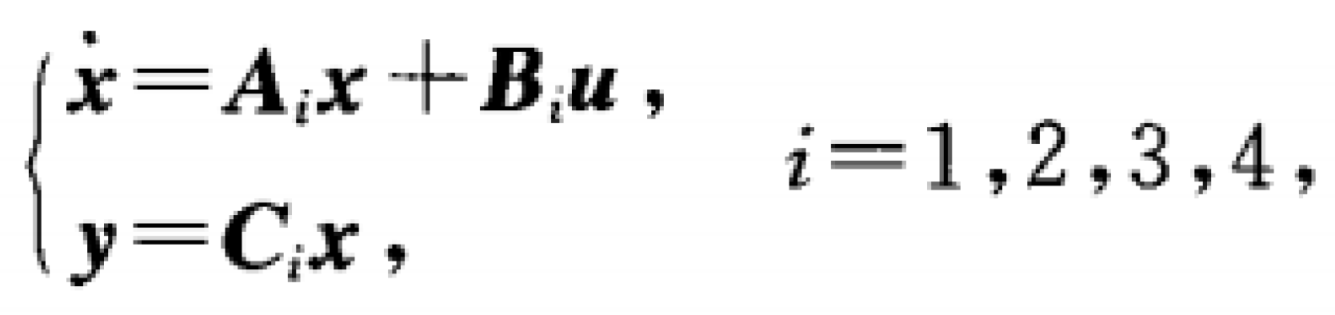
Among
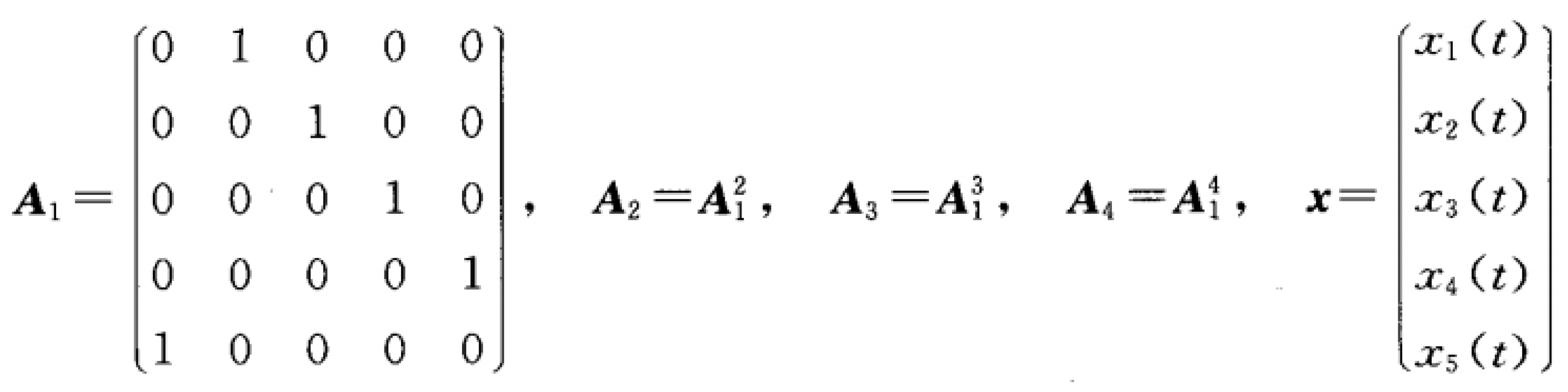
They respectively represent the generating matrix, inhibiting matrix, restraining matrix, sub-sickness and mother matrix, and the five-element state vector of the human body. U represents the system input, and Y represents the system output.
The research on these models mentioned above is mostly still in the exploratory stage and has not yet formed a comprehensive research system. The models developed through these studies are primarily theoretical models and lack empirical validation. Most of the models are unable to assign parameter values, and if they do, they are typically derived through theoretical simulations. [35]
The above discussion provides some insights into the research progress and methods of quantitative analysis of the Five Elements Theory. The quantitative analysis of the Five Elements Theory remains a relatively new research field, and there may be other recent developments and representative articles related to this topic.
4. Mixed quantization method
4.1. Mixed Quantization: Fortune Curve
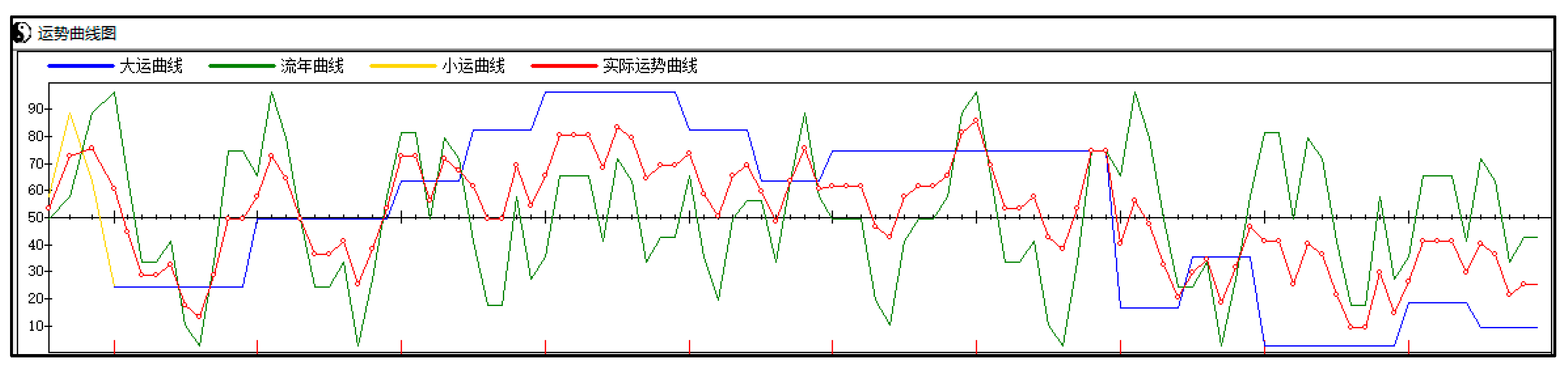
With the advancement of computer technology, some researchers have employed computational simulation methods to explore the divination principles of the Book of Changes (Yi Jing). They have focused on exploring the interrelationships between Yin and Yang, the Five Elements, Heavenly Stems and Earthly Branches, and the concepts of prosperity and decline within the Yi Jing. Through the use of assigned values, they have made progress in conducting comprehensive quantitative analysis. Among them, the XuanAo software series developed by Fan Xunrong is considered representative. For example, the XuanAo Bazi software uses quantitative analysis to derive corresponding variable curves. This software, developed based on divination culture, incorporates destiny parameter settings. Its unique "fortune trend curve" helps users understand their future destiny trends. [36]See Figure 6.
4.2. Quantization method of the five elements of the main branch: Lee Quantization method.
In order to measure the strength of Heavenly Stems and Earthly Branches, as well as the power of the Five Elements, scholar Li Hongcheng referenced various quantification methods and designed a method for calculating the scores of the Five Elements. Li Hongcheng's quantification method involves five steps: [37]
(1) Initial assignment of Heavenly Stems and Earthly Branches
Each pillar in the Four Pillars of Destiny is composed of Heavenly Stems and Earthly Branches. Each Heavenly Stem is assigned a value of 100 points, and each Earthly Branch is also assigned a value of 100 points. However, some Earthly Branches contain Heavenly Stems. For example, the Earthly Branch Shen contains the Heavenly Stems Geng, Ren, and Wu. In this case, Geng is 60 points, Ren is 30 points, and Wu is 10 points.
(2) Quantification of the prosperity and decline of the Five Elements
For a specific Five Element, the score in the prosperous state is 2, the score in the phase state is 1.414, the score in the dormant state is 1, the score in the captive state is 0.707, and the score in the deceased state is 0.5.
(3) Monthly coefficients for the Five Elements
Each of the Five Elements has five different states of prosperity, decline, dormancy, being captive, and being deceased in each month. Therefore, the prosperity and decline of each Five Element in a specific month becomes complex. For example, for the metal element in the month of Shen, it is prosperous with Geng, dormant with Ren, and in the phase state with Wu. Based on the quantification values of the Five Elements in each state, we can determine that the score of metal in the month of Shen is: prosperous with Geng (score = 2 * 60/100 = 1.2), dormant with Ren (score = 1 * 30/100 = 0.3), and in the phase state with Wu (score = 1.414 * 10/100 = 0.1414). Finally, the total score of metal in the month of Shen is calculated as 1.2 + 0.3 + 0.1414 = 1.641, which is referred to as the monthly coefficient of the Five Elements.
(4) Calculation of final values for each Five Element
Multiply the initial values of each Five Element by their respective monthly coefficients to obtain the final values.
(5) Analysis of prosperity and decline
Based on the final values of each Five Element, specific states of prosperity, neutrality, and decline are defined. States between 280 and 660 are considered prosperous, with 280-329 being excessively prosperous, 330-659 being extremely prosperous, and above 660 being exceptionally prosperous. States between 140 and 279 are considered neutral, with 140-179 being balanced, 180-229 being slightly prosperous, and 230-279 being partly prosperous. States between 40 and 139 are considered declining, with 139-90 being declining and weak, 89-40 being declining, weak, and depleted, and below 40 being declining and prone to illness.
4.3. Other mixed quantization methods
The author also attempted to use the system dynamics model to simulate the five elements. However, the construction method of the system dynamics model did not accommodate the feedback loops inherent in the relationships between the five elements. As a result, it was not possible to model the five elements effectively using the general system dynamics approach. Additionally, the author's team employed a one-dimensional cellular automata model to analyze the evolution of divination, in a similar vein to Steven Wolfram's article published in Nature in 1984. However, due to the different rules of evolution compared to one-dimensional cellular automata, the results of the analysis were not satisfactory.
Guo Junyi [38] proposed a new concept called "easy calculation." This concept unveils a general quantitative method for transforming the qualitative content of the Yijing into quantitative measures, allowing for a more seamless integration of Yijing principles with modern science. In essence, it can be considered a form of "fortune-telling" that explores and calculates the patterns of human life using the thinking mode of the Yijing and leveraging modern scientific and technological advancements. Of particular note, the easy calculation algorithm can convert qualitative problems that pose challenges in quantification into concrete operational calculation programs. The underlying theoretical basis for achieving this transformation lies in the thinking mode and methodology of "image, numeration, and reasoning" employed in the Yijing.
5. Summary and prospect
Since the evolution of Yijing, scholars in the East and the West have basically reached a consensus that the core idea of Yijing is "change". It emphasizes that change is inevitable under certain laws and needs to be actively dealt with. The divination prediction in Yijing is to guide people to walk out of a suitable road, seek advantages and avoid disadvantages, and make people's lives smoother. When encountering problems or challenges, you can use Yijing for prediction and decision-making reference, so as to take the most appropriate action. This may be the common wish of all researchers.
From the above research, it can be seen that whether it is to establish differential equations by borrowing, to carry out computer simulation with assumptions and simulation data, or to analyze and study the five elements theory of traditional Chinese medicine by using mathematical methods such as tangent function, Boolean network and matrix, [39] It is basically obtained by the assignment of theoretical simulation parameters and lacks empirical test. To study the five elements theory of TCM from the perspective of mathematical quantification, the description methods adopted by researchers are difficult for scholars in the medical field [40], there is no unified language or symbol in the cross study of mathematics and traditional Chinese medicine, and its internal laws cannot be revealed by mathematical methods. [41] If the proven research results can be standardized into an authoritative system for promotion, and the classic model of the five elements theory of traditional Chinese medicine can be expressed in modern language or mode, it will be more conducive to the development of the intersection of mathematics and traditional Chinese medicine.
Up to now, few people have done the calculation of the sublimation nature of Yijing, which is similar to the time wave theory or Yijing. Binary system, time wave, easy ball and so on are all different from China scholars' ways of thinking about the quantification of Yin-Yang and Five Elements. This kind of research that comes from Yijing and is higher than Yijing is still very scarce. At the same time, we should also see that even the time wave theory has some problems, because it is based on the divinatory order of Wen Wang, and the divinatory order of Wen Wang itself is controversial Once the waveform changes due to rough calculation, the prediction may lose its feasibility. This is also the focus of Watkins' objection.
In the future, the quantification of Yijing may need to be realized based on machine learning and deep learning. Because Yijing holds that all changes have their inherent motivations and laws, but these motivations and laws are not fixed, but constantly evolve and update with the changes of the times and environment. Therefore, Yijing not only provides a set of static prediction methods, but also provides a set of dynamic learning methods, that is, through observation, comparison, induction, summary and other ways, constantly revise and improve their understanding and grasp of the changes in everything. This method is similar to the machine learning and deep learning techniques used in modern artificial intelligence, and both use the characteristics and laws contained in the data to learn and optimize. It is also possible that through the development of ChatGPT, the quantitative problem of Yijing can be solved essentially, and the spatio-temporal modeling analysis can be carried out by constructing a new coordinate system.
Acknowledgments
Xin Yang and Dongya Liu have given a lot of help in the quantitative study of Yijing, including the experiments of one-dimensional cellular automata, two-dimensional cellular automata and agents.
References
- Xiuwenju. Modern Development Course of "Science Easy". Academic Exchange, 2017(12):26-32.
- Zheng, X.; Cao, Y. Big data reveals the change characteristics of 64 hexagrams and lines. Preprints 2023, 2023080208. [Google Scholar] [CrossRef]
- Zheng, X.; Cao, Y. Big Data Analyzing the Asymmetry of 64 Hexagrams Based on the Yarrow-stalk Method. Preprints 2023, 2023081347. [Google Scholar] [CrossRef]
- Zheng, X.; Liu, H.; Zhang, G. One Kind Method for Constructing Knowledge Graph of Yijing. Preprints 2023, 2023090996. [Google Scholar] [CrossRef]
- Sun Guangcai. Combinatorial Theory in "Guabian Diagram" in Yijing. Journal of Weinan Teachers College, 1995(S3):42-45.
- Sun Mingchen. On the Structure of Zhouyi. Harbin Normal University, 2020.
- Peter Meyer,Terence Mckenna. TimeWaveZero software. https://www.fractal-timewave.com/.
- McKenna, Terence & McKenna, Dennis. The Invisible Landscape: Mind, Hallucinogens, and the I Ching. Seabury Press,New York,1975.
- http://www.viewzone2.com/timewavex.html.
- https://www.fractal-timewave.com/articles/math_twz_10.htm.
- https://www.fourmilab.ch/rpkp/autopsy.html.
- Storm, L. A PARAPSYCHOLOGICAL INVESTIGATION OF THE I CHING: THE RELATIONSHIP BETWEEN PSI, INTUITION, AND TIME PERSPECTIVE1. The Journal of Parapsychology, 2006, 70(1): 121.
- http://www.i-ching.hu/chp00/chp2/reconstruct.htm.
- Guo Hongtao. On the arrangement of the five elements of traditional Chinese medicine from the perspective of image mathematics. Journal of Guiyang College of Traditional Chinese Medicine, 1995(01):17-18.
- Guo Junyi. On "Easy Calculation" Algorithm. Qilu Zhutan, 2000(02):18-20.
- Zhao Xixin. Mathematical Model of Yin-Yang Theory in TCM. Henan Traditional Chinese Medicine, 1997,17( 5) :264-265.
- Liu Yao. A preliminary study on mathematical thinking and methods in the theory of traditional Chinese medicine: on the application of tangent function in the theory of five elements of traditional Chinese medicine. Journal of Yunnan College of Traditional Chinese Medicine, 1999,22( 4): 51-53.
- Zhai Zhongxin. A Mathematical Model of Yin-Yang Theory in TCM. Journal of Mathematical Medicine, 1999,12( 4): 302-304.
- Lin Zongzhen, Yang Guanqun. Try to build a mathematical model of Yin-Yang theory of traditional Chinese medicine. Journal of Jinan University (Natural Science Edition), 2003,24( 5): 23-29.
- Zhao Zhiyong, Zhao Wei. Establishment of mathematical model of Yin-Yang theory of traditional Chinese medicine and quantitative study of calculus. Sichuan Traditional Chinese Medicine, 2005,23( 11): 8 -10.
- Guo Wenyi, Wu Jiaqi, Wang Shuai. Modeling and Solution of Five Elements System. Journal of shanghai second polytechnic university, 2008,25( 4): 254-256.
- Yu Zhenfeng. Mathematical Model of Traditional Chinese Medicine. Journal of Mathematical Medicine, 2007,20 (6) :747-750.
- Ding Zhan 'ao. Establishing the Mathematical Model of the Theory of Yin-Yang and Five Elements. Journal of Natural Science of Heilongjiang University, 1993,10( 2): 59-62.
- Jin Chen. Mathematical Modeling of Traditional Chinese Medicine. Journal of Mathematical Medicine, 2002,15( 6): 489-491.
- Zhao Wei, Zhao Zhiyong. Mathematical model of the Five Elements Theory and the solution of its differential equations. Sichuan Traditional Chinese Medicine, 2006,24( 11): 7-9.
- DAI Yong-sheng. Study on mathematical model for five aspects. Liaoning Journal of Traditional Chinese Medicine, 1998, 25(10): 451-453.
- MENG Kai-tao. Mathematics of Yi-Yang and five elements and its application in traditional Chinese Medicine[J]. Acta Unive rsitatis Traditionis Medicalis Sinensis Pharmacologicaeque Shanghai, 2007, 21(6): 4-9.
- LI Xiao -wei, WANG Yi -min, LIU Xia, ZHANG Yan. The summarization on the quantitative models of five elements. BME & Clin Med, 2012, 16(4):411-414.
- Li Shujing. Genetic Algorithm and Easy Algorithm. Zhouyi Research, 2002(01):66-72.
- Lin Lvduan. Yijing and Fuzzy Mathematics. Journal of Fuzhou Teachers College, 2002(02):116-118.
- Hu Huakai. Mathematical Demonstration of Five Elements Theory. Science, Technology and Dialectics, 1995(05):38-42.
- Gu Licui. Mathematical model and affine generalized Cartan matrix of the five elements theory of traditional Chinese medicine. Heilongjiang Medicine, 2010,23(01):77.
- Wu Dawei, Fan Xu, Ai Qun, et al. Mathematical Structure of Thinking Model of Five Elements Theory. China Journal of Basic Medicine of Traditional Chinese Medicine, 2008(04):308-311.
- Fang Qingxiang, Wang Wei. Study on the Thinking Model of Five Elements Theory in TCM. University Mathematics, 2011,27(06):100-104.
- Zhang Lei,Yan Guangdong.The Summarization on the Quantitative Models of Yin-yang and Five Elements. CHINA JOURNAL OF CHINESE MEDICINE,2010,25(03):445-447.
- http://www.fpwap.com/game250060/.
- https://www.docin.com/p-2653149420.html.
- Guo Junyi. Yijing and Yijing. Zhouyi Studies, 1997(02):80-83.
- LI Dong-tao. Inspiration of complexity science to traditional Chinese medicine theory research. Journal of Anhui Traditional Chinese Medical College, 2010, 29(6): 4-5.
- DENG Tie-tao, ZHENG Hong. Study on the theory of five organs correlation--from five elements to five organs correlation[J]. Engineering Sciences, 2008, 10(2): 7-13.
- Li Xiaowei, Wang Yimin, Liu Xia, et al. Summary of mathematical quantitative research on the theory of five elements in traditional Chinese medicine in recent years. biomedical engineering and clinical medicine, 2012, 16(4):4.
Figure 1.
McKenna time wave curve (local part).
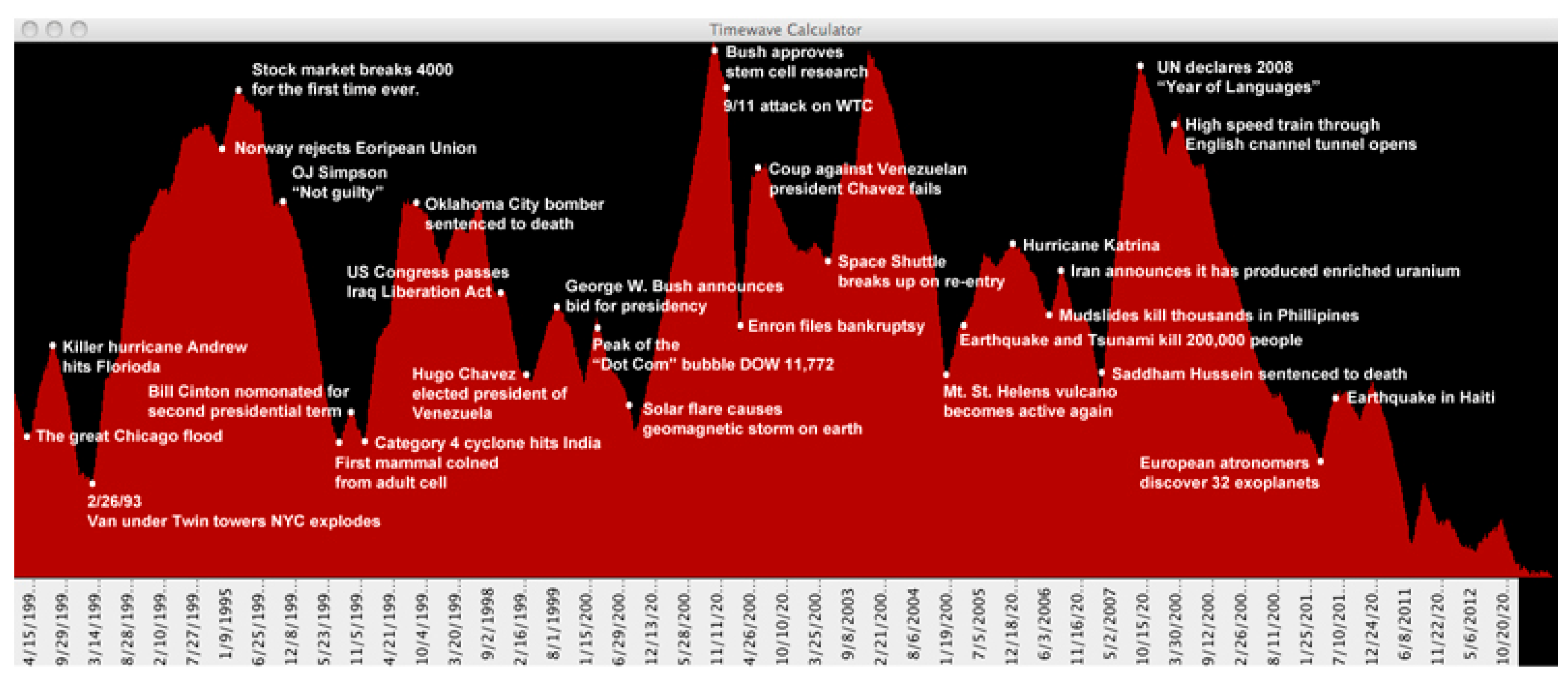
Figure 2.
Partial enlargement of fractal time wave. Note: You can see that the same pattern is used to draw two different eras. The graph at the bottom spans nearly 150 years, while the graph at the top spans about 1.5 years.
Figure 2.
Partial enlargement of fractal time wave. Note: You can see that the same pattern is used to draw two different eras. The graph at the bottom spans nearly 150 years, while the graph at the top spans about 1.5 years.
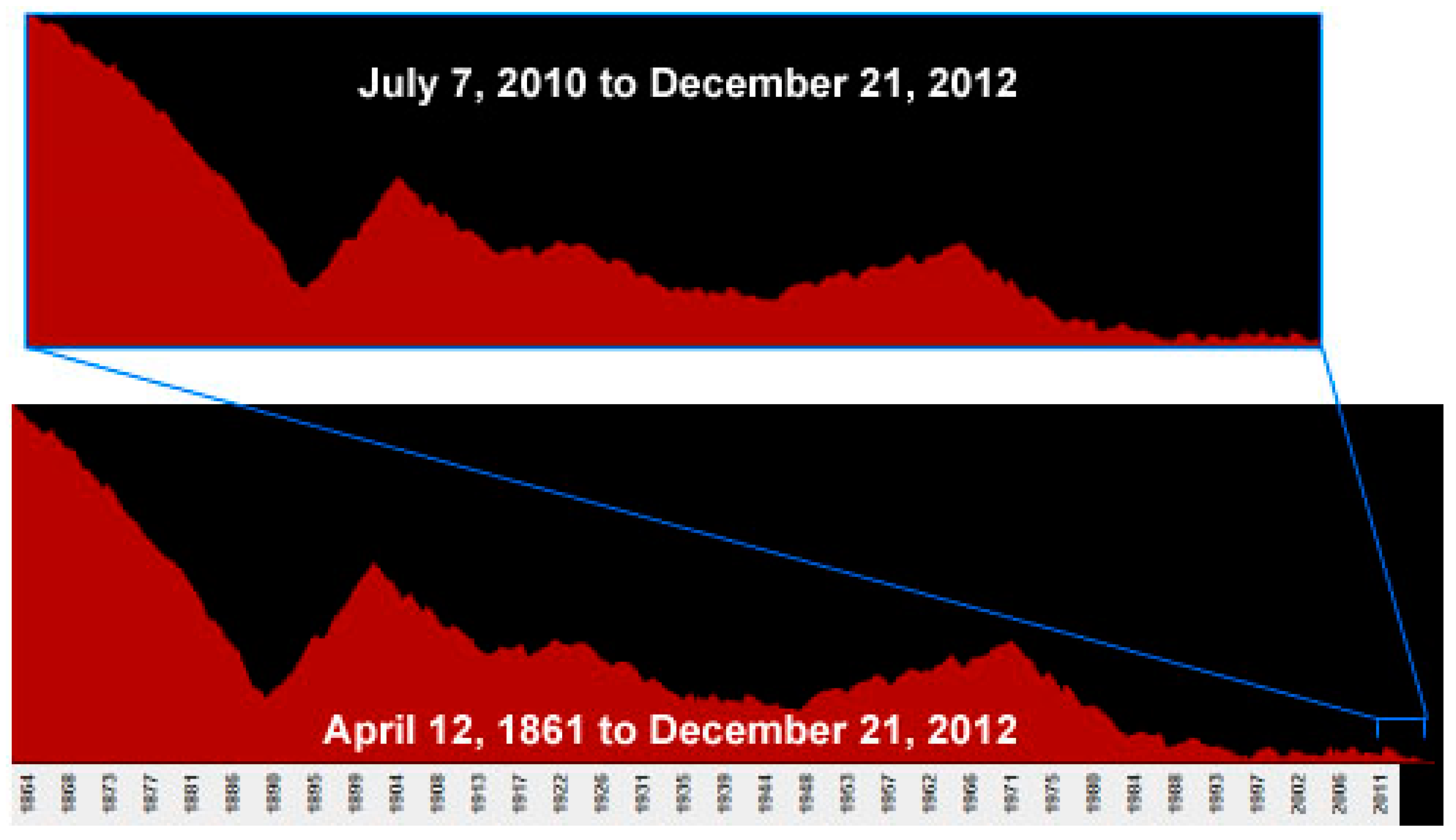
Figure 3.
Graphic comparison between Mckenna and Watkins. Note: The two pictures are similar in general, but there are some differences, such as May 9th.
Figure 3.
Graphic comparison between Mckenna and Watkins. Note: The two pictures are similar in general, but there are some differences, such as May 9th.
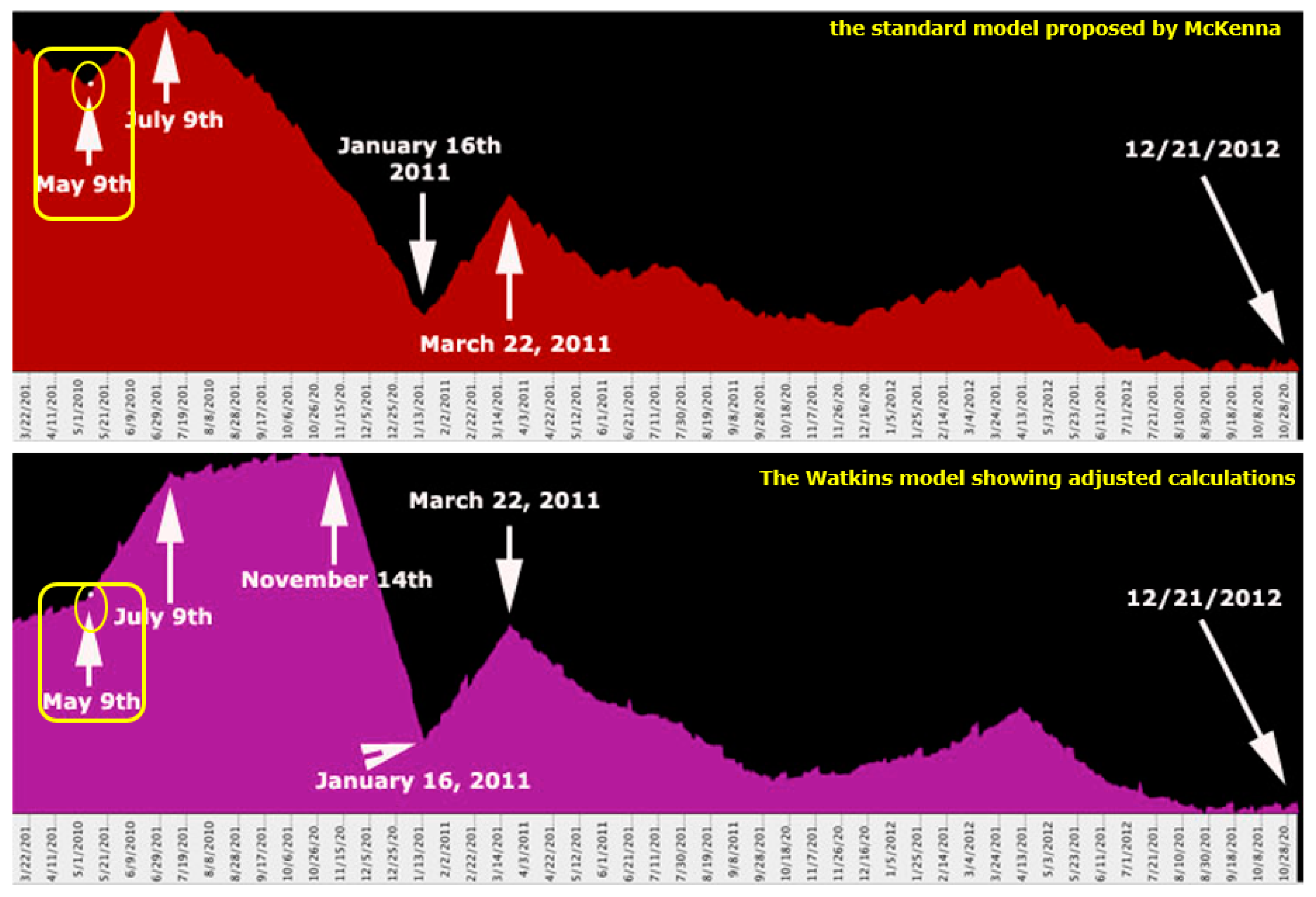
Figure 4.
Schematic diagram of key links of easy ball construction.

Figure 5.
Principle matrix of five elements generating each other.
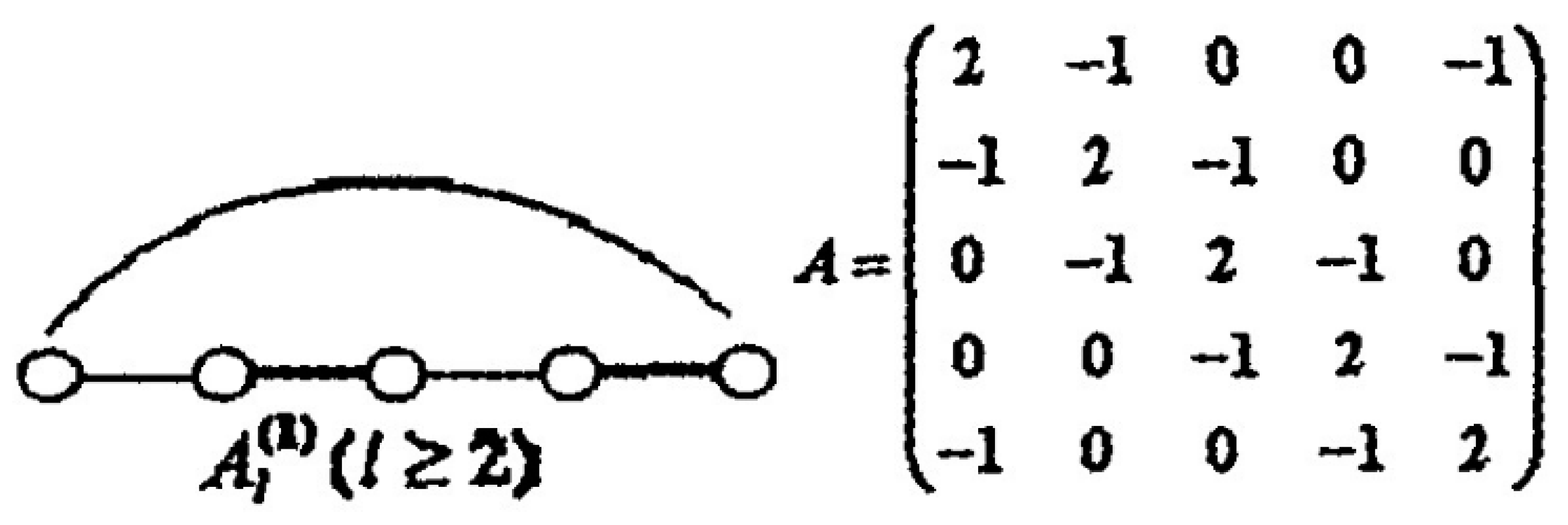
Figure 6.
Schematic diagram of fortune curve of arcane eight-character software.
Disclaimer/Publisher’s Note: The statements, opinions and data contained in all publications are solely those of the individual author(s) and contributor(s) and not of MDPI and/or the editor(s). MDPI and/or the editor(s) disclaim responsibility for any injury to people or property resulting from any ideas, methods, instructions or products referred to in the content. |
© 2023 by the authors. Licensee MDPI, Basel, Switzerland. This article is an open access article distributed under the terms and conditions of the Creative Commons Attribution (CC BY) license (http://creativecommons.org/licenses/by/4.0/).
Copyright: This open access article is published under a Creative Commons CC BY 4.0 license, which permit the free download, distribution, and reuse, provided that the author and preprint are cited in any reuse.


