

Submitted:
08 March 2024
Posted:
11 March 2024
You are already at the latest version
Abstract
Ambitious biodiversity goals to protect 30% or more of the Earth’s surface by 2030 (30x30) require strategic near-term targets. To define areas that must be protected to prevent the most likely and imminent extinctions, we propose Conservation Imperatives—16,825 unprotected sites harboring rare and threatened species and spanning ~164 Mha of the terrestrial realm. We estimate that protecting the Conservation Imperatives would cost approximately US\(169 billion [90% probability: \)146 — \(228 billion]. Globally, 38% of the 16,825 sites are either adjacent to or within 2.5 km of an existing protected area, potentially reducing land acquisition and management costs. These sites should be prioritized for conservation action over the next five years as part of a broader strategy to expand the global protected area network. The expansion of global protected areas between 2018–2023 incorporated only 7% of sites harboring range-limited and threatened species, highlighting a renewed urgency to conserve these habitats. Permanently protecting only 0.74% of land found in the tropics, where Conservation Imperatives are concentrated, could prevent the majority of predicted near-term extinctions once adequately resourced. We estimate this cost to be US\)29 billion to US$46 billion per year over the next five years. Multiple approaches will be required to meet long-term protection goals: providing rights and title to Indigenous Peoples and Local Communities (IPLCs) conserving traditional lands, government designation of new protected areas on federal and state lands, and land purchase or long-term leasing of privately held lands.
Keywords:
Conservation imperatives
; 30 by 30
; Protected area targets
; Rare species
; Land cover fraction mapping
; Geospatial analysis
; Land costs analysis
Introduction
In late December 2022, at the United Nations Convention on Biological Diversity’s 15th Conference of Parties (COP15), more than 190 parties adopted the 30×30 target—to protect at least 30% of the world’s lands, oceans, and inland waters by 2030 (Convention on Biological Diversity, 2022). Conservation biologists, Indigenous Peoples, science-based NGOs, corporate leaders, and others have endorsed the 30×30 target and also called for protecting half of the terrestrial realm to have the best chance for humanity to reverse biodiversity loss, stabilize Earth’s climate, prevent ecosystem collapse, and avoid future pandemics (Locke, 2015; Pimm et al., 2018; Dinerstein et al., 2020; IUCN World Conservation Congress, 2021). Either goal—30% protected or 50% protected—will encourage protection of large areas of land to meet targets, but this strategy can easily result in underrepresentation of biodiversity (Kuempel et al., 2016). Land protection targets must account for the urgency of preventing numerous species extinctions and extirpations of small, rare, and range-restricted populations.
The purpose of this paper is to offer a science-based strategy to secure and protect the remaining homes of rare and endangered species through timely, affordable investments in land acquisition and habitat conservation. To this end, we introduce the term Conservation Imperatives, defined as currently unprotected sites that contain rare, threatened, and narrow-range endemic species. Specifically, our approach is to map unprotected sites harbouring rare species while accounting for converted habitat and estimate costs to put these lands under conservation stewardship. We also seek to determine progress in protection of global sites of rarity from 2018-2023. Finally, we outline new efforts to leverage Conservation Imperatives to finance protection where immediate focus is needed and create anchor points for wider conservation planning under a five-year global strategy.
Advancing Conservation Imperatives is a global prioritization scheme in the sense that preventing extinctions is proposed as an immediate conservation target. We strive for maximum buy-in by all nations, Indigenous groups, and local communities who have jurisdiction over such lands to preserve opportunities for expanding protection to Conservation Imperatives. We intentionally avoid prioritizing among the sites at a global scale. The maps and data we present here should be used as a starting point for subsequent ecoregion-based or regional prioritizations within each realm. A rich literature on systematic conservation planning and reserve design can inform methodologies for evaluating and delineating proposed sites at a regional level (Margules and Pressey, 2000; Bottrill and Pressey, 2012; Watts et al., 2017; Wolff et al., 2023). Local teams of experts in each country can also take advantage of higher-resolution spatial data—for species distributions, population viability of threatened species, representation of rare habitats, land cover, extent of degraded lands, restoration potential, connectivity options, threats from development, extensive records of land purchase or leasing prices, and feasibility of conservation effort—often unavailable in global assessments. These essential planning efforts reinforce local ownership of Conservation Imperatives and will help reduce extinction risk by considering likely future conditions in each region.
Methods
Species Rarity Layer
We combined six widely used data layers employed in published global biodiversity assessments to identify sites supporting rare, narrow-range endemic, and endangered species (Dinerstein et al., 2020). Using the latest dataset of global protected areas (UNEP-WCMC and IUCN, 2023) as our base map, we sequentially intersected polygons identified as supporting rare and threatened species to avoid double counting of the overlapped areas. These include Alliance for Zero Extinction (AZE) sites, the range-restricted rarity of forest species, the IUCN Red List, Key Biodiversity Areas (KBAs), a second estimator of range-restricted rarity among vertebrates, and range-restricted vascular plants. For more details on construction of the species rarity layer, see Dinerstein et al. (2020) (SM Table 1). The total extent of these six data layers, minus the area covered by global protected areas, determines the remaining unprotected segment, which defines the extent of Conservation Imperatives (Figure 1). This layer of species rarity was then refined using the fractional land cover analysis described below.
For freshwater species, which are on average more endangered than terrestrial species, we relied on the same data layers because: 1) the life histories of some of the most endangered vertebrates in the IUCN Red List of Endangered Species (Layer 3, see Figure 1) could be considered freshwater, rather than terrestrial species, or at least freshwater-dependent. These taxa include amphibians and some reptile groups; 2) the IUCN Red List polygons (Layer 3) also contain the spatial distributions of several relatively well-studied freshwater taxa for which range maps exist. These include: freshwater turtles, freshwater fish, freshwater crabs, freshwater molluscs, freshwater crayfishes and shrimps, odonates (dragonflies and damselflies), and some aquatic plants; 3) more than half of all endangered vertebrates in the Alliance for Zero Extinction layer (Layer 1) are amphibians.
Fractional Land Cover Analysis
We introduced a fractional land cover analysis to derive a more accurate estimate of the true Area-of-Habitat (hereafter “AoH”) for rare and threatened species because published range data contain varying amounts of agricultural, pastoral, and urban lands. The uneven resolution of the most widely used global biodiversity layers, coupled with rapid land-use change from conversion to agriculture and urbanization, results in many species rarity sites now containing areas of non-habitat. To identify and remove non-habitat, we used Copernicus Global Land Cover Layers CGLS-LC100 Collection 3 at 100 m resolution (Buchhorn et al., 2020) (hereafter “Copernicus data”) and Google Earth Engine (Gorelick et al., 2017) to generate a land cover map that includes fractions of all land cover types occurring in a pixel at 100 m resolution.
We used seven classes to create the fractional layer: Forest, Shrub, Grass, Crop, Urban, Bare Ground, and Permanent Water (inland water bodies). We defined Forest using percent tree cover in the Copernicus data that varied by biome, and set cutoff levels based on expert knowledge in each biome and their distinguishing ecological characteristics. Forest is defined as pixels with tree cover fraction > 80% for the Tropical forest biome, > 50% for the Temperate forest biome, and > 30% for the Boreal forest and Mangrove biomes. To differentiate desert habitat from bare ground in the Desert and Xeric shrub biome, desert is defined as > 70% bare soil and bare ground is defined as 50-69% bare soil in this biome. For all other cover types, we did not differentiate percent cover among biomes. Shrub cover is defined as pixels with shrub cover fraction ≥ 30%; Grass as grass cover fraction ≥ 50%; Bare ground as bare cover fraction ≥ 50%; Urban as urban cover fraction ≥ 10%; Permanent Water (inland) as permanent water cover fraction ≥ 30%; and Crop as cropland cover fraction >1% (to avoid any potential cultivated areas).
The species rarity layer and the fractional land cover map were overlaid to calculate the contribution by different cover types to unprotected polygons (Figure 1). To calculate the AoH (Brooks et al., 2019) in species rarity sites, we masked all land in the Crop, Urban, and Bare Ground cover types. We recognize that crops and bare ground can represent suitable habitat for some species that are threatened or have restricted ranges. Evaluating these individual species’ requirements is, however, beyond the scope of this global assessment. In instances where the fractional land cover analysis resulted in small isolated fragments of rare species habitat surrounded by developed or cultivated land, fragments smaller than 1 ha were removed, due to high near-term conversion risk. Finally, we overlaid the resulting species rarity layer with the world’s 846 terrestrial ecoregion boundaries to be able to categorize Conservation Imperatives by ecoregion (Dinerstein et al., 2017). The result of these sequential overlays allows us to identify Conservation Imperatives (Figure 1).
Adjacency Analysis
To determine the adjacency of Conservation Imperatives to existing reserves mapped in the World Database on Protected Areas (WDPA) layer (Figure 1), we buffered protected areas by 2.5 km and assessed which sites fell within this buffer. For this exercise we assumed that site protection and management could be easier as the expansion of existing protected areas or corridor establishment. We chose 2.5 km as the upper limit based on the minimum corridor width recommended for the largest terrestrial vertebrates (elephants) to move between isolated patches of habitat (Beier, 2019).
Cost Assessment
Establishing accurate spatial delineation of Conservation Imperatives sets the stage for estimating the expected costs of protected area designation. Previous assessments of costs for conservation at the global scale have relied on extrapolation of land values based on agricultural and pastoral potential (Naidoo and Iwamura, 2007; Strassburg et al., 2020). Despite recent calls for datasets reflecting the real costs of land for conservation (Coomes et al., 2018; White et al., 2022), comprehensive datasets remain unavailable. Complicating this xestimation is that multiple stewardship mechanisms with different cost implications—such as private land purchase, leasing of community reserves and forests, re-establishing Indigenous land rights, and government re-designations—affect the true total costs to protect sites harbouring rare species. Using actual data on costs to place land under conservation stewardship can provide a clearer approximation of the resources required to secure critical sites for biodiversity (Coomes et al., 2018).
To estimate the cost of securing Conservation Imperatives sites in the tropical belt, we collected empirical data from land protection projects occurring between 2008 and 2022, fit generalized linear regression models, and applied a simulation approach. Our dataset consisted of 1,016 projects compiled from IUCN Netherlands, the Quick Response Fund for Nature, and World Land Trust (Quick Response Fund for Nature, n.d.), supplemented by unpublished data from other NGOs focused on land purchase that met our criteria for inclusion. These organizations regularly fund land acquisition, designation, and protection projects globally, with a higher concentration in the tropics. This portfolio includes a range of projects, including expansion of existing parks and community reserves, establishment of privately protected areas, and creation of community forest reserves. Acquisition costs cover the purchase price and legal and notary fees, which were as much as 10% of the acquisition cost. For leased land projects of varying lengths, we calculated an annual value and then extrapolated the cost per hectare for 10 years, the dataset’s median lease length. We adjusted all costs to 2023 dollars to account for inflation. We removed projects with incomplete information on location, purchase cost, purchase size, and lease length. After cleaning the dataset, the remaining locations contained 833 sites distributed across all 6 major realms and 14 biomes (SM Figure 1).
We next fit linear regression models to the empirical cost per hectare of land protection projects. We used a log transformation on cost-per-hectare values to reduce skew and create an approximately normal distribution. We hypothesized that land value could be influenced by biogeographical realm, region, ecoregion, the area of land being secured, type of land acquisition, and country-level economic factors (Tulloch et al., 2021; Dinerstein et al. 2020). We used the following covariates as predictors: realm, size of acquisition, type of acquisition (categorized into purchase or lease), national per capita GDP, and country population size (World Bank, 2022). All continuous covariates were scaled and centered for interpretation. The mean per capita GDP and population were extracted based on the country in which the project occurred between 2010 and 2020. A random effect for data source was added to account for possible variation among the groups that supplied project data. We fit candidate models and used Akaike Information Criterion and conditional R2 values to select the most informative model for land value (MuMin R Package; Burnham and Anderson, 2004). We tested for correlations among continuous covariates and excluded variables with R > 0.65 prior to the analysis (Dormann et al., 2013). We also tested for multiple collinearity using the variance inflation factor (Dormann et al., 2013). Neither test required removal of covariates.
To calculate the price to place Conservation Imperatives under conservation stewardship, we used Monte Carlo simulations (Mooney, 1997) to estimate cost per hectare and total land value of all sites under simulated purchase scenarios. Each simulation used the land value model to predict the cost per hectare of each Conservation Imperatives site using random values for acquisition size (assuming multiple smaller purchases would be needed to secure large sites), acquisition type (assuming a mix of purchase and lease), and data source, and determined land value by multiplying the predicted cost per hectare by the known size of the site. We ran 10,000 simulations with random values drawn from distributions parameterized by realm. Total cost estimates were calculated as the mean across all simulations, and we used 90% probability distributions to measure uncertainty. We used this approach to determine the total cost to place all Conservation Imperatives in the tropical belt under conservation stewardship. We then identified the top 10 ecoregions in each realm harbouring the most Conservation Imperatives and assessed the price to conserve those sites by ecoregion. We converted all results to US dollars per square kilometer to keep units comparable to the fractional analysis. Code used for model fitting and simulation can be found in the supplementary materials.
Representation of Species Rarity Among Newly Created Protected Areas
To determine if the increases in the global protected area estate over the last five years have effectively addressed rare and endemic species exposed to the greatest risks of extinction, we intersected the Conservation Imperatives polygons with the most recent map of the WDPA, using protected area categories 1-7 (April 2023) (UNEP-WCMC and IUCN, 2023). We predicted that new reserves created during 2018-2023 would cover > 50% of the Conservation Imperatives.
Results
Fractional Land Cover Analysis
We identified 16,825 sites harbouring rare and threatened species, covering ~164 Mha or 1.22% of the Earth’s land surface (Figure 2). This AoH represents a 46% reduction from earlier estimates based on published compilation of identified areas of importance for rare and threatened species (e.g. KBAs, Red List sites; Dinerstein et al., 2020). Most of these reductions occurred in large blocks of unprotected habitat rather than in smaller fragments.
Reduction in total AoH harbouring unprotected rarity differed by latitude and by biome. In the four major tropical realms, we found a 45% reduction in total land area. In the non-tropical realms, we estimated a 49% reduction in area (Table 1). Within biomes that comprise the tropical realms, tropical and subtropical dry broadleaf forests underwent the largest reduction in target habitat (77%), followed by tropical and subtropical coniferous forests (58%). Tropical and subtropical moist broadleaf forests, which contained the highest concentration (75%) of Conservation Imperatives, had a 49% reduction in area (Figure 3; Table 2).
Conservation Imperatives
Conservation Imperatives are highly concentrated. We found a distinct skew in the distribution of the 16,825 sites harbouring unprotected rarity across biogeographic realms and biomes (Figure 2; Table 3 and Table 4; SM Table 2). The majority of unprotected sites fall within the tropical and subtropical moist forests biome. Within the same biome but sorted by realm, the Neotropics had the most sites (38% of all Conservation Imperatives), followed by the Indomalayan (34%), Australasian (18%), and Afrotropical (9%) realms. Sites were also clustered within realms. The ten ecoregions with the most Conservation Imperatives within the four major tropical realms account for 63.5% of all sites globally (Figure 4; Table 5). The top five countries in the world with the highest number of Conservation Imperatives include the Philippines, Brazil, Indonesia, Madagascar, and Colombia, together accounting for 59% of all sites globally. Over 87% of all Conservation Imperatives occur in just 30 countries (Table 6).
Representation of Species Rarity Among Newly Created Protected Areas
We predicted that >50% of new protected areas designated between 2018 and 2023 would overlap with unprotected species rarity sites. We estimated that 1.2 million km2 was added to the global protected area estate over this five-year time period (UNEP-WCMC and IUCN, 2023). Of that, the largest extent was located in two ecoregions (#473 Japura-Solimões-Negro Moist Forests and #831 North Arabian Desert, totalling 192,000 km2), but based on our analysis these additions had very little overlap with areas harbouring rare and threatened species. In fact, over this same time period only 109,779 km2, or less than 7% of identified Conservation Imperatives have been added to the World Database on Protected Areas (Figure 5), leaving the vast majority of these sites at risk of conversion and degradation. Expressed slightly differently, had the 1.2 million km2 set aside during 2018-2023 included only Conservation Imperatives, 73% of these sites globally would now be under protection.
Cost Analysis
The model of land acquisition costs per hectare that included realm, purchase type, purchase size, per capita GDP, and population size performed best and had an R2 of 0.76 (SM Table 4). Among the variables we tested, acquisition size (-0.67, 95% CI [-0.71, -0.64]; larger acquisitions had lower per-ha costs), acquisition type (0.97, 95% CI [0.66, 1.28]; purchases were more expensive than leases), and realm were the most useful predictors, and explained much of the model variation on their own. We also found that higher per capita GDP (0.18, 95% CI [0.07, 0.28]) and human population density (0.03, 95% CI [0.02, 0.08]) increased land prices (SM Table 4).
In Monte Carlo simulations of the land cost for Conservation Imperatives, we found that total cost of the Conservation Imperatives in the tropics is US$169 billion, with a 90% probability between US$146 and $228 billion (SM Figure 2). Much of this uncertainty appeared to come from variations in the size and type (purchases and leases) of land acquisitions. Land acquisition was least expensive in Australasia and most expensive in Indomalaya, but somewhat similar in the other realms (Table 7, SM Figure 2b). The Afrotropical, Indomalayan, and Neotropical realms showed the largest variation in predicted total cost, which appeared to arise from larger cost differences between lease arrangements and purchases and the number of sites that were either leased or purchased in each simulation (SM Figure 2). Land costs for the top 10 ecoregions—ranked by number of species rarity sites—from each of the four major tropical realms would be US$59.4 billion (90% probability of US$29–$108 billion), safeguarding 63% of all sites (Figure 4; Table 5). To cover Conservation Imperatives at all latitudes, the total cost increases to US$263 billion (90% probability of US$204–339 billion).
Adjacency Analysis
Adjacency analysis of Conservation Imperatives sites to existing protected areas revealed that 38% (SD = 36.01) of the 16,825 sites either bordered or were within 2.5 km of a nearby existing protected area (Table 6). The five countries with the most Conservation Imperatives had at least 20% located next to existing protected areas (SM Figure 3). Colombia ranked highest among the top 30 countries with 56% of all Conservation Imperatives bordering protected areas.
Discussion
Key Findings
Five key insights emerging from this study elevate the need to prioritize the conservation of rare and threatened species and their habitats as an urgent near-term target within a larger global biodiversity strategy: 1) Conservation Imperatives identified in this study represent a mere 1.2% of the Earth’s terrestrial surface (0.74% in the tropical belt); 2) Conservation Imperatives were underrepresented in the creation of new protected areas during the last five years, indicating that a focus on species rarity is necessary; 3) had new protected areas created during 2018-2023 been more strategically located to cover polygons identified as Conservation Imperatives, 73% of them could have been protected; 4) the bulk of the world’s rare and endangered species could be represented in protected areas for approximately $25 billion/year for five years, and for only $5 billion/year for five years in the Neotropics, where ecoregions contain the largest number of Conservation Imperatives; and 5) the proximity of 38% of the 16,825 Conservation Imperatives to existing protected areas could greatly reduce barriers to protection and the costs of subsequent management of these areas while enhancing connectivity and augmenting climate adaptation strategies.
Preventing Extinction is an Unfulfilled Conservation Mandate
These insights raise a strategic question: Why have sites harbouring rarity and impending global extinction been overlooked? Numerous studies have shown that the goals of stabilizing Earth’s climate and reversing biodiversity loss are interdependent (Arneth et al., 2020; Dinerstein et al., 2020; Shin et al., 2022). Efforts and investments to address the climate crisis have overshadowed the attention governments and intergovernmental processes have paid to the biodiversity crisis. The recent Biodiversity COP held in Montreal, Canada in December 2022 (Convention on Biological Diversity, 2022) was an important milestone, helping spur more urgent and ambitious efforts to protect biodiversity. The COP also linked nature conservation with climate interventions that maintain the Earth’s forest cover and carbon sinks, sometimes referred to as nature-based climate solutions (IUCN, 2020). Major investments to prevent forest conversion in carbon-rich regions, such as the Amazon Basin, the Congo Basin, and boreal regions are essential and must be afforded a high priority as some of the last remaining wilderness areas. However, a focus on unprotected rare species areas is needed as the world sets about to expand the protected area network from 17% today to 30% or more by 2030.
Our results corroborate observations that conservation efforts are failing to target regions rich in rare species (Maxwell et al., 2020). Only 7% of the 1.2 million km2 added to the global protected area estate over the past five years covered unprotected species rarity sites. These included protected areas that had been established prior, but only recently been recorded in WDPA—so the actual expansion of protection during this period could be even smaller. Several analyses point to a pattern where the addition of new protected areas to the global coverage is largely attributable to areas characterized by low agricultural productivity (Venter et al., 2018), and have had limited success at protecting threatened species (Pimm et al., 2014). Clearly, the combined efforts of international and local conservation NGOs, foundations, and government agencies to increase protected area coverage to avoid extinctions and extirpations of species needs greater support. This analysis shows that this will not happen de facto even with 30x30 goals, given the limited progress over the past five years.
Of most concern is that only 2.4% of newly created protected areas added to the WDPA were in the tropical and subtropical moist forest biome containing by far the highest numbers of Conservation Imperatives. In contrast, 69% of protection occurred in the temperate broadleaf and mixed forests biome, 14% in Boreal forest/taiga, and 6% in temperate conifer forests – none of which contain high numbers of Conservation Imperatives. As a result, targeted effort is now required to secure the remaining fraction of rare unprotected species sites, before more land conversion occurs, and without leaving to chance the selection of new protected areas. Our results yield a surprisingly low number of Conservation Imperatives in the five ecoregion complexes that make up the endemism-rich Mediterranean scrub biome. This finding may be because this biome is one of the most heavily converted among the 14 terrestrial biomes and much of what remains is either protected or so degraded that the fractional land cover analysis inadvertently removed areas that are still viable.
Preventing Extinction is Affordable and Doable
Using the Conservation Imperatives identified in this analysis, a starting strategy that targets the 10 ecoregions within each of the four tropical realms containing the highest number of sites could put 63% of all identified sites under conservation stewardship and represent 12 different biomes. With the geographic concentration of Conservation Imperatives sites, this approach will retain representation across distinct biomes and realms (Margules and Pressey, 2000; Pressey et al., 2007). The land value for those sites is estimated at US$59 billion (90% probability of US$29–$108 billion). Focusing more narrowly on the 10 Neotropical ecoregions containing the largest number of Conservation Imperatives would represent 23% of all identified sites, involving a land acquisition cost of US$1.4 billion/year for five years in this realm. Several studies have suggested that up to US$224 billion per year for 10 years would be needed to protect nature globally (Waldron et al., 2020). The Conservation Imperatives could help focus these investments in the next five years to protect sites where irreplaceable biodiversity is concentrated while allowing individual nation states to formulate longer-term strategies to address less threatened taxa, habitats, and ecological processes.
Factors Affecting Cost of Conservation Imperatives
While land purchase or leasing values provide a starting point for costs, a diversity of approaches will be needed to secure protection of Conservation Imperatives. Whereas traditional land trust models focus on purchase of land for private management, options such as community reserves, government re-designations, private sector commitments, and other effective area-based conservation measures (OECMs) may be more effective, less costly, and more sustainable. Where national governments incorporate creation of new protected areas into their sovereign biodiversity strategies as a unique contribution, the global cost of initial protection of Conservation Imperatives will drop dramatically.
Conservation Imperatives that are adjacent to or within 2.5 km of an existing reserve could be much cheaper to manage than isolated Conservation Imperatives. This would especially be true where entities or agencies responsible for protecting nearby reserves could extend management protocols to the adjacent Conservation Imperatives. Alternatively, where these adjacent lands constitute buffer areas or corridors, they could be managed as community reserves. Promoting this landscape approach to reserve management will help ensure these protected areas remain home to the rare and endangered species they protect, even in a rapidly changing world.
As the best conservation strategy will depend on site conditions and land tenure, much of the work to secure Conservation Imperatives will depend on close collaboration with local groups, communities, and governments. For example, 17% of Conservation Imperatives are located within current and historical Indigenous lands (Dinerstein et al., 2020). Indigenous Peoples and local communities (IPLCs) have been among the most effective stewards of biodiversity, and recognition of land rights can play an outsized role in protecting people and biodiversity (Ban et al., 2018; Dinerstein et al., 2020; Dawson et al., 2021; Duarte et al., 2023). Resource management by local communities can further secure the protection of millions of hectares of critical habitat within sustainable-use forest reserves, such as Amazonian floodplains (Campos-Silva and Peres, 2016), with the added bonus of raising thousands of local households above the poverty line (Campos-Silva et al., 2021). Where this strategy is appropriate, funding through conservation payments could provide a viable means to pay for site protection and restoration (Börner et al., 2010; Zander and Garnett, 2011).
Finer Scale Assessment of Conservation Imperatives
Conservation Imperatives can serve as a starting point to guide biodiversity protection commitments from the public and private sector. Efforts are now underway to finance Conservation Imperatives in five of the top 10 countries (Table 6) for sites deemed appropriate for land purchase through private philanthropy. By the end of 2024, similar initiatives could be underway in all of the top 30 countries. Many companies are now developing strategies to become “nature positive” by avoiding impacts on biodiversity-sensitive sites and increasing financial commitments to nature and biodiversity. Conservation Imperatives should be considered in such plans, and can guide the direction of globally flexible resources towards the highest priorities. These discrete sites are measurable and relatively straightforward to monitor, and thus could appeal to companies concerned about clearly defined nature-positive outcomes. Of course, in all cases, the local context must be assessed to ensure that conservation actions will be sustainable and support local and Indigenous communities where applicable.
Conservation Imperatives can also act as “anchor points” or connectivity nodes in comprehensive conservation planning efforts. Multicriteria analysis and decision-making platforms can utilize Conservation Imperatives to optimize broader strategies for designing compact and connected protected area networks at the national, ecoregional, or subnational levels (Zhang et al., 2021). Systematic conservation planning can also prove valuable, although these assessments must take into account natural, financial, social, human, and institutional factors that are best assessed and finer scales (Bottrill and Pressey, 2012). Existing planning tools such as Marxan (Watts et al., 2017) and new tools allowing dynamic conservation planning from automated satellite-based habitat monitoring (Shirk et al., 2023) could underpin these regional assessments.
One of the most critical aspects of these fine-scale assessments is to determine the viability of sites. A number of Conservation Imperatives that are not adjacent to existing protected areas are small fragments. The long-term viability of these sites and the endangered populations they contain must be subjected to feasibility analyses, such as those conducted recently for a subset of mammal species (Wolff et al., 2023). These in-depth analyses can also better assess the dynamic nature of threats, model the effects of climate change, and incorporate other features.
Efforts to reach the 30×30 goal will incur long-term costs for protection and restoration. As assessments of Conservation Imperatives move to the country, ecoregional, or landscape scales, the work of local teams of scientists and planners to identify critical areas for restoration and tap into these resources could help safeguard many threatened Conservation Imperatives. Such funding is typically earmarked for restoring lands by allowing for natural regeneration or targeted re-planting (preferably with native species) and not applicable to land purchase. However, time frames for restoration of degraded habitats can be on the order of 5-20 years or more. A central point of our paper is that the Conservation Imperatives require protection within the next five years. This urgency is underlined by two levels of extinction crisis of documented by conservation biologists: the accelerated rates of species extinction compared to historical background rate (Pimm et al., 2014; Ceballos et al., 2015); and the extinction of small populations (Ceballos et al., 2017). So these conservation targets—safeguarding the last populations of rare and endangered species, and protection and restoration of habitats—are on different timelines.
Gaps in our Approach
The largest gap in our approach occurs where adding new parcels alone will not achieve the desired outcome of avoiding extinctions. The best examples of this problem are where exotic invasive species introduced into tropical archipelagos, and where poaching of endangered species, particularly keystone species, remains unchecked. In the first instance, simply setting aside land will not guarantee a future for island endemics that have evolved in the absence of exotic invasive herbivores, omnivores and carnivores, invasive plants, or new diseases. Even those archipelagos that contain formally protected areas are subjected to these threats. Here, targeted eradication and control campaigns are the primary approaches to prevent extinctions, and funding is desperately needed to conserve the large number of tropical flora and fauna on remote islands facing these threats. In the second instance, excessive hunting and poaching of large mammal species could remove critical species whose presence or abundance are essential to maintain critical ecological function. New technologies are emerging to assist those charged with protecting endangered populations and should be part of this global funding effort to avoid extinctions (Dertien et al., 2023).
Conclusion
Conservation Imperatives can contribute to a science-based priority-setting strategy for expanding the global protected area network to at least 30% by 2030, in line with ambitious targets set forth in the Kunming-Montreal Global Biodiversity Framework. Area-based conservation targets have moved to the forefront of conservation, and we welcome this approach. Embedded in the area-based approach, however, should be the commitment to protecting irreplaceable sites harbouring rare and endangered biodiversity as we strive towards 30×30. Conservation Imperatives occupy only a small portion of the emerging global conservation portfolio but offer high-quality opportunities to protect the diversity of life on Earth.
Acknowledgments
This paper is dedicated to a visionary in biodiversity conservation, Dr. Thomas Lovejoy, friend of wild nature, colleague, mentor, and inspiration to us all. We would like to thank R. Naidoo, S. Butchart, and S. Pimm, for helpful comments on the manuscript. We thank N. D. Burgess and A. Arnell at UNEP-WCMC for providing support and verification of the use of the World Database on Protected Area data in the analysis and for valuable editorial comments. The findings and perspectives in this paper do not necessarily reflect the position of Planet Labs PBC. A pre-print version of this manuscript is submitted to Preprints.org and is available online at https://www.preprints.org/manuscript/202309.1827/v1 (Dinerstein et al., 2023).
References
- Armsworth, P.R. Inclusion of costs in conservation planning depends on limited datasets and hopeful assumptions. Ann. New York Acad. Sci. 2014, 1322, 61–76. [Google Scholar] [CrossRef] [PubMed]
- Armsworth, P.R.; Cantú-Salazar, L.; Parnell, M.; Davies, Z.G.; Stoneman, R. Management costs for small protected areas and economies of scale in habitat conservation. Biol. Conserv. 2011, 144, 423–429. [Google Scholar] [CrossRef]
- Arneth, A.; Shin, Y.-J.; Leadley, P.; Rondinini, C.; Bukvareva, E.; Kolb, M.; Midgley, G.F.; Oberdorff, T.; Palomo, I.; Saito, O. Post-2020 biodiversity targets need to embrace climate change. Proc. Natl. Acad. Sci. 2020, 117, 30882–30891. [Google Scholar] [CrossRef] [PubMed]
- Ban, N.C.; Frid, A.; Reid, M.; Edgar, B.; Shaw, D.; Siwallace, P. Incorporate Indigenous perspectives for impactful research and effective management. Nat. Ecol. Evol. 2018, 2, 1680–1683. [Google Scholar] [CrossRef] [PubMed]
- Beier, P. A rule of thumb for widths of conservation corridors. Conserv. Biol. 2018, 33, 976–978. [Google Scholar] [CrossRef] [PubMed]
- Birdlife International (2018). Digital boundaries of Key Biodiversity Areas from the World Database of Key Biodiversity Areas.
- Börner, J.; Wunder, S.; Wertz-Kanounnikoff, S.; Tito, M.R.; Pereira, L.; Nascimento, N. Direct conservation payments in the Brazilian Amazon: Scope and equity implications. Ecol. Econ. 2010, 69, 1272–1282. [Google Scholar] [CrossRef]
- Bottrill, M.C.; Pressey, R.L. The effectiveness and evaluation of conservation planning. Conserv. Lett. 2012, 5, 407–420. [Google Scholar] [CrossRef]
- Brooks, T.M.; Pimm, S.L.; Akçakaya, H.R.; Buchanan, G.M.; Butchart, S.H.; Foden, W.; Hilton-Taylor, C.; Hoffmann, M.; Jenkins, C.N.; Joppa, L.; et al. Measuring Terrestrial Area of Habitat (AOH) and Its Utility for the IUCN Red List. Trends Ecol. Evol. 2019, 34, 977–986. [Google Scholar] [CrossRef]
- Buchhorn, M. , Smets, B., Bertels, L., De Roo, B., Lesiv, M., Tsendbazar, N.-E., et al. (2020). Copernicus global land service: Land cover 100m: collection 3: epoch 2019: Globe. Version V3. 0.1.
- Burnham, K. P. , and Anderson, D. R. (2004). Multimodel inference: understanding AIC and BIC in model selection. Sociol. Methods Res. 33, 261–304.
- Campos-Silva, J.V.; Peres, C.A. Community-based management induces rapid recovery of a high-value tropical freshwater fishery. Sci. Rep. 2016, 6, 34745. [Google Scholar] [CrossRef]
- Campos-Silva, J.V.; Peres, C.A.; Hawes, J.E.; Haugaasen, T.; Freitas, C.T.; Ladle, R.J.; Lopes, P.F.M. Sustainable-use protected areas catalyze enhanced livelihoods in rural Amazonia. Proc. Natl. Acad. Sci. 2021, 118. [Google Scholar] [CrossRef]
- Ceballos, G.; Ehrlich, P.R.; Barnosky, A.D.; García, A.; Pringle, R.M.; Palmer, T.M. Accelerated modern human–induced species losses: Entering the sixth mass extinction. Sci. Adv. 2015, 1, e1400253. [Google Scholar] [CrossRef] [PubMed]
- Ceballos, G., Ehrlich, P. R., and Dirzo, R. (2017). Biological annihilation via the ongoing sixth mass extinction signaled by vertebrate population losses and declines. Proc. Natl. Acad. Sci. 114, E6089–E6096.
- Convention on Biological Diversity (2022). COP15: Nations adopt four goals, 23 targets for 2030 in landmark UN biodiversity agreement. Off. CBD Press Release. Available at: https://www.cbd.int/article/cop15-cbd-press-release-final-19dec2022.
- Coomes, O.T.; MacDonald, G.K.; Waroux, Y.l.P.d. Geospatial Land Price Data: A Public Good for Global Change Science and Policy. BioScience 2018, 68, 481–484. [Google Scholar] [CrossRef]
- da Silva, J.M.C.; Barbosa, L.C.F.; Topf, J.; Vieira, I.C.G.; Scarano, F.R. Minimum costs to conserve 80% of the Brazilian Amazon. Perspect. Ecol. Conserv. 2022, 20, 216–222. [Google Scholar] [CrossRef]
- Dawson, N.M.; Coolsaet, B.; Sterling, E.J.; Loveridge, R.; D, G.-C.N.; Wongbusarakum, S.; Sangha, K.K.; Scherl, L.M.; Phan, H.P.; Zafra-Calvo, N.; et al. The role of Indigenous peoples and local communities in effective and equitable conservation. Ecol. Soc. 2021, 26. [Google Scholar] [CrossRef]
- Dertien, J.S.; Negi, H.; Dinerstein, E.; Krishnamurthy, R.; Negi, H.S.; Gopal, R.; Gulick, S.; Pathak, S.K.; Kapoor, M.; Yadav, P.; et al. Mitigating human–wildlife conflict and monitoring endangered tigers using a real-time camera-based alert system. BioScience 2023, 73, 748–757. [Google Scholar] [CrossRef]
- Dinerstein, E. , Joshi, A. R., Hahn, N. R., Lee, A. T. L., Vynne, C., Burkart, K., et al. (2023). Conservation Imperatives: Securing the Last Unprotected Terrestrial Sites Harboring Irreplaceable Biodiversity. Preprints. [CrossRef]
- Dinerstein, E. , Joshi, A. R., Vynne, C., Lee, A. T. L., Pharand-Deschênes, F., França, M., et al. (2020). A “Global Safety Net” to reverse biodiversity loss and stabilize Earth’s climate. Sci. Adv. 6, eabb2824.
- Dinerstein, E.; Olson, D.; Joshi, A.; Vynne, C.; Burgess, N.D.; Wikramanayake, E.; Hahn, N.; Palminteri, S.; Hedao, P.; Noss, R.; et al. An Ecoregion-Based Approach to Protecting Half the Terrestrial Realm. Bioscience 2017, 67, 534–545. [Google Scholar] [CrossRef]
- Dormann, C.F.; Elith, J.; Bacher, S.; Buchmann, C.; Carl, G.; Carré, G.; Marquéz, J.R.G.; Gruber, B.; Lafourcade, B.; Leitão, P.J.; et al. Collinearity: A review of methods to deal with it and a simulation study evaluating their performance. Ecography 2013, 36, 27–46. [Google Scholar] [CrossRef]
- Duarte, D.P.; Peres, C.A.; Perdomo, E.F.C.; Guizar-Coutiño, A.; Nelson, B.W. Reducing natural vegetation loss in Amazonia critically depends on the formal recognition of indigenous lands. Biol. Conserv. 2023, 279. [Google Scholar] [CrossRef]
- Ellis, E.C.; Klein Goldewijk, K.; Siebert, S.; Lightman, D.; Ramankutty, N. Anthropogenic transformation of the biomes, 1700 to 2000. Glob. Ecol. Biogeogr. 2010, 19, 589–606. [Google Scholar] [CrossRef]
- Enquist, B.J.; Feng, X.; Boyle, B.; Maitner, B.; Newman, E.A.; Jørgensen, P.M.; Roehrdanz, P.R.; Thiers, B.M.; Burger, J.R.; Corlett, R.T.; et al. The commonness of rarity: Global and future distribution of rarity across land plants. Sci. Adv. 2019, 5, eaaz0414. [Google Scholar] [CrossRef] [PubMed]
- Gorelick, N.; Hancher, M.; Dixon, M.; Ilyushchenko, S.; Thau, D.; Moore, R. Google Earth Engine: Planetary-scale geospatial analysis for everyone. Remote Sens. Environ. 2017, 202, 18–27. [Google Scholar] [CrossRef]
- Green, J.M.; Burgess, N.D.; Green, R.E.; Madoffe, S.S.; Munishi, P.K.; Nashanda, E.; Turner, R.K.; Balmford, A. Estimating management costs of protected areas: A novel approach from the Eastern Arc Mountains, Tanzania. Biol. Conserv. 2012, 150, 5–14. [Google Scholar] [CrossRef]
- Hansen, M. C. , Potapov, P. V, Moore, R., Hancher, M., Turubanova, S. A., Tyukavina, A., et al. (2013). High-resolution global maps of 21st-century forest cover change. Science (80-. ). 342, 850–853.
- Hill, S.L.L.; Arnell, A.; Maney, C.; Butchart, S.H.M.; Hilton-Taylor, C.; Ciciarelli, C.; Davis, C.; Dinerstein, E.; Purvis, A.; Burgess, N.D. Measuring Forest Biodiversity Status and Changes Globally. Front. For. Glob. Chang. 2019, 2. [Google Scholar] [CrossRef]
- Iacona, G. D. , Sutherland, W. J., Mappin, B., Adams, V. M., Armsworth, P. R., Coleshaw, T., et al. (2018). Standardized reporting of the costs of management interventions for biodiversity conservation. Conserv. Biol. 32, 979–988.
- IUCN (2020). Global Standard for Nature-based Solutions. A user-friendly framework for the verification, design and scaling up of NbS. Gland, Switzerland.
- IUCN World Conservation Congress (2021). 101 - Setting area-based conservation targets based on evidence of what nature and people need to thrive. in (Marseille). Available at: https://www.iucncongress2020.org/motion/101.
- Kuempel, C.D.; Chauvenet, A.L.M.; Possingham, H.P. Equitable Representation of Ecoregions is Slowly Improving Despite Strategic Planning Shortfalls. Conserv. Lett. 2016, 9, 422–428. [Google Scholar] [CrossRef]
- Locke, H. (2015). Nature needs (at least) half: a necessary new agenda for protected areas. Prot. wild Park. wilderness, Found. Conserv., 3–15.
- Margules, C. R., and Pressey, R. L. (2000). Systematic conservation planning. Nature 405, 243–253.
- Mooney, C. Z. (1997). Monte carlo simulation. Sage.
- Naidoo, R.; Iwamura, T. Global-scale mapping of economic benefits from agricultural lands: Implications for conservation priorities. Biol. Conserv. 2007, 140, 40–49. [Google Scholar] [CrossRef]
- Pimm, S.L.; Jenkins, C.N.; Abell, R.; Brooks, T.M.; Gittleman, J.L.; Joppa, L.N.; Raven, P.H.; Roberts, C.M.; Sexton, J.O. The biodiversity of species and their rates of extinction, distribution, and protection. Science 2014, 344, 1246752. [Google Scholar] [CrossRef]
- Pimm, S.L.; Jenkins, C.N.; Li, B.V. How to protect half of Earth to ensure it protects sufficient biodiversity. Sci. Adv. 2018, 4, eaat2616. [Google Scholar] [CrossRef]
- Pressey, R.L.; Cabeza, M.; Watts, M.E.; Cowling, R.M.; Wilson, K.A. Conservation planning in a changing world. Trends Ecol. Evol. 2007, 22, 583–592. [Google Scholar] [CrossRef]
- Quick Response Fund for Nature (n.d.). Available at: www.quickrespondfund.org.
- Shin, Y.; Midgley, G.F.; Archer, E.R.M.; Arneth, A.; Barnes, D.K.A.; Chan, L.; Hashimoto, S.; Hoegh-Guldberg, O.; Insarov, G.; Leadley, P.; et al. Actions to halt biodiversity loss generally benefit the climate. Glob. Chang. Biol. 2022, 28, 2846–2874. [Google Scholar] [CrossRef]
- Shirk, A.J.; Jones, G.M.; Yang, Z.; Davis, R.J.; Ganey, J.L.; Gutiérrez, R.J.; Healey, S.P.; Hedwall, S.J.; Hoagland, S.J.; Maes, R.; et al. Automated habitat monitoring systems linked to adaptive management: a new paradigm for species conservation in an era of rapid environmental change. Landsc. Ecol. 2022, 38, 7–22. [Google Scholar] [CrossRef]
- Strassburg, B.B.N.; Iribarrem, A.; Beyer, H.L.; Cordeiro, C.L.; Crouzeilles, R.; Jakovac, C.C.; Junqueira, A.B.; Lacerda, E.; Latawiec, A.E.; Balmford, A.; et al. Global priority areas for ecosystem restoration. Nature 2020, 586, 724–729. [Google Scholar] [CrossRef] [PubMed]
- Tsendbazar, N.-E. , Tarko, A. J., Li, L., Herold, M., Lesiv, M., Fritz, S., et al. (2020). Copernicus global land service: Land cover 100m: Version 3 globe 2015-2019: Validation report.
- Tulloch, V.J.; Atkinson, S.; Possingham, H.P.; Peterson, N.; Linke, S.; Allan, J.R.; Kaiye, A.; Keako, M.; Sabi, J.; Suruman, B.; et al. Minimizing cross-realm threats from land-use change: A national-scale conservation framework connecting land, freshwater and marine systems. Biol. Conserv. 2021, 254, 108954. [Google Scholar] [CrossRef]
- UNEP-WCMC and IUCN (2018). Protected Planet: The World Database on Protected Areas (WDPA) and World Database on Other Effective Area-based Conservation Measures (WD-OECM). Available at: www.protectedplanet.net.
- UNEP-WCMC and IUCN (2023). Protected Planet: The World Database on Protected Areas (WDPA) and World Database on Other Effective Area-based Conservation Measures (WD-OECM). Available at: www.protectedplanet.net [Accessed , 2023]. 6 April.
- Venter, O.; Magrach, A.; Outram, N.; Klein, C.J.; Possingham, H.P.; Di Marco, M.; Watson, J.E. Bias in protected-area location and its effects on long-term aspirations of biodiversity conventions. Conserv. Biol. 2017, 32, 127–134. [Google Scholar] [CrossRef]
- Waldron, A. , Adams, V., Allan, J., Arnell, A., Asner, G., Atkinson, S., et al. (2020). Protecting 30% of the planet for nature: costs, benefits and economic implications.
- Watts, M. E., Stewart, R. R., Martin, T. G., Klein, C. J., Carwardine, J., and Possingham, H. P. (2017). Systematic conservation planning with Marxan. Learn. Landsc. Ecol. A Pract. Guid. to Concepts Tech., 211–227.
- White, T.B.; O Petrovan, S.; Christie, A.P.; A Martin, P.; Sutherland, W.J. What is the Price of Conservation? A Review of the Status Quo and Recommendations for Improving Cost Reporting. BioScience 2022, 72, 461–471. [Google Scholar] [CrossRef]
- Wolff, N.H.; Visconti, P.; Kujala, H.; Santini, L.; Hilbers, J.P.; Possingham, H.P.; Oakleaf, J.R.; Kennedy, C.M.; Kiesecker, J.; Fargione, J.; et al. Prioritizing global land protection for population persistence can double the efficiency of habitat protection for reducing mammal extinction risk. One Earth 2023, 6, 1564–1575. [Google Scholar] [CrossRef]
- World Bank (2022). World Databank. World Development Indicators.
- Zander, K.K.; Garnett, S.T. The Economic Value of Environmental Services on Indigenous-Held Lands in Australia. PLOS ONE 2011, 6, e23154. [Google Scholar] [CrossRef]
- Zhang, R.; Lu, Y.; Adams, K.; Sefair, J.A.; Mellin, H.; Acevedo, M.A.; Maciejewski, R. A visual analytics framework for conservation planning optimization. Environ. Model. Softw. 2021, 145. [Google Scholar] [CrossRef]
Figure 1.
Schematic illustrating the construction of Conservation Imperatives and adjacency analysis. 1) Six layers of rare species data were overlaid together with the World Database on Protected Areas (WDPA; 2023) to remove overlapping areas to generate the Species Rarity Layer; 2) The resulting Species Rarity Layer was overlaid on a fractional land cover map with areas of habitat and non-habitat; 3) areas of non-habitat were removed from theSpecies Rarity Layer to derive Conservation Imperatives; 4) After completion of the previous steps, spatial analysis was performed to identify Conservation Imperatives that are adjacent to an existing reserve (i.e., within 2.5 km).
Figure 1.
Schematic illustrating the construction of Conservation Imperatives and adjacency analysis. 1) Six layers of rare species data were overlaid together with the World Database on Protected Areas (WDPA; 2023) to remove overlapping areas to generate the Species Rarity Layer; 2) The resulting Species Rarity Layer was overlaid on a fractional land cover map with areas of habitat and non-habitat; 3) areas of non-habitat were removed from theSpecies Rarity Layer to derive Conservation Imperatives; 4) After completion of the previous steps, spatial analysis was performed to identify Conservation Imperatives that are adjacent to an existing reserve (i.e., within 2.5 km).
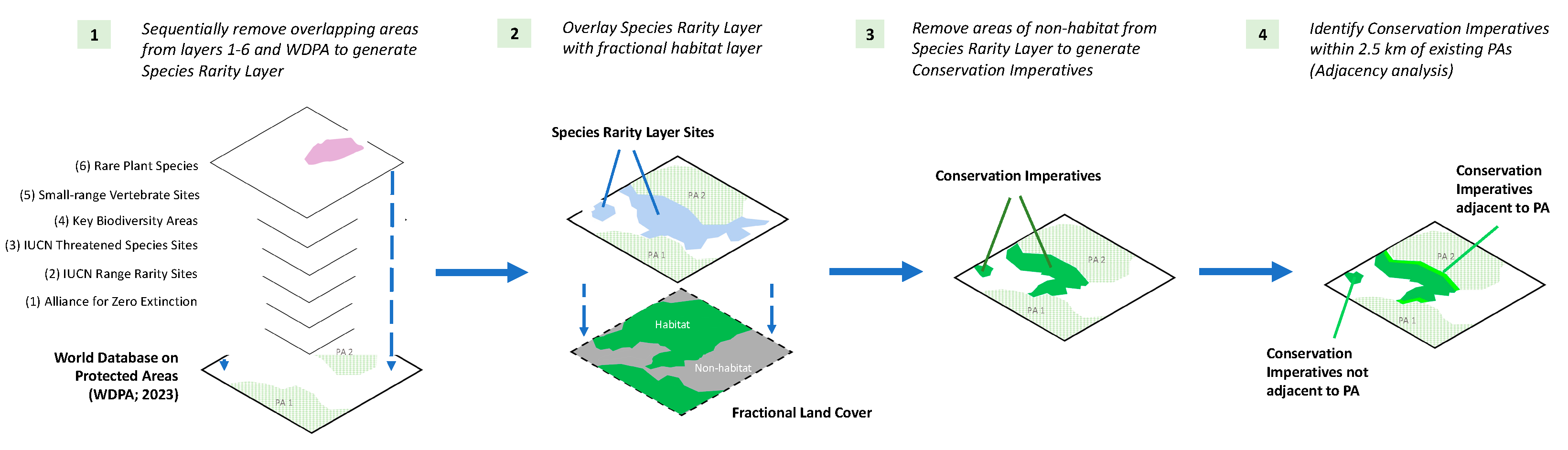
Figure 2.
Map of global unprotected species rarity site. Global distribution of the unprotected species rarity sites (magenta area) across predominantly forested habitat (green) and non-forested habitat (yellow), with non-habitat areas (grey) removed from previously designated species rarity sites, covering 1.22%. Non-habitat areas include land classified as urban, agricultural, and degraded.
Figure 2.
Map of global unprotected species rarity site. Global distribution of the unprotected species rarity sites (magenta area) across predominantly forested habitat (green) and non-forested habitat (yellow), with non-habitat areas (grey) removed from previously designated species rarity sites, covering 1.22%. Non-habitat areas include land classified as urban, agricultural, and degraded.
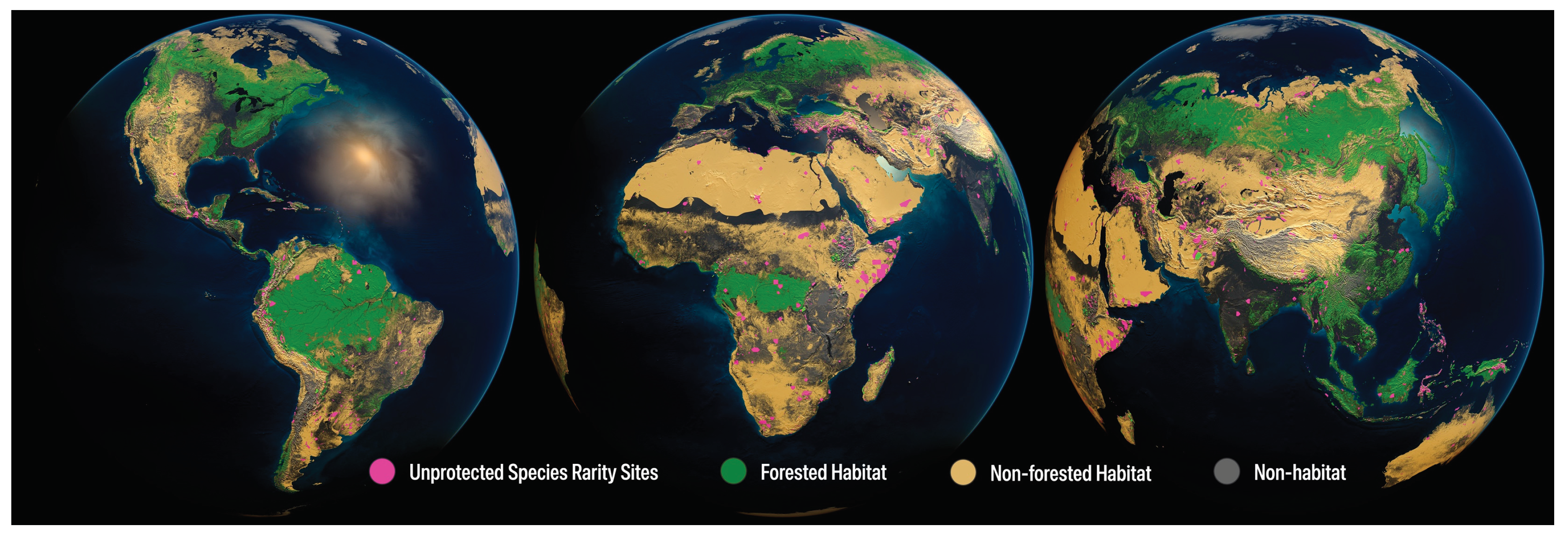
Figure 3.
Effect of fractional analysis in identifying and removing non-habitat (Other) areas from species rarity polygons in several regions with high species rarity. Forested and non-forested habitat are retained. (A) Sierra Nevada de Santa Marta, Colombia; (B) West African coastal forests; and (C) Madagascar dry forests.
Figure 3.
Effect of fractional analysis in identifying and removing non-habitat (Other) areas from species rarity polygons in several regions with high species rarity. Forested and non-forested habitat are retained. (A) Sierra Nevada de Santa Marta, Colombia; (B) West African coastal forests; and (C) Madagascar dry forests.
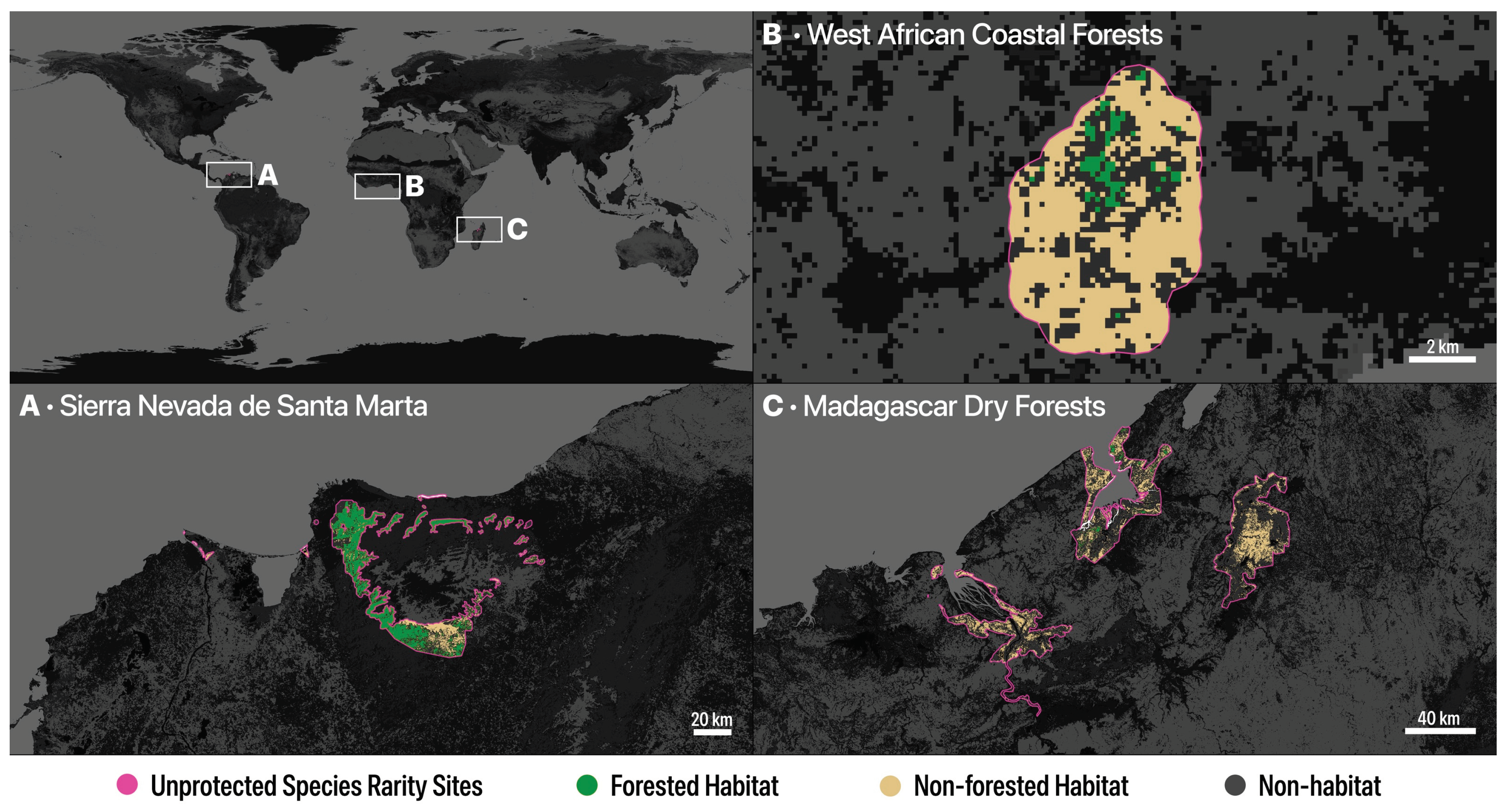
Figure 4.
The 10 ecoregions in each realm containing the highest number of Conservation Imperatives.
Figure 4.
The 10 ecoregions in each realm containing the highest number of Conservation Imperatives.
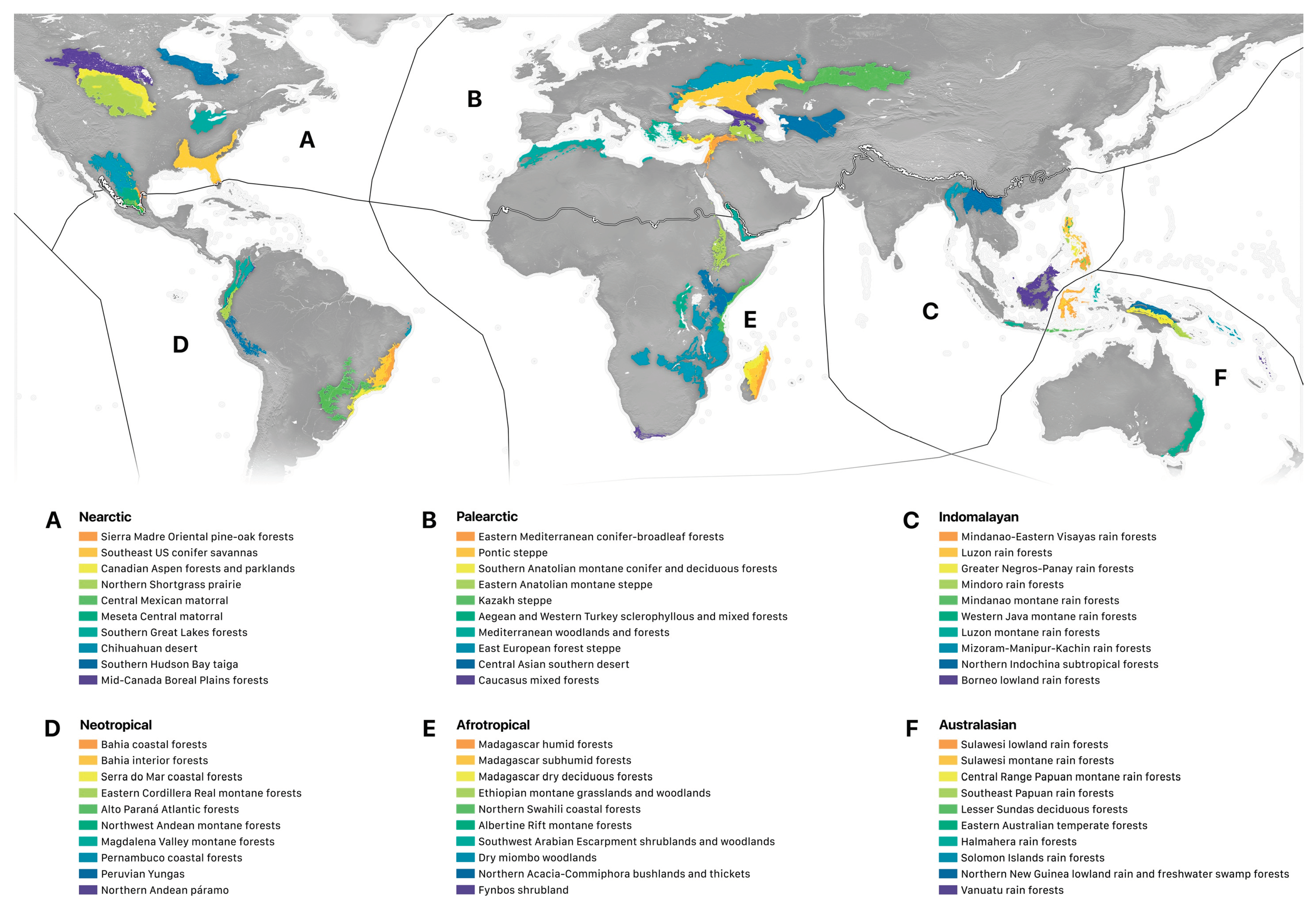
Figure 5.
Expansion of protection in species rarity sites under World Database on Protected Areas (WDPA) between 2018 and 2023, after overlaying the fractional land cover. Green polygons show unprotected species rarity sites that have gained protection between 2018 and 2023, representing only 7% of the global increase in protection coverage. Magenta polygons represent sites that remain unprotected in 2023.
Figure 5.
Expansion of protection in species rarity sites under World Database on Protected Areas (WDPA) between 2018 and 2023, after overlaying the fractional land cover. Green polygons show unprotected species rarity sites that have gained protection between 2018 and 2023, representing only 7% of the global increase in protection coverage. Magenta polygons represent sites that remain unprotected in 2023.
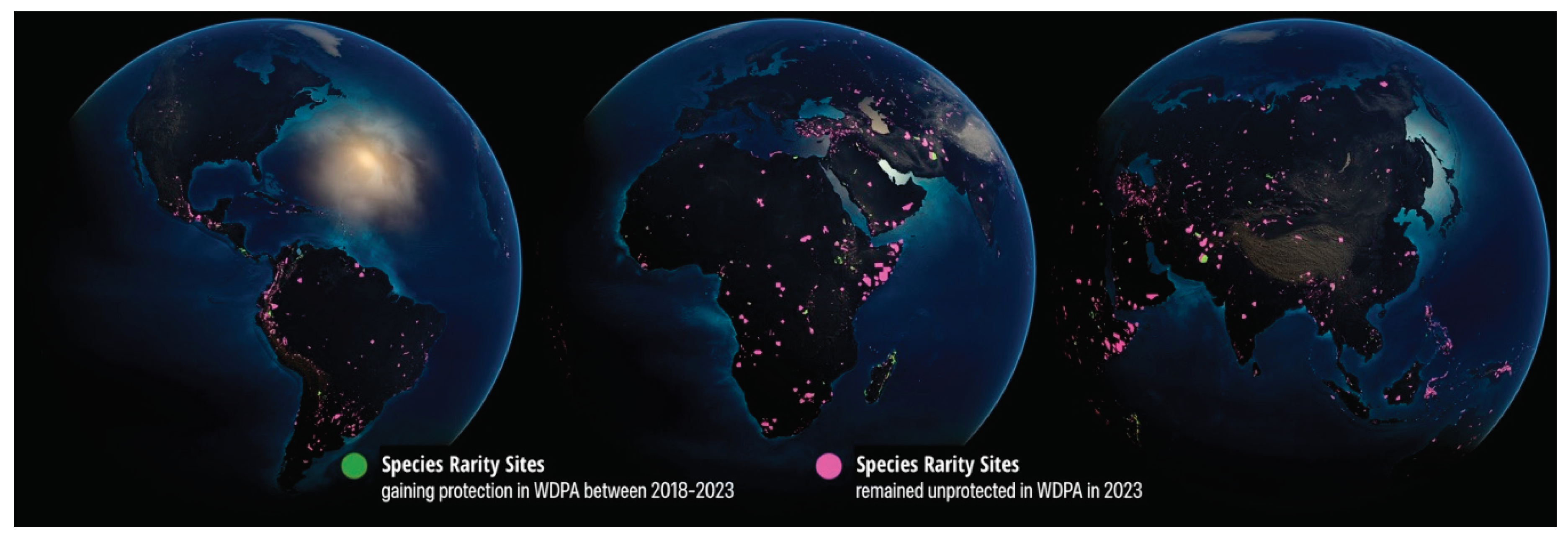

Table 1.
Extent of habitat by biogeographic realm after applying fractional land cover to species rarity sites and removing non-habitat area.
Table 1.
Extent of habitat by biogeographic realm after applying fractional land cover to species rarity sites and removing non-habitat area.
| Realm | Forested habitat (km2) | Non-forested habitat (km2) | Total habitat (km2) | % habitat reduction* |
|---|---|---|---|---|
| Afrotropic | 65,301 | 350,050 | 415,351 | 32% |
| Australasia | 180,550 | 37,066 | 217,616 | 36% |
| Indomalayan | 150,262 | 4,662 | 154,924 | 56% |
| Nearctic | 17,512 | 23,501 | 41,012 | 49% |
| Neotropic | 174,945 | 137,045 | 311,990 | 54% |
| Oceania | 1,766 | 241 | 2,007 | 84% |
| Palearctic | 73,220 | 423,791 | 497,010 | 49% |
| Total | 663,556 | 976,355 | 1,639,911 | 46% |
*Approximate reduction of unprotected rare and threatened species areas from 2019 levels, versus total area extent from newly compiled data sets.
Table 2.
Extent of habitat by biome after applying fractional land cover to species rarity sites and removing non-habitat area.
Table 2.
Extent of habitat by biome after applying fractional land cover to species rarity sites and removing non-habitat area.
| No. | Biome Name | Forested habitat (km2) | Non-forested habitat (km2) | Total habitat (km2) | % habitat reduction* |
|---|---|---|---|---|---|
| 1 | Tropical & Subtropical Moist Broadleaf Forests | 536,606 | 55,436 | 592,043 | 49% |
| 2 | Tropical & Subtropical Dry Broadleaf Forests | 7,903 | 13,248 | 21,152 | 77% |
| 3 | Tropical & Subtropical Coniferous Forests | 13,152 | 3,073 | 16,225 | 58% |
| 4 | Temperate Broadleaf & Mixed Forests | 28,563 | 25,156 | 53,719 | 68% |
| 5 | Temperate Conifer Forests | 19,777 | 8,481 | 28,257 | 33% |
| 6 | Boreal Forests/Taiga | 51,147 | 35,018 | 86,165 | 22% |
| 7 | Tropical & Subtropical Grasslands, Savannas & Shrublands | 17 | 370,057 | 370,075 | 14% |
| 8 | Temperate Grasslands, Savannas & Shrublands | 5 | 82,146 | 82,151 | 53% |
| 9 | Flooded Grasslands & Savannas | 2 | 8,794 | 8,796 | 65% |
| 10 | Montane Grasslands & Shrublands | 41 | 32,775 | 32,816 | 62% |
| 11 | Tundra | 1 | 45,632 | 45,633 | 35% |
| 12 | Mediterranean Forests, Woodlands & Scrub | 5 | 36,162 | 36,167 | 78% |
| 13 | Deserts & Xeric Shrublands | 7 | 259,015 | 259,022 | 46% |
| 14 | Mangroves | 6,329 | 1,361 | 7,690 | 44% |
| Total | 663,556 | 976,355 | 1,639,911 | 46% |
* Approximate reduction of unprotected rare and threatened species areas from 2019 levels, versus total area extent from newly compiled data sets.
Table 3.
Distribution of Conservation Imperatives sites (2023) by realm. The four tropical realms account for 89% of all sites globally.
Table 3.
Distribution of Conservation Imperatives sites (2023) by realm. The four tropical realms account for 89% of all sites globally.
| Biogeographic Realm | Forest (km2) | Grass (km2) | Shrub (km2) | Desert (km2) | Total (km2) | Number of Sites | % TotalSites |
|---|---|---|---|---|---|---|---|
| Afrotropic | 65,301 | 124,904 | 224,425 | 722 | 415,351 | 1,870 | 11.1% |
| Australasia | 180,550 | 30,538 | 6,210 | 318 | 217,616 | 2,526 | 15.0% |
| Indomalayan | 150,262 | 2,681 | 1,963 | 18 | 154,924 | 4,569 | 27.2% |
| Nearctic | 17,512 | 11,355 | 11,914 | 233 | 41,012 | 184 | 1.1% |
| Neotropic | 174,945 | 89,346 | 47,455 | 244 | 311,990 | 5,972 | 35.5% |
| Oceania | 1,766 | 149 | 92 | - | 2,007 | 52 | 0.3% |
| Palearctic | 73,220 | 262,573 | 20,868 | 140,349 | 497,010 | 1,652 | 9.8% |
| Total | 663,556 | 521,545 | 312,927 | 141,883 | 1,639,911 | 16,825 | 100% |
Table 4.
Distribution of Conservation Imperatives sites (2023) in each biome. The tropical and subtropical moist broadleaf forests biome alone account for three-quarters of all sites globally.
Table 4.
Distribution of Conservation Imperatives sites (2023) in each biome. The tropical and subtropical moist broadleaf forests biome alone account for three-quarters of all sites globally.
| No. | Biome Name | Forest (km2) | Grass (km2) | Shrub (km2) | Desert (km2) | Total (km2) | Number of Sites | % Total Sites |
|---|---|---|---|---|---|---|---|---|
| 1 | Tropical & Subtropical Moist Broadleaf Forests | 536,606 | 27,081 | 28,355 | - | 592,043 | 12,580 | 74.8% |
| 2 | Tropical & Subtropical Dry Broadleaf Forests | 7,903 | 5,925 | 7,323 | - | 21,152 | 554 | 3.3% |
| 3 | Tropical & Subtropical Coniferous Forests | 13,152 | 552 | 2,521 | - | 16,225 | 170 | 1.0% |
| 4 | Temperate Broadleaf & Mixed Forests | 28,563 | 24,055 | 1,101 | - | 53,719 | 503 | 3.0% |
| 5 | Temperate Conifer Forests | 19,777 | 7,860 | 620 | - | 28,257 | 125 | 0.7% |
| 6 | Boreal Forests/Taiga | 51,147 | 25,828 | 9,191 | - | 86,165 | 88 | 0.5% |
| 7 | Tropical & Subtropical Grasslands, Savannas & Shrublands | 17 | 165,980 | 204,077 | - | 370,075 | 562 | 3.3% |
| 8 | Temperate Grasslands, Savannas & Shrublands | 5 | 63,503 | 18,643 | - | 82,151 | 439 | 2.6% |
| 9 | Flooded Grasslands & Savannas | 2 | 8,435 | 358 | - | 8,796 | 57 | 0.3% |
| 10 | Montane Grasslands & Shrublands | 41 | 29,993 | 2,782 | - | 32,816 | 428 | 2.5% |
| 11 | Tundra | 1 | 43,136 | 2,497 | - | 45,633 | 37 | 0.2% |
| 12 | Mediterranean Forests, Woodlands & Scrub | 5 | 21,619 | 14,543 | - | 36,167 | 436 | 2.6% |
| 13 | Deserts & Xeric Shrublands | 7 | 96,743 | 20,389 | 141,883 | 259,022 | 619 | 3.7% |
| 14 | Mangroves | 6,329 | 835 | 526 | - | 7,690 | 227 | 1.3% |
| Total | 663,556 | 521,545 | 312,927 | 141,883 | 1,639,911 | 16,825 | 100% |
Table 5.
The top 10 ecoregions in each realm with the highest number of Conservation Imperatives sites (2023), and the total remaining natural habitat and estimated cost to place under conservation stewardship. This includes tropical and non-tropical ecoregions.
Table 5.
The top 10 ecoregions in each realm with the highest number of Conservation Imperatives sites (2023), and the total remaining natural habitat and estimated cost to place under conservation stewardship. This includes tropical and non-tropical ecoregions.
| ID | Ecoregion Name | Total Habitat Area (km2) | Number of Sites | % of Sites in Realm | Estimated Cost (Million USD) | ||
|---|---|---|---|---|---|---|---|
| Mean | Lower 90% CI | Upper 90% CI | |||||
| Afrotropic | |||||||
| 17 | Madagascar humid forests | 4,295 | 614 | 32% | $337 | $190 | $539 |
| 18 | Madagascar subhumid forests | 3,836 | 250 | 13% | $302 | $164 | $477 |
| 32 | Madagascar dry deciduous forests | 3,025 | 59 | 3% | $241 | $120 | $398 |
| 79 | Ethiopian montane grasslands and woodlands | 725 | 49 | 3% | $56 | $24 | $103 |
| 25 | Northern Swahili coastal forests | 16,190 | 48 | 3% | $1,201 | $447 | $2,259 |
| 1 | Albertine Rift montane forests | 5,200 | 43 | 2% | $352 | $111 | $713 |
| 108 | Southwest Arabian Escarpment shrublands and woodlands | 2,407 | 38 | 2% | $272 | $133 | $462 |
| 42 | Dry miombo woodlands | 376 | 35 | 2% | $26 | $10 | $50 |
| 51 | Northern Acacia-Commiphora bushlands and thickets | 10,976 | 32 | 2% | $710 | $179 | $1,545 |
| 89 | Fynbos shrubland | 2,049 | 29 | 2% | $221 | $64 | $472 |
| Total Cost of Top 10 Ecoregions | $3,717 | ||||||
| Australasia | |||||||
| 156 | Sulawesi lowland rain forests | 25,417 | 1,090 | 45% | $197 | $136 | $276 |
| 157 | Sulawesi montane rain forests | 36,785 | 421 | 18% | $270 | $152 | $428 |
| 139 | Central Range Papuan montane rain forests | 39,150 | 379 | 16% | $231 | $83 | $441 |
| 153 | Southeast Papuan rain forests | 15,727 | 46 | 2% | $98 | $37 | $184 |
| 163 | Lesser Sundas deciduous forests | 1,916 | 41 | 2% | $15 | $9 | $22 |
| 168 | Eastern Australian temperate forests | 2,192 | 39 | 2% | $31 | $19 | $45 |
| 140 | Halmahera rain forests | 3,147 | 32 | 1% | $24 | $16 | $35 |
| 152 | Solomon Islands rain forests | 10,456 | 25 | 1% | $69 | $46 | $97 |
| 148 | Northern New Guinea lowland rain and freshwater swamp forests | 6,101 | 22 | 1% | $39 | $18 | $69 |
| 159 | Vanuatu rain forests | 992 | 18 | 1% | $7 | $5 | $10 |
| Total Cost of Top 10 Ecoregions | $980 | ||||||
| Indomalayan | |||||||
| 247 | Mindanao-Eastern Visayas rain forests | 22,648 | 1,561 | 36% | $14,948 | $9,354 | $22,070 |
| 241 | Luzon rain forests | 15,139 | 1,123 | 26% | $9,912 | $6,336 | $14,223 |
| 231 | Greater Negros-Panay rain forests | 1,813 | 190 | 4% | $1,184 | $672 | $1,819 |
| 248 | Mindoro rain forests | 1,663 | 178 | 4% | $971 | $501 | $1,664 |
| 246 | Mindanao montane rain forests | 7,517 | 139 | 3% | $4,880 | $2,411 | $8,015 |
| 288 | Western Java montane rain forests | 709 | 100 | 2% | $467 | $239 | $765 |
| 240 | Luzon montane rain forests | 2,644 | 57 | 1% | $1,732 | $752 | $2,975 |
| 249 | Mizoram-Manipur-Kachin rain forests | 5,395 | 52 | 1% | $3,037 | $1,796 | $4,651 |
| 256 | Northern Indochina subtropical forests | 3,171 | 44 | 1% | $2,097 | $1,174 | $3,205 |
| 219 | Borneo lowland rain forests | 13,993 | 43 | 1% | $8,399 | $2,961 | $16,403 |
| Total Cost of Top 10 Ecoregions | $47,628 | ||||||
| Nearctic | |||||||
| 327 | Sierra Madre Oriental pine-oak forests | 1,828 | 16 | 9% | $76 | $47 | $112 |
| 399 | Southeast US conifer savannas | 1,149 | 15 | 8% | $66 | $35 | $107 |
| 386 | Canadian Aspen forests and parklands | 121 | 9 | 5% | $7 | $4 | $12 |
| 396 | Northern Shortgrass prairie | 672 | 9 | 5% | $40 | $21 | $64 |
| 427 | Central Mexican matorral | 603 | 8 | 4% | $21 | $7 | $41 |
| 432 | Meseta Central matorral | 819 | 8 | 4% | $31 | $15 | $55 |
| 342 | Southern Great Lakes forests | 222 | 7 | 4% | $11 | $4 | $22 |
| 428 | Chihuahuan desert | 3,490 | 7 | 4% | $131 | $55 | $241 |
| 382 | Southern Hudson Bay taiga | 1,782 | 6 | 3% | $99 | $42 | $177 |
| 376 | Mid-Canada Boreal Plains forests | 561 | 5 | 3% | $30 | $12 | $55 |
| Total Cost of Top 10 Ecoregions | $513 | ||||||
| Neotropical | |||||||
| 442 | Bahia coastal forests | 3,563 | 1,635 | 27% | $410 | $307 | $543 |
| 443 | Bahia interior forests | 1,161 | 579 | 10% | $138 | $107 | $174 |
| 500 | Serra do Mar coastal forests | 3,134 | 434 | 7% | $372 | $277 | $481 |
| 460 | Eastern Cordillera Real montane forests | 18,176 | 279 | 5% | $1,796 | $1,201 | $2,541 |
| 439 | Alto Paraná Atlantic forests | 2,177 | 192 | 3% | $241 | $162 | $338 |
| 486 | Northwest Andean montane forests | 18,454 | 192 | 3% | $1,888 | $1,169 | $2,775 |
| 477 | Magdalena Valley montane forests | 9,685 | 156 | 3% | $927 | $516 | $1,511 |
| 491 | Pernambuco coastal forests | 160 | 150 | 2% | $19 | $13 | $26 |
| 493 | Peruvian Yungas | 11,658 | 142 | 2% | $1,191 | $852 | $1,600 |
| 593 | Northern Andean páramo | 892 | 121 | 2% | $92 | $66 | $125 |
| Total Cost of Top 10 Ecoregions | $7,075 | ||||||
| Palearctic | |||||||
| 791 | Eastern Mediterranean conifer-broadleaf forests | 6,900 | 114 | 7% | $1,092 | $634 | $1,681 |
| 735 | Pontic steppe | 9,506 | 101 | 6% | $1,675 | $1,017 | $2,497 |
| 804 | Southern Anatolian montane conifer and deciduous forests | 12,680 | 70 | 4% | $2,255 | $1,241 | $3,512 |
| 727 | Eastern Anatolian montane steppe | 9,761 | 57 | 3% | $1,501 | $757 | $2,492 |
| 732 | Kazakh steppe | 9,220 | 53 | 3% | $1,504 | $845 | $2,375 |
| 785 | Aegean and Western Turkey sclerophyllous and mixed forests | 1,577 | 43 | 2% | $270 | $143 | $437 |
| 798 | Mediterranean woodlands and forests | 2,221 | 40 | 2% | $295 | $137 | $511 |
| 661 | East European forest steppe | 2,191 | 39 | 2% | $382 | $210 | $608 |
| 819 | Central Asian southern desert | 3,436 | 37 | 2% | $486 | $269 | $780 |
| 650 | Caucasus mixed forests | 5,851 | 36 | 2% | $901 | $488 | $1,431 |
| Total Cost of Top 10 Ecoregions | $10,361 | ||||||
Table 6.
Top 30 countries with the highest number of Conservatives Imperative sites, their percentage total, median area of sites (km2), and the number and percentage of sites within the country that are adjacent to existing protected areas (i.e., within 2.5 km of boundary).
Table 6.
Top 30 countries with the highest number of Conservatives Imperative sites, their percentage total, median area of sites (km2), and the number and percentage of sites within the country that are adjacent to existing protected areas (i.e., within 2.5 km of boundary).
| Country | Number of Conservation Imperative sites | % of Total sites | Median area of sites (km2) | Total area of sites (km2) | Number of sites adjacent to existing protected area (within 2.5 km of boundary) | % of sites adjacent to existing protected area in country |
|---|---|---|---|---|---|---|
| Philippines | 3,355 | 19.5% | 0.46 | 53,816 | 833 | 25% |
| Brazil | 3,342 | 19.4% | 0.31 | 35,632 | 781 | 23% |
| Indonesia | 1,893 | 11.0% | 0.50 | 116,773 | 387 | 20% |
| Madagascar | 968 | 5.6% | 0.37 | 14,585 | 183 | 19% |
| Colombia | 761 | 4.4% | 0.93 | 39,827 | 423 | 56% |
| Ecuador | 653 | 3.8% | 0.38 | 35,026 | 157 | 24% |
| Papua New Guinea | 527 | 3.1% | 0.36 | 81,800 | 26 | 5% |
| India | 437 | 2.5% | 5.23 | 20,861 | 65 | 15% |
| Peru | 342 | 2.0% | 13.42 | 43,590 | 101 | 30% |
| Turkey | 304 | 1.8% | 28.53 | 50,166 | 2 | 1% |
| Russia | 291 | 1.7% | 54.48 | 138,436 | 89 | 31% |
| China | 276 | 1.6% | 22.68 | 41,276 | 47 | 17% |
| Mexico | 230 | 1.3% | 17.22 | 33,441 | 63 | 27% |
| Argentina | 187 | 1.1% | 40.87 | 61,285 | 38 | 20% |
| Australia | 137 | 0.8% | 2.31 | 35,705 | 54 | 39% |
| United Republic of Tanzania | 127 | 0.7% | 0.24 | 1,041 | 52 | 41% |
| South Africa | 116 | 0.7% | 9.74 | 40,648 | 52 | 45% |
| Myanmar | 114 | 0.7% | 16.78 | 22,883 | 16 | 14% |
| Ethiopia | 109 | 0.6% | 0.86 | 40,513 | 6 | 6% |
| Kazakhstan | 104 | 0.6% | 85.39 | 58,230 | 19 | 18% |
| United States of America | 102 | 0.6% | 17.78 | 10,636 | 51 | 50% |
| Venezuela | 93 | 0.5% | 1.77 | 2,793 | 50 | 54% |
| Kenya | 92 | 0.5% | 0.69 | 16,297 | 22 | 24% |
| Vietnam | 85 | 0.5% | 5.47 | 3,274 | 42 | 49% |
| Bolivia | 81 | 0.5% | 16.31 | 8,612 | 27 | 33% |
| Yemen | 78 | 0.5% | 27.00 | 6,111 | 1 | 1% |
| Malaysia | 76 | 0.4% | 7.88 | 9,141 | 25 | 33% |
| Democratic Republic of the Congo | 73 | 0.4% | 13.46 | 49,350 | 23 | 32% |
| Syria | 70 | 0.4% | 5.16 | 2,360 | 1 | 1% |
| Chile | 66 | 0.4% | 3.49 | 2,652 | 22 | 33% |
| Total of Top 30 Countries | 15,089 | 87.6% | 1,076,759 | 3,658 | 24% |
Table 7.
Predicted cost per km2 and total purchase cost for securing Conservation Imperatives (2023) within tropical latitudes by realm. All costs are in 2023 $US dollars. The mean total cost and 90% probability intervals are reported in billions of dollars.
Table 7.
Predicted cost per km2 and total purchase cost for securing Conservation Imperatives (2023) within tropical latitudes by realm. All costs are in 2023 $US dollars. The mean total cost and 90% probability intervals are reported in billions of dollars.
| Realm | Mean cost/km2 (USD) | Mean acquisition size (km2) | Mean total cost (Billions USD) | 90% probability (Billions USD) |
|---|---|---|---|---|
| Afrotropic | $32,548 | 21,811 | $38.53 | $24.39–59.70 |
| Australasia | $5,800 | 131,750 | $1.59 | $1.19–2.11 |
| Indomalayan | $361,840 | 1,840 | $90.39 | $72.36–112.49 |
| Nearctic | $29,545 | 14,911 | $0.14 | $0.08–0.22 |
| Neotropic | $75,010 | 11,025 | $28.39 | $23.84–34.02 |
| Palearctic | $61,082 | 7,441 | $9.50 | $3.58–19.70 |
Disclaimer/Publisher’s Note: The statements, opinions and data contained in all publications are solely those of the individual author(s) and contributor(s) and not of MDPI and/or the editor(s). MDPI and/or the editor(s) disclaim responsibility for any injury to people or property resulting from any ideas, methods, instructions or products referred to in the content. |
© 2024 by the authors. Licensee MDPI, Basel, Switzerland. This article is an open access article distributed under the terms and conditions of the Creative Commons Attribution (CC BY) license (http://creativecommons.org/licenses/by/4.0/).
Copyright: This open access article is published under a Creative Commons CC BY 4.0 license, which permit the free download, distribution, and reuse, provided that the author and preprint are cited in any reuse.