

Submitted:
19 September 2023
Posted:
21 September 2023
You are already at the latest version
Abstract
Arboviruses represents a real public health problem globally and in the Central African subregion in particular that represents a high risk zone for the emergence and re-emergence of arboviruses outbreaks. Furthermore, an updated review on the current arboviruses burden and associated mosquito vectors is lacking for this region. To contribute in filling this knowledge gap, the current study was designed with following objectives: (i) to systematically review data on the occurrence and distribution of arboviruses and mosquito fauna and (ii) to identify potential spillover mosquito species in Central African region in the last 30 years. Web search enabled the documentation of 2454 articles from different online databases. The Preferred Reporting Items for Systematic Reviews and Meta-Analyses (PRISMA) and The Quality of Reporting of Meta-analyses (QUORUM) steps for a systematic review enabled the selection of 164 articles that fulfilled our selection criteria. Of the six arboviruses (Dengue Virus (DENV), Chikungunya Virus (CHIKV), Yellow Fever Virus (YFV), Zika Virus (ZIKV), Rift Valley Fever Virus (RVFV), and West Nile Virus (WNV)) of public health concern studied, the most frequently reported were Chikungunya and Dengue. The entomological records showed >248 species of mosquitoes and regrouped under 15 genera with Anopheles (n= 100 species), Culex (n= 56 species) and Aedes (n=52 species) having high species diversity. Three genera were rarely represented with only one species and included: Orthopodomyia, Lutzia, and Verrallina, but individuals of the genera Toxorhinchites and Finlayas were not identified upto the species level. We found that two Aedes species (Ae. aegypti and Ae. albopictus) colonised the same microhabitat and were involved in major epidemics of the six medically important arboviruses and other less frequently identified mosquito-genera consisted of competent species and were associated with outbreaks of medical and zoonotic arboviruses. The present study reveals high species richness of competent mosquito-vectors that could lead to the spillover of medically important arboviruses in the region. Although epidemiological studies were found, they were not regularly documented and this also applies to vector competence and transmission studies. Future studies will consider unpublished information in dissertations, technical reports from different countries to enable it more consistent. A regional project entitled: Ecology of Arboviruses (EcoVir) is underway in three countries (Gabon, Benin and Cote d’Ivoire) to generate a more comprehensive epidemiological and entomological data on this topic.
Keywords:
arboviruses
; mosquitoes
; epidemics
; transmission
; Central Africa
1. Introduction
Mosquito-borne arboviruses are viruses that are transmitted by mosquitoes [1]. Arboviruses are maintained in nature by a cycle of biological transmission between a susceptible host and blood feeding arthropods [2]. The clinical symptoms range from a mild febrile state to severe forms accompanied by haemorrhagic shock or encephalitis [3]. Arboviruses cause mortality rate of 50% and an estimated 200,000 cases and 30,000 deaths each year and Yellow Fever (YF) alone is of major public health concern [4]. In addition to YF, dengue (DENV) accounts for over 390 million infections per year [5]. Others such as CHIKV, ZIKV, RVFV, and WNV have also caused epidemics in Central Africa [6] and are also considered as arboviruses of major public health concern in this region [7].
Landscape modifications and climate change as a result of an upsurge in anthropic activities over time in the tropics have modified the natural life cycle and occurrence of major arboviruses and their vectors [8]. It appears that tropical species are now invading temperate zones, leading to the emergence of arboviruses that were only confined to well defined regions of the globe. There are more than 3600 species of mosquitoes of the family Culicidae that occurs globally [9]. In the Central African Region, two major invasive arboviruses vectors (Ae. aegypti and Ae. albopictus) have been frequently reported and in some countries of this region, they are main drivers of arboviruses spillovers [10].
Although arboviruses and its vectors represents a real public health danger in endemic settings, they are still a neglected topic and limited studies have been reported to present updated information on it for the Central African Region. To fill this knowledge gap, the present study aimed to conduct a systematic literature review to update on the occurrence and distribution of arboviruses of major public health concern and associated spillover vectors in Central African region in the last 30 years to guide control and identify avenues for future studies.
2. Materials and Methods
2.1. The study region
The present study was conducted in eight countries (Angola, Cameroon, Chad, Central African Republic, Democratic Republic of Congo, Equatorial Guinea, Gabon, and Republic of the Congo) of the Central African region. This region is located in the heart of the African continent. Central Africa is home for the second largest tropical rainforest in the world with annual rainfall that ranges from 100-400 mm per year in the Sahel and over 1600 mm in the tropical rainforests. This ecosystem promotes the survival and proliferation of mosquitoes [1] and the propagation of the diseases they harbour.
2.2. Literature search strategy
The Preferred Reporting Items for Systematic Reviews and Meta-Analyses (PRISMA) [11] and The Quality of Reporting of Meta-analyses (QUORUM) [12] criteria were applied in paper selection (Figure 1). The search for article was conducted in the following database: Google Scholar, Web of Science, PubMed, LILACS, Genesis Library and Z-Library. The following combinations of search keywords were used: “Gabon” OR “Cameroon” OR “Cameroun” OR “Belgian Congo” OR “Democratic Republic of the Congo” OR “Zaïre”, “Republic du Congo” OR “Republic of the Congo” OR “Angola” OR “Tchad” OR “Chad”, “Republic Centre Afrique” OR “Central African Republic” OR “Guinée Equatoriale” OR “Equatorial Guinea”, AND (“Mosquitoes” OR “mosquito-borne virus” OR “arbovirus” OR “arthropod-borne virus” OR “yellow fever” OR “chikungunya” OR “dengue” OR “Rift Valley Fever virus” OR “West Nile virus” OR “Zika” OR “alphavirus” OR “flavivirus” OR “bunyavirus”). Additional information was searched from the World Health Organization (WHO) (http://www.who.int) and Centers for Disease Control and Prevention (CDC) (www.ecdc.europa.eu) databases.
2.3. Inclusion and exclusion criteria
All the papers collected were screened following the relatedness to the topics of the study and the inclusion/exclusion criteria were defined by consensus. The inclusion criteria were: (i) studies conducted in Central Africa, (ii) references from review articles enabled the obtention of more relevant papers. The exclusion criteria were: (i) arboviruses detected in animals were not considered but were used in the discussion, (ii) incomplete information such as articles with only abstract with no relevant information, (iii) studies conducted outside central Africa and reports published before 1993.
3. Results and Discussion
3.1. Papers selected for the review
The internet search resulted in the collection of 2454 papers and only 164 responded to the stipulated selection criteria (Figure 1). A complete database was created for the 164 relevant articles selected for this study (Supplementary file 1).
3.2. Papers retained by country
The current study found that the majority of the papers available online on arboviruses and vectors are from Cameroon (58 (35.4%)) followed by Gabon (39 (23.8%)) and the least number recorded was from Equatorial Guinea (4 (2.4%)). The details on the distribution of the number of papers published within the study period by country can be found in Figure 2.
3.3. The periodic trend in publication of epidemiological and entomological data by country
The number of relevant scientific papers on arboviruses and vectors published for the Central African Region has improved for some countries and still remain scant for others. We made a graphical presentation of the situation by country and we found for Cameroon that more papers appeared online between 2019 and 2022 with higher entomological studies than epidemiological and both (Figure 3). In Gabon, more publications appeared online between 2020 and 2021 and dominated by entomological studies (Figure 3). In the Democratic Republic of Congo (DRC), more papers were published between 2018 and 2021 and rather dorminated by epidemiological studies (Figure 3). In Angola most papers appeared online in 2006 and were mostly epidemiological studies. For the other countries like Central African Republic (CAR), Chad, Republic of the Congo (RoC) and Equatorial Guinea (EG), both epidemiological and entomological data were sparse and most of them were cross sectional. The low publication turnover for the different countries partly supports the fact that arboviruses are a neglected subject and that studies available were conducted to confirm cases in suspect outbreak areas in the different countries. The weak trend in publication indicates the lack of regular surveillance of the diseases and vectors and lack of conjoint and coordinated regional studies.
3.4. Occurrence of arboviruses in the Central African Region
The six arboviruses of public health importance considered in this review belonged to three genera notably i) Alphavirus (CHIKV), ii) Flavivirus (DENV, WNV, YFV, ZIKV), iii) Phlebovirus (RVFV). Of this six arboviruses reported to be circulating in the Central African Region, CHIKV and DENV have been detected in all the countries of this region [13] and the other four appears to variably occur in the different countries as follows:
i.Angola
The available and relevant information on arboviruses and associated vectors for Angola was documented in 17 papers. The details on each arbovirus targeted for this review is presented (Table 1) as follows:
DENV
Dengue circulation in Angola was first announced in the 1980s by infected travellers returning from Angola to the Netherlands [14]. In 2013 Angola reported its first locally acquired DENV cases [15]. During the 2013 epidemic, about 10% of case and random cluster participants in Luanda, Angola’s capital city, had evidence of recent DENV infection [16]. Furthermore, the genetic study by Neto et al.[17] reported the circulation of DENV2 in Luanda.
YFV and CHIKV
In 1970 in Angola, outbreaks of YFV and CHIKV were reported [18]. The first YFV cases in Angola were reported in Luanda. On April 13th 2016, the WHO declared a YFV outbreak in Angola and at the same period the WHO also notified the case of RVFV in a man from China working in Luanda, the capital of Angola. Again, in May 2016, a 21 year old woman traveller from Luanda to Tokyo tested positive for CHIKV. According to the distribution map proposed by Adam and Jassoy [13], Angola is endemic for YF and CHIKV.
ii.Cameroon
All the six medically important arboviruses targeted in this review have been reported in Cameroon (Table 1). This study found 58 papers published online on these arboviruses and associated vectors. The situation of the different arboviruses of Cameroon is as follows:
CHIKV
In Cameroon, CHIKV was reported in most regions and high prevalence reported in the North West (51.4%) [19], and others recorded varing prevalence as follows: Littoral region (12.6-59.4%) [20], Center (3-59.4%) [19] and South West regions (4-63%) [21]. However, Cameroon has already been reported as CHIKV endemic area with high transmission risk [13].
DENV
Dengue was found in all the epidemiological studies for Cameroon and was detected in all the 10 regions of the country. The prevalence by region reporting this virus is as such: Littoral (3.8-68.3%) [22,23,24], Far North (6.7-14.36%) [25,26], West (6.14-14.36%) [26,27], Center (3-45.45%) [26,28], South West (2.5-74%) [6,21] and South (0.5-14.28%). Similar to CHIKV, Dengue is also endemic in the whole of Cameroon with high transmission risk [13].
YFV
ZIKV
Most of the studies found online about arboviruses of Cameroon frequently reported ZIKV. Prevalence differed with region as such: Southwest (11.4%) [6], Littoral (10-26.2%) [15,25], East (7.6%) [30], Far North (2-4.8%) [30] and Adamawa (2%) [30]. Zika virus has already been reported to be endemic in Cameroon and with high transmission risk [13].
WNV
The report on WNV for Cameroon is scant and was only reported in the south west region of Cameoron with prevalence range of 3-82% [21].
iii.Central African Republic
The CAR has been victim of attacks of 19 arboviruses in the past and recently, 3 arbovirus were involved in fatal cases: in 1983 WNV was isolated in four patients, two serious cases of YFV occurred in 1985 and 1986, and from 1983 to 1986 RVFV was identified in patients who died from hemorrhagic fever [31]. The details on the different arboviruses are presented (Table 1) in the following paragrahs:
CHIKV
Genetic analysis by Tricou et al. [32] confirmed the circulation of CHIKV in the 1970s and 1980s. A serological survey of antibodies to arboviruses was carried out in the human population of the south-east part of CAR in April 1979 and CHIKV was detected to be actively circulating in adult population [33]. The distribution map of CHIKV by Adam and Jassoy [13] shows that CAR is an endemic country for this virus.
RVFV
A RVFV study conducted in cattle and humans in Bangui reported an overall seroprevalence of anti-RVFV IgM antibodies of 1.9% and that of IgG antibodies of 8.6%. IgM antibodies were found only during the rainy season, but the frequency of IgG antibodies did not differ significantly by season. No evidence of recent RVFV infection was found in 335 people considered at risk; however, 16.7% had evidence of past infection [34]. In another study conducted on cattle, it was found that antibodies to RVFV virus were found in about 8% of adult cattle [35]. The presence of antibodies of CHIKV in cattle indicates their possible role as reservoir of the disease in Bangui.
YFV, DENV and ZIKV
In the Central African Republic since 2006, YFV cases have been notified in the provinces of Ombella-Mpoko, Ouham-Pende, Basse-Kotto, Haute-Kotto and in Bangui the capital which is also an Aedes spp. endemic area. However, the presence of the YFV vectors in this capital city of CAR represents a risk for the spread of the disease. To the best of our knowledge, little or no updated information on YFV, DENV and ZIKV has been published on the burden of these arboviruses in CAR. However a distribution map on these three arboviruses of public health concern by Adam and Jassoy [13] showed that CAR is an endemic country for these arboviruses and its vectors.
iv.Chad
Three important arboviruses (DENV, YFV and RVFV) have been reported to occur in Ndjamena (Table 1), the capital city of Chad. Only six papers were found eligible for Chad and were included in the study.
DENV
Information on Dengue in Chad is not documented and no available evidence on its occurrence was found for the period from 1993 to 2023, but the distribution map of Adam and Jassoy [13] indicates the presence of this arbovirus in this country.
YFV
RVFV
This is a zoonotic febrile disease that affects livestock and humans and was first reported in Chad in 1967 [37] and in the same period in Cameroon and since then this disease has spread beyond the subregion. Apart from this preliminary report another report by Durand et al. [38] revealed a prevalence rate of 4% in French troops.
v.Democratic Republic of Congo
The available and relevant information on arboviruses and associated vectors for the Democratic Republic of Congo was documented in 19 papers. The details on each arbovirus targeted for this review is presented (Table 1) as follows:
YFV
Post indepence of DRC in 1960, YF epidemics has been reported in all the 26 provinces of the country. A two-year survey (2013 to 2014), reported YFV prevalence of 31.5% among children in DRC [39]. From December 5, 2015, to November, 2016, a large YF outbreak has affected Angola and the DRC, with 7334 suspected cases, of which 962 have been confirmed, and 393 deaths reported to WHO as of Oct 28, 2016 [40,41]. According to the updated distribution map of Adam and Jassoy[13], the DRC is YF endemic area with high transmission risk [41,42]. Recent report on YF in DRC was in Kinshasa, its capital city with seroprevalence range of 6-73% [39,43] (Table 1). The occurrence of YFV in the capital city of this country was not astonishing as it is known that densely populated cities, where high densities of mosquitoes coexists with city inhabitants creates a favouratble milieu for an epidemic of massive proportions.
CHIKV
In the last two decades, Kinshasa, the capital of the DRC experienced CHIKV epidemics in the years 1999 and 2000, with an estimated 50,000 reported cases [44]. Still in Kinshasa, another outbreak occurred in 2012 [45]. Apart from Kinshasa, other provinces where CHIKV has been reported are Kisangani [46] and Matadi [47]. According to the Aedes spp. and the CHIKV distribution maps published in Adam and Jassoy [13], the DRC is a CHIKV endemic area with high transmission risk [42].
DENV
Dengue fever virus is one of the common mosquito-borne viruses in the DRC and cases of this disease has been reported in some hotspot provinces such as Kisangani [46] and Kinshasa [39,45,48,49] via seroepidemiological studies [39,50]. Furthermore, serotyping information on the circulating DENV in the DRC was not available until a survey reported 16 DENV-1 and DENV-2 cases from 2003 to 2012 [51]. Genetic analysis revealed that the DENV-1 strain that caused the 2013 epidemic in Angola also circulated in the DRC in 2015 [52]. Three serotypes of DENV (DENV-1, DENV-2 and DENV-3) have been recorded in DRC, the most frequent being serotype DENV-1 [39]. In Kisangani, DENV co-circulated with CHIKV during the WNV outbreak of 1998 [46]. In Kinshasa, co-occurrence of dengue and chikungunya was reported during the 2012 outbreak [45]. To conclude, the DENV updated map for sub-Saharan Africa (SSA) published in Adam and Jassoy [13], shows that the DRC is a DENV endemic area with high transmission risk [42].
ZIKV
Only few studies presents relevant information on the burden and distributon of Zika in the DRC as only one study reported on its occurrence. A serological study from 2013 to 2014 showed a prevalence rate of 3.5% for ZIKV antibodies in sud-Ubangi [39]. Another study by [51] from 2003 to 2011 showed a negative test result for ZIKV using the polymerase chain reaction (PCR) method. The occurrence of Zika virus in the DRC has also been shown in the updated distribution map for ZIKV for SSA [13].
RVFV
In 1998 in Kisangani area of DRC, RVF has been reported in humans with low prevalence of 4% [46]. As a zoonotic arbovirus, it has also been reported in domestic animals such as cattle where in 2009 a seroprevalence of 20% was reported in this animal species in Katanga [53]. Also, a seroprevalence rate range of 2–16% among cattle was reported in the Nord-Kivu, Sud-Kivu, Ituri provinces from the eastern region [54]. A transmission risk study conducted in 2014 revealed that Aedes mosquitoes harbored RVFV [55].
WNV
From the available information on WNV of the DRC only one paper presents relevant information on clinical cases of the disease and this was in 1998, when a high seroprevalence of 66% was reported in Kisangani [46]. Other information on this virus are from research on wild animals to establish their potential epizootiological role in its spread to humans where WNV antibodies were detected in Haut-Uelé Province in chimpanzee [56], in bufalo and elephant in the Garamba National Park [54].
vi.Equatorial Guinea
The available and relevant information on arboviruses and associated vectors for Equatorial Guinea was documented in only four papers. The details on each arbovirus targeted for this review is presented (Table 1) as follows:
CHIKV, DENV and YFV
From the best of our knowledge, the only arboviruses that have been reported in EG are: CHIKV, DENV and YFV. Chikungunya was first detected in 2002 and 2003 [57]. In 2006 one of the three travelers returning from EG was diagnosed positive with CHIKV in Spain [58]. Inaddition, EG is known to be CHIKV endemic [13]. Similarly, only one study presents the distribution map of DENV and YFV of the EG and shows that the country is endemic for the two arboviral types [13].
vii.Gabon
In Gabon, arboviruses and associated vectors have been reported in 39 papers. The publication trend has evolved positively for epidemiological studies with high number registered in 2022. All the six arboviruses of public health concern have been identified (Table 1), but their prevalence and distribution differed with province as follows:
CHIKV
This virus was reported in the whole of Gabon [59] and two important outbreaks occurred i.e. in 2007 and 2010 [60] in the Estuaire province of the capital city (Libreville) of Gabon. In Libreville, the prevalence range was 3-86% [61], followed by Haut-Ogooue (45.2-62.3%) [60], and then Ogooue-Lolo (28.7%) [62]. Recent reports on CHIKV are from Moyen-Ogooue province with prevalence range of 0.6-61.2% [7,63]. Chikungunya is endemic in Gabon and with high transmission risk [13].
DENV
RVFV, YFV, WNV, ZIKV
The reports on RVFV, YFV, WNV and ZIKV for Gabon are scant as only one paper reported the presence of these four arboviruses only in the Moyen-Ogooue province with varying prevalences as such: YFV (60.7%), ZIKV (40.3%), WNV (25.3%) and RVFV (14.3%) [7].
viii.Republic of the Congo
The available and relevant information on arboviruses and associated vectors for the RoC was documented in 10 papers. The details on each arbovirus targeted for this review is presented (Table 1) as follows:
CHIKV
In January 2019, an outbreak of CHIKV fever was reported near Pointe-Noire. This study found a novel CHIKV strain and established the presence of the A226V substitution and close relation with Aedes aegypti-associated Central Africa chikungunya strains [67]. Similarly, in February 9th 2019, during the CHIKV outbreak, investigations found two new CHIKV sequences of the East/Central/South African (ECSA) lineage, clustering with the recent enzootic sub-clade 2, showing the A226V mutation. Entomological surveys reported one Ae. albopictus pool to RT-PCR positive [68].
DENV
Although DENV is one of the frequently reported arbovirus in the Central African subregion, from the best of our knowledge, no relevant information has been presented on its burden and occurrence in the RoC. However, the distribution map of DENV for SSA by Adam and Jassoy [13] clearly shows that RoC is endemic for this virus and its Aedes spp. vectors.
ZIKV
The lone study reporting the occurrence of ZIKV in RoC was that conducted on 386 serum specimens from volunteer blood donors in 2011 from rural and urban areas of Republic of the Congo. The result of this study showed a low ZIKV seropositivity rate (1.8%) [69].
3.5. Distribution of arboviruses in the Central African subregion
Chikungunya and Dengue were the most frequently detected of the six studied arboviruses of medical importance. Indeed, some countries have already witnessed historic epidemic waves of CHIKV for instance in Cameroon in 2006, in Gabon (2007 to 2010), in Congo Brazzaville in 2011 and in the DRC in 2019. The circulating arboviruses in the different Central African countries are presented in Table 1. The widespread distribution of CHIKV and DENV could be attributed to the suitable ecological variables for its vectors and of course it has already been reported that DENV is the most prevalent of all arboviruses [70,71]. Although RVFV cases have already been reported in clinical cases in countries like Chad, CAR, Gabon, and DRC, data is still scant, but in a country like Cameroon information is mostly available for animal species (cattle, sheep and goats) [72,73]. The free circulation of livestock and people in the Central African regional corridor could be the main driver of circulating strains of major arboviruses in countries of this region [6]. The circulation of RVFV in domesticated ruminants in countries of this region could indicate possible risk of human exposure to zoonotic strains [74]. Also, information on WNV was also poorly documented with clinical cases reported in Cameroon, Gabon and the Democratic Republic of Congo. Also, information on WNV in animals is scant and needs to be documented. The detection discrepancies between countries could be multifactorial as follows: (i) lack of knowledge, (ii) low or lack of diagnostic capacity, and (ii) poor surveillance systems. The lack of data from the Central African sub-region makes it difficult to generate robust and quality field epidemiological and entomological information that could inform on the patterns and drivers of arthropod-borne diseases transmission [75,76].

Table 1.
Occurrence and burden of major arboviruses in different countries of the Central African sub-region from January 1993 to June 2023.
Table 1.
Occurrence and burden of major arboviruses in different countries of the Central African sub-region from January 1993 to June 2023.
| Country | Site (region, province, city) | arbovirus | Proportions (%) | References |
|---|---|---|---|---|
| Gabon | Estuaire | CHIKV | 3-86 | [60,61,77] |
| DENV | 4-21.4 | [60,61,77] | ||
| Moyen Ogooue | CHIKV | 0.6-61.2 | [7,63,78] | |
| DENV | 12.3-88.24 | [7,63,65,66] | ||
| RVFV | 14.3 | [7] | ||
| YFV | 60.7 | [7] | ||
| WNV | 25.3 | [7] | ||
| ZIKV | 40.3 | [7] | ||
| Haut Ogooue | CHIKV | 45.2-62.3 | [62] | |
| DENV | 12.2 | [62] | ||
| Ogooue Lolo | CHIKV | 28.7 | [62] | |
| Woleu Ntem | CHIKV | 0.5 | [79] | |
| nationwide | CHIKV | 35.6-86 | [59,80] | |
| DENV | 0.2-94.8 | [59,64] | ||
| 212-220 villages | DENV | 0.5 | [81] | |
| RVFV | 3.3 | [82] | ||
| Cameroon | East | ZIKV | 7.6 | [30] |
| Littoral | CHIKV | 12.6-59.4 | [19,20] | |
| DENV | 3.9-68.3 | [20,22,23,24,25,26,28] | ||
| ZIKV | 10-26.2 | [20,30] | ||
| South | DENV | 0.5-14.28 | [79,83] | |
| North | YFV | 25.5 | [29] | |
| Far North | DENV | 6.7-14.36 | [25,26] | |
| ZIKV | 2-4.8 | [30] | ||
| Adamawa | DENV | 4.7-6.89 | [26,84] | |
| ZIKV | 2 | [30] | ||
| West | CHIKV | 15.7 | [60] | |
| DENV | 6.14-14.36 | [25,26,27,28] | ||
| Center | CHIKV | 3-59.4 | [19,20,85] | |
| DENV | 3-45.45 | [20,25,26,28,85] | ||
| ZIKV | 3.3 | [30] | ||
| North West | CHIKV | 51.4 | [86] | |
| South West | CHIKV | 4-63 | [6,21] | |
| ZIKV | 11.4 | [6] | ||
| DENV | 2.5-74 | [6,21] | ||
| YFV | 4-72 | [21] | ||
| WNV | 3-82 | [21] | ||
| Democratic Republic of Congo | Matadi | CHIKV | 83.2 | [47] |
| Kisangani | WNV | 66 | [46] | |
| CHIKV | 34 | [46] | ||
| DENV | 3 | [46] | ||
| RVFV | 4 | [46] | ||
| kinshasa | DENV | 0.4-8.1 | [39,45,48,49,51] | |
| YFV | 6.0-73 | [39,43] | ||
| CHIKV | 0.1-49.7 | [39,45,51,87,88,89] | ||
| Sud-Ubangi | ZIKV | 3.5% | [39] | |
| Republic of the Congo | Brazzaville | CHIKV | 11.7-71 | [90,91] |
| Pointe-Noire | - | [67,68] | ||
| - | ZIKV | 1.8 | [69] | |
| - | DENV | - | [13] | |
| Angola | Luanda | DENV | 11.1-94.4 | [17,92,93] |
| CHIKV | 7 | [17,94] | ||
| 13 provinces | YFV | 70 | [95] | |
| Equatorial Guinea | Bata | CHIKV | 1.1-33.3 | [58] |
| Chad | N’Djamena | YFV | 0.28 | [13,36] |
| RVFV | 4 | [38] | ||
| DENV | - | [13] | ||
| Central African Republic | Bangui | YFV | 6.5 | [96] |
| RVFV | 1.9-16.7 | [34] | ||
| CHIKV | - | [32] |
Chikungunya virus (CHIKV), Dengue Virus (DENV), Zika Virus (ZIKV), Yellow Fever Virus (YFV), Rift Valley Fever Virus (RVFV), West Nile Virus (WNV); (-) not available.
3.6. The mosquito fauna of the Central African Region from 1993 to 2023
After a thorough online search, we documented >248 species of mosquitoes regrouped under 15 genera in decreasing order of magnitude as follows: Anopheles (n=100), Culex (n=56), Aedes (n=52), Uranotaenia (n=12), Coquillettidia (n=10), Eretmapodites (n=5), Ficalbia (n=4), Mansonia (n=2), Mimomyia (n=2), Ochlerotatus (n=2), Lutzia (n=1), Orthopodomyia (n=1), Verrallina (n=1), but Finlayas and Toxorhinchites species were unidentified (Figure 4) (Table 2).
From the current study, it is clear that the genus Culex constituted the most diverse group with highest species frequency and this could be accounted for by their high adaptability in different agroecological settings and their ability to colonise diverse microhabitat-types for breeding, survival and proliferation. The genus Aedes was the second most frequent group and with invasive species such as Ae. aegypti and Ae. Albopictus that codominated rural and urban spaces [97]. These two species were frequently identified in all the countries presenting data on potential mosquito fauna of arboviruses. Although Ae. aegypti has been frequently reported [98,99], Ae. albopictus usually occurs in higher proportions in the Central African Region [89,97] (Table 3). Despite the fact that studies reporting circulating arboviruses in mosquitoes in the Central African Region are scant, papers published elsewhere in West Africa precisely in Ivory Coast reported very low infection rates in local Ae. aegypti [100]. The occurrence of different species in countries of this region could be an indication of an eventual spillover of arboviruses [101].
Table 2.
Mosquito fauna reported in some Central African countries from January 1993 to June 2023.
| Species | Countries | References | |||||||
|---|---|---|---|---|---|---|---|---|---|
| Cameroon | RoC | Gabon | CAR | DRC | EG | Angola | Chad | ||
| Aedes aegypti | + | + | + | + | + | + | + | + | [10,16,47,59,62,67,89,90,97,98,99,101,102,103,104,105,106,107,108,109,110,111,112,113,114,115,116,117,118,119,120,121,122,123,124,125,126,127,128,129,130,131,132,133,134,135,136,137,138,139,140,141,142,143,144,145,146,147,148,149] |
| Aedes abnormalis | + | [150] | |||||||
| Aedes africanus | + | + | + | [62,86,101,103,104,105,106,116,118,123,150,151,152,153] | |||||
| Aedes albopictus | + | + | + | + | + | + | + | + | [10,47,59,86,89,90,97,98,99,101,103,105,106,107,108,109,110,111,112,114,115,116,117,118,120,121,122,123,124,125,126,127,128,129,130,131,132,134,135,136,137,138,140,142,145,146,148,151,154,155,156,157,158] |
| Aedes alternans | + | [140] | |||||||
| Aedes argenteopunctatus | + | + | [101,103,105,123,152] | ||||||
| Aedes australis | + | [140] | |||||||
| Aedes caspiua | + | [140] | |||||||
| Aedes centropunctatus | + | [103] | |||||||
| Aedes cinerus | + | [140] | |||||||
| Aedes circum | + | + | [101,105,114,123] | ||||||
| Aedes circumluteocus | + | + | + | [101,123,152,153,159] | |||||
| Aedes contigus | + | [122,151] | |||||||
| Aedes cumminsii | + | + | [103,105] | ||||||
| Aedes dalzieli | + | + | + | [103,114,153] | |||||
| Aedes dendrophilus | [105] | ||||||||
| Aedes domesticus | + | [101,105] | |||||||
| Aedes dufouri | + | [140] | |||||||
| Aedes fraseri | + | [101,123,152] | |||||||
| Aedes flavifrons | + | [140] | |||||||
| Aedes fowleri | + | + | + | [103,114,140,150] | |||||
| Aedes furcifer | + | [153] | |||||||
| Aedes gibinsis | + | [101,152] | |||||||
| Aedes haworthi | + | [105] | |||||||
| Aedes ingrani | + | [105] | |||||||
| Aedes irritans | + | [132] | |||||||
| Aedes longipalpis | + | + | [105,153] | ||||||
| Aedes luteocephalus | + | [103,104,105] | |||||||
| Aedes mcintoshi | + | + | [103,114] | ||||||
| Aedes metallicus | + | [101,123] | |||||||
| Aedes minutus | + | [153] | |||||||
| Aedes mixtus | + | [103] | |||||||
| Aedes mucidus | + | [114] | |||||||
| Aedes multiplex | + | [140] | |||||||
| Aedes nigricephalus | + | [132] | |||||||
| Aedes notoscriptus | + | [140] | |||||||
| Aedes ochraceus | + | [114] | |||||||
| Aedes opok | + | [105,150] | |||||||
| Aedes palpalis | + | [105,122,150] | |||||||
| Aedes polynesiensis | + | [140] | |||||||
| Aedes procax | + | [140] | |||||||
| Aedes simpsoni | + | + | + | [10,59,101,103,104,105,109,112,122,123,135,136,151] | |||||
| Aedes simulans | + | [160] | |||||||
| Aedes soleatus | + | [101,123] | |||||||
| Aedes stockesi | + | [105] | |||||||
| Aedes subargenteopunctatus | + | [105] | |||||||
| Aedes tarsalis | + | [101,105,123,125,150,152] | |||||||
| Aedes vexans | + | + | + | [117,128,140,153] | |||||
| Aedes vigilax | + | + | [140,153] | ||||||
| Aedes vittatus | + | + | + | + | [99,103,105,112,114,125,136,153] | ||||
| Aedes vittiger | + | [140] | |||||||
| Aedes wellmani | + | [101,123] | |||||||
| Anopheles annuliotus | + | [105,152] | |||||||
| Anopheles annulipes | + | [140] | |||||||
| Anopheles arabiensis | + | + | + | + | [140,161,162,163] | ||||
| Anopheles ardensis | + | + | + | [161] | |||||
| Anopheles argenteolobatus | + | + | [161] | ||||||
| Anopheles austenii | + | + | [161] | ||||||
| Anopheles azevedoi | + | [161] | |||||||
| Anopheles bambusae | + | [105] | |||||||
| Anopheles barberellus | + | + | + | [161] | |||||
| Anopheles berghei | + | [161] | |||||||
| Anopheles bervoetsi | + | + | + | [161] | |||||
| Anopheles brohieri | + | + | + | [161] | |||||
| Anopheles brunnipe | + | + | + | + | + | [161,164] | |||
| Anopheles buxtoni | + | [161] | |||||||
| Anopheles caliginosus | + | + | [161] | ||||||
| Anopheles carnevalei | + | + | + | [161,165,166] | |||||
| Anopheles caroni | + | + | [161] | ||||||
| Anopheles christyi | + | + | + | [161] | |||||
| Anopheles cinctus | + | + | + | + | + | + | + | [103,161] | |
| Anopheles cinerus | + | + | [161] | ||||||
| Anopheles claviger | + | [140] | |||||||
| Anopheles coluzzii | + | + | + | + | + | + | + | + | [117,128,140,161,163] |
| Anopheles confusus | + | [161] | |||||||
| Anopheles cconcolor | + | + | + | [161,163] | |||||
| Anopheles coustani | + | + | + | + | + | + | + | [103,105,140,161,162,163] | |
| Anopheles cydippis | + | + | + | + | + | [161] | |||
| Anopheles dureni | + | + | + | [161] | |||||
| Anopheles deemingi | + | [161] | |||||||
| Anopheles demeilloni | + | + | + | + | [161] | ||||
| Anopheles distinctus | + | + | [161] | ||||||
| Anopheles dthali | + | [161] | |||||||
| Anopheles domicolus | + | + | + | [161] | |||||
| Anopheles dualaensis | + | [161] | |||||||
| Anopheles eouzani | + | + | [161] | ||||||
| Anopheles faini | + | + | [160,161] | ||||||
| Anopheles flavicosta | + | + | + | [103,161] | |||||
| Anopheles freetownensis | + | + | + | [161] | |||||
| Anopheles fontenillei | + | [161] | |||||||
| Anopheles fuscivenosus | + | [161] | |||||||
| Anopheles funestus | + | + | + | + | + | + | + | + | [103,105,113,125,140,150,160,161,162,163,164,165,167] |
| Anopheles gambiae | + | + | + | + | + | + | + | + | [10,59,97,99,101,103,105,107,108,110,112,113,115,118,125,128,131,132,136,140,142,150,151,161,162,163,164,165,167,168,169,[10,59,97,99,101,103,105,107,108,110,112,113,115,118,125,128,131,132,136,140,142,150,151,161–165,167–169,] |
| Anopheles garnhami | + | [161] | |||||||
| Anopheles gabonensis | + | [161] | |||||||
| Anopheles gibbinsi | + | + | + | [161] | |||||
| Anopheles hamoni | + | [161] | |||||||
| Anopheles hancocki | + | + | + | + | [161,164] | ||||
| Anopheles hargreavesi | + | + | + | + | + | [161] | |||
| Anopheles charperi | + | [161] | |||||||
| Anopheles hyrcanus | + | [140] | |||||||
| Anopheles implexus | + | + | + | + | + | + | [105,161,166] | ||
| Anopheles jebudensis | + | + | + | + | + | [160,161] | |||
| Anopheles keniensis | + | [161] | |||||||
| Anopheles kingi | + | [161] | |||||||
| Anopheles leesoni | + | + | + | + | + | + | [161] | ||
| Anopheles listeri | + | [161,163] | |||||||
| Anopheles lloreti | + | [161] | |||||||
| Anopheles longipalpis | + | + | + | + | [161] | ||||
| Anopheles maculipalpis | + | + | + | + | + | [161] | |||
| Anopheles maculipennis | + | + | [140,152] | ||||||
| Anopheles marshallii | + | + | + | + | + | + | [159,160,161,166] | ||
| Anopheles melas | + | + | + | + | + | + | + | [117,146,161,163,165,168] | |
| Anopheles meraukensis | + | [153] | |||||||
| Anopheles millecampsi | + | [161] | |||||||
| Anopheles mortiauxi | + | [161] | |||||||
| Anopheles moucheti | + | + | + | + | + | + | [115,117,151,161,164,165,166] | ||
| Anopheles mousinhoi | + | + | [161] | ||||||
| Anopheles multicinctus | + | + | + | [161] | |||||
| Anopheles namibiensis | + | [161] | |||||||
| Anopheles natalensis | + | + | + | + | + | + | [105,160,161] | ||
| Anopheles nili | + | + | + | + | + | + | + | + | [103,105,151,160,161,162,163,164,165] |
| Anopheles njombiensis | + | + | [161] | ||||||
| Anopheles obscurus | + | + | + | + | + | + | + | [159,161] | |
| Anopheles okuensis | + | [161] | |||||||
| Anopheles ovengensis | + | + | [161,165] | ||||||
| Anopheles paludis | + | + | + | + | + | + | [105,151,153,159,161,164] | ||
| Anopheles pharaoensis | + | + | + | + | + | + | [103,131,140,161,162,163] | ||
| Anopheles pretoriensis | + | + | + | + | + | + | [161] | ||
| Anopheles rageaui | + | + | + | [161] | |||||
| Anopheles rhodesiensis | + | + | + | + | + | + | [161] | ||
| Anopheles rodhaini | + | [161] | |||||||
| Anopheles rivulorum | + | + | + | + | [161] | ||||
| Anopheles rivulorum-like | + | [161] | |||||||
| nopheles ruarinus | + | [161,163] | |||||||
| Anopheles rufipes | + | + | + | + | + | + | + | [103,140,161,162,163] | |
| Anopheles schwetzi | + | + | + | [160,161] | |||||
| Anopheles seydeli | + | [161] | |||||||
| Anopheles smithii | + | + | + | + | [160,161] | ||||
| Anopheles somalicus | + | [161] | |||||||
| Anopheles squamosus | + | + | + | + | + | + | + | [114,161,162,163,[114,161–163,] | |
| Anopheles symesi | + | [161] | |||||||
| Anopheles tchekedii | + | [161] | |||||||
| Anopheles tenebrosus | + | + | + | + | + | + | [115,117,128,159,161] | ||
| Anopheles theileri | + | + | + | [161] | |||||
| Anopheles vanhoofi | + | + | [161] | ||||||
| Anopheles versus | + | [170] | |||||||
| Anopheles vinckei | + | [161,166] | |||||||
| Anopheles walravensi | + | + | [161] | ||||||
| Anopheles wellecomei | + | + | + | + | + | + | [140,161,162] | ||
| Anopheles ziemmani | + | + | + | + | + | + | + | [103,115,140,161,162,163] | |
| Anopheles zombaensi | + | [160] | |||||||
| Coquelettidia spp. | + | + | [103,105,151] | ||||||
| Coquelettidia annettii | + | [101] | |||||||
| Coquelettidia aurites | + | [159,160] | |||||||
| Coquelettidia cristata | + | [105] | |||||||
| Coquelettidia fraseri | + | [105] | |||||||
| Coquelettidia maculipennis | + | [101,123] | |||||||
| Coquelettidia microannulata | + | [160] | |||||||
| Coquelettidia pseudoconopas | + | + | [105,160] | ||||||
| Coquelettidia richiardii | + | [140] | |||||||
| Coquelettidia versicor | + | [160] | |||||||
| Coquelettidia xanthogaster | + | [140] | |||||||
| Culex albiventis | + | + | [123,171] | ||||||
| Culex annulioris | + | + | + | [103,105,123,153,160,161] | |||||
| Culex annulirostries | + | [140] | |||||||
| Culex antenatus | + | + | [112,114,118,123,132,171] | ||||||
| Culex andersoni | + | [160] | |||||||
| Culex argenteopunctatus | + | [171] | |||||||
| Culex australicus | + | [140] | |||||||
| Culex cinerus | + | + | + | [103,107,132,159,160,171] | |||||
| Culex cinerellus | + | + | + | [97,132,160,171] | |||||
| Cx.duttoni | + | + | + | [97,101,106,112,115,117,118,122,123,125,128,150,151,152,153,171,172] | |||||
| Cx.decens | + | + | [97,106,107,112,117,118,128,131,132,150,159] | ||||||
| Culex eouzani | + | [171] | |||||||
| Culex fatigans | + | [125] | |||||||
| Culex guiarti | + | [171] | |||||||
| Culex horridus | + | [171] | |||||||
| Culex individiosus | + | [101] | |||||||
| Culex insignis | + | + | [140,171] | ||||||
| Culex macfie | + | [171] | |||||||
| Culex muspratti | + | [171] | |||||||
| Culex musarum | + | [171] | |||||||
| Culex simpliciforceps | + | [171] | |||||||
| Cx.moucheti | + | [101,122,123,151,152,171] | |||||||
| Culex modestus | + | [140] | |||||||
| Culex molestus | + | [140] | |||||||
| Culex neavei | + | + | + | [140,153,171] | |||||
| Culex nebulosus | + | + | + | [103,132,160,171] | |||||
| Culex orbostiensis | + | [140] | |||||||
| Culex ornothoracic | + | [101,152,171] | |||||||
| Culex perexiguus | + | [140] | |||||||
| Culex perfuscus | + | [101,112,125,151,171] | |||||||
| Culex perfidiosus | + | + | [103,105,107,125,150,151,171] | ||||||
| Cx.pipiens | + | + | [101,118,140,172] | ||||||
| Culex phillipi | + | [123,171] | |||||||
| Culex poicilipes | + | + | [105,115,118,128,140] | ||||||
| Culex poecilipes | + | + | [117] | ||||||
| Culex pruina | + | [123,151,171] | |||||||
| Culex quasiguiarti | + | [160] | |||||||
| Culex quinquefasciatus | + | + | + | + | + | + | [10,59,97,103,105,106,107,108,110,112,113,114,115,117,122,123,128,131,132,136,140,142,146,151,153] | ||
| Culex rubinotus | + | + | [159,160] | ||||||
| Culex rima | + | + | + | [132,140,160,171] | |||||
| Culex sitiens | + | [140] | |||||||
| Culex schwetzi | + | [171] | |||||||
| Culex semibrunneus | + | [160,171] | |||||||
| Culex simpsoni | + | + | [117,118,160] | ||||||
| Culex sunyaniensis | + | [171] | |||||||
| Culex subaequali | + | [171] | |||||||
| Culex tigripes | + | + | + | + | [99,103,105,106,107,112,113,118,122,123,125,131,132,152] | ||||
| Culex trifilatus | + | + | [101,160] | ||||||
| Culex univittatus | + | + | [101,118,123,151,152,160] | ||||||
| Culex watti | + | + | [140,160] | ||||||
| Culex wiggleworthi | + | [101,123,151,152,171] | |||||||
| Culex taufliebi | + | [97] | |||||||
| Culex thalassius | + | [171] | |||||||
| Culex theileri | + | [160] | |||||||
| Culex trifoliatus | + | + | [97,101,171,[97,101,171,] | ||||||
| Culex umbripes | + | [97,161] | |||||||
| Eretmapodites spp. | + | + | + | + | [101,122,123] | ||||
| Eretmapodites quinquevittatus | + | + | + | [10,106,112] | |||||
| Eretmapodites chrysogaster | + | + | [101,105,123,152,160,[101,105,123,152,160,] | ||||||
| Eretmapodites grahami | + | [160] | |||||||
| Eretmapodites inornatus | + | + | [97,105,153] | ||||||
| Eretmapodites plioleucus | + | [101] | |||||||
| Ficolbia spp | + | [123] | |||||||
| Ficalbia Flavopicta | + | [101] | |||||||
| Ficalbia malfeyi | + | [159] | |||||||
| Ficalbia mediolineata | + | [132] | |||||||
| Ficalbia uniformis | + | [160] | |||||||
| Finlayas spp. | + | [160] | |||||||
| Lutzia tigripes | + | + | + | + | [97,101,107,123,140,150,151,160,172] | ||||
| Mansona africana | + | + | + | + | [10,59,103,105,106,108,114,132,151,153,159] | ||||
| Mansona uniformis | + | + | + | + | [10,59,103,105,108,110,114,131,132,140,151] | ||||
| Mimmonyia.spp | + | [123] | |||||||
| Mimmonyia flavopicta | + | [101] | |||||||
| Mimmonyia plumosa | + | [160] | |||||||
| Ochlerothatus rusticus | + | [140] | |||||||
| Ochlerothatus excrucians | + | [140] | |||||||
| Orthopodomyia reunionensis | + | [140] | |||||||
| Uranotaenia spp. | + | + | + | [123] | |||||
| Uranotaenia bilineata | + | + | [101,152,159,160] | ||||||
| Uranotaenia cavernicola | + | [159,160] | |||||||
| Uranotaenia nigromaculata | + | [159,160] | |||||||
| Uranotaenia nigripes | + | [160] | |||||||
| Uranotaenia caliginosa | + | [159] | |||||||
| Uranotaenia caeruleocephala | + | [160] | |||||||
| Uranotaenia machadoi | + | [160] | |||||||
| Uranotaenia pallidocephala | + | [160] | |||||||
| Uranotaenia balfoui | + | [160] | |||||||
| Uranotaenia chorleyi | + | [160] | |||||||
| Uranotaenia alboabdominalis | + | [160] | |||||||
| Uranotaenia mashonaensis | + | + | [101,132,159,160] | ||||||
| Verralina funerea | + | [140] | |||||||
| Toxorhinchites.spp | + | [122,123] | |||||||
+: presence of species; RoC: Republic of the Congo; CAR: Central African Republic; DRC: Democratic Republic of Congo; EG: Equatorial Guinea.
3.7. Arboviruses and associated mosquito vectors in the Central African Region from 1993 to 2023
The spillovers of arboviruses of public health importance have been reportedly being associated to the following mosquito genera of medical and zoonotic importance such as Aedes, Culex, Anopheles, etc. The vector competence of Ae. aegypti [101,173,174,175] and Ae. albopictus [174,176] in the transmission of major arboviruses has been well documented. The vector competence and the association of some Aedes spp. as potential vectors of important viruses is still unknown. For the Culex mosquitoes already identified in studies of the Central African Region, they have been frequently reported to be associated with zoonotic arboviruses such as RVFV and WNV [9,175,177,178]. Of the Culex spp. involved in the spread of zoonotic arboviruses, Culex pipiens was reported to be associated with CHIKV [9,177,179,180]. The genus Anopheles has also been reported to be associated with some medically important arboviruses such as YFV (An. gambiae s.l.) [181], ZIKV (An. moucheti) [179] and CHIKV (An. funestus) [175]. Moreover, other mosquitoes that are not well known in the region are associated with arboviruses and include: Eretmapodites spp. (ZIKV) [123,175], Coquelettidia spp. (YFV and RVFV) [173,175,177] and Lutzia tigripes that was reported to be potential vector of YFV, DENV, and WNFV [101,159,175]. The occurrence of these competent and potential vectors in the different countries of this sub-region of Africa could indicate the risk of spillover of the different viruses highlighted in Table 3. Therefore vector competent studies and transmission studies together with clinical diagnosis is required to keep track of the patterns of occurrence and spread of arboviruses of medical and zoonotic importance in the Central African Region.
Table 3.
Arboviruses and associated mosquito vectors in the Central African Region from January 1993 to June 2023.
Table 3.
Arboviruses and associated mosquito vectors in the Central African Region from January 1993 to June 2023.
| Species | Virus | References |
|---|---|---|
| Ae.aegypti | Dengue, Chikungunya, Zika, Yellow Fever, Rift Valley fever virus, Ross River, Murray Vallée, Wesselsbron, Encephalitis, Dugbe, Orungo, Bakanki, O’nyong Nyong | [101,108,114,116,138,173,174,175,182,183] |
| Ae.abnormalis | n.a | / |
| Ae.africanus | Bouboui, Chikungunya, Orungo, Wesselsbron, West Nile, Yellow fever, Zika, Bozo, Wamba, Uganda, Bouboui, Bozo, Middelburg, Orungo, Saboya, Semliki Forest, Yaoundé, ArB 28215 | [116,150,153,173,175,184,185] |
| Ae.albopictus | Dengue, Chikungunya, Zika, Yellow fever, Usutu, Weeselsbron, Ross River, Rif Valley fever, West Nile virusl, Murray Vallée, Japonese encephalitis, St-Louis encephalitis, sindbis virus | [108,114,116,138,174,176] |
| Ae.alternans | n.a | / |
| Ae.argenteopunctatus | Middelburg, Semliki Forest, Ndumu, Kedougou, Wesselsbron, Bunyamuera, Shokwe, Simbu, Pongola, Zinga, Zika, Yellow Fever, Sindbis, Chikungunya, Nkolbisson, Ngari, Pongola | [101,153,175,179] |
| Ae.australis | n.a | / |
| Ae.bromelia | Yellow Fever | [186] |
| Ae.caballus | Wesselsbron, Rift Valley fever, Midelburg | [175,187] |
| Ae. cordeleri | Chikungunya | [175] |
| Ae.caspiua | Usutu | [175] |
| Ae.centropunctatus | n.a | / |
| Ae.cinerus | n.a | / |
| Ae.circumluteocus | Wesselsbron, Pongola, Bunyamwera, Rift Valley Fever, Ndumu, Spondweni, Simbu, Middelburg, Shokwe, West Nile | [101,114,153,175,187] |
| Ae.contigus | n.a | / |
| Ae.cumminsii | Middelburg, Nkolbisson, Rift Valley fever, Shokwe, Sindbis, Spondweni | [175,188] |
| Ae.dalzieli | Zika, Yellow Fever, Rift Valley Fever, Sindbis, Middelburg, Semeliki forest, Ndumu, Kedougou, Chikungunya, Wesselsbron, Bunyawera, Shokwe, Simbu, Pongola, Zinga | [114,153,179,189] |
| Ae.dendrophillus | n.a | / |
| Ae.dentatus | Yellow Fever, Rift Valley Fever, Wesselsbron | [173,175] |
| Ae.domesticus | Wesselsbron, Bunyamwera | [101] |
| Ae.dufouri | n.a | / |
| Ae.fraseri | n.a | / |
| Ae.flavifrons | n.a | / |
| Ae.fowleri | n.a | / |
| Ae.furcifer | Yellow Fever, Bouboui, Chikungunya, Bunyawera, Bouboui, Dengue, Rift Valley Fever, Zika, Bwamba | [153,173,175,190] |
| Ae.gibinsis | n.a | / |
| Ae.haworth | n.a | / |
| Ae.ingrani | n.a | / |
| Ae.irritans | n.a | / |
| Ae.lili | Yellow Fever | [8] |
| Ae.longipalpis | Uganda | [153] |
| Ae.luteocephalus | Yellow Fever, Chikungunya, Bouboui, Bweyawera, Zika | [173,175,179] |
| Ae.mcintoshi | Pongola, Ndumu, Chikungunya | [175] |
| Ae.metallicus | Yellow Fever, Zika, Bagaza | [173,175,185] |
| Ae.minutus | Zika, Yellow Fever, Sindbis, Middelburg, Semeliki Forest, Ndumu, Kedougou, Chikv, Wesselsbron, Bunyawera, Shokwe, Simbu, Pongola, Zinga | [153,175,179] |
| Ae.mixtus | n.a | / |
| Ae.mucidus | n.a | / |
| Ae.multiplex | n.a | / |
| Ae.neoafricanus | Yellow Fever | [8] |
| Ae.nigricephalus | n.a | / |
| Ae.notoscriptus | n.a | / |
| Ae.ochraceus | Ndumu, Rift Valley Fever | [175,189] |
| Ae.opok | Yellow Fever, Chinkungunya, Bouboui, Orungo, Wesselbron, Zika, Bozo, Wamba, Uganda, Bouboui, Bozo, Middelburg, Orungo, Saboya, Semeniki Forest, Yaoundé | [116,150,173,175,185] |
| Ae.palpalis | Rift Valley Fever, Simbu, Uganda | [150] |
| Ae.polynesiensis | n.a | / |
| Ae.procax | n.a | / |
| Ae.simpsoni | Yellow Fever, Chinkungunya, Babanki, Ngari, Bwamba, Uganda, Bouboui, Bozo, Middelburg, Orungo, Saboya, Semeniki Forest, Yaoundé | [101,173,175,185,186] |
| Ae.simulans | n.a | / |
| Ae.soleatus | n.a | / |
| Ae.stockesi | n.a | / |
| Ae.subargenteopunctatus | n.a | / |
| Ae.tarsalis | Pata, Pangola, Kedougou, Wesselbron, Zika | [150,175] |
| Ae.tricholabic | Ndumu | [175] |
| Ae.vexans | Eastern Equine Encephalitis, Batai, Banna, Japonese Encephalitis, West Nile, Zika, Semiliki Forest, Trivittatus, wesselsbron | [153,191] |
| Ae.vigilax | Edge | [153] |
| Ae.vittatus | Yellow Fever, Chikungunya, Sindbis. Middelburg, Semliki Forest, Ndumu, Kedougou, Wesselsbron, Bunyamuera, Shokwe, Simbu, Pongola, Zinga, Zika, Usutu | [153,173,175,179,184] |
| Ae.vittiger | n.a | / |
| Ae.wellemani | n.a | / |
| An. annuliotus | n.a | / |
| An.annulipes | n.a | / |
| An.arabiensis | n.a | / |
| An.ardensis | n.a | / |
| An.argenteolobatus | n.a | / |
| An.austenii | n.a | / |
| An.azevedoi | n.a | / |
| An.bambusae | n.a | / |
| An.barberellus | n.a | / |
| An.berghei | n.a | / |
| An.bervoetsi | n.a | / |
| An.brohieri | Sindbis | [179] |
| An.brunnipe | n.a | / |
| An.buxtoni | n.a | / |
| An.caliginosus | n.a | / |
| An.carnevalei | n.a | / |
| An.caroni | n.a | / |
| An.christyi | n.a | / |
| An.cinctus | n.a | / |
| An.cinerus | n.a | / |
| An.claviger | n.a | / |
| An.coluzzii | n.a | / |
| An.confusus | n.a | / |
| An.concolor | n.a | / |
| An.coustani | Bwanba, Chikungunya | [175,179] |
| An.cydippis | n.a | / |
| An.dureni | n.a | / |
| An.deemingi | n.a | / |
| An.demeilloni | n.a | / |
| An.distinctus | n.a | / |
| An.dthali | n.a | / |
| An.domicolus | n.a | / |
| An.dualaensis | n.a | / |
| An.eouzani | n.a | / |
| An.faini | n.a | / |
| An.flavicosta | n.a | / |
| An.freetownensis | n.a | / |
| An.fontenillei | n.a | / |
| An.fuscivenosus | n.a | / |
| An.funestus | Ckikungunya, Nyonda, Bwamba, Bunyamwera, O’nyong Nyong, Pongola | [175,179] |
| An.gambiae | Yellow Fever, Ilesha, Bwamba, O’nyong Nyong, Yaoundé, Tataguine, Bangui, Nyando | [101,173,175] |
| An.garnhami | n.a | / |
| An.gabonensis | n.a | / |
| An.gibbinsi | n.a | / |
| An.hamoni | n.a | / |
| An.hancocki | n.a | / |
| An.hargreavesi | n.a | / |
| An.harperi | n.a | / |
| An.hyrcanus | n.a | / |
| An.implexus | n.a | / |
| An.jebudensis | n.a | / |
| An.keniensis | n.a | / |
| An.kingi | n.a | / |
| An.leesoni | n.a | / |
| An.listeri | n.a | / |
| An.lloreti | n.a | / |
| An.longipalpis | n.a | / |
| An.maculipalpis | n.a | / |
| An.maculipennis | n.a | / |
| An.marshallii | n.a | / |
| An.melas | n.a | / |
| Ae.mercaukensis | Edge | [153] |
| An.millecampsi | n.a | / |
| An.mortiauxi | n.a | / |
| An.moucheti | Bwanba, Tataguine, Zika | [179] |
| An.mousinhoi | n.a | / |
| An.multicinctus | n.a | / |
| An.namibiensis | n.a | / |
| An.natalensis | n.a | / |
| An.nili | Bwanba, Tataguine | [179] |
| An.njombiensis | n.a | / |
| An.obscurus | n.a | / |
| An.okuensis | n.a | / |
| An.ovengensis | Tataguine | [179] |
| An.paludis | Bouboui | [153,175] |
| An.pharaoensis | n.a | / |
| An.pretoriensis | n.a | / |
| An.rageaui | n.a | / |
| An.rhodesiensis | n.a | / |
| An.rodhaini | n.a | / |
| An.rivulorum | n.a | / |
| An.rivulorum-like | n.a | / |
| An.ruarinus | n.a | / |
| An.rufipes | n.a | / |
| An.schwetzi | n.a | / |
| An.seydeli | n.a | / |
| An.smithii | n.a | / |
| An.somalicus | n.a | / |
| An.squamosus | n.a | / |
| An.symesi | n.a | / |
| An.tchekedii | n.a | / |
| An.tenebrosus | n.a | / |
| An.theileri | n.a | / |
| An.vanhoofi | n.a | / |
| An.versus | n.a | / |
| An.vinckei | n.a | / |
| An.walravensi | n.a | / |
| An.wellecomei | n.a | / |
| An.ziemmani | n.a | / |
| An.zombaensis | n.a | / |
| Coquelettidia.spp | Yellow Fever, Rift Valley, Sindbis, Usutu | [173,175,177] |
| Co.annettii | n.a | / |
| Co.aurites | n.a | / |
| Co.cristata | n.a | / |
| Co.fraseri | n.a | / |
| Co.fuscopennata | Sindbis | [175] |
| Co.maculipennis | n.a | / |
| Co.microannulata | n.a | / |
| Co.pseudoconopas | n.a | / |
| Co.richiardii | n.a | / |
| Co.versicor | n.a | / |
| Co.xanthogaster | n.a | / |
| Cx.albiventis | Arumowot | [175] |
| Cx.annulioris | Kamese, Edge | [153,175] |
| Cx.annulirostries | n.a | / |
| Cx.antenatus | Rift Valley Fever, Arumowot | [175,177] |
| Cx.andersoni | n.a | / |
| Cx.argenteopunctatus | n.a | / |
| Cx.australicus | n.a | / |
| Cx.cinerus | M’Poko, Sindbis | [159] |
| Cx.cinerellus | n.a | / |
| Cx.duttoni | Usutu, Bagaza, wesselsbron | [150,153,175] |
| Cx.decens | Sindbis, Usutu, Kamese, M’Poko, West Nile | [150,159,179] |
| Cx.eouzani | n.a | / |
| Cx.fatigans | n.a | / |
| Cx.guiarti | n.a | / |
| Cx.horridus | n.a | / |
| Cx.individiosus | Sindbis, Usutu | [179] |
| Cx.ingrani | Bagaza | [175] |
| Cx.insignis | n.a | / |
| Cx.macfiei | n.a | / |
| Cx.muspratti | n.a | / |
| Cx.musarum | n.a | / |
| Cx.simpliciforceps | n.a | / |
| Cx.moucheti | Ntaya | [101] |
| Cx.modestus | West Nile | [9] |
| Cx.molestus | n.a | / |
| Cx.neavei | Spondweni, Bagaza, West Nile | [175,189] |
| Cx.nebulosus | n.a | / |
| Cx.orbostiensis | n.a | / |
| Cx.ornothoracic | n.a | / |
| Cx.perexiguus | n.a | / |
| Cx.perfuscus | Sindbis, Usutu, Bagaza, M’Poko, Tataguine, West Nile | [150,179] |
| Cx.perfidiosus | n.a | / |
| Cx.pipiens | Chikungunya, Rift Valley Fever, West Nile | [9,177,179,180] |
| Cx.phillipi | n.a | / |
| Cx.poicilipes | West Nile, Bagaza | [189] |
| Cx.poecilipes | n.a | / |
| Cx.pruina | Kamese, Bozo | [150,175] |
| Cx.quasiguiarti | n.a | / |
| Cx.quinquefasciatus | West Nile, Wesselsbron | [175] |
| Cx.rubinotus | Banzi, Yaoundé, Ndumu | [175] |
| Cx.rima | n.a | / |
| Cx.sitiens | n.a | / |
| Cx.schwetzi | n.a | / |
| Cx.semibrunerus | n.a | / |
| Cx.simpsoni | Sondbis, West Nile, Usutu, Wanowri | [101,175] |
| Cx.sunyaniensis | n.a | / |
| Cx.subaequalis | n.a | / |
| Cx.tigripes | n.a | / |
| Cx.trifilatus | Sinbis, Usutu | [179] |
| Cx.univittatus | Sindbis, West Nile, Wesselsbron, Usutu, Spondweni, Bagaza, Japanese Encephalitis, Eastern Equine Encephalitis, Murray Valley | [101,175] |
| Cx.watti | n.a | / |
| Cx.wiggleworthi | n.a | / |
| Cx.taufliebi | n.a | / |
| Cx.tarsalis | West Nile | [180] |
| Cx.telesilila | Sindbis, Usutu | [179] |
| Cx.thalassius | n.a | / |
| Cx.theileri | Rift Valley Fever, Shuni | [175,178] |
| Cx. trifoliatus | n.a | / |
| Cx.umbripes | n.a | / |
| Eretmapodites.spp | Zika Virus, Spondweni, Simbu | [101,175] |
| Er.quinquevittatus | Zika, Arumorwot | [175] |
| Er.chrysogaste | Semliki forest, Middelburg, Ntaya, Simbu, Nkolbisson, Rift valley | [101] |
| Er.grahami | n.a | / |
| Er.inornatus | Zika, Bouboui | [153,175] |
| Er.pliol | n.a | / |
| Ficolbia.spp | n.a | / |
| Fi.Flavopicta | n.a | / |
| Fi.malfeyi | n.a | / |
| Fi.mediolineata | n.a | / |
| Fi.uniformis | n.a | / |
| Finlayas.spp | n.a | / |
| Lu.tiggipes | Yellow Fever, Dengue, Japanese Encephalitis, West Nile, Kamese, Mossuril, Sindbis, Babanki | [101,159,175] |
| Ma.africana | Middelburg, Wesselsbron, Spondweni, Banzi | [153,175] |
| Ma.uniformis | Pongla, Bwamba, O’nyong Nyong, Ndumu, Zika, Spondweni | [175,179] |
| Mimmonyia.spp | n.a | / |
| Mi.flavopicta | n.a | / |
| Mi. plumosa | n.a | / |
| Oc.rusticus | n.a | / |
| Oc.excrucians | n.a | / |
| Or.reunionensis | n.a | / |
| Uranotaenia.spp | n.a | / |
| Ur.bilineata | n.a | / |
| Ur.cavernicola | n.a | / |
| Ur.cavernicola | n.a | / |
| Ur.nigripes | n.a | / |
| Ur.caliginosa | n.a | / |
| Ur.caeruleocephala | n.a | / |
| Ur.machadoi | Yellow fever, Dengue, Japanese Encephalitis, West nile, Wesselsbron | [101,159] |
| Ur.pallidocephala | n.a | / |
| Ur.balfoui | n.a | / |
| Ur.chorleyi | n.a | / |
| Ur.alboabdominali | n.a | / |
| Ur.mashonaensis | n.a | / |
| Ve.funerea | n.a | / |
| Toxorhinchite.spp | Mosuril, Kamese | [150] |
n.a/=not available.
4. Conclusions
Of the 164 eligible papers on the topic used in this study, we found that most of them were from Cameroon, followed by Gabon, but least number was recorded in Equatorial Guinea. The most commonly reported arboviruses to cause epidemics were Chikungunya and Dengue. The entomological records showed >248 species of mosquitoes in different studies related to arboviruses and regrouped under 15 genera with Anopheles (n= 100 species), Culex (n= 56 species) and Aedes (n=52 species) having highest species diversity and broad distribution. Three genera were rarely represented with only one species and included Orthopodomyia, Lutzia, and Verrallina, but individuals of the genera Toxorhinchites and Finlayas were not identified upto the species level. We found that these two Aedes species were involved in major epidemics of the six medically important arboviruses and other rare mosquito genera consisted of competent species and associated to outbreaks of zoonotic arboviruses. The present study shows that the widespread of competent mosquito vectors could lead to the spillover of medically important arboviruses in the region presumably via the free movement of animals and people via porous borders. Although epidemiological studies were found, they were not regularly documented and this applies to vector competence and transmission studies. Future studies will consider raw data from technical, scientific, and administrative reports/archives (Ministry of Scientific Research and Ministry of Health) and unpublished information in dissertations (research institutions and Universities) that could enable the study more complete. A regional project entitled: Ecology of Arboviruses (EcoVir) is underway in three countries (Gabon, Benin and Cote d’Ivoire) by the authors of this current work to generate more comprehensive epidemiological and entomological field data on this topic.
Author Contributions
Conceptualization, N.P.; S.L.S.; P.M.; R.O. and R.M.N.; methodology: S.L.S.; Validation S.L.S. and R.M.N.; resources, J.Z.B.Z.; L.S.D.; S.B.; A.A.A.; J.F.M.; literature search, N.P. and S.L.S.; data curation, S.L.S.; writing-original draft preparation, N.P. and S.L.S.; writing- review and editing, N.P.; S.L.S. and R.M.N.; visualization, S.L.S.; N.P.; A.A.K.; C.R.Z.K. and R.M.N.; supervision, R.M.N. All authors have read and agreed to the current version of the manuscript.
Funding
This work received funding from the EcoVir-DFG project.
Data Availability Statement
available upon request from the corresponding author.
Acknowledgements
We are grateful to authors for making their information available online and for providing information upon request. We are thankful to the Laboratoire d’Ecologie des Maladies Transmissibles (LEMAT) of the Université Libreville Nord for the constructive ideas on how to generate relevant information for this study. This study was conducted as part of the DFG-EcoVir project and the first author will benefit from it to finalise her PhD thesis.
Conflicts of Interest
The authors declare no conflict of interest.
References
- Morin-Rivat, J.; Fayolle, A.; Favier, C.; Bremond, L.; Gourlet-Fleury, S.; Bayol, N.; Lejeune, P.; Beeckman, H.; Doucet, J.-L. Present-day central African forest is a legacy of the 19th century human history. eLife. 2017, 6, e20343. [Google Scholar] [CrossRef] [PubMed]
- Casal, J. Comparative Virology, Arboviruses: Incorporation in a General System of Virus classification. Academic press. 1979, 307–333. [Google Scholar]
- WHO. Surveillance and control of arboviral diseases in the WHO African RegionWorld Health Organization on behalf of the UNICEF/UNDP/World Bank/WHO Special Programme for Research and Training in Tropical Diseases. 2022, 148.
- Bourgarel, M.; Wauquier, N.; Gonzalez, J.P. Emerging viral threats in Gabon: health capacities and response to the risk of emerging zoonotic diseases in Central Africa. Emerg Hlth Threats J. 2010, 3, e7. [Google Scholar] [CrossRef]
- Madewell, Z.J. Arboviruses and Their Vectors. South. Med. J. 2020, 113, 520–523. [Google Scholar] [CrossRef]
- Fokam, E.B.; Levai, L.D.; Guzman, H.; Amelia, P.A.; Titanji, V.P.K.; Tesh, R.B.; Weaver, S.C. Silent circulation of arboviruses in Cameroon. East. Afr. Med. J. 2010, 87, 262. [Google Scholar] [CrossRef]
- Ushijima, Y.; Abe, H.; Ngema-Ondo, G.; Bikangui, R.; Massinga, L.M.; Zadeh, V.R.; Essimengane, J.G.E.; Mbouna, A.V.N.; Bache, E.B.; Agnandji, S.T.; Lell, B.; et al. Surveillance of the major pathogenic arboviruses of public health concern in Gabon, Central Africa: increased risk of West Nile virus and dengue virus infections. BMC Infect. Dis. 2021, 21. [Google Scholar] [CrossRef]
- Zahouli, J.B.Z.; Koudou, B.G.; Müller, P.; Malone, D.; Tano, Y.; Utzinger, J. Urbanization is a main driver for the larval ecology of Aedes mosquitoes in arbovirus endemic settings in south-eastern Côte d’Ivoire. PLoS Negl. Trop. Dis. 2017, 11. [Google Scholar] [CrossRef]
- Darriet, F. Des moustiques et des hommes. Chronique d’une pullulation annonée. coll. Didactiques. 2014, ed. IRD, Marseille.
- Grard, G.; Caron, M.; Mombo, I.M.; Nkoghe, D.; Ondo, S.M.; Jiolle, D.; Fontenille, D.; Paupy, C.; Leroy, E.M. Zika Virus in Gabon (Central Africa) – 2007: A New Threat from Aedes albopictus? PLoS Negl. Trop. Dis. 2014, 8, e2681. [Google Scholar] [CrossRef]
- Page, M.J.; Mckenzi, J.E.; Bossuyt, P.M.; Boutron, I.; Hoffmann, T.C.; Mulrow, C.D.; Shamseer, L.; Tetzlaff, J.M.; Akl, E.A.; Brennan, S.E.; et al. The PRISMA 2020 statement: an updated guideline for reporting systematic reviews. BJM. 2021, 372, n71. [Google Scholar] [CrossRef]
- Moher, D.; Cook, D.J.; Eastwood, S.; Olkin, I.; Rennie, D.; Stroup, D.F. Improving the quality of reports of meta-analyses of randomised controlled trials: the QUOROM statement. QUOROM Group. Br. J. Surg. 2000, 87, 1448–1454. [Google Scholar] [CrossRef]
- Adam, A.; Jassoy, C. Epidemiology and Laboratory Diagnostics of Dengue, Yellow Fever, Zika, and Chikungunya Virus Infections in Africa. Pathogens. 2021, 10, 1324. [Google Scholar] [CrossRef] [PubMed]
- Bakker, R.C.; Veenstra, J.; Dingemans-Dumas, A.M.; Wetsteyn, C.F.M.; Kager, P.A. Imported Dengue in the Netherlands. J. Travel Med. 1996, 3, 204–208. [Google Scholar] [CrossRef] [PubMed]
- Schwartz, E.; Meltzer, E.; Mendelson, M.; Tooke, A.; Steiner, F.; Gautret, P.; Friedrich-Jaenicke, B.; Libman, M.; Bin, H.; Wilder-Smith, A.; et al. Detection on four continents of dengue fever cases related to an ongoing outbreak in Luanda, Angola, March to May 2013. Euro. Surveill. 2003, 18. Available online: http://www.eurosurveillance.org/ViewArticle.aspx?ArticleId=20488 Euro Surveill. 2011;16 (22):pii=19883. [CrossRef]
- Sharp, T.M.; Moreira, R.; Soares, M.J.; da Costa, L.M.; Mann, J.; DeLorey, M.; Hunsperger, E.; Muñoz-Jordán, J.L.; Colón, C.; Margolis, H.S.; de Caravalho, A.; Tomashek, K.M. Underrecognition of Dengue during 2013 Epidemic in Luanda, Angola. Emerg. Infect. Dis. 2015, 27, 1311–1316. [Google Scholar] [CrossRef] [PubMed]
- Neto, Z.; Martinez, P.A.; HillI, S.C.; Jandondo, D.; Theze, J.; Mirandela, M.; Aguiar, R.S.; Xavier, J.; Sebastião, C.D.S.; Candido, A.M.; et al. Molecular and genomic investigation of an urban outbreak of dengue virus serotype 2 in Angola, 2017–2019; PLoS Negl. Trop. Dis. 2022, 16, e0010255. [Google Scholar] [CrossRef]
- Filipe, A.R.; Pinto, M.R. Arbovirus studies in Luanda, Angola; Virological and serological studies during an outbreak of dengue -like disease caused by the Chikungunya virus. Bull. Wld.Hlth. Org. 1973, 49, 37–40. [Google Scholar]
- Demanou, M.; Antonio-Nkondjio, C.; Ngapana, E.; Kouagang, E.; Nfor, C.; Ndiforchu, V.; Vola, L.S.; Tchendjou, P.; Rousset, D.; Manuguerra, J.C.; et al. Retrospective Investigation of a Dengue-Like Syndrome in a Rural Area in Western Cameroon. 13th International Congress on Infectious Diseases Abstracts (Oral Presentations) 2008. [Google Scholar] [CrossRef]
- Nana-Ndjangwo, S.M.; Djiappi-Tchamen, B.; Mony, R.; Demanou, M.; Keumezeu-Tsafack, J.; Bamou, R.; Awono-Ambene, P.; Bilong, B.C.F.; Antonio-Nkondjio, C. Assessment of Dengue and Chikungunya Infections among Febrile Patients Visiting Four Healthcare Centres in Yaoundé and Dizangué, Cameroon. Viruses. 2022, 14. [Google Scholar] [CrossRef]
- Ndip, L.M.; Bouyer, D.H.; Da Rosa, A.P.A.T.; Titanji, V.P.K.; Tesh, R.B.; Walker, D.H. Acute Spotted Fever Rickettsiosis among Febrile Patients, Cameroon. Emerg. Infect. Dis. 2004, 10. [Google Scholar] [CrossRef]
- Sado, F.B.Y.; Simo, F.B.N.; Ngouanet, S.A.; Mekanda, F.M.O.; Demanou, M. Detection and serotyping of dengue viruses in febrile patients consulting at the New-Bell District Hospital in Douala, Cameroon. PLoS ONE. 2018, 13. [Google Scholar]
- Tchetgna, H.D.S.; Yousseu, F.B.S.; Kamgang, B.; Tedjou, A.; Mccall, P.J.; Wondj, C.S. Concurrent circulation of Dengue Serotype 1, 2, and 3 among acute febrile patients in cameroon. Int. J. Infect. Dis. 2021, 116. [Google Scholar] [CrossRef]
- Techetgna, H.S.; Descorps-Declere, S.; Selekon, B.; Garba-Ouangole, S.; Konamna, X.; Berthet, N. Continuous Circulation of Yellow Fever among Rural Populations in the Central African Republic. Viruses. 2022, 14, 14. [Google Scholar]
- Tchuandom, S.B.; Tchouangueu, T.F.; Antonio-Nkondjio, C.; Lissom, A.; Djang, J.O.N.; Atabonkeng, E.P.; Assompta, K.; Nchinda, G.; Kuiate, J-R. Seroprevalence of dengue virus among children presenting with febrile illness in some public health facilities in Cameroon. PAMJ. 2018, 31. [Google Scholar] [CrossRef] [PubMed]
- Tchuandom, S.B.; Tchadji, J.C.; Tchouangueu, T.F.; Biloa, M.Z.; Atabonkeng, E.P.; Fumba, M.I.M.; Massom, E.S.; Nchinda, G.G.; Kuiate, J.R. A cross-sectional study of acute dengue infection in paediatric clinics in Cameroon. BMC Pub. Hlth. 2019, 19. [Google Scholar] [CrossRef]
- Ali, I.M.; Tchuenkam, V.P.K.; Colton, M.; Stittleburg, V.; Mitchell, C.; Gaither, C.; Thwai, K.; Espinoza, D.O.; Zhu, Y.; Jamal, H.; et al. Arboviruses as an unappreciated cause of non-malarial acute febrile illness in the Dschang Health District of western Cameroon. PLoS Negl. Trop. Dis. 2022, 16, e0010790. [Google Scholar] [CrossRef]
- Monamele, G.C.; Demanou, M. First documented evidence of dengue and malaria co-infection in children attending two health centers in Yaoundé, Cameroon. PAMJ. 2018, 29, 1–3. [Google Scholar] [CrossRef]
- Demanou, M.; Ratsitoharana, R.; Seukap, E.; Abassora, M.; Nimpa, M.; Onambay, C.; Gake, B.; Tabonfack, A.; Faye, O.; Sall, A.; Njouom, R. Yellow fever outbreak in North Cameroon, 2011. Conference Paper. January 2011. Available online: https://www.researchgate.net/publication/331089142.
- Gake, B.; Vernet, M.A.; Leparc-Goffart, I.; Drexler, J.F.; Goulda, E.A.; Galliana, P.; de Lamballerie, X. Low seroprevalence of Zika virus in Cameroonian blood donors. Braz. J. Infect. Dis. 2017, 21, 481–483. [Google Scholar] [CrossRef]
- Mathiot, C.C.; Gonzalez, J.P.; Georges, A.J. Current problems of arboviruses in central Africa. Bull Soc Pathol Exot Filiales. 1988, 81, 396–401. [Google Scholar]
- Tricou, V.; Desdouits, M.; Nakouné, E.; Gessain, A.; Kazanji, M.; Berthet, N. Complete genome sequences of two chikungunya viruses isolated in the Central African Republic in the 1970s and 1980s. Genome Announc. 2017, 5, e00003–17. [Google Scholar] [CrossRef]
- Saluzzo, J.F.; Gonzalez, J.P.; Hervé, J.P.; Georges, A.J. Serological survey for the prevalence of certain arboviruses in the human population of the south-east area of Central African Republic. Bull Soc Pathol Exot Filiales. 1981, 490–499. [Google Scholar]
- Nakouné, E.; Kamgang, B.; Berthet, N.; Manirakiza, A.; Kazanji, M. Rift Valley Fever Virus Circulating among Ruminants, Mosquitoes and Humans in the Central African Republic. PLoS Negl. Trop. Dis. 2016, 10, e0005082. [Google Scholar] [CrossRef] [PubMed]
- Guilherm, J.M.; Gonella-Legall, C.; Legall, F.; Nanouke, E.; Vincent, J. Seroprevalence of five arboviruses in Zebu cattle in the Central African Republic. Trans. R. Soc. Trop. Med. Hyg. 1996, 90, 31–33. [Google Scholar] [CrossRef] [PubMed]
- Bessimbaye, N.; Mbanga, D.; Moussa, A.M.; Ferdinand, D.Y.; Maxime, N.D.; Barro, N.; Tidjani, A.; Ouchemi, C. Evaluation of yellow fever surveillance in Chad, 2015-2020. Afr. J. Microbiol. Res. 2021, 15, 152–160. [Google Scholar]
- Maurice, Y. Premières constatations sérologiques sur l’incidence de la maladie de Wesselsbron et de la Fièvre de la Vallée du Rift chez les ovins et les ruminants sauvages du Tchad et du Cameroun. Rev. Elev. Méd. Vét. Pays Trop. 1967, 20, 395–405. [Google Scholar] [CrossRef] [PubMed]
- Durand, J.P.; Bouloy, M.; Richecoeur, L.; Peyrefitte, C.N.; Tolou, H. Rift Valley Fever Virus Infection among French Troops in Chad. Emerg. Infect. Dis. 2003, 9, 751–752. [Google Scholar] [CrossRef]
- Willcox, A.C.; Matthew, H.; Collins, M.H.; Jadi, R.; Keeler, C.; Parr, J.B.; Mumba, D.; Kashamuka, M.; Tshefu, A.; de Silva, A.M.; et al. Seroepidemiology of Dengue, Zika, and Yellow Fever Viruses among Children in the Democratic Republic of the Congo. Am. J. Trop. Med. Hyg. 2018, 99, 756–763. [Google Scholar] [CrossRef]
- EuCDC. Assessing the yellow fever outbreak in Angola – European Medical Corps mission undertaken in the framework of the European Union Civil Protection Mechanism. European Centre for Disease Prevention and Control ,10–20 May 2016. Stockholm: ECDC 2016,7.
- WHO. Winning the war against yellow fever, angola. 2016. Available from: www.who.int.org.
- Mbanzulu, M.K.; Mboera, L.E.G.; Luzolo, F.K.; Wumba, R.; Misinzo, G.; Sharadhuli, I.K. Mosquito-borne viral diseases in the Democratic Republic of the Congo: a review. Parasit. Vectors. 2020, 13. [Google Scholar] [CrossRef]
- Ingelbeen, B.; Weregemere, N.A.; Noel, H.; Tshapenda, G.P.; Mossoko, M.; Nsio, J.; Ronsse, A.; Ahuka-Mundeke, S.; Cohuet, S.; Kebela, B. Urban yellow fever outbreak—Democratic Republic of the Congo, 2016: Towards more rapid case detection. PLoS Negl. Trop. Dis. 2018, 12, e0007029. [Google Scholar] [CrossRef]
- Delatte, H.; Paupy, C.; Dehecq, J.S.; Thiria, J.; Failloux, A.B.; Fontenille, D. Aedes albopictus, vecteur des virus du Chikungunya et de la dengue à La Réunion: Biologie et contrôle. Parasite. 2008, 15, 3–13. [Google Scholar] [CrossRef]
- Malekani, M.J.; McCollum, A.; Monroe, B.P.; Malekani, V.D.; Mulumba, M.L.; Tshilenge, C.G.; Kondas, A.; Doty, J.B.; Okitolonda, E.W.; Muyembe, J.J.T.; et al. Cas de dengue chez les patients suspects de chikungunya à Kinshasa. Ann. Afr. Med. 2014, 7. [Google Scholar]
- Nur, Y.A.; Groen, J.; Heuvelmans, H.; Tuynman, W.; Copra, C.; Osterhaus, A.D. An outbreak of West Nile fever among migrants in Kisangani, Democratic Republic of Congo. Am. J. Med. Hyg. 1999, 61, 885–888. [Google Scholar] [CrossRef] [PubMed]
- De Weggheleire, A.; Nkuba-Ndaye, A.; Mbala-Kingebeni, P.; Mariën, J.; Kindombe-Luzolo, E.; Ilombe, G.; Mangala-Sonzi, D.; Binene-Mbuka, G.; De Smet, B.; Vogt, F.; et al. A Multidisciplinary Investigation of the First Chikungunya Virus Outbreak in Matadi in the Democratic Republic of the Congo. Viruses. 2021, 13. [Google Scholar] [CrossRef] [PubMed]
- Yamamoto, S.P.; Kasamatsu, Y.; Kanbayashi, D.; Kaida, A.; Shirano, M.; Kubo, H.; Goto, T.; Iritani, N. Dengue Virus in Traveler Returning to Japan from the Democratic Republic of the Congo, 2015. Jpn. J. Infect. Dis. 2019, 72, 426–428. [Google Scholar] [CrossRef] [PubMed]
- Proesmans, S.; Katshongo, F.; Milambu, J.; Fungula, B.; Mavoko, H.M.; Ahuka-Mundeke, S.; da Luz, R.I.; Esbroeck, M.V.; Arien, K.K.; Cnops, L.; et al. Dengue and chikungunya among outpatients with acute undifferentiated fever in Kinshasa, Democratic Republic of Congo: A crosssectional study. PLoS Negl. Trop. Dis. 2019, 13, e0007047. [Google Scholar] [CrossRef] [PubMed]
- Amarasinghe, A.; Kuritsky, J.N.; Letson, W.G.; Margolis, S.H. Dengue virus infection in Africa. Emerg. Infect. Dis. 2011, 17, 1349–1353. [Google Scholar] [CrossRef]
- Makiala-Mandanda, S.; Ahuka-Mundeke, S.; Abbate, J.L.; Pukuta-Simbu, E.; Nsio-Mbeta, J.; Berthet, N.; Leroy, E.M.; Becquart, P.; Muyembe-Tamfum, J.J. Identification of dengue and chikungunya cases among suspected cases of yellow fever in the Democratic Republic of the Congo. Vector Borne Zoonotic Dis. 2018, 18, 364–370. [Google Scholar] [CrossRef]
- Colavita, F.; Vairo, F.; Carletti, F.; Boccardo, C.; Ferraro, F.; Iaiani, G.; Moghazia, S.A.; Galardo, G.; Lalle, E.; Selvaggi, C.; et al. Full-length genome sequence of a dengue serotype 1 virus isolate from a traveler returning from Democratic Republic of Congo to Italy, July 2019. IJID. 2020, 9, 46–48. [Google Scholar] [CrossRef]
- Tshilenge, G. Immunogeno: protective mechanism for Rift valley fever in the Democratic Republic of Congo. J. Vet. Res. 2012, 79. [Google Scholar] [CrossRef]
- Georges, T.M.; Justin, M.; Victor, M.; Marie, K.J.; Mark, R.; Léopold, M.M.K. Seroprevalence and virus activity of Rift valley fever in cattle in eastern region of Democratic Republic of the Congo. J. Vet. Med. 2018, 4956378. [Google Scholar] [CrossRef]
- Mbanzulu, K.M.; Wumba, R.; Mukendi, J.K.; Zanga, J.K.; Shija, F.; Bobanga, T.L.; Aloni, M.N.; Misinzo, G. Mosquito-borne viruses circulating in Kinshasa, Democratic Republic of the Congo. Int. J. Infect. Dis. 2017, 57, 3–37. [Google Scholar] [CrossRef]
- Osterrieth, P.; Deleplanque-Liegeois, P. Présence d’anticorps vis-à-vis de virus transmis par les arthropodes chez le chimpanzé (Pan tronglodites), comparaison de leur état immunitaire à celui de l’homme. Ann. Soc. Belge Méd. Trop. 1961, 1, 63–72. [Google Scholar]
- Sanchez-seco, M.P.; Negredo, A.I.; Puente, S.; Pinazo, M.J.; Shufffenecker, I.; Tenorio, A.; Fedele, C.G.; Domingo, C.; Rubio, J.M.; de Ory, F. Diagnóstico microbiológico del virus chikungunya importado en España (2006-2007): deteccion de casos en viajeros. Enferm. Infecc. Microbiol. Clin. 2009, 27, 457–461. [Google Scholar] [CrossRef] [PubMed]
- Collao, X.; Negredo, A.I.; Cano, J.; Tenorio, A.; de Ory, F.; Benito, A.; Masia, M.; Sánchez-Seco, M.-P. Different Lineages of Chikungunya Virus in Equatorial Guinea in 2002 and 2006. Am. J. Trop. Med. Hyg. 2010, 82, 505–507. [Google Scholar] [CrossRef] [PubMed]
- Leroy, E.M.; Nkoghe, D.; Ollomo, B.; Nze-Nkogue, C.; Becquart, P.; Grard, G.; Pourrut, X.; Charrel, R.; Moureau, G.; Ndjoyi-Mbiguino, A.; De Lamballerie, X. Concurrent Chikungunya and Dengue Virus Infections during Simultaneous Outbreaks, Gabon, 2007. Emerg. Infect. Dis. 2009, 15. [Google Scholar] [CrossRef]
- Nkoghe, D.; Kassa Kassa, R.F.; Bisvigou, U.; Caron, M.; Grard, G.; Leroy, E.M. No clinical or biological difference between Chikungunya and Dengue Fever during the 2010 Gabonese outbreak. Infect. Dis. Rep. 2012, 4, e5. [Google Scholar] [CrossRef]
- Vazeille, M.; Moutailler, S.; Pages, F.; Jarjaval, F.; Failloux, A.B. Introduction of Aedes albopictus in Gabon: what consequences for dengue and chikungunya transmission? Trop. Med. Int. Health. 2008, 13, 1176–1179. [Google Scholar] [CrossRef]
- Nkoghe, D.; Kassa, R.F.; Caron, M.; Grard, G.; Mombo, I.; Bikie, B.; Paupy, C.; Becquart, P.; Bisvigou, U.; Leroy, E.M. Clinical Forms of Chikungunya in Gabon, 2010. PLoS Negl. Trop. Dis. 2012, 6, e1517. [Google Scholar] [CrossRef]
- Gabor, J.J.; Schwarz, N.G.; Esen, M.; Kremsner, P.G.; Grobusch, M.P. Dengue and chikungunya seroprevalence in Gabonese infants prior to major outbreaks in 2007 and 2010: A sero-epidemiological study. Travel Med. Infect. Dis. 2016. [Google Scholar] [CrossRef]
- Caron, M.; Grard, G.; Paupy, C.; Mombo, I.M.; Bikie, B.N.B.; Kassa Kassa, F.R.; Nkoghe, D.; Leroy, E.M. First Evidence of Simultaneous Circulation of Three Different Dengue Virus Serotypes in Africa. PLoS ONE. 2013, 8. [Google Scholar] [CrossRef]
- Abe, H.; Ushijima, Y.; Massinga, L.M.; Bikangui, R.; Nguema-Ondo, G.; Mpingabo, P.; Zadeh, R.V.; Pemba, C.M.; Kurosaki, Y.; Igasaki, Y. Re-emergence of dengue virus serotype 3 infections in Gabon in 2016-2017, and evidence for the risk of repeated dengue virus infections. IJID. 2020, 91, 129–136. [Google Scholar] [CrossRef]
- Lim, J.k.; Fernandes, J.F.; Yoon, I.-K.; Lee, I.J.; Mba, R.O.; Lee, K.S.; Namkung, S.; Yang, J.S.; Bae, S.H.; Lim, S.-K.; et al. Epidemiology of dengue fever in Gabon: Results from a health facility-based fever surveillance in Lambaréné and its surroundings. PLoS Negl. Trop. Dis. 2021, 15. [Google Scholar] [CrossRef] [PubMed]
- Fritza, M.; Taty, R.T.; Portella, C.; Guimbi, C.; Mankou, M.; Leroy, E.M.; Becquart, P. Re-emergence of chikungunya in the Republic of the Congo in 2019 associated with a possible vector-host switch. IJID. 2019, 84, 99–101. [Google Scholar] [CrossRef] [PubMed]
- Vairo, F.; Coussoud-Mavoungou, M.P.A.; Ntoumi, F.; Castilletti, C.; Kitembo, L.; Haider, N.; Carletti, F.; Colavita, F.; Gruber, C.E.M.; Iannetta, M.; et al. Chikungunya Outbreak in the Republic of the Congo, 2019-Epidemiological, Virological and Entomological Findings of a South-North Multidisciplinary Taskforce Investigation. Viruses. 2020, 12, 1020. [Google Scholar] [CrossRef] [PubMed]
- Nurtop, E.; Moyen, N.; Dzia-Lepfoundzou, A.; Dimi, Y.; Ninove, L.; Drexler, J.F.; Gallian, P.; de Lamballerie, X.; Priet, S. A Report of Zika Virus Seroprevalence in Republic of the Congo. Vector Borne Zoonotic Dis. 2020, 20, 40–42. [Google Scholar] [CrossRef]
- Guzman, M.G.; Halstead, S.B.; Artsob, H.; Buchy, P.; Farrar, J.; Gubler, D.J.; Hunsperger, E.; Kroeger, A.; Margolis, H.S.; Martinez, E. Dengue: A continuing global threat. Nature Reviews Microbiology. 2010, 8, S7–S16. [Google Scholar] [CrossRef]
- Bhatt, S.; Gething, P.W.; Brady, O.J.; Messina, J.P.; Farlow, A.W.; Moyes, C.L.; Drake, J.M.; Brownstein, J.S.; Hoen, A.G.; Sankoh, O.; et al. The global distribution and burden of dengue. Nature. 2013, 496, 504–507. [Google Scholar] [CrossRef]
- Sado, F.Y.; Tchetgna, H.S.; Kamgang, B.; Djonabaye, D.; Nakouné, E. Seroprevalence of Rift Valley fever virus in domestic ruminants of various origins in two markets of Yaoundé, Cameroon. PLOS Negl. Trop. Dis. 2022, 16, e0010683. [Google Scholar] [CrossRef]
- Ebogo-Belobo, J.T.; Sadeuh-Mba, S.A.; Mveng-Sanding, G.M.A.; Chavely, G.M.; Groschup, M.H.; Mbacham, W.F.; Njouom, R. Serological evidence of the circulation of the Rift Valley fever virus in sheep and goats slaughtered in Yaoundé, Cameroon. Vet. Med. Sci. 2022, 8, 2114–2118. [Google Scholar] [CrossRef]
- Liang, G.; Gao, X.; Gould, E.A. Factors responsible for the emergence of arboviruses; strategies, challenges and limitations for their control. Emerg. Microbes Infect. 2015, 4, e18. [Google Scholar] [CrossRef]
- Kraemer, M.U.G.; Faria, N.R.; Reiner Jr, R.C.; Golding, N.; Nikolay, B.; Stasse, S.; Johansson, M.A.; Salje, H.; Faye, O.; Wint, G.R.W.; et al. Spread of yellow fever virus outbreak in Angola and the Democratic Republic of the Congo 2015–16: a modelling study. The lancet infectious dis. 2016, 3, 330–338. [Google Scholar] [CrossRef]
- Tajudeen, Y.A.; Oladipo, H.J.; Oladunjoye, I.O.; Yusuf, R.O.; Sodiq, H.; Omotosho, A.O.; Adesuyi, D.S.; Yusuff, S.I.; El-Sherbini, M.S. Emerging Arboviruses of Public Health Concern in Africa: Priorities for Future Research and Control Strategies. Challenges. 2022, 13, 60. [Google Scholar] [CrossRef]
- Peyrefitte, C.N.; Bessaud, M.; Pastorino, B.A.M.; Gravier, P.; Plumet, S.; Merle, O.L.; Moltini, I.; Coppin, E.; Tock, F.; Daries, W.; et al. Circulation of Chikungunya Virus in Gabon, 2006-2007. JMV. 2008, 80, 430–433. [Google Scholar] [CrossRef]
- Lim, J.K.; Ridde, V.; Agnandji, S.T.; Lell, B.; Yaro, S.; Yang, J.S.; Hoinard, D.; Weaver, S.C.; Vanhomwegen, J.; Salje, H.; et al. Seroepidemiological Reconstruction of Long-term Chikungunya Virus Circulation in Burkina Faso and Gabon. JID. 2023, 227, 261–267. [Google Scholar] [CrossRef]
- Dongho, G.B.D.; Venturi, G.; Fortuna, C.; Paganotti, G.M.; Severini, C.L.; Episcopia, M.; Tsapi, A.T.; Benedetti, E.; Marsili, G.; Amendola, A.; et al. Dengue and Chikungunya virus circulation in Cameroon and Gabon: molecular evidence among symptomatic individuals Access. Microbiology. 2022, 2, 000340. [Google Scholar]
- Tchetgna, H.S.; Ouilibona, R.S.; Nkili-Meyong, A.A.; Caron, M.; Labouba, I.; Selekon, B.; Njouom, R.; Leroy, E.M.; Nakoune, E.; Berthet, N. Viral Exploration of Negative Acute Febrile Cases Observed during Chikungunya Outbreaks in Gabon. Intervirology. 2019, 1–11. [Google Scholar]
- Pourrut, X.; Nkoghé, D.; Gonzalez, J.P.; Leroy, E.M. No Evidence of Dengue Virus Circulation in Rural Gabon. Emerg. Infect. Dis. 2011, 17, 1568–1569. [Google Scholar] [CrossRef]
- Pourrut, X.; NKogué, D.; Souris, M.; Paupy, C.; Pawweska, J.; Padilla, C.; Moussavou, G.; Leroy, E.M. Rift Valley Fever Virus Seroprevalence in Human Rural Populations of Gabon. PLoS Negl Trop Dis. 2010, 4, e763. [Google Scholar] [CrossRef]
- Simo, F.B.N.; Sado, F.B.Y.; Mbarga, A.E.; Bigna, J.J.; Melong, A.; Ntoude, A.; Kamgang, B.; Bouyne, R.; Fewou, P.M.; Demanoua, M. Investigation of an Outbreak of Dengue Virus Serotype 1 in a Rural Area of Kribi, South Cameroon: A Cross-Sectional Study. Intervirology. 2019, 1–7. [Google Scholar]
- Galani, B.R.T.; Mapouokam, D.W.; Simo, F.B.N.; Mohamadou, H.; Chuisseu, P.D.D.; Njintang, N.Y.; Moundipa, P.F. ; Investigation of dengue-malaria coinfection among febrile patients consulting at Ngaoundere Regional Hospital, Cameroon. J. Med. Virol. 2021, 1–12. [Google Scholar] [CrossRef]
- Peyrefitte, C.N.; Rousset, D.; Pastorino, B.A.M.; Pouillot, R.; Bessaud, M.; Tock, F.; Mansaray, H.; Merle, O.L.; Pascual, A.M.; Paupy, C.; et al. Chikungunya Virus, Cameroon, 2006. Emerg. Infect. Dis. 2007, 13, 768–771. [Google Scholar] [CrossRef]
- Demanou, M.; Antonio-Nkondjio, C.; Ngapana, E.; Rousset, D.; Paupy, C.; Manuguerra, J.-C.; Zeller, H. Chikungunya outbreak in a rural area of Western Cameroon in 2006: A retrospective serological and entomological survey. BMC Res. Notes. 2010, e62. [Google Scholar] [CrossRef] [PubMed]
- Pastorino, B. , Muyembe-Tamfum, J.J.; Bessaud, M.; Tock, F.; Tolou, H.; Durand, J.P.; Peyrefitte, C.N. Epidemic Resurgence of Chikungunya Virus in Democratic Republic of the Congo: Identification of a New Central African Strain. J. Med. Virol. 2004, 74, 277–282. [Google Scholar] [CrossRef]
- Ido, E.; Ahuka, S.; Karhemere, S.; Shibata, K.; Kameoka, M.; Muyembe, J.J. Infection du virus de la dengue survenue lors d’une épidémie du virus chikungunya en République démocratique du Congo. Ann. Afr. Med. 2017, 10. [Google Scholar]
- Selhorst, P.; Makiala-Mandanda, S.; De Smet, B.; Mariën, J.; Anthony, C.; Binene-Mbuka, G.; De Weggheleire, A.; Ilombe, G.; Kinganda-Lusamaki, E.; Pukuta-Simbu, E.; et al. Molecular characterization of chikungunya virus during the 2019 outbreak in the Democratic Republic of the Congo. Emerg. Microb. Infect. 2020, 9, 1912–1918. [Google Scholar] [CrossRef] [PubMed]
- Moyen, N.; Thiberville, S.-D.; Pastorino, B.; Nougairede, A.; Thirion, L.; Mombouli, J.-V.; Dimi, Y.; Leparc-Goffart, I.; Capobianchi, M.R.; Lepfoundzou, A.D.; et al. First Reported Chikungunya Fever Outbreak in the Republic of Congo, 2011. PLoS ONE. 2014, 9, e115938. [Google Scholar] [CrossRef]
- Biboussi, B. Epidémie de fièvre virale Chikungunya au Congo. Bulletin d’information du Bureau de la Représentation de l’OMS au Congo. 2011, N° 098 5 Juillet 2011.
- Sebastião, C.S.; Gaston, C.; Paixão, J.P.; Sacomboio, E.N.M.; Neto, Z.; de Vasconcelos, J.N.; Morais, J. Coinfection between SARS-CoV-2 and vector-borne diseases in Luanda, Angola. J Med Virol. 2021, 94, 366–371. [Google Scholar] [CrossRef]
- Sebastiãoa, C.S.; Neto, Z.; Jandondo, D.; Mirandela, M.; Morais, J.; Britoa, M. Dengue virus among HIV-infected pregnant women attending antenatal care in Luanda, Angola: An emerging public health Concern. Sci. Afr. 2022, 17, e01356. [Google Scholar] [CrossRef]
- Takaya, S.; Kutsuna, S.; Nakayama, E.; Taniguchi, S.; Tajima, S.; Katanami, Y.; Yamamoto, K.; Takeshita, N.; Hayakawa, K.; Kato, Y.; et al. Chikungunya Fever in Traveler from Angola to Japan, 2016. Emerg.Infect.Dis. 2017, 23, 156. [Google Scholar] [CrossRef]
- Vasconcelos, P.F.C.; Monath, T.P. Yellow fever remains a potential threat to public health. Vector-borne and zoonotic Diseases 2016, xx, 1–2. [Google Scholar] [CrossRef]
- Nakouné, E.; Selekon, B.; Morvan, J. Summary: Microbiological surveillance:viral haemorrhagic fevers in the Central African Republic. Santé publique. 2000, 2035. [Google Scholar]
- Obame-Nkoghe, J.; Makanga, B.K.; Zongo, S.B.; Koumba, A.A.; Komba, P.; Longo-Pendy, N.-M.; Mounioko, F.; Akone-Ella, R.; Nkoghe-Nkoge, L.-C.; Ngangue-Salamba, M.-F.; et al. Urban Green Spaces and Vector-Borne Disease Risk in Africa: Case of the Sibang Forested Park in Libreville (Gabon, CenTral Africa). Int. J. Environ. Res. Public Health 2023, 20, 5774. [Google Scholar]
- Kamgang, B.; Happi, J.Y.; Boisier, P.; Njiokou, F.; Hervé, J.P.; Simard, F.; Paupy, C. Geographic and ecological distribution of the dengue and chikungunya virus vectors Aedes aegypti and Aedes albopictus in three major Cameroonian towns. Med. Vet. Entomol. 2010, 24, 132–141. [Google Scholar] [CrossRef] [PubMed]
- Wilson-Bahun, T.A.; Kamgang, B.; Lenga, A.; Wondji, C.S. Larval ecology and infestation indices of two major arbovirus vectors, Aedes aegypti and Aedes albopictus (Diptera: Culicidea), in Brazzille, the capital city of the Republic of the Congo. Parasits Vectors, 2020, 13. [Google Scholar] [CrossRef] [PubMed]
- Vianney, B.J.M.; Diakaridia, F.; Yahaya, S.; Koné, A.B.; Lambert, K.K.; Sevidzem, S.L.; Acapovi -Yao, G.L. Molecular detection of arboviruses in culicidae in some sites of Côte d’Ivoire. International Journal Biology 2021, 19, 125–138. [Google Scholar]
- Mayi, M.P.A.; Bamou, R.; Djiappi-Tchamen, B.; Fontaine, A.; Jeffries, C.L.; Walker, T.; Antonio-Nkondjio, C.; Cornel, A.J.; Tchuinkam, T. Habitat and Seasonality Affect Mosquito Community Composition in the West Region of Cameroon. Insects. 2020, 11, 312. [Google Scholar] [CrossRef] [PubMed]
- Souza-Neto, J.A.; Powell, J.R.; Bonizzoni, M. Aedes aegypti vector competence studies: A review. Infection, genetics and evolution 2019, 67, 191–209. [Google Scholar] [CrossRef] [PubMed]
- Diallo, M.; Laganier, R.; Nangouma, A. First record of Ae. albopictus (Skuse 1894), in Central African Republic. Trop. Med. Int.Hlth. 2010, 15, 1185–1189. [Google Scholar] [CrossRef]
- Staples, J.E.; Diallo, M.; Janusz, K.B.; Manengu, C.; Lewis, R.F.; Perea, W.; Yactayo, S.; Sallb, A.A.; on behal of the RCA Risk Assessment Team. Yellow fever risk assessment in the Central African Republic. Trans. R. Soc. Trop. Med. Hyg. 2010, 108, 608–615. [Google Scholar] [CrossRef]
- Ngoagouni, C.; Kamgang, B.; Manirakiza, A.; Nangouma, A.; Paupy, C.; Nakoune, E.; Kazanji, M. Entomological profile of yellow fever epidemics in the Central African Republic, 2006-2010. Parasit. Vector. 2012, 5. [Google Scholar] [CrossRef]
- Toto, J.-C.; Abaga, S.; Carnevaley, P.; Simard, F. First report of the oriental mosquito Aedes albopictus on the West African island of Bioko, Equatorial Guinea. Med. Vet. Entomol. 2003, 17, 343–346. [Google Scholar] [CrossRef]
- Kamgang, B.; Ngoagouni, C.; Manirakiza, A.; Nakoune, E.; Paupy, C.; Kazanji, M. Temporal Patterns of Abundance of Aedes aegypti and Aedes albopictus (Diptera: Culicidae) and Mitochondrial DNA Analysis of Ae. albopictus in the Central African Republic. PLoS Negl. Trop. Dis. 2013, 7. [Google Scholar] [CrossRef]
- Paupy, C.; Delatte, H.; Bagny, L.; Corbel, V.; Fontenille, D. Aedes albopictus, an arbovirus vector: From the darkness to the light. Microb. Infect. 2009, 11, 1177–1185. [Google Scholar] [CrossRef] [PubMed]
- Paupy, C.; Kassa Kassa, F.; Caron, M.; Nkoghé, D.; Leroy, E.M. A Chikungunya Outbreak Associated with the Vector Aedes albopictus in Remote Villages of Gabon. Vector-Borne and Zoonotic Dis 2012, 12, 167–169. [Google Scholar] [CrossRef] [PubMed]
- Pages, F.; Peyrefitte, C.N.; Mve, M.T.; Jarjaval, F.; Brisse, S.; Iteman, I.; Gravier, P.; Nkoghe, D.; Grandadam, M. Aedes albopictus Mosquito: The Main Vector of the 2007 Chikungunya Outbreak in Gabon. PLoS ONE. 2009, 4, e4691. [Google Scholar] [CrossRef]
- Kamgang, B.; Vazeille, M.; Tedjou, A.N.; Wilson-Bahun, T.A.; Yougang, A.P.; Mousson, L.; Wondji, C.S.; Failloux, A.B. Risk of dengue in Central Africa: Vector competence studies with Aedes aegypti and Aedes albopictus (Diptera: Culicidae) populations and dengue 2 virus. PLoS Negl. Trop. Dis. 2019, 13, e0007985. [Google Scholar] [CrossRef]
- Simard, F.; Nchoutpouen, E.; Toto, JC.; Fontenille, D. Geographic Distribution and Breeding Site Preference of Aedes albopictus and Aedes aegypti (Diptera: Culicidae) in Cameroon, Central Africa. Entomological Society of America. 2005, 42, 726–731. [Google Scholar] [CrossRef]
- Saotoing, P.; Tchuenguem, F.N.F.; Nlôga, A.M.N. Entomological Survey on Culicidae fauna in the City of Maroua, Far North Region Cameroon. Int. J. Innovation. 2014, 9, 438–448. [Google Scholar]
- Namegni, R.S.P.; Njan-Nloga, A.M.; Wade, A.; Eisenbarth, A.; Groschup, M.H.; Stoek, F. Diversity and Abundance of Potential Vectors of Rift Valley Fever Virus in the North Region of Cameroon. Insects. 2020, 11, 814. [Google Scholar]
- Akono-Ntonga, P.; Peka-Nsangou, M.F.; Kekeunou, S.; Kojom-Fozie-Kamga, R.; Tonga, C.; Ngo-Hondt, E.; Mbida, J.A. Diversité et agressivité de la culicidofaune dans la ville de Douala, Cameroun. Faun. Entomol. 2020, 73, 26–35. [Google Scholar]
- Kamgang, B.; Vazeille, M.; Tedjou, A.; Yougang, A.P.; Wilson-Bahun, T.A.; Mousson, L.; Wondji, C.S.; Failloux, A.-B. Different populations of Aedes aegypti and Aedes albopictus (Diptera: Culicidae) from Central Africa are susceptible to Zika virus infection. PLoS Negl. Trop 2020, 14, e0008163. [Google Scholar] [CrossRef]
- Talipouo, A.; Akono, P.N.; Tagne, D.; Mbida, A.M.; Etang, J.; Fobasso, R.T.; Ekoko, W.; Binyang, J.; Dongmo, A. Comparative study of Culicidae biodiversity of Manoka island and Youpwe mainland area, Littoral Cameroon. Int. J. Biosci. 2017, 10, 9–18. [Google Scholar]
- Ntoumba, A.A.; Foko, L.P.K.; Ekoko, W.E.; Ndongo, J.M.; Bunda, G.W.; Meva, F.E.; Lehman, L.G. Entomological characteristics of mosquitoes breeding sites in two areas of the town of Douala, Cameroon. J. Trop. Insect. Scie. Sci. 2020.
- Paupy, C.; Brengues, C.; Kamgang, B.; Herve, J.P.; Fontenille, D.; Simard, F. Gene Flow Between Domestic and Sylvan Populations of Aedes aegypti (Diptera: Culicidae) in North Cameroon. J. Med. Entomol. 2008, 45, 391–400. [Google Scholar] [CrossRef]
- Fontenille, D.; Toto, J.C. Aedes (Stegomyia) albopictus (Skuse), vecteur potentiel du virus de la dengue, a envahi les villes du sud du Cameroun; Maladies à transmission vectorielle en milieu urbain. Emerg Infect Dis. 2001, 7, 1066–1067. [Google Scholar] [CrossRef] [PubMed]
- Hondt, O.E.N.; Ntonga, P.A.; Hiol, J.V.N.; Edou, D.N.; Tonga, C.; Dadji, G.A.F.; Kekeunou, S. Adaptation compétitive d’Aedes albopictus Skuse, 1894 en présence d’Aedes aegypti Linné, 1862 dans quelques gîtes larvaires temporaires de la ville de Douala (Cameroun) dans un contexte de résistance aux pyréthrinoïdes. Bull. Soc. Pathol. Exot. 2020, 113, 79–87. [Google Scholar] [CrossRef] [PubMed]
- Djiappi-Tchamen, B.; Nana-Ndjangwo, M.S.; Nchoutpouen, E.; Makoudjou, I.; Ngangue-Siewe, I.N.; Talipouo, A.; Mayi, M.P.A.; Awono-Ambene, P.; Wondji, C.; Tchuinkam, T.; Antonio-Nkondjio, C. Aedes Mosquito Surveillance Using Ovitraps, Sweep Nets, and Biogent Traps in the City of Yaoundé, Cameroon. Insects. 2022, 13, 793. [Google Scholar] [CrossRef]
- Mayi, M.P.A.; Bamou, R.; Djiappi-Tchamen, B.; Djojo-Tachegoum, C.; Fontaine, A.; Antonio-Nkondjio, C.; Tchuinkam, T. A mosquito survey along a transect of urbanization in Dschang, West Region of Cameroon, reveals potential risk of arbovirus. Spillovers 2019. [Google Scholar] [CrossRef]
- Kamgang, B.; Brengues, C.; Fontenille, D.; Njiokou, F.; Simard, F.; Paupy, C. Genetic Structure of the Tiger Mosquito, Aedes albopictus, in Cameroon (Central Africa). PLoS ONE. 2011, 6, e20257. [Google Scholar] [CrossRef]
- Bakwo-Fils, E.M.; Ntonga-Akono, P.; Belong, P.; Messi, J. Impact des aménagements piscicoles sur le pullulement culicidien à Yaoundé, Cameroun. Faun. Entomol. 2009, 62, 109–114. [Google Scholar]
- Tedjou, A.N.; Kamgang, B.; Yougang, A.P.; Njiokou, F.; Wondji, C.S. Update on the geographical distribution and prevalence of Aedes aegypti and Aedes albopictus (Diptera: Culicidae), two major arbovirus vectors in Cameroon. PLoS Negl. Trop. Dis. 2019, 13. [Google Scholar] [CrossRef]
- Kamgang, B.; Vazeille, M.; Youganga, A.P.; Tedjoua, A.N.; Wilson-Bahun, T.A.; Mousson, L.; Wondji, C.S.; Failloux, A.B. Potential of Aedes albopictus and Aedes aegypti (Diptera: Culicidae) to transmit yellow fever virus in urban areas in Central Africa. Emerg. Microb.Infect. 2019, 8, 1636–1641. [Google Scholar] [CrossRef]
- Mbida, M.A.; Etang, J.; Ntonga, A.P.; Talipouo, A.; Awono-Ambene, P.; Oke-Agbo, F.; Eboumbou, C.; Akogbéto, M.; Osse, R.; Lehman, G.; Ekoko, W.; et al. Preliminary investigation on aggressive culicidae fauna and malaria transmission in two wetlands of the Wouri river estuary, Littoral-Cameroon. J. Entomol. Zoo Stud. 2016, 4, 105–110. [Google Scholar]
- Tedjou, A.N.; Kamgang, B.; Yougang, A.P.; Wilson-Bahun, T.A.; Njiokou, F.; Wondji, C.S. Patterns of Ecological Adaptation of Aedes aegypti and Aedes albopictus and Stegomyia Indices Highlight the Potential Risk of Arbovirus Transmission in Yaoundé, the Capital City of Cameroon. Pathogens. 2020, 9, 491. [Google Scholar] [CrossRef] [PubMed]
- Kamgang, B.; Nchoutpouen, E.; Simard, F.; Paupy, C. Notes on the blood-feeding behavior of Aedes albopictus (Diptera: Culicidae) in Cameroon. Parasit. Vectors. 2012, 5. [Google Scholar] [CrossRef] [PubMed]
- Pamba, R.; Koumba, A.A.; Zinga-Koumba, C.R.; Sevidzem, S.L.; Mbouloungou, A.; Yacka, L.L.; Djogbenou, L.S.; Mavoungou, J.F.; M’Batchi, B. Typology of Breeding Sites and Species Diversity of Culicids (Diptera: Culicidae) in Akanda and its Environs (North West, Gabon). European J. Biology Biotech. 2020, 1. [Google Scholar]
- Krueger, A.; Hagen, R.M. First record of Aedes albopictus in Gabon, Central Africa. Trop. Med. Int. Hlth. 2007, 12, 1105–1107. [Google Scholar] [CrossRef]
- Xia, S.; Dweck, H.K.M.; Lutomiah, J.; Sang, R.; McBride, C.S.; Rose, N.H.; Ayala, D.; Powell, J.R. Larval sites of the mosquito Aedes aegypti formosus in forest and domestic habitats in Africa and the potential association with oviposition evolution. Ecology and Evol. 2021, 11, 16327–16343. [Google Scholar] [CrossRef]
- Kamgang, B.; Wilson-Bahun, T.A.; Irving, H.; Kusimo, M.O.; Lenga, A.; Wondji, C.S. Geographical distribution of Aedes aegypti and Aedes albopictus (Diptera: Culicidae) and genetic diversity of invading population of Ae. albopictus in the Republic of the Congo. Wellcome Open Research. 2018, 3. [Google Scholar]
- Kamgang, B.; Wilson-Bahun, T.A.; Yougang, A.P.; Lenga, A.; Wondji, C.S. Contrasting resistance patterns to type I and II pyrethroids in two major arbovirus vectors Aedes aegypti and Aedes albopictus in the Republic of the Congo, Central Africa. Infect. Dis. Poverty, 2020, 9, 2–10. [Google Scholar] [CrossRef]
- Bitsindou, P.; Bantsimba-Ndziona, M.J.; Lenga, A. Distribution actuelle et caractérisations bioécologiques d’Aedes aegypti et d’Aedes albopictus dans deux arrondissements de Brazzaville. Bull. Soc. Pathol. Exot. 2018, 111, 301–308. [Google Scholar] [CrossRef]
- Mombouli, J.V.; Bitsindou, P.; Elion, D.O.A.; Grolla, A.; Feldmann, H.; Niama, F.R.; Parra, H.-J.; Vincent, J.; Munster, V.J. Chikungunya Virus Infection, Brazzaville, Republic of Congo, 2011. Emerg.Infect.Dis. 2018, 19, 1542–1542. [Google Scholar] [CrossRef]
- Parreira, R.; Centeno-Lima, S.; Lopes, A.; Portugal-Calisto, D.; Constantino, A.; Nina, J. Dengue virus serotype 4 and chikungunya virus coinfection in a traveller returning from Luanda, Angola. Euro Surveill. 2014, 19. Available online: http://www.eurosurveillance.org/ViewArticle.aspx?ArticleId=20730.
- Fernández, M.C.M.; Arletty, T.; Cani, P.; Flores, Y.H. Longitudinal spatial distribution of Aedes aegypti (Diptera: Culicidae) during the yellow fever epidemic in Angola, 2016. Glob. J. Zool. 2018, 4, 001–006. [Google Scholar] [CrossRef]
- Diarra, A.Z.; Laroche, M.; Berger, F.; Parola, P. Use of MALDI-TOF MS for the Identification of Chad Mosquitoes and the Origin of Their Blood Meal. Am. J. Trop. Med. Hyg. 2019, 100, 47–53. [Google Scholar] [CrossRef] [PubMed]
- Yougang, A.P.; Kamgang, B.; Wilson Bahun, T.A.; Tedjou, A.N.; Nguiffo-Nguete, D.; Njiokou, F.; Wondji, C.S. First detection of F1534C Knockdown resistance mutation in Aedes aegypti (Diptera: Culicidae) from Cameroun. Infect. Dis. Poverty. 2020, 9, 51–62. [Google Scholar] [CrossRef]
- Djiappi-Tchamen, B.; Nana-Ndjangwo, M.S.; Mavridis, K.; Talipouo, A.; Nchoutpouen, E.; Makoudjou, I.; Bamou, R.; Mayi, A.M.P.; Awono-Ambene, P.; Tchuinkam, T.; Vontas, J.; Antonio-Nkondjio, C. Analyses of Insecticide Resistance Genes in Aedes aegypti and Aedes albopictus Mosquito Populations from Cameroon. Genes. 2021, 12, 828. [Google Scholar] [CrossRef]
- Vazeille, M.; Failloux, A.N.; Mousson, L.; Elissa, N.; Roudhain, F. Receptivité orale d’Aedes aegypti formosus de Franceville (Gabon, Afrique centrale) pour le virus de la dengue de typtes 2. Bull. Soc. Path. exot. 1999, 92, 341–342. [Google Scholar]
- Dickson, L.B.; Sarah, H.; Merkling, S.H.; Gautier, M.; Ghozlane, A.; Jiolle, D.; Paupy, C.; Ayala, D.; Moltini-Conclois, I.; Fontaine, A.; Lambrechts, L. Exomewide association study reveals largely distinct gene sets underlying specific resistance to dengue virus types 1 and 3 in Aedes aegypti. PLoS Genet. 2020, 16, e1008794. [Google Scholar] [CrossRef]
- Jiolle, D.; Moltini-Conclois, I.; Obame-Nkoghe, J.; Yangari, P.; Porciani, A.; Scheid, B.; Kengne, P.; Ayala, D.; Failloux, A.B.; Paupy, C. Experimental infections with Zika virus strains reveal high vector competence of Aedes albopictus and Aedes aegypti populations from Gabon (Central Africa) for the African virus lineage Emerging. Microb. Infect. 2021, 10, 1245–1253. [Google Scholar] [CrossRef]
- Coffinet, T.; Mourou, J.R.; Pradines, B.; Toto, J.C.; Jarjaval, F.; Amalvict, R.; Kombila, M.; Carnevale, P.; Pages, F. First record of Aedes albopictus in Gabon. journal of the American Mosquito Control Association. 2007, 23, 471–472. [Google Scholar] [CrossRef]
- Xia, S.; Cosme, L.V.; Lutomiah, J.; Sang, R.; Ngangue, M.F.; Rahola, N.; Ayala, D.; Powell, J.R. Genetic structure of the mosquito Aedes aegypti in local forest and domestic habitats in Gabon and Kenya. Parasit. Vectors. 2020, 13, 13. [Google Scholar] [CrossRef]
- Bobanga, T.; Moyo, M.; Vulu, F.; Irish, S.R. First report of Aedes albopictus (Diptera: Culicidae) in the Democratic Republic of Congo. Afr. Entomol. 2018, 26, 234–236. [Google Scholar] [CrossRef]
- Kamgang, B.; Marcombe, S.; Chandre, F.; Nchoutpouen, E.; Nwane, P.; Etang, J.; Corbel, V.; Paupy, C. Insecticide susceptibility of Aedes aegypti and Aedes albopictus in Central Africa. Parasit. Vectors. 2011, 4. [Google Scholar] [CrossRef] [PubMed]
- Saluzzo, J.F.; Vincent, T.; Miller, J.; Veas, F.; Gonzalez, J.P. Arbovirus Discovery in Central African Republic (1973- 1993): Zika, Bozo, Bouboui, and More. Annals Infect. Dis. Epidemiol. 2017, 2. [Google Scholar]
- Bamou, R.; Diarra, A.; Mayi, M.P.A.; Djiappi-Tchamen, B.; Antonio-Nkondjio, C.; Parola, P. Wolbachia Detection in Field-Collected Mosquitoes from Cameroon. Insects. 2021, 12, 1133. [Google Scholar] [CrossRef]
- Osuna, A.M.; Gidley, A.; Mayi, M.P.A.; Bamou, R.; Dhokiya, V.; Antonio-Nkondjio, C.; Jeffries, C.L.; Walker, T. Diverse novel Wolbachia bacteria strains and widespread co-infections with Asaia in Culicine mosquitoes from ecologically diverse regions of Cameroom. Wellcome Open Res. 2023, 8, 267. [Google Scholar]
- Grard, G.; Moureau, G.; Charrel, R.N.; Holmes, E.C.; Gould, E.A.; de Lamballerie, X. Genomics and evolution of Aedes-borne flaviviruses. J. General Virology. 2023, 91, 87–94. [Google Scholar] [CrossRef]
- Mariën, J.; Laurent, N.; Gombeer, S.N. First observation of Aedes albopictus in the Tshuapa province (Boende) of the Democratic Republic of the Congo. preprint. 2021.
- Canelas, T.; Thomsen, E.; Kamgang, B.; Kelly-Hope, L.A. Demographic and environmental factors associated with the distribution of Aedes albopictus in Cameroon. Med. Vet. Entomol. 2023, 37, 143–151. [Google Scholar] [CrossRef]
- Agbodzi, B.; Sado, F.B.Y.; Simo, F.B.N.; Kumordjie, S.; Yeboah, C.; Mosore, M.-T.; Bentil, R.E.; Prieto, K.; Colston, S.M.; Attram, N.; et al. Chikungunya viruses containing the A226V mutation detected retrospectively in Cameroon form a new geographical subclade. Int. J. Infect. Dis. 2021, 113, 65–73. [Google Scholar] [CrossRef]
- Socolovschi, C.; Pagés, F.; Raoult, D. Rickettsia felis in Aedes albopictus Mosquitoes, Libreville, Gabon. Emerg. Infect. Dis. 2012, 18, 1687–1688. [Google Scholar] [CrossRef]
- Ngoagouni, C.; Kamgang, B.; Brengues, C.; Yahouedo, G.; Paupy, C.; Nakouné, E.; Kazanji, M.; Fabrice, C.F. Susceptibility profile and metabolic mechanisms involved in Aedes aegypti and Aedes albopictus resistant to DDT and deltamethrin in the Central African Republic. Parasit. Vectors. 2016, 9. [Google Scholar] [CrossRef] [PubMed]
- Makanga, B.K.; Koumba, A.A.; Makouloutou, P.; Mougoubi, J.W.; Koumba, C.R.Z.; Mavoungou, J.F. Diversité de la culicidofaune et risques potentiels de maladies dans le Parc National de Loango au Gabon. Int. J. Innov. Appl. Stud. 2022, 37, 368–377. [Google Scholar]
- Obame-Nkoghe, J.; Rahola, N.; Ayala, D.; Yangari, P.; Jiolle, D.; Allene, X.; Bourgarel, M.; Maganga, G.D.; Berthet, N.; Leroy, E.M.; Paupy, C. Exploring the diversity of bloodsucking Diptera in caves of Central Africa. Sci. Rep. 2017, 7, 1–11. [Google Scholar] [CrossRef] [PubMed]
- Irish, S.R.; Kyalo, D.; Snow, R.W.; Coetzee, M. Updated list of Anopheles species (Diptera: Culicidae) by country in the Afrotropical Region and associated islands. Zootaxa 2020, 4747, 401–449. [Google Scholar] [CrossRef] [PubMed]
- Kerah-Hinzoumbé, C.; Péka, M.; Nkondjio, C.A.; Donan-Gouni, I.; Awono-Ambene, P.; Samè-Ekobo, A.; Simard, F. Malaria vectors and transmission dynamics in Goulmoun, a rural city in south-western Chad. BMC Infect. Dis. 2009, 9. [Google Scholar] [CrossRef]
- Tavares, W.; Morais, J.; Martins, J.F.; Scalsky, R.J.; Stabler, T.C.; Medeiros, M.M.; Fortes, F.J.; Arez, A.P.; Silva, J.C. Malaria in Angola: recent progress, challenges and future opportunities using parasite demography studies. Malar. J. 2022, 21. [Google Scholar] [CrossRef]
- Trape, J.F.; Zoulani, A. Malaria and urbanization in Central Africa: the example of Brazzaville: Part II: Results of entomological surveys and epidemiological analysis. Transactions of the Royal Society of Tropical Medecine and Hygiene. 1987, 81, 10–18. [Google Scholar] [CrossRef]
- Ridl, F.C.; Bass, C.; Torrez, M.; Govender, D.; Ramdeen, V.; Yellot, L.; Edu, A.E.; Schwabe, C.; Mohloai, P.; Maharaj, R.; Kleinschmidt, I. A pre-intervention study of malaria vector abundance in Rio Muni, Equatorial Guinea: Their role in malaria transmission and the incidence of insecticide resistance alleles. Malar. J. 2008, 7. [Google Scholar] [CrossRef]
- Makanga, B.; Yangari, P.; Rahola, N.; Rougeron, V.; Elguero, E.; Boudenga, L.; Moukodoum, N.D.; Okouga, A.P.; Arnathau, C.; Durand, P.; et al. Malaria transmission and potential for Ape to human transfers in Africa. PNAS (proceedings of the National Academy of Sciences) Early Edittion 2016. [Google Scholar] [CrossRef]
- Cuamba, N.; Choi, K.S.; Townson, H. Malaria vectors in Angola: Distribution of species and molecular forms of the Anopheles gambiae complex, their pyrethroid insecticide knockdown resistance (kdr) status and Plasmodium. Malar. J. 2006, 5. [Google Scholar] [CrossRef]
- Overgaard, H.J.; Sæbo, S.; Reddy, M.R.; Reddy, V.P.; Abaga, S.; Matias, A.; Slotman, M.A. Light traps fail to estimate reliable malaria mosquitobiting rates on Bioko Island, Equatorial Guinea. Malar. J. 2012, 11. [Google Scholar]
- Koumba, A.A.; Koumba, C.R.Z.; Nguema, R.M.; Zahouli, B.J.Z.; Ovono, A.M.; Souza, A.; Ketoh, G.K.; Djogbenou, L.S.; M’batchi, B.; Mavoungou, J.F. Preliminary evaluation of the insecticide susceptibility in the Culicid Fauna, particularity Malaria plasmodium and Arbovirus vectors in the region of Mouila, South-West GABON. Indian J. Med. Res. Pharm. Sci. 2018, 5. [Google Scholar]
- Tezzo, F.W.; Fasine, S.; Zola, E.M.; Marquetti, M.C.; Mbuka, G.B.; Ilombe, G.; Takasongo, R.M.; Smitz, N.; Bisset, J.A.; Bortel, W.V.; Vanlerberghe, V. Parasites High Aedes spp. larval indices in Kinshasa, Democratic Republic of Congo. Vectors. 2021, 14. [Google Scholar]
- Mayi, M.P.A.; Foncha, D.F.; Kowo, C.; Tchuinkam, T.; Brisco, K.; Anong, D.N.; Ravinder, S.; Cornel, A.J. Impact of deforestation on the abundance, diversity, and richness of Culex mosquitoes in a southwest Cameroon tropical rainforest. J. Vector Ecology. 2019, 44, 271–281. [Google Scholar] [CrossRef] [PubMed]
- Djoufounna, J.; Mayi, M.P.A.; Bamou, R.; Ningahi, L.G.; Magatsing, F.O.; Djiappi-Tchamen, B.; Djamouko-Djonkam, L.; Antonio-Nkondjio, C.; Tchuinkam, T. Larval habitats characterization and population dynamics of Culex mosquitoes in two localities of the Menoua Division, Dschang and Santchou, West Cameroon. The J. Basic and Appl. Zoo. 2022, 83. [Google Scholar] [CrossRef]
- Cordelier, R.; Geoffroy, B. Contribution à l’étude des Culicides de la République Centrafricaine Rythmes d’activités en Secteur Préforestier. Cah. O.R.S.T.O.M., Em. méd. et Parasitol. 1974, 12, 19–48. [Google Scholar]
- Bouree, P.; Ensaf, A. Aedes albopictus: A multifunctional mosquito. 2015. [Google Scholar]
- Braack, L.; d’Almeida, A.P.G.; Cornel, A.J.; Swanepoel, R.; de Jage, C. Mosquito-borne arboviruses of African origin: review of key viruses and vectors. Parasit. Vectors. 2018, 11. [Google Scholar] [CrossRef]
- Gérardin, P. Fièvre à virus Chikungunya: Progrès en Pédiatrie, France. Ed.Pédiatrie tropicale et des voyages. 2012, Chapitre 25, 285–292. [Google Scholar]
- Turell, M.; Linthicum, K.J.; Patrican, L.A.; Davies, F.G.; Kairo, A.; Bailey, C.L. Vector Competence of Selected African Mosquito (Diptera: Culicidae) Species for Rift Valley Fever Virus. Vect.Path.Host.Int.Trans 2008. [Google Scholar] [CrossRef]
- Armand, C.C. Etude Bibliographique des zoonoses en côte d’ivoire. Ecole National de vétérinaire Toulouse 2001. [Google Scholar]
- Cornet, M.; Robin, Y.; Château, R.; Heme, G.; Adam, C.; Valade, M.; Le Gonidec, G.; Jan, C.; Renaudet, J.; Dieng, P.L.; et al. Isolements d’arbovirus au Sénégal Oriental h partir de moustiques (19724977) et notes sur l’épidémiologie des virus transmis par les Aedes, en particulier du virus amaril. Cah. O.R.S.T.O.M., sér. Ent. méd. et Parasitol. 1979, 17, 149–163. [Google Scholar]
- Thiemann, T.C.; Lemenager, D.A.; Kluh, S.; Carrol, B.D.; Lothrop, H.D.; Keisen, W.K. Spatial Variation in Host Feeding Patterns of Culex tarsalis and the Culex pipiens complex (Diptera: Culicidae) in California. J. Med. Entomol. 2012, 49. [Google Scholar]
- Cordelier, R.; Geoffroy, B. Observqtions sur les vecteurs potentiels de la fievre jaune en Républiaque Centrafricaine. Cah. ORSTM., Sér. Ent. Méd. Et Parasitol. 1972, x, 127–144, acces autorisé via le site https://horizon.documentation.ird.fr. [Google Scholar]
- WHO. Vector-borne diseases. 2020 Available online from www.who.int.
- Armindo, R.F.; Manuel, R.P. Arbovirus studies in Luanda, Angola. Bull. Wld Hith Org. 1973, 49, 37–40. [Google Scholar]
- Germain, M.; Robin, Y.; Geoffrey, B.; Cornet, M.; Vauchez, M.F. Isolements du virus de la fièvre jaune à partir d’Aedes du groupe A. africanus (Theobald) en République Centrafricaine. Importance des savanes humides et semi-humides en tant que zone d’émergence du virus amaril. Cah. O.R.S.T.O.M., sér. Ent. méd. et Parasitol. 1976, XIV, 125–139. [Google Scholar]
- Obame-Nkoghe, J.; Roiz, D.; Ngangue, M.F.; Costantini, C.; Rahola, N.; Jiolle, D.; Lehmann, D.; Makaga, L.; Ayala, D.; Kengne, P.; et al. Invasion of forested areas in Gabon (Central Africa) by the Asian tiger mosquito and the potential consequences from the One Health perspective. 2022.
- Huang, Y.-M. The subgenus Stegomyia of Aedes in the Afrotropical Region with keys to the species (Diptera: Culicidae). Zootaxa 2019, 700. [Google Scholar] [CrossRef]
- Kokernot, R.H.; Paterso, H.E.; De Meillon, B. Studies on the transmission of wesselsbron virus by Aedes (Oclherotatus) Caballus (Theo). Medical J. 1958. [Google Scholar]
- White, G.B. Notes on a Catalogue of Culicidae of the Ethiopian Region. Mosquito Systematics. 1975, 7. [Google Scholar]
- Diallo, M. Dynamique comparée des populations de Culicidae à Kédougou (zone soudano-guinéenne) et à Barkédji (zone de savane sahélienne): conséquences dans la transmission des arbovirus. Université Cheikh Anta Diop de Dakar Faculté des Sciences et Techniques. 1995. [Google Scholar]
- Huang, Y.M.; Rueda, L. A pictorial key to the sections, groups, and species of the Aedes (Diceromyia) in the Afrotropical Region (Diptera: Culicidae). Zootaxa. 2016, 4079, 281–290. [Google Scholar] [CrossRef] [PubMed]
- Blanchard, R. Les moustiques: Histoire Naturelle et Médicale. Paris SFR de Rudeval, 1905, Imprimeur -éditeur 4.
Figure 1.
Flow chart of the steps in the reviewing process.
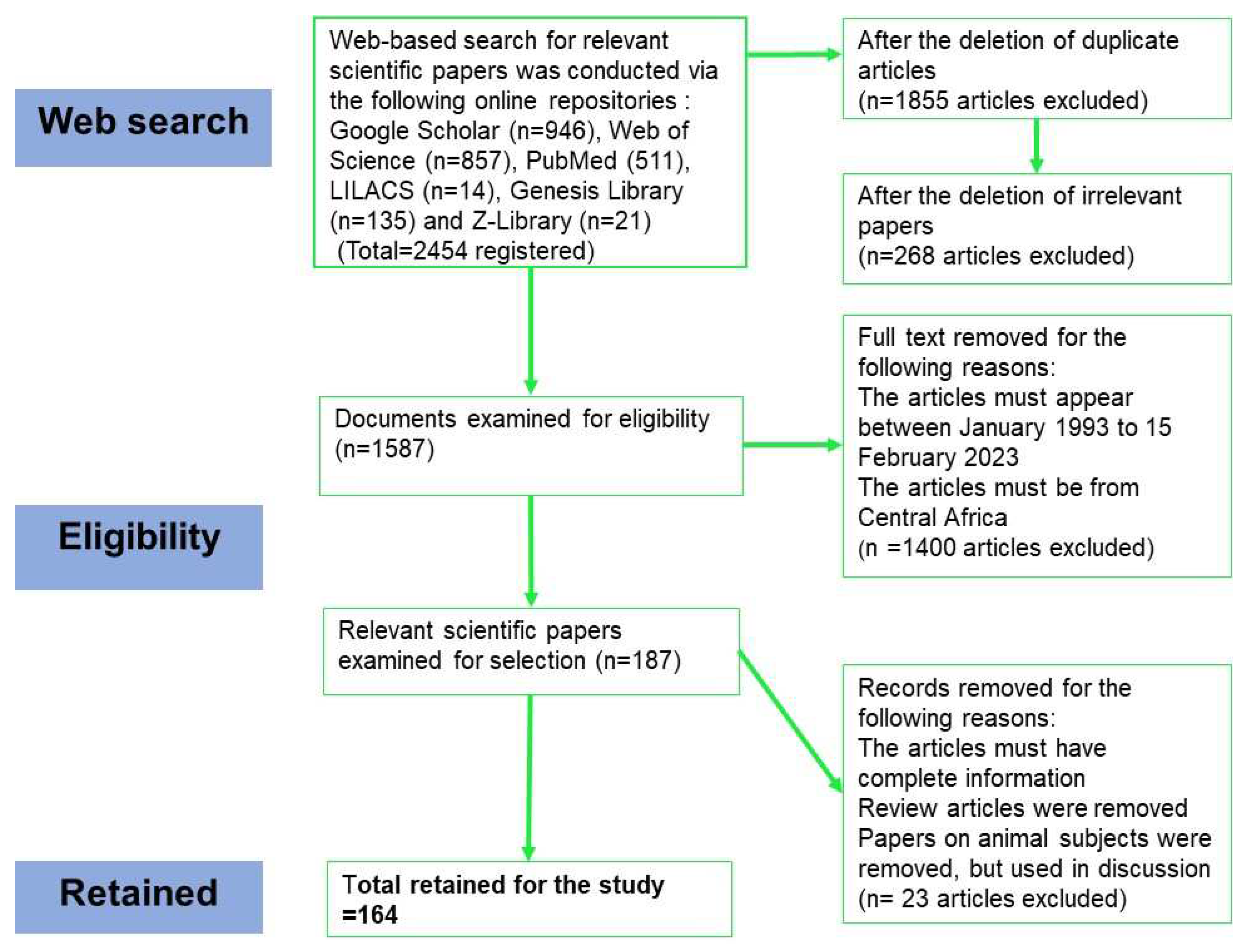
Figure 2.
Number of articles retained by country from 1993 to 2023.
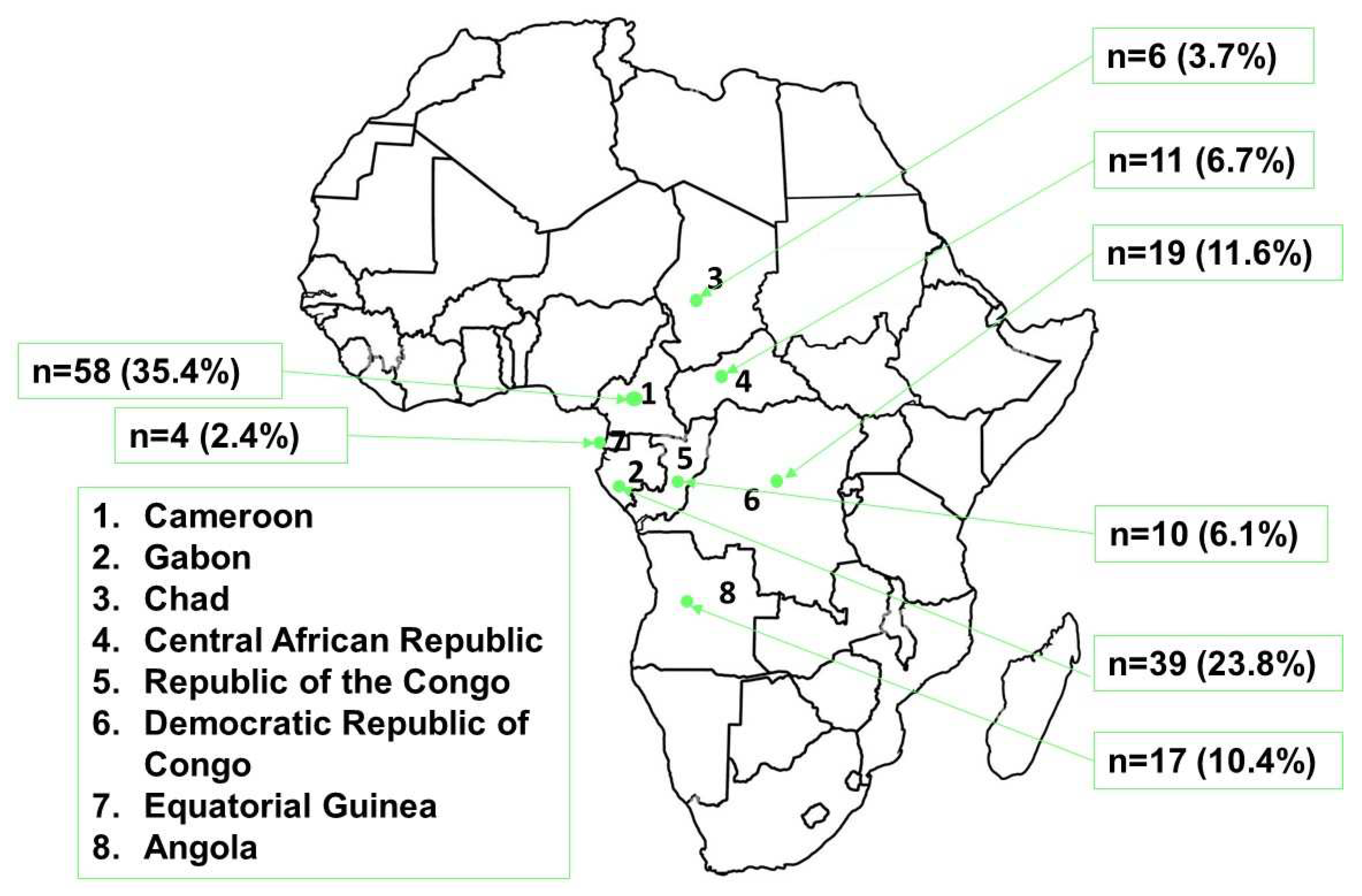
Figure 3.
The periodic trend in publication of entomological and epidemiological data by country.
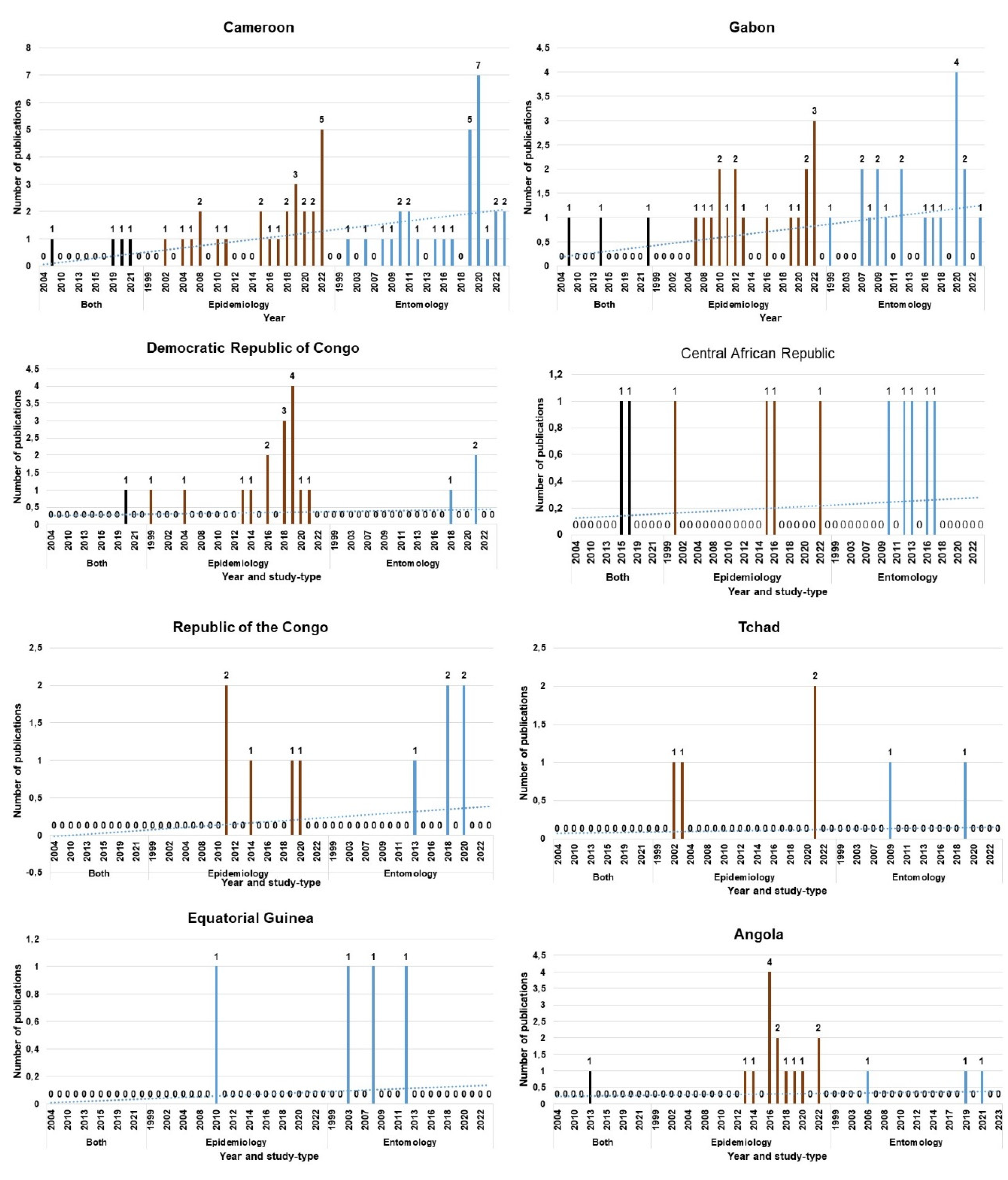
Figure 4.
Genera of mosquitoes identified in the Central African subregion from January 1993 to June 2023; (**): unidentified species.
Figure 4.
Genera of mosquitoes identified in the Central African subregion from January 1993 to June 2023; (**): unidentified species.
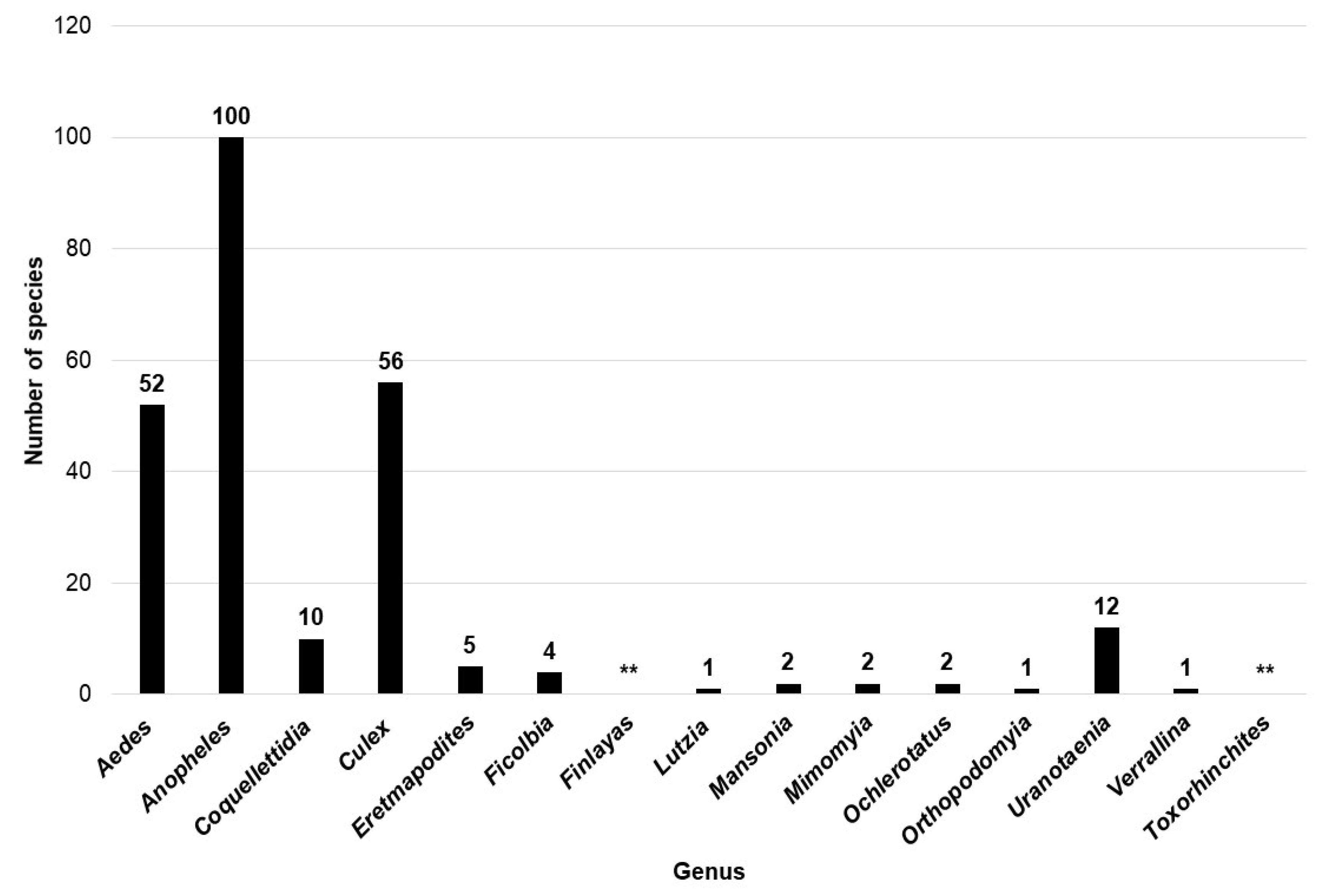
Disclaimer/Publisher’s Note: The statements, opinions and data contained in all publications are solely those of the individual author(s) and contributor(s) and not of MDPI and/or the editor(s). MDPI and/or the editor(s) disclaim responsibility for any injury to people or property resulting from any ideas, methods, instructions or products referred to in the content. |
© 2023 by the authors. Licensee MDPI, Basel, Switzerland. This article is an open access article distributed under the terms and conditions of the Creative Commons Attribution (CC BY) license (http://creativecommons.org/licenses/by/4.0/).
Copyright: This open access article is published under a Creative Commons CC BY 4.0 license, which permit the free download, distribution, and reuse, provided that the author and preprint are cited in any reuse.


