

Submitted:
11 September 2023
Posted:
13 September 2023
You are already at the latest version
Abstract
Background: to know the existing documentation related to exogenous melatonin in the performance of professional soccer players. Methods: critical and systematic review. Data were obtained by looking up the following bibliographic data bases: Web of Science, MEDLINE (via PubMed), Embase, Cochrane Library and Scopus. The used terms were "Soccer Athlete", "Melatonin" and "Soccer Performance", using as a filter: "Humans". The search update was in May 2023. Results: having applied the inclusion and exclusion criteria, 8 articles were selected out of 59 retrieved references. The dose of melatonin administered in the studies ranged between 5 and 8 mg. The outcomes showed a decrease in oxidative stress, muscle damage and inflammatory markers in the melatonin-treated group. Conclusions: Exogenously administered melatonin seems to attenuate some of the effects derived from physical exercise such as oxidative stress, inflammation and muscle damage in professional soccer players, and since it has no potential adverse effects, it could be interesting to apply it in this population. However, the direct effects of melatonin supplementation on physical performance have not been demonstrated, so more research is needed on the intervention period, effective dose and larger participant populations.
Keywords:
football players
; melatonin
; football performance
; soccer
; sport nutrition
; European football
1. Introduction
Melatonin is a hormone derived from serotonin and synthesized through the tryptophan-serotonin pathway in the pineal gland, with concentrations varying according to signals from the circadian centers of the brain [1]. This hormone is the current gold standard for evaluating circadian rhythm, as it directly reflects the rhythm in the central nervous system [2].
In addition, Ishihara et al. [2] add that melatonin plays a crucial role in regulating metabolism and energy balance, as well as lipid and glucose metabolism. It has also been shown that melatonin has anti-inflammatory actions, reduces oxidative stress, and has effects on physical performance [3].
In the world of professional soccer, there are several factors that affect players' sleep and rest, such as game schedules, which vary greatly and sometimes occur later than 8:00 pm, exposure to artificial light, alcohol consumption, or fatigue after travel [4]. All of this creates an environment of sleep deprivation, which can impair recovery processes in soccer players. In addition, as suggested by Fullagar et al. [5], sleep loss can affect physical, neurophysiological, and cognitive parameters, which can have consequences for the performance and recovery of elite athletes.
According to Clemente et al. [6], it has been shown that sleep deprivation inhibits performance in soccer and increases the risk of injury. There are few studies that seek to demonstrate the connection between melatonin and performance in professional soccer. For this reason, the objective of this work was to review and summarize the main findings on the application of melatonin in the performance of professional soccer players.
The objective of the present study was to review and critically analyze the effects of melatonin supplementation on the performance of professional soccer players.
2. Materials and Methods
Design. Critical analysis of the retrieved studies through systematic technique. The structure of this review followed “the Preferred Reporting Items for Systematic Reviews and Meta-Analyses” (PRISMA) [7] checklist for systematic reviews and was registered in PROSPERO.
Data sources. Data was obtained through direct internet search in the following bibliographic databases in health sciences: Web of Science, MEDLINE (via PubMed), Embase, Cochrane Library, and Scopus. The PICO system was used for the formulation of the questions, as follows: P = Effect of melatonin on the sport performance, I = Association of melatonin supplementation with the performance of professional soccer players, C = Melatonin supplementation , and O = Changes in the melatonin intake may have a major impact on the performance of professional soccer players.
Information processing. To define the search terms, the “Thesaurus of Health Sciences Descriptors” (DeCS) developed by the Latin American and Caribbean Center of Information in Medical Sciences (BIREME) and its equivalence with the “Medical Subject Headings” (MeSH) established by the National Library of Medicine of the United States were consulted.
The following search equations were deemed appropriate:
Population: soccer players. “Soccer player” [Title/Abstract] OR “footballer” [Title/Abstract] OR “football player” [Title/Abstract] OR “soccer athlete” [Title/Abstract] OR “football athlete” [Title/Abstract].
Intervention: melatonin - a biogenic amine found in animals and plants. In mammals, melatonin is produced by the pineal gland. Melatonin secretion increases in darkness and decreases during light exposure. Melatonin is involved in the regulation of SLEEP, mood, and REPRODUCTION. Melatonin is also an effective antioxidant. “Melatonin” [MeSH Terms] OR “melatonin” [Title/Abstract] OR “melatonina” [Title/Abstract] OR “melatonin supplement*” [Title/Abstract].
Outcome: soccer performance. Soccer - a game in which a round, inflated ball is advanced by kicking it with any part of the body except the hands or arms. The objective of the game is to place the ball inside the opposing team's goalposts. “Soccer” [MeSH Terms] OR “soccer” [Title/Abstract] OR “soccer performance” [Title/Abstract] OR “European Football” [Title/Abstract] OR “football performance” [Title/Abstract] OR “elite football” [Title/Abstract] OR “training performance” [Title/Abstract] OR “match performance” [Title/Abstract].
The final search equation was performed for use in the MEDLINE database, via PubMed, by joining the three equations previously exposed using Boolean operators: Population AND Intervention AND Outcome (following the PIO format), using the “Humans” filter.
Subsequently, this search strategy was adapted to the characteristics of each of the other consulted databases, performing the search from the first available date in each of the selected databases until April 2023. In addition, a manual search was conducted in the references of the selected articles for the review, in order to decrease the possibility of publication bias. Risk of bias assessment was performed using the blinded Cochrane risk of bias tool.
Final selection of articles. Articles that fulfilled the following criteria were selected for review and critical analysis: Inclusion: scientific articles that use melatonin supplementation and relate it to performance in football or related sports gestures, published in journals indexed in Web of Science with JCR regardless of their quartile, and published before April 2023. Exclusion: studies conducted on non-human samples, observational studies that use measures of endogenous melatonin without intervention, and those that study melatonin supplementation in contexts unrelated to football performance or related efforts. Studies published after April 2023 and those whose journals are not included in JCR of Web of Science are also excluded.
Data extraction. To detect duplicate records (those present in more than one database), the ZOTERO program (a reference manager developed by the Center for History and New Media at George Mason University) was used. To systematize and promote understanding of the results, the articles were classified according to the variables under study, considering the following data: first author, year of publication, quality criteria of the journal (quartile and position in the area), population studied, country and period of the study, intervention performed, and main results.
Ethical aspects. All data were obtained from articles accepted for review. Thus, in accordance with Law 14/2007 on biomedical research [8], ethics committee approval was not required when using secondary data.
Equity, diversity, and inclusion statement. The recruitment of participants considered gender, race/ethnicity/culture, socioeconomic level. The author team include senior and junior researchers. The study accounted for the participants’ accessibility needs, regional geographic differences, education, and socioeconomic levels. The study considered gendered and racialized inequities due to the diversity in professional football.
3. Results
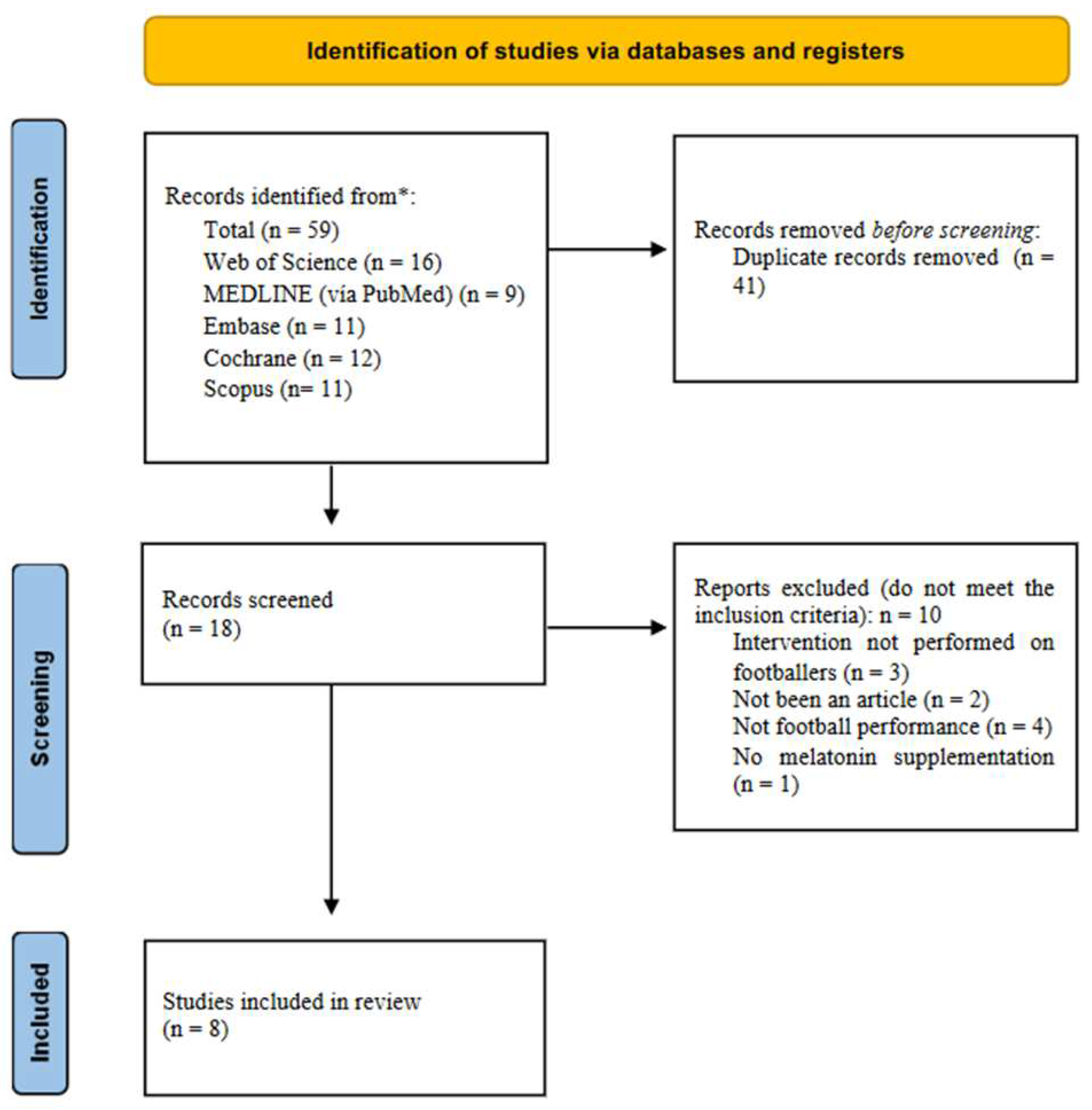
After applying the search criteria, a total of 59 references were retrieved: 16 (%) in Web of Science, 9 (%) in MEDLINE (via PubMed), 11 (%) in Embase, 12 (%) in Cochrane, and 11 (%) in Scopus.
After removing forty-one duplicates, 18 studies were obtained as a result. Based on the inclusion and exclusion criteria and after reading the titles, 10 studies were discarded, and 8 articles were considered appropriate for review and critical analysis, mainly because they did not involve football players as the study population (n=3), they were conference papers rather than articles (n=2), did not involve supplementation with melatonin (n=1), or did not refer to performance in football (n=4) (Figure 1). Table 1 summarizes data from the 8 articles included in the review.
According to the selection criteria, all the reviewed articles were experimental studies. Tunisia contributed the highest number of studies, with 6 articles [9,10,11,13,14,16]. Spain presented one study [12], as well as Poland [15]. The study by Czuczejko et al. [15] included the largest number of participants, with n = 47, while three studies had the smallest population, with n = 12 [9,13,16]. None of the studies included women in their sample. The intervention periods in the reviewed articles ranged from 90 minutes [12] to 30 days [15].
Performed interventions. The interventions carried out in the reviewed studies reasonably consisted of the administration of exogenous melatonin as supplementation. In most cases, melatonin was ingested between 30 minutes and 1 hour before the physical tests, except for the studies by Czuczejko et al. [15], where it was administered every day 1 hour before sleep, and Farjallah et al. 2020 [10], where melatonin was administered every day at 19:00. The doses varied from 5 to 8 mg: 4 trials used 5 mg of melatonin [10,14,15,16]; 3 studies administered 6 mg [11,12,13], and one article was conducted with one group ingesting 5 mg and another group ingesting 8 mg of melatonin [9]. It is noteworthy that none of the studies measured the level of endogenous melatonin before the intervention, nor reported monitoring the melatonin ingested through the participants' diet.
Results of the interventions. In the studies conducted by Ghattasi et al. in 2014 and 2016 [9,16], a reduction in performance was observed after melatonin ingestion. In the 2014 study, the consumption of 8 mg of melatonin prior to nocturnal exercise decreased performance, while in the 2016 study, performance decreased in the morning after melatonin administration, but was not affected in the afternoon. In two of the studies conducted by Farjallah et al. [11,13], there were no differences in physical performance parameters between the placebo and melatonin groups. However, in one of these studies, a lower inflammation, oral temperature, and a decrease in oxidative processes were observed in the melatonin group after exercise [11], while the other study showed reduced liver damage and a protective effect on renal function when melatonin was ingested [13]. Regarding the studies that did show effects of melatonin administration in football players, five of them demonstrated a decrease in oxidative stress after sports practice when exogenous melatonin was administered [10,11,12,13,15]. Melatonin supplementation also showed anti-inflammatory effects in football players in three of the reviewed studies [10,12,15]. Muscle damage, measured by CK and LDH levels, was attenuated in the group that took melatonin in three studies [10,11,15].

Table 1.
Summary of accepted articles for review on the effects of melatonin supplementation on footballers performance.
Table 1.
Summary of accepted articles for review on the effects of melatonin supplementation on footballers performance.
| Author, Year | Impact Index | Studied Population | Country | Intervention Period | Intervention Type | Observed Result |
|---|---|---|---|---|---|---|
| Ghattassi et al., 2014 [9] | IF: 0,919 Rank: 61/85 Quartile: Q3 Category: Biology |
Professional footballers N total: 12 H/M: 12/0 Age: 22,9±1,3 years Height: 1,8±0,05m Weight: 72,0±8,8kg |
Tunisia | 3 nocturnal sessions | Three test sessions were conducted in random order: two sessions with ingestion of melatonin - 5mg or 8mg, and one session with ingestion of a placebo, taken 30 minutes before the physical test sessions. Performance was measured by the following tests in this order each evaluation night: squat jump (SJ), countermovement jump (CMJ), medicine ball throw (MBT), 5-jump test (5-JT), grip strength (HG), and agility test. | The ingestion of 5mg of melatonin did not affect subsequent performance. However, the ingestion of 8mg of melatonin prior to nocturnal exercise decreased performance, specifically in grip strength (HG) compared to placebo (p<0.01) and 5mg of melatonin (p<0.05). There was a significant decrease when comparing placebo and 5mg of melatonin with 8mg of melatonin in squat jump (SJ) and countermovement jump (CMJ) (p<0.01). |
| Farjallah et al., 2020 [10] | IF: 2,877 Rank: 34/93 Quartile: Q2 Category: Biology |
Professional footballers N total: 20 H/M: 20/0 Age: 18,81±1,3 years Weight: 70,0±10,6kg Height: 1,81±0,1m BMI: 21,27±1,87kg.m-2 |
Tunisia | 7 days | On day 1 and day 7, a blood analysis, an RSA test, and a second blood analysis after the RSA test were conducted. Two training sessions were held each day. One group received a placebo, while the other group received 5mg of melatonin every day at 7:00 PM in a double-blind fashion.. | The melatonin group showed a smaller decrease in performance after the TC (training camp). A decrease in oxidative stress and muscle damage parameters was observed after melatonin ingestion, as well as protection against the decline of antioxidant enzymes. The consumption of melatonin showed an anti-inflammatory effect. |
| Farjallah et al., 2022 [11] | IF: 4,606 Rank: 16/88 Quartile: Q1 Category: Sport Sciences |
Professional footballers N total: 13 H/M: 13/0 Age: 17,5±0,8 years Weight: 70,3±3,9 kg Height: 1,8±0,08m |
Tunisia | 10 days | On the first day of testing, anthropometric measurements and the Vameval test were conducted. In the second session, one group received 6mg of melatonin (MEL), and another group received a placebo (PLA) in a double-blind manner. Thirty minutes later, surveillance tests, oral temperature measurements, and blood samples were taken. Then, the participants performed the maximal incremental test (RET) until exhaustion at 100% of their maximal aerobic speed (MAS). Heart rate was monitored during the test. After exercise, the rating of perceived exertion (RPE) was assessed, and oral temperature and ventilatory thresholds (OT and VT) were measured again. Additionally, a second blood sample was taken 3 minutes after the RET. In the third session, all tests were repeated under the same conditions so that each participant experienced one session with MEL and another with PLA. |
There were no significant differences between MEL and PLA regarding physical performance, heart rate, RPE, and psychocognitive performance. However, a reduction in oral temperature was observed after exercise in the melatonin group. Regarding biomarkers, there were no significant effects on AOPP or GR after RET. In the PLA group, there was a decrease in GPx, UA, and TBIL levels post-RET, and an increase in MDA levels. However, the levels of CK and LDH were lower post-exercise following melatonin ingestion. |
| Maldonado et al., 2011 [12] | IF: 2,869 Rank: 19/48 Quartile: Q2 Category: Behavioral Sciences |
Spanish second division footballers N total: 16 H/M: 16/0 Age: 18-20 years Weight: 68,25±1,53 kg |
Spain | 90 minutes | The experimental group (E) was treated with 6mg of melatonin, while the control group (C) received a placebo. They performed 60 minutes of intense exercise on a stationary bicycle, during which blood samples were taken under baseline conditions from 9:00 to 9:30 AM. Blood samples were also taken 30 minutes before exercise and at minutes 3, 15, and 60 during the exercise. | The experimental group showed a lower increase in lipid peroxidation products measured as MDA compared to the control group. In the experimental group, total antioxidant activity did not decrease at 3 and 15 minutes compared to baseline and increased at 60 minutes. In the control group, total antioxidant activity decreased at 15 and 60 minutes. The experimental group also exhibited significant effects in reducing triglyceride levels and increasing IgA levels after intense exercise. |
| Farjallah et al., 2022 [13] | IF: 2,098 Rank: 59/80 Quartile: Q3 Category: Pshychology |
Professional footballers N total: 12 H/M: 12/0 Age: 17,54±0,78 years Weight: 70,31±3,86 kg Height: 1,8±0,08 m |
Tunisia | 3 days | In a randomized, double-blind design, 6 participants took 6mg of MEL (melatonin) while the other 6 took PLA (placebo). Blood samples were collected 30 minutes after melatonin ingestion and 3 minutes after the RET (maximal incremental test). Additionally, heart rate, distance covered, time to exhaustion, and various biomarkers were measured. | There were no differences between MEL (melatonin) and PLA (placebo) for physical performance parameters. The ingestion of melatonin showed less liver damage and a protective effect on renal function after exercise. |
| Farjallah et al., 2022 [14] | IF: 3,752 Rank: 29/74 Quartile: Q2 Category: Multidisciplinary Sciences |
Professional footballers N total: 20 H/M: 20/0 Age: 18,8±1,3 years Weight: 70,0±10.6 kg Height: 181±8 cm |
Tunisia | 6 days | The participants' sleep schedule and meals were monitored and controlled. They underwent two training sessions per day. Two groups were formed: one group took 5mg of MEL (melatonin), and the other group took PLA (placebo). Blood samples were collected on the first day and after the training period during rest. A battery of physical tests was conducted on the first day and after the training period. | The consumption of MEL (melatonin) reduced exercise-induced oxidative stress. The MEL group experienced less muscle, kidney, and liver damage after the intensive training period. The decline in physical performance was attenuated by MEL, which can be explained by the reduction in cellular damage following melatonin supplementation. The MEL group exhibited better performance compared to the PLA (placebo) group. |
| Czuczejko et al. 2019 [15] | IF: 2,839 Rank: 171/297 Quartile: Q3 Category: Biochemistry & Molecular Biology |
Football players and control group N total: 47 H/M: 47/0 Age: 20,95±2,4 years Weight: 89,7±8,5 kg Height: 1,85±0,2 m |
Poland | 30 days | The athletes were supplemented with 5mg of melatonin daily, 1 hour before bedtime. Blood samples were collected before starting the supplementation and after. Two physical capacity tests, namely Astrand-Ryhming and PWC170, were conducted. | The supplementation with MEL (melatonin) increased the blood level of indolamine in the football players. However, MEL supplementation did not have any significant effects on the concentration of GSH (antioxidant). There was a decrease in oxidative processes, indicating a reduction in oxidative stress. Additionally, the inflammatory markers decreased following the supplementation. |
| Ghattassi et al., 2016 [16] | IF: 1,697 Rank: 73/81 Quartile: Q4 Category: Physiology |
Football players N total: 12 H/M: 12/0 Age: 17,9±1,3 years Weight: 62,0±8,8 kg Height: 1,74 ± 0,06 m |
Tunisia | 2 days | Each participant underwent two sessions of physical and cognitive tests with 3 testing periods per day. In one session, they consumed 5mg of MEL (melatonin) at 07:30 am, 30 minutes before the first test, and in the other session, they took a placebo (PLA). These sessions were separated by a 36-hour interval. The participants were advised to maintain a recommended energy intake and adhere to scheduled meal and sleep times. | The ingestion of MEL (melatonin) resulted in a decrease in morning performance in various measures such as vigilance, reaction time, MBT (medicine ball throw), and HG (handgrip strength). However, there was no significant effect on performance in the afternoon. Interestingly, for both the PLA (placebo) and MEL conditions, performance was better at 4:00 pm. |
Figure 1.
Identification and selection of the studies.
4. Discussion
This literature review synthesizes the information regarding the effects of exogenous melatonin on the performance of professional football players, providing the scientific community with evidence to promote new interventions for performance enhancement in these athletes.
The reviewed articles, excluding Maldonado et al. [12], were published within the last 10 years, and even five out of the eight selected studies were published five years ago, indicating that this is a very current research field with much yet to be investigated [17]. This was evidenced during the literature search conducted in this review, which had to cover a wide time range and generalize the quartiles of the journals in which the articles were published due to the limited publication in this topic. Additionally, there are no studies available on melatonin ingested through food, so a greater number of studies should be conducted to evaluate the intake of melatonin through food and its influence on endogenous synthesis of this hormone.
Melatonin is rapidly absorbed and reaches peak levels around 40 minutes [18], so the observed administration schedules (around 30 to 60 minutes before the tests) would be appropriate.
The intervention period was very short in most studies, with only one study conducted over 30 days. On the one hand, it was demonstrated that melatonin did not improve performance when used with a short-term acute dose [11,13]. On the other hand, it was observed that melatonin is effective as an antioxidant and anti-inflammatory in the short term [10,11,12,13].
Regarding the doses used in the studies, they were heterogeneous and not considered high for the adult population. The standard doses used in the studies ranged from 5 to 8 mg, although more studies are needed to determine the optimal effective minimum dose [19]. However, a Cochrane review [20] stated that a daily dose of melatonin between 0.5 and 5 mg was equally effective, and no better efficacy was attributed to doses higher than 5 mg.
As previously pointed out, the endogenous melatonin of the football players was not taken into account, which poses a problem in validating supplementation. Furthermore, the diets of the football players should be controlled and evaluated, as the consumption of certain foods or nutrients such as caffeine or certain vitamins and minerals can alter melatonin production [21], and melatonin has been identified in a wide range of foods, consumption of which can significantly increase melatonin concentration in human serum [22]. Therefore, more studies are needed in which a nutritional assessment of the football players is conducted to quantify melatonin consumed through the diet, as the intake of melatonin-rich foods can have positive impacts on health by increasing circulating melatonin [22].
The results of this review demonstrated a decrease in sports performance in football players following the administration of melatonin prior to nighttime exercise, as well as in the case of early morning exercise. In this regard, López-Flores et al. [23] concluded that elevated melatonin concentrations at the time of physical activity could lead to a decrease in sports performance, mainly due to the depressive effects of this hormone on the central nervous system. Additionally, Atkinson et al. [24] suggested that melatonin supplementation had negative effects on reaction time, vigilance, and short-term memory.
The studies did not find direct effects on improving the performance of football players when melatonin was administered. The evidence that melatonin could be an ergogenic aid is weak, and further research is needed before a decision can be made [25].
In contrast, considering the results of the reviewed studies on melatonin and physical performance, it has been observed that melatonin attenuates the decline in physical performance after a period of intensive training rather than enhancing performance itself. This finding can be explained by the improvement effect of melatonin on aerobic capacity [26,27].
Another result obtained in the review was the reduction of oxidative stress after physical exercise, which could translate into an indirect improvement in performance. In line with this, numerous studies have demonstrated both in vitro and in vivo that melatonin protects against oxidative damage from free radicals [28]. Kruk et al. [3] support these findings by confirming that melatonin and its metabolites play an important role as scavengers of free radicals and ROS/RNS, reducing cellular and tissue oxidative damage.
Several studies included in this review have shown an anti-inflammatory effect due to the ingestion of exogenous melatonin in football players. This result was supported by Ochoa et al. [29], where the obtained data indicated that melatonin administration had protective effects, reducing the activation and overexpression of pro-inflammatory mediators.
Leonardo-Mendonça et al. [30] also found a relationship between melatonin supplementation and the reduction of muscle damage in athletes, as revealed by the results of the present review.
Finally, there is a meta-analysis that demonstrates the effectiveness of melatonin in combating jet lag in athletes who have to undertake international travel, as a way to counteract performance impairment [20]. However, this was not the purpose of the present review, although it is proposed as a possible line of future review study due to the importance of jet lag in professional football, given the constant travel requirements of national and international competitions in this sport.
Limitations. The sample studied is exclusive to professional football, so generalizability to other populations may be limited. It would be necessary to increase the number of studies with a larger number of male and female subjects under study, including football leagues from different countries and continents.
5. Conclusions
Melatonin supplementation administration appears to attenuate some of the effects associated with physical exercise, such as oxidative stress, inflammation, and muscle damage in professional football players. Since it does not have potential adverse effects, it could be interesting to apply it in this population. However, the direct effects of melatonin supplementation on physical performance have not been demonstrated, highlighting the need for further research on the intervention period, effective dosage, and larger study populations. Greater emphasis should be placed on conducting studies that assess the nutritional intake of professional football players, as it plays a crucial role in understanding the potential benefits of melatonin in athletes.
Author Contributions
The study was designed by BR, AS and MM-A; data were collected and analyzed by AJA, AL-M, and JC-P; data interpretation and manuscript preparation were undertaken by AJA, BR, AS and MM-A. All authors reviewed and approved the final manuscript. All authors have read and agreed to the published version of the manuscript.
Funding
This study was funded by the High Council for Sports (CSD), Spanish Ministry of Culture and Sport, through the NESA NETWORK “Spanish Network of Sports Care at Altitude” Ref. 19/UPB/23. This research was supported by an FPU grant from the Spanish University Ministry to Alejandro Lopez-Moro (FPU20/00210).
Institutional Review Board Statement
Not applicable.
Informed Consent Statement
Not applicable.
Data Availability Statement
There are restrictions on the availability of data for this trial, due to the signed consent agreements around data sharing, which only allow access to external researchers for studies following the project’s purposes. Requestors wishing to access the trial data used in this study can make a re-quest to mariscal@ugr.es.
Acknowledgments
The authors thank FSI, Football Science Institute, for their support.
Conflicts of Interest
The authors declare no conflict of interest.
References
- Vasey C, McBride J, Penta K. Circadian Rhythm Dysregulation and Restoration: The Role of Melatonin. Nutrients [Internet]. 2021 Sep 30;13(10):3480. [CrossRef]
- Ishihara A, Courville AB, Chen KY. The Complex Effects of Light on Metabolism in Humans. Nutrients [Internet]. 2023 Mar 14;15(6):1391. [CrossRef]
- Kruk, J., Aboul-Enein, B.H. & Duchnik, E. Exercise-induced oxidative stress and melatonin supplementation: current evidence. J Physiol Sci 71, 27 (2021). [CrossRef]
- Nédélec, M., Halson, S., Abaidia, AE. et al. Stress, Sleep and Recovery in Elite Soccer: A Critical Review of the Literature. Sports Med 45, 1387–1400 (2015). [CrossRef]
- Fullagar HHK, Vincent GE, McCullough M, Halson S, Fowler P. Sleep and sport performance. J Clin Neurophysiol [Internet]. 2023. [CrossRef]
- Clemente FM, Afonso J, Costa J, Oliveira R, Pino-Ortega J, Rico-González M. Relationships between Sleep, Athletic and Match Performance, Training Load, and Injuries: A Systematic Review of Soccer Players. Healthcare [Internet]. 2021 Jun 26;9(7):808. [CrossRef]
- Page MJ, McKenzie JE, Bossuyt PM, Boutron I, Hoffmann TC, Mulrow CD, et al. The PRISMA 2020 statement: an updated guideline for reporting systematic reviews. BMJ [Internet]. 2021;372:n71. Disponible en. [CrossRef]
- Ley 14/2007, de 3 de Julio, de Investigación Biomédica. Available online: https://www.boe.es/eli/es/l/2007/07/03/14 (accessed on 18 January 2023).
- Ghattassi K, Graja A, Hammouda O, Chtourou H, Boudhina N, Chaouachi A, et al. Effect of nocturnal melatonin ingestion on short-term anaerobic performance in soccer players. Biol Rhythm Res [Internet]. 2014;45(6):885-93. [CrossRef]
- Farjallah MA, Ghattassi K, Ben Mahmoud L, Graja A, Boudaya M, Elleuch H, et al. Effect of nocturnal melatonin intake on cellular damage and recovery from repeated sprint performance during an intensive training schedule. Chronobiol Int [Internet]. 2020;37(5):686-98. [CrossRef]
- Farjallah, M.A.; Graja, A.; Ben Mahmoud, L.; et al. Effects of melatonin ingestion on physical performance and biochemical responses following exhaustive running exercise in soccer players. Biol Sport. 2022, 39, 473–479. [Google Scholar] [CrossRef] [PubMed]
- Maldonado MD, Manfredi M, Ribas-Serna J, Garcia-Moreno H, Calvo JR. Melatonin administrated immediately before an intense exercise reverses oxidative stress, improves immunological defenses and lipid metabolism in football players. Physiol Behav [Internet]. 2012;105(5):1099–103. [CrossRef]
- Farjallah MA, Graja A, Ghattassi K, Ben Mahmoud L, Elleuch H, Ayadi F, et al. Melatonin ingestion prevents liver damage and improves biomarkers of renal function following a maximal exercise. Res Q Exerc Sport [Internet]. 2022;1-11. [CrossRef]
- Farjallah, M.A.; Ghattassi, K.; Kamoun, A.; Graja, A.; Ben Mahmoud, L.; Driss, T.; et al. Melatonin supplementation alleviates cellular damage and physical performance decline induced by an intensive training period in professional soccer players. PLoS ONE 2022, 17, e0273719. [Google Scholar] [CrossRef] [PubMed]
- Czuczejko J, Sielski L, Wozniak B, Wozniak A, Szewczyk-Golec K. Melatonin supplementation improves oxidative and inflammatory state in blood professional athletes during the preparatory period for competitions. Free Radic Res [Internet]. 2019;53(2):198-209. [CrossRef]
- Ghattassi K, Hammouda O, Graja A, Boudhina N, Chtourou H, Hadhri S, et al. Morning melatonin ingestion and diurnal variation of short-term maximal performances in soccer players. Physiol Int [Internet]. 2016;103(1):94–104. [CrossRef]
- Atkinson G, Drust B, Reilly T, Waterhouse J. The relevance of melatonin to sports medicine and science. Sports Med [Internet]. 2003;33(11):809–31. [CrossRef]
- Poza JJ, Pujol M, Ortega-Albás JJ, Romero O, en representación del Grupo de estudio de insomnio de la Sociedad Española de Sueño (SES). Melatonina en los trastornos de sueño. Neurología [Internet]. 2018;37(7):575–85. [CrossRef]
- Matheson, E.; Hainer, B.L. Insomnia: Pharmacologic therapy. Am Fam Physician 2017, 96, 29–35. [Google Scholar] [PubMed]
- Herxheimer A, Petrie KJ. Melatonin for the prevention and treatment of jet lag. Cochrane Database Syst Rev [Internet]. 2002;2010(2):CD001520. [CrossRef]
- Peuhkuri K, Sihvola N, Korpela R. Dietary factors and fluctuating levels of melatonin. Food Nutr Res [Internet]. 2012;56(1):1725. [CrossRef]
- Meng X, Li Y, Li S, Zhou Y, Gan R-Y, Xu D-P, et al. Dietary Sources and Bioactivities of Melatonin. Nutrients [Internet]. 2017 Apr 7;9(4):367. [CrossRef]
- López-Flores, M.; Luque-Nieto, R.; Moreira, O.C.; Suarez-Iglesias, D.; Villa-Vicente, J.G. Effects of Melatonin on Sports Performance: A Systematic Review. JEPonline 2018, 21, 121–138. [Google Scholar]
- Atkinson G, Jones H, Edwards BJ, Waterhouse JM. Effects of daytime ingestion of melatonin on short-term athletic performance. Ergonomics [Internet]. 2005;48(11–14):1512–. [CrossRef]
- Waterhouse J, Atkinson G. Melatonin as an ergogenic aid. Biol Rhythm Res [Internet]. 2009;40(1):71–9. [CrossRef]
- Beck WR, Botezelli JD, Pauli JR, Ropelle ER, Gobatto CA. Melatonin has an ergogenic effect but does not prevent inflammation and damage in exhaustive exercise. Sci Rep [Internet]. 2015;5(1):18065. [CrossRef]
- Cheikh M, Hammouda O, Gaamouri N, Driss T, Chamari K, Cheikh RB, et al. Melatonin ingestion after exhaustive late-evening exercise improves sleep quality and quantity, and short-term performances in teenage athletes. Chronobiol Int [Internet]. 2018;35(9):1281–93. [CrossRef]
- Galván C de T, Guisado Barrilao R, García MC, Ochoa J, Ocaña Wilhelmi J. Antioxidantes y ejercicio físico: funciones de la melatonina. Rev Andal Med Deport [Internet]. 2008;1(2):61–72. Available online: https://www.redalyc.org/articulo.oa?id=323327655004.
- Ochoa JJ, Díaz-Castro J, Kajarabille N, García C, Guisado IM, De Teresa C, et al. Melatonin supplementation ameliorates oxidative stress and inflammatory signaling induced by strenuous exercise in adult human males: Melatonin and strenuous exercise. J Pineal Res [Internet]. 2011;51(4):373–80. [CrossRef]
- Leonardo-Mendonça RC, Ocaña-Wilhelmi J, de Haro T, de Teresa-Galván C, Guerra-Hernández E, Rusanova I, et al. The benefit of a supplement with the antioxidant melatonin on redox status and muscle damage in resistance-trained athletes. Appl Physiol Nutr Metab [Internet]. 2017;42(7):700–7. [CrossRef]
Disclaimer/Publisher’s Note: The statements, opinions and data contained in all publications are solely those of the individual author(s) and contributor(s) and not of MDPI and/or the editor(s). MDPI and/or the editor(s) disclaim responsibility for any injury to people or property resulting from any ideas, methods, instructions or products referred to in the content. |
© 2023 by the authors. Licensee MDPI, Basel, Switzerland. This article is an open access article distributed under the terms and conditions of the Creative Commons Attribution (CC BY) license (http://creativecommons.org/licenses/by/4.0/).
Copyright: This open access article is published under a Creative Commons CC BY 4.0 license, which permit the free download, distribution, and reuse, provided that the author and preprint are cited in any reuse.


