

Submitted:
11 September 2023
Posted:
13 September 2023
You are already at the latest version
Abstract
In recent research, a growing body of empirical evidence, suggests that prosocial impact at work can play a significant role in enhancing creativity and innovativeness. Drawing from Self Determination Theory, we hypothesized that basic psychological needs and benevolence satisfaction could serve as a mediating factor in the relation between employees perceived social impact and innovative work behavior and creativity, thus illuminating the manner in which contentment of psychological needs fosters inventive proclivities within the organizational milieu. Results from a study in Greece and Canada (N=528) showed that both perceived social impact and prosocial motivation are positively associated with innovative work behavior and creativity while autonomy and competence satisfaction mediate the relation between perceived social impact and the work outcomes examined within this study. Moreover, prosocial motivation was found to moderate the relation between benevolence satisfaction and innovativeness. Findings extend prior research on the role of prosociality on creative behavior at work and provide supporting evidence for the organizations that encourage and support employees’ initiatives to make a positive difference in the lives of others.
Keywords:
positive impact
; needs satisfaction
; prosocial motivation
; benevolence
; innovative work behavior
; creativity
1. Introduction
Amidst the contemporary, fast-paced, and dynamic landscape of the modern workplace, delving into the investigation of Innovative Work Behavior (IWB) could potentially provide valuable insights for achieving organizational success [1]. IWB, as defined by Janssen [2], involves the intentional creation, introduction, and application of new ideas within a work role, group, or organization, aimed at benefiting role performance, the group, or the organization. This multifaceted concept encompasses activities such as problem and/or solution searching, idea generation, idea championing (i.e., attempting to build support for ideas), and idea implementation [3].
At the core of Innovative Work Behaviors (IWB) resides the fundamental essence of creativity. Creativity, as defined by Amabile [4] and Van Dyne et al. [5], emphasizes the generation of original and novel work, focusing on the creation of new and innovative ideas. However, the concept of IWB encompasses a broader scope. IWB necessitates more than mere displays of creative behavior. It entails a holistic process of innovation that involves courageous experimentation, learning from failures, fostering a sense of autonomy to take proactive actions, and continuously exerting energy to explore novel ideas with reduced fear of external judgment. The dynamic interplay of these multifaceted elements suggests that energetic resources must align with high-level and high-quality motivational states to effectively foster and sustain IWB.
In recent research, a growing body of empirical evidence, primarily focusing on management applications, suggests that prosocial motivation can play a significant role in enhancing creativity and innovativeness [6]. Prosocial motivation pertains to the desire to act for the benefit and welfare of others and has been linked to various positive personal and professional outcomes [7,8]. Zhang and Bartol [9] proposed that the extent of an individual’s engagement in the innovative process depends on their concern for the problem at hand. Consequently, employees with a prosocial motivation, driven by the greater interests of others, the organization, or groups, exhibit a heightened focus on the well-being and needs of others [10]. Investigating the role of prosocial motivation, Grant and Berry [11] underscore the significance of directing employees’ attention towards the development and evaluation of ideas that effectively benefit beneficiaries. This highlights the notion of prosocial impact.
Prosocial impact is characterized by individuals’ perceptions of their work behavior benefiting others, a perception largely influenced by the meaningfulness of their work content [1]. Prosocial impact allows employees to transcend their own perspectives, heightens their sensitivity to the needs of others, and enables them to perform tasks with utmost dedication and interest, all of which are crucial elements in fostering creativity and innovativeness [12]. However, since not all employees may possess inherent self-regulation or prosocial motivation, organizations have a responsibility to provide opportunities for employees to experience meaningful work [13]. Furthermore, existing research suggests that perceiving one’s work as positively impacting others’ well-being serves as a significant need-satisfying factor across diverse cultural and occupational contexts [14]. The current study aims at addressing some recent calls asserting that prosocial motivation is a potentially important yet understudied determinant of innovative behavior deserving of further applied research [15,16].
The primary goal of this study is to utilize basic psychological needs [17] as a framework to explore the underlying mechanisms that could explain the potential relationship between prosocial impact, prosocial motivation, innovative work behaviors, and creativity. By employing this theoretical lens, the study aims to shed light on the intricate processes through which prosocial impact and motivation may influence employees’ innovative work behaviors and creative outputs.
The notion of basic psychological needs satisfaction (BPNS), derived from Self-Determination Theory [18], emerges as a potential mechanism to elucidate the underlying dynamics that govern the relationship between prosocial impact, Innovative Work Behaviors (IWB), and creativity. the three fundamental psychological needs are as follows: autonomy, competence, and relatedness. Autonomy represents the desire for individuals to experience a sense of independence and choice in their actions, fostering a feeling of control over their decisions aligned with personal values and interests. Competence reflects the need for individuals to feel effective and skilled in their pursuits, contributing to a sense of mastery and accomplishment. Lastly, relatedness pertains to the need for individuals to experience social connectedness, care, and support in their relationships, fostering a sense of belongingness and understanding. These core psychological needs are pivotal in promoting intrinsic motivation, well-being, and optimal functioning across various domains of life. Indeed, scholarly discourse has posited that positive impact may be associated with an increase in the fulfillment of basic psychological needs [19]. Substantiating this supposition, compelling empirical findings underscore the intricate connection between Basic Psychological Need Satisfaction (BPNS), Innovative Work Behaviors (IWB) and creativity, thus illuminating the manner in which contentment of psychological needs fosters inventive proclivities and creativity within the organizational milieu [20,21].
Hypothesis 1: Through greater need satisfaction, prosocial impact leads to greater Innovative Work Behaviors (IWB) and creativity.
According to Martela and Ryan [22], benevolence - the act of positively contributing to others - could potentially be considered as a “fourth” psychological need. Controlling for the three initial needs (i.e., autonomy, competence, and relatedness), they demonstrated through three independent studies that benevolence satisfaction acts an indirect effect in the relationship between prosocial impact and well-being, with all four factors emerging as independent constructs [22]. Subsequent studies have further shown that satisfaction of benevolence significantly assists individuals in finding meaning at work [23]. Recent research suggests that instead of being considered a fundamental psychological need, benevolence may be viewed as a well-being enhancer [24]. This shift in perspective arises from the unclear construct validity of benevolence frustration. [25]. Well-being enhancers are characterized as “universal conditions for enhancing human flourishing, wherein satisfaction should lead to optimal development and overall well-being” [24]. However, their frustration might not necessarily have distinct effects on causing ill-being. Based on the preceding findings, exploring the indirect role of benevolence satisfaction in the relationship between prosocial impact, Innovative Work Behaviors (IWB), and creativity holds significant promise for understanding essential organizational outcomes.
Hypothesis 2: Through greater benevolence satisfaction, prosocial impact leads to greater Innovative Work Behaviors (IWB) and creativity.
Moreover, considering that not all employees are inherently self-regulated orprosocially motivated [13], it becomes imperative to acknowledge the potential role of prosocial motivation in amplifying the relationships between benevolence satisfaction, Innovative Work Behaviors (IWB), and Creativity. IWB includes actions that are not always normally rewarded and rewarding for an employee since championing of ideas and supporting new services/products involves energy, personal investment and a sense of personal agency. Prosocial motivation refers to the desire to act for the benefit or welfare of others and has been linked to a wide array of positive personal and professional outcomes [7] since it helps employees go beyond the limitations of their own perspectives, improve their sensitivity to the needs of others, and perform tasks to the best of their abilities and interests all of which are crucial for promotimig innovativeness and creativity [12]. The degree of individual participation in the innovative process depends on the degree of his/her concern regarding the problem and thus, prosocially motivated employees who are driven by the greater interests of others, the organization, or groups are more concerned about the well-being and needs of others [9,26].
Hypothesis 3: The relation between benevolence satisfaction, Innovative Work Behaviors and creativity is moderated by prosocial motivation.
This study aims to make valuable contributions to the field of human resources. Firstly, it builds an integrated model, drawing from the Self-Determination Theory (SDT) and prior research, to investigate the connections between prosocial impact, needs satisfaction, prosocial motivation, and Innovative Work Behaviors (IWB)/creativity. Secondly, the research examines whether needs satisfaction and benevolence satisfaction have an indirect effect in the link between prosocial impact and IWB/creativity. Additionally, the study explores the moderating role of prosocial motivation on the relationship between benevolence satisfaction and IWB. By adopting this comprehensive approach, the study seeks to provide valuable insights into the complex dynamics of these variables and their implications for human resources.
2. Materials and Methods
2.1. Participants and Procedures
In this study, we recruited 528 employees, of which 64% were female, from various industries and occupations in Greece and Canada using a convenience sampling method. Most of the participants (52.8%) held a Masters’ degree, with an average age of 37.5 years and an average of 7.3 years of employment. To ensure sufficient statistical power, we calculated the sample size using G*Power v3.1 software, with an effect size of 0.15 and a power of 0.95.
2.2. Measures
The survey employed a Likert-type scale with endpoints at 1, representing strong disagreement, and 7, indicating strong agreement. This scale allowed respondents to express their level of agreement or disagreement with each statement, providing a standardized and efficient method for data collection and analysis.
2.2.1. Innovative work behavior
Innovative work behavior was measured by nine items adapted from De Jong and Den Hartog’s [3]. The IWB scale is a unidimensional measure that incorporates items to reflect four stages of IWB, i.e., exploration, generation, championing, and implementation of ideas. Participants were required to indicate how frequently, using a 7-point Likert-type scale ranging from 1 (almost never) to 7 (almost always), they manifest the behaviors mentioned in the survey. A sample item is “how often do you find new approaches to execute tasks?”. Cronbach’s alpha coefficient was .90.
2.2.2. Creativity
Creativity was assessed using a 6-item Likert-type scale developed by Madjar et al. [27], where participants were asked to rate their agreement with statements like “I suggest radically new ways to improve products or services.” The Cronbach’s alpha coefficient yielded a high value of .90, reflecting strong internal consistency among the items.
2.2.3. Prosocial motivation
Prosocial motivation was measured by a five-item scale adapted from Grant and Sumanth [28], which includes items such as “I prefer to work on tasks that allow me to have a positive impact on others.” Cronbach’s alpha coefficient was .94.
2.2.4. Prosocial impact
Prosocial impact was assessed with the 3-item scale developed by Grant [29]. A sample item was “I am aware of how my work today will help others (e.g., colleagues, patients and their family).” Cronbach’s alpha coefficient was .95.
2.2.5. Needs satisfaction
Needs satisfaction was measured by a scale developed by Huyghebaert-Zouaghi et al. [30], that allows simultaneously to assess not only need satisfaction and frustration, but also need unfulfillment. Cronbach’s alphas coefficients follow: Autonomy (3 items; α = .89), Competence (3 items; α = .87), Relatedness (3 items; α = .93). Benevolence (4 items; α = .87)
2.2.6. Benevolence satisfaction
An adapted version of Martela and Ryan’s [22] scale was used to measure benevolence satisfaction in the workplace. The scale consists of four statements, assessing perceptions of positive impact on others, contribution to society, positive influence on colleagues and clients, and improvement of their well-being. The scale demonstrated satisfactory internal consistency (Cronbach’s α = 0.87).
2.2.7. Control variables.
In order to remove spurious relationships among the principal variables, we controlled for some demographic characteristics that might influence IWB and creativity. More specifically, the following variables were included in our analyses: country (0 = Canada, 1 = Greece), gender (0 = female, 1 = male), age (in years), and job tenure (in years).
2.3. Data analysis
Before conducting the main analyses, data were examined for confirmatory factorial analysis (CFA). univariate and multivariate normality and missing values. Kurtosis values were examined for individual variables, and none exceeded the critical threshold of 3.00, indicating that the variables were not severely non-normally distributed [31]. Hence, multivariate normality was not a significant concern in this study. Little’s MCAR test [32] was also performed to see if missing values were completely missing at random, and the test was not significant. Moreover, to investigate potential distinctions between the two populations comprising our sample (Greek and Canadian), we performed an ANOVA test on the variables within our conceptual framework. The results indicated significant variations in participants’ Innovative Work Behaviors (F(1, 519) = 34.98, p = .001) and creativity (F(1, 519) = 10.22, p = .001) based on their respective countries. To account for the potential influence of participants’ country, as well as other sociodemographic variables, on the observed outcomes, we included them as covariates in our subsequent analyses.
The moderated mediation model corresponds to Model 14 in Hayes [33] and is employed to explore the relationships among prosocial impact, need satisfaction, benevolence satisfaction, and work outcomes (innovative work behavior and creativity). The model investigates the indirect effects of prosocial impact on work outcomes, mediated by need satisfaction and benevolence satisfaction. Additionally, the moderating role of prosocial motivation in the relationship between benevolence satisfaction and work outcomes is examined. The indirect effects are calculated using the product of two paths approach [34]. Furthermore, the index of moderated mediation was computed to explore whether the indirect effect of social impact on work outcomes through benevolence satisfaction varies based on levels of prosocial motivation. All variables were standardized to facilitate the interpretation of coefficients and simple (conditional) effects.
For the analyses, we employed the statistical language R v4.3.0 [35] and the structural equation modeling library lavaan v0.16-15 [36]. These robust statistical tools enabled us to conduct thorough examinations of the relationships and interactions between the variables, ensuring rigorous and comprehensive results.
3. Results
Table 1 presents the descriptive statistics of the study variables, offering a comprehensive overview of their individual characteristics. Concurrently, Figure 1 portrays a correlogram that depicts the interrelationships between the variables, showcasing the pairwise Pearson correlations among them. Notably, all variables exhibit positive associations, signifying significant statistical differences from zero at the .001 level of significance. However, the correlation between autonomy satisfaction and prosocial motivation, though still positively related, demonstrates significance at the .01 level (r = .11, p = .009; refer to Figure 1). This finding accentuates the nuanced nature of their association, warranting further exploration and interpretation in light of the study’s objectives.
3.1. Effect of social impact on need satisfaction
The findings of the moderated mediation model are graphically represented in Figure 2. The left-hand side of the figure illustrates that social impact exerts a positive influence on all dimensions of need satisfaction, including autonomy, competence, relatedness, and benevolence.
3.2. Effect of need satisfaction on work outcomes
In terms of the impact of need satisfaction on work outcomes, the right-hand side of Figure 2 reveals that competence satisfaction has a positive effect on both innovative work behavior and creativity. Additionally, autonomy satisfaction positively influences creativity, but not innovative work behavior. Conversely, benevolence satisfaction positively impacts innovative work behavior, while creativity remains unaffected by this need. Notably, when accounting for the effects of the other needs, relatedness satisfaction does not appear to significantly influence any of the work outcomes examined within this study.
3.3. The moderating role of prosocial motivation in the relationship between benevolence satisfaction and work outcomes
Moving on to the moderation of benevolence satisfaction on work outcomes by prosocial motivation, it is important to note that prosocial motivation shows a positive association with both work outcomes (innovative work behavior and creativity). However, the moderating role of prosocial motivation in the effects of need satisfaction on work outcomes is limited, as evidenced by non-significant interaction terms for most cases (all p-values for interaction terms > .186). However, a notable exception is observed in the case of the effect of benevolence satisfaction on innovative work behavior. The relationship between benevolence satisfaction and innovative work behavior becomes stronger (more positively pronounced) as prosocial motivation increases (Figure 3). Specifically, as depicted in Figure 2, when prosocial motivation is 1 standard deviation below the mean, the effect of benevolence satisfaction on innovative work behavior is moderate (β = 0.131, SE = .054, z = 2.45, p = .014). At average levels of prosocial motivation, this effect becomes more pronounced (β = 0.213, SE = .049, z = 4.35, p < .001). Moreover, when prosocial motivation is 1 standard deviation above the mean, the effect is even stronger (β = 0.295, SE = .054, z = 5.52, p < .001).
3.4. (Moderated) Mediation of the effect of prosocial impact on work outcomes through need satisfaction
Table 2 presents the standardized indirect effects of social impact on work outcomes, specifically innovative work behavior and creativity, through the mediating influence of need satisfaction. The upper section reveals that prosocial impact exerts a positive impact on innovative work behavior indirectly by positively influencing both competence and benevolence satisfaction. In essence, higher levels of social impact are associated with elevated innovative work behavior, attributed to the simultaneous elevation of competence and benevolence satisfaction. Notably, these indirect effects are consistently observed across all levels of prosocial motivation.
While the indirect effect of social impact on innovative work behavior through competence satisfaction remains unaffected by prosocial motivation, as indicated by a nonsignificant moderated mediation index, the same cannot be said for the indirect effect through benevolence satisfaction (moderated mediation index: .059 [SE = .016], z = 3.79, p < .001). Specifically, the indirect effect of social impact on innovative work behavior through benevolence satisfaction strengthens as prosocial motivation increases. This implies that individuals with higher prosocial motivation exhibit even more substantial improvements in innovative work behavior when social impact and benevolence satisfaction jointly contribute to their work experiences. Importantly, after accounting for the effects of need satisfaction on innovative work behavior, social impact no longer exerts a direct effect on the outcome, indicating complete mediation [37].
The lower section of Table 2 demonstrates that social impact also positively affects creativity indirectly by fostering both competence and autonomy satisfaction. Once again, higher levels of social impact are associated with increased competence and autonomy satisfaction, leading to enhanced creativity. Remarkably, these indirect effects remain consistent across all levels of prosocial motivation, as evidenced by the nonsignificant moderated mediation indexes. Furthermore, after controlling for the influence of need satisfaction on creativity, the direct effect of social impact on the outcome is rendered insignificant, confirming complete mediation.
In summary, the findings underscore the significance of need satisfaction as a mediating mechanism through which social impact influences work outcomes. The interplay of competence, benevolence, and autonomy satisfaction plays a crucial role in facilitating innovative work behavior and creativity, providing valuable insights for understanding the role of prosocial motivation in this context.
4. Discussion
The present study explored the complex interplay between prosocial impact, need satisfaction, benevolence satisfaction, prosocial motivation, and their effects on work outcomes. Our findings shed light on the intricate mechanisms through which these variables interact, providing valuable insights into the factors that contribute to innovative work behavior and creativity in the workplace.
The results demonstrated that prosocial impact significantly influences innovative work behavior and creativity indirectly through the effect of need satisfaction. Specifically, social impact positively affected all dimensions of need satisfaction, including competence, autonomy, relatedness, and benevolence. These findings align with previous research, emphasizing the importance of social impact in fostering positive work experiences and outcomes [29,38]. The findings of this study suggest that when individuals perceive their work as having a positive impact on others and society, they may experience heightened levels of need satisfaction, which could be associated with improved innovative work behavior and enhanced creativity.
The differential effects of need satisfaction on work outcomes merit attention. Competence satisfaction emerged as a robust predictor of both innovative work behavior and creativity, highlighting its pivotal role in enhancing individual performance and creative output. Autonomy satisfaction also positively influenced creativity, emphasizing the significance of granting employees the freedom to make independent decisions and take ownership of their work.
Notably, benevolence satisfaction demonstrated a unique pattern, significantly impacting innovative work behavior, but not creativity. This intriguing finding suggests that when individuals experience a sense of fulfillment from helping others and contributing to the welfare of their colleagues or the organization, they are more inclined to engage in innovative behaviors that benefit the team or organization as a whole. This result aligns with the notion that prosocial motivations can foster collaborative efforts and creative problem-solving [11].
Moreover, the role of prosocial motivation in moderating the relationship between benevolence satisfaction and innovative work behavior was noteworthy. As prosocial motivation increased, the positive effect of benevolence satisfaction on innovative work behavior strengthened, indicating that individuals high in prosocial motivation may experience even greater benefits in terms of innovative work behavior when their benevolence needs are met.
These findings contribute to the broader understanding of the multifaceted nature of employee motivation and its implications for organizational success. Organizations that foster a work environment where employees perceive their actions as positively impacting others are more likely to witness elevated levels of need satisfaction, leading to enhanced innovative work behavior and creativity among their workforces.
5. Limitations and future research
While this study has provided valuable insights, it is crucial to recognize its limitations and outline potential avenues for future research to address them.
First, the cross-sectional design of our data analysis limits our ability to draw causal conclusions between variables. For instance, it is possible that work outcomes (e.g., IWB) influence psychological states (need satisfaction and benevolence). However, the present study builds on a sequence supported by prior empirical evidence in the self-determination literature [18]: psychological needs satisfaction (or well-being optimizers) → work motivation quality → employee behaviors. Longitudinal research using at least four time points has validated this sequence [39]. Future studies should further validate the proposed sequence using longitudinal or experimental data analyses.
Second, as this study relies on self-reported data, common method bias may have influenced the results. Nonetheless, considering the nature of most variables of interest (psychological experiences and states such as needs satisfaction), using other measurement methods might have been difficult and possibly less accurate [40](Spector, 2006). Additionally, we conducted a Harman‘s one-factor test to statistically assess the magnitude of this bias, and the results indicated an acceptable extracted total variance [41]. Future studies could employ objective measures for some of the variables studied, particularly with regards to prosocial behaviors (e.g., peer observation).
Thirdly, it is important to acknowledge that this study’s sample predominantly comprised French-speaking Canadians and Greeks. As a result, the generalizability of the conclusions is limited and applicable mainly to these specific cultural groups. To enhance external validity, further research is essential to validate these findings in more diverse populations, encompassing individuals from various Canadian provinces and representing different countries and industries. By widening the study’s scope, researchers can obtain a more comprehensive understanding of the phenomenon, assess its cross-cultural applicability, and ascertain any variations or commonalities across various professional contexts.
6. Practical implications and conclusion
Practical implications of these results can guide organizations in cultivating a work environment that promotes employee well-being and creativity. Recognizing the importance of prosocial impact, organizations should encourage and support initiatives that enable employees to make a positive difference in the lives of others and society. By doing so, employees may experience heightened need satisfaction, particularly in the domains of competence, autonomy, relatedness, and benevolence.
To foster innovative work behavior and creativity, organizations should also focus on enhancing competence and autonomy satisfaction. Providing employees with opportunities to develop their skills and knowledge, coupled with granting them autonomy in decision-making, can boost their creative contributions.
Additionally, organizations should acknowledge the unique influence of benevolence satisfaction on innovative work behavior. Emphasizing a culture of collaboration, teamwork, and mutual support can harness the potential of employees’ benevolence motivations to drive innovative initiatives that benefit the organization as a whole.
Lastly, understanding the role of prosocial motivation as a moderator can help organizations tailor their support and recognition strategies. Acknowledging and reinforcing prosocial behaviors in employees who exhibit high prosocial motivation can further boost their engagement in innovative work behavior.
In conclusion, this study illuminates the intricate dynamics of prosocial impact, need satisfaction, benevolence satisfaction, prosocial motivation, and their impact on work outcomes. By acknowledging the significance of prosocial impact and fostering a work environment that fulfills employees’ psychological needs, organizations can harness the potential of their workforce to drive innovation and creativity, ultimately contributing to organizational success and growth.
Funding
This study received funding from the European Union’s Horizon 2020 Research and Innovation Program (project “MUSES”) under the Marie Skłodowska-Curie grant agreement with no. 101028279.
Institutional Review Board Statement
The study was conducted in accordance with the Declaration of Helsinki, and approved by the Ethics Committee/Mentor of Athens School of Fine Arts for studies involving humans.
Conflicts of Interest
The authors declare no conflict of interest
References
- Farrukh, M.; Meng, F.; Raza, A.; Wu, Y. Innovative Work Behaviour: The What, Where, Who, How and When. Pers. Rev. 2023, 52, 74–98. [Google Scholar] [CrossRef]
- Janssen, O. Job Demands, Perceptions of Effort-Reward Fairness and Innovative Work Behaviour. J. Occup. Organ. Psychol. 2000, 73, 287–302. [Google Scholar] [CrossRef]
- De Jong, J.; den Hartog, D. Measuring Innovative Work Behaviour. Creativity Innov. Manag. 2010, 19, 23–36. [Google Scholar] [CrossRef]
- Amabile, T.M. Creativity and Innovation in Organizations, 5; Harvard Business School, 1996.
- Van Dyne, L.; Jehn, K.A.; Cummings, A. Differential Effects of Strain on Two Forms of Work Performance: Individual Employee Sales and Creativity. J. Organiz. Behav. 2002, 23, 57–74. [Google Scholar] [CrossRef]
- Forgeard, M.J.C.; Mecklenburg, A.C. The Two Dimensions of Motivation and a Reciprocal Model of the Creative Process. Rev. Gen. Psychol. 2013, 17, 255–266. [Google Scholar] [CrossRef]
- Bolino, M.C.; Grant, A.M. The Bright Side of Being Prosocial at Work, and the Dark Side, Too: A Review and Agenda for Research on Other-Oriented Motives, Behavior, and Impact in Organizations. Annals 2016, 10, 599–670. [Google Scholar] [CrossRef]
- Grant, A. M. Give and Take: Why Helping Others Drives Our Success; Penguin, 2014.
- Zhang, X.; Bartol, K. M. Linking Empowering Leadership and Employee Creativity: The Influence of Psychological Empowerment, Intrinsic Motivation, and Creative Process Engagement. Acad. Manag. J. 2010, 53, 107–128. [Google Scholar] [CrossRef]
- De Dreu, C.K.W. Rational Self-Interest and Other Orientation in Organizational Behavior: A Critical Appraisal and Extension of Meglino and Korsgaard (2004). J. Appl. Psychol. 2006, 91, 1245–1252. [Google Scholar] [CrossRef]
- Grant, A.M.; Berry, J.W. The Necessity of Others Is the Mother of Invention: Intrinsic and Prosocial Motivations, Perspective Taking, and Creativity. Acad. Manag. J. 2011, 54, 73–96. [Google Scholar] [CrossRef]
- Li, Y.; Bai, X. Creating for Others: An Experimental Study of the Effects of Intrinsic Motivation and Prosocial Motivation on Creativity. Adv. Psychol. Sci. 2015, 23, 175. [Google Scholar] [CrossRef]
- Lysova, E.I.; Allan, B.A.; Dik, B.J.; Duffy, R.D.; Steger, M.F. Fostering Meaningful Work in Organizations: A Multi-level Review and Integration. J. Vocat. Behav. 2019, 110, 374–389. [Google Scholar] [CrossRef]
- Schwartz, S.H.; Bardi, A. Value Hierarchies Across Cultures: Taking a Similarities Perspective. J. Cross Cult. Psychol. 2001, 32, 268–290. [Google Scholar] [CrossRef]
- Forgeard, M. Prosocial Motivation and Creativity in the Arts and Sciences: Qualitative and Quantitative Evidence. Psychol. Aesthet. Creativity Arts. 2022. [CrossRef]
- Tian, X.; Peng, X.; Peng, X. Influence of Prosocial Motivation on Employee Creativity: The Moderating Role of Regulatory Focus and the Mediating Role of Knowledge Sharing. Front. Psychol. 2021, 12, 704630. [Google Scholar] [CrossRef] [PubMed]
- Olafsen, A.H.; Deci, E.L. Self-Determination Theory and Its Relation to Organizations. In Oxford Research Encyclopedia of Psychology. Olafsen, A.H., Deci, E.L., Eds.; Oxford University Press, 2020. [CrossRef]
- Ryan, R.M.; Deci, E.L. Self-Determination Theory: Basic Psychological Needs in Motivation, Development, and Wellness (Paperback edition); Guilford Press, 2018.
- Martela, F.; Ryan, R.M. Prosocial Behavior Increases Well-Being and Vitality Even Without Contact with the Beneficiary: Causal and Behavioral Evidence. Motiv. Emot. 2016, 40, 351–357. [Google Scholar] [CrossRef]
- Devloo, T.; Anseel, F.; De Beuckelaer, A.; Salanova, M. Keep the Fire Burning: Reciprocal Gains of Basic Need Satisfaction, Intrinsic Motivation and Innovative Work Behaviour. Eur. J. Work Organ. Psychol. 2015, 24, 491–504. [Google Scholar] [CrossRef]
- Messmann, G.; Evers, A.; Kreijns, K. The Role of Basic Psychological Needs Satisfaction in the Relationship Between Transformational Leadership and Innovative Work Behavior. Human Resource Dev. Quarterly 2022, 33, 29–45. [Google Scholar] [CrossRef]
- Martela, F.; Ryan, R.M. The Benefits of Benevolence: Basic Psychological Needs, Beneficence, and the Enhancement of Well-Being. J. Pers. 84, 750–764. [CrossRef]
- Martela, F.; Riekki, T.J.J. Autonomy, Competence, Relatedness, and Beneficence: A Multicultural Comparison of the Four Pathways to Meaningful Work. Front. Psychol. 2018, 9, 1157. [Google Scholar] [CrossRef]
- Martela, F.; Ryan, R.M. Distinguishing Between Basic Psychological Needs and Basic Wellness Enhancers: The Case of Beneficence as a Candidate Psychological Need. Motiv. Emot. 2020, 44, 116–133. [Google Scholar] [CrossRef]
- Gradito Dubord, M.A.; Martin, L.; Forest, J. Bien Faire et Se Tenir en Joie: La Bienveillance, les Motivations et les Comportements des Travailleurs à la Lumière de la Théorie de l’Autodétermination. Ad machina 2022, 66–86. [Google Scholar] [CrossRef]
- De Dreu, C.K.W.; Nijstad, B.A.; Bechtoldt, M.N.; Baas, M. Group Creativity and Innovation: A Motivated Information Processing Perspective. Psychol. Aesthet. Creativity Arts 2011, 5, 81–89. [Google Scholar] [CrossRef]
- Madjar, N.; Greenberg, E.; Chen, Z. Factors for Radical Creativity, Incremental Creativity, and Routine, Noncreative Performance. J. Appl. Psychol. 2011, 96, 730–743. [Google Scholar] [CrossRef] [PubMed]
- Grant, A.M.; Sumanth, J.J. Mission Possible? The Performance of Prosocially Motivated Employees Depends on Manager Trustworthiness. J. Appl. Psychol. 2009, 94, 927–944. [Google Scholar] [CrossRef]
- Grant, A.M. Does Intrinsic Motivation Fuel the Prosocial Fire? Motivational Synergy in Predicting Persistence, Performance, and Productivity. J. Appl. Psychol. 2008, 93, 48–58. [Google Scholar] [CrossRef]
- Huyghebaert-Zouaghi, T.; Ntoumanis, N.; Berjot, S.; Gillet, N. Advancing the Conceptualization and Measurement of Psychological Need States: A 3 × 3 Model Based on Self-Determination Theory. J. Career Assess. 2021, 29, 396–421. [Google Scholar] [CrossRef]
- Westfall, P.H.; Henning, K.S.S. Texts in Statistical Science: Understanding Advanced Statistical Methods; Taylor & Francis, 2013.
- Little, R.J.A. A Test of Missing Completely at Random for Multivariate Data with Missing Values. J. Am. Stat. Assoc. 1988, 83, 1198–1202. [Google Scholar] [CrossRef]
- Hayes, A.F. Introduction to Mediation, Moderation, and Conditional Process Analysis: A Regression-Based Approach, 3rd ed.; Guilford Press, 2022.
- MacKinnon, D.P.; Lockwood, C.M.; Hoffman, J.M.; West, S.G.; Sheets, V. A Comparison of Methods to Test Mediation and Other Intervening Variable Effects. Psychol. Methods 2002, 7, 83–104. [Google Scholar] [CrossRef]
- R Core Team, 2023. R: A Language and Environment for Statistical Computing, version 4.3.0. Computer software. https://r-project.
- Rosseel, Y. Lavaan: An R Package for Structural Equation Modeling. J. Stat. Soft. 2012, 48, 1–36. [Google Scholar] [CrossRef]
- Baron, R.M.; Kenny, D.A. The Moderator-Mediator Variable Distinction in Social Psychological Research: Conceptual, Strategic, and Statistical Considerations. J. Pers. Soc. Psychol. 1986, 51, 1173–1182. [Google Scholar] [CrossRef]
- Grant, A.M.; Parker, S.K. 7 Redesigning Work Design Theories: The Rise of Relational and Proactive Perspectives. Acad. Manag. Ann. 2009, 3, 317–375. [Google Scholar] [CrossRef]
- Olafsen, A.H.; Deci, E.L.; Halvari, H. Basic Psychological Needs and Work Motivation: A Longitudinal Test of Directionality. Motiv. Emot. 2018, 42, 178–189. [Google Scholar] [CrossRef]
- Spector, P.E. Method Variance in Organizational Research: Truth or Urban Legend? Organ. Res. Methods 2006, 9, 221–232. /. [CrossRef]
- Fuller, C.M.; Simmering, M.J.; Atinc, G.; Atinc, Y.; Babin, B.J. Common Methods Variance Detection in Business Research. J. Bus. Res. 2016, 69, 3192–3198. [Google Scholar] [CrossRef]
Figure 1.
Correlogram (Pearson correlations) of the study variables. Note. All correlations are significantly different from 0. SI = social impact; AS = autonomy satisfaction; CS = competence satisfaction; RS = relatedness satisfaction; BS = benevolence satisfaction; IWB = innovative work behavior; CR = creativity; PM = prosocial motivation.
Figure 1.
Correlogram (Pearson correlations) of the study variables. Note. All correlations are significantly different from 0. SI = social impact; AS = autonomy satisfaction; CS = competence satisfaction; RS = relatedness satisfaction; BS = benevolence satisfaction; IWB = innovative work behavior; CR = creativity; PM = prosocial motivation.
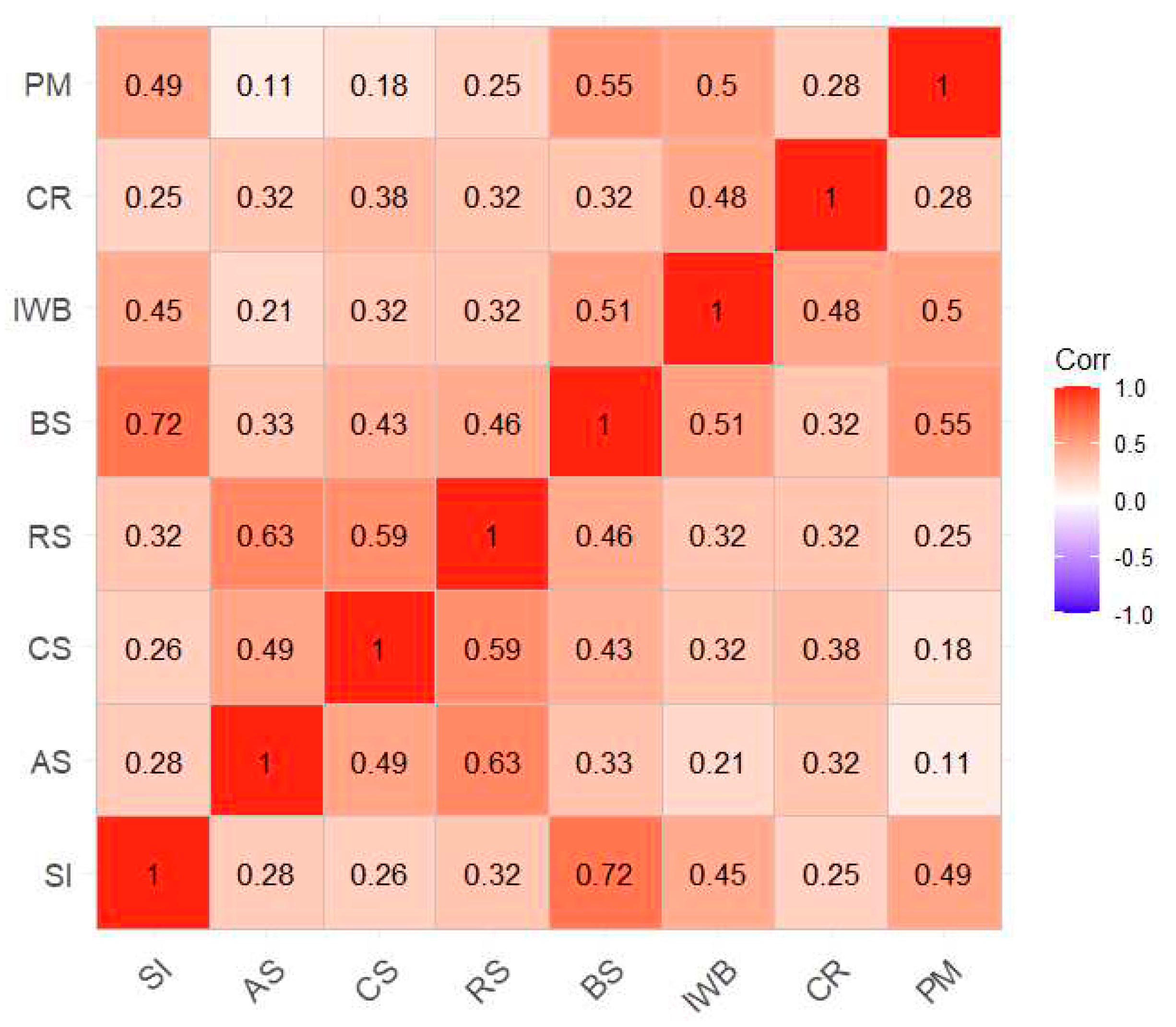
Figure 2.
Mediation of the relationship between social impact and work outcomes through need satisfaction, moderated by prosocial motivation. Note. All coefficients are standardized. The non-significant interaction terms involving PM are not shown (only the interaction between PM and BS is shown). The direct effects from PM to the work outcomes are not shown (see text). SI = social impact; AS = autonomy satisfaction; CS = competence satisfaction; RS = relatedness satisfaction; BS = benevolence satisfaction; IWB = innovative work behavior; CR = creativity; PM = prosocial motivation. *p < .05; **p < .01; ***p < .001.
Figure 2.
Mediation of the relationship between social impact and work outcomes through need satisfaction, moderated by prosocial motivation. Note. All coefficients are standardized. The non-significant interaction terms involving PM are not shown (only the interaction between PM and BS is shown). The direct effects from PM to the work outcomes are not shown (see text). SI = social impact; AS = autonomy satisfaction; CS = competence satisfaction; RS = relatedness satisfaction; BS = benevolence satisfaction; IWB = innovative work behavior; CR = creativity; PM = prosocial motivation. *p < .05; **p < .01; ***p < .001.
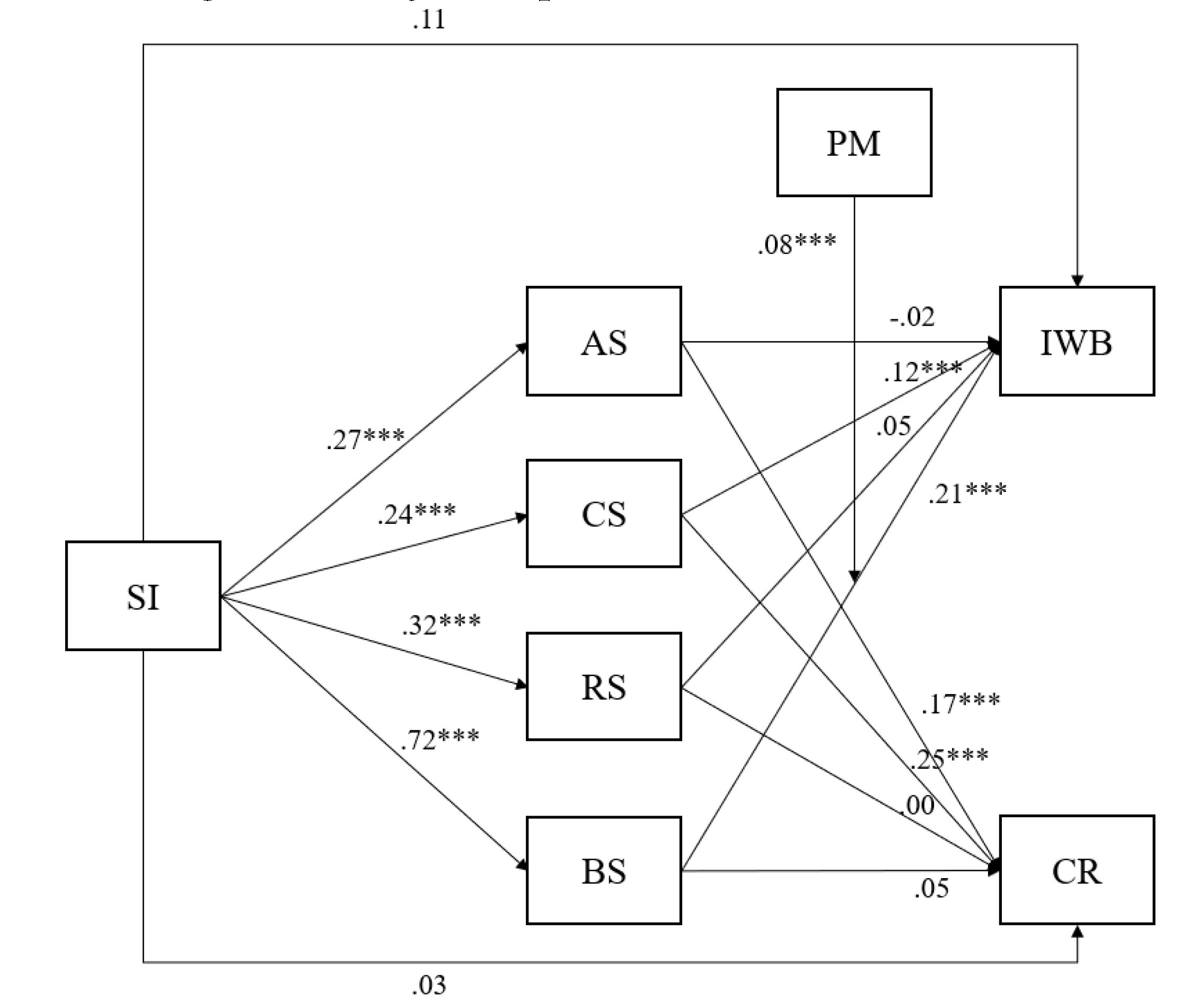
Figure 3.
Effect of benevolence satisfaction on innovative work behavior as a function of prosocial motivation. Note. All variables are standardized (z scores). Values are given for average values of the other needs’ satisfaction (autonomy, competence, and relatedness).
Figure 3.
Effect of benevolence satisfaction on innovative work behavior as a function of prosocial motivation. Note. All variables are standardized (z scores). Values are given for average values of the other needs’ satisfaction (autonomy, competence, and relatedness).
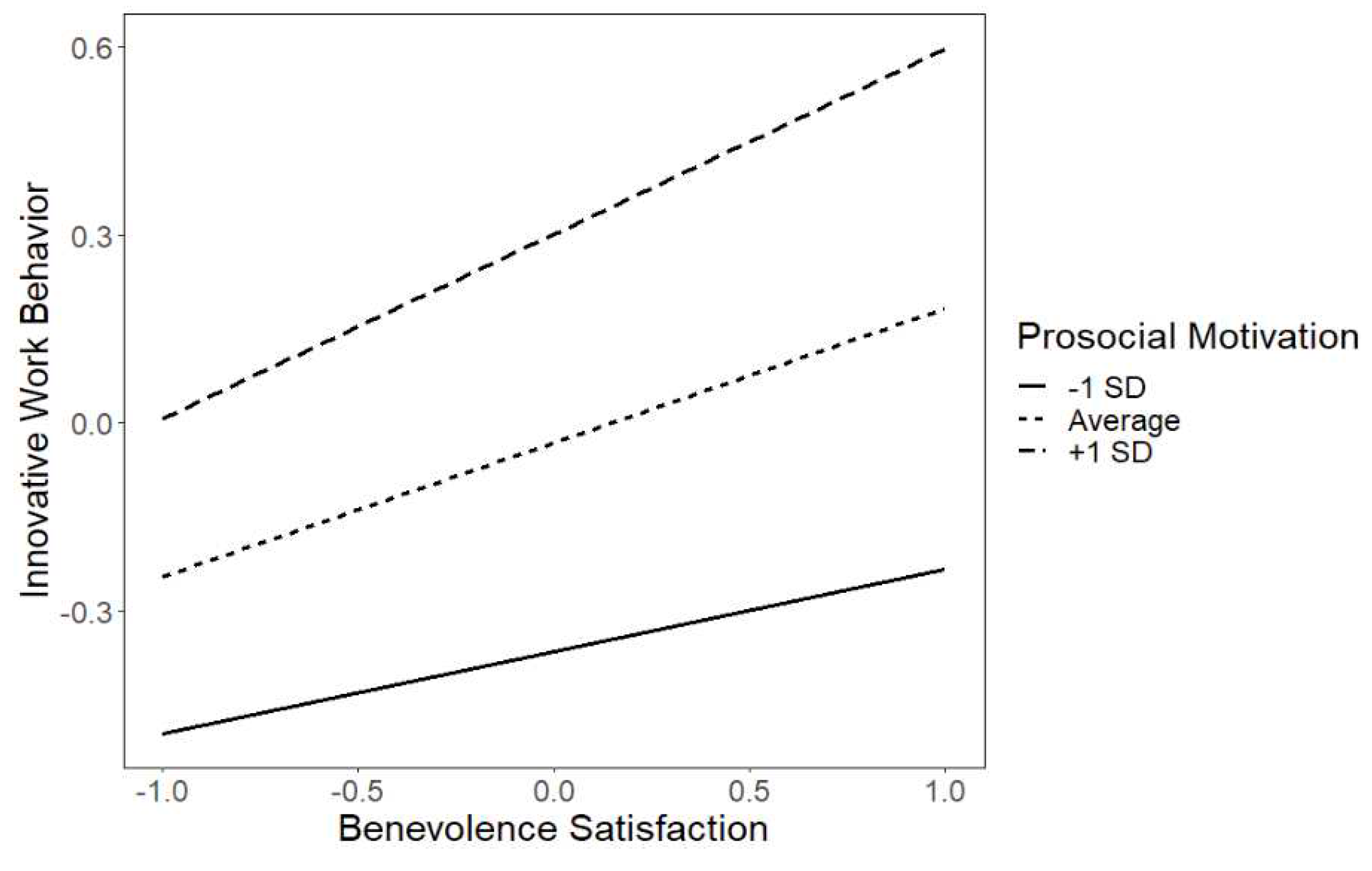

Table 1.
Descriptive statistics for all study variables.
| Variable | N | Min | Max | Mean | SD |
| Social Impact | 549 | 1.00 | 7.00 | 4.96 | 1.35 |
| Need Satisfaction | |||||
| Autonomy | 557 | 1.00 | 7.00 | 5.25 | 1.26 |
| Competence | 557 | 1.00 | 7.00 | 5.71 | 0.98 |
| Relatedness | 557 | 1.33 | 7.00 | 5.23 | 1.14 |
| Benevolence | 556 | 1.00 | 7.00 | 5.25 | 1.07 |
| Work Outcomes | |||||
| Innovative Work Behavior | 526 | 1.00 | 6.89 | 3.72 | 1.25 |
| Creativity | 527 | 1.00 | 7.00 | 4.92 | 1.11 |
| Prosocial Motivation | 548 | 1.00 | 7.00 | 5.92 | 1.03 |
Table 2.
Standardized indirect effects and moderated mediation indexes for the mediation of the relationship between social impact and work outcomes via need satisfaction, moderated by prosocial motivation.
Table 2.
Standardized indirect effects and moderated mediation indexes for the mediation of the relationship between social impact and work outcomes via need satisfaction, moderated by prosocial motivation.
| 95% Confidence Interval | |||||||||
| Work Outcome | Need | Prosocial Motivation | Standardized Indirect Effect | p | Lower Limit | Upper Limit | Mediation? | Moderated Mediation Index | p |
| IWB | Autonomy | Low | 0.01 | .583 | -0.02 | 0.04 | No | -0.01 | .195 |
| Average | -0.01 | .559 | -0.02 | 0.01 | No | ||||
| High | -0.02 | .183 | -0.05 | 0.01 | No | ||||
| Competence | Low | 0.03 | .022 | 0.00 | 0.06 | Yes | 0.00 | .935 | |
| Average | 0.03 | .003 | 0.01 | 0.05 | Yes | ||||
| High | 0.03 | .028 | 0.00 | 0.05 | Yes | ||||
| Relatedness | Low | 0.03 | .070 | 0.00 | 0.06 | No | -0.01 | .202 | |
| Average | 0.02 | .186 | -0.01 | 0.04 | No | ||||
| High | 0.00 | .860 | -0.03 | 0.03 | No | ||||
| Benevolence | Low | 0.09 | .015 | 0.02 | 0.17 | Yes | 0.06 | .000 | |
| Average | 0.15 | .000 | 0.08 | 0.22 | Yes | ||||
| High | 0.21 | .000 | 0.14 | 0.29 | Yes | ||||
| CR | Autonomy | Low | 0.04 | .010 | 0.01 | 0.08 | Yes | 0.00 | .909 |
| Average | 0.05 | .000 | 0.02 | 0.07 | Yes | ||||
| High | 0.05 | .007 | 0.01 | 0.08 | Yes | ||||
| Competence | Low | 0.06 | .001 | 0.02 | 0.09 | Yes | 0.01 | .575 | |
| Average | 0.06 | .000 | 0.03 | 0.09 | Yes | ||||
| High | 0.07 | .000 | 0.03 | 0.10 | Yes | ||||
| Relatedness | Low | 0.01 | .718 | -0.03 | 0.04 | No | -0.01 | .495 | |
| Average | 0.00 | .911 | -0.03 | 0.02 | No | ||||
| High | -0.01 | .596 | -0.04 | 0.02 | No | ||||
| Benevolence | Low | 0.04 | .375 | -0.05 | 0.12 | No | 0.00 | .771 | |
| Average | 0.03 | .401 | -0.04 | 0.11 | No | ||||
| High | 0.03 | .513 | -0.06 | 0.11 | No | ||||
Note. Low and high levels of prosocial motivation correspond to 1 standard deviation below and above the mean, respectively. Significant effects are in bold. IWB = Innovative Work Behavior; CR = Creativity.
Disclaimer/Publisher’s Note: The statements, opinions and data contained in all publications are solely those of the individual author(s) and contributor(s) and not of MDPI and/or the editor(s). MDPI and/or the editor(s) disclaim responsibility for any injury to people or property resulting from any ideas, methods, instructions or products referred to in the content. |
© 2023 by the authors. Licensee MDPI, Basel, Switzerland. This article is an open access article distributed under the terms and conditions of the Creative Commons Attribution (CC BY) license (http://creativecommons.org/licenses/by/4.0/).
Copyright: This open access article is published under a Creative Commons CC BY 4.0 license, which permit the free download, distribution, and reuse, provided that the author and preprint are cited in any reuse.


