

Submitted:
19 November 2024
Posted:
20 November 2024
You are already at the latest version
Abstract
The influences of a supervisor's perception and behavior on employee output constitute a significant issue that scholars are eager to explore; nevertheless, an effective connection between supervisors' perception and employees' positive behaviors is lacking. Therefore, we investigate the potentiality of such a connection based on social exchange theory and self-determination theory, whereby supervisors can establish an inclusive workplace environment upon receiving organizational support, leading salespeople to perceive a superior team atmosphere that engenders a sense of internal obligation, which eventually gives rise to proactive behavior. However, front-line salespeople demonstrate a considerable extent of autonomous decision-making conduct, and the determination of behavior for job engagement necessitates that each salesperson holds superior intrinsic motivation; accordingly, the moderating impact of the salesperson`s core self-evaluation is also probed in our study. Using Mplus 8.0 to analyze the matched survey of 50 team leaders and 299 employees, we ultimately discovered that the supervisor's perceived organizational support exerts a positive influence on the group-inclusive climate; a group-inclusive climate can enhance the felt obligation and career initiative of front-line salespeople; a supervisor's perceived organizational support can enable salespeople to perceive the inclusive climate of the group, engender their sense of obligation, and ultimately impact their career initiative; and a salesperson's core self-evaluation can significantly moderate the positive effects of the group-inclusive climate.
Keywords:
supervisor's perceived organizational support
; group-inclusive climate
; felt obligation
; career initiative
; core self-evaluation
1. Introduction
The role of a team manager is multi-dimensional: as supervisors, they are obligated to ensure team output and be concerned about the status and feedback of front-line employees; as employees, they are accountable for managing the company's affairs and daily operations. In reality, the positive actions taken by supervisors for the benefit of the organization mirror the level of workplace support they perceive [1]. The supervisor's perceived organizational support (SPOS) is closely associated with social exchange, which is a crucial concept in the study of supervisor behavior, as it delineates the process of reciprocal interchange between supervisors and organizations, which facilitates the engenderment of organizational commitment and team members’ initiative behaviors [2]. Existing studies have indicated that SPOS enables employees to acquire a sense of organizational support [3] through leader–member exchange, thereby further augmenting employees' initiative [4]. Nevertheless, these studies overlook an important matter, in that team members’ perceived support does not originate solely from the supervisor, and it is imprecise to depict the perceived support of the supervisor as organizational support, disregarding the roles of team members and the organizational environment [5,6]. Additionally, these studies merely concentrate on the discussion between managers' perceived support and employees' behavioral outcomes, failing to precisely identify the connection between the two. The academic community seemingly holds the belief that organizational support can directly and unambiguously enhance employee output, but this omission is remarkable because, of course, supervisors' perceptions do not directly influence employee performance, but rather need to be internalized and transformed into their motivation. Therefore, it is requisite to explore the organizational environment and employees' intrinsic motivations, as delineated in self-determination theory, in order to construct a bridge from supervisor perception to employee behavior and complement the mechanism of organizational support influences at different levels, which is precisely what is lacking in the current research.
Regarding the external environment, numerous scholars (e.g., [7,8]) contend that it is indispensable to discuss support behavior and employee perception of the inclusive climate in the study of organizational support and leader–member exchange. A group-inclusive climate is a state in which team members respect each other's individual expression, diversity, and independence, and it is a signal jointly emitted by all team members [9]. In accordance with the social exchange theory, when a supervisor perceives support from the organization, they will display positive conduct that is advantageous to the organization. [2], thus constituting a transmission of a sense of support. When team members sense the support of their manager, they will continuously undertake positive social exchange, form mutual respect and recognition, and establish a harmonious communication environment [10]. Employees can discern the sense of support and affiliation within the team and regard themselves as respected members [11], thereby engendering the perception of a group-inclusive climate.
The chain of influence of the group-inclusive climate on employee output remains incomplete. Self-determination theory reveals that, when the external environment undergoes changes, individual employee behavior generation hinges on the autonomy and selectivity of internal psychological factors [12]. Social exchange within a team-inclusive atmosphere necessitates the engagement of employees' intrinsic motivations, thereby encouraging them to dedicate themselves more to their work [11]. The formation of felt obligation stems from employees' positive choices regarding their own behaviors [4]; when employees form the perception of an inclusive climate, they are inclined to assist the organization in achieving its goals and anticipate obtaining greater returns [2], which constitutes a key impetus for the output of employees' positive behaviors [13]. Nevertheless, the current research on employees' felt obligation is confined to organizational support (e.g., [13,14]). Since inclusive climate, which is closely associated with organizational support, is seldom mentioned in previous studies, we incorporate this aspect.
Career initiative demands that employees think more actively about their career development and establish long-term goal planning [15]. Both group-inclusive climate and felt obligation should be seriously considered for stimulating the career initiative of salespeople. Compared to the work of other departments, that of salespeople has certain particularities, in that whether they obtain organizational support largely depends on performance, meaning their inclusion might be insufficient. However, front-line salespeople enjoy full freedom in determining their working time and place, which implies that they need a sufficient sense of mission and responsibility to ensure their commitment to work [16]. In other words, even if the manager, or team, fully plays a supportive role, a salesperson will still generate more or less proactive behavior due to certain personality characteristics [17], autonomous motivation [18,19], or awareness of the team environment [17].
Similar to the viewpoints of Li [17], Zhao [18], and other scholars, we consider core self-evaluation (CSE) among the factors influencing salespeople's positive choices. CSE is a fundamental assessment of self-worth, encompassing self-esteem, self-efficacy, etc. [20] Because front-line salespeople make a high degree of free decisions [21], when CSE is low, a salesperson might make more negative self-determinations [22]; only when a strong sense of responsibility and emotional stability are cultivated can a positive organizational atmosphere exert its full effects [19]. After all, although positive social exchange is the common denominator of human beings, not everyone is willing to accept equal efforts and returns [23].
Therefore, we present several theoretical contributions in this paper. Primarily, our study aim is to construct a bridge to elaborate upon the connection between the SPOS and the output of employees' proactive behaviors in detail and depth. Through integrating social exchange theory and self-determination theory, we can dissect the inclusive atmosphere emitted by supervisors when they perceive organizational support, as well as the sense of obligation engendered by team members when they perceive team inclusiveness, in order to expound the impacts of the external environment and internal motivation on the selection of proactive behavior, thereby filling the gap in this aspect of previous studies. Simultaneously, we explore whether CSE influences the actual outputs of felt obligation and career initiative based on the distinctive work attributes of salespeople, a moderating effect attesting that, different from most of the outcomes of positivity research hitherto (e.g., [24,25]), organizational support and inclusion cannot be truly universal, and the promotion of employees' initiative still demands the involvement of employees' own personality traits. The hypothetical model of this study is depicted in Figure 1.
2. Literature Review and Hypothesis Development
2.1. Supervisor Perceived Organizational Support and Group-Inclusive Climate
As a team manager, the supervisor assumes the dual role of employee and leader [26]. SPOS refers to a manager’s perception of whether organization members or superior leaders value their efforts for the organization's development and whether their superiors pay attention to their well-being in life and work [26]. Existing studies have indicated that SPOS enables employees to obtain a sense of organizational support through leader–member exchange [3]. When managers perceive themselves as being fully supported by the organization, they are more prone to offer developmental feedback to motivate employees [18]. By initiating a process of social exchange with the organization, supervisors transform this positive mindset into working approaches that are beneficial to the organization [2], leading team members to feel the change brought about by their manager's positive behavior and resulting in an adequate sense of organizational support [3]. SPOS is transitive and can therefore be transferred from supervisors to employees.
However, previous research seems to one-sidedly consider supervisors as agents of the organization and tends to attribute any of their support to the organization itself [5,6]. Although, in the process of team management, employees may view team behavior as a mirrored reflection of supervisor behavior [27], if the perceived support of employees stems more from team managers, this dynamic cannot truly reflect the entire picture of organizational support, but is merely a manifestation of supervisor support [28]. In fact, subsequent studies have demonstrated that SPOS can lead to a series of changes in the sense of support, including supervisor support, co-worker support, and the supportive atmosphere of the group as a whole [29]. We describe perceived organizational support as a working environment jointly created by all team members, where members respect one another, assist each other, and feel a sense of belonging.
The organizational support environment is highly correlated with the establishment of an inclusive environment within the organization [30,31]. Stamper and Masterson [32] investigated the perceived support and encouragement of team members in the organizational environment and proposed that perceived organizational support can enable organization members to exhibit a more inclusive state. Team members' perceptions of inclusion is analogous to their perception of organizational support, which stems from all levels of the organization. Nembhard and Edmondson [33] describe inclusive team leaders as those who "pay attention to the needs and interests of employees, listen to the views of employees, encourage employees, and recognize their contributions"; Carmeli et al. [34] extended this description of inclusivity to all members of the organization, depicting it as the support, openness, and approachability shown in the interaction among all team members. Both definitions suggest that the supportive behaviors of both supervisors and team members can enable employees to perceive an inclusive working environment among the group; therefore, it is essential to conduct research on the group-inclusive climate, which supplements the incomplete summary of employees’ perceived organizational support in Eisenberger's study [3] and can better describe the organizational environmental outcomes co-created by all group members.
SPOS builds a team-supportive environment [3,29] and creates a team-inclusive environment as a manifestation of social exchange. According to the principle of reciprocity, when managers perceive a high level of organizational support, their own personalities and management methods can be better accepted, which enables them to generate prosocial behaviors that are beneficial to the team [2], allowing them to extend more support and kindness to team members, who can sense the manager's support and become followers of the team manager's behavior to continue to conduct positive social exchange. In the role of mutual promotion, employees and managers jointly create a supportive and inclusive working environment. Team members can respect and identify with each other, carry out harmonious communication [10], and obtain corresponding feelings and feedback [31]. We therefore hold the view that:
Hypothesis 1.
SPOS has a positive impact on a group-inclusive climate.
2.2. Group-Inclusive Climate, Salesperson's Felt Obligation and Career Initiative
The self-determination theory delineates that, due to alterations in the external environment, employees will independently opt for behaviors in accordance with the satisfaction of their internal psychological factors [12]; thus, employees' intrinsic motivation establishes the connection between the environment and individual behaviors. Felt obligation is regarded as a crucial internal factor that supports and promotes the positive behaviors of employees [4,14] among their motivations for to consider that they are obligated to care for the welfare of the organization and assist it in achieving its goals [4]. The voluntary commitment of front-line sales staff plays a highly significant role in service, particularly in terms of the impact on service performance [14]. Due to the relative freedom of working time and place, salespeople make a high degree of free decisions, compared with employees in other departments, constituting an important part of the service role attributes of front-line salespeople [21]. Felt obligation ensures that front-line salespeople fulfill their duties despite a highly free environment and may encourage them to exert extra efforts [35].
Pan et al. [5] and Vadera et al. [6] constructed a corresponding framework of perceived support, delineating that organizational support composed of both supervisor and colleague support can enhance team employees’ felt obligation. On this basis, we investigate the positive impacts of the group-inclusive climate created by such a supportive environment on front-line salespeople`s felt obligation. A group-inclusive climate is among the external environments that employees can perceive [34], which can augment the organization’s openness and enable salespeople to acquire more team identity. When inclusion is perceived, by initiating the social exchange process, front-line salespeople will conceive the idea that "goodwill will be rewarded at some point in the future" [36], which motivates them to "have an obligation to assist the organization in achieving its goals and expect greater rewards for more efforts on behalf of the organization" [2] (p.1855).
Hypothesis 2.
A group-inclusive climate has a positive impact on salespeople's felt obligation.
A group-inclusive climate can enable salespeople to undertake proactive behaviors that contribute to improving team efficiency [34], including planning more challenging work for themselves by redefining the goals provided by the organization [37]; nevertheless, this demands that the organization offer adequate support and assistance to employees [38], as it is only in this manner that employees can acquire more psychological security, self-efficacy, and career commitment [34,39], thereby gaining the confidence to make more forward-looking career plans [40]. According to the self-determination theory, when employees perceive the external environment of a group-inclusive climate, they can convert it into the satisfaction of internal psychological needs. When they obtain psychological security and commitment, employees are more inclined to make positive choices regarding their own behavior and invest themselves in activities (such as career planning and skill development) that exceed normal work requirements [41].
Hypothesis 3.
A group-inclusive climate has a positive impact on salespeople's career initiative.
The satisfaction of internal needs also generates the motivation for employees' positive behaviors. According to social exchange theory, positive perception prompts employees to assist the organization in achieving its goals through reciprocal behavior [6], and an employee's inner sense of obligation plays a driving role as an internal motivation, thus generating a positive incentive to ensure that employees can be satisfied in a long-term mutually beneficial relationship [36]. Yu and Frenkel [42], Coyle-Shapiro [43], and other scholars have previously depicted the promoting effects of felt obligation on task performance and service-oriented citizenship behavior, but the prospective results generated by felt obligation have not been discussed in the current study. Felt obligation can bring about the expectation for employees to participate in long-term reciprocal exchange [36], which coincides with the requirement of career initiative for employees' self-starting, proactive, and persistent behaviors [44], enabling employees to obtain positive feedback on future work by changing their work status and constructing a more long-term goal plan [15].
Hypothesis 4.
Felt obligation has a positive impact on the career initiative of salespeople.
As mentioned above, we ascertained the correlation between the perception of team leaders and the positive behaviors of team members; starting from the social exchange theory, when a supervisor perceives the support of the organization, they are inclined to modify their own behavior to conduct reciprocal exchange with the team, thus promoting employees' perceptions of the supervisor's support, and leading them to gradually form a team climate of mutual respect and tolerance through imitation and following. According to the self-determination theory, the external environment and internal motivation influence an individual's independent choice of their own behavior. When salespeople perceive the fully inclusive atmosphere of the team, they can trust the working environment more [45] and obtain psychological security [46], so their psychological needs are more fulfilled and they will have a sense of obligation to make efforts to return to the organization in order to ensure that reciprocal exchanges occur. At the same time, because employees desire to have the opportunity for long-term social exchange, forward-looking professional initiative behavior can be generated.
Hypothesis 5.
SPOS promotes the salespeople's felt obligation through a group-inclusive climate and ultimately stimulates salespeople's career initiative.
2.3. Salesperson's Core Self-Evaluation
Judge et al. [47] contend that CSE is regarded as the most fundamental evaluation that people hold, reflecting all the baselines implicated in other beliefs and evaluations. Existing studies have indicated that there is a significant influential relationship between core self-evaluation and employees' intrinsic motivation. When core self-evaluation is high, the individual possesses greater subjective initiative and self-efficacy, and releases positive psychological impetus; at this juncture, individuals tend to set more challenging goals while cultivating goal commitment and persistence [48]. There is a positive correlation between CSE and employees' perceptions of job characteristics (e.g., [20,49]). Studies by Ferris et al. [50] reveal that employees with high CSE are more sensitive to positive stimuli. In the workplace, a high-CSE employee will pay more attention to the positive stimuli of the organizational environment, maintain a positive cognition of the organization [18], and exhibit a more pronounced sense of identification within the organization [51], which reinforces the positive role of a group-inclusive climate, enabling team members to obtain more positive psychological impetus and exhibit positive behaviors [52]. Relatively speaking, when employee CSE is low, even if they can achieve a more inclusive organizational environment, they will not have the willingness to open up, which will affect the generation of positive behaviors. We thus make the following hypotheses:
Hypothesis 6(a).
A salesperson's CSE moderates the impact of the group-inclusive climate on their felt obligation. When a salesperson's CSE is higher, the group-inclusive climate has a stronger impact.
Hypothesis 6(b).
A salesperson's CSE moderates the impact of the group-inclusive climate on their career initiative. When a salesperson's CSE is higher, the group-inclusive climate has a stronger impact.
3. Materials and Methods
3.1. Data Collection
For this study, we adopted the research method of matched survey questionnaires for data collection; that is, sales department supervisors and their sales staff filled in the scales on a questionnaire, evaluating different indicators individually. Matching the direct leadership relationship between the sales department supervisor and the sales staff resulted in a total of 50 collected questionnaires from sales supervisors and 299 from their sales staff. Among them, the ratio of supervisors to employees among 49 teams was 1:6, while 1 team had a 1:5 ratio.
To ensure minimal homologous bias, the matched survey questionnaire was administered in three installments, administered in one-month intervals. The T1 questionnaire was divided into two parts, one for supervisors and one for employees. The variable of the supervisor questionnaire was "SPOS"; 60 copies were distributed and 52 were retrieved, with a retrieval rate of 86.7%. The variable of the employee questionnaire was "Group-inclusive Climate". Each supervisor was matched with six employees in their team to fill out the questionnaire. A total of 360 questionnaires were dispatched and 345 were retrieved, with a retrieval rate of 95.8%. The T2 questionnaire was an employee-only questionnaire, and the research variables were "Felt Obligation" and "CSE". The employees who had completed the T1 questionnaire were asked to fill out the questionnaire; 345 questionnaires were distributed, and 310 were retrieved, with a retrieval rate of 89.9%. The T3 questionnaire was a supervisor-only questionnaire, with the variable of "Salesperson`s Career Initiative", and each sales team supervisor evaluated their sales staff. After screening and matching the questionnaires, we eliminated the teams that did not meet the requirements or had too few participants, and finally distributed 52 questionnaires and retrieved 50 questionnaires, with a retrieval rate of 96.2%.
After screening, a total of 50 sales teams that met the research requirements were selected, and 50 valid questionnaires were issued to team leaders, with an effective rate of 83.3%. Among the sample of managers, 68% were male (N=34), 64% had a college education or above (N=32), and their ages were mainly between 26 and 45 years old (N=38, 76%). There were 299 valid questionnaires for employees, and the effective rate was 83%. The proportion of male and female employees in the sample was relatively balanced (the male sample accounted for 50.2%), their ages were concentrated mainly between 25 and 35 years old (N=266, 88.9%), 89.3% (N=267) had been working in the team for less than 5 years, and those with a college degree or above accounted for 71.2% (N=213).
3.2. Measurements
We measured all variables using a 5-point Likert scale. Participants rated how much they agreed with the item descriptions, using a scale from 1 (strongly disagree) to 5 (strongly agree). To ensure the reliability and validity of the measurements, we selected formally published scales from existing studies that have been shown to be effective for measurement. The complete scales are in Appendix A.
We adopted the perceived organizational support scale developed by Eisenberger et al. [53] to measure SPOS, which is widely utilized in organizational support research for employees (including supervisors) in enterprises and possesses high reliability and validity [26]. The scale comprises 8 items, including, “The organization places significant emphasis on my objectives and values." The Cronbach's Alpha of this scale is 0.76.
About group-inclusive climate, our study adopts the measurement scale developed by Chung et al. [54], consisting of 10 total items, the first 5 of which are employed to measure employees' sense of belonging to the team, including questions such as, "I am treated as a valued member of my work group.", while the last 5 items are utilized to measure the extent to which employees perceive that the team is tolerant of their own uniqueness, including, " I can offer a viewpoint on work-related matters that differs from those of my group members." The Cronbach's Alpha is 0.73.
The scale we used for felt obligation is that developed by Eisenberger et al. [4] The six-question scale encompasses items such as, " I feel a personal responsibility to contribute in any way possible to assist my organization in reaching its objectives." The Cronbach's Alpha value is 0.72.
The scale adopted in our study to measure career initiative was developed by Van Veldhoven et al. [40] and consists of 5 questions, including, "In my work, I keep trying to learn new things." The Cronbach's Alpha value for this scale is 0.78.
We adopted the CSE scale compiled by Judge et al. [47], consisting of 12 items, of which 6 items are used for positive measurement and 6 for negative measurement. The contents of the scale include, "I am confident I will get the success I deserve in life.", "Sometimes I feel depressed. (-).”, etc. The Cronbach's Alpha value of this scale is 0.81.
3.3. Analysis Method
In this study, Mplus 8.0 was utilized to conduct confirmatory factor analysis (CFA) for the construct validity of the questionnaire. The five-factor model was employed as the original hypothesis model and, in accordance with the hypothesis model of our study, the variables "SPOS" with "group-inclusive climate", "group-inclusive climate" with "salesperson's felt obligation", "group-inclusive climate" with "salesperson's career initiative", and "salesperson's felt obligation" with "salesperson's career initiative" were combined to construct a four-factor competitive model. Simultaneously, we calculated the average variance extracted (AVE) and the composite reliability (CR) of the questionnaire results to confirm its validity. Finally, an analysis was conducted using Mplus 8.0 to explore the direct, indirect, and moderating effects of "salesperson's CSE", so as to verify the hypotheses of our study.
4. Results
4.1. Reliability and Validity Analysis
Our five-factor model can better reflect the latent characteristics of common factor constructs (Table 1). Compared with other competing models, the content of the five-factor model is consistent (CFI = 0.995 > 0.9; TLI = 0.994 > 0.9; RMSEA = 0.040 < 0.05). Table 2 presents the discriminant validity results. The results indicate that the AVE values of all variables in this study are greater than 0.5, the composite reliability is greater than 0.8, and the correlation coefficients between all dimensions are less than the square roots of the AVE values; thus, the discriminant validity of our research is deemed adequate. Furthermore, all alpha coefficients exceed 0.8, indicating that the reliability of this questionnaire is outstanding.
4.2. Hypothesis Testing
The test results of the direct and indirect effects of the model hypothesis are presented in Table 3 and Table 4, where it can be observed from the direct effects that SPOS positively influences group-inclusive climate (β = 0.171, p < 0.01). Hypothesis 1 is valid; group-inclusive climate can significantly affect salespeople's felt obligation (β = 0.576, p < 0.001) and career initiative (β = 0.466, p < 0.001). Hypothesis 2 and Hypothesis 3 are valid; a salesperson's felt obligation can promote their establishment of career initiative (β = 0.472, p < 0.001). Hypothesis 4 is also valid.
The test results show that the chain mediation effect is significant. Group-inclusive climate and salesperson's felt obligation play indirect roles in the relationship between SPOS and salesperson's career initiative (β = 0.046, p < 0.5). Hypothesis 5 is thus proven.
Table 5 presents the positive moderating effect of salesperson's CSE. When salespeople with higher CSE perceive a group-inclusive climate, felt obligation (β = 0.174, p < 0.01) and career initiative (β = 0.218, p < 0.001) can be significantly enhanced; thus, Hypothesis 6(a) and Hypothesis 6(b) are valid. Figure 2 present the interaction graphs with the mean of the regulating variable plus or minus one standard deviation.
Since the selection of the mean value plus or minus one standard deviation for the adjustment effect was arbitrary [55], it is impossible to accurately determine the value under which the adjustment effect is effective; therefore, we adopted the Johnson–Newman technique for our study in order to explore the nature of the adjustment effect of Hypothesis 6. To facilitate observation and drawing, we did not centralize the data, and the results are presented in Figure 3. The upper and lower two curves in the figures are 95% confidence intervals for indirect effects, and the middle curve represents the predicted values of moderating effects. When salesperson`s CSE is greater than 1.69, the indirect effect of the group-inclusive climate on salesperson's felt obligation increases; when salesperson`s CSE is greater than 1.40, the indirect influence of the group-inclusive climate on salesperson's career initiative also increases; these results also illustrate the significant role that a salesperson's CSE plays in the relationship between their perception of the work environment and their reciprocal behavior.
5. Conclusions and Discussion
5.1. Research Conclusions
Through the analysis of paired data, the final results validate the conceptual model and theoretical hypotheses of our study, and the following conclusions can be drawn: 1) SPOS has a positive influence on group-inclusive climate; 2) a group-inclusive climate can enhance the felt obligation of front-line salespeople; 3) a group-inclusive climate can enable salespeople to demonstrate more career initiative; 4) a salesperson`s felt obligation promotes the generation of their career initiative; 5) SPOS creates a sense of obligation by leading sales staff to perceive the inclusive climate of the group, ultimately affecting their career initiative; 6) a salesperson's CSE can significantly moderate the positive impact of a group-inclusive climate.
5.2. Theoretical Contribution
There are relatively few sources in the literature on employee perception and behavior from the perspective of supervisors, indicating that the identity of the supervisor as a team member is readily overlooked [26]; nevertheless, supervisor behavior is a crucial part of employees' perceptions of job characteristics [23], so it is necessary to investigate the influences of supervisor perception on their own behaviors and those of team members. In previous studies, organizational support was considered unilateral as generated by the supervisor, since the supervisor was regarded as the agent of organizational behavior [27]; thus, any support, including that from supervisors, tended to be attributed to the organization itself [5,6]. However, in addition to supervisor support, team partners are also a significant part of the organization, and the interaction between the two behaviors generates team members' perception of the working atmosphere, constituting a reason to discuss the organizational climate in our study, along with the fact that, in accordance with the self-determination theory, team members' free choice of their own behaviors stems from their perception of the external environment and the transformation of their internal motivation.
The inclusive atmosphere of the team serves as a good bridge that can fully demonstrate the overall organizational atmosphere, encompassing supervisor support and peer support, and clearly elucidate the social exchange between the supervisor and the organization after perception of the organization’s support. When supervisors perceive greater organizational support, they are more inclined to extend such support signals through their own behaviors. When employees obtain a friendlier cognition of supervisors’ behaviors, they imitate and follow, and they also incorporate social citizenship behaviors beneficial to the organization into social exchange with other team members; all team members can then experience a sense of support and belonging and feel that they are respected members [11], thereby forming the perception of an inclusive climate within the team [34]. In most recent research, organizational inclusivity is also deemed to be generated by supervisors` perceived and extended inclusivity [56]; to be precise, these collectively constitute the team-inclusive climate at different levels [7,56]. Hypothesis 1 of this study was aimed at exploring the path between supervisors' and employees' perceptions of the inclusive work environment, the result of which more robustly supports the above view.
Our research findings are akin to our anticipation that SPOS cannot directly exert an influence on the proactive behavioral output of salespeople but requires transformation through a series of perceptions and motivations. According to the self-determination theory, a group-inclusive climate functions as positive feedback as perceived by salespeople in the social environment, and employees' internal sense of obligation can transform inclusivity more effectively, as felt obligation guarantees that employees can be satisfied in their long-term mutually beneficial relationships with the organization [36], which is in accordance with the expectations of employees. In prior studies, although felt obligation has been verified to play a distinct mediating role in organizational support and the task performance of salespeople [4,42], organizational support was not regarded as part of the team environment, and nor was the necessity of felt obligation elaborated upon. We affirmed the significance of the correlation between organizational support and a group-inclusive atmosphere and took into account felt obligation as an important internal motivation for the transformation of the external environment into employee behavior, thereby truly constructing a behavioral motivation chain among team leaders and their members; therefore, this study fills the current voids in the research field of organizational support and employee behavior.
We place a higher emphasis on the way salespeople perceive the team environment since, compared with employees in other departments, salespeople have flexible personalized contracts regarding the workplace and working hours, which ensures their social participation and performance in the team [57]. A high degree of freedom in decision-making constitutes an important part of the service role attributes of frontline sales personnel [21], so it is necessary for us to undertake a more detailed analysis of the sales staff group. After all, the generation of proactive behavior not only depends on an individual's perception of the external environment, but also their own personality traits [18]. We take CSE, the internal basis of salespeople's personality traits, as a factor and draw a conclusion from the verification results of Hypothesis 6, in that the generation of career initiative cannot merely rely on a change in environment, and the involvement of CSE is also of great significance. Unlike most positive perceptions to date (e.g., [24,25]), in fact, organizational support and inclusivity are not truly universal. Among people with lower CSE, the loss of self-efficacy hinders them from engaging in their work more enthusiastically, even when they are well-off.
5.3. Managerial Implications
The findings of our research can provide managers with insights on how to motivate employees. Firstly, the construction of the team atmosphere demands that managers adjust and enhance their own behaviors; managers should pay attention to the needs and interests of front-line sales staff, listen to their viewpoints, encourage them, and recognize their contributions, enabling sales staff to acquire a greater sense of belonging and inclusivity and effectively enhancing the group-inclusive climate. For managers themselves, improvement in the inclusive climate also implies that their management style and personality have been acknowledged by the team, and they can feel more support from the organization. Additionally, it is necessary to screen the personality traits of salespeople, as they need to consciously engage in sales work without supervision, so their CSE plays a crucial role in determining their sense of duty and initiative in work; thus, managers must thoroughly screen employees or assist them in establishing higher CSE levels through encouragement and support.
6. Limits and Future Directions
Firstly, the perceptions of the workplace environment among salespeople and among employees in other departments remain to be determined. Undoubtedly, the sales team possesses a particularity, showing a higher correlation between return and performance, yet the time and place of their work are more flexible, leading to a stronger or weaker concept within the sales team; this is an area that is not covered in this article, but which deserves more extensive and in-depth exploration.
Secondly, based on the latest research, Shore and Chung [7] propose that inclusivity is hierarchical, including tiers such as organizational, supervisor-perceived, and team member-perceived inclusivity, as well as factors such as group-inclusive climate, etc. Compared with the inclusivity perceived by supervisors and team members, a group-inclusive climate is more extensive, not confined to a specific group. Additionally, the manager is also a member of the team, and the team-inclusive climate also applies to the manager themself. In fact, the team-inclusive climate stems not only from the manager's superior leadership or the overall company environment, but also from the managerial team, composed of colleagues and subordinates at the same level; therefore, the environment formed by the perception and behavior of the team manager needs to be evaluated at multiple levels. We may continue this discussion in the future, taking relevant perspectives [7,56] into account.
Thirdly, there is still a dearth of extensive research on the issue of inclusion failure. Inclusivity does not necessarily exert an influence on all employees with diverse characteristics, and it does not necessarily have a positive promoting effect in organizations with distinct characteristics. While this study takes employees' CSE as a moderating variable in order to observe the promoting or inhibiting effect of personal characteristics on perceived inclusivity, there are still numerous factors that play such a role, such as power concentration at the team level, which remain to be explored. Similarly, as described by the scholars Zhao et al. [18], managers' CSE is also a topic worthy of discussion; after all, even if managers perceive adequate organizational support, it is questionable whether they have the ability and determination to convey such support.
Despite these limitations, our study intends to stimulate the academic community, in order to broaden its comprehension of the interactions of behavior and motivation between supervisors and employees, to assist managers who implement interventions with the intent of enhancing work output, and to aid researchers who aspire to better understand the relationships between supervisors and employees.
Author Contributions
Y.G. designed the study and wrote the review, original draft, visualization and methodology; G.S. drafted the study and conducted project management; Y.L. collected and analyzed data and wrote the statistical analyses. All authors have read and agreed to the published version of the manuscript.
Funding
This research received no external funding.
Institutional Review Board Statement
The study was conducted in accordance with the Declaration of Helsinki, and approved by the Ethics Committee of Management Department, School of Business, Macau University of Science and Technology. The Approval Letter number is MSB-202429.
Informed Consent Statement
Informed consent was obtained from all subjects involved in the study.
Data Availability Statement
Data available on request due to restriction.
Acknowledgments
Thanks to all the team managers and members who participated in the research and provided valuable materials for our study.
Conflicts of Interest
The authors declare no conflicts of interest.
Appendix A

Table A1.
Measurement items.
| Variables |
|---|
| Supervisor`s perceived organizational support |
| - The organization values my contribution to its well-being. - The organization strongly considers my goals and values. - The organization really cares about my well-being. - The organization is willing to help me when I need a special favor. - The organization shows very little concern for me. (-) - The organization cares about my opinions. - The organization takes pride in my accomplishments at work. |
| Group-inclusive climate |
| - I am treated as a valued member of my work group. - I belong in my work group. - I am connected to my work group. - I believe that my work group is where I am meant to be. - I feel that people really care about me in my work group. - I can bring aspects of myself to this work group that others in the group don’t have in common with me. - People in my work group listen to me even when my views are dissimilar. - While at work, I am comfortable expressing opinions that diverge from my group. - I can share a perspective on work issues that is different from my group members. - When my group’s perspective becomes too narrow, I am able to bring up a new point of view. |
| Salesperson`s Felt obligation |
| - I feel a personal obligation to do whatever I can to help my organization achieve its goals. - I owe it to the organization to give 100% of my energy to organization’s goals while I am at work. - I have an obligation to the organization to ensure that I produce high-quality work. - I owe it to the organization to do what I can to ensure that customers are well-served and satisfied. - I would feel an obligation to take time from my personal schedule to help the organization if it needed my help - I would feel guilty if I did not meet the organization’s performance standards |
| Salesperson`s career initiative |
| - In my work, I set challenging goals. - In my work, I keep trying to learn new things. - With regard to my skills and knowledge, I see to it that I can cope with changes in my work. - I think about how I can keep doing a good job in the future. - In my work, I search for people from whom I can learn something |
| Salesperson`s core self-evaluation |
| - I am confident I will get the success I deserve in life. - Sometimes I feel depressed. (-) - When I try, I generally succeed. - Sometimes when I fail I feel worthless. (-) - I complete tasks successfully. - Sometimes, I do not feel in control of my work. (-) - Overall, I am satisfied with myself. - I am filled with doubts about my competence. (-) - I determine what will happen in my life. - I do not feel in control of my success in my career. (-) - I am capable of coping with most of my problems. - There are times when things look pretty bleak and hopeless to me. (-) |
References
- Shanock, L.; Eisenberger, R. When Supervisors Feel Supported: Relationships with Subordinates' Perceived Supervisor Support, Perceived Organizational Support, and Performance. J. Appl Psychol. 2006, 91, 689-695. [CrossRef]
- Kurtessis, J. N.; Eisenberger, R.; Ford, M. T.; Buffardi, L. C.; Stewart, K. A.; Adis, C. S. Perceived Organizational Support: A Meta-Analytic Evaluation of Organizational Support Theory. J. Manage. 2017, 43, 1854-1884. [CrossRef]
- Eisenberger, R.; Shoss, M. K.; Karagonlar, G.; Gonzalez-Morales, M. G.; Wickham, R. E.; Buffardi, L. C. The Supervisor Pos-Lmx-Subordinate Pos Chain: Moderation by Reciprocation Wariness and Supervisor's Organizational Embodiment. J. Organ Behav. 2014, 35, 635-656. [CrossRef]
- Eisenberger, R.; Armeli, S.; Rexwinkel, B.; Lynch, P.; Rhoades, L. Reciprocation of Perceived Organizational Support. J. Appl Psychol. 2001, 86, 42-51. [CrossRef]
- Pan, W.; Sun, L.; Abuliezi, Z. Leader-Member Exchange and Employee Creativity: Test of a Multilevel Moderated Mediation Model. Hum Perform. 2012, 25, 432-451. [CrossRef]
- Vadera, A. K.; Pratt, M. G.; Mishra, P. Constructive Deviance in Organizations: Integrating and Moving Forward. J. Manage. 2013, 39, 1221-1276. [CrossRef]
- Shore, L. M.; Chung, B. G. Inclusion as a Multi-Level Concept. Curr Opin Psychol. 2024, 60. [CrossRef]
- Randel, A. E.; Galvin, B. M.; Shore, L. M.; Ehrhart, K. H.; Chung, B. G.; Dean, M. A., et al. Inclusive Leadership: Realizing Positive Outcomes through Belongingness and Being Valued for Uniqueness. Hum Resour Manage R. 2018, 28, 190-203. [CrossRef]
- Jansen, W. S.; Otten, S.; van der Zee, K. I.; Jans, L. Inclusion: Conceptualization and Measurement. Eur J. Soc Psychol. 2014, 44, 370-385. [CrossRef]
- Lei, H.; Do, N. K.; Le, P. B. Arousing a Positive Climate for Knowledge Sharing through Moral Lens: The Mediating Roles of Knowledge-Centered and Collaborative Culture. J. Knowl. Manag. 2019, 23, 1586-1604. [CrossRef]
- Shore, L. M.; Randel, A. E.; Chung, B. G.; Dean, M. A.; Ehrhart, K. H.; Singh, G. Inclusion and Diversity in Work Groups: A Review and Model for Future Research. J. Manage. 2011, 37, 1262-1289. [CrossRef]
- Deci, E.; Connell, J.; Ryan, R. Self-Determination in a Work Organization. J. Appl Psychol. 1989, 74, 580-590. [CrossRef]
- Thompson, P. S.; Bergeron, D. M.; Bolino, M. C. No Obligation? How Gender Influences the Relationship Between Perceived Organizational Support and Organizational Citizenship Behavior. J. Appl Psychol. 2020, 11, 1338-1350. [CrossRef]
- Malhotra, N.; Ashill, N.; Lages, C. R.; Homayounfard, A. Understanding the Role of Frontline Employee Felt Obligation in Services. Serv Ind J. 2022, 42, 843-871. [CrossRef]
- Grant, A. M.; Ashford, S. J. The Dynamics of Proactivity at Work. Res. Organ. Behav. 2008, 28, 3-34. [CrossRef]
- Lyngdoh, T.; Chefor, E.; Lussier, B. Exploring the Influence of Supervisor and Family Work Support on Salespeople's Engagement and Unethical Behaviors. J. Bus Ind Mark. 2023, 38, 1880-1898. [CrossRef]
- Li, N.; Ding, M. The Influence of Paradoxical Leadership on Adaptive Performance of New-Generation Employees in the Post-Pandemic Era: The Role of Harmonious Work Passion and Core Self-Evaluation. Sustainability-Basel. 2022. [CrossRef]
- Zhao, J.; Wang, M.; Li, Y.; Zhao, G. When Does Newcomer Get Feedback? Relationship Between Supervisor Perceived Organizational Support and Supervisor Developmental Feedback. J. Organ Change Manag. 2024. [CrossRef]
- Sears, G. J.; Han, Y. Do Employee Responses to Organizational Support Depend On their Personality? The Joint Moderating Role of Conscientiousness and Emotional Stability. Empl Relat. 2021, 43, 1130-1146. [CrossRef]
- Judge, T.; Locke, E.; Durham, C.; Kluger, A. Dispositional Effects on Job and Life Satisfaction: The Role of Core Evaluations. J. Appl Psychol. 1998, 83, 17-34. [CrossRef]
- Boshoff, C.; Allen, J. The Influence of Selected Antecedents on Frontline Staff's Perceptions of Service Recovery Performance. Int J Inf Syst Serv. 2000, 11, 63-90. [CrossRef]
- Chang, C.; Ferris, D. L.; Johnson, R. E.; Rosen, C. C.; Tan, J. A. Core Self-Evaluations: A Review and Evaluation of the Literature. J. Manage. 2012, 38, 81-128. [CrossRef]
- Cropanzano, R.; Mitchell, M. Social Exchange Theory: An Interdisciplinary Review. J. Manage. 2005, 31, 874-900. [CrossRef]
- Alghofeli, M.; Bajaba, S.; Alsabban, A.; Basahal, A. Mediating Role of High-Performance Practices and the Moderating Role of Climate for Inclusion. Employ Responsib Rig. 2024. [CrossRef]
- Meng, W.; Xu, Z.; Abuliezi, Z.; Lyu, Y.; Zhang, Q. Paradoxical Leadership, Team Adaptation and Team Performance: The Mediating Role of Inclusive Climate. Front. Psychol. 2023, 14. [CrossRef]
- Eisenberger, R.; Stinglhamber, F.; Vandenberghe, C. Perceived Supervisor Support: Contributions to Perceived Organizational Support and Employee Retention. J. Appl Psychol. 2002, 87, 565-573. [CrossRef]
- Eisenberger, R.; Karagonlar, G.; Stinglhamber, F.; Neves, P.; Becker, T. E.; Gonzalez-Morales, M. G., et al. Leader–Member Exchange and Affective Organizational Commitment: The Contribution of Supervisor`S Organizational Embodiment. J. Appl Psychol. 2010, 95, 1085-1103. [CrossRef]
- DeConinck, J. B. The Effect of Organizational Justice, Perceived Organizational Support, and Perceived Supervisor Support on Marketing Employees' Level of Trust. J. Bus Res. 2010, 63, 1349-1355. [CrossRef]
- Puah, L. N.; Ong, L. D.; Chong, W. Y. The Effects of Perceived Organizational Support, Perceived Supervisor Support and Perceived Co-Worker Support on Safety and Health Compliance. Int J Occup Saf Ergo. 2016, 22, 333-339. [CrossRef]
- Cancela, D.; Hulsheger, U. R.; Stutterheim, S. E. The Role of Support for Transgender and Nonbinary Employees: Perceived Co-Worker and Organizational Support's Associations with Job Attitudes and Work Behavior. Psychol Sex Orientat. 2022, 9, 49-57. [CrossRef]
- Ashikali, T.; Groeneveld, S. Diversity Management in Public Organizations and its Effect On Employees` Affective Commitment: The Role of Transformational Leadership and the Inclusiveness of the Organizational Culture. Rev. Public Pers. Adm. 2015, 35, 146-168. [CrossRef]
- Stamper, C.; Masterson, S. Insider or Outsider? How Employee Perceptions of Insider Status Affect their Work Behavior. J. Organ Behav. 2002, 23, 875-894. [CrossRef]
- Nembhard, I. M.; Edmondson, A. C. Making It Safe: The Effects of Leader Inclusiveness and Professional Status on Psychological Safety and Improvement Efforts in Health Care Teams. J. Organ Behav. 2006, 27, 941-966. [CrossRef]
- Carmeli, A.; Reiter-Palmon, R.; Ziv, E. Inclusive Leadership and Employee Involvement in Creative Tasks in the Workplace: The Mediating Role of Psychological Safety. Creativity Res J. 2010, 22, 250-260. [CrossRef]
- Settoon, R.; Bennett, N.; Liden, R. Social Exchange in Organizations: Perceived Organizational Support, Leader-Member Exchange, and Employee Reciprocity. J. Appl Psychol. 1996, 81, 219-227. [CrossRef]
- Mossholder, K.; Settoon, R.; Henagan, S. A Relational Perspective on Turnover: Examining Structural, Attitudinal, and Behavioral Predictors. Acad Manage J. 2005, 48, 607-618. [CrossRef]
- Hacker, W. Activity: A Fruitful Concept in Industrial Psychology. In Goal directed behaviour: The concept of action in psychology, 1st ed.; Frese, M., Sabini, J., Eds.; Lawrence Erlbaum Associates: London, UK; 1985; Chapter 18, pp. 262-284.
- Norton, T. A.; Zacher, H.; Ashkanasy, N. M. Organisational Sustainability Policies and Employee Green Behaviour: The Mediating Role of Work Climate Perceptions. J. Environ Psychol. 2014, 38, 49-54. [CrossRef]
- Choi, S. B.; Tran, T. B. H.; Park, B. Inclusive Leadership and Work Engagement: Mediating Roles of Affective Organizational Commitment and Creativity. Soc Behav Personal. 2015, 43, 931-944. [CrossRef]
- Van Veldhoven, M.; Dorenbosch, L.; Breugelmans, A.; Van De Voorde, K. Exploring the Relationship Between Job Quality, Performance Management, and Career Initiative: A Two-Level, Two-Actor Study. SAGE OPEN. 2017, 7. [CrossRef]
- De Vos, A.; Soens, N. Protean Attitude and Career Success: The Mediating Role of Self-Management. J. Vocat Behav. 2008, 73, 449-456. [CrossRef]
- Yu, C.; Frenkel, S. J. Explaining Task Performance and Creativity from Perceived Organizational Support Theory: Which Mechanisms are More Important? J. Organ Behav. 2013, 34, 1165-1181. [CrossRef]
- Coyle-Shapiro, J. A.; Morrow, P. C.; Kessler, I. Serving Two Organizations: Exploring the Employment Relationship of Contracted Employees. Hum Resour Manage-Us. 2006, 45, 561-583. [CrossRef]
- Frese, M.; Fay, D. Personal Initiative: An Active Performance Concept for Work in the 21St Century. Res. Organ. Behav. 2001, 23, 133-187. [CrossRef]
- Santuzzi, A. M.; Martinez, J. J.; Keating, R. T. The Benefits of Inclusion for Disability Measurement in the Workplace. Equal Divers Incl. 2022, 41, 474-490. [CrossRef]
- Lee, J.; Shin, H. Effects of Inclusive Leadership on the Diversity Climate and Change-Oriented Organizational Citizenship Behavior. Behavioral Sciences. 2024, 14. [CrossRef]
- Judge, T.; Erez, A.; Bono, J.; Thoresen, C. The Core Self-Evaluations Scale: Development of a Measure. Pers Psychol. 2003, 56, 303-331. [CrossRef]
- Gagné, M.; Deci, E. Self-Determination Theory and Work Motivation. J. Organ Behav. 2005, 26, 331-362. [CrossRef]
- Akosile, A. L.; Ekemen, M. A. The Impact of Core Self-Evaluations on Job Satisfaction and Turnover Intention Among Higher Education Academic Staff: Mediating Roles of Intrinsic and Extrinsic Motivation. Behavioral Sciences. 2022, 12. [CrossRef]
- Ferris, D. L.; Rosen, C. R.; Johnson, R. E.; Brown, D. J.; Risavy, S. D.; Heller, D. Approach or Avoidance (or Both?): Integrating Core Self-Evaluations within an Approach/Avoidance Framework. Pers Psychol. 2011, 64, 137-161. [CrossRef]
- Yan, X.; Wang, Z.; Su, J.; Luo, Z. Relationship Between Core Self-Evaluations and Team Identification: The Perception of Abusive Supervision and Work Engagement. Curr Psychol. 2020, 39, 121-127. [CrossRef]
- Beehr, T. A.; Jr. Drexler, J. A. Social Support, Autonomy, and Hierarchical Level as Moderators of the Role Characteristics-Outcome Relationship. J. Organ Behav. 1986, 7, 207-214. [CrossRef]
- Eisenberger, R.; Stinglhamber, F. Perceived Organizational Support. J. Appl Psychol. 1986, 71, 500-507. [CrossRef]
- Chung, B. G.; Ehrhart, K. H.; Shore, L. M.; Randel, A. E.; Dean, M. A.; Kedharnath, U. Work Group Inclusion: Test of a Scale and Model. Group Organ Manage. 2020, 45, 75-102. [CrossRef]
- Preacher, K. J.; Curran, P. J.; Bauer, D. J. Computational Tools for Probing Interactions in Multiple Linear Regression, Multilevel Modeling, and Latent Curve Analysis. J. Educ Behav Stat. 2006, 31, 437-448. [CrossRef]
- Chung, B. G.; Shore, L. M.; Wiegand, J. P.; Xu, J. The Effects of Inclusive Psychological Climate, Leader Inclusion, and Workgroup Inclusion on Trust and Organizational Identification. Equal Divers Incl. 2024. [CrossRef]
- Kalra, A.; Singh, R.; Badrinarayanan, V.; Gupta, A. How Ethical Leadership and Ethical Self-Leadership Enhance the Effects of Idiosyncratic Deals On Salesperson Work Engagement and Performance. J. Bus Ethics. 2024. [CrossRef]
Figure 1.
Study model.
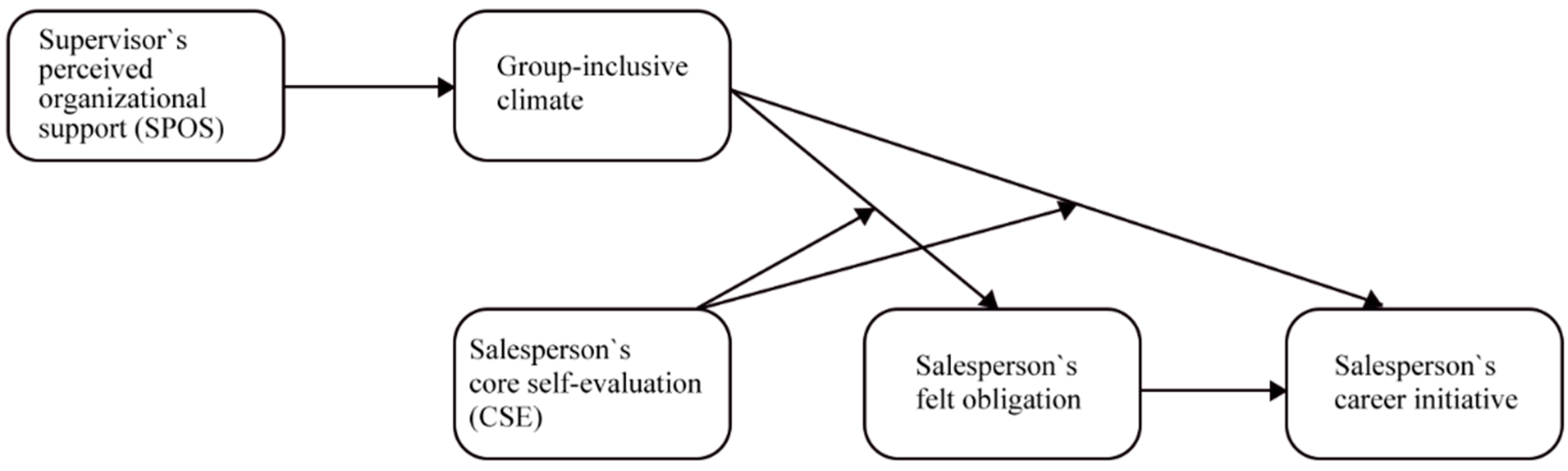
Figure 2.
(a) Moderating effect of a salesperson`s CSE on the group-inclusive climate–salesperson's felt obligation; (b) Moderating effect of a salesperson`s CSE on the group-inclusive climate–salesperson's career initiative.
Figure 2.
(a) Moderating effect of a salesperson`s CSE on the group-inclusive climate–salesperson's felt obligation; (b) Moderating effect of a salesperson`s CSE on the group-inclusive climate–salesperson's career initiative.
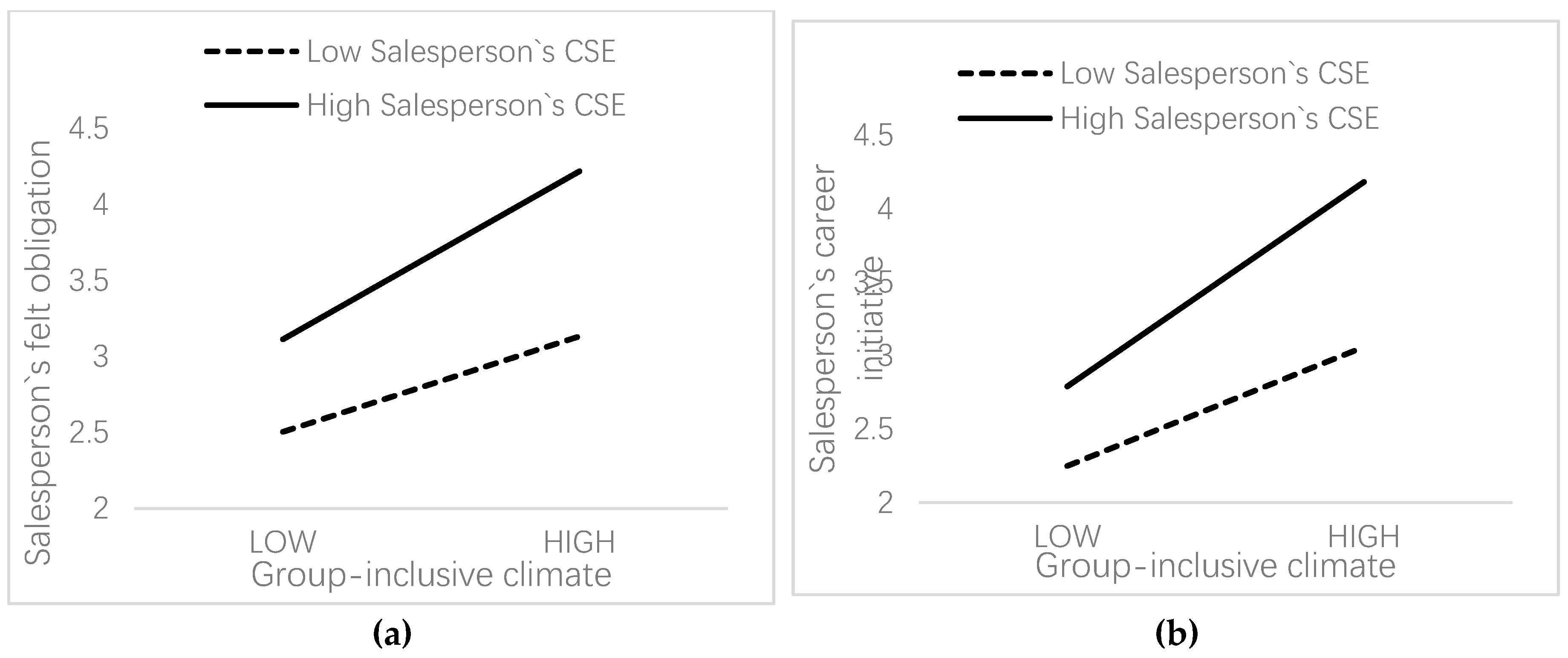
Figure 3.
(a) Johnson–Newman figure of moderating effect on salesperson's felt obligation; (b) Johnson–Newman figure of moderating effect on salesperson's career initiative.
Figure 3.
(a) Johnson–Newman figure of moderating effect on salesperson's felt obligation; (b) Johnson–Newman figure of moderating effect on salesperson's career initiative.
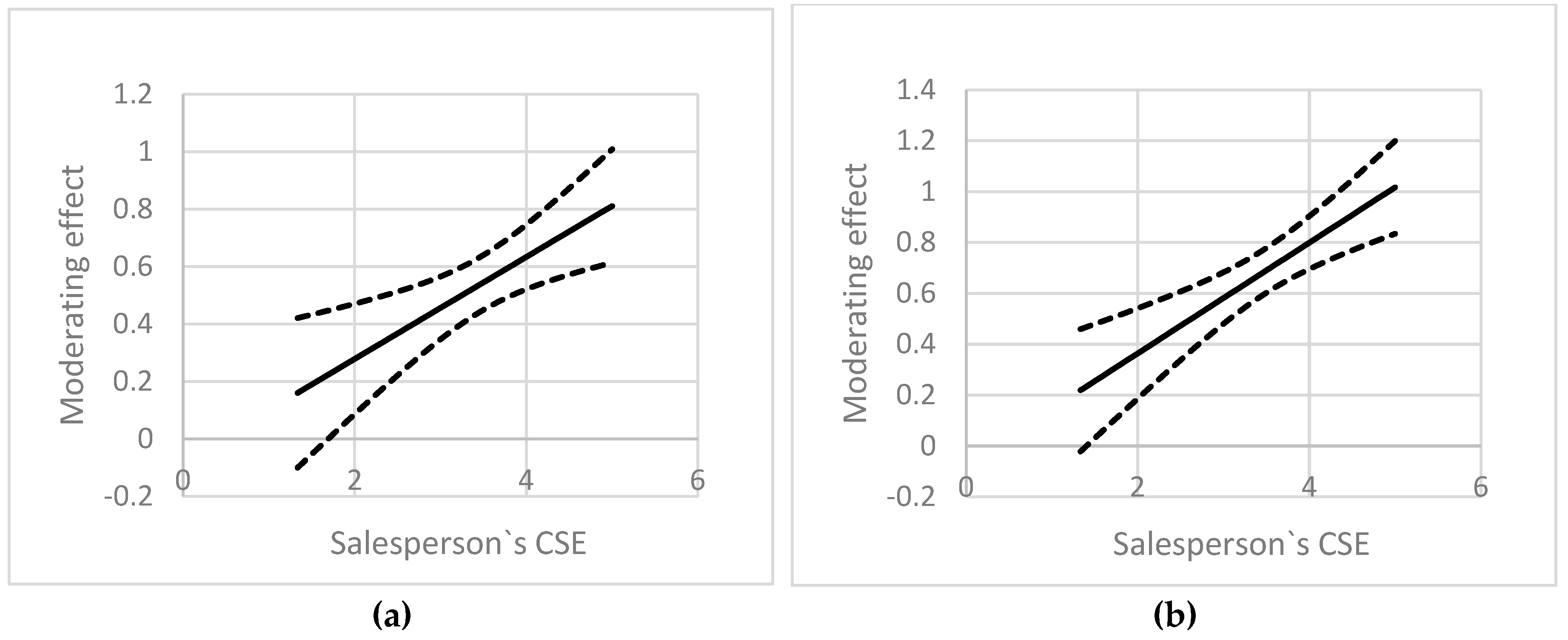
Table 1.
Confirmatory factor analysis.
| Measurement Model | df | /df | CFI | TLI | RMSEA | |
|---|---|---|---|---|---|---|
| Hypothesized 5-factor model | 769 | 1134.877 | 1.476 | .959 | .957 | .040 |
| M1 4-factor model (combined SPOS and GIC1) | 773 | 2102.931 | 2.720 | .853 | .844 | .076 |
| M2 4-factor model (combined GIC and FO2) | 773 | 2412.591 | 3.121 | .818 | .807 | .084 |
| M3 4-factor model (combined GIC and CI3) | 773 | 2176.510 | 2.816 | .845 | .835 | .078 |
| M4 4-factor model (combined FO and CI) | 773 | 2155.260 | 2.788 | .847 | .838 | .077 |
N = 299. 1 GIC: group-inclusive climate; 2 FO: salesperson's felt obligation; 3 CI: salesperson's career initiative.
Table 2.
Discriminate validity and alpha coefficients.
| Factor | SPOS | GIC | FO | CI | CSE | Mean | S.D. | C.R. | AVE | α |
|---|---|---|---|---|---|---|---|---|---|---|
| SPOS | (.746)4 | 3.73 | .72 | .909 | .556 | .887 | ||||
| GIC1 | .152**5 | (.759) | 3.33 | .81 | .931 | .576 | .930 | |||
| FO2 | .017 | .489** | (.764) | 3.25 | .94 | .893 | .584 | .937 | ||
| CI3 | -.007 | .407** | .651** | (.716) | 3.09 | .96 | .840 | .512 | .938 | |
| CSE | -.071 | .060 | .474** | .459** | (.756) | 3.44 | .83 | .941 | .572 | .959 |
N = 299; ∗∗ p <0.01. 1 GIC: group-inclusive climate; 2 FO: salesperson's felt obligation; 3 CI: salesperson's career initiative; 4 values in the diagonal represent the square roots of the average variance extracted values; 5 values in the area below the diagonal represent the correlation coefficients for the constructs.
Table 3.
Results of direct effect analysis.
| Direct Effect | Estimate | S.E. | 95% C.I. |
|---|---|---|---|
| SPOS → GIC(Hypothesis 1)1 | .171** | .067 | (.057, .278) |
| SPOS → FO2 | -.076 | .066 | (-.183, .039) |
| SPOS → CI3 | -.100 | .054 | (-.201, .002) |
| GIC → FO (Hypothesis 2) | .576*** | .054 | (.477, .660) |
| GIC → CI (Hypothesis 3) | .466*** | .055 | (.372, .556) |
| FO → CI (Hypothesis 4) | .472*** | .048 | (.396, .550) |
N = 299; ∗ p <0.05; ∗∗ p <0.01; ∗∗∗ p <0.001. 1 GIC: group-inclusive climate; 2 FO: salesperson's felt obligation; 3 CI: salesperson's career initiative.
Table 4.
Results of indirect effect analysis.
| Indirect Effect | Estimate | S.E. | 95% C.I. |
|---|---|---|---|
| SPOS → GIC1 → FO2 | .098* | .041 | (.032, .169) |
| SPOS → GIC → CI3 | .080* | .032 | (.028, .134) |
| WGIC → FO → CI | .272*** | .038 | (.213, .338) |
| SPOS → GIC → FO → CI (Hypothesis 5) | .046* | .020 | (.017, .081) |
N = 299; ∗ p <0.05; ∗∗ p <0.01; ∗∗∗ p <0.001. 1 GI: group-inclusive climate; 2 FO: salesperson's felt obligation; 3 CI: salesperson's career initiative.
Table 5.
Results of moderating effect analysis.
| Model 1 | Model 2 | |||||
|---|---|---|---|---|---|---|
| FO2 | CI3 | |||||
| Beta | S.E. | 95% C.I. | Beta | S.E. | 95% C.I. | |
| GIC1 | .530*** | .050 | (.432, .628) | .683*** | .045 | (.594, .772) |
| CSE | .516*** | .049 | (.419, .613) | .505*** | .044 | (.418, .593) |
| GIC×CSE (Hypothesis 6) | .174** | .059 | (.058, .291) | .218*** | .054 | (.112, .323) |
N = 299; ∗ p <0.05; ∗∗ p <0.01; ∗∗∗ p <0.001. 1 GIC: group-inclusive climate; 2 FO: salesperson's felt obligation; 3 CI: salesperson's career initiative.
Disclaimer/Publisher’s Note: The statements, opinions and data contained in all publications are solely those of the individual author(s) and contributor(s) and not of MDPI and/or the editor(s). MDPI and/or the editor(s) disclaim responsibility for any injury to people or property resulting from any ideas, methods, instructions or products referred to in the content. |
© 2024 by the authors. Licensee MDPI, Basel, Switzerland. This article is an open access article distributed under the terms and conditions of the Creative Commons Attribution (CC BY) license (http://creativecommons.org/licenses/by/4.0/).
Copyright: This open access article is published under a Creative Commons CC BY 4.0 license, which permit the free download, distribution, and reuse, provided that the author and preprint are cited in any reuse.


