

Submitted:
12 September 2023
Posted:
13 September 2023
You are already at the latest version
Abstract
Three new cembranoids (1–3) and a new casbanoid (4), along with three known analogues (5–7), have been isolated from the soft coral Sinularia nanolobata collected off Ximao Island. The structures including the absolute configurations of new compounds were established by extensive spectro-scopic data analysis, time-dependent density functional theory/electronic circular dichroism (TDDFT-ECD) calculations and the comparison with spectroscopic data of known compounds. In in vitro bioassay, compounds 1 and 5 exhibited moderate cytotoxic activities against human erythroleukemia (HEL) cells line with IC50 values of 37.1 and 42.4 uM, respectively.
Keywords:
Marine natural product
; Sinularia nanolobata
; Structure elucidation
; Cytotoxicity
1. Introduction
Soft corals of the genus Sinularia (subclass Octocorallia, order Alcyonacea, family Alcyoniidae) have been well studied by organic chemists for a long time [1,2]. To date, hundreds of secondary metabolites have been discovered from approximately 50 species of this genus [2]. Chemically, the structures of those metabolites can be classified to mainly three types: terpenes, steroids, and prostaglandins, which were responsible for a diverse range of significant bioactivities, especially cytotoxic and anti-inflammatory potentials [1,2,3].
The first chemical and biological study on soft coral S. nanolobata has been performed in 1997, resulting in the isolation of four cytotoxic amphilectane-type diterpenoids [4]. In the following serval decades, a variety of diterpenoids, nor-diterpenoids, sesquiterpenoids, nor-sesquiterpenoids, steroids, seco-steroids, and steroidal glycosides, which exhibiting interesting biological activities, such as anti-inflammatory, cytotoxic, and neuroprotective activities, have been isolated from the titled animals [5,6,7,8,9,10,11,12,13]. Their unique structures and excellent bioactivities have attracted our ongoing interest to search for more bioactive secondary metabolites from the South China Sea soft corals.
Recently, soft coral S. nanolobata was collected off Ximao Island, Hainan Province, China, in May 2019. Our previous chemical study on the titled animal has resulted in the isolation and characterization of a series of polyoxygenated diterpenoids [14]. The further chemical investigation of the acetone extract of same sample has led to the isolation and characterization of three previously undescribed cembrane-type diterpenoids (1–3) and a new casbane-type diterpenoid (4) (Figure 1). Herein, we report the isolation, structure elucidation, and cytotoxic activity of these newly isolated compounds
2. Results
The acetone extract of S. nanolobata was portioned between Et2O and H2O to afford the Et2O-soluble fraction, which was subjected to silica gel column chromatography to give 12 subfractions. The subfractions were further purified by repeated silica gel, Sephadex LH-20, and reversed-phase HPLC to afford compounds 1–7, respectively. The known compounds were rapidly characterized as grandilobatin D (5) [6], 11,12-epoxy-1E,3E,7E-cembratrien-15-ol (6) [15], and casbene (7) [16] by comparing the observed and reported spectroscopic data.
Compound 1 was obtained as a optical active {[α] -13.5 (c 0.25, CHCl3)} colorless oil. Its molecular formula C21H34O2 was determined by the HR-EIMS ion peak at m/z 318.2554 [M]+ (calcd. For C21H34O2, Figure S1g), implying 5 degrees of unsaturation. The IR spectrum showed the presence of a carbonyl group (1708 cm-1, Figure S1h). The 1H NMR data (Table 1) of 1 displayed two vinyl methyls at δH 1.75 (3H, s) and 1.70 (3H, s), two tertiary methyls at δH 1.29 (3H, s) and 1.30 (3H, s), a bimodal methyl at δH 0.98 (3H, d, J = 6.9 Hz), an oxymethyl at δH 3.02 (3H, s), and three olefinic protons at δH 6.17 (1H, d, J = 10.7 Hz), 5.89 (1H, d, J = 10.7 Hz) and 5.24 (1H, m), respectively. The 13C NMR data together with DEPT and HSQC spectra indicated the presence of 21 carbon signals which were classified as 6 methyls, 6 methylenes, 4 methines, and 5 quaternary carbons. The aforementioned data revealed that 1 was a cembrane-type diterpenoid, and closely resembled that of co-occurring known compound, grandilobatin D (5) [6], with the only difference being the methoxyl group at C-15 in 1 instead of the C-15 hydroxyl group in 5, in agreement with the mass data. This replacement caused the 13C NMR resonance of C-15 to be shifted downfield from δC 73.9 to 78.2 in 1. The position of the methoxyl group at C-15 was further confirmed by the HMBC correlation from –OMe (δH 3.02) to C-15 (δC 78.2) (Figure 2). The geometries of the double bonds at Δ1,2, Δ3,4, and Δ7,8 were both assigned to be E by the observed chemical shifts (< 20 ppm) of the 2 vinyl methyls resonance at δC 17.4 (C-18) and δC 17.6 (C-19), along with the NOESY correlations of H-2 (δH 6.17)/Me-18 (δH 1.75), H-3 (δH 5.89)/H2-14 (δH 2.23 and 1.97), and H-7 (δH 5.24)/H2-9 (δH 3.03).
The TDDFT-ECD calculation was carried out to deduce the absolute configuration of 1, which has been proven to be reliable structure elucidation method for the determination of the absolute configuration of natural products. Detailed comparison of the experimental ECD spectrum with those of calculated ones revealed that the Boltzmann-averaged ECD spectrum of (12S)-1 displayed an identical curve compared to the experimental one (Figure 3). Consequently, the absolute configuration of 1 was determined as 12S.
Compound 2, which was isolated as a colorless oil, gave the molecular formula C21H34O2, the same as that of 1, on the basis of HR-EIMS ion peak at m/z 318.2558 [M]+ (calcd. for C21H34O2, 318.2553). The 1H and 13C NMR data (Table 1) of 2 were virtually identical to those of co-isolated known compound, 11,12-epoxy-1E,3E,7E-cembratrien-15-ol (6), with the exception of a methoxyl group at C-15 in 2 instead of the C-15 hydroxyl group in 6. The planar structure of 2 was further elucidated by 1H–1H COSY and HMBC experiments (Figure 2). The E geometries of the double bonds Δ3,4 and Δ7,8 in 2 were determined by the chemical shifts (< 20 ppm) of the C-18 (δC 18.3) and C-19 (δC 15.1) methyl groups, which were further confirmed by the NOESY cross-peaks of H-2 (δH 6.14)/Me-18 (δH 1.74), and H-7 (δH 5.29)/H2-9 (δH 2.26) (Figure 2). Moreover, the NOESY correlations of H-2/Me-16 (δH 1.30), and H-3 (δH 5.82)/H2-14 (δH 2.12 and 2.03) assigned the E geometry of double bond Δ1,2. The relative configuration of C-11 and C-12 of 2 were suggested to be the same 11R*, 12R* as those of 6 due to the similar NMR data and the diagnostic NOESY relationships of H-11 (δH 2.90)/H-13β (δH 1.33), and Me-20 (δH 1.25)/H-10β (δH 1.45) (Figure 2). The absolute configuration of 2 was established by the application of TDDFT-ECD calculation method. As shown in Figure 3, the Boltzmann-averaged ECD spectrum of (11R, 12R)-2 was matched to the experimental ECD spectrum of 2. Accordingly, the structure of 2 was elucidated as depicted in Figure 1.
Compound 3 was also obtained as a colorless oil with the molecular formula of C21H34O2 on the basis of HR-EIMS ion peak at m/z 318.2566 [M]+ (calcd. for C21H34O2, 318.2553). Analysis of the 1H and 13C NMR data of 3 (Table 2) revealed similarities to 2, except for the location of methoxyl group from the C-15 in 2 transferred to C-4 in 3, and accompanied by the isomerization of olefins from Δ1,2 and Δ3,4 to Δ1,15 and Δ2,3, respectively. These observations were supported by the HMBC correlations from the methyl protons Me-18 (δH 1.31) to C-3 (δC 130.5), C-4 (δC 77.3) and C-5 (δC 41.7); –OMe (δH 3.07) to C-4 (δC 77.3); Me-16 (δH 1.81) to C-1 (δC 129.5), C-15 (δC 131.7); and from the olefinic proton H-2 (δH 5.71) to C-15 (Figure 2). The large coupling constant (J2,3 = 16.3 Hz) and the 13C chemical shift of the methyl group Me-19 (δC 14.8) established the E geometries of the double bonds Δ2,3 and Δ7,8. Its relative configuration at C-11 and C-12 were proven the same 11R*, 12R* as those of 2 on the basis of the NOESY experiment (Figure 2). The whole relative configuration of the remaining chiral center C-4 and the distant stereochemical domain C-11/C-12 was defined by the QM-NMR calculation and DP4+ analysis [17,18]. Finally, the NMR parameter on the two possible candidate isomers (Figure S5a, 3a: 4R*, 11R*, 12R*; 3b: 4S*, 11R*, 12R*) were calculated by the means of gauge including atomic orbitals (GIAO) method at mPW1PW91/6-31+G(d) level of theory following the DP4+ protocols. As a result, the experimentally observed NMR data of 3 gave the best match over 99% to the 3b isomer (Figure S5b).
With the relative configuration assigned, the following task was the determination of the absolute configuration of 3. Similarly, TDDFT-ECD calculation method was again applied in this case to determine the absolute configuration of 3. As shown in Figure 4, the Boltzmann averaged ECD spectrum of (4S, 11R, 12R)-3 was highly matched to the experimental ECD curve of 3. In light of these evidence, the structure of compound 3 was established as depicted in Figure 1.
Compound 4 was isolated as a colorless oil, possessing the molecular formula of C20H30 by the HR-EIMS ion peak at m/z 270.2342 [M]+ (calcd. for C20H30, 270.2342), suggesting that 4 possessed 6 degrees of unsaturation. The 1H and 13C NMR data (Table 2) of 4 were resemble to those of co-isolated known compound casbene (7), with the exception of a conjugated terminal double bond in 4 instead of the vinyl methyl in 7. This replacement caused the presence of another 3 olefinic protons and the missing of a methyl signal in the 1H NMR of 4. The planar structure of 4 was further secured by the analysis of its 1H–1H COSY and HMBC correlations (Figure 2). The geometries of the double bonds Δ3,4 and Δ7,8 were assigned to be both E by the shielded carbon resonances of the 2 vinyl methyls at δC 15.8 (C-18) and 18.0 (C-19), along with the obvious NOESY correlations of Me-18 (δH 1.65)/H-2 (δH 1.32), and Me-19 (δH 1.64)/H2-6 (δH 2.16) (Figure 2). Moreover, the large coupling constants (J10,11 = 16.2 Hz) between H-10 and H-11 established the E geometry of double bond Δ10,11. The 1,2-cis-configuration of C-1 and C-2 was determined by the NOE relationships of H-1/H-2/Me-16 (Figure 2) and the large ∆δC value (13.1 ppm) between the gem-dimethyls C-16 (δC 29.2) and C-17 (δC 16.1). Moreover, TDDFT-ECD calculation method was also applied to determine the absolute configuration of 4. As a result, the Boltzmann-averaged ECD spectrum of (1S, 2R)-4 highly matched to the experimental one, while the ECD profile of enantiomer (1R, 2S)-4 showed completely opposite curve (Figure 4). Consequently, the absolute configuration of 4 was determined to be 1S, 2R.
In in vitro bioassay, cembrane-type diterpenoids has been well documented to display the growth inhibitory activities against various cancer cell lines [19]. Accordingly, the cytotoxic activities of all the isolated compounds 1–7 were evaluated in vitro against HEL (human erythroleukemia cells), H1975 (human lung adenocarcinoma cells), A549 (human non-small cell lung cancer cells), H1299 (human non-small cell lung cancer cells), and MDA-MB-231 (human breast cancer cells) by using the CCK8 and MTT methods. Comparison of positive control (doxorubicin: IC50 = 0.05 μM for HEL), only compounds 1 and 5 exhibited medium cytotoxic activities against HEL cells with IC50 values of 37.09 and 42.37 μM, respectively.
3. Discussion
Although this is not the first chemical investigation that we have conducted on the soft coral S. nanolobata from the South China Sea, we have still obtained some new structures from it in this study. Structurally, all the new compounds 1–4 shared the same cembrane or casbane-type carbon skeleton with known analogues 5–7, and these molecules differed from each other mainly in different substituents or double bond positions, which suggested that they underwent a common biosynthesis pathway. In the bioassay, ketone carbonyl compounds 1 and 5 showed potential cytotoxic activities against HEL cells being compared to that of inactive compounds, which provided the possible lead scaffold for further structural modifications to design novel anti-tumor drug. Further research should be conducted to the ecological roles of these bioactive secondary metabolites formed in the biosynthesis process of the soft coral.
4. Materials and Methods
4.1. The General Experimental Procedures
Optical rotations were measured on a Perkin-Elmer 241MC polarimeter (PerkinElmer, Fremont, CA, USA). IR spectra were recorded on a Nicolet 6700 spectrometer (Thermo Scientific, Waltham, MA, USA); peaks are reported in cm–1. The NMR spectra were measured at 300 K on Bruker DRX 400 and Avance 600 MHz NMR spectrometers (Bruker Biospin AG, Fallanden, Germany); Chemical shifts are reported in parts per million (δ) in CDCl3 (δH reported referred to CHCl3 at 7.26 ppm; δC reported referred to CDCl3 at 77.16 ppm) and coupling constants (J) in Hz; assignments were supported by 1H–1H COSY, HSQC, HMBC, and NOESY experiments. EIMS and HR-EIMS spectra were recorded on a Finnigan-MAT-95 mass spectrometer (ThermoFisher Scientific, Waltham, USA) Semi-preparative HPLC was performed on an Agilent-1260 system equipped with a DAD G1315D detector using ODS-HG-5 (250 mm × 9.4 mm, 5 µm) by eluting with CH3OH–H2O or CH3CN–H2O system at 3 mL/min. Commercial silica gel (200−300 and 400−500 mesh; Qingdao, China) was used for column chromatography. Precoated SiO2 plates (HSGF-254; Yantai, China) were used for analytical TLC. Spots were detected on TLC under UV light or by heating after spraying with anisaldehyde H2SO4 reagent. All solvents used for extraction and isolation were of analytical grade.
4.2. Biological Material
Specimens of S. nanolobata, identified by Prof. Xiu-Bao Li from Hainan university, were collected along the coast of Ximao Island, Hainan province, China, in May 2019, at a depth of ‒20 m, and were frozen immediately after collection. A voucher specimen is available for inspection at Shanghai Institute of Materia Medica, SIBS-CAS (No. 19-XD-12).
4.3. Extraction and Isolation
The frozen soft coral was extracted exhaustively with acetone at room temperature (3 × 5.0 L). The acetone extract was then partitioned between Et2O and H2O, and the Et2O-soluble fraction was concentrated under reduced pressure to give a brown residue. Subsequently, the residue was separated into 12 fractions (A-L) by gradient silica gel column chromatography. Fraction A (264 mg) was partially purified by semi-preparative RP-HPLC (CH3CN–H2O, 97:3, 3.0 mL/min) to yield compounds 4 (0.6 mg, tR = 24.4 min) and 7 (4.0 mg, tR = 29.8 min). Fraction G (583 mg) was initially chromatographed over Sephadex LH-20 column eluted with PE/DCM/MeOH (2:1:1), affording four subfractions (G1–G4). Purification of subfraction G3 by semi-preparative RP-HPLC (CH3CN–H2O, 60:40) yielded compounds 1 (2.5 mg, tR = 19.4 min), 2 (39.7 mg, tR = 20.8 min) and 3 (4.9 mg, tR = 21.7 min). Fraction H (356 mg) was further chromatographed over Sephadex LH-20 column eluted with PE/DCM/MeOH (2:1:1), affording five subfractions (H1–H5). Subfraction H3 was subsequently separated by silica gel column chromatography (300–400 mesh), eluting with PE–DCM (1:1) to give compounds 5 (21.8 mg) and 6 (3.9 mg).
4.3.1. 12α-methyl-1E,3E,7E-cembratrien-10-one (1)
Colorless oil; [α] -13.5 (c 0.25 CHCl3); IR (KBr) νmax = 2928, 2871, 1708, 1456, 1376, 1154, 1072 cm-1; UV (MeCN) λmax 249.0 nm (log ε 4.65); 1H and 13C NMR data see Table 1; HR-EIMS m/z 318.2554 [M]+ (calcd. for C21H34O2, 318.2553).
4.3.2. 15-methoxyl-11,12-epoxy-1E,3E,7E-cembratrien (2)
Colorless oil; [α] -2.8 (c 0.53 CHCl3); IR (KBr) νmax = 2977, 2937, 1144, 1071 cm-1; UV (MeCN) λmax 192.0 nm (log ε 4.29); 1H and 13C NMR data see Table 1; HR-EIMS m/z 318.2558 [M]+ (calcd. for C21H34O2, 318.2553).
4.3.3. 4α-methoxyl-11,12-epoxy-1,2E,7E-cembratrien (3)
Colorless oil; [α] +9.9 (c 0.28 CHCl3); IR (KBr) νmax = 2974, 2934, 1374, 1075 cm-1; UV (MeCN) λmax 243.5 nm (log ε 3.80); 1H and 13C NMR data see Table 2; HR-EIMS m/z 318.2566 [M]+ (calcd. for C21H34O2, 318.2553).
4.3.4. 2E,7E,10E,12-casbatetraen (4)
Colorless oil; [α] -96.7 (c 0.04 CHCl3); IR (KBr) νmax = 2923, 2853, 1456 cm-1; CD (MeCN) λ (∆ε) 207.5 (-3.94), 240.5 (+0.99); UV (MeCN) λmax 203.0 nm (log ε 4.05); 1H and 13C NMR data see Table 2; HR-EIMS m/z 270.2342 [M]+ (calcd. for C20H30, 270.2342).
4.4. Computational Methods
Conformational searches were carried out using the torsional sampling (MCMM) method and MMFFs force field. Conformers above 1% population were re-optimized at the B3LYP/6-311G(d,p) level with IEFPCM (Polarizable Continuum Model using the Integral Equation Formalism variant) solvent model for acetonitrile. For the resulting geometries, ECD spectra were obtained by TDDFT calculations performed with Gaussian 09 at the same functional, basis set and solvent model as the energy optimization.
4.5. Bioactivity Assays
The cytotoxicity of compounds 1–7 was evaluated by using the CCK8 (HEL) and MTT (H1975, MDA MB-231, A549, H1299) methods, with doxorubicin (DOX) as the positive control. The growth inhibition of compounds on cancer cells from different tissue sources was tested using five concentration gradients. The maximum concentration of the compounds was 50 μM, diluted by five times, and the cancer cells were treated with five concentration gradients for 72 hours, respectively. Compounds with the highest concentration of 50 μM and inhibition rate greater than 60% were re-screened and calculated the half-maximal inhibition (IC50) values.
5. Conclusions
In summary, three new cembrane-type and one new casbane-type diterpenoids were isolated and characterized from the soft coral S. nanolobata collected off Ximao Island, Hainan Province, China. The structures of new compounds were established by the combination of extensive spectroscopic analysis, comparison with literature data, and DFT-based quantum chemical calculation aided configuration analysis. Especially, the relative configuration of 3 was defined by the QM-NMR calculation and DP4+ analysis, and the absolute configurations of 1–4 were determined by TDDFT ECD calculation. In in vitro bioassay, compounds 1 and 5 exhibited moderate cytotoxic activities against HEL cells with IC50 values of 37.09 and 42.37 μM, respectively. The discovery of these new bioactive secondary metabolites once again proved the chemical diversity of soft coral S. nanolobata.
Supplementary Materials
The following supporting information can be downloaded at the website of this paper posted on Preprints.org, Figure S1–S4: HREIMS, 1D NMR, 2D NMR, IR, ECD and UV spectra of compounds 1–4; Figure S5: QM-NMR calculation of compound 3; Figure S6: Experimental ECD spectra and TDDFT-ECD calculated ECD curves of compounds 1–4.
Author Contributions
Conceptualization, H. L. and Y.W.G.; methodology, Y.W.G.; software, S.W.L.; validation, S.W.L. and M.Z.S..; formal analysis, J.L.; investigation, D.D.Y. and L.M.K.; resources, L.G.Y.; data curation, S.W.L.; writing—original draft preparation, D.D.Y. and L.M.K.; writing—review and editing, S.W.L.; visualization, J.L.; supervision, M.Z.S.; project administration, H.L. and Y.W.G.; funding acquisition, Y.W.G. All authors have read and agreed to the published version of the manuscript.
Funding
This research was funded by the National Key Research and Development Program of China, grant number 2022YFC2804100; and the National Science Foundation of China, grant number 81991521. J. Liu is thankful for the financial support of Syngenta-SIMM-PhD Studentship Project.
Institutional Review Board Statement
Not applicable.
Informed Consent Statement
Not applicable.
Data Availability Statement
Data are available in Electronic Supporting Information (ESI).
Acknowledgments
The authors would like to thank Prof. X.-B. Li from Hainan University for the taxonomic identification of the soft coral material.
Conflicts of Interest
The authors declare no conflict of interest.
Sample Availability
Samples of the compounds are available from the authors.
References
- Chen, W.-T.; Li, Y.; Guo, Y.-W. Terpenoids of Sinularia soft corals: Chemistry and bioactivity. Acta Pharm. Sin. B 2012, 2, 227–237. [Google Scholar] [CrossRef]
- Yan, X.; Liu, J.; Leng, X.; Ouyang, H. Chemical diversity and biological activity of secondary metabolites from soft coral genus Sinularia since 2013. Mar. Drugs 2021, 19, 335. [Google Scholar] [CrossRef] [PubMed]
- Kamel, H.N.; Slattery, M. Terpenoids of Sinularia: chemistry and biomedical applications. Pharm. Biol. 2008, 43, 253–269. [Google Scholar] [CrossRef]
- Yamada, K.; Ujiie, T.; Yoshida, K.; Miyamoto, T.; Higuchi, R. Sinulobatins A-D, New amphilectane-type diterpenoids from the Japanese soft coral Sinularia nanolobata. Tetrahedron 1997, 53, 4569–4578. [Google Scholar] [CrossRef]
- Ahmed, A.F.; Su, J.-H.; Shiue, R.-T.; Pan, X.-J.; Dai, C.-F.; Kuo, Y.-H.; Sheu, J.-H. New -caryophyllene-derived terpenoids from the soft coral Sinularia nanolobata. J. Nat. Prod. 2004, 67, 592–597. [Google Scholar] [CrossRef]
- Ahmed, A.F.; Tai, S.-H.; Wen, Z.-H.; Su, J.-H.; Wu, Y.-C.; Hu, W.-P.; Sheu, J.-H. A C-3 methylated isocembranoid and 10-oxocembranoids from a Formosan soft coral, Sinularia grandilobata. J. Nat. Prod. 2008, 71, 946–951. [Google Scholar] [CrossRef]
- Tseng, Y.-J.; Wen, Z.-H.; Dai, C.-F.; Chiang, M. Y.; Sheu, J.-H. Nanolobatolide, a new C18 metabolite from the Formosan soft coral Sinularia nanolobata. Org. Lett. 2009, 11, 5030–5032. [Google Scholar] [CrossRef] [PubMed]
- Tseng, Y.-J.; Wang, S.-K.; Duh, C.-Y. Secosteroids and norcembranoids from the soft coral Sinularia nanolobata. Mar. Drugs 2013, 11, 3288–3296. [Google Scholar] [CrossRef] [PubMed]
- Chao, C.-H.; Huang, T.-Z.; Wu, C.-Y.; Chen, B.-W.; Huang, C.-Y.; Hwang, T.-L.; Dai, C.-F.; Sheu, J.-H. Steroidal and α-tocopherylhydroquinone glycosides from two soft corals Cladiella hirsute and Sinularia nanolobata. RSC Adv. 2015, 5, 74256–74262. [Google Scholar] [CrossRef]
- Chao, C.-H.; Wu, C.-Y.; Huang, C.-Y.; Wang, H.-C.; Dai, C.-F.; Wu, Y.-C.; Sheu, J.-H. Cubitanoids and cembranoids from the soft coral Sinularia nanolobata. Mar. Drugs 2016, 14, 150. [Google Scholar] [CrossRef] [PubMed]
- Ngoc, N.-T.; Huong, P.T.M.; Thanh, N.V.; Cuong, N.X.; Nam, N.H.; Thung, D.C.; Kiem, P.V.; Minh, C.V. Steroid constituents from the soft coral Sinularia nanolobata. Chem. Pharm. Bull. 2016, 64, 1417–1419. [Google Scholar] [CrossRef] [PubMed]
- Ngoc, N.-T.; Huong, P.T.M.; Thanh, N.V.; Cuong, N.X.; Nam, N.H.; Thung, D.C.; Kiem, P.V.; Minh, C.V. Sesquiterpene constituents from the soft coral Sinularia nanolobata. Nat. Prod. Res. 2017, 31, 1799–1804. [Google Scholar] [CrossRef] [PubMed]
- Hsu, F.-Y.; Wang, S.-K.; Duh, C.-Y. Xeniaphyllane-derived terpenoids from soft coral Sinularia nanolobata. Mar. Drugs 2018, 14, 40. [Google Scholar] [CrossRef] [PubMed]
- Liu, J.; Li, S.-W.; Zhao, Q.-M.; Zhang, Z.-Y.; Yao, L.-G.; Gu, Y.-C.; Lan, L.-F.; Guo, Y.-W. Nanolobatone A, unprecedented diterpenoid and related casbanoids from the Hainan soft coral Sinularia nanolobata. Chem-Eur. J. 2023, e202300055. [Google Scholar] [CrossRef]
- Duh, C.-Y.; Hou, R.-S. Cytotoxic cembranoids from the soft corals sinularia gibberosa and Sarcophyton trocheliophorum. J. Nat. Prod. 1996, 59, 595–598. [Google Scholar] [CrossRef]
- Sitton, D.; West, C.A. Casbene: an anti-fungal diterpene produced in cell-free extracts of Ricznus communis seedings. Phytochemistry 1975, 14, 1921–1925. [Google Scholar] [CrossRef]
- Grimblat, N.; Zanardi, M.M.; Sarotti, A.M. Beyond DP4: an improved probability for the stereochemical assignment of isomeric compounds using quantum chemical calculations of NMR shifts. J. Org. Chem. 2015, 80, 12526–12534. [Google Scholar] [CrossRef] [PubMed]
- Grimblat, N.; Gavin, J.A.; Daranas, A.H.; Sarotti, A.M. Combining the power of J coupling and DP4 analysis on stereochemical assignments: the J-DP4 methods. Org. Lett. 2019, 21, 4003–4007. [Google Scholar] [CrossRef] [PubMed]
- Rodrigues, I.G.; Miguel, M.G.; Mnif, W. A brief review on new naturally occurring cembranoid diterpene derivatives from the soft corals of the genera Sarcophyton, Sinularia, and Lobophytum since 2016. Molecules 2019, 24, 781–813. [Google Scholar] [CrossRef] [PubMed]
Figure 1.
The chemical structures of compounds 1–7.
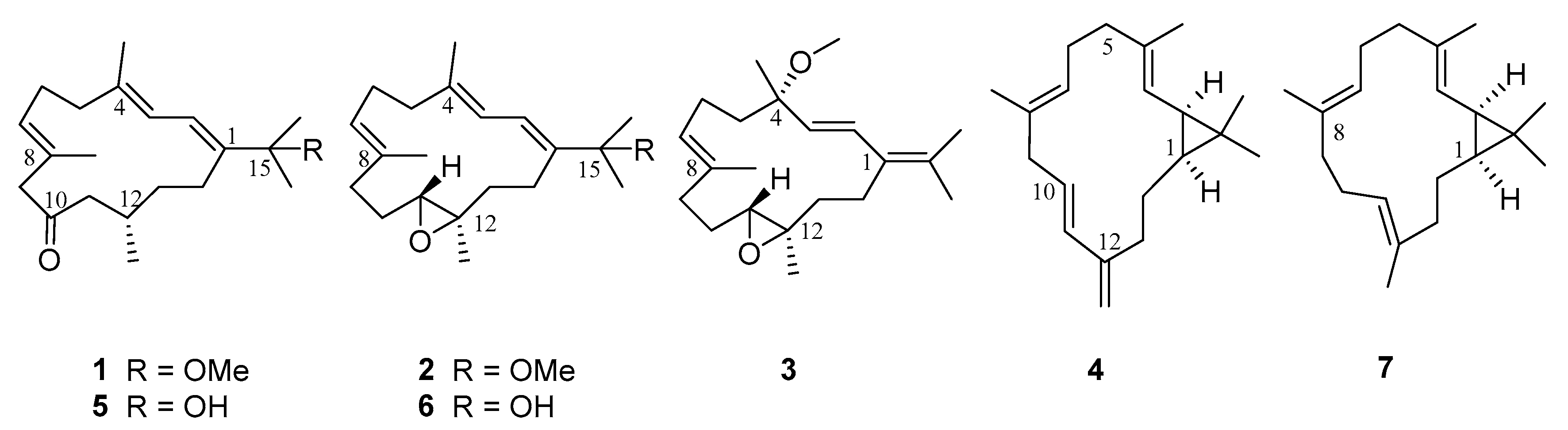
Figure 2.
The 1H–1H COSY, key HMBC and NOESY correlations of compounds 1–4.
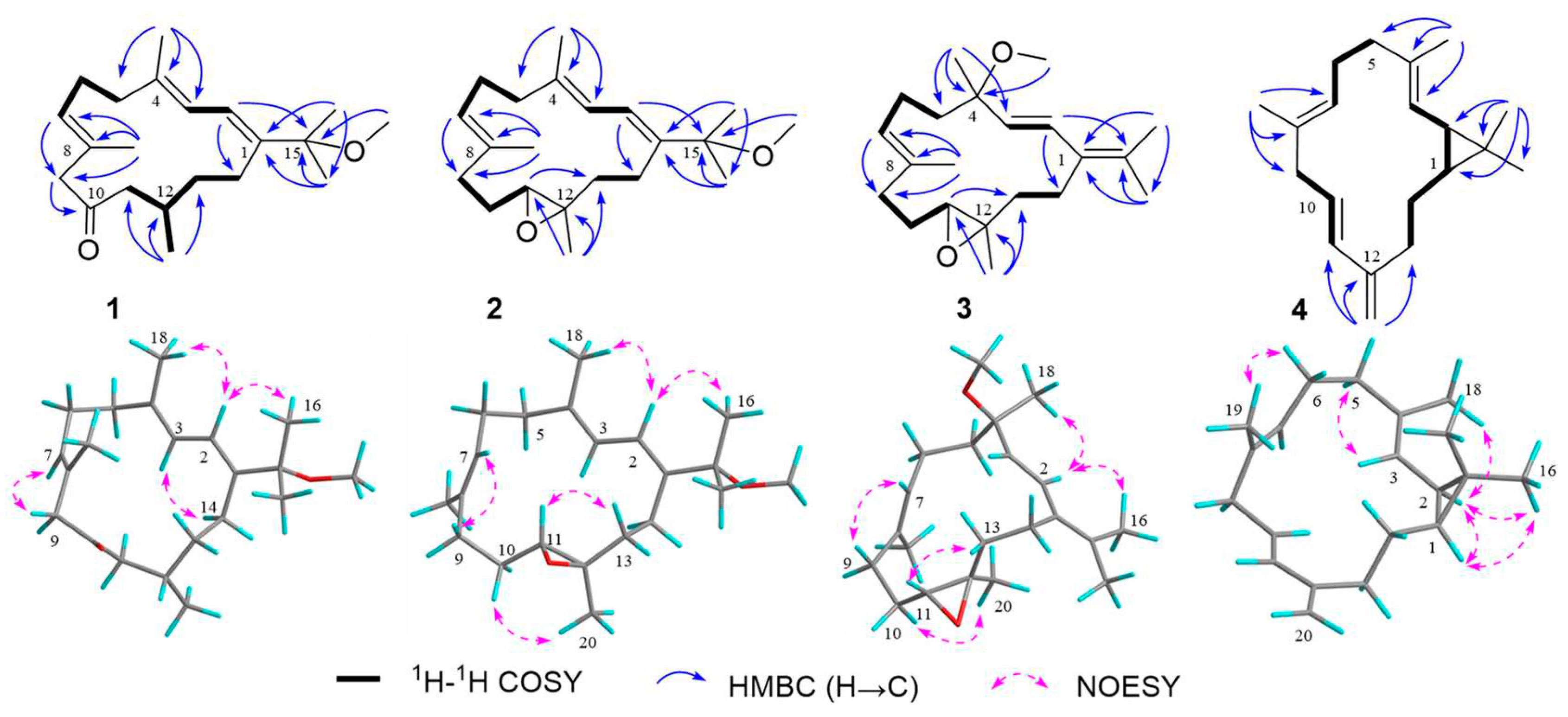
Figure 3.
Experimental and calculated ECD spectra of 1 and 2.
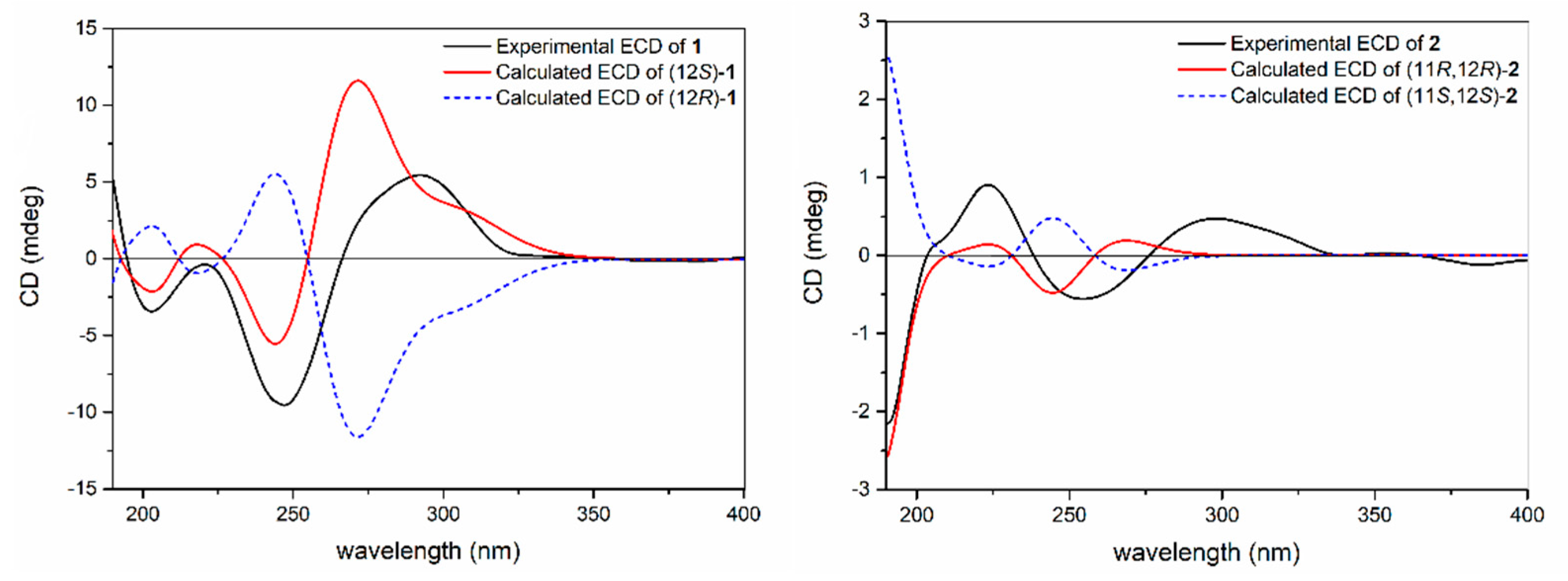
Figure 4.
Experimental and calculated ECD spectra of 3 and 4.
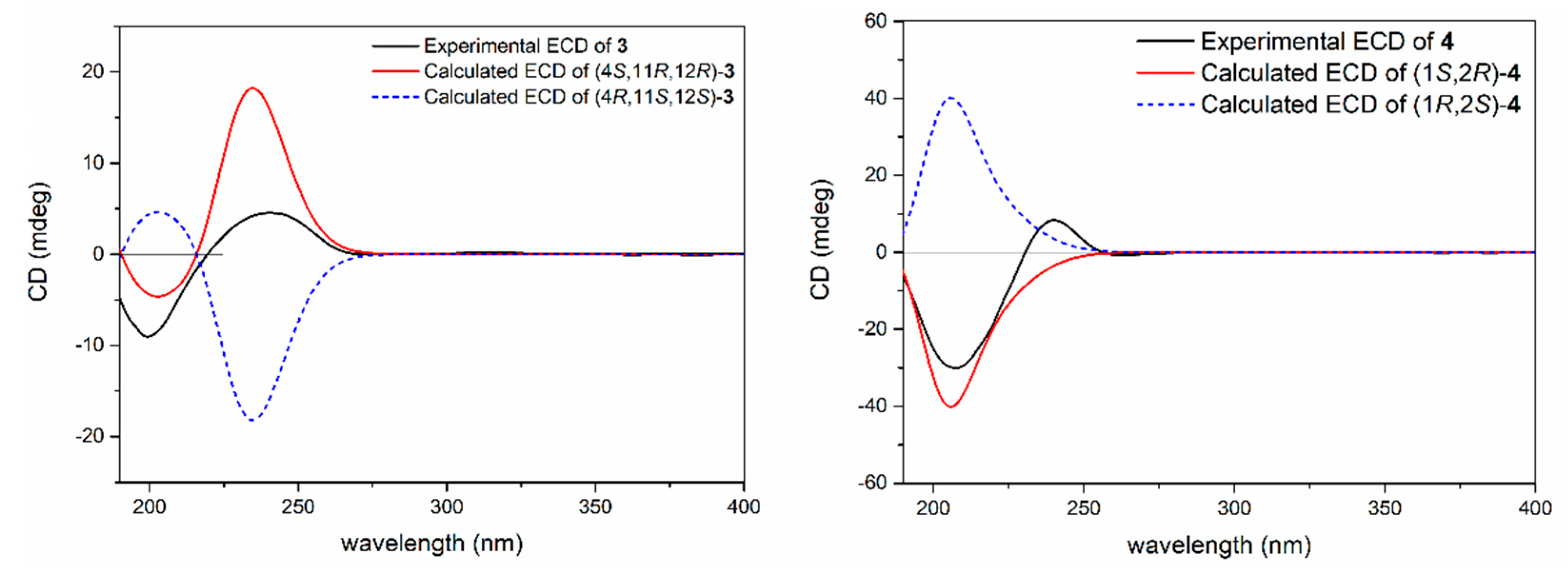

Table 1.
The 1H and 13C NMR data of 1 and 2 in CDCl3.a
| No. | 1 | 2 | |||
| δH, mult (J in Hz) | δC, mult | δH, mult (J in Hz) | δC, mult | ||
| 1 | - | 143.2, s | - | 143.0, s | |
| 2 | 6.17, d (10.7) | 122.1, d | 6.14, d (10.0) | 122.3, d | |
| 3 | 5.82, d (10.7) | 121.8, d | 5.82, d (10.0) | 120.3, d | |
| 4 | - | 137.3, s | - | 138.8, s | |
| 5 | 2.18, m | 39.0, t | 2.17, m | 38.2, t | |
| 2.18, m | 2.17, m | ||||
| 6 | 2.23, m | 25.5, t | 2.27, m | 25.1, t | |
| 2.23, m | 2.17, m | ||||
| 7 | 5.24, m | 128.9, d | 5.28, m | 127.2, d | |
| 8 | - | 129.4, s | - | 133.6, s | |
| 9 | 3.03, m | 53.1, t | 2.26, m | 37.0, t | |
| 3.03, m | 2.11, m | ||||
| 10 | - | 209.9, s | 2.01, m | 24.5, t | |
| 1.45, m | |||||
| 11 | 2.55, dd (14.6, 8.7) | 50.9, t | 2.90, dd (9.2, 3.5) | 61.3, t | |
| 2.19, m | |||||
| 12 | 2.06, m | 30.2, d | - | 61.4, d | |
| 13 | 1.43, m | 37.4, t | 2.08, m | 38.8, t | |
| 1.27, m | 1.33, m | ||||
| 14 | 2.23, m | 24.6, t | 2.12, m | 23.1, t | |
| 1.97, m | 2.03, m | ||||
| 15 | - | 78.2, s | - | 78.0, s | |
| 16 | 1.29, s | 27.0, q | 1.29, s | 26.4, q | |
| 17 | 1.30, s | 25.2, q | 1.29, s | 25.8, q | |
| 18 | 1.75, s | 17.4, q | 1.74, s | 18.3, q | |
| 19 | 1.70, s | 17.6, q | 1.66, s | 15.1, q | |
| 20 | 0.98, d (6.9) | 20.4, q | 1.25, s | 17.4, q | |
| –OMe | 3.02, s | 50.4, q | 3.02, s | 50.4, q | |
a 1H NMR at 600 MHz, values are reported in ppm referenced to CHCl3 (δH 7.26). 13C NMR at 150 MHz, values are reported in ppm referenced to CDCl3 (δC 77.16). Assignments were aided by HSQC and HMBC experiments.
Table 2.
The 1H and 13C NMR data of 3 and 4 in CDCl3.a
| No. | 3 | 4 | |||
| δH, mult (J in Hz) | δC, mult | δH, mult (J in Hz) | δC, mult | ||
| 1 | - | 129.5, s | 0.62, dt (8.2, 2.6) | 29.5, d | |
| 2 | 6.48, d (16.3) | 127.4, d | 1.32, m | 26.0, d | |
| 3 | 5.71, d (16.3) | 130.5, d | 4.83, d (8.2) | 122.9, d | |
| 4 | - | 77.3, s | - | 134.8, s | |
| 5 | 1.92, m | 41.7, t | 2.22, dd (12.1, 4.2) | 39.6, t | |
| 1.60, m | 2.06, dd (12.1, 4.9) | ||||
| 6 | 2.64, m | 23.0, t | 2.16, m | 23.8, t | |
| 1.95, m | 2.16, m | ||||
| 7 | 5.34, br d (7.7) | 128.6, d | 5.14, t (5.7) | 124.2, d | |
| 8 | - | 132.5, s | - | 134.2, s | |
| 9 | 2.33, d (13.0) | 36.9, t | 2.73, dd (16.4, 5.0) | 40.8, t | |
| 2.10, dd (13.0, 3.1) | 2.62, dd (16.4, 9.1) | ||||
| 10 | 2.18, dt (12.9, 3.0) | 24.4, t | 5.67, ddd (16.2, 9.1, 5.0) | 130.5, d | |
| 1.32, m | |||||
| 11 | 2.79, dd (10.8, 2.6) | 62.6, d | 5.94, d (16.2) | 130.8, d | |
| 12 | - | 61.6, s | - | 147.5, s | |
| 13 | 2.01, m | 37.6, t | 2.31, m | 34.3, t | |
| 1.02, m | 2.31, m | ||||
| 14 | 2.46, m | 26.4, t | 1.49, m | 25.5, t | |
| 2.04, m | 1.38, m | ||||
| 15 | - | 131.7, s | - | 20.1, s | |
| 16 | 1.81, s | 21.5, q | 1.07, s | 29.2, q | |
| 17 | 1.81, s | 20.4, q | 0.93, s | 16.1, q | |
| 18 | 1.31, s | 23.3, q | 1.65, s | 15.8, q | |
| 19 | 1.70, s | 14.8, q | 1.64, s | 18.0, q | |
| 20 | 1.30, s | 16.3, q | 4.87, s | 113.0, t | |
| 4.82, s | |||||
| –OMe | 3.07, s | 50.3, q | |||
a 1H NMR at 600 MHz, values are reported in ppm referenced to CHCl3 (δH 7.26). 13C NMR at 150 MHz, values are reported in ppm referenced to CDCl3 (δC 77.16). Assignments were aided by HSQC and HMBC experiments.
Disclaimer/Publisher’s Note: The statements, opinions and data contained in all publications are solely those of the individual author(s) and contributor(s) and not of MDPI and/or the editor(s). MDPI and/or the editor(s) disclaim responsibility for any injury to people or property resulting from any ideas, methods, instructions or products referred to in the content. |
© 2023 by the authors. Licensee MDPI, Basel, Switzerland. This article is an open access article distributed under the terms and conditions of the Creative Commons Attribution (CC BY) license (http://creativecommons.org/licenses/by/4.0/).
Copyright: This open access article is published under a Creative Commons CC BY 4.0 license, which permit the free download, distribution, and reuse, provided that the author and preprint are cited in any reuse.


