
Submitted:
23 October 2023
Posted:
24 October 2023
You are already at the latest version
Abstract
In this paper, spacetime is defined as the absolutely invariant homogeneous "coordinate spacetime" frame and its modulation by the relatively variable non-homogeneous "metric spacetime" under its constraints. This modulation is caused by matter and motion, and carries the function of transmitting interactions, reflecting the diffeomorphism invariance and Lorentz invariance. This inhomogeneous spacetime concept makes the medium nature of spacetime more obvious and avoids the problem of "path dependence" caused by the concept of curved spacetime. In this paper, it is argued that all energy-momentum has internal spatio-temporal properties, and all interactions must be transmitted through spacetime metrics. On this basis, a converging and dispersing cyclic multiverse model is proposed. This model of the universe is inevitable as long as there are two macroscopic manifestations of the matter of the universe, namely, gravitation induced convergence and "explosive" dispersion caused by different factors. The new cosmic model matches the observed accelerated "expansion" of the universe and no longer requires the dark energy hypothesis.
Keywords:
cyclic universe
; spacetime energy-momentum
; big bang
; dark energy
; cosmological constant
Ⅰ Definition
Absolute time has a one-way dimension with infinite extension3, which is the smallest dimension in the N-dimensional physical space that can express the position of infinite points; any point on the time axis is completely symmetric and can only appear once; the order of any two points on the time axis is unchangeable and cannot overlap. Absolute time is coordinate time, a fixed time frame with a fixed time measure , there is no concept of acceleration and deceleration, and there is no concept of bending.
Absolute space has fixed and unchanging three dimensions4 [3]. It is the largest dimension of N-dimensional space having exact N-1 dimensional boundary5 [4]. Any point in absolute space is perfectly symmetric, simultaneous, non-interchangeable and non-overlapping. Absolute space is Coordinate Space, a fixed spatial frame with a fixed length measure, no concept of stretch and contraction, and no concept of bending.
Absolute space-time is homogeneous space-time. Absolute time does not exist the concept of rest, there is no beginning, there is no end6; absolute space does not exist the concept of movement, can not be generated and eliminated7 [5], absolute space has no center, no boundary.
Relative time is the measure time within an infinitesimal neighborhoodat moment t of coordinate time, i.e., the instantaneous clock, which is a modulation of the coordinate time measure, , whereis the absolute time measure andis mudulation.
Relative space is the space of measures in an infinitesimal neighborhoodof a pointin coordinate space, i.e., the local ruler, which is a modulation of the coordinate space measure, ,,, whereis the absolute space measure and are mudulations.
The relative spacetime measurereflects a change in the value of the measurefor a positionin absolute spacetime. Relative spacetime does not require the concept of position, which is determined by absolute spacetime.
Neither the absolute spacetime measures, nor the relative spacetime measuresare related to the observer. They are properties of spacetime, and are spacetime measures at specific locations in coordinate spacetime. For the sake of visualization, we can think of them as a kind of "spacetime density".
The universe is a collection of time, space, and all energy-momentum.
There are two basic forms of energy-momentum8 [6], the pure energy-momentum form, radiant energy or light energy, and the matter-particle form . The presence or absence of mass is the identification that distinguishes them [6]. Energy-momentum has another important medium form, the pure spacetime form, in which any relative spacetime contains energy-momentum; there is a fixed and unchanging relationship between energy and momentum in any energy-momentum form9, whether it is at rest or in motion. This relation establishes the Minkowski spacetime relation.
Space-time should not be regarded as a background or stage for energy-momentum, but as a collaborator, guider, measurer, and bearer of energy-momentum. Energy is characterized by time, and momentum is characterized by three-dimensional space,,, and spacetime is the direct parameter of energy-momentum. Spacetime, through its measure (spacetime density) , transmits interactions between the various forms of energy and momentum, or is changed by them. This is the fundamental reason why all things can interact, they share space-time.
Energy-momentum in the form of matter, when at absolute rest, does not change its coordinate position because of the magnitude of the energy-momentum10. Energy-momentum in radiant form does not change its speed (time coordinates) because of the magnitude of the energy-momentum.
The unchanged speed of light is the criterion for absolute energy-momentum. The magnitude of the global energy-momentum of the Universe is absolute. Invariant form of constraints between energy-momentum and space-time, conservation of quantitative values is the first principle of the Universe, which is the direct determinant of all interactions, the embodiment of the force of action.
II The Nature of Interaction
The two fundamental forms of energy-momentum exist simultaneously in the universe and they can be converted into each other under specific conditions, both essentially consisting of photons. The values of energy-momentum they express are unlimited and can range from infinitely small to infinitely large, i.e., from elementary particles to black holes can be expressed in the same structural form.
The radial diffusion of static matter particles due to their own energy-momentum shape 11[6] changes the spacetime measurearound them, resulting in the formation of a radial gradient gravitational field , i.e., a spacetime field of a specific measure. This is what General Relativity (GR) expresses as matter changing spacetime. Thus, the gravitational field of GR is determined by the conservation of energy-momentum and must naturally be energy-momentum conserved12 [7, 8]. The spacetime measure gradient of the gravitational field, which reflects the magnitude of the gravitational potential, embodies the energy-momentum of the gravitational field, and there is no questions of GR13 [9].
When a particle of matter moves with velocity, its energy-momentum increases at the same time, and the increase in energy-momentum must be matched by the corresponding spacetime , which affects the spacetime measureof the location of its form, resulting in the "Length contracts and time dilates" effect. This is a manifestation of the theory of relativity (SR) [10]. In the view of third party observers, the wave front and acceleration of moving matter particles produces fluctuations in the dynamic spacetime measure, i.e. Gravitational Waves.
This spacetime measure expression, applicable in any situation and at any energy level, is a natural property of spacetime and remains valid at any stage of the evolution of the universe. Spacetime no longer needs to use the concepts of flatness and curvature14, but only needs to be expressed in terms of the coordinates of a spacetime position and the spacetime measureof that position. This is the unification of the absolute and relative nature of space-time and the unification of the concepts of SR and GR space-time.
In order to match the usual gravitational and electric potentials, we correspond the spacetime measure to the "spacetime density". The spacetime density takes the absolute spacetime measure as a reference, which usually has the lowest spacetime density, defined as 0. The presence of matter causes the spacetime density to increase. The greater the energy momentum of matter, the greater the spacetime density. Usually the energy-momentum of matter spreads radially, thus causing a radial gradient change that extends all the way to infinity and returns approximately to 0, the absolute spacetime density.
Spacetime density is an expression of the amount of energy momentum carried by spacetime, and gravitational wave detection15 [11], gravitational redshift detection [12], and cosmological redshift detection [13] have all demonstrated essentially that it is the change in spacetime density, not the curvature of space or expansion of spacetime, that is responsible for the change in spacetime density. Light emitted from a star has a constant velocity, but the spacetime density it experiences becomes progressively lower as it moves away from the star. The photon matches the change in spacetime density ( measure ) of the gravitational field, resulting in a lower frequency and longer wavelength. Thus the spectrum emitted by a particular substance appears to a distant observer to be red-shifted. In contrast, when a distant photon enters the Earth's gravitational field, the spatial and temporal density gradually increases, and the photon's frequency gradually increases and its wavelength gradually becomes shorter, which is the gravitational violet shift phenomenon.
Matter, whether at the microscopic or macroscopic level, has both convergent and divergent behaviors, or modes of interaction. Convergence is dependent on electromagnetic and gravitational fields, and is the ability to attract other light energy or matter particles16; divergence is the manifestation of the destruction of the stability of the structure of matter or annihilation, and its decomposition into photons, depending on the lifetime of the structural body formed by the convergence, as well as on the properties of the interacting objects. For example, macroscopic collisions exhibit disintegration, microscopic collisions exhibit generation [14], and positive and negative matter encounters exhibit annihilation [15, 16], and decay is a matter of lifetime17.
Convergence, dominated by gravity, eventually leads to the formation of black holes [17, 18]. The final form of a black hole is the same as that of an elementary particle [19], which must eventually disintegrate as long as certain specific conditions are met [20, 21]. Usually the creation and annihilation of a black hole is a normal convergence and dispersion process, but when the mass of a black hole is large enough, its diffusion will be the starting point for the birth of a new universe.
No matter what level of convergence or dispersion, it is dominated by the same invariant laws of physics. The most fundamental laws of physics and physical constants do not create and destroy, they are themselves the determinants of the form of matter and energy momentum18 [6], or they are matter and energy. This is the basis for our proposed model of a converging and dispersing cyclic universe.
Ⅲ The converging and dispersing cyclic mode of operation of the universe
The universe is free from external factors. As a whole that is not interfered by any other external factors, there should not be any initial and boundary conditions in its operation mode.
The universe is an infinite body of energy and momentum, in which the macroscopic matter is composed of "primitives" step by step, and reductionism [22] is the only correct theory of composition at the physical level. Therefore, the only constants that determine the motion of macroscopic things in the universe are the spacetime measure and the gravitational constant G. No other constants are needed.
The mode of operation of the universe is unique and there are no other options. It is an absolutely stable system, and its main mode of operation should not and will not be changed by any internal factors.
The body of the universe is a self-causal system, one with a high degree of order. Therefore, the universe must exist and operate in some cyclical fashion. Otherwise, we must ask where the initial conditions come from and why there are boundaries; we must ask whether worlds have beginnings and sizes19; we must ask why they are this way and not that way, and what the basis of the constants is; and we must ask whether the sensitivity of internal perturbations contradicts the order .......
The model of the universe should ensure that any of its moments can be an "initial condition" and any of its states can be a "boundary condition". And the mode of operation of the world will not change from this "beginning". In this way, the universe, which seems to have no always, can be "beginning" and "end" at all times, but it is not the same at all times.
These seemingly highly causal conditions do not guarantee human "determinism"20 [23, 24]. For, first, the infinity of space-time and momentum, and the infinite continuity of correlations, completely eliminates the possibility of global prediction. Second, any interaction propagates at a finite speed of light. III. There are levels of structure and interaction of matter, and the laws of physics only guarantee that no singularity phenomenon occurs at the lowest level of primitives, while at the upper level one is confronted with the problem of phase transitions, and symmetrical multi-path selection. The occurrence of phase transitions is deterministic, yet not all outcomes resulting from phase transitions can be described deterministically. Symmetry breaking is deterministic, yet the outcome of path selection is not always predictable. What we can guarantee is that the local predictability of a macroscopic system with finite time, finite region, and finite amount of energy and momentum is generally consistent with the real world21.
Based on the above conditions, combined with a review of current astronomical observations and cosmological results [25-27], the most plausible model of the universe's existence must postulate a four-dimensional infinite spacetime-distributed multi-universe evolutionary scenario. This is the simplest and largest model of energy-momentum converging and dispersing cyclic. It is fundamentally different from the single-universe cyclic model22 [26]. For the sake of description, we refer to the whole set of multiverses as a "world" or "universe", and a "region" of them as a "subuniverse". In four-dimensional space-time, there are infinitely many subuniverses in different states of evolution and overlapping with each other. Neighboring subuniverses do not have obvious and determinable boundaries. Localized matter converges with each other under the action of gravity, and when a "primary black hole" is formed, it explodes and decomposes. In the process of spreading out in all directions, the micro-convergence under the action of electromagnetic force, and the macro-convergence under the action of gravity, evolve into nebulae, stars, and black holes. Eventually, they will collide and converge with nebulae, stars, and black holes from other subuniverses in the distant surroundings. This will result in the formation of many new stars and black holes in the neighborhood. The giant black holes will evolve into "primary black holes", which will become the origin of new subuniverses.
We define that the evolution of each subuniverse can start from the "Big Bang" of the subuniverse "primary black hole"23 [28, 29], because it contains the main energy of the new universe. We can consider the "Big Bang" as the boundary between the old and the new subuniverses. Before it is in the phase of "convergence", which is the end point of several old subuniverses, and after it is in the phase of diffusion, which is the starting point of new subuniverses. For a certain period of time, the evolution of a subuniverse after the Big Bang can be considered as independent if it has not yet mixed with other subuniverses around it. However, when it begins to collide and mix with the evolutionary results of other subuniverses, we consider that the subuniverse has begun to disappear, and a new subuniverse is already in the formation stage, i.e., the stage of convergence. This is another kind of division, the end of dispersion and the beginning of convergence.
For convenience of description, a part of a subuniverse is denoted as, where the subscript m (1 ≤ m < ∞) represents the subuniverse identity, and the superscript p (1 ≤ p < P) represents the decomposition of matter within the subuniverse to form a group. The subuniverse in the process of dispersion of a certainis denoted as,, representing all the matter and energy from the beginning of the "big bang" to the stage before mixing with other subuniverses. Denote the subuniverse in the process of convergence as,, which represents all the matter and energy in the mixing stage before the formation of the "primary singularity". Neglecting the details of the intermediate process of convergence and dispersion, the macroscopic state of the whole universe can be described as follows: the dispersion of a subuniverse is the process of convergence of other subuniverses in the surrounding area; and the process of convergence of a subuniverse is the process of dispersion of other subuniverses in the surrounding area. The whole can be expressed as
whereis similar to the Divergence operator. Equation (1) shows that the matter and energy of the ith subuniversein the divergence process will be dispersed intonewly formed neighboring subuniversesin different parts. The "Big Bang" position is the center of the "Big Bang", and all the matter in the subuniverses becomes farther and farther away, never to return. Accompanying it is a process of "space-time inflation"24.
Equation (2) shows that the matter energy of the jth subuniversein the process of convergence is formed by absorbing part of the matter energy of each of the neighboring subuniverses. It is the "primary black hole" of the new subuniverse that is being created, and all the matter is getting closer and closer to it. It is accompanied by a process of "space-time contraction"25.
The distribution of subuniverses in space will obviously not be a very regular distribution; they are in different states, of different sizes, and at different distances from each other. The matter diffused from the subuniverses will not be completely received by the adjacent ones, and some of the matter and energy may cross the neighbors, reach far away, and eventually converge with other subuniverses. Therefore, neighboring subuniverses are not always subuniverses that are immediately adjacent in spatial location.
From the macroscopic point of view of the whole universe, the aggregation and dispersion relations described in equations (1) and (2) constitute a kind of simplest distributed "oscillation" structure, the oscillation of the density of matter and the density of space-time. The entire universe is subject to energy-momentum relations and conservation. It looks like a thermodynamic process, in which an infinite number of "big molecules" in an infinite box are constantly colliding and breaking up into "small molecules", which scatter and polymerize to form new "big molecules". However, the position, content and structure of each new "macromolecule" in space will never be duplicated by the old macromolecule. Although it appears to be a cycle, it is never the same from cycle to cycle.
In such a model, when a subuniverse is in the moment before the "big bang", the extremely high energy density corresponds to the extremely high spatial and temporal density. In the moment after the "big bang", the energy-momentum matter form changes drastically, and the high-density matter form is broken down into low-density matter form, which spreads outward drastically along with the light radiation. This leads to a rapid decrease in the density of space-time, which also propagates in all directions at the speed of light, and the wave front is a gravitational wave. The change in spacetime density further leads to the breakdown of matter. This is a period of instability where the density of space and the density of matter are difficult to match. For spacetime, it can be thought of as undergoing a spatial "inflationary" process. For external observers, it is a "superluminal" phenomenon26. Subsequently, the density of spacetime stabilizes, and the subuniverse begins to undergo a period of baryon formation27, nucleosynthesis, gaseous matter formation, and then a period of stellar evolution. When the frontiers of the subuniverses are attracted by the newly formed "black holes" of other subuniverses in the distance, they will be irreversibly accelerated in all directions.
The universe in which humans currently live, which can be called the "home universe", is actually a spreading subuniverse within the observable range [30], and astronomical and cosmological observations have confirmed that galaxies are moving away from each other [31]. The current cosmological explanation is that space-time is expanding at an accelerated rate28 [4]. This is actually an illusion. The accelerated spreading of matter in the subuniverse and the accompanying decrease in spacetime density are inevitable processes, but they are not an expansion of overall spacetime, but simply matter accelerating away. This predicts that the dark energy [32] hypothesis is unnecessary.
Modern physics has a clearer explanation of the intermediate stages of the evolutionary process of the Universe, however, there is no answer to the origin and end of the Universe29. The constant steady state universe model [34] has been disproved by astronomical observations [35]. The Friedman model of the universe, based on a single universe, envisions three different fates for the universe [36], and unexplained problems remain. In order to solve these problems, various multi-universe cyclic models have been suggested [31, 37-39]. Whether these models are in the right direction or not, an important aspect that we need to examine is its complexity and whether it creates more problems in order to solve them.
The model of converging and dispersing cyclic multiverse is not only capable of answering various cosmological existential questions, but the most crucial aspect is the inevitability of its formation. Assuming that the energy of the universe exists in two interconvertible forms at the same time, radiant energy and material energy; they are able to interact with each other at different levels in two behavioral modes, namely, convergence and dispersion. As long as the universe is large enough, there is enough matter, and each subuniverse can ultimately have a limited amount of matter, that is, the energy of the "big bang" is limited, then the entire universe must contain countless subuniverses. No matter what state these subuniverses are in, after the explosion, its diffuse matter and the diffuse matter of neighboring subuniverses meet and form a new convergence,is unavoidable. It is also unavoidable that the new aggregates will eventually converge into subuniverse black holes. Moreover, this process will continue forever.
The "large number"[4] of each newly created subuniverse is different, and the matter density of subuniverses is different. However, the fundamental physical constants of the subuniverses do not change30, and the fundamental laws of physics do not change. There is no reason for any change here, nor should there be. Under the model of converging and dispersing cyclic, the "big bang" of the subuniverse does not indicate the beginning of the subuniverse time and space, they only change the density of space and time. The converging and dispersing cyclic model reflects the entropy invariance of the entire universe. The decomposition of a subuniverse is the permanent disappearance of that subuniverse, and therefore no identical subuniverses will ever appear31.
Ⅳ Conclusion
In this paper, absolute spacetime is defined as coordinate spacetime, and measure spacetime is defined as relative spacetime; relative spacetime is a property of absolute spacetime, which eliminates the problem of the beginning and the end of spacetime; the concepts of flat spacetime and curved spacetime are abandoned, and the spacetime views of chivalric relativity and general relativity are unified. This paper argues for a distributed converging and dispersing cyclic multiverse model that is necessarily homogeneous and isotropic on large scales and is an absolutely stable system. The universe consists of an infinite number of subuniverses that evolve in a continuously cyclic manner. Subuniverses have beginnings and endings; universes do not have beginnings and endings. The world is cyclical within itself, yet never repeats itself.
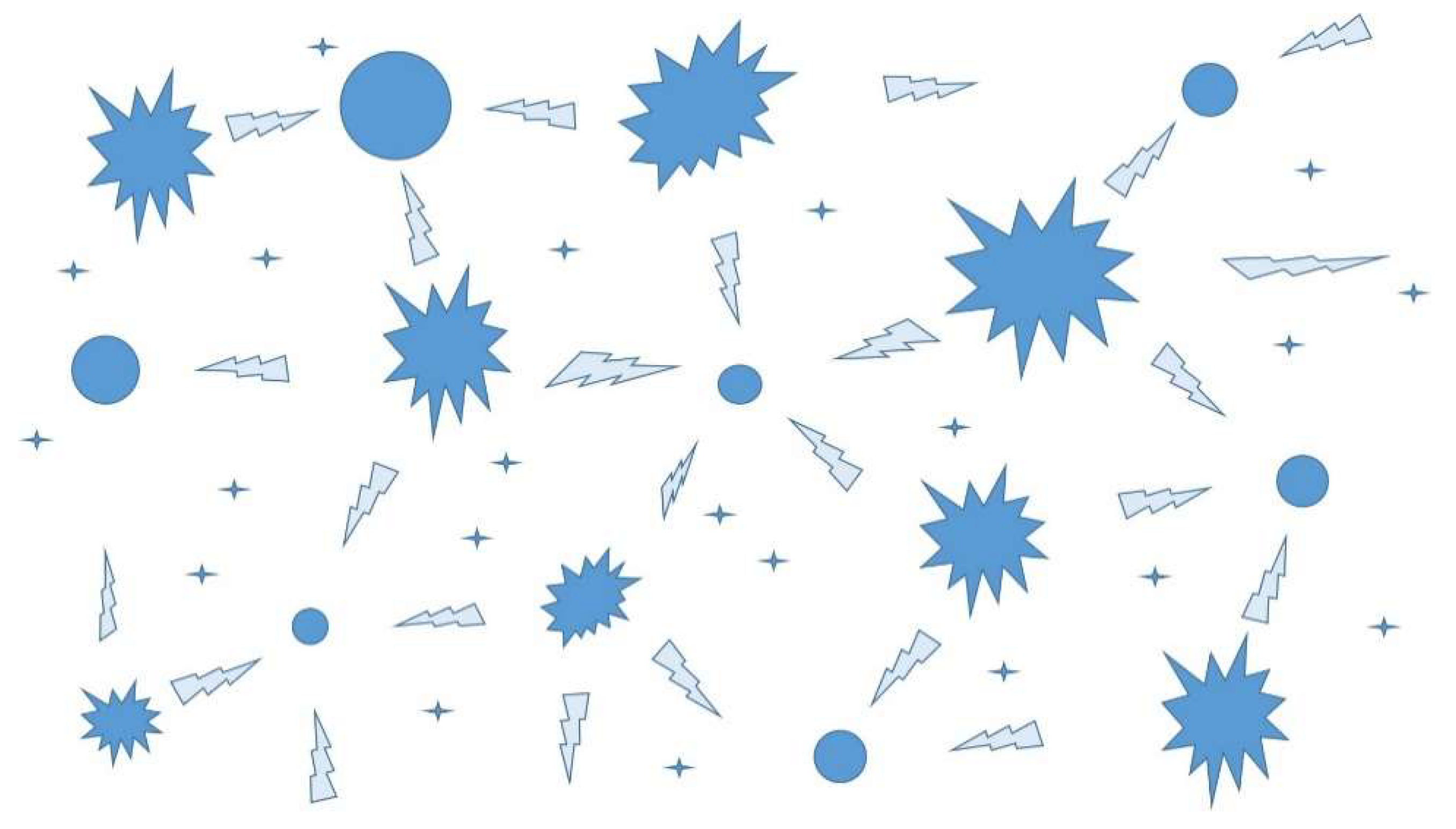
Figure 1.
A simple diagram of the Convergent and Disperse Cyclic Multiverse Model (CDCMM). There are roughly two types of subuniverse states in the unbounded universe. One class is in a convergent state and one class is in a divergent state. Note that the actual situation will not be so distinct.
Figure 1.
A simple diagram of the Convergent and Disperse Cyclic Multiverse Model (CDCMM). There are roughly two types of subuniverse states in the unbounded universe. One class is in a convergent state and one class is in a divergent state. Note that the actual situation will not be so distinct.
References
- Isaac, N., Mathematical Principles of Natural Philosophy. Chinese Version ed., Beijing: Beijing Unversity.
- Russell, B., Principles of mathematics (1903). 2010: Routledge.
- Ehrenfest, P. In what way does it become manifest in the fundamental laws of physics that space has three dimensions. in Proc. Amsterdam Acad. 1917.
- Misner, C.W., K.S. Thorne, and J.A. Wheeler, GRAVITATION. 2017: Princoten University Press.
- Cortes, M. and L. Smolin, The universe as a process of unique events. Physical Review D, 2014. 90(8): p. 084007. [CrossRef]
- Fan, C. Supersymmetry: Light String and Light Ring. 2023; Available from: https://www.researchgate.net/publication/369527872_Supersymmetry-Light_String_and_Light_Ring.
- Rüster, S.B., Energy is Conserved in General Relativity. https://www.researchgate.net/publication/362537694, 2022.
- Szabados, L.B., Quasi-local energy-momentum and angular momentum in general relativity. Living Reviews in Relativity, 2009. 12(1): p. 1-163. [CrossRef]
- Formiga, J. and J.A. Duarte, Gravitational energy problem and the energy of photons. Physical Review D, 2023. 108(4): p. 044043. [CrossRef]
- Einstein, A., 爱因斯坦文集(一). Chinese ed. Vol. 一. 1976: 商务印书馆.
- Cahillane, C. and G. Mansell, Review of the Advanced LIGO gravitational wave observatories leading to observing run four. Galaxies, 2022. 10(1): p. 36. [CrossRef]
- Pound, R.V. and G.A. Rebka Jr, Apparent weight of photons. Physical review letters, 1960. 4(7): p. 337. [CrossRef]
- Perlmutter, S., et al., Cosmology from type Ia supernovae. arXiv preprint astro-ph/9812473, 1998.
- The Large Hadron Collider beauty (LHCb).
- Li, B.A. and C.N. Yang, CY Chao, Pair creation and Pair Annihilation. International Journal of Modern Physics A, 1989. 4(17): p. 4325-4335.
- Anderson, C.D., The apparent existence of easily deflectable positives. Science, 1932. 76(1967): p. 238-239. [CrossRef]
- Schoen, R. and S.-T. Yau, The existence of a black hole due to condensation of matter. Communications in Mathematical Physics, 1983. 90(4): p. 575-579. [CrossRef]
- Christodoulou, D. The formation of black holes in general relativity. in The twelfth marcel grossmann meeting: on recent developments in theoretical and experimental general relativity, astrophysics and relativistic field theories (In 3 volumes). 2012. World Scientific.
- ’t Hooft, G., On the quantum structure of a black hole. Nuclear Physics B, 1985. 256: p. 727-745. [CrossRef]
- Janis, A.I., E.T. Newman, and J. Winicour, Reality of the Schwarzschild singularity. Physical Review Letters, 1968. 20(16): p. 878. [CrossRef]
- Hawking, S., Singularities and the geometry of spacetime. The European Physical Journal H, 1966. 39(4): p. 413-503. [CrossRef]
- Gallagher, R. and T. Appenzeller, Beyond Reductionism. Science, 1999. 284(5411): p. 79-79.
- Wigner, E.P., Symmetry and conservation laws. Proceedings of the National Academy of Sciences, 1964. 51(5): p. 956-965.
- Stergiou, C., Causal Processes and Locality in Classical and in Quantum Physics. 2011.
- Riess, A.G., The expansion of the Universe is faster than expected. Nature Reviews Physics, 2020. 2(1): p. 10-12. [CrossRef]
- Steinhardt, P.J. and N. Turok, Cosmic evolution in a cyclic universe. Physical Review D, 2002. 65(12): p. 126003. [CrossRef]
- Linder, E.V., Exploring the expansion history of the universe. Physical Review Letters, 2003. 90(9): p. 091301. [CrossRef]
- Allahverdi, R., et al., The first three seconds: a review of possible expansion histories of the early universe. arXiv preprint arXiv:2006.16182, 2020. [CrossRef]
- DeWitt, B.S., Quantum theory of gravity. II. The manifestly covariant theory. Physical Review, 1967. 162(5): p. 1195. [CrossRef]
- Freedman, W.L., The Hubble constant and the expansion age of the Universe. Physics Reports, 2000. 333: p. 13-31. [CrossRef]
- Joyce, A., et al., Beyond the cosmological standard model. Physics Reports, 2015. 568: p. 1-98. [CrossRef]
- Collaboration, D.E.S., et al., Dark Energy Survey year 1 results: Constraints on extended cosmological models from galaxy clustering and weak lensing. Physical Review D, 2019. 99(12): p. 123505. [CrossRef]
- Wikipedia. Wikipedia.
- Bondi, H. and T. Gold, The steady-state theory of the expanding universe. Monthly Notices of the Royal Astronomical Society, 1948. 108(3): p. 252-270. [CrossRef]
- Hu, W. and S. Dodelson, Cosmic Microwave Background Anisotropies. Annual Review of Astronomy and Astrophysics, 2002. 40(1): p. 171-216.
- 陈斌, 广义相对论. 2018: Beijing University Press.
- Ijjas, A. and P.J. Steinhardt, A new kind of cyclic universe. Physics Letters B, 2019. 795: p. 666-672. [CrossRef]
- Steinhardt, P.J. and N. Turok, A cyclic model of the universe. Science, 2002. 296(5572): p. 1436-1439. [CrossRef]
- Penrose, R. The basic ideas of conformal cyclic cosmology. in AIP Conference Proceedings 11. 2012. American Institute of Physics.
| 1 | Newton's definition of time: "Absolute, real and mathematical time, determined by its properties, passing uniformly by itself, independent of all external things." The biggest characteristic of Newtonian space-time is its absoluteness and irrelevance. Newtonian spacetime can be fully described by spacetime coordinates. |
| 2 | Russel's view, like Newton's, is that Absolute motion is essential to Dynamics, and involves absolute space. Ehrenfest analyzed the three dimensional nature of space "In what way does it become manifest in the fundamental laws of physics that space has three dimensions". Traditionally the definition of physical space has been divided into two incompatible categories, the absolute space concept of classical physics and the relative space concept of modern physics. The definition in this paper differs from both by unifying absolute and relative space. |
| 3 | Space alone is static. There is no impetus for evolution. The world becomes dynamic only when time provides the impetus for change. Time is a creation at every moment, while space is always present. |
| 4 | This is the largest dimension in N-dimensional physical space in which an N-1 dimensional boundary can be set, and the smallest dimension in which anything can remain in space without being infinitely squeezed into a boundary. The boundary of some closed region or object in physical space must be 0, 1, or 2 dimensions. Beyond a 2-dimensional boundary, we cannot determine whether the portion beyond the boundary belongs inside or outside that enclosed region. When approaching a low-dimensional thing from a closed high-dimensional direction, it can never be approached as an infinitesimal gap. |
| 5 | The literature defines a boundary: The Boundary of a Boundary is Zero. |
| 6 | Instead of trying to understand how the infinite past has reached the present day, one should think how the present moment has reached the infinite future. The fact that a two-way infinite in time is mathematically explicable and physically inexplicable is the first of the cosmic quandaries. Therefore physicists tend to think that there was a beginning moment of the universe. But the question is even worse; we must answer what came before this moment? Why was it created in this moment and not the other? It is philosophically just as difficult. Perhaps then it would not be called "existence". An infinite past is what characterizes existence. |
| 7 | Cortes, Marina and Smolin Lee describe a new class of quantum spacetime models based on energy causal sets and show that spacetime emerges from them under natural conditions. The causal links of these causal sets are labeled by energy and momentum, and conservation laws are applied to the events. A similar view is dominant in physics, which holds that spacetime can arise. |
| 8 | The specific definitions of energy-momentum and matter-particles will be described in a separate article. |
| 9 | As is the definite relationship between the energy E = hνand momentum P = h/λ of a photon. |
| 10 | For example, a stationary object absorbing two photons of the same frequency from opposite directions simultaneously increases its energy, changing the spacetime density around it, but not its spatial coordinate position. |
| 11 | The radial extension of the electric field of the electron is the radial extension of the energy-momentum, which is the subject of the gravitational spacetime measure. Therefore, when the electron is composed of photons, the "graviton" is the spacetime field generated by the "photons". Its form is very different from that of the photon, which is not a fixed wave packet, but a closed diffuse wave packet. |
| 12 | Therefore, there is no question of whether the energy-momentum of the gravitational field is conserved. |
| 13 | the definition of the total spacetime energy-momentum; the quantum theory of gravity. |
| 14 | One can also think of absolute spacetime as a special case of flat spacetime and relative spacetime as a special case of curved spacetime. |
| 15 | Gravitational waves detected by the LIGO laser interferometer can only be expressed as the spacetime metric〈Δt,Δx,Δy,Δz〉, i.e., spacetime density waves. It's not space-time curving. |
| 16 | Concerning the weak and strong forces, we believe that they are simply manifestations of the electromagnetic force in maintaining a particular structure. See [6]. |
| 17 | Lifetime is a process that can be precisely measured and is related to the time of particle creation, its structure, and space-time conditions. See [6]. They are not probabilistic events. |
| 18 | For a detailed argument in this area see a separate topic. |
| 19 | This is limited to a physical discussion; the theological aspect can be explained separately. If we consider the operation of the world as a single pendulum, it does not have any starting information, and therefore physically we are unable to trace when it was started. |
| 20 | Démon de Laplace is also powerless. Even in the microscopic realm of finiteness, interactions are "probabilistic" in nature because there is a speed of propagation for any interaction, and nothing outside of the reach of propagation is predictable. Wigner wrote "More generally, if we knew all the laws of nature, or the ultimate law of nature, the invariance properties of these laws would not furnish us new information". Laws are simply the basis of how everything works; we can master them, but that is not the same as mastering everything. Just as we have mastered the rules of chess, it is not the same as having mastered all the games. |
| 21 | However, there is uncertainty in the accuracy, which is determined by the Uncertainty Principle. Assuming that there is only pure light, in any local space of definite size, there can always be a long wavelength photon that cannot be completely included, making local energy-momentum conservation untenable. |
| 22 | Fundamentally different from the typical single-universe cyclic model, "Cosmic evolution in a cyclic universe", In this model, the universe undergoes an endless sequence of cosmic epochs which begin with the universe expanding from a "big bang" and end with the universe contracting to a "big crunch. "big crunch." |
| 23 | Physics generally recognizes the existence of a cosmic " primary singularity" as well as a general black hole singularity. A spacetime singularity arises from a gravitational collapse, where the entire volume of the universe shrinks to zero, or locally to zero. Our view is that gravitational collapse is just a phase transition, and that for the most fundamental physical entities, elementary particles, black holes, which have singularities but don't reach them, the first thing that happens is a phase transition. If a spacetime singularity does exist, then it is the same as spacetime disappearing, how long can such a singularity exist? When local spacetime singularities form, what is the relationship between the spacetime of these singularities and global spacetime? How to transform between causality and non-causality new? A new set of questions we cannot answer. |
| 24 | The "space-time expansion" here is different from the usual concept, not the expansion of space-time "volume", but the rapid spread of "space-time density". In the same position, time becomes faster and faster, and the scale becomes bigger and bigger. This is a phenomenon that must accompany the disintegration of space-time by a black hole with a high energy density. |
| 25 | This is the opposite of "space-time expansion". Due to the constant convergence of matter-energy in a region, the energy density at this point is increasing, the spacetime density is increasing, and the spacetime metric gradient is getting larger and larger, which corresponds to a sharp contraction of the local spacetime. At the same location, time is getting slower and the scale will get shorter. |
| 26 | Note that we are analyzing spacetime, not photons. The speed of the photon remains the same, but the speed between two photons that diverge from each other is twice the speed of light; the change in density of spacetime that diverges from each other is also twice the speed of light. |
| 27 | The formation process of the early elementary particles of the universe was a screening process matching the energy of photons with the density of space-time, following the law of "survival of the fittest". After the explosion of the black hole decomposed into photons, in the high-density space-time, will be re-formed into matter particles, its energy and space-time density match. However, as the density of space-time continues to change, the structural stability of many particles of matter is destroyed, and decomposed into photons, and will be transformed into particles of lower energy in low-density space-time. This process is repeated until photon energy and spacetime density can no longer be matched to form any stable particles. Thus, the higher energy particles are created earlier and the lower energy particles are created later. The particles of matter that currently exist are all stable particles that meet the current spacetime density, and many generations of particles have broken down during evolution, leaving only one generation of more stable particles in the Standard Model. This is a very narrow region of energy. The inability of independent neutrons, quarks, mesons, etc. to exist in a stable manner and the various decays are a reproduction of this scenario. The survival of electrons, protons, and nuclei capable of stabilization is an extremely rare phenomenon in the evolutionary history of the universe. The stability of synthesized protons and nuclei depends on the local spacetime density of their own internal elemental configuration. This suggests that the particles themselves play a decisive role in the alteration of spacetime, and that gravity has an even greater influence in the microscopic scenario. This evolutionary process also explains the necessity of the asymmetry of positive and negative matter particles in the Universe. |
| 28 | An interesting question would be "Expansion relative to what? Our point is that expansion is the expansion of the spacetime metric, not the expansion of spacetime itself, and absolute spacetime is always there. |
| 29 | John D. Barrow said, “There was no 'before' the beginning of our universe, because once upon a time there was no time” [33]. |
| 30 | But the "Hubble constant" can be different in any sub-universe, and H is not a fundamental physical constant, it is an observation. The fundamental constants h, c, G do not change. |
| 31 | "How easy it is to dry the dew on the scallion. The dew will fall again tomorrow morning, and when will the dead return?" --Ancient Chinese elegy. The pattern of converging and dispersing cyclic can be compared to the nightly convergence and morning dispersing cyclic of dew, where today's drop of dew is never the same as yesterday's drop. |
Disclaimer/Publisher’s Note: The statements, opinions and data contained in all publications are solely those of the individual author(s) and contributor(s) and not of MDPI and/or the editor(s). MDPI and/or the editor(s) disclaim responsibility for any injury to people or property resulting from any ideas, methods, instructions or products referred to in the content. |
© 2023 by the authors. Licensee MDPI, Basel, Switzerland. This article is an open access article distributed under the terms and conditions of the Creative Commons Attribution (CC BY) license (http://creativecommons.org/licenses/by/4.0/).
Copyright: This open access article is published under a Creative Commons CC BY 4.0 license, which permit the free download, distribution, and reuse, provided that the author and preprint are cited in any reuse.


