
Submitted:
05 September 2023
Posted:
07 September 2023
You are already at the latest version
Abstract
Urban vitality is an important reflection of a city's development potential and urban quality. This study uses exploratory spatio-temporal big data such as social media check-ins to portray the spatio-temporal evolution of urban vitality at the subdistrict scale in Changsha, a city in central China, from 2013-2021, and finds that urban vitality in Changsha exhibits central agglomeration and outward circling expansion over time; and then use Geodetector and spatial regression analyses are used to explain the interactive effects and spatio-temporal heterogeneity of the spa-tial elements of subdistrict form, subdistrict function and subdistrict economy on urban vi-tality. The results show the following: (1) The subdistrict form and subdistrict function dimen-sions have a significant effect on urban vitality, and the effect of the economic dimension of the subdistrict is not significant. (2) The interaction effect of the density of entertainment and leisure facilities and the density of business office facilities in subdistrict function is the dominant factor in the change of urban vitality. (3) Under the spatio-temporal effect, land use diversity and park facility density have the strongest positive effect on urban vitality; road density and shopping facility density have the weakest effect. The study aims to provide a reference for the optimization and allocation of spatial elements of subdistricts in sustainable urban development and urban renewal, to achieve the purpose of urban vitality creation and enhancement.
Keywords:
urban vitality
; social media
; subdistrict form
; subdistrict function
; spatio-temporal heterogeneity
1. Introduction
With the rapid economic development and urbanization since China's Reform and Opening-up, urban space has shifted from rough expansion to intensive connotative development. Urban renewal is an important means of achieving sustainable urban development [1]. The shaping and enhancement of spatial quality is the main goal of the urban renewal movement [2], and urban spatial quality is closely related to vitality [3]. Vibrant cities have higher well-being indices for their residents and tend to be more attractive to investment and talent inflows, enhancing urban competitiveness [4]. Maintaining and enhancing the urban vitality of urban centers is particularly important for the realization of urban development [5]. Urban vitality is a spatial characteristic that results from the interactions between human activities and space; it is also an important manifestation of the potential for urban development and urban quality [6,7]. Subdis-trict-scale urban vitality provides a finer-grained reflection of the activity of people in-ter-acting with the urban space [8].
Urban vitality is a classic topic in urban planning and development, and the creation of vibrant cities and vibrant spaces has long been a concern in the fields of urban planning, environmental science, and geography [9,10]. The characterization and measurement of urban vitality is the focus of scholars' attention, and the characterization of urban vitality is generally based on the related theories of Jacobs and Jan Gehl, according to whom urban vitality is qualitatively embodied in the composite qualities of the explicit and objective existence of the city, and is quantitatively characterized by the people and their activities in the city [7,11,12]. In terms of measurement indicators, novel big data is often used as a measure of urban vitality. Kim et al. [12] used cell phone traffic signals and Wi-Fi access points to measure urban vitality intensity, based on the perspective of combining virtual and real. Levin et al. [13] used remote sensing data to find that nighttime light images can effectively reflect the intensity of urban residents' activities and that it changes over time. Wu et al. [14] explored the difference between daytime and nighttime vitality by using Easygo crowd-sourced travel data. Concerning the object of study, administrative divisions are often used as a basic measure of urban vitality. [15,16] There are also more extensive measures of vitality for specific spatial types, such as urban vitality measures for historic districts [17], parks [18], and waterfronts [19]. Urban vitality exhibits a high degree of concentration where there is a high and overlapping density of population as well as commercial and public service facilities [5]. Vitality measurement methods include interview questionnaires [20], the entropy method vitality evaluation model [21], Jane Index [5], Projection Pursuit Model (PPM) [22], kernel density estimation [23], and other methods. In addition, Li et al. [7] and Qi et al. [24] have over the course of time been applied in related research.
Established studies have shown that the factors affecting the urban vitality of cities mainly include social development, economic restructuring, and characteristics of the built environment and other aspects. In the area of social development, social policies and institutions are important factors influencing the urban vitality of cities. With the loss of vitality in inner cities, due to the aging of the urban physical environment and to functional imbalance, countries around the world have been promoting urban renewal campaigns since the middle of the last century to restore the vitality of cities [25]. Effective intervention by governmental agencies leads to an orderly urban renewal movement, which is a mandatory and effective strategy for revitalizing urban center spaces [26]. Negative events, such as major social emergencies, such as the outbreak of New Crown Pneumonia (COVID-19) [27,28] and wars and conflicts [29], can reduce the vitality of urban spaces and have lasting impacts. Economic restructuring often brings about corresponding changes in the spatial dynamics of cities. Traditional economic development indicators such as Gross Domestic Product (GDP) and disposable income per capita are partly indicative of economic vitality, and elevated levels of these indicators mean that social activities such as consumption and innovative behaviors of the population can be promoted to influence the urban vitality [30]. Emerging online economies such as urban takeaways in recent years also contribute to the clustering of urban vitality as a consumer activity for the population [31]. In terms of the built environment, scholars have chosen to measure different types of urban built environment indicators to analyze their impact on urban vitality, such as reasonable urban texture [8] and spatial structure [32] that can lead to the gathering of vitality, to intense urban development and construction [33], and to supporting facilities [34] that are also considered to be closely related to urban vitality, including high-density buildings that create intensely fertile ground for crowd activities [16]. In terms of analytical methods, Geographically Weighted Regression (GWR) [34], Structural Equation Modeling (SEM) [32], and Spatial Lag Modeling (SLM) [7] are often used in related studies. For example, Wang et al. [35] used multi-scale GWR to explore the spatial and temporal influence mechanism of 24-hour urban vitality in Beijing. In addition, Geodetector is increasingly being used in related research. For example, Li et al. [36] used Geodetector to analyze the interaction effects among the drivers of nighttime light expansion dynamics. Overall, it seems that studies on the level of the city have been more frequent, while fewer studies have looked at indicator systems of factors influencing urban vitality at the neighborhood level and could therefore be further supplemented.
Changsha is the representative city of the middle reaches of the Yangtze River in China [37]. Strategically, it is an important nodal city of the urban agglomeration in the middle reaches of the Yangtze River and has rapidly developed into a megacity with a resident population of more than 10 million under the guidance of the "The Belt and Road " and "The Yangtze River Economic Belt" national strategies [38]. As a popular city for travel on the internet, it has been vigorously developing its nighttime economy in recent years, with the city's attractiveness and economic competitiveness rising year by year, and playing an exemplary role in economic transformation. Therefore, Changsha City is representative of its geographical location and economic development characteristics and is a typical city in China's fast-growing central region [39]. As a representative of China's new first-tier cities, Changsha is facing urban problems, such as deteriorating road traffic and loss of vitality in the old urban areas after experiencing rapid industrial and economic development [40]. This makes Changsha a typical city for measuring the factors influencing the spatial and temporal evolution of urban vitality.
Summarizing existing research, it was found that a large number of studies have been conducted on urban vitality and its driving factors based on different study areas, scales, and perspectives. However, current research on urban vitality and its driving factors is mainly based on cross-sectional data, and the research scale focuses on the prefecture or district scale. In terms of study areas, nationwide studies are mainly explored at the provincial scale, while studies at the prefecture, city, county, and district scales are mostly confined to developed regions. The research methodology is dominated by the research paradigm of environmental geography, but there is a lack of exploration of the interactive effects of neighborhood form-function and urban vitality relationships. At the same time, urban vitality agglomeration does not evolve in the short term but is formed over a long period by way of various spatial factors [41], with a strong temporal sequence [42]. Most current studies lack consideration of the spatial and temporal characteristics of the evolution of urban vitality and the factors influencing it over a multi-year span. Based on this, this paper uses exploratory spatial data analysis to investigate the evolution of urban vitality and spatial and temporal influences at the Subdistrict scale in Changsha, a city in central China. We use Geodetector and spatial regression analyses to explain the interactive effects and spatio-temporal heterogeneity of the three dimensions of subdistrict form, subdistrict function, and subdistrict economy on urban vitality. Our aim is to provide targeted planning recommendations as a reference for the creation and enhancement of vibrancy in the construction of sustainable human settlement and urban renewal.
2. Study Area and Indicator Selection
2.1. Study Area
Changsha is located in Hunan Province, China, in the central region of China, with a latitude and longitude of 28°11′49〃N,112°58′42〃E. The central urban area of Changsha City in this study refers to the urban area within the third ring road, involving Wangcheng District, Kaifu District, Changsha County, Yuelu District, Furong District, Tianxin District, and Yuhua District (Figure 1). Subdistricts are the basic organizational units of the city's morphological structure and urban functions, and the central city is divided into 81 subdistricts based on administrative divisions, which will be used as research units.
2.2. Selection of Indicators
2.2.1. Indicators of urban vitality
Considering the availability of data, this study selects the period 2013–2021, with a research period of nine years, and the study years selected are 2013, 2017, and 2021 for the empirical analysis of the urban vitality of subdistricts. Urban public space vitality is usually characterized by crowd activity situations, and this study uses social media check-ins data with spatio-temporal big data on nighttime lighting to characterize urban subdistrict urban vitality [8,35]. Social media check-ins data can effectively respond to the location information of urban individuals at any given time [43]. Compared to traditional research data, the shared check-ins social media information can be captured by online web crawlers to obtain the behavioral dynamics of urban residents, based on the intensity of check-ins, which reflects the temporal characteristics of urban residents' movement and aggregation [44,45]. Sina Weibo is the largest social network platform in China, and Weibo check-in big data can effectively respond to the spatio-temporal behavior of urban residents [46]. In this study, we use a Python program to capture the microblog data with check-in location information from the Sina Weibo website (https://weibo.com), by collecting the check-in location information from the time nodes of December 2013, October 2017, and August 2021, respectively, and obtaining a total of 37,198 pieces of valid data after cleaning. The urban vitality was quantified jointly with the night-time lighting data, as there may have been a low amount of early data due to differences in the number of users in different years and the difficulty of crawling the early data. Nighttime light images can directly reflect the spatial information of human social activities, and the continuous NPP/VIIRS nighttime light data were processed to obtain the annual nighttime light index [47] for three years, which was obtained from Earth Observation Group (https://eogdata.mines.edu/).

Table 1.
Indicators of urban vitality.
| Theme | Variable | Explanation | 2013 Mean/STD |
2017 Mean/STD |
2021 Mean/STD |
|---|---|---|---|---|---|
| Urban vitality | CW | Point density of Weibo check-ins | 1.169/2.088 | 2.062/3.630 | 1.676/2.289 |
| NLI | Night Light Index | 16.213/18.312 | 20.474/43.664 | 56.18/111.71 |
2.2.2. Influencing elements of urban vitality
In this study, 14 indicators were selected from the three levels of subdistrict form, subdistrict function, and subdistrict economy to analyze the influence of urban vitality in subdistricts, as shown in Table 2. In terms of subdistrict form, the land use diversity index is calculated based on Point of Interest (POI) data for Shannon entropy (SHDI), which can effectively reflect the degree of mixed land use in the subdistrict [48]. Road density(RD) is closely related to subdistrict morphology and is usually expressed in terms of the total length of roads per unit of subdistrict area [49]. The road network data in this paper comes from the OpenStreetMap (OSM) platform, which is a widely used platform for acquiring geographic data [50]. Vegetation cover is a major reflector of human activities, and the Urban Normalized Vegetation Index (UNVI) is closely related to land use and expansion [51,52]. The density of transport facilities is an important part of the morphology of subdistricts and land use planning, and the underground is one of the main modes of transport in modern cities [53]; in this paper, the density of the metro stations (MSD) is expressed through the number of metro stations per unit area of the subdistrict. Waterfront space is one of the important carriers of the urban landscape, and the urban vitality of waterfront areas is an important research theme of urban vitality [19,54]. In this study, the inverse of the straight-line distance from the center of mass of the subdistrict to the nearest body of water is used as a measure of the hydrophilicity (NH) of the subdistrict. In terms of subdistrict function, six categories of POI functional facility indicators were selected as factors influencing the urban vitality of the subdistrict using web crawler technology. Urban parks can increase residents' social connections and promote social interactions between neighbors [55], so the role of influencing vitality was explored through the density of POI park facilities (DP) within a subdistrict. Restaurants are one of the basic urban amenities that are closely related to the dynamic activities of the city [56], and in this study, the ratio of the number of POI restaurant facilities in a subdistrict to the size of the neighborhood was chosen to represent the density of restaurant facilities (DRD). Urban studies usually correlate resident behavior with shopping place linkages [57,58] and shopping centers usually promote social activities among residents [59], so the density of POI shopping facility (DS) points in the subdistrict was chosen as one of the driving factors. Differences in the planning of business offices have different impacts on the spatial behavior of employees, and the development of business districts is also linked to the urban spatial planning model [60], where the density of business offices (DBO) in the subdistrict is taken into account. Recreation and leisure facilities in residential environments have a positive effect on the mobility of urban residents [61,62], so this study chose to measure the ratio of the number of recreation and leisure facilities in the POI of a subdistrict to the area of the subdistrict as a proxy for recreation and leisure facility density (DRL) to investigate the influence on urban vitality. Healthcare facilities are one of the indispensable elements for urban development, as they relate to the health and wellbeing of residents [63], so we chose to incorporate the indicator of the density of POI healthcare facilities (DH) in the subdistrict. In terms of subdistrict economy, GDP and Disposable Personal Income (DPI) are the classic indicators of economic vitality in cities, while the resident population number is the dominant element of economic development in cities [64,65]; therefore, subdistrict GDP, DPI, and the total number of the resident population in the subdistrict were chosen to measure the influential nature of urban vitality.
The urban infrastructure elements of the subdistrict morphology laid out above and functional level data come from web crawlers and the official website of OSM, while the natural elements come from satellite remote sensing data, and the socio-economic development elements of the subdistrict economic data come from the Changsha City Statistical Yearbook.
3. Methodology
3.1. Entropy Weight Method
Entropy weight method is widely used in the research of urban vitality evaluation [21,66,67]. In this study, we draw on previous research methods and use the entropy weight method to measure the urban vitality in the central city of Changsha.
First, the data are normalized by formula (1), after which the entropy weight method is used to determine the weights of the urban vitality indicators, and the formula is shown in (2)
Next, the entropy value j and the information utility value are calculated for each indicator, taking the following form:
Then, the weights of each indicator were calculated:
Finally, a composite value for the urban vitality is calculated:
3.2. Spatial Autocorrelation
3.2.1. Global spatial autocorrelation
Global spatial autocorrelation is used to measure the overall degree of spatial relatedness, and in this paper, we first measure the spatial relatedness of urban vitality using global Moran's I, which is calculated as follows:
Where is the urban vitality and, is the mean value of urban vitality, is the spatial weight, and n is the total number of subdistricts. have a value range of [-1,1]. > 0 and significant, indicating the existence of spatial autocorrelation of subdistrict urban vitality, which means that there is spatial autocorrelation between areas with high and low urban vitality intensity, and that high urban vitality subdistricts and low urban vitality subdistricts tend to cluster in geographic space, respectively; I < 0 and significant, indicating that there is a negative spatial correlation between urban vitality, which means that subdistricts with high and low urban vitality values tend to be geographically spatially discrete; when I = 0, indicating that the spatial distribution of subdistrict urban vitality is random.
3.2.2. Local spatial autocorrelation
The local spatial autocorrelation can reflect the degree of association between a local spatial unit and its neighbors, and is calculated as follows:
Where > 0 and significant, indicating that blocks I with high (low) urban vitality values are adjacent to blocks with high (low) urban vitality values; < 0 and significant, indicating that blocks with high (low) urban vitality values are adjacent to blocks with low (high) urban vitality values; and when = 0, indicating that the distribution of urban vitality of the subdistrict is random.
3.3. Geodetector model
Geodetector is a spatial analysis model that detects the relationship between spatial differentiation and its potential influences, identifying associations between variables as a result of changes in spatial distribution [68]. In this study, the Geodetector model is used to explore the subdistrict dominant factors affecting the distribution of urban vitality in the central city of Changsha, and the calculation formula is as follows:
where L is the classification of the dependent variable; N is the total number of subdistricts; and σn is the variance within stratum h. The q-value indicates the explanatory power of the detection factor for the explanatory variables.
3.4. Geographically and Temporally Weighted Regression
Geodetector can analyze the impact of driving factors on the overall aggregation of urban vitality, but is unable to explore differences in driving factors across regions [69]. To further explore the regional differences in the impact of driving factors on the urban vitality, a spatial econometric regression model was chosen to explore the impact of urban vitality. The traditional GWR model cannot take into account the non-stationarity of the study object in the time dimension, and the Geographically and Temporally Weighted Regression model (GTWR) takes into account both temporal and spatial non-stationarities, which enables more efficient parameter estimation [41], calculated as follows:
where is the explanatory variable, is the spatio-temporal coordinates of neighborhood i, and is the random error.
4. Characteristics of Urban vitality Evolution in Changsha
4.1. Spatial Distribution Characteristics and Changes in Urban vitality
To visually reflect the spatial and temporal distribution characteristics of the urban vitality in the subdistricts, the natural breakpoint method was used to classify the urban vitality values into five levels from high to low: low urban vitality subdistricts (0.000-0.034), lower urban vitality subdistricts (0.034-0.091), medium urban vitality subdistricts (0.091-0.179), higher urban vitality subdistricts (0.179-0.287), and high urban vitality subdistricts (0.287-0.582). The distribution map of urban vitality of Changsha central city subdistricts from 2013 to 2021 was drawn to summarize the trend of the differences in urban vitality of Changsha subdistricts, as shown in Figure 2.
From 2013 to 2021, low urban vitality subdistricts and lower urban vitality subdistricts will be concentrated in Wangcheng District and north of Kaifu District in the north, Yuhua District in the south-central part of the city and Changsha County in the east, while high vitality subdistricts and higher vitality subdistricts will be concentrated in Furong, Yuhua, and Yuelu Districts in the central part of the city, and will be expanded to the west and south. The main spatial and temporal distribution characteristics of the urban vitality of subdistricts are as follows: in 2013, the urban vitality of subdistricts in Changsha's central urban area as a whole showed a spatial distribution pattern of high in the middle and low in the surroundings, with high urban vitality subdistricts and higher urban vitality subdistricts distributed in the central and south-central areas, and dispersing sporadically to the peripheral areas. In 2017, areas of high urban vitality and higher urban vitality gradually expanded southwards, contiguously in the south-central region and sporadically into the eastern and western regions. By 2021, the pattern of distribution of urban vitality of subdistricts will have changed considerably, showing a pattern of centralized distribution, with high urban vitality and higher urban vitality subdistricts concentrated in the central, western, and southern regions, and tending to be sporadically distributed in the east-central region. Low spatial vigor values and lower spatial vigor value subdistrict variations were not well characterized.
4.2. Spatial Clustering Characteristics and Changes in Urban vitality
The global Moran'I index of urban vitality of subdistricts is 0.381, 0.435, and 0.468 from 2013 to 2021, and the Moran'I index increases sequentially, which indicates that there is a significant positive spatial dependence of the distribution of urban vitality of subdistricts and that it is increasing year by year. The LISA map (Figure 3) reflects the local spatial distribution characteristics of the urban vitality of subdistricts in central Changsha. The number of low-high type subdistricts has increased and is characterized by a sporadic distribution between 2013 and 2021. The high–low type subdistrict shows independent distribution characteristics and shifts from the north to the east; the low–low type subdistrict shows clustered distribution characteristics and is permanently distributed in the northern area and to the south. The number of subdistrict types with high–high urban vitality in the subdistrict increased between 2013 and 2021 and is concentrated in the central region. Overall, from 2013 to 2021, the urban vitality of subdistricts of the high–high type is concentrated in the central Furong District, the intersection of Tianxin and Yuhua Districts, and gradually extends in all directions, while the low–low type of subdistrict is concentrated in the Wangcheng District, the Kaifu District, and the northern part of Changsha County in the long term and spreads down to the southern part of Changsha County.
5. An analysis of the driving factors of urban vitality within the subdistrict space
5.1. Geodetection results of driving factors
The driving factors affecting the intensity of urban vitality in Changsha's subdistricts were probed and the results are shown in Table 3. Since Geodetector can only analyze cross-sectional data, drawing on Tan et al. [70] and Zhang et al. [71], the mean values of the explanatory variables and each influencing factor were taken for the three years and reclassified using Jenks's natural breakpoints method, which converted the numerical quantities of the factors to typological quantities, and then later analyzed the q-values using Geodetector model.
Geodetector results showed that three of the 14 factors in subdistrict form, subdistrict function, and subdistrict economy had q-values higher than 0.05 as non-significant. Among all the detected factors, seven factors in terms of subdistrict form and subdistrict function have a significant influence on the urban vitality of Changsha's subdistricts, and their explanatory power is as follows, in descending order: DRL (X8) > DBO (X7) > SHDI (X1) > DRD (X5) > RD (X2) > DS (X6) > DP (X4). In particular, the q-statistics of DRL (0.643), DBO (0.642), SHDI (0.563), and DRD (0.517) exceeded 0.5 and passed the significance test at the 0.01 level, and their explanatory power for the spatial distribution of subdistrict vibrancy in Changsha's central urban area exceeded 50%, which was the dominant factor influencing the distribution of vibrancy intensity. RD (0.497), DS (0.419) and DP (0.403) were the next most dominant factors with high explanatory power and significant at the 0.01 level. DH, MSD, DOP, UNVI, and DPI have relatively low explanatory power, although they are significant at the 0.01 and 0.05 levels. GDP, MSD, and NH did not pass the test of significance at the 5% level and do not have sufficient explanatory power for the distribution of urban vitality in the subdistrict.
The results of the interaction probes for the significant factors are shown in Figure 4. It can be seen that all the driving factors do not only have independent effects on the differences in urban vitality of subdistricts, and the results of the interaction probes between the driving factors show that the interaction effects are two-way enhancement or non-linear enhancement. This indicates that the explanatory power of the distribution of urban vitality after the interaction between the driving factors in various aspects has been enhanced to different degrees compared with when the factors act individually, which suggests that the distribution of the intensity of urban vitality is the result of the joint action of multiple factors. This indicates that the distribution of urban vitality intensity is the result of the joint action of multiple factors. In particular, the interaction of the functional aspects of the subdistrict, DRL and DBO, with other factors has a strong explanatory power of 0.5 or more; the synergistic effect of DP and DBO has the strongest effect on the urban vitality of the subdistrict, with an explanatory power of 0.86; and the interaction of the subdistrict's GDP and DPI has the lowest effect, with an explanatory power of 0.19.
5.2. Spatio-temporal heterogeneity in spatial driving factors of subdistricts
5.2.1. Model Diagnostics and Validity Estimation Impact Analysis
The spatial measurement model needs to be screened before regression analysis. The spatial measurement model needs to be screened before regression analysis is performed. Firstly, the multiple covariance test of explanatory variables was conducted for each aspect of driving factors, and then the model diagnostic coefficients of OLS, GWR, TWR, and GTWR were compared, and the spatial econometric model with the optimal parameters was selected. Finally, the selected model regression results are combined with the Geodetector results for validity estimation [72-74]. Finally, the selected model regression results are combined with the Geodetector results for validity estimation.
Multiple covariance test of variance inflation factor (VIF) was carried out on the urban vitality of Changsha central urban subdistricts and seven dominant factors, and the results showed that the VIF value of the density of food and beverage facilities was 14.28, which was higher than the critical value of 10, indicating the existence of multiple covariance, and the re-conducting of the VIF test after deletion of the density of food and beverage facilities showed that there was no multi-covariance for the other factors. The results are shown in Table 4.
The urban vitality was then analyzed in a spatial econometric regression with the six driving factors. In this study, ArcGIS 10.7 was used as the operating platform, and the optimal bandwidth was measured by loading the GTWR plug-in, selecting AICc, and regressing the OLS, TWR, GWR, and GTWR models, and comparing the results respectively. The model diagnostic results are shown in Table 5, and the results show that the GTWR model has the highest adjusted R2 and the strongest goodness of fit, so the GTWR model was chosen to empirically analyze the driving factors of the spatial and temporal distribution of urban vitality in Changsha's central district.
5.2.2. Spatial and Temporal Differences in the Impact of Subdistrict Morphology Aspects
Figure 5 and Figure 6 show the spatial and temporal differences in the effect of subdistrict form on changes in the intensity of urban vitality. From 2013 to 2021, the overall mean value of the regression coefficient of the land use diversity index first increased and then decreased to 4.824, 4.585, and 3.718 in 2013, 2017, and 2021, respectively, reflecting the fluctuating decline of the positive effect of SHDI on the intensity of urban vitality, and the regression coefficient decreases gradually from the center to the perimeter. The reasons for this may lie in the fact that Changsha was in a rapid development stage from 2013 to 2017, and the city was in a period of rapid expansion, with the population size and land use rate on the rise [75]. In contrast, in the context of the Changsha New Crown outbreak in 2021, the increase in subdistrict traffic flow and crowd concentration triggered by a diversification of land use types will increase the COVID-19 transmission risk [28.76], so the influence of SHDI on urban vitality showed a decreasing trend in 2021. The high-value areas of the regression coefficients of SHDI are mainly in Furong and Yuhua Districts, while the low-value areas are mainly distributed in the southern part of Changsha County and Wangcheng District, indicating that the driving effect of SHDI on urban vitality agglomeration is stronger in Furong and Yuhua Districts, whereas the influence of SHDI on urban vitality intensity is weaker in Changsha County and Wangcheng District. The reason may lie in the fact that Furong District and Yuhua District are in the center of the city, with high land use, strong crowd concentration, and complete urban facilities, while the southern part of Changsha County and Wangcheng District are relatively underdeveloped urban areas, with a low degree of land use, a single nature of land use, and a dispersed urban vitality due to the limitations of the geographic location.
The average values of the regression coefficients of RD were 0.388, 0.267, and 0.482 from 2013 to 2021, reflecting that the intensity of RD on the urban vitality showed a facilitating effect and a fluctuating upward trend. The reason may lie in the fact that in the early stages of urban development, urban sprawl led to the intricate construction of subdistrict road networks, and part of the road network pattern is not conducive to pedestrian mobility and automobile traffic efficiency in the space [77,78]. In the later stage, after the development of urbanization and the renovation of the old city, the road infrastructure is improving, and RD greatly contributes to the vitality of subdistrict space [79]. The regression coefficients of RD on urban vitality are negative in Yuelu District and northern Changsha County, positive elsewhere, and the strongest facilitating effect is found in Tianxin District, Furong District, and Yuhua District. The reason may be that the low coefficient areas of Yuelu District and Changsha County have a single land nature, dominated by forests and arable land, with low road densities and poor crowd agglomeration, while central areas, such as Furong District, are located in the center of Changsha and are characterized by high population densities, high RD densities, and high mobility of crowds.
5.2.3. Spatial and Temporal Differences in the Impact of Functional Aspects of the Subdistrict.
The regression coefficients for the functional aspects of the subdistrict are shown in Figure 7, Figure 8, Figure 9 and Figure 10. The average values of the regression coefficients for DP from 2013 to 2021 are 0.665, 0.751, and 0.750, respectively, reflecting a gradual increase in the impact of DPs on the urban vitality. Parks are social places for urban residents' recreation and leisure, providing health and social benefits directly or indirectly [80], and are ideal open spaces to promote sustainable development [81,82]. Thus, China is vigorously promoting the goal of constructing park cities, which will have a facilitating effect on the aggregation of urban vitality in the subdistrict. Overall, park services are shown to contribute to the urban vitality in all neighborhoods except for the predominantly cropland area in northern Long Beach County. The reason is that parks are a key resource for building the city's public health and safety [83], which is an essential functional land use for planning purposes, while the city center has a low rate of public open space provision due to the compact urban fabric [84]. The presence of more forested and landscaped parks in Yuelu District attracts more tourists and therefore promotes the urban vitality of subdistricts in a much more effective manner.
The average values of the regression coefficients for DS in the subdistrict are -0.002, -0.001, and 0.000 for the years 2013–2021, with the disincentives gradually decreasing to being negligible. The reason may be that although shopping centers have the function of promoting social interaction among residents, the rapid growth of information technology has made online shopping behaviors frequent [85,86], and online shopping is gradually replacing offline shopping [87]. Except for Yuelu District, where DS in some subdistricts positively contributes to the urban vitality, the rest of the urban area turns out to be inhibitory. The reasons for this may be that the subdistricts with higher regression coefficients are within Changsha's university city and its surroundings; college students belong to a high consumption group [88], and student consumption behavior plays an important role in the development of the regional economy [89].
The mean values of the regression coefficients of DRL densities from 2013 to 2021 are 0.084, 0.058, and 0.064, reflecting that the aggregation of recreational and leisure venues on the urban vitality decreases and then increases. Early on, there was a problem of traditional recreation and leisure service facilities not being equitably and reasonably allocated [45]. Community residents' demand for recreation and leisure rose after the epidemic, but there was still a problem of insufficient coverage of outdoor open space recreation facilities [90], and the decline in crowd congregation during the epidemic in Changsha around the year 2021 led to a reduction in indoor recreation activities [91]. Overall, the regression coefficients of the influence of recreation and leisure facilities on the urban vitality increased gradually from east to west, with Changsha County's recreation and leisure facilities showing a high degree of facilitation of urban vitality, and Yuelu District's overall performance of an inhibitory effect. The reason for this may be that Yuelu District's land use is relatively homogeneous, with forest parks and educational facilities occupying a large area, and in the early days, it was geographically more remote and developed later compared to the central city.
The mean values of the regression coefficients for DBO from 2013 to 2021 are 0.015, 0.018, and 0.018, respectively, reflecting the increased contribution of business office facilities to the urban vitality. As a necessary functional place within the city, business office space is one of the main behavioral purposes of daily trips of subdistrict residents [92], and with the development of neighborhoods and land use density, there is a significant correlation between business office facilities and land use density [93], so the influence of DBO density increases. High-value areas of DBO density are located in Furong, Kaifu, Tianxin, and Yuhua Districts, which are the core areas of Changsha with high land use diversity; low-value areas are located in the southern part of Changsha County, where the land use type is mainly cropland and there are fewer DBO facilities.
6. Discussion
In the context of urban development of urban renewal and old city renovation, it is particularly important to study the evolution characteristics and driving factors of urban vitality of subdistricts over a series of years for the revival and prediction of urban vitality. The main feature of this study is to use the spatio-temporal big data to characterize the spatial and temporal evolution of the agglomeration level of urban vitality at the subdistrict scale and to explore the significance and spatial and temporal heterogeneity of the factors influencing the agglomeration of urban vitality at the subdistrict level in terms of the temporal and spatial dimensions by using Geodetector and GTWR models. Compared with previous studies of the characteristics of urban vitality distribution and driving factors, the study focuses on the spatial and temporal characteristics of urban vitality aggregation at the subdistrict level over a protracted period of time; it also focuses on the interactions and spatial and temporal heterogeneity of driving factors at the form, function, and economic levels, which can reveal a more perfect phenomenon law, and is of great significance in promoting the enhancement of the urban vitality of the old city and in realizing the sustainable development of the city in the context of urban regeneration.
6.1. Policy implications
The results of the study have reference values for the spatial layout of the subdistrict, which can alleviate the problem of loss and uneven distribution of urban vitality to a certain extent. Changsha, as a representative city of China's rapid economic development in recent years, the urban vitality value of the central city has also been increasing year by year [39]. However, in the analysis of vitality evolution, the uneven development of urban vitality in new cities and the decrease of urban vitality in some subdistricts of old cities are also found, and it is necessary to adopt differentiated policies to cope with such phenomena. For example, for areas farther away from the city center and with slower development, measures should be taken to improve subdistrict form, determine subdistrict function, appropriately increase land utilization, enrich the traffic network as soon as possible, improve road density and accessibility, and control the development intensity of the peripheral cultivated land area; in addition, for some subdistricts with declining urban vitality, subdistrict form should be repaired, the function of the subdistrict should be increased, the types of land use should be rationally organized to avoid too much functional homogenization, and the diversity of land use should be enhanced through the addition of different types of urban infrastructures, to improve the quality of life of the inhabitants. In the future, after entering the late and stable stage of urbanization, the planning and development should continue to adhere to the concept of people-oriented and sustainable development, pay attention to the quality of urban development, focus on the needs of urban residents, and maintain the stability of the urban vitality of the inner city, for example, in the subdistricts where the business office facilities are concentrated, consider increasing the open space such as small-scale parks, and the parks can be considered to be combined with the layout of recreation and leisure facilities to promote the urban vitality. For example, in neighborhoods where business office facilities are concentrated, consider adding open spaces such as small parks and green spaces.
6.2. Limitations
This study could still be improved in several ways. First, social media check-in data and nighttime lighting indices rely heavily on electronic devices and remote sensing imagery. While this type of data has wide coverage and a representative sample size, there is a bias in the quantification of specific human behavioral characteristics (e.g., shopping, life interactions, etc.). Secondly, in the selection of indicators of driving factors, although the dimensions of subdistrict form and function are taken into account, there is a lack of attention to human subjective cognition such as the perception and preferences of neighborhood residents for the environment, and the indicator system of driving factors needs to be further supplemented.
7. Conclusions
This study aims to investigate the spatial driving factors of subdistrict space in the spatio-temporal evolution of urban vitality in Changsha City. To achieve the research objective, the entropy weight method and spatial autocorrelation are used to conceptualize and measure the urban vitality and characterize its spatio-temporal evolution using two indicators, namely, social media check-ins and nighttime lighting index. In addition, Geodetector and GTWR models are used to explore how three dimensions of subdistrict form, subdistrict function, and subdistrict economy influence the aggregated characteristics of urban vitality, and how these influences evolve. Data from 81 subdistricts in the central city of Changsha, China in 2013, 2017, and 2021 were collected for empirical analysis. The results of the study show that:
(1) The spatial and temporal distribution of urban vitality in the central district of Changsha City shows spatial differentiation characteristics and the urban vitality was gathered in the south-central and southwestern districts in 2013, with a sporadic distribution. The south-central and southwestern regions show a gradual agglomeration and distribution trend after 2017 and continue to spread to the west and south in 2021. Low urban vitality subdistricts have long been concentrated in Wangcheng District in the north and Changsha County in the east, and the urban vitality value of the mountainous area in the southwest of Yuelu District is also low.
(2) There is a significant spatial correlation in the distribution of urban vitality. The high–high type of urban vitality subdistricts are clustered and distributed at the junction of the Furong, Yuhua, and Tianxin Districts in the central part of the city, and then gradually spreads out from the center to the surrounding area. The low–low type of urban vitality subdistricts are mainly located in the northern Wangcheng District, Kaifu District, and the northern part of Changsha County, before spreading to the south in 2021.
(3) Subdistrict form and subdistrict function have a significant effect on urban vitality, while the effect of the economic dimension of the subdistrict is not significant. The aggregation of urban vitality is the result of a variety of factors. The interaction of entertainment, recreation, and business office at the functional level of the subdistrict is the dominant factor affecting the intensity of urban vitality, while factors related to the level of income of the city's inhabitants have the lowest interaction at the economic level.
(4) The contribution of SHDI to the urban vitality intensity was most prominent, followed by DP. From the perspective of temporal evolution, the street pattern shows a positive contribution to the urban vitality. As for the function of the subdistrict, except for the density of DS facilities, which has both a positive and a negative inhibitory effect on the urban vitality at different times, the density of DP, DRL, and DBO all show a positive contribution to the urban vitality. In terms of the spatial distribution of the intensity of the role, the functional aspects of the subdistrict, SHDI, and RD, fill an important role in promoting the urban vitality of the central subdistricts, as well as inhibiting the surrounding remote subdistricts, with SHDI playing a stronger role in promoting the urban vitality. In terms of subdistrict form, the effects of DP and DS on urban vitality are high in the west and low in the east, while the effects of DRL and DBO show a spatial distribution pattern of gradual increase from the west to the east.
Author Contributions
Conceptualization, Y.L. and Z.Z.; methodology, Y.L.; software, Y.L.; validation, Y.L., Z.Z. and H.T.; formal analysis, Y.L.; investigation, Y.L.; resources, Y.L.; data curation, Y.L.; writing—original draft preparation, Y.L.; writing—review and editing, Y.L., Z.Z. and H.T.; visualization, Y.L.; supervision, Z.Z.; project administration, Z.Z.; funding acquisition, Y.L. and H.T. All authors have read and agreed to the published version of the manuscript.”.
Funding
This research was funded by Postgraduate Scientific Research Innovation Project of Hunan Province (No.CX20231106); Project for Philosophy and Social Science Foundation of Hunan Province (No. 20YBQ024).
Data Availability Statement
The data used in this study are mainly from Earth Observation Group, Amap, OpenStreetMap, Changsha Statistical Yearbook. Most of the data can be obtained by visiting the following links: https://eogdata.mines.edu/, https://www.amap.com/,https://www.openstreetmap.org/,http://tjj.chansha.gov.cn/tjxx/tjsj/tjnj/.
Conflicts of Interest
The authors declare no conflict of interest.
References
Disclaimer/Publisher’s Note: The statements, opinions and data contained in all publications are solely those of the individual author(s) and contributor(s) and not of MDPI and/or the editor(s). MDPI and/or the editor(s) disclaim responsibility for any injury to people or property resulting from any ideas, methods, instructions or products referred to in the content.
- Zheng, H.W.; Shen, G.Q.P.; Song, Y.; Sun, B.; Hong, J. Neighborhood sustainability in urban renewal: An assessment framework. Environment and Planning B: Urban Analytics and City Science, 2017, 44, 903–924. [Google Scholar] [CrossRef]
- Shach-Pinsly, D.; Bindreiter, S.; Porat, I.; Sussman, S.; Forster, J.; Rinnerthaler, M. Multiparametric analysis of urban environmental quality for estimating neighborhood renewal alternatives. Urban Planning, 2021, 6, 172–188. [Google Scholar] [CrossRef]
- Tang, J.; Long, Y. Measuring visual quality of street space and its temporal variation: Methodology and its application in the Hutong area in Beijing. Landscape and Urban Planning, 2019, 191, 103436. [Google Scholar] [CrossRef]
- Brenner, N.; Schmid, C. Towards a new epistemology of the urban? City 2015, 19, 151–182. [Google Scholar] [CrossRef]
- Gómez-Varo, I.; Delclòs-Alió, X.; Miralles-Guasch, C. Jane Jacobs reloaded: A contemporary operationalization of urban vitality in a district in Barcelona. Cities 2022, 123, 103565. [Google Scholar] [CrossRef]
- Kang, C.D. Effects of the human and built environment on neighborhood vitality: Evidence from Seoul, Korea, using mobile phone data. Journal of Urban Planning and Development, 2020, 146, 05020024. [Google Scholar] [CrossRef]
- Li, X.; Li, Y.; Jia, T.; Zhou, L.; Hijazi, I.H. The six dimensions of the built environment on urban vitality: Fusion evidence from multi-source data. Cities, 2022, 121, 103482. [Google Scholar] [CrossRef]
- Xia, C.; Yeh, A.G.O.; Zhang, A. Analyzing spatial relationships between urban land use intensity and urban vitality at street block level: A case study of five Chinese megacities. Landscape and Urban Planning, 2020, 193, 103669. [Google Scholar] [CrossRef]
- Chen, Y.; Yu, B.; Shu, B.; Yang, L.; Wang, R. Exploring the spatiotemporal patterns and correlates of urban vitality: Temporal and spatial heterogeneity. Sustainable Cities and Society 2023, 91, 104440. [Google Scholar] [CrossRef]
- Zhang, A.; Li, W.; Wu, J.; Lin, J.; Chu, J.; Xia, C. How can the urban landscape affect urban vitality at the street block level? A case study of 15 metropolises in China. Environment and Planning B: Urban Analytics and City Science, 2021, 48, 1245–1262. [Google Scholar] [CrossRef]
- Lopes, M.N.; Camanho, A.S. Public green space use and consequences on urban vitality: An assessment of European cities. Social Indicators Research, 2013, 113, 751–767. [Google Scholar] [CrossRef]
- Kim, Y.L. Seoul's Wi-Fi hotspots: Wi-Fi access points as an indicator of urban vitality. Computers, Environment, and Urban Systems 2018, 72, 13–24. [Google Scholar] [CrossRef]
- Levin, N.; Duke, Y. High spatial resolution night-time light images for demographic and socio-economic studies. Remote Sensing of Environment, 2012, 119, 1–10. [Google Scholar] [CrossRef]
- Wu, C.; Ye, Y.; Gao, F.; Ye, X. Using street view images to examine the association between human perceptions of locale and urban vitality in Shenzhen, China. Sustainable Cities and Society, 2023, 88, 104291. [Google Scholar] [CrossRef]
- Lee, S.; Kang, J.E. Impact of particulate matter and urban spatial characteristics on urban vitality using spatiotemporal big data. Cities, 2022, 131, 104030. [Google Scholar] [CrossRef]
- Fu, R.; Zhang, X.; Yang, D.; Cai, T.; Zhang, Y. The relationship between urban vibrancy and the built environment: An empirical study from an emerging city in an Arid Region. International journal of environmental research and public health, 2021, 18, 525. [Google Scholar] [CrossRef]
- Huang, J.; Hu, X.; Wang, J.; Lu, A. How Diversity and Accessibility Affect Street Vitality in Historic Districts? Land, 2023, 12, 219. [Google Scholar] [CrossRef]
- Mu, B.; Liu, C.; Mu, T.; Xu, X.; Tian, G.; Zhang, Y.; Kim, G. Spatiotemporal fluctuations in urban park urban vitality determined by on-site observation and behavior mapping: A case study of three parks in Zhengzhou City, China. Urban Forestry & Urban Greening, 2021, 64, 127246. [Google Scholar]
- Fan, Z.; Duan, J.; Luo, M.; Zhan, H.; Liu, M.; Peng, W. How did the built environment affect urban vitality in urban waterfronts? A case study in Nanjing Reach of Yangtze River. ISPRS International Journal of Geo-Information, 2021, 10, 611. [Google Scholar] [CrossRef]
- Sung. H.; Lee, S. Residential built environment and walking activity: Empirical evidence of Jane Jacobs’ urban vitality. Transportation Research Part D: Transport and Environment, 2015, 41, 318–329. [Google Scholar] [CrossRef]
- Jiang, Y.; Chen, Z.; Sun, P. Urban Shrinkage and Urban Vitality Correlation Research in the Three Northeastern Provinces of China. International Journal of Environmental Research and Public Health 2022, 19, 10650. [Google Scholar] [CrossRef] [PubMed]
- Yue W, Chen Y, Thy P T M, et al. Identifying urban vitality in metropolitan areas of developing countries from a comparative perspective: Ho Chi Minh City versus Shanghai. Sustainable Cities and Society, 2021, 65, 102609. [Google Scholar] [CrossRef]
- Paköz, M.Z.; Yaratgan, D.; Şahin, A. Re-mapping urban vitality through Jane Jacobs’ criteria: The case of Kayseri, Turkey. Land Use Policy, 2022, 114, 105985. [Google Scholar] [CrossRef]
- Qi, Y.; Chodron Drolma, S.; Zhang, X.; Liang, J.; Jiang, H.; Xu, J.; Ni, T. An investigation of the visual features of urban street vitality using a convolutional neural network. Geo-spatial Information Science, 2020, 23, 341–351. [Google Scholar] [CrossRef]
- Lu, J.; Wang, Y. Characteristic Vibrant District Construction--An Important Strategy for Urban Renewal. Journal of Urban Planning, 2016, 232, 101–108. [Google Scholar]
- Pipa, H.; de Brito, J. , Oliveira Cruz, C. Sustainable rehabilitation of historical urban areas: Portuguese case of the urban rehabilitation societies. Journal of Urban Planning and Development, 2017, 143, 05016011. [Google Scholar]
- Paköz, M.Z.; Işık, M. Rethinking urban density, vitality and healthy environment in the post-pandemic city: The case of Istanbul. Cities, 2022, 124, 103598. [Google Scholar] [CrossRef]
- Enoch, M.; Monsuur, F.; Palaiologou, G.; Quddus, M.A.; Ellis-Chadwick, F.; Morton, C.; Rayner, R. When COVID-19 came to town: Measuring the impact of the coronavirus pandemic on footfall on six high streets in England. Environment and Planning B: Urban Analytics and City Science, 2022, 49, 1091–1111. [Google Scholar] [CrossRef]
- Alkazei, A.; Matsubara, K. Post-conflict reconstruction and the decline of urban vitality in Downtown Beirut. International Planning Studies, 2021, 26, 267–285. [Google Scholar] [CrossRef]
- Pan, H.; Yang, C.; Quan, L.; Liao, L. A new insight into understanding urban vitality: A case study in the Chengdu-Chongqing area twin-city economic circle, China. Sustainability, 2021, 13, 10068. [Google Scholar] [CrossRef]
- Zikirya, B.; He, X.; Li, M.; Zhou, C. Urban food takeaway vitality: a new technique to assess urban vitality. International Journal of Environmental Research and Public Health 2021, 18, 3578. [Google Scholar] [CrossRef] [PubMed]
- Wu, C.; Zhao, M.; Ye, Y. Measuring urban nighttime vitality and its relationship with urban spatial structure: A data-driven approach. Environment and Planning B: Urban Analytics and City Science, 2023, 50, 130–145. [Google Scholar] [CrossRef]
- Nathansohn, R.; Lahat, L. From urban vitality to urban vitalization: Trust, distrust, and citizenship regimes in a Smart City initiative. Cities, 2022, 131, 103969. [Google Scholar] [CrossRef]
- Chen, Z.; Dong, B.; Pei, Q.; Zhang, Z. The impacts of urban vitality and urban density on innovation: Evidence from China's Greater Bay Area. Habitat International 2022, 119, 102490. [Google Scholar] [CrossRef]
- Wang, X.; Zhang, Y.; Yu, D.; Qi, J.; Li, S. Investigating the spatiotemporal pattern of urban vibrancy and its determinants: Spatial big data analyses in Beijing, China. Land use policy, 2022, 119, 106162. [Google Scholar] [CrossRef]
- Li, L.; Zhao, K.; Wang, X.; Zhao, S.; Liu, X.; Li, W. Spatio-temporal evolution and driving mechanism of urbanization in small cities: A case study from Guangxi. Land, 2022, 11, 415. [Google Scholar] [CrossRef]
- Tuofu, H.; Qingyun, H.; Xiao, O. The Capitalization Effect of Natural Amenities on Housing Price in Urban China: New Evidence From Changsha. Frontiers in Environmental Science, 2022, 10, 833831. [Google Scholar] [CrossRef]
- Long, Y.; Qin, J.; Wu, Y.; Wang, K. Analysis of Urban Park Accessibility Based on Space Syntax: Take the Urban Area of Changsha City as an Example. Land 2023, 12, 1061. [Google Scholar] [CrossRef]
- Xiong, Y.; Zhang, F. Effect of human settlements on the urban thermal environment and factor analysis based on multi-source data: A case study of Changsha city. Journal of Geographical Sciences, 2021, 31, 819–838. [Google Scholar] [CrossRef]
- Fan, J.; Zheng, B.; Tang, Q.; Zhang, B.; Liu, N. The Changsha Historic Urban Area: A Study on the Changing Accessibility of the Road Network. Applied Sciences 2022, 12, 2796. [Google Scholar] [CrossRef]
- Chen, L.; Zhao, L.; Xiao, Y.; Lu, Y. Investigating the spatiotemporal pattern between the built environment and urban vibrancy using big data in Shenzhen, China. Computers, Environment, and Urban Systems 2022, 95, 101827. [Google Scholar] [CrossRef]
- Xu, X.; Xu, X.; Guan, P.; Ren, Y.; Wang, W.; Xu, N. The cause and evolution of urban street vitality under the time dimension: Nine cases of streets in Nanjing City, China. Sustainability 2018, 10, 2797. [Google Scholar] [CrossRef]
- Wu, C.; Ye, X.; Ren, F.; Du, Q. Check-in behavior and spatio-temporal vibrancy: An exploratory analysis in Shenzhen, China. Cities, 2018, 77, 104–116. [Google Scholar] [CrossRef]
- Rizwan, M.; Wan, W.; Cervantes, O.; Gwiazdzinski, L. Using location-based social media data to observe check-in behavior and gender difference: Bringing Weibo data into play. ISPRS International Journal of Geo-Information, 2018, 7, 196. [Google Scholar] [CrossRef]
- Chen, T.; Hui, E.C.M.; Lang, W.; Tao, L. People, recreational facility and physical activity: New-type urbanization planning for the healthy communities in China. Habitat International, 2016, 58, 12–22. [Google Scholar] [CrossRef]
- Yu, H.; Xu, S.; Xiao, T.; Hemminger, B.M.; Yang, S. Global science discussed in local altmetrics: Weibo and its comparison with Twitter. Journal of Informetrics 2017, 11, 466–482. [Google Scholar] [CrossRef]
- Jin, X.; Long, Y.; Sun, W.; Lu, Y.; Yang, X.; Tang, J. Evaluating cities' vitality and identifying ghost cities in China with emerging geographical data. Cities, 2017, 63, 98–109. [Google Scholar] [CrossRef]
- He, J.; Li, X.; Liu, P.; Wu, X.; Zhang, J.; Zhang, D.; Liu, X.J.; Yao, Y. Accurate estimation of the proportion of mixed land use at the street-block level by integrating high spatial resolution images and geospatial big data. IEEE Transactions on Geoscience and Remote Sensing, 2020, 59, 6357–6370. [Google Scholar] [CrossRef]
- Usui, H. Optimisation of building and road network densities in terms of variation in plot sizes and shapes. Environment and Planning B: Urban Analytics and City Science, 2021, 48, 1263–1278. [Google Scholar] [CrossRef]
- Lilford, R.J.; Oyebode, O.; Satterthwaite, D.; Melendez-Torres, G.J.; Chen, Y.F.; Mberu, B.; Watson, I.S.; Sartori, J.; Ndugwa, R.; Caiaffa, P.W.; Haregu, T.; Capon, P.A.; Saith, R.; Ezeh, A. Improving the health and welfare of people who live in slums. The Lancet, 2017, 389, 559–570. [Google Scholar] [CrossRef]
- Bégué, A.; Vintrou, E.; Ruelland, D.; Claden, M.; Dessay, N. Can a 25-year trend in Soudano-Sahelian vegetation dynamics be interpreted in terms of land use change? A remote sensing approach. Global environmental change, 2011, 21, 413–420. [Google Scholar] [CrossRef]
- Rodríguez Mauricio, D.J. Análisis temporal del NDVI del humedal de Purrumpampa en Huamachuco y su relación con la expansión urbana. Revista Geográfica de América Central, 2023, 70, 428–447. [Google Scholar] [CrossRef]
- Zemp, S.; Stauffacher, M.; Lang, D.J.; Scholz, R.W. Classifying railway stations for strategic transport and land use planning: Context matters! Journal of transport geography, 2011, 19, 670–679. [Google Scholar] [CrossRef]
- Liu, S. Liu, S.; Lai. S. Q.; Liu, C.; Jiang, L. What influenced the vitality of the waterfront open space? A case study of Huangpu River in Shanghai, China. Cities 2021, 114, 103197. [Google Scholar] [CrossRef]
- Kaźmierczak, A. The contribution of local parks to neighborhood social ties. Landscape and urban planning, 2013, 109, 31–44. [Google Scholar] [CrossRef]
- Wu, M.; Pei, T.; Wang, W.; Guo, S.; Song, C.; Chen, J.; Zhou, C. Roles of locational factors in the rise and fall of restaurants: A case study of Beijing with POI data. Cities, 2021, 113, 103185. [Google Scholar] [CrossRef]
- Yoshimura, Y.; Sobolevsky, S.; Bautista Hobin, J.N.; Ratti, C.; Blat, J. Urban association rules: uncovering linked trips for shopping behavior. Environment and Planning B: Urban Analytics and City Science, 2018, 45, 367–385. [Google Scholar] [CrossRef]
- Zacharias, J.; Bernhardt, T.; De Montigny, L. Computer-simulated pedestrian behavior in shopping environment. Journal of Urban Planning and Development, 2005, 131, 195–200. [Google Scholar] [CrossRef]
- Wu, S.S.; Lo, S.M. Events as community function of shopping centers: A case study of Hong Kong. Cities, 2018, 72, 130–140. [Google Scholar] [CrossRef]
- Celińska-Janowicz, D.; Smętkowski, M.; Wojnar, K. Behavioural Aspects of Office Space Structures in the City: The Case of Warsaw’s Business Districts. Urban Planning 2021, 6, 431–443. [Google Scholar] [CrossRef]
- Fobker, S.; Grotz, R. Everyday mobility of elderly people in different urban settings: The example of the city of Bonn, Germany. Urban Studies, 2006, 43, 99–118. [Google Scholar] [CrossRef]
- Zhang, Z.; Wang, M.; Xu, Z.; Ye, Y.; Chen, S.; Pan, Y.; Chen, J. The influence of Community Sports Parks on residents’ subjective well-being: A case study of Zhuhai City, China. Habitat International, 2021, 117, 102439. [Google Scholar] [CrossRef]
- Li, J. The influence of state policy and proximity to medical services on health outcomes. Journal of Urban Economics, 2014, 80, 97–109. [Google Scholar] [CrossRef]
- Indaco, A. From Twitter to GDP: Estimating economic activity from social media. Regional Science and Urban Economics 2020, 85, 103591. [Google Scholar] [CrossRef]
- Stansel, D. Local decentralization and local economic growth: A cross-sectional examination of US metropolitan areas. Journal of Urban Economics, 2005, 57, 55–72. [Google Scholar] [CrossRef]
- Tu, W.; Zhu, T.; Zhong, C.; Zhang, X.; Xu, Y.; Li, Q. Exploring metro vibrancy and its relationship with built environment: a cross-city comparison using multi-source urban data. Geo-spatial Information Science, 2022, 25, 182–196. [Google Scholar] [CrossRef]
- Shi, Y.; Zheng, J.; Pei, X. Measurement Method and Influencing Mechanism of Urban Subdistrict Vitality in Shanghai Based on Multisource Data. Remote Sensing, 2023, 15, 932. [Google Scholar] [CrossRef]
- Wang, J.F.; Li, X.H.; Christakos, G.; Liao, Y.; L., Zhang, T.; Gu, X.; Zheng, X.Y. Geographical detectors-based health risk assessment and its application in the neural tube defects study of the Heshun Region, China. International Journal of Geographical Information Science 2010, 24, 107–127. [Google Scholar] [CrossRef]
- Bi, Y.; Zheng, L.; Wang, Y.; Li, J.; Yang, H.; Zhang, B. Coupling relationship between urbanization and water-related ecosystem services in China’s Yangtze River Economic Belt and its socio-ecological driving forces: A county-level perspective. Ecological Indicators, 2023, 146, 109871. [Google Scholar] [CrossRef]
- Tan, S.; Zhang, M.; Wang, A.; Ni, Q. Spatio-temporal evolution and driving factors of rural settlements in low hilly region—A case study of 17 cities in Hubei Province, China. International Journal of Environmental Research and Public Health, 2021, 18, 2387. [Google Scholar] [CrossRef]
- Zhang, X.; Gong, Z. Spatiotemporal characteristics of urban air quality in China and geographic detection of their determinants. Journal of Geographical Sciences, 2018, 28, 563–578. [Google Scholar] [CrossRef]
- Mansour, S.; Al Kindi, A.; Al-Said, A.; Al-Said, A.; Atkinson, P. Sociodemographic determinants of COVID-19 incidence rates in Oman: Geospatial modeling using multiscale geographically weighted regression (MGWR). Sustainable cities and society, 2021, 65, 102627. [Google Scholar] [CrossRef] [PubMed]
- Hu, J.; Zhang, J.; Li, Y. Exploring the spatial and temporal driving mechanisms of landscape patterns on habitat quality in a city undergoing rapid urbanization based on GTWR and MGWR: The case of Nanjing, China. Ecological Indicators 2022, 143, 109333. [Google Scholar] [CrossRef]
- Liu, C.; Wu, X.; Wang, L. Analysis on land ecological security change and affect factors using RS and GWR in the Danjiangkou Reservoir area, China. Applied Geography, 2019, 105, 1–14. [Google Scholar] [CrossRef]
- He, Y.; Zhou, G.; Tang, C.; Fan, S.; Guo, X. The spatial organization pattern of urban-rural integration in urban agglomerations in China: An agglomeration-diffusion analysis of the population and firms. Habitat International, 2019, 87, 54–65. [Google Scholar] [CrossRef]
- Ye, Y.; Qiu, H. Using urban landscape pattern to understand and evaluate infectious disease risk. Urban Forestry & Urban Greening, 2021, 62, 127126. [Google Scholar]
- Cui, Y.; Yu, Y.; Cai, Z.; Wang, D. Optimizing road network density considering automobile traffic efficiency: Theoretical approach. Journal of Urban Planning and Development, 2022, 148, 04021062. [Google Scholar] [CrossRef]
- Galanis, A.; Botzoris, G.; Eliou, N. Pedestrian road safety in relation to urban road type and traffic flow. Transportation research procedia 2017, 220–227. [Google Scholar] [CrossRef]
- Wu, T.; Xiang, L.; Gong, J. Updating road networks by local renewal from GPS trajectories. ISPRS International Journal of Geo-Information, 2016, 5, 163. [Google Scholar] [CrossRef]
- Huai, S.; Liu, S.; Zheng, T.; Van de Voorde, T. Are social media data and survey data consistent in measuring park visitation, park satisfaction, and their driving factors? A case study in Shanghai. Urban Forestry & Urban Greening, 2023, 81, 127869. [Google Scholar]
- Chiesura, A. The role of urban parks for the sustainable city. Landscape and urban planning, 2004, 68, 129–138. [Google Scholar] [CrossRef]
- Wei, F. Greener urbanization? Changing accessibility to parks in China. Landscape and Urban Planning, 2017, 157, 542–552. [Google Scholar] [CrossRef]
- Roberts, H.; Kellar, I.; Conner, M.; Gidlow, C.; Kelly, B.; Nieuwenhuijsen, M.; McEachan, R. Associations between park features, park satisfaction, and park use in a multi-ethnic deprived urban area. Urban Forestry & Urban Greening 2019, 46, 126485. [Google Scholar]
- Mak, B.K.L.; Jim, C.Y. Linking park users' socio-demographic characteristics and visit-related preferences to improve urban parks. Cities 2019, 92, 97–111. [Google Scholar] [CrossRef]
- Etminani-Ghasrodashti, R. , Hamidi, S. Online shopping as a substitute or complement to in-store shopping trips in Iran? Cities, 2020, 103, 102768. [Google Scholar] [CrossRef]
- Song, Z. The geography of online shopping in China and its key drivers. Environment and Planning B: Urban Analytics and City Science, 2022, 49, 259–274. [Google Scholar] [CrossRef]
- Xi, G.; Cao, X.; Zhen, F. How does same-day-delivery online shopping reshape social interactions among neighbors in Nanjing? Cities, 2021, 114, 103219. [Google Scholar] [CrossRef]
- Barrera, G.A.; Ponce, H.R. Personality traits influencing young adults' conspicuous consumption. International Journal of Consumer Studies, 2021, 45, 335–349. [Google Scholar] [CrossRef]
- Carrascal Incera, A.; Kitsos, A.; Posada, D.G. Universities, students and regional economies: a symbiotic relationship? Regional Studies 2022, 56, 892–908. [Google Scholar] [CrossRef]
- Wash, P.M.; Omar, S.I.; Mohamed, B.; Isa, M.I. Recreation as a Social Factor in Urban Development: A Response to Covid-19 Pandemic in Greater Jos, Nigeria. International Journal of Built Environment and Sustainability, 2022, 9, 91–101. [Google Scholar] [CrossRef]
- Xiang, W.; Chen, L.; Peng, Q.; Wang, B.; Liu, X. How effective is a traffic control policy in blocking the spread of COVID-19? A case study of Changsha, China. International Journal of Environmental Research and Public Health, 2022, 19, 7884. [Google Scholar] [CrossRef] [PubMed]
- Kumaraguruparan, S.V.; Ramaraj, A.; Venkatavaradan, S. A Review on Office Space Management Post Pandemic COVID-19. International Journal of Built Environment and Sustainability, 2022, 9, 63–68. [Google Scholar] [CrossRef]
- Kim, H.K.; Sohn, D.W. An analysis of the relationship between land use density of office buildings and urban street configuration: Case studies of two areas in Seoul by space syntax analysis. Cities, 2002, 19, 409–418. [Google Scholar] [CrossRef]
Figure 1.
The Changsha City Central District’s location, as well as the administrative divisions of 81 subdistricts.
Figure 1.
The Changsha City Central District’s location, as well as the administrative divisions of 81 subdistricts.
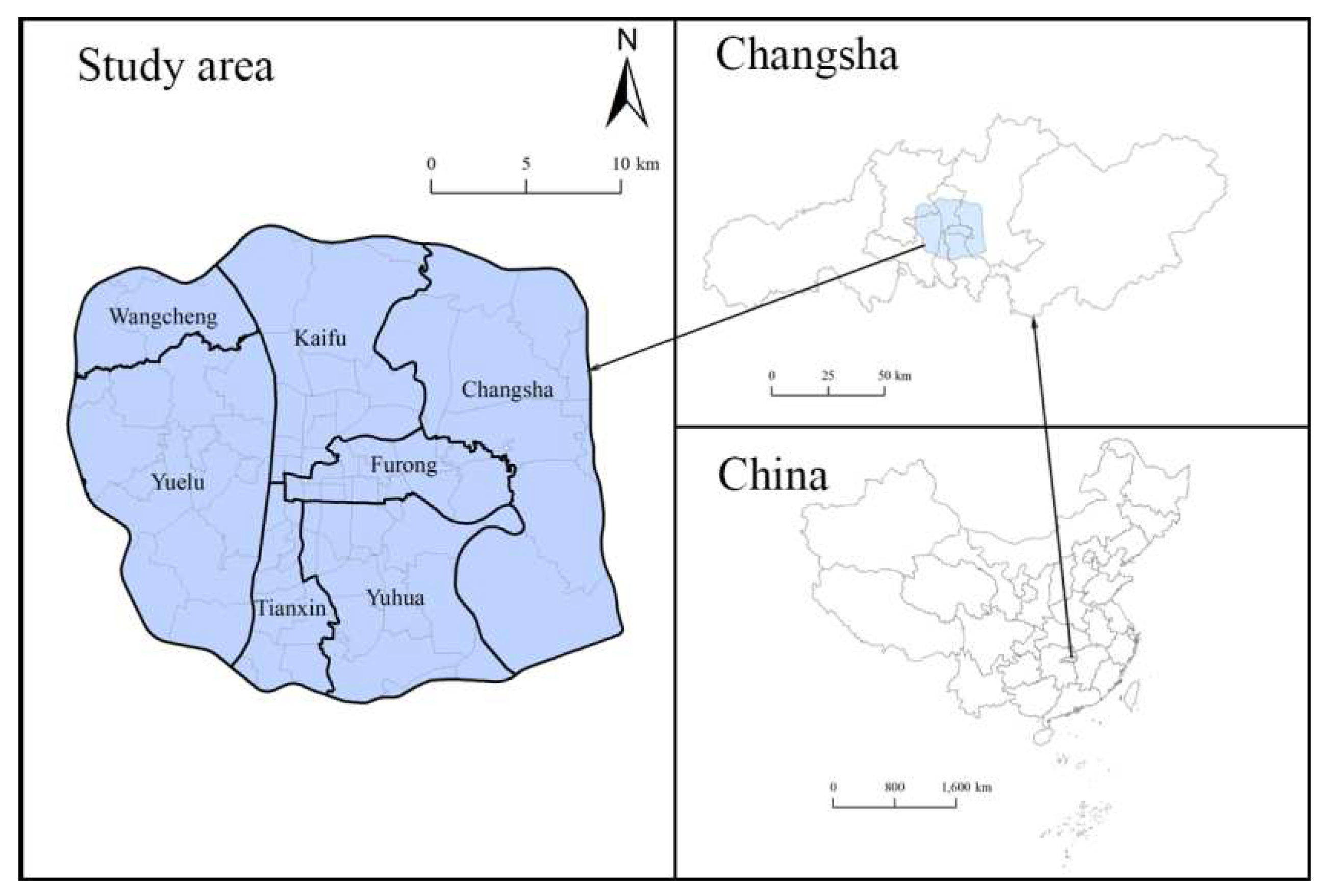
Figure 2.
Distribution of Urban vitality in Central Changsha, 2013–2017.
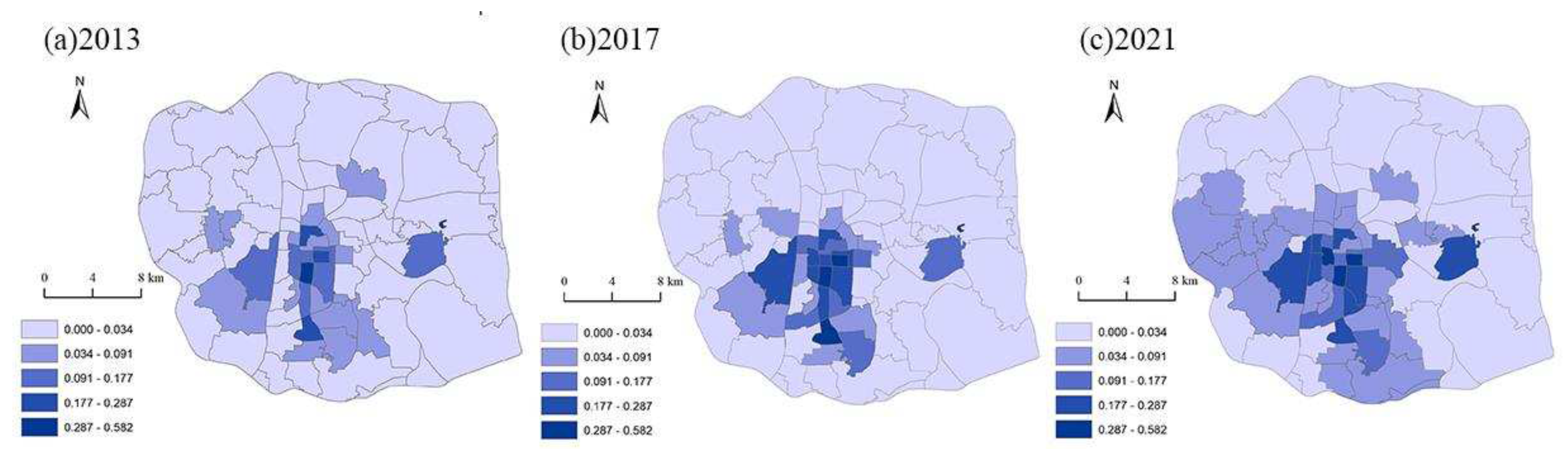
Figure 3.
LISA Map of Urban vitality in Central Changsha, 2013-2017.
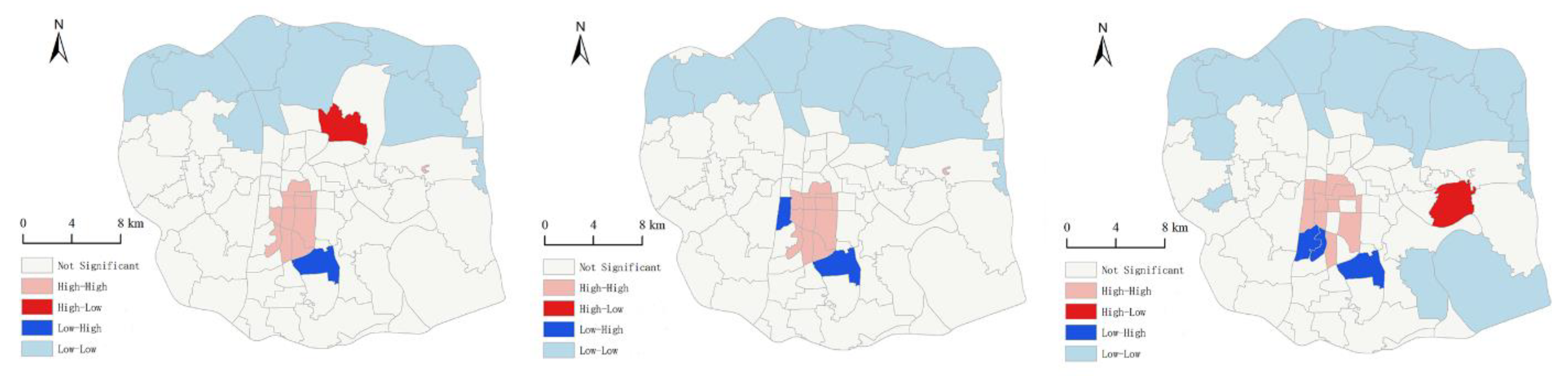
Figure 4.
Interaction Detection Results of Factors Influencing Urban vitality.
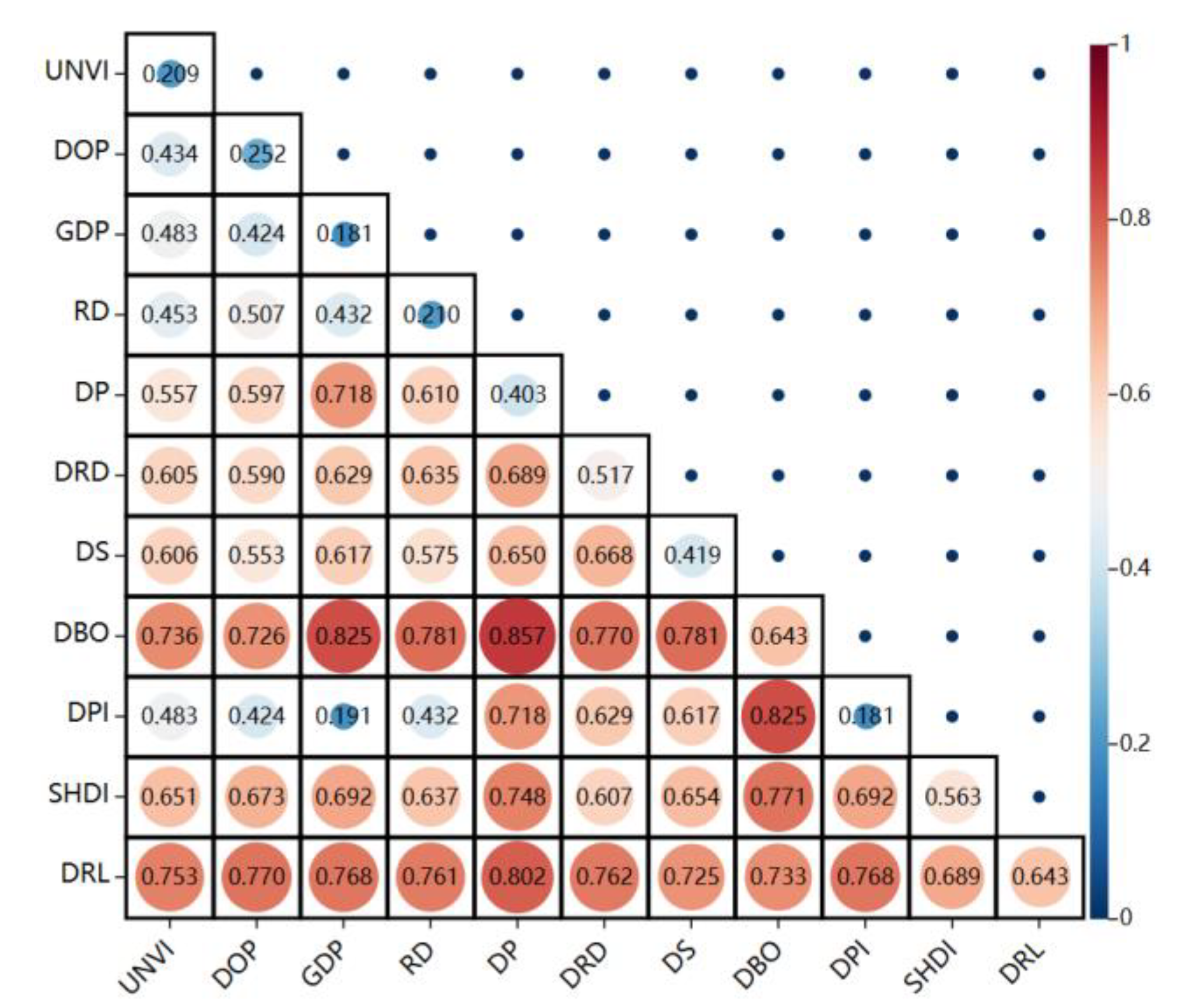
Figure 5.
SHDI Regression Coefficient.
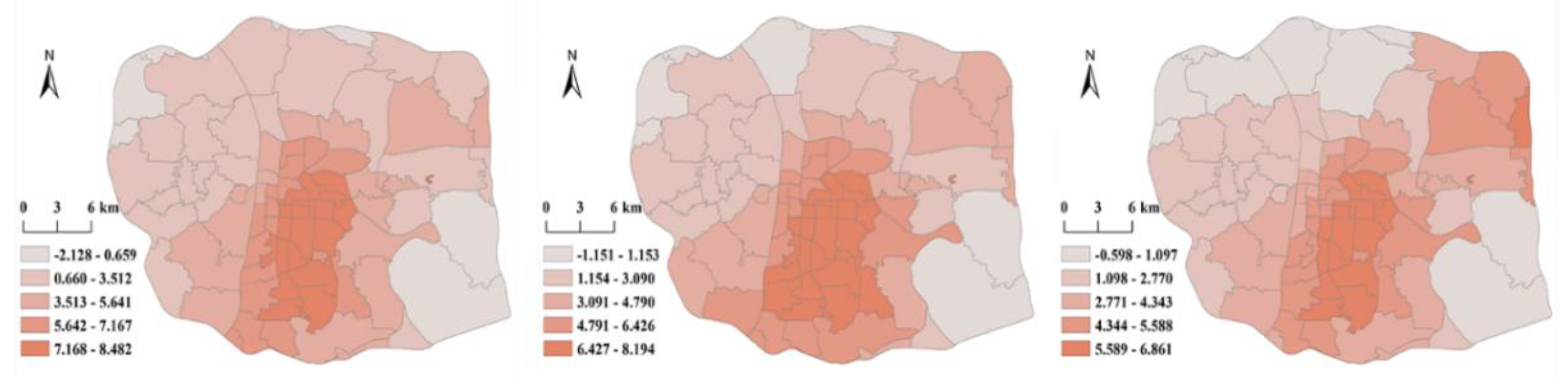
Figure 6.
RD Regression Coefficient.
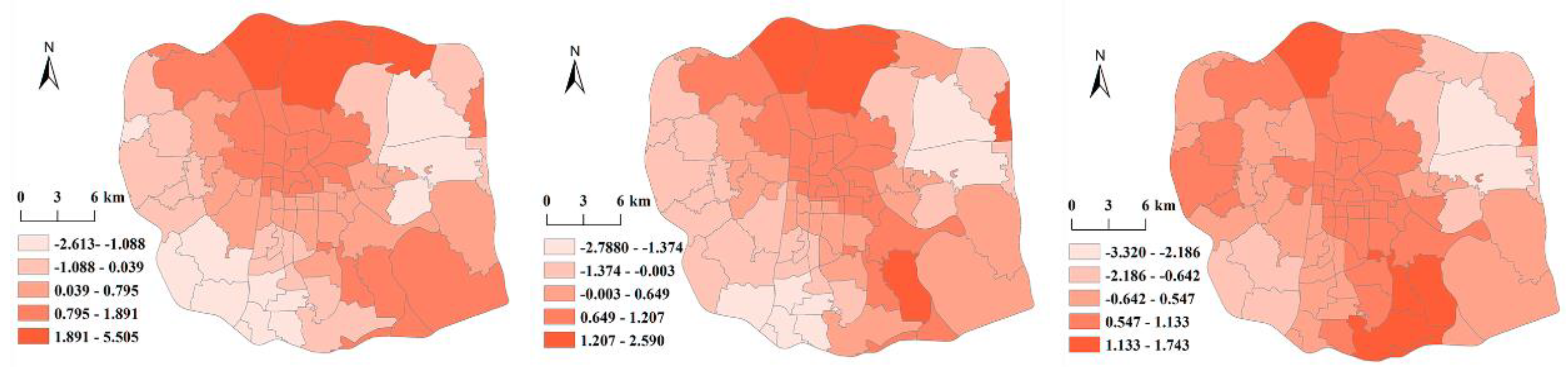
Figure 7.
DP Regression Coefficient.
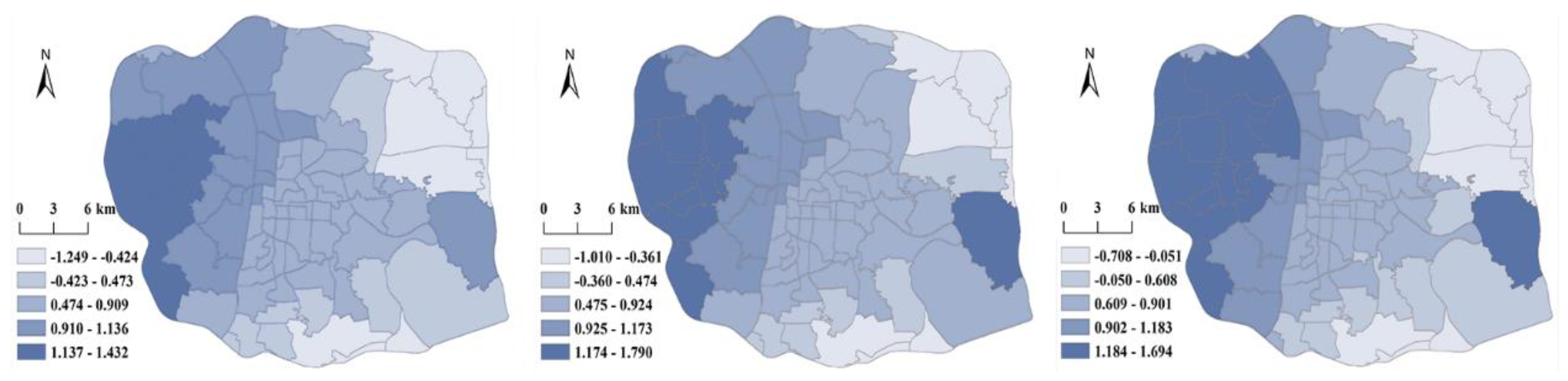
Figure 8.
DS Regression Coefficient.
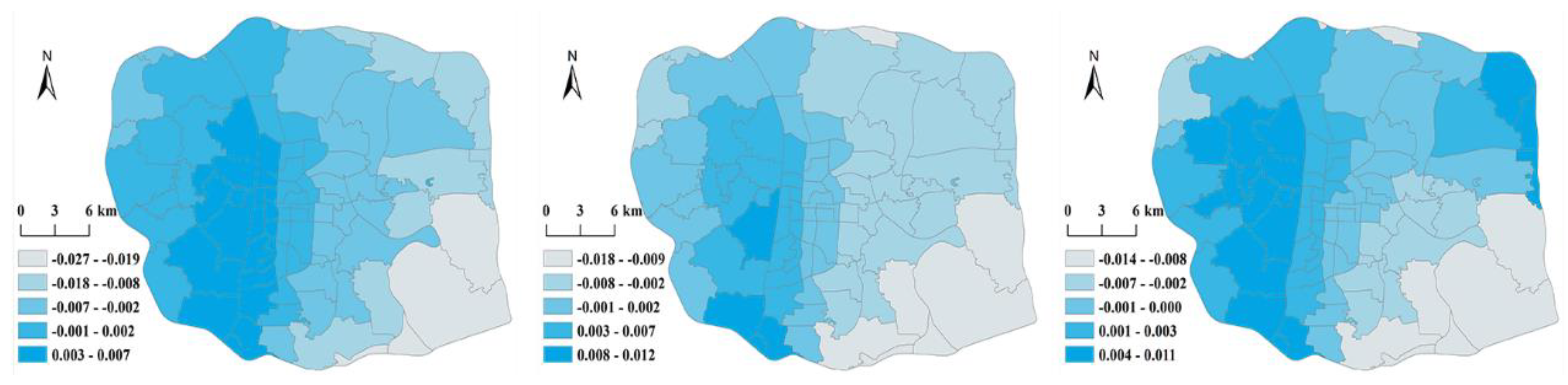
Figure 9.
DRL Regression Coefficient.
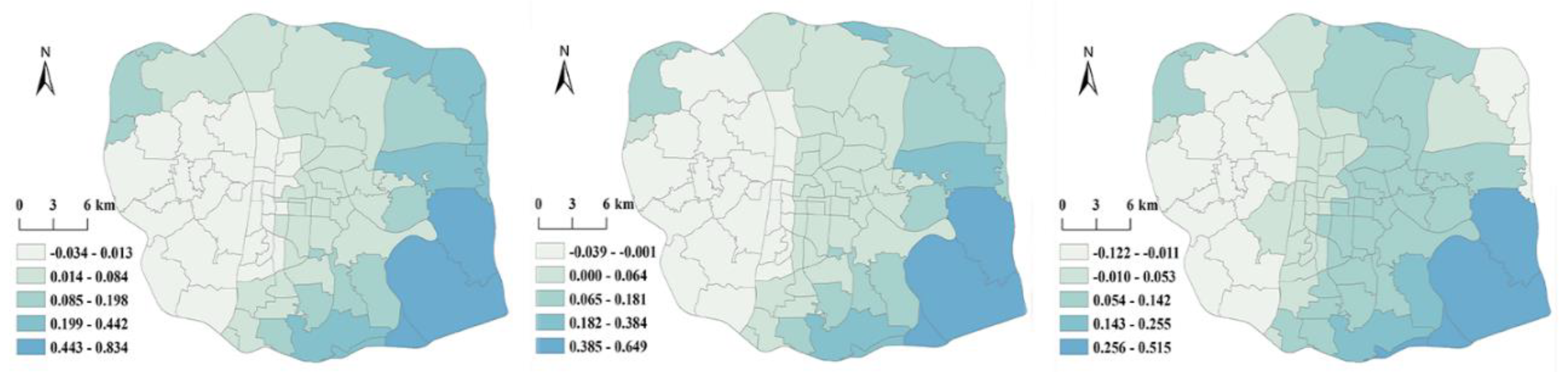
Figure 10.
DBO Regression Coefficient.
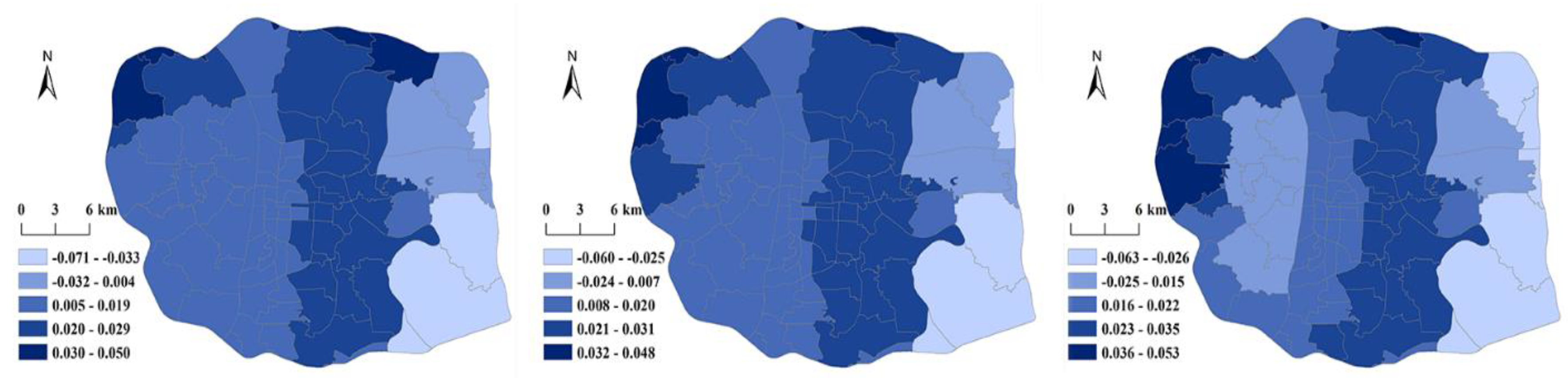
Table 2.
Indicator System for Subdistrict Spatial Driving Factors for Urban Vitality.
| Theme | Variable | Explanation | 2013 Mean/STD |
2017 Mean/STD |
2021 Mean/STD |
|---|---|---|---|---|---|
| Subdistrict Form | SHDI | Shannon's Diversity Index | 0.373/0.400 | 0.500/0.402 | 1.012/0.449 |
| RD | Road density | 2.880/2.209 | 5.003/2.702 | 6.849/3.943 | |
| UNVI | Urban Normalized Vegetation Index | 4455.808/1462.664 | 5391.162/1344.464 | 5574.558/1327.430 | |
| MSD | Metro station density | -/- | 0.881/2.566 | 1.240/2.547 | |
| NH | Neighborhood hydrophilic | 0.701/0.482 | 0.736/0.508 | 0.806/0.522 | |
| Subdistrict Function | DP | The density of park facilities | 0.820/1.746 | 2.711/4.629 | 6.849/3.943 |
| DRD | Dining room density | 25.256/42.980 | 142.550/187.261 | 1.012/0.449 | |
| DS | The density of shopping facilities | 56.383/100.326 | 250.027/281.288 | 3.406/5.036 | |
| DBO | The density of business office facilities | 30.205/89.556 | 104.054/196.502 | 197.486/273.150 | |
| DRL | The density of recreational and leisure facilities | 8.047/14.820 | 20.553/33.906 | 125.612/168.580 | |
| DH | The density of health facilities | 3.179/3.769 | 5.546/4.953 | 7.206/5.320 | |
| Subdistrict Economy | GDP | Gross Domestic Product | 810.971/251.924 | 1153.451/295.777 | 1520.181/445.961 |
| DPI | Disposable personal income | 3.263/0.462 | 4.666/0.498 | 6.400/0.562 | |
| DOP | The density of the resident population | 4.592/3.964 | 4.325/3.326 | 4.546/2.787 |
Table 3.
Influence factor detection results.
| code | Geodetector factor | q-value | p-value | significance | sort |
|---|---|---|---|---|---|
| X1 | SHDI | 0.563 | 0.000 | 0.01% | 3 |
| X2 | RD | 0.497 | 0.000 | 0.01% | 5 |
| X3 | UNVI | 0.209 | 0.031 | 0.05% | - |
| X4 | DP | 0.403 | 0.002 | 0.01% | 7 |
| X5 | DRD | 0.517 | 0.000 | 0.01% | 4 |
| X6 | DS | 0.419 | 0.000 | 0.01% | 6 |
| X7 | DBO | 0.642 | 0.000 | 0.01% | 2 |
| X8 | DRL | 0.643 | 0.000 | 0.01% | 1 |
| X9 | DH | 0.357 | 0.051 | 0.05% | - |
| X10 | GDP | 0.181 | 0.042 | - | - |
| X11 | DPI | 0.181 | 0.042 | 0.05% | - |
| X12 | DOP | 0.252 | 0.008 | 0.01% | - |
| X13 | MSD | 0.285 | 0.255 | - | - |
| X14 | NH | 0.058 | 0.774 | - | - |
Table 4.
Covariance test results.
| covariance test | Modified covariance test | ||
|---|---|---|---|
| variant | VIF value | variant | VIF value |
| DRL | 8.793 | DRL | 4.579 |
| DBO | 2.110 | DBO | 1.797 |
| SHDI | 1.903 | SHDI | 1.802 |
| DRD | 14.283 | RD | 1.452 |
| RD | 1.469 | DS | 3.418 |
| DS | 4.443 | DP | 2.843 |
| DP | 2.861 |
Table 5.
Model diagnostic coefficients.
| OLS | TWR | GWR | GTWR | |
|---|---|---|---|---|
| R2 | 0.588 | 0.614 | 0.668 | 0.681 |
| R2Adjusted | 0.577 | 0.604 | 0.631 | 0.672 |
| AICc | 490.830 | -668.756 | 477.808 | 1579.8 |
Table 6.
Descriptive Statistics of GTWR Regression Coefficients.
| 2013 | 2017 | 2021 | |||||||||||
|---|---|---|---|---|---|---|---|---|---|---|---|---|---|
| min | max | mean | STD | min | max | mean | STD | min | max | mean | STD | ||
| subdistrict form | SHDI | -2.128 | 0.620 | 4.824 | 2.618 | -1.151 | 8.194 | 4.585 | 2.412 | -0.598 | 6.861 | 3.718 | 2.021 |
| RD | -1.179 | 0.620 | -0.424 | 0.439 | -1.291 | 0.460 | -0.428 | 0.428 | -0.984 | 0.486 | 3.718 | 0.337 | |
| subdistrict function | DP | -1.249 | 1.432 | 0.665 | 0.560 | -1.010 | 1.790 | 0.751 | 0.528 | -0.708 | 1.694 | 0.750 | 0.531 |
| DS | -0.027 | 0.007 | -0.002 | -0.002 | -0.018 | 0.012 | -0.001 | 0.006 | -0.014 | 0.011 | 0.001 | 0.004 | |
| DRL | 0.084 | 0.834 | 0.084 | 0.084 | -0.039 | 0.649 | 0.058 | 0.132 | -0.122 | 0.515 | 0.063 | 0.108 | |
| DBO | -0.071 | 0.050 | 0.015 | 0.018 | -0.060 | 0.048 | 0.018 | 0.016 | -0.063 | 0.053 | 0.018 | 0.020 | |
Disclaimer/Publisher’s Note: The statements, opinions and data contained in all publications are solely those of the individual author(s) and contributor(s) and not of MDPI and/or the editor(s). MDPI and/or the editor(s) disclaim responsibility for any injury to people or property resulting from any ideas, methods, instructions or products referred to in the content. |
© 2023 by the authors. Licensee MDPI, Basel, Switzerland. This article is an open access article distributed under the terms and conditions of the Creative Commons Attribution (CC BY) license (http://creativecommons.org/licenses/by/4.0/).
Copyright: This open access article is published under a Creative Commons CC BY 4.0 license, which permit the free download, distribution, and reuse, provided that the author and preprint are cited in any reuse.


