

Submitted:
28 August 2023
Posted:
30 August 2023
You are already at the latest version
Abstract
Increasing of renewable energy share in total energy production is a direction that leads towards European Union’s aims of carbon neutrality by 2050, as well as increases energy self-sufficiency and independence. Some of the main challenges to increase renewable energy share while providing efficient and secure energy supply are related to optimization and profitability of de-centralized energy production systems. Integration of energy storage systems in addition to decentralized renewable energy production, for example, by solar panels, leads to more effective electricity supply and smart energy solutions. The modelling of such complex dynamic system can be performed using system dynamics method. The aim of the article is to forecast the practice of electricity storage in Latvia in the coming decades. A system dynamics model predicting the implementation of battery storage in private households was created for the case study of Latvia. Modelling results reveal that under the right conditions for electricity price, investment costs and with the right policy interventions battery storage technologies combined with PV panels have high potential for utilization in household sector. Model results show that in baseline scenario with no additional policies up 21 422 households or 10.8 % of Latvian households could have combined PV and battery system installed in 2050. Moderate subsidy policy can help to increase this number up to 25 118.
Keywords:
battery energy storage
; energy management
; household consumption
; solar panels
; system dynamics
1. Introduction
Renewables are our future. For decades now, the European Union (EU) has main-tained its course towards increasing its renewable energy aims, with the current target set as at least 32% of renewable energy share in 2030 [1]. The EU climate or carbon neutrality targets set by the European Climate Law [2,3] prescribe greenhouse gas (GHG) emission reduction by at least 55% in 2030 and net zero GHG emissions by 2050. A complementary effect to achieving the 55% GHG emission reduction by 2030 could be renewable energy share increase to 38-40% of gross final consumption [4].
But, to get to that future, the challenges of today have to be solved. On one hand, the recent technology advancements have promoted significant deployment of renewable energy technologies, e.g., with the increase of photovoltaic (PV) module production the prices have reduced significantly [5], and, consequentially, PV cost reduction is said to be one of most important reasons for global installed capacity rise [6]. On the other hand, the practical concerns are frequently related to fluctuating nature of solar resource and PV power intermittency [7,8] and subsequent overvoltage incidents [9].Hence, the transition towards sustainable power generation from renewable sources is not viable without sufficient energy storage [10].
Energy storage systems (EES) provide the possibility to confront the problems that arise due to intermittent power generation by renewable energy systems [11]. EES also allow increasing our effective ability to harvest and consume renewable energy, and simultaneously increase the renewable energy share in the demand profile. On the downside, EES capacity configuration affects the system’s economic feasibility [7]. Montoya-Duque et al. [12] reports that in isolated systems that require energy storage CAPEX might be even two-fold. A significant challenge that is considered in EES research with an aim to ensure system reliability is the sizing of the storage system [13].
There are various types of energy storage systems, i.e., battery energy storage, compressed air energy storage, hydrogen fuel cells, power-to-gas methane, superconducting magnetic energy storage, and fly-wheel energy storage to name some [10,14]. Elmorshedy et al. [8] also report that hydraulic storage and supercapacitors are used in combination to PV and wind turbine systems. It is reported that electric batteries are deployed in 77.1% cases and hydrogen tanks in 15.4% of cases of energy storage systems [8]. Hyvonen et al. [11] report lithium batteries to be most feasible for small-scale applications, while hydrogen and thermal energy storage are unfeasible for their considered scenario of individual detached houses. An integrated supercapacitor and battery system might improve system reliability, self-sufficiency and aid overcoming the limitations of battery energy storage, that arise due to changing nature of household consumption load [8].
EES can be deployed at various scales. Landl and Kirchsteiger [9] use Matlab/Simulink to analyze large-scale PV farm and battery energy storage system (BESS) in European network context. Research on renewable energy source (RES) and EES integrated use in single-dwelling, as well as, multi-house and even village level has been recently progressing. At the community level, Mazzeo et al., [15] used Artificial Neural Network method for sizing and energy performance prediction of hybrid renewable energy system that includes batteries (EV charging) for energy storage. Their model that is implemented by TRNSYS and Matlab simulation is aimed at promoting Zero Energy District development [15]. In Matera et al. [13] the authors supplement the aforementioned model for a case of small office communities. Wang et al. [7] provide a literature overview on numerous models that have recently been developed for PV integrated systems both in general and for household level. They note that the research on village level system, its configuration and life cycle economic benefits is lacking [7]. Cirone et al. [16] also apply TRNSYS for dynamic modelling of four interconnected municipality buildings system, which includes PV generation, battery energy storage and shared electricity use. Monroe et al.[17] elaborate even more by applying agent-based modelling to analyze dynamics of electricity prices in a consumer-prosumer system at neighborhood level and including storage solutions.
To stimulate the households to implement onsite renewable energy generation, as well as, to seize the additional opportunities provided by energy storage technologies, the performance of such systems at local and relevant conditions must be evaluated by modelling and prediction. Mazzeo et al. [18] report that HOMER (Hybrid optimization model for electric renewables) and Matlab are most widespread softwares for hybrid systems analysis. Hyvonen et al. [11] modelled energy storage scenarios for a detached house in Finnish climate conditions by Matlab computational model with graphical capacity optimization. With a particular focus on system costs (including Life cycle costs and levelized cost of storage), they found that the use of energy storage systems may only be feasible for households in detached houses in case of (a) high electricity market prices or (b) availability of economic support mechanisms [11]. But they also state that their previous experience has indicated linear optimization to be less than optimal for energy storage size elaboration [11]. Mascherbauer et al. [19] have modelled single family house system including PV, battery storage, hot water tank and thermal storage by building mass at household and national level in Austria with the aim to determine the potential of smart energy management system. Wang et al. [7] use optimization model (particle swarm optimization algorithm) to elaborate optimal energy storage capacity, power and typical energy storage output for different scenarios, including PV off-grid and on-grid system for community context. The modelling inputs are based on cost-benefit analysis and indicators as net present value and internal rate of return are used to determine the system’s economic feasibility. For the environmental dimension, Wang et al. [7] take into account the avoided greenhouse gas emissions (including, CO2, NO2, SO2) in g/kWh. Elmorshedy et al. [8] assessed the technoeconomic feasibility of a hybrid renewable energy system with energy storage. They used HOMER software for optimization of the studied design, and integrated Matlab/Simulink modelling to analyze the dynamic changes in the system [8]. Miletić et al. [20] use Mixed Integer Linear Programming (MILP) model to a household that includes PV, electric vehicle charging and BESS. Bakić et al. [21] performed dynamic analysis of household PV and wind hybrid system by optimization simulation in TRNSYS program. They note that in order to achieve constant electrical power supply from the system throughout the year, addition of energy storage is needed, e.g. batteries or hydrogen based system [21].
The abovementioned exemplifies that researchers are searching for ways to model the dynamic nature of an integrated RES and EES smart system. Another suitable method would be system dynamics (SD) modelling. SD modelling is a computer-based modeling and simulation method [22] that allows to uncover the causal relationships and feedback mechanisms underlying between technological, economic and social systems [23]. The advantages of SD modelling include the model’s ‘open structure’ and flexibility [22]. SD modelling has been applied for the case of solar energy based electric vehicle charging [24]. Kubli and Ulli-Beer [23] developed a SD model for analysis of likely deployment patterns of decentralized energy generation and Riveros et al. [25] apply SD to model diffusion of distributed generation and consumption (prosumer) communities.
While there have been few previous SD studies regarding RES and EES integration, the applications are still expanding. The aim of the article is to forecast the practice of electricity storage in Latvia in the coming decades. Particularly, the so far less common SD modelling approach is used, to describe the underlying behavior and the dynamic structures of the analyzed system. The rest of the paper is structured as follows: SD model structure, input data and assumptions, as well as, model validation is described in Section 2; the results of simulations and sensitivity analysis are presented in Section 3. Finally, overall discussion and conclusions are presented in Section 4.
2. Materials and Methods
In order to predict the practice of electricity storage in Latvia in the coming decades, the SD modeling method was used. Modeling was done using Stella Architect software.
SD is a method for studying the dynamic development of complex systems, with the help of which complex problems can be solved. SD theory is based on the study of the relationship between the behavior of the system and the underlying system structure. This means that by analyzing the structure of the system, a deeper under-standing of the causes of the behavior of the system is formed, which allows to better address the problematic behavior of the observed system [26].
SD was established in the mid-1950s by Professor Jay Wright Forrester of the Massachusetts Institute of Technology. SD was originally designed to help business leaders improve their understanding of production processes, but its application is now much wider, including policy analysis and development in both the public and private sectors [27].
For decades, system dynamics modeling has been employed in energy system re-search. The fundamental advantage of system dynamics over other modeling method-ologies is its ability to capture the complexity of dynamic systems [26]. The most fun-damental difference between system dynamics and other modeling methodologies is its endogenous approach, which means that model structure and elements defined within the system, rather than exogenous inputs, are responsible for dynamic behavior. System dynamics models can take into account four major factors that other modeling methods frequently overlook:
- Material and information delays;
- Non-linear relationships;
- Causation not correlation;
- Feedbacks in the system.
More information on how system dynamics is used in energy modeling, as well as the advantages over alternative modeling methodologies, may be found in the following works [28,29].
2.1. Model structure
The system dynamics model predicting the implementation of battery storage in private households was created for the case study of Latvia. All the input parameters, like solar radiation, electricity price, number of households and other parameters used were specific to the case of Latvia. In this case, the model was created with the aim of predicting the dynamics of battery storage implementation in Latvia until 2050.
The numerical values of the model parameters are based on assumptions derived from analysis of statistical databases, analyzing electricity market data, as well as other sources. The central part of the model structure is depicted in Figure 1. This part of the structure represents the main dynamics of PV panel and battery system installation. An important parameter in the development of this model is the total number of private households (single-family buildings) in Latvia. In this research, the installation of solar PV and battery storage system is considered and forecasted only for single-family buildings with small scale PV and battery systems. Based on official Latvian statistics database, there are around 200 000 detached (single-family) households in Latvia. Part of these households have information about possibility to implement micro-generation and storage applications in their households, some of households have already implemented these applications, however, there are still a large number of households that lack the information about micro-generation and storage or lack the information about advantages, which means that before the actual implementation of micro-generation or storage can happen, it is necessary to inform these households. Special information campaigns can be organized for this purpose, however, there is also word-of-mouth happening regardless of any information campaign. The inventory "Uninformed households" describes the part of private households in Latvia that still need to be specifically informed about alternatives for self-generating and storing electricity. When a household receives enough information about micro-generation and storage, it moves from the “Uninformed household” stock to the “Informed household” stock and is now ready to make decision on micro-generation and storage implementation. These stocks are affected by the information rate, which depends on the informing fraction and in the model is assumed to be 0.1. In this research informing fraction is a single parameter including both information campaigns and word-of-mouth informing. At this stage it is not modeled in more detailed, however the plan is to expand this section in the future research. Equation (1) describes the flow.
where IR – information rate of uninformed households, units/year; HHUn – number of uninformed households, units; IFr – information fraction which describes the speed at which uninformed households get informed about PV and battery technologies.
IR = HHUn · IFr,
Accordingly, households that obtain information and begin to evaluate the installation of solar panels or batteries at some point come to a decision to install one of the options (PV, batteries, or both) or to keep the current grid connection without additional technologies. Outgoing flows describe the total number of informed households and the decision made accordingly. The flow "PV installation rate" is described in the model by equation (2). The outgoing flow "PV and battery installation rate" is also determined according to the same principle.
where InRi – installation rate of the specific solution, units/year; HHInf - number of informed households, units; Di – investment decision in specific solution.
InRi = HHInf · Di,
The model also includes a flow "Battery installation rate", which describes the number of households that decide to install a battery when PV panels are already installed previously or re-install a battery because the battery life is shorter than the life of the PV panel system duration.
The stock "Households with PV", describes the number of households that have installed only PV panels. On the other hand, the stock "Households with PV and batteries" describes the number of households that have not only installed PV, but also added a battery. This number is not currently counted and analyzed in publicly available data in Latvia, but it was assumed that this number is minimal, setting five households as the initial value. Both of these stocks are also affected by the outflow, which describes the technology's depreciation time, which is affected by the average lifetime of the technology. This means that after the end of the technical lifetime of the technology, household returns to the previous stock. As technical lifetime for batteries is shorter than for PV, households with PV and batteries move to the stock “Households with PV” after the technical lifetime of batteries have ended as they still have working PV panels left. Afterwards they can again make decision on installing the batteries. “Households with PV” after the end of the technical lifetime for PV moves back to the stock “Informed households” and can again make decision on installing the PV or PV and batteries. The flow "Decommissioning rate of the PV" is determined according to the equation (3). The flow " Decommissioning rate of the batteries" is also determined according to the identical principle.
where DCi – decommissioning rate of the specific technology (PV or battery), units/year; HHi – number of households with specific technology solution, units; LTi – technical lifetime of the specific technology (PV or battery), years.
DCi = HHi / LTi,
The decision on installing the PV or battery system in model is made based on rentability of each system. Figure 2 represents the model structure responsible for decision making. For the system to be attractive, the payback time must be lower than the lifetime of the particular technology. Otherwise, the interest in installing the technology will be negligible and the choice in favor of installing the specific technology will be made only by those for whom the financial aspect is not decisive in making the choice. It's usually a very tiny fraction. The interest of the rest of society increases if the payback time is shorter than the lifetime of the equipment. The faster the payback time, the greater the interest in choosing the particular technology. Decision regarding the choice of technology is calculated by using logistic function in which the rentability of all the solutions, including installation of no technology is compared. The highest share of decision makers opt-in for the solution with fastest payback time and lowest share of decision makers chooses option with longest payback time.
where Ri – payback time of the specific technology (years); α - elasticity coefficient that describes the decision-making nature of decision makers.
Di = exp(-α · Ri) / (exp(-α · R1) + exp(-α · R2) + exp(-α · R3)),
Decisions to install PV and battery systems are largely influenced by the amount of investment required and the payback time of technology installation. Investment costs depend on the installed capacity of the technology. Also, the payback time is affected by the granted subsidies and the intensity of support. On the other hand, the payback time is affected by the necessary investments for installing the technology, as well as the savings in electricity costs. The sub-model of these influencing parameters can be seen in Figure 3.
The payback time if solar panels are installed for a household is determined by the investment costs of the PV panels and the savings in electricity costs, which are respectively determined by the comparison of the annual electricity costs with grid connection versus the electricity costs with installed solar panels. Electricity costs for grid electricity users, grid electricity costs for PV system and grid electricity costs for PV and battery system was calculated by using a model previously developed by the authors [26]. In this research electricity price was assumed to be constant for whole simulation period, therefore also costs of grid electricity for all three systems were assumed to be constant for whole simulation. Explanation on why the constant electricity price was chosen for this research is given in section 2.2. Similarly, the payback time of the system with accumulation is affected by the corresponding savings in electricity costs and investment costs and is determined according to the formula of the same principle. The PV payback time is determined according to equation (5).
where PTi – payback time for specific system (PV or PV and battery), years; ISi – Investment costs for specific system (includes subsidies if granted), EUR; Si – savings made by using specific technology, EUR/year.
PTi = ISi / Si,
On the other hand, investment costs with subsidies depend on the investment costs of installing the technology, the intensity of the support, as well as the amount of support available for increasing energy efficiency. This parameter in the PV system situation is calculated according to equation (6). If the available support for increasing energy efficiency is available, then the investment costs depend on the intensity of the support, otherwise the investment costs of the technology are taken into account. The investment costs of the battery system are also determined according to the same principle, only in this case the costs of the PV system are additionally included, because when installing the battery for the storage of renewable energy, it also resonates with the PV panel system.
where AF – available funding for PV and battery installation, EUR; Ii – Total investment costs for specific system without subsidies, EUR; SIi – support intensity for specific technology (either PV or battery).
ISi = IF(AF > 0; Ii · (1 - Si); Ii),
The investment costs of PV depend on the installed capacity of the PV system, as well as on the investment costs of the inverter, as it adds up to additional costs, as it also needs to be replaced when comparing lifetimes. Also, the parameter is affected by the specific investment cost, which is affected by the rate of cost decrease (depends on the fraction of decrease; is assumed in the model to be a decrease of 0.02 units per year) as the costs of these technologies are expected to decrease over time.
where IPV – PV investment cost, EUR; CPV – installed PV capacity for household, kW; SpIPV – specific investment costs of PV, EUR/kW; IInv – investment costs of inverter, EUR.
IPV = CPV · SpIPV + IInv,
Also, the payback time parameter for determining savings, comparing the benefits of a PV-only system and a PV-battery system, is created according to the same structure and calculation equations.
The above-mentioned stock "Available funding for PV and battery installation" comes from sub-model with related flows and parameters shown in Figure 4.
The amount of support available in the stock is also affected by the allocation of the incoming flow of funding, which describes the additional planned funding. According to the data of the Ministry of Economy, is planned in the amount of EUR 20 million, however, separate financing is available also from Ministry of Climate and Energy and from Ministry of Environmental Protection and Regional Development [30]. On the other hand, the amount in the stock is reduced by the outgoing flow "Funds utilization rate", which describes the support granted to the implemented energy efficiency projects. Considering that the system dynamics model describes the predictive situation, and the model does not include all possible exceptional cases, as well as the parameters are based on assumptions, the outgoing flow and its influencing parameters are determined according to the following equations. The outgoing flow is determined by the formula (8). Where, if the support requested at a given time is more than the available support, then it is included in the model and the support is stopped.
where FU – funding utilization rate, EUR/year; FR – funding requested by households for PV and battery installation, EUR/year; DT – delta time of simulation, year.
FU = IF(FR > AF; AF / DT; FR),
On the other hand, the parameter "Total funds requested" depends on the requested support for the installation of the PV system, which is affected by the intensity of the support, the amount of installation and investment costs, as well as on the requested support for the installation of the storage system, which depends on the investment costs of the battery, system installation and support the amount of intensity as well as the total available support. The parameter of the requested total funds is determined according to the equation (9).
where FRPV – funds requested for PV installation, EUR/year; FRB – funds requested for battery installation, EUR/year.
FR = IF(AF > 0; (FRPV + FRB) / DT; 0),
2.2. Input data and assumptions
In this section the most relevant input data and assumptions used in the system dynamics model are described.
Relevant data about technologies are taken from technology catalogues. Information about average capacities for technologies are taken from statistics and scientific literature. Information about households is taken from statistic databases. Most relevant information used in the system dynamics model is shown in the Table 1.
Historic electricity spot price data was taken from NordPool database [36] for years 2013 to 2022 to evaluate the change in electricity spot price and decide on best value to use for battery diffusion forecast simulation. Average yearly values were compared. Historic data shows (see Table 2) that there are fluctuations in electricity price from 2013 to 2020, however, the price stays between 34 and 50 Euros per Megawatt-hour. Fluctuations are mostly due to changes in hydro resource availability and changes in natural gas price, as those are the main resources in electricity generation in Latvia. It is also dependent on price of imported electricity. Year 2021 and 2022 came with several shocks to the system and it is clearly reflected in the huge increase in electricity price. Lower water level in hydro reservoirs and lower wind energy production in Nordic-Baltic region resulted in switching to more expensive electricity generation means. Increase in demand for natural gas and coal increased the price of resources, which is reflected in the electricity price. Ukraine-Russia conflict also played a huge role in electricity price increase, because of sanctions put on Russia. As Latvia historically imported most of the natural gas from Russia, natural gas price increase after Ukraine-Russia conflict had a devastating effect on energy sector and yearly average electricity price reached the unprecedented level of 227 Euros per Megawatt-hour. As Nordic-Baltic region have worked together in last year to reduce the dependence on Russian natural gas, price of natural gas and electricity have gone down significantly, however, overall electricity price is still higher than it was from 2013 to 2020. It is hard to predict what will be the electricity price in the future and how much time will be necessary for the energy system to adapt to the new reality, however, for the purpose of this research it is assumed that energy system will adapt to the shocks of 2021 and 2022 and the baseline price of electricity in the long term will be at 2013 to 2020 level rather than at 2021 or 2022 level.
There is no information on how many households so far have installed battery storage, therefore it is assumed that this number is negligible. Assumed number is 5 households.
It is also assumed that average electricity price will be constant for whole simulation. Model allows to make this parameter as changeable and in the future research this option might be exercised, however, the goal of the current research was to test the model structure, rather than to predict the electricity price changes, therefore, for this research electricity price was set as constant for whole simulation.
For subsidies it was assumed that for all subsidy scenarios 20 million Euros will be allocated at the beginning of the simulation and new finances at the same 20 million Euro level will be allocated every 5 years.
2.3. Model validation
To build a confidence in a model, it is necessary to carry out several model validation tests. No model exactly matches the real object or system being modeled, so absolutely reliable models do not exist. Models are considered reliable and valid if they can be used with confidence. Forrester and Senghi believe that confidence is the most appropriate criterion for testing a model's behavior because there is no absolute proof of a model's ability to describe reality. In order to build confidence in the model's validity as a result of model validation, the purpose of the model must first be clearly defined [37].
The purpose of the verification or approval of the system dynamics model is to determine the validity of the model structure. The accuracy of reproduction of the real behavior of the model is also assessed, but this is only meaningful if we already have sufficient confidence in the structure of the model. Thus, the overall logical validation order is to first check the validity of the structure and then start testing the accuracy of behavior only after the model structure is perceived as adequate [38]. This sequence was also used in this research. There are several different structure and behavior tests, like model structure verification test, parameter verification test, dimensional consistency test, boundary adequacy test, extreme condition test, behavior reproduction test, behavior anomaly test and others.
Structure and parameter verification was done by consulting energy experts and analyzing scientific literature to make sure that the structure of the created model complies with generally accepted principles and that all the parameters have matching element in the real system. Since SD root back to the engineering theory, SD models must ensure dimensional consistency. The dimensional consistency test provided an analysis of the dimensions of the parameters used in the model equations. This test allowed to make sure that no inadvertent error had crept into any of the equations. Extreme condition test was carried out in order to make sure that model will perform in an adequate manner even if the values fell out of the common range. It is important that model works properly to different kind of shocks.
Also, behavior validation tests were carried out to assess whether the model can represent the behavior of the real-life system. To assess the adequacy, model results were compared to the historic data of PV integration in households of Latvia. For this test the historic input data for technology costs, electricity prices, relevant historic policies and other parameters were put into the model. Model was simulated from year 2013 to year 2022. As can be seen from Figure 5, model describes the historic development of PV integration very well. Although, simulated results do not exactly match the historic development, the overall trend is very similar and this builds confidence in model.
Historical development trend of battery implementation cannot be compared, because so far, the installation of batteries in households in Latvia has hardly taken place and there is nothing to compare against. What validation showed is that same as in the real-life system, based on historic battery prices, technology parameters and electricity prices, practically no battery systems were installed.
2.3. Defining scenarios
This section describes the scenarios that were selected and modeled within this research. It describes what policy measure were chosen to be tested and what sensitivity parameters were chosen.
Main purpose of the research was to build and validate the system dynamics model which allows to predict the future implementation of the PV and battery systems. Model was supplemented with one policy measure - subsidies. For future research model can be supplemented with additional policies to test their effect on battery system integration in households. In this research four separate scenarios were developed. Baseline scenario describes the system in which no additional policies are implemented apart from what is already existing in the current energy system. This is mainly related to the net-metering for households which have installed PV systems. It allows to transfer excess solar energy to the grid, when production is higher than consumption, and take it back at the moments when consumption is higher than solar production of installed PV. This basically means that distribution grid is working as a storage. Advantage comes from lower electricity price when taking back the solar energy surplus. When accumulated solar energy surplus is taken back from the grid only distribution system operator tariff must be paid instead of the full electricity tariff. This is taking into the account when calculating the costs of each system (grid only, PV, battery, PV and battery).
There are 3 separate subsidy scenarios. Each of them includes already existing policies mentioned above and in addition provides subsidies for specific technology implementation. Differences can be seen in Table 3. Main difference between scenarios is the technology which receives the subsidies and the amount of financial aid available. For scenarios in which only 1 technology receives the subsidies, funding amount is 20 million Euros every 5 years, however, when both technologies receive subsidies, 20 million Euros are allocated separately for each technology implementation.
To test the sensitivity of the model to changes in various parameters, sensitivity analysis was carried out. Electricity tariff, technical lifetime of the battery, initial investment of the battery and battery investment decrease fraction was chosen as four parameters with most influence on the model results. Table 4 shows the intervals tested for sensitivity analysis. Results of sensitivity analysis are displayed in results section.
3. Results
This section provides the key initial results that describe the diffusion of PV systems and electricity storage system in households in Latvia up to year 2050 based on different parameters. The sensitivity of most relevant parameters is assessed.
3.1. Model results
This is in a way an intuitive conclusion, however, electricity price proved to have a large role in transition from grid electricity to PV and battery utilization. Figure 6 shows the comparison of PV and PV with battery system diffusion level at different electricity tariffs. It can be seen in Figure 6 a) that if the electricity price for the whole simulation period would be 35 Euros per Megawatt-hour, which is about the lowest price electricity have reached in the last 10 years (see Table 2), interest in both PV and PV with battery installation would be very low. Most of the households would stay connected to the grid without additional production or storage capacities. Interest in batteries would start only after year 2040, when investment cost would have been decreased enough for payback time to be lower than technical lifetime of batteries. It is logical that with low electricity prices payback time for PV and batteries is too long to make it a desirable option. Model results show that at this electricity price level in a year 2050 only 25.4 % of all households would have installed PV only systems and 3.5 % would have installed PV systems complemented with battery storage. The rest would still be fully dependent on grid electricity.
Figure 6 b) shows that if the electricity price for the whole simulation period would be 50 Euros per Megawatt-hour, which was the highest electricity price from year 2013 to 2020 (see Table 2), interest in PV and batteries would significantly increase. This means that payback time is significantly lower than it was at previous electricity price and micro-generation and storage technologies become more lucrative even without additional support from government. PV technology implementation gains traction right out of the gate, while PV and battery installation starts to rise already before 2030. Model results show that at this electricity price level in a year 2050 48.6 % of all households would have installed PV only systems and 10.8 % would have installed PV systems complemented with battery storage.
Figure 6 c) shows that if the electricity price for the whole simulation period would be 90 Euros per Megawatt-hour, which was around the electricity price in a year 2021 (see Table 2), interest in PV and batteries would significantly increase. In this case electricity price is so high that the current technology costs for PV and batteries are becoming very lucrative already at the beginning of the simulation and payback time is very short. Even without government support households make decision on switching to PV or PV with batteries and future technology cost decrease promotes it even more, however close to the year 2050 installation rate slows down, because the system is close to full saturation. Model results show that at this electricity price level in year 2050 68.6 % of all households would have installed PV only systems and 18.0 % would have installed PV systems complemented with battery storage.
Figure 6 d) shows that if the electricity price for the whole simulation period would be 220 Euros per Megawatt-hour, which was around the electricity price in a year 2022 (see Table 2), PV and battery installation rate would explode. Grid electricity is so expensive that even battery technologies which at this point are still expensive would seem to be more lucrative than using only grid electricity. PV only systems still takes larger fraction than PV with batteries, because total investment and payback time in PV will always be lower than for PV system supplemented with batteries. Model results show that at this electricity price level in a year 2050 70.8 % of all households would have installed PV only systems and 22.0 % would have installed PV systems complemented with battery storage. End results are similar to the one with the electricity price at 90 Euros per Megawatt-hour, however, the initial investment rate is significantly higher.
It is crucial to mention that results show the situation when net-metering systems is working for whole simulation in all electricity price scenarios and all households can use this system, however in reality distribution system operator most likely would not be able to accumulate all the solar surplus electricity showed in c) and d) scenarios in the grid and net-metering would be eliminated in order to keep the grid stability. This would in turn affect the PV and battery system integration rate, because without net-metering payback period increases and grid connections look more attractive. In this research, however, the effect of the PV integration rate on the electricity grid and net-metering system is not analyzed. Model must be extended in order to analyze this effect. This is a goal for further research.
Figure 7 shows the PV and PV with batteries integration rate for the baseline scenario in which the electricity price was set at 50 Euros per Megawatt-hour, which was assumed to be the most realistic future price level for the current study. In further studies, the price formation should be extended and price variation should be considered.
Baseline scenario reveals the gradual increase in PV system installation from 11 764 in 2023 up to 96 497 households with PV in 2050. PV with battery installation starts at year 2027 and goes up from 5 households in 2027 to 21 422 households with PV and battery combination in 2050. This shows that there is potential for battery integration in households, however, to reach the higher integration rate, support policy implementation is necessary.
Figure 8 shows how the subsidy policy implementation changes the PV with battery system integration in households. It can be seen that baseline scenario with no policies shows the lowest number of households with PV and battery storage in 2050. When subsidies are given only for PV installation, but not for battery storage, initial increase in installation of systems with PV and batteries is higher than for baseline scenario, however, end result is only slightly higher. Initial increase is due to the fact that by subsidizing PV installation the total cost of the system with PV and batteries is also reduced, therefore it is more attractive than in the baseline scenario, however in the long-term PV only systems still are more attractive than a combined system.
When only batteries are subsidized, initial increase for PV and battery system installation is similar to the one with PV subsidies and higher than in the baseline scenario, however the end result is better than in baseline and subsidies for PV only scenario. This can be explained with a fact that by subsidizing only batteries, payback time for the combined system is closer to the PV only system, therefore interest in combined PV and battery system installation increases, and increases not only for the initial period, but throughout the simulation.
If both technologies are subsidized, it is predictable that initial increase would be higher than in previous scenarios. This increase happens not at the expense of PV only systems, but because both PV only and combined PV and battery systems become competitive with a grid electricity tariff and installation increase happens in both categories. End result, however, is similar to the scenario with subsidies for batteries only and as both technologies receive subsidies, investment and saving difference between solutions are still in favor of PV system.
From the scenario results can be seen the fact that 20 million Euro subsidies very 5 years for technologies with 50 % support intensity is really not enough to significantly increase the adoption of combined PV and battery system. Difference between baseline scenario and subsidy for both technologies’ scenario is 3696 households. In baseline scenario 21 422 households have combined PV and battery system installed, while in scenario with subsidies for both technologies 25 118 households have combined PV and battery system installed.
3.2. Results of sensitivity analysis
Sensitivity analysis was carried out in order to assess how the changes in most relevant parameters might impact the implementation of combined PV and battery systems. Sensitivity analysis was done for the system without subsidies. Figure 9 shows the sensitivity of electricity tariff. The huge gap can be seen between PV and battery system installation at electricity price 30 and 150 Euros per Megawatt-hour.
Technical lifetime of the battery also has high impact on the combined PV and battery system installation. Figure 10 shows that if battery technical lifetime would be 10 years or lower, almost no installation of battery storage would take place, because investment would be too high to pay off within lifetime of technology.
Initial investment also plays huge role in battery storage implementation and sensitivity analysis shows how the installed amount of PV and battery systems changes when increasing or decreasing initial investment by 25 %. Number of households with PV and battery system changes from 19 890 in highest investment scenario to 31 029 in lowest investment scenario (see Figure 11).
Not only initial investment itself, but also investment decrease over time plays a role in battery system integration. Sensitivity analysis of investment decrease fraction (see Figure 12) shows significant changes in end result when changing yearly investment decrease fraction from 0.5 to 3 %. Number of households with PV and battery system changes from 19 127 in lowest investment decrease fraction scenario to 28 840 in highest investment decrease fraction scenario.
From sensitivity analysis can be seen that all 4 parameters – electricity price, technical lifetime of the battery storage, initial investment of battery storage and investment decrease fraction of battery storage have a huge impact on the battery storage installation, therefore it is crucial to carefully consider the values of these parameters when making a future prediction on battery storage development.
4. Discussion and conclusions
Extensive testing and validation of the model was done before the forecast simulation and sensitivity analysis were carried out. Model testing results built the confidence in the model adequacy and reliability. Behavior validation results showed the same development trend of PV system integration in households as historic data.
Results showed the potential for integration of battery storage in household sector. Although, battery storage implementation rate is heavily dependent on electricity prices, the moderate scenario model results show that total of 21 422 households could install battery storage until 2050 if the electricity price level on average will stay around 50 Euros per Megawatt-hour and no support policies will be implemented aside from the ones already in place. 21 422 households are more than 10 % from all households in Latvia. This is also in line with the research done by Australian researchers for which the no policy slow growth scenario showed a similar increase of around 13 % until 2050 [36]. Australians projected that with additional policies in best case scenario even up to 50 % of households could have battery storage installed by 2050. For our model additional policy implementation and testing is planned for future research.
Testing of subsidy policies revealed that the best outcome can be achieved by subsidizing not one technology separately, but both technologies at the same time. Results showed that by implementing subsidy policy in the model and funding both PV and battery installation, household number with combined PV and battery system increased by 3696 households from 21 422 to 25 118 when compared to baseline scenario.
Electricity prices have a huge impact on the battery storage implementation. In last few years Latvia has experienced significant increase in electricity price due to several reasons. This has resulted in significant increase in demand for PV system installation at household sector. Current battery installation rate in Latvia is still low, however, model results show that if electricity prices will remain high and investment costs for batteries will keep falling, battery storage installation together with PV panels will gain traction and rapid increase in battery storage implementation can be predicted.
Not only electricity prices, but also other parameters like technical lifetime of batteries, initial investment and investment decrease fraction are very sensitive to changes and even small or moderate changes in these parameters can have a huge impact on future battery storage installation rate.
Current model allows to model development of PV and battery systems in household sector. At the current state only baseline scenario without policies and different subsidy scenarios can be tested, however, it would be beneficial to supplement the model with additional policies in the future research. Additional policies would allow to test what is the highest percentage of households with battery storage that can be reached.
In future research the model must also be complemented with extended structure for information transfer from uninformed to informed households. Information about available technologies and their benefits is a key in transforming the energy sector and increasing the PV and battery system installation rate. Only the households with access to qualitative information can make rational decisions. The model must also be complemented with additional effects between existing elements to increase the adequacy of the model even more. For example, current model does not consider links between installed amount of PV or battery capacity and electricity distribution tariff due to increased costs for infrastructure maintenance and expansion, however real-life system has this link. There is also link between installed amount of PV and battery systems and installation rate in real-life system, which is not included in current version of the model. There are also other links that should be identified and considered for future research in order to improve the model adequacy.
Author Contributions
Conceptualization, E.A., A.G., E.K., A.K., D.B.; methodology, E.A, A.G.; validation, A.G., D.B.; formal analysis, E.A., E.K.; data curation, E.A., E.K.; writing—original draft preparation, A.G., A.K.; writing—review and editing, A.G., E.K., E.A., A.K., D.B.; visualization, E.A., A.G.; supervision, D.B.; funding acquisition, E.K. All authors have read and agreed to the published version of the manuscript.
Funding
This work has been supported by the European Social Fund within the Project No 8.2.2.0/20/I/008 «Strengthening of PhD students and academic personnel of Riga Technical University and BA School of Business and Finance in the strategic fields of specialization» of the Specific Objective 8.2.2 «To Strengthen Academic Staff of Higher Education Institutions in Strategic Specialization Areas» of the Operational Programme «Growth and Employment».
Acknowledgments
This work has been supported by the European Social Fund within the Project No 8.2.2.0/20/I/008 «Strengthening of PhD students and academic personnel of Riga Technical University and BA School of Business and Finance in the strategic fields of specialization» of the Specific Objective 8.2.2 «To Strengthen Academic Staff of Higher Education Institutions in Strategic Specialization Areas» of the Operational Programme «Growth and Employment». .
Conflicts of Interest
The authors declare no conflict of interest. The funders had no role in the design of the study; in the collection, analyses, or interpretation of data; in the writing of the manuscript; or in the decision to publish the results.
References
- European Parliament, “Directive (EU) 2018/2001 of the European Parliament and of the Council of 11 December 2018 on the promotion of the use of energy from renewable sources (recast),” Official Journal of the European Union, vol. 2018, no. L 328, pp. 82–209, 2018.
- European Commission, “European Climate Law,” Proposal for a REGULATION OF THE EUROPEAN PARLIAMENT AND OF THE COUNCIL establishing the framework for achieving climate neutrality and amending Regulation (EU) 2018/1999 (European Climate Law), pp. 1–46, 2020. [CrossRef]
- European Commission, “Amended proposal for European Climate Law,” Amended proposal for a REGULATION OF THE EUROPEAN PARLIAMENT AND OF THE COUNCIL on establishing the framework for achieving climate neutrality and amending Regulation (EU) 2018/1999 (European Climate Law) EN, vol. 2020/0036/, pp. 1–6, 2020.
- N. Scarlat, M. Prussi, and M. Padella, “Quantification of the carbon intensity of electricity produced and used in Europe,” Appl Energy, vol. 305, p. 117901, 2022, doi:10.1016/j.apenergy.2021.117901. [CrossRef]
- G. Oreski et al., “Motivation, benefits, and challenges for new photovoltaic material & module developments,” Progress in Energy, vol. 4, no. 3, 2022, doi:10.1088/2516-1083/ac6f3f. [CrossRef]
- D. Gielen, F. Boshell, D. Saygin, M. D. Bazilian, N. Wagner, and R. Gorini, “The role of renewable energy in the global energy transformation,” Energy Strategy Reviews, vol. 24, no. June 2018, pp. 38–50, 2019, doi:10.1016/j.esr.2019.01.006. [CrossRef]
- W. Wang, K. Kang, G. Sun, and L. Xiao, “Configuration optimization of energy storage and economic improvement for household photovoltaic system considering multiple scenarios,” J Energy Storage, vol. 67, no. October 2022, p. 107631, 2023, doi:10.1016/j.est.2023.107631. [CrossRef]
- M. F. Elmorshedy, M. R. Elkadeem, K. M. Kotb, I. B. M. Taha, and D. Mazzeo, “Optimal design and energy management of an isolated fully renewable energy system integrating batteries and supercapacitors,” Energy Convers Manag, vol. 245, no. August, p. 114584, 2021, doi:10.1016/j.enconman.2021.114584. [CrossRef]
- S. Landl and H. Kirchsteiger, “Mitigating Overvoltage in Power Grids with Photovoltaic Systems by Energy Storage,” Environmental and Climate Technologies, vol. 26, no. 1, pp. 470–483, 2022, doi:10.2478/rtuect-2022-0036. [CrossRef]
- S. Sridhar and S. R. Salkuti, “Development and Future Scope of Renewable Energy and Energy Storage Systems,” Smart Cities, vol. 5, no. 2, pp. 668–699, 2022, doi:10.3390/smartcities5020035. [CrossRef]
- J. Hyvönen, A. Santasalo-Aarnio, S. Syri, and M. Lehtonen, “Feasibility study of energy storage options for photovoltaic electricity generation in detached houses in Nordic climates,” J Energy Storage, vol. 54, no. February, 2022, doi:10.1016/j.est.2022.105330. [CrossRef]
- L. Montoya-Duque, S. Arango-Aramburo, and J. Arias-Gaviria, “Simulating the effect of the Pay-as-you-go scheme for solar energy diffusion in Colombian off-grid regions,” Energy, vol. 244, p. 123197, 2022, doi:10.1016/j.energy.2022.123197. [CrossRef]
- N. Matera, D. Mazzeo, C. Baglivo, and P. M. Congedo, “Energy Independence of a Small Office Community Powered by Photovoltaic-Wind Hybrid Systems in Widely Different Climates,” Energies (Basel), vol. 16, no. 10, 2023, doi:10.3390/en16103974. [CrossRef]
- Ortega and F. Milano, “Generalized model of vsc-based energy storage systems for transient stability analysis,” IEEE Transactions on Power Systems, vol. 31, no. 5, pp. 3369–3380, 2016, doi:10.1109/TPWRS.2015.2496217. [CrossRef]
- D. Mazzeo et al., “Artificial intelligence application for the performance prediction of a clean energy community,” Energy, vol. 232, p. 120999, 2021, doi:10.1016/j.energy.2021.120999. [CrossRef]
- D. Cirone, R. Bruno, P. Bevilacqua, S. Perrella, and N. Arcuri, “Techno-Economic Analysis of an Energy Community Based on PV and Electric Storage Systems in a Small Mountain Locality of South Italy: A Case Study,” Sustainability (Switzerland), vol. 14, no. 21, Nov. 2022, doi:10.3390/su142113877. [CrossRef]
- J. G. Monroe, P. Hansen, M. Sorell, and E. Z. Berglund, “Agent-based model of a blockchain enabled peer-to-peer energy market: Application for a neighborhood trial in Perth, Australia,” Smart Cities, vol. 3, no. 3, pp. 1072–1099, Sep. 2020, doi:10.3390/smartcities3030053. [CrossRef]
- D. Mazzeo, N. Matera, P. De Luca, C. Baglivo, P. M. Congedo, and G. Oliveti, “A literature review and statistical analysis of photovoltaic-wind hybrid renewable system research by considering the most relevant 550 articles: An upgradable matrix literature database,” J Clean Prod, vol. 295, p. 126070, 2021, doi:10.1016/j.jclepro.2021.126070. [CrossRef]
- P. Mascherbauer, L. Kranzl, S. Yu, and T. Haupt, “Investigating the impact of smart energy management system on the residential electricity consumption in Austria,” Energy, vol. 249, Jun. 2022, doi:10.1016/j.energy.2022.123665. [CrossRef]
- M. Miletić, M. Gržanić, I. Pavić, H. Pandžić, and T. Capuder, “The effects of household automation and dynamic electricity pricing on consumers and suppliers,” Sustainable Energy, Grids and Networks, vol. 32, Dec. 2022, doi:10.1016/j.segan.2022.100931. [CrossRef]
- V. Bakić, M. Pezo, Ž. Stevanović, M. Živković, and B. Grubor, “Dynamical simulation of PV/Wind hybrid energy conversion system,” Energy, vol. 45, no. 1, pp. 324–328, 2012, doi:10.1016/j.energy.2011.11.063. [CrossRef]
- Barisa, V. Kirsanovs, and A. Safronova, “Future transport policy designs for biomethane promotion: A system Dynamics model,” J Environ Manage, vol. 269, no. May, p. 110842, 2020, doi:10.1016/j.jenvman.2020.110842. [CrossRef]
- M. Kubli and S. Ulli-Beer, “Decentralisation dynamics in energy systems: A generic simulation of network effects,” Energy Res Soc Sci, vol. 13, pp. 71–83, 2016, doi:10.1016/j.erss.2015.12.015. [CrossRef]
- G. Valdmanis, M. Rieksta, I. Luksta, and G. Bazbauers, “Solar Energy Based Charging for Electric Vehicles at Fuel Stations,” Environmental and Climate Technologies, vol. 26, no. 1, pp. 1169–1181, 2022, doi:10.2478/rtuect-2022-0088. [CrossRef]
- J. Zapata Riveros, M. Kubli, and S. Ulli-Beer, “Prosumer communities as strategic allies for electric utilities: Exploring future decentralization trends in Switzerland,” Energy Res Soc Sci, vol. 57, Nov. 2019, doi:10.1016/j.erss.2019.101219. [CrossRef]
- Aslani, P. Helo, and M. Naaranoja, “Role of renewable energy policies in energy dependency in Finland: System dynamics approach,” Appl Energy, vol. 113, pp. 758–765, 2014, doi:10.1016/j.apenergy.2013.08.015. [CrossRef]
- D. J. Currie, C. Smith, and P. Jagals, “The application of system dynamics modelling to environmental health decision-making and policy - A scoping review,” BMC Public Health, vol. 18, no. 1. BioMed Central Ltd., Mar. 27, 2018. doi:10.1186/s12889-018-5318-8. [CrossRef]
- H. Qudrat-Ullah, “Modelling and Simulation in Service of Energy Policy,” in Energy Procedia, Elsevier Ltd, 2015, pp. 2819–2825. doi:10.1016/j.egypro.2015.07.558. [CrossRef]
- S. Bolwig et al., “Review of modelling energy transitions pathways with application to energy system flexibility,” Renewable and Sustainable Energy Reviews, vol. 101, pp. 440–452, Mar. 2019, doi:10.1016/J.RSER.2018.11.019. [CrossRef]
- “Comparison of support programs for citizens (In Latvian).” https://ekii.lv/index.php?page=programmu-salidzinajums (accessed Aug. 23, 2023).
- The Danish Energy Agency, “Catalogues of technology data by Danish Energy Agency,” https://ens.dk/en/our-services/projections-and-models/technology-data.
- V. Ramasamy, D. Feldman, J. Desai, and R. Margolis, “U.S. Solar Photovoltaic System and Energy Storage Cost Benchmarks: Q1 2021,” 2021. [Online]. Available: www.nrel.gov/publications.
- Distribution system operator, ““Electrical supply review",” 2023. Accessed: Aug. 23, 2023. [Online]. Available: https://sadalestikls.lv/lv/elektroapgades-apskats.
- U. G. K. Mulleriyawage and W. X. Shen, “Optimally sizing of battery energy storage capacity by operational optimization of residential PV-Battery systems: An Australian household case study,” Renew Energy, vol. 160, pp. 852–864, Nov. 2020, doi:10.1016/J.RENENE.2020.07.022. [CrossRef]
- Official statistics of Latvia, “MAS070.Traditional dwellings and the persons living in them by building type and time of construction in regions, republican cities, counties and neighborhoods 2011 – 2021(In Latvian).”.
- “NordPool market data.” Accessed: Aug. 23, 2023. [Online]. Available: https://www.nordpoolgroup.com/.
- “J.W. Forrester” and “P.M. Senge,” “Tests for building confidence in system dynamics models,” TIMS Studies in the Management Sciences, vol. 14, pp. 209–228, 1980.
- “Y. Barlas” “A. Erdem,” “Output Behavior Validation In System Dynamics Simulation,” Proceedings Of The European Simulation Symposium, vol. 1, pp. 1–4, 1994.
Figure 1.
PV and battery storage diffusion sub-model.
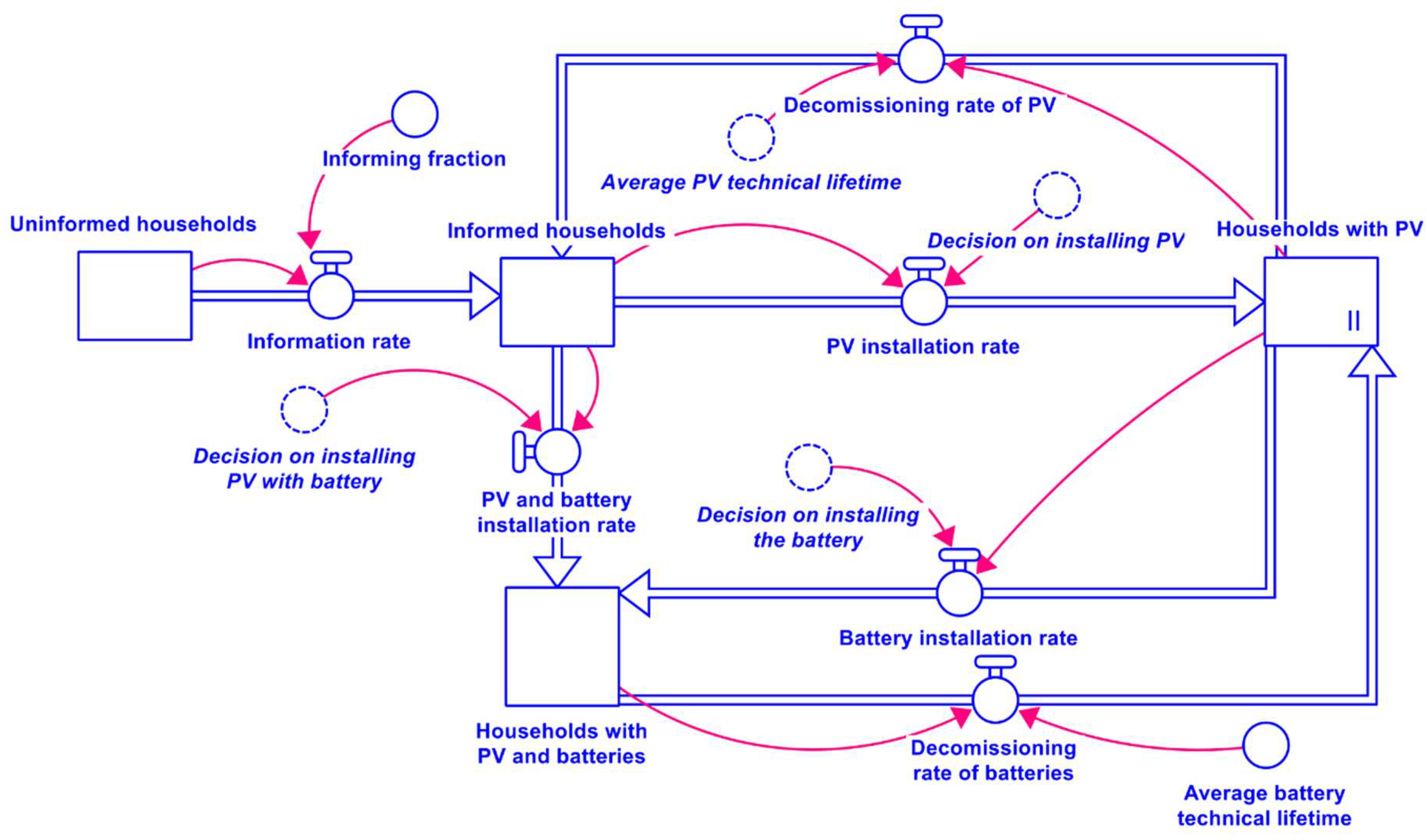
Figure 2.
Decision making sub-model.
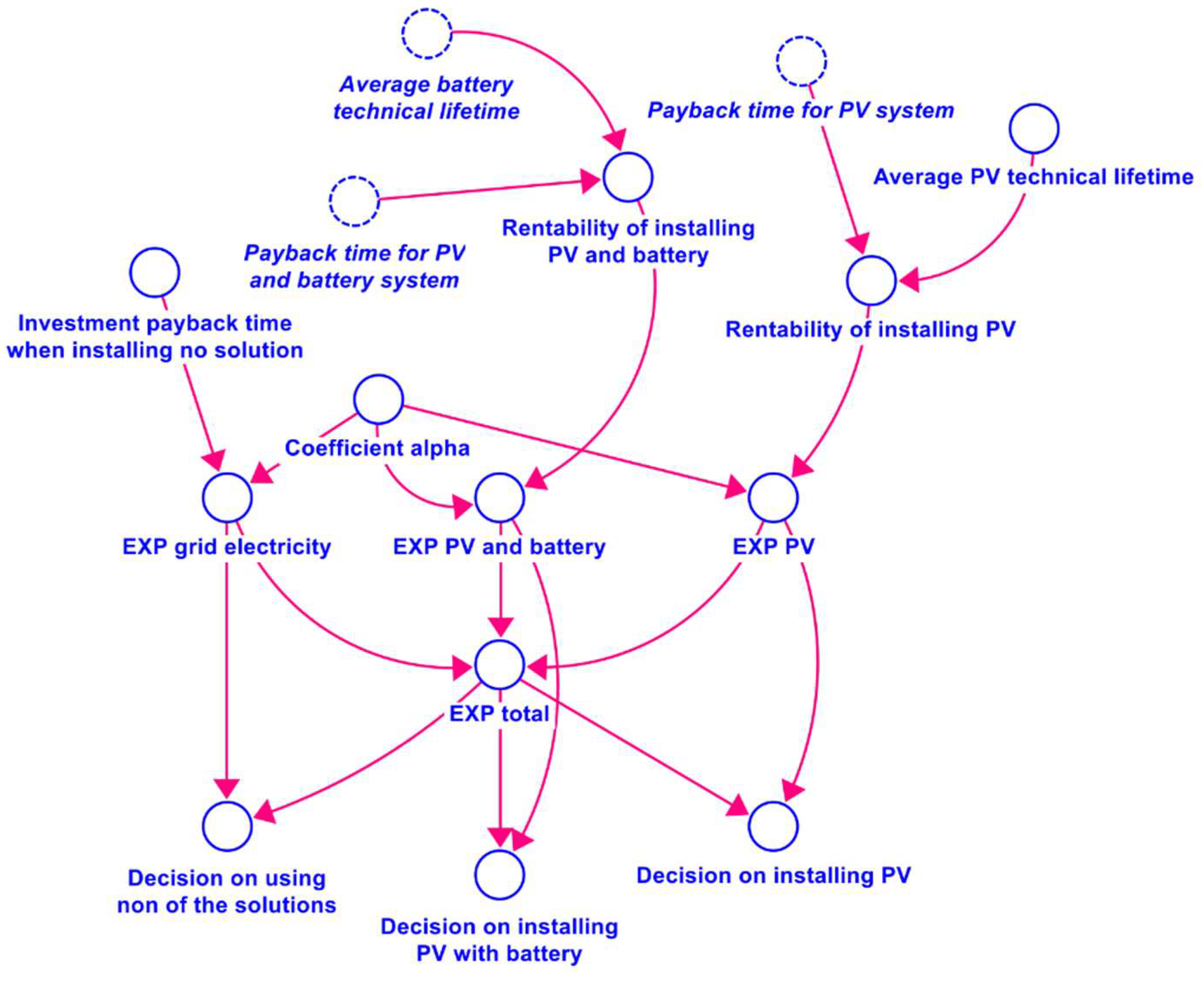
Figure 3.
Payback time calculation sub-model.
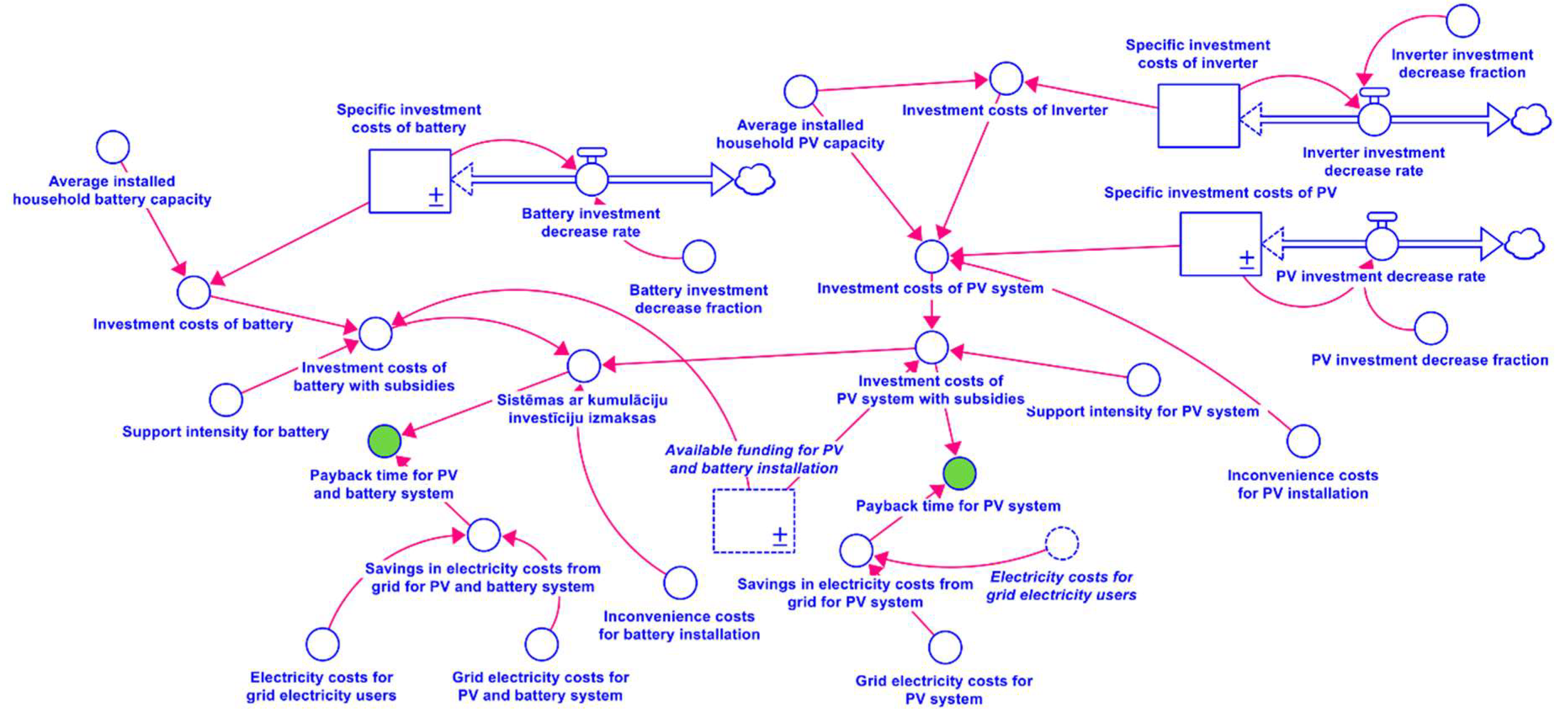
Figure 4.
Support policy scheme sub-model.
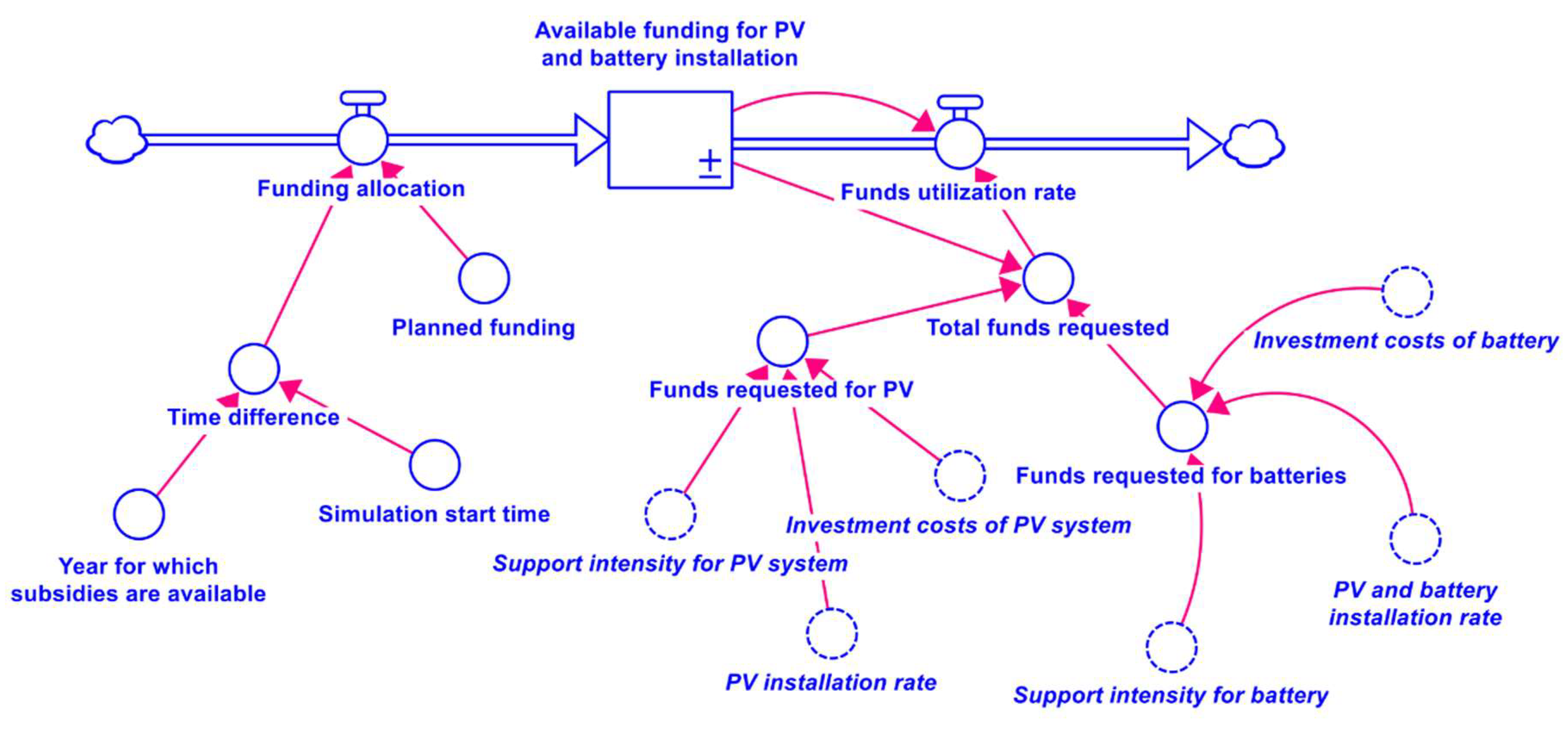
Figure 5.
Model validation with historical data for PV installation.
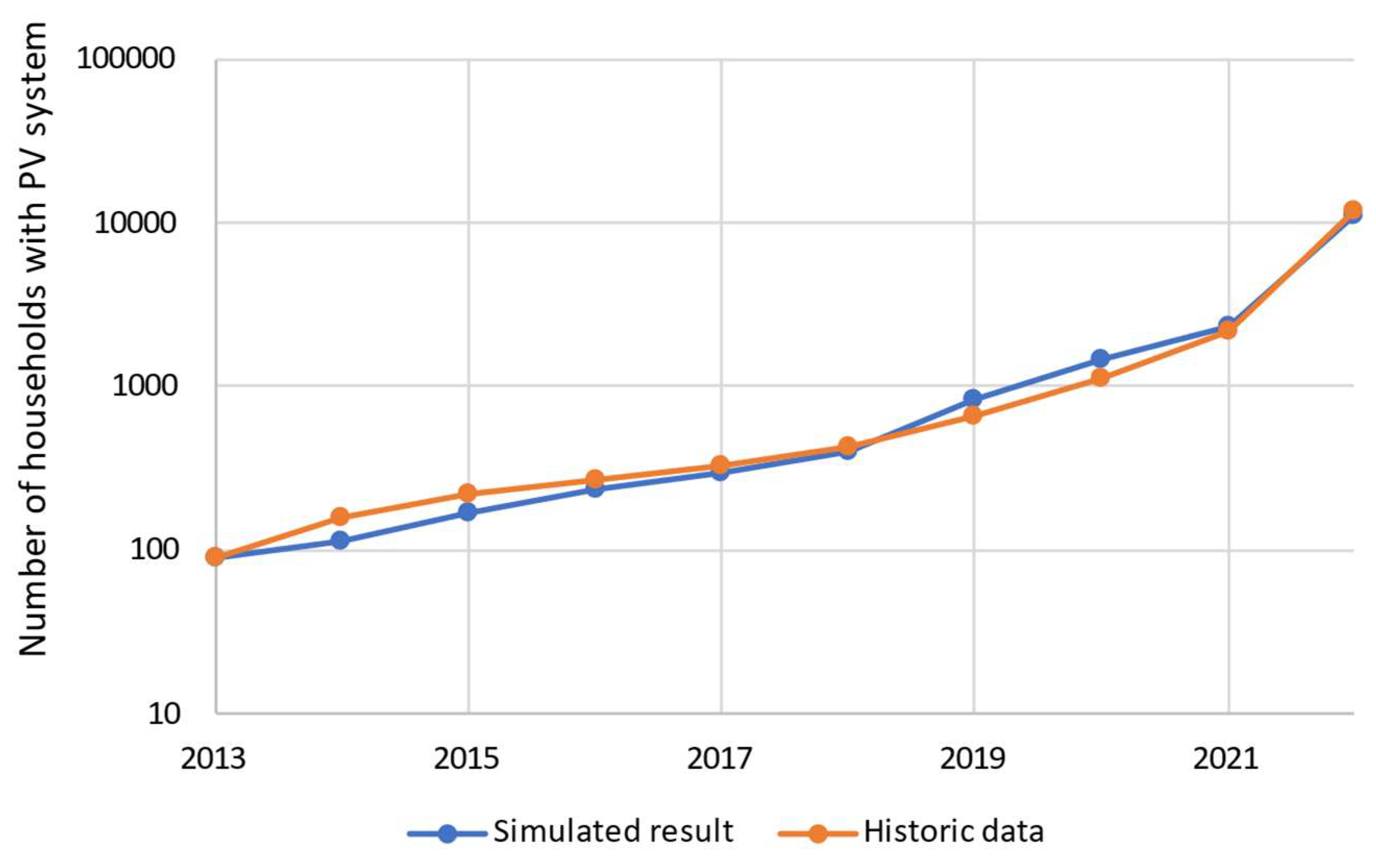
Figure 6.
PV and battery system diffusion based on electricity tariff.
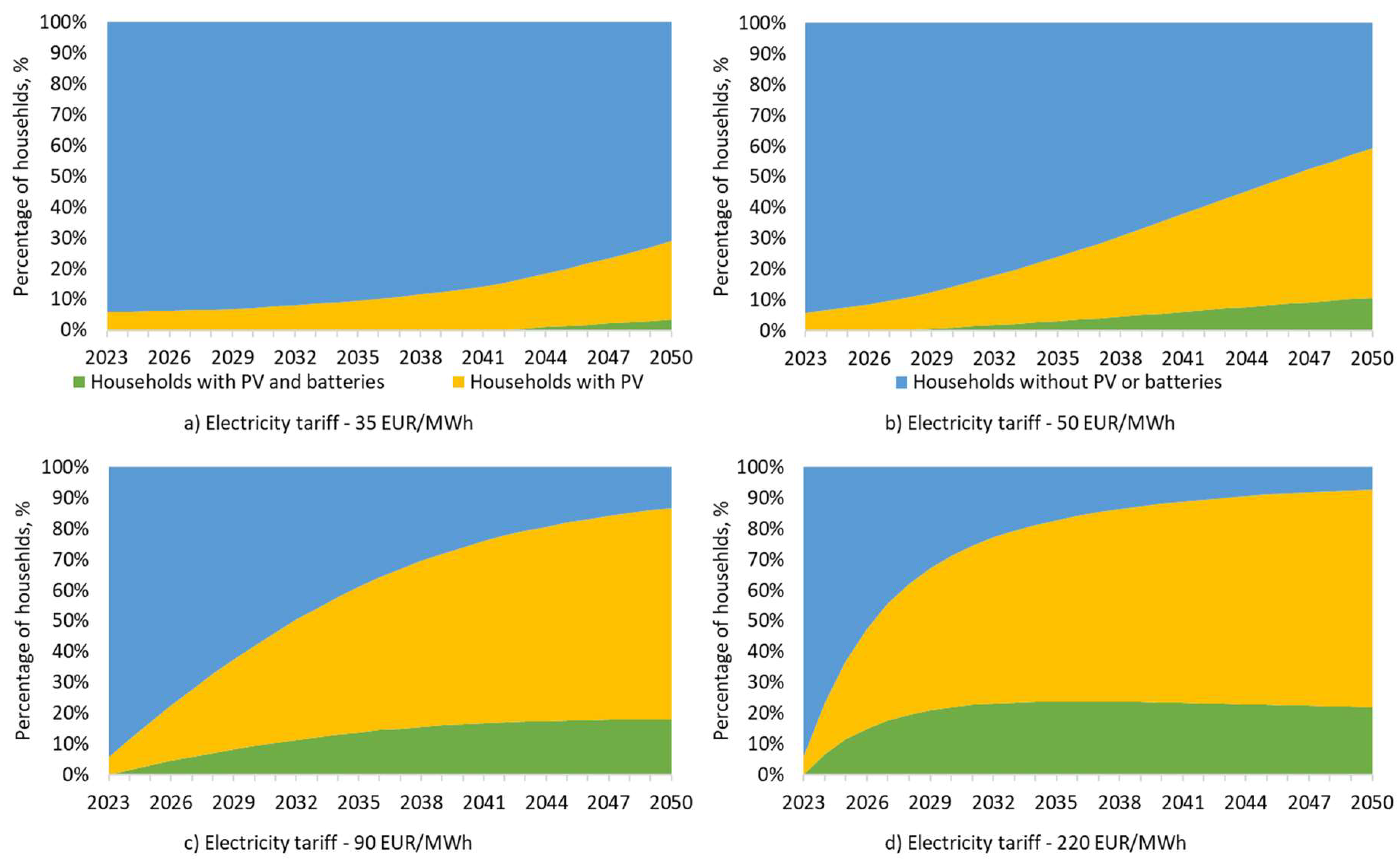
Figure 7.
PV and PV with battery integration in the baseline scenario.
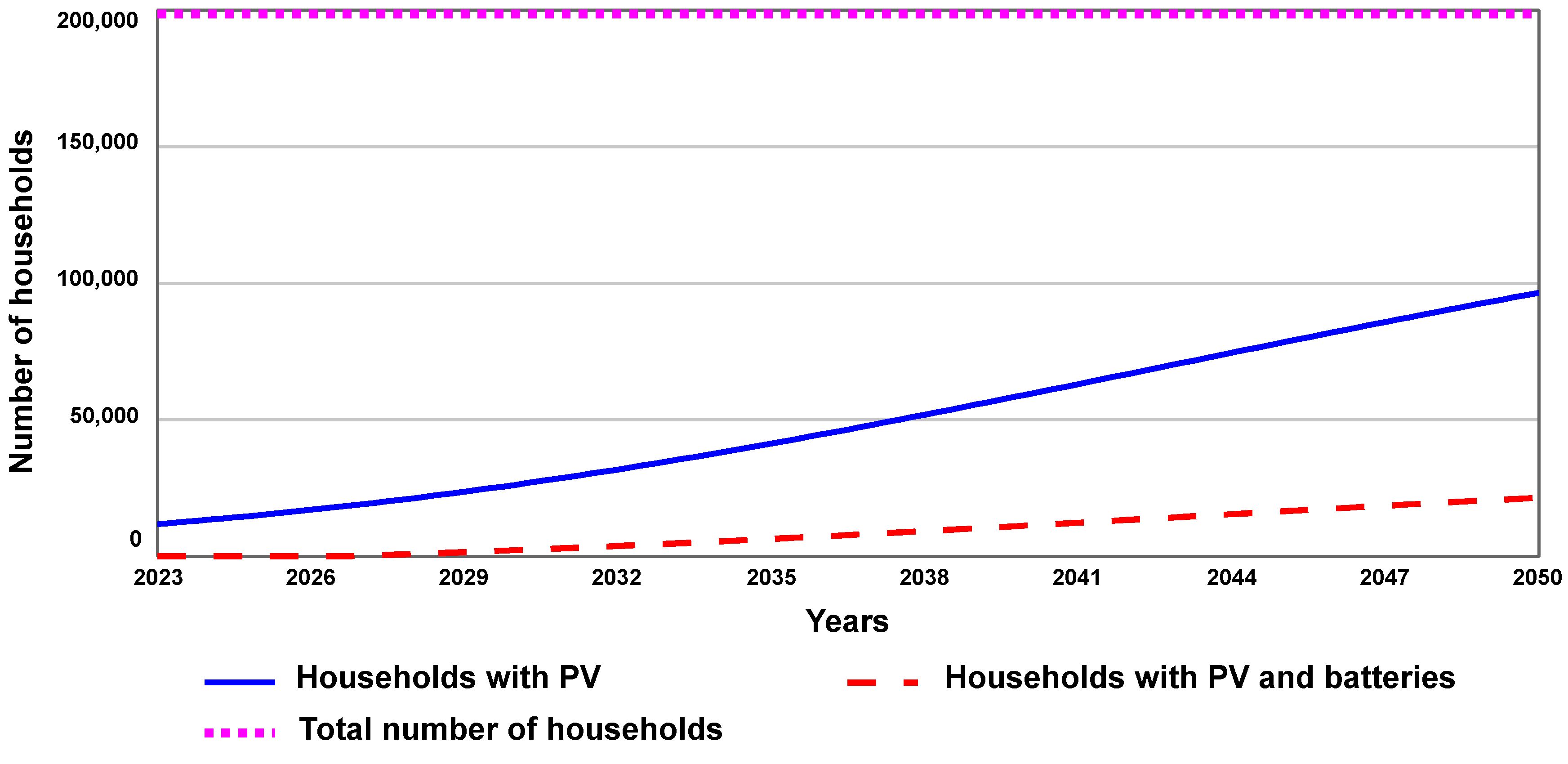
Figure 8.
Model scenario comparison.
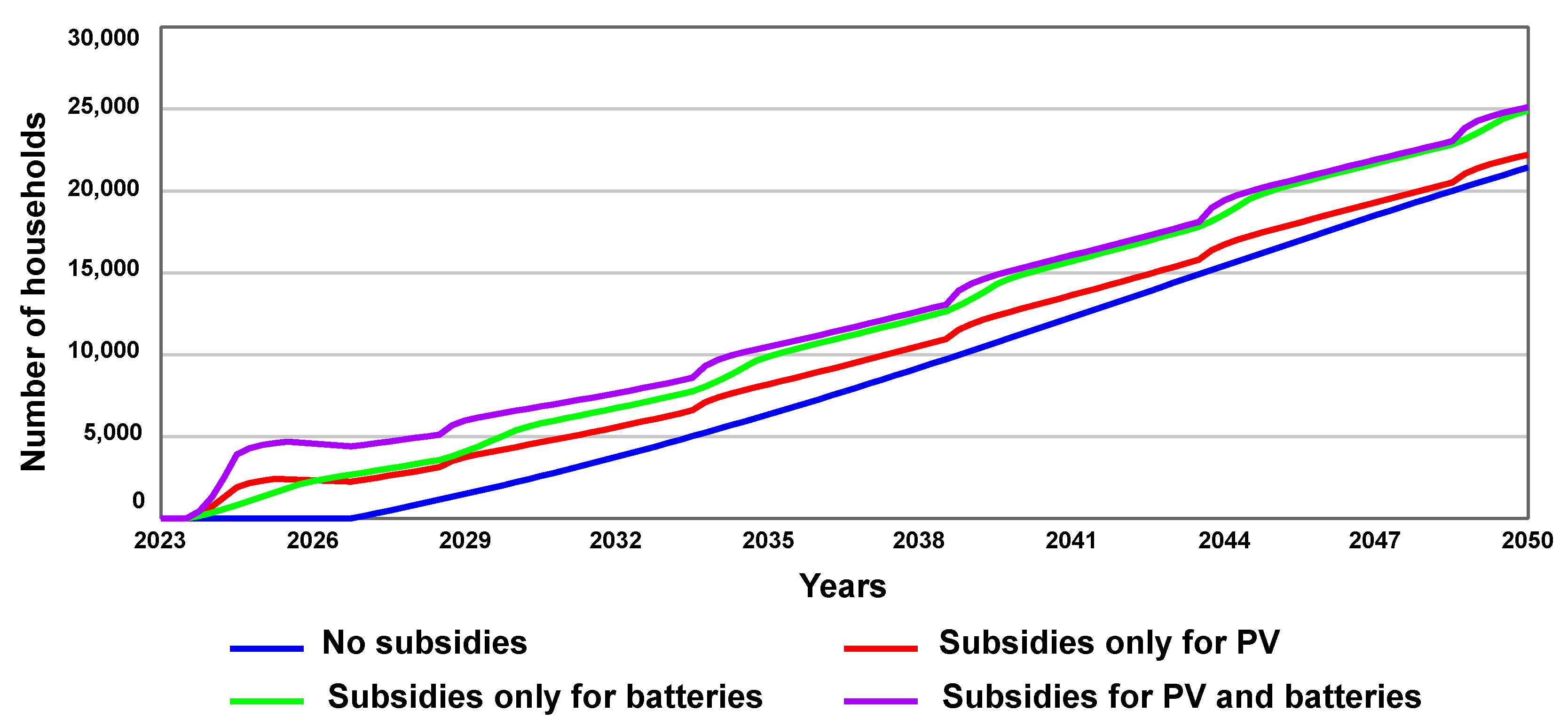
Figure 9.
Sensitivity analysis of electricity tariff on battery storage installation (Tariff interval: 30 – 150 EUR per MWh).
Figure 9.
Sensitivity analysis of electricity tariff on battery storage installation (Tariff interval: 30 – 150 EUR per MWh).
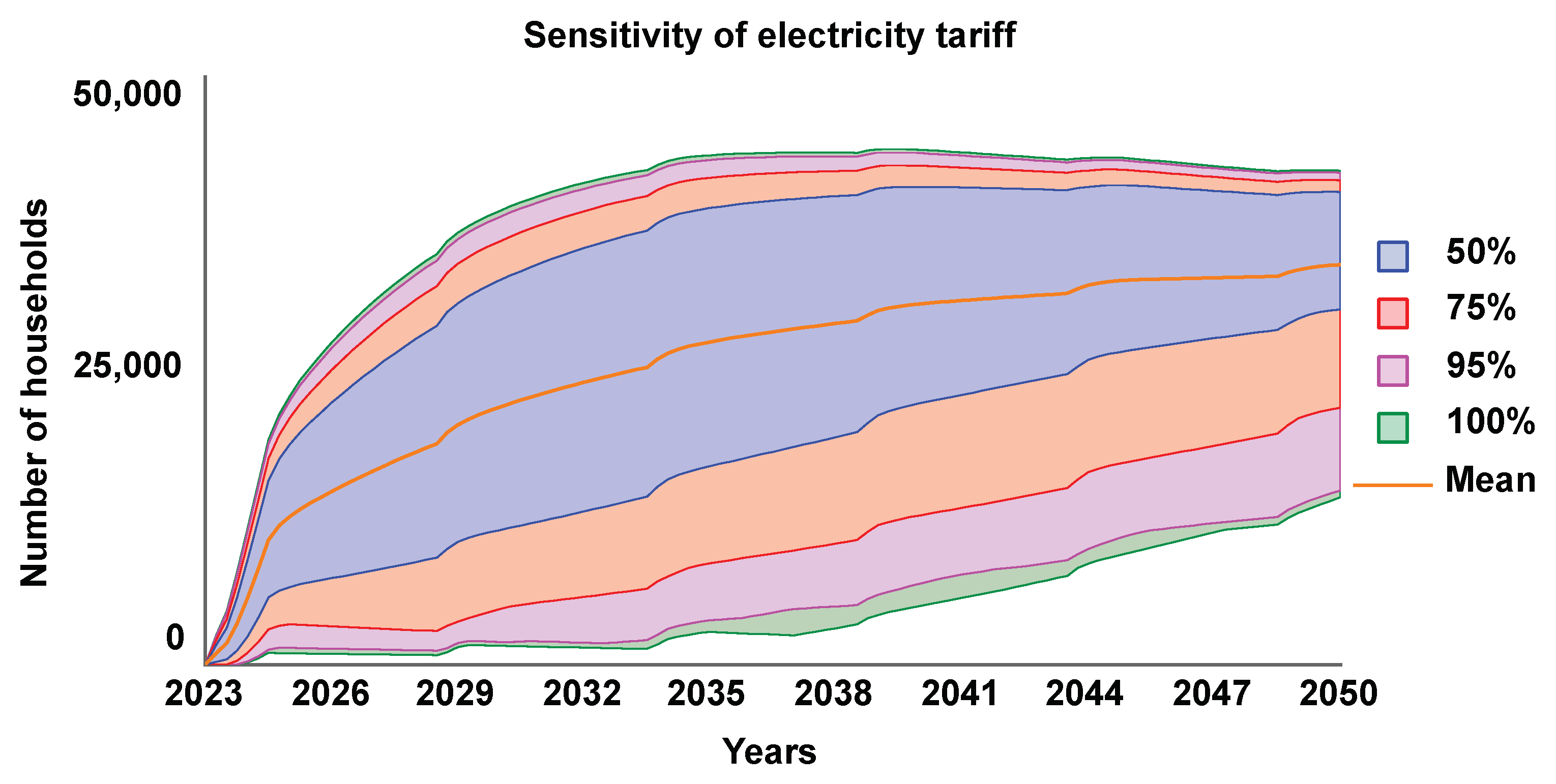
Figure 10.
Sensitivity analysis of battery technical lifetime on battery storage installation (Technical lifetime interval: 10 – 30 years).
Figure 10.
Sensitivity analysis of battery technical lifetime on battery storage installation (Technical lifetime interval: 10 – 30 years).
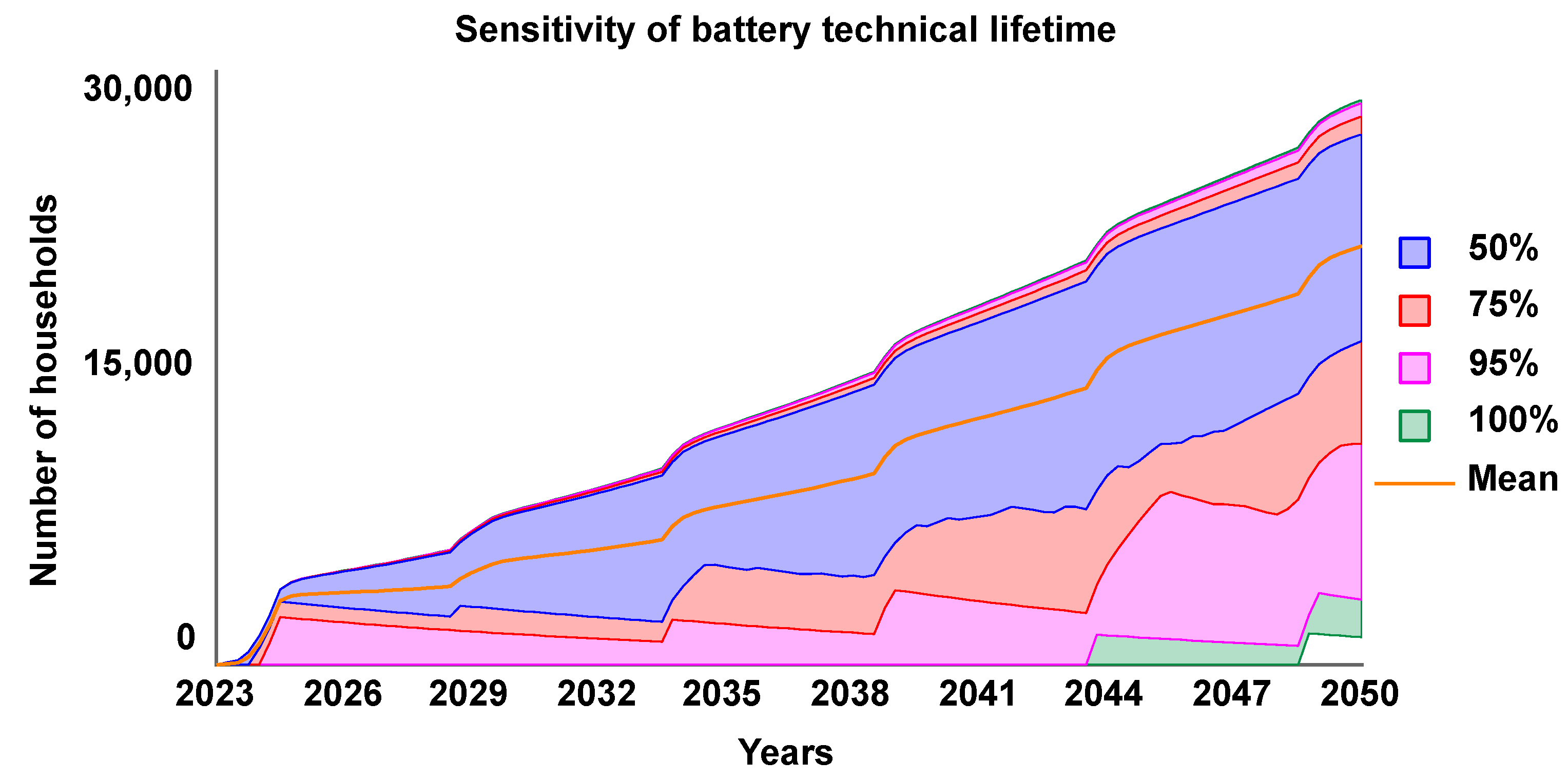
Figure 11.
Sensitivity analysis of initial investment on battery storage installation (Initial investment interval: 600 – 1000 EUR per kWh).
Figure 11.
Sensitivity analysis of initial investment on battery storage installation (Initial investment interval: 600 – 1000 EUR per kWh).
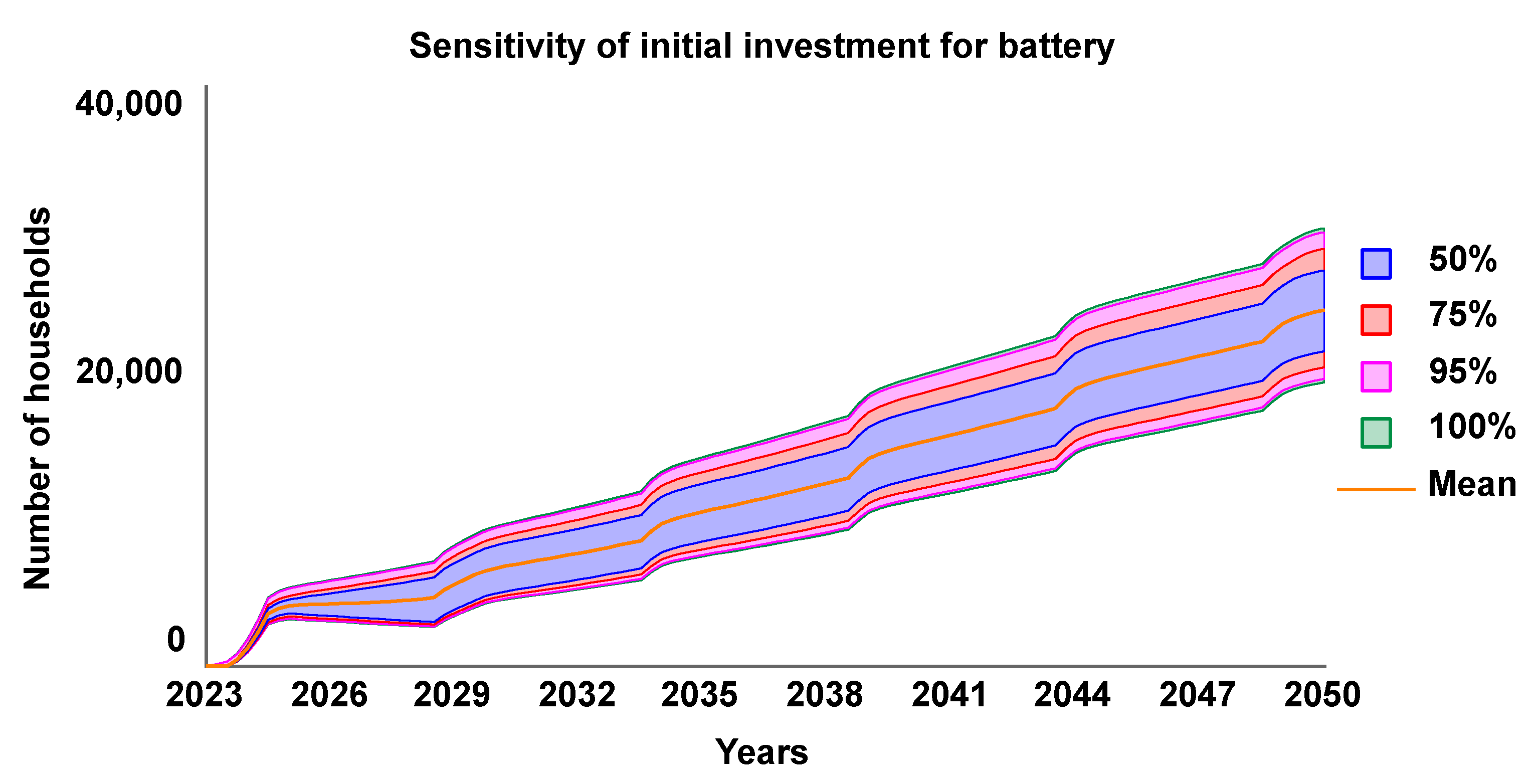
Figure 12.
Sensitivity analysis of battery investment decrease fraction on battery storage installation (Battery investment decrease fraction interval: 0.5 – 3 % per year).
Figure 12.
Sensitivity analysis of battery investment decrease fraction on battery storage installation (Battery investment decrease fraction interval: 0.5 – 3 % per year).
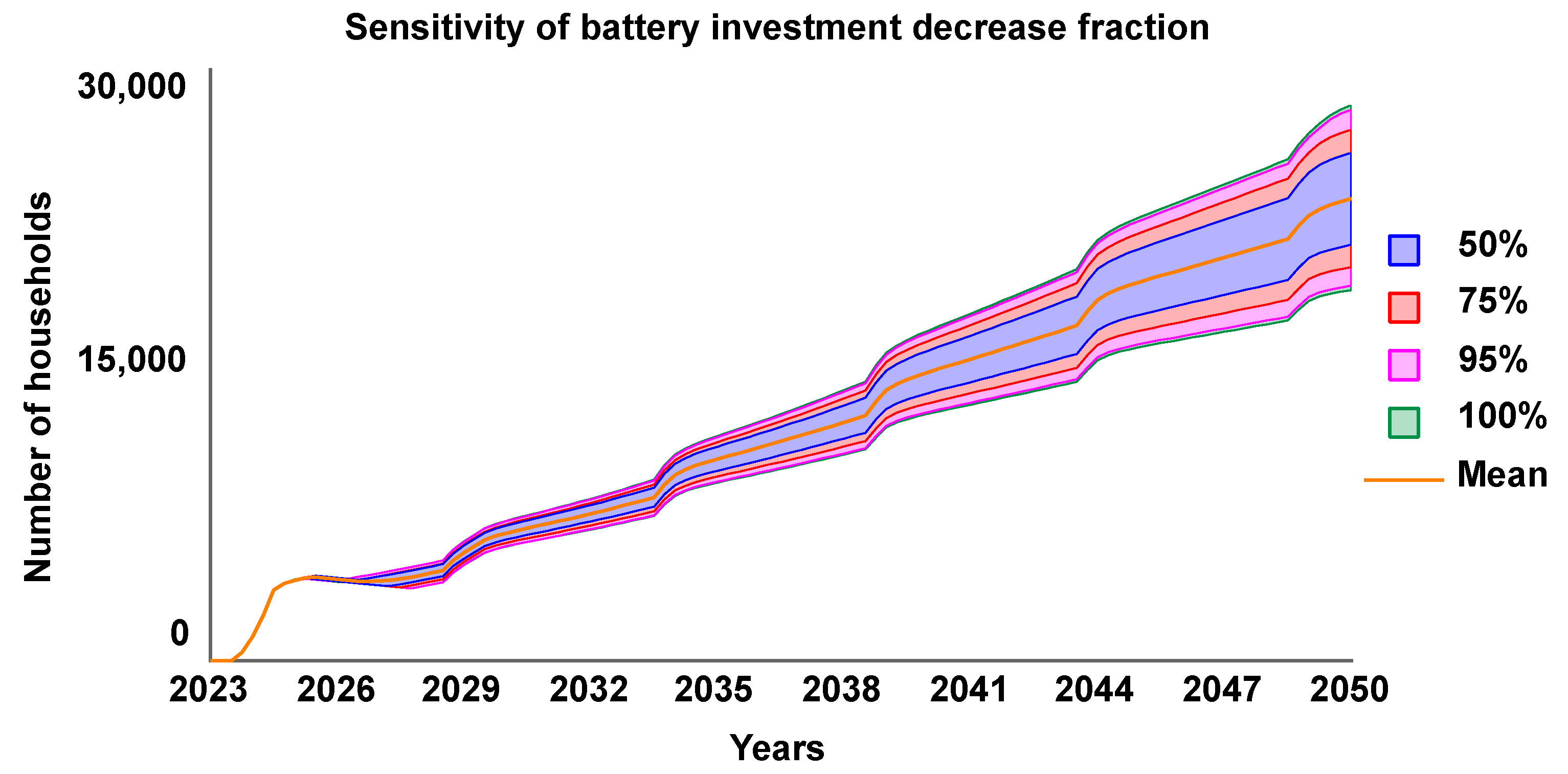

Table 1.
Model input parameters.
| Parameter | Value | Unit | Reference |
| PV investment cost (with installation) | 1100 | EUR/kW | [31] |
| Inverter investment cost | 100 | EUR/kW | [31] |
| Battery investment cost | 800 | EUR/kWh | [32] |
| Average installed household PV capacity | 8 | kW | [33] |
| Average installed household battery capacity | 5 | kWh | [34] |
| Average PV technical lifetime | 35 | years | [31] |
| Average battery technical lifetime | 20 | years | [31] |
| Number of one-family households | 198 541 | number | [35] |
| Number of households with PV | 11 764 | number | [33] |
Table 2.
NordPool yearly average electricity price for Latvia.
| 2013 | 2014 | 2015 | 2016 | 2017 | 2018 | 2019 | 2020 | 2021 | 2022 | |
|---|---|---|---|---|---|---|---|---|---|---|
| Average electricity price | 48.40 | 50.12 | 41.85 | 36.10 | 34.68 | 49.90 | 46.28 | 34.07 | 88.77 | 226.92 |
Table 3.
Scenario description.
| Scenario | PV | Batteries | Financing, MEUR | Support intensity, % |
| Baseline | 0 | 0 | ||
| Subsidies 1 | X | 20 | 50 | |
| Subsidies 2 | X | 20 | 50 | |
| Subsidies 3 | X | X | 2 x 20 | 50 |
Table 4.
Parameters for sensitivity analysis.
| Parameter | Unit of measurement | Lowest value | Highest value |
| Electricity tariff | EUR/MWh | 30 | 150 |
| Technical lifetime of battery | Years | 10 | 30 |
| Initial investment of battery | EUR/kWh | 600 | 1000 |
| Battery investment decrease fraction | %/year | 0.5 | 3 |
Disclaimer/Publisher’s Note: The statements, opinions and data contained in all publications are solely those of the individual author(s) and contributor(s) and not of MDPI and/or the editor(s). MDPI and/or the editor(s) disclaim responsibility for any injury to people or property resulting from any ideas, methods, instructions or products referred to in the content. |
© 2023 by the authors. Licensee MDPI, Basel, Switzerland. This article is an open access article distributed under the terms and conditions of the Creative Commons Attribution (CC BY) license (http://creativecommons.org/licenses/by/4.0/).
Copyright: This open access article is published under a Creative Commons CC BY 4.0 license, which permit the free download, distribution, and reuse, provided that the author and preprint are cited in any reuse.


