

Submitted:
14 August 2023
Posted:
16 August 2023
You are already at the latest version
Abstract
Taking advantage of fact that the surface electrons of metallic nanoparticles (NPs) can be effectively released even at a low voltage bias, we demonstrate an improvement in the electrochemical performance of nano-sized Prussian Blue (PB) based secondary batteries by the incorporation of bare Ag or Ni NPs onto the vicinity of the working PB NPs. It is found that the capacity for electrochemical energy storage of the 17-nm-PB-based battery is significantly higher than the capacity of 10-nm-PB-based, 35-nm-PB-based or 46-nm-PB-based batteries. There is a critical PB size for the highest electrochemical energy storage efficiency. The full specific capacity CF of the 17-nm-PB-based battery stabilized to 62 mAh/g after 130 charge-discharge cycles at a working current of IW = 0.03 mA. The addition of 14 mass-percent of Ag NPs in the vicinity of the PB NPs gives rise to a 32% increase in the stabilized CF. A 42% increase in the stabilized CF can be obtained with the addition of 14 mass-percent of Ag NPs on the working electrode of the 35-nm-PB-based battery. An enhancement of CF is also found for electrodes incorporating bare Ni NPs but the effect is smaller.
Keywords:
Rechargeable battery
; Prussian Blue
; Cathode material
; Metallic nanoparticle
; cyclability enhancement
1. Introduction
Although the Li-ion battery has become the most commonly used power source in portable electronic devices, efforts to enhance the cyclability of secondary batteries toward extending their cycle-life and increasing their energy-content continue [1-4]. It is the repeated extraction and restoration of electrochemical energy in the solid electrode that makes a battery reusable. The prerequisite for a solid compound to act as a cathode material for power storage is the existence of lattice sites from which ions can be extracted then reinserted after extraction [5-8]. Prussian Blue analogues (PBAs) with the general chemical formula AM[M′(CN)6] (A, alkali metal; M and M′, transition metal; hereafter denoted as A-MM′) [9,10] have been favored as promising active materials for cathodes [11-15]. The three-dimensional open channels in A-MM′s, enclosed by the MN6-M′C6-MN6-M′C6 octahedral chains along the three crystallographic directions, allow the migration of weakly bonded ions through the channels for energy extraction and restoration [16-23]. The voids for accommodating alkali ions in the open channels of the PBAs are uniformly distributed and spacious enough to receive ions as large as K+. There are two possible redox active sites, Mn+-M(n+1)+ and M′n+-M′(n+1)+, in A-MM′. Theoretically, when fully redox active, each site is capable of providing a specific capacity of 170.8 mAh/g during the charging-recharging cycle [24]. However, most PBAs give a specific capacity that is considerably smaller than 170.8 mAh/g [24], showing that only a portion of the metal ions are actually redox active. A high specific capacity, that can reach 140 mAh/g, has been reported in K-CuFe with a Li ion organic electrolyte, but the capacity decreases significantly with cycling due to the instability of the reduced state [16-19]. Stabilization of the reduced states by the application of a coating of stable K-NiFe onto high-capacity K-CuFe has been demonstrated to improve cycle stability [25]. It has been shown that the capacity of K-NiFe with organic electrolytes does not fade over 100 cycles [26,27]. Various approaches, such as employing nano-sized [27-29], core-shell [26-30], Ni-doped [31], polymer-coated [32-34] or carbon-coated [35] PBA, have been taken to improve cycle stability.
The accommodation of H2O onto A sites and the replacement of M′(CN)6 by (H2O)6 are unavoidable when the co-precipitation method is employed for synthesis. The intake of H2O onto A sites reduces the number of sites available for A+ restoration, while intake onto the M′ sites weakens the redox capability at the M′-C sites. These naturally occurring structural imperfections limit the redox capability of PBA as a cathode material. One way to provide additional electrons to facilitate redox activity in the PBAs is by the incorporation of metallic nanoparticles, where surface electrons are weakly bonded to the NPs. In this study, we demonstrate that the stability of the charging-discharging cycle can be greatly enhanced by the incorporation of capping-free Ag or Ni NPs into the vicinity of Na-FeFe NPs in the cathode compact.
2. Results and Discussion
2.1. Chemical composition
There are two lattice sites in the A-MM′ where H2O can accommodate onto them during the co-precipitation reactions [36]. The M ions in A-MM′ form a face-centered cubic sublattice allowing the accommodation of either M′(CN)6 or (H2O)6 between the two M ions, giving rise to a stoichiometric composition of M[M′(CN)6]1-y[(H2O)6]y. The voids enclosed by the MN6 and M′C6 octahedra can accommodate either A ions or H2O molecules or be left empty, giving a stoichiometric composition of A2x·z(H2O), with 2x + z ≤ 1. Taking A = Na, M = Fe, M′ = Fe and H2O on the O sites in the present PB compounds, gives a constrained stoichiometric composition of Na2xFe[Fe′(CN)6]1-y[(H2O)6]y·z(H2O), with a charge balance of 2x + z ≤ 1 and x + 2 - 3(1-y) = 0 for diffraction pattern refinement. The diffraction patterns were analyzed using the General Structure Analysis System (GSAS) program [37], following the Rietveld profile refining method, assuming a cubic symmetry. Figure 1A,B, 1C and 1D illustrate the observed (crosses) and calculated (solid lines) diffraction patterns of the Na-FeFe synthesized with reaction solutions of 25, 50, 70 and 85 oC, respectively. Giving a chemical composition of Na0.38Fe[Fe(CN)6]0.82[(H2O)6]0.18·0.34H2O (marked Na0.38-FeFe) for the Na-FeFe synthesized at 25 oC, a Na0.41Fe[Fe(CN)6]0.84[(H2O)6]0.16·0.36H2O (marked Na0.41-FeFe) for that synthesized at 50 oC, a Na0.34Fe[Fe(CN)6]0.81[(H2O)6]0.19·0.34H2O (marked Na0.34-FeFe) for that synthesized at 70 oC, and a Na0.36Fe[Fe(CN)6]0.84[(H2O)6]0.16·0.38H2O (marked Na0.36-FeFe) for that synthesized at 85 oC. Figure 2 illustrates the atomic arrangement of Na-FeFe, with 2/8 of the 8c sites and 1/9 of the 24e sites are occupied by H2O. Occupations of H2O onto the 8c or 24e sites will limit the redox capability during the electrochemical processes.
2.2. Particle size
The x-ray diffraction peaks of Na0.38-FeFe are significantly broader in width than those of Na0.36-FeFe (Figure 1A,B), revealing the particles in the Na0.38-FeFe NP assembly are much smaller than those in the Na0.36-FeFe assembly. In addition, the x-ray diffraction peaks of the four Na-FeFe, Ag and Ni NP assemblies appear to be much broader than the instrumental resolution, reflecting the broadening of the peak profiles due to the finite-size effect. The size distributions and mean particle diameters of the NP assemblies were determined by fitting the diffraction peaks to the diffraction profiles of finite sized particles. Taking a Lorentzian diffraction profile of the peak width wi(di) from each nanoparticle of diameter di, the diffraction intensity Ihkl of the (hkl) Bragg reflection at a scattering angle 2θ from a multi-dispersed NP assembly having a log-normal size distribution ni(di) takes the form of [37, 38]
where C is the instrumental scale factor, 2θhkl is the Bragg position of the (hkl) reflection, λ is the x-ray wavelength, dm is the mean particle diameter and σ is the standard deviation of the size distribution of the NP assembly. Figure 1 E–H show the observed (crosses) and calculated (solid lines) {200} and {220} diffraction peak profiles of the Na0.38-FeFe, Na0.41-FeFe, Na0.34-FeFe and Na0.36-FeFe NP assemblies, respectively, obtained from the fits of the diffraction profiles to the expression (1). A mean particle diameter of d = 10(1) nm with a deviation width of σ = 0.45(1) was obtained for the Na0.38-FeFe NP assembly (inset to Figure 1E), d = 17(2) nm with σ = 0.65(1) for the Na0.41-FeFe NP assembly (inset to Figure 1F), d = 35(2) nm with σ = 0.50(2) for the Na0.34-FeFe NP assembly (inset to Figure 1G) and d = 46(2) nm with σ = 0.55(4) for the Na0.36-FeFe NP assembly (inset to Figure 1H). It appears that larger particles were obtained for the Na-FeFe synthesized at a higher reaction temperature. Profile analysis of the x-ray diffraction peaks of the Ag and Ni NP assemblies give d = 7.6(3) nm with σ = 0.65(8) for the Ag NP assembly (Figure 3A) and d = 12.4(3) nm with σ = 0.51(7) for the Ni NP assembly (Figure 3B). The reaction temperature, chemical composition, lattice parameters, mean particle diameter, and deviation width of the size distribution for each of the four Na-FeFe compounds, the Ag NP, and the Ni NP assemblies are listed in Table 1.
2.3. Ultimate size for energy storage
The galvanostatic charge-discharge (GCD) cycles were performed in constant working current IW mode for each cycle. The working electrodes packed using 10, 17, 35 and 46 nm Na-FeFe are labelled 10NFF, 17NFF, 35NFF and 46NFF, respectively. Obvious differences in the GCD profiles are observed for the batteries using different sizes of Na-FeFe in the working electrode. The GCD profiles of the 17NFF battery take the longest in time to complete a cycle, followed by the 35NFF battery, then the 46NFF battery, but the 10NFF battery takes the shortest time (Figure 4A). Among the four batteries studied, the 17NFF battery had the highest energy capacity. The full specific capacity (FSC) CF of 17NFF battery reached 86 mAh/g in the initial cycle at IW = 0.015 mA, but it gradually decayed to 76 mAh/g and then stabilized after 40 GCD cycles (open triangles in Figure 4B). A relatively low CF of 42 mAh/g, which is only 50% that of 17NFF, was obtained for the 10NFF battery (open stars in Figure 4B). The decay profiles of CF with respect to the number of GCD cycles completed for the four batteries are similar. The Na and H2O contents in the four Na-FeFe compounds studied are similar (Table 1). It is mainly the size of Na-FeFe that gives rise to the differences in the GCD behavior. Apparently, there is a size limit to the Na-FeFe NPs for the highest electrochemical energy storage efficiency. The higher energy storage efficiency of the 17NFF battery compared to the 35NFF and 46NFF batteries is a direct result of there being more Na-FeFe particles for dispersal in the working electrode allowing for the receive and release of Li+ ions. On the other hand, the Li+ ions are received and releases at the surfaces of the Na-FeFe NPs facing the anode. The reduction in energy storage efficiency of the 10NFF battery is thus a result of the appearance of a large amount of surface atoms that cannot effectively store Li+ ions. It is the competition between the number of NPs that are available for dispersal over the electrode and the loss of storage capability for the atoms on the surfaces of the NPs that result in the ultimate size limit for electrochemical energy storage by the Na-FeFe NPs.
The full specific capacity CF can be affected by the working current employed in running the GCD cycles. The CF of the two 35NFF batteries, configured using working electrodes with the same set of coatings, were measured employing a sequence of different IW for the GCD cycles (Figure 5). A CF of 84 mAh/g was obtained for the two 35NFF batteries at IW = 0.015 mA. A direct drop in CF appeared whenever the IW was raised. The CF dropped to 60 mAh/g after runs through a series of changes in the IW from 0.015 to 0.03 to 0.06 to 0.09 mA. Remarkably, CF jumped back to 78 mAh/g when the IW was subsequently reduced to 0.015 mA. The behavior of CF with respect to the IW shows that the loss of CF at a high IW is linked to the reduced efficiency in receiving Li+ onto the Na-FeFe. Discharging at a high IW drives the accumulation of more Li+ ions onto the cathode plate rather than entering the Na-FeFe NPs for energy storage, which builds the potential between the cathode and the anode, but with fewer Li+ ions stored in the Na-FeFe NPs.
2.4. Enhanced electrochemical stability
The amount of Ag/Ni NPs added into the electrode is specified in the label for each battery. For example, the label 17NFF+14%Ag indicates a 17NFF battery with an addition of 14 mass percent of Ag NPs onto the working electrode. In the initial stage, represented by the 2nd GCD cycle, the 35NFF+14%Ni battery took 10% longer to complete a GCD cycle than did its counterpart battery 35NFF (dashed lines in Figure 6A). The difference in the time taken to complete a GCD cycle increased to 15% after the completion of 200 GCD cycles (solid lines in Figure 6A). The Coulomb efficiency of nearly 100% obtained for the 2nd GCD cycle was retained after 200 GCD cycles. It appears that the incorporation of Ni NPs onto the working electrode can enhance as well as stabilize the energy capacity stored in the battery.
Two separated peaks are clearly revealed in the dC/dV curves for the initial GCD cycles (dashed lines in Figure 6B). The one at around 3.0 V is from the redox reaction at the Fe3+-N sites, whereas the one at around 3.8 V is from reaction at the Fe2+-C sites. The lower redox efficiency for the Fe2+-C sites reflects a reduction in the redox activity because of the partial occupation of the sites by H2O. The main difference between the dC/dV curves of the 35NFF and 35NFF+14%Ni batteries in the initial stage (dashed lines in Figure 6B), which appears in the high voltage regime, shows that the incorporation of Ni NPs facilitates the redox reactions more on the Fe2+-C sites than on the Fe3+-N sites. As expected, there is a reduction in the redox efficiency at both the Fe2+-C and Fe3+-N sites after 200 GCD cycles, but at a noticeable smaller rate for the 35NFF+14%Ni battery than for the 35NFF battery. The incorporation of Ni NPs in the vicinity of Na0.24-FeFe NPs enhances the GCD cycle stability. This behavior may be understood as arising from the participation of loosely bounded surface electrons of the Ni NPs in the redox reactions with Li+ ions during GCD cycles.
In the initial stage, the full specific capacity CF of the 35NFF+14%Ni battery reached 95 mAh/g, which is 10% higher than the 86 mAh/g of the 35NFF battery (Figure 7A). The CF of both batteries stabilized after 200 GCD cycles. CF of the 35NFF+14%Ni battery reduced to 67 mAh/g, but this was still 15% higher than the 58 mAh/g of the 35NFF battery. The profiles of the decay of CF with respect to the number n of GCD cycles completed of the 35NFF+14%Ni and 35NFF batteries are similar. An enhancement in the capacity is also seen in the batteries with Ag NPs incorporated in the working electrodes. The amount of Ag NPs added to the working electrodes significantly affects the enhancement factor and the decay profile of CF(n) (Figure 7B). The incorporation of 14% Ag NPs enhances the CF by 30%, with the initial CF reaching 110 mAh/g and stabilizing at 78 mAh/g after 30 GCD cycles (open circles and squares in Figure 7B). On the other hand, the CF(n) remains stable for batteries incorporating 25% or 35% Ag NPs onto the working electrode, with the CF remaining around 78 mAh/g (open stars and triangles in Figure 7B). The CF of the three 35NFF+14%Ag, 35NFF+25%Ag and 35NFF+35%Ag batteries stabilized to 78 mAh/g, 44% higher than the 55 mAh/g of the 35NFF battery.
The decay rate of CF(n) is largely reduced when Ag or Ni NPs are added into the working electrodes of the 17 nm Na0.41-FeFe batteries. The CF(n) of the 17NFF battery decayed by 30% (from 88 to 62 mAh/g) before stabilizing after 130 GCD cycles (open squares in Figure 8A). The addition of 14% Ni NPs reduced the decay in CF(n) to 16% (from 88 to 74 mAh/g) (open triangles and stars in Figure 8A); whereas the addition of 14% Ag NPs reduced the decay in CF(n) to 7% (from 88 to 82 mAh/g) (open circles in Figure 8A). The higher efficiency in stabilization of CF for the 7.6 nm Ag NPs than for the 12.4 nm Ni NPs arises from there being more surface electrons available for redox reactions of Li+ ions in the Ag NPs than in the Ni NPs.
A lower working current gives rise to a higher energy storage rate is also seen in the 17 nm Na0.41-FeFe batteries with and without the addition of Ag/Ni NPs onto the working electrodes. A higher CF for the 17NFF+14%Ag than for the 17NFF+14%Ni than for the 17NFF is revealed regardless of the IW employed (Figure 8B). The CF of the 17NFF+14%Ag battery stabilized from 88 to 81 mAh/g after 130 GCD cycles when IW = 0.03 mA was employed from the initial cycle (open circles in Figure 8A). On the other hand, it was reduced from 135 to 101 mAh/g after 5 GCD cycles with IW = 0.015 mA, but then dropped directly to 79 mAh/g once the IW was raised to 0.03 mA at the 6th GCD cycle, then further dropped to 61 and 52 mAh/g at IW = 0.06 and 0.09 mA, respectively (open triangles in Figure 8B). The CF jumped back to 101 mAh/g once the IW was again reduced to 0.015 mA. This behavior of a lower IW which gives rise to a higher CF with a larger decay in CF was also observed in the 17NFF+14%Ni and 17NFF batteries (filled circles and open squares in Figure 8B).
3. Materials and methods
3.1. Synthesis of Prussian Blue nanoparticles
Four sets of Na-FeFe NPs were synthesized by the co-precipitation method. All reagents were purchased from Alfa-Aesar, Acros-Organics or Nihon-Shiyaku and used without further purification. The deionized water used in the synthetic procedures was obtained from a Milli-Q-Gard purification system. Fast PES Bottle Top Filters with a 0.45 μm pore size obtained from Nalgene were used during the synthesis process. Two separate solutions of 0.1M Na4Fe(CN)6 and 0.1M FeCl3 were simultaneously dropped at a rate of 5 sec/drop into deionized water maintained at a temperature of 25, 50, 70 or 85 oC, as illustrated in Figure 9. Each solution was slowly stirred at 200 rpm for another 24 hours after the addition of the reaction solution was completed. The microcrystalline powder was isolated from the solution by centrifugation before being washed and re-dispersed in 100 ml of deionized water. This washing process was repeated for three times before the wet-muddy powder was dried at 95 oC in a vacuum for 24 hrs.
3.2. Synthesis of Ag and Ni nanoparticles
The Ag/Ni NPs were fabricated by employing the gas condensation method [38]. High-purity Ag/Ni ingots (0.6 g, 99.99% pure, ~2 mm in diameter) were heated by a current source of 65/50 A and were evaporated at a rate of 0.05 Å/s in an Ar atmosphere of 1.5 torr. The evaporated particles were collected on a non-magnetic SS316 stainless steel plate placed 20 cm above the evaporation source, maintained at 77 K. After natural cooling to room temperature, the NPs, which were only loosely attached to the collector, were stripped off in a N2 atmosphere. The samples thus fabricated were in powdered form, consisting of macroscopic amounts of individual Ag/Ni NPs.
3.3. X-ray diffraction
The X-ray diffraction measurements were performed on a Bruker D8 ADVANCE diffractometer, employing the reflection geometry with an incident wavelength of λ = 1.5406 Å from a Cu target and collimation slits of 0.3 mm in width before and after the sample position. For each measurement, ~0.1 g of the sample was sharped into a width of ~1 mm to receive the whole of the x-ray beam at all scattering angle.
3.4. Electrochemical experiments
Electrochemical tests were conducted using a CR2032 coin-cell configuration assembled in a N2 atmosphere with H2O and O2 levels both below 0.01 ppm. The circular working electrode (coated onto thin aluminum foil 0.02 mm thick) for Li-ion insertion and extraction contained a uniformly mixed Na-FeFe : Ag/Ni NPs (if applicable) : acetylene-black (AB) : polyvinylidene-fluoride (PVDF) : N-Methyl-pyrrolidone (NMP) slurry (dried in a vacuum at 120 oC for 24 hrs) with mass ratios of 7 : 1 (14%), 1.75 (25%) or 2.45 (35%) : 2 : 1 : 40. Details of the electrode fabrication processes are shown in Figure 10. The mass loading for the electrode is 1.9 mg of Na-FeFe over the circular working area which was 15 mm in diameter and 0.1 mm thick (17.67 mm3 in volume). A piece of porous polypropylene (1.8 mm thick) was used as a separator between the Na-FeFe containing working electrode and lithium metal electrode, which was filled with 1 M of LiPF6 dissolved in mixed ethylene carbonate (EC) and diethyl carbonate (DEC) solutions (1 : 1 v/v %) as the electrolyte. The charge-discharge experiments were performed with a HOKUTO HJSD8 in constant current mode, with a cut-off voltage of 1.5 V for Li-ion insertion and 4.0 V for Li-ion extraction. All capacities are expressed per gram of PB.
4. Conclusions
Prussian Blue with a general chemical formula of NaxFe[Fe′(CN)6]1-y[(H2O)6]y·z(H2O) is demonstrated to be an active cathode material for the electrochemical energy storage. Four sets of Prussian Blue NPs, with mean particle diameters of 11, 17, 35 and 46 nm, were fabricated by co-precipitation of Na4Fe(CN)6 and FeCl3 in deionized water each at a selective temperature. Among these, the 17 nm Na-FeFe NPs had the highest efficiency in terms of electrochemical energy storage when used as the working electrode of a rechargeable battery. There are two redox active Fe2+-C and Fe3+-N sites in Na-FeFe. The unavoidable replacement of Fe(CN)6 by (H2O)6 during the co-precipitation in deionized water limits the redox activity of Na-FeFe when used as a working electrode. We demonstrate that the introduction of bare Ag or Ni NPs in the vicinity of the working Na-FeFe NPs can effectively stabilize the GCD cycles. In particular, the addition of 14 mass percent of 7.6 nm Ag NPs to the vicinity of the 17 nm Na-FeFe NPs could enhance the storage capacity by as much as 32%, and the addition of 14 mass percent of 12.4 nm Ni NPs led to an enhancement in storage capacity of 24%. The storage capacity of Na-FeFe NPs was enhanced by the participation in redox reactions of the weakly bonded surface electrons of the Ag/Ni NPs. It is hence essential to use capping free metallic NPs for effective enhancement.
Author Contributions
W.H.L. and E.B. designed the study; E.B. and M.H.M. synthesized the sample; E.B., M.H.M. and C.C.Y. performed the measurements; E.B., M.H.M., C.C.Y., and W.H.L. analyze all data; all of the authors discussed the results; W.H.L. wrote the manuscript with discussion and input from all of the authors. All authors have read and agreed to the published version of the manuscript.
Funding
This work was supported by the Ministry of Science and Technology of Taiwan under Grant No. MOST 110-2112-M-008-034.
Conflicts of Interest
The authors declare no conflict of interest.
References
- Etacheri, V.; Marom, R.; Elazari, R.; Salitra, G.; Aurbach, D. Challenges in the development of advanced Li-ion batteries: a review. Energy Environ. Sci. 2011, 4, 3243–3262. [Google Scholar] [CrossRef]
- Goodenough, J.B.; Park, K.S. The Li-ion rechargeable battery: a perspective. J. Am. Chem. Soc., 2013, 135, 1167–1176. [Google Scholar] [CrossRef]
- Choi, J.W.; Aurbach, D. Promise and reality of post-lithium-ion batteries with high energy densities. Nat. Rev. Mater. 2016, 1, 1–16. [Google Scholar] [CrossRef]
- Kim, T. , Song, W.; Son, D.Y.; Ono, L.K.; Qi, Y. Lithium-ion batteries: outlook on present, future, and hybridized technologies. J. Mater. Chem. A 2019, 7, 2942–2964. [Google Scholar] [CrossRef]
- Liu, C.; Neale, Z.G.; Cao, G. Understanding electrochemical potentials of cathode materials in rechargeable batteries. Mater. Today 2016, 19, 109–123. [Google Scholar] [CrossRef]
- Dong, C.; Gao, W.; Jin, B.; Jiang, Q. Advances in cathode materials for high-performance lithium-sulfur batteries. iScience 2018, 6, 151–198. [Google Scholar] [CrossRef]
- Liu, Z.; Yuan, X.; Zhang, S.; Wang, J.; Huang, Q.; Yu, N.; Zhu, Y.; Fu, L.; Wang, F.; Chen, Y.; Wu, Y. Three-dimensional ordered porous electrode materials for electrochemical energy storage. NPG Asia Materials 2019, 11, 1–21. [Google Scholar] [CrossRef]
- Khan, S.A.; Ali, S.; Saeed, K.; Usman, M.; Khan, I. Advanced cathode materials and efficient electrolytes for rechargeable batteries: practical challenges and future perspectives. J. Mater. Chem. A 2019, 7, 10159–10173. [Google Scholar] [CrossRef]
- Buser, H.J.; Schwarzenbach, D.; Petter, W.; Ludi, A.J.I.C. The crystal structure of Prussian blue: Fe4[Fe(CN)6]3·xH2O. Inorg. Chem., 1977, 16, 2704–2710. [Google Scholar] [CrossRef]
- Verdaguer, M.; Girolami, G.S. Magnetic Prussian Blue Analogs. In Magnetism: Molecules to Materials V, Wiley, 2004; 283-346.
- Okubo, M.; Asakura, D.; Mizuno, Y.; Kim, J.D.; Mizokawa, T.; Kudo, T.; Honma, I. Switching redox-active sites by valence tautomerism in Prussian blue analogues AxMny[Fe(CN)6]·nH2O (A: K, Rb): Robust frameworks for reversible Li storage. J. Phys. Chem. Lett., 2010, 1, 2063–2071. [Google Scholar] [CrossRef]
- Lu, Y.; Wang, L.; Cheng, J.; Goodenough, J.B. Prussian blue: a new framework of electrode materials for sodium batteries. Chem. Commun., 2012, 48, 6544. [Google Scholar] [CrossRef]
- Pasta, M.; Wessells, C.D.; Huggins, R.A; Cui, Y. A high-rate and long cycle life aqueous electrolyte battery for grid-scale energy storage. Nat. Commun., 2012, 3, 1–7. [Google Scholar] [CrossRef]
- Wang, B.; Han, Y.; Wang, X.; Bahlawane, N.; Pan, H.; Yan, M.; Jiang, Y. Prussian blue analogs for rechargeable batteries. iScience, 2018, 3, 110–133. [Google Scholar] [CrossRef]
- Hurlbutt, K.; Wheeler, S.; Capone, I.; Pasta, M. Prussian blue analogs as battery materials. Joule, 2018, 2, 1950–1960. [Google Scholar] [CrossRef]
- Imanishi, N.; Morikawa, T.; Kondo, J.; Yamane, R.; Takeda, Y.; Yamamoto, O.; Sakaebe, H.; Tabuchi, M. Lithium intercalation behavior of iron cyanometallates. J. Power Sources 1999, 81, 530–534. [Google Scholar] [CrossRef]
- Jayalakshmi, M.; Scholz, F. Performance characteristics of zinc hexacyanoferrate/Prussian blue and copper hexacyanoferrate/Prussian blue solid state secondary cells. J. Power Sources 2000, 91, 217–233. [Google Scholar] [CrossRef]
- Eftekhari, A. Potassium secondary cell based on Prussian blue cathode. J. Power Sources 2004, 126, 221–228. [Google Scholar] [CrossRef]
- Okubo, M.; Asakura, D.; Mizuno, Y.; Kudo, T.; Zhou, H.; Okazawa, A.; Kojima, N.; Ikedo, K.; Mizokawa, T.; Honma, I. Ion-Induced Transformation of Magnetism in a Bimetallic CuFe Prussian Blue Analogue. Angew. Chemie., 2011, 123, 6393–6397. [Google Scholar] [CrossRef]
- Wang, R.Y.; Wessells, C.D.; Huggins, R.A.; Cui, Y. Highly reversible open framework nanoscale electrodes for divalent ion batteries. Nano Lett., 2013, 13, 5748–5752. [Google Scholar] [CrossRef]
- Wang, L.; Lu, Y.; Liu, J.; Xu, M.; Cheng, J.; Zhang, D.; Goodenough, J.B. A superior low-cost cathode for a Na-ion battery. Angew. Chemie, 2013, 52, 2018–2021. [Google Scholar] [CrossRef]
- Pasta, M.; Wessells, C.D.; Liu, N et al. Full open-framework batteries for stationary energy storage. Nat. Commun., 2014, 5, 1–9. [Google Scholar] [CrossRef]
- Mullaliu, A.; Asenbauer, J.; Aquilanti, G.; Passerini, S.; Giorgetti, M. Highlighting the Reversible Manganese Electroactivity in Na-Rich Manganese Hexacyanoferrate Material for Li-and Na-Ion Storage. Small Methods 2020, 4, 1900529. [Google Scholar] [CrossRef]
- Brant, W.R.; Mogensen, R.; Colbin, S.; Ojwang, D.O.; Schmid, S.; Häggström, L.; Ericsson, T.; Jaworski, A.; Pell, A.J.; Younesi, R. Selective control of composition in Prussian white for enhanced material properties. Chem. Mater., 2019, 31, 7203–7211. [Google Scholar] [CrossRef]
- Asakura, D.; Li, C.H.; Mizuno, Y.; Okubo, M.; Zhou, H.; Talham, D.R. Bimetallic cyanide-bridged coordination polymers as lithium ion cathode materials: core@shell nanoparticles with enhanced cyclability. J. Am. Chem. Soc., 2013, 135, 2793–2799. [Google Scholar] [CrossRef]
- Mizuno, Y.; Okubo, M.; Kagesawa, K.; Asakura, D.; Kudo, T.; Zhou, H.; Oh-Ishi, K.; Okazawa, A.; Kojima, N. Precise electrochemical control of ferromagnetism in a cyanide-bridged bimetallic coordination polymer. Inorg. Chem., 2012, 51, 10311–10316. [Google Scholar] [CrossRef]
- Li, C.H.; Nanba, Y.; Asakura, D.; Okubo, M.; Talham, D.R. Li-ion and Na-ion insertion into size-controlled nickel hexacyanoferrate nanoparticles. RSC Adv., 2014, 4, 24955–24961. [Google Scholar] [CrossRef]
- Moo Lee, K.; Tanaka, H.; Ho Kim, K.; Kawamura, M.; Abe, Y.; Kawamoto. Improvement of redox reactions by miniaturizing nanoparticles of zinc Prussian blue analog. Appl. Phys. Lett., 2013, 102, 141901. [Google Scholar] [CrossRef]
- Fiore, M.; Wheeler, S.; Hurlbutt, K.; Capone, I.; Fawdon, J.; Ruffo, R.; Pasta, M. Paving the way toward highly efficient, high-energy potassium-ion batteries with ionic liquid electrolytes. Chem. Mater., 2020, 32, 7653–7661. [Google Scholar] [CrossRef]
- Li, C.H.; Peprah, M.K.; Asakura, D.; Meisel, M.W. , Okubo, M.; Talham, D.R. Stepwise Reduction of Electrochemically Lithiated Core–Shell Heterostructures Based on the Prussian Blue Analogue Coordination Polymers K0.1Cu[Fe(CN)6]0.7·3.5H2O and K0.1Ni[Fe(CN)6]0.7·4.4H2O. Chem. Mater., 2015, 27, 1524–1530. [Google Scholar] [CrossRef]
- Fu, H.; Liu, C.; Zhang, C.; Ma, W.; Wang, K.; Li, Z.; Lu, X.; Cao, G. Enhanced storage of sodium ions in Prussian blue cathode material through nickel doping. J. Mater. Chem. A 2017, 5, 9604–9610. [Google Scholar] [CrossRef]
- Tang, Y.; Zhang, W.; Xue, L.; Ding, X.; Wang, T.; Liu, X.; Liu, J.; Li, X.; Huang, Y. Polypyrrole-promoted superior cyclability and rate capability of NaxFe[Fe(CN)6] cathodes for sodium-ion batteries. J. Mater. Chem. A 2016, 4, 6036–6041. [Google Scholar] [CrossRef]
- Zhang, Q.; Fu, L.; Luan, J.; Huang, X.; Tang, Y.; Xie, H.; Wang, H. Surface engineering induced core-shell Prussian blue@ polyaniline nanocubes as a high-rate and long-life sodium-ion battery cathode. J. Power Sources 2018, 395, 305–313. [Google Scholar] [CrossRef]
- Wang, X.; Wang, B.; Tang, Y.; Xu, B.B.; Liang, C.; Yan, M.; Jiang, Y. Manganese hexacyanoferrate reinforced by PEDOT coating towards high-rate and long-life sodium-ion battery cathode. J. Mater. Chem. A 2020, 8, 3222–3227. [Google Scholar] [CrossRef]
- Jiang, Y.; Yu, S.; Wang, B.; Li, Y.; Sun, W.; Lu, Y.; Yan, M.; Song, B.; Dou, S. Prussian blue@C composite as an ultrahigh-rate and long-life sodium-ion battery cathode. Adv. Funct. Mater., 2016, 26, 5315–5321. [Google Scholar] [CrossRef]
- Lee, C.H.; Wu, C.M.; Batsaikhan, E.; Li, H.C.; Li, C.H.; Peprah, M.K.; Talham, D.R.; Meisel, M.W.; Li, W.H. Complex Magnetic Phases in Nanosized Core@Shell Prussian Blue Analogue Cubes: Rb0.48Co[Fe(CN)6]0.75[(H2O)6]0.25·0.34H2O @K0.36Ni[Cr(CN)6]0.74[(H2O)6]0.26·0.11H2O. J. Phys. Chem. C 2015, 119, 29138–29147. [Google Scholar] [CrossRef]
- Larson, A.C.; Von Dreele, R.B. General Structure Analysis System, Report LAUR 86-748; Los Alamos National Laboratory: Los Alamos, NM, 1994. [Google Scholar]
- B.E. Warren, X-ray Diffraction, Dover Publications: Dover, UK, 251, 1990.
- Li, W.H.; Lee, C.H. Spin polarization and small size effect in bare silver nanoparticles. In Complex Magnetic Nanostructures, Springer, Cham., 195-224, 2017.
Figure 1.
(A)-(D) The observed (crosses) and calculated (solid lines) x-ray diffraction patterns of the Na-FeFe synthesized with reaction solutions at (A) 25 oC, (B) 50 oC, (C) 70 oC and (D) 85 oC, assuming a cubic symmetry for the crystalline structure, giving a chemical composition of Na0.38Fe[Fe(CN)6]0.82[(H2O)6]0.18·0.34H2O for (A), Na0.41Fe[Fe(CN)6]0.84[(H2O)6]0.16·0.36H2O for (B), Na0.34Fe[Fe(CN)6]0.81[(H2O)6]0.19·0.34H2O for (C), and Na0.36Fe[Fe(CN)6]0.84[(H2O)6]0.16·0.38H2O for (D). The differences between the calculated and observed patterns are plotted at the bottom. The solid vertical lines mark the calculated positions of the Bragg reflections of the proposed crystalline structure. (E)-(H) The observed (crosses) and calculated (solid lines) {200}+{220} peak profiles of the Na-FeFe synthesized with reaction solutions at (E) 25 oC, (F) 50 oC, (G) 70 oC and (H) 85 oC, assuming a lognormal size distribution, given a mean particle diameter of d = 10(1) nm with a standard deviation width of σ = 0.45(1) for (E), d = 17(2) nm with σ = 0.65(1) for (F) d = 35(1) nm with σ = 0.50(2) for (G), and d = 46(2) nm with σ = 0.55(4) for (H). The insets show the size distributions obtained from the fits.
Figure 1.
(A)-(D) The observed (crosses) and calculated (solid lines) x-ray diffraction patterns of the Na-FeFe synthesized with reaction solutions at (A) 25 oC, (B) 50 oC, (C) 70 oC and (D) 85 oC, assuming a cubic symmetry for the crystalline structure, giving a chemical composition of Na0.38Fe[Fe(CN)6]0.82[(H2O)6]0.18·0.34H2O for (A), Na0.41Fe[Fe(CN)6]0.84[(H2O)6]0.16·0.36H2O for (B), Na0.34Fe[Fe(CN)6]0.81[(H2O)6]0.19·0.34H2O for (C), and Na0.36Fe[Fe(CN)6]0.84[(H2O)6]0.16·0.38H2O for (D). The differences between the calculated and observed patterns are plotted at the bottom. The solid vertical lines mark the calculated positions of the Bragg reflections of the proposed crystalline structure. (E)-(H) The observed (crosses) and calculated (solid lines) {200}+{220} peak profiles of the Na-FeFe synthesized with reaction solutions at (E) 25 oC, (F) 50 oC, (G) 70 oC and (H) 85 oC, assuming a lognormal size distribution, given a mean particle diameter of d = 10(1) nm with a standard deviation width of σ = 0.45(1) for (E), d = 17(2) nm with σ = 0.65(1) for (F) d = 35(1) nm with σ = 0.50(2) for (G), and d = 46(2) nm with σ = 0.55(4) for (H). The insets show the size distributions obtained from the fits.
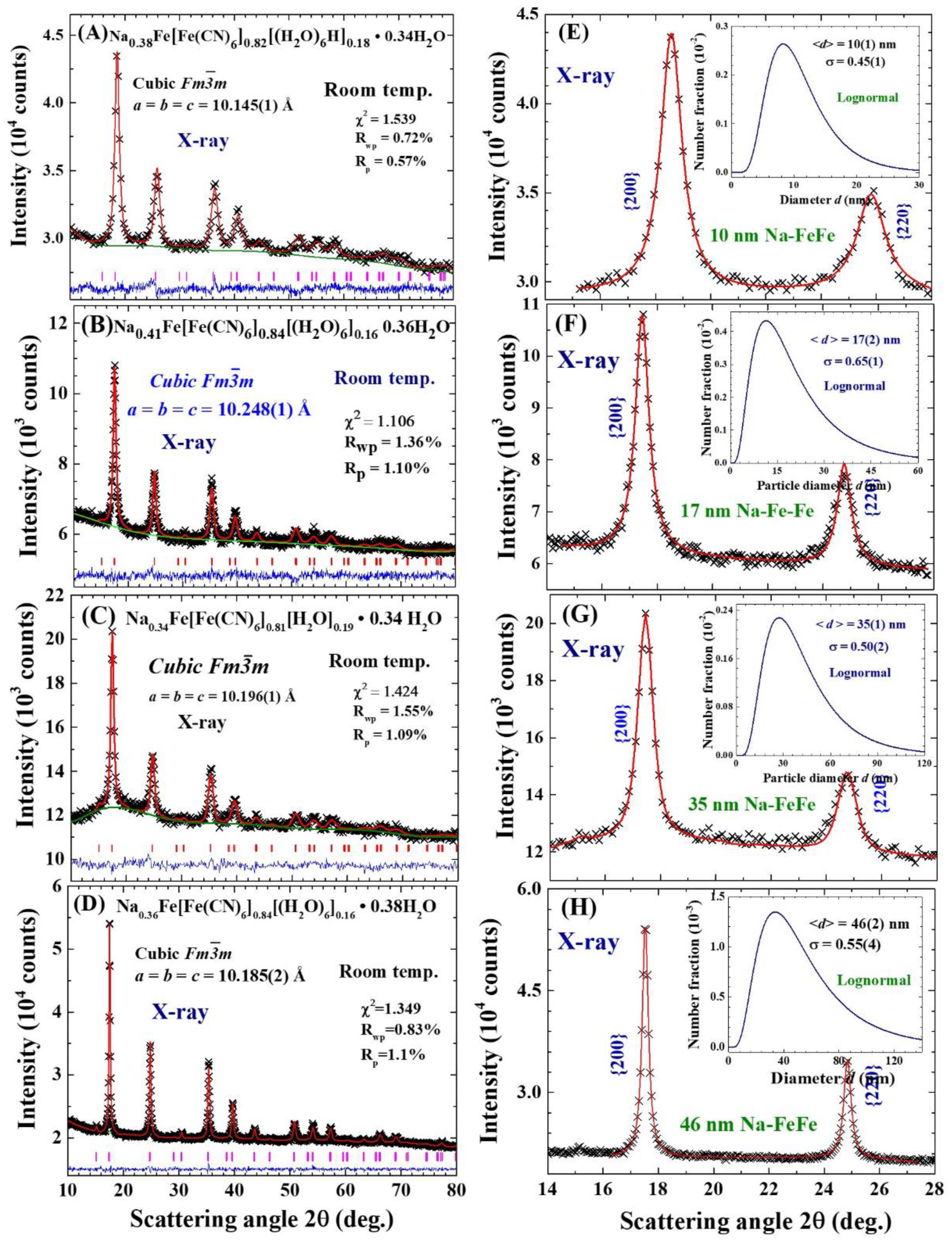
Figure 2.
Schematic drawing of the crystalline structure of the Na-FeFe, with 2/8 of the 8c sites and 1/9 of the 24e sites occupied by H2O. This structure of PB can be viewed, when there is no atomic deficiency, as consisting of Fe-N-C-Fe-C-N-Fe chains along the three crystallographic axis directions.
Figure 2.
Schematic drawing of the crystalline structure of the Na-FeFe, with 2/8 of the 8c sites and 1/9 of the 24e sites occupied by H2O. This structure of PB can be viewed, when there is no atomic deficiency, as consisting of Fe-N-C-Fe-C-N-Fe chains along the three crystallographic axis directions.
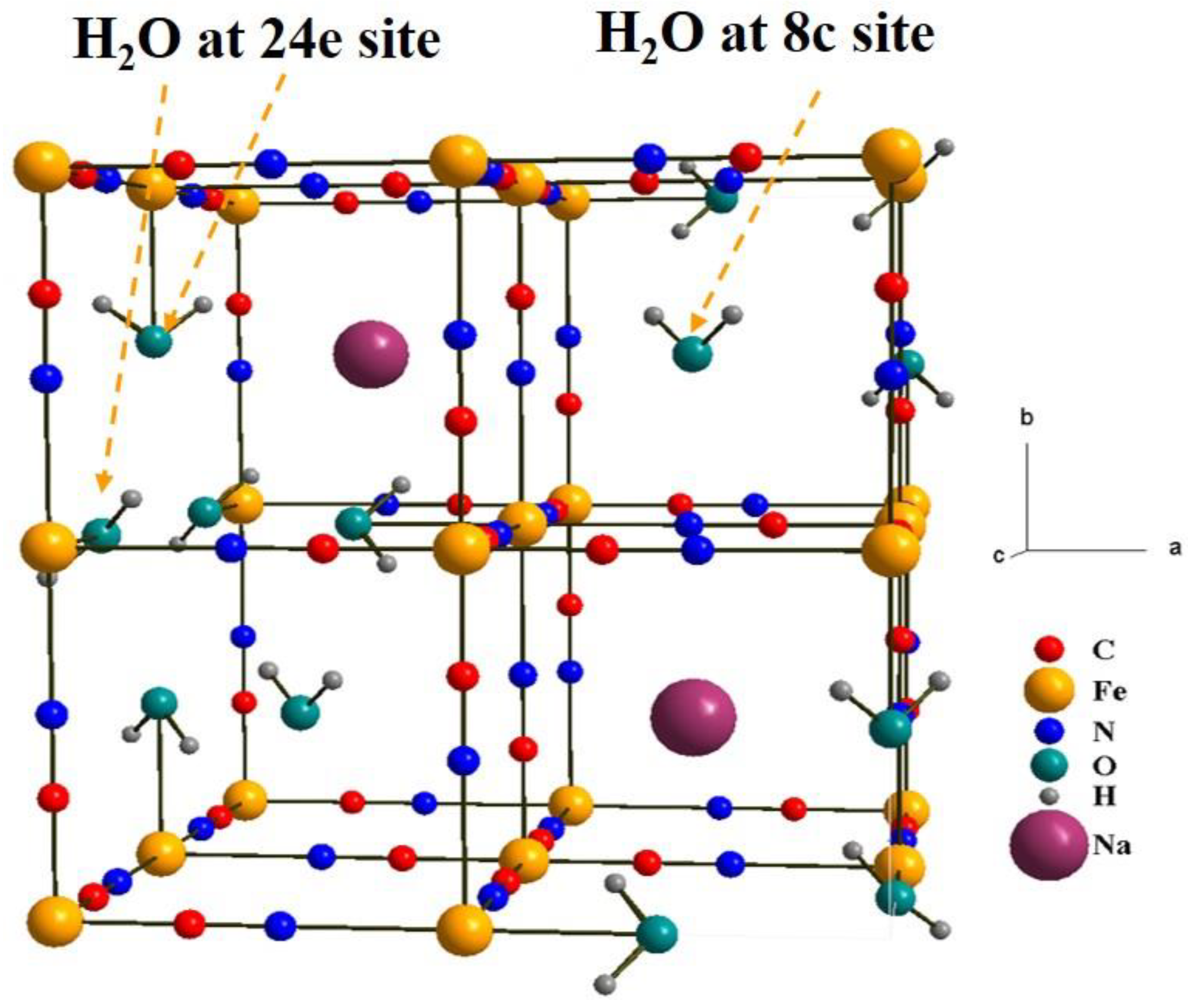
Figure 3.
The {111}+{200} peak profiles of the (A) Ag and (B) Ni NP assemblies obtained at room temperature. The solid lines indicate the calculated diffraction profiles, assuming a lognormal size distribution, as shown in the insets, revealing mean particle diameters of 7.6(3) nm for the Ag NP assembly and 12.4(3) nm for the Ni NP assembly. The insets show the size distributions obtained from the fits.
Figure 3.
The {111}+{200} peak profiles of the (A) Ag and (B) Ni NP assemblies obtained at room temperature. The solid lines indicate the calculated diffraction profiles, assuming a lognormal size distribution, as shown in the insets, revealing mean particle diameters of 7.6(3) nm for the Ag NP assembly and 12.4(3) nm for the Ni NP assembly. The insets show the size distributions obtained from the fits.
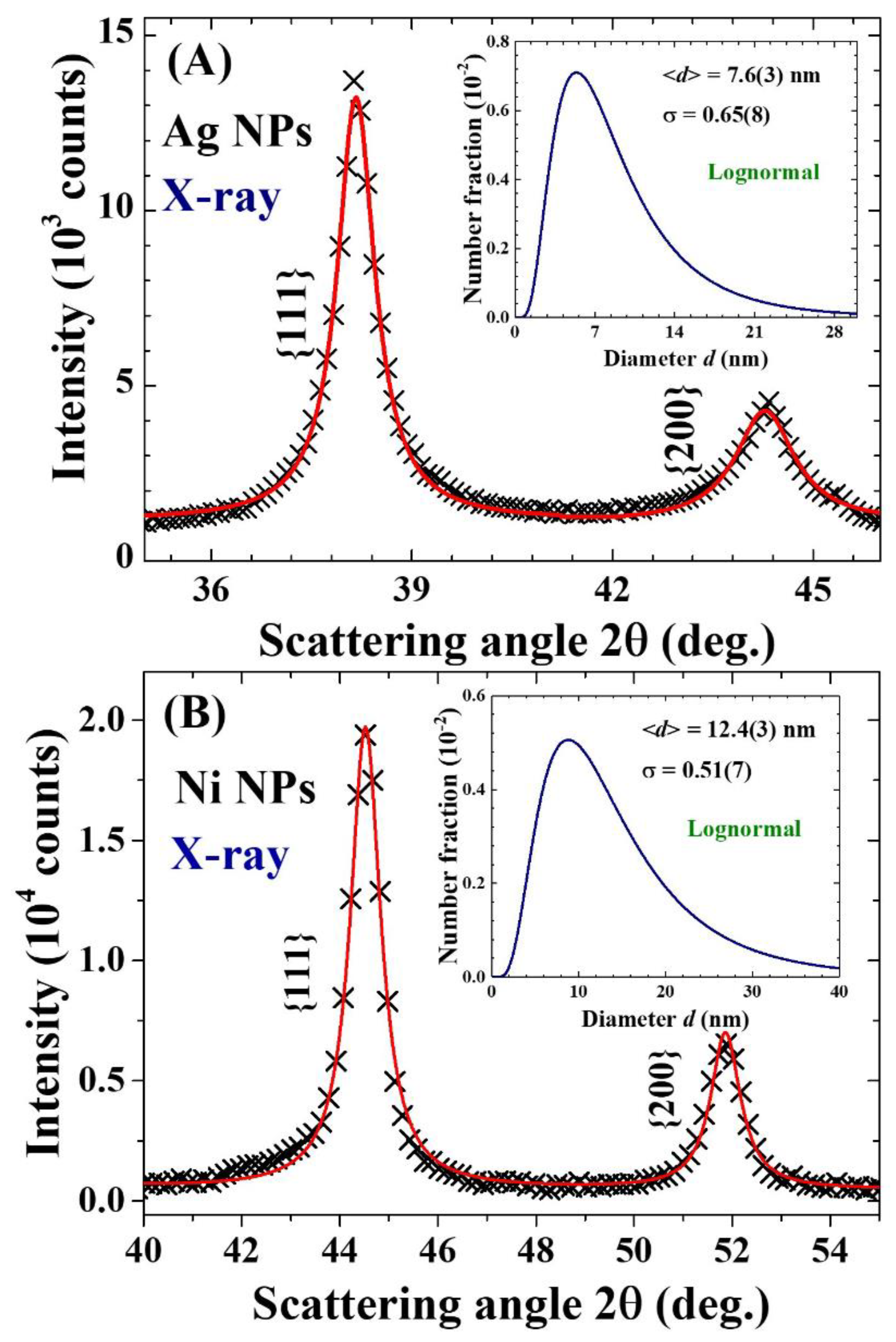
Figure 4.
(A) Comparison of charge-discharge profiles of the 17NFF (dotted dashed lines), 35NFF (black solid lines), 46NFF (dashed lines) and 10NFF (blue solid lines) batteries. The 17NFF battery takes the longest time to complete a cycle, whereas the 10NFF takes the shortest. (B) Direct comparisons between the decay profiles CF(n) of the 17NFF (open triangles), 35NFF (open circles), 46NFF (open squares) and 10NFF (open stars) batteries at IW = 0.015 mA. All four batteries have similar decay profiles CF(n).
Figure 4.
(A) Comparison of charge-discharge profiles of the 17NFF (dotted dashed lines), 35NFF (black solid lines), 46NFF (dashed lines) and 10NFF (blue solid lines) batteries. The 17NFF battery takes the longest time to complete a cycle, whereas the 10NFF takes the shortest. (B) Direct comparisons between the decay profiles CF(n) of the 17NFF (open triangles), 35NFF (open circles), 46NFF (open squares) and 10NFF (open stars) batteries at IW = 0.015 mA. All four batteries have similar decay profiles CF(n).
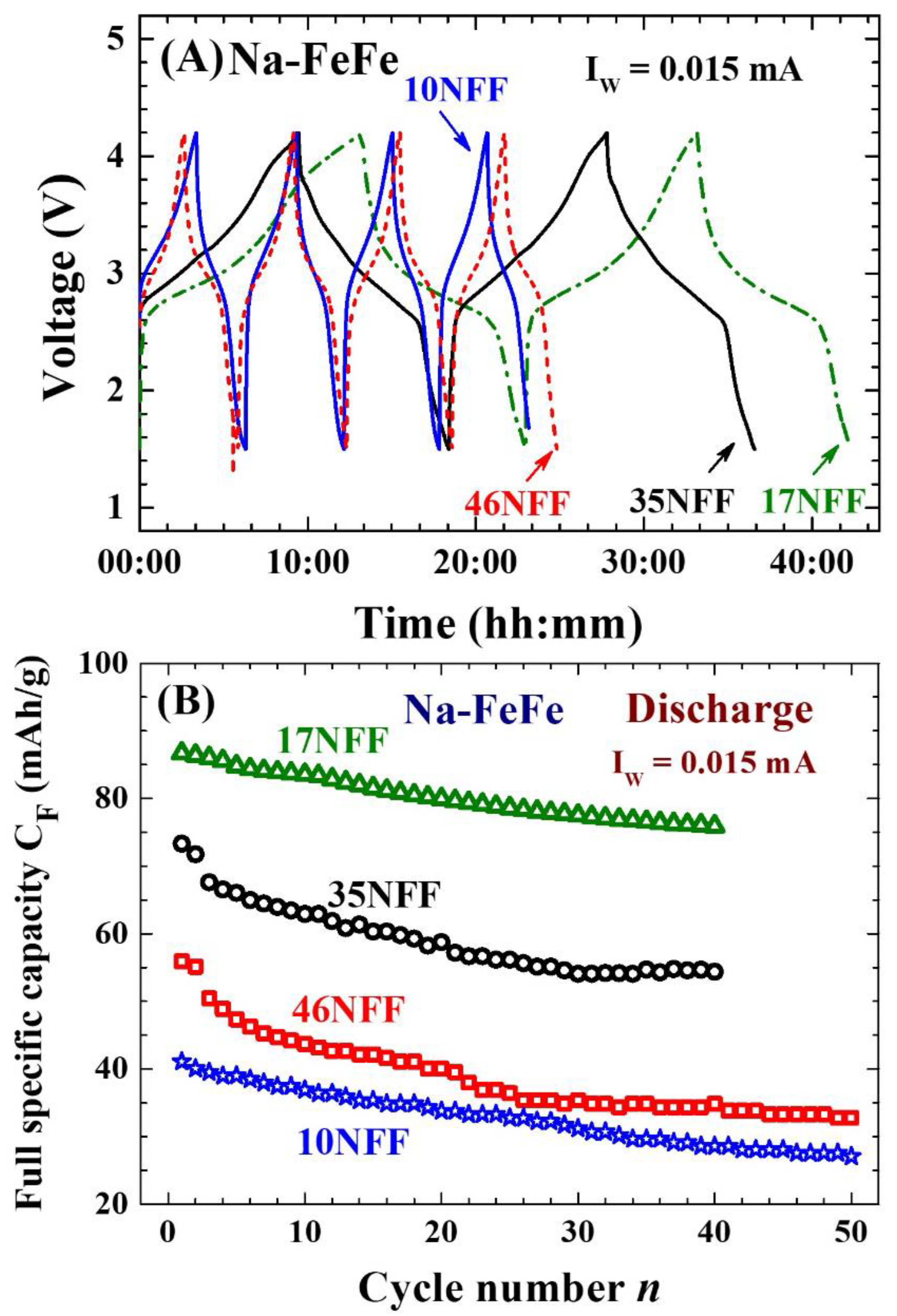
Figure 5.
Variations of full specific capacity CF on the working current IW employed in the charge-discharge cycles. The CF drops from 86 to 60 mAh/g as the IW increases from 0.015 to 0.03 to 0.06 to 0.09 mA, but jumps back to 78 mAh/g once the working current is subsequently reduced to 0.015 mA.
Figure 5.
Variations of full specific capacity CF on the working current IW employed in the charge-discharge cycles. The CF drops from 86 to 60 mAh/g as the IW increases from 0.015 to 0.03 to 0.06 to 0.09 mA, but jumps back to 78 mAh/g once the working current is subsequently reduced to 0.015 mA.
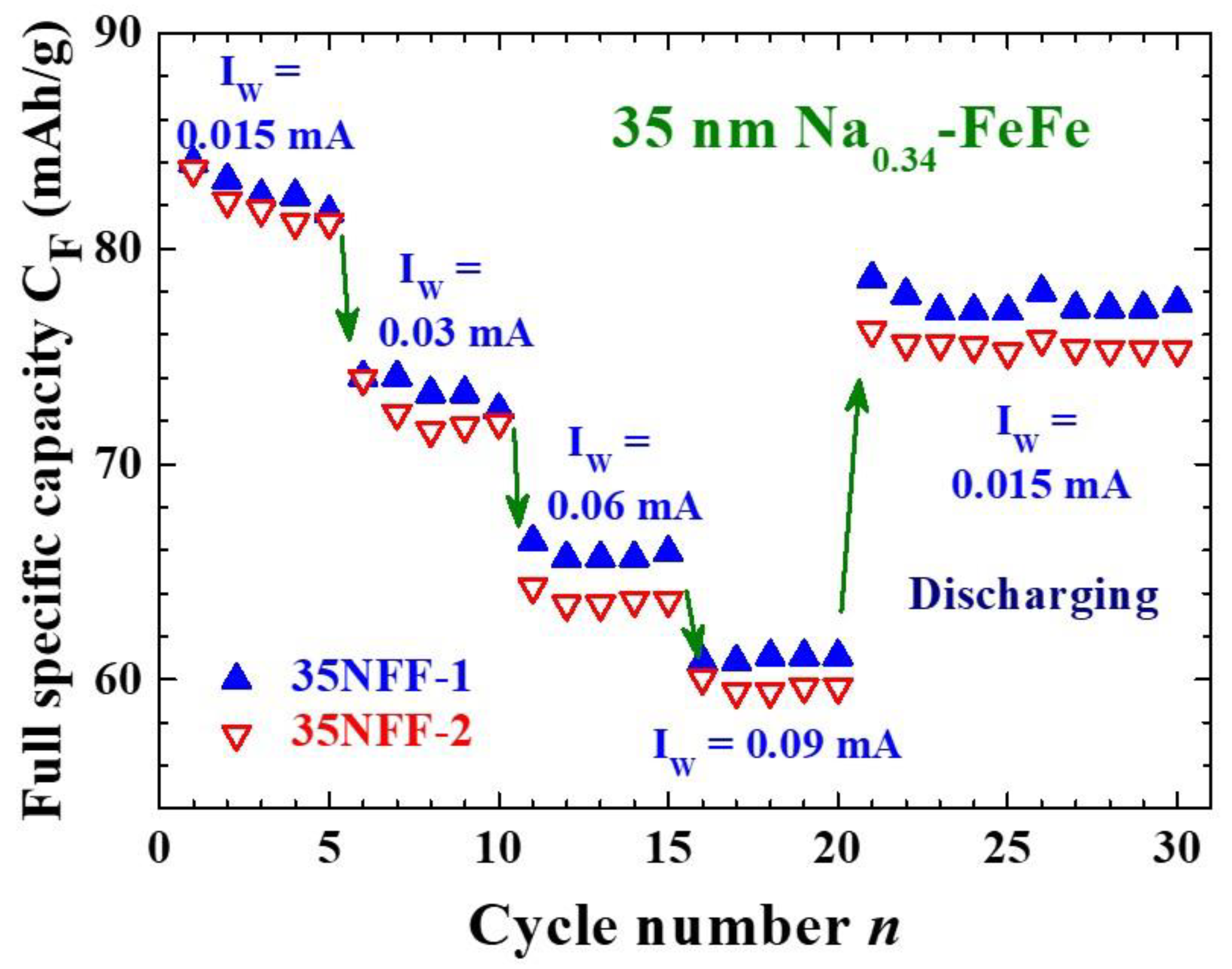
Figure 6.
(A) Direct comparison between the charge-discharge profiles of the 35NFF and 35NFF+14%Ni batteries in the 2nd (dashed lines) and 200th (solid lines) GCD cycles. Differences in the full specific capacity CF between the two batteries increase from 10% in the 2nd cycle to 15% in the 200th cycle. (B) Variations of differential capacity dC/dV with potential V of the 35NFF and 35NFF+14%Ni batteries in the 2nd (dashed lines) and 200th (solid lines) GCD cycles. The two separated peaks clearly reveal both the Fe2+-C and the Fe3+-N sites do participate in redox reactions.
Figure 6.
(A) Direct comparison between the charge-discharge profiles of the 35NFF and 35NFF+14%Ni batteries in the 2nd (dashed lines) and 200th (solid lines) GCD cycles. Differences in the full specific capacity CF between the two batteries increase from 10% in the 2nd cycle to 15% in the 200th cycle. (B) Variations of differential capacity dC/dV with potential V of the 35NFF and 35NFF+14%Ni batteries in the 2nd (dashed lines) and 200th (solid lines) GCD cycles. The two separated peaks clearly reveal both the Fe2+-C and the Fe3+-N sites do participate in redox reactions.
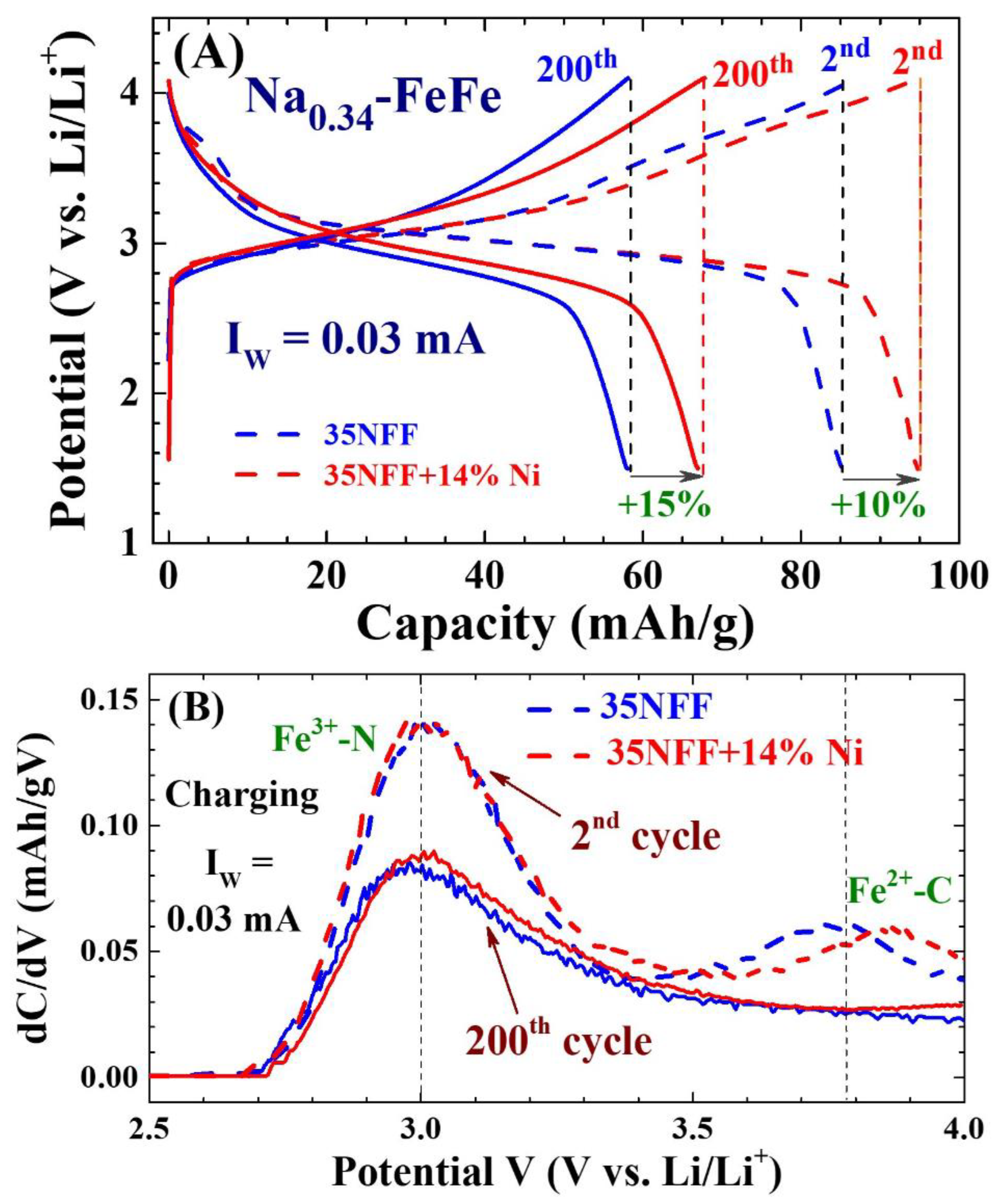
Figure 7.
(A) Direct comparison between the decay profiles CF(n) of the 35NFF (open triangles) and 35NFF+14%Ni (open circles) batteries. (B) Direct comparison between the decay profiles CF(n) of the 35NFF (open squares), 35NFF+14%Ag (open circles), 35NFF+25%Ag (open stars) and 35NFF+35%Ag (open triangles) batteries.
Figure 7.
(A) Direct comparison between the decay profiles CF(n) of the 35NFF (open triangles) and 35NFF+14%Ni (open circles) batteries. (B) Direct comparison between the decay profiles CF(n) of the 35NFF (open squares), 35NFF+14%Ag (open circles), 35NFF+25%Ag (open stars) and 35NFF+35%Ag (open triangles) batteries.
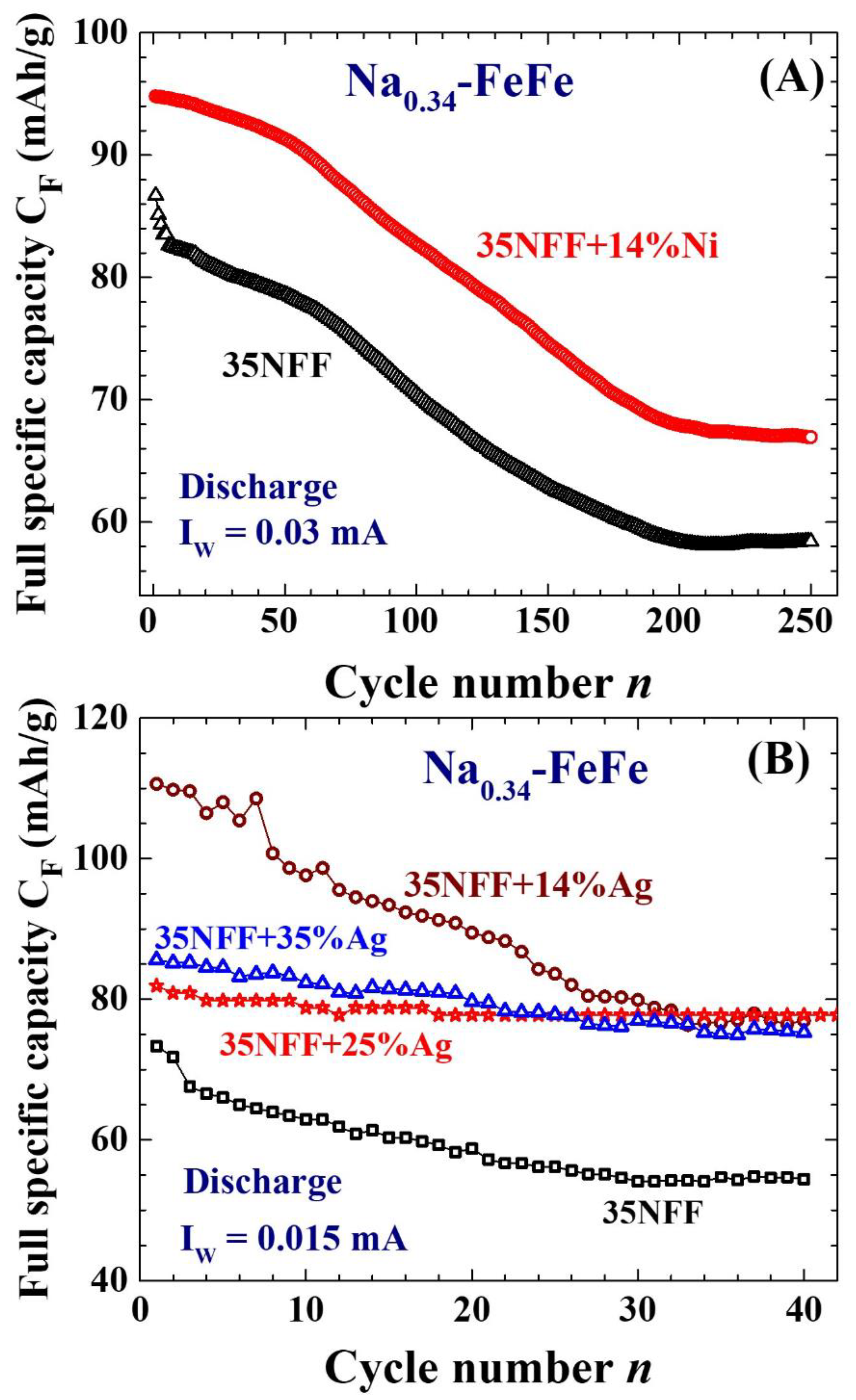
Figure 8.
(A) Direct comparison between the decay profiles CF(n) of the 17NFF (open squares), 17NFF+14%Ni (open circles and stars) and 17NFF+14%Ag (open triangles) batteries. (B)Variation of the full specific capacity CF with the number n of GCD cyclse completed, revealing a sudden drop in the CF once the working current IW is increased, but a jump back to a higher CF once IW is subsequently reduced.
Figure 8.
(A) Direct comparison between the decay profiles CF(n) of the 17NFF (open squares), 17NFF+14%Ni (open circles and stars) and 17NFF+14%Ag (open triangles) batteries. (B)Variation of the full specific capacity CF with the number n of GCD cyclse completed, revealing a sudden drop in the CF once the working current IW is increased, but a jump back to a higher CF once IW is subsequently reduced.
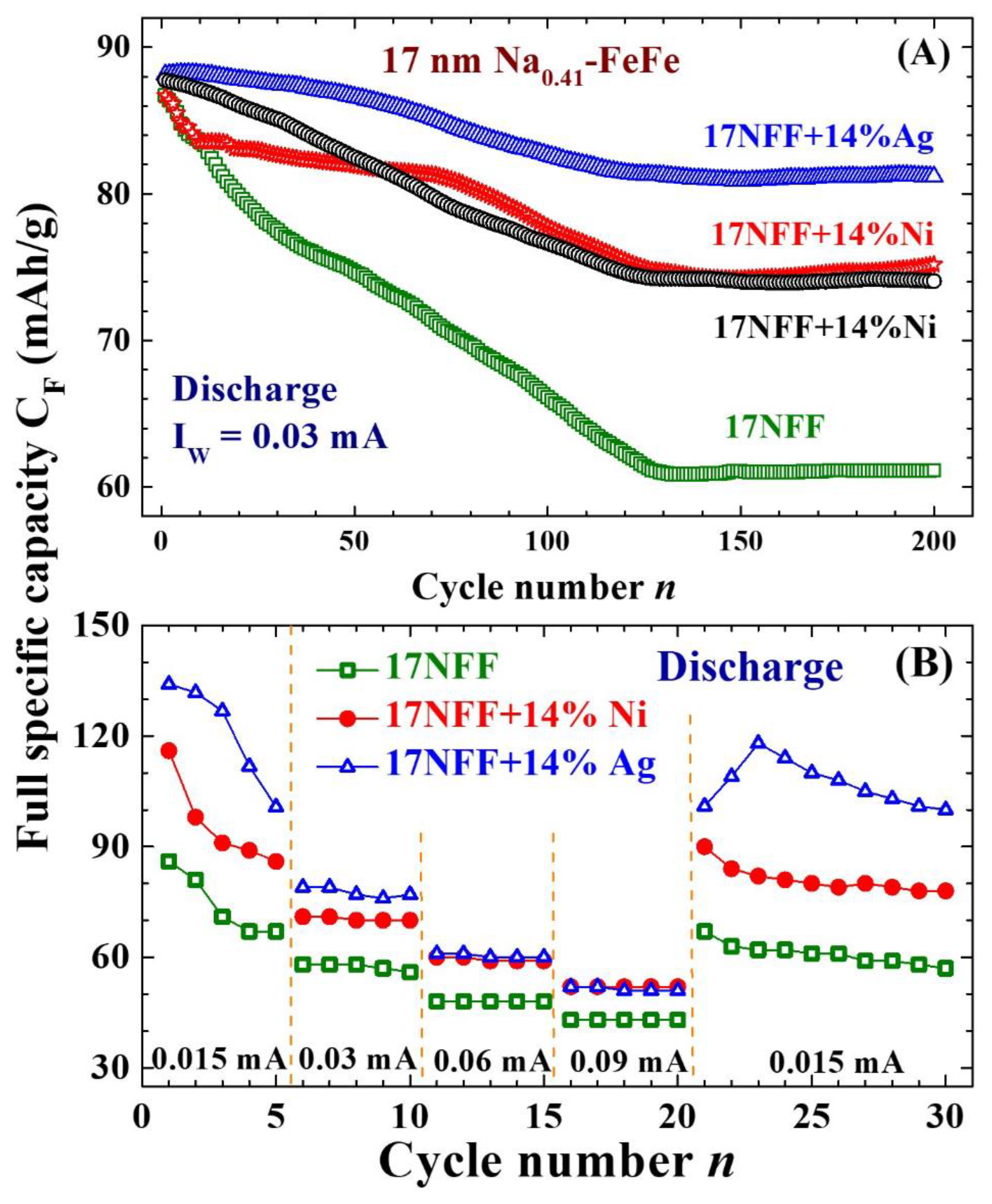
Figure 9.
Process for the fabrication of Na-FeFe nanoparticles, followed the co-precipitation method. The four sets of Na-FeFe nanoparticles were synthesized separately with the reaction solution maintained at temperatures of 25, 50, 70 or 85 oC.
Figure 9.
Process for the fabrication of Na-FeFe nanoparticles, followed the co-precipitation method. The four sets of Na-FeFe nanoparticles were synthesized separately with the reaction solution maintained at temperatures of 25, 50, 70 or 85 oC.
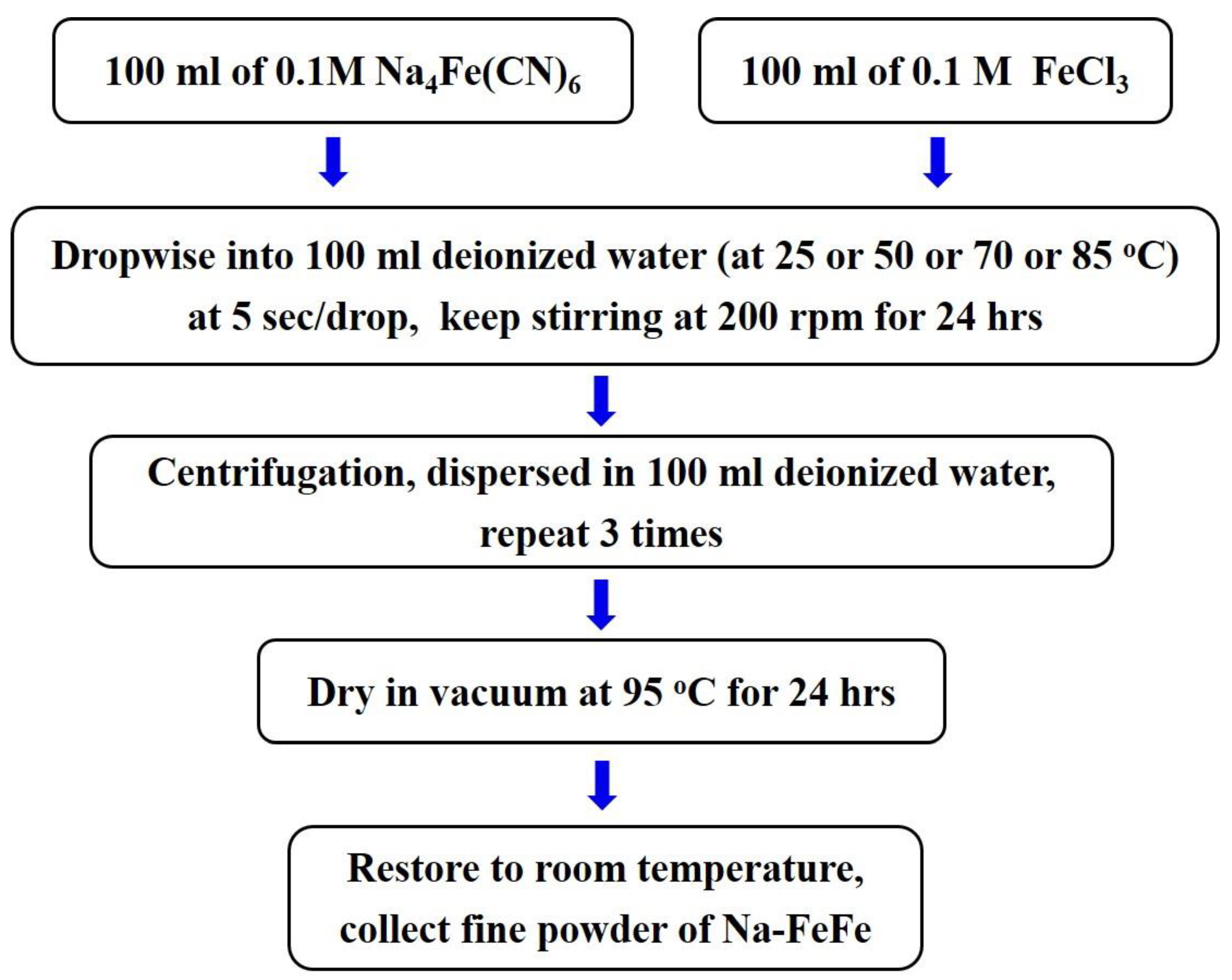
Figure 10.
Procedure for the preparation of the working electrode containing Na-FeFe NPs, where AB represents acetylene-black, PVDF the polyvinylidene-fluoride, and NMP the N-Methyl-pyrrolidone. Mass ratios of 7 : 1, 7 : 1.75 or 7 : 2.45 were used for the Na-FeFe : Ag/Ni NPs amounts to a mass ratio of 14%, 25% or 35% of Ag/Ni NPs in the electrode
Figure 10.
Procedure for the preparation of the working electrode containing Na-FeFe NPs, where AB represents acetylene-black, PVDF the polyvinylidene-fluoride, and NMP the N-Methyl-pyrrolidone. Mass ratios of 7 : 1, 7 : 1.75 or 7 : 2.45 were used for the Na-FeFe : Ag/Ni NPs amounts to a mass ratio of 14%, 25% or 35% of Ag/Ni NPs in the electrode
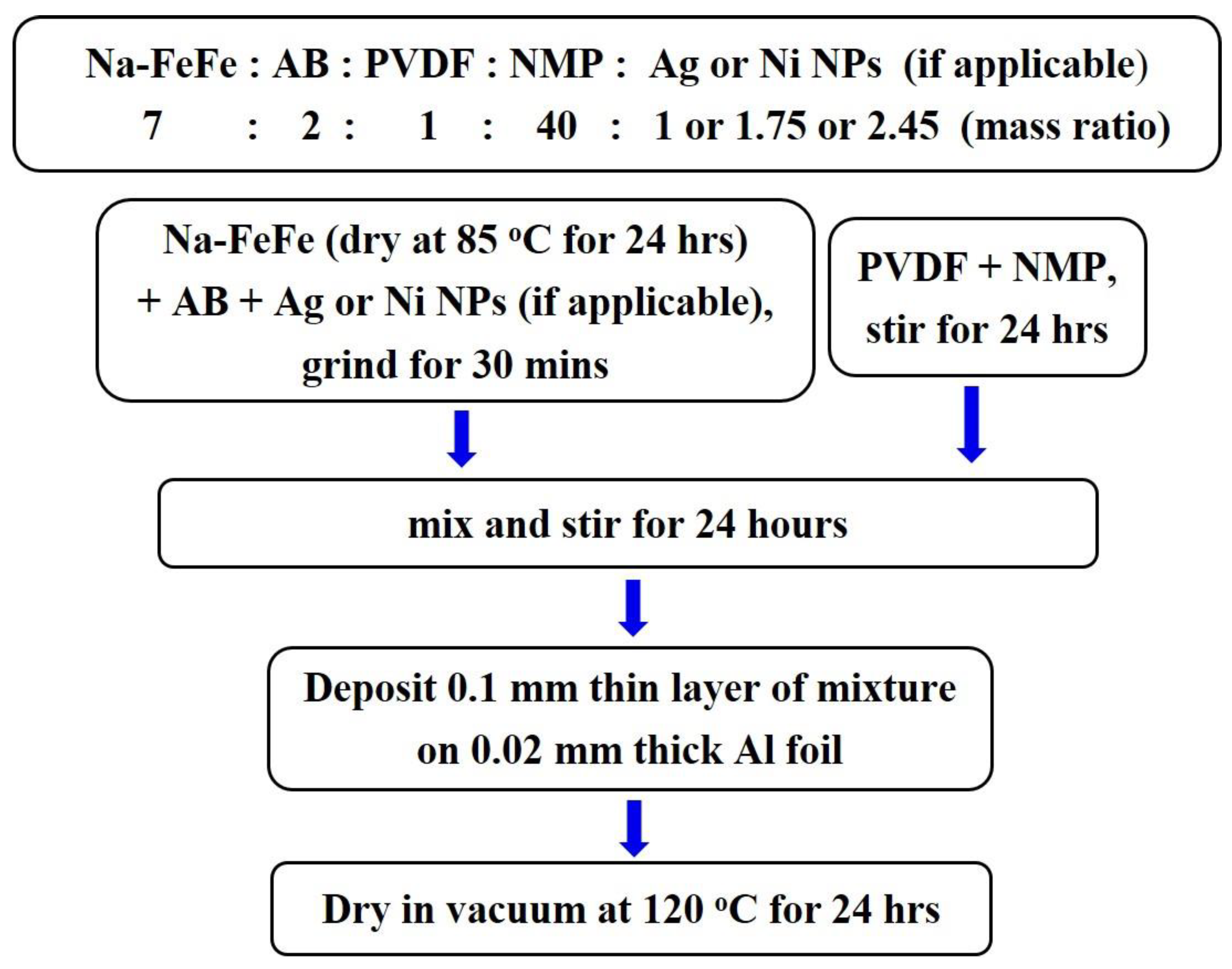

Table 1.
Labels, reaction solution temperatures, chemical compositions, lattice parameters, mean particle diameters, and deviation widths of the size distributions of the four Na-FeFe compounds used in this study.
Table 1.
Labels, reaction solution temperatures, chemical compositions, lattice parameters, mean particle diameters, and deviation widths of the size distributions of the four Na-FeFe compounds used in this study.
| Label | T (oC) | Chemical composition | a (Å) | d (nm) | σ |
|---|---|---|---|---|---|
| Na0.38-FeFe | 25 | Na0.38Fe[Fe(CN)6]0.82[(H2O)6]0.18·0.34H2O | 10.145(1) | 10(1) | 0.45(2) |
| Na0.41-FeFe | 50 | Na0.41Fe[Fe(CN)6]0.84[(H2O)6]0.16·0.36H2O | 10.248(1) | 17(2) | 0.65(1) |
| Na0.34-FeFe | 70 | Na0.34Fe[Fe(CN)6]0.81[(H2O)6]0.19·0.34H2O | 10.196(1) | 35(2) | 0.50(2) |
| Na0.36-FeFe | 85 | Na0.36Fe[Fe(CN)6]0.84[(H2O)6]0.16·0.38H2O | 10.185(2) | 46(2) | 0.55(4) |
| Ag | Ag | 4.088(1) | 7.6(3) | 0.65(8) | |
| Ni | Ni | 3.526(3) | 12.4(3) | 0.51(7) | |
| T = temperature of the reaction solution a = lattice constant at room temperature d = mean particle diameter σ = deviation width of size distribution of the nanoparticle assembly | |||||
Disclaimer/Publisher’s Note: The statements, opinions and data contained in all publications are solely those of the individual author(s) and contributor(s) and not of MDPI and/or the editor(s). MDPI and/or the editor(s) disclaim responsibility for any injury to people or property resulting from any ideas, methods, instructions or products referred to in the content. |
© 2023 by the authors. Licensee MDPI, Basel, Switzerland. This article is an open access article distributed under the terms and conditions of the Creative Commons Attribution (CC BY) license (http://creativecommons.org/licenses/by/4.0/).
Copyright: This open access article is published under a Creative Commons CC BY 4.0 license, which permit the free download, distribution, and reuse, provided that the author and preprint are cited in any reuse.


