

Submitted:
17 September 2023
Posted:
19 September 2023
You are already at the latest version
Abstract
Good health and well-being is one of the essential SDGs that ensure healthy lives and promote well-being for all ages and further entails providing substantial medical services to the public at low cost and with minimal adverse effects on the environment. Information and communication technologies (ICTs) have taken on an increasingly important function as significant facilitators of healthcare reform, with the goals of enhancing access to health services, the quality of treatment provided, and the overall productivity of the healthcare system. However, the integration of ever-increasing ICT technologies into the healthcare systems, also referred to as digital transformation, is not a straightforward process, but it comes with different types of challenges from integration level to application design level and security level. Although several studies have been proposed to address the integration of ICT technologies into healthcare systems, there is still a need for a comprehensive research study on the integration and design challenges, security and privacy challenges, application areas, and possible positive and negative impacts. Therefore, this paper contributes as the research literature study covering an important SDG, "Good health and well-being," and its digital transformation, along with summarising our research findings in a detailed and taxonomical way. To start with, firstly, we present a detailed comparison of existing studies on healthcare and well-being, mainly focusing on integrating ICT technologies in healthcare in terms of sustainable aspects, security and privacy challenges, design and integration challenges, E-health-related applications, and future directions. We also present an overview and the need for digital transformation in healthcare, discuss its significant components, highlight E-health's importance and benefits, explore its integration and design challenges, and categorise the security and privacy challenges. Next, we present an in-depth discussion on the role of Blockchain technology as today's leading technology in E-health, discussing Blockchain technology and its characteristics, highlighting its benefits, and describing the possible types of Blockchain-based E-health use cases. Furthermore, we discuss the positive and negative impact of ICT integration along with identifying open issues and challenges of integrating ICT technologies into the healthcare systems and discuss future research directions, which provide the strength for researchers to address the issues in future solutions.
Keywords:
sustainability
; sustainable development goal
; healthcare
; information and communication technology
; blockchain
; security and privacy
; design goal
; society
; environmental
; financial)
1. Introduction
Among the 21st century’s global challenges, Sustainability is one of the utmost, if not the greatest, concerns [1]. This is one of the reasons that the 17 Sustainable Development Goals (SDGs) by the United Nations, as introduced in 2015, become the common agenda of countries around the world. These SDGs are integrated and indivisible [2]. Among these goals, the third SDG’s goal, ‘Good Health and well-being,’ become the top priority because of the COVID-19 pandemic across the world [3]. This true global epidemic of the digital era appeared as a great problematic concern among general populations and healthcare professionals [4]. Hence, this situation, in addition to anxiety, also provided chances for countries worldwide to assess and advance their healthcare systems [5]. Digital transformation is gaining traction across all SDG sectors, but the healthcare SDG target still appears splintered and early in its implementation process despite significant research and practical application. In this context, developing a sustainability-focused ICT infrastructure that can better contribute to the progress of the ‘Good Health and Wellbeing’ goal of SDGs is vital. Several tangible examples of digital transformation in healthcare include telemedicine, IoT and AI-based devices, and blockchain-based health records, all of which are drastically altering the ways in which patients and doctors communicate and collaborate to improve patient care and health outcomes. Therefore, reliable responses to this sustainability concern facing the world today can be explored in the form of more reliable ICT developments such as Blockchain (BC) and the Internet of Things (IoT) [6].
The fundamental role of digitalization in achieving all the SDGs is broadly recognized [7]. However, concerning SDG 3, digital advancements and its related technologies and challenges still need to be endured in healthcare, though they certainly attained a level of maturity [5]. It is worth mentioning that the healthcare industry in the United States is of significant magnitude, as seen by the expected national health spending, which is estimated to reach a staggering $5.7 trillion by the year 2026. There is an opportunity for individuals to acquire a comprehensive understanding of digital technology and leverage its capabilities to enhance corporate growth. In order to effectively transition conventional practices into a successful digital framework in the year 2023, it is important to get a full understanding of the contemporary healthcare environment. However, while 15% of businesses overall have gone digital, just 7% of those in the healthcare and pharmaceutical industries have done so [8]. The World Health Organization (WHO), for its global strategy on digital healthcare, has recommended appreciating principles of accessibility, privacy, interoperability, confidentiality, transparency, security, scalability, and replicability [9]. Therefore, placing principle-based assessment criteria on several available digital options (e.g., IoT, BC, AI, etc.) and their different underlying integrating challenges, including design and security to advance the healthcare system across the countries, must be studied. Therefore, to recognize the importance of incorporating digital technologies into healthcare, in this paper, we discuss the digital transformation in healthcare concerning its components, importance, and benefits, further, explore its integration and design challenges, and classify the security and privacy challenges. Furthermore, we also addressed the role and application and highlighted several open issues with key challenges concerning different ICT technologies and Blockchain in healthcare systems.
Based on our research into one of the most crucial SDGs—healthcare—and its ongoing digital transformation with the help of cutting-edge ICT technologies, we were able to identify several weaknesses in the survey literature on the topic of ICT integration with healthcare systems, especially concerning the three sustainability perspectives (environmental, social, and economic): (i) research surveys (like [10,11]) which provide an overarching view of sustainability but don’t go into the specifics of ICT integration and the associated challenges (ii) Only environmental sustainability considerations are presented in the survey study [12], which also describes IoT as an integration technology and focuses on its limited applicability, (iii) The research study [13] only covered telemedicine and ICT (5G) concerning health care, and (iv) the research papers [14,15,16] discuss the limited sustainability viewpoints, highlight the limited ICT integration issues, and make use of artificial intelligence (AI) and big data as integration technologies.
However, we motivate to present a state-of-the-art and comprehensive survey study by conducting a detailed comparison of existing studies and highlighting their shortcomings in order to discuss the digital transformation in healthcare with respect to its components, importance, and benefits, explore its integration and design challenges; and classify the security and privacy challenges. As a second source of inspiration for this research, we describe the characteristics of Blockchain technology, highlight its benefits, and list the different types of applications/use cases that can be implemented using Blockchain in the field of electronic health records (E-health).
To address the shortcomings in the existing research studies on healthcare, an important SDG, a growing trend towards the adoption of digital transformation in healthcare, along with discussing their integration, design, security and privacy challenges, explore the utilisation of Blockchain technology and its characteristics and applications, we present a comprehensive and state-of-the-art survey that focuses primarily on the integration of ICT technologies to the healthcare (SDG), discussing the integration, design, security and privacy challenges, discuss the positive and negatives impact of ICT and then Blockchain integration and then highlights open research questions and future directions.
The contributions of this research work can be summarized as follows:
- Present a detailed comparison of existing studies, mainly focusing on integrating ICT technologies in healthcare, an important SDG, in terms of sustainable aspects, security and privacy challenges, design and integration challenges, E-health related applications, and future directions.
- Present an overview of the need for digital transformation in healthcare, discuss its significant components, highlight E-health’s importance and benefits, explore its integration and design challenges and categorise the security and privacy challenges.
- Present in-depth discussion on the role of Blockchain technology in E-health, discussing Blockchain technology and its characteristics, highlighting its benefits, and describing the possible types of Blockchain-based E-health use cases.
- Discuss the positive and negative impact of ICT integration, including Blockchain technology, into the health systems.
- Identify open issues and challenges of integrating ICT technologies into the healthcare systems and discuss future research directions, which provide the strength for researchers to address the issues in future solutions.
The organisation of the research work is as follows: Section 2 presents the methodology of our research study. Section 3 provides a related work consisting of a detailed comparison of existing studies on integrating ICT technologies to the SDG (healthcare). An overview of the need for digital transformation in healthcare, including necessary components, E-health’s importance and benefits, the integration and design challenges, and security and privacy challenges, are presented in Section 4. Section 5 Present an in-depth discussion on the role of Blockchain technology in E-health. In Section 6, the positive and negative impact of ICT integration, including Blockchain technology in E-health, is discussed. Section 7 identifies the open issues and challenges of integrating ICT technologies into the healthcare systems. The implications of our study are presented in Section 8. Finally, we concluded the research work in Section 9.
2. Methodology of Our Study
Our study’s research methodology is based on an in-depth literature evaluation of peer-reviewed papers on digital healthcare. Using carefully chosen keywords, relevant studies were found from more accessible resources like Google Scholar. We used terms like sustainability, sustainable development aim, healthcare, blockchain, information technology, security and privacy, design goal, Economic, Social, and Environmental. We created the selection criterion, which solely considers studies from journal articles and conference proceedings; book chapters and industrial correspondences are omitted. We considered the latest investigations, focused on studies published since 2021, and took the following six stages to produce a more thorough conclusion.
- Development of Study design based on the literature review on healthcare management studies.
- Selection of assessable sources such as Google Scholar to find digital healthcare studies with a sustainability focus.
- Creation of a search query and keyword pursuit for sustainability, SDG3, sustainable development objective, healthcare, blockchain, information technology, security and privacy, design purpose, and economic, social, and environmental considerations.
- Creation of appropriate data sets and data collection using MS Excel. The main headings of the dataset comprised Problem Focused, Sustainability Aspects Focused, ICT Integration, Technology, Security and Privacy Challenges, Design and Integration Challenges, E-Health Related Applications, and Future Directions were created.
- Data evaluation is completed through Textual analysis of the developed records of various studies.
- Assessment of the findings and conclusion is established.
After application of all the conditions of our article inclusion criterion among 22 studies found at the first stage, only 13 studies fulfilled all the criteria and were therefore included in the analysis.
3. Existing Work
This section compares the related work that focuses explicitly on the role of digitalisation in healthcare as an important SDG. We compare the existing work on the basis of the following significant parameters: publisher and year, paper title, problem-focused, sustainability aspects focused, ICT integration technology, security and privacy challenges, design and integration challenges, E-health-related applications, and future directions. Table 1 shows a detailed comparison of existing works.
Using a case study on empirical estimation, Abbas et al. [10] provided the results of a survey that looked at digitalization in the context of SDG3-healthcare services. The research was conducted to aid in the formulation of long-term decisions regarding policy and ethical principles in the Asian healthcare industry by shedding light on how cybersecurity measures might improve service quality and increase institutional excellence. However, the proposed research is limited in that it only describes a small subset of the possible cybersecurity solutions that could have a major effect on the digital transformation of healthcare. Furthermore, another study by Ullah et al. [11] integrated the implications of the China-Pakistan Economic Corridor (CPEC) and looked into the use of digitalization and e-governance to deal with the COVID-19 problems. In light of the recent COVID-19 epidemic, this study set out to explore and analyse the United Nations’ E-Government Development Index (EGDI) reports and rankings. Despite the importance of discussing the security and privacy concerns, design integration challenges, and the consequences of real-time applications, the proposed work only focused on studying the usage of digital technology in the healthcare sector.
In another study, the hybrid method provided by Espinosa et al. [12] combines a literature study with an analysis of the effects of healthcare’s adoption of digitalization technologies like the IoT. The study set out to answer a wide range of concerns about the influence of the IoT and similar technologies on healthcare and their related issues on the public. The primary limitation of this research was that it focused solely on healthcare IoT implications without addressing security, privacy, and design issues. A recent systematic review by Carbonell et al. [13] examines how the advent of the 5G network will affect how doctors and hospitals use data from various digital apps to enhance the care they deliver to their patients. This research focuses on the following use cases: Telesurgery, mobile ultrasonography, biosensor technology, robotic surgery, and the linked ambulance were recognised as the key medical uses. However, discussion on sustainability, security, and design challenges is limited in the proposed study.
To establish SDG (healthcare) for developing countries, Joshi et al. [14] presented a survey study intending to integrate digitalization technology like AI to comprehend its relevance and its uses for healthcare and medicine. This research sheds insight into the social, economic, and institutional obstacles to implementing AI in public healthcare. The study’s limitations include its narrow focus on privacy concerns as a security criterion and a few other important design considerations like governance and scalability. In addition to the above research, Thayyib et al. [15] investigate how various developing fields—including business, engineering, healthcare, sustainable operations, and hospitality tourism—can benefit from digitalization technologies like AI and big data. The study’s primary objective was to use bibliometric reviews to investigate the effects of AI and big data on these five areas and to inform managers of the most recent practical applications of these digitalization trends. However, this study merely covered the basics of how these digital technologies integrate with the aforementioned five growing industries; it did not delve into privacy and security issues, nor did it address the difficulties of integrating these technologies into existing designs or focusing on sustainability.
Piorunkiewicz and Morawiec [16] have published a study detailing the significance of AI in long-term e-health systems from a theoretical perspective in light of the practical Polish healthcare experience. However, this research was limited in that it did not specifically address security and privacy concerns, as well as design and integration challenges; instead, it merely described the conceptual problems of sustainable growth in e-health and made some suggestions about the role of ICT as a knowledge management factor in the healthcare system.
In their research study, [17] conducted an investigation to assess the impact of digital transformation on the healthcare sector. In order to do this study, a comprehensive bibliographic review is conducted by collating a multitude of papers. Nevertheless, this study has several limitations with regard to the examination of sustainability viewpoints, integration technologies of information and communication technology (ICT), and future implications. In another research, Marques and Ozben [18] conducted a comprehensive analysis that explores the available data on the impact of digital technology on healthcare and clinical laboratories. Their study emphasises the necessity of digital transformation in these domains, highlighting its potential to minimize inefficiencies and costs by improving effectiveness without compromising quality. Moreover, this study examines the significance of environmental sustainability as a crucial component. However, it fails to take into account the aspects of security, design, challenges, and future directions.
Hadjiat [19] conducted a research to evaluate the implications of digital health on disparities and inequities in healthcare. Nevertheless, the scope of this study was restricted as it just focused on the fundamental aspects of the issue, neglecting to go into the intricacies of design, integration, security concerns, as well as the applications and potential future developments. In a subsequent study, Ngongoni et al. [20] conducted a study with the objective of elucidating the intricacies surrounding the enhancement of scaling and the augmentation of sustainability of innovations within the African area. The primary purpose of this research is to fortify health systems and foster innovation. This research encompassed several design problems, including minimalistic design, cross-functional innovations, modular designs, off-grid capabilities, and interoperability.
Alajlan and Baslyman [21] conducted a study with the objective of assessing the long-term sustainability and ecological implications of electronic health (e-health) solutions that have been proposed or are now being implemented. The aforementioned study highlights a lack of empirically grounded and comprehensive sustainability models and evaluation tools that can effectively inform and guide practices in real-world scenarios. Nevertheless, this research solely concentrates on sustainability’s social and environmental aspects, neglecting other crucial elements such as design, integration, security issues, and future views. In an additional study, [22] conducted a scholarly inquiry that initially presents the utilisation of Information and Communication Technology (ICT) applications in response to the COVID-19 pandemic. Subsequently, the study offers a comprehensive review and subsequent analysis of the current state of ICT applications. This research primarily examined the uses of Big Data, with a specific focus on privacy and data accessibility considerations and potential future ramifications.
As a result, in order to address the shortcomings of existing survey studies in terms of various aspects such as detailed ICT integration technology along with its components, security and privacy challenges, design and integration challenges, and sustainability aspects focused, we present a comprehensive and state-of-the-art research survey that primarily focused on sustainability aspects, security and privacy challenges, design and integration challenges, and various potential applications.
4. Digital Transformation in Healthcare
The term "digital transformation" is commonly used to describe the process by which an organisation adopts and integrates new information and developing technologies in order to improve its operations and the quality of its products and services to customers [23]. Indeed, the use of cutting-edge digital technologies in healthcare systems represents a dramatic shift in how the health industry and its many sectors (including medicine, insurance, the supply chain, etc.) think about and approach the many pressing problems related to medical care and health [24]. In addition, there is a rising focus on global health problems that might be at the core of the work done by the United Nations system on each of the three aspects of sustainable development: economic, social, and environmental across many countries’ borders [25].
According to the World Health Organization (WHO), E-health is defined as the use of information and communication technology (ICT) in the medical domain for the advancement of medicine and diagnosis of patients’ diseases [26]. The extensive use of ICT for healthcare and health-related reasons in various situations, both within and outside healthcare settings, is an example of the digital health model. New market possibilities and healthcare business models are being created as a result of the technological advancements in healthcare, which are improving the delivery of healthcare obstacles by addressing concerns like medical treatment practice, economic development, and a spectrum of challenges associated with the elderly community [27]. As a complete system/model, healthcare consists of (a) primary service providers, including healthcare professionals, nurses, hospital management, and support staff, and (b) supporting services like diagnostic labs and health insurance. Examples of digital healthcare models include e-Health, m-Health, and telemedicine [28].
Due to the ever-increasing number of available devices, information and communications technology (ICT) can be essential in treating and preventing health problems. The proliferation of these digital gadgets among healthcare workers and professionals in hospitals and clinics is mainly attributable to recent technological advances such as robotics and the (IoT) [29]. For instance, fitness trackers and wearables now have the potential to play an essential part in monitoring patient health remotely [30]. Furthermore, the remote care of many different types of patients has been revolutionised and made much easier thanks to the introduction of electronic health records (EHR). As a result, an ever-expanding digital data bank is linked to healthcare treatment and patient records [31].
To conclude, the healthcare system as a whole could stand to gain from the use of ICTs. No matter how close or far a patient may be from a hospital or clinic, they can still contact medical professionals [32]. In the medical field, this means diagnosing patients remotely, accessing expert advice during a crisis, learning about and preparing for disease epidemics, and so on. Big Data analytics can all aid snapshots, trend analyses, and forecasts regarding disease outbreaks, health service utilisation, and patient knowledge, attitudes, and practises [33].
4.1. ICT-Based Healthcare System Components
To better grasp the significance of ICT requirements in healthcare, we present a comprehensive overview of the various components of healthcare systems in this section. For example, a healthcare system often consists of one or more medical devices, each outfitted with multiple sensors to collect patients’ essential information and make independent judgments regarding how best to treat patients. In general, six core elements are required for a healthcare system to carry out its essential functions, including the patient, healthcare provider, medical device, sensor, network and data processing facility [34]. The various healthcare components described above are depicted in Figure 1, which serves as an example of healthcare architecture.
4.1.1. Patient
Patients in e-health systems access healthcare services (or consult with healthcare professionals) via digital methods (such as telehealth, electronic consultations, or e-health platforms). Anybody needing medical care is considered a patient, whether they have an ongoing condition, an acute illness, or are just looking to stay healthy [35].
4.1.2. Healthcare Provider
The component includes health service providers (i.e., hospitals and organisations), medical doctors, and nurses. They can communicate using a wired and wireless transmission module with the data processing element. In the cloud-based scenario, the health server specifically stores sensitive medical and patient information. Doctors and nurses can use this information when they treat a patient in a person [36].
4.1.3. Medical Device
A medical device is any tool, instrument, appliance, or gadget used for medical reasons like diagnosis, monitoring, treatment, or relief. Medical devices can range from throat syringe needles to complex programmable ICDs, as stated by the U.S. Food and Drug Administration (FDA). The European Union also has different classification requirements for medical devices depending on whether they are non-invasive, invasive, or have active therapeutic qualities [37].
4.1.4. Sensor
In medicine, sensors are used to track and measure a patient’s physiological parameters. Several physiological sensors, such as a sensor for blood sugar and a sensor for heart rate, are utilised as a trigger to automate many tasks of healthcare systems, such as diagnosis and monitoring, amongst others. Typically, sensors are divided into physiological, biological, and environmental categories [38].
4.1.5. Network/E-Health Architecture
In E-health architecture, different networking components are concerned with how different medical devices and sensors communicate with each other and other members of a healthcare system. In an E-health network scenario, the primary purpose of data transmission is to transport signals from sensors or devices to the central node and then send aggregated measures from the central node to a health server or healthcare practitioner [39].
4.1.6. Data Processing
E-health systems rely heavily on data processing, which includes gathering, organising, and analysing patient information to provide better care. Data processing in electronic health care entails using different tools and technologies, such as IoT and AI, to record and later access information about a patient’s health and treatment [40].
4.2. E-Health Importance and Benefits
ICT integration with health systems presents significant benefits to health providers and patients in the following areas:
4.2.1. Enhancing Public Health and Medical Facilities
Improvements in hospital operations, electronic health records (EHR), and health information are just a few examples of how this integration might help the public and private sectors of healthcare. In addition, quick information and data sharing among healthcare providers and experts can increase patients’ access to high-quality care [41].
4.2.2. Aiding Medical Professionals
One of the most promising applications of this integration is the enhancement of surgical procedures/operations or guidance, including remote telesurgery. Digital health technology allows various outlying medical facilities to offer telemedicine and remote diagnosis to their patients. Hospitals in China, for instance, have used 5G to conduct remote surgery, such as liver procedures and deep brain stimulation implants for Parkinson’s illness [42].
4.2.3. Real-time Monitoring and Management
Personal health and dedicated devices, such as sensors, monitors, wristwatches, and mobiles, are widely deployed and utilised for monitoring and feedback purposes, providing an additional benefit to integrating ICT with the existing healthcare systems. For example, remote ultrasound imaging for kidney stones and fertilisation, as well as swab testing, have all been accomplished with the help of mobile phones. It has been predicted that by 2025, there will be half a million different mobile health monitoring and feedback applications available [43].
4.2.4. Improved and Accurate Analysis
Health data may now be analysed and predicted with more precision because of cutting-edge ICT technologies and ideas, such as AI, big data, and virtual reality (VR) simulations. In addition, imaging, diagnostics, and data analytics are all made possible by computing at the edge, which collects data from devices and sensors [44].
4.3. E-Health Challenges
Incorporating information and communication technologies (ICT) into health systems can bring about various beneficial effects, including improved access to health services, significant enhancement in communication and coordination among those who provide medical care, and enhancement of patient outcomes and treatment methods. However, several obstacles need to be overcome to integrate ICT into health systems, including the following:
We divide the challenges into two broader categories: integration and design, and security and privacy.
4.3.1. Integration and Design Challenges
Multiple design challenges have been explored to explain the sluggish ICT adoption and integration rate in the healthcare industry, including ordinary users (such as patients and doctors) and stakeholders (government and private firms). Furthermore, health-related information (EHR) is emerged as a result of the complexities of system design, data formats, controlling accessing authorities, policies and regulation of healthcare artifacts, and the interoperability challenges of various systems and their used health information technologies, which can raise further issues related to system speed, performance, efficiency, technology adoption, and increases costs.
We divided all these issues into integration and design issues. The integration issues cover the integration challenges of ICT to existing healthcare systems [45]. Finally, the design issues enforce the implementation and design of the health scenarios by combining different tools and technologies. Figure 2 illustrates ICT technologies’ integration and design challenges to the existing healthcare systems.
- Centralised Architectures: A number of issues, some of which are directly related to the quality of treatment offered to patients, are seen as fundamental design issues in the current healthcare systems, which are based on centralised architectures [46]. For instance, because healthcare systems span many organisations all over the world and are expanding at a larger scale, centralised architecture may be less scalable and less efficient. It may also lead to more error-prone and longer wait times, which can be the reasons for deaths in severe cases [47]. In addition, the single point of failure problem is magnified in a centralised architecture, which means the entire healthcare system might go down and severely impede patient care [48].
- Unsecured networks: When healthcare practitioners transmit or maintain patient information using unprotected Wi-Fi or public networks, they run the risk of making the information accessible to third parties who are not authorised to access it [49].
- Non-trusted Storage Options: There are serious threats to patient privacy and data security posed by using non-trusted storage solutions in healthcare systems [50]. For example, physicians and other healthcare practitioners can keep patients’ data on their local servers without enforcing any security system or on their own devices like smartphones, tablets, and computers. Nevertheless, in either event, it is possible that the gadgets cannot be as secure as the rest of the healthcare system’s infrastructure. On the other hand, there is a larger-scale risk of data breaches, unauthorised access, and data loss when using untrusted public clouds for storage purposes [51].
- Data Collection: Data collection is a prerequisite for every healthcare setup to maintain quality, achieve efficiency, or have a positive outcome improvement process. Various healthcare entities acquire data from various sources, which typically flows in a disjointed or non-standardized fashion across these entities. Therefore, healthcare organizations may encounter numerous challenges when gathering information about patients’ race, ethnicity, and language, requiring careful collection, preparation, and management [52].
- Non-Availability of Infrastructure and Resources: A lack of suitable ICT infrastructure, such as internet access, hardware, and software, might hamper adopting and using ICT solutions in health systems. For instance, many governments might not have the means to invest in ICT technology and infrastructure, making integrating ICT into health systems challenging [53].
- Interoperability: Sharing, storing, and exchanging data across different health systems can be difficult due to the widespread use of multiple ICT solutions and platforms supported by heterogeneous and dispersed network architectures. Thus, interoperability protocols and specifications are required to guarantee appropriate collaboration and interaction across various ICT technologies [54].
- Data Management and Integration: The capacity to combine and manage diverse types of data collected from many sources is a recurring IT challenge to the healthcare industry, primarily as clinics and hospitals digital their work operations. Notes or transcripts from patient visits, information about insurance, treatment plans, laboratory results, referrals, medical history, and vital data from remote monitoring gadgets, such as wearables, are some of the various types of data collected in e-health. Other types of data collected in e-health include health history and referrals [55]. Since patients frequently see a variety of experts at facilities that are partnered with one another, each category of data in a patient’s file may originate from a different source. To compile all pertinent medical information about a patient in one location, healthcare providers require electronic health records (EHR) software designed to collect, integrate, and manage patients’ data efficiently. This results in improved diagnostic procedures, treatment approaches, and patient outcomes [56].
- Data Access: Data accessibility promotes access to the patient healthcare record and prompt reaction in an emergency, both crucial in sustaining the high standards of healthcare services. In addition, it benefits patients since doctors may quickly access their complete medical histories, lab findings, and related notes from other practitioners [57]. The capacity to quickly retrieve relevant information from a patient’s record can significantly enhance clinical efficiency by minimising the number of times a doctor has to switch between programs to finish a consultation and diagnose a patient. However, the exponential growth of data in the field of E-healthcare highlights the pressing necessity for enhanced data accessibility practices and information and communication technology (ICT) models. Despite the numerous advantages of this expansion, ensuring the availability of high-quality care data remains a significant challenge [58].
- Cost: Building health systems based on ICT infrastructure and technologies may be impossible in low-income or other areas with few funds. For example, there can be a sizable financial burden associated with the purchase, implementation, and support of ICT infrastructure to form a complete healthcare system and the expenditure of training healthcare staff to use the new technologies used to train before the manual methods [59].
- Compliance: The regulatory landscape is continuously shifting, as evidenced by the standards for billing, the maintenance of equipment, and software updates, to name just a few instances. Even though compliance controls are in place to protect patients and the data they provide, it still creates a legal minefield that chief information officers in the healthcare industry need to avoid [60]. Solution providers like Ta and Cervey help healthcare organisations and medical practices remotely. For instance, Arena provides a specialised quality management system to the medical device manufacturing industry. This system assists medical device manufacturers in ensuring that their equipment complies with specific regulations such as ISO 3485 [61].
- Reluctant to Adoption New Technology: Many healthcare workers may be reluctant to accept new technology because of the potential disruption to their practices that ICT integration into health systems may cause. For example, the adoption and use of ICT in health systems may be hampered because health workers may lack the technical experience and skills necessary to utilise and maintain ICT solutions efficiently [62].
Converting these challenges requires a concerted effort from government officials, stakeholders, health professionals, technology vendors, and legislators. This will allow for successfully incorporating ICT into health systems and realising these technologies’ potential benefits.
4.3.2. Security and Privacy Challenges
A massive amount of sensitive health information related to patients is accessed and communicated over the Internet daily, making security and privacy the top priority for the healthcare industry. Furthermore, as most e-health data is transferred and shared utilising open communication channels, there is a chance that the data could be subject to network attacks. Therefore, we divided the section into two sub-sections: security and privacy issues. Figure 3 illustrates the categorisation of security and privacy challenges of integration of ICT technologies to the existing healthcare systems.
-
Security ChallengesSecurity in E-health is defined as the access to sensitive patient information strictly regulated using security rules and processes to prevent misuse of sensitive patient information. In many countries, patients’ individual health records (PHI) are recorded, communicated, and kept electronically for later use.
- ★
- Physical Access to Resources: One of the most critical security challenges in healthcare systems is ensuring the safety of the resources used to implement the healthcare infrastructure. This is especially true in situations where patient data is stored or accessible. To prevent theft or unauthorised access to patient information, healthcare organisations must ensure that physical access controls are in place and functioning properly [63].
- ★
- Third-Party Untrusted Manufacturers/Devices: While the increasing use of IoT devices within healthcare systems promises to bring about much-needed beneficial change, this development also raises new security concerns. As a result of its potential to facilitate data operations and enhance the treatment process, IoT has been adopted by many organisations working in the health sector [64]. Nevertheless, due to the fact that most IoT devices are designed and manufactured by unreliable vendors, they frequently lack security patches and suitable built-in security protections, which in turn creates security concerns for entire healthcare systems [65].
- ★
- Cyber Attacks: Cyber-attacks, such as ransomware, phishing, spoofing, and malware attacks, are increasingly targeting the healthcare industry [66]. In addition to disrupting healthcare operations, these cyberattacks might result in the theft or disclosure of private patient data. For example, the healthcare industry is becoming vulnerable to ransomware attacks, in which hackers encrypt sensitive patient information and demand a ransom in exchange for decrypting it [67].
- ★
- Insider Threats: When it comes to data security threats, many businesses neglect the possibility of insider threats because they focus instead on external attacks, despite the fact that insider threats are typically related to overlooked basic design or security vulnerabilities [68]. The healthcare industry has recently seen an upsurge in insider threats, which are just as dangerous as those from the outside. In most cases involving E-health, insider threats might come from within the organisation itself, whether they be former or current staff, suppliers, company associates, healthcare officers, doctors, or incompetent staff [69].
-
Privacy ChallengesWhen discussing health information, "privacy" refers to preventing unwanted access to an individual’s medical records and keeping those records private [70]. It is possible to achieve this goal by strictly enforcing the relevant policies and laws. Patients have the right to know who has access to their medical records, how those records are being used, whether or not they will be shared with a third party and the circumstances under which such information may be shared. For instance, the Health Insurance Portability and Accountability Act (HIPAA) protects patients’ health information confidentiality [71].In E-health scenarios, the following are the privacy issues /challenges that patients and healthcare service providers (such as doctors) might face.
- ★
- Device Privacy: In the E-health patient scenario, device privacy is a major concern due to the enforcement of the device anonymity principle, which states that the patient has the right to know who is authorised to configure and install the device, what kind of medical device the patient is equipping, and who is interacting with and responsible for managing the devices [72].
- ★
- Data Privacy: Personal and medical information are two highly sensitive data that must be safeguarded to ensure data privacy. Data privacy in healthcare systems refers to protecting individual patients’ health information against misuse [73].
5. The Role of Blockchain in E-Health
This section begins with an overview of the basics and principles of Blockchain technology, followed by a discussion of its salient characteristics. Then, we examine the role of Blockchain technology in E-health and highlight its benefits. Finally, we will discuss the potential types of Blockchain applications and use cases.
5.1. Blockchain Technology
Blockchain is made up of two different but related paradigms: the decentralised network and Distributed Ledger Technology (DLT), which links the network nodes in a peer-to-peer (P2P) fashion so that users can communicate with one another directly without the need for a trusted third party. In blockchain technology, the decentralised network eliminates the need for a centralised network (also known as a trusted third party) as part of the design process for a decentralised setting without a central authority [74]. The distributed ledger stores records of transactions in a block-based format that is shareable, immutable, and append-only. Each block is connected to the block that came before it by a cryptographic hash that is contained in the block header, creating the complete chain structure known as a Blockchain. Each block structure stores numerous pieces of information connected to a particular occurrence, including the timestamp, nonce, and transaction-related data. The specifics of this information are as follows: (i) a timestamp provides information about the time each block was created; (ii) a nonce is a one-time generated, unique random number for each individual; and (iii) a transaction contains the data or information to be sent to other nodes, which is then stored in the ledger following an approval procedure. In addition to the nonce, Blockchain technology also makes use of other cryptographic primitives, including hashes, encryption mechanisms, digital signatures, etc., to establish a baseline of confidence before transmitting transactions between network nodes [75,76].
Two types of Blockchain network nodes create and validate blocks. A basic node creates account wallets and network transactions. The others are full nodes (miner nodes) that verify and add transactions to the Blockchain. Blockchain technology relies on a consensus protocol, which eliminates the need for a trusted third party’s services to manage the interactions between nodes and regulates their behaviour to maintain a trustworthy relationship and guarantee the integrity of transactions [77]. Miner nodes essentially manage the consensus protocol, and this process is known as mining on the Blockchain network. It involves verifying transactions and adding those transactions in the form of Blocks utilising some computational puzzles or challenges. Furthermore, each consensus method is linked to miners’ incentives for their time and effort [78].
Several different consensus mechanisms have been proposed, each of which is dependent on the uses of the blockchain [79]. Nonetheless, PoW (Proof of Work) [80], PoS (Proof of Stake) [81], PBFT (Practical Byzantine Fault Tolerance) [82], and DPoS (Delegated Proof of Stake) [83] are the most often employed consensus methods in existing Blockchain applications. The Bitcoin cryptocurrency, the most well-known application of Blockchain technology, is a good example of an application that typically implements the PoW consensus. Second, the Ethereum platform utilised the PoS to mine Ether blocks and reward network nodes with Ether for their participation [84].
5.2. Characteristics
The entire Blockchain technology, from the design perspective to the security capabilities and working scenarios, is divided into the following set of characteristics [45]: decentralisation, immutability (or tamper proof), security and privacy, consensus mechanism, anonymity, open source, smart contracts, and transparency. These characteristics further help the users achieve the set of design requirements and security goals for designing efficient and secure applications. Figure 4 illustrates the characteristics of Blockchain technology, which are shown in detail as below.
- Decentralisation: In a decentralised network, rather than having a central authority controlling everything, a group of nodes organises themselves in a P2P fashion and takes on responsibility for maintaining the network’s general structure [79].
- Immutability: Immutability (or tamper-proof) in the context of Blockchain technology refers to the fact that once a significant number of miner nodes have confirmed a block of data, the block and its associated data are irrevocably secured. Therefore, the immutability characteristic of Blockchain data provides assurances of data integrity and authenticity and can be used to trace its history [85].
- Security and Privacy: Utilising cutting-edge cryptographic techniques, blockchain technology ensures the security and immutability of all transactions created and stored in its distributed ledger. Using consensus protocols, for instance, Blockchain transactions are recorded in the distributed ledger after being generated by the encryption and digital signature mechanism. Encrypting and hashing each block in the chain with the hashing methods creates a verifiable chain [86].
- Consensus Mechanism: The consensus mechanism is a fundamental characteristic of Blockchain technology that ensures that only valid transactions and blocks are added to the distributed ledger, which requires the agreement of all network nodes. The consensus method is an agreement or set of rules that are given as a challenging problem or puzzle that all network participants must solve and agree upon [84].
- Anonymity: Blockchain’s anonymity feature could be transformative in terms of user and data privacy and security. Implementing anonymity in Blockchain is a promising new step towards preserving users’ privacy and fostering trust in the veracity of data and transactions, especially in high-stakes situations involving the exchange of financial or personally identifying information [87].
- Open Source: Using some of the available coding attributes incorporated into Blockchain technology, this open-source feature enables developers to create decentralised and secure applications to establish trust between network nodes and their data. This characteristic also gives you the freedom to create efficient and automated applications for a wide range of social and business use cases [88].
- Smart Contracts: Smart contracts are an intriguing use case for Blockchain technology since they are self-managing and self-executing pieces of code that execute on the Blockchain. Smart contracts automate the process of obtaining an agreement between a sender and a recipient on a set of established conditions by using predefined rules. Smart contracts are a facilitator, confirming and implementing contract rules to facilitate contract negotiations and achieve autonomy. Furthermore, smart contracts are used to ensure that all parties in the Blockchain are held accountable for their activities, as their conditions are public and can be viewed by any node in the network [89].
- Transparency: Transparency is yet another essential characteristic of Blockchain technology, as it enables anyone with network access to keep track of and validate transactions in the distributed ledger. In a public blockchain, for instance, users can record and manage transactions in a public ledger that is accessible to everyone on the network [90].
- Traceability: For audit purposes, the blockchain’s traceability feature and the usage of security guidelines ensure that transactions can’t be altered after they’ve been added to the ledger. As a result, it is possible to trace the history of any transaction in detail [91].
5.3. Blockchain Benefits in E-Health
Figure 5 illustrates the Blockchain Benefits in E-Health.
- Decentralise Architecture: These days, a decentralised management system is necessary for processing, managing, and storing health data due to the nature of E-healthcare systems worldwide. In such scenarios, participants worldwide, including doctors, patients, hospitals, healthcare stakeholders, drug distributors, and so on, seek remote access to the system to carry out the abovementioned tasks [92]. To make this a reality, Blockchain has the potential to serve as the decentralised health data management infrastructure from which all stakeholders can enjoy secure access to identical medical records without anyone acting as the global health data authority [93].
- Tamper-proof Record: Since the data in a distributed ledger are encrypted, hashed, time-stamped, and appended in chronological order in the form of a chain, the immutability attribute of the distributed ledger used in blockchain considerably improves the security of the health data recorded on it [94]. Once data has been recorded to blockchain technology, it cannot be tampered with, edited, or recovered by any other means. In addition, patient health records are encrypted before being saved on blockchain technology using cryptographic keys, which helps protect patients’ identities as well as their privacy [95].
- Data Availability: Patient information in traditional healthcare systems is regularly shared between several providers without any security measure, increasing the risk of data leakage and unauthorised access. Due to the distributed nature and immutable feature of the blockchain, records are duplicated across numerous nodes, making the system highly resistant to data loss, illicit activities, and an array of security attacks that target data availability [96].
- Data Control and Ownership: Considering patient data in E-health systems contain sensitive and essential information, patients must retain ownership of their data and have insight into how the healthcare system utilises it [97]. In addition, it makes it clear that patients have a right to the certainty that the information about their health that other parties hold will not be mishandled. Blockchain technology fulfils these needs through its secure cryptographic techniques and the practical application of its smart contracts functionality [98]. By using such available features of Blockchain, Patients can decide who has access to their medical records and can grant or revoke access as needed. Furthermore, blockchain’s built-in privacy mechanisms allow patients to control who is entitled to their health information and cease access at any time [99].
- Verifiable Record: One of the advantages of using blockchain technology in electronic health care is that it makes it possible to verify the accuracy of medical records about patients and healthcare providers without actually accessing the records stored on the blockchain. For instance, the supply chain management process of medications and the processing of insurance claims both use this capability to provide the verifiability of records recorded on a temper-proof ledger in the event that a discrepancy occurs. Therefore, This is a crucial requirement to ensure data integrity [100].
- Transparency: In terms of E-health transparency, Blockchain technology makes use of a decentralised ledger to record all of the transactions and patient data using a consensus process [101]. This feature introduces and assures an additional level of difficulty for anyone working in the healthcare system to change or manipulate the data in any way. In addition to this, transparency means that all parties involved, such as patients, medical professionals, healthcare facilities, and insurance companies, have access to identical information and can validate the credibility of the data [102].
5.4. Blockchain-based E-health Use Cases/Applications
Although blockchain technology has traditionally been applied to the financial and cryptocurrency sectors, its usefulness is rapidly expanding into other areas, such as the healthcare industry. Through its mechanism of providing decentrlised access control, secure and tamper proof data, autonomous and tracking, blockchain technology demonstrates its potential in the medical fields, including E-health, tele-health, medicine, genomics, neuroscience, and personalised healthcare applications. In this section, we discussed the potential types of Blockchain-based E-health use cases whose operations and procedures notably benefited from the Blockchain’s characteristics.
5.4.1. Management of Electronic Health Record (EHR)
One of the most important applications that can be accomplished by integrating Blockchain technology into healthcare systems is the management of electronic health records (EHR). This involves creating, storing, and managing patients’ personal, medical, or health-related data by utilising the distributed and immutable storage feature of Blockchain [92]. In addition, features such as data provenance, consensus mechanisms, smart contracts, and improved security and privacy protocols are being argued as the foundation of reliable and robust patient EHR storage and management. For example, one such Blockchain-based healthcare application is HealthChain [103], which was built as a permissioned, private blockchain network using IBM Blockchain’s Hyperledger Fabric [104] and then deployed on Bluemix. In this application, Blockchain is implemented to safely store and manage patient health records, giving people greater control over their personal information. Another blockchain-based medical record management application is Ancile [105]. It is designed to achieve access control, data security, privacy, and interoperability of electronic medical records by utilising the smart contracts feature, which is run on the Ethereum blockchain platform. Data access control, monitoring and verifiability of data, and establishing transparency are only a few of the obstacles that medical data sharing encounters throughout the deployment of EHR. MeDShare, developed by Xia et al. [65], is a blockchain-based platform for the secure sharing of medical records across organisations with which one cannot establish a reliable level of confidence. In addition, it is now very important for healthcare systems to have accurate patient records to provide timely and effective care. To overcome the aforementioned obstacles, Dubovitskaya et al. [106] proposed a blockchain-based framework that makes use of permissioned blockchain technology to keep track of cancer patients’ electronic medical records, share them safely, and guarantee access to, management of, and storage of encoded patient data.
5.4.2. Medical Bill/Insurance Claims
As the insurance sector moves from manual to digital methods, fraud increases owing to a lack of integrity processes and legal comprehension among significant individuals. In a recent report, according to statistics from the International Association of Insurance Supervisors (IAIS), about a quarter of all insurance claims have been investigated for possible fraud every year since 2010 [107]. In the realm of medicine or health insurance, the essential key stakeholders, such as insurance companies, medical institutions, and patients, face a variety of concerns associated with the design mechanism, the provision of services, and security issues when engaging and communicating with one another. With the use of Blockchain technology in ICT, particularly in the digitalisation of medical bills and the insurance claims process, tremendous benefits have been observed due to blockchain characteristics such as decentralisation, immutability, transparency, and traceability. For instance, immutability is used to construct data storage systems to prevent data modification. Moreover, Blockchain’s advanced security and privacy mechanisms are utilised to design blockchain-based transaction systems that protect multiple parties’ privacy. In addition, the smart contract functionality of Blockchain technology paves the way for the implementation of an efficient and automatic medical insurance claim system for signing contracts, administration of databases, and handling payments. Since the information needed to settle claims, such as policy details and premiums, can be pre-programmed into the Blockchain.
5.4.3. Remotely Analysing/Monitoring Patients
The rise of digitalisation in the E-health sector has made it possible to analyse data remotely and monitor a patient’s health. The term "remote patient monitoring" refers to the practice of acquiring patient data through various IoT devices (body sensors) or wearables connected to the patient. With the integration of Blockchain technology into E-health, both patients and healthcare service providers stand to benefit from RPM in several important ways. For example, from the patient’s point of view, it may provide more freedom, such as enabling them to get treatment remotely while sitting anywhere in the globe using the decentralised environment. Furthermore, Blockchain’s transparent and auditability feature can promote better disease management and easily track medicine and history by offering real-time assistance and input. To implement this idea, Griggs et al. [108] built a remote patient monitoring system on the Ethereum Blockchain, prioritising secure data communication over distributed platforms and facilitating automatic, real-time patient-doctor interaction. To secure the data and preserve the privacy of patients, Ashraf et al. [109] implemented a Blockchain-based system that enabled a patient-centric agent (PCA) to preserve end-to-end privacy and security of data in an irreversible remote patient monitoring setup. In contrast, Ji et al. [110] put forwards an approach known as BMPLS (Blockchain-based Multi-level Privacy-preserving Location Sharing) to facilitate privacy-preserving geographic location sharing.
5.4.4. Health Data Analysis
The term "health data analytics" refers to gathering, analysing, and interpreting data from various sources, such as electronic health records (EHRs), smartwatches, and health applications, within the healthcare industry. Health data analytics aims to extract and analyse health trends from massive amounts of healthcare data, which uses data analysis tools and techniques, including machine learning and deep learning [111]. This data can be utilised to improve patient health and outcomes, reduce expenses, and optimise resource utilisation [112]. Additionally, it can be used to realise further predictive analytics of healthcare data and progress research in medicine and associated sectors. As a result, the healthcare sector can be advanced and its operations optimised through the combination of health data analytics and Blockchain technology. By merging Blockchain technology with health data analytics, sensitive patient information may be maintained on a distributed, immutable ledger impervious to manipulation [113]. In addition, it may be transferred safely and efficiently across various healthcare providers and systems, enhancing interoperability.
5.4.5. Clinical Trials/Data
The past two years’ global pandemic has profoundly affected the clinical trial industry, prompting trial donors and clinical research organisations to adopt remote studies and other innovative solutions. The pharmaceutical business, academic institutions, government agencies, and others involved in clinical trial research have all tried to develop remedies to these problems, but thus far, none have been entirely successful [114]. Yet technological tools can also speed up trials and maintain data security while ensuring that companies comply with all applicable rules and regulations. Clinical trials are increasingly utilising blockchain technology to ensure the security of sensitive data and the reliability of collected data [115]. Blockchain, a unique technology that can dramatically redefine businesses and change how data is transacted, saved, and shared, is an example of an intriguing yet novel technology that may turn out to be the breakthrough needed to solve the aforementioned issues. Blockchain’s primary function during a clinical trial is to keep records and produce a transparent audit trail of all the changes made to a given data collection [116].
6. Impact of ICT Integration into Health Systems
The integration of ICT and their underlying technologies have had a significant impact on society, particularly in the digitalisation of patient records, the improvement of the quality of access to healthcare services, the modernisation of patient treatment, the improvement of patient overall satisfaction, the pharmaceutical supply chain, and the promotion of health and well-being. In this section, we focus on some of the most promising potential benefits of integrating ICT technology into healthcare, which will ultimately benefit society as a whole. We also covered the Blockchain technology impacts from sustainability perspectives (i.e., environmental, social, and economical) and highlighted the negative impacts on society.
6.1. Positive Impacts
6.1.1. Digitalisation of Patient Records
The digitalisation of patient health records has been identified as a key positive effect of the introduction of ICT to healthcare systems. This term describes the process of transferring previously paper-based medical records into an electronic format to more easily store, retrieve, and share such records among healthcare professionals [117]. When it comes to the economy, digitising patient information can help minimise the administrative expenses resulting from paper-based maintenance of records, such as the costs involved with storage spaces, printing, and postage. This is an important aspect of the sustainability issue. In addition, the digitalisation of patient information in e-health may benefit the natural world. There are many ways to lessen the healthcare industry’s impact on the environment, such as cutting back on paper and energy use for paper-based prescriptions, lowering transportation costs, decreasing the use of hazardous chemicals, and encouraging sustainable procurement practices [118].
6.1.2. Improved and Quality Access to Healthcare Services
The development of ICT has allowed for the introduction of telehealth, telemedicine, remote surgery, remote consultations, etc., all of which have significantly impacted the accessibility and quality of healthcare services. In addition, ICT can facilitate secure, cost-effective, and safe access to healthcare services, which is particularly important in regions with limited healthcare resources and, at times, difficult access to them during emergencies. The integration will help patients in both urban and rural locations by reducing the time and money spent going too far with healthcare providers and levelling equality in terms of access to medical treatment [119].
6.1.3. Patient Independence and Autonomy
ICT-enabled healthcare systems provide patients with independence and complete access by allowing them to manage and control their data in their own manner. It is also a requirement of data security that no authorised individual has access to patient data via unauthorised means. In addition, from a social perspective, it can result in improved health outcomes and increased patient trust and participation in their own advanced healthcare systems [120].
6.1.4. Real-Time Diseases Monitoring
An important positive effect of this integration on society is the development and consistency of real-time plans for diseases or outbreaks that have occurred in a particular region, as a result of the collection and analysis of real-time data and the implementation of prompt responses [121]. For instance, these ICT-enabled healthcare systems reduce the cost of individuals (healthcare providers such as physicians or analysts) travelling to a specific region and collecting data for the analysis perspective. E-health systems also promote environmentally cognisant cultures during outbreaks of diseases such as covid-19 by assisting healthcare providers and policymakers in making informed decisions and responding more effectively to public health emergencies [122].
6.1.5. Equity Healthcare Services Culture
By eliminating social, economic, and environmental inequalities, health equity ensures that all people (individuals, groups of people, and communities) can realise their full health capacity. This means having fair access to medical care, nutritious food, and a secure place to call home. By implementing healthcare services more readily accessible and affordable, ICT can aid in reducing health inequalities. Telehealth and distant consultations make it possible for healthcare services to reach underserved and rural areas while minimising the need for patients to travel and their associated costs [123].
6.2. Blockchain Technology Impacts on Sustainability
In addition to debating on the positive social impacts of incorporating ICT into healthcare systems, this work will also argue that Blockchain technology has the potential to greatly contribute to accomplishing sustainability goals, especially in healthcare, and stimulating society as a whole. Some of the impacts of Blockchain technological advances’ potential application in healthcare’s pursuit of sustainability are listed below.
6.2.1. Environmental Impact
Environmentally friendly ICT business practices have received a lot of attention in recent years, and many corporations, including healthcare, have announced plans to implement ICT technologies into their programs and processes to reduce their harmful effects on the environment. However, some of the ICT integrations also have negative impacts on business and society. For example, when it comes to consensus techniques like proof-of-work (PoW) used in the Bitcoin cryptocurrency, the integration of blockchain technology into ICT-based corporate operations has often been criticised for its impact on the environment. To reduce this impact, the Ethereum network has migrated to the proof-of-stake (PoS) consensus mechanism, which is widely regarded as being far more energy-efficient than the previous proof-of-work (PoW) consensus mechanism. This change will help to mitigate the network’s negative social and environmental impacts [124].
6.2.2. Social Impact
Since its inception, blockchain technology has had far-reaching effects on social progress and development thanks to its ability to broaden people’s access to data and information and its capacity to change the traditional single network into a collaborative value network [125]. With the advent of Blockchain technology and various socially beneficial applications like cryptocurrencies, the goal is to implement sustainable behaviour-based applications to utilise smart contracts and reinforce a long-term approach to sustainability. Cryptocurrencies like Bitcoin, for instance, benefit society because they eliminate the need for trusted third parties in monetary transactions while providing a safe means of transferring funds and storing value. In addition, the funds generated by these cryptocurrencies are tailored to investments that will positively impact society and the environment. Regarding healthcare, insurance companies have begun implementing their systems, including auditing procedures and monitoring of funds, by utilising Blockchain technology and smart contracts without a middleman in order to ensure the modifications made by trusted parties [126].
6.2.3. Economical Impact
The environment and social problems that aim to tackle global challenges, such as financial inclusion, are starting to empower the benefits of leveraging blockchain technology for both businesses and people. Many of the SDGs see blockchain technology as a key facilitator since it represents a forward-thinking approach to the G20 agenda’s central goal of increasing economic participation in businesses and for the benefit of society [127]. For example, in order to help more people and companies take advantage of economic opportunities by using Blockchain technology, it is mandatory to define the financial inclusion criteria, which establish standards for things like using financial services, investing in businesses, putting money towards one’s education, protecting oneself from financial loss, and putting money away for one’s retirement. By utilising the same concept for healthcare, the funds which are spent on healthcare can lead to greater healthcare opportunities, which in turn can boost human capital and efficiency and economic growth [128].
6.3. Negative Impacts
In addition to discussing the positive effects of this integration on society, we also emphasise its negative aspects. The negative aspects of digital transformation, including ICT technologies and Blockchain in healthcare systems, are illustrated as follows: Figure 6 shows the positive and negative impacts of ICT Integration to the healthcare systems.
6.3.1. Cost
Although the digitalisation of healthcare systems has many benefits for the development of healthcare services, no one can deny the high costs associated with its design, implementation, and successful deployment [129]. However, with the introduction of new ICT technologies and systems to existing healthcare systems, the medical treatment process is becoming quite expensive and costly, and patients are required to pay hefty fees for even minor procedures, with the cost potentially being shifted onto patients in the form of greater expenses for healthcare. Ultimately, this digitalisation process creates additional monetary strain for patients, especially those without insurance or other subsidies [130].
6.3.2. Technical Knowledge
The requirement for technical skills from stakeholders and end-users is one of the most significant obstacles to integrating ICT technologies with the healthcare system in society. For instance, the installation, configuration, and implementation of the most recent ICT systems and their underlying technologies with existing health systems can be burdensome for system developers and administrators, as well as necessitating specialised knowledge and appropriate training for the users of such systems. Consequently, this can result in delays in patient requests for treatment, data and information loss during system upgrades, and other technical problems that can have an effect on the delivery of medical treatments [131].
6.3.3. Doctor-Patient Interaction
One major social consequence of digitising healthcare systems is that doctors and patients have less face-to-face time together, which can be important for having truthful discussions and building trust [132]. Most patients now get their appointments and medicine suggestions over the phone because of digital health technologies like telehealth, which raises concerns about a potential decline in the quality of the personal connection and feelings of compassion that characterise direct contact between patients and medical professionals [133].
6.3.4. Patient’s Information Privacy
EHRs and other patient data are particularly vulnerable to hacking and other types of unauthorised access due to the increasing prevalence of ICT and other digital technologies inside healthcare systems. When patient data falls into the wrong hands, it can lead to identity pillaging, prejudice, and other adverse effects [70].
6.3.5. Over-Relience of ICT Technology
As healthcare systems become more sophisticated and digitalized, patients and clinicians are starting to rely increasingly on them for everything from treatment to diagnosis. However, the total reliance on such digital systems can create vulnerabilities and risks for doctors and patients if the underlying technology fails or is compromised for some reason, potentially leading to risks such as the death of patients, despite the fact that these transformations demonstrated the many ways to move towards the next ledger successfully [134].
6.3.6. Increased Social Imbalance
Unfortunately, in this increasingly digital world, not everyone has easy access to the technologies they need to participate fully. Inequalities in healthcare benefits and access to and provision of healthcare services may result from the fact that not all patients in an E-health system have access to digital health technologies. As a result, this difficulty can amplify pre-existing social and economic disparities and may reduce health outcomes for vulnerable groups [135].
7. Challenges and Future Research Directions
Figure 7 shows the challenges and future research directions, which provide the strength for researchers to address the issues in future solutions.
7.1. Interoperability
Interoperability between blockchain-based networks, which is essential for them to interact with and share information with one another and take quick decisions, is another major obstacle preventing many industries from adopting the blockchain as a solution. When it comes to interoperability in E-health care systems, a uniform set of technical standards for building and designing such systems in order to exchange information and work together across systems is needed, but this is often lacking due to a lack of standardised healthcare procedures. Due to the lack of a universally accepted protocol for blockchain interoperability, it might be difficult for different blockchain networks to exchange data with one another [136]. Furthermore, in blockchain-based healthcare models, interoperability is more concerned with the requirement of integrating various technological elements. These components include smart contracts, record keeping, and consensus processes, all of which can be difficult to integrate and keep up to date [137].
7.2. Security and Privacy
In the security of EHRs, confidentiality refers to hiding sensitive information from unauthorised users, while integrity refers to preserving accurate data. In unsecured EHR scenarios, any adversary can modify the information that has been stored, which results in incorrect information. As a result, securing such saved information and data from various threats to its security and attempts to modify it is a very challenging issue to address [138]. Furthermore, authorisation is also a primary concern in E-health security scenarios since it ensures that only approved individuals may view sensitive patient data stored in EHR systems. But a malicious actor might utilise stolen credentials to access sensitive patient data [139]. In addition, data ownership is an essential issue in the healthcare industry. This challenge refers to "who owns the data" and "who has access to the data." Attackers can change the ownership data to invalidate their ownership. So, blocking illegal access to the data related to ownership is of the utmost importance in ensuring the system is secure and safe [140].
7.3. Use of Trusted Storage Options
Using trusted storage solutions and implementing strong security measures are essential for healthcare providers and organisations to prioritise patient data security and privacy in the face of the non-trusted storage dilemma. This can be accomplished by establishing distributed secure networks, utilising an advanced encryption mechanism while transporting data between parties, implementing proper authorisation and access control techniques, and monitoring and tracking suspicious actions on a regular basis [141,142].
7.4. Increased Volume of Health Data
While there are many positives to implementing blockchain technology in healthcare, particularly in terms of data security, the proliferation of patient-related smart sensing IoT devices and blockchain’s use in E-health has led to an explosion of data that presents a significant challenge for collection and management of patient data [143]. When it comes to collecting and processing massive amounts of data, the healthcare industry has quickly risen to the top as one of the most prominent users of blockchain technology. Generally, Blockchain is developed to counteract centralisation issues by recording and processing transaction data on a distributed tamper-proof ledger with a restricted data set and hence low storage requirements [144]. In this context, it is necessary to collect a vast amount of patient data from decentralised parties, including their medical history, test samples, diagnosis images, CT scans, etc, all of which must be accessible to all the nodes in the blockchain. However, the growing volume of patient transactions slows down record searching and access, making it unfit for many types of transactions. Therefore, a solution that utilises blockchain technology must be both robust and scalable. Since blockchain’s uses are largely transactional, the databases powering the technology tend to expand rapidly [145].
7.5. Social and Cultural Adoption Barrier
Since blockchain technology is still in its infancy and faces challenges from society, such as social and cultural shifts in addition to the aforementioned technical challenges, its applicability is limited when it comes to designing efficient and reliable healthcare solutions, which necessitated an entirely new way of thinking about how to get things done. In spite of the fact that the healthcare sector is gradually adopting Blockchain technology, more work is needed from both academics and the industry to overcome the obstacles and fully transition to this new system [146]. For instance, it’s important to get people together to discuss how to persuade the healthcare industry and individual patients to abandon their reliance on antiquated, insecure methods in favour of cutting-edge technologies that promote autonomy, transparency, and security. In addition, Blockchain technology and its benefits are viewed as being somewhat questionable because it is not widely used and has a poor success rate in the health industry. As a result of all of these difficulties and dangers, we cannot call it a practical and all-encompassing answer to all of the problems in the healthcare industry at this time [147].
7.6. Medical Industry Settings/Standards
The medical sector is not a unified body with its own set of rules and regulations; instead, it comprises a wide variety of distinct entities and parties, each of which has its own set of standards by which it operates. However, with the development of ICT technologies like Blockchain and the health organisation’s present requirements, many authenticated and recognised standards would be necessary from worldwide standardisation agencies. For instance, Blockchain technology is in its early stages; thus, it will undoubtedly face many standardisation problems on the path to actual deployment in healthcare and medicine [148]. Therefore, medical researchers must try to ascertain the need for predefined standards that help determine the volume, type, and format of data exchanged in blockchain-based applications. Further, these standards will act as both a check on the shared information and a layer of security.
8. Implications of Our Study
There is an implied requirement to address sustainability concerns in the Healthcare sector by valuing various ICT technologies, including the recently emergent Blockchain technology. The primary decision-makers in the healthcare and well-being sector should consider and promote the development of E-Health by introducing and supporting Blockchain-based applications due to their promising characteristics in other similar industries, including finance, supply chain management, etc. The findings of a few adverse effects of digital technologies suggest that the government and relevant organisations develop policies to address undesirable challenges and outcomes in E-Health. More specific implications of our study are as follows:
8.1. Security and Privacy Implications
Our study has implications for the security and privacy of third parties involved in storing, analysing, and selling sensitive patient information. Health-related information is provided to related enterprises. Such business models must evaluate the viability of incorporating Blockchain applications to increase control, privacy, and authenticity. Instead of being dispersed among various healthcare service providers, patient information should be possessed and maintained by the patients themselves, and decision-makers must support this trend. These actions can aid healthcare providers in overcoming several legal and ethical issues.
8.2. Stakeholder Implications
Considering the findings associated with ICT and Blockchain technology challenges, our study’s outcome also serves as a wake-up call for the healthcare industry, which requires strategic partnerships to ensure the availability of necessary resources. For example, Healthcare companies must develop more long-lasting alliances with government and non-government organisations, such as fund providers, training institutions, and Medical Research and development organisations.
8.3. Research and Development
For future sustainability research in E-healthcare, our findings suggest that instead of focusing solely on an overview of sustainability issues, the time has come to investigate the sustainability-related challenges of ICT integration in the healthcare sector through the concerted efforts of academia and researchers.
9. Conclusion
Promoting good health and well-being is a fundamental Sustainable Development Goal (SDG) aimed at ensuring the overall well-being of individuals across all age groups. This objective includes the provision of affordable and environmentally sustainable medical services to the general population while minimising any potential negative impacts. ICT technologies have become more crucial in facilitating healthcare reform that aims to improve access to health services, enhance the quality of treatment, and increase the overall productivity of the healthcare system. The integration of ICT technologies into healthcare systems is a complex endeavor, characterized by several obstacles at multiple levels, including integration, application design, and security. Despite numerous studies examining the incorporation of ICT into healthcare systems, there remains a requirement for a comprehensive research investigation into the challenges associated with integration and design, security and privacy, application domains, and the potential positive and negative consequences.
Upon completing this study, we have identified and delineated the fundamental contributions of this research, which can serve as findings and potentially benefit the broader society. First, we present a detailed comparison of existing studies, mainly focusing on integrating ICT technologies in healthcare, an important SDG, in terms of sustainable aspects, security and privacy challenges, design and integration challenges, E-health-related applications, and future directions, which serves as the literature review of existing survey studies. Second, we give an overview of the need for digital transformation in healthcare, discuss its significant components, highlight E-health’s importance and benefits, explore its integration and design challenges and categorise the security and privacy challenges. Third, we extend an in-depth discussion on the role of Blockchain technology in E-health, discussing Blockchain technology and its characteristics, highlighting its benefits, and describing the possible types of Blockchain-based E-health use cases. Furthermore, we discuss the positive and negative impact of ICT integration, including Blockchain technology, on health systems from the sustainability point of view. Finally, we identify open issues and challenges of integrating ICT technologies into the healthcare systems and discuss future research directions, which provide the strength for researchers to address the issues in future solutions.
Author Contributions
All authors contributed equally to the concept, design and methodology, and draft writing. “Conceptualisation, F.H. and K.H.; Methodology, F.H. and K.H.; Writing- original draft preparation, F.H. and K.H.; Writing- review and editing, F.H. and K.H.; Proof-reading, F.H. and K.H.” All authors have read and agreed to the published version of the manuscript.
Funding
This research received no external funding.
Institutional Review Board Statement
Not applicable
Informed Consent Statement
Not applicable
Conflicts of Interest
The authors declare no conflict of interest.
Abbreviations
The following abbreviations are used in this manuscript:
| SDG | Sustainable Development Goal |
| IoT | Internet of Things |
| AI | Artificial Intelligence |
| BC | Blockchain |
| WHO | World Health Organisation |
References
- Berniak-Woźny, J.; Rataj, M. Towards Green and Sustainable Healthcare: A Literature Review and Research Agenda for Green Leadership in the Healthcare Sector. International Journal of Environmental Research and Public Health 2023, 20, 908. [Google Scholar] [CrossRef] [PubMed]
- Mhlanga, D. The role of artificial intelligence and machine learning amid the COVID-19 pandemic: What lessons are we learning on 4IR and the sustainable development goals. International Journal of Environmental Research and Public Health 2022, 19, 1879. [Google Scholar] [CrossRef] [PubMed]
- Ekwebelem, O.C.; Ofielu, E.S.; Nnorom-Dike, O.V.; Iweha, C.; Ekwebelem, N.C.; Obi, B.C.; Ugbede-Ojo, S.E. Threats of COVID-19 to achieving United Nations sustainable development goals in Africa. The American Journal of Tropical Medicine and Hygiene 2021, 104, 457. [Google Scholar] [CrossRef] [PubMed]
- Kontoangelos, K.; Economou, M.; Papageorgiou, C. Mental health effects of COVID-19 pandemia: a review of clinical and psychological traits. Psychiatry investigation 2020, 17, 491. [Google Scholar] [CrossRef] [PubMed]
- Monaghesh, E.; Hajizadeh, A. The role of telehealth during COVID-19 outbreak: a systematic review based on current evidence. BMC public health 2020, 20, 1–9. [Google Scholar] [CrossRef] [PubMed]
- Chandan, A.; John, M.; Potdar, V. Achieving UN SDGs in Food Supply Chain Using Blockchain Technology. Sustainability 2023, 15, 2109. [Google Scholar] [CrossRef]
- Medaglia, R.; Damsgaard, J. Blockchain and the United Nations Sustainable Development Goals: Towards an Agenda for IS Research. PACIS, 2020, p. 36.
- Nowak, A. The Cost of Living: The Impact of the Increasing Cost of Pharmaceutical Drugs on Public Health 2019.
- Organization, W.H. ; others. Is the Eastern Mediterranean Region ready for digitalizing health? implications from the global strategy on digital health (2020–2025) 2021.
- Abbas, H.S.M.; Qaisar, Z.H.; Ali, G.; Alturise, F.; Alkhalifah, T. Impact of cybersecurity measures on improving institutional governance and digitalization for sustainable healthcare. Plos one 2022, 17, e0274550. [Google Scholar] [CrossRef] [PubMed]
- Ullah, A.; Pinglu, C.; Ullah, S.; Abbas, H.S.M.; Khan, S. The role of e-governance in combating COVID-19 and promoting sustainable development: a comparative study of China and Pakistan. Chinese Political Science Review 2021, 6, 86–118. [Google Scholar] [CrossRef]
- Verdejo Espinosa, Á.; López, J.L.; Mata Mata, F.; Estevez, M.E. Application of IoT in healthcare: keys to implementation of the sustainable development goals. Sensors 2021, 21, 2330. [Google Scholar] [CrossRef]
- Cabanillas-Carbonell, M.; Pérez-Martínez, J.A.; Yáñez, J. 5G Technology in the Digital Transformation of Healthcare, a Systematic Review. Sustainability 2023, 15, 3178. [Google Scholar] [CrossRef]
- Joshi, S.; Sharma, M.; Das, R.P.; Rosak-Szyrocka, J.; Żywiołek, J.; Muduli, K.; Prasad, M. Modeling Conceptual Framework for Implementing Barriers of AI in Public Healthcare for Improving Operational Excellence: Experiences from Developing Countries. Sustainability 2022, 14, 11698. [Google Scholar] [CrossRef]
- Thayyib, P.; Mamilla, R.; Khan, M.; Fatima, H.; Asim, M.; Anwar, I.; Shamsudheen, M.; Khan, M.A. State-of-the-Art of Artificial Intelligence and Big Data Analytics Reviews in Five Different Domains: A Bibliometric Summary. Sustainability 2023, 15, 4026. [Google Scholar] [CrossRef]
- Soltysik-Piorunkiewicz, A.; Morawiec, P. The Sustainable e-Health System Development in COVID 19 Pandemic–The Theoretical Studies of Knowledge Management Systems and Practical Polish Healthcare Experience. J. e-Health Manag 2022, 2022, 1–12. [Google Scholar] [CrossRef]
- Stoumpos, A.I.; Kitsios, F.; Talias, M.A. Digital Transformation in Healthcare: Technology Acceptance and Its Applications. International journal of environmental research and public health 2023, 20, 3407. [Google Scholar] [CrossRef]
- Fragão-Marques, M.; Ozben, T. Digital transformation and sustainability in healthcare and clinical laboratories. Clinical Chemistry and Laboratory Medicine (CCLM) 2023, 61, 627–633. [Google Scholar] [CrossRef] [PubMed]
- Hadjiat, Y. Healthcare inequity and digital health–A bridge for the divide, or further erosion of the chasm? PLOS Digital Health 2023, 2, e0000268. [Google Scholar] [CrossRef]
- Ngongoni, C.N.; Wasswa, W.; Chibi, M. Legacy of COVID-19 Innovations: Strengthening African Primary Health Care through Pandemic Innovations. Sustainability 2023, 15, 12073. [Google Scholar] [CrossRef]
- Alajlan, A.; Baslyman, M. Toward a Comprehensive Understanding and Evaluation of the Sustainability of E-Health Solutions. Applied Sciences 2023, 13, 5811. [Google Scholar] [CrossRef]
- Cheshmehzangi, A.; Su, Z.; Zou, T. ICT applications and the COVID-19 pandemic: Impacts on the individual’s digital data, digital privacy, and data protection. Frontiers in Human Dynamics 2023, 5, 971504. [Google Scholar] [CrossRef]
- Butt, J. A conceptual framework to support digital transformation in manufacturing using an integrated business process management approach. Designs 2020, 4, 17. [Google Scholar] [CrossRef]
- Badidi, E. Edge AI and blockchain for smart sustainable cities: Promise and potential. Sustainability 2022, 14, 7609. [Google Scholar] [CrossRef]
- Clark, S.; MacLachlan, M.; Marshall, K.; Morahan, N.; Carroll, C.; Hand, K.; Boyle, N.; O’Sullivan, K. Including digital connection in the united nations sustainable development goals: A systems thinking approach for achieving the SDGs. Sustainability 2022, 14, 1883. [Google Scholar] [CrossRef]
- Stark, H.E.; Graudins, L.V.; McGuire, T.M.; Lee, C.Y.Y.; Duguid, M.J. Implementing a sustainable medication reconciliation process in Australian hospitals: The World Health Organization High 5s project. Research in Social and Administrative Pharmacy 2020, 16, 290–298. [Google Scholar] [CrossRef]
- Tajpour, M.; Hosseini, E.; Mohammadi, M.; Bahman-Zangi, B. The effect of knowledge management on the sustainability of technology-driven businesses in emerging markets: The mediating role of social media. Sustainability 2022, 14, 8602. [Google Scholar] [CrossRef]
- Westbrook, J.I.; Braithwaite, J. Will information and communication technology disrupt the health system and deliver on its promise? Medical Journal of Australia 2010, 193, 399–400. [Google Scholar] [CrossRef]
- Celik, A.; Romdhane, I.; Kaddoum, G.; Eltawil, A.M. A top-down survey on optical wireless communications for the internet of things. IEEE Communications Surveys & Tutorials 2022. [Google Scholar]
- Yuehong, Y.; Zeng, Y.; Chen, X.; Fan, Y. The internet of things in healthcare: An overview. Journal of Industrial Information Integration 2016, 1, 3–13. [Google Scholar]
- Lupiáñez-Villanueva, F.; Hardey, M.; Torrent, J.; Ficapal, P. The integration of Information and Communication Technology into medical practice. International journal of medical informatics 2010, 79, 478–491. [Google Scholar] [CrossRef]
- Ksibi, S.; Jaidi, F.; Bouhoula, A. A Comprehensive Study of Security and Cyber-Security Risk Management within e-Health Systems: Synthesis, Analysis and a Novel Quantified Approach. Mobile Networks and Applications 2022, 1–21. [Google Scholar] [CrossRef]
- Islam, M.R.; Kabir, M.M.; Mridha, M.F.; Alfarhood, S.; Safran, M.; Che, D. Deep Learning-Based IoT System for Remote Monitoring and Early Detection of Health Issues in Real-Time. Sensors 2023, 23, 5204. [Google Scholar] [CrossRef]
- Grimson, J. Delivering the electronic healthcare record for the 21st century. International journal of medical informatics 2001, 64, 111–127. [Google Scholar] [CrossRef] [PubMed]
- Butpheng, C.; Yeh, K.H.; Xiong, H. Security and privacy in IoT-cloud-based e-health systems—A comprehensive review. Symmetry 2020, 12, 1191. [Google Scholar] [CrossRef]
- Tahir, A.; Chen, F.; Khan, H.U.; Ming, Z.; Ahmad, A.; Nazir, S.; Shafiq, M. A systematic review on cloud storage mechanisms concerning e-healthcare systems. Sensors 2020, 20, 5392. [Google Scholar] [CrossRef] [PubMed]
- Mathews, S.C.; McShea, M.J.; Hanley, C.L.; Ravitz, A.; Labrique, A.B.; Cohen, A.B. Digital health: a path to validation. NPJ digital medicine 2019, 2, 38. [Google Scholar] [CrossRef] [PubMed]
- Jin, W.; Kim, D.H. Design and implementation of e-health system based on semantic sensor network using IETF YANG. Sensors 2018, 18, 629. [Google Scholar] [CrossRef]
- Benhlima, L.; others. Big data management for healthcare systems: architecture, requirements, and implementation. Advances in bioinformatics 2018, 2018. [Google Scholar]
- Ross, M.; Wei, W.; Ohno-Machado, L. “Big data” and the electronic health record. Yearbook of medical informatics 2014, 23, 97–104. [Google Scholar] [CrossRef] [PubMed]
- Curran, G.M.; Bauer, M.; Mittman, B.; Pyne, J.M.; Stetler, C. Effectiveness-implementation hybrid designs: combining elements of clinical effectiveness and implementation research to enhance public health impact. Medical care 2012, 50, 217. [Google Scholar] [CrossRef] [PubMed]
- Guo, Y.; Chen, W.; Zhao, J.; Yang, G.Z. Medical robotics: opportunities in China. Annual Review of Control, Robotics, and Autonomous Systems 2022, 5, 361–383. [Google Scholar] [CrossRef]
- Chan, M.; Estève, D.; Fourniols, J.Y.; Escriba, C.; Campo, E. Smart wearable systems: Current status and future challenges. Artificial intelligence in medicine 2012, 56, 137–156. [Google Scholar] [CrossRef]
- Chen, M.; Decary, M. Artificial intelligence in healthcare: An essential guide for health leaders. Healthcare management forum. SAGE Publications Sage CA: Los Angeles, CA, 2020, Vol. 33, pp. 10–18.
- Hameed, K.; Barika, M.; Garg, S.; Amin, M.B.; Kang, B. A taxonomy study on securing Blockchain-based Industrial applications: An overview, application perspectives, requirements, attacks, countermeasures, and open issues. Journal of Industrial Information Integration 2022, 26, 100312. [Google Scholar] [CrossRef]
- Wen, H.; Wu, Y.; Yang, C.; Duan, H.; Yu, S. A unified federated learning framework for wireless communications: Towards privacy, efficiency, and security. IEEE INFOCOM 2020-IEEE Conference on Computer Communications Workshops (INFOCOM WKSHPS). IEEE, 2020, pp. 653–658.
- Daglish, D.; Archer, N. Electronic personal health record systems: a brief review of privacy, security, and architectural issues. 2009 world congress on privacy, security, Trust and the Management of e-Business. IEEE, 2009, pp. 110–120.
- Thota, C.; Sundarasekar, R.; Manogaran, G.; Varatharajan, R.; Priyan, M. Centralized fog computing security platform for IoT and cloud in healthcare system. In Fog computing: Breakthroughs in research and practice; IGI global, 2018; pp. 365–378.
- Papaioannou, M.; Karageorgou, M.; Mantas, G.; Sucasas, V.; Essop, I.; Rodriguez, J.; Lymberopoulos, D. A survey on security threats and countermeasures in internet of medical things (IoMT). Transactions on Emerging Telecommunications Technologies 2022, 33, e4049. [Google Scholar] [CrossRef]
- Ekonomou, E.; Fan, L.; Buchanan, W.; Thuemmler, C. An integrated cloud-based healthcare infrastructure. 2011 IEEE third international conference on cloud computing technology and science. IEEE, 2011, pp. 532–536.
- Newaz, A.I.; Sikder, A.K.; Rahman, M.A.; Uluagac, A.S. A Survey on Security and Privacy Issues in Modern Healthcare Systems: Attacks and Defenses. ACM Trans. Comput. Healthcare 2021, 2. [Google Scholar] [CrossRef]
- Rolim, C.O.; Koch, F.L.; Westphall, C.B.; Werner, J.; Fracalossi, A.; Salvador, G.S. A cloud computing solution for patient’s data collection in health care institutions. 2010 Second International Conference on eHealth, Telemedicine, and Social Medicine. IEEE, 2010, pp. 95–99.
- Garavand, A.; Behmanesh, A.; Aslani, N.; Sadeghsalehi, H.; Ghaderzadeh, M.; others. Towards Diagnostic Aided Systems in Coronary Artery Disease Detection: A Comprehensive Multiview Survey of the State of the Art. International Journal of Intelligent Systems 2023, 2023. [Google Scholar] [CrossRef]
- Sadhu, P.K.; Yanambaka, V.P.; Abdelgawad, A.; Yelamarthi, K. Prospect of internet of medical things: A review on security requirements and solutions. Sensors 2022, 22, 5517. [Google Scholar] [CrossRef] [PubMed]
- Ghaderzadeh, M.; Aria, M.; Hosseini, A.; Asadi, F.; Bashash, D.; Abolghasemi, H. A fast and efficient CNN model for B-ALL diagnosis and its subtypes classification using peripheral blood smear images. International Journal of Intelligent Systems 2022, 37, 5113–5133. [Google Scholar] [CrossRef]
- Ghaderzadeh, M.; Aria, M. Management of covid-19 detection using artificial intelligence in 2020 pandemic. Proceedings of the 5th International Conference on Medical and Health Informatics, 2021, pp. 32–38.
- Roy, S.; Das, A.K.; Chatterjee, S.; Kumar, N.; Chattopadhyay, S.; Rodrigues, J.J. Provably secure fine-grained data access control over multiple cloud servers in mobile cloud computing based healthcare applications. IEEE Transactions on Industrial Informatics 2018, 15, 457–468. [Google Scholar] [CrossRef]
- Rosenbaum, S. Data governance and stewardship: designing data stewardship entities and advancing data access. Health services research 2010, 45, 1442–1455. [Google Scholar] [CrossRef]
- Garavand, A.; Salehnasab, C.; Behmanesh, A.; Aslani, N.; Zadeh, A.H.; Ghaderzadeh, M.; others. Efficient model for coronary artery disease diagnosis: a comparative study of several machine learning algorithms. Journal of Healthcare Engineering 2022, 2022. [Google Scholar] [CrossRef]
- Elsharkawy, N.B.; Abdelaziz, E.M.; Ouda, M.M.; Oraby, F.A. Effectiveness of health information package program on knowledge and compliance among pregnant women with anemia: a randomized controlled trial. International Journal of Environmental Research and Public Health 2022, 19, 2724. [Google Scholar] [CrossRef]
- Ghaderzadeh, M.; Asadi, F.; Hosseini, A.; Bashash, D.; Abolghasemi, H.; Roshanpour, A. Machine learning in detection and classification of leukemia using smear blood images: a systematic review. Scientific Programming 2021, 2021, 1–14. [Google Scholar] [CrossRef]
- Gheisari, M.; Ebrahimzadeh, F.; Rahimi, M.; Moazzamigodarzi, M.; Liu, Y.; Dutta Pramanik, P.K.; Heravi, M.A.; Mehbodniya, A.; Ghaderzadeh, M.; Feylizadeh, M.R.; others. Deep learning: Applications, architectures, models, tools, and frameworks: A comprehensive survey. CAAI Transactions on Intelligence Technology 2023. [Google Scholar] [CrossRef]
- Haleem, A.; Javaid, M.; Singh, R.P.; Suman, R. Medical 4.0 technologies for healthcare: Features, capabilities, and applications. Internet of Things and Cyber-Physical Systems 2022. [Google Scholar] [CrossRef]
- Al Alkeem, E.; Yeun, C.Y.; Zemerly, M.J. Security and privacy framework for ubiquitous healthcare IoT devices. 2015 10th International Conference for Internet Technology and Secured Transactions (ICITST). IEEE, 2015, pp. 70–75.
- Xu, T.; Wendt, J.B.; Potkonjak, M. Security of IoT systems: Design challenges and opportunities. 2014 IEEE/ACM International Conference on Computer-Aided Design (ICCAD). IEEE, 2014, pp. 417–423.
- Dogaru, D.I.; Dumitrache, I. Cyber security in healthcare networks. 2017 E-Health and Bioengineering Conference (EHB). IEEE, 2017, pp. 414–417.
- AlZubi, A.A.; Al-Maitah, M.; Alarifi, A. Cyber-attack detection in healthcare using cyber-physical system and machine learning techniques. Soft Computing 2021, 25, 12319–12332. [Google Scholar] [CrossRef]
- Zafar, F.; Khan, A.; Suhail, S.; Ahmed, I.; Hameed, K.; Khan, H.M.; Jabeen, F.; Anjum, A. Trustworthy data: A survey, taxonomy and future trends of secure provenance schemes. Journal of network and computer applications 2017, 94, 50–68. [Google Scholar] [CrossRef]
- Walker-Roberts, S.; Hammoudeh, M.; Dehghantanha, A. A systematic review of the availability and efficacy of countermeasures to internal threats in healthcare critical infrastructure. IEEE Access 2018, 6, 25167–25177. [Google Scholar] [CrossRef]
- Price, W.N.; Cohen, I.G. Privacy in the age of medical big data. Nature medicine 2019, 25, 37–43. [Google Scholar] [CrossRef] [PubMed]
- Ahmed, S.M.; Rajput, A. Threats to patients’ privacy in smart healthcare environment. In Innovation in Health Informatics; Elsevier, 2020; pp. 375–393.
- Ali, M.; Naeem, F.; Tariq, M.; Kaddoum, G. Federated learning for privacy preservation in smart healthcare systems: A comprehensive survey. IEEE journal of biomedical and health informatics 2022, 27, 778–789. [Google Scholar] [CrossRef] [PubMed]
- Shahid, J.; Ahmad, R.; Kiani, A.K.; Ahmad, T.; Saeed, S.; Almuhaideb, A.M. Data protection and privacy of the internet of healthcare things (IoHTs). Applied Sciences 2022, 12, 1927. [Google Scholar] [CrossRef]
- Battula, S.K.; Garg, S.; Naha, R.; Amin, M.B.; Kang, B.; Aghasian, E. A blockchain-based framework for automatic SLA management in fog computing environments. The Journal of Supercomputing 2022, 78, 16647–16677. [Google Scholar] [CrossRef]
- Swan, M. Blockchain: Blueprint for a new economy; " O’Reilly Media, Inc.", 2015.
- Nofer, M.; Gomber, P.; Hinz, O.; Schiereck, D. Blockchain. Business & Information Systems Engineering 2017, 59, 183–187. [Google Scholar]
- Maleh, Y.; Shojafar, M.; Alazab, M.; Romdhani, I. Blockchain for cybersecurity and privacy: architectures, challenges, and applications 2020.
- Crosby, M.; Pattanayak, P.; Verma, S.; Kalyanaraman, V.; others. Blockchain technology: Beyond bitcoin. Applied Innovation 2016, 2, 71. [Google Scholar]
- Zheng, Z.; Xie, S.; Dai, H.; Chen, X.; Wang, H. An overview of blockchain technology: Architecture, consensus, and future trends. 2017 IEEE international congress on big data (BigData congress). Ieee, 2017, pp. 557–564.
- Gervais, A.; Karame, G.O.; Wüst, K.; Glykantzis, V.; Ritzdorf, H.; Capkun, S. On the security and performance of proof of work blockchains. Proceedings of the 2016 ACM SIGSAC conference on computer and communications security, 2016, pp. 3–16.
- Gaži, P.; Kiayias, A.; Zindros, D. Proof-of-stake sidechains. 2019 IEEE Symposium on Security and Privacy (SP). IEEE, 2019, pp. 139–156.
- Castro, M.; Liskov, B. ; others. Practical byzantine fault tolerance. OsDI, 1999, Vol. 99, pp. 173–186.
- Larimer, D. Delegated proof-of-stake (dpos). Bitshare whitepaper 2014, 81, 85. [Google Scholar]
- Mingxiao, D.; Xiaofeng, M.; Zhe, Z.; Xiangwei, W.; Qijun, C. A review on consensus algorithm of blockchain. 2017 IEEE international conference on systems, man, and cybernetics (SMC). IEEE, 2017, pp. 2567–2572.
- Zheng, B.K.; Zhu, L.H.; Shen, M.; Gao, F.; Zhang, C.; Li, Y.D.; Yang, J. Scalable and privacy-preserving data sharing based on blockchain. Journal of Computer Science and Technology 2018, 33, 557–567. [Google Scholar] [CrossRef]
- Zhang, R.; Xue, R.; Liu, L. Security and privacy on blockchain. ACM Computing Surveys (CSUR) 2019, 52, 1–34. [Google Scholar] [CrossRef]
- Khalilov, M.C.K.; Levi, A. A survey on anonymity and privacy in bitcoin-like digital cash systems. IEEE Communications Surveys & Tutorials 2018, 20, 2543–2585. [Google Scholar]
- Muzammal, M.; Qu, Q.; Nasrulin, B. Renovating blockchain with distributed databases: An open source system. Future generation computer systems 2019, 90, 105–117. [Google Scholar] [CrossRef]
- Mohanta, B.K.; Panda, S.S.; Jena, D. An overview of smart contract and use cases in blockchain technology. 2018 9th international conference on computing, communication and networking technologies (ICCCNT). IEEE, 2018, pp. 1–4.
- Wang, Z.; Lin, J.; Cai, Q.; Wang, Q.; Zha, D.; Jing, J. Blockchain-based certificate transparency and revocation transparency. IEEE Transactions on Dependable and Secure Computing 2020, 19, 681–697. [Google Scholar] [CrossRef]
- Galvez, J.F.; Mejuto, J.C.; Simal-Gandara, J. Future challenges on the use of blockchain for food traceability analysis. TrAC Trends in Analytical Chemistry 2018, 107, 222–232. [Google Scholar] [CrossRef]
- Shahnaz, A.; Qamar, U.; Khalid, A. Using blockchain for electronic health records. IEEE access 2019, 7, 147782–147795. [Google Scholar] [CrossRef]
- Abu-Elezz, I.; Hassan, A.; Nazeemudeen, A.; Househ, M.; Abd-Alrazaq, A. The benefits and threats of blockchain technology in healthcare: A scoping review. International Journal of Medical Informatics 2020, 142, 104246. [Google Scholar] [CrossRef] [PubMed]
- Cerchione, R.; Centobelli, P.; Riccio, E.; Abbate, S.; Oropallo, E. Blockchain’s coming to hospital to digitalize healthcare services: Designing a distributed electronic health record ecosystem. Technovation 2023, 120, 102480. [Google Scholar] [CrossRef]
- Abunadi, I.; Kumar, R.L. BSF-EHR: blockchain security framework for electronic health records of patients. Sensors 2021, 21, 2865. [Google Scholar] [CrossRef] [PubMed]
- Tagde, P.; Tagde, S.; Bhattacharya, T.; Tagde, P.; Chopra, H.; Akter, R.; Kaushik, D.; Rahman, M.H. Blockchain and artificial intelligence technology in e-Health. Environmental Science and Pollution Research 2021, 28, 52810–52831. [Google Scholar] [CrossRef] [PubMed]
- Jabbar, R.; Fetais, N.; Krichen, M.; Barkaoui, K. Blockchain technology for healthcare: Enhancing shared electronic health record interoperability and integrity. 2020 IEEE International Conference on Informatics, IoT, and Enabling Technologies (ICIoT). IEEE, 2020, pp. 310–317.
- Ray Chawdhuri, D. Patient privacy and ownership of electronic health records on a blockchain. Blockchain–ICBC 2019: Second International Conference, Held as Part of the Services Conference Federation, SCF 2019, San Diego, CA, USA, June 25–30, 2019, Proceedings 2. Springer, 2019, pp. 95–111.
- Biswas, S.; Sharif, K.; Li, F.; Mohanty, S. Blockchain for e-health-care systems: Easier said than done. Computer 2020, 53, 57–67. [Google Scholar] [CrossRef]
- Hameed, K.; Garg, S.; Amin, M.B.; Kang, B.; Khan, A. A context-aware information-based clone node attack detection scheme in Internet of Things. Journal of Network and Computer Applications 2022, 197, 103271. [Google Scholar] [CrossRef]
- Li, S.; Zhang, Y.; Xu, C.; Cheng, N.; Liu, Z.; Du, Y.; Shen, X. HealthFort: A Cloud-Based Ehealth System With Conditional Forward Transparency and Secure Provenance Via Blockchain. IEEE Transactions on Mobile Computing 2022. [Google Scholar] [CrossRef]
- Sharma, Y.; Balamurugan, B. Preserving the privacy of electronic health records using blockchain. Procedia Computer Science 2020, 173, 171–180. [Google Scholar] [CrossRef]
- Chenthara, S.; Ahmed, K.; Wang, H.; Whittaker, F.; Chen, Z. Healthchain: A novel framework on privacy preservation of electronic health records using blockchain technology. Plos one 2020, 15, e0243043. [Google Scholar] [CrossRef]
- Cachin, C. ; others. Architecture of the hyperledger blockchain fabric. Workshop on distributed cryptocurrencies and consensus ledgers. Chicago, IL, 2016, Vol. 310, pp. 1–4.
- Dagher, G.G.; Mohler, J.; Milojkovic, M.; Marella, P.B. Ancile: Privacy-preserving framework for access control and interoperability of electronic health records using blockchain technology. Sustainable cities and society 2018, 39, 283–297. [Google Scholar] [CrossRef]
- Dubovitskaya, A.; Xu, Z.; Ryu, S.; Schumacher, M.; Wang, F. Secure and trustable electronic medical records sharing using blockchain. AMIA annual symposium proceedings. American Medical Informatics Association, 2017, Vol. 2017, p. 650.
- Zheng, H.; You, L.; Hu, G. A novel insurance claim blockchain scheme based on zero-knowledge proof technology. Computer Communications 2022, 195, 207–216. [Google Scholar] [CrossRef]
- Griggs, K.N.; Ossipova, O.; Kohlios, C.P.; Baccarini, A.N.; Howson, E.A.; Hayajneh, T. Healthcare blockchain system using smart contracts for secure automated remote patient monitoring. Journal of medical systems 2018, 42, 1–7. [Google Scholar] [CrossRef] [PubMed]
- Uddin, M.A.; Stranieri, A.; Gondal, I.; Balasubramanian, V. Continuous patient monitoring with a patient centric agent: A block architecture. IEEE Access 2018, 6, 32700–32726. [Google Scholar] [CrossRef]
- Ji, Y.; Zhang, J.; Ma, J.; Yang, C.; Yao, X. BMPLS: Blockchain-based multi-level privacy-preserving location sharing scheme for telecare medical information systems. Journal of medical systems 2018, 42, 1–13. [Google Scholar] [CrossRef] [PubMed]
- Raghupathi, W.; Raghupathi, V. Big data analytics in healthcare: promise and potential. Health information science and systems 2014, 2, 1–10. [Google Scholar] [CrossRef] [PubMed]
- Zaabar, B.; Cheikhrouhou, O.; Jamil, F.; Ammi, M.; Abid, M. HealthBlock: A secure blockchain-based healthcare data management system. Computer Networks 2021, 200, 108500. [Google Scholar] [CrossRef]
- Odeh, A.; Keshta, I.; Al-Haija, Q.A. Analysis of Blockchain in the Healthcare Sector: Application and Issues. Symmetry 2022, 14, 1760. [Google Scholar] [CrossRef]
- Wong, D.R.; Bhattacharya, S.; Butte, A.J. Prototype of running clinical trials in an untrustworthy environment using blockchain. Nature communications 2019, 10, 917. [Google Scholar] [CrossRef]
- Nugent, T.; Upton, D.; Cimpoesu, M. Improving data transparency in clinical trials using blockchain smart contracts. F1000Research 2016, 5. [Google Scholar] [CrossRef]
- Ahmad, R.W.; Salah, K.; Jayaraman, R.; Yaqoob, I.; Ellahham, S.; Omar, M. Blockchain and COVID-19 pandemic: Applications and challenges. Cluster Computing 2023, 1–26. [Google Scholar] [CrossRef]
- Wyatt, D.; Lampon, S.; McKevitt, C. Delivering healthcare’s ‘triple aim’: Electronic health records and the health research participant in the UK National Health Service. Sociology of health & illness 2020, 42, 1312–1327. [Google Scholar]
- Shaharul, N.A.; Ahmad Zamzuri, M.I.; Ariffin, A.A.; Azman, A.Z.F.; Mohd Ali, N.K. Digitalisation Medical Records: Improving Efficiency and Reducing Burnout in Healthcare. International Journal of Environmental Research and Public Health 2023, 20, 3441. [Google Scholar] [CrossRef]
- Nundy, S.; Cooper, L.A.; Mate, K.S. The quintuple aim for health care improvement: a new imperative to advance health equity. JAMA 2022, 327, 521–522. [Google Scholar] [CrossRef]
- Deutschbein, T.; Reimondo, G.; Di Dalmazi, G.; Bancos, I.; Patrova, J.; Vassiliadi, D.A.; Nekić, A.B.; Debono, M.; Lardo, P.; Ceccato, F.; others. Age-dependent and sex-dependent disparity in mortality in patients with adrenal incidentalomas and autonomous cortisol secretion: an international, retrospective, cohort study. The Lancet Diabetes & Endocrinology 2022, 10, 499–508. [Google Scholar]
- Chakraborty, C.; Kishor, A. Real-time cloud-based patient-centric monitoring using computational health systems. IEEE transactions on computational social systems 2022, 9, 1613–1623. [Google Scholar] [CrossRef]
- Karidakis, M.; Woodward-Kron, R.; Amorati, R.; Hu, B.; Pym, A.; Hajek, J. Enhancing COVID-19 public health communication for culturally and linguistically diverse communities: An Australian interview study with community representatives. Qualitative Health Communication 2022, 1, 61–83. [Google Scholar] [CrossRef]
- Kaihlanen, A.M.; Virtanen, L.; Buchert, U.; Safarov, N.; Valkonen, P.; Hietapakka, L.; Hörhammer, I.; Kujala, S.; Kouvonen, A.; Heponiemi, T. Towards digital health equity-a qualitative study of the challenges experienced by vulnerable groups in using digital health services in the COVID-19 era. BMC health services research 2022, 22, 188. [Google Scholar] [CrossRef]
- Martine, G.; Alves, J.E.D. Economy, society and environment in the 21st century: three pillars or trilemma of sustainability? Revista Brasileira de Estudos de População 2015, 32, 433–460. [Google Scholar] [CrossRef]
- Agarwal, B.; Gautam, R.S.; Jain, P.; Rastogi, S.; Bhimavarapu, V.M.; Singh, S. Impact of Environmental, Social, and Governance Activities on the Financial Performance of Indian Health Care Sector Firms: Using Competition as a Moderator. Journal of Risk and Financial Management 2023, 16, 109. [Google Scholar] [CrossRef]
- Pentescu, A.; Cetină, I.; Orzan, G. Social media’s impact on healthcare services. Procedia Economics and Finance 2015, 27, 646–651. [Google Scholar] [CrossRef]
- Raghupathi, V.; Raghupathi, W. Healthcare expenditure and economic performance: insights from the United States data. Frontiers in public health 2020, 8, 156. [Google Scholar] [CrossRef]
- ŞENKARDEŞ, İ.Ç.G. A Discussion On The Effects Of Blockchain Technology Within The Context Of Sustainable Development. Bilgi ve İletişim Teknolojileri Dergisi 2021, 3, 243–262. [Google Scholar] [CrossRef]
- Schmitt, T.; Haarmann, A. Financing health promotion, prevention and innovation despite the rising healthcare costs: How can the new German government square the circle? Zeitschrift für Evidenz, Fortbildung und Qualität im Gesundheitswesen 2023, 177, 95–103. [Google Scholar] [CrossRef]
- Popov, V.V.; Kudryavtseva, E.V.; Kumar Katiyar, N.; Shishkin, A.; Stepanov, S.I.; Goel, S. Industry 4.0 and digitalisation in healthcare. Materials 2022, 15, 2140. [Google Scholar] [CrossRef]
- Konttila, J.; Siira, H.; Kyngäs, H.; Lahtinen, M.; Elo, S.; Kääriäinen, M.; Kaakinen, P.; Oikarinen, A.; Yamakawa, M.; Fukui, S.; others. Healthcare professionals’ competence in digitalisation: A systematic review. Journal of clinical nursing 2019, 28, 745–761. [Google Scholar] [CrossRef]
- Botrugno, C. Information technologies in healthcare: Enhancing or dehumanising doctor–patient interaction? Health 2021, 25, 475–493. [Google Scholar] [CrossRef]
- Bertakis, K.D. The influence of gender on the doctor–patient interaction. Patient education and counseling 2009, 76, 356–360. [Google Scholar] [CrossRef]
- Kabanda, G. Cybersecurity risk management plan for a blockchain application model. Trans Eng Comput Sci 2021, 2, 221. [Google Scholar]
- Mahgoub, I.M.; Abdelrahman, A.; Abdallah, T.A.; Mohamed Ahmed, K.A.H.; Omer, M.E.A.; Abdelrahman, E.; Salih, Z.M.A. Psychological effects of the COVID-19 pandemic: Perceived stress, anxiety, work–family imbalance, and coping strategies among healthcare professionals in Khartoum state hospitals, Sudan, 2021. Brain and Behavior 2021, 11, e2318. [Google Scholar] [CrossRef]
- Torab-Miandoab, A.; Samad-Soltani, T.; Jodati, A.; Rezaei-Hachesu, P. Interoperability of heterogeneous health information systems: a systematic literature review. BMC Medical Informatics and Decision Making 2023, 23, 18. [Google Scholar] [CrossRef] [PubMed]
- Reegu, F.A.; Abas, H.; Gulzar, Y.; Xin, Q.; Alwan, A.A.; Jabbari, A.; Sonkamble, R.G.; Dziyauddin, R.A. Blockchain-Based Framework for Interoperable Electronic Health Records for an Improved Healthcare System. Sustainability 2023, 15, 6337. [Google Scholar] [CrossRef]
- Shakeel, T.; Habib, S.; Boulila, W.; Koubaa, A.; Javed, A.R.; Rizwan, M.; Gadekallu, T.R.; Sufiyan, M. A survey on COVID-19 impact in the healthcare domain: worldwide market implementation, applications, security and privacy issues, challenges and future prospects. Complex & intelligent systems 2023, 9, 1027–1058. [Google Scholar]
- Zubaydi, H.D.; Varga, P.; Molnár, S. Leveraging Blockchain Technology for Ensuring Security and Privacy Aspects in Internet of Things: A Systematic Literature Review. Sensors 2023, 23, 788. [Google Scholar] [CrossRef]
- Qahtan, S.; Yatim, K.; Zulzalil, H.; Osman, M.H.; Zaidan, A.; Alsattar, H. Review of healthcare industry 4.0 application-based blockchain in terms of security and privacy development attributes: Comprehensive taxonomy, open issues and challenges and recommended solution. Journal of Network and Computer Applications 2023, 209, 103529. [Google Scholar] [CrossRef]
- Albahri, A.; Duhaim, A.M.; Fadhel, M.A.; Alnoor, A.; Baqer, N.S.; Alzubaidi, L.; Albahri, O.; Alamoodi, A.; Bai, J.; Salhi, A. ; others. A systematic review of trustworthy and explainable artificial intelligence in healthcare: Assessment of quality, bias risk, and data fusion. Information Fusion 2023. [Google Scholar] [CrossRef]
- Mahajan, H.B.; Rashid, A.S.; Junnarkar, A.A.; Uke, N.; Deshpande, S.D.; Futane, P.R.; Alkhayyat, A.; Alhayani, B. Integration of Healthcare 4.0 and blockchain into secure cloud-based electronic health records systems. Applied Nanoscience 2023, 13, 2329–2342. [Google Scholar] [CrossRef] [PubMed]
- Khanna, D.; Jindal, N.; Singh, H.; Rana, P.S. Applications and Challenges in Healthcare Big Data: A Strategic Review. Current Medical Imaging 2023, 19, 27–36. [Google Scholar] [CrossRef]
- Guo, C.; Chen, J. Big data analytics in healthcare. In Knowledge Technology and Systems: Toward Establishing Knowledge Systems Science; Springer, 2023; pp. 27–70.
- El Khatib, M.; Hamidi, S.; Al Ameeri, I.; Al Zaabi, H.; Al Marqab, R. Digital Disruption and Big Data in Healthcare-Opportunities and Challenges. ClinicoEconomics and Outcomes Research 2022, 563–574. [Google Scholar] [CrossRef]
- Khan, M.I.; Loh, J. Benefits, challenges, and social impact of health care providers’ adoption of social media. Social Science Computer Review 2022, 40, 1631–1647. [Google Scholar] [CrossRef]
- Jacob, C.; Sezgin, E.; Sanchez-Vazquez, A.; Ivory, C. Sociotechnical factors affecting patients’ adoption of mobile health tools: systematic literature review and narrative synthesis. JMIR mHealth and uHealth 2022, 10, e36284. [Google Scholar] [CrossRef]
- Siyal, A.A.; Junejo, A.Z.; Zawish, M.; Ahmed, K.; Khalil, A.; Soursou, G. Applications of blockchain technology in medicine and healthcare: Challenges and future perspectives. Cryptography 2019, 3, 3. [Google Scholar] [CrossRef]
Figure 1.
Healthcare Architecture, as an Example.
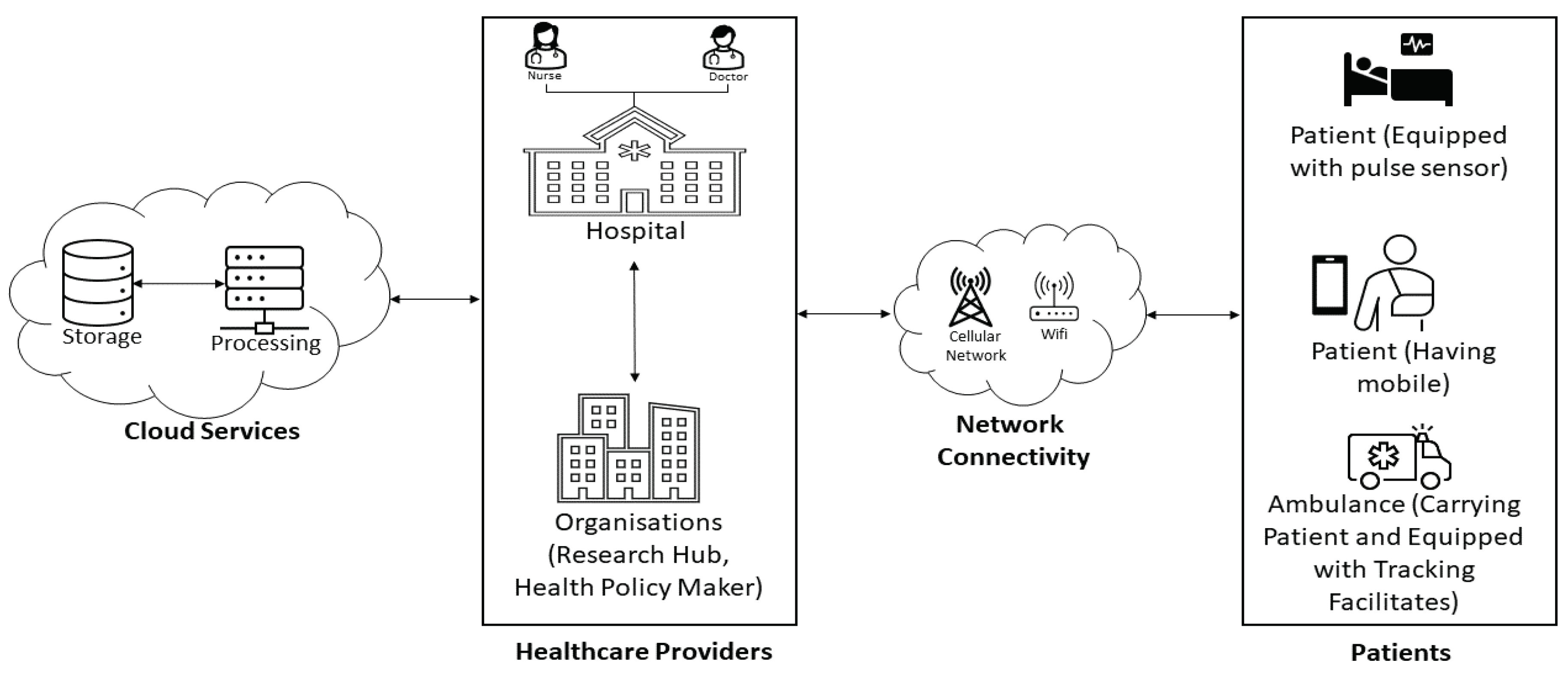
Figure 2.
Integration and Design Challenges of ICT Technologies to the Healthcare Systems.
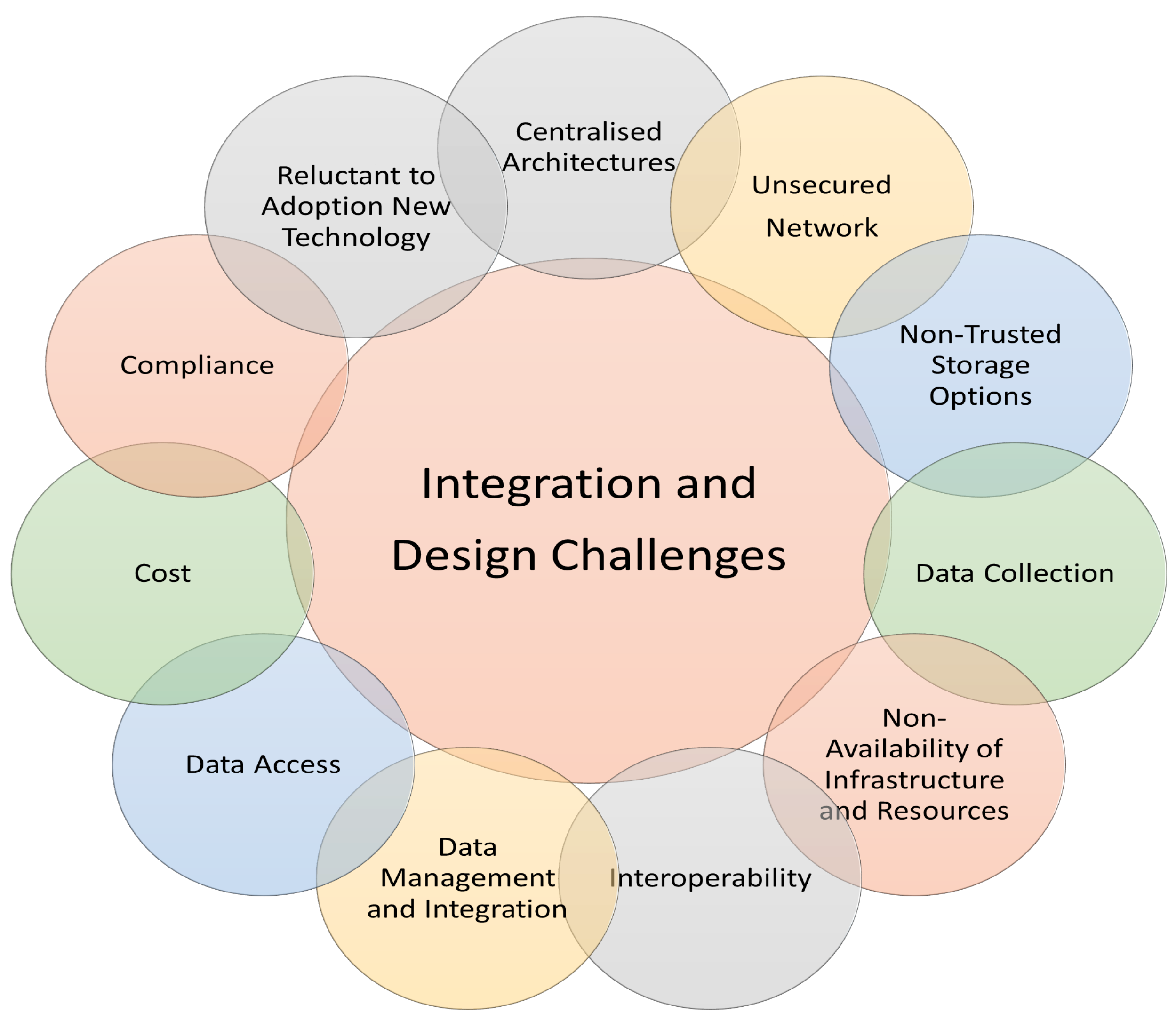
Figure 3.
Security and Privacy Challenges of Integrating ICT Technologies to the Healthcare Systems.
Figure 3.
Security and Privacy Challenges of Integrating ICT Technologies to the Healthcare Systems.

Figure 4.
Blockchain Characteristics.
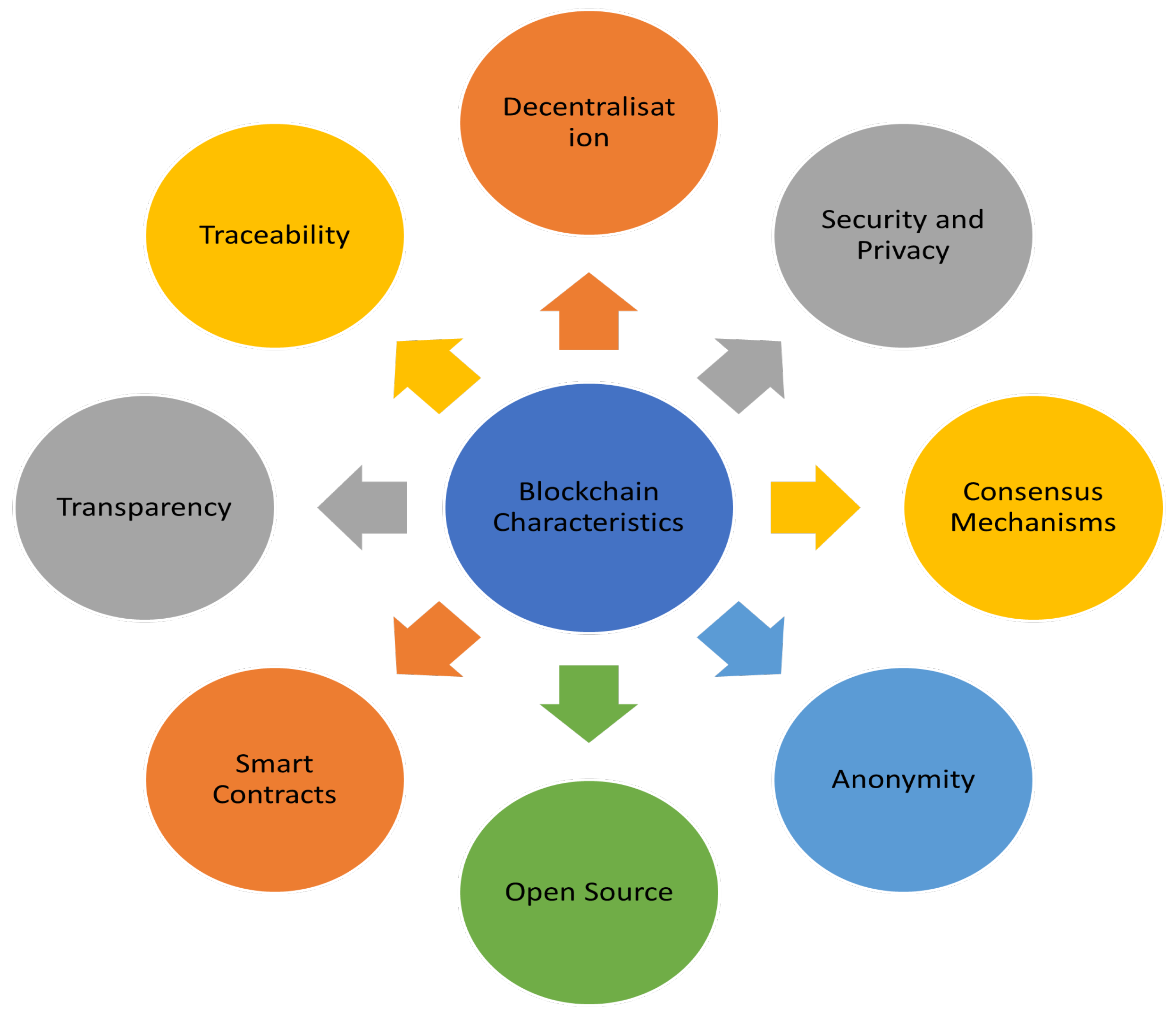
Figure 5.
Blockchain Benefits in E-Health.
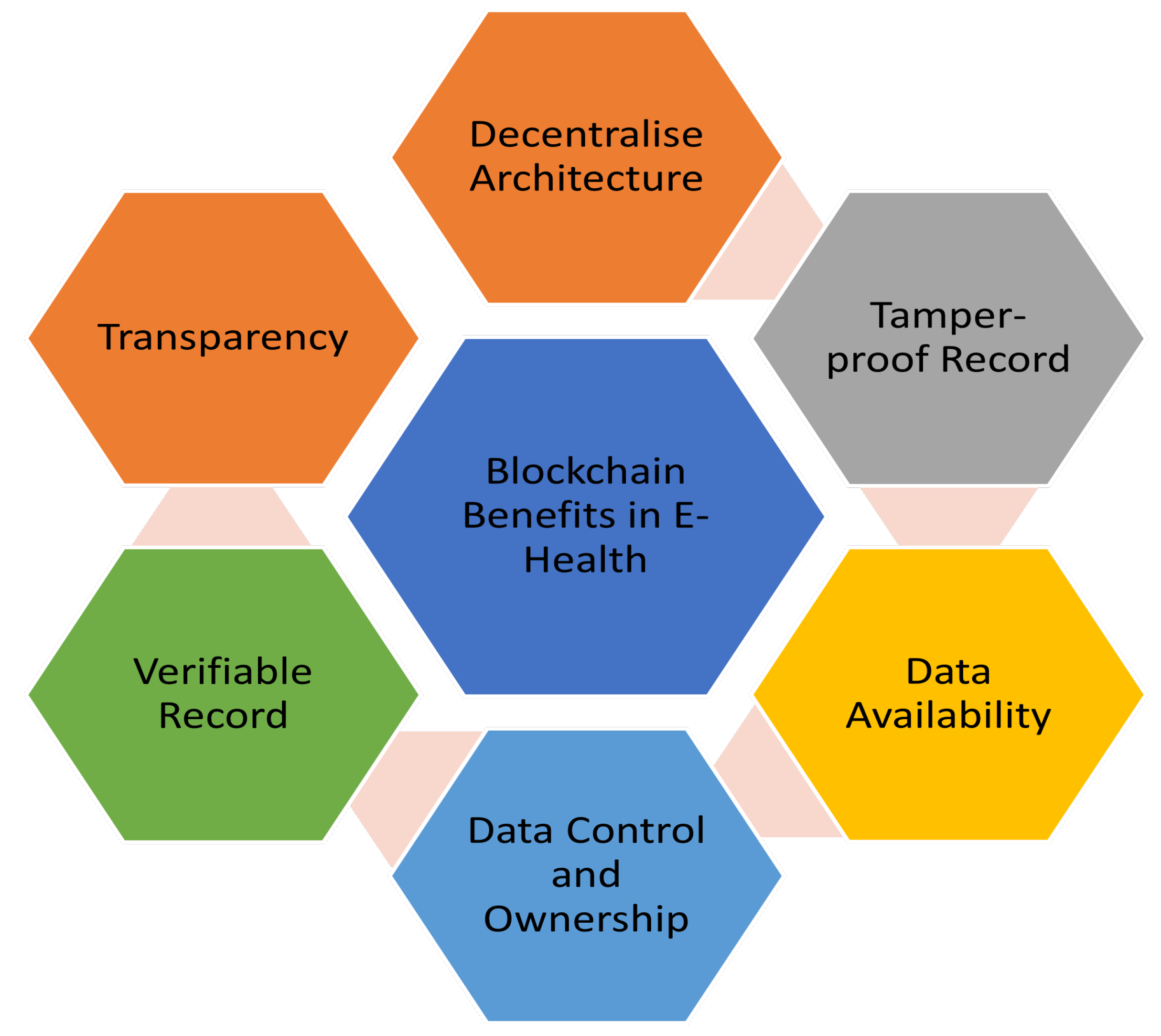
Figure 6.
Positive and Negative Impact of ICT Integration into Health Systems.
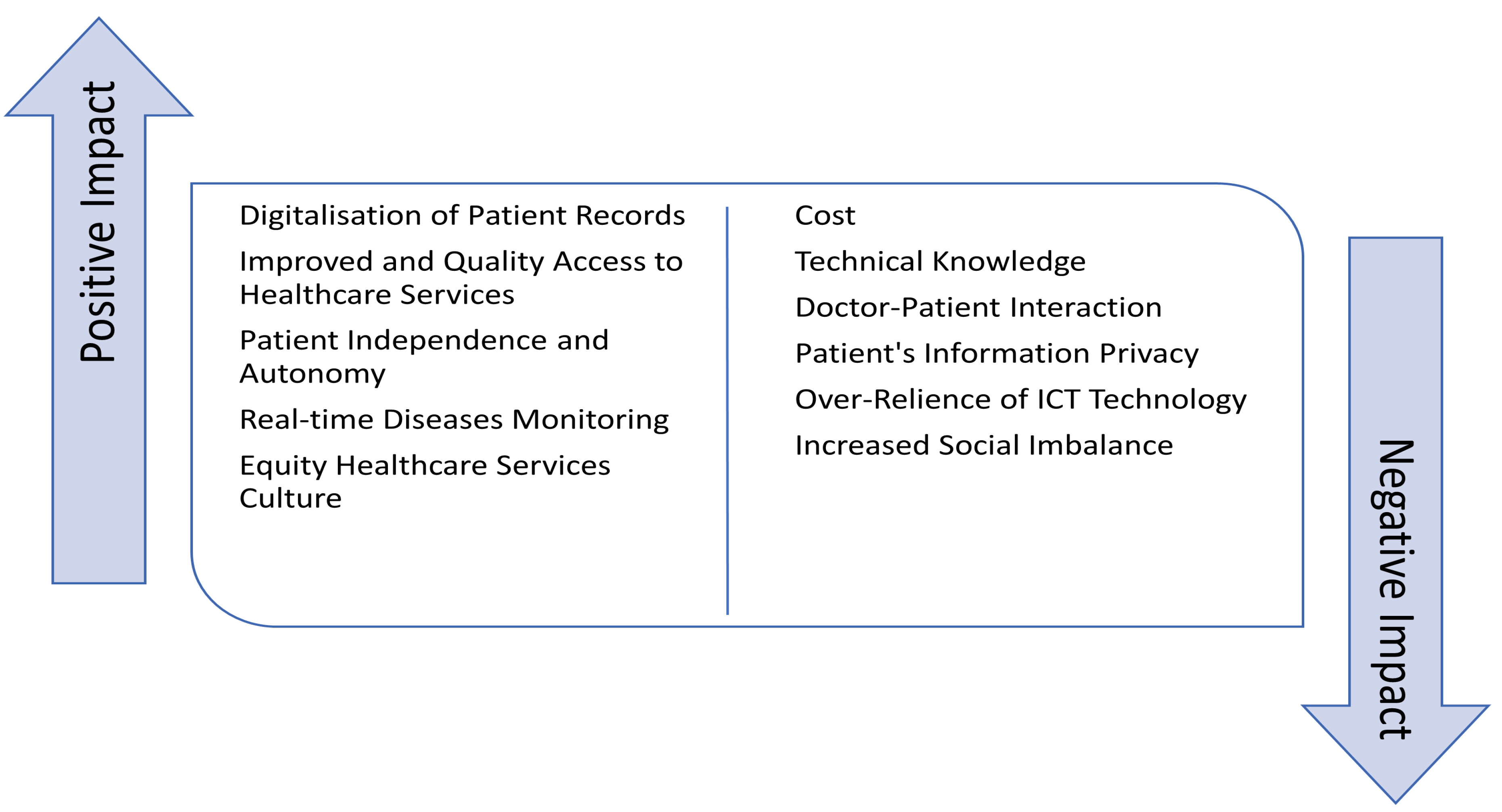
Figure 7.
Challenges and Future Research Directions.
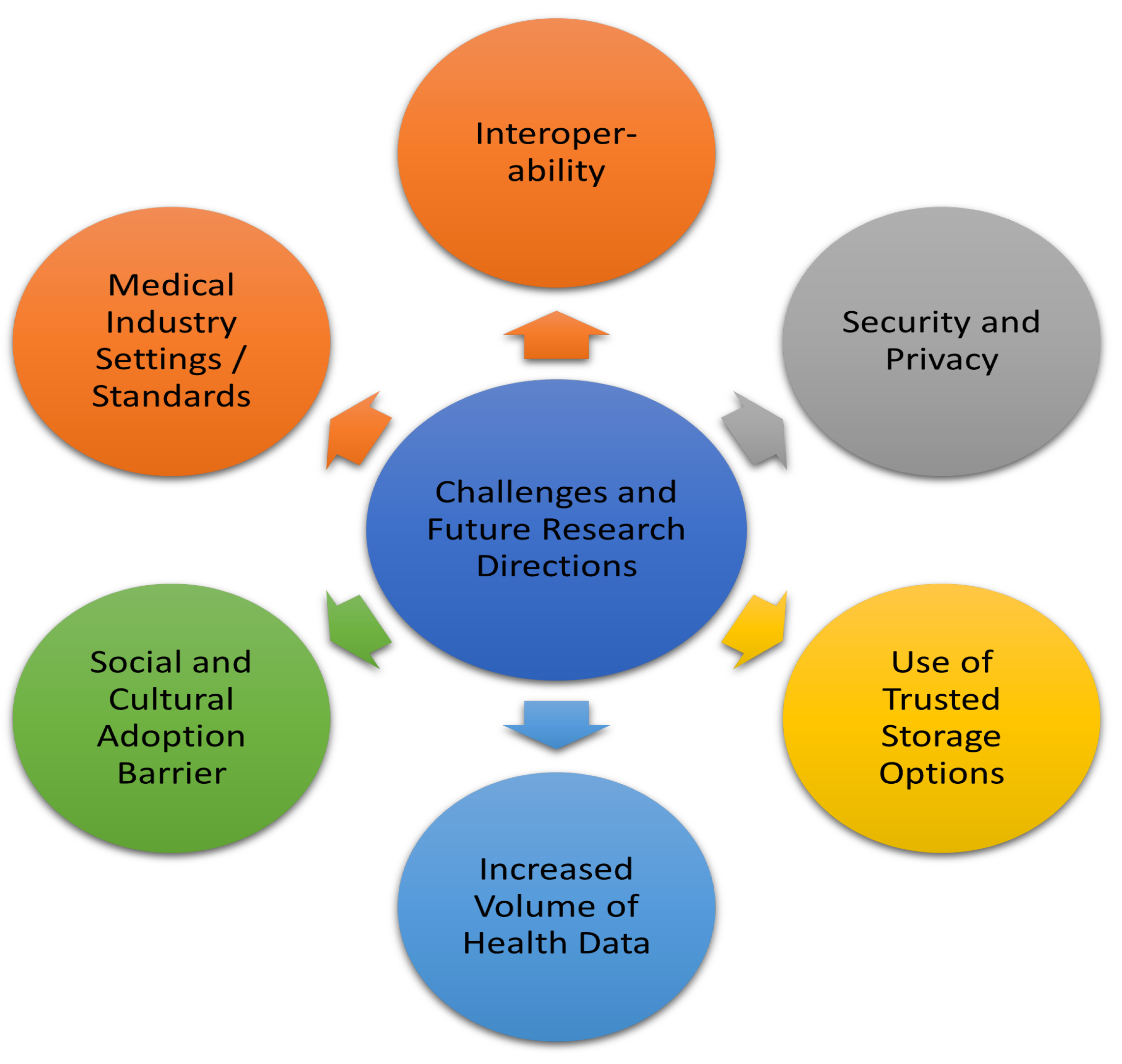

Table 1.
Existing Studies on Integration of ICT to the SDG (Healthcare and Well-Being).
| Ref | Publisher and Year | Paper Title | Problem Focused | Sustainability Aspects Focused | ICT Integration Technology | Security and Privacy Challenges | Design and Integration Challenges | E-Health Related Applications | Future Directions |
|---|---|---|---|---|---|---|---|---|---|
| [10] | PLOS ONE 2022 | Impact of cybersecurity measures on improving institutional governance and digitalization for sustainable healthcare | To assess the relationship between digitalization and security for healthcare | Social and Economic | N/A | N/A | N/A | N/A | Proposed model can be applied to other SDGs |
| [11] | Springer 2021 | The role of E-Governance in combating COVID-19 and promoting sustainable development: A comparative study of China and Pakistan | To investigate the role of e-governance in combating COVID-19 | Social and Economic | N/A | N/A | N/A | N/A | Financial technology can provide solutions to health crises such as the COVID-19 pandemic |
| [12] | MDPI 2021 | Application of IoT in Healthcare: Keys to Implementation of the SDGs | (a) Are IoT applications key to the improvement of people’s health and the environment? (b) Are there research and case studies implemented in cities or territories that demonstrate the effectiveness of IoT applications and their benefits to public health? (c) What sustainable development indicators and objectives can be assessed in the applications and projects analyzed | Environment | IoT | N/A | N/A | Intelligent Solutions (Vaccine and drug manufacturing, logistics, population vaccination planning and management, data management, and patient monitoring at home) | Security for management of intelligent systems IoT-based framework for SDGs |
| [13] | MDPI 2023 | 5G Technology in the Digital Transformation of Healthcare, a Systematic Review | Analyse the impact of the 5G network on the use of apps to improve healthcare | N/A | 5G | N /A | N/A | Telemedicine | 5G-based technologies to facilitate monitoring and tracking for better healthcare |
| [14] | MDPI 2022 | Modeling Conceptual Framework for Implementing Barriers of AI in Public Healthcare for Improving Operational Excellence: Experiences from Developing Countries | To understand the significance of AI and its implementation barriers in the healthcare systems in developing countries | Social and Economic | AI | Privacy | Governance, Scalability | N/A | various perspectives on the design and development of the conceptual framework can be further expanded and empirically developed from the viewpoint of sustainable public healthcare systems |
| [15] | MDPI 2023 | State-of-the-Art of AI and Big Data Analytics Reviews in Five Different Domains: A Bibliometric Summary | To explore the AI and Big data technologies for different emerging fields (Business, Engineering, Healthcare, Sustainable Operations, and Hospitality Tourism) | N/A | AI and Big data | N/A | N/A | N/A | Specialization in AI sub-domains and BDA tools, AI and BDA in selected management domains, contributing to Smaller thematic areas, Empirical research base, Legal and ethical concerns |
| [16] | IBIMA 2022 | The Sustainable e-Health System Development in COVID-19 Pandemic - The Theoretical Studies of Knowledge Management Systems and Practical Polish Healthcare Experience | To describe the theoretical issues of sustainable development in e-health, and to show practical issues of ICT | N/A | AI | N/A | N/A | Electronic Cards (Insurance, Verification, Prescription, Medical Events, Drug monitoring, network patient information) | Barriers of ICT implementation in the healthcare system. |
| [17] | MDPI 2023 | Digital Transformation in Healthcare: Technology Acceptance and Its Applications | To examine the effects of digital transformation on the healthcare industry | N/A | IoT | Security | N/A | Telemedicine | N/A |
| [18] | De Gruyter 2023 | Digital Transformation and Sustainability in Healthcare and Clinical Laboratories | Study examines the existing data about the influence of digital technology on healthcare and clinical labs | Environmental | N/A | N/A | N/A | Telemedicine and Teleworking | N/A |
| [19] | Plos Digital Health 2023 | Healthcare inequity and digital health–A bridge for the divide, or further erosion of the chasm? | The present state of disparity and inequity to assess the ramifications of digital health | N/A | N/A | N/A | N/A | N/A | N/A |
| [20] | MDPI 2023 | Legacy of COVID-19 Innovations: Strengthening African Primary Health Care through Pandemic Innovations | How are technologies that were originally created for the purpose of addressing the COVID-19 pandemic being employed to enhance the capacity and effectiveness of Primary Health Care? | N/A | N/A | Security | Minimalistic Design, Cross Functional Innovations, Modular Designs, Offgrid Capabilities, Interoperability | N/A | N/A |
| [21] | MDPI 2023 | Toward a Comprehensive Understanding and Evaluation of the Sustainability of E-Health Solutions | Evaluate the long-term viability and ecological impact of recently suggested or currently implemented electronic health (e-health) solutions | Social, Economics | N/A | N/A | N/A | N/A | N/A |
| [22] | Frontiers 2023 | ICT applications and the COVID-19 pandemic: Impacts on the individual’s digital data, digital privacy, and data protection | The use of ICT technologies and Users personal data | N/A | Big Data | Privacy and Data Accessibility | N/A | N/A | The present discourse concerns matters pertaining to digital privacy, data-driven methodologies, and legislation governing the protection of data. |
Disclaimer/Publisher’s Note: The statements, opinions and data contained in all publications are solely those of the individual author(s) and contributor(s) and not of MDPI and/or the editor(s). MDPI and/or the editor(s) disclaim responsibility for any injury to people or property resulting from any ideas, methods, instructions or products referred to in the content. |
© 2023 by the authors. Licensee MDPI, Basel, Switzerland. This article is an open access article distributed under the terms and conditions of the Creative Commons Attribution (CC BY) license (http://creativecommons.org/licenses/by/4.0/).
Copyright: This open access article is published under a Creative Commons CC BY 4.0 license, which permit the free download, distribution, and reuse, provided that the author and preprint are cited in any reuse.


