

Submitted:
07 August 2023
Posted:
09 August 2023
You are already at the latest version
Preprints on COVID-19 and SARS-CoV-2
Abstract
As a result of the COVID 19 outbreak that has affected the whole world, teacher leadership has gained more significance. Teacher leadership is a multidimensional concept. While some teachers exercise leadership only at the classroom level, others exercise leadership at macro level. This level of leadership enactment is directly related to how teachers construct their professional identity in relation to leadership. This study aims to explore the leadership-related professional identities of teachers who came to the fore especially during the COVID 19 pandemic period by using the latent profile analysis method. The data were collected a sample of 710 teachers. Teachers completed Teacher Leadership Behavior Scale that measures teacher leadership behaviors at four levels: classroom, parental, micro-level, macro-level. Participants also completed Rosenberg Self-Esteem Scale, Teacher Self-Efficacy Scale, Openness to Authority Scale, and Job Satisfaction Scale. As a result of latent profile analysis, three distinct profiles of teacher leadership identity emerged: those who exercise leadership at a minimum level, an intermediate level and a maximum level across all four levels of teacher leadership. These profiles were labeled as "extended professionality," "intermediate professionality," and "restricted professionality," drawing upon Hoyle's (1974) conceptualization of teacher professional identity. These findings suggest that teachers construct their identity differently about teacher leadership. It is essential for school leaders to first explore those different levels of professional identity and tailor their professional development activities accordingly.
Keywords:
teacher leadership
; COVID 19
; teacher professional identity
; latent profile analysis
; school improvement
1. Introduction
Although principal leadership is regarded as the most central in school improvement (Johnston, 2010), there are many other sources of leadership within schools that could equally contribute to school improvement. One of these important sources is teacher leadership. The importance of teacher leadership has been better understood especially with the transition to distance education during the COVID 19 pandemic. Therefore, there has been a growing interest in teacher leadership among scholars and practitioners alike (Alexandrou & Swaffield, 2014; Hilty, 2011; Schott, 2020) since teacher leaders are critical in reforming schools (Wilson, 2016). In today’s ever-changing world, where student learning is beyond the responsibility of one teacher (Little, 1990), teacher leadership is more important than ever in today's world, where student needs are becoming more diverse and differentiated every day and this situation is much better understood during the COVID 19 pandemic. (CSTP, 2009). There is also enough empirical evidence in the literature that teacher leadership has a significant impact on student outcomes (Leithwood, Patten, & Jantzi, 2010; Alexandrou, 2015; Shen et al., 2020).
Despite the increasing interest in teacher leadership lately, with the contribution of the above-mentioned situations, , the concept still remains ambiguous (Hunzicker, 2022) and most studies on teacher leadership are atheoretical (Schott et al., 2020). Furthermore, there is no agreed-upon definition (Cosenza, 2015). Teacher leadership is defined in terms of roles and responsibilities (Katzenmeyer & Moller, 2009), formal positions (Fink & Markholt, 2011), functions (TLEC, 2012), worldviews (Smulyan, 2016), a stance (Hunzicker, 2022), moral agency (Frost, 2019) or influence (Schott et al., 2020). However, the succinct definition provided by Wenner and Campbell (2016) reflects the essence of most definitions: “maintaining K-12 classroom-based teaching responsibilities, while also taking on leadership responsibilities outside of the classroom” (Wenner & Campbell, 2016, p. 5). This definition does not specify how teachers take on leadership responsibilities beyond the classroom.
Teachers exercise leadership outside of their classrooms in three different forms: formally, informally and in a hybrid form. Within the formal form of teacher leadership, leadership is seen as a role-based practice (Fink & Markholt, 2011) where teachers are given a formal position and expected to lead change by serving in that role. In contrast, within the informal view, leadership emerges spontaneously from the teacher ranks (Riveros et al., 2013). All teachers can exercise leadership regardless of their position (Hill, 2014). Frost (2018) calls this approach “non-positional teacher leadership”. Leadership is an entitlement for every teacher regardless of formal roles or positions (Bangs & Frost, 2015). It draws on teachers’ moral purpose and agency (Frost, 2018). In the hybrid form, teachers teach part-time and support colleagues in other times (Margolis & Huggins, 2012).
Silva et al. (2000) have described three distinct waves of teacher leadership and argued that teacher leadership evolved from formal positions to the re-culturing of schools over time. In the first wave, teachers were given formal roles and were expected to exercise leadership in that role. In the second wave, teacher leadership entailed sharing pedagogical expertise with colleagues. In the third wave, teacher leadership involved re-culturing of schools where teachers collaborate and collectively learn together. The third wave is still emerging (Wilson, 2016). Berry et al. (2013) have added a so-called fourth wave to this conceptualization (Smulyan, 2016), which they called “teacherpreneurs”. In the new fourth wave, teachers stay in the classroom but also develop their own ideas and executive them just like entrepreneurs. Teacher leadership is evolving from formal positions (the first wave) to a more informal approach (the fourth wave) (Carrion and García-Carrión, 2015).
What is problematic about the formal view of teacher leadership is that leadership is regarded as “additional” rather than “a part of” teachers’ daily work (Silva et al., 2000). If teacher leadership is defined in terms of positional authority, not all teachers see themselves reflected in that “leader” image (Lambert, 2002). Then, a critical source of leadership is lost for school improvement. Leadership is a matter of teachers’ agency and their commitment to initiating and leading change (Frost and Durrant, 2002). As Berry et al. (2020) argue, in today’s educational system, all teachers need to lead one way or another. Then the challenge is: How can we enable every teacher to exercise leadership? In order to answer this question, we first need to understand the antecedents of teacher leadership. How are teacher leaders different from those who do not exercise leadership? What makes a teacher leader (want to) exercise leadership?
Researchers have been trying to understand the antecedents of teacher leadership in recent years (Ding and Thien, 2020). Schott et al. (2020) has identified antecedents at three different levels: teacher, school-level, and supra-school level. One of the most important determinants of teacher leadership at teacher level is teachers’ professional identity. Even some scholars argue that the biggest barrier is often lack of a teacher’s leader self-perception since some teachers have difficulty viewing themselves as leaders (Hunzicker, 2017). Even if all the enablers are in place, such as supportive organizational structure, school culture and principal, in order to exercise leadership, teachers must “first perceive themselves as leaders” (Carver, 2016). If teachers see themselves only a teacher, which Helterbran (2010) calls “I am just a teacher syndrome”, they will not leadership as a legitimate part of their professional roles (Frost and Durrant, 2002). Hunzicker (2017) studied the process in which teachers learn to be a teacher leader, she found that what enable the progression was “self-perception”. Therefore, in order to foster and support teacher leadership in schools, the first and most critical step is to explore teachers’ professional identity and assess to what degree they see leadership as a dimension of their professional identity. Below we discuss teachers’ professional identity in relation to leadership.
1.1. Teacher Professional Identity
There has been increasing research interest in the concept of teacher professional identity over the last 40 years (Beijaard, 2017). It has become the fundamental aspect of research on teaching throughout the world (Akkerman, 2011) since it affects the performance and decisions of teachers in most domains (Beijaard et al., 2000; Hong, 2010; Mahan, 2010). It is an organizing principle in teachers’ lives (Maclure, 1993) and a lens through which teachers make sense of their role (Brenner et al., 2018). Shortly, professional identity stands at the core of the teaching profession (Popper-Giveon, & Shayshon, 2017; Sachs, 2005).
Although professional identity is widely researched, the concept of professional identity is defined differently (Beijaard et al., 2004) and there is no consensus on the definition (Rodrigues & Mogarro, 2019). Especially the distance education process during the COVID 19 pandemic and the hybrid education approach afterwards have brought new definitions to the professional identity of teachers. However, the succinct definition provided by Beijaard, Meijer and Verloop, (2004) reflects the essence of most definitions: a set of views which teachers hold about themselves as professionals. Hoyle (1974), one of the most influential scholars in the field, used the term “professionality” to refer to teachers’ professional identity. Hoyle and John (1995) define professionality as "that set of knowledge, skills, values, and behaviors, which is exercised on behalf of clients" (p. 16). It refers to teachers’ own of interpretations of their work and their orientations towards their work (Van Veen, et al., 2001). It concerns how teachers construct their own professional identities (Qanay & Frost, 2022). It is important to analyze and understand a teacher’s professional identity (Van Veen, et al., 2001) because individuals act in congruent with their identity (Oyserman, 2009). For instance, regarding teacher’s integration of new technology, Lai and Jin (2021) found that teachers’ adoption of new technology is directly related to the construction of their professional identity. Teachers who adopted an educator (vs instructor identity) were more likely to adopt new innovations. Similarly, Liu and Geertshuis (2021) found that professional identity was influential in the adoption of Learning Management System (LMS). Teachers who were student-focused were more likely to adopt LMS.
Teachers construct their professionality in different ways in different arenas of education: face-to-face, distance or hybrid. It is possible to see various categorization in the literature. For instance, regarding “teacher roles” within the classroom, Beijaard et al. (2000) discuss teachers’ professional identity in terms of three roles: a subject matter expert, a pedagogical expert and a didactical expert. Van Veen et al. (2001) have distinguished two professional orientations regarding the goals of education: an instructor orientation to advance qualification, and an educator orientation to advance personal and moral development. Professional identity also directly influences teachers’ orientation towards leadership, which we discuss below.
1.2. Teacher Leadership and Extended Professionality
About teacher roles in the school as a whole, Hoyle (1974) describes two different orientations: restricted professionality and extended professionality. Hoyle’s (1974) influential distinction between “restricted professionality” and “extended professionality” influences how teachers construct their professional roles in terms of leadership. Teachers with “restricted professionality” are mostly oriented to their own classrooms, while teachers with “extended professionality” go beyond their classroom walls and orient to the whole schools (Hoyle, 1974). Teachers with “restricted professionality” are more concerned about subject matter and teaching in the classroom while teachers with “extended professionality” focus on the school as a whole (Van Veen et al., 2001). Teachers with “restricted professionality” feel responsible for their own students while teachers with “extended professionality” see the development of students as the joint responsibility of all teachers (Little, 1990). Teachers with “extended professionality” engage with issues from a broad social and political frame (Smulyan, 2016) and locate classroom practice within a larger social framework (Hoyle, 2008). Teachers with “extended professionality” are happily collegial (Hoyle, 2008).
When Hoyle (1974) proposed this distinction, there was no empirical evidence, but later studies provided empirical evidence to support this conceptualization. Teachers with “extended professionality” are more likely to exercise leadership to contribute to school improvement and take responsibility for innovation especially in times such as the Covid 19 pandemic. Jongmans et al. (1998) found teachers with an extended professional orientation are more collegial. Van Veen et al. (2001) found that teachers with an extended professionality are more likely to engage in collaboration. Jongmans, Biemans and Beijaard (1998) demonstrated that teachers with “extended professionality” were more involved in policy making. It could be argued that teachers were involved in life-changing decision manking process during the Covid. An important finding of these studies was that these teachers did not ignore their classrooms. They extended their professionality beyond classrooms. These studies clearly demonstrate that leadership is a crucial dimension of extended professionality. Some teachers may not see leadership as part of their professional identity (Frost, 2006). Some teachers see their role only in terms of classroom (Collay, 2006).
Leadership is simply a dimension of what it is to be a professional, a form of professionality which is maximally agential (Frost, 2018). Becoming a teacher leader is a process of the adoption of a leadership stance a way of being a teacher, a worldview and a habit of mind - leading here and then (Smulyan 2016; Poekert et al., 2016). For instance, Lieberman and Friedrich (2010) described the process in the National Writing Project as acquiring “a leadership identity.” Frost (2014) called for enabling all teachers to enact extended professionality since it is directly related to teacher leadership. Then, leadership programme for teachers should be about developing their leadership identity since extended professionalism as a key condition for teacher quality and student outcomes (Gaikhorst, Beishuizen, Zijlstra, & Volman, 2015; Sugrue, 2011). Unfortunately, offering workshops to update teachers’ knowledge will add little if teachers do not have an extended professionality. Therefore, teacher leadership development programmes should be extending teacher professionality. The first step is to discover where teachers are in terms of their professionality and then enable teachers to adopt a leadership identity. To the best of knowledge there is no study that has tested Hoyle’s distinction between restricted professionality and extended professionality in the Turkish settings. The purpose of our study is to explore teachers’ professionality in relation to teacher leadership in Türkiye, using Hoyle’s distinction through latent profile analysis.
2. Methodology
2.1. Design
The study used a cross-sectional design that aimed to identify the latent profiles of teacher leadership after the COVID-19 pandemic through Latent Profile Analysis (LPA). Four factors of teacher leadership behaviors (classroom leadership, parental leadership, micro-level leadership, macro-level leadership) were used to determine the latent profiles. Various fit indices were utilized to decide the number of profiles (Akogul & Erisoglu, 2017) and the model that best fits the data was selected.
2.2. Participants and Sampling Procedure
The data for this study were collected from a total of 710 teachers who were affiliated with schools situated in the city of Istanbul, Turkey. Among the participating teachers, 263 participants (37 %) were male, while 402 participants (56,6%) were female and data from 45 (6.3%) were missing. Their ages ranged from 22 to 65 years, with an average age of 42.3 (SD = 8.8). On average, teachers had 18 years of experience (SD = 9.3). In terms of teaching level, 45 participants (6.3 %) were from preschool, 172 participants (24.2%) were from primary school, 242 participants (34.1%) were from middle school, and 204 participants (28.7.6%) were from high school. The data for 47 (6.6%) were missing.
2.3. Research Instruments
Participants completed Teacher Leadership Behavior Scale (Bolat, 2023). The scale with a high level of validity and reliability (Cronbach's alpha = .93) consisted of 17 items and four factors that measure teachers’ behaviour at four levels. Cronbach's alphas for classroom leadership were .78, for parental leadership .89, for micro-level leadership .90, and for macro-level leadership .91. “Classroom leadership” (sample item: I help my students to discover themselves) and “parental leadership” (sample item: I am always in communication with parents for the benefit of my students) were characteristic of “restricted professionality”, and “micro-level leadership” (sample item: I offer advice and suggestions to my colleagues) and “macro-level leadership” (sample item: I am involved in decision making process at school) were characteristic of “extended professionality”.
Participants completed Job Satisfaction Scale (five items) (Judge et al., 1998). (Cronbach's alpha = .91), Sample item is: I find real enjoyment in my work. Participants completed Teacher Self Efficacy Scale (five items) (Midgley et al., 1989). This scales measures whether teachers feel self-efficacious in their teaching abilities. Sample item is: I am certain that I can make a difference in my students’ lives. For these three scales, responses were provided on a 5-point Likert scale, ranging from 1 (definitely disagree) to 5 (definitely agree).
Participants completed a short version of the Rosenberg self-esteem scale (Rosenberg, 1965) consisting of six items (Cronbach's alpha = .82). The scale measures participants’ level of self-esteem. This short version was developed by Bolat and Antalyalı (2023) and demonstrated high levels of validity and reliability. Sample item is: Overall, I am satisfied with myself. Participants completed Openness to Authority Scale (three items) (Bolat & Antalyalı, 2023). This scale measures the extent to which teachers express their ideas to authority figures (Cronbach's alpha = .92). Sample item is: I can freely express my ideas to my superiors when I do not agree with them. For these two scales, responses were provided on a 7-point Likert scale, ranging from 1 (definitely does not define me) to 7 (definitely defines me).
2.4. Data Analysis
Latent Profile Analysis was used to determine profiles of teacher leadership. The R package (v. 4.0.2) (R Core Team, 2021) and “tidyLPA" package program were used to identify latent profiles (Rosenberg et al., 2021). LPA analyzes individuals' latent profiles based on observed variables, also known as dependent variables. Based on the specified continuous variables, the most probable profile to which an individual belongs is identified. In LPA, instead of assigning individuals to any specific group, it estimates the probability of membership in a group (Degnan et al., 2008). LPA allows for the analysis variables using measures such as means, variances, and covariances. The first stage in determining latent profiles is the model selection where 4 different models (model 1, 2, 3, and 6) are tested. In addition to selecting the model that fits the data the best, the number of profiles is also explored (Williams & Kibowski, 2016). By comparing the obtained fit indices, the number of profiles is determined. The most commonly fit indices used for the number of profiles are the Bayesian Information Criterion (BIC; Schwarz, 1978), Akaike Information Criterion (AIC; Akaike, 1987) and SABIC. Lower values are better for model fit (Bauer, 2022). The entropy measure, which reveals unexplained cases in classification, was utilized to assess the quality of classification, where an entropy value close to 1 is perfect, a value above .80 is desirable and a value above .60 is the minimum value accepted (Asparouhov & Muthén, 2014; Akogul and Erisoglu, 2017). It is essential to choose the most concise model and ensure that none of the profile solutions have a small profile size of less than 5% of the total sample (Hamza & Willoughby, 2013).
Afterwards, the independent variable of profile membership was utilized in a series of one-way Analysis of Variance tests to assess whether there were significant differences in the scores of Job Satisfaction, Teacher Self-Efficacy, Self Esteem Scale and Openness to authority among the identified groups. The data were analyzed using SPSS.
Interventionary studies involving animals or humans, and other studies that require ethical approval, must list the authority that provided approval and the corresponding ethical approval code.
3. Results
3.1. Correlations
The interrelationships among four teacher leadership behavior factors (classroom leadership, parental leadership, micro-level leadership, macro-level leadership), job satisfaction, teacher self-efficacy, self-esteem and openness to authority were calculated and presented in Table 1. There was a high correlation among all scores.
3.2. Profiles of the Teacher Leadership Behaviors
Latent Profile Analysis was performed, and the results are presented in Table 2, which includes fit statistics for different models. As depicted in Table 2, the values of AIC, BIC, and SABIC are lower for the three-profile model, indicating a good solution. Furthermore, Models 1, 2 and 3 ensure that the smallest profile is no less than 5% of the sample size. The higher entropy during the transition from other profiles to a three-profile solution indicates that the three-profile solution is superior to alternative solutions. The BLRT tests yielded highly significant values (p < 0.01), further supporting the selection of the three-profile model. Based on these results, the three-profile is the most suitable and best-fitting model for the data. Based on the fit indices and the objective of latent profile analysis, we determined that the 3-profile was more appropriate.
The teachers were categorized into three profiles after the analysis. Profile 2 represents the smallest group, consisting of 54 teachers and accounting for 8 % of the total sample. This group exhibits the lowest average scores across all four teacher leadership behaviour factors (classroom leadership, parental leadership, micro-level leadership and macro-level leadership) and is identified as teachers with “restricted professionality”. Profile 1, on the other hand, is the largest group, comprising 341 teachers, which represents 48 % of the sample. This group exhibits the highest average scores across all four teacher leadership behaviour factors and is identified as teachers with “extended professionality”. Lastly, Profile 3 consists of 315 teachers, accounting for 44 % of the sample. This group demonstrates moderate scores across all four teacher leadership behaviour factors and is identified as teachers with “intermediate (moderate) professionality”. Figure 2 displays the plot illustrating these three-profile.
3.3. The Univariate Analysis of Job Satisfaction, Teacher Self-Efficacy Self Esteem Scale and Openness to Authority of Teachers.
The purpose of employing one-way ANOVA tests was to assess whether there were differences in the average scores of job satisfaction, teacher self-efficacy, self-esteem and openness to authority scales among the identified profiles. Post-hoc Scheffe were subsequently applied and yielded significant results (p<.001). The results revealed that the extended professionality profile exhibited the highest level across all four measures, while the restricted professionality profile displayed the lowest level. The intermediate professionality class fell in the middle range of all measures (Table 3).
4. Discussion
This study aimed to explore teachers' professionalism in relation to teacher leadership through latent profile analysis in the aftermath of the COVID 19 pandemic. For the analysis, we used Hoyle’s (1974) influential distinction between “restricted professionality” and “extended professionality” as a framework. Our study was based on the argument that the most important antecedent of teacher leadership is teachers’ professionality identity- what Hoyle (1974, 2008) calls professionality.
We used teacher leadership behavior scale, developed by Bolat (2023) to measure teacher leadership. We chose this scale because this scale measures teacher leadership, not at a unidimensional but a multidimensional level. Some teachers exercise leadership only at the classroom level, while others lead at the micro-level (among colleagues) or macro-level (involving the entire school community). This scale represents this multidimensionality. The scale consisted of four factors which measures teacher leadership at four levels: classroom leadership, parental leadership, micro-level leadership and macro level leadership. We additionally used four other scales to validate the profiles: the Rosenberg Self-Esteem Scale, Teacher Self-Efficacy Scale, Openness to Authority Scale, and Job Satisfaction Scale. As a result of latent profile analysis, three distinct profiles of teacher leaders emerged: those who exercise leadership at a minimum level across all four levels, those who demonstrate an intermediate level of leadership across all four levels, and those who exhibit a maximum level of leadership across all four levels. These profiles were labeled as "extended professionality," "intermediate professionality," and "restricted professionality," drawing upon Hoyle's (1974) conceptualization of teacher professionality. The profiles were also found to differ in terms of self-esteem, job satisfaction, teacher self-efficacy, and openness to authority. This finding is line with Hoyle’s distinction, but there are significant differences.
Extended Professionality Profile in our study is perfectly in line with the concept of “extended professionality” proposed by Hoyle (1974). Teachers in this profile focus both on their classrooms and school as a whole. They feel responsible both for their own students and student in the whole school. This was also the case with the Extended Professionality Profile within our study. We expected that teachers with extended professionality would score high on all measures and this was the case. Teachers with extended professionality did not downplay their role in the classroom while focusing on school improvement. Teachers within the Extended Professionality Profile exercised leadership within the classroom, among parents and colleagues and within the whole school. This study provided empirical evidence for the concept of extended professionality. This finding is also consistent with the findings of Clement et al. (1995, cited in Van Veen, et al., 2001) who describes teachers’ professional concerns in terms of three categories: self-concern, task concern and other-concern. Self-concern and task-concerns focus on classroom, while other-concern refers to what teachers do with or for others as a member of a school community. Teachers with extended professionality are more other-concerned.
Restricted Professionality Profile in our study had different characteristics than what Hoyle (1974) suggested. Hoyle suggested that teachers with restricted professionality are mostly oriented to their classroom responsibilities rather than the whole school, are more concerned about teaching in the classroom rather than the general quality of teaching in school and feel responsible for only their own students rather than all students (Jongmans et al. 1998; Hoyle, 1974; Hoyle; 2008; Van Veen et al., 2001). However, in our research, we found that teachers with restricted professionality are not only concerned about the whole school, but also their own classrooms, the development of their students or involvement of parents in the educational process either. They scored low on all four factors of teacher leadership. Classroom leadership and parental leadership used items like these: I learn about the inner world of my students, I help my students discover themselves, I develop the talents of my students, I collaborate with parents for the development of my students, I learn the family lives of my students. Teachers with restricted professionality scored low on these two factors. We expected that teachers with restricted professionality would score low on micro-level and macro-level leadership, but high on classroom leadership and parental leadership. But this was not the case. This was a key distinction from Hoyle’s conceptualization. Hoyle (2008) had warned in later publications that the term “restricted professionality” should not carry a negative connotation and teachers with “restricted professionality” could be excellent teachers. It is just that the scope of professionalism that was restricted (Hoyle 2008). The professionalism of teachers in our study also had restricted professionalism. Teachers with restricted professionality also scored very low on all other measures. In other words, they had a lower level of self-esteem, less satisfied with their jobs, feel a lower level of self-efficacy in their classroom and have difficulty to expressing their ideas to their superiors.
The present research was unique in that it extended Hoyle's conceptualization by adding a third dimension, "intermediate professionality," to the existing distinction between "extended professionality" and "restricted professionality." Teachers with "intermediate professionality" exhibited moderate scores across all four teacher leadership behaviour factors. This finding could suggest that these teachers could be going through a process. Smulyan (2016) explains that in the formation of leadership identity, teachers move through three waves: teacher leadership as behaviors and skills, teacher leadership as process and teacher leadership as stance. The teachers with "intermediate professionality" could be in the “process” of becoming a teacher leader, in a transition from perceiving teacher leadership as behaviors to viewing it as a stance.
4.1. Suggestions and future directions for research
Teachers with restricted professionality scored low on self-esteem, job satisfaction, self-efficacy and openness-to-authority measures. One study found that teacher leadership contributes to greater satisfaction in the classroom (Johnson & Landman, 2000). However, it is not clear which leads to which, that is, whether teacher leadership is the cause or the effect of job satisfaction. Similarly, however, it was not clear in our studies these four variables are the cause or the effect of restricted professionality. Experimental studies are needed to test the effect of these four concepts on teacher leadership. School leaders first need to understand explore teachers’ conception of their own professionality and design professional development activities tailored differently for each type of professionality. School leaders also need to understand that support at cultural and structural level of the school will not foster teacher leadership unless teachers develop extended professionality and perceive themselves as leaders (Carver, 2016). This is a gradual process where teachers add additional roles and images to their professional identity over time (Chval et al., 2010). School leaders need to know that identity development is dynamic and an on-going process (Akkerman & Meijer, 2011)
School leaders should design a school culture where there are opportunities for conversation, discussion and reflection among teachers since these practices help the development of a leadership stance in an organic way (Smulyan 2016). Extended professionalism cannot be developed unless teachers are engaged in interaction with other professionals (Hong, 2010). Colleagues are often the key actors in teachers’ formation of professional identity Cohen (2010).
In one study, teacher leaders who participated in a leadership cohort for three consecutive years revealed that their conceptions of teacher leadership evolved over time from a set of behaviors and skills, to a commitment and ongoing process across many contexts, to a way of thinking and positioning oneself within the field of education (Smulyan, 2016). Intermediate group can be a link with the teacher leadership as a process. Policy makers could design teacher leadership programmes to change teachers’ professional identity. Many programs such as the Great Lakes Academy (Carver, 2016), International Teacher Leadership Program (Frost, 2011), The Teacher Leadership for School Improvement (TLSI) (Ross et al., 2011) were successful in changing teachers’ conception of identity. When times such as the Covid come again, teachers with extended professionality can greatly contribute to effective decision making in educational settings.
Funding
This research has received no additional funding.
Institutional Review Board Statement
The study was approved by Süleyman Demirel Üniversitesi Ethics Committee with the reference number of E- 87432956-050.99-502057 on the date of 25.05.2023.
Informed Consent Statement
All participation was voluntary.
Data Availability Statement
All data can be accessed at https://osf.io/8bczr.
Acknowledgments
We would like to thank Dr. Ergün Kara for his help and support in data analysis.
Conflicts of Interest
“The authors declare no conflict of interest.”
References
- Hoyle, E. Professionality, professionalism and control in teaching. London Educational Review 1974, 3, 13–19. [Google Scholar]
- Johnston, M.P. Distributed leadership theory for investigating teacher librarian leadership. International Association for Librarianship. 2015. [Google Scholar]
- Alexandrou, A.; Swaffield, S. (Eds.) Teacher leadership and professional development; Routledge, 2014. [Google Scholar]
- Hilty, E. B. (Ed.) Teacher leadership – the “new” foundations of teacher education; Peter Lang, 2011. [Google Scholar]
- Schott, C.; van Roekel, H.; Tummers, L.G. Teacher leadership: A systematic review, methodological quality assessment and conceptual framework. Educational Research Review 2020, 31, 100352. [Google Scholar] [CrossRef]
- Wilson, A. From professional practice to practical leader: Teacher leadership in professional learning communities. International Journal of Teacher Leadership 2016, 7, 45–62. [Google Scholar]
- Little, J.W. The persistence of privacy: Autonomy and initiative in teachers' professional relations. Teachers College Record 1990, 91, 509–536. [Google Scholar] [CrossRef]
- Center for Strengthening the Teaching Profession. Teacher leadership skills framework. Available online: http://cstp-wa.org/cstp2013/wp-content/uploads/2014/06/Teacher-Leadership-Framework.pdf (accessed on 1 August 2023).
- Leithwood, K.; Patten, S.; Jantzi, D. Testing a conception of how school leadership influences student learning. Educational Administration Quarterly 2010, 46, 671–706. [Google Scholar] [CrossRef]
- Alexandrou, A. A Learning Odyssey: The trials, tribulations and successes of the educational institute of Scotland’s further education and teacher learning fepresentatives. Research in Post-Compulsory Education 2015, 20, 113–126. [Google Scholar] [CrossRef]
- Shen, J.; Wu, H.; Reeves, P.; Zheng, Y.; Ryan, L.; Anderson, D. The association between teacher leadership and student achievement: A meta-analysis. Educational Research Review 2020, 31, 100357. [Google Scholar] [CrossRef]
- Hunzicker, J.L. Is it teacher leadership? Validation of the five features of teacher leadership framework and self-determination guide. International Journal of Teacher Leadership 2022, 11, 5–28. [Google Scholar]
- Cosenza, M.N. Defining teacher leadership: Affirming the teacher leader model standards. Issues in Teacher Education 2015, 24, 79–99. [Google Scholar]
- Katzenmeyer, M.; Moller, G. Awakening the sleeping giant: Helping teachers develop as leaders; Corwin Press, 2009. [Google Scholar]
- Fink, S.; Markholt, A. Leading for instructional improvement: How successful leaders develop teaching and learning expertise; John Wiley & Sons, 2011. [Google Scholar]
- Teacher Leadership Exploratory Consortium. Teacher Leader Model Standards. 2012. Available online: https://www.nea.org/resource-library/teacher-leader-model-standards (accessed on 29 June 2023).
- Smulyan, L. Symposium introduction: Stepping into their power: The development of a teacher leadership stance. Schools 2016, 13, 8–28. [Google Scholar] [CrossRef]
- Frost, D. HertsCam: A teacher-led organisation to support teacher leadership. International Journal of Teacher Leadership 2018, 9, 79–100. [Google Scholar]
- Wenner, J.A.; Campbell, T. The theoretical and empirical basis of teacher leadership: A Review of the literature. Review of Educational Research 2016, 87, 134–171. [Google Scholar] [CrossRef]
- Riveros, A.; Newton, P.; da Costa, J. From teachers to teacher-leaders: A case study. International Journal of Teacher Leadership 2013, 4, n1. [Google Scholar]
- Hill, V. The HertsCam teacher led development work program. In Transforming education through teacher leadership; Frost, D., Ed.; LfL: Cambridge, 2014. [Google Scholar]
- Bangs, J.; Frost, D. Non-positional teacher leadership: Distributed leadership and self-efficacy. In Flip the System; Routledge, 2015; pp. 91–107. [Google Scholar]
- Margolis, J.; Huggins, K.S. Distributed but undefined: New teacher leader roles to change schools. Journal of School Leadership 2012, 22, 953–981. [Google Scholar] [CrossRef]
- Silva, D.Y.; Gimbert, B.; Nolan, J. Sliding the door: Locking and unlocking possibilities for teacher leadership. Teachers College Record 2000, 102, 779–804. [Google Scholar] [CrossRef]
- Berry, B.; Byrd, A.; Wieder, A. Teacherpreneurs: Innovative teachers who lead but don't leave; John Wiley & Sons, 2013. [Google Scholar]
- Carrion, R.G.; García-Carrión, R. Transforming education through teacher leadership. International Journal of Educational Leadership and Management 2015, 219–221. [Google Scholar] [CrossRef]
- Lambert, L. A framework for shared leadership. Educational Leadership 2002, 59, 37–40. [Google Scholar]
- Frost, D.; Durrant, J. Teachers as leaders: Exploring the impact of teacher-led development work. School Leadership & Management 2002, 22, 143–161. [Google Scholar]
- Berry, B.; Doucet, A.; Owens, B. Teacher leadership in the aftermath of a pandemic: The now, the dance, the transformation. Independent report written to inform the work of Education International. Available online: https://issuu.com/educationinternational/docs/2020researchcovid19nowdancetransformation?fr=sZDU1MzE0MTkwMTA (accessed on 1 August 2021).
- Ding, Z.; Thien, L.M. Assessing the antecedents and consequences of teacher leadership: A partial least squares analysis. International Journal of Leadership in Education 2022, 1–23. [Google Scholar] [CrossRef]
- Hunzicker, J. From teacher to teacher leader: A conceptual model. International Journal of Teacher Leadership 2017, 8, 1–27. [Google Scholar]
- Carver, C.L. Transforming identities: The transition from teacher to leader during teacher leader preparation. Journal of Research on Leadership Education 2016, 11, 158–180. [Google Scholar] [CrossRef]
- Helterbran, V.R. Teacher leadership: Overcoming 'I am just a teacher' syndrome. Education 2010, 131, 363–371. [Google Scholar]
- Beijaard, D. Learning teacher identity in teacher education. In The SAGE Handbook of Research on Teacher Education; Clandinin, D. J., Husu, J., Eds.; Sage, 2017; pp. 139–142. [Google Scholar]
- Akkerman, S. F.; Meijer, P. C. A dialogical approach to conceptualizing teacher identity. Teaching and Teacher Education 2011, 27, 308–319. [Google Scholar] [CrossRef]
- Beijaard, D.; Verloop, N.; Vermunt, J.D. Teachers’ perceptions of professional identity: An exploratory study from a personal knowledge perspective. Teaching and Teacher Education 2000, 16, 749–764. [Google Scholar] [CrossRef]
- Hong, J.Y. Pre-service and beginning teachers' professional identity and its relation to dropping out of the profession. Teaching and Teacher Education 2010, 26, 1530–1543. [Google Scholar] [CrossRef]
- Mahan, P.L. Work environment stressors, social support, anxiety, and depression among secondary school teachers. AAOHN Journal 2010, 58, 197–205. [Google Scholar] [CrossRef] [PubMed]
- Maclure, M. Arguing for your self: Identity as an organizing principle in teachers’ jobs and lives. British Educational Research Journal 1993, 19, 311–322. [Google Scholar] [CrossRef]
- Brenner, P.S.; Serpe, R.T.; Stryker, S. Role-specific self-efficacy as precedent and product of the identity model. Sociological Perspectives 2018, 61, 57–80. [Google Scholar] [CrossRef]
- Popper-Giveon, A.; Shayshon, B. Educator versus subject matter teacher: The conflict between two sub-identities in becoming a teacher. Teachers and Teaching 2017, 23, 532–548. [Google Scholar] [CrossRef]
- Sachs, J. Teacher education and the development of professional identity: Learning to be a teacher. In Connecting policy and practice: Challenges for teaching and learning in schools and universities; Denicolo, P., Kompf, M., Eds.; Routledge, 2005; pp. 5–21. [Google Scholar]
- Beijaard, D.; Meijer, P.C.; Verloop, N. Reconsidering research on teachers’ professional identity. Teaching and Teacher Education 2004, 20, 107–128. [Google Scholar] [CrossRef]
- Rodrigues, F.; Mogarro, M.J. Student teachers’ professional identity: A review of research contributions. Educational Research Review 2019, 28, 100286. [Google Scholar] [CrossRef]
- Hoyle, E.; John, P. Professional Knowledge and Professional Practice; Cassell: London, 1995. [Google Scholar]
- Van Veen, K.; Sleegers, P.; Bergen, T.; Klaassen, C. Professional orientations of secondary school teachers towards their work. Teaching and Teacher Education 2001, 17, 175–194. [Google Scholar] [CrossRef]
- Qanay, G.; Frost, D. The teacher leadership in Kazakhstan initiative: Professional learning and leadership. Professional Development in Education 2022, 48, 411–425. [Google Scholar] [CrossRef]
- Oyserman, D. Identity-based motivation: Implications for action-readiness, procedural-readiness, and consumer behavior. Journal of Consumer Psychology 2009, 19, 250–260. [Google Scholar] [CrossRef]
- Lai, C.; Jin, T. Teacher professional identity and the nature of technology integration. Computers & Education 2021, 175, 104314. [Google Scholar]
- Liu, Q.; Geertshuis, S. Professional identity and the adoption of learning management systems. Studies in Higher Education 2021, 46, 624–637. [Google Scholar] [CrossRef]
- Hoyle, E. Changing conceptions of teaching as a profession: Personal reflections. In Professional Knowledge and Professional Practice; Hoyle, E., John, P. D., Eds.; 2008. [Google Scholar]
- Jongmans, K.; Biemans, H.; Beijaard, D. Teachers' professional orientation and their involvement in school policy making: Results of a Dutch study. Educational Management & Administration 1998, 26, 293–304. [Google Scholar]
- Frost, D. The concept of ‘agency’in leadership for learning. Leading & Managing 2006, 12, 19–28. [Google Scholar]
- Collay, M. Discerning professional identity and becoming bold, socially responsible teacher-leaders. Educational leadership and administration: Teaching and Program Development 2006, 18, 131–146. [Google Scholar]
- Poekert, P.; Alexandrou, A.; Shannon, D. How teachers become leaders: An internationally validated theoretical model of teacher leadership development. Research in Post-Compulsory Education 2016, 21, 307–329. [Google Scholar] [CrossRef]
- Lieberman, A.; Friedrich, L. D. How teachers become leaders: Learning from practice and research. Series on school reform; Teachers College Press, 2010. [Google Scholar]
- Gaikhorst, L.; Beishuizen, J.J.; Zijlstra, B.J.; Volman, M.L. Contribution of a professional development program to the quality and retention of teachers in an urban environment. European Journal of Teacher Education 2015, 38, 41–57. [Google Scholar] [CrossRef]
- Sugrue, C. Irish teachers’ experience of professional development: Performative or transformative learning? Professional Development in Education 2011, 37, 793–815. [Google Scholar] [CrossRef]
- Akogul, S.; Erisoglu, M. An approach for determining the number of clusters in a model-based cluster analysis. Entropy 2017, 19, 452. [Google Scholar] [CrossRef]
- Bolat, Ö. Öğretmen Liderliği Davranış Ölçeği: Geçerlilik ve Güvenilirlik Çalışması. Dokuz Eylül Üniversitesi Buca Eğitim Fakültesi Dergisi 2023, 56, 1033–1056. [Google Scholar] [CrossRef]
- Judge, T.A.; Locke, E.A.; Durham, C.C.; Kluger, A.N. Dispositional effects on job and life satisfaction: the role of core evaluations. Journal of Applied Psychology 1998, 83, 17. [Google Scholar] [CrossRef]
- Midgley, C.; Feldlaufer, H.; Eccles, J.S. Change in teacher efficacy and student self-and task-related beliefs in mathematics during the transition to junior high school. Journal of Educational Psychology 1989, 81, 247. [Google Scholar] [CrossRef]
- Rosenberg. 1965.
- Bolat, Ö.; Antalyalı, Ö.L. PS kişisel eğilimler envanterinin psikometrik özellikleri. Turkish Studies - Education 2023, 18, 433–477. [Google Scholar] [CrossRef]
- R Core Team R: A Language and environment for statistical computing. (Version 4.1) [Computer software]. Retrieved from https://cran.r-project.org. (R packages retrieved from MRAN snapshot 2022-01-01).
- osenberg, J., Beymer, P., Anderson, D., Van Lissa, C.; Schmidt, J. tidyLPA: Easily Carry Out Latent Profile Analysis (LPA) Using Open-Source or Commercial Software. [R package]. Available online: https://CRAN.R-project.org/package=tidyLPA.
- Degnan et al., 2008.
- Williams, G.A.; Kibowski, F. Latent class analysis and latent profile analysis. Handbook of methodological approaches to community-based research: Qualitative, quantitative, and mixed methods 2016, 15, 143–151. [Google Scholar]
- Schwarz, G. Estimating the Dimension of a Model. Annals of Statistics 1978, 6, 461–464. [Google Scholar] [CrossRef]
- Akaike, H. Information theory and an extension of the maximum likelihood principle. In 2nd International Symposium on Information Theory; Petrov, B. N., Csaki, F., Eds.; Akademiai Kiado, 1973; pp. 267–281. [Google Scholar]
- Bauer, J. A primer to latent profile and latent class analysis. In Methods for Researching Professional Learning and Development: Challenges, Applications and Empirical Illustrations; Springer International Publishing, 2022; pp. 243–268. [Google Scholar]
- Asparouhov, T.; Muthén, B. Variable-specific entropy contribution. Technical appendix. Muthen & Muthen 2014. [Google Scholar]
- Hamza, C.A.; Willoughby, T. Nonsuicidal self-injury and suicidal behavior: A latent class analysis among young adults. PloS one 2013, 8, e59955. [Google Scholar] [CrossRef] [PubMed]
- Clement, M. De professionele ontwikkeling van leerkrachten basisonderwijs. De spanning tussen autonomie en collegialiteit (Professional development of primary school teachers. The tension between autonomy and collegiality). Dissertation, University of Leuven, 1995. [Google Scholar]
- Johnson, S. M.; Landman, J. “Sometimes bureaucracy has its charms”: The working conditions of teachers in deregulated schools. Teachers College Record 2000, 102, 85–124. [Google Scholar] [CrossRef]
- Chval, K.B.; Arbaugh, F.; Lannin, J.K.; van Garderen, D.; Cummings, L.; Estapa, A.T.; Huey, M.E. The transition from experienced teacher to mathematics coach: Establishing a new identity. The Elementary School Journal 2010, 111, 191–216. [Google Scholar] [CrossRef]
- Cohen, J. L. Getting recognized: Teachers negotiating professional identities as learners through talk. Teaching and Teacher Education 2010, 26, 473–481. [Google Scholar] [CrossRef]
- Ross, D.; Adams, A.; Bondy, E.; Dana, N.; Dodman, S.; Swain, C. Preparing teacher leaders: Perceptions of the impact of a cohort-based, job-embedded, blended teacher leadership program. Teaching and Teacher Education 2011, 27, 1213–1222. [Google Scholar] [CrossRef]
Figure 2.
Three latent profiles of teacher leadership (N = 710).
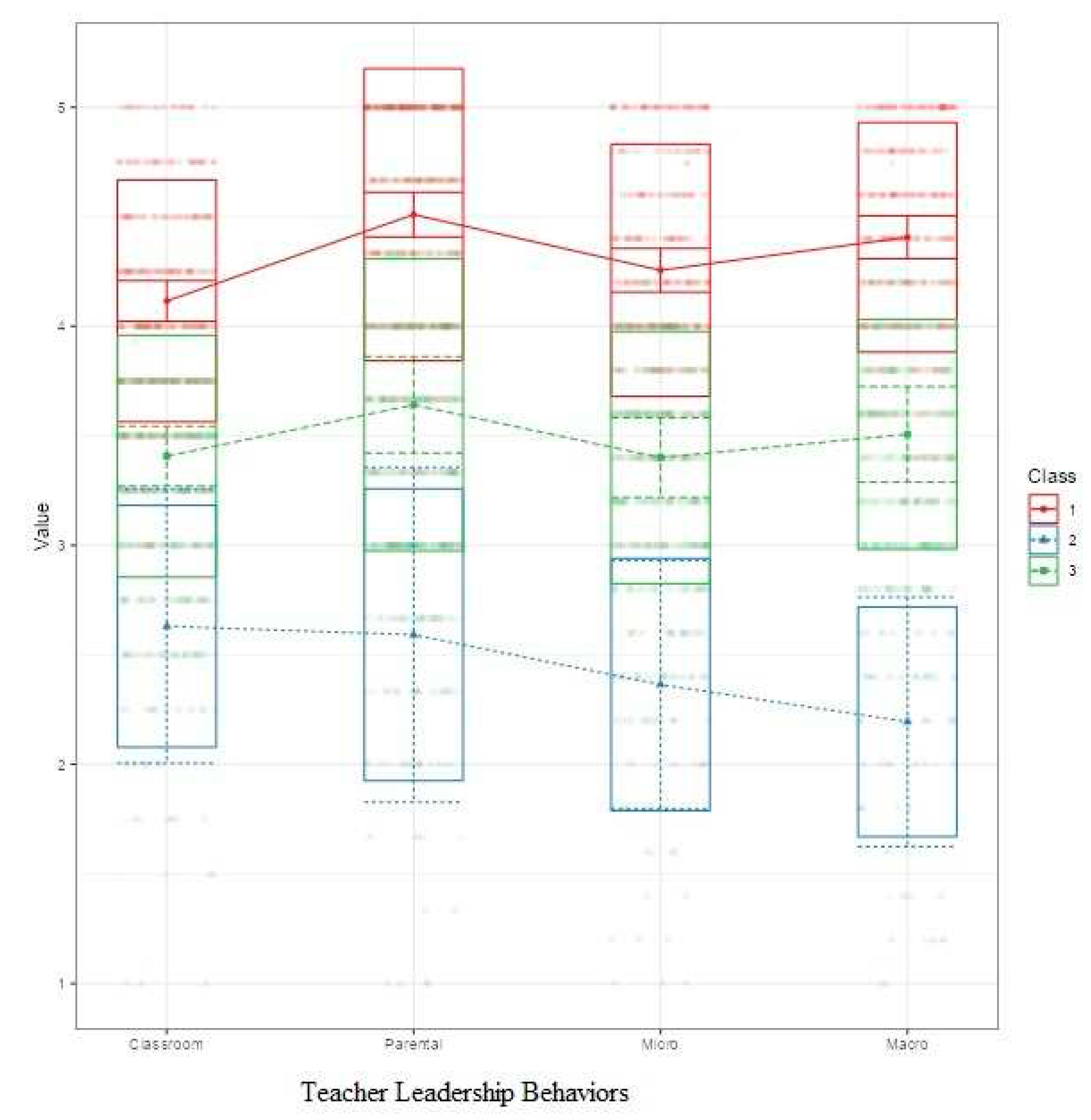

Table 1.
Correlations of variables.
| Variable | 1 | 2 | 3 | 4 | 5 | 6 | 7 | 8 |
|---|---|---|---|---|---|---|---|---|
| 1. Classroom leadership | — | |||||||
| 2. Parental leadership | .53*** | — | ||||||
| 3. Micro-level leadership | .51*** | .45*** | — | |||||
| 4. Macro-level leadership | .52*** | .54*** | .64*** | — | ||||
| 5. Job satisfaction | .40*** | .33*** | .31*** | .38*** | — | |||
| 6. Teacher self-efficacy | .50*** | .42*** | .37*** | .46*** | .51*** | — | ||
| 7. Self esteem | .45*** | .36*** | .37*** | .37*** | .50*** | .53*** | — | |
| 8. Openness to authority | .36*** | .28*** | .32*** | .45*** | .29*** | .33*** | .44*** | — |
* p < .05, ** p < .01, *** p < .001
Table 2.
1–4 profiles for teacher leadership behaviour in Türkiye.
| The Number of Profiles | BIC | AIC | AWE | CLC | KIC | SABIC | Entropy | BLRTP | Profile size | Sample<5% |
|---|---|---|---|---|---|---|---|---|---|---|
| 1 | 6888 | 6852 | 6963 | 6838 | 6863 | 6863 | - | - | 710 | No |
| 2 | 6224 | 6165 | 6347 | 6140 | 6181 | 6183 | 0.77 | p<0.01 | 447,263 | No |
| 3 | 6018 | 5936 | 6189 | 5902 | 5957 | 5961 | 0.80 | p<0.01 | 341,54,254 | No |
| 4 | 5956 | 5851 | 6175 | 5807 | 5877 | 5883 | 0.78 | p<0.01 | 316,11,104,279 | Yes |
Table 3.
ANOVA for Job Satisfaction, Teacher Self-Efficacy, Self Esteem Scale and Openness to authority scores.
Table 3.
ANOVA for Job Satisfaction, Teacher Self-Efficacy, Self Esteem Scale and Openness to authority scores.
| Variables | Class | Mean score | Df | F | p | Eta squared |
|---|---|---|---|---|---|---|
| Job Satisfaction | extended professionality | 4,1946 | 2 | 62,793 | .000*** | 0,151 |
| restricted professionality | 3,1751 | |||||
| intermediate professionality | 3,7845 | |||||
| Teacher Self-Efficacy | extended professionality | 4,1232 | 2 | 96,071 | .000*** | 0,214 |
| restricted professionality | 3,2871 | |||||
| intermediate professionality | 3,7249 | |||||
| Self Esteem Scale | extended professionality | 5,9521 | 2 | 72,733 | .000*** | 0,171 |
| restricted professionality | 4,8564 | |||||
| intermediate professionality | 5,2757 | |||||
| Openness to authority | extended professionality | 5,5626 | 2 | 61,263 | .000*** | 0,148 |
| restricted professionality | 4,0079 | |||||
| intermediate professionality | 4,6150 |
* p < .05, ** p < .01, *** p < .001.
Disclaimer/Publisher’s Note: The statements, opinions and data contained in all publications are solely those of the individual author(s) and contributor(s) and not of MDPI and/or the editor(s). MDPI and/or the editor(s) disclaim responsibility for any injury to people or property resulting from any ideas, methods, instructions or products referred to in the content. |
© 2023 by the authors. Licensee MDPI, Basel, Switzerland. This article is an open access article distributed under the terms and conditions of the Creative Commons Attribution (CC BY) license (http://creativecommons.org/licenses/by/4.0/).
Copyright: This open access article is published under a Creative Commons CC BY 4.0 license, which permit the free download, distribution, and reuse, provided that the author and preprint are cited in any reuse.


