

Submitted:
04 August 2023
Posted:
07 August 2023
You are already at the latest version
Preprints on COVID-19 and SARS-CoV-2
Abstract
The COVID-19 led to changes modifying the role of digital transformation and unleashing unparalleled opportunities to improve business production processes in all three dimensions of sustainability - economic, social, and environmental through data-driven innovative service implications that significantly impact restaurant business, resulting in an increased competitive advantage. This paper identifies the innovative service implications and summarizes sustainable social systems measures in the context of strategic management in the restaurant industry triggered by COVID-19. Based on in-depth interviews with sixteen key experts in the restaurant industry, the paper clarifies and concretizes the rapidly transforming problem of identifying the main changes in the restaurant business, using three dimensions: consumer demand, corporate strategy optimization, and the use of the company's innovative potential. The findings reveal how companies need to expand their digital strategies and adapt their management approach to all stakeholders bringing sustainable business development in the post-pandemic period into focus. This paper serves as a framework for understanding the digital transformation role in resilient business management within restaurant social systems, with friction occurring along the workflow from kitchen to customer.
Keywords:
sustainable digital transformation
; strategic management
; restaurant business
; consumer preferences
; data-driven innovation
; expert interview
; resilient business management
1. Introduction
The outbreak of COVID-19 has had great social and political significance and felt throughout the economy. Thousands of companies were forced to close establishments, the communication method shifted to online, and telecommuting was introduced. Small and medium enterprises (SME) of the restaurant industry's, were the business community majority, who’s service systems suffered the most, being important in the functioning analysis [7,42]. Often, these SMEs are the last stage of the food supply chain, making direct contact with the final consumer [21,31].
The restaurant industry was one of the sectors with the activity adjustment greatest need in the period ahead, and numbers from the latest survey by the Association of Hotels, Restaurants and Similar Establishments of Portugal (AHRESP) are bare [37]. Half of the restaurants were at a standstill at the end of 2020 and 35% were considering insolvency. The losses are overwhelming; more than 80% of the restaurants saw turnover drop by more than 60% in three months. Since the first confinement, 38% of the companies have already laid off people. However, some have managed not to send people away. There 25% of restaurants implement takeaway and delivery. The kitchen became an ideas laboratory to keep them going. Joining global home delivery platforms like “UberEats” or “Glovo” helped bigger restaurants to stay afloat until the wave passes.
The pandemic has severely disrupted full-service restaurants as compared to quick service [36], including four resilience determinants, namely social (i.e., restaurant rating), physical (i.e., contactless service), economic (i.e., chain operation), and natural (e.g., location) capitals, which are significantly associated with the restaurant business resilience during the pandemic. These four determinants play different roles in the full-service and quick-service restaurants resilience. Now, it is clear restaurants need a comprehensive sustainable social systems approach to address the challenges posed by the pandemic.
As previous studies have shown, changing strategies and tactics to offset the impact of COVID-19 gave an advantage to a greater extent to chain restaurants were already equipped with digital infrastructure and had some innovative potential to quickly use their resources [14,16]. Digital transformation boosts sustainability in all three dimensions - economic, social, and environmental - through data-driven innovations that significantly impact customer engagement, resulting in an increased competitive advantage [23]. The quality of a company’s relationships and engagement with its stakeholders is critical, bringing the sustainable social systems into focus. Companies use innovation to strategically differentiate themselves from competitors with a more compelling value proposition while also considering the company's innovative potential. This prompted scientists and practitioners to explore consumer preferences, based on them, analyze, and form a competitive value proposition, considering the innovative potential of the company [11,13,32].
Sustainable digital transformation has become a necessity for doing business and customer interactions [28,40]. Based on the literature analysis, the factors determine demand in the restaurant business were identified, such as the quality and range of menus [29], food and service costs [8], sales forecasts [30], online reviews and customer service evaluation [4,33,34]. Among these factors, crisis events are dynamic, difficult to predict, and can lead to serious consequences for the industry. However, only a small number of empirical studies have examined the crises impact on restaurant demand [24,27,45]. Based on the previous studies analysis, this paper substantiates the need to analyze the pandemic impact on the restaurant business’s sustainable digital transformation. The research question is: What are the main changes in the business operations showing the adaptability of the restaurants to the sustainable social systems problems arose during the pandemic?
The objective of this paper is to justify the sustainable digital transformation significance, depending on the restaurant adaptability level, to the challenges encountered during the pandemic; how likely a sustainable digital transformation strategy is to be used in business operations in the restaurant industry; and how valuable it is in terms of in the post-COVID era.
To fill this gap in the research, the authors collected data on current issues of consumer demand, corporate strategy optimization, and the use of the company's innovative potential through in-depth interviews with restaurant industry experts. The information was analyzed to investigate the pandemic’s impact on the restaurant business’ ability to adapt to the new business reality and describe innovative service implications. The reasons do not allow the timely application and development of the company's innovative potential were also studied.
This study is a groundbreaking attempt to uncover the unfolding global COVID-19 pandemic on the restaurant industry implications within sustainable social systems. The expert data analysis can be used to assess restaurant business management decisions and forecast demand based on various pandemic scenarios more accurately. The authors assessed the significant factors associated with COVID-19 by identifying different blocks of innovation capacity. The results are a contribution to the strategic management literature on the factors determine restaurant sustainability.
2. Literature review
2.1. Analysis of the demand structure in restaurants: consumer preferences
Sustainable digital transformation according to Guo et al. [22] consists of four components: increasing the online processes use; introducing digital products or services; implementing online platforms; improving the supply chains digitalization. It is argued that a digital transformation enhances business performance by developing digital strategies, adopting digital technologies, and changing the way value is created in sustainable social systems.
The creation of value and innovative service implications in SME around the world is a key source of a sustainable presence in the market. Al-Kalouti et al. [1] argue that for most service companies, the ability to innovate is a key source of long-term competitive advantage.
Social systems largely shape consumer demand through targeted marketing strategies and has a particular importance for the restaurant industry sustainability, given the increased competition for people’s attention [25,35,48]. Data-driven forecasting and studying trends affect consumer demand can help to restaurant management, and conduct strategic planning and marketing analysis [12,34,49,50]. Digital transformation resources such as information technologies use and knowledge, influence organizational effectiveness research in restaurants and can help to prioritize set of actions for the company's sustainable development strategy. Consumer demand analysis in the restaurant industry includes several factors , that can be divided into two large categories:
1. Internal environment micro-level factors: directly related to products and services, corrected due to management processes self-regulation within the company's restaurant activities. For example, consumer preferences in the range of dishes [38]; compliance with sanitary regulations [18]; service quality and atmosphere [2]; online reviews and customer satisfaction [15].
2. External environmental macro-level factors: influence business processes from the outside, regardless of the company’s current activities. For example, economic conditions (gross domestic product, unemployment, interest rates); socio-demographic characteristics (population, migration); external environment: weather conditions and periods (day of the week, season); events (cultural, national, public holidays), the political situation in the country; and crises (financial downturns, infectious diseases) [5,6].
Demand structure analysis in restaurants can include several research types, depending on how consumer preferences are assessed. Most studies used micro-level factors for analysis. For example, restaurant demand measures, individual customer preferences, their behavioral intentions, or identified systematic choices [43,44]. Although such studies involve data heterogeneity, they may have limitations and be subject to respondent bias depending on the primary information source. Another group of micro-level studies use individual restaurants as the analysis unit rely on statistical data (e.g., restaurant sales and visits) to describe demand [17,45]. These surveys can be more accurate and reliable than consumer surveys, but often include small sample sizes and focus on a few specific restaurants. The third group of studies focuses on a combination of micro- and macro-level analysis using aggregated data and in-depth expert interviews with restaurant companies to predict demand for restaurant services [10]. This type of research can consider the internal and external factors influencing demand in restaurants, as well as the years of professional business experience, such as the average bill for the restaurant or what management decisions were made depending on changes in food consumption format preferences. Due to the larger factor analysis, companies can identify the main changes in the restaurant market during the COVID-19 pandemic.
2.2. Impact of the COVID-19 crisis on the restaurant industry
Service innovation relativized the physical doors closing and opened them to the online world, where customers could find home delivery platforms ready to bridge the gap between restaurants and entire society [36]. This solution, fundamental and highly beneficial at the height of the pandemic allowed restaurants to expand their business and invest in new ways to attract customers:
- The alternative to human contact and mechanized service a newly emerging reality. Self-service allows consumers to personalize their order to the maximum and have it arrive, in real-time, in the kitchen, streamlining processes and saving time. Robots serve the table, replacement of traditional menus with digital menus, accessible by QR Codes, and contactless payment. All these alternatives also served to accelerate the technological trends guarantee the quality of service and a limitless consumer experience.
- New technologies have not only improved the consumer experience but have also made restaurants much more profitable:
1. Speeding process. It gives opportunity allows better and more efficient cost management and, in turn, saves company’s time for what matters: the customer loyalty.
2. Managing waste. About one-third of all food produced for human consumption is recycled [39]. In other words, every day, delicious and fresh food goes to waste at restaurants, just because it has not been sold in time. This situation leads to the creation of new solutions in industry. For example, the “Too Good To Go” app lets customers buy and collect Magic Bags of this food - at a great price - directly from businesses.
A disruptive and unpredictable crisis has the potential to adversely affect ongoing operations, reputation, profitability, growth, and business survival [26]. A significant amount of research looks at the impact of various crises and industry crisis management, but there is much less research on these topics in the restaurant sector [19,20]. Most of these studies have focused on the impact of potential damage to the competitiveness and companies’ economic stability in the industry. The uncertainty and high risks highlighted by the COVID-19 addressed the need to assess its long-term impact on restaurant demand to help the industry and research community better understand and guaranty sustainable development, prepared for the public health crisis.
Conducting in-depth interviews with restaurant business executives to identify major market changes in the restaurant industry provide practical understanding of innovative service implications in the restaurant business in the post-COVID era with digital transformation strategies.
3. Methodology
3.1. Method description
Assessment of changes in the use of digital technologies in the restaurant business is based on in-depth interviews and obtains detailed information from industry experts on sustainable social systems, service provision, digital transformation strategies, and companies’ innovative potential during the pandemic.
The in-depth interview allows to use a mix of detailing and clarifying questions to motivate experts to freely share their personal experience and express in detail their beliefs, attitudes, and feelings on the research topic [46]. This type of data collection provides an opportunity to understand how restaurants have been able to adapt to the dynamic market conditions during the pandemic crisis and offer practical recommendations to companies on using their innovative potential. The method’s benefits can be divided into three main categories:
- 1.
- It allows the researcher and the expert to establish a comfortable relationship for more detailed answers on sensitive topics [41].
- 2.
- The researcher can independently select candidates for interviews, to receive the most accurate data obtained sample, and can also ask clarifying questions, obtain additional information, and return to key questions immediately in the dialogue to gain a better understanding of the expert’s attitude to the topic.
- 3.
- In-depth interviews are useful when a detailed portrait of customer opinions and behavior is needed. In addition, researchers analyze innovative ideas and contexts can provide a more accurate picture of market changes [9]. Berent [3] suggested two main reasons for this: first, the respondent’s ability to analyze motivation for a particular action, second, the use of active listening, together with anonymity, gives the respondent a sense of security and the chance to frankly express personal thoughts and feelings. Webb [46] noted researchers could track changes in a respondent's tone and choice of words to accurately interpret expert opinion. This makes it possible to establish a strong mutual understanding and a high degree of trust, thereby improving the data quality.
3.2. Research design
The in-depth interview was chosen as a research method based on the premise this approach is able to identify significant patterns of changes have occurred during the pandemic and based on expert opinion, it will be possible to develop recommendations for companies to develop a value proposition based on the company's innovative potential.
The interview method algorithm consists of the following mandatory steps:
- The preparatory stage contains from sampling strategy development, selecting experts and developing an interview guide (script), which contains the questions, will be asked during the interview.
- A field study consists of recruiting experts, conducting the interview itself, and transcribing the interview, if an audio recording was made, or a text document is immediately recorded with answers to the questions posed during the interview.
- The analytical stage contains the interview results processing and the analytical report preparation. Using the text document data describing the answers and the expert's impressions, an analytical report and/or presentation on the study results is compiled.
3.3. Data collection
Conducting in-depth interviews with restaurant managers was used to collect primary data from November 2021 to November 2022. This method allowed researchers to collect data from respondents in Portugal and Russia (where the scientific bases of research are located), which led to the identification of expert opinions on the main changes in the market situation in the restaurant industry on European continent with in two different contexts: short lockdown policies in Russia versus long in Portugal, with different levels on tourism dependency economy. According to the criteria, the participants hold senior positions in the restaurants management. Companies started their work before the start of the pandemic (in 2019) and have different sales channels. The interview contained 13 questions to identify the main changes in the restaurant market. On completion, the data were analyzed and systematized in accordance with the information received. For the purposes of this study, a restaurant was defined as a full-service restaurant establishment with table service, wide selection of food and beverages and a range of related services.
4. Findings and discussion
The interviews with restaurant industry experts and the features of the changes influencing a company’s value proposition development were analyzed. The pandemic served as a strong motivator for the restaurant business restructuring, forcing them to build and/or optimize an analytics system of large amounts of online data, e-commerce, and corresponding business strategy. It is important to understand what drives customers to return, what characteristics of value proposition motivate them to recommend a restaurant, what the restaurant brand image is, and what specific product and service characteristics create value for customers in the post-COVID Era. Noticing that social systems frictions occurring in the restaurant along the flow of work from kitchen to customer in terms of formal structure, interaction, symbols, attitudes, layout, and equipment making its sustainability challenging [47]. In this regard, one can track the growing popularity and importance of using individual in-depth interviews with restaurant business experts to analyze value propositions and restaurants’ innovative potential.
4.1. Analysis of respondent profiles
The total number was sixteen interview participants. Data of the respondents’ restaurant companies contain profiles of the following nature (Table 1).
Restaurant profiles. Among them, 37.5% belong to the average service level, 25% each are casual and business dining and quick service restaurants. 12.5% belong to the luxury dining restaurant format.
All the restaurants were established, before the pandemic started. 43.8% are large enterprises and 37.5% - small businesses enterprises. The experts number representing medium-sized category -18.8%. 62.5% of establishments combine online and offline business formats, 31.3% work mainly offline, and 6.3% work mainly for delivery and pickup. 75.6% of establishments deliver through their own system and 25.4% use aggregators.
4.2. Restaurant business adaptability results and demand structure analysis
The interviews showed the restaurants’ adaptability level to the problems arising during the pandemic. The experts' answers were divided into the following categories (Table 2).
One of the main issues facing the head of restaurant businesses during the pandemic was to analyze the possibilities to solve emerging problems related to consumer demand, which may influence the digital technology implementation.
According to half of the research participants, restaurant adaptation costs more than in the pre-pandemic period and requires larger investments, both emotional and physical. The serious problems presence associated with consumer demand, menu and service optimization incline experts to the opinion their restaurants are more likely not to adapt to the new reality of doing business.
Three global types of companies were identified, differentiated by their level of adaptability to the problems arose during the pandemic until 2022. Based on the characteristics of each type in terms of the adaptability level, sustainability recommendations were formed as part of the company's activities improving in terms of the strategic management of innovative potential for restaurants business in the digital transformation era. First type - A (31.4%) got different problems with adaptability and estimates themselves to the level “1”,“2”,“3”, “4” (Table 3). The second type – B (level “6”, 37.5%) sure their restaurant establishments have managed to adapt, but there are minor management problems and third type - C (level “7”, 31.3%) are convinced due to a strong brand and quality service, they have been able to fully adapt to the problems arose during the pandemic.
The results suggest each of the restaurants adapted to the demand during the pandemic and the adaptations are characterized by different consumer’s preferences. This shows which consumer preferences should be considered when digitalizing a business. The more quickly restaurants reacted to ongoing changes and were able to change value proposition characteristics in a timely manner, using the company’s innovative potential, the smaller the impact of the COVID-19 pandemic.
5. Conclusion and implications
This paper offers useful service market experts’ insights that can give a better understanding of the innovative service implications in the restaurant business in the post-COVID era with digital transformation strategies, and the role consumer preferences play in sustainable social systems. With the increasing role of sustainable digital transformation, businesses are reliant on their and data-driven innovation capabilities to enhance their existing procedures and provide support for their sustainable endeavors.
The overall implication of the findings is to achieve high-organizational effectiveness, restaurant operators’ first need to establish distinctive strategies in how to use digital resources to form a competitive value proposition and develop the company's innovative capacity. The changes in the service provision structure under the influence of COVID-19 dictate a new reality for the restaurant market. However, industry representatives note positive aspects. The pandemic period has shown companies with innovative service have the greatest chances of staying afloat, while their less successful competitors were often forced to suspend or completely stop their activities. This concerns both the value proposition characteristics and the company's timely innovative potential development. The crisis prompted restaurants to value sustainable social systems, optimize structure, digitalize business processes, and innovate services.
Industry experts believe that in recent years, the norms of running a restaurant business have been standardizing quite quickly: market leaders, using their own innovative potential, are introducing new developments, which is leading to an increase in the gap between them and other players in available resources and business opportunities. During the pandemic, large companies took advantage of their competitive advantages and the innovative potential that had been developed before the pandemic began. This confirms the sustainability of the implementation of the innovative service in the restaurant business (Table 4).
The restaurant industry has shown a significant increase of the innovations related to the service quality during the pandemic, including through the innovative potential expansion. Most of the experts noted an increase in the innovation’s introduction after the lockdown and intentions to use them on an ongoing basis in the post-pandemic period (Table 5).
Today, most restaurants use several delivery types to provide the maximum variability for the consumer’s convenience. The most common food delivery methods among interview experts are their own delivery systems. Each of the delivery forms options has its own advantages and disadvantages (Figure 1). However, 75.6% of experts believe delivery through aggregators cannibalizes the restaurant’s own delivery, and 25.4% are sure aggregators contribute to the restaurant brand promotion and increase chain restaurant recognition among consumers due to their wide presence in the media space.
Experts (75.6%) consider own delivery system to be the most optimal, since dishes and service quality (freshness, taste, and appearance) is their main advantage.
With the delivery services advent during the COVID-19 pandemic, online services and apps have also developed. 62.5% of experts see them as useful for their business development and believe online communication increases brand awareness and growth in demand, simplifying and speeding up communication between the client and restaurant.
The pandemic has brought the future closer by forming new behavioral consumption habits in a short time. According to most experts in the restaurant business, success in overcoming the pandemic crisis was determined by a combination of the following factors:
1. Using the opportunity to quickly business adaptation to delivery (for example, developing a company's own delivery service system or using aggregators).
2. Reducing costs during a crisis with timely management measures application (for example, cost optimization, staff reduction, menu reduction, the rapid implementation of changes, the search for additional income sources).
3. Developing company's innovative potential as support measures during the crisis (for example, using brand promotion in the online, new related programs simplify the services provision, aggregators).
The change in consumer attitudes towards restaurant and service standards affect the restaurateurs’ views. Experts note even those companies whose initial concept did not involve the innovative potential development are now planning to use these opportunities actively. Before the pandemic and lockdown’s introduction, some restaurateurs were not sure about the delivery service advisability, developing an online presence or using marketing promotion tools or hesitated to implement them. However, during the severe restrictions period, no one had any doubts about the need to introduce and apply these directions.
A significant number of participants agreed the pandemic has forced restaurants to rethink business development plans. The priority was delivery development. Among the answers were such areas as business digitalization, organizational systematization, and product promotion. For example, expanding the online presence of an institution (brand growth in social media, improvement of a website or mobile app), marketing campaign and loyalty programs development. However, some experts said for their business, the pandemic consequences were so devastating all plans had to be postponed, and in the short term, they will have a long recovery period. They attribute this to the timely management decisions lack and the delayed use of the company's innovative potential.
Three global types of companies were identified and differentiated by their adaptability level to the problems arose during the pandemic in 2021-2022 (Table 2). Based on the characteristics of each type in terms of the adaptability level, recommendations were formed as part of the company's activities improving in terms of the strategic management of innovative potential for restaurants to reach sustainability in the digital transformation era.
Turning to practical recommendations for business leaders and marketing professionals, the following describes possible ways to adjust the entrepreneurial activities of companies, depending on the level of adaptability of the company to external changes in the market. For the first type of companies – A (the level of restaurants adaptability to the problems arose during the pandemic “1”, “2” and “3”, “4”), which did not adapt to the problems, two types of problems were identified as critical and significant. The peculiarity of these company’s types lies in the reduced response to changes in the structure of demand and consumer preferences for food consumption. Companies are focused on making organizational management heavy use to maintain current product performance rather than developing the company’s values. The organizational component is sufficiently developed: production process management is implemented. However, attention is not paid to establishing a relationship between the available resources and consumers demand in the value proposition. In companies of this type, control is not exercised in terms of tracking external changes in the consumption model, and since products and related services do not convey value, that is, they do not form the image of restaurants among stakeholders, companies do not develop appropriately or get the required consumers volume. Thus, companies focused on organizational management broadcast only the product characteristics, without associating them with the consumer values. It is important to note the functional characteristics convey information about the company's products high quality are not sufficient to influence consumer choice. For a homogeneous supply in the market, matching demand plays a decisive role, which distinguishes the restaurants products from competitors, and broadcasting the characteristics of a product and service quality high level. Accordingly, for companies in the first type, who were affected by problems specific to the level of adaptability “1”, “2” and “3”, “4” to create favorable conditions for the innovative potential realization based on the value proposition in strategy, they need to:
- −
- Form a strategy for assessing the material and technical innovation potential, including: 1) material and technical resources availability, 2) production progressiveness and flexibility.
- −
- Analyze the investment innovation potential required, including: 1) financial stability, 2) liquidity and business activity, 3) profitability, 4) innovative financial strategy.
- −
- Assess the staff for innovation potential, including: 1) qualifications and production potential, 2) their motivation to carry out innovative activities, 3) training and retraining.
The second type of companies – B, characterized by a low level of staff involvement and a focus on solving issues caused by the high competition for consumer attention (the adaptability level of restaurants to the problems arose during pandemic number “6”). Unlike the previous types, these companies recognize the strategic importance of consumer preferences for the restaurant. A lot of effort is spent on market research, while the company's ability to create a competitive advantage in the quality service form because of the well-coordinated employees work is not used. In other words, companies understand the value proposition significance, study the market, and analyze company’s competitive position, but take little action to improve the accompanying service quality by building team processes among employees. That is why companies with a low level of staff involvement should carefully consider the team processes development. Thus, strategic recommendations for companies with a low level of staff involvement and focus on solving issues caused by the high competition for consumer attention can be formulated as follows:
- −
- Develop an organizational structure most closely matches the strategic choice of the value proposition and, in accordance with it, eliminate problems arise in communication between departments affect products and services quality.
- −
- Implement an adaptation strategy in accordance with the organizational culture, as part of the staff innovative potential assessment, and leave only those aspects the company can provide.
- −
- Carry out regular monitoring, as the information assessment and analytical block part of innovative potential, to consider provided opportunities and prospects, fix real difficulties, rules and restrictions the company will have to face in the near future.
The third type of companies – C, is determined by the presence on the value proposition focus (the restaurants adaptability level to the problems arose during pandemic number “7”). The belonging to this type indicates the companies’ actions relevance to strengthening its position in the restaurant market. Since the innovations implementation is based on the relationship between the innovative potential and companies’ value proposition, it is quite easy to adapt to various industry changes and build an innovative marketing strategy in accordance with the new reality. Companies characterized by a value proposition orientation regularly analyze and respond quickly to the market changes, have a well-functioning management structure, use technology in innovations implementation, have a great advantage in demonstrating a direct and positive relationship between innovation and performance. Accordingly, companies with a focus on the value proposition should agree on a strategy for the information and analytical block of innovation potential, including: 1) intellectual property management, 2) marketing research, 3) new technologies based on consumer demands development.
After analyzing and identifying the value proposition characteristics most demanded by consumers, strategic decisions are made on the innovative potential implementation to create innovations. Companies using strategic marketing tools should:
- −
- Divide existing business processes into parts (separate characteristics of the value proposition) to form an understanding of the company's functioning logic and the division of responsibility areas for the products and services provided quality.
- −
- Identify and evaluate the client's attitude to each characteristic of the value proposition.
- −
- Develop or improve business processes considering the consumers interests.
In this way, companies can strengthen relationships with customers or confirm a high reputation. To successfully maintain an up-to-date value proposition, it is necessary to conduct regular expert assessments of consumer perceptions of each characteristic and identify strengths and weaknesses can be improved by using the innovative potential.
6. Limitations and future research
This paper shows the main changes in the restaurant market in the COVID-19 pandemic context. In-depth interviews make it possible to form practical sustainability recommendations for using the company’s innovative potential in the digital transformation era during the pandemic. However, some limitations remain because this research was based on data from restaurant in Portugal and Russia.
The results cannot be generalized to other HoReCa channel players (e.g. hotels, cafes, bars, etc.). In further research, it would be interesting to analyze similar expert opinions in the other countries restaurant industries. In this volatile economic environment, empirical research on the restaurant industry response to the pandemic will be especially valuable. Therefore, the authors call for further analysis based on the initial interviews data. This will help shed light on changing restaurant behavior in response to the COVID-19 pandemic.
Author Contributions
E. Fainshtein initiated the research and the writing of the manuscript. E. Fainshtein and V. Chkoniya facilitated all sessions, collected, and analyzed the data. P. Vorobyev conducted writing review and editing. E. Serova supervised all research stages and provided guidance of the manuscript. All authors have read and agreed to the published version of the manuscript.
Funding
This research received no external funding.
Institutional Review Board Statement
Not applicable.
Informed Consent Statement
Informed consent was obtained from all subjects involved in the study.
Data Availability Statement
Not applicable.
Conflicts of Interest
The authors declare no conflict of interest.
References
- Al-kalouti, J., Kumar, V., Kumar, N., Garza-Reyes, J. A., Upadhyay, A., & Zwiegelaar, J. B. Investigating innovation capability and organizational performance in service firms. Strat. Change 2020, 29, 103-113. [CrossRef]
- Bae, S., Slevitch, L., & Tomas, S. The effects of restaurant attributes on satisfaction and return patronage intentions: Evidence from solo diners’ experiences in the United States. Cog. Bus. & Manag. 2018, 5, 1-24. [CrossRef]
- Berent, P. H. Depth Interview. J. of Adv. Res. 1996, 6, 32-39.
- Bilgihan A., Seo S., Choi J. Identifying restaurant satisfiers and dissatisfiers: Suggestions from online reviews. J. of Hospit. Mark. & Manag. 2018, 27, 601–625. [CrossRef]
- Bujisic, M., Bogicevic, V., & Parsa, H. G. The effect of weather factors on restaurant sales. J. of Foodservice Bus. Res. 2017, 20, 350-370. [CrossRef]
- Byrd, K., Fan, A., Her, E., Liu, Y., Leitch, S., & Almanza, B. Restaurant patronage during the COVID-19 pandemic and the protection motivation theory: influence of consumers’ socio-demographic, situational, and psychographic factors. J. of Foodservice Bus. Res. 2021, 1, 1-29. [CrossRef]
- Cacho, J. L., Marques, L., & Nascimento, Á. Customer-Oriented Global Supply Chains: Port Logistics in the Era of Globalization and Digitization. In V. Chkoniya, A. O. Madsen, & P. Bukhrashvili (Eds.), Anthropol. Appr. to Understanding Consumpt. Patterns and Cons. Behav. Hershey, PA, USA: IGI Global 2020, 1, 82–103. [CrossRef]
- Cao Q., Duan W., Gan Q. Exploring determinants of voting for the “helpfulness” of online user reviews: A text mining approach. Decis. Support Syst. 2011, 50, 511–521. [CrossRef]
- Cassell, C., & Symon, G. (Eds.). Essential guide to qualitative methods in organizational research. Sage 2004, 388.
- Cheng, C. C., Chang, Y. Y., Tsai, M. C., Chen, C. T., & Tseng, Y. C. An evaluation instrument and strategy implications of service attributes in LOHAS restaurants. Int. J. of Contemp. Hospit. Manag. 2018, 31, 194-216. [CrossRef]
- Christensen C. M., McDonald, R., Altman, E. J., & Palmer, J. E. Disruptive innovation: An intellectual history and directions for future research. J. of Manag. Stud. 2018, 55, 1043-1078. [CrossRef]
- De Vries, J., Roy, D., & De Koster, R. Worth the wait? How restaurant waiting time influences customer behavior and revenue. J. of Operat. Manag. 2018, 63, 59-78. [CrossRef]
- Durand, R., Grant, R. M., & Madsen, T. L. The expanding domain of strategic management research and the quest for integration. Strat. Manag. J. 2017, 38, 4-16. [CrossRef]
- Fainshtein, E., & Serova, E. Value Proposition of Network Companies Providing Restaurant Services in Russia: Analysis and Evaluation. In Anthropol. Appr. to Understanding Consumpt. Patterns and Cons. Behav. IGI Global 2020, 137-158. [CrossRef]
- Fainshtein, E., & Serova, E. Using Intelligent Text Analysis of Online Reviews to Determine the Main Factors of Restaurant Value Propositions. In Handbook of Res. on Applied Data Sci. and Artif. Intel. in Bus. and Ind. IGI Global 2021, 223-240. [CrossRef]
- Fainshtein E. Value Proposition Analysis of Network Business During Digital Adaptation in COVID-19 Conditions. Mark. and Smart Technol. Springer, Singapore 2021, 205, 145-153. [CrossRef]
- Fernandes, E., Moro, S., Cortez, P., Batista, F., & Ribeiro, R. A data-driven approach to measure restaurant performance by combining online reviews with historical sales data. Int. J. of Hospit. Manag. 2021, 94, 1-10. [CrossRef]
- Fleetwood, J. Scores on doors: Restaurant hygiene ratings and public health policy. J. of Public Health Pol. 2019, 40, 410-422. [CrossRef]
- Ghaharian, K., Abarbanel, B., Soligo, M., & Bernhard, B. Crisis management practices in the hospitality and gambling industry during COVID-19. Int. Hospit. Rev. 2021, 35, 171-194. [CrossRef]
- Gössling, S., Scott, D., & Hall, C. M. Pandemics, tourism and global change: a rapid assessment of COVID-19. J. of Sustainable Tourism 2020, 29, 1-20. [CrossRef]
- Golan, M. S., Jernegan, L. H., & Linkov, I. Trends and applications of resilience analytics in supply chain modeling: systematic literature review in the context of the COVID-19 pandemic. Env. Syst. and Dec. 2020, 40, 222–243. [CrossRef]
- Guo, H., Yang, Z., Huang, R., & Guo, A. The digitalization and public crisis responses of small and medium enterprises: Implications from a COVID-19 survey. Frontiers of Bus. Res. in China 2020, 14, 1-25. [CrossRef]
- Hajishirzi, R.; Costa, C.J.; Aparicio, M. Boosting Sustainability through Digital Transformation’s Domains and Resilience. Sustainability 2022, 14, 1822. [CrossRef]
- Jung, S. S., & Jang, S. S. Have restaurant firms been using right recession turnaround strategies?: Evaluating with propensity score measure. Int. J. of Hospit. Manag. 2020, 91, 242-250. [CrossRef]
- Kim, M. J., & Hall, C. M. Can sustainable restaurant practices enhance customer loyalty? The roles of value theory and environmental concerns. J. of Hospit. and Tourism Manag. 2020, 43, 127-138. [CrossRef]
- Kim, M., Kim, E. J., & Bai, B. Examining restaurant purchase intention during crises: the role of message appeal. Int. J. of Contemp. Hospit. Manag. 2021, 33, 4373-4390. [CrossRef]
- Koh, Y., Lee, S., & Choi, C. The income elasticity of demand and firm performance of US restaurant companies by restaurant type during recessions. Tourism Econ. 2013, 19, 855-881. [CrossRef]
- Kohtamäki, M., Parida, V., Oghazi, P., Gebauer, H., & Baines, T. Digital servitization business models in ecosystems: A theory of the firm. J. of Bus. Res. 2019, 104, 380-392. [CrossRef]
- Konuk F. A. The influence of perceived food quality, price fairness, perceived value and satisfaction on customers’ revisit and word-of-mouth intentions towards organic food restaurants. J. of Retailing and Cons. Serv. 2019, 50, 103-110. [CrossRef]
- Lasek A., Cercone N., Saunders J. Restaurant sales and customer demand forecasting: Literature survey and categorization of methods. In: Leon-Garcia A. et al. (eds). Smart City 360°. Cham: Springer 2016, 166, 479–491. [CrossRef]
- Larue, B. COVID-19 and labor issues: An assessment. Canadian J. of Agricult. Econ. 2021, 69, 269–279. [CrossRef]
- Leiblein, M. J., & Reuer, J. J. Foundations and futures of strategic management. Strat. Manag. Rev. 2020, 1, 1-33. [CrossRef]
- Li H., Meng F., Jeong M., Zhang Z. To follow others or be yourself? Social influence in online restaurant reviews. Int. J. of Contemp. Hospit. Manag. 2020, 32, 1067–1087. [CrossRef]
- Li H., Xie K. L., Zhang Z. The effects of consumer experience and disconfirmation on the timing of online review: Field evidence from the restaurant business. Int. J. of Hospit. Manag. 2020, 84, 1–11. [CrossRef]
- Liu, P., & Tse, E. C. Y. Exploring factors on customers’ restaurant choice: an analysis of restaurant attributes. British Food J. 2018, 120, 2289-2303.
- Liu, W., Choi, T., Niu, X., Zhang, M., & Fan, W. Determinants of Business Resilience in the Restaurant Industry During the COVID-19 Pandemic: A Textual Analytics Study on an O2O Platform Case. IEEE Transactions on Engineering Manag. 2022, 99, 1–14. [CrossRef]
- McTeigue, C., Sanchez, C., Santos, E., Walter, C. E., & Au-Yong-Oliveira, M. A Strategy for Tourism Growth, Rebound, and Revival: Promoting Portugal as a Destination Post-COVID-19. Sustainability 2021, 13, 12588. [CrossRef]
- Nemeschansky, B., von der Heidt, T., & Kim, P. B. Customer-driven menu analysis (CDMA): Capturing customer voice in menu management. Int. J. of Hospit. Manag. 2020, 91, 1-14. [CrossRef]
- Paužuolienė, J., Šimanskienė, L., & Fiore, M. What about Responsible Consumption? A Survey Focused on Food Waste and Consumer Habits. Sustainability 2022, 14, 1-13. [CrossRef]
- Ritala, P., Baiyere, A., Hughes, M., & Kraus, S. Digital strategy implementation: The role of individual entrepreneurial orientation and relational capital. Tech. Forecasting and Soc. Change 2021, 171, 1-15. [CrossRef]
- Robson, S., & Foster, A. Qualitative research in action. Edward Arnold 1989.
- Singh, S., Kumar, R., Panchal, R., & Tiwari, M. K. Impact of COVID-19 on logistics systems and disruptions in food supply chain. Int. J. of Prod. Res. 2021, 59, 1993–2008. [CrossRef]
- Vu, H. Q., Li, G., Law, R., & Zhang, Y. Exploring tourist dining preferences based on restaurant reviews. J. of Travel Res. 2019, 58, 149-167. [CrossRef]
- Yi, S., Zhao, J., & Joung, H. W. Influence of price and brand image on restaurant customers’ restaurant selection attribute. J. of Foodservice Bus. Res. 2018, 21, 200-217. [CrossRef]
- Yost, E., Kizildag, M., & Ridderstaat, J. Financial recovery strategies for restaurants during COVID-19: Evidence from the US restaurant industry. J. of Hospit. and Tourism Manag. 2021, 47, 408-412. [CrossRef]
- Webb, J. R. Understanding and Designing Marketing Research (2e: uppl.) 2001, 390.
- Whyte, William Foote. “The Social Structure of the Restaurant.” American Journal of Sociology, vol. 54, no. 4, 1949, pp. 302–10. JSTOR, http://www.jstor.org/stable/2770650. Accessed 31 July 2023.
- Zhang, C., Zhang, H., & Wang, J. Personalized restaurant recommendation method combining group correlations and customer preferences. Inf. Sci. 2018, 454, 128-143. [CrossRef]
- Zhang, S. N., Li, Y. Q., Liu, C. H., & Ruan, W. Q. Reconstruction of the relationship between traditional and emerging restaurant brand and customer WOM. Int. J. of Hospit. Manag. 2021, 94, 1-12. [CrossRef]
- Zott, C., Amit, R., & Massa, L. The business model: recent developments and future research. J. of Manag. 2011, 37, 1019-1042. [CrossRef]
Figure 1.
Advantages and disadvantages of using the company's own delivery service system or using aggregators during the pandemic, 2022.
Figure 1.
Advantages and disadvantages of using the company's own delivery service system or using aggregators during the pandemic, 2022.
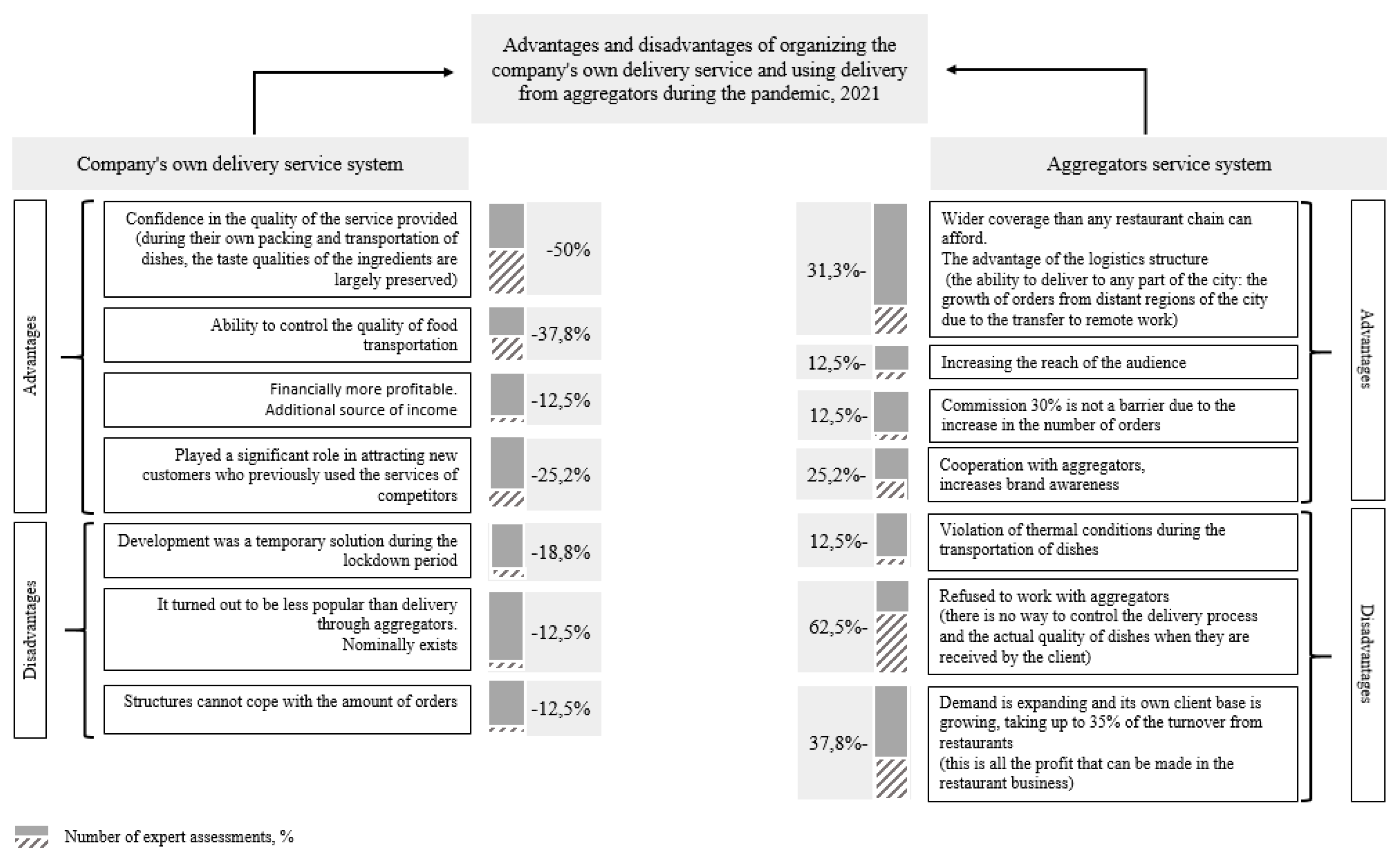

Table 1.
Profiles of restaurant companies that experts present for interviews, 2022.
| Criterion | Description | Number of answers | % |
|---|---|---|---|
| Restaurant format (classes of restaurants by service characteristics [14]) | 1.Luxury dining (upscale) | 2 | 12,5 |
| 2. Fine dining (midscale) | 6 | 37,5 | |
| 3. Casual and business dining (low-scale) | 4 | 25 | |
| 4.Quick service dining | 4 | 25 | |
| Foundation date | Restaurants working before 2019, before the pandemic | 16 | 100 |
| Company size (number of employees) | Small: 15-100 | 6 | 37,5 |
| Average: 101-250 | 3 | 18,8 | |
| Large: > 251 | 7 | 43,8 | |
| Directions of activity (establishments of new sales channels) | Online & offline business formats | 10 | 62,5 |
| Mostly offline operations | 5 | 31,2 | |
| Mostly delivery and takeaway orders | 1 | 6,3 | |
| Delivery form | Own delivery system | 12 | 75,6 |
| Own delivery system & aggregators | 4 | 25,4 | |
| Key innovations, helped businesses during the pandemic | New products and services | 6 | 37,5 |
| Marketing campaign | 8 | 50 | |
| Online services and applications | 16 | 100 | |
| Loyalty program | 12 | 75 |
Source: Own development based on the retrieved data.
Table 2.
The level of adaptability of restaurants to the challenges that have arisen during the pandemic by expert evaluation, 2022.
Table 2.
The level of adaptability of restaurants to the challenges that have arisen during the pandemic by expert evaluation, 2022.
| The level of adaptability of restaurants to the challenges have arisen during the pandemic by experts’ evaluation from "1" to "7" | Number of answers | % |
|---|---|---|
| “1” - No, the restaurant has not adapted to the pandemic problems | 1 | 6,3 |
| “2” - Poorly adapted, there are serious problems (customer demand/ margins continue to fall, while costs rise, etc.) | 1 | 6,3 |
| “3” - Quite poorly adapted, there are minor problems with optimizing the format of the proposed dishes and service (purchasing ingredients, optimizing menu, developing delivery, etc.) | 2 | 12,5 |
| “4” - Difficult to answer, forced to emergency problem adaptation caused by the repeated lockdown | 1 | 6,3 |
| “5” - Some adaptation, but there are serious problems with increased safety requirements (redevelopment, purchasing personal protective equipment, monitoring the workers well-being, etc.) | 0 | 0 |
| “6” - Adapted, but there are minor management problems (staff turnover, technological development, etc.) | 6 | 37,5 |
| “7” - Yes, the restaurant has fully adapted to the pandemic problems, customers come back not only for the food, but for the atmosphere | 5 | 31,3 |
Source: Own development based on the retrieved data.
Table 3.
Characteristics of restaurants’ levels of adaptability to demand problems that arose during the pandemic, 2022.
Table 3.
Characteristics of restaurants’ levels of adaptability to demand problems that arose during the pandemic, 2022.
| Key elements of restaurants adaptability | Characteristics of consumer demand | Estimates of characteristics by adaptability level types, % | ||
|---|---|---|---|---|
| A | B | C | ||
| 1.a Structure of demand | Increased for cheaper meals | 6,3 | 12,5 | 18,8 |
| Increased stratification of expensive & cheap meals | 6,3 | 0,0 | 6,3 | |
| The structure of demand has not changed compared to the pre-pandemic demand | 18,8 | 25,1 | 6,3 | |
| Increased demand for higher quality food ingredients | 12,5 | 0,0 | 0,0 | |
| 1.b Consumer preferences in the range of dishes | Narrowed range of popular dishes | 12,5 | 25,1 | 12,5 |
| Increased demand for exotic, unusual dishes | 6,3 | 0,0 | 0,0 | |
| Increased demand for the most popular dishes | 12,5 | 0,0 | 6,3 | |
| Preferences haven’t changed compared to pre-pandemic period | 12,5 | 25,1 | 12,5 | |
| Bias in favor of delivery orders | 6,3 | 25,2 | 18,8 | |
| Increased demand for speed of service | 0,0 | 0,0 | 12,5 | |
| Bulk purchase of semi-finished products | 0,0 | 0,0 | 12,5 | |
| 1.c Changes in average bill per restaurant visit | Dropped significantly | 6,3 | 0,0 | 0,0 |
| Decreased slightly | 12,5 | 18,8 | 0,0 | |
| Grew slightly | 0,0 | 12,5 | 12,5 | |
| Grew significantly | 0,0 | 12,5 | 18,8 | |
| 1.d Changes in format preferences of restaurants food consumption | Visiting by two persons/small groups | 6,3 | 12,5 | 6,3 |
| Decreased number of corporations | 6,3 | 18,8 | 6,3 | |
| Increased takeaway orders | 18,8 | 31,5 | 12,5 | |
| Increased delivery orders to home | 0,0 | 18,8 | 18,8 | |
| Increased delivery orders to work | 6,3 | 18,8 | 6,3 | |
| Menu assortment matrix has not changed, changes in dishes (size, visual) | 0,0 | 12,5 | 6,3 | |
| “Breakfast” format is developing | 0,0 | 0,0 | 6,3 | |
| 1.e Changes in the visitors composition | Decreased number of older visitors | 12,5 | 6,3 | 12,5 |
| Increased share of romantic couples | 6,3 | 0,0 | 6,3 | |
| Number of tourists has fallen sharply | 12,5 | 25,1 | 25,1 | |
| Composition of visitors hasn’t changed | 6,3 | 18,8 | 0,0 | |
| Culture of consumption has changed | 6,3 | 0,0 | 0,0 | |
| Fewer impulsive restaurant visits | 6,3 | 6,3 | 0,0 | |
| Number of tourists has increased | 0,0 | 0,0 | 12,5 | |
| Increased influx of new guests from competing restaurants | 0,0 | 0,0 | 12,5 | |
| 1.f Other new consumer requirements | Tendency to buy cheaper meals but larger portions | 6,3 | 0,0 | 0,0 |
| Demand for the bonus system, service quality. Active feedback in reviews | 0,0 | 12,5 | 0,0 | |
| Demand for takeaway and delivery orders doubled | 6,3 | 25,2 | 12,5 | |
| Increased demand for stock diversity | 12,5 | 0,0 | 0,0 | |
| Increased demand for menu variety | 0,0 | 0,0 | 12,5 | |
| No additional requirements due to COVID-19 | 6,3 | 12,5 | 12,5 | |
Source: Own development based on the retrieved data.
Table 4.
Innovative service implications in the restaurant business during the lockdowns in 2020 and in 2021.
Table 4.
Innovative service implications in the restaurant business during the lockdowns in 2020 and in 2021.
| The main innovations implemented in the restaurant during the 2020 lockdown | % | Developments that were used during the 2021 lockdown | % |
|---|---|---|---|
| Cost reduction: menu, service types, events, and staff amount. | 37 | Full use of ensuring sanitary standards developments, services provision introduction new rules in accordance with the additional requirements of 2021. | 40 |
| Compliance with sanitary standards for customers and staff. | 32 | Optimization of the concept and well-functioning management mechanism improvement, in accordance with the restaurant development new directions. Service developments integration in 2020 in the process of providing restaurant services. | 30 |
| Development of a food delivery service (own and through aggregators). | 26 | Analysis of the company's strategy in accordance with the target audience change connected with the tourism migrations. | 15 |
| Optimization of all management processes. A radical change in the concept from “fine dining” to “quick service”. | 5 | Use this period to carry out renovations to improve the atmosphere in restaurants. | 15 |
Source: Own development based on the retrieved data.
Table 5.
Innovations that were fixed after the lockdown and innovations that will be used on an ongoing basis in the post-pandemic period.
Table 5.
Innovations that were fixed after the lockdown and innovations that will be used on an ongoing basis in the post-pandemic period.
| Innovations that were fixed in the work after the lockdown | % | Innovations that will be used on an ongoing basis in the post-pandemic period | % |
|---|---|---|---|
| Improvement of service quality in accordance with sanitary standards. | 23 | Compliance with sanitary standards. | 50 |
| Development of the meals delivery system, semi-finished products and groceries. | 17 | Development of delivery service forms. | 14 |
| Compliance with government regulations. | 14 | Development of catering service. | 11 |
| Development of employees multitasking due to the staff reduction. | 14 | Development of website and social networks, business digitalization. | 7 |
| Reduction of working hours in line with the restaurants opening hour’s reduction. | 10 | Analysis of positioning, strategic development, loyalty programs. | 7 |
| Analysis and change of strategy to attract additional customer audiences. | 8 | Coordinate concept change does not allow making accurate forecast now. | 4 |
| Development of food delivery through aggregators. | 6 | Development of loyalty programme. | 4 |
| Development of loyalty programs (carrying out new promotions, advertising campaigns, providing gifts). | 4 | Changing the economic model of doing business when the crisis worsens. | 3 |
| Usual work process without innovations. | 4 | - | - |
Source: Own development based on the retrieved data.
Disclaimer/Publisher’s Note: The statements, opinions and data contained in all publications are solely those of the individual author(s) and contributor(s) and not of MDPI and/or the editor(s). MDPI and/or the editor(s) disclaim responsibility for any injury to people or property resulting from any ideas, methods, instructions or products referred to in the content. |
© 2023 by the authors. Licensee MDPI, Basel, Switzerland. This article is an open access article distributed under the terms and conditions of the Creative Commons Attribution (CC BY) license (http://creativecommons.org/licenses/by/4.0/).
Copyright: This open access article is published under a Creative Commons CC BY 4.0 license, which permit the free download, distribution, and reuse, provided that the author and preprint are cited in any reuse.


