

Submitted:
28 July 2023
Posted:
01 August 2023
You are already at the latest version
Abstract
Heavy and light quarks produced in high-pT partonic collisions radiate differently. Heavy quarks regenerate their color field, stripped-off in the hard reaction, much faster than the light ones and radiate a significantly smaller fraction of the initial quark energy. This peculiar feature of heavy-quark jets leads to a specific shape of the fragmentation functions observed in e+e− annihilation. Differently from light flavors, the heavy quark fragmentation function strongly peaks at large fractional momentum z, i.e. the produced heavy-light mesons, B or D, carry the main fraction of the jet momentum. This is a clear evidence of the dead-cone effect, and of a short production time of a heavy-light mesons. Contrary to propagation of a small qq¯ dipole, which survives in the medium due to color transparency, a heavy-light Qq¯ dipole promptly expands to a large size. Such a big dipole has no chance to remain intact in a dense medium produced in relativistic heavy ion collisions. On the other hand, a breakup of such a dipole does not affect much the production rate of Qq¯ mesons, differently from the case of light qq¯ meson production.
Keywords:
quarks
; jets
; fragmentation
; hadronization
1. Introduction
High- parton scattering leads to formation of four cones of gluon radiation: (i)-(ii) backward-forward jets formed by the color field of the colliding partons shaken off in in the hard collision; (iii)-(iv) the scattered partons carry no field up to transverse momenta . These partons are regenerating the lost color field via gluon radiation forming the up-down jets, as is illustrated in Figure 1
The radiation process is ordered in time or path length according to [1],
Here x is the fractional light-cone momentum of the radiated gluon; is its transverse momentum relative to the initial quark direction. The radiated gluons subsequently hadronize forming a jet of hadrons. For heavy quarks the second term in the denominator play important role leading to the so called dead-cone effect [2].
In terms of the Fock state representation all radiated gluons pre-exist in the initial bare parton, and are liberated on mass shell successively in accordance with their coherence length/time Eq. (1). First are radiated gluons with small longitudinal and large transverse momenta.
1.1. Radiational energy loss in vacuum
How much energy is radiated over the path length L? Only gluons with radiation length contribute [3],
where is the gluon energy; the soft cut-off parameter . The perturbative radiation spectrum reads,
We see that radiation by light and heavy quarks behave quite differently at small :
(i) Light quarks:
(ii) Heavy quarks:
Dead-cone effect: gluons with are suppressed [2,3]. Heavy quarks radiate less energy compared with the light ones. They promptly restore their color field and stop radiating. The amount of radiated energy for light and heavy flavors is depicted in Figure 2 vs radiation length for different jet energies.
We see that heavy quarks radiate only a small fraction 10-20% of their initial momentum. In particular, this explains the unusual shape of the experimentally observed fragmentation function of b-quarks, presented in Figure 3 [4] (and similar for charm [5]).
Indeed, most of B-mesons carry a large fraction , of the b-quark momentum.
We conclude that such a specific shape of the fragmentation function of heavy quarks is a direct manifestation of the dead-cone effect.
2. Production length
The process of gluon radiation by a heavy quark Q ends up with color neutralization by a light antiquark and production of a dipole. As far as we are able to calculate the radiated fraction of the light-cone momentum (e.g. for b-quark) , the production length distribution can be extracted directly from data on ,
The results for the differential distribution are depicted in Figure 4 at several values of momenta .
Remarkably, the mean value of is extremely short and shrinks with rising . This sounds counter-intuitive, however, the process has maximal hard scale allowed by the kinematics .
The production length turns out to be much shorter than the confinement radius, indicating that the fragmentation mechanism is pure perturbative. At , a small-size dipole is produced, with no certain mass, but with a certain radius. It is to be projected on the B-meson wave function, giving (compare with [6]).
3. Fragmentation in a dense medium
3.1. Formation length of a meson
The light antiquark in the B-meson carries a tiny fraction of its momentum, , i.e. about 5%. The produced dipole has a small transverse separation, but it expands with a high speed, enhanced by 1/x, i.e. is an order of magnitude faster than symmetric or dipoles.
where , and as was evaluated in the potential model [7]. The B meson is nearly as big as the pion, since its radius is controlled by the mass of the light antiquark.
According to (5) the dipole heavy-light dipole separation promptly reaches the large hadronic size. This is confirmed by comparison data, for detected in nuclear collisions. Data demonstrate a color opacity for B-mesons (prompt production) and color transparency effect for decaying to B (non-prompt production). The nuclear suppression factors for these two channels are compared in Figure 5 [8].
While Eq. (5) describes the early, perturbative stage of the dipole expansion, the further evolution filters out the states with large relative phase shifts. The longest time takes discrimination between the two lightest hadrons, the ground state B and the first radial excitation , which concludes the formation process. Correspondingly, the full formation path length can be evaluated as,
E.g. for the oscillatory potential , so is extremely short for medium-large transverse momenta.
3.2. Attenuation of dipoles propagating in a dense medium
The mean free path of a meson in a hot medium characterizing by the transport coefficient (the rate of broadening) ,
E.g. at , so a formed B-meson breaks up in the medium nearly instantaneously.
A b-quark propagating through the hot medium, easily picks up and loses accompanying light antiquarks without an essential reduction of its momentum. Meanwhile the b-quark keeps dissipating its energy with a rate, slightly enhanced by medium induced radiative energy loss [9] effects. Eventually the detected B-meson is produced in the dilute periphery of the medium.
The heavy quark keeps losing energy even inside a colorless dipole sharing its momentum with the light quark, as is illustrated in Figure 6 presenting a unitarity cut of a Reggeon,
Thus, the heavy quark Q dissipates a part of its energy on a long path from the hard collision point to the medium periphery.
where is temperature dependent string tension in the medium [10] ; the vacuum string tension ; The critical temperature is fixed at .
3.3. Medium modified production rate
The cross section of a heavy-light meson M production in collisions can be presented in the factorized form,
We replaced the fragmentation function by the differential expression (4). The medium-modified distribution is given by,
Here, for the sake of simplicity, we fixed the dipole separation at the mean value. This approximation is rather accurate due to shortness of . Otherwise, one can calculate the attenuation factor in (10) exactly, applying the path integral technique [11,12].
Eventually, the production rate of heavy-light mesons in collisions with impact parameter reads,
The effective production length in the medium turns out to be much longer than in vacuum, because the heavy-light meson is produced mainly at the medium periphery, long distance from the hard collision point.
3.4. Data analysis
Now we are in a position to calculate the nuclear ratio
to be compared with data. Here
and is the nuclear thickness function.
The model cannot fully predict (as well as any other model) the nuclear ratio, because the medium density is not known, but is rather the goal of the research. We embedded this information into the broadening rate (transport coefficient) following the popular model [13]
where is the number of participants at transverse coordinates and relative to the centers of the colliding nuclei. The falling time dependence, is due to longitudinal expansion of the produced medium. The time interval required for equilibrated medium production. We fixed it at the frequently used value .
The only fitted parameter is , which is the maximal value of the brodening rate (transport coefficient) at and . In fact, measurement of this parameter is our goal. Comparison with ATLAS [8] and CMS data [14] for B-meson production (non-prompt ) in lead-lead collisions at is presented in Figure 7.
We see that data are described pretty well, either for , or dependences. The adjusted parameter ranges within . This magnitude is considerably smaller compared with the values usually measured for light quarks. See discussion below.
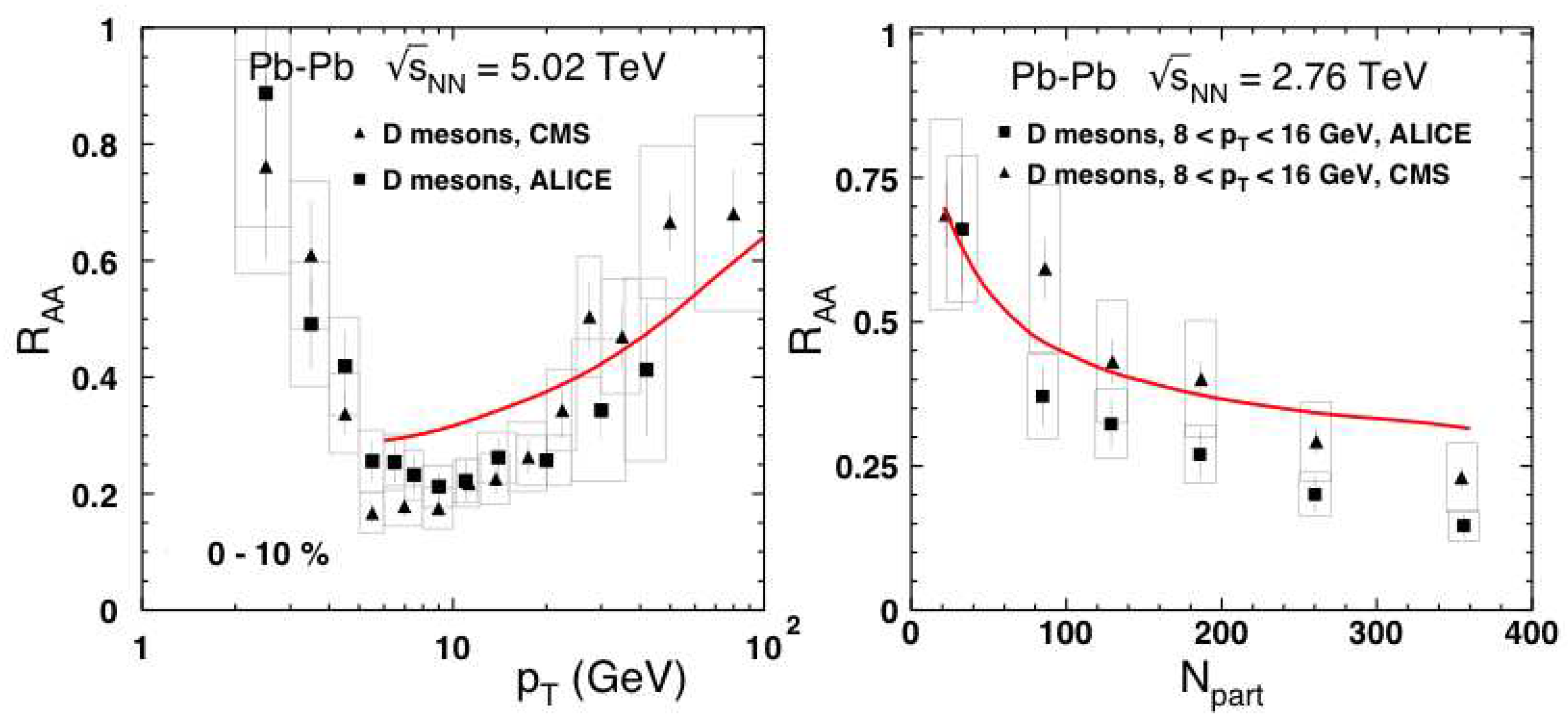
We successfully described data on D-meson production as well, as is demonstrated in Figure 8.
Notice that c-quarks radiate in vacuum more energy than b-quarks, while the effects of absorption of and dipoles in the medium are similar. Therefore D-mesons are suppressed in collisions more than B-mesons. for D-mesons steeply rises with due to color transparency. Since dipoles expand much faster than , no color transparency effects are seen in for B-mesons, as was demonstrated in the right pane of Figure 5.
Interesting that the found broadening rate parameter for c-quarks , significantly exceeds the value we found for b-quarks, while is quite less than for light quarks (see below). Such a hierarchy of broadening rates for different quark flavors might look puzzling, if were a real transport coefficient in terms of statistical medium properties. It coincides with the rate of broadening [17] only within the Born approximation, i.e. single gluon exchange for an inelastic process. In reality, broadening is subject to strong higher-order corrections and usually considerably exceeds the Born approximation estimate. The rate of broadening reads [18,19],
where is the gluon density; is the medium density per unit of length. The characteristic scale of the process is related to the mean transverse momentum of the radiated gluons. For light quarks it is given by the non-perturbative effective gluon mass, [12,20]. For heavy quarks gluon radiation is subject to the dead-cone effect and the scale is much larger . This is why the rate of broadening for heavy quarks is significantly reduced. This is another manifestation of the dead-cone effect.
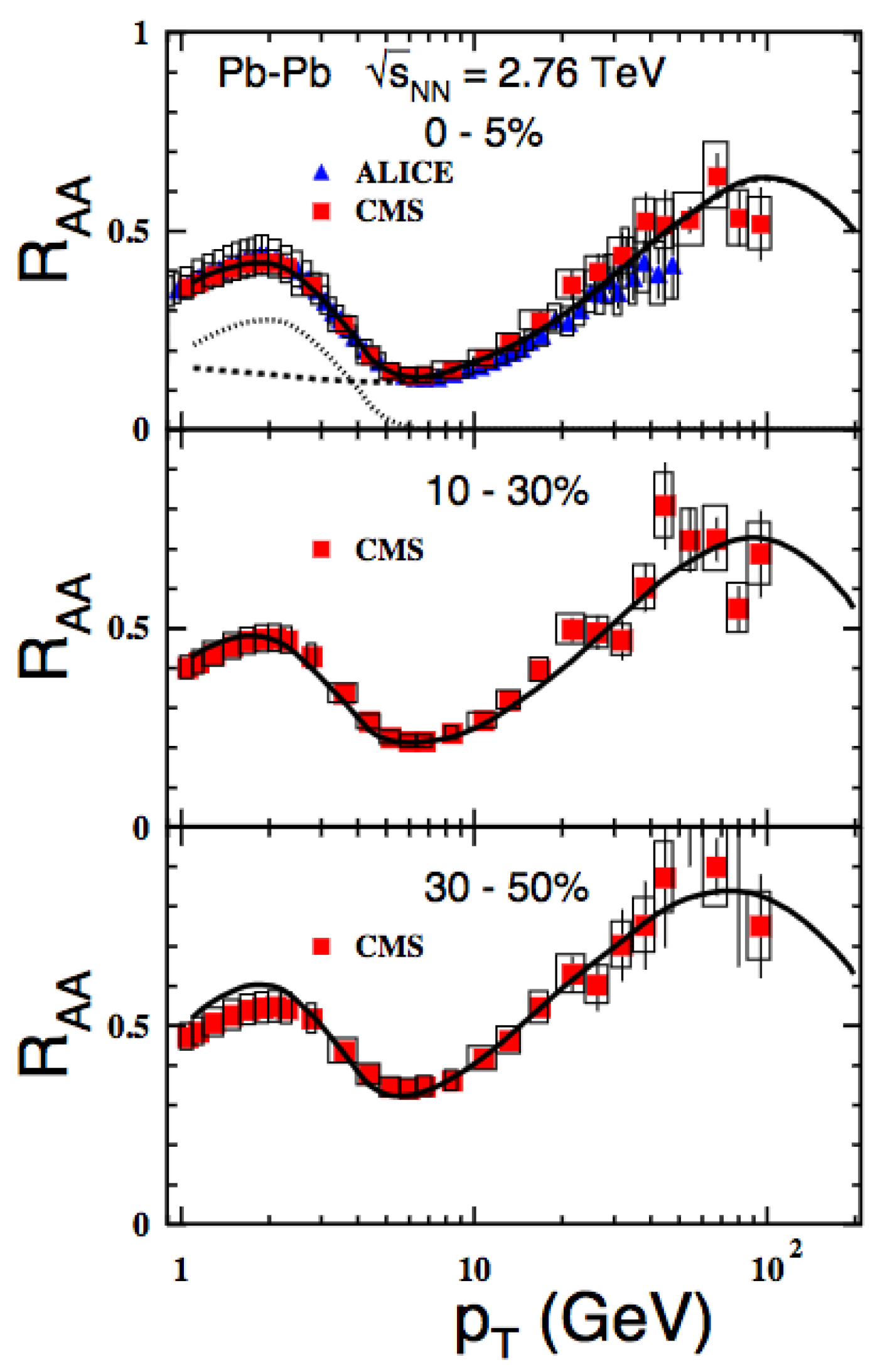
The left plot in Figure 8 shows a considerable disagreement with data at small transverse momenta . While the measured is steeply falling with , our calculations predict a nearly constant value. Such kind of disagreement has been observed earlier for light quarks, as is displayed in Figure 9
Apparently a bump at small is presented in for D-mesons as well, while our calculations in Figure 8 disregard the hydrodynamic component.
4. Summary
Our observations and results can be summarized as follows.
- Heavy and light quarks originated from hard collisions radiate differently. The former is subject to the dead-cone effect, suppressing radiation of low- gluons. Consequently heavy quarks regenerate their color field much faster than light ones and radiate a significantly smaller fraction of the initial energy. The heavier is a quark, the less it radiates.
- The fragmentation function usually depends on two variables , fractional light-cone momentum of produced meson, and the scale . However, we consider here the case of "maximal" scale, when the jet energy and the hard scale coincide. This happens e.g. in annihilation, or high- jet production at Feynman .
- The dead-cone effect suppressing bremsstrahlung of heavy quarks, explains the unusual shape of the fragmentation function of heavy quarks , observed at LEP and SLAC. It peaks at large fractional momentum z, i.e. the produced heavy-light mesons, B or D, carry the main fraction of the jet momentum. On the contrary, the fragmentation function of light quarks is falling steadily with z towards .
- Differently from propagation of a small dipole, which survives in the medium due to color transparency, a dipole promptly expands to a large transverse size, controlled by the small mass of the light quark. Such a big dipole has no chance to remain intact in a hot medium. On the other hand, a breakup of such a dipole hardly affects the production rate of mesons.
- We successfully described data on and centrality dependence of the production rate of B and D mesons in heavy ion collisions. The only unavoidable parameter of such analyses is the broadening rate (usually called transport coefficient) of the quark in the medium. Its maximal value was found , and for b, c and light quarks respectively. Such hierarchy of the broadening rates is related to the same dead-cone effect.Suppression of bremsstrahlung leads to a considerable reduction of broadening.
Acknowledgments
This work was supported in part by grants ANID - Chile FONDECYT 1231062 and 1230391, by ANID PIA/APOYO AFB220004, and by ANID - Millennium Science Initiative Program ICN2019_044. The work of J.N. was partially supported by Grant No. LTT18002 of the Ministry of Education, Youth and Sports of the Czech Republic, by the project of the European Regional Development Fund No. CZ.02.1.01/0.0/0.0/16_019/0000778 and by the Slovak Funding Agency, Grant No. 2/0020/22.
References
- Landau, L.D.; Pomeranchuk, I. Limits of applicability of the theory of bremsstrahlung electrons and pair production at high-energies, Dokl. Akad. Nauk Ser. Fiz., 1953, 92, 535.
- Dokshitzer, Y.L.; Khoze, V.A.; Troian, S.I. On specific QCD properties of heavy quark fragmentation (’dead cone’). J. Phys. G 1991, 17, 1602–1604. [Google Scholar] [CrossRef]
- Kopeliovich, B.Z.; Potashnikova, I.K.; Schmidt, I. Why heavy and light quarks radiate energy with similar rates. Phys. Rev. C 2010, 82, 037901–037904. [Google Scholar] [CrossRef]
- Kniehl, B.A.; Kramer, G; Schienbein, I.; Spiesberger, H. Finite-mass effects on inclusive B meson hadroproduction. Phys. Rev. D 2008, 77, 014011-014038. [CrossRef]
- Kneesch, T.; Kniehl, B.A.; Kramer, G; Schienbein, I. Charmed-meson fragmentation functions with finite-mass corrections, Nucl. Phys. B 2008, 799, 34-69. [CrossRef]
- Kopeliovich, B.Z.; Pirner, H.-J.; Potashnikova, I.K.; Schmidt, I.; Tarasov, A.V. Perturbative fragmentation, Phys. Rev. D 2008, 77, 054004–054014. [Google Scholar] [CrossRef]
- Hwang, C.W. Charge radii of light and heavy mesons, Eur. Phys. J. C 2002, 23, 585–596. [Google Scholar] [CrossRef]
- Aaboud, M.; Aad, G.; Abbott, B.; et al. Prompt and non-prompt J/ψ and ψ(2S) suppression at high transverse momentum in 5.02 TeV Pb+Pb collisions with the ATLAS experiment, Eur. Phys. J. C 2018, 78, 762-797,.
- Dokshitzer, Y.L.; Kharzeev, D.E. Heavy quark colorimetry of QCD matter, Phys. Lett. B 2001, 519, 199–214. [Google Scholar] [CrossRef]
- Toki, H.; Sasaki, S.; Ichie, H.; Suganuma, H. Chiral symmetry breaking in the dual Ginzburg-Landau theory, Austral. J. Phys. 1997, 50, 199–206. [Google Scholar] [CrossRef]
- Kopeliovich, B.Z.; Schäfer, A.; Tarasov, A.V. Bremsstrahlung of a quark propagating through a nucleus, Phys. Rev. C 1999, 59, 1609–1619. [Google Scholar] [CrossRef]
- Kopeliovich, B.Z.; Schäfer, A.; Tarasov, A.V. Nonperturbative effects in gluon radiation and photo-production of quark pairs, Phys. Rev. D 2000, 62, 054022–054080. [Google Scholar] [CrossRef]
- Chen, X.F.; Greiner, C.; Wang, E.; Wang, X.N.; Xu, Z. Bulk matter evolution and extraction of jet transport parameter in heavy-ion collisions at RHIC,’ Phys. Rev. C 2010, 81, 064908–064921. [Google Scholar] [CrossRef]
- Sirunyan, A.M.; et al. Measurement of the B± Meson Nuclear Modification Factor in Pb-Pb Collisions at =5.02TeV, Phys. Rev. Lett. 2017, 119, no.15, 152301-152305. [CrossRef]
- Acharya, S.; et al. Measurement of D0, D+, D*+ and Ds+ production in Pb-Pb collisions at =5.02TeV, JHEP 2018, 1810, 174-209. [CrossRef]
- Sirunyan, A.M.; et al. Nuclear modification factor of D0 mesons in PbPb collisions at =5.02TeV, Phys. Lett. B 2018, 782, 474-496. [CrossRef]
- Baier, R.; Dokshitzer, Y.L.; Mueller, A.H.; Peigne, S.; Schiff, D. Radiative energy loss and p(T) broadening of high-energy partons in nuclei, Nucl. Phys. B 1997, 484, 265–283. [Google Scholar] [CrossRef]
- Kopeliovich, B.Z.; Pirner, H.-J.; Potashnikova, I.K.; Schmidt, I. Mutual boosting of the saturation scales in colliding nuclei, Phys. Lett. B, 2011, 697, 333-344. [CrossRef]
- Johnson, M.B.; Kopeliovich, B.Z.; Tarasov, A.V. Broadening of transverse momentum of partons propagating through a medium, Phys. Rev. C 2001, 63, 035203–035230. [Google Scholar] [CrossRef]
- Kopeliovich, B.Z.; Potashnikova, I.K.; Povh, B.; Schmidt, I. Evidences for two scales in hadrons, Phys. Rev. D 2007, 76, 094020–094035. [Google Scholar] [CrossRef]
- Kopeliovich, B.Z.; Nemchik, J; Potashnikova, I.K.; Schmidt, I. Quenching of high-pT hadrons: Energy Loss vs Color Transparency, Phys. Rev. C 2012, 86, 054904-054921. [CrossRef]
- Nemchik, J.; Karpenko, I.A.; Kopeliovich, B.Z.; Potashnikova, I.K.; Sinyukov, Y.M., High-pT hadrons from nuclear collisions: Unifying pQCD with hydrodynamics, 2013, Proceedings, 15th conference on Elastic and Diffractive scattering (EDS Blois 2013), 9-13 September 2013. Saariselka, Lapland, Finland [arXiv:1310.3455].
- Abelev, B.; et al. Centrality dependence of charged particle production at large transverse momentum in Pb-Pb collisions at =2.76TeV, Phys. Lett. B 2013, 720, 52-62. [CrossRef]
- Lee, Y.-J.; (for the CMS Collaboration), Quarkonia Measurements by the CMS Experiment in pp and Pb-Pb Collisions, J. Phys. G 2011, 38, 124015-124023. [CrossRef]
- Yoon, A.S.; (for the CMS Collaboration), Centrality and pT dependence of charged particle RAA in Pb-Pb collisions at =2.76TeV, J. Phys. G 2011, 38, 124116-124122. [CrossRef]
Figure 1.
High- collision in the c.m. frame of two partons, which leads to production of four jets: (i)-(ii) soft color field shaken off in the collision; (iii)-(iv) transverse cones of gluons radiated due to regeneration of the stripped off color field.
Figure 1.
High- collision in the c.m. frame of two partons, which leads to production of four jets: (i)-(ii) soft color field shaken off in the collision; (iii)-(iv) transverse cones of gluons radiated due to regeneration of the stripped off color field.
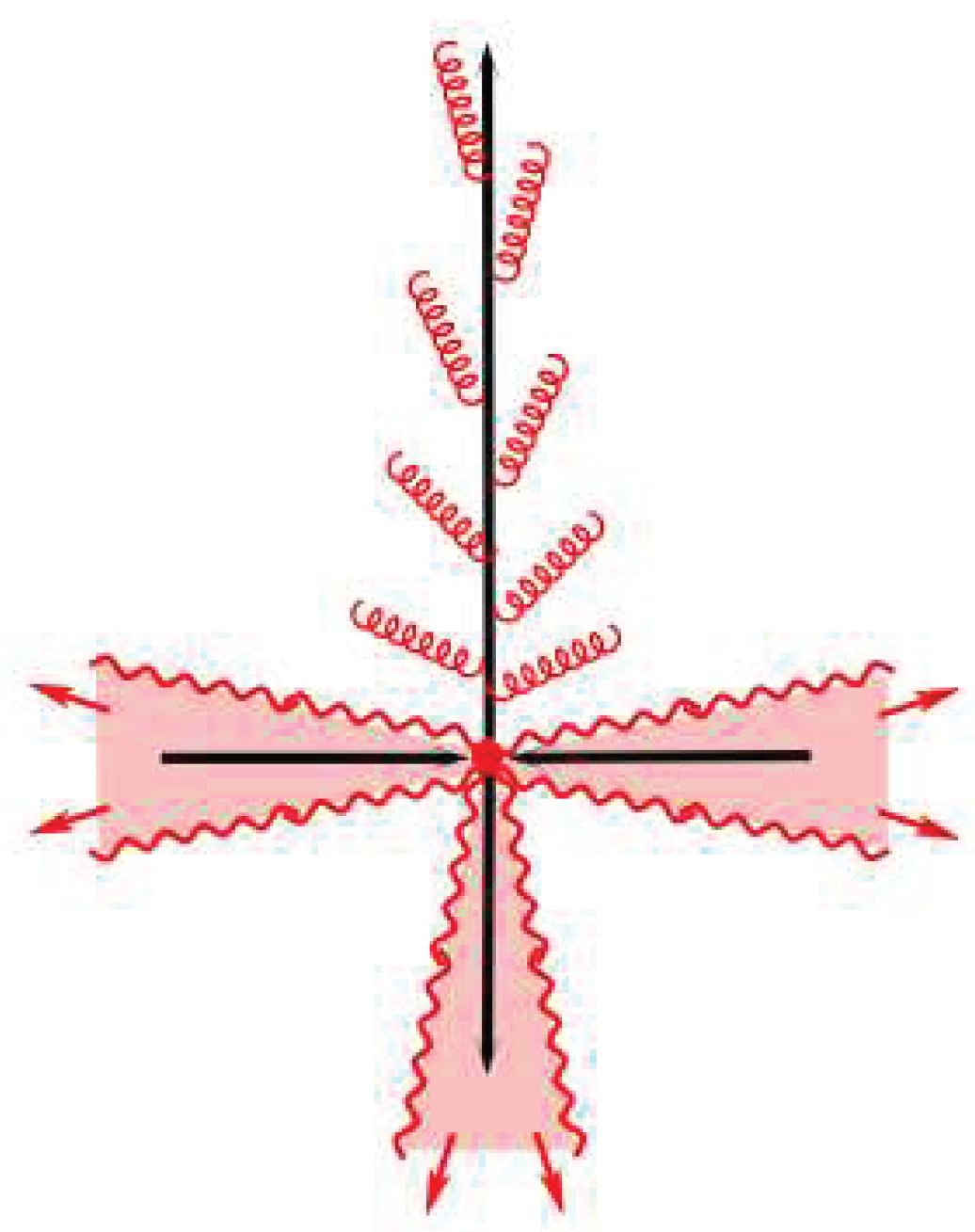
Figure 2.
Radiational energy loss in vacuum by light (u,d), c and b quarks, depicted by blue, red and green curves respectively. Radiated energy is plotted as function of path length for different jet energies.
Figure 2.
Radiational energy loss in vacuum by light (u,d), c and b quarks, depicted by blue, red and green curves respectively. Radiated energy is plotted as function of path length for different jet energies.

Figure 3.
The fragmentation function, from annihilation at LEP. The curve is the DGLAP fit [4].
Figure 3.
The fragmentation function, from annihilation at LEP. The curve is the DGLAP fit [4].
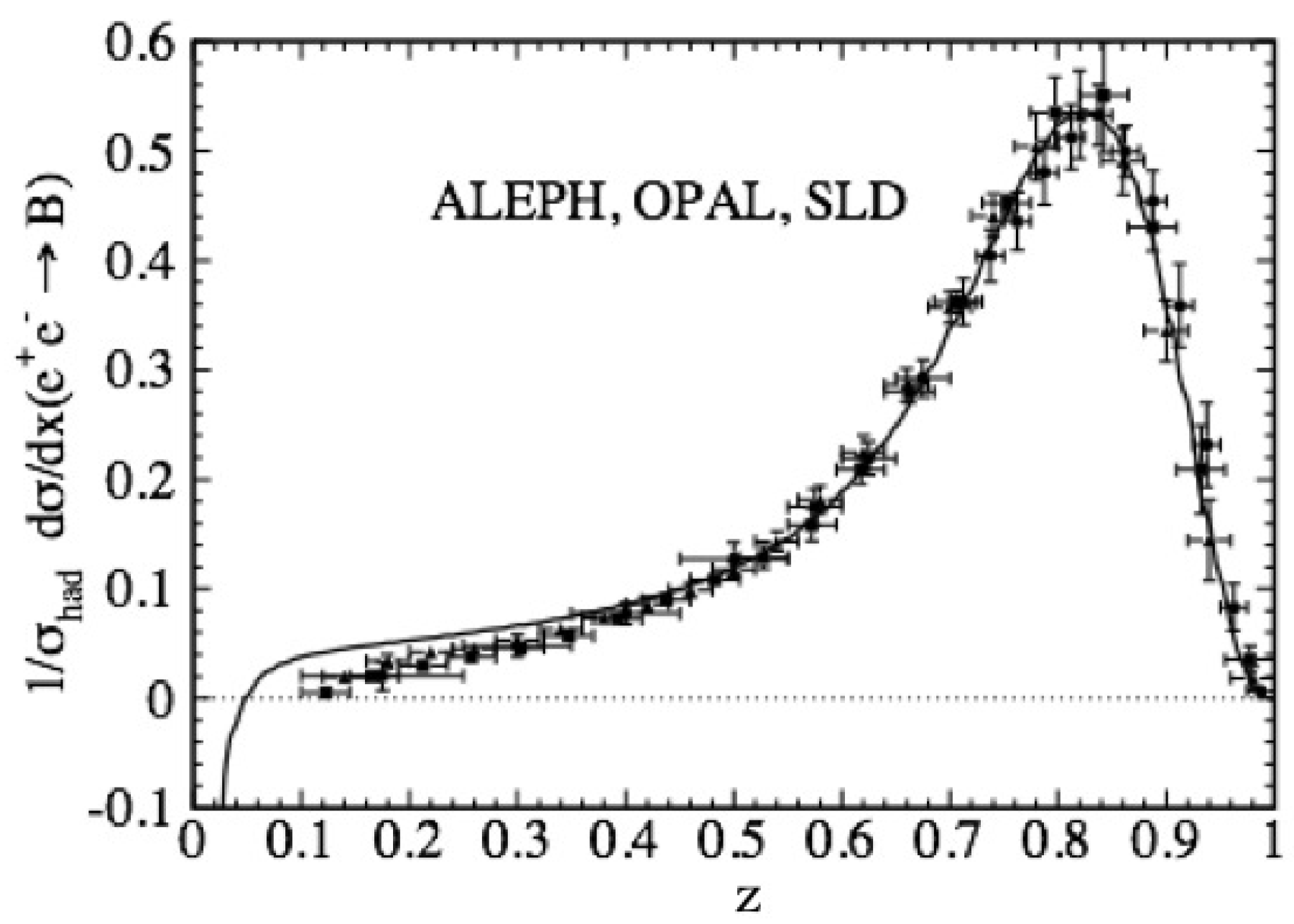
Figure 4.
The -distribution of B-mesons produced with different in collisions.
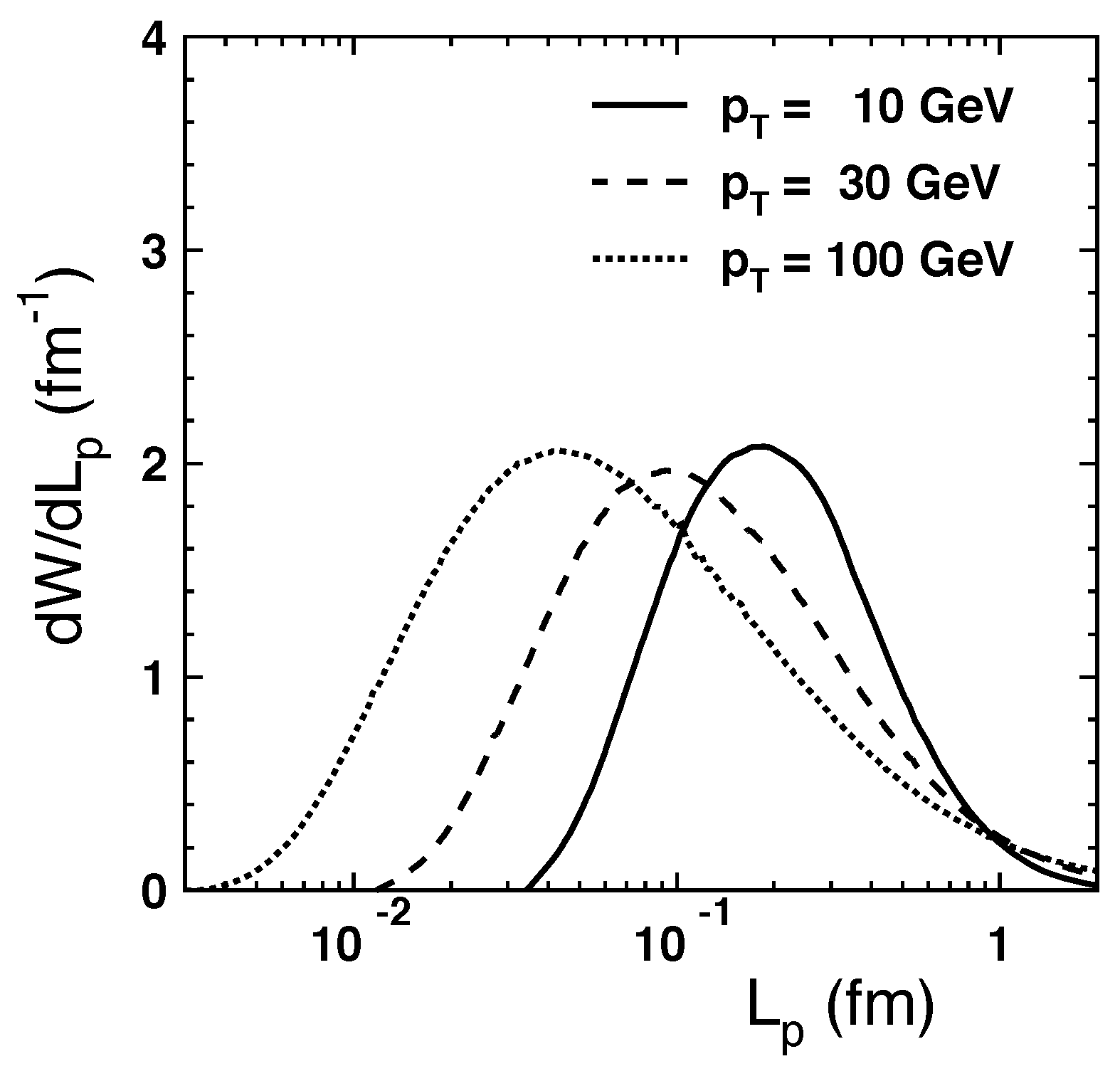
Figure 5.
Nuclear suppression factor vs . Left: promptly produced ’s exhibit color transparency effect. Right: ’s from B decays demonstrate a -independent color-opacity effect.
Figure 5.
Nuclear suppression factor vs . Left: promptly produced ’s exhibit color transparency effect. Right: ’s from B decays demonstrate a -independent color-opacity effect.
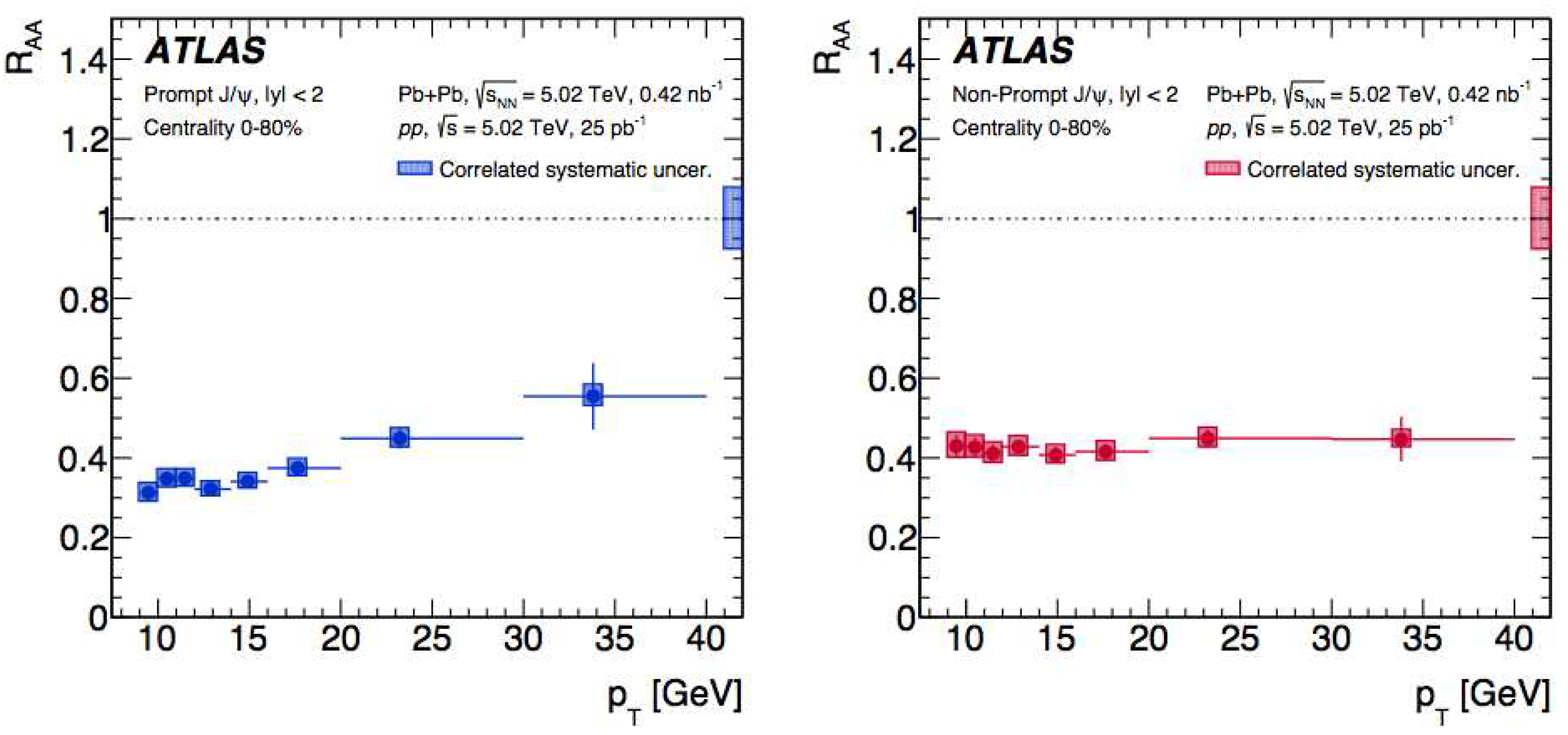
Figure 6.
Redistribution of energy inside the dipole. The gluons radiated by Q are absorbed by so the dipole energy remains unchanged.
Figure 6.
Redistribution of energy inside the dipole. The gluons radiated by Q are absorbed by so the dipole energy remains unchanged.
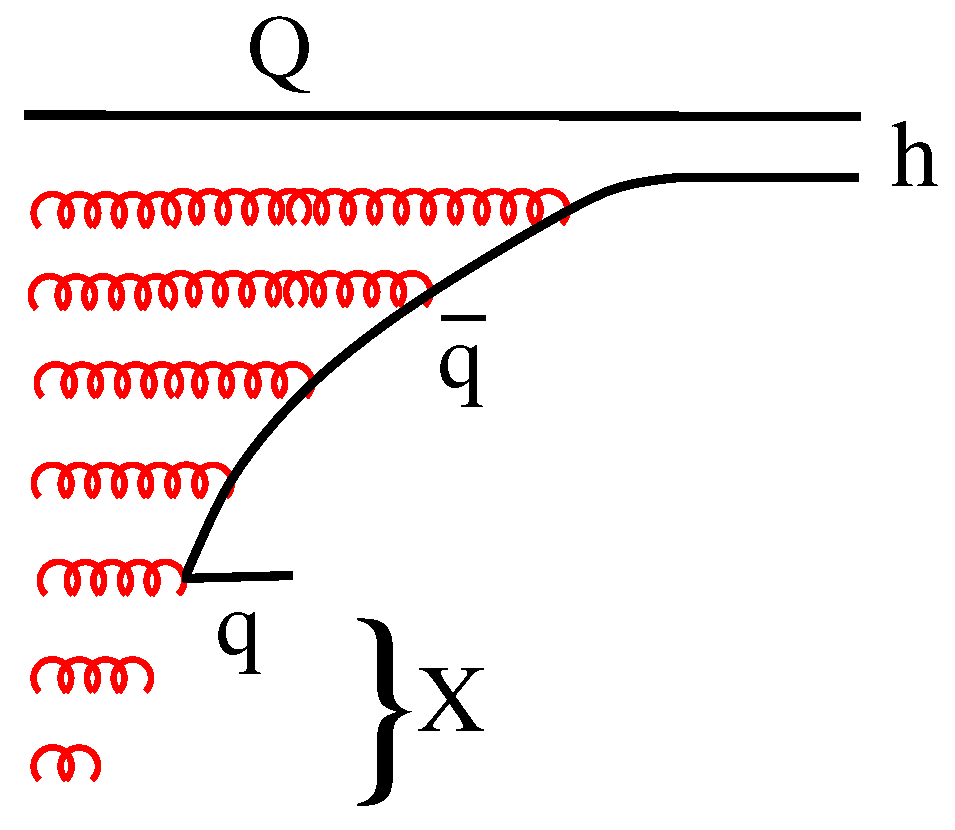
Figure 7.
Nuclear ratio for B-meson production in lead-lead collisions as function of (Left) and versus centrality (Right). Data are from ATLAS [8] and CMS [14].
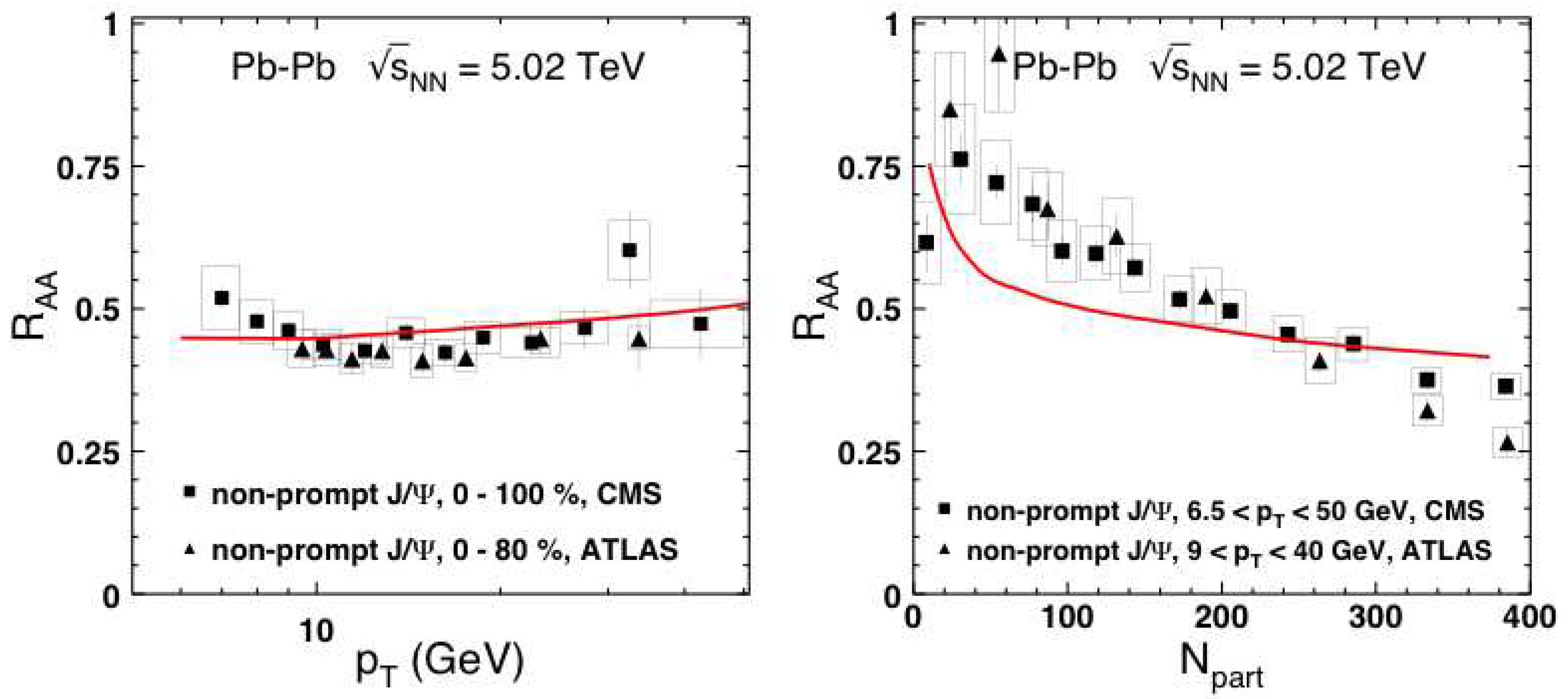
Figure 8.
The same as in Figure 7, but for production of D-mesons in experiments ALICE [15] and CMS [16].
Disclaimer/Publisher’s Note: The statements, opinions and data contained in all publications are solely those of the individual author(s) and contributor(s) and not of MDPI and/or the editor(s). MDPI and/or the editor(s) disclaim responsibility for any injury to people or property resulting from any ideas, methods, instructions or products referred to in the content. |
© 2023 by the authors. Licensee MDPI, Basel, Switzerland. This article is an open access article distributed under the terms and conditions of the Creative Commons Attribution (CC BY) license (http://creativecommons.org/licenses/by/4.0/).
Copyright: This open access article is published under a Creative Commons CC BY 4.0 license, which permit the free download, distribution, and reuse, provided that the author and preprint are cited in any reuse.


