

Submitted:
14 September 2023
Posted:
18 September 2023
You are already at the latest version
Preprints on COVID-19 and SARS-CoV-2
Abstract
Purpose: The rapid development of technological innovations is causing major transformations in organisations. These changes are facilitating the transition of organisations from traditional to digital cultures and are influencing the positioning and even the survival of many of them. Higher Education Institutions are no exception. This article aims to understand the main factors that facilitate and drive this transformation from the point of view of their external stakeholders. Design/methodology/approach - Due to the complexity of the study, the case study method has been used as an appropriate methodology. Findings - As the results of the study show, the use of new agile methodologies, the development of continuous improvement processes, the automation of tasks with the use of new technologies, data-driven decision making, and the management of new digital talent are enablers. Research limitations/implications - Further research could conduct similar analyses with other stakeholders, to achieve a complete management model. Practical implications - The case study allows researchers to learn from practitioners and business leaders, while providing a theoretical model that can help other managers in the process of transforming their organisations. Originality/value - The main contribution of this study has been to apply the study to a specific Higher Education Institution.
Keywords:
digital transformation
; Higher Education Institutions
; students
; alumni
; Providers
; employer companies
; case method
1. Introduction
The exponential growth of computing power and powerful computational and analytical tools has spawned the so-called "digital" economy [1]. This is an economic activity derived from online connections between different economic units, as well as connections between devices, data, and processes [2]. This economy is based on the incorporation of digital technology to automate organisational processes. It is based on the interconnection of people, companies and machines through the Internet, mobile technology, and the Internet of Things (IoT) [3].
This economy, in turn, refers to the actions recorded by the public and private sectors to use digital technologies as a means of communication and increase productivity [4].innovation plays a decisive role in this process of change [5].organisations need to carry out a series of transformations to apply these innovations in improving management to develop new business models, customer experience and increase organisational performance and productivity [6].
According to [7], traditional jobs are becoming less important and new opportunities and job profiles are being created in the digital sphere. These new opportunities arise due to the growing demand for new skills and digital talent [8].
Given this new reality, there is an emerging shortage factor when it comes to finding the right digital talent. Organisations have an increasing need to recruit people with digital knowledge, skills, and competencies. One way to do this is to discover and capitalise on the talent they currently have in-house, and another is to recruit talent externally, either through direct hires or through mergers and acquisitions from other companies, and then integrate it into the organisation's culture and operations [8].
To help address this digital talent shortage, Higher Education Institutions (HEIs) have an important role to play in adapting as an organisation to this new scenario. In addition, they can develop programmes to train professionals in the new competences and skills required [2]. Therefore, one of the major challenges in achieving these objectives is to involve all members of the organisation, including external stakeholders.
The aim of this article is to find out what are the main factors that are driving the Digital Transformation of HEIs from the perspective of external stakeholders such as students, graduates, employers, and other providers. The study has focused on a singular but representative case of a Spanish HEI that is currently undergoing this process. The uniqueness is based on the profound change that the culture of the organisation is undergoing. It is undergoing a process of change from a traditional culture, the same since its foundation more than 55 years ago, to a digital culture to generate an organisation that is capable of permanently adapting to the changes that occur in the environment. In addition, one of the authors of this study, a current employee of the institution, has collaborated extensively in obtaining data from external stakeholders, internal and external sources of information, as well as from the direct observations he has been able to gather on a day-to-day basis.
The article is organised as follows: in the first section, "Theoretical Framework", the theoretical foundations of the subsequent case study are developed. The second section, "Methodology", describes the rationale for using the case study as the most appropriate tool for information gathering in terms of the research objectives. In the third section, the factors driving the digital transformation process from the perspective of external stakeholders are presented and analysed. The fourth section discusses the results obtained. The last section presents the main conclusions, implications, and limitations, as well as future research directions.
2. Theoretical framework
To deepen the understanding of the research objective and contextualise the results, this article discusses the concepts of Digital Transformation (DT), external stakeholders and enablers of the process.
2.1. Digital Transformation
The digital economy refers to economic activity derived from online connections between different business units, devices, data and processes [2].
Higher education is undergoing a major transformation due to the new digital economy and the technological innovations that are taking place, with the development of new digital tools. These changes are affecting learning models and altering the economics of the commercial component of HEIs [9].
The emergence of the COVID-19 pandemic is accelerating all these processes [10]. Thus, this revolution implies that all members of the organisation participate and adapt digital technologies to optimise the use of technological advances, always with the aim of improving the value proposition of companies [11].
The increasing demand of companies for digital profiles is one of the main reasons why HEIs are introducing new training programmes in this field. Another reason is to encourage the retraining of professionals, especially senior profiles, in new technologies, increasing their qualification levels and skills [12].
The adoption of new innovations by universities is also related to the paradigm shift, where technology is conceived as a complex and interconnected environment that enables digital learning [13].
In this context, it is very important to establish an appropriate strategy, which serves to integrate, coordinate, prioritise and implement the necessary transformations.
The objective is to incorporate the appropriate technological innovations to automate processes and provide the possibility of generating and collecting data to assist the General Management in decision-making [14].
According to [15], companies often define technological innovation strategies based on the development and use of information technologies (ICT), but the reality is that this has a very limited impact.
Achieving a comprehensive digital transformation also requires a cultural change on the part of organisations. This involves new ways of thinking and working. An important factor in this process is to maximise the speed of change and innovation, unlike traditional organisations, which were geared towards minimising risk and failure [16].
We are facing a disruptive change that will affect all organisations and their professionals. These changes generate resistance in most of the professionals involved for emotional, cognitive and behavioural reasons. Stakeholders in general and external stakeholders in particular, will be relevant to achieve these changes.
Implementing an appropriate strategy to address them is critical, with leaders responsible for clearly and transparently communicating the need for change and encouraging their staff to participate in the project. Reducing stakeholder resistance will increase organisational performance throughout the process [17].
Therefore, knowing which factors these external actors consider most important will help to facilitate the change process.
2.2. External Stakeholders in HEIs
Today, HEIs must show their relevance for society. They are subject to changes in their management strategy. They have moved from simply training students to creating value by meeting the needs of all stakeholders. To do this, they must first identify them, and then be constantly observing them to detect possible changes in them and thus adapt the organisation to its environment [18]. According to the classification of HEI stakeholders [19], Table 1 shows the main stakeholder groups.
The research focuses on four of the main external stakeholders of HEIs: students, graduates, employers, and other providers.
The management of external stakeholders, due to the influence they have on the organisation's digital transformation process, is crucial to understand how to facilitate the whole process and avoid resistance to change [20].
HEIs must digitise, i.e., they must incorporate those information technologies that help to offer more efficient solutions to existing needs [21]. Recently, the concept of University 4.0 has emerged. It is an institution that is oriented towards others, at the service of students, committed to and connected with the surrounding productive environment and in line with the concept of a green university [9].
Today, there is a need for a socially responsible management approach. HEIs have been forced to reconsider their role in society due to the establishment of new relationships with stakeholders and the community.
Full recognition of all stakeholders in the process of HEI activities is essential for HEIs to achieve their objectives and manage opportunities in accordance with the mission of each institution.
2.3. Relevant factors facilitating the Digital Transformation (DT) of HEIs from the perspective of external stakeholders.
The latest digital technological advances in Big Data, automation, AI, IoT, VR and machine learning not only affect the business world, but also governments and HEIs [22]. In the specific case of HEIs, they face the need to adapt as an organisation [2], and they must also train the future agents of change who will be the professionals who will have to work in this new scenario.
A challenge for HEIs will be to bridge the significant skills gap, both in digital aspects and in teaching methodologies, which is occurring, and which has been aggravated by the COVID-19 pandemic [23].
External stakeholders, such as students, graduates, and employer companies, play an important role in achieving the organisation's strategic goals [24].
In the digital age, as companies seek to implement Digital Transformation (DT) of their business processes, it is inevitable that talent management will also become digital [22].
Therefore, opportunities arise for HEIs, if they can keep up with the times, manage digital change and engage in training digital talent that is aligned with the digital competences required by organisations [22].
The development of appropriate programmes by universities is crucial to increase the number of professionals with digital skills in new business environments, which are increasingly in demand [25]. This also helps to strengthen a country's economic development and global reputation [26].
Throughout this process, it is important to keep in mind the importance of collaboration between governments, businesses and HEIs in creating a digital talent ecosystem in a country, to address the global gap that is emerging between the demand for digitally skilled professionals and the number of digitally skilled professionals.
The common goal of this collaboration is to develop a strong link between students, researchers, managers, entrepreneurs, and governmental entities, to favour the transfer of knowledge, methodologies, and technology, in the development of digital skills [22]. This helps to reduce the gap that has been created between organisations that are less digitised and those that are becoming digitised.
HEIs are important for strengthening a country's economic development and global reputation. Countries that have successfully transformed their education systems according to the changing needs of the digital age can provide a digital workforce for public and private sector organisations [18].
What universities should consider is how to manage tools and approaches to facilitate digital skills learning. They should make these processes more effective by designing programmes to achieve lifelong learning over time [8].
In this context, assessment, guidance, and measurement strategies should be applied to effectively monitor, learn, and guide students throughout the process through the effective use of digital technologies [26]. Higher education institutions can also provide a digital talent development environment using new applications such as University 4.0, facilitating seamless learning opportunities through short-term training and certification programmes for students to acquire the digital skills demanded by businesses [22].
This highlights systems-oriented programmes in Science, Technology, Engineering and Mathematics (STEM) education. The STEM system provides improvements in curricula, educational methods, and teacher training to enable individuals to acquire creative, innovative, analytical, critical thinking and problem-solving skills.
The contents of higher education ensure the enrichment of the working environment by meeting the needs and expectations of the business world and enhancing university-industry cooperation [27].
3. Methodology
To understand and interpret complex phenomena such as the factors assisting the process of digital transformation of HEIs from the perspective of external stakeholders, the use of a qualitative methodology is considered more appropriate [28] [29].
For the analysis of social phenomena in their own natural environment, and the study of subjective aspects of human behaviour, the techniques considered most suitable for data collection are participant observation, structured and semi-structured interviews and content analysis, among others. Therefore, qualitative methodologies provide more detailed and complete information than quantitative methodologies [30].
In this study, the case study method has been used as part of qualitative research, which allows for a deeper understanding of a specific social phenomenon [31]. Furthermore, the phenomenon investigated is exploratory and descriptive; the literature is inconclusive, requiring an in-depth qualitative analysis of the subject, and primary information is available thanks to the collaboration of the HEIs studied, which has allowed interviews with people involved in the process and the contributions provided by the direct observation of one of the researchers within the organisation [28]. The stages followed in the case study according to [29] are shown in Figure 1 below.
Regarding the data collection process, a representative sample was selected from each of the external stakeholders to be studied. Thirty-two semi-structured interviews were conducted between January and May 2022. In the case of students, a sample was selected from the different areas of knowledge to be representative. Regarding the graduates, as in the previous case, we configured a representative sample according to the studies they had completed. As for the employer companies, a sample was also made, seeking to ensure that they were from multiple sectors of activity and that they had a permanent relationship with the HEI in terms of candidate applications. Finally, several external providers were selected, including technology providers.
Interviews were conducted both face-to-face and online via Teams software. Interviews lasted on average between 50 minutes for face-to-face interviews and 30 minutes on average for online interviews. Regarding the type of interview, semi-structured interviews were used, based on open-ended questions, where the interviewer elaborated on each factor according to the interviewee's answers until a saturation point was reached where no new contributions were made. Once all the transcripts had been analysed, a search was made for propositions that were repeated for each interest group.
There are several reasons for choosing this HEI. The first is that the chosen HEI is currently undergoing a Digital Transformation (DT) process which started five years ago. Therefore, it is a contemporary event that is taking place while this research is being carried out, with the corresponding added value that this entails. Another factor has been the willingness of external stakeholders to provide a representative sample. Finally, it has been possible to incorporate the information provided by direct observation, as one of the authors of the study is a member of the Institution under study, which has enabled the data collected from the different sources to be contrasted in a sufficiently broad manner. We also had access to the main internal documentary sources of the organisation, such as books, catalogues, websites, intranet, social networks (YouTube, LinkedIn) and even an audiovisual content platform (play.esic.edu).
To initiate the Digital Transformation (DT) process, the Institution's management decided to use external consultants to draw up a five-year strategic plan. Heterogeneous and representative working groups were established among the employees and, based on group dynamics, an analysis of the initial situation was carried out and ideas and suggestions from the majority of those selected were incorporated. Likewise, reflection and in-depth analysis was carried out on those factors that could bring about changes in order to improve the institution's management. Based on the pooling of the different working groups, several lines of action and objectives were established.
The objective was to transform the Institution from a traditional culture, consolidated since its origins more than 55 years ago, to a digital culture, which would allow a rethink to achieve a more agile, flexible, customer-oriented organisation with the capacity to adapt to the continuous changes in the environment. At the same time, changes are being made to the organisational structure, with the creation and development of a Digital Transformation (DT) department.
New teaching methodologies have also been incorporated, such as transformative learning [32], where the "flipped classroom" has been applied. Thus, there has been a shift from the master class, where the teacher is the centre, to putting the student at the centre, and making the whole methodology revolve around the student [34].
To implement this methodology, the management considered it necessary to make a change in the digital tool that was being used, Moodle. Canvas was chosen because of its usability, lower costs for hosting, maintenance and upgrades, and because of its intuitive and modern user interface. It is more visual and often easier to navigate for new users. This allows for integrations with other tools and systems. ease of implementation for both teachers and students. the availability of new utilities to facilitate the learning process.
HEIs are also progressively incorporating an improvement in terms of having data-driven customer intelligence systems and implementing agile methodologies in part of academic management.
Therefore, it is shown as a unique and contemporary case that allows us to offer information to build a roadmap that can serve as a guide for other similar organisations.
In addition to the above, there is also the possibility of access to both internal and external information, as one of the authors of the study was part of the teaching and research staff at the time of this study. This provides a privileged view of the phenomenon and facilitates access to the sources that have been used in this article following existing models in the literature such as [32], [28], [29].
Initially no minimum number of semi-structured interviews was set, and it was decided to follow a strategy of 'theoretical saturation' for each interview. Interviews were conducted until it was perceived that informants reported similar and consistent information to support the validity and quality of the theoretical model [28], [31]. As for the sample, it was constructed in such a way that it was representative of each stakeholder. From interviews with students from different years and careers to students who are also studying different areas of knowledge. As for the employer companies, an attempt was made to collect a sample from multiple sectors. Suppliers have also been selected using criteria of heterogeneity of sectors.
Finally, to complete the principle of triangulation in the collection of information [29] and to achieve sufficient consistency in the results, we accessed internal documents. Thus, we consulted: files on the corporate intranet, annual reports, books with the history of the last 56 years of the HEI, digital channels such as the website, social networks, audiovisual content platforms, as well as information from the different commercial campaigns.
4. Results
Based on the data collected from the research process, we can state that the four main propositions that facilitate the DT process of HEIs according to external stakeholders are: learning process, lifelong learning, employability, and relationship with suppliers, which are listed in Table 2.
4.1. Improving the learning process
A change is taking place in the learning model within HEIs. It has evolved from a traditional, teacher-centred methodology, with lectures, to a methodology where the student is the centre and the rest of the elements that form part of the educational process, teachers, content, etc., revolve around the student.
With the new methodology, the student is provided with the contents asynchronously, prior to the face-to-face sessions, so that during the sessions and together with the teacher, the student can study the contents in depth, resolve doubts and find out about practical application cases [34].
In this approach, the learner is put at the centre, the so-called Student-Centred Learning [35]; [36]; [33]. This model is called Transformative Learning.
The incorporation of new digital tools for teaching, Learning Management System (LMS) Canvas, in our case, has facilitated the implementation of the new "flipped classroom" methodologies, as well as communication between students, teachers and IES, facilitating the whole training. process.
On this change of methodology and LMS, a third-year student of the Digital Business Degree comments:
"The IES switch from Moodle to Canvas has allowed me to communicate better with the IES. Now I can access all the necessary information - content, assignments - from any device at any time.
Another Marketing student explains:
"The new Canvas system facilitates communication with teachers when it comes to resolving doubts and providing content to prepare the subjects".
Another Marketing student comments on the usefulness of Canvas:
"It is a fundamental tool for preparing classes based on the content required in the new inverted classroom methodology.
Proposition 1:
The implementation of new digital tools streamlines communication between students and the HEI and facilitates the implementation of new teaching methodologies such as the "flipped classroom".
4.2. Lifelong learning
The new methodology, Transformative Learning, requires a process of preparation before and after classes which, until now, with the traditional method, was not necessary for the student. As with any change, a period of adaptation and assimilation is necessary on the part of students and teachers which, if not carried out correctly and with help, can lead to resistance to change on both sides.
A comment from a marketing student:
"The new methodology requires us to work before the classes, the contents that are going to be seen. This requires a change in the way we study compared to how we have been doing it until now.
In the opinion of a marketing student:
"The new methodology requires a lot of initiative, organisation and proactivity on our part. In addition, there are contents that should be better adapted to the subjects by the teaching staff.
A digital business student thinks that:
"In addition, a significant number of teachers have returned to the traditional system of explaining content in the classroom and are not developing the new methodology, due to the fact that some students do not work on the content prior to class.
Proposition 2
The new Transformative Learning methodology requires a process of assimilation and adaptation on the part of students and teachers to avoid resistance to change and to get the most out of it.
The implementation of new digital tools helps to facilitate the lifelong learning process of students and graduates. Keeping up to date is one of the differential values that HEIs can provide. Holding company events on new technologies, as well as access to new content offered by HEIs such as: blogs, audiovisual content platforms, events through social networks such as YouTube and LinkedIn, facilitate this continuous learning process.
One student highlighted the accessibility of the content:
"The new formats made available to us, the graduates, allow us to access up-to-date content in new formats and from any device and from any place.
Another student shares his opinion on access to new content:
"I would like to keep the contents offered by my HEI up to date as it allows me to keep myself updated and strengthen my professional profile".
Other students consider it important as an added value:
"The fact that my HEI offers content in open format enhances the reputation of my HEI and thus strengthens my professional profile as a graduate.
Proposition 3
The implementation of new content in digital formats supports lifelong learning for students and alumni, increasing its added value and at the same time enhancing the reputation of the HEI.
4.3. Employability
One of the main values that impact on the reputation of an HEI is its ability to enhance the employability of its students. This enhancement is threefold. The first is the ease of curricular placements in official programmes where they are compulsory. The second aspect is employability through the recruitment of students and alumni as employees. And the third aspect is the improvement and access to new positions in organisations, based on the development of their knowledge and competences.
According to [37], the employability of HEIs is among the functional benefits along with the perception of "value for money". Employability is one of the prominent factors influencing students' choice of a HEI [38].
A Digital Business student comments on the employability offered by IES:
"The possibility to do an internship in a company, and to be hired by the company, was one of the main factors that made me choose my current HEI".
A digital business student excels in internship offer management platforms:
"It is important for me to have bid management platforms that are easy to use and where I can receive feedback on my application.
Alumni agree on the importance of the employability offered by HEIs:
"Being able to access better career opportunities is one of the important factors when choosing my HEI".
Other alumni comment on the process of managing new offers:
"For me it is important to have access to digital platforms in line with others that exist in the market, such as InfoJobs, when it comes to accessing new professional offers".
Other alumni comment on the commitment they made to him when he enrolled in their HEI:
"One of the important factors that made me choose IES is the commitment to access new professional opportunities throughout my professional life.
One of the employer companies considers it important when managing IES candidates:
"Having a person from the HEI to advise us on the selection process speeds up the process and reduces the time it takes to fill a position. This makes us turn to HEIs that have this service.
A human resources technician from one of the companies recruiting students comments on the importance of the relationship with the HEI:
"Having agile channels of communication with HEIs when we have a position to fill, both for internships and for joining our company, is essential for us as it speeds up and shortens recruitment times. This communication involves having a single interlocutor who understands our business and sends us candidates who meet the personal and professional profile we are looking for".
Proposition 4
The availability of digital tools for the management of internships and job offers, as well as having a personalised advice service for employer companies, increases the employability of IES students.
4.4. Collaboration with external suppliers.
Within the process of digital transformation of HEIs, digital innovation is an essential element. As we have seen throughout the article, digital tools influence all processes. Therefore, information and communication technologies (ICT) are essential tools to drive the whole transformation process [39]. These tools are, for the most part, provided by external suppliers. We will be able to detect the factors that accelerate the digital transformation process, based on the data provided by our research.
In this regard, a CEO of a provider of some of the technologies developed in a digital platform for IES content, comments:
"Today, having a comprehensive data-driven strategy that integrates information from the different communication channels of HEIs is essential for decision-making. It will also allow the incorporation of technology, such as Artificial Intelligence (AI), to establish business intelligence processes. It will provide a data-driven governance system that will enable real-time decision-making.
Another technology provider comments on the development of new technology solutions:
"The use of agile methodologies such as Scrum has been an essential tool for the development of the content platform project. It has allowed us to periodically validate the deliverables, which has shortened the development times of the technological solutions".
Proposition 5
Having suppliers that use agile methodologies facilitates the development of innovative technological solutions for training, such as audiovisual content platforms.
5. Discussion and Conclusions
Due to the impact on organisations of the development of new technologies that facilitate and automate many of the processes carried out by companies, they are being forced to rethink the need to establish Digital Transformation (DT) processes to develop competitive advantages in each market. To achieve this, organisations must incorporate not only technology, but also new processes and methodologies to achieve new value propositions aligned with the demands of an increasingly changing environment.
HEIs are no exception and, in their case, face several challenges. The first is to adapt as an organisation to the new cultural and digital transformation brought about by the incorporation of new technologies. The second challenge is to meet the growing demand for professionals with the right digital talent to carry out the transformation required by the market.
This is why there is an opportunity for HEIs to build a training offer that responds to this demand, based on appropriate programmes so that professionals can acquire the knowledge and skills demanded by the new digital environment.
Within this process of transformation as an organisation, the role of stakeholders in general and external stakeholders can help facilitate this digital transformation process.
As we have not found previous research measuring these factors, we have used the case method [45].
Based on the methodology used for the collection of information and consisting of: semi-structured interviews, internal and external communication channels and direct observation, the aim has been to achieve an adequate degree of consistency of the data required in this type of study.
In this sense, four propositions have been identified: the learning process, lifelong learning, employability, and supplier relations. From these, according to table 3, we have determined nine key factors in the process according to the external stakeholders on which the study was carried out.

Table 3.
Propositions, key factors and results.
| Proposals | Key factors | Results |
|---|---|---|
|
Technology: Learning Management Systems (LMS) Methodologies (flipped classroom). |
Improve the learning process. It facilitates the learning process. |
|
Technology (blog, social networks, and audiovisual platforms). Methodology. |
It enables lifelong learning. Better sense of belonging |
|
Technology (Intranet for bid management). Advisers for relations withemployers. |
Student and alumni recruitment is accelerated. Improve employability and reputation. |
|
Technology. Administrative processes |
It facilitates the creation and development of new technologies. It facilitates management and relationships. |
*Own elaboration.
In terms of practical implications, the study highlights the importance of improving and facilitating the current learning process, with designs that incorporate the latest methodologies such as the flipped classroom, putting the student at the centre. In addition, the importance of incorporating technological tools related to ICT is also highlighted, such as: platforms for monitoring online classes such as Zoom or Teams, platforms for accessing content and for communication, academic and educational management such as LSM, Canvas, virtual classrooms. The use of devices such as PCs, tablets or smartphones allows them to access content and interact with their HEI at any time and in any place.
These tools allow students to enjoy a similar experience to that which they enjoy in their day-to-day work with any other public or private organisation.
Another aspect of the study is the importance of employability.
For employers, ICT-related technological innovations such as online platforms and intranets are necessary to speed up student recruitment processes. Therefore, students and graduates value favourably the availability of these intranets, which provide access to job offers for both internships and job recruitment, and they also receive value-added services such as the possibility to receive feedback from employers to whom they have applied as potential candidates. Employers say that a key factor in the selection process of HEIs for talent recruitment is the availability of personal advisors to facilitate the task of matching offers to suitable profiles and thus streamlining the selection process with their HR departments. This will also enhance the reputation of the HEI as a preferred source of recruitment for employers, students and graduates.
Finally, the other HEI providers also consider that having adequate technology and streamlined administrative processes are key factors that help to improve and develop their relationship with HEIs. This allows them to offer a higher level of quality in the provision of their services, speeding up the resolution of incidents, reducing administrative work and facilitating the implementation of new value propositions on a day-to-day basis, and even helping to propose and implement solutions they already have with other clients.
With all the above, the HEI will become an organisation connected to its environment, flexible enough to steer its direction according to changes in the environment and offering an appropriate value proposition to the market at any given moment [46].
6. Limitations of the research.
There are some limitations to this research that could be overcome in future analyses. First, the qualitative nature of this article only allows the researchers to present some propositions. Working hypotheses could be developed and tested through quantitative empirical evidence to complement the findings of this article.
It is likely that the regulations of the education system in each country and region may affect the initial degree and pace of technology adoption, facilitating or hindering the process. It would be interesting to broaden the vision of this article by extending it from different perspectives or to other types of diversity: country, size, specialisation, etc. Another limitation is that the study is limited to a single HEI and could be enriched by conducting the same study on a larger sample of HEIs even in other countries and regions to corroborate or extend the results of the present study.
7. Future lines of research.
As for future lines of research, it is suggested to study the impact that other technologies with uses in education can have, such as: extended realities, blockchain, digital twins, 3D printing, the metaverse and the incorporation of generative artificial intelligences (AI) as tools in the educational process for both teachers and students. These technologies have interesting applications in the field of training, by facilitating immersive experiences through viewers or glasses, in environments where digital spaces can be developed with tools that significantly enrich the learning experience, recreating environments that facilitate immersive content. They also facilitate the connectivity of students and teachers in these immersive spaces, significantly increasing the degree of attention and interaction of teachers and students. In addition, it is possible to design group workspaces for students in immersive formats, being able to connect a larger number of students who are located anywhere. All that is needed is an Internet connection and a pair of glasses, a computer or a smartphone. Therefore, although these are technologies that need to go through the corresponding maturation and research process, they still offer new capabilities that should be the subject of future research. Authors such as [44] argue that case study methods are only appropriate for exploratory research.
Abbreviations
| ICT | Information and Communications Technologies. |
| DT | Digital Transformation |
| He is | Higher Education Institutions. |
| ODS | Sustainable development goals |
| WoS | Science Web |
References
- Castells, M. (2011). The rise of the network society (Vol. 12). John wiley & sons. [CrossRef]
- Abad-Segura, E. , González-Zamar, M. D., Infante-Moro, J. C., & Ruipérez García, G. (2020). Sustainable management of digital transformation in higher education: Global research trends. Sustainability, 12(5), 2107. [CrossRef]
- Sotnikov, A. , & Katasonova, G. (2018. The higher Education System In "digital Economy". Information Innovative Technologies, (1), 106-111.
- Sánchez Hernández, M. P. (2018). Déficit vocacional en la era digital. Tendencias Sociales. Revista De Sociología, (1), 197–224. [CrossRef]
- Trantopoulos, K. , &. e. a. (2017). "External knowledge and information technology: Implications for process innovation performance.". MIS quarterly 41.1: 287-300. [CrossRef]
- Piccini, E. , Hanelt, A., Gregory, R., & Kolbe, L. (2015). Transforming industrial business: the impact of digital transformation on automotive organizations.
- Manyika, J. , Chui, M., Miremadi, M., Bughin, J., George, K., Willmott, P., & Dewhurst, M. (2017). A future that works: AI, automation, employment, and productivity. McKinsey Global Institute Research, Tech. Rep, 60, 1-135.
- Cardenas-Navia, I. , & Fitzgerald, B. (2019). The digital dilemma: Winning and losing strategies in the digital talent race.. Industry and Higher Education, 33(3),, 214-217. [CrossRef]
- López, A. (2019). Transformación digital e innovación global en la Universidad 4.0. Economistas, 165, 113-122.
- Watermeyer, R. , Crick, T., Knight, C., & Goodall, J. (2021). COVID-19 and digital disruption in UK universities: Afflictions and affordances of emergency online migration. Higher Education, 81(3), 623-641.
- Fortunato, M. , Alter, T., Clever, M., & MacGregor, C. (2019). Higher educational engagement in economic development in collaboration with corporate powerhouses. Business and corporation engagement with higher education: Models, theories and best practices. [CrossRef]
- López, S. , & Almagro, A. (2002). Economía de la educación: capital humano y rendimiento educativo. Análisis económico 17 (36), 79-106. [CrossRef]
- Mahlow, C. , & Hediger, A. (2019). Digital Transformation in Higher Education. Buzzword or opportunity? E-learn, 13. [CrossRef]
- Almaraz, F. Almaraz, F., Machado, A. M., Esteban, C. L. (2017). Analysis of the digital transformation of Higher Education Institutions. A theoretical framework. EDMETIC 6(1), 181-202.
- Matt, C. , Hess, T., & Belian, A. (2015). Digital Transformation Strategies. Business and Information Systems Engineering, 57(5), 339-343. [CrossRef]
- Schmidt, R. , Mohring, M., Reichstein, R., Zimmerman, A., & Luceri, S. (November de 2015). Benefits of enterprise architecture management–insights from European experts. In IFIP Working Conference on The Practice of Enterprise Modeling (pp. In IFIP Working Conference on The Practice of Enterprise Modeling (págs. (pp. 223-236). Springer, Cham. [CrossRef]
- Perides, M. , Vasconcellos, E., & Vasconcellos, L. (2020). Change Management In Digital Transformation Projects: Case Study In A Financial Organization. Revista de Gestão e Projetos, 11(1),, 54.
- Geryk, M. (2017). Universities of the future: Universities in transition under the influence of stakeholders’ changing requirements.. Springer, Cham. In International Conference on Applied Human Factors and Ergonomics, (págs. (pp. 116-124)). [CrossRef]
- Burrows, J. (1999). Going beyond labels: A framework for profiling institutional stakeholders. Contemporary Education, 70(4), 5.
- Beach, S. (april de 2009). Who or what decides how stakeholders are optimally engaged by governance networks delivering public outcomes? In: 13th International Research Society for Public. (Fredericksberg, Ed.) Copenhagen Business School, 6-8. [CrossRef]
- Dewar, J. (2017), «University 4.0: Redefining the Role of Universities in the Modern Era», Higher Education Review, agosto, https://www.thehighereducationreview.com/magazine/university-40-redefining-the-role-of-universities-in-themodern-era-SUPG758722027.html.
- Karaboga, T. , GüROL, y., Binici, C., & Sarp, P. (2021). Sustainable Digital Talent Ecosystem in the New Era: Impacts on Businesses, Governments and Universities. Istanbul Business Research, 49(2),, 360-379. [CrossRef]
- García-Peñalvo, F. J. , Corell, A., Abella-García, V., & Grande, M. (2020). Online assessment in higher education in the time of COVID-19. Education in the Knowledge Society, 21. doi.org/10.14201/eks. 2301. [Google Scholar]
- Collings, D. , & Mellahi, K. (2009). Strategic talent management: A review and research agenda. Human Management Rewie, 19(4), 304-313. [CrossRef]
- Bond, M. , Marín, V. I., Dolch, C., Bedenlier, S., & Zawacki-Richter, O. (2018). Digital transformation in German higher education: student and teacher perceptions and usage of digital media. International Journal of Educational Technology in Higher Education, 15(1), 1-20. 10.1186/s41239-018-0130-1.
- Himmetoglu, B. , Aydug, D., Bayrak, C. (2020). Education 4.0: Defining the teacher, the student, and the scholl manager aspects of the revolution. Turkish Online Journal of Distance Education, 21(Special issue-IODL), 12-28. [CrossRef]
- Akgündüz, D. , Aydeniz, M., Çakmakçı, G., Çavaş,, B., Öner, T., & Özdemir,, S. (2015). STEM eğitimi Türkiye raporu. İstanbul: Scala Basım. [CrossRef]
- Yin, R. (1998). The abridged version of case study research. In Handbook of Applied Social Research Methods;Bickman, L.T., Debra, J.R., Eds. Sage Publications: Thousand Oaks, CA, USA,, pp. 229–259.
- Larriaga, O. , & Rodriguez, J. (2010). El estudio de casos como metodología de investigación científica en dirección y economía de la empresa. Una aplicación a la internacionalización.. Investigaciones europeas de dirección y economía de la empresa, Investigaciones europeas de dirección y economía de la empresa, 16(3), 31-52. [CrossRef]
- Perry, C. (1998). Processes of a case de study methodology for postgraduate research in marketing”, European Journal of Marketing. European Journal of Marketing, Vol. 32 No. 9, pp 785-802. [CrossRef]
- Merriam, S. (1998). Qualitative Research and Case Study Applications in Education. Revised and expanded from “Case Study Research in Education”. Jossey-Bass Publishers: San Francisco, CA, USA.
- Bustos Díaz, J. , Mellen Vinagre, T., & Nicolas-Sans, R. (2021). University Teaching Planning in Times of COVID-19: Analysis of the Catalan Context and Proposal for a Future Model from ESIC Business and Marketing School Experience. Sustainability, 13(11). [CrossRef]
- Billis, S. , & Anid, N. (2017). N. To Flip or Not to Flip.Active and Collaborative Learning. Future Technologies Conference (FTC) 2017. canada.
- 7 Things You Should Know about Flipped Classrooms. (10 de September de 2017). Recuperado el 10 de September 2017 de 2017, de Educause Learning Initiative. 2012.: https://bit.ly/1RwE3mn.
- Mingorance, A. , Trujillo, J., Cáceres, P., & Torres, C. (2017). Improvement of academic performance through the flipped classroom methodology centered in the active learning of the university student of education sciences. Journal of Sport and Healt.
- Mingorance Estrada, A. Mingorance Estrada, A., Granda Vera, J., Rojas Ruiz, G., Alemany Arrebola, I. (2019). Flipped classroom to improve university student centered learning and academic performance. Social Sciences, 8(11),, 315.
- Ostojić, M. , & Leko Šimić, M. (2021). Students’ Perceptions of Public vs. Private Higher Education Institution Brand Value in Croatia. Sustainability, 13(17), 9767. [CrossRef]
- Correia, PMAR, Mendes, I., & Pereira, S. (2019) Enhancing Factors of the Attractiveness of Higher Education Institutions; a case study of Portuguese public universities. Synesis). 11 (2),pp148-176.
- Cueva Gaibor, D. (2020). Digital Transformation in Today´s University. Revista Conrado 16(77), 483-489.
- Baños Martínez, V. (2021). Blended learning en tiempos de pandemia ¿experiencia de éxito en educación superior? Revista INFAD de Psicología. Revista Internacional de Psicología Educativa y del Desarrollo.
- Jackson, N. (2019). Managing for competency with innovation change in higher education: Examining the pitfalls and pivots of digital transformation. Business Horizons, 62(6), 761-772. [CrossRef]
- Stoeker, R. (1991): “Evaluating and rethinking the case study”, The Sociological Review, vol.39, nº 1, págs. 88-112.
- Bonache, J. (1999): “El estudio de casos como estrategia de construcción teórica: características, críticas y defensas”, Cuadernos de Economía y Dirección de la Empresa, nº 3, págs. 123-140.
- Chetty, S. (1996): “The case study method for research in small and medium sized firms”, International Small Business Journal, vol. 15, nº 1, págs. 73-85.
- Yin, R. (1994). Discovering the future of the case study. Method in evaluation reseach. [CrossRef]
- Tay, H. , & Low, S. (2017). "Digitalization of learning resources in a HEI – a lean management perspective. International Journal of Productivity and Performance Management, vol. 66 No. 5, págs. 680-694. [CrossRef]
Figure 1.
Stages of the case study.
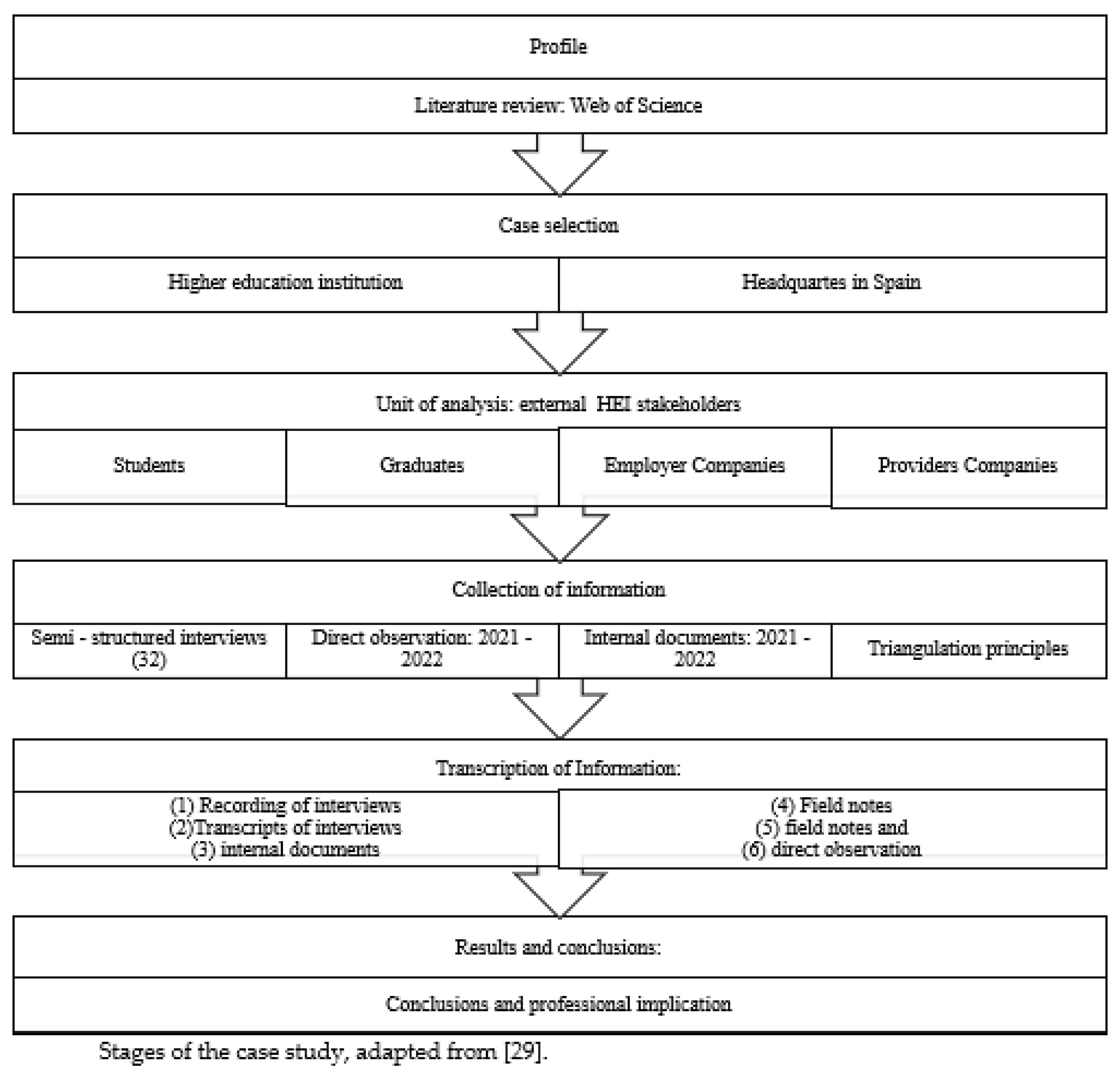
Table 1.
Types of stakeholders in HEIs.
| Category of matches | Constituent groups |
| The governing bodies | State and federal governments; Board of Directors;neutral organisations; religious organisations |
| Administration | Rector, Management Team |
| Employees | Faculty; administrative staff, support staff |
| Clientele | Students; parents; spouses; service sector partners, employers; companies receiving trainees; companies employing students. |
| Suppliers | Secondary education providers, secondary school students; other HEIs; HEI service companies. |
| Competitors | Direct: Public and private post-secondary education providers.Potential: Distance education providers; Inauguration.Substitutes: employer-sponsored training programmes. |
| Donors | Individuals (including managers, friends, parents, students, employees, companies, research centres, foundations). |
| Communities | Neighbours; school systems; social services.Chambers of Commerce; special interest groups. |
| Regulatory bodiesgovernmental | Ministry of Education, neutral organisations; state and local financial aid agencies; research councils; local research grants; tax authorities; social security; patent office. |
| Regulatory bodiesnon-governmental | Foundations; accredited institutional and non-programming entities; professional associations; sponsors; ecclesiastics |
| Financial intermediaries | Banks; fund managers; analysts. |
| Joint venture partners | Alliances and consortia; corporate co-sponsors of education and research services. |
Source: adapted from Burrows (1999).
Table 2.
Top four propositions within the HEI's TD process according to its external stakeholders.
|
Technology | Canvas | |
| Methodology | Transformative learning | ||
| External Stakeholders |
|
Technology | Audiovisual platform Social mediaBlogs |
| Methodology | |||
|
Technology | ||
| Council | |||
|
Technology | ||
| Processes |
*Own elaboration.
Disclaimer/Publisher’s Note: The statements, opinions and data contained in all publications are solely those of the individual author(s) and contributor(s) and not of MDPI and/or the editor(s). MDPI and/or the editor(s) disclaim responsibility for any injury to people or property resulting from any ideas, methods, instructions or products referred to in the content. |
© 2023 by the authors. Licensee MDPI, Basel, Switzerland. This article is an open access article distributed under the terms and conditions of the Creative Commons Attribution (CC BY) license (http://creativecommons.org/licenses/by/4.0/).
Copyright: This open access article is published under a Creative Commons CC BY 4.0 license, which permit the free download, distribution, and reuse, provided that the author and preprint are cited in any reuse.


