

Submitted:
06 May 2023
Posted:
08 May 2023
You are already at the latest version
Abstract
The search for growth and sustainability in any organization largely depends on its ability to carry out digital transformation and agility processes. These processes are essential to adapt to an increasingly changing and competitive business environment, allowing companies to be more efficient and effective in creating an unbreakable bond with their customers. This manuscript addresses the importance of detecting and eliminating anti-patterns in organizational culture for a successful digital and agile transformation. During the early stages of the transformation process, prejudices and paradigms rooted in the organization can become an obstacle to change. The goal of this writing is to offer a practical guide for leaders and teams in organizations seeking successful cultural transformation. Effective strategies are proposed to overcome the challenges faced by organizations during this early stage. In summary, the key steps to be followed in the initial stages of digital transformation with agility are described, including the importance of establishing strong leadership, defining a clear vision and scope of the transformational process, among others. A set of recommendations will be provided to overcome recurring anti-patterns, such as lack of stakeholder participation and commitment, lack of proper planning, and confusion of roles and responsibilities.
Keywords:
Agile
; agility
; scrum
; culture
; digital transformation
; anti-patterns
1. Introduction
Digital transformation and agility [1] are key processes for any organization seeking growth and sustainability in their business [2,3]. However, the initial stages of this process can be filled with biases, misguided expectations, and unfounded paradigms. Therefore, it is crucial to highlight the importance of the first stage of this process, in which the current reality of the organization must be analyzed, evaluating its strategies, processes, technology, people, and culture [4]. This analysis is essential to define the paths to follow in the transformation process [5].
However, during this initial stage, the current culture, knowledge, traditional practices, and comfort zone of teams and individuals can be a barrier to change [6,7]. Resistance to change is common due to biases and paradigms entrenched in the organization [5]. Therefore, it is essential to address this issue sensitively and effectively to encourage the adoption of new ways of working [6,7]. In this sense, it is crucial to establish consensus with the client to define the strategic vision [8], expectations, and tipping point necessary to initiate cultural transformation from the organization’s leadership [9].
In this manuscript, we will address the first major challenge of cultural transformation: fostering a mindset change for the adoption of new habits and ways of working [6,10,11]. We will describe the challenges that organizations face in this initial stage and propose effective strategies to overcome them. In summary, this text aims to offer a practical guide for leaders and teams of organizations seeking successful cultural transformation [7,12] in the context of agility and digital transformation [3].
2. Problem
The gap between the traditional and ingrained culture of employees and new methods of communication, collaboration, and efficiency can generate significant tension in any organization seeking to improve its productivity and adapt to market changes. The clash between traditional culture and new methods of work and technology can lead to resistance to change, making it difficult to adopt new, more efficient and productive ways of working [13]. It is important for organizations to address this cultural tension and promote a collaborative environment in which employees are involved, trained, and encouraged to embrace a culture of innovation and continuous improvement [12]. By finding a balance between preserving organizational values and culture, and adopting new technologies and trends, greater productivity and performance can be achieved in the organization. [1,4,5,14].
Some of the most recurrent practices that provide opportunities for adjustment or course correction are:
- Lack of stakeholder participation and commitment,
- Poor definition of products,
- Inadequate iteration planning,
- Lack of detailed analysis and identification of dependencies,
- Confusion of roles and responsibilities,
- Ineffective meetings,
- Reports to non-existent bosses and high micromanagement,
- Individualism and ineffective communication,
- Demotivation and mutual distrust, and
- Lack of commitment.
If the team or organization is unwilling to change their way of working, facilitators and change agents who will lead the transformation will face significant difficulties in achieving acceptance of the proposed model and launching a proper agile cultural transformation process[6]. This can hinder the achievement of the broad benefits that can be obtained, such as:
Therefore, the first major challenge is to fully understand the purpose of the transformation in the organization [8] and why it is necessary to implement it [10,11]. This requires approaching it empathetically and sensitively to what is established, which opens the doors to the following steps in implementation. In this regard, it is absolutely relevant to early detect the culture and antipatterns [16] that can unbalance or cause the transformation process to fail [5].
The concept of antipattern [17] applies to something that initially seems attractive and appears to be an easy solution to implement, but eventually, far from solving a problem, ends up causing even more problems. Antipatterns are hidden within the good practices of the framework that is intended to be implemented and seem to be part of the system [16]. Therefore, it is crucial to early identify them and take timely corrective measures [17].
2.1. Agile Anti-Patterns
Agile frameworks propose sustained mutual control based on reciprocal trust, fostering collaboration, adaptation, and joint learning [18,19,20]. With "controlled freedom," teams have the possibility to do everything they consider right as long as they respect the flexible, moldable, and adaptable structure of the applied framework. This approach works very well until the team starts to go beyond the established limits. At that point, bad practices can arise that trigger various problems [17].
When antipatterns appear, the team can lose focus on the iteration goal and the product vision to be developed, leading to a loss of concentration and weakening the cohesion of the team. Additionally, excessive pressure on developers is often a frequent problem, especially close to the end of the iteration [16,21]. To solve this, collaborative planning is needed with a shared understanding of the iteration goal and the product vision. Added to this, it is necessary to generate trust in the developers’ decisions, without forgetting that we are working in an environment of uncertainty and that it is here where a continuous empirical process of inspection and adaptation is what allows us to reduce risks [17].
Another common problem is having too many meetings. In these cases, it is necessary to respect the timing of each meeting and look for efficient communication methods, such as using collaborative tools [22]. Similarly, a lack of understanding of the Product Owner’s role [18] can also generate problems. It is important to remember that the Product Owner is the representative of the users in the team and delivers the prioritization of the product features to be built [21]. However, it is the developers, based on their capabilities, who will decide the scope of the iteration.
Finally, there are anti-patterns that arise from a lack of understanding of the agile philosophy, a lack of adoption of its values and principles, and in some cases, a lack of commitment. These causes can easily appear in any team, even those with experience working with agility. That’s why it is essential to avoid falling into routine and always maintain a high guard to prevent the appearance of anti-patterns in experienced teams [17,21].
3. Solution
In an era where digital transformation is essential for business survival and success, companies are increasingly adopting agile approaches to achieve the necessary efficiency and innovation [2,15]. However, the agile cultural transformation is not an easy task and often faces many challenges along the way. In this section, we will describe the key steps that must be followed in the initial stages of digital transformation with agility.
- Establish a strong leadership: Agile cultural transformation requires energetic and committed leadership capable of making quick and effective decisions to drive change [5]. Leaders must be visible and transparent in their commitment [6], inspiring the entire team and helping to overcome possible obstacles [9,23].
- Define a clear vision: A clear vision is essential for any cultural transformation process [8]. It is necessary to know the strategic objectives of the organization to define the direction in which the transformational process wants to go. The vision must be shared throughout the organization to ensure understanding and alignment of wills within the organization. Understanding the vision [5] is a crucial step in defining a solid transformation roadmap and avoiding future counterproductive patterns.
- Define the scope of the transformation process: It is important to define the scope of the process and ensure that it is aligned with the organization’s vision and strategic objectives. This will help avoid lack of clarity in the process, focusing the effort and necessary capabilities for its development. This scope should be reflected in a Transformation Backlog that must be approached in an iterative and incremental manner [7,10], so that the organization can take incremental steps in an evolutionary and organic way, which will frequently undergo an inspection and adaptation process [18], thereby increasing the probability of success in the transformation journey.
- Form a transformation team: To achieve effective agile cultural transformation, a committed and multidisciplinary team is required to work closely with organizational leaders [23]. This team must be aligned with the process vision and have the ability to adapt and evolve as the transformation progresses [8]. This team will create and sustain the movement of change and transformation within the organization, generating waves of inspiration, transparency, and trust, above the vertical pressure of top-down mandates.
Figure 1.
Key steps for cultural transformation.
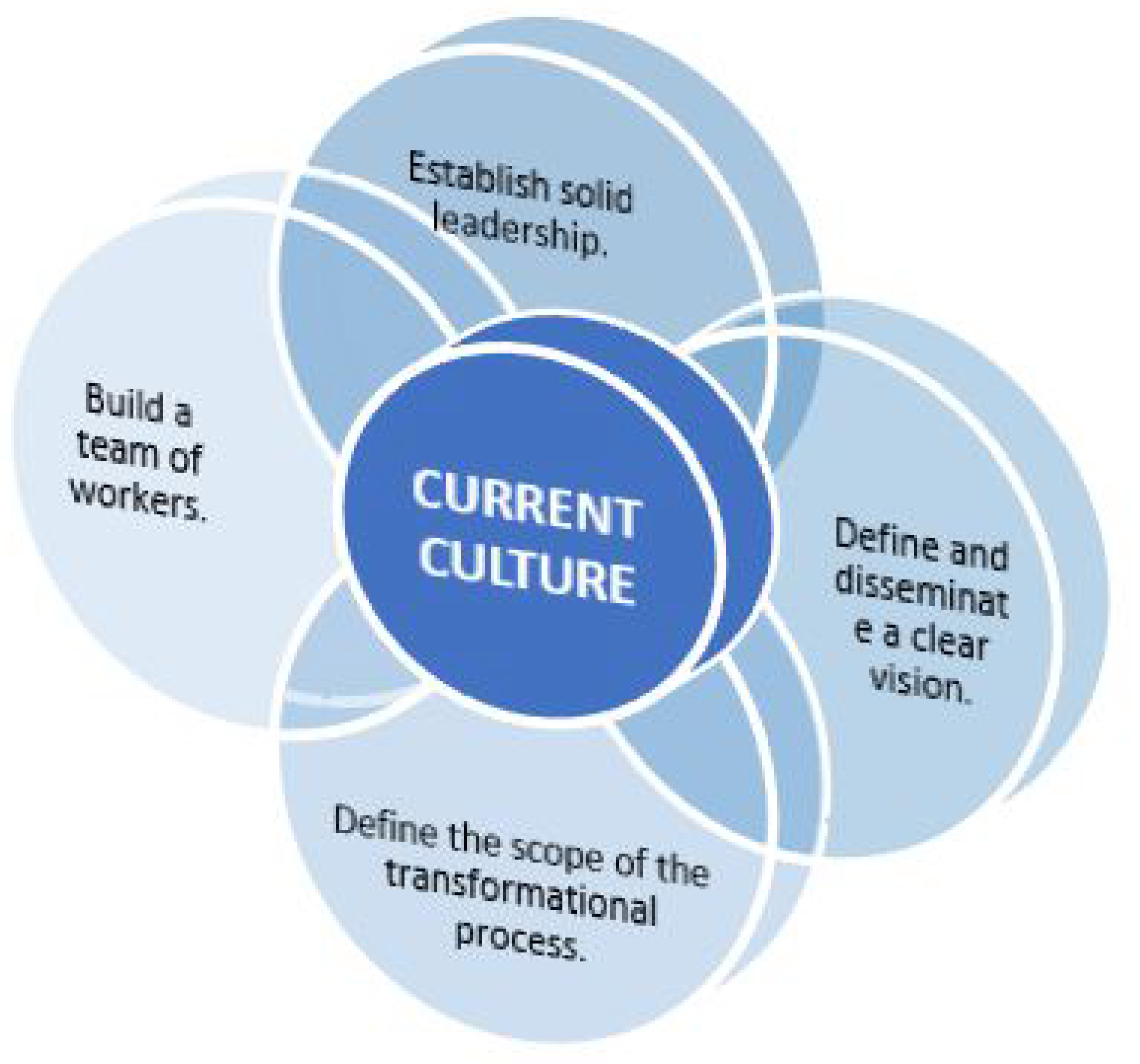
In addition to these key steps, it is important to develop active and constant surveillance to identify agile anti-patterns that may arise during the transformation process and establish effective strategies to overcome them. This process should be participatory and led by the transformation team, and as anti-patterns are detected, they should be transparent and visualized in the transformation backlog to prioritize and define actionable steps to correct these cultural deviations [7]. This will allow organizational leaders to avoid potential obstacles and ensure the success of the process.
Following these key steps from the outset of a transformational process will allow leaders, facilitators, and change agents to establish a solid foundation for agile cultural transformation, avoiding the main anti-patterns that can hinder the success of the process and allowing the organization to achieve the efficiency and innovation necessary to face the challenges of the current market [15,23].
3.1. Recommendations
The Agile cultural transformation can be a challenging path for companies, but by following the appropriate recommendations, a successful transition to an agile culture can be achieved. Based on the experience of agile transformation projects [24,25], we have identified six key recommendations to help companies initiate the necessary cultural change:
- Understanding the current culture of the organization: It is crucial to understand the current culture of the organization and determine which elements need to be changed to support agile digital transformation [13]. Identifying antipatterns and obstacles that hinder the adoption of an agile culture is key to prepare for the challenges that will arise during the transformation [1,4].
- Having committed leadership: Solid and committed leadership is essential to driving change and promoting agile transformation. These leaders must be willing to make tough decisions to ensure the success of the transformation [5], such as moving from a vertical structure of hierarchies and functional silos to a horizontal network-based and customer-centric approach [11,23,27].
- Pilots and experimentation: Conducting pilots and experiments on a small scale is an excellent way to demonstrate the benefits of agile digital transformation and obtain valuable feedback. This also helps the company to test new technologies and agile practices before implementing them on a large scale [7,11,28].
- Measurement and continuous improvement: Measuring and evaluating progress towards agile digital transformation is essential for continuously improving the process and ensuring long-term success. This allows the company to identify areas for improvement and make necessary adjustments to ensure the success of cultural transformation [5,12].
Figure 2.
Stages of digital transformation with agility. Image courtesy of D.C.A.
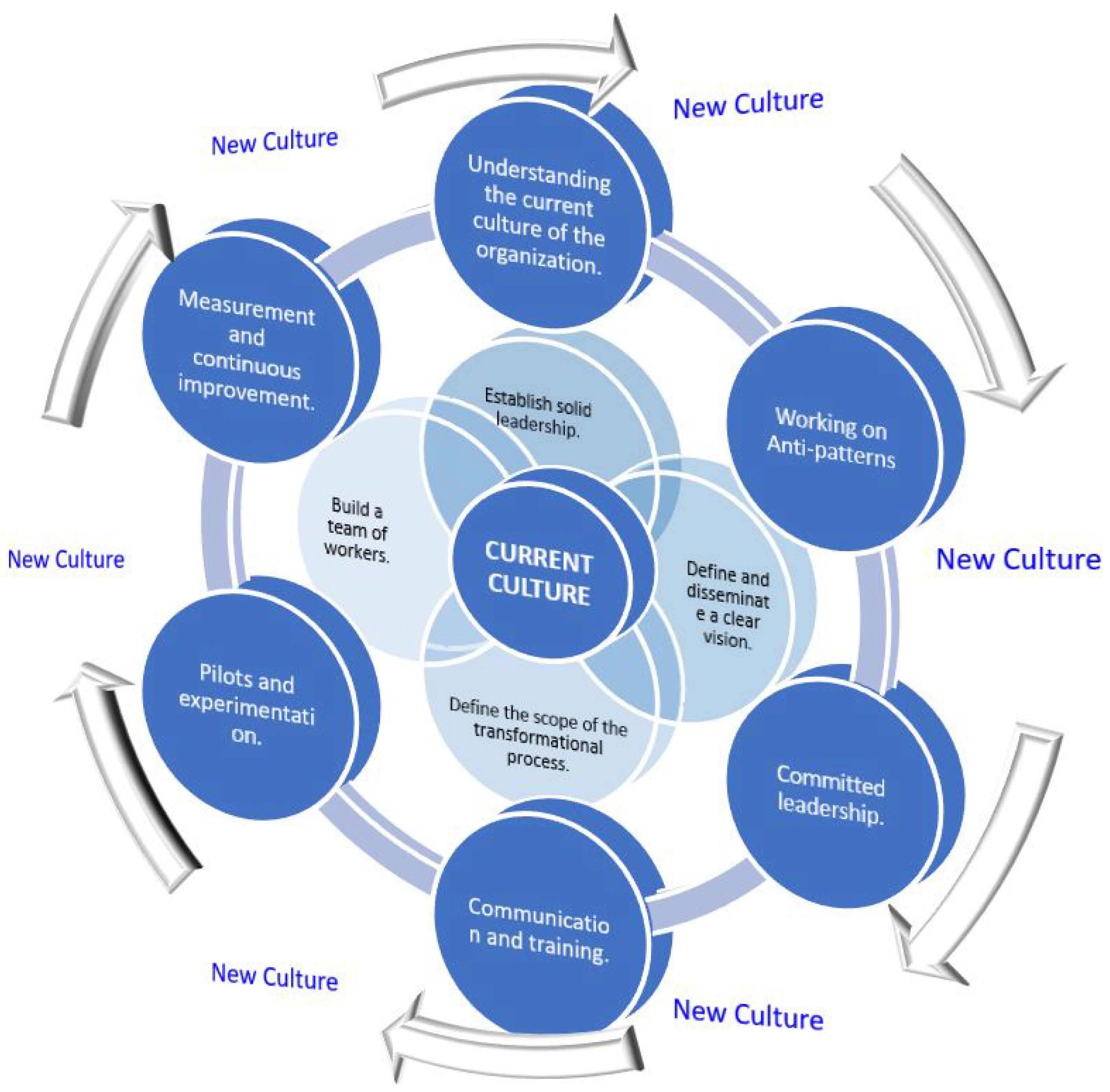
To achieve a successful Agile cultural transformation, it is important to highlight that understanding the current culture and identifying anti-patterns are key steps to prepare and overcome any obstacles in the organizational transformation path.
These recommendations will help companies to address the challenges of cultural transformation by facilitating the transition towards a more agile and innovative culture.
4. Conclusions
Leading a successful agile digital transformation requires an understanding of the organization’s culture and previous knowledge. Without careful planning and a well-defined strategy, antipatterns can hinder the project and make success difficult to achieve. Overcoming these obstacles requires a strategic approach and a firm commitment from senior leadership and the leadership team to convey and drive new beliefs, methods, and ways.
It is important to remember that identifying and overcoming agility antipatterns is an ongoing process throughout this transformation journey and even beyond the departure of consultants supporting this path. The successful implementation of any agile framework should be a co-created, empathetic, and organic social process that also requires a constant focus on continuous improvement for the adoption and evolution of agile practices that will drive high performance and transformation success. A culture in constant reinforcement is essential to inspire and energize all stakeholders in the pursuit of new and better value for their customers [9,29].
Agile digital transformation is a unique opportunity for organizations to advance and stay ahead in a changing and competitive world. If approached with the right mindset, agile digital transformation can generate significant benefits in terms of efficiency, innovation, and customer satisfaction. The key to success lies in adopting agility as a mindset and not just as a tool and committing to a continuous process of improvement and growth.
Author Contributions
Conceptualization, D.C.A. and R.M.D.; Formal analysis, D.C.A. and R.M.D.; Methodology, D.C.A. and R.M.D.; Project administration, D.C.A.; Resources, D.C.A. and R.M.D.; Software, D.C.A. and R.M.D..; Supervision, R.M.D..; Validation, D.C.A. and R.M.D..; Writing—original draft, D.C.A. and R.M.D.; Writing—review and editing, D.C.A. and R.M.D. All authors have read and agreed to the published version of the manuscript.
Acknowledgments
We would like to acknowledge the Agile TCS community for their valuable insights and contributions that have helped shape the ideas presented in this paper. Their expertise and commitment to agile methodologies have been an inspiration and a driving force in our research. We are grateful for their support and guidance throughout this project.
Conflicts of Interest
No conflicting interests were disclosed.
References
- Westerman, G.; Bonnet, D.; McAfee, A. Leading digital transformation. Mit Sloan Manag. Rev. 2014, 55, 1–18. [Google Scholar]
- An IMD and Cisco Initiative. Digital vortex: How digital disruption is redefining industries, 2015.
- TCS. Winning in a business 4.0 world. TCS 2019, 1, 4–52. [Google Scholar]
- Schein, E.H. Organizational culture and leadership, volume 2. John Wiley & Sons, 2010.
- Kotter, J.P. Leading change: Why transformation efforts fail. Harvard Business Review 1995, 73, 59–67. [Google Scholar]
- Appelo, J. Management 3.0: Leading Agile Developers, Developing Agile Leaders. Addison-Wesley, 1st edition, 2019.
- Little, J. Lean Change Management. Packt Publishing, 1st edition, 2014.
- Satell, G. Cascades: How to Create a Movement that Drives Transformational Change. McGraw-Hill, 1st edition, 2019.
- Prahalad, C.K.; Ramaswamy, V. Co-creation experiences: The next practice in value creation. J. Interact. Mark. 2004, 18, 5–14. [Google Scholar] [CrossRef]
- Fowler, M.; Highsmith, J.; et al. The agile manifesto. Softw. Dev. 2001, 9, 28–35. [Google Scholar]
- Womack, J.P.; Jones, D.T. Lean Thinking: Banish Waste and Create Wealth in Your Corporation. Simon and Schuster, USA, 2nd edition, 2003.
- Deming, W.E. Out of the Crisis. MIT press, 1st edition, 1982.
- Dignan, A. Brave New Work: Are You Ready to Reinvent Your Organization? Portfolio, 1st edition, 2019.
- Aghina, W.; Handscomb, C.; Ludolph, J.; Rona, D.; West, D. Enterprise agility: Buzz or business impact. McKinsey & Company, 2020; 19. [Google Scholar]
- Denning, S. The age of agile: How smart companies are transforming the way work gets done. Amacom, 1st edition, 2018.
- Zakova, S.; Čtvrtníková, T. Scrum anti-patterns, team performance and responsibility. Int. J. Agil. Syst. Manag. 2021, 14, 170. [Google Scholar] [CrossRef]
- Laplante, P.A.; Neill, C.J. Antipatterns: Identification, Refactoring, and Management. Auerbach Publications, 2005.
- Schwaber, K.; Sutherland, J. The Scrum Guide The Definitive Guide to Scrum: The Rules of the Game. scrumguides.org, 6th edition, 2020.
- Anderson, D.J. . Kanban: Successful Evolutionary Change for Your Technology Business. Blue Hole Press, 1st edition, 2010.
- Schwaber, K.; Beedle, M. Agile software development with scrum. Series in agile software development, volume 1. Prentice Hall Upper Saddle River, 2002.
- Eloranta, V.-P.; Koskimies, K.; Mikkonen, T. Exploring scrumbut – an empirical study of scrum anti-patterns. Inf. Softw. Technol. 2016, 74, 194–203. [Google Scholar] [CrossRef]
- Carew, P.J.; Glynn, D. Anti-patterns in agile adoption: A grounded theory case study of one irish it organisation. Glob. Flex. Syst. Manag. 2017, 18, 275–289. [Google Scholar] [CrossRef]
- Hamel, G. The Future of Management. Harvard Business Press, 1st edition, 2007.
- TCS. Here’s the tcs agile transformation story. TCS 2022, 1, 1. [Google Scholar]
- TCS. Agile as a way of life: The tcs story. TCS 2022, 1, 1. [Google Scholar]
- Kasarda, J.D.; Bidwell, C.E. The Organization and Its Ecosystem: A Theory of Structuring in Organizations. Monographs in Organizational Behavior and Industrial Relations. Transaction Publishers, 1980.
- Kotter, J. Accelerate: Building Strategic Agility for a Faster-Moving World. Harvard Business School Press, 1st edition, 2014.
- Liker, J.K. The Toyota Way: 14 Management Principles from the World’s Greatest Manufacturer. McGraw-Hill, USA, 1st edition, 2004.
- Hax, A.C.; Wilde, D.L. The delta model—Toward a unified framework of strategy. SSRN Electron. J. 2002. [Google Scholar] [CrossRef]
Disclaimer/Publisher’s Note: The statements, opinions and data contained in all publications are solely those of the individual author(s) and contributor(s) and not of MDPI and/or the editor(s). MDPI and/or the editor(s) disclaim responsibility for any injury to people or property resulting from any ideas, methods, instructions or products referred to in the content. |
© 2023 by the authors. Licensee MDPI, Basel, Switzerland. This article is an open access article distributed under the terms and conditions of the Creative Commons Attribution (CC BY) license (http://creativecommons.org/licenses/by/4.0/).
Copyright: This open access article is published under a Creative Commons CC BY 4.0 license, which permit the free download, distribution, and reuse, provided that the author and preprint are cited in any reuse.


