

Submitted:
26 July 2023
Posted:
27 July 2023
You are already at the latest version
Abstract
Leishmaniosis is a zoonoses caused by Leishmania spp., an intracellular protozoan parasite. This parasite is transmitted by sandflies and the disease is endemic in Mediterranean basin. In the last years, the number of species which could be reservoir of parasite is increased. One of the most relevant is the horses, due to contact with humans and its ability to control the disease, being a possible silent reservoir. In this study, we have analyzed the prevalence and factors related to L. infantum infection in healthy horses in Mediterranean region. Epidemiological data and serum samples were obtained to 167 apparently healthy horses and presence of L. infantum was evaluated by ELISA method and qPCR. The results show 27,5% of prevalence and the main factors related to infection are equine breed, outdoor living, use and season. In conclusion, the prevalence of L. infantum infection in apparently horses from Eastern Spain (Mediterranean basin) is elevated. To control this zoonosis, it would be advisable to carry out more studies on this and other species that could be silent reservoirs of the parasite, as well as carry out measures such as the use of repellents on a regular basis.
Keywords:
equine
; leishmania
; one health
; parasitic infection
; zoonosis
1. Introduction
Leishmaniosis is a parasitic disease caused by Leishmania spp., which includes L. infantum, the most common causal agent of leishmaniosis in the Mediterranean basin. This protozoan parasite is transmitted by the phlebotomine sandflies from the Psychodidae family, being the genus Phlebotomus its principal vector in Europe [1,2,3]. Even though the domestic dog (Canis lupus familiaris) has always been considered the main reservoir of this parasite [4,5], L. infantum infection has been reported in different species in Europe, including cats [6], wild carnivores [7,8], wild rabbits [9,10], birds [11], reptiles [12] and horses [13].
In Europe, the number of clinical cases of equine leishmaniosis (EL) reported has been low, and clinical manifestations is mild without visceral involvement, and cutaneous lesions tend to self-recover without treatment [14,15,16]. L. infantum has been identified as the etiological agent of EL with cutaneous presentation in Germany [14] and Switzerland [17], as well as in countries where this zoonosis is considered endemic, such as Italy [18], Spain [16] and Portugal [15]. However, most data of EL have been recorded from South and Central America, being the main etiological agent L. braziliensis [19,20,21] or L. infantum [22,23,24].
Subclinical infections or Leishmania spp. infections in healthy horses has been reported around the world, and the prevalence in endemic areas depends on study and geographic area. In Venezuela and Brazil, the prevalence of L. braziliensis infection in healthy horses ranged between 7.1 to 28% [25,26], whereas the prevalence of L. infantum in Europe seems to be lower [27,28,29,30]. Given that both the techniques used, and the number of individuals evaluated differ greatly between studies, the observed prevalence varies between countries and in the same country or region, both in the Old and the New World.
The role of horses as a reservoir of the parasite has not been well studied, but undoubtedly, horses can play a very important role [31], not only as a source of food for sandflies [24] but also because their feces are a source of food for development of their larvae [32].
The aim of this work is to analyze the prevalence of L. infantum infection and related factors in apparently healthy horses in Eastern Spain, Mediterranean basin, an endemic region.
2. Materials and Methods
2.1. Animals and Epidemiological Data
A total of 167 horses without clinical signs living in Valencia Community (Eastern Spain, Mediterranean region) was studied and samples were recovered from December 2022 to June 2023. For all animals, epidemiological data were collected: sex (two categories: male or female), reproductive status in males (two categories: castrated or not), age (four categories: foal -less than five years old-, young -between five and twelve years old, adult -between thirteen and twenty-one years old-, and elder -more than twenty-one years old), breed (seventeen categories), crossbreed or purebred (two categories), use (six categories: teaching, breeding, dressage, hitch, walking, and leap), type of housing (two categories: outdoor or indoor), and living or not with dogs. Samples were recovered in two period of the year, winter (December 2022-January 2023) and spring (May 2023-June 2023). The mean of temperatures was annotated.
2.2. Sample Collection and DNA Extraction
Ten milliliters of whole blood were taken by jugular venipuncture using Vacutainer tubes with or without anticoagulant. Samples without anticoagulant were maintained at room temperature to obtain serum aliquots, which were stored at -80ºC until processing. Serological testing for Leishmania spp. detection of specific antibodies was performed using Enzyme-linked immunosorbent assay (ELISA) test for anti-Leishmania-specific immunoglobulin G (IgG) antibodies (Leishmania vet ELISA®, Demeditec Diagnostics GmbH, Germany), following the manufacturer’s instructions. Sample with ELISA titer > cut-off was considered seropositive. Whole blood samples recovered with EDTA anticoagulant were used for DNA extraction before 24 h to recovery. Total DNA was isolated using Thermo Fisher Scientific DNA purification Kit following the manufacturer’s protocol (Thermo Fisher Scientific, MA, USA). DNA was quantified using a Nanodrop spectrophotometer (Thermo Fisher Scientific), and only samples with A260/A280 > 1.8 were used. DNA samples were stored at -80ºC until use for PCR.
2.3. Real-Time PCR Analysis
The primers and probes for L. infantum DNA detection were chosen in the constant region of the kinetoplast DNA minicircle, and fluorogenic probes were synthesized by FAM reported molecule attached to the 5’ end, a TAMRA quencher linked to the 3’ end, and ROX as the internal passive reference dye. Primers and probe sequence are: 5-GGCGTTCTGCGAAAACCG-3’ (forward), 5’-AAAATGGCATTTTCGGGCC-3’ (reverse), and 5’-AAAATGGCATTTTCGGGCC-3’ (probe) [33]. Real-time PCR was performed in a 20 µl of total volume of reaction, including 10 µl of qLUMEN MasterMix (Gquence®, Labbox Labware, SL, Barcelona, Spain), 300nM of each primer, 250 nM of the fluorogenic probe and 50-100 ng of DNA. Reactions were run at triplicate for all samples and were performed on the QuantStudio 5 Real-Time PCR System (Thermo Fisher Scientific, MA, USA). The thermal cycle conditions consisted of a 2 min initial incubation at 50ºC, followed by 10 min at 95ºC, and 40 cycles at 95ºC for 15 s and 60ºC for 1 min each. On each plate, a negative control (free RNA and DNA water) and positive control was included.
2.4. Statistical Analysis
Prevalence of parasitic infection was analysed using the GENMOD procedure of the statistical program SAS (North Carolina State University, USA). Binary (for sex, reproductive status in males, crossbreed or purebred, type of housing, living or not with dogs, and period of the year) or logistic regression model (for age, breed, and use) were used using each factor as a fixed effect in their respective statistical analysis. The statistical significance was set at p-value < 0.05.
3. Results
Of the 167 samples evaluated, 27.5% were positive in the ELISA test and qPCR (46/167). Presence of L. infantum DNA was confirmed in 40.7% of samples analyzed by qPCR (68/167). The total prevalence of L. infantum infection in animals evaluated was 27.5%. In terms of sex, 65.3% of animals evaluated were males (109/167), being 66.1% of them, castrated (72/109). Related to age, 21% of animals were foal (less than five years), 40% young animals (between five and twelve years old), 80% adults (between thirteen and twenty-one years old) and 26% old horses (more than twenty-one years old). The most of horses were purebred, including a total of eighteen different breeds, and 38.3% were crossbreed animals. In term of use, 44% of horses were used for dressage (74/167), whereas 19.2% (32/167) and 16.2% (27/167) were used for walking and teaching, respectively. Regarding type of housing, a total of 112 horses (67.1%) had outside access, and 159 (95.2%) living with dogs. A total of 106 samples were collected from December 2022 to January 2023 (63.5%) (Table 1).
A total of 46 (27.5%) samples analyzed were positive for anti-leishmania antibodies and confirmed by qPCR. Related to factors evaluated, sex or castration in males, age, pure- or crossbred, and living of dogs were no effect in the L. infantum infection, whereas horse breed, life condition, use, period of recovery sample and location were effect. Breeds with most prevalence were Pony, Spanish Sport Horse (CDE), and Purebred Spanish Horse (PRE), with 75%, 57.1%, and 32.9% of prevalence, respectively. Only one Haflinger and one Percheron were included in this study, and two were positives, and one of two Irish cob horses was positive (Table 2).
Outdoor horses present higher prevalence than indoor (38.9% and 5.5%, respectively, p<0.0001) (Figure 1a). The prevalence in horses used for teaching were higher than other uses, being the prevalence of 88.9% (p<0.0001) (Figure 1b). The number of positive samples recovered in spring (60.7%) were higher than in winter (8.5%) (p<0.0001). Mean of temperature were 13.1ºC and 24.1ºC for winter and spring, respectively (AEMET, Spanish Meteorology Statal Agency). Figure 1c shows the prevalence of positive animals according to period of recovered and mean of temperature for each location and period.
4. Discussion
This study shows the prevalence and factors related to infection of L. infantum in horses from Eastern Spain, where this parasite is endemic. The results show a total prevalence of 27.5% by two methods (ELISA and qPCR) and 40.7% by qPCR, being the factors with effect of horse breed, if the animal had access to outside, the use of horse, and the period of recovery sample were effect.
This study has been realized in Eastern Spain, concretely Valencian region, where human leishmaniasis is endemic since 1982 [35]. Dog is consider the most common reservoir and its seroprevalence in dogs has been studied, and in Spain, depends on province, being between 57.1% for Balearic Islands (Mediterranean basin) to 0% for Vizcaya (North Spain) [36,37]. Inasmuch as other species could also serve as reservoirs, knowing the prevalence in these other species is very important to control this zoonosis. Concretely, horses have relevance, given that it is a species in direct contact with human and usually lives in urban arear or close to them.
Data of seroprevalence in horses is limited. The only study carried out in Spain shows a prevalence of 14.3% by ELISA [37], and similar results has been observed in Italy [13,24]. However, in other Mediterranean countries, seroprevalence seem to be more less. For example, studies realized by serological methods indicate a prevalence of 0.3% in Greece [29], 1.4% in Israel [30], and 4% in North Portugal [28], whereas Nardoni et al. (2019) observed 36.7% of donkeys evaluated positive. In South America, seroprevalence of Leishmania spp. in healthy horses has been estimated around 27% [39], reaching even 67.3% of horses from urban areas by qPCR [40]. These data are in agree with those observed in our study, confirming the sensitivity of the qPCR technique for the detection of Leishmania spp., especially in asymptomatic animals [41]. The evaluation of healthy horses in endemic areas of leishmaniasis is important, mostly in Europe, where equine leishmaniosis is produced by L. infantum and its clinical presentation is usually mild, appearing skin lesions that usually remit spontaneously, so the infection goes unnoticed in most cases [13].
No effect of sex, pure- or crossbred, and living with dogs has been observed, in accordance with other studies carried out on healthy horses and dogs [13,39,42]. Related to age, results of studies are contradictories. Our results indicate no effect on age, in according with Biral et al. (2021), whereas Gazzonis et al. (2020) show an increase of prevalence related to age [13,40]. In other species, such as dogs, seropositive has been related to age, so in this specie, the chronicity of the infection has an accumulative effect [43]. However, the immune response in horses is effective in controlling the infection [37], so there would not be this accumulative effect unlike what happens in dogs. Related to breed, equine breeds with more prevalence were CDE and PRE, in accordance with other studies, which meso-dolichomorphic horses present high prevalence than breeds with other morphotype [13]. Both equine breeds, CDE and PRE, have calm temperaments, as is the case with horses used for teaching, which could make it easier for them to serve as food for the sandflies and, therefore, increase the risk of Leishmania spp. infection. This also happens in outdoor horses, which the outdoor living increases the risk, factor that has been associated with this risk in other species, such as dogs [43,44].
Prevalence of L. infantum infection in spring was much higher than in winter when the average temperature recorded were lower (24.1ºC versus 13.1ºC in spring). The increase of temperature has been demonstrated as relevant factor in Leishmania spp. dissemination, facilitating the presence of the parasite and its vectors [45,46,47]. These data are more relevant considering that climate change will increase temperatures throughout the year and throughout the word. Some researchers are already carrying out studies with predictive models in this regard. Concretely, Daoudi et al. (2022) estimates an expansion of L. tropica and its vector using Ecological Niche Modeling [48]. This modelling could be extrapolated to the expansion of L. infantum, as well as to its vector. In fact, L. infantum has been detected not only in sandflies but also in dogs and horses of cold European countries [14,49,50], and the scientists already recommend including cutaneous leishmaniasis in the differential diagnosis in human patients [51].
5. Conclusions
In this study, high prevalence of L. infantum infection has been detected in healthy horses of Eastern Spain. The main related factors with increased the risk of infection are equine breed, outdoor living, and use for teaching. The prevalence increases in the warm seasons, confirming that the climate change and the consequent increases in temperature suggest an increase in the spread of the parasite in all species. In horses, the high prevalence observed in this study shows that the horses could be an important reservoir for this zoonotic parasite, so it would be interesting to implement control measures, such as the use of repellents, mainly in horses living in urban areas.
Author Contributions
Conceptualization, L.L.; methodology, L.L.; formal analysis, P.J.M-G.; resources, L.L.; data curation, L.M-S.; Q.D. and E. M-A.; writing—original draft preparation, L.M-S.; Q.D. and E. M-A.; writing—review and editing, L.L.; supervision, L.L.; project administration, L.L.; funding acquisition, L.L. All authors have read and agreed to the published version of the manuscript.
Funding
This research was funded by Universidad Cardenal Herrera CEU, grants number IDOC22-05 and PUENTE22-01.
Institutional Review Board Statement
The animal study protocol was approved by the Ethics Committee of Universidad Cardenal Herrera CEU (protocol code VCS/2022/PEA/0279 and date approval 21/12/2022).
Informed Consent Statement
Informed consent was obtained from all owners of the animals involved in the study.
Data Availability Statement
The dataset of the current study is available from the corresponding author upon reasonable request.
Acknowledgments
We are grateful to the Universidad Cardenal Herrera CEU.
Conflicts of Interest
The authors declare no conflict of interest. The funders had no role in the design of the study; in the collection, analyses, or interpretation of data; in the writing of the manuscript; or in the decision to publish the results.
References
- Akhoundi, M.; Kuhls, K.; Cannet, A.; Votýpka, J.; Marty, P.; Delaunay, P.; Sereno, D. A Historical Overview of the Classification, Evolution, and Dispersion of Leishmania Parasites and Sandflies. PLOS Neglected Tropical Diseases 2016, 10, e0004349. https://doi.org/10.1371/journal.pntd.0004349. [CrossRef]
- Baneth, G.; Nachum-Biala, Y.; Shabat Simon, M.; Brenner, O.; Gaier, S.; Rojas, A.; Yasur-Landau, D. Leishmania Major Infection in a Dog with Cutaneous Manifestations. Parasit Vectors 2016, 9, 246. https://doi.org/10.1186/s13071-016-1541-2. [CrossRef]
- Gramiccia, M. Recent Advances in Leishmaniosis in Pet Animals: Epidemiology, Diagnostics and Anti-Vectorial Prophylaxis. Vet Parasitol 2011, 181, 23–30. https://doi.org/10.1016/j.vetpar.2011.04.019. [CrossRef]
- Mancianti, F.; Gramiccia, M.; Gradoni, L.; Pieri, S. Studies on Canine Leishmaniasis Control. 1. Evolution of Infection of Different Clinical Forms of Canine Leishmaniasis Following Antimonial Treatment. Trans. R. Soc. Trop. Med. Hyg. 1988, 82, 566–567. https://doi.org/10.1016/0035-9203(88)90510-x. [CrossRef]
- Ready, P.D. Leishmaniasis Emergence in Europe. Euro Surveill 2010, 15, 19505.
- Ahuir-Baraja, A.E.; Ruiz, M.P.; Garijo, M.M.; Llobat, L. Feline Leishmaniosis: An Emerging Public Health Problem. Vet Sci 2021, 8, 173. https://doi.org/10.3390/vetsci8090173. [CrossRef]
- Giner, J.; Villanueva-Saz, S.; Fernández, A.; Gómez, M.A.; Podra, M.; Lizarraga, P.; Lacasta, D.; Ruiz, H.; Del Carmen Aranda, M.; de Los Ángeles Jimenez, M.; et al. Detection of Anti-Leishmania Infantum Antibodies in Wild European and American Mink (Mustela Lutreola and Neovison Vison) from Northern Spain, 2014-20. J Wildl Dis 2022, 58, 198–204. https://doi.org/10.7589/JWD-D-21-00027. [CrossRef]
- Ortuño, M.; Nachum-Biala, Y.; García-Bocanegra, I.; Resa, M.; Berriatua, E.; Baneth, G. An Epidemiological Study in Wild Carnivores from Spanish Mediterranean Ecosystems Reveals Association between Leishmania Infantum, Babesia Spp. and Hepatozoon Spp. Infection and New Hosts for Hepatozoon Martis, Hepatozoon Canis and Sarcocystis Spp. Transbound Emerg Dis 2022, 69, 2110–2125. https://doi.org/10.1111/tbed.14199. [CrossRef]
- Athanasiou, L.V.; Katsogiannou, E.G.; Tsokana, C.N.; Boutsini, S.G.; Bisia, M.G.; Papatsiros, V.G. Wild Rabbit Exposure to Leishmania Infantum, Toxoplasma Gondii, Anaplasma Phagocytophilum and Babesia Caballi Evidenced by Serum and Aqueous Humor Antibody Detection. Microorganisms 2021, 9, 2616. https://doi.org/10.3390/microorganisms9122616. [CrossRef]
- Martín-Sánchez, J.; Torres-Medina, N.; Morillas-Márquez, F.; Corpas-López, V.; Díaz-Sáez, V. Role of Wild Rabbits as Reservoirs of Leishmaniasis in a Non-Epidemic Mediterranean Hot Spot in Spain. Acta Trop 2021, 222, 106036. https://doi.org/10.1016/j.actatropica.2021.106036. [CrossRef]
- Otranto, D.; Testini, G.; Buonavoglia, C.; Parisi, A.; Brandonisio, O.; Circella, E.; Dantas-Torres, F.; Camarda, A. Experimental and Field Investigations on the Role of Birds as Hosts of Leishmania Infantum, with Emphasis on the Domestic Chicken. Acta Trop 2010, 113, 80–83. https://doi.org/10.1016/j.actatropica.2009.09.014. [CrossRef]
- Mendoza-Roldan, J.A.; Zatelli, A.; Latrofa, M.S.; Iatta, R.; Bezerra-Santos, M.A.; Annoscia, G.; Gernone, F.; Votýpka, J.; Modrý, D.; Tichá, L.; et al. Leishmania (Sauroleishmania) Tarentolae Isolation and Sympatric Occurrence with Leishmania (Leishmania) Infantum in Geckoes, Dogs and Sand Flies. PLoS Negl Trop Dis 2022, 16, e0010650. https://doi.org/10.1371/journal.pntd.0010650. [CrossRef]
- Gazzonis, A.L.; Bertero, F.; Moretta, I.; Morganti, G.; Mortarino, M.; Villa, L.; Zanzani, S.A.; Morandi, B.; Rinnovati, R.; Vitale, F.; et al. Detecting Antibodies to Leishmania Infantum in Horses from Areas with Different Epizooticity Levels of Canine Leishmaniosis and a Retrospective Revision of Italian Data. Parasit Vectors 2020, 13, 530. https://doi.org/10.1186/s13071-020-04385-8. [CrossRef]
- Koehler, K.; Stechele, M.; Hetzel, U.; Domingo, M.; Schönian, G.; Zahner, H.; Burkhardt, E. Cutaneous Leishmaniosis in a Horse in Southern Germany Caused by Leishmania Infantum. Vet Parasitol 2002, 109, 9–17. https://doi.org/10.1016/s0304-4017(02)00246-7. [CrossRef]
- Rolão, N.; Martins, M.J.; João, A.; Campino, L. Equine Infection with Leishmania in Portugal. Parasite 2005, 12, 183–186. https://doi.org/10.1051/parasite/2005122183. [CrossRef]
- Solano-Gallego, L.; Fernández-Bellon, H.; Serra, R.; Gállego, M.; Ramis, A.; Fondevila, D.; Ferrer, L. Cutaneous Leishmaniosis in Three Horses in Spain. Equine Vet J 2003, 35, 320–323. https://doi.org/10.2746/042516403776148336. [CrossRef]
- Müller, N.; Welle, M.; Lobsiger, L.; Stoffel, M.H.; Boghenbor, K.K.; Hilbe, M.; Gottstein, B.; Frey, C.F.; Geyer, C.; von Bomhard, W. Occurrence of Leishmania Sp. in Cutaneous Lesions of Horses in Central Europe. Vet Parasitol 2009, 166, 346–351. https://doi.org/10.1016/j.vetpar.2009.09.001. [CrossRef]
- Gazzonis, A.L.; Morganti, G.; Porcellato, I.; Roccabianca, P.; Avallone, G.; Gavaudan, S.; Canonico, C.; Rigamonti, G.; Brachelente, C.; Veronesi, F. Detection of Leishmania Spp. in Chronic Dermatitis: Retrospective Study in Exposed Horse Populations. Pathogens 2022, 11, 634. https://doi.org/10.3390/pathogens11060634. [CrossRef]
- Aguilar, C.M.; Rangel, E.F.; Deane, L.M. Cutaneous Leishmaniasis Is Frequent in Equines from an Endemic Area in Rio de Janeiro, Brazil. Mem Inst Oswaldo Cruz 1986, 81, 471–472. https://doi.org/10.1590/s0074-02761986000400015. [CrossRef]
- Yoshida, E.L.; Correa, F.M.; Marques, S.A.; Stolf, H.O.; Dillon, N.L.; Momen, H.; Grimaldi, G. Human, Canine and Equine (Equus Caballus) Leishmaniasis Due to Leishmania Braziliensis (= L. Braziliensis Braziliensis) in the South-West Region of São Paulo State, Brazil. Mem Inst Oswaldo Cruz 1990, 85, 133–134. https://doi.org/10.1590/s0074-02761990000100026. [CrossRef]
- Falqueto, A.; Varejão, J.B.; Sessa, P.A. Cutaneous Leishmaniasis in a Horse (Equus Caballus) from Endemic Area in the State of Espirito Santo, Brazil. Mem Inst Oswaldo Cruz 1987, 82, 443. https://doi.org/10.1590/s0074-02761987000300020. [CrossRef]
- Soares, I.R.; Silva, S.O.; Moreira, F.M.; Prado, L.G.; Fantini, P.; Maranhão, R. de P.A.; da Silva Filho, J.M.; Melo, M.N.; Palhares, M.S. First Evidence of Autochthonous Cases of Leishmania (Leishmania) Infantum in Horse (Equus Caballus) in the Americas and Mixed Infection of Leishmania Infantum and Leishmania (Viannia) Braziliensis. Vet Parasitol 2013, 197, 665–669. https://doi.org/10.1016/j.vetpar.2013.06.014. [CrossRef]
- de Pinho, F.A.; Mendes, M.O.; de Magalhães, V.L.P.; Tinôco, A.A.C.; Seoane, J.H.L.; Rêgo, F.D.; Soares, R.P.; Barrouin-Melo, S.M. Clinical Evolution of Equine Leishmaniasis with Self-Limiting Cutaneous Disease Caused by Leishmania Infantum in Northeastern Brazil: A Case Report. Vet Parasitol Reg Stud Reports 2023, 41, 100881. https://doi.org/10.1016/j.vprsr.2023.100881. [CrossRef]
- Escobar, T.A.; Dowich, G.; Dos Santos, T.P.; Zuravski, L.; Duarte, C.A.; Lübeck, I.; Manfredini, V. Assessment of Leishmania Infantum Infection in Equine Populations in a Canine Visceral Leishmaniosis Transmission Area. BMC Vet Res 2019, 15, 381. https://doi.org/10.1186/s12917-019-2108-1. [CrossRef]
- Vedovello Filho, D.; Jorge, F.A.; Lonardoni, M.V.C.; Teodoro, U.; Silveira, T.G.V. American Cutaneous Leishmaniasis in Horses from Endemic Areas in the North-Central Mesoregion of Paraná State, Brazil. Zoonoses Public Health 2008, 55, 149–155. https://doi.org/10.1111/j.1863-2378.2008.01106.x. [CrossRef]
- Aguilar, C.M.; Rangel, E.F.; Garcia, L.; Fernandez, E.; Momen, H.; Grimaldi Filho, G.; De Vargas, Z. Zoonotic Cutaneous Leishmaniasis Due to Leishmania (Viannia) Braziliensis Associated with Domestic Animals in Venezuela and Brazil. Mem Inst Oswaldo Cruz 1989, 84, 19–28. https://doi.org/10.1590/s0074-02761989000100005. [CrossRef]
- Schulz, A.; Mellenthin, K.; Schönian, G.; Fleischer, B.; Drosten, C. Detection, Differentiation, and Quantitation of Pathogenic Leishmania Organisms by a Fluorescence Resonance Energy Transfer-Based Real-Time PCR Assay. J Clin Microbiol 2003, 41, 1529–1535. https://doi.org/10.1128/JCM.41.4.1529-1535.2003. [CrossRef]
- Lopes, A.P.; Sousa, S.; Dubey, J.P.; Ribeiro, A.J.; Silvestre, R.; Cotovio, M.; Schallig, H.D.F.H.; Cardoso, L.; Cordeiro-da-Silva, A. Prevalence of Antibodies to Leishmania Infantum and Toxoplasma Gondii in Horses from the North of Portugal. Parasit Vectors 2013, 6, 178. https://doi.org/10.1186/1756-3305-6-178. [CrossRef]
- Kouam, M.K.; Diakou, A.; Kanzoura, V.; Papadopoulos, E.; Gajadhar, A.A.; Theodoropoulos, G. A Seroepidemiological Study of Exposure to Toxoplasma, Leishmania, Echinococcus and Trichinella in Equids in Greece and Analysis of Risk Factors. Vet Parasitol 2010, 170, 170–175. https://doi.org/10.1016/j.vetpar.2010.02.004. [CrossRef]
- Aharonson-Raz, K.; Baneth, G.; Lopes, A.P.; Brancal, H.; Schallig, H.; Cardoso, L.; Steinman, A. Low Seroprevalence of Leishmania Infantum and Toxoplasma Gondii in the Horse Population in Israel. Vector Borne Zoonotic Dis 2015, 15, 726–731. https://doi.org/10.1089/vbz.2015.1826. [CrossRef]
- Miranda, D.E. de O.; Sales, K.G. da S.; Faustino, M.A. da G.; Alves, L.C.; Brandão-Filho, S.P.; Dantas-Torres, F.; de Carvalho, G.A. Ecology of Sand Flies in a Low-Density Residential Rural Area, with Mixed Forest/Agricultural Exploitation, in North-Eastern Brazil. Acta Trop 2015, 146, 89–94. https://doi.org/10.1016/j.actatropica.2015.03.011. [CrossRef]
- Ximenes, M.F.; Souza, M.F.; Castellón, E.G. Density of Sand Flies (Diptera: Psychodidae) in Domestic and Wild Animal Shelters in an Area of Visceral Leishmaniasis in the State of Rio Grande Do Norte, Brazil. Mem Inst Oswaldo Cruz 1999, 94, 427–432. https://doi.org/10.1590/s0074-02761999000400001. [CrossRef]
- Manna, L.; Reale, S.; Viola, E.; Vitale, F.; Foglia Manzillo, V.; Pavone, L.M.; Michele, P.L.; Caracappa, S.; Gravino, A.E. Leishmania DNA Load and Cytokine Expression Levels in Asymptomatic Naturally Infected Dogs. Vet Parasitol 2006, 142, 271–280. https://doi.org/10.1016/j.vetpar.2006.06.028. [CrossRef]
- Meteorología, A.E. de Agencia Estatal de Meteorología - AEMET. Gobierno de España Available online: https://www.aemet.es/es/portada (accessed on 23 June 2023).
- Humanes-Navarro, A.M.; Herrador, Z.; Redondo, L.; Cruz, I.; Fernández-Martínez, B. Estimating Human Leishmaniasis Burden in Spain Using the Capture-Recapture Method, 2016-2017. PLoS One 2021, 16, e0259225. https://doi.org/10.1371/journal.pone.0259225. [CrossRef]
- Gálvez, R.; Montoya, A.; Cruz, I.; Fernández, C.; Martín, O.; Checa, R.; Chicharro, C.; Migueláñez, S.; Marino, V.; Miró, G. Latest Trends in Leishmania Infantum Infection in Dogs in Spain, Part I: Mapped Seroprevalence and Sand Fly Distributions. Parasit Vectors 2020, 13, 204. https://doi.org/10.1186/s13071-020-04081-7. [CrossRef]
- Edo, M.; Marín-García, P.J.; Llobat, L. Is the Prevalence of Leishmania Infantum Linked to Breeds in Dogs? Characterization of Seropositive Dogs in Ibiza. Animals (Basel) 2021, 11, 2579. https://doi.org/10.3390/ani11092579. [CrossRef]
- Fernández-Bellon, H.; Solano-Gallego, L.; Bardagí, M.; Alberola, J.; Ramis, A.; Ferrer, L. Immune Response to Leishmania Infantum in Healthy Horses in Spain. Vet Parasitol 2006, 135, 181–185. https://doi.org/10.1016/j.vetpar.2005.09.007. [CrossRef]
- Nardoni, S.; Altomonte, I.; Salari, F.; Martini, M.; Mancianti, F. Serological and Molecular Findings of Leishmania Infection in Healthy Donkeys (Equus Asinus) from a Canine Leishmaniosis Endemic Focus in Tuscany, Italy: A Preliminary Report. Pathogens 2019, 8, 99. https://doi.org/10.3390/pathogens8030099. [CrossRef]
- Biral, N.V.; Azevedo Santos, H.; Senne, N.A.; Paulino, P.G.; Camilo, T.A.; Tassinari, W. de S.; Silva, V.L.; Santos, F.N.; Angelo, I. da C. A Cross-Sectional Study of Leishmania Spp. in Draft Horses from the Distrito Federal, Brazil: Seroprevalence, Spatial Distribution, and Associated Factors. Prev Vet Med 2021, 195, 105467. https://doi.org/10.1016/j.prevetmed.2021.105467. [CrossRef]
- Lopes, K.F.C.; Delai, R.M.; Fazoli, K.G.Z.; Rey, L.M.R.; Lopes-Mori, F.M.R.; Benitez, A. do N.; Borges Neto, A.; Bernardes, J.C.; Caldart, E.T.; Mitsuka-Breganó, R.; et al. Urban Horses As Environmental Bioindicators for Leishmaniasis. Vector Borne Zoonotic Dis 2021, 21, 534–538. https://doi.org/10.1089/vbz.2020.2760. [CrossRef]
- de Assis, J.; de Queiroz, N.M.G.P.; da Silveira, R. de C.V.; Nunes, C.M.; Oliveira, T.M.F. de S.; Junior, A.C.F. de N.; Neves, M.F.; Machado, R.Z.; Buzetti, W.A.S. [Comparative study of diagnostic methods for visceral leishmaniasis in dogs from Ilha Solteira, SP]. Rev Bras Parasitol Vet 2010, 19, 17–25. https://doi.org/10.4322/rbpv.01901004. [CrossRef]
- Srivastava, P.; Dayama, A.; Mehrotra, S.; Sundar, S. Diagnosis of Visceral Leishmaniasis. Trans R Soc Trop Med Hyg 2011, 105, 1–6. https://doi.org/10.1016/j.trstmh.2010.09.006. [CrossRef]
- Symeonidou, I.; Angelou, A.; Theodoridis, A.; Sioutas, G.; Papadopoulos, E. Canine Leishmaniosis in Greece: An Updated Countrywide Serological Study and Associated Risk Factors. Pathogens 2021, 10, 1129. https://doi.org/10.3390/pathogens10091129. [CrossRef]
- Piscopo, T.V.; Mallia Azzopardi, C. Leishmaniasis. Postgrad Med J 2007, 83, 649–657. https://doi.org/10.1136/pgmj.2006.047340corr1. [CrossRef]
- Trájer, A.J. The Alteration of the Suitability Patterns of Leishmania Infantum Due to Climate Change in Iran. Int J Environ Health Res 2022, 32, 1567–1580. https://doi.org/10.1080/09603123.2021.1897535. [CrossRef]
- WHO Leishmaniasis Available online: https://www.who.int/news-room/fact-sheets/detail/leishmaniasis (accessed on 11 May 2023).
- Daoudi, M.; Outammassine, A.; Amane, M.; Hafidi, M.; Boussaa, S.; Boumezzough, A. Climate Change Influences on the Potential Distribution of the Sand Fly Phlebotomus Sergenti, Vector of Leishmania Tropica in Morocco. Acta Parasitol 2022, 67, 858–866. https://doi.org/10.1007/s11686-022-00533-5. [CrossRef]
- Apostolopoulos, N.; Mitropoulou, A.; Thom, N.; Moritz, A. Update on Therapy and Prevention of Canine Leishmaniasis. Tierarztl Prax Ausg K Kleintiere Heimtiere 2018, 46, 315–322. https://doi.org/10.15654/TPK-180089. [CrossRef]
- Oerther, S.; Jöst, H.; Heitmann, A.; Lühken, R.; Krüger, A.; Steinhausen, I.; Brinker, C.; Lorentz, S.; Marx, M.; Schmidt-Chanasit, J.; et al. Phlebotomine Sand Flies in Southwest Germany: An Update with Records in New Locations. Parasit Vectors 2020, 13, 173. https://doi.org/10.1186/s13071-020-04058-6. [CrossRef]
- Talas, J.; Mielcarek, K.; Wu, J.; Brunner, M.; Steinhoff, M.; Zouboulis, C.C. [Cutaneous leishmaniasis in Germany-still a travel-related disease]. Hautarzt 2022, 73, 146–151. https://doi.org/10.1007/s00105-021-04890-6. [CrossRef]
Figure 1.
Number and percentage of positive horses by ELISA and qPCR regarding (a) type of housing (outdoor or indoor); (b) use (T: teaching; B: breeding; D: dressage; H: hitch; W: walking; L: leap), and (c) season (winter with mean temperature: 13.1ºC) and spring with mean temperature: 24.1ºC).
Figure 1.
Number and percentage of positive horses by ELISA and qPCR regarding (a) type of housing (outdoor or indoor); (b) use (T: teaching; B: breeding; D: dressage; H: hitch; W: walking; L: leap), and (c) season (winter with mean temperature: 13.1ºC) and spring with mean temperature: 24.1ºC).
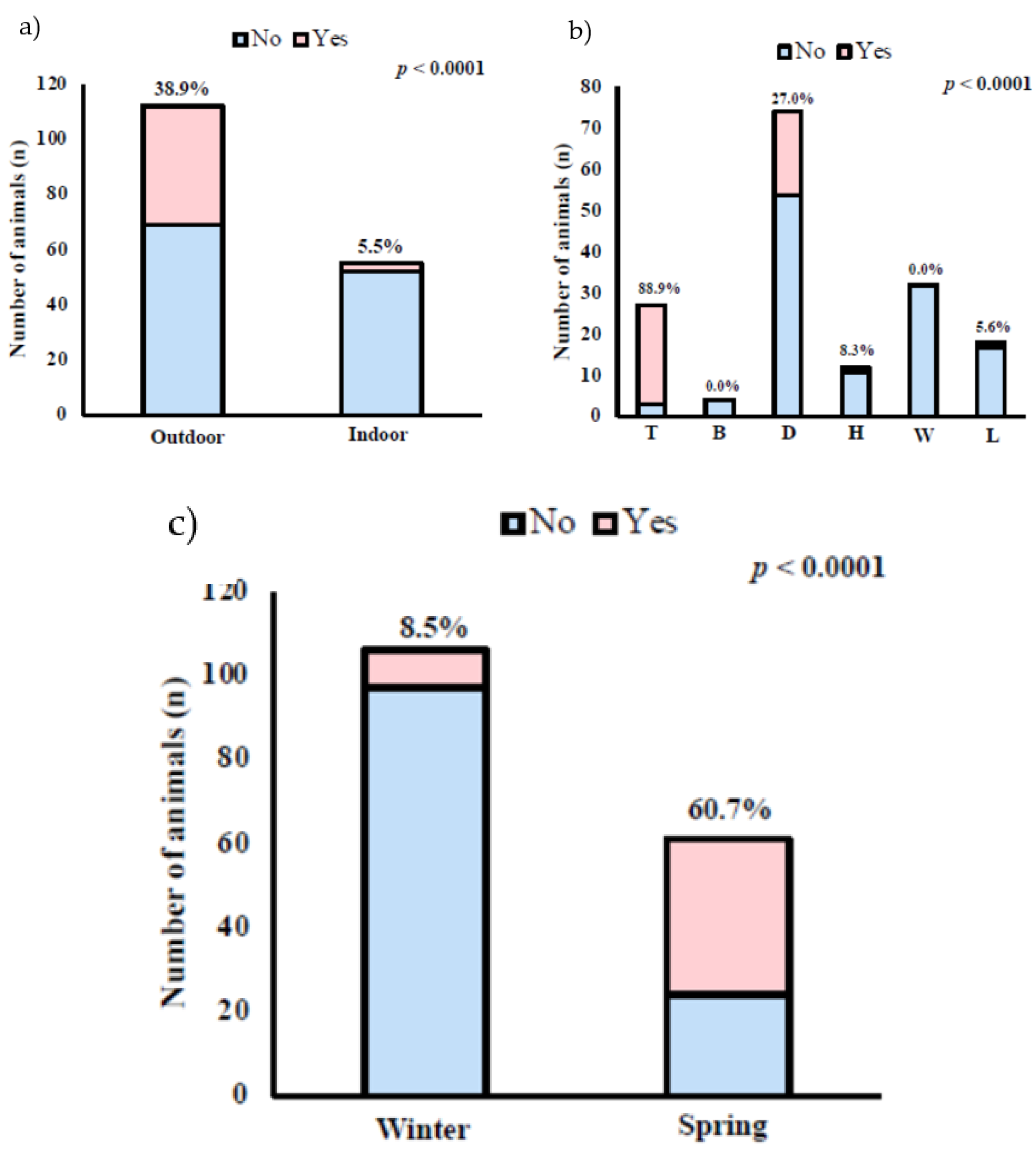

Table 1.
Epidemiological data of horses included in this study. KWPN: Koninklijk Warmbloed Paard Nederland; PRE: Purebred Spanish Horse.
Table 1.
Epidemiological data of horses included in this study. KWPN: Koninklijk Warmbloed Paard Nederland; PRE: Purebred Spanish Horse.
| Variable | Categories | Number of Horses (%) | |
|---|---|---|---|
| Gender | Male | Castrated | 72 (66.1%) |
| No castrated | 37 (33.9%) | ||
| Female | 58 (34.7%) | ||
| Age | Foal (<5 years) | 21 (12.6%) | |
| Young (5-12 years) | 40 (24.0%) | ||
| Adult (13-21) | 80 (47.9%) | ||
| Elder (>21 years) | 26 (9.6%) | ||
| Breed | Purebreed (125) | Anglo-Arabian | 1 (0.6%) |
| Belgian Warmblood | 2 (1.2%) | ||
| Spanish Sport Horse | 7 (4.2%) | ||
| Connemara | 1 (0.6%) | ||
| Haflinger | 1 (0.6%) | ||
| Hannoverian | 4 (2.4%) | ||
| Hispano-Breton | 8 (4.8%) | ||
| Hispanic-Arabic | 6 (3.6%) | ||
| Holsteiner | 1 (0.6%) | ||
| Gypsy Cob | 2 (1.2%) | ||
| Jaca navarra | 2 (1.2%) | ||
| KWPN | 5 (3.0%) | ||
| PRE | 74 (44.3%) | ||
| Percheron | 1 (0.6%) | ||
| Pony | 4 (2.4%) | ||
| Frech Saddle Horse | 5 (3.0%) | ||
| Arabian | 1 (0.6%) | ||
| Crossbred | 42 (25.1%) | ||
| Use | Teaching | 27 (16.2%) | |
| Breeding | 4 (2.4%) | ||
| Dressage | 74 (44.3%) | ||
| Hitch | 12 (7.2%) | ||
| Walking | 32 (19.2%) | ||
| Leap | 18 (10.8%) | ||
| Type of housing | Outdoor | 112 (67.1%) | |
| Indoor | 55 (32.9%) | ||
| Living with dogs | Yes | 159 (95.2%) | |
| No | 8 (4.8%) | ||
| Periodo of the year | Winter | 106 (63.5%) | |
| Spring | 61 (36.5%) | ||
Table 2.
Prevalence of L. infantum infection according to horse breed. KWPN: Koninklijk Warmbloed Paard Nederland; PRE: Purebred Spanish Horse.
Table 2.
Prevalence of L. infantum infection according to horse breed. KWPN: Koninklijk Warmbloed Paard Nederland; PRE: Purebred Spanish Horse.
| Number of Positive Animals (%) | ||
|---|---|---|
| Purebred (125) | Anglo-Arabian | 0 |
| Belgian Warmblood | 0 | |
| Spanish Sport Horse | 4 (57.1%) | |
| Connemara | 0 | |
| Haflinger | 1 (100%) | |
| Hannoverian | 0 | |
| Hispano-Breton | 0 | |
| Hispanic-Arabic | 0 | |
| Holsteiner | 0 | |
| Gypsy Cob | 1 (50%) | |
| Jaca navarra | 0 | |
| KWPN | 0 | |
| PRE | 25 (32.9%) | |
| Percheron | 1 (100%) | |
| Pony | 3 (75%) | |
| Frech Saddle Horse | 0 | |
| Arabian | 0 |
Disclaimer/Publisher’s Note: The statements, opinions and data contained in all publications are solely those of the individual author(s) and contributor(s) and not of MDPI and/or the editor(s). MDPI and/or the editor(s) disclaim responsibility for any injury to people or property resulting from any ideas, methods, instructions or products referred to in the content. |
© 2023 by the authors. Licensee MDPI, Basel, Switzerland. This article is an open access article distributed under the terms and conditions of the Creative Commons Attribution (CC BY) license (http://creativecommons.org/licenses/by/4.0/).
Copyright: This open access article is published under a Creative Commons CC BY 4.0 license, which permit the free download, distribution, and reuse, provided that the author and preprint are cited in any reuse.


