

Submitted:
27 July 2023
Posted:
28 July 2023
You are already at the latest version
Abstract
the process of rapidly digitalizing and transforming businesses, known as Industry 4.0, was already underway before COVID-19. However, the imposed restrictions during the pandemic significantly amplified the need and motivation for both businesses and consumers to utilize digital tools across all sectors including the sectors of bioeconomy. The agricultural and food production sectors have a predominant role in the bioeconomy of the European Union (EU), followed by wood production. These sectors make significant contributions not only to national economies but also to rural areas. Consequently, the digitalization of businesses within the bioeconomy sector not only transforms the enterprises and value chains themselves but also benefits the rural communities in which these enterprises are situated. This study aims to assess the barriers of the bioeconomy sector and ways to support digital transformation within this sector. The paper analyses bioeconomy in EU and the state of digitalisation in the EU. The empiric analysis is based on the cluster analysis of the digitalisation and R&D indicators of the EU and the AHP analysis that allows determining the digitalisation scenarios in Latvia, Lithuania and Poland carried out by four stake-holder groups - national government; advisory and extension; research and entrepreneurship. The results of the AHP indicate that experts from Lithuania and Poland preferred the scenario that suggested the self-initiative from the entrepreneurs of the sector, but experts from Latvia – prioritization of support for digital transformation using national and EU funding. The AHP results also indicate that the opinions of the national government, consulting, and research experts are more aligned throughout all three countries, but the opinion of entrepreneurs differs from these groups.
Keywords:
digitalisation
; bioeconomy
; entrepreneurship
; digital transformation
; AHP
1. Introduction
Bioeconomy is a well-defined concept for academy, industries, governmental agencies, international organizations, farmers, and other societies. In the last ten years more than sixty countries from all around the world, in developed as well as in developing countries, have developed bioeconomy strategies (Gardossi et.al, 2023). As indicated by Aguilar and Twardowski (2022) bioeconomy has been the catalyser in triggering the transition from the economic paradigm of a linear production system towards a circular and sustainable bioeconomy.
The concept of bioeconomy is inseparable from sustainable workforce, natural resource management, promotion of renewable resources, mitigations of climate change and ensuring food security (Venkatramanan et al., 2021; Asada et al., 2020; Böcher et al., 2020; Liobikiene et al., 2021). In latest years digitalization has become another important feature of bioeconomy, in the context of bioeconomy, digitalisation shows a whole range of different operations, which are commonly connected with collection, electronic processing, exchange of data (Rübberdt, 2022) and monetization of data. From the perspective of circular bioeconomy, the use of emerging technologies gives measurable benefits. For example, assisting workers in making efforts towards circularity-based operational decisions, improve products’ economic and environmental sustainability through efficient resource utilization (Mboli et al., 2022, Garcia-Muina et al., 2019).
New digital tools are especially is applicable in the agriculture sector. Terms like precision farming, smart farming, digital agriculture, and agriculture 4.0 have become well-known and widely used to describe modern farming practices. Digitalization plays a central role in smart farming, encompassing the application of information and communication technologies to identify, monitor, analyze, and represent the spatial characteristics of agricultural production in digital formats (Ayre et al., 2019). In the broader sense, digitalization is associated with progress, efficiency, processing speed and is applicable in all sub-sectors of bioeconomy. Many of the benefits of digitalisation are connected to increased efficiency through precise mechanisation, automation, and improved decision-making (Fielke, Taylor, Jakku, 2020).
But digital transformation does not come with benefits only, the process involves overcoming technological, monetary and personal barriers the authors of this paper tried to summarise these barriers according to the PEST criteria (see Table 1) based on the research of Eastwood et al., 2023; Fielke, Taylor, Jakku, 2020; Rübberdt 2022; Goller et al., 2021.
Eastwood et al. (2023) conducted a comprehensive analysis of the barriers agriculture enterprises face in adopting digital applications. The most significant challenges related to digitalization revolve around technological issues - data quality, reliability, security, and the integration of data with various systems. Moreover, digital transformation requires high investment costs into new technologies, making it feasible primarily for large and profitable agribusinesses. State institutions often lag in digitizing their systems, resulting in poor digital infrastructure and interconnectivity issues among systems that hampers the flow of digitalized business data.
Additionally, there is a scarcity of skilled personnel in rural areas, exacerbating the implementation of digitalization. To address these issues, Eastwood, Klerkx, and Nettle (2017) advocate for a strong connection between national authorities, consultants, researchers, and entrepreneurs to foster better technological innovation and digitalization processes. There is shortage of qualified personnel in rural areas so an issue of digital skills is important. In this context as supported by Eastwood, Klerkx and Nettle (2017) a strong connection between national authorities, consultants, research and entrepreneurship should be achieved for better technological innovation and digitalisation processes.
Rübberdt (2022) indicates importance of data integration in analysis of bioeconomy sector, because the bioeconomy future is maximization of sustainability and value creation from the available amount of raw materials that would be inconceivable without integrated data systems. He also points out that although digitalisation activities are being implemented for some time at different points in bioeconomy, they are usually covering a particular sub area in research and development or planning the resources and activities of agriculture and forestry (Rübberdt, 2022). Here Rübberdt (2022) highlights the challenge of linking and interpretation of the data especially in agriculture and forestry. In this context, usually the data relating to the environment – such as soil constituents or moisture levels, as well as weather data play a key role. However, the data gaps are expected.
Literature suggests that an emphasis on digitalisation efforts are made in the livestock farming involving different integrated processes for automatization of work processes (Goller, Caruso, Harteis, 2021; Steeneveld et al., 2012; Eastwood, Klerkx, Nettle, 2017). Vik et al. (2019) analysed the digitalisation processes in the Norwegian dairy sector. They found out that adoption of automated milking systems and other digital techniques are mostly related to the political and structural changes in the sector. On the one hand these processes increased the social welfare of farmers by having more leisure time, but on the other hand some farmers highlighted the lack of competences in working with automated milking systems. Goller et al. (2021) study on analysis of digitalization in agriculture in German dairy farms demonstrated same challenges of digitalization, requiring deep knowledge and understanding of farming processes and effort to learn new skills, obtain new knowledge. Study revealed the positive effects of digitalisation both on farmers working as well as their private life.
For the above reasons, it can be concluded that various barriers to implement the digitalization processes in bioeconomy activities persist and way‘s to overcome or minimise them should be explored. In this context, this study aims to assess the barriers of the bioeconomy sector and ways to support digital transformation within the bioeconomy in the EU, focusing on agriculture as the main contributor to bioeconomy in EU and the Baltic States region and Poland. The paper is structured as follows: Section 2 explains the methodology applied in the research, Section 3 discusses the results of the empirical application, and Section 4 presents the discussion part and future research areas.
2. Materials and Methods
This article comprises the results of the application of the cluster analysis aimed to explore the clusters of digital performance and R&D in the EU member states. The cluster analysis was carried out by grouping the data from Eurostat that characterizes drivers for digitalization. The data are grouped in 5 categories – Macro; Digital infrastructure; Individuals; Enterprises and e-commerce and R&D (Research & Development)(see Table 2).
The article also reflects the results of the use of the AHP method to evaluate the scenarios and the criteria for increasing the level of digitalisation in the bioeconomy sector. AHP analysis is one of the most widely employed multicriteria methods among other decision making methods such as TOPSIS, DEMATEL, ELECTRE, ANP etc. (Stofkova et.al., 2022, Schulze-Gonzalez, 2021). AHP is a decision-making framework developed by Thomas L. Saaty in the 1970s. It is a structured technique used to prioritize and make decisions when there are multiple criteria and alternatives involved. The AHP method helps individuals or groups systematically analyze complex problems by breaking them down into a hierarchical structure. In this technique, the processes of rating alternatives and aggregating to find the most relevant alternatives are integrated. The technique is employed for ranking a set of alternatives or for the selection of the best in a set of alternatives. The ranking/selection is done with respect to an overall goal, which is broken down into a set of criteria (Ramanathan, 2004, Canco et.al. 2021, Ameen, Morshed, 2021).
The structure of the AHP for this study consists of 3 levels (Figure 1) – the Overall objective or the level 1 is to assess the scenarios and criteria for supporting digitalisation in the bioeconomy sector. The level 2 or the criteria level is comprised of 5 criteria – market pressure for customers and other stakeholders; pressure from new regulatory measures; availability of technologies; advancement of digital skills and availability of support (monetary, technical or other). And lead to the choice from 3 alternatives or scenarios in the level 3: self-initiative from the enterprises of the sector or the (bottom-up scenario); National and EU support/ political prioritisation of digitalisation or the top-down scenario and a scenario that foresees a continuation of the existing path with a combination of market driven and government initiatives.
The AHP was applied in Latvia, Lithuania and Poland and to gather the results of the AHP similar stakeholder groups were represented in all countries (see Table 3). National government that was represented by ministry related to bioeconomy, regional development and digitalisation, in Lithuania and Poland it was the Ministry of Agriculture and in Latvia, it was the Ministry of Environmental Protection and Regional Development. The experts of agriculture consulting agencies of all three countries comprised the second group. The third groups – of the researcher working in the thematic field of digitalisation and bioeconomy and the fourth group – by entrepreneurs.
The evaluation of the AHP criteria and scenarios is carried out by each expert according to the scale of relative importance (see Table 4), this type of a nine-point scale has been elaborated by the founder of the AHP method – T.L. Saaty (Saaty, 1994). And the results of the evaluation of criteria and scenarios are than processed to calculate the summary results and their min-max distribution among countries and within stakeholder groups.
3. Results
3.1. Bioeconomy in the European Union
The bioeconomy is a concept that appeared in the strategic documents of the European Union (EU) at the beginning of the new century (see Table 5) and has been adapted by individual member states and their regions as a response of the scientific and research sphere, the economic sector and public authorities to the challenges of modernity (EU, 2010). The main challenges related to this are the growing world population, the accelerating depletion of certain resources, especially non-renewable ones, including fossil energy sources, the growing pressure of the industrial sector on the environment, and adverse climate change (EU, 2012).
The current interest in bioeconomy issues stems from a number of challenges facing the global economy, which include sustainable management of natural resources, sustainable production, improving public health, mitigating the adverse effects of climate change, integrating social and economic development, and global sustainability (Twardowski, Wozniak, 2016). For this reason, the bioeconomy has become an important area of interest for European Union and an important element in the implementation of various policies. In 2012, the concept of bioeconomy development was reflected in the European Union’s Bioeconomy strategy - Innovating for Sustainable Growth. A Bioeconomy for Europe (EC, 2012). In the bioeconomy development program, the European Commission identified several priority goals, the implementation of which will lay the groundwork for the development of a more innovative, resource-efficient and competitive society, in which ensuring food security will be realized under conditions that protect the natural environment, while at the same time enabling the use of renewable resources in other industrial sectors (It aims to achieve five objectives: i. ensure food and nutrition security; ii. sustainably manage natural resources; iii. reduce dependence on non-renewable, un-sustainable resources, whether sourced domestically or abroad; iv. mitigate and adapt to climate change; and v. strengthen European competitiveness and create jobs, through a set of three areas of action, namely investments in research, innovation and skills; reinforced policy interaction and stakeholder engagement; and enhancement of markets and competitiveness in bioeconomy) (EC, 2012). The goals formulated in this way indicated the need to support the development in EU countries of the production of renewable biological resources and the conversion of these resources and waste streams into higher value-added products, such as food, feed, bio-based products and bioenergy.
In 2018 update of the Bioeconomy strategy targets to accelerate the deployment of a sustainable European bioeconomy so as to maximise its contribution towards the 2030 Agenda and its Sustainable Development Goals (SDGs), as well as the Paris Agreement. This update is also linked to new European policy priorities, in particular the renewed Industrial Policy Strategy, the Circular Economy Action Plan and the Communication on Accelerating Innovation in Clean Energy, all of which emphasize the importance of a sustainable, circular bioeconomy to achieve their goals. The updated strategy for a sustainable bioeconomy in Europe supports the same five goals, but in the context of the revised policy proposes three kay priorities, namely: Strengthening and scaling-up the bio-based sectors, unlocking investments and markets; Rapidly deploying local bioeconomies across Europe and Understanding the ecological boundaries of the bioeconomy. (EU, 2018)
According to the JRC report Trends in the bioeconomy, as of December 2022, in the EU-27 there are 10 EU countries with national bioeconomy strategies dedicated to the bioeconomy (Austria, Germany, Spain, France, Finland, Ireland, Italy, Latvia, the Netherlands and Portugal) and seven with their respective national strategies under development (Czechia, Croatia, Hungary, Lithuania, Poland, Sweden and Slovakia). Also, it should be pointed out that currently three large macro-regional bioeconomy initiatives in Europe are involving governmental authorities, i.e.: BIOEAST - Central-Eastern European Initiative for Knowledge-based Agriculture Aquaculture and Forestry in the Bioeconomy (https://www.norden.org/en/bioeconomy), Nordic bioeconomy (https://www.matis.is/media/utgafa/actions_for_sustainable_bioeconomy_in_the_west_nordic_region.pdf) and Bioeconomy in the Baltic Sea Region (http://bsrbioeconomy.net/).
In 2019 bioeconomy is providing over 17,42 million jobs in EU (plus one million new green jobs expected by 2030, for example by developing new biodegradable products); bioeconomy provides over €2.346. trillions in annual turnover in the EU
The largest share in the EU bioeconomy is recorded by agriculture and food production (Table 6, Figure 2) – according to data from 2019 it is about 68%. In 2019 the turnover of food, beverage and tobacco industry is 49.3% of the whole bioeconomy in EU which makes €1.157 trillion, most of the turnover is in food production, €967 billion; €153,67 billions in beverage production and €36,16 billions in tobacco production. Agriculture takes the second largest share in bioeconomy of the EU – 18.63% or €437 billion in turnover in 2019. These two largest sectors in turnover are followed by bio-based chemical sector (8.39%), paper production industry (8,04%) and production of wood products and furniture (7.53%).
A similar structure can be noticed if the value added is analysed in bioeconomy – in 2019 the total value added is €57 billions, most of it is in food, beverage and tobacco production (€237.46 billions and agriculture (€192.8 billons). Each of these sectors makes about 1/3 of the whole value added in bioeconomy leaving 1/3 to the rest of the sectors combined. In this group the largest value added is in the bio-based chemicals sector (€64.52 billions), production of wood products and furniture (€49.6 billions) and paper industry (€48.21 billions).
The analysis of turnover in the bioeconomy sectors in Estonia, Latvia, Lithuania and Poland shows a variation (Figure 2), from €7.58 billion Estonia (0,32% of turnover in bioeconomy sector in EU27) to €146.88 billion in Poland (6.26% of turnover in bioeconomy sector in EU27).
In the analysis of the structure of turnover in bioeconomy in Lithuania and Poland for 2019 it can be observed that the largest share of turnover is in food, beverage and tobacco production (respectively 36.2% i.e., €3.2 bil; 52.9% i.e., €28.9 bil). Followed by agriculture, wood production and furniture. Simultaneously, Estonia and Latvia have the largest share from turnover in the production of wood products and furniture. (35% i.e., €2.7 billion; 28.4% i.e., €2.3 billion, respectively (mainly wood products). Followed by food, beverage and tobacco production and agriculture. A comparably large share in the structure of turnover is also taken by forestry. A similar structure can be seen by analyzing the value added in the bioeconomy in the reviewed countries.
If we look at the employment of the bioeconomy sectors (Table 7. Figure 3), we can see that it is even more dominated by agriculture and food production, which combined makes 78% of the whole employment in bioeconomy. In 2019 there were 17.42 million people employed in bioeconomy of the EU27, 8.83 million were employed in agriculture and 4.66 in food production.
The analysis of employment in the bioeconomy sectors in Estonia, Latvia, Lithuania and Poland shows a variation (Figure 3), from 61.7 thousand people employed in Estonia (0,3% of people employed in bioeconomy sector in EU27) to 2.3 million people employed in Poland (14% of people employed in bioeconomy sector in EU27). Latvia, Lithuania and Poland recorded the highest share of employment in the agricultural sector, while in Estonia the largest number of people employed is in wood products and furniture. Also, in Latvia and Lithuania can be noticed that large share of people employed in the bioeconomy sector are employed in production of wood products and furniture (20,1%; 21%). The second sector registering high employment is food production (respectively: Estonia - 23.8%, Latvia – 19.3%, Lithuania – 22.1% and Poland 20%)
3.2. Digitalisation in the Baltic states and Poland
Digitization aspects in the EU are reflected in the annually calculated Digital Economy and Society Index (DESI), which shows the progress of digital transformation made in EU member countries. The latest DESI report from 2022 was based on data from 2020, i.e., after the introduction of restrictions related to the pandemic (Figure 4) (EU,2022)
During the COVID-19 pandemic, Member States have been advancing in their digitalisation efforts but still struggle to close the gaps in digital skills, the digital transformation of SMEs, and the roll-out of advanced 5G networks.
The EU has made significant resources available to support the digital transformation by allocating EUR 127 billion to digital reforms and investments under the National Recovery and Resilience Plans. It was an opportunity to accelerate digitalisation, make the Union more resilient and reduce external dependencies through both reforms and investments. On average, Member States allocated 26% of their allocation under the Recovery and Resilience Facility (RRF) to digital transformation, above the mandatory 20% threshold. Austria, Germany, Luxembourg, Ireland and Lithuania are the countries that have chosen to invest more than 30% of their RRF allocation in digital technology.
Estonia ranks 9th and Lithuania ranks 14th of 27 EU Member States in the 2022 edition of the Digital Economy and Society Index. Both countries perform well and scores above the European Union (EU) average in most of indicators. Except connectivity in case of Estonia and connectivity and human capital in case of Lithuania. Estonia’s performance growth is slower than that of other countries with similar DESI scores; indicatively, it raised its score by around 6.5% in average every year between 2017 and 2022, compared to an EU average 7.5%. Lithuania being close to the average in many indicators, the country’s progress has slowed down during the last five years and catch-up with the most digitalised EU countries has not been as speedy as it could have been. Lithuania has still room to improve the digital skills of its population and to invest in the reskilling and upskilling of its workforce, as it currently ranks 20th in the human capital dimension of the DESI.
Meanwhile, Latvia and Poland rank lower than the average of the 27 EU member states in DESI 2022 (17th and 24th, respectively). Latvia’s DESI score grew at a slower pace than most of the other EU countries over the last few years while in Poland’s aggregate DESI score grew slightly more than the EU average. Still both countries have not yet managed to catch up with other member states.
3.3. Cluster analysis by the digitalisation and R&D indicators of EU member states
Cluster analysis was performed based on the factor analysis carried out with the group of indicators from Table 2. The factor analysis determined a group of indicators associated with the Factor 1 - Digitalisation level and the Factor 2 – R&D level. ANOVA results indicate that both factors are significant for cluster analyse (Table 8) with Sig. < 0.05.
Cluster membership for EU states was assigned in 4 clusters (see Table 9 and Table 10) – the 1st cluster comprises most of the EU member states – 10 and is characteristic with a rather high score of R&D level for the cluster member states but comparably lover score for the Digitalisation level. The country closest to the cluster centre is France with and the furthest from the cluster centre is Germany – characteristic with higher R&D scores as the rest of the group, but lower scores for Digitalisation level. Also, one of the Baltic states- Estonia belongs to the 1st cluster that can be seen as an accomplishment for Estonia and a result in its strategic focus towards digitalisation and investments in R&D (Kattel, Mergel, 2019, RDIA Strategy, 2021). The 2nd cluster comprises lower performing member states per both criteria and is represented by 7 EU member states, including Latvia, Lithuania and Poland. The countries being furthest away from the cluster centre are Romania and Bulgaria, whose results of the analysed indicators are lower as for the rest of the group. The 3rd cluster joins EU member states with high scores in Digitalisation level, but low scores in R&D. And the last cluster encompasses the highest performing EU member states both in the Digitalisation and R&D levels – Belgium; Denmark; Luxembourg; Netherlands; Finland and Sweden.
The mapping (Figure 5) of the cluster membership allows to distinguish 3 characteristic regions – Central European states with rather good level of both factors: lower performing Eastern and Western part of Europe and highest performing Central and Northern Europe. This allows to assume the importance of historic and geopolitical factors in the development of the country’s path towards digitalisation. And highlights e.g. Estonia’s previously mentioned successful direction of strategic priority for digitalisation and funding for R&D that allows it to list among the states of the cluster 1insted of the cluster 2 as Latvia, Lithuania, Poland and other countries of this region.
3.4. Evaluation of scenarios and criteria for increasing the level of digitalisation in the bioeconomy sector
As mentioned in the section 2 regarding research methods, the structure of the AHP for this study consists of 3 levels – the Overall objective or the level 1 which is to assess the scenarios and criteria for supporting digitalisation in the bioeconomy sector. The level 2 or the criteria level is comprised of 5 criteria:
1. market pressure for customers and other stakeholders;
2. pressure from new regulatory measures;
3. availability of technologies;
4. advancement of digital skills;
5. availability of support (monetary, technical or other).
The 3 alternatives or scenarios in the level 3 were:
1. Self-initiative from the enterprises of the sector (bottom-up scenario);
2. National and EU support/ political prioritisation of digitalisation or the top-down scenario;
3. A scenario that foresees a continuation of the existing path with a combination of market driven and government initiatives.
The obtained results show (Figure 6 and Figure 7), that Lithuanian and Polish experts gave a priority to the criteria promoting the scenario no 1, that foresees the self-initiative from the enterprises of the sector - the bottom-up scenario, but experts from Latvia considered the scenario no 2 – the national and EU support for digitalisation and prioritization of digitalisation to be the best scenario. As it can be seen from Estonia‘s example, digitalisation can be an efficient driver for economy and strategic prioritisation followed by sufficient support instruments can have positive effect on the digital transformation and overall economic growth.
The evaluation of criteria (Figure 8 and Figure 9) among the countries indicate, that all countries have considered Market pressure from customers to be the leading driver for change in digitalisation in the bioeconomy sector, followed by Availability of technologies in Latvia (and Advancement of digital skills in Poland) and Regulatory measures in Lithuania. Overall the Availability of technologies is considered important among all three countries and assessed equally, Regulatory measures are considered more important in Latvia and Lithuania, but in this case Polish experts have given it less emphasis all other criteria are marked higher.
Results for stakeholder groups
The results for the stakeholder groups show, all stakeholder groups from Latvia, Lithuania and Poland, have evaluated Market pressure as the most important criteria, wit the national government experts giving it the most emphasis and entrepreneurs giving the lowest score (Table 11). This group is followed by Availability of technologies as the next most important criteria in all stakeholder groups except the group of entrepreneurs which has evaluated Pressure from new regulatory measures as the second most important. Two least important criteria in opinion of national government and research experts are Advancement of digital skills and Availability of support these criteria are evaluated as more important by experts from extension services and entrepreneurs.
In the evaluation of scenarios (Table 12), the scenario no 1 – Self-initiative of the entrepreneurs of the sector is marked the highest by all stakeholder groups except national government experts that have prioritised scenario no 2 - National and EU support/ political prioritisation of digitalisation. Which is logical as this group emphasises the role of policy making in shifting the business practices towards digital transformation. The scenario no 3 - Existing path with a combination of market driven and government initiatives - has received the lowest score indicating that all experts are not satisfied with status quo and the current path of digitalisation in bioeconomy and would expect to see a different approach in supporting it.
4. Discussion
The analysis in this study was based on the primary data from AHP surveys, however, it should be noted that sectoral data on digitization in the bioeconomy is lacking or very general in the countries examined. That is why the opinions of experts involved in analyzing or implementing changes in the digitization of the bioeconomy were so important in our research. The obtained results indicate, that the market pressure to introduce digital solutions is the scenario that is preferred by most of the experts in all 3 countries except the group of National government experts.
If take a comprehensive look at the situation in digitalisation in the EU, both the DESI index and the results of the cluster analysis indicate that all three of the analysed countries are in a group of countries not highly advanced in digitalisation and it is distinctive that the third Baltic State – Estonia has significantly higher digital performance indicators as other 2 Baltic States and Poland. Still we can clearly see the path towards digitalisation and suggest that Latvia, Lithuania and Poland will follow this path due to the market pressure, but, as it can be also concluded from the AHP analysis targeted national and EU support measures would help to achieve the average EU level of digitalisation faster. Support and aid for investments in digital technologies is especially such investment-intensive bioeconomy sectors as agriculture and forestry where many digital tools are available, but the investment costs are too high for entrepreneurs to cover, especially in the case of small-scale actors. (Ehlers, Huber, Finger, 2021...) This was also stated in the AHP evaluation from the entrepreneurs’ stakeholder group, substantiating the findings of previous research. (Vik et al., 2019, Goller et al., 2021…)
As mentioned one of the barriers of research in bioeconomy is data availability, it could be improved by changes in recommendations/requirements for reporting in the bioeconomy. In addition, it could be achieved by conducting detailed studies by government entities or with the use of targeted grants for this purpose.
Literature suggests that there is the strong link between digitalisation and R&D (Klerkx, Jakku, Labarthe, 2019, Phillips et al., 2019). The cluster analysis of present research also highlighted the links of digitalisation and R&D – the 4th cluster encompassed the highest performing EU member states both in the Digitalisation and R&D levels – Belgium; Denmark; Luxembourg; Netherlands; Finland and Sweden. Therefore, it can be concluded that there is a definite link between the R&D investments and performance and the level of technological advancements (in this case digital) in the country. This connection has been previously well described (Boikova et.al., 2021, Bacco et al., 2019, Eastwood, Klerkx, Nettle, 2017) Thus the level of digitalisation in the bioeconomy sector of EU countries is also increased by implementation of CBE JU-funded investment projects, especially flagships. These projects are dedicated to creating and delivering technically mature facilities for bioeconomy sector activities. These projects are usually connected with high level of digitalisation. The performance in these clusters is highest by Central and Northern Europe, however Eastern and Western part of Europe is under lower performance. (CBE JU, 2023). This fact was also supported with the present research, revealing the opinion of stakeholders that digitalisation through the national and EU funding (scenario no 2) was not rated as the best scenarion in most stajkeholder groups and in all countries participating in the evaluation.
The AHP results also may indicate that the opinions of national government, consulting and research experts are more aligned, but the opinion of entrepreneurs differs from these groups, therefore when planning new support measures for the bioeconomy sector it can be advised to involve entrepreneurs in the planning process to make sure that their needs are being met.
Author Contributions
Conceptualization, SZR, AP and LG; methodology SZR and PR; software, SZR and PR; validation, SZR; formal analysis, SZR and PR; investigation, SZR; resources, SZR; data curation, SZR, AP, LG and IG; writing—original draft preparation, SZR, AP, LG, AN; writing—review and editing, SZR, AP, LG, AN; visualization, SZR, AP, LG; supervision, SZR; project administration, IG; funding acquisition, IG All authors have read and agreed to the published version of the manuscript.
Funding
this research and APC for this article was funded by the Post-doctoral Research Aid Program of the State Education Development Agency of Latvia, project “Digitalisation of Enterprises of the Bioeconomy Sector for Increasing their Competitiveness and Exportability” grant number 1.1.1.2/VIAA/3/19/553.
Informed Consent Statement
Informed consent was obtained from all subjects involved in the study.
Data Availability Statement
Authors use secondary data from publicly available Eurostat databases and DataM Data-Modelling platform of resource economics (European Commission) and primary data from surveys conducted using the AHP method. Data links: 1. Main GDP aggregates per capita (2023) Eurostat, available: https://ec.europa.eu/eurostat/databrowser/product/view/NAMA_10_PC. 2. Level of internet access – households (2023) Eurostat, available: https://ec.europa.eu/eurostat/databrowser/view/tin00134/default/table?lang=en. 3. Internet use by individuals (2023) Eurostat, available: https://ec.europa.eu/eurostat/databrowser/product/view/ISOC_CI_IFP_IU. 4. Individuals who have basic or above basic overall digital skills by sex (2023) Eurostat (2023) Eurostat, available: https://ec.europa.eu/eurostat/cache/metadata/en/tepsr_sp410_esmsip2.htm. 5. Individuals using the internet for doing an online course (2023) Eurostat, available: https://ec.europa.eu/eurostat/databrowser/product/view/ISOC_CI_AC_I. 6. Enterprises having received orders online (2023) Eurostat, available: https://ec.europa.eu/eurostat/databrowser/product/view/ISOC_EC_ESELN2. 7. Enterprises using software solutions, like CRM to analyse information about clients for marketing purposes (2023) Eurostat, available: https://ec.europa.eu/eurostat/databrowser/product/view/ISOC_EB_IIP. 8. Internet purchases by individuals (2023) Eurostat, available: https://ec.europa.eu/eurostat/databrowser/view/ISOC_EC_IB20$DEFAULTVIEW/default/table. 9. Share of enterprises’ turnover on e-commerce (2023) Eurostat, available: https://ec.europa.eu/eurostat/databrowser/product/view/ISOC_EC_EVALN2. 10. Research and development expenditure, by sectors of performance (2023) Eurostat, available: https://ec.europa.eu/eurostat/databrowser/view/tsc00001/default/table?lang=en. 11. Share of government budget appropriations or outlays on research and development (2023) Eurostat, available: https://ec.europa.eu/eurostat/databrowser/product/view/GBA_NABSTE. 12. Share of R&D personnel and researchers in total active population and employment by sector of performance and sex (2023) Eurostat, available: https://ec.europa.eu/eurostat/databrowser/product/view/RD_P_PERSLF 13. Jobs and Wealth in the European Union Bioeconomy (2022) Data-Modelling platform of resource economics (DataM), European Commission, available: https://datam.jrc.ec.europa.eu/datam/mashup/BIOECONOMICS/
Conflicts of Interest
The authors declare no conflict of interest. The funders of this research had no role in the design of the study; in the collection, analyses, or interpretation of data; in the writing of the manuscript; or in the decision to publish the results.
References
- Adamowicz, M. Bioeconomy as a Concept for the Development of Agriculture and Agribusiness. Problems of Agricultural Economics 2020, 365(Special Issue 4), 135–155. [Google Scholar] [CrossRef]
- Asada, R. , Cardellini, G., Mair-Bauernfeind, C., Wenger, J., Haas, V., Holzer, D., & Stern, T. Effective bioeconomy? A MRIO-based socioeconomic and environmental impact assessment of generic sectoral innovations. Technological Forecasting and Social Change 2020, 153, 119946. [Google Scholar]
- Ameen, Raed & Mourshed, Monjur. Urban sustainability assessment framework development: The ranking and weighting of sustainability indicators using analytic hierarchy process. Sustainable Cities and Society 2019, 44, 356–366.
- Aguilar, A. , Twardowski T. Bioeconomy in a changing word. EFB Bioeconomy Journal 2022, Volume 2, 100041. [Google Scholar] [CrossRef]
- Ayre, M. , Mc Collumb, V., Waters, W., Samsond, P., Curro, A., Nettlee, R., Paschene, J.A., King, B., Reichelt, N. Supporting and practising digital innovation with advisers in smart farming. NJAS - Wageningen Journal of Life Sciences 2019, 90–91, 100302. [Google Scholar] [CrossRef]
- Bacco, M. , Barsocchi, P., Ferro, E., Gotta, A., Ruggeri, M. The Digitisation of Agriculture: a Survey of Research Activities on Smart Farming. Array, 2019, 3-4, 100009. [Google Scholar] [CrossRef]
- Bioeconomy, The European way to use our natural resources: action plan, European Commission, 2018. Available online: https://op.europa.eu/en/publication-detail/-/publication/775a2dc7-2a8b-11e9-8d04-01aa75ed71a1.
- Boikova, T.; Zeverte-Rivza, S.; Rivza, P.; Rivza, B. The Determinants and Effects of Competitiveness: The Role of Digitalization in the European Economies. Sustainability 2021, 13, 11689. [Google Scholar] [CrossRef]
- Birner. R. Bioeconomy Concepts. In Bioeconomy Shaping the Transition to a Sustainable, Biobased Economy, 2018.
- Böcher, M. , Töller, A. E., Perbandt, D., Beer, K., & Vogelpohl, T. Research trends: Bioeconomy politics and governance. Forest Policy and Economics 2020, 118, 102219. [Google Scholar]
- Canco, I.; Kruja, D.; Iancu, T. AHP, a Reliable Method for Quality Decision Making: A Case Study in Business. Sustainability 2021, 13, 13932. [Google Scholar] [CrossRef]
- CBE, JU. Bio-based Industries Joint Undertaking Driving Europe’s green transition. 2022. Available online: https://www.cbe.europa.eu/system/files/2022-12/BBI%20JU%20Driving%20Europe%E2%80%99s%20green%20transition.pdf.
- CBE, JU. A competitive bioeconomy for a sustainable future. 2023. Available online: https://www.cbe.europa.eu/system/files/2023-03/A%20competitive%20bioeconomy%20for%20a%20sustainable%20future.pdf.
- Commission adapts its strategy for sustainable bioeconomy to ensure green growth in Europe, Press release, European Commission, 13 February 2012, Memo 12/97. 13 February.
- Digital Strategy, European Commission, 2022. Available online: https://digital-strategy.ec.europa.eu/en/policies/desi.
- Eastwood, C. R. , Turner, J. A., Romera, A. J., Selbie, D., Henwood, R., Espig, M., … & Wever, M. A Review of Multi-scale Barriers to Transitioning from Digital Agriculture to a Digital Bioeconomy. CABI Reviews 2023. [Google Scholar] [CrossRef]
- Eastwood, C. , Klerkx L., Nettle R. Dynamics and distribution of public and private research and extension roles for technological innovation and diffusion: Case studies of the implementation and adaptation of precision farming technologies. Journal of Rural Studies 2017, 49, 1–12. [Google Scholar] [CrossRef]
- European Competitiveness Report, Communication from the Commission COM, European Commission, 2008, 774 final, Brussels, 2009.
- Europe 2020 — A strategy for smart, sustainable and inclusive growth, European Commission, 2010, Brussels, 3.3.2010.
- EUs implementation of the Sustainable Development Goals (SDGs), European Commission, available: https://ec.europa.eu/environment/sustainable-development/SDGs/im- plementation/index_en.htmSustainable development - overview, European Commission. Available online: https://ec.europa.eu/ environment/sustainable-development/index_en.htm.
- Ehlers, M.H. , Huber, R., Finger, R. Agricultural policy in the era of digitalization. Food Policy 2021, 100, 102019. [Google Scholar] [CrossRef]
- Fielke, S. , Taylor B., Jakku, E. 2020. Digitalisation of agricultural knowledge and advice networks: A state-of-the-art review. Agricultural Systems 2020, 180, 102763. [Google Scholar] [CrossRef]
- Garcia-Muiña, F. E. , González-Sánchez, R., Ferrari, A. M., Volpi, L., Pini, M., Siligardi, C., & Settembre-Blundo, D. Identifying the equilibrium point between sustainability goals and circular economy practices in an Industry 4.0 manufacturing context using eco-design. Social sciences 2019, 8, 241. [Google Scholar] [CrossRef]
- Gardossi, L. , Philp J., Fava F., Winickoff D., D’Aprile L., Dell’Anno B., Jørgen Marvik O., Lenzi A. EFB Bioeconomy Journal 2023, 3, 100053. [Google Scholar] [CrossRef]
- Klerkx, L. , Jakku, E., Labarthe, P. A review of social science on digital agriculture, smart farming and agriculture 4.0: New contributions and a future research agenda. NJAS - Wageningen Journal of Life Sciences. 2019, 90–91, 100315. [Google Scholar] [CrossRef]
- Kattel, R. , Mergel I. Estonia’sDigitalTransformation. Great Policy Successes / Compton, Mallory E.; ’t Hart, Paul (Hrsg.). - Oxford: Oxford University Press, 2019; pp. 143–160. ISBN 978-0-19-884371-9. [Google Scholar]
- Liobikienė, G. , Miceikienė, A., & Brizga, J. Decomposition analysis of bioresources: Implementing a competitive and sustainable bioeconomy strategy in the Baltic Sea Region. Land Use Policy 2021, 108, 105565. [Google Scholar]
- Mboli, J. S. , Dhavalkumar T., Mishra, J.L. An Internet of Things-enabled decision support system for circular economy business model. Software: Practice and Experience 2022, 52, 772–787. [Google Scholar]
- Michael, G. , Carina C., Christian H. Digitalisation in Agriculture: Knowledge and Learning Requirements of German Dairy Farmers. International Journal for Research in Vocational Education and Training 2021, 8, 208–223. [Google Scholar]
- Mubareka S., Giuntoli, J., Sanchez Lopez, J., Lasarte Lopez, J., M‘barek, R., Ronzon, T., Renner, A. and Avraamides, M. Trends in the EU bioeconomy, EUR 31434 EN, Publications Office of the European Union, Luxembourg, 2023, ISBN 978-92-68-00295-7. [CrossRef]
- The European Green Deal., European Commission, COM, 2019, 640 final, Brussels, 11.12. 2019.
- Towards a Sustainable Europe by 2030, Reflection Paper, European Commission, COM, 2019, 22, Brussels, 30. 01. 2019.
- OECD, Bioeconomy to 2030: Designing a Policy Agenda, 2023. Available online: https://www.oecd.org/futures/long-termtechnologicalsocietalchallenges/42837897.pdf.
- Phillips, P.W.B. , Relf-Eckstein, J.-A., Jobe, G., Wixted, B. Configuring the new digital landscape in western Canadian agriculture. Njas - Wageningen J. Life Sci 2019, 90–91, 100295. [Google Scholar] [CrossRef]
- Ramanatan, R. Multicriteria Analysis of Energy, ed Cutler J. Cleveland, Elsevier 2004, pp 77-88. Available online: https://www.sciencedirect.com/topics/economics-econometrics-and-finance/ahp-approach.
- RDIE Strategy: Estonian Research and Development, Innovation and Entrepreneurship Strategy 2021—2035. Ministry of Economic Affairs and Communications. Republic of Estonia, 2021. Available online: www.taie_arengukava_kinnitatud_15.07.2021_211109a_en_final.pdf.
- Ronzon, T. , M’Barek R. Socioeconomic indicators to monitor the EU’s bioeconomy in transition, Sustainability 2018, vol. 10, p. Sustainability 2018, 10, 1745. [Google Scholar] [CrossRef]
- Rübberdt, K. Digital Bioeconomy. The bioeconomy system, 2022, 145-158 p.
- Ronzon, T. , Piotrowski S., Tamosiunas S., Dammer L., Carus M., M’Barek R. Developments of Economic Growth and Employment in Bioeconomy Sectors across the EU. Sustainability 2020, 12, 4507. [Google Scholar] [CrossRef]
- Saaty, T. L. How to make a decision: the analytic hierarchy process. Interfaces 1994, 24, 19–43. [Google Scholar] [CrossRef]
- Stofkova, J.; Krejnus, M.; Stofkova, K.R.; Malega, P.; Binasova, V. Use of the Analytic Hierarchy Process and Selected Methods in the Managerial Decision-Making Process in the Context of Sustainable Development. Sustainability 2022, 14, 11546. [Google Scholar] [CrossRef]
- Schulze-González, E.; Pastor-Ferrando, J.-P.; Aragonés-Beltrán, P. Testing a Recent DEMATEL-Based Proposal to Simplify the Use of ANP. Mathematics 2021, 9, 1605. [Google Scholar] [CrossRef]
- Steeneveld, W. , Tauer L. W., Hogeveen H, and Oude Lansink A. G. J. M. Comparing technical efficiency of farms with an automatic milking system and a conventional milking system. J. Dairy Sci. 2012, 95, 7391–7398. [Google Scholar] [CrossRef]
- Sustainable Bioeconomy for Europe: Strengthening the Connection Between Economy, Society, and the Environment, Updated Bioeconomy Strategy. Directorate-General for Research and Innovation (European Commission), 2018. Available online: https://op.europa.eu/en/publication-detail/-/publication/edace3e3-e189-11e8-b690-01aa75ed71a1.
- Twardowski T., Woźniak E. (2016), Bioekonomia wokół nas,Nauka 2016, nr 3, s. 147-160.
- Venkatramanan, V. , Shah, S., & Prasad, R. (Eds.). Sustainable bioeconomy: pathways to sustainable development goals. Springer Nature 2021. [Google Scholar] [CrossRef]
- Vik, J. , Stræte, E. P., Hansen, B.G., Nærland, T. The political robot – The structural consequences of automated milking systems (AMS) in Norway. NJAS - Wageningen Journal of Life Sciences, 2019, 90–91, 100305. [Google Scholar] [CrossRef]
Figure 1.
The structure of the AHP.
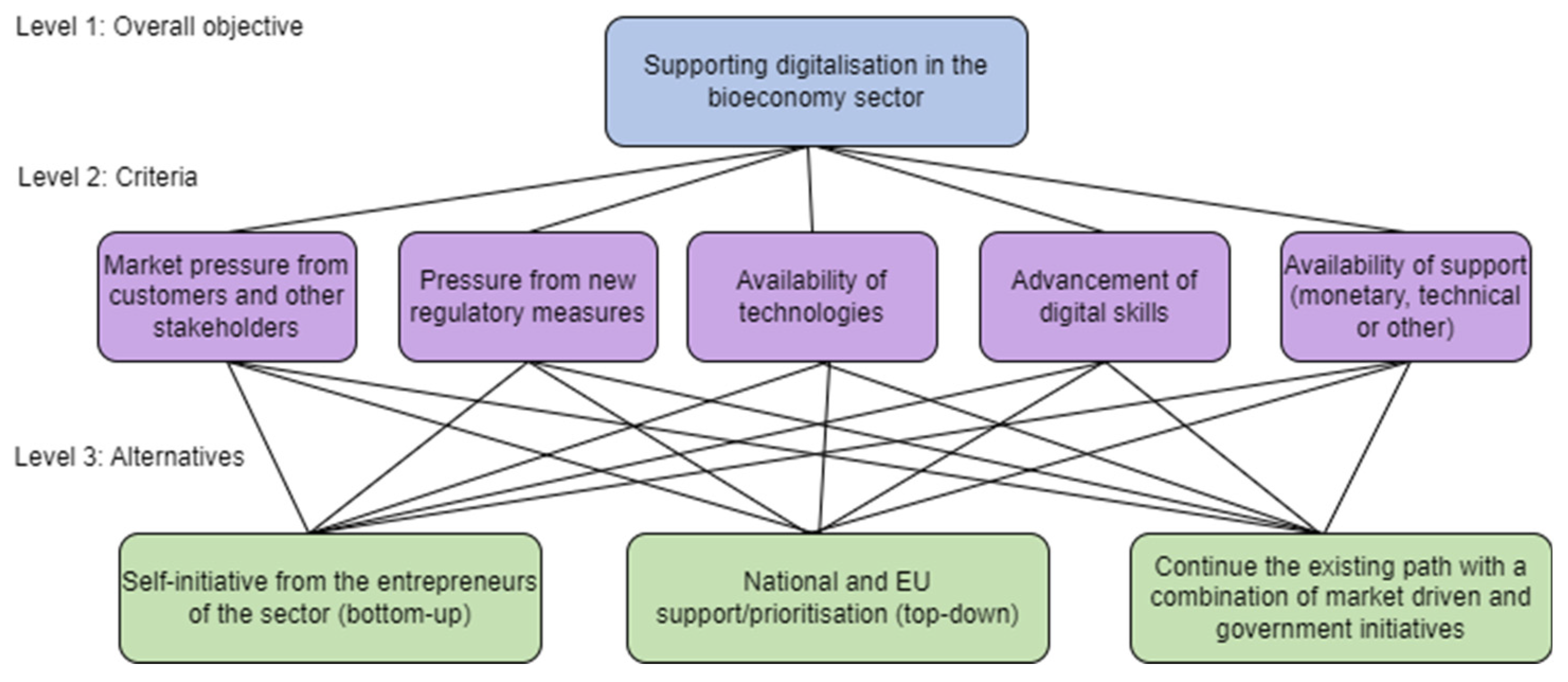
Figure 2.
Turnover in the bioeconomy by sectors in EU27, 2019. Source: DataM JRC, 2022.
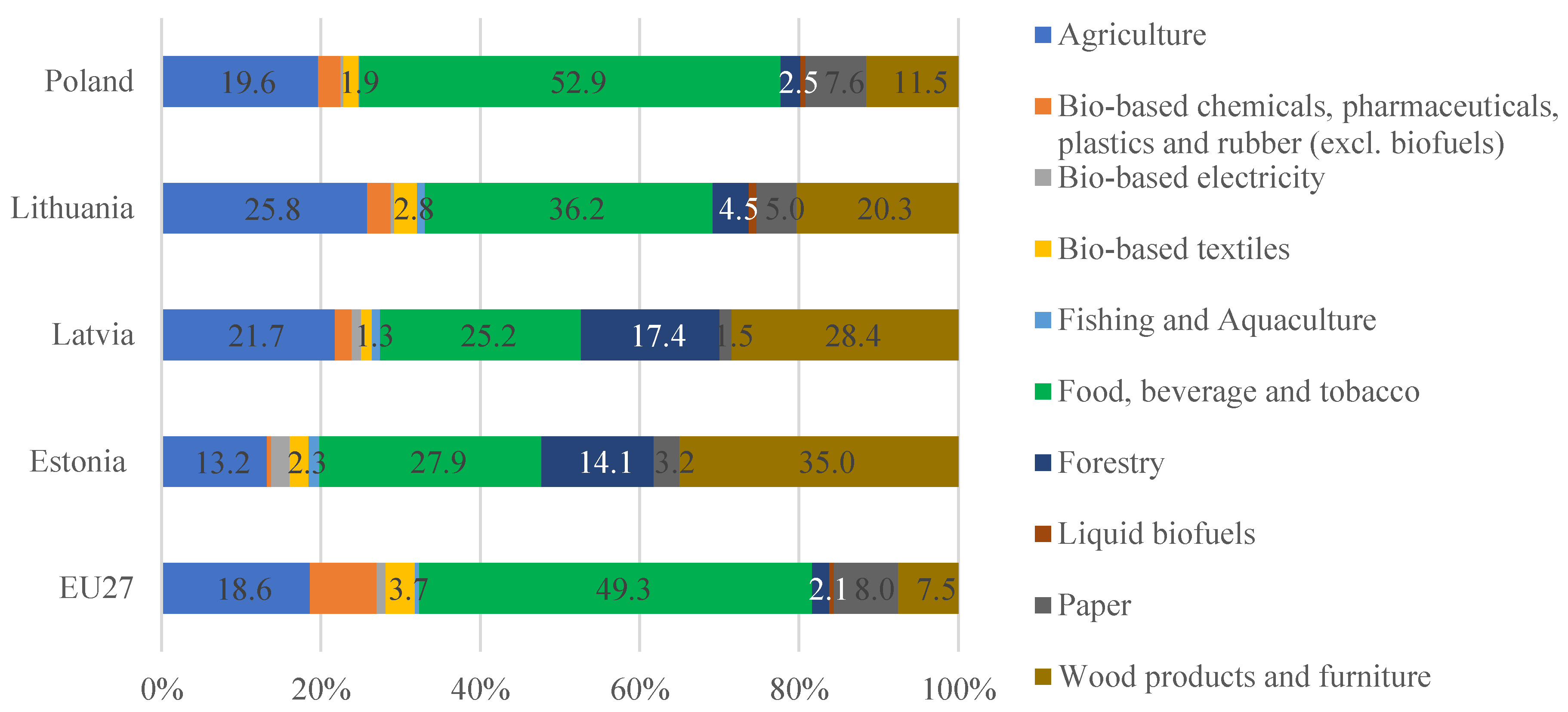
Figure 3.
Structure of employment in the bioeconomy by sectors in EU27, 2019. Source: DataM JRC, 2022.
Figure 3.
Structure of employment in the bioeconomy by sectors in EU27, 2019. Source: DataM JRC, 2022.
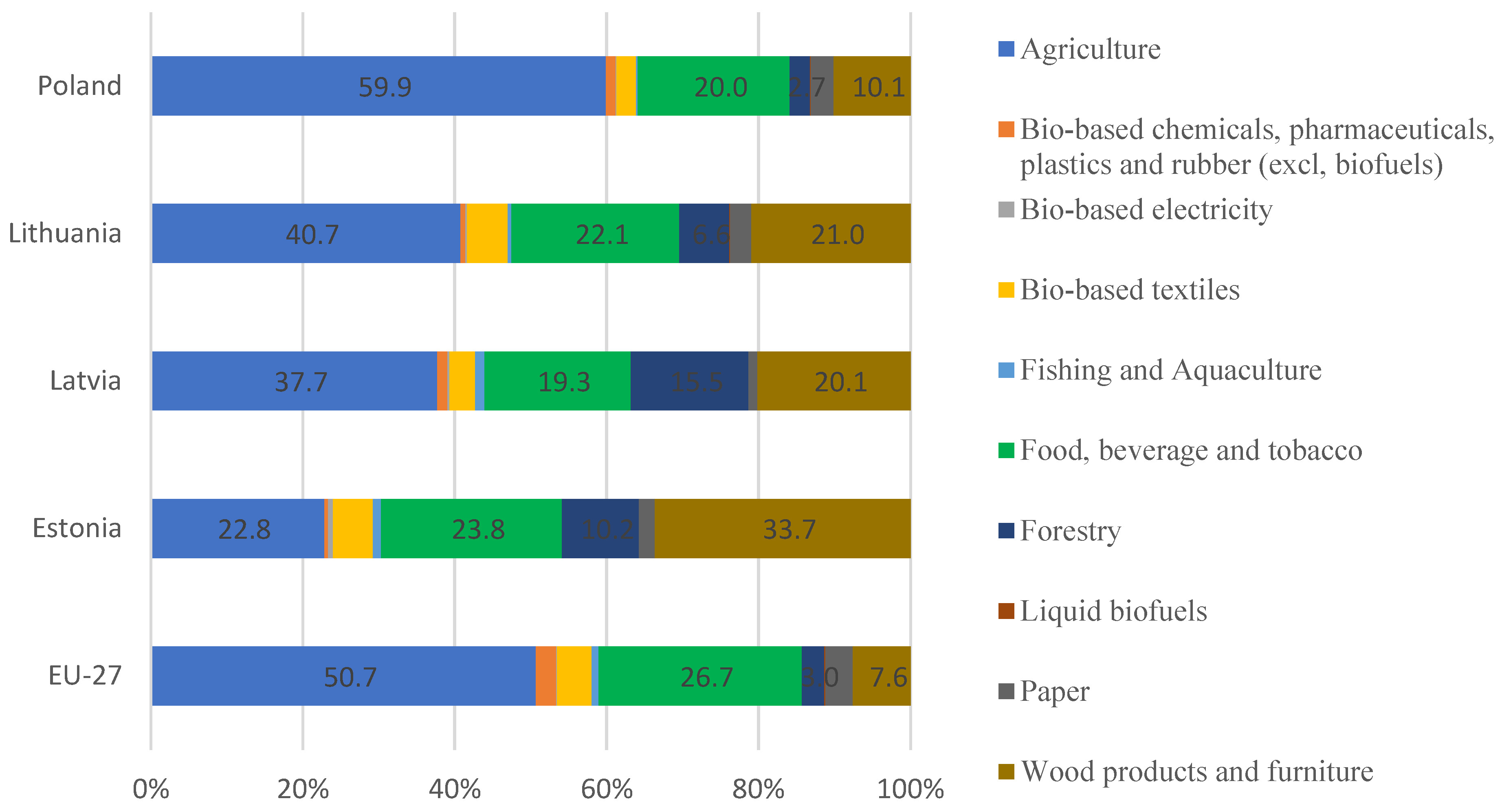
Figure 4.
DESI for EU27 and Estonia, Latvia, Lithuania and Poland in 2022. Source: European Commission, 2022.
Figure 4.
DESI for EU27 and Estonia, Latvia, Lithuania and Poland in 2022. Source: European Commission, 2022.
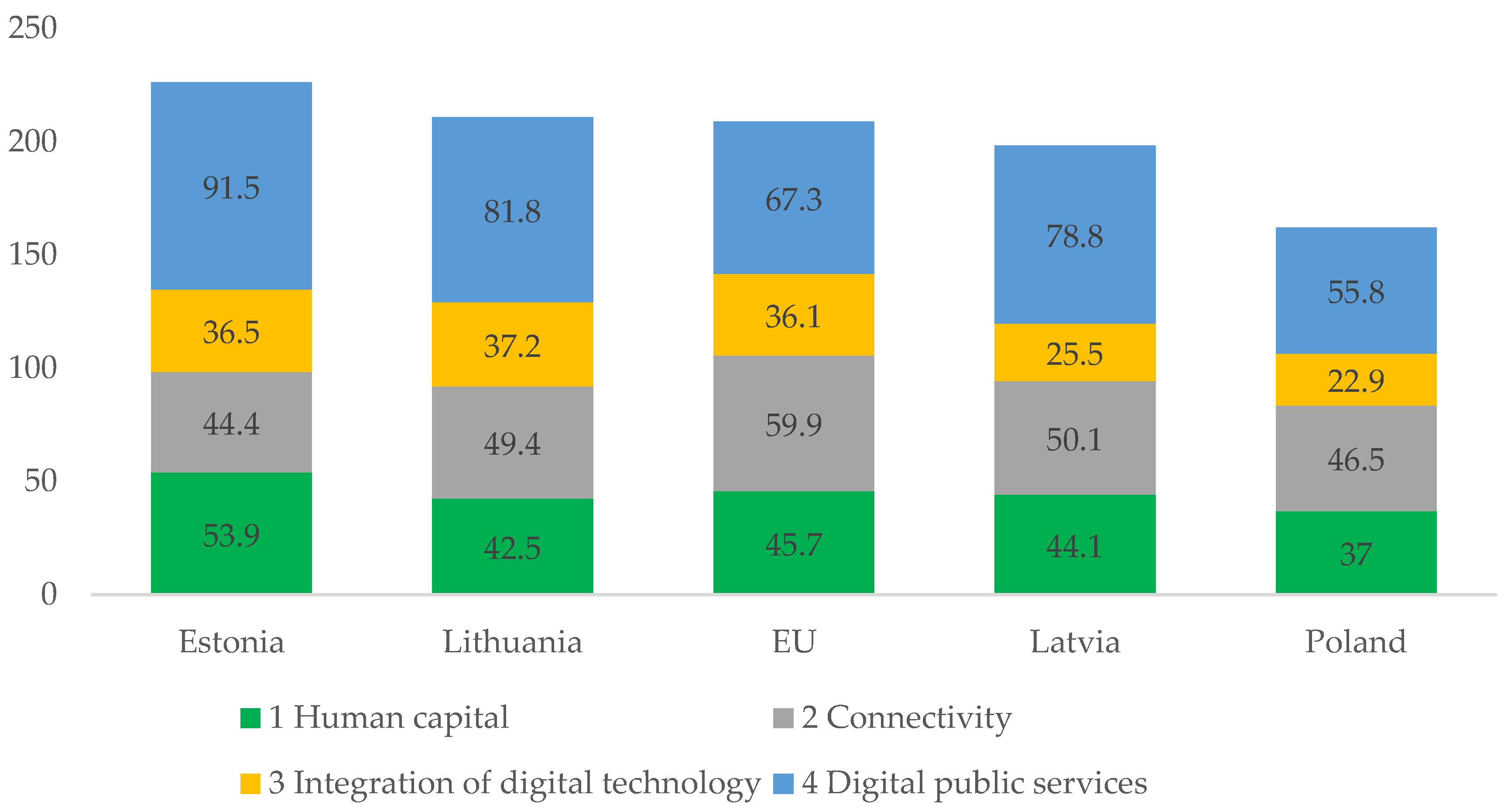
Figure 5.
Cluster membership in EU.
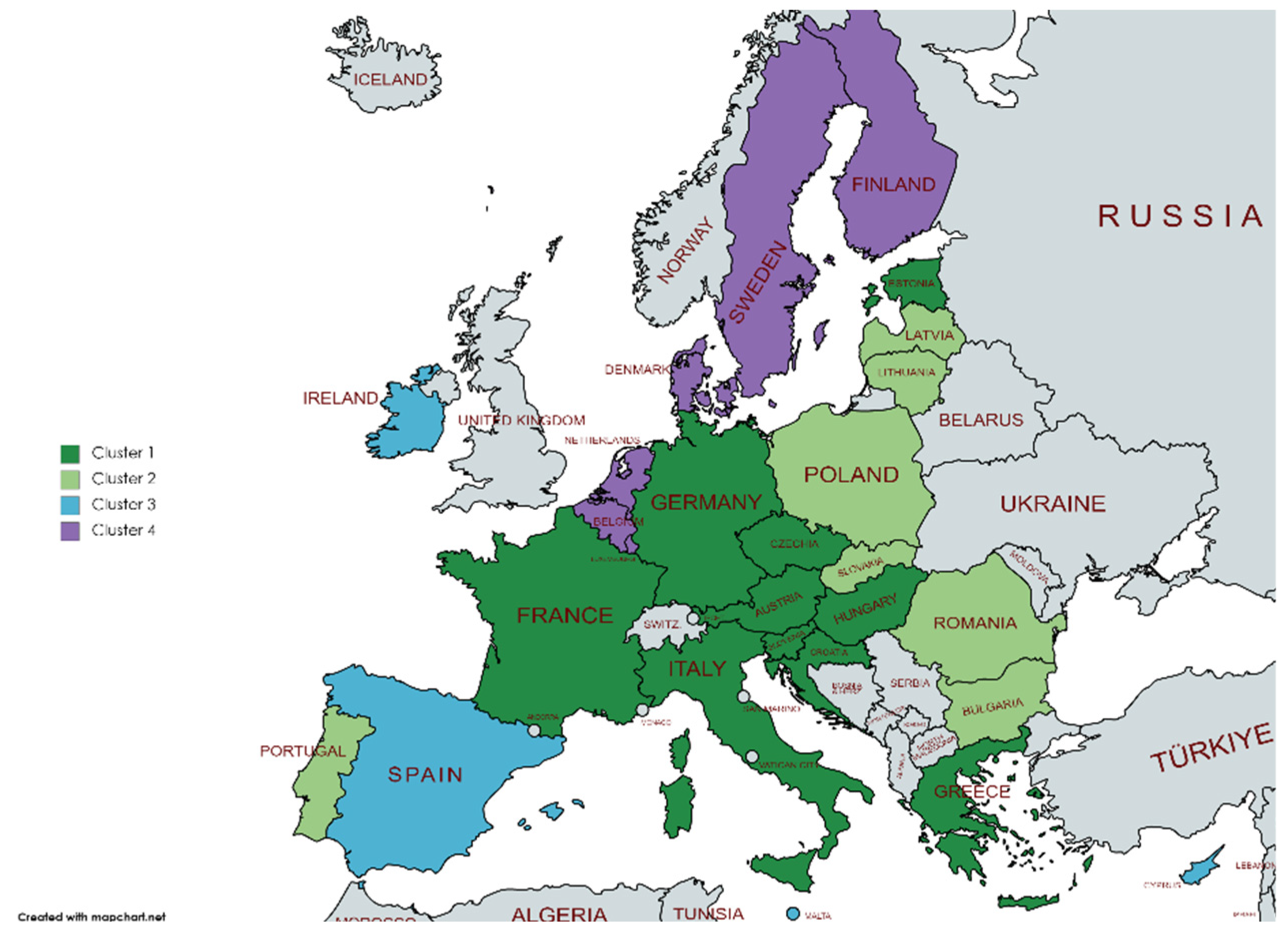
Figure 6.
Results summary for Latvia, Lithuania and Poland for the evaluation of scenarios, comparison among countries.
Figure 6.
Results summary for Latvia, Lithuania and Poland for the evaluation of scenarios, comparison among countries.
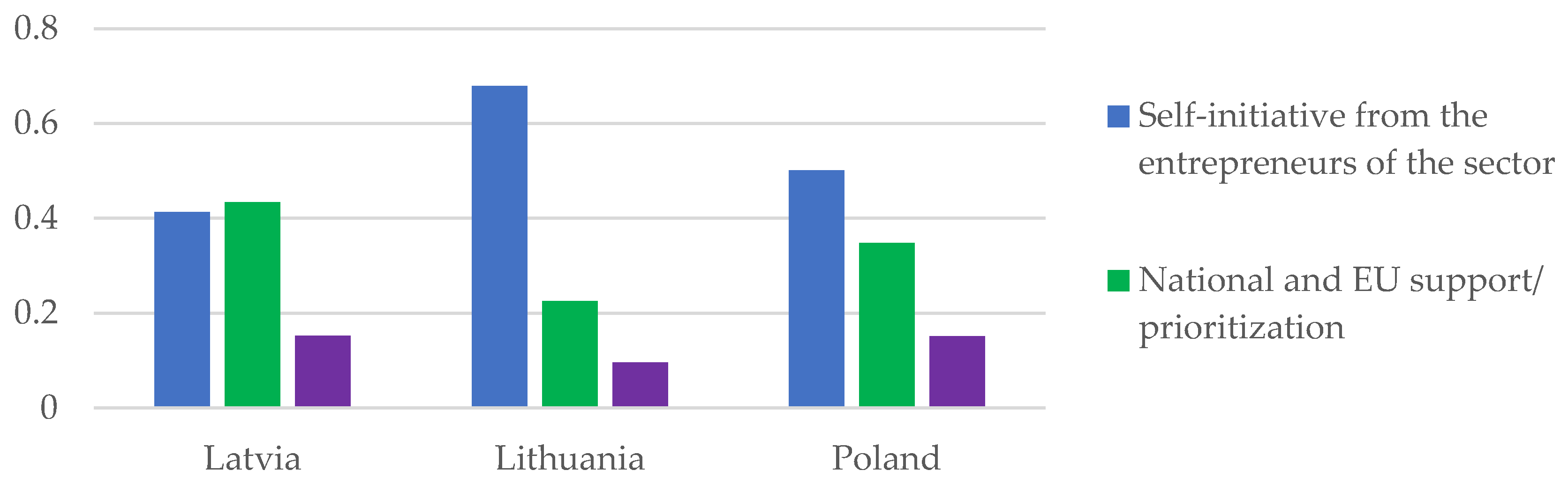
Figure 7.
Results summary for Latvia, Lithuania and Poland for the evaluation of scenarios, comparison among scenarios.
Figure 7.
Results summary for Latvia, Lithuania and Poland for the evaluation of scenarios, comparison among scenarios.
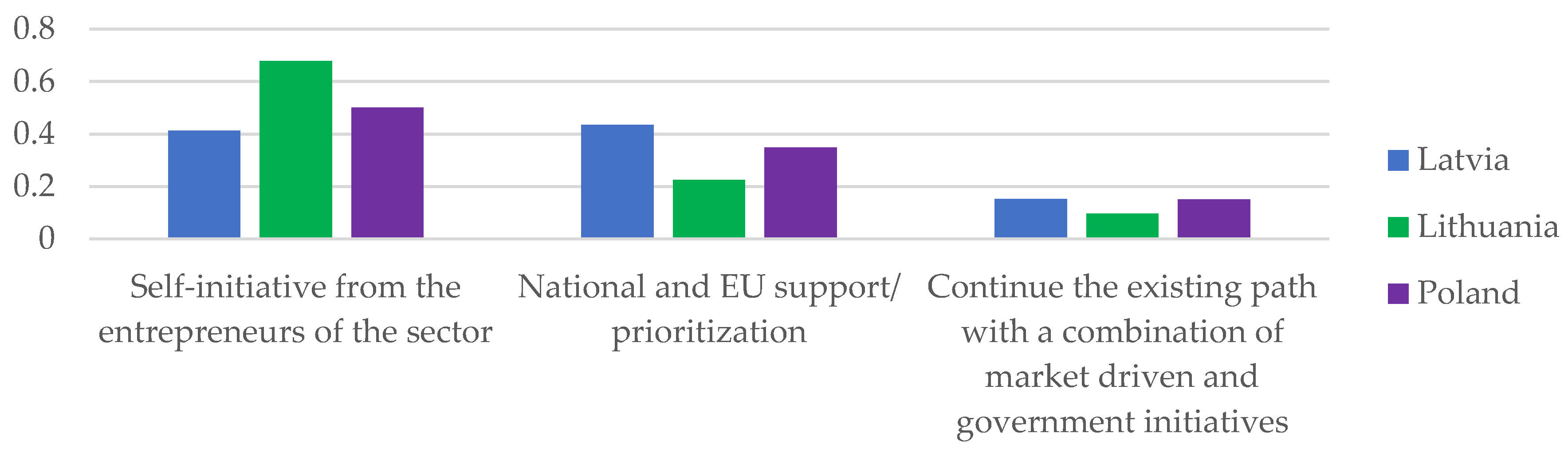
Figure 8.
Results summary for Latvia, Lithuania and Poland for the evaluation of criteria, comparison among countries.
Figure 8.
Results summary for Latvia, Lithuania and Poland for the evaluation of criteria, comparison among countries.
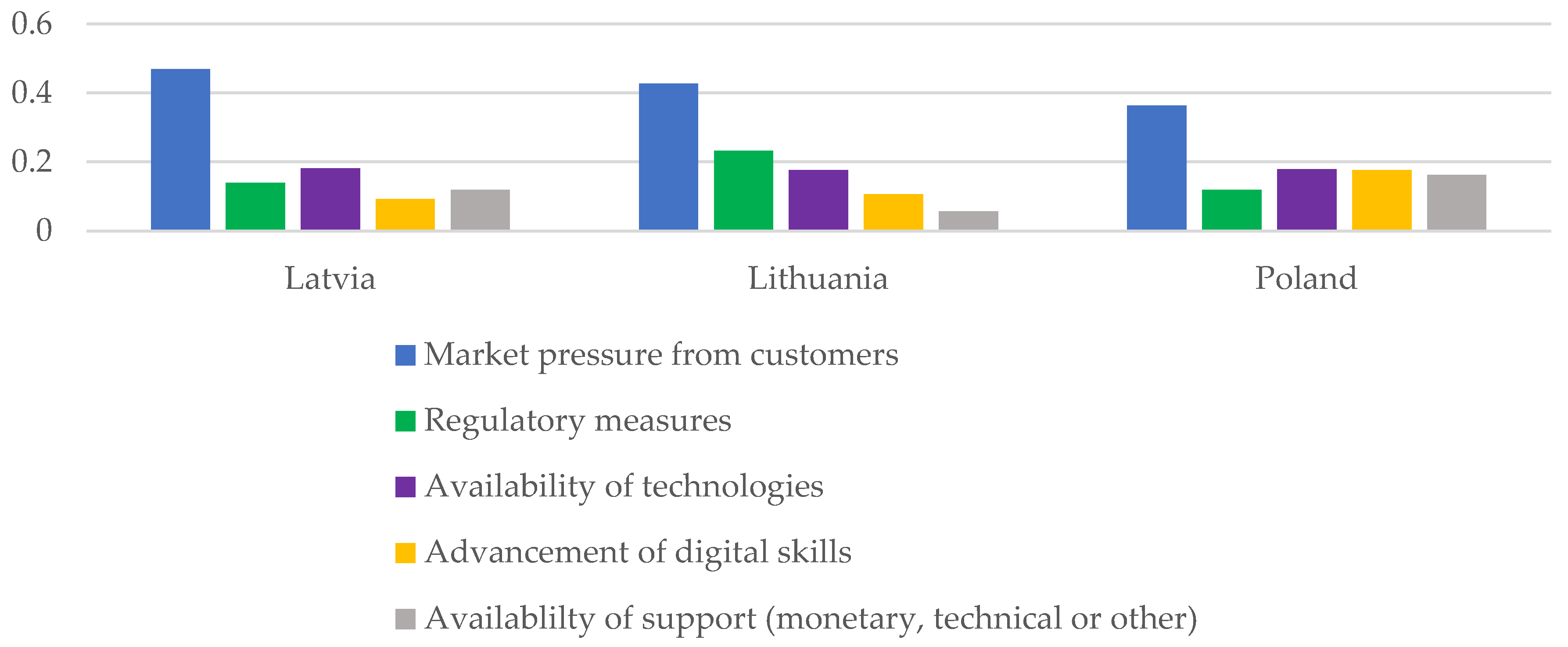
Figure 9.
Results summary for Latvia, Lithuania and Poland for the evaluation of criteria, comparison among criteria.
Figure 9.
Results summary for Latvia, Lithuania and Poland for the evaluation of criteria, comparison among criteria.
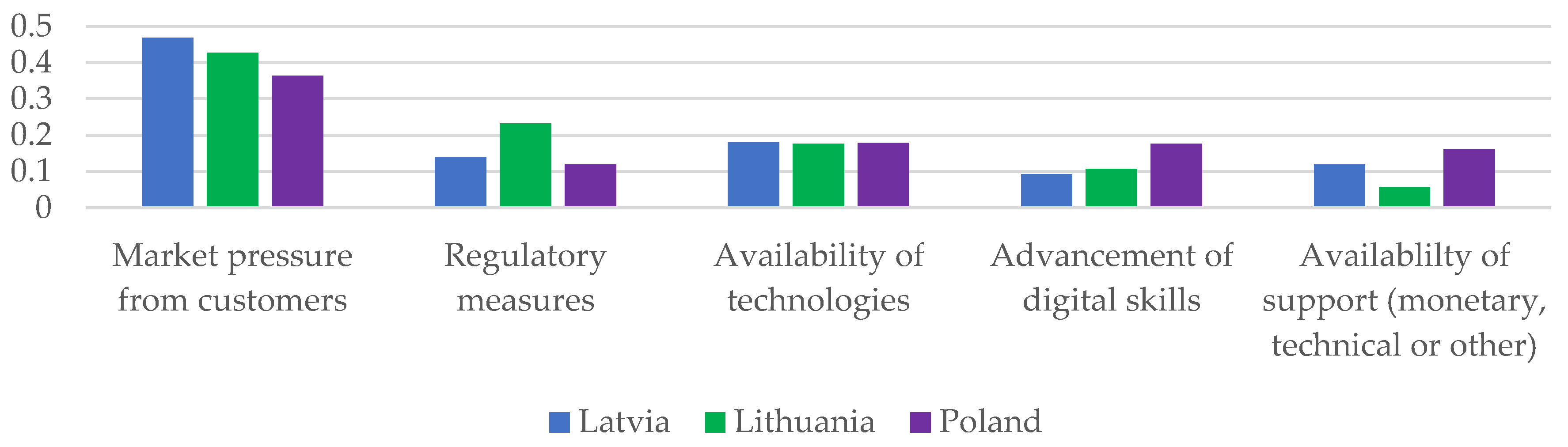

Table 1.
Barriers for digital transformation in bioeconomy.
| PEST Criteria | Barriers |
|---|---|
| Political | Uncertainty regarding how to regulate data, data protection concerns |
| Lack of strategic prioritisation of digitalisation | |
| Fragmented support for digitalisation | |
| Insufficient development of state owned efficient and interoperable systems e.g. systems gathering farming data; weather service | |
| Lack of transparency of the use of requested data | |
| Economical | High investment costs |
| Limited monetization of produced data | |
| Cost effectiveness of introducing new technologies | |
| Social | Digital skills of the entrepreneur and employees |
| Readiness of the rest of the supply chain and market, limited integration of data, insufficient digital skills of clients | |
| Desire to learn and change practices | |
| Fear of using new technologies, uncertainty about cyber security threats and data sharing | |
| Possible negative consumer and societies’ perception of the use of digital tools vs traditional/ natural | |
| Technological | Low data quality, data gaps |
| Issues with integration of systems, technologies and data | |
| Data and cyber security threats | |
| Issues with stability, speed and reliability of the internet connection | |
| Limited availability of technologies | |
| Limited availability of service, parts and tech support |
Table 2.
Data classification and availability.
| Group | Indicator | Year | Unit of measure |
|---|---|---|---|
| Macro | Main GDP aggregates per capita | 2022 (exc. Luxembourg 2021) estimate | Current prices, euro per capita |
| Digital infrastructure | Level of internet access-households | 2022 | % of households |
| Individuals | Internet use by individuals | 2022 | % of individuals |
| Individuals who have basic or above basic overall digital skills | 2021 | % of individuals | |
| Individuals using the internet for doing an online course | 2022 | % of individuals | |
| Enterprises | Enterprises having received orders online | 2022 | % of enterprises |
| Enterprises using software solutions, like CRM to analyse information about clients for marketing purposes | 2021 | % of enterprises | |
| Internet purchases by individuals | 2022 (exc. Finland 2021) | % of individuals | |
| Share of enterprises’ turnover on e-commerce | 2022 | % of turnover | |
| R&D | R&D expenditure | 2020 | % of GDP |
| Share of government budget appropriations or outlays on R&D | 2021 | % of government expenditure | |
| R&D personnel, numerator in full-time equivalent (FTE) | 2020 | % of population in the labour force |
Table 3.
Stakeholder groups involved in the evaluation.
| Stakeholder groups | Latvia | Lithuania | Poland |
|---|---|---|---|
| National government | Ministry of Environmental Protection and Regional Development | Ministry of Agriculture of the Republic of Lithuania | Ministry of Agriculture and Rural Development – no result |
| Consulting | Latvian Rural Advisory and Training Centre – no result | PI Lithuanian Agriculture Advisory Service | Agricultural Advisory Centre in Brwinów (CDR) |
| Research | Latvia University of Life Sciences and Technologies | Vytautas Magnus University | Institute of Agricultural and Food Economics - National Research Institute |
| Entrepreneurship | Farmer (berry growing and processing) | Entrepreneur from the forestry sector | Farmer (horticultural farm – - mainly apple and currant production) |
Table 4.
Scale of relative importance.
| Intensity of importance | Definition | Explanation |
|---|---|---|
| 1 | Equal importance | Two activities contribute equally to the objective |
| 3 | Weak importance of one over another | Experience and judgment slightly favor one activity over another |
| 5 | Essential or strong importance | Experience and judgment strongly favor one activity over another |
| 7 | Demonstrated importance | An activity is strongly favored, and its dominance demonstrated in practice |
| 9 | Absolute importance | The evidence favoring one activity over another is of the highest possible order of affirmation |
| 2, 4, 6, 8 | Intermediate values between two adjacent judgments | When compromise is needed |
Table 5.
Selected definition of bioeconomy.
| Author/institution (Year) | Method of defining bioeconomy |
|---|---|
| Enriquez, Martinez (1997) | All economic activity derived from scientific and/or research activity focused on understanding mechanisms and processes at the genetic/molecular levels and its application to industrial process. |
| EC DG Research (2006) | All production systems involving biophysical and biochemical processes, and thus includes all of the life sciences and related generic technologies necessary to make useful products; applications of biotechnology in agriculture and industry, such for bio-refineries, bio-energy and bio-chemicals, are an integral part of the bio-based economy; it also includes novel forms of land and sea usage (such as those enhancing ecosystems services and other public goods) as well as the use of materials currently considered as wastes. |
| OECD (2010) | Transforming life science knowledge into new, sustainable, eco-efficient and competitive products. |
| BECOTEPS (2010) | All sectors which derive their products from biomass. |
| EC DG Research (2010) | Production models based on biological processes and natural ecosystems using natural materials, which consume minimal amounts of energy without generating waste, as all waste resulting from one process is the material for the next and as a result it is reused in the ecosystem. |
| EC DG Research (2012) | An economy using biological resources from the land and sea as well as waste including food wastes, as inputs to industry and energy production, it also covers the use of bio-based processes to green industries. |
| EC DG Research (2012) | Bioeconomy encompasses the production of renewable biological resources and the conversion of these resources and waste streams into value added products such as food, feed, bio-based products and bioenergy. The bioeconomy relies on life sciences, agronomy, ecology, food science and social sciences, biotechnology, nanotechnology, information and communication technologies (ict), and engineering, and includes the sectors of agriculture, forestry, fisheries, food, and pulp and paper production, as well as parts of chemical, biotechnological and energy industries. |
| McCormick, Kautto (2013) | An economy where the basic building blocks for materials, chemicals and energy are derived from renewable biological resources, such as plant and animal sources. |
| GFFA (2015) | Shaping human lives in conjunction with the environment through restoration of natural resources and ecosystems, innovation and green growth, and growth taking into account social and health aspects. |
| GBS (2018) | Production, use, and regeneration of resources, including related knowledge, results of research, and innovation, to provide information, products, processes, and services .within and across all economic sectors to achieve the sustainable economic development. |
| Birner, 2018 | the knowledge-based production and utilization of biological resources, innovative biological processes and principles to sustainably provide goods and services across all economic sectors (Bioeconomy Summit 2015, p. 4). |
| CBE JU, 2022 | The bioeconomy is an emerging – and rapidly growing - sector that will play a key role in the sustainable production of renewable biological resources from both land and aquatic environments. |
Sources own study […] Maciejczak M., Hofreiter K., How to define bioeconomy?, Roczniki Naukowe SERiA, 2013, t. 15, z. 4, s. 243-248.; Adamowicz, M. (2020). BIOECONOMY AS A CONCEPT FOR THE DEVELOPMENT OF AGRICULTURE AND AGRIBUSINESS. Problems of Agricultural Economics, 365(Special Issue 4), 135-155. https://doi.org/10.30858/zer/131842.
Table 6.
Turnover in the bioeconomy by sectors in EU27, 2019 (billion euro).
| Sectors | EU27 | Estonia | Latvia | Lithuania | Poland |
|---|---|---|---|---|---|
| Agriculture | 437.0 | 1.0 | 1.7 | 3.2 | 28.9 |
| Bio-based chemicals, pharmaceuticals, plastics and rubber (excl. biofuels) | 196.9 | 0.0 | 0.2 | 0.4 | 4.1 |
| Bio-based electricity | 26.4 | 0.2 | 0.1 | 0.1 | 0.6 |
| Bio-based textiles | 86.1 | 0.2 | 0.1 | 0.4 | 2.7 |
| Fishing and Aquaculture | 12.5 | 0.1 | 0.1 | 0.1 | 0.2 |
| Food, beverage and tobacco | 1 157.1 | 2.1 | 2.0 | 4.5 | 77.6 |
| Forestry | 49.5 | 1.1 | 1.4 | 0.6 | 3.6 |
| Liquid biofuels | 14.9 | 0.0 | - | 0.1 | 1.0 |
| Paper | 188.7 | 0.2 | 0.1 | 0.6 | 11.2 |
| Wood products and furniture | 176.6 | 2.7 | 2.3 | 2.5 | 16.9 |
| Bioeconomy | 2 345.7 | 7.6 | 8.0 | 12.5 | 146.9 |
Source: DataM JRC, 2022.
Table 7.
Employment in the bioeconomy by sectors in EU27, Estonia, Latvia, Lithuania and Poland in 2019.
Table 7.
Employment in the bioeconomy by sectors in EU27, Estonia, Latvia, Lithuania and Poland in 2019.
| Sectors | EU-27 | Estonia | Latvia | Lithuania | Poland |
|---|---|---|---|---|---|
| Agriculture | 8 830 300 | 14 100 | 45 430 | 75 780 | 1 418 700 |
| Bio-based chemicals, pharmaceuticals, plastics and rubber (excl, biofuels) | 462 379 | 313 | 1 567 | 1 243 | 31 090 |
| Bio-based electricity | 25 047 | 379 | 336 | 411 | 2 086 |
| Bio-based textiles | 791 242 | 3 273 | 4 064 | 9 962 | 61 004 |
| Fishing and Aquaculture | 161 040 | 660 | 1 490 | 840 | 5 100 |
| Food, beverage and tobacco | 4 658 299 | 14 688 | 23 213 | 41 152 | 474 372 |
| Forestry | 517 410 | 6 270 | 18 680 | 12 270 | 63 000 |
| Liquid biofuels | 25 747 | 0 | - | 231 | 3 380 |
| Paper | 632 755 | 1 280 | 1 419 | 5 148 | 70 067 |
| Wood products and furniture | 1 320 066 | 20 794 | 24 257 | 38 987 | 240 260 |
| Bioeconomy | 17 424 285 | 61 756 | 120 455 | 186 023 | 2 369 059 |
Source: DataM JRC, 2022.
Table 8.
ANOVA.
| Cluster | Error | F | Sig. | |||
|---|---|---|---|---|---|---|
| Mean Square | df | Mean Square | df | |||
| REGR factor score 1 (Digitalisation level) | 6.345 | 3 | .303 | 23 | 20.950 | .000 |
| REGR factor score 2 (R&D level) | 6.214 | 3 | .320 | 23 | 19.422 | .000 |
Table 9.
Cluster membership.
| Cluster 1 | Cluster 2 | Cluster 3 | Cluster 4 | ||||
|---|---|---|---|---|---|---|---|
| Countries | Distance | Countries | Distance | Countries | Distance | Countries | Distance |
| Czechia | .465 | Bulgaria | 1.151 | Ireland | .954 | Belgium | .541 |
| Germany | 1.502 | Latvia | .658 | Spain | .426 | Denmark | .643 |
| Estonia | .687 | Lithuania | .658 | Cyprus | 1.003 | Luxembourg | .629 |
| Greece | .642 | Poland | .475 | Malta | .862 | Netherlands | .860 |
| France | .138 | Portugal | .634 | Finland | .544 | ||
| Croatia | .660 | Romania | .963 | Sweden | .414 | ||
| Italy | .588 | Slovakia | .628 | ||||
| Hungary | .356 | ||||||
| Austria | .793 | ||||||
| Slovenia | .347 | ||||||
Table 10.
Final Cluster Centres.
| Cluster | ||||
|---|---|---|---|---|
| 1 | 2 | 3 | 4 | |
| REGR factor score 1 (Digitalisation level) | -.60804 | -.67827 | 1.32522 | .92123 |
| REGR factor score 2 (R&D level) | .51837 | -.83708 | -1.21715 | .92407 |
Table 11.
Criteria evaluation by stakeholder groups.
| Stakeholder groups | Criteria | ||||
|---|---|---|---|---|---|
| Market pressure for customers and other stakeholders | Pressure from new regulatory measures | Availability of technologies | Advancement of digital skills | Availability of support (monetary, technical or other) | |
| National government | 0.48 | 0.16 | 0.20 | 0.07 | 0.09 |
| Consulting | 0.39 | 0.09 | 0.22 | 0.18 | 0.11 |
| Research | 0.40 | 0.17 | 0.21 | 0.10 | 0.12 |
| Entrepreneurship | 0.32 | 0.22 | 0.17 | 0.14 | 0.15 |
Table 12.
Scenario evaluation by stakeholder groups.
| Stakeholder groups | Scenarios | ||
|---|---|---|---|
| Self-initiative from the enterprises of the sector | National and EU support/ political prioritisation of digitalisation | Existing path with a combination of market driven and government initiatives | |
| National government | 0.38 | 0.50 | 0.12 |
| Consulting | 0.56 | 0.36 | 0.08 |
| Research | 0.53 | 0.30 | 0.16 |
| Entrepreneurship | 0.57 | 0.29 | 0.14 |
Disclaimer/Publisher’s Note: The statements, opinions and data contained in all publications are solely those of the individual author(s) and contributor(s) and not of MDPI and/or the editor(s). MDPI and/or the editor(s) disclaim responsibility for any injury to people or property resulting from any ideas, methods, instructions or products referred to in the content. |
© 2023 by the authors. Licensee MDPI, Basel, Switzerland. This article is an open access article distributed under the terms and conditions of the Creative Commons Attribution (CC BY) license (https://creativecommons.org/licenses/by/4.0/).
Copyright: This open access article is published under a Creative Commons CC BY 4.0 license, which permit the free download, distribution, and reuse, provided that the author and preprint are cited in any reuse.


