

Submitted:
22 July 2023
Posted:
25 July 2023
You are already at the latest version
Abstract
Air pollution is a man-made environmental-related problem and has importance globally among all environmental issues. It is described as an atmospheric situation in which several components appear at high attention above their ambient level and generate a quantifiable effect on vegetation, animals, and people. Air pollution and its control are a universal problem and have become an issue of great trouble for us in current years. However, monitoring and measurement of the concentration of air pollutants are most difficult in assessment to monitoring other components in the environment. Air pollutants are transported to polar regions by different mechanisms such as long-range atmospheric transport or grasshopper effects and via anthropogenic activities. After reaching the polar regions, they settle down and remain as such for a long-time due to their persistent nature. They can distress the environment and wildlife of the polar regions. Generally, dangerous chemicals may cause a risk of well-being effects, whereas lethal pollutants focus on one physiological reaction. We reviewed the available information on air pollution (occurrence, sources, and harmful effects) in the polar regions.
Keywords:
Air Pollution
; Polar Regions
; Grasshopper Effects
; Environment
1. Introduction
Air pollution is the pollution of air or can be well-defined as the presence of pollutants in the environment for a specific duration. It may exist as solid particles, gases, and liquid drops. It is the main cause of the weakening of the ozone (O3) layer in the atmosphere above Antarctica and leading to the change in climate (Bhardwaj, 2023). Now, air pollutants are transported to polar regions via different mechanisms. Polar regions were considered pristine land on the Earth. They are the driest, and coldest region and are a sensitive marker of global change. The polar ice holds a record of prior atmospheres of tens or even hundreds of thousands of years and allows the study of the changes in the atmosphere of the Earth.
Air pollution originates in one nation, but its impact may be felt in other nations which are nearby that country. The first time, it was documented in the 13th century in London. The Clean Air Act (CAA) established national standards for air quality. These are of two types, primary standards (PS) and secondary standards (SS). PS set the limits of pollutants to protect the health of the community, children, and asthmatic patients. While SS sets the limits of pollutants to protect against reduced visibility, buildings, crops, and vegetation. The European Commission (EC) introduced an air quality standard in Europe in 1980 for the measurement of sulfur dioxide (SO2) and suspended particulates (Smeets, 1982).
The United States Environmental Protection Agency (USEPA) has set National Ambient Air Quality Standards (NAAQS) for the pollutants like nitrogen oxide (NOx), O3, carbon monoxide (CO), SO2, lead (Pb), and particulate matter under the Clean Air Act Amendments of 1970 (CAAA70) (Grambsch, 2001). These six pollutants are called criteria contaminants. Grifin (2007) categorized air contaminants into criteria and non-criteria pollutants. Those pollutants whose numerical concentration limit has been established as the separating mark between poor or acceptable air quality, are known as criteria contaminants, while those pollutants which are designated as toxic by legislation, are known as non-criteria pollutants. SO2, O3, NOx, benzene, Pb, PM10, and CO are criteria pollutants.
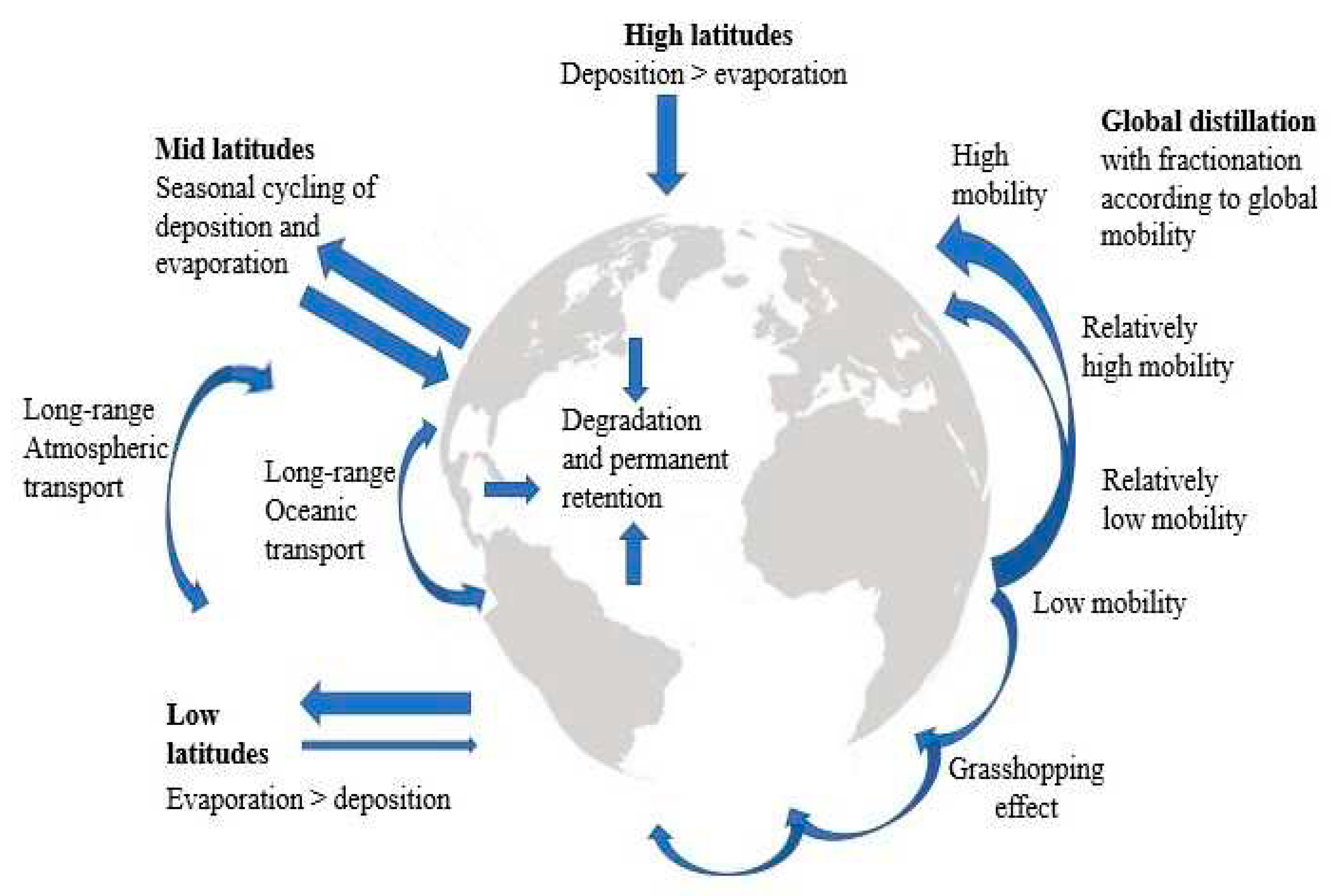
Due to anthropogenic actions, and natural phenomena like wind-blown dust elements, the air quality of the polar regions has deteriorated. Scientists reported different pollutants from the Antarctic environment and stated that they came through the long-range atmospheric transport mechanism (Bhardwaj et, al., 2019; Bhardwaj and Jindal, 2020; Bhardwaj et. al., 2021). Hao et. al., (2019) reported several air pollutants like polychlorinated biphenyls (PCBs), polybrominated diphenyl ethers (PBDEs), and organochlorine pesticides (OCPs) in the air samples, collected from the Fildes Peninsula, West Antarctica. After traveling a long distance, these pollutants can be stored in the ice/snow. Bhardwaj et. al., (2018) have presented the “Grasshopper” mechanism for the transportation of pollutants, while Lebedev et. al., (2015) described the “Cold Finger phenomenon” for the transportation of pollutants from one continent to another (Figure 1).
Persistent organic pollutants (POPs) and mercury (Hg) were the major toxic contaminants and reported in the environment of the Arctic (Sharma et. al., 2013). The presence of halogens in snow, sea ice, aerosols, and seawater causes the depletion of ozone during summer and spring (Abbatt et. al., 2012). Due to anthropogenic actions, such as petrochemical extraction, shipping, and processing, there is the existence of nitrogen in the snow/sea ice (Bartels-Rausch et. al., 2014). The black carbon was found on the surface of snow and atmosphere near the Russian Station in the Arctic continent, and it was due to the flaring of additional natural gas throughout oil extraction (Stohl et. al., 2013). The presence, sources, and harmful effects of air pollution in the polar regions are described in this study.
2. Sources of Air Pollution
Air pollution affects the polar environments, societies, and climate through the different various sources and these sources may be local and remote (Arnold et. al., 2016). Emissions are the chief cause of air pollution while other causes are power, transportation engines, burning of solid waste, and heat generation. Faulty vehicles, dust from construction & road sites, brick kilns, and poisonous fumes from industries contribute to air pollution. Cement industries, thermal power plants, steel, mines, refineries, and petrochemicals are the foremost factors blameable for air pollution. As per the study of Friedrich and Reis (2013), air pollutants mainly arise from the combustion process. The use of wood could be a noteworthy source of polycyclic aromatic hydrocarbons (PAHs) and other absorbing or non-absorbing particles. The polar regions (Antarctica and Arctic) are the receiver of air pollutants from various sources. The resident sources of air pollution are already influencing the atmospheric composition (Marelle et. al., 2016). The local discharge of air pollutants is increasing due to the increased number of populations, mining activities, urbanization, and infrastructure development (Andrew, 2014).
Volatile organic pollutants (VOCs), which include hydrocarbons (HCs), halocarbons, and oxygenates, are directly released from various sources. These sources may be anthropogenic as well as natural sources. They can be put into the expansion of secondary pollutants (SPs) with distinct efficiencies. Hydrocarbons (ethyne & ethane) and advanced aliphatic hydrocarbons (toluene, xylenes, and benzene) are emitted from vehicles that depend on fuel. Benzene is released in high concentrations (1-50 µg/L) in ambient air (Esmaelnejad et. al., 2015). Nitrogen oxide (NO), and nitrogen dioxide (NO2) are together called NOx. They are released from power generation (static sources), and transport (mobile sources). They have lifetimes of ~ five days. After that, they altered into nitric acid (HNO3) and fall with rain. However, NO2 is a predecessor of tropospheric ozone while NO does not impact ozone.
3. Health Effects Due to Air Pollution
Air pollution can be injurious to human health. The existence of poisonous chemicals in the air badly impacts humans, agriculture, climate, vegetation, and animal life. It can damage the property and environment. Due to an increase in PM10 and PM2.5, people lose lung function and suffer from cardiovascular and chronic respiratory diseases. NO2 also causes respiratory disease. CO decreases the oxygen (O2) delivery into the human, and starts a severe headache, and decreased visual view. Ingested lead (Pb) (~75%) is left in the tissues and bones and causes kidney and brain damage. Due to air pollution, the developing nervous system of children is particularly susceptible. Air pollution has long been known to have a hostile impact on humans, aquatic ecosystems, plants, and livestock through acid rain. In the untreated state, benzene can cause cancer. Often the quantity of the emitted pollutants has been comparatively high in a certain area, so the dangerous effects due to the pollutants are more noticeable. The changes in the air contaminants impact the balance of radiation and influence polar climate warming (Shindell and Faluvegi, 2009).
4. Conclusions and Recommendations:
Over the last few decades, air pollution is a most important concern for developing as well as developed nations. The environment of these countries is now changing due to several activities such as mining, construction, vehicular emissions, etc. Air pollution negatively affects the health of humans and other wildlife animals and may lead to death. It also affects the environment of the polar region. After traveling long distances, air pollutants reached the polar region and settle down in the ice for a long time. Researchers are working to minimize this issue and giving several recommendations to solve this problem. These recommendations are as follows.
- (i)
- Globally, regular monitoring of air pollution is necessary.
- (ii)
- More sophisticated instruments are required for the analysis of air pollutants.
- (iii)
- Emission of CO, NO2, and HCs should be measured by catalytic converters.
- (iv)
- More strategies for controlling air pollution should be made by the authority.
Author Contributions
Both authors contributed equally.
Funding
This study was not supported by any funding agency.
Availability of Data and Materials
Not applicable
Code Availability
Not applicable
Acknowledgments
The authors thank Amity University for providing the platform to do this study.
Conflicts of Interest/Competing Interest
There is no conflict of interest between the authors.
Abbreviation
| EC = European Commission |
| USEPA = United States Environmental Protection Agency |
| NAAQS = National Ambient Air Quality Standards |
| OCPs = Organochlorine Pesticides |
| PCBs = Polychlorinated Biphenyls |
| PBDEs = Polybrominated Diphenyl Ethers |
| POPs = Persistent Organic Pollutants |
| PAHs = Polycyclic Aromatic Hydrocarbons |
| VOCs = Volatile Organic Pollutants |
| NO2 = Nitrogen Dioxide |
| NO = Nitrogen Oxide |
| CO = Carbon monoxide |
| O2 = Oxygen |
References
- Abbatt, J. P. D., Thomas, J. L., Abrahamsson, K., Boxe, C., Granfors, A., Jones, A. E., King, M.D., Saiz-Lopez, A., Shepson, P.B., Sodeau, J., Toohey, D.W., Toubin, C., von Glasow, R., Wren, S.N., Yang, X. Halogen activation via interactions with environmental ice and snow in the polar lower troposphere and other regions. Atmospheric Chemistry and Physics 2012, 12(14), 6237–6271. [CrossRef]
- Andrew, R. (2014). Socio-Economic Drivers of Change in the Arctic. AMAP Technical Report No. 9 (2014). Arctic Monitoring and Assessment Programme (AMAP).
- Arnold, S. R. , Law, K. S., Brock, C. A., Thomas, J. L., Starkweather, S. M., von Salzen, K., Stohl, A., Sharma, S., Lund, M.T., Flanner, M.G., Petäjä, T., Tanimoto, H., Gamble, J., Dibb, J.E., Melamed, M., Johnson, N., Fidel, M., Tynkkynen, V.P., Baklanov, A., Eckhardt, S., Monks, S.S., Browse, J., Bozem, H. (2016). Arctic air pollution: Challenges and opportunities for the next decade. Elementa: Science of the Anthropocene, 4. [CrossRef]
- Bartels-Rausch, T. , Jacobi, H. W., Kahan, T. F., Thomas, J. L., Thomson, E. S., Abbatt, J. P. D., Ammann, M., Blackford, J.R., Bluhm, H., Boxe, C., Domine, F., Frey, M.M., Gladich, I., Guzman, M.I., Heger, D., Huthwelker, T., Klan, P., Kuhs, W.F., Kuo, M.H., Maus, S., Moussa, S.G., McNeill, V.F., Newberg, J.T., Petterson, J.B.C., Roeselove, M., Sodeau, J. R. A review of air–ice chemical and physical interactions (AICI): liquids, quasi-liquids, and solids in snow. Atmospheric chemistry and physics, 2014; 14, 3, 1587–1633. [Google Scholar]
- Bhardwaj, L.K.; Jindal, T. Persistent organic pollutants in lakes of Grovnes Peninsula at Larsemann Hill area, East Antarctica. Earth Systems and Environment 2020, 4(2), 349–358. [CrossRef]
- Bhardwaj, L.K.; Sharma, S.; Jindal, T. Occurrence of polycyclic aromatic hydrocarbons (PAHs) in the Lake water at Grovnes Peninsula Over East Antarctica. Chemistry Africa 2021, 4, 965–980. [Google Scholar] [CrossRef]
- Bhardwaj, L.; Chauhan, A.; Ranjan, A.; Jindal, T. Persistent organic pollutants in biotic and abiotic components of Antarctic pristine environment. Earth Systems and Environment 2018, 2(1), 35–54. [Google Scholar] [CrossRef]
- Bhardwaj, L.; Sharma, S.; Ranjan, A.; Jindal, T. Persistent organic pollutants in lakes of Broknes peninsula at Larsemann Hills area, East Antarctica. Ecotoxicology 2019, 28(5), 589–596. [Google Scholar] [CrossRef] [PubMed]
- Bhardwaj, L.K. (2023). A Comprehensive Review on the Climate Change and Its Impact on Health. Preprints.org 2023, 2023050159. [CrossRef]
- Esmaelnejad, F.; Hajizade, Y.; Pourzamani, H.; Amin, M.M. (2015). Monitoring of benzene, toluene, ethyl benzene, and xylene isomers emission from Shahreza gas stations in 2013. International Journal of Environmental Health Engineering, 4(May), 1-7. [CrossRef]
- Friedrich, R. , & Reis, S. (Eds.). (2013). Emissions of air pollutants: measurements, calculations and uncertainties. Springer Science & Business Media.
- Grambsch, A. (2001). Climate change and air quality. Department of Tansportation Centre for Climate Change and Environmental Forecasting, Washington DC, 25.
- Griffin, R. D. (2007). Principles of air quality management, Boca Raton, FL: CRC. [CrossRef]
- Hao, Y.; Li, Y.; Han, X.; Wang, T.; Yang, R.; Wang, P.; Xiao, K.; Li, W.; Lu, H.; Fu, J.; Wang, Y.; Shi, J.; Zhang, Q.; Jiang, G. Air monitoring of polychlorinated biphenyls, polybrominated diphenyl ethers and organochlorine pesticides in West Antarctica during 2011–2017: Concentrations, temporal trends and potential sources. Environmental Pollution, 2019; 249, 381–389. [Google Scholar]
- Lebedev, A. T., Mazur, D. M., Polyakova, O. V., & Hänninen, O. (2015). Snow samples as markers of air pollution in mass spectrometry analysis. In Environmental Indicators, 515-541. Springer, Dordrecht. [CrossRef]
- Marelle, L.; Thomas, J.L.; Raut, J.C.; Law, K.S.; Jalkanen, J.P.; Johansson, L.; Roiger, A.; Schlager, H.; Kim, J.; Reiter, A.; Weinzierl, B. Air quality and radiative impacts of Arctic shipping emissions in the summertime in northern Norway: from the local to the regional scale. Atmospheric Chemistry and Physics, 2016; 16, 4, 2359–2379. [Google Scholar] [CrossRef]
- Sharma, S. , Ishizawa, M., Chan, D., Lavoué, D., Andrews, E., Eleftheriadis, K., & Maksyutov, S. 16-year simulation of Arctic black carbon: Transport, source contribution, and sensitivity analysis on deposition. Journal of Geophysical Research: Atmospheres, 118, 2, 943–964. [CrossRef]
- Shindell, D. , & Faluvegi, G. Climate response to regional radiative forcing during the twentieth century. Nature Geoscience 2009, 2(4), 294–300. [Google Scholar] [CrossRef]
- Smeets, J. (1982). Air quality limit and guide values for sulphur dioxide and suspended particulates—A European community directive. Environmental Monitoring and Assessment, 1, 373-382. [CrossRef]
- Stohl, A.; Klimont, Z.; Eckhardt, S.; Kupiainen, K.; Shevchenko, V. P.; Kopeikin, V. M.; Novigatsky, A. N. Black carbon in the Arctic: the underestimated role of gas flaring and residential combustion emissions. Atmospheric Chemistry and Physics, 2013; 13, 17, 8833–8855. [Google Scholar] [CrossRef]
Figure 1.
Global Transport Processes of Pollutants (Grasshopper Effect).
Disclaimer/Publisher’s Note: The statements, opinions and data contained in all publications are solely those of the individual author(s) and contributor(s) and not of MDPI and/or the editor(s). MDPI and/or the editor(s) disclaim responsibility for any injury to people or property resulting from any ideas, methods, instructions or products referred to in the content. |
© 2023 by the authors. Licensee MDPI, Basel, Switzerland. This article is an open access article distributed under the terms and conditions of the Creative Commons Attribution (CC BY) license (http://creativecommons.org/licenses/by/4.0/).
Copyright: This open access article is published under a Creative Commons CC BY 4.0 license, which permit the free download, distribution, and reuse, provided that the author and preprint are cited in any reuse.