

Submitted:
18 September 2023
Posted:
21 September 2023
You are already at the latest version
Abstract
Solar geoengineering (SG) solutions have many advantages compared to the difficulty of carbon removal (CR): SG produces fast results, is shown here to have much higher efficiency than CR, is not related to fossil fuel legislation, and is something we all can participate in brightening the Earth with cool roofs, and roads. SG requirements detailed previously to mitigate global warming (GW) have been concerning primarily because of overwhelming goals and climate circulation issues. In this paper, the advantages of annual solar geoengineering (ASG) to mitigate yearly global warming increases are explored and detailed as it provides higher feasibility in geoengineering applications. ASG area modification requirements found here are generally 50 to possibly higher than 150 times less compared to the challenge of full SG GW mitigation reducing circulation concerns. Results indicate that there are mixed technologies that can help meet annual mitigation Earth brightening goals. As well, results show much higher feasibility for L1 space shading compared to prior literature estimates for full GW mitigation. However, stratosphere injections appear challenging in the annual approach. Because ASG earth brightening area requirements are much smaller than those required for full mitigation, we have concerns that worldwide negative SG would interfere with making positive advances for several reasons. Negative SG currently dominates yearly practices with the application of dark asphalt roads and roofs. This issue is discussed.
Keywords:
solar geoengineering
; space mirrors
; earth mirrors
; desert modification
; space clusters
; stratosphere injection
1. Introduction
This paper provides fundamental physics-based annual solar geoengineering (ASG) equations to aid in estimated requirements for yearly solar radiation modification (SRM). Therefore, this paper provides baseline assessments without using computer-aided full climate solutions. Solar geoengineering physics should add a deeper understanding of ASG requirements. Estimates are simplified by focusing on temperature which is the key thermodynamic driver for the climate system and ASG.
Many climatologists have anticipated goals of about -5 Wm-2 reduction requirements to reverse global warming for an approximate 1°C rise. Depending on their interests, this is likely an overestimate. We illustrate that the goal should be closer to -1.5 Wm-2. This recommendation can be extended to reverse forcing ASG estimated goal of , a factor of 50 times less than the -1.5Wm-2. Overestimates of goals can lead to discouraging reflective area modification requirements in ASG applications for Earth brightening, space mirrors, and SAI.
The IPCC worries about an increase of a 1.5°C rise over the pre-industrial period. This is estimated to possibly occur around 2039-2043 at the current rate of yearly temperature increases. This can be estimated from Figure 1 which shows the short-term GW trends occurring around 2052. However, the graph displays changes since 1975. The IPCC warning is referenced to the pre-industrial period. Translating Figure 1 to the pre-industrial period requires adding about 0.17°C to each data point. Then this would occur around 2043 from the graph. Some authors predict that this could occur 5 to 10 years sooner (Diffenbaugh and Barnes, 2023) showing the importance of implementing an ASG program soon.
ASG will require timely yearly construction rate reflective modified areas both on Earth and possibly in space to reduce some of the Sun’s energy to mitigate yearly global warming increases. Thus, a key purpose of ASG is to maintain the status quo allowing time for future mitigation improvements. Because goals are limited to mitigating yearly warming increases, many controversial SG and governance issues are minimized.
From the graph’s trend analysis equation, the current rate of global warming is an increase in temperature of 0.019°C/year. To maintain the status quo for zero global warming growth, we can divide up the ASG construction task into two parts for simplicity. Half relegated to the stratosphere (Sec. 3.4) or space shading methods. Half relegated to land-based solutions such as that proposed by project MEER (2023) but on a larger scale (see Sec 3.4). Therefore, a reasonable goal is to mitigate a 0.019°C/year global warming increase. This should minimize circulation concerns (Barrett et al., 2014; Jiang et al., 2019; Malik et al., 2020; NASEM, 2021) and many other controversial governance issues. This goal turns out to be about 50 to possibly higher than 150 times less mitigation in Earth brightening area modification requirements compared to prior full mitigation estimates (Feinberg, 2022).
Most of the current SRM literature is focused on stratosphere aerosol injections (SAI). As this is covered by computer-aided models and there are a lot of concerns in this area, this paper focuses more on Earth-brightening and L1 space Sun dimming solutions. However, overviews of physics goals that may be helpful for SAI are presented. There are many reasons that SAI may not be appropriate for ASG. The primary one is yearly maintenance needs (Barrett et al., 2014; Jiang et al., 2019; Malik et al., 2020; NASEM, 2021). This is less of a problem in SRM methods like Earth-brightening.
An additional topic of discussion in this paper is negative solar geoengineering, the increase of black asphalt roads, roofs, and dark buildings. This bad behavior is more of an issue, as it is closer to the scale of effort needed for yearly ASG mitigation. Therefore, it impedes opportunities for positive ASG advances. This is discussed in Sec. 4.5.
2. Method and Data
2.1. Zero global Warming Growth
In this paper, the approach is to provide key physics-based equations and estimates to achieve just enough solar geoengineering to reverse the potential yearly increase in global warming, which we can refer to as annual solar geoengineering. For example, global warming from 1975 to 2022 was 0.9°C (NASA, 2023). If a status quo annual solar geoengineering approach was applied, the ideal result would be a zero temperature increase. The warming level would stay at 0.9°C. According to Figure 1, the current temperature reversal requirement for ZGWG per year is
TR=-0.0188°C/year
2.2. Theory
In this section, key physics-based ASG equations and goals are presented. The numbers used in this section and Sec. 3 can be updated for more complex computer-aided models depending on the reader’s interest and the changing climate. As well, mostly averages in approximating estimates are used. The estimated general requirements to offset a temperature increase in energy units is
TR=-0.0188°C/year=-0.102Wm-2/year
This conversion to energy units is obtained (using the Stephan-Boltzmann relation) as
Here T1 is taken as the average surface temperature of the Earth of about 14.5°C and T2=14.5 oC+0.0188°C=14.519°C.
The SG strategy indicates that reversing the global warming that occurred from 1950 to 2019 having a temperature rise of 0.95°C, would require a reversal of . This is just the global warming rise from 1950 to 2019 of 0.95°C in energy units where . Here 287.65K=14.5°C is roughly the average temperature of the Earth. Then we can write for full global warming mitigation (from 1950 to 2019), the reversal equates to (Feinberg, 2022)
In this equation, the reverse forcing due to an albedo change of the target is denoted by . We note that increasing the reflectivity of a hotspot surface also reduces its associated greenhouse gas effect. This is estimated in Equation (4)with the 1+f term, using an average re-radiation estimate for f of 62% (Feinberg, 2021; Hartmann et al., 2013). In this equation, we assume that feedback, which is dominated by water vapor, will also reverse. That is, SG reverse forcing causes a cooling effect and cooler air holds less water vapor. In Equation (4), the average feedback value is estimated in 2019 as (Feinberg, 2021, 2023a). We note that many other authors have anticipated that water vapor feedback likely has a doubling effect (Dessler et al., 2008; Liu et al., 2018). Note that this value can be written with temperature dependence, and this is discussed in Appendix A.
Then inserting into Equation (4), we can write
This is the estimated recommended goal for a total reversal of global warming from 1950 to 2021. Other updated estimates may be used depending on the reader’s interest. Since in this paper, we are interested in zero global warming annual growth, the ASG requirement for a reversal is approximated as (from Equation (3-5))
This is the estimated main reverse forcing ASG recommendation used in this paper.
2.2.1. Greenhouse Gas Equivalent Reduction from SRM
It is helpful to note the SG advantage in Equation (5). To mitigate the 5.1Wm-2 in Equation (4), requires an estimated SG change of -1.47Wm-2 compared to trying to do it with GHG removal which would require the full -2.38Wm-2 (Equation (5)). This yields a work savings of 0.91Wm-2 (=2.38Wm-2-1.47Wm-2). This is a 38% (=0.91Wm-2 /2.38Wm-2) SG advantage (Feinberg, 2021) yielding much higher efficiency compared to CR. That is in SG, fundamentally, we can take into account a 1+f re-radiation reduction in Equation (5), (i.e., increasing the reflectivity of a hotspot surface also reduces its associated greenhouse gas effect).
This is a key SG effective advantage that this paper recommends when working on SG mitigation goals. Therefore, 62% of SRM goes into an additional “GHG equivalent reduction’.
This GHG-albedo effect may also in certain areas, decrease the high levels of possible CO2 and often water vapor feedback re-radiation that can occur in UHIs in the presence of high heat flux (Feinberg, 2022a, 2023).
Alternately, worldwide negative solar geoengineering equivalently increases the GHG effect by this 1+f factor (Sec. 4.5), and its additional associated water vapor feedback increases. When these average effects are considered in addition to the background climate, urbanization heat fluxes from impermeable surfaces can be problematic on both the local and global levels (Feinberg, 2022a; 2023) as discussed in Sec. 4.5.
2.2.1. Area estimates for Annual Solar Geoengineering
To estimate the Equation (6) area modification requirements for a -0.0293Wm-2 reversal, the approach is to use the following solar geoengineering estimate (Feinberg, 2022) given by
This SG physics-based equation indicates that in SRM, as anticipated, the reversal is proportional to the average solar energy over 24 hours, , the fractional target area AT relative to the Earth’s area AE, the amount of irradiance Xc falling on the target with global averages of 47% (Hartmann et al., 2013), the amount of outgoing reflected transmission from the target (primarily used in Earth brightening application, see Sec. 3.1), a space irradiance factor (see Sec. 3.2), and an UHI de-amplification factor . These are detailed below. In addition, the albedo change is , where the target’s albedo is given by , and its increase is denoted by .
The space irradiance factor XS introduced is generally taken as unity. However, for space mirror application, the optimal L1 point rotates around the Sun with the same angular speed as the Earth, thus allowing constant shading. Then the irradiance shading occurs 24 hours a day and the Earth’s curvature is not a factor. This increases So/4 to So. To account for the increase in space irradiance, we can let XS=4 in Equation (7)).
This equation also provides provisions for targets in urban heat island (UHI) areas which can have microclimate de-amplification effects denoted by HT (Feinberg, 2020, 2022a). For example, in UHIs, the solar canyon effect amplifies warming when buildings reflect light onto pavements amplifying heat at the surface. Other amplification issues can include re-radiation due to the increase in local CO2 GHGs, local water vapor feedback, temperature inversions, loss of wind and evapotranspiration cooling, increases in solar heating of impermeable surfaces from building sides, pavements heat fluxes, and so forth (Feinberg, 2023). Some of these effects could reverse and de-amplify in ASG urban applications, increasing cooling, and can be accounted for in Equation (7) with the HT variable. City heat flux amplification is often observed by the UHI’s dome and footprint. The footprint and dome growth are indications of amplified heat flux that is observed to spread beyond the boundaries of the city itself both horizontally and vertically (Zhou et al., 2015; Feinberg, 2020, 2023).
3. Results
3.1. Earth Brightening Transmission Loss
In Equation (7), the XO factor provides an estimate of the outgoing transmission of reflected short-wave radiation and is applicable in Earth brightening studies. When taken as unity, the results for Equation (7) in Earth brightening applications yields the minimum required area to achieve a specific ASG reversal goal. In Earth brightening, there are several eventual losses that can occur for the outward short wavelength transmission through the upper atmosphere. The primary ones are clouds and aerosols that can impede the reflected sunlight (Smoliak et al., 2022). These losses in the upper atmosphere areas can affect the mean lower surface air temperature (MSAT).
The incoming solar irradiance XC in this paper is taken as 47% due to clouds as indicated in the IPCC global mean Earth energy budget assessment (Hartmann et al., 2013). However, one might anticipate that the outgoing transmission from an Earth-brightened surface has a higher transmissibility probability than the incoming irradiance. For example, given that the incoming radiation occurred through a clear portion of the sky, we can estimate the probability that there will be loss issues on the outgoing reflective radiation should be less. One helpful estimation method is to use a Bayesian approach. Using this prior information, the Bayesian result indicates that the probability of clear transmission is 78%. This is estimated in Appendix B. Therefore the minimum required area obtained in Equation (7) for Earth brightening, is adjusted in this paper using a Bayes correction XO-Bayes=0.78 factor.
Readers may wish to model this further for specific areas and adjust this factor using other probability methods and factors (such as aerosols) to improve transmission estimates. One should note that it may not be well-known how transmission loss affects the MSAT. As well there are areas for Earth brightening where SRM is optimal, such as near the equator yielding higher irradiance (Smoliak et al., 2022).
3.1.1. Pavement Example
As an example, consider the required area for worldwide cool pavements. We can consider an average asphalt pavement albedo of about , and using cool road methods, estimate an increase for a target pavement area with albedo of . Then considering an average irradiance of , with , , and , and using a 50% ASG reversal goal, the
requirement is
Solving we obtain the SG target area percentage for half of ZGWG yielding a minimum and
Bayesian estimated requirement of
The pavement modification area that needs to be
cooled for a change equates to
This yields an equivalent minimum radius of 138
miles. This result is summarized in Section 3.4.
This example illustrates the SRM area modification requirements for ASG. Other
values may be used depending on the reader’s interest.
For pavements that are cooled with (see Equation (A-4)), the requirement for area
modification is much less according to Appendix
A. In this case, it is likely that . Letting for this example, the area modification is reduced
from Equation (10) to
This yields a reduced equivalent minimum radius of 76 miles. This result is also summarized in Sec. 3.4. Note that to achieve these results; the goal for 50% mitigation is reduced by more than half.
If we could do full global warming SG mitigation per the equivalent cool pavements in Equation (10) but with , , and , the area required would be about 6 million square
miles. In comparison, this ASG requirement where , , and hotspot mitigation estimate for (see Equation (A-4)), the resulting area reduction
is 36,000mi2. The ASG area factor is reduced by about 160 compared
to full SG mitigation.
3.2. L1 Space Shading Estimates
We can translate an AT area modification
requirement to a solar reflective space disc mirror-type shading application.
In this case, we note that most authors consider the Sun-Earth L1 position as
optimum. For the irradiance in space mirror shading estimation, we can take XC=100%
and XS=4 (as discussed above). Sun-shading can effectively translate
to changing a target on Earth’s reflectivity to ~100% from the average Earth’s
albedo of 30%, so that =0.7. Using these parameters and our 50% ASG goal, Equation
(7) is
Solving we obtain the ASG percentage for half of
ZGWG of
This yields a disc of about 7843 km2 (radius 50 km). Results are summarized in Sec. 3.4.
Note when we talk about space mirrors with a value for AT/AE, this value becomes the required percent of incident solar radiation that is needed to be reflected away from the Earth to achieve a mitigation goal in Equation (12).
3.3. Annual Stratospheric Injection Estimates
Results appear quite challenging to meet ASG area modification requirements (summarized in Sec. 3.4) for both Earth brightening or space mirror size estimates. Unfortunately, there is no easy solution. Although this paper does not focus on SAI as it is often assessed with computer climate models, it is helpful to overview the ASG goals and estimated differences compared to full GW mitigation. Much has been written about an alternate less expensive Sun-dimming temporarily reflecting particle method such as SO2 injected into the stratosphere (Keutsch et al., 2020; Keith et al., 2016, Tollefson, 2018; Ferraro et al., 2015; Dykema et al., 2014; Crutzen, 2006). Here SO2 injected into the stratosphere at the top of the atmosphere (TOA) reduces the Sun’s energy reaching the Earth through solar aerosol reflectivity. As an estimate for annual SAI, we can use the equation given by Niemeier and Timmreck (2015) where the reduction in radiation at the top of the atmosphere is
The actual injection rate (in units of MT(S)/year - megatonnes of SO2 per year) for full GW reduction according to Equation (6) requires a goal of 1.47Wm-2. To provide the first-year annual requirements rather than full mitigation, the injection rate using Equation (14) is 32x less as shown in Table 1. Here full climate mitigation requires an injection of 6.9MT(S)Yr-1 for a goal of 1.47Wm-2, whereas, for the first year, the ASG goal is reduced to an injection of 0.216Mt(S)Yr-1 for a 0.01465 Wm-2 50% reduction goal. Unfortunately, depending on the SO2 dissipation per year, this would need to be possibly doubled in the second year, tripled in the third year, and so forth for ZGWG.
The stratosphere area modification required has not been fully established. Initial assessments appear problematic as outlined in Appendix C due mainly to the reflection efficiency. Estimates are often equated to one Pinatubo eruption which may be unreliable.
3.4. Overview of Estim ates
Table 2 provides an overview of the needed estimates based on the suggested inputs to mitigate the annual global warming growth trend of 0.019°C/year for ASG. The results in Table 2 are divided, with Earth brightening area modification of surface land and half to space-type application. The objective for each is to reduce the incoming solar energy by -0.01465Wm-2 per year for 50% annual GW mitigation. Therefore, any two combinations would ideally meet the ASG requirements. Note that in Table 2, the HT value, as an example, is taken as 3 for UHI areas and conservatively 2 for Earth mirrors used on urban rooftops as often implemented by project MEER (2023). This HT average estimate can vary depending on the UHI microclimate (Feinberg, 2023). In the case of something like sea-type floating mirrors, HT=1, also is shown in Table 2.
Note the ASG requirement (Equation (6) compared to full mitigation (Equation (5) is ~50 times (=1.47Wm-2/0.029Wm-2) reduced in energy flux requirements and area modification (per Equation (7)). For example, desert treatment is reduced from the author’s initial estimate of 1.0% (Feinberg, 2022) to 0.010% for 50% annual mitigation in Table 2. Therefore the areas in ASG mitigation are in general a factor of 50 times smaller which also minimizes any potential circulation concerns (Barrett et al., 2014; Jiang et al., 2019; Malik et al., 2020; NASEM, 2021). Table 2 suggests several options including multiple combinations that can be considered in annual mitigation. For hotspot cooling shown in Table 3, this has the potential to reduce area requirements by a factor of over 150 (per Equation (11).
4. Discussion
4.1. Annual Solar Radiation Management
4.1.1. Annual Solar Geoengineering Allocation by Country Area
To aid solar radiation management, we can allocate goals amongst countries by their wealth. For example, using the total household wealth by county the United States and England’s requirements would be 31% and 3.5% (Wikipedia, 2022) respectively. Then the area allocations, for example, with surface albedo change in Equation (10) would be:
- U.S. mitigation =31% x 60,000 mi2=18,600mi2/Yr or 51mi2/day
- England mitigation =3.5% x 60,000 mi2=2100mi2/Yr or 5.75mi2/day
Such goals may be obtainable with mixed technology (see Sec. 4.2).
Costs associated with solar geoengineering in space shading can similarly be divided.
4.1.2. L1 Space Particle Clusters
Another similar idea that may merit investigation is to use space particle clusters instead of space mirrors, at or near the L1 Sun-Earth region. This idea has been suggested in the past (Mautner , 1991). A cluster of particles such as calcium carbonate, SO2, or moondust (Bromley et al., 2023) in space at L1 may have a long suspension time reducing the injection rate. Diffusion would likely be slow due to low outer space temperatures (~2.7K) and studies could be done to estimate issues.
We can estimate the requirement for solar reduction for an ASG value using a transmissibility method (Feinberg, 2022). For example, considering the Earth’s solar absorbed radiation estimate as a required absorption reduction estimate can be found for Equation (6) from
Solving yields So=1360.833Wm-2. Then one finds 0.167Wm-2 (=1361 Wm-2 -1360.833Wm-2) is the reduction required for the incoming solar radiation.
If we measure the transmission of the incoming solar radiation above and below the particle treatment, the transmissibility (TR) from sun-dimming should be (Feinberg, 2022)
Measuring the transmissibility is likely a helpful method to assess the injection amount. Note, that we can also use similar measurement methods for SAI.
4.2. Earth Brightening Advances
Earth brightening SG’s state-of-the-art potential is a lot higher today. Drone technology, for example, has had major advances in painting buildings (Maghazel and Netland, 2019) and agriculture spray methods (Klauser and Paushinger, 2021). For example, consider the US and England’s goals for Earth brightening in Sec. 3.4 in terms of area per day
- U.S. Mitigation Goal Earth Brightening is 51 mi2/day
- England Mitigation Goal Earth Brightening is 5.75 mi2/day
A typical two-gallon per acre agriculture drone can spray about 1 mi2/day (Agri Spray Drones, 2023) which includes refills. Then if we assume paint drones can be designed with similar capabilities, this requires the
- U.S. Mitigation Goal of about 51 drones/day
- England Mitigation Goal of about 6 drones/day
Although paint drones are not equivalent and rated similar to agriculture drones, technology improvements likely should be able to provide this type of capability for paint drones. Given AI technological advances, improvement in Earth-brightening drones, while difficult, is likely more feasible than one might think. However, paint areas have to be made available. Nevertheless, this technology should be part of the solution. The full solution will likely require a mixture of ASG Earth brightening technologies (Sec. 4.4).
New ultra-thin bright white paint surface treatments (98.1% reflective and half as thick) have been developed to help cool the Earth (Li et al., 2021; Felicelli et al., 2022). Possibly other technologies could be developed specifically for the Earth-brightening of buildings, streets, desert areas, mountain tops, and UHI areas. Possibly an agency like SpaceX or NASA could vastly improve AI drone use for SG implementation. AI technology could allow for 24-hour-a-day drone ASG work with automatic target brightening, refilling, and target recognition. Furthermore, studies could help assess the best strategies to try and improve coverage areas including mountain ranges since mountains cover about 24% of the Earth. Brightening mountain areas could also increase condensation and snowfall as was done on the Peruvian Andes mountain tops (Grossman, 2012) which can increase snowfall and spring runoff to reservoirs in drought-prone areas.
Annual mitigation using Earth mirrors, as suggested by project MEER (2023), has several advantages. Mirrors can be placed in areas of high irradiance, yielding a likely large albedo change, and when used in city areas on roofs, HT>1. These reduce the Earth’s annual SG area requirements per Equation (7). Alternately, it may be of interest to use something like floating sea mirrors or particles which would yield a high albedo change as exemplified in Table 2.
One might question the practice of painting the Earth a light color. Yet, we continue to accept negative solar geoengineering (Sec. 4.5). Unfortunately, we may already be at the point where we are faced with these types of difficult decisions.
4.3. Natural Hotspots
Natural hotspots like deserts and mountain areas are likely good ASG targets to consider to find ways to cool them to help reduce global warming. They may cover a significant area and are relatively free from urbanized regions. Similar to pavements and UHIs, natural hotspot cooling would likely help reduce atmospheric water vapor feedback. As well certain regions are optimal such as the tropics and subtropics (Smoliak, 2022). Certainly, natural hotspots would be highly controversial geoengineering targets. Nevertheless, their amplification of heat and its effect on the Earth’s temperature will likely be related to their area and temperature differences compared to the global ambient. Some examples of such hotspots include:
- Flaming Mountains, China
- Bangkok Areas in Thailand (with planet’s hottest city)
- Deserts
- Badlands of Australia
- Tropics and Subtropics
4.4. Mixed Planning for Annual Global Warming Mitigation
A mixed plan for annual global warming mitigation (AGWM) of -0.02°C/year can reduce the burden of relying on any one method which would reduce governance issues and technological unforeseen problems. In addition to ASG, the author has estimated that half of the annual warming increase is due to population growth (Feinberg, 2023a). That is under zero population growth, we would anticipate a reduction to a 0.01°C/year increase. A mixed plan should include ASG with ocean reflective particles/floating mirrors, AI drone painting, space mirrors or clusters as well as the traditional ideas of stratospheric aerosol injection, marine cloud brightening, and cirrus cloud thinning. Non-SG efforts in the area of population development supported by multi-actor governance would be extremely helpful according to this recent study (Feinberg, 2023a). The importance of ASG and AGWM is key to the success and our ability to address the immediate GW yearly trend increases occurring. This effort should also include a strong effort to reduce negative solar geoengineering as well.
4.5. Worldwide negative solar geoengineering
ZGWG is challenging enough. However, the problem of yearly increases in black asphalt roads, rooftops, and even dark-colored cars worldwide makes the task harder. Although many issues like black electric vehicles and gas cars do not contribute significantly to global warming, it encourages bad behavior for poor solar color choices. This illustrates the lack of SG awareness which is highly problematic for an increasing population (Feinberg, 2022a). As a suggestion, restricting cars to light colors would go a long way in greatly increasing such awareness.
In terms of global warming, these issues are a form of ‘negative solar geoengineering’. Currently, it is estimated that roads occupy about 14% of all manmade impermeable surface areas (Huang et al., 2022) of which impermeable surfaces occupy an estimated 0.26% of the Earth (Sun et al., 2022). Then the estimated area of the Earth occupied by roads is small, about 0.0364%. This is a bit higher compared to Equation (9) estimated requirement for area modification but illustrates the negative ASG interference issue. By comparison to the estimated total impermeable surfaces, it is a factor of 8.5 times higher than the Equation (9) requirement (0.26%/0.0305%). This illustrates the difficult task of annual surface area modification requirements with worldwide negative solar geoengineering. Feinberg (2023) estimated that 1.1% of global warming is likely due to asphalt roads using only the average feedback factor which if brightened similar to concrete with an albedo increase of 5, could have reduced global warming by 5.5%. An MIT pavement study (MIT, 2020) concluded that in all U.S. urban areas, an increased temperature of 1.3°C occurs in summer months and heatwaves are 41% more intense with 50% more heatwave days due to asphalt pavements. Expansion of cities is increasing rapidly where 55% of the world’s population lives and this is expected to grow to about 70% by 2050 (Wikipedia, 2021).
Feinberg (2022) estimated that heat from asphalt roads and roofs can produce 7.5 times more energy in heat pollution per acre than a solar power plant where studies have found they average about 0.33GWh per acre per year (Ong, 2013). Furthermore, a gallon of gas equates to 33.6 kWh (Wikipedia, 2021). Then this heat pollution equates to 74,200 gallons of gasoline energy per year per acre.
This illustrates the enormous energy in an acre of asphalt heat pollution and how black roads and roofs make significant incremental warming contributions.
Negative solar geoengineering also has the potential to increase local and global water vapor feedback as it creates increases in warm air which can hold more water vapor. Hotspots can increase water vapor feedback dramatically as illustrated in the assessment in Appendix A and 3.1. As discussed previously, Zhao et al. (2014) observed that UHI temperatures increase in the daytime (ΔT) by 3.3K more in humid compared to dry climates. A primary issue in humid UHI areas is the use of black asphalt which, given the worldwide urban heatwave problems, this author feels should be banned in most cases. The warming consequences of black asphalt are not fully understood, but it is bad for the local environment and is well-documented for many problems, especially in concentrated urban areas where heatwaves cause related health issues (MIT, 2020; EPA, 2005).
5. Conclusion
In this paper, estimates are provided for annual solar geoengineering requirements. The results illustrate many challenges. However, results show higher feasibility for annual solar geoengineering modification to help mitigate global warming. This is due to reductions in goals that lead to a factor of 50 to possibly over 150 times less area modification requirements compared to full SG mitigation. This minimizes circulation concerns and many other controversial issues.
Many recommendations are made in this paper. These include the use of ASG and the calculations, the use of mixed technology (Sec. 4.4) for ASG Earth brightening modification, the suggested method of using space clusters that may be highly useful, and UHI use of the HT value in Table 2. Results in general point to challenging but feasible solutions. Suggestions are provided for solar radiation management using wealth allocations by country for Earth brightening to improve feasibility (Sec 4.1).
It is pointed out that for ASG to be effective; it is helpful to address many global warming issues including the ongoing negative solar geoengineering especially the practice of black asphalt use. We should not condone the bad behavior of dark color choices whether it be in automotive or the construction practices of roads, houses, and buildings. It also impedes the efforts of positive solar geoengineering. Such issues should be addressed in worldwide climate meetings.
It is likely important to have a mixed plan that should include AGWM that could include in addition to ASG the likely need for population development supported by multi-actor governance to reduce warming due to anthropogenic effects.
There is little time left to meet the IPCC suggested 1.5°C goal as shown in Figure 1. The longer we delay in implementing an ASG program, the more unacceptable our status quo will be due to increases in global warming reducing our options. This paper provides improved solar geoengineering feasibility with annual mitigation goals that can greatly supplement carbon removal and reduction efforts.
Funding
This work was unfunded.
Author contribution and consent to publish
The author, Alec Feinberg, performed the research and written content in this manuscript and has full consent to publish this material.
Data Availability
The primary data in this manuscript in Figure 1, is readily available on the NASA website and is fully referenced (2023).
Conflict of Interest Statement
The author, Alec Feinberg, states that he has no conflicts of interest with this research work.
Competing Interests
The author declares that he has no known competing financial interests or personal relationships that could have appeared to influence the work reported in this paper.
Appendix A: Earth brightening of hotspots and its influence on water vapor feedback
In terms of an albedo change, it is clear from Equation (4), that the larger the albedo change, the smaller the required target area that is needed to meet a specific SG goal. However, the impact of different albedo changes, according to Equations (4) and (5) creates the same average water vapor feedback effect in humid areas. Therefore, we would like to assess the effect of cooling a high-temperature hotpot surface by considering its feedback temperature dependence rather than using an average factor. We later define a hotspot area below.
To look at hotspot influence on water vapor feedback in humid areas, consider the Clausius-Clapeyron relation. To assess this potential effect, Equation (4)can be written with temperature dependence
The rule of thumb is a decrease in water vapor goes as the temperature ratio changes. However, the most accurate method is to use the Clausius-Clapeyron humidity relationship between two temperature changes as
Here T1 and T2 are in degrees K, 2.465E6 J-kg−1 is the latent heat of vaporization and 462 J-kg−1 K−1 is the specific gas constant for water vapor, and we can denote the Clausius-Clapeyron humidity relationship by CC.
For example, if we take the average temperature of the Earth as 14.5°C, the estimated AF factor at 27°C is
This is close to the average . It is estimated that water vapor feedback is dominated by tropical areas (Desler et al., 2008; Liu et al. 2018) where an average temperature of 27°C may be reasonable. This provides a helpful point estimate for the average value which is dominated by the water vapor feedback effect.
Consider an effort to do Earth brightening focusing solely on hotspot surfaces in humid areas. As an example, consider an asphalt hotspot surface area averaging 61°C that is changed to a cool road close to the region’s ambient which in this example we can take as 33°C. Then the Clausius-Clapeyron relation indicates the potential for a local region cooling to reduce its water vapor effect and how it could change its feedback factor. Then the potential feedback factor could effectively increase to
Compared to , the local value is doubled to . Then according to Equations 4 and 5, the Equation (6 local goal would be cut in half where
This feedback is related to thermal equilibrium and how it can factor into reducing water vapor content in the atmosphere and its potential local re-radiation effect. Therefore, these are potential estimates and likely maximum assessments. A full computer climate model may provide more insight. This is simply an example to help illustrate the importance of hotspot cooling and its potential water vapor feedback effect in humid regions. Note in comparison to Equation (5), ASG in this case is a factor of 100 times reduced. Section 3.4 summarizes this maximum hotspot cooling potential results. Sec. 3.1 illustrates the potential full advantage of selecting hotspot targets for cooling and the importance of being able to cool T2 where T2 >> T1. We might then define a hotspot as having the potential in which AF(T) is reasonably greater than the estimated average .
Note that a factor of two higher (Equation (A-4)) is not unreasonable for an urban heat island water vapor feedback compared to the standard atmosphere. Zhao et al. (2014) compared similarly constructed cities with twenty-four located in the humid southeastern United States to 15 cities in dry climates. They found an average ΔT increase of 3.3 K observed in daytime hours in humid climates with little differences in nighttime hours. Feinberg (2022a) modeled UHI water vapor feedback based on Zhao et al.’s (2014) dataset. The mathematical treatment found a UHI local feedback value of 3.4 Wm−2 K−1 (Feinberg, 2022a) for cities in humid environments at 15 °C. This is about a factor of 2.1 higher compared to some authors’ estimates for average feedback in the standard atmosphere (Liu, 2018).
Again on the flip side, we note the potential water vapor feedback effect causes warming increases associated with worldwide negative solar geoengineering (Sec. 4.5).
Appendix B: Bayesian estimate for outgoing transmission loss in Earth brightening
In this assessment, we have prior information. Our calculation is based on XC=0.47 for the incoming sunlight irradiance in Equation (7). Then to find the Bayes’ correction for the outgoing transmission in Equation (8), we start with the prior information that Sunlight falls on a target area. Using Bayes’ theorem, the first quantity of interest is . We then have prior knowledge that the sunlight makes it to the reflective target so that . We wish to know the probability of non-transmission of the reflected light due to a cloudy area given that the incoming solar radiation had a clear sky area given by . The probability that the sky will be cloudy is . This yields from Bayes’ theorem
Where:
,
We conclude that the probability for clear outgoing transmission is TClear=1-0.22=0.78.
Appendix C: CaCO3 Stratospheric Injections – Alternate approach
In this section, a CaCO3 injection rate example is provided for ASG. Here, we can use the approach of Equation (7) rather than Equation (14) to illustrate stratosphere area requirements that may provide some alternate insights. Consider the Earth’s average albedo of about , then for this CaCO3 example, assume an increased reflectivity by a factor of 2 with a CaCO3 injection bringing an area’s atmospheric albedo to . Then, considering full irradiance, , with , and using a 50% reversal annual climate mitigation goal for half of zero global warming growth, in Equation (7) yields
Solving we obtain the SG stratospheric target area modification initial estimated
Here the particle reflection efficiency issues is denoted by eff. For example, for an 80% efficiency in Equation (C-2), the results requires more area where . This stratosphere area modification equates to
Estimates for the specific surface area (m2/g) of CaCO3 vary widely depending on the type of CaCO3 from 5-24 m2/g (SciencDirect, 2023) to 30-60 m2/g (AmericanElements, 2023). If we conservatively use 10 m2/g, we can calculate the injection rate using Equation (C-3) as
For a 70% efficiency
This is one partial solution as the dissipation rate in this approach needs to be estimated to maintain coverage over time. The area saturated is given by Equation (C-2) with eff=0.7 and is . Because of this large area and its replenishing needs, in the annual approach, particle injection is difficult due to the cumulative yearly requirements. Such estimates are likely better assessed with a computer model.
List of Abbreviations and Nomenclature
| Solar geoengineering | SG | Reverse forcing change in Watts/m2 | ΔPRev |
| Zero global warming growth | ZGWG | Reverse forcing albedo change from a target area T in Watts/m2 | |
| top of the atmosphere | TOA | Reverse forcing albedo change from a target area T in Watts/m2 | |
| Solar radiation management | SRM | Re-radiation factor (62%) | f |
| Greenhouse gas | GHG | Secondary feedback amplification, taken as 2.15 | AF |
| Long Wavelength | LW | Solar irradiance averaging 47% | Xc |
| Space irradiance: Space=4, else=1 | XS | ||
| Transmissibility | TR | Annual reversal in Watts/m2 | ΔPASG |
| Target area | Target albedo, SG target’s albedo modification | , | |
| Earth area | |||
| Temperature reversal | TR | microclimate amplification factor | HT |
| Average solar radiation 340Wm-2 | Radiation change, at the TOA | ||
| Annual solar geoengineering | ASG | SO2 Injection rate, Particle Overlap | , O |
| Clausius-Clapeyron relation | CC | Stratosphere Aerosol Injections | SAI |
| Mean surface air temperature | MSAT | Annual Global Warming Mitigation | AGWM |
| Global Warming | GW |
References
- Agri Spray Drones, How many acres per hour or day can a spray drone spray? https://agrispraydrones.com/how-many-acres-per-hour-or-day-can-a-spray-drone-spray/, accessed 6-9-2023.
- AmericanElements, Calcium Carbonate Nanoparticles: https://www.americanelements.com/calcium-carbonate-nanoparticles-471-34-1#:~:text=About%20Calcium%20Carbonate%20Nanoparticles,60%20m2%2Fg%20range., accessed 4-23-2023.
- Barrett, S., Lenton, T. M., Millner, A., Tavoni, A., Carpenter, S. R., Anderies, J. M., Chapin III, F. S., Crépin, A. S., Daily, G., Ehrlich, P., Folke, C., Galaz, V., Hughes, T. P., Kautsky, N., Lambin, E. F., Naylor, R., Nyborg, K., Polasky, S., Scheffer, M., ... de Zeeuw, A. J. (2014). Climate engineering reconsidered. Nature Climate Change, 4(July 2014), 527-529.
- 2023; 4. Bromley B, Khan S, Kenyon S (2023) Dust as a solar shield, PLOS Clim. [CrossRef]
- Crutzen P (2006). Albedo Enhancement by Stratospheric Sulfur Injections: A Contribution to Resolve a Policy Dilemma? Climatic Change, 77(3), 211. [CrossRef]
- Dessler, A.; Zhang, Z.; Yang, P. Water-vapor climate feedback inferred from climate fluctuations, 2003–2008. Geophys. Res. Lett. 2008, 35, 20.
- 2023; 7. Diffenbaugh N, Barnes E (2023) Data-driven predictions of the time remaining until critical global warming thresholds are reached, PNAS. [CrossRef]
- Dykema J, Keith D, Anderson J, Weisenstein D (2014) Stratospheric controlled perturbation experiment: a small-scale experiment to improve understanding of the risks of solar geoengineering Phil. Trans. R. Soc. A. [CrossRef]
- EPA. Study Cambridge Systematics. Cool Pavement Report, Heat Island Reduction Initiative. 2005. Available online: https://citeseerx.ist.psu.edu/viewdoc/download?doi=10.1.1.648.3147&rep=rep1&type=pd (accessed on 12 March 2023).
- Feinberg, A. (2020) Urban heat island amplification estimates on global warming using an albedo model. SN Appl. Sci. 2, 2178. [CrossRef]
- 2021; 11. Feinberg A (2021) A Re-Radiation Model for the Earth’s Energy Budget and the Albedo Advantage in Global Warming Mitigation, Dynamics of Atmospheres and Oceans. [CrossRef]
- A: A (2022) Solar Geoengineering Modeling and Applications for Mitigating Global Warming, 2022; 12. Feinberg A (2022) Solar Geoengineering Modeling and Applications for Mitigating Global Warming: Assessing Key Parameters and the Urban Heat Island Influence, Frontiers in Climate. [CrossRef]
- Feinberg, A (2022a) Urban Heat Island High Water-Vapor Feedback Estimates and Heatwave Issues: A Temperature Difference Approach to Feedback Assessments Sci 4, no. 4: 44, (Feature Papers—Multidisciplinary Sciences 2022). [CrossRef]
- Feinberg A (2023) Urbanization Heat Flux Modeling Confirms it is a Likely Cause of Significant Global Warming: Urbanization Mitigation Requirements, recently accepted in Land (in production).
- F: A (2023a) Climate change trends due to population growth and control, 2023; 15. Feinberg A (2023a) Climate change trends due to population growth and control: Feedback and CO2 doubling temperature opposing rate model, ResearchGate (submitted for review).
- 2022; V3, 16. Felicelli A, Katsamba I, Barrios F, Zhang Y, Guo Z, Peoples J, Chiu G, Ruan X, (2022), Thin layer lightweight and ultrawhite hexagonal boron nitride nanoporous paints for daytime radiative cooling, Physical Science, V3, I10, 101058. [CrossRef]
- Ferraro A, Charlton-Perez A, Highwood E (2015) Stratospheric dynamics and midlatitude jets under geoengineering with space mirrors and sulfate and titania aerosols. Journal of Geophysical Research: Atmospheres, 120(2), 414–429. [CrossRef]
- Grossman, D. (2012) With Sawdust and Paint, Locals Fight to Save Peru’s Glaciers https://theworld.org/stories/2012-09-25/sawdust-and-paint-locals-fight-save-perus-glaciers.
- Huang X, Yang J, Wang W, Liu Z (2022) Mapping 10 m global impervious surface area (GISA-10m) using multi-source geospatial data, Earth Syst. Sci. [CrossRef]
- 2019; 21. Jiang J, Cao L, MacMartin D, Simpson I, Kravitz B, Cheng W, Visioni D, Tilmes S, Richter J, Mills M, (2019) Stratospheric Sulfate Aerosol Geoengineering Could Alter the High-Latitude Seasonal Cycle. [CrossRef]
- Keutsch F. (2020) The stratospheric controlled perturbation experiment (SCoPEx), Harvard University, https://scopexac.com/wp-content/uploads/2021/03/1.-Scientific-and-Technical-Review-Foundational-Document.pdf.
- Keith D, Weisenstein D, Dykema J, Keutsch F (2016). Stratospheric Solar Geoengineering without Ozone Loss. Proceedings of the National Academy of Sciences. http://www.pnas.org/content/113/52/14910.full.
- Klauser F, Pauschinger D (2021) Entrepreneurs of the air: Sprayer drones as mediators of volumetric agriculture, J. of Rural Studies. [CrossRef]
- Li X, Peoples J, Yao P, Ruan X, (2021) Ultrawhite BaSO4 Paints and Films for Remarkable Daytime Subambient Radiative Cooling, ACS Applied Materials & Interfaces. [CrossRef]
- Liu, R.; Su, H.; Liou, K.; Jiang, J.; Gu, Y.; Liu, S.; Shiu, C. An Assessment of Tropospheric Water Vapor Feedback Using Radiative Kernels. JGR Atmos. 2018, 123, 1499–1509.
- Maghazel O, Netland T (2019) Drones in manufacturing: exploring opportunities for research and practice, J. of Manufacturing Technology Management ISSN: 1741-038X https://www.emerald.com/insight/content/doi/10.1108/JMTM-03-2019-0099/full/html.
- Mautner M. N., (1991) A space-based solar screen against climatic warming, J. of the British Interplanetary Society, Vol. 44, pp.135-138.
- NASA Vital Signs (2023) Global Temperature | Vital Signs – Climate Change: Vital Signs of the Planet (nasa.gov), accessed online on April 10, 2023.
- National Academies of Sciences, Engineering, and Medicine (2021) Reflecting sunlight: recommendations for solar geoengineering research and research governance. Consensus Study Report. NASEM. Accessed 10 July 2023. [CrossRef]
- Niemeier, U. & Timmreck, C. (2015) What is the limit of climate engineering by stratospheric injection of SO2? Atmos. Chem. Phys., 15, 9129–9141 30.
- Ong S, Campbell C, Denholm P, Magolis R, Heath G (2013) Land-use requirements for solar power plants in the United States, NREL, Technical Report NREL/TP-6A20-56290, https://www.nrel.gov/docs/fy13osti/56290.pdf.
- ScienceDirect, Calcium Carbonate: https://www.sciencedirect.com/topics/chemistry/calcium-carbonate, accessed 4-23-2023.
- Smoliak B, Gelobter M, Haley J 2022 Environ. Res. Commun. 4 065003DOI 10.1088/2515-7620/ac7a25.
- Sun Z, Du W, Jiang H, Weng Q, Guo H, Han Y, Xing Q, Ma Y, (2022) Global 10-m impervious surface area mapping: A big earth data based extraction and updating approach, Int. J. of Applied Earth Observation and Geoinformation. [CrossRef]
- Tollefson, J. (2018), First sun-dimming experiment will test a way to cool the Earth, Nature, https://www.nature.com/articles/d41586-018-07533-4.
- Wikipedia (2021) Gasoline gallon equivalent, https://en.wikipedia.org/wiki/Gasoline_gallon_equivalent, (accessed December 4, 2021).
- Wikipedia (2022) List of countries by total wealth, https://en.wikipedia.org/wiki/List_of_countries_by_total_wealth, (accessed September 17, 2023).
- Worldbank, Urban development (2020) available online at: https://www.worldbank.org/en/topic/urbandevelopment/overview#1, (accessed December 4, 2021).
- Zhao, L.; Lee, X.; Smith, R.; Oleson, K. (2014) Strong, contributions of local background climate to urban heat islands. Nature 2014, 511, 216–219.
- Zhang, P., Ren, G., Qin, Y., Zhai, Y., Zhai, T., Tysa, S. K., et al. (2021). Urbanization effects on estimates of global trends in mean and extreme air temperature. J. Clim. 34, 1923–1945. doi: 10.1175/JCLI-D-20-0389.1.
- Zhou D, Zhao S, Zhang L, Sun G, Liu Y (2015) The footprint of urban heat island effect in China. Sci Rep 5:11160. [CrossRef]
Figure 1.
Global warming linear short-term trend (smoothed) assessment (NASA, 2023).
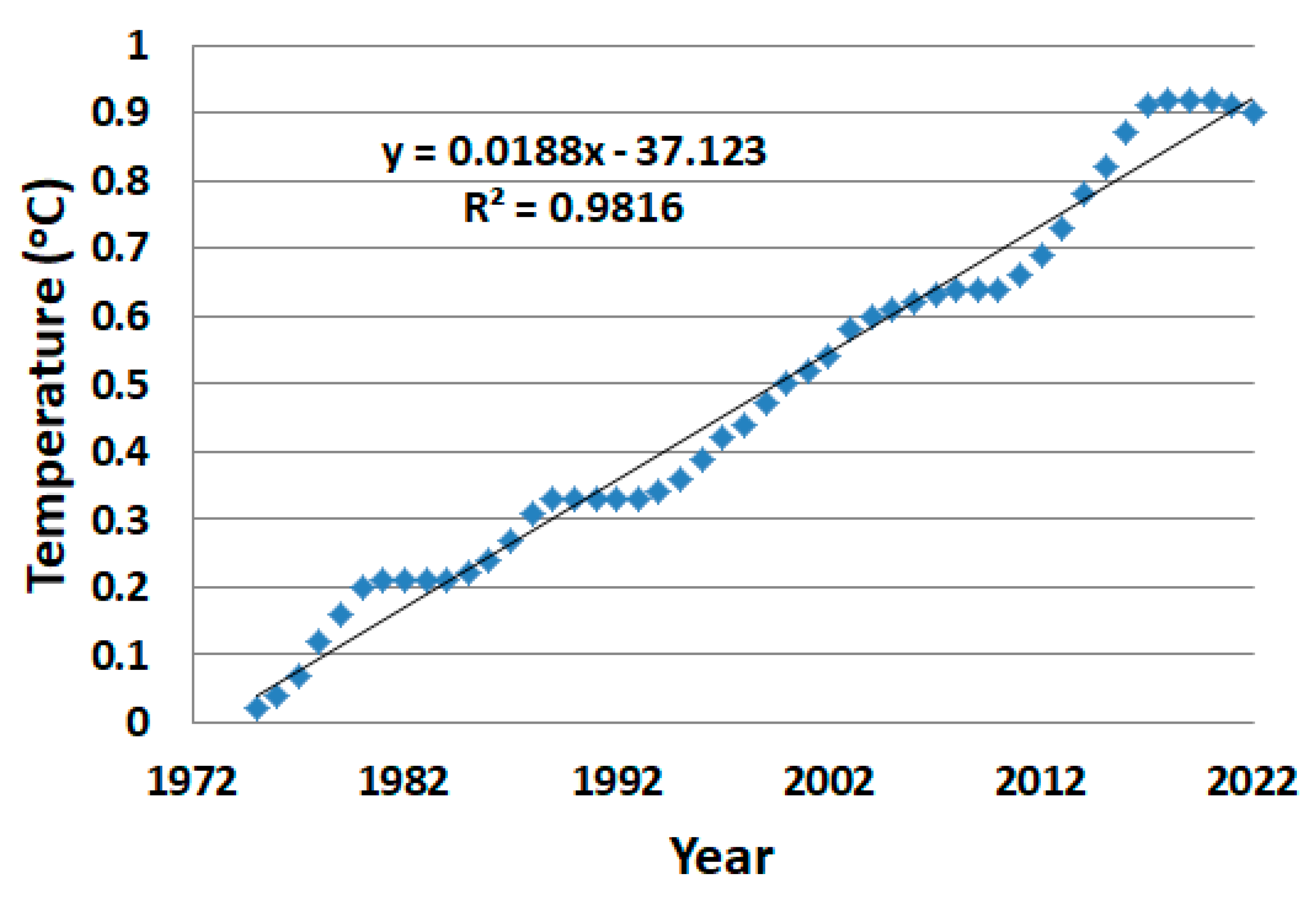

Table 1.
SO2 Injection requirements for SRM.
| Stratosphere Injection | FullReversal | Annual50%Reversal |
| ΔRTOA (Wm-2) | 1.47 | 0.01465 |
| (Mt(S)Yr-1) | 6.9 | 0.216 |
| Savings | 0.4 | 32x |
Table 2.
ASG requirements for land and space.
| Earth Brightening | Space | ||||||
| Parameters | Pavements | Desert Treatment | UHIs |
Earth (Sea) Mirrors** |
L1 Space Shading Parameters | Stratosphere Injections | |
| ΔPASG(Wm-2) | -0.01465 | -0.01465 | -0.0147 | -0.01465 | ΔPASG(Wm-2) | -0.01465 | -0.01465 |
| XS=1,XO=1,XC,= | 0.47 | 0.92 | 0.47 | 0.7 | XC=1, XS= | 4 | 1 |
| 0.3 | 0.44 | 0.1 | 0.75 | 0.7 | 0.3 | ||
| HT | 1 | 1 | 3 | 2 (1) | HT | 1 | 1 |
| 2.15 | 2.15 | 2.15 | 2.15 | 2.15 | 2.15 | ||
| Earth Brightening Minimal Results | L1 Space Disc Results | CaCO3 Injec. | |||||
| AT/AE | 0.0305% | 0.0106% | 0.031% | 0.0041%(0.0082%) | AT/AE Earth Shade | 0.00154% | 0.0144%/eff |
| AT (Mi2) | 60,035 | 20,940 | 60,035 | 8061 (16,124) | Shade AT (Mi2, km2) | 3023, 7843 | ~27,924,~74,322 |
| Radius (Mi) | 138 | 81.6 | 138 | 51 (71.6) | Shade Radius (Mi, km) | 31, 50 | ~94.3, ~153.8 |
| AT (km2) | 1.56E+05 | 5.42E+04 | 1.6E+05 | 2.1E+04 (4.2E+04) | Disc Area (Mi2, km2)* | 3023, 7843 | - |
| Radius (km) | 223 | 131 | 223 | 81.6 (115) | Disc Radius (Mi, km)* | 31, 50 | - |
*Depends on Sun-blocking efficiency of the disc and actual distance relative to L1. **Reflective particles
Table 3.
ASG potential hotspot possible requirements.
| T2, T1XC | 61°C, 33°C0.5, 0.47 |
| AF | 4.3 |
| ΔPASG(Wm-2) | -0.01465 |
| AT/AE | 0.0092% |
| AT (Mi2) | 18,011 |
| Radius (Mi) | 76 |
| AT (km2) | 0.47E+05 |
| Radius (km) | 122 |
Disclaimer/Publisher’s Note: The statements, opinions and data contained in all publications are solely those of the individual author(s) and contributor(s) and not of MDPI and/or the editor(s). MDPI and/or the editor(s) disclaim responsibility for any injury to people or property resulting from any ideas, methods, instructions or products referred to in the content. |
© 2023 by the authors. Licensee MDPI, Basel, Switzerland. This article is an open access article distributed under the terms and conditions of the Creative Commons Attribution (CC BY) license (http://creativecommons.org/licenses/by/4.0/).
Copyright: This open access article is published under a Creative Commons CC BY 4.0 license, which permit the free download, distribution, and reuse, provided that the author and preprint are cited in any reuse.


