
Submitted:
09 April 2024
Posted:
09 April 2024
You are already at the latest version
Abstract
Technology can be seen everywhere and has been integrated into our lives.We are always using technology and enjoying the convenience brought by technology. However, physical retailers and e-commerce companies are also gradually adopting advanced technologies. Technology improves the purchasing environment and purchasing experience. Virtual reality and augmented reality have been hotly discussed in recent years. Technology, although virtual reality and augmented reality technology have not yet matured, it can be said that they will in the future It has great development potential. Virtual reality and augmented reality are also beginning to sprout in the retail industry. However, research on the acceptance of the use of virtual reality and augmented reality in the apparel shopping process is still lacking because This study explores how usefulness, ease of use, hedonicity, customer experience, customer engagement and satisfaction. To influence customer loyalty, this study adopted questionnaire survey and convenience sampling methods, and collected a total of 308 valid questionnaires. The analysis method used confirmatory factor analysis and structural equation model to verify the research hypothesis relationship. The results of this study found. Hedonic has a significant impact on customer loyalty, while usefulness, ease of use, customer experience, customer engagement and satisfaction Satisfaction does not have a significant impact on customer loyalty. This study explains the academic contribution of the research results. The practical implications in marketing are put forward, and specific suggestions and directions for future research are given.
Keywords:
virtual reality
; augmented reality
; hedonic
; satisfaction
; customer loyalty
1. Introduction
Virtual reality (VR) and augmented reality (AR) have been listed as hotly discussed technology topics in 2021. Many major companies have been investing in research on augmented reality and virtual reality for many years, such as Google and Facebook., Samsung, HTC and other manufacturers, virtual reality and augmented reality have a wide range of applications, such as food introduction, virtual try-on of clothes, introduction of furniture and house space, and travel toursnline education courses, e-sports games, and medical care are all related to the applications of virtual reality and augmented reality. Thus, virtual reality and augmented reality are used so that consumers can see the surrounding environment of the house without going to the physical house. For example, digital home decoration uses virtual reality and augmented reality. Reality allows consumers to directly see the full picture of the sample house. Virtual reality and augmented reality are used to introduce tourist attractions. Although it is not yet mature in Taiwan, some industries have already had some applications.
The global development scale of VR and AR will become larger. According to analysis data from Goldman Sachs, VR and AR hardware sales revenue is estimated to reach 45 billion US dollars in 2025, while VR and AR application software sales revenue The market size is estimated to reach US$35 billion, of which online games, live streaming, and film and television entertainment account for half of the application software market size, with a market share of 54%, while medical care, engineering, retail, and education account for 46% Market size In the application software segment, 55% of global consumers believe VR and AR will be as popular as smartphones. Practical applications of VR and AR. In this study explores consumer loyalty after physical apparel retailers apply VR and AR technologies. Retailers' use of VR and AR technologies can improve customers' purchasing experience and purchase intention to understand how VR and AR technologies can increase sales for physical apparel retailers. Collect and enhance brand awareness. The purpose of this research can be summarized as: (1) to explore the influencing factors of consumer loyalty using VR and AR technologies, (2) to explore the model of customer loyalty using VR and AR technologies and (3) to provide retailers and enterprises with appropriate marketing strategies. This research process is based on first observing the development trends of VR, AR and clothing retail industries, and then discovering the research incentives.
2. Literature Review
2.1. Theoretical Background
The technology acceptance model proposed by Davis (1986) is based on the theory of reasoned action Ajzen &Fishbein (1980) was originally developed to explain whether the general public can accept information technology, the technology acceptance model has been applied in various fields, so Davis(1986) believes that the beliefs and attitudes of the technology acceptance model. The relationship between these three factors, degree and willingness, can predict consumers' acceptance of new technologies. Introducing innovation into the retail industry. New technologies, factors such as consumers' use and acceptance of new technologies, have been scientifically studied in many empirical studies. The technology acceptance model is widely adopted and used as a theoretical basis to investigate Pantano (2014), augmented AR and VR application of these two technologies in the retail market has been a hotly discussed topic in recent years. Therefore, technologyThe acceptance model is the most appropriate method to explain acceptance and future use intention Rese, Baier, Geyger-Schulz, & Schreiber (2017).
2.2. Usefulness
Davis (1986) defined perceived usefulness as “when consumers use a certain technology or system, they will increase their Consumers' work efficiency and work attitude", Yim, Chu, & Sauer (2017) pointed out that compared with the past, e-commerce media. In the model of physical marketing of goods, using augmented reality to sell goods can produce more perceived usefulness. In addition, Rese, Schreiber, & Baier (2014) also put forward a similar point of view, regarding the use of augmented reality by retailers when selling goods. In reality, just like Rese et al. used IKEA as a case in their study, IKEA operates in online shopping purchase websites. Using augmented reality, experiments have shown that after experiencing augmented reality, consumers feel that augmented reality is more useful to them. is useful.
2.3. Ease of Use
Davis (1986) defined perceived ease of use as “the amount of effort a customer makes when using a certain technology or system. for ease of use in operating the technology. Usability is also defined as the ease with which consumers use and understand the technology. Huang & Liao (2016), therefore, Venkatesh & Davis (1996) emphasized the importance of ease of use because many technologies are not easy for users to use due to the design of the operating interface. Learning and being rejected by users. Pantano & Servidio (2012) found that when consumers use VR. Consumers respond well to immersive tools for shopping in virtual environments because innovative tools are used to make consumers feel it has to be easy to use.
2.4. Hedonic
Venkatesh (2000) defines perceived enjoyment as the degree of fun experienced by using technology. The most original analysis model of the technology acceptance model focuses on practicality and ease of use, but in these years of research, perceived hedonicity is also considered to drive consumption. Sun & Zhang (2006), Kim & Forsythe (2007) stated that the hedonic value of virtual try-on technology is higher than functionality and consumers believe that the hedonic value of virtual try-on technology is higher than functionality, innovative technology. Hedonic value brought by it can more arouse their purchase intention. Kim (2016) and others show that in the application of smart technology, the perceived enjoyment of virtual fitting mirrors has a higher utility ratio for consumers. In terms of usefulness, in terms of using virtual reality, in short, theoretical and empirical research shows that the factor of perceived enjoyment is important to consumers, especially in terms of consumers' acceptance and usefulness of new technologies.
2.5. Customer Experience
Customer experience refers to the process in which consumers produce stimulating reactions after experiencing certain things and interpret this reaction. Schmitt (2010) and Carbone & Haeckel (1994) define customer experience as the consumer’s experience aftercontacting goods and services. You will feel the experience just now and form feelings and experiences. It can also be explained that experience is the result of experiencing things. Kim & Forsythe (2008) pointed out that using augmented reality to experience shopping can improve consumers' attitudes towards products and enhance brand image, thereby increasing consumers' willingness to purchase. In addition, using virtual reality in marketing activities can provide a better experience far exceeds the experience provided in general marketing activities (Hilken, Ruyter, Chylinski, Mahr, & Keeling, 2017).
2.6. Customer Participation
Participation has been a topic of discussion in many disciplines, such as social psychology and organizational behavior.However, participation is a relatively new concept in the field of marketing, so participation is considered to be developmental and is expected to contribute to consumption. Provide effective predictions and explanations for the behavioral results of the author. Prentice & Loureiro (2017) stated that customer engagement is the primary factor that determines whether customers purchase and form loyalty. However, marketers can increase customer engagement through the immersion of virtual reality, indicating that the use of augmented reality and virtual reality and the environment adds novel perspectives to retail shopping, thereby increasing consumer engagement with the retailer (Scholz & Smith,2016).
2.7. Satisfaction
Taylor & Strutton (2010) define satisfaction as a feeling that can be learned from past experiences factors that provide pleasure. Past research has also shown that satisfaction is an important indicator of customer loyalty.Dick & Basu (1994), therefore Biscaia, Rosa, Moura, & Sarrico (2017) concluded that in the retail industry In the context of, improving customer satisfaction will have a positive impact on loyalty, Gelbrich, Hagel, & Orsingher (2021) points out that technology-assisted services can increase consumer satisfaction, Research by Jiang & Benbasat (2007) also believes that consumer satisfaction will increase with the immersion in virtual reality technology. The sense of satisfaction increases as consumers feel that virtual reality becomes more realistic.
2.8. Customer Loyalty
Customer loyalty is a key goal of many marketing strategies because customer loyalty can create stable performance. Wang, Head, & Archer (2000) believe that only when retailers operateby maintaining relationships with consumers can the long-term profitability and sustainability of the market be achieved. Ameen, Hosany, & Research by Paul (2022) shows that good interface design in virtual reality and augmented reality enhances consumer loyalty. The perception of customization effectively affects loyalty to shopping malls. Similarly, Butt, Ahmad, Muzaffar, Ali, & Shafique (2021) found that consumers’ purchase intention in the field of beauty has shift from traditional purchasing experiences to the need for more immersive experiences proves consumers’ appetite for augmented reality. The technology feels satisfied, thus positively influencing consumers’ repurchase intention.
3. Research Methodology
The research model summarizes usefulness, ease of use, hedonicity, customer experience, customer participation based on literature discussion and satisfaction research aspects, and use this to discuss usefulness, ease of use, hedonicity, customer experience, customer loyalty. This study developed the following six research hypotheses based on the review of literature and the establishment of a research framework. Based on this hypothesis, empirical research is conducted to explore the mutual influence relationship between various variables in the research hypotheses.
3.1. Research Hypotheses
Rese, Baier, Geyer-Schuiz, & Schreiber (2017) show that perceived usefulness will affect consumers’ attitude and willingness to use augmented reality. From this, it can be speculated that usefulness may affect customer loyalty, so it is speculated that the "usefulness" of virtual reality and augmented reality has a positive relationship with customer loyalty.
H1: The usefulness of virtual reality and augmented reality has a positive relationship with customer loyalty.
Chi (2018) showed that consumers purchase clothes on e-commerce platforms, and the ease of use of website operations will affect whether consumers are willing to buy clothes on e-commerce platforms. Therefore, it is speculated that virtual reality and augmented reality The ease of use of the environment has a positive relationship with customer loyalty. Lee, Kim, & Choi (2019) research shows how consumers accept virtual reality devices.
H2: The ease of use of virtual reality and augmented reality has a positive relationship with customer loyalty.
It is found that hedonicity has a significant impact on consumers’ willingness to use them. Therefore, the immersive experience provided by virtual reality technology. The feeling of hedonicity of the environment can create unforgettable experiences for consumers and stimulate consumers' desire to return again (Kim, So, Mihalik, & Lopes, 2021). Therefore, it is speculated that the "hedonicity" of virtual reality and augmented reality” has a positive relationship with “customer loyalty”.
H3: The hedonicity of virtual reality and augmented reality has a positive relationship with customer loyalty.
The immersion of virtual reality and augmented reality has a significant impact on customer experience, thereby increasing customers’ repurchase intention and loyalty (Peukert, Pfeiffer, & Weinhardt, 2019), and experiential use in the fashion industry Shopping technologies such as virtual try-on can generate word-of-mouth benefits and loyalty (Alexander & Kent, 2020). Therefore, it is speculated that the customer experience of virtual reality and augmented reality has a positive relationship with "customer loyalty".
H4: The customer experience of virtual reality and augmented reality has a positive relationship with customer loyalty.
Finn, McQuitty, & Rigby (1994) found that customer participation will affect the time consumers stay in the store, which means that the immersive experience of virtual reality and augmented reality can arouse consumers' interest and make consumers Willing to spend time experiencing and shopping and patronizing again, the research results of McLean & Wilson (2019) and Arghashi & Yuksel (2022) confirmed that customer participation in virtual reality and augmented reality has a significant impact on customer loyalty. Therefore, it is speculated that virtual reality customer engagement with augmented reality has a positive relationship with customer loyalty.
H5: The customer engagement of virtual reality and augmented reality has a positive relationship with customer loyalty.
Poushneh & Vasquez-Parraga (2017) research results show that augmented reality experience has a positive impact on consumers, thereby improving consumer satisfaction and loyalty. Hudson, Matson-Barkat, Pallamin, & Jegou ( 2019) also found that the immersion of virtual reality affects the customer satisfaction and loyalty of consumer experience. Therefore, it is speculated that the satisfaction of virtual reality and augmented reality has a positive relationship with "customer loyalty".
H6: The customer satisfaction of virtual reality and augmented reality has a positive relationship with customer loyalty.
3.2. Scale Measurement
This study obtained primary data through a questionnaire survey, and then conducted subsequent statistics based on this primary data. The questionnaire of this study was developed based on the research structure and reference to past literature. The questionnaire content includes the following eight parts: The first part is about the application of virtual reality and the application of virtual reality to the subjects when purchasing clothing. The research is a total of 6 questions on the perceived usefulness of augmented reality, numbered 1 to 6; the second part is for the subjects There are 5 questions in total regarding the perceived ease of use of virtual reality and augmented reality when purchasing clothing. No. 7~11; The third part is about the hedonic effects of virtual reality and augmented reality on subjects’ purchase of clothing. There are 6 questions in total, numbered 12~17; the fourth part is to understand the impact of this question on customer experience. There are a total of 5 questions on the impact of virtual reality and augmented reality on subjects' purchase of clothing. 18~22; The fifth part is to understand the question of customer participation and the application of virtual reality to subjects when purchasing clothing. and the impact of augmented reality, there are 5 questions in total, numbered 23~27 respectively; the sixth part is to understand the issue of satisfaction The questions have a total of 5 questions on the impact of virtual reality and augmented reality on subjects’ purchase of clothing. Question numbers 28~32; The seventh part is to understand the subjects’ opinions on the application of virtual reality and augmented reality in purchasing clothing.Regarding the degree of customer loyalty, there are 5 questions in total, numbered 33~37 respectively; the eighth part is for the subjects to conduct personal basic tests. Fill in the information, fill in the amount and number of purchases of clothing, and fill in the number of times you have experienced virtual reality and augmented reality, a total of 8 questions, totaling 45 questions in the questionnaire.
The measurement scale of this study adopts the seven-point Likert scale proposed by Bollen (1989) to measure the score of each question. Each question is divided into strongly disagree, disagree, slightly disagree, normal, slightly agree, and agree. , strongly agree, and give scores from 1 to 7 respectively. The subjects will fill in the corresponding scores according to their feelings. The higher the score filled in by the subjects, the higher the degree of agreement with the question and the more capable they are. Understand how subjects feel about using virtual reality and augmented reality to purchase clothing.
3.3. Data Analysis Methods
After the questionnaires are collected in this study, quantitative coding will be carried out and SPSS21 and AMOS26 statistical software will be used. It is an analytical tool to analyze the relationship between the variables of this study and test the aforementioned research hypotheses. The study used narrative statistical analysis, reliability analysis, factor analysis and structural equation analysis.
4. Empirical Results
4.1. Sample Analysis
This study is based on the collected valid questionnaires on gender, age, education, income, occupation, virtual reality. Demographic variables such as the number of environments and augmented reality experiences, the number of apparel purchases, and the amount of apparel purchases were processed. Various sample structure statistics were conducted. Among the 308 valid questionnaires, women accounted for the majority, accounting for 74%. The age group is dominated by those aged 19-24, accounting for 44.5%, with education levels ranging from university to junior college. The largest number of respondents were those with a bachelor's degree, accounting for 49.7%. The largest number of respondents had an average monthly income of less than 15,000. More, accounting for 39%, followed by 25,000 to 35,000, accounting for 20.1%. Those who answered in terms of occupation Most of them are students, accounting for 49%. The number of VR and AR experiences is the largest among those who have experienced it 1 to 2 times. Many, accounting for 44.2%, and the largest proportion of people who buy clothing 3 to 4 times and 7 or more times a year on average are29.2%, the average amount spent on each clothing purchase is 501-1500 yuan, accounting for 29.2%. 34.1%. The distribution of basic characteristics of the sample is as Table 1.
4.2. Reliability Analysis
This study uses Cronbach's alpha coefficient as the standard to measure reliability, and conducts internal to test consistency and stability, Nunnally (1978) pointed out that Cronbach's ÿ coefficient value is higher than 0.7.The reliability of the table is within an acceptable range, and the measurement items representing the facets have a high degree of internal consistency, Table 2 shows that the Cronbach's ÿ coefficient of each aspect of this study is greater than 0.8, which means that the reliability of the research constructs is very credible. (please see Table 2).
4.3. Factor Analysis
Before conducting factor analysis, KMO and sphericity tests are first used to check whether the facet data is suitable for analysis. When conducting factor analysis, Kaiseer said that if the KMO value is greater than 0.8, it means that the appropriateness is good and suitable for factor analysis. If the p value of the sphericity test is less than 0.05, it means that factor analysis is suitable, and the factor loading is absolutely If the value is lower than 0.5, it means that the question does not have convergent validity and will be deleted, so delete the third question on usefulness to fit the final model. The following is the KMO value of each aspect factor analysis and Bartlett's sphericity test. The variables of KMO in this study are all greater than 0.8, which meets the verification standard, while the P values of the spherical verification are all 0.000, reaching the significant standard. Table 3 shows the results of factor analysis.
4.4. Structural Equation Model Analysis
This study uses AMOS 26 statistical software to conduct structural equation model analysis. Before analysis, it is necessary to measure the overall fit of the structural equation. The fit can be used to understand the research model and this study.Is the questionnaire survey data consistent? If the data is more consistent with the representative model, the research will have a good overall fit and use path analysis to test whether the path coefficient of the variable is significant, and thereby verify the research hypothesis. Hair et al. (1998) divided the structural equation into three dimensions, namely absolute fit, relative fit and streamlined fit. Table 4 shows the model fit results.
Structural equation modeling (SEM) is an analytical tool often used to explore causal relationships in science and social research because. Structural equation patterns can explore causal relationships between multiple variables that cannot be directly observed, while structural equation patterns. The research includes analysis methods such as factor analysis and path analysis. LISREL and AMOS are the two statistical software with the highest usage rates, so this study uses AMOS 26 statistics software to perform structural equation model analysis . The hypothesis testing results of this study found that H3 and H6 hypotheses. However, H1, H2, H4 and H5 are not supported. Please see Table 5 for details.
5. Discussion and Management Implications
The relationship between the usefulness of virtual reality and augmented reality and customer loyalty. The study shows that the research hypothesis H1: "The usefulness of virtual reality and augmented reality has an impact on The empirical result that "customer loyalty has a positive relationship" is not established. From this, we can understand that in the fashion industry The usefulness of virtual reality and augmented reality does not increase customer loyalty. Chen et al. (2020) pointed out the usefulness of augmented reality will significantly increase consumer loyalty and perception. Rese et al. (2017) shows that usefulness will affect consumers’ attitude towards using augmented reality, which is contrary to the results of this study. The conclusion drawn from the study is that in the process of purchasing clothing, even if there are virtual reality and augmented reality, consumers improve purchasing efficiency will not increase consumer loyalty, perhaps because virtual reality and augmented reality
Augmented reality technology is still in a developing stage, and most consumers surveyed in this study only I have experienced this technology 1 to 2 times, so my experience with the technology is not widespread yet, so I cannot be more comprehensive. A comprehensive understanding of the benefits brought by virtual reality and augmented reality. The relationship between the ease of use of virtual reality and augmented reality and customer loyalty. The results of this study show that research hypothesis H2: "The relationship between the ease of use of virtual reality and augmented reality The empirical result that "customer loyalty has a positive relationship" is not established, indicating that virtual reality and expansion in the fashion industry The ease of use of augmented reality will not increase customer loyalty, which is consistent with the relationship.
Research results shows that the ease of use of augmented reality affects loyalty shows the opposite. But compared with Shen et al. (2022) The results are consistent, indicating that the ease of use of virtual reality and augmented reality operations does not affect usage attitudes. This can probably be explained by the fact that most of the survey subjects in this study are young people, and young people have poor attitudes towards the operation of technology. Relatively familiar with and have more knowledge about virtual reality and augmented reality technology, so virtual reality and the easy-to-operate nature of augmented reality will not be an inducement to increase customer loyalty.
The results of customer loyalty are the same as Dick et al. (1994), which shows that the satisfaction generated by the assistance of virtual reality and augmented reality in the process of purchasing clothing affects consumer loyalty. Like previous studies, satisfaction will increase consumer loyalty. In this study, it can be understood that the satisfaction generated by consumers having technological assistance in the process of purchasing clothing will increase consumer loyalty.
Enhance the fun of usefulness and ease of use, and enhance consumers’ understanding of virtual reality and augmented reality loyalty of contextual applications in the fashion industry. The empirical results of this study show that ease of use and usefulness do not affect customer loyalty. It can be understood that in this millennial generation, the operation of technology and the convenience it brings are common to us and will not be affected by it. Virtual reality and augmented reality operations are easy to use and can improve efficiency, which will generate loyalty to businesses that use virtual reality and augmented reality. This is because consumers feel that the technology is easy to operate and can improve the current situation. This is the most basic thing, so if you want consumers to be impressed by the operation of virtual reality and augmented reality, you can make some changes in the operation, such as when consumers enter the interface of virtual reality and augmented reality. At the same time, we can design some situations or go through levels to explain the operating rules to consumers and interact with them, allowing consumers to immerse themselves in the virtual world. In this way, the ease of use and usefulness will become interesting and thoughtful because the operation surface becomes interesting. Using virtual reality and augmented reality again to buy clothes possible.
Strengthen customer experience and sense of participation, meet consumer needs and enhance interactivity, and enhance consumer loyalty to the application of virtual reality and augmented reality in the fashion industry. The immersion provided by virtual reality and augmented reality sense, helping to enhance customer experience and sense of participation. However, you can also have a better shopping experience compared with traditional merchants. Since you use virtual reality and augmented reality. There will be a better shopping experience after the border. At this time, companies should think about what kind of experience can satisfy consumers. What consumers need to meet their expectations for virtual reality and augmented reality. What are some of them?An experience that cannot be enjoyed by physical shopping, but can be achieved with the application of virtual reality and augmented reality technology A different experience, for example, it can be combined with artificial intelligence to recommend consumers through big data analysis.
What kind of clothing is suitable and recommended clothing combinations, so that consumers not only experience virtual reality and reality and augmented reality gain entertainment value and practical value at the same time. Perhaps through such an experience It can allow consumers to be more involved in shopping in virtual reality and augmented reality, thereby influencing consumers to want to go back to shopping. Your patronage may result in referrals to others.
Enhance the hedonic nature of virtual reality and augmented reality to facilitate retailers and enterprises to develop appropriate business models. The empirical results of this study show that hedonic nature has a significant impact on customer loyalty. It can be seen that in consumption Most of the entertainment effects brought to them by virtual reality and augmented reality are in the minds of readers, so it can also positively affect repurchase intention, so we can attract consumers' attention towards the interestingness of virtual reality and augmented reality, increase the discussion of virtual reality and augmented reality applications in the fashion industry, and To create word-of-mouth benefits, we can combine Taiwan’s fashion shows and use virtual reality and augmented reality to bring consumers into the virtual fashion show, thereby creating topics and making virtual reality and augmented reality interesting. Or integrate online and offline channels to provide virtual reality and augmented reality try-on experiences online. After the online experience, you can enjoy discounts but need to go to a physical store to purchase clothing. This way, online customers can bringing it to the offline experience, and through physical services, consumers can feel a sense of belonging to the store and become loyal. You can also design interesting people, things or brand concepts on clothes, scan them through the exclusive app, and use the principles of augmented reality to understand the brand story or concept, or use a virtual reality head-mounted device to experience it. The 360-degree view provided by virtual reality allows you to understand brand stories or concepts, making the original boring brand concepts vivid and interesting, arousing consumer resonance and forming customer loyalty.
6. Conclusion and Research Limitations
The model established in this study is to explore the impact of usefulness, ease of use, hedonicity, customer experience, customer participation and satisfaction on customer loyalty. After structural equation analysis, hedonicity and customer loyalty are obtained Degree is significantly related, while usefulness, ease of use, customer experience, customer participation and satisfaction are not significantly related to customer loyalty. The ease of use and usefulness of virtual reality and augmented reality do not affect consumers’ loyalty to apparel merchants. Therefore, we can understand whether the operations of virtual reality and augmented reality are easy to use and whether they save consumption. Improving the shopping efficiency of consumers by increasing their shopping time will not make consumers loyal to clothing merchants and make them purchase again or recommend them to others.
The hedonic nature of virtual reality and augmented reality has a significant impact on customer loyalty. Virtual reality and augmented reality are emerging entertainment technologies for consumers and can be different from other technologies. For example, with the sense of entertainment brought by artificial intelligence, consumers may believe that the hedonic nature of virtual reality and augmented reality can reduce the stress of daily life and bring them unprecedented experiences, thus making consumers loyal to apparel merchants. , recommend merchants that use virtual reality and augmented reality to others or have the possibility of repeat purchases. The experience and sense of participation in virtual reality and augmented reality do not affect consumers’ loyalty to apparel merchants. We can understand consumers’ feelings after the experience and the immersion in virtual reality and augmented reality. The immersive feeling will not make consumers want to return to this clothing store to buy again, and will reduce their loyalty to clothing merchants. Satisfaction with virtual reality and augmented reality affects consumers’ loyalty to apparel merchants. It means that the satisfaction after experiencing virtual reality and augmented reality will prompt consumers to increase their loyalty to apparel merchants.
After collecting and analyzing online questionnaires, this study found that the age distribution of the samples fell between 19 and 24 years old, and most of them were students or young adults. The age distribution of the collected samples was not broad enough. Moreover, the male-to-female ratio is also unbalanced. Girls account for the majority and there are fewer male subjects, which cannot effectively represent the overall consumer attitude towards virtual reality and augmented reality.The survey of this study is mainly based on online sampling questionnaires, targeting consumers who are interested in virtual reality and augmented reality. Online sampling may not be representative of the sample and may cause errors. possible, resulting in limited inference results. Many factors related to variables affecting customer loyalty, and it is impossible to discuss the impact of each variable on customer loyalty one by one. This study can only speculate on the variables based on past literature, focusing on usefulness, ease of use, hedonicity, customer experience , customer participation and satisfaction as research variables. Due to the impact of the epidemic, all questionnaires for this study were conducted online. When doing so, we should strive to obtain true responses and collect questionnaires from different ethnic groups. Otherwise, we cannot accurately control the filling of questionnaires. The background and consumption status of the respondents lead to uneven quality of the questionnaire, which affects the authenticity of the data analysis results. Since the backgrounds and demographic variables of the subjects surveyed in this study are generally very similar, future research can collect data on consumers in different occupations or different regions, making the collection of samples Wider and more representative. This study focuses on usefulness, ease of use, hedonicity, customer experience, customer participation and satisfaction. However, in addition to these variables, there should be other variables that will affect customer loyalty, which may Variables will be affected over time or changes in consumers' consumption patterns, so it is recommended that future research conduct interviews with consumers before research in order to find out the variables that more comprehensively affect customer loyalty. Discussion on virtual reality and augmented reality in other industries. This study takes the fashion industry to explore the impact of virtual reality and augmented reality on customer loyalty as the research topic.
It is recommended that subsequent research can conduct research on customer loyalty in virtual reality and augmented reality in other industries, and compare whether there are differences in the empirical results between different industries. This study uses the technology acceptance model to explore the impact of virtual reality and augmented reality on customer loyalty. However, it can be reflected on whether the ease of use and usefulness of the technology acceptance model are really true. In line with today's consumers, with the development of information and the popularization of technology, usefulness and ease of use may have become basic and necessary functions. Therefore, subsequent research should consider the practicality of the technology acceptance model or make corrections and improvements.
Funding: The author acknowledges and is grateful for the financial support the National Science and Technology Council, Taiwan, under grant 118-2410-H-005-012.
References
- Ajzen, I. & Fishbein, M. (1980). Understanding attitudes and predicting social behavior. Prentice-hall,278.
- Alexander, B.; Kent, A. Change in technology-enabled omnichannel customer experiences in-store. J. Retail. Consum. Serv. 2020, 65, 102338. [Google Scholar] [CrossRef]
- Ameen, N.; Hosany, S.; Paul, J. The personalisation-privacy paradox: Consumer interaction with smart technologies and shopping mall loyalty. Comput. Hum. Behav. 2021, 126, 106976. [Google Scholar] [CrossRef]
- Bollen, K. A. (1989). Structure equations with latent variables. New York: john wiley.
- Biscaia, A.R.; Rosa, M.J.; e Sá, P.M.; Sarrico, C.S. Assessing customer satisfaction and loyalty in the retail sector. Int. J. Qual. Reliab. Manag. 2017, 34, 1508–1529. [Google Scholar] [CrossRef]
- Butt, A.; Ahmad, H.; Muzaffar, A.; Ali, F.; Shafique, N. WOW, the make-up AR app is impressive: a comparative study between China and South Korea. J. Serv. Mark. 2021, 36, 73–88. [Google Scholar] [CrossRef]
- Carbone, L. P. , Haeckel, S. H.(1994).Engineering customer experiences. Market Management,3(3),8-19.
- Chi, T. Understanding Chinese consumer adoption of apparel mobile commerce: An extended TAM approach. J. Retail. Consum. Serv. 2018, 44, 274–284. [Google Scholar] [CrossRef]
- Davis, F. (1986). A technology acceptance model for empirically testing new end-user information systems : theory and results. Massachusetts Institute of Technology,233-250.
- Dick, A.S.; Basu, K. Customer Loyalty: Toward an Integrated Conceptual Framework. J. Acad. Mark. Sci. 1994, 22, 99–113. [Google Scholar] [CrossRef]
- Finn, A.; McQuitty, S.; Rigby, J. Residents' acceptance and use of a mega-multi-mall: West Edmonton Mall evidence. Int. J. Res. Mark. 1994, 11, 127–144. [Google Scholar] [CrossRef]
- Gelbrich, K.; Hagel, J.; Orsingher, C. Emotional support from a digital assistant in technology-mediated services: Effects on customer satisfaction and behavioral persistence. Int. J. Res. Mark. 2020, 38, 176–193. [Google Scholar] [CrossRef]
- Huang, T.-L.; Liao, S. A model of acceptance of augmented-reality interactive technology: the moderating role of cognitive innovativeness. Electron. Commer. Res. 2014, 15, 269–295. [Google Scholar] [CrossRef]
- Hilken, T.; de Ruyter, K.; Chylinski, M.; Mahr, D.; Keeling, D.I. Augmenting the eye of the beholder: exploring the strategic potential of augmented reality to enhance online service experiences. J. Acad. Mark. Sci. 2017, 45, 884–905. [Google Scholar] [CrossRef]
- Hudson, S.; Matson-Barkat, S.; Pallamin, N.; Jegou, G. With or without you? Interaction and immersion in a virtual reality experience. J. Bus. Res. 2018, 100, 459–468. [Google Scholar] [CrossRef]
- Jiang, Z.; Benbasat, I. Research Note—Investigating the Influence of the Functional Mechanisms of Online Product Presentations. Inf. Syst. Res. 2007, 18, 454–470. [Google Scholar] [CrossRef]
- Kim, J.; Forsythe, S. Hedonic usage of product virtualization technologies in online apparel shopping. Int. J. Retail. Distrib. Manag. 2007, 35, 502–514. [Google Scholar] [CrossRef]
- Kim, J.; Forsythe, S. Adoption of Virtual Try-on technology for online apparel shopping. J. Interact. Mark. 2008, 22, 45–59. [Google Scholar] [CrossRef]
- Kim, H.-Y.; Lee, J.Y.; Mun, J.M.; Johnson, K.K.P. Consumer adoption of smart in-store technology: assessing the predictive value of attitude versus beliefs in the technology acceptance model. Int. J. Fash. Des. Technol. Educ. 2016, 10, 26–36. [Google Scholar] [CrossRef]
- Kim, H.; So, K.K.F.; Mihalik, B.J.; Lopes, A.P. Millennials’ virtual reality experiences pre- and post-COVID-19. J. Hosp. Tour. Manag. 2021, 48, 200–209. [Google Scholar] [CrossRef]
- Lee, J.; Kim, J.; Choi, J.Y. The adoption of virtual reality devices: The technology acceptance model integrating enjoyment, social interaction, and strength of the social ties. Telematics Informatics 2018, 39, 37–48. [Google Scholar] [CrossRef]
- McLean, G.; Wilson, A. Shopping in the digital world: Examining customer engagement through augmented reality mobile applications. Comput. Hum. Behav. 2019, 101, 210–224. [Google Scholar] [CrossRef]
- Nunnally, J. C. (1994). Psychometric theory 3E. Tata McGraw-hill education.
- Pantano, E.; Servidio, R. Modeling innovative points of sales through virtual and immersive technologies. J. Retail. Consum. Serv. 2012, 19, 279–286. [Google Scholar] [CrossRef]
- Pantano, P. (2014). Innovation drivers in retail industry. International Journal of Information Management,34(3),344-350.
- Prentice, C.; Loureiro, S.M. An asymmetrical approach to understanding configurations of customer loyalty in the airline industry. J. Retail. Consum. Serv. 2017, 38, 96–107. [Google Scholar] [CrossRef]
- Poushneh, A. , & Vasquez-Parraga, A. Z.(2017).Discernible impact of augmented reality on retail customer's experience, satisfaction and willingness to buy. Journal of Retailing and Consumer services,34,229-234.
- Peukert, C.; Pfeiffer, J.; Meißner, M.; Pfeiffer, T.; Weinhardt, C. Shopping in Virtual Reality Stores: The Influence of Immersion on System Adoption. J. Manag. Inf. Syst. 2019, 36, 755–788. [Google Scholar] [CrossRef]
- Rese, A. , Schreiber, S., and Baier, D.(2014).Technology acceptance modeling of augmented reality at the point of sale: Can surveys be replaced by an analysis of online reviews? Journal of Retailing and Consumer Services,21(5),869-876.
- Rese, A.; Baier, D.; Geyer-Schulz, A.; Schreiber, S. How augmented reality apps are accepted by consumers: A comparative analysis using scales and opinions. Technol. Forecast. Soc. Chang. 2017, 124, 306–319. [Google Scholar] [CrossRef]
- Sun, H.; Zhang, P. The role of moderating factors in user technology acceptance. Int. J. Human-Computer Stud. 2006, 64, 53–78. [Google Scholar] [CrossRef]
- Schmitt, B. (2010). Experiential marketing. Journal of Marketing Management,15,53-67.
- Scholz, J.; Smith, A.N. Augmented reality: Designing immersive experiences that maximize consumer engagement. Bus. Horizons 2016, 59, 149–161. [Google Scholar] [CrossRef]
- Taylor, D.G.; Strutton, D. Has e-marketing come of age? Modeling historical influences on post-adoption era Internet consumer behaviors. J. Bus. Res. 2010, 63, 950–956. [Google Scholar] [CrossRef]
- Venkatesh, V. , & Davis, F. D.(1996).A model of the antecedents of perceived ease of use: development and test. Journal of Decision Sciences,27,451-481.
- Venkatesh, V. (2000).Determinants of Perceived Ease of Use: Integrating control,intrinsic motivation, and emotion into the technology acceptance model. Journal of Information Systems Research,11(4),342-365.
- Wang, F. , Head, M., & Archer, N.(2000).A relationshipÿbuilding model for the web retail marketplace. Internet Research,10(5),374-384.
- Yim, M.Y.-C.; Chu, S.-C.; Sauer, P.L. Is Augmented Reality Technology an Effective Tool for E-commerce? An Interactivity and Vividness Perspective. J. Interact. Mark. 2017, 39, 89–103. [Google Scholar] [CrossRef]

Table 1.
Sample characteristics.
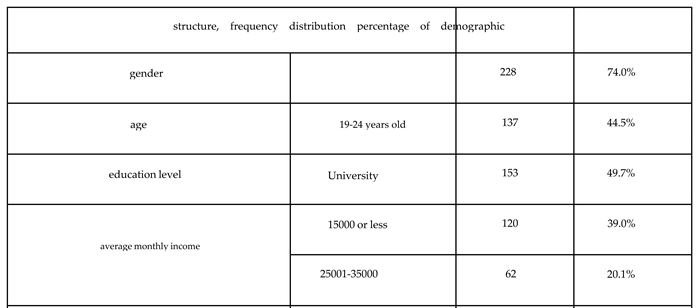
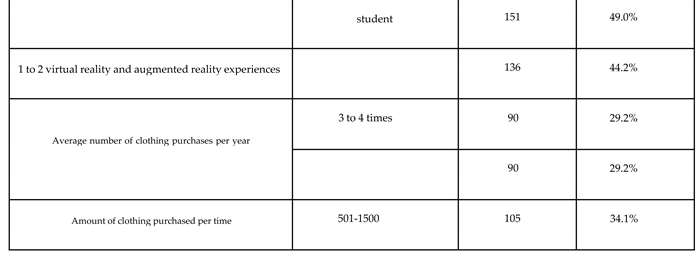
Table 2.
Reliability analysis of research constructs.
| Project | Cronbach’ | Items |
|---|---|---|
| usefulness | 0.875 | 6 |
| Ease of use | 0.852 | 5 |
| Hedonic | 0.927 | 6 |
| customer experience | 0.901 | 5 |
| customer engagement | 0.891 | 5 |
| Satisfaction | 0.931 | 5 |
| customer loyalty | 0.931 | 5 |
Table 3.
The results of factor analysis.
| Project | SME | Bartlett's Ball Test | Variance |
|---|---|---|---|
| usefulness | 0.864 | 0.000 | 0.67 |
| Ease of use | 0.832 | 0.000 | 0.64 |
| Hedonic | 0.891 | 0.000 | 0.74 |
| customer experience | 0.875 | 0.000 | 0.72 |
| customer engagement | 0.853 | 0.000 | 0.70 |
| Satisfaction | 0.900 | 0.000 | 0.79 |
| customer loyalty | 0.862 | 0.000 | 0.78 |
Table 4.
Model fit in the research.
| Index | Results | standard |
|---|---|---|
| Chi-square of freedom | 2.590 | Excellent |
| RMSEA | 0.72 | Good |
| GFI | 0.76 | Good |
| AGFI | 0.72 | Good |
| NFI | 0.85 | Good |
| RFI | 0.84 | Good |
| IFI | 0.91 | Excellent |
| CFI | 0.91 | Excellent |
| PNFI | 0.77 | Excellent |
| PGFI | 0.82 | Excellent |
Table 5.
Path analysis results.
| Research hypotheses | Path | P-Value | Significant |
|---|---|---|---|
| H1: Usefulness → loyalty | + | 0.529 | No. |
| H2: Ease of use→ loyalty | + | 0.061 | No. |
| H3: Hedonic→ loyalty | + | 0.000 | Support |
| H4: Customer experience→ loyalty | + | 0.993 | No. |
| H5: Customer engagement→ loyalty | + | 0.246 | No. |
| H6: Satisfaction→ loyalty | + | 0.011 | Support |
Disclaimer/Publisher’s Note: The statements, opinions and data contained in all publications are solely those of the individual author(s) and contributor(s) and not of MDPI and/or the editor(s). MDPI and/or the editor(s) disclaim responsibility for any injury to people or property resulting from any ideas, methods, instructions or products referred to in the content. |
© 2024 by the author. Licensee MDPI, Basel, Switzerland. This article is an open access article distributed under the terms and conditions of the Creative Commons Attribution (CC BY) license (https://creativecommons.org/licenses/by/4.0/).
Copyright: This open access article is published under a Creative Commons CC BY 4.0 license, which permit the free download, distribution, and reuse, provided that the author and preprint are cited in any reuse.


