

Submitted:
17 July 2023
Posted:
19 July 2023
You are already at the latest version
Abstract
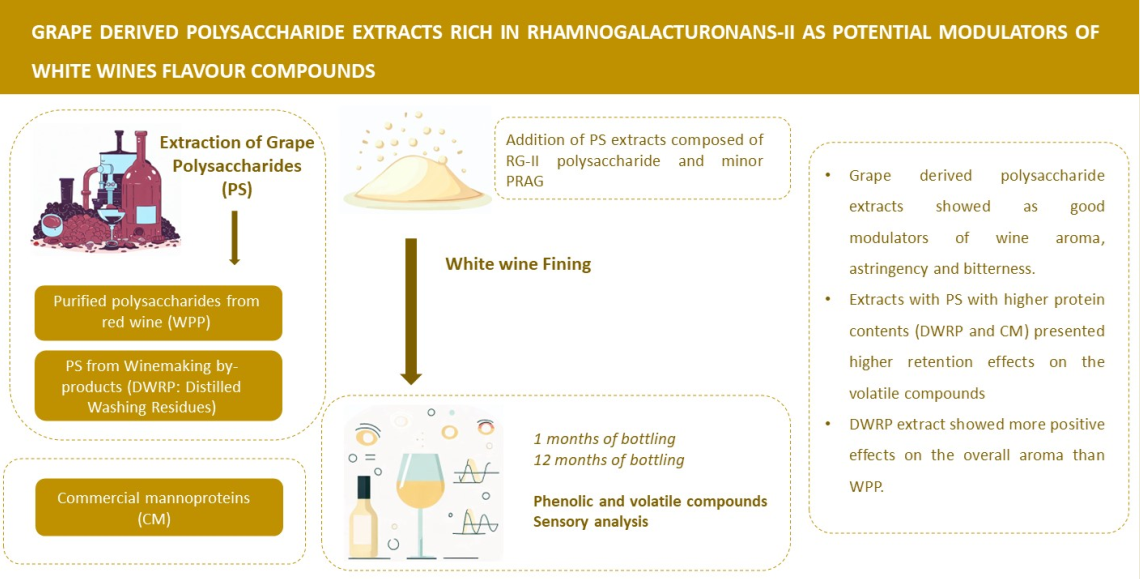
Most authors have investigated the role of mannoproteins on wine quality but very few analyze the use of grape derived polysaccharides as they are not commercially available. Purified grape derived polysaccharides from red wine (WPP) and winemaking by-products (DWRP: Distilled Washing Residues Polysaccharides) were used as potential fining agents to modulate white wine flavour. Phenolics and volatile compounds were analyzed in control and wines treated with WPP, DWRP and commercial mannoproteins (CM) after one and twelve months of bottling, and a sensory analysis was conducted. WPP and DWRP, rich in rhamnogalacturonans-II, showed as good modulators of wine aroma and astringency. Improvement of wine aroma was related to an increase of all volatile families expect higher alcohols and volatile acids. The modulation of astringency and bitterness was related to a reduction in the proanthocyanidin content and its mean degree of polymerization. Extracts with polysaccharides with higher protein contents presented higher retention of volatile compounds, and DWRP extract showed more positive effects on the overall aroma. Our novel results open the possibility of obtaining valuable polysaccharides from distilled washing residues of wine-pomaces, which could promote its valorization as by-product. This is the first time to describe the potential use of this by-product.
Keywords:
rhamnogalacturonans type II (RG-II)
; mannoproteins (MP)
; polysaccharides rich in arabinose and galactose (PRAG)
; winemaking by-products
; volatiles
; phenols sensory quality
1. Introduction
One of the key factors that greatly affect the final product in winemaking is the use of fining agents. Fining agents are widely used in the wine industry to stabilize, clarify and modify the wine's sensory properties. The fining agent reacts with wine components either chemically or physically, to remove unwanted particles and impurities. These agents can improve color, flavour, aroma, and texture of the wine since they bind or adsorb particulate matter [1]. However, the choice of the fining agent and the amount used can have a significant effect on the wine's sensory properties and overall quality. Therefore, it is important to know the effects of the different fining agents and optimize their use to produce high-quality wines that meet consumer expectations. This operation frequently uses proteins of animal origin as gelatin, egg albumin, casein and fish proteins. Nevertheless, the allergenic potential of the animal proteins has supposed an increased interest in the development of alternative solutions. These may include the addition of proteins obtained from plants, such as those derived from potatoes, cereals, legumes or grape seeds. Additionally, non-proteinaceous plant-based substances, such as cell wall polysaccharides and pomace materials, have also emerged as potential alternatives to animal proteins for wine fining treatments [2].
From these cell wall polysaccharides, mannoproteins (MP) are preferred over other fining agents due to their commercial availability and their ability to effectively remove unwanted particles without significantly affecting the sensory properties of the wines. MP are a group of glycoproteins naturally present in wine which arise from the yeast cell walls [3,4]. MP have proved to improve wine sensory properties such as aroma [5,6,7,8] and mouthfeel [9,10], enhancing the perception of body and texture in wine, as well as increasing color [9], and protein and tartrate stability [11]. These products are specially recommended in white wines to protect aroma and enhance complexity, increasing the perception of fruity aromas and their intensity, and refreshing the aromatic potential of already oxidized wines [8,12].
Although grape and wine polysaccharides (PS) also affect wine sensory quality and chemical composition [13,14,15,16,17,18,19], they are not commercially available and there is very little research evaluating their potential uses in real wine samples. An arabinogalactan protein (AGP) isolated from a Carignan noir red wine enhanced the volatility of some volatile compounds while rhamnogalacturonan type II (RG-II) polysaccharides decreased the volatility of some esters in model systems [16]. Arabinogalactan (AG) has also been reported to interact with other macromolecules in the wine matrix, such as tannins, forming complexes which produce extra hydrophobic regions resulting in the retention of volatile compounds [18]. Moreover, AG and RG-II can modulate tannin self-aggregation, with a direct impact on the wine mouthfeel, body, and astringency perception [13,14,15,17]. Moreover, a recent study of our workgroup used polysaccharides obtained from grape pomace and must during wine deposit storage, and observed an improvement of some wine properties as volatile and polysaccharide composition [19]. Considering the different results obtained in some studies [20], it is essential to investigate the effects of grape polysaccharide on real wine samples instead of model systems.
Grape polysaccharides arise from the cell walls of grape berries and include non-pectic polysaccharides like celluloses and hemicelluloses, and pectic polysaccharides like rhamnogalacturonans type I and II (RG-I and RG-II), homogalacturonans (HG), and polysaccharides rich in arabinose and galactose (PRAG), which include arabinans and arabinogalactans (AG), and arabinogalactan proteins (AGP). RG-II dimer is a complex pectic polysaccharide of the cell walls of all higher plants [21]. It shows molecular weights of 10 kDa [6] and a complex structure of glycosyl residues [20]. Despite its widespread presence in higher plants, RG-II molecules are difficult to extract as they involve several extraction steps, and therefore are not commercially available. PRAG are glycoproteins composed of proteins (~ 10 %) and polysaccharides rich in arabinose and galactose (~ 90 %) [22]. HG consists of α-1,4 D-galacturonic acid residues, which can be methyl-esterified or acetylated and bonded with calcium cations to create crosslinking bridges [23]. Both RG-II and PRAG are present in high amounts in wines, with contents up to 300 and 600 mg L-1, respectively [24]. Although HG can be identified in musts after grape crushing, few HG are present in the final wines as they might undergo fragmentation by grape or yeast poly-galacturonases.
Previous researches of our group have developed extraction methods to obtain valuable active polysaccharides from grape pomaces [25], and have characterized polysaccharide extracts obtained from grape pomace, musts, wines, lees and other by-products [26]. This paper aims to evaluate the potential use of highly purified polysaccharide extracts rich in RG-II as fining agents to modulate the flavour composition and sensory properties of white wines. It describes the use of two PS extracts obtained from wine and pomace by-products, and compare their effects with a commercial mannoprotein product recommended for this purpose.
1. Results and discussion
2.1. Oenological parameters
Average ethanol degree was 12.3 ± 0.11 %; titratable acidity was 6.11 ± 0.09 g L-1 of tartaric acid; volatile acidity was 0.22 ± 0.05 g L-1 of acetic acid; malic acid was 1.59 ± 0,06 g L-1; pH was 3.43 ± 0.10; free SO2 was 29.6 ± 1.2 mg L-1; total SO2 was 102.3 ± 1.8 mg L-1; and the absorbance at 420 nm was 0.13 ± 0.02. The oenological parameters were like those described for this variety [27].
2.1. Volatile composition of Viura wines treated with PS extracts and CM
Table 1 shows the concentration of individual volatile compounds and volatile families of Viura wines treated with the PS extracts and CM after one month (T1) and twelve months (T12) of bottling. Table 2 show the OAV values, odor thresholds and descriptors [28,29,30,31] of the volatile compounds with OAV > 0.2. Twenty-nine volatile compounds were detected and most of them were in similar amounts than previous research [32]. Volatile compounds were organized into seven different chemical families: higher alcohols, with 1-propanol, isobutanol, 2-methyl-1-butanol, 3-methyl-1-butanol and 2-phenylethyl alcohol; C6 alcohols, represented by 1-hexanol, E-3-hexen-1-ol, Z-3-hexen-1-ol, and benzyl alcohol; ethyl esters, with ethyl butyrate, ethyl hexanoate, ethyl octanoate, ethyl decanoate, ethyl-2-methylbutyrate, ethyl isovalerate and ethyl lactate; acetates, comprised by propyl acetate, isobutyl acetate, isoamyl acetate, hexyl acetate, and β-phenethyl acetate; volatile acids, represented by isovaleric acid, hexanoic acid, octanoic acid, and decanoic acid; phenol volatiles, comprised by 4-vinylguaicol and 4-vinylphenol; terpenes, formed by linalool and α-terpineol.
The one-way ANOVA results revealed that the addition of the PS fractions significantly affected the volatile contents of Viura samples both after one month and twelve months of bottling (T1 and T12, respectively).
Higher alcohols were the major chemical family in Viura wines. The use of PS extracts did not produce differences on the content of total higher alcohols after one month of bottling (T1). Only 1-propanol and isobutanol showed significant differences, but both showed OAV values below their odor thresholds (Table 2) and did not contribute to the wine flavour. These findings were consistent with those obtained by our research group, who observed that the addition of RG-II-rich extracts and inactivated commercial yeasts rich in MP did not modify the content of higher alcohols in Albillo and Verdejo wines [19]. However, after twelve months of bottling (T12), the addition of PS extracts reduced the content of total higher alcohols compared to the control wine. In fact, grape derived PS extracts (WPP and DWRP), rich in RG-II and minor PRAG, reduced the content of higher alcohols more effectively than CM rich in MP. The effect of wine PS on wine volatile compounds has been analyzed by several authors, showing many times contradictory results [6]. Many studies are carried out in model systems and not in real wine samples, and PS are described to affect aroma volatility, either indirectly “by changing the viscosity of the media”, or by direct interaction with volatile compounds, being these intercations dependent on the physico-chemical structure of the volatile molecules [6], and probably on the physico-chemical composition of the PS involved. Therefore, it seems that the protein part of the PS, such as in MP or PRAG polysaccharides, affects to a greater extent than the glycosidic parts regarding the interactions with volatile compounds [16,33], which are mainly hydrophobic interactions and hydrogen binding. The furanic compounds, volatile phenols and aldehydes and cyclic alcohols (2-phenyl ethanol), all with low hydrophobicity and flat structure, are retained by the MP since the π-π stacking occurs between the aromatic/furanic ring of the compounds and the protein part of the mannoprotein. On the other hand, MP, PRAG and RG-II can form stable colloids in solution with tannins and protein aggregates [34]. Hence, the reduction of some aromatic compounds could also be attributed to an indirect effect of PS. Higher alcohols would precipitate by the formation of haze and by interactions with wine proteins and phenolics throw hydrophobic interactions, hydrogen bonds and/or π- π stacking [35,36]; however, the indirect interactions are mainly theorical and need to be contrasted in future studies [37]. The higher decreasing effect of higher alcohols in Viura wines treated with WPP after twelve months, could also be attributed to hydrophobic interactions, hydrogen bonds and/or π- π stacking of the RG-II glycosidic groups with the largest aromatic family found in Viura wines. Most higher alcohols are mostly related to herbaceous aromas with pungent and strong notes. Therefore, the use of PS extracts in this study had positive effects on the wine aroma.
Wines treated with DWRP and CM increased the contents of C6 alcohols after one month of bottling (T1), while WPP had not effect. After twelve months of bottling (T12), no differences were observed among these aromatic compounds, except for benzyl alcohol, which presented higher concentrations in those wines treated with PS extracts, but it was below its OAV in all the wines (Table 2). Since WPP had no effect on C6 alcohols at T1, and was mainly composed of RG-II (74.7 %) [26], the retention effect of DWRP and CM at T1 could be attributed to the protein part of the PRAG in DWRP extract and MP in CM. On the other hand, the loss of the retention effect after twelve months could be due to the fact that these interactions between these aromatic compounds and PS are reversible, which means that the aromatic compounds can be gradually released by the formation of colloidal barriers or absorbing free ethanol molecules to break up the Marangoni effect in wines with and ethanol degree > 5 % [18,33,37]. Higher MP (or proteic PS) contents could produce higher retention effects [33,38].
C6-C10 fatty acids are usually related with unpleasant aromas (Table 2); however, they can prevent the hydrolysis of esters [39]. Those wines treated with DWRP and CM extracts presented higher retention of these volatile compounds after one month of aging, which can be due to the higher hydrophobicity of fatty acids because of their carbonyl and hydroxyl groups that can react with some PS as MP [37] and RG-II, which also has been related to the increase of fatty acids in solution [18]. However, no significant differences were observed in the concentrations of the fatty acids between wines treated with PS extracts and control wines after twelve months of bottling.
Regarding the rest of volatile families, the addition of CM, and specially DWRP extracts, increased the contents of ethyl esters, acetates, volatile phenols, and terpenes after one month of bottling (T1), and presented a great retention effect of most of these volatile compounds after twelve months (T12), since their contents were significantly higher than in the control wines. The use of WPP extracts increased the concentration of total terpenes at T1, related to varietal odorants in wine [40], as well as total ethyl esters and terpenes at T12. The addition of CM increased the content of total ethyl esters, acetates and terpenes both at T1 and T12. The addition of DWRP extracts increased the content of total ethyl esters, acetates, phenols and terpenes both at T1 and T12.
Our results indicated that PS extracts had a satisfactory retention effect on compounds related to fruity aromas [30], as ethyl octanoate and ethyl hexanoate, which presented some of the highest OAVs of the Viura wines (Table 2); and isoamyl acetate and β-phenethyl acetate, providing banana and apple notes to the wine [30]. However, WPP had a lower retention effect than DWRP and CM on most volatile compounds.
The higher retention effect of CM and DWRP extracts could be attributed to the proteic part of the MP and PRAG, which would directly interact with the hydrophobic part of the volatile compounds [6], or would form stabilized colloids in solution with phenolic compounds [41,42,43], which retain and protect the aromatic compounds in wine [37]. Moreover, the RG-II molecule have also shown a stabilization effect of these colloids [34], avoiding the release of the aromatic compounds. The retention effect of volatile compounds with planar structures and saturated bonds, as volatile phenols, and terpenes, could be due to interactions of the RG-II through hydrophobic interactions or by the proteic part of the PRAG content by H-bonds and π-π stacking [18,37,38] by forming stable colloids in solution.
Considering the results obtained in this study, it can be concluded that grape derived PS extracts, mainly DWRP, was a good modulator of wine aroma in Viura wines. Generally, those extracts with PS with higher protein contents (DWRP and CM) presented higher retention effects on the volatile compounds. In this sense, more studies are needed to understand the interactions between the molecular compounds of the wines and the effects of the different wine polysaccharides in different wine matrix. This will allow oenologists to understand the effect of yeast and grape derived polysaccharides in the winemaking process to improve wine quality.
2.1. Phenolic composition of Viura wines treated with PS extracts and CM
Table 3 shows the effect of the PS extracts and CM on the monomeric phenolic compounds after one month (T1) and twelve months (T12) of bottling. The extracts WPP, DWRP and CP reduced the concentration of total monomeric phenolics in Viura wines at both times. These results agreed with those previously reported by our workgroup [19], who observed that WPP extracts reduced the phenolic content in Verdejo wines during deposit storage, and with those research which reports that MP interact with phenolic compounds, reducing the content of flavonoids in wine [12,44,45,46,47]. The addition of WPP and DWRP produced a loss of 9 % of total monomeric phenolic after one month of bottling. After 12 months of bottling, this reduction was around 19 % for WPP, DWRP and CM. These results do not demonstrate a gradual desorption of the monomeric polyphenols adsorbed by the PS extracts and CM added to the wine, as described by [37], who points out that non-covalent and reversible MP-polyphenol interactions can present a gradual desorption of polyphenols to wine during aging. Probably, most of the monomeric polyphenols joined irreversibly with PS of WPP, DWRP extracts and CM. This loss is probably favored by the molecular weight of the PS of the grape derived extracts and CM that are susceptible to interact with the monomeric molecules of the polyphenols. WPP and DWRP extracts were mainly composed of medium and low molecular weight PS, and CM was composed of both low and high molecular weight PS [26]. However, it is important to note that the content of monomeric phenolics in white wines is low. Therefore, studies in red wines with higher contents of these compounds are needed to confirm these results.
2.4. Proanthocyanins of Viura wines treated with PS extracts and CM
Table 4 shows the total proanthocyanidin (PA) content and mean degree of polymerization (mDP), as well as the percentages of epicatechin, catechin, and epicatechin-gallate terminal subunits in Viura wines treated with the PS extracts and CM at T1 and T12. The PA content was similar as described by [48] in Viura wines. No statistically significant differences were obtained for total PA concentration at T1. The % of catechin, the primary terminal subunit in the grape skin [49], and epicatechin was higher in the wines treated with the PS extracts, except for % (+) catechin in the WPP wine. The mDP, which is an indicator of the wine sensory properties of bitterness and astringency [50], significantly decreased in the wines treated with the grape derived PS extracts (WPP and DWRP) and CM.
After 12 months of bottle aging (T12), the use of both grape derived PS extracts and CM produced a loss of PA (Table 4). The addition of WPP and DWRP produced a similar reduction in the PA content than CM (~22-29 %). It is described in bibliography a reduction of wine astringency produced by MP due to a precipitation effect. Therefore, the flocculant effect can lead to coaggregation and precipitation of MP–flavanol complexes in wines, and a decrease of flavanols [51,52,53]. In the same way, the high content of RG-II dimmer in the WPP and DWRP extracts and its interaction with flavanols to form complexes, would explain the decrease of PA in the wines. Riou et al. [54] reported that RG-II strongly enhanced the mean apparent diameter of these complexes with time, suggesting co-aggregation between RG-II dimer and tannin. After 12 months of bottling, wines treated with WPP and DWRP had lower contents of PA than control wines, probably due to the size increase and precipitation of the PA-RG-II complexes, corroborating the results obtained by [54]. As observed in T1, the use of grape derived PS extracts reduced the mDP of PA, obtaining similar effects between DWRP and CM. It can be concluded that the grape derived PS extracts can potentially reduce the astringency perception since they reduced both the PA content and the mDP of the PA, related to the astringency and bitter sensations [50]. Therefore, these extracts have a good potential to be considered as finning agents to modulate wine astringency and bitterness, which is especially important in white wines with undesirable excess of bitterness or astringency sensations.
2.5. Sensory Characteristics of Viura wines treated with PS extracts and CM
The Viura wines were analyzed in terms of their gustative and olfactory attributes after twelve months of aging (T12), and a Generalized procrustes analysis (GPA) consensus configuration is presented in Figure 1 and Figure 2, respectively.
The primary two factors of the olfactory GPA space accounted for 85.7 % of the overall variation (Figure 1), and the CM, WPP and DWRP wines were well differentiated from the control wines. The wines were differentiated according to their aromatic intensity, floral, fruit, mineral, balsamic, bakery, species, and herbaceous notes. CM and DWRP wines were very close in the GPA space, indicating that both produced the same effect on the wine olfactory characteristics. The use of both WPP and DWRP extracts at wine finning increased the aromatic intensity of the wines and their floral and fruit notes, in good agreement with the data obtained for the volatile compounds. However, the wines treated with the WPP extract showed a different behavior. The use of WPP extracts also increased aromatic intensity and floral and fruit notes in comparison with the control wines, but these wines were also characterized by herbaceous notes.
The average space of gustatory attributes is shown in Figure 2, which explained 93.4 % of the entire variation. The wines with the addition of grape derived PS extracts and CM were again separated from the control wine in the GPA space. Therefore, wines were differentiated according to their astringency, bitterness, duration, freshness, body, sweetness, balance, smoothest and acidity. The addition of commercial mannoproteins increased freshness sensations as well as body, sweetness, balance and smoothness, and reduced acidity perception. These results agreed with bibliography data [12,44] and with the use recommended by the commercial manufacturers for these purified products. This paper describes for the first the potential use of grape derived polysaccharides on the gustatory and olfactory sensations of white wines. Our results demonstrated that grape derived PS extracts were as good modulators of mouthfeel sensations as CM. Both WPP and DWRP improved body, sweetness, balance and smoothness, and reduced astringent and bitterness sensations.
In general, both grape derived PS extracts improved the olfactory and mouthfeel characteristics of the wines, proving to be a good alternative to commercial mannoproteins as modulators of white wine flavor compounds. Moreover, the extract obtained from the distilled washing residues of wine pomaces (DWRP) showed to have even more positive effects than the purified PS extract obtained from wine (WPP). Also considering that the process for the extraction of the DWRP is much simpler and less time-consuming, our results open the possibility of obtaining valuable polysaccharides from distilled washing residues, which could promote its valorization as by-product, contributing to the circular economy.
3. Material and Methods
3.1. Polysaccharide extracts and commercial mannoproteins
As previously described [26], a first fraction of polysaccharides was obtained from the freeze-dried polysaccharides extracted from a Carignan noir wine by two successive steps of anion-exchange [3,55]. Polysaccharides were loaded on a Fractogel EMD DEAE 650 (M) (Merck, Germany) column (18 x 24 cm2). An unbound fraction was recovered, and the bound polysaccharides were eluted as described [26]. The fraction eluted by 50 mM of NaCl on the Fractogel EMD DEAE 650 was loaded on a concanavalin A-Sepharose (Pharmacia, Sweden) column equilibrated 50 mM sodium acetate buffer pH 5.6 containing 150 mM NaCl, 1 mM CaCl2, 1 mM MgCl2 and 1 mM MnCl2, the unbound fraction was collected, dialyzed against water, freeze dried and named WPP (Wine Purified Polysaccharides). A second fraction of polysaccharides was obtained from the wash water used by the distillery after draining the distilled wine pomace. It was concentrated, precipitated and lyophilized as described [26] to obtain the DWRP fraction (Distilled Washing Residues Polysaccharides). A commercial product rich in mannoproteins (CM, commercial mannoproteins) and recommended for wine finning at bottling was supplied by Lallemand Bio S.L.
These three extracts were characterized in terms of monosaccharide and PS composition, PS molecular weight distribution and PS purity as described [26]. WPP showed the highest polysaccharide purity (89.7 %), followed by CM (66.2 %) and DWRP (40.6 %) [26]. WPP was mainly composed of RG-II (74.7%), and small amounts of PRAG (14.7 %), HG (6.9 %) and glycosyl polysaccharides (GP) like celluloses and hemicelluloses (3.2%); DWRP was mainly composed of RG-II (51.1 %), PRAG (26.0 %) and HG (19.1 %), and small amounts of GP (2.7 %). CM was mainly composed of MP (74.7 %) and glucans (25.3 %) [26]. HPSEC-RID was used to determine the molecular weight (Mw) distributions of the PS extracts. WPP was mainly composed of medium Mw PS (71.2 %), and low Mw PS (28.8 %). DWRP presented similar Mw distributions than WPP (53.8 % of medium Mw PS and 46.2 % of low Mw PS). Finally, CM was composed of low (52.8 %) and high Mw PS (45.6 %).
3.2. Winemaking and trials
A white wine was made from Viura Vitis vinifera L. variety by traditional winemaking in 2018 in a winery of Rioja Qualified Denomination of Origin (D.O.Ca Rioja). Harvest was carried out at optimum maturity (22.9 oBrix, pH 3.35, 6.53 g L-1 total acidity as g L-1 tartaric acid), and grapes were destemmed-crushed and pressed (BucherVaslin XPro 8, France). Must was fermented in a stainless-steel deposit at 14 to 16 oC after inoculation with 0.15 g L-1 of Saccharomyces cerevisiae yeast (Martin Vialate, Magenta, France). Fermentation took 12 days and finally the wines were cold-settled. The PS extracts were added to the wine 24 hours before filtration and bottling.
Four experiments were carried in triplicate: control wine (without no product addition, C); wine with the addition of purified PS obtained from wine (WPP); wine with the addition of purified PS obtained from the pomace distilled washing residues (DWRP); and wine treated with the commercial mannoproteins (CM). The doses used for the PS extracts and CM were 0.10 g L-1.
3.3. Standard oenological parameters
General oenological parameters in the wines were measured according to the official methods described by the International Organization of Vine and Wine [56]: pH, total acidity (g L-1 tartaric acid), volatile acidity (g L-1 acetic acid), alcohol content (% vol: mL ethanol for 100 mL wine at 20 oC), absorbance at 420 nm, free SO2 (mg L-1 free sulfur dioxide) and total SO2 (mg L-1 total sulfur dioxide). Malic acid was analyzed by the autoanalyzer BioSystems Y15 (Biosystem, Barcelona, Spain).
3.4. Analysis of volatile compounds
Higher alcohols were quantified by direct injection of wine in split mode (25:1), using an Agilent 7890A gas chromatograph with a flame ionization detector and the chromatographic conditions previously described [57].
Volatile compounds found in lower concentrations in the wine were quantified by headspace solid-phase micro-extraction (autosampler PAL RSI 120) and gas chromatography with mass spectrometer (Agilent 78902B CG coupled to a 5977B MSD). 10 mL of wine was diluted (1:3 with an hydroalcoholic solution and the addition of four internal standards (IS): methyl 2-methylbutyrate, methyl octanoate, heptanoic acid and 3,4-dimethylphenol) and placed into a 20-mL glass vial with 3.5 g L-1 of sodium chloride. The samples were incubated 5 min at 40 ºC and after that the volatiles in the headspace of the vial were extracted with a 1-cm 50/30-μm DVB/Carboxen/PDMS SPME fiber (Supelco) at the same temperature and with agitation speed of 500 rpm during 60 min. After extraction, the fiber was desorbed 3 min in the injector at 250 ºC, using the splitless mode. Chromatographic analyses were carried out with a DB-WAX Ultra Inert capillary column (60 m length, 0.25 mm i.d., and 0.50 mm film thickness, Agilent), and with the chromatographic conditions previously established [58]. The volatile composition of the wines was analysed in triplicate after one month of bottling (T1) and after twelve months of bottle aging (T12). The Odor Activity Value (OAV) was used to evaluate the potential contribution of a chemical compound to wine aroma. This parameter provides a rough pattern of sensory importance of odorants by converting quantitative data into sensory information [59]. We have considered that odorants with higher OAVs (> 0.2) contribute more strongly to overall aroma.
3.5. Quantification of monomeric and polymeric phenolic compounds by HPLC-DAD
Monomeric phenolic compounds were determined by using the Agilent 1100 liquid chromatograph equipped with a LiChrospher 100 RP-18 reversed phase column (0.4 x 25 cm, 5 µm) as described [60]. DAD chromatographs were obtained at 360 nm (flavonols), 320 nm (hydroxybenzoic and hydroxycinnamic acids) and 280 nm (flavanols) with the calibration curves of their respective standards (r2 > 0.999) or according to the calibration of the most similar compound standard. Each wine was analyzed in triplicate after one month (T1) and twelve months (T12) of bottling.
The flavan-3-ols and condensed tannins of Viura wines were analysed following a methodology previously described [61]. A multi-step analytical method with an initial fractionation of wine phenolics by gel permeation chromatography (GPC) with a TSK Toyorpeal gel HW-50F (Tosohaas, Montgomery-ville, PA, USA) packed in a Millipore (Bedford, MA, USA) Vantage L column (120 mm x 12 mm i.d.). Two millilitres (2 mL) of wine were directly applied to the column and flow rate was regulated at 1 mL min-1. The first fraction was eluted with 60 mL of a solution of ethanol/water/trifluoroacetic acid (55:45:0.05, v/v/v) and the second fraction was recovered by elution with 50 mL of acetone/water (60:40, v/v), the second fractions were taken to dryness under vacuum conditions.
The dried fractions of wine flavan-3-ols and condensed tannins were solved in 1.5 mL of MeOH and 0.5 mL of phloroglucinol solution made by 0.1 N HCl in MeOH, 50 g L-1 phloroglucinol and 10 g L-1 ascorbic acid, were added and the solution was at 50 oC for 20 minutes. After the reaction time, 0.5 mL of sodium acetate (40 mM) were added to stop the reaction of the proanthocyanins and analysed by HPLC-DAD. Each fined wine was analysed in triplicates after one month (T1) and twelve months (T12) of bottling.
The flavan-3-ols and condensed tannins of Viura wine were quantitated by high-performance liquid chromatography-diode array detection (HPLC-DAD) in an Agilent modular 1100 liquid chromatograph (Waldbronn, Germany) using an ACE HPLC (5 C18-HL) column (5 µm packing, 200 mm x 46 mm i.d.). Phenolic compounds were eluted al 1 mL min-1 flow rate with solvent A: formic acid/water (2:98, v/v); solvent B: acetonitrile/water/formic acid (80:18:2, v/v/v). The chromatograms were acquired at 280 nm for the identification and quantitation of flavan-3-ols and condensed tannins. Total proanthocyanidin content (PA) was calculated as the sum of extension subunits (phloroglucinol adducts) and terminal subunits (catechin, epicatechin and epicatechin-gallate). The apparent mean degree of polymerization (mDP) was calculated as the sum of all subunits divided by the sum of the terminal subunits.
3.6. Sensory analysis
The sensory analysis was carried out by 14 expert tasters. Firstly, the tasters selected the descriptors to be used in the sensory analysis. In a second session, wine samples were scored using a structured numerical scale of six points (0 represented no intensity and 5 the highest intensity) according to UNE-87-020-93 Standard (ISO 4121:1987). Samples were presented in standard glasses and codified with three-digit number. Data of sensory analysis after twelve months of bottling (T12) are presented.
3.7. Statistical analyses
A one-way analysis of variance (ANOVA) with the Duncan post-hoc testing was carried out using SPSS Statics 23 (IBM Corp., Armonk, NY, USA). Generalized Procrustes Analysis (GPA) used for the sensory data was made with the XLSTAT 2022.1 Software (Addinsoft Inc., New York, NY, USA).
Author Contributions
Conceptualization, Zenaida Guadalupe, Belén Ayestarán and Leticia Martínez-Lapuente; Methodology, Diego Canalejo; Software, Diego Canalejo; Validation, Zenaida Guadalupe, Belén Ayestarán, Leticia Martínez-Lapuente and Silvia Pérez-Magariño; Formal Analysis, Diego Canalejo; Investigation, Diego Canalejo; Resources, Thierry Doco; Data Curation, Diego Canalejo; Writing – Original Draft Preparation, Diego Canalejo; Writing – Review & Editing, Zenaida Guadalupe; Visualization, Diego Canalejo; Supervision, Zenaida Guadalupe and Belén Ayestarán; Project Administration, Zenaida Guadalupe and Silvia Pérez-Magariño; Funding Acquisition, Zenaida Guadalupe and Silvia Pérez-Magariño.
Acknowledgments
The authors would like to thank the Instituto Nacional de Investigación y Tecnología Agraria y Alimentaria (INIA) and the Ministerio de Ciencia e Innovación for the funding provided for this study through the project RTA2017-00005-C02-02.
References
- Jackson, R. S. Wine Science: Principles and Applications, 3rd ed.; Elsevier: Oxford, United Kingdom, UK, 2008; pp. 435 – 441. [Google Scholar]
- Marangon, M.; Vincenzi, S.; Curioni, A. Wine fining with plant proteins. Molecules 2019, 24, 2186. [Google Scholar] [CrossRef]
- Vidal, S.; Williams, P.; Doco, T.; Moutounet, M.; Pellerin, P. The polysaccharides of red wine: Total fractionation and characterization. Carbohydr. Polym. 2003, 54, 439–447. [Google Scholar] [CrossRef]
- Waterhouse, A. L.; Sacks, G. L.; Jeffery, D. W. Understanding Wine Chemistry, 1st ed.; Wiley: Hoboken, NJ, USA, 2016; pp. 12–18. [Google Scholar]
- Comuzzo, P.; Tat, L.; Tonizzo, A.; Battistutta, F. Yeast derivatives (extracts and autolysates) in winemaking: Release of volatile compounds and effects on wine aroma volatility. Food Chem. 2006, 99, 217–230. [Google Scholar] [CrossRef]
- Jones-Moore, H. R.; Jelley, R. E.; Marangon, M.; Fedrizzi, B. The interactions of wine polysaccharides with aroma compounds, tannins, and proteins, and their importance to winemaking. Food Hydrocoll. 2022, 123, 107150. [Google Scholar] [CrossRef]
- Juega, M.; Carrascosa, A. V.; Martinez-Rodriguez, A. J. Effect of Short Ageing on Lees on the Mannoprotein Content, Aromatic Profile, and Sensorial Character of White Wines. J. Food Sci. 2015, 80, 384–388. [Google Scholar] [CrossRef]
- Pérez-Magariño, S.; Martínez-Lapuente, L.; Bueno-Herrera, M.; Ortega-Heras, M.; Guadalupe, Z.; Ayestarán, B. Use of Commercial Dry Yeast Products Rich in Mannoproteins for White and Rosé Sparkling Wine Elaboration. J. Agric. Food Chem. 2015, 63, 5670–5681. [Google Scholar] [CrossRef]
- Rinaldi, A.; Gonzalez, A.; Moio, L.; Gambuti, A. Commercial mannoproteins improve the mouthfeel and colour of wines obtained by excessive tannin extraction. Molecules 2021, 26, 4133. [Google Scholar] [CrossRef]
- Vidal, S.; Francis, L.; Williams, P.; Kwiatkowski, M.; Gawel, R.; Cheynier, V.; Waters, E. The mouth-feel properties of polysaccharides and anthocyanins in a wine like medium. Food Chem. 2004, 85, 519–525. [Google Scholar] [CrossRef]
- Gonzalez-Ramos, D.; Cebollero, E.; Gonzalez, R. A recombinant Saccharomyces cerevisiae strain overproducing mannoproteins stabilizes wine against protein haze. Appl. Environ. Microbiol. 2008, 74, 5533–5540. [Google Scholar] [CrossRef]
- Del Barrio-Galán, R.; Pérez-Magariño, S.; Ortega-Heras, M. Techniques for improving or replacing ageing on lees of oak aged red wines: The effects on polysaccharides and the phenolic composition. Food Chem. 2011, 127, 528–540. [Google Scholar] [CrossRef]
- Brandão, E.; Silva, M. S.; García-Estévez, I.; Williams, P.; Mateus, N.; Doco, T.; de Freitas, V.; Soares, S. The role of wine polysaccharides on salivary protein-tannin interaction: A molecular approach. Carbohydr. Polym. 2017, 177, 77–85. [Google Scholar] [CrossRef] [PubMed]
- Brandão, E.; Silva, M. S.; García-Estévez, I.; Williams, P.; Mateus, N.; Doco, T.; De Freitas, V.; Soares, S. Inhibition Mechanisms of Wine Polysaccharides on Salivary Protein Precipitation. J. Agric. Food Chem. 2020, 68, 2955–2963. [Google Scholar] [CrossRef] [PubMed]
- Chong, H. H.; Cleary, M. T.; Dokoozlian, N.; Ford, C. M.; Fincher, G. B. Soluble cell wall carbohydrates and their relationship with sensory attributes in Cabernet Sauvignon wine. Food Chem. 2019, 298, 124745. [Google Scholar] [CrossRef] [PubMed]
- Dufour, C.; Bayonove, C. L. Influence of wine structurally different polysaccharides on the volatility of aroma substances in a model system. J. Agric. Food Chem. 1999, 47, 671–677. [Google Scholar] [CrossRef]
- Manjón, E.; Li, S.; Dueñas, M.; García-Estévez, I.; Escribano-Bailón, M. T. Effect of the addition of soluble polysaccharides from red and white grape skins on the polyphenolic composition and sensory properties of Tempranillo red wines. Food Chem. 2023, 400, 134110. [Google Scholar] [CrossRef]
- Mitropoulou, A.; Hatzidimitriou, E.; Paraskevopoulou, A. Aroma release of a model wine solution as influenced by the presence of non-volatile components. Effect of commercial tannin extracts, polysaccharides and artificial saliva Food Res. Int. 2011, 44, 1561–1570. [Google Scholar] [CrossRef]
- Pérez-Magariño, S.; Cano-Mozo, E.; Bueno-Herrera, M.; Canalejo, D.; Doco, T.; Ayestarán, B.; Guadalupe, Z. The effects of grape polysaccharides extracted from grape by-products on the chemical composition and sensory characteristics of white wines. Molecules 2022, 27, 4815. [Google Scholar] [CrossRef]
- Zhai, H-Y. ; Li, S-Y.; Zhao, X.; Lan, Y-B.; Zhang, X-Ke.; Shi, Y.; Duan, Ch-Q. The compositional characteristics, influencing factors, effects on wine quality and relevant analytical methods of wine polysaccharides: A review. Food Chem. 2023, 403, 134467. [Google Scholar] [CrossRef]
- O’Neill, M. A.; York, W. S. The Composition and Structure of Plant Primary Cell Walls. Annu. Rev. Plant Biol. 2003, 8, 1–54. [Google Scholar] [CrossRef]
- Jones-Moore, H.R.; Jelley, E.E.; Marangon, M.; Fedrizzi, B. The polysaccharides of winemaking: From grape to wine. Trends in Food Sci. Technol. 2021, 111, 731–740. [Google Scholar] [CrossRef]
- Hanlin, R. L.; Hrmova, M.; Harbertson, J. F.; Downey, M. O. Review: Condensed tannin and grape cell wall interactions and their impact on tannin extractability into wine. Aust. J. Grape Wine Res. 2010, 16, 173–188. [Google Scholar] [CrossRef]
- Martínez-Lapuente, L.; Guadalupe, Z.; Ayestarán, B.; Pérez-Porras, P.; Bautista-Ortín, A.B.; Gómez-Plaza, E. Ultrasound treatment of crushed grapes: Effect on the must and red wine polysaccharide composition. Food Chem. 2021, 356, 129669. [Google Scholar] [CrossRef]
- Canalejo, D.; Guadalupe, Z.; Martínez-Lapuente, L.; Ayestarán, B.; Pérez-Magariño, S. Optimization of a method to extract polysaccharides from white grape pomace by-products. Food Chem. 2021, 365, 130445. [Google Scholar] [CrossRef] [PubMed]
- Canalejo, D.; Guadalupe, Z.; Martínez-Lapuente, L.; Ayestarán, B.; Pérez-Magariño, S.; Doco, T. Characterization of polysaccharide extracts recovered from different grape and winemaking products. Food Res. Int. 2022, 157, 111480. [Google Scholar] [CrossRef]
- Martínez, J.; Gonzalo-Diago, A.; Baroja, E.; García-Escudero, E. Características agronómicas y potencial enológico de las variedades de vid blancas autorizadas en la D.O.Ca. Rioja. Zubía Monográfico 2017, 29, 67–82. [Google Scholar]
- Vilanova, M.; Genisheva, Z.; Bescansa, L.; Masa, A.; Oliveira, J. M. Volatile composition of wines from cvs. Blanco lexítimo, Agudelo and Serradelo (Vitis vinifera) grown in Betanzos (NW Spain). J. Inst. Brew. 2009, 115, 35–40. [Google Scholar] [CrossRef]
- Naranjo, A.; Martínez-Lapuente, L.; Ayestarán, B.; Guadalupe, Z.; Pérez, I.; Canals, C.; Adell, E. Aromatic and sensory characterization of maturana blanca wines made with different technologies. Beverages 2021, 7, 10. [Google Scholar] [CrossRef]
- Ferreira, V.; López, R.; Cacho, J.F. Quantitative determination of the odorants of young red wines from different wines from different grape varieties. J. Sci. Food Agric. 2000, 80, 1659–1667. [Google Scholar] [CrossRef]
- de-la-Fuente-Blanco, A.; Sáenz-Navajas, M.P.; Valentin, D.; Ferreira, V. Fourteen ethyl esters of wine can be replaced by simpler ester vectors without compromising quality but at the expense of increasing aroma concentration. Food Chem. 2020, 307, 125553. [Google Scholar] [CrossRef]
- Pérez-Magariño, S.; Ortega-Heras, M.; Martínez-Lapuente, L.; Guadalupe, Z.; Ayestarán, B. Multivariate analysis for the differentiation of sparkling wines elaborated from autochthonous Spanish grape varieties: Volatile compounds, amino acids and biogenic amines. Eur. Food Res. Technol. 2013, 236, 827–841. [Google Scholar] [CrossRef]
- Chalier, P.; Angot, B.; Delteil, D.; Doco, T.; Gunata, Z. Interactions between aroma compounds and whole mannoprotein isolated from Saccharomyces cerevisiae strains. Food Chem. 2007, 100, 22–30. [Google Scholar] [CrossRef]
- Marassi, V.; Marangon, M.; Zattoni, A.; Vincenzi, S.; Versari, A.; Reschiglian, P.; Roda, B.; Curioni, A. Characterization of red wine native colloids by asymmetrical flow field-flow fractionation with online multidetection. Food Hydrocoll. 2021, 110, 106204. [Google Scholar] [CrossRef]
- Esteban-Fernández, A.; Muñoz-González, C.; Jiménez-Girón, A.; PérezJiménez, M.; Pozo-Bayón, M. Á. Aroma release in the oral cavity after wine intake is influenced by wine matrix composition. Food Chem. 2018, 243, 125–133. [Google Scholar] [CrossRef]
- Lyu, J.; Chen, S.; Xu, Y.; Li, J.; Nie, Y.; Tang, K. Influence of tannins, human saliva, and the interaction between them on volatility of aroma compounds in a model wine. J. Food Sci. 2021, 86, 4466–4478. [Google Scholar] [CrossRef]
- Li, S.; Zhai, H.; Ma, W.; Duan, C.; Yi, L. Yeast mannoproteins: Organoleptic modulating functions, mechanisms, and product development trends in winemaking. Food Frontiers. 2023, 1–36. [Google Scholar] [CrossRef]
- Comuzzo, P.; Tat, L.; Fenzi, D.; Brotto, L.; Battistutta, F.; Zironi, R. Interactions between yeast autolysates and volatile compounds in wine and model solution. Food Chem. 2011, 127, 473–480. [Google Scholar] [CrossRef]
- Avram, V.; Floare, C.G.; Hosu, A.; Cimpoiu, C.; Măruţoiu, C.; Moldovan, Z. Characterization of Romanian Wines by Gas Chromatography–Mass Spectrometry. Anal. Lett. 2015, 48, 1099–1116. [Google Scholar] [CrossRef]
- Loscos, N.; Hernandez-Orte, P.; Cacho, J.F.; Ferreira, V. Release and formation of varietal aroma compounds during alcoholic fermentation from nonfloral grape odorless flavor precursors fractions. J. Agric. Food Chem. 2007, 55, 6674–6684. [Google Scholar] [CrossRef]
- Ribeiro, T.; Fernandes, C.; Nunes, F. M.; Filipe-Ribeiro, L.; Cosme, F. Influence of the structural features of commercial mannoproteins in white wine protein stabilization and chemical and sensory properties. Food Chem. 2014, 159, 47–54. [Google Scholar] [CrossRef]
- Van Sluyter, S. C.; McRae, J. M.; Falconer, R. J.; Smith, P. A.; Bacic, A.; Waters, E. J.; Marangon, M. Wine protein haze: Mechanisms of formation and advances in prevention. J. Agric. Food Chem. 2015, 63, 4020–4030. [Google Scholar] [CrossRef]
- Waters, E. J.; Pellerin, P.; Brillouet, J. M. A Saccharomyces mannoprotein that protects wine from protein haze. Carbohydr. Polym. 1994, 23, 185–191. [Google Scholar] [CrossRef]
- Del Barrio-Galán, R.; Pérez-Magariño, S.; Ortega-Heras, M.; Guadalupe, Z.; Ayestarán, B. Polysaccharide characterization of commercial dry yeast preparations and their effect on white and red wine composition. LWT Food Sci. Technol. 2012, 48, 215–223. [Google Scholar] [CrossRef]
- Del Barrio-Galán, R.; Medel-Marabolí, M.; Peña-Neira, Á. Effect of different aging techniques on the polysaccharide and phenolic composition and sensory characteristics of Syrah red wines fermented using different yeast strains. Food Chem. 2015, 179, 116–126. [Google Scholar] [CrossRef] [PubMed]
- Guadalupe, Z.; Palacios, A.; Ayestarán, B. Maceration enzymes and mannoproteins: A possible strategy to increase colloidal stability and color extraction in red wines. J. Agric. Food Chem. 2007, 55, 4854–4862. [Google Scholar] [CrossRef] [PubMed]
- Loira, I.; Vejarano, R.; Morata, A.; Ricardo-da-Silva, J. M.; Laureano, O.; González, M. C. Effect of Saccharomyces strains on the quality of red wines aged on lees. Food Chem. 2013, 139, 1044–1051. [Google Scholar] [CrossRef]
- Martínez-Lapuente, L.; Guadalupe, Z.; Ayestarán, B.; Ortega-Heras, M.; Pérez-Magariño, S. Sparkling Wines Produced from Alternative Varieties: Sensory Attributes and Evolution of Phenolics during Winemaking and Aging. Am. J. Enol. Vitic. 2013, 64, 39–49. [Google Scholar] [CrossRef]
- Monagas, M.; Gómez-Cordovés, C.; Bartolomé, B.; Laureano, O.; Ricardo da Silva, J.M. Monomeric, oligomeric and polymeric flavan-3-ol composition of wines and grapes from Vitis vinífera L.cv. Graciano, Tempranillo, and Cabernet Sauvignon. J. Agric. Food Chem. 2003, 51, 6475–6481. [Google Scholar] [CrossRef]
- Vidal, S.; Francis, L.; Guyot, S.; Marnet, N.; Kwiatkowski, M.; Gawel, R.; Cheynier, V.; Waters, E.J. The Mouth-Feel Properties of Grape and Apple Proanthocyanidins in a Wine-Like Medium. J. Sci. Food Agric. 2003, 83, 564–573. [Google Scholar] [CrossRef]
- Manjón, E.; Recio-Torrado, A.; Ramos-Pineda, A. M.; García-Estévez, I.; Escribano-Bailón, M. T. Effect of different yeast mannoproteins on the interaction between wine flavanols and salivary proteins. Food Res. Int. 2021, 143, 110279. [Google Scholar] [CrossRef]
- Poncet-Legrand, C.; Doco, T.; Williams, P.; Vernhet, A. Inhibition of grape seed tannin aggregation by wine mannoproteins: Effect of polysaccharide molecular weight. Am. J. Enol. Vitic. 2007, 58, 87–91. [Google Scholar] [CrossRef]
- Wang, S.; Wang, X.; Zhao, P.; Ma, Z.; Zhao, Q.; Cao, X.; Cheng, C.; Liu, H.; Du, G. Mannoproteins interfering wine astringency by modulating the reaction between phenolic fractions and protein in a model wine system. LWT Food Sci. Technol. 2021, 152, 112217. [Google Scholar] [CrossRef]
- Riou, V.; Vernhet, A.; Doco, T.; Moutounet, M. Aggregation of grape seed tannins in model wine - Effect of wine polysaccharides. Food Hydrocoll. 2002, 16, 17–23. [Google Scholar] [CrossRef]
- Buffetto, F.; Ropartz, D.; Zhang, X. J.; Gilbert, H. J.; Guillon, F.; Ralet, M. C. Recovery and fine structure variability of RGII sub-domains in wine (Vitis vinifera Merlot). Ann. Bot. 2014, 114, 1327–1337. [Google Scholar] [CrossRef] [PubMed]
- OIV. International Organisation of Vine and Wine. In Compendium of International Methods of Wine and Must Analysis; International Organisation of Vine and Wine: Paris, France, 2016. [Google Scholar]
- Pérez-Magariño, S.; Bueno-Herrera, M.; López de la Cuesta, P.; González-Lázaro, M.; Martínez-Lapuente, L.; Guadalupe, Z.; Ayestarán, B. Volatile composition, foam characteristics and sensory properties of Tempranillo red sparkling wines elaborated using different techniques to obtain the base wines. Eur. Food Res. Technol. 2019, 245, 1047–1059. [Google Scholar] [CrossRef]
- Rodríguez-Bencomo, J. J.; Ortega-Heras, M.; Pérez-Magariño, S. Effect of alternative techniques to ageing on lees and use of non-toasted oak chips in alcoholic fermentation on the aromatic composition of a red wine. Eur. Food Res. Technol. 2010, 230, 485–496. [Google Scholar] [CrossRef]
- Sooklim, C.; Samakkarn, W.; Thongmee, A.; Duangphakdee, O.; Soontorngun, N. Enhanced aroma and flavour profile of fermented Tetragonula pagdeni Schwarz honey by a novel yeast T. delbrueckii GT-ROSE1 with superior fermentability. Food Biosci. 2022, 50, 102001. [Google Scholar] [CrossRef]
- Portu, J.; López, R.; Baroja, E.; Santamaría, P.; Garde-Cerdán, T. Improvement of grape and wine phenolic content by foliar application to grapevine of three different elicitors: Methyl jasmonate, chitosan, and yeast extract. Food Chem. 2016, 201, 213–221. [Google Scholar] [CrossRef]
- Guadalupe, Z.; Soldevilla, A.; Sáenz-Navajas, M. P.; Ayestarán, B. Analysis of polymeric phenolics in red wines using different techniques combined with gel permeation chromatography fractionation. J. Chromatogr. A. 2006, 1112, 112–120. [Google Scholar] [CrossRef]
Figure 1.
Generalized Procrustes analysis (GPA) of the mean ratings for olfactory phase in Viura wines after twelve months of bottling. C: Control wines; WPP: Wine Purified Polysaccharides; DWRP: Distilled Washing Residues Polysaccharides; CM: Commercial Mannoproteins.
Figure 1.
Generalized Procrustes analysis (GPA) of the mean ratings for olfactory phase in Viura wines after twelve months of bottling. C: Control wines; WPP: Wine Purified Polysaccharides; DWRP: Distilled Washing Residues Polysaccharides; CM: Commercial Mannoproteins.
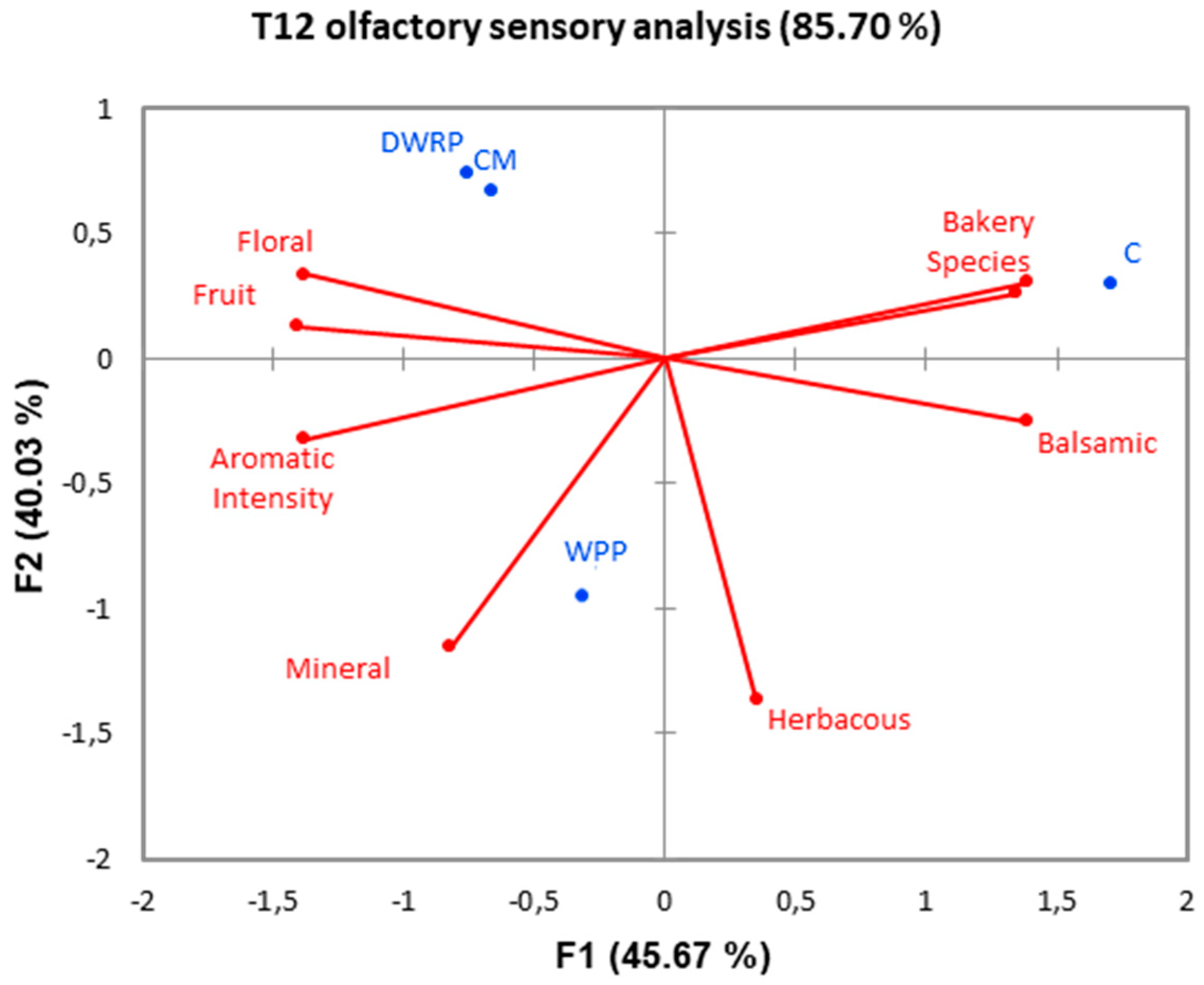
Figure 2.
Generalized Procrustes analysis (GPA) of the mean ratings for gustative phase in Viura wines after twelve months of bottling. C: Control wines; WPP: Wine Purified Polysaccharides; DWRP: Distilled Washing Residues Polysaccharides; CM: Commercial Mannoproteins.
Figure 2.
Generalized Procrustes analysis (GPA) of the mean ratings for gustative phase in Viura wines after twelve months of bottling. C: Control wines; WPP: Wine Purified Polysaccharides; DWRP: Distilled Washing Residues Polysaccharides; CM: Commercial Mannoproteins.
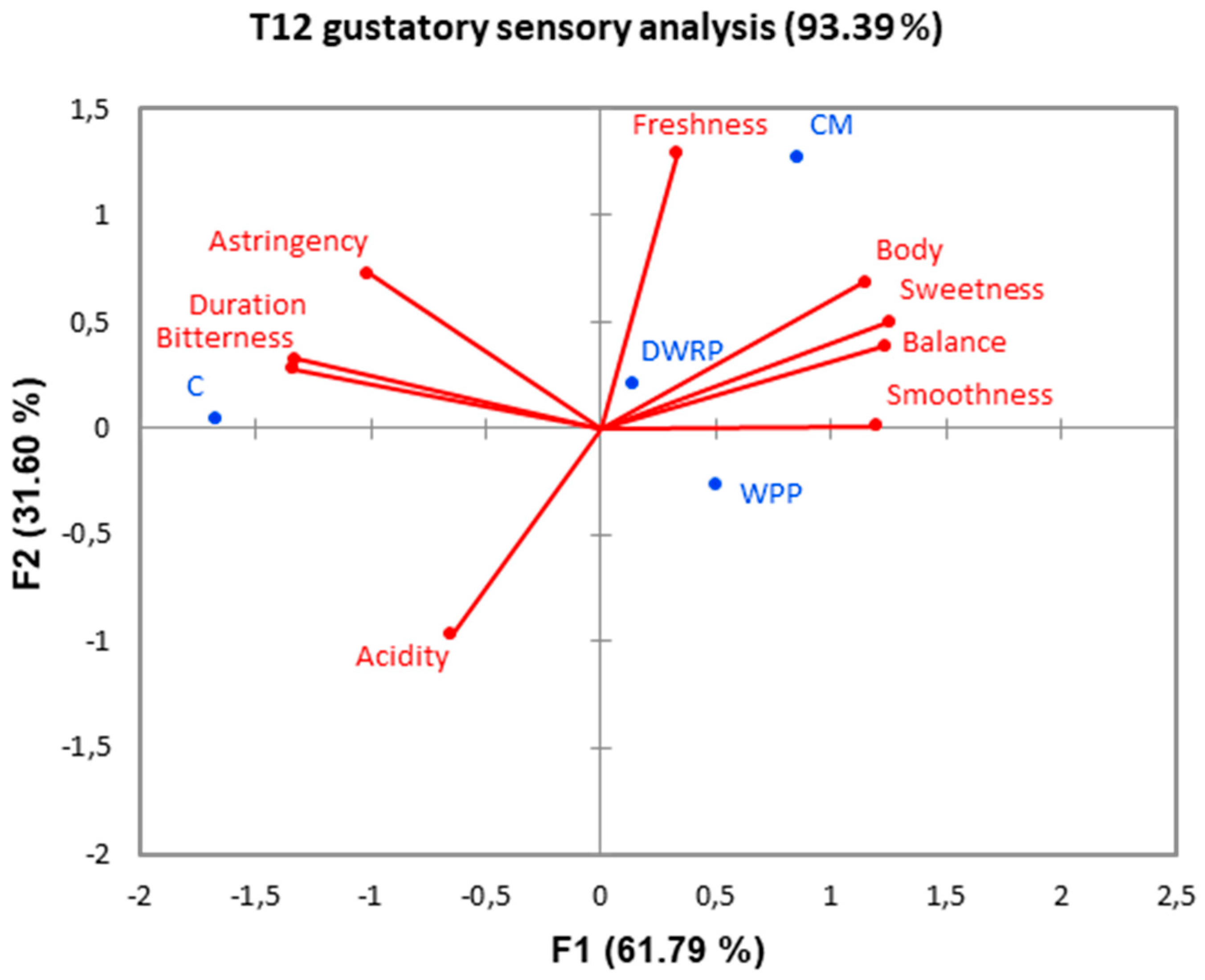

Table 1.
Concentration of volatile compounds (µg L-1)a of Viura wines treated with the PS extracts and CM after one (T1) and twelve months of bottling (T12).
Table 1.
Concentration of volatile compounds (µg L-1)a of Viura wines treated with the PS extracts and CM after one (T1) and twelve months of bottling (T12).
| T1 | T12 | |||||||||
| Compounds | Cb | WPPb | DWRPb | CMb | F-value | Cb | WPPb | DWRPb | CMb | F-value |
| 1-propanol | 33,643 (1,522.0)b | 37,529 (1,442.0)c | 32,195 (1,180.8)ab | 30,672 (200.4)a | 17.807*** | 32,796 (1,171.0)c | 27,407 (876.1)a | 29,552 (1,246.6)b | 29,756 (154.1)b | 31.726*** |
| Isobutanol | 1,259.3 (39.6)b | 1,040.9 (71.8)a | 1,334.4 (62.6)b | 1,324.7 (58.7)b | 15.938*** | 22,424 (1,125.7)c | 18,340 (1,603.0)a | 20,079 (1,068.4)b | 20,687 (543.8)b | 12.927** |
| 2-Methyl-1-butanol | 29,536 (2,762.0) | 29,560 (1,583.1) | 29,834 (1,103.0) | 27,687 (831.9) | 0.972 (ns) | 27,447 (2,124.9)b | 20,988 (4,947.0)a | 24,600 (2,307.3)ab | 26,457 (639.9)b | 5.598* |
| 3-Methyl-1-butanol | 28,933 (2,015.0) | 25,780 (1,510.9) | 26,576 (2,295.3) | 28,253 (2,114.2) | 3.073 (ns) | 158,137 (8,747.6)b | 125,476 (20,626)a | 143,312 (8,373.6)b | 149,973 (3,206)b | 7.953** |
| 2-Phenylethanol | 17,197 (104.3) | 15,681 (866.3) | 18,104 (1,736.7) | 15,847 (323.5) | 3.987 (ns) | 23,143 (1,357.6)a | 24,122 (963.1)b | 22,406 (243.8)a | 24,360 (126.1)b | 20.059*** |
| TOTAL HIGHER ALCOHOLS | 110,569 (6,442.9) | 109,592 (4,431.8) | 108,044 (5,858.4) | 103,784 (3,042.8) | 3.380 (ns) | 263,948 (14,526)c | 216,335 (25,337)a | 239,951 (13,239)b | 251,234 (4,109.5)bc | 9.723** |
| 1-Hexanol | 444.9 (20.0)a | 481.3 (22.9)a | 986.7 (100.6)b | 1,037.8 (134.3)b | 41.750*** | 960.9 (22.2) | 952.4 (13.4) | 953.2 (15.7) | 960.9 (11.9) | 0.506(ns) |
| (E)-3-Hexenol | 57.8 (4.2)a | 47.0 (2.8)a | 132.8 (8.7)c | 78.0 (6.8)b | 118.549*** | 95.6 (6.9) | 94.1 (2.1) | 98.8 (0.4) | 97.7 (8.7) | 0.831(ns) |
| (Z)-3-Hexenol | 181.2 (8.5)a | 149.2 (6.0)a | 416.2 (53.7)c | 244.3 (30.7)b | 43.235*** | 485.8 (7.8) | 488.3 (1.3) | 491.4 (3.0) | 492.8 (6.0) | 2.080(ns) |
| Benzyl alcohol | 198.5 (8.4)b | 198.5 (7.3)b | 213.3 (15.7)b | 107.4 (10.2)a | 59.554*** | 153.2 (4.3)a | 167.8 (8.4)b | 177.3 (2.4)c | 173.3 (3.8)bc | 25.325*** |
| TOTAL C6 ALCOHOLS | 882.4 (23.7)a | 876.0 (35.0)a | 1,749.0 (178.7)c | 1,467.5 (182.0)b | 33.611*** | 1,695.5 (18.8) | 1,703.2 (18.6) | 1,720.6 (21.6) | 1,724.6 (5.3) | 3.691(ns) |
| Ethyl butyrate | 54.0 (2.4)a | 54.0 (7.9)a | 110.3 (5.7)b | 62.6 (10.7)a | 40.579*** | 213.9 (6.7)a | 254.5 (0.2)c | 232.8 (1.4)b | 263.4 (4.6)d | 175.091*** |
| Ethyl hexanoate | 722.6 (88.1)a | 740.5 (31.8)a | 1,474.6 (120.9)b | 861.0 (72.4)a | 52.911*** | 353.4 (10.2)a | 374.9 (7.2)b | 354.8 (0.6)a | 403.4 (3.1)c | 79.376*** |
| Ethyl octanoate | 1,058.2 (89.8)a | 1,003.7 (32.3)a | 2,069.5 (422.9)b | 1,373.3 (117.8)a | 14.281*** | 266.5 (4.1)b | 256.3 (1.9)a | 252.0 (3.3)a | 293.9 (3.8)c | 188.401*** |
| Ethyl decanoate | 237.8 (40.5)a | 210.4 (13.2)a | 579.1 (122.7)c | 388.0 (32.9)b | 19.152*** | 32.2 (2.9)a | 33.5 (0.5)a | 32.0 (1.6)a | 38.4 (1.8)b | 14.596*** |
| Ethyl-2-methylbutyrate | 10.6 (0.2)a | 10.1 (0.3)a | 12.2 (0.4)b | 10.1 (0.1)a | 38.058*** | 7.2 (0.2)a | 7.0 (0.1)a | 8.0 (0.6)b | 7.3 (0.2)a | 10.679** |
| Ethyl isovalerate | 22.0 (2.1) | 23.6 (2.1) | 24.5 (1.3) | 21.1 (1.5) | 2.213 (ns) | 17.8 (2.3) | 17.6 (3.5) | 19.3 (0.2) | 16.5 (2.0) | 1.274(ns) |
| Ethyl lactate | 1,067.1 (40.2)a | 992.9 (30.5)a | 2,522 (379.8)c | 1,577.9 (247.2)b | 28.642*** | 21,806.8 (211.9)a | 22,412.9 (217.2)b | 22,626.0 (126.8)bc | 22,861.0 (96.4)c | 21.994*** |
| TOTAL ETHYL ESTERS | 3,172.3 (263.3)a | 3,035.2 (100.8)a | 6,792.1 (594.0)c | 4,294.0 (285.3)b | 25.530*** | 22,697.7 (212.3)a | 23,356.6 (217.2)b | 23,524.9 (126.8)b | 23,883.9 (96.1)c | 25.116*** |
| Propyl acetate | 565.2 (2.0)a | 571.5 (31.1)a | 1,131.6 (56.6)c | 712.0 (84.1)b | 75.742*** | 34.9 (1.2) | 34.4 (0.5) | 32.8 (0.1) | 35.1 (1.4) | 3.771 (ns) |
| Isobutyl acetate | 367.0 (72.5)ab | 334.8 (33.3)a | 754.9 (15.4)c | 412.4 (28.7)b | 155.111*** | 27.4 (2.0)a | 28.6 (2.2)a | 25.8 (0.6)a | 35.8 (4.9)b | 7.058* |
| Isoamyl acetate | 2,554.5 (250.1)ab | 2,272.8 (66.0)a | 5,156.1 (173.8)c | 3,110.6 (522.5)b | 55.001*** | 965.1 (22.3)a | 963.8 (5.6)a | 1011.6 (28.3)b | 1028.3 (40.3)b | 4.368* |
| Hexyl acetate | 384.2 (53.0)a | 310.2 (16.7)a | 726.2 (86.8)b | 374.1 (61.1)a | 29.512*** | 37.3 (1.9)a | 40.5 (0.3)c | 38.1 (0.1)a | 38.8 (0.4)bc | 5.596* |
| β-Phenylethyl acetate | 543.3 (1.4)ab | 434.2 (48.2)a | 1,081.7 (50.6)c | 625.9 (95.5)b | 69.424*** | 69.8 (0.6)a | 78.0 (0.2)c | 78.4 (1.4)c | 77.5 (1.2)c | 52.655*** |
| TOTAL ACETATES | 4,414.2 (279.0)a | 3,923,5 (98.8)a | 8,850.4 (355.3)c | 5,235 (716.2)b | 69.250*** | 1,134.5 (17.1)a | 1,145.2 (6.9)a | 1186.6 (28.9)b | 1,215.5 (48.1)b | 4.838* |
| Isovaleric acid | 38.8 (0.1)a | 33.5 (2.4)a | 53.8 (8.7)b | 58.9 (9.6)b | 10.024** | 365.3 (5.0) | 362.5 (0.8) | 365.1 (7.2) | 376.1 (12.8) | 0.221 (ns) |
| Hexanoic acid | 1,221.7 (17.5)a | 1071.0 (109.8)a | 1,630.8 (176.2)b | 1,610.2 (217.9)b | 10.403** | 4,384.4 (17.1)b | 4,342,0 (3.4) | 4,318.0 (44.0) | 4,302.1 (47.1) | 0.072 (ns) |
| Octanoic acid | 2,574.9 (12.8)b | 1,989.3 (267.2)a | 3,062.8 (190.9)c | 3,076.9 (306.5)c | 15.690*** | 4.035.4 (10.0)a | 4,140.3 (59.4) | 4,040.2 (6.2) | 4,131.6 (89.6) | 0.078 (ns) |
| Decanoic acid | 41.2 (10.2)ab | 37.2 (3.1)a | 66.2 (6.4)c | 60.5 (19.4)bc | 4.576* | 301.7 (12.2)b | 297.3 (5.8) | 296.6 (1.9) | 304.8 (7.5) | 0.555 (ns) |
| TOTAL ACIDS | 3,876.6 (40.6)b | 3,131.0 (382.5)a | 4,813.6 (382.2)c | 4,806.5 (553.4)c | 13.222** | 9,086.7 (34.3) | 9,141.9 (69.4) | 9,020.2 (59.3) | 9,114.5 (141.9) | 0.403 (ns) |
| 4-vinylguaiacol | 332.5 (46.3)a | 299.0 (7.2)a | 662.8 (116.9)b | 345.7 (21.3)a | 21.176*** | 121.4 (1.3)a | 128.3 (6.8)a | 141.3 (8.3)b | 126.7 (4.3)a | 23.578*** |
| 4-vinylfenol | 267.5 (45.6)a | 262.7 (10.3)a | 664.1 (47.9)c | 373.4 (22.6)b | 85.457*** | 46.9 (0.6)a | 47.0 (0.6)a | 56.7 (0.2)b | 49.2 (0.3)a | 7.189*** |
| TOTAL PHENOLS | 600.0 (91.9)a | 561.7 (8.8)a | 1,326.9 (158.9)b | 719.1 (43.9)a | 40.515*** | 168.3 (1.4)a | 175.3 (6.8)a | 198.0 (8.3)b | 175.9 (4.3)a | 17.713*** |
| Linalool | 37.1 (1.9)a | 45.9 (1.9)b | 42.8 (2.2)b | 44.5 (1.8)b | 11.642*** | 27.5 (2.3)a | 35.1 (2.5)b | 34.4 (0.7)b | 34.3 (1.8)b | 19.486*** |
| α-Terpineol | 6.2 (0.2)a | 6.5 (0.2)a | 6.9 (0.1)b | 6.3 (0.1)a | 11.500** | 2.8 (0.1)c | 2.6 (0.1)b | 3.8 (0.2)d | 2.3 (0.1)a | 163.189*** |
| TOTAL TERPENES | 43.3 (1.9)a | 52.4 (1.9)b | 49.7 (2.3)b | 50.8 (1.8)b | 12.057*** | 30.3 (2.3)a | 37.6 (2.6)b | 38.2 (0.8)b | 36.6 (1.8)b | 19.233*** |
a Mean values are shown (n=3). Different letters in the same row indicate significant differences (p < 0.05). Level of significance: *, ** and ***indicates significance at p < 0.05, at p < 0.01 and at p < 0.001 respectively. b Control wine (C) and wines treated with the PS extracts. WPP: Wine Purified Polysaccharides, DWRP: Distilled Washing Residues Polysaccharides; CM: Commercial Mannoproteins.
Table 2.
Odor activity values (OAV > 0.2)a of Viura wines treated with the PS extracts and CM after one (T1) and twelve months of bottling (T12).
Table 2.
Odor activity values (OAV > 0.2)a of Viura wines treated with the PS extracts and CM after one (T1) and twelve months of bottling (T12).
| T1 | T12 | ||||||||||||
| Compounds | Odordescriptor | Odorthreshold (µg L-1) | Reference | Cb | WPPb | DWRPb | CMb | F-value | Cb | WPPb | DWRPb | CMb | F-value |
| Isobutanol | Alcohol, solvent, green, bitter | 75,000 | 29 | - | - | - | - | - | 0.3 | 0.2 | 0.3 | 0.3 | 3.167(ns) |
| 2-Methyl-1-butanol | Alcohol | 30,000 | 29 | 1.0 | 1.0 | 1.0 | 0.9 | 0.972 (ns) | 0.9b | 0.7a | 0.8b | 0.9b | 7.667* |
| 3-Methyl-1-butanol | Alcohol | 7,000 | 30 | 4.1 | 3.7 | 3.8 | 4.0 | 3.073 (ns) | 5.3c | 4.2a | 4.8b | 5.0b | 7.921** |
| 2-Phenylethanol | Roses, honey | 14,000 | 31 | 1.2 | 1.1 | 1.3 | 1.1 | 3.987 (ns) | 1.6a | 1.7b | 1.6a | 1.7b | 17.000*** |
| (E)-3-Hexenol | Green, floral | 400 | 31 | 0.1a | 0.1a | 0.3c | 0.2b | 118.549*** | 0.2 | 0.2 | 0.2 | 0.2 | 0.667(ns) |
| (Z)-3-Hexenol | Green, floral | 400 | 31 | 0.5a | 0.4a | 1.0c | 0.6b | 43.235*** | 1.2 | 1.2 | 1.2 | 1.2 | 1.383(ns) |
| Ethyl butyrate | Papaya, apple | 20 | 31 | 2.7a | 2.7a | 5.5b | 3.1a | 40.579*** | 10.7a | 12.7c | 11.6b | 13.2d | 219.933*** |
| Ethyl hexanoate | Apple, fruity, sweetish | 14 | 31 | 51.6a | 52.9a | 105.3b | 61.5a | 52.911*** | 25.2a | 26.8b | 25.3a | 28.8c | 74.772*** |
| Ethyl octanoate | Apple, fruity, sweetish | 5 | 31 | 211.6a | 200.7a | 413.9b | 274.7a | 14.281*** | 53.3b | 51.3a | 50.4a | 58.8c | 173.479*** |
| Ethyl decanoate | Grape | 200 | 31 | 1.2a | 1.1a | 2.9c | 1.9b | 19.152*** | - | - | - | - | - |
| Ethyl 2-methylbutyrate | Fruity, strawberry, apple, blackberry | 2 | 32 | 5.3a | 5.0a | 6.1b | 5.1a | 38.058*** | 3.6a | 3.5a | 4.0b | 3.7a | 10.563** |
| Ethyl isovalerate | Fruity | 3 | 31 | 7.3 | 7.9 | 8.2 | 7.0 | 2.213 (ns) | 5.9 | 5.9 | 6.4 | 5.5 | 1.275(ns) |
| Isoamyl acetate | Banana, apple | 30 | 31 | 85.2ab | 75.8a | 171.9c | 103.7b | 55.001*** | 32.2a | 32.1a | 33.7a | 34.3b | 4.873* |
| β-Phenylethyl acetate | Banana | 250 | 31 | 2.2ab | 1.7a | 4.3c | 2.5b | 69.424*** | 0.3 | 0.3 | 0.3 | 0.3 | 1.036(ns) |
| Isovaleric acid | Cheese | 33 | 31 | 1.2a | 1.0a | 1.6b | 1.8b | 10.024** | 10.9 | 10.9 | 10.9 | 11.3 | 0.221 (ns) |
| Hexanoic acid | Cheese, fatty | 3,000 | 31 | 0.4a | 0.4a | 0.5b | 0.5b | 10.403** | 1.5 | 1.4 | 1.4 | 1.4 | 0.072 (ns) |
| Octanoic acid | Cheese, fatty, rancid | 1,000 | 31 | 2.6b | 2.0a | 3.1c | 3.1c | 15.690*** | 4.0 | 4.1 | 4.0 | 4.1 | 0.078 (ns) |
| 4-vinylguaiacol | Clove, curry | 40 | 31 | 8.3a | 7.5a | 16.6b | 8.6a | 21.176*** | 3.0a | 3.2a | 3.5b | 3.2a | 23.578*** |
| 4-vinylphenol | Smoky, almond | 180 | 31 | 1.5a | 1.5a | 3.7c | 2.1b | 85.457*** | 0.3 | 0.3 | 0.3 | 0.3 | 0.423(ns) |
| Linalool | Floral, citrus | 25 | 29 | 1.5 | 1.8 | 1.7 | 1.8 | 1.833(ns) | 1.1 | 1.4 | 1.4 | 1.4 | 1.129(ns) |
a Mean values are shown (n=3). Different letters in the same row indicate significant differences (p < 0.05). Level of significance: *, ** and ***indicates significance at p < 0.05, at p < 0.01 and at p < 0.001 respectively. b Control wine (C) and wines treated with the PS extracts. WPP: Wine Purified Polysaccharides, DWRP: Distilled Washing Residues Polysaccharides; CM: Commercial Mannoproteins.
Table 3.
Concentration of monomeric phenolic (mg L-1)a of Viura wines treated with the PS extracts and CM after one (T1) and twelve months of bottling (T12).
Table 3.
Concentration of monomeric phenolic (mg L-1)a of Viura wines treated with the PS extracts and CM after one (T1) and twelve months of bottling (T12).
| T1 | T12 | |||||||||
| Flavonoidsc | C | WPP | DWRP | CMd | F-value | C | WPP | DWRP | CMd | F-value |
| Flavonols | ||||||||||
| Myricetin-3-gal | 1.30 (0.02) | nd | nd | nd | - | 0.91 (0.01) | nd | nd | nd | - |
| Myricetin-3-glcU | 1.92 (0.04) | 1.79 (0.19) | 1.50 (0.32) | 1.40 (0.42) | 2.559(ns) | 1.34 (0.03) | 1.25 (0.12) | 1.05 (0.2) | 0.98 (0.27) | 3.095(ns) |
| Myricetin-3-glc | 0.95 (0.01)b | 0.30 (0.02)a | 1.39 (0.01)d | 0.99 (0.10)c | 356.043*** | 0.67 (0.01)b | 0.21 (0.01)a | 0.97 (0.01)c | 0.69 (0.06)b | 433.25*** |
| Quercetin-3-glcU | 1.80 (0.04)b | 1.10 (0.32)a | 1.88 (0.21)b | 4.04 (0.52)c | 31.623*** | 1.26 (0.03)b | 0.77 (0.2)a | 1.32 (0.13)b | 2.83 (0.33)c | 39.401*** |
| Quercetin-3-glc | 1.73 (0.04)a | 3.33 (0.74)b | 1.24 (0.34)a | 1.06 (0.19)a | 18.696*** | 1.21 (0.03)a | 2.33 (0.47)b | 0.87 (0.22)a | 0.74 (0.12)a | 22.619*** |
| Free kaempferol | 1.86 (0.04)a | 5.48 (1.06)c | 2.86 (0.34)ab | 4.60 (0.78)b | 14.731*** | 1.30 (0.03)a | 3.84 (0.68)c | 2.00 (0.22)a | 3.22 (0.50)b | 17.796*** |
| Free syringetin | 3.28 (0.91) | nd | nd | nd | - | 2.30 (0.58) | nd | nd | nd | - |
| Isorhamnetin | 1.63 (0.02)d | 0.28 (0.03)a | 0.36 (0.04)b | 0.41 (0.04)c | 1443.579*** | 1.14 (0.01)d | 0.20 (0.02)a | 0.25 (0.03)b | 0.29 (0.03)c | 1483.778*** |
| Total myricetin | 4.17 (0.05)c | 2.09 (0.19)a | 2.89 (0.32)b | 2.39 (0.43)b | 46.759*** | 2.92 (0.03)c | 1.46 (0.12)a | 2.02 (0.2)b | 1.67 (0.28)b | 56.42*** |
| Total quercetin | 3.53 (0.06)ab | 4.43 (0.81)b | 3.12 (0.40)a | 5.10 (0.55)b | 4.190* | 2.47 (0.04)ab | 3.10 (0.51)bc | 2.19 (0.26)a | 3.57 (0.35)c | 5.029* |
| Total kaempferol | 1.86 (0.04)a | 5.48 (1.06)c | 2.86 (0.34)ab | 4.60 (0.78)b | 14.731*** | 1.30 (0.03)a | 3.84 (0.68)c | 2.00 (0.22)a | 3.22 (0.50)b | 17.796*** |
| Totalsyringetin | 3.28 (0.91) | nd | nd | nd | - | 2.30 (0.58) | nd | nd | nd | - |
| Total Flavonols | 14.47 (0.91)c | 12.28 (1.35b | 9.23 (0.62)a | 12.50 (1.05)b | 24.269*** | 10.13 (0.58)c | 8.60 (0.86)b | 6.46 (0.39)a | 8.75 (0.67)b | 29.347*** |
| Flavanols | ||||||||||
| Epigallocatechin | 7.08 (0.84)b | 3.85 (0.78)a | 3.54 (0.65)a | 4.44 (0.71)a | 17.396*** | 3.03 (0.13) | 2.99 (0.09) | 2.99 (0.13) | 2.94 (0.08) | 0.078(ns) |
| Catechin | 17.96 (1.32) | 17.79 (1.47) | 17.92 (1.67) | 18.98 (1.79) | 0.021(ns) | 29.83 (2.34) | 29.86 (2.41) | 30.22 (2.22) | 29.52 (2.31) | 0.019(ns) |
| Epicatechin | 14.38 (1.44) | 16.20 (1.09) | 16.54 (1.43) | 17.40 (2.01) | 1.440(ns) | 16.58 (1.54)c | 2.48 (0.52)a | 4.24 (0.37)b | 4.14 (0.42)b | 172.286*** |
| Total Flavanols | 39.42 (2.13) | 37.84 (1.99) | 38.00 (2.29) | 40.82 (2.79) | 0.871(ns) | 49.44 (2.80)b | 35.33 (2.47)a | 37.45 (2.25)a | 36.60 (2.35)a | 11.553** |
| HydroxybenzoicAcids (HBAs) | ||||||||||
| Gallic acid | 8.70 (1.02) | 7.70 (0.85) | 7.55 (0.67) | 7.98 (0.77) | 1.253(ns) | 5.02 (0.76)a | 7.98 (0.45)b | 8.16 (0.76)b | 7.32 (0.61)b | 16.346*** |
| Hydroxycinnamic acids (HCAs) | ||||||||||
| trans-Caftaric acid | 2.22 (0.19)a | 2.09 (0.31)a | 6.22 (0.87)b | 2.12 (0.13)a | 55.027*** | 1.02 (0.12) | 1.02 (0.08) | 1.02 (0.07) | 1.01 (0.10) | 0.009(ns) |
| trans-Coutaric acid | 16.79 (1.72) | 14.38 (1.65) | 13.56 (1.03) | 15.37 (1.28) | 2.886(ns) | 2.32 (0.65) | 2.27 (0.31) | 2.32 (0.3) | 2.32 (0.13) | 0.014(ns) |
| Caffeic acid | 1.15 (0.04)c | 1.00 (0.02)ab | 0.96 (0.03)a | 1.13 (0.04)bc | 18.200*** | nd | nd | nd | nd | - |
| trans-fertaric acid | 0.14 (0.01)a | 0.17 (0.01)b | 0.22 (0.01)c | 0.27 (0.01)c | 46.75*** | nd | nd | nd | nd | - |
| Ferulic acid | 0.43 (0.02)a | 0.42 (0.02)a | 0.49 (0.02)a | 0.60 (0.02)b | 10.688** | nd | nd | nd | nd | - |
| Total HCAs | 20.73 (1.73)b | 18.06 (1.68)a | 21.45 (1.35)b | 19.49 (1.29)a | 3.757(ns) | 3.34 (0.66) | 3.29 (0.32) | 3.34 (0.31) | 3.33 (0.16) | 0.011(ns) |
| Total monomericphenolics | 83.32 (3.06)b | 75.88 (3.05)a | 76.23 (2.81)a | 80.79 (3.33)ab | 4.480* | 67.93 (3.04)c | 55.2 (2.67)a | 55.41 (2.43)a | 56.00 (2.52)ab | 16.741*** |
a Mean values are shown (n=3). Different letters in the same row indicate significant differences (p < 0.05). Level of significance: *, ** and *** indicates significance at p < 0.05, p < 0.01 p < 0.001. b Control wine (C) and wines treated with the PS extracts. WPP: Wine Purified Polysaccharides, DWRP: Distilled Washing Residues Polysaccharides; CM: Commercial Mannoproteins. c Nomenclature abbreviation: glc: glucoside; gal: galactoside; glcU: glucuronide.
Table 4.
Concentration of total proanthocyanidins (mg L-1), % catechin, % epicatechin, % epicatechin terminal subunits and mean degree of polymerization (mDP) of Viura wines treated with the PS extracts and CM after one (T1) and twelve months of bottling (T12).
Table 4.
Concentration of total proanthocyanidins (mg L-1), % catechin, % epicatechin, % epicatechin terminal subunits and mean degree of polymerization (mDP) of Viura wines treated with the PS extracts and CM after one (T1) and twelve months of bottling (T12).
| T1 | T12 | |||||||||
| Polymeric compoundsb | Cc | WPPc | DWRPc | CMc | F-value | Cc | WPPc | DWRPc | CMc | F-value |
| PA | 60.47 (3.91) | 54.78 (3.33) | 55.45 (3.26) | 49.33 (2.89) | 3.660 (ns) | 45.2 (2.95)b | 35.74 (1.87)a | 34.80 (1.95)a | 32.69 (1.83)a | 6.986* |
| % Cat | 10.40 (2.64)b | 7.23 (1.23)a | 13.07 (1.58)c | 11.07 (1.47)bc | 10.695** | 9.5 (2.32)b | 7.02 (1.12)a | 12.10 (1.32)c | 11.02 (1.32)bc | 11.538** |
| % Epi | 16.13 (2.09)a | 21.75 (2.97)bc | 23.59 (2.79)c | 18.77 (2.36)ab | 9.774** | 7.02 (0.95)a | 9.71 (1.39)b | 10.72 (1.24)b | 9.17 (1.13)b | 10.363** |
| % Epi-gal | 2.78 (0.31) | 2.69 (0.27) | 2.69 (0.37) | 3.26 (0.59) | 2.729 (ns) | 1.60 (0.11)a | 1.58 (0.10)a | 1.49 (0.13)a | 1.95 (0.23)b | 10.924** |
| mDP | 2.75 (0.35)c | 2.08 (0.23)b | 1.61 (0.15)a | 1.72 (0.17)a | 174.180*** | 3.22 (0.47)c | 2.37 (0.24)b | 1.62 (0.14)a | 1.68 (0.15)a | 155.770*** |
a Mean values are shown (n=3). Different letters in the same row indicate significant differences (p < 0.05). Level of significance: *, ** and *** indicates significance at p < 0.05, p < 0.01 p < 0.001. b PA: total proanthocyanidins content (mg L-1); Cat: % catechin terminal subunits; Epi: % epicatechin terminal subunits; Epi-gal: % epicatechin-gallate terminal subunits; mDP: Mean Degree of Polymerization expressed as the summatory of total subunits divided by the summatory of monomeric Flavan-3-ols. c Control wine (C) and wines treated with the PS extracts. WPP: Wine Purified Polysaccharides, DWRP: Distilled Washing Residues Polysaccharides; CM: Commercial Mannoproteins.
Disclaimer/Publisher’s Note: The statements, opinions and data contained in all publications are solely those of the individual author(s) and contributor(s) and not of MDPI and/or the editor(s). MDPI and/or the editor(s) disclaim responsibility for any injury to people or property resulting from any ideas, methods, instructions or products referred to in the content. |
© 2023 by the authors. Licensee MDPI, Basel, Switzerland. This article is an open access article distributed under the terms and conditions of the Creative Commons Attribution (CC BY) license (http://creativecommons.org/licenses/by/4.0/).
Copyright: This open access article is published under a Creative Commons CC BY 4.0 license, which permit the free download, distribution, and reuse, provided that the author and preprint are cited in any reuse.


