

Submitted:
14 July 2023
Posted:
18 July 2023
You are already at the latest version
Abstract
Eco-innovation denotes developing green practices using environmentally friendly innovative approaches or technologies. Although, eco-innovation has been broadly applied in different in-dustries, such as low-carbon production and manufacturing, how to implement such innovation in education for sustainable development (ESD) has rarely been studied. Therefore, this research considered a reflective and cooperative learning approach to science, technology, engineering, arts, and math (STEAM) education. A case study examined Wanluan Township of Pingtung County in southern Taiwan. Four departments’ students and teachers at Meiho University were involved in situated learning. Students of hospitality management played farm owners who en-gaged in organic agriculture to produce food and beverages. These agricultural products were farm-to-table, cooked and served for customers in a natural dining setting through the students’ teamwork. Students of tourism, sports & leisure management, and food science & nutrition played tourists in a self-guided travel context, who engaged in acts such as visiting buildings to understand heritage while observing that the houses were still in use a dwelling. This encouraged reflection on the importance of cultural preservation. According to the results from the role-play farm owners and tourists, eco-innovation can represent a sustainable marketing strategy for im-proving the local-community economy and can be implemented in a practical situation in STEAM. The goal of ESD for 2030 — societal transformation — is to foster students’ responsible behavior and attitudes in a personally authentic manner, thereby fostering sustainability learning and understanding.
Keywords:
sustainable development education
; environment protection
; environmental psychology
; reflex-ive process
; responsible behavior
; rural community
; rural tourism
; sustainability learning
; sus-tainable tourism and hospitality
; travel experience
1. Introduction
Eco-innovation denotes the concept of environmentally friendly innovation, which represents a useful greening technology [1]. An review by Cristina, González-Moreno, and Sáez-Martín [2] indicated eco-innovation has been broadly considered in terms of different categories, including performance (market value), drivers (implementation of innovation), process (research and development management), context (country or region), types (services, product design, or process), and policy [2] (p. 6-7). Such innovation has been applied in several industries, including agriculture [3], manufacturing [4], tourism services [5], and hospitality [6].
Klaus [7] redefined eco-innovation with reference to “the double externality problem, the regulatory push/pull effect and the increasing importance of social and institutional innovation.” [7] (p. 319). According to the definition, two specific key determinants — “push and pull,” as shown in Figure 1 — have been proposed to construct an eco-innovation system [8] in greening supply chain management and a circular economy [9]. Figure 1 is divided into two parts to indicate how the notion of “push and pull” supports eco-innovation. The push aspect consists of technology and regulation. The pull aspect represents the market. These concepts accord with supply chain management because the upstream component of the greening supply chain is to push business-to-business (B2B) actions toward being environmentally friendly, whereas the downstream component of this supply chain is using eco-innovation results to pull (attract) customers to businesses (business-to-customer; B2C).
Based on the above concepts, part of the push component is technology that may solve “the double externality problem” associated with economic activity [10] and environmental sustainability [11]. This includes the product’s design, palette, materials, production, manufacturing, quality, as well as energy use. At the same time, regulatory approaches may also be considered to maintain technological performance, such altering occupational safety and health (OSH) standards and environmental conservation laws. For example, the problem of air pollution [12] has a strong relationship with CO2 emissions reduction [13]. When the push component has been prepared, the pull component thus connects with users or customers, via service image [14], market competition [15], and customer demand for green energy [16].
Although the eco-innovation concept is detailed in Figure 1, teaching and learning eco-innovation in higher education remains difficult, particularly education for sustainable development (ESD) [17]. Societal transformation has identified ESD goals for 2030 [18]. The sustainable development goals (SDGs) [19] also emphasize the need to learn sustainability in societal, cultural, and economic contexts, rather than, for example, learning about climate change from textbooks or classroom videos. Eco-innovation requires interdisciplinary knowledge to connect with the complicated problems of technology and regulation. Therefore, it is not easy to present a simple model of sustainability learning in a societal or cultural context [20].
Given the above background, we considered that eco-innovation needs a renewable basis to meet the 2030 ESD goal — societal transformation within a sustainability learning context. Accordingly, we posed several critical questions:
- How should one construct a framework for sustainability learning in STEAM?
To answer these questions, we considered a case study in science, technology, engineering, the arts, and math (STEAM) education. STEAM education was chosen in part because the work of Georgette and Lee [24] supports our choice of questions. One piece of vital evidence is a key sentence, namely STEAM can make “students create their own portfolio texts so that their knowledge is as current as possible and they solve real-life problems that empower them as well as deeply seed their knowledge in multiple ways for transference.” [24] (p. 1083). This sentence supports several key points of the present study.
The first point is helping students to solve real-life problems by themselves, as sustainability learning usually occurs in everyday life situations. Students must learn how to solve real-world problems by self-directed learning [25]. When self-directed learning is used to solve a real problem, knowledge or skills are obtained from the process of problem solving. This process is also consistent with educational psychology theory [26], namely that a successful experience enhancing subsequent learning motivation. The second point is that solving a real-world problem lead to knowledge transference through lived experience, because a real-word problem represents an opportunity to understand or observe the implicit evidence underlying uncertain situations. Through self-directed learning in the context of lived experience, personal feelings or reflections may help the individual to understand the process of societal transformation. This also represents application of the theory of learning-by-doing [27]. Experiences are created during actions, and these personal experiences support transference in a societal-cultural context.
An educational case study is suitable for elucidating the unknowns underlying a given social and cultural context [28] and hence suitable for explaining how eco-innovation can apply in ESD. An educational case study of ESD is not novel; Helen and Meijers [29] reviewed many such cases, thereby determining practical challenges exist in current ESD. For example, Dzintra and Badyanova [30] used a case study to investigate how sustainable leadership could be used implement ESD in two schools. Scholz et al. [31] developed a transdisciplinary case study to understanding the problems of ESD in complex human-environment systems. Their study successfully revealed how sustainability learning can be adopted for a project management model (representation, assessment, and strategy building).
Therefore, a STEAM case study was employed in the present study to clarify the determinants of eco-innovation and sustainability learning in ESD for 2030. The case examined was an industry-university cooperation from 2020 to 2023. Wanluan Township in Pingtung County in southern Taiwan wanted to improve the rural economy and promote agricultural products. Although Wanluan is a small rural village, they strive to use organic farming and environment-friendly actions for rural sustainable development. Based on university social responsibility (USR) [32], four departments’ students and two departments’ teachers in Meiho University were thus involved in a study of different sustainable marketing activities.
Two roles of push and pull were played. Hospitality students played farm owners in business-to-business (B2B) sustainability learning. The role of these students was to provide organic food and beverages. They were asked to prepare a natural dining environment though teamwork. The primary mission was critical thinking regarding how to cook and serve farm-to-table meals. In contrast, students from another three departments (tourism, sports & leisure management, and food science & nutrition) played rural travel tourists, representing the concept of table-to-farm. These students played tourists who visited Wanluan’s attractions, which included cultural and natural ecological experiences that involved rural landscapes and heritage buildings. The students’ observations and reflections were recorded to elucidate the cultural and ecological impacts on rural sustainable development.
All learning processes were experienced by the students themselves. They were asked to complete the assignments using reflective and cooperative methods. The practical tasks were all outdoor activities. Accordingly, the situated learning consisted of discovering how personal experience can support authenticity.
This paper is structured in five sections. The first section provided a theoretical background to eco-innovation and sustainability learning. The second section presents how qualitative data were collected and analyzed in the case study. The third section presents the results of students and teachers as participant observations. The fourth section discusses what theory can be constructed after implementation of ESD. Finally, we conclude that the proposed questions were answered, and subsequently explore the implications and possible topics for ongoing study.
2. Materials and Methods
2.1. Justification for Case Study
The case study is used to understand a specific phenomenon, especially in social science research. Ellen [33] suggested that the reliability and validity of social science research requires verification with sufficient evidence. Accordingly, Rob and Khan [34] redefined what case-study methodology can meet the requirements of social science research. The renewed definition [34] (p. 90) has the following stipulations:
- (a)
- Detailed descriptions must be obtained from immersion in the context of the case;
- (b)
- The case must be temporally and spatially bounded;
- (c)
- There must be frequent engagement between the case itself and the unit of analysis.
The renewed definition provides a concrete recommendation of how the reliability and validity of a case study can be examined via the evidence obtained. The first such aspect is data reliability, which is a concept consistently used in behavioral research. When conducting a case study, the data are usually obtained in a selected context (see point a). The data can be repeated measurements collected from a single person, to improve data consistency. The second aspect is data validity. This core research component is usually considered in terms of internal and external validity. A case study occurs at a specific time and place. Temporal and spatial (see point b) data can be collected from interaction behavior such as activities, festivities, or social networks [35], all of which could represent the unit of analysis (see point c). To synthesize these aspects, case-study methodology in social science research is sufficient to explain how and why a specific phenomenon occurs. Following the theory of case study methodology, the scope of the study is elucidated in the following section.
2.2. The Scope of a STEAM Case Study
To explore the proposed questions, an educational case study of STEAM was adopted. A STEAM case study was considered appropriate to connect theory and practice in the learning process. In particular, STEAM disciplines focus on problem-solving skills that involve inter-discipline knowledge. For example, Jesionkowska, Wild, and Deval [36] developed a STEAM case study in a workshop format, namely “active learning for understanding augmented reality (AR) within a workshop methodology.” One finding was that “the activity itself is structured into a theoretical and a practical part.” [36] (p. 4). That is, the learning itself is “activity,” and through the interactive process students can learn and then continue the process of “active learning.”
We adopted a STEAM case study because STEAM disciplines emphasize that students can learn by doing. Yuichiro and Simon [27] explained a theory of learning in which doing is a specific process that enables students to solve a problem within its context. STEAM disciplines also involve emotions during learning. When students solve a problem in the process of learning by doing, positive feelings will result; the practical learning actions are transferred into emotions. That is particularly relevant to the field of “art” within the STEAM disciplines.
In particular, Mejias et al. noted that “many practices of STEAM are non-pedagogical, that is, they are present in popular culture, the contemporary arts, or in the STEM fields.” [37] (p. 11). That is, STEAM do not have a traditional teaching or learning method, but rather these differ according to cultural context. As such, STEAM disciplines are suitable for assessing authentic learning within cultural contexts.
With reference to prior theories, a STEAM case study was constructed to explore the aforementioned research questions. The scope consisted of an eco-innovation location (local rural community) that incorporated B2B to B2C of sustainability learning; the scope was consistent with eco-innovation theory according to Klaus [7]. The B2B aspect presented the push using technology and regulation, whereas the B2C component presented the pull via the market or customer (as in Figure 1).
2.3. Data Collection and Analysis
2.3.1. Data Source
The STEAM case study was based on a short-term industry-university cooperation between Meiho University and Wanlaun Township Office from 2020 to 2023. Since 2019, COVID-19 has caused serious impacts on the rural economy, as tourism and agricultural sale decreased. In particular, young residents working outside the region had no compelling reason to return. As this situation occurred in most rural areas, the government expended considerable effort and resources to address several aspects of the damage.
One government effort toward recovery was to encourage universities to engage in energy-related cooperation with affected industries in rural areas. Therefore, from 2020 to 2023, Meiho University began projects to assist the local rural community. Such projects fall under the auspices of university social responsibility (USR). As shown by Bokhari [38], USR can effectively assist local communities to adopt sustainable development. In the past three years, Meiho University engaged in USR projects with Wanlaun Township Office to alleviate COVID-19-related economic damage.
Notably, COVID-19 remains a threat. Therefore, in 2022 and 2023, we considered how eco-innovation efforts might improve the rural economy. Meiho’s teachers in two departments — hospitality management and tourism — thus setup a team to address this important topic. Teachers of hospitality management took charge of B2B sustainability learning with students of hospitality management. In contrast, B2C sustainability learning was provided as an elective by tourism teachers, which involved students taking a rural travel assignment.
Therefore, the stakeholders of the STEAM case study consisted of university students and teachers, agricultural farmers, small businesses, local government, and external customers. In particular, the STEAM case study provided a blended social-cultural context for ESD and understanding the benefits of eco-innovation.
2.3.2. Data Collection from B2B and B2C Sustainability Learning
In the STEAM case study, qualitative data were collected by the stakeholders. The data collection period was the first semester of September of 2022 to January of 2023. Data cleaning, transcription, coding, storage, and explanation occurred in the second semester, from February of 2023 to June of 2023.
Participant observation [39] was employed for data collection. B2B and B2C sustainability learning occurred at different times and places, and generated original data from multiple sources. Therefore, the data processing and cleaning were important. For consistency, study scope was classified to build different data sets.
The B2B aspect of sustainability was farm-to-table; that is, hospitality management students role-played farm owners whose organic agriculture practices were used to supply food and beverages. The learning activity occurred four times, twice in November of 2022 and twice in December of 2022. The participants were 10 students (6 females, 4 males; age range: 18–19 years) who volunteered to role-play teamwork to assist farmers to set up dining using their farm fruits and vegetables. The tasks for students were to set up the dining service and to serve guests. The authors observed how the students worked together, and how they perceived being a farm owner who provided low-carbon food and service to customers.
The B2C sustainability learning focused on table-to-farm. This was part of an elective subject — community cultural tourism — that was taken by 58 students (34 females, 24 males; age range: 18–19), 36 of tourism, 16 of sports & leisure management, and 6 of food science & nutrition.. The students were required to complete self-guided travel within Wanlaun Township. The students adopted the role and perspective of outside tourists.
The task appears simple, but it had numerous complexities. The trip assignment was to promote the Cocoa cultural industry festival in December of 2022. Therefore, participant students needed to complete self-guided travel before/during the festival. Their trip required considerable planning as they needed to design their travel itinerary considering several questions, such as where to go (which attractions to see), when (time/period), the budget, and which culture to observe (rural community, economy, and production). In particular, students were required to reflect on their feelings when they saw the heritage embodied by a 100-year-old building in which people continued to live.
The B2C and B2B sustainability learning were created to obtain different data during the COVID-19 pandemic. In particular, the qualitative data were affected by the need to observe personal social distancing [40]. The qualitative data were divided into primary and secondary data. Hox and Boeije [41] explained that primary data are original data collected for a specific research goal. Secondary data represent a different purpose and may be reused to address another research question. In this study, a specific research goal with respect to sustainability learning was to understand how and why eco-innovation can meet the needs of ESD. Therefore, the primary data were face-to-face interviews and observations. The primary sustainability learning data, included photographs, videos, travel narratives, and semi-structured interviews with transcripts. All electronic data were cleaned, coded, transmitted, and stored by authors themselves. Secondary data were also incorporated into the analysis, such as website information, local government newspapers, catalogs of agri-food products, students’ meeting minutes, and students’ reflective reports.
2.3.3. Reliability and Validity of Qualitative Data
Reliability and validity were assessed. When assessing the collected data, the triangulation method [42] was used for the data analysis. Regarding reliability, we assessed data consistency with reference to different sources (people), places, and times. The people consisted of students, industrial experts, local government members, and residents. The places consisted of the fixed dining location and different attractions. Regarding times, the B2B aspect included four dining events, and the B2C aspect occurred at various times. Overall, we strictly ensured the internal and external validity of the collected data.
The analysis procedure consisted of text (keyword) search, comparison, and double-checking with the different stakeholders. The meaning of collected photos and videos was analyzed, helping to explain the behavior and interactions. Therefore, the internal validity was assured; this included determining which processed has associated problems and which results were not easily interpreted. Regarding external validity, we checked with local government and domain experts (such farmers) whether the same learning activity could be extended to other rural development.
3. Results
3.1. Destination: The Eco-innovation Strategy in Rural Development
3.1.1. The History and Problem of Wanlaun Township
According to the website of Wanlaun Township Office [43], Wanlaun is a small rural area in Pingtung County, in southern Taiwan. Wanlaun Township has a rich history, and its changes are representative of most of Taiwan’s rural development. Wanlaun Township has a good reputation because of its mixed cultural and social history. When people recall this history, they also remember conflict and fusion. Historical records indicate that the area experienced the Qing dynasty, 50 years of Japanese occupation, movement of the national government to Taiwan, and so forth.
As Wanlaun is near Taiwan’s central mountain range, cultural conflict has often occurred. This is because fighting was necessary for survival. For example, the indigenous Paiwan mountain dwellers fought with the lowland aboriginal Pingpu. In turn, the Pingpu fought immigrants from China — Hakka or Fujianese. However, those conflicts also enabled a fusion to arise from misunderstandings and living requirements. Therefore, today, Wanlaun Township is an example of cultural and societal diversity.
Although, conflict and fusion represent the history of Wanlaun, new challenges have emerged with new generations. These include how a local community can engage in sustainable development given challenges such as population decrease, young people remaining outside the area, and a production economy. We briefly explain these issues as follows. First, the population has decreased to c. 19,415. The birthrate is not sufficient for population replacement. The population decrease indicates that people are generally unwilling to live there, and the cost of elder care will increase. The second problem is related to the first; because the area has few opportunities, young people choose to work elsewhere. This then causes the third problem, as productive ability decreases or disappears because there are too few human resources; farming must be carried out by fewer residents.
However, a crisis is often accompanied by opportunity. The aforementioned problems have threatened sustainable development, but residents must also determine other ways to survive. For example, Wanlaun Township has a famous agri-food, namely Wanluan pork knuckle. This delicacy attracts many tourists to the area. The residents consider how to provide different agri-foods for tourists, and thereby encourage tourists to remain for longer and contribute more to the local economy. This idea is simple, but its execution of challenging for a rural area.
3.1.2. The Geographic Condition of Wanlaun Township
As Wanlaun Township is located in Pingtung County in southern Taiwan, near the Central Mountain Range, it has distinct geographic conditions. As shown in Figure 2, Wanlaun Township has an area of approximately 60.73 square kilometers. The climate belongs is subtropical and comfortable for dwelling in the region. Summers are hot and winters are dry. The average temperature is 26 to 33 degrees Celsius. There is sufficient water supply throughout the year from the Central Mountain Range; therefore, Wanlaun is good location for different types of agriculture at different altitudes. Agricultural products include betel nuts, pineapples, bananas, mangos, wax apples, pawpaw, guava, litchi, red dragon fruit, honey, and flowers [43].
For example, cocoa has become a new agricultural product in the region because the cocoa bean needs a specific temperature of c. 20 to 30 degrees Celsius. Other places are unsuitable for farming, such as Kaohsiung, Tainan, or Taichung. Therefore, the Soil and Water Conservation Bureau [44] has supplied different resources to this area to support the new agricultural product – cocoa. From 2019 to 2023, Taiwan’s cocoa and related products, such as oil, fat, and chocolate, has created significant benefits for Wanlaun. Currently, cocoa in not the main crop of Wanlaun Township, but its cocoa quality is better than that of other places in Taiwan.
3.1.3. The Eco-innovation Strategy of Wanlaun Township
When our research team visited and executed the study, the aforementioned problems — population decreasing, young people remaining outside the region, and maintaining a productive economy — were being discussed by the population. Most residents and local government members believed that only by constructing an environment of wellbeing could people be attracted to return and stay. Therefore, the Wanlaun Township Office begun to apply for some projects supported by the government, such as the Soil Water Conservation Bureau, to improve the environment friendly character of the region.
For approximately 10 years, there has been increasing innovation and construction related to the ecological environment. Although, residents and local government do not know the term eco-innovation, the concept of environmental conservation is deeply appreciated by most residents. Some environmentally-friendly actions executed by residents include painting walls in rich colors, aquaponics, ecological pool and farm practices, changing farming methods (nontoxic or organic farming), reducing chemical pesticide use, food and agriculture education, cooking local food for older residents, starting a fruit festival, employing a river cleaning, and restoring Erfeng Canal (the underground dike was built 1923, during the Japanese occupation). Farmers were particularly encouraged to change agriculture to conserve water and soil, such as changing from cultivating areca catechu (betel nut) to more economically valuable products, such as coffee and cocoa.
As a brief summary, the eco-innovation strategy for rural sustainable development in Wanlaun Township includes educating farmers to not continue to use chemical pesticide that harm people and land. Another aspect is changing agricultural products, such as from betels nut to coffee and cocoa, and adopting organic farming for those new products. This will foster an environment of health and well-being and thus attract people to visit the rural natural landscape and experience local traditional culture, thereby engaging in sustainability learning.
3.2. B2B Sustainability Learning: Farm-to-Table
Wanluan pork knuckle is famous in Taiwan, but fewer people know that the region has a high yield of passion fruit. To promote other fruits in winter, the Agriculture Section of Wanlaun Township Office invited local farmers to take place in dining for outside customers.
The dining event took place four times in November and December of 2022. The Agriculture Section brought sellers and buyers of agricultural products together. This was a dining event, but also an exhibition of agricultural products. The sellers were local companies, such as local small farmers, but also present were restaurants, food processing companies, souvenir companies, and so forth. The buyers were the end users (i.e., general consumers), food manufactures, logistics companies, wholesalers or retailers, and export and import companies. The dining was characterized by a successful lineage of the agri-food supply chain from upstream to downstream.
The dining was focused on the slogan that to “eat local is to eat healthily.” This slogan was based on the fact that the products were all fresh; further the Agriculture Section highlighted that an organic farming approach was taken, without the use of chemical pesticides. The water and soil were clean, without any pollution, and the food and beverages were high quality and suitable for further food processing or for direct consumption. Traceable agricultural products (TAP) [45] were also used, such as for eggs and pork.
Farm-to-table is a specific concept for students of hospitality management. These students learn cooking skills in university, but they are provided with food materials that are not generally in their original form. For example, they cook with eggs but do not see chickens. Therefore, students readily volunteered to provide service to a local rural area. The students received brief training by a teacher of the restaurant service course, who had direct contact with the Agriculture Section of Wanlaun Township Office; as a USR project, the teacher was requited to control all aspects of the work.
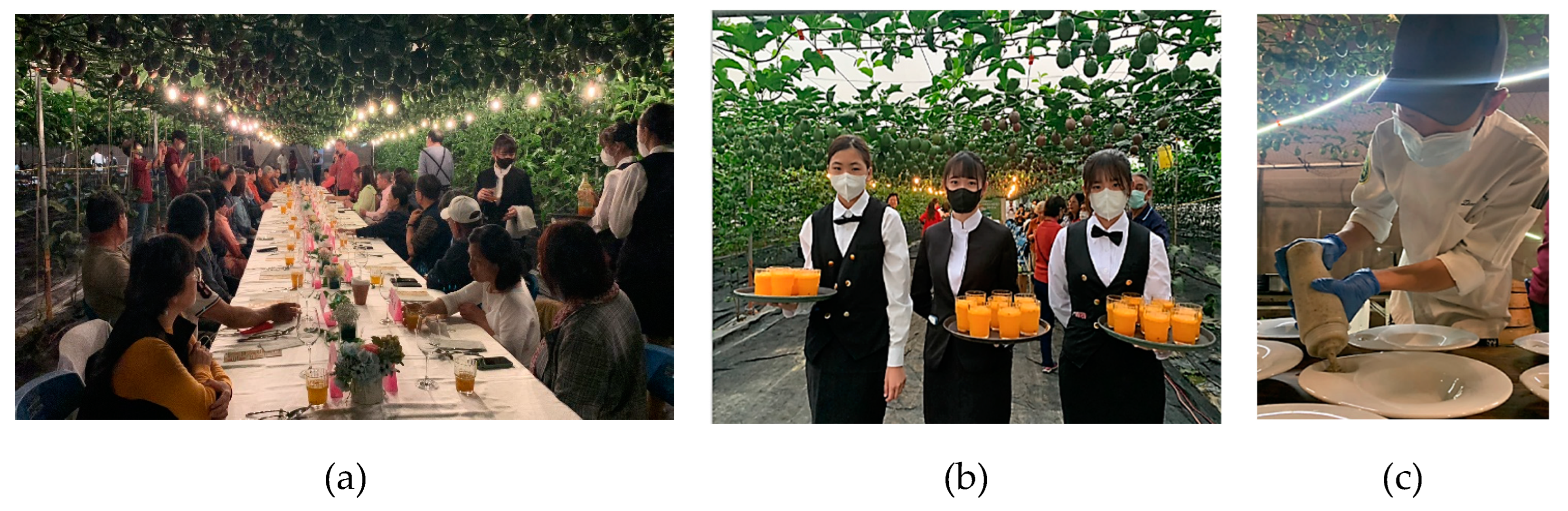
To set up a dining environment or to provide table services were not difficult for the students because most knew how to execute a single task without time limitations. However, a real project has many limitations and requirements, such as the concept of just-in-time, whereby meals and beverages should be delivered at the same time. The required services needed reactions in real-time, such that the tasks were consisted with a real business. Therefore, a teacher guided students in teamwork practices, as depicted in Figure 4a.
The teamwork was taught, but the actions were executed by the students themselves. During the dining event, students were in charge of everything; the teacher only observed the proceedings. Students were into divided groups, namely kitchen staff who prepared the meals, as shown in Figure 4c, and table service, who served the attendees, as shown in Figure 4b. Any temporary problems were solved by the team leader. The first time the team leader and members worked together, problems occurred and the students were nervous. However, the third and fourth events ran smoothly. Students felt free to talk with the farm owners and attendees.
Figure 3.
Farm-to-table – Natural dining from a local fruit farm. (a) Outside tourists or customers experience healthy dining; (b) Students serving passion fruit juice to customers; (c) Students were trained in teamwork for producing low-carbon dining.
Figure 3.
Farm-to-table – Natural dining from a local fruit farm. (a) Outside tourists or customers experience healthy dining; (b) Students serving passion fruit juice to customers; (c) Students were trained in teamwork for producing low-carbon dining.
3.3. B2C Sustainability Learning: Self-Guided Travel to a Rural Community
A qualitative study by Noy [46] described backpackers’ travel narratives, noting that travel experiences enable one to feel what is authentic. The experience of authenticity is a psychological process that underlies the human behavior of self-change. The process also involves the individual’s reflection or understanding. Their self-guided travel was connected to the eco-innovation of Wanlaun Township. Table 1 shows their preferred rural experiences.
Most students’ photos were not clear; however, we considered that some photos nevertheless presented eco-innovation meaning. For example, photos of the Million Gold Mary Temple and Life Memorial Park (Columbarium Pagoda) are shown in Figure 4 and Figure 5.
Regarding Figure 4, the travel narrative of students was interesting with respect to this Catholic edifice. The students had some specific reflections after the trip, particularly in terms of why a simple building can be an important place for community residents and tourists. Their reflections are illustrated in the following points:
- Outside the building: We (the students) called this single-color church the “white house.” It has a lonely appearance, with small doors and windows. However, its appearance made us reflect on why a traditional architecture approach can make the building still live. The Catholic logo and official seal of the Qing dynasty looked ancient but nevertheless clear. These simple symbols appeared to embody a spirit in people‘s hearts. We thought that a person could live like this building; simply, but for a long time (stronger). The Catholic church has been through some disasters, such as fire, earthquake, and typhoon, but remains standing.
- Inside the building: We saw a wood carving of the Blessed Virgin Mary. This is an exquisite carving, with the face of a young girl. Although the wood is over 100 years old, the colors remain beautiful. The building inside was akin to an art gallery, with its church pews and ceiling artwork that remains clean and beautiful. Recently, the old building has been combined with new technology — a light show that takes place on Christmas Eve every year. The building fits the meaning of eco-innovation, namely that an “old building has new life.”
Figure 4.
Cultural travel in a rural community of Wanlaun Township. (a) The outside of the building still has the official seal of the Qing dynasty. The cross and bell were imported from Spain; (b) Inside the building there are church pews, and the ceiling artwork remains beautiful.
Figure 4.
Cultural travel in a rural community of Wanlaun Township. (a) The outside of the building still has the official seal of the Qing dynasty. The cross and bell were imported from Spain; (b) Inside the building there are church pews, and the ceiling artwork remains beautiful.
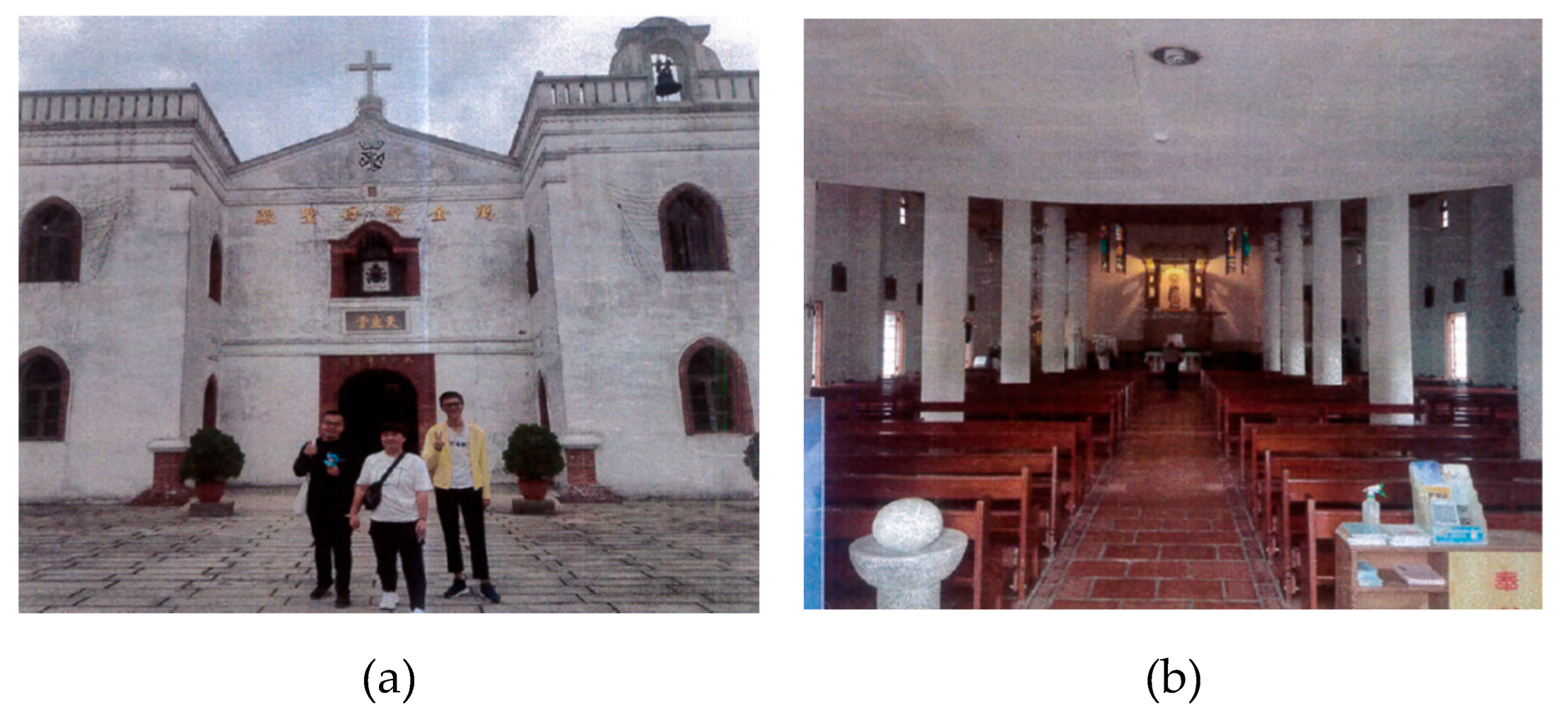
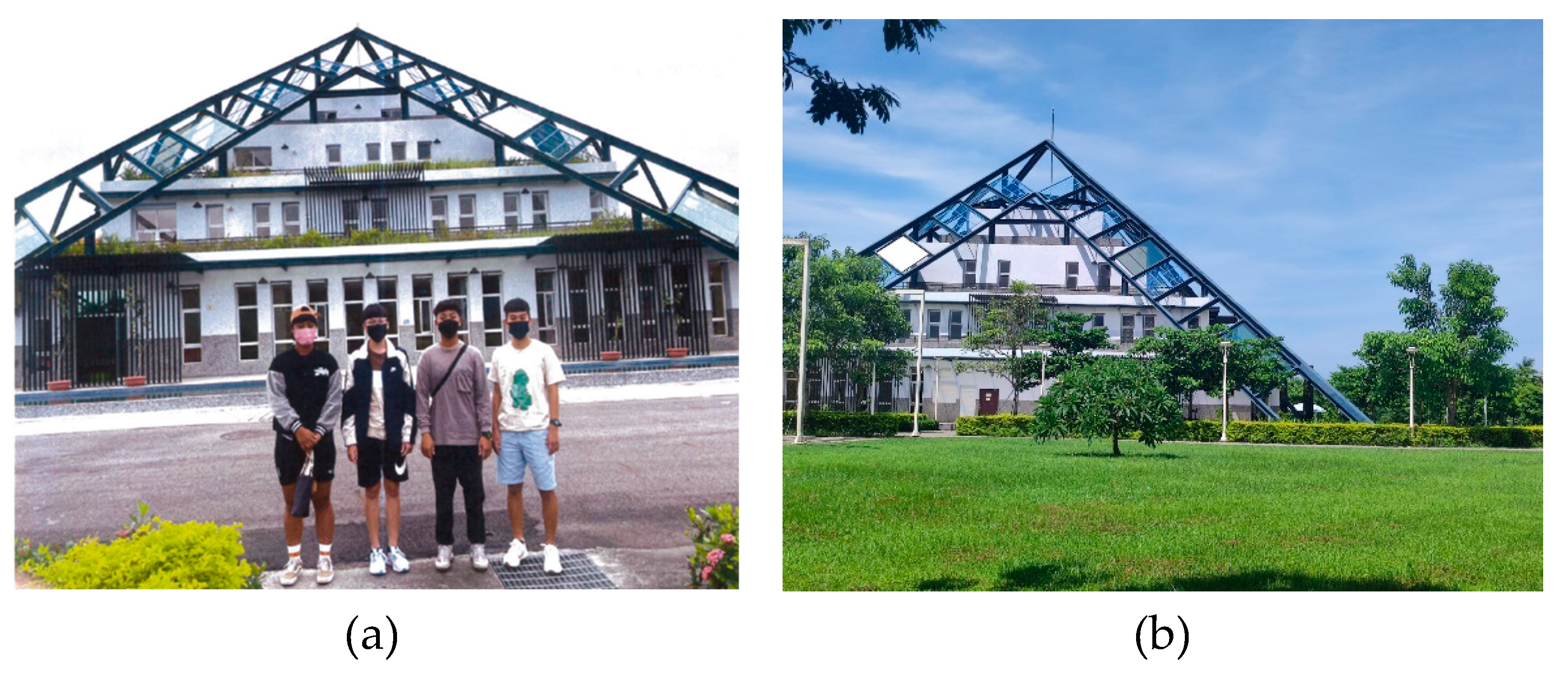
Figure 5 illustrates another travel narrative of students, namely talking about the Life Memorial Park (Columbarium Pagoda). This visit was surprising to the students. Some of their specific reflections are described below.
- The students asked the teacher “Is green eco-innovation? In rural areas, everywhere is green.” This was an example of incomplete critical thinking. Rural areas are subject to greening, but continue to need more greening engineering. The students recalled feeling somewhat nervous when they stood in front of the Columbarium Pagoda and took photos. However, they agreed that the pagoda has created a new style for traditional customs because, prior to the new building, the location was a mausoleum. According to Taiwanese custom, the mausoleums of ancestors should not be moved; however, the mausoleum has now been replaced by an architectural pyramid. The local government faced many objections to moving the mausoleum. However, the students saw that the pyramid fit the natural background and looked pleasing.
- The students also asked, “Is this a new strategy for rural marketing?” They said that they did not often travel to rural areas because they perceived such regions as dark. After the visit, they students saw that the region was clean and nice, and they showed the photos they took on social media. However, they were surprised that many people, especially younger people, tagged the posts, which the students believed reflection new attraction to Facebook users. They believed that the Life memorial Park was a nicer term than Columbarium Pagoda. The park beautified the living environment and calmed the heart and spirit.
Figure 5.
Cultural travel in a rural community to explore new attractions. (a) Students took photos, arguing that the Columbarium Pagoda was an example of eco-innovation; (b) Most of the young tourists took photos and uploaded them to social media, such as Facebook and Instagram.
Figure 5.
Cultural travel in a rural community to explore new attractions. (a) Students took photos, arguing that the Columbarium Pagoda was an example of eco-innovation; (b) Most of the young tourists took photos and uploaded them to social media, such as Facebook and Instagram.
3.4. STEAM within Sustainability Learning:
According to Kaczynski, Wood, and Harding [47], radar charts are suitable for qualitative evaluation. The qualitative data were used to determine the extent of the students’ learning. Since eco-innovation is defined by practical knowledge, students may not clearly see the relationships to STEAM education; therefore, our research team used interviews to construct radar charts.
The B2B sustainability learning involved 10 students (6 females and 4 males). They were interviewed regarding the extent to which the learning was considered applicable to each STEAM discipline, using the categories low, middle, and high. The radar chart was used to understand basic cognitions; therefore, enabling choice of multiple levels was considered unnecessary. Figure 6 is a radar chart that indicates to what extent sustainability learning was considered by the students to apply to each STEAM discipline during the B2B sustainability learning.
Figure 6 indicates that that applicability of the learning to science, technology, and the arts was considered greater than that to engineering and math. The students considered that dining was a type of art, in terms of presenting aesthetically pleasing meals that were also enjoyable to eat. The preparation and setup processes were related to hospitality management skills, from kitchen skills to table service. These combined tasks well represented food science. Fewer students felt that dining was akin to engineering. Such students considered that from when the task began, they needed to determine how many attendees would be present, the quantity of food materials needed, and the time required for preparation. All of these aspects required quantitative calculations; even food nutrition needed consideration. They reflected on the link between food service processes and health and that farming is a career worth consideration.
Figure 7 presents a radar chart that indicates the extent to which B2C sustainability learning was considered to apply to STEAM disciplines. The evaluation was completed by 58 students (34 females and 24 males). The result were slightly different from those related to B2B sustainability learning. The major reason is that self-guided travel connected to the eco-innovation of Wanlaun Township. Most students observed the natural landscape, heritage buildings, and ecological environment. Therefore, science, the arts, and technology were considered more applicable than were engineering and math. The students were interested in the Life memorial Park and the pyramid architecture was relevant to engineering and math. However, the students nevertheless felt that the architecture was more a form of art related to people’s life. Another important aspect was the technology. Most students noted that sustainability learning during the rural trip had a strong relationship with technology. However, the technology considered was specifically information technology. This is because this generation frequently uses smartphones other and smart devices; therefore, students typically obtain information and marketing through websites, Facebook, Instagram, or other social media.
In brief summary, the main B2B sustainability learning was that students learned about low-carbon operations [48], and that “eat local is to eat healthily” reduces CO2 emissions. Students saw the rural regeneration alliance among farms, residents, and local government, and how to work together to attract customers to enjoy low-carbon culinary delicacies. The primary B2C sustainability learning was implemented via students’ self-guided travel, during which they experience the rural landscape and heritage historical culture. The tasks were difficult for the students, but engendered different authentic feelings. Therefore, B2B and B2C sustainability learning were successful regarding eco-innovation for the different STEAM disciplines.
4. Discussion
4.1. Sustainability Learning Framework for STEAM and Eco-Innovation
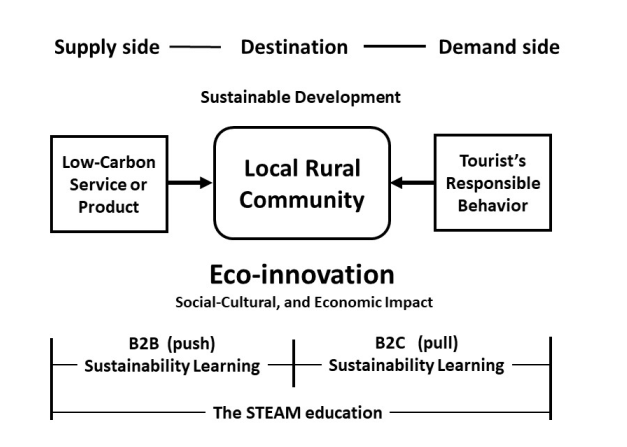
After examining process the practical case study in Wanlaun Township, we can link theory and practice. Figure 8 shows a framework for STEAM sustainability learning.
The framework is divided three parts, which were derived from the scope of the case study as described in Section 2.2. Central to the framework is the destination for the entire eco-innovation system [8]. Then, the supply side is represented by B2B sustainability learning as a push function, whereas the demand side is represented by B2C sustainability learning as a pull function. Each part was explored in terms of its associated issues and unfolded the evidence obtained. Therefore, the research questions posed may be answered as follows.
4.2. Eco-Innovation Theory “Push and Pull” can fit a Real Case of Situated Learning
The first question is important because the “push and pull” concept supports the eco-innovation theory of Klaus [7] (p. 326). However, this concept has been studied infrequently for real cases. Therefore, our case study revealed that this concept is suitable for a real-world situation.
Wanlaun Township is located in a rural area. Although, its tourism resources are not prominent, government support for environmental conservation has increasing adoption of different eco-innovation approaches. Although the rural community residents did not know the term “eco-innovation,” the improvements associated with such innovation increased the confidence of residents. Therefore, Wanlaun Township has become not only a place but also a destination. It is beginning to exhibit the core values of eco-innovation, as reflected in the different impacts on society, culture, and the economy. The impacts will mix, become the local-community context, and then finally influence rural sustainable development. Therefore, becoming a destination is the heart of the eco-innovation system, as reflected in the functions of “push and pull” in situated learning.
4.3. Situated Learning Fosters Responsible Behavior and Reflection with Personal Authenticity
Noy [46] revealed that travel fosters self-change; this is similar to learning by doing. The core value of STEAM education is to encourage problem solving by students themselves; through the process of learning by doing they understand the problems they encounter and what resources they can use, and in so doing, they attain the goal of inter-disciplinary learning [49]. B2B and B2C sustainability learning represent true opportunities for inter-disciplinary learning. We discuss this in the following section.
- Supply side (B2B sustainability learning): This form of learning represents a push. This component relates to providing low-carbon services or products for customers. This is complex because different stakeholders exist, such as the local government, small farms, the community, and outside customers. We found that the students worked together but they have had relative few prior social experiences; therefore, the students were shy when talking with farmers and customers. However, the students were interested in the organic approach to fruit farming. We further summarize this learning as follows:
- Situated learning fosters students’ responsible behavior because they must use teamwork to solve problems. With suitable pressure, students can grow to a greater extent, and in particular, they can experience personal authenticity associated with real-life interactions.
- Situated learning is not necessarily the best approach, as students’ performance is observed at specific times and places. However, with addition practice, students can slowly gain confidence. After engagement in situated learning, student’s potential thus be increased.
- Situated learning fostered some aspects of student cognitions, one of which was empathy for how hard farmers work farm. Consequently, the students were careful not to waste food materials in the classroom.
- Demand side (B2C sustainability learning): This learning component presented as a pull. The learning subject was self-guided travel in a rural community. This was chosen to provide students with a different perspective, namely that of a tourist. Another reason was to enhance cognitions regarding environmental conservation. We found that an important part of this this task was to ask (not force) students to become close to their local community. Most students live in or pass through their community, but they do not know any community history, even if they are residents. The travel task was therefore not only a trip to the countryside, but also an experience of local community that fostered knowing and understanding a place. We further summarize the outcomes of this task as follows:
- Situated learning fosters students’ responsible behavior because they see that the rural environment is green while simultaneously learning that greening the environment requires considerable effort and responsible behavior. In particular, irresponsible tourist behavior can create noise and garbage.
- Situated learning enhances personal life experiences; observation and touch can engender emotions that affect cognitions. The experience of historical heritage can enable one to understand its relationship to current lifestyles. For example, the understanding of how old buildings can continue to exist (Million Gold Mary Temple and Liou Family Ancestral Hall) involves comprehension of maintenance, recovery, and survival to today. Understanding this history fosters wisdom (accumulated experiences). A trip can engender changes in the individual [46], not only changed behavior but also changes in the mind.
- Situated learning illustrates that eco-innovation is not entirely focused on environmental engineering, but it also applies to cultural or social contexts. For example, the Catholic church is over 100 years old, but engenders the spirit of learning in STEAM because the building is relevant to science, technology, engineering, the arts, and math. Religion has components of architectural technology, recovery engineering, and Western science and art, all of which may relate to mathematics. Therefore, we can understand how the Columbarium Pagoda can change to a pyramid architecture and becoming part of eco-innovation.
5. Conclusions
Sustainability learning with cooperative and reflective elements was explored in the STEAM case study. The case study also examined how eco-innovation can be a sustainable marketing strategy to improve the local-community economy and be implemented in practice. According to the results from farm owners and tourists, we revealed the goal of ESD for 2030 – societal transformation — in a cultural and social context.
5.1. Implications
As societal transformation is a goal of ESD for 2030, our study accords with Feola [50], namely that societal transformation represents a suitable response to global environmental change. This current work bridges theory and the goal of ESD for 2030. Following the ESD for 2030, the United Nations Educational, Scientific and Cultural Organization (UNESCO) [51] published a roadmap for education for sustainable development. The results of this study have managerial and educational implications that may explain how the Asia-Pacific context meets the emerging policy of UNESCO [51].
The study has several implications for management regarding how to implement eco-innovation in a rural area. Through considering eco-innovation actions, we suggest that support and resources from government are necessary. For example, we saw that river recovery engineering and rural regeneration were all executed by the Council of Agriculture. Rural activity also related to the supporting projects. Rural sustainable development not only needs financing but also effective management of input resources. We saw that eco-innovation may reduce pesticide use, but we do not know the extent to which organic or nontoxic farming approaches have been broadly adopted and certified. Therefore, soil and water conservation is not simple; more consideration should be given to managerial aspects. The community must expend effort itself to manage the living environment so that there is not a situation where one farm uses pesticides whereas a neighboring farm uses nontoxic methods. Or, one area might seek to recover old buildings but a neighboring area might not engage in any such actions. This would demonstrate inconsistency of management. Therefore, this industry-university cooperation provides another perspective by which to make the suggestions for local government regarding managerial implications.
Another implication related to STEAM education and sustainability learning. When striving for sustainable education for students, it is important to ask whether this is worthwhile. Sustainable Development Goals (SDGs) has become a popular term worldwide; however, it is not clear the extent to which teachers truly understanding the core meaning. This also applied to the term ESD. Therefore, UNESCO policy [51] may be used to support teachers; there could be dedicated SDG, with the support subsequently extended to others. Without such an approach, the SDGs may remain a slogan, similar to” climate change crisis.” This pertains to the basic problem of how to teach students with different learning approaches for STEAM disciplines. The importance of STEAM is well understood, but we suggest that STEAM education needs to incorporate more social and cultural elements from industry. However, is remains difficult to connect industrial knowledge to teaching (e.g., problem-solving or self-learning). Therefore, STEAM education needs to expend more effort to explore practical issues, including the role of learning by doing through life experiences associated with situated learning.
5.2. Limitations and Future Research
This study is a single case from the rural community of Wanluan Township. It is primarily relevant to an Asia-Pacific context and will not apply to all situations worldwide. Therefore, that this is a case of a single community represents the first limitation. The study period is another limitation. The rural activities occurred in specific contexts, such as B2B sustainability learning in the fruit production season, and B2C sustainability learning during the Cocoa cultural industry festival. The students did not talk about this issue, but we note that this limitation existed nevertheless.
Our suggestions for future research are including “push and pull” eco-innovation, STEAM education, and sustainability learning. Eco-innovation theory is typically focused on implementation [52]. We recognize the importance of eco-innovation implementation, but how the factors of push and pull affect eco-innovation requires further investigation. The topic has a critical position in the greening supply chain. The second suggestion pertains to the method of STEAM education. Learning by doing may promote successful outcomes in real life. This may challenge different professionals, since the teaching methods of technical and vocational education are different than those of general education. Therefore, future studies could compare the factors that affect educational implementation. Finally, we return to the original point, namely sustainability learning. The roadmap of ESD for 2030 (UNESCO) [51] is focused on societal transformation. This has provided a direction for educators, but how to use or connect this to higher education has been less studied. More case studies could be used to clarify the different practices; clear understanding of teaching and learning practices are urgently needed.
Author Contributions
Investigation, Hung, - C.L.; resources, YU, -T.F.; data curation, Lin, -Y.H.; data analysis, Lin.-Y.C.; and Chen, Yi. H.; Conceptualization, writing—original draft, writing—review & editing, W.-S.L. All authors have read and agreed to the published version of the manuscript.
Funding
This research was funded by the Ministry of Education (MOE, Taiwan; grant number: PHE1110041, the 2022 Project of MOE Teaching Practice Research Program).
Institutional Review Board Statement
Not applicable.
Informed Consent Statement
Informed consent was obtained from all participants involved in the study.
Data Availability Statement
Not applicable.
Acknowledgments
We would like to thank the reviewers for their valuable comments and efforts. We would especially like to thank the Wanlaun Township Office and students and faculty at the Department of Tourism and Department of Hospitality Management of Meiho University for their valuable collaboration and assistance during each practical stage of the project.
Conflicts of Interest
The author declares no conflict of interest.
References
- M. M., A. Eco-innovation–Towards a Taxonomy and a Theory. In Proceedings of Entrepreneurship and Innovation (Organizations, Institutions, Systems and Region), The 25th celebration DRUID conference, June 17-20, 2008.
- Díaz-García, C.; González-Moreno, A.; Sáez-Martíínez, F.J. Eco-innovation: insights from a literature review. Innovation 2015, 17, 6–23. [Google Scholar] [CrossRef]
- Eva M, G.-G.; Piedra-Muñoz, L.; Galdeano-Gómez, F. Multidimensional Assessment of Eco-innovation Implementation: Evidence from Spanish Agri-food Sector. Int. J. Environ. Res. Public Health 2020, 17, 1432. [Google Scholar] [CrossRef]
- De Jesus Pacheco, D.A.; Ten Caten, C.S.; Jung, C.F.; Ribeiro, J.LD.; Navas, H.V.; Cruz-Machado, V.A. Eco-innovation Determinants in Manufacturing SMEs: Systematic Review and Research Directions. J. Clean. Prod. 2017, 142, 2277–2287. [Google Scholar] [CrossRef]
- Alonso-Almeida, M.-d.M.; Rocafort, A.; Borrajo, F. Shedding Light on Eco-Innovation in Tourism: A Critical Analysis. Sustainability 2016, 8, 1262. [Google Scholar] [CrossRef]
- Sharma, T.; Chen, J.; Liu, W.Y. Eco-innovation in hospitality research (1998-2018): a systematic review. Int. J. Contemp. Hosp. Manag. 2018, 32, 913–933. [Google Scholar] [CrossRef]
- Klaus, R. Redefining Innovation—Eco-innovation Research and The Contribution from Ecological Economics. Ecol. Econ. 2000, 32, 319–332. [Google Scholar] [CrossRef]
- Sally, G.; McMeekin, A. Eco-innovation Systems and Problem Sequences: The Contrasting Cases of US and Brazilian Biofuels. Ind. Innov. 2011, 18, 301–315. [Google Scholar] [CrossRef]
- Bag, S.; Dhamija, P.; Bryde, D.J.; Singh, R.K. Effect of eco-innovation on green supply chain management, circular economy capability, and performance of small and medium enterprises. J. Bus. Res. 2022, 141, 60–72. [Google Scholar] [CrossRef]
- Melek, Y.; Kazan, H. Effects of Eco-innovation on Economic and Environmental Performance: Evidence from Turkey’s Manufacturing Companies. Sustainability 2020, 12, 3167. [Google Scholar]
- Paul, E. Eco-innovation for Environmental Sustainability: Concepts, Progress and Policies. Int. Econ. Econ. Policy 2010, 7, 267–290. [Google Scholar]
- Brunekreef, B.; Holgate, S. T. Air Pollution and Health. The Lancet 2002, 360, 1233–1242. [Google Scholar] [CrossRef]
- Sulaman, M.; Long, X. Rule of Law and CO2 Emissions: A Comparative Analysis Across 65 Belt and Road Initiative (BRI) countries. J. Clean. Prod. 2021, 279, 123539. [Google Scholar] [CrossRef]
- William, L.B. Sears’ Repair of its Auto Service Image: Image Restoration Discourse in the Corporate Sector. Commun. Stud. 1995, 46, 89–105. [Google Scholar] [CrossRef]
- Joel, M.P. A Status-based Model of Market Competition. Am. J. Sociol. 1993, 98, 829–872. [Google Scholar]
- Rolf, W.; Bilharz, M. Green Energy Market Development in Germany: Effective Public Policy and Emerging Customer Demand. Energy Policy 2006, 34, 1681–1696. [Google Scholar] [CrossRef]
- Helen, K.; Meijers, F. Education for Sustainable Development (ESD): Exploring Theoretical and Practical Challenges. Int. J. Sustain. High. Educ. 2014, 15, 188–207. [Google Scholar]
- Shulla, K.; Filho, W.L.; Lardjane, S.; Sommer, J.H.; Borgemeister, C. Sustainable development education in the context of the 2030 Agenda for sustainable development. Int. J. Sustain. Dev. World Ecol. 2020, 27, 458–468. [Google Scholar] [CrossRef]
- Federica, C.M.; Celone, A. SDGs and Innovation in the Business Context Literature Review. Sustainability 2019, 11, 7043. [Google Scholar] [CrossRef]
- Sipos, Y.; Battisti, B.; Grimm, K. Achieving Transformative Sustainability Learning: Engaging Head, Hands and Heart. Int. J. Sustain. High. Educ. 2008, 9, 68–86. [Google Scholar] [CrossRef]
- John, R.A.; Reder, L.M.; Simon, H.A. Situated Learning and Education. Educ. Res. 1996, 25, 5–11. [Google Scholar]
- Anne, P.T.; Oskamp, S. Relationships Among Ecologically Responsible Behaviors. J. Environ. Syst. 1984, 13, 115–126. [Google Scholar]
- Ronald, E.H. The Role and Experience in Learning: Giving Meaning and Authenticity to the Learning Process in Schools. J. Technol. Educ. 2000, 11, 23–33. [Google Scholar]
- Georgette, Y.; Lee, H. Exploring the Exemplary STEAM education in the US as a Practical educational Framework for Korea. J. Korean Assoc. Sci. Educ. 2012, 32, 1072–1086. [Google Scholar]
- Safapour, E.; Kermanshachi, S.; Taneja, P. A Review of Nontraditional Teaching Methods: Flipped Classroom, Gamification, Case Study, Self-Learning, and Social Media. Educ. Sci. 2019, 9, 273. [Google Scholar] [CrossRef]
- Dunlosky, J.; Rawson, K.A.; Marsh, E.J.; Nathan, M.J.; Willingham, D.T. Improving Students’ Learning with Effective Learning Techniques: Promising Directions from Cognitive and Educational Psychology. Psychol. Sci. Public Interest 2013, 14, 4–58. [Google Scholar] [CrossRef]
- Yuichiro, A.; Simon, H.A. The Theory of Learning by Doing. Psychol. Rev. 1979, 86, 124. [Google Scholar]
- Sharan, M.B. The Case Study in Educational Research: A Review of Selected Literature. J. Educ. Thought 1985, 204–217. [Google Scholar]
- Helen, K.; Meijers, F. Education for Sustainable Development: Exploring Theoretical and Practical Challenges. Int. J. Sustain. High. Educ. 2014, 15, 188–207. [Google Scholar]
- Dzintra, I.; Badyanova, Y. A Case Study of ESD Implementation: Signs of Sustainable Leadership. Discourse Commun. Sustain. Educ. 2014, 5, 38–48. [Google Scholar]
- Scholz, R.W.; Lang, D.J.; Wiek, A.; Walter, A.I.; Stauffacher, M. Transdisciplinary Case Studies as A Means of Sustainability Learning: Historical Framework and Theory. Int. J. Sustain. High. Educ. 2006, 7, 226–251. [Google Scholar] [CrossRef]
- Vallaeys, F.; Oliveira, M.; Crissien, T.; Solano, D.; Suarez, A. State of the art of university social responsibility: a standardized model and compared self-diagnosis in Latin America. Int. J. Educ. Manag. 2022, 36, 325–340. [Google Scholar] [CrossRef]
- Ellen, A.D. Validity and Reliability in Social Science Research. Educ. Res. Perspect. 2011, 38, 105–123. [Google Scholar]
- Rob, V.; Khan, S. Redefining Case Study. Int. J. Qual. Methods 2007, 6, 80–94. [Google Scholar] [CrossRef]
- Kirsten, P.S.; Christakis, N.A. Social Networks and Health. Annu. Rev. Sociol. 2008, 34, 405–429. [Google Scholar]
- Jesionkowska, J.; Wild, F.; Deval, Y. Active Learning Augmented Reality for STEAM Education—A Case Study. Educ. Sci. 2020, 10, 198. [Google Scholar] [CrossRef]
- Mejias, S.; Thompson, N.; Sedas, R.M.; Rosin, M.; Soep, E.; Peppler, K.; Roche, J.; Wong, J.; Hurley, M.; Bell, P.; et al. The trouble with STEAM and why we use it anyway. Sci. Educ. 2021, 105, 209–231. [Google Scholar] [CrossRef]
- Bokhari, A.A. ; King Abdulaziz University Universities‟ Social Responsibility (USR) and Sustainable Development: A Conceptual Framework. Int. J. Econ. Manag. Stud. 2017, 4, 8–16. [Google Scholar] [CrossRef]
- David, A.K.; Yoels, W.C. The College Classroom: Some Observations on the Meanings of Student Participation. Sociol. Soc. Res. 1976, 60, 421–439. [Google Scholar]
- Lobe, B.; Morgan, D.; Hoffman, K.A. Qualitative Data Collection in an Era of Social Distancing. Int. J. Qual. Methods 2020, 19. [Google Scholar] [CrossRef]
- Hox, J.J.; Boeije, H.R. Data Collection, Primary Versus Secondary. Encycl. Soc. Meas. 2005, 593–599. [Google Scholar]
- Noble, H.; Heale, R. Triangulation in Research, with Examples. Evid. -Based Nurs. 2019, 22, 67–68. [Google Scholar] [CrossRef]
- Wanlaun Township Office Website. Available online: https://www.pthg.gov.tw/townwlt/Default.aspx (accessed on 25 June 2023).
- Soil and Water Conservation Bureau Website. Available online: https://www.swcb.gov.tw/Home/eng/ (accessed on 02 July 2023).
- Lipiäinen, S.; Kuparinen, K.; Sermyagina, E.; Vakkilainen, E. Pulp and paper industry in energy transition: Towards energy-efficient and low carbon operation in Finland and Sweden. Sustain. Prod. Consum. 2022, 29, 421–431. [Google Scholar] [CrossRef]
- Noy, C. This Trip Really Changed Me: Backpackers’ Narratives of Self-Change. Ann. Tour. Res. 2004, 31, 78–102. [Google Scholar] [CrossRef]
- Costa, C.; Antonucci, F.; Pallottino, F.; Aguzzi, J.; Sarriá, D.; Menesatti, P. A Review on Agri-food Supply Chain Traceability by Means of RFID Technology. Food Bioprocess Technol. 2013, 6, 353–366. [Google Scholar] [CrossRef]
- Kaczynski, D.; Wood, L.; Harding, A. Using Radar Charts with Qualitative Evaluation: Techniques to Assess Change in Blended Learning. Act. Learn. High. Educ. 2008, 9, 23–41. [Google Scholar] [CrossRef]
- Gao, X.; Li, P.; Shen, J.; Sun, H. Reviewing assessment of student learning in interdisciplinary STEM education. Int. J. STEM Educ. 2020, 7, 2–4. [Google Scholar] [CrossRef]
- Feola, G. Societal transformation in response to global environmental change: A review of emerging concepts. AMBIO 2015, 44, 376–390. [Google Scholar] [CrossRef]
- United Nations Educational, Scientific and Cultural Organization (UNESCO). Available online: https://unesdoc.unesco.org/ark:/48223/pf0000374802.locale=en (accessed on 05 July 2023).
- Tsai, K.-H.; Liao, Y.-C. Innovation Capacity and the Implementation of Eco-innovation: Toward a Contingency Perspective. Bus. Strat. Environ. 2017, 26, 1000–1013. [Google Scholar] [CrossRef]
Figure 1.
The determinants of eco-innovation by push/pull. Figure from Klaus [7] (p. 326).OSH = Occupational Safety and Health.
Figure 1.
The determinants of eco-innovation by push/pull. Figure from Klaus [7] (p. 326).OSH = Occupational Safety and Health.
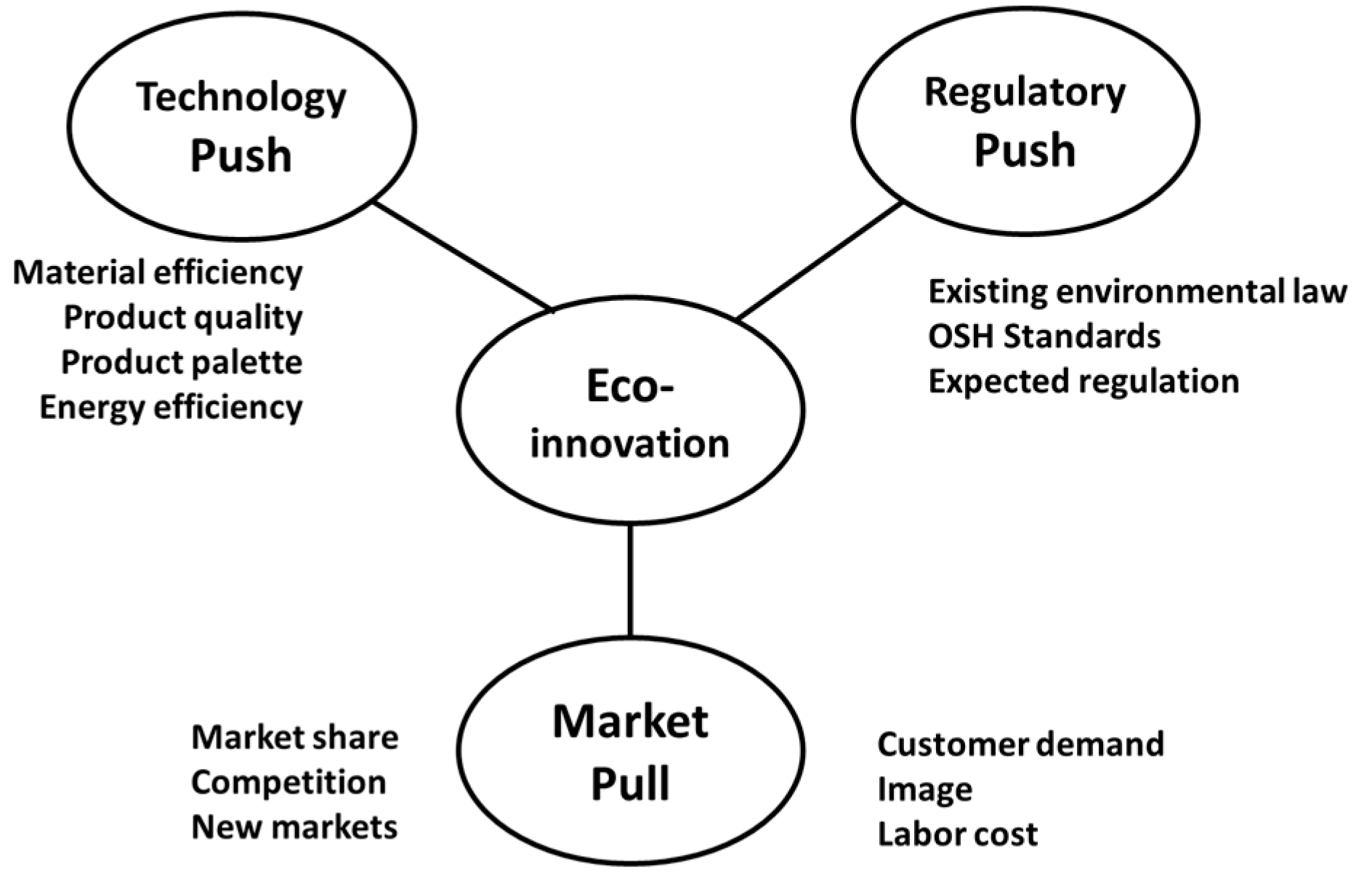
Figure 2.
Wanlaun Township in Pingtung County (red line), near the Central Mountain Range, has a rich culture and landscapes (modified from Google maps).
Figure 2.
Wanlaun Township in Pingtung County (red line), near the Central Mountain Range, has a rich culture and landscapes (modified from Google maps).
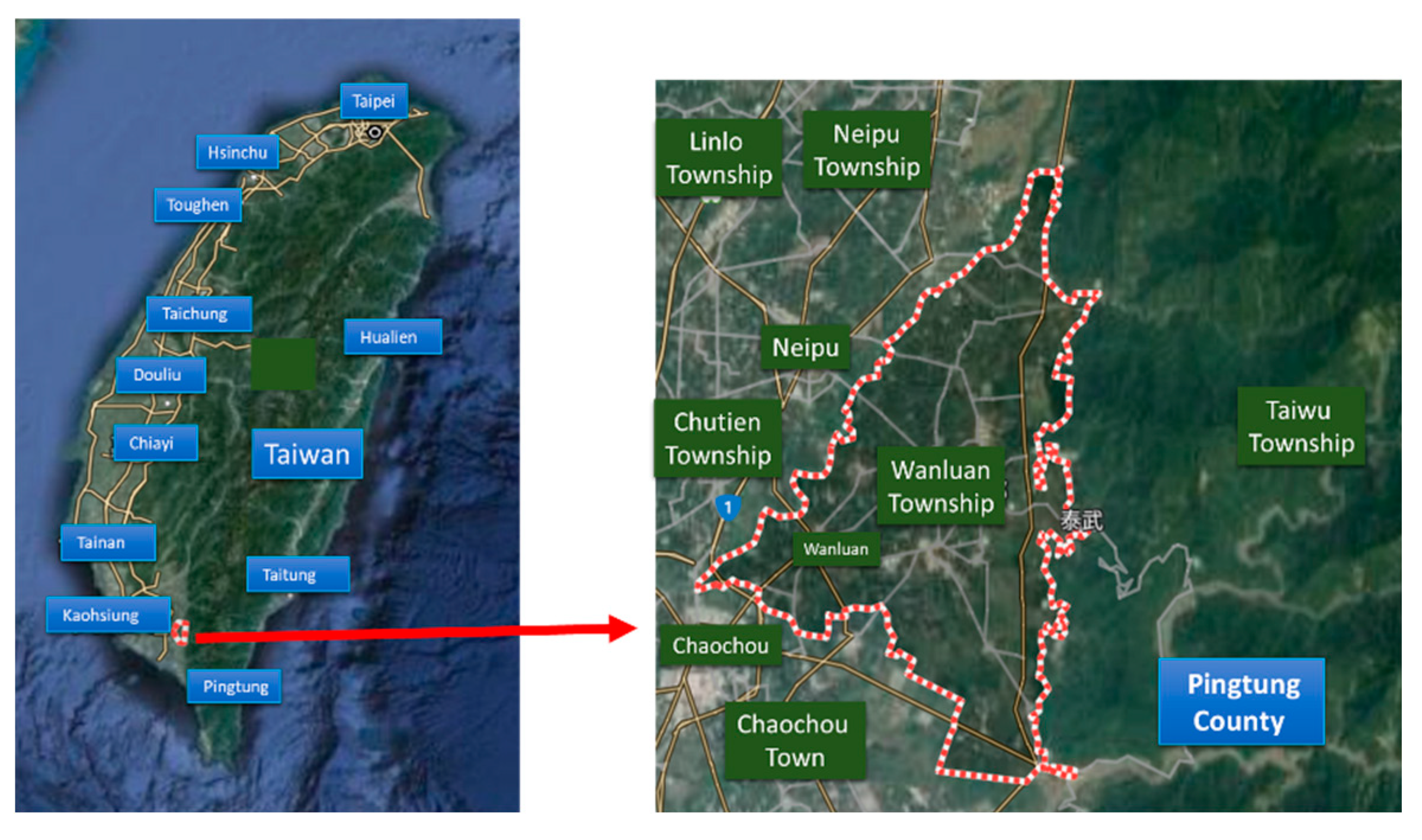
Figure 6.
Different relationships between B2B sustainability learning and STEAM disciplines.
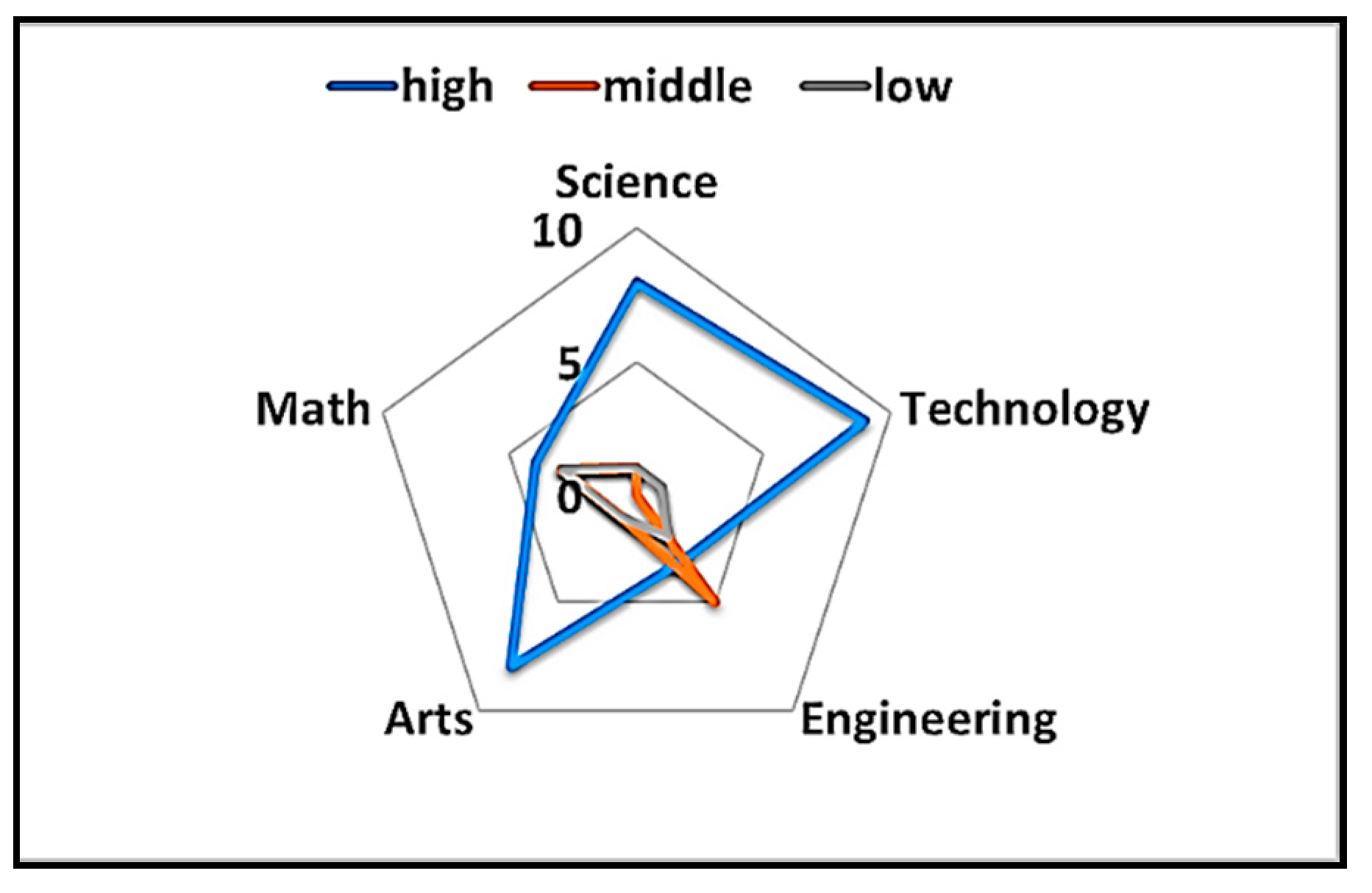
Figure 7.
Different relationship between STEAM disciplines and B2C sustainability learning.
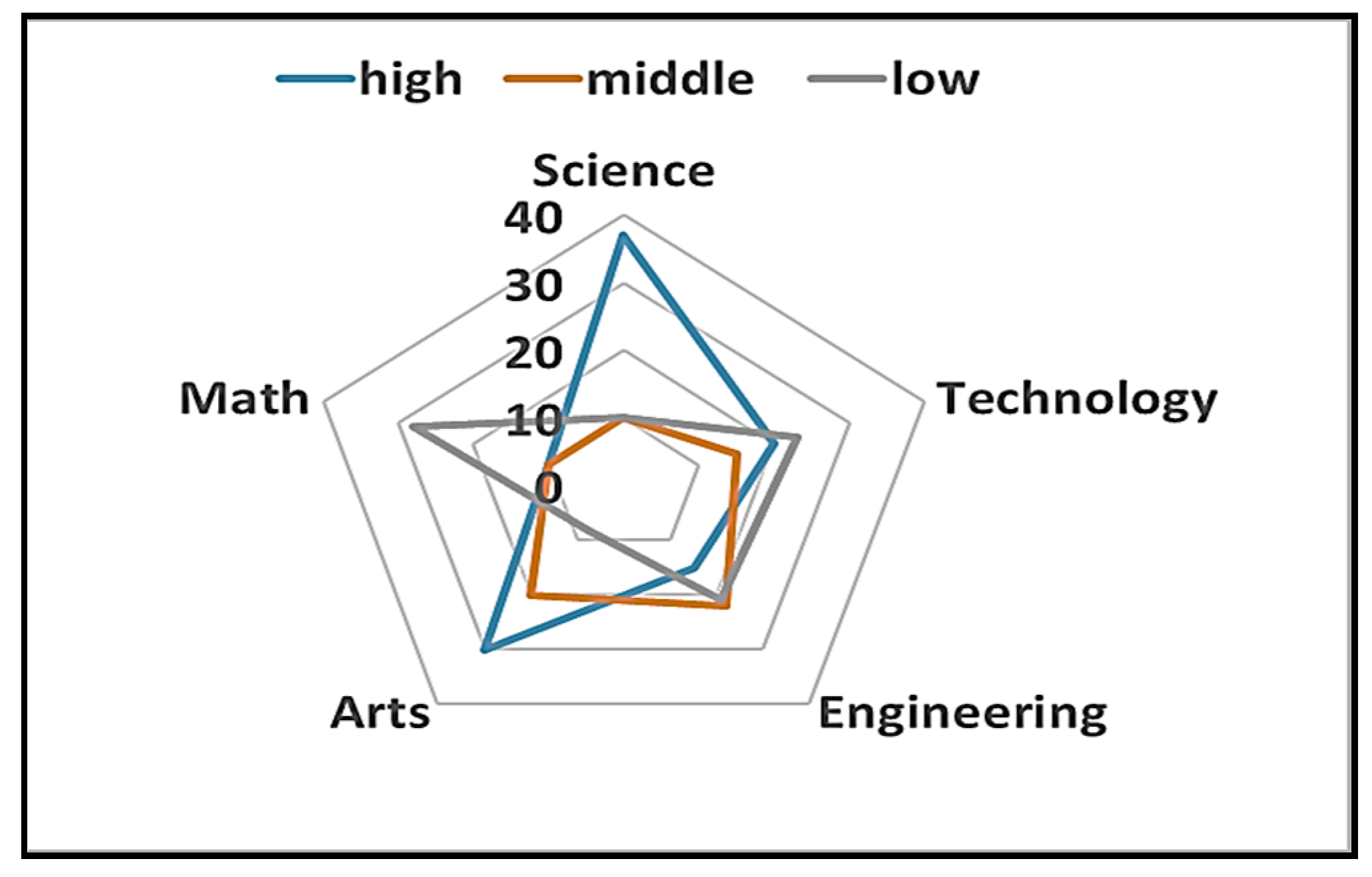
Figure 8.
A framework for STEAM sustainability learning.
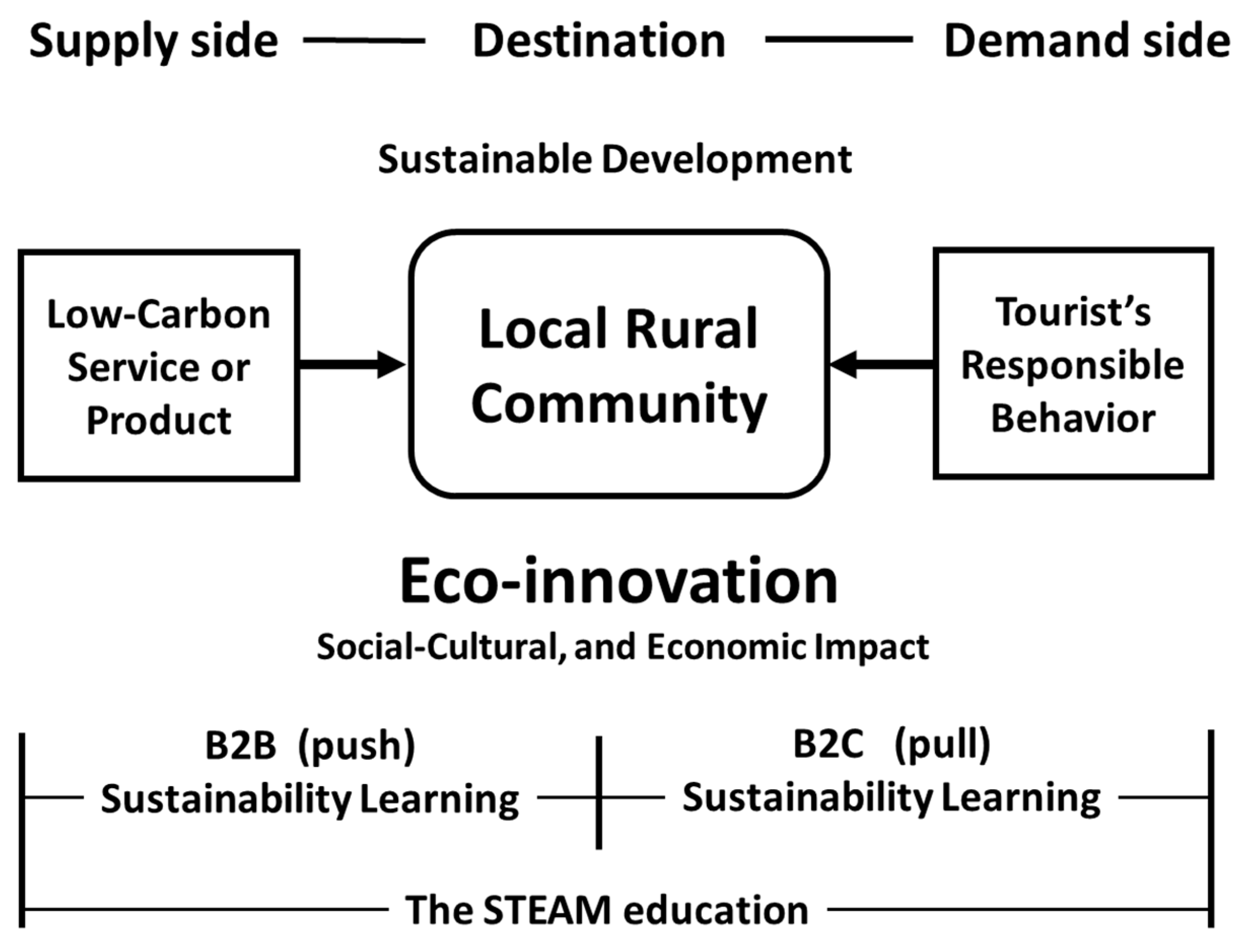

Table 1.
Students’ self-guided travel connected with eco-innovation in Wanlaun Township.
| Attractions | Travel Experiences and their Eco-Innovation Meaning |
|---|---|
| Million Gold Mary Temple | This Catholic temple was built 1860. It is the residents’ religious center but also an example of live heritage because the building used local materials such as honey, lime, unrefined sugar, and soil mixed together. Although, it has been damaged several times, it remains standing in its original location. The eco-innovation meaning is that an old building has a new function (education) and represents a local cultural-social attraction. |
| Liou Family Ancestral Hall | The building was constructed in 1864 and is occupied by descendants of the original inhabitants. The building is located at the front of a traditional Hakka settlement because the occupants, the Liou family, had a good reputation and were wealthy at that point in time. In particular, the building has a rich Chinese cultural heritage and arts. The students saw Chinese feng shui in the design. For example, the river flowing in front of house represents wealth and protection from external forces. The eco-innovation meaning is wisdom, as the building was designed in harmony with nature, without damaging the environment. The old building is not only a residence but also has new function for the cultural trip. |
| Life Memorial Park (Columbarium Pagoda) | The park was built in 2019. It has a special place in Taiwanese culture. As most Taiwanese people revere their ancestry, many people are unwilling to support change. However, this problem was overcome, and the park was constructed, including two pyramids. Younger people frequently visit the park to take photos. The eco-innovation meaning is effective use of land, and making the landscape more beautiful and friendly. |
| Kulaluce Tribe (Permanent House the for Typhoon Morakot Disaster) | Typhoon Morakot caused massive damage in southern Taiwan in August 2009. After the disaster, the indigenous people were moved to this location to begin a new life. The Permanent House was built in a traditional cultural style, and has become a popular park that promotes high sea-level coffee. The eco-innovation meaning is re-construction, cultural conservation, and the production of high-quality coffee. |
Disclaimer/Publisher’s Note: The statements, opinions and data contained in all publications are solely those of the individual author(s) and contributor(s) and not of MDPI and/or the editor(s). MDPI and/or the editor(s) disclaim responsibility for any injury to people or property resulting from any ideas, methods, instructions or products referred to in the content. |
© 2023 by the authors. Licensee MDPI, Basel, Switzerland. This article is an open access article distributed under the terms and conditions of the Creative Commons Attribution (CC BY) license (http://creativecommons.org/licenses/by/4.0/).
Copyright: This open access article is published under a Creative Commons CC BY 4.0 license, which permit the free download, distribution, and reuse, provided that the author and preprint are cited in any reuse.


