

Submitted:
14 July 2023
Posted:
17 July 2023
You are already at the latest version
Abstract
Although the beneficial health effects of prebiotics have been demonstrated in numerous research papers, its incorporation into daily food remains unfamiliar to consumers. This work evaluates the resistant maltodextrin (RMD) addition in the sensory attributes of pasteurized orange juice, together with the physico-chemical properties and the aromatic profile. RMD addition moderately improved almost all sensory attributes evaluated by panellists. It also proportionally increased °Brix together with density and decreased acidity. Colour changes were registered with higher RMD concentrations. Orange pulp presence affected the volume particle size distribution analysis while RMD addition did not exercised any effect. The aroma volatile compounds were also analysed. Pulp-added samples marked higher alcohol and aldehydes quantity, whereas pulp-free samples registered higher terpenes and terpenoids values. Ketones and acids were also quantified. RMD had a moderate impact on volatile compounds quantifications, playing the orange pulp presence a much more decisive role. A correlation analysis was also performed to relate instrumental and sensorial determinations for all samples. This work proves that the addition of RMD to orange juice is technologically feasible while also achieving a good response at the sensory level.
Keywords:
resistant maltodextrin
; pasteurized orange juice
; sensory evaluation
; physico-chemical properties
; volatile aroma compounds
1. Introduction
Consumers’ consciousness towards a healthy diet in recent years has increased the demand for high-value food products, such as functional ingredients [1], aiming to improve the nutritional properties of conventional food and beverages. Within the functional ingredients, prebiotics emerges as a route of great interest to meet consumers’ needs due to their contribution to human health. Prebiotics are a group of dietary fibers whose selective fermentation results in specific changes in the composition and/or activity of the gastrointestinal microbiota, thus conferring benefits upon host health [2]. Substances such as inulin, fructo-oligosaccharides, gluco-oligosaccharides, lactulose, isomalto-oligosaccharides, or lactosucrose have been widely studied because of their prebiotic activity [3,4]. However, resistant maltodextrin (RMD), which is a corn-based non-digestible fiber [5], is gaining popularity in recent times because of its positive implications in human health [6,7,8,9].
This functional food trend represents an innovation focus on the food industry to develop new food products that go beyond basic nutrition and good tasting [10,11]. As such, it entails technological challenges depending on the food matrix, processing, packaging, shelf life, etc. For this reason, it is convenient to investigate the application of these substances on easily manageable matrices, such as beverages. Accordingly, orange juice is a suitable vehicle for this kind of functional ingredient because it already contains functional compounds [12] and because it is the most preferred fruit juice flavor among consumers [13]. Besides, prebiotics added to liquid matrices could be more effective in terms of health impact because they are usually easier to digest than solid foods. However, it is widespread to apply a pasteurization process to commercial orange juice. It is well-known that thermal treatments cause a complex series of chemical reactions which either losing the original aroma or developing foreign odors to fresh orange juice [14]. Therefore, protecting or improving the original sensory attributes of heat-treated orange juice is an interesting challenge that needs to be further exploited.
The healthy effect of many prebiotics has been proven in clinical trials [15]. However, the incorporation of functional ingredients into day-to-day foods could be more familiar to consumers [16]. So, in addition to the health effect of functional ingredients, it is also of great relevance to elucidate the impact of functional compounds in food products, as it is critical for consumer acceptance. Therefore, this work aimed to evaluate the sensory attributes of pasteurized orange juice with RMD, together with the physico-chemical properties and the aromatic profile. Analysing how functional ingredients influence sensorial properties of conventional foods and their acceptability is essential to improve consumer predisposition to turn towards healthier eating habits.
2. Materials and Methods
2.1. Raw materials
This study was conducted with freshly squeezed orange juice supplied by Refresco Iberia S.A.U. (Valencia, Spain). All oranges were of Spanish origin. RMD (Fibersol-2) added to the juice was purchased from ADM/Matsutani, LLC (Decatur, IL, USA). Frozen pasteurized orange pulp was provided by a local fruit processing company (Zumos Valencianos del Mediterráneo, Valencia, Spain).
2.2. Sample preparation and pasteurization
Eight samples of orange juice were prepared. Four were orange juice with pulp (OJP), and the other four were orange juice without pulp (OJWP). Fresh orange juice was directly collected from the industrial squeezed lines. Orange pulp (2.5%) was added to the OJP samples. Pulp content was homogenised using a stirrer (LH Overhead Stirrer, VELP Scientifica, Italy) by applying 200 rpm for 5 minutes. Increasing RMD concentrations (2.5, 5, and 7.5%) were mixed into OJP and OJWP samples. Thus, for a final beverage portion of 200 mL, 5, 10, or 15 g of RMD respectively would be ingested, enough to display functional effects according to other studies [6,7,8,9]. Control samples without RMD addition (OJP0 and OJWP0) were also prepared, and they complied with the European Fruit Juice Association orange juice guidelines (AIJN), so no adulteration or deviation occurred during the juice extraction. To properly dissolve RMD in the fresh orange juice, the same stirrer at 200 rpm for 15 min was used. Finally, all samples were pasteurized (Fruchtsaftdispenser, Mabo Steuerungselemente GmbH, Germany) at 85 °C for 10 s, and were hot filled into 250 mL polyethylene terephthalate (PET) bottles. After the heat treatment, all bottles were immersed in a cold-water bath (< 10 °C) for 30 minutes to cool down.
2.3. Sensory analysis
A trained panel of 15 members, 6 men, and 9 women, conducted a sensory analysis of the orange juice samples. The age of the panellists ranged from 28 to 55 years old. They evaluated colour, aromatic intensity, sweetness, acidity, bitterness, mouthfeel, off-flavour, and acceptability as the attributes of the orange juices samples by using a 9-point hedonic scale (9 = like extremely; 1 = dislike extremely) [17].
During test session, panellists worked in individual booths. All samples were presented to the panellists at 20 °C under normal lighting conditions in 50 mL cups, and a 3-digit random number was placed on them, identifying each sample. Water at room-temperature was given to the panellists to clean the palate before trying the next sample. At the session, the panellists evaluated all eight samples (with and without orange pulp addition, and with and without RMD addition).
2.4. Physico-chemical determinations
2.4.1. Brix, pH, acidity, and density
Total soluble solids (°Brix) were measured using refractometry (Abbemat 200, Anton Paar, Austria). Determination of pH was made using a Basic 20 pH meter (Crison, Spain). Acidity, expressed as grams of citric acid per 100 mL (gCA/100 mL), was determined using a DL53 acid titrator (Mettler Toledo, Switzerland). Density was obtained using a densimeter (DMA 5000, Anton Paar, Austria). All determinations were performed in triplicate by AOAC guidelines [18].
2.4.2. Particle size
Juice particle size distribution was determined by applying the laser diffraction method and Mie theory [19] by using a particle size analyser (Malvern Instruments Ltd., Mastersizer 2000, U.K.) equipped with a wet sample dispersion unit (Malvern Instruments Ltd., Hydro 2000 MU, U.K.). Laser diffraction reports the volume of material of a given size, since the light energy reported by the detector system is proportional to the volume of material present. The Mie theory requires information on the sample and the dispersant optical properties. For orange juice, the particle refraction and absorption were 1.52 and 0.1, respectively, and the water refraction index was 1.33. The sample was dispersed in distilled water and pumped through the optical cell under moderate stirring (1,800 rpm) at 20 °C. The volume (%) against particle size (in µm) was obtained, and the size distribution was characterized by the volume mean diameter (D[4,3]). The standard percentile d(0.1), or particle size below which 10% of the sample lies, and d(0.9), or particle size below which 90% of the sample lies, were also considered for juice characterization.
2.4.3. Colour measurement
The sample colour was measured using a colourimeter (Konica Minolta CM-700d/600d series, Tokyo, Japan) with a standard illuminant D65 and a visual angle 10°. Results were obtained in terms of L* (brightness: L* = 0 (black), L* = 100 (white)), a* (-a* = greenness, +a* = redness), and b* (-b* = blueness, +b* = yellowness), according to the CIELab system [20]. Total colour differences (ΔE) were calculated by comparing each sample with RMD with its corresponding control (OJWP0 or OJP0).
2.5. Analysis of volatile compounds by ITEX/GS-MS
The extraction and analysis of volatile compounds were performed according to Igual et al. [21] using the in-tube extraction technique (ITEX) followed by their separation and identification by gas chromatography-mass spectrometry (GC-MS), using a GC-MS QP-2010 model (Shimadzu Scientific Instruments, Kyoto, Japan) equipped with a Combi-PAL AOC-5000 autosampler (CTC Analytics, Zwingen, Switzerland) and a capillary column (ZB-5 ms, 30 m × 0.25 mm i.d. × 0.25 µm, Phenomenex, Torrance, USA). For the volatile extraction step, a hermetically sealed headspace vial containing 0.5 g of sample was incubated at 60 °C under continuous agitation for 10 min. After the incubation, from the headspace phase, the volatile compounds were adsorbed (aided by the headspace syringe) repeatedly (15 strokes) into a porous polymer fiber microtrap (ITEX-2TRAPTXTA, Tenax TA 80/100 mesh, ea). The extraction of the volatile compounds and their thermal desorption and injection into the GC-MS injector were performed automatically using the Combi-PAL AOC-5000 autosampler. These parameters for the column oven were used: from 38°C the temperature has risen to 110 °C and then to 250 °C at 4 °C/min and 20 °C/min, respectively, and the final temperature was held for 5 min. The identification of the samples’ volatiles was based on their mass spectra using the software’s NIST27 and NIST147 mass spectra libraries and was verified and compared with retention indices drawn from databases [22,23]. Results are expressed as a relative percentage from the total peak area.
2.6. Statistical analysis
Analysis of variance (ANOVA) was applied with a confidence level of 95% (p < 0.05) to evaluate the differences among samples. Furthermore, a correlation analysis (CA) among sensorial attributes of juices was conducted with a 95% significance level. A multiple factor analysis (MFA) was also carried out to relate results from instrumental and sensorial determinations for the evaluated juices and study their influences on samples. Statgraphics Centurion XVII Software, version 17.2.04 (Statgraphics Technologies, Inc., The Plains, VA, USA) and XLSTAT statistical software version 2021 was used [24].
3. Results and Discussions
3.1. Sensory evaluation
Figure 1 shows the sum of scores of each sample without orange pulp (a) and with orange pulp (b) for each evaluated sensory attribute. In general terms, the most noticeable changes occurred in the sensory parameters related to smell and taste, such as aromatic intensity, sweetness, acidity, and bitterness, which affected the overall acceptability of the samples in both OJWP (a) and OJP (b) samples, respectively. OJWP0 marked the highest aromatic intensity of all samples. Similarly, OJWP0 rank also has the highest value in acidity and bitterness and the lowest in terms of sweetness. OJP0 had similar scores to OJWP0, which led to the lowest acceptability scores for both standard samples. This could be expected since the standard samples consist only of pasteurized orange juice (OJWP0) and pasteurized orange juice with pulp (OJP0), without any addition of RMD.
RMD addition to OJWP and OJP samples moderately improved almost all the sensory attributes, except for the aromatic intensity, which obtained slightly lower scores. This could be due to RMD addition, which lead to a reduction of the orange juice content in the final sample, and therefore an aromatic loss could be expected. Moreover, RMD-added OJP samples did not show any additional off-flavour compared to the standard OJP0 sample. In contrast, RMD-added OJWP samples did present more off-flavours, especially at high RMD concentrations. Rega et al. [25] stated that orange pulp strongly influences flavour release in orange juice and increases the fresh orange juice character. Thus, orange pulp seems to play a role in masking possible off-flavours derived from RMD addition to orange juice. In addition, the sweet/acid ratio has been identified as a basic precept when judging the sensory quality of many fruit-based products [26]. RMD incorporation increased the sweetness scores and decreased the acidity and bitterness scores, being this effect higher at higher RMD concentrations. This resulted in a higher overall acceptability of the RMD-added samples. This contrasts with the study by Luckow and Delahunty [27], who found that consumers prefer the sensory characteristics of conventional orange juices to their functional (probiotic and prebiotic) counterparts. This could be an indicator that RMD is more suitable for developing sensory-attracting functional foods in comparison with other functional ingredients.
The HSD (Honestly-Significant-Difference) method applied to the sum of ranks was used to perform a multiple comparison among the samples. The calculated Tukey’s HSD value, according to assay conditions, was 40.7. When the difference between the sums of rank of each pair of samples, for each attribute, was greater than 40.7, significant differences between paired samples were assumed. Significant differences were not observed among the eight samples studied (p > 0.05). Therefore, the expert judges could not appreciate differences among the samples for any attribute that showed a significant effect.
A correspondence analysis was carried out to relate the samples by means of the different juices with all the attributes evaluated and the assessors’ preferences. From this analysis, two factors were obtained that explained 90% of the variability of the results (Figure 2). The first factor (F1) explained 76.08% of the variability, and the second (F2) explained 13.79%. Figure 2 shows the projection in the plane of the juices and attributes derived from the correspondence analysis. Samples are mainly ordered from left to right of the graph from the lowest to the highest RMD concentration on F1. OJP0 was identified as more bitter, whilst OJWO was related to acidity and flavour intensity. OJWP5 sample was favorably evaluated for its color and mouthfeel, and juices with higher concentrations of RMD were identified as the sweetest. Furthermore, sweetness is the sensory attribute that has the most weight on overall liking.
3.2. Physico-chemical properties
°Brix content of orange juice comes from its sugar content, mainly fructose, sucrose, and glucose. Also, acidity is a result of its citric acid content. The °Brix/acid ratio plays a major role in the sensory properties of orange juice. For this reason, it is commonly used as a juice quality indicator and fruit maturity [28]. They are also measured to ensure non-deviation during the juice extraction process in accordance with the AIJN [29]. OJWP0 had almost the same (p > 0.05) °Brix as OJP0 (Table 2). RMD addition proportionally increased (p < 0.05) the °Brix values of orange juice in both OJWP and OJP samples. This phenomenon was expected as RMD displays good dissolving properties in water [5]. Contrariwise, orange pulp, an insoluble fiber, did not have a significant (p > 0.05) impact on °Brix. Unlike with the °Brix, adding higher concentrations of RMD to orange juice proportionally decreased (p < 0.05) its acidity. This could be explained since RMD addition reduced quantity of raw orange juice, and therefore citric acid. Similar results were obtained in previous works on RMD addition to orange juice [30,31,32]. Other studies on prebiotic-added fruit-based beverages also showed the same behavior [33,34,35]. Thus, adding RMD to orange juice helped to achieve a favorable sweet/acid balance, as RMD-added samples obtained higher acceptability scores (Figure 1). RMD incorporation into orange juice did not affect (p > 0.05) the pH, which ranged between 3.67 to 3.71 in all samples. The potential technological applications of prebiotics not only for a nutritious upgrade but also for sensory and physico-chemical improvement of conventional food have been discussed [36].
Colour of orange juice, which is mainly due to carotenoid pigments, plays an important role as a quality indicator and is key to consumer acceptance [37]. RMD addition at higher concentrations significantly decreased L* values (p < 0.05) (Table 2). Therefore, all orange juices turned slightly darker when RMD concentration was raised. This is probably because adding RMD reduced the orange juice content in the finished samples. Orange pulp showed a small but significant (p < 0.05) effect on the L* values, as all OJP RMD-added samples marked higher L* values than the free-pulp samples at same RMD concentrations. In addition, OJWP samples got, in general lower a* values than OJP samples, meaning that OJP samples were slightly redder than OJWP samples. This could be an indicator that pulp incorporation into orange juice could add carotenoids to orange juice. Accordingly, in a past study on orange juice bioactive compounds, pulp-added orange juice presented higher carotenoid content than free-pulp orange juice [31]. b* value was barely affected by orange pulp presence. Additionally, RMD incorporation to orange juice decreased (p < 0.05) L* and b* values, meaning that samples lost brightness and yellowness, especially at higher RMD concentrations. a* values were also affected by RMD, but not in a significant way. Higher RMD concentrations caused (p < 0.05) colour changes in both OJWP and OJP samples, mainly in pulp-free samples.
The analysis for the volume particle size distribution for all OJWP (Figure 3a) and OJP (Figure 3b) indicates that both followed a similar trend. However, pulp-free samples had less data dispersion. Pulp-added samples, on the contrary, seem to show more data dispersion. This is likely due to the addition of orange pulp rather than the addition of RMD, since pulp is an insoluble solid of variable size, while RMD has good water-soluble properties and then should barely affect the volume particle size distribution. Table 3 summarizes the mean values (and standard deviations) of volume mean diameter D[4,3] and the standard percentiles d(0.1), d(0.5), and d(0.9). The particle size of OJP samples presented significantly greater volume mean diameter (p < 0.05) than OJWP samples exclusively because of orange pulp addition. Also, RMD addition to orange juice hardly had an impact (p > 0.05) on the volume mean diameter mainly because its water-soluble properties.
3.3. Aromatic profile
3.4. Instrumental and sensorial correlations
Juice density is also an important quality control parameter in the juice industry [28]. OJWP0 and OJP0 samples presented the same (p > 0.05) density values. However, adding higher concentrations of RMD to orange juice proportionally increased density values (p < 0.05). In addition, the RMD-added OJP samples presented slightly higher (p < 0.05) density values compared to the OJWP samples at the same RMD concentrations. The effect of RMD on orange juice density was expected as it completely dissolved in water. Moreover, density values and °Brix (soluble solids) have traditionally presented a clear relationship in matrices that practically only contain soluble solids, such as fruit juices. As a result, regression models have been proposed [38,39]. On the contrary, insoluble solids such as cloud and pulp contribute little to the density measurements industry [28]. Accordingly, °Brix (Table 2) and density values (Table 3) of both OJP and OJWP RMD-added samples proportionally followed the same trend in this study.
3.3. Aromatic profile
The taste and the overall quality of food are mainly based on the flavors and aromas of ingredients [40]. Flavour has a direct influence on consumer satisfaction, influencing its direct consumption. In the present study, the aroma volatile compounds were divided into 5 groups: alcohols, aldehydes, terpenes and terpenoids, ketones, and acids. Table 4 shows the analysis of volatile compounds of these groups for all OJWP and OJP samples. OJP samples reported higher (p < 0.05) alcohol content than OJWP samples, mainly because the content of 1-terpinen-4-ol increased (p < 0.05) in pulp-added samples. 1-terpinen-4-ol has been considered by some authors as an index of degradation of the aroma in the orange juice or as an indicator of the age of orange juice [41]. OJP0 marked the highest (p < 0.05) amount of 1-terpinen-4-ol. RMD addition slightly decreased (p < 0.05) 1-terpinen-4-ol content in all OJWP and OJP samples, being this effect clearer in OJWP samples. Keeping 1-terpinen-4-ol at the lowest possible levels is desirable, as it has been reported as one of the predominant compounds contributing to storage off-flavour development in citrus juices [42]. Moreover, 1-terpinen-4-ol comes from acid-catalysed hydration of limonene and linanool [43], which could be enhanced when the °Brix/acid ratio is low, at acidic conditions. Therefore, a decrease in 1-terpinen-4-ol could be expected since adding RMD to orange juice increased °Brix and decreased citric acid content (Table 2).
Aldehydes are secondary metabolites formed during ripening and maturation period of orange fruit [44]. The main representants within the aldehydes were the octanal, followed by decanal and nonanal. Perez-Cacho and Rouseff [45] reported that these compounds were present at 45 (octanal), 22 (nonanal) and 10 (decanal) times greater concentrations in mechanically squeezed orange juice compared to hand squeezed because industrial juice extraction practices introduce relatively high levels of peel oil. Brat et al. [46] also quantified greater amounts of octanal, nonanal and decanal in orange pulp than in orange juice. This explains why pulp-added samples marked higher (p < 0.05) amounts of octanal, nonanal and decanal, and subsequently higher (p < 0.05) total values of aldehydes, than OJPW samples. Furthermore, RMD addition to OJWP samples decreased (p < 0.05) total aldehydes content. Interestingly, it displayed the opposite effect in pulp-added orange juice, OJP5 ranking the highest (p < 0.05) value of total aldehydes among all samples. Therefore, RMD addition to pulp-added orange juice seems to retain more aldehydes concentration, especially octanal, which along with nonanal and decanal have been related to a more intense orange-like/green note in the overall aroma profile of juice from Valencia variety oranges [47].
Terpenes and terpenoids group reached the largest amount of all 5 volatile compounds groups. Limonene and β-myrcene were the main compounds of this group, with higher (p < 0.05) quantification in the OJWP samples than in the OJP samples in both cases. Presence of limonene and β-myrcene at these values seems to be related to orange juice extraction, as industrial processes apply higher manufacturing pressures compared to manually hand squeezing processes, therefore leading to higher orangel peel oil extractions [14,48]. Pulp incorporation implied a reduction of orange juice in OJP samples. As a result, pulp-free samples got higher (p < 0.05) total values of terpenes and terpenoids, ranging between 84.38% to 86.74%, whilst pulp-added samples registered values in the range of 81.07% to 82.19%. Although limonene concentrations could be influenced by several factors such as orange maturity stage, origin, variety, way of harvesting and juice processing conditions [49], it has been also found as one of the predominant volatile compounds in other orange juice studies [43]. Despite its high concentration, the contribution of limonene to orange aroma is considered the most conflicted of any of the volatiles in orange juice. In fact, Perez-Cacho and Rouseff [14] stated that limonene does not display a key impact in orange juice, although it is a necessary component of any orange juice odor model. In other study, they also hypothesized that limonene could work as a ¨lifting agent¨ for other volatiles, in a similar way as ethanol does in wine [45].
In addition to limonene and β-myrcene, α-pinene was the next highest quantified volatile compound in the terpene and terpenoids group, especially in the pulp-added samples. Brat et al. [46] reported a higher amount of α-pinene in orange pulp than in orange juice. Therefore, this seems to be due exclusively to orange pulp incorporation. RMD addition slightly increased (p > 0.05) total values of terpenes and terpenoids in pulp-free samples. However, higher RMD concentrations did not cause a higher impact. Moreover, it did not have an effect (p > 0.05) on pulp-added samples.
From the ketones group, no difference (p > 0.05) was observed between OJP0 and OJWP0. RMD hardly increased (p > 0.05) total ketones quantification in pulp-free samples. However, in pulp-added samples, RMD incoporation did had a significant effect by increasing (p < 0.05) total ketones values. Ketones have been related to the aromatic quality of orange juice [41]. Moreover, from the acids group, the biggest amount was identified in OJWP0 and OJP0 increasing (p < 0.05), butanoic acid-ethyl ester and acetic acid-octyl ester being the mainly identified acids. This could be correlated with the fact that, during sensorial analysis, panelists identified control samples with higher acidity. Adding higher RMD concentrations reduced (p < 0.05) total acids values, probably because its addition implied a reduction of orange juice in the final samples.
Consumers expect high-quality juices, with sensory properties like those found at unprocessed fresh juices. However, pasteurization is known to affect aroma release in a negative way [14]. This seems to be related to interactions such as polymerization of proteins and pectin during heat treatment [50]. Orange juice can be considered as a multiphase system of an aqueous phase and a water-insoluble phase comprising both cloud and pulp, which contains large amounts of cell wall polysaccharides and can be a source of pectin [51]. Then, pulp particles could enhance such chemical reactions during the orange juice pasteurization process.
Other factors affecting aroma volatile compounds' retention are matrix constituents like fat, carbohydrates, and proteins [52]. Prebiotics, such as RMD, could be used innovatively to replace fat in food products and enhance the mouthfeel by providing better tongue lubrication [53]. Lipids are the most prominent aroma compound retention components, so the interactions between volatile compounds and RMD become increasingly relevant al low-fat products [52]. Orange juice is inherently fat-free. However, since starch-based ingredients could be used to retain and protect volatile compounds, it could positively influence their loss through the evaporation process [52]. Volatile compounds binding to starch have been divided into two categories: one is due to the inclusion complex thanks to hydrophobic bounding between flavour compound and starch amylase helix and due to polar interactions between starch hydroxyl groups and aroma compounds [54]. Therefore, it can be assessed that RMD could help better retain the aroma compounds, even if it decreases orange juice content in the final product. In this study, adding RMD improved total terpenes and terpenoid retention in pulp-free samples, compared to the control sample.
In line with this, Garmarini et al. [55] showed that the carbohydrate type used as a drying aid can modify the volatile aroma compounds of strawberry puree. Siccama et al. [56] also highlighted that maltodextrin increased concentration is a critical factor in retention of alcohols, aldehydes, and 1-octen-3-ol aroma compounds during asparagus spray drying process. Different biopolymers, such as maltodextrin, could successfully be used to encapsulate aromas and flavors, leading to the development of insoluble complexes. Moreover, flavour retention could be positively influenced through the molecular association of biopolymers and hydrogen bonding [40]. In line with this, Ćorković et al. [57] assessed that maltodextrins contains maltose, D-glucose, polysaccharides and oligosaccharides and it is a starch product partially hydrolyzed which can improve sensorial characteristics of food such as aroma, color and taste.
Packaging technologies and materials also have a role in the flavour absorption of orange juice, reducing the intensity of aroma compounds [54]. For instance, van Willige et al. [58] highlighted that limonene, myrcene, and decanal amounts could be reduced during orange juice storage through absorption of the PET packaging. Therefore, several factors could lead to a better retention of aroma products during orange pasteurization process such as manufacturing, orange maturity stage, the presence of orange pulp, polymers addition and packaging material.
3.3. Instrumental and sensorial correlations
MFA was used to relate results from instrumental and sensorial determinations for the evaluated juices. Factors 1 (F1) and 2 (F2) explained 75.55% of the data variability (Figure 4). The sensory acidity corresponds to the instrumentally measurable acidity due to its proximity in the plane. In turn, the sweetness the panellists detect is also close to the measured °Brix. The relationship between the parameter D[4,3] of the particle size determination and the texture of the juices in the mouth are related in F2 but in the opposite way. The sensory evaluated off-flavours are close to the instrumentally quantified terpenes and terpenoids, and the flavour intensity is related to the acids of the determined aroma compounds.
Figure 5 shows the superimposed MFA representation of the juices. Each sample is represented by 8 points grouping sensory and instrumental variables studied in the samples. The consensus representation that considers the 8 variables simultaneously is also represented for each juice. From the sensory analysis, sweetness, acidity, and bitterness have been grouped into sensory taste variables. On the other hand, off-flavours and flavour intensity have been grouped into a variable named sensory flavour. Colour and texture in the sensory test have been kept individually as sensory colour and sensory texture, respectively. The variables obtained from the instrumental measurements have been grouped as follows: L*, a*, and b* as instrumental colour; °Brix, titratable acidity as instrumental flavour; density and particle size parameter D [4,3] as instrumental texture and the different groups of analytically determined aromatic compounds as instrumental aroma.
As shown in Figure 4 and Figure 5, there was a significant difference between juices with and without pulp according to F2 factor. The juices with pulp are closer to larger particle sizes and aromatic compounds determined in the study. On the other hand, juices without pulp are closer to the sensory attribute of texture in the mouth and to off flavours. Besides, samples with the highest RMD concentrations were close to the sensory sweetness and brix degrees determined, as well as to the density. However, standard samples without RMD addition are close to the sensory intensity of flavour, acidity, and bitterness and to instrumentally determined L*, a*, titratable acidity, and acid aroma compounds.
The superimposed representation of the samples in the MFA made it possible to evaluate the proximity between the studied variables for all samples. Observing the underlying structure of the instrumentals and sensory variables and their proximities, it can be inferred that variables such as sensory colour and flavour or instrumental aroma influence the position of the samples in the plane. The most significant differences in the samples are generally produced by the variables mentioned above and the rest of the variables studied in the MFA present different distances for each sample. Therefore, these differences affect each sample differently. This trend is also observed in the RV coefficients obtained from the MFA. RV coefficients range from 0.6 to 0.9. Sensory color, flavour, and instrumental aroma showed the lowest RV values against the other variables, while the rest of studied variables showed higher RV coefficients, above all instrumental colour. This indicates that sensory colour and flavour or instrumental aroma are important variables to evaluate studied juices.
4. Conclusions
Despite the growing background on the beneficial effects of prebiotics on health, its incorporation to day-to-day foods remains unfamiliar to consumers. This work provides evidence that the addition of RMD to pasteurized orange juice is technologically feasible while also achieving a good respose at the sensory level even at high RMD concentrations. RMD improved almost all sensory attributes leading to higher acceptability scores than RMD-free control samples. Also, RMD addition to orange juice displayed a very similar impact on the physico-chemical properties of orange juice as it was previously found. Moreover, several factors including manufacturing process, fruit maturity stage or packaging technology and materials, could lead to a better retention of aroma products during juice pasteurization process. In this work, RMD addition had a moderate effect on volatile compounds quantification whereas the presence of orange pulp played a much more decisive role by increasing 1-terpinen-4-ol, octanal, nonanal, decanal and α-pinene, and decreasing limonene and β-myrcene.
Therefore, adding RMD may be of interest not only to upgrade the nutritional quality but also the organoleptic acceptability of conventional fruit juices, such as orange juice. This can favour the consolidation of prebiotics addition to day-to-day foods in consumers’ diet.
Author Contributions
Conceptualization, E.A., J.M.-M., M.S.C., P.C.-F., M.I. and P.G.-S.; methodology, E.A., M.S.C., A.C.F., S.A.S. and M.I.; software, M.S.C., A.C.F., S.A.S. and M.I.; validation, J,M.-M., P.C.-F. and P.G.-S.; formal analysis, E.A., M.I. and M.S.C.; investigation, E.A., M.I. and M.S.C.; resources, J.M.-M., P.C.-F. and P.G.-S.; data curation, M.S.C. and M.I.; writing—original draft preparation, E.A. and M.S.C.; writing—review and editing, M.I., M.S.C. and P.G.-S.; visualization, J.M.-M.; supervision, J.M.-M., P.C.-F. and P.G.-S.; project administration, J.M.-M. and P.G.-S.; funding acquisition, P.C.-F.. All authors have read and agreed to the published version of the manuscript.
Funding
This research received no external funding.
Acknowledgments
We would like to thank Refresco Iberia S.A.U. for its support and for providing the squeezed orange juice to perform this study.
Conflicts of Interest
The authors declare no conflict of interest.
References
- Karelakis, C.; Zevgitis, P.; Galanopoulos, K.; Mattas, K. Consumer trends and attitudes to functional foods. J. Int. Food Agribus. Mark. 2020, 32, 266–294. [Google Scholar] [CrossRef]
- Gibson, G.R., Scott, K.P.; Rastall, R.A., Tuohy, K.M.; Hotchkiss, A.; Dubert-Ferrandon, A.; Gareau, M.; Eileen, F.M.; Saulnier, D.; Loh, G.; Macfarlane, S.; Delzenne, N.; Ringel, Y.; Kozianowski, G.; Dickmann, R.; Lenoir-Wijnkoop, I.; Walker, C.; Buddington, R. Dietary prebiotics: Current status and new definition. Food Sci. Technol. Bull. Funct. Foods 2010, 7, 1–19.
- Gibson, G.R.; Probert, H.M.; Loo, J.V.; Rastall, R.A.; Roberfroid, M.B. Dietary modulation of the human colonic microbiota: updating the concept of prebiotics. Nutr. Res. Rev. 2004, 17, 259–275. [Google Scholar] [CrossRef] [PubMed]
- Corzo, N.; Alonso, J.L.; Azpiroz, F.; Calvo, M.A.; Cirici, M.; Leis, R.; Lombó, F.; Mateos-Aparicio, I.; Plou, F.J.; Ruas-Madiedo, P.; Rúperez, P.; Redondo-Cuenca, A.; Sanz, M.L.; Clemente, A. Prebiotics: Concept, properties and beneficial effects. Nutr. Hosp. 2015, 31, 99–118. [Google Scholar] [PubMed]
- 5. Lockyer S, Nugent AP. Health effects of resistant starch. Nutr. Bull. 2017, 42, 10–41. [CrossRef]
- Ye, Z.; Arumugam, V.; Haugabrooks, E.; Williamson, P.; Hendrich S. Soluble dietary fiber (Fibersol-2) decreased hunger and increased satiety hormones in humans when ingested with a meal. Nutr. Res. 2015, 35, 393–400. [CrossRef]
- 7. Livesey G, Tagami H. Interventions to lower the glycemic response to carbohydrate foods with a low-viscosity fiber (resistant maltodextrin): meta-analysis of randomized controlled trials. Am. J. Clin. Nutr. 2009, 89, 114–125. [CrossRef]
- Kishimoto, Y.; Oga, H.; Hayashi, N.; Yamada, T.; Tagami, H. Suppressive effect of resistant maltodextrin on postprandial blood triacylglycerol elevation. Eur. J. Nutr. 2007, 46, 133–138. [Google Scholar] [CrossRef]
- Baer, D.J.; Stote, K.S.; Henderson, T.; Paul, D.R.; Okuma, K.; Tagami, H.; Kanahori, S.; Gordon, D.T.; Rumpler, W.V.; Ukhanova, M.; Culpepper, T.; Wang, X.; Mai, V. The metabolizable energy of dietary resistant maltodextrin is variable and alters fecal microbiota composition in adult men. J. Nutr. 2014, 144, 1023–1029. [Google Scholar] [CrossRef]
- Priyadarshini A, Priyadarshini A. Market dimensions of the fruit juice industry. In: Fruit Juices: Extraction, Composition, Quality and Analysis. Rajauria, G., Tiwari B.K., Eds. Elsevier, London, UK, 2018, pp. 15-32.
- Day, L.; Seymour, R.B.; Pitts, K.F.; Konczak, I.; Lundin, L. Incorporation of functional ingredients into foods. Trends Food Sci. Technol. 2009, 20, 388–395. [Google Scholar] [CrossRef]
- Fonteles Vidal, T.; Rodrigues, S. Prebiotic in fruit juice: Processing challenges, advances, and perspectives. Curr. Opin. Food Sci. 2018, 22, 55–61. [Google Scholar] [CrossRef]
- Neves, M.F.; Trombin, V.G.; Marques, V.N.; Martinez, L.F. Global orange juice market: a 16-year summary and opportunities for creating value. Trop. Plant Pathol. 2020, 45, 166–174. [Google Scholar] [CrossRef]
- Ruiz Perez-Cacho, P.; Rouseff, R.L Processing and storage effects on orange juice aroma: A review. J. Agric. Food Chem. 2008, 56, 9785–9796. [CrossRef]
- Roberfroid, M.; Gibson, G,R.; Hoyles, L.; McCartney, A.L.; Rastall, R.; Rowland I.; Wolvers, D.; Watzl, B.; Szajewska, H.; Stahl, B.; Guarner, F.; Respondek, F.; Whelan, K.; Coxam, V.; Davicco, M-J.; Léotoing, L.; Wittrant, Y.; Delzenne, N.M.; Cani, P.D.; Neyrinck, A.M.; Meheust, A. Prebiotic effects: metabolic and health benefits. Br. J. Nutr. 2010, 104 Suppl 2, S1–S63.
- Luckow, T.; Delahunty, C. Consumer acceptance of orange juice containing functional ingredients. Food Res. Int. 2004, 37, 805–814. [Google Scholar] [CrossRef]
- ISO 4121:2003. Sensory analysis - Guidelines for the use of quantitative response scales.
- Latimer, G.W.; AOAC International. Official Methods of Analysis of AOAC International, 19th ed., AOAC International, Gaithersburg, MD, USA, 2012; Volume 2.
- ISO 13320:2020. Particle Size Analysis-Laser Diffraction Methods.
- Commission Internationale de l’Eclairage (CIE). Colorimetry, 2nd Edition. Publication CIE No. 15.2. Austria, Vienna, 1986.
- Igual, M.; Chiş, M.S.; Socaci, S.A.; Vodnar, D.C.V.; Ranga, F.; Martínez-Monzó, J.; García-Segovia, P. Effect of Medicago sativa Addition on Physicochemical, Nutritional and Functional Characteristics of Corn Extrudates. Foods 2021, 10, 1–21. [Google Scholar] [CrossRef] [PubMed]
- The Pherobase Database of Pheromones and Semiochemicals. Available online: https://www.pherobase.com/ (accessed on 10 March 2023).
- Flavornet and Human Odor Space. Available online: http://www.flavornet.org/ (accessed on 10 March 2023).
- Lumivero, XLSTAT statistical and data analysis solution 2023. Available online: https://www.xlstat.com/en (accessed on 31 May 2023).
- Rega, B.; Fournier, N.; Nicklaus, S.; Guichard, E. Role of pulp in flavor release and sensory perception in orange juice. J. Agric. Food Chem. 2004, 52, 4204–4212. [Google Scholar] [CrossRef]
- Jayasena, V.; Cameron, I. °Brix/acid ratio as a predictor of consumer acceptability of Crimson Seedless table grapes. J. Food Qual. 2008, 31, 736–750. [Google Scholar] [CrossRef]
- Luckow, T.; Delahunty, C. Consumer acceptance of orange juice containing functional ingredients. Food Res. Int. 2004, 37, 805–814. [Google Scholar] [CrossRef]
- Kimball, D.A. Citrus Processing: Quality Control and Technology. Springer Science & Business Media, New York, NY, USA, 2012.
- AIJN-European Fruit Juice Association. Orange Juice Guideline. Available online: https://aijn.eu/en/publications/aijn-papers-guidelines/juice-quality (accessed on 1 May 2023).
- Arilla, E.; Igual, M.; Martínez-Monzó, J.; Codoñer-Franch, P.; García-Segovia, P. Impact of Resistant Maltodextrin Addition on the Physico-Chemical Properties in Pasteurized Orange Juice. Foods 2020, 9. [Google Scholar] [CrossRef]
- Arilla, E.; García-Segovia, P.; Martínez-Monzó, J.; Codoñer-Franch, P.; Igual, M. Effect of Adding Resistant Maltodextrin to Pasteurized Orange Juice on Bioactive Compounds and Their Bioaccessibility. Foods 2021, 10, 1198. [Google Scholar] [CrossRef] [PubMed]
- Arilla, E.; Martínez-Monzó, J., Codoñer-Franch P., García-Segovia, P., Igual, M. Stability of vitamin C, carotenoids, phenols, and antioxidant capacity of pasteurised orange juice with resistant maltodextrin storage. Food Sci. Technol. Int. 2022 (in press). [CrossRef]
- Ghavidel, R.A.; Karimi, M.; Davoodi, M.; Jahanbani, R.; Asl, A.F.A. Effect of fructooligosaccharide fortification on quality characteristic of some fruit juice beverages (apple & orange juice). Intl. J. Farm. Alli. Sci. 2014, 3, 141–146. [Google Scholar]
- Braga, H.F.; Conti-Silva, A.C. Papaya nectar formulated with prebiotics: Chemical characterization and sensory acceptability. LWT-Food Sci. Technol. 2015, 62, 854–860. [Google Scholar] [CrossRef]
- Pimentel, T.C.; Madrona, G.S., Prudencio, S.H. Probiotic clarified apple juice with oligofructose or sucralose as sugar substitutes: Sensory profile and acceptability. LWT-Food Sci. Technol. 2015, 62, 838–846. [CrossRef]
- De Paulo Farias, D.; de Araújo, F.F. , Neri-Numa, I.A.; Pastore, G.M. Prebiotics: Trends in food, health and technological applications. Trends Food Sci. Technol. 2019, 93, 23–35. [Google Scholar] [CrossRef]
- Wibowo, S.; Grauwet, T.; Santiago, J.S.; Tomic, J.; Vervoort, L.; Hendrickx, M.; Van Loey, A. Quality changes of pasteurized orange juice during storage: A kinetic study of specific parameters and their relation to colour instability. Food Chem. 2015, 187, 140–51. [Google Scholar] [CrossRef]
- Ramos, A.M.; Ibarz, A. Density of juice and fruit puree as a function of soluble solids content and temperature. J. Food Eng. 1998, 3, 57–63. [Google Scholar] [CrossRef]
- Ibarz, A.; Miguelsanz, R. Variation with temperature and soluble solids concentration of the density of a depectinised and clarified pear juice. J. Food Eng. 1989, 10, 319–323. [Google Scholar] [CrossRef]
- Saifullah, M.; Shishir, M.R.I.; Ferdowsi, R.; Rahman, M.R.T.; Van Vuong, Q. Micro and nano encapsulation, retention and controlled release of flavor and aroma compounds: A critical review. Trends Food Sci. Technol. 2019, 86, 230–251. [Google Scholar] [CrossRef]
- Jordan, M.J.; Goodner, K.L.; Laencina, J. Deaeration and pasteurization effects on the orange juice aromatic fraction. LWT - Food Sci. Technol. 2003, 36, 391–396. [Google Scholar] [CrossRef]
- Wibowo, S.; Vervoort, L.; Tomic, J.; Santiago, J.S.; Lemmens, L.; Panozzo, A.; Grauwet, T.; Hendrickx, M.; Van Loey, A. Colour and carotenoid changes of pasteurised orange juice during storage. Food Chem. 2015, 171, 330–340. [Google Scholar] [CrossRef]
- Wibowo, S.; Grauwet, T.; Kebede, B.T.; Hendrickx, M.; Van Loey, A. Study of chemical changes in pasteurised orange juice during shelf-life: A fingerprinting-kinetics evaluation of the volatile fraction. Food Res. Int. 2015, 75, 295–304. [Google Scholar] [CrossRef]
- Kelebek, H.; Selli, S. Determination of volatile, phenolic, organic acid and sugar components in a Turkish cv. Dortyol (Citrus sinensis L. Osbeck) orange juice. J. Agric. Food Chem. 2011, 91, 1855–1862. [Google Scholar] [CrossRef]
- Ruiz Perez-Cacho, P.; Rouseff, R.L. Fresh squeezed orange juice odor: a review. Crit Rev Food Sci Nutr. 2008, 48, 681–695. [Google Scholar] [CrossRef] [PubMed]
- Brat, P.; Rega, B.; Alter, P.; Reynes, M.; Brillouet, J.M. Distribution of volatile compounds in the pulp, cloud, and serum of freshly squeezed orange juice. J. Agric. Food Chem. 2003, 51, 3442–3447. [Google Scholar] [CrossRef]
- Sellami, I.; Mall, V.; Schieberle, P. Changes in the Key Odorants and Aroma Profiles of Hamlin and Valencia Orange Juices Not from Concentrate (NFC) during Chilled Storage. J. Agric. Food Chem. 2018, 66, 7428–7440. [Google Scholar] [CrossRef]
- Averbeck, M.; Schieberle, P.H. Characterisation of the key aroma compounds in a freshly reconstituted orange juice from concentrate. Eur Food Res.Technol. 2009, 229, 611–622. [Google Scholar] [CrossRef]
- Bylaite, E.; Meyer, A.S. Characterisation of volatile aroma compounds of orange juices by three dynamic and static headspace gas chromatography techniques. Eur. Food Res.Technol. 2006, 22, 176–184. [Google Scholar] [CrossRef]
- Berlinet, C.; Guichard, E.; Fournier, N.; Ducruet, V. Effect of Pulp Reduction and Pasteurization on the Release of Aroma Compounds in Industrial Orange Juice. J. Food Sci. 2007, 72, 1–9. [Google Scholar] [CrossRef] [PubMed]
- Schalow, S.; Baloufaud, M.; Cottancin, T.; Fischer, J.; Drusch, S. Orange pulp and peel fibres: pectin-rich by-products from citrus processing for water binding and gelling in foods. Eur. Food Res. Technol. 2018, 244, 235–244. [Google Scholar] [CrossRef]
- Jørgensen, A.D.; Jensen, S.L.; Ziegler, G.; Pandeya. A.; Buléon, A.; Svensson, B.; Blennow, A. Structural and physical effects of aroma compound binding to native starch granules. Starch-Stärke 2012, 64, 461–469. [CrossRef]
- Singla, V.; Chakkaravarthi, S. Applications of prebiotics in food industry: A review. Food Sci Technol Int 2017, 23, 649–667. [Google Scholar] [CrossRef]
- Madene, A.; Jacquot, M.; Joël, S.; Desobry, S. Flavour encapsulation and controlled release - A review. Int. J. Food Sci. Technol. 2006, 41, 1–21. [Google Scholar] [CrossRef]
- Garmarini, M.V., Van Baren, C., Zamora, M.C., Chirife, J., Di Leo Lira, P., Bandoni, A., Impact of trehalose, sucrose and/or maltodextrin addition on aroma retention in freeze dried strawberry puree. Int. J. Food Sci.Technol. 2011, 46, 1337–1345. [CrossRef]
- Siccama, J.W.; Pegiou, E.; Zhang, L.; Mumm, R.; Hall, R.D.; Boom, R.M.; Schutyser, M.A.I. Maltodextrin improves physical properties and volatile compound retention of spray-dried asparagus concentrate, LWT-Food Sci. Technol. 2021, 142, 1–13. [Google Scholar]
- Ćorković, I.; Pichler, A.; Šimunović, J.; Kopjar, M. Hydrogels: Characteristics and application as delivery systems of Phenolic and aroma compounds. Foods 2021, 10, 1–23. [Google Scholar] [CrossRef]
- van Willige, R.W.G.; Linssen, J.P.H.; Legger-Huysman, A.; Voragen, A.G.J. Influence of flavour absorption by food-packaging materials (low-density polyethylene, polycarbonate and polyethylene terephthalate) on taste perception of a model solution and orange juice. Food Addit. Contam. 2003, 20, 84–91. [Google Scholar] [CrossRef]
Figure 1.
Score of the different sensory attributes evaluated in pasteurized orange juice with or without pulp and 0-7.5 % of RMD addition. (a) OJWP, orange juice without pulp; (b) OJP, orange juice with pulp. Concentric octagonal isolines show the axis tick marks.
Figure 1.
Score of the different sensory attributes evaluated in pasteurized orange juice with or without pulp and 0-7.5 % of RMD addition. (a) OJWP, orange juice without pulp; (b) OJP, orange juice with pulp. Concentric octagonal isolines show the axis tick marks.
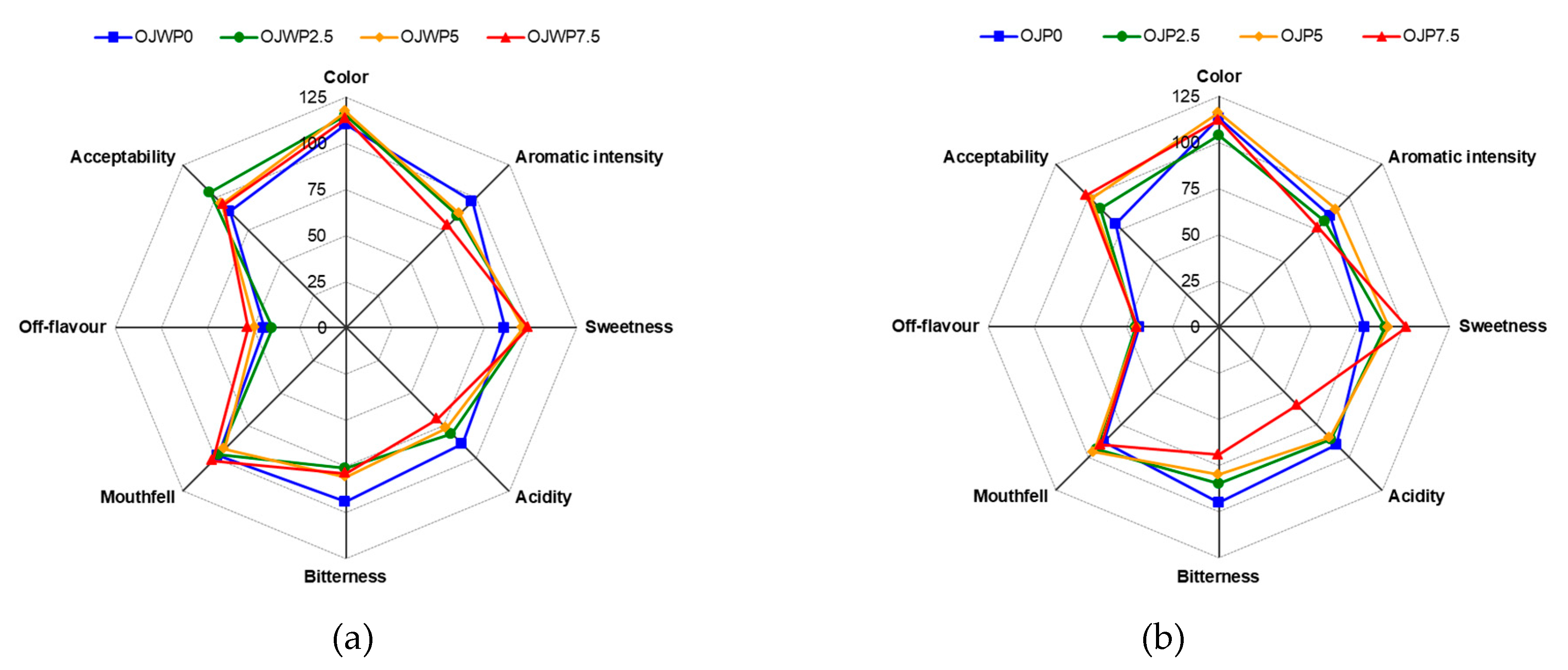
Figure 2.
Correspondence analysis. Representation of sensory attributes and samples tested in the normalized plane defined by the two factors, explaining the variability of the results of the sensorial analysis. OJP, orange juice with pulp; OJWP, orange juice without pulp; 0-7.5 % of RMD addition.
Figure 2.
Correspondence analysis. Representation of sensory attributes and samples tested in the normalized plane defined by the two factors, explaining the variability of the results of the sensorial analysis. OJP, orange juice with pulp; OJWP, orange juice without pulp; 0-7.5 % of RMD addition.
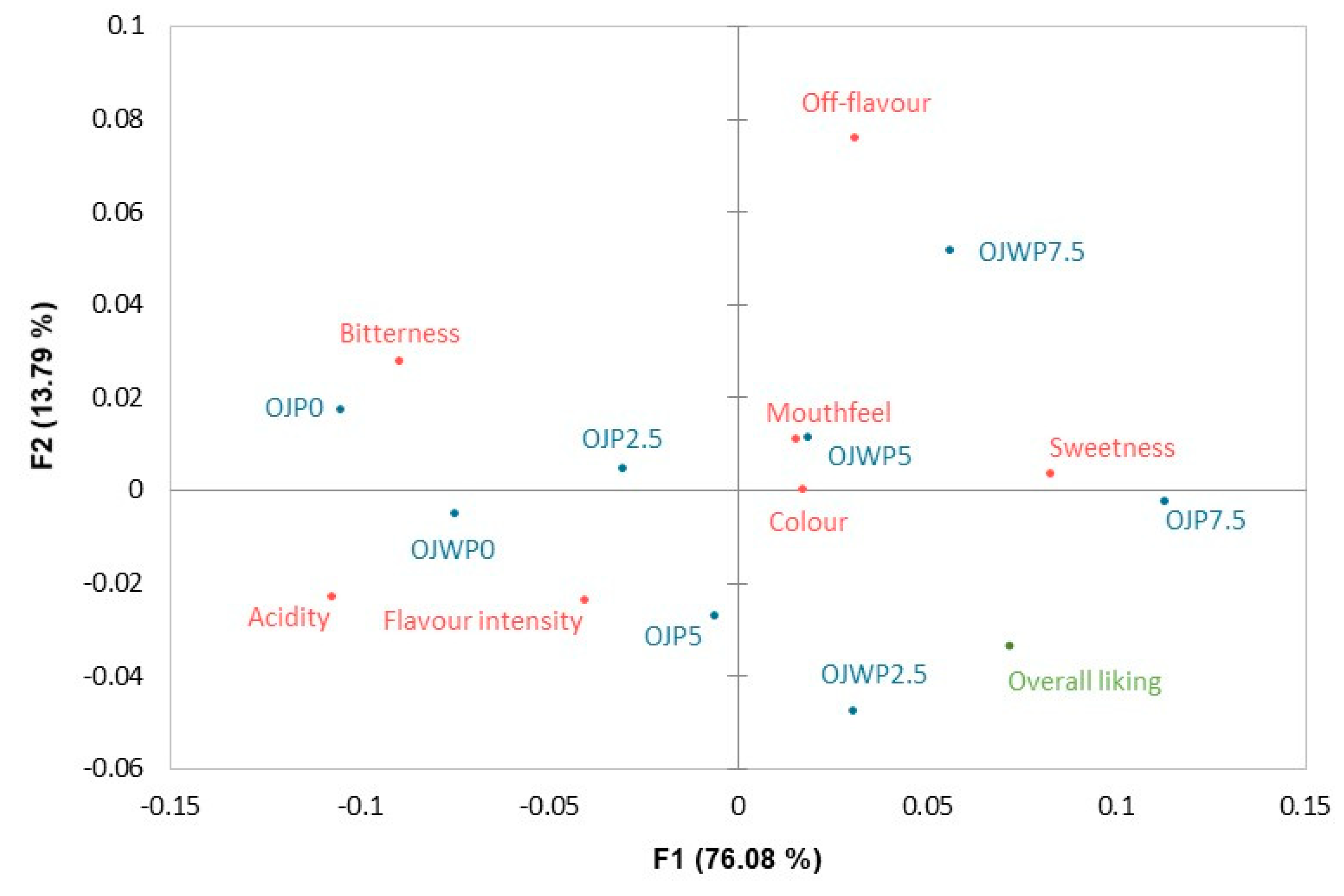
Figure 3.
Volume particle size distributions (representative curves) of pasteurized orange juice with or without pulp and 0-7.5 % of resistant maltodextrin. OJP, orange juice with pulp; OJWP, orange juice without pulp.
Figure 3.
Volume particle size distributions (representative curves) of pasteurized orange juice with or without pulp and 0-7.5 % of resistant maltodextrin. OJP, orange juice with pulp; OJWP, orange juice without pulp.
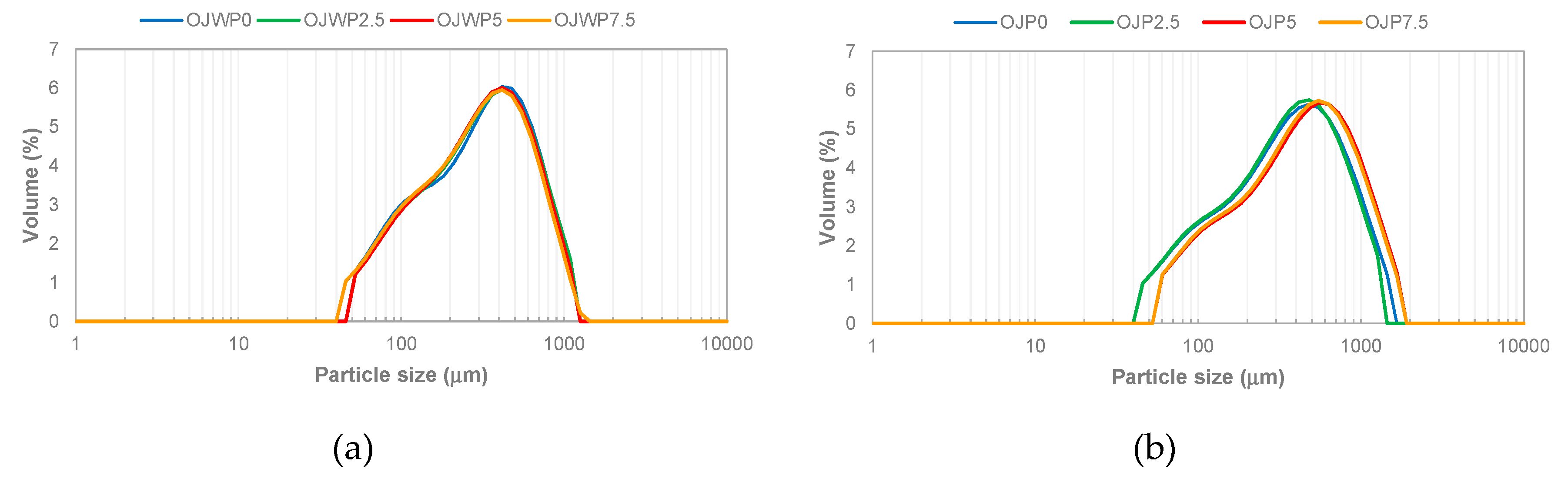
Figure 4.
Correlation circle of the response variables.
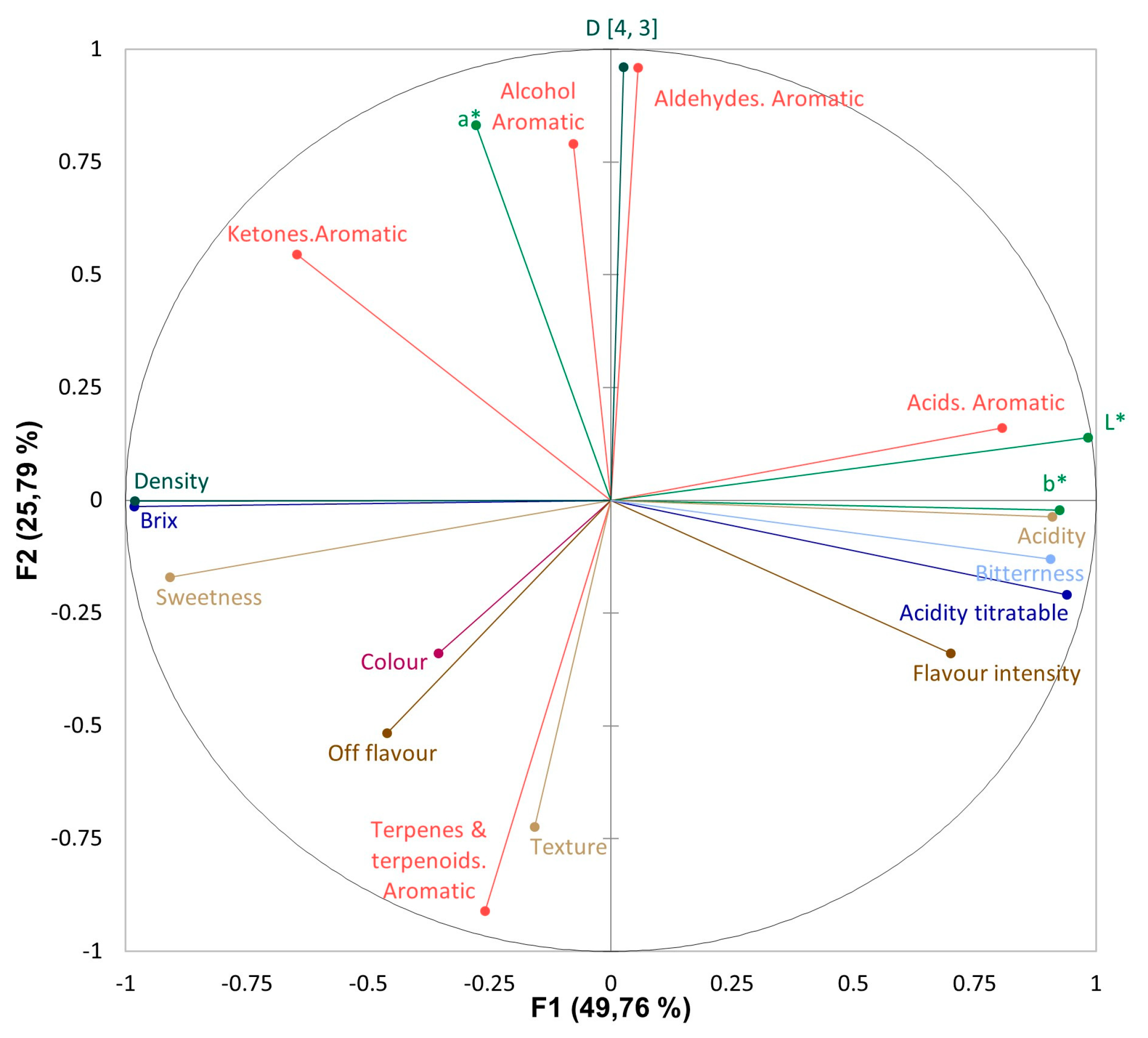
Figure 5.
Superimposed MFA representation of the juices. Each sample is represented by eight points grouping sensory and instrumental variables studied in the samples. Each juice representation considers the eight variables simultaneously.
Figure 5.
Superimposed MFA representation of the juices. Each sample is represented by eight points grouping sensory and instrumental variables studied in the samples. Each juice representation considers the eight variables simultaneously.
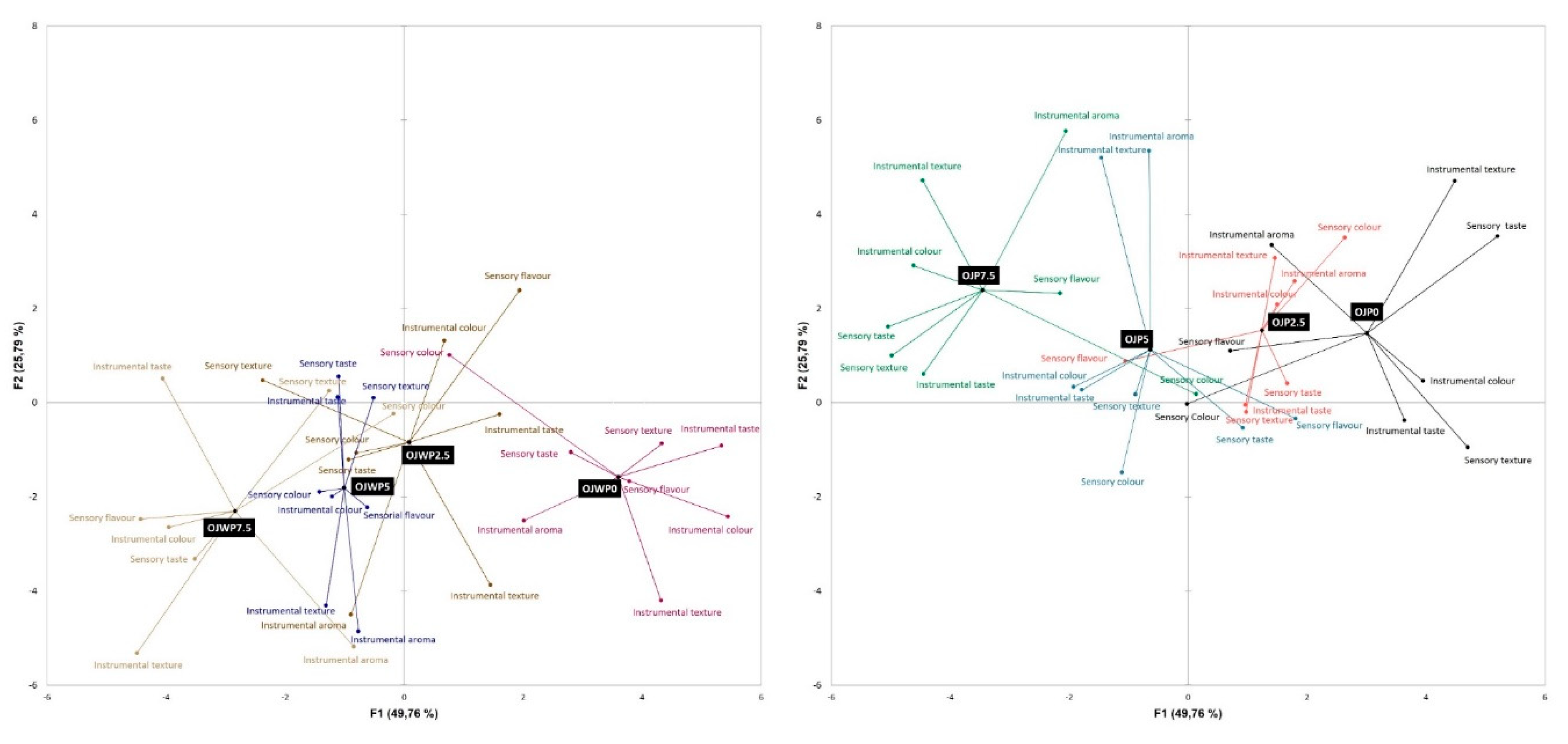

Table 2.
Mean values (and standard deviations) of °Brix, pH, acidity (gCA/100 mL), color coordinates (L*, a* and b*) of pasteurized orange juice and total colour differences (ΔE).
Table 2.
Mean values (and standard deviations) of °Brix, pH, acidity (gCA/100 mL), color coordinates (L*, a* and b*) of pasteurized orange juice and total colour differences (ΔE).
| Sample | °Brix | pH | Acidity | L* | a* | b* | ΔE |
|---|---|---|---|---|---|---|---|
| OJWP0 | 12.3 (0.2)d | 3.67 (0.02)b | 0.920 (0.002)a | 40.68 (0.13)a | -1.54 (0.13)d | 29.6 (0.3)a | - |
| OJWP2.5 | 14.4 (0.2)c | 3.67 (0.02)b | 0.882 (0.002)c | 37.89 (0.16)d | -1.29 (0.07)bc | 28.70 (0.07)c | 2.95 (0.13)e |
| OJWP5 | 16.5 (0.2)b | 3.67 (0.02)b | 0.861 (0.002)e | 36.80 (0.12)e | -1.48 (0.09)d | 27.4 (0.4)d | 4.5 (0.2)c |
| OJWP7.5 | 18.7 (0.2)a | 3.67 (0.02)b | 0.838 (0.002)g | 35.12 (0.02)g | -1.51 (0.02)d | 26.43 (0.12)e | 6.41 (0.05)a |
| OJP0 | 12.2 (0.2)d | 3.70 (0.02)a | 0.891 (0.002)b | 40.13 (0.10)b | -1.35 (0.12)c | 29.4 (0.4)ab | - |
| OJP2.5 | 14.4 (0.2)c | 3.68 (0.02)b | 0.872 (0.002)d | 38.84 (0.13)c | -1.240 (0.002)ab | 28.76 (0.15)bc | 1.46 (0.07)f |
| OJP5 | 16.5 (0.2)b | 3.71 (0.02)a | 0.849 (0.002)f | 37.9 (0.3)d | -1.350 (0.014)c | 26.5 (1.2)e | 3.7 (0.5)d |
| OJP7.5 | 18.8 (0.2)a | 3.68 (0.02)b | 0.832 (0.002)h | 35.69 (0.13)f | -1.16 (0.05)a | 26.5 (0.5)e | 5.3 (0.2)b |
The same letter in superscript within column indicates homogeneous groups established by ANOVA (p < 0.05). OJP, orange juice with pulp; OJWP, orange juice without pulp; 0-7.5 % of RMD addition.
Table 3.
Mean values (and standard deviations) of volume mean diameter (μm) D[4,3], standard percentiles (μm) d(0.1), d(0.5), d(0.9), and density (g/cm3) of pasteurized orange juice.
| Sample | D[4,3] | d(0.1) | d(0.5) | d(0.9) | Density |
|---|---|---|---|---|---|
| OJWP0 | 302 (13)cd | 25.6 (1.6)c | 245 (10)cd | 665 (30)c | 1.0487 (0.0002)g |
| OJWP2.5 | 307 (4)c | 26.1 (1.2)c | 247 (5)c | 677 (8)c | 1.0575 (0.0003)f |
| OJWP5 | 299 (14)cd | 23 (2)e | 242 (11)cd | 657 (31)c | 1.0659 (0.0009)d |
| OJWP7.5 | 286 (12)d | 19.9 (1.2)f | 230 (9)d | 632 (28)c | 1.0757 (0.0004)b |
| OJP0 | 427 (26)ab | 43 (3)ab | 332 (18)ab | 963 (66)a | 1.0487 (0.0005)g |
| OJP2.5 | 410 (37)b | 41 (4)b | 324 (29)b | 916 (87)b | 1.0579 (0.0002)e |
| OJP5 | 433 (20)a | 41 (3)ab | 339 (18)a | 974 (47)a | 1.0670 (0.0003)c |
| OJP7.5 | 427 (25)ab | 44 (4)a | 335 (20)ab | 957 (62)ab | 1.0762 (0.0007)a |
The same letter in superscript within column indicates homogeneous groups established by ANOVA (p < 0.05). OJP, orange juice with pulp; OJWP, orange juice without pulp; 0-7.5 % of RMD addition.
Table 4.
Mean values (and standard deviations) of aroma volatile compound quantification (relative % from total peaks area) of pasteurized orange juice.
Table 4.
Mean values (and standard deviations) of aroma volatile compound quantification (relative % from total peaks area) of pasteurized orange juice.
| Alcohols | OJWP0 | OJWP2.5 | OJWP5 | OJWP7.5 | OPJ0 | OPJ2.5 | OPJ5 | OPJ7.5 | Odor perception |
|---|---|---|---|---|---|---|---|---|---|
| 1-Octanol | 0,09(0,03)bc | 0,11(0,03)bc | 0,07(0,03)c | 0,07(0,01)c | 0,21(0,02)a | 0,22(0,02)a | 0,18(0,01)a | 0,11(0,02)b | citrus |
| 3-methyl-1-Butanol, | 0,07(0,02)b | 0,06(0,02)bc | 0,06(0,03)bc | 0,07(0,02)b | 0,16(0,02)a | 0,02(0,01)d | 0,03(0,02)cd | citrus | |
| 2-methyl- 1-Butanol | 0,04(0,02)b | 0,35(0,02)a | whiskey, malt, burnt | ||||||
| 1-Terpinen-4-ol | 0,69(0,02)c | 0,60(0,02)d | 0,57(0,02)d | 0,49(0,02)e | 1,03(0,02)a | 0,88(0,02)b | 0,87(0,02)b | 0,94(0,02)b | malty |
| cis-p-Mentha-2,8-dien-1-ol | 0,13(0,02)c | 0,16(0,03)bc | 0,15(0,02)bc | 0,17(0,02)b | 0,14(0,02)bc | 0,28(0,02)a | 0,25(0,02)a | turpentine, nutmeg, must | |
| 2-Cyclohexen-1-ol, 2-methyl-5-(1-methylethenyl)-, cis- // cis-Carveol | 0,34(0,03)bc | 0,24(0,02)d | 0,29(0,04)c | 0,31(0,02)c | 0,23(0,02)d | 0,12(0,02)e | 0,39(0,02)a | 0,37(0,02)ab | fresh, minty |
| 2-Cyclohexen-1-ol, 2-methyl-5-(1-methylethenyl)-, trans- // trans-Carveol | 0,08(0,02)bc | 0,06(0,01)cd | 0,07(0,02)bc | 0,03(0,02)d | 0,03(0,02)d | 0,11(0,01)ab | 0,12(0,02)a | Caraway, Spicy, Citrus, Fruity | |
| Total | 1,19(0,10)d | 1,26(0,15)d | 1,25(0,16)d | 1,16(0,11)d | 1,83(0,12)b | 1,41(0,11)c | 2,18(0,10)a | 1,82(0,12)b | |
| Aldehydes | OJWP0 | OJWP2.5 | OJWP5 | OJWP7.5 | OPJ0 | OPJ2.5 | OPJ5 | OPJ7.5 | Odor perception |
| Dodecanal | 0,07(0,02)bc | 0,05(0,02)c | 0,06(0,02)c | 0,05(0,02)c | 0,12(0,02)a | 0,10(0,02)ab | 0,06(0,02)c | 0,12(0,02)a | cologne, violet, pine, chypre. |
| 2-Hexenal, (E)- | 0,09(0,02)c | 0,09(0,02)c | 0,08(0,03)cd | 0,09(0,02)c | 0,20(0,02)a | 0,05(0,02)d | 0,14(0,02)b | 0,16(0,02)b | green, leaf |
| Heptanal | 0,03(0,02)a | 0,05(0,02)a | 0,03(0,02)a | 0,04(0,02)a | 0,07(0,02)a | 0,06(0,02)a | Green, oily, fatty, cognac,almond | ||
| Undecanal | 0,04(0,03)a | 0,05(0,02)a | 0,04(0,02)a | 0,06(0,03)a | 0,08(0,02)a | 0,08(0,02)a | 0,08(0,02)a | 0,08(0,02)a | oil, pungent, sweet |
| Octanal | 7,27(0,04)d | 7,18(0,03)d | 6,97(0,04)e | 6,52(0,05)f | 8,23(0,04)c | 8,96(0,06)b | 9,20(0,04)a | 9,23(0,03)a | malty |
| Nonanal | 0,47(0,06)b | 0,34(0,03)cd | 0,36(0,02)cd | 0,43(0,04)bc | 0,63(0,03)a | 0,59(0,04)a | 0,59(0,02)a | 0,59(0,03)a | fat, citrus, green |
| Decanal | 1,64(0,03)d | 1,36(0,05)e | 1,43(0,03)e | 1,62(0,03)d | 2,83(0,03)a | 2,28(0,05)c | 2,43(0,03)b | 2,30(0,04)c | soap, orange peel, tallow |
| Total | 9,58(0,20)d | 9,10(0,19)e | 8,99(0,18)f | 8,8(0,21)g | 12,13(0,18)c | 12,13(0,23)c | 12,56(0,17)a | 12,48(0,16)b | |
| Terpenes and terpenoids | OJWP0 | OJWP2.5 | OJWP5 | OJWP7.5 | OPJ0 | OPJ2.5 | OPJ5 | OPJ7.5 | Odor perception |
| Camphene | 0,06(0,02)a | 0,04(0,03)a | 0,08(0,02)a | camphor, piney woody with terpy nuances | |||||
| β-Pinene | 0,49(0,02)c | 0,12(0,02)f | 0,25(0,03)d | 0,18(0,02)e | 0,62(0,03)b | 0,08(0,02)f | 0,62(0,04)b | 0,69(0,04)a | pine, resin, turpentine |
| Benzaldehyde | 0,08(0,02)a | 0,07(0,03)a | 0,06(0,02)a | 0,07(0,02)a | almond, burnt sugar | ||||
| β-Myrcene | 34,36(0,06)b | 34,88(0,18)a | 33,51(0,07)c | 32,49(0,08)d | 31,81(0,07)e | 31,17(0,10)f | 31,06(0,08)f | 31,00(0,12)f | balsamic, must, spice |
| Limonene | 34,18(0,04)c | 35,08(0,06)a | 34,87(0,06)b | 33,87(0,07)d | 23,02(0,10)f | 25,02(0,07)e | 23,16(0,09)f | 23,08(0,10)f | citrus, mint |
| β-cis-Ocimene | 0,86(0,02)c | 0,73(0,02)d | 0,71(0,02)d | 0,83(0,03)c | 1,05(0,04)b | 1,11(0,03)a | 1,06(0,03)ab | 1,03(0,03)b | citrus, herb, flower |
| α-Phellandrene | 0,06(0,02)ab | 0,03(0,01)b | 0,05(0,02)ab | 0,09(0,03)a | 0,07(0,03)ab | citrus, terpenic, green, woody | |||
| .gamma.-Terpinene | 1,98(0,02)e | 1,91(0,02)e | 1,97(0,04)e | 2,20(0,04)d | 2,89(0,07)bc | 3,08(0,05)a | 2,81(0,06)c | 2,97(0,05)ab | Sweet, citrus, woody, tropical fruits |
| Terpinolene | 0,11(0,02)b | 0,10(0,02)b | 0,11(0,02)b | 0,13(0,03)b | 0,21(0,02)a | 0,12(0,02)b | fresh, woody, sweet, pine, citrus | ||
| α-Pinene | 6,90(0,04)g | 6,37(0,03)h | 7,24(0,04)f | 7,82(0,06)e | 12,11(0,07)a | 10,27(0,06)d | 10,66(0,08)c | 11,36(0,08)b | pine, turpentine |
| β-Linalool | 0,64(0,02)e | 0,65(0,03)e | 0,61(0,02)e | 0,75(0,05)d | 0,53(0,05)f | 1,21(0,03)c | 1,53(0,03)b | 1,86(0,04)a | flower, lavender |
| (+)-4-Carene | 1,24(0,02)b | 1,05(0,03)b | 1,07(0,04)b | 1,26(0,03)b | 1,69(0,06)a | 1,78(0,05)a | 1,73(0,04)a | 1,27(0,03)b | lemon, resin |
| Benzene, 2-ethenyl-1,3-dimethyl- | 0,22(0,03)ab | 0,16(0,02)b | 0,22(0,03)ab | 0,22(0,03)ab | 0,27(0,03)a | 0,26(0,03)a | 0,23(0,03)a | 0,21(0,03)ab | not mentioned in literature |
| β-Terpineol | 0,03(0,03)e | 0,14(0,03)d | 0,03(0,02)e | 0,05(0,03)e | 0,13(0,02)d | 0,23(0,02)c | 0,57(0,03)b | 0,79(0,03)a | woody, piney, floral |
| α-Terpineol | 0,23(0,04)c | 0,19(0,03)cd | 0,15(0,03)de | 0,13(0,02)e | 0,33(0,02)b | 0,24(0,03)c | 0,40(0,02)b | 0,86(0,03)a | terpenic, oil, anise, mint |
| α-Citral | 0,19(0,02)a | 0,05(0,03)b | lemon, fruity, sweet | ||||||
| Copaene | 0,09(0,02)cd | 0,09(0,02)bcd | 0,06(0,03)d | 0,07(0,02)d | 0,19(0,03)a | 0,13(0,03)abc | 0,17(0,03)a | 0,15(0,04)ab | wood, spice |
| 1,3,8-p-Menthatriene | 0,11(0,02)ab | 0,06(0,03)b | 0,13(0,02)a | 0,13(0,02)a | 0,15(0,03)a | 0,16(0,03)a | 0,14(0,03)a | 0,16(0,02)a | Turpentine |
| Limonene epoxide | 0,14(0,03)a | 0,15(0,03)a | 0,14(0,03)a | 0,14(0,03)a | 0,14(0,03)a | 0,15(0,04)a | 0,20(0,03)a | 0,15(0,02)a | Fruit |
| Caryophyllene | 0,13(0,03)b | 0,13(0,03)b | 0,08(0,02)c | 0,10(0,02)bc | 0,25(0,03)a | 0,12(0,03)bc | 0,22(0,02)a | 0,20(0,02)a | Musty, green |
| α-Caryophyllene | 0,03(0,02)d | 0,08(0,02)cd | 0,08(0,02)cd | 0,08(0,02)cd | 0,12(0,03)abc | 0,13(0,03)ab | 0,17(0,03)a | 0,11(0,03)bc | Musty, green |
| β-Elemene | 0,05(0,02)d | 0,07(0,03)bcd | 0,06(0,03)cd | 0,11(0,02)abc | 0,12(0,03)ab | 0,13(0,03)a | 0,10(0,03)abcd | herb, wax, fresh | |
| Naphthalene, 1,2,3,5,6,7,8,8a-octahydro-1,8a-dimethyl-7-(1-methylethenyl)-, [1R-(1.alpha.,7.beta.,8a.alpha.)]- // Valencene | 1,33(0,03)f | 2,73(0,08)d | 2,42(0,05)e | 2,67(0,05)d | 4,12(0,08)b | 4,10(0,06)b | 4,29(0,07)a | 3,84(0,02)c | green, oil |
| 2-Cyclohexen-1-one, 2-methyl-5-(1-methylethenyl)-, (R)- // (-)-Carvone | 0,90(0,03)e | 1,00(0,03)d | 1,41(0,04)b | 1,80(0,05)a | 0,85(0,06)e | 0,29(0,04)f | 1,40(0,06)b | 1,21(0,02)c | Mint |
| 2-Cyclohexen-1-one, 3-methyl-6-(1-methylethenyl)-, (S)- | 0,16(0,03)e | 0,36(0,03)c | 1,04(0,03)b | 1,18(0,04)a | 0,08(0,02)f | 0,25(0,03)d | 0,12(0,03)ef | 0,17(0,02)e | spicy, carraway |
| Naphthalene, 1,2,3,5,6,8a-hexahydro-4,7-dimethyl-1-(1-methylethyl)-, (1S-cis)- // delta.-Cadinene | 0,10(0,03)e | 0,08(0,02)e | 0,08(0,02)e | 0,20(0,03)d | 0,32(0,03)bc | 0,36(0,03)ab | 0,41(0,03)a | 0,29(0,01)c | thyme, medicine, wood |
| (-)-α-Panasinsen | 0,21(0,03)a | 0,24(0,03)a | 0,23(0,04)a | 0,20(0,02)a | not mentioned in literature | ||||
| 2,6-Octadien-1-ol, 3,7-dimethyl-, acetate, (Z)- // Nerol acetate | 0,05(0,03)b | 0,05(0,03)b | 0,06(0,03)ab | 0,07(0,03)ab | 0,08(0,02)ab | 0,11(0,01)a | sweet, fruity and floral | ||
| 1-Cyclohexene-1-carboxaldehyde, 4-(1-methylethenyl)- | 0,04(0,03)d | 0,20(0,03)c | 0,12(0,03)c | 0,25(0,03)bc | 0,21(0,03)bc | 0,04(0,02)d | 0,37(0,04)a | 0,27(0,02)b | herbal, fresh, spicy |
| β-Citral | 0,03(0,03)a | 0,05(0,03)a | 0,06(0,03)a | 0,05(0,02)a | 0,06(0,02)a | 0,04(0,02)a | lemon | ||
| Total | 84,38(0,68)b | 86,31(0,82)a | 86,45(0,88)a | 86,74(0,90)a | 81,89(1,16)c | 81,07(1,08)c | 81,95(1,05)c | 82,19(0,80)c | |
| Ketones | OJWP0 | OJWP2.5 | OJWP5 | OJWP7.5 | OPJ0 | OPJ2.5 | OPJ5 | OPJ7.5 | Odor perception |
| Acetophenone | 0,04(0,02)c | 0,04(0,02)c | 0,04(0,02)c | 0,05(0,02)c | 0,06(0,03)c | 0,18(0,02)b | 0,53(0,03)a | must, flower, almond | |
| Ethanone, 1-(4-methylphenyl)- | 0,11(0,03)bc | 0,11(0,03)bc | 0,11(0,03)bc | 0,15(0,04)b | 0,06(0,03)c | 0,05(0,04)c | 0,18(0,04)b | 0,46(0,05)a | floral, sweet |
| Total | 0,11(0,03)c | 0,15(0,06)c | 0,15(0,05)c | 0,19(0,07)c | 0,11(0,05)c | 0,11(0,07)c | 0,36(0,06)b | 0,99(0,08)a | |
| Acids | OJWP0 | OJWP2.5 | OJWP5 | OJWP7.5 | OPJ0 | OPJ2.5 | OPJ5 | OPJ7.5 | Odor perception |
| Butanoic acid, methyl ester | 0,59(0,08)b | 0,04(0,01)d | 0,06(0,02)d | 0,06(0,02)d | 1,20(0,02)a | 0,10(0,02)cd | 0,07(0,02)d | 0,15(0,03)c | ether, fruit, sweet |
| Dodecanoic acid | 0,17(0,04)b | 0,14(0,02)b | 0,14(0,03)b | 0,13(0,03)bc | 0,07(0,02)c | 0,25(0,03)a | 0,26(0,04)a | 0,24(0,02)ab | soapy |
| Tetradecanoic acid | 0,61(0,08)a | 0,14(0,04)d | 0,27(0,01)c | 0,24(0,04)c | 0,14(0,04)d | 0,18(0,02)cd | 0,38(0,04)b | 0,24(0,03)c | waxy |
| Butanoic acid, ethyl ester | 1,89(0,07)c | 1,35(0,15)d | 1,37(0,04)d | 1,41(0,03)d | 2,33(0,07)b | 3,48(0,05)a | 1,95(0,06)c | 2,19(0,11)b | fruity, sweet |
| Acetic acid, octyl ester | 1,40(0,08)a | 0,78(0,03)b | 0,74(0,06)b | 0,80(0,04)b | 0,15(0,03)c | 0,05(0,01)d | 0,07(0,03)cd | 0,04(0,01)d | sour |
| Total | 4,65(0,36)a | 2.45 (0,25)d | 2,58(0,16)cd | 2,63(0,16)cd | 3,87(0,18)b | 4,06(0,13)b | 2,71(0,19)cd | 2,86(0,20)c | |
| n.i. | 0,09 | 0,73 | 0,58 | 0,47 | 0,15 | 0,99 | 0,55 | 0,08 |
The same letter in superscript within column indicates homogeneous groups established by ANOVA (p < 0.05). OJP, orange juice with pulp; OJWP, orange juice without pulp; 0-7.5 % of RMD addition.
Disclaimer/Publisher’s Note: The statements, opinions and data contained in all publications are solely those of the individual author(s) and contributor(s) and not of MDPI and/or the editor(s). MDPI and/or the editor(s) disclaim responsibility for any injury to people or property resulting from any ideas, methods, instructions or products referred to in the content. |
© 2023 by the authors. Licensee MDPI, Basel, Switzerland. This article is an open access article distributed under the terms and conditions of the Creative Commons Attribution (CC BY) license (http://creativecommons.org/licenses/by/4.0/).
Copyright: This open access article is published under a Creative Commons CC BY 4.0 license, which permit the free download, distribution, and reuse, provided that the author and preprint are cited in any reuse.


