

Submitted:
14 July 2023
Posted:
17 July 2023
You are already at the latest version
Abstract
Historical and Endowment Properties are different from Heritage and cultural Properties, as Historical and Endowment properties are governed by a unique set of laws that Waqf recipients must abide by. Property that is entrusted is usually in the form of buildings, land or valuables which in preservation is not limited to time as long as the property can be utilized. Reliable information technology is needed to ensure data security both digitally and physically, while the rapid development of information technology demands information openness and this will be a challenge in itself. The objectives of this study include examining the collection of historical databases and endowments, the relationship between digital data and physical data and management organizations. The method of how to design a query model to display data is then analyzed whether the data conforms to the rules in waqf management. The results are expected to bring up accurate data between digital data and physical data and if there are differences into findings for the next analysis.
Keywords:
history
; endowments
; query model
; digital data
; physical data
1. Introduction
Digitization and preservation of cultural heritage (CH) are two complex processes involving several underlying techniques and algorithms to make CH mockups available to present and future generations. Digital content preservation is inspired by the manufacturing industry where companies use archive platforms and customized life cycle management (PLM) frameworks to store critical data and knowledge about important facts at every stage of the product lifecycle. This data can be very important in the future for several reasons such as avoiding previous mistakes or for repetitive purposes. Cultural heritage assets as products, their history as life cycles, and studying the preservation of their life cycle from a product point of view reveal the needs behind long-term preservation of cultural heritage [1] .The cultural paradigm shift of society of the last two centuries from the French Revolution to the present society always starts looking for new ones with features that are easier to understand, this becomes a challenge in the preservation of heritage and culture, along with it being concerned about its preservation [2]. New technology has revolutionized the world, nowadays we can communicate directly to almost anywhere in the world with just a click from our mobile phone or laptop. This technology is also invading the field of cultural heritage, causing major changes in stakeholder institutions and communities approaching their heritage, where communities participate directly in the process of restoration to social tagging, so it is necessary to examine how social media and cultural institutions have become highly interconnected [3]. Cultural organizations are increasingly utilizing social media in their activities, although often considered a marketing tool, analyzing social media interactions can provide insight into the changing nature of engagement across a range of objects. Understanding the nature of human involvement in understanding heritage in the world through digital technology has implications for how heritage management organizations can engage with diverse communities within society [4]. Relational databases provide data storage for decades. However, for today's web and mobile applications, scalability in data models cannot be overstated. The term NoSQL broadly encompasses all non-relational databases that provide schemaless and scalable models. NoSQL databases are also referred to as Internet age databases. They are currently used by Google, Amazon, Facebook and other organizations operating in the Web 2.0 era. The different types of NoSQL databases namely key-value pair, column-based, column-oriented, and graph-based document databases allow programmers to model data more closely to formats such as those used in applications [5].
2. Related Work
The Ontology-Based Data Access (OBDA) system allows users to access external databases through conceptual domain views, rendered in terms of ontologies. Semantic technology can represent conceptual modeling, query rewriting, and source-to-target mapping [6]. Data acquisition has always been the most important in archaeological practice. In recent decades, increased digitization in data acquisition has made a major impact in the way archaeological fieldwork is conducted, both in terms of methodology and interpretation. Digital documentation methodologies have led to new methods of representation, analysis and understanding of heritage sites [7]. The terrible evolution of technology and the huge improvement in data, it has become difficult to work with traditional database management tools. New technologies have emerged, such as NoSQL databases, that radically change the architecture of the databases authors are used to seeing, thereby improving the performance and availability of services. Since this technology is relatively new, standard or informal migration processes do not yet exist [8]. The digital protection method of traditional cultural heritage from the information recall rate is low, and the processing time is long. Therefore, a new digital method of protection of cultural heritage based on web technologies is proposed. An improved four-layer architectural design pattern was adopted to plan a web-based digital protection platform for cultural heritage. Application service providers (ASPs) combine SQL server and architecture to develop database platforms and functional modules for dynamic management directly from the website model. Based on this, combined with web technologies, digital images of cultural heritage are reconstructed followed by calculating the uncertainty probability of web visualization, completing metalanguage modeling, and network cultural heritage classification [9,10]. In today's multi-model database world there are attempts to integrate databases expressed in different data models. The integration of relational and graph databases with the help of functional data models and formal languages – lambda calculus considers the existence of data schemas both for relational and graph databases. In this approach, relationships are considered as characteristic functions and property graphs as single-valued and multivalued sets of functions. It is then possible to express queries through such integrated heterogeneous databases by a single query expression expressed in a typed version of lambda calculus. A more user-friendly version of the language can serve as a powerful query tool in practice, queries sent to integrated systems and translated into queries in SQL and Cypher [11,12]. An automated method for modeling relational databases that uses SQL triggers and foreign keys to efficiently answer positive semantic questions about instances based to Web Semantic ontologies. In contrast to existing knowledge-based approaches, additional space in the database is required to reduce reasoning at query time. The implementation significantly improves query response time by letting the system ignore integrity constraints and other types, inference at run-time [13]. The use of NoSQL databases has evolved to manage unstructured data for applications to ensure performance and scalability. However, many organizations prefer to transfer data from NoSQL operational databases to relational-based SQL databases to use existing tools for business intelligence, analytics, decision making, and reporting. NoSQL to relational database transformations require manual schema mapping, which requires domain expertise and real-time consumption. Therefore, an efficient and automated method is needed to turn an unstructured NoSQL database into a structured database. An efficient method to convert NoSQL databases into relational databases automatically. Experimentally use MongoDB as a NoSQL database, and MySQL and PostgreSQL as relational databases to perform transformation tasks for different dataset sizes. excellent performance, compared to existing cutting-edge methods, in converting data from a NoSQL database to a relational database [14,15]. Hierarchies are methods of forming systems into groupings of data in databases, while to integrate some data into integrated data systems in software engineering, it is necessary to have an appropriate method so that data does not occur in an integrated system. In addition to making it easier to know the object attributes of a data, it is necessary to create a method partition, after we can integrate data with the grid method, then a combination of several methods is done into a new method, the Hierarchy of Grid Partition (HGP) method. The Hierarchy of Grid Partition (HGP) method is to integrate the data of an engineering software and database, in order to make it easier for users to find the data needed and not duplicate data. To develop this method, design tools are needed in the form of object-oriented modeling which is a unified modeling language (UML). The Grid Partition (HGP) method makes it easier to find data, because all data is already formed in the data partition grid system, so this method is that the data access system is more effective and efficient [16]. A multidimensional approach can be used to maintain the potential on which the data analysis process is based in the productive, commercial and academic fields. Additive functions allow the reuse of previous results to be efficiently stored and managed, being relevant in query response time with simulations. In static components of the model, multidimensional variables are characterized by attributes arranged into structures called dimensions. These attributes become the classical relational approach, so that they can take values from homogeneous sets. Dimensions are formed by pairs (N, J) consisting of the name of the dimension and its attribute hierarchy, respectively, where the hierarchy is tuples (N, E, <, T, V), N is the name of the dimension; E the set that contains the attribute; <a is a partial sequence relationship defined in E, so ∀x, y ∈ E, x < y, then it means that x is grouped into T according to the value of the hierarchical level (x < T, ∀x E) and V is the lower value, that is, V < x, ∀x E. The next variable becomes an important attribute known as size and represents the variable being analyzed. The steps depend entirely and functionally on attribute [17]. The development of physical data investigation models adapted to digital data, on which the model must be based on existing theories for physical crime investigations, among others
- The model should be practical and follow the same steps as the actual investigation.
- The model should be general with respect to technology and not limited to product flows and procedures.
- The model should be specific enough so that general technological requirements for each phase can be developed.
- The model should be abstract and applicable to law enforcement investigations, investigative firms, and incident response [14].
3. Results
3.1. Dataset Collection
Dataset collection is carried out as part of research aimed at developing a monitoring system, through data queries, describing the relationship between managing entities and data entities that are expected to affect data sustainability. Furthermore, in the query model design, this is necessary so that data can be matched between digital data and physical data periodically reviewed [19]. The data set is a management database, heirlooms stored in museums and land/rice fields scattered in several areas. In conducting investigations, physical data is checked periodically, and inputted back into the system using different tables based on their relevance by different operators. Applying strict criteria during screening, the dataset contains images and text documents that accurately represent diverse heritage objects and soil/rice fields according to real-world scenarios. Initial screening is carried out to see the quality and reliability of the dataset. To maintain the integrity of the dataset, obscure objects are significantly excluded. Objects must be clearly and accurately identified to avoid ambiguity and allow the use of datasets for subsequent analysis and modeling tasks. Identification must be done by experts to ensure the quality and reliability of data sets, for example heirlooms made of gold or land in the center of cities that are valuable resources become objects of great interest.
3.2. Variables and Data Sources
The research data was obtained from Yayasan Nadzir Waqf Pangeran Sumedang (YNWPS), in accordance with the Decree of the Minister of Law and Human Rights of the Republic of Indonesia Number: AHU-0014381. AH.01.04.Tahun 2017, as the manager of waqf heirlooms and land/rice fields from the Kingdom of Sumedang Larang Indonesia. In the course of the history of the Sumedang Larang Kingdom which was in Indonesia at one time the regional ruler (Radja), gave wealth in the form of waqf treasures. By definition, waqf property is different from inheritance, because waqf property is enshrined through the message of the waqf giver to the waqf recipient where the object of the waqf property must exist for all time as long as it can be utilized. Thus, the preservation of waqf property requires a reliable method so that its sustainability can be maintained both digitally and physically. The data obtained for the study are shown in Table 1 below.
3.2. Data Set Representation
The dataset is represented consisting of data, History and Lineage, Waqf Manager, Nadzir Waqf, Person in Charge of Land/Rice Fields, Person in Charge of Tomb/Site, Cultivator, Land Tenant, Tomb Occupant, Site/Tomb (GIS), Land/Rice Field (GIS), Museum, Historical Building. Based on Table 1 the representation of the graph dataset and semantic relationships are shown in Figure 1 below:
The dataset in a gray circle indicates that the data object is in the form of waqf assets managed by YNWPS in the form of objects including: land, rice fields, historical buildings and sites or tombs, others are manuscript data and data of people involved in the management and use of waqf assets. To make it easier to analyze the data, a model representation was carried out [20].
3.3. Dataset Representation Model with First Order Logic (FOL) concept
If the dataset History and Endowments of the Kingdom of Sumedang Larang (SWKSL) from Figure 1 is an R relation, it can be defined as follows:
Definition 1:
SWKSL is an R relation and contains S, inductively it can be defined that R ⊃ S, where S:= S1, S2, S3,. . . . . ., Sn so ∀ Si ε R,
∀ S : (∃ A := an ), where attribute A := a1, a2, a3, . . . so that ∀ ai ε S
In a formula, the FOL component has no independent variables.
3.4. Query Analysis Preservation of Historical Databases and Endowments
In creating models and data analysis is done by creating an ontology-based Algebra Query Model from the manager/user state represented based on FOL.
Based on Figure 2 there are 7 relationship entities, namely: SNZ = Nadzir Wakaf, Spy = Pengurus YNWPS, Sp = Penggarap, Spjb = Penanggung Jawab Bangunan bersejarah, Sptw = Penyewa tanah wakaf, Smdr = Mandor, Skcn = Kuncen.
Example: entity overview Nadzir Wakaf
Nadzir wakaf is a person responsible for all or part of the endowment property. Nadzir wakaf can be a caretaker and or be the person in charge of historical buildings and or be a tenant of land / rice fields, and not be a cultivator nor become a kuncen and not be a foreman.
then it can be formalized todi :
∃ SNZ ⊂ Spy ∨ (Spts ∧ Spbs ) ∧ Sptw
So it can be written :
∃ x(SNZ (x)) → Spy (y) ∨ (Spts (z) ∧ Spbs (r) ) ∧ Sptw (u)
Condition nadzir wakaf :
1. ∀ x(SNZ(x) → ∄x (Smdr(y) ∧ Skcn(z))
All nadzir waqf no one is a foreman or kuncen
2. ∀ x(SNZ(x) ⊄ (Smdr(y) ∧ Skcn(z))
All waqf nadzir are not part of the foreman or kuncen
For example : there is a waqf nadzir who is the manager of YNWPS and becomes the cultivator in charge of the land / rice field or the person in charge of historical buildings and tenants (residents) of the waqf land
Query Example : whether there is a waqf nadzir who is the manager of the foundation and is in charge of the land / rice field and the person in charge of historical buildings and tenants (residents) of the waqf land.
SELECT SNZ.nama (attribute nama nadzir wakaf)
FROM Nadzir N, Pengurus PY, Penggarap PNG, PJBangunan PJB, Penyewa PTW
Where N.nama = PY.nama AND (((PNG nama AND PJB.nama) ) AND PTW.nama));
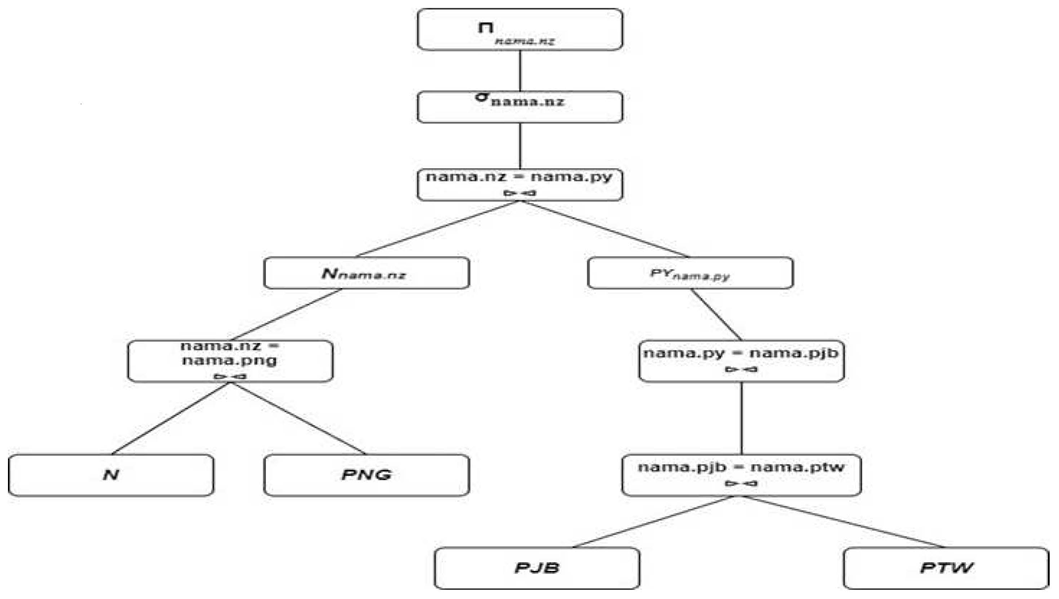
In relational algebra the above query can be shown as follows:
Πnama ( σnama.nz (( N nama.nz=nama.py PY)nama.py=nama.pjt ( PNG nama.png=nama.pjb
(PJB nama.pjb=nama.ptw PTW )))
The form of the command analysis tree above is:
3.5. Workflow query platform
Data tracing steps are required platforms in digital data protection and physical data is divided into two platform parts, namely management platforms and application platforms (Ying Zhao, 2022).
- Platform Management by Administrator. Establish manager authorities that allow different administrators to establish different levels of database platform management operations.
- An application platform to examine historical and waqf database collections related to digital data tracing and physical data as well as managing organizations. There are 13 relationship tables and only 5 tables plus 3 tables for synchronization checks are simulated nadzir_wakaf, table pengurus_YNWPS, tablepenggarap, tablecek_data_penggarap, table data_bergerak, tablecek_data_bergerak, table data_tidak_bergerak, table cek_data_tidak_bergerak. The workflow process of such queries is described in Figure 4 below:
Algorithm pseudocode sql for data synchronization in accordance with the regulations of the articles of association and bylaws of the YNWPS managing organization are described in Appendix:
4. Discussion
The query algorithm presented is very simple, but at least it can contribute to anticipating data errors that at this time researchers have a perception of being more concerned with digital data security than physical data. Digital forensic research methods continue to evolve in accordance with advances in information and communication technology. Historical preservation and waqf, especially specifically waqf property (heirlooms, land and historical buildings) are only carried out in countries where the majority of the population is Muslim. Property that is entrusted usually has components that cannot change over time, even though changes in human mentality and behavior from time to time can change. Data retention is very important and very influential on the security of digital data and physical data. It is meaningless if digital data is safe but does not match the physical data even the object is lost from circulation. The strategy of maintaining the security of digital data and physical data can be done by installing cameras on physical data presented online, so that data control and data updates are no longer needed, unless there are things out of control, but this needs to be investigated further and not done conventionally most likely requires a fairly high cost.
5. Conclusions
Model queries are discussed only to compare one or more observed attributes. If there are findings from the query that indicate a difference, this query algorithm model is for further development because it is necessary to create the next relationship table from the specification of the dataset attributes studied.
Author Contributions
Conceptualization, R.S.; B.N.R.; A.S.A. and R.B.; methodology, R.S.; software, R.S.; validation, R.S. and B.N.R.; formal analysis, B.N.R. and A.S.A.; investigation, A.S.A.; resources, B.N.R; data curation R.S.; writing—original draft preparation, R.S.; writing—review and editing, R.S., B.N.R., A.S.A. and R.B.; supervision, B.N.R., A.S.A. and R.B.; project administration R.S. and B.N.R.; funding acquisition, B.N.R. All authors have read and agreed to the published version of the manuscript.
Data Availability Statement
Not applicable.
Acknowledgments
The author would like to thank the Rector of Padjadjaran University who has provided funding assistance so far for research dissemination through the Unpad Doctoral Research Grant contract number: Number: 1595/UN6.3.1/PT.00/2021 and ALG Grant 2022, YNWPS Management for providing accurate data for research, thanks also to the reviewers for the valuable review of this paper.
Conflicts of Interest
The authors declare no conflict of interest.
Appendix A
/* create simulated table to check the synchronization of digital data with physical data */
create tablenadzir( kode_nwvarchar (6), nama_nadzir varchar (25), jabatan_luar varchar (25), jabatan_nadzir varchar (25), alamat varchar (40), no_ktp numeric (16), primary key (kode_nw));
create tablepengurus_YNWPS(kode_p varchar (6), nama_pengurus varchar (25), jabatan varchar (25), tpt_tgl_lhr varchar (25), alamat varchar (40), no_ktp numeric (16),
primary key (kode_p), foreign key (kode_nw) reference nadzir);
create tablepenggarap( kode_garapvarchar (6), lokasi_varchar (25), nama_dahulu varchar (25), nama_sekarang varchar (25), alamat varchar (40), no_ktp numeric (16), luas_garapan numeric (16), keterangan numeric (16), primary key (kode_garap),
foreign key(kode_p) referencepengurus_YNWPS);
create tablecek_data_penggarap(kode_cek_garapvarchar (6), Lokasi varchar (25),
Cek_nama_sekarang varchar (25), tgl_cek date(default), status_cek varchar (16),
petugas_cekvarchar (25), petugas_entri varchar (25), keterangan varchar (40),
primary key (kode_cek_garap), foreign key (kode_garap) reference penggarap);
create tablebergerak(kode_barangvarchar (6), nama_bendavarchar (25), Jumlahnumeric (4),spesifikasivarchar (25), keadaan_dahulu varchar (15), keadaan_sekarangvarchar (25), asal_perolehanvarchar (25),tgl_perolehandate (default),tmpt_simpanvarchar (25),bukti_fotovarchar (25),petugas_entrivarchar (25), primary key(kode_barang),
foreign key(kode_p)referencepengurus_YNWPS);
create tablecek_data_bergerak( kode_cek_barangvarchar (6), cek_nama_benda varchar (25),
Jumlahnumeric (4), spesifikasi varchar (25), tgl_cek date (default),
status_cekvarchar (25), petugas_cek varchar (25), bukti_foto varchar (25),
petugas_entrivarchar (25), keterangan varchar (25), primary key (kode_cek_barang),
foreign key(kode_barang)referencebergerak);
create tabletidak_bergerak(kode_lokasivarchar (6), lokasi varchar (25), luas_dahulu varchar (25), luas_sekarang varchar (25), no_sertifikat varchar (15), nadzir_wakaf varchar (25),
nama_daerahvarchar (25), koordinat_lokasi numeric (25), primary key (kode_lokasi),
foreign key (kode_p) referencepengurus_YNWPS);
create tablecek_data_tidak_bergerak(kode_cek_lokasivarchar (6), cek_lokasi_varchar (25),
luas_dahulunumeric (10), cek_luas_sekarang numeric (10), luas_meterpersegi numeric (10),
tgl_cek date (16), status_cek varchar (25), petugas_cek varchar (25), petugas_entri varchar (25), primary key (kode_cek_lokasi), foreign key (kode_garap) reference tidak_bergerak);
/* nadzir_wakaf = SNZ, pengurus_YNWPS = Spy , penggarap = Sp,, cek_data penggarap = Scp,
data_bergerak = Sb, , cek_data_bergerak = Scb, data_tidak_bergerak = Stb, cek_data_tidak bergerak = Sctb, */
/*, No Nadzir Waqf is the manager */
select nama_nadzir, nama_pengurus
from nadzir.SNZ, pengurus.Spy
where nama_nadzir = nama_pengurus; (3)
Query (3) The above can be written as follows :
/* Check Nadzir Waqf Data Synchronization with Algorithm simple nested loop join */
for each record nz є Snz do
for each record py є Spy do
if (nzi== pyi )= true then print ‘’finding’’
add (nz , py) to result
else then print ‘’clear’’
/* Check data synchronization penggarap, there isn't any penggarap what's changed */
/* if initialization nama_penggarap=nmpeng and cek_nama_penggarap=cnmpeng, then */
for each recordnmpeng є Sp do
for each recordcnmpeng є Scp do
if (nmpengi != cnmpengj)= true then print ‘’finding’’
add (nmpeng,cnmpeng) to result
else then print ‘’clear’’
/* Sync check data_bergerak with cek_data_bergerak , with algorithm simple nested loop join */
for each record nama_benda є Sb do
for each record cek_nama_benda є Scb do
if (spesifikasii != spesifikasij )= true then print ‘’finding’’
add (nama_bendai, nama_bendaj) to result
else then print ‘’clear’’
/* Sync check data_tidak_bergerak with cek_data_tidak bergerak , with algorithm simple nested loop join */
for each recordlokasi є Stb do
for each recordcek_lokasi є Sctb do
if (luas_sekarangi!= luas_sekarangj )= true then print ‘’finding’’
add (lokasi, cek_lokasij) to result
else then print ‘’clear’’
References
- Belhi, A.; Foufou, S.; Bouras, A.; Sadka, A.H. Digitization and Preservation of Cultural Heritage Products. IFIP Adv. Inf. Commun. Technol. 2017, 517, 241–253. [Google Scholar] [CrossRef]
- Cook, A. Between the Old World and the New One. C.F. Volney and the Politics of Travel Writing in France, 1782-1803. Ann. Hist. Revolut. Fr. 2016, 385, 87–107. [Google Scholar]
- Gaitán, M. Cultural Heritage and Social Media. E-Dialogos 2014, 4, 38–45. [Google Scholar]
- Cui, T.; Kumar, P.; Orr, S.A. Connecting Characteristics of Social Media Activities of a Heritage Organisation to Audience Engagement. Digit. Appl. Archaeol. Cult. Herit. 2023, 28, e00253. [Google Scholar] [CrossRef]
- Joseph, N.; Mathew, P.; George, P.G. Modeling and Querying NOSQL Databases. 2021; 95–100. [Google Scholar]
- Pankowski, T. Modeling and Querying Data in an Ontology-Based Data Access System. In Proceedings of the Procedia Computer Science; Elsevier B.V. 2021; 192, pp. 497–506. [Google Scholar]
- Vital, R.; Sylaiou, S. Digital Survey: How It Can Change the Way We Perceive and Understand Heritage Sites. Digit. Appl. Archaeol. Cult. Herit. 2022, 24, e00212. [Google Scholar] [CrossRef]
- Bouamama, S. Migration from a Relational Database to NoSQL. Int. J. Knowledge-Based Organ. 2018, 8, 63–80. [Google Scholar] [CrossRef]
- Zhao, Y. Digital Protection of Cultural Heritage Based on Web Technology. Math. Probl. Eng. 2022, 2022. [Google Scholar] [CrossRef]
- Casterella, G.I.; Vijayasarathy, L. An Experimental Investigation of Complexity in Database Query Formulation Tasks. J. Inf. Syst. Educ. 2013, 24, 211–221. [Google Scholar]
- Pokorný, J. Integration of Relational and Graph Databases Functionally. In Proceedings of the Foundations of Computing and Decision Sciences; Sciendo, December 1 2019; Vol. 44; pp. 427–441. [Google Scholar]
- Ruggieri, F. Security in Digital Data Preservation. Digit. Evid. Electron. Signat. Law Rev. 2014, 11. [Google Scholar] [CrossRef]
- LePendu, P.; Dou, D.; Frishkoff, G.; Rong, J. Ontology Database: A New Method for Semantic Modeling and an Application to Brainwave Data. 2008. [Google Scholar]
- Aftab, Z.; Iqbal, W.; Almustafa, K.M.; Bukhari, F.; Abdullah, M. Automatic NoSQL to Relational Database Transformation with Dynamic Schema Mapping. Sci. Program. 2020, 2020. [Google Scholar] [CrossRef]
- Karmacharya, A.; Wefers, S. Ontology-Based Structuring of Spectral and Spatial Recording Strategies for Cultural Heritage Assets: Background, State of Affairs, and Future Perspectives. Digit. Tech. Doc. Preserv. Cult. Herit. 2018, 159–174. [Google Scholar]
- Yasin, V.; Sitompul, O.S.; Zarlis, M.; Sihombing, P. Big Data Measurement Model in Achieving Maximum Accuracy Using the Model Hierarchy of Grid Partition (HGP) Method. 2019 3rd Int. Conf. Electr. Telecommun. Comput. Eng. ELTICOM 2019 - Proc. 2019; 107–110. [Google Scholar] [CrossRef]
- Palominos, F.E.; Durán, C.A.; Córdova, F.M. Improve Efficiency in Multidimensional Database Queries through the Use of Additives Aggregation Functions. Procedia Comput. Sci. 2019, 162, 754–761. [Google Scholar] [CrossRef]
- Casey, E.; Schatz, B. Conducting Digital Investigations. Digit. Evid. Comput. Crime Third Ed. 2011, 187–227. [Google Scholar]
- Xu, D. An Analysis of Archive Digitization in the Context of Big Data. Mob. Inf. Syst. 2022, 2022. [Google Scholar] [CrossRef]
- Maria, C.; Keet; v An Introduction to Ontology Engineering. 2020.
Figure 1.
Representation of Historical Dataset and Endowments of Sumedang Larang Kingdom.
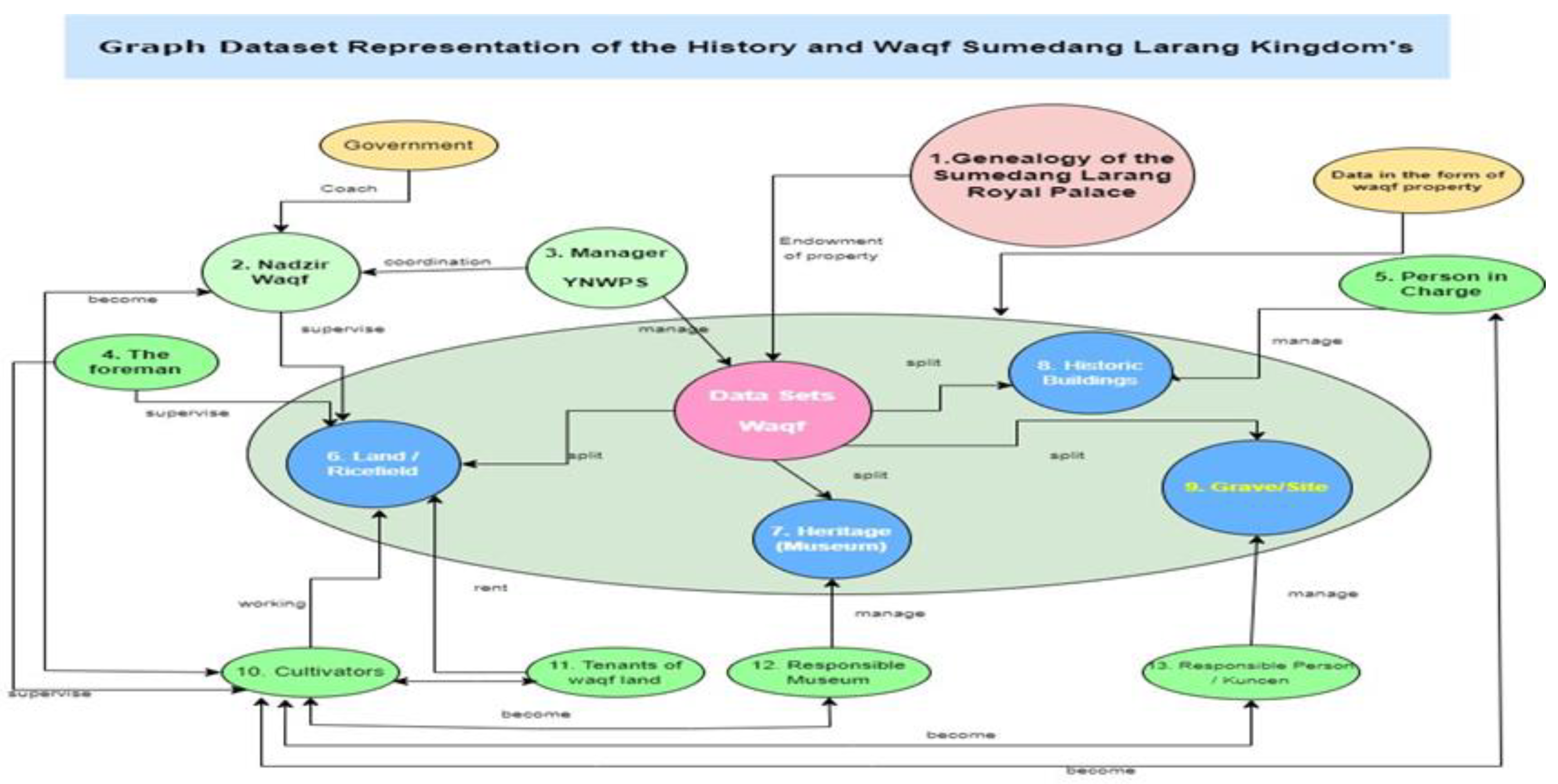
Figure 2.
Model Graph of Equivalent Relation Relationships.
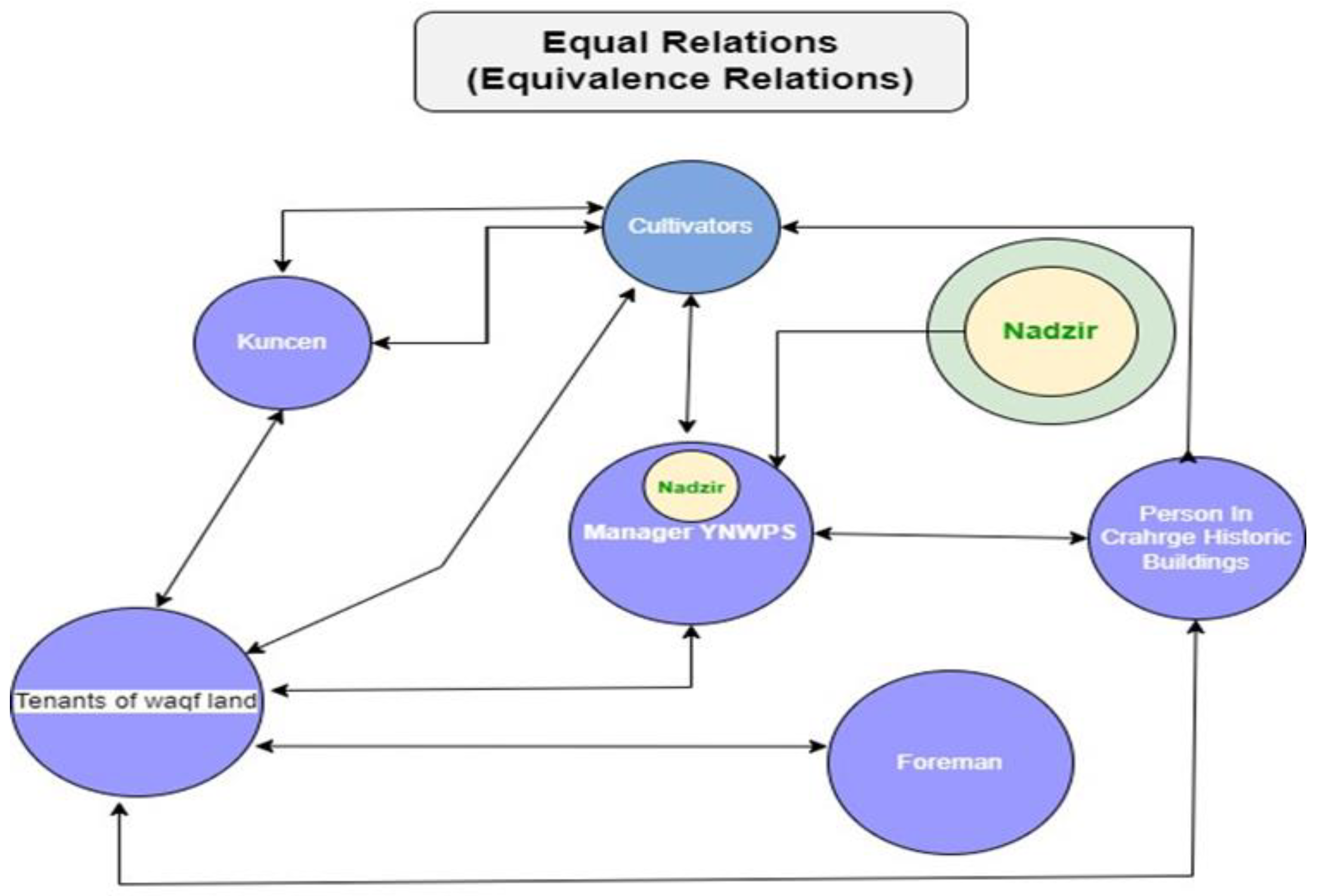
Figure 4.
Process at workflow query platform digital data with physical data.
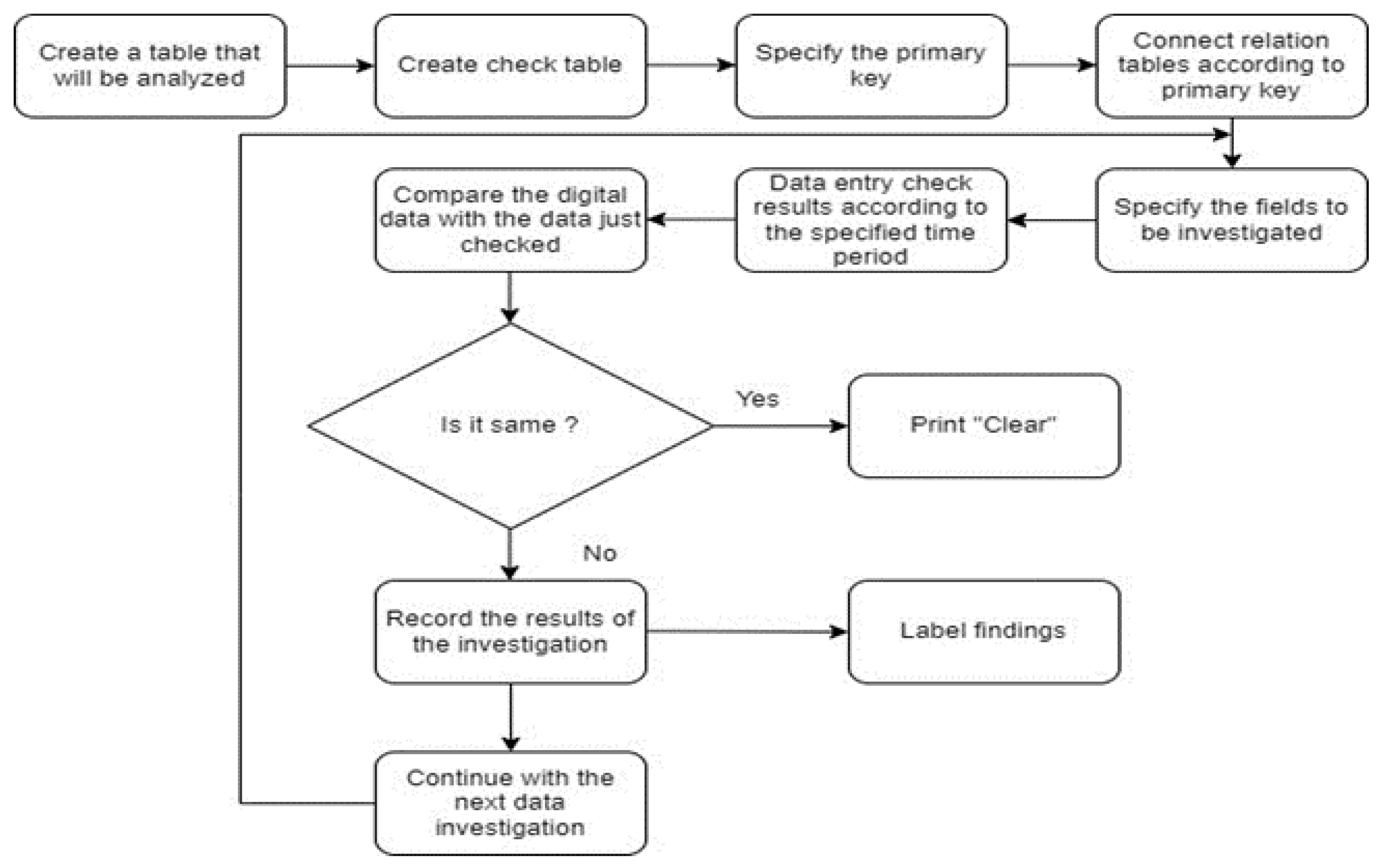

Table 1.
Variables and Data Sources.
| No. | Variabel and Data | Data Source | Description |
| 1 | Genealogy of the Sumedang Larang Royal Palace | YNWPS | Historical Manuscripts and Genealogies of Waqf |
| 2 | Nadzir Waqf | YNWPS | Biodata of The Nadzir Waqf |
| 3 | Manager YNWPS | YNWPS | Biodata of the Manager YNWPS |
| 4 | The Foreman | YNWPS | Biodata of the Foreman |
| 5 | Person in Charge Historic Buildings | YNWPS | Biodata of the Person in Charge Historic Buildings |
| 6 | Land/Ricefield | YNWPS | Data of the Land/Ricefeld |
| 7 | Heritage/Museum | YNWPS | Data of the Heritage/Mudeum |
| 8 | Historic Buildings | YNWPS | Data of the Historic Building |
| 9 | Grave/Site | YNWPS | Data of the Grave/Site |
| 10 | Cultivators | YNWPS | Data of the Cultivators |
| 11 | Tenants of Waqf Land | YNWPS | Data Tenants of Waqf Land |
| 12 | Responsible Museum | YNWPS | Biodata of the Person in Charge of the Museum |
| 13 | Responsible Person | YNWPS | Biodata of the Person in Charge of the Grave/Situs |
Disclaimer/Publisher’s Note: The statements, opinions and data contained in all publications are solely those of the individual author(s) and contributor(s) and not of MDPI and/or the editor(s). MDPI and/or the editor(s) disclaim responsibility for any injury to people or property resulting from any ideas, methods, instructions or products referred to in the content. |
© 2023 by the authors. Licensee MDPI, Basel, Switzerland. This article is an open access article distributed under the terms and conditions of the Creative Commons Attribution (CC BY) license (http://creativecommons.org/licenses/by/4.0/).
Copyright: This open access article is published under a Creative Commons CC BY 4.0 license, which permit the free download, distribution, and reuse, provided that the author and preprint are cited in any reuse.


