

Submitted:
28 July 2023
Posted:
31 July 2023
Read the latest preprint version here
Abstract
Berry curvature is deemed responsible for generating work in a strongly metastable system containing dynamically responsive clathrate hydrate structures. Hyperbolic curvature produces non-extensive volume changes and is attributed to gluon emission and reabsorption in a U(2) electroweak symmetry group synchronized across the condensed matter system, the embedding vacuum manifold and associated quantum interactions. The property of asymptotic freedom is evident across these three domains. Pressure perturbations of the low-energy system initiate ‘rolling’ critical responses that conserve energy and momentum across the synchronized U(2) group and also reveal an emergent gauge field. The corresponding emergence of a Ginzberg-Landau superconducting phase transition is consistent with gauge-invariant coupling of this scalar field to the Yang-Mills action of QCD. The discovery of an energy gap in the gradient energy term of the system Lagrangian is associated with a critical correlation length and is consistent with a complex energy band gap in the Berry phase. Coupled with the emergence and absorption of the Higgs-like scalar field, a mechanism for describing the QCD mass gap arises.
Keywords:
Berry geometrical phase
; symmetry groups
; self-organized criticality
; dual superconductivity
; gauge-invariance
; hyperbolic curvature
; false vacuum
; QCD mass gap
Introduction
Situations can arise in thermodynamics whereby a physical system is prevented from attaining its lowest energy and highest entropy state through the existence of an energy barrier. False vacuum conditions can result from such metastability in the extreme so that on short timescales a positive, non-minimum energy density cannot be raised or lowered in response to external interactions. Where an energy barrier is maintained through dynamic inhomogeneities, a system can be isolated from external interactions through local stability conditions, as characterized by a non-concave entropy function [1]. The process of thermodynamic isolation is also described by the characteristic of asymptotic freedom in particle physics [2]. Opposition to dynamical change is established through complex reorganization of individual system components, ie. degenerate hydrogen bonding in dissipative condensed matter systems; gluon splitting and recombining in the case of colour confinement; and gluon exchange in quark confinement [3].
A non-equilibrium system in which a material of almost constant density is associated with variable-volume mechanical work has previously been described [4]. The low-energy system reported encompasses both a crystal-fluid material and its embedding vacuum manifold whereby variable hyperbolic curvature of the embedding manifold rather than any fluid mechanical response determines the swept volume V of a piston expander and hence the work performed by the system.
The crystal-fluid is composed of dissipative, reorganizing, guest-free clathrate hydrate structures (or water ice cages) suspended within a polar dielectric inhibitor solvent. The formulation results in false vacuum behaviour [5] such that the material part of the system is isolated from any external thermodynamic interactions. However, despite the presence of strong local stability conditions, it is possible to perturb the system through external pressure interactions to induce a ‘rolling’ critical response [6] that in turn imposes a hyperbolic curvature action on the vacuum manifold to ultimately deliver a net energy gain, ie. an additional source of energy enters the system.
Hyperbolic curvature derives from the negative potential of the false vacuum established by the variable effective radius (ie. variable inertia) of the highly degenerate system. Conservation of angular momentum requires that a reducing effective radius produces an acceleration whilst an increasing effective radius produces a deceleration. Since the crystal-fluid retains constant total energy, acceleration acts to reduce hyperbolic (or negative) curvature of the embedding manifold whilst deceleration increases hyperbolic curvature via quantum interactions. The associated changes in swept volume V are thereby non-extensive.
During the ‘rolling’ critical response, the crystal-fluid system displays magnetic and superconducting behaviours quantified by a distinctive universality class of critical exponents. Variable manifold curvature alters the electric and magnetic properties of the system to establish a phase transition from Type-2 superconductivity to dual of Type-1 superconductivity where the spontaneous magnetic field Hs, as the order parameter, reduces to zero [7]. Following this, ordering is attributed to an emergent gauge field, similar to the topological ordering of spin ices as described by Castelnovo et al. [8]. In a dual superconductor, the roles of the electric and magnetic fields are exchanged so that in this case the electric field is excluded. The significance of dual superconductivity in furthering an understanding of the strong interaction is examined in comprehensive reviews by Ripka [9] and Kondo et al. [10]. The superconducting phase transition is consistent with Ginzburg-Landau theory revealing gauge-invariant coupling of a scalar field to the Yang-Mills action of quantum chromodynamics (QCD) [10]. The emergent gauge field is associated with an apparent broken symmetry with gradient energy expressed on the hyperbolic surface of the system where the electric field is excluded. However, gauge symmetry is revealed not to be broken but rather decomposed and synchronized to become more capacious in extent.
A model for the emergent gauge symmetry is presented here to account for the net energy gain initiated by the ‘rolling’ critical behaviour (and subsequent geometrical action of the vacuum manifold) in terms of Noether-conserved quantities, ie. energy and angular momentum for the case being considered. Since a topological phase factor, or Berry phase, reveals gauge structure in quantum mechanics [11], the existence of a parity-time (PT) symmetry may account for quantum mechanical interactions manifesting as real energy [12] in the gradient energy term of the Lagrangian associated with the dual superconductor phase transition [4].
Emergence of the gauge field corresponds to a critical correlation length ξ that represents long-range ordering of magnetic spins. This divergence is responsible for an energy gap in the gradient energy term consistent with energy band gaps reported in non-Hermitian PT symmetric systems [13]. Furthermore, the existence of a mass gap in QCD is necessary to explain why the strong interaction is strong but only short-ranged. Confirmation of a mass gap would also account for the fact that quantum particles have positive masses even though classical waves travel at the speed of light [14]. Evidence of Berry phase curvature and the Ginzburg-Landau parameter κ [4] thus enables insights into the Yang-Mills action and the mass gap phenomenon in QCD.
Experimental evidence and background material
The temperature and pressure of the crystal-fluid are measured at five-second intervals with sensors that have direct contact with the crystal-fluid and recorded by a PLC/ PC monitoring system. All values for energy and thermodynamic potentials are derived from the pressure and temperature measurements by the NIST REFPROP program/database [15]. The calculations are in accordance with GERG-2008 modified by the Kunz and Wagner Model 0 (KW0) [16]. The piston expander is completely immersed in a heat bath temperature with a temperature of 270K, approx. The schematic arrangement provided in Figure 1 is reproduced from [4]:
Figure 1.
Schematic arrangement of the experimental apparatus in which a negative pressure material is formulated and manipulated. Dissipative structuring of the crystal-fluid material is controlled with a view to establishing a power cycle through non-equilibrium, non-extensive volume displacements.
Figure 1.
Schematic arrangement of the experimental apparatus in which a negative pressure material is formulated and manipulated. Dissipative structuring of the crystal-fluid material is controlled with a view to establishing a power cycle through non-equilibrium, non-extensive volume displacements.
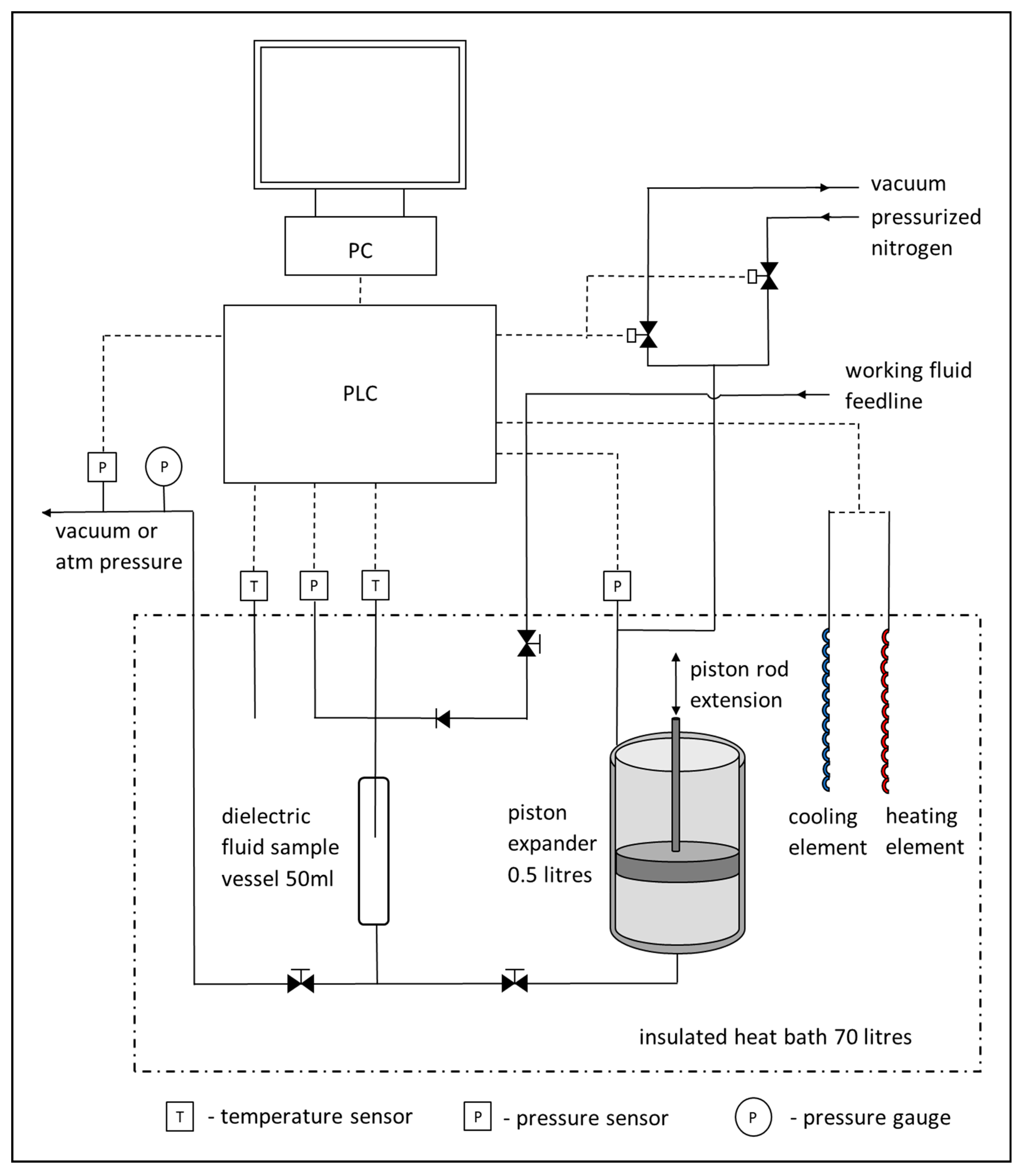
A negative-pressure fluid is established by the Berthelot-method [17]. Approx. 3.5 grams of crystal-fluid are transferred into a previously evacuated stainless-steel sample vessel (50ml). A low-energy, negative-pressure regime results in the formation of water ice cages hosting methane molecules. The sample vessel is completely immersed in a relatively large heat bath (70 litres) where the temperature of the bath is controlled with an electric element and a refrigeration dip cooler. Once the desired temperature is obtained, the sample is released into the fluid-side of the 0.5 litre retracted piston expander, also completely immersed in the heat bath, which displaces the piston vertically upwards to the fully-extended position. The gas-side of the piston is open to atmospheric pressure during this extension. This action reduces the energy of the system further and is intended to transfer the guest methane molecules from the host water ice cages to similar structures within the inhibitor solvent. Negative and positive piston displacements are then induced through pressurized nitrogen perturbations to produce negative and positive work outputs where displacement ratios are 1:100 and 100:1, approx.
From completion of the Berthelot mixing process through subsequent positive and negative displacements of the piston expander, REFPROP determines that the crystal-fluid material remains in a subcooled liquid phase, as recorded in Appendix 1 of [4]. It is both astonishing and remarkable that 3.5 grams of material does not transition to a vapour or gas, nor produce any methane outgassing, when contained within the initial sample volume of 50 ml. More remarkable still is that an additional work-generating positive piston displacement of 0.5 litre also has no effect upon the integrity of the subcooled liquid phase. A conventional interpretation in terms of fluid mechanics would locate all the crystal-fluid material in the lowest section of stainless-steel tubing connecting the sample vessel to the piston expander (excluding any capillary action) due to ordinary gravity and the generation of work would be inconceivable. This perplexing and counterintuitive outcome is examined in more detail below together with supporting mathematical expressions.
Whilst validity of the REFPROP calculations may be reasonably challenged, it has been demonstrated successfully that the program/ database is very sensitive to outgassing and re-absorption events associated with phase transitions in similar materials when performing quasi-thermodynamic cycles [5]. In such circumstances methane outgassing accompanies the formation of low-energy, guest-free water ice cages and is consistent with the fluctuation-dissipation theorem. With these phase-change processes, long-range interactions are also established whereby non-additivity in the fundamental thermodynamic relation is revealed.
Figure 2 is reproduced (with some additional annotation) from recent experimental findings reported in [4] where Points 1-4 identify particular stages of the work cycle in a low energy system; Stage 1-2 corresponds to negative displacement of the 0.5 litre piston expander and Stage 3-4 corresponds to positive displacement:
Changes in negative potential energy and internal energy vary in a 1:1 relationship after discounting the Pv work term associated with the walls of the vessel. Thus, a linear oscillator or constant Hamiltonian function is described. The associated affine non-concave entropy reveals local stability conditions achieved through dynamically-responsive inhomogeneities, ie. the complex reorganization of dissipative structures composed of water ice cages, such that energy cannot be minimized and entropy cannot be maximized [1]. Specific volume and internal energy are shown to be highly constrained intensive parameters.
Loss of homogeneity is characteristic of phase transitions that give rise to critical phenomena. The discovery of a distinctive universality class of critical exponents that obey the scaling laws of Fisher, Rushbrooke, Widom and Josephson [18] reveals spontaneous magnetic and superconducting properties for the crystal-fluid material investigated. A phase transition from Type-2 superconductivity to dual Type-1 superconductivity is described by the Ginzburg-Landau parameter where the spontaneous magnetic field Hs, as the order parameter, reduces to zero [4]. The associated spontaneous magnetism Ms can be either positive or negative such that the phase transition increases negative curvature (positive piston displacement) or reduces negative curvature (negative piston displacement), respectively.
Inequalities in the associated Maxwell relations together with calculations of the hyperbolic geometry reveal non-additivity and non-extensivity in the fundamental thermodynamic relation. Additivity can be restored through an emergent scalar field (or a coupling energy) [19]. Extensivity can be restored through hyperbolic curvature, ie. non-extensive changes in swept volume V. The coupling energy is derived from the critical correlation length exponent v in 3-dimensions combined with values of a scalar field Φ as derived from the gradient energy term ½(∇Φ)2 of the Lagrangian such that:
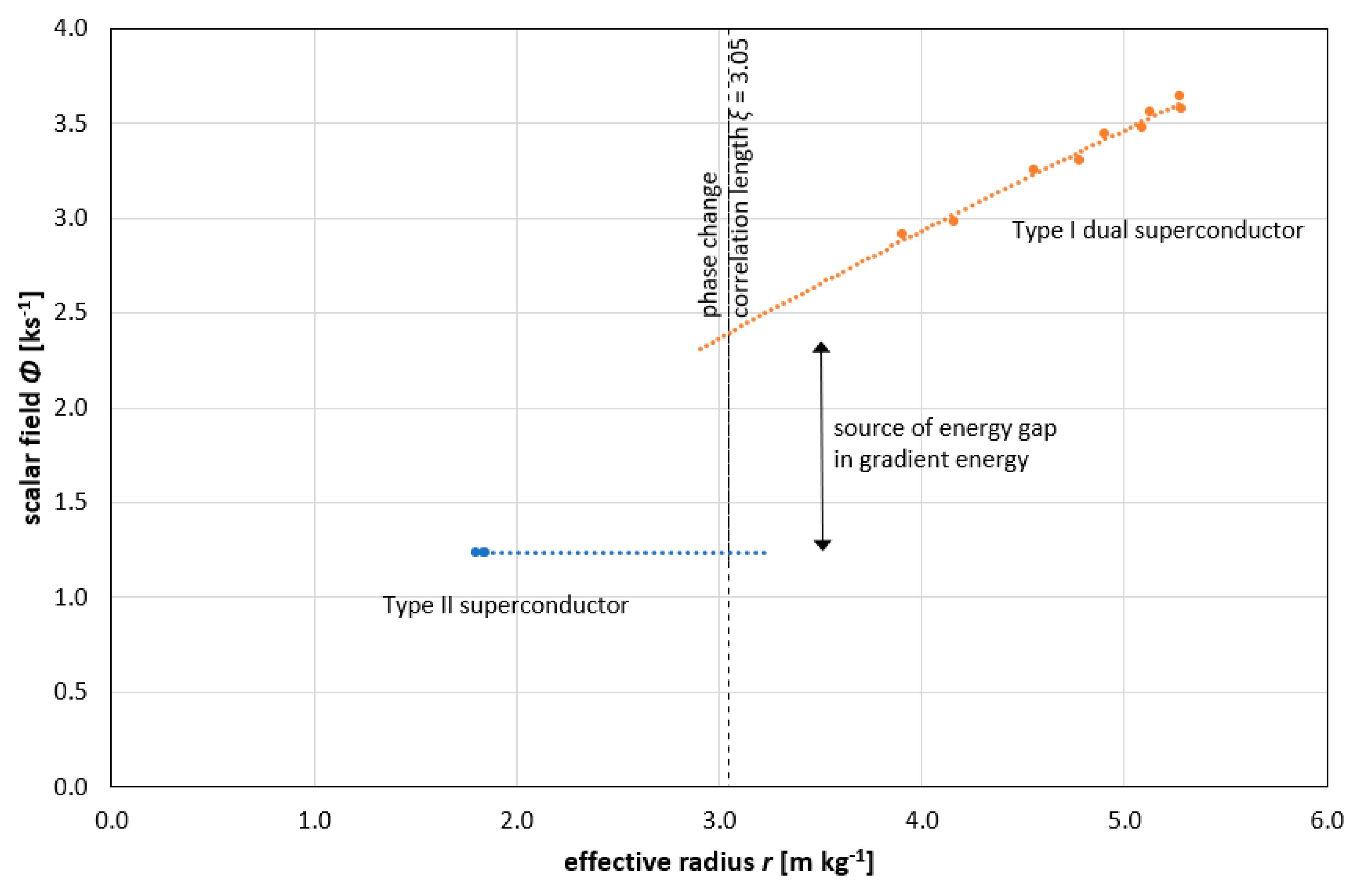
The critical correlation length ξ associated with the universality class is linked to hyperbolic curvature through Lorentz boosts, ie. relativistic velocity and the reference frames associated with acceleration and deceleration. The critical correlation length is revealed to be a Lorentz length expansion, ie. a relativistic phenomenon coinciding with the formation of magnetic spin patches. The relativistic time contraction linked to the critical correlation length is also revealed in Figure 3 where the y-axis representing scalar field values has units of s-1, ie. the reciprocal of time.
Figure 3.
Effect of inertia and critical correlation length on the magnitude of the scalar field. A gradient energy term, as derived from the Lagrangian function, describes the dynamical system. This, in turn, reveals scalar field Φ values associated with the critical response and a field coupling constant of 1. Energy conservation requires that non-extensive PV work be balanced through an equal-and-opposite electromagnetic coupling to the scalar field. The gradient energy term of the Lagrangian corresponds to the hyperbolic geometry and topology of the system, as well as its inertial potential. In considering the variable effective radius r of the system (ie. its ‘hidden’ inertia), the corresponding Euclidean volume ~ e3r.
Figure 3.
Effect of inertia and critical correlation length on the magnitude of the scalar field. A gradient energy term, as derived from the Lagrangian function, describes the dynamical system. This, in turn, reveals scalar field Φ values associated with the critical response and a field coupling constant of 1. Energy conservation requires that non-extensive PV work be balanced through an equal-and-opposite electromagnetic coupling to the scalar field. The gradient energy term of the Lagrangian corresponds to the hyperbolic geometry and topology of the system, as well as its inertial potential. In considering the variable effective radius r of the system (ie. its ‘hidden’ inertia), the corresponding Euclidean volume ~ e3r.
Again, the correlation length ξ is associated with a superconducting phase transition and related to a Lorentz boost in 3-dimesional space [4]. Its value reveals the presence of self-organized criticality responsible for a ‘rolling’ critical response in accordance with:
where T is the system temperature and Tc is the critical temperature. Both temperatures are dynamic under external pressure perturbation to reveal sustained anisotropy in the water ice structures in either direction. ξ corresponds to an energy gap in gradient energy and increasing values of the gauge field Φ are associated with relativistic length expansion and time contraction [4].
The gradient energy term equates with PV work (ie. it corresponds to the least action principle of the Lagrangian) whilst the hyperbolic surface area is a function of the effective radius of the system. Both properties are calculated from experimental results [4]. In order for the gradient energy to be fully expressed on the surface of the system, it is necessary to introduce topological defects at the superconducting phase transition where the order parameter Hs goes to zero. Beyond this point, ordering is attributed to the emergence of the gauge field and the topology associated with magnetic frustration and charge fractionalization.
Analysis and discussion
Gauge symmetry
Experimental results reveal a relativistic manifestation of length expansion and time contraction arising from false vacuum behaviour in a thermodynamically constrained condensed matter system. The local stability conditions maintained through dynamically-responsive inhomogeneities in soft matter are deemed equivalent to the property of asymptotic freedom, or antiscreening, which accounts for the mechanism of colour confinement in particle physics. In QCD it is the emergence of clouds of virtual gluons that establish the antiscreening phenomenon [2]. In both mechanisms, increasing kinetic energy is mirrored by an increasing negative potential such that total energy remains constant.
Whilst the crystal-fluid material displays high stability in total energy and density, the embedding manifold always remains on the threshold of instability. Small positive or negative pressure perturbations produce divergent critical behaviour manifesting as large variations in swept volume V. However, this is not the specific volume of the material system (density remaining almost constant) but rather the non-extensive volume associated with the embedding vacuum manifold as it exhibits hyperbolic curvature [4].
The ‘rolling’ critical response initiated by anisotropy in water ice cage structures facilitates net energy gain for the duration of external pressure perturbations, either positive or negative, in a display of self-organized criticality [20]. The angular momentum of the material is transferred to or from the embedding vacuum manifold through self-organizing behaviour and high energy degeneracy of the water ice cage structures. However, this concise statement does not provide a full description and a more detailed hypothesis follows.
Work derived from the piston expander can be expressed in terms of an electromagnetic pseudo-scalar gauge-invariantly coupled to the gradient energy of the vacuum manifold via a critical correlation length. The relationship is in agreement with the cosmological inflation model proposed by Ratra [21]:
where the covariant vector Fμν and contravariant gradient potential Fμν combine to produce Lorentz invariance for the pseudo-scalar field when rotated on a hyperbolic manifold, ie. the electromagnetic field pseudo-scalar reflects the geometry resulting from non-extensivity of the non-equilibrium system.
In the quasi-micro-canonical ensemble [4], the electromagnetic field pseudo-scalar acts as the coupling mechanism but contributes no work in itself. It expresses the hyperbolic curvature of the vacuum manifold whilst forming the magnetic exchange pathways that facilitate energy transfers either to or from the vacuum manifold. The inner-product of E and B remains the same viewed in all relativistic frames [22] with the pseudo-scalar field remaining Lorentz invariant such that:
Ginzburg-Landau theory states that the free energy of a superconductor near a phase transition can be expressed in terms of a complex order parameter field [23]:
Then the complex gradient energy term e3vΦ maps to a complex wavefunction:
where the quantity |Ψ(r)|2 reflects density of superconducting charge carriers (electrons for Type II and the magnetic counterpart arising from gauge monopole defects for dual Type I [9]). Various conceptual approaches for interpreting magnetic monopole phenomena have recently been presented by Cayssol and Fuchs [24]. In complex form the gradient energy term strongly resembles a quantum mechanical wavefunction in which the energy spectrum is entirely real and observable. Ψ0(r) corresponds to the emergence of the gauge field at the Type II to dual Type I superconducting phase transition. Dissipation of either the scalar field Φ or the critical correlation length ξ would represent a collapse in the wavefunction.
Application of de Moivre’s formula and isomorphic mapping of the complex field to a rotational matrix form gives:
and similarly expressing electromagnetic duality as rotations in the 2-dimensional real plane:
Then the conjugate transpose of (7) is (8) and VVH = 1 suggesting that PV work of the piston expander is contingent upon the decomposition of a Hermitian unitary matrix A into two 2 x 2 non-Hermitian unitary matrices (ie. two complex matrices V and VH containing both real and imaginary components such that VH ≠ V) [25]. The gauge field and the electromagnetic pseudo-scalar would thereby be coupled through a marginal interaction.
Although this interpretation appears at odds with the expression for PV work stated in (3), in fact any 2 x 2 complex symmetric matrix A can be eigendecomposed into a diagonal matrix sandwiched between two complex unitary matrices, ie. VDVH in this case. Minkowski spacetime vectors can be represented by 2 x 2 orthogonally diagonalizable matrices and incorporated into the extended physical VDVH decomposition. These Hermitian matrices exhibit basic 3-dimensional rotation as well as 4-dimensional Lorentz transformation properties consistent with the relativistic length expansion and time contraction responsible for PV work, as revealed through the experimental results [4]. Thus, the 2 x 2 unitary matrix A as a member of the U(2) symmetry group is decomposed into factors identifiable as both as Hermitian and non-Hermitian.
When represented in terms of gauge symmetry groups [25], the U(1) group of electromagnetism (via its mapping to SO(2) in the 2-dimensional real plane) and the SU(2) group of the complex order parameter, are in fact subgroups of the U(2) group such that:
which represents a mapping to a Yang-Mills electroweak symmetry group [26] where ℤ2 represents the topology associated with the condensation of gauge monopoles [27]. Formation of the U(2) group is accompanied by critical behaviour and emergence of the gauge field Φ as predicted by the Yang-Mills theory.
The dual superconductor model has several interpretations that require condensation of gauge monopoles, just as normal superconductivity results from the condensation of electric charges (or Cooper pairs) [9,10]. Theoretical frameworks for the condensation of gauge monopoles have been structured in terms of Abelian gauge-invariance (the SU(2) gauge symmetry group) or non-Abelian gauge-invariance (the SU(3) gauge symmetry group). Recent efforts [10] have sought to extract the Abelian component responsible for gauge-independent quark confinement from non-Abelian gauge-invariance required for gauge monopole condensation without losing the essential characteristic of asymptotic freedom.
In the vacuum of a dual superconductor, the dual Meissner effect compresses the chromoelectric flux between a quark and antiquark into a thin flux tube to form the hadronic string [9,28]. As the distance between the quark and antiquark increases, the flux tube becomes longer whilst maintaining a minimal thickness. This geometry ensures that the energy increases linearly with length to create a linear confining potential between the quark and antiquark that bears a similarity to the linear oscillating Hamiltonian of the system. The flux tube defines the extent of QCD vacuum suppression, ie. positions where the colour-electric field is maximally expelled to establish dual superconductivity [29].
Yang-Mills theory requires the existence of both chromomagnetic monopole condensation and the dual Meissner effect [9,10]. The force carrying gauge bosons of QCD are gluons which perform a similar role to photons in electromagnetism. Since the gluon field represents a local expulsion of the QCD vacuum, the absorption of physical gluon emissions into the QCD vacuum would tend to reduce local ‘space density’ and effective magnetic permeability μ0. The net effect is to reduce the hyperbolic curvature of the embedding manifold, ie. a quantum mechanical process manifests as relativistic ‘strong gravity’ [30].
Berry phase and parity-time (PT) symmetry
Since the superconducting phase transition established experimentally results from the hyperbolic geometry and topology of the embedding vacuum manifold of the constant Hamiltonian oscillator, it represents a Berry phase [13]. That is, curvature determines the balance of electromagnetic duality which in the extreme leads to dual superconducting behaviour, ie. exclusion of the electric field1. This geometrical phase also exposes the gauge structure in quantum mechanics [31].
In addition to describing the emergence of a gauge field Φ, the gradient energy term ½(∇Φ)2 of the Lagrangian can be decomposed into a complex order parameter field in accordance with Ginzburg-Landau theory. The PV work generated in the piston expander confirms the associated quantum mechanical wavefunction to be entirely real and observable, a phenomenon recently uncovered by Gu et al. [11].
Since the oscillating Hamiltonian can be described through a combination of Hermitian and non-Hermitian matrices, it resembles a PT symmetric system [12]. Such systems are characterized as not being isolated from the environment (ie. non-adiabatic) but subject to highly constrained interactions. This description is consistent with the false vacuum behaviour of the crystal-fluid material where both specific volume and internal energy are highly constrained. Energy and entropy gains and losses to the environment (including the embedding manifold in this case) are exactly balanced, ie. a renormalized marginal interaction is evident.
PT symmetry requires both space reflection and time reversal symmetries. The upside-down potential of the quartic term as identified by Bender [12] is consistent with the marginal interaction and negative gradient energy term derived from experiment [4]. However, the results presented here reveal the symmetry of Lorentz boosts, ie. symmetries in the expansion and contraction of both space and time, which may represent a more generalized form of PT symmetry.
1 In this case hyperbolic curvature of the vacuum manifold establishes dual superconductivity rather than the hydrogen bonding induced curvature of the crystal-fluid lattice being responsible for the superconducting phase transition, as suggested in [4], ie. the causality is reversed.
Symmetry synchronization and conserved quantities
Quark acceleration produces gluon emissions, ie. a lower binding potential is necessary to maintain the momentum and energy of any given quark colour configuration [32]. This results from a gluon recombination process whereby a quark and antiquark pair are annihilated. The emergence and annihilation of physical gluons represents an exchange between the non-Abelian gauge symmetry of QCD and an Abelian gauge symmetry of the vacuum, ie. an electroweak interaction.
The following non-Abelian Faddeev-Niemi decomposition is considered [33]:
However, this decomposition is a restricted one since splitting and recombining gluons in SU(3) represents a limited interaction with the U(2) spacetime manifold rather than full symmetry breaking to SU(2). The requirement for a Higgs-type scalar field is satisfied by the emergent gauge field Φ [10]. So:
Asymptotic freedom is thereby maintained through the dominant SU(3) group. Again, U(2) appears as an electroweak symmetry group [26] with ℤ2 representing a topology consistent with the condensation of gauge monopoles [27].
A U(2) gauge symmetry that provides for the condensation of gauge monopoles has so far been identified in both the condensed matter system and the underlying QCD particle physics. However, it is also possible to determine a U(2) gauge symmetry for the vacuum manifold of spacetime through which hyperbolic curvature and scalar field potential are effected. That is, where the splitting and recombining of force-carrying gluons manifests as fictitious forces in inertial reference frames.
The Lorentz group SO(4) provides for the conservation of energy and angular momentum in 4-dimensions (ℝ4) through two continuous symmetries; rotations in 3-dimensional Euclidean space and Lorentz boosts which influence both space and time [34]. The 4 x 4 orthogonal matrix representation of the metric tensor can also be cast in terms of a 2 x 2 unitary matrix operating on a complex 2-component spinor. The complete unitary 2 x 2 transformation matrix for spinor rotations and boosts can be expressed as:
or
where θ is the Lorentz rotation angle, σ is the Pauli spin matrix, and ϕ is the angle associated with the Lorentz boost (or rapidity) [35]. Equation (12) represents a ‘right-handed’ spinor ϕR and (13) represents a ‘left-handed’ spinor ϕL, ie. the Weyl spinors. Later insights by Dirac led to the concept of the bispinor which, unlike (12) and (13), preserves parity of the wavefunction under the sign reversal operation Ψ(x,t) → Ψ(-x,t) thereby maintaining a positive gauge field and positive energy (whilst also predicting the existence of antimatter). However, retaining the 2 x 2 matrix whilst acknowledging parity preservation requirements produces the following spacetime group representation [36]:
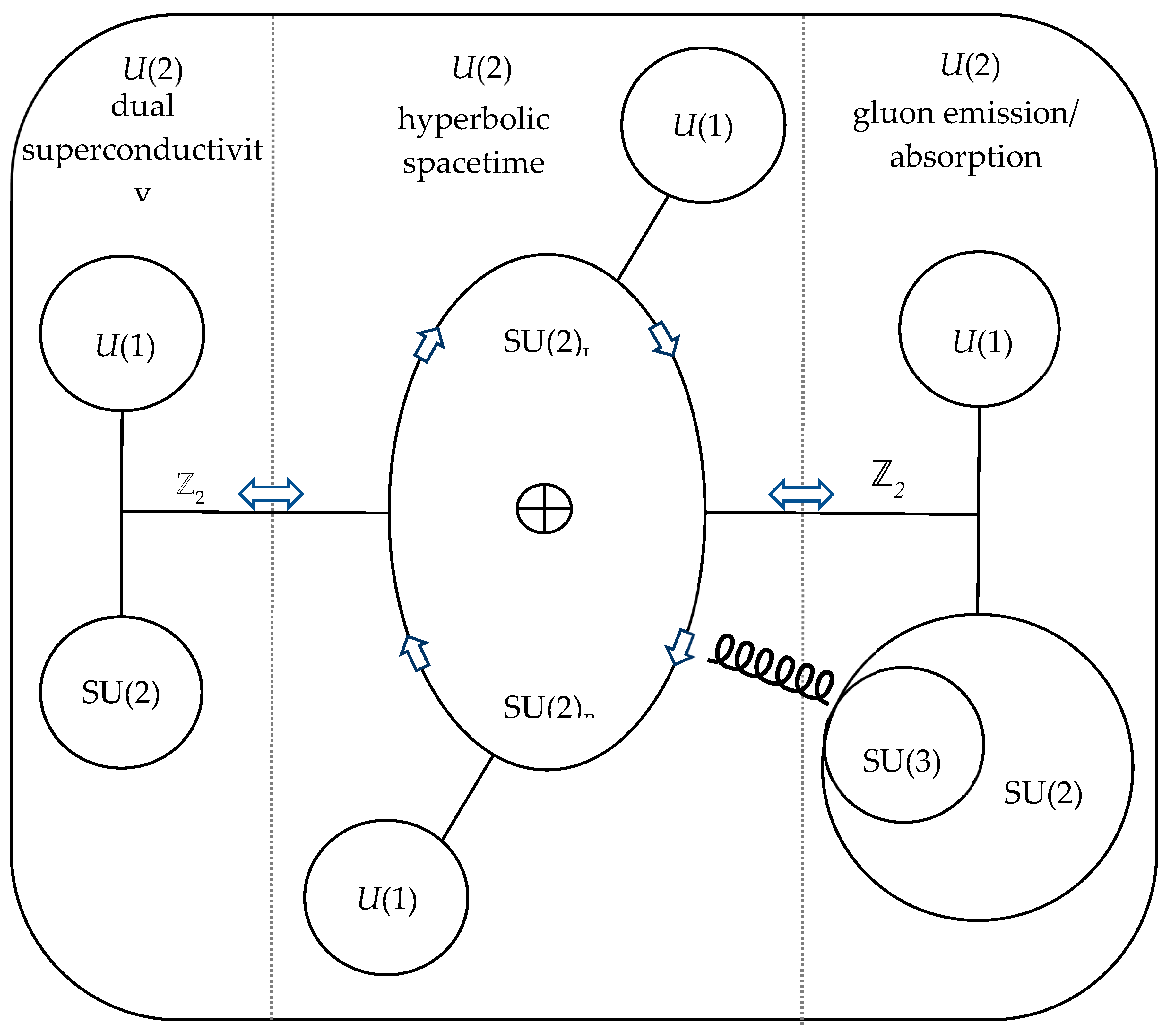
The symmetry group decompositions in (9), (11) and (14) are then amalgamated to describe a consolidated ‘symmetry synchronization’ that establishes common gauge-invariance in U(2), as shown schematically in Figure 4:
Both energy and angular momentum are conserved within the common U(2) group to reveal both time and space symmetry in a Lorentz boost in agreement with Noether’s theorem (see below). Since there is a gluon field for each colour charge, it follows that each gluon field can be composed of a time-like component and three space-like components. These components relate to the electric potential and the magnetic potential, respectively, and will interact with the vacuum manifold to determine the values of effective permittivity ε0 and effective permeability μ0.
Variations in effective μ0 require that a spontaneous magnetic flux Ms, with associated spontaneous magnetic field Hs, emerges to conserve magnetic charge. Fractionalized magnetic charges arising from the geometrically frustrated crystal-fluid material can be interpreted as condensing into a gauge monopole topology providing magnetic exchange pathways. The correlation length ξ of these pathways produces divergent critical behaviour that is shown to have a distinctive universality class of critical exponents. The gauge monopole topological defects act as both convergent sinks (under acceleration) and divergent sources (under deceleration) of the magnetic flux Ms [8].
Similar principles apply to variations in vacuum energy determined by the local ‘space density’ (which determines the embedding manifold curvature). Conservation of energy requires that negative PV work is performed under false vacuum acceleration of the material (energy is transferred to the vacuum manifold) whilst positive PV work is performed under deceleration (energy is transferred from the vacuum manifold). Work is related to the gauge/ scalar field Φ as follows [4]:
The right-side of equation (15) represents the gradient energy term of the Lagrangian function resulting from the scalar potential ∇Φ developed across the gauge monopole topology. The Lagrangian action of the left-side, ie. mechanical work, is also related to the critical response function revealed in the coupling relationship (1) to demonstrate renormalization (ie. a marginal interaction equal to one) in the synchronized U(2) group gauge field, as illustrated in Figure 4.
With U(2) gauge-invariance spanning the asymptotically-free behaviour of both the dual superconducting system and the quark-gluon system via interactions with the embedding vacuum manifold, a correspondence between non-equilibrium thermodynamics and quantum mechanics is established. Since the superconducting phase transition conforms to Ginzburg-Landau theory (ie. gauge-invariant coupling of a scalar field to the Yang-Mills action is implied) it seems reasonable to link the gradient energy gap of Figure 3 to the mass gap problem in QCD.
Energy band gaps
In Figure 3 the gradient energy gap corresponds to the opening of an energy band gap in the Berry or topological phase. Such gaps preserve topological invariance under unitary or Hermitian-flattening transformations [13]. As detailed above, the (VDVH) decomposable 2 x 2 unitary matrix, as belonging to the U(2) symmetry group, is able to describe such transformations.
The energy gap is complex and derives from the critical correlation length ξ, ie. through the formation of magnetic spin patches at the superconducting phase transition. Cayssol and Fuchs provide additional insight [24]:
‘Although elusive as magnetic charge in real space, the Dirac monopole actually exists in reciprocal space as a source of Berry flux and is related to band contact points. The well-known quantization of the magnetic strength of the Dirac monopole has a counterpart in the Chern numbers characterizing the bands.’
The topological invariant Chern number ℤ2 has already been uncovered in the symmetry group decompositions of equations (9) and (11), which could be interpreted as a U(2) group that fibres over a circle as a 3-sphere bundle, ie. a Hopf fibration results [24].
Whilst the massless gluons either emitted or absorbed by accelerating or decelerating quarks act as gauge particles, gauge invariance is only established where the associated gauge field can emerge under U(2) ‘symmetry synchronization’ at a critical correlation length ξ in the low-energy system. That is, gauge monopole defects are required to effectively condense such that the scalar field potential induces a flow of magnetic charge.
By extension, the lower bound of the QCD mass gap can be attributed to a symmetry-breaking of U(2) and the annihilation of gauge monopoles from below in the low-energy, infrared limit. In this event, the conservation pathway between the classical and quantum systems no longer exists since the systems are effectively isolated except for weak residual gravitational interactions, ie. the systems are decoupled. With this ‘breaking’ of U(2) gauge symmetry into isolated sub-groups, and the collapse of any critical magnetic correlation length, there is no mechanism through which non-equilibrium angular momentum can be conserved through gluon interactions and the corresponding curvature imposed upon the embedding manifold, ie. conservation of energy and momentum becomes limited to the individual symmetry groups and the condensed matter system would become describable by classical thermodynamics and discontinuous (first order) phase transitions. Thus, in this interpretation of broken gauge symmetry, a strong gravitational interaction [30] is replaced by a far weaker one limited to gluon interactions arising from quantum fluctuations and other irrelevant interactions.
Cosmological analogy
The same principle may be applied to the high-energy bound of the QCD mass gap from above. Guth’s model of cosmological inflation [37,38] is also founded upon false vacuum and negative pressure conditions. The associated deceleration of inflationary expansion within a false vacuum would result in gluon splitting where conservation of energy and momentum are mediated by a synchronized gauge field/ symmetry group together with the corresponding cosmic monopole entities necessary to facilitate a critical correlation length. This manifests as increasing negative curvature of the vacuum manifold under inflationary expansion. The splitting of gluons and the emergence of quark and antiquark pairs acts to increase the strong interaction through confinement mechanisms.
The non-extensive inflationary volume expansion is given by [4]:
where Vr is the reduced volume │(V – Vc)/ Vc│ at the critical temperature Tc with a correlation length exponent v in 3-dimensions. Critical volume Vc and critical temperature Tc are not absolute values but rather ‘rolling’, dynamical values determined by structural anisotropy and dissipative false vacuum restructuring of elementary particles under non-equilibrium conditions. At the collapse of critical behaviour, Vr = 1 and non-extensive inflationary volume expansion ceases.
The critical length exponent v represents the dimensionless group parameter of rapidity such that its emergence on a Lorentz hyperbolic manifold (ie. a Lorentz boost) is associated with the relativistic length expansion to determine non-extensive inflationary volume expansion. Increasing the effective radius of structural elements under false vacuum conditions produces deceleration such that angular momentum is removed from the sub-atomic quarks. The counteracting emergence of quark- antiquark pairs qq̄ plus gluons from the QCD vacuum, the associated gluon splitting, together with subsequent integration of the emergent particles into complex binding arrangements, establishes the colour and quark confinement mechanisms. These tend to increase local ‘space density’ and effective magnetic permeability μ0. The resultant compensating effect sees hyperbolic curvature of the embedding vacuum manifold increase to generate inflationary expansion. The process is illustrated by analogy to the experimental findings in Figure 5.
Figure 5.
Deceleration of dissipative water ice cage structures under critical false vacuum conditions results in the transfer of momentum away from sub-atomic quarks. The processes of colour and quark confinement see compensating quark-antiquark pairs and gluons emerge from the quantum vacuum to enable gluon splitting. The corresponding tendency to reduce local ‘space density’ increases the hyperbolic curvature of the vacuum manifold to generate positive expansion work.
Figure 5.
Deceleration of dissipative water ice cage structures under critical false vacuum conditions results in the transfer of momentum away from sub-atomic quarks. The processes of colour and quark confinement see compensating quark-antiquark pairs and gluons emerge from the quantum vacuum to enable gluon splitting. The corresponding tendency to reduce local ‘space density’ increases the hyperbolic curvature of the vacuum manifold to generate positive expansion work.
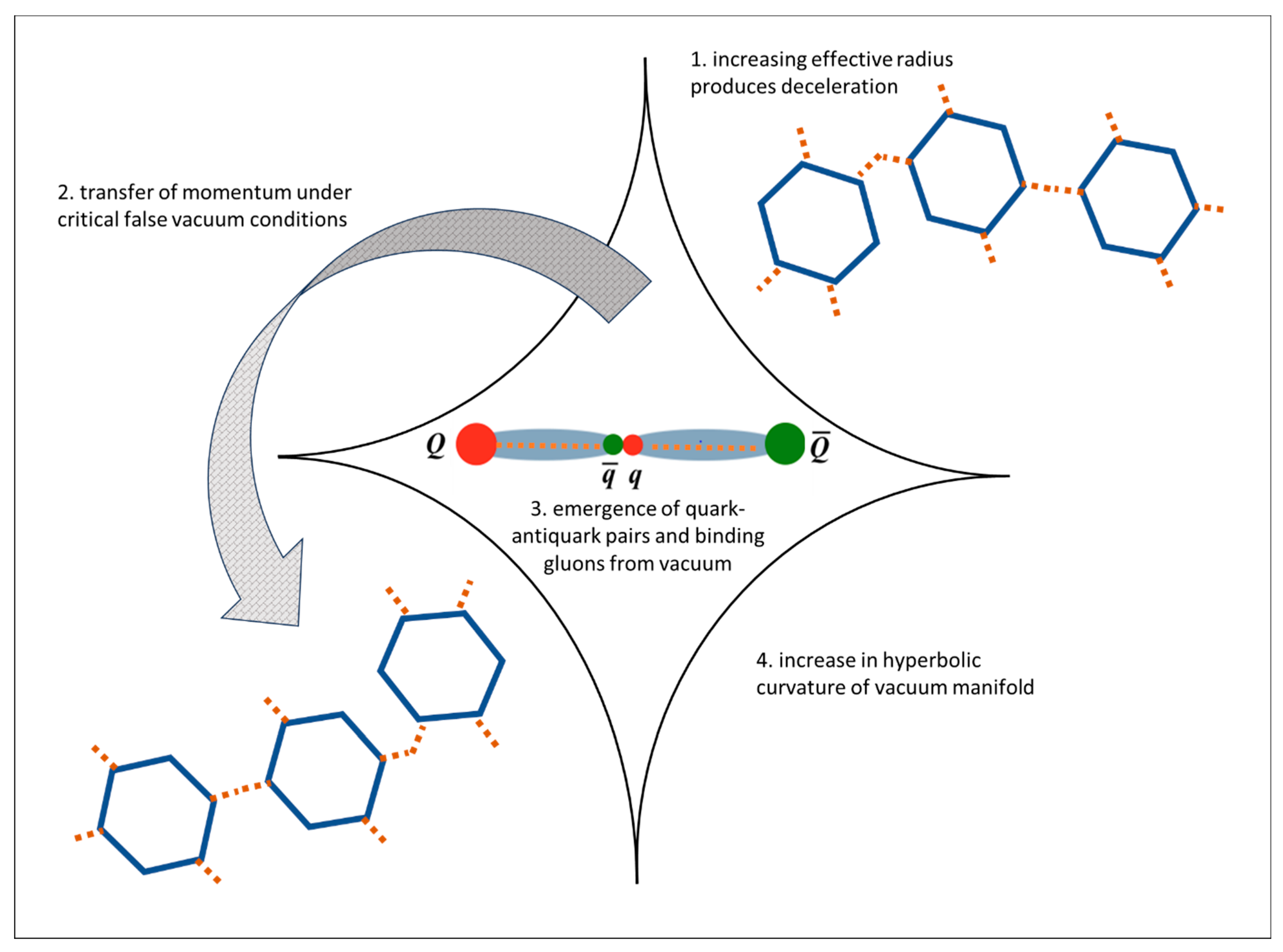
Upon the collapse of critical behaviour, the synchronized gauge symmetry is broken, the cosmic monopole entities with associated topology are annihilated, and critical correlation length is destroyed. Absorption of the gauge field into the QCD colour field attributes mass to the emergent quark and antiquark pairs of the confinement process under a Higgs-like mechanism. Again, under such an interpretation, classical thermodynamics essentially separates from quantum mechanics to leave only weak residual gravitational interactions. The energy and mass of the strong interaction is thereby effectively fixed at the point where the common symmetry group associated with cosmological inflation is broken, cosmic monopole entities are annihilated, and the critical correlation length destroyed.
Conclusion
The complex reorganization of systems with high energy degeneracy leads to the property of asymptotic freedom, as characterized by the emergence of variable negative potential that maintains constant total energy. In these systems, the excess negative potential imposes variable hyperbolic curvature on the embedding manifold to create strong gravitational effects able to perform mechanical work. This strong gravity emerges only when quantum interactions are coupled to non-equilibrium thermodynamics through a critical correlation length.
Experimental findings uncovering a dual-superconducting phase are linked to emergence of a gauge field and corresponding synchronization of a common U(2) symmetry group encompassing dual superconductivity, Lorentz spacetime and gluon interactions. Conservation of energy and angular momentum across these domains is linked to time and rotational space symmetries in agreement with Noether’s theorem. Gauge monopoles are naturally associated with the U(2) group and ℤ2 topology such that a critical correlation length can be established. For a synchronized U(2) group, gauge monopoles then correspond to the quark emission/ vacuum absorption of gluons from acceleration, and vacuum emission/ quark absorption of gluons from deceleration. The magnitude of the critical correlation length and the effective radius/ inertia of the water ice cage structures determine the hyperbolic curvature of the vacuum manifold which in turn determines the spontaneous magnetic field strength and associated transfers of energy.
In complex form the gradient energy term of the Lagrangian strongly resembles a quantum mechanical wavefunction in which the energy spectrum is entirely real and observable. Such behaviour resembles a PT symmetric system which is not isolated from the environment (ie. non-adiabatic) but subject to highly constrained interactions. Conservation of momentum and energy are determined through the symmetry of Lorentz boosts, ie. symmetries in both space and time, in a system containing both Hermitian and non-Hermitian elements.
The spontaneous magnetic field is the order parameter that, in transitioning from negative to positive, signifies a superconducting phase transition from Type II to a dual of Type I. The superconducting phase transition is consistent with Ginzburg-Landau theory revealing gauge-invariant coupling of a scalar field to the Yang-Mills action in QCD. The point at which the critical correlation length and gauge field emerge is postulated as the low-energy, infrared bound of the QCD mass gap.
References
- H. Callen, Thermodynamics and an Introduction to Thermostatistics (Wiley, New York, 1985), Chap. 8,10.
- Wilczek, F. Nobel Lecture: Asymptotic freedom: From paradox to paradigm. Rev. Mod. Phys. 2005, 77, 857–870. [Google Scholar] [CrossRef]
- J. Greensite, An Introduction to the Confinement Problem (Springer, Cham, 2020), Chap. 1,2,3). [CrossRef]
- M. Gibbons, Superconducting phase transition reveals an electromagnetic coupling to a scalar field potential that generates mechanical work, J. Phys. D: Appl. Phys., 56, 054001 (2022). [CrossRef]
- M. Gibbons, A condensed-matter analogue of the false vacuum, J. Phys. Commun., 5, 065005 (2021). [CrossRef]
- F. Pázmándi, G. Zaránd and G. T. Zimányi, Self-Organized Criticality in the Hysteresis of the Sherrington-Kirkpatrick Model, Phys. Rev. Lett., 83, 1034-1037 (1999). [CrossRef]
- S. V. G. Menon, Renormalization Group Theory of Critical Phenomena (Wiley, New Delhi, 1995), Chap. 1,2,3.
- C. Castelnovo, R. Moessner and S. L. Sondhi, Magnetic monopoles in spin ice, Nature, 451, 42-45, (2008). [CrossRef]
- G. Ripka, Dual superconductor models of color confinement, Lecture Notes in Physics (2004), Chap. 1,3,5. [CrossRef]
- K. Kondo, et al., Quark confinement: Dual superconductor picture based on a non-Abelian Stokes theorem and reformulations of Yang–Mills theory, Phys. Rep., 579, 1-266 (2015). [CrossRef]
- Y. Gu, X. Hao and J. Liang, Generalized Gauge Transformation with PT-Symmetric Non-Unitary Operator and Classical Correspondence of Non-Hermitian Hamiltonian for a Periodically Driven System, Ann. Phys., 6, 534, 2200069 (2022). [CrossRef]
- C. M. Bender, PT-symmetric quantum theory, J. Phys.: Conf. Ser., 631, 012002 (2015). [CrossRef]
- A. Fan, G-Y. Huang and S-D Liang, Complex Berry curvature pair and quantum Hall admittance in non-Hermitian systems, J. Phys. Commun., 4, 115006 (2020). [CrossRef]
- Jaffe, E. Witten, 2000 Quantum Yang-Mills Theory. Available online: www.claymath.org/millennium/Yang-MillsTheory/yangmills.pdf.
- E. W. Lemmon, L. H. Huber, M.O. McLinden, and I. Bell, Reference Fluid Thermodynamic and Transport Properties Database (REFPROP) (Boulder, Colorado, 2020). Available online: https://www.nist.gov/programs-projects/reference-fluid-thermodynamic-and-transport-properties-database-refprop.
- O. Kunz and W. Wagner, Journal of Chemical & Engineering Data, 57, 11, 3032-3091 (2012). [CrossRef]
- Imre, K. Martinás and L. P. N. Rebelo, Thermodynamics of negative pressure in liquids, Non-Equilibrium Thermodynamics, 23, 4 (1998). [CrossRef]
- Cowan, Topics in Statistical Mechanics (World Scientific, London, 2022), Chap. 4.
- H. Callen, Thermodynamics and an Introduction to Thermostatistics (Wiley, New York, 1985), Chap. 3,7.
- P. Bak and K. Chen, The physics of fractals, Physica D, 38, 1-3, 5-12 (1989). [CrossRef]
- Ratra, Cosmological 'seed' magnetic field from inflation, ApJL, 391, L1-L4, (1992). Available online: https://adsabs.harvard.edu/full/1992ApJ...391L...1R.
- Tong, University of Cambridge, Lectures on Electromagnetism, Chap. 4, 2023. Available online: https://www.damtp.cam.ac.uk/user/tong/em/el4.pdf.
- S. Huber, ETH Zürich, Experimental and Theoretical Aspects of Quantum Gases lecture notes, Chapter 7, 2023. Available online: https://ethz.ch/content/dam/ethz/special-interest/phys/theoretical-physics/cmtm-dam/documents/qg/Chapter_07.pdf.
- J. Cayssol and J. N. Fuchs, Topological and geometrical aspects of band theory, J. Phys. Mater., 4, 034007 (2021). [CrossRef]
- A. Zee, Group Theory in a Nutshell for Physicists (Princeton University Press, Princeton, 2016), Preface and Parts 1, 2.
- R. Penrose, The Road to Reality (Vintage, London, 2005), Chap. 13, 25.
- I.G. Halliday and A. Schwimmer, Z(2) monopoles in lattice gauge theories, Physics Letters B, 102, 5, 337-340 (1981). [CrossRef]
- Bissey, A. I. Signal, and D. B. Leinweber, Comparison of gluon flux-tube distributions for quark-diquark and quark-antiquark hadrons, Phys. Rev. D, 80, 114506 (2009). [CrossRef]
- H. Suganuma, S. Sasaki and H. Toki, Color confinement, quark pair creation and dynamical chiral-symmetry breaking in the dual Ginzburg-Landau theory, Nuclear Physics B, 435, 1–2, 207-240 (1995). [CrossRef]
- A. Salam and C. Sivaram, Strong gravity approach to QCD and confinement, Mod. Phys. Lett., 8, 4, 321–326 (1993). [CrossRef]
- M. V. Berry, Quantal phase factors accompanying adiabatic changes, R. Soc. London, 392, 45–57 (1984). [CrossRef]
- L. M. Lederman and C. T. Hill, Symmetry and the Beautiful Universe (Prometheus Books, New York, 2004), Chap. 12.
- J. Evslin, et al., Nonabelian Faddeev-Niemi decomposition of the SU(3) Yang-Mills theory, J. High Energ. Phys. 94 (2011). [CrossRef]
- M. E. Peskin and D. V. Schroeder, An Introduction to Quantum Field Theory (CRC Press, Boca Raton, 1995), Chap. 3.
- J-M. Lévy-Leblond, J-P. Provost, Additivity, rapidity, relativity, Am. J. Phys., 47, 12, 1045-1049 (1979). [CrossRef]
- N. Mukunda and S. Chaturvedi, Continuous Groups for Physicists (Cambridge University Press, Cambridge, 2022), Chap. 16.
- A. H. Guth, Inflation, Proc. Natl. Acad. Sci. USA, 90, 4871-4877, (1993). [CrossRef]
- H. Guth, The Beamline, 27, 14 (1997), The Inflationary Universe. Available online: ned.ipac.caltech.edu/level5/Guth/Guth3.html.
Figure 2.
Excess internal energy potential resulting from excess thermodynamic potentials. All values for energy and thermodynamic potentials are derived from the pressure and temperature measurements by the NIST REFPROP program/database. The calculations are in accordance with GERG-2008 modified by the Kunz and Wagner Model 0 (KW0). The piston expander is completely immersed in a heat bath with a temperature of 270K, approx.
Figure 2.
Excess internal energy potential resulting from excess thermodynamic potentials. All values for energy and thermodynamic potentials are derived from the pressure and temperature measurements by the NIST REFPROP program/database. The calculations are in accordance with GERG-2008 modified by the Kunz and Wagner Model 0 (KW0). The piston expander is completely immersed in a heat bath with a temperature of 270K, approx.
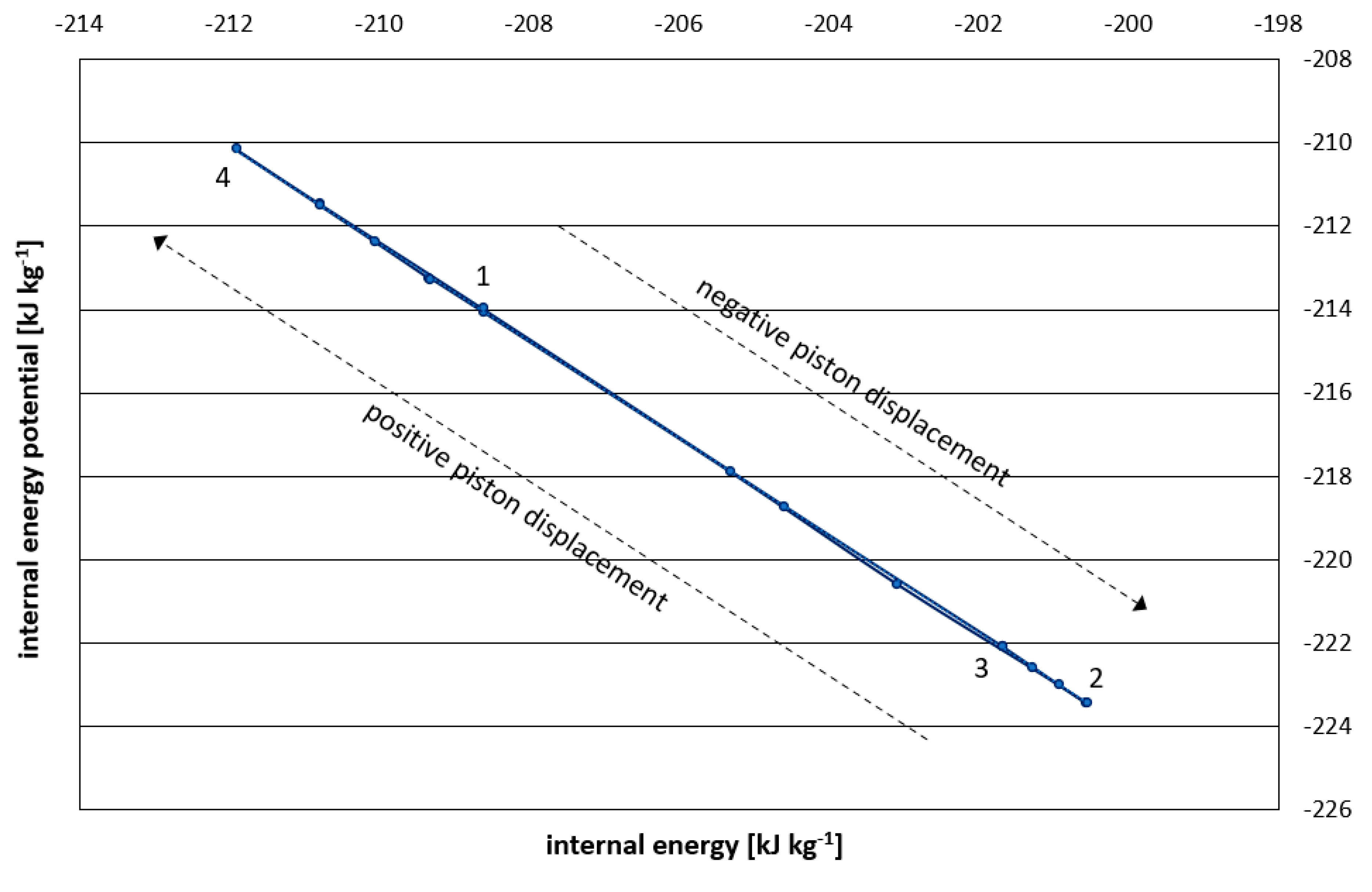
Figure 4.
Decomposition of symmetry groups to establish a common U(2) gauge-invariance. This model of gauge-invariance provides a mechanism through which the pressure-induced ‘rolling’ critical response results in PV work that is either positive or negative. The complex reorganization of water ice cages produces variable inertia which, through the conservation of angular momentum, is responsible for either an acceleration or deceleration of quarks. In the case of acceleration, this leads to the emission of physical gluons that are absorbed into the embedding manifold. A corresponding tendency to reduce local ‘space density’ and effective magnetic permeability μ0 manifests as reduced hyperbolic curvature and negative PV work. Conservation of magnetic charge imposes a superconducting phase transition on the crystal-fluid material.
Figure 4.
Decomposition of symmetry groups to establish a common U(2) gauge-invariance. This model of gauge-invariance provides a mechanism through which the pressure-induced ‘rolling’ critical response results in PV work that is either positive or negative. The complex reorganization of water ice cages produces variable inertia which, through the conservation of angular momentum, is responsible for either an acceleration or deceleration of quarks. In the case of acceleration, this leads to the emission of physical gluons that are absorbed into the embedding manifold. A corresponding tendency to reduce local ‘space density’ and effective magnetic permeability μ0 manifests as reduced hyperbolic curvature and negative PV work. Conservation of magnetic charge imposes a superconducting phase transition on the crystal-fluid material.
Disclaimer/Publisher’s Note: The statements, opinions and data contained in all publications are solely those of the individual author(s) and contributor(s) and not of MDPI and/or the editor(s). MDPI and/or the editor(s) disclaim responsibility for any injury to people or property resulting from any ideas, methods, instructions or products referred to in the content. |
© 2023 by the authors. Licensee MDPI, Basel, Switzerland. This article is an open access article distributed under the terms and conditions of the Creative Commons Attribution (CC BY) license (http://creativecommons.org/licenses/by/4.0/).
Copyright: This open access article is published under a Creative Commons CC BY 4.0 license, which permit the free download, distribution, and reuse, provided that the author and preprint are cited in any reuse.


