

Submitted:
10 July 2023
Posted:
12 July 2023
You are already at the latest version
Abstract
The purpose was to reflect on the sustainability of artisanal and informal mining in the Peruvian Andean zone by 2022. The type of research was basic, non-experimental design, ex post facto scope. The sample consisted of: statistics on crime prevention due to socio-environmental conflicts from the National Prosecutor's Office and the Ombudsman's Office, reports of interventions targeted at artisanal and informal miners. The procedure focused on gathering secondary information for a documentary review analysis that is based on proven and disseminated past facts. Artisanal and informal mining is strengthened in the Peruvian Andean zone by incidence and force: 1) the social license and agreements by community assembly, 2) the flexibility in compliance with the formalization, preventive and environmental protection laws, 3) the 50% increase in socio-environmental conflict due to mining activity, 4) a 25% progressive increase in the production costs of agricultural and livestock activities. The direct consequences on environmental sustainability are: 1) the delimited reconversion of the change in agricultural land use in a third of the communal territories in basin headwaters; 2) displacement of environmentally friendly economic activity by 20% in basin headwaters; 3) the impossibility of modification or intervention in water surfaces, bofedales by communal agreements.
Keywords:
conflicto
; costs
; deterioration of the territory
; laws
; social license
1. Introduction
In Latin American countries, there is an advance and level of environmental deterioration in the Andean area, generated by the expansion of the mining extractive industry, which resulted in socio-environmental conflicts; according to [1] the number of environmental conflicts reported, are sustained in the productive specialization for more than 25 years towards the primary sector, the impulse of neo-extractivism and the structural changes of the economies, the amount of environmental conflicts predominate and are associated with mining activity in 37%, with Peru representing 63% of the total, whose main product that is in the middle of the disputes correspond to metallic minerals, in gold 20.7%, copper 8.0% and silver 5.2%.
The representativeness of mineral resources, demonstrated by [2], the data estimated reserves in silver, copper, zinc and tin, worldwide amounted to 25%, 11%, 15% and 11% respectively of the world total, the main export destinations were: Asia, North America and Europe, with percentages of 32%, 28% and 13%. Foreign direct investment reached 23% of Latin American GDP; However, mining exploitation since these years consolidated the problem that remains today, it is difficult to solve, and has an environmental impact, we refer to illegal mining that in Peru reached 28% of the gross added value of the mining sector, in extracted gold product. In this period, artisanal mining begins the other problem, in the case of gold from 2011 to 2016, the number of 22 million people working in mining activity was projected despite the serious health effects of the use of mercury.
From the studies of [3] stated that, neoliberal extractivism in Colombia and Peru from the 1990s onwards. The management of mining resources was based on a model that favors the accumulation of private and foreign wealth, in modifications and updates of the fiscal system, together with programmed intervention activities to suppress social mobilization; between 1995 and 2011, the Peruvian mining sector consolidated an economic growth of the Peruvian GDP of 3.5%, while the mining sector grew 7.2%, for the year 2013 it contributed 9.4%, and in the first decade of the XXI century, 55% came from the mining sector, sustained in the policies of the governments of Toledo (2001-2006), García (2006-2011) and Humala (2011-2016); They concluded that policies to encourage foreign direct investment in mining generated serious environmental impacts, along with human rights violations.
So far, only the effects of mining extraction, the policies in favor that allow its production, the recognition of the mining contribution to the Peruvian GDP, the degrees of conflict have been touched; However, later we will develop on the causes and effects of the decisions of peasant organizations, grouped in associations of artisanal miners, the decisions of government policy in favor of this mining modality, the problems and environmental deterioration.
The Peruvian Andean zone, especially that of the center and south, contain mining deposits, whose exploitation periods exceed 30 effective years. In addition, each deposit contains a variety of mineral concentrations. The contributions of [4] the mining activity in operation is located in the regions of Arequipa, Cusco, Puno and Tacna; in which the antiquity of exploration attracts expansion towards the less mature, a strong exploration in Apurimac and Moquegua. [23] Likewise, the relationship between the executed and developed canon of socio-environmental conflicts is latent, for reasons of contamination and disposal of solid and liquid waste. The data of the investigation showed that for the year 2015, they received in the range from 10 million soles (ex exploration) to 500 million those with old exploitation.
The conflicts generated by mining exploitation, according to [5,6,7,8,9,10,11,12,13,14,15,16,17,18,19,20,21,22] were in response to environmental deterioration between 2010 and 2019, tended downward; the highest rate of social conflicts from 5.01 per 100,000 inhabitants to 3.93, keeping latent the fall due to the Covid-19 pandemic, likewise, the highest rate of conflicts were concentrated in the central and southern regions of Peru, these being Apurímac, Moquegua, Ancash, Ayacucho, Cusco; and in 2018, the three regions with the highest participation of the mining sector in the regional GDP were: Ancash, Apurimac and Cusco.
[1,2,3,4,5,6,7,8,9,10,11,12,13,14,15,16,17,18,19,20,21,22] From the international and national preamble, the research is framed to date, in which there is a sufficient amount of scientific production on the deterioration and environmental impact generated by mining production, especially in those with informal, illegal and even formal organization systems, added to the socio-environmental conflict. It is justified because, despite the environmental deterioration it causes, the problems of safety and labor remuneration, the processes not supervised by quality; makes the type of artisanal and informal mining, exists and has sustainability in the Peruvian Andean zone, is a phenomenon linked to the social, with government protection policy given the conflict in the country. The reason why, we only delimit the Andean zone, is due to the presence of foreign and national direct investment, the first in formal modality, with all the requirements, standards, indicators and controls and the second in two nuances the formal and the informal, which presents little compliance with requirements.
In the Peruvian Andean zone, there is and is tangible evidence; that the presence and progress of artisanal and informal miners’ associations, which operate under various conditions, supervision of the competing body that cannot solve the problems of physical-legal-legal sanitation, and its growth is complemented by a social protection force; environmental degradation is tangible; But it is difficult to find a solution. The general question of the research was: Why is artisanal and informal mining sustainable in the Peruvian Andean area? The dimensions that allowed the cases to be operationalized were: a) the social license issued by the peasant community, b) the state of the filters and directives that allow the formalization of artisanal mining, c) the role of socio-environmental conflict and d) loss of income in the agricultural sector. The general objective of the research was: To reflect on the sustainability of artisanal and informal mining in the Peruvian Andean zone by 2022.
2. Materials and Methods
The type of research was basic, non-experimental design, ex post facto scope. Based on the documentary review method and the concurrent triangulation design, because we cross and compare qualitative and quantitative data. The sample consisted of: reports on crime prevention due to socio-environmental conflict of the Attorney General’s Office and the Ombudsman’s Office, television program in the specialty of mining, reports of interventions to artisanal and informal miners focused.
The procedure focused on collecting secondary information for a documentary review analysis that is based on proven past facts, disseminated and on crime prevention and / or judicial process. In addition, the interview with the communal authorities, active mining members, where there is a presence of artisanal mining.
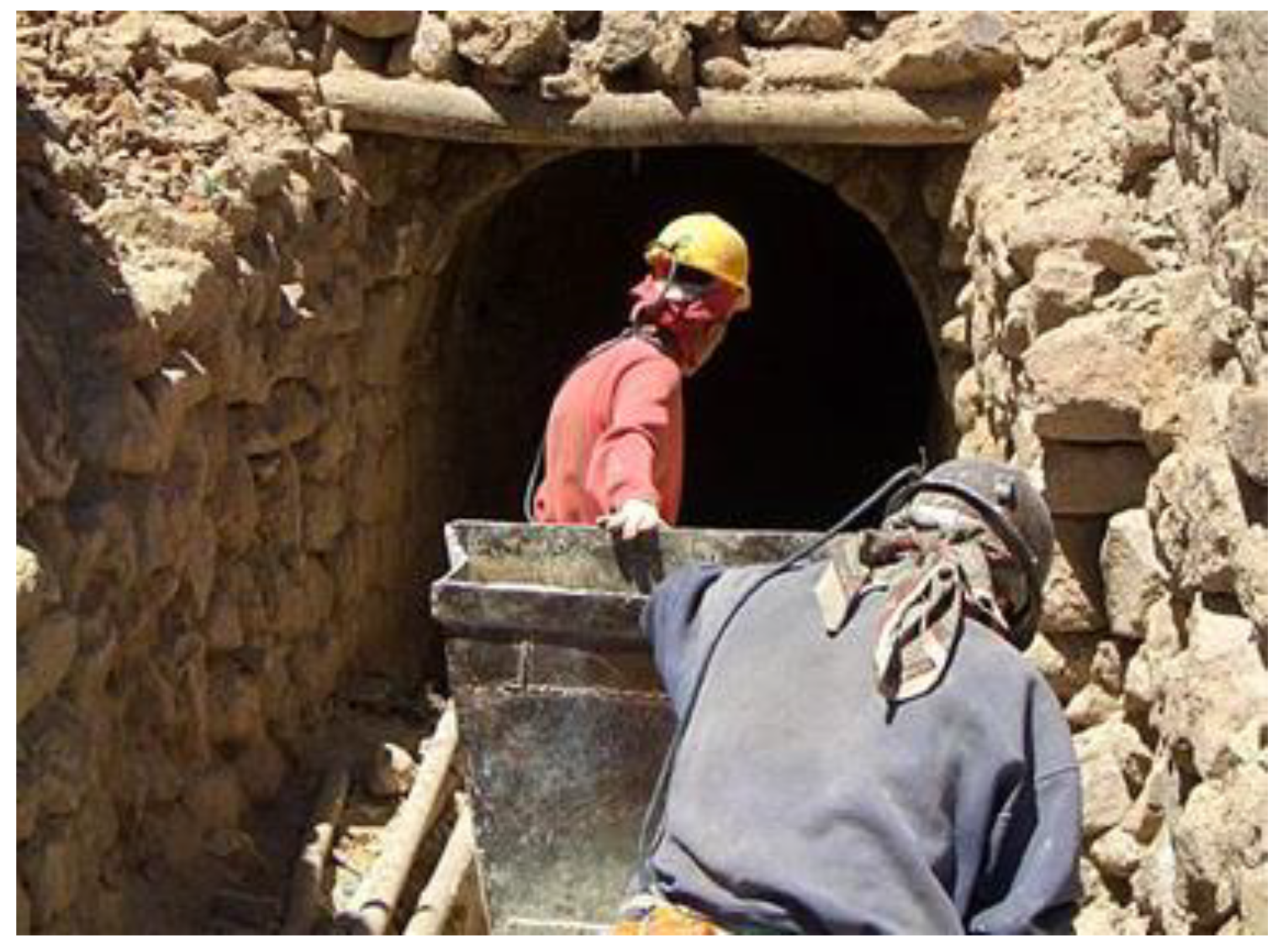
Figure 1.
Artisanal mine sinkhole. [20].
Figure 1.
Artisanal mine sinkhole. [20].
3. Casuistic Framework
[6,7,8,9,10,11,12,13,14,15,16,17,18,19,20,21,22,23,24] is notorious the effect of mining activity in the increase of exports, generation of foreign exchange, and strength in the balance of payments, presenting weakness in the generation of direct and indirect employment, as a consequence the impact at the microeconomic level is little determined, on the contrary it could generate externalities, if it does not follow the environmental monitoring plans, This is the first study that can be prioritized and achieved, having little basic information for estimates at the microeconomic level. The methodology of using the input-output matrix to analyze the technical coefficients of intermediate purchases has not been carried out for forty years (to date), so we have no knowledge of the real direct and indirect economic contribution of mining. The data of the contribution in the social, are ephemeral, due to the little data and half consistent instruments, because it is understood, as the social, the contribution of indirect investment of mining in the area of influence to calm extreme demands. In addition, it is still in force that mining operations are developed in territories with historical environmental and social liabilities, for the present with a considerable advance in the provision of public services.
Environmental impacts, as an example in the Inambari basin, are summarized in three predominant factors; according to [5,6,7,8,9,10,11,12,13,14,15,16,17,18,19,20,21,22] a) physical, in very high magnitude are: soil loss, alteration of the water table, air quality; In high magnitude are: alteration of water courses, accelerated water erosion, surface soil movement, water turbidity, tailings, sediments and mercury pollution; b) biological, in high magnitude is the movement of vegetation cover and displacement of wildlife; high the affectation of tree species and alteration of ecosystems; (c) socio-economic; In very high magnitude conflict over the use of land, and high, we have, sources of economic income, affectation of public and occupational health, prostitution-crime and migration and immigration.
Gold extraction methods that cause high impact are the process of traca, dredge, shute; those of medium magnitude are drag, caranchera, chupadera and raft of gringo; All of them contribute to deforestation, earthworks, the accumulation of gravel, water pollution by suspended material, the silting of river beds, pollution by hydrocarbons. By 2017 it exceeds 32,000 hectares of forest land converted to mining, deforestation by mining reaches until 2017 a projection of 19,000 hectares and agriculture 17,000 hectares.
[7] When we talk about informal artisanal mining, it is because of its expansion, the contribution of income to the economy in an irregular way, whose non-requirement of formalization, makes the development of economic activity, generate health problems, from risky work; it is onerous for artisanal miners to become formalized, under Legislative Decree 1040-2008, which defines artisanal mining as that which is done with non-technological means, without explosives and within a reduced and determined area; In addition, it is regulated by Law 27651, Law on the formalization and promotion of small-scale mining. Informal mining is defined as that which the state identifies as a valid business and intends to formalize to generate that this sector is favored with its development, is characterized by using equipment or machinery that does not correspond or serves for the mining activity it develops, does not meet the requirements of administrative regulations, exploits in areas where mining is prohibited; it also preys on the environment.
In addition, for the year 2000 in the area of Huaypetue, Madre de Dios, the registry of 9500 families engaged in artisanal mining, operating in adverse conditions, poor in occupational safety and health, exposed to mercury contamination, was identified. [7]
[8] In several regions and communal territories, in the northern zone, specifically in the district of Huamachuco, the peasants grouped for artisanal mining, have incomplete knowledge about the formalization process, but they are linked to this activity by the excitement of the benefits it brings to extract and directly trade the pound of gold; The other detail is the aversion to take greater risks with respect to adding administrative workload and other major commitments, the growth of mining activity is par excellence linked to the family group by kinship or consanguinity.
On the other hand, informal mining activities, such as Cerro El Toro, there is soil violation, whose clearing of recycled material is spread in free areas near the sinkhole, whose chemical substances destroy the ecosystem; Common roads and trails are deteriorated, being prone to cause accidents. The bottleneck to continue and comply with the procedure is the environmental impact study or the environmental management instrument. [8]
[9] serves as a reference and example, for the study carried out from the competing institution, the area of intervention was the district of Santa Rosa de Quives, province of Canta, Lima region, Yangas locality. The population dedicated to artisanal mining were approximately 2000 inhabitants, the mineralized area is gold vein with high values, vein type deposit, located in normal faults. In Quives, 63 titled mining rights were located, 25 mining rights in process, and by that date there were 200 artisanal mining operations. Artisanal miners are organized in associations; However, formalization management is at the embryonic level. The associations are members of the National Federation of Artisanal Miners (FENAMARPE). The process is to detect outcrop deposits and continue with horizontal or vertical underground work, at a maximum depth of 80 ml, following the mineralized structure; they only characterize geometry for veins of reduced thickness and high grade; However, the lack of resources and little technical knowledge affect operations following the mineralized body with basic tools and intense labor.
[10,11,12,13,14,15,16,17,18,19,20,21] From the middle of the last decade of the 90s of the twentieth century, until the beginning of the first decade of the twenty-first century, artisanal mining and small-scale mining activity was a means of subsistence and growth opportunity for its operators, added to closing the gap of social inclusion and fight against poverty. However, the demand for international gold and the pressure on international prices (troy ounce) transformed the market of gold traders and stockpilers, where many became illegal, to exploit on a larger scale, often with minimal conditions and extreme risks, becoming a problem for the administration of the State and welfare for society. Illegal artisanal mining is characterized by exploiting gold in places prohibited by the state such as national parks, national reserve areas, historical monuments, protected natural areas, areas of national interest for isolated populations, etc.
For the year 2019, taking as an example the region of Piura, 823 artisanal informal miners subject to Legislative Decree 1336-2017, covered by the law of delegation of Powers No. 30506, were in the process of formalization. The results are resistant, to the process of formalization by informal artisanal miners, the only thing that is done is to extend the deadline already expired of all processes, since the enactment of the original law No. 27651-2002. The investigation concludes that the formalization process is not respecting the deadlines, they are extended again. [10]
From [11] he indicated that: the process of formalization of small-scale and artisanal mining activities is a means of facing, stopping the strong advance of illegal mining, for the reason that this activity does not care about the well-being of health and safety of the mining worker, deteriorates and often destroys the ecosystem; It violates the security and conservation of cultural heritage, evades taxes and even does not register commercial operations, and is not sustainable. Among the problems faced by small-scale mining are: financing 19%, security 12%, environment 13%, technical assistance 11%, training 8%, health 6%. He differentiated the form of exploitation indicating that; Artisanal mining focuses on how to exploit abandoned or unclosed mines for subsistence, due to the invasion in the concession of a third party, in the Andean and coastal zone known as Philonian mining. In the jungle it is characterized by the mechanization of the operation by the use of dredges, known as alluvial mining. Mining in the Andean zone is characterized by the fact that they work directly in the exploitation and benefit to satisfy their basic needs, use manual methods and basic equipment, and acquire mining rights to obtain an income derived from the conclusion of different mining contracts, being not acceptable.
Researchers [12] determined that informal and illegal mining is harmful to human health, especially those in direct contact, does not contribute to sustain an adequate infrastructure for health through taxes, does not apply optimal extraction technologies. They generate as a consequence, in the low jungle; deforestation and forest degradation, illegal logging for commercial exploitation, expansion of agricultural land, and other illicit activities such as drug trafficking, trafficking in persons; They also close the argument by indicating carelessness, minimal intervention of the State to comply with the rules.
[13] It is estimated that one million families by 2022 are directly and indirectly linked to artisanal mining activity, being an instrument of fight against poverty, because those immersed seek to get out of the poor state through the improvement of family income. Given its importance, social justification, and its production valued in international markets, this activity is developed in contextual and precarious conditions, social, health, labor, environmental; whereas it presents constraints on developing value and sustaining a formal value chain, barriers to ownership, limitations on the use of surface area, knowledge deficit and aversion to formality; all these problems have been going on for more than twenty years, and the government management system and competing institution were only dedicated to extending the validity of the formalization, whose norms: Supreme Decree No. 013-2011-EM, with a five-year horizon; and mining formalization processes Legislative Decrees No. 1105 and No. 1293 years 2012 and 2017, everything is slowed down by the extensions and extensions of deadlines, therefore there is low environmental performance, low working conditions, low competitiveness, because there is no national policy that effectively addresses the unsustainability of artisanal mining activities.
[14] argued that the Peruvian state tried to establish mechanisms through rules to regulate mining activities of exploration, exploitation and benefit in artisanal mining, in its own or others’ concessions and for mining petitions in process or extinguished concessions. Legislative Decree No. 1105-2014, the publication meant a setback in the fight against illegal mining, because the illegal miner was given the opportunity to join the formalization process, subject to mining formalization, ensuring the continuity of its activities. By that date 75,000 people were registered and only 300 people were formalized, it was a chaotic result because 5% of the total registered was not reached for what was planned in the government management year 2014; only the deadline was extended and they were asked to have the RUC as the only requirement.
[15,16,17,18,19] as of July 2022, there were 208 registered social conflicts, 152 active and 56 latent; with 274 collective protest actions. The territorial distribution, in Cusco 18 and in Apurimac 17. The socio-environmental typology are numerous because they reach 63.0% of the total and are maintained since April 2007 and those directly linked to mining are 66.4%.
[16,17,18,19] the last conflict sounded, is the one located in the Las Bambas mining company, Apurimac region; With more than 50 days of blockade of the access roads to the mine, which is now heading towards a dialogue, it is not the only one, there are to date 183 social conflicts that threaten Peru, of which 73 are miners. Of these, 59 are active and the rest latent. The consequences are extreme, such as the case of Cajamarca with Conga, today we can understand that poverty reaches 41.9% who live there.
[17] the Peruvian government closes 2022 with a social and political crisis, with a habit of social conflict, Cusco is the region with the greatest conflict in the mining sector, maintaining 12 unresolved disputes, whose demands are limited to the breach of agreements, the delay in executing agreements between mining companies and communities. This problem dates back 18 years, despite progress, there is no full model to reduce social conflict. The neuralgic points of the confrontations are the demand for greater economic compensation for land and the use of servitude by mining companies. Although, the mining sector contributes to productivity, competitiveness of the sector and direct and indirect jobs; Poverty and health indicators among the local population remain low. Social conflicts are exacerbated by lack of political momentum, that is, to take responsibility for the fulfillment of the agreements and that they enter the operational plans, have a budget and deadlines for compliance within the function of each ministry.
[18] the Peruvian mining sector accumulated losses of $ 760 million in 2022, centered and caused by multiple social conflicts, whose gross added value of the mining sector went from a potential growth of 2.9% to a fall of 0.3% in 2022. Peru closed with a production of 2.2 million MT of copper; 3.3 million ounces of gold and 1.2 MT of zinc. By 2023, copper falls above 250 thousand MT are expected. The copper mining commodity, despite the fall, maintains a positive outlook for 2023. Gold and zinc production by 2023 will fall to 3.2 million ounces and 1.1 million MT. Mining investment will contract by 21% by 2023 with the figure approaching $4 billion. The investment portfolio for the year 2023 amounts to $ 547 million dollars, which includes 47 projects, of which 11 have operations restricted by social conflict.
4. Results
Artisanal and informal mining is strengthened in the Peruvian Andean zone by incidence and strength:
4.1. Social License and Agreements by Communal Assembly
The communal peasant territories, occupy between 75% to 85% throughout the Peruvian Andean zone, the property is communal, the form of organization is communal, the final decisions are determined by the assembly, after presentation of the agenda in communal assembly. From the evidence presented in the casuistic framework, we can indicate that; Communal peasant organizations, in whose territories there are mineral deposits with potential for exploration and exploitation, negotiations are initiated under the current legal framework for small-scale and artisanal mining, the Law on Peasant Communities and the Communal Statute; where the process that allows to give initial sustainability is the following:
a) General Assembly is convened and the agenda is taken the decision to approve the social license and use of easement for the beginning of exploration and exploitation of the mining deposit with a technical report on the quality and quantity of metal contained by the Ministry of Energy and Mines, added to the verification of the ownership and validity of the mining complaint.
b) It continues with the approval of the communal assembly on the beginning of the formalization of an association of local mining extractors and marketers of the peasant community.
c) The process continues with the approval to deliver profit share to the holder of the mining complaint who holds the property title and take him as a temporary commoner.
d) The process continues with the approval and agreement of the directors of the association, with the community members, which stipulates that the unskilled labor for the exploitation of the mine must be assigned to the active qualified community members of the community and that at the end of the minimum year 10% of profits must be delivered to the community to be used according to the needs of the community. peasant community.
e) The process is closed with the approval of the demarcation that includes the mining area, the buffer zone and the waste collector to be treated later.
4.2. Flexibility in Compliance with Formalization, Preventive and Environmental Protection Laws
From 2008 onwards, the legal norms regarding the flexibilization of the formalization registry, triggered that a considerable number of associations of illegal miners, passed to the artisanal group, giving a greater time for the regularization of the formality. Law 27651 is the original one that regulates the formalization and promotion of small-scale mining, which was modified with Legislative Decree 1040-2008, which changes the concept, specifying that artisanal mining is that which is done with non-technological means, without explosives, within a small and determined area; It also defined for the first time informal mining, as that which the State identifies as a valid business and is intended to formalize to generate favor for its development, is characterized by using equipment or machinery that does not correspond or serves for the mining activity it develops, does not meet the requirements of administrative regulations, exploits in areas where mining is prohibited; also, it preys on the environment, it is here that many illegal miners were favored, because after this norm, Legislative Decree 1105-2012 was approved, and 1293-2017, they meant one more setback before the fight against illegal mining, subject to the security of the continuity of their activities, for this date 75,000 people were registered and only 300 people were formalized, It was a chaotic result, the characteristic thing was that they allowed mining activities of exploration, exploitation and benefit in artisanal mining in own or others’ concessions and for mining petitions in process or extinguished concessions.
4.3. The 50% Increase in Socio-Environmental Conflict due to Mining Activity
The increase in socio-environmental conflict is limited to: It is estimated that one million families by 2022 are directly and indirectly linked to artisanal mining activity, being an instrument of fight against poverty, because those immersed seek to leave the poor state through the improvement of family income. Given its importance, social justification, and its production valued in international markets, this activity is developed in conditions of context and precariousness in the social, health, labor, environmental; whereas it presents constraints on developing value and sustaining a formal value chain, barriers to ownership, limitations on the use of surface area, knowledge deficit and aversion to formality; All these problems have been happening for more than twenty years and the government management system and competing institution, were only dedicated to extending the validity of the formalization.
As of July 2022, there were 208 registered social conflicts, 152 active and 56 latent; with 274 collective protest actions. The territorial distribution, in Cusco 18 and in Apurimac 17. The socio-environmental typology are numerous because they reach 63.0% of the total and are maintained since April 2007 and those directly linked to mining are 66.4%. The last conflict notorious is the one located in the Las Bambas mining company, Apurimac region; With more than 50 days of blocking the access roads to the mine, which is now heading towards a dialogue, it is not the only one, there are other frequent ones in the Cusco region.
4.4. The Progressive Increase in 25% of the Production Costs of Agricultural and Livestock Activity
An example, for the year 2000 in the area of Huaypetue, Madre de Dios, the registry of 9500 families engaged in artisanal mining, operating in adverse conditions, poor in occupational safety and health, exposed to mercury contamination was identified; This happens, because the comuneros or peasant settlers, directs the vision of improving the family income, taking advantage of the conditions of the territory in which they live, mining production, gold product, silver, present considerable prices, whose falls are not extreme; It is followed by iron and copper for their average to higher demand which if they present extreme falls because they are subject to the growth behavior of strong economies.
In the case of the Andean zone, the production of various agricultural crops, is characterized by the fact that it is developed in lands whose degree of inclination ranges between 18 ° degrees to 35 °, with sudden changes of slope that conditions the yield per common area of cultivation (case 1/4 of ha), adds the extended smallholding strengthened in the progressive distribution and division of plots whose initial area ranges from 1/2 ha to 1/4 ha, the preference for the technique of irrigation by gravity that impoverishes the soil by the considerable washing of biological nutrients, the agronomic management against pests that is heterogeneous (not uniform due to the diversity of crops in a sector) and the cost of high wages for being leveled to that of civil construction worker. Then, the yield for the common surface area that is 1/4 ha, is low, where the investment and costs, exceeds the income obtained per agricultural campaign, the common commercial measure in the Andean area is the arroba (composed of 11 Kgrs), for more than 6 years there has been a progressive fall in final prices of agricultural products, which was exacerbated by the increase in the costs of agricultural inputs since February 2022. The average for the last six years is close to 25% in the increase in production costs.
The direct consequences on environmental sustainability are:
4.5. The Delimited Reconversion of the Change of Agricultural Land Use in one Third of the Communal Territories in Basin Headwaters
Recognized that the communal territories, present cadastral registration, a legal organization; However, in the altitudinal zone of Puna, the economic and ecological demarcation carried out by the community, to approve access to the permit and social license, is what allows the agricultural land of dry condition, to be modified; up to a maximum area of land allowed by the communal assembly. In general, the maximum area of the total demarcated in a basin headwaters does not exceed one third, and this demarcated area should not be close to an area where water resources flow. The spatial distribution of the internal and external mining vein is suitable for the specific functions of the mining operation.
4.6. Displacement of Environmentally Friendly Economic Activity by 20% in Basin Headwaters
From the ecological economic demarcation, the permit and social license of the peasant community for mining exploitation, in any case, the conversion of agricultural land use to mining land is modified and developed, in general, of the total area assigned to mining exploitation, agricultural activity, the head of the basin, 40% is affected, from that area a minimum of 20% moves the friendly economic activity that is agriculture.
4.7. The Impossibility of Modification or Intervention in Water Surfaces, Wetlands by Communal Agreements
The sustainability of artisanal and informal mining is based on respecting the agreements made by the communal assembly, these being: a) the pact to create an association of artisanal extractors and marketers with members of the community, which is supplied with unskilled labor from community members, b) respect the final agreement to deliver a 10% profit to the community and c) establish according to the assembly agreement, Based on ecological economic zoning, in which the cession of use is assigned through the social license in a given area.
5. Discussion
In the reflections and different points of view of this research work we can contribute to having a different look at the factors that involve the sustainability of artisanal and informal mining in the Peruvian Andean zone that coincides with the research of [1,2,3] the amount of environmental conflicts reported, are sustained in the productive specialization for more than 25 years towards the primary sector, the impulse of neo-extractivism and the structural changes of the economies, the amount of environmental conflicts predominate and are associated with mining activity in 37%, being Peru that represents 63% of the total, whose main product that is in the middle of the disputes correspond to metallic minerals, in gold 20.7%, copper 8.0% and silver 5.2%, Therefore, we must specify that according to the methodology applied, it is evident that the previous processes required by the community and the government are not met, given that the economic interests of investors and extractive mining companies prevail and leave in the background the demands of the population surrounding the deposit.
One of the main factors involving the sustainability of artisanal and informal mining in the Peruvian Andean zone are the social conflicts that grow due to the lack of understanding between the parties involved (company—community) added by the environmental impacts generated by the activity, and by the little interest in the generation of shared value and distribution of benefits involved in the activity that corroborates the research contributions formulated by [4,5] the mining activity developed in certified operation, is located in the regions of Arequipa, Cusco, Puno and Tacna; in which the antiquity of exploration attracts expansion towards the less mature, and a strong exploration in Apurimac and Moquegua.
Likewise, the relationship between the executed fee and the development of socio-environmental conflicts is latent, due to contamination and disposal of solid and liquid waste. The data of the investigation showed that for the year 2015, they received in the range from 10 million soles (ex exploration) to 500 million those with old exploitation.
The social conflicts that affect the sustainability of artisanal and informal mining in the Peruvian Andean zone, were settled mainly by environmental deterioration with the alteration of the natural structure, subject to drilling, use of explosives and tailings, even more so by mercury waste that affects water in the headwaters of basin that affect communities in lowland areas with water consumption (animals and humans) with waste that affect health, in that sense there is coincidence with the research work carried out by researchers [12,13,14,15] determined that informal and illegal mining can be harmful to human health, especially those who are in direct contact, when they move away from meeting minimum safety requirements in mining operations, Therefore, it does not contribute to sustain an adequate infrastructure for health through taxes, it does not apply optimal extraction technologies.
It should be noted that it is very important to contribute to sustainability and harmony in mining activities in Peruvian Andean areas, complying with the granting of the social license that is the result of the agreements of communal assemblies taking into account the content of the act, which contains the geographical and ecological delimitation with the mining activity, as well as the shared benefits and involvement of the community to improve living conditions.
6. Conclusions
We can conclude that in the Peruvian Andean zone the sustainability of artisanal and informal mining has been positioned by economic interests of investors and mining companies that encourage exploitation, demanding the social license, which is obtained after consultation with the community, not complying with the agreements, leads to social conflicts that have an impact on poverty, lack of opportunities, improvement of quality of life; And the Peruvian State, through the Ministry of Energy and Mines, lacks human resources to enforce the rules and laws that require the formalization and conditions of artisanal mining activity in the Peruvian Andean zone where the largest number of mining deposits is concentrated.
The mining companies and the communities surrounding the mining area tend to the same goal of reaching democratic consensus that results in the social license, the use of easements, the direct and indirect participation of the community in the mining activity, the mitigation of environmental impacts, as well as the distribution of profits or profits generated by the mining activity.
The lack of opportunities for growth and development of the population, added to their traditional production activities forced by their needs, strengthen and decide to start informal mining activity, taking into account the high international price of metals, exploitation without taking into account technology, personal safety, as well as environmental deterioration and pollution, It has widespread consequences.
The sustainability of informal artisanal mining in the Peruvian Andean zone is limited to strengthening the capacities of communities and miners, respecting agreements for harmonious coexistence among all organized actors, as well as reducing environmental deterioration that brings negative consequences, and that does not contribute to human development, such as improving economic income and quality of life for families.
Author Contributions
The following statements should be used; a) Conceptualization, Felipe Rafael Valle Díaz and Rosmel Iván Rodriguez Peceros; b) methodology, Oscar Apaza Apaza; c) validation, Rosmel Iván Rodriguez Peceros and Alfredo Huamán Cuya.; d) formal analysis, Oscar Apaza Apaza and Hermenegildo Chaccara Huachaca; e) investigation, Felipe Rafael Valle Díaz and Juan Felipe Valle Sherón; f) resources, Rosmel Iván Rodriguez Peceros and Alfredo Huamán Cuya; g) data curation, Juan Felipe Valle Sherón; h) writing—original draft preparation, Carlos Vidal Davila Ignacio and Alfredo Huamán Cuya; i) writing—review and editing, Carlos Vidal Davila and Jesús Virgilio Luque Rivera Ignacio. j) visualization, Jesús Virgilio Luque Rivera.; k) supervision, Rosmel Iván Rodriguez Peceros; l) project administration, Felipe Rafael Valle Díaz; ll) funding acquisition, Hermenegildo Chaccara Huachaca. All authors have read and agreed to the published version of the manuscript.”
Funding
This research received no external funding and The APC was funded by author and co-authors.
Institutional Review Board Statement
The study was conducted in accordance with the Declaration of Helsinki, and approved by the Institutional Review Board of the Scientific Committee of the IX IBEROAMERICANA CONVENTION ON ENVIRONMENT AND SUSTAINABILITY, June 2023.
Informed Consent Statement
Informed consent was obtained from all subjects involved in the study.
Conflicts of Interest
The authors declare no conflict of interest.
References
- Pérez, M., Peña, M., Rojas, J., Vargas, J., Altamira, S., Crespo, Z., y Zúñiga, J. (2019) Metabolismo social y conflictos ambientales en países andinos y sudamericanos. Informe de investigación. https://bibliotecadigital.univalle.edu.co/bitstream/handle/10893/14421/2826%20Mario%20P%c3%a9rez.pdf?sequence=1&isAllowed=y.
- Palacios, J., Calvo, G., Valero, A., y Valero, A. (2017) La explotación minera en la región Andina: un enfoque termodinámico. En congreso El extractivismo en América Latina: dimensiones económicas, sociales, políticas y culturales (76-87). https://idus.us.es/handle/11441/74363.
- Vélez, I., Ruíz, G. (2015) Extractivismo neoliberal minero y conflictos socio-ambientales en Perú y Colombia Revista Ambiente y sostenbilidad https://doi.org/10.25100/ays.v5i1.4297. [CrossRef]
- https://revistaambiente.univalle.edu.co/index.php/ays/article/view/4297.
- Aguilar, K, López, C. (2021) El impacto de los precios internacionales de Commodities en el conflicto minero del sur del Perú, periodo 2007-2014. Repositorio Universidad Andina del Cusco. https://repositorio.uandina.edu.pe/handle/20.500.12557/4015.
- León, J. (2019) Determinantes económicos y sociopolíticos de los conflictos socioambientales en el Perú. Revista de investigaciones altoandinas - Scielo 21 (2) http://dx.doi.org/10.18271/ria.2019.456. [CrossRef]
- Kuramoto, J., Glave, M. (2007) La minería peruana: lo que sabemos y lo que aún nos falta saber. GRADE. http://biblioteca.clacso.edu.ar/Peru/grade/20100513021350/InvPolitDesarr-4.pdf.
- Gallo, G. (2016) El divorcio entre la minería peruana informal artesanal y la normativa en seguridad y salud en el trabajo. Segunda especialidad en Derecho del Trabajo y de la seguridad social. https://tesis.pucp.edu.pe/repositorio/handle/20.500.12404/8394.
- Alayo, M. (2020) La necesidad de mejorar el proceso de formalización de la pequeña minería y minería artesanal en el distrito de Huamachuco. https://repositorio.ucv.edu.pe/handle/20.500.12692/60536.
- Loaiza, E., Galloso, A. (2010) Actividad minera artesanal en la cuenca del río Chillón (Yangas-Canta) región Lima. Instituto geológico, minero y metalúrgico, serie E: Minería. https://repositorio.ingemmet.gob.pe/handle/20.500.12544/358.
- Nizama, V. (2019) Ausencia de intervención del estado en la minería artesanal informal aurífera: caso región Piura. Repositorio Universidad del Pacífico. https://repositorio.up.edu.pe/handle/11354/2337.
- Galiano, E. (2016) No es que el camino sea difícil, es que lo difícil es el camino: el proceso de formalización de las actividades de pequeña minería y minería artesanal en Lima Metropolitana a partir del Decreto Legislativo 1105. Escuela de pos grado Universidad católica del Perú. https://www.proquest.com/openview/d3993a72c32c84bfb1d0502554ac32b7/1?pq-origsite=gscholar&cbl=2026366&diss=y.
- Munsibay-Muñoa, M. A., Cavero-Egúsquiza, L. L. (2022) Análisis de la minería informal en la economía peruana periodo 2018 al 2022. INNOVA Research Journal. 7 (3), 119-136, https://dialnet.unirioja.es/servlet/articulo?codigo=8736843.
- Ministerio de Energía y Minas (2022) Política Nacional multisectorial para la pequeña minería y minería artesanal. https://infopoliticaminera.minem.gob.pe/img/Politica%20Nacional%20PMMA%20al%202030vf.pdf.
- Chávez, J. (2019) La evolución de las disposiciones gubernamentales para el proceso de formalización minera en las actividades de pequeña minería y minería artesanal en el Perú, entre los años 2012 al 2018. https://www.proquest.com/openview/ed7710314c5ee8d65842eea92a3a5176/1?pq-origsite=gscholar&cbl=51922&diss=y.
- Defensoría del Pueblo (julio, 2022) Reporte de conflictos sociales. https://www.defensoria.gob.pe/la-defensoria-del-pueblo-registro-208-conflictos-sociales-y-274-acciones-de-protesta-durante-el-mes-de-julio-2022/#:~:text=Respecto%20de%20los%20conflictos%20vinculados,socioambientales%2C%20es%20de%2066.4%20%25.&text=Del%20total%20de%20casos%20activos,participa%20en%2081%20de%20ellos.
- Instituto Peruano de Economía (abril 2019) Conflictos mineros en el Perú. https://www.ipe.org.pe/portal/en-el-peru-existen-73-conflictos-mineros-segun-la-defensoria/.
- Sputnik mundo (diciembre, 2022) ¿Porque el Perú cierra el 2022 con más de 70 cnflictos sociales vinculados a la minería? https://sputniknews.lat/20221231/por-que-peru-cierra-el-2022-con-mas-de-70-conflictos-sociales-vinculados-a-la-mineria-1134212137.html#:~:text=La%20conflictividad%20es%20moneda%20corriente,registran%2012%20disputas%20sin%20resolver.
- Bnamericas (febrero, 2023) Minería peruana acumula pérdidas en medio de conflictos sociales. https://www.bnamericas.com/es/noticias/mineria-peruana-acumula-perdidas-en-medio-de-conflictos-sociales.
- Observatorio nacional de política criminal (2021). La minería ilegal en la amazonia peruana. USAID, Ministerios de Justicia de Derechos Humanos. ISBN 978-612-4225-43-7, https://preveniramazonia.pe/wp-content/uploads/Documento-La-mineri%CC%81a-ilegal-en-la-Amazoni%CC%81a-peruana-versio%CC%81n-pdf.pdf.pdf.
- Rumbo minero (17 octubre 2016) Chile: apoyamos a la pequeña minería porque impulsa gran movilidad económica y social. Fotografía.https://www.rumbominero.com/peru/noticias/mineria/chile-apoyamos-a-la-pequena-mineria-porque-impulsa-gran-movilidad-economica-y-social-afirma-ministra-williams/.
- Environmental Law Institute (2022) Corrupción en la minería artesanal y de pequeña escala en la amazonia peruana. USAID en el marco del Proyecto PREVENIR. https://preveniramazonia.pe/wp-content/uploads/Informe-Corrupcion-en-MAPE_final.pdf.
- Ramírez, W. (2017) Impacto ambiental de la pequeña minería y minería artesanal en la sub cuenca del río Inambari Madre de Dios. https://repositorio.uncp.edu.pe/handle/20.500.12894/4583.
- Palacios, J., Calvo, G., Valero, A., y Valero, A. (2017) La explotación minera en la región Andina: un enfoque termodinámico. En congreso El extractivismo en América Latina: dimensiones económicas, sociales, políticas y culturales (76-87). https://idus.us.es/handle/11441/74363.
Disclaimer/Publisher’s Note: The statements, opinions and data contained in all publications are solely those of the individual author(s) and contributor(s) and not of MDPI and/or the editor(s). MDPI and/or the editor(s) disclaim responsibility for any injury to people or property resulting from any ideas, methods, instructions or products referred to in the content. |
© 2023 by the authors. Licensee MDPI, Basel, Switzerland. This article is an open access article distributed under the terms and conditions of the Creative Commons Attribution (CC BY) license (http://creativecommons.org/licenses/by/4.0/).
Copyright: This open access article is published under a Creative Commons CC BY 4.0 license, which permit the free download, distribution, and reuse, provided that the author and preprint are cited in any reuse.


