

Submitted:
03 July 2023
Posted:
04 July 2023
You are already at the latest version
Abstract
Begomoviruses, which belong to the Geminiviridae family, are intracellular parasites transmitted by whiteflies to dicotyledonous plants, significantly damaging agronomically relevant crops. These nucleus-replicating DNA viruses need to move intracellularly from the nucleus to the cytoplasm and then, like other plant viruses, spread systemically throughout the plant to cause dis-ease. The transport proteins of begomoviruses play a crucial role in recruiting host components for the movement of viral DNA within and between cells while exhibiting functions that suppress the host's immune defense. Pioneering studies on species of the Begomovirus genus have identified specific viral transport proteins involved in intracellular transport, cell-to-cell movement, and systemic spread. Recent research has primarily focused on viral movement proteins and their interaction with the cellular host transport machinery, significantly expanding our understanding of viral infection pathways. This review focuses on three main aspects: (i) the role of viral transport proteins, specifically movement proteins (MPs) and nuclear shuttle proteins (NSPs), (ii) their ability to recruit host factors for intra- and intercellular viral movement, and (iii) suppress antiviral immunity, with a particular emphasis on bipartite begomoviral movement proteins.
Keywords:
Begomoviruses
; movement protein
; nuclear shuttle protein
; suppression of antiviral signaling
; virus-host interactions
; intracellular virus movement
1. Introduction
Begomoviruses belong to the Geminiviridae family and exhibit monopartite or bipartite circular single-stranded DNA genomes [1]. Monopartite begomoviruses possess a single genomic component known as DNA-A, approximately 2.7 kb in size, while bipartite begomoviruses consist of two components, DNA-A and DNA-B, each around 2.6 kb [1]. The successful establishment of a productive infection requires nuclear replication, cell-to-cell movement, and systemic transport throughout the plant via the phloem, posing challenges due to the nuclear envelope and the cell wall [2]. The virion-sense strand of DNA-A (and monopartite genomes) encodes the coat protein (CP or AV1/V1), which may also be involved in intracellular transport of viral (v)DNA and insect transmission, and the movement protein (MP or AV2/V2), not present in all bipartite begomoviruses ([1,3]. In monopartite begomoviruses, CP or V1 and MP or V2 play essential roles in inter and intracellular movement of viral DNA (vDNA). The DNA-A complementary-sense strand encodes the replication-associated protein (Rep or AC1/C1), the transcriptional activator protein (TrAP or AC2/C2), the replication enhancer protein (Ren or AC3/C3), and the multifunctional AC4/C4 protein [1,3]. A fifth small open reading frame (ORF), designated AC5/C5 downstream of AC3/C3 in the DNA-A of some monopartite and bipartite begomoviruses, has been functionally characterized as a suppressor of RNA silencing defenses and facilitator of viral movement ([4,5]. In bipartite begomoviruses, the DNA-B component encodes a nuclear shuttle protein (NSP) responsible for nucleocytoplasmic transport of vDNA and MP involved in cell-to-cell and systemic spread of vDNA [1,2]. The intra and intercellular transport functions of begomoviral shuttling and movement proteins make them valuable targets for identifying host factors in fundamental cellular processes exploited by begomoviruses. These viral proteins interact with host factors in various organelles and are, therefore, potential hubs in the host-virus protein-protein interaction network [6].
Understanding interaction networks is crucial for a comprehensive view of the metabolic and physiological responses of organisms to growth, cell differentiation, abiotic stress, and defense against pathogen attacks. Genome-wide studies focusing on plant immunity and pathogen infection strategies have provided an integrated picture of interactions between pathogens and plants [7]. This interaction network reveals that pathogen effectors and plant defense proteins converge, forming highly interconnected subsets of host proteins known as immune hubs [6,7] Remarkedly, these immune hubs exhibit conservation among effectors from evolutionarily distinct pathogens, including the gram-negative bacterium Pseudomonas syringae (Psy) and the obligate biotrophic oomycete Hyaloperonospora arabidopsidis (Hpa) [7]. The conservation of some immune hubs extends to include interactions with viral proteins. For instance, the CSN5A immune hub, which interacts with several host defense proteins and different effectors from divergent pathogens, also interacts with L2/C2 from begomoviruses [7,8]. A protein-protein interaction (PPI) network, derived from host protein interactions with the bipartite begomoviral transport proteins, the movement protein (MP) and nuclear shuttle protein (NSP), have been recently described [6]. The MP-NSP-host PPI network identified several hubs enriched by host transport functions and defense proteins, indicating that MP and NSP recruit host transport functions to move the vDNA intra- and intercellularly and display immune-suppressing functions that favor infection. This review describes current knowledge about the role of viral movement proteins, the potential target host factors involved in the viral movement, and the mechanism of suppressing antiviral immunity by begomoviral movement proteins.
4. The Immunomodulatory Properties of NSP
In addition to its canonical transport function, NSP interacts with host defense proteins in various compartments to evade the plant immune system. As a suppressor of host defenses, NSP triggers the upregulation of Asymmetric Leaves 2 (AS2) expression and interacts with AS2 within the nucleus [47]. Additionally, NSP facilitates the trafficking of AS2 from the nucleus to the cytoplasm. Once in the cytoplasm, AS2 is redirected to the processing bodies (PBs), which activates the Decapping 2 (DCP2) enzyme and accelerates the turnover rate of mRNA. This interplay leads to a decrease in small interfering RNAs (siRNAs) and hampers the process of posttranscriptional gene silencing (PTGS), ultimately favoring the accumulation of viral mRNA. Consistent with these findings, AS2 overexpression enhances the virulence of begomoviruses, whereas inactivation of the AS2 gene reduces the susceptibility of the host [47]. Therefore, NSP negatively controls RNA silencing by increasing the expression and activity of AS2, an inmate suppressor of PTGS, thereby favoring virus infection.
Furthermore, CabLCV NSP directly interacts within the nucleus with Jasmonate Insensitive 1 (JIN1 or MYC2) to inhibit its transcriptional activity [48]. JIN1/MYC2 is a conserved interaction partner shared by βC1 of tomato yellow leaf curl China virus and CabLCV NSP proteins [48]. JIN1/MYC2 is a transactivation factor that upregulates genes involved in terpene syntheses, such as Terpene Synthase 10 (TPS10) and Terpene Synthase 4 (TPS04). Accordingly, CabLCV infections result in reduced terpene synthesis, which, in turn, enhances the performance of Bemisia tabaci, the vector of CabLCV. Terpenes possess insecticidal, repellent, and attractive properties for natural enemies, thus serving as an effective defense strategy against B. tabaci [48,49]. Further investigations are necessary to fully understand the role of NSP in vector-plant interactions and the complex synergistic relationship between the vector and the virus.
Ras-GAP SH3 domain-binding protein (G3BP) plays a critical role in the formation of stress granules (SGs) in mammals when subjected to various stress conditions, including oxidative stress, heat shock, and viral infections [50,51]. The assembly of SGs, facilitated by G3BP, acts as an antiviral mechanism that hampers both host and viral protein translation during viral infections. However, viruses have developed strategies to counteract this host defense mechanism by disrupting SGs. For instance, poliovirus utilizes its proteinase 3C to cleave G3BP [52], and the alphavirus SFV interacts with G3BP through the FGDF motif present in the carboxyterminal region of the nsP3 protein [51,53]. The discovery of the FGDF motif in viral and host proteins has prompted investigations into similar motifs in plant virus-encoded proteins and their hosts [53,54,55]. In the case of begomoviruses, a conserved (F/Y)VS(F/Y) motif has been identified in the carboxyterminal region of the NSP protein. Based on this finding, NSPs from AbMV and pea necrotic yellow dwarf virus (PNYDV) may interact with the G3BP-like protein (AT5G48650) in plants. Accordingly, AbMV NSP, which contains a sequence similar to the human G3BP homolog-related FVSF motif, has been shown to interact with the G3BP-like protein [55]. Furthermore, a loss-of-function mutant (AASF) of AbMV NSP failed to induce SG assembly [55]. Despite the established interaction between begomoviral NSP and the G3BP-like protein, its biological significance and implications remain unclear.
At the plasma membrane, NSP has been shown to interact with two different classes of receptor-like kinases involved in antiviral plant immunity. These classes include the leucine-rich-repeat receptor-like kinases (LRR-RLKs), such as NSP-Interacting Kinase 1 (NIK1), NIK2, Flagellin Sensitive 2 (FLS2), and Brassinosteroid Insensitive 1 (BRI1)-Associated Kinase 1 (BAK1) [56]. The second class comprises PERK-like kinases, with NSP-Associated Kinase (NsAK) as a representative example [57].
NSP proteins from various begomoviruses interact with NIKs from distinct plant species, including Solanum lycopersicum, Glycine max, and Arabidopsis thaliana [58,59]. Both CabLCV and TGMV NSP proteins interact with the activation loop of AtNIK1, preventing the phosphorylation of the activation site (Thr-474) and impairing its kinase activity. The binding site of NSP on NIK1 has been precisely mapped to an 80 amino acid stretch that overlaps with the activation loop and includes the crucial Thr474 residue [58]. Replacing the critical Thr-474 residue with aspartate generates a constitutively activated NIK1 mutant, which is no longer inhibited by NSP [60]. Hence, the NSP inhibition of NIK1 kinase occurs upstream of Thr-474. The conservation of NSP-NIK interactions among different begomoviruses and NIKs from diverse plant species implies a mechanism wherein NSP negatively modulates host antiviral kinase receptors in an evolutionarily conserved manner.
In contrast to the inhibitory effect of NSP on NIK1-mediated antiviral immunity, begomoviruses-derived nucleic acids function as viral pathogen-associated molecular patterns (vPAMPs) and trigger the activation of the antiviral pathway [61,62]. NIK1 is activated by phosphorylation at the critical Thr-474 residue, subsequently leading to the phosphorylation of the cytosolic ribosomal protein L10 at the Ser-104 residue (RPL10a) [15,63]. Once phosphorylated, RPL10a is redirected to the nucleus, where it interacts with the transcription factor LIMYB (L10-Interacting MYB domain-containing protein) [64]. LIMYB is a critical repressor of genes associated with translational machinery and photosynthesis [62,64]. The prolonged activation of NIK1 leads to the suppression of global translation, which hinders the association of viral mRNA with polysomes, thereby impairing the efficient translation of viral mRNA, ultimately compromising infection [64]. NSP suppresses this host defense strategy by binding to the activation loop of the NIK1 kinase [58]. Ectopic expression of the T474D phosphomimic mutant, which bypasses NSP inhibition, enhances RPL10 translocation to the nucleus and confers resistance to begomovirus infection in transgenic tomato lines [15,65]. Additional evidence suggests that NIK2, the closest homolog of NIK1, acts redundantly and is activated by begomovirus-derived nucleic acids, thereby initiating the assemble of the antiviral defense response, which is also negatively modulated by NSP [61,62].
Tomato yellow spot virus (ToYSV) NSP has been found to interact with Solanum lycupersicum (Sl)BAK1 (Solyc10g047140) through yeast two-hybrid assays [66]. Additionally, it interacts with the PERK-like kinase NsAK [57]. The formation of the NSP-NsAK complex enhances viral infection, suggesting a positive modulation role. In contrast, the interaction between NSP and BAK1 is likely associated with a host defense-suppressing function. BAK1 serves as a co-receptor for various pattern recognition receptors (PRRs), including Flagellin Sensing 2 (FLS2) and Elongation Factor-Thermo Unstable Receptor (EFR), which detect specific PAMPs and trigger PAMP-triggered immunity (PTI), the initial layer of the plant's innate immune system [67,68].
Multiple lines of evidence suggest that NSP may suppress BAK1's role in immunity. Firstly, NIK1 and BAK1 belong to the same subfamily II of LRR-RLKs and share conserved positions for kinase activation sites [69]. Secondly, the binding site of NSP on NIK1 and the corresponding sequence on BAK1 are highly conserved [70]. Finally, NIK1-mediated antiviral signaling has been shown to interact with BAK1-mediated PTI through direct interaction of NIK1 with the co-receptor BAK1 and the PRR FLS2 [71]. The viral NSP suppressor of NIK1 may interfere with the formation of the NIK1-BAK1-FLS2 complex. Therefore, it is reasonable to hypothesize that the binding of NSP to BAK1 may also suppress PTI, although conclusive data supporting this interpretation are currently lacking.
6. The movement protein suppressive functions of host defenses
RNA silencing is a broad defense mechanism that plants employ against viral infections. To counteract this defense, the begomovirus genome encodes viral suppressors of RNA silencing (VSRs) [85,86]. Regarding begomoviral proteins associated with virus movement, V2 and C4 inhibit both transcriptional gene silencing (TGS) and posttranscriptional gene silencing (PTGS) [85,86,87]. V2 from cotton leaf curl Multan virus (CLCuMuV) effectively counteracts TGS by directly interacting with argonaute 4 (AGO4) and suppressing RNA-dependent DNA methylation (RdDM)-mediated TGS [88]. Similarly, TYLCV V2 interacts with host histone deacetylase 6, hindering the recruitment of methyltransferase 1 (MET1) and resulting in hypomethylation of the viral genome [89]. TYLVCV V2 is a potent suppressor of PTGS, interacting with and SGS3 (suppressor of gene silencing 3), the cofactor of RDR6, and inhibiting secondary siRNA production [90].
The C4 protein inhibits SAM synthetase enzyme activity and interacts with AGO4 to reduce viral genome methylation [91,92,93]. Additionally, specific C4 proteins interfere with the spread of the RNA silencing signal between cells and/or systemically [94,95]. TYLCV C4 interacts with plasma membrane-localized receptor-like kinases, Barley Any Meristem (BAM) 1 and 2 proteins, preventing the intercellular spread of siRNAs [96]. C4 also suppresses kinases-mediated host defenses, including mitogen-activated protein kinases (MAPKs), which play crucial roles in general host defense against pathogens. Recent findings reveal that TLCYnV C4 inhibits MAPK-mediated defense responses by preventing the dissociation of the ERECTA/BKI1 complex [97]. In addition to BAM1 and 2, TYLCV C4 protein interacts with several other plant RLKs, such as clavata 1 (CLV1), FLS2, and BRI1 [98,99]. By interacting with CLV1, C4 disrupts the regulation of the antiviral factor WUSCHEL expression [100]. C4/AC4 has also been shown to interact with various Shaggy-like protein kinases, which negatively regulate brassinosteroid (BR) signaling [101,102]. The interference of C4 with hormone signaling is further supported by its interactions with auxin biosynthetic enzymes, disrupting endogenous auxin content [103]. Notably, the NSP-MP-host protein-protein interaction network of bipartite begomoviruses revealed two significant hubs enriched with auxin response-related proteins and auxin signaling regulators [6]. These hubs consist of an NSP-MP general interaction-derived hub and an NSP-specific host interaction-derived hub [6]. Auxin signaling is likely targeted by the NSP and MP movement functions encoded by bipartite begomoviruses.
8. Conclusions
Like all other viruses, begomoviruses must enter host cells and interact extensively with the host's cellular machinery to complete their life cycle. Once inside the cytoplasm, the begomoviral genomes move intracellularly to the nucleus for replication and transcription of viral genes. Subsequently, the newly replicated vDNA must translocate back to the cytosol to dock at plasmodesmata for cell-to-cell movement. Many steps involved in the nucleocytoplasmic, intracytoplasmic, and cell-to-cell movement of vDNA are shared among both bipartite and monopartite begomoviruses. These shared features include the nuclear-shuttling property of NSP and the MP's ability to increase the size exclusion limit of plasmodesmata. However, in monopartite begomoviruses, these movement functions may be accomplished by viral protein complexes rather than a single protein. For monopartite begomoviruses, the V2 protein is recognized as the movement protein, which requires not only host proteins but also the assistance of viral proteins to dock at the plasmodesmata.
For the intracytoplasmic movement, interactions between NSP-NIG and MP-SYTA are also conserved among NSPs and MPs from different bipartite begomoviruses. Additionally, the MP-mediated relocation of SYTA-induced ER-plasma membrane junction to the plasmodesmata is conserved among both monopartite and bipartite begomoviruses, even extending to RNA viruses. Despite significant progress in studying the interactions of begomoviral proteins with the host transport machinery in recent years, several questions regarding the mechanisms of intra and intercellular translocation of vDNA remain unanswered. For instance, it is still unclear in what form (single-stranded or double-stranded DNA) the DNA leaves the nucleus and how the viral proteins with nuclear-shuttling properties engage with the host nuclear export machinery. Additionally, for monopartite begomoviruses, while in the nucleus, mechanisms underscoring the CP decision on vDNA packing or transport to the cytoplasm have yet to be elucidated. Furthermore, studies have identified both tubule-independent and tubule-guided mechanisms for the intracytoplasmic movement of vDNA, which depends on specific virus-host interactions. However, the decision-making mechanism behind the subversion of the preferential host transport system during infection remains unknown. Furthermore, the regulation of MP function during infection and interactions at the plasmodesmata for cell-to-cell movement are yet to be described. Uncovering these molecular mechanisms is crucial to develop more conceptual designs that will lead to alternative strategies for virus control.
Author Contributions
S.S.B., F.A.S., N.C.E., T.F.F.S., J.J.B. wrote the first draft of the manuscript. E.R.A.N. was involved in developing the illustrations of mechanistic models. E.P.B.F. conceived and supervised the review topics. All authors contributed to the article and approved the submitted version. All authors have read and agreed to the published version of the manuscript
Funding
This work was partially funded by CAPES finance code 001, CNPq, FAPEMIG, and the National Institute of Science and Technology in Plant-Pest interactions. S.S.B. is a recipient of a CNPq graduate fellowship and F.A.S. is a pos-doctoral fellow from CAPES.
Conflicts of Interest
The authors declare no conflict of interest.
Abbreviations
AbMV: Abutilon mosaic virus
AGO4: Argonaute 4
AS2: Asymmetric Leaves2
BAK1: Brassinosteroid Insensitive 1 (BRI1)-Associated Kinase 1
BAM1: Barley Any Meristem (BAM) 1
BDMV: Bean dwarf mosaic virus
BeYDV: Bean yellow dwarf virus
CablCV: Cabbage leaf curl virus
CLV1: Clavata 1
CLCuMuV: Cotton leaf curl Multan virus
CLCuD: cotton leaf curl disease
CP: Coat Protein
cpHSC70-1: Heat Shock Cognate 70 kDa Protein
DCP2: Decapping 2 enzyme
vDNA: viral DNA
ss-vDNA: single-stranded DNA
ds-vDNA: double-stranded DNA
EFR: elongation factor-thermo unstable receptor
FLS2: flagellin sensing 2
G3BP: Ras-GAP SH3 domain-binding protein
hRIP: HIV Rev-interacting protein
JIN1: Jasmonate Insensitive 1
LRR-RLK: leucine-rich repeat-receptor-like kinase
LIMYB: L10-Interacting MYB domain-containing protein
MAPK: mitogen-activated protein kinase
MET1: methyltransferase 1
MPs: movement proteins
NES: leucine-rich nuclear export signal
NIG: NSP-interacting GTPase
NIK: NSP-interacting kinase
NISP: NSP-Interacting Syntaxin 6 domain-interacting protein
NLS: nuclear localization signal
NsAK: NSP-Associated Kinase
NSI: nuclear shuttle protein interactor
NSP: Nuclear Shuttle Protein
ORF: open reading frame
PAMP: pathogen-associated molecular pattern
PB: processing body
PD: plasmodesmata
Pin4: peptidyl-prolyl cis-trans isomerase NIMA-interacting 4
PNYDV: pea necrotic yellow dwarf virus
PRR: pattern recognition receptors
PTGS: posttranscriptional gene silencing
PTI: PAMP-triggered immunity
RdDM: RNA-dependent DNA methylation
RPL10: ribosomal protein L10
SCD2: stomatal cytokinesis defective 2
SG: stress granule
siRNAs: small interfering RNAs
SqLCV: Squash leaf curl virus
SGS3: suppressor of gene silencing 3
SYTA: synaptotagmin
TGMV: Tomato golden mosaic virus
TGS: transcriptional gene silence
TLCV: Tomato leaf curl virus
TYLCV: Tomato yellow leal curl virus
ToYSV: Tomato yellow spot virus
ToLCNDV: Tomato leaf curl New Delhi virus
VSR: viral suppressor of RNA silencing
WWP1: WW domain protein 1
References
- Kumar, R.V. Plant Antiviral Immunity Against Geminiviruses and Viral Counter-Defense for Survival. Front. Microbiol. 2019, 10. [CrossRef]
- Rojas, M.R.; Hagen, C.; Lucas, W.J.; Gilbertson, R.L. Exploiting Chinks in the Plant’s Armor: Evolution and Emergence of Geminiviruses. Annu. Rev. Phytopathol. 2005, 43, 361–394. [CrossRef]
- Devendran, R.; Namgial, T.; Reddy, K.K.; Kumar, M. Zarreen, F.; Chakraborty, S. Insights into the multifunctional roles of geminivirus-encoded proteins in pathogenesis. Arch. Virol. 2022, 167, 307–326. [CrossRef]
- Li, F.; Xu, X.; Huang, C.; Gu, Z.; Cao, L.; Hu, T.; Ding, M.; Li ,Z.; Zhou, X. The AC5 protein encoded by Mungbean yellow mosaic India virus is a pathogenicity determinant that suppresses RNA silencing-based antiviral defenses. New Phytolog. 2015, 208:555-569. [CrossRef]
- Zhao, S.; Gong, P.; Liu, J.; Liu, H.; Lozano-Durán, R.; Zhou, X.; Li, F. Geminivirus C5 proteins mediate formation of virus complexes at plasmodesmata for viral intercellular movement. Plant Physiol. 2023, kiad338. [CrossRef]
- Gouveia-Mageste, B.C.; Martins, L.G.C.; Dal-Bianco, M.; Machado, J.P.B.; da Silva, J.C.F.; Kim, A.Y.; Yazaki, J.; dos Santos, A.A.; Ecker, J.R.; Fontes, E.P.B. A Plant-Specific Syntaxin-6 Protein Contributes to the Intracytoplasmic Route for the Begomovirus CabLCV. Plant Physiol. 2021, 187, 158–173. [CrossRef]
- Mukhtar, M.S.; Carvunis, A.-R.; Dreze, M.; Epple, P.; Steinbrenner, J.; Moore, J.; Tasan, M.; Galli, M.; Hao, T.; Nishimura, M.T.; et el. Independently Evolved Virulence Effectors Converge onto Hubs in a Plant Immune System Network. Science 2011, 333, 596–601. [CrossRef]
- Lozano-Durán, R.; Rosas-Díaz, T.; Gusmaroli, G. et al. Geminiviruses subvert ubiquitination by altering CSN-mediated derubylation of SCF E3 ligase complexes and inhibit jasmonate signaling in Arabidopsis thaliana. Plant Cell 2011, 23, 1014–1032. [CrossRef]
- Noueiry, A.O.; Lucas, W.J.; Gilbertson, R.L. Two Proteins of a Plant DNA Virus Coordinate Nuclear and Plasmodesmal Transport. Cell 1994, 76, 925–932. [CrossRef]
- Lazarowitz, S.; Beachy, R. Viral Movement Proteins as Probes for Intracellular and Intercellular Trafficking in Plants. Plant Cell 1999, 11, 535–548. [CrossRef]
- Sanderfoot, A.A.; Lazarowitz, S.G. Cooperation in viral movement: The geminivirus BL1 movement protein interacts with BR1 and redirects it from the nucleus to the cell periphery. Plant Cell. 1995, 7, 1185–1194. [CrossRef]
- Pascal, E.; Sanderfoot, A.A.; Ward, B.M.; et al. The geminivirus BR1 movement protein binds single-stranded DNA and localizes to the cell nucleus. Plant Cell 1994, 6, 995–1006. [CrossRef]
- Sanderfoot, A.A.; Lazarowitz, S.G. Getting It Together in Plant Virus Movement: Cooperative Interactions between Bipartite Geminivirus Movement Proteins. Trends Cell Biol. 1996, 6, 353–358. [CrossRef]
- Frischmuth, S.; Kleinow, T.; Aberle, H.-J.; Wege, C.; Hülser, D.; Jeske, H. Yeast Two-Hybrid Systems Confirm the Membrane- Association and Oligomerization of BC1 but Do Not Detect an Interaction of the Movement Proteins BC1 and BV1 of Abutilon Mosaic Geminivirus. Arch. Virol. 2004, 149, 2349–2364. [CrossRef]
- Carvalho, C.M.; Santos, A.A.; Pires, S.R.; Rocha, C.S.; Saraiva, D.I.; Machado, J.P.B.; Mattos, E.C.; Fietto, L.G.; Fontes, E.P.B. Regulated Nuclear Trafficking of RpL10A Mediated by NIK1 Represents a Defense Strategy of Plant Cells against Virus. PLOS Pathog. 2008, 4, e1000247. [CrossRef]
- Carvalho, C.M.; Fontenelle, M.R.; Florentino, L.H.; et al. A novel nucleocytoplasmic traffic GTPase identified as a functional target of the bipartite geminivirus nuclear shuttle protein. Plant J. 2008, 55, 869–880. [CrossRef]
- Sanderfoot, A.A.; Ingham, D.J.; Lazarowitz, S.G. A Viral Movement Protein as a Nuclear Shuttle. The Geminivirus BR1 Movement Protein Contains Domains Essential for Interaction with BL1 and Nuclear Localization. Plant Physiol. 1996, 110, 23–33. [CrossRef]
- Diamos, A.G.; Crawford, J.M.; Mason, H. S. Fine-tuning expression of begomoviral movement and nuclear shuttle proteins confers cell-to-cell movement to mastreviral replicons in Nicotiana benthamiana leaves. J. Gen. Virol. 2019, 100, 1038-1051. [CrossRef]
- Rojas, M.R.; Noueiry, A.O.; Lucas, W.J.; Gilbertson, R.L. Bean dwarf mosaic geminivirus movement proteins recognize DNA in a formand size-specific manner. Cell, 1998, 95, 105-113. [CrossRef]
- Hehnle, S.; Wege, C.; Jeske, H. Interaction of DNA with the movement proteins of geminiviruses revisited. J. Virol. 2004, 78, 7698-7706. [CrossRef]
- Rojas, M.R.; Jiang, H.; Salati, R.; Xoconostle-Cázares, B.; Sudarshana, M.R.; Lucas, W.J.; Gilbertson, R.L. Functional Analysis of Proteins Involved in Movement of the Monopartite Begomovirus, Tomato Yellow Leaf Curl Virus. Virol. 2001, 291, 110–125. [CrossRef]
- Sharma, P.; Ikegami, M. Characterization of signals that dictate nuclear/nucleolar and cytoplasmic shuttling of the capsid protein of Tomato leaf curl Java virus associated with DNA beta satellite. Virus Res. 2009, 144, 145–153. [CrossRef]
- Kunik, T.; Palanichelvam, K.; Czosnek, H.; Citovsky, V.; Gafni, Y. Nuclear Import of the Capsid Protein of Tomato Yellow Leaf Curl Virus (TYLCV) in Plant and Insect Cells. Plant J. Cell Mol. Biol. 1998, 13, 393–399. [CrossRef]
- Guerra-Peraza, O.; Kirk, D.; Seltzer, V.; et al. Coat proteins of Rice tungro bacilliform virus and Mungbean yellow mosaic virus contain multiple nuclear-localization signals and interact with importin alpha. J. Gen. Virol. 2005, 86,1815–1826. [CrossRef]
- Zhao, W.; Wu, S.; Barton, E.; Fan, Y.; Ji, Y.; Wang, X.; Zhou, Y. Tomato Yellow Leaf Curl Virus V2 Protein Plays a Critical Role in the Nuclear Export of V1 Protein and Viral Systemic Infection. Front. Microbiol. 2020, 11,1243. [CrossRef]
- McGarry, R.C.; Barron, Y.D.; Carvalho, M.F.; Hill, J.E.; Gold, D.; Cheung, E.; Kraus, W.L.; Lazarowitz, S.G. A Novel Arabidopsis Acetyltransferase Interacts with the Geminivirus Movement Protein NSP. Plant Cell 2003, 15, 1605–1618. [CrossRef]
- Carvalho, M.F.; Lazarowitz, S.G. Interaction of the Movement Protein NSP and the Arabidopsis Acetyltransferase AtNSI is Necessary for Cabbage Leaf Curl Geminivirus Infection and Pathogenicity. J. Virol. 2004, 78, 11161–11171. [CrossRef]
- Carvalho, M.F.; Turgeon, R.; Lazarowitz, S.G. The Geminivirus Nuclear Shuttle Protein NSP Inhibits the Activity of AtNSI, a Vascular-Expressed Arabidopsis Acetyltransferase Regulated with the Sink-to-Source Transition. Plant Physiol. 2006, 140, 1317–1330. [CrossRef]
- Pilartz, M.; Jeske, H. Abutilon mosaic geminivirus double-stranded DNA is packed into minichromosomes. Virol. 1992, 189, 800-802. [CrossRef]
- Pilartz, M.; Jeske, H. Mapping of abutilon mosaic geminivirus minichromosomes. J. Virol., 2003, 77, 10808-18. [CrossRef]
- Zhou, Y.; Rojas, M.R.; Park, M.-R.; Seo, Y.-S.; Lucas, W.J.; Gilbertson, R.L. Histone H3 Interacts and Colocalizes with the Nuclear Shuttle Protein and the Movement Protein of a Geminivirus. J. Virol. 2011, 85, 11821–11832. [CrossRef]
- Carvalho, C.M.; Machado, J.P.B.; Zerbini, F.M.; Fontes, E.P. NSP-Interacting GTPase: A Cytosolic Protein as Cofactor for Nuclear Shuttle Proteins. Plant Signal. Behav. 2008, 3, 752–754. [CrossRef]
- Sánchez-Velar, N.; Udofia, E.B.; Yu, Z.; Zapp, M. L. hRIP, a cellular cofactor for Rev function, promotes release of HIV RNAs from the perinuclear region. Genes Dev. 2004, 18, 23–34. [CrossRef]
- Bist, P.; Kim, S.S.; Pulloor, N.K.; McCaffrey, K.; Nair, S.K.; Liu, Y.; et al. ArfGAP domain-containing protein 2 (ADAP2) integrates upstream and downstream modules of RIG-I signaling and facilitates type I interferon production. Mol. Cell. Biol. 2017, 37, e00537-16. [CrossRef]
- Calil, I.P.; Quadros, I.P.S.; Araújo, T.C.; Duarte, C.E.M.; Gouveia-Mageste, B.C.; Silva, J.C. F.; et al. A WW domain-containing protein forms immune nuclear bodies against begomoviruses. Mol. Plant. 2018, 11, 1449–1465. [CrossRef]
- Happle, A.; Jeske, H.; Kleinow, T. Dynamic subcellular distribution of begomoviral nuclear shuttle and movement proteins. Virol., 2021, 562, 158-175. [CrossRef]
- Krenz, B.; Windeisen, V.; Wege, C.; Jeske, H.; Kleinow, T. A Plastid-Targeted Heat Shock Cognate 70kDa Protein Interacts with the Abutilon Mosaic Virus Movement Protein. Virol. 2010, 401, 6–17. [CrossRef]
- Krapp, S.; Schuy, C.; Greiner, E.; Stephan, I.; Alberter, B.; Funk, C.; et al (2017) Begomoviral movement protein effects in human and plant cells: towards new potential interaction partners. Viruses, 9, 334. [CrossRef]
- Krenz, B.; Jeske, H.; Kleinow, T. The induction of stromule formation by a plant DNA-virus in epidermal leaf tissues suggests a novel intra- and intercellular macromolecular trafficking route. Front. Plant Sci. 2012, 3, 291. [CrossRef]
- Padidam, M.; Beachy, R.N.; Fauquet, C.M. The role of AV2 (‘precoat’) and coat protein in viral replication and movement in tomato leaf curl geminivirus. Virol. 1996, 224, 390-404. [CrossRef]
- Rigden, J.E.; Dry, I.B.; Mullineaux, P.M.; Rezaian, M.A. Mutagenesis of the virion-sense open reading frames of tomato leaf curl virus. Virol. 1993, 193, 1001-1005. [CrossRef]
- Pitaksutheepong, C.; Vimoltat, A.; Nathwong, B.; Attathom, S. The N-terminal 62 amino acid residues of the coat protein of Tomato yellow leaf curl Thailand virus are responsible for DNA binding. J. Gen. Plant Pathol. 2007, 73, 72-75. [CrossRef]
- Kunik, T.; Mizrachy, L.; Citovsky, V.; Gafni, Y. Characterization of a tomato karyopherin α that interacts with the Tomato Yellow Leaf Curl Virus (TYLCV) capsid protein1. J. Exp. Bot. 1999, 50, 731–732. [CrossRef]
- Priyadarshini, C.G.P.; Savithri, H.S. Kinetics of interaction of Cotton Leaf Curl Kokhran Virus- Dabawali (CLCuKV-Dab) coat protein and its mutants with ssDNA. Virol. 2009, 386, 427-437. [CrossRef]
- Priyadarshini, C.G.P.; Ambika, M.V.; Tippeswamy, R.; Savithri, H.S. Functional characterization of coat protein and V2 involved in cell-to-cell movement of cotton leaf curl Kokhran Virus-Dabawali. PLoS ONE 2011, 6(11). [CrossRef]
- Saeed, M.; Zafar, Y.; Randles, J.W.; Rezaian, M.A. A monopartite begomovirus-associated DNA beta satellite substitutes for the DNA B of a bipartite begomovirus to permit systemic infection. J. Gen. Virol. 2007, 88, 2881–2889. [CrossRef]
- Ye, J.; Yang, J.; Sun, Y.; Zhao, P.; Gao, S.; Jung, C.; Qu, J.; Fang, R.; Chua, N.-H. Geminivirus Activates ASYMMETRIC LEAVES 2 to Accelerate Cytoplasmic DCP2-Mediated MRNA Turnover and Weakens RNA Silencing in Arabidopsis. PLOS Pathog. 2015, 11, e1005196. [CrossRef]
- Li, R.; Weldegergis, B.T.; Li, J.; Jung, C.; Qu, J.; et al. Virulence factors of geminivirus interact with MYC2 to subvert plant resistance and promote vector performance. Plant Cell, 2014, 26, 4991–5008. [CrossRef]
- Luan, J.-B.; Yao, D.-M.; Zhang, T.; Walling, L.L.; Yang, M.; et al. Suppression of terpenoid synthesis in plants by a virus promotes its mutualism with vectors. Ecology Letters 2013, 16, 390–398. [CrossRef]
- Tourrière, H.; Chebli, K.; Zekri, L.; Courselaud, B.; Blanchard, J.M.; Bertrand, E.; Tazi J. The RasGAP-associated endoribonuclease G3BP assembles stress granules. J. Cell Biol. 2003, 160, 823-31. [CrossRef]
- Panas, M.D.; Varjak, M.; Lulla, A.; Eng, K.E.; Merits, A.; et al. Sequestration of G3BP coupled with efficient translation inhibits stress granules in Semliki Forest virus infection. Mol. Biol. Cel. 2012, 23, 4701-4712. [CrossRef]
- White, J.P.; Cardenas, A.M.; Marissen, W.E.; Lloyd, R.E. Inhibition of cytoplasmic mRNA stress granule formation by a viral proteinase. Cell Host Microbe. 2007, 2, 295-305. [CrossRef]
- Panas, M.D., Schulte ,T., Thaa, B., Sandalova, T., Kedersha, N., et al. Viral and cellular proteins containing FGDF motifs bind G3BP to block stress granule formation. PLoS Pathog. 2015, 11, e1004659. [CrossRef]
- McInerney, G.M. FGDF motif regulation of stress granule formation. DNA Cell Biol. 2015, 34, 557-560. [CrossRef]
- Krapp, S., Greiner, E., Amin, B., Sonnewald, U., Krenz, B. The stress granule component G3BP is a novel interaction partner for the nuclear shuttle proteins of the nanovirus pea necrotic yellow dwarf virus and geminivirus abutilon mosaic virus. Virus Res. 2017, 227, 6-14. [CrossRef]
- Martins, L.G.C.; Raimundo, G.A.S.; Ribeiro, N.G.A.; et al. A begomovirus nuclear shuttle protein-interacting immune Hub: Hijacking host transport activities and suppressing incompatible functions. Front. Plant Sci. 2020, 11, 398. [CrossRef]
- Florentino, L.H.; Santos, A.A.; Fontenelle, M.R.; Pinheiro, G.L.; Zerbini, F.M.; Baracat-Pereira, M.C.; Fontes, E.P.B. A PERK-like receptor kinase interacts with the geminivirus nuclear shuttle protein and potentiates viral infection. J Virol. 2006, 80, 6648-6656. [CrossRef]
- Fontes, E.P.B.; Santos, A.A.; Luz, D.F.; Waclawovsky, A.J.; Chory, J. The Geminivirus Nuclear Shuttle Protein Is a Virulence Factor That Suppresses Transmembrane Receptor Kinase Activity. Genes Dev. 2004, 18, 2545–2556. [CrossRef]
- Mariano, A.C.; Andrade, M.O.; Santos, A.A.; Carolino, S.M.B.; Oliveira, M.L.; Baracat-Pereira, M.C.; Brommonshenkel, S.H.; Fontes, E.P.B. Identification of a Novel Receptor-like Protein Kinase That Interacts with a Geminivirus Nuclear Shuttle Protein. Virol. 2004, 318, 24–31. [CrossRef]
- Santos, A.A.; Carvalho, C.M.; Florentino, L.H.; Ramos, H.J.O.; Fontes, E.P.B. Conserved Threonine Residues within the A-Loop of the Receptor NIK Differentially Regulate the Kinase Function Required for Antiviral Signaling. PLoS ONE 2009, 4, e5781. [CrossRef]
- Teixeira, R.M.; Ferreira, M.A.; Raimundo, G.A.S.; Loriato, V.A.P.; Reis, P.A.B.; Fontes, E.P.B. Virus perception at the cell surface: revisiting the roles of receptor-like kinases as viral pattern recognition receptors. Mol. Plant Pathol. 2019, 20, 1196-1202. [CrossRef]
- Teixeira, R.M.; Ferreira, M.A.; Brustolini, O.J.B.; Saia, T.F.F.; Jean-Baptiste, J.; Breves, S.S.; Soares, I.N.; Ribeiro, N.G.A.; Duarte, C.E.M.; et al. Coordinated regulation of photosynthesis and translation via NIK1/RPL10/LIMYB signaling module in response to biotic and abiotic stresses. BioRxiv, 2023. [CrossRef]
- Rocha, C.S.; Santos, A.A.; Machado, J.P.B.; Fontes, E.P.B. The Ribosomal Protein L10/QM-like Protein Is a Component of the NIK-Mediated Antiviral Signaling. Virol. 2008, 380, 165–169. [CrossRef]
- Zorzatto, C.; Machado, J.P.B.; Lopes, K.V.G.; Nascimento, K.J.T.; Pereira, W.A.; Brustolini, O.J.B.; Reis, P.A.B.; Calil, I.P.; Deguchi, M.; Sachetto-Martins, G.; et al. NIK1-Mediated Translation Suppression Functions as a Plant Antiviral Immunity Mechanism. Nature 2015, 520, 679–682. [CrossRef]
- Brustolini, O.J.B.; Machado, J.P.B.; Condori-Apfata, J.A.; Coco, D.; Deguchi, M.; Loriato, V.A.P.; Pereira, W.A.; Alfenas-Zerbini, P.; Zerbini, F.M.; Inoue-Nagata, A.K.; et al. Sustained NIK-Mediated Antiviral Signalling Confers Broad-Spectrum Tolerance to Begomoviruses in Cultivated Plants. Plant Biotechnol. J. 2015, 13, 1300–1311. [CrossRef]
- Sakamoto, T.; Deguchi, M.; Brustolini, O.J.; Santos, A.A.; Silva, F.F.; Fontes, E.P.B. The tomato RLK superfamily: Phylogeny and functional predictions about the role of the LRRII-RLK subfamily in antiviral defense. BMC Plant Biol. 2012, 12, 29. [CrossRef]
- Zipfel, C.; Kunze, G.; Chinchilla, D.; Caniard, A.; Jones, J.D.G.; Boller, T.; Felix, G. Perception of the Bacterial PAMP EF-Tu by the Receptor EFR Restricts Agrobacterium-Mediated Transformation. Cell 2006, 125, 749–760. [CrossRef]
- Chinchilla, D.; Zipfel, C.; Robatzek, S.; et al. A flagellin-induced complex of the receptor FLS2 and BAK1 initiates plant defence. Nature 2007, 448, 497–500. [CrossRef]
- Machado, J.P.B.; Brustolini, O.J.B.; Mendes, G.C.; Santos, A.A.; Fontes, E.P.B. NIK1, a host factor specialized in antiviral defense or a novel general regulator of plant immunity? BioEssays 2015, 37, 1236–1242. [CrossRef]
- Santos, A.A.; Lopes, K.V.G.; Apfata, J.A.C.; Fontes, E.P.B. NSP-Interacting Kinase, NIK: A Transducer of Plant Defence Signalling. J. Exp. Bot. 2010, 61, 3839–3845. [CrossRef]
- Li, B.; Ferreira, M.A.; Huang, M.; Camargos, L.F.; Yu, X.; Teixeira, R.M.; Carpinetti, P.A.; Mendes, G.C.; Gouveia-Mageste, B.C.; Liu, C., et al. The receptor-like kinase NIK1 targets FLS2/BAK1 immune complex and inversely modulates antiviral and antibacterial immunity. Nat Commun 2019, 10, 4996. [CrossRef]
- Wolf, S.; Deom, C.M.; Beachy, R.N.; Lucas, W.J. Movement protein of tobacco mosaic virus modifies plasmodesmatal size exclusion limit. Science 1989, 246, 377-379. [CrossRef]
- Gafni, Y.; Epel, B.L. The role of host and viral proteins in intra- and inter-cellular trafficking of geminiviruses. Physiol. Mol. Plant Pathol. 2002, 60, 231–241. [CrossRef]
- Lewis, J.D.; Lazarowitz, S.G. Arabidopsis Synaptotagmin SYTA Regulates Endocytosis and Virus Movement Protein Cell-to-Cell Transport. Proc. Natl. Acad. Sci. U. S. A. 2010, 107, 2491–2496. [CrossRef]
- Levy, A.; Zheng, J.Y.; Lazarowitz, S.G. Synaptotagmin SYTA Forms ER-Plasma Membrane Junctions That Are Recruited to Plasmodesmata for Plant Virus Movement. Curr. Biol. 2015, 25, 2018–2025. [CrossRef]
- Rothenstein, D.; Krenz, B.; Selchow, O.; Jeske, H. Tissue and cell tropism of Indian cassava mosaic virus (ICMV) and its AV2 (precoat) gene product. Virol. 2007, 359, 137–145. [CrossRef]
- Poornima-Priyadarshini, C.G.; Ambika, M.V.; Tippeswamy, R.; Savithri, H.S. Functional Characterization of Coat Protein and V2 Involved in Cell-to-Cell Movement of Cotton Leaf Curl Kokhran Virus-Dabawali. PLoS ONE 2011, 6, e26929. [CrossRef]
- Moshe, A.; Belausov, E.; Niehl, A.; Heinlein, M.; Czosnek, H.; Gorovits, R. The Tomato yellow leaf curl virus V2 protein forms aggregates depending on the cytoskeleton integrity and binds viral genomic DNA. Sci. Rep. 2015, 5, 9967. [CrossRef]
- Fondong, V. N. (2013). Geminivirus protein structure and function. Mol. Plant Pathol. 2013, 14, 635 649. [CrossRef]
- Jupin, I.; Dekouchkovsky, F.; Jouanneau, F.; Gronenborn, B. Movement of Tomato yellow leaf curl geminivirus (TLCV)-Involvement of the protein encoded by ORF C4. Virol. 1994, 204, 82–90. [CrossRef]
- Medina-Puche, L.; Orılio, A.F.; Zerbini, F.M.; Lozano-Duran, R. Small but mighty: Functional landscape of the versatile geminivirus-encoded C4 protein. PLoS Pathog. 2021, 17, e1009915. [CrossRef]
- Wang, L.; Fan, P.; Jimenez-Gongora, T.; Zhang, D.; Ding, X.; Medina-Puche, L.; Lozano-Durán, R. The V2 Protein from the Geminivirus Tomato Yellow Leaf Curl Virus Largely Associates to the Endoplasmic Reticulum and Promotes the accumulation of the Viral C4 Protein in a Silencing Suppression-Independent Manner. Viruses 2022, 14, 2804. [CrossRef]
- Wang, L.; Tan, H.; Medina-Puche, L.; Wu, M.; Gómez, B.G.; Gao, M.; Shi, C.; Jimenez-Góngora, T.; Fan, P.; Ding, X.; et al. Combinatorial interactions between viral proteins expand the functional landscape of the tomato yellow leaf curl virus proteome. PLoS Pathog. 2022, 18, e1010909. [CrossRef]
- Hak, H.; Levy, Y.; Chandran, S. A.; Belausov, E.; Loyter, A.; Lapidot, M.; Gafni, Y. TYLCV-Is movement in planta does not require V2 protein. Virol. 2015, 477, 56 60. [CrossRef]
- Atabekova, A.K.; Solovieva, A.D.; Chergintsev, D.A.; Solovyev,A.G.; Morozov, S.Y. Role of Plant Virus Movement Proteins in Suppression of Host RNAi Defense. Int. J. Mol. Sci. 2023, 24, 9049. [CrossRef]
- Teixeira, R.M.; Ferreira, M.A.; Raimundo, G.A.S.; Fontes, E.P.B. Geminiviral Triggers and Suppressors of Plant Antiviral Immunity. Microorganisms 2021, 9, 775. [CrossRef]
- Zhang, J.; Ma, M.; Liu, Y.; Ismayil, A. Plant Defense and Viral Counter-Defense during Plant–Geminivirus Interactions. Viruses 2023, 15, 510. [CrossRef]
- Wang, Y.; Wu, Y.; Gong, Q.; Ismayil, A.; Yuan, Y.; Lian, B.; Jia, Q.; Han, M.; Deng, H.; Hong, Y.; et al. Geminiviral V2 Protein Suppresses Transcriptional Gene Silencing through Interaction with AGO4. J. Virol. 2019, 93, e01675-18. do. [CrossRef]
- Wang, B.; Yang, X.; Wang, Y.; Xie, Y.; Zhou, X. Tomato Yellow Leaf Curl Virus V2 Interacts with Host Histone Deacetylase 6 to Suppress Methylation-Mediated Transcriptional Gene Silencing in Plants. J. Virol. 2018, 92, e00036-18. [CrossRef]
- Glick, E.; Zrachya, A.; Levy, Y.; Mett, A.; Gidoni, D.; Belausov, E.; Citovsky, V.; Gafni, Y. Interaction with host SGS3 is required for suppression of RNA silencing by tomato yellow leaf curl virus V2 protein. Proc. Natl. Acad. Sci. USA 2008, 105, 157–161. [CrossRef]
- Kumar, G.; Dasgupta, I. Geminiviral C4/AC4 proteins: An emerging component of the viral arsenal against plant defence. Virol. 2023, 579, 156–168. [CrossRef]
- Medina-Puche, L.; Orılio, A.F.; Zerbini, F.M.; Lozano-Duran, R. Small but mighty: Functional landscape of the versatile geminivirus-encoded C4 protein. PLoS Pathog. 2021, 17, e1009915. [CrossRef]
- Zhai, Y.; Roy, A.; Peng, H.; Mullendore, D.L.; Kaur, G.; Mandal, B.; Mukherjee, S.K.; Pappu, H.R. Identification and Functional Analysis of Four RNA Silencing Suppressors in Begomovirus Croton Yellow Vein Mosaic Virus. Front. Plant Sci. 2022, 12, 768800. [CrossRef]
- Carluccio, A.V.; Prigigallo, M.I.; Rosas-Diaz, T.; Lozano-Duran, R.; Stavolone, L. S-acylation mediates Mungbean yellow mosaic virus AC4 localization to the plasma membrane and in turns gene silencing suppression. PLoS Pathog. 2018, 14, e1007207. [CrossRef]
- Li, Z.; Du, Z.; Tang, Y.; She, X.; Wang, X.; Zhu, Y.; Yu, L.; Lan, G.; He, Z. C4, the Pathogenic Determinant of Tomato Leaf Curl Guangdong Virus, May Suppress Post-transcriptional Gene Silencing by Interacting with BAM1 Protein. Front. Microbiol. 2020, 11, 851. [CrossRef]
- Rosas-Diaz, T.; Zhang, D.; Fan, P.; Wang, L.; Ding, X.; Jiang, Y.; Jimenez-Gongora, T.; Medina-Puche, L.; Zhao, X.; Feng, Z.; et al. A virus-targeted plant receptor-like kinase promotes cell-to-cell spread of RNAi. Proc. Natl. Acad. Sci. USA 2018, 115, 1388–1393. [CrossRef]
- Mei, Y.; Wang, Y.; Hu, T.; He, Z.; Zhou, X. The C4 protein encoded by Tomato leaf curl Yunnan virus interferes with mitogenactivated protein kinase cascade-related defense responses through inhibiting the dissociation of the ERECTA/BKI1 complex. New Phytol. 2021, 231, 747–762. [CrossRef]
- Ferreira, M.A.; Teixeira, R.M.; Fontes, E.P.B. Geminivirus–Host Interactions: Action and Reaction in Receptor-Mediated Antiviral Immunity. Viruses 2021, 13: 840. [CrossRef]
- Garnelo-Gómez, B.; Zhang, D.; Rosas-Díaz, T.; Wei, Y.; Macho, A.P.; Lozano-Durán, R. The C4 Protein from Tomato Yellow Leaf Curl Virus Can Broadly Interact with Plant Receptor-Like Kinases. Viruses 2019, 11, 1009. [CrossRef]
- Li, H.; Zeng, R.; Chen, Z.; Liu, X.; Cao, Z.; Xie, Q.; Yang, C.; Lai, J. S-acylation of a geminivirus C4 protein is essential for regulating the CLAVATA pathway in symptom determination. J. Exp. Bot. 2018, 69, 4459–4468. [CrossRef]
- Piroux, N.; Saunders, K.; Page, A.; Stanley J. Geminivirus pathogenicity protein C4 interacts with Arabidopsis thaliana shaggy-related protein kinase AtSKn, a component of the brassinosteroid signaling pathway. Virol. 2007, 362:428–440. [CrossRef]
- Mills-Lujan, K.; Andrews, D.L.; Chou, C.W.; Deom, C.M. The roles of phosphorylation and SHAGGY-like protein kinases in geminivirus C4 protein induced hyperplasia. PLoS One. 2015, 10, e0122356. [CrossRef]
- Vinutha, T.; Vanchinathan, S.; Bansal, N.; Kumar, G.; Permar, V.; Watts, A.; Ramesh, S.V.; Praveen, S. Tomato auxin biosynthesis signaling is reprogrammed by the geminivirus to enhance its pathogenicity. Planta 2020, 252, 51. [CrossRef]
- Silva, F.A.; Raimundo, G.LA.S.; Fontes, E.B.P. Begomovirus/host protein-protein interactions in intracellular virus movement. In: R.K. Gaur., P. Sharma., and H. Czosnek.. (Org.). Geminivirus : Detection, Diagnosis and Management. 1ed.London: Academic Press, 2022, v. 1, p. 347-356. [CrossRef]
Figure 1.
Current model of the intra and intercellular movement of the bipartite begomovirus CabLCV. The viral particle is delivery into the cytoplasm by insect vectors upon cell infection. Importin-like proteins facilitate the translocation of disassembled CP-bound ssvDNA to the nucleus, where it is converted to dsDNA by host polymerases. Within the nucleus, NSP binds to both ssvDNA and dsvDNA, although the exact form of vDNA that is exported from the nucleus remains unclear. During this stage, CP binds to the synthesized ssvDNA for packaging. To prevent packaging, NSP recruits NSI, which acetylates CP, leading to its dissociation from vDNA. This process facilitates the NSP-mediated nuclear export of vDNA through nuclear pores. In the cytosol, NSP interacts with NIG, forming a complex that enables the release of vDNA-NSP from the nuclear pore into the cytosol. NSP and NIG further interact with the endosomal NISP, redirecting the vDNA-NIG-NSP complex to early endosomes. MP binds to the endocytosis regulator SYTA and is translocated from the plasma membrane to the endosome, where it interacts with the vDNA-NSP complex. From the endosome, the nucleoprotein complex utilizes the SYTA-mediated endocytic recycling pathway to travel to the plasmodesmata for the cell-to-cell vDNA-NSP movement. CabLCV MP can also relocate the SYPT-induced ER-PM junctions to the plasmodesmata for efficient cell-to-cell transport of vDNA. The vDNA-NSP-NIG-NISP complex may utilize this alternative route (secretory pathway along microtubules and microfilaments) for trafficking to the plasmodesmata. WWP1, an antiviral protein, sequesters NIG within nuclear bodies to prevent the NIG proviral function associated with its cytosolic localization. Nascent vDNA disrupts the WWP1 nuclear bodies restoring the NIG cytosolic localization and proviral function. The figure was created with BioRender.com and adapted from [104].
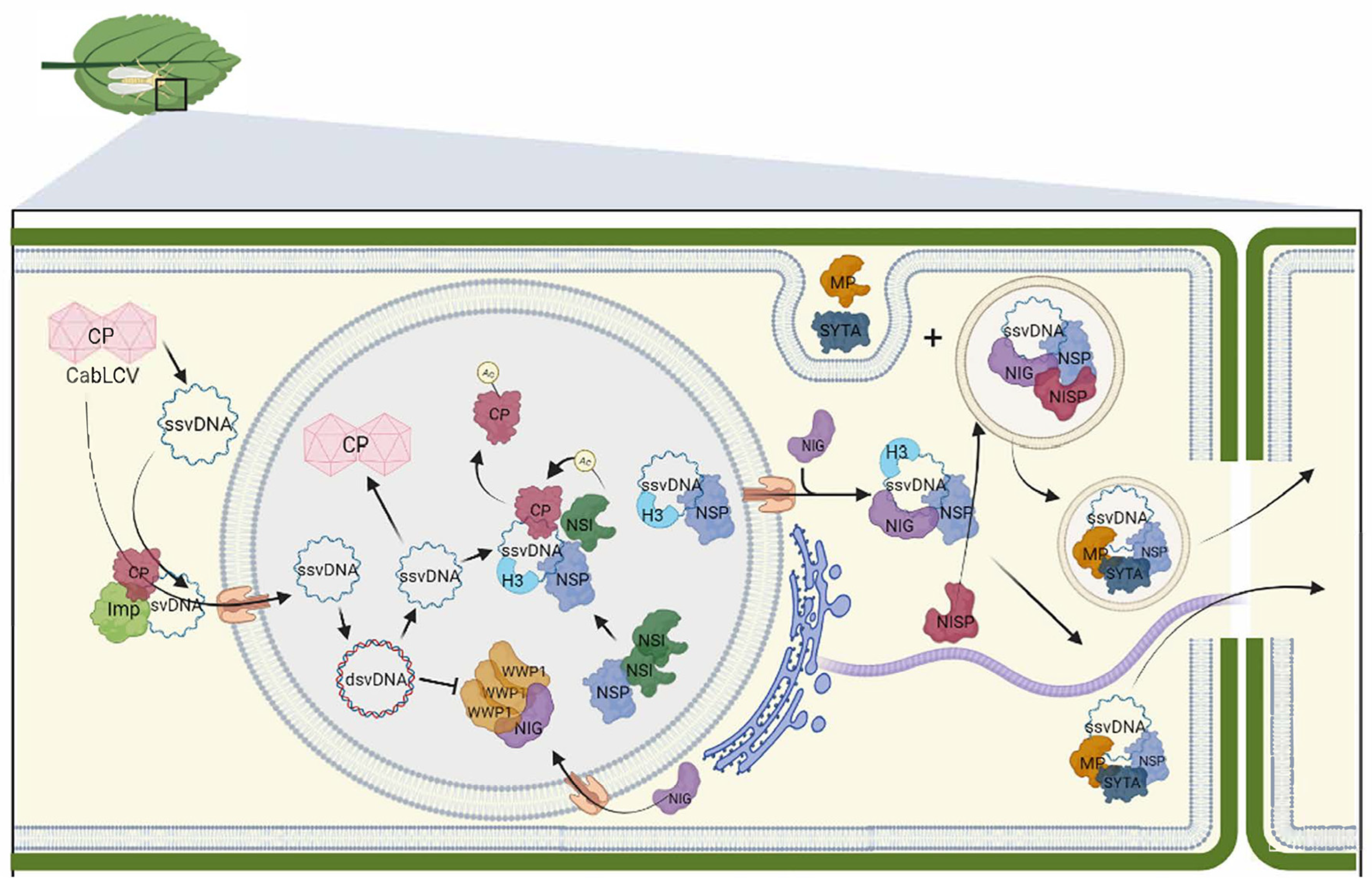
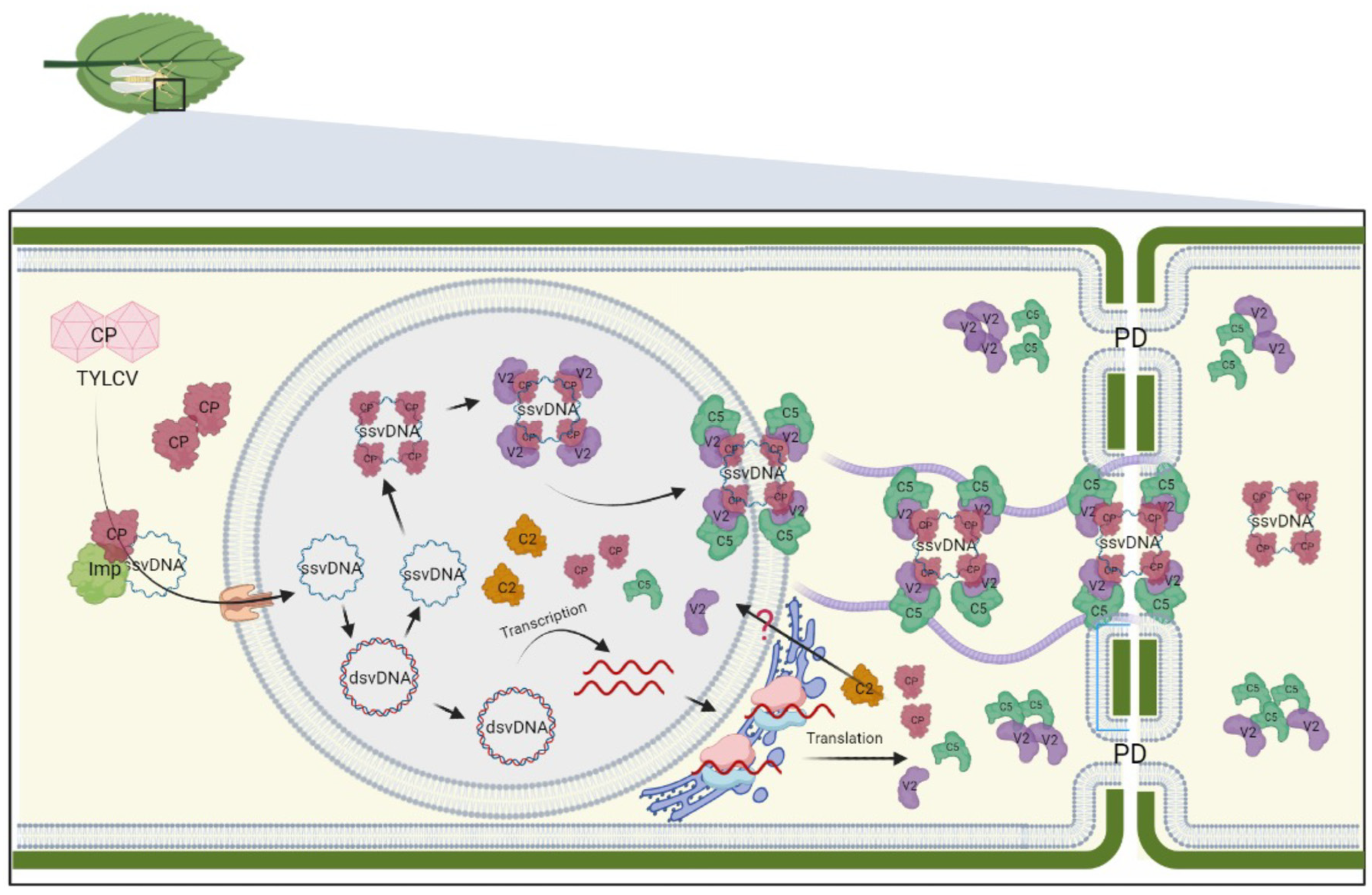
Figure 2.
Current model for intra- and intercellular transport of monopartite begomoviruses. Upon cell infection, the viral particle is delivered into the cytoplasm by insect vectors. Importin-like proteins facilitate the translocation of disassembled CP-bound ssvDNA to the nucleus, where it undergoes conversion to dsDNA by host polymerases. CP, in association with V2, interacts with newly synthesized vDNA within the nucleus. The association of C5 with V2 enables the transport of the vDNA-CP-V2 complex from the nucleus to the cytosol. Once in the cytosol, the nucleoprotein complex-associated C5 interacts with microfilaments and guides the complex toward plasmodesmata to promote the viral cell-to-cell movement. Additionally, C5 can diffuse to adjacent cells through plasmodesmata, where it relocates the C5-C2 complex to suppress host defense mechanisms in neighboring cells. The figure was created with BioRender.com and adapted from [5].
Disclaimer/Publisher’s Note: The statements, opinions and data contained in all publications are solely those of the individual author(s) and contributor(s) and not of MDPI and/or the editor(s). MDPI and/or the editor(s) disclaim responsibility for any injury to people or property resulting from any ideas, methods, instructions or products referred to in the content. |
© 2023 by the authors. Licensee MDPI, Basel, Switzerland. This article is an open access article distributed under the terms and conditions of the Creative Commons Attribution (CC BY) license (http://creativecommons.org/licenses/by/4.0/).
Copyright: This open access article is published under a Creative Commons CC BY 4.0 license, which permit the free download, distribution, and reuse, provided that the author and preprint are cited in any reuse.