

Submitted:
03 July 2023
Posted:
04 July 2023
You are already at the latest version
Abstract
Post-industrial recycling (PIR) and post-consumer recycling (PCR) are measures to sustain re-sources by improving materials’ circularity and sustainability. Currently, circularity is mostly measured as the degree of reutilization of a material from 0 to 100 % at product or company lev-el. This lacks in assessing the resources’ usage over multiple product life cycles. Therefore, we propose to assess circularity as (i) the frequency resources are used in products (effective circu-larity eC) and (ii) a vehicle to reduce virgin resource use and environmental impacts (environ-mentally efficient circularity eeC). Besides, to compare the environmental impacts of using recy-cled materials from PIR or PCR, we analyse their impact reduction potential (IRP) indicating the environmental benefits of recycling in relation to virgin material put onto the market. We demonstrate the suggested indicators for a case study material: polypropylene. For this polymer type, the eC ranges between 0.93 and 9.08 uses of the resource on average depending on collec-tion, sorting, and recycling rates. Likewise, the eeC ranges between 0.31 and 1.50 uses per kg of CO2 equivalents emitted. PCR has a higher IRP regarding climate change impacts than PIR in all analysed scenarios. The results reveal the relevance of PCR and PIR beyond the product life cycle.
Keywords:
Life cycle assessment
; LCA
; Circular Economy
; Indicator
; Polypropylene
; Recycling
; global warming impact
; climate change
; efficiency
; effectiveness
; PCR
; PIR
; environmental assessment
1. Introduction
As society and industry moves towards strategies of sustainable development, the circular economy concept has been proposed to overcome the dependency on the growing resource demand and depletion while minimizing emission levels [1,2,3]. Economic growth should be decoupled from the consumption of finite resources and negative impacts on the environment by preserving raw materials, components and products at their highest possible value and utility [4]. Implementing circular economy strategies and business models is seen as a key to accelerate the transition and to support the sustainable development which is widely highlighted in political frameworks, such as the European Circular Economy Action Plan [5], and scientific literature [6,7,8].
Especially plastics are materials of interest in current circular economy debates [9,10,11,12]. More than 57.2 million tons of plastics were produced in EU27+3 countries in 2021, while only 5.5 million tons were recycled to replace virgin material [13]. Forecasts of the global plastic production show an exponential growth, anticipating a global annual demand of 1600 million tonnes per year of plastic by 2050 [14]. Strategies to foster the circular economy concept are widely known as ‘R-strategies’ [15]. This study focuses on plastic recycling as one particular R-strategy, which can be implemented in products by two core principles: The use of recycled materials in products and a fully recyclable product after its use [16], with a circular product system requiring both.
1.1. Difference between post-industrial recycling and post-consumer recycling
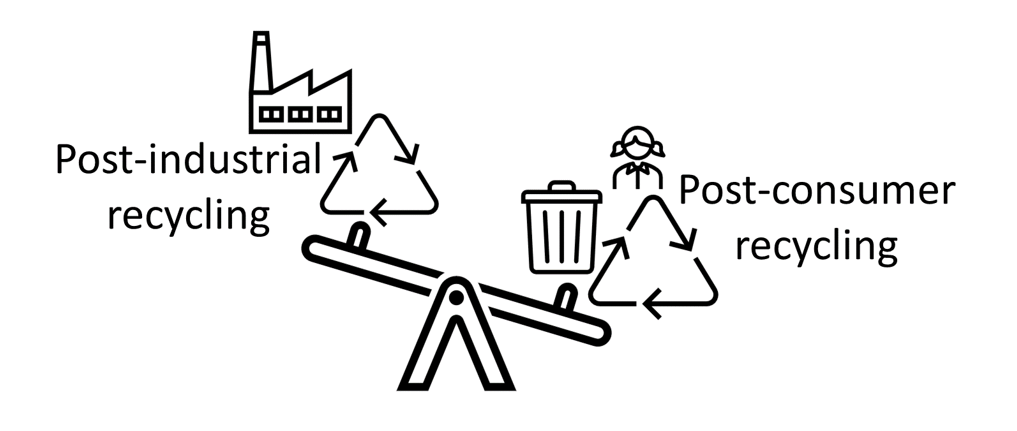
An important distinction in the use of recycled materials in products is the difference between materials from post-industrial recycling (PIR) and post-consumer recycling (PCR). PIR is made of post-industrial waste (PIW) that is sometimes referred to as pre-consumer waste. PIW refers to waste that is obtained during production and manufacturing, and thus, before use. It typically consists of uncontaminated mono-materials or at least of a well-known compositions, resulting in minor losses in recycling and a high quality of the recyclate, as demonstrated in a case study comparing the quality of recycled non-food pouches from PIR and PCR [17]. PIR does not include the reuse of materials from reworking, regrinding or scrap of a technical process that is reused in the same process [18]. In contrast, PCR uses post-consumer waste (PCW) that originates from products after use i.e., in households or commercial and industrial facilities [18]. Plastic PCW is often collected as part of a mixed waste stream together with other materials and contaminants. PCR usually goes along with higher impurities and losses during collection, separation, and recycling, and thus, resulting in a lower quality compared to PIR [19].
PIW is often not referred to as waste, but rather as a by-product of joint production, especially if it has a positive economic value [20]. The amount of PIW available on the market is limited by plastic manufacturing processes that are optimized regarding the efficient usage of their main (virgin) plastic material. As PIR uses a by-product as feedstock from production before use, it does not close the loop but preserves material that cannot be reused in the same process. In contrast, PCR and the use of PCR granulate in products close the loop at products’ end of life (EoL), and thus, allow materials to be recycled multiple times. A decoupling of virgin resource extraction from economic growth and environmental damage might, therefore, only be realized by a combination of PIR and PCR. The potential of PIR to contribute to the CE, is however, low compared to PCR.
1.2. Measuring circularity
Circularity can be measured by indicators, but these indicators have not yet been used to compare the contribution of PIR and PCR to circularity in the scientific literature. Recent publications present comprehensive overviews of existing indicators to measure circularity [1,6,21,22,23,24,25,26,27,28,29,30,31,32,33,34,35,36,37]. However, these reviews lack indicators to compare the circularity of PIR and PCR. The missing capability to analyse the circularity of PIR and PCR might be due to the prevailing understanding of material circularity as a degree or percentage of closing the loop ranging from 0 to 100 %. A case study measuring the circularity in terms of mass and quality conservation as a percentage of recycled plastic made of PIR and PCR mentioned the different waste origins as a main limitation for the comparability of results [17]. Most indicators fail to point out the dependence and fixed ratio between virgin and PIR production and do not quantify this relation to the frequency of times PCR materials can be recycled. In existing studies, the perspective is often set to a single product life cycle neglecting to cover multiple recycling loops and the intrinsic difference between PIR and PCR. For example, the widely applied material circularity indicator (MCI) does not distinguish between recycled materials from PIW and PCW and only accounts for PCR [38]. Most studies addressing circularity from recycling either focus on PIR only [39] or PCR only [40]. Neither is sufficient to assess the different relevance of PIR and PCR materials in a circular economy that is addressed above.
A radically different perspective on material circularity can be taken based on the path length of a resource, which was first proposed by Bailey et al. [41]. This idea has been transferred to a metric defining circularity as the average number of product life cycles in which a material is involved before it leaves system as waste [42]. According to Figge et al. [42], a circularity of 1 describes a linear system; a circularity of infinity represents a fully circular product system. The indicator captures resource circularity from its first use – defined as initial use of the material – to its last use when the initial amount of material is lost due to dissipative losses. Lost material is described as anything that cannot be preserved in the value chain as recycled material [42], such as material that is not collected for recycling or remelting losses in the recycling process. This definition does not limit material circularity to a single product life cycle and rather calculates the circularity of the material over several product applications. The indicator has been demonstrated on closed-loop remanufacturing of medical products [17] and used for the assessment of the copper value chain as an open-loop system [43]. However, it has not been applied to compare PIR and PCR.
Circularity and sustainability are closely linked but can also contradict each other [7]. Pauliuk [44] mentioned the need of circularity indicators in combination with life cycle sustainability indicators. When assessing circularity, the focus can be on (i) increasing the frequency resources are used or (ii) using circularity as a vehicle to reduce virgin resource use and environmental impacts. The former might ignore the fact that recycling activities also require resources and cause emissions. The latter sets the material circularity in relation to environmental impacts caused. Ever since assessing processes, effectiveness and efficiency have been widely regarded as two important but separate metrics that are sometimes confused. The present paper follows the well-known definition: ‘Efficiency is concerned with doing things right. Effectiveness is doing the right things’ [45]. Effectiveness is usually driven by a specific goal to be achieved regardless of the effort it takes and the impacts it causes. Regarding circularity as the goal, a recycling activity is effective if the circularity is increased without considering resources needed and emissions generated.
We suggest measuring the frequency resources are used in product systems (i) by the effective circularity (eC) and the result of using circularity as a vehicle to reduce environmental impacts (ii) by the environmentally efficient circularity (eeC).The eeC is in line with the well-established concept of “eco-efficiency” which aims to use less resources while generating the same, or a greater, amount of economic activity [46]. Eco-efficiency is measured in sustainability analysis and development [47,48]. Analogously, the eeC can be used to compare circularity measures for minimizing virgin resource extraction while generating less environmental impacts. Thus, eeC sets the obtained eC in relation to the environmental impacts. Besides, to compare the environmental impacts of using recycled materials from PIR or PCR, the impact reduction potential (IPR) is proposed to analyse the environmental benefits of recycling in relation to virgin material put onto the market. In contrast to existing metrics, the IPR considers the availability of PIR and PCR material per kg of initial virgin resource input. It addresses the proportionality and fixed quantities of virgin, PIR and PCR granulate to be used in products.
This study assesses circularity in terms of effectiveness and environmental efficiency comparing recycled resources from PIW and PCW. Additionally, we identify the IRP of PIR and PCR material compared to virgin plastic use. In the process, we measure the path length of an initial resource input including all product life cycles in which it is used. A case study on polypropylene (PP) is conducted focusing on the PP packaging loop. The eC, the eeC and the IPR are demonstrated in different scenarios.
2. Materials and Methods
Section 2.1 introduces the concept and calculation of the eC to assess the frequency a resource is used on average in a product system. Afterwards, the combination of the eC and environmental impact assessment is explained to obtain the eeC and the IRP in Section 2.2. In Section 2.3, the application of the proposed indicators to a case study of PP is outlined to answer the research question of how the circularity of plastic can be measured for PIR and PCR considering also environmental impacts?
2.1. Effective circularity
For the purpose of this study, the proposed indicator of Figge et al. [42] is modified to consider the different contributions of a resource being used in product systems as virgin, PIR and PCR material. The original indicator sums up three different contributions to circularity: ‘initial use’, ‘refurbishment’, and ‘recycling’ [42]. For the initial use, Figge et al. propose setting the contribution of virgin resource use to 1, which means that the virgin material is always used once [42]. Setting the initial use of a resource to 1 neglects loss during production, i.e. material that is processed but never enters the use phase, including PIW that is not collected for recycling. However, these lost resources should be considered when measuring the eC. We propose to divide the ‘initial use’ into contributions of virgin production and PIR. Both, virgin and PIR material are used in products for the first time and, thus, represent the initial use of the material. Their contribution should be calculated separately for both virgin and PIR materials (eCvir and eCPIR). Ideally, the use of virgin and PIR material together can have a maximum value of 1 if the PIW are fully collected, recycled and processed into products (without dissipative loss before use). For this study, contributions from ‘refurbishment’ are neglected as the focus is on recycling. Here, the contribution of ‘recycling’ is defined as material used in products made of PCR granulate. The eC is determined by eCtotal according to Equation (1) by adding the three contributions from virgin material (eCvir), PIR material (eCPIR) and PCR material (eCPCR) along the value chain.
All three contributions to eCtotal reflect the frequency of average uses of the material per virgin resource input. The higher the eC, the more effectively the resource is used. Ideally, eCtotal would be infinite. In practice, dissipative losses of uncollected material, material that is sorted out, or rejects from recycling occur, which is why eCtotal aims for a quantifiable value. This indicator provides the relation between the use of the material in virgin, PIR and PCR product systems starting from an initial and fixed input quantity of virgin resource input (mvir) until the material is lost. The eC of virgin products (eCvir) equals the virgin production rate (PRvir) multiplied with mvir (see Equation (2)).
In line with Figge et al. [24], we suggest setting mvir to 1 kg to obtain the frequency a resource is used on average per kg. This way, the results can be interpreted based on 1 kg of virgin material put on the market. If the parameter is set to another specific input value, eCtotal is calculated for this specific value, which must be communicated in the interpretation. The input of virgin material is multiplied with the percentage of the material that is processed into a final virgin product (PRvir) to consider losses in virgin production. Since the focus is on the circularity of the material, this metric does not consider a specific target product and production rate. Nevertheless, the losses along the value chain must be captured holistically. Accordingly, an average production rate from pre-processing and virgin product manufacturing of a material should be considered, since only the material used in products on the market contributes to eC. The value for PRvir can be determined based on average market data that represents a specific value chain for a resource and a market under study, such as overall plastic pre-processing and production in a specific country. This is further explained in Section 2.3 in a case study on PP used for lightweight packaging (LP) in Germany.
All losses during pre-processing and virgin product manufacturing serve as a potential feedstock for PIR and equal the share of PIW based on mvir (pPIW). The eC of PIR (eCPIR) is calculated according to Equation (3).
To obtain eCPIR, mvir and pPIW are multiplied with the collection rate of PIW (CRPIW), the recycling rate of PIW (RRPIW), and the production rate of PIR granulate into products (PRPIR). CRPIW is defined as the share of the PIW collected for recycling compared to the total amount of accumulated PIW during virgin production. For PIW, sorting often plays a minor role, since most PIW is collected as mono-material waste at industrial production locations. Therefore, losses in sorting of PIW are neglected in Equation (3). RRPIW is defined as the material share preserved in the recycling process (outgoing recycled material per ingoing material). Analogously to virgin production, PRPIR is defined as losses in processing and production of the recycled material into a final product.
To determine the eC of PCR material (eCPCR), it is necessary to calculate the maximum amount of material accumulating as PCW after first use (pPCW,1) according to Equation (4).
The subscripted index of 1 reflects the first time PCW is collected after use. pPCW,1 is used to calculate the contribution of PCR to eCtotal by considering that some of the material will be recycled several times, which is depicted in Equation (5).
The variable n shows the total number of PCR loops until the initial input of virgin material is lost. The more frequently the material is recycled as PCR granulate on average, the more often it can be used to replace virgin material. For each loop i, the amount of material that passes through each loop preceding and including loop i must be considered. The accumulating PCW after first use (pPCW,1) is multiplied and summed up with the series of all further loops. This is conducted by multiplying the percentages of the PCW that is collected (CRPCW), sorted (SRPCW), recycled into granulate (RRPCW) and processed into a final product made of PCR (PRPCR) for all loops i. The index j is used to add up the amount of material that has reached each loop i. The PCW collection rate (CRPCW) reflects the waste share that is disposed of correctly into the waste stream and collected for sorting and recycling based on the virgin and PIR material put onto the market. The PCW sorting rate (SRPCW) corresponds to the waste share that is sorted correctly and separated into the desired fraction, such as by polymer type. For PCW plastics, this point is often measured as the output of a sorting plant [20]. Losses from additional pretreatment steps at the recycler can be attributed to either sorting or recycling. In any case, it is important to capture losses holistically and state the reference points. After recycling, the material is processed into products again for another use. Losses during production refer to material that is processed and cannot be reused internally. This material should be referred to as PIW as it occurs before use. However, this material has been used and recycled from PCW. It can contain impurities and, therefore, contributes to eCPCR. The recycling of this waste share is theoretically possible, but can often be neglected in calculations, as most recycled plastics from PCW are used in products that can internally reuse waste generated. In most cases, PRPCR shall be set to 1 and, therefore, be excluded from Equation (5). For the calculation of eCPCR in Equation (5), the variables are illustrated in Figure 1.
In Figure 1, mvir is split into a share of virgin and PIR material put on the market (B) and losses of PIW that is not collected for recycling or that occur during the PIR process (Blost). This material share does not enter the market and can, therefore, not be collected as PCW. During PCW collection, a certain share of the virgin and PIR material used in products on the market is disposed of correctly into the waste stream and collected for sorting and recycling (C). The remaining share of virgin and PIR material used in products on the market is lost (Clost). Likewise, during PCW sorting and recycling, a certain waste share is sorted correctly (D), recycled to granulate (E) and processed into products from PCR granulate (F). The remainder of these are lost (Dlost, Elost and Flost). The share of PCW that is preserved in each subsequent loop i is calculated and added up until the entire amount of mvir is lost. Regarding Figure 1, this corresponds to the point where the targeted material reaches zero.
Whereas PIW is always recycled in an open-loop recycling system which is described by recycled material cascading into another product system, PCW can be recycled via an open or closed-loop recycling system. We point out that the original indicator proposed by Figge et al. [42] only extends to activities which companies can control. In the context of recycling activities, this can often only be realized in closed-loop systems aiming to take back products to the original manufacturer that are used again to produce new products of the same type [4]. Since most PCW plastics are collected, sorted, and recycled as lightweight packaging (LP) waste from household and commercial use, the terminology for open and closed-loop recycling is extended and briefly defined in the context of this study. Open-loop recycling is described as follows: products, components or materials are reused or recycled (which can be cascaded) generally amongst unspecified organizations into alternative products, components or materials [49]. PCW can be recycled via a product-specific take back system to the original manufacturer that are used again to produce new products of the same type (closed-loop) or products recycled into alternative products, which is in line with the definition of open-loop recycling given above.
Closed-loop recycling of PCW can often only be realized for products that remain in the company’s ownership or are returned to the company after use requiring broad infrastructure. For instance, PP recycling of fruit and vegetable crates or PET bottle-to-bottle recycling are well established closed-loop systems [50,51,52]. However, a product-specific take-back system might not be purposeful regarding the variety of plastic products in household and commercial waste. If companies each manage their own collection and recycling activities, this could indeed be much more resource-intensive compared to an open-loop system for household and commercial waste. This is supported by the British standard institution, which states that “a closed-loop system cannot generally be advocated over an open-loop system” [49]. Therefore, the definition of closed and open-loop recycling is extended to include the following:
- Level 1: Closed-loop recycling of a product into the identical production application
- Level 2: Quasi-closed-loop recycling with restricted but defined reuse in products that are managed by the same recycling system
- Level 3: Open-loop recycling, reuse in alternative products that might be further managed by another recycling system (also referred to as recycling cascade)
The conventional understanding of closed-loop recycling (level 1) is complemented in this study by quasi-closed-loop recycling (level 2). The re-granulate of a quasi-closed-loop recycling can fully replace corresponding virgin material in some applications, such as plant pots, non-food pouches, or pipes, without compromising the quality and longevity of the products compared to virgin material. However, in contrast to virgin material, it is limited in terms of colour or food contact. For open-loop recycling (level 3), the collection, sorting and recycling rates in Equation (5) must be set separately for each loop, as the rates can vary for different open-loop recycling systems. In line with the assumptions of Figge et al. [42], some simplifications can be made for the variables used in Equation (5) with an index higher than 1, if a closed or quasi-closed-loop system can be assumed: All variables in Equation (5) for each loop i are assumed to equal those of the first loop, and thus:
Concluding, eCtotal reflects the frequency a resource is used on average in a product system but focuses on the contributions of virgin, PIR and PCR materials. Applying the assumptions discussed (i) setting mvir to 1, (ii) excluding production losses for products made of PIR and PCR materials (PRPIR = PRPCR = 1), as well as assuming a closed or quasi-closed-loop recycling (simplification according to Equation (5a) to (5d)), a simpler formula is presented to determine eCtotal in Equation (6).
If a value chain is linear (i.e., without considering PCW recycling), eCtotal can be lower than 1 if virgin and PIR material is not completely processed into products, and a share of it, thus, never enters the market. With PCR, circularity increases depending on the loss of resources being wasted. As a result, an ever-decreasing fraction of the resources re-enters each cycle until the material is lost completely. We note that this metric does not consider quality or lifetime restrictions. Both have to be taken into account regarding a specific product or product group after manufacturing.
2.2. Combining effective circularity and environmental impact assessment
In Section 2.2.1, the eC is set in relation to the environmental impacts caused over the value chain to assess the environmental efficiency resulting from circularity as eeC. In Section 2.2.2, the IRP (above introduced as impact reduction potential) of PIR and PCR is determined.
2.2.1. Environmentally efficient circularity
What enhances the eC, such as increasing the recycling rate, might have a negative environmental impact because collection, sorting and recycling require resources and emit emissions. The relationship between increasing the eC and decreasing environmental impacts is determined by eeCtotal as an indicator to complement eCtotal. To obtain eeCtotal, eCtotal is measured as a function of the environmental consequences from providing, recycling, and treating the virgin resource input (mvir) from its first to its last use according to Equation (7):
Etotal reflects the environmental impacts of a material over the entire path until mvir is lost. Environmental impact assessment, which is also referred to as life cycle assessment (LCA), is a widely accepted method to assess environmental impacts over a product's life cycle from raw material extraction to the EoL. A product LCA is defined by DIN ISO standards 14040/44 and typically focuses on a single product life cycle [53,54]. Therefore, its ability to provide information for decision-making is often limited to the life cycle phases of the product. However, environmental impacts can also be determined beyond a product life cycle. In the LCA context, this is often referred to as system expansion. We use this term to state that the environmental impacts of a material over the entire value chain are captured. In particular, an investigated product system from virgin material is expanded from one product life cycle to cover additional product systems. The aim is to capture the environmental impacts associated with mvir over all product life cycles in which it is used, including its virgin provision, PIR and PCR as well as the last treatment as waste. Calculating eeCtotal, each impact category of LCA methods can be selected for Etotal as further elaborated for the case study in Section 2.3.2. The calculation of Etotal for a respective impact category is described by Equation (8) and illustrated in Figure 2.
Evir reflects all impacts of providing virgin plastic granulate to be further manufactured into a product from cradle-to-granulate per kg of virgin granulate. Evir is multiplied with the eC of the virgin material (eCvir) in Equation (8). EPIR corresponds to the impacts of PIW-to-granulate per kg of PIR granulate, which is then multiplied by eCPIR. Analogously, EPCR describes the impacts of the PCR granulate from PCW-to-granulate and is multiplied by eCPCR. Environmental impacts of the manufacturing step from granulate into an end-product, e.g. injection moulding or thermoforming, as well as environmental impacts of the use phase are not considered in our study (see Figure 2). Such impacts are related to a specific product instead of the material and are, therefore, neglected regarding the aim stated above. The material entering the market can be partly collected, sorted, and recycled into PIR and PCR granulate. The collected PCW can be recycled again and again until the material is lost. By multiplying EPCR by eCPCR and adding them in Equation (8), the environmental impacts of recycling PCW and providing re-granulate over multiple loops are added up, as eCPCR indicates the frequency of average applications of mvir recycled as PCW.
Note that for EPIR and EPCR, exclusively the burdens associated with collection, sorting and recycling are accounted for. Burdens of the treatment of residues are attributed to the last treatment activity to avoid double counting. The lost material along the value chain that is not collected for recycling or accumulates as residues are treated as waste via thermal treatment or landfill. This does not contribute to eC, but causes environmental impacts that are associated with the material and, therefore, have to be added to Etotal. Consequently, EEoL reflects the burdens arising from thermal treatment (e.g. municipal incineration) and from landfill of lost waste. Regardless of the frequency with which the resource is recycled after use, the amount of virgin resource input (mvir) must be finally treated as waste via energy recovery or landfill. If mvir is set to 1 kg as suggested input value (see Section 2.1), 1 kg is fully treated as waste after a certain number of times the resource has been recycled. The last variable Ecredits in Equation (8) accounts for environmental benefits that are only considered for thermal treatment processes in this study.
If waste is incinerated, the waste heat is usually transformed into heat and electricity to be used in other product system that might be outside the value chain under investigation. For eeC, we need to consider how to account for environmental impacts of energy recovery processes that provide a benefit for other product systems in which the recovered energy could be used but which may be outside the investigated material's path. There is a long running debate in LCA on how to assign impacts of EoL processes, if they provide valuable resources to be used in other product systems, as it is the case for recycling and energy recovery [15,55,56]. Any benefits of recycling and energy recovery are always shared between two product systems – one producing the waste and another one using the recycled material or recovered energy [15,57]. DIN ISO 14044 defines a hierarchical procedure for handling such multi-functional processes [54]. The preferred options are subdivision by means of dividing the multi-functional process into sub-processes or system expansion. A subdivision is not possible for recycling and energy recovery processes, as the waste is treated, and resources (materials or energy) are provided at the same time. As explained above, recycling is modelled by system expansion in this study, as every subsequent product system, in which the material is used, is added into the system boundaries until the material is completely lost. Nonetheless, system expansion is not applied to energy recovery processes. The eeC aims to investigate the environmental impacts associated with the material. Recovered heat and electricity are used in other product systems that are out of the scope of this study. Therefore, substitution is applied awarding credits for recovered energy to account for the benefit of recovered energy. This is often referred to as avoided burdens [58]. The secondary use of recovered energy in other product systems is substituted. Here, the environmental impacts of provided heat and electricity mixes of the market under study can be avoided and should be included in Equation (8) (Ecredits).
2.2.2. Impact reduction potential of using recycled granulate
The eC can also be combined with environmental impact assessment to quantify the IPR. In contrast to eeC, the IPR focuses on decreasing environmental impacts, and is analysed for the use of recycled materials (here PIR and PCR granulate) to replace of virgin granulate. The IRP of recycled granulates is often calculated for the use of 1 kg of PIR or PCR granulate replacing 1 kg of virgin granulate, as conducted in LCA studies on plastics [59,60]. However, this neglects the fact that PIR and PCR granulate are not available in unlimited quantities. The amount of available PIR granulate directly dependents on the amount of virgin granulate processed; more precisely the share of it that cannot be used internally. PCR granulate also cannot be used infinitely and independently from virgin granulate provision due to dissipative losses along the value chain that have to be compensated by bringing new material into the loop.
To quantify the IRP of PIR and PCR in this study, eCtotal is linked to environmental benefits of 1 kg re-granulate replacing 1 kg virgin granulate based on a fixed virgin resource input (mvir) to create a value chain perspective. This maps the proportionality and resource availability of virgin, PIR and PCR granulate to be used in products. The law of leverage is used to explain this in a simplified way. The law states that the longer the lever, the greater the force, which is said to provide leverage. The environmental benefits of replaying 1 kg of virgin granulate by 1 kg of PIR and PCR granulate, respectively, are set as ‘weights’ and the eCs of PIR and PCR describe the ‘levers’ of a seesaw (see Figure 3).
The environmental benefits of using 1 kg PIR and PCR granulate to replace 1 kg of virgin granulate is calculated as the difference between the re-granulate and virgin granulate (see the size of the weights on both sides of the seesaw in Figure 3). It is expected that EPIR is lower compared to EPCR because the collected PIW often consists of minor impurities resulting in high recycling rates, and both have a lower impact than virgin granulate provision per kg (EPIR<EPCR<Evir). Thus, the weight of the seesaw on the left side (Evir-EPIR) is depicted to be heavier than the weight on the right side (Evir-EPCR). The bigger the difference between the impact of producing 1 kg of virgin granulate and 1 kg of PIR or PCR granulate, the heavier the weights on the seesaw. As can be seen in Figure 3, eCPIR and eCPCR are considered the levers indicating the amount of PIR and PCR granulate available per kg of virgin resource input (mvir). The weight can each be multiplied by the respective eC of PIR and PCR (eCPIR and eCPCR) to determine the ‘force’ providing the leverage defined as IPRPIR and IPRPCR based on the principle 'force equals weight times lever’ as described by Equation (9).
2.3. Transfer to the case study example of polypropylene used for packaging
The proposed indicators eC, eeC, and IRP are demonstrated using the value chain of PP, which currently has the highest market share (approximately 20 % in Germany and worldwide of all polymers processed) [13,61]. Since the largest area of application for PP is packaging [13], the study explicitly considers the packaging loop of virgin, PIR, or PCR materials. The geographic scope of the study focuses on German market conditions as data were mostly obtained for PP processed, collected, sorted, and recycled in Germany. Here, most packaging materials are collected as LP (introduced as lightweight packaging above) and recycled via the Dual System in the so-called yellow bin or yellow bag in Germany [62]. Like many other countries, Germany imports and exports waste and recycled materials. For the sake of simplicity, imported and exported waste and recycled materials are excluded from the system boundaries, which means that plastic packaging consumptions equals the amount of accumulating plastic packaging waste. Therefore, the analysed PP LP value chain can be understood as a theoretical path of virgin PP, whose waste is (partly) processed into further packaging materials made of PIR and PCR.
We note that the recycled material made of PIR and PCR might not be used for all packaging applications, especially due to regulations for food contact materials. However, since the recycled material from PCW can be used to manufacture products of restricted, but defined applicability and quality that can be recycled again via LP recycling, the value chain can be considered a quasi-closed-loop recycling (level 2). This means that the case study results cannot be interpreted in the context of all PP packaging, but only PP packaging for non-food applications that can be made (partly) of recycled PCW. Although, no particular product application is considered here, we are sure to assess an existing value chain. There are products made of recycled PP (both from PIR and PCR), which can be collected, properly sorted, and recycled via LP recycling system to be used again in products regardless of the form and function of the product. Secondary data from literature as well as primary data from a plastic processor (Pöppelmann GmbH & Co. KG Kunststoffwerk-Werkzeugbau in Germany) who produces PP plant pots from both PIR and PCR materials are used. PP plant pots can be considered a reference product in this study, because they are currently available on the market made of 100% PIR and PCR plastic.
To determine the eC, the eeC, and the IRP, a scenario analysis is conducted. Two linear scenarios are investigated where PP LP waste is not recycled at the EoL, but incinerated. In the first linear scenario virgin only, virgin material only is processed without the recycling of PIW and PCW. In the scenario vir+PIR, beside virgin material, PIW is partly collected and recycled. The linear scenarios do not reflect the prevailing situation of LP recycling of PP in Germany, but are used for comparison. Both scenarios reflect virgin PP and PIR material processed in non-recyclable products that is not collected or cannot be sorted for PCR and is fully lost after its first use. Additionally, four circular scenarios are analysed including PCR. As the collection and recycling rates of PCW plastics have increased in recent years and are expected to further increase due to recycling targets of the EU [10], four circular scenarios are investigated with varying collection, sorting, and recycling rates of PCW. Such scenarios are based on conservative, realistic, optimistic, and ideal assumptions and are therefore named conservative, realistic, optimistic, and ideal scenario that are further explained below.
2.3.1. Effective circularity
The scenario virgin only is determined by eCvir only. According to made suggestions, the virgin resource input (mvir) is set to 1 kg. The scenario virgin+PIR is determined by the sum of eCvir and eCPIR. The value of pPIW is used as a starting point to calculate eCPIR. All parameters needed to calculate eCvir and eCPIR are not assumed to change in the future because the processing of virgin and PIR materials is considered to already be optimized for the efficient usage of the virgin material, and therefore, assumed to be constant in all analysed scenarios. For the circular scenarios (conservative, realistic, optimistic, and ideal), eCtotal is calculated as a sum of all three contributions (eCvir, eCPIR and eCPCR), assuming different collection, sorting and recycling rates. Since a quasi-closed-loop recycling of PP is investigated for PCW in this study (level 2), the mentioned simplifications on calculating eCtotal are made, following Equation (6) in Section 2.1. According to the manufacturer, production rates of both PIR and PCR (PRPIR and PRPCR) can be assumed to be 100 % since any significant waste produced is reused internally in the production process of our case study product.
Table 1 summarize the values used to calculate eCvir, eCPIR, and eCPCR in each scenario. The sources and calculation of the assumed values are explained in detail in Appendix A. For some values, data specifically for PP and/or (PP) packaging was unavailable. Therefore, literature data of plastics in general are used. In Table 1, values for PRPIR, PRPCR and mvir are not shown, because they do not influence the eC. The values for pPIW, CRPIW, RRPIW, and pPCW are explained above and do not change across the scenarios. Since the collection and sorting of LP is mostly reported as an aggregated value, CRPCW and SRPCW are summarized as an aggregated value and further referred to as CSRPCW.
2.3.2. Environmentally efficient circularity and impact reduction potential
The aim here is to measure the eeC of the PP LP value chain to analyse the eC and the IRP in relation to the environmental impacts caused from its first use to its final treatment. Every environmental impact category typically calculated in LCA methods can be used in relation to eC. In this study, we focus on the climate change (CC) impacts according to the impact assessment method of the sixth IPCC assessment report as exemplary impact category [63]. Therefore, the CC impact, measured in terms of CO2 equivalents (CO2eq) of a material over the entire path, is calculated for Etotal according to Section 2.2.1. The scope and system boundaries to be assessed for Etotal contain the investigated life cycle stages according to Equation (8) and Figure 2 related to the material. This includes the provision of virgin PP as well as recycled PP from PIR and PCR and of its last treatment activity. If the PP packaging waste is not collected for recycling, it is assumed to be incinerated including energy recovery in this study only, since landfill does not play a significant role in Germany anymore [13].
The data for Etotal are obtained by modelling the life cycle inventory and conducting the impact assessment using the Shpera database and software version 10.6.2.9. The CC impacts of providing PP granulates (Evir, EPIR or EPCR) are calculated based on 1 kg of PP granulate that can be used in products within the system boundaries. Evir is modelled using an existing European dataset for PP granulate from the Sphera database. EPIR is modelled from PIW-to-granulate based on data for mechanical recycling provided by the company Pöppelmann. For EPCR, data for PP recycling from PCW-to-granulate is collected from the literature. A fully reproducible life cycle inventory is found in the literature regarding PCW recycling of PP in North America. As the geographic scope of this study focuses on German market conditions, the background data is updated to representative datasets for the market under study. Transport processes are modelled using a dataset representing truck-trailer transport (Euro 6, 34-40 t gross). The incineration is modelled using a dataset for PP in a municipal waste incineration plant (EEoL) with energy recovery (Ecredits). The European district heat mix is used to credit recovered heat. The electricity demand and credits are modelled using the German electricity grid mix. The life cycle inventory of the modelled foreground system of this study can be found in the supplemental materials.
To determine the IRP of PP packaging using PIR or PCR granulate to replace virgin granulate, the values needed in Equation (9) can be taken from previous descriptions of this case study.
3. Results and discussion
The results are presented in four sections: the eC (Section 3.1), the eeC (Section 3.2), the IPR (Section 3.3) followed by a discussion of the indicators in terms of applicability to other studies and limitations (Section 3.4).
3.1. Effective circularity
Figure 4 shows the results for eCtotal of the linear and circular scenarios. The number at the top of each bar indicates eCtotal. The number inside or next to the bars as well as the colour legend indicate the contribution of the virgin (eCvir), PIR (eCPIR), and PCR product system (eCPCR) to eCtotal based on 1 kg of virgin resource input.
The first two bars in Figure 4 represent the two linear scenarios. The scenario virgin only results in eCtotal of 0.93. In the scenario virgin + PIR, eCtotal cumulates to a value of 0.99. Comparing both linear scenarios, the PIR increases eCtotal by 6.5 %. The eC is understood as frequency of average uses per kg of virgin resource input. However, the results can also be interpreted as kg of material used in products on average per kg of virgin resource input. Thus, including PIR in the scenario virgin+PIR, beside 0.93 kg virgin material used in products, 0.06 kg PIR material per kg of virgin resource input can be preserved and additionally processed into products. Ideally, the sum of eCvir an eCPIR could have a maximum value of eCtotal = 1. However, 0.01 kg of the initial virgin PP granulate is lost due to some PIW not collected for recycling and minor losses in the recycling of PIW. The ratio of PIW per kg of virgin material processed may be different for a specific process, but it can be assumed that virgin production is always optimized towards the main product which is the virgin product.
The last four bars in Figure 4 show the circular scenarios including PCR from conservative to ideal assumptions. The four scenarios vary in the values for CSRPCW and RRPCW to demonstrate the influence of dissipative losses in collection, sorting, and recycling of PCW. While the absolute contribution of virgin and PIR to eCtotal does not change, the contribution of PCR (eCPCR) increases from the conservative to the ideal scenario. In principle, the bigger the share of the PCW that is collected, sorted, and recycled, the more often the initial virgin input of 1 kg virgin granulate is preserved and recycled into PCR material that can be used in products.
In the conservative scenario, 1 kg of virgin input (PP) is used 1.28 times on average in product systems. Thereof, 0.93 kg is used in virgin products, 0.06 kg is used in PIR products and 0.34 kg is recycled at least once and used in PCR products. Even in the conservative scenario, PCR has more than four times the contribution of PIR to eCtotal. Although PIW has a higher collection and recycling rate than PCW, the contribution of PIR is limited by two factors: Firstly, the size of the remaining fraction of virgin production that is not reused in the virgin production process onsite, and secondly, the fact that a material can only be considered PIR material once, but be part of PCR multiple times. About 0.09 kg are recycled more than once in the conservative scenario and eCPCR increases exponentially in the further scenarios with increasing CSRPCW and RRPCW.
Regarding the realistic scenario, PCR can preserve 0.71 kg of PP used in products per kg of virgin input. This means that 0.71 kg of PCR is generated and can be used in products per kg of virgin input over several loops. Regarding the relative contributions of virgin, PIR, and PCR materials to eCtotal, eCvir and eCPIR decrease while the relative contribution of eCPCR increases from the conservative to the ideal scenario. The more PCR granulate is maintained in the loop, the more often the PP material is recycled and used in PCR products on average and the less significant eCvir and eCPIR in the overall PP value chain.
The relationship between the collection, sorting, and recycling rate of PCR and the obtained eCPCR is exponential (see Equation (5) in Section 2.1). This becomes visible if looking at the optimistic and ideal scenario. In an optimistic scenario, 1.74 kg of PCR granulate can be produced from 1 kg of virgin input resulting in eCtotal of 2.73. In the ideal scenario, PCR material is recycled and used more than eight times resulting in 8.09 kg of PCR material used in products. Thereof, 7.21 kg are recycled more than once. As a result, the initial virgin resource input of 1 kg PP granulate is used 9.08 times on average referring to kg available material used in products.
Figure 5 shows a Sankey diagram for the realistic and the ideal scenario up to the 10th use of the material. It depicts the amount of material that passes each loop i from use to use (with a number indicating the use phase) and reflects the remaining fraction of the initial virgin input that is used in product system. The upper Sankey diagram shows the realistic scenario while the lower diagram represents the ideal scenario.
In both scenarios in Figure 5, about 11 g of 1 kg virgin input do not reach the first use phase due to uncollected PIW or losses during the mechanical recycling of PIW (which corresponds to the sum of eCvir and eCPIR of 0.99). At the end of the value chain, the virgin input of 1 kg is fully incinerated (11 g PIW and 989 g PCW). In between its first use and last treatment (incineration), the two scenarios differ. In the realistic scenario, a larger proportion of material is not preserved and sent to incineration in each loop i resulting in the virgin resource input being lost after seven uses of the material. No significant amount of the material from the initial PP virgin input reaches an 8th use phase. In the ideal scenario, about 351 g of the initial 1 kg is still in the loop after the 10th use phase. Further loops are not shown. After the 67th loop, the initial virgin input is fully lost in the ideal scenario. The more PCW is collected and recycled, the more significant the PCR in terms of their contribution to eCtotal and the more often materials are used in product systems on average. Figure 5 visualizes the delayed incineration of the initial virgin input in the ideal scenario compared to the realistic one, as the material remains in the value chain for more loops resulting in an increased average frequency of use. However, the eC does not indicate whether the collection and recycling of PCW also lead to lower environmental impacts. Therefore, the eeC is calculated and discussed in the next section.
3.2. Environmentally efficient circularity
For the eeC of the linear and circular scenarios, eCtotal is put in relation to the CC impact to obtain eeCtotal, which is shown in Figure 6.
The eeC here assesses the efficiency of the effective resource use in relation to the CC impact. Thus, eeCtotal indicates the average uses of a material per kg of CO2eq emitted. Since mvir has been set to 1 kg, eeCtotal can also be interpreted as kg of PP to be used in the LP packaging loop per kg of CO2eq emitted. This means that 1 kg of CO2eq is used as a reference unit here to depict the climate efficiency of the different scenarios with or without including PIR and PCR. In the scenario virgin only, eeCtotal is determined to be 0.31 kg PP used in the LP packaging loop per kg CO2eq. In the linear scenario virgin + PIR, eeCtotal barely increases compared to virgin only from 0.31 to 0.33 kg PP used in products per kg CO2eq. By taking PCR into account in the circular scenarios, eeCtotal increases significantly from the conservative to the ideal scenario reaching 1.50 kg PP used in the packaging loop per kg CO2eq in the ideal scenario. It follows that PCR contributes to a higher extend to eeCtotal than PIR. PCR preserves the initial virgin resource more often in the value chain while maintaining the same emission level (per kg of CO2eq).
To better understand the eeC in terms of CC, the CC impact of providing 1 kg virgin, PIR and PCR granulate as well as burdens and benefits from energy recovery of 1 kg of PP are shown in Figure 7. All values shown are used to calculate the CC impact of the overall PP value chain (ETotal) according to Equation (8).
The provision of PP granulate from virgin material has a higher impact on CC per kg PP granulate (Evir: 1.65 kg CO2eq/kg) than granulate produced via PIR (EPIR: 0.21 kg CO2eq/kg) or PCR (EPCR ranging from 0.41 to 0.37 kg CO2eq/kg depending on the scenario). As collection, sorting and recycling rates for PCR increase from the conservative to the ideal scenario, less PCW needs to be collected and transported in these scenarios to provide 1 kg of recycled PP granulate. Since the CC impact of the modelled transport processes depends on the quantity and distance transported, the CC impact per kg PP granulate decrease. All other inputs into the collection, sorting, and recycling processes, such as required energy, are constant for all scenarios. With increasing collection, sorting and recycling rates, the quality of the PCW stream might increase which could result in a lower energy and resource consumption per kg of recycled granulate. This would probably also decrease the CC impact, but this has not been considered here. The impacts caused per kg of PP granulate (Evir, EPIR and EPCR) are each multiplied with the respective eCvir, eCPIR and eCPCR to obtain the CC impact per kg virgin resource input. This expresses the proportionality between virgin PIR and PCR loops. The last bar in Figure 7 show the burdens and benefits of 1 kg of PP that is incinerated including energy recovery. As already demonstrated in the Sankey diagrams in Figure 5, 1 kg of PP is always sent to incineration after becoming a dissipative loss in sorting or recycling. Since the sum of burdens and credits from energy recovery of 1 kg of PP is positive, thermal treatment of PP leads to a net burden.
The more frequently the material is recycled and used in the LP packaging loop, the higher eCtotal but also ETotal. If eCtotal and Etotal are placed in relation to each other, eeCtotal indicates the extent to which the additional eC is also environmentally worthwhile. Only if the eC in relation to the environmental impacts (here exemplary CC impact) is higher, we speak of an environmentally and circularly efficient value chain. Since PCR causes a more significant increase in eCtotal than PIR, eeCtotal increases to a higher extend for the circular scenarios compared to the linear scenarios (although EPIR<EPCR).
3.3. Impact reduction potential
Based on the finding of the previous section, we conclude that PIR and PCR both have a potential to reduce the CC impact when replacing virgin PP granulate regarding the CC impact (EPIR< EPCR<Evir). If 1 kg of PIR granulate replaces 1 kg of virgin granulate, 1.44 kg CO2eq/kg is saved. In contrast, using 1 kg of PCR granulate to replace 1 kg of virgin granulate saves between 1.24 and 1.28 kg CO2eq/kg depending on the scenario. As described above, this neglects the fact that PIR and PCR granulates are not available in unlimited quantities. PIR directly depends on the virgin input, but also PCR is not completely used infinitely and independently from virgin production due to the need to compensate dissipative losses. To consider the availability of PIR and PCR granulates, we have raised the picture of the seesaw in Section 2.2.2. IRP indicates the benefits (here regarding the CC impact) per kg of PIR and PCR per kg of virgin resource input (see Figure 8).
On the left side, the IRP of PP PIR granulate is shown (IRPPIR). The benefits in CO2eq emissions of 1 kg PIR re-granulate replacing 1 kg of virgin material (the weight on the left side) is multiplied with eCPIR (the lever on the left side). As a result, 0.09 kg CO2eq per kg of virgin input can be saved by PIR granulate considering its availability per virgin input. In contrast, IRPPCR is shown on the right side depicting all four circular scenarios from conservative to ideal assumptions. In all scenarios, the benefits in CO2eq of 1 kg PCR re-granulate replacing 1 kg of virgin granulate do not vary significantly (the weights on the right side), because the collection, sorting, and recycling rates vary, but not the processes themselves. Only the transport-dependent climate emissions cause a slight increase of the weights on the seesaw because they directly depend on the dissipative losses from PCW-to-granulate. All other inputs of energy and materials are the same per kg of provided re-granulate in all scenarios. In principle, we expect that energy and resource input per kg of generated re-granulate would decrease with increasing collection, sorting, and recycling rates for the optimistic and ideal scenario, if this goes along with an increase in PCW quality. This would further increase the weight, and thus, the IPRPCR.
On the contrary, eCPCR defined as the lever varies with the scenarios. In the conservative scenario, IPRPCR equals 0.42 kg CO2eq per kg of virgin PP input that can be saved by PCR granulate. Even in this scenario, the combination of the weight (the CC benefit) and the lever (the eC) of PCR outweighs those of PIR. In the further scenarios where the PCW is kept in the loop even more often, the IPRPCR increases, mainly because the lever becomes larger. The increase in weight on the seesaw plays a minor role here because the process inputs are kept constant. For the case study, PP from PCR has a higher IRP than PIR. For other value chains and materials, however, the seesaw can tip to the other side. For instance, if collection and sorting rates of PCR are lower or the environmental impacts to recycle the PCW are relatively high. This might be the case for plastic PCW that is currently barely recycled, such as plastics in waste of electrical and electronic equipment. Here the plastics are mostly incinerated as residual fraction because the energy and resources required to obtain valuable recycled plastics by mechanical separation and recycling processes are often too high to be recycled in an environmentally and economically reasonable way. Additionally, the seesaw could tip for other environmental impact categories that have not been analysed here.
3.4. Applicability and limitations
The eC can be used to quantify material circularity regardless of additional resources used or environmental impacts caused when increasing material circularity. A recycling activity is effective if the frequency of uses increases regardless of the effort it takes. Looking at the path of a resource from its first to its last use, the relevance of PIR in contrast to PCR can be investigated as the eC. The eC serves as the basis for the combination of circularity and environmental assessment to calculate the eeC and the IPR but could also be used as a single metric to rate and compare the circularity of different value chains.
Both the eeC and IPR are useful for interpreting the link between environmental impact assessment and material circularity, but with different focuses. In the context of planetary boundaries [64], the eeC can be used to measure the environmental efficiency of circularity measures, such as PIR and PCR. LCA approaches set the focus on decreasing environmental impacts while providing the same function (defined by the so-called functional unit in each LCA) and only consider a single product life cycle. In contrast, the eeC is calculated the other way around. The focus is set on increasing circularity while causing the same environmental impact. With regard to the CC impact, this could be used, for instance, to assess climate policy and protection measures. For CC impacts, the so-called CO2-budget, also known as the carbon budget, is often discussed. It refers to the total amount of CC emissions from anthropogenic sources that may be emitted as a maximum if global warming beyond a defined limit is to be avoided with a certain probability [65]. Studies report a relationship between the cumulative total amount of CO2eq emitted and the temperature increase caused by them [66,67]. Therefore, the cumulative amount of CC emissions must be limited by climate-efficient measures including PIR and PCR. Nonetheless, if the assessment focus is always set to a product level as in conventional LCA, environmental advantages that are played out along the value chain might be neglected. Thus, the eeC can contribute to the discussion of CO2-budgets but also planetary boundaries related to other environmental issues related to LCA impact categories.
The IRP can help determine whether PIR or PCR leads to greater overall environmental benefits. Again, if the impact assessment is always limited to a product level as in product LCA standards, environmental advantages along the value chain are neglected. Especially for products that can be made of PIR or PCR without restrictions regarding quality and applicability, this study reveals that companies should choose PP from PCR to support overall climate protection goals. Focusing on existing system boundaries of a product life cycle, the use of PIR materials in products will often lead to lower impacts because the availability of recycled material is not taken into account. Both PIR and PCR save CC impact compared to virgin PP production across the PP value chain of packaging materials. Nonetheless, PCR has the greater leverage compared to PIR in all scenarios. The more PCR material is collected and recycled from the conservative to the ideal scenario, the higher the amount of PCR material that can be used in products replacing virgin material which will lead to overall benefits along the value chain. It follows that the more PCR material is looped in the value chain, the higher the share of PCR products on the market and, thus, the greater the influence of PCR on the eeC and the IRP. By broadening the perspective from product to material level, the significance of PCR becomes visible.
Looking at current LCAs of plastics at the product level, existing standards recommend to distinguish between modelling PIR and PCR granulate [20]. According to such standards, if PIW has a positive economic value (market price above 0) at the point of occurrence (i.e. excluding any storage, transport, additional processing, etc.), it shall be modelled as any other by-product in LCA [20]. Thus, PIW should include impacts of its (virgin) pre-chain, which is often allocated based on economic allocation factors between a virgin PP product and the PIW. Since the PIW in our study has a monetary value, which is however, low compared to the main product of the pre-chain, the PIR granulate would carry minor impacts of the virgin pre-chain. Our research of prices of different pre-chains producing PP PIW indicate an allocatable share of the pre-chain between 0.94 % and 4.62 % depending on volatile prices provided by a plastics manufacturer (further information can be found in the supplementary materials). Even if the calculated CC impact of providing 1 kg of PIR granulate (EPIR = 0.21 kg CO2eq/kg PP) would additionally carry the highest identified economic share of 4.62 % from the CC impact of virgin PP granulate provision (Evir = 1.65 kg CO2eq/kg PP), it would result in 0.28 kg CO2eq/kg PP. This is lower than the calculated CC impact of 1 kg PCR granulate calculated in this study (EPCR is between 0.37 and 0.39 kg CO2eq/kg PP). Since the PCR granulate would reveal a higher CC impact compared to PIR granulate based on economic allocation as suggested in product LCA standards, this might not be sufficient to identify the CC benefits that are played out along the value chain.
Furthermore, the common product LCA standards often refer to avoided burdens for the recycled material replacing virgin material at the EoL [20]. Avoided burden approaches have been criticized for claiming environmental impacts that are credited to a product system with a negative sign that »do not physically occur« [58]. This can challenge the interpretation of results. In our case, energy can clearly be used 1:1 in the form of generated heating value or kilowatt-hour of electricity in every arbitrary product system, replacing heat and electricity mixes of an area under study. Contrarily, recycled material can only be used in combination with a substitution rate that has to be defined regarding a specific product. Currently, recycled plastics from PCW can fully replace corresponding virgin material in some applications, such as thick-walled injection moulding products, but no food contact materials. Thus, the definition of the avoided burdens caused by recycled materials ise sometimes challenging or very case-specific. By using system expansion to include the whole value chain of a material, as with the eeC and the IPR, avoided burdens for the materials are not considered, improving the interpretability of the results.
Regarding the limitations of this study, it should be noted that the case study should be seen as a first example to demonstrate the indicators. Most limitations for interpreting the results are a consequence of available data sources. Especially regarding PCR, more updated data for the German market would help to create reliable dataset regarding the value chain under study. As reported for the case study, there was no consistent data available to calculate the eC for PP packaging. Data for plastic packaging or even plastic products in general had to be used. Existing data sources usually group plastics together, so there are hardly any separate rates by polymer type. The results serve as first and rough estimation about the eC of PP packaging and are subjected with high uncertainties, which propagate with the eeC and the IPR.
Furthermore, the influence of longevity or quality due to recycling has not been considered in this study. This would require considering lifetime restrictions or downcycling effects, such as mechanical, processability, or aesthetic properties. Figge et al. [42] proposed another indicator for considering the service life and limitations due to quality resulting in a decreased longevity of a product. This indicator was not examined here since service life and quality must always be considered with a specific product. For instance, it is noted that the ideal scenario represents a hypothetical scenario of a closed-loop system regardless of quality losses that might influence recyclability and the processability into specific products made of PCR granulates. Studies have reported that PP suffers quality losses, such as a decreasing melt flow index, after five extrusion cycles in a closed system [68]. Especially, the result of the eC presented for the ideal scenario needs to be confirmed in practice. The dissipative losses per loop in collection and recycling have to be compensated by bringing new material into the system, which can improve the material properties because it rejuvenates the average age of the materials in the loop.
4. Conclusion and outlook
This study proposes indicators to answer the question of how plastics’ circularity can be measured for PIR and PCR considering also environmental impacts? First, we suggest measuring circularity as the frequency resources are used in product systems by the effective circularity (eC). This is obtained from the first to the last product system in which a material is used on average and is subdivided into contributions from virgin, PIR and PCR product systems. Second, circularity is regarded as a vehicle to reduce environmental impacts by the environmentally efficient circularity (eeC). Third, the impact reduction potential (IPR) is calculated measuring environmental benefits if recycled material (PIR or PCR) replaces virgin material but considering the resource availability of PIR and PCR per kg of virgin resource input. The indicators are demonstrated in a case study of PP packaging.
The proposed indicators help to understand the relevance of PIR and PCR in the context of minimizing virgin resource use and closing the loop while reducing emission levels from a material perspective. Most indicators concerning circularity and LCA are developed in the context of a product level. Thus, they are applicable at a product perspective because they aim to isolate a single product life cycle. Comparing the product and material perspective, the material perspective captures the whole value chain from virgin PP to the final treatment activity. The results reveal that the eC of the PP packaging loop increases significantly the more it is collected, sorted and recycled. An initial virgin PP granulate can be used on average more than nine times in an ideal scenario aiming for a closed loop. Additionally, the eeC and the IPR comparing PIR and PCR of PP show better results for PCR, although PCR has a higher CC impact per kg of PP granulate than PIR.
Assessing the whole value of PP from its first to its last use in a product system is currently not established and companies often optimize their products at the product level. In the future, the proposed indicators could be used to assess circularity and environmental benefits at a material level. Environmental decisions for a sustainable material should be made on material level looking beyond a product life cycle. Future research should focus how to integrate the proposed indicators (eC, eeC and IPR) in existing assessment methods and reporting obligations or environmental policy.
Supplementary Materials
The following supporting information can be downloaded at the website of this paper posted on Preprints.org.
Author Contributions
Conceptualization, A.S.; methodology, A.S. and B.K.; formal analysis, A.S.; investigation, A.S.; data curation, A.S.; writing—original draft preparation, A.S. and B.K; writing—review and editing, C.G. and B.K.; visualization, A.S.; supervision, A.S.; project administration, A.S.; funding acquisition, A.S. All authors have read and agreed to the published version of the manuscript.
Funding
This research and APC was funded in part by the Fraunhofer-Gesellschaft with sponsored research agreement with industry partner Pöppelmann GmbH & Co. KG Kunststoffwerk-Werkzeugbau.
Data Availability Statement
This study includes licensed data from the company Sphera which is taken from the GaBi/Sphera database version 10.6.2.9. The used data sets are listed in the supplementary materials. The data is processed and provided according to the Sphera data processing and publication policy at https://scn.spherasolutions.com/client/tc/Sphera-GaBi-Software-Special-Terms-and-Conditions.pdf as well as in line with the MDPI Research Data Policies at https://www.mdpi.com/ethics.
Conflicts of Interest
The method was jointly developed by Fraunhofer UMSICHT and Pöppelmann GmbH & Co. KG Kunststoffwerk-Werkzeugbau. The co-author B.K. is an employee of the company Pöppelmann GmbH & Co. KG Kunststoffwerk-Werkzeugbau that partially financed the project and provided primary data to fill existing data gaps regarding post-industrial recycling. The authors have no competing interests and declare no conflict. Fraunhofer UMSICHT performed exclusively the calculations, analysis, and interpretation of data to ensure scientific independence.
Appendix A
Here the listed values in Table 1 that are assumed to calculate the eC of the case study example are explained for all scenarios. For the linear scenarios of the eC, the production rate of virgin material (PRvir) is calculated based on the share of accumulated PIW per processed virgin plastic (pPIW) in Germany (see Equation (2)). pPIW is obtained using plastic flow data for Germany by dividing the total amount of PIW at plastic producers and processers (0.95 million tonnes) by the total amount of virgin plastics processed in the same year (12.61 million tonnes) [61]. The amount of virgin plastics processed in Germany is determined by subtracting the processed recycled materials from PIR and PCR (0.95 million tonnes from PIR and 0.05 million tonnes from PCR) from the total amount of all plastics processed (14.37 million tonnes). Data specifically for PP and/or (PP) packaging was unavailable. As a result, pPIW is set to 7.6 %, and consequently, PRvir equals 92.4 %. The detailed calculation can be found in the supplementary materials. For eCPIR according to Equation (3), CRPIW is assumed to be 89.1 % based on the same material flow data of plastics in Germany used for pPIW [61]. Out of 0.95 million tonnes PIW accumulating, 0.85 million tonnes are used in PIR. Values for the recycling rate of PIR are obtained from the manufacturer of plant pots providing primary data of PIR (see Table 1).
As starting value for eCPCR, pPCW,1 is calculated to be 99 % for all scenarios. Regarding the values for CRPCW, SRPCW, and RRPCW needed to calculate eCPCR for the circular scenarios, different reference points for LP packaging are reported in the literature. For the collection and sorting of LP, most data are currently available as collected waste for recycling at the sorting plant output. Hence, CRPCW and SRPCW are summarized as an aggregated value and further referred to as CSRPCW. In this study, losses from additional pre-treatment steps at the recycler are captured as losses during recycling starting with debailing at the recycler. Further losses in recycling occur during shredding, washing, additional sorting, and extrusion or palletisation. According to the revised reference point of the EU-2019/665 [69], the amount of PCW that is recycled is measured in reference to the amount of plastic that has been separated by polymer type during the previous sorting processes and does not undergo any further pre-processing before being used in a pelleting, extrusion, or moulding process. At the time of data collection for this study, most available data was calculated according to the previous method considering the amount of PCW that is sent to the recycler according to the EU Packaging Directive 94/62/EC and EU-2005/270/EC [69,70]. However, the change in the reference points for the recycled quantities has no influence on eCtotal because with both reference points losses are captured over the entire recycling chain. The shift in reference points affects the quotas to which the losses are assigned, but not the losses in total. In any case, it is important to holistically capture all relevant sources of dissipative losses along the value chain according to available and reported data.
In the conservative scenario, CSRPCW is based on data for plastic products in general that is assumed to be lower than the CSRPCW for PP plastic packaging because of existing collection and sorting capacities for LP waste. Therefore, CSRPCW for the realistic scenario is derived from data for plastic packaging waste in Germany for the year 2019 [71]. This value represents plastic packaging only and is, therefore, more realistic for the case study. The optimistic value for CSRPCW entails a future assumption that 75 % of PP LP is disposed of correctly by the user in the LP waste stream and sorted correctly. The ideal scenario could represent, e.g., a product-specific take-back system in which 99 % of a specific product waste and recollected and sorted, e.g., for plant pots that are re-collected assuming that only 1 % of the waste is lost in collection.
For RRPCW, different literature values were collected for mechanical recycling ranging from 66% as suggested status-quo for PP PCR in the EU [72] to 93% for closed-loop recycling of PP plastic crates [73]. Again, we present scenarios with lower and higher recycling rates to analyse different scenarios. We rounded the values found in the literature and selected 65% as a conservative assumption for RRPCW in Germany based on the median of eight recycling plants in the EU [72]. For the realistic scenario, RRPCW is set to 75% based on findings by Antonopoulus et al. [72] (71%) and Schwarz et al. [74] (74% for open-loop mechanical recycling and 80% for closed-loop mechanical recycling). For the optimistic RRPCW, the future target of 85% suggested by Antonoloulos et al. [72] is taken. For the ideal scenario, the RRPCW is set to 90%. RRPCW can be assumed to be lower than RRPIR (96%) because of contamination with organic and other impurities after use. Since we consider PP packaging as end-consumer products, a slightly lower rate (RRPCW) of 90 % is assumed than 93 % for plastic crates that are mainly used in the B2B sector [73].
References
- Corona, B.; Shen, L.; Reike, D.; Rosales Carreón, J.; Worrell, E. Towards sustainable development through the circular economy—A review and critical assessment on current circularity metrics. Resources, Conservation and Recycling 2019, 151, 104498. [Google Scholar] [CrossRef]
- Nikolaou, I.E.; Jones, N.; Stefanakis, A. Circular Economy and Sustainability: The Past. the Present and the Future Directions, Circular Economy and Sustainability 2021, 1, 1–20. [Google Scholar] [CrossRef]
- Schroeder, P.; Anggraeni, K.; Weber, U. The Relevance of Circular Economy Practices to the Sustainable Development Goals. Journal of Industrial Ecology 2018, 23. [Google Scholar] [CrossRef]
- Ellen MacArthur Foundation. Towards a circular economy Business rationale for an accelerated transition. 2015. Available online: https://emf.thirdlight.com/file/24/_A-BkCs_h7gfln_Am1g_JKe2t9/Towards%20a%20circular%20economy%3A%20Business%20rationale%20for%20an%20accelerated%20transition.pdf.
- European Commission. A new Circular Economy Action Plan For a cleaner and more competitive Europe: COM/2020/98 final. 2020.
- Elia, V.; Gnoni, M.G.; Tornese, F. Measuring circular economy strategies through index methods: A critical analysis. Journal of Cleaner Production 2017, 142, 2741–2751. [Google Scholar] [CrossRef]
- Geissdoerfer, M.; Savaget, P.; Bocken, N.M.; Hultink, E.J. The Circular Economy – A new sustainability paradigm? Journal of Cleaner Production 2017, 143, 757–768. [Google Scholar] [CrossRef]
- Ghisellini, P.; Cialani, C.; Ulgiati, S. A review on circular economy: The expected transition to a balanced interplay of environmental and economic systems. Journal of Cleaner Production 2016, 114, 11–32. [Google Scholar] [CrossRef]
- King, S.; Locock, K.E. A circular economy framework for plastics: A semi-systematic review. Journal of Cleaner Production 2022, 364, 132503. [Google Scholar] [CrossRef]
- European Commission. A European Strategy for Plastics in a Circular Economy: COM(2018) 28 final. 2018.
- Yuan, X.; Wang, X.; Sarkar, B.; Ok, Y.S. The covid-19 pandemic necessitates a shift to a plastic circular economy. Nature reviews. Earth & environment 2021, 2, 659–660. [Google Scholar] [CrossRef]
- Johansen, M.R.; Christensen, T.B.; Ramos, T.M.; Syberg, K. A review of the plastic value chain from a circular economy perspective. Journal of environmental management 2022, 302 Pt A, 113975. [Google Scholar] [CrossRef]
- Plastics Europe. Plastics - The Facts 2022. 2022. Available online: https://plasticseurope.org/knowledge-hub/plastics-the-facts-2022/.
- Bibas, R.; Chateau, J.; Lanzi, E.; Mavroeidi, E.; Ostalé Valriberas, D. Global Plastic projections to 2050: Economic drivers and environmental consequences. 2020.
- van der Harst, E.; Potting, J.; Kroeze, C. Comparison of different methods to include recycling in lcas of aluminium cans and disposable polystyrene cups. Waste management (New York, N.Y.) 2016, 48, 565–583. [Google Scholar] [CrossRef]
- Martínez Leal, J.; Pompidou, S.; Charbuillet, C.; Perry, N. Design for and from Recycling: A Circular Ecodesign Approach to Improve the Circular Economy. Sustainability 2020, 12, No 23, 9861. [Google Scholar] [CrossRef]
- Schulte, A.; Velarde, P.Á.S.; Marbach, L.; Mörbitz, P. Measuring the circularity potential of recycled LDPE based on quantity and quality conservation - a functional requirement matrix approach. Resources, Conservation & Recycling Advances 2023, 17, 200127. [Google Scholar] [CrossRef]
- DIN. Environmental labels and declarations - Self-declared environmental claims (Type II environmental labelling): ISO 14021.
- Hubo, S.; Ragaert, K.; Leite, L.; Martins, C. Evaluation of post-industrial and post-consumer polyolefin-based polymer waste streams for injection moulding. In Proceedings of the 6th Polymers & Mould Innovations International Conference, 2014; Institute for Polymers and Composites, 2014; pp. 201–206. [Google Scholar]
- Nessi, S.; Sinkko, T.; Bulgheroni, C.; Garcia-Gutierrez, P.; Giuntoli, J.; Konti, A.; Sanye-Mengual, E.; Tonini, D.; Pant, R.; Marelli, L.; Ardente, F. Life cycle assessment (lca) of alternative feedstocks for plastics production; Publications Office of the European Union: Luxembourg, 2021. [Google Scholar] [CrossRef]
- Rigamonti, L.; Mancini, E. Life cycle assessment and circularity indicators. The International Journal of Life Cycle Assessment 2021. [CrossRef]
- Pereira Domingues Martinho, V.J. Insights into circular economy indicators: Emphasizing dimensions of sustainability. Environmental and Sustainability Indicators 2021, 10, 100119. [Google Scholar] [CrossRef]
- Moraga, G.; Huysveld, S.; Mathieux, F.; Blengini, G.A.; Alaerts, L.; van Acker, K.; Meester S de Dewulf, J. Circular economy indicators: What do they measure? Resources, conservation, and recycling 2019, 146, 452–461. [Google Scholar] [CrossRef] [PubMed]
- Mishra, S.; Singh, S.P.; Johansen, J.; Cheng, Y.; Farooq, S. Evaluating indicators for international manufacturing network under circular economy. Management Decision 2019, 57, 811–839. [Google Scholar] [CrossRef]
- Jerome, A.; Helander, H.; Ljunggren, M.; Janssen, M. Mapping and testing circular economy product-level indicators: A critical review. Resources, Conservation and Recycling 2022, 178, 106080. [Google Scholar] [CrossRef]
- Janik, A.; Ryszko, A. Circular economy in companies: An analysis of selected indicators from a managerial perspective. Multidisciplinary Aspects of Production Engineering 2019, 2, 523–535. [Google Scholar] [CrossRef]
- Jain, S.; Jain, N.K.; Metri, B. Strategic framework towards measuring a circular supply chain management. Benchmarking: An International Journal 2018, 25, 3238–3252. [Google Scholar] [CrossRef]
- Helander, H.; Petit-Boix, A.; Leipold, S.; Bringezu, S. How to monitor environmental pressures of a circular economy: An assessment of indicators. Journal of Industrial Ecology 2019, 139, 1011. [Google Scholar] [CrossRef]
- Harris, S.; Martin, M.; Diener, D. Circularity for circularity's sake? Scoping review of assessment methods for environmental performance in the circular economy. Sustainable Production and Consumption 2021, 26, 172–186. [Google Scholar] [CrossRef]
- Garcia-Saravia Ortiz-de-Montellano, C.; van der Meer, Y. A Theoretical Framework for Circular Processes and Circular Impacts Through a Comprehensive Review of Indicators. Global Journal of Flexible Systems Management 2022, 23, 291–314. [Google Scholar] [CrossRef]
- Chrispim, M.C.; Mattsson, M.; Ulvenblad, P. The underrepresented key elements of Circular Economy: A critical review of assessment tools and a guide for action. Sustainable Production and Consumption 2023, 35, 539–558. [Google Scholar] [CrossRef]
- Calzolari, T.; Genovese, A.; Brint, A. Circular Economy indicators for supply chains: A systematic literature review. Environmental and Sustainability Indicators 2022, 13, 100160. [Google Scholar] [CrossRef]
- Camacho-Otero, J.; Boks, C.; Pettersen, I. Consumption in the Circular Economy: A Literature Review. Sustainability 2018, 10, 2758. [Google Scholar] [CrossRef]
- Parchomenko, A.; Nelen, D.; Gillabel, J.; Rechberger, H. Measuring the circular economy - A Multiple Correspondence Analysis of 63 metrics. Journal of Cleaner Production 2019, 210, 200–216. [Google Scholar] [CrossRef]
- Saidani, M.; Yannou, B.; Leroy, Y.; Cluzel, F.; Kendall, A. A taxonomy of circular economy indicators, submitted to the Journal of Cleaner Production 2019.
- Iacovidou, E.; Velis, C.A.; Purnell, P.; Zwirner, O.; Brown, A.; Hahladakis, J.; Millward-Hopkins, J.; Williams, P.T. Metrics for optimising the multi-dimensional value of resources recovered from waste in a circular economy: A critical review. Journal of Cleaner Production 2017, 166, 910–938. [Google Scholar] [CrossRef]
- WBCSD. Circular Metrics Landscape Analysis. 2018. Available online: http://docs.wbcsd.org/2018/06/Circular_Metrics-Landscape_analysis.pdf.
- Ellen MacArthur Foundation. Circularity-Indicators: An approach to Measuring Circularity. Methodology. 2015. Available online: https://ellenmacarthurfoundation.org/material-circularity-indicator.
- Huysman, S.; de Schaepmeester, J.; Ragaert, K.; Dewulf, J.; de Meester, S. Performance indicators for a circular economy: A case study on post-industrial plastic waste. Resources, Conservation and Recycling 2017, 120, 46–54. [Google Scholar] [CrossRef]
- Glogic, E.; Sonnemann, G.; Young, S.B. Environmental Trade-Offs of Downcycling in Circular Economy: Combining Life Cycle Assessment and Material Circularity Indicator to Inform Circularity Strategies for Alkaline Batteries. Sustainability 2021, 13, 1040. [Google Scholar] [CrossRef]
- Bailey, R.; Janet, K.; Bras, A.; Bras, B. Applying Ecological Input-Output Flow Analysis to Material Flows in Industrial Systems: Part I: Tracing Flows. Journal of Industrial Ecology 2004, 8, 45–68. [Google Scholar] [CrossRef]
- Figge, F.; Thorpe, A.S.; Givry, P.; Canning, L.; Franklin-Johnson, E. Longevity and Circularity as Indicators of Eco-Efficient Resource Use in the Circular Economy. Ecological Economics 2018, 150, 297–306. [Google Scholar] [CrossRef]
- Klose, S.; Pauliuk, S. Quantifying longevity and circularity of copper for different resource efficiency policies at the material and product levels. Journal of Industrial Ecology 2021. [CrossRef]
- Pauliuk, S. Critical appraisal of the circular economy standard BS 8001:2017 and a dashboard of quantitative system indicators for its implementation in organizations. Resources, Conservation and Recycling 2018, 129, 81–92. [Google Scholar] [CrossRef]
- Drucker, P.F. Management; Routledge, 2012. [Google Scholar]
- The World Business Council for Sustainable Development. Eco-efficiency and cleaner production: Charting the course to sustainability. Available online: https://enb.iisd.org/consume/unep.html.
- Huppes, G.; Ishikawa, M. A Framework for Quantified Eco-efficiency Analysis - Huppes - 2005 - Journal of Industrial Ecology - Wiley Online Library. Journal of Industrial Ecology 2005, 9, 25–41. [Google Scholar] [CrossRef]
- Maxime, D.; Marcotte, M.; Arcand, Y. Development of eco-efficiency indicators for the Canadian food and beverage industry. Journal of Cleaner Production 2006, 14, 636–648. [Google Scholar] [CrossRef]
- British Standards Institution. Framework for implementing the principles of the circular economy in organizations – guide; BSI: Frankfurt am Main, 2017. [Google Scholar]
- Albrecht, S.; Brandstetter, P.; Beck, T.; Fullana-i-Palmer, P.; Grönman, K.; Baitz, M.; Deimling, S.; Sandilands, J.; Fischer, M. An extended life cycle analysis of packaging systems for fruit and vegetable transport in Europe. The International Journal of Life Cycle Assessment 2013, 18, 1549–1567. [Google Scholar] [CrossRef]
- Pinter, E.; Welle, F.; Mayrhofer, E.; Pechhacker, A.; Motloch, L.; Lahme, V.; Grant, A.; Tacker, M. Circularity Study on PET Bottle-To-Bottle Recycling. Sustainability 2021, 13, 7370. [Google Scholar] [CrossRef]
- European Commission. 15Th update of the register of valid applications for authorisation of recycling processes to produce recycled plastic materials and articles of intended to come into contact with foods submitted under article 13 of regulations. (EC) NO 282/2008.
- DIN EN ISO 14040; Environmental management – Life cycle assessment – Principles and framework: ISO 14040.
- DIN EN ISO 14044; Environmental management – Life cycle assessment – Requirements and guidelines: ISO 14044. 2006.
- Ekvall, T.; Björklund, A.; Sandin, G. Modeling recycling in life cycle assessment. 2020.
- Tonini, D.; Schrijvers, D.; Nessi, S.; Garcia-Gutierrez, P.; Giuntoli, J. Carbon footprint of plastic from biomass and recycled feedstock: Methodological insights. The International Journal of Life Cycle Assessment 2021, 26, 221–237. [Google Scholar] [CrossRef]
- Ekvall, T.; Björklund, A.; Sandin, G.; Jelse, K.; Lagergren, J.; Rydberg, M. Modeling recycling in life cycle assessment. 2020.
- Brander, M.; Wylie, C. The use of substitution in attributional life cycle assessment. Greenhouse Gas Measurement and Management 2011, 1, 161–166. [Google Scholar] [CrossRef]
- Eriksson, O.; Carlsson Reich, M.; Frostell, B.; Björklund, A.; Assefa, G.; Sundqvist, J.-O.; Granath, J.; Baky, A.; Thyselius, L. Municipal solid waste management from a systems perspective. Journal of Cleaner Production 2005, 13, 241–252. [Google Scholar] [CrossRef]
- Astrup, T.; Fruergaard, T.; Christensen, T.H. Recycling of plastic: Accounting of greenhouse gases and global warming contributions. Waste management & research 2009, 27, 763–772. [Google Scholar] [CrossRef]
- Conversio Market & Strategy GmbH. Stoffstrombild Kunststoffe in Deutschland 2017. 2018.
- Picuno, C.; Alassali, A.; Chong, Z.K.; Kuchta, K. Flows of post-consumer plastic packaging in Germany: An MFA-aided case study. Resources Conservation and Recycling 2021, 169, 105515. [Google Scholar] [CrossRef]
- IPCC. Climate Change 2022: Impacts, Adaptation, and Vulnerability.: Contribution of Working Group II to the Sixth Assessment Report of the Intergovernmental Panel on Climate Change; Cambridge, UK; New York, 2022.
- Rockström, J.; Steffen, W.; Noone, K.; Persson, Å.; Chapin, F.S., III; Lambin, E.; Lenton, T.M.; Scheffer, M.; Folke, C.; Schellnhuber, H.J.; et al. Planetary Boundaries: Exploring the Safe Operating Space for Humanity. Ecology and Society 2009, 14. [Google Scholar] [CrossRef]
- Matthews, J.B.R.; Möller, V.; van Diemen, R.; Fuglestvedt, J.S.; Masson-Delmotte, V.; Méndez, C.; Semenov, S.; Reisinger, A. IPCC 2021: Annex VII: Glossary, Climate Change 2021: The Physical Science Basis. Contribution of Working Group I to the Sixth Assessment Report of the Intergovernmental Panel on Climate Change.
- Rogelj, J.; Elzen M den Höhne, N.; Fransen, T.; Fekete, H.; Winkler, H.; Schaeffer, R.; Sha, F.; Riahi, K.; Meinshausen, M. Paris agreement climate proposals need a boost to keep warming well below 2 °c. Nature 2016, 534, 631–639. [Google Scholar] [CrossRef]
- Chen, P.-Y.; Chen, S.-T.; Hsu, C.-S.; Chen, C.-C. Modeling the global relationships among economic growth. energy consumption and CO2 emissions, Renewable and Sustainable Energy Reviews 2016, 65, 420–431. [Google Scholar] [CrossRef]
- Da Costa, H.M.; Ramos, V.D.; de Oliveira, M.G. Degradation of polypropylene (PP) during multiple extrusions: Thermal analysis. mechanical properties and analysis of variance, Polymer Testing 2007, 26, 676–684. [Google Scholar] [CrossRef]
- European Commission. Amending Decision 2005/270/EC establishing the formats relating to the database system pursuant to European Parliament and Council Directive 94/62/EC on packaging and packaging waste: EU-2019/665. 2019.
- European Parliament and Council. Packaging and packaging waste: Directive 94/62/EC. 1994.
- Umweltbundesamt (2021): Aufkommen und Verwertung von Verpackungsabfällen in Deutschland im Jahr 2019 (2021). Available online: https://www.umweltbundesamt.de/sites/default/files/medien/479/publikationen/texte_148-2021_aufkommen_und_verwertung_von_verpackungsabfaellen_in_deutschland_im_jahr_2019.pdf.
- Antonopoulos, I.; Faraca, G.; Tonini, D. Recycling of post-consumer plastic packaging waste in the eu: Recovery rates, material flows, and barriers. Waste management (New York, N.Y.) 2021, 126, 694–705. [Google Scholar] [CrossRef]
- Tua, C.; Biganzoli, L.; Grosso, M.; Rigamonti, L. Life Cycle Assessment of Reusable Plastic Crates (RPCs). Resources 2019, 8, 110. [Google Scholar] [CrossRef]
- Schwarz, A.E.; Ligthart, T.N.; Godoi Bizarro, D.; de Wild, P.; Vreugdenhil, B.; van Harmelen, T. Plastic recycling in a circular economy; determining environmental performance through an lca matrix model approach. Waste management (New York, N.Y.) 2021, 121, 331–342. [Google Scholar] [CrossRef]
Figure 1.
Simplified collection, sorting and recycling scheme of targeted PCW material to be recycled.
Figure 1.
Simplified collection, sorting and recycling scheme of targeted PCW material to be recycled.
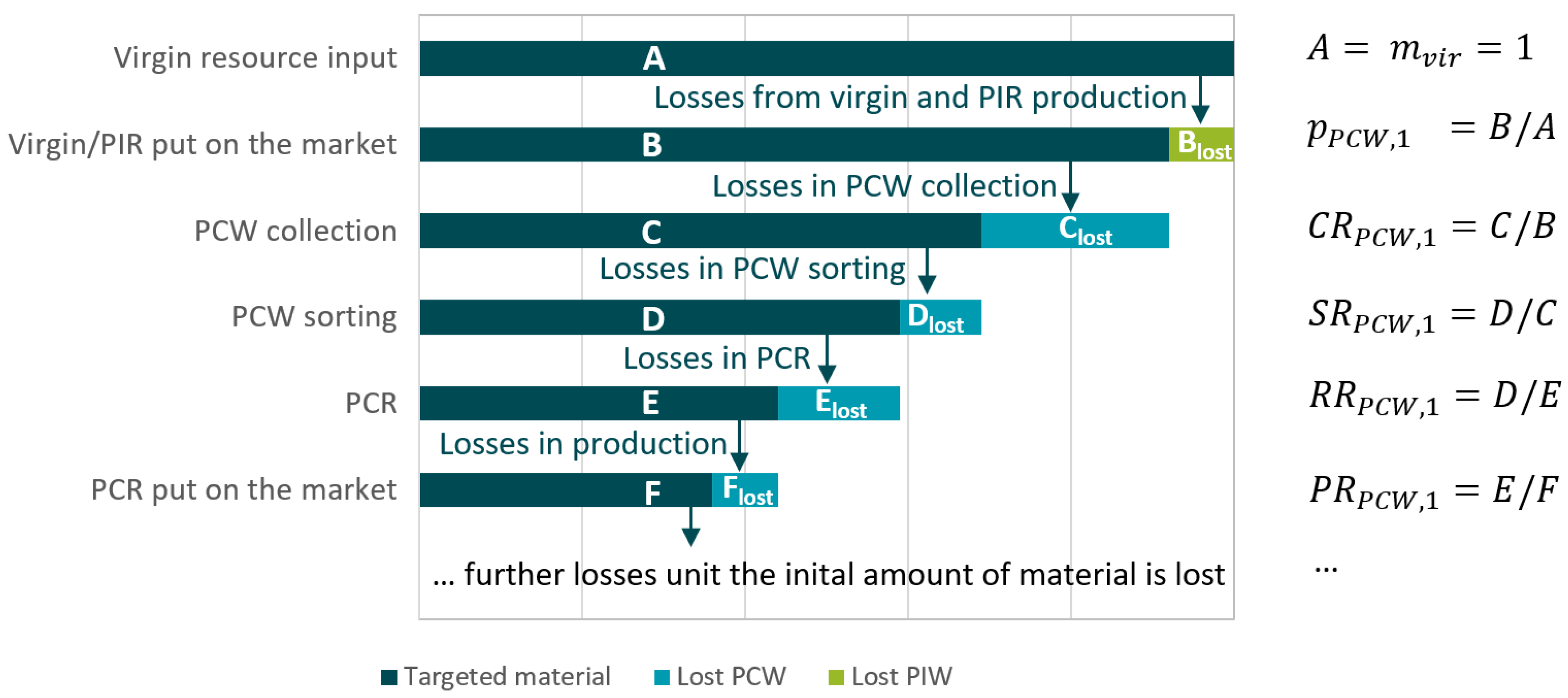
Figure 2.
Entire path of 1 kg of virgin resource input used in multiple product systems until the material is lost including the environmental impacts associated with the material.
Figure 2.
Entire path of 1 kg of virgin resource input used in multiple product systems until the material is lost including the environmental impacts associated with the material.
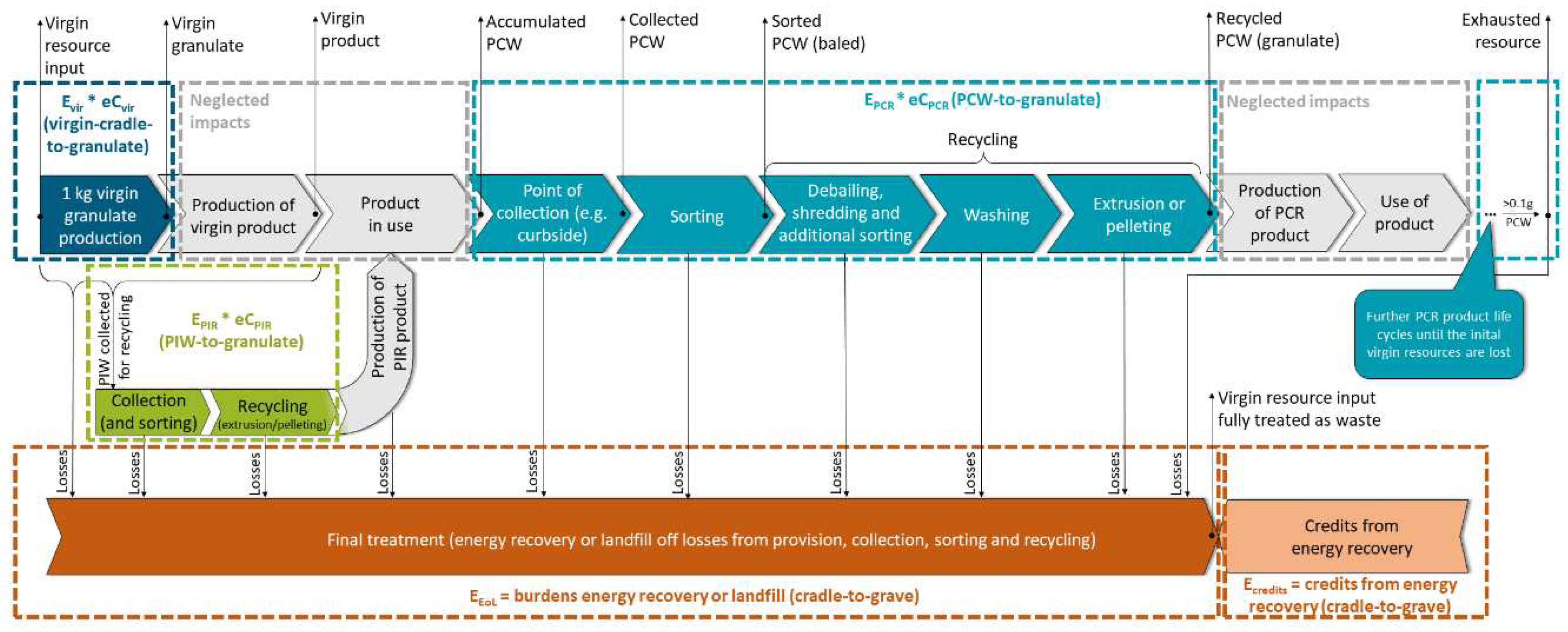
Figure 3.
Schematic example of the IRP of PIR and PCR if PIR granulate causes lower environmental impacts than PCR granulate (EPIR<EPCR) and both have lower impacts than virgin granulate provision (Evir).
Figure 3.
Schematic example of the IRP of PIR and PCR if PIR granulate causes lower environmental impacts than PCR granulate (EPIR<EPCR) and both have lower impacts than virgin granulate provision (Evir).
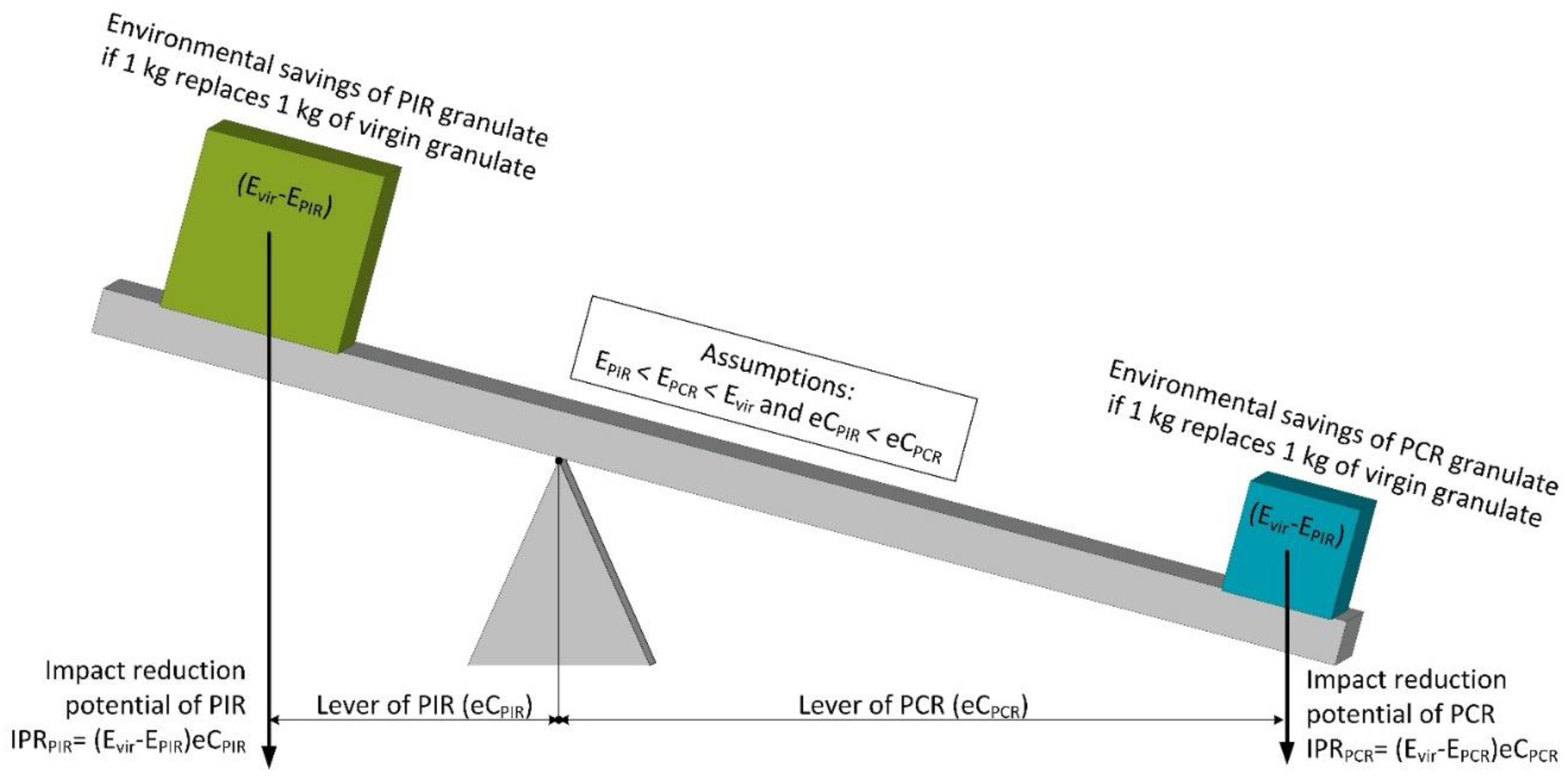
Figure 4.
The eC of PP for the linear and circular scenarios.
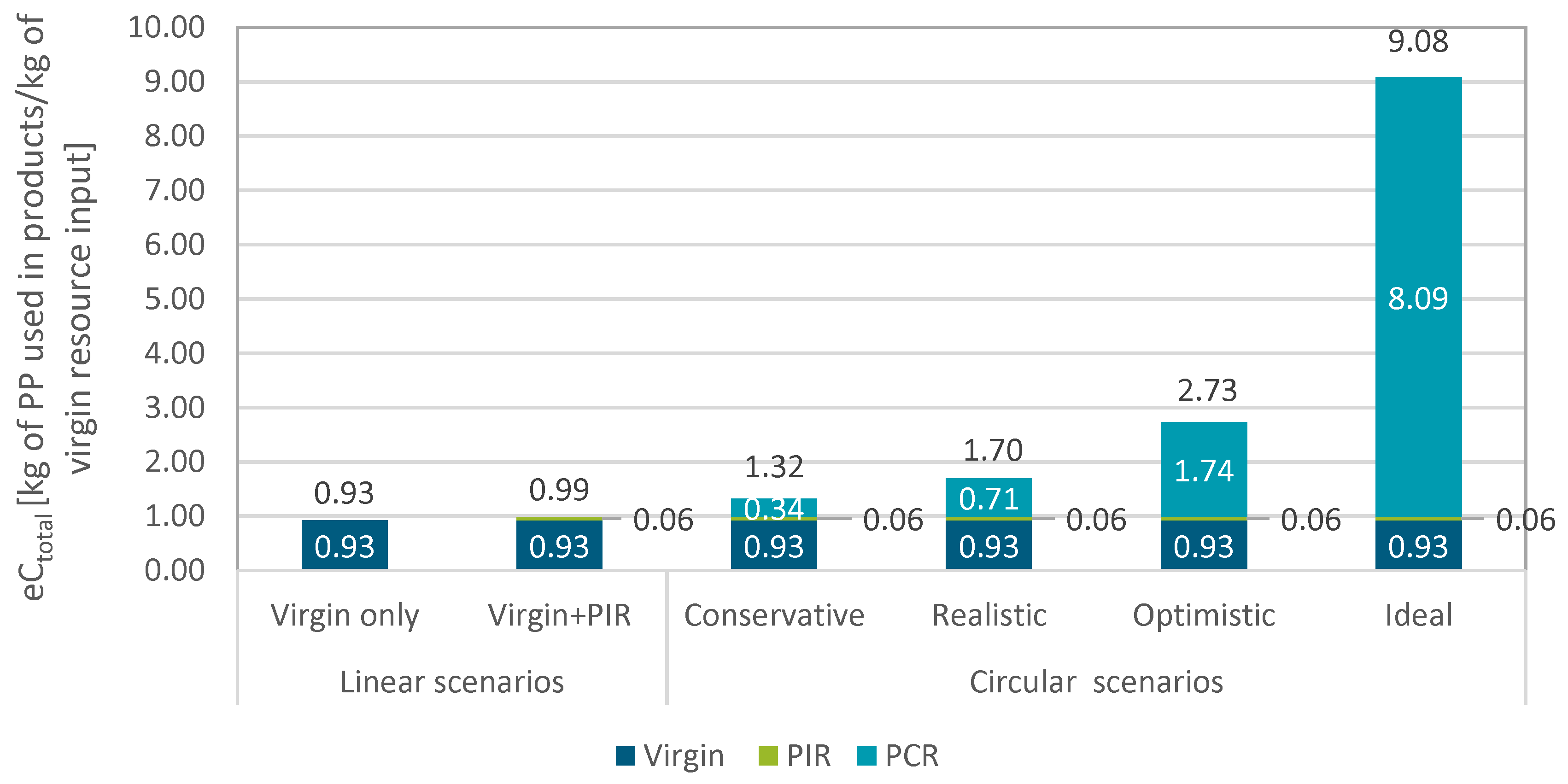
Figure 5.
Sankey diagram of 1 kg of virgin PP input up to 10th use of a material including contributions from virgin (dark blue), PIR (green) and PCR (light blue): (a) Realistic scenario; (b) Ideal scenario.
Figure 5.
Sankey diagram of 1 kg of virgin PP input up to 10th use of a material including contributions from virgin (dark blue), PIR (green) and PCR (light blue): (a) Realistic scenario; (b) Ideal scenario.
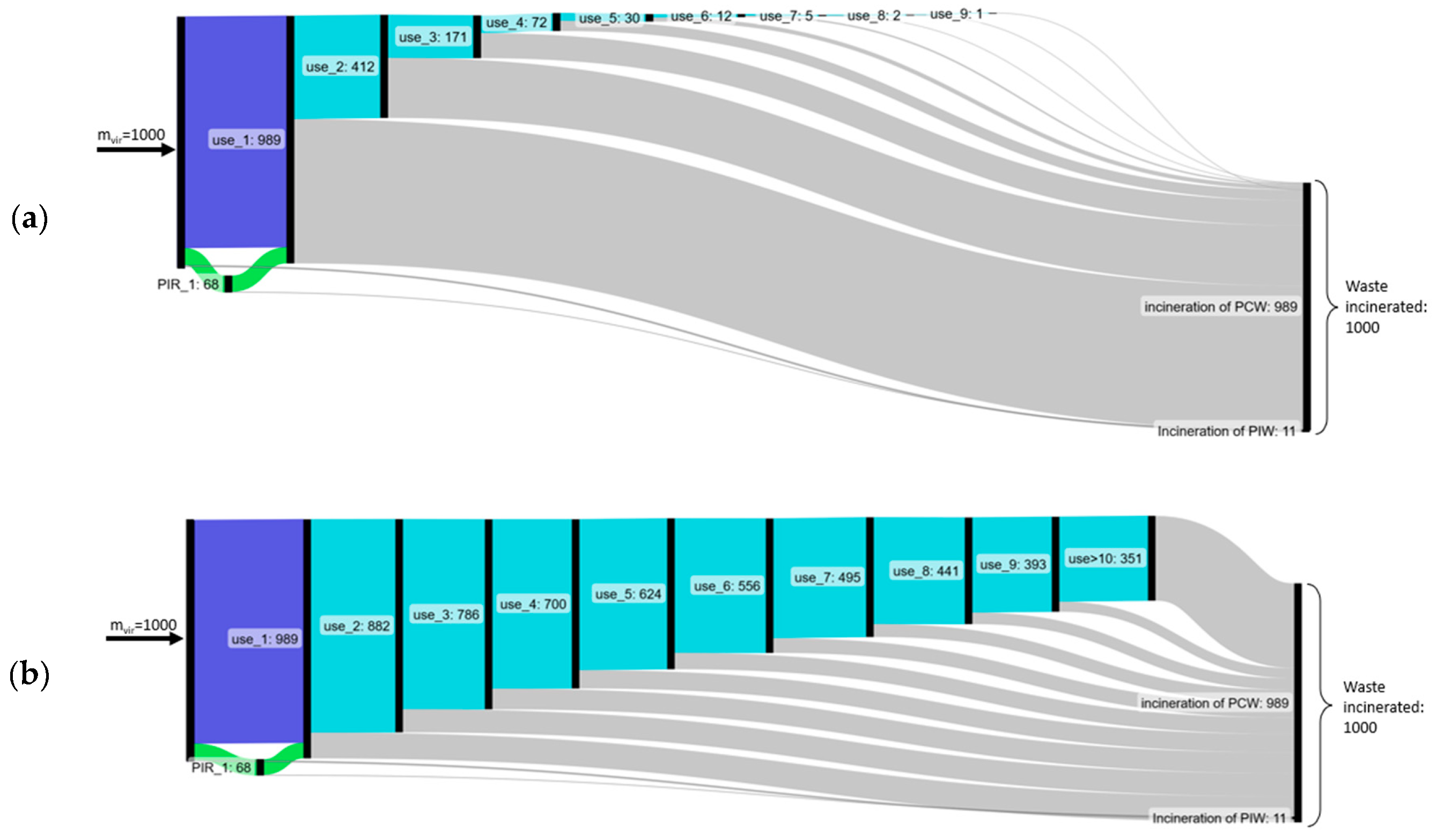
Figure 6.
The eeC calculated for the linear and circular scenarios per CC impact.
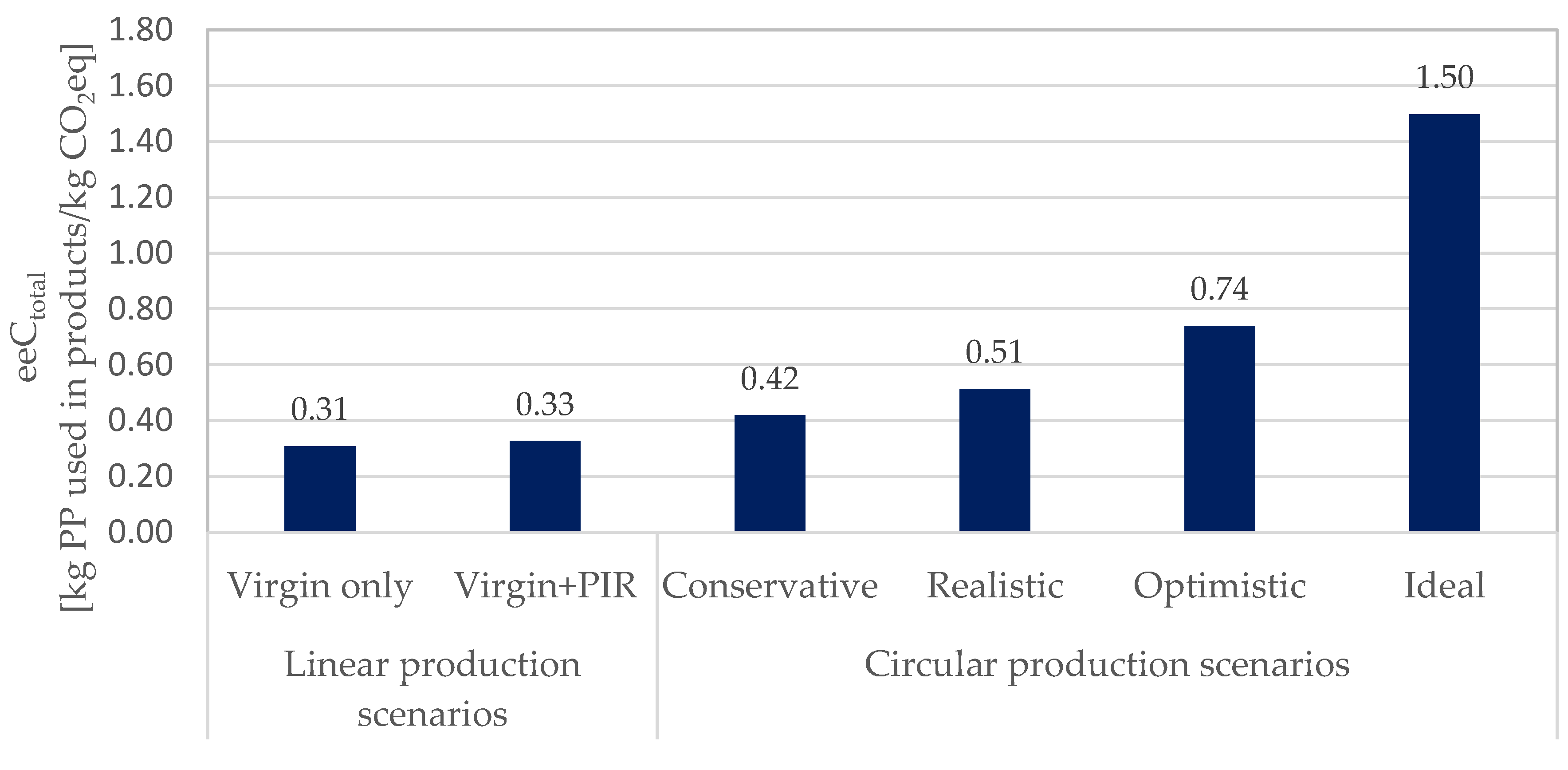
Figure 7.
CC impact per kg of PP from virgin granulate provision (Evir), PIR (EPIR), PCR (EPCR) as well as the aggregated burdens and benefits of incineration and energy recovery of 1 kg PP (EEoL+Ecredits).
Figure 7.
CC impact per kg of PP from virgin granulate provision (Evir), PIR (EPIR), PCR (EPCR) as well as the aggregated burdens and benefits of incineration and energy recovery of 1 kg PP (EEoL+Ecredits).
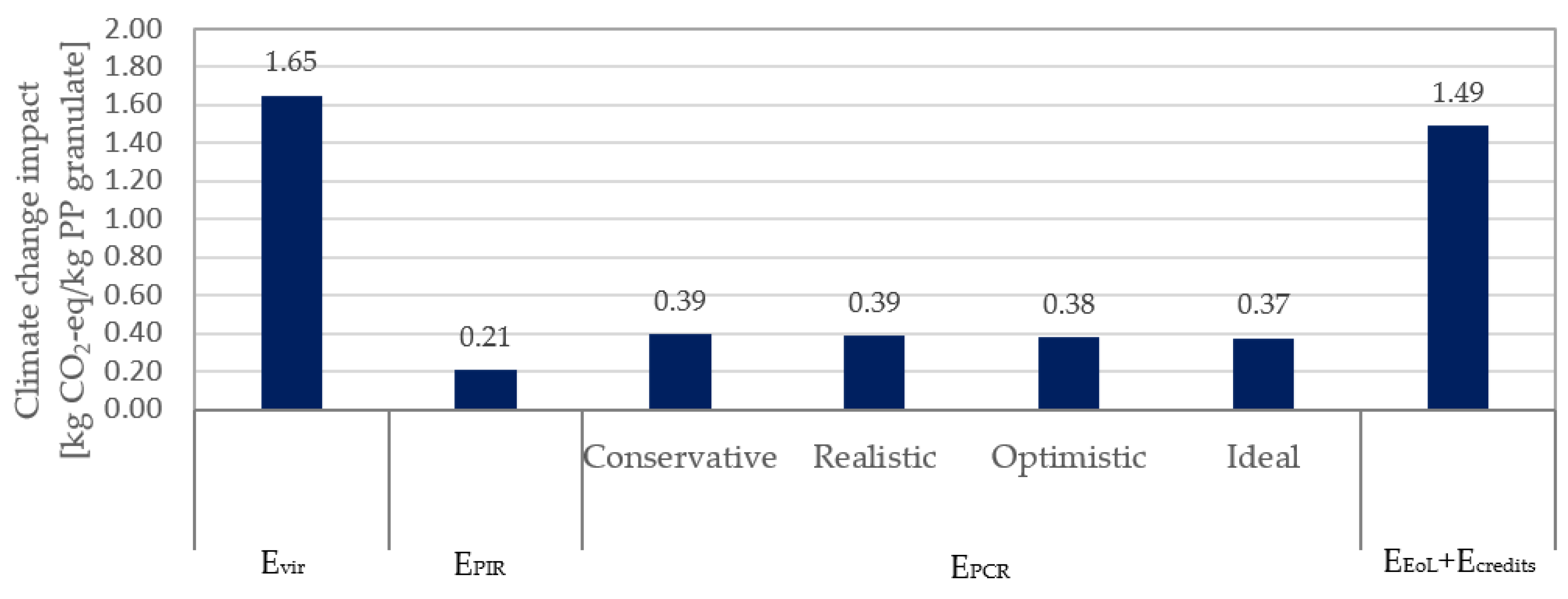
Figure 8.
The IRP of PP PIR compared to PP PCR.
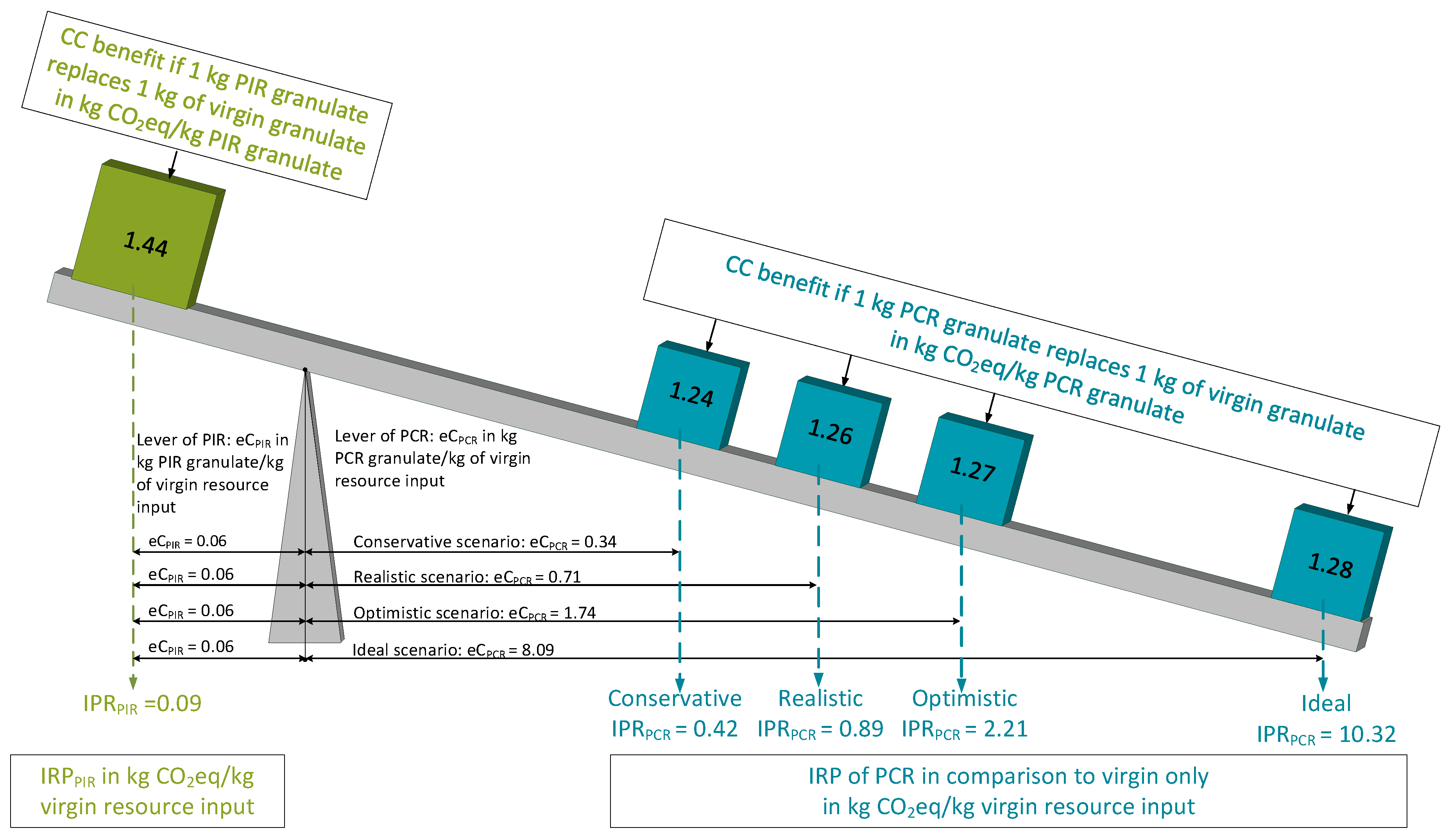

Table 1.
Investigated scenarios and corresponding values to calculate the eC.
| Scenario | pPIW | CRPIW | RRPIW | pPCW,1 | CSRPCW | RRPCW | |
|---|---|---|---|---|---|---|---|
|
Linear scenarios |
Virgin only | 7.6 % b [61] | 0 % | 0 % | 92.4 b % [61] | 0 % | 0 % |
| Virgin + PIR | 7.6 % b [61] | 89.1 % b [61] | 96 %a | 99 %b | 0 % | 0 % | |
|
Circular scenarios |
Conservative | 38.9 %b [61] | 65 %c | ||||
| Realistic | 55.5 %b [49] | 75 %c | |||||
| Optimistic | 75 %c | 85 %c | |||||
| Ideal | 99 %c | 90 %c | |||||
| a: primary data based on PP | |||||||
| b: literature values based on plastics | |||||||
| c: estimation based on different literature values | |||||||
Disclaimer/Publisher’s Note: The statements, opinions and data contained in all publications are solely those of the individual author(s) and contributor(s) and not of MDPI and/or the editor(s). MDPI and/or the editor(s) disclaim responsibility for any injury to people or property resulting from any ideas, methods, instructions or products referred to in the content. |
© 2023 by the authors. Licensee MDPI, Basel, Switzerland. This article is an open access article distributed under the terms and conditions of the Creative Commons Attribution (CC BY) license (http://creativecommons.org/licenses/by/4.0/).
Copyright: This open access article is published under a Creative Commons CC BY 4.0 license, which permit the free download, distribution, and reuse, provided that the author and preprint are cited in any reuse.


