

Submitted:
03 July 2023
Posted:
05 July 2023
You are already at the latest version
Abstract
In recent years, unquestionable warnings like the negative impacts of CO2 emissions, the necessity of utilizing sustainable energy sources, and the rising demand for municipal electrification have been issued. In this study, by incorporating two significant assumptions, such as electricity production in close proximity to the business location and only renewable energy resource usage, a modest off-grid hybrid energy system is designed. To construct the system, a number of elements such as wind generators (WG), photovoltaic arrays (PV), battery banks, and bi-directional converters are taken into account. Moreover, a real case in Malmö, Sweden, is considered. To optimize the system, a bi-objective problem is developed, and it is solved by proposing a particle swarm optimization (PSO) approach to provide the load requirements (with a maximum allowance of 0.1% unmet) for a nearby supermarket (approximately 1000 m2). Moreover, to verify the obtained results, the developed system is simulated using HOMER Pro software, and the results are compared and discussed. The contribution of this study is to provide off-grid or local clients around the world with a dependable and affordable option by minimizing both the baseline cost of energy and the net current expenditure in the desired system. The best-obtained results by the proposed PSO offered 160 PVs, 5 WGs, and 350 batteries, respectively, while the best solution found by the simulation method was using 384 PVs, 5 WGs, and 189 batteries for the considered off-grid system.
Keywords:
Renewable energy
; Photovoltaic arrays
; Wind turbines
; Particle swarm optimization
; real-case problems
1. Introduction
In most nations, the industrial and commercial sectors are the biggest consumers of electricity. The demand to harness renewable energy sources (RES) has increased significantly in the modern era as a result of rising population and urbanization, as well as the ongoing depletion of fossil fuels [1]. Additionally, the negative effects on the environment may be lessened by adopting RES to reduce CO2 emissions [2]. Moreover, the cost of power transmission may be anticipated, particularly for rural and isolated places like islands [3]. To reduce the consumption of fossil fuels, there are many steps that need to be taken. Increasing the flexibility of how electricity is produced, such as through the use of Distributed Generation (DG), Future Intelligent Distribution Grids (FIDG), which UNITED-GRID has estimated for Sweden, the Netherlands, and France for 2035 or 2050 [4], Microgrid development [5], and decentralization, can be important steps in resolving this issue [6]. In the decentralization approach, hybrid systems that combine several power producers and energy sources operate as a single entity [7,8,9].
Different component arrangements, such as solar panels, wind turbines, battery banks, hydrogen storage, etc., have been used for designing hybrid systems, using a variety of modeling techniques ranging from sophisticated metaheuristics to exact solution methods, according to the literature [10,11]. Other cutting-edge approaches have been put forth, including the non-dominated sorting GA (NSGA-II) [12], Tabu Search (TS), Fuzzy Logic (FL), Grey Wolf (GW), etc. A brief summary of some of the published studies in this area is included in Table 1, where FC, HP, ST, Fs, and NPC stand for Fuel cell, Hydropower, Storage, Fuels, and Net Present Cost, and the time unit of the modeling span is based on years.
According to the presented information in Table 1, the PSO method is one of the most practical and successful techniques because it artificially models every day life and the social interactions of animals and birds, in which group activities take place without any group members interacting with one another. PSO is a population-based evolutionary method that performs significantly better than GA in terms of CPU usage and the quantity of necessary parameters [42]. This method is also easier to parallelize, takes fewer time steps, and is more stable than conventional techniques [43,44].
The presented study, which focuses on off-grid technologies and the supply chain for sustainable development, can benefit the local population in a variety of ways, including lower road building costs, improved energy network management, and having electrical power backup. Furthermore, we chose to focus on supermarkets as a case study because of the disappearance of local businesses in towns, the growth of supermarkets in metropolitan areas, and the acceptance of the idea of wholesale grocery providers. Moreover, in this study, a bi-objective problem to supply the hourly required load for a nearby supermarket with a peak load of 115 kW and 2002 kWh per day is considered to provide electricity for off-grid or local clients while minimizing both the baseline cost of energy and the net current cost in the desired system. To solve the problem, first a PSO-based algorithm is utilized. Then, the HOMER Pro application is used to simulate the considered hybrid system, as this application is frequently used in the field of renewable energy systems because of its sophisticated optimization modeling and vast range of variables and targets [45]. Finally, the results obtained from both solution approaches are compared together.
The following is the content of the study: The system configuration and related elements are described in the following section. Section 3 includes the problem definition, which is followed by solution methods. Section 5 contains the obtained findings and discusses the findings results. Finally, the study is concluded in the last section.
2. System Configuration
Configurations of the considered potential hybrid systems are explained in the following.
2.1. Photovoltaic array
Numerous mathematical models have been proposed in the literature for photovoltaic (PV) array power generation. For instance, maximum power tracing efficiency and latitude and longitude parameters were used in Rui Wang et al.'s computations [13]. A linear model based on PV efficiency and solar irradiance was used because of its simplicity to converge, and because it ignored temperature variations in numerical modeling [46,47,48], while other researchers used more complex models that also took temperature impact into account [49,50]. Each solar panel's potential power production at time step t is formulated in equation (1).
where, is the maximum allowable PV power, r is the solar irradiance, is a predetermined set point for radiation (equivalent to 150 ), and is the solar radiation taken into account when the standard environment is 1000 in equation (1). Additionally, a PV panel with the Kyocera KD-145SXUFU model was chosen for generating electricity. To produce approximately one kW of power from every PV array, seven PV panels in each array were assumed to produce the MPP voltage output of every Kyocera panel (). Roof-mounted horizontal plates were utilized despite the fact that tilted PV modules have superior solar ray absorption levels. According to Lindahl's recommendation, the initial expenditure for commercial PV arrays erected on roofs, including converters, can be expected to be around $11.6. [51].
Numerous maintenance and repair tasks should be kept in consideration when estimating operation and maintenance (O&M) costs in order to be more realistic. Among them are Electric Power Research Institute (EPRI) indicated in 2015 that the yearly O&M of solar PV can be approximated at roughly 10.00-45.00 [52]. Prices in this study are given in Swedish kronas (SEK), with 1 US dollar equaling 8.22 SEK and MSEK standing for one million SEK.
2.2. Wind turbine
To calculate power output by each wind turbine at time step t, equation (2) is used [53].
where is the rated power and is the turbine's swept area. The Northern Power NPS 100C-24 wind turbine is 37 meters above the ground, and is the velocity of the wind at that height. The standard value for contemporary wind generators is approximately 0.40, which has been verified using the NPS-100C-24 curve for its power. The rated wind speed was computed as with the cut-in wind speed, , being 3 m/s and the cut-out wind speed, , being 26 m/s.
2.3. Battery bank and convertor
The proposed model of the battery bank's charging and discharging scenarios is generated from the Maleki et al. [46] model by using equations (3) and (4), respectively. The investigation used a Gildemeister 10kW–40kWh CELLCUBE® battery.
where the battery bank's charge and discharge efficiencies, respectively, are and . Both were taken to be 95%. is the quantity of electricity that has been stored at the current time step t, and is the rate of hourly self-discharge. It should be noted that each battery has its own minimum and maximum storage limits. The battery cannot be discharged below a particular threshold; in this study, zero and 40 kWh of electrical energy are used as the lower and upper limits, respectively. It goes without saying that the rated battery capacity cannot be exceeded. As a result, more batteries must be prepared for the system design in order to store a larger amount of electricity. Furthermore, the rectifier and inverter systems were both chosen with equal to 95%.
2.4. Systems architecture
The suggested system is shown in Figure 1, where the battery bank and PV arrays are linked to the DC busbar and converters have connections to the AC and DC busbars in both directions.
3. Problem Definition
In order to arrive at the ideal number of components, such as PV arrays and wind turbines, minimal LCOE and NPC during a 20-year operational lifespan were taken into consideration. Additionally, all refrigerators and freezers that are in operation are thought to always be turned on to prevent food contamination in grocery stores. Therefore, no more than 0.1% of a shortage for upkeep and repair was permitted; as a result, with this setting and only RES, a small amount of will be produced. Equations (5) and (6) are used to determine the LCOE and NPC, respectively.
where, is the annuity factor, is the entire annualized cost, and is the annual energy yield (kWh) in equation (5). Equation (6) is used to determine the NPC in SEK, where is the annual net cost for the designed project, is the initial cost, and p is the interest rate. All the limitations have been listed in Table 2.
In Table 2, denotes the number of PV arrays, each of which has an installed power of 1 kW. The maximum number of PV arrays and batteries is determined in order to keep the project's overall cost from becoming excessively high. Access to a load demand profile is the first set of information needed to execute each optimization and simulation of the hybrid system. Equation (7) can be used to define the hourly electricity consumption indicator (HECI, unit W/m2) in accordance with the non-linear correlation suggested by Noren and Pyrko [54].
where, , and are constant coefficients that were discovered by monthly regression. The temperature daily average in the specified area is shown by in Malmö, in degrees Celsius. Noren and Pyrko [54,55] presumptively included grocery retailers’ gross floor area (GFA) and sales floor area (SFA). Through the analysis of the data, it became clear that SFA consumes a lot more electricity than GFA. The existence of numerous refrigerators in SFA is the primary cause of this discrepancy. Therefore, all the aforementioned equations were programmed in MATLAB software, taking into account a 1000 m2 supermarket that is situated in Malmö. Figure 2 shows the load profile between January and August using the hourly outdoor temperature in 2020 during weekends and working days [56], where the data in this figure are for 1000 m2.
The hybrid system structure is shown in Figure 3. In this figure, it is seen that wind turbines and electric loads are linked to AC busbars, whereas PV panels and batteries are linked to DC busbars. Moreover, a pair of bi-directional converters are used to connect two busbars.
4. Solution Methods
Both solution approaches for the problem presented in this study are scrutinized in the following ways:
4.1. Metaheuristic solution approach
To find the best solution to the proposed NP-hard problem, a metaheuristic solution approach based on the PSO method is developed [57,58]. In general, PSO locates each swarm by first producing a random population. In each iteration, the best answer is kept in its memory while it continues to converge on the optimal solution for changing each person's velocity. Initialization, encoding, parent choice, and position update are crucial PSO processes. The size of the population (PS), factor of constriction in a swarm to bound the speed (CF), maximum iterations (MI), and coefficients for acceleration noted by and are all included in the initialization step.
Evaluations of the starting population and the fitness function are carried out at the encoding step. The method maintains and saves the finest position of every detected particle within iterations and records the best one as the global position during the parent selection stage. All positions in the list are examined, and the velocity factor of this algorithm is changed after each iteration. Two equations from (8) and (9) are used to update the swarms' positions, where the swarm's velocity () and related position () are updated while taking into account the coefficient of control () and acceleration coefficients (and).
where, is the best recorded global position and is the best position at the time step t. In equations (8) and (9), velocity limit coefficient is shown by χ, and and are uniformly generated random values (with 0 and 1 as their endpoints in a closed interval). These parameters are either replaced with new positions in each phase or kept in the best position thus far after comparison to the best global position. When the PSO algorithm completes the MI, it is terminated. Table 3 provides the proposed PSO method's pseudocode.
4.2. Simulation method
In addition to the proposed metaheuristic approach, a simulation method is considered to optimize the proposed hybrid system using HOMER Pro software. It should be noted that HOMER Pro utilized the hourly air temperature data.
The Swedish Meteorological and Hydrological Institute's data bank was used to gather the real sun irradiance, wind speed, and ambient temperature data [56]. Figure 4 displays the monthly average of the horizontal solar radiation for the entire planet. The greatest and minimum daily irradiances are reported for the months of July and December, respectively, and the average annual global irradiance is 2.73.
The average annual wind speed at Malmö, where the value is 4.88 (m/s), is shown in Figure 5.
The average daily temperature for each month is shown in Figure 6 in a fluid fashion, with an annual average temperature of 7.37 (˚C).
5. Results and Discussions
With no annual shortage and considering separate operational reserves, the proposed system is going to be operated for a period of 20 years.
5.1. Results of PSO method
The PSO method was programmed in MATLAB (R2017b) software using a laptop with an Intel(R) Core(TM) i5-4200U CPU running at 2.30 GHz and 4.0 GB of RAM. Table 4 displays the defined parameters' starting values.
The number of particles represents the number of search agents. Table 5 lists the optimal outcomes from the generated PSO modeling. In this table, the unit of PV and converter is kW, the unit of WG and Batteries is number, the LCOE is measured in kr/kWh, and finally the unit of NPC is Mkr.
According to the results presented in Table 5, it is seen that the best solution found by the PSO method is having 160 kW PV arrays, 5 wind turbines, 350 batteries, and 199 kW converters, with a LCOE of around 3.9 and less than 39 million Kronas as NPC.
5.2. Results of simulation method
In the next step, to solve the problem with the simulation method, the HOMER application was used, and the best configuration for the hybrid system was made up as shown in Table 6, where the explanations for each column are similar to what has been mentioned for Table 5.
The results in Table 6 show that in the best solution, 384 kW of PV arrays, 5 wind turbines, 189 batteries, and 199 kW of converters are needed, resulting in a LCOE of around 3.1 and A NPC of a bit less than 31 million Kronas.
The findings are remarkably comparable to one another; as it was expected to find dissimilarities between them, anticipating equal outcomes was unrealistic. In terms of convergence to equivalent optimal values, it is obvious that the coded metaheuristic method and the simulation approach are compatible. The selection of several alternatives in optimization considerations can be another cause of discrepancies in results. The low solar irradiation during six months of the year (in Sweden) was taken into account during the optimization with PSO. As a result, employing batteries rather than adding more PV panels was the main focus. In addition, the hybrid system's design needed solar panels to take advantage of the sun's energy, particularly during the summer. The supermarket was seen as entirely self-sufficient, even in periods of limited sunshine.
According to what is presented in Table 5 and Table 6 for the batteries, 350 batteries equal 14 MWh, while 189 batteries equal 7.6 MWh of storage. The average annual load is 850 MWh, or 2.3 MWh/day; therefore, the smaller battery storage can cover the load for about 3 days, while the larger one can do so for 6 days. Both of these sizes seem appropriate for an off-grid system with significant unmet load demand.
The PSO model also took into account the space limitations for solar panel installation (placement on the supermarket's roof). While the space limitations were not taken into consideration when designing the technology in HOMER Pro, As a result, it is clear from the data analysis and comparison of the two planned models that the project with PSO has higher expenses because it requires more batteries.
Of course, it is conceivable and desirable to feed the extra electricity back into the grid, which will bring in more money. Profitability won't significantly increase because the estimated price per kWh for sold electricity is now only between 0.3 and 0.5 SEK. It is obvious that the unique state of being totally self-sufficient in energy supply, which has evident advertising values, would most likely be the key benefit for the shop under study. As the changes in renewable energy sources are handled, the system will have more flexibility. The system might be even better supported, encouraging a higher share of renewables, if the storage is allowed to integrate with the grid even more by charging from electricity purchased at low prices.
6. Conclusions
Both in emerging and wealthy nations, decentralized local electrification by utilizing renewable energy sources has the potential to revolutionize green energy solutions. The decentralized electrical supply for a small supermarket with a 20-year lifespan was the focus of this study, taking into account a real-world situation in Malmö, a city in southern Sweden. To solve the considered problem, two approaches—metaheuristic and simulation methods—were utilized.
The best solution found by the proposed PSO algorithm offered 160 PV arrays, 5 wind turbines, 350 batteries, and 199 bi-directional system converters. However, using HOMER Pro to simulate the hybrid system, the suggested off-grid system was made up of 384 PV arrays, 5 wind turbines, 189 batteries, and 199 converters. It should be noted that in this investigation, a shortfall of no more than 0.1% at peak load was permitted. It will be simple to manage and deal with the continued shortage because the store may have a few non-critical loads. However, for the supermarket under study, it is reasonable to keep connected to the grid, so the shortfall won't be a problem. The grid can also receive significant help regarding grid connectivity. From the supermarket's perspective, it is obvious that the system is not immediately lucrative, but it will have high promotional values.
To go deeper in this area, salvage price evaluation might make the consulting project more practical for future research. Furthermore, tilting PV panels that have been carefully tuned are preferable to horizontal ones. It is advised that any excess electricity be either used in another operation, sold to the grid, or stored in hydrogen tanks. Therefore, the stored energy can be used again when more energy (whether electricity or heat via fuel cells) is required, especially during the winter when the solar irradiation is insufficient.
Author Contributions
Conceptualization, Ghadirinejad. N. and Ottermo. F.; methodology, Ghadirinejad. N., Ottermo. F.; software, Ghadirinejad. N. and Nejad. M.G.; validation, Nowzari. R.; formal analysis, Alsaadi. N. and Nejad. M.G.; investigation, Nowzari. R. and Alsaadi. N.; resources, Alsaadi. N.; data curation, Ghadirinejad. N. and Nowzari. R.; writing—original draft preparation Ghadirinejad. N. and Nejad. M.G.; writing—review and editing, Nowzari. R. and Alsaadi. N.; visualization, Nowzari. R.; supervision, Ottermo. F.; project administration, Alsaadi. N. and Nejad. M.G.
Funding
This research received no external funding.
Data Availability Statement
Data is available according to requests.
Nomenclature
| DG | Distributed Generation | initial cost | |
| EA | Evolutionary Algorithm | turbine's swept area | |
| EPRI | Electric Power Research Institute | & | constant coefficients |
| FABC | Fuzzy Artificial Bee Colony | entire annualized cost | |
| FIDG | Future Intelligent Distribution Grids | annual net cost | |
| GA | Genetic Algorithm | contemporary wind turbines | |
| GFA | Gross Floor Area | annual energy yield | |
| GW | Grey Wolf | stored electricity at time step t | |
| HOMER | Hybrid Optimization Model for Electric Renewables | number of PV arrays | |
| INTLP | Interval LP | p | interest rate |
| kW | Kilo Watt | best position at time step t | |
| LP | Linear Programming | maximum allowable PV power | |
| MI | Maximum Iterations | rated power | |
| MPP | Maximum Power Point | r | solar radiation |
| MSEK | Million SEK | & | uniform random values |
| NPC | Net Present Cost | predetermined radiation set point | |
| NSGAII | Non-Dominated Sorting GA | standard solar radiation | |
| O&M | Operation and Maintenance | t | time step |
| PS | Population Size | Average Daily Temperature | |
| PSA | Parallel Stochastic Annealing | velocity of swarm i | |
| PSO | Particle Swarm Optimization | velocity of the wind | |
| PV | Photovoltaic | best global position | |
| RES | Renewable Energy Sources | position of swarm i | |
| SA | Simulated Annealing | rate of hourly self-discharge | |
| SEK | Swedish Kronas | battery bank's charge efficiency | |
| SFA | Sales Floor Area | battery bank's discharge efficiency | |
| SOC | State of Charge | Χ | velocity limit coefficient |
| TS | Tabu Search | control coefficient | |
| WG | Wind Generator |
References
- Wang, X.; Ha, B.; Lee, G.Y.; Kim, H.; Yu, J.; Rhee, H.; ...; Ahn, S.H. Low-cost far-field wireless electrical load monitoring system applied in an off-grid rural area of Tanzania. Sustainable Cities and Society 2020, 59, 102209. [CrossRef]
- Watkins, P.; McKendry, P. Assessment of waste derived gases as a renewable energy source–Part 1. Sustainable Energy Technologies and Assessments 2015, 10, 102–113. [Google Scholar] [CrossRef]
- Saxena, A.; Shankar, R. Improved load frequency control considering dynamic demand regulated power system integrating renewable sources and hybrid energy storage system. Sustainable Energy Technologies and Assessments 2022, 52, 102245. [Google Scholar]
- Rise, A.; Tran, T.; Damaj, M.; Cea, M.G.; Rossi, J.; Srivastava, A.; Steen, D. Deliverable 2. 2 Scenario descriptions for active distribution grid developments. 2019.
- Borbely, A.M.; Kreider, J.F. Distributed generation: The power paradigm for the new millennium. CRC press. 2001.
- Ghaem Sigarchian, S. Small-Scale Decentralized Energy Systems: Optimization and performance analysis (Doctoral dissertation, KTH Royal Institute of Technology). 2018.
- Arul, P.G.; Ramachandaramurthy, V.K. Mitigating techniques for the operational challenges of a standalone hybrid system integrating renewable energy sources. Sustainable Energy Technologies and Assessments 2017, 22, 18–24. [Google Scholar] [CrossRef]
- Gbadamosi, S.L.; Nwulu, N.I. A multi-period composite generation and transmission expansion planning model incorporating renewable energy sources and demand response. Sustainable Energy Technologies and Assessments 2020, 39, 100726. [Google Scholar] [CrossRef]
- Kristiansen, A.B.; Satola, D.; Lee, K.; Zhao, B.; Ma, T.; Wang, R.Z.; ... & Novakovic, V. Feasibility study of an off-grid container unit for industrial construction. Sustainable Cities and Society 2020, 61, 102335.
- Kumar, R. Fuzzy particle swarm optimization control algorithm implementation in photovoltaic integrated shunt active power filter for power quality improvement using hardware-in-the-loop. Sustainable Energy Technologies and Assessments 2022, 50, 101820. [Google Scholar] [CrossRef]
- Nuvvula, R.S.; Devaraj, E.; Elavarasan, R.M.; Taheri, S.I.; Irfan, M.; Teegala, K.S. Multi-objective mutation-enabled adaptive local attractor quantum behaved particle swarm optimisation based optimal sizing of hybrid renewable energy system for smart cities in India. Sustainable Energy Technologies and Assessments 2022, 49, 101689. [Google Scholar] [CrossRef]
- Bahlouli, K.; Lotfi, N.; Ghadiri Nejad, M. A New Multi-Heuristic Method to Optimize the Ammonia–Water Power/Cooling Cycle Combined with an HCCI Engine. Sustainability 2023, 15, 6545. [Google Scholar] [CrossRef]
- Wang, R.; Li, G.; Ming, M.; Wu, G.; Wang, L. An efficient multi-objective model and algorithm for sizing a stand-alone hybrid renewable energy system. Energy 2017, 141, 2288–2299. [Google Scholar] [CrossRef]
- Maleki, A.; Khajeh, M.G.; Rosen, M.A. Two heuristic approaches for the optimization of grid-connected hybrid solar–hydrogen systems to supply residential thermal and electrical loads. Sustainable cities and society 2017, 34, 278–292. [Google Scholar] [CrossRef]
- Maleki, A.; Rosen, M.A. Design of a cost-effective on-grid hybrid wind–hydrogen based CHP system using a modified heuristic approach. International Journal of Hydrogen Energy 2017, 42, 15973–15989. [Google Scholar] [CrossRef]
- Fadaee, M.; Radzi, M.A. M. Multi-objective optimization of a stand-alone hybrid renewable energy system by using evolutionary algorithms: A review. Renewable and sustainable energy reviews 2012, 16, 3364–3369. [Google Scholar] [CrossRef]
- Isa, N.M.; Das, H.S.; Tan, C.W.; Yatim, A.H. M.; Lau, K.Y. A techno-economic assessment of a combined heat and power photovoltaic/fuel cell/battery energy system in Malaysia hospital. Energy 2016, 112, 75–90. [Google Scholar] [CrossRef]
- Diaf, S.; Diaf, D.; Belhamel, M.; Haddadi, M.; Louche, A. A methodology for optimal sizing of autonomous hybrid PV/wind system. Energy policy 2007, 35, 5708–5718. [Google Scholar] [CrossRef]
- Trivedi, M. Multi-objective generation scheduling with hybrid energy resources. Clemson University. 2007.
- Elliston, B.; Macgill, I.; Diesendorf, M. Least cost 100% renewable electricity scenarios in the Australian National Electricity Market. Energy Policy 2013, 59, 270–282. [Google Scholar]
- Ugirimbabazi, O. Analysis of power system options for rural electrification in Rwanda (Master's thesis, Universitetet i Agder; University of Agder). 2015.
- Eke, R.; Kara, O.; Ulgen, K.O.R. A. Y. Optimization of a wind/PV hybrid power generation system. International Journal of Green Energy 2005, 2, 57–63. [Google Scholar] [CrossRef]
- Giannakoudis, G.; Papadopoulos, A.I.; Seferlis, P.; Voutetakis, S. Optimum design and operation under uncertainty of power systems using renewable energy sources and hydrogen storage. International journal of hydrogen energy 2010, 35, 872–891. [Google Scholar] [CrossRef]
- Akella, A.K.; Sharma, M.P.; Saini, R.P. Optimum utilization of renewable energy sources in a remote area. Renewable and Sustainable Energy Reviews 2007, 11, 894–908. [Google Scholar] [CrossRef]
- Dagdougui, H.; Ouammi, A.; Sacile, R. Modelling and control of hydrogen and energy flows in a network of green hydrogen refuelling stations powered by mixed renewable energy systems. International journal of hydrogen energy 2012, 37, 5360–5371. [Google Scholar] [CrossRef]
- Kaviani, A.K.; Riahy, G.H.; Kouhsari, S.M. Optimal design of a reliable hydrogen-based stand-alone wind/PV generating system, considering component outages. Renewable energy 2009, 34, 2380–2390. [Google Scholar] [CrossRef]
- Lagorse, J.; Simoes, M.G.; Miraoui, A.; Costerg, P. Energy cost analysis of a solar-hydrogen hybrid energy system for stand-alone applications. International journal of hydrogen energy 2008, 33, 2871–2879. [Google Scholar] [CrossRef]
- Ekren, O.; Ekren, B.Y. Size optimization of a PV/wind hybrid energy conversion system with battery storage using simulated annealing. Applied energy 2010, 87, 592–598. [Google Scholar] [CrossRef]
- Garcia, R.S.; Weisser, D. A wind–diesel system with hydrogen storage: Joint optimisation of design and dispatch. Renewable energy 2006, 31, 2296–2320. [Google Scholar] [CrossRef]
- Iniyan, S.; Suganthi, L.; Samuel, A.A. Energy models for commercial energy prediction and substitution of renewable energy sources. Energy Policy 2006, 34, 2640–2653. [Google Scholar] [CrossRef]
- Razak, J.A.; Sopian, K.; Ali, Y. Optimization of renewable energy hybrid system by minimizing excess capacity. International Journal of Energy 2007, 1, 77–81. [Google Scholar]
- Katsigiannis, Y.A.; Georgilakis, P.S. Optimal sizing of small isolated hybrid power systems using tabu search. Journal of Optoelectronics and Advanced Materials 2008, 10, 1241. [Google Scholar]
- Budischak, C.; Sewell, D.; Thomson, H.; Mach, L.; Veron, D.E.; Kempton, W. Cost-minimized combinations of wind power, solar power and electrochemical storage, powering the grid up to 99.9% of the time. journal of power sources 2013, 225, 60–74. [Google Scholar] [CrossRef]
- Lorestani, A.; Ardehali, M.M. Optimization of autonomous combined heat and power system including PVT, WT, storages, and electric heat utilizing novel evolutionary particle swarm optimization algorithm. Renewable Energy 2018, 119, 490–503. [Google Scholar] [CrossRef]
- Abedi, S.; Alimardani, A.; Gharehpetian, G.B.; Riahy, G.H.; Hosseinian, S.H. A comprehensive method for optimal power management and design of hybrid RES-based autonomous energy systems. Renewable and Sustainable Energy Reviews 2012, 16, 1577–1587. [Google Scholar] [CrossRef]
- Bernal-Agustín, J.L.; Dufo-López, R. Efficient design of hybrid renewable energy systems using evolutionary algorithms. Energy Conversion and management 2009, 50, 479–489. [Google Scholar] [CrossRef]
- Ahmarinezhad, A.; Tehranifard, A.A.; Ehsan, M.; Firuzabad, M.F. Optimal sizing of a stand alone hybrid system for Ardabil area of Iran. Technical and Physical Problems of Engineering 2012, 4, 118–125. [Google Scholar]
- Mohammadi, M.; Ghasempour, R.; Astaraei, F.R.; Ahmadi, E.; Aligholian, A.; Toopshekan, A. Optimal planning of renewable energy resource for a residential house considering economic and reliability criteria. International Journal of Electrical Power & Energy Systems 2018, 96, 261–273. [Google Scholar]
- Yuan, J.; Xu, J.; Wang, Y. (2018, March). Techno-economic study of a distributed hybrid renewable energy system supplying electrical power and heat for a rural house in China. In IOP Conference Series: Earth and Environmental Science (Vol. 127, No. 1, p. 012001). IOP Publishing.
- Wang, R. Multi-objective configuration optimization method for a diesel-based hybrid energy system. Energy Reports 2020, 6, 2146–2152. [Google Scholar] [CrossRef]
- Vatankhah Barenji, R.; Ghadiri Nejad, M.; Asghari, I. Optimally sized design of a wind/photovoltaic/fuel cell off-grid hybrid energy system by modified-gray wolf optimization algorithm. Energy & Environment 2018, 29, 1053–1070. [Google Scholar]
- Mozafar, M.R.; Moradi, M.H.; Amini, M.H. A simultaneous approach for optimal allocation of renewable energy sources and electric vehicle charging stations in smart grids based on improved GA-PSO algorithm. Sustainable cities and society 2017, 32, 627–637. [Google Scholar] [CrossRef]
- Bendu, H.; Deepak, B.B. V. L.; Murugan, S. Multi-objective optimization of ethanol fuelled HCCI engine performance using hybrid GRNN–PSO. Applied Energy 2017, 187, 601–611. [Google Scholar] [CrossRef]
- Zhang, Q.; Ogren, R.M.; Kong, S.C. A comparative study of biodiesel engine performance optimization using enhanced hybrid PSO–GA and basic GA. Applied energy 2016, 165, 676–684. [Google Scholar] [CrossRef]
- Hsu, C.C.; Zhang, Y.; Ch, P.; Aqdas, R.; Chupradit, S.; Nawaz, A. A step towards sustainable environment in China: The role of eco-innovation renewable energy and environmental taxes. Journal of Environmental Management 2021, 299, 113609. [Google Scholar] [CrossRef]
- Maleki, A.; Ameri, M.; Keynia, F. Scrutiny of multifarious particle swarm optimization for finding the optimal size of a PV/wind/battery hybrid system. Renewable Energy 2015, 80, 552–563. [Google Scholar] [CrossRef]
- Twaha, S.; Ramli, M.A. A review of optimization approaches for hybrid distributed energy generation systems: Off-grid and grid-connected systems. Sustainable Cities and Society 2018, 41, 320–331. [Google Scholar] [CrossRef]
- Duman, A.C.; Güler, Ö. Techno-economic analysis of off-grid PV/wind/fuel cell hybrid system combinations with a comparison of regularly and seasonally occupied households. Sustainable Cities and Society 2018, 42, 107–126. [Google Scholar] [CrossRef]
- Koutroulis, E.; Kolokotsa, D. Design optimization of desalination systems power-supplied by PV and W/G energy sources. Desalination 2010, 258, 171–181. [Google Scholar] [CrossRef]
- Grande, L.S. A.; Yahyaoui, I.; Gómez, S.A. Energetic, economic and environmental viability of off-grid PV-BESS for charging electric vehicles: Case study of Spain. Sustainable cities and society 2018, 37, 519–529. [Google Scholar] [CrossRef]
- Lindahl, J. National survey report of PV power applications in Sweden. Uppsala University and International Energy Agency: Uppsala, Sweden, 2014, 9.
- Castillo-Calzadilla, T.; Macarulla, A.M.; Kamara-Esteban, O.; Borges, C.E. Analysis and assessment of an off-grid services building through the usage of a DC photovoltaic microgrid. Sustainable cities and society 2018, 38, 405–419. [Google Scholar] [CrossRef]
- Sharafi, M.; ELMekkawy, T.Y. Multi-objective optimal design of hybrid renewable energy systems using PSO-simulation based approach. Renewable energy 2014, 68, 67–79. [Google Scholar] [CrossRef]
- Norén, C.; Pyrko, J. An analysis of electricity consumption and load de-mand in Swedish grocery stores. ECEEE Summer Study 1999.
- Nguyen, T.T. C.; Tran, Q.B.; Nguyen, T.M. P.; Tran, D.L.; Nguyen, A.T.; Dang, Q.T. The effects of risks in agricultural supply chain management on business performance: A case study in Vietnam. AgBioForum 2019, 21, 23–34. [Google Scholar]
- Observations of hourly air temperature, Malmö A (55.5714;13.0734). 2010. Available online: https://www.smhi.se/klimatdata.
- Yang, J.; He, L.; Fu, S. An improved PSO-based charging strategy of electric vehicles in electrical distribution grid. Applied Energy 2014, 128, 82–92. [Google Scholar] [CrossRef]
- Delgarm, N.; Sajadi, B.; Kowsary, F.; Delgarm, S. Multi-objective optimization of the building energy performance: A simulation-based approach by means of particle swarm optimization (PSO). Applied energy 2016, 170, 293–303. [Google Scholar] [CrossRef]
Figure 1.
The hybrid system arrangement.
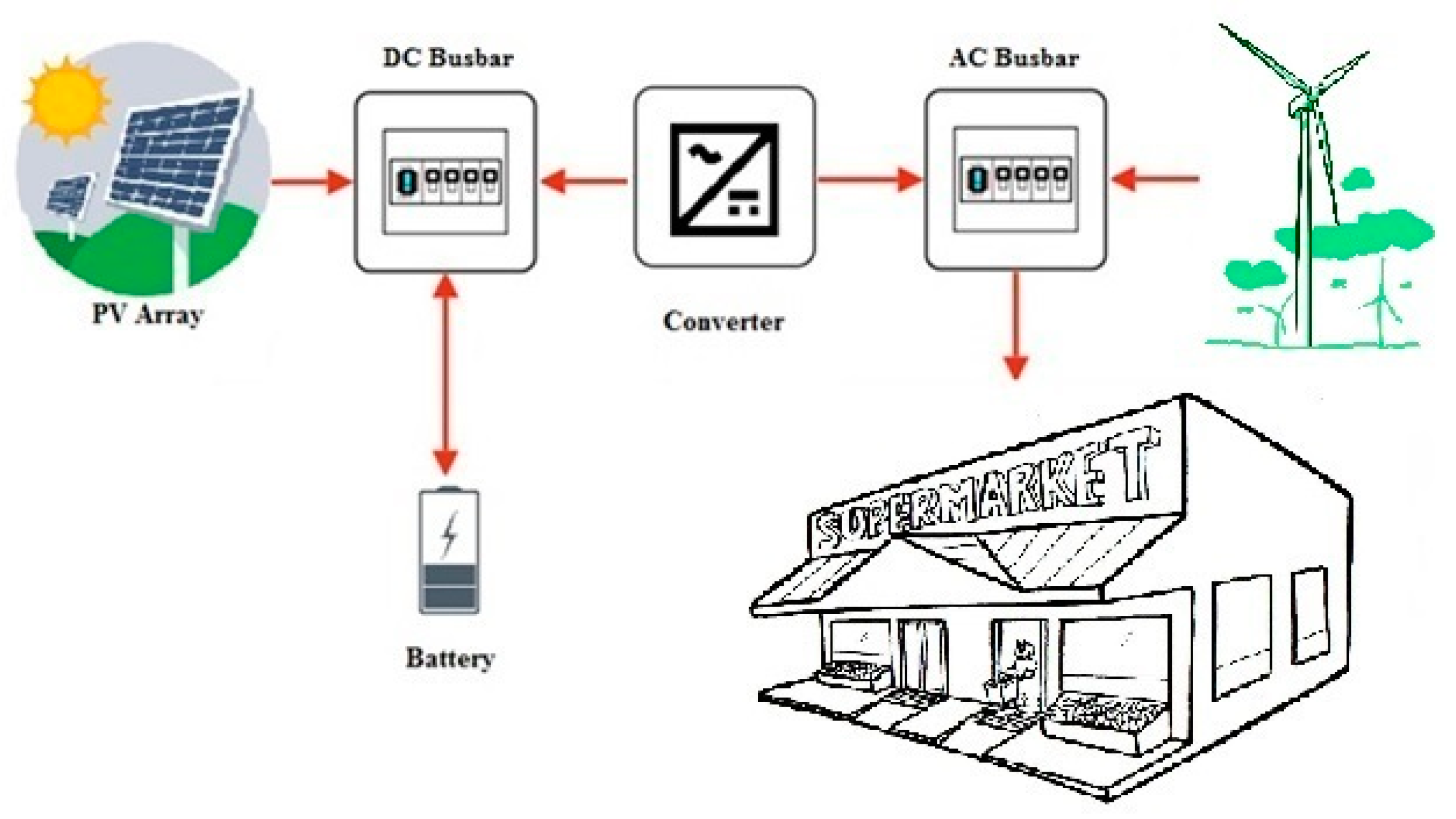
Figure 2.
Electricity consumption profile for the prototype supermarket located in Malmö.
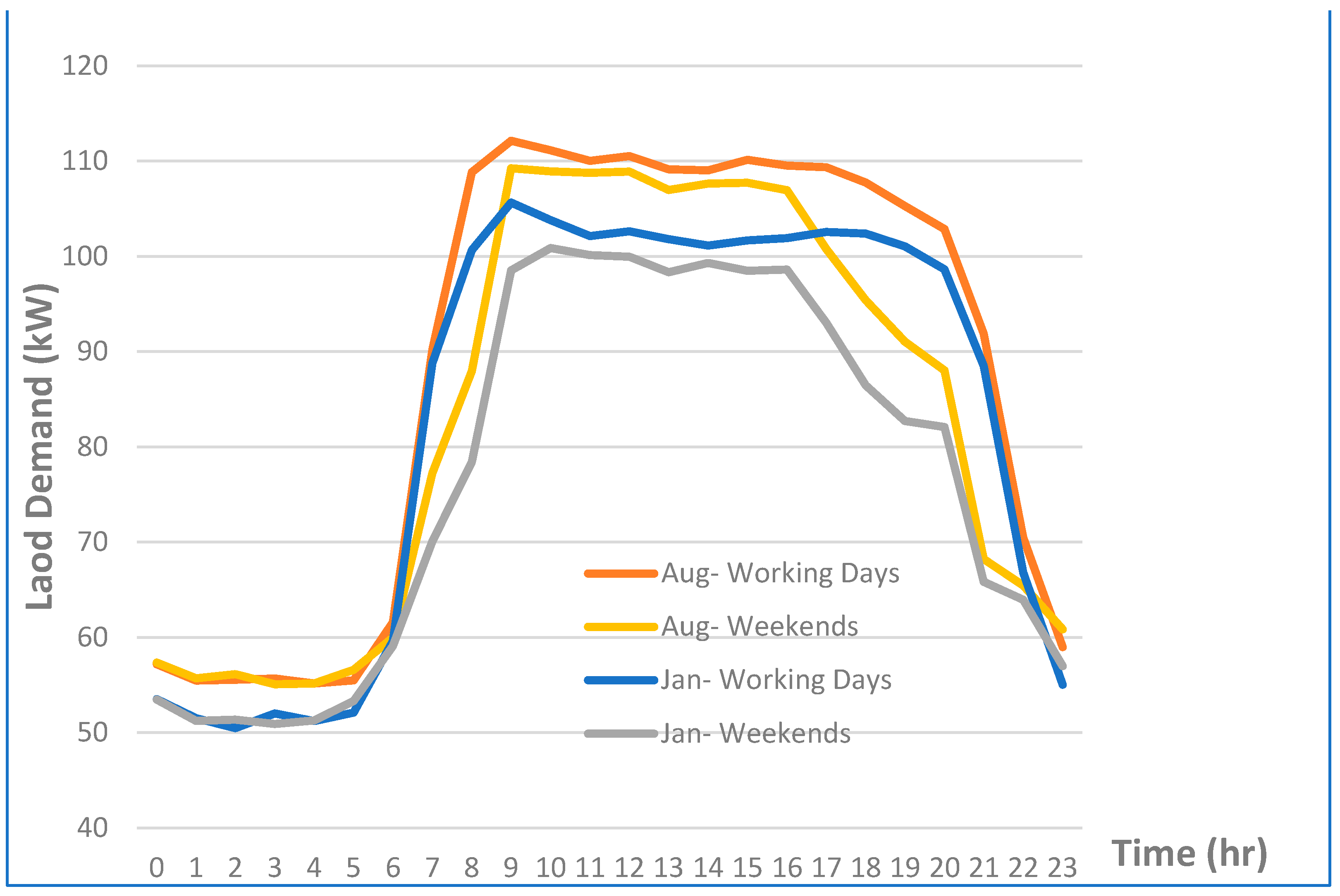
Figure 3.
The designed system.
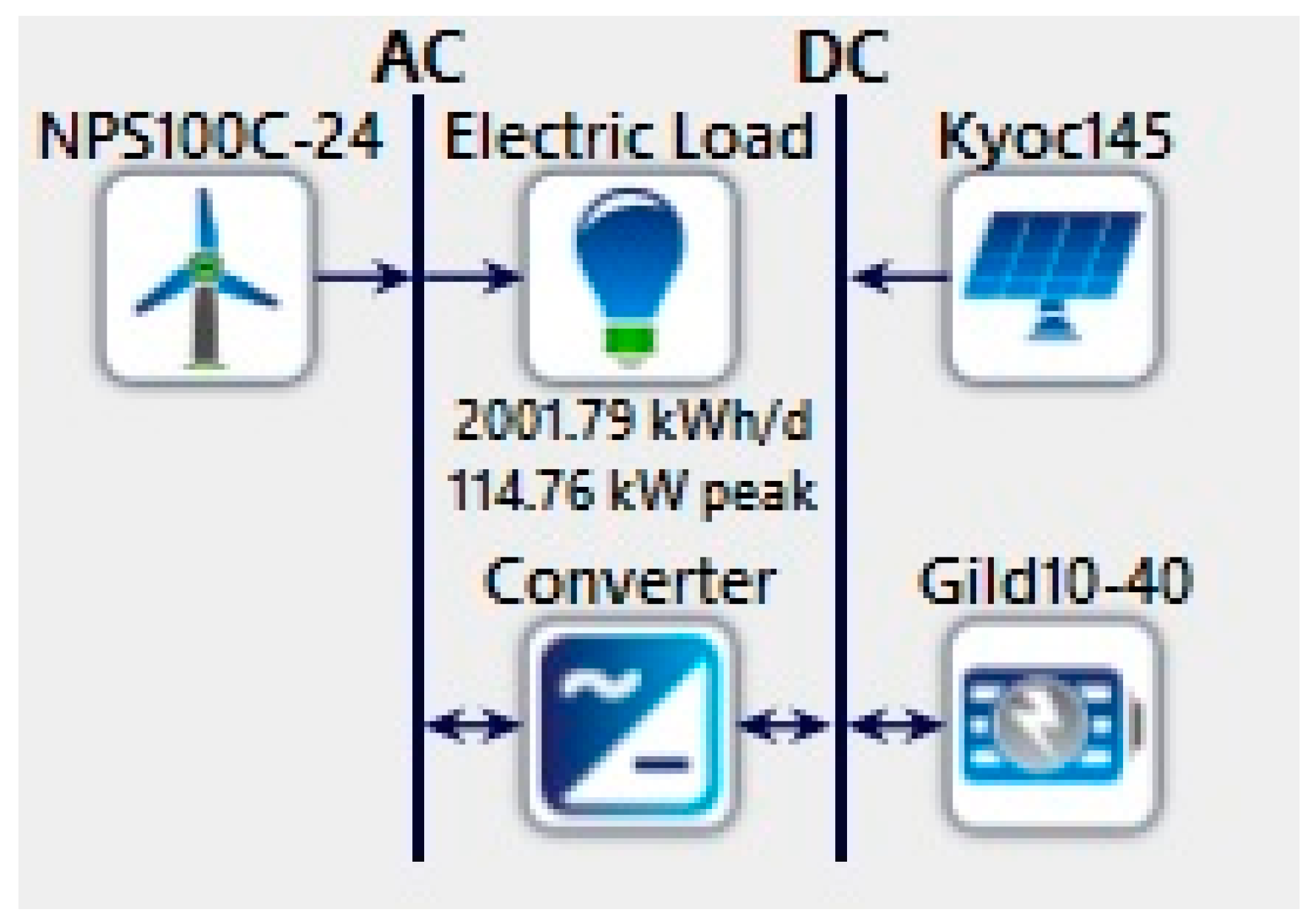
Figure 4.
Average of solar horizontal irradiance per month.
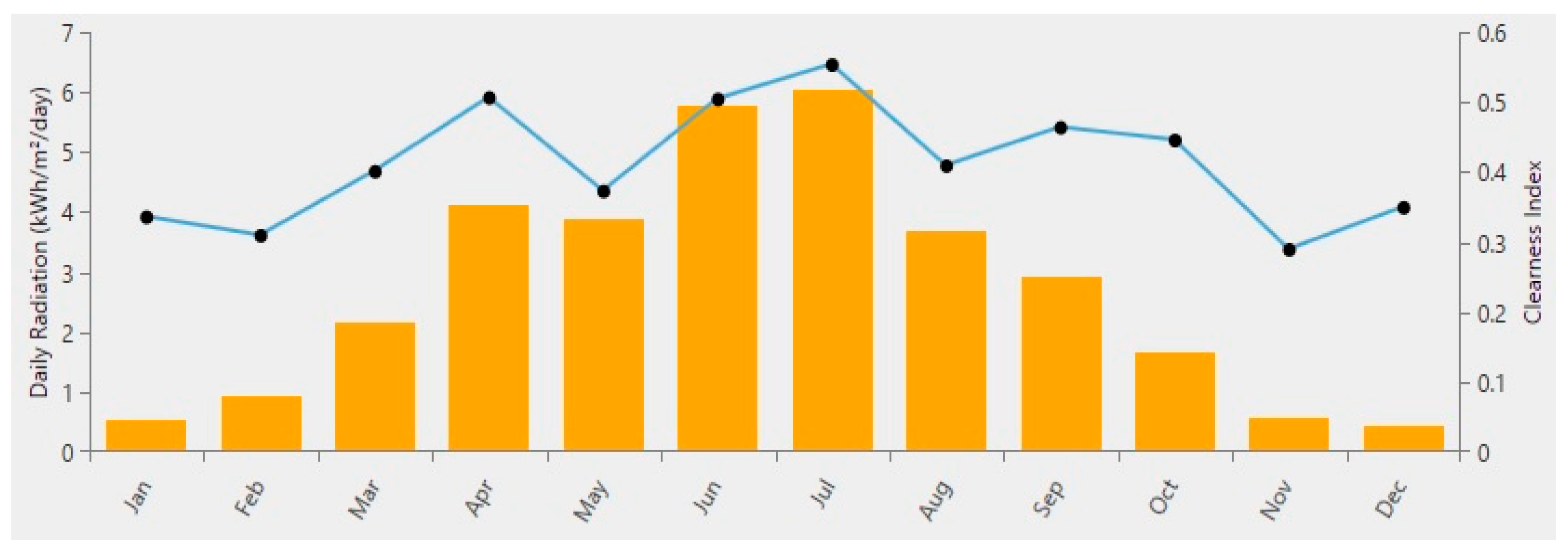
Figure 5.
Data for mean speed of wind.
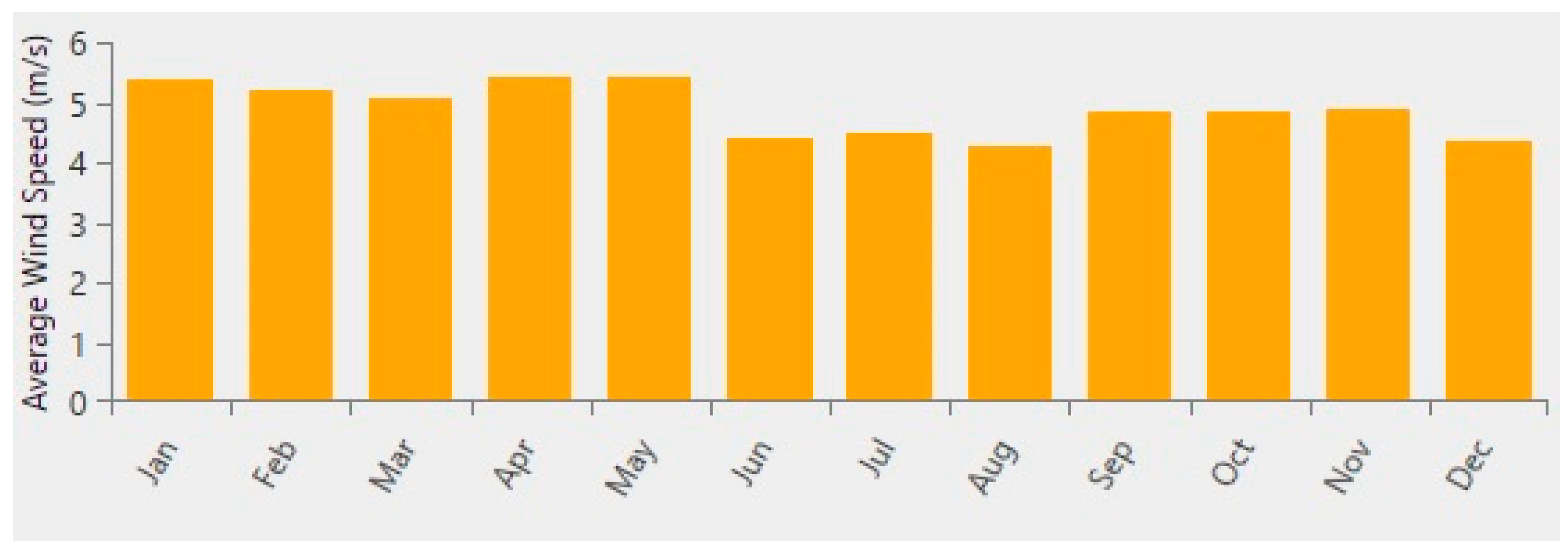
Figure 6.
Monthly average temperature.
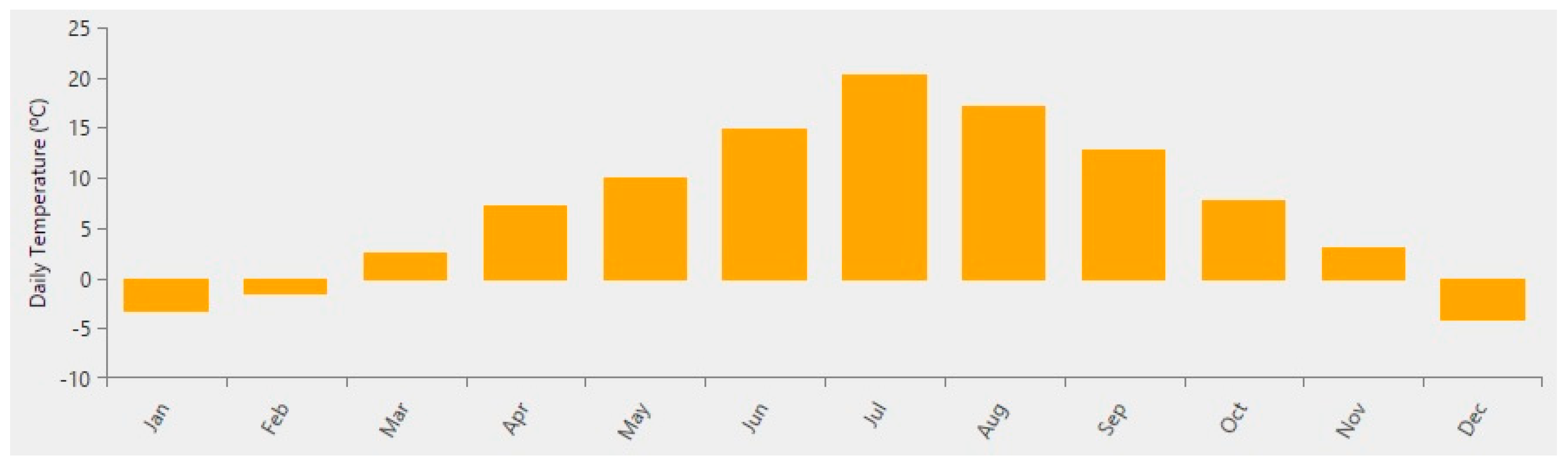

Table 1.
Literature review of hybrid system optimization methods.
| Reference | System Components | Objective(s) | Optimization method | Modeling span | |||||
|---|---|---|---|---|---|---|---|---|---|
| WG | PV | FC | HP | ST | Fs | ||||
| Wang et al. [13] | ● | ● | ● | ● | Multi-objective problem | NSGA-II | 1 | ||
| Maleki et al. [14] | ● | ● | ● | PSO with adaptive inertia weight | PSO | 1 | |||
| Maleki and Rosen [15] | ● | ● | ● | Minimize system/ total cost | PSO | 1 | |||
| Fadaee and Radzi [16] | ● | ● | ● | Multi-objective optimization | EA | 20 | |||
| Isa et al. [17] | ● | ● | ● | Lowest total cost/ lowest levelized energy cost / Low pollutant gas | HOMER | 25 | |||
| Diaf et al. [18] | ● | ● | ● | Power supply loss minimization / Energy cost minimization | PSO | 1 | |||
| Trivedi [19] | ● | ● | Lowest cost / Lowest gas emission | GA | 1 day | ||||
| Elliston et al. [20] | ● | ● | ● | ● | Lowest yearly cost | GA | 1 | ||
| Ugirimbabazi [21] | ● | ● | ● | ● | ● | Minimum LCOE & NPC | HOMER | 25 | |
| Eke et al. [22] | ● | ● | Lowest total expense | LP | 1 | ||||
| Garyfallos et al. [23] | ● | ● | ● | ● | ● | Lowest total expense | PSA | 10 | |
| Akella et al. [24] | ● | ● | ● | Lowest total operational expense | LP | 1 | |||
| Hanane et al. [25] | ● | ● | ● | ● | Lowest difference of hydrogen supply and demand | MINLP | 30 days | ||
| Kashefi et al. [26] | ● | ● | ● | ● | Minimize annualized expense | PSO | 20 | ||
| Lagorsea et al. [27] | ● | ● | ● | Lowest total expense | Simulation | 1 | |||
| Orhan et al. [28] | ● | ● | ● | Lowest total expense | SA | 20 | |||
| Raquel and Daniel [29] | ● | ● | ● | ● | Lowest LEC | LP & Heuristic | 1 | ||
| Iniyan et al. [30] | ● | ● | ● | Lowest cost/ higher efficiency rate | LP | 11 | |||
| Juhari et al. [31] | ● | ● | ● | ● | Lowest energy expense | Simulation | 1 | ||
| Katsigiannis and Georgilakis [32] | ● | ● | ● | ● | Lowest energy expense | TS | 20 | ||
| Budischak et al. [33] | ● | ● | ● | ● | ● | Lowest energy expense | Exact solution | 20 | |
| Lorestani & Ardehali [34] | ● | ● | ● | Minimum total cost with covering thermal and electrical loads | PSO | 1 | |||
| Abedi et al. [35] | ● | ● | ● | ● | ● | Lowest total expense, Lowest gas emission, Lowest uncovered load | FL | 1 | |
| Bernal and Dufo [36] | ● | ● | ● | ● | ● | ● | Lowest total expense | GA | 1 |
| Ahmarinezhad et al. [37] | ● | ● | ● | ● | ● | ● | Lowest total expense | PSO | 20 |
| Mohammadi et al. [38] | ● | ● | ● | Minimum NPC with different unmet load | HOMER | 20 | |||
| Yuan et al. [39] | ● | ● | ● | Lowest NPC & LCOE | HOMER | 10 | |||
| Rongjie Wang [40] | ● | ● | ● | ● | Minimum cost and load power shortage rate | FABC | 20 | ||
| Vatankhah et al. [41] | ● | ● | ● | ● | Lowest NPC & LCOE | GW | 20 | ||
Table 2.
The constraints description.
| No. of constraints | Description |
|---|---|
| #1 | |
| #2 | |
| #3 | |
| #4 | |
| #5 | Limitation of the battery storage: The state of charge (SOC): If → If → |
| #6 | At most 0.1% shortage is accepted |
Table 3.
Pseudocode of the proposed PSO algorithm.
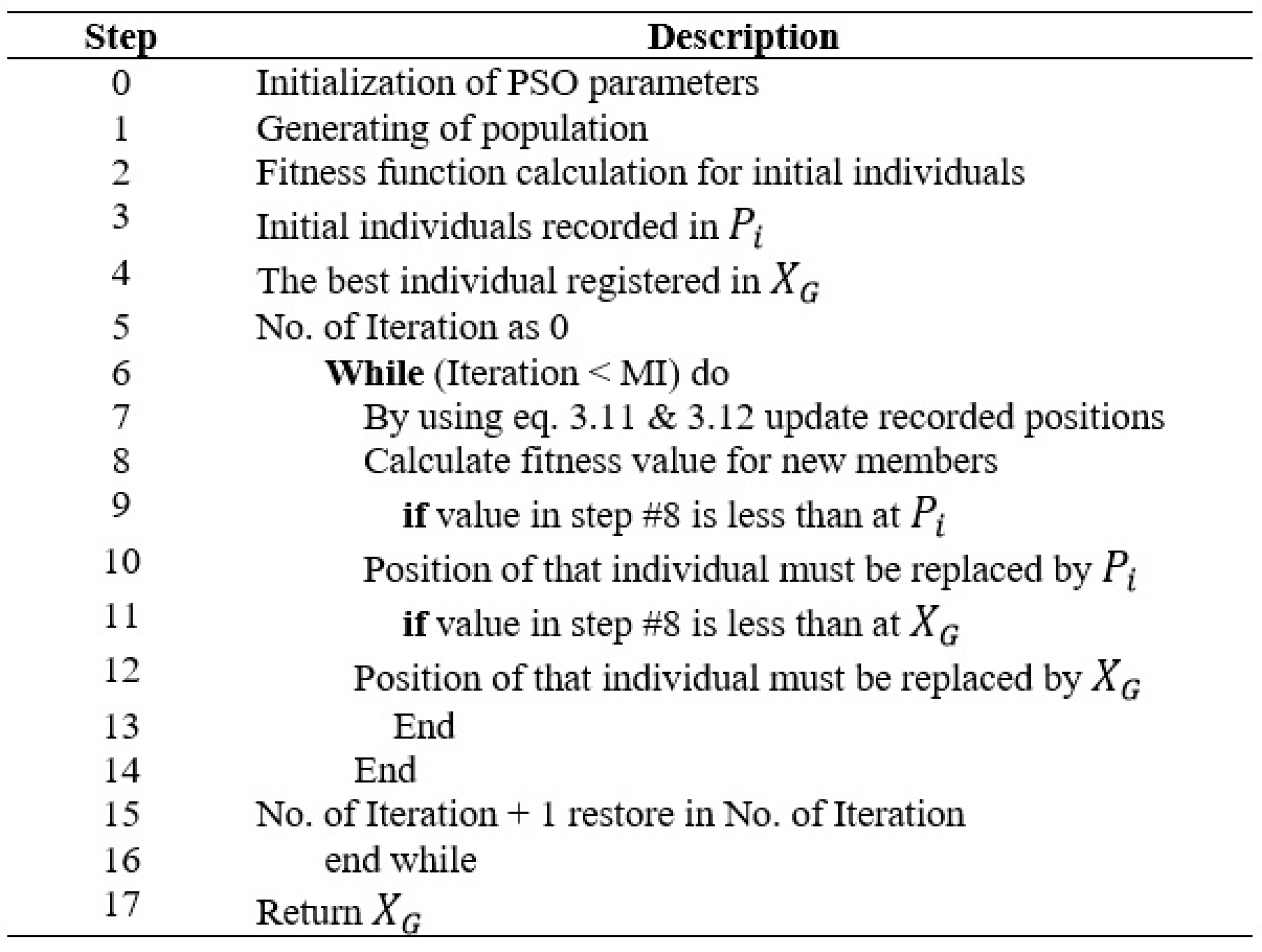 |
Table 4.
Initial values of considered parameters in PSO method.
| PSO Parameters | Values |
|---|---|
| ω | 1 |
| χ | 0.7 |
| 2.5 | |
| 1.5 | |
| Lifespan (year) | 20 |
| Particles | 200 |
| Maximum iterations | 200 |
| Number of bi-directional converters | 199 |
Table 5.
Results of the used heuristic method.
| Methods | PV | WG | Batteries | Convertor | LCOE | NPC |
|---|---|---|---|---|---|---|
| PSO | 160 | 5 | 350 | 199 | 3.9191 | 38.919 |
Table 6.
Results of used simulation method.
| Methods | PV | WG | Batteries | Convertor | LCOE | NPC |
|---|---|---|---|---|---|---|
| Simulation | 384 | 5 | 189 | 199 | 3.12 | 30.975 |
Disclaimer/Publisher’s Note: The statements, opinions and data contained in all publications are solely those of the individual author(s) and contributor(s) and not of MDPI and/or the editor(s). MDPI and/or the editor(s) disclaim responsibility for any injury to people or property resulting from any ideas, methods, instructions or products referred to in the content. |
© 2023 by the authors. Licensee MDPI, Basel, Switzerland. This article is an open access article distributed under the terms and conditions of the Creative Commons Attribution (CC BY) license (https://creativecommons.org/licenses/by/4.0/).
Copyright: This open access article is published under a Creative Commons CC BY 4.0 license, which permit the free download, distribution, and reuse, provided that the author and preprint are cited in any reuse.


