

Submitted:
01 July 2023
Posted:
04 July 2023
You are already at the latest version
Abstract
The present research endeavours to examine the impact of customers' perceptions regarding a firm's dedication to corporate social responsibility (CSR) on their allegiance to particular banking brands. The mediating factors of brand credibility and image help to facilitate the indirect relationship between corporate social responsibility (CSR) and brand equity, which is the focus of this study. The objective of the research is to investigate the plausible causal association among perceived corporate social responsibility, brand image, brand credibility, and brand equity. The study's data was obtained by conducting a survey among a sample of 320 banking customers in Ethiopia. In order to perform a thorough examination of the data, AMOS version 24.0 and structural equation modelling (SEM) methodologies were employed. The present research endeavours to broaden the conventional comprehension of the advantages that corporate social responsibility (CSR) offers to customers. It aims to address a void in the current literature by scrutinising the impacts of customers' perceptions of CSR, brand credibility, and brand image on their allegiance towards particular banking service brands. The findings of this study carry substantial implications for financial institutions, and the conclusions derived from the results are of considerable significance.
Keywords:
Corporate Social Responsibility
; Brand Credibility
; Brand Equity
; Brand Image
; Banks
1. Introduction
CSR is acknowledged as a crucial driver for the progress of developing countries. Development aid is essential for poverty reduction, education and training promotion, and sustainable and equitable development (Kaul and Luo, 2018; Aboud and Diab, 2018). However, the topic has recently sparked controversy and discussion. Numerous studies have emphasised the importance of CSR, demonstrating its association with greater stakeholder backing (He and Lai, 2014), increased purchase intentions, decreased financial risks for firms, and improved financial performance. Adopting CSR principles as core values and effectively utilising them for branding purposes led to these business accomplishments. Banks are integrating socially responsible strategies and tactics into their operations. Several researchers (Mukhibad et al., 2022; Bolton and Park, 2022) have analysed the economic benefits of socially responsible actions, highlighting significant corporate social responsibility (CSR) programmes that can enhance the well-being of society and customers (Wang and Juslin, 2013). A research gap remains in the banking industry regarding the impact of CSR activities on marketing efforts, despite prior extensive research (Schmeltz, 2012). CSR is widely embraced in diverse industries, with the banking sector placing particular emphasis on it due to the intricate nature of its offerings. Assessing consumer perceptions of CSR activities in the banking industry presents difficulties. CSR activities play a crucial role in shaping consumers’ perceptions of banking services, as they have a direct impact on the quality and reputation of these services (Maignan & Ferrell, 2001).
This study seeks to identify the key determinants of consumer brand equity in the Ethiopian banking industry. This study investigates corporate social responsibility (CSR) indicators, encompassing economic, environmental, and ethical aspects. Prior studies have neglected to consider the intermediary functions of brand credibility and brand image in the correlation between CSR and brand equity. This study aims to examine the relationship between CSR, brand image, brand credibility, and brand equity. Specifically, the study proposes a model to test the mediating effects of brand image and brand credibility on the relationship between CSR and brand equity. This study provides three noteworthy contributions. The current literature on CSR has primarily emphasised legal and ethical considerations, overlooking the environmental aspect. However, the environmental dimension can substantially impact consumer intentions (Mensah et al., 2017). Environmentally conscious businesses tend to receive more stakeholder support, including from consumers, as observed across various industry sectors (Eyasu and Arefayne, 2020).
The banking sector’s CSR literature has focused on economic, legal, ethical, and social aspects but has neglected the environmental aspect (Anh and Phuong, 2021). CSR has become increasingly significant in various industries, including banking (Mukhibad et al., 2022). This study emphasises the significance of brand credibility and brand image as mediating factors that facilitate brand equity. The significance of CSR activities in developing brand equity through brand image and credibility is important for marketers to comprehend. This study informs the development of CSR policies and initiatives and examines the impact of such activities on brand image and credibility. Moreover, CSR research has predominantly concentrated on Western nations across diverse industries, resulting in insufficient scrutiny of CSR undertakings in emerging economies such as Ethiopia. Mamo et al. (2023) suggest that the banking sector’s functionality and sustainability can be comprehended by examining the different dimensions of CSR, which can be efficiently executed through CSR tools. Bolton and Park (2022) propose that implementing CSR initiatives in the banking industry can increase its appeal and confer a competitive edge. CSR activities have been shown to enhance a company’s value (Nguyen et al., 2023).
This study aims to improve understanding of the relationship between consumer perception and corporate social responsibility (CSR) in the banking industry. The objectives of the study are to address the following research questions: Does a relationship exist between consumers’ perception of corporate social responsibility (CSR) and their brand equity? What factors impact consumers’ perceptions of corporate social responsibility (CSR)? Does CSR have an impact on brand equity, and if so, is this relationship mediated by brand credibility and brand image? Several studies (Tran et al., 2020; Ghaleb et al., 2021; Al-Ghamdi et al., 2019; Fatma & Khan, 2023) have examined the relationship between corporate social responsibility (CSR) and brand equity. There is a lack of comprehensive research on the impact of perceived corporate social responsibility (CSR) on brand equity in the banking industry, specifically in Ethiopia, with regards to brand credibility and brand image.
2. Review of Related Literature
2.1. Consumers’ Perception of CSR
CSR perception can impact consumer behaviour, resulting in favourable word-of-mouth, purchase intention, and loyalty (Obeidat et al., 2018; Abu et al., 2021; Negassa & Japee, 2022). The academic literature often uses "perceived CSR" and "CSR activities" interchangeably. Sen and Bhattacharya (2001) distinguish between the terms "former" and "latter" in relation to a company’s social responsibility. The former refers to the consumer’s perception of the company’s actions, while the latter pertains to the company’s tangible activities, such as voluntary contributions and charitable giving. CSR refers to a company’s actions that exhibit its dedication to fulfilling its social responsibilities, as demonstrated by prior research. Consumer perception is crucial (Heesup, Jongsik, and Wansoo, 2019). Consumers’ assessments of a company’s compliance with stakeholder expectations and social obligations through voluntary initiatives are known as "perceived CSR" (Porter and Kramer, 2006; Bhattacharya, Korschun, and Sen, 2009). Aro, Suomi, and Saraniemi (2018) propose that effective communication of corporate social responsibility (CSR) initiatives enhances the perception of a company’s social responsibility by consumers. Bhattacharya et al. (2009) highlight the significance of stakeholders’ access to information on a company’s CSR activities. This information has a significant impact on consumers’ attitudes towards the company, its products, and their purchase behaviour.
CSR is essential in the current competitive business landscape. Modern consumers demand that corporations demonstrate social and ethical responsibility towards both society and the environment. Incorporating societal and ethical considerations is essential for attaining competitive advantage and legitimising organisational operations. Fulfilling social responsibilities towards society and stakeholders has resulted in sustained competitive advantages for companies through corporate social initiatives (Ramlugun and Raboute, 2015; Kim, 2017). Research suggests that companies practising CSR receive greater consumer support and promotion than those that do not (Maignan and Ferrell, 2003; Marin, Ruiz, and Rubio, 2009). As CSR gains significance in academic and corporate domains, consumers closely scrutinise companies’ involvement in such initiatives. According to Kim (2017), a company’s CSR practises can improve its relationship with customers. Effective CSR implementation requires involvement from both internal and external stakeholders, enabling companies to anticipate and leverage evolving social conditions to gain a competitive advantage. CSR is a widely discussed subject among academics and professionals. Corporate social responsibility (CSR) is a management system and strategy that integrates social welfare into business practises, providing a competitive advantage (Forcadell and Aracil, 2017; Marin and Ruiz, 2007).
2.2. Research Hypothesis
CSR encourages businesses to participate in voluntary practises that align their objectives with those of society. Achua (2008) states that CSR has been incorporated into the business model through the participation of customers, businesses, and communities. Forcadell and Aracil (2017) discovered that participating in socially responsible activities enhances consumers’ inclination towards sustainable consumption by demonstrating genuine commitment. CSR and ethics are closely intertwined. CSR is based on the idea that companies should voluntarily contribute to social welfare initiatives in the areas where they operate. The notion suggests that businesses should prioritise social responsibility and engage in practises that benefit society, as their success and survival depend on the welfare of society. This study investigates the impact of corporate social responsibility (CSR) on brand equity in the Ethiopian banking industry, specifically in the financial services sector. Previous studies have investigated the impact of CSR. The authors emphasise the need for a systematic examination of the factors that motivate companies to participate in CSR activities in order to improve consumer behaviour. The proposed framework is illustrated in Figure 1.
2.2.1. Corporate Social Responsibilities and Brand Image
Brand image refers to the association of individuals with the values and traits of a specific brand (Achua, 2008). A brand’s image can exist independently of its official brand affiliation. Consumer brand image is positively influenced by emotional attachment to a product or service (Maignan and Ferrell, 2003; Marin, Ruiz, and Rubio, 2009). Brand image boosts self-esteem and fosters a socially and ethically aware image (Fatma and Rahman, 2016; Forcadell and Aracil, 2017). Research on brand image highlights the significance of socially responsible actions as crucial components of a company’s image. These activities foster connections between brands and consumers (Borgerson et al., 2009; Esmaeilpour and Barjoei, 2016). Poolthong and Mandhachitara (2009) and Genedy and Sakr (2017) established a positive correlation between consumers’ favourable responses to CSR initiatives and their perception of the company’s image. Chouthoy and Kazi (2016) suggest that CSR initiatives can improve corporate reputation and consumer loyalty. The researcher proposes the following hypothesis:
H1.
Consumer perception of CSR has a direct and significant effect on brand image.
2.2.2. CSR and Brand Credibility
Brand credibility refers to how consumers perceive a brand’s expertise and trustworthiness (Chen, 2010). A brand’s credibility relies on its ability to fulfil its promises to customers. The success of CSR policies is heavily influenced by the credibility of the corresponding activities, which significantly affects a brand’s reputation (Baek, Kim, and Yu, 2010). CSR initiatives can enhance a company’s perceived product and service quality by signalling competent management, thereby influencing customer perception (Beaudoin and Thorson, 2005). Alhaddad (2015) found that CSR initiatives improve a company’s credibility with consumers. Heesup and colleagues (2019) proposed that CSR initiatives and brand credibility have a substantial impact on favourable results. Consumer trust in a brand’s social actions positively influences their inclination to reward the brand for its corporate social responsibility initiatives. Marin and Ruiz (2007) found that brand attachment can result from the alignment of a brand’s values with a consumer’s social values. The findings presented led to the formulation of a hypothesis.
H2.
Consumer perception of CSR has a direct and significant effect on brand credibility.
2.2.3. Brand Credibility and Brand Equity
According to Anderson (2019), a company’s reputation significantly impacts its market share and brand equity. According to Sen et al. (2006), brand credibility is essential for brand equity in accordance with brand signalling theory. Brand researchers continuously explore new factors that affect brand credibility. Freestone and McGoldrick (2008) highlight the significance of brand credibility in shaping consumer decision-making and their willingness to support a business. Klein and Dawar (2004) suggest that brand credibility reduces customer risk and facilitates decision-making by enhancing trust in a brand’s specifications and perceived value. Brand equity is strongly predicted by the combination of brand credibility and personal experience. Trustworthy and consistent brands can establish customer brand equity. Customer perceptions of quality and trustworthiness have an impact on brand credibility and equity. Based on the aforementioned observations, the following hypothesis is proposed:
H3.
Brand credibility has a direct and significant effect on brand equity.
2.2.4. Brand Image and Brand Equity
Foote and Evans (2010) found a positive correlation between brand image and consumer behaviour, specifically in terms of increased purchasing and recommendation. Brand image is a key predictor of hotel brand equity, according to Abu et al. (2021). Mohr and Webb (2005), Dahlsrud (2008), and Pedersen (2010) assert that brands are pivotal in shaping consumers’ perceptions of themselves. Brand image is positively associated with brand promotion activities, such as word-of-mouth recommendations and support. This is consistent with social identity theory as proposed by Erdiaw-Kwasie et al. (2017). Consumer brand perception is influenced by their expectations, which in turn impacts brand performance. Brand equity is positively correlated with corporate social responsibility (CSR) initiatives (Aro, Suomi, & Saraniemi, 2018). Planken et al. (2013) discovered a positive correlation between brand equity and consumers who possess a strong brand image and positive brand sentiments. These customers exhibit higher brand equity. The researcher suggests a hypothesis based on the results obtained.
H4.
Brand image has a direct and significant effect on brand equity.
2.2.5. CSR and Brand Equity
Corporate social responsibility (CSR) is essential for companies to evaluate their products and cultivate a positive image among consumers. Various studies have investigated the influence of CSR on brand equity through diverse channels (Mukhibad et al., 2022; Bolton and Park, 2022). Social exchange theory posits that companies engaging in socially beneficial activities, such as charitable donations, environmental protection, legal compliance, and ethical treatment of employees, are rewarded by attracting and retaining consumers. Consumers benefit from the reciprocal relationship as members of society. Positive word-of-mouth can enhance customer equity for firms. Previous research indicates that a brand’s image can be improved by participating in socially responsible actions, which can attract customers (Kaul and Luo, 2018; Aboud and Diab, 2018). Mensah et al. (2017) discovered that CSR perception has a positive impact on brand equity by demonstrating principles and values that exhibit respect and concern for customers and society. Effective communication of CSR initiatives to consumers can improve brand image and increase consumer equity towards the company (Mamo et al., 2023; Anh and Phuong, 2021). The credibility and brand equity of a company are influenced by how consumers perceive its corporate social responsibility (CSR) practises (Fatma & Rahman, 2015). Eyasu and Arefayne (2020) state that previous research suggests that consumers view socially responsible actions as a positive and reliable aspect of a brand’s image, resulting in a tendency to establish a long-term relationship with the brand. The preceding arguments lead us to propose the following hypothesis:
H5.
Consumer perception of CSR activities has a direct and significant effect on brand equity.
H6.
Consumer perception of CSR has an indirect and significant effect on brand equity via brand credibility
H7.
Consumer perception of CSR has an indirect and significant effect on brand equity via brand image.
3. Research Methodology
The study employed both descriptive and explanatory research designs to examine the relationship between independent and dependent variables. The descriptive research approach was used to investigate the relationship between the independent and dependent variables, while the explanatory research approach was utilised to establish the link between perceived CSR, brand equity, brand credibility, and brand image. This approach is consistent with previous research on CSR and brand equity (He & Lai, 2014; Abu et al., 2021; Negassa & Japee, 2023). The study’s participants were customers of commercial banks in Ethiopia. However, the analysis focused on the customers of the top nine commercial banks, which constitute nearly 60% of all customers. These nine banks, namely the Commercial Bank of Ethiopia, Dashen Bank, Buna International Bank, United Bank, Bank of Abyssinia, Nib International Bank, Wogagen Bank, Oromia Bank, and Awash International Bank, were the units of analysis for this study. In this study, the survey approach of the quantitative method was used for data collection. Primary data were immediately gathered through the administration of questionnaires. A self-administered, structured questionnaire was constructed with closed-ended items. The questionnaire consisted of two sections: Section A and Section B. Section A contained the respondent’s personal information, such as gender, age, the highest level of education, and occupation. Section B comprised questions regarding perceived CSR (economic, environmental, and ethical), brand credibility, brand image, and brand equity. A total of 18 questions were used, measured on a Likert scale of five points, ranging from strongly disagree (1) to strongly agree (5).
Perceived CSR (economic, environmental, and ethical) was measured using nine indicators adapted from Salmones et al. (2005). For brand credibility, three indicators were also adapted from Salmones et al. (2005). To suit the specific contextual requirements of this research, brand image was measured using three indicators adapted from Sweeney and Soutar (2001), and brand equity was measured using three items adapted from Sweeney and Soutar (2001). The study employed convenience sampling to collect cross-sectional data from a sample of customers in the banking industry. This sampling approach aligns with previous studies that have also utilised convenience sampling (Mahmoud et al., 2018; Abu Zayyad et al., 2021). A total of 360 structured questionnaires were distributed, and 320 were returned, resulting in an 89% response rate. The respondents were proportionally distributed among the age, gender, and income groups. The demographic analysis reveals that the majority of the participants identified as male (56.9%). The age group of 19 to 36 years old constituted the majority of respondents (53.8%). The majority of respondents (42.8%) had an association with the bank for a period of six to fifteen years, based on the number of years observed. Savings accounts made up the majority of respondents’ account types (52.2%). The study also includes information regarding the educational attainment of the participants. 50% of the sample had a degree, as shown in Table 1.
4. Results and discussions
4.1. Results
Assessment of the measurement model
The researcher tested the convergent validity of the latent components using confirmatory factor analysis (CFA) and average variance extracted metrics (AVE). From Table 2, it can be seen that all AVE values for latent constructs are greater than 0.50. This suggests that the latent variables are able to explain, on average, more than half of the variance contained in the indicators due to latent constructs (Negassa & Japee, 2023). Cronbach’s alpha and composite reliability were both used to determine the structures’ level of reliability. The total score for composite reliability is above the acceptable threshold of 0.70. According to the criteria stated by Hair et al. (2014), the Cronbach’s alpha value must be at least 0.70 for the research to be considered quantitative. Consequently, all conditions for convergent validity, construct reliability, internal reliability, and composite reliability have been met.
Discriminant validity measures
Discriminant validity ensures the uniqueness of the measures used to assess a construct (Hair et al., 2014). It is characterised by a low correlation between the measure of interest and other constructs (Negassa and Japee, 2023). To evaluate the validity of discriminant validity, the average variance extracted (AVE) was used. As highlighted by Hair et al. (2014), the squared correlation for each construct should be lower than the square root of the AVE of the indicators measuring that construct. Table 3 confirms that the indicators effectively capture the construct’s uniqueness, resulting in minimal correlations between the constructs. In conclusion, the recommended measurement model demonstrates both convergent and discriminant validity, indicating favourable measurement properties and reliable structural relationships. Thus, it can be concluded that the model exhibits satisfactory levels of validity and reliability.
Hypothesis Test and SEM Results
This section pertains to the analysis of a structural model that underwent testing using AMOS 24.0. The model’s evaluation was based on the analysis results. The findings indicate a strong compatibility between the proposed model and the collected data, as evidenced by the model fit indices (χ2 = 520.287, df = 200, χ2/df = 2.6014; GFI = 0.917; CFI = 0.9371; RMSEA = 0.07). The results suggest a strong alignment between the gathered data and the proposed model. Table 4 displays the path coefficients of the model for examination and contemplation. Table 4 demonstrates that the perception of corporate social responsibility by consumers has a significant and direct effect on brand credibility (β= 0.40, p < 0.05) and brand image (β = 0.38, p< 0.05), thus supporting Hypotheses 1 and 2. H3, which proposes a direct relationship between CSR’s customer perception and brand equity (β= 0.47, p< 0.05), was found to be significant, supporting its validity. Furthermore, the study found significant direct effects of brand credibility (β = 0.44, p < 0.05) and brand image (β = 0.39, p < 0.05) on brand equity, thus supporting Hypotheses 4 and 5, as shown in Table 4 below.
Mediation Analysis (indirect effect of CSR on brand equity via brand credibility and brand image)
This section tests the mediating effect of brand credibility and brand image on brand equity (H6, H7). The results of the study did not support H6, as there was no significant indirect effect of perceived CSR on brand loyalty through brand credibility (β = 0.0022, P > 0.05). In a similar vein, the results of the study did not support H7, as the results did not show a significant indirect effect of perceived CSR on brand equity through brand image (β = 0.0017, P > 0. 05). The study did not find a significant direct effect of perceived corporate social responsibility on brand equity when brand credibility and brand image were present (β = 0.0287, P > 0.05). This finding supports the findings of Mobin and Imran (2023). Brand credibility and image do not act as mediators between perceived CSR and brand equity. Table 5 displays the outcomes of the meditation analysis. The perceived CSR had a significant direct effect on both brand credibility and brand image, as can be seen in Table 4 above.
4.2. Discussion
This study investigates the perception of consumers towards CSR and its effect on consumer brand image, credibility, and equity. This study examines the hypothesis that there is a causal relationship between the perception of corporate social responsibility, brand name recognition, brand reliability, and brand equity. The research findings suggest that customers consider CSR activities as a way to authenticate the credibility of a business (Tran et al., 2020; Ghaleb et al., 2021; Al-Ghamdi et al., 2019; Fatma & Khan, 2023). Brand equity, resulting from consumer belief, can be advantageous for companies. Brand credibility positively affects customer brand equity. Businesses should enhance brand reliability by addressing various aspects, including quality, pricing, availability, and social responsibility. Brand equity is positively correlated with customer trust. Prior research has primarily examined the impact of emotional outcomes (Mamo et al., 2023; Anh and Phuong Thao, 2021); however, this study highlights the importance of the cognitive process involved in shaping consumers’ perceptions of corporate social responsibility. As such, it is recommended that both researchers and businesses take this into consideration. The study demonstrates that consumers’ perceptions of a company’s CSR have positive effects on the credibility and image of the company’s brand. Customers tend to identify with companies that have corporate social responsibility initiatives that promote positive self-perception and growth. Corporate social responsibility initiatives can enhance brand recognition.
4.3. Theoretical Contribution and Managerial implications
This study makes a significant contribution by pinpointing the importance of brand credibility and image in the chain of events that connect corporate social responsibility (CSR) and brand equity. The information gathered during the current investigation supports this theory. The results indicate that brand equity increases when consumers feel a strong connection to a company’s commitment to making a positive impact in the business world. Based on these findings, it appears that CSR initiatives can enhance brand equity by increasing the visibility and credibility of the company among its target audience (Freestone & McGoldrick, 2008). This research builds upon previous empirical evidence demonstrating the positive influence of CSR in the banking industry on customer brand image (Sen et al., 2006). This suggests that a brand’s social benefits can have an impact on its brand image. Additionally, the findings imply that corporations have the potential to foster brand equity by actively promoting customer brand recognition. Likewise, consumers are more likely to identify with a brand if they perceive an alignment between the brand’s values and their own. Consequently, this alignment can result in a sustained association with the company.
This study carries significant implications for professionals in the banking industry. Firstly, the impact of corporate social responsibility (CSR) on a company’s bottom line underscores the need to prioritise CSR rather than treat it as an afterthought. It should be recognised as an essential aspect of conducting business. Businesses that achieve long-term success are those that integrate CSR into their daily operations, leading to improved social and financial outcomes. The research findings offer valuable insights for businesses as they demonstrate how consumers’ perceptions of CSR efforts can enhance a brand’s credibility and consumer image, ultimately resulting in increased brand equity. Numerous studies have consistently shown that positive consumer attitudes towards a company’s social activities have a significant influence on subsequent consumer perceptions and behaviours. Therefore, corporate social responsibility has become an expectation that businesses must fulfil to promote societal welfare and address stakeholder concerns. According to the data, when a bank acts responsibly towards its community, it is more likely to attract and retain consumers. Engaging in CSR activities brings substantial benefits to the organisation. These actions have far-reaching effects, enhancing the brand’s legitimacy and strengthening the customer’s image with the brand, both of which contribute to brand equity.
5. Conclusions
Corporate social responsibility (CSR) is a relatively novel concept in developing countries like Ethiopia that has the potential to guide global enterprises towards sustainable and social progress. However, there is a dearth of research on how socially responsible attributes of banking services impact various marketing outcomes. This study aimed to address this gap in the literature by examining the relationship between CSR perception, brand credibility, and brand image among users of financial services brands. The theoretical model developed for this research investigates not only brand credibility, brand image, and brand equity but also other marketing outcomes. By incorporating brand credibility and brand image into the proposed framework, this study establishes a critical link between CSR and brand equity. While there is a direct influence observed from CSR on brand credibility and brand image, the results indicate a relatively strong direct connection between perceived CSR and brand equity. Nonetheless, financial institutions can enhance their relationship with clients by highlighting the positive effects of their community-oriented CSR initiatives through diverse programmes.
6. Limitations and Future Research Directions
While this study has yielded significant conclusions, there are several limitations that offer opportunities for further exploration by future researchers. Firstly, it is important to consider that the scope of this study is limited to the banking services sector, which should be taken into account when extrapolating the findings to other business models. Since CSR activities can vary across industries due to the diverse nature of their operations, it would be valuable for researchers to test the proposed model in a wider range of industries. Conducting studies with a representative sample of industries would enhance the generalizability of the findings. Secondly, although this research examines the mediating effects of brand credibility and brand image in the relationship between corporate social responsibility and brand equity, the suggested model allows for the examination of additional variables, such as intent and attitude, as potential mediators or moderators. Exploring these variables can provide a more comprehensive understanding of the mechanisms through which CSR influences brand equity. Thirdly, it would be interesting and informative to investigate how the impact of CSR on brand equity varies across different demographic segments. Future researchers may consider dividing their samples by age and gender to explore potential differences in purchasing behaviour between these demographic subsets. By incorporating demographic characteristics as control variables, future studies can provide insights for banks to tailor their CSR strategies to effectively cater to specific demographic groups. In summary, future research can expand upon this study by examining diverse industries, exploring additional variables, and investigating the role of demographic factors, all of which can contribute to a more nuanced understanding of the relationship between CSR, brand equity, and customer behaviour.
Funding
This research received no external funding.
Conflicts of Interest
The authors declare no conflict of interest.
References
- Aboud, A.; Diab, A. The impact of social, environmental and corporate governance disclosures on firm value. J. Account. Emerg. Econ. 2018, 8, 442–458. [Google Scholar] [CrossRef]
- Abu Zayyad, H.M.; Obeidat, Z.M.; Alshurideh, M.T.; Abuhashesh, M.; Maqableh, M.; Masa’deh, R.E. Corporate social responsibility and patronage intentions: The mediating effect of brand credibility. Journal of Marketing Communications 2021, 27, 510–533. [Google Scholar] [CrossRef]
- Achua, J.K. Corporate social responsibility in Nigerian banking system. Soc. Bus. Rev. 2008, 3, 57–71. [Google Scholar] [CrossRef]
- Al-Ghamdi SA, A.; Badawi, N.S. Do corporate social responsibility activities enhance customer satisfaction and customer loyalty? Evidence from the Saudi banking sector. Cogent Business & Management 2019, 6, 1662932. [Google Scholar]
- Alhaddad, A. Perceived quality, brand image and brand trust as determinants of brand loyalty. Journal of Research in Business and Management 2015, 3, 01–08. [Google Scholar]
- Anderson, M.A. (2019). The business case for CSR: A supply chain management strategy (Doctoral dissertation, Capella University).
- Anh, N.V.; Phuong Thao, N.T. Impact of CSR activities towards adoption of Mobile Banking. Cogent Business & Management 2021, 8, 1962486. [Google Scholar]
- Wang, J.; Han, W.; Ge, C.; Guan, H.; Yang, H.; Zhang, X. Form-stable oxalic acid dihydrate/glycolic acid-based composite PCMs for thermal energy storage, Renew. Energy 2019, 136, 657–663. [Google Scholar] [CrossRef]
- Baek, T.H.; Kim, J.; Yu, J.H. The differential roles of brand credibility and brand prestige in consumer brand choice. Psychol. Mark. 2010, 27, 662–678. [Google Scholar] [CrossRef]
- Beaudoin, C.E.; Thorson, E. Credibility Perceptions of News Coverage of Ethnic Groups: The Predictive Roles of Race and News Use. Howard J. Commun. 2005, 16, 33–48. [Google Scholar] [CrossRef]
- Bhattacharya, C.B.; Korschun, D.; Sen, S. Strengthening Stakeholder–Company Relationships Through Mutually Beneficial Corporate Social Responsibility Initiatives. J. Bus. Ethic- 2009, 85, 257–272. [Google Scholar] [CrossRef]
- Bolton, B.; Park, J.; Ntim, C.G. Social impact as corporate strategy: responsibility and opportunity. Cogent Bus. Manag. 2022, 9. [Google Scholar] [CrossRef]
- Borgerson, J.L.; Schroeder, J.E.; Magnusson, M.E.; Magnusson, F. Corporate communication, ethics, and operational identity: a case study of Benetton. Bus. Ethic- A Eur. Rev. 2009, 18, 209–223. [Google Scholar] [CrossRef]
- Chen, Y.-S. The Drivers of Green Brand Equity: Green Brand Image, Green Satisfaction, and Green Trust. J. Bus. Ethic- 2010, 93, 307–319. [Google Scholar] [CrossRef]
- Chouthoy, S.; Kazi, R. En Route to a Theory-building Consumer Brand Commitment through CSR Reputation. Global Business & Management Research 2016, 8, 67–82. [Google Scholar]
- Dahlsrud, A. How corporate social responsibility is defined: An analysis of 37 definitions. Corp. Soc. Responsib. Environ. Manag. 2008, 15, 1–13. [Google Scholar] [CrossRef]
- Erdiaw-Kwasie, M.O.; Alam, K.; Shahiduzzaman, M. Towards Understanding Stakeholder Salience Transition and Relational Approach to ‘Better’ Corporate Social Responsibility: A Case for a Proposed Model in Practice. J. Bus. Ethic- 2017, 144, 85–101. [Google Scholar] [CrossRef]
- Esmaeilpour, M.; Barjoei, S. The Impact of Corporate Social Responsibility and Image on Brand Equity. Global Business & Management Research 2016, 8, 55–66. [Google Scholar]
- Eyasu, A.M.; Arefayne, D. The effect of corporate social responsibility on banks’ competitive advantage: Evidence from Ethiopian lion international bank S.C. Cogent Bus. Manag. 2020, 7. [Google Scholar] [CrossRef]
- F. Hair Jr, J., Sarstedt, M., Hopkins, L., & G. Kuppelwieser, V. (2014). Partial least squares structural equation modeling (PLS-SEM) An emerging tool in business research. European business review, 26(2), 106-121.
- Fatma, M.; Khan, I. CSR Influence on Brand Loyalty in Banking: The Role of Brand Credibility and Brand Identification. Sustainability 2023, 15, 802. [Google Scholar] [CrossRef]
- Fatma, M.; Rahman, Z. The CSR’s influence on customer responses in Indian banking sector. Journal of Retailing and Consumer Services 2016, 29, 49–57. [Google Scholar] [CrossRef]
- Foote, J.; Gaffney, N.; Evans, J.R. Corporate social responsibility: Implications for performance excellence. Total. Qual. Manag. Bus. Excel. 2010, 21, 799–812. [Google Scholar] [CrossRef]
- Forcadell, F.J.; Aracil, E. European Banks’ Reputation for Corporate Social Responsibility. Corp. Soc. Responsib. Environ. Manag. 2017, 24, 1–14. [Google Scholar] [CrossRef]
- Freestone, O.M.; McGoldrick, P.J. Motivations of the Ethical Consumer. J. Bus. Ethic- 2008, 79, 445–467. [Google Scholar] [CrossRef]
- Genedy, A. S.; Sakr, A. The Relationship between Corporate Social Responsibility and Corporate Financial Performance in Developing Countries. Case of Egypt. International Journal of Business and Economic Development (IJBED) 2017, 5, 59–73. [Google Scholar]
- Ghaleb, B.A.A.; Qaderi, S.A.; Almashaqbeh, A.; Qasem, A. Corporate social responsibility, board gender diversity and real earnings management: The case of Jordan. Cogent Bus. Manag. 2021, 8. [Google Scholar] [CrossRef]
- He, Y.; Lai, K.K. The effect of corporate social responsibility on brand loyalty: the mediating role of brand image. Total. Qual. Manag. Bus. Excel. 2014, 25, 249–263. [Google Scholar] [CrossRef]
- Han, H.; Yu, J.; Kim, W. Environmental corporate social responsibility and the strategy to boost the airline’s image and customer loyalty intentions. J. Travel Tour. Mark. 2019, 36, 371–383. [Google Scholar] [CrossRef]
- Kaul, A.; Luo, J. An Economic Case for CSR: T He Comparative Efficiency of For-profit Firms in Meeting Consumer Demand for Social Goods. Strategic Management Journal 2018, 39, 1650–1677. [Google Scholar] [CrossRef]
- Kim, S. The Process Model of Corporate Social Responsibility (CSR) Communication: CSR Communication and its Relationship with Consumers’ CSR Knowledge, Trust, and Corporate Reputation Perception. J. Bus. Ethic- 2017, 154, 1143–1159. [Google Scholar] [CrossRef]
- Klein, J.; Dawar, N. Corporate social responsibility and consumers’ attributions and brand evaluations in a product–harm crisis. Int. J. Res. Mark. 2004, 21, 203–217. [Google Scholar] [CrossRef]
- Mahmoud, M.A.; Hinson, R.E.; Adika, M.K. The Effect of Trust, Commitment, and Conflict Handling on Customer Retention: The Mediating Role of Customer Satisfaction. J. Relatsh. Mark. 2018, 17, 257–276. [Google Scholar] [CrossRef]
- Maignan, I., & Ferrell, O.C. (2001). Corporate citizen as a marketing instrument – concepts, evidence and research directions. European Journal of Marketing, 35(3/4), 457 – 484.
- Maignan, I.; Ferrell, O. Nature of corporate responsibilities. J. Bus. Res. 2003, 56, 55–67. [Google Scholar] [CrossRef]
- Mamo, Y.A.; Sisay, A.M.; Dessalegn, B.; Angaw, K.W. The Socio-economic effect of Corporate Social Responsibility on Local Community Development in Southern Ethiopia. Cogent Bus. Manag. 2023, 10. [Google Scholar] [CrossRef]
- Marin, L.; Ruiz, S. “I Need You Too!” Corporate Identity Attractiveness for Consumers and The Role of Social Responsibility. J. Bus. Ethic- 2007, 71, 245–260. [Google Scholar] [CrossRef]
- Marin, L.; Ruiz, S.; Rubio, A. The Role of Identity Salience in the Effects of Corporate Social Responsibility on Consumer Behavior. J. Bus. Ethic- 2009, 84, 65–78. [Google Scholar] [CrossRef]
- Mensah, H.K.; Agyapong, A.; Nuertey, D. The effect of corporate social responsibility on organizational commitment of employees of rural and community banks in Ghana. Cogent Bus. Manag. 2017, 4. [Google Scholar] [CrossRef]
- Mohr, L.A.; Webb, D.J. The effects of corporate social responsibility and price on consumer responses. J. Consum. Aff. 2005, 39, 121–147. [Google Scholar] [CrossRef]
- Mukhibad, H.; Jayanto, P.Y.; Suryarini, T.; Hapsoro, B.B.; McMillan, D. Corporate governance and Islamic bank accountability based on disclosure—a study on Islamic banks in Indonesia. Cogent Bus. Manag. 2022, 9. [Google Scholar] [CrossRef]
- Negassa, G. J., & Japee, G. P. (2022). The Role of Entrepreneurs in Developing Corporate Brands for Start-Ups. Central European Management Journal, 30(4), 1808-1816.
- Negassa, G.J.; Japee, G.P. The Effect of Bonding, Responsiveness and Communication on Customer Retention: The Mediating Role of Customer Satisfaction. J. Relatsh. Mark. 2023, 22, 115–131. [Google Scholar] [CrossRef]
- Nguyen, T.H.; Nguyen, Q.T.; Nguyen, D.M.; Le, T. The effect of corporate governance elements on corporate social responsibility reporting of listed companies in Vietnam. Cogent Bus. Manag. 2023, 10. [Google Scholar] [CrossRef]
- Obeidat, Z.M.; Xiao, S.H.; al Qasem, Z.; al Dweeri, R.; Obeidat, A. Social media revenge: A typology of online consumer revenge. J. Retail. Consum. Serv. 2018, 45, 239–255. [Google Scholar] [CrossRef]
- Pedersen, O.W. Environmental Principles and Environmental Justice. Environ. Law Rev. 2010, 12, 26–49. [Google Scholar] [CrossRef]
- Planken, B.; Nickerson, C.; Sahu, S. CSR across the globe: Dutch and Indian consumers’ responses to CSR. Int. J. Organ. Anal. 2013, 21, 357–372. [Google Scholar] [CrossRef]
- Poolthong, Y.; Mandhachitara, R. Customer expectations of CSR, perceived service quality and brand effect in Thai retail banking. Int. J. Bank Mark. 2009, 27, 408–427. [Google Scholar] [CrossRef]
- Porter, M.E.; Kramer, M.R. The Link between Competitive Advantage and Corporate Social Responsibility. Harvard Business Review 2006, 84, 78–92. [Google Scholar]
- Ramlugun, V.G.; Raboute, W.G. Do CSR Practices Of Banks In Mauritius Lead To Satisfaction And Loyalty? Stud. Bus. Econ. 2015, 10, 128–144. [Google Scholar] [CrossRef]
- De Los Salmones, M.D.M.G.; Crespo, A.H.; Del Bosque, I.R. Influence of Corporate Social Responsibility on Loyalty and Valuation of Services. J. Bus. Ethic- 2005, 61, 369–385. [Google Scholar] [CrossRef]
- Schmeltz, L. Consumer-oriented CSR communication: focusing on ability or morality? Corp. Commun. Int. J. 2012, 17, 29–49. [Google Scholar] [CrossRef]
- Sen, S.; Bhattacharya, C.B.; Korschun, D. The Role of Corporate Social Responsibility in Strengthening Multiple Stakeholder Relationships: A Field Experiment. J. Acad. Mark. Sci. 2006, 34, 158–166. [Google Scholar] [CrossRef]
- Sweeney, J.C.; Soutar, G.N. Consumer perceived value: The development of a multiple item scale. J. Retail. 2001, 77, 203–220. [Google Scholar] [CrossRef]
- Tran, Q.T.; Lam, T.T.; Luu, C.D. Effect of Corporate Governance on Corporate Social Responsibility Disclosure: Empirical Evidence from Vietnamese Commercial Banks. J. Asian Finance, Econ. Bus. 2020, 7, 327–333. [Google Scholar] [CrossRef]
- Wang, L.; Juslin, H. Corporate Social Responsibility in the Chinese Forest Industry: Understanding Multiple Stakeholder Perceptions. Corp. Soc. Responsib. Environ. Manag. 2013, 20, 129–145. [Google Scholar] [CrossRef]
Figure 1.
Hypothetical Framework. Source: Fatma and Khan (2023).
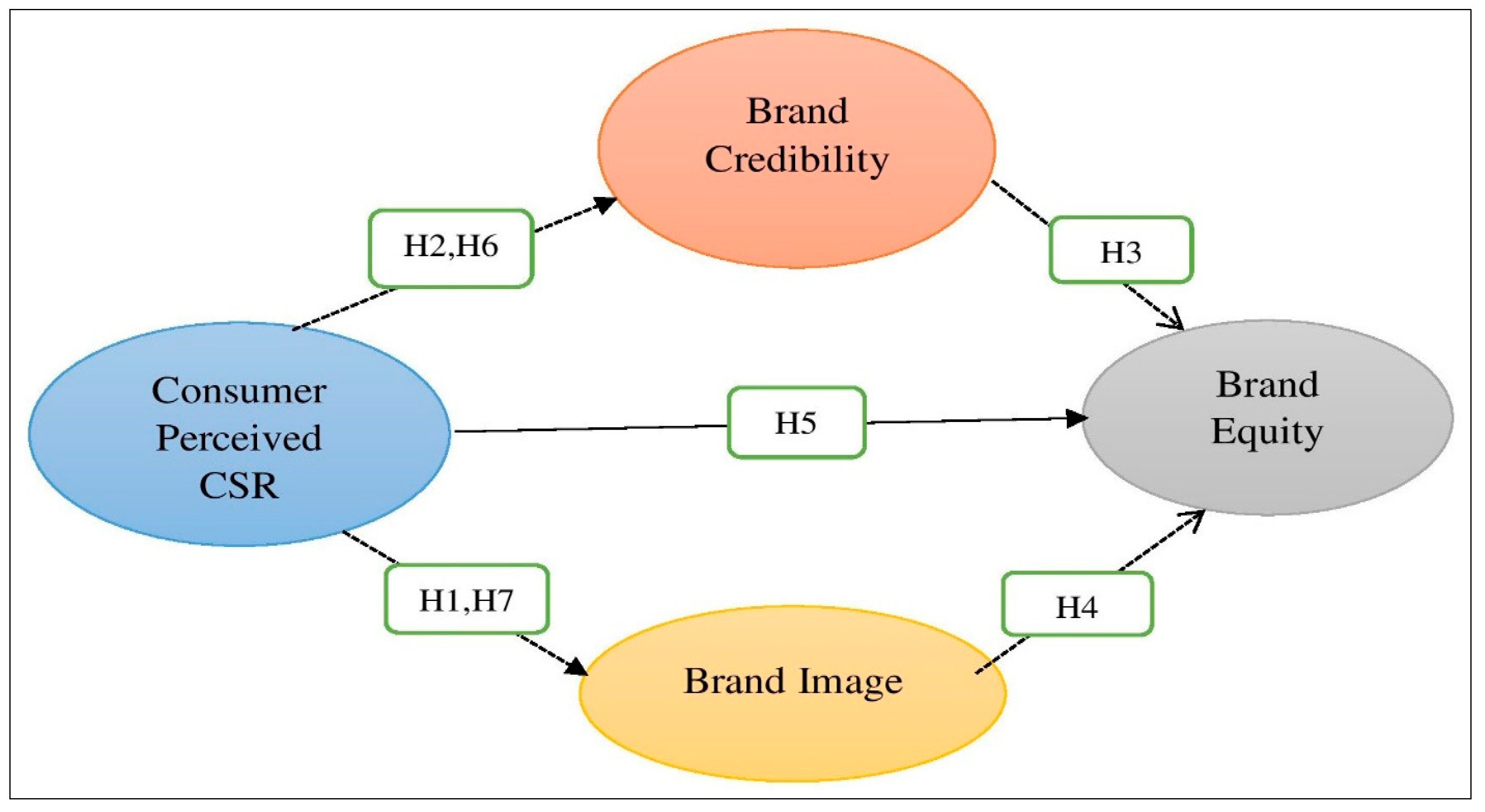

Table 1.
Respondents’ demographic profiles.
| Particulars | Frequency | Percent |
| Gender of the Respondents | ||
| Male Female Total |
182 | 56.9 |
| 138 | 43.1 | |
| 320 | 100.0 | |
| Age group of the respondents | ||
| Below 18 Years 19 - 36 Years 36 - 54 Years Above 54 Years Total |
56 | 17.5 |
| 172 | 53.8 | |
| 68 | 21.2 | |
| 24 | 7.5 | |
| 320 | 100.0 | |
| No. of Years of association with this Bank | ||
| Less than 5 years 6 - 15 Years Above 15 Years Total |
87 | 27.2 |
| 137 | 42.8 | |
| 96 | 30.0 | |
| 320 | 100.0 | |
| Type of Account having by the Customer | ||
| Savings Account Current Account Demand Account Total |
167 | 52.2 |
| 62 | 19.4 | |
| 91 | 28.4 | |
| 320 | 100.0 | |
| Educational level of the respondents | ||
| Certificate Diploma Degree Masters and above Total |
21 | 6.6 |
| 97 | 30.3 | |
| 160 | 50 | |
| 42 | 13.1 | |
| 320 | 100.0 | |
Table 2.
Content and convergent validity analysis for variables.
| Variables | Factor loading | AVE | CR | Cronbach’s Alpha |
| Perceived CSR | 0.724 | 0.906 | 0.926 | |
| Environment CSR | ||||
| ENCSR1 | 0.853 | 0.759 | 0.936 | 0.720 |
| ENCSR2 | 0.896 | |||
| ENCSR3 | 0.865 | |||
| Economic CSR | ||||
| ECCSR1 | 0.887 | 0.773 | 0.870 | 0.816 |
| ECCSR2 | 0.864 | |||
| ECCSR3 | 0.882 | |||
| Ethical CSR | ||||
| EECSR1 | 0.844 | 0.746 | 0.880 | 0.704 |
| EECSR2 | 0.874 | |||
| EECSR3 | 0.871 | |||
| Brand Credibility | ||||
| BC1 | 0.873 | 0.726 | 0.864 | 0.736 |
| BC2 | 0.799 | |||
| BC3 | 0.874 | |||
| Brand Image | ||||
| BI1 | 0.851 | 0.764 | 0.890 | 0.880 |
| BI2 | 0.927 | |||
| BI3 | 0.840 | |||
| Brand Equity | ||||
| BL1 | 0.955 | 0.684 | 0.890 | 0.895 |
| BL2 | 0.790 | |||
| BL3 | 0.884 | |||
Note: CR: composite reliability; AVE: average variance extracted.
Table 3.
Discriminant validity measures.
| 1 | 2 | 3 | 4 | |
| Perceived CSR (1) | 0.850 | |||
| Brand Credibility (2) | 0.101 | 0.852 | ||
| Brand Identification (3) | 0.144 | 0.323 | 0.874 | |
| Brand Loyalty (4) | 0.071 | 0.292 | 0.230 | 0.827 |
Note that the diagonals show the square root of the average variance extracted, while the other entries show the squared correlation.
Table 4.
Hypothesis results.
| Structural path | Standardised coefficients | Results | |
| H1 | CSR has a direct and significant effect on brand credibility | 0.40 | Supported |
| H2 | CSR has a direct and significant effect on brand image | 0.38 | Supported |
| H3 | CSR has a direct and significant effect on brand equity | 0.47 | Supported |
| H4 | Brand credibility has a direct and significant effect on brand equity | 0.44 | Supported |
| H5 | Brand image has a direct and significant effect on brand equity | 0.39 | Supported |
Notes: t-values for two-tailed test: 1.96 (significant level = 5%).
Table 5.
Mediating results.
| Total effects (CSR->Brand Equity) |
Direct effects (CSR->Brand Equity) |
Paths/relationships | Indirect effect | Decision |
| 0.0512 | 0.0287 | H6:CSR>Brand credibility>Brand equity | 0.0022 | Not supported |
| H7:CSR>Brand image>Brand Equity | 0.0017 | Not supported |
Notes: t-values for two-tailed test: 1.96 (significant level = 5%).
Disclaimer/Publisher’s Note: The statements, opinions and data contained in all publications are solely those of the individual author(s) and contributor(s) and not of MDPI and/or the editor(s). MDPI and/or the editor(s) disclaim responsibility for any injury to people or property resulting from any ideas, methods, instructions or products referred to in the content. |
© 2023 by the authors. Licensee MDPI, Basel, Switzerland. This article is an open access article distributed under the terms and conditions of the Creative Commons Attribution (CC BY) license (http://creativecommons.org/licenses/by/4.0/).
Copyright: This open access article is published under a Creative Commons CC BY 4.0 license, which permit the free download, distribution, and reuse, provided that the author and preprint are cited in any reuse.