

Submitted:
30 June 2023
Posted:
04 July 2023
You are already at the latest version
Abstract
Ship pilots and maritime safety administration have an urgent need for more accurate and earlier warnings on strong wind gusts. This study firstly investigates the “Oriental Star” cruise ship cap-sizing event in 2015, one of the deadliest shipwreck events in recent years, and explores all related hydro-meteorological components in a global mesoscale model. It is found that, rather than the missing signal in raw surface wind prediction, the cumulus precipitation variable (CP) increases dramatically during the accident occurrence, which significantly corresponds to the sub-grid strong wind gust. The effective lead-time can be extended from 24hr (deterministic model) to 48hr (en-semble model). This finding is then verified in another two recent deadly cruise boat accidents. The introduction of the new variable is bearing the hope of improvement to the current maritime safeguard system, on predicting sub-grid strong wind gusts for small-size cruise boats in offshore and inland rivers. Finally, an automatic-response system is developed to provide economical con-vection prediction via Inmarsat email communication, aiming to explore operational severe con-vective gust early-warning and appropriate numerical mesoscale model application.
Keywords:
Strong wind gust
; early warning
; ensemble forecasts
; severe convection
; auto-response system
1. Introduction
Wind gust is officially defined as sudden and brief increase of wind speed [1], and often characterized by small spatial scale, rapid variation, short duration, and more importantly, little prediction skills. Early warning of strong wind gusts is needed by small-size vessels (including but not limited to skiff, craft, boat and yacht) navigation [2], as in recent years many deadly maritime accidents are associated with the strong wind gusts, especially under severe convective events. Severe convective event usually refers to a weather system less than 200 km in horizontal scale with extreme air uplift, often accompanied with sudden and rapid adverse weather such as thunderstorm, heavy rainfall, hail, tornado, as well as strong wind gusts.
The "Oriental Star" shipwreck in 2015 broke the record of Chinese maritime accidents dramatically in both death toll and rate. This inland river cruise ship suddenly capsized under extreme heavy rainfall in Yangtze River upstream main channel, claiming 442 passengers' and crews' lives. All 12 survivors confirmed the on-site strong winds and heavy rains, lasting 1-2 hours. After a five-month investigation, the national professional team concluded that “it’s a catastrophe caused by a sudden and rare downburst accompanied with small-scale and strong convective weather” [3]. Another cruise boat, namely “Double Dragon”, was also overturned in upstream Yangtze River in 2016, with a death toll 15 out of 18. In addition, on 5th of July 2018 in offshore Phuket Island, Southern Thailand, two cruise boats capsized during a heavy storm, claiming 47 tourists’ lives out of 102, and marked the worst maritime disaster in Thailand. During these tragedies, the sudden strong convective events were all present. Statistical analysis shows that this kind of extreme weather occurs frequently in the tropical maritime continent, and in some monsoonal mid-latitudes where "Oriental Star" and “Double Dragon” shipwrecks fell in. To improve the strong convective-related extreme-weather forecasting skills and warning capability, scholars have made a lot of efforts, however mostly focused on rainfall extremes and secondary disasters, e.g. flooding, landsliding, inundation, etc. Collier et al. [4] and Nakamura et al. [5] were among the first to point out that the high wind and gust under severe weather in mid-latitude may be due to deep convection. Mao [6] reviewed the meteorological service during the “Oriental Star” ship capsizing event, pointing out that "the current technology can’t make accurate warnings on the local scale winds, ..., it is necessary to strengthen skills". As noted by Friederichs [7], “gusts are one of the most poorly observed atmospheric variables”, so far the effective operational recording and warning of strong nautical wind gust is still a challenging problem.
Multiple methods have been applied to estimate wind gust from meteorology components. Weggel [8] and International Maritime Organization [9] tended to directly connect wind gust with10-minute average wind speed (or sustained wind, WMO 1987). This is rather simple and can only work as a state-of-the-art method when no big eddy present, i.e., it might somehow miss some small-scale but devastating convective gust discussed in this paper. Nakamura et al. [10] applied eddy equations and a non-numerical cloud physics model in western Europe region, and concluded that the gust factor (gust/mean) under deep convection is much greater and more variable than no eddy condition. At the end of the paper, it is suggested that only numerical weather prediction (NWP) combined with eddy equations shall be the next research stage.
Patlakas et al. [11,12], Chen et al. [13] and Gutiérrez et al. [14] applied various regional atmosphere numerical models forced by giant global weather products to simulate wind gust under complex weather conditions. However, few of the wind gust estimation researches are in the navigation field nor accident-based. As a result, no significant predictor is recommended for strong nautical wind gust at efficient lead time [15].
This paper studies the convective events associated with above cruise shipwrecks through meteorological components analysis. From a meteorological point of view, the precipitation could be divided into two types, large-scale precipitation (LSP) and cumulus precipitation (CP). The former is generally introduced by the steady uplift of warm air mass, e.g. slow moving warm fronts, little chance with strong wind gusts (Figure 1(a)). But the latter will develop and intensify when the lower atmosphere level is quite unstable, e.g. in squall lines or fast-moving cold front (Figure 1 (b-d)), possible with strong wind gusts.
The total precipitation is commonly applied because in practice it is hard to discriminate convective and non-convective precipitation from the surface rain-gauge-based reading. However, in specific numerical product these two rainfall components are calculated, delivered, and stored separately. In dynamic meteorology theory, CP is much representative for the intensity of convective weather. For the crew, any precipitation will result directly in limited visibility, which affects the navigation of the vessel. However, due to the poor across-wind-resistance of cruise boats, the strong wind gusts might be a much greater threat than navigation visibility. The reason is nowadays the conventional cabin has evolved from a dormitory-style canopy bed to an independent window-viewing bedroom, in order to meet the demands of the passengers' private space and sightseeing. For example, during two renovations in 1997 and 2008, the shipyard enlarged the “Oriental Star” space and lifted the center of gravity, reduced the wind pressure stability criterion numeral from 1.36 to 1.02, i.e. worsen the ship’s across-wind-resistance [16]. The wind gust has the characteristics of sudden intensification, large instantaneous maximum wind speed, and great mutability directions. When the wind pressure tilting moment is greater than the minimum overturning moment, the ship will capsize due to water inflow [17]. This situation is particularly dangerous for the inland and offshore cruise boats.
Although the concomitant relationship between short-term torrential precipitation and strong wind gusts under deep convective weather has been confirmed in both observations and fine-grid (distances < 5 km) model [14], it is very difficult to apply the latter to provide operational early-warning service because in most cases, the precipitation and strong wind gusts occur simultaneously. The fine-grid regional model needs the output of large-scale global weather products as initial forcing, which is time-consuming and disabled for operational warning. A hypothesis is raised by Jian et al. [18] that it is potential to invert the intensity of severe convective events by watching the CP variance in numerical weather products, thus indirectly warning the strong wind gust for small-size vessels, especially cruise boats. This paper seeks the possibility that the global numerical product itself can act as an efficient tool to retrieve adverse convective events, though the events’ spatial scales are much smaller than the model grid distance (also called sub-grid), which are usually considered lack of simulation capabilities.
This paper is organized as follows: section 2 lists the data source and format; section 3 discusses the weather components’ temporal-spatial performance during “Oriental Star” shipwreck; section 4 verifies the findings in section 3 for another two cruise boat wrecks; section 5 introduces an automatic gust warning system developed for marine application; section 6 draws the conclusion.
2. Data
2.1. Numerical Prediction Product
Numerical weather product is a powerful tool applying hydrodynamics, thermodynamics, and other equations to describe the weather evolution process initialized from certain boundary conditions of the atmosphere, and predicting the atmospheric motion state in a certain period in the future. And the method of weather phenomena, which has been used as a method of daily weather forecast in many countries.
The numerical product used in this paper is the global deterministic (0.5°×0.5°, single member) and ensemble (1°×1°, 51 members including one control experiment) mesoscale numerical weather prediction product from European Centre for Medium-Range Weather Forecasts (ECMWF) with time step of 6-hour and lead time up to 240h [19]. It is running under TL639 spectral truncation (horizontal resolution ~32 km) with 62 vertical levels out to ten days along. The product contains a variety of totally 33 weather variables from the surface to upper atmosphere, of which two are directly related to surface wind: 10-meter zonal wind (10U) and meridional wind (10V). The core weather variables are listed in Table 1 below in section 3.2.
2.2. Ship AIS Data
Automatic Identification System (AIS) is a widely-applied monitoring and communication system to automatically broadcast and receive ship dynamic, static, voyage and safety information to realize ship identification. In "Oriental Star" accident case, AIS information is applied to analyze the cause relationship between typical accidents and weather.
2.3. CMORPH Satellite Precipitation Data
CMORPH (CPC MORPHing technique) originally was a technique created and developed by the United States National Oceanic and Atmospheric Administration (NOAA) to produce global high-altitude and spatial resolution precipitation products [20]. Nowadays CMORPH mostly refers to the precipitation data processed by this technology, which is based on low-orbit satellite observation, combined with multi-platform satellite microwave sensor, and then integrated by interpolation processing.
CMORPH has a variety of precipitation products available for free download from the NOAA server at http://ftp.cpc.ncep.noaa.gov/precip/CMORPH_V0.x/RAW/. The product has a time resolution of 3 hours and a spatial resolution of 0.25°× 0.25°, covering the area within 60 degrees of the global north and south latitude. Figure 3 (b) in section 3.2 shows the CMORPH rainfall distribution during the "Oriental Star" accident.
3. Weather Component Analysis during “Oriental Star” Accident
3.1. Purpose
For ship navigators, if they can receive early warning signals of wind gusts that may occur in sight, they can make effective accident-avoidance activity. In “Oriental Star” case, this preventive activity could be anchoring, like other nearby vessels did. The national investigation report [16] blamed the ship captain for “ignoring the possibility that severe weather may occur”, which is somewhat true because no other ship in the same channel, no matter big- or small- size, sank over that night. So far no persuasive point was given why the captain kept this cruise ship, fully loaded with over 400 passengers, moving forward in the extreme heavy rain, but clearly he would not do so if given enough warning in advance. It can be seen that the short-term wind warning has certain security for boat navigation in practical significance. Regarding the strong wind gust warning, there are three points that need to be raised before further discussion:
- Dynamics theory tells us the more convective the cell is, the more possibly we could see an accompanying strong surface wind. But strong surface wind gusts and local heavy rains are not 100% present. This paper only discusses the possibility of the early warning on the strong surface wind gusts associated with “deep convective event”. In other words, probability exists that the finding may not fully warn the short-term convective gusts each time, but our purpose is to avoid the deadly cruise boat overturning.
- The temporal-spatial scale of the short-term strong wind gust’s actual activity range is much smaller than the resolution of the conventional weather model. Therefore, the direct forecast sub-grid short-term strong wind is often ineffective in terms of advancement and accuracy. The focus of this paper is to solve this problem from the perspective of indirect forecasting.
- The cause for each ship accident normally might and should not be due to just one factor. In the “Oriental Star” case, the national investigation report [16] concludes more than four possible factors, e.g. captain’s disastrous operation, ship renovation flaw, lack of attention by maritime safety administration, and adverse weather component. But in this paper, we only discuss the external non-human factor, i.e. potential weather predictor analysis.
3.2. Surface Wind Analysis
During the “Oriental Star” accident, the nearby observatory site observed a maximum 10-minute average surface wind speed as high as 6.8 m/s, far below the 32-38 m/s identified in the national investigation report [16]. This large gap is not surprising for two reasons: first it is a small-scale event with a diameter of 2-4 km; second as Nakamura [5] pointed out, the wind gust under deep convective events could be as high as 2.9 times more than the sustained wind.
How well does the numerical prediction compare with observation Figure 2 illustrates the near-surface wind simulations at (a) 92 minutes in advance, and (b) 268 minutes after the “Oriental Star” overturning time, from ECMWF half-degree-resolution product. Given grid nudging would reduce the wind strength due to smoothing effect, the fact that wind speeds are close to minimum around the shipwreck position still frustrates us. So at least in this case, the real strong wind gust introduced by deep convection cannot be simulated from raw mesoscale numerical model output, thus hardly suitable for marine safety warning.
3.3. Explore Weather Components in Deterministic Product
According to the nearby local meteorological observatory record, the on-site hourly rainfall reached 64.9 mm during UTC 1300-1400Z on June 1, 2015, which reached the torrential rain level normally in 24 hours. Figure 3 shows rainfall images from various sources as close to the “Oriental Star” accident. In Doppler Radar (Figure 3(a)), a squall line with multi-convective cells just passed the "Oriental Star" route. In satellite infrared image from CMORPH project (Figure 3 (b)), the accumulated 3-hour precipitation map shows that overwhelming precipitation occurs at the tragedy moment and place.
Now we shall look at the quantitative predicted weather components. In ECMWF deterministic products, the forecasted CP distribution (Figure 4 (a)) is much similar to the observation field (Figure 3 (b)), with the maximum value exactly located at the shipwreck position. However, this numerical forecast was initialized in UTC 1200Z June 1st 2015, just 90 minutes ahead of the accident. Due to the dynamic computation and data transition time, the analyzer could get the prediction data as early as 8 hours after the model initialization time. So we have to go backwards for another 24 hours, i.e. look at the forecasts initialized on May 31st UTC1200Z. It turns out an area with high CP value is observed to be adjacent to the last route of “Oriental Star” ship (Figure 4 (b)), giving a hope to the early-warning signal. In contrast, the LSP variable has a much higher value but far away from the ship position (Figure 4 (c)) with a minimum distance exceeds 250 km.
Besides wind and precipitation variables, this study checks all 33 variables in ECMWF deterministic product, but no other weather components show high spatial-temporal connectivity with the “Oriental Star” accident (Table 1). Only air temperatures at high-level (Figure 5) are in the middle or end of an increasing trend. In meteorological view, this trend indicates that the local air mass was uprising during that day, however this is very limited informative. Due to the superiority of CP variable, in the rest parts it will be mainly discussed as a predictor.
3.4. Predicted CP Following “Oriental Star” Last Route
In “Oriental Star” case, sliding moving average and optimal Kriging interpolation are applied on ship AIS data and weather components. The Kriging Method Optimization is often applied toward optimal, linear and unbiased purposes, here is the best after comparison with others. For the position of the ship corresponding to each time interval, the forecast data of the ECMWF numerical product with the lead of 24-36h, 48-60h and 72-84h are obtained by the space-time interpolation method. The formula is defined as follows:
Where is the estimated value at the point , is the weight coefficient, indicating the contribution of the observation value at each sample space point to the estimated value. The weight coefficient must satisfy two conditions: one is that the estimated value is unbiased, and the other is optimal. is also called the variogram, a measure of the degree of spatial correlation between points. is the covariance function in the region and is the mean. The solving process is skipped here, and finally it is simplified by the Lagrangian multiplier method:
Among them is the covariance, is the coefficient in the Lagrangian multiplier method. The above formula can also be expressed in matrix form:
Therefore, can be solved by matrix inversion, is obtained by fitting the function .
With the above algorithm, different types of rainfall amount that "Oriental Star" would expect to receive per 15 minutes are calculated (Figure 6. The ship experienced an ordinary rainfall process shortly after its departure on UTC 1600Z May 28th, both CP and LSP counted for this weather process. After then no rain was present until in mid-day of June 1, among all variables only the CP at one-day lead time shows a dramatic uprising and decrease trend. These rapid variations closely correspond with the on-site severe downburst and wind gust causing the ship to capsize, though 90 minutes earlier than the actual accident time, but is still remarkable considering its lead time. In contrast, CP predictions at other lead times and all LSP predictions on the ship’s last time are almost negligible, this agrees with the horizontal fields in Figure 4. Therefore, it is suggested that the one-day-lead CP prediction before the "Oriental Star" shipwreck has a great potential on strong wind gust early warning, which is missing in LSP variable.
3.5. Extended Study: Ensemble Forecast
As one of the renowned forecasting institutes, ECMWF developed its Ensemble Prediction System (EPS) in 1992, consisting of a global atmospheric general circulation model, a data assimilation system, a land surface model, an ocean wave model, and an ensemble forecasting system. In contrast to the deterministic product, which provides one model result per grid point, the ECMWF EPS produces multiple model outcomes per grid point. Forecasts such as these are designed to provide a measure of the forecast uncertainty and probability from which alternative scenarios and strategies can be developed. The ECMWF EPS generates a total of 51 forecasts (ensemble members), which are used to represent initial analysis error (by perturbing the initial analysis) and model error (by using stochastic processes to represent errors in model physics). The probability of occurrence of an event (e.g., rainfall above or below some threshold) can be characterized by the number of ensemble members predicting the event divided by the total number of members.
Since its first distribution, ensemble forecast has been acting as a powerful method to minimize the uncertainty and systematic bias, and is applied frequently in multi weather-related hazards early-warning, e. g. flooding [21], agriculture [22] and typhoon [23]. In marine navigation, Skoglund et al. [24] compared deterministic and ensemble results, and concluded that route optimization using the latter has the potential to reduce the risk of late arrival for voyages under adverse weather.
This section examines the CP performance in the ECMWF EPS product. In Figure 7 (a), most ensemble members of the regional average (defined in blue rectangle in Figure 7 (b)) CP time series show a sudden increase during the accident period. Noting that the members with high values perform better, we choose the average CP prediction of the highest one tenth of all 51 ensemble members (similar to the concept of 10% significant wave height) to draw the horizontal distribution (Figure 7 (b)). It is observed that the maximum CP value is much closer to the final route of "Oriental Star" ship. Figure 7 (c) indicates that, in the ensemble run, the CP’s warning effect can extend from 24-hour lead to 48-hour lead, but more cases shall be considered.
4. CP Warning Effect Verification in Another Two Similar Accidents
To confirm the finding in section 3, another two cruise boat capsizing accidents, also possibly due to the strong convective wind gusts, were investigated whereas ship-based AIS data are unavailable. In both cases, it is confirmed that in the ECMWF product, the nearest wind speeds at the shipwreck locations are both less than 8 m/s (5 level at Beaufort Scale), far from the actual situation.
In “Double Dragon” cruise boat accident in June 2016, similar to the discussion in section 3, the CP variable predicted at 24-hour lead time shows great potential to become an early-warning factor in ECMWF deterministic forecast (Figure 8 (a)) and ensemble forecast (Figure 8 (b) and (c)), i.e. the horizontal and temporal distribution of CP maximum value is observed to be very close to the accidental occurrence. In contrast, the LSP value is almost negligible before and after the accident (not shown).
In “Phoenix” cruise boat accident in July 2018, the 24-hour lead CP prediction (Figure 9) also shows a corresponding sudden increase at the moment. However, whether this trend can be applied as an early-warning factor is open to question. The main reason is due to the fact that convection is the common tropical weather type, and the accident was in the rainy season when cumulus rain is almost routine. It can be seen that the CP value on the accident day is greater than the previous day but less than the next (Figure 9). In addition, numerical weather simulation usually applies different cumulus physics and parameterization schemes in the tropics from those in the extratropical region. Besides, “Phoenix” boat’s design and operation was found to be substandard and introduced the disaster partially [25]. Therefore, the warning factor discovery in other regions cannot be directly transplanted into the tropic area, the applicable warning factor in the tropics for short-term high wind needs further study. Given the ECMWF deterministic product grid resolution (0.5*0.5 degree), we could suggest that a sudden predicted CP increment of over 20mm from nearly zero should be taken caution seriously, under the background of a negligible LSP value.
Since this article is the innovation to study strong wind gust warning potential through an indirect method, there are many questions that remain unsolved. For example, when the magnitude of CP changes significantly, does it necessarily indicate that short-term high winds occur at this time, or occur sometime before or after, that is, the exact time of the short-term high winds occurrence is not analyzed. Another unclear problem is, if the shorter CP duration could indicate the intensity of short-term strong wind. In the future work, we would try to increase the forecast lead time, and develop algorithms to correct the data of 48h and 72h lead, thus striving to issue a proper early warning accordingly.
5. Development of an Auto-Response Early-Warning System
5.1. Purpose of the Warning System
As discussed above, in recent years, cruise boat related accidents caused by strong wind gusts have claimed heavy casualties and assets loss in eastern and southeastern Asia. This is not in contradiction with the increasing trend of summer daily peak wind gusts over the last 50 years under a warmer surface atmosphere [26].
Vessels’ robustness against great wind/wave varies greatly with a lot of factors including tonnage, size, age, carrier product, structure, and etc. Inland and offshore cruise boats are generally having less than 1,000 gross-tonnage, thus less resistant to the strong wind gust, but also much closer to the harbor and anchorage, so the early-warning service in lead time of 2 to 48 hours is mostly critical and applicable. In “Oriental Star” case, if the captain could anchor one hour in advance, then the tragedy could highly possibly be dodged because all other nearby small ships are not capsized. However, currently commercial weather routing services, with fame of professional and ship-oriented, are requested by transoceanic shipping companies and somewhat expensive. As a result, the cruise boat has very limited adverse-weather warning other than the open-access information. Even for very large vessels, the sudden extreme weather may also cause a big impact in a shallow channel. For example, it is arguably that on 8am of Mar 23rd, 2021, if a sudden strong convective gust causes the ULCC (Ultra Large Container Carrier) “Even Given” stuck in the Egypt Suez Canal, resulting in a whole week malfunction of the channel and interrupting the whole world’s supply chain.
But open-access weather services, though free of charge, have limitations too. The weather reports in ECG or NAVTEX are described in text mode while the weather fax map is graphical and non-quantitative. In short, these weather services could only describe the regional synoptic weather condition but not ship-oriented. As a result, the effect of the weather-related self-navigation is highly dependent on senior officer’s personal experiences. One analysis shows more than 80% of marine accidents in the maritime domain are caused by human errors [27].
Based on numerical weather products and Inmarsat satellite email communication, the Climate Forecast Applications Network group (CFAN) in Georgia Institute of Technology in the USA, developed an auto marine wind forecast system [28]. Some other sail weather providers could provide similar service too, but only free for a limited trial time. The most important thing is that none of the current systems provide warning services on convective events or strong wind gusts. Upon the finding in this study, we adjust the previous wind forecasting system, to add-up the state-of-the-art nautical CP, and LSP forecast, aim to provide deep convective wind gust warning to cruise boat officers via email communication.
5.2. Core of the System
The core forecasting frame is obtained from the ECMWF global product, the same model discussed in this paper. CFAN group has a long-term collaboration with ECMWF [21]. To reduce the communication cost via Inmarsat satellite service, most computational jobs were set in the servers. The request might be initialized at any time by one of the vessel high-rank officers, who would send out a formatted email with latitude and longitude information, to a particular email address (e.g. xxxx@cfanclimate.net). The successful arrival of this email will trigger a set of jobs which will read the near-to-date high-volume ECMWF product from the US server, generate the future weather elements change trend near the target location, compress them, and then deliver the package to the server located in Dalian Maritime University, China. The Chinese server will apply a bias-correction algorithm to adjust the raw data according to water depth, season of the year, wind direction, and grid distance to the nearest land. Finally, the future CP/LSP trend will be stated in a concise way and sent back to the ship’s satellite receiver. Figure 10 briefly states the system process.
5.3. Input and Output of the Warning System
The system is designed to simplify the operation through an already installed email communication instrument on the ship. For example, if any crew sends out a request including the following phrase “/LAT/30.4/LON/123.1/”, he will receive below message within 10 minutes via F station (25 minutes via C station):
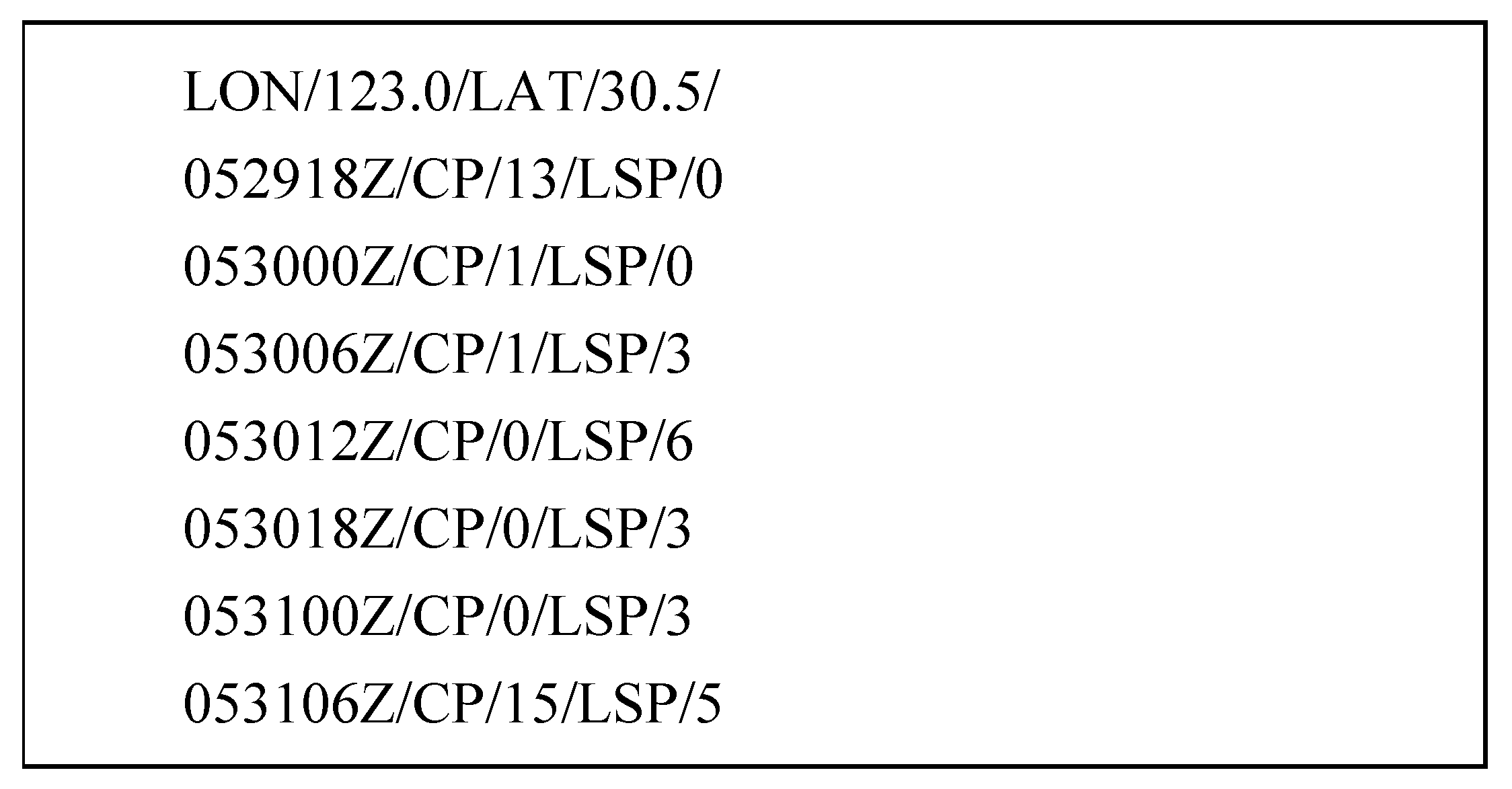
The first line notes the nearest grid’s latitude and longitude. In the following lines, the first value on the left marks the starting date and hour in GMT (e.g. 052912Z means 1200Z at May 29th), then the accumulated CP and LSP forecast value by the increment of six hours (e.g. 052918Z/CP/13/ means an accumulated 13mm would be expected from the lead six hours till 1800Z on May 29th).
Nowadays many inland river cruise boats are running in liner ship mode, that is to say, the manager and navigator could provide the ship position at the exact time before the departure. Thus the predicted CP or wind profile like Figure 6 or Figure 7 (c) could be generated before and during the trip. Under this object-oriented service, the ship’s resilience toward convective wind gusts can be improved. By reading the figures, the ship officer could know which part of the trip is most dangerous and then take necessary action to avoid it.
Page [29] stated that “With such an effective means of navigation, backed up by the continuing improvements in the provision of weather information and navigational warnings, the small craft of the future, whether at sea or in the air, should be capable of operation with minimal interference with larger commercial craft.” Our research bears a wishful small step towards this direction.
6. Conclusion
This study mainly analyzes the performance of predicted weather components around the deadly "Oriental Star" shipwreck, for the first time raises a possibility that the sub-grid strong wind gust associated with deep convective weather can be indirectly warned by the sudden CP increase in the mesoscale global numerical product. The result shows that, in terms of a single member (deterministic) model, the rapid change of CP at 24-hour lead is much more obvious than 48-hour and more, i.e. the 24h lead forecast has more potential to act as a warning factor. The finding has been confirmed in another mid-latitude boat capsizing but not in the tropics. In addition, when considering the high value of the ensemble forecast members, the effective lead time could be extended to 48-hour. It was also found that if the simultaneous LSP variation is negligible, then the warning credibility could be high.
It is suggested in current stage the adverse weather service provider shall consider adding CP variable into the maritime warning system, at least in the mid-latitude and for small-size cruise ship, to indirectly warn the strong convective wind gust along offshore and inland river, which is of great significance for the safeguard navigation of small-size passenger vessels. A previous automatic wind forecasting system could be modified to provide new convective wind gust warning.
Author Contributions
Conceptualization, J.J.; methodology, J.J.; software, J.H. and J.J.; validation, J.J., and J.H.; formal analysis, J.J.; investigation, J.J. and J.H.; resources, P.W. and J.H.; data curation, J.H. and J.J.; writing—original draft preparation, J.J.; writing—review and editing, J.H.; visualization, J.H.; supervision, J.J. and P.W.; project administration, J.J.; funding acquisition, J.J. All authors have read and agreed to the published version of the manuscript.
Funding
This research was funded by the National Natural Science Foundation of China (Grant No. 42261144671, 42030602).
Institutional Review Board Statement
Not applicable.
Informed Consent Statement
Not applicable.
Acknowledgments
Thanks reviewers for their grammar suggestion and comments.
Conflicts of Interest
The authors declare no conflict of interest.
References
- The measurement of gustiness at routine wind stations: A review (A.C.M. Beljaars). Instruments and Observing Methods Report No. 31, World Meteorological Organization (WMO), Geneva.1987.
- Watts, A. Weather forecasting for small craft. J. Navigation. 1977, 30, 474–478. [Google Scholar] [CrossRef]
- National investigation report on the "Oriental Star" shipwreck incident, 2015. Available online: http://www.huaxia.com/xw/dlxw/2015/12/4677742.html (accessed on 1 August 2021).
- Collier, C.G.; Dixon, J.; Harrison, M.S.J.; Hunt, J.C.R.; Mitchell, J.F.B.; Richardson, D.S. Extreme surface winds in mid-latitude storms: Forecasting and changes in climatology. J. Wind Eng. Ind. Aerodyn. 1994, 52, 1–27. [Google Scholar] [CrossRef]
- Nakamura, K.; Kershaw, R.; Gait, N. Prediction of near-surface gusts generated by deep convection. Meteorol. Appl. 1996, 3, 157–167. [Google Scholar] [CrossRef]
- Mao, Y.W. Meteorological Early Warning Service in the "Oriental Star" Passenger Ship Overturning Event and Its Enlight-enment. Cities and Disaster Reduction. 2018, 15–18. [Google Scholar]
- Friederichs, P.; Gober, M.; Bentzien, S.; Lenz, A.; Krampitz, R. A probabilistic analysis of wind gusts using extreme value statistics. Meteorol. Z. 2009, 18, 615–629. [Google Scholar] [CrossRef]
- Weggel, J.R. Maximum daily wind gusts related to mean daily wind speed. J. Struct. Eng. 1999, 125, 465–468. [Google Scholar] [CrossRef]
- International Maritime Organization (IMO). MSC.1/Circular.1281/Annex/ Chapter3, Origin of Present Stability Criteria, Explanatory Notes to the International Code on Intact Stability. 2008.
- Nakamura, K.; Kershaw, R.; Gait, N. Prediction of near-surface gusts generated by deep convection. Meteorol. Appl. 1996, 3, 157–167. [Google Scholar] [CrossRef]
- Patlakas, P.; Galanis, G.; Barranger, N.; Kallos, G. Extreme wind events in a complex maritime environment: ways of quantification. J. Wind Eng. Ind. Aerodyn. 2016, 149, 89–101. [Google Scholar] [CrossRef]
- Patlakas, P.; Drakaki, E.; Galanis, G.; Spyrou, C.; Kallos, G. Wind gust estimation by combining a numerical weather prediction model and statistical post-processing. Energy Procedia. 2017, 125, 190–198. [Google Scholar] [CrossRef]
- Chen, C.; Sasa, K.; Ohsawa, T.; Prpić-Oršić, J. Comparative study on WRF model simulations from the viewpoint of optimum ship routing. Ocean. Eng. 2020, 207. [Google Scholar] [CrossRef]
- Gutiérrez, A.; Porrini, C.; Fovell, R. Combination of wind gust models in convective events. J. Wind Eng. Ind. Aerodyn. 2020, 199, 104–118. [Google Scholar] [CrossRef]
- Brown, R.D.; Swail, V.R. Over-water gust factors. Ocean. Eng. 1991, 18, 363–394. [Google Scholar] [CrossRef]
- National investigation report on the "Oriental Star" shipwreck incident, 2015. Available online: http://www.huaxia.com/xw/dlxw/2015/12/4677742.html. (accessed on 1 August 2021).
- Sasa, K. Incecik, A. Numerical simulation of anchored ship motions due to wave and wind forces for enhanced safety in offshore harbor refuge. Ocean. Eng. 2012, 44, 68–78. [Google Scholar] [CrossRef]
- Jian, J.; Yu, M.J.; Shi, M.L.; Chen, J.H. Early warning of gust according to C_P change rate from numerical weather products. Navi. Chi. 2020, 43, 25–30. [Google Scholar]
- Persson, A. User guide to ECMWF forecast products. European Centre for Medium-Range Weather Forecast. Reading, UK. (2011).
- Joyce, R.J.; Janowiak, J.E.; Arkin, P.A.; Xie, P. CMORPH: A method that produces global precipitation estimates from passive microwave and infrared data at 8-km, hourly resolution. J. Hydrometeor. 2004, 5, 487–503. [Google Scholar] [CrossRef]
- Webster, P.J.; Jian, J.; Hopson, T.M.; Hoyos, C.D.; Agudelo, P.A.; Chang, H.R.; Curry, J.A.; Grossman, R.L.; Palmer, T.N.; Subbiah, A.R. Extended-range probabilistic forecasts of Ganges and Brahmaputra floods in Bangladesh. Bull. Am. Meteorol. Soc. 2010, 91, 1493–1514. [Google Scholar] [CrossRef]
- Christ, E.H.; Webster, P.J.; Snider, J.L.; Toma, V.E.; Ooserhuis, D.M.; Chastain, D.R. Predicting heat stress using probabilistic canopy temperature forecasts. Agron. J. 2015, 108, 1981–1991. [Google Scholar] [CrossRef]
- Don, P. K.; Evans, J. L.; Chiaromonte, F.; Kowaleski, A. M. Mixture-Based Path Clustering for Synthesis of ECMWF Ensemble Forecasts of Tropical Cyclone Evolution. Mon. Weather Rev. 2016, 144, 3301–3320. [Google Scholar] [CrossRef]
- Skoglund, L.; Kuttenkeuler, J.; Rose´n, A.; Ovega°rd, E. A comparative study of deterministic and ensemble weather forecasts for weather routing. J. Mar Sci. Technol. 2015, 20, 429–441. [Google Scholar] [CrossRef]
- Thailand authority report, 2018. Available online: https://thethaiger.com/news/phuket/phoenix-substandard-more-officials-face-legal-action. (accessed on 1 August 2021).
- Azorin-Molina, C.; Guijarro, J.A.; McVicar, T.R.; Vicente-Serrano, S.M.; Chen, D.L.; Jerez, S.; Espirito-Stanto, F. Trends of daily peak wind gusts in Spain and Portugal, 1961–2014. J. Geophys Res. Atmos. 2016, 121, 1059–1078. [Google Scholar] [CrossRef]
- Cho, J.Y.; Keum, J.S.; Jang, W.J. A study on the effects of marine accidents by navigation officer’s fatigue. Metabolism-clinical & Experimental. 2010, 57, 946–953. [Google Scholar]
- Jian, J.; Webster, P.J. A new marine auto-response quantitative wind forecast system. Procedia - Social and Behavioral Sciences. 2013, 96, 1362–1365. [Google Scholar] [CrossRef]
- Page, D. The future navigation of small craft both at sea and in the air. J. Navigation. 1992, 45, 13–18. [Google Scholar] [CrossRef]
Figure 1.
Different types of clouds and precipitations: (a) frontal clouds Ci, Cs, As, Ns with large scale precipitation; (b) fair weather cumulus; (c) cumulus congestus; (d) cumulonimbus with strong precipitation.
Figure 1.
Different types of clouds and precipitations: (a) frontal clouds Ci, Cs, As, Ns with large scale precipitation; (b) fair weather cumulus; (c) cumulus congestus; (d) cumulonimbus with strong precipitation.
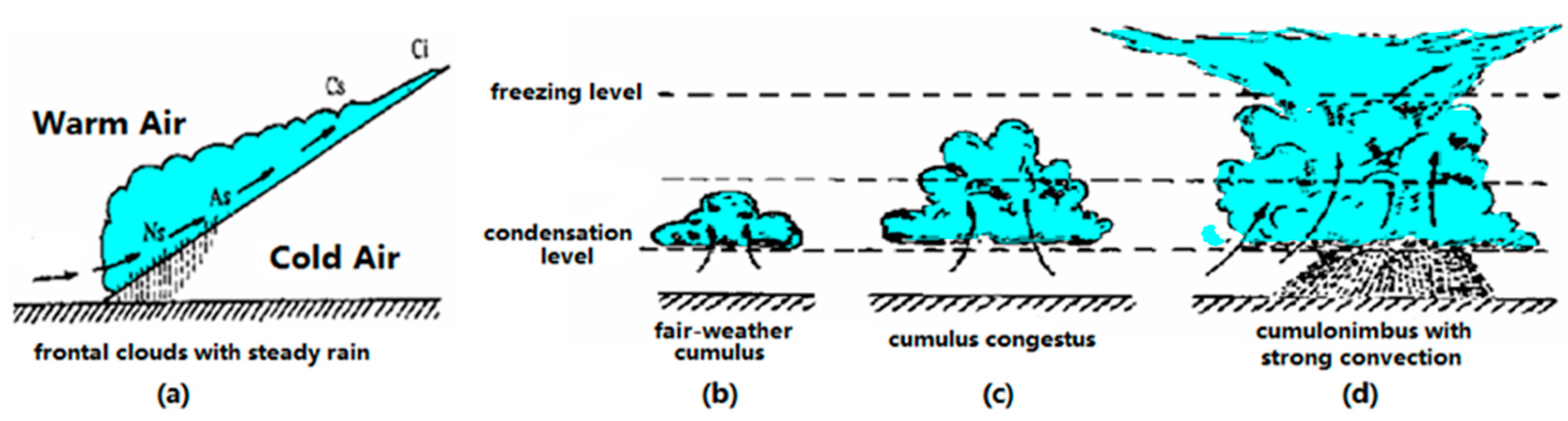
Figure 2.
10-meter wind at UTC: (a) 1200Z on 1st JUN 2015; (b) 1800Z on 1st JUN 2015 (Black thick line and red star mark the last route and shipwreck position of "Oriental Star").
Figure 2.
10-meter wind at UTC: (a) 1200Z on 1st JUN 2015; (b) 1800Z on 1st JUN 2015 (Black thick line and red star mark the last route and shipwreck position of "Oriental Star").
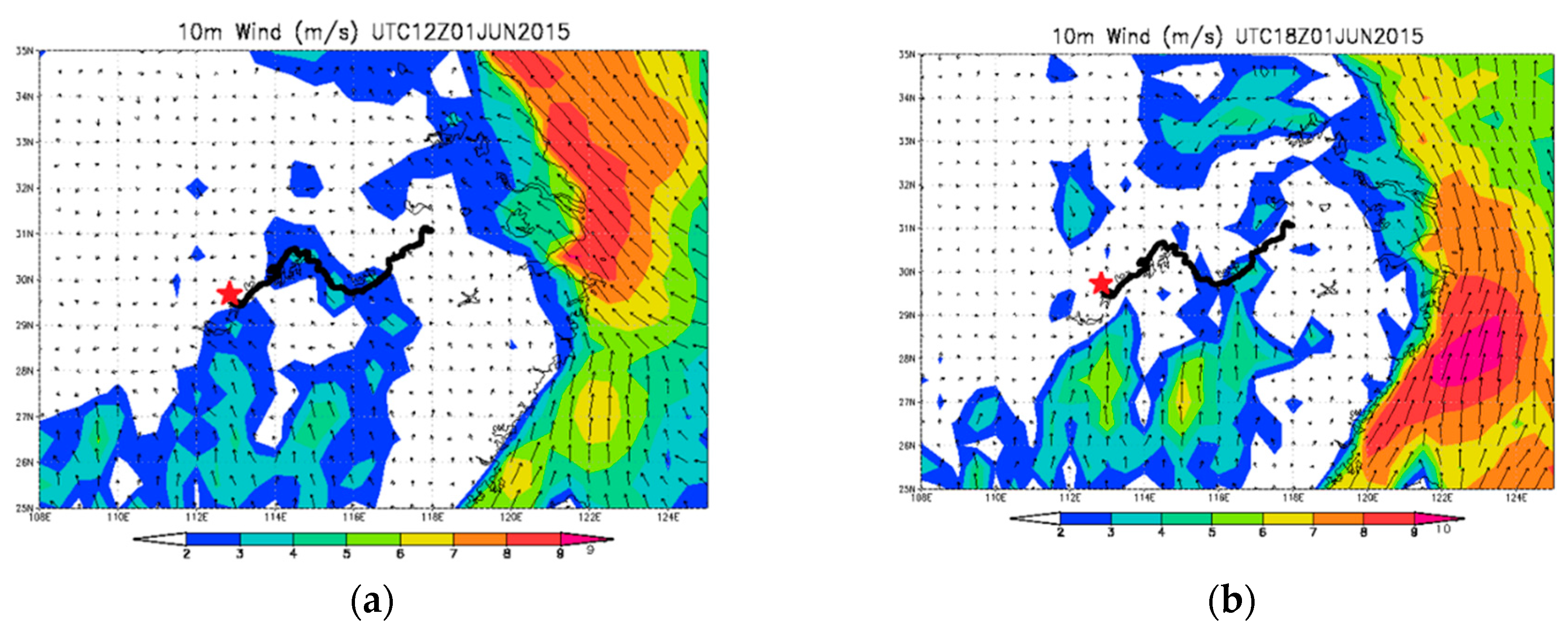
Figure 3.
(a) Doppler radar rain rate snapshot at the “Oriental Star” shipwreck moment; (b) CMORPH 3-hour precipitation during UTC1200-1500Z on Jun 1st 2015. (red box matches area of 2a, purple thick line marks the last track of "Oriental Star". The star marks the ship’s final wreck location.)
Figure 3.
(a) Doppler radar rain rate snapshot at the “Oriental Star” shipwreck moment; (b) CMORPH 3-hour precipitation during UTC1200-1500Z on Jun 1st 2015. (red box matches area of 2a, purple thick line marks the last track of "Oriental Star". The star marks the ship’s final wreck location.)
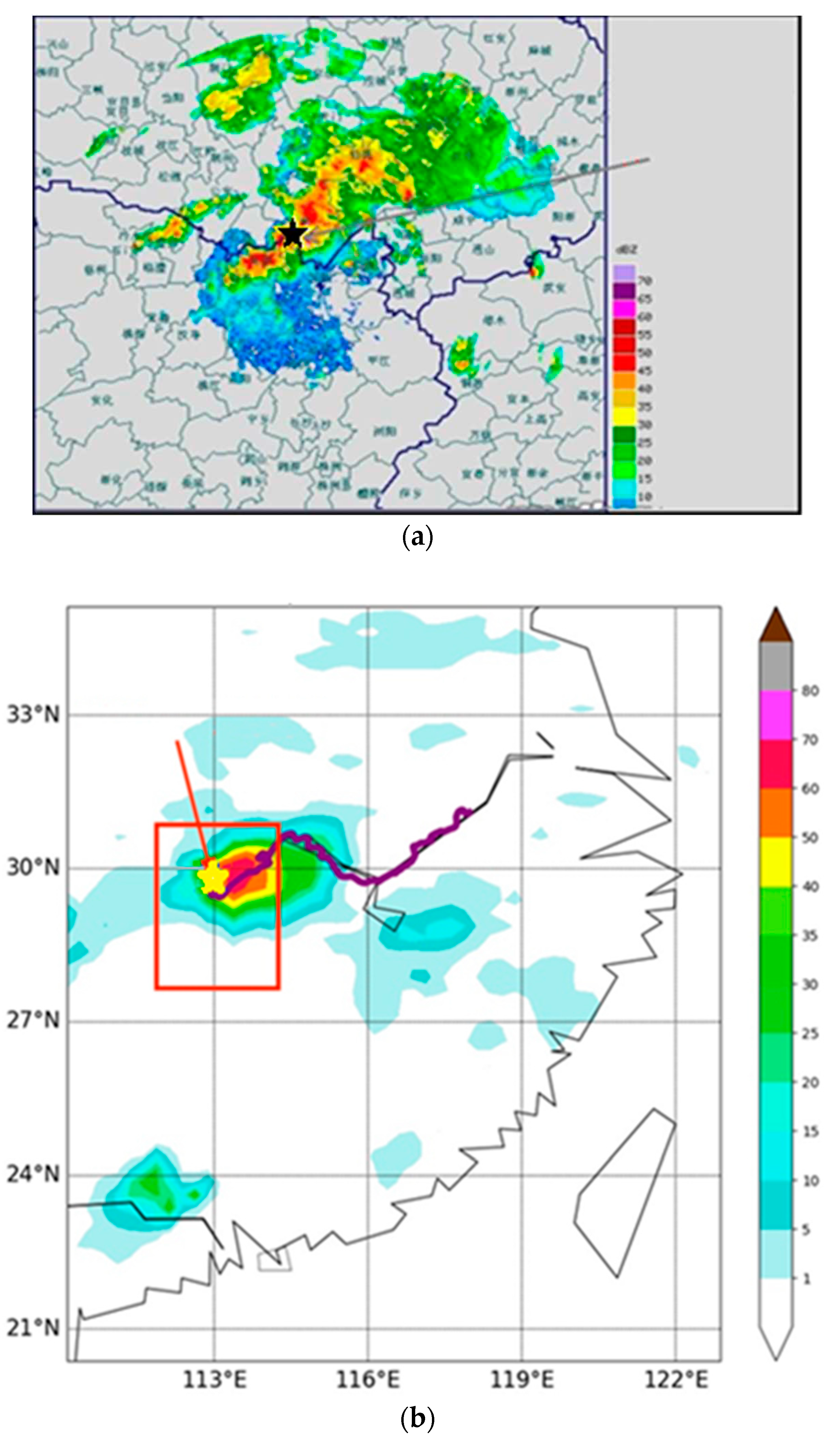
Figure 4.
(a) Cumulus precipitation (CP) prediction over UTC 12-18Z initialized at 12Z 1st Jun, 2015; (b) Same to (a) but initialized at UTC12Z 31st May; (c) Same to (b) but for large-scale precipitation (LSP) prediction (from Jian et al. 2020).
Figure 4.
(a) Cumulus precipitation (CP) prediction over UTC 12-18Z initialized at 12Z 1st Jun, 2015; (b) Same to (a) but initialized at UTC12Z 31st May; (c) Same to (b) but for large-scale precipitation (LSP) prediction (from Jian et al. 2020).
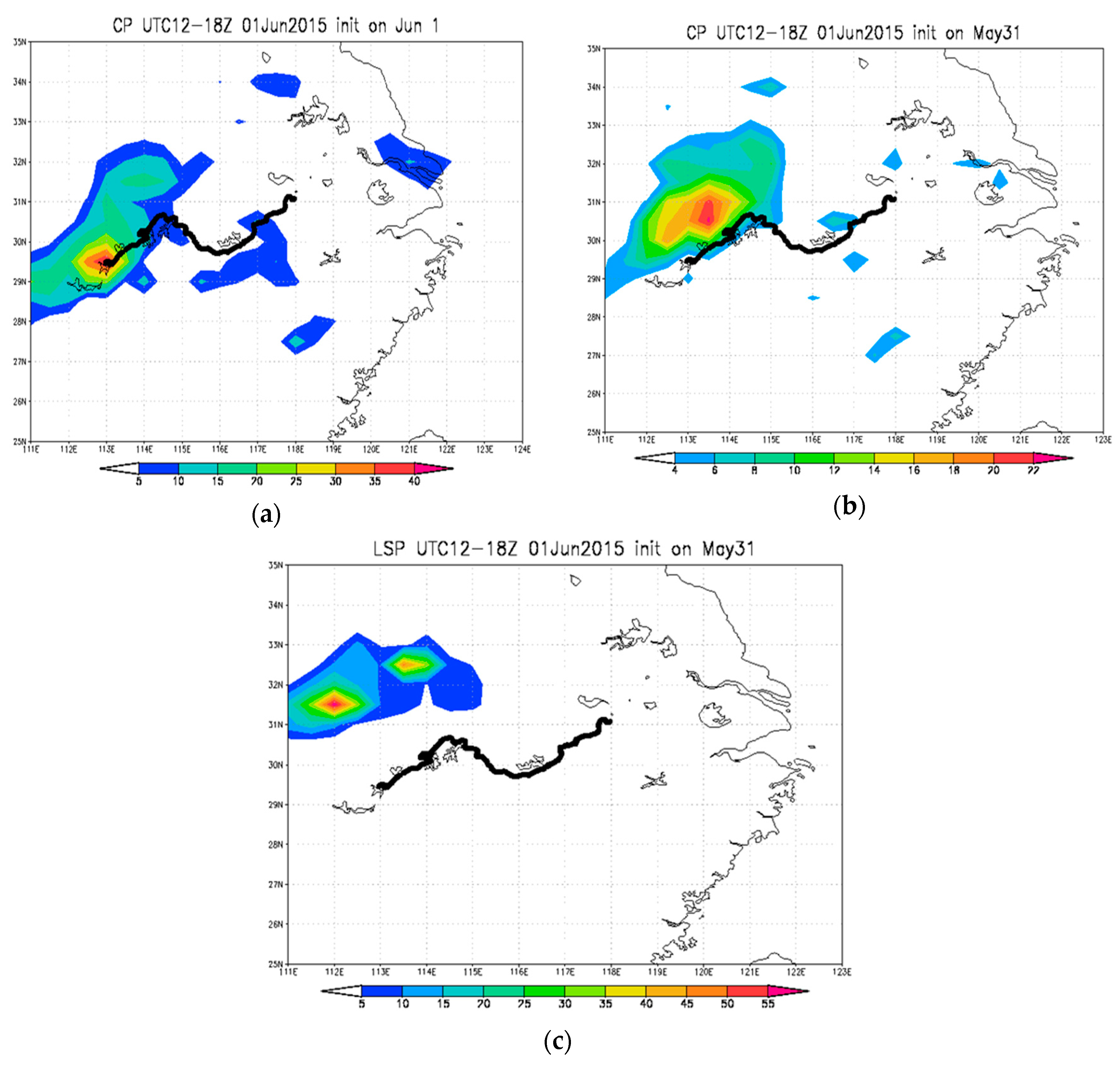
Figure 5.
Upper-level air temperature trend at different pressure level at the location of “Oriental Star” final shipwreck, the vertical lines mark the shipwreck time.
Figure 5.
Upper-level air temperature trend at different pressure level at the location of “Oriental Star” final shipwreck, the vertical lines mark the shipwreck time.
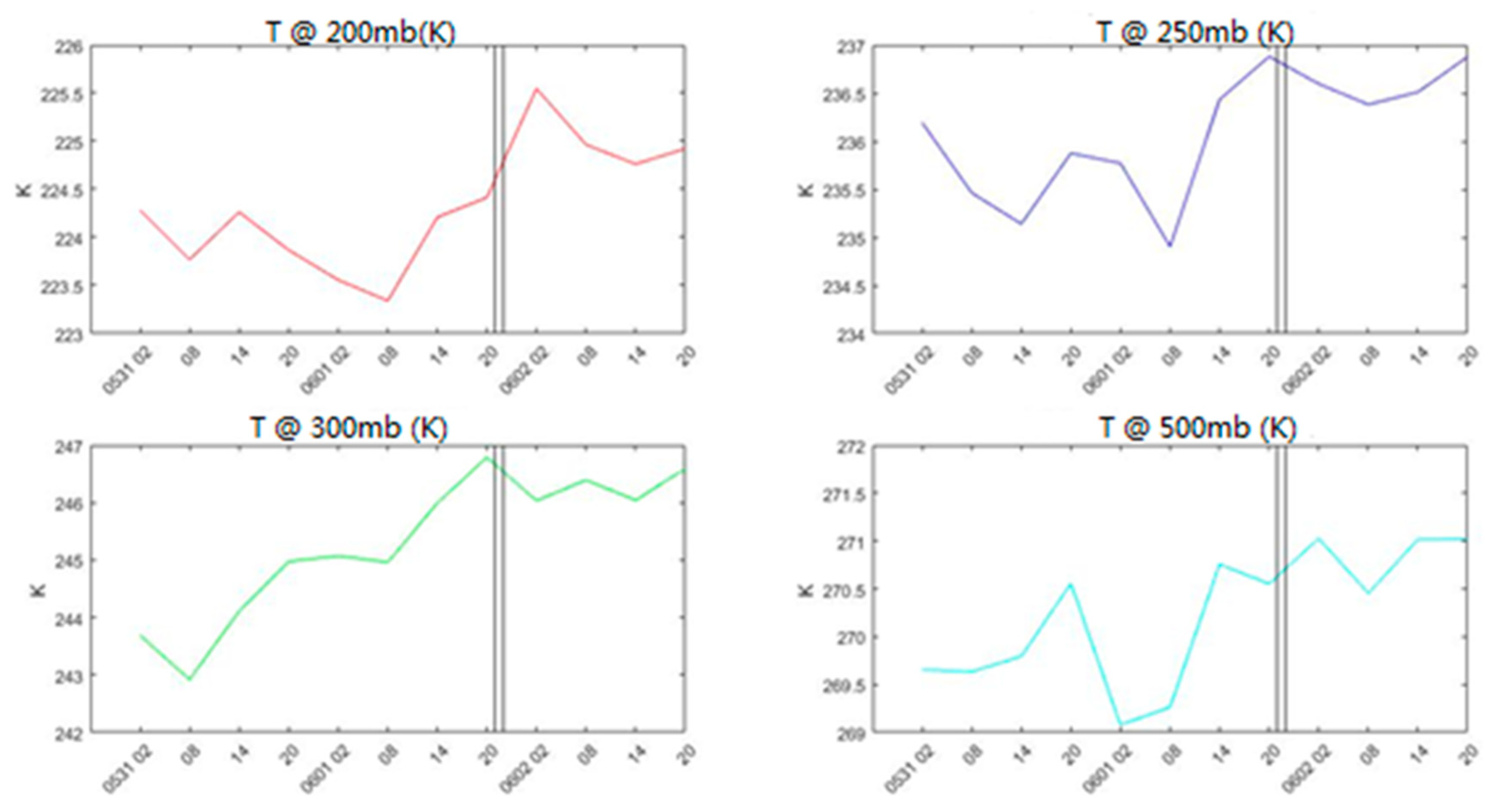
Figure 6.
Predicted CP (solid) and LSP (dash) value following the last route of "Oriental Star" ship at 1 day (red), 2-day (gray) and 3-day (green) lead time
Figure 6.
Predicted CP (solid) and LSP (dash) value following the last route of "Oriental Star" ship at 1 day (red), 2-day (gray) and 3-day (green) lead time
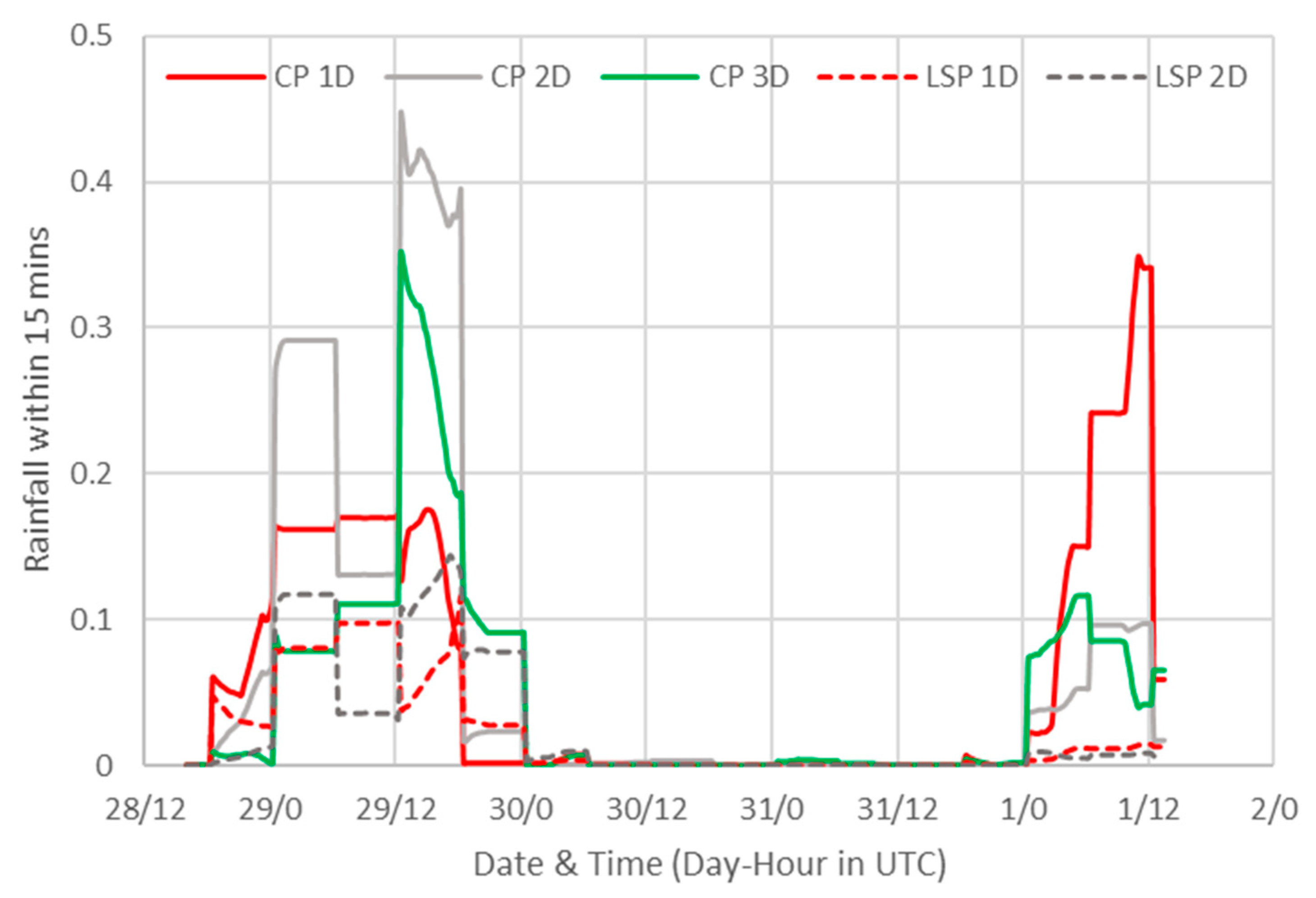
Figure 7.
(a) Time series of regional average (blue box) ensemble CP forecast; (b) mean of the highest one tenth of 51-member ensemble CP forecast at 24-hour lead; (c) similar to Figure 6 but for mean of one tenth of the all ensemble CP forecasts.
Figure 7.
(a) Time series of regional average (blue box) ensemble CP forecast; (b) mean of the highest one tenth of 51-member ensemble CP forecast at 24-hour lead; (c) similar to Figure 6 but for mean of one tenth of the all ensemble CP forecasts.
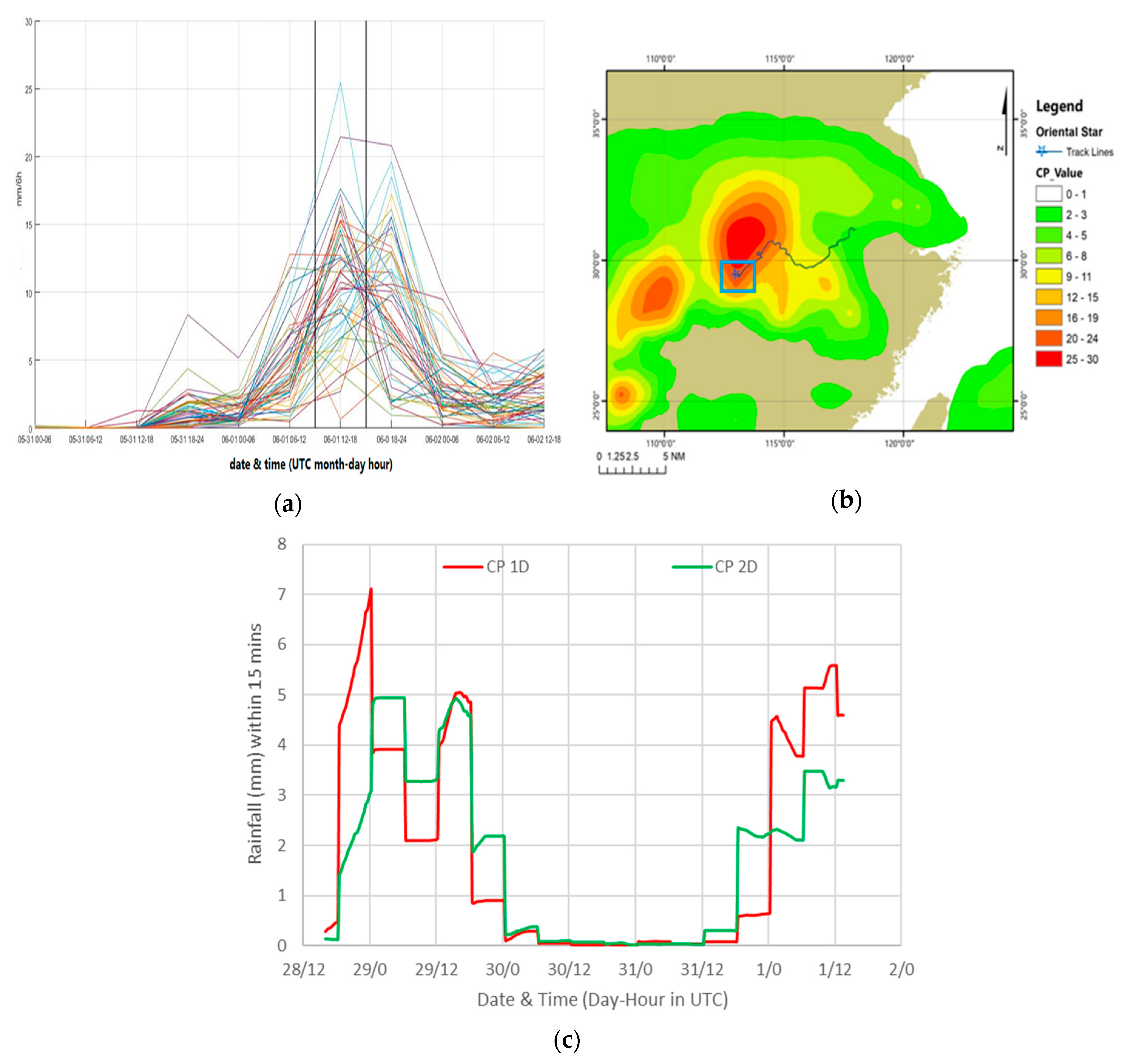
Figure 8.
(a) deterministic and (b) ensemble mean forecast of 6-hour accumulated CP horizontal distribution on 4th of June, 2016 when “double dragon” capsized; (c) time series of ensemble CP prediction similar to Figure 7 (a) but for “Double Dragon” Case.
Figure 8.
(a) deterministic and (b) ensemble mean forecast of 6-hour accumulated CP horizontal distribution on 4th of June, 2016 when “double dragon” capsized; (c) time series of ensemble CP prediction similar to Figure 7 (a) but for “Double Dragon” Case.
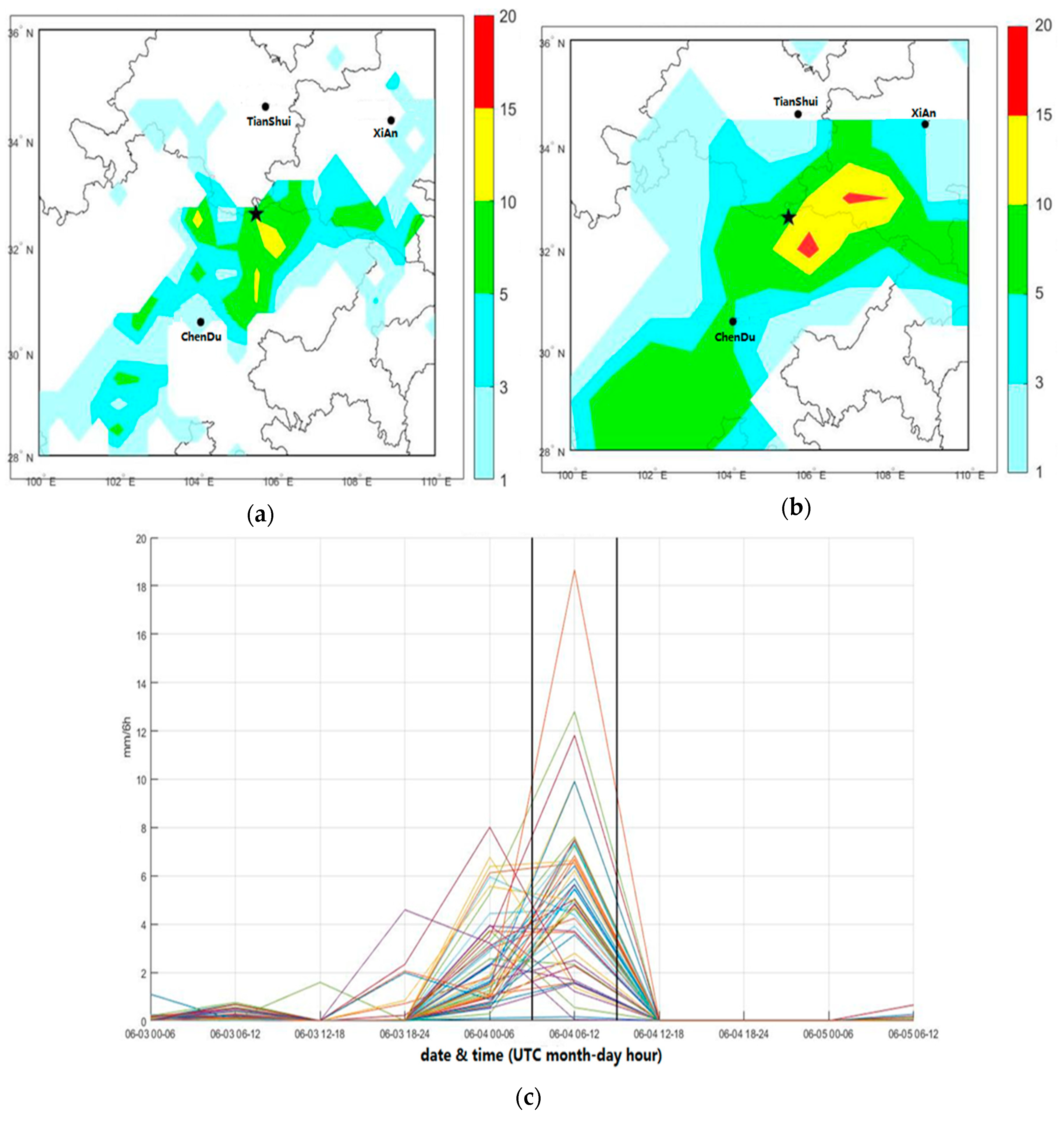
Figure 9.
CP forecast at offshore Phuket island, southern Thailand during July 4-7th, 2018 (from Jian et.al. 2020).
Figure 9.
CP forecast at offshore Phuket island, southern Thailand during July 4-7th, 2018 (from Jian et.al. 2020).
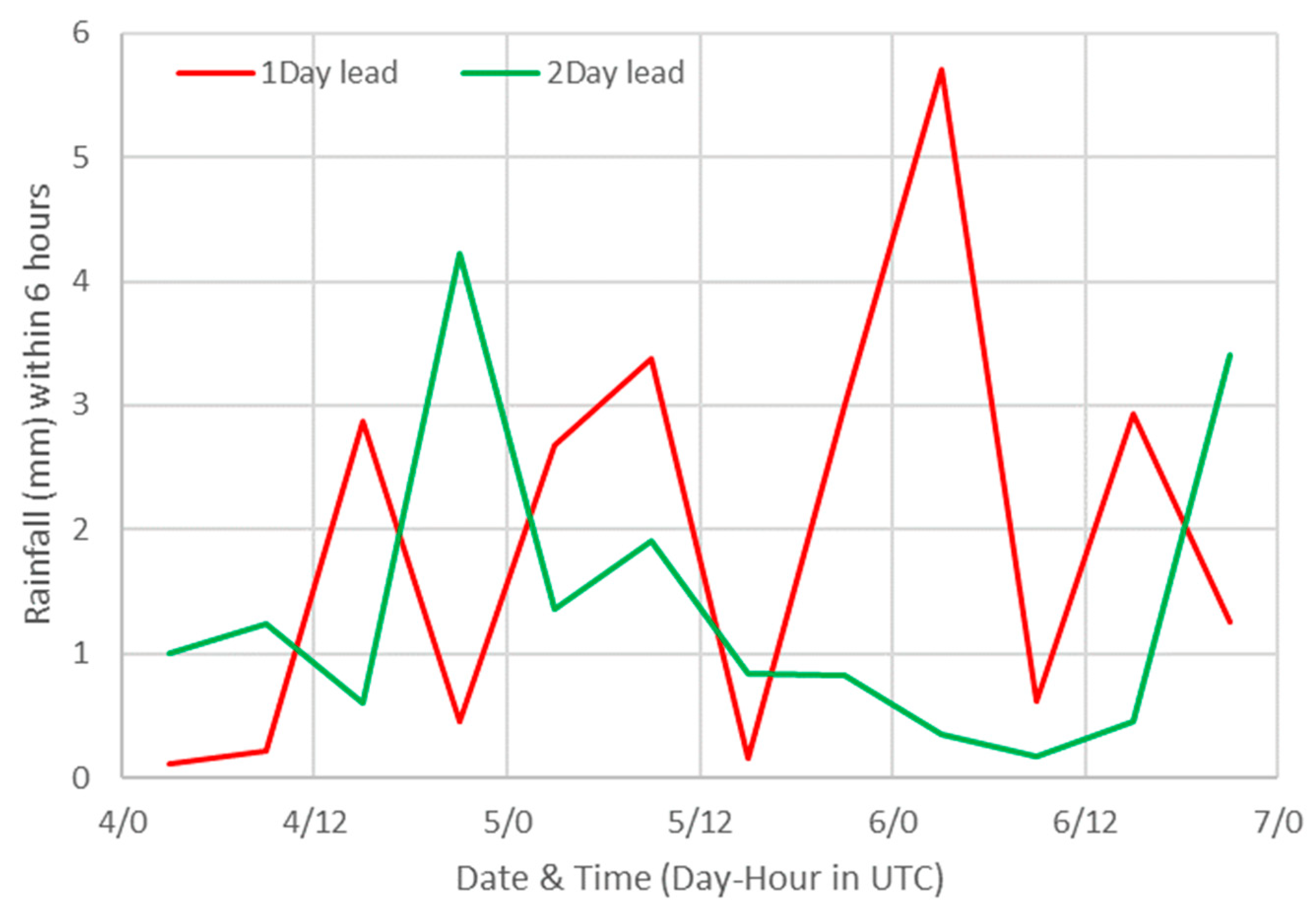
Figure 10.
Structure of the automatic weather navigation system scheme.
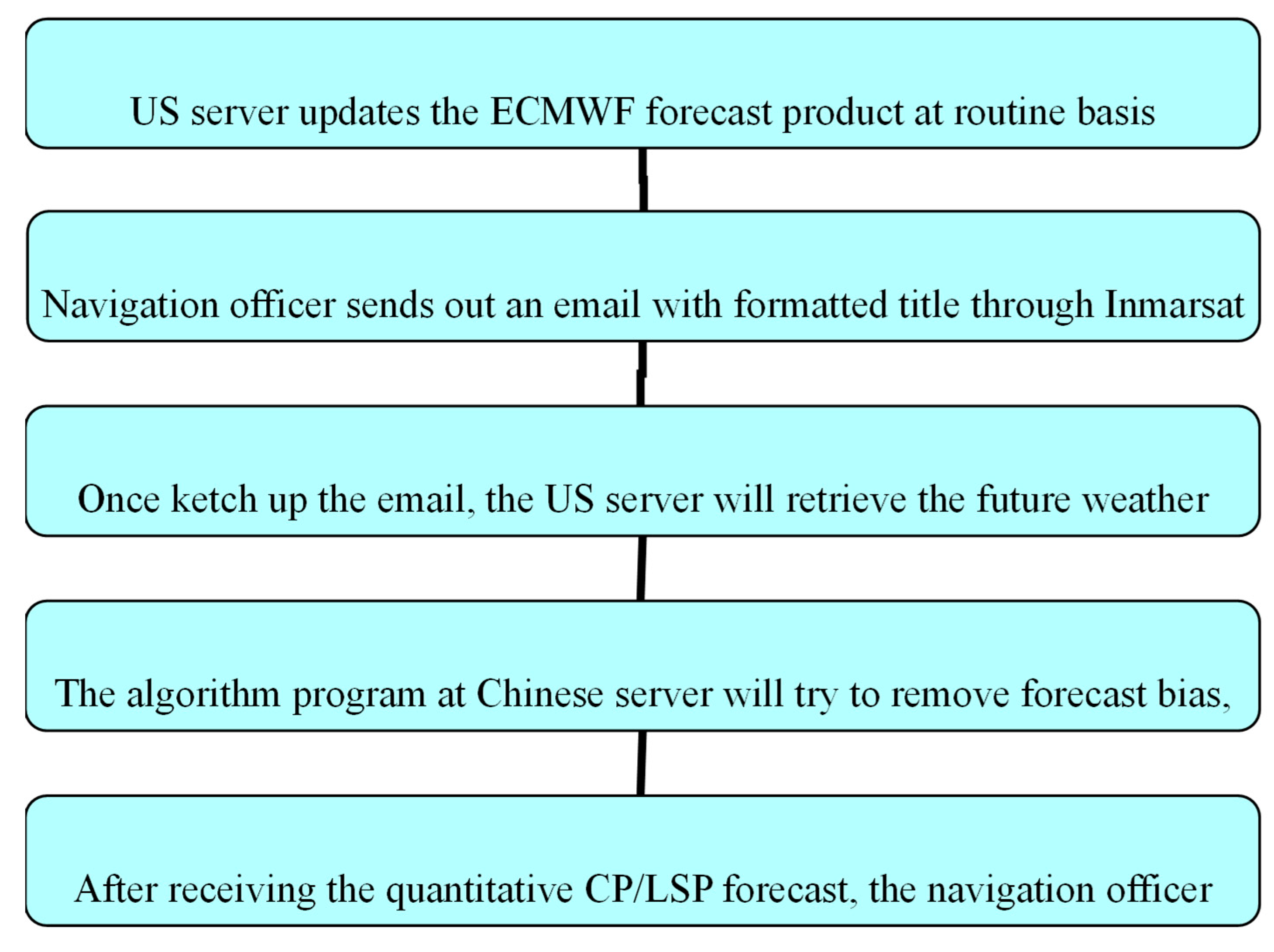

Table 1.
Selected weather components in ECMWF deterministic product at 24-hour lead time and their tempo-spatial variation to the “Oriental Star” accident.
Table 1.
Selected weather components in ECMWF deterministic product at 24-hour lead time and their tempo-spatial variation to the “Oriental Star” accident.
| Abbreviation | Full Name | Level | Unit | Variation at “Oriental Star” Accident |
|---|---|---|---|---|
| 2D, 2T | Dew point and air temperature | 2 meter above surface | K | No |
| CP | Cumulus precipitation | Surface | m | Extreme value fits the accident’s location and time |
| LSP | Large scale precipitation | Surface | m | No |
| MSL | Mean sea level pressure | Surface | Pa | No |
| Q | Specific humidity | 700 mb, 850 mb | kg/kg(%) | No |
| SLHF, SSHF, SSR, STR | Latent and sensible heat flux, Solar and thermal radiation | Surface | W/m2*s | No |
| GH | Geopotential height | 700 mb, 850 mb | gmp | No |
| T | Air temperature | 200 mb | K | Middle of increasing trend |
| T | Air temperature | 250 mb | K | End of increasing trend |
| T | Air temperature | 300 mb | K | End of increasing trend |
| T | Air temperature | 500 mb | K | No |
| U ,V | Horizontal wind velocity | 10 meter above surface, 200 mb, 700 mb, 850 mb | m/s | No |
| VO | Vorticity | 700 mb, 850 mb | 1/s | No |
Disclaimer/Publisher’s Note: The statements, opinions and data contained in all publications are solely those of the individual author(s) and contributor(s) and not of MDPI and/or the editor(s). MDPI and/or the editor(s) disclaim responsibility for any injury to people or property resulting from any ideas, methods, instructions or products referred to in the content. |
© 2023 by the authors. Licensee MDPI, Basel, Switzerland. This article is an open access article distributed under the terms and conditions of the Creative Commons Attribution (CC BY) license (http://creativecommons.org/licenses/by/4.0/).
Copyright: This open access article is published under a Creative Commons CC BY 4.0 license, which permit the free download, distribution, and reuse, provided that the author and preprint are cited in any reuse.


