

Submitted:
22 June 2023
Posted:
22 June 2023
You are already at the latest version
Abstract
This article traces the origination, distribution, kinematics, function, and nature of alternative lateral horse gaits, i.e. intermediate speed lateral-sequence gaits involving the synchronization of ipsilateral limbs in the swing phase. Such alternative lateral horse gaits (namely, the running walk, rack, broken pace, hard pace, and broken trot) have been prized by equestrians for their comfort, and have been found in select horse breeds for hundreds of years and even exhibited in fossil equid trackways. After exploring the evolution and development of alternative lateral gaits via fossil equid trackways, human art and historical writings, and the genetics and history of modern horse breeds, functional and biomechanical reasons are offered for the genesis of these gaits. The article concludes by tracing similarities and differences between and within the expression of these alternative lateral gaits by various horse breeds. Fast and low-swinging hard pacing gaits are common in several horse breeds of East and North Asia, high-stepping rack and running walk gaits are often displayed in European and North and South American breeds, the broken pace is found in breeds of Central Asia, Southeast Asia, West Asia, Western North America, and Brazil in South American, and the broken trot occurs in breeds of North Asia, South Asia, and the Southern United States, and Brazil South America.
Keywords:
horses
; gaits
; alternative lateral gaits
1. Introduction
Horses display one of the most diverse sets of gaits among mammals [1–4]. Most horse breeds perform the standard or so-called “natural” gaits of the walk, trot, and gallop (or canter) [5–11]. The walk is a slow even four-beat symmetrical lateral-sequence gait that is “stepped,” “square” or “singlefoot” with hooves lifting-off from and setting-down on the ground in a fairly independent manner (limb phasing value of ca. 0.25, so the limbs sequentially set down in near quarter intervals of the stride). The walk also lacks a suspended phase (or period where all four limbs are off the ground at once) [9–18]. The trot is an even two-beat diagonal-sequence and diagonal-couplet symmetrical and intermediate speed gait (limb phasing value of 0.50) wherein diagonal limbs lift-off and land together resulting in suspended phases wherein all four limbs are off the ground [9–11, 13, 17–26]. The four-beat gallop (or three-beat canter) is an asymmetrical fast gait involving the sequential lifting-off and setting-down of contralateral limb pairs (horses employ a transverse gallop with front and hind contralateral pairs sequentially mirroring each other) and lots of suspension wherein all four legs are simultaneously off the ground [9, 11, 27–31].
In addition to the “natural” gaits, several “gaited” horse breeds also display “artificial” gaits or what I shall call alternative lateral gaits, i.e. intermediate speed symmetrical lateral-sequence gaits involving the synchronization of ipsilateral limbs [7, 9, 11, 32–44]. The term alternative here seems preferable to artificial as these gaits spontaneously evolved in fossil equids and modern horse breeds and are often performed by foals without any training. The running walk is an even four-beat square (“singlefoot”) gait involving hyperextension of the hind limbs under the body of the horse and inverted-pendulum swinging mechanics, and lacks periods of four-limb suspension [33, 35–36, 38, 41, 44–48]. The rack [or tölt] is also a square (“singlefoot”) gait but is reliant on the spring-mass mechanics of the horse ligament system [9, 11, 33, 35–36, 38, 42, 44, 49–57]. The (hard) pace is an even two-beat lateral-couplet gait wherein ipsilateral hooves lift-off and land at roughly the same time and has periods of four-limb suspension [9, 35–36, 42, 44, 58–64]. If ipsilateral hooves lift-off the ground nearly simultaneously but land further apart in time so as to yield an uneven four-beat shuffling cadence without periods of four-limb suspension, the horse is performing the broken pace (or stepping pace or amble) [35–36, 38, 44]. Finally, if diagonal hooves lift off nearly together in time but land further apart in time so as to yield an uneven four-beat shuffling cadence, again in a later-sequence gait but without periods of four-limb suspension, one has the broken trot (or fox trot) [35–36, 38, 44, 65–67].
In other words, horse gaits can be organized according to the following schema:
walk: slow, symmetrical, lateral-sequence, singlefoot, even, four-beat, inverted pendulum running walk: intermediate, symmetrical, lateral-sequence, singlefoot, even, four-beat, inverted pendulum rack: intermediate, symmetrical, lateral-sequence, singlefoot, even, four-beat, spring mass broken pace: intermediate, symmetrical, lateral-sequence, lateral-couplet, uneven, four-beat, spring mass hard pace: intermediate, symmetrical, lateral-sequence, lateral-couplet, even, two-beat trot: intermediate, symmetrical, diagonal-sequence, diagonal-couplet, even, two-beat broken trot: intermediate, symmetrical, lateral-sequence, diagonal-couplet, uneven, four-beat canter/gallop: fast, asymmetrical, contralateral-sequence, contralateral-couplet, uneven, three to four-beat
The evolutionary origin of alternative lateral gaits in horses is somewhat complicated. Alternative lateral gaits are quite rare in mammals, typically occurring only in longer-legged species such as camels, alpacas, llamas, guanacos, vicuñas, giraffes, okapis, gerenuks, elephants, bears, bandicoots, maras, the maned wolf, and some longer-legged dog breeds such as greyhounds, bloodhounds, Great Danes, Rhodesian ridgebacks, salukis, and weimaraners [4, 68–71]. Horses do have long legs, but modern non-equine perissodactyls (tapirs and rhinoceroses) seem to exclusively employ the trot as their intermediate speed gait, and this presumably represents the locomotive behavior of basal perissodactyls including equids (ca. 56-47 Ma), from which horses derived [72–75]. At some point in their evolutionary history, however, horses gained the ability to avail themselves of alternative lateral gaits. For there is evidence from tridactyl equid trackways that perhaps some Miocene and certainly some Pliocene equids employed the alternative lateral gait of the rack (and perhaps the running walk), in addition to the diagonal gait of the trot and the asymmetrical gallop [76–78 their figure S1]. Yet it seems that horses eventually lost the ability to perform alternative lateral gaits. For wild equine populations (zebras; asses; Przewalski’s horses), and some of the oldest horse breeds (i.e. Caspian, Exmoor, Sorraia, and most Arabian and Akhal-Teke horses) seem to exclusively employ the trot as their intermediate speed gait. Hence it is likely that basal members of the tribe Equini (ca. 16 Ma) had lost the ability to perform alternative lateral gaits and only trotted at intermediate speeds. All the same, many modern horse breeds can perform alternative lateral gaits such as the running walk, rack, broken pace, hard pace, and broken trot. So horses once again gained an ability to employ alternative lateral gaits. Human art and history, and modern genetics, indicate that this ability to perform alternative lateral gaits reoccurred (whether by a reversion to an ancestral mechanism or by the development of a new mechanism) ca. 2200 BCE-1000 CE [79–80]. The story of how horses gained, lost, then regained the ability for alternative lateral gaits, and their nature and benefits, is told below.
2. Alternative Lateral Horse Gaits
Members of the genus Equus–including domesticated caballine horse breeds (Equus ferus caballus), as well as the (likely) non-domesticated Przewalski Horse (Equus ferus przewalskii), zebras (hippotigroids), and wild asses (hemiones)–standardly perform three to four gaits, the walk, trot, gallop (and sometimes canter) [5–11]. These are often called the “natural” gaits of horses. There are also additional horse gaits (sometimes called “artificial” or supplemental) that are spontaneously displayed in certain domestic horse breeds (i.e. gaited horses). All of these additional gaits (running walk, rack, broken pace, hard pace, broken trot), possess an ipsilateral step sequence (left hind, left front, right hind, right front), and here will be called alternative lateral gaits.
The walk is the standard slow gait of the horse (ca. 1.4-1.8 m/s) involving independent movement of the four limbs in a lateral footfall sequence (left hind, left front, right hind, right front). It yields four audible even beats with the movements of the right legs imitating those of the left side. Hence it is a symmetrical lateral sequence “stepping,” “square,” or “singlefoot” gait (here stepping, “square,” or “singlefoot” are used to mean that the limbs operate mostly independently of each other). The walk has a limb phasing value, or lateral advanced placement, around 0.25 as each limb makes contact with the ground near one-fourth the temporal duration of the stride. The walk has a duty factor of 0.70-0.60, indicating the hind limbs making contract with the ground through 60-70% of the stride duration, and has extended phases of 3-limb support, as well as lateral and diagonal two-limb support phases [9–18].
The trot (or jog if performed in slow manner) is the standard intermediate speed gait of the horse (ca. 2.5-6.5 m/s, up to 8.5-12.0 in harness racing). It is a symmetrical diagonal sequence and diagonal couplet gait (left hind+right front, right hind+left front) that yields two audible even beats (at slower speeds the front hoof often lands just before the hind diagonal hoof and at higher speeds the hind hoof just before the front diagonal hoof, but not enough to make an audible difference). It has a limb phasing value, or lateral advanced placement, of 0.50, and a duty factor of around 0.55-0.30, resulting in lots of diagonal two-limb support phases, some single limb support phases, and periods of suspension when all four legs are off the ground at the same time [9–11, 13, 17–26]. The trot can occur with elevated and animated front legs where it is often called the park trot, as in the Morgan Horse [67].
The gallop (sometimes called a lope if done in slow manner or run if done in fast manner) is the standard fast gait of the horse (ca. 9.0-15.0 m/s, up to 17.0-19.0 m/s in horse racing). In equines this takes the form of an asymmetrical transverse gallop involving fast repeating strikes of contralateral couplets (i.e. left hind, right hind, left front, right front in a right-lead gallop, or the reverse in a left-lead gallop). A gallop will typically yield four uneven quick beats with long periods of four-limb suspension (duty factor of 0.30-0.20) and phases of one or contralateral two-limb support. If performed at a slightly slower speed the asymmetrical gait can turn into a three-beat canter wherein a hind limb contacts the ground, followed by a diagonal limb pair making contact together, and ending with contact of the front leading limb (i.e. left hind, right hind+left front, right front), with single limb and diagonal limb support phases, and occasional periods of three-limb support at slower speeds [9, 11, 27–31].
Five different types of alternative lateral horse gaits can be distinguished, with certain variants found within, yet, as noted above, all of them are symmetrical lateral sequence gaits with a footfall pattern of left hind, left front, right hind, right front). These are the running walk (or flat walk at slower speeds), rack (often called the tölt in Europe), the broken pace (or stepping pace), the pace (hard pace), and the broken trot (often called the fox trot) [7, 9, 11, 33–44]. These gaits are distinguishable in terms of audible beats (number and chronicity), temporal kinematic parameters (advanced placement and lift-off of consecutive limbs and whether they are diagonal or ipsilateral couplets, and duty factor or hind limb stance duration), support structures (number of hooves on the ground at the same time in stance phases), linear parameters (footprint patterns, stride (cycle) length, and track gauge width), joint angles, body movements, and biomechanics [see Figure 1 and table S1].
2.1. The Running Walk
The running walk is an accelerated outstretched walk wherein the biomechanics and limb sequence of the standard walk are largely retained but the hind limbs extend forward under the horse’s body before pushing off in order to propel the horse in an intermediate-speed and overstepping gait. Like the walk it is a four-beat lateral sequence gait, and preferably square or singlefoot (especially in the show arena) with four even beats, though occasionally lateral couplet (with ipsilateral hooves landing closer together in time than diagonal hooves). Again, the running walk, like the walk, biomechanically involves swinging the horse’s legs in an inverted pendulum-like manner, generation of forward motion through muscular effort in pushing limbs off the ground, and minor flexing or extending of the leg joints. However, the bulk of the forward propulsion of the running walk comes from the hind limbs extending forward under the horse’s body and overstepping the landing point of the ipsilateral front hooves. In order to maintain balance, and not waste kinetic energy, horses in the running walk will nod their head up and down, often causing the ears to flop up and down as well. Thus, a horse displaying a running walk will have a low sweeping stride in the rear limbs but a short elevated stride in the front limbs. There is some debate as to whether the “running walk” is properly spoken of as a walk or a run [81], however, the present author finds no solid reason to discard the traditional name of running walk (especially as its speed can attain 2.5-4.0 m/s, at which point most non-gaited horses will have transitioned to a trotting gait, yet it involves inverted pendulum biomechanics) and it will be retained herein.
The two forms of the running walk are the slower flat walk and the faster running walk proper (i.e. the hard running walk). The flat walk (or sometimes called the flat foot walk or flat footed walk) takes place at around 1.8 to 2.2 meters/second with a stride duration of 1.10-0.95 seconds and a stride length of 1.8 to 2.4 meters. The flat walk is often slightly uneven (the ratio of ipsilateral over diagonal step time is 0.60-0.70) and so involves lateral couplets (though as much of an even singlefoot gait as possible is encouraged and an overly pacy walk or “camel walk” discouraged in the show arena). In the flat walk there is a period during which a front or hind hoof lies flat on the ground (hence the name of the gait), some head nod (vertical head displacement of 11-19 cm), a little forward to back movement in the saddle, but not a lot of up and down movement (croup vertical displacement is around 8 cm). The flat walk contains a lot of 3-limb support phases (ca. 0.40-0.70 of the stride length) with alternating lateral and diagonal periods of support [7, 35–36, 41, 82–85].
The running walk proper (henceforth the hard running walk) is the faster version of the gait taking place around 2.2 to 4.0 meters/second, with a stride duration of 0.85-0.65 seconds, and a stride length of 2.1 to 2.9 meters. The hard running walk is ideally quite even (ratio of ipsilateral over diagonal step times of 0.70-0.90), but the front limbs break over and lift off the ground just before the heels of the hind hooves land (so it is not flat footed). Hence while the running walk has a lateral advanced placement close to 0.25 (0.23 to 0.17), it possesses a fairly low lateral advanced liftoff (0.10-0.19) and a fairly high diagonal advanced lift-off (0.31 to 0.48). There is also substantial head nodding that occurs with the running walk, which helps the hose maintain balance (vertical head displacement 10-24 mm). The back of the horse is fairly level (i.e. unrounded) in the running walk with very little up and down movement of the rider in the saddle (croup vertical displacement ca. 3-6 cm), and only a slight front to back rocking motion in the saddle. The running walk has minimal tripedal support phases (0.15 to 0.05) compared to other lateral gaits and may have occasional periods of single foot support (0.02-0.08) at very fast speeds, with two front feet and one hind foot in the air simultaneously. The running walk tends to leave a trackway of four isolated prints without obvious ipsilateral or diagonal pairings [33, 35–36, 38, 41, 44–47] (see Figure 1 and table S1).
The running walk is a very comfortable gait for the rider and prized in horse breeds where a long duration intermediate-speed gait is desired. It is also a very sure-footed gait with periods of tripedal support at slower speeds and with one limb always on the ground (explaining its possible appearance in tridactyl Pliocene equids moving across ash beds in Laetoli, see [76]). Though the running walk is not found in Spanish horse breeds today, the Spanish imprint is seen in the close association of “walking” horse breeds with early Spanish colonies in the Americas, as well as in shared genes between New World and Iberian horses [86–90]. In fact, the running walk seems to have originated with horses that were part of a Celtic migration from the Hallstatt Culture in the Austrian and Swiss Alps (ca. 800 BCE) to Iberia (ca. 540 BCE) [91–97]. These Celtic horses gave rise to the Spanish Jennet (Galician) horse that formed part of the Spanish lineage brought to the Americas in the sixteenth century. In addition, it is likely that these Celtic horses gave rise to the medieval palfrey horses of England, France, and Italy, some of which, as detailed later, seem to display a running walk in depictions of knights sparing on horseback (here the lack of vertical motion in the saddle felt in the running walk gait may have made balancing and striking easier on horseback).
The running walk gait occurs in many breeds of the Southern United States, but is most famous in the Tennessee Walking Horse. In the Tennessee Walking Horse the running walk can occur with slight elevation and animation of the front limbs in a pleasure or road gait or lots of elevation and animation of the front limbs in a show gait (at its extreme a very high-stepping running walk, or “big lick,” is induced through the use of modified shoes, and in the past the unfortunate practice of soring of the horses’ feet). In any case, there tends to be lots of head nodding. The Tennessee Walking Horse is also capable of a fast running walk including periods of single foot support [41, 98–101]. The running walk also occurs in the American Walking Pony (which has a slower pleasure walk and a faster merry walk with less head nodding), Florida Cracker, McCurdy Plantation [McCurdy Walker], Smokey Valley (where it is labeled the soft prance), and Tiger Horse; as well as in genetic offshoots of the Tennessee Walker including the North American Curly, Tennuvian [Tennessee Walker + Peruvian Paso], Utah Walkony [Tennessee Walker + Pony], and Walkaloosa [Tennessee Walker + Appaloosa]. A running walk is occasionally found in other gaited breeds of the Southern United States including the Banker, Kentucky Mountain Saddle, Morgan, Rocky Mountain, Spanish Mustang, Spanish Colonial, and Spotted Saddle Horse though typically with little elevation and animation of the front limbs [35, 102–104]. The running walk gait, in addition, has also made its way up north where it is sometimes found in the Canadian Pony of the Americas, Montana Travler, and Sable Island Horse (where it is called the prance), as well as south into Mexico with the Sierra Tarahumara. The Galiceño of Mexico is also said to perform the running walk, but one study of the breed only found a standard walking gait at ca. 1.36 m/s [105], while other reports and illustrations seem to indicate it possesses more of a rack or broken pace [37]. The expression “running walk” is also occasionally used for the alternative lateral gait common in Greek and Turkish breeds, but (as will be seen below) their gait is more properly labeled a broken pace (see Figure 2).
The running walk takes a unique form in South America and the Spanish Caribbean where it was likely derived from a combination of Spanish Jennet [Galician], Barb [Moroccan], and Castilian horse of Southern Spain (the latter known for its alternative lateral “paso castellano” gait) influence. In South America the running walk gait occurs in the Andean and Peruvian Paso Horse where it is called the paso llano (a shortening of paso castellano) or the andadura rota. In these horses, however, it occurs with a unique form, with less head nod and hind leg extension, and with the forelegs moving in an outward sweeping arc, or what is called termino, with some elevation and sharply angled knee joints [agudez], and animation [brio]. The paso llano tends to be performed more quickly than the standard running walk with a stride duration of 0.63-0.57, and with a slightly shorter stride length of ca. 1.7-1.9 m, and occasionally has slightly diagonal couplets (LAP 0.27-0.28). It is said to be a gait well-adapted to a coastal or desert environment [38, 44, 106–109]. The Peruvians are very precise in categorizing the different forms the running walk can take, namely: golpeado or slow moving with quick understeps, little forward progress, slight unevenness, diagonal couplets, more diagonal bipedal support than lateral bipedal support phases, and some discomfort for the rider; picado or even with some speed and capped prints; and gateado or fast with overstep, slight unevenness with lateral couplets, longer hind limb support phases than front limb support phases, more lateral bipedal support than diagonal bipedal support phases, and great comfort for the rider). A similar running walk with termino is found in the Abaco Barb of the Bahamas [102, 104] (see Figure 2).
2.2. The Rack
The rack is a lateral sequence four-beat gait which varies from having lateral couplets to being square (“singlefoot”), the latter being prized in the show arena. The rack has a shorter hind step than the running walk with less extension, and is usually performed at a quicker rate (stride duration 0.70-0.42 seconds) and faster speed (2.5-6.0 meters/second, up to 10.6 in racing horses), with a longer stride length (2.0 to 3.6 meters, up to 4.5 to 6.0 meters in racing horses). The rack has a lateral advanced placement of around 0.24-0.18 and a diagonal advanced placement of 0.34-0.24. It is typically an elegant gait in which the horse holds its head high (with little nod) and often its forelegs are quite elevated and show lots of animation. The rack has occasional tri-limb support at slower speeds (i.e. a saddle rack) with understepping or capping of ipsilateral hoof tracks, but at faster speeds (i.e. a hard rack or speed rack) there are only two-limb (lots of lateral bipedal and some diagonal bipedal support sequences) and one-limb (single foot) support phases with overstepping of ipsilateral limb tracks to such an extent that diagonal pairs of hoof impressions are close together in trackways. The rack is also a narrow-gauge gait wherein the legs move inward closer to the center of the horse’s body (so the interior straddle is often negative in value as hind limb impressions cross the centerline parallel to the direction of travel). The rack does not seem to be as efficient a gait biomechanically for the horse as the broken trot or broken pace (more study, however, needs to be done in this regard), and can be hard on the horse’s leg joints if performed at a fast pace. However, the racking gait is fairly comfortable for the rider. The back of the horse tends to be ventroflexed (concave) in the rack, and while the rider does experience some up and down motion in the saddle (croup vertical displacement of 3.0 to 6.5 cm), as evidenced by the shaking of the horses’s tail, there is not nearly as much up and down motion as in the trot (croup vertical displacement of 5.0-13.0 cm), as most of the up and down motion is absorbed at the back of the horse, though there can be some slight swaying from side to side [9, 11, 33, 35–36, 38, 42, 44, 49–57]. Stefánsdóttir [110, their table 1] found that in Icelandic Horses mean heart rates were similar for the tölt (132, 153, 180 BPM) and trot (131, 154, 186 BPM) at speeds of 3.2, 4.1, and 5.5 m/s, however, that mean lactate blood concentrations were generally higher in the tölt (1.07, 1.48, 4.66 mmol/l) than the trot (0.92, 1.27, 4.92 mmol/l) increasing recovery time [see also 111–112] (see Figure 1 and table S1).
The racking gait has been identified definitively in some Pliocene tridactyl equids of Laetoli, Tanzania traveling across slippery ash deposits, and perhaps in some Miocene tridactyl equids of Barstow, California [76–77]. Like the running walk, the rack, with periods of three-foot support when slow and usually with one leg on the ground at all times [single foot support], seems well adapted for slippery, rugged, or steep terrain. Hence the rack tends to be associated with breeds inhabiting mountainous or hilly regions.
In modern horses, the rack, like the running walk, seems to have originated in the Celtic horses that made their way from the Austrian and Swiss Alps (ca. 800 BCE) into England, France, and Iberia (ca. 550 BCE) whereby it was passed down to the medieval French and English Palfrey, Scottish Galloway, Irish Hobby, and Spanish Jennet (indeed medieval illustrations of the English Palfrey horses, French Haquenées, and Pictish Galloway horses show a gait similar to the modern rack) [91–97, 113–122]. Though lost in most breeds of southern Europe, the rack is often found in the Portuguese Garrano Horse (where it is called the passo travado and takes the form of a hard rack with periods of single foot support), sometimes in the Alter Real of Portugal as well [102, 104] (see Figure 2).
The racking gait is well-known and best studied in the Icelandic horse (where it is known as the tölt), and can be performed either as a saddle rack with periods of three-leg support, or as a hard rack with single foot support phases, though the front legs are not as elevated as in the American Saddlebred [9, 11, 33, 35, 38, 42, 44, 49–57, 123–126]. The rack (or more properly tölt) is also found in genetic offshoots of the Icelandic Horse including the Danish Faeroe Island Pony and the German Aegidienberger [Cross of Icelandic + Peruvian Paso] [102–104] (see Figure 2).
The rack is also a prominent gait in many horse breeds of the Southern United States. Modern genetics tends to confirm the tradition that such gaited horses originated from Spanish blood lines that made their way into the Southern United States and Mexico, and also into New England with the Narragansett Pacer, and were later crossed with other breeds such as the English Thoroughbred [127–130]. For there are close genetic links between North American gaited breeds (such as the Saddlebred, Florida Cracker, Banker, and Marsh Tackey) and Spanish breeds such as the Andalusian, Pura Raza Galega [Galician], Barb, and Lusitano [86–90, 131] (see Figure 2).
The racking gait is prized in some members of the American Saddlebred where it tends to be more trained than natural and takes the form of either a saddle rack with very elevated and animated forelimbs and tripedal and bipedal support structures or a hard rack with only bipedal and single foot support structures (and is usually a trained gait) [44, 58, 129, 132–136]. The rack also occurs in the Florida Cracker (i.e. the coon rack) where it is a quick-stepping saddle rack with extensive lateral bipedal support phases due to a large diagonal advanced lift-off (ca. 0.42); Kentucky Mountain Saddle Horse (i.e. a mountain pleasure rack) which has a saddle rack with front legs moving with low elevation and less animation; Kentucky Natural Gaited Horse; McCurdy Plantation Horse (the McCurdy lick, plantation gait, or saddle gait) which often takes the form of a hard rack with some but not extreme front limb elevation; Mountain Pleasure Horse, with a saddlerack (trail or mountain pleasure rack with some but not extreme front leg elevation or head left); National Show Horse which has a rack similar to the Saddlebred with elevated front limbs and animation as it is cross of Arabian + Saddlebred horses); National Spotted Saddle Horse; North American Singlefooting Horse, which can perform a slower saddle rack with some elevation of front legs (trail or country rack), but is most known for its hard or speed rack occurring at very fast speeds with extensive single foot support phases (road gait); Racking Horse, which also has a hard rack or speed rack (the style rack) with extensive single foot support phases, as well as a large diagonal advanced lift-off of ca. 0.40 and longer hind than front limb support phases; Rocky Mountain Horse (mountain rack), which can take the form of a slower saddle rack (show gait) or a faster hard rack (pleasure gait), though both are performed with relatively low elevation and animation of the front legs; Smoky Valley Horse (traveling gait), which can be either a saddle rack or hard rack, and the Virginia Highlander, which usually performs a hard or speed rack [35, 38, 44, 102–104] (see Figure 2).
The rack is also sometimes found in the American Walking Pony, Morgan (hard rack), Newfoundland Pony and Sable Island Horse of Canada, Spanish Mustang and Spanish Colonial Horse (with less elevated front legs), Sierra Tarahumara of Mexico, Tennessee Walking Horse (often with elevated legs), and the Walkaloosa [102, 104, 137]. The rack may be seen on occasion in the Azteca of Mexico, the Banker [Corolla] of North Carolina in the United States, the Morab of Clovis, California in the United States, (probably) in the Galiceño of Mexico, and possibly in the Canadian Pony and Lac La Croix of Canada [37, 102, 104, 138] (see Figure 2).
South American horses and their offshoots, including the American Paso Fino, Columbian Paso Fino, Columbian Trocha Pura, Puerto Rican Criollo, and Puerto Rican Paso Fino, are named after their paso fino racking gait (classic fino, fino clásico, or show gait]. The classic fino is typically a very collected rack performed with quick low steps, little forward momentum (i.e. a very slow speed), and three-limb support phases. Accordingly, such gaits typically have a short stride length (ca. 0.6 to 1.1 meters) and stride duration (0.39-0.35 seconds) [38, 102–104, 139–144]. The Paso Fino breeds can also perform faster versions of the rack called the paso corto with moderate speed and extension and the paso largo with great speed and extension (though these gaits most often take the form of a broken trot). The Cuban Paso performs a similar rack to the classic fino, where it is called the marcha fina y gualdrapeada or paso del gualdrapeo. Paso Fino horses also often perform what is called a “flat walk,” but this is really just a standard walk rather than a slower variant of the highly extended running walk. All of the Paso Fino horses seem to be closely related, and descended from Iberian Horse breeds including the Caballo Galega, Asturcón, Andalusian, Spanish Jennet, and Garrano, as well as perhaps the Lusitano [89, 90, 144–146] (see Figure 2).
Brazilian horses typically perform a broken pace (marcha picada), or broken trot (marcha batida), but recently a square rack (the marcha de centro, marcha de intermediária) has become popular in such breeds as the Campeiro, Campolina, Mangalarga Marchador, and Mangolina. A rack can also occur in the Venezualan Criollo [Llanero] [145].
The rack is also common gait in South African horses. Not only is it found in South African Saddlebreds imported from the United States, but also in more native breeds including the Basuto, Cape Boer, and Nooitgedacht, which often display a saddle rack termed the trippel in light of its three-limb support phases [40, 102, 104, 147–151] (see Figure 2).
2.3. The Broken Pace (Stepping Pace; Amble)
The broken pace or stepping pace is a four-beat gait wherein the ipsilateral feet are lifted off the ground at around the same time, but the hind foot lands a little before the front foot yielding an asynchronous or shuffling beat (diagonal/ipsilateral step time ratio of 0.35-0.55). Its lateral advanced placement varies from 0.18-0.13 and diagonal advanced placement from 0.37-0.33. The broken pace occurs at a speed of around 2.9 to 6.2 m/s, with a stride duration of 0.61-0.45 seconds, and a stride length of 2.0 to 3.1 meters. It is also a narrow-gauge gait wherein the legs move inward and under the center of the horse’s body, and so often has a negative interior straddle value. Like the hard rack or speed rack, the broken pace often leaves trackways wherein diagonal pairs of hoof prints are close together. Though more comfortable than a hard pace due to periods of three-limb and single foot support, less side-to-side sway, and possessing little vertical motion in the saddle (croup vertical displacement ca. 4.0 cm), the broken pace is less comfortable for the rider than a rack or running walk as there is still some side-to-side motion in the saddle (and the horse’s head may even sway from side to side though somewhat elevated). A horse can maintain a broken pace for some distance, but it can be hard on the horse’s back (which tends to be somewhat ventroflexed or concave) if habitually occurring [35–36, 38, 44]. When compared to the rack of the Icelandic at 3.2 m/s, the mean heartrate of the Mangalarga Marchador horse was lower 106.2 BPM (vs. 132.0 BPM) but had a higher mean blood lactate level of 3.2 mmol/l (vs. 1.07 mmol/l) [112, 152] (see Figure 1 and table S1).
The broken pace is considered undesirable in many of the horse breeds in which it occasionally occurs, such as the Faeroe Island, Icelandic, American and Puerta Rican Paso Fino (i.e. the sobre paso), McCurdy Plantation Horse, and Tennessee Walking Horse.
Yet the broken pace (stepping pace) is a recognized and desired gait in several horse breeds, whether for transportation or show. In fact, the broken pace is esteemed in Greek horses such as the Arravani [Macedonian Pacer], Cretan [Messara], Peneia, Pindos, Rhodian, and Thessalian, where the gait is called the arravani and performed with elevated front feet, as well as in the Albanian, Shan of Myanmar in Southeast Asia where the gait is called the ahthacha [102, 104, 153–159]. A broken pace is also valued in South African Saalperd, Basuto, and Cape Boer where the gait is called the kortgang as well as the South African Nooitgedacht where the gait is called the styrkstap; and the Dongola of West Africa where the gait is called the takama [102, 104, 147–151] (see Figure 2).
In the Southern United States, the broken pace is a recognized gait in horse shows with the American Walking Pony, Morgan, Saddlebred, National Show Horse, and National Spotted Saddle Horse where it takes the form of a gait performed at a slower speed than the rack, hence its name, the slow gait. The broken pace is also a favored gait in Spanish-American horse breeds that made their way into Native American hands (whence it is often called the “Indian shuffle”), as in the Appaloosa, Florida Cracker, Nokota, North American Curly, Paint, Sable Island, Spanish Mustang, Spanish Colonial Horse, Tiger Horse, and Walkaloosa. Such horses have genetic links to the Caballo Galega, Asturcón, Garrano, and interestingly perhaps the Yakut for the Nokota [90, 102–104, 107, 131, 160–161]. On occasion the broken pace also seems to occur in the Azteca and (perhaps) Galiceño of Mexico, (perhaps) the Lac La Croix of Canada, and the Banker and Morab of the United States [102, 104] (see Figure 2).
A broken pace is also esteemed in several South American horse breeds, especially in Peru and Brazil. The Andean and Peruvian Paso are known for their broken pace (the sobreandando), which is ideally performed at a fairly fast speed with overstepping and periods of single foot support (ca. 8-9%), otherwise it is not very comfortable to the rider in a slower understepping form (aguilillo) [38, 44, 102, 104, 106, 108–109, 162–163]. So too are Brazilian horses such as the Campeira, Campolina, Mangalarga Marchador, Mangalarga Paulista, Mangolina, Nordestino, Pampa, and Piquira, which display a broken pace known as the marcha picada, and which is normally a slower gait (ca. 3.0-4.0 m/s), with a stride duration of 0.93 seconds, and a stride length of ca. 1.8-2.0 m, with extensive three-limb support phases (ca. 60%), but can be performed quicker (stride duration 0.50 seconds) with periods of single foot support (ca. 13-19%) [38, 44, 102, 104, 164–185]. A broken pace is also desirable in the Paso Higueyano of the Dominican Republic in the Caribbean, which, in fact, is named after the gait, i.e. the paso higueyano, and is performed in a slow and animated manner with elevated front legs and small steps. A broken pace on occasion occurs in the Marajoara of Brazil, and perhaps the Costa Rican Saddle Horse [102, 104, 138]. These South American horses all share close genetic links with Iberian horses including the Sorraia, Lusitano, Andalusian, Garrano, and Lusitano, and likely the extinct Spanish Jennet [107, 186, 187, 188, 189] (see Figure 2).
Some of the Indonesian horses have been described as having this gait, such as the Sandalwood and Timor of Indonesia, and this seems to be the gait exhibited by the Tongan Singlefooter of Tongan Island, Polynesia. There does seem to be a link between the ancient Java horse and the broken pacing gaits of the native South African breeds [102, 104] (see Figure 2).
2.4. The Pace (Hard Pace; Flying Pace)
The true or hard pace is a two-beat gait involving heavy coordination of ipsilateral legs which take off and land at nearly the same time (lateral advanced placement of 0.10-0.05, and diagonal advanced placement of 0.45-0.40). It is performed at a fast speed (3.5-8.1 m/s, up to 10.5-14.0 in the racing or flying pace), with a stride duration of 0.60-0.30 seconds, and a stride length of 2.1 to 3.5 meters (up to 5.4-6.3 in the racing or flying pace). The hard pace also involves periods of suspension when all four limbs are in the air at once. The hard pace possesses a strong side-to-side motion in the saddle (especially at slower speeds), with the horses head held high but often swaying from side to side, and is not very comfortable for the rider. The hard pace is capable of great speeds, even faster than the trot, though not as fast as the gallop, yet it can be hard on the horse as its back is quite concave or ventroflexed and it is metabolically taxing [9, 35–36, 42, 44, 58–64, 190]. A flying pace treadmill simulation in Icelandic Horses at ca. 9.0-12.1 m/s produced a much higher mean heart rate (204-206 BPM) and mean lactate concentrations (11.9-18.8 mmol/l). Though even higher mean heart rates and/or lactate blood concentrations occurred in the speed pace of the Standardbred Horse (heart rate 199-227 BPM; lactate 20.8-20.9 mmol/l) [191–192], approaching those of racing Thoroughbreds in the gallop (heart rate 214-223 BPM; lactate 22.5 mmol/l) [193–195] (see Figure 1 and table S1).
The hard pace is particularly well known in the Icelandic Horse who are able to perform a flying pace or flugskeið at high speeds [33, 64] (see Figure 2).
The hard pace (along with the broken pace) is also quite common among Turkish breeds of West Asia including the Andolu Yerli, Canik, Lesvos, Mytilene, Turkmene, and West Black Sea Horse, for whom the broken pace is called the yorga (or the düz yorga when collected) and the hard pace the rahvan, and performed at fast speeds with elevated front legs [102, 104, 159, 196–205]. The hard pace (along with the broken pace) can also be found in some Abaco Barbs, and on occasion in the Akhal Teke and Yamud [Iomud] of Turkmenistan, and the Kurdi [Jaf] and Turkoman of Iran [102, 104, 206–209] (see Figure 2).
The hard pace (along with the broken pace) is also common in many horse breeds associated with the Scythian peoples, likely indicative of the actual origin of alternative lateral gaits. In Central Asia, in the Pontic-Caspian steppe region occupied by the Scythians (ca. 800-400 BCE), and later colonized by the Persians, Turks, and Mongols, including Kazakhstan, Kirghizstan, Tajikistan, Turkmenistan, and Uzbekistan. Among such horse breeds of Central Asia capable of the hard pace or stepping pace are the Kalmyk, Kabarda, Karachai, Kazakh, West Black Sea, and on occasion the Kushum and Yamud. And the hard pace (along with the broken pace) occurs in horse breeds of the West Asian steppes occupied by the Scythian Cimmerians (800-400 BCE) including the Karabakh of Azerbaijan, Tushin of Georgia, and on occasion in the Altai and Tuva of Russia. Finally, there is an association of pacing horses with the Scythian Saka (700-200 BCE) of the Eurasian steppes and Tarim Basin (i.e. Xinjiang in China) including the Karabair, Kyrgyz, Yanqi, and Yili breeds. The hard pace also occur in the Mezen and Vyatka of Russia [102, 104, 210–215] (see Figure 2). It likely occurred in the now extinct Turkmene of Turmenistan.
Gaited horses made their way from Central Asia to East Asia with the development of the Xiongnu Empire (209 BCE-100 CE) and the establishment of the Silk Road trade route during the Han Dynasty (206 BCE- 220 CE) [Li et al., 2020]. Hence many East Asian breeds also often pace including the Chakouyi, which have a pace with elevated and flexed front legs, Cheju [Jeju], Datong, Hokkaido [Dosanko], Mongolian [Wushen] (where it is called the joroo), Shan, Tibetan, and the aforementioned Yanqi and Yili perhaps even earlier associated with the Scythian Saka group [102, 104, 216–226]. The hard pace is also found in the Bhutia [Yuta], Spiti, and Zaniskari of India [102, 104, 227–229] (see Figure 2).
Iberian breeds such as the Galician and Garrano sometimes possess a hard pace called the andadura serrada or andadura perfecta, and a fast broken pace called the andadura chapeada or andadura imperfecta, and such gaits are found on occasion in the Andalusian, Asturcón, and perhaps the Retuertas [102, 104]. All of these are closely related Iberian breeds. A hard pace is also sometimes found in the French Mérens, German Lewitzer, and Welsh Mountain Pony [102, 104] (see Figure 2). And it has made its way into the Andalusian donkey, where it is called the paso de ambladura.
A hard pace also occurs in many harness racing horses that compete in the trot or pace, including the Bulgarian Trotter, Dutch Harness, Finnhorse, French Trotter, German Trotter, Italian Trotter, Spanish Trotter, Orlov Trotter, Standardbred, Nordic Trotter, and Trottingbred [59, 102, 104, 230–231]. As we will see, this is associated with the DMRT3 “gait-keeper” A-allele which encourages horses to maintain a trot or pace rather than transitioning to a gallop (see Figure 2).
The hard pace is typically discouraged in South American breeds. In the Peruvian Paso, the fast form of the hard pace with lots of overstep and suspension is called the huachano [or paso portante, or andadura] and is not super comfortable for the rider, though the entrepaso or slower version of the hard pace, performed with less overstep and more bilateral support phases than suspended phases, is a bit more comfortable. In the Mangalarga Marchador or Mangalarga Paulista the hard pace is called the passo esquipado [or andadura]; in the Columbian Paso the hard pace is called the andadura saltada; and in the Puerto Rican Paso Fino it is simply called the andadura where it usually occurs at a fast speed [139, 185]. The hard pace is also discouraged in gaited breeds of the Southern United States, such as the Tennessee Walking Horse and Walkaloosa. It seems to occur on occasion in the Newfoundland Pony and perhaps the Canadian Pony, but again is not too desirable [102, 104] (see Figure 2).
2.5. The Broken Trot (Fox Trot)
The broken trot or fox trot is a variant of the trot wherein diagonal limbs lift off the ground in unison (or nearly so), but the front foot comes down just before the hind foot, resulting in diagonal couplets and a four-beat gait. It has a lateral advanced placement of 0.41-0.32 and a diagonal advanced placement of 0.07-0.20. It is still, however, a lateral sequence gait (with a footfall pattern of left hind, left front, right hind, and right front). The broken trot occurs at a speed of around 3.2-3.7 meters/second, a stride duration of around 0.67-0.58 seconds, and with a stride length of 2.0-2.5 meters. Like the trot, ipsilateral pairs of hooves land near each other in the trackway. In the typical broken trot or fox trot the forelimbs engage in long sweeping motions with minimal flexion of the carpus, whereas the hind limbs take shorter steps with great hock flexion and springing release of force. Fox trotting horses tend to engage in some head nodding (vertical displacement of 12 cm), and their back tends to be convex or rounded (dorsiflexed). The fox trot is quite comfortable for the rider (though there is a slight front to back rocking motion along with an occasional small bounce up and down) and is able to be sustained for long distances by the horse [35–36, 38, 44, 65–66, 232]. Wanderley et al. [152] showed just how energy efficient a gait the broken trot is. They compared the marcha picada (broken pace) and marcha batida (broken trot) of the Mangalarga Marchador at 3.2 m/s, however, and found the marcha batida gait (heart 83.7 BPM; lactate 1.3 mmol/l) was more energy efficient than the marcha picada (heart 106.2 BPM; lactate 3.2 mmol/l) as it had lower average heart rate and lactate blood levels [152; see also 235–236] (see Figure 1 and table S1).
The broken trot (or fox trot) occurs in several Siberian horse breeds of the Baikal and Caucasus Mountains such as the Buryat, Kabarda, Karachai, Transbaikal, and Yakut, where it is called the tropota and involves short quick steps [237–245]. The broken trot also occurs in Indian horses that inhabit the Thar Desert, such as the Kathiawari, Marwari, and Sindhi, where it takes the form of a fast gait with periods of single foot suspension and elevated front limbs known, and is known as the revaal (rewal) or aphcal [246–249] (see Figure 2).
The fox trot is not very common in present day European breeds but it was said to occur in the Bidet Breton of Normandy [250]. In the United States, Southern gaited horses of Spanish and French heritage (likely from the Spanish Jennet and Bidet Breton breeds) possess the fox trot including the Appalachian Singlefoot Horse of North Carolina, which has a fox trot with little front leg elevation and with capping of tracks; Marsh Tacky of South Carolina (the swamp trot or rocking chair trot), which is performed at a slow speed with periods of three or even four-leg support for traversing marshes; Missouri Fox Trotter of Missouri, which has a slower broken trot (flatfoot walk or fox walk) and a faster broken trot (fox trot) with lots of head nodding; as well as in breeds derived from the Missouri Fox Trotter, such as North American Curly and the Walkaloosa. The broken trot can sometimes be found in the Kentucky Mountain Saddle, Morab, National Spotted Saddle Horse, and Tennessee Walking Horse of the United States [102–104]. The park walk of the Morgan Horse is either an animated two-beat slow trot, or a slow four-beat broken trot (fox walk), in which case periods of four-limb support (c. 5%) are possible [67] (see Figure 2).
The broken trot also occurs in South American horses of Spanish origin. In the Puerto Rican Paso Fino and Puerto Rican Criollo, it occurs as the paso corto (pleasure or trail gait) that takes place with moderate speed and extension (with the head of the horse held high and somewhat elevated forelimbs) and with periods of three-limb support for a very comfortable ride, and as the paso largo (speed gait) at fast speeds with lots of extension (with head held lower along with less front leg elevation) and with phases of hind single foot support [38, 142]. A broken trot may also occur in the Andean and the Peruvian Paso of Peru, though it is discouraged in the latter breed (where it is called a pasitrote) (see Figure 2).
Perhaps the broken trot, however, is most famous in Brazilian and Columbian breeds. In Brazil the Campeiro, Campolina, Mangalarga Marchador, Mangalarga Paulista, Mangolina, Nordestino, Pampa, and Piquira all possess a broken trot (the marcha batida) that can take place with long periods of stance (ca. 65%; stride duration 0.61 seconds) including three-leg support phases (ca. 27%), or even quadrupedal support phases (ca. 7%), useful in traveling on moist or soft terrain. Though it can also be done at a faster speed (ca. 4.3 m/s; stride duration 0.53 seconds), with a longer stride length (ca. 2.3 meters) with periods of single foot support (ca. 16%) [38, 102–104, 166–167, 170–171, 173–176, 180–183, 185]. The marcha batida can be performed in different styles, as a marcha macia with the front hooves kept close to the ground, the marcha batida proper which is quicker stepping with higher front leg elevation, and the slower marcha boa with three-leg (or even four-leg support), the favored and most comfortable version. The Columbian Trocha Pura and Trocha y Galope Horse take their name from the broken trot (i.e. the trocha), which most often occurs with quick short steps (having a stride duration of 0.39-0.34 seconds) [102, 104, 144, 185]. A similar trocha gait is found in the American Paso Fino Horse through Columbian blood lines. The broken trot occurs on occasion in the Bolivian Paso, Venezuelan Criollo [Llanero], and Marajoara of Brazil [102, 104, 145] (see Figure 2).
Some New Zealand breeds, including the Kaimanawa and Nati, seem to exhibit the broken trot [102, 104].
3. Historical Origin of Alternative Lateral Gaits
3.1. Alternatively Gaited Horses in Ancient Literature
There is scant evidence for alternatively gaited horses in historical writings until we come to the Middle Ages. The distinction between driving [penna] and chasing [parh; lahlahhiskinu] gaits in the Hittite Kikkuli horse training manual (ca. 1450 BCE) is no longer thought to distinguish between trotting and pacing gaits, but rather between trotting and galloping gaits or merely different speeds of a walking gait [251–255].
There are suggestive references, however, to what may be gaited horses in Roman authors, albeit to breeds located in Greece, Spain, and Persia. Justin, in his Historia Philippicae 9.2 (ca. 175 CE) itself based upon the lost Liber Historiarum Philippicarum (ca. 10 CE) of Pompaeus Trogus, mentions the fine mares [nobilium equarum] that Phillip of Macedonia brought back from the Ferghana Valley of Uzbekistan, then part of the Bactrian Kingdom [Scythia] in 339 BCE. Chinese histories will a few centuries later discuss the “heavenly horses” [tianma] imported from the Ferghana Valley into China in 104 BCE (Shiji 24; Hanshu 96; see Liu, 2020). Lucilius, in his Saturae 476 (ca. 130 BCE), describes the horses of Lusitania in Spain as possessing optimal gaits [gradarius optimus vector]. Virgil, in his Georgics 3.117 (29 BCE), talks about horses from Thessaly in Greece that employed “distinguished balled steps” [gressus glomerare superbos]. Strabo, in his Geographica 3.4.15 (ca. 5 BCE), notes that the horses brought to Iberia by the Celts, i.e. Celtiberian horses [Κελτιβήρων], just like those of Persia, move swiftly and easily [ταχεῖς καὶ εὐδρόμους], and are accustomed to climbing mountains and bending their limbs at bidding when required [κατοκλάζεσθαι ῥᾳδίως ἀπὸ προστάγματος, ὅτε τούτου δέοι]. Petronius, in his Satyricon 86 (ca. 60 CE), also speaks of the great Asturian-like horses in Macedonia [asturconem Macedonicum optimum]. Seneca, in his Epistolae morales 87.10 (ca 63 CE) contrasts simple horses [caballus; equus] with Spanish Asturian horses [asturconibus] and trotting horses [tolutariis]. Pliny the Elder, in his Naturalis historia 8.57 (77 CE), writes of horses from Galacia and Asturia in Northern Spain (larger theldones and smaller asturcones) that had an unusual gait [non vulgaris] that was supple [mollis] and involved the successive uncoiling of balled limbs [alterno crurum explicatu glomeratio], based on which (other) horses are taught to adopt a speedy trot [tolutim carpere incursum]. Similarly, Silius Italicus, in his Punica 3.336 (84 CE), notes that the Spanish Asturian horse travels in “balled steps leaving the [rider’s] back unshaken” [inconcusso glomerat vestigia dorso]. Martial, in his Epigrams 14.199 (85 CE), goes on to describe how the Asturian horse “picks up its hoof in a quick rhythmic manner” [ad numeros rapidum qui colligit unguem]. And later Vegetius, in his Digesta artis mulomedicinae 1.56 and 3.6 (ca. 430-435 CE) writes of the Persian saddle horses which possessed splendid gaits of great value [incessus nobilitate pretiosos], namely, intermediate gaits [ambulatura media] between those of trotters [tolutarios] and gallopers [totonarios]. In particular Persian horses have gaits [ambulaturae] with short and quick steps [gradus], which delight and excite the rider [minutus, celer et qui sedentem delectet et erigat]. For they are taught to walk at a trot [tolutim ambulare] supplely [molliter], in a light and flattering manner [levitatem et quaedam blandimenta vecturae], with short steps [minutos gressus; minutum ambulans], elevated legs [altius crura], and bent knees and hocks [inflexione geniculorumn atque gambarum], i.e. in a manner similar to that of Spanish Asturian horses [asturconibus].
However, it has been disputed whether these descriptions relay no more than that these Greek, Spanish, and Persian horses moved with elevated front legs in a high-stepping and collected trot, as with the paso de Andadura of the Spanish Andalusian, the paso nadado [paso español] of the Portuguese Alter Real, Akhal-Teke, Giara, and Chilean horses, or the park trot of Hackney and Morgan Horses [256–263]. The Latin noun glomeratio and verb glomerare are ambiguous in meaning (translated above as balled), referring either to something which is rolled-up or rounded (i.e. flexed joints), or more abstractly to something that is assembled or joined together (i.e. collected or coordinated steps). The only text above that seems to definitively pick out an alternative lateral gait, as opposed to a collected and elevated trot, is that of Silius Italicus who noted that the gait of Asturian horses leaves the rider’s back unshaken [perhaps explaining the frequent use of the word mollis (fine or smooth) in describing such gaits in other authors]. Still the contrast between trotters [tolutarios] and horses with other gaits [ambulaturae; glomerare] in these classical Latin texts does seem to indicate the presence of some sort of ambling gait in the Spanish, Persian, and Greek horses of the Roman era (ca. 130 BCE-435 CE). A bit disconcerting, however, is the fact that Xenophon’s Περὶ ἱππικῆς 7 (ca. 355 BCE), only mentions the gaits of walk, trot, and gallop in Athenian horses, but this may be because the gaited Greek horses were located more in the mountains than in the cities.
Much more explicit references to alternatively gaited horses do occur in the Middle Ages. The cleric William Fitzstephen, in his Descriptio nobilissimae civitatis Londoniae 11 (ca. 1172), describes a horse market located in a field [West Smithfield] outside of London. Fitzstephen found it a joy to behold there gaited horses [gradarios] that sweetly ambled [suaviter ambulantes] by alternatively raising and lowering the legs on the same side of the body in unison [pedibus lateraliter simul erectis quasi et subalternis et demissis], in addition to rougher [durius] (trotting) horses [equos] that raised and lowered their opposite front and hind legs together [a contradictoriis pedes simul elevant et deponunt], and swift (galloping) horses that first throw out both front feet followed by both back feet [pedibus anteriorobis simul solo … et posterioribus similiter]. The German Dominican Albert the Great, in his De animalibus 22.54 (ca. 1260), describes four gaits of horses: the walk [peditatio], trot [trotatio], gallop [cursus], and amble [ambulatio]. He notes that in the amble [ambulatio] the horse moves by simultaneously lifting up the front and hind foot on the same side of the body [simul in eodem latere unum anteriorem et unum posteriorem leuat pedem]. And he claims it occurs more sweetly [suavius] if the horse does not elevate its legs too much, and places the front feet on the ground more quickly than the hind foot [aliquantulum citius anteriorem quam posteriorem figit pedem] – perhaps describing a rack with elevated and animated front legs. Not to be outdone, Abou Bakr Ibn Badr, in his Nâçerî 19 (ca. 1333), details ten forms of ambling, in contradistinction to the trot, found in Arabian horses, mules, and camels. Important here are his contrasts between three velocities of the two-beat hard pace, the slow amble [mekhâm], pleasure amble [harwalah or hemledjeh], and speed amble [rahwanah], along with the four-beat amble [rakd], presumably the rack or perhaps the broken pace (stepping pace).
The distinction between trotting and ambling horses became commonplace in the Renaissance, with the terms gradarius and ambulatura [ambladura] associated with intermediate speed alternative lateral gaits, even if they had broader usages in the ancient world and could mean simply a walk, trot, or gait, in addition to perhaps an amble [261]. Polydore Virgil, in his Anglica Historia 1.15 (1534), notes that many English horses did not trot but instead rather paced [non succussat sed graditur]. Similarly, Thomas Blundeville’s The Arte of Ryding and Breakinge Great Horses (1560) contrasts horses that “have a trotting pace, as the mares of Flanders and some of our own mares” with “ambling horses, to travel by the way … [such as] a fair jennet of Spain, or at least a bastard jennet, or else a fair Irish ambling Hobbie,” and with “swift runners … [such as] a horse of Barbary or a Turk.”
Gervase Markham, in his treatise Cavelarice, or The English Horseman 4.1 (1607), delineates three intermediate speed horse gaits, the certain amble [thorow amble; certaine amble], the uncertain amble [traine; racke; incertaine amble; shuffling and broken amble], and the trot. The amble in general is denoted as a two-beat hard pace, or “the taking vp of both the legs together vppon one side [he must take vp his right fore foote, and his left hinder foote], & so carrying them smoothly along, to set them downe vpon the ground euen together, and in that motion be must lift and winde vp his fore foote some what hye from the ground, but his vnder foote he must no more bvt take from the ground, and as it were sweep it close by the earth.” By way of contrast, “when a horse trots, he takes vp his feet … to which is crosse wise, as the left hinder foote & the right fore foote.” Markam goes on to favorably describe the certain amble, whether by nature or training, as one in which the horse passes over a sizeable quantity of ground in a few paces, with smooth, certain, and deliberate steps. On the other hand, the uncertain amble is undesirable and occurs in disordered or weary horses when the horse performs a pace with short, quick, and busy strides, taking up the feet on the same side “thicke and rouddly together,” and traveling only a short distance in a long time. Later equestrian works, such as William Browne’s The Arte of Riding the Great Horse (1628) and William Cavendish’s A General System of Horsemanship (1658), offer similar contrasts of the trot, hard pace, and broken pace.
3.2. Alternatively Gaited Horses in Art
The most important evidence for alternative lateral gaits in early domestic horse breeds occurs in art rather than in literature. Some of the purported evidence for alternative lateral horse gaits in art must be carefully interpreted, however. It is necessary to distinguish proper intermediate speed alternative lateral gaits versus slow walks or gallops which at times might look similar. Because gait speed is not always apparent in art, an alternative lateral gait is most clearly represented when ipsilateral limbs are far off the ground at the same time. For this reason, several famous images of laterally gaited horses are quite ambiguous.
There is a depiction of a horse in the Lascaux caves of France (ca. 17,000 BCE) that have been interpreted as engaged in the lateral gait of a pace [35, 10]. However, it is hard to tell which limbs are or are not on the ground, and it is more likely an image of a galloping horse as with other horses depicted in the Lascaux caves [264 pp. 7 and 26, 265–270]. Again, a couple of the depictions of ancient horses could be interpreted as a running walk gait, since the hind limbs seem to extend far underneath the horses’ bodies while the ipsilateral front feet are in the air. This is the case with a horse figured on the tomb of Rekhmire in Sheikh Abd el-Qurna, Thebes (TT1100), ca. 1471-1448 BCE [271 their fig. 3], and also with a bas-relief in the North Palace of Nineveh in Assyria [Iraq] (ca. 645-635 BCE) showing a horse fleeing a predator [272 their fig. 3]. It is hard to be certain, however, that the artists really intended to picture an alternative lateral gait as opposed to a standard walk. Most likely they did not.
A coin from ca. 492-480 BCE depicts Alexander the Great on a Macedonian horse with what might be two ipsilateral feet off the ground at the same time [273 their fig. 46], as does a coin from ca. 440 BCE of the Thracian king Sparadokus [155 their fig. 16]. These images may well portray horses in a racking gait as the hind limbs seem to be close to landing while the ipsilateral front limbs are quite elevated. However, it is hard to be sure that an intermediate speed racking gait is figured as opposed to a slow walk with animated front legs. Other images of Alexander, in fact, feature him on a trotting horse, and depiction of a ruler on a horse with an elevated front leg became quite commonplace and stylized in art [274].
The West Frieze of the Parthenon, sculpted around 440 BCE, depicts a procession of riders on horseback transporting the peplos (robe) of the goddess Athena from Kerameikos to the Temple of Athena Nike on the Acropolis during the Panathenaic festival. Block W-9 contains a carving of a horse that is often said to display an alternative lateral gait with two ipsilateral limbs off the ground in a collected posture [274 their fig. 3.19, 273 their fig. 49]. Yet it might equally well be interpreted as representing a horse being reined to a stop from a gallop, as with the horse behind it, particularly as the weight of the horse does seem to be shifted posteriorly. The equestrian statue of Marcus Nonius Balbus from Herculaneum (ca. 25 BCE), the Horses of St. Mark [Cavalli di San Marco] found in St. Mark’s Basilica in Venice, Italy (ca. 200 CE), and a bas-relief (MNHA 261) of the Celtic goddess Epona from Dalheim, Luxembourg (ca. 200 CE) render horses with a hind foot on the ground (or nearly so) while an ipsilateral front foot is quite elevated, but again this may represent nothing more than an animated walking gait (as in a Spanish walk or park trot), or it may represent a prance wherein a horse is raising a front leg from a standing position [258, 262, 276].
Strong evidence of alternatively gaited horses does turn up, on the other hand, in Oriental art. Various reliefs and ceramic statues originating in the Sichuan Province during the Han dynasty (ca. 25-220 CE) clearly display horses in pacing gaits, such as the chariots depicted on stone slabs from the Wu Family Shrine (ca. 147 CE) at the Wuzhaishan Site (North Slope, East Wall) in Shandong Province (ca. 147 CE) or the Chulan Tomb 2 (ca. 171 CE) from Suxian, Anhui Province, or the well-known Flying Horse of Gansu statue (ca. 220 CE) from the tomb of General Zhang in the city of Wuwei, Gansu Province, China [277–279, 280 their fig. 1, 281, 264 their fig. 45, 283–284, 285 their fig. 3a-c]. Such Chinese statuettes likely portray horses brought back from the Ferghana Valley of Uzbekistan around 104 BCE during the War of the Heavenly Horses between China and the Greco-Bactrian Kingdom (formerly Persian) as described in the Hanshu 96 [286–289]. In addition, a Turkestan painting from ca. 700 CE shows a horse and camel pacing side by side, and the Turkish Şine-Usu Inscription in Mongolia (ca. 747 CE) seems to mention a pacing (yorga) horse race on the seventh column of its south side [33 p. 293, 34, 197, 277]. Depictions of alternatively gaited horses become quite common during the Turkish Ottoman Empire in the Thirteenth to Sixteenth Centuries [290–291]. Elsewhere an Egyptian manual of horsemanship, the Nihāyat al-su’l wa-al-umnīyah fī ta‘allum a‘māl al-furūsīyah (1371), depicts Mamluk warriors using spears or lances while riding on gaited horses [292–293], and an illustration from the Mughai School in Oudh, India (ca. 1675) depicts a prince practicing falconry on an ambling horse [264 p. 180; Victoria and Albert Museum, IS.133:31/B-1964].
In the West clear depictions of horses in alternative lateral gaits only show up in the Middle Ages and Renaissance. Pictish (Celtic) carvings on stone slabs show Scottish soldiers on racking horses (ca. 800-900 CE), such as those from Meigle, Pershire (in the Meigle Museum), the Cross Slab in Edderton, Easter Ross, and the Hilton of Cadboll Stone [294 their fig. 3; National Museum of Scotland, X.IB 189]. The royal seals of portray King Richard I (1197) and John (1215) of England, Normandy, and Aquitaine, mounted on racking horses on the reverse side [British Museum 2000,0103.6; 1987,0103.1]. Also perhaps depicting a racking horse (though less distinctly) is an icon of St. George on a horse with the youth of Mytilene from the Near East (ca. 1250). Alternatively gaited horses (Palfreys, Galloways, Hobbys) seem to have become quite popular in the later Middle Ages as several illuminated manuscripts depict clerics, knights, and nobles riding in a racking gait including an Apocalypse manuscript of ca. 1275 (British Library, Add MS 35166), the English Queen Mary Psalter (ca. 1310-1320) and Scottish Taymouth Hours (ca. 1325-1335), the French Très riches heures du Duc de Berry (ca. 1410-1416), along with Devonshire Hunting Tapestries (ca. 1425-1450) [264 pp. 173 and 177, 295 p. 7, 296; British Library, Royal MS 2.B.VII.f151b]. The Ellesmere Canterbury Tales manuscript (ca. 1400-1410), and the Italian Fiore dei Liberi’s Flos duellatorum (ca. 1410) depict horses in what may be a running walk with hind legs extending far underneath the horses’ bodies. The city seal of Pavia, Italy (ca. 1450), in fact, contains a clear illustration of a laterally gaited horse [274 their fig. 45].
4. Evolutionary Origin of Alternative Lateral Horse Gaits
Horses, along with tapirs and rhinoceroses, belong to the Order Perissodactyl which arose at the end of the Paleocene. Horses (equids) [Family Equidae] seem to have arisen in the late Paleocene (Wasatchian, Wa0) themselves around 56 Ma [72, 73, 75]. The first equids were small (around 35 cm in height at the withers) and tetradactyl with four toes on the front foot (manus) and three toes on the hind foot (pes), and possessed small hooved toes that were integrated into a padded foot traveling in a subunguligrade posture with body-weight distributed over several toes and a padded heel, much like today’s tapirs [74, 297]. Miocene anchitheriine equids evolved longer legs, and likely tridactyl hooved and padless feet and an unguligrade posture with weight centered over the middle toe [299–302]. Such changes coincided in part with the spread of glassy plains (ca. 24 Ma), and seem to represent adaptation to life on a flat and somewhat soft and pliable ground substrate (at least in comparison to that of a more rocky terrain), with an increasing need for efficient long-distance migration as well as quick evasion of ambush predators, if not pursuit predators which only evolved later it seems [74, 301–306].
Trackways of fossil equids show that tridactyl Miocene and Pliocene species were capable of not just diagonal-sequence trotting gaits at around 2.9-3.5 m/s (as seen in trackways of Cremohipparion from the lacustrine Hoya de la Sima site (ca. 8.7-7.8 Ma) near Jumilla, Spain and in Hipparion trackways formed in coastal sands at the Sierra del Colmenar section (ca. 4.9-4.2 Ma) of the Bajo Segura Basin, outside of Elche, Spain) as well as asymmetrical galloping gaits at around 5.2-6.5 m/s (as seen in Cremohipparion trackways from the same Hoya de la Sima site as well as with Hippotherium trackways (ca. 6.0-5.3 Ma) in the alluvial Colle di Osoppo site near Osoppo, Italy), but also alternative lateral gaits at around 2.1-3.1 m/s [76–77, 78 their fig. S1]. For example, a trackway of Scaphohippus from the lacustrine Greer Quarry site (ca. 14.5 Ma) near Barstow, California, United States, is very similar to those made by modern racking breeds, although a trotting gait cannot be entirely ruled out [77], and trackways laid down in ash at Laetoli Site G in Tanzania, Africa (ca. 3.7 Ma) most definitely display racking gaits, along with a possible running walk gait [76–78, 307]. Presumably ancient equids could also engage in a slow walking gait, though, so far, no such trackways have been identified, except perhaps in a Pleistocene zebra laid down in coastal sands [308].
Miocene and Pliocene equids were smaller in size than horses of today (ca. 80-95 cm in height at the withers in the early to middle Miocene and ca. 100-130 cm in height in the late Miocene through Pliocene), but they were still long-legged mammals adapted for rapid travel over diverse substrates through the use of a variety of gaits [78]. Alternative lateral gaits would have been beneficial for such equids for a couple of reasons. In the first place, the joints and ligament systems of tridactyl horses were less restrictive than those of modern horses and so the limb joints were less stable and likely more prone to hyperextension [74, 302, 305, 309–311]. Not only would the lateral hooves have helped with stabilizing the joints and preventing hyperextension, but so too would alternative lateral gaits in alleviating the force of hoof impact. For alternative lateral gaits, especially the running walk, rack, broken pace, and broken trot, often have periods of three-limb support as well as nearly continual single foot support phases and reduced to no suspension phases. Hence, as we will see, the force of impact on the limbs at ground contact is substantially reduced. Secondly, as alternative lateral gaits allow for maintaining ground contact at all times, even at intermediate speeds, as well as increased periods of three-limb support, they provide for sure-footedness on slippery or highly deformable substrates, such as ash, sand, mud, or wet rocks, or on slopes, as well avoidance of tripping on terrains littered with rocks and tree roots. A final intriguing possibility (though less likely) is that the alternative lateral gait of the pace (which is quicker than the trot) could have helped Miocene equids avoid attacks of ambush predators, along with the even faster gallop.
As noted in the introduction, at some point it seems the ability of equids to perform alternative lateral gaits was lost. Alternative lateral gaits do not occur in most horse breeds today [Equus ferus caballus], including some of the more ancient breeds (Caspian, Exmoor, Sorraia, and most Arabian and Akhal-Teke horses), along with the non-domesticated Przewalski’s horse [Equus przewalskii] which split off from modern horses ca. 45,000 years ago [80, 102, 104, 312–315]. Nor are alternative lateral gaits known in wild asses (subgenus Asinus), namely Equus africanus, Equus kiang, and Equus hemionus), or in wild zebras (subgenus Hippotigris), namely Equus grevyi, Equus quagga, and Equus zebra, groups which split off from modern horses [Equus ferus caballus] ca. 4.5-4.0 Ma [316–319].
A plausible hypothesis that accords with ichnological and paleontological evidence is that alternative lateral gaits first arose in longer-legged unguligrade (hoofed) tridactyl anchitheriines, such as Parahippus, in the early Eocene some 24 Ma; they continued on through the early Miocene divergence (ca. 16.3 Ma) of the (mostly) monodactyl early Equini and tridactyl Hipparionini tribes [and hence, as we have seen, were present in the Old World hipparionins that lived on into the Pliocene ca. 1.0 Ma]; but they were lost in the monodactyl Equini of the late Miocene beginning with Dinohippus around 10.3 Ma; and they continued to be absent in the modern horse genus Equus which arose around 4.1 Ma, only for alternative lateral gaits to make another appearance in modern horse breeds relatively recently, ca. 2200-1000 BCE.
Different explanations have been offered for the equid transition to monodactyly and trotting (and galloping) gaits. The classic explanation was that as equids moved onto open and flat arid grasslands, high speed gaits were needed to flee from predators, favoring longer legs and the monodactyl foot. In contrast, tridactyl horses were adapted to locomotion on softer substrates in unlevel and uneven woodlands and forests where the extra digits and alternative lateral gaits (with increased periods of three-foot support and continual single-foot support with the exception of the hard pace) aided in traction, joint stability, and agility [303, 305, 309]. There may be some truth to this, and short bursts of speed were likely useful in avoiding predation on the grasslands, but, as has been pointed out, horses seem to have evolved long limbs and reduced digits well before high-speed pursuit predators came on board and monodactyl and tridactyl forms coexisted in many areas [320–322]. Hence a currently favored view is that the development of monodactyly, and a transition from alternative lateral to the diagonal trotting gait, was beneficial for migration between patchy resources in open, level, grassland environments. Indeed, as we will see, biomechanically a trotting gait would be more efficient than a racking gait for long-distance travel at intermediate speeds. This is because derived Anchitheriinae and Equine not only possessed a dominant middle (third) digit likely encased in a keratinous hoof, but seem to have also developed a spring foot with a ligamentary suspensory apparatus allowing for storage of elastic energy during ground contact, especially following suspended phases as in the trot or pace [74, 302, 305]. And the gallop, allowing for the highest speeds in short distances, would be most useful in escaping predators (whether ambush or later pursuit ones) on open terrain.
If alternative lateral gaits were present in equids from ca. 24 Ma to 10 Ma and then lost, when did horses regain the ability to make use of them and why? As we have seen, the modern horse species Equus ferus caballus seems to have split off from the non-gaited Prezewalski’s horse (Equus przewalski) around 45,000 years ago and non-gaited wild asses and zebras even earlier ca. 4.5-4.0 Ma [80, 312, 314]. Eventually horses went extinct in North American and three, somewhat isolated populations of Equus ferus caballus formed on the Continent around 11,000 years ago: one occupying the Central Asian steppes, another existing in Iberia and separated from Europe by the Pyrenees, and finally an East Asian population in Mongolia and China separated from the rest of Asia by the Altai Mountains and the Taklamakan and Gobi deserts [318, 323–325].
The latest evidence suggests that the horse domestication event from which modern horses originated occurred not ca. 3500 BCE within the Botai region of Kazakhstan in Central Asia (a disputed early horse domestication event, i.e. DOM1] and then spread via the Yamnaya culture into Central and Southern Europe from ca. 3000-2500 BCE [for a contrary view see 326–327], but rather that domestication first occurred ca. 2200 BCE in the Volga region of Western Russia, i.e. within the Pontic-Caspian Steppe of Eastern Europe (a later horse domestication event, i.e. DOM2) [328–330]. Moreover, modern genetical studies have tied the development of (most) alternative lateral gaits to a particular allele (A) of the DMRT3 gene and have suggested that this allele arose sometime between 9600-1200 years ago, and likely just before or after domestication [79–80, 331]. This “gait-keeping” gene allowed the horse to extend lateral-sequence gaits (as in the walk) into intermediate speeds rather than shifting to the diagonal-sequence trot (at around 1.5-2.2 m/s) or the asymmetrical gallop (at around 4.5 to 6.0 m/s) [8, 332]. Thus alternative lateral gaits, whether based on novel genetic, neural, and physiological mechanisms, or representing reversion to an earlier state, likely reappeared in horses ca. 2500-3500 years ago. Domesticated horses, some of whom presumably had the ability for alternative lateral gaits, then spread to Bohemia (Central Europe) and (perhaps) Anatolia (Western Asia) ca. 2200-2000 BCE, and to Western Europe and Mongolia ca. 1500-1000 BCE, likely through the Sintashta culture and their horse-drawn chariots [97, 220, 226, 327, 329, 333–340].
Gaited horses are associated early on with Central, Southern, and Western Asia. As we have seen, reliefs and statues from the Sichuan Province of China during the Han period (ca. 25-220 CE) display pacing horses, probably the precursors of the Chakouyi horse of today found in Ganzu, China, and historical documents suggest they were imported into China from Kazakh horses of the Fergana Valley of Uzbekistan ca. 104 BCE [286–287]. Indeed as we have noted Philip even earlier (339 BCE) imported Ferghana horses into Macedonia [see also 341–342]. We have also pointed out early representations of pacing horses in artwork from Turkestan and Mongolia (ca. 700-750 CE) [33, pp. 291–306, 197, 277].
Moreover, many gaited breeds are found today in Central Asia or Western Asia including the Anadolu Yerli and Canik of Turkey, the extinct Turkmene and extant Turkoman of Iran, the Tushin of Georgia, the Kazakh of Kazakhstan, the Kyrgyz of Kirghizstan, the Yamud [Iomud] of Turkmenistan, the Wushen of Mongolia, the Karabiar of Uzbekistan, the Karabakh of Azerbaijan, and the Altai and Tuva of Siberia. This suggests a close association of gaited horses with the Scythians (and later Turks), an equestrian people that expanded from the Eurasian Steppe and Altai Mountains of Southern Siberia (ca. 900-800 BCE) into the Pontic-Caspian Steppe of Central Asia (ca. 800-700 BCE), into the Tarim Basin of Northern China ca. 800-700 BCE, then into Western Asia (ca. 600 BCE), before being conquered in ca. 300 BCE by the Persians and in 339 BCE by the Macedonians [341–343]. Thus there is direct or indirect evidence of gaited horses existing in Central Asia, Western Asia, and European Russia from ca. 800 to 100 BCE. There are additionally strong genetic links between the Mongolian and Kazak breeds and the Tuva, Turkmene, Tibetan, Kyrgyz, Bhutia, Zanskari, Chakouyi, and Hokkaido [220, 224, 344–348]. All of this ties the origin of gaited horses to the Scythians in Central Asia, ca. 1000 BCE, though an earlier origin in the region is also possible.
The Scythians laid the groundwork for the famous Silk Road, eventually set up by the Han Dynasty (ca. 200 BCE), for the transportation of goods between China, India, Persia, Egypt, and Greece. Gaited horses then likely spread into Southeast Asia including Korea during the Kofun Period (300-538 CE), into Tibet through the South Silk Road [Ancient Tea Horse Road] of the Tang Dynasty (ca. 618-907), and later elsewhere into China through a horse market set up in Tianzhu County during the Ming Dynasty (1368-1644 CE), and finally into Hokkaido, Japan ca. 1600 [224, 346, 349–351].
Yet equally strong direct and indirect evidence places gaited horses in Western Europe during the same time frame (i.e. 800-200 BCE). For there is a close linkage of gaited horse breeds with the Celts. The Celtic Hallstatt Culture, known for its horses, arose in the Alps of Austria and Switzerland (ca. 800 BCE) and Celtic peoples seem to have migrated into Iberia (ca. 800-540 BCE), Ireland (ca. 600-500 BCE), Wales (ca. 450 BCE), Yorkshire (ca. 430 BCE), and Scotland (ca. 400 BCE) [96–97]. Each of these areas of Celtic inhabitation seems to have had or currently has gaited horse breeds, namely the extinct Galloway Pony of Yorkshire and Scotland, the Welsh Mountain Pony of Wales, the extinct Hobby Horse of Ireland, the extinct Bidet Briton of Brittany, France, the Mérens of the French Pyrenees, the French and English Palfrey, the extinct Celtic Asturcón [Spanish Jennet], and the Castilian, Galician, and Garrano of Spain and Portugal [250]. Indeed, Pictish carvings from the Strathclyde Kingdom (ca. 800-900 CE) depicted horses, and DNA from early York horses in the Northern Yorkshire region of England (ca. 850-900 CE) was found to possess the DMRT3 A-allele common to most gaited breeds [79]. Unfortunately so far only a couple of Southern European horses from 200 BCE-800 CE have been tested, and none of them possessed the DMRT3 A-allele [79–80].
One particular puzzle, in fact, is how the rack and pace got into Icelandic horses, of whom ancient Icelandic horses living from 850-1050 CE were found to possess the DMRT3 A-allele [79]. Icelandic horses share a gene pool both with certain English horses [Shetland, Norwegian Fjord, and the gaited Scottish Highland and Welsh Pony] as well as with Mongolian horses, though no clear link with gaited Spanish breeds [89, 154, Jansen et al., 2002, Bjørnstad, et al., 2003, 154, McCue et al., 2012, 89, Funk et al., 2020]. Hence it is most likely that the Vikings introduced gaited horse breeds of Asian origin into Iceland and the Faroe Islands (as well as perhaps Ireland and Scotland) via Scandinavia ca. 850 CE [79]. Still, there is direct and indirect evidence that gaited Celtic horses made their way into Britain quite early; they are associated with Pictish monuments (ca. 800-900 CE), and horses of York from ca. 750-850 were found to possess the DMRT3 mutant A-allele, which in turn may have led to the medieval Scottish Galloway and Irish Hobby breeds. A horse from Beauvais in the Hauts-de-France region of northern France (ca. 1450-1500) was also found to possess the A-allele of the DMRT3 gene suggesting it was gaited [97].
Yet as Wutke et al. [79] note the DMRT3 A-allele is strikingly absent from both ancient and modern Scandinavian horse breeds. Indeed currently the earliest presence of the DMRT3 A-allele associated with Asian gaited horse breeds occurs in a medieval horse from Tavan Tolgoi in the Ömnögovi Province of Mongolia (ca. 1200-1370) [97]. However, this will probably be pushed back much earlier as more horse samples are tested from earlier periods in the East and West, especially from 200 BCE-800 CE [79–80]. So there is still a puzzle whether gaited horse breeds made their way up into Iceland from Celtic lineages in Britain, or down into Britain from Asian lines in Iceland, or perhaps some combination of the two wherein Celtic and Asia gaited horse lineages were mixed together in Europe. Little evidence, however, supports the view of Wutke et al. [79] that the Vikings spread the gaited allele east via incursions into Western Asia.
Did alternative lateral gaits first arise in the East and then spread to the West, or was there are separate origin of gaited horses in the West as well? The evidence as it stands is not clear. It is possible that the DMRT3 A-allele favoring alternative gaits arose in Central Asia and spread West, perhaps through the trade networks created by the Scythians (ca. 600-300 BCE). For there are also several gaited horse breeds associated with Greece such as the Pindos, Rhodian, Arravani, and Cretan, and, as we have seen, Phillip of Macedonia conquered Scythia in 339 BCE and had twenty-thousand fine horse mares [nobilium equarum] taken back to Macedonia [Justin, Liber Historiarum Philippicarum 9.2; see 341–342]. There is also a close genetic link between Caspian and Anatolian horses and gaited Greek horses (Pindos; Peneia; Cretan) and gaited Turkish horse breeds (Kurd, Akhal Teke, Turkoman) [154–155]. The Pindos breed in particular shows genetical similarities to Central Asian gaited horse breeds (i.e. the Kyrgyz, Tushin, and Altai) [354]. So there was likely and Anatolian corridor for equine gene flow between Asia and Europe [335–336, but see 338].
Yet it is hard to explain how such alternative lateral gaits made their way further West from Turkey into the Celtic areas of France, Spain, England, Scotland, and Ireland, as historical writings of the Romans suggest they already existed there in the first century BCE [but see 155]. Nor does there seem to be much historical evidence linking the spread of gaited horses to Spain and France and Britain by either the Persians (550-330 BCE), Greeks (479 BCE-334 BCE), Macedonians (338-323 BCE), Romans (ca. 27BCE-480 CE), Huns (434-453), or Anglo-Saxons (440-775 CE). Perhaps the Celts imported gaited horses from Persia or Greece in the 4th century BCE, but such horses would have had to make their way into Spain, France, and Britain fairly quickly before the Celtic rule was compromised by the Romans in ca. 50-29 BCE.
As to why alternative lateral gaits returned in horses, there is a definite association of alternative lateral gaits with mountainous terrain such as the Altai, Caucasus, Himalayas, Pyrenees, Alps, Andes, etc. [see tables S2-S5]. The rack, stepping pace, and pace are commonly found in horse breeds inhabiting mountainous areas or steppes, and such gaits often occur with elevated front legs. This could just be a coincidental occurrence coinciding with the location of the tribes where the alternative lateral gaits first arose and the territories into which they spread. Yet more likely there is also an adaptive advantage. Such high-stepping gaits seem to allow for clearance over objects in one’s path, such as rocks or stumps, and also sure-footedness at intermediate speeds with their periods of three-limb support and continual one-limb support for travel over harder ground. It is also the case that the hard pace, common in horse breeds of Southern Asia, is a very fast intermediate gait, faster indeed than the trot, and this may have had something to do with its origin. Meanwhile the broken trot commonly occurs in horses living in deserts, marshes, or rain forests, and so seems well suited for travel on soft deformable terrain due to its periods of three or even four-limb support to help the horse not get stuck or slip and fall [see tables S2-S5].
5. Genetics of Alternative Lateral Horse Gaits
A breakthrough regarding the genetics of alternative lateral gaits occurred in 2012 [331] when it was discovered that nearly all gaited horses possessed a variant allele (A) as opposed to the wild-type allele (C) of the DMRT3 gene of chromosome 23 found in non-gaited horses. The DMRT3 gene was labeled the “gait-keeper” gene as it controls the number of gaits a horse can (naturally) employ and the transitional speeds between them. Horses without the A-allele tend to have just three gaits – walk, trot, and gallop (or canter) – whereas horses with the A-allele (especially those homozygous for it) can employ alternative lateral gaits such as the running walk, rack, broken pace, or pace and maintain these gaits at intermediate to fast speeds.
The wild-type DMRT3 C-allele codes for a protein transcription factor responsible for producing regular bursting patterns in the dI6 interneurons of mammalian spines and thereby coordinating diagonal and contralateral limb movements. The A-allele developed through a single nucleotide polymorphism (SNP) that introduced a premature stop codon into the gene. The resulting truncated protein transcription factor (possessing only 300 out of 474 amino acids) lacks the ability to produce regular interneuronal bursts in the spine and thereby induce horses to transition from a slow walk to an intermediate speed diagonally-coordinated trot, and finally to an asymmetrical contralaterally-coordinated gallop (or canter) at fast speeds. Instead, horses with the mutated A-allele tend to transition from a slow walk to an intermediate speed laterally-coordinated running walk, rack, stepping pace, or pace [331, 355–356]. In other words, horse breeds that possess the A-allele (such as the Icelandic, Mangalarga Marchador, Paso Fino, Tennessee Walking Horse, and Saddlebred), when they wish to travel faster, tend to employ alternative lateral gaits based upon the same lateral sequence footfall pattern found in the walk (LH, LF, RH, RF) rather than transitioning to a diagonal trot or asymmetrical gallop [89, 331, 357–359]. In fact, such horses (especially those homozygous for the A-allele) not only display an unwillingness to engage in trots and gallops, but show poor quality versions of trots and gallops when they do perform them [174, 331, 360–361].
Further investigation has found that nearly all alternatively gaited horse breeds, whether located in Europe, Asia, North American, or South America possess a high percentage of the A-allele (>15%) of the DMRT3 “gait-keeper” gene, though there are still a few breeds left to be genotyped, and in several cases only small sample sizes exist [41, 79–80, 136, 144, 146, 156–157, 160, 173–175, 177, 181, 201, 206, 211, 213, 216, 218, 221–222, 224, 226, 244, 245, 247, 331, 357, 361–374; see tables S2-S5]. Only a few inconsistencies still exist, such as with the occasionally gaited Dongola of West Africa and Nokota of North America, who, so far, have not been found to possess the A-allele of the DMRT3 gene [358–359]. Larger sample sizes might eventually change this. Importantly, as we will see, the fox trotting gait may not be linked at all or only in a minor way to the A-allele of the DMRT3.
Effects peculiar to the different alleles of the DMRT3 gene have also been observed. For example, it has been found that in Icelandic horses pacing generally requires a genotype homozygous for the DMRT3 A-allele (i.e. AA), whereas horses with a heterozygous genotype (CA) are typically only able to perform the rack [tölt]. More particularly, 94% of five-gaited Icelandic horses who could perform both the tölt and the flying pace were homozygous for the A-allele (i.e. AA), whereas while 88% of four-gaited Icelandic horses who could only perform the tölt but not the flying pace had at least one copy of the A-allele (about two-thirds having the CA genotype and one-third the AA genotype). And only 29% of Nordic Trotters with the CA DMRT3 genotype could perform a quality pace [331, 362, 364]. More study, however, needs to be done to see if this holds true for other pacing horse breeds as well. Fonseca et al. [177] found that Mangalarga Marchador horses of the homozygous AA DMRT3 genotype had greater diagonal advanced placements (AA=31.7, CA=28.9) and smaller periods of diagonal support (AA=35.5, CA=41.0) in the broken pace (marcha picada) than those that were of the heterozygous CA genotype. More studies of this sort would be informative with other breeds. In addition, while homozygosity for the A-allele reduced the quality of the trot and gallop in Icelandic Horses, having a single copy of the A-allele was beneficial in warm-blooded harness racers, whether they trotted or paced, as it encouraged the horse to sustain the trot or pace at higher speeds rather than switching to a gallop [331, 362–375].
It turns out, however, that other genes besides the DMRT3 are involved in the production of alternative lateral gaits, of which we are only beginning to understand. As Petersen et al. [357] point out, breeds with the DMRT3 A-allele on chromosome 23 display various types of alternative lateral gaits, and so “it appears that this locus does not itself explain the entirety of the variation in gait present in domestic horses … [but rather] that gait is a polygenic trait, and … variations among breeds are determined by modifying loci.”
In the first place while homozygosity for the DMRT3 A-allele (i.e. an AA genotype) seems necessary for the ability to pace in Icelandic and Hokkaido horses (only 4-6% of CA genotype Icelandics could pace and 0% of CA Hokkaido horses) and perhaps in other horse breeds as well, it does not seem sufficient. For only 70-94% of Icelandic and 86% of Hokkaido horses homozygous for the A-allele were reported to pace [218, 364, 366]. This could merely reflect the fact of upbringing and training (though not maternal example, as Amano et al. [218] noted) or it could be due to further genetic factors.
In the second place, the DMRT3 A-allele and its various genotypes are not great predictors of pacing versus trotting ability in warmblooded or coldblooded harness racers. While 71% of homozygous AA genotype French Trotters were indeed trotters and only 29% pacers, the opposite was the case with Finnhorses where ca. 78% of the AA genotype were pacers and only ca. 22% trotters. Similarly, while 98% of heterozygous CA genotype French Trotters were trotters and 2% pacers, ca. 82% of heterozygous CA genotype Finnhorses were trotters and ca. 18% pacers [373, 375]. Moreover, Standardbred horses are nearly all homozygous for the AA allele but ca. 56-66% trot while ca. 34-44% pace [331, 362, 364, 371]. Again Tennessee Walking Horses (as well as the National Spotted Saddle Horse) are almost all homozygous for the DMRT3 A-allele, and though they are famous for the running walk gait, many members of the breed can perform other alternative lateral gaits such as the rack, broken pace, or broken trot [41, 358–359]. Nor did the particular genotype of the DMRT3 gene (AA, CA, or CC) correlate well with whether or not American Saddlebreds were three- or five-gaited (i.e. were shown in slow gait (broken pace) and rack in addition to walk, trot, and gallop). In fact, three- and five-gaited horses had nearly the same proportions of the genotypes: AA (7%, 3%), CA (26%, 24%), and CC (24%, 26%) [136].
In the third place, the A-allele of the DMRT3 gene appears to have little to no role in the generation of the lateral sequence diagonal-couplet gait (i.e. the broken trot or fox trot). For the DMRT3 AA genotype is nearly fixed (100%) in the racking and pacing Icelandic Horse as well as in the Missouri Fox Trotter [358]. And the CC genotype is nearly fixed (100%) in other breeds that engage in the broken trot including the Karbarda [tropota], Transbaikal [tropota], Yakut [tropota], and Marwari [revaal] [80, 213, 222, 247, 358]. Similarly, Colombian Paso Fino horses that perform a rack (fino classico) have a nearly fixed A-allele with the following genotype frequencies: AA (0.94-1.00), CA (0.00-0.01), and CC (0.00-0.05). However, Colombian Trocha horses that perform a broken trot (trocha) have a nearly fixed C allele, with the following genotypes: AA (0.00-0.03), CA (0.02-0.15), and CC (0.82-0.98) – though the CA genotype might help in producing a more distinct trocha (or trot) gait [144, 358, 362]. Parallel findings occur with the Brazilian Mangalarga Marchador breed. Mangalara Marchador horses that preferred the broken pace (marcha picada) almost all possessed the A-allele of the DMRT3 gene, having the following genotypes: AA (0.31-0.87), CA (0.13-0.65), CC (0.00-0.05), whereas horses that preferred the broken trot (marcha batida) had the following genotypes: AA (0.00-0.15), CA (0.00-0.34), CC (0.85-0.94) [173–175, 181]. A study of Brazilian Campolina horses, however, found similar gene frequencies in horses that perform the broken pace (marcha picada) or the broken trot (marcha batida). Horses that performed the marcha picada had genotype frequencies of AA (0.12), CA (0.88), and CC (0.00), while horses that performed the marcha batida had genotype frequencies of AA (0.44), CA (0.56), and CC (0.00) [173]. Hence, it seems that while at least one copy of the A-allele is necessary for the performance of the rack and broken pace, and perhaps two copies (i.e. homozygosity) for the performance of the hard pace, the A-allele is not required at all for the performance of the broken trot.
Equine scientists are still untangling the other genes involved in the production of alternative lateral gaits and their variations. Initial explorations have found various candidate genes on chromosomes 1, 19, 23, and 30 that correlate to some degree with the particular alternative lateral gait displayed by a horse, but much more work needs to be done [41, 218, 225, 371, 376]. Some genes seem to be associated with the rapidity and length of the horses’ steps, which tend to be quick and collected in Paso Fino horses, but slower and more extended in other breeds [144]. There are probably also genes related to the degree to which the front feet are elevated or not. Finally, there seem to be several genes related to speed. In particular, the MSTN “speed gene” on ECA 18, which produces muscular myostatin is of some importance. Horses with the variant C-allele of the MSTN gene (which increased in frequency in horses from 900-1400 CE) are faster that those homozygous for the wild-type T, and in particular, horses that are homozygous for the variant (CC) are capable of short bursts of speed, horses that are heterozygous (CT) are better at middle distance racing, and individuals without the C-allele (TT) have the greatest endurance. Moreover, horses with the variant C-allele in the CKM gene have greater endurance, horses with the variant T-allele in COX4K2 gene have greater durability, while individuals homozygous for variant G-allele in the PDK4 gene have greater short distance speed [97, 367, 372, 377–388]. However, understanding of the genetic factors undergirding and controlling the various alternative lateral gaits is still in its infancy.
6. Reasons for the Development of Alternative Lateral Horse Gaits
There seem to be four reasons for the development of alternative lateral gaits in horses, adaptive, biomechanical, military, and human comfort.
As noted above, there is a definite correlation of gaited horse breeds with mountainous (or desert) terrain. It seems that alternative lateral gaits help horses to be more sure-footed and better able to navigate sloped, uneven, and mixed terrain [389]. Such gaits allow for the retention of one foot on the ground at all times [with the exception of the pace] and three-limb support phases at intermediate speeds. Though the trot has an even longer diagonal support phase, it has primarily bipedal phases, and also involves suspended phases where all four legs are off the ground. And though many alternative lateral gaits are narrow gauge and the horse tends to shift its limbs inward and closer to the centerline (and the trot has advantages in keeping the horses’ center of mass closer to the midline than at the periphery as in the pace), this does not seem to affect overall balance on rough terrain (and perhaps such a narrow gauge track may have other advantages on such terrain such as being able to navigate narrow spaces) [7, 69]. High front leg elevation, whether in trotting or pacing gaits, is also beneficial in the mountains as it allows the front feet to avoid collisions with rocks or tree trunks and branches located on or near the ground. The continual placement of one foot on the ground also results in less pressure on limb joints at ground contact (versus gaits such as the trot or pace or gallop which have periods of suspension) which may have been advantageous in allowing fast travel with less hyperextension or compression of limb joints as compared to the trot (both with earlier tridactyl equids who had less developed joints as well as with modern breeds). It also would have helped prevent joint injury over travel on hard surfaces (such as in rocky mountainous terrain and steppes) [39 pp. 127–144 and 206–216]. It is not clear, however, if this adaptability to mountainous terrain is the reason alternative lateral gaits evolved in the first place, or whether such gaits were artificially selected for in mountainous tribes, probably a bit of both.
Biomechanically gaits with periods of suspension, such as the trot and pace and gallop, compress the limb joints more than other alternative lateral gaits, and in this way can make great use of the elastic energy stored in the ligaments and tendons of the horse’s legs [390], and there is less likelihood of ipsilateral feet interfering with each other [55]. For example, the energy cost of the Icelandic tölt is 4.8-5.5% greater than that of the trot at higher velocities, and around 15% greater than that of the pace or gallop [9, 55, 391–394]. And the tölt is slightly more metabolically taxing and has a longer recovery time in comparison to the trot [110-112, 393–394]. So the trot (and somewhat the pace) are very efficient for intermediate-speed long-distance travel. Almost as efficient as the trot it seems is the broken trot. As we have seen, Wanderley et al. [152] found the marcha batida gait more energy efficient than the marcha picada in the Mangalarga Marchador as it had lower average heart rate and lactate blood levels.
On the other hand, the peak ground contact forces (especially for the hind limbs) are greater in the trot than in the tölt at speeds of ca. 3.0-4.0 m/s: 9.4-10.0 N/kg for front limbs and 6.6-7.0 N/kg for hind limbs in the tölt, and 8.9-11.7 N/kg for front limbs and 7.5-10.0 N/kg for hind limbs in the trot. And peak ground contract forces are particularly high in the pace as compared to the tölt at velocities above 5.0 m/s: 10.6 N/kg for front leg and 7.6 N/kg for hind leg in tölt, and 31.1-32.5 N/kg for the front leg in the pace and 42.6-44.3 for the hind leg in the pace [49, 53, 64, 124]. Hence the tölt allows for high speeds at short distances without harming leg joints as much as the trot or pace. The broken trot is also presumably an efficient gait with fairly low ground reaction forces due to three-limb support phases at slower speeds and lack of suspended phases. Though the trot (as well as the pace) can typically reach greater speeds than the running walk, rack, broken pace, or broken trot.
In terms of human breeding or artificial selection of horses there is evidence that alternatively gaited horses were used in the military. Part of this was economical as pacing horses are often small and so could travel just as fast as larger trotting horses but consumed less feed. Yet part of this seems that warriors on horses exhibiting alternate lateral gaits would not bounce up and down as much and hence could better aim lances, spears, arrows (with hands free), or sword strikes. There is evidence for mounted archers on horses in Northern China ca. 350 BCE [351]. Artwork and historical texts note the use of mounted horses by Scythian, Celtic, and Pictish, Mongol, and Ottoman Turkish archers in the first millennium BCE through the late Middle Ages [91–92, 294, 341–342, 396–398]. Scottish soldiers used Hobby Horses [hobynis] brought from Ireland for military campaigns under Edward I (1296) and this continued for some time, for example, as noted by the poem The Brus 112 and 115 (1372) written by John Barbour [396, 399–402]. The Mamluk treatise Nihāyat al-su’l wa-al-umnīyah fī ta‘allum a‘māl al-furūsīyah (1371) depicts Egyptian warriors using spears or lances on gaited horses [292–293]. Fiore dei Liberi’s Flos duellatorum (ca. 1410) shows knights jousting or training in sword techniques on ambling horses (indeed in what is perhaps a running walk gait). A painting from Ming Dynasty of China (ca. 1500) shows an archer riding a horse in a broken pacing gait [264 p. 13]. Thomas Blundeville, in his “The Art of Riding” (1558), notes that Irishmen used ambling Hobby Horses in battle when they fired off darts or threw spears. So lateral gaits seem to have had some utility in battle, though again many illustrations and textual descriptions of battles or jousts depict horses at a galloping gait [264 p. 197]. Finally, Claudio Corte’s work Il Cavallarizzo (1562) notes that Spaniards used jennet horses [ginecti] for light cavalry units. Such gaited horses were also probably prized for hunting on horseback as with the Galloway horses in the Scottish Taymouth Hours depictions. Indeed recently the Boer cavalry featuring the gaited Cape Boer horse was prominent in the Boer Wars in South Africa (1880-1902) [150–151].
Horses with alternative lateral gaits (in particular the pace or stepping pace) were thus favored for military use by armies in Central Asia, West Asia, Southern Europe, and Southern Asia including the Scythians (ca. 800 BCE), Archaemenid Persians (550-339 BCE), Macedonians (ca. 339-323 BCE), Bactrians (ca. 104 BCE), the Chinese Han Dynasty (ca. 100 BCE), Sassanid Persians (ca. 700-900 CE), Seljuk Turks (ca. 1037-1308), and Mongols (ca. 1206-1294). Gaited horses (those that racked) were also favored in the West by the invading Celts and Picts (ca. 800 BCE) from whence they spread over the next few centuries into France, England, and Spain.
Finally ambling horses were very comfortable to ride and became a favored mode of transportation by the nobility, as depicted in art. Ambling horses do not jolt the rider’s back as much as the trot due to less up and down motion in the saddle. Ambling horses were also great on uneven terrain as they could lift up their front legs high and avoid obstacles in the roadway, and having one foot on the ground and phases of three-limb support allowed them to avoid stumbling. Hence alternatively gaited horses (the palfredus) were popular and fetched a high price in the Middle Ages and Renaissance as shown in documents from Christ Church, Canterbury from 1336-1525, and the rolls of Durham abbey from 1456-1457 [also Christ Church, Canterbury it seems] [122, 403, 404 n. 600].
Still ambling horses began to give way to trotting horses in the seventeenth century with breeds such as the Bidet Breton, Canadian Pacer, English and French Palfrey, Irish Hobby, Spanish Jennet, Scottish Galloway, Rhode Island Narragansett, and others going extinct, and ambling genes being reduced in other gaited breeds such as the Alter Real of Portugal, the Andalusian and Asturcón of Spain, and Mérens of France; the Arabian and perhaps Barb, Akhal Teke, and Turkoman of the Near East; the Mongolian Horse; the Chilean Horse and Costa Rican Saddle Horse and in South America; and the Canadian Horse and Newfoundland Pony in North America. Partly this was due to a shift in fashion in favor of larger Arabian, Andalusian, Quarter and Thoroughbred horses. Secondly, better roadways were developed and carriages became feasible for long-distance transportation and these were typically pulled by larger trotting horses. The same gene (DMRT3) that allows horses to engage in speedy lateral gaits prevents or makes worse the trotting and galloping gaits [128, 174, 331, 361–362]. Hence the traditional favor of and use of smaller gaited breeds began to wane. These breeds themselves were also often “improved” by crossing them with blood from other breeds, in part to alter their size or appearance, but also in part to increase their trotting ability. Thirdly galloping horse racing became popular and pacing horses are poor gallopers in general. All of this led to the dilution and decrease in populations of the gaited breeds. Many of the gaited breeds only continued to exist in a feral or semi-feral state. Exceptions to this being the continued favor gaited horses in the Southern United States, Puerto Rico, South America, Iceland and Faeroe Islands, Wales, Greece, South Africa and West Africa; Turkey, Russia, Central Asia; China, Cheju, Hokkaido, Wushen (Mongolia), and India.
In the late 1800s, however, amblers made a comeback. Developed in the United States in Alabama, Florida, Kentucky, and Missouri, alternatively gaited horses found favor as saddle horses. Subsequently many of breeds that were feral were captured and trained so they could become comfortable saddle horses again, as with Galician and Mérens or Europe and the Spanish Mustang and Spanish Colonial Horse of the United States (beginning in 1930s and gaining momentum in the 1990s). In addition, new gaited breeds were developed (Aegidienberger, America Paso Fino, American Gaited Pony, Campolina, Mangolina, Montana Travler, Piquira, National Show Horse, Smokey Valley Horse, Tennuvian, Tiger Horse, Utah Walkalony, Virgina Highlander) or lateral gaits introduced into ungaited or previously gaited horses (Morab, Morgan, and Walkaloosa of the United States, and Paso Higueyano of the Dominican Republic) through crosses with gaited breeds. Finally, it has been recognized that the DMRT3 gene (or pacing ability) was advantageous in harness racing horses whether trotting or pacing individuals. Nowadays ambling horses seem as popular as ever, and function as pleasure or trail horses, show horses, or harness racers in many parts of the world.
7. Conclusion
Soon after horses were domesticated, some of them seem to have evolved alternative lateral gaits which were quickly favored by humans for military use and transportation. There are strong associations of gaited horses with both the Celts and the Scythians from ca. 800 BCE to 300 BCE, but no ties of gaited horses to either the Yamnaya culture of Central Asia (ca. 3000-2500 BCE) or the Sintashta culture of Western Russia (ca. 2200-2000 BCE). Regions of Central and West Asia and Siberia inhabited by the Scythians still have gaited horses to this day including the Kalmyk, Kabarda, Karachai, Kazakh, Yamud, Karabakh, Tushin, Altai, Tuva, Karabair, Kyrgyz, Yanqi, and Yili breeds. Scythian horses, in fact, were famed in the Ferghana Valley of Central Asia (ca. 400 BCE) and imported into Macedonia by Philip (339 BCE) and into China by the Han Dynasty (104 BCE]), and they may have been imported into the Mediterranean even earlier by the Archaemenid Persians. The establishment of the Silk Road ca. 200 BCE between Egypt, Greece, India, Asia, and Europe, which presumably meant exchange of livestock including horses. Later expansions of the Sassanid Persians (ca. 700-900), Seljuk Turks (ca. 1037-1308), and Mongols (ca. 1206-1294) presumably helped to spread the allele for alternative lateral gaits further into Europe and Asia [97,353]. Indeed the Turks are closely associated with gaited horse breeds that arose in in Turkey ca. 700-1300 CE (Anadolu Yerli and Canik) and Iran (the extinct Turkmene and extant Turkoman). As Wallner et al. [405] argue, European horse breeds cluster together in a roughly 700-year-old haplogroup (ca. 1300) that was transmitted to Europe by the import of two lineages of Oriental stallions, i.e. Arabian and Turkoman.
Yet there is a seeming separate lineage of Celtic gaited horses in France and Spain that seems to go back to 800-500 BCE and then spreading into Britain (ca. 500-400 BCE). It is possible that the Celts imported Greek gaited horses to mix with their lineages in the fourth to second centuries BCE. Yet as it stands so far little genetic connections have been found between Celtiberian and Asian gaited horse breeds, and chronologically there is not much time for such a Celtic importation to occur as gaited horses only seem to make their way to Persia and Greece ca. 330-323 BCE) and the Romans conquered France, Britain, and Spain ca. 57-19 BCE splitting up the Celtic rule. Moreover, as we have seen, Roman sources describe what may be gaited horses in Spain as early as 130-29 BCE.
In any case, gaited horses were prized for military use by ancient Scythian, Celtic, Macedonian, Turkish, and Mongol armies, and continue to be of great service and enjoyment to humans. Though Thoroughbreds and Quarter Horses, along with Arabians and Andalusians, are quite popular horse breeds, horse farms breeding and training alternatively gaited horses have become numerous throughout the United States and the world. For alternatively gaited horses provide a very smooth and comfortable intermediate speed gait for the rider. Hence they are proving quite popular as pleasure or road animals. So too harness racing is a popular equestrian sport wherein pacing individuals do quite well on the track. For all of these reasons alternative lateral gaits (if this is not just wishful thinking) and gaited breeds likely should continue to rise in frequency among horses of the future.
Acknowledgments
I would like to thank Elize Renders, Christine Janis, and Maryan Zyderveld for continued encouragement and information, as well as Victoria Brennan for assistance with Ukrainian and Russian sources. This article goes out to the trainers whose work with gaited horse breeds has been instrumental in bringing out their import including Brenda Imus, Ivy Starnes, Gaye DeRusso, Lee Zeigler, Scott McGregor, Yoni Blom, Liz Graves, Beth Jennings, Kimberly Hart, Alexandra Montan Gray, and Nani Barnes.
References
- Gray, J. Animal Locomotion; Norton: New York, New York, USA, 1968; ISBN 978-02-9717-432-5. [Google Scholar]
- McNeill Alexander. Principles of Animal Locomotion; Princeton University Press: Princeton, New Jersey, USA, 2006; ISBN 978-06-9112-634-0. [Google Scholar]
- Bertram, J.E.A. (Ed.) Understanding Mammalian Locomotion: Concepts and Applications; John Wiley & Sons: Hoboken, New Jersey, USA, 2016; ISBN 978-04-7045-464-0. [Google Scholar]
- Dagg, A.I. Gaits in mammals. Mammal. Rev. 1973, 3, 135–154. [Google Scholar] [CrossRef]
- Back, W.; Clayton, H. (Eds.) Equine Locomotion, 2nd ed.; W.B. Saunders: New York, NY, USA, 2013; ISBN 978-07-0202-950-9. [Google Scholar]
- Grogan, J.W. The gaits of horses. J. Am. Vet. Med. Assoc. 1951, 118, 112–117. [Google Scholar]
- Hildebrand, M. Symmetrical gaits of horses. Science 1965, 150, 701–708. [Google Scholar] [CrossRef] [PubMed]
- Hoyt, D.F.; Taylor, C.R. Gait and the energetics of locomotion in horses. Nature 1981, 292, 239–240. [Google Scholar] [CrossRef]
- Robilliard, J.J.; Pfau, T.; Wilson, A.M. Gait characterisation and classification in horses. J. Exp. Biol. 2007, 210, 187–197. [Google Scholar] [CrossRef]
- Hobbs, S.; Licka, T.; Polman, R. The difference in kinematics of horses walking, trotting and cantering on a flat and banked 10m circle. Equine Vet. J. 2011, 43, 686–694. [Google Scholar] [CrossRef]
- Serra Bragança, F.M.; Broomé, S.; Rhodin, M.; Björnsdóttir, S.; Gunnarsson, V.; Voskamp, J.P.; Persson-Sjodin, E.; Back, W.; Lindgren, G.; Novoa-Bravo, M.; et al. Improving gait classification in horses by using inertial measurement unit (IMU) generated data and machine learning. Sci. Rep. 2020, 10, e17785. [Google Scholar] [CrossRef]
- Clayton, H.M. Comparison of the stride kinematics of the collected, medium, and extended walks in horses. Am. J. Vet. Res. 1995, 56, 849–852. [Google Scholar]
- Back, W.; Schamhardt, H.C.; Barneveld, A. Are kinematics of the walk related to the locomotion of a warmblood horse at the trot? Vet. Q. 1996, 18, 79–84. [Google Scholar] [CrossRef]
- Galisteo, A.M.; Vivo, J.; Miró, F.; Morales, J.L.; Monterde, J.G.; Cano, M.R. Variaciones en el patrón biocinemático básico del paso de caballos de tres razas guiados de la mano. Arch. Zoot. 1998, 48, 327–335. [Google Scholar]
- Hodson, E.; Clayton, H.M.; Lanovaz, J.L. The forelimb in walking horses: 1. Kinematics and ground reaction forces. Equine Vet. J. 2000, 32, 287–94. [Google Scholar] [CrossRef] [PubMed]
- Hodson, E.; Clayton, H.M.; Lanovaz, J.L. The hindlimb in walking horses: 1. Kinematics and ground reaction forces. Equine Vet. J. 2000, 32, 38–43. [Google Scholar] [CrossRef] [PubMed]
- Miró, F.; Vivo, J.; Cano, R.; Diz, A.; Galisteo, A.M. Walk and trot in the horse at driving: Kinematic adaptation of its natural gaits. Anim. Res. 2006, 55, 603–613. [Google Scholar] [CrossRef]
- Weishaupt, M.A.; Hogg, H.P.; Auer, J.A.; Wiestner, T. Velocity-dependent changes of time, force and spatial parameters in Warmblood horses walking and trotting on a treadmill. Equine Vet. J. 2010, 42, 530–537. [Google Scholar] [CrossRef] [PubMed]
- Drevemo, S.; Dalin, D.; Fredricson, I. 1980. Equine locomotion: 1. The analysis of linear and temporal stride characteristics of trotting standardbreds. Equine Vet. J. 1980, 12, 60–65. [Google Scholar] [CrossRef]
- Drevemo, S.; Fredricson, I.; Dalin, G.; Björne, K. Equine locomotion: 2. The analysis of coordination between limbs of trotting Standardbreds. Equine Vet. J. 12, 66–70. [CrossRef]
- Van Weeren, P.R.; Van den Bogert, A.J.; Back, W.; Bruin, G.; Barneveld, A. Kinematics of the standardbred trotter measured at 6, 7, 8 and 9 m/s on a treadmill before and after 5 months of pre-race training. Acta Anat. 1993, 146, 154–161. [Google Scholar] [CrossRef]
- Clayton, H.M. Comparison of the stride kinematics of the collected, working, medium and extended trot in horses. Equine Vet. J. 1994, 26, 230–234. [Google Scholar] [CrossRef]
- Holmström, M.; Fredricson, I.; Drevemo, S. Biokinematic analysis of the Swedish Warmblood riding horse at trot. Equine Vet. J. 1994, 26, 235–240. [Google Scholar] [CrossRef]
- Hobbs, S.J.; Bertram, J.E.; Clayton, H.M. An exploration of the influence of diagonal dissociation and moderate changes in speed on locomotor parameters in trotting horses. PeerJ 2016, 4, e2190. [Google Scholar] [CrossRef]
- Torres-Pérez, Y.; Gómez-Pachón, E.Y.; Miró-Rodríguez, F. Cinemática 2D de caballos al trote mediante videometría y modelamiento matemático. Rev. Fac. Ing. 2017, 26, 83–96. [Google Scholar] [CrossRef]
- Walker, V.A.; Tranquille, C.A.; Newton, J.R.; Dyson, S.J.; Brandham, J.; Northrop, A.J.; Murray, R.C. Comparison of limb kinematics between collected and lengthened (medium/extended) trot in two groups of dressage horses on two different surfaces. Equine Vet. J. 2017, 49, 673–680. [Google Scholar] [CrossRef] [PubMed]
- Hildebrand, M. Analysis of asymmetrical gaits. J. Mammal. 1977, 58, 131–156. [Google Scholar] [CrossRef]
- Deuel, M.S.; Lawrence, L.M. Kinematics of the equine transverse gallop. J. Equine Vet. Sci. 1987, 7, 375–382. [Google Scholar] [CrossRef]
- Splan, R.K.; Hunter, H.B. Temporal variables of the canter of the Tennessee Walking Horse. Equine Comp. Exerc. Physiol. 2004, 1, 41–44. [Google Scholar] [CrossRef]
- Bertram, J.E.A.; Gutmann, A. Motions of the running horse and cheetah revisited: Fundamental mechanics of the transverse and rotary gallop. J. R. Soc. Interface 2009, 6, 549–559. [Google Scholar] [CrossRef] [PubMed]
- Back, W.; Schamhardt, H.C.; Barneveld, A. Kinematic comparison of the leading and trailing fore- and hindlimbs at the canter. Equine Vet. J. 2010, 29, 80–83. [Google Scholar] [CrossRef]
- Goubaux, A.; Barrier, G. The Exterior of the Horse; J.B. Lippincott: Philadelphia, 1892; pp. 472–575. ISBN 978-13-7664-079-3. [Google Scholar]
- Feldmann, W.; Rostock, A.K. Islandpferde Reitlehre; Gestüt Aegidienberg: Bonn, Germany, 1988; pp. 249–306. [Google Scholar]
- Zyderveld, M.C. De laterale symmetrische gangen, in het bijzonder die van het paard. Thesis, Rijksuniversiteit Utrecht, Utrecht, The Netherlands, 1991. [Google Scholar]
- Imus, B. Heavenly Gaits: The Complete Guide to Gaited Riding Horses; Breakthrough Publications: New York, New York, USA, 1995; ISBN 978-09-1432-782-0. [Google Scholar]
- Ziegler, L. Easy-Gaited Horses; Storey Publishing: North Adams, Massachusetts, USA, 2005; ISBN 978-15-8017-562-3. [Google Scholar]
- Bruns, U. Experience with strange gaits. Iceland. Horse Soc. Gt. Br. Newslett. 1991, 16, 12–16. [Google Scholar]
- Nicodemus, M.C.; Clayton, H.M. Temporal variables of four-beat, stepping gaits of gaited horses. Appl. Anim. Behav. Sci. 2003, 80, 133–142. [Google Scholar] [CrossRef]
- Clayton, H.M. The Dynamic Horse: A Biomechanical Guide to Equine Movement and Performance; Sport Horse Publications: Mason, Michigan, USA, 2004; pp. 161–194. ISBN 978-09-7476-700-0. [Google Scholar]
- Bekker, L. Riding the gaited horse. SA Horseman 2009, 4, 32–35. [Google Scholar] [CrossRef]
- Staiger, E.A.; Bellone, R.R.; Sutter, N.B.; Brooks, S.A. Morphological variation in gaited horse breeds. J. Equine Vet. Sci. 2016, 43, 55–65. [Google Scholar] [CrossRef]
- Stefánsdóttir, G.J.; Jansson, A.; Ragnarsson, S.; and Gunnarsson, V. Speed of gaits in Icelandic horses and relationships to sex, age, conformation measurements and subjective judges’ scores. Comp. Exerc. Physiol. 2021, 17, 151–160. [Google Scholar] [CrossRef]
- Duarte, H.O.G.; Rosa, G.S.; Hussni, C.A. Aspectos da locomoção e bases gerais dos andamentos básicos naturais dos equinos. Vet. e Zootec. 2022, 29, e1–12. [Google Scholar] [CrossRef]
- Renders, E.; Vincelette, A. Laterally coordinated gaits in the modern horse (Equus ferus caballus). In Animal Husbandry; Kukovics, S., Ed.; IntechOpen: London, UK, 2022; pp. 125–156; ISBN 978-18-0355-126-5.caballus). In Animal Husbandry; Kukovics, S., Ed.; IntechOpen: London, UK, 2022; pp. 125–156; ISBN 978-18-0355-126-5. [Google Scholar]
- Slade, L.M. Conformation and gait characteristics of Icelandic, Tennessee Walker and Walkony horses. In Proceedings of the Second International Workshop on Animal Locomotion: Fallbrook, California, USA, 12th to 14th March 1993; Schamhardt, H.C., Clayton, H.M., Wade, J.F., Eds.; Equine Veterinary Journal: Newmarket, Suffolk, UK, 1993; p. 8. [Google Scholar]
- Roberson, P. Validation of a Three-Dimensional Motion Capture System for Use in Identifying Characteristics of the Running. Walk. Thesis, . University of Tennessee: Knoxville, Tennessee, USA, 2007. [Google Scholar]
- Nicodemus, M.C.; Holtz, H.M.; Swartz, K. Relationship between velocity and temporal variables of the flat shod running walk. Equine Vet. J. 2010, 34, 340–343. [Google Scholar] [CrossRef] [PubMed]
- Staiger, E.A.; Abri, M.A.; Silva, C.A.S.; Brooks, S.A. Loci Impacting Polymorphic Gait in the Tennessee Walking Horse. J. Anim. Sci. 2016, 94, 1377–1386. [Google Scholar] [CrossRef] [PubMed]
- Biknevicius, A.R.; Mullineaux, D.R.; Clayton, H.M. Locomotor mechanics of the tölt in Icelandic horses. Am. J. Vet. Res. 2006, 67, 1505–1510. [Google Scholar] [CrossRef]
- Starke, S.D.; Robilliard, J.J.; Weller, R.; Wilson, A.M.; Pfau, T. Walk-run classification of symmetrical gaits in the horse: A multidimensional approach. J. R. Soc. Interface 2008, 6, 335–342. [Google Scholar] [CrossRef]
- Östlund, V. Limb Phasing Icelandic. Horses. Thesis, . Swedish University of Agricultural Sciences: Uppsala, Sweden, 2011. [Google Scholar]
- Pecha, A.; Rumpler, B.; Kotschwar, A.; Peham, C.; Licka, T. The influence of weighted heel boots on the duration and start of the stance phases of all four limbs in slow and fast tolt in the Icelandic Horse. Pferdeheilkunde 2011, 27, 686–694. [Google Scholar] [CrossRef]
- Boehart, S.; Marquis, H.; Falaturi, P.; Carstanjen, B. Influence of palmarly added weights on locomotor parameters of the tölt of Icelandic Horses and comparison with corresponding data of the flying pace. Pferdeheilkunde 2013, 29, 628–632. [Google Scholar] [CrossRef]
- Weishaupt, M.A.; Waldern, N.M.; Amport, C.; Ramseier, L.A.; Wiestner, T. Effects of shoeing on intra- and inter-limb coordination and movement consistency in Icelandic horses at walk, tölt, and trot. Vet. J. 2013, 198, e109–113. [Google Scholar] [CrossRef]
- Waldern, N.M.; Wiestner, T.; Ramseier, L.C.; Weishaupt, M.A. Comparison of limb loading and movement of Icelandic horses while tölting and trotting at equal speeds. Am. J. Vet. Res. 2015, 76, 1031–1040. [Google Scholar] [CrossRef] [PubMed]
- Gunnarsson, V.; Stefánsdóttir, G.J.; Jansson, A.; Roepstorff, L. The effect of rider weight and additional weight in Icelandic horses in tölt: Part II, stride parameters. Animal 2017, 11, 1567–1572. [Google Scholar] [CrossRef]
- Reynisson, G. Analysis of Movement in Pace and Tölt in the Icelandic. Horse. Thesis, . Agricultural University of Iceland: Borgarbyggð, Iceland, 2017. [Google Scholar]
- Plumb, C.S. The pacer. In Types and Breeds of Farm Animals; Ginn: Boston, Massachusetts, USA, 1906; pp. 49–54. [Google Scholar]
- Jordan, R. The Gait of the American Trotter and Pacer; William R. Jenkins: New York, New York, USA,, 1910. [Google Scholar]
- Crawford, W.H.; Leach, D.H. The effect of racetrack design on gait symmetry of the pacer. Can. J. Comp. Med. 1984, 48, 374–380. [Google Scholar]
- Streitlein, I.; Preuschoft, H. Die Kinematik der Trabtempi von Reitpferden. In Studien zu den Bewegungen von Sportpferden; Preuschoft, H., Fritz, M., Huellen-Kluge, K., Knisel, G., Streitlein, I., Eds.; Deutsche Reiterliche Vereinigung: Warendorf, Germany, 1987; pp. 20–65. ISBN 978-38-8542-194-8. [Google Scholar]
- Wilson, B.D.; Neal, R.J.; Howard, A.; Groenendyk, S. The gait of pacers 1: Kinematics of the racing stride. Equine Vet. J. 1988, 20, 341–346. [Google Scholar] [CrossRef] [PubMed]
- Wilson, B.D.; Neal, R.J.; Howard, A.; Groenendyk, S. The gait of pacers 2: Factors influencing pacing speed. Equine Vet. J. 1988, 20, 347–351. [Google Scholar] [CrossRef] [PubMed]
- Boehart, S.; Massarf, L.; Marquis, H.; Falaturp, P.; Gabriel, A.; Carstanjen, B. Development of locomotor parameters of the flying pace of Icelandic Horses after application of weights to the palmar aspect of the hoof. Pferdeheilkunde 2012, 28, 597–602. [Google Scholar] [CrossRef]
- Clayton, H.M.; Bradbury, J.W. Temporal characteristics of the fox trot, a symmetrical equine gait. Appl. Anim. Behav. Sci. 1994, 42, 153–159. [Google Scholar] [CrossRef]
- Nicodemus, M.C.; Slater, K. Forelimb kinematics of the flat walk and fox trot of the Missouri Fox Trotter. Comp. Exerc. Physiol. 2009, 6, 149–156. [Google Scholar] [CrossRef]
- Nicodemus, M.C.; Holt, K.M.; Clayton, H.M. Temporal variables of the park walk and park trot of the Morgan Horse. J. Anim. Sci. Suppl. 2001, 79, 210. [Google Scholar]
- Webb, S.D. Locomotor evolution in camels. Forma et Functio 1972, 2, 99–111. [Google Scholar]
- Hildebrand, M. Analysis of tetrapod gaits: General considerations and symmetrical gaits. In Neural Control of Locomotion; Herman, R.M., Grillner, S., Stein, P.S.G., Stuart, D.G., Eds.; Springer: New York, New York, USA, 1976; pp. 203–236. [Google Scholar]
- Janis, C.M.; Theodor, J.M.; Boisvert, B. Locomotor evolution in camels revisited: a quantitative analysis of pedal anatomy and the acquisition of the pacing gait. J. Vertebr. Paleontol. 2002, 22, 110–121. [Google Scholar] [CrossRef]
- Pfau, T.; Hinton, E.; Whitehead, C.; Wiktorowicz-Conroy, A.; Hutchinson, J.R. Temporal gait parameters in the alpaca and the evolution of pacing and trotting locomotion in the Camelidae. J. Zool. 2011, 283, 193–202. [Google Scholar] [CrossRef]
- Froehlich, DJ. Quo vadis Eohippus? The systematics and taxonomy of the early Eocene equids (Perissodactyla). Zool. J. Linn. Soc. 2002, 134, 141–256. [Google Scholar] [CrossRef]
- Rose, K.D.; Holbrook, L.T.; Rana, R.S.; Kumar, K.; Jones, K.E.; Ahrens, H.E.; Missiaen, P.; Sahni, A.; Smith, T. Early Eocene fossils suggest that the mammalian order Perissodactyla originated in India. Nat. Commun. 2014, 5, e5570. [Google Scholar] [CrossRef]
- Janis, C.M.; Bernor, R.L. The evolution of equid monodactyly: A review including a new hypothesis. Front. Ecol. Evol. 2019, 12, 1–19. [Google Scholar] [CrossRef]
- Rose, K.D.; Holbrook, L.T.; Kumar, K.; Rana, R.S.; Ahrens, H.E.; Dunn, R.H.; Folie, A.; Jones, K.E.; Smith, T. Anatomy, relationships, and paleobiology of Cambaytherium (Mammalia, Perissodactylamorpha, Anthracobunia) from the lower Eocene of western India. J. Vertebr. Paleontol. 2020, 39, 1–147. [Google Scholar] [CrossRef]
- Renders, E. The gait of Hipparion sp. from fossil footprints in Laetoli, Tanzania. Nature 1984, 308, 179–181. [Google Scholar] [CrossRef]
- Vincelette, A. Determining the gait of Miocene, Pliocene, and Pleistocene horses from fossilized trackways. Foss. Rec. 2021, 24, 151–169. [Google Scholar] [CrossRef]
- Renders, E.; Vincelette, A. Methodology for the determination of modern and fossil horse gaits from trackways. J. Paleontol. Tech. 2023, 27, 1–25. [Google Scholar]
- Wutke, S.; Andersson, L.; Benecke, N.; Sandoval-Castellanos, E.; Gonzalez, J.; Hallsteinn Hallsson, J.; Lõugas, L.; Magnell, O.; Morales-Muniz, A.; Orlando, L.; et al. The origin of ambling horses. Curr. Biol. 2016, 26, e697–699. [Google Scholar] [CrossRef]
- Staiger, E.A.; Almén, M.S.; Promerová, M.; Brooks, S.; Cothran, E.G.; Imsland, F.; Jäderkvist Fegraeus, K.; Lindgren, G.; Mehrabani Yeganeh, H.; Mikko, S.; et al. The evolutionary history of the DMRT3 “Gait keeper” haplotype. Anim. Genet. 2017, 48, 551–559. [Google Scholar] [CrossRef]
- Struble, M.K.; Gibb, A.C. Do we all walk the walk? A comparison of walking behaviors across tetrapods. Integr. Comp. Biol. 2022, 62, 1246–1280. [Google Scholar] [CrossRef]
- Holt, K.M.; Nicodemus, M.C. Temporal variables of the flat walk of the Tennessee Walking Horse weanling. J. Anim. Sci. 2001, 79, 210. [Google Scholar]
- Nicodemus, M.C.; Holt, K.M. Temporal variables of the flat walking Tennessee Walking Horse foal. J. Anim. Sci. 2002, 80, 155. [Google Scholar]
- Holt, K.M. Performance of the Flat Walking Tennessee Walking Horse Yearling before and after a 60-Day Strength Training. Regime. Thesis, . Mississippi State University: Starkville, Mississippi, USA, 2006. [Google Scholar]
- Nicodemus, M.C.; Holt, H.M. Two-dimensional kinematics of the flat-walking Tennessee Walking Horse yearling. Equine Comp. Exerc. Physiol. 2006, 3, 101–108. [Google Scholar] [CrossRef]
- Cañon, J.; Checa, M.L.; Carleos, C.; Vega-Pla, J.L.; Vallejo, M.; Dunner, S. The genetic structure of Spanish Celtic horse breeds inferred from microsatellite data. Anim. Genet. 2000, 31, 39–48. [Google Scholar] [CrossRef] [PubMed]
- Mirol, P.M.; Peral García, P.; Vega-Pla, J.L.; Dulout, F.N. Phylogenetic relationships of Argentinean Creole horses and other South American and Spanish breeds inferred from mitochondrial DNA sequences. Anim. Genet. 2002, 33, 356–363. [Google Scholar] [CrossRef] [PubMed]
- Luis, C.; Bastos-Silveira, C.; Cothran, E.G.; Oom, M.M. Iberian origins of New World horse breeds. J. Hered. 2006, 97, 107–113. [Google Scholar] [CrossRef]
- Petersen, J.L.; Mickelson, J.R.; Cothran, E.G.; Anderson, L.S.; Axelsson, J.; Bailey, E.; Bannasch, D.; Binns, M.M.; Borges, A.S.; Brama, P.; et al. Genetic diversity in the modern horse illustrated from genome-wide SNP data. PLoS One 2013, 8, e54997. [Google Scholar] [CrossRef] [PubMed]
- Cortés, O.; Dunner, S.; Gama, L.T.; Martínez, A.M.; Delgado, J.V.; Ginja, C.; Jiménez, L.M.; Jordana, J.; Luis, C.; Oom, M.M.; et al. The legacy of Columbus in American horse populations assessed by microsatellite markers. J. Anim. Breed. Genet. 2017, 134, 340–350. [Google Scholar] [CrossRef] [PubMed]
- Aldhouse-Green, M.J. Animals in Celtic Life and Myth; Routledge: London, UK, 1992; ISBN 978-04-1518-588-2. [Google Scholar]
- Bennett, Deb. Conquerors: The Roots of New World Horsemanship; Amigo Publications: Solvang, California, USA, 1998; ISBN 978-09-6585-330-9. [Google Scholar]
- Gonzaga, P. A History of the Horse, Volume 1: The Iberian Horse from Ice Age to Antiquity; J.A. Allen: London, 2003; ISBN 978-08-5131-867-7. [Google Scholar]
- Royo, J.L.; Álvarez, I.; Beja-Pereira, A.; Molina, A.; Fernández, I.; Jordana, J.; Gómez, E.; Gutiérrez, J.P.; Goyache, F. The origins of Iberian horses assessed via mitochondrial DNA. J. Hered. 2005, 96, 663–669. [Google Scholar] [CrossRef] [PubMed]
- Luis, C.; Juras, R.; Oom, M.M.; Cothran, E.G. Genetic Diversity and Relationships of Portuguese and Other Horse Breeds Based on Protein and Microsatellite Loci Variation. Anim. Genet. 2007, 38, 20–27. [Google Scholar] [CrossRef] [PubMed]
- Lira, J.; Linderholm, A.; Olaria, C.; Brandström Durling, M.; Thomas, M.; Gilbert, P.; Ellegren, H.; Willerslev, E.; Lidén, K.; Arsuaga, J.L.; et al. Ancient DNA reveals traces of Iberian Neolithic and Bronze Age lineages in modern Iberian horses. Mol. Ecol. 2010, 19, 64–78. [Google Scholar] [CrossRef]
- Fages, A.; Hanghøj, K.; Khan, N.; Gaunitz, C.; Seguin-Orlando, A.; Leonardi, M.; McCrory Constantz, C.; Gamba, C.; Al-Rasheid, K.A.S.; Albizuri, S.; et al. Tracking five millennia of horse management with extensive ancient genome time series. Cell 2019, 177, 1419–1435. [Google Scholar] [CrossRef]
- Fletcher, J.L. A study of the first fifty years of Tennessee Walking Horse breeding. J. Hered. 1946, 37, 369–373. [Google Scholar] [CrossRef]
- Warden, M.L. The fine horse industry in Tennessee. Tenn. Hist. Q. 1947, 6, 134–147. [Google Scholar]
- Officer, W.E. A Study of the Breeding Methods Used in the Development of the Tennessee Walking Horse. Dissertation; Tennessee Agricultural and Industrial State College: Nashville, Tennessee, USA, 1950. [Google Scholar]
- Womack, B. The Echo of Hoofbeats: A History of the Tennessee Walking Horse. 3rd edn; Dabora: Shelbyville, Tennessee, USA, 1994; ISBN 978-15-9514-518-5. [Google Scholar]
- Hendricks, B.L. International Encyclopedia of Horse Breeds; University of Oklahoma Press: Norman, Oklahoma, USA, 1995; ISBN 978-08-0613-884-8. [Google Scholar]
- Lynghaug, F. The Official Horse Breeds Standards Guide: The Complete Guide to the Standards of All North American Equine Breed Associations; Voyageur Press: Beverly, Massachusetts, 2009; ISBN 978-07-6033-804-9. [Google Scholar]
- Rousseau, E. Horses of the World; Princeton University Press: Princeton, New Jersey, USA, 2014; ISBN 978-06-9116-720-6. [Google Scholar]
- Nicodemus, M.C.; Beranger, J. Application of gait analysis to determine if the Galiceno horse breed is a gaited horse breed. J. Anim. Sci. 2016, 94, 386–387. [Google Scholar] [CrossRef]
- Montenegro, H.R.L. Ecuación de regresión para determinar la zancada del caballo peruano de paso en relación a su hipometría. Thesis; Universidad Nacional de Trujillo: Trujillo, Peru, 2012. [Google Scholar]
- Hendrickson, S.L. A genome wide study of genetic adaptation to high altitude in feral Andean Horses of the paramo. BMC Evol. Biol. 2013, 13, e273. [Google Scholar] [CrossRef]
- Gonzales, R.; Li, R.; Kemper, G.; Del Carpio, C.; Ruiz, E. An algorithm for estimating the variation of the joint angles of the limbs of Peruvian Paso Horse. 2018 IEEE XXV International Conference on Electronics, Electrical Engineering and Computing (INTERCON); IEEE: Lima, Peru, 2018; pp. 1–4. [Google Scholar] [CrossRef]
- Vilela, J.L.L. , Yupanqui, B.I.T.; Velarde, M.L.; Quintana, P.; Vargas, T.; Gonzales, R.; Sokolich, A.; Dextre, J. PSXII-3 estimation of heritability and correlation of functional traits in the Peruvian Paso Horse. J. Anim. Sci. 2022, 100, 211–212. [Google Scholar] [CrossRef]
- Stefánsdóttir, G.J.; Ragnarsson, S.; Gunnarsson, V.; Roepstorff, L.; Jansson, A. A comparison of the physiological response to tölt and trot in the Icelandic horse. J. Anim. Sci. 2015, 93, 3862–3870. [Google Scholar] [CrossRef]
- Stefánsdóttir, G.J.; Ragnarsson, S.; Gunnarsson, V.; Jansson, A. Physiological response to a breed evaluation field test in Icelandic horses. Animal 2014, 8, 431–439. [Google Scholar] [CrossRef] [PubMed]
- Stefánsdóttir, G.J. Physiological Response to Exercise in the Icelandic Horse. Thesis; Swedish University of Agricultural Sciences: Uppsala, Sweden, 2015. [Google Scholar]
- Speed, J.G.; Etherington, M.G. The Exmoor Pony — and a survey of the evolution of horses in Britain, part II. Brit. Vet. J. 1953, 109, 315–320. [Google Scholar] [CrossRef]
- Hewitt, H.J. The Horse in Medieval England; J.A. Allen: London, UK, 1983; ISBN 978-08-5131-333-7. [Google Scholar]
- Dent, A.; Goodall, D.M. A History of British Native Ponies: From the Bronze Age to the Present Day; J.A. Allen: London, UK, 1987; ISBN 978-08-5131-436-5. [Google Scholar]
- Gladitz, C. Horse Breeding in the Medieval World; Four Courts Press: Dublin, Ireland, 1997; ISBN 978-18-5182-270-6. [Google Scholar]
- Hyland, A. The Horse in the Middle Ages; Sutton Publishing: Stroud, UK, 1999; ISBN 978-07-50910-067-5. [Google Scholar]
- Lewis, C.A. Origins and Development of the Irish Draught Horse; Geography Publications: Dublin, Ireland, 2004; ISBN 978-09-0660-247-8. [Google Scholar]
- Edwards, P. Horse and Man in Early Modern England; Hambledon Continuum: London, UK, 2007; ISBN 978-18-5285-480-5. [Google Scholar]
- Contamine, P. Le cheval « noble » aux XIVe-XVe siècles: une approche européenne. Acad. Inscript. et Belles-Lettres 2008, 152, 1695–1726. [Google Scholar] [CrossRef]
- Jenéy, C. Horses and equitation. In Handbook of Medieval Culture: Fundamental Aspects and Conditions of the European Middle Ages; Classen, A., Ed.; Walter de Gruyter: Berlin, Germany, 2015; pp. 674–696. ISBN 978-31-1026-659-7. [Google Scholar]
- Ropa, A. The price and value of the warhorse in Late Medieval England. In The Horse in Premodern European Culture; Ropa, A., Dawson, T., Eds.; Walter de Gruyter: Berlin, Germany, 2020; pp. 219–234. ISBN 978-15-0151-818-8. [Google Scholar]
- Zips, S.; Peham, C.; Scheidl, M.; Licka, T.; Girtler, D. Motion pattern of toelt of Icelandic horses at different speeds. Equine Vet. J. 2001, 33, 109–111. [Google Scholar] [CrossRef]
- Biknevicius, A.R.; Mullineaux, D.R.; Clayton, H.M. Ground reaction forces and limb function in tölting Icelandic horses. Equine Vet. J. 2004, 36, 743–747. [Google Scholar] [CrossRef]
- Kohut, P.; Giergiel, M.; Bujarska, M.; Augustyn, R.; Długosz, B.; Pieszka, M.; Łuszczyński, J. The non-contact method for biomechanical motion analysis of Icelandic horses. In Advances in Mechanism and Machine Science: Proceedings of the 15th IFToMM World Congress on Mechanism and Machine Science; Uhl, T., Ed.; Springer: Dordrecht, Germany, 2019; pp. 175–184. ISBN 978-30-3020-131-9. [Google Scholar]
- Rosengren, M.K.; Sigurðardóttir, H.; Eriksson, S.; Naboulsi, R.; Jouni, A.; Novoa-Bravo, M.; Albertsdóttir, E.; Kristjánsson, Þ.; Rhodin, M.; Viklund, Å.; Velie, B.D.; Negro, J.J.; et al. A QTL for conformation of back and croup influences lateral gait quality in Icelandic horses. BMC Genom. 2021, 22, e267. [Google Scholar] [CrossRef]
- Earle, A.M. Narragansett Pacers. New Engl. Mag. 1890, 2, 39–42. [Google Scholar]
- Dodge, T.A. The horse in America. N. Am. Rev. 1892, 155, 667–683. [Google Scholar]
- Wallace, J.H. The Horse of America in His Derivation, History, and Development; J.H. Wallace: New York, New York, 1897; ISBN 978-13-3247-136-2. [Google Scholar]
- Phillips, D. Horse Raising in Colonial New England; Cornell University Press: Ithaca, New York, USA, 1922; ISBN 978-12-9877-310-4. [Google Scholar]
- Conant, E.K.; Juras, R.; Cothran, E.G. A microsatellite analysis of five Colonial Spanish horse populations of the southeastern United States. Anim. Genet. 2012, 43, 53–62. [Google Scholar] [CrossRef]
- Curtis, G.W. Horses, Cattle, Sheep and Swine: Origin, History, Improvement, Description; Rural Publishing: New York, New York, USA, 1893; pp. 58–60. ISBN 978-13-3288-360-8. [Google Scholar]
- Plumb, C.S. “The American Saddle Horse,” “The Pacer,” Types and Breeds of Farm Animals (Boston: Ginn, 1906): 26–32, 49–54.
- Farshler, E.R. The American Saddle Horse; Standard Press: Louisville, Kentucky, USA, 1938. [Google Scholar]
- Taylor, L. The Horse America Made: The Story of the American Saddle Horse; Harper & Row: New York, New York, USA, 1961; ISBN 978-00-6006-690-1. [Google Scholar]
- Regatieri, I.C.; Eberth, J.E.; Sarver, F.; Lear, T.L.; Bailey, E. Comparison of DMRT3 genotypes among American Saddlebred Horses with reference to gait. Anim. Genet. 2016, 47, 603–605. [Google Scholar] [CrossRef]
- Prystupa, J.M.; Hind, P.; Cothran, E.G.; Plante, Y. Maternal lineages in native Canadian equine populations and their relationship to the Nordic and Mountain and Moorland Pony Breeds. J. Hered. 2012, 103, 380–390. [Google Scholar] [CrossRef]
- Ayala-Valdovinos, M.A.; Galindo-García, J.; Sánchez-Chiprés, D.; Duifhuis-Rivera, T.; Anguiano-Estrella, R. A novel simple genotyping assay for detection of the “Gait keeper” mutation in DMRT3 and allele frequencies in Azteca and Costa Rican Saddle Horse breeds. Mol. Cell. Probes 2020, 50, e101506. [Google Scholar] [CrossRef]
- Godfrey, A.H. Horse show: Columbian exhibition. J. Comp. Med. Vet. Arch. 1893, 14, 193–224. [Google Scholar]
- Arrillaga, C.G. Breeding Better Paso Fino Horses; C. Gaztambide: Rio Peidnas, Puerto Rico, 1981. [Google Scholar]
- Sepulveda Ruiz, G.L. Medidas de locomocion de caballos de Paso Fino Puertorriquenos. Dissertation; University of Puerto Rico: Mayaguez, Puerto Rico, 1999. [Google Scholar]
- Nicodemus, M.C.; Clayton, H.M. Temporal variables of the Paso Fino stepping gaits. In Proceedings of the 17th Equine Nutrition and Physiology Symposium; Ott, E., Stull, C., Burns, P., Pipkin, J., Malinowski, K., Eds.; University of Kentucky: Lexington, Kentucky, 2001; pp. 242–247. [Google Scholar]
- Cruz-Becerra, D.; Burunat-Gutiérrez, E.; Hernándo-Barrios, A.; Pérez-Acosta, A.M. Discriminación auditiva de pasos equinos por caballos de paso fino. Univ. Psychol. 2009, 8, 507–518. [Google Scholar]
- Novoa-Bravo, M.; Jäderkvist Fegraeus, K.; Rhodin, M.; Strand, E.; García, L.F.; Lindgren, G. Selection on the Colombian Paso Horse’s gaits has produced kinematic differences partly explained by the DMRT3 gene. PLoS One 2018, 13, e0202584. [Google Scholar] [CrossRef]
- Cothran, E.G.; Canelon, J.L.; Luis, C.; Conant, E.; Juras, R. Genetic analysis of the Venezuelan Criollo horse. Genet. Mol. Res. 2011, 10, 2394–2403. [Google Scholar] [CrossRef] [PubMed]
- Wolfsberger, W.W.; Ayala, N.M.; Castro-Marquez, S.O.; Irizarry-Negron, V.M.; Potapchuk, A.; Shchubelka, K.; Potish, L.; Majeske, A.J.; Figueroa Oliver, L.; Diaz Lameiro, A.; et al. Genetic diversity and selection in Puerto Rican Horses. Sci. Rep. 2022, 12, e515. [Google Scholar] [CrossRef] [PubMed]
- Joubert, D.M.; Bosman, W.M. The Nooitgedacht Pony. S. Afr. J. Sci. 1971, 67, 366–373. [Google Scholar] [CrossRef]
- Cothran, E.G.; Van Dyk, E. Genetic analysis of three native South African horse breeds. J. S. Afr. Vet. Assoc. 1998, 69, 120–125. [Google Scholar] [CrossRef]
- Van der Merwe, F.J.; Martin, J. Four Southern African horse breeds. Anim. Genet. Resour. 2002, 32, 57–72. [Google Scholar] [CrossRef]
- Swart, S. ‘High horses’ — Horses, class and socio-economic change in South Africa. J. S. Afr. Stud. 2008, 34, 193–213. [Google Scholar] [CrossRef]
- Swart, S. Riding High: Horses, Humans and History in South Africa; Wits University Press: Johannesburg, South Africa, 2010; ISBN 978-18-6814-451-0. [Google Scholar]
- Wanderley, E.K.; Manso Filho, H.C.; Manso, H.E.C.C.C.C.; Santiago, T.A.; McKeever, K.H. Metabolic changes in four beat gaited horses after field marcha simulation. Equine Vet. J. 2010, 42, 105–109. [Google Scholar] [CrossRef] [PubMed]
- Alexandridis, C. The Pineia Horse. Anim. Genet. Resour. 1995, 16, 71–74. [Google Scholar] [CrossRef]
- Bömcke, E.; Gengler, N.; Cothran, E.G. Genetic variability in the Skyros pony and its relationship with other Greek and foreign horse breeds. Genet. Mol. Biol. 2011, 34, 68–76. [Google Scholar] [CrossRef]
- Antikas, T.G. Native Greek horses: From man- and fish-eaters B.C. to DMRT3 gaiters in modern times. In Hungarian Grey, Racka, Mangalitsa: Papers Presented at the International Conference Honouring János Matolcsi, 25-26 November 2013; Körösi, A., Szotyori-Nagy, Á., Eds. Museum of Hungarian Agriculture, Budapest, Hungary, 2015; pp. 127–133; ISBN 978-96-3709-278-7.
- Giantsis, I.A.; Diakakis, N.E.; Avdi, M. Genetic composition and evaluation of the status of a non-descript indigenous horse population from Greece, the Macedonian Pacer. J. Equine Vet. Sci. 2018, 71, 64–70. [Google Scholar] [CrossRef]
- Kominakis, A.; Kritikos, N.; Simpson, A.; Sdourlias, T.; Iliopoulou, E.; Karagianni, V.; Pappas, D.; Hager-Theodorides, A.L. Genetic analysis of three horse breeds of Greece. In Proceedings of the 12th World Congress on Genetics Applied to Livestock Production (WCGALP): Technical and Species Orientated Innovations in Animal Breeding, and Contribution of Genetics to Solving Societal Challenges; Veerkamp, R.F., De Haas, Y., Eds. Wageningen Academic Publishers: Wageningen, Netherlands, 2022; pp. 3130–3134. [Google Scholar]
- Emilio Katsoulakou, M.; Papachristou, D.; Kostaras, N.; Laliotis, G.; Bizelis, I.; Cothran, E.G.; Juras, R.; Koutsouli, P. Genetic variability of small horse populations from the Greek Islands. Black Sea J. Agr. 2023, 6, 117–125. [Google Scholar] [CrossRef]
- Okuda, Y.; Moe, H.H.; Moe, K.K.; Shimizu, Y.; Nishioka, K.; Shimogiri, T.; Mannen, H.; Kanemaki, M.; Kunieda, T. Genotype distribution and allele frequencies of the genes associated with body composition and locomotion traits in Myanmar native horses. Anim. Sci. J. 2017, 88, 1198–1203. [Google Scholar] [CrossRef]
- Jäderkvist Fegraeus, K.; Kangas, N.; Andersson, L.S.; Lindgren, G. Gaitedness is associated with the DMRT3 “Gait keeper” mutation in Morgan and American Curly Horses. Anim. Genet. 45, 908–909. [CrossRef]
- Ovchinnikov, I.V.; Dahms, T.; Herauf, B.; McCann, B.; Juras, R.; Castaneda, C.; Cothran, E.G. Genetic diversity and origin of the feral horses in Theodore Roosevelt National Park. PLoS ONE 2008, 13, e0200795. [Google Scholar] [CrossRef]
- Zavala, P. Escuela de caballería conforme á la práctica observada en Lima; El Estado: Lima, 1873. [Google Scholar]
- Corral, F. La historia desde las anécdotas: jinetes y caballos, aperos y caminos; Trama Ediciones: Quito, Ecuador, 2014; ISBN 978-99-7836-957-9. [Google Scholar]
- Beck, SL. O deslocamento e os andares do cavalo. Equinos 1983, 53, 31–40. [Google Scholar]
- Andrade, L.S. Efeito da conformação sobre otipo e eficiência da marcha. In Anais do I Simpósio Nordestino do Cavalo Mangalarga Marchador, 1986, Aracaju (SE); Andrade, L.S., Ed.; Lúcio Sérgio de Andrade, Aracaju, Brazil, 1986; pp. 31–34.
- Beck, SL. Os andamentos naturais do cavalo Mangalarga Marchador. In Anais do I Simpósio Nordestino do Cavalo Mangalarga Marchador, 1986, Aracaju (SE); Andrade, L.S., Ed.; Lúcio Sérgio de Andrade, Aracaju, Brazil, 1986; pp. 19–24.
- Hussni, C.A.; Wissdorf, H.; De Mello Nicoletti, J.L. Variações da marcha em equinos da raça Mangalarga Marchador. Cienc. Rural 1996, 26, 91–95. [Google Scholar] [CrossRef]
- Nascimento, J.F. Mangalarga marchador: tratado morfofuncional; Associação Brasileira dos Criadores do Cavalo Mangalarga Marchador: Belo Horizonte, Brazil, 1999. [Google Scholar]
- Lage, M.C.G. Caracterização morfométrica, dos aprumos e do padrão de deslocamento de equinos da raça Mangalarga Marchador e suas associações com a qualidade da marcha. Thesis; Universidade Federal de Minas Gerais, Belo Horizonte, Brazil, 2001.
- Procópio, A.M. A velocidade da marcha: Mangalarga Marchador. Rev. ABCCMM 2003, 15, 74–76. [Google Scholar]
- Procócopio, A.M. Análise cinemática da locomoção de equinos marchadores. Thesis; Universidade Federal de Minas Gerais, Belo Horizonte, Brazil, 2005.
- Lage, M.C.G.R.; Germann, J.A.G.; Procócopio, A.M.; Pereira, J.C.C.; Biondini, J. Associação entre medidas lineares e angulares de equinos da raça Mangalarga Marchador. Arq. Bras. Med. Vet. Zootec. 2009, 61, 968–979. [Google Scholar] [CrossRef]
- Manso Filho, H.C.; Cothran, E.G.; Juras, R.; Gomes Filho, M.A.; Da Silva, N.M.V.; Da Silva, G.B.; Ferreira, L.M.C.; Abreu, J.M.G.; Da Costa Cordeiro Manso, H.E.C. Alelo DMRT3 mutante em equinos de marcha batida e picada das raças Campolina e Mangalarga Marchador. Cienc. Vet. Trop. 2015, 18, 6–11. [Google Scholar]
- Patterson, L. , Staiger, E.A.; Brooks, S.A. DMRT3 is associated with gait type in Mangalarga Marchador Horses, but does not control gait ability. Anim. Genet. 2015, 46, 213–215. [Google Scholar] [CrossRef] [PubMed]
- Fonseca, M.G.; De Camargo Ferraza, G.; Lage, J.; Pereira, G.L.; Curi, R.A. A genome-wide association study reveals differences in the genetic mechanism of control of the two gait patterns of the Brazilian Mangalarga Marchador breed. J. Equine Vet. Sci. 2017, 53, 64–67. [Google Scholar] [CrossRef]
- Fonseca, M.G. Mangalarga Marchador: estudo morfométrico, cinemático e genético da marcha batida e da marcha picada. Thesis; Universidade Estadual Paulista: São Paulo, Brazil, 2018. [Google Scholar]
- Fonseca, M.G.; Silvatti, A.; Lage, J. Kinematics of marcha picada of Mangalarga Marchador horses with AA and AC genotypes of DMRT3. Comp. Exerc. Physiol. 2018, 14, e51. [Google Scholar] [CrossRef]
- Santos, J.E.S.; Santiago, J.M.; Lucena, J.E.C.; Santos, B.A.; Lana, A.M.Q.; Rezende, A.S.C. ; Effectiveness of the morphofunctional evaluation method of Campolina and Mangalarga Marchador breeds. R. Bras. Zootec. 2018, 47, e20170280. [Google Scholar] [CrossRef]
- Sousa, A.F.; Fonteque, JH.; Costa, D. Cavalo Campeiro: Passado, presente e futuro do Marchador das Araucárias. Rev. Acad. Cienc. Anim. 2018, 16, 1–12. [Google Scholar] [CrossRef]
- Sousa, A.S.; Jesus, I.I.C.; Oliveira, C.A.A.; Costa, R.B.; Godoi, F.N. How is the morphometry of stallions and mares show-winning and nonwinning Campolina Brazilian breed with batida and picada gaits? J. Equine Vet. Sci. 2018, 64, 34–40. [Google Scholar] [CrossRef]
- Bussiman, F.O.; Santos, B.A.; Abreu Silva, B.C.; Perez, B.C.; Pereira, G.L.; Chardulo, L.A.L.; Eler, J.P.; Ferraz, J.B.S.; Mattos, E.C.; Curi, R.A.; et al. Allelic and genotypic frequencies of the DMRT3 Gene in the Brazilian horse breed Mangalarga Marchador and their association with types of gait. Genet. Mol. Res. 2019, 18, eGMR18217. [Google Scholar] [CrossRef]
- Nascimento, C.A.M.S.; Gonzaga, I.V.F.; Santiago, J.M.; Silva, A.C.; Melo, D.A.S.; Lima, D.L.S.; Pinto, A.P.G.; Lucena, J.E.C. Participation frequency and performance of horses in national shows of Campolina and Mangalarga Marchador breeds. R. Bras. Zootec. 2019, 48, e78. [Google Scholar] [CrossRef]
- Pereira, L.M.A.; Souza, A.F.; Silva, A.D.; Costa, D.; Fonteque, J.H. Medidas lineares e angulares não influenciam o tipo de marcha em cavalos Campeiros. Arq. Bras. Med. Vet. Zootec. 2020, 72, 565–572. [Google Scholar] [CrossRef]
- Schade, J.; Souza, A.F.; Vincensi, L.C.; Fonteque, J.H. The influence of the metacarpophalangeal joint angle on the transversal area and mean echogenicity of the superficial digital flexor tendon and suspensory ligament in gaited horses. J. Equine Sci. 2021, 32, 135–141. [Google Scholar] [CrossRef] [PubMed]
- Duarte, H.O.G. Análise do andamento marchado de equinos da raça Criollo Colombiano. Thesis; Universidad Estadual Paulista: Botucatu, Brazil, 2022. [Google Scholar]
- Cothran, E.G.; Luis, C. Genetic distance as a tool in the conservation of rare horse breeds. Eur. Assoc. Anim. Prod. 2005, 116, 55–61. [Google Scholar]
- Pires, D.A.F.; Coelho, E.G.A.; Melo, J.B.; Oliveira, D.A.A. , Ribeiro, M.N.; Cothran, E.G.; Juras, R. Genetic relationship between the Nordestino horse and national and international horse breeds. Genet. Mol. Res. 2016, 15, e15027881. [Google Scholar] [CrossRef]
- Baena, M.M.; Diaz, S.; Moura, R.S.; Meirelles, S.L.C. Genetic characterization of Mangalarga Marchador breed horses based on microsatellite molecular markers. J. Equine Vet. Sci. 2020, 95, e103231. [Google Scholar] [CrossRef]
- Nogueira, M.B.; Faria, D.A.; Ianella, P.; Paiva, S.R.; McManus, C. Genetic diversity and population structure of locally adapted Brazilian horse breeds assessed using genome-wide single nucleotide polymorphisms. Livest. Sci. 2022, 264, e105071. [Google Scholar] [CrossRef]
- Orr, G. A Treatise on the Cavalry and Saddle Horse; D.M. Shury: London, UK, 1803. [Google Scholar]
- Ronéus, N.; Essén-Gustavsson, B.; Lindholm, A.; Persson, S. Muscle characteristics and plasma lactate and ammonia response after racing in Standardbred trotters: Relation to performance. Equine Vet. J. 1999, 31, 170–173. [Google Scholar] [CrossRef]
- Evans, D.L.; Priddle, T.L.; Davie, A.J. Plasma lactate and uric acid responses to racing in pacing Standardbreds and relationships with performance. Equine Vet. J. 2002, 34, 131–134. [Google Scholar] [CrossRef]
- Krzywanek, H.; Wittke, G.; Bayer, A.; Borman, P. The heart rates of Thoroughbred Horses during a race. Equine Vet. J. 1970, 2, 115–117. [Google Scholar] [CrossRef]
- MacMillan, K.M. Results of a Treadmill Simulation of Field Training Regimens of Three-Year-Old Racing Standardbred Pacers. Thesis; University of Prince Edward Island: Charlottetown, Canada, 1999. [Google Scholar]
- Mukai, K.; Takahashi, T.; Eto, D.; Ohmura, H.; Tsubone, H.; Hiraga, A. Heart rates and blood lactate response in Thoroughbred Horses during a race. J. Equine Sci. 2007, 18, 153–160. [Google Scholar] [CrossRef]
- Güleç, E. Türk Rahvan Atı ve Atçılığı; Yaşat ve Geliş: Ankara, Turkey, 1996. [Google Scholar]
- Türkmen, M. Geçmişten günümüze, G. Türklerde rahvan (yorga) binicilik. Gazi BESBD 1998, 3, 53–64. [Google Scholar]
- Yildiran, I. Kavramsal ve fonksiyonel açıdan Türklerde yorga/rahvan biniciliğin tarihsel gelişimi ve Türkiye’de geliştirme perspektifleri. Gazi BESBD 1999, 4, 43–58. [Google Scholar]
- Caglayan, T.; Inal, S.; Garip, M.; Coskun, B.; Inal, F.; Gunlu, A.; Gulec, E. The determination of situation and breed characteristics of Turkish Rahvan Horse in Turkey. J. Anim. Vet. Adv. 2010, 9, 674–680. [Google Scholar] [CrossRef]
- Gupta, A.K.; Tandon, S.N.; Pal, Y.; Bhardwaj, A.; Chauhan, M. Phenotypic characterization of Indian equine breeds: A comparative study. Anim. Genet. Resour. 2012, 50, 49–58. [Google Scholar] [CrossRef]
- Özbeyaz, C.; Yüceer, B.; Güngör, Ö.F. Türkiye’deki rahvan yürüyüşlü atlarda doublesex and mab-3 related transcription factor 3 (DMRT3) mutant allel dağılımı. Ankara Univ. Vet. Fak. 2016, 63, 47–52. [Google Scholar] [CrossRef]
- Yüceer, B.; Erdoğan, M.; Yaralı, C.; Özarslan, B.; Özbeyaz, C. Türkiye’de rahvan koşan atlar arasındaki genetik çeşitlilik. Ankara Univ. Vet. Fak. 2016, 63, 201–210. [Google Scholar] [CrossRef]
- Yüceer, B.; Özarslan, B.; Özbeyaz, C. Türkiye’de rahvan koşan atlarda fenotipik çeşitlilik. Ankara Univ. Vet. Fak. 2016, 63, 195–199. [Google Scholar] [CrossRef]
- Akyol, H. , Koçak, S., 2019. Morphological characteristics of pacing horses and examination of breeding conditions. Acta Vet. Euras. 2019, 45, 91–95. [Google Scholar] [CrossRef]
- Bayramoğlu, B. Türk Rahvan Atininmorfolojġk ve Davraniġsal Özellġklerġnġn Belġrlenmesġ. Thesis, Tekirdağ Namık Kemal Üniversitesi, Tekirdağ, Turkey, 2019. [Google Scholar]
- Moazemi, I.; Mohammadabadi, M.R.; Mostafavi, A.; Esmailizadeh, A.K.; Babenko, O.I.; Bushtruk, M.V.; Tkachenko, S.V.; Stavetska, R.V.; Klopenko, N.I. Polymorphism of DMRT3 gene and its association with body measurements in horse breeds. Russ. J. Genet. 2020, 56, 1232–1240. [Google Scholar] [CrossRef]
- Ardestani, S.S.; Zandi, M.B.; Vahedi, S.M.; Janssens, S. Population structure and genomic footprints of selection in five major Iranian horse breeds. Anim. Genet. 2022, 53, e13243. [Google Scholar] [CrossRef]
- Nazari, F.; Seyedabadi, H.R.; Noshary, A.; Emamjomeh-Kashan, N.; Banabazi, M.H. A genome-wide scan for signatures of selection in Kurdish Horse breed. J. Equine Vet. Sci. 2022, 113, e103916. [Google Scholar] [CrossRef] [PubMed]
- Amjadi, M.A.; Yeganeh, H.M.; Sadeghi, M.; Raza, S.H.A.; Yang, J.; Najafabadi, H.A.N.; Batool, U.; Shoorei, H.; Abdelnour, S.A.; Ahmed, J.Z. Microsatellite analysis of genetic diversity and population structure of the Iranian Kurdish Horse. J. Equine Vet. Sci. 2021, 98, e103358. [Google Scholar] [CrossRef]
- Toktosunov, B.I.; Abdurasulov, A.K.H.; Musakunov, M.K. Color and gaits of Kyrgyz native horses. Zootek. Belarusi 2018, 53, 235–242. [Google Scholar]
- Kalinkova, L.V.; Toktosunov, B.I.; Abdurasulov, A.K. Polymorphism of the DMRT3 gene in native horses bred in high-altitude regions of Kyrgyzstan. Vet. Zool. Biol. 2020, 7, e7. [Google Scholar]
- Nguyen, T.B.; Paul, R.C.; Okuda, Y.; Le, T.N.A.; Pham, P.T.K.; Kaissar, K.J.; Kazhmurat, A.; Bibigul, S.; Bakhtin, M.; Kazymbet, P.; et al. Genetic characterization of Kushum horses in Kazakhstan based on haplotypes of mtDNA and Y chromosome, and genes associated with important traits of the horses. Jpn. J. Equine Sci. 2020, 31, 35–43. [Google Scholar] [CrossRef]
- Khrabrova, L.A.; Blohina, N.V.; Sorokin, S.I. Occurrence of the DMRT3 mutation in Native horse breeds. XIX International Scientific and Practical Conference: Current Trends of Agricultural Industry in Global Economy; SiBAC, Moscow, Russia, 2021; 126–132. [Google Scholar] [CrossRef]
- Nguyen, T.B.; Paul, R.C.; Okuda, Y.; Le, T.N.A.; Pham, P.T.K.; Kaissar, K.J.; Kazhmurat, A.; Bibigul, S.; Bakhtin, M.; Kazymbet, P.; et al. Report on genetic characteristics of Kazakhstan original Kushum Horse. Rep. Soc. Res. Native Livest. 2021, 30, 155–167. [Google Scholar]
- Belousova, N.F.; Bass, S.P.; Zinovyeva, S.A.; Sorokin, S.I.; Wilkinson, M. Study of the population-genomic structure of Vyatka horses in interline aspect. Agrar. B. Urals. 2022, 14, 2–8. [Google Scholar] [CrossRef]
- Han, H.; Zeng, L.; Dang, R.; Lan, X.; Chen, H.; Lei, C. The DMRT3 Gene Mutation in Chinese Horse Breeds. Anim. Genet. 2015, 46, 341–342. [Google Scholar] [CrossRef]
- Yang, J.; Moon, K.H.; Lim, Y.K. Comparison of hippological differences between Jeju Ponies and Jeju Pony crossbreds: II. The incidence of innate pacers in the Jeju racer. J. Vet. Clin. 2016, 33, 400–401. [Google Scholar] [CrossRef]
- Amano, T.; Onogi, A.; Yamada, F.; Kawai, M.; Shirai, K.; Ueda, J. Genome-wide association mapping and examination of possible maternal effect for the pace trait of horses. Anim. Genet. 2018, 49, 461–463. [Google Scholar] [CrossRef] [PubMed]
- Liu, L.L.; Fang, C.; Meng, J.; Detilleux, J.; Liu, W.J.; Yao, X.K. Genome-wide analysis reveals signatures of selection for gait traits in Yili horse. BioRxiv 2018, e471797. [Google Scholar] [CrossRef]
- Han, H.; Bryan, K.; Shiraigol, W.; Bai, D.; Zhao, Y.; Bao, W.; Yang, S.; Zhang, W.; MacHugh, D.E.; Dugarjaviin, M.; et al. Refinement of global domestic horse biogeography using historic landrace Chinese Mongolian populations. J. Hered. 2019, 110, 769–781. [Google Scholar] [CrossRef] [PubMed]
- Chandra, P.R.; Ba Nguyen, T.; Okuda, Y.; Nu Anh Le, T.; Mosese Dau Tabuyaqona, J.; Konishi, Y.; Kawamoto, Y.; Nozawa, K.; Kunieda, T. Distribution of the mutant allele of the DMRT3 gene associated with ambling gaits in Japanese native horse populations. Anim. Sci, J. 2020, 91, e13431. [Google Scholar] [CrossRef]
- Srikanth, K.; Kim, N.Y.; Park, W.C.; Kim, J.M.; Kim, K.D.; Lee, K.T.; Son, J.H.; Chai, H.H.; Choi, J.W.; Jang, G.W.; et al. Comprehensive genome and transcriptome analyses reveal genetic relationship, selection signature, and transcriptome landscape of small-sized Korean native Jeju horse. Sci. Rep. 2020, 10, e16672. [Google Scholar] [CrossRef]
- Irvine, R. How horses matter in Eastern Mongolia: Cross breeding, gaited horses, and relationships with the land on the 21st century steppe. In The Relational Horse: How Frameworks of Communication, Care, Politics and Power Reveal and Conceal Equine Selves; Argent, G., Vaught, J., Eds.; Brill: Leiden, The Netherlands, 2022; pp. 177–196. ISBN 978-90-0451-035-7. [Google Scholar]
- Li, Y.; Liu, Y.; Wang, M.; Lin, X.; Li, Y.; Yang, T.; Feng, M.; Ling, Y.; Zhao, C. Whole-genome sequence analysis reveals the origin of the Chakouyi Horse. Genes 2022, 13, e2411. [Google Scholar] [CrossRef]
- Pan, J.; Purev, C.; Zhao, H.; Zhang, Z.; Wang, F.; Wendoule, N.; Qi, G.; Liu, Y.; Zhou, H. Discovery of exercise-related genes and pathway analysis based on comparative genomes of Mongolian originated Abaga and Wushen horse. Open Life Sci. 2022, 17, 1269–1281. [Google Scholar] [CrossRef]
- Han, H.; Randhawa, I.A.S.; MacHugh, D.E.; McGivney, B.A.; Katz, L.M.; Dugarjaviin, M.; Hill, E.W. Selection signatures for local and regional adaptation in Chinese Mongolian horse breeds reveal candidate genes for hoof health. BMC Genom. 2023, 24, e35. [Google Scholar] [CrossRef]
- Pundir, R.K. Characterisation of Spiti Horses of India. Anim. Genet. Resour. 2004, 34, 75–81. [Google Scholar] [CrossRef]
- Behl, R.; Behl, J.; Gupta, N.; Gupta, S.C. Genetic relationships of five Indian horse breeds using microsatellite markers. Animal 2007, 1, 483–488. [Google Scholar] [CrossRef] [PubMed]
- Gupta, A.K.; Chauhan, M.; Bhardwaj, A.; Gupta, N.; Gupta, S.C.; Pal, Y.; Tandon, S.N.; Vijh, R.K. Comparative genetic diversity analysis among six Indian breeds and English Thoroughbred horses. Livest. Sci. 2014, 163, 1–11. [Google Scholar] [CrossRef]
- Coates, H.T. A Short History of the American Trotting and Pacing Horse; Coates: Philadelphia, 1883. [Google Scholar]
- MacCluer, J.W.; Boyce, A.J.; Dyke, B.; Weitkamp, L.R.; Pfennig, D.W.; Parsons, C.J. Inbreeding and Pedigree Structure in Standardbred Horses. J. Hered. 1983, 74, 394–399. [Google Scholar] [CrossRef]
- Rooney, J.R. Footfall pattern of the foxtrot. Missouri Fox Trot. Breed Assoc. J. 1987, 2, l–l2. [Google Scholar]
- Prates, R.C.; Rezende, H.H.C.; Lana, A.M.Q.; Borges, I.; Moss, P.C.B.; Moura, R.S.; Rezende, A.S.C. Heart rate of Mangalarga Marchador mares under marcha test and supplemented with chrome. Rev. Bras. Zootec. 2009, 38, 916–922. [Google Scholar] [CrossRef]
- Manso Filho, H.C.; Manso, H.E.C.C.C.C.; McKeever, K.H.; Duarte, S.R.R.; Abreu, J.M.G. Heart rate responses of two breeds of four-gaited horses to a standardised field gaited test. Comp Exerc Physiol. 2012, 8, 41–46. [Google Scholar] [CrossRef]
- Silva, F.S.; Melo, S.K.M.; Manso, H.E.C.C.C.C.; Abreu, J.M.G.; Manso Filho, H.C. Heart rate and blood biomarkers in Brazilian gaited horses during a standardized field gaited test. Comp. Exerc. Physiol. 2014, 10, 105–111. [Google Scholar] [CrossRef]
- Coelho, C.S.; Adam, G.L.; Omena e Silva, G.A.; Carvalho, R.S.; Souza, V.R.C.; Fazio, F. Heart rate monitoring in Mangalarga Marchador Horses during a field marcha test. J. Equine Vet. Sci. 2019, 79, 50–53. [Google Scholar] [CrossRef]
- Alekseev, N.D.; Stepanov, N.P. Horse of the Yakut breed: Intrabreed types, economic and biological features. Dost. Nauk. Tek. APK 2006, 5, 8–10. [Google Scholar]
- Alekseev, N.D. On the origin of the Yakut horse. Nauka Tek. Yakutii 2007, 1, 15–18. [Google Scholar]
- Librado, P.; Sarkissian, C.D.; Ermini, L.; Schubert, M.; Jónsson, H.; Albrechtsen, A.; Fumagallim, M.; Yang, M.A.; Gamba, C.; Seguin-Orlando, A.; et al. Tracking the origins of Yakutian horses and the genetic basis for their fast adaptation to subarctic environments. PNAS 2015, 112, e68896897. [Google Scholar] [CrossRef]
- Ushnitskii, V.V. Northern nomads: Interactions between man and horse in the Yakut culture. Izvestia 2017, 19, 172–183. [Google Scholar]
- Ivanov, R.V. Origin of horses of the Yakut breed. Konevod. Konnyy Sport 2021, 1, 28–30. [Google Scholar]
- Khrabrova, L.A.; Blohina, N.V.; Chysyma, R.B.; Bazaron, B.Z.; Khamiruev, T.N. Assessment of mtDNA variability and phylogenetic relationships of Siberian local horse breeds. Earth Env. Sci. 2021, 839, e052009. [Google Scholar] [CrossRef]
- Zaytsev, A.M.; Kalashnikov, V.V.; Khrabrova, L.A.; Blokhina, N.V.; Kalashnikova, T.V. A study of the population genomic structure and the character of genetic divergence of equine breeds (Equus caballus). In Bioeconomy Genetic Technologies in Animal Husbandry. International Congress on Biotechnology: Moscow, Russia, 2021; pp. 335–338.
- Kalinkova, L.V.; Zaitsev, A.M.; Ivanov, R.V. Genetic structure of the local Yakutian horse population for genes MC1R, ASIP, DMRT3, and MSTN. Sel’skok. biol. 2022, 57, 272–282. [Google Scholar] [CrossRef]
- Khrabrova, L.A. Polymorphism of the GYS1, DMRT3, and MSTN genes in local breed horses. Russ. Inst. Horse Breed. 2022, 575, 256–268. [Google Scholar]
- Devi, K.M.; Ghosh, S.K. Molecular phylogeny of Indian horse breeds with special reference to Manipuri pony based on mitochondrial D-loop. Mol. Biol. Rep. 2013, 40, 5861–5867. [Google Scholar] [CrossRef] [PubMed]
- Jun, J.; Cho, Y.S.; Hu, H.; Kim, H.M.; Jho, S.; Gadhvi, P.; Park, K.M.; Lim, J.; Paek, W.K.; Han, K.; et al. Whole genome sequence and analysis of the Marwari horse breed and its genetic origin. BMC Genom. 2014, 15, e4. [Google Scholar] [CrossRef]
- Pal, Y.; Bhardwaj, A.; Legha, R.A.; Talluri, T.R.; Mehta, S.C.; Tripathi, B.N. Phenotypic characterization of Kachchhi-Sindhi horses of India. Indian J. Anim. Res. 2021, 55, 1371–1376. [Google Scholar] [CrossRef]
- Bhardwaj, A.; Nayan, V.; Legha, R.A.; Bhattacharya, T.K.; Pal, Y.; Giri, S.K. Identification and characterization of single nucleotide polymorphisms in DMRT3 gene in Indian horse (Equus caballus) and donkey (Equus asinus) populations. Anim. Biotechnol. 2023, 1–11. [Google Scholar] [CrossRef]
- Morvan, J. Le cheval de trait et le Bidet. Bretons. Thesis, . Université de Lyon: Lyon, France, 1928. [Google Scholar]
- McMiken, D.F. “Ancient origins of horsemanship. Equine Vet. J. 1990, 22, 73–78. [Google Scholar] [CrossRef] [PubMed]
- Nyland, A. “Penna- and parh- in the Hittite horse training texts,”. J. Near Eastern Stud. 1992, 51, 293–296. [Google Scholar] [CrossRef]
- Klecel, W.; Martyniuk, E. From the Eurasian steppes to the Roman circuses: A review of early development of horse breeding and management. Animals 2021, 11, e1859. [Google Scholar] [CrossRef]
- Raulwing, P. The Kikkuli Text (CTH 284): Some interdisciplinary remarks on Hittite training texts for chariot horses in the second half of the 2nd Millennium B.C. In Les Équidés dans le monde méditerranéen antique. Actes du colloque organisé par l’École française d’Athènes, le Centre Camille Jullian, et l’UMR 5140 du CNRS, Athènes, 26-28 Novembre 2003; Gardeisien, A., Ed.; Édition de l’Association pour le développement de l’archéologie en Languedoc-Rousillon: Haftad, France, 2005; pp. 61–75. ISBN 978-29-1236-909-3. [Google Scholar]
- Nyland, A. The Kikkuli Method of Horse Training, 2nd edn; Maryannu Press: Sydney, Australia, 2009; ISBN 978-09-8044-307-3. [Google Scholar]
- Semple, W.H. Virgil, Georg. iii. 116-17. Classical Rev. 1946, 60, 61–63. [Google Scholar] [CrossRef]
- Anderson, J.K. Ancient Greek Horsemanship; University of California Press: Berkeley, California, USA, 1961; ISBN 978-05-2032-643-9. [Google Scholar]
- Hyland, A. Equus: The Horse in the Roman World; B. T. Batsford: London, UK, 1990; ISBN 978-03-0004-770-7. [Google Scholar]
- Ortoleva, V. L’addestramento del cavallo nella tarda antichità: terminologia greco-latina ed esiti romanza. In Società multiculturali nei secoli V-IX scontri, convivenza, integrazione nel mediterraneo occidentale: Atti delle VII giornate di studio sull’eta Romanobarbarica; Rotili, M., Ed.; Arte Tipogrfica: Naples, Italy, 2001; pp. 91–107. [Google Scholar]
- Serra, I.S. La atribución de la ambladura natural al caballo asturcón en las fuentes latinas. In El caballo en la Antigua Iberia: estudios sobre los équidos en la Edad del Hierro, Sanz, F.Q., Merchán, M.Z., Eds.; Real Academia de la Historia: Madrid, Spain, 2003; pp. 141–144. ISBN 978-84-9598-320-6. [Google Scholar]
- Barea, J.P. Razas y empleos de los caballos de Hispania según los textos griegos y latinos de la Antigüedad. In La transmisión de la ciencia desde la Antigüedad al Renacimiento, Hernández, M.T.S., Ed.; Universidad de Castilla: La Mancha, Spain, 2008; pp. 117–202. ISBN 978-84-8427-572-5. [Google Scholar]
- Willekes, C. The Horse in the Ancient World: From Bucephalus to the Hippodrome; I.B. Tauris: London, UK, 2016; ISBN 978-17-8453-366-3. [Google Scholar]
- Cam, M.T.; Poulle-Drieux, Y.; Vallat, F. Chevaux d’élite chez Végèce: provenance des montures de luxe (Mul. 3,6) et amélioration des allures (Mul. 1,56,37-39. Latomus 2017, 76, 594–628. [Google Scholar]
- Pickeral, T. The Horse: 30,000 Years of the Horse in Art; Merrell: London, UK, 2009; ISBN 978-18-5894-493-7. [Google Scholar]
- Pigeaud, R. (2007). Determining style in Palaeolithic cave art: A new method derived from horse images. Antiquity 2007, 81, 409–422. [Google Scholar] [CrossRef]
- Azéma, M. L’art des cavernes en action. Tome 1: les animaux modèles; Errance: Paris, France, 2010; ISBN 978-28-7772-399-2. [Google Scholar]
- Azéma, M. L’art des cavernes en action. Tome 2: les animaux figurés; Errance: Paris, France, 2010; ISBN 978-28-7772-413-5. [Google Scholar]
- Azéma, M.; Rivère, F. Animation in Palaeolithic art: A pre-echo of cinema. Antiquity 2012, 86, 316–324. [Google Scholar] [CrossRef]
- Pruvost, M.; Bellone, R.; Benecke, N.; Sandoval-Castellanos, E.; Cieslak, M.; Kuznetsova, T.; Morales-Muñiz, A.; O’Connor, T.; Reissmann, M.; Hofreiter, M.; et al. Genotypes of predomestic horses match phenotypes painted in Paleolithic works of cave art. PNAS 2011, 108, 18626–18630. [Google Scholar] [CrossRef]
- Áldez-Sánchez, E.B.; García-Viñas, E. The equids represented in cave art and current horses: A proposal to determine morphological differences and similarities. Anthropozoologica 2019, 54, 1–12. [Google Scholar] [CrossRef]
- Delpeut, L. What makes a horse a horse? Configurational aspects of ancient Egyptian equines. Cheiron 2021, 1, 17–45. [Google Scholar]
- Agüera, E.; Cruz, J.C.M. Los relieves asirios como fuente de documentación equinotécnica. Astarté 2021, 4, 1–11. [Google Scholar]
- Stribling, N.; Schertz, P. The Horse in Ancient Greek Art; National Sporting Library & Museum; Middleburg, Virginia, USA, 2017; ISBN 978-03-0023-057-4. [Google Scholar]
- Duffey, A.E. The Equestrian Statue: A Study of Its History and the Problems Associated with Its. Creation. Dissertation, University of Pretoria, Pretoria, South Africa, 1992. [Google Scholar]
- Cosmopoulos, M.B. The Parthenon and Its Sculptures; Cambridge University Press: Cambridge, UK, 2004; ISBN 978-05-2113-013-4. [Google Scholar]
- Freeman, C. The Horses of St Marks: A Story of Triumph in Byzantium, 2nd edn; The Overlook Press: New York, New York, USA, 2010; ISBN 978-15-9020-267-8. [Google Scholar]
- Bishop, C.W. 1918. The horses of T’ang T’ai-Tsung. Museum J. 1918, 9, 244–272. [Google Scholar]
- Waley, A. The heavenly horses of Ferghana: A new view. Hist. Today 1955, 5, 95–103. [Google Scholar]
- Olsen, S.J. The horse in Ancient China and its cultural influence in some other areas. P. Acad. Nat. Sci. Phila. 1988, 140, 151–189. [Google Scholar]
- Harrist, R.E. Medieval China, the legacy of Bole: Physiognomy and horses in Chinese painting. Artibus Asiae 1997, 57, 135–156. [Google Scholar] [CrossRef]
- Lindhuff, K.M. Imaging the horse in early China: From the table to the stable. In Horses and Humans: The Evolution of Human-Equine Relationships; Olsen, S.L., Grant, S., Choyke, A.M., Bartosiewicz, L., Eds.; Bar Publishing: Oxford, UK, 2006; pp. 303–322. ISBN 978-18-4171-990-0. [Google Scholar]
- Zhiguo, H. Study and comparison of the chronology of the bronze Galloping Horse excavated at Leitai, Wuwei City, Gansu Province. Kaogu 2008, 4, 85–88. [Google Scholar]
- Wei, H. Large-sized stone-sculptured animals of the Eastern Han Period in Sichuan and the Southern Silk Road. Chinese Archaeol. 2010, 10, 172–176. [Google Scholar] [CrossRef]
- Shi, J. 2015. “Rolling between burial and shrine: A tale of two chariot processions at Chulan Tomb 2 in Eastern Han China (171 C.E.). J. Am. Orient. Soc. 2015, 135, 433–452. [Google Scholar] [CrossRef]
- Creel, H.G. The role of the horse in Chinese history. Am. Hist. Rev. 1965, 70, 647–672. [Google Scholar] [CrossRef]
- Tao, J. Heavenly horses of Bactria: The creation of the Silk Road. Emory J. Asian Stud. 2019, 5, 1–24. [Google Scholar]
- Kroll, P.W. The dancing horses of T’ang. In Critical Readings on Tang China, vol. 3, Kroll, P.W., Ed.; Brill: Leiden, The Netherlands, 2018; pp. 1476–1503. ISBN 978-90-0428-167-7. [Google Scholar]
- Liu, Y. The Han Empire and the Hellenistic world: Prestige gold and the exotic horse. Mediterr. Archaeol. Archaeom. 2020, 20, 175–198. [Google Scholar] [CrossRef]
- Kretschmar, M. Pferd und Reiter im Orient: Untersuchungen zur Reiterkultur Vorderasiens in der Seldschukenzeit; Olms, Hildersheim, 1980; ISBN 978-34-8708-214-1. [Google Scholar]
- Esin, E. The horse in Turkic art. Cent. Asiatic J. 1965, 10, 167–227. [Google Scholar]
- Smith, G.R. Medieval Muslim Horsemanship: A Fourteenth-Century Arabic Cavalry Manual; The British Library: London, UK, 1979; ISBN 978-09-0465-412-7. [Google Scholar]
- Digard, J.P. (Ed.) Chevaux et cavaliers arabes dans les arts d’Orient et d’Occident; Paris, Gallimard et Institut du Monde Arabe: Paris, France, 2002. [Google Scholar]
- Hughson, I. Pictish horse carvings. Glasgow Archaeol. J. 1991-1992, 17, 53–61. [Google Scholar] [CrossRef]
- Clark, J. The Medieval Horse and Its Equipment: c. 1150-c. 1450, 2nd Edn; The Boydell Press: Woodbridge, UK, 2004; ISBN 978-18-4383-097-9. [Google Scholar]
- Herbert-Davies, E. The Cultural Representation of the Horse in Late Medieval England: Status and. Gender. Thesis, . University of Leeds: Leeds, UK, 2009. [Google Scholar] [CrossRef]
- Wood, A.R.; Bebej, R.M.; Manz, C.L.; Begun, D.L.; Gingerich, P.D. Postcranial functional morphology of Hyracotherium (Equidae, Perissodactyla) and locomotion in the earliest horses. J. Mammal. Evol. 2011, 18, 1–32. [Google Scholar] [CrossRef]
- Hulbert, R.C.; MacFadden, B.J. Morphological transformation and cladogenesis at the base of the adaptive radiation of Miocene hypsodont horses. Am. Mus. Nov. 1991, 3000, 1–61. [Google Scholar]
- MacFadden, B.J. Fossil Horses, Systematics, Paleobiology, and Evolution of the Family Equidae; Cambridge University Press: New York, New York, USA, 1992; ISBN 978-05-2147-708-6. [Google Scholar]
- Franzen, J.L. The Rise of Horses: 55 Million Years of Evolution; John Hopkins University Press: Baltimore, Maryland, USA, 2010; ISBN 978-0801893735. [Google Scholar]
- Janis, C.M.; Franklin, E.; Baird, C.N.; Tyler, J. The Miocene browsing horses: another way to be a successful large equid. In The Equids, a Successful Group of Species, Prins, H.T.T., Gordon, I.J., Eds.; Springer: New York, New York, USA, 2023 (in press).
- Vincelette, A.R.; Renders, E.; Scott, K.M.; Falkingham, P.L.; Janis, C.M. Hipparion tracks and horses’ toes: The evolution of the equid single hoof. Roy. Soc. Open Sci. 2023; (in press). [Google Scholar] [CrossRef]
- Eisenmann, V. Sur quelques caractères adaptatifs du squelette d’Equus et leurs implications paléoécologiques. B. Mus. Natl. Hist. Paris 1984, 6, 185–195. [Google Scholar]
- Cantalapiedra, J.L.; Prado, J.L.; Fernández, M.H.; Alberdi, M.T. 2017. Decoupled ecomorphological evolution and diversification in Neogene-Quaternary horses. Science 2017, 355, 627–630. [Google Scholar] [CrossRef]
- McHorse, B.K.; Biewener, A.A.; Pierce, S.E. The evolution of a single toe in horses: Causes, consequences, and the way forward. Integr. Comp. Biol. 2019, 59, 638–655. [Google Scholar] [CrossRef]
- Bernor, R.L.; Kaya, F.; Kaakinen, A.; Fortelius, M. 2021. Old world hipparion evolution, biogeography, climatology, and ecology. Earth Sci. Rev. 2021, 221, e103784. [Google Scholar] [CrossRef]
- Renders, E.; Sondaar, P.Y. Animal prints and trails: Hipparion. In Laetoli: A Pliocene Site in Northern Tanzania; Leakey, M.C., Harris, J.M., Eds. Clarendon Press: Oxford, UK, 1987; pp. 471–481. ISBN 978-01-9854-441-8. [Google Scholar]
- Helm, C.W.; Carr, A.S.; Cawthra, H.C.; De Vynck, J.C.; Dixon, M.G.; Gräbe, P.J.; Thesen, G.H.H.; Venter, J.A. Tracking the extinct giant Cape zebra (Equus capensis) on the Cape south coast of South Africa. Quaternary Res. 2023, 1–13. [Google Scholar] [CrossRef]
- Sondaar, P.Y. The osteology of the manus of fossil and recent Equidae with special reference to phylogeny and function. Verh. Konik. Ned. Akad. Wet. 1968, 25, 1–76. [Google Scholar]
- Thomason, JJ. The functional morphology of the manus in the tridactyl equids Merychippus and Mesohippus: paleontological inferences from neontological models. J. Vertebr. Paleontol. 1986, 6, 143–161. [Google Scholar] [CrossRef]
- McHorse, B.K.; Biewener, A.A.; Pierce, S.E. Mechanics of evolutionary digit reduction in fossil horses (Equidae). P. Roy. Soc. B.-Biol. Sci. 2017, 284, e20171174. [Google Scholar] [CrossRef]
- McCue, M.E.; Bannasch, D.L.; Petersen, J.L.; Gurr, J.; Bailey, E.; Binns, M.M.; Distl, O.; Guérin, G.; Hasegawa, T.; Hill, E.W.; et al. A high density SNP array for the domestic horse and extant Perissodactyla: Utility for association mapping, genetic diversity, and phylogeny studies. PLoS Genet. 2012, 8, e1002451. [Google Scholar] [CrossRef] [PubMed]
- Orlando, L.; Ginolhac, A.; Zhang, G.; Froese, D.; Albrechtsen, A.; Stiller, M.; Schubert, M.; Cappellini, E.; Petersen, B.; Moltke, I.; et al. Recalibrating Equus evolution using the genome sequence of an early Middle Pleistocene horse. Nature. 2013, 499, 74–78. [Google Scholar] [CrossRef] [PubMed]
- Sarkissian, C.D.; Ermini, L.; Schubert, M.; Yang, M.A.; Librado, P.; Fumagalli, M.; Jónsson, H.; Bar-Gal, G.K.; Albrechtsen, A.; Vieira, F.G.; et al. Evolutionary genomics and conservation of the endangered Przewalski’s Horse. Curr. Biol. 2015, 25, 2577–2583. [Google Scholar] [CrossRef]
- Gaunitz, C. Ancient genomes revisit the ancestry of domestic and Przewalski’s horses. Science 2018, 360, 111–114. [Google Scholar] [CrossRef]
- Weinstock, J.; Willerslev, E.; Sher, A.; Tong, W.; Ho, S.Y.W.; Rubenstein, D.; Storer, J.; Burns, J.; Martin, L.; Bravi, C.; et al. Evolution, systematics, and phylogeography of Pleistocene horses in the New World: A molecular perspective. PLoS Biol. 2005, 3, e241. [Google Scholar] [CrossRef]
- Vilstrup, J.T.; Seguin-Orlando, A.; Stiller, M.; Ginolhac, A.; Raghavan, M.; Nielsen, S.C.A.; Weinstock, J.; Froese, D.; Vasiliev, S.K.; Ovodov, N.D.; et al. Mitochondrial phylogenomics of modern and ancient equids. PLoS ONE 2013, 8, e55950. [Google Scholar] [CrossRef]
- Orlando, L. An ancient DNA perspective on horse evolution. In Paleogenomics: Genome-Scale Analysis of Ancient DNA; Lindqvist, C., Rajora, O.P., Eds.; Springer: Dordrecht, The Netherlands, 2019; pp. 325–351. ISBN 978-30-3004-753-5. [Google Scholar]
- Cirilli, O.; Pandolfi, L.; Rook, L.; Bernor, R.L. Evolution of Old World Equus and origin of the zebra-ass clade. Sci. Rep. 2021, 11, e10156. [Google Scholar] [CrossRef]
- Janis, C.M.; Wilhelm, P.B. Were there mammalian pursuit predators in the tertiary? Dances with wolf avatars. J. Mammal. Evol. 1993, 1, 103–125. [Google Scholar] [CrossRef]
- Andersson, K. Were there pack-hunting canids in the Tertiary, and how can we know? Paleobiology 2005, 31, 56–72. [Google Scholar] [CrossRef]
- Martín-Serra, A.; Figueirido, B.; Palmqvist, P. In the pursuit of the predatory behavior of borophagines (Mammalia, Carnivora, Canidae): Inferences from forelimb morphology. J. Mammal. Evol. 2016, 23, 237–249. [Google Scholar] [CrossRef]
- Cai, D.; Tang, Z.; Han, L.; Speller, C.F.; Yang, D.Y.; Ma, X.; Cao, J.; Zhu, H.; Zhou, H. Ancient DNA provides new insights into the origin of the Chinese domestic horse. J. Archaeol. Sci. 2009, 36, 835–842. [Google Scholar] [CrossRef]
- Cieslak, M.; Pruvost, M.; Benecke, N.; Hofreiter, M.; Morales, A.; Reissmann, A.; Ludwig, A. Origin and history of mitochondrial DNA lineages in domestic horses. PLoS ONE 2010, 5, e15311. [Google Scholar] [CrossRef]
- Warmuth, V.; Eriksson, A.; Bower, M.A.; Cañon, J.; Cothran, G.; Distl, O.; Glowatzki-Mullis, M.L.; Hunt, H.; Luís, C.; Oom, M.M.; et al. European domestic horses originated in two Holocene refugia. PLoS ONE 2011, e10.1371. [Google Scholar] [CrossRef]
- Outram, A.K.; Steer, N.A.; Bendrey, R.; Olsen, S.; Kasparov, A.; Zaibert, V.; Thorpe, N.; Evershed, R.P. The earliest horse harnessing and milking. Science 2009, 323, 1332–1335. [Google Scholar] [CrossRef]
- Trautmann, M.; Frînculeasa, A.; Preda-Bălănică, B.; Petruneac, M.; Focşǎneanu, M.; Alexandrov, S.; Atanassova, N.; Włodarczak, P.; Podsiadło, M.; Dani, J.; et al. First bioanthropological evidence for Yamnaya horsemanship. Sci. Adv. 2023, 9. [Google Scholar] [CrossRef]
- Orlando, L. Ancient genomes reveal unexpected horse domestication and management dynamics. BioEssays 2019, 42, e1900164. [Google Scholar] [CrossRef]
- Librado, P. , et al. The origins and spread of domestic horses from the Western Eurasian steppes. Nature 2021, 598, 634–640. [Google Scholar] [CrossRef]
- Taylor, W.T.T.; Barrón-Ortiz, C.I. Rethinking the evidence for early horse domestication at Botai. Sci. Rep. 2021, 11, e7440. [Google Scholar] [CrossRef] [PubMed]
- Andersson, L.S.; Larhammar, M.; Memic, F.; Wootz, H.; Schwochow, D.; Rubin, C.J.; Patra, K.; Arnason, T.; Wellbring, L.; Hjälm, G.; et al. Mutations in DMRT3 affect locomotion in horses and circuit function in mice. Nature 2012, 488, 642–646. [Google Scholar] [CrossRef] [PubMed]
- Reilly, S.M.; McElroy, E.J.; Biknevicius, A.R. Posture, gait and the ecological relevance of locomotor costs and energy-saving mechanisms in tetrapods. Zoology 2007, 110, 271–289. [Google Scholar] [CrossRef] [PubMed]
- Kuznetsov, P.F. The emergence of Bronze Age chariots in Eastern Europe. Antiquity 2006, 80, 638–645. [Google Scholar] [CrossRef]
- Anthony, D.W. The Horse, the Wheel, and Language: How Bronze-Age Riders from the Eurasian Steppes Shaped the Modern World; Princeton University Press: Princeton, New Jersey, 2007; ISBN 978-06-9114-818-2. [Google Scholar]
- Koban, E.; Denizci, M.; Aslan, O.; Aktoprakligil, D.; Aksu, S.; Bower, M.; Balcioglu, B.K.; Bahadir, A.O.; Bilgin, R.; Erdag, B.; et al. High microsatellite and mitochondrial diversity in Anatolian native horse breeds shows Anatolia as a genetic conduit between Europe and Asia. Anim, Genet. 2012, 43, 401–409. [Google Scholar] [CrossRef]
- Damgaard, P.B. , et al. The first horse herders and the impact of early Bronze Age steppe expansions into Asia. Science 2018, 360, eaar7711. [Google Scholar] [CrossRef]
- Yang, L.; Kong, X.; Yang, S.; Dong, X.; Yang, J.; Gou, X.; Zhang, H. Haplotype diversity in mitochondrial DNA reveals the multiple origins of Tibetan horse. PLoS ONE 2018, 13, e0201564. [Google Scholar] [CrossRef]
- Guimaraes, S.; Arbuckle, B.S.; Peters, J.; Adcock, S.E.; Buitenhuis, H.; Chazin, H.; Manaseryan, N.; Uerpmann, H.P.; Grange, T.; Geigl, E.M. Ancient DNA shows domestic horses were introduced in the southern Caucasus and Anatolia during the Bronze Age. Sci. Adv. 2020, 38, eabb0030. [Google Scholar] [CrossRef]
- Wilkin, S.; Ventresca Miller, A.; Fernandes, R.; Spengler, R.; Taylor, W.T.T.; Brown, D.R.; Reich, D.; Kennett, D.J.; Culleton, B.J.; Kunz, L.; et al. Dairying enabled Early Bronze Age Yamnaya steppe expansions. Nature 2021, 598, 629–633. [Google Scholar] [CrossRef]
- Recht, L. The Spirited Horse: Equid–Human Relations in the Bronze Age Near East; Bloomsbury Academic: London, UK, 2022; ISBN 978-13-5015-891-7. [Google Scholar]
- Gaebel, R.E. Cavalry Operations in the Ancient Greek World; University of Oklahoma Press: Norman, Oklahoma, USA, 2002; ISBN 978-08-0613-444-4. [Google Scholar]
- Sidnell, P. Warhorse: Cavalry in Ancient Warfare; Hambledon Continuum: London, UK, 2007; pp. 75–126. ISBN 978-08-2642-105-0. [Google Scholar]
- Wendelken, R.W. Horses and gold: The Scythians of the Eurasian Steppes. In The Role of Migration in the History of the Eurasian Steppe, Bell-Fialkoff, A., Ed.; Springer: Dordrecht, Germany, 2000; pp. 189–206. ISBN 978-13-4961-837-8. [Google Scholar]
- Tozaki, T.; Takezaki, N.; Hasegawa, T.; Ishida, N.; Kurosawa, M.; Tomita, M.; Saitou, N.; Mukoyama, H. Microsatellite variation in Japanese and Asian Horses and their phylogenetic relationship using a European horse outgroup. J. Hered. 2003, 94, 374–380. [Google Scholar] [CrossRef]
- Kakoi, H.; Tozaki, T.; Gawahara, H. Molecular analysis using mitochondrial DNA and microsatellites to infer the formation process of Japanese native horse populations. Biochem. Genet. 2007, 45, 375–375. [Google Scholar] [CrossRef] [PubMed]
- Yang, Y.; Zhu, Q.; Liu, S.; Zhao, C.; Wu, C. The origin of Chinese domestic horses revealed with Novel mtDNA Variants. Anim. Sci. 2017, 88, 19–26. [Google Scholar] [CrossRef] [PubMed]
- Han, H.; Bryan, K.; Shiraigol, W.; Bai, D.; Zhao, Y.; Bao, W.; Yang, S.; Zhang, W.; MacHugh, D.E.; Dugarjaviin, M.; et al. Refinement of global domestic horse biogeography using historic landrace Chinese Mongolian populations. J. Hered. 2019, 110, 769–781. [Google Scholar] [CrossRef]
- Tozaki, T.; Kikuchi, M.; Kakoi, H.; Hirota, K.; Nagata, S.; Yamashita, D.; Ohnuma, T.; Takasu, M.; Kobayashi, I.; Hobo, S.; et al. Genetic diversity and relationships among native Japanese horse breeds, the Japanese Thoroughbred and horses outside of Japan using genome-wide SNP data. Anim. Genet. 2019, 50, 449–459. [Google Scholar] [CrossRef]
- Kuzmina, E.E. The Prehistory of the Silk Road; University of Pennsylvania Press: Philadelphia, Pennsylvania, USA, 2008; ISBN 978-08-1224-041-2. [Google Scholar]
- Li, Y.; Liu, Y.; Wang, M.; Lin, X.; Li, Y.; Yang, T.; Feng, M.; Ling, Y.; Zhao, C. Whole-genome sequence analysis reveals the origin of the Chakouyi Horse. Genes 2022, 13, e2411. [Google Scholar] [CrossRef] [PubMed]
- Li, Y.; Zhang, C.; Taylor, W.T.T.; Chen, L.; Flad, R.K.; Boivin, N.; Liu, H.; You, Y.; Wang, J.; Ren, M.; et al. Early evidence for mounted horseback riding in northwest China. PNAS 2020, 117, 29569–29576. [Google Scholar] [CrossRef] [PubMed]
- Jansen, T.; Forster, P.; Levine, M.A.; Oelke, H.; Hurles, M.; Renfrew, C.; Weber, J.; Olek, K. Mitochondrial DNA and the origins of the domestic horse. PNAS 2002, 99, 10905–10910. [Google Scholar] [CrossRef]
- Bjørnstad, G.; Nilsen, N.Ø.; Røed, K.H. Genetic relationship between Mongolian and Norwegian horses? Anim. Genet. 2003, 34, 55–58. [Google Scholar] [CrossRef]
- Funk, S.M.; Guedaoura, S.; Juras, R.; Raziq, A.; Landolsi, F.; Luís, C.; Martínez, A.M.; Mayaki, A.M.; Mujica, F.; Oom, M.M.; et al. Major inconsistencies of inferred population genetic structure estimated in a large set of domestic horse breeds using microsatellites. Ecol. Evol. 2020, 10, 4261–4279. [Google Scholar] [CrossRef]
- Perry, S.; Larhammar, M.; Vieillard, J.; Nagaraja, C.; Hilscher, M.M.; Tafreshiha, A.; Rofo, F.; Caixeta, F.V.; Kullander, K. Characterization of Dmrt3-derived neurons suggest a role within locomotor circuits. J. Neurosci. 2019, 39, 1771–1782. [Google Scholar] [CrossRef]
- Vieillard, J.; Franck, M.C.M.; Hartung, S.; Jakobsson, J.E.T.; Ceder, M.M.; Welsh, R.E.; Lagerström, M.C.; Kullander, K. Adult spinal Dmrt3 neurons receive direct somatosensory inputs from ipsi- and contralateral primary afferents and from brainstem motor nuclei. J. Comp. Neurol. 2023, 531, 5–24. [Google Scholar] [CrossRef] [PubMed]
- Petersen, J.L.; Mickelson, J.R.; Rendahl, A.K.; Valberg, S.J.; Andersson, L.S.; Axelsson, J.; Bailey, E.; Bannasch, D.; M. M.; Borges, A.S.; Brama, P.; et al. Genome-wide analysis reveals selection for important traits in domestic horse breeds. PLoS Genet. 2013, 9, e1003211. [Google Scholar] [CrossRef]
- Promerová, M.; Andersson, L.S.; Juras, R.; Penedo, M.C.; Reissmann, M.; Tozaki, T.; Bellone, R.; Dunner, S.; Hořín, P.; Imsland, F.; et al. Worldwide frequency distribution of the “Gait keeper” mutation in the DMRT3 Gene. Anim. Genet. 2014, 45, 274–282. [Google Scholar] [CrossRef] [PubMed]
- Gaspar, M.C.; Campos, F.A.; Staiger, E.A.; Martin, K.; Vierra, M.; Foster, G.; Lundquist, E.; Brooks, S.A.; Rosa, L.P.; Lafayette, C. Disciplinas esportivas em cavalos de raças de trabalho são associadas ao alelo A no locus DMRT3. Equina 2021, 15, 4–8. [Google Scholar]
- Jäderkvist Fegraeus, K.; Hirschberg, I.; Árnason, T.; Andersson, L.; Velie, B.D.; Andersson, L.S.; Lindgren, G. To pace or not to pace: A pilot study of four- and five-gaited Icelandic Horses homozygous for the DMRT3 “Gait keeper” mutation. Anim. Genet. 2017, 48, 694–697. [Google Scholar] [CrossRef] [PubMed]
- Kristjansson, T.; Bjornsdottir, S.; Sigurdsson, A.; Andersson, L.S.; Lindgren, G.; Helyar, S.J.; Klonowski, A.M.; Arnason, T.J. The effect of the “Gait keeper” mutation in the DMRT3 gene on gaiting ability in Icelandic Horses. Anim. Breed. Genet. 2014, 131, 415–425. [Google Scholar] [CrossRef]
- Jäderkvist Fegraeus, K.; Andersson, L.S.; Johansson, A.M.; Árnason, T.; Mikko, S.; Eriksson, S.; Andersson, L.; Lindgren, G. The DMRT3 “Gait keeper” mutation affects performance of Nordic and Standardbred Trotters. J. Anim. Sci. 2014, 92, 4279–4286. [Google Scholar] [CrossRef]
- Jäderkvist Fegraeus, K.; Johansson, L.; Mäenpää, M.; Mykkänen, A.; Andersson, L.S.; Velie, B.D.; Andersson, L.; Árnason, T.; Lindgren, G. Different DMRT3 Genotypes Are Best Adapted for Harness Racing and Riding in Finnhorses. J. Hered. 2015, 106, 734–740. [Google Scholar] [CrossRef]
- Jäderkvist Fegraeus, K.; Imsland, N.H.F.; Árnason, T.; Andersson, L.; Andersson, L.S.; Lindgrena, G. The Importance of the DMRT3 “Gait keeper” mutation on riding traits and gaits in Standardbred and Icelandic Horses. Livest. Sci. 2015, 176, 33–39. [Google Scholar] [CrossRef]
- Ricard, A. Does heterozygosity at the DMRT3 gene make French Trotters better racers? Genet. Sel. Evol. 2015, 47, e10. [Google Scholar] [CrossRef]
- Jäderkvist Fegraeus, K.; Lawrence, C.; Petäjistö, K.; Johansson, M.K.; Wiklund, M.; Olsson, C.; Andersson, L.; Andersson, L.S.; Røed. K.H.; Ihler, C.F.; Strand, E.; et al. Lack of significant associations with early career performance suggest no link between the DMRT3 “Gait keeper” mutation and precocity in Coldblooded Trotters. PLoS One 2017, 12, e0177351. [Google Scholar] [CrossRef] [PubMed]
- Negro Rama, S.; Valera, M.; Membrillo, A.; Gómez, M.D.; Solé, M.; Menendez-Buxadera, A.; Anaya, G.; Molina, A. Quantitative analysis of short- and long-distance racing performance in young and adult horses and association analysis with functional candidate genes in Spanish Trotter Horses. J. Anim. Breed. Genet. 2016, 133, 347–356. [Google Scholar] [CrossRef]
- Pereira, G.L.; Matteis, R.; Regitano, L.C.A.; Chardulo, L.A.L.; Curi, R.A. MSTN, CKM, and DMRT3 gene variants in different lines of quarter horses. J. Equine Vet. Sci. 2016, 39, 33–37. [Google Scholar] [CrossRef]
- He, M.S.; Yu, X.; Gao, C.C.; Cao, H.; Ma, H.Y.; Liu, L.L.; Jiang, X.; Liu, W.J. Polymorphism analysis of DMRT3 gene in the Yili Horse. Xinjiang Agric. Sci. 2017, 54, 184–189. [Google Scholar]
- Kalinkova, L.V.; Zaitsev, A.M.; Kalashnikov, V.V. Polymorphism of the DMRT3 gene in the Orlov Trotter breed of horses. Vet. Zootek. Biotek. 2019, 7, 60–65. [Google Scholar]
- McCoy, A.M.; Beeson, S.K.; Rubin, C.-J.; Andersson, L.; Caputo, P.; Lykkjen, S.; Moore, A.; Piercy, R.J.; Mickelson, J.R.; McCue, M.E. Identification and validation of genetic variants predictive of gait in Standardbred Horses. PLoS Genet. 2019, 15, e1008146. [Google Scholar] [CrossRef] [PubMed]
- Dall’Olio, S.; Bovo, S.; Tinarelli, S.; Schiavo, G.; Padalino, B.; Fontanesi, L. Association between candidate gene markers and harness racing traits in Italian Trotter Horses. Livest. Sci. 2021, 244, e104351. [Google Scholar] [CrossRef]
- Kvist, L.; Honka, J.; Niskanen, M.; Liedes, O.; Aspi, J. Selection in the Finnhorse, a native all-around horse breed. J. Anim. Breed. Genet. 2021, 138, 188–203. [Google Scholar] [CrossRef] [PubMed]
- Lukanova, N.; Stoykova-Grigorova, R.; Stefanova, K. First detection of the DMRT3 “Gait keeper” mutation in horse breeds in Bulgaria. Bulg. J. Agric. Sci. 2021, 27, 1233–1237. [Google Scholar]
- Ricard, A.; Duluard, A. Genomic analysis of gaits and racing performance of the French Trotter. J. Anim. Breed. Genet. 2021, 138, 204–222. [Google Scholar] [CrossRef]
- Grilz-Seger, G.; Neuditschko, M.; Ricard, A.; Velie, B.; Lindgren, G.; Mesarič, M.; Cotman, M.; Horna, M.; Dobretsberger, M.; Brem, G.; et al. Genome-wide homozygosity patterns and evidence for selection in a set of European and Near Eastern horse breeds. Genes 2019, 10, e491. [Google Scholar] [CrossRef]
- Gu, J.; MacHugh, D.E.; McGivney, B.A.; Park, S.D.; Katz, L.M.; Hill, E.W. Association of sequence variants in CKM (creatine kinase, muscle) and COX4I2 (cytochrome c oxidase, subunit 4, isoform 2) genes with racing performance in Thoroughbred horses. Equine Vet. J. 2010, 38, 569–575. [Google Scholar] [CrossRef]
- Hill, E.W.; McGivney, B.A.; Gu, J.; Whiston, R.; MacHugh, D.E. A genome-wide SNP-association study confirms a sequence variant (g.66493737C>T) in the equine myostatin (MSTN) gene as the most powerful predictor of optimum racing distance for Thoroughbred racehorses. BMC Genom. 2010, 11, e552. [Google Scholar] [CrossRef] [PubMed]
- Hill, E.W.; Gu, J.; Eivers, S.S.; Fonseca, R.G.; McGivney, B.A.; Govindarajan, P.; Orr, N.; Katz, L.M.; MacHugh, D.E. A sequence polymorphism in MSTN predicts sprinting ability and racing stamina in Thoroughbred horses. PLoS One 2010, 5, e8645. [Google Scholar] [CrossRef] [PubMed]
- Hill, E.W.; Gu, J.; McGivney, B.A.; MacHugh, D.E. Targets of selection in the Thoroughbred genome contain exercise-relevant gene SNPs associated with elite racecourse performance. Anim. Genet. 2010, 41, 56–63. [Google Scholar] [CrossRef] [PubMed]
- Schröder, W.; Klostermann, A.; Distl, O. Candidate genes for physical performance in the horse. Vet. J. 2011, 190, 39–48. [Google Scholar] [CrossRef] [PubMed]
- Bower, M.A.; McGivney, B.A.; Campana, M.G.; Gu, J.; Andersson, L.S.; Barrett, E.; Davis, C.R.; Mikko, S.; Stock, F.; Voronkova, V.; et al. The genetic origin and history of speed in the Thoroughbred racehorse. Nat. Commun. 2012, 3, e643. [Google Scholar] [CrossRef] [PubMed]
- Petersen, J.; Valberg, S.J.; Mickelson, J.R.; McCue, M.E. Haplotype diversity in the equine myostatin gene with focus on variants associated with race distance propensity and muscle fiber type proportions. Animal Genet. 2014, 45, 827–835. [Google Scholar] [CrossRef]
- François, L.; Jäderkvist Fegraeus, K.; Eriksson, S.; Andersson, L.S.; Tesfayonas, Y.G.; Viluma, A.; Imsland, F.; Buys, N.; Mikko, S.; Lindgren, G.; et al. Conformation traits and gaits in the Icelandic Horse are associated with genetic variants in myostatin (MSTN). J. Hered. 2016, 107, 431–437. [Google Scholar] [CrossRef]
- Pereira, G.L.; Matteis, R.; Meira, C.T.; Regitano, L.C.A.; Silva, J.A.V.; Chardulo, L.A.L.; Curi, R.A. Comparison of sequence variants in the PDK4 and COX4I2 genes between racing and cutting lines of quarter horses and associations with the Speed Index. J. Equine Vet. Sci. 2016, 39, 1–6. [Google Scholar] [CrossRef]
- Pereira, G.L.; Matteis, R.; Regitano, L.C.A.; Chardulo, L.A.L.; Curi, R.A. MSTN, CKM, and DMRT3 gene variants in different lines of quarter horses. J. Equine Vet. Sci. 2016, 39, 33–37. [Google Scholar] [CrossRef]
- Regatieri, I.; Curi, R.A.; Ferraz, G.C.; Queiroz-Neto, A. Candidate genes for performance in horses, including monocarboxylate transporters. Pesqui. Vet. Brasil. 2017, 37, 66–72. [Google Scholar] [CrossRef]
- Khrabrova, L.A.; Sorokin, S.I.; Blokhina, N.V.; Kalashnikova, T.V. Myostatin gene polymorphism in local horse breeds. In XVIII International Scientific and Practical Conference: Modern Trends in Agricultural Production in the World Economy; SiBAC, Moscow, Russia, 2020; pp. 27–33. [CrossRef]
- Ramdya, P.; Thandiackal, R.; Cherney, R.; Asselborn, T.; Benton, R.; Ijspeert, A.J.; Floreano, D. Climbing favours the tripod gait over alternative faster insect gaits. Nat. Commun. 2017, 8, e14494. [Google Scholar] [CrossRef] [PubMed]
- Biewener, A. Muscle-tendon stresses and elastic energy storage during locomotion in the horse. Comp. Biochem. Physiol. 1998, 120, 73–87. [Google Scholar] [CrossRef]
- Biknevicius, A.R.; Mullineaux, D.R.; Clayton, H.M. Locomotor mechanics of the tölt in Icelandic horses. Am. J. Vet. Res. 2006, 67, 1505–1510. [Google Scholar] [CrossRef]
- Waldern, N.M.; Wiestner, T.; Ramseier, L.C.; Weishaupt, M.A. Comparison of tölt and trot at the same speed: Differences in limb loading and movement. Am. J. Vet. Res. 2015, 76, 1031–1040. [Google Scholar] [CrossRef]
- Clayton, H.M.; Hobbs, S.J. Ground forces: The sine qua non of legged locomotion. J. Equine Vet. Sci. 2019, 76, 25–35. [Google Scholar] [CrossRef]
- Usherwood, J.R. An extension to the collisional model of the energetic cost of support qualitatively explains trotting and the trot–canter transition. J. Exp. Zool. Part A 2020, 333, 9–19. [Google Scholar] [CrossRef]
- Stefánsdóttir, G.J.; Gunnarsson, V.J. The star of the show: The Icelandic horse. In Humans, Horses and Events Management; CABI: Wallingford, Connecticut, USA, 2021; pp. 26–47. [Google Scholar] [CrossRef]
- Hyland, A. The Warhorse 1250-1600; Sutton Publishing: Stroud, UK, 1998; ISBN 978-07-5090-746-0. [Google Scholar]
- Selby, S. Chinese Archery; Hong Kong University Press: Hong Kong, China, 2000; ISBN 978-96-2209-501-4. [Google Scholar]
- Loades, M. War Bows: Longbow, Crossbow, Composite Bow and Japanese Yumi; Bloomsbury: Oxford, UK, 2019; ISBN 78-14-7282-553-7. [Google Scholar]
- Scharff, R.F. On the Irish horse and its early history. P. Roy. Irish Acad. B. 1908, 27, 81–86. [Google Scholar]
- Morris, J.E. (1914), Mounted infantry in mediaeval warfare. Trans. R. Hist. Soc. 1914, 8, 77–102. [Google Scholar] [CrossRef]
- Lydon, J. The hobelar: An Irish contribution to medieval warfare. Irish Sword 1954, 2, 12–16. [Google Scholar]
- Jones, R. Re-thinking the origins of the Irish Hobelar. Cardiff Hist. Pap, 2008, 1, e03. [Google Scholar]
- Walford, W.S.; Way, A. The rights of Christ Church, Canterbury, on the deaths of bishops or the province. Archaeol. J. 1854, 11, 273–277. [Google Scholar]
- Sheppard, J.B. Literae Cantuarienses: The Letter Books of the Monastery of Christ Church, Issue 85, Volume 2; Her Majesty’s Stationary Office: London, UK, 1888; p. 140. [Google Scholar]
- Wallner, B.; Palmieri, N.; Vogl, C.; Rigler, D.; Bozlak, E.; Druml, T.; Jagannathan, V.; Leeb, T.; Fries, R.; Tetens, J.; et al. Y chromosome uncovers the recent Oriental origin of modern stallions. Curr. Biol. 2017, 27, 2029–2035. [Google Scholar] [CrossRef]
Figure 1.
Modified Hildebrand diagram for symmetrical horse gaits, plotting lateral advanced placement (limb phasing value or % of stride duration separating ipsilateral foot contacts) vs. hind foot stance duration (duty factor or % of stride duration hind feet are on the ground) vs. stride duration (seconds). Square gaits (walk, flat walk, running walk, saddle rack, hard rack) are symbolized by a square, diagonal gaits (fox walk, broken trot (i.e. fox trot), and trot) are symbolized by a diamond, and lateral gaits (broken pace (i.e. stepping pace) and pace) are symbolized by a triangle. Square gaits tend to have longer stride durations (and duty factors), with diagonal gaits intermediate in value, and lateral gaits (and asymmetrical gaits) with the least stride durations. Diagonal gaits have the largest lateral advanced placements (limb phasing values) while lateral gaits have the smallest. Data points are averaged values from each of the following sources [12, 18, 22, 38, 44, 47, 57, 62, 65–67, 82–85].
Figure 1.
Modified Hildebrand diagram for symmetrical horse gaits, plotting lateral advanced placement (limb phasing value or % of stride duration separating ipsilateral foot contacts) vs. hind foot stance duration (duty factor or % of stride duration hind feet are on the ground) vs. stride duration (seconds). Square gaits (walk, flat walk, running walk, saddle rack, hard rack) are symbolized by a square, diagonal gaits (fox walk, broken trot (i.e. fox trot), and trot) are symbolized by a diamond, and lateral gaits (broken pace (i.e. stepping pace) and pace) are symbolized by a triangle. Square gaits tend to have longer stride durations (and duty factors), with diagonal gaits intermediate in value, and lateral gaits (and asymmetrical gaits) with the least stride durations. Diagonal gaits have the largest lateral advanced placements (limb phasing values) while lateral gaits have the smallest. Data points are averaged values from each of the following sources [12, 18, 22, 38, 44, 47, 57, 62, 65–67, 82–85].
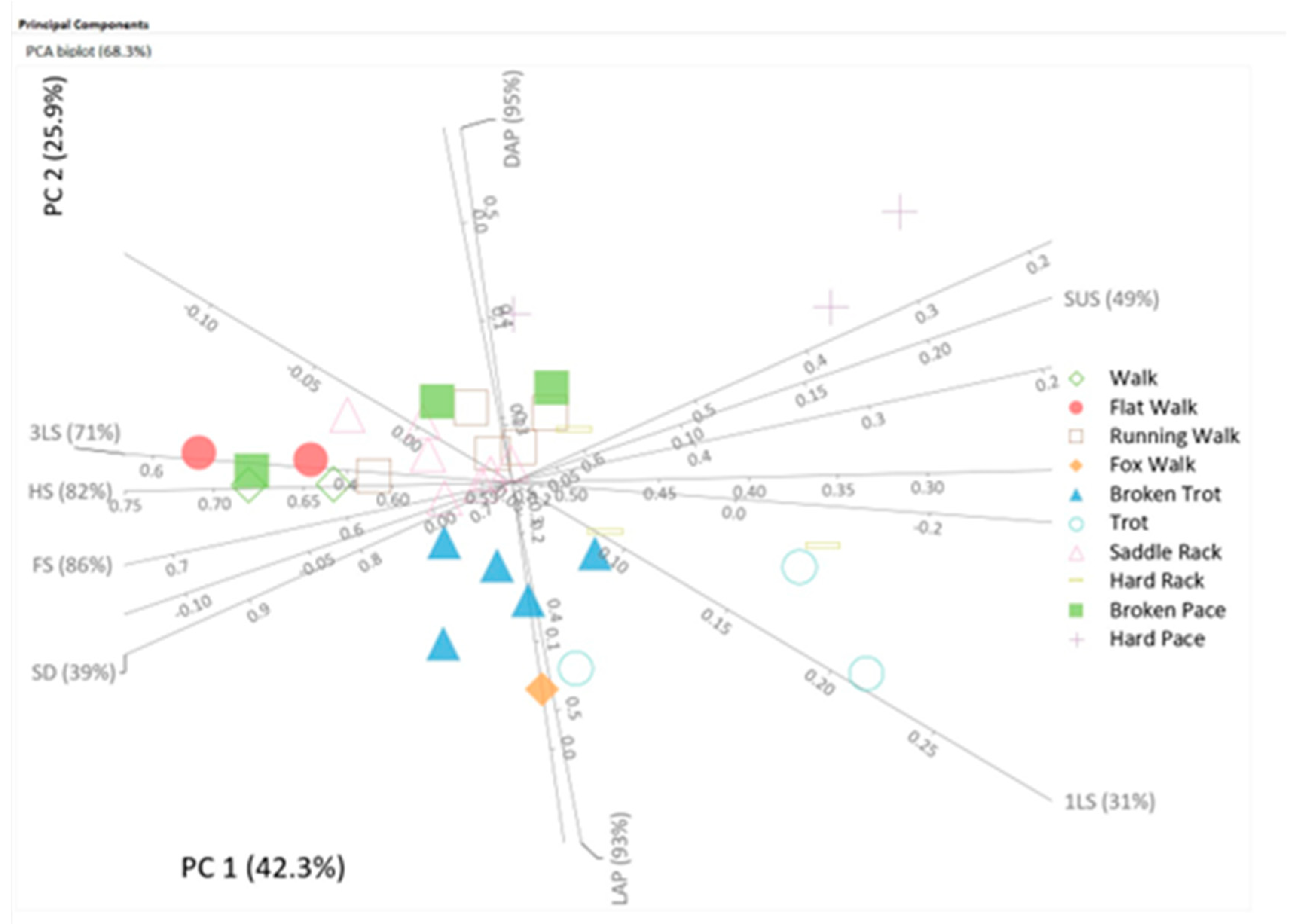
Figure 2.
Map showing world-wide distribution of horse breeds with alternative lateral gaits. Gaits are color-coded with yellow indicating the broken trot, red the running walk, green the rack, blue the stepping pace, and purple the hard pace. When horses perform more than one gait the circle surrounding their abbreviation is multi-colored. The following are the horse breeds denoted and their abbreviations: AB=Abaco Barb, AD=Aegidienberger, AL=Albanian, AN=Andean, AP=Appaloosa, AR=Arravani, AS=Appalachian Singlefoot, AT=Altai, AY=Andolu Yerli, AZ=Azteca, BB=Bidet Breton [Extinct], BH=Banker Horse, BS=Basuto, BT=Bulgarian Trotter, BU=Bhutia, BY=Buryat, CA=Campolina, CB=Cape Boer, CH=Cheju, CK=Chakouyi, CO=Campeiro, CN=Canik, CP=Canadian Pacer [Extinct], CR=Cretan, CS=Castilian [Extinct], CU=Cuban Paso, DH=Dutch Harness Horse, DN=Dongola, DT=Datong, KD=Kabarda, KC=Karachai, FC=Florida Cracker, FG=Ferghana [Extinct], FH=Finnhorse, FI=Faeroe Island Pony, FR=French Trotter, FT=Missouri Fox Trotter, GA=Galician, GC=Galiceño, GR=Garrano, GT=German Trotter, GW=Galloway Pony [Extinct], HB=Hobby Pony [Extinct], HK=Hokkaido, IC=Icelandic, IT=Italian Trotter, JV=Java [Extinct], KA= Kaimanawa, KD=Kabarda, KG=Kyrgyz, KK=Karabakh, KM=Kalmyk, KR=Karabair, KS=Kentucky Mountain Saddle Horse [same location for KN=Kentucky Natural Gaited Horse and for VS=Smokey Valley Horse], KU=Kurdi, KW=Kathiawari, KZ=Kazakh [same location for KS=Kushum], MA=Mangolina, ME=Mérens, MI=Mytilene, MJ=Marajoara Island Horse, MO=Gaited Morgan, MM=Mangalarga Marchador, MP=McCurdy Plantation, MR=Timor, MT=Carolina Marsh Tacky, MW=Marwari, NA=Nati, NC=North American Curly, ND=Nordestino, NF=Newfoundland Pony, NG=Nooitgedacht, NK=Nokota, NP=Narragansett Pacer [Extinct], NS=National Show Horse, NT=Nordic Trotter, OT=Orlov Trotter, PA=Canadian Pony of the Americas, PC=Columbian Paso Fino, PE=Peneia, PF=Palfrey [Extinct], PH=Paso Higueyano, PI=Pindos, PM=Pampa, PQ=Piquira, PP=Peruvian Paso, PR=Puerto Rican Paso Fino [same location for RC=Puerto Rican Criollo], PT=Paint, RE=Alter Real, RH=Racking Horse, RM=Rocky Mountain Horse [same location for OK=Mountain Pleasure Horse], RO=Rhodian, SA=Standardbred (Pacer), SB=American Saddlebred, SC=Spanish Colonial, SH=Shan, SI=Sindhi, SF=North American Singlefooting, SI=Sable Island, SJ=Spanish Jennet [same location for CT=Celtic Asturcon] [Extinct], SL=Afrikan Saalperd, SM=Spanish Mustang, SP=Spiti, SS=National Spotted Saddle Horse, ST=Sierra Tarahumara, SW=Sandalwood, TB=Trottingbred, TC=Columbia Trocha Pura [same location for TG=Columbia Trocha y Galope], TG=Tiger Horse, TH=Thessalian, TI=Tibetan, TK=Turkmene [Extinct], TL=Transbaikal, TM=Turkoman [same location for NI=Nisean [Extinct], TN=Tushin, TR=Montana Travler, TS=Tongan Singlefooter, TU=Tennuvian, TV=Tuva, TW=Tennessee Walking, UW=Utah Walkalony, VC=Venezuelan Criollo, VH=Smokey Valley Horse, VY=Vyatka, WB=West Black Sea, WL=Walkaloosa, WM=Welsh Mountain Pony, WP=American Walking Pony, WU=Mongolian Wushen, YK=Yakut, YL=Yili, YM=Yamud, YQ=Yanqi, ZA=Zaniskari.
Figure 2.
Map showing world-wide distribution of horse breeds with alternative lateral gaits. Gaits are color-coded with yellow indicating the broken trot, red the running walk, green the rack, blue the stepping pace, and purple the hard pace. When horses perform more than one gait the circle surrounding their abbreviation is multi-colored. The following are the horse breeds denoted and their abbreviations: AB=Abaco Barb, AD=Aegidienberger, AL=Albanian, AN=Andean, AP=Appaloosa, AR=Arravani, AS=Appalachian Singlefoot, AT=Altai, AY=Andolu Yerli, AZ=Azteca, BB=Bidet Breton [Extinct], BH=Banker Horse, BS=Basuto, BT=Bulgarian Trotter, BU=Bhutia, BY=Buryat, CA=Campolina, CB=Cape Boer, CH=Cheju, CK=Chakouyi, CO=Campeiro, CN=Canik, CP=Canadian Pacer [Extinct], CR=Cretan, CS=Castilian [Extinct], CU=Cuban Paso, DH=Dutch Harness Horse, DN=Dongola, DT=Datong, KD=Kabarda, KC=Karachai, FC=Florida Cracker, FG=Ferghana [Extinct], FH=Finnhorse, FI=Faeroe Island Pony, FR=French Trotter, FT=Missouri Fox Trotter, GA=Galician, GC=Galiceño, GR=Garrano, GT=German Trotter, GW=Galloway Pony [Extinct], HB=Hobby Pony [Extinct], HK=Hokkaido, IC=Icelandic, IT=Italian Trotter, JV=Java [Extinct], KA= Kaimanawa, KD=Kabarda, KG=Kyrgyz, KK=Karabakh, KM=Kalmyk, KR=Karabair, KS=Kentucky Mountain Saddle Horse [same location for KN=Kentucky Natural Gaited Horse and for VS=Smokey Valley Horse], KU=Kurdi, KW=Kathiawari, KZ=Kazakh [same location for KS=Kushum], MA=Mangolina, ME=Mérens, MI=Mytilene, MJ=Marajoara Island Horse, MO=Gaited Morgan, MM=Mangalarga Marchador, MP=McCurdy Plantation, MR=Timor, MT=Carolina Marsh Tacky, MW=Marwari, NA=Nati, NC=North American Curly, ND=Nordestino, NF=Newfoundland Pony, NG=Nooitgedacht, NK=Nokota, NP=Narragansett Pacer [Extinct], NS=National Show Horse, NT=Nordic Trotter, OT=Orlov Trotter, PA=Canadian Pony of the Americas, PC=Columbian Paso Fino, PE=Peneia, PF=Palfrey [Extinct], PH=Paso Higueyano, PI=Pindos, PM=Pampa, PQ=Piquira, PP=Peruvian Paso, PR=Puerto Rican Paso Fino [same location for RC=Puerto Rican Criollo], PT=Paint, RE=Alter Real, RH=Racking Horse, RM=Rocky Mountain Horse [same location for OK=Mountain Pleasure Horse], RO=Rhodian, SA=Standardbred (Pacer), SB=American Saddlebred, SC=Spanish Colonial, SH=Shan, SI=Sindhi, SF=North American Singlefooting, SI=Sable Island, SJ=Spanish Jennet [same location for CT=Celtic Asturcon] [Extinct], SL=Afrikan Saalperd, SM=Spanish Mustang, SP=Spiti, SS=National Spotted Saddle Horse, ST=Sierra Tarahumara, SW=Sandalwood, TB=Trottingbred, TC=Columbia Trocha Pura [same location for TG=Columbia Trocha y Galope], TG=Tiger Horse, TH=Thessalian, TI=Tibetan, TK=Turkmene [Extinct], TL=Transbaikal, TM=Turkoman [same location for NI=Nisean [Extinct], TN=Tushin, TR=Montana Travler, TS=Tongan Singlefooter, TU=Tennuvian, TV=Tuva, TW=Tennessee Walking, UW=Utah Walkalony, VC=Venezuelan Criollo, VH=Smokey Valley Horse, VY=Vyatka, WB=West Black Sea, WL=Walkaloosa, WM=Welsh Mountain Pony, WP=American Walking Pony, WU=Mongolian Wushen, YK=Yakut, YL=Yili, YM=Yamud, YQ=Yanqi, ZA=Zaniskari.
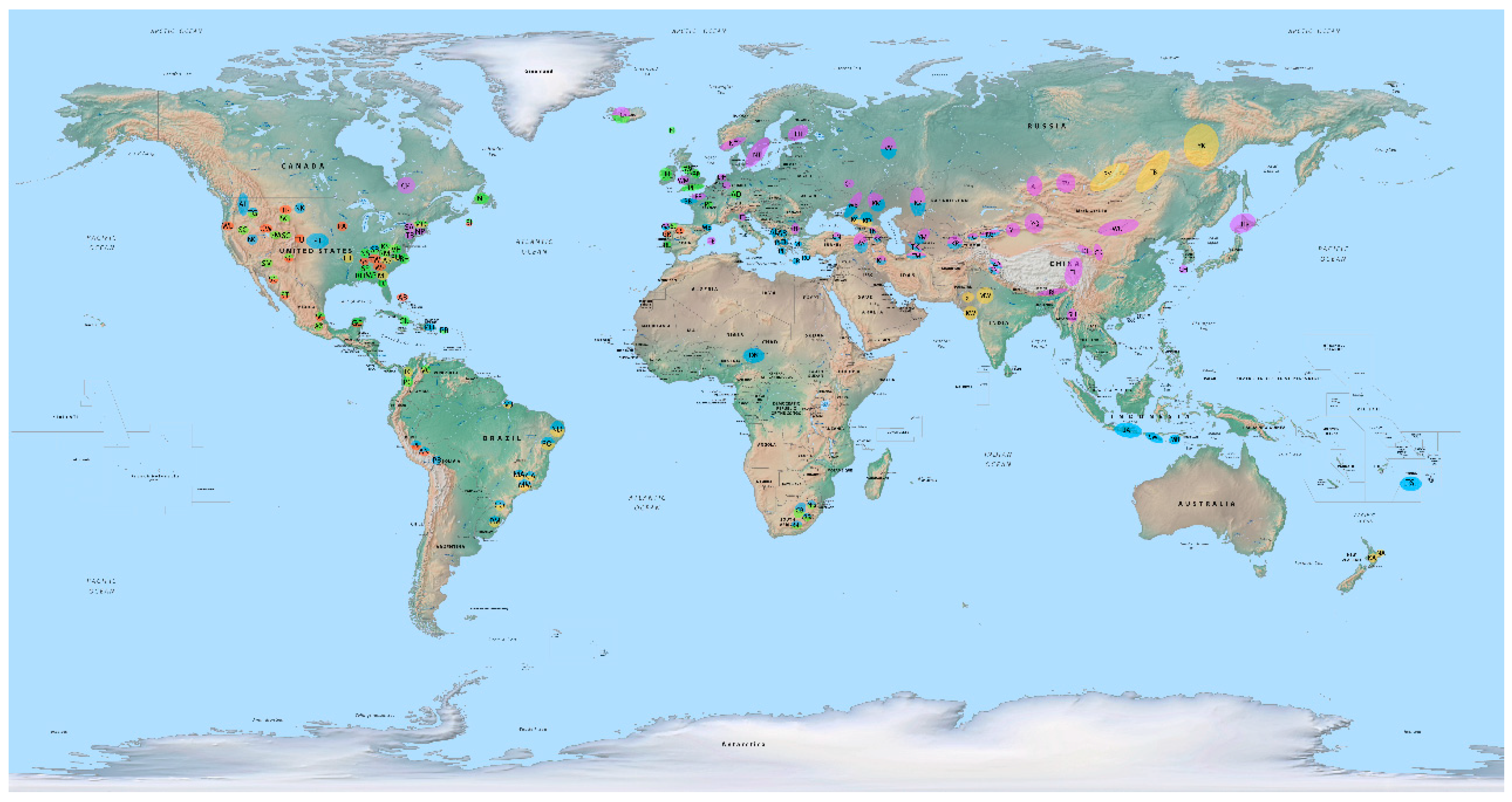
Disclaimer/Publisher’s Note: The statements, opinions and data contained in all publications are solely those of the individual author(s) and contributor(s) and not of MDPI and/or the editor(s). MDPI and/or the editor(s) disclaim responsibility for any injury to people or property resulting from any ideas, methods, instructions or products referred to in the content. |
© 2023 by the authors. Licensee MDPI, Basel, Switzerland. This article is an open access article distributed under the terms and conditions of the Creative Commons Attribution (CC BY) license (http://creativecommons.org/licenses/by/4.0/).
Copyright: This open access article is published under a Creative Commons CC BY 4.0 license, which permit the free download, distribution, and reuse, provided that the author and preprint are cited in any reuse.


