
Submitted:
04 March 2026
Posted:
05 March 2026
You are already at the latest version
Abstract
Quantum Mechanics is sufficiently capable of proving quantum gravity by itself without considering actual Einsteinian General Relativistic formalism. Due to the non-applicability of Einsteinian relativity in quantum gravity, in this article, we have described gravity as a correspondence between General (Quantum) Relativity and Quantum Field Theory (QFT) by introducing a (quantum) quadratic form and a (quantum) metric tensor along with dynamic time t. Here, we have developed a Kline-Gordon-like equation and a Dirac-like equation in QFT, which are themselves actually nothing but the quantum gravitational field equations (analogous to Einstein's field equation in General Relativity) for bosons and fermions, respectively. Furthermore, we have developed a Generalized Quantum Gravitational Field Theory, where QFT is conjugated with gravity and Dark Energy (for inconstant cosmological constant), so that it can unify Standard Model with gravity and Dark Energy in 'General Unified Theory' as SU(5)=SU(3)×(SU(2)⊕iSU(2)) through a Gravito-weak symmetry group. In addition, we have shown that unbounded operators, such as, i) the (quantum) relativistic mass and time, ii) the quantum scalar curvature and the proper time, iii) the (quantum) relativistic mass and its inversely stretched/shrank (3+1)D curvilinear quantum spacetime, all in pairs are satisfied their individual Uncertainty Principles, i.e., they cannot have definite and constant values at the same time. We have also proved that the present theory of Quantum Gravity is 'multiplicatively renormalizable'.
Keywords:
General Quantum Gravity
; Quantum Differential Geometry
; Gravito-weak Symmetry
; General Unified Theory
1. Introduction
There is undoubtedly a strong conceptual link between Einstein’s theory of gravity and quantum gauge theories [1]. But merging Einstein’s theory of gravity and Quantum Mechanics is one of the main outstanding problems of modern physics [2]. Experimentalists often use the Newton-Schrödinger equations (NSEs) as the conceptual framework and technical platform for understanding the interaction of quantum matter with classical gravity at today’s low energy (compared to Planck energy) and to compare their laboratory results, but NSE cannot be derived from General Relativity plus Quantum Field Theory (QFT) [3]. It is nowadays thought that gravity cannot be described by a local QFT of point particles and that a theory of Quantum Gravity must be fundamentally non-local [4]. But in the present article, we have shown that gravity not only can be derived by a local QFT of elementary particles quite naturally but it also preserves quantum phenomena along with a set of two separate (quantum) gravitational field equations, one for bosons and/or conjugated fermions and another for free fermions.
On a mathematical level the quantization of gravity, i.e. the description of spacetime by quantum states, leads to physically inconsistent results. Quantum mechanics is a linear non-deterministic theory, whereas General Relativity is a non-linear deterministic one. The problems may be resolved within a new framework of quantum gravity, where one should point out that the obtainable phenomena need not necessarily have to do with either quantum or gravity theory [5]. This is the main purpose of the present article, which is based on identifying a correspondence between General (Quantum) Relativity and QFT. The aspect of the work highlights herein how, for a valid theory of Quantum Gravity, the quantization of the field can originate from a General Quantum Gravity framework rather than directly from Einsteinian General Relativity.
It is technically impossible to be accurate to combine constant velocity with accelerating velocity in a common framework. So, we mostly omit both Quantum Mechanical and General Relativistic computations in this article and simply follow a different approach to Quantum Mechanics by focusing on various forms of metric line elements (we should call such an approach as `Metric Mechanics’) and introducing a form of `Quantum Differential Geometry’.
A common practice to demonstrate Quantum Mechanics in curved spacetime is forcing QFT, which is developed from Special Relativity, to behave according to General Relativity (as we know, for example [6], or some references used in this article, or any other works on QFT in curved spacetime). In this article, we shall develop a completely opposite perspective to force General (Quantum) Relativity to behave according to QFT in curvilinear quantum spacetime. In this way, we shall able to develop quantum gravity without considering the Laplace-Beltrami operator defined on the background spacetime with metric , i.e., without considering a generalization of the d’Alambertian wave operator in Minkowski space to curved spacetime, for example.
Similarly, to construct QFT in this article, we shall not go to consider the orthodox Quantum Relativistic Klein-Gordon equation, which is developed from Special Relativity, as a contribution from the spin connection (as we know, for example [7]). On the other hand, in order to write Dirac equation in general relativity, we shall not use here the spinorial covariant derivative with the spinor affine connection coefficients for spin- particles (as we know, for example [7,8]). Instead, in this article, a Kline-Gordon-like equation and a Dirac-like equation in QFT, which are themselves actually nothing but the quantum gravitational field equation (analogous to Einstein’s field equation in General Relativity) for bosons and fermions, respectively, are originated quite naturally from `Metric Mechanics’ in curvilinear quantum spacetime.
The structure of this article is as follows:
- 1.
- Part I: Simple Quantum Gravity & Nature of Dynamic Time,
- 2.
- Part II: General Quantum Gravity,
- 3.
- Part III: Discussion and Conclusion.
In overall scenario,
- 1.
- By introducing a form of `Quantum Differential Geometry’, we shall construct a universal quantum gravitational field equation, which is quite analogous to Einstein’s gravitational field equation.
- 2.
- Unlike orthodox Kline-Gordon equation or Dirac equation, which are developed from Special Relativity, all of the (unorthodox) equations in this article are technically in accelerating frames. We shall develop two sets of separate gravitational field equations, one set for bosons and/or conjugated fermions (Kline-Gordon-like equation) and another set for free fermions (Dirac-like equation) by using `Metric Mechanics’. Both of these equations satisfy the local non-vacuum quantum gravitational field equations in QFT, we should call it as Generalized Quantum Gravitational Field Theory.
- 3.
- We shall develop Gravito-weak symmetry group , so as it can be applied to unify Standard Model with gravity and Dark Energy (for inconstant cosmological constant) in curvilinear quantum spacetime as follows,which we call as the `General Unified Theory’.
- 4.
-
Additionally, we shall show that the pairs of unbounded operators, such as,
- the (quantum) relativistic mass m of a particle and time t,
-
- i)
- the quantum scalar curvature for a fermion and the proper time ,
- ii)
- the quantum scalar curvature for a boson and the proper time ,
-
- i)
- the (quantum) relativistic mass m of a fermion and its inversely stretched/shrank spacetime due to stretching/shrinking parameters ,
- ii)
- the (quantum) relativistic mass m of a boson and its inversely stretched/shrank spacetime due to stretching/shrinking parameters ,
all are satisfying their Uncertainty Principles independently as follows:- ,
-
- i)
- for the (quantum) metric tensor ,
- ii)
- for the (quantum) metric tensor , respectively,
-
- i)
- ,
- ii)
- , respectively,
i.e., in pairs, they cannot have definite and constant values at the same instance. Additionally, the rootages of the Uncertainty Principles in immediately establish the direct and exclusively straightforward relations between the Einsteinian mass-energy relationship and Quantum Mechanics as,- •
- for its stretched/shrank spacetime due to stretching/shrinking parameters for a fermion,
- •
- for its stretched/shrank spacetime due to stretching/shrinking parameters for a boson.
- 5.
- And finally, we shall prove that the General Quantum Gravity is actually ‘multiplicatively renormalizable’.
Definitely, in this article, we are going to develop a different kind of Quantum Mechanics in curvilinear quantum spacetime influenced by quantized gravity with different scope and nature of reality, where the dynamic temporal axis plays a significant role to achieve a scenario of quantum gravity. We shall see that General Quantum Gravity seems to defy partially both the concepts of Quantum Mechanics and General Relativity simultaneously by describing gravity as the curvature of quantized spacetime caused by quantized mass and energy under the influence of quantized gravity.
PART I: Simple Quantum Gravity & Nature of Dynamic Time
2. Simple Quantum Gravity
Let a Hilbert space is associated with any quantum system. Let de Broglie’s matter wave be described by a complex-valued wave function as,
where time t is non-dynamic, homogeneous, isotropic and mathematically rigid, unique external background parameter to define how the probabilities of possible values for quantum observables change over time in a quantum space.
Theorem 1
(Existence of Schrödinger Equation with Total Energy while Time t is Non-dynamic). There always exists a Schrödinger equation which represents the total energy .
Proof.
We know that momentum and angular frequency are related through the law of dispersion, that is [9],
which yields after integrating as,
then for the mass-energy relationship from [10],
a suitable plane wave would be for total energy as,
Technically, a wave packet, that satisfies , have to satisfy , too, for (2). By superposition of a set of such waves, a wave packet can be constructed as,
resulting the quantum operators as,
whence the expression,
vanishes for , thus for (6), it satisfies,
which is a three-dimensional Schrödinger equation representing total energy , while time t is non-dynamic by the definition. This completes the proof.□ □
Proposition 1
Theorem 2.
Three-dimensional Schrödinger equation (7) representing total energy is achievable from a relation,
while time t is non-dynamic.
Proof.
For the kinetic energy,
thus, for (3) along with (8), suppose a suitable plane wave for (9) is as follows,
By superposition of a set of such waves, a wave packet can be constructed as,
Remark 1
(Target of This Article). To combine gravity and Quantum Mechanics, we require a new understanding of time [12]. On the other hand, the total energy in (4) is actually related to a spacetime. So, we have to try to develop a Schrödinger equation representing total energy while time t is dynamic in a curvilinear quantum spacetime by commencing the following.
Definition 1
(Dynamic Time t). Let us consider that time t is hereafter a variable, observer-dependent and a dynamic dimension to merge with non-curvilinear quantum space to generate a general curvilinear quantum spacetime coordinate so as the whole spacetime can curve.
Definition 2
( Function). For the quantum energy operator and three-momentum operator in Quantum Mechanics, let us consider a function as,
where may be the rest mass or the invariant mass of the system of particles, or equal to the mass of the decay particle, etc.
Remark 2
(Spacetime & Objective of This Article). Since (12) has an analogy to a curvilinear (Minkowski-like) spacetime structure, then instead of Minkowskian spacetime , by using (12) with little bravery, we may consider the quantum energy operator and three-momentum operator as the contravariant `temporal’ and `spatial’ coordinates, respectively, of a hypothetical curvilinear quantum spacetime. In addition, since in (12) would be the rest mass or the invariant mass of the system of particles, or equal to the mass of the decay particle, etc., this so-called hypothetical curvilinear quantum spacetime is not a perfect geometrically relevant curvilinear spacetime similar to what we usually use to construct Einsteinian Relativity. So, from the very beginning of this article, we shall follow the term as the Quantum Mechanical `footprint’ of a so-called `spacetime’ structure to achieve a General (Quantum) Relativistic approach to (quantum) gravitational field equation without considering actual Einsteinian General Relativistic formalism.
Definition 3
((Quantum) Quadratic Form). Suppose a Hilbert space is associated with any quantum system while time t is dynamic in a hypothetical curvilinear quantum spacetime for in (12). Let us postulate that the existence of a single spacetime M, on which all events occur, with no particular coordinates attached to it. Let us consider a finite-dimensional complex vector space . Consider the `four-momentum’ operator on for some state , when,
for and , with the energy operator and the three-momentum operator . For a diffeomorphism , suppose an event at a point , is occurred at . Similarly, for another diffeomorphism , the same event is considered to be occurred at . From inertial reference frames, the changing coordinates is then given by the map . Let be the (quantum) quadratic form defined by,
so that it can satisfy the following orthogonality conditions,
while,
The last term of (14) becomes zero if their states are not entangled.
Definition 4
((Quantum) Metric Tensor). Let a Hilbert space is associated with any quantum system. Let us consider a finite dimensional complex vector space , . Suppose is a smooth manifold, that is, is an four-dimensional differentiable manifold and is a (quantum) metric tensor, then,
so as,
but is not a four-dimensional Lorentz metric since is in Hilbert space . Here, the metric tensor is symmetric, i.e., , and . Components of its inverse matrix are themselves the components of matrix , namely, , where is the Kronecker delta.
Definition 5
(Quantum) Line Elements). For the bilinear form in (14), let us define a freely-falling inertial frame (an orthonormal line operator) in the neighborhood of a moving body in such a way that (using the summation convention),
for , where is the (quantum) metric tensor. Since , , then (20) may yield a dual base curvilinear quantum coordinate system for a point , when,
so as it can get a line element in as,
Proposition 2
(Position-momentum Relation for Dynamic Time t). Suppose is a solution to (20) in curvilinear quantum spacetime for a sufficiently nice potential and for a sufficiently nice initial condition when time t is dynamic. Then the expected position and expected four-momentum in the state satisfy,
Since the mass-energy relationship (4) and since position and momentum satisfy (23) in the state , then we can yield (22) as,
where,
is the mass by setting a phase factor , such as , and is the ordinary three-dimensional velocity vector.
Note 1 Technically, any mechanics that satisfies (26) in curvilinear quantum spacetime would not be the orthodox Quantum Mechanics, not even Theorem 2, due to dynamic time t in a hypothetical curvilinear quantum spacetime. Hence, the mechanics we are going to study in this article would lead an unorthodox Quantum Mechanics, which unmistakably stand apart from its orthodox version. In other words, curvilinear quantum spacetime is locally orthodox Quantum Mechanical in space for its global curvilinear spacetime covering, i.e., it holds in quantum spacetime.
Let us demonstrate the non-applicability of Einsteinian energy-momentum relationship in the present article as follows.
Definition 6
(Energy-momentum Relation for Massive and Massless Particles). Comparing (24) and (25), we can yield the (quantum) relativistic relation for from [10] as,
which is neither equivalent to and nor deductive from the Einsteinian energy-momentum equation, . (This is the fundamental reason why we shall not follow Einsteinian energy-momentum relationship in this article.) Again,
- 1.
- For the first term in the rhs of (28), the given object follows a curved path in spacetime, its direction is constantly changing, which means it is accelerating, even if its speed remains constant.
- 2.
- We shall also consider in the Appendix A below that if a given object satisfies (22), so as satisfies (28) naturally, then its spacetime must satisfy a proper time, for example in (A13) for a boson, or in (A25) for a fermion, thus the curvature of spacetime also affects the flow of time.
Hence, the given object in (28) experiences time dilation, where its temporal velocity slows down relative to a distant observer, and its spatial velocity must increase to maintain a constant `four-velocity’ magnitude. Thus, the (quantum) relativistic equation (28) is definitely in an accelerating vector spacetime of a `gravitating’ body moving at accelerating velocities by the definition.
Theorem 3
(Existence of Schrödinger Equation with Total Energy while Time t is Dynamic). Prove that the total energy of (28) yields a Schrödinger equation in a curvilinear quantum spacetime as,
where the d’Alembertian operator , while time t is dynamic.
Proof.
For a free relativistic particle we have from (28) as,
where is the four-dimensional velocity vector, lead to the group velocity of the associated wave packet as,
A relativistic free particle (let us follow [9], for example) of energy is associated with a wave of angular frequency and wavelength . Hence, the propagation vector for the wave is and of magnitude . Momentum and angular frequency are related through the law of dispersion, that is,
The phase velocity is,
A suitable plane wave is,
By superposition of a set of such waves, a four-dimensional wave packet can be constructed as,
The partial derivatives occurring in (33) are,
and,
resulting the quantum operators as,
whence the expression,
satisfies a Schrödinger equation representing total energy in a curvilinear quantum spacetime for (30) as,
where the d’Alembertian operator , while time t is dynamic. This completes the proof.□ □
Remark 3
(Orthodox Kline-Gordon Equation). We can check that by inputting from [10], the Schrödinger equation (37) naturally and straightforwardly yields the orthodox Kline-Gordon equation in a curvilinear quantum spacetime. Thus, (37) is actually a relativistic Schrödinger equation. This strongly establishes that the present article is nothing but a different perspective of the fundamental Quantum Field Theory.
Testable Prediction 1.
Non-relativistic Schrödinger equation masks its covering relativistic Schrödinger equation in a curvilinear quantum spacetime deluding with the similarities in their expressions.
Claim 1.
Non-dynamic temporal axis t in non-relativistic must behave as dynamic in curvilinear quantum spacetime.
Theorem 4.
If the mass m behaves as a quantum operator then it can yield the relativistic Schrödinger equation (37) with total energy in a curvilinear quantum spacetime, while time t is dynamic.
Proof.
Multiplying both sides of (24) by , we can get that,
hence, a suitable plane wave for the last two lines of (38) yields,
By superposition of a set of such waves, while mirroring (32), a four-dimensional wave packet can be constructed as,
where is the four-dimensional velocity vector. The partial derivatives occurring in (39) are,
and,
resulting the quantum operators as,
where the lhs relations of (41) and (42) are nothing but the relations of (35) and (36). In addition, since,
hence, the expression for (30),
satisfies the same relativistic Schrödinger equation (37) with total energy in a curvilinear quantum spacetime due to (41) and (42), while time t is dynamic. This completes the proof.□ □
Definition 7
((Quantum) Metric Operators in Curvilinear Quantum Mechanics). From (42), we can write down the generalized (quantum) metric operator equation in quantum spacetime as,
The form in (44) is selected due to its primal presence in (40). Without any doubt, (43) and (44) may yield their contravariant metric tensors as,
respectively.
From Theorem 4, or Theorem 3, it is clear that the generalized (quantum) metric operators (43) and (45), or (44) and (46), are providing us a definition of Quantum Differential Geometry in curvilinear quantum spacetime. In addition, in (43) and (44), or in (45) and (46), establishes that graviton is its own antiparticle.
Note 2 Here, in (43) and (44), as well as in (45) and (46), provide us their quantum operator forms, whereas, (17) is the tensor form of in a curvilinear quantum spacetime though, (43), (44), (45), (46), including (17) all are numerically equivalent for .
3. Nature of Dynamic Time
Note 3 [Essential Prerequisites] Before we proceed our study further, we must need some essential basic ideas of Quantum Field Theory in curvilinear quantum spacetime where the temporal direction t is dynamic. We have developed them in the Appendix A below. We must need to make an excursion into it before proceeding further.
By using bosonic (A11) from Appendix A.1, we can develop a first order bosonic quantum equation in curvilinear quantum spacetime where the temporal direction t is dynamic as follows.
Theorem 5
(Time-Space Duality in Bosonic Particle). For (A11), the dynamics of the quantum mechanical (bosonic) particle is describable by a first order quantum equation in curvilinear quantum spacetime when time t is dynamic as,
for a stretching/shrinking parameters , while is the external potential energy and is the Hamiltonian (or total energy) operator.
Proof.
Equalizing and then rearranging the third and fourth terms of (A11), we can get,
While the temporal axis is , the dynamics of the quantum state is possible to be defined as follows by shifting one from the lhs of (50) to the rhs of (50) as,
where , while is the three-dimensional velocity vector. Therefore, by introducing external potential energy and the Hamiltonian (or total energy) operator , we have an ordinary differential equation in curvilinear quantum spacetime as,
where is a stretching/shrinking parameters (stretching at , whereas shrinking at ), while time t is dynamic in (A1), or more precisely in (22). In (52), t is a (positive) formation of space for . This completes the proof.□ □
Let us develop a first order fermionic quantum equation in curvilinear quantum spacetime (analogous to Theorem 5) as follows.
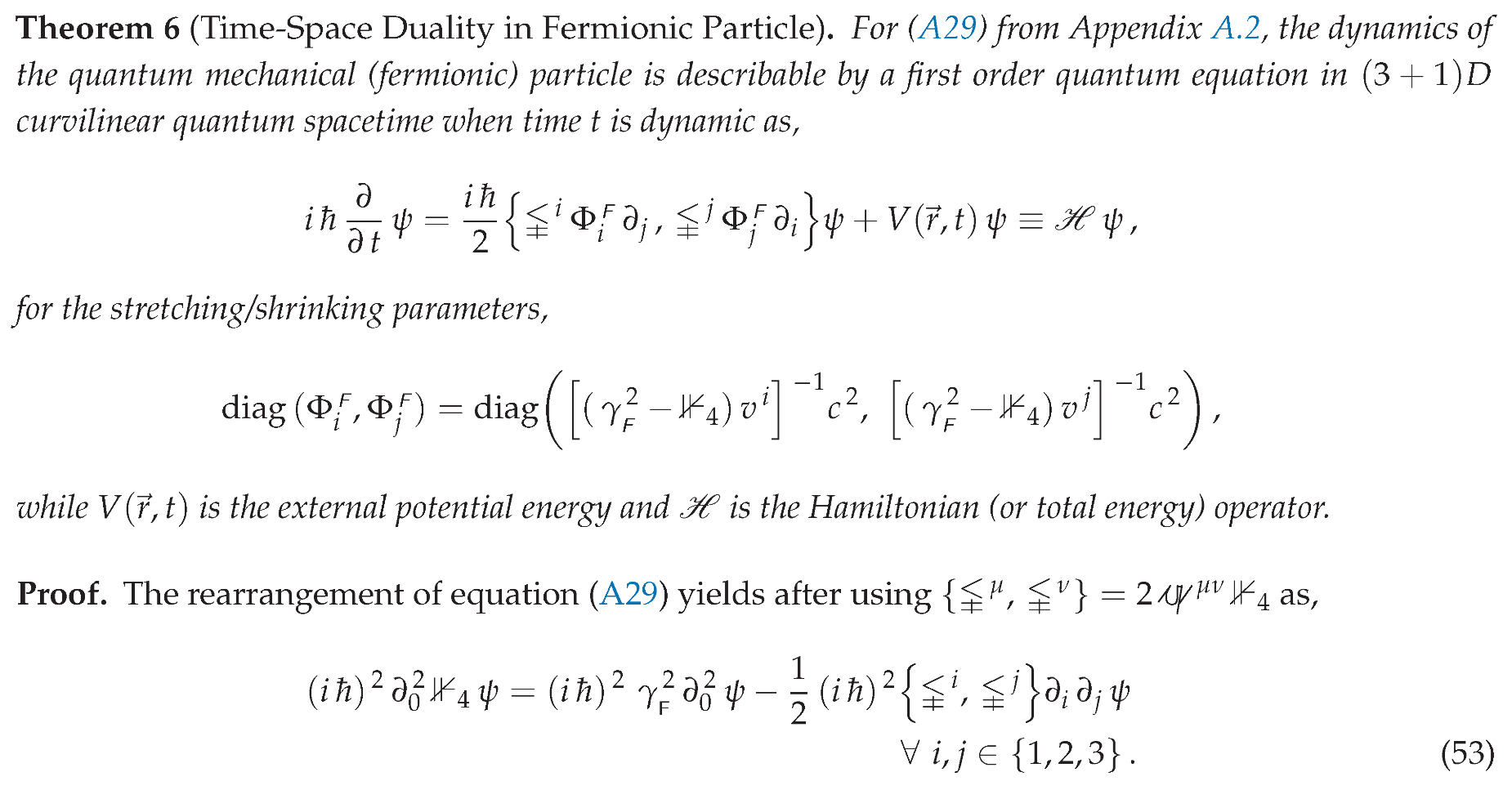
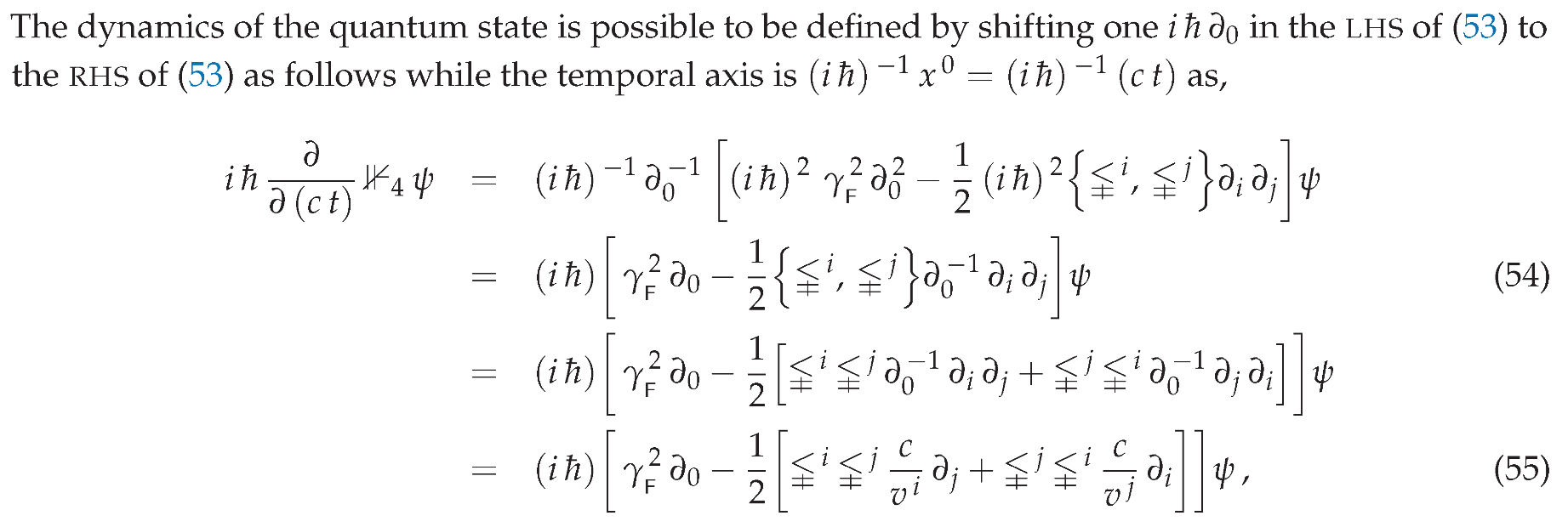
while , etc. Therefore, by introducing external potential energy and the Hamiltonian (or total energy) operator , we have a first order quantum equation for fermions in curvilinear quantum spacetime as,
for the stretching/shrinking parameters (stretching at , whereas shrinking at ),

while time t is dynamic for (A17), or more precisely due to (A15). Additionally, t is a (positive) formation of space for , or . This completes the proof.□ □
Definition 9
(Direction of Dynamic Time). Another arrangement of (51) (or (55), but we discard it here for unnecessary repetition) is also possible (suppose, but not necessarily, for an antiparticle, for example) as follows,
for . Since in , then time t is a (positive) formation of space for (suppose for antiparticle, for example) not depending on the direction of its associatory spatial coordinates, which is exactly opposite of the spatial coordinates of a particle in (52). So, in associate with fermionic particles (which is not discussed further here), this `positive’ temporal direction strongly supports that,
Claim 2.
Dynamic time flows in its forward direction not depending on its associatory spatial coordinates for (bosonic or fermionic) matter or antimatter.
Definition 10
Claim 3.
Dynamic time is not fundamental but emergent, i.e., dynamic time is not an independent physical entity. If space not exists then time not exists, too, but the reverse condition is not true since the stretching/shrinking parameters or satisfy ranging from to . On the contrary, space is an independent physical entity in both (52) and (57).
Remark 4.
At , the direction of time `relativistically’ reverses depending on its associatory spatial coordinates due to its stretching/shrinking parameters or , but at , the direction transforms into a complex number, which is technically unacceptable.
Testable Prediction 2.
The transformation of stretching/shrinking parameters from to may yield a time-reflection at , i.e., a uniform inversion of the temporal evolution of a signal, for example, photonic time-reflection [13], which arises when an abrupt change in the properties of the host material occurs uniformly in space.
Testable Prediction 3.
The transformations of stretching/shrinking parameters, i.e.,
- 1.
- from to for bosonic matter to antimatter and
- 2.
- from to for fermionic matter to antimatter,
or their vice versa, i.e., antimatter to matter transformations, may break time-translation symmetry at in a medium depending on the three-velocity for .
To remove the dynamic time t from (52) or (56), we can introduce a set of time-independent wave equations for bosons or fermions, respectively, as follows.

PART II: General Quantum Gravity
4. Universal Quantum Gravitational Field Equations
By inputting the modified form of (34) as follows,
in place of of (A12) from the Appendix A.1 below and after that, by dropping from both of the terms of the resultant (A12), and finally multiplying it by , we can acquire a new form of (A12) as follows,
Multiplying both terms of (59) by , we can get,
Hence, (62) is still an analogy to Kline-Gordon-like equation (A12), but now containing a gravitational field within it without replacing partial derivatives with covariant derivatives (i.e., geometrically covariant generalization, as we know from, for example, [14] or [15]). Comparing (37) and (62) as both of them are originated from (22), we can get,
It is a natural substitution of the relativistic Schrödinger equation (37), even the orthodox Kline-Gordon equation (according to Remark 3), as well as (62), too.
Remark 5.
Conjugated spinorial (A31) in curvilinear quantum spacetime from the Appendix A.2 below can also develop an equation containing a gravitational field within it as,
which is quite analogous to (62).
Since for (20), then (62) yields a positive mass relation with (quantum) metric tensor for bosons as follows,
and similarly, (63) yields a positive mass relation with (quantum) metric tensor for conjugated fermions as follows,
neither of which are technically possible to acquire from the orthodox Kline-Gordon equation.
Note 4 [Fermionic Scenario] In a similar way, let us consider fermions. Then, by inputting (58) in place of in (A28) from the Appendix A.2 below, we can get the following relation after dropping m from both of the terms of the resultant (A28), and finally multiplying it by , we can acquire a new form of (A28) as follows,
Avoiding any further repetition, multiplying both terms of (66) simply by from the left we can get,
For due to (13), the second term in (67) gives,
thus, (67) yields,
i.e., using (A14) and (17) while admitting (27), the expanded form of (68) would be rewritten as,
so as we have the formalisms,
which make the appearance of in (68) quite harmless. In (69), are the Dirac gamma-matrices and are the Majorana gamma-matrices. The first two equations in (69) give us particle and antiparticle Dirac equations, respectively, whereas the remaining two equations therein give us neutrinos. Actually, (68) is an extended and/or modified version of the generalized relativistic field equation in Ref. [16]. Speaking straightforwardly, (69) is nothing but a `Special’-within-Special Relativistic QFT equation because of . Quite like Remark 3, here, (69) also establishes that the present article is nothing but a different perspective of the fundamental Quantum Field Theory, if we accept additionally with mass m to achieve the targeted General (Quantum) Relativistic solutions, otherwise, by removing , the overall scenario naturally transforms itself into the orthodox Special Relativistic forms.
In addition, (68) also yields a positive mass relation with (quantum) metric tensor for (A16) as follows,
Though (68) is still an analogy to Dirac-like equation (A28), but it is now accompanied by a gravitational field.
By the way, in (68), the coupling of a Dirac spinor to a background gravitational field is quite straightforward rather than considering the Lorentz connection (or gauge potential) usually followed by the authors of the contemporary literature, for example [17].
Although, both bosonic (62), or (63), and fermionic (68) fields are now recombining Quantum Mechanics with the gravitational field within one framework, but none of them at their present structural formations are able to give us the quantum gravitational field equations we are looking for. So, we need something else to investigate further, which will be elaborated in the next three sections, but initially, we start with the theorem as follows.
Theorem 7.
For the quantum differential geometric curvature forms and (i.e., tensor and scalar curvatures, respectively), there exists a non-vacuum quantum gravitational field equation in curvilinear quantum spacetime in such a way that,
where (quantum) metric tensor is a property of curvilinear Quantum Differential Geometry satisfying both (17) and (42) simultaneously, whereas is the `naïve’ cosmological constant for the cosmological constant Λ and is the quantum energy-momentum tensor for the General Relativistic energy-momentum tensor .
Using 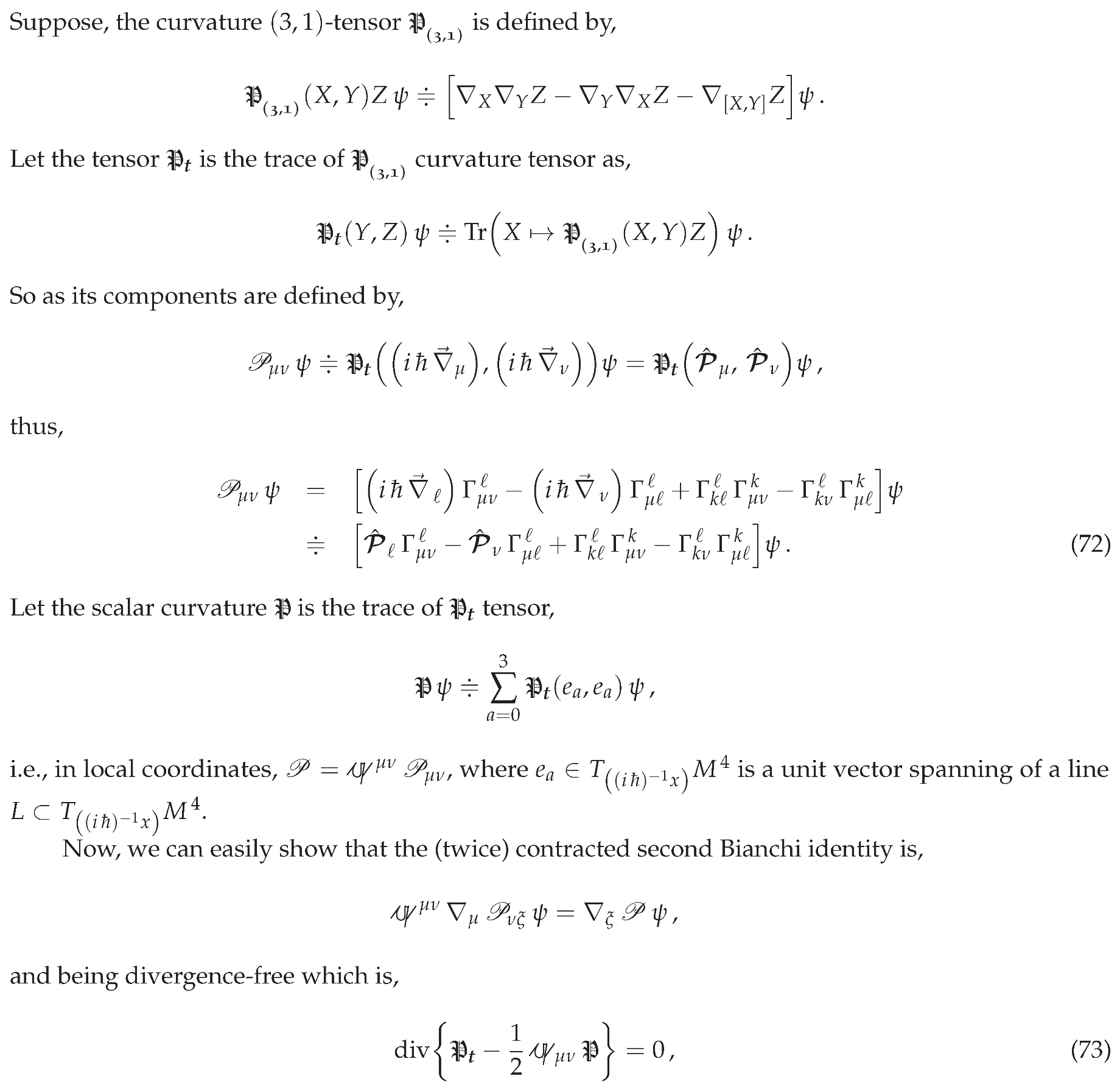
[18]. Let us consider a finite-dimensional complex vector space , . Let be a smooth manifold and X, Y, Z are smooth vector fields on , where is an four-dimensional differentiable manifold and is the (quantum) metric tensor satisfying (17) and also the both forms of (42) simultaneously. This is either a positive-definite section of the bundle of symmetric (covariant) 2-tensors or a positive-definite bilinear maps, for all . Here, is the subspace of generated by elements of the form . Let be local coordinates in a neighborhood U of some point of M. For (20), in U the vector fields due to (13) form a local basis for and the 1-forms form a dual basis for , that is,
The metric may then be written in local coordinates as , where for (17).
Let denote the Levi-Civita connection of the metric . The Christoffel symbol is the components of the Levi-Civita connection and is defined in U by , i.e., for (13), and for a permutations of the vector fields X, Y and Z as,
along with , thus, using (44) and (46), we can show that they are given by the (quantum) Christoffel symbols as,
then, the non-vacuum quantum gravitational field equation yields (in its components) due to (73) along with the quantum energy-momentum tensor , where is the General Relativistic energy-momentum tensor for the Einstein gravitational constant as,
Let us introduce the `naïve’ cosmological constant as for the cosmological constant , describing the pressure-like effect of Dark Energy, then the quantum gravitational field equation (74) would be rewritten as,
This completes the proof.□ □
Remark 6
(Universality of (75)). The non-vacuum quantum gravitational field equation (75) is free of factor or , i.e., it is equally applicable to bosons and conjugated fermions in curvilinear quantum spacetime. Similarly, its first order equation is also applicable to fermions in curvilinear quantum spacetime (see Section 5 below for more details).
Note it that, unlike the dimension of Einsteinian gravitational field equation in General Relativity [19], the quantum gravitational field equation (75) has the dimension as .
For in (75), the mass dimension of gravitational constant vanishes. So, not owing to the mass dimension of G, the perturbative version of the quantum gravitational field equation (75) is renormalizable in curvilinear quantum spacetime. Though, we do not explore this idea in this article, instead we are going to use a different pathway in Section 10 below to prove that the present theory of Quantum Gravity is actually `multiplicatively renormalizable’.
5. Duality of Quantum Field Theory and Quantum Differential Geometry in Fermionic Scenarios
Theorem 8.
Let M be a spin manifold. If is the quantum scalar curvature of M then, the d’Alembertian operator □ on a spinor (see page 308 of [20], for example),
where,
yields,
for the construction when the spin of the particle(s) (i.e., scalars, gauge bosons, gravitons, etc.) is with the conditions , , and the total symmetrization of the indices as .
Proof.

Since , then we have,
This completes the proof.□ □
Theorem 9
(Duality of Quantum Gravitational Field and Conjugated Fermionic Field). A non-vacuum quantum gravitational field equation in curvilinear quantum spacetime can metamorphose into the Kline-Gordon-like equation (63) for conjugated fermions.
Proof.
For (79), we can introduce a new kind of line element as,
By introducing in (81), where is the trace of quantum curvature tensor, we have a tensor calculus-free definition of as,
By the virtue of the universality of (75) in Remark 6 that the non-vacuum quantum gravitational field equation (75) is equally applicable to bosons as well as conjugated fermions, too, in curvilinear quantum spacetime, then we can modify (75) by using (82) and (81) as follows,
i.e., by using the first line and the last line of (78) it yields,
hence, by using (80), we have,
which is a non-vacuum quantum gravitational field equation for conjugated fermions accompanied by Dark Energy, while the ‘naïve’ cosmological constant yields as,
since and . Inserting (84) into (75), we can get for (18) as,
which returns us to (79), since again for (18).
Remark 7
Claim 4.
Dark Energy may originate from matter fields.
Definition 13
((Quantum) Ricci-like Flow, or Quantum Metric Flow in Conjugated Fermionic Fields). Combination of (A26) from Appendix A.2 with (A25) to have , so as we may take for (A29) as , which can be used to modify (80) in such a way that,
or alternatively,
or since , let , then,
Suppose, the inverse operator of the momentum operator in curvilinear quantum spacetime is [21],
hence,
provided ψ vanishes at . In such a case,
Then (89) yields,
Thus, the evolution equation (90) is the flow of the metric by the quantum curvature somehow analogous to the unnormalized Hamilton’s Ricci Flow [18], but since , the flow equation (90) is not exactly Hamilton’s Ricci Flow but a new kind of (Quantum) Ricci-like Flow. Let us simply name it as a Quantum Metric Flow in conjugated fermionic fields.
Theorem 10
(Duality of Quantum Gravitational Field and Fermionic Field). A non-vacuum quantum gravitational field equation in curvilinear quantum spacetime can metamorphose into the Dirac-like equation (68) for free fermions.
Proof.
Let us assume a simplest system of linear homogeneous differential equations of first order which meets the conditions of (80) as,
then it yields a spinor field representation with quantum scalar curvature as,
for the construction when the spin of the particle is with and . By comparing (92) with (68), we can get,
Comparing from (A24) with (93), we have,
and with the proper time it becomes for (A25) as,
which appears like as a quantum `operator’.
Squaring up (94), we get,
so, by using , we can get (95) as,
then we can have a modification of the non-vacuum quantum gravitational field equation (75) in curvilinear quantum spacetime by using (96) and (95) as,
hence, by multiplying (97) with and by reusing the proper time , we can get,
The simplest system of linear homogeneous differential equations of first order which meets the conditions of (98) reads for as,
By the way, another non-vacuum quantum gravitational field equation for spinor in curvilinear quantum spacetime is possible to be derived by the simplest system of linear homogeneous differential equations of first order which meets the conditions of (83) reads for as,
Similarly, the simplest system of linear homogeneous differential equations of first order which meets the conditions of (85) reads for as,
Remark 8.
Other two first order field equations from (102) are possible to write as,
At present, we do not know what are their purposes actually.
Since, (68), more precisely (69), is nothing but a gravitational field equation for free fermions as we have seen in Theorem 10 and on the other hand, (68) is nothing but a `Special’-within-Special Relativistic QFT equation because of , then, with a little bravery, we can say that: a `Special’-within-Special frame of relativity makes a General frame of relativity emerge.
But (68) (so as (A28) below) is not technically a Dirac equation since it has a direct relation with the gravitational field equation of General (Quantum) Relativity for fermions. Though, for practical purposes, we shall never use any of these `dummy’ Dirac-like equations, instead we shall use a properly developed, local non-vacuum quantum gravitational field equation (117), see below, for fermions, which is effectively applicable to various particle interactions in curvilinear quantum spacetime (see Section 9 below).
Definition 14
((Quantum) Ricci-like Flow, or Quantum Metric Flow in Fermionic Fields). Combination of (A26) from Appendix A.2 with (A25) to have can be used to modify (91) in such a way that,
thus, after introducing into (104), the
rhs
last two terms in (104) transform into the following as,
or since , let , then,
which is the flow of the metric by the quantum curvature . Let us name it as a Quantum Metric Flow in fermionic fields.
Definition 15
(Dark Energy and Its Quantum Factor ). The cosmological constant is at the Planck scale for the Planck length and the Planck mass [22]. Since the Planck length is a unit of length introduced in the system of Planck units and the Planck length can acquire a physical meaning in the framework of quantum gravity [23], let us assume a line element as follows for the temporal axis if is not corresponding to Planck time , i.e., , but satisfies the transformation (see SubSection 9.2 below for more details) as,
where, let us consider that,
for the four-velocity . Admitting Claim 4 that Dark Energy may originate from matter fields, let us state that the simplest system of linear homogeneous differential equations of first order which meets the conditions of (105) as,
Note that has the dimension of momentum as . From (107), we can also write,
for the temporal axis , when , thus, must satisfy the proper time . It must be remembered that,
Claim 5.
Dark Energy is strongly sterile and never reacts with other physical particles anyway, even it never shows any self-interactions either.
6. Generalized Quantum Gravitational Field Theory in Fermionic Scenarios
Definition 16
(Generalized Quantum Gravitational Conjugated Fermionic Fields). To complete the General Relativity as a logical structure, we used to set the equation of motion for the gravitational field as, , in practice (see [20,24,25], for example). Likewise, from (75), it implies the equation of motion for the quantum gravitational field as,
Insertion of (82) and then use of the first line with the last line of (78) along with (85) and (18) into (110) yields,
hence, for (109), it yields,
thus, by inserting (105) and , we have,
which is a non-vacuum quantum gravitational field equation for conjugated fermions. Thus, (113) actually gives,
The positive energy-momentum tensor in (114) guarantees that gravity obtained from this conjugated fermionic field is always attractive, on the other hand, negative value of therein guarantees that Dark Energy obtained from the same conjugated fermionic field is always repulsive.
Importantly, (113) is exactly equivalent to (110) for the geometry coupled to matter. Instead of (75) and (83) or (85), it would be appropriate if we consider (114) as the non-vacuum quantum gravitational field equation for conjugated fermions in curvilinear quantum spacetime.
Definition 17
(Equations of Gravity and Dark Energy Exclusivity). Comparison between (83) and (113) directly yields,
which is an excellent equation of conjugated fermionic fields exclusively for gravity and Dark Energy. By the way, we may also have a simplest system of linear homogeneous differential equation of first order which meets the conditions of (115) as,
which is equivalent to (101).
Remark 9.
Since , we can also transform (111) into,
which is a direct relation between Einstein-like tensor and Kline-Gordon-like equation in curvilinear quantum spacetime. More precisely, (112) or (116) yields,
Thus, we have an exact correspondence between Quantum Differential Geometry and conjugated fermionic Quantum Field Theory.
Definition 18
(Generalized Quantum Gravitational Fermionic Fields). The simplest system of linear homogeneous differential equation of first order, which meets the conditions of (113) while satisfying fermionic fields causing QCD, gravity (grv) and Dark Energy (de), is as,
The structure of (117) is an excellent evidence why we should consider (117) instead of (108). It is the best local non-vacuum quantum gravitational field equation for fermions, which will be effectively applicable to various particle interactions in curvilinear quantum spacetime (see Section 9 below).
7. Generalized Quantum Gravitational Field Theory in Bosonic Scenarios
Since the Kline-Gordon-like equation (63) for conjugated fermions arises in Theorem 9 from (79), which is actually a distorted form of (75) then the universality of (75) assures us that no matter how (79) has been emerged from conjugated fermions, it can be always valid for all bosons (i.e., not just for conjugated fermions exclusively). Since for (18), let us consider the bosonic version analogous to (79) as,
By comparing (118) with (62) and for the proper time , we can get,
which appears like as a quantum `operator’.
Theorem 11
(Duality of Quantum Gravitational Field and Bosonic Field). A non-vacuum quantum gravitational field equation in curvilinear quantum spacetime can metamorphose into the Kline-Gordon-like equation (62) for bosons.
Proof.
This completes the proof. □ □
Corollary 1.
So, we have seen that a quantum gravitational field equation is easily deductible into a Kline-Gordon-like equation (63), or (62), in Theorem 9, or Theorem 11, respectively, establishing that a Kline-Gordon-like equation (63), or (62), is itself nothing but a quantum gravitational field equation analogous to Einstein’s field equation in General Relativity. Thus, (62) (so as (A12), or better to say that conjugated spinorial (63) along with (A31) for example) is not technically a Kline-Gordon equation since it has a direct relation with the gravitational field equation of General (Quantum) Relativity (as we have seen in Theorem 11, or Theorem 9, above). Though, for practical purposes, we shall never use any of these `dummy’ Kline-Gordon-like equations, instead we shall use a properly developed, local non-vacuum quantum gravitational field equation (124), see below, for bosons, which is effectively applicable to various particle interactions in curvilinear quantum spacetime (see Section 9 below).
Furthermore, by simply adding (62) with the second equation of (121), we can get,
and the insertion of (105) and into it yields,
which is a non-vacuum quantum gravitational field equation for bosons, whereas (113) is the non-vacuum quantum gravitational field equation for conjugated fermions. The structure of (124) insists us to determine,
Testable Prediction 4.
Color force, gravity and Dark Energy interaction are simultaneous but not interdependent, while they all require an additional background mass field to perform their roles.
Additionally, (123) also yields,
Thus, we have an exact correspondence between Quantum Differential Geometry and bosonic Quantum Field Theory.
8. Fermionic and Bosonic Mass-Spacetime Uncertainties and Geometries of Their Masses
8.1. Fermionic Scenarios
Let us assume that the quantum relativistic fermion mass for (A20), where for (A24) and for (A22), then it yields the following relation due to as,
which appears like as a quantum `operator’. Then, we can say that,
Let they define on suitable dense subspaces, suppose, , and , of .
Proposition 3.
The (quantum) relativistic mass and time operators m and t, similarly, quantum scalar curvature and the proper time operators and τ, commute canonically for , i.e.,
Using
Let , then the canonical commutation relations are and . □ □
Definition 19
(From [11]). If A is a symmetric operator on , then for all unit vectors ψ in , the uncertainty of A in the state ψ is given by,
Theorem 12
(Uncertainty Relations for Fermions). Suppose ψ is a unit vector in belonging to , or belonging to,
then,
where and , or and , are given by the Definition 19.
Using
[11]). For a particle moving in , let the quantum Hilbert space be and define the relativistic mass and time operators M and T, similarly quantum scalar curvature and the proper time operators and , by
According to Stone’s theorem, ∀, or , we have,
Thus,
if and . Renaming the variable of integration back to t, or , we get,
if , then for each fixed a, similarly, if , then for each fixed b. For any real constants and , similarly and , we have,
Solving (128) for gives,
by the Cauchy–Schwarz inequality. If is a unit vector and we take and , then and , similarly we take and , then and . Thus, we get,
This completes the proof.□ □
Definition 20 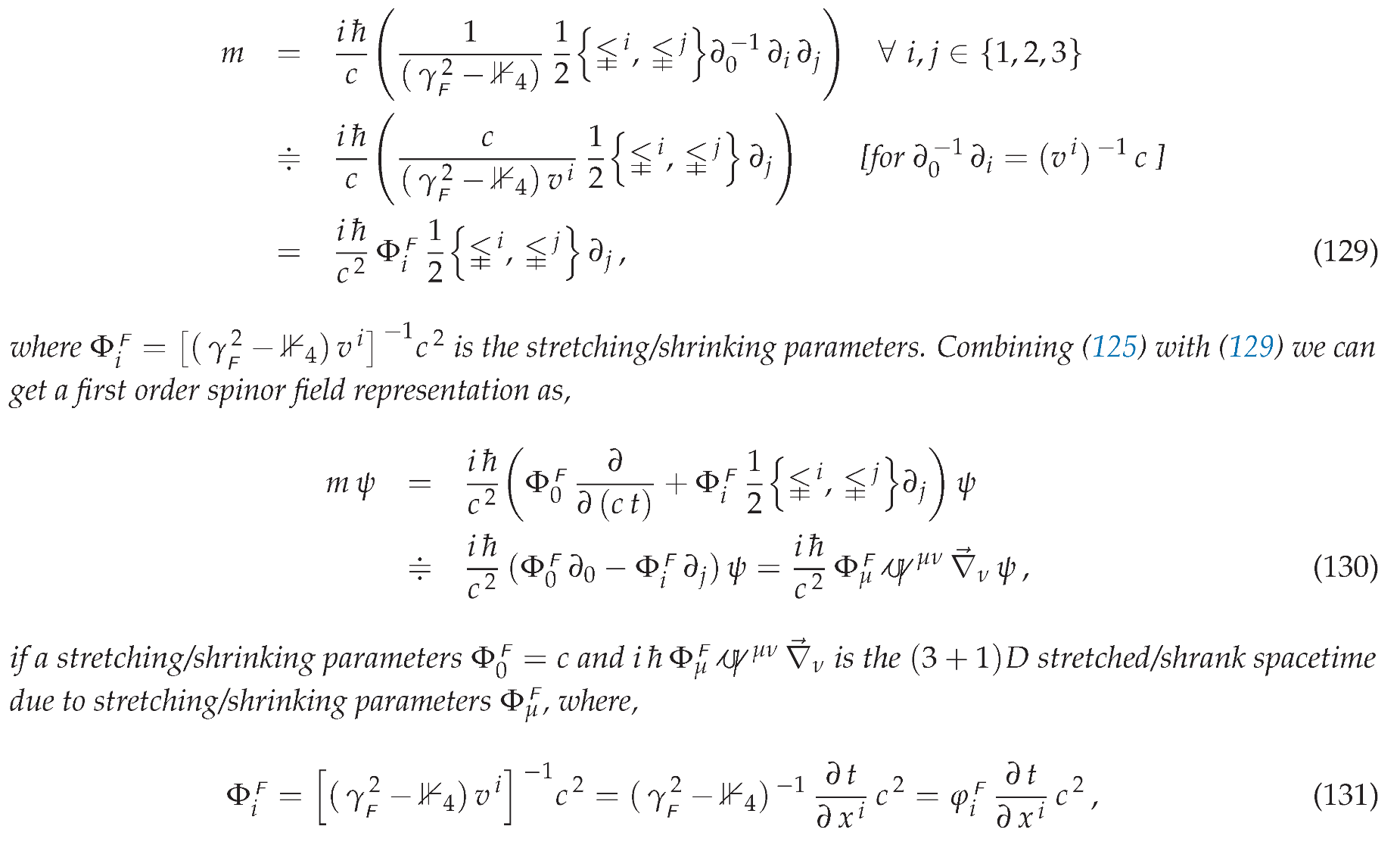
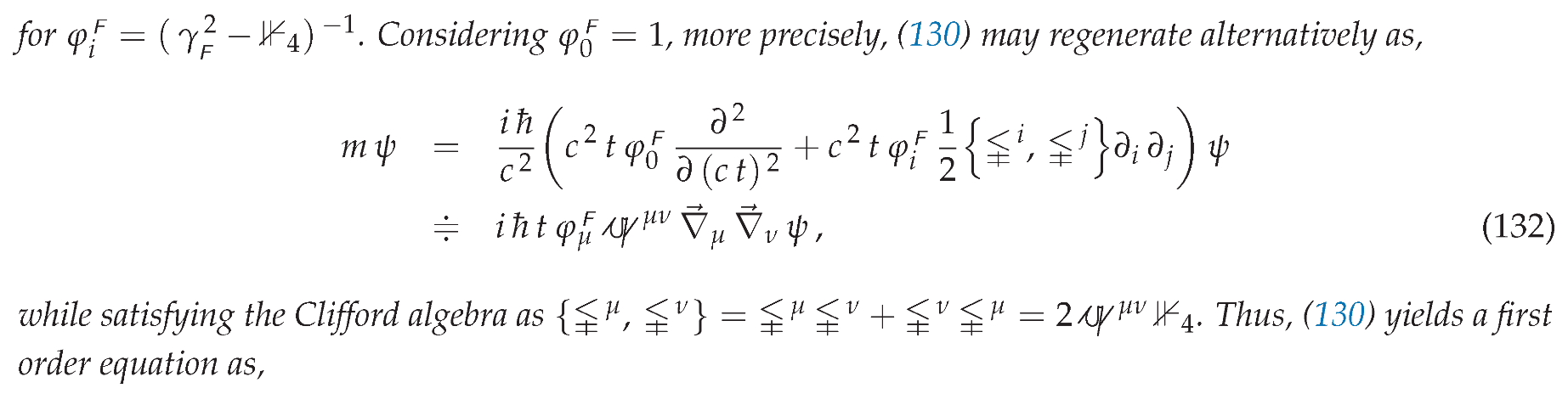
(Geometry of Fermionic Mass). Insertion of (54) into (125) yields,
where the total energy is,
whereas, (132) yields a second order equation for (131) as,
Suppose, for a hypothetical mass , then (135) gives,
Thus, fermionic matter is represented by a tensor of the second rank [26].
Note it that the equation (134) is the direct and exclusively straightforward relation between Quantum Mechanics and the Einsteinian mass-energy relationship of Relativity for a fermion.
Definition 21
(Mass-Spacetime Uncertainty for Fermions). Following Theorem 13 but without any further repetition, we can develop a new uncertainty relation for (130) as,
Thus, the mass m of a fermionic particle and its inversely stretched/shrank spacetime , which conjugated in the uncertainty principle (137), cannot have definite and constant values at the same time.
Testable Prediction 5.
It is quite clear if a quark satisfying (133) somehow starts behaving `bosonic’ as (136), i.e., where (virtual) quark-antiquark pair condenses in the same energy level, then this quark can start `oscillating’ between the matter-antimatter states. Furthermore, since from its definition then a visible mass difference between the observed matter-antimatter eigenstates must be occurred (see the LHCb measurement of mixing and CP violation in neutral charm mesons [27], for example).
Testable Prediction 5 is always true for D0 meson, K0 meson and two types of B mesons. Of course, in the whole scenario, the mass-spacetime uncertainty (137) must play a crucial role.
8.2. Bosonic Scenarios
Let us assume that the quantum relativistic boson mass for (A6), where for (A10) and for (A8), then it yields the following relation due to as,
which appears like as a quantum `operator’. Then, we can say that,
Let they define on suitable dense subspaces, suppose, , and , of , then we can easily reach:
Theorem 13
(Uncertainty Relations for Bosons). Suppose ψ is a unit vector in belonging to , or belonging to,
then,
where and , or and , are given by the Definition 19.
Now, it is not very hard to show that the geometry of bosonic mass and the mass-spacetime uncertainty for bosons are exactly analogous with the fermionic scenarios. We conclude here with minimum repetitions.
Definition 22
(Geometry of -dependent Bosonic Mass). A first order bosonic field representation by combining (138) with (52) yields,
if a stretching/shrinking parameters and is the stretched/shrank spacetime due to stretching/shrinking parameters , where,
for . Considering , more precisely, (139) may regenerate alternatively as,
Thus, (139) yields a first order equation as,
where the total energy is,
Suppose, for a hypothetical mass , then (144) gives,
Thus, bosonic matter is represented by a tensor of the second rank [26].
The equation (143) is also the direct and exclusively straightforward relation between Quantum Mechanics and the Einsteinian mass-energy relationship of Relativity for a boson.
Additionally, we can develop the mass-spacetime uncertainty for bosons using (139) as,
where the mass m of a bosonic particle and its inversely stretched/shrank spacetime , which conjugated in the uncertainty principle (146), cannot have definite and constant values at the same time.
Definition 23
(Geometry of -independent Bosonic Mass). A second order bosonic field representation from the mass operator m in (41) yields,
If we assume a hypothetical mass such as , then (147) gives,
Thus, bosonic matter is again represented by a tensor of the second rank [26].
Testable Prediction 6.
For all derivations of the quantum time-reversal symmetry of open quantum systems for microscopic dynamics, descending from the increasing entanglement between a system and its environment, when the Markov approximation is performed (for example [28]),
- 1.
- the transformation of stretching/shrinking parameters from to (or to ) as well as
- 2.
- the mass-hypothetical mass relation for (or )
have to be satisfied.
9. General Unified Theory
Let us accept a partial field equation for gravitation (where Dark Energy sector is neglected) by splitting it from (117) as follows,
where m is the mass of fermion causing gravity, but not the mass of a graviton itself.
9.1. Gravity Sector [29,30,31]
The gauge field theory approach to gravitation was extended by Carmeli, who formulated Einstein’s theory as a local gauge theory with the gauge group . The gauge theory of gravity seems to be the best existing theory for the exploration of gravitation, which is renormalizable to all orders. The gauge theory of gravitation is based on the fact that any tensorial field defined on the pseudo-Riemannian manifold of spacetime has an underlying spinor structure [29,30,31].
Let there are four Hermitian matrices, denoted by , where Roman capital indices are the spinor indices taking the values . Let the spinor equivalent of the quantum operator forms of the (quantum) metric tensors (44) and (46), respectively, are given by,
where and are the skew-symmetric Levi-Civita metric spinors. In addition, the Hermitian matrices and also satisfy (44) and (46), respectively, as follows,
Thus, the contravariant vector , considered as the tangent vector, defines the directional derivative,
The above spinors are now having the form,
Let be a normalized spinor basis, i.e., a pair of spinors subject to the normalization condition , where a and b are dyad indices. Possessing spinorial character with respect to the index A and vectorial character with respect to the index , the covariant derivatives may have the representation, . The coefficients , which form a set of four complex matrices, will be taken as the gauge potentials of the theory. With the aid of the gauge potential , the gauge field of the theory which have the dyad components is possible to define by [29,30,31],
Then the consideration of the simplest Lagrangian density, which is invariant under both general coordinate transformation and spin frame transformation, is,
From the and , we can obtain two new representations of the and matrices as,
But there is a number of things remain unanswered in this scenario. (we shall discuss them in the end of the following SubSection 9.2)
9.2. Dark Energy Sector
Let us accept a partial field equation for Dark Energy (where gravity sector is neglected) by splitting it from (117) as follows,
where m is the mass of fermion causing Dark Energy, but not the mass of a Dark Energy gauge boson itself.
Definition 24
- 1.
- from when (around Planck time), i.e., `naïve’ cosmological constant was almost during the Big Bang
- 2.
- to when , i.e., `naïve’ cosmological constant will reach almost at the time of Big Freeze, thus, the cosmological constant Λ will reach almost at the time of Big Freeze, because the value will be sufficient to help the Universe to achieve its absolute zero temperature state.
The present-day value of cosmological constant is [32] thus, the density of Dark Energy is decreasing as is growing continuously.
Hence, the inconstant `naïve’ cosmological constant , which agrees with the best-fit of the current result [33], technically provides us a unit as the square of `energy-per-velocity’, i.e., .
Testable Prediction 7.
For near-future surveys (DESI-extension and the Vera C. Rubin Observatory LSST), we can show the exact rate of overall Dark Energy evolution by using the factor and time , while additionally accepting the forecast given in [34]. We can also calculate the possible lifespan of the Universe from the evolving value of the cosmological constant Λ due to Definition 24.
(The author of the present article does not willing to accept a different, ultra-light version of the axion as like as [34] a priori at this very early stage of his work because he is not sure whether our `massive’ Dark Energy candidate, which will be discussed below in (167), is actually a ultra-light version of the axion or not and neither he exactly targets to show the current best-fit CDM model to make it distinguishable from CDM at over .)
It is clear that the mutual field of (149) and (153) mediated by the same fermion of mass m in (117) is a bilocal field. Let the binary system with graviton a at and Dark Energy gauge boson b at be described by a bilocal field . Let the propagator of bilocal field is [35,36],
as,
where being a positive infinitesimal and,
with,
and is the liner trajectory with coefficients for an arbitrary natural number n and for the single fermion of (117) with mass m. Thus, for the propagation of binary system from, let, to , we have the factor,
So, by considering and while,
let the Bethe-Salpeter equation be given by using (149) and (153) as,
where the linear operator describes the propagation of graviton and Dark Energy gauge boson. Then the matrix element of the decay process with momenta and can be found from the reduction formula [37],
where f and g contain the same mutual spinor u of the same fermion,
Thus, we can conclude that Dark Energy gauge boson is definitely satisfying the gauge field of the antifundamental representation . Additionally, the Bethe-Salpeter equation (154) of bilocal fields for graviton and Dark Energy gauge boson helps us to realize that the spin of Dark Energy gauge boson from would be either 0 or 2. But is not a tensor, thus the Dark Energy gauge boson from must be a strongly sterile, non-self-interacting (due to Claim 5 above), `massive’ (during gauge symmetry breaking, see (167) below), spin-0 particle. Note it here that Dark Energy is not considered `massive’ in the traditional sense of elementary particles (see Remark 11 in SubSection 9.3 below).
But neither one of the References [29,30,31] in SubSection 9.1 and not our above discussion able to show us a tiny possibility for an antifundamental representation for `massive’ Dark Energy gauge boson. Due to this reason, we do not focus either on [29,30,31] or our above discussion anymore, instead, we shall try to develop something conventional here as follows.
9.3. Gravito-Weak Symmetry Group (Using [38])
Let us formulate the kinematics of the gauge fields in terms of the spinors. Any element of can be written in the form where the are three real numbers and the are the three generators of the group . For the global symmetry to be made into a local symmetry, with dependent on space and time coordinates, let us introduce a vector gauge field for each generator , then the transformation law for the matrices is,
where for (117),
and the matrices,
or,
are Hermitian and have zero trace. Let us define,
straightforwardly,
where . The field strength tensors are taken to be,
Using the results , etc., the matrices and may be written as, and , respectively, where,
and , while , , so the Lagrangian density expresses as,
The fields and are electrically charged, but is chargeless. It is convenient to define here the complex combinations,
where the field is the complex conjugate of the field , so as the field is the complex conjugate of the field , thus, we can define,
By breaking the symmetry, we have from (158) and (156) or (157) in terms of the scalar Higgs field and the vacuum state expectation value of the Higgs field as,
where is now,
then multiplying by , we find for (161) as,
for,
where,
whereas is the Dark angle and is the Weinberg angle. Along with the fields and , respectively, if we define the orthogonal combinations,
then (162) and (163) correspond to the rotations of axes in and spaces, respectively, so the rotations can be inverted to give,
which yield,
where,
Using (164) and (165) in (160), to express the field and in terms of the fields and , similarly, to express the field and in terms of the fields and , we may write the full Lagrangian density,
and,
We can identify the three vector fields, , , , with the mediators of the weak interaction, the , , Z particles. Similarly, the three vector fields, , , , have the mediators of the gravito-dark interaction, the , A, Q particles. We can also identify that,
On the other hand, the bosons and A are massless in (166) and none of them does carry any color, weak or electromagnetic charges, however the former one uniquely interacts with the energy momentum tensor due to gravity sector in SubSection 9.1. To make a difference between them, let us consider that the former one is a graviton whereas the later one is a photon ().
Testable Prediction 8.
By neglecting quantum corrections to the mass ratio, we have,
In other words, if we consider , then it depends upon the acceleration () in the direction of motion caused by per unit force () of Dark Energy applied at an angle , i.e., then depends upon the Dark Energy density, thus, for the evolving Dark Energy model [34], will change as Dark Energy density change with time while in (168) still remains constant.
Remark 10
(Dilemma about ). Definitely, (168) assures us that , which is used to achieve , must have a dimensionless value. We do not sure whether in (161) is actually dimensionless or not, though, the current observations strongly favor the massless graviton [32]. But to assume as dimensionless in (168), we have to take as a minuscule mass with incredibly tiny upper limit that does not significantly alter large-scale gravity [39,40], so as it would appear harmlessly in (168) resulting as dimensionless. Possibly, the best way to express a `massive’ graviton to be appeared as a massless one is to consider a universal quantum `supertunneling’ through spacetime, which is currently unknown to us.
Definition 25
(Resolving Hierarchy Problem without Fine-tuning). Feebleness of gravity in Definition 8 guarantees us that gravity must be quantized to resolve the Hierarchy Problem without fine-tuning, i.e., the problem concerning the large discrepancy between aspects of the weak force and gravity (see [41], for example). According to (166), is a companion to graviton. Thus, a minuscule mass of graviton with incredibly tiny upper limit due to makes gravity times weaker than the weak force in (166) since .
Testable Prediction 9
(Mass of Q Boson). If is a minuscule mass with incredibly tiny upper limit, then it leads to for in (167). Thus, we may have .
Remark 11
(Sterile Nature of Q Boson). In (167), Q boson ispseudo-massivedue to its peculiar mass-construction for , which ought to be dimensionless by taking as a minuscule mass with incredibly tiny upper limit. If we consider Remark 10, then would switch between dimensional and dimensionless states in a mutually exclusive way depending upon the observational conditions. Possibly that is why Q boson is naturally undetectable by a particle detector and this peculiarity may be the reason that it is a highly sterile particle in nature. Additionally, this peculiarity possibly ensures Q to be a scalar particle rather than a vector particle. Without any doubt, Q boson is the particle resulting Dark Energy.
Theorem 14
(Confirmation of Chargeless and A bosons). Both and A bosons are chargeless.
Proof.
Let the hypercharge current is . To introduce gravito-weak isospin and gravito-weak hypercharge interactions, let us consider [42],
Expressions for the neutral currents are,
Let us represent the electric current,
then we get,
hence,
Suppose, and A bosons are carrying charge , then we can identify,
Hence, e have to change as Dark Energy density change with time while is constant. But none of and A bosons depend upon Dark Energy density. Thus, it confirms that and A bosons (i.e., graviton and photon) are chargeless in nature. This completes the proof. □ □
Testable Prediction 10.
If a graviton couples with a field where the Dark Energy density vanishes (i.e., where acceleration () in the direction of motion caused by per unit force () of Dark Energy is no longer applicable), then it can show surface charge density without satisfying the Weinberg-Witten theorem [43] (which tells us that a non-zero charge may make sense if the graviton is massive) since graviton is massless due to (166) as the dimension of mass vanishes due to (161) (or at least its mass does not significantly alter large-scale gravity [39,40], for example). For this purpose, we can focus some findings like Reference [44]. This surface charge density may observe non-classically near the event horizon of a Black Hole.
9.4. General Unified Theory
Suppose, the scenario of Standard Model in elementary particle physics is concerned the QCD, Electroweak, and Electromagnetism along with gravity and Dark Energy interactions. Let us call this scenario as the `General Unified Theory’. The equations of QCD and Electroweak along with gravity and Dark Energy interactions obeyed by the fermions would be easily achievable by using (117) in companion to the bosonic fields (124) (without repeating here the well-known formalism of the Standard Model again). For the symmetry part, let us consider that the generators are and the covariant derivative is (by analogy with the Gravito-weak symmetry group and the QCD symmetry group namely),
where are the gauge bosons and satisfies (155), whereas only one coupling () for all interactions. So, the General Unified Theory is coupled with gauge theory to describe the interactions as,
where the gauge fields are comprising eight gluons (g) form an octet of , three massive weak bosons (, , ) from the weak interaction part, i.e., , of Gravito-weak symmetry group , while they all are spin-1 vector bosons, in association with one `massless’ spin-2 graviton (), one massless spin-1 photon () and one `massive’ spin-0 Dark Energy gauge boson (Q) from the gravitational interaction part, i.e., , of Gravito-weak symmetry group . This completes the generalized form of all particle interactions in baryonic matters. Definitely, non-baryonic matter, i.e., Dark Matter, does not satisfy a gauge group like (170). We must need a different scenario for this purpose.
10. Renormalization [45] of General Quantum Gravity
Let is a field quantity or field operator or simply the field, which is the linear operator depending on a point in four-dimensional , space. Let there exist a non-singular matrix such that hermitian conjugation with is of the form,
where is symmetric in all pairs of indices and independent of . Then (124) divisor exists such that,
The field equation is quantum Lorentz invariant and , where is: , and is defined by the transformation of under an infinitesimal Lorentz-like transformation, i.e.,
when,
and .
Now, with this sufficient background along with Section 2 of Chapter V in page 112 of [45], we can easily show that the operator and the commutation relation of are suitable for acceptance, so that,
for , is consistent with the equation or equivalently .
Let the (quantum) metric tensor of (17) may rearrange as,
Then may yield:
Thus (with the summation convention),
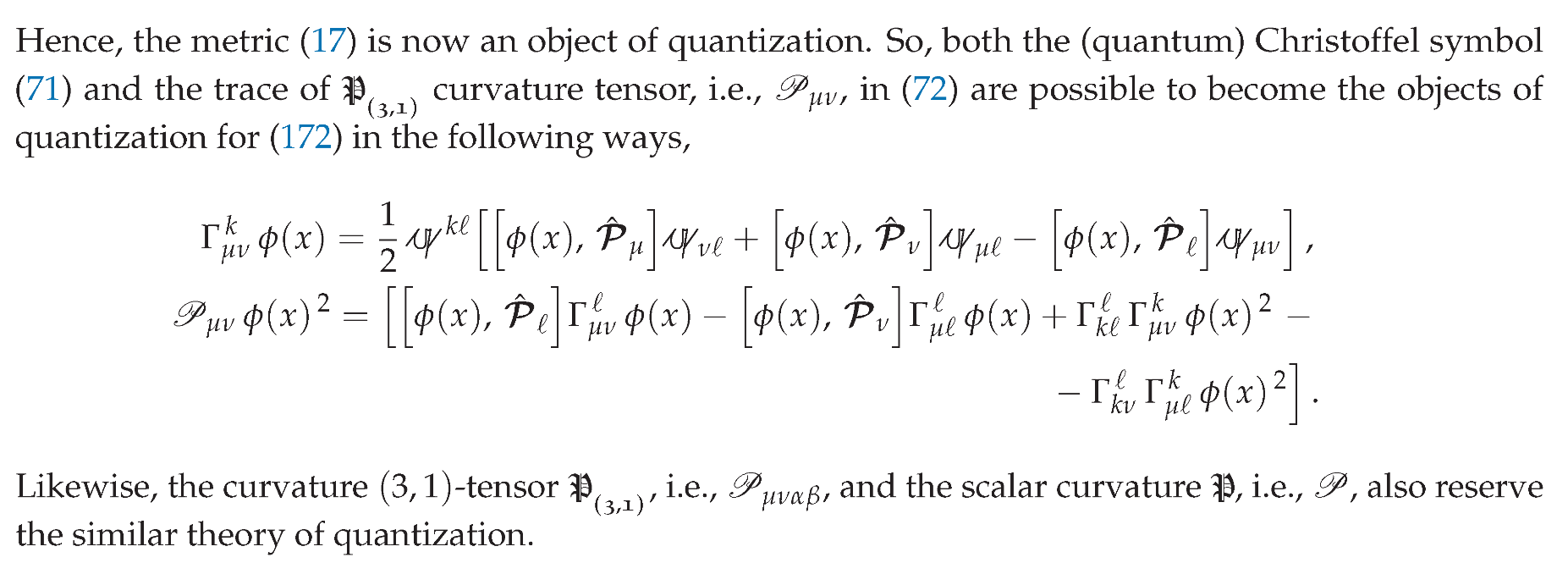
For a real scalar field with a interaction along with the acceptation of the map (though, the following formalism remains true without considering this map) and for (79), the renormalized Lagrangian is,
By denoting , and , we get,
It is clear that the theory is `multiplicatively renormalizable’, and the renormalized Lagrangian is related to the bare Lagrangian by the renormalization transformation , and , where the renormalization constants depend on the coupling constant and on regularization parameters. Since (172) is considered as true for (171), then, could be written as,
where and . Thus, (173) is multiplicatively renormalizable. So as the (quantum) metric tensor (172) and quantum scalar curvature are multiplicatively renormalizable, too. Differently, we can show that the (quantum) Christoffel symbol is actually multiplicatively renormalizable in such a way that,
Thus, by performing a little calculation, we can show that all quantum differential geometric curvatures, i.e., , and , are evidently become multiplicatively renormalizable.
Although, separately, by using [20,46,47,48,49] and omitting any further repetitions, we can easily show that (117), as well as (108), are naturally renormalizable. Consequently, all kind of non-vacuum quantum gravitational field equations, for example the universal form (75), bosonic form (83), fermionic forms (99), (100) and (101), even including bosonic and fermionic particle field equations, for example (87) and (103), respectively, are all renormalizable by the definitions.
PART III: Discussion and Conclusion
The insuperable obstacle between gravity and quantum mechanics is their spacetimes [50,51,52,53,54]. But John Donoghue was correct when he stated about the claims that, “general relativity clashes with quantum mechanics are wrong or at least misleadingly simplistic” [55]. By accepting the quantum temporal axis as our `new’ conception of time throughout this article, we have melted down this insuperable obstacle between gravity and Quantum Mechanics in Theorem 3 by developing a curvilinear Schrödinger equation representing total energy and dynamic time t in a curvilinear quantum spacetime.
Speaking philosophically, time in General Quantum Gravity is nothing but an essential illusion necessary for mechanics concerned with the bodies in motions or forces in equilibrium. That is to say that all events are in time, but time is not a separate, independent reality, outside and strongly apart from all-that-is-in-time, i.e., the contingent, as like as Nyāya-Vaiśeṣika and the Sāṅkhya-Yoga schools. Time is phenomenal like as the system of Advaita Vedānta but not extraordinary. Time is conceived as instant, a series of discontinuous instants, because of the quantized spatial dimensions in (52) or (57), for example, but not like as William James, Husserl and Bergson or neither as one instant being superseded by the Buddhist doctrine of momentariness. Time as instant is real and not as unitary, but these instants are present in a linear order as like as the Jaina tradition, however, time is neither an absolute dimension as like as Jaina, Nyāya, Newton, Bergson or Aristotle and neither it is unchanging due to Definition 10. The relativistic and quantized time in (52) or (57) is not transcendental like Kant or Husserl. It is not like as Leibnitz, too, where time is a system of relations, or not even like as Einstein, where time is simply relativistic but not quantized. Time (as well as space) must be finite and has a beginning when but again not quite like Einsteinian due to the quantized spatial dimensions in (52) and (57). Time is only `relativistically’ reversible at , otherwise it has an irreversible direction. (See Refs. [56] and [57] for a brief account of time.)
In this article, we have strongly avoided to focus on any parts of the orthodox Quantum Mechanics including orthodox Kline-Gordon and Dirac equations. On the other hand, we have also avoided to focus on the definitions of Special and/or General Relativity. Instead, we have employed a new trick here, we have named it as `Metric Mechanics’, by manipulating various kind of line elements (also known as, metric functions) for both bosonic and fermionic fields throughout this article to achieve all sorts of required QFT equations without adopting the orthodox Kline-Gordon or Dirac formalisms. As a result, we have developed here the unorthodox versions of Kline-Gordon-like and Dirac-like equations suitable for curvilinear Quantum Mechanics so as, from the very beginning, these Kline-Gordon-like and Dirac-like equations would make themselves appropriate for the General (Quantum) Relativity, rather than Special Relativity. For this reason, both Kline-Gordon-like and Dirac-like equations have appeared quite different from their orthodox counterparts in QFT while carrying an innocent-looking but quite straightforward General (Quantum) Relativistic signature within their mass fields, e.g., for bosons and for fermions, instead of the orthodox mass term `’, we commonly use in QFT. Speaking more precisely, while in orthodox QFT, obeys the Klein-Gordon equation and obeys the Dirac equation, we have shown in this article that there always exists a possibility of an unorthodox `(General) Relativistic Quantum Mechanics’ alongside of the fundamental QFT (quite similar to Rimark 3 and Note Section 4, where we have already established a deep relationship between this article and the fundamental QFT). To satisfy this, we have established in Section 4 that should obey the Klein-Gordon-like equation whereas should obey the Dirac-like equation, which are actually proved in Section 5 as the modified versions of Einstein-like gravitational field equations by themselves in curvilinear quantum spacetime. On the other hand, their orthodox Quantum Mechanical counterparts, i.e., and , are solely Special Relativistic and they are unable to develop any gravitational field equations like Einsteinian.
Since (33) as well as (39) satisfy (36) and (42), respectively, thus, Quantum Gravity and Quantum Mechanics are able to express each other simultaneous in a curvilinear quantum spacetime, while this curvilinear quantum spacetime is locally Quantum Mechanical in space for its global curvilinear spacetime covering, i.e., it holds in this curvilinear quantum spacetime. Quantum gravitational wave packets (33) or (39) in curvilinear spacetime are universally existed as the covering companions to the three-dimensional wave packets in (1).
Usually, when gravity itself is treated in QFT, there arouses a problematic part that the metric itself is not a well-defined quantum concept [55]. By considering a (quantum) metric tensor , which is multiplicatively renormalizable by nature, we have overthrown such a dilemma in our present article.
From the second and the fourth terms of (A11) from the Appendix A.1, it becomes, , then the rearrangement yields,
hence it is a (quantum) metric tensor as like as (17). So, a non-vacuum quantum gravitational field equation (75) exists for (174), better to say, for (A11). In other words, it is also true for the fields of bosonic (62), or (63), and fermionic (68) since (174) is originated from the same (19). Then, for example, the first order quantum equations, i.e., bosonic (52) and fermionic (56) are undoubtedly the pseudo-gravity equations for (174) ready to satisfy the non-vacuum quantum gravitational field equation (75) in curvilinear quantum spacetime through bosonic (62) or (63), and fermionic (68), since (52) and (56) are also originated from (19). Undoubtedly, (52) and (56) are equally eligible to stand along with some other alternative quantum theories, like the Newton-Schrödinger equation (as we know, for example [3]), or some modified Schrödinger equations (as we know, for example [58]), or the Gravitational Schrödinger equations (as we know, for example [59]), etc.
In General Theory of Relativity, matter means everything that is not the gravitational field (metric), but in (79) as well as in the free fermionic field representation (92), we have replaced matter with quantum scalar curvature . General Relativistic Ricci scalar R never depicts such dynamical possibilities like (79) or (92). Similarly, neither General Relativity and not the orthodox Quantum Mechanics can predict something like a metamorphosis of bosonic fields from (83) or (85) to (87), or a metamorphosis of fermionic fields from (99) or (100) or (101) to (103), or their vice versa.
The fraction in (79) is the nonminimal parameter. But (79) is not the conformally invariant wave equation (as we know, for example, [60,61,62,63]), on the other hand, (79) is neither even a free classical Hermitian Klein-Gordon field on a curved spacetime when (as we know, for example [15,64]). Thus, (79) is a Quantum Gravitational Klein-Gordon-like equation of its `own kind’ for conjugated fermions. Although, the factor is being of relevance when we consider curved spacetime [65] for the `naïve’ cosmological constant . Thus, from (79), we have a bosonic field representation of the cosmological constant as,
Then, the simplest system of linear homogeneous differential equations of first order which meets the conditions of (175) would be as,
In association with (175) and (176), consideration of in (115), where N is an even number, may help us to explore the possibilities for opening a study on cosmological bodies solely based on gravity and/or Dark Energy.
In Section 8, the inversely stretched/shrank spacetimes for fermions, i.e., , in (137) and for bosons, i.e., , in (146) become quite complicated to presume. The situation is not altered in their second order field representations with the hypothetical mass or . Even the transformation of (148) from the mass operator m in (41) makes it equally complicated. Definitely, both the first order and the second order quantum geometries of mass of fermionic or bosonic particle is not as simple as we can usually expect. We need an elaborative study on it elsewhere.
By introducing a direct transformation from (133) to (136) for fermions, so as (142) to (145) for bosons, where (136) mirroring bosonic fields while (142) mirroring fermionic fields, we have demonstrated a new kind of boson-fermion `Supersymmetry’ without ever considering Supersymmetry and its troupe of surprisingly heavy superparticles, since .
Since the orthodox Quantum Mechanics is typically set up in constant velocity frameworks and since both Kline-Gordon and Dirac equations are developed from Special Relativity, whereas on the other hand, Newton-Schrödinger equations cannot be derived from General Relativity plus Quantum Field Theory [3], then we can say that no experimental formalism has designed yet to understand the interaction of quantum matter with classical gravity in accelerating frames at today’s technical platform to determine whether the generality (i.e., universally validation) of quantum gravity, unless otherwise we consider some well-known classical findings ranging from Schrödinger equation to Einstein’s mass-energy relationship, or something like which we have established in this article by using different aspects of General Quantum Gravity. To justify the General Quantum Gravity, there are some good references, as we know, for example [66,67,68,69,70,71,72], explaining the proposals and highlighting the important ways, which can help us to predict in such a way the interpretation of General Quantum Gravity may experimentally access. Though, such an experiment might be feasible in the near future. Despite the lack of experimental evidences for quantum gravity, Testable Prediction 9 is a unique and exclusive way to probe General Quantum Gravity quite straightforwardly apart from some other near-future experimental possibilities to probe quantum gravity, such as [2,73,74], for example. If Testable Prediction 9 is provable then overall scenario of General Quantum Gravity will be proved automatically. Perhaps, a careful anomaly detection search for narrow-width resonances beyond the Standard Model based on the dijet final state using proton-proton collisions at TeV recorded during 2015-2018 period in the ATLAS detector at the Large Hadron Collider (LHC) at CERN may probe by revealing a deficit in the potentially signal-enriched region (using something like [75], for example).
Appendix A. (3+1)D Curvilinear Quantum Field Theory
Appendix A.1. Bosons
Let (22), whose temporal direction t is dynamic, yield a quantum factor for (21) as,
where the subscript is intending bosons and is the three-dimensional velocity vector, i.e., (using the summation convention),
A (quantum) Lorentz-like transformation originated from (22) is possible to obtain in a curvilinear quantum spacetime on contrary to the Special Relativistic Lorentz transformation as follows.
Definition A1
((Quantum) Lorentz-like transformation for bosons or composites). Let us consider,
where is a matrix with constant elements, and is a constant four-vector. If we consider Λ and matrices as,
then let a standard form would be for Λ,
i.e., the linear (Quantum) Lorentz-like (homogeneous) transformation of the form would be,
which is nothing but the Special Relativistic Lorentz transformation (SRLT) written reciprocally in a generalized curvilinear quantum spacetime, thus, (A3) always satisfies the inverse map,
or vice versa. Additionally, the inhomogeneous transformations would be,
where describes translations.
Remark A1
(Bridging Link between Simple (Quantum) Relativity and General (Quantum) Relativity). For the `four-momentum’ operator of (13), the linear (Quantum) Lorentz-like transformation in (A4) would become as,
which can inject a (Quantum) Lorentz-like signature in the (quantum) scalar curvature while considering (72), see later in the main text, as,
Definitely, it is a strong bridge between Simple (Quantum) Relativity and General (Quantum) Relativity. No such bridges are possible to exist in Einsteinian relativity.
By the way, we can also establish the fact that elements of the proper, orthochronous, homogeneous (Quantum) Lorentz-like group `’ can be described by means of elements of , i.e., the group of all complex matrices where a, b, c, and d are complex numbers satisfying,
associates with each four-vector a Hermitian matrix,
which can also be written as due to (13) for and the three Pauli matrices .
Putting it another way, let the metric be derived from the -norm as,
then this metric space can also establish a space, as the transformation (A4) preserves the scalar product since,
As a result, the description of the representations of the (Quantum) Lorentz-like group is equivalent to that of the group .
In , space, , where is the identity matrix and are the Pauli spin matrices. So, the inner product would be given by . By considering the transformation with A in and since , this transformation preserves . Writing , we can see that there is a Lorentz-like transformation such that . It is clear that in this identification we must have .
Definition A2
(Some Crucial Properties). Let us consider the operators and by the rules and , where and are the generators of spacetime translations and the Lorentz rotations, respectively, then and define the Lie algebra of the Poincaré group [20]. Then there is a unitary representation of the Poincaré group on , where α ranges over all spacetime translations and R ranges over all Lorentz boosts and spatial rotations, which fulfills and as well as a unique state , called a vacuum, represented by a ray in , which is invariant under the action of the Poincaré group. For each test function f, defined on spacetime, there exists a set of operators (tempered distributions regarded as a functional of f) which, together with their adjoints defined on a domain D, are defined on a dense subset of , containing the vacuum . The Hilbert space is spanned by the field polynomials acting on the vacuum (cyclicity condition). The relation is valid when each side is applied to any vector in domain D. Finally, if the supports of two fields are space-like separated, then the fields either commute or anticommute.
Over again, we have (A1) as,
Thus, (A5) implies that the total energy operator is also possible to define as in curvilinear quantum spacetime.
Remark A2
(Parameter and Its Relation with Bosonic Field). Imitating the Special Relativistic mass for the Lorentz factor , let us assume analogously that the (quantum) relativistic mass of a boson in quantum spacetime is,
Let us insert (A5) `twice’ into (A6) one after another as follows. At first by inserting the value of we get,
and then by inserting the value of it yields,
and by using and for (A6), if a parameter yields,
then (A7) gives,
i.e., the rest mass of boson in association with is now able to behave like as an expression of the energy operator of (34). This is a bridging relation between (Quantum) Relativity and Quantum Mechanics.
Definition A3
Equalizing the second and last terms of (A11) yields a second order wave equation as,
and by using and (A12) yields,
for the construction when the spin of the particle is with the conditions , , and the total symmetrization of the indices as . So, (A12) is nothing but an analogy to Kline-Gordon equation, though, makes it clear that (A12) is not an orthodox Quantum Relativistic Kline-Gordon equation, though, it is actually a hidden (quantum) gravitational field equation (see (62), or more precisely, see (63) or the origin of (87), in the main text for more details) which have to satisfy the curvilinear quantum coordinate system for (19). Thus, unlike orthodox Quantum Relativistic Kline-Gordon equation, here (A12) (or (62), in other words, (63) or (87), for example) is technically applicable in accelerating frames for Definition 6.
Appendix A.2. Fermions
Let us write a fermionic field representation by using a set of (quantum) line elements, i.e., and , using the gamma matrices when,

Let (A15) yield a quantum factor for fermionic fields as,
where the subscript means fermions, definitely , thus for (A17), the quantum factor for spinor is,
But (A17) also yields,
Thus, (A19) implies that the energy operator is now for fermions, which is also possible to be written as in curvilinear quantum spacetime.
Definition A4
((Quantum) Lorentz-like transformation for Fermions). It is possible to develop a standard form of (Quantum) Lorentz-like transformation for fermions using the gamma matrices as,
Interestingly, this transformation does not have any Special Relativistic counterparts.
Remark A3
(Parameter and Its Relation with Fermionic Field). Let us assume that the quantum relativistic fermion mass is,
Let us insert (A19) `twice’ into (A20) one after another as follows, at first by inserting the value of we get,
and then by inserting the value of it yields,
and by using and for (A20), if a parameter yields,
then (A21) gives,
i.e., the rest mass of fermion in association with is now able to behave like as an expression of the energy operator of (34). This is again a bridging relation between (Quantum) Relativity and Quantum Mechanics.
Note it that fermions that satisfy are not tachyons, the property of is a special characteristic of fermions as long as (A15) is satisfied.
Definition A5
So, we are able to yield a first order spinor field representation using the third and the fourth terms and/or the second and the last terms of (A26) as,
and by using and (A28) yields,
in terms of the Dirac tensor spinors for the construction when the spin of the particle is with and . Though, (A28) is analogous to Dirac equation, but of (A23) make it clear that (A28) is not an orthodox Quantum Relativistic Dirac equation, though, it is actually a hidden (quantum) gravitational field equation (for example, see (68), or more precisely, see the origin of (103), in the main text for more details) which have to satisfy the curvilinear quantum coordinate system for (19). Thus, unlike orthodox Quantum Relativistic Dirac equation, (A28) (or (68), in other words, (103) for example) is technically only applicable in accelerating frames for Definition 6.
Let us consider that an anticommutative line operator for mesons made of two-quarks is possible to be written by squaring the second and the fourth terms of (A26) as,

This second order wave equation is analogous to Kline-Gordon-like equation (A12), but now with .
References
- I. J. R. Aitchison, A. J. G. Hey, Gauge Theories in Particle Physics: A Practical Introduction, Vol. 2 (CRC Press, 2024).
- G. Tobar et al., Nature Communications 15, 7229 (2024).
- B.-L. B. Hu, E. Verdaguer, Semiclassical and Stochastic Gravity: Quantum Field Effects on Curved Spacetime (Cambridge University Press, 2020).
- M. J. D. Hamilton, Mathematical Gauge Theory: With Applications to the Standard Model of Particle Physics (Springer International, 2017).
- F. Müller, “On the Paradigms of Quantum Gravity 2016” in Experimental Search for Quantum Gravity, ed. by S. Hossenfelder (Springer, 2018), pp. 21-27.
- M. Blagojevic, Gravitation and Gauge Symmetries (Institute of Physics Publishing, 2002).
- P. M. Alsing, J. C. Evans, K. K. Nandi, Gen. Rel. Grav. 33, 1459 (2001).
- P. Collas, D. Klein, The Dirac Equation in Curved Spacetime (Springer Nature, 2019).
- J. L. Powell, B. Crasemann, Quantum Mechanics (Addison-Wesley Publishing Company, Inc. 1961).
- M. Jammer, Concepts of Mass in Contemporary Physics and Philosophy, (Princeton University Press, 2000), pp. 69-70 .
- B. C. Hall, Quantum Theory for Mathematicians (Springer, 2013).
- E. Gaztañaga, K. S. Kumar, J. Marto, Class. Quantum Grav. 43, 015023 (2026).
- H. Moussa et al., Nat. Phys. 19, 863 (2023).
- L. E. Parker, D. J. Toms, Quantum Field Theory in Curved Spacetime: Quantized Fields and Gravity (Cambridge University Press, 2009).
- S. A. Fulling, Aspects of Quantum Field Theory in Curved Space-Time (Cambridge University Press, 1989).
- A. Aste, Symmetry 2, 1776 (2010).
- M. Gasperini, Theory of Gravitational Interactions (Springer, 2017).
- B. Chow, P. Lu, L. Ni, Hamilton’s Ricci Flow (American Mathematical Society and Science Press, 2010).
- N. Olivi-Tran, Adv. Studies Theor. Phys. 3, 9 (2009).
- I. L. Buchbinder, I. L. Shapiro, Introduction to Quantum Field Theory with Applications to Quantum Gravity (Oxford University Press, 2021).
- J. Matehkolaee Mehdi, Pramana-J. Phys. 93, 84 (2019).
- B. M. Novakovic, D. B. Novakovic, A. B. Novakovic, AIP Conf. Proc. 839, 144 (2006).
- C. Cremaschini, Eur. Phys. J. C 83, 729 (2023).
- E. Zeidler, Quantum Field Theory III: Gauge Theory (Springer-Verlag, 2011).
- H. Friedrich, A. Rendall, “The Cauchy Problem for the Einstein Equations” in Einstein’s Field Equations and Their Physical Implications, ed. by B. G. Schmidt (Springer, 2000).
- E. Schrödinger, Space-time Structure (Cambridge University Press, 1997), p. 6l.
- R. Aaij et al., Phys. Rev. Lett. 127, 111801 (2021).
- T. Guff, C. U. Shastry, A. Rocco, Sci Rep 15, 3658 (2025).
- M. Carmeli, Group Theory and General Relativity (McGraw-Hill, 1977).
- M. Carmeli, Classical Fields: General Relativity and Gauge Theory (John Wiley, 1982).
- M. Camneli, E. Leibowitz, N. Nissani, Gravitation: SL(2,C) Gauge Theory and Conservation Laws (World Scientific, 1990).
- S. Navas et al. (Particle Data Group), Phys. Rev. D 110, 030001 (2024).
- Editorial, Nature Astronomy 9, 471 (2025).
- A. J. Shajib, J. A. Frieman, Phys. Rev. D 112, 063508 (2025).
- I. Sogami, S. Nishimoto, Il Nuovo Cimento 52, 531 (1979).
- I. Sogami, S. Nishimoto, Prog. Theor. Phys. 62, 1768 (1979).
- W. Kummer, Il Nuovo Cimento 31, 219 (1964).
- W. N. Cottingham, D. A. Greenwood, An Introduction to the Standard Model of Particle Physics (Cambridge University Press, 2007).
- A. Piórkowska-Kurpas, S. Cao, M. Biesiada, Journal of High Energy Astrophysics 33, 37 (2022).
- A. Piórkowska-Kurpas, Universe 8, 83 (2022).
- B. Carr, Universe or Multiverse? (Cambridge University Press, 2007).
- R. Demina, A. Garcia-Bellido, Electroweak Symmetry and its Breaking (World Scientific, 2023).
- S. Weinberg, E. Witten, Phys. Lett. 96B, 59 (1980).
- S. Nair, A. Vijaykumar, S. Sarkar, JCAP 11, 004 (2024).
- Y. Takahashi, An Introduction to Field Quantization (Pergamon Press, 1969).
- J. C. Collins, Renormalization: An introduction to renormalization, the renormalization group, and the operator-product expansion (Cambridge University Press, 2023).
- W. D. McComb, Renormalization Methods: A Guide for Beginners (Oxford University Press, 2007).
- E. B. Manoukian, Renormalization (Academic Press, 1983).
- K. Costello, Renormalization and Effective Field Theory (American Mathematical Society, 2011).
- E. Anderson, The Problem of Time: Quantum Mechanics Versus General Relativity (Springer, 2017).
- M. Bojowald, “A Momentous Arrow of Time” in The Arrows of Time: A Debate in Cosmology, eds. by L. Mersini-Houghton, R. Vaas (Springer, 2012), pp. 169-189.
- T. P. Singh, “Classical and Quantum: A Conflict of Interest” in Gravity and the Quantum, eds. by J. S. Bagla, S. Engineer (Springer, 2017), pp. 411-425.
- C. Kiefer, “Quantum Gravity: Whence, Whither?” in Quantum Field Theory and Gravity: Conceptual and Mathematical Advances in the Search for a Unified Framework, eds. by F. Finster et al. (Springer, 2012), pp. 1-13.
- C. K. Raju, Time: Towards a Consistent Theory (Springer, 1994).
- J. F. Donoghue, “Quantum General Relativity and Effective Field Theory” in Handbook of Quantum Gravity, eds. by C. Bambi et al. (Springer Nature, 2024), pp. 3-26.
- A. N. Balslev, A Study of Time in Indian Philosophy (Munshiram Manoharlal Publishers Pvt. Ltd., 1999).
- A. N. Balslev, J. N. Mohanty (eds.), Religion And Time (E. J. Brill, 1993).
- M. Maziashvili, Z. K. Silagadze, Gen. Relativ. Gravit. 53, 67 (2021).
- D. H. Bernstein, E. Giladi, K. R. W. Jones, Mod. Phys. Lett. A 13, 2327 (1998).
- J. Natario, A. Sasane, Ann. Henri Poincaré 23 2345 (2022),.
- Y. Choquet-Bruhat, C. De Witt-Morette, M. Dillard-Bleick, Analysis, Manifolds, and Physics, Part I: Basics (Elsevier, 1996).
- R. Penrose, W. Rindler, Spinors and Space-Time, Vol 1 (Cambridge University Press, Cambridge, 2003).
- T.-P. Hack, Cosmological Applications of Algebraic Quantum Field Theory in Curved Spacetimes (Springer, 2016).
- S. Hollands, W. Ruan, Ann. Henri Poincaré 3, 635 (2002).
- R. Penrose, W. Rindler, Spinors and Space-Time, Vol. 2 (Cambridge University Press, Cambridge, 1999).
- N. Huggett, N. Linnemann, M. D. Schneider, Quantum Gravity in a Laboratory? (Cambridge University Press, 2023).
- S. Hossenfelder (ed.), Experimental Search for Quantum Gravity (Springer, 2018).
- C. Pfeifer, C. Lämmerzahl (eds.), Modified and Quantum Gravity: From Theory to Experimental Searches on All Scales (Springer Nature, 2023).
- G. Z. Adunas, E. Rodriguez-Milla, D. V. Ahluwalia, Phys. Lett. B 485, 215 (2000).
- A. R. Brown et al., PRX Quantum 4, 010320 (2023).
- S. Nezami et al., PRX Quantum 4, 010321 (2023).
- A. Garcia-Soto, D. Garg, M. H. Reno, C. A. Argüelles, Phys. Rev. D 107, 033009 (2023).
- R. Schützhold, Phys. Rev. Lett. 135, 171501 (2025).
- S. M. Vermeulen et al., Phys. Rev. X 15, 011034 (2025).
- G. Aad et al., Phys. Rev. D 112, 072009 (2025).
Disclaimer/Publisher’s Note: The statements, opinions and data contained in all publications are solely those of the individual author(s) and contributor(s) and not of MDPI and/or the editor(s). MDPI and/or the editor(s) disclaim responsibility for any injury to people or property resulting from any ideas, methods, instructions or products referred to in the content. |
© 2026 by the authors. Licensee MDPI, Basel, Switzerland. This article is an open access article distributed under the terms and conditions of the Creative Commons Attribution (CC BY) license (http://creativecommons.org/licenses/by/4.0/).
Copyright: This open access article is published under a Creative Commons CC BY 4.0 license, which permit the free download, distribution, and reuse, provided that the author and preprint are cited in any reuse.