
Submitted:
20 September 2024
Posted:
23 September 2024
Read the latest preprint version here
Abstract
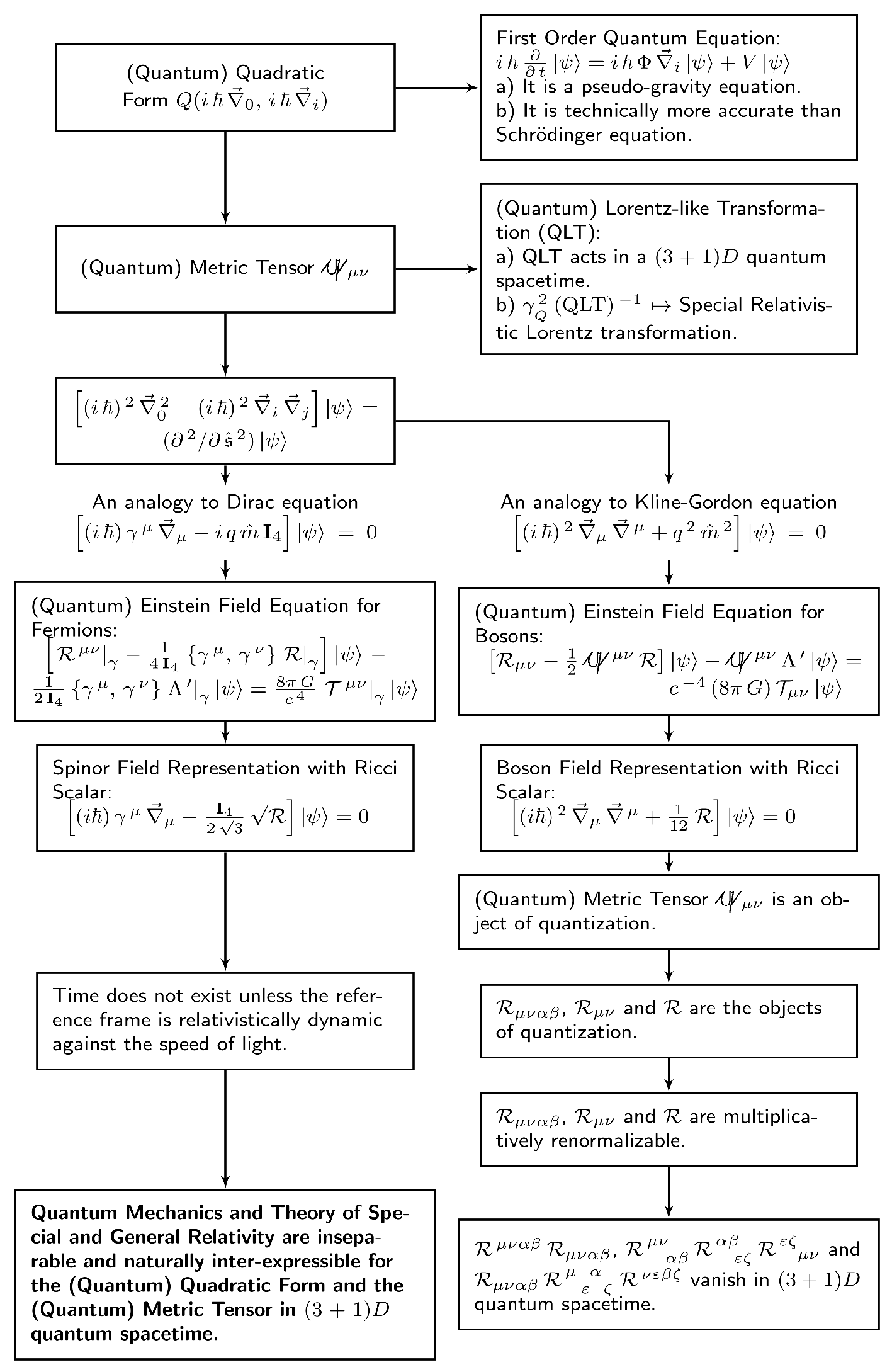
The insuperable obstacle between gravity and quantum mechanics is their spacetimes. Introduction of a (quantum) quadratic form on a state Hilbert space and a (quantum) metric tensor in (3+1)D quantum spacetime solves the problem by providing a common spacetime for both gravity and quantum mechanics which helps further to develop an accurate and generalized form of quantum gravity, i.e., General Quantum Gravity. This formalism yields a (3+1)D pseudo-gravity first order quantum equation, which is technically more accurate than Schr\"odinger equation. A (quantum) Lorentz-like transformation is also possible to be developed in (3+1)D quantum spacetime. Instead of one common Einstein field equation to explain gravitational effects, this formalism yields two individual (quantum) Einstein field equations, namely, one for bosons and another for fermions. In this work, (quantum) metric tensor as well as quantum Riemann tensor, quantum Ricci tensor and quantum Ricci scalar all are found to be the objects of quantization. Apparently, these quantum Riemann tensor, quantum Ricci tensor and quantum Ricci scalar are also found to be multiplicatively renormalizable while all divergences of their higher orders vanish in (3+1)D quantum spacetime. Ultimately, General Quantum Gravity yields that: Quantum Mechanics and Theory of Special and General Relativity are inseparable and naturally inter-expressible for the (quantum) quadratic form and the (quantum) metric tensor in (3+1)D quantum spacetime.
Keywords:
quantum gravity
; (quantum) Einstein field equations
; renormalization
Highlights
- An accurate and generalized form of Quantum Gravity
- Quantization of (Quantum) Metric Tensor & multiplicatively renormalizable gravity
- Pseudo-gravity First Order Quantum Equation replacing Schrödinger equation
- Two separate (quantum) Einstein field equations one for bosons and other for fermions
- Inseparability and inter-expressibility of Quantum Mechanics and Theory of Relativity
1. Introduction
The insuperable obstacle between gravity and quantum mechanics is their spacetimes. General Theory of Relativity is non-renormalizable, after quantization, and there is no very promising alternative [1]. One can suppose that, at very short distances and/or when the curvature becomes very large, gravitational phenomena must be described by some other theory that is extended compared to General Theory of Relativity [2]. For this purpose, by considering a (quantum) quadratic form on a state Hilbert space, we have developed a freely-falling inertial frame and a line element using a (quantum) metric tensor . This inertial frame yields an analogy to Kline-Gordon equation, which is able to yield a spinor field representation analogous with Dirac equation. To make both of these analogies to be able to give us gravity, we developed one bosonic and one fermionic (quantum) Einstein field equations distinguishably out of them. The (quantum) metric tensor is found to be an object of quantization. Hence, the (quantum) Christoffel symbol , quantum Riemann tensor , quantum Ricci tensor and quantum Ricci scalar are also reserved such quantization. For a real scalar field with a interaction, the (quantum) metric tensor becomes multiplicatively renormalizable in quantum spacetime. Thus, the quantum forms , and are evidently become multiplicatively renormalizable, too. Apparently, all divergences of the “dangerous” [3], and vanish in quantum spacetime.
2. General Quantum Gravity
First of all, we must omit Schrödinger equation 1 as well as the spin connection throughout this work. Let a Hilbert state space is associated with any quantum system.
Definition 1 ((Quantum) Quadratic Form).
Let us postulate the existence of a single space-time M, on which all events occur, with no particular coordinates attached to it. Let us consider the differential operator in . For a diffeomorphism , let an event at a point , is occurred at . Similarly, for another diffeomorphism , the same event is considered to be occurred at . From inertial reference frames, the changing coordinates is then given by the map . Let be the (quantum) quadratic form defined by,
so that, for the basic axiom of special relativity, F preserves Q, i.e., .
Definition 2 ((Quantum) Metric Tensor).
Let us consider an infinite-dimensional complex vector space . Let is a smooth manifold, that is, is an n-dimensional differentiable manifold and is a (quantum) metric tensor satisfying,
when is the n-dimensional Lorentz metric. This is either a positive-definite section of the bundle of symmetric (covariant) 2-tensors or a positive-definite bilinear maps, for all . Here, the metric tensor is symmetric, i.e., , and . Components of its inverse matrix are themselves the components of matrix , namely, , where is the Kronecker delta. The basic axiom of special relativity then ensures that F preserves .
Let the ‘energy-momentum four-vector’ operator in for some state , when with the energy operator 2 and the three-momentum operator for and . Consider next a freely-falling inertial frame (an orthonormal line operator) in the neighbourhood of a gravitating body in such a way that,
using summation convention. Since , then (3) may yield a quantum coordinate system for a point , when , so as it can get a line element in as,
which can easily satisfy a (quantum) Lorentz-like transformation (QLT) originated from (3) (see Definition 3 below), though, this QLT will be in a quantum spacetime on contrary to the Special Relativistic Lorentz transformation. Let , where is a matrix with constant elements, and is a constant four-vector. Let (4) may yield a quantum factor ℘ as,
where is the velocity, which is accelerating in a curvilinear path for the quantum factor (in SI unit),
where is the acceleration whereas is just a non-zero observation in the curvilinear path while c is always a physical constant (the Universality of the speed of light). Though is analogous to the Lorentz factor , but ℘ is not Special Relativistic due to (6).
Definition 3 ((Quantum) Lorentz-like transformation (QLT)).
If we consider Λ matrix as
then a standard form of (Quantum) Lorentz-like transformation (QLT) is,
Thus,
In space, , where is the identity matrix and are the Pauli spin matrices. So, the inner product would be given by . By considering the transformation with A in and since , this transformation preserves . Writing , we can see that there is a Lorentz-like transformation such that . It is clear that in this identification we must have , so there is a two-to-one homomorphism of into .
Let the operators and by the rule , , where and are called the generators of spacetime translations and the Lorentz rotations, respectively, then and define the Lie algebra of the Poincaré group [2]. Then there is a unitary representation of the Poincare group on , where ranges over all spacetime translations and R ranges over all Lorentz boosts and spatial rotations, which fulfills and as well as a unique state , called a vacuum, represented by a ray in , which is invariant under the action of the Poincaré group. For each test function f, defined on spacetime, there exists a set of operators (tempered distributions regarded as a functional of f) which, together with their adjoints defined on a domain D, are defined on a dense subset of , containing the vacuum . The Hilbert state space is spanned by the field polynomials acting on the vacuum (cyclicity condition). The relation is valid when each side is applied to any vector in domain D. Finally, if the supports of two fields are space-like separated, then the fields either commute or anticommute.
Over again, (5) yields,
So, (9) implies that the energy operator is now defining as in spacetime. Again, since relativistic mass for the Lorentz factor , then we may assume analogously that the quantum relativistic mass is for of (6). Hence, the quantum relativistic mass is now behaving like as an operator.
Remark 1.
Inserting (9) ‘twice’ into the mass relation , we may have, , so as, if , then we have . In natural units along with , this Θ becomes dimensionless, i.e., , where q is a quotient number . The quantum rest mass is behaving like as another expression of the energy operator , i.e., for with .
Insertion of (9) in of (3) yields,
Use of Rremark 1 into (10) yields a second order wave equation as,
for the quotient number and the construction when the spin of the particle is with the conditions , , and the total symmetrization of the indices as . So, (11) is nothing but an analogy to Kline-Gordon equation, but unlike conventional Kline-Gordon equation, (11) must have to satisfy the quantum coordinate system for (4); in addition, it is actually mass-independent due to and as, if when is the proper time. Technically, (11) is not a Kline-Gordon equation, though (11) has a close relation with General Theory of Relativity due to (6).
Now, (10), as well as (11), is able to yield a spinor field representation for Remark 1 for the gamma matrices as,
in terms of the Dirac tensor spinors for the construction when the spin of the particle is with and . So, (12) is analogous with Dirac equation, where is the identity matrix. Though (12) also has a close relation with General Theory of Relativity for (6), but none of (11) and (12) are able to give us gravity yet. So, we need something additional to investigate further as follows.
On the first step, let us check our quantum spacetime from the perspective of General Theory of Relativity [4].
Theorem 1.
Let is the non-vacuum (Quantum) Einstein field equation in quantum spacetime, when is the ‘naive’ cosmological constant.
Proof.
Let is a smooth manifold, that is, is an n-dimensional differentiable manifold and is the quantum metric tensor satisfying (2), which is either a positive-definite section of the bundle of symmetric (covariant) 2-tensors or a positive-definite bilinear maps, for all . Here, is the subspace of generated by elements of the form . Let be local coordinates in a neighborhood U of some point of M. In U the vector fields form a local basis for and the 1-forms form a dual basis for , that is, . The metric may then be written in local coordinates as , where . Let denote the Levi-Civita connection of the metric . The Christoffel symbol is the components of the Levi-Civita connection and is defined in U by , and for , we see that they are given by,
Let the curvature -tensor is defined by,
Let the tensor is the trace of curvature tensor,
Its components are defined by , thus, the Ricci tensor,
is purely Quantum Mechanical due to (13). Again, the scalar curvature is the trace of tensor: where is a unit vector spanning of a line . Then, the non-vacuum quantum Einstein tensor directly acts on a quantum spacetime. Thus, the non-vacuum quantum Einstein field equation, , is now ‘purely’ Quantum Mechanical for (13), where the rhs comes from the energy-momentum tensor, for example, , where ℓ is related to the cosmological constant as and a is the (squared) Klein-Gordon mass [5]. 3 Again, the Ricci tensor is , thus, the non-vacuum (Quantum) Einstein field equation in quantum spacetime would become as,
where the Lorentz metric tensor is satisfying (2) and the ‘naive’ cosmological constant (in SI unit) , which yields the cosmological constant . □
The ‘−’ sign for the cosmological constant is taken to make it clear that is always repulsive in nature.
The last line of (15) is Einsteinian and non-renormalizable, though, in the first line of (15), the mass dimension of gravitational constant G vanishes due to . So, not owing to the mass dimension of G, the perturbative version of the first line of (15) is renormalizable.
Theorem 2.
For of (3), there exists a first order quantum equation in as,
while V is the external potential energy.
Proof.
Let for (10). Then the dynamics of the quantum state is possible to be defined as,
while . Therefore, by introducing external potential energy V and the Hamiltonian (or total energy) operator , we have a first order quantum equation in as,
where . □
Let (10) be rewritten as, for (9), but as for (3), then yields,
hence it is a (quantum) metric tensor as like as (2). Additionally, a non-vacuum (Quantum) Einstein field equation exactly similar to (15) is also possible to exist for bosons. Thus, (15) is doubtlessly a non-vacuum bosonic (Quantum) Einstein field equation in quantum spacetime.
Then the first order quantum equation (16) undoubtedly a pseudo-gravity equation for (17) ready to satisfy the non-vacuum bosonic (Quantum) Einstein field equation (15) in quantum spacetime. So, the first order quantum equation (16) in quantum spacetime is technically more accurate on the contrary to the second order Schrödinger equation in (which has no relation with gravity at all).
In a similar way, due to the commutativity of partial derivatives, the first equation of (12) may yield,
here and hereafter represents the anticommutator. Since for (9), then an orthonormal line operator is possible to be written in comparison to (3) as,
but if satisfies (19), where represents the anticommutator, which is satisfying the Clifford algebra as , then for the commutativity of partial derivatives, the first equation of (12) yields:
Lemma 1.
If , then it must satisfy,
Proof.
In (19), the anticommutator relation must have to satisfy that,
for and , etc., we have,
inputting , etc.,
Hence, this gives the lemma. □
By the way, (19) also satisfies an equivalency as:
Theorem 3.
Let M be a spin manifold. If is the quantum scalar curvature of M then,
yields,
for the construction when the spin of the particle is with the conditions , , and the total symmetrization of the indices as .
Proof.
Terms in (20) possess local conformal symmetry, while the fraction there in (20) is the nonminimal parameter. Evidently, (20) is not the Klein-Gordon equation emerged from spinor fields. Thus, the spinor field representation with quantum Ricci scalar would be,
for the construction when the spin of the particle is with and .
Remark 2.
From and of Rremark 1, we get, for . Combining, and we get, , which yields for as, since , i.e., .
Theorem 4
(Uncertainty Relations). For and/or , we have , then we get the uncertainty relations as,
Proof.
[Hints.] To quantify the precision of the rest mass and quantum Ricci scalar along with time, let us consider the standard deviation . Let the variances of rest mass () and time (), defined as,
Evaluating the inverse Fourier transform through integration by parts, we get the theorem with equality if and only if and t are linearly dependent. A similar result would hold for the pair of conjugate variables and t. □
Theorem 5.
A fermionic analogy to quantum Christoffel symbol yields an antisymmetrized quantum Ricci tensor along with a non-vacuum fermionic analogy to (Quantum) Einstein field equation.
Proof.
Not considering the spin connection as our basic consideration as we have stated in the beginning line of the Section 2, let us consider,
then,
so, a non-vacuum fermionic analogy to (Quantum) Einstein field equation is,
where the energy-momentum tensor is, for example, generated by the energy-momentum tensor of the spinor field in such a way that according to the definition of (23), where, for example [2],
for the mass-independent spinor field. □
So, not owing to the mass dimension of G in (23) for due to , the perturbative version of (23) is renormalizable.
Let us develop a first order quantum equation for fermions in analogous to Theorem 2.
Theorem 6.
For (19), there exists a first order quantum equation for fermions in as,
while V is the external potential energy.
Proof.
Let (18) be written as,
Then the dynamics of the quantum state for fermions is possible to be defined as follows since , whereas and as for ,
while , etc. Therefore, by introducing external potential energy V and the Hamiltonian (or total energy) operator , we have a first order quantum equation for fermions in as,
for . □
The analogy between bosonic (15) and fermionic (23) (Quantum) Einstein field equations in , as well as the presence of relativistic effects in the bosonic (16) and fermionic (24) first order quantum equations in , and (20) as well as its spinor field representation (21) invoke us to name this formalism as General Quantum Gravity.
2.1. Renormalization [6]
Let is a field quantity or field operator or simply the field, which is the linear operator depending on a point in four-dimensional space. Let there exists a non-singular matrix such that hermitian conjugation with is of the form , where is symmetric in all pairs of indices and independent of . Then (11) divisor exists such that . The field equation is Lorentz invariant and , where is: , and is defined by the transformation of under an infinitesimal Lorentz-like transformation, i.e., , when and .
Now, with this background along with Section 2 of Chapter V in page 112 of [6], we can easily show that the operator and the commutation relation of so that , for , is consistent with the equation or equivalently .
Let the (quantum) metric tensor of (2) may transform as for (3). Then may yield (with the summation convention):
Thus (by omitting the summation convention),
Hence, the metric is an object of quantization. So as (13), as well as (14), is also an object of quantization for (25) in such a way,
Thus, other two forms, i.e., quantum Riemann tensor and quantum Ricci scalar also reserve the similar theory.
For a real scalar field with a interaction and (though, the following formalism must be true without considering this map), the renormalized Langrangian with (20) is . By denoting , and , we get . It is clear that the theory is multiplicatively renormalizable, and the renormalized Lagrangian is related to the bare Lagrangian by the renormalization transformation , and , where the renormalization constants depend on the coupling constant and on regularization parameters. Since , then, could be written as,
where and . Thus, (26) is multiplicatively renormalizable. So as (25), as well as quantum Ricci scalar , is multiplicatively renormalizable, too. Then, we can show that the quantum Christoffel symbol is actually multiplicatively renormalizable in such a way that,
Thus, the quantum forms , and are evidently become multiplicatively renormalizable. Apparently, all divergences of the “dangerous” [3], and vanish in quantum spacetime.
3. Conclusion
In this study of General Quantum Gravity, the Lorentz-like transformation (7), the interrelated (11), (12) and (16), as well as the bosonic (15) and fermionic (23) (Quantum) Einstein field equations, even the boson field representation with Ricci scalar (20) as well as its spinor field representation (21), are all emerged from the (quantum) quadratic form and the (quantum) metric tensor defined by (1) and (2), respectively. Thus, for (8) and for the bosonic (15) and fermionic (23) (Quantum) Einstein field equations, General Quantum Gravity yields that: Quantum Mechanics and Theory of Special and General Relativity are inseparable and naturally inter-expressible for the (quantum) quadratic form and the (quantum) metric tensor in quantum spacetime.
From this work, we can determine an important unsolved fundamental problem: What is time? By comparing with of (9), i.e., having , we can get the change of time for (4) while as,
for the (non-quantum) pure relativistic interval , thus, time shifts itself from quantum frame to relativistic frame (Universality of time). Hence, time does not exist unless the reference frame is relativistically dynamic against the speed of light. On the other hand, at the speed of light, when , the differentiation becomes changeless, i.e., time freezes at the speed of light. As a result, photon’s rest mass becomes uncertain at due to (22). Actually, (27) is the famous Einstein relation implying that a moving particle lives longer by a factor . The classical direct experimental evidence for this phenomenon (see, for example, page 20 of [7]) justifies the validity of as well as , in other words, the validity of (3), so as the General Quantum Gravity, likewise.
We can also determine here another important unsolved fundamental problem: Why gravity is feeble against other fundamental forces? For fermionic (Quantum) Einstein field equation (23), we have considered the energy-momentum tensor generated by the energy-momentum tensor of the spinor field . Taking the relative strength based on the strong force felt by a proton-proton pair as unity and omitting all additional conditions, it yields roughly that Approximate Relative Strength ofApproximate Relative Strength of. By adjusting the additional conditions, we may get the Approximate Relative Strength of electroweak force as , which easily expresses that gravity is many orders of magnitude smaller than electroweak or strong interactions.
References
- Collins, J. C., Renormalization: An introduction to renormalization, the renormalization group, and the operator-product expansion, Reissued as OA (Cambridge University Press, Cambridge) 2023.
- Buchbinder I. L. and Shapiro I. L., Introduction to Quantum Field Theory with Applications to Quantum Gravity (Oxford University Press, Oxford) 2021.
- Goroff, M. H. and Sagnotti, A., Nucl. Phys. B 266 (1986) 709. [CrossRef]
- Chow, B., Lu P. and Ni, L., Hamilton’s Ricci Flow (American Mathematical Society and Science Press, Providence) 2010.
- Holzegel G. and Smulevici J., Ann. Henri Poincaré 13 (2012) 991. [CrossRef]
- Takahashi, Y., An Introduction to Field Quantization (Pergamon Press, Oxford) 1969.
- Kleinert, H., Multivalued Fields: In Condensed Matter, Electromagnetism, and Gravitation (World Scientific, Singapore) 2008.
| 1 | However, in this work, we shall introduce below a first order quantum equation (16) in quantum spacetime instead of considering the second order Schrödinger equation in space. |
| 2 | |
| 3 | Note that is not applicable for the spinor field, so, we shall develop a non-vacuum fermionic (Quantum) Einstein field equation (23) below with proper . |
Disclaimer/Publisher’s Note: The statements, opinions and data contained in all publications are solely those of the individual author(s) and contributor(s) and not of MDPI and/or the editor(s). MDPI and/or the editor(s) disclaim responsibility for any injury to people or property resulting from any ideas, methods, instructions or products referred to in the content. |
© 2024 by the authors. Licensee MDPI, Basel, Switzerland. This article is an open access article distributed under the terms and conditions of the Creative Commons Attribution (CC BY) license (http://creativecommons.org/licenses/by/4.0/).
Copyright: This open access article is published under a Creative Commons CC BY 4.0 license, which permit the free download, distribution, and reuse, provided that the author and preprint are cited in any reuse.