
Submitted:
19 June 2023
Posted:
19 June 2023
You are already at the latest version
Abstract
Soluble noble metal salts are widely used for loading noble metals as nano-catalysts in many applications. In this paper, Pt-SnO2 composite nanoceramics were prepared from SnO2 nanoparticles and H2PtCl6 using two Pt-loading methods separately: For the solution reduction method, the H2PtCl6 solution was added to a suspension of SnO2 and zinc powder to form Pt on SnO2 nanoparticles; and for the impregnation method, Pt was formed from H2PtCl6 in the course of sintering. Although a series of samples prepared using both Pt loading methods showed a strong response to H2 at room temperature, the ones prepared using the solution reduction method exhibited much better room temperature hydrogen sensing characteristics. For two samples of 0.5 wt% Pt and sintered at 825°C, the response value for the sample prepared using the solution reduction method was 5300 to 1% H2-20% O2-N2, which was much larger than that of 150 for the sample prepared using the impregnation method. Samples prepared using the two Pt loading methods have similar microstructures as characterized by XRD, FESEM, EDS, TEM, and HRTEM. However, the residual chlorine content in those using the impregnation method was found to be higher than that using the solution reduction method through analysis. It is proposed that the striking difference in the room temperature hydrogen sensing characteristics among samples prepared using these two different Pt loading methods separately resulted from their different chlorine removal process. This study demonstrates the importance of a proper method in loading noble metals from their soluble salts as nano-catalysts in many applications.
Keywords:
SnO2
; gas sensor
; room temperature
; Pt-loading
; catalyst
1. Introduction
In recent years, gas sensors have been widely used in industrial production, environmental monitoring, healthcare, home safety, and many other fields [1,2,3]. Among various types of commercial gas sensors, the one based-on metal oxide semiconductors (MOSs) is especially attractive due to its low cost, simple structure, and easy operation [4,5,6]. Commonly used MOS materials are classified as n-type (e.g. SnO2, ZnO, WO3, etc.) and p-type (CuO, NiO, Co3O4, etc.), of which SnO2 has long been successfully commercialized as the most popular material [7]. In spite of these advantages, commercial gas sensors based-on SnO2 thick films all have a major disadvantage of high operating temperatures (200-400°C), which has prevented them from some important applications [8,9]. For example, high operating temperatures are a major safety hazard for the detection of clean energy H2 during production, application, transport, and storage [10]. Therefore, the development of low-temperature metal oxide semiconductor gas sensors has always been an important goal in gas sensor research.
To develop MOS gas sensors with lower operation temperatures, researchers have modified MOS materials through changing material morphology [11], doping with metal ions [12], loading with noble metals [13], and/or constructing hetero-junctions [14]. Among these measures, noble metal loading has been proven to be especially effective in improving the gas-sensitive properties of MOSs. For examples, Fan et al. showed a response value of 2.5 times higher than that of pure SnO2 to 100 ppm ethanol at 240°C by loading 2 wt% Pt on pure SnO2 nanosheets [15]. Wang et al. observed temperature-modulated double selectivity for CO at 130°C and CH4 at 240°C by preparing Ag-loaded ZnO microspheres [16]. Zhu et al. demonstrated extraordinary gas sensitivity to CO at room temperature by preparing Pd-SnO2 composite nanoceramics [17]. It is generally believed that catalytic noble metals are able to promote the decomposition of gas molecules, reduce the activation energy of gas adsorption and reactions, and thus decrease the operating temperature of MOS gas sensors.
Soluble noble metal salts (e.g. H2PtCl6∙6H2O, PdCl2, HAuCl4∙4H2O, Pd(NH3)2(NO2)2) are widely used to load noble metals on MOSs. In some researches, MOSs were simply immersed in solutions of noble metal salts and the loading of noble metals on MOSs was fulfilled through subsequent heat-treatments [5,18,19,20,21,22,23,24,25]. While in other researches, some reducing agents (e.g. NaBH4, C6H8O6) [26,27,28,29,30] or metals (e.g. Zn) [17,31] were added to solutions of noble metal salts dispersed with MOSs to realize the loading of noble metals on MOSs through a solution reduction process, such as the loading of Pt through the addition of Zn [31]:
Obviously, two quite different methods have appeared for loading noble metals on MOSs in the literature, which are termed as the impregnation method and the solution reduction method separately hereafter. Up to date, both methods have been widely adopted to load noble metals on MOSs to improve their gas sensing performance, while almost nobody has paid any attention to making a choice between these two methods to achieve a better effect, or nobody is sure if there is any difference between these two methods.
In recent years, a number of advances have been made by investigating the room-temperature gas-sensitive properties of composite noble metal catalyst-metal oxide nanoceramics prepared by conventional pressing and sintering. Among them, Pt-SnO2 composite nanoceramics have been well studied with regard to their room temperature hydrogen sensing characteristics [13,32,33,34]. In this study, Pt-SnO2 composite nanoceramics were prepared with Pt loaded from chloroplatinic acid using two methods, namely the solution reduction method and the impregnation method separately. While almost no differences could be observed between samples prepared using these two different Pt-loading methods in their crystal structure or microstructure, a distinctive difference in the room-temperature hydrogen sensing capability could be easily observed: The ones prepared using the solution reduction method usually had much higher room-temperature hydrogen responses than those prepared using the other Pt-loading method. For those samples prepared using the impregnation method, Cl2 was formed from chloroplatinic acid at high temperatures and was proposed responsible for their observed lower room-temperature hydrogen responses. These results suggest that a high priority should be given to the selection of a suitable method for loading noble metals on MOS to improve its gas sensing capability, which has been quite neglected until now.
2. Materials and Methods
Pt-SnO2 composite nanoceramics were prepared from SnO2 nanoparticles (50-70 nm, Shanghai Aladdin Biochemical Technology Co.) and H2PtCl6·6H2O (Pt 37.5%, Shanghai Aladdin Biochemical Technology Co.) using two different Pt loading methods: (1) For the solution reduction method, SnO2 nanoparticles and zinc powder (Zn 95.0%, Sinopharm Chemical Reagent Co.) were dispersed at a series of designed ratios in deionized water separately and magnetically stirred. For every suspension, 0.1 M H2PtCl6 solution (prepared from H2PtCl6·6H2O) was slowly dropped to react with the zinc powder in it. After the reaction, the suspensions were centrifuged and dried, and finally pressed into pellets of 10 mm in diameter and 1.2 mm thick. (2) For the impregnation method, SnO2 nanoparticles and 0.1 M H2PtCl6 solutions were mixed in deionized water at a series of molar ratios. After being magnetically stirred for 30 min, the suspensions were dried in an oven at 110°C for 10 hours and were pressed into pellets of 10 mm in diameter and 1.2 mm thick.
The pressed pellets were sintered at designated temperatures in air for 2 h separately. After sintering, a pair of parallel In-Ga electrodes, with a distance of 2 mm, was formed on a major surface of some sintered pellets for subsequent gas sensing measurement.
The responses of the samples to hydrogen were measured in terms of their resistance through a commercial gas sensing measurement system (GRMS-215, Partulab Com., Wuhan, China) [2], in which a constant DC voltage was applied between the In-Ga electrodes of the samples and the flown currents were measured to yield the resistances. For the response process, a target gas prepared from O2, N2, and 1.5% H2–N2 was flown into the measurement chamber at the rate of 300 mL/min. For the recovery process, ambient air was pumped into the chamber at the rate of 1000 mL/min. The room temperature was maintained at 25°C and the relative humidity (RH) in air was kept at around 50% for the measurements.
The crystal structure of Pt-SnO2 composite nanoceramics was characterized through X-ray diffraction (XRD; SmartLab, Japan Rigaku, Cu Kα radiation). The microstructure of Pt-SnO2 was observed through field emission scanning electron microscopy (FESEM; SIGMA, ZEISS Corporation, Jena, Germany) and transmission electron microscopy (TEM, JEM-2100F, JEOL, Tokyo, Japan). Pt loading was analyzed by EDS (EDS; ULTIM MAX, Oxford Instruments) and HRTEM. The amount of residual chlorine in the materials was obtained by potentiometric titration using the Aptar 855 Potentiometric Titration Robot (Ag electrode, 0.1 M silver nitrate) titrated to the point where a potential jump occurs and calculated from the volume of silver nitrate solution consumed.
3. Results and Discussion
Though two different Pt-loading methods were adopted in this study, there were no detectable differences in the X-ray diffraction patterns obtained for samples prepared using these two methods separately. Four representative XRD patterns are shown in Figure 1, which were obtained for four samples of 2 wt% Pt, sintered at 600°C and 825°C, prepared using the solution reduction and impregnation methods separately. In all patterns, most strong peaks are identified as those of SnO2 in tetragonal rutile structure (JCPDS: 41-1445). In those of two samples sintered at 825°C, some peaks from cubic Pt (JCPDS: 4-802) can be clearly observed; while in those of two samples sintered at 600°C, these peaks from Pt are much weaker, or even cannot be detected. A similar result had been obtained in a previous study, whose intensity of Pt peaks also increased considerably with sintering temperature, and it was explained that the crystallinity of Pt nanoparticles increases with increasing sintering temperature [31]. Obviously, Pt-SnO2 bulk composites could be successfully prepared using these two Pt-loading methods separately.
Figure 2 presents some micro-structural analyses obtained for two samples of 2 wt% Pt and sintered at 825°C, while prepared using the solution reduction and impregnation methods for Pt-loading separately. As shown in Figure 2(a), which was a FESEM micrograph taken for a fractured surface of a sample prepared using the solution reduction method, most grains are around 50-70 nm, which should be SnO2 grains that had experienced no obvious grain-growth in a sintering at 825°C [17]. Micro-pores are present in the microstructure, which are related to the fact of no detectable shrinkages in the sintering and should be beneficial for gas sensing applications [31]. Figure 2(b) presents some EDS analyses obtained for this sample, in which a couple of Pt grains around 100 nm in size can be identified. This sample was of a relatively high Pt content (2 wt%), other Pt nanoparticles were much smaller and could only be observed through TEM, which will be given in the following. Figure 2 (c,d) are micro-analyses obtained for another sample prepared using the impregnation method, which actually shows no detectable differences in micro-structure between samples prepared using two different Pt-loading methods separately.
These two samples in Figure 2 were partially crushed and ground into powders for further TEM analyses, and some of the results are shown in Figure 3. Those particles around 50-70 nm are obviously SnO2 grains. Besides them, some much smaller nanoparticles, typically as small as 5 nm, can be observed in both samples. HRTEM analysis was carried out for one such small nanoparticle in each sample and the crystal plane spacing was calculated by Digital Micrograph software to be 0.23 nm, corresponding to that of Pt (1 1 1). These small nanoparticles were therefore determined to be Pt nanoparticles, which is consistent with the XRD analysis. It can be concluded that samples prepared using these two different Pt loading methods were of quite similar microstructure even through TEM analysis.
For samples prepared using the impregnation method, sintering at an elevated temperature is crucial for achieving a room-temperature hydrogen sensing capability. In many investigations on loading noble metals on low-dimensional MOS materials to improve their gas sensing, a heat-treatment is usually conducted around 600°C after impregnation in solutions of noble metal salts. For example, Matushko et al. prepared SnO2 sensitive layers that were impregnated in H2PtCl6∙6H2O solution and sintered at 620°C in air. The Pt-SnO2 material showed improved response/recovery time to H2 at an operating temperature of 260°C [5]. Yin et al. impregnated SnO2 particles into HAuCl4∙4H2O solution and sintered at 550°C for 3 h in air to obtain Au-SnO2 materials that could detect H2 down to 0.4 ppm at an operating temperature of 350°C [19]. Wang et al. impregnated SnO2 nanosolid material into H2PtCl6∙6H2O solution, sintered at 500°C for 2h in N2, and achieved a response value of 64.5 for 100 ppm CO at room temperature [18]. Ma et al. impregnated SnO2 powder into Pd(NH3)2(NO2)2 solution and sintered at 500°C in air. The resulting Pd-SnO2 material inhibited the poisoning by water vapor [21]. It is therefore meaningful to study those samples prepared using the impregnation method and sintered at 600°C. As an example, the room-temperature hydrogen sensing characteristic of a sample of 0.5 wt% Pt, prepared using the impregnation method and sintered at 600°C, had been carefully measured and is shown in Figure 4.
The response value of an n-type semiconductor gas sensor to a reducing gas is usually defined as S = Ra/Rg, where Ra and Rg are the resistances of the sensor in air and in the target gas, respectively. As shown in Figure 4, the sample prepared using the impregnation method has a response of 65 to 1% H2-20% O2-N2 at room temperature. Generally speaking, such a room temperature response to H2 is actually quite outstanding among those reported for low-dimensional MOSs in the literature [35,36,37]. However, as the H2 concentration is reduced to 0.0625%, it shows no response.
Though Pt-SnO2 composite nanoceramics prepared using these two different Pt loading methods separately were similar in microstructure, their room-temperature hydrogen sensing characteristics showed quite different dependence on sintering temperature. As reported in a previous study, for samples prepared using the solution reduction method, an extraordinary room-temperature hydrogen sensing capability can be observed even before sintering [31]. For comparison, the room-temperature hydrogen sensing characteristic of a sample of 0.5 wt% Pt prepared using the solution reduction method and sintered at 600°C is also shown in Figure 4. First of all, it can be seen that this sample has a response of 1300 to 1% H2-20%O2-N2, which is quite typical for samples prepared using the solution reduction method while is 20 times higher than that of the sample prepared using the impregnation method [38,39]. Secondly, this sample has a response of 5 to 0.0625% H2-20% O2-N2, which also forms a sharp contrast with that of the other sample. It is quite surprising that there is such a striking difference in room-temperature hydrogen-sensing characteristics between samples prepared using two different Pt loading methods separately.
For Pt-SnO2 composite nanoceramics prepared using the solution reduction method, the optimum sintering temperature has been found to be around 825°C to yield both good mechanical strength and appealing room-temperature hydrogen sensing characteristics [31,33,34]. Figure 5 shows the room temperature hydrogen-sensitive properties of two samples of 0.5 wt% Pt sintered at 825°C while prepared using these two different Pt loading methods separately to make a further comparison. To 0.0625%, 0.125%, 0.25%, 0.5%, and 1% H2-20% O2-N2, the sample prepared using the impregnation method showed responses of 3, 8, 21, 56, and 150, respectively; and the sample prepared using the solution reduction method showed responses of 50, 153, 516, 1440, and 5300, respectively. Obviously, for each of the two Pt loading methods, the sample sintered at 825°C showed a much better room-temperature hydrogen sensing capacity than the one sintered at 600°C. And for this sintering temperature, the sample prepared using the solution reduction method still exhibited a much more attractive room-temperature hydrogen sensing capacity than the other one prepared using the impregnation method.
Chlorine-containing precursors are frequently used to load noble metal nano-catalysts in many applications, while chlorine is generally known to have negative effects on these nano-catalysts [40]. A post-treatment is mostly adopted to effectively remove chlorine in precursors, and the thermal removal of chlorine from H2PtCl6 can be specifically expressed as [40,41,42]:
Obviously, for those samples prepared using the impregnation method in this study, chlorine must be removed in the course of sintering in this way. Table 1 shows the chlorine content of four samples of 2 wt% Pt prepared using the two different Pt loading methods and sintered at 600°C and 825°C separately.
It can be clearly seen that a small amount of chlorine can be detected in all these four samples, and those samples prepared using the impregnation method had much more chlorine than those prepared using the solution reduction method. As a matter of fact, for those samples prepared using the solution reduction method, chlorine had been mostly removed through a quite different process: As (PtCl6)2- ions were dissolved in solution, chlorine should be mostly removed from the samples through the centrifugation process. According to the results in Table 1, it is clear that chlorine can be more effectively removed through this method than thermal removal.
Given the fact that the amount of residual chlorine was considerably higher in samples prepared using the impregnation method than those prepared using the other method, a specially controlled experiment had been conducted to enhance the thermal removal of chlorine in samples prepared by the impregnation method: For samples of 2 wt% Pt, while some were prepared using the typical impregnation method with sintering at 825°C for 2 h in air, others were prepared using a modified impregnation method. For these samples, SnO2 nanoparticles and 0.1M H2PtCl6 solution were mixed in deionized water, magnetically stirred, dried, and then the dried mixed powder was heat-treated at 825°C for 2 h in air. Such a heat-treatment on mixed powder should be more effective for the removal of chlorine than on pressed pellets. After the heat-treatment, pellets were pressed from the powder and were sintered at 825°C for 2 h in air. Obviously, a calcination process had been added and this method is termed as impregnation & calcination method hereafter. Figure 6 shows the room temperature hydrogen sensing characteristics for two samples prepared using these two methods separately. First of all, it should be pointed out that the sample of 2 wt% Pt prepared using the impregnation method only showed a room-temperature response value of 5 to 1% H2-20% O2-N2, which was much smaller than that of the sample of 0.5 wt% Pt prepared using the same method in Figure 5. As a matter of fact, Pt content had been found to have an important influence on the room temperature hydrogen sensing characteristics of Pt-SnO2 composite nanoceramics [31], and 0.5 wt% Pt had been found as an attractive Pt content for samples prepared using the impregnation method in this study. More interestingly, it can be clearly seen that the sample prepared using the impregnation & calcination method exhibited much better room temperature hydrogen sensing characteristics than the other one in Figure 6, which showed a room temperature response value of 2750 to 1% H2-20% O2-N2. Obviously, the calcination process of 825°C for 2 h in air had shown a dramatic effect on those samples prepared using the impregnation method. In other words, for samples prepared using the impregnation method, much longer time durations at high temperatures are needed to optimize the catalytic effect of noble metals than those for samples prepared using the solution reduction method. For the preparation of many noble metal-loaded nanomaterials, such long time durations at high temperatures are often not practicable. This result further confirms the importance of the solution reduction method in loading noble metals as nanocatalysts.
Moreover, it should be emphasized that chlorine is removed at room temperature in the solution reduction method, which also forms a sharp contrast with thermal removal. According to Equation (3), for those samples prepared using the impregnation method, Cl2 will react with them at elevated temperatures. It is well known that as a room-temperature hydrogen-sensitive material, Pt-SnO2 composite nanoceramics can be easily affected by harmful gases [2]. The reaction of Cl2 at elevated temperatures will inevitably show some negative effect on the room-temperature hydrogen sensing capability of Pt-SnO2 composite nanoceramics. In short, the solution reduction method is better than the impregnation method to prepare room-temperature hydrogen Pt-SnO2 composite nanoceramics in two ways: chlorine can be more thoroughly removed, and the reaction of Cl2 at elevated temperatures can be mostly avoided. With these advantages, the striking difference in room-temperature hydrogen sensing characteristics between samples prepared using these two different Pt loading methods separately can now be well understood. As a matter of fact, Cl2 is known to have a negative influence on many materials and should be removed at as low as possible temperatures.
In many applications, soluble noble metal salts are widely used to load noble metals as nano-catalysts on other materials [43,44,45,46,47]. Though an obvious catalytic effect was often observed, there was little chance to study if an optimized process had been adopted to load the noble metals. Now through studying room temperature hydrogen sensing characteristics of Pt-SnO2 composite nanoceramics prepared using two Pt loading methods (the impregnation and the solution reduction methods) separately, it is clearly shown that a striking difference can be observed in the catalytic effect achieved among different loading methods even a same noble metal salt is adopted. This is reasonable in that catalysts are generally very vulnerable in many applications [48,49,50]. Much more attention should be taken to optimize the catalytic effect of noble metal nano-catalysts when noble metal salts are used to load them in future researches.
4. Conclusions
Pt-SnO2 composite nanoceramics were prepared from SnO2 nanoparticles and H2PtCl6·6H2O using two Pt-loading methods, the solution reduction method and the impregnation method, separately. Though strong room temperature responses to hydrogen can be observed for some samples prepared using these two Pt-loading methods separately, samples prepared using the solution reduction method show much better room-temperature hydrogen sensing characteristics than those prepared using the other method. For two samples of 0.5 wt% Pt and sintered at 825°C, the one prepared using the impregnation method had a response of 150 to 1% H2-20% O2-N2 at room temperature, while the other one prepared using the solution reduction method had a response of 5300. XRD, FESEM, and TEM analyses revealed no detectable difference between samples prepared using these two Pt-loading methods separately, while samples prepared using the impregnation method were found to have more chlorine than those prepared using the other method. It is proposed that the difference in the chlorine removal process between these two Pt-loading methods have resulted in the observed different room-temperature hydrogen sensing characteristics between samples prepared using these two methods separately. This study highlights the importance to choose a proper loading method when noble metals are loaded from their soluble salts as nano-catalysts in many applications.
Author Contributions
Conceptualization, J.Z. and W.C.; methodology, J.Z., J.S. and X.L.; validation, Z.Y. and F.C.; formal analysis, J.Z. and M.W.; investigation, J.Z. and J.S.; data curation, J.Z., X.L. and M.W.; writing—original draft preparation, J.Z. and W.C.; writing—review and editing, J.Z. and W.C. All authors have read and agreed to the published version of the manuscript.
Funding
This research was funded by the Jilin Education Department Scientific Research Program under Grant No. JJKH20230915KJ, the Jilin Science and Technology Development Program under Grant No. YDZJ202201ZYTS548, the National Key R&D Program of China under Grant No. 2020YFB2008800, and the Shenzhen Fundamental Research Program under Grant No. JCYJ20190808152803567.
Institutional Review Board Statement
Not applicable.
Informed Consent Statement
Not applicable.
Data Availability Statement
The data unavailable this article will be shared on reasonable request to the corresponding author.
Conflicts of Interest
The authors declare no conflict of interest.
References
- Plecenik, T.; Moško, M.; Haidry, A.A.; Ďurina, P.; Truchlý, M.; Grančič, B.; Gregor, M.; Roch, T.; Satrapinskyy, L.; Mošková, A.; et al. Fast highly-sensitive room-temperature semiconductor gas sensor based on the nanoscale Pt–TiO2–Pt sandwich. Sens. Actuators B 2015, 207, 351–361. [Google Scholar] [CrossRef]
- Lu, X.; Wu, M.; Huang, Y.; Song, J.; Liu, Y.; Yan, Z.; Chen, F.; Zhao, J.; Chen, W. Influences of impurity gases in air on room-temperature hydrogen-sensitive Pt–SnO2 composite nanoceramics: a case study of H2S. Chemosensors 2023, 11, 31. [Google Scholar] [CrossRef]
- Ab Kadir, R.; Li, Z.; Sadek, A.Z.; Abdul Rani, R.; Zoolfakar, A.S.; Field, M.R.; Ou, J.Z.; Chrimes, A.F.; Kalantar-zadeh, K. Electrospun granular hollow SnO2 nanofibers hydrogen gas sensors operating at low temperatures. J. Phys. Chem. C 2014, 118, 3129–3139. [Google Scholar] [CrossRef]
- Koo, W.T.; Cho, H.J.; Kim, D.H.; Kim, Y.H.; Shin, H.; Penner, R.M.; Kim, I.D. Chemiresistive hydrogen sensors: fundamentals, recent advances, and challenges. ACS Nano 2020, 14, 14284–14322. [Google Scholar] [CrossRef] [PubMed]
- Matushko, I.P.; Oleksenko, L.P.; Maksymovych, N.P.; Lutsenko, L.V.; Fedorenko, G.V. Nanosized Pt-SnO2 gas sensitive materials for creation of semiconductor sensors to hydrogen. Mol. Cryst. Liquid Cryst. 2021, 719, 61–70. [Google Scholar] [CrossRef]
- Ou, L.X.; Liu, M.Y.; Zhu, L.Y.; Zhang, D.W.; Lu, H.L. Recent progress on flexible room-temperature gas sensors based on metal oxide semiconductor. Nano-Micro Lett. 2022, 14, 206. [Google Scholar] [CrossRef]
- Masuda, Y. Recent advances in SnO2 nanostructure based gas sensors. Sens. Actuators B 2022, 364, 131876. [Google Scholar] [CrossRef]
- Zhang, J.; Liu, X.; Neri, G.; Pinna, N. Nanostructured materials for room-temperature gas sensors. Adv. Mater. 2016, 28, 795–831. [Google Scholar] [CrossRef]
- Meng, X.; Bi, M.; Xiao, Q.; Gao, W. Ultrasensitive gas sensor based on Pd/SnS2/SnO2 nanocomposites for rapid detection of H2. Sens. Actuators B 2022, 359, 131612. [Google Scholar] [CrossRef]
- Wang, Z.; Li, Z.; Jiang, T.; Xu, X.; Wang, C. Ultrasensitive hydrogen sensor based on Pd0-loaded SnO2 electrospun nanofibers at room temperature. ACS Appl. Mater. Interfaces 2013, 5, 2013–2021. [Google Scholar] [CrossRef]
- Chen, Z.; Hu, K.; Yang, P.; Fu, X.; Wang, Z.; Yang, S.; Xiong, J.; Zhang, X.; Hu, Y.; Gu, H. Hydrogen sensors based on Pt-decorated SnO2 nanorods with fast and sensitive room-temperature sensing performance. J. Alloy. Compd. 2019, 811, 152086. [Google Scholar] [CrossRef]
- Kou, X.; Meng, F.; Chen, K.; Wang, T.; Sun, P.; Liu, F.; Yan, X.; Sun, Y.; Liu, F.; Shimanoe, K.; et al. High-performance acetone gas sensor based on Ru-doped SnO2 nanofibers. Sens. Actuators B 2020, 320, 128292. [Google Scholar] [CrossRef]
- Zhu, S.; Li, P.; Wu, G.; Li, Z.; Wu, P.; Hu, Y.; Gu, H.; Chen, W. Extraordinary room-temperature hydrogen sensing capabilities with high humidity tolerance of Pt SnO2 composite nanoceramics prepared using SnO2 agglomerate powder. Int. J. Hydrog. Energy 2018, 43, 21177–21185. [Google Scholar] [CrossRef]
- Meng, F.J.; Guo, X.M. Tuning the oxygen defects and Fermi levels via In3+ doping in SnO2-In2O3 nanocomposite for efficient CO detection. Sens. Actuators B 2022, 357, 131412. [Google Scholar] [CrossRef]
- Fan, H.Q.; Zheng, X.K.; Shen, Q.; Wang, W.J.; Dong, W.Q. Hydrothermal synthesis and their ethanol gas sensing performance of 3-dimensional hierarchical nano Pt/SnO2. J. Alloy. Compd. 2022, 909, 164693. [Google Scholar] [CrossRef]
- Wang, Y.; Cui, Y.; Meng, X.; Zhang, Z.; Cao, J. A gas sensor based on Ag-modified ZnO flower-like microspheres: Temperature-modulated dual selectivity to CO and CH4. Surf. Interfaces 2021, 24, 101110. [Google Scholar] [CrossRef]
- Zhu, S.; Liu, Y.; Wu, G.; Fei, L.; Zhang, S.; Hu, Y.; Yan, Z.; Wang, Y.; Gu, H.; Chen, W. Mechanism study on extraordinary room-temperature CO sensing capabilities of Pd-SnO2 composite nanoceramics. Sens. Actuators B 2019, 285, 49–55. [Google Scholar] [CrossRef]
- Wang, K.; Zhao, T.Y.; Lian, G.; Yu, Q.Q.; Luan, C.H.; Wang, Q.L.; Cui, D.L. Room temperature CO sensor fabricated from Pt-loaded SnO2 porous nanosolid. Sens. Actuators B 2013, 184, 33–39. [Google Scholar] [CrossRef]
- Yin, X.T.; Zhou, W.D.; Li, J.; Lv, P.; Wang, Q.; Wang, D.; Wu, F.y.; Dastan, D.; Garmestani, H.; Shi, Z.; et al. Tin dioxide nanoparticles with high sensitivity and selectivity for gas sensors at sub-ppm level of hydrogen gas detection. J. Mater. Sci.-Mater. Electron. 2019, 30, 14687–14694. [Google Scholar] [CrossRef]
- Kocemba, I.; Rynkowski, J. The influence of catalytic activity on the response of Pt/SnO2 gas sensors to carbon monoxide and hydrogen. Sens. Actuators B 2011, 155, 659–666. [Google Scholar] [CrossRef]
- Ma, N.; Suematsu, K.; Yuasa, M.; Kida, T.; Shimanoe, K. Effect of water vapor on Pd-loaded SnO2 nanoparticles gas sensor. ACS Appl. Mater. Interfaces 2015, 7, 5863–5869. [Google Scholar] [CrossRef] [PubMed]
- Matushko, I.P.; Fedorenko, G.V.; Oleksenko, L.P.; Maksymovych, N.P. Platinum containing semiconductor nanomaterials based on SnO2 with Pt-additives to analyze concentration of CH4 in air. Mol. Cryst. Liquid Cryst 2023, 752, 68–76. [Google Scholar] [CrossRef]
- Chen, Y.Z.; Shao, Z.P.; Xu, N.P. Partial oxidation of dimethyl ether to H2/syngas over supported Pt catalyst. J. Nat. Gas Chem. 2008, 17, 75–80. [Google Scholar] [CrossRef]
- Mousavi, H.; Mortazavi, Y.; Khodadadi, A.A.; Saberi, M.H.; Alirezaei, S. Enormous enhancement of Pt/SnO2 sensors response and selectivity by their reduction, to CO in automotive exhaust gas pollutants including CO, NOx and C3H8. Appl. Surf. Sci. 2021, 546, 149120. [Google Scholar] [CrossRef]
- Meng, F.J.; Guo, X.M. Co/Au bimetal synergistically modified SnO2-In2O3 nanocomposite for efficient CO sensing. Ceram. Int. 2023, 49, 15979–15989. [Google Scholar] [CrossRef]
- Karaduman, I.; Er, E.; Celikkan, H.; Erk, N.; Acar, S. Room-temperature ammonia gas sensor based on reduced graphene oxide nanocomposites decorated by Ag, Au and Pt nanoparticles. J. Alloy. Compd. 2017, 722, 569–578. [Google Scholar] [CrossRef]
- Li, W.; Huang, L.; Wang, T.; Hao, X.; Wang, B.; Lu, Q.; Liang, X.; Liu, F.; Liu, F.; Wang, C.; et al. Based Nafion gas sensor utilizing Pt-MOx (MOx = SnO2, In2O3, CuO) sensing electrode for CH3OH detection at room temperature in FCVs. Sens. Actuators B 2021, 346, 130543. [Google Scholar] [CrossRef]
- Lee, J.M.; Park, J.E.; Kim, S.; Kim, S.; Lee, E.; Kim, S.J.; Lee, W. Ultra-sensitive hydrogen gas sensors based on Pd-decorated tin dioxide nanostructures: room temperature operating sensors. Int. J. Hydrog. Energy 2010, 35, 12568–12573. [Google Scholar] [CrossRef]
- Lin, B.Z.; Jia, F.C.; Lv, B.J.; Qin, Z.L.; Liu, P.D.; Chen, Y.L. Facile synthesis and remarkable hydrogen sensing performance of Pt-loaded SnO2 hollow microspheres. Mater. Res. Bull. 2018, 106, 403–408. [Google Scholar] [CrossRef]
- Meng, X.N.; Bi, M.S.; Gao, W. Rapid response hydrogen sensor based on Pd@Pt/SnO2 hybrids at near-ambient temperature. Sens. Actuators B 2022, 370, 132406. [Google Scholar] [CrossRef]
- Liu, M.; Wang, C.; Li, P.; Cheng, L.; Hu, Y.; Xiong, Y.; Guo, S.; Gu, H.; Chen, W. Transforming Pt-SnO2 nanoparticles into Pt-SnO2 composite nanoceramics for room-temperature hydrogen-sensing applications. Materials 2021, 14, 2123. [Google Scholar] [CrossRef]
- Xiong, Y.; Chen, W.; Li, Y.; Cui, P.; Guo, S.; Chen, W.; Tang, Z.; Yan, Z.; Zhang, Z. Contrasting room-temperature hydrogen sensing capabilities of Pt-SnO2 and Pt-TiO2 composite nanoceramics. Nano Res. 2016, 9, 3528–3535. [Google Scholar] [CrossRef]
- Liu, M.; Li, P.; Huang, Y.; Cheng, L.; Hu, Y.; Tang, Z.; Chen, W. Room-temperature hydrogen-sensing capabilities of Pt-SnO2 and Pt-ZnO composite nanoceramics occur via two different mechanisms. Nanomaterials 2021, 11, 504. [Google Scholar] [CrossRef] [PubMed]
- Huang, Y.; Chen, F.; Meng, L.; Hu, Y.; Chen, W. Aging and activation of room temperature hydrogen sensitive Pt–SnO2 composite nanoceramics. J. Mater. Sci. 2022, 57, 15267–15275. [Google Scholar] [CrossRef]
- Hong, Z.-S.; Wu, C.-H.; Wu, R.-J. Application of Pt@SnO2 nanoparticles for hydrogen gas sensing. J. Chin. Chem. Soc. 2018, 65, 861–867. [Google Scholar] [CrossRef]
- Wu, M.L.; Wang, Z.B.; Wu, Z.Y.; Zhang, P.; Hu, S.X.; Jin, X.S.; Li, M.; Lee, J.H. Characterization and modeling of a Pt-In2O3 resistive sensor for hydrogen detection at room temperature. Sensors 2022, 22, 7306. [Google Scholar] [CrossRef] [PubMed]
- Kadhim, I.H.; Abu Hassan, H.; Abdullah, Q.N. Hydrogen gas sensor based on nanocrystalline SnO2 thin film grown on bare Si substrates. Nano-Micro Lett. 2016, 8, 20–28. [Google Scholar] [CrossRef] [PubMed]
- Li, Q.; Yang, S.; Lu, X.Y.; Wang, T.Q.; Zhang, X.M.; Fu, Y.; Qi, W. Controllable fabrication of PdO-PdAu ternary hollow shells: synergistic acceleration of H2-sensing speed via morphology regulation and electronic structure modulation. Small 2022, 18, 2106874. [Google Scholar] [CrossRef]
- Gao, Z.M.; Wang, T.Q.; Li, X.F.; Li, Q.; Zhang, X.M.; Cao, T.L.; Li, Y.N.; Zhang, L.Y.; Guo, L.; Fu, Y. Pd-decorated PdO hollow shells: a H2-sensing system in which catalyst nanoparticle and semiconductor support are interconvertible. ACS Appl. Mater. Interfaces 2020, 12, 42971–42981. [Google Scholar] [CrossRef]
- Li, Y.C.; Li, X.S.; Zhu, B.; Zhu, X.B.; Lian, H.Y.; Zhu, A.M. A facile approach to direct preparation of Pt nanocatalysts from oxidative dechloridation of supported H2PtCl6 by oxygen plasma. J. Catal. 2022, 414, 16–24. [Google Scholar] [CrossRef]
- Li, N.; Hu, Z.; Zheng, M.; Lu, H.; Zhao, B.; Zhang, S.; Zheng, J.; Ji, G.; Cao, J. Formation of Pt nanoparticles in mesoporous silica channels via direct low-temperature decomposition of H2PtCl6·6H2O. Mater. Lett. 2013, 106, 193–196. [Google Scholar] [CrossRef]
- Kinoshita, K.; Routsis, K.; Bett, J. The thermal decomposition of platinum (II) and (IV) complexes. Thermochim. Acta 1974, 10, 109–117. [Google Scholar] [CrossRef]
- Jiang, Z.; Zhang, Z.; Shangguan, W.; Isaacs, M.A.; Durndell, L.J.; Parlett, C.M.A.; Lee, A.F. Photodeposition as a facile route to tunable Pt photocatalysts for hydrogen production: on the role of methanol. Catal. Sci. Technol. 2016, 6, 81–88. [Google Scholar] [CrossRef]
- Degler, D.; Pereira de Carvalho, H.W.; Kvashnina, K.; Grunwaldt, J.D.; Weimar, U.; Barsan, N. Structure and chemistry of surface-doped Pt:SnO2 gas sensing materials. RSC Adv. 2016, 6, 28149–28155. [Google Scholar] [CrossRef]
- Hua, Z.; Yuasa, M.; Kida, T.; Yamazoe, N.; Shimanoe, K. High sensitive gas sensor based on Pd-loaded WO3 nanolamellae. Thin Solid Films 2013, 548, 677–682. [Google Scholar] [CrossRef]
- Zhang, D.; Sun, Y.e.; Jiang, C.; Yao, Y.; Wang, D.; Zhang, Y. Room-temperature highly sensitive CO gas sensor based on Ag-loaded zinc oxide/molybdenum disulfide ternary nanocomposite and its sensing properties. Sens. Actuators B 2017, 253, 1120–1128. [Google Scholar] [CrossRef]
- Yang, L.; Wang, Z.; Zhou, X.; Wu, X.; Han, N.; Chen, Y. Synthesis of Pd-loaded mesoporous SnO2 hollow spheres for highly sensitive and stable methane gas sensors. RSC Adv. 2018, 8, 24268–24275. [Google Scholar] [CrossRef]
- Martin, A.J.; Mitchell, S.; Mondelli, C.; Jaydev, S.; Perez-Ramirez, J. Unifying views on catalyst deactivation. Nat. Catal. 2022, 5, 854–866. [Google Scholar] [CrossRef]
- Hui, L.; Xue, Y.; Xing, C.; Liu, Y.; Du, Y.; Fang, Y.; Yu, H.; Huang, B.; Li, Y. Highly loaded independent Pt0 atoms on graphdiyne for pH-general methanol oxidation reaction. Adv. Sci. 2022, 9, 2104991. [Google Scholar] [CrossRef]
- Back, S.; Siahrostami, S. Noble metal supported hexagonal boron nitride for the oxygen reduction reaction: a DFT study. Nanoscale Adv. 2019, 1, 132–139. [Google Scholar] [CrossRef]
Figure 1.
XRD patterns obtained for four samples of 2 wt% Pt: (a) using the solution reduction method for Pt-loading and sintered at 600°C; (b) using the impregnation method for Pt-loading and sintered at 600°C; (c) using the solution reduction method for Pt-loading and sintered at 825°C; (d) using the impregnation method for Pt-loading and sintered at 825°C.
Figure 1.
XRD patterns obtained for four samples of 2 wt% Pt: (a) using the solution reduction method for Pt-loading and sintered at 600°C; (b) using the impregnation method for Pt-loading and sintered at 600°C; (c) using the solution reduction method for Pt-loading and sintered at 825°C; (d) using the impregnation method for Pt-loading and sintered at 825°C.
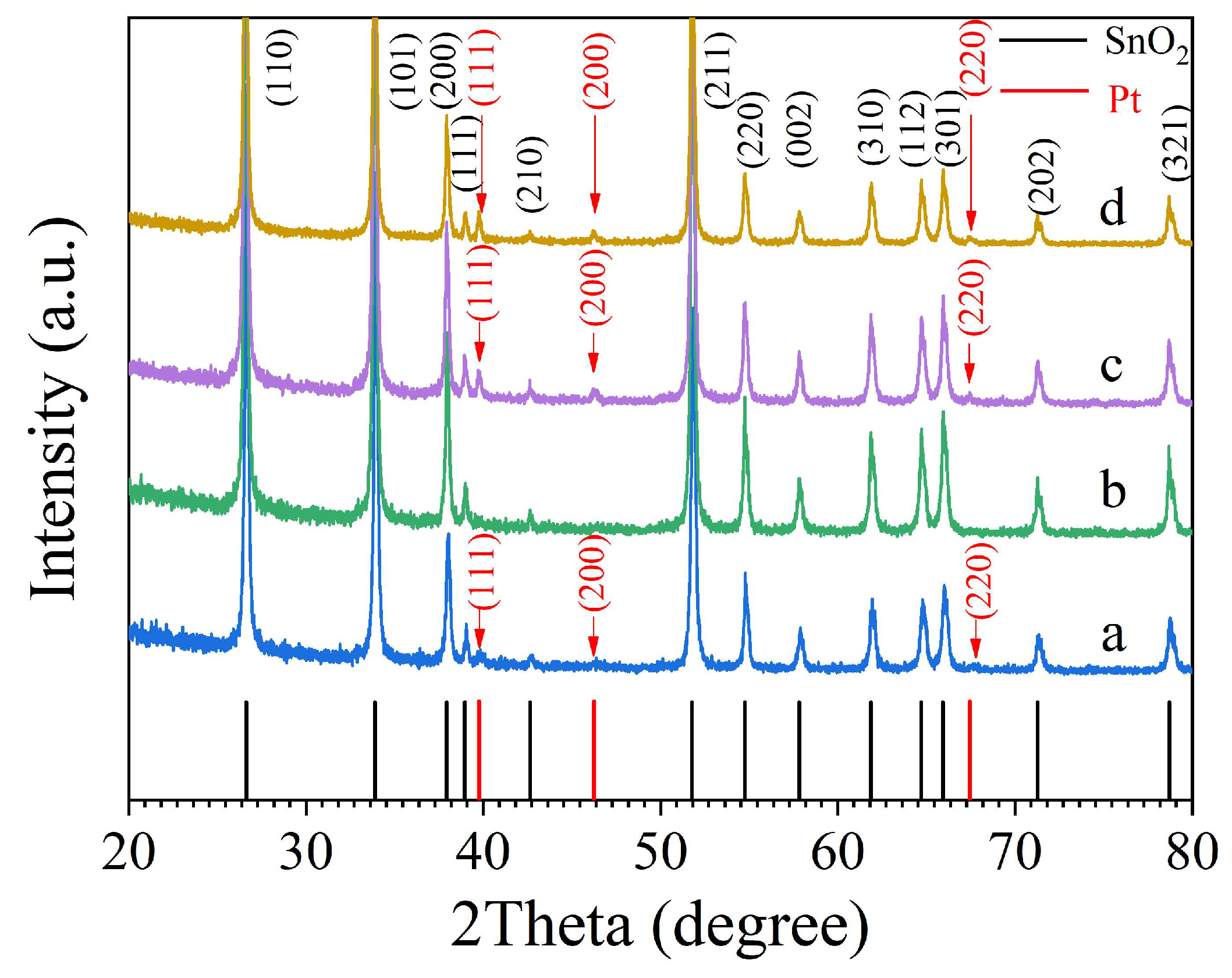
Figure 2.
For samples of 2 wt% Pt and sintered at 825°C: (a) FESEM micrograph for one prepared using solution reduction method; (b) EDS analyses for one prepared using solution reduction method; (c) FESEM micrograph for one prepared using impregnation method; (d) EDS analyses for one prepared using impregnation method.
Figure 2.
For samples of 2 wt% Pt and sintered at 825°C: (a) FESEM micrograph for one prepared using solution reduction method; (b) EDS analyses for one prepared using solution reduction method; (c) FESEM micrograph for one prepared using impregnation method; (d) EDS analyses for one prepared using impregnation method.
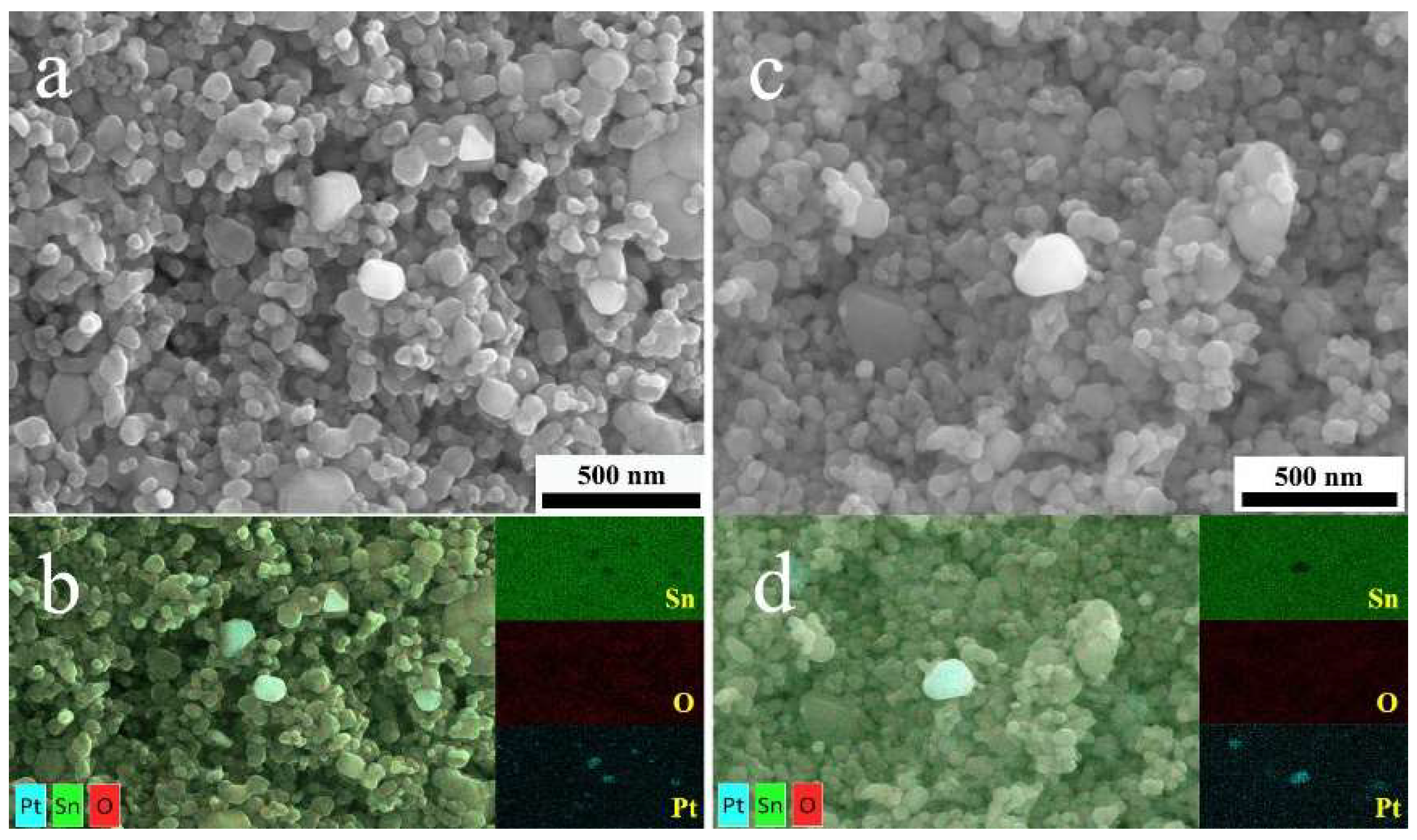
Figure 3.
For samples of 2 wt% Pt and sintered at 825°C: (a) TEM micrograph for one prepared using solution reduction method; (b) HRTEM of a small nanoparticle in one prepared using solution reduction method; (c) TEM micrograph for one prepared using impregnation method; (d) HRTEM of a small nanoparticle in one prepared using impregnation method.
Figure 3.
For samples of 2 wt% Pt and sintered at 825°C: (a) TEM micrograph for one prepared using solution reduction method; (b) HRTEM of a small nanoparticle in one prepared using solution reduction method; (c) TEM micrograph for one prepared using impregnation method; (d) HRTEM of a small nanoparticle in one prepared using impregnation method.
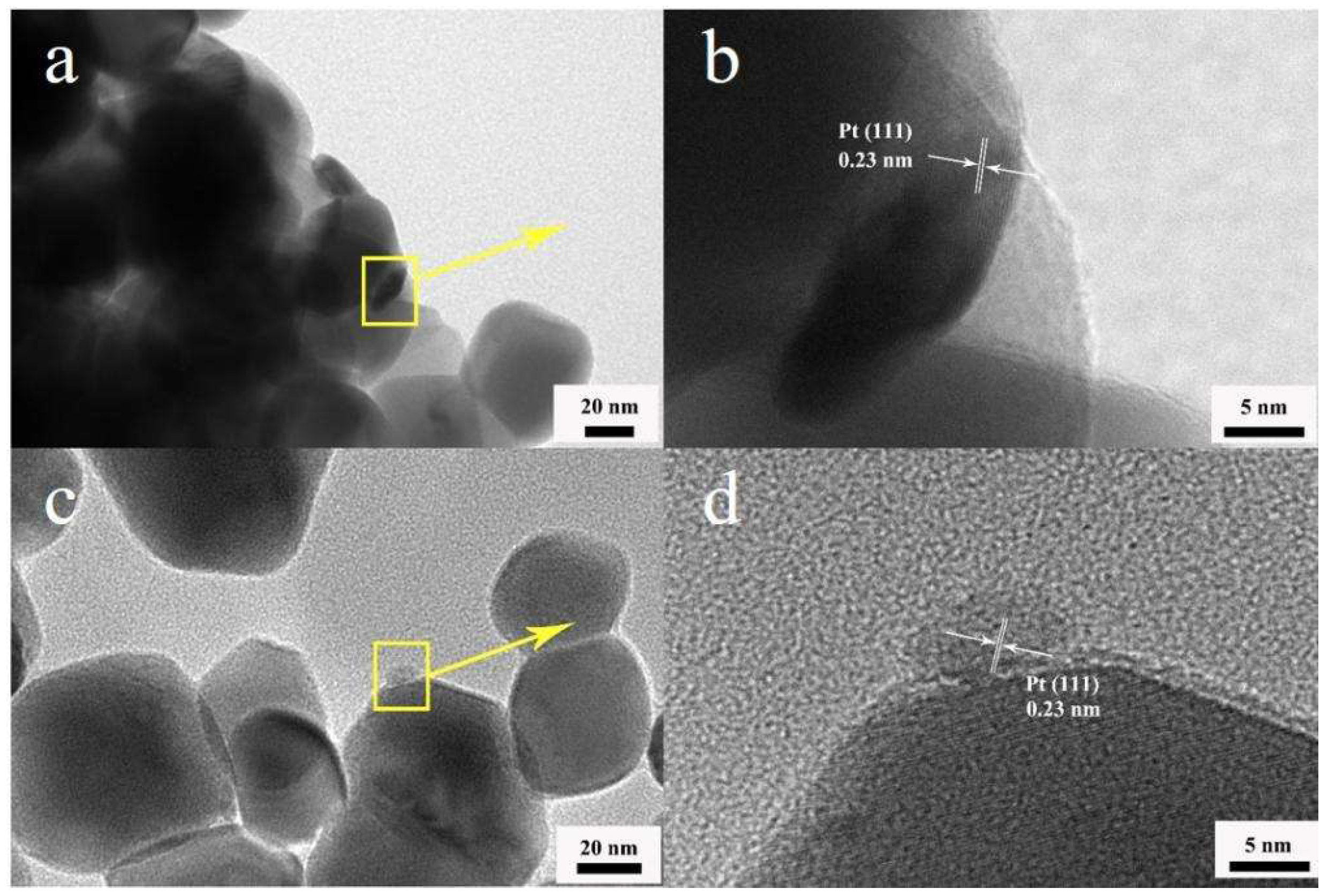
Figure 4.
Room temperature hydrogen sensing characteristics for two Pt-SnO2 composite nanoceramic samples of 0.5 wt% Pt and sintered at 600°C, prepared using the solution reduction and the impregnation methods for Pt loading, separately.
Figure 4.
Room temperature hydrogen sensing characteristics for two Pt-SnO2 composite nanoceramic samples of 0.5 wt% Pt and sintered at 600°C, prepared using the solution reduction and the impregnation methods for Pt loading, separately.
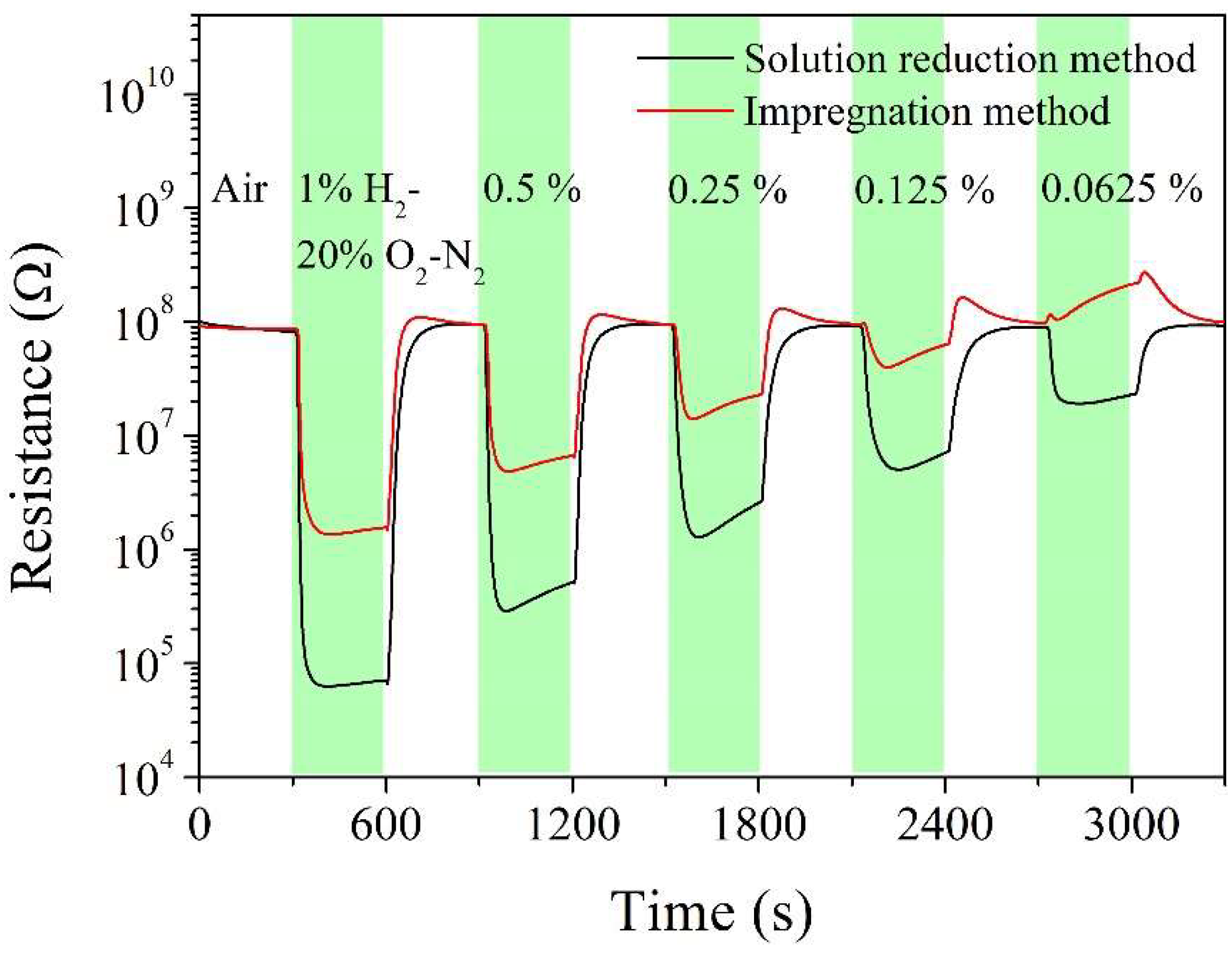
Figure 5.
Room temperature hydrogen sensing characteristics for two Pt-SnO2 composite nanoceramic samples of 0.5 wt% Pt and sintered at 825°C, prepared using the solution reduction and the impregnation methods for Pt loading separately.
Figure 5.
Room temperature hydrogen sensing characteristics for two Pt-SnO2 composite nanoceramic samples of 0.5 wt% Pt and sintered at 825°C, prepared using the solution reduction and the impregnation methods for Pt loading separately.
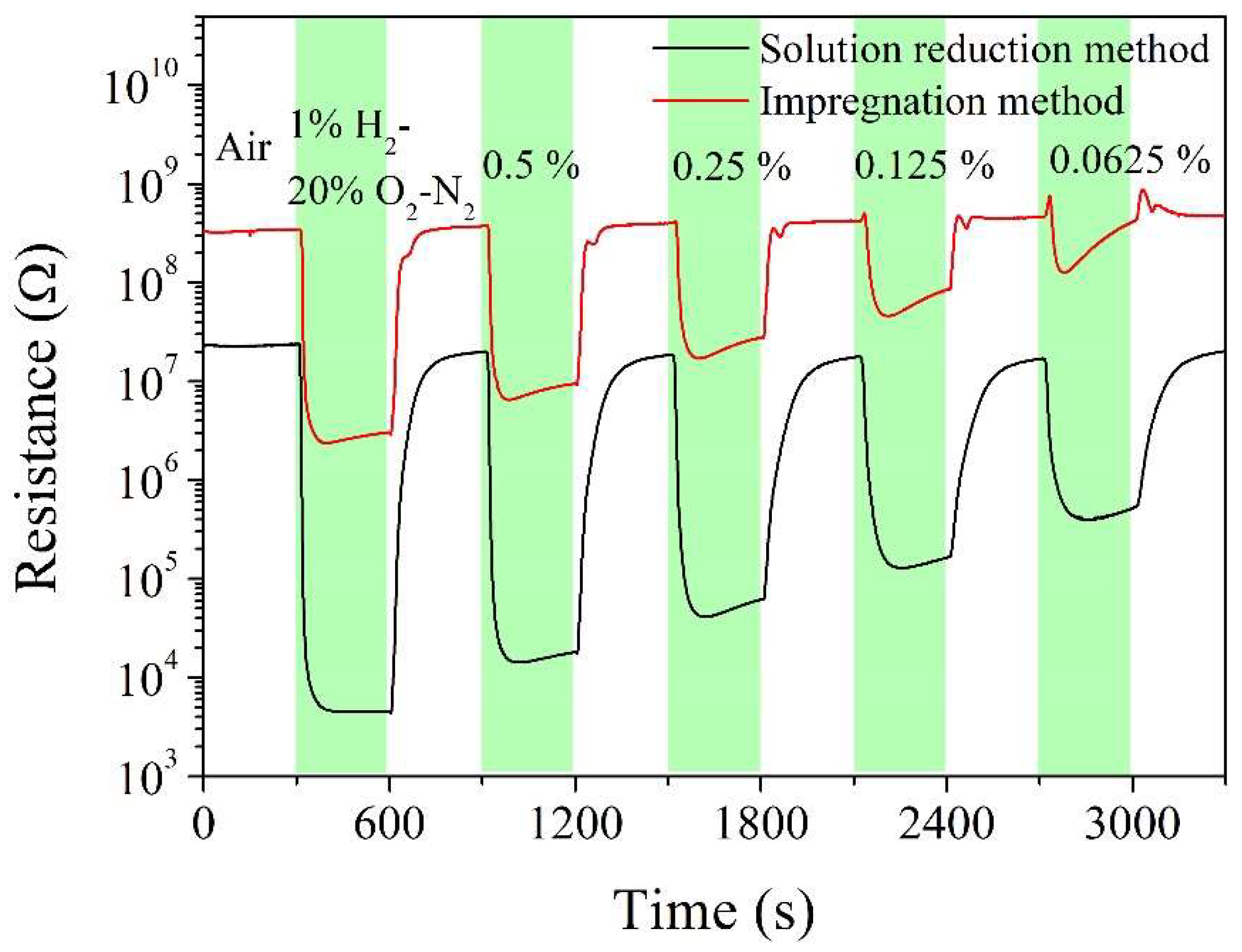
Figure 6.
Room temperature hydrogen sensing characteristics for two Pt-SnO2 composite nanoceramic samples of 2 wt% Pt and sintered at 825°C, prepared using the impregnation method and the impregnation & calcination method for Pt loading separately.
Figure 6.
Room temperature hydrogen sensing characteristics for two Pt-SnO2 composite nanoceramic samples of 2 wt% Pt and sintered at 825°C, prepared using the impregnation method and the impregnation & calcination method for Pt loading separately.
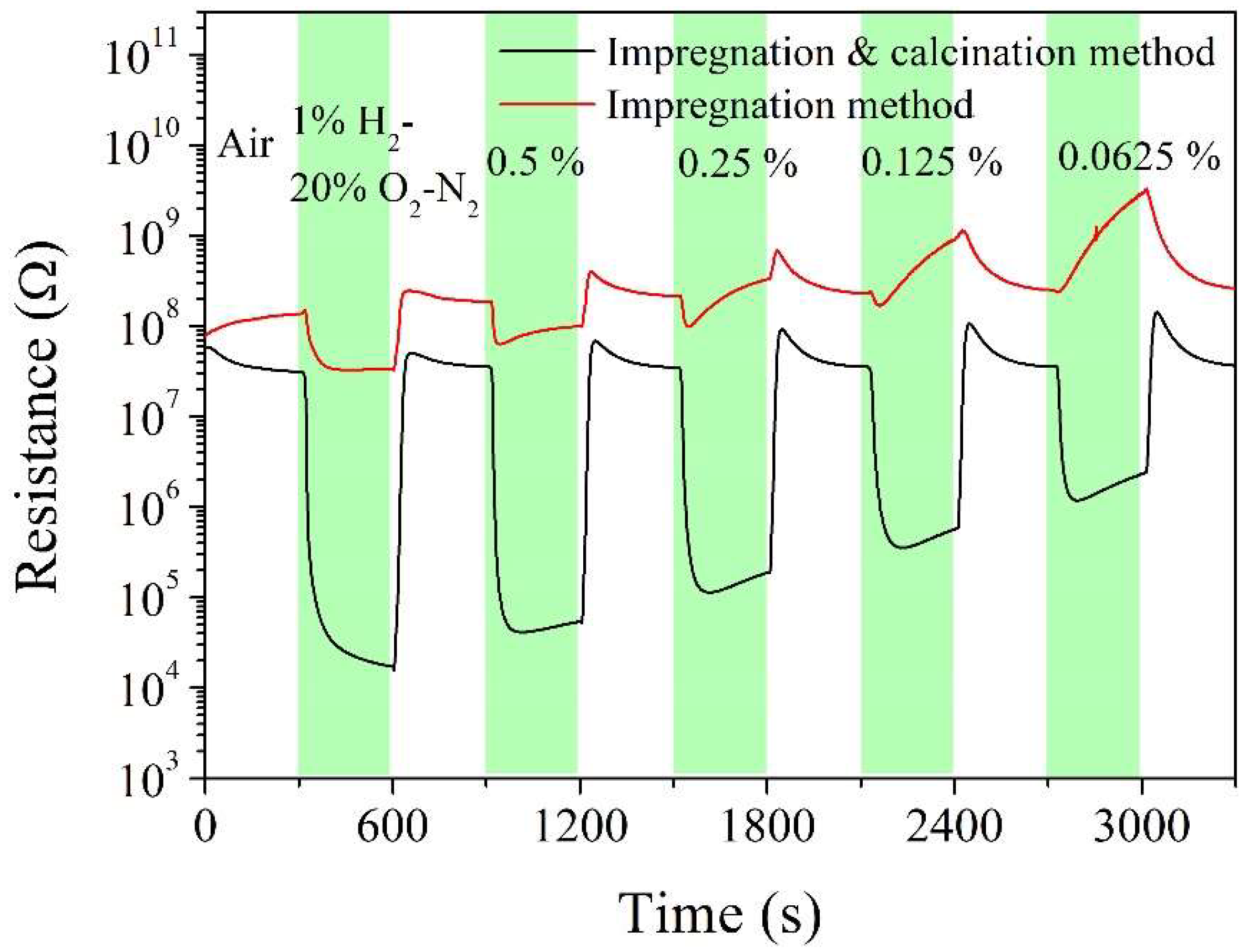

Table 1.
The content of residual chlorine in four samples of 2 wt% Pt prepared in this study.
| Sintering temperature, °C | Pt loading method | Chlorine, wt% |
|---|---|---|
| 600 | Solution reduction | 0.167 |
| Impregnation | 0.495 | |
| 825 | Solution reduction | 0.14 |
| Impregnation | 0.41 |
Disclaimer/Publisher’s Note: The statements, opinions and data contained in all publications are solely those of the individual author(s) and contributor(s) and not of MDPI and/or the editor(s). MDPI and/or the editor(s) disclaim responsibility for any injury to people or property resulting from any ideas, methods, instructions or products referred to in the content. |
© 2023 by the authors. Licensee MDPI, Basel, Switzerland. This article is an open access article distributed under the terms and conditions of the Creative Commons Attribution (CC BY) license (http://creativecommons.org/licenses/by/4.0/).
Copyright: This open access article is published under a Creative Commons CC BY 4.0 license, which permit the free download, distribution, and reuse, provided that the author and preprint are cited in any reuse.


