

Submitted:
16 June 2023
Posted:
16 June 2023
You are already at the latest version
Abstract
The Victorian Government Inquiry into wildfires that killed 173 people in 2009 has driven an Australian policy shift from self-evacuation or staying and defending a well-prepared property (‘go or stay’) to self-evacuation under catastrophic fire weather (‘leave early’). The Inquiry also led to the establishment of national ‘performance standards’ for Private Fire Shelters (PFS, that also known as bunkers). Nonetheless, incorporation of PFS into national bushfire policy remains embryonic with only Victoria having streamlined accreditation and planning approval processes. Arguments against PFS include potentially engendering complacency about preparing dwellings to survive fire and encourage risky behavior in response to a fire threat. Counteracting these arguments is research that shows that residents without PFS have low engagement with bushfire preparation and typically delay evacuation. In any case, because wildfire is unpredictable it is accepted that self-evacuation plans must have fallback positions that include sheltering ‘in place’ from the bushfire, making properly used and well maintained PFS an important element of bushfire safety. A less discussed barrier to PFS uptake outside Victoria appears to hinge on a lack of clarity about obligations for their design, certification, and consistency with planning approvals. The escalating Australian fire crisis demands much greater research and development in legal frameworks, policy and planning processes for PFS, as well as design and construction standards.
Keywords:
Building codes
; climate change
; extreme wildfires
; evacuation
; fire disasters
; land use planning
; law and policy reform
; risk
1. Introduction
Australian approaches for co-existing with wildfires (known as bushfires) have been of great policy relevance and interest to other nations with flammable landscapes. A key feature of the Australian approach is an ethos of community and individual self-reliance and self-assessment of bushfire risk. Until recently, Australian residents in bushfire prone areas were expected to either self-evacuate well before the threat of fire, or stay and defend their property on the condition that it had been prepared to withstand bushfire, a policy colloquially known as ‘stay or go’ [1,2,3]. This approach sharply contrasts with the north American approach based on government initiated, often mandatory, mass evacuations from areas threatened by fire, [4,5,6].
The tragic loss of 173 lives in the 2009 bushfires and subsequent Victorian Government Inquiry [7], however, ushered in a radical shift in Australian firefighting doctrine [4,6,8]. The old ‘stay or go’ policy has now been replaced by a ‘leave early’ policy that is based around self-organized evacuations under catastrophic fire weather conditions [2]. This pivot is associated with many other policy changes including the establishment of a national fire danger rating system (AFDRS) that defines catastrophic fire weather [9].
For a variety of natural and anthropogenic disasters it has long been accepted that sheltering in place is a better strategy than poorly executed evacuations [5]. Nonetheless, the 2009 Bushfire Inquiry found that 169 people died sheltering in place [5,7]. The 2009 Victorian Government Bushfire Inquiry recognized that sheltering in place was an effective strategy to survive bushfire if there was appropriate design of fire shelters and sufficient preparation for their use, leading to the recommendation to develop design and building standards for ‘private fire shelters’ (PFS), also known as ‘fire bunkers’, to serve as refuge of last resort [7,10,11]. Consequently, in 2014, the Australian Building Codes Board (‘ABCB’) provided detailed guidelines for the construction of fire shelters, the ‘PFS Performance Standard’ (ABCB 2014, iv) [12]. Importantly, the PFS Performance Standard sets objectives for what should be considered and achieved when designing a PFS, but it is not directly enforceable. That is, it needs to be adopted or implemented through state legislation or regulations to become law (see discussion in Part 2, below). Unlike the Australian Standard for construction of buildings in bushfire prone areas (‘Bushfire Construction Standard’) [13] (Figure 1), the PFS Performance Standard has not yet been explicitly implemented in building laws across Australia (though even the Bushfire Construction Standard is adopted differently in different states and territories).
Highlighting the pivot from ‘stay-go’ to ‘leave early’ policy The Royal Commission into the 2019-20 Bushfires did not ‘investigate the adequacy or inadequacy of individual sheltering facilities’ [14]. Rather the 2019-20 Bushfire Inquiry focused on issues around ‘shared responsibility’ for bushfire evacuation involving individuals, various tiers of government and non-government organizations, with recommendations concerning coordinated emergency planning and preparation, coupled with the need for nationally consistent terminology and education relating to places of refuge. The 2019-20 Bushfire Inquiry did, however, note that ‘consideration should be given to the need to shelter in place and build more resilient sheltering facilities’, particularly for circumstances when evacuations will be impractical or impossible [14].
Thus, the two most important bushfire inquires in recent Australian history neatly bracket the arrested development of enabling regulations and policy support for PFS. Here we briefly sketch the current legal and policy framework for PFS, and reflect on the risk and design trade-offs relating to PFS that have shaped the development of this framework to date. We argue for further urgent research and development of PFS design and legal and policy frameworks so that they can become an effective option of last resort in a bushfire, rather than an object of conflict and confusion.
2. Current PFS law and policy framework in Australia
PFS are, arguably, most needed for residents of homes in the highest category of ‘bushfire attack level’ (BAL), the Flame Zone category, which has the highest risk of death under catastrophic conditions [5] (Figure 1). BAL categories are established under the Australian Standard for Construction of buildings in bushfire-prone areas, AS 3959:2018, and require a determination of the potential exposure to radiant heat flux according to 6 BALs, based on estimated radiant heat flux expressed as kW/m2 (Figure 1). BAL ratings are derived by considering likely fire weather, terrain, vegetation type and distance to vegetation [13]. The higher the BAL rating, the greater the risk and the more stringent the building requirements become. However, at present, the legal and policy framework for PFS is not connected with or prioritized according to, the BAL rating of a property.
The ABCB’s PFS Performance Standard was developed:
‘…to ensure that a private bushfire shelter built in accordance with the Standard provides a measured degree of protection to people with nowhere else to go, such as occupants of dwellings in remote locations’[12].
The PFS Performance Standard considers the construction, siting, capacity, and design and operational constraints for PFS (Table 1) [12,15]. PFS may need to be accredited by a particular body or under a specific process before being installed. For example, in Victoria, PFS must either be accredited by the Building Regulations Advisory Committee, approved for use by the Building Appeals Board, or certified by a registered fire safety engineer [16]. A purpose built (i.e., non-commercial) design may need to be assessed and approved by a registered fire safety engineer [16]. PFS may also need to be detached from a dwelling, but may be able to be installed inground or above-ground, depending on the characteristics of the site and the proposed structure Table 1) [12].
In Australia, building and development activities are governed under state, not national, laws. As a result, the PFS Performance Standard only becomes part of the law (and, e.g., enforceable) when it is ‘adopted’ by state building statutes or regulations and/or land use planning schemes. For example, in the state of Victoria, a person must have a permit under the Building Act 1993 (s 16) [17] before carrying out any building work. A PFS is defined as a class 10c ‘non habitable’ structure under the Building Code of Australia, which is part of the National Construction Code, and so, to build a PFS, a person must have a building permit. The Building Regulations 2018 (Vic) govern how and when to apply for a permit, and they specifically adopt the Building Code of Australia as if it was part of the state regulations (r 10) [18]. This means that the Performance Standards for PFS set out in clause HP76 of the Building Code of Australia (which are guided by the ABCB PFS Performance Standard) are adopted into Victorian law. As such, the PFS Performance Standards provide – through the Building Regulations – guidance on the strict performance measures required for PFS construction in Victoria, including maintaining and accessing a PFS (Building Regulations 2018 (Vic), r 164-6) [18].
In addition to a building permit, some landholders in Victoria will also need to obtain a planning permit before constructing a PFS. For example, planning approval is required if a proposed PFS is larger than 30m2 or if it will be constructed in a sensitive area such as a Floodway Overlay or Heritage Overlay (Victorian Planning Provision 52.12-4, [19]). The Victorian Government and the state’s fire management agency, the Country Fire Authority, both encourage people to contact their local government to find out whether planning approval is necessary before they purchase or begin to build a PFS on their land .
Because fire management and building laws are the responsibility of Australian state and territory governments, the interpretation and application of the national standards ‘varies enormously’ [15]. This is apparent in the treatment of PFS. Victoria is the only state that has specific planning and design guidelines for PFS (as set out above), and the only jurisdiction where commercial PFS are manufactured [15,16]. While the permission process for installing PFS in Victoria is comparatively clear compared to the other states and territories, the process still involves many administrative steps and can take a long time to finalise. Importantly, it is illegal to build a bushfire shelter while claiming it is for another purpose [16]. Despite detailed design, building and planning oversight in the State, the Victorian Building Authority guidelines stress that PFS ‘should not be considered a substitute for creating a bushfire plan and leaving early’ [16]. Additionally, the Victorian Country Fire Authority stresses the need for PFS owners to identify other places of last resort in addition to a fire bunker [20]. Nonetheless, the installation of a PFS is recognised as a bushfire safety measure, including because installing an approved PFS can reduce the required construction standards for a dwelling below what would ordinarily be required based on the assessed BAL rating (see below) [16].
All Australian states and territories implement the National Construction Code in some way, typically through legislation about building (e.g., Building Act 2016 (Tas) [21], s 11; Environmental Planning and Assessment Regulation 2021 (NSW), r 4 [22]), and typically explicitly engage with the provisions of the Australian Standard 3959:2018 for the construction of buildings in bushfire-prone areas (e.g., Environmental Planning and Assessment Regulation 2021 (NSW), Part 14) [22]. However, unlike in Victoria, legal instruments in other jurisdictions do not refer directly to the PFS Performance Standard or set specific arrangements for constructing or accrediting PFS, and provide less additional guidance about how the building and planning law and policy frameworks govern the installation and maintenance of PFS (e.g., [23]; but see Tasmanian Government advice [24]). Because Victoria experienced catastrophic bushfires in both 2009 and 2019-20, and policy development was a recommendation of the government inquiry in 2010 [7], it appears that – relative to other states and territories – the Victorian government responded to strong public demand for both access to approved PFS and clarity about the relevant governance framework. In contrast, despite other states and territories recently experiencing extreme fire events, and that they are certain to experience more in future, there has not been similar progress in PFS policy development elsewhere.
The ABCB’s PFS Performance Standard creates a clear mechanism that could readily be used as a basis for guidance under state frameworks. We suggest that there is value in proactively articulating and consistently implementing clear governance across the country for PFS, recognising what has been learned from the post-fire inquiries of recent years. Taking a proactive approach to these kinds of reforms may help to avoid the worst of the trade-offs described below, and mitigate the possibility that concerned landholders will construct unregulated, inadequate and/or unsafe PFS. Such unregulated activities may, at best, create unnecessary costs for landholders and an undesirable administrative burden for local governments responsible for regulating planning activities (e.g., [25]). At worst, a lack of clarity in the governance of PFS may create unnecessary risks to landholders’ lives in future fires.
3. Private fire shelter trade-offs
As outlined below there are a range of arguments for and against installing PFS. Many of these issues remain unresolved, contributing to the arrested development of PFS policies amongst Australian states and territories.
The deaths of seven people sheltering during the 2009 Victorian Black Saturday bushfires in shipping containers, cellars and self-built bunkers highlight the danger of poorly designed PFS [11,26]. By contrast, preliminary reports suggest that PFS designed in accordance with the national PFS Performance Standard protected lives during the 2019-20 bushfires in Victoria, with no reported deaths or injuries in six shelters, three adjacent to destroyed residences [26]. We do not dispute that there is scope for further improvement in PFS design [27], including in producing more cost-effective designs. However, the lack of nationally consistent implementation and support for the ABCB PFS Performance Standard, combined with variable approaches in planning approval processes, none of which appear to support, let alone prioritize or even mandate the installation of PFS to provide a last resort in the most bushfire-prone locations, may be a formidable barrier for the widespread adoption of PFS. Limiting adoption across the country limits investment in commercial designs and the achievement of economies of scale. The reasons for resistance to explicit planning and building support for PFS appear to relate to philosophical, legal, and psychological factors as outlined below.
Accredited PFS have been characterized as potentially encouraging delayed self-evacuation , by providing a false sense of safety, clouding or encouraging hasty decision making [8,10]. This criticism, however, ignores research findings that show that residents without PFS will delay evacuation for a complex of biophysical, social and psychological reasons, often to the point that it is no longer safe to do so [3,5,6,8,28]. Indeed, recognizing the likelihood that self-evacuation is often poorly executed led Johnson et al. [3] to assert that ‘well designed fire bunkers for every dwelling in bushfire prone areas’ should be a planning requirement. Even without a legal requirement of this kind, Lohm and Davis [29] found that many residents in the Victorian wildland urban interface understood that leaving early under dangerous fire weather was an impractical approach and this led some residents to install fire bunkers to provide a refuge from bushfire. Importantly, McLennan et al. [30] found that the installation of PFS did not axiomatically mean residents would not leave early from a bushfire threat, albeit most PFS owners intended to stay and defend their property.
Another prominent argument against PFS is that their existence can engender complacency [5] and could disincentivize ‘other practical means to mitigate fire hazard‘ [10]. This argument overlooks a perverse feature of self-evacuation: people who do not have PFS and who plan to leave in advance of a fire are typically the least prepared to shelter in place [31]. In sum, PFS can counteract a key vulnerability of the ‘leave early’ policy: the need for backup plans when evacuation is impossible [8]. This is consistent with advice from authorities in Victoria and Tasmania, that ‘leaving early is always the safest option’ but that PFS as a last resort – when it is no longer safe to leave and a person is faced with imminent impact from fire – may be an acceptable ‘part of an overall bushfire plan’ [20,24].
The financial cost of PFS has been identified as a barrier to PFS uptake. In Victoria, despite building and planning frameworks explicitly accommodating PFS, it has been shown that only the affluent can afford PFS to mitigate their bushfire risk, raising questions about social equity [29]. Furthermore, a strictly economic argument posits that PFS may be a poor investment given the low likelihood of use, especially if a ‘leave early’ policy is adopted, and may even encourage the installation of PFS where they are not required. Nonetheless, an opposing alternative economic argument is that installing PFS to provide a refuge of last resort presents a cost effective alternative to extensive retrofits of poorly designed structures in dangerous landscape settings [32], and a prudent response to escalating risk of catastrophic fire danger driven by climate change. An often overlooked additional benefit of PFS is the provision a safe place to store valuable items for residents that leave early to avoid the threat of fire [33].
Finally, in Victoria, PFS provide a means to reduce the construction requirement below the BAL assessed at the property [16]. This approach is explicitly excluded in Tasmania, where the fire agency has warned that ‘a PFS will not be accepted as an offset or substitute for compliance with other bushfire safety requirements’ [24]. However, even in Victoria, the opportunity to reduce a construction requirement below a BAL rating by installing a PFS must be balanced against requirements to maintain both the PFS itself, as well as a clear and safe line of access to the shelter, which would necessarily involve some clearing and vegetation management.
An adequately designed PFS can still be dangerous if it is not properly used, for example, by exceeding capacity, or if it is poorly maintained [10]. However, these concerns can be mitigated through adequate design of PFS and appropriate preparations and education regarding their use [5].
In the United States, legal responsibility for loss of life associated with PFS has been identified as a barrier to finding alternatives to mass evacuations [34]. It is not clear whether a similar concern is driving the hesitation by most state and territory governments to support and sometimes to mandate PFS in Australian legal frameworks. We suggest the Australian policy shift from stay-and-defend to self-evacuation has deflected responsibility from government and onto individuals in a way that has been observed in a range of climate adaptation and land management contexts [35]. Likewise, decisions by states not to facilitate, mandate and accredit PFS means that building designers and surveyors and fire engineers must not only design and certify that a PFS is built to a reasonable standard but may also retain liability for their work [12,15].
More research is required to understand the use and effectiveness of PFS in bushfire emergencies [8], but this will not occur without PFS being prioritized as an important and practical research area. The escalating Australian fire crisis demands serious investment, research, and development in PFS-related laws, policies, design standards and planning processes.
Supplementary Materials
Not Applicable.
Author Contributions
Conceptualization, D.M.J.S.B.; writing—original draft preparation, D.M.J.S.B. and P.C.M.; visualization, D.M.J.S.B., funding acquisition, D.M.J.S.B. All authors have read and agreed to the published version of the manuscript.
Funding
This research was funded by Australian Research Council Laureate Fellowship, grant number FL220100099 awarded to D.M.J.S.B.
Institutional Review Board Statement
Not applicable.
Informed Consent Statement
Not applicable.
Data Availability Statement
Not applicable.
Acknowledgments
P.C.M. acknowledges the support of Natural Hazards Research Australia though a 2023 Early Career Research Fellowship. We thank Dr Raphael Blanchi for invaluable discussion about private fire shelters.
Conflicts of Interest
The authors declare no conflict of interest.
References
- Handmer, J.; Tibbits, A. Is staying at home the safest option during bushfires? Historical evidence for an Australian approach. Global Environmental Change Part B: Environmental Hazards 2005, 6, 81-91. [CrossRef]
- Handmer, J.; O’Neill, S. Examining bushfire policy in action: Preparedness and behaviour in the 2009 Black Saturday fires. Environmental Science and Policy 2016, 63, 55-62. [CrossRef]
- Johnson, P.F.; Johnson, C.; Sutherland, C. Stay or go? Human behavior and decision making in bushfires and other emergencies. Fire technology 2012, 48, 137-153. [CrossRef]
- Paveglio, T.B.; Carroll, M.S.; Jakes, P.J. Alternatives to evacuation during wildland fire: Exploring adaptive capacity in one Idaho community. Environmental Hazards 2010, 9, 379-394. [CrossRef]
- Blanchi, R.; Whittaker, J.; Haynes, K.; Leonard, J.; Opie, K. Surviving bushfire: the role of shelters and sheltering practices during the Black Saturday bushfires. Environmental Science and Policy 2018, 81, 86-94. [CrossRef]
- McLennan, J.; Ryan, B.; Bearman, C.; Toh, K. Should we leave now? Behavioral factors in evacuation under wildfire threat. Fire technology 2019, 55, 487-516. [CrossRef]
- Teague, B.; Pascoe, S.; McLeod, R. The 2009 Victorian bushfires Royal Commission final report: summary. 2010.
- Whittaker, J.; Blanchi, R.; Haynes, K.; Leonard, J.; Opie, K. Experiences of sheltering during the Black Saturday bushfires: Implications for policy and research. International Journal of Disaster Risk Reduction 2017, 23, 119-127. [CrossRef]
- Australian Fire Danger Rating System. Available online: https://afdrs.com.au (accessed on 11 May 2023).
- Centre for International Economics. Final Regulation Impact Statement: Proposal to amend the Building Code of Australia to include requirements for private bushfire shelters; 2011.
- Schell, P. Private bush fire shelters-a bush fire safety engineering perspective. In Proceedings of the FSE11: Fire Safety Engineering International Conference-Raising the Bar, 2011; pp. 259-276.
- Australian Building Codes Board. Performance standard: The design and construction of private bushfire shelters; 2014.
- Standards Australia. AS 3959:2018 Construction of buildings in bushfire-prone areas; 2018.
- Binskin, M.; Bennett, A.; Macintosh, A. Royal Commission into National Natural Disaster Arrangements Report. Canberra: Commonwealth of Australia 2020.
- Bell, N. Development in Australian bushfire prone areas. Environment 2019, 1-14.
- Victorian Building Authority. Always install an accredited bushfire shelter. Available online: https://www.vba.vic.gov.au/news/news/2020/always-install-an-accredited-bushfire-shelter (accessed on 10 June 2023).
- Victorian Government. Building Act 1993 (Victoria). Available online: https://www.legislation.vic.gov.au/in-force (accessed on 10 June 2023).
- Victorian Government. Building Regulations 2018 (Victoria). Available online: https://www.legislation.vic.gov.au/in-force (accessed on 10 June 2023).
- Victorian Government. Victoria Planning Provisions. Available online: https://planning-schemes.app.planning.vic.gov.au/Victoria%20Planning%20Provisions/ordinance (accessed on 10 June 2023).
- Country Fire Authority. Private bushfire shelters in Victoria: A guide for siting, landscaping and use. Available online: https://www.cfa.vic.gov.au/plan-prepare/your-local-area-info-and-advice/private-bushfire-shelters-or-bunkers (accessed on 10 June 2023).
- Tasmanian Government. Building Act 2016 (Tasmania). Available online: https://www.legislation.tas.gov.au/browse/inforce (accessed on 10 June 2023).
- New South Wales Government. Environmental Planning and Assessment Regulation 2021 (New South Wales) Available online: https://legislation.nsw.gov.au/browse/inforce (accessed on 10 June 2023).
- Hannam, P.; Chung, L. In the dark ages: Stoush brewing over use of bushfire bunkers. The Sydney Morning Herald. Available online: https://www.smh.com.au/national/in-the-dark-ages-stoush-brewing-over-bushfire-bunkers-20200501-p54oxs.html (accessed on 10 June 2023).
- Tasmania Fire Service. Building for Bushfire: Private Bushfire Shelters. Available online: https://www.bushfirereadyneighbourhoods.tas.gov.au/sites/default/files/property-prep/attachments/tfs_private_bushfire_shelters_info_sheet.pdf (accessed on 10 June 2023).
- Augustine, J. Birches Bay: Kingborough Council takes court action to force residents to remove bushfire bunker. The Mercury. Available online: https://www.themercury.com.au/news/tasmania/birches-bay-kingborough-council-takes-court-action-to-force-residents-to-remove-bushfire-bunker/news-story/7657e52db5e4a9683b8e1a627f55bd39 (accessed on 10 June 2023).
- Kachel, N. Bunker-down the smart way in a bushfire. CSIROscope. Available online: https://www.csiro.au/en/news/All/Articles/2020/February/bunker-down-with-bushfire-bunkers (accessed on 10 June 2023).
- Nguyen, Q.; Ngo, T.; Tran, P.; Mendis, P.; Aye, L.; Baduge, S.K. Fire resistance of a prefabricated bushfire bunker using aerated concrete panels. Construction and Building Materials 2018, 174, 410-420. [CrossRef]
- McLennan, J.; Paton, D.; Beatson, R. Psychological differences between south-eastern Australian householders' who intend to leave if threatened by a wildfire and those who intend to stay and defend. International Journal of Disaster Risk Reduction 2015, 11, 35-46. [CrossRef]
- Lohm, D.; Davis, M. Between bushfire risk and love of environment: preparedness, precariousness and survival in the narratives of urban fringe dwellers in Australia. Health, Risk & Society 2015, 17, 404-419. [CrossRef]
- McLennan, J.; Elliott, G.; Wright, L. Bushfire survival preparations by householders in at-risk areas of south-eastern Australia. Australian Journal of Emergency Management, The 2014, 29, 11-17.
- Penman, T.D.; Eriksen, C.E.; Horsey, B.; Bradstock, R.A. How much does it cost residents to prepare their property for wildfire? International Journal of Disaster Risk Reduction 2016, 16, 88-98.
- Kelly, K. PIA Policy Response to the Victorian bushfires of February 2009. Australian Planner 2010, 47, 48-51. [CrossRef]
- Green, A.; McKinnon, S.; Cooper, P.; Eriksen, C.; Daly, M.; Boehme, T. Preparing for Wildfire: Home Retrofits and Household Preparation. Available at SSRN 4211461.
- Paveglio, T.B.; Carroll, M.S.; Jakes, P.J. Adoption and perceptions of shelter-in-place in California’s Rancho Santa Fe Fire Protection District. International Journal of Wildland Fire 2010, 19, 677-688. [CrossRef]
- McDonald, J.; McCormack, P.C. Responsibility and risk-sharing in climate adaptation: a case study of bushfire risk in Australia. Climate Law 2022, 12, 128-161. [CrossRef]
Figure 1.
Conceptual diagram of Bushfire Attack Levels (BAL) used to frame the Australian Standards for house construction. PFS are most needed in the BAL-Flame Zone by the Australian Building Codes Board performance standards (Adapted from [15].
Figure 1.
Conceptual diagram of Bushfire Attack Levels (BAL) used to frame the Australian Standards for house construction. PFS are most needed in the BAL-Flame Zone by the Australian Building Codes Board performance standards (Adapted from [15].
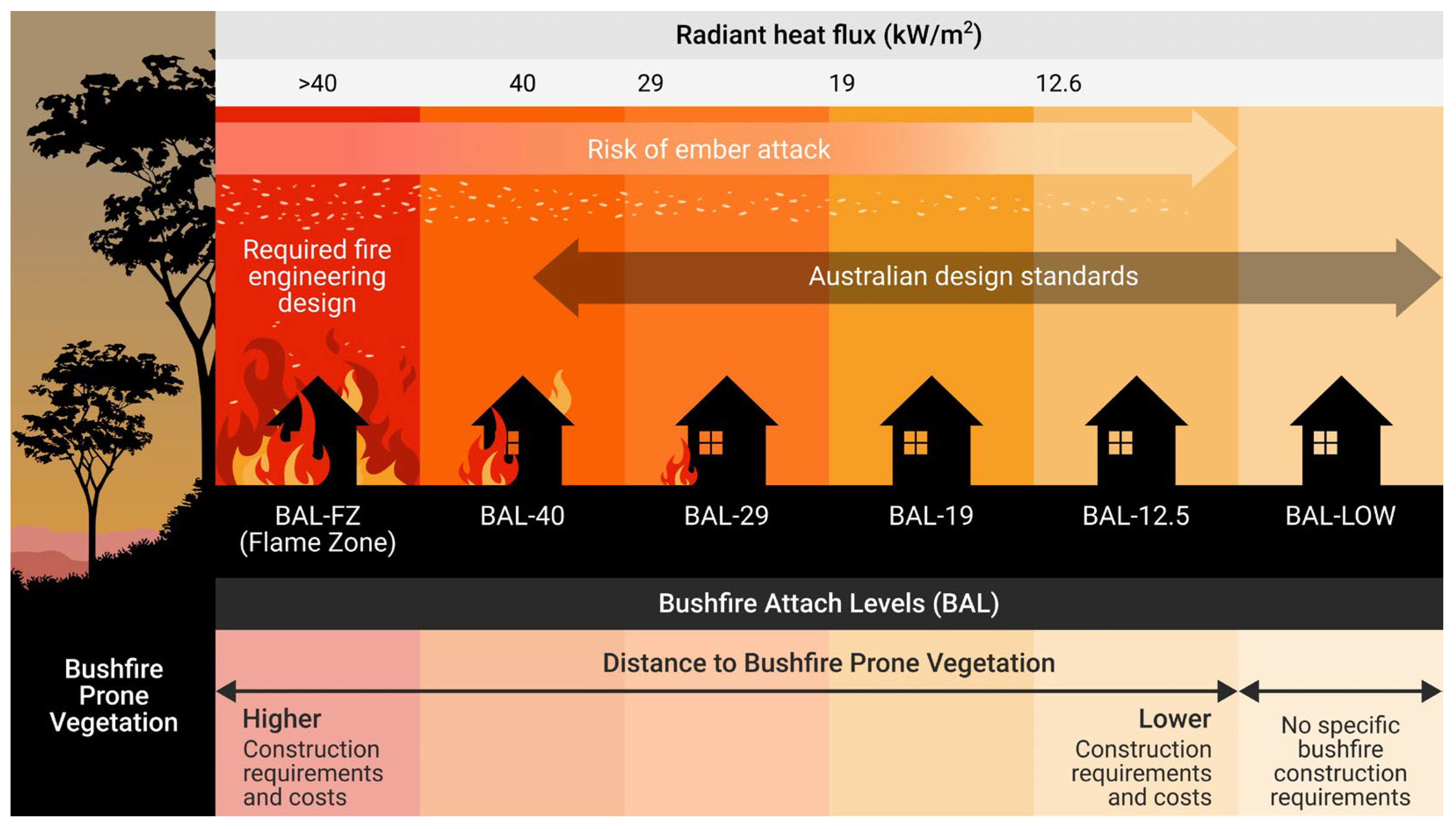

Table 1.
Summary of key Acceptance Criteria in the Performance Standard for Private Bushfire Shelters [12] (adapted from [15]. Note these standards were developed as a design and construction guide for private bushfire shelters focusing on prescribing the performance metrics a shelter needs to meet to provide a certain level of protection for a range of people who use it correctly.
Table 1.
Summary of key Acceptance Criteria in the Performance Standard for Private Bushfire Shelters [12] (adapted from [15]. Note these standards were developed as a design and construction guide for private bushfire shelters focusing on prescribing the performance metrics a shelter needs to meet to provide a certain level of protection for a range of people who use it correctly.
| Design elements | Acceptance criteria |
| Siting | Positioned away from structures and flammable material and vegetation. |
| External Access | < 20 m from dwelling with a 1 m pathway with clear signage |
| Construction | Materials and design to withstand bushfire and enable easy egress with viewing window to observe external environment |
| Tenable interior environment | Habitable for > 60 minutes occupation providing tenable interior environment in terms of air and surface temperature and air quality |
| Maintenance | Mandated maintenance regime. |
Disclaimer/Publisher’s Note: The statements, opinions and data contained in all publications are solely those of the individual author(s) and contributor(s) and not of MDPI and/or the editor(s). MDPI and/or the editor(s) disclaim responsibility for any injury to people or property resulting from any ideas, methods, instructions or products referred to in the content. |
© 2023 by the authors. Licensee MDPI, Basel, Switzerland. This article is an open access article distributed under the terms and conditions of the Creative Commons Attribution (CC BY) license (http://creativecommons.org/licenses/by/4.0/).
Copyright: This open access article is published under a Creative Commons CC BY 4.0 license, which permit the free download, distribution, and reuse, provided that the author and preprint are cited in any reuse.


