

Submitted:
09 June 2023
Posted:
09 June 2023
You are already at the latest version
Abstract
Soil quality is a factor which is directly related to the sustainability of agricultural production and can be compromised through the use of inadequate management practices. In this work, soil edaphic respiration and changes in microbial biomass promoted by cover crops in an integrated crop-livestock system (ICLS) were evaluated using soil quality indicators by the respirometry method. The design used was completely randomized in a 3x6 factorial scheme and multivariate principal components analysis (PCA) was performed according to MANOVA. The edaphic respiration was determined based on the respirometry technique. From the results, it was found that edaphic soil respiration was significant in the nine evaluation periods, demonstrating the importance of grass cover on this edaphic respiration arising from the biological activity of microorganisms, which is directly related to the amount of organic carbon in the soil. It was concluded that the use of cover crops contributed to producing organic matter in the soil and consequently greater microbial respiratory activity.
Keywords:
respirometry
; cover crops
; conservation systems
; microbial biomass
1. Introduction
The degradation of pastures and land use through traditional agriculture can compromise the environmental and economic sustainability of agricultural activity, which modifies the carbon and nitrogen cycle [1]. In this sense, the use of technologies such as the no-tillage system (NTS), which consists of minimal soil preparation and performing crop rotation, and integrated crop-livestock systems (ICLSs) which favor the recovery of degraded pastures, improve straw production for the NTS and the physical, chemical and biological properties of the soil for the agricultural year, and have been proposed as alternatives for reversing this situation [2,3,4,5].
According by in Reference [6] soil is considered one of the important components in the process of maintaining life, as it promotes the dynamics and storage of water, maintains food chains and the regulatory functions of the environment, nutrient cycling, and the diversity of macro and microorganisms which represent the main life regulation element. Intense use of the soil without rational management compromises its quality, reducing it, and initiating processes that can alter its density, fertility and biological activity [7,8].
Considering that the soil is the basis for sustainable production, soil quality is a factor which is directly related to the sustainability of the functions of an agroecosystem [9,10,11], and the use of cover crops as an ecological and economic alternative for proper soil management enables balancing properties which revolve around the soil-plant [12], turn contributing to form organic matter (OM) to protect the soil [13], as well as attracting edaphic organisms by offering shelter and food [14,15,16].
According by in Reference [17], there is a close relationship between the OM content and the microbial activity of the soil, and in order to assess its quality, physical and chemical attributes, it is also necessary to use biological indicators such as biomass and basal respiration. In view of this, the evaluation of microbial activity has been proposed as a sensitive indicator of the increase or decrease in the OM content and quality in the soil and in monitoring environmental changes resulting from agricultural use [7,18].
Soil microbial activity is mainly influenced by temperature, pH, luminosity, salinity, energy sources and organic substrates, nutrients and presence or absence of toxic elements. Taking into account that most of the biological activity occurs in the surface layer of the soil, removal of vegetation cover due to inadequate management interferes with the factors that influence the microbial life present in it, causing changes in its population and activity [19].
Soil respiration is a strong indicator of the decomposition intensity [20], as it reflects the biological activity of organic waste [21] and can be used to document changes in carbon dynamics soil in areas which have suffered deforestation for planting crops [14]. researchers and producers have increasingly sought to know the effects of management practices on the quality of the edaphic environment through evaluating soil properties [11].
As the physical indicators of soil quality investigated under different usage and management conditions is essential to understand degradation processes [22], the respirometry method is an easy-to-perform technique with relatively low costs which enables estimating the total soil microbial activity [23]. In this context, the objective of this work was to evaluate soil edaphic respiration in an ICLS and the alterations promoted by cover crops in the microbial biomass present in it using soil quality indicators.
2. Materials and Methods
The study was conducted in two stages during the period from March to July 2018 in an experimental area conducted by Embrapa Algodão at the Experimental Station of the State Agricultural Research Corporation of Paraíba (EMPAER), located at the Imbaúba site, PB Highway, Municipality of Lagoa Seca (07° 10' 15” S, 35° 51' 13” W.Gr., altitude of 634 m), in the Mesoregion of the Paraíba wetlands, Microregion of Campina Grande. Soil samples were collected from a strip of the area with five-years consolidation of a low carbon agricultural production system to compose the experimental test, called the integrated crop-livestock system (ICLS).
Various combinations of fibrous crops (cotton), oilseeds (peanuts), grasses (corn and sorghum) and legumes (pigeon peas and crotalaria or rattlepods) were used in associations with different species of forage grasses as soil cover in the experimental area with the ICLS conducted by Embrapa Algodão, totaling 25 treatments of the experiment (Table 1).
Completely randomized design was used in a 3×6 factorial scheme with three soil collection depths - SD (0-10, 10-20, 20-30 cm), five vegetation covers, and one without cover (control) with three replications, totaling 54 experimental units. The species which composed the treatments were those from the planting range 14 days after corn was planted, namely: Brachiaria brizantha (Piatã and Marandu cultivars, Paiaguás); Urochloa mosambicensis (urochloa); Cienchrus cillares (Buffel grass); and Panicum maximum (Massai and Mombaça cultivars) (Table 1).
The first stage of the experiment consisted of collecting soil material (samples) from five vegetation covers: Brachiaria brizantha (Piatã and Marandu cultivars, Paiaguás); Urochloa mosambicensis (urochloa); Cienchrus cillares (Buffel grass) and Panicum maximum (Massai and Mombaça cultivars) of the experimental area with ICLS and of an adjacent area (control) without vegetation cover in the strip implanted 14 days after the corn was planted. Vegetation and residues were removed from the surface of the soil classified as Neosol [24] using a hoe; then, samples were collected at three depths (0-10, 10-20, 20-30 cm) using a Dutch auger, and five simple samples were taken from each depth to form a composite, totaling 90 samples that were packed in plastic bags.
A composite sample of each treatment was subsequently sent to the Laboratory of Soil Chemistry and Fertility of the Center for Agricultural Sciences (CCA) of the Federal University of Paraíba (UFPB), Campus II in Areia-PB, for physical and chemical analysis of the soil (Table 2).
After collecting soil samples, they were placed to dry in a greenhouse for a period of 72 hours in order to obtain fine air-dried soil (FADS). Then, the samples were sieved through a mesh of 200 merch, placed in aluminum cans at the Laboratory of Soil Chemistry and Fertility, UEPB, Lagoa Seca-PB, and put into an oven at 65°C for 72 hours to obtain a dry soil at constant weight. Next, the water retention capacity of the soils was determined using the funnel method with the previously dried soil distributed in a 250 mL Erlenmeyer flask, adding water to a moisture of 60% of the field capacity. The treatments were then placed in transparent plastic pots of 0.5 L to determine edaphic respiration, in which 0.2 kg of soil were placed and the alkali solution was allocated in a pot with a volume of 40 ml in the amount of 25 ml of NaOH (0.2 N). The technique was determined by in Reference [25], consisting of measuring the difference between the acid volume needed to neutralize the sodium hydroxide contained in the glasses.
The containers were opened at four-day intervals (total of nine readings) and titrated with HCl (2N) with phenolphthalein acid/base indicator, being evaluated at the Soil Chemistry and Fertility Laboratory for titration with HCl acid (0.2 N) in a 25 mL automatic pipettor using 3 drops of phenolphthalein as an indicator. After the reading, the same amount of 25 mL of HCl solution (2N) was placed again right after the containers were closed. The difference between the acid volume needed to neutralize sodium hydroxide in the treatment is proportional to the amount of carbon dioxide produced by soil microorganisms.
The following formula proposed by in Reference [26] was used to calculate edaphic respiration (equation 1):
in which CO2 is amount of mineralized carbon (mg of CO2 kg-1 of soil), V1 is volume of HCl needed to neutralize NaOH in the treatment (mL), V0 is volume of HCl needed to neutralize the control (mL), 44 is CO2 molar weight equivalent, and 0.2 is the mass of the soil (kg).
CO2 = (V1 – V0) x 44 ÷ 0.2
3. Results
From the principal component analysis summary, it is possible to observe that the 17 original variables were reduced into three principal components (PC1, PC2 and PC3) with relevant information characterized by eigenvalues greater than unity (λ > 1.0). The first three PCs explain 91.22% of the total accumulated variance, with PC1 accounting for 68.92% of the total variance, PC2 explains 16.22%, and PC3 contributes with 6.07% of this variance. On the other hand, PC4 characterized a univariate process related only to the phosphorus content in the soil (Table 3). The first three principal components and phosphorus contents were significantly influenced by soil cover varieties, sampling depth and interaction between these two factors.
According to MANOVA (multivariate analysis of variation), basal soil respiration was influenced by nine evaluation periods, demonstrating the importance of cover (grass) on edaphic respiration arising from the biological activity of microorganisms, which is directly related to the amount of organic carbon in the soil (Table 3). Normally, microbial biomass carbon (MBC) represents 1 to 4% of the total organic carbon and, in general, qMIC values below 1% can be attributed to some limiting factor of the microbial biomass activity [7,18,27].
Through the two-dimensional projection of the PC scores (Figure 1A) and the Pearson’s correlation coefficients between the PCs and the original variables (Figure 1B), it is possible to verify that there was generally a separation of the factors grass varieties and soil collection depth in two components, being the principal component 1 (PC1) with 68.92% (grass) of the variance, and the principal component 2 (PC2) with 16.22% (sampling depth). Grass varieties and soil sampling depth were distributed across the four quadrants of the principal component analysis figure for grass varieties and sampling depth (Figure 1A). Coverage systems with greater grass diversification and soil sampling depths were grouped in the second and fourth quadrants (p>0.1). These established 5 associations with the indices and groups of cover varieties (grass) and sampling depth, while the others were separated by the first and third quadrants (p>0.1) (Figure 1A). Attributes such as soil microbial biomass provide information that will serve as subsidies for assessing soil quality and measuring the level of imbalance to which a given environment is subject to, which are useful to determine the sustainability of agricultural practices (5). In this sense, soil basal respiration measures the microbiological activity of the soil where microorganisms degrade organic compounds to CO2, thus being an excellent indicator of soil quality activity [7,18].
Among the associations formed between cover crops and sampling depth in the second and fourth quadrants, it can be observed in PC1 that the BRS Paiaguás and BRS Piatã grass varieties used as soil cover promoted greater microbial respiratory activity (R1 to R9) at a depth of 0-10 cm (Figure 1A and B).
The original soil edaphic respiration averages are presented in Appendix A, confirming the principal component analysis results for edaphic respiration. However, the mean edaphic respiration values were reduced as a function of sampling depth, regardless of soil cover. This greater soil microbial respiratory activity is directly related to soil management through the integrated crop-livestock system (ICLS) with BRS Paiaguás, BRS Piatã and Massai cv. as soil cover, which promote an increment of straw on the soil surface, and which results in an increase in the soil’s organic matter content after the decomposition process. In Reference [28] studied the influence of different systems on microbial activity and did not observe statistical differences in relation to basal soil respiration in the types of soil management, integrated crop-livestock system, native vegetation or native vegetation in recovery.
The original means of the physical-chemical variables of the soil are presented in Appendix B, confirming the principal component analysis results. In the PC3 projection, it was verified that soils covered with BRS Paiaguás and BRS Urochloa grasses had a higher hydrogen potential (pH) when compared to soils covered with BRS Piatã and BRS Massai, respectively. Planting systems which aim at less soil disturbance with higher organic matter content may generally result in greater hydrogen-ionic potential at the end of the mineralization process due to the production and release of organic acids.
In Reference [29] state that oxidation releases electrons into the soil solution under organic matter accumulation conditions in the soil in the final mineralization stage, which leads to an increase in pH, even at depth. However, areas under no-tillage systems with several years of stabilization present lower pH values, possibly due to complexation of toxic Al+3 by soil organic matter. According by in Reference [30] the conventional tillage planting system presents greater acidity compared to the no-tillage system.
In the second principal component (PC2), it was found that coverage with BRS Mombaça grass provided higher phosphorus (P) content in the soil, so that these contents decreased with increasing soil depth. The highest phosphorus (P) content in the most superficial soil layer is due to the decomposition of root residues from both cover crops, as well as from cultivated plants such as sorghum and others added to the system, which in principle use the phosphorus of the fertilizer applied in the superficial layers for its development.
The same was observed by in Reference [31], who found higher P levels in the no-tillage system and attributed it to the fact that there is little soil disturbance in this type of cultivation compared to other systems. A similar behavior was observed for base saturation and cation exchange capacity in which the use of BRS Paiaguás and BRS Piatã grasses as mulch significantly increased the base saturation and cation exchange capacity (CEC) of the soil (Figure 1A and B). This increase in base saturation and CEC in an ICLS with these grasses as cover is linked to the potential of these grasses as straw producers, consequently resulting in an increase in organic matter. Research worldwide has shown that no-tillage systems have higher potential base saturation values compared to the conventional system conducted under monocultures over five years due to higher organic matter, magnesium, calcium, potassium and cation exchange capacity levels [32].
According by in Reference [33], although the organic matter accumulation on the soil surface is low with low activity clay in a NTS, it results in an increase in effective and potential CEC values, with better results up to 8 cm deep. The lower the CEC of the soil mineral fraction, the greater the relative contribution of soil organic matter is in its total CEC. Moreover, according by in Reference [27] found that decreases in soil organic matter content under traditional crops also resulted in decreases in soil CEC.
The use of vegetation cover with BRS Paiaguás and BRS Piatã grasses reduced the aluminum (Al+3) content in the soil when compared to the soil without vegetation cover (control), with an increase in this content as the depth increased. This reduction in the Al+3 content in the soil through the use of these grasses as cover is due to the high affinity of Al+3 oxides to bond with organic matter. According by in Reference [34], organic matter has a high concentration of functional groups, among which the carboxylic groups stand out, which have the capacity to establish interactions via coordination reactions with the –OH groups of Al+3 present in the surface of oxides.
The OM action in reducing Al+3 by complexation has already been demonstrated by in Reference [35] in an experiment applying bovine manure, chicken litter and hen litter as an alternative for fertilizing cultures in dystrophic litholic soil. The greater the organic residue amount in the soil, the greater the soil biomass due to the decomposition of plant residues or the increase in the amount of roots, resulting in an exudation of organic acids [14,36] such as: lactic, acetic, citric, maleic, oxalic, tartaric and succinic acids. These acids can participate in aluminum ion complexation reactions, reducing its toxicity to plants, in addition to buffering soil pH [37,38].
In observing the second principal component (PC2) regarding the soil organic matter (OM) content, it was verified that the highest organic matter contribution was verified in the most superficial soil layer using BRS Mombaça grass (V4) as soil cover at 0-10 cm deep. However, there was a significant decrease in soil matter content as the sampling depth was increased (Figure 1A and B).
Mainly biological activity, thus resulting in productivity increases. Such improvements result from the contribution of organic matter (OM) provided by the addition of straw by Mombaça grass. The forage poaceae Panicum maximum and Brachiaria spp. provide large sources of straw for the NTS due to the production of a large amount of dry matter [39]. According to the two-dimensional projection of the PC scores (Figure 1C) and the eigenvectors between the PCs and the original variables (Figure 1D), it is possible to verify that there was a significant effect of the covers (grass) for particle density and total soil porosity for the physical attributes of the soil.
The associations formed (PC3) between covers and soil sampling depth for soil physical components (particle density and total porosity) were observed in the third quadrant (Figure 1D). It was observed that the BRS Paiaguás, BRS Mombaça and BRS Piatã grass varieties were those which promoted the lowest soil particle density when compared with the control (without vegetation cover), with an increase in this density at a depth greater than 10 cm. However, among the grasses used as soil cover in the ICLS system, the BRS Urochloa grass showed the lowest efficiency in reducing soil particle density (PD) and total porosity (TP).
Organic matter forms macro aggregates in the soil, improving its physical structure through aggregating soil particles, resulting in greater total porosity and thus optimizing water storage as well as air circulation, promoting greater soil aeration. In Reference [4] observed an increase in aggregate stability and water infiltration rate, as well as a decrease in soil density and compaction in ICLSs. The dendrogram obtained by analyzing hierarchical clusters is shown in Figure 2. There was a formation of groups (Figure 2A). The G1 group is formed by soil covered independently of soil depth, while G4 is the best grouping with three covers: V2 - BRS Paiaguás, V3 - Urocloa, and V4 - BRS Mombaça, at different soil depths (Figure 2A).
By observing the dendrogram of the second principal component, it is noted that the classifier separated the profiles into three groups, G1, G2 and G3, among which G3 presented the smallest grouping of grass varieties (V2 and V4), with the largest grouping of grasses being observed in G1 with different soil depths (Figure 2B).
4. Discussion
According by in Reference [40] greater CO2 release generally occurs due to greater biological activity, which is directly related to the amount of labile carbon in the soil. MANOVA demonstrated that the first three principal components and phosphorus contents were significantly influenced by soil cover varieties and sampling depth for the variables related to physical and chemical soil attributes (pH, phosphorus content in the soil, aluminum content, organic matter content, cation exchange capacity, base saturation, particle density and total porosity). It is also possible to observe that there was interaction between the soil cover and sampling depth factors on edaphic respiration, as well as on the physical and chemical components of the soil; a behavior which can be attributed to the potential of the grasses used as soil cover in no-tillage systems, mainly due to the ability of the root system of these grasses to reach greater depths in the soil, improving their physical, chemical and biological potential (Table 3).
According by in Reference [41], a NTS is characterized by forming an organic environment which favors soil moisture and fertility preservation, and that facilitates the diffusion of phosphorus (P) in the soil solution and its absorption by plants. In addition, the use of ground cover plants can promote the release of water-soluble organic acids capable of complexing exchangeable aluminum, mobilizing calcium and magnesium [27] and retaining potassium, thereby preventing its leaching [2,3,5,42,43].
Evaporation losses in soils with the presence of straw are lower compared to soils without vegetation cover, promoting a more suitable environment for establishing a crop [44]. In a study carried out by in Reference [45] studying the organic matter compartments in soil with different covers, they found lower total organic carbon (TOC) levels at greater depths, in addition to higher TOC levels in native forest when compared to cultivated soils. These results may be associated with the greater reserve and contribution of organic matter in the forest soils, in addition to less anthropic action.
Cover crops, usually grasses like BRS Mombaça, have an aggressive root system which is capable of penetrating deeper into the soil profile, absorbing nutrients and producing biomass, causing the phosphorus cycling process to occur, and transporting it to the upper surface layers, without which it would not be possible given its low mobility in the soil. In studying the phosphorus levels in no-tillage planting and conventional planting management systems over a long period [46] observed similar results to those observed in this study, in which the phosphorus levels were higher in the NTS compared to the conventional tilling planting system (CPS).
The improvement in these physical attributes of the soil in no-tillage systems (NTS) stems from the fact that there is no soil disturbance through revolving the layers, and the large contribution of straw and organic matter through the different root systems of the species present in the area due to colonization of the soil profile by the roots is a way to increase the organic matter in depth. This improves the soil structure, which in turn promotes microorganism activity, contributing to the increase in the infiltration rate, reduction of erosion, in addition to establishing positive effects on aggregate stability, porosity and soil density [47]. Due to its low density, organic matter may have contributed to the reduction in particle density (PD) and total porosity (TP) values in samples under the ICLS when compared to the area without vegetation cover. In Reference [4] reported that integrated systems increase aggregate stability and water infiltration rate and decrease soil density and compaction.
The best physical conditions in the area under forest are provided by the presence of leaves and branches on the soil which, when decomposed, increase the levels of organic matter, providing a reduction in density, due to the better structuring of the soil with its addition [48,49,50], and by the different root systems of the species present in the area, since the colonization of the soil profile by the roots is a way to increase organic matter in depth, improving the structure and creating biopores [14,51].
5. Conclusions
The highest microbial respiratory activity was obtained using the BRS Paiaguás and BRS Piatã grass varieties at a depth of 0-10 cm. The BRS Mombaça grass promoted a higher contribution of organic matter and phosphorus content in the soil. BRS Massai showed the lowest performance among the grasses used as cover, followed by Urochloa with a lower contribution of organic matter, phosphorus, and lower soil CEC.6. Patents.
Author Contributions
Conceptualization, J.F.B.N.; methodology, J.F.B.N., F.R.P., K.R.C.A. and F.F.A.C.; validation, J.F.B.N., C.S.S., F.F.A.C., E.F.M., and A.S.M.; investigation, F.F.A.C., and G.K.G.C.; resources, E.F.M. and A.L.P.S.; writing—original draft preparation, J.F.B.N., B.M.S.S., R.L.S.F., and E.F.M.; writing—review and editing, G.K.G.C., F.F.A.C., E.F.M., and A.S.M.; supervision, J.F.B.N., F.F.A.C. and E.F.M.; funding acquisition, J.F.B.N. and F.F.A.C. All authors have read and agreed to the published version of the manuscript.
Funding
This research received no external funding.
Data Availability Statement
Not applicable.
Acknowledgments
The Coordination for the Improvement of Higher Education Personnel—Brazil (CAPES)—Finance Code 001.
Conflicts of Interest
The authors declare no conflict of interest.
References
- Calone, R.; Mircea, D.M.; González-Orenga, S.; Boscaiu, M.; Lambertini, C.; Barbanti, L.; Vicente, O. Recovery from Salinity and Drought Stress in the Perennial Sarcocornia fruticosa vs. the Annual Salicornia europaea and S. veneta. Plants. 2022, 11, 1058. https://doi.org/10.3390/plants11081058. [CrossRef]
- Davari, M.; Gholami, L.; Nabiollahi, K.; Homaee, M.; Jafari, H.J. Deforestation and cultivation of sparse forest impacts on soil quality (case study: West Iran, Baneh). Soil Tillage Res. 2020, 198, 104504. https://doi.org/10.1016/j.still.2019.104504. [CrossRef]
- Huang, W.; Zong, M.; Fanm, Z.; Feng, Y.; Li, S.; Duan, C.; Li, H. Determining the impacts of deforestation and corn cultivation on soil quality in tropical acidic red soils using a soil quality index. Ecol. Ind. 2021, 125, 107580. https://doi.org/10.1016/j.ecolind.2021.107580. [CrossRef]
- Macedo, M. C. M. Integração lavoura e pecuária: o estado da arte e inovações tecnológicas. Rev. Bras. Zootec. 2009, 38, 133-146.
- Zeraatpisheh, M.; Bakhshandeh, E.; Hosseini, M.; Alavi, S. Assessing the effects of deforestation and intensive agriculture on the soil quality through digital soil mapping. Geoderma. 2020, 363, 114139.
- Moreira, F.M.S.; Siqueira, J.O. Microbiologia e bioquímica do solo. UFLA: Lavras, Brasil, 2006.
- Diaz-Gonzalez, F.A.; Vuelvas, J.; Correia, C.A.; Velho, V.E.; Patino, D. Machine learning and remote sensing techniques applied to estimate soil indicators – Review. Ecol. Indic. 2022, 135, 108517. https://doi.org/10.1016/j.ecolind.2021.108517. [CrossRef]
- Muñoz, A.; López-Piñeiro, A.; Ramirez, M. Soil quality attributes of conservation management regimes in a semi-arid region og south western Spain. Soil & Tillage Research: Amsterdam, Netherlands, 2007.
- Camargo, F.F. Indicadores físicos, químicos e biológicos da qualidade do solo em sistemas agroflorestais agroecológicos na área de preservação ambiental Serra da Mantiqueira, MG. Doctoral Thesis, Universidade Federal de Lavras, Lavras, 2016.
- Jung, J.; Maeda, M.; Chang, A.; Bhandari, M.; Ashapure, A.; Landivar-Bowles, J. The potential of remote sensing and artificial intelligence as tools to improve the resilience of agri- culture production systems. Curr. Opin. Biotechnol. 2021, 70, 15-22. https://doi.org/10.1016/j.copbio.2020.09.003. [CrossRef]
- Silva, L.G. Uso e monitoramento de indicadores microbiológicos para avaliação de qualidade do solo de cerrado sobre diferentes agroecossistemas. Masters Dissertation, Universidade de Brasília, Brasília, 2008.
- Souza, K.B.; Pedrotti, A.; Resende, S.C.; Santos, H.M.T.; Menezes, M.M.G.; Santos, L.A.M. Importância de Novas Espécies de Plantas de Cobertura de Solo para os Tabuleiros Costeiros. Rev. Fapese. 2008, 4, 131-140.
- Harasim, E.; Gaweda, D.; Wesolowski, M.; Kwiatkowski, C.; Gocol, M. Cover cropping influences physico-chemical soil properties under direct drilling soybean. Acta Agric. Scand. Sec. B, Soil Plant Sci. 2016, 66, 85-94. https://doi.org/10.1080/09064710.2015.1066420. [CrossRef]
- Cherubin, M.R.; Karlen, D.L.; Cerri, C.E.P.; Franco, A.L.C.; Tormena, C.A.; Davies, C.A.; Cerri, C.C. Soil Quality Indexing Strategies for Evaluating Sugarcane Expansion in Brazil. PLoS ONE. 2016, 11, 0150860. https://doi.org/10.1371/journal.pone.0150860. [CrossRef]
- Rabary, B.; Sall, S.; Letourmy, P.; Husson, O.; Ralambofetra, E.; Moussa, N.; Chotte, J.L. Effects of living mulches or residue amendments on soil microbial properties in direct seeded cropping systems of Madagascar. Appl. Soil Ecol. 2008, 39, 236-243. [CrossRef]
- Parra, J.R.P.; Panizzi, A.R.; Haddad, M.L. Índices nutricionais para medir consumo e utilização de alimento por insetos. In Bioecologia e nutrição de insetos: base para o manejo integrado de pragas, Panizzi, A.R., Parra, J.R.P., Eds.; Embrapa Soja: Brasília, Brasil, 2009; pp. 37-90.
- Sparling, G.P. Soil microbial biomass, activity and nutrient cycling as indicators of soil health. In Biological Indicators of Soil Health, Pankhurst, C.E., Doube, B.M., Gupta, V.V.S.R., Eds.; CAB International: Wallingford, Inglaterra, 1997; pp. 97-120.
- Ibrahimi, K.; Attia, K.; Amami, R.; Américo-Pinheiro, J.H.P; Sher, F. Assessment of three decades treated wastewater impact on soil quality in semi-arid agroecosystem. J. Saudi Soc. Agric. Sci. 2022, 21, 525-535.
- Araújo, R.; Goedert, W.J.; Lacerda, M.P.C. Qualidade de um solo sob diferentes usos e sob cerrado nativo. Rev. Bras. Ciênc. Solo. 2007, 31, 1099-1108.
- Singh, J.S.; Gupta, S.R. Plant decomposition and soil respiration in terrestrial ecosystems. Bot. Rev. 1977, 43, 449-528. https://doi.org/10.1007/BF02860844. [CrossRef]
- Souto, P.C.; Bakke, I.A.; Souto, J.S.; Oliveira, V.M. Cinética da respiração edáfica em dois ambientes distintos no semiárido da Paraíba, Brasil. Rev. Caatinga 2009, 22, 52-58.
- Ramos, M.R.; Favaretto, N.; Dieckow, J.; Dedeck, R.A.; Vezzani, F.M.; Almeida, L.; Sperrin, M. Soil, water and nutrient loss under conventional and organic vegetable production managed in small farms versus forest system. J. Agric. Rural Dev. Trop. Subtrop. 2014, 115, 131–140.
- Damasceno, J.; Souto, J.S. Indicadores biológicos do núcleo de desertificação do seridó ocidental da Paraiba. Rev. Geogr. 2014, 31, 100-132.
- Santos, O.F.; Souza, H.M.; Oliveira, M.P.; Caldas, M.B.; Roque, C.G. Propriedades químicas de um Latossolo sob diferentes sistemas de manejo. Rev. Agric. Neotrop. 2017, 4, 36-42. https://periodicosonline.uems.br/index.php/agrineo/article/view/1185.
- öhlinger, R. Bestimmung der Bodenatmung im Laborversuch. In Bodenbiologische Arbeitsmethoden, Schinner, F., Öhlinger, R., Kandeler, E., Margesin, R., Eds.; Springer-Verlag: Berlin, Germany, 1993; pp. 86-90.
- Severino, L.S.; Costa, F.X.; Beltrão, N.E.M.; Lucena, A.M.A.; Guimarães, M.M.B. Mineralização da torta de mamona, esterco bovino e bagaço de cana estimada pela respiração microbiana. Rev. Biol. Ciênc. Terra 2005, 5, 54-59.
- Barbosa, M.A.; Ferraz, R.L.S.; Coutinho, E.L.M.; Coutinho Neto, A.M.; Silva, M.S.; Fernandes, C.; Rigobelo, E.C. Multivariate analysis and modeling of soil quality indicators in long-term management systems. Sci. Total Environ. 2019, 657, 457-465. [CrossRef]
- Alves, T.D.S.; Campos, L.L.; Neto, N.E.; Matsuoka, M.; Loureiro, M.F. Biomassa e atividade microbiana de solo sob vegetação nativa e diferentes sistemas de manejos. Acta Sci., Agron. 2011, 33, 341-347. https://doi.org/10.4025/actasciagron.v33i2.4841. [CrossRef]
- Sousa, D.M.G.; Miranda, L.N.; Oliveira, S.A. Acidez do solo e sua correção. In Fertilidade do solo, Novais, R.F., Alvarez V.V.H., Barros, N.F., Fontes, R.L.F., Cantarutti, R.B., Neves, J.C.L., Eds.; Viçosa: Sociedade Brasileira de Ciência do Solo, Brasil, 2007; pp. 205-274.
- Canellas, L.P.; Velloso, A.C.X.; Marciano, C.R.; Ramalho, J.F.G.P.; Rumjanek, V.M.; Rezende, C.E.; Santos, G.A. Propriedades químicas de um cambissolo cultivado com cana-de-açúcar, com preservação do palhiço e adição de vinhaça por longo tempo. Rev. Bras. Ciênc. Solo. 2003, 27, 935-944. http://www.scielo.br/scielo.php?script=sci_arttext&pid= S0100-06832003000500018.
- Santos, H.G.; Jacomine, P.K.T.; Anjos, L.H.C.; Oliveira, V.A.; Lumbreras, J.F.; Coelho, M.R.; Almeida, J.A.; Araújo Filho, J.C.; Oliveira, J.B.; Cunha, T.J.F. Sistema Brasileiro de Classificação de Solos. EMBRAPA, 2018; 353.
- Bilibio, W.D.; Correia, G.F.; Borges, E.N. Atributos físicos e químicos de um latossolo, sob diferentes sistemas de cultivo. Rev. Ciênc. Agrotecnológica. 2010, 34, 817-822. https://doi.org/10.1590/S1413-70542010000400004. [CrossRef]
- Ciotta, M.N.; Bayer, C.; Fontoura, S.M.V.; Ernani, P.R.; Albuquerque, J.A. Matéria orgânica e aumento da capacidade de troca de cátions em solo com argila de atividade baixa sob plantio direto. Ciênc. Rural. 2003, 33, 1161-1164. https://doi.org/10.1590/S0103-84782003000600026. [CrossRef]
- Cornejo, J.; Hermosín, M. C. Interaction of Humic Substances and Soil Clays. In Humic substances in terrestrial ecosystems, Piccolo, A., Eds.; Elsevier: Amsterdam, Netherlands, 1996; pp. 595-624.
- Ernani, P.R.; Gianello, C. Diminuição do alumínio trocável do solo pela incorporação de esterco de bovinos e cama de aviário. Rev. Bras. Ciênci. Solo. 1983, 7, 161-165.
- Souza, E.D.; Costa, S.E.V.G.A.; Anghinoni, I.; Lima, C.V.S.; Carvalho, P.C.F.; Martins, A.P. Biomassa microbiana do solo em sistema de integração lavourapecuária em plantio direto, submetido a intensidades de pastejo. Rev. Bras. Ciênc. Solo. 2010, 34, 79-88. https://doi.org/10.1590/S0100-06832010000100008. [CrossRef]
- Hargrove, W.L.; Thomas, G.W. Effect of organic matter on exchangeable aluminum and plant growth in acid soils. In Chemistry in the soil environment, Dowdy, R.H., Ed.; ASA Spec. Publ. 40. ASA and SSSA: Madison, Wisconsin, 1981.
- Sposito, G. The chemistry of soils. Oxford University Press: New York, United States, 1989. pp. 277.
- Kluthcouski, J.; Cobucci, T.; Aidar, H.; Costa, J.L.S.; Portela, C. Cultivo do Feijoeiro em Palhada de Braquiária. Santo Antônio de Goiás. (Documentos 157). Embrapa Arroz e Feijão. 2003.
- Mazurana, M.; Fink, J.R.; Camargo, E.; Schmitt, C.; Andreazza, R.; Camargo, F.A.O. Estoque de carbono e atividade microbiana em sistema de plantio direto consolidado no Sul do Brasil. Rev. Ciênc. Agrár. 2013, 36, 288-296. https://doi.org/10.19084/rca.16311. [CrossRef]
- Gatiboni, L.C.; Kaminski, J.; Rheinheimer, D. Dos S.; Flores, J.P.C. Biodisponibilidade de formas de fósforo acumuladas em solo sob sistema plantio direto. Rev. Bras. Ciênc. Solo. 2007, 31, 691-699.
- Rosolem, C.A.; Calonego, J.C.; Foloni, J.S.S. Lixiviação de potássio da palha de espécies de cobertura de solo de acordo com a quantidade de chuva aplicada. Rev. Bras. Ciênc. Solo. 2003, 27, 355-362.
- Boer, C.A.; Assis, R.L.; Silva, G.P.; Braz, A.J.B.P.; Barroso, A.L.L.; Cargnelutti Filho, A.; Pires, F.R. Ciclagem de nutrientes por plantas de cobertura na entressafra em um solo de Cerrado. Pesqui. Agropecu. Bras. 2007, 42, 1269-1276. https://doi.org/10.1590/S0100-204X2007000900008. [CrossRef]
- Peres, J.G.; Souza, C.F.; Lavorenti, N.A. Avaliação dos efeitos da cobertura de palha de cana de açúcar na umidade e na perda de água no solo. Eng. Agríc. 2010, 30, 875-886. https://doi.org/10.1590/S0100-69162010000500010. [CrossRef]
- Fontana, A.; Silva, C.F.D.; Pereira, M.G.; Brito, R.J.D.; Benites, V.D.M. Avaliação dos compartimentos da matéria orgânica em área de Mata Atlântica. Acta Sci., Agron. 2011, 33, 545-550. https://doi.org/10.4025/actasciagron.v33i3.5169. [CrossRef]
- Rodrigues, M.; Pavinato, P.S.; Withers, P.J.A.; Teles, A.P.B.; Herrera, W.F.B. Legacy phosphorus and no tillage agriculture in tropical oxisols of the Brazilian savanna. Sci. Total Environ. 2016, 542, 1050-1061. https://doi.org/10.1016/j.scitotenv.2015.08.118. [CrossRef]
- Spera, S.T.; Santos, H.P.; Fontaneli, R.S.; Toom, G.O. Atributos físicos de Hapludox em função de sistemas de produção integração lavoura-pecuária (ILP), sob plantio direto. Rev. Acta Sci., Agron. 2010, 32. https://doi.org/10.4025/actasciagron.v32i1.926. [CrossRef]
- Bonini, C.S.B.; Alves, M.C. Estabilidade de agregados de um Latossolo vermelho degradado em recuperação com adubos verdes, calcário e gesso. Rev. Bras. Ciênc. Solo. 2011, 35, 1263-1270. http://doi.org/10.1590/S0100-06832011000400019. [CrossRef]
- Dalchiavon, F.C.; Dal Bem, E.A.; Souza M.F.P.; Ribeiro, R.; Alves, M.C.; Colodro, G. Atributos fsicos de um Latossolo Vermelho distrófco degradado em resposta à aplicação de biossólidos. Rev. Bras. Ciênc. Agrár. 2013, 8, 205-210. htps://doi.org/10.5039/agraria.v8i2a2370.
- Zaninet, R.A.; Moreira, A.; Moraes, L.A.C. Atributos fsicos, químicos e biológicos de Latossolo Amarelo na conversão de floresta primária para seringais na Amazônia. Pesq. Agropecu. Bras. 2016, 51, 1061-1068. htps://doi.org/10.1590/s0100-204x201600090000.
- Calonego, J.C.; Rosolem, C.A. Soybean root growth and yield in rotaton with cover crops under chiseling and no-tll. Eur. J. Agron. 2010, 33, 242-249. htps://doi. org/10.1016/j.eja.2010.06.002.
Figure 1.
Two-dimensional projection of scores and eigenvectors for the combinations of land cover varieties (V) and sampling depths (SD) in the first and second (A and B), third and fourth (C and D) principal components (PCs).
Figure 1.
Two-dimensional projection of scores and eigenvectors for the combinations of land cover varieties (V) and sampling depths (SD) in the first and second (A and B), third and fourth (C and D) principal components (PCs).
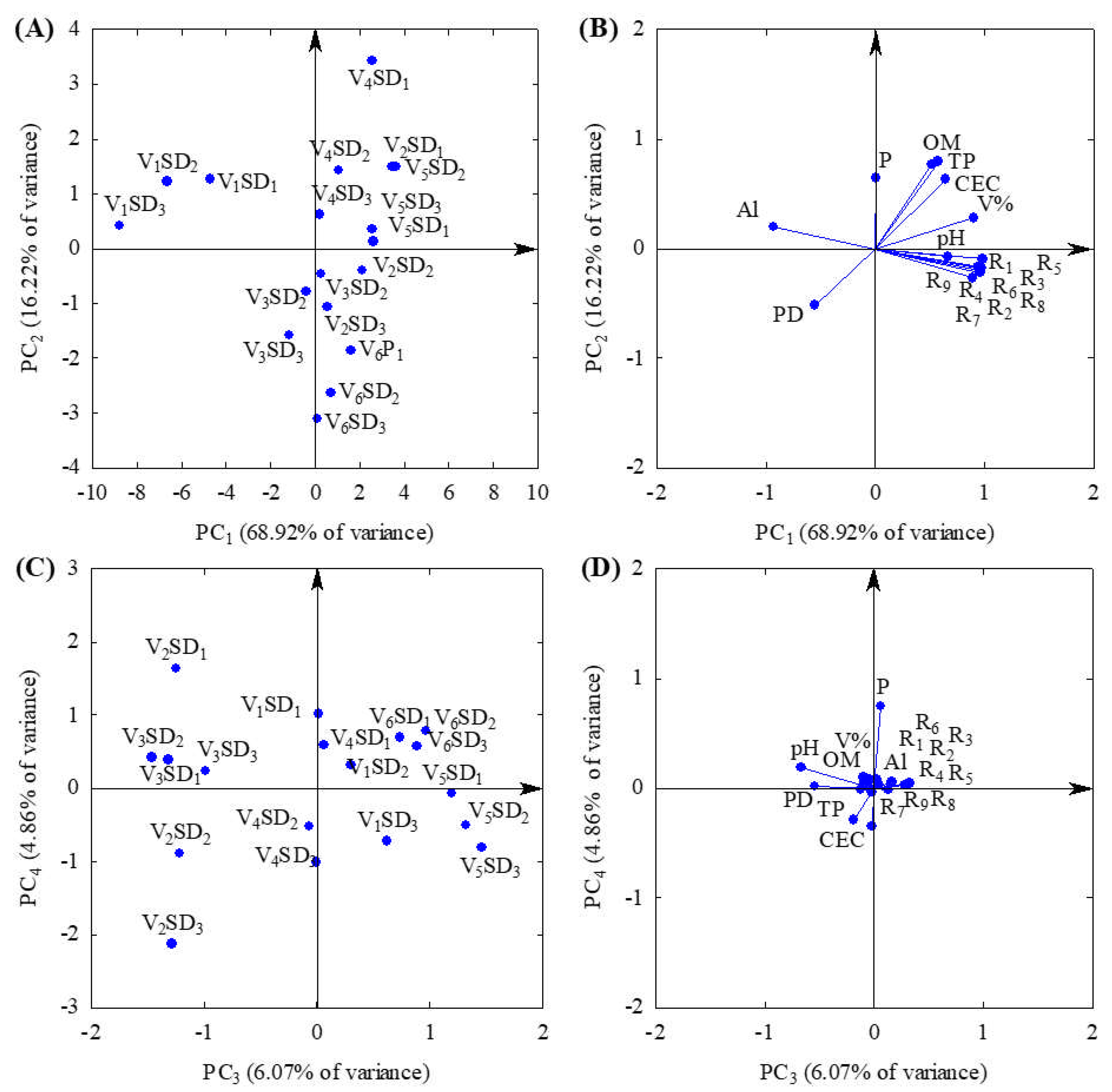
Figure 2.
Hierarchical clustering dendrogram of combinations of land cover varieties (V) and sampling depths (SD) in the first (A) and second (B) principal components (PCs).
Figure 2.
Hierarchical clustering dendrogram of combinations of land cover varieties (V) and sampling depths (SD) in the first (A) and second (B) principal components (PCs).
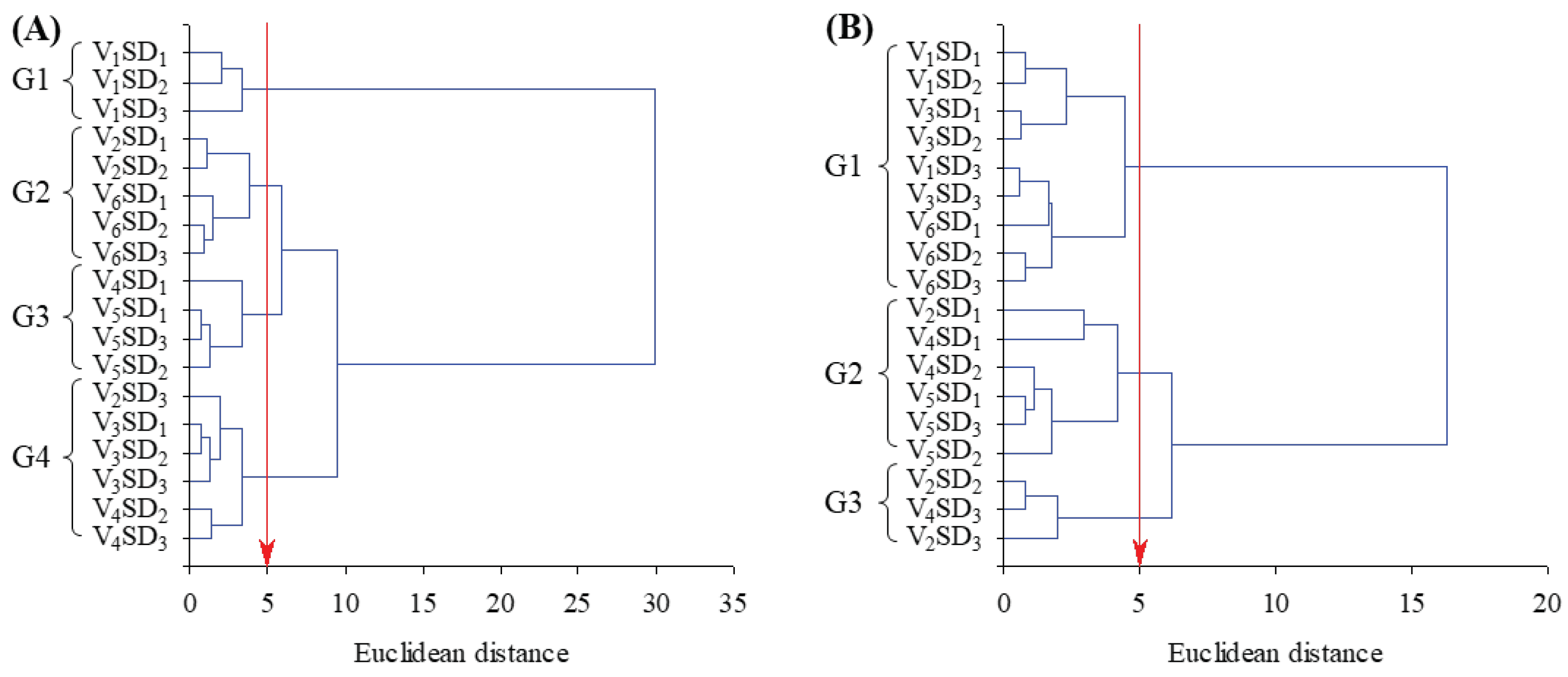

Table 1.
Treatments in the experimental area of Embrapa Algodão/EMPAER.
| Manual planting together with corn | |
|---|---|
| 1 2 3 4 5 6 |
Brachiaria brizantha cv Piatã Brachiaria brizantha cv Marandú Urochloa mosambicensis – urochloa grass Cenchrus ciliares (L) – buffel grass Brachiaria decumbens Panicum maximum cv Massai |
| Planting between rows along with corn | |
| 7 8 9 10 11 12 |
Brachiaria decumbens Brachiaria Brizantha cv Paiaguás Brachiaria Brizantha cv Piatã Corn + Brachiaria + Stylosanthes Corn + Piatã + Stylosanthes Mombaça by hand |
| Planting between rows 14 days after corn | |
| 13 14 15 |
Brachiaria Brizantha cv Piatã Brachiaria Brizantha cv Paiaguás Brachiaria brizantha cv Marandú |
| Planting 14 days after sorghum grain | |
| 16 17 18 19 20 |
Panicum maximum cv Massai Urochloa mosambicensis Brachiaria Brizantha cv Piatã Brachiaria Brizantha cv Paiaguás Panicum maximum cv Mombaça |
| Planting 14 days after corn by hand | |
| 21 22 23 24 25 |
Panicum maximum cv Massai Urochloa mosambicensis – urochloa grass Brachiaria Brizantha cv Piatã Brachiaria Brizantha cv Paiaguás Panicum maximum cv Mombaça |
Table 2.
Chemical characteristics of the soil used in the experiment.
| Attributes | ||||||||
|---|---|---|---|---|---|---|---|---|
| pH | P | K | Na+ | H+Al+3 | Al+3 | Ca+2 | Mg+2 | M.O |
| H2O | mg dm-3 | -------------------------cmolc dm-3--------------------- | g dm-3 | |||||
| 6.2 | 45.5 | 65.1 | 0.0 | 3.22 | 0.05 | 0.40 | 0.40 | 7.05 |
Table 3.
Summary of principal component analysis, multivariate variance - MANOVA and univariate - ANOVA.
Table 3.
Summary of principal component analysis, multivariate variance - MANOVA and univariate - ANOVA.
| Indicators | Principal components | |||
|---|---|---|---|---|
| PC1 | PC2 | PC3 | PC4** | |
| Pearson’s correlation coefficients (r) | ||||
| R1 – Microbial respiration at 4 days | 0.98* | -0.09 | 0.03 | 0.07 |
| R2 – Microbial respiration at 8 days | 0.97* | -0.23 | -0.04 | 0.07 |
| R3 – Microbial respiration at 12 days | 0.96* | -0.17 | -0.05 | 0.02 |
| R4 – Microbial respiration at 16 days | 0.96* | -0.18 | -0.10 | 0.03 |
| R5 – Microbial respiration at 20 days | 0.97* | -0.17 | 0.05 | 0.03 |
| R6 – Microbial respiration at 24 days | 0.90* | -0.26 | 0.33 | 0.04 |
| R7 – Microbial respiration at 28 days | 0.94* | -0.17 | 0.28 | 0.03 |
| R8 – Microbial respiration at 32 days | 0.97* | -0.20 | 0.13 | -0.01 |
| R9 – Microbial respiration at 36 days | 0.98* | -0.18 | -0.02 | -0.04 |
| pH - Hydrogen Potential | 0.67* | -0.08 | -0.66* | 0.18 |
| P - Phosphorus content in the soil | 0.00 | 0.64* | 0.07 | 0.75* |
| Al - Aluminum content | -0.93* | 0.20 | 0.16 | 0.06 |
| OM - Organic matter content | 0.58* | 0.80* | -0.11 | -0.02 |
| CEC - Cation Exchange Capacity | 0.64 | 0.64* | -0.02 | -0.34 |
| V% - Base saturation | 0.91* | 0.28 | -0.09 | 0.09 |
| PD - Particle density | -0.55* | -0.52* | -0.54* | 0.01 |
| TP – Total porosity | 0.52 | 0.77* | -0.19 | -0.29 |
| λ – Eigenvalues | 11.72 | 2.76 | 1.03 | 0.83 |
| σ2 (%) Total explained variance | 68.92 | 16.22 | 6.07 | 4.86 |
| σ2 (%) Total accumulated variance | 68.92 | 85.14 | 91.22 | 96.07 |
| Variation sources | Wilks test (p-value) | F-test (p-value) | ||
| Var – Soil cover varieties | < 0.01 | < 0.01 | 0.01 | <0.01 |
| SD – Sampling Depth | < 0.01 | < 0.01 | 0.01 | <0.01 |
| Var x SD - Interaction between factors | < 0.01 | < 0.01 | 0.01 | <0.01 |
*: correlation coefficients greater than 0.5 considered in the principal components; and **: single variable in the principal component subjected to analysis of variance by the F-test.
Disclaimer/Publisher’s Note: The statements, opinions and data contained in all publications are solely those of the individual author(s) and contributor(s) and not of MDPI and/or the editor(s). MDPI and/or the editor(s) disclaim responsibility for any injury to people or property resulting from any ideas, methods, instructions or products referred to in the content. |
© 2023 by the authors. Licensee MDPI, Basel, Switzerland. This article is an open access article distributed under the terms and conditions of the Creative Commons Attribution (CC BY) license (http://creativecommons.org/licenses/by/4.0/).
Copyright: This open access article is published under a Creative Commons CC BY 4.0 license, which permit the free download, distribution, and reuse, provided that the author and preprint are cited in any reuse.


