
Submitted:
02 June 2023
Posted:
05 June 2023
You are already at the latest version
Abstract
Distributed leadership is based on increasing the knowledge of the skills of those who exercise the role of leaders in the school. The objectives are a) to analyse school principals’ practices aimed at creating professional development opportunities linked to teacher leadership for school improvement and b) to relate the perceptions of teacher leaders with professional development opportunities granted by principals. The methods of the study were based on an examination of 21 interviews, between individual semi-structured interviews with school principals and group interviews with teacher leaders at six public schools in Chile, as well as a documentary analysis of institutional educational projects using grounded theory and NVivo 12 software. The results are presented in three categories: management of principals about school organisation, development of the professional capacities of teacher leaders, and management of principals about school coexistence and participation of teacher leaders. The conclusions detailing school principal practices show that distributed leadership practices are helpful in developing teachers’ leadership competencies. Furthermore, this study suggests that training amplifies the beneficial effects of distributed leadership on teachers’ development. Finally, the findings imply that school principals should regularly fulfil their managerial responsibilities and pay more attention to teacher training to improve the school.
Keywords:
distributed leadership
; school principal’s practices
; teacher leadership
; teacher profes-sional development
1. Introduction
This study deepens the distributed perspective on leadership as a practice to improve school effectiveness from the perspective of principals and teacher leaders at public schools in Chile. Distributed leadership was chosen because it can significantly help the transformation and improvement of the school under the right conditions [1], as it does not require a single person to perform all the essential management functions but rather a group that can execute them collectively [2].
To reinforce the idea that leadership is not a personal attribute, but rather a resource that arises in a situation and that anyone can use regardless of their position [4,5], the concepts worked on from the perspective of distributed leadership and the theory of social practices [5]. This invites a change of perspective and considers leadership as a practice and not as an aspect that only some people have, that is, as a social phenomenon in which more members of the school participate.
This would help to decongest school management, boost school autonomy, promote collaborative work, and participate in institutional decision-making. This is because principals are the key elements because they are the ones who best know their school context and can appropriately manage their resources [6]. One of the leadership practices of school principals is the creation of professional development opportunities for teachers, particularly those considered leaders by their peers [7]. In this study, they are referred to as ‘teacher leaders’ [8,9].
Teachers also play an important role in distributing leadership skills. These teachers often act as mentors and role models for their peers, helping to create a supportive and collaborative learning environment in school [10]. They may also be responsible for coordinating and supervising their peers’ work and setting and meeting goals to improve the quality of teaching [9].
1.1. Theoretical Framework
The Chilean educational context has been constantly evolving in recent years and has been particularly challenging owing to the COVID-19 pandemic. Regulatory changes since the laws on the Competitiveness of the Principal and Heads of the Administrative Department of Public Education [11], Education Quality and Equity [12], the Quality Assurance System [13], School Inclusion [14], the Teacher Professional Development System [15], and the New Public Education System [16] have encouraged constant transformations in the action scenario of people who exercise school management, specifically, to school principals.
With the promulgation of the General Education Law [17], the school head role was faced with the introduction of new requirements, where the responsibility of raising the quality of education in the school was explicitly required, to encourage teachers’ professional development, to meet institutional goals, to consider the regulations established in the Institutional Educational Project (IEP) where institutional rules are established, and to carry out pedagogical supervision in the classroom. In addition, the obstacles presented by the Chilean Educational Reform and its slow implementation of Local Public Education Services [16], whether due to administrative difficulties, lack of technical capacity, or the confinement measures themselves by COVID 19, are still factors that influence management, as it is expected to continue transforming the educational scenarios of public schools in Chile until 2029 [18].
Within the framework of the reform, structural changes take place at the state level, giving special emphasis to principals because they are considered the second factor that most impacts student learning after the work carried out by teachers [19-21]. In fact, it is expected that principals have an impact on teaching work through a series of practices, such as the construction and implementation of a strategic vision, professional teacher development, effective management of the school organisation, encouraging participation and school coexistence, and, above all, pedagogical leadership, and the training of future teacher leaders [22].
In this sense, the work and bureaucratic burden increase for those who lead, which could cause complications in the organisational response to constant changes in the context, fostering institutional fragility, apathy, and disunity between levels and members in an educational community. Therefore, it is necessary to focus on school leadership using a shared approach that allows for greater collaboration, innovation, and creativity within the school, as does the distributed perspective.
Distributed leadership is an emerging concept in education. This perspective involves sharing the responsibility and authority for school improvement among different people within a school. This model has been gaining adherence in recent years, with school districts worldwide [23,24,25,26,27] seeking different ways to train teachers and students to participate in the decision-making process. It should be noted that there is a certain affinity between the distribution of leadership and participatory practices within a school, causing confusion or indistinct use of the concepts of distributed, democratic, collaborative, and co-leadership (or shared leadership). Ref. [4] states that, although collaborative leadership is essentially distributed, it does not have to be collaborative or democratic because it depends on the situation. Co-leadership or leader plus it reflects the existence of the work of more people exercising leadership, but it is not the same as distributed leadership because, again, it depends on the situation.
This is an influential idea in the political and practical fields of education because it is a resistant concept adaptable to different situations for two reasons. First, it considers leadership as a practice, not as a psychological aspect or as the function or responsibility of a person [3,4]. Second, it emphasizes the interactions of people (persons who exercise leadership and those who follow) based on a particular situation, instead of being limited to those who have formal leadership positions or roles [7,19,20]. Therefore, in each situation, distributed leadership arises from interaction with others (leaders and followers).
To understand the relationship between a situation and leadership practices, it is necessary to explain it using social practice theory. According to Ref. [5], it is fundamental to understand practices as ways of doing and/or saying that they arise in the interrelation of competencies of people, that is, of the set of knowledge and skills that they master; the importance of professional teacher development; the materiality that encompasses the tools, infrastructure, and/or resources available that the situation or context offers; and the meaning of the existence of the practices, which is manifested in the goals that are sought to be met, whose ultimate aim is school improvement [28] and effective improvement of student learning outcomes [29].
Consequently, competencies, materiality, and meaning define the execution of a practice, and cease to exist if an element disappears. The practice, then, is collective knowledge instead of the individual knowledge of a subject. It is social knowledge where people cannot be considered solely responsible for the execution of the practice because they are part of its constitution, where the material allows the explanation of the existence of the practices in addition to being the context or space of representation [30]. Some of the most common practices carried out by school principals are shown in Figure 1.
Distributed leadership is based on the idea that all members of the educational community contribute to the success of the school, instead of depending on the central leader [31]. In this study, teachers who exercised leadership were identified as those people with the ability to assume responsibility have opportunities to exercise leadership and belong to a trusted network of principals. They influence their peers without a formal position of power and, in turn, help principals relate to the rest of the community to improve their student learning [32].
However, it is necessary to encourage relationships between people in formal and informal positions for the emergence of teaching leadership, apart from task delegation, for reasons of work saturation. Indeed, distribution is different from delegation because it is associated with the transfer of influence through different distribution patterns [3,4,7,19,33] in a symmetrical relationship, not only with the bureaucratic assignment of school administration tasks [34,35]. Table 1 shows the differences between the traditional and distributed leadership styles.
1.2. Purpose of the Study
However, there is still a prevalence in the educational community regarding the perception of traditional leadership, and that it is a psychological aspect of the person in charge, leaving that person solely responsible for the success or failure of the internal processes of the school. Therefore, the questions that guided this study were as follows. How do principals create opportunities to promote professional development and the emergence of teacher leadership? What do teacher leaders think of these opportunities?
To answer these questions, the following general objectives were stipulated: a) to analyse school principals’ practices aimed at creating professional development opportunities linked to the exercise of teacher leadership for school improvement, and b) to relate the perceptions of teacher leaders with professional development opportunities granted by principals.
2. Methods
This study examines school principals’ practices associated with the creation of professional development opportunities to exercise teacher leadership in public schools in Chile. For this study, a qualitative approach was chosen because it allows for a deeper understanding of complex and subjective phenomena, such as the context and meanings of the experiences and perceptions of people linked to the study phenomenon [36]. In addition, a Case Study was selected because it is a specific qualitative research method that focuses on a detailed analysis of a particular case [37], helping explore and understand complex phenomena in a detailed and deep way through inductive reasoning. Another reason is that it is intrinsic because it provides a detailed and rich description of the situation that arouses interest in itself; because it is particularistic, that is, it focuses on a particular phenomenon; and because it is heuristic, it allows flexibility and adaptation to new findings during the investigation [37,38,39].
2.1. Participants
The universe of this study includes principals of public schools in Chile and teachers who are considered leaders by their peers. The sample focused on headteachers and teacher leaders at six public educational institutions. Principals were chosen based on their level of accessibility because they were interested in the study. The principals selected teacher leaders through snowball sampling as they were those who contacted and recruited them [38]. Table 2 shows the codes used to identify school principals and teacher leaders.
It should be noted that the grouping of participating people does not represent most of the population, but rather itself, and as a Case Study, generalization is not sought [39,40]. Schools belonging to the public system were chosen because they need the most support to reinforce educational quality, as they welcome students from the most vulnerable sectors [19].
2.2. Procedure
Individual and group semi-structured interviews and documentary analyses were used to obtain information. Semi-structured interviews were used to collect information that helped obtain a deep and detailed understanding of the phenomenon. Specifically, because of its flexibility and depth, the possibility of interaction that the conversation offers, and its ability to ask new questions and obtain more open and honest answers [38].
The planning and application of the individual and group semi-structured interviews began with the identification of two study variables: principals’ practices associated with the creation of professional development opportunities for the exercise of teacher leadership for school improvement, and teacher leaders’ perceptions in terms of those opportunities. Three categories were then defined: management of principals about school organisation, development of the professional capacities of teacher leaders, and management of principals about school coexistence and participation of teacher leaders. Subsequently, the dimensions, operational elements, and indicators allowed the creation of questions for the principals and teacher leaders. Interviews were conducted separately with principals and teacher leaders, with guidelines containing the same thematic areas to convey the principal practice and perceptions of the teacher leaders.
The documentary analysis helped collect data from the written records that are public and official of the State Administration, such as the Framework for Good Management and School Leadership (FGMSL) [41] and the Institutional Educational Projects (IEP), respectively, because they provide guidance on the main practices of people involved in school improvement processes through leadership and because they provide information on the objectives pursued by schools and how the institution is structured.
2.3. Ethical Approval
The initial contact to access the fieldwork began with a direct approach, with members representing the education area of the Municipal Corporation of Colina requesting permission to invite school principals to participate in the study. The principals who voluntarily presented themselves were contacted, and this approach was maintained until the time of the interviews.
2.4. Field Work and Data Analysis
The interviews were conducted in the workspaces of principals and teacher leaders to facilitate collaboration among the participants so that the same context served as an input for the description of their experiences and perceptions of distributed leadership management practices. To avoid biases inherent to human interaction and to discourage the expression of irrelevant personal facts or opinions, question guidelines and protocols were created to ensure validity and reliability. Analytical guidelines were created for the selected documents.
Analysis procedures based on grounded theory [42,43] were performed using NVivo 12 software to guide the simultaneous process of data collection, coding, and analysis, without the goal of creating a theory [44,45]. Methodologically, the first step began with the collection of information through individual semi-structured interviews with principals, and group interviews with teacher leaders. Audio recordings, made with prior authorization and consent from the interviewees, were transcribed. Transcribed texts and documents, such as FGMSL and IEPs, were saved in the PDF format for use in the software.
The second step was to read repeatedly to identify the main ideas and keywords, and to select the units of meaning. The third step involves coding and generating codes for the selected units. The fourth step was categorization by performing axial coding and grouping the definitive codes into categories. Finally, the categories were designed by gathering a series of related categories and forming a large category to achieve topic saturation.
2.5. Evaluating the Realiability and Validity of the Study
Based on transparency, some measures considered to avoid reliability and validity problems are described as follow:
- The transcriptions were faithful to the recordings of the interviews, trying at all costs to avoid being limited, selective, partial, biased, and incomplete to ensure the saturation of emerging themes;
- Updated documents were used as data sources so that the information they presented was consistent with the current context in which the research was conducted;
- The NVivo 12 program was used to mitigate and avoid possible human errors that could create confusion in the process of coding, categorizing, and providing ambiguous information;
- Transcripts are available so they can be corroborated by contacting the author;
- In the coding and categorization processes, loss of the richness of words and their connotations was avoided as much as possible;
- We avoided imposing meaning on the categories according to the point of view of the researcher and what the analysis texts declared, and the people interviewed wanted to say were maintained at all costs.
3. Results
The results are presented in narrative form by themes and their respective relationships through categories grouped into three categories: management of principals about school organisation, development of the professional capacities of teacher leaders, and management of principals about school coexistence and participation of teacher leaders.
3.1. Management of Principals about School Organisation
This category is linked to the first objective. The categories that comprise it are the roles of teacher leaders, organisational conditions, creating opportunities, and school improvement. In relation to the elements that make up leadership, principals agree that some of the aspects that help identify a teacher leader are: “initiative, creativity, proactivity, curiosity to create projects, motivation, collaborative capacity, desire to do things, responsibility, and self-confidence” [32] (p. 282). Likewise, they consider that the concept of leadership as a practice is difficult to contain in rigid terms because it depends on the situation, organisational conditions, and opportunity, where the initiative and confidence to assume responsibilities are key.
Similarly, in addition to teachers’ personal commitment, it is important to consider organisational conditions, understood as situational elements that enable the practice of leadership such as space, time, resources, and routines. Principals acknowledge that they use regulations that allow the use of non-teaching hours to ensure the time and space that teachers need, considering that "the times are relative due to the positions they hold as teachers” (BDifem, principal of School B).
For their part, teacher leaders perceive that their principals restructure the school to encourage their participation, considering the situational factors that make it possible, or not, the emergence of the practice of leadership because "the activities can be changed from one day to the next if there is no time or money. (FDL3mas, teacher leader at School F).
However, given the complexity of managing school demands, it is necessary to create professional development opportunities because leadership distribution is possible if people are willing to assume responsibility. The principals (ADifem, BDifem, CDifem, DDifem, EDifem, and FDimas) affirmed that they created opportunities for teachers to continue training, either on their own initiative or as a need for the school. In response to the above, the teacher leaders unanimously responded that they had professional development opportunities and that it was a personal choice if they wanted to take it or if they wanted to become people with formal leadership positions. The latter refers to the option of being teachers with leadership in the informal sphere and continuing to maintain this role "behind the scenes” (CDL2fem, teacher leader of School C).
Finally, both principals and teacher leaders agree that leadership is a co-effect of school improvement because the emergence of teacher leadership has a single meaning in its existence: the improvement of student learning. For this, it is necessary to have a base of people with knowledge and a level of specialization that allows them to face the constant changes and improvement processes that arise in the school, because the intention to improve is for boys and girls (BDL1fem, teacher leader from School B).
The documents analysed are in line with those described by principals and teacher leaders. The IEP of the school dedicate specific sections to express the intentions of improvement, both of the school and of the plans that seek quality through school change and the relationship it has with the management of the school because "it is a an integrated institutional and educational process that, over time, produces an increase in the level of quality in its processes and results in the institution” (FPEI, institutional educational project of School F).
3.2. Development of the Professional Capacities of Teacher Leaders
With this category, we seek to relate categories that allowed us to achieve the second objective of the study: to analyse how principals support teacher professional development for the promotion of teacher leadership. Four categories were identified: managerial roles, managerial support, professional teacher development, and promotion of teacher leadership.
It is important to highlight the direct relationship between the categories of "principal’s role " and "principal’s support”. Both, principals and teacher leaders, agree that leadership is more likely to be manifested by a teacher if they have support from the principal (ADifem, principal of School A). For example, FDimas explains that "if (a teacher) makes a mistake or crosses the line a little, we support it in a certain way, but we also go back to prosecute where we have to go or how far we can go (FDimas, Principal of School F). The teacher leaders affirmed that they felt supported by their principal and that there was trust in them when they took initiative.
Regarding the promotion of teacher leadership, understood as the step of exerting influence from an informal level to a formal level, principals agree that teachers exercise leadership, camouflaged, as a way of explaining the existence of informal leadership on the part of teachers, who are part of the principals’ circle of trust but prefer to maintain the role of teachers, and not necessarily use that practice or a series of practices as a means of promoting leadership teachers from an informal level to a formal level as a managerial position.
Indeed, some principals (BDifem and DDifem) mentioned that there were competent teachers to hold formal positions, such as future headteachers, but that they liked to remain classroom teachers. In the words of CDL1fem, it is considered that informal leadership or camouflaged indicates that they act as teacher leaders, assuming responsibilities in different tasks from their role without necessarily having a position and that principal trusts that everything will be “perfect” and that it depends on their personal disposition whether or not they assume promotion to a formal position (CDL1fem, teacher leader C).
3.3. Management of Principals about School Coexistence and Participation of Teacher Leaders
In this category, data related to the assessments of teachers regarding the promotion of trust and collaborative work that allowed the emergence of teacher leadership were brought together. The following categories were developed: relationships between principals and teacher leaders, the climate of trust, collaborative work, distribution of leadership, and limits of leadership.
To exercise leadership from a distributed perspective, it is essential to create a positive emotional environment in schools. Teacher leaders valued the need for a climate of trust in the workplace, either at a personal level, such as self-confidence, or at an institutional level, such as a trusting principal. In addition, they agree that the distribution of leadership is manifested through the distribution of responsibilities and that teamwork is key.
However, teacher leaders themselves ensure that they have limited empowerment, and that their influence is limited to a few margins. First, due to the very goal of the school organisation, its existence only makes sense if it is based on complying with the improvement of academic performance. Second, due to supervision or monitoring by the principal, even though it is oriented towards learning, teacher leaders learn how far they can go (FDimas, principal of School F).
Third, owing to the regulations of the legal framework of the national context and the hierarchy of the internal system of the school, the principal is formally responsible for the educational community and administration. The fourth limitation is related to situational aspects, as it can enable, or not enable, the exercise of leadership; therefore, management by the principal is essential to restructuring organisational conditions.
The personal disposition of the teacher is also considered a fifth limit for the exercise of leadership because it depends on the personal motivations and attitudes of each teacher to assume such responsibility. In fact, some teacher leaders shared the idea of retaining informal leaders, because they wanted to continue as classroom teachers. Or as CDL1fem explains “we are fond of the classroom more than the administrative; for example, I do not know how to give an example of being in charge of school coexistence, guidance, UTP, or another; they are not within our personal interest (CDL1fem, teacher leader at School C).
Others, however, wanted to continue to improve to reach managerial positions (ADL2fem, DDL1fem, and FDL1fem). Finally, the sixth limitation is the relationship with other members of the educational community, specifically with their peers, since they do not like to feel that others change their perceptions by exercising a leadership role when they do not have formal positions.
From the documentary analysis, FGMSL [41] is the most important conceptual reference for people who exercise school management in Chile since it provides guidelines that would help consolidate their role as principals. As such, it defines the main practices, competencies, and knowledge for the development of school leadership. The use of this framework helps manage the coexistence and participation of the educational community among other things.
Principals are primarily responsible for generating opportunities for teacher participation and collaboration in formal spaces in pleasant school environments. In fact, all participating schools have an internal regulation as an instrument that allows the fulfilment of the rights and duties of its members, regulating their relations, setting rules of operation, coexistence, and good treatment to promote a positive climate based on trust and collaboration, which boosts teacher leadership, whose official representative is the school principal. In this way, the intentions of managing the right climate and different ways of relating are explicitly ignored. With this, it is consolidated that principals favour the emergence of teacher leadership, stimulating the appropriate climate for it, and restructuring the organisational conditions, not only by will or necessity, but also because it is specified in FGMSL and IEP.
Although the results were organised into three categories, it was possible to create relationships between concepts. The three most important concepts of this study are the principal’s role, leader’s role, and organisational conditions. This is primarily because distributed leadership cannot exist if it is missing. Based on the principal’s role, it is possible to determine that one of its functions is to support teachers in the role of leaders, which can be accomplished by creating opportunities for professional teacher development. Similarly, the last category encourages the promotion of teacher leadership, considering the personal disposition of teachers to assume responsibility, as shown in Figure 2.
However, the distribution of leadership is possible because of the teacher leader- principal relationship through constant interactions, considering that the meaning of its existence is school improvement. This is possible if it is carried out in a climate of trust based on collaborative work, taking into account the limits of teacher leadership: the goal of the organisation (category "school improvement"), the supervision of principal and regulations (in "principal’s role"), situational aspects (in "organisational conditions"), personal disposition of the teacher (in "teacher leader’s role") and the relationship with others (in the category "teacher leader-principal relationship") (Galdames-Calderón, 2021, 258).
4. Discussion and Conclusions
Distributed leadership is a social practice because it is based on the idea that leadership does not reside in just one person or a small group of people but is distributed among all members of a school. This allows both administrators and teacher leaders to contribute and make decisions in a more active and meaningful way, which, in turn, can improve the effectiveness and efficiency of the organisation. Along these lines, people exercise both leadership and non-leadership. First, it supposes that the emergence of leadership must be facilitated and supported, and its potential is released with the most basic: the creation of opportunities for the development of teacher leadership capacity, which is the first element shaping school principals’ practices of distributed leadership.
The following three elements are given by the distributed perspective itself, since according to Ref. [3,4], it is the people who exercise leadership and those who interact with their situation that allows it to emerge. With respect to the elements provided by social practice theory (competencies, materiality, and meaning according to Ref. [5]), it is possible to merge them in such a way that, in the face of a new scenario that may present a situation and the decision-making that this might entail, the emergence of leadership may prevail. With this, the people that interact, principals, and teacher leaders must have the competencies necessary to know how to use the materiality that grants the organisational conditions to carry it out with a sense course that motivates action: the school improvement. If competencies are linked to people and materiality to the situation, the fifth element to consider is meaning, as shown in Figure 3.
However, with the redefinition of the role of the school principal, management strategies are required to overcome individualistic management through the principal’s support as a method of influencing the distribution of leadership, whose perceptions of teacher leaders have highly similar assessments. In fact, the same teacher leaders agree that support is key when they take the initiative and consider it necessary to intervene because it helps develop relationships based on trust and promotes positive professional attitudes such as openness to feedback and continuous training [32].
This means that the promotion of teacher leadership has benefits at both the personal, professional, and organisational levels, since it allows capitalizing on experience and reduces the chances of error, as long as it is considered that empowerment is limited by factors such as the goal of the organisation, supervision of the principal, regulations, situational aspects, the teacher’s willingness to assume leadership, and even the relationship with peers. In summary, the school principals’ practices associated with the creation of opportunities for teachers’ professional development for the exercise of leadership linked to improvement are summarized in Table 3.
To conclude, it is recommended to change perspectives and consider leadership as a practice, not as a psychological aspect that only a few people have. In other words, it is a social phenomenon in which more members of the school participate, as pointed out by references [3,4,6,7,19,20,23,24,31,33,34,35].
In general terms, principals were frank in admitting that it is necessary for teachers to exercise leadership to manage the school organisation effectively and efficiently, and that training is decisive for the emergence of teacher leadership. In this sense, it is necessary to systematically create opportunities and restructure organisational conditions so that they can be successfully implemented.
Teacher leaders’ perceptions agree with what principals say regarding the people who participate in the distribution of leadership must have a series of competencies that make them eligible based on a task or responsibility within the school. It is also necessary to have the materiality that the organisational conditions grant and that the sense that motivates their activity is the improvement of school effectiveness. In addition, they also value that exercising leadership can be learned because it is a resource and social knowledge, and for this, it can be acquired either through training courses, recruiting agents outside the school, or empowering a member to help the organisation. Internal training and the distribution of learning among peers.
Author Contributions
Not applicable.
Funding
This research received no external funding.
Institutional Review Board Statement
This study adhered to the standards of the Social Sciences of the Ethical Committee of Experimentation of the Autonomous University of Barcelona (Spain).
Informed Consent Statement
Informed consent was obtained from all the subjects involved in the study. All participants were informed that anonymity was assured, why the research was being conducted, and how the data would be used. As with all research involving humans, ethical approval from the Autonomous University of Barcelona Ethics Committee was obtained before conducting the study.
Data Availability Statement
The data presented in this study are available upon request from the corresponding author. The data were not publicly available due to private and ethical restrictions.
Conflicts of Interest
The authors declare no conflict of interest.
References
- Harris, A.; DeFlaminis, J. Distributed leadership in practice: evidence, misconceptions and possibilities. Manag. in Ed. 2016, 30, 141–146. [Google Scholar] [CrossRef]
- Hargreaves, A.; Connor, M. Collaborative professionalism: When teaching together means learning for all, 1st ed.; Corwin Press: California, United States, 2018; pp. 1–141. [Google Scholar]
- Spillane, J. Distributed Leadership. The Ed. Forum 2005, 69, 143–150. [Google Scholar] [CrossRef]
- Spillane, J. Distributed leadership, 1st ed.; Jossey-Bass: San Francisco, United States, 2006; pp. 1–144. [Google Scholar]
- Ariztía, T. La teoría de las prácticas sociales: particularidades, posibilidades y límites. Rev. de Epistemología de Cs. Soc. 2017, 59, 221–234. [Google Scholar] [CrossRef]
- Galdames, M.; Antúnez, A.; Silva, P. Liderazgo distribuido como práctica de los directivos escolares para la mejora escolar en Chile. In Políticas Públicas para la Equidad Social, 1st ed.; Rivera-Vargas, P., Muñoz-Saavedra, J., Morales-Olivares, R. y Butendieck, S., Eds.; Colección Políticas Públicas: Santiago, Chile, 2019; Volume 2, pp. 111–122, http://hdl.handle.net/2445/136061. [Google Scholar]
- Harris, A.; Jones, M. Teachers leading enquiry. Sch. Lead. & Manag. 2022, 42, 309–312. [Google Scholar] [CrossRef]
- Berg, J. H; Horn, P.; Supovitz, J.; Margolis, J. Typology of Teacher Leadership Programs. CPRE Research Reports 2019, 1, 1–53. [Google Scholar]
- Nguyen, D.; Ng, D. Teacher collaboration for change: sharing, improving, and spreading. Prof. Develop. in Ed. 2020, 46, 638–651. [Google Scholar] [CrossRef]
- Krichesky, G.; Murillo, F. J. La colaboración docente como factor de aprendizaje y promotor de mejora. Un estudio de casos. Educ. XX1 2018, 21, 135–155. [Google Scholar] [CrossRef]
- Law Nº 20.006 of 2005 Competitiveness of Principal and Heads of the Administrative Department of public education. Available online: http://bcn.cl/1z01q (accessed on 2 June 2023).
- Law Nº 20.501 of 2011 Education Quality and Equity. Available online: http://bcn.cl/1vz9t (accessed on 2 June 2023).
- Law Nº 20.529 of 2011 Quality Assurance System. Available online: http://bcn.cl/1uv5c (accessed on 2 June 2023).
- Law Nº 20.845 of 2015 School Inclusion. Available online: http://bcn.cl/1uv1u (accessed on 2 June 2023).
- Law Nº 20.903 of 2016 Teacher Professional Development System. Available online: http://bcn.cl/1uzzn (accessed on 2 June 2023).
- Law Nº 21.040 of 2017 New Public Education System. Available online: https://bcn.cl/2f72w (accessed on 2 June 2023).
- Law Nº 20.370 of 2009 General Education Law. Available online: http://bcn.cl/1uvx5 (accessed on 2 June 2023).
- MINEDUC Avances del Sistema de Educación Pública y extensión del calendario de implementación. Available online: https://n9.cl/awsey (accessed on 2 June 2023).
- Leithwood, K.; Day, C.; Sammons, P.; Harris, A.; Hopkins, D. Successful School Leadership What it is and How it influences pupil learning. Nat. College for Sch. Lead. 2006, 1, 1–132, https://n9.cl/9k6k. [Google Scholar]
- Leithwood, K.; Harris, A.; Hopkins, D. Seven strong claims about successful school leadership revisited. Sch. Lead. & Manag 2020, 40, 5–22. [Google Scholar] [CrossRef]
- Pont, B. A literature review of school leadership policy reforms. Europ. Jour. of Edu. 2020, 55, 154–168. [Google Scholar] [CrossRef]
- Fullan, M. Liderar en una cultura de cambio, 3rd ed.; Ediciones Morata: Madrid, Spain, 2022; pp. 1–176. [Google Scholar]
- DeFlaminis, J.; Abdul-Jabbar, M.; Yoak, E. Distributed leadership in schools. A practical guide for learning and improvement, 1st ed.; Routledge: New York, United States, 2016; pp. 1–232. [Google Scholar] [CrossRef]
- Harris, A.; Jones, M.; Ismail, N. Distributed leadership: taking a retrospective and contemporary view of the evidence base. Sch. Lead. & Manag. 2022, 42, 438–456. [Google Scholar] [CrossRef]
- Supovitz, J. A.; D'Auria, J.; Spillane, J. P. Meaningful & sustainable school improvement with distributed leadership. CPRE Research Reports 2019, 1, 1–66, https://repository.upenn.edu/cpre_researchreports/112. [Google Scholar]
- Tintoré, M. & Gairín, J. Tres décadas de investigación sobre liderazgo educativo en España. Un mapeo sistemático. REICE 2022, 20, 5–24. [Google Scholar] [CrossRef]
- Tintoré, M.; Gairín, J. Liderazgo educativo en España, revisión sistemática de la literatura. In Liderazgo educativo en Iberoamérica. Un mapeo de la investigación hispanohablante, 1st ed.; Díaz Delgado, M.A. (coord.). Editorial Infinita: Ciudad de México, México, 2023; pp. 59–84. [Google Scholar]
- Creemers, B. P.; Peters, T.; Reynolds, D. (Eds.) School effectiveness and school improvement, 2nd ed.; Routledge: London, United Kingdom, 2022; pp. 1–430. [Google Scholar]
- Koh, G.A.; Askell-Williams, H.; Barr, S. Sustaining school improvement initiatives: advice from educational leaders. Sch. Effect. and Sch. Improv. 2023, 34, 101–120. [Google Scholar] [CrossRef]
- Feldman, M. Practice Theory and Routine Dynamics. In Cambridge Handbook of Routine Dynamics, 1st ed.; Feldman, M., Pentland, B., D’Adderio, L., Dittrich, K., Rerup, C., Seidl, D., Eds.; Cambridge University Press: Cambridge, United Kingdom, 2021; pp. 21–36. [Google Scholar] [CrossRef]
- Azorín, C.; Harris, A.; Jones, M. Taking a distributed perspective on leading professional learning networks. Sch. Lead. & Manag. 2019, 40, 111–127. [Google Scholar] [CrossRef]
- Galdames-Calderón, M. Prácticas directivas de liderazgo distribuido: creación de oportunidades de desarrollo profesional docente para la mejora escolar. Un estudio de caso en el municipio de Colina, Chile. Doctoral thesis, University of Barcelona, Barcelona, 25th January 2021. http://hdl.handle.net/10803/671984. 1080. [Google Scholar]
- Gronn, P. Distributed Leadership as a unit of analysis. The Lead. Quarterly 2002, 13, 423–451. [Google Scholar] [CrossRef]
- MacBeath, J. Leadership as distributed: a matter of practice. Sch. Lead. & Manag. 2005, 25, 349–366. [Google Scholar] [CrossRef]
- MacBeath, J. No lack of principles: leadership development in England and Scotland. Sch. Lead. & Manag. 2011, 31, 105–121. [Google Scholar] [CrossRef]
- Gibbs, G. Analyzing Qualitative Data, 2nd ed.; SAGE Publications: California, United States, 2018; pp. 1–232. [Google Scholar]
- Merriam, Sh.; Grenier, R. Qualitative Research in Practice. Examples for discussion and analysis, 2nd ed.; Jossey-Bass: San Francisco, United States, 2019; pp. 1–480. [Google Scholar]
- Creswell, J. & Poth, C. Qualitative inquiry & research design. Choosing among five approaches, 4th ed.; SAGE Publications: California, United States, 2018; pp. 1–488. [Google Scholar]
- Stake, R. Investigación con estudio de casos, 6th ed.; Ediciones Morata: Madrid, Spain, 2022; pp. 1–153. [Google Scholar]
- Cohen, L.; Manion, L.; Morrison, K. Research methods in education, 8th ed.; Routledge: New York, United States, 2018; pp. 1–944. [Google Scholar]
- MINEDUC. Marco para la Buena Dirección y el Liderazgo Escolar, 1st ed.; Editora Maval: Santiago, Chile, 2015; pp. 1–44, https://n9.cl/nkwmg. [Google Scholar]
- Glaser, B.; Strauss, A. The Discovery of grounded theory: strategies for qualitative research, 1st ed.; Routledge: New York, United States, 2000; pp. 1–282. [Google Scholar]
- Charmaz, K. With constructivist grounded theory you can’t hide: Social justice research and critical inquiry in the public sphere. Quali. Inquiry, 2020, 26, 165–176. [Google Scholar] [CrossRef]
- Bryant, A. The Varieties of Grounded Theory, 1st ed.; SAGE Publications: California, United States, 2019; pp. 1–152. [Google Scholar]
- Liska, L.; Seide, K. Coding for Grounded Theory. In The SAGE Handbook Current Developments in Grounded Theory, 1st ed.; Bryant, A., Charmaz, K., Eds.; SAGE Publications: California, United States, 2019; Volume 1, pp. 167–185. [Google Scholar]
Figure 1.
Distributed leadership as a social practice.
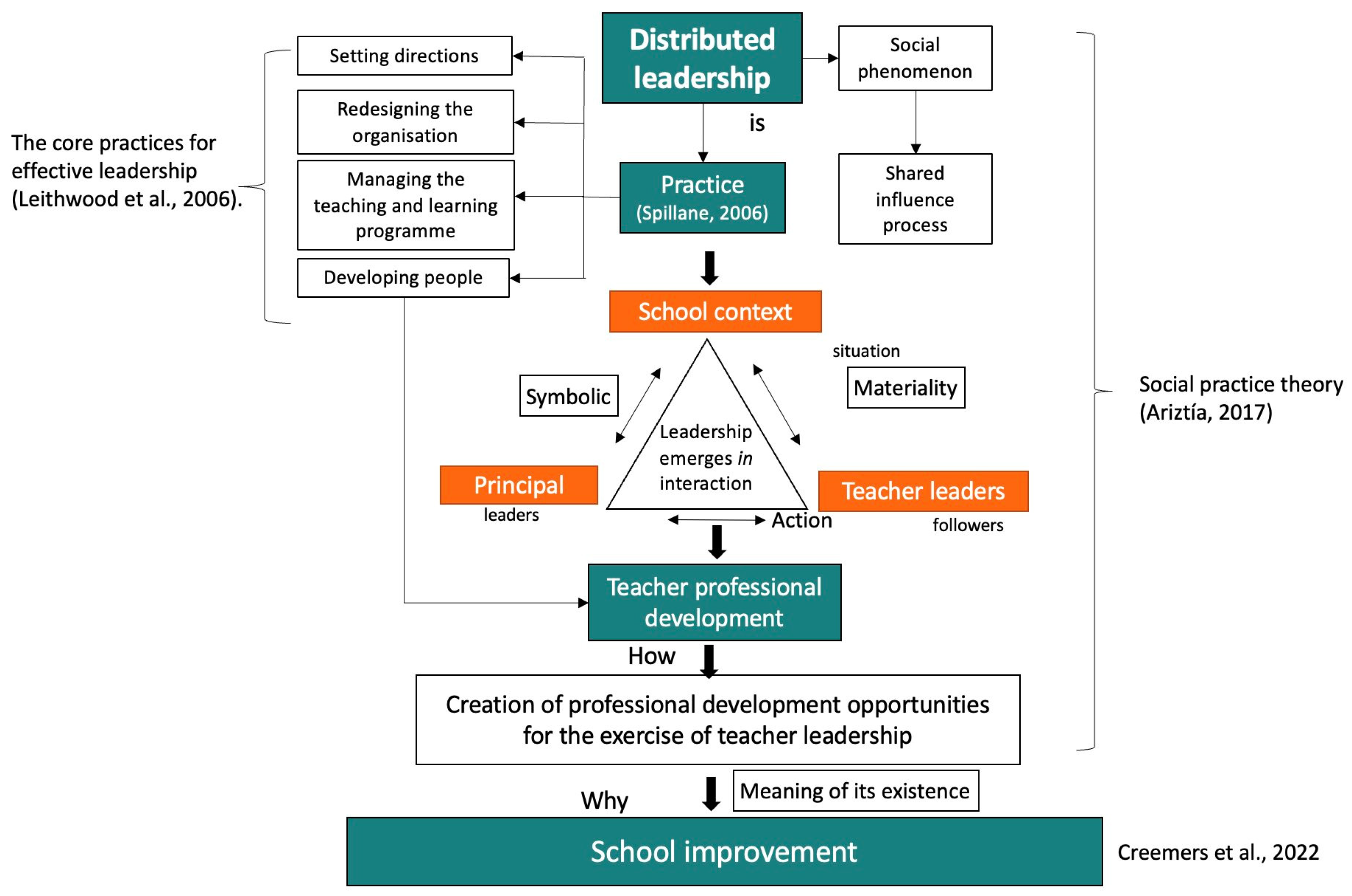
Figure 2.
Connections between categories.
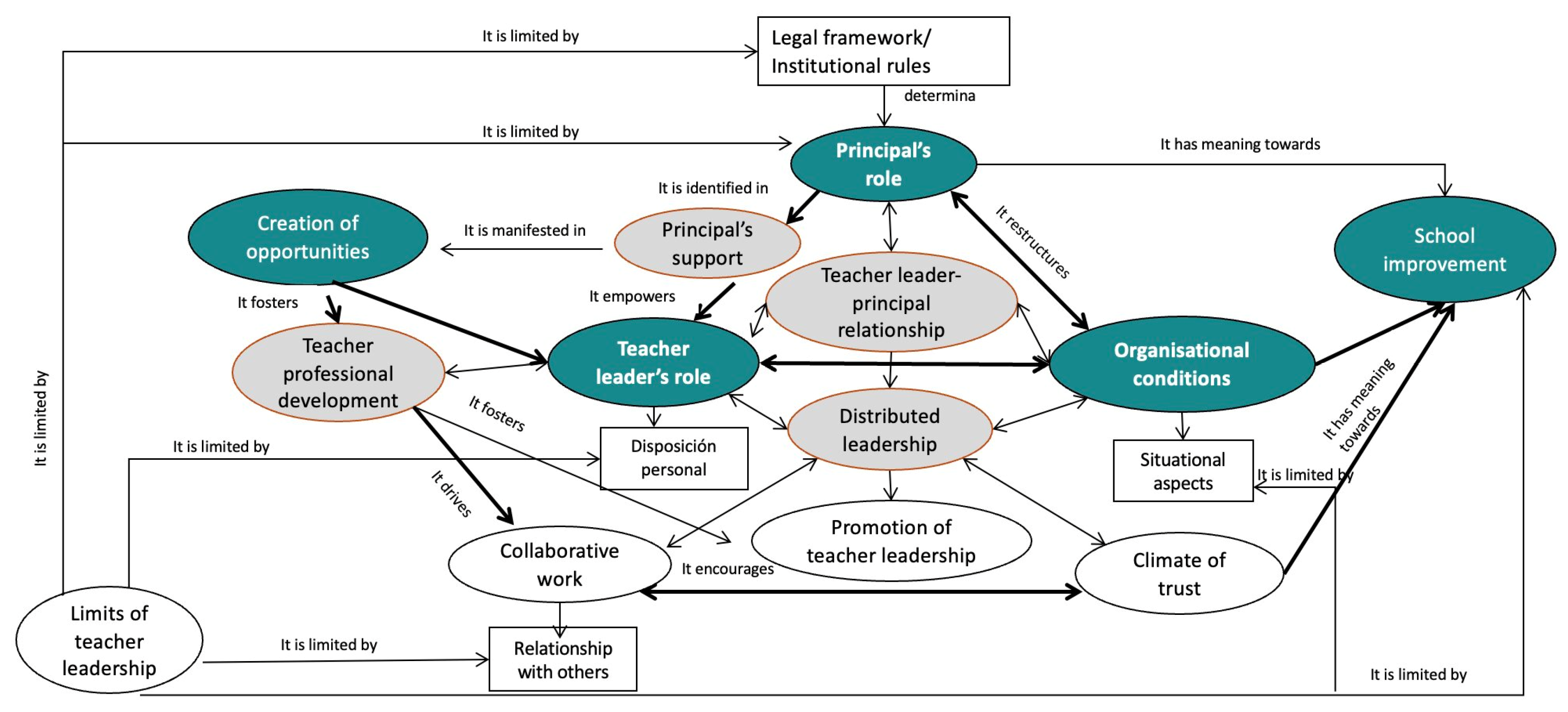
Figure 3.
Five elements that constitute distributed leadership.
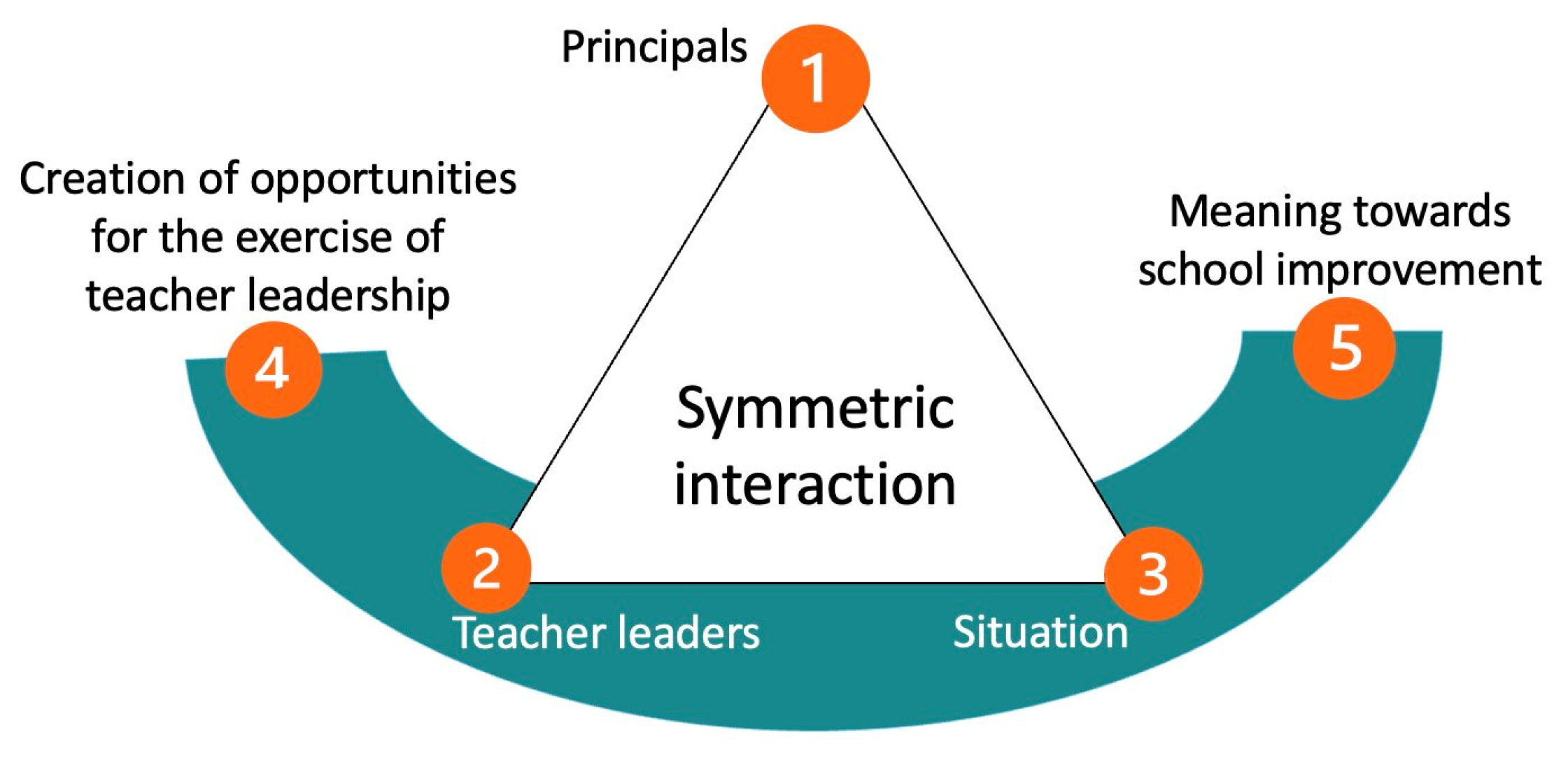

Table 1.
Differences between the traditional leadership and distributed leadership.
| Traditional leadership | Distributed leadership |
|---|---|
| Specialized role | Shared influence process |
| Leadership as a persona characteristic | Leadership as a social practice |
| Leadership as supervision of hierarchical control processes | Leadership that arises in interaction processes |
| Individualistic | Collaborative - participatory |
| Task delegation | Distribution of responsibilities |
| Hierarchical relationships | Symmetric relations |
| Responsibility lies with one person: school principal | Responsibility lies with the team: educational community |
| Rationalist-positivist paradigm | Descriptive-analytical or normative-prescriptive paradigm |
| Centralized power | Shared power |
Table 2.
Identification codes of reporting schools and agents.
| School | Typology | School principal’s code | Number of teacher leaders | Teacher leader’s code |
|---|---|---|---|---|
| School A | Primary school | ADifem | 2 | ADL1fem |
| ADL2fem | ||||
| School B | BDifem | 3 | BDL1fem | |
| BDL2fem | ||||
| BDL3fem | ||||
| School C | CDifem | 3 | CDL1fem | |
| CDL2fem | ||||
| CDL3fem | ||||
| School D | DDifem | 2 | DDL1fem | |
| DDL2fem | ||||
| School E | High school | EDifem | 2 | EDL1mas |
| EDL2fem | ||||
| School F | Vocational Education and Training High school | FDimas | 3 | FDL1fem |
| FDL2mas | ||||
| FDL3mas | ||||
| Total: 21 participants | 6 school principals | 15 teacher leaders | ||
Table 3.
Main school principals’ practices.
| Management of principals about school organisation | Development of the professional capacities of teacher leaders | Management of principals about coexistence and participation of teacher leaders |
|---|---|---|
| Identify teacher leaders | Know the role of the principal in promoting teachers’ professional development | Encourage relationship and interactions between principals and teacher leaders |
| Restructure the organisational conditions of the school | Support for teacher leaders in professional development | Fostering confidence with the school and self confidence |
| Creating opportunities for teachers’ professional development | Fostering the promotion of teacher leadership | Promoting collaborative work |
| Having a sense of school improvement | Empowering the teacher as a leader | Distributing leadership |
Disclaimer/Publisher’s Note: The statements, opinions and data contained in all publications are solely those of the individual author(s) and contributor(s) and not of MDPI and/or the editor(s). MDPI and/or the editor(s) disclaim responsibility for any injury to people or property resulting from any ideas, methods, instructions or products referred to in the content. |
© 2023 by the authors. Licensee MDPI, Basel, Switzerland. This article is an open access article distributed under the terms and conditions of the Creative Commons Attribution (CC BY) license (http://creativecommons.org/licenses/by/4.0/).
Copyright: This open access article is published under a Creative Commons CC BY 4.0 license, which permit the free download, distribution, and reuse, provided that the author and preprint are cited in any reuse.