

Submitted:
28 May 2023
Posted:
30 May 2023
You are already at the latest version
Abstract
Thermal treatment in Australia is gaining interest due to legislative changes, waste reduction goals, and the need to address contaminants risks in biosolids used for agriculture. The resulting biochar product has the potential to be beneficially recycled as a soil amendment. On-farm management practices were reviewed to identify barriers that need to be overcome to increase recycling and examine the role of pyrolysis and gasification in effectively improving the quality and safety of biochar. Key findings revealed: (1) thermal treatment can effectively eliminate persistent organic pollutants, microplastics and pathogens, and (2) more than 90% of the total heavy metals content in biosolids become immobilized when these are converted to biochar, thus reducing their bioavailability following land application. While reported research on the short-term effects of biosolids-derived biochar suggested promising agronomic results, there is dearth of information on long-term effects. Other knowledge gaps include optimisation of land application rates, understanding of rate of breakdown and fate of contaminants in soil and water, heavy metal mobility in soil and bioaccumulation or transfer to the food chain. Improved understanding of nutrients and contaminants dynamics in soils receiving biosolids-derived biochar is a pre-requisite for their safe use in Australian agriculture, and therefore it is highlighted as priority area for future research.
Keywords:
heavy metals
; microplastics
; organic pollutants
; pyrolysis and gasification
; sewage sludge
; soil amendment
; thermal treatments
1. Introduction
Biosolids are the solid end-product of urban wastewater treatment plants, consisting of sewage sludge treated to achieve safe environmental and health standards [1]. While these biosolids are rich in organic matter and contain agronomically significant concentrations of plant nutrients, they also contain contaminants, including organic chemicals, heavy metals, pathogens and microplastics, which cause concern due to the potential for long-term environmental and public health impacts [2,3]. As the global population increases, biosolids production, which is proportional to population size, will also increase [4]. Annual sewage sludge production has been estimated at 10 million tons, 40 million tons, and 14 million tons in Europe, China, and the United States, respectively [5]. In 2021, Australia generated approximately 350,000 dry tons of biosolids [1]. These are growing concerns, given that biosolid production increased by 24% from 2010 to 2019 [6], and restrictions regarding the safe use of biosolids in Australia have increased with a trend toward diverting their reutilization as a source of carbon and nutrients in agriculture [7]. There is renewed interest both nationally and internationally in finding an alternative waste management strategy that models the principles of circular economy to recover carbon, nutrients, and energy from biosolids, while reducing the need for landfill disposal [8,9].
Thermal processes including pyrolysis, gasification, and hydrothermal technology can be employed to sustainably process biosolids intended for land application [8]. The materials that result from these processes offer several advantages compared with biosolids, including: (i) reduction or improved control of odor, pathogens, organic and inorganic contaminants; (ii) mass reduction (range: 30 to 90%), which subsequently reduces handling, transport and storage costs; (iii) conversion of biosolids into higher-value products such as bio-oil, syngas and biochar [10]. These advantages should be perceived as opportunities to improve regulatory compliance, reduce existing costs, and generate additional revenue streams.
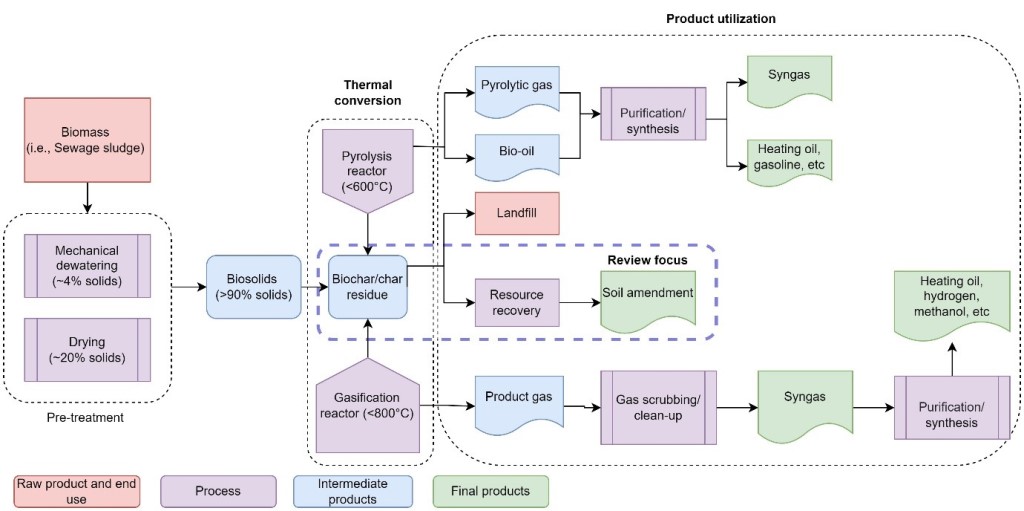
This article critically reviews the potential of using biosolids-derived biochar as a soil amendment in Australian agriculture. While there have been reviews on biochar production from biosolids, including characterization, and evaluation of its effect on soil and crops [4,11] (Figure 1), need remains for a specialized assessment on biosolids-derived biochar to understand its potential as a soil amendment in the Australian agricultural system. Initially, the current biosolids management practices and regulatory frameworks in Australia is analyzed to identify limitations associated with biosolids recycling to land. Furthermore, it also explores thermal treatment methods (i.e., pyrolysis and gasification) as potential biosolids management solutions. The review then evaluates the physicochemical properties and contaminant fate of biosolids-derived biochar to assess its potential for land application compared to biosolids. The aim of the review is to present biosolids-derived biochar as a promising soil amendment by highlighting the opportunities and challenges when applied to soil and taken up by plants.
2. Current biosolids management practices and regulatory framework in Australia
In 2019, Australia produced 2.3 million tons of wet biosolids with an average solid content of 16%, equating to 371,000 tons DBS [6]. The large majority (91%) of biosolids were applied to land. Of this 91%, approximately 67% of biosolids were used in agriculture, 16% in land rehabilitation, and 8% in landscaping. The remaining 9% went to landfill (4%), discharged into the ocean (1%), and 4% were used for other purposes [1,6].
A national regulatory framework strictly controls the land application of biosolids [12], and state guidelines have been developed to ensure a high level of protection for both the environment and public health [13]. However, current guidelines for controlling nutrients, pathogens, and contaminants in land application of biosolids vary between states in Australia, as highlighted by McCabe et al. (2019) [14]. As a result, Victoria, Tasmania and Northern Territory [1] are faced with the problem of stockpiling biosolids that fail to meet the regulatory criteria [15]. Currently, there are no guidelines in Australia on the issue of microplastics present in biosolids.
3. Limitations with recycling biosolids to land
The concern around environmental health, food safety, and quality are due to heavy metals and metalloids, persistent organic pollutants (POPs), microplastics, and pathogens [16]. These contaminants hinder the land application of biosolids.
3.1. Heavy metals and metalloids
The risk of environmental availability or mobility (i.e. potential of metals when released in the environment, to move under natural forces to groundwater or to distance from the site of release) [17,18] and bioavailability (i.e. the ability a phenomenon strongly controlled by type of organism, type of exposure and metal availability) of heavy metals and metalloids in the soil is a primary concern for land application of biosolids [5]. Elements such as arsenic (As), copper (Cu), lead (Pb), zinc (Zn), and nickel (Ni) present in sewage sludge become concentrated during treatment and are present in biosolids [19]. Land application of these elements may result in uptake by plants and subsequent transfer to the food chain [20,21] or environmental losses by processes such as leaching and runoff [2,22].
The degree of these risks depends on both the concentration of heavy metals and metalloids in the soil amendment; and the environmental physicochemical properties in which they are released. The elemental concentrations vary depending on the location, wastewater source (commercial, domestic or industry), and sludge treatment process [15]. However, the most critical factors that affect the mobility and bioavailability of heavy metals are soil pH, soil permeability, soil organic matter content, and factors that affect microbial activity [23].
3.2. Persistent organic pollutants
Persistent organic pollutants (POPs), derived from synthetic organic compounds used in numerous industries, are present in wastewater and accumulate in biosolids [24]. Although primary and secondary treatments in WWTP result in the partial removal of organic pollutants (e.g., polyfluorinated alkyl substances (PFAS) [25] and triclosan [26], some may remain in residual concentrations in biosolids and include perfluorinated chemicals (PFOS, PFOA), polychlorinated biphenyls (PCB), polychlorinated alkanes (PCAs), polybrominated diphenyl ethers (PBDE), triclosan, polyaromatic hydrocarbons (PAH), polybrominated diphenyl ethers (PBDEs), dioxins, steroids and antibiotics [24]. The concentration of total PFOS, PFOA and total PCB detected in Australian samples of biosolids ranged from 0.021-0.386 mg·kg-1, 0.003-0.05 mg·kg-1, 0.27-0.77 mg·kg-1 and 0.02-0.41 mg·kg-1 respectively [25]. Consequently, the existence of POPs in land-applied biosolids results in ecosystem contamination with potential for bioaccumulation in plants and animals [26] and risk of human and animal toxicity [27].
To address the risk of environmental persistence, human and animal toxicity, and bioaccumulation of POPs in the food chain, the Australian government introduced strict concentration limits to restrict the land application of biosolids with high concentrations of POPs [28]. In Australia, the allowable limits of POPs in biosolids ranged from: PFOS 0.3-4.2 mg·kg-1; PFOA 0.05-33.6 mg·kg-1; total DDT 0.5-1 mg·kg-1; total PCBs 0.05-0.5 mg·kg-1 [12]. Although the disposal of biosolids in Australia complies with these limits, concerns remain regarding their bioavailability and mobility when applied to the soil [27]. More research is required to understand the bioavailability and mobility of heavy metals from biosolids when applied on land in the Australian context [28].
3.3. Microplastics
Microplastic particles range from 1 mm to 5 mm and can be detected in surface water, soil, sediment, and biota [29]. Microplastics commonly detected in biosolids are generally produced from polyethylene, polypropylene, polystyrene, polyvinylchloride, polyethylene terephthalate, and other polymers [30,31]. These microplastics originate from the synthetic fibers of clothing and plastics used in personal care products which eventually enter WWTPs and can enter the environment via subsequent application of biosolids to land [32,33].
Microplastic contamination of biosolids is widespread in Australia. For example, Okoffo et al., (2020) [34] collected biosolids samples from 82 WWTPs across Australia and reported that 99% of samples contained plastics at a concentration between 0.4 and 23.5 mg·kg-1 DBS. Okoffo et al., (2020) [34] further projected that around 4,700 Mt of plastics are released into the Australian environment through biosolids end-use, of which 3,800 Mt is released onto agricultural land.
Microplastics can persist in the environment for decades after their application. Although microplastics are not biodegradable, they are prone to photodegradation and thermo-oxidative degradation [32,34]. The degradation of microplastics to nanoplastics is a concern for plants and animals [35]. At the nanoscale, plastics can pass through cell membranes and enter the food chain [36]. In general, microplastics and nanoplastics are capable of causing widespread physical and chemical impacts on soil physiochemistry, terrestrial food webs, growth inhibition in earthworms, lethal toxicity to fungi, mammalian lung inflammation and broad cytotoxicity [37].
3.4. Pathogens
The transmission of infectious pathogens from biosolids to humans, animals or plants is a significant public health concern [19]. Biosolids contain pathogenic microorganisms, including viruses, bacteria, protozoa, and helminths [38]. The pathogen load depends on the treatment and stabilization processes used to produce the biosolids [19]. Moderate applications of biosolids can increase the diversity of the soil ecosystem, as the additional organic matter and nutrient inputs support the growth of microbial populations, leading to an increase in diversity [1,39]. However, the impact of biosolids on soil microbial diversity is not always positive. For instance, a study conducted by Mossa et al. (2017) [40] found that the increasing application of biosolids resulted in a change in the soil microbial diversity. Soil samples collected from 17 maize fields showed that diversity decreased with increasing zinc (Zn) concentration in soils with more than 1000 mg kg-1 Zn. This indicates that above a certain level of accumulation of biosolids, the positive impact of organic matter on soil microorganisms is offset by the negative effect of high metal contamination [40].
Further inactivation of these pathogens depends on temperature, moisture content, pH, soil type texture and sunlight [41]. While viral and bacterial pathogens will die in 1-3 months, protozoan oocysts and helminth ova can survive in biosolids for up to a year [42]. Overall, the application of biosolids on soil can have a significant impact on soil microbial diversity and abundance, and its effects depend on the amount of biosolids applied, the level of metal contamination in the sewage sludge, and the soil type [39]. However, the lack of data makes it challenging to review viral and protozoan pathogens in biosolids and is worthy of further research [43].
4. Thermal treatment of biosolids
Several factors drive the international uptake of thermal treatment, including current market changes and policy developments, energy generation from waste, waste minimization, and reduced associated disposal costs [44,45] (Figure 2). Pyrolysis and gasification are the two main thermal processes applied to the management of biosolids and provide two benefits. Firstly, the destruction of POPs [46], microplastics [47] and pathogens [3] and secondly, the technology requires reduced land footprint relative to other, more hazardous, waste management facilities (i.e., landfill or stockpiles) [8].
4.1. Pyrolysis
Pyrolysis involves heating organic materials in the absence of an oxidizing agent in a non-reactive environment (i.e., in the absence of oxygen). Contaminants including POPs, plastics and pathogens are destroyed during three major stages: (i) dehydration and removal of lightweight volatile compounds at 25-200°C; (ii) treatment of low and high molecular weight hydrocarbon complexes occurring at 200-600°C, and; (iii) decomposition of inorganics and formation of stable gases at >600°C [48,49]. Typical processes require a vapor residence time ranging from 3-1500s [10]. The reaction produces the following products: bio-crude oil, solid biochar, and syngas (Figure 2), with the proportion of the products dependent on the pyrolysis method, reaction time, and quality of sewage sludge. Regarding biochar, as the process time and/or temperature increase, the biochar yield decreases [50].
4.2. Gasification
In contrast to pyrolysis, gasification takes place at a much higher temperature ranging from 800-1200°C (Figure 2) and a range of pressures (atmospheric to 35 bar) with controlled introduction of oxygen (~3%) to allow some combustion. Due to the partial combustion of the products of thermal treatment, gasification typically converts organic compounds to 15% biochar and 85% combustible gases which drive the process [51]. Similarly, as with pyrolysis, as process time and/or temperature increase, biochar yield decreases, and the biochar properties depend on the physicochemical properties of the feedstock biosolids. Currently, biochar generated from biosolids can be used for applications in landfill, agriculture, or in construction [11].
5. Biosolids-derived biochar
5.1. Physicochemical characteristics of biosolids-derived biochar
The physiochemical characteristics of biosolids-derived biochar are highly variable and depend on the composition of the input feedstock, the thermal treatment process, the temperature, and the residence time [54,55]. Characteristics of particular interest include biochar yield; surface area; porosity; pH; electrical conductivity; concentrations of C, N & H; and N & P content. Figure 3 presents data related to the variation in BDB properties as a function of the temperature of pyrolysis/gasification. The data were compiled using UC Davis Biochar [56] and data from published peer-reviewed articles worldwide. The complete data sets used are presented in the supplementary material (Table S1).
5.1.1. Biochar yield
While significant mass reduction of biosolids is achievable, the amount of biochar produced varies significantly depending on the production procedure and source properties [55,57]. During thermal treatment, the high organic content of biosolids is transformed and fixed in stable carbon phase [58]. The decrease in yield is attributed to the volatilization of hydrocarbons and gasification of the carbonaceous compounds at high temperatures [55]. The relative ash content of biochar increases with pyrolysis residence time and temperature, which is expected as ash remains in the solid fraction while organic matter undergoes thermal decomposition [59,60,61]. Due to the elimination of volatiles, some of the nutrients and metals contained in feedstock biosolids become concentrated in biochar [62].
5.1.2. Surface area & porosity
Surface area and porosity play a crucial role in biochar applications, such as wastewater treatment and soil remediation. These properties are decisive to the quantity/quality of the available active sites in biochar and therefore enhance other biochar properties such as cation exchange capacity, water holding capacity, and adsorption capacity [63,64]. The surface area and porosity of BDB are interlinked [65], and generally increases with process temperature due to three factors: 1) an increasing degree of aromatization and rearrangement in the chemical compounds [66]; 2) mass loss during thermal decomposition due to the liberation of water and volatile matter [67]; and 3) the volatilization of moisture content in biosolids could create micropores in biochar [68]. However, under extreme temperature, the surface area decreases and is likely due to the destruction of porous structure and development of deformation, cracking, or blockage of micropores in BDB [69,70].
5.1.3. Electrical Conductivity and pH
The electrical conductivity (EC) and pH of biochar influence the mobility of macro- and micro-nutrients and heavy metals [87]. Electrical conductivity indicates the content of soluble salts. Biochar’s high in ash content typically contains proportionally higher concentrations of salt ions. These salt ions act to reduce the exchangeable hydrogen and aluminum ions in the soil. Consequently, this has the effect of increasing the soil pH [87]. As treatment temperature increases, the EC of the material reduces dramatically, particularly with temperatures > 500°C [55,59,88]. Biochar EC correlates better with feedstock type than pyrolysis temperature because it is a function of ash content and elemental composition [89,90].
Biochar pH influences the mobility of macro- and micro-nutrients, and heavy metals. In contrast with EC, resulting biochar pH increases with temperature from around pH 7 at 300°C to pH 10-12 at 900°C (Table 1, Figure 3) [55,58,91]. At temperatures higher than 550°C, cations such as Ca, K, Mg, Na and Si present in the biosolids will form carbonates and oxides leading to an increase in pH [92]. As pH increases, heavy metals become reduced and are present in residual phases or bound to carbonates, oxides, and organic matter [87].
5.1.4. H:C molar ratio
Biosolids-derived biochar is very stable. Estimates of the mean residence time of BDB in soil are in the order of 2000 years [93]. The molar H:C ratio is an indicator of this stability. More specifically, the ratio is an indicator of the degree of carbonization that can be used to characterize the degree of aromaticity (i.e. the degree to which aromatic rings are connected in two- and three-dimensional dimensions) of the biochar [65,94]. This is indicated by a reduction of H relative to C, indicating increased aromatization and consequently increased chemical stability [94].
Consequently, biochar stability increases as the degree of aromatic condensation increases [95]. H and C concentration decreases significantly with increases in process temperature (Table 1). This occurs primarily due to the volatilization of elements as CO, CO2, H2O, and hydrocarbons [19]. Additional losses of H occur due to the reduction of hydroxyl (OH-) functional groups, dehydration, and condensation in the thermal treatment processes [96].
5.1.5. Nitrogen, phosphorus, and other nutrients
Nitrogen, alongside phosphorus, is important for determining the fertilizer value of biosolids-derived biochar but experiences significant losses during thermal treatment (Table 1) [82]. Most nitrogen is lost due to volatilization of the different nitrogen groups (i.e., NH4-N or NO3-N) at low temperatures [50], and with temperatures above 600°C, nitrogen is gradually transformed into pyridine-like structures [80,97]. Thomsen et al. (2017a) [98] operated numerous thermal technologies across a temperature range of 600-850°C, both with and without oxidation. Without oxidation, nitrogen content decreased from 3.7% in DBS to 2.2% in BDB at 600°C, 0.6% at 750°C, and 0.1% at 850°C. In contrast, the addition of oxidation at 600°C resulted in nitrogen content of 0.1% in BDB, which decreased further to 0% at subsequent temperatures. Consequently, a low process temperature without oxidation should be used if biochar with high nitrogen retention is sought [98].
Conversely, while there appears to be a loss of phosphorus during thermal treatment [55], total phosphorus concentration in biochar generally increases with process temperature (Table 1) [85]. Thomsen et al. (2017a) [98] measured an increase in total P from 4% in DBS to around 8% in BDB formed at 600 ° C and to 11% in BDB formed at 750 ° C. This increase could be due to the increased contact of Ca, Mg and P upon the transformation of organic matter in the biosolids, which would lead to the formation of insoluble Ca-P and Mg-P compounds [59]. However, while total P increases, the available fraction of phosphorus (Colwell P) decreases with increasing process temperature [55,59]. This relatively unavailable P is expected to become available over time slowly [85].
There are several other agronomically essential nutrients contained within BDB. While the total nutrient concentrations of K, Ca, Mg and Fe typically increase with increasing temperature [55,98], the total H:C ratio and sulfur decreases [99] (Figure 3 and Table S1 in supplementary materials).
5.2. Contaminants in biosolid-derived biochar
5.2.1. Fate of Heavy Metals in biosolids-derived biochar
Heavy metals and metalloids contained within biosolids are either volatilized during thermal treatment or become concentrated in the biochar product [100]. Mercury, for example, has a low boiling point, and at temperatures above 500°C, almost all mercury can be volatilized during pyrolysis [76] (Table 1). Furthermore, Hossain et al. (2011) [55] observed enrichment of Pb, Ni and Cr in the biochar at temperatures of up to 500°C, followed by a decrease in concentration at 700°C, indicating partial loss of these metals at elevated temperatures. Metals that remain are commonly concentrated and converted to more stable to more chemically stable forms during thermal treatment [101]. Consequently, the focus has shifted to understanding the conversion of stabilized heavy metals into bioavailable forms and the subsequent mobility of heavy metals in a soil environment [82,93].
High-temperature thermal treatment reduces the ability for heavy metals to leach from biochar into soils, and this phenomenon increases with temperature [66,77,87]. These BDB have high pH and CEC values (Table 1) along with more chemically stable heavy metal fractions that result in unfavorable conditions for leaching (Table 1) [102]. As a secondary effect of pH increasing with process temperature, heavy metal solubility decreases with increases in pH. Devi and Saroha (2014) [102] demonstrated that pH has a strong effect on water-soluble heavy metals, whereby the extractable rates of Pb, Zn and Cu decreased from 16%, 82% and 43% in sewage sludge to 1%, 2% and 2% in biochar, respectively, as pH increased from 3 to 7.
Consequently, heavy metal bioavailability is also typically reduced by thermal treatment and attributed to reductions in soil pH and the physical changes which both the heavy metals and biochar [103,104,105]. Yang et al. (2018) [76] pyrolyzed eight biosolids from four different wastewater treatment plants in southeast Melbourne, Australia. They produced biochar at two different temperatures (500 and 700°C) with residence times of 5 hours and a heating rate of 5°C min-1. The concentrations of plant-available Cd, Cu, Pb, and Zn decreased by 93%, 84%, 98% and 86% respectively. In this case, treatment at 700°C was no more beneficial than 500 ° C. However, Yang et al. (2018) [76] declared that the DTPA method used to estimate plant-available heavy metal content extracts both readily exchangeable and more persistently bound heavy metals. Although the magnitude of reduction in plant-available heavy metals is large, these values may under-represent the benefit of thermal treatment.
Similarly, to Yang et al. (2018) [76], Hossain et al. (2011) [55] thermally treated biosolids from a Sydney (NSW, Australia) WWTP at 300, 400, 500 and 700°C with an unreported dwell time. Elements including Cu, Cd and Zn were extracted with DTPA to estimate their plant-available fractions. Copper initially experienced a decrease of at least 99% at a temperature of 300°C. However, when exposed to 400 and 500°C, Cu experienced a decrease of only 35% and 24%, respectively, before decreasing back to 99% at 700°C. Cadmium saw a similar effect at 400°C, displaying an increase in availability over the feedstock by 33%, while at all other temperatures, Cd was below the limit of detection, with an apparent decrease in the availability of at least 93%. By comparison, Zn followed a temperature-dependent reduction in plant-availability of 52%, 72%, 82% and 100% at 300, 400, 500 and 700°C, respectively [55]. Unfortunately, without a dwell time, it is difficult to compare results.
For international comparison, Lu et al. (2013) [78] pyrolyzed biosolids from 3 different wastewater treatment plants in China at 300, 400, and 500 degrees with a dwell time of 2 hours and a heating rate of 10°C·min-1. Heavy metal bioavailability was in the range of 0–4%, 0–9%, 0–3%, 0–2%, 0–4% of total concentrations of Pb, Zn, Cu, Fe, and Mn, respectively (Table 2). DTPA-extractable heavy metals increased at higher treatment temperatures. Across the three WWTPs, a treatment temperature of 300°C resulted in an average reduction of plant-available extract by 99%, decreasing to 88% at 400°C and 89% at 500°C (Table 2).
The optimum temperature and dwell time appear to be somewhat feedstock specific. For example, both Yang et al. (2018) [76] and Lu et al. (2013) [78] produced no added benefit from additional treatment temperature (Table 1), while the results from Hossain et al. (2011) [55] indicate a higher treatment temperature is more effective at reducing heavy metal bioavailability in the biochar product. Therefore, independent feedstocks should be evaluated for optimum treatment temperature to maximize heavy metal immobilization while ensuring unnecessary energy expense.
Although there are competing results from various investigations, thermal treatment of biosolids can immobilize most of the heavy metals in the resulting biochar, and the expected environmental risk is low. However, data explaining the change in heavy metal and metalloid availability that occurs during thermal treatment is scarce [93]. Consequently, the detailed mechanism of how thermal treatment temperature influences the distribution and fraction transformation of heavy metals in sewage sludge still needs further investigation.
5.2.2. Fate of organic pollutants and microplastics in biosolids-derived biochar
Although biosolids are essential vectors for the transfer of POPs and microplastics to the environment, both can be destroyed by thermal treatment. Ross et al. (2016) [114] demonstrated that 2.5 minutes of pyrolysis at 500°C eliminates some common pollutants, including triclocarban and triclosan from the biochar product. At a temperature of 500°C, the removal rate of POPs, specifically dioxins (PCDD/PCDF), was 97% in sewage sludge [115]. Conversion of biosolids to biochar reduced PAH content by 95% [79]. Thermal degradation of PAH is further supported in Table 2. Thermal treatment is a promising technology for the decomposition of microplastics at higher temperatures [116]. Ni et al. (2020) [47] reported that the microplastic concentration in BDB decreased significantly from 550 to 960 particles per gram to 1.4-2.3 particle per gram with an increase in the pyrolysis temperature up to 500°C. According to Ni et al. (2020) [47], thermal treatment of biosolids at high temperatures (>450°C) can reduce microplastic concentration by 99%. A recent case study summarized evidence on this topic covering 20 studies and more than 100 different organic pollutants and concluded that pyrolysis reduces the concentration of organic contaminants with an efficacy of >95% to >96% in most cases [117].
While pyrolysis has been demonstrated to be an effective method for removing organic contaminants, it is important to ensure the quality of biochar product meets the established guidelines. This may require an approval process that includes not only chemical analyses, but also bioassays to test the ecotoxicity to soil, water organisms and plants.
6. Use of biosolids-derived biochar as a soil amendment
The current understanding of the agricultural effects of biosolids-derived biochar in Australian agricultural soil is limited and is primarily based on few biomass feedstock materials. Furthermore, commercial biochar in Australia is marketed with only limited (or without) analytical data for the biochar [118]. For the land application of biochar, it is vital to know the composition of the biochar and, consequently, the properties of soils used [119]. Thus, international experiences do not necessarily apply to Australian soils. Consequently, research and development must be undertaken to integrate information on Australian soils into management decisions.
There are no legislative standards available in Australia that prescribe limits for the concentrations of heavy metals in biochar intended for soil application. Regulations and standards for composts and biosolids in Australia are based upon an assessment of the total concentration of metals in the material, without any consideration of their mobility in soil and bioavailability. Consequently, inappropriate regulation may limit the use of these nutrient-rich bioresources [93]. Voluntary biochar quality standards exist in Europe i.e., European Biochar Certificate [107], and in the USA i.e., International Biochar Initiative, and they aim to guarantee the quality of a product. These voluntary schemes define biochar as a material produced by the thermal treatment of biomass under low oxygen conditions, and consequently both these guidelines allow the use of biosolids as feedstocks for biochar production under defined regulation [106]. Importantly, according to these guidelines, organic contaminant and heavy metal concentrations are the major determinants of the end-use of the biochar [106,107]. However, there are currently no legislative guidelines for the application of biochar in Australia; however, the International Biochar Initiative [106] and European Biochar Certificate [107] guidelines provide a valuable reference to understand if BDB is suitable for land application in terms of heavy metals and total persistent organic pollutants [11].
6.1. Soil effects
Biochar applied to soil can be used for locking carbon in soil, heavy metal immobilization, greenhouse gas reduction and soil water retention [118,120,121].
6.1.1. Soil acidity and nutrient leaching
Naturally, high pH and CEC values for BDB can reduce soil acidity, limit nutrient leaching, and heavy metal release in soil. Hossain et al. (2011) [55] demonstrated that by manipulating the temperature of pyrolysis, it is possible to create a range of BDB products with pH values targeted for application in acidic or in alkaline soils. Additionally, the highly negative surface-charge density of biochar enables the retention of cationic nutrients via ion exchange, whereas the relatively extensive surface area, internal porosity, and polarizability facilitate the sorption of anionic nutrients via covalent bonds [122]. Therefore, BDB could adsorb heavy metals and organic contaminants such as pesticides and herbicides from the environment [11].
6.1.2. Soil hydrology
Biosolids-derived biochar has both a high specific surface area and porosity, which could represent an improvement in soils nutrient status and physical properties such as water retention and hydraulic conductivity [123]. The bulk density of biochar is lower than that of mineral soils [124], suggesting that the application of biochar can alter soil hydrology and further increase soil porosity, which can result in long-term impacts on soil aggregation [121,125]. Méndez et al. (2013) [88] applied the BDB obtained at 600°C at 8% (w/w) application rate and observed increases in soil field capacity from 23% to 29%, and available water increased from 10 to 16%.
Typically, high biochar application rates are necessary to improve soil physical properties, such as water holding capacity or bulk density, i.e., >40 t·ha-1 [126]. In specific cases, however, lower biochar application rates (~10 t·ha-1) have been shown to improve physical soil properties [127,128]. There is a lack of research regarding the appropriate level of biochar application for different soil types [118,129].
6.1.3. Greenhouse gas emissions
Organic materials, such as sewage sludge, added to the soil result in N2O emissions that are sometimes far greater than equivalent amounts of chemical fertilizer [130,131]. Van Zwieten et al. (2010) [131] demonstrated that if biosolids are processed via slow pyrolysis, they do not pose the same greenhouse gas risk as untreated organic material. Biosolids-derived biochar were effective in reducing overall emissions of N2O compared with the control soil. The control soil that received an equivalent 165 kg N (in the form of urea) released 15% of this N as N2O, while amendment of the soil with 5% BDB resulted in only 2% of the N being converted into N2O (i.e., an 84% decrease). Grutzmacher et al. (2018) [132] conducted an incubation experiment in which they applied a range of biochar from different feedstocks to the soil and investigated the potential of biochar to reduce fertilizer induced N2O emissions. When ammonium nitrate was co-applied with biochar, the smallest emission was observed in soil amended with BDB, which reduced the N2O emission by 87% [132].
6.1.4. Soil nutrients, soil organic matter, and soil carbon
Pyrolysis makes biosolids very stable against chemical and biological degradation, and biosolids-derived biochar in the soil can store carbon in the form of stable structures for centuries. de Figueiredo et al. (2019a) [72] evaluated the effects of applying BDB in combination with mineral fertilizer on soil organic carbon fractions (SOC). They demonstrated that the increase of organic C in the soil promoted by biochar varies with the pyrolysis temperature employed [51]. The biochar produced under lower pyrolysis temperature (300°C) affected the more labile fractions of soil organic matter (SOM), whereas the biochar produced under higher pyrolysis temperature (500°C) influenced the more stable fractions of SOM [72]. These differences among biochar greatly influence their mineralization rates, nutrient release, and C accumulation in the soil [133]. Considering the importance of equilibrating the supply of C in both labile and stable forms of SOM, the biochar produced at 300°C pyrolysis temperature presents great potential to be used for agro-environmental purposes [72]. Additionally, BDB is beneficial for the soil microbiota. Carbonized organic matter represents energy for microorganisms that inhabit the soil [134], and its application to the soil increases soil microbial activity [135,136]. Furthermore, the high surface area and porosity increase microbial activity by promoting optimal growth conditions [137].
Compared to biochar derived from plant residues, BDB generally contains a higher level of nutrients [138]. Additionally, the high porosity increases the surface area in the structure of the material. It facilitates the adsorption of both hydrophilic and hydrophobic molecules [62], which subsequently improves nutrient retention [60]. In one of the first studies in Australia, Bridle and Pritchard (2004) [139] investigated the effect of BDB on N and P recovery in an incubation experiment over eight weeks. Water-soluble N was retained in the biochar. Biosolids-derived biochar did not initially increase soil mineral N levels, as observed with land application of biosolids, although soil bicarbonate-extractable P levels gradually increased. This study demonstrated that nitrate and ammonium concentrations did not increase in soil within 56 days after application, suggesting that land application can minimize the risk of nitrogen leaching [139].
6.2. Crop effects
6.2.1. Crop yield
All the above-mentioned soil impacts play an important role in promoting crop yield (Table 3). Sousa and Figueiredo (2016) [141] reported enrichment of nutrients in soil treated with BDB, especially P, available N and exchangeable cations (Ca and Mg). This enriched soil promoted the development of radish plants with increased plant height, above-ground dry weight and number of leaves at different rates of BDB application. Furthermore, Hossain et al. (2010) [142] studied the use of BDB on the production of cherry tomato and found the addition of biochar (10 t·ha−1) increased the average dry weight of shoot production from 62 to 74 g·plant−1, and increased yield by 64%.
The interaction between soil and BDB can alter over a long period of time. An extensive literature search revealed limited investigations that demonstrated long-term impacts of BDB on soil and crop yield (Table 3). Faria et al. (2018) [93] conducted a two-year field experiment which resulted in increased soil fertility, mainly P, Mg, Cu, and Zn, and an increase in CEC, while soil K was not affected. Increased soil fertility resulted in greater crop yield, especially in the second cropping season. Figueiredo et al. (2020) [143] investigated the direct (first and second cropping season) and residual (third and fourth cropping season) effects of BDB on soil P fractions, P uptake and corn grain yield. Positive effects of the trial were observed on corn yield and P content in soil. BDB also maintained a high soil P content for two years without re-application, indicating that BDB can behave as a slow-release P-fertilizer [143]. Given that there are limited long-term studies, it is challenging to assess the long-term effect of BDB when applied to land. Despite the increasing research effort in recent years in this area, a sound understanding of the relationship between desired biochar characteristics and production conditions and feedstock is still lacking. Further work is needed, especially to identify which combination of feedstock and treatment conditions would provide the most appropriate properties for biochar as a soil amendment [65].
6.2.2. Bioavailability and bioaccumulation of pollutants
The main limitation in using biosolids and BDB as a soil amendment is the presence of heavy metals and PAH (Table 2). To cause a toxic effect, heavy metals must dissolve in soil solution, be taken up by organisms, and transported to cells where a toxic effect can occur [147]. Through conversion of biosolids to biochar, it is possible to decrease PAH concentrations (Table 2) and the bioavailability of heavy metals (Table 4). Waqas et al. (2014) [111] conducted research on contaminated soil from farmland near an iron refinery plant in Fujian Province, China, in which the researchers applied both biosolids and BDB. The conversion of biosolids to biochar significantly decreased the concentration of PAH and available heavy metal concentration (Table 2). Additionally, the application of BDB to soil was much more effective in reducing the availability of PAHs and heavy metals than biosolids, and therefore reducing pollutant transfer from soil to water and subsequently to plants. Consistent with these observations, plants with biochar application were less prone to PAH accumulation. Studies that involved growing lettuce [113], tomatoes [109], and cucumber [111] with biosolids and BDB, revealed that PAH concentration in plant biomass was lower in the biochar trials (Table 3).
In a Mediterranean context, Mendez et al. (2012) [147] evaluated the effects of biochar from pyrolyzed sewage sludge applied on agricultural soil. The evaluated properties included heavy metal solubility and bioavailability in BDB-treated soils compared to those treated with raw sewage sludge. The risk of leaching of Cu, Ni and Zn were lower in the soil treated with BDB than in the sewage sludge treatment [147]. Biochar amended samples also reduced the availability of Ni, Zn, Cd and Pb in plants compared to amended samples of sewage sludge (Table 3, Table 4).
While bioaccumulation of heavy metals in plants grown in BDB is a potentially concerning pathway for them to enter the food chain, the bioavailability of heavy metals represents low risk. Jin et al. (2016) [95] and Lu et al. (2016) [148] reported that although carbonization leads to the enrichment of heavy metals in the matrix of BDB, they exist mostly in oxidizable and residual forms. This results in a significantly reduced bioavailability of these pollutants and presents a very low ecological risk [95]. Hossain et al. (2010) [142] investigated the effect of BDB on cherry tomatoes and concluded that, while heavy metals were taken up by the plant, there was no significant bioaccumulation in the fruit (Table 4). In contrast, an experiment conducted by Song et al. (2014) [60] reported the accumulation of heavy metals, mostly Ni, in garlic tissues in soil amended with BDB. It should be noted that this study used high application rates of BDB (50%), which is unrealistic from an agronomic point of view. However, this does indicate that plants undertake preferential storage of heavy metals in different tissues. More research is required to understand the specifics of preferential heavy metal storage in edible crops. Furthermore, interactions between biochar, soil, microbes, and plant roots are known to occur within a short period of time after application to the soil [121]. But the extent, rates, and implications of these interactions are still far from understood, and this knowledge is needed for an effective evaluation of the use of biochar as a soil amendment [44,89].
Despite increasing the concentration of total heavy metals in relation to the raw material, pyrolysis reduces the bioavailability of metals [3,72]. Due to the reduced metal leaching resulting from immobilization during thermal treatment, BDB is generally understood to be safe, and hence, several researchers recommend establishing limit values in Australian regulations on leachability of metals instead of total metal concentrations [76,77]. For example, in an Australian study by Hossain et al. (2010) [142], 10 t·ha-1 of BDB was used, which were over maximum concentrations allowed by the Australian food standards. Although total metal concentrations in the soil exceeded the guidelines, tomatoes grown in this environment did not result in the accumulation of potentially toxic concentrations of heavy metals (Table 3, Table 4).
7. Conclusions and future research needs
Options for the beneficial use of biosolids in Australia are centered on application to agricultural land. The presence of contaminants such as heavy metals, persistent organic pollutants, microplastics and pathogens are of concern, and represent a risk to the environment, human and animal health. It is anticipated that measures implemented towards achieving low- or neutral-carbon economy, assisted by technological advances for the treatment of sewage sludge (e.g., improved removal of contaminants and energy recovery from treatment processes), coupled with volatility of fertilizer and energy markets, will stimulate increased uptake of biosolids in Australian agriculture. Increased recycling of biosolids and biosolids-derived products to land may go some way to reduce the reliance on synthetic and mineral fertilizers and help improve the carbon balance of arable land. The use of biosolids is also leaning towards nutrient extraction and power generation, as witnessed, for example, in some European Union countries and the United States.
This review brought together scientific evidence showing that thermal treatment (e.g., pyrolysis and gasification) of biosolids can be employed to reduce pathogens, microplastics, and organic pollutants load, and decrease the bioavailability of heavy metals maintaining them within environmentally and agronomically safe levels. Where biosolids or biochar are used, on-farm implementation of best (or recommended) management practices for crops, soil and applied nutrients must always be exercised to control such risks. While research into the short-term effects (e.g., <10 years) of biosolids-derived biochar on crop, soil and environment appears to support their use in agriculture, the longer-term effects are less known. Therefore, longer-term studies are required for better understanding the viability of using biosolids-derived biochar (BDB) as a safe soil amendment. The nutrient and contaminant dynamics in soils receiving BDB, and the inherent risk of transferring these contaminants to the food chain need to be determined together with measures to mitigate such risks. Key research gaps identified by this review are summarised below:
- Explore the potential for cost-effective thermal technology to treat biosolids, including alternatives for recovering energy for electricity generation and conversion of biosolids to biochar.
- Thermal treatment appears to be effective at eliminating persistent organic pollutants, microplastics, and pathogenic contaminants from biosolids. However, the efficacy of thermal treatment in reducing (or avoiding) soil contamination from these sources is not well documented. This information is critical for supporting the safe use of biosolid-derived biochar as a soil amendment and for removing concerns associated with recycling.
- There is potential to customize biochar products to suit specific users’ needs (e.g., soil and crop type, farm application method), which will require understanding of the relationship between the desired biochar characteristics and the production conditions and feedstock. The optimal combination of feedstock and treatment conditions to match specific crop and soil requirements needs to be determined. Optimizations of the physical and mechanical properties of biosolids-derived biochar will facilitate field application with standard fertilizer applicators, improving field delivery efficiency and logistics, and their acceptability by farmers.
A comprehensive analysis of the strengths, weakness, opportunities, and threats associated with the conversion of biosolids to biochar in the Australian market is discussed in Figure 4. The circular economy approach and closing the waste-loop gap are identified as opportunities. However, challenges such as long-term studies, understanding nutrient and contaminant dynamics, and cost of equipment for the thermal treatment are recognized as weaknesses.
Supplementary Materials
The following supporting information can be downloaded at the website of this paper posted on Preprints.org. Table S1: Variation in BDB properties as a function in pyrolysis/gasification temperature. The data were compiled using UC Davis Biochar Database (http://biochar.ucdavis.edu/) and data from published peer-reviewed articles from around the world.
Author Contributions
Payel Sinha: Conceptualization; Investigation; Formal analysis; Writing- Original draft preparation. Serhiy Marchuk: Conceptualization; Formal analysis; Visualization; Writing, Reviewing, and Editing. Peter W. Harris: Conceptualization; Formal analysis; Visualization; Writing, Reviewing, and Editing. Diogenes L. Antille: Conceptualization; Visualization; Writing- Reviewing and Editing. Bernadette K. McCabe: Conceptualization, Visualization, Funding acquisition; Supervision; Writing, Reviewing, and Editing.
Funding
The financial support for Payel Sinha was received from an Australian Research Training Program scholarship to support international tuition and a University of Southern Queensland International Postgraduate Scholarship. The authors are grateful to the Centre for Agricultural Engineering at the University of Southern Queensland (Toowoomba, QLD, Australia) for support to conduct this research.
Conflicts of Interest
none.
Abbreviations
BDB: Biosolids-derived biochar; CEC: Cation exchange capacity; DBS: Dry biosolids; WWTP: Wastewater treatment plant; POPs: Persistent organic pollutants; PFOS, PFOA: Perfluorinated group of chemicals; PCBs: Polychlorinated biphenyls; PCAs: Polychlorinated alkanes; PBDEs: Polybrominated diphenyl ethers; PAHs: Polyaromatic hydrocarbons; PBDEs: Polybrominated diphenyl ethers.
References
- Marchuk, S.; Tait, S.; Sinha, P.; Harris, P.; Antille, D.L.; McCabe, B.K. Biosolids-derived fertilisers: A review of challenges and opportunities. Sci. Total Environ. 2023, 875, 162555. [CrossRef]
- Marchuk, S.; Antille, D.L.; Sinha, P.; Tuomi, S.; Harris, P.W.; McCabe, B.K. An investigation into the mobility of heavy metals in soils amended with biosolids-derived biochar. In: 2021 ASABE Annual International Meeting; ASABE Paper No.: 2100103; American Society of Agricultural and Biological Engineers. St. Joseph, MI, USA, 2021. [CrossRef]
- Paz-Ferreiro, J.; Nieto, A.; Méndez, A.; Askeland, M.P.; Gascó, G. Biochar from biosolids pyrolysis: A review. Int. J. Environ. Res. Public Health 2018, 15, (5). [CrossRef]
- Goldan, E.; Nedeff, V.; Barsan, N.; Culea, M.; Tomozei, C.; Panainte-Lehadus, M.; Mosnegutu, E. Evaluation of the use of sewage sludge biochar as a soil amendment—A review. Sustainability 2022, 14, (9), 5309. [CrossRef]
- Collivignarelli, M.C.; Canato, M.; Abbà, A.; Carnevale Miino, M. Biosolids: What are the different types of reuse? J. Clean. Prod. 2019, 238, 117844. [CrossRef]
- Australian & New Zealand Biosolids Partnership, 2020. https://www.biosolids.com.au/guidelines/australian-biosolids-statistics/ (30 April 2023).
- Department of Environment and Science. End of Waste Code: Biosolids (ENEW07359617). Queensland Government, Australia. 2020. https://environment.des.qld.gov.au/data/assets/pdf_file/0029/88724/wr-eowc-approved-biosolids.pdf.
- Oladejo, J.; Shi, K.; Luo, X.; Yang, G.; Wu, T. A review of sludge-to-energy recovery methods. Energies 2019, 12, (1). [CrossRef]
- Chojnacka, K.; Moustakas, K.; Witek-Krowiak, A. Bio-based fertilizers: A practical approach towards circular economy. Bioresour. Technol. 2020, 295, 122223. [CrossRef]
- Racek, J.; Sevcik, J.; Chorazy, T.; Kucerik, J.; Hlavinek, P. Biochar – Recovery material from pyrolysis of sewage sludge: A review. Waste Biomass Valorization 2020, 11, (7), 3677-3709. [CrossRef]
- Patel, S.; Kundu, S.; Halder, P.; Ratnnayake, N.; Marzbali, M.H.; Aktar, S.; Selezneva, E.; Paz-Ferreiro, J.; Surapaneni, A.; de Figueiredo, C.C.; Sharma, A.; Megharaj, M.; Shah, K. A critical literature review on biosolids to biochar: an alternative biosolids management option. Rev. Environ. Sci. Biotechnol. 2020, 19, (4), 807-841. [CrossRef]
- Natural Resource Management Ministerial Council. National water quality management strategy: Guidelines for sewerage systems biosolids management. 2004. https://environment.des.qld.gov.au/assets/documents/regulation/wr-eowc-approved-biosolids.pdf.
- McCabe, B.K.; Harris, P.; Antille, D.L.; Schmidt, T.; Lee, S.; Hill, A.; Baillie, C. Toward profitable and sustainable bioresource management in the Australian red meat processing industry: A critical review and illustrative case study. Critical Rev. Environ. Sci. Technol. 2020, 50, (22), 2415-2439. [CrossRef]
- McCabe, B.K.; Antille, D.L.; Marchuk, S.; Tait, S.; Lee, S.; Eberhard, J.; Baillie, C.P. Biosolids-derived organomineral fertilizers from anaerobic digestion digestate: opportunities for Australia. In: 2019 ASABE Annual International Meeting, ASABE Paper No.: 1900192; American Society of Agricultural and Biological Engineers. St. Joseph, MI, USA, 2019. [CrossRef]
- Pritchard, D.L.; Penney, N.; McLaughlin, M.J.; Rigby, H.; Schwarz, K. Land application of sewage sludge (biosolids) in Australia: risks to the environment and food crops. Water Sci. Technol. 2010, 62, (1), 48-57. [CrossRef]
- Maulini-Duran, C.; Artola, A.; Font, X.; Sánchez, A. A systematic study of the gaseous emissions from biosolids composting: raw sludge versus anaerobically digested sludge. Bioresour. Technol. 2013, 147, 43-51. [CrossRef]
- Kim, R.-Y.; Yoon, J.-K.; Kim, T.-S.; Yang, J.E.; Owens, G.; Kim, K.-R. Bioavailability of heavy metals in soils: definitions and practical implementation—a critical review. Environ. Geochem. Health 2015, 37, 1041-1061. [CrossRef]
- Asmoay, A.S.; Salman, S.A.; El-Gohary, A.M.; Sabet, H.S. Evaluation of heavy metal mobility in contaminated soils between Abu Qurqas and Dyer Mawas Area, El Minya Governorate, Upper Egypt. Bull Natl Res Cent 2019, 43, 1-13. [CrossRef]
- Lu, Q.; He, Z.L.; Stoffella, P.J. Land application of biosolids in the USA: A Review. Appl Environ Soil Sci 2012, 2012, 201462. [CrossRef]
- Torri, S.I.; Corrêa, R.S. Downward movement of potentially toxic elements in biosolids amended soils. Appl Environ Soil Sci 2012, 2012. [CrossRef]
- Antille, D.L.; Godwin, R.J.; Sakrabani, R.; Seneweera, S.; Tyrrel, S.F.; Johnston, A.E. Field-Scale evaluation of biosolids-derived organomineral fertilizers applied to winter wheat in England. Agronomy Journal 2017, 109, (2), 654-674. [CrossRef]
- Wuana, R.A.; Okieimen, F.E. Heavy Metals in Contaminated Soils: A review of sources, chemistry, risks and best available strategies for remediation. ISRN Ecology 2011, 2011, 402647. [CrossRef]
- Silveira, M.L.A.; Alleoni, L.R.F.; Guilherme, L.R.G. Biosolids and heavy metals in soil. Scientia Agricola 2003, 60, (4). [CrossRef]
- Darvodelsky, P.; Hopewell, K. Assessment of emergent contaminants in biosolids. Water e-Journal 2018, 3. [CrossRef]
- Schultz, M.M.; Higgins, C.P.; Huset, C.A.; Luthy, R.G.; Barofsky, D.F.; Field, J.A. Fluorochemical mass flows in a municipal wastewater treatment facility. Environ. Sci. Technol. 2006, 40, (23), 7350-7357. [CrossRef]
- Lozano, N.; Rice, C.P.; Ramirez, M.; Torrents, A. Fate of Triclocarban, Triclosan and Methyltriclosan during wastewater and biosolids treatment processes. Water Res. 2013, 47, (13), 4519-4527. [CrossRef]
- Mackay, D.; Fraser, A. Bioaccumulation of persistent organic chemicals: mechanisms and models. Environ. Pollut. 2000, 110, (3), 375-391. [CrossRef]
- Abdel-Shafy, H.I.; Mansour, M.S.M. A review on polycyclic aromatic hydrocarbons: Source, environmental impact, effect on human health and remediation. Egypt. J. Pet. 2016, 25, (1), 107-123. [CrossRef]
- Clarke, B.O.; Porter, N.A.; Marriott, P.J.; Blackbeard, J.R. Investigating the levels and trends of organochlorine pesticides and polychlorinated biphenyl in sewage sludge. Environ. Int. 2010, 36, (4), 323-329. [CrossRef]
- Ng, E.-L.; Huerta Lwanga, E.; Eldridge, S.M.; Johnston, P.; Hu, H.-W.; Geissen, V.; Chen, D. An overview of microplastic and nanoplastic pollution in agroecosystems. Sci. Total Environ. 2018, 627, 1377-1388. [CrossRef]
- Nizzetto, L.; Futter, M.; Langaas, S. Are agricultural soils dumps for microplastics of urban origin? Environ. Sci. Technol. 2016, 50, (20), 10777-10779. [CrossRef]
- Piehl, S.; Leibner, A.; Löder, M.G.J.; Dris, R.; Bogner, C.; Laforsch, C. Identification and quantification of macro- and microplastics on an agricultural farmland. Sci. Rep. 2018, 8, (1), 17950. [CrossRef]
- He, D.; Luo, Y.; Lu, S.; Liu, M.; Song, Y.; Lei, L. Microplastics in soils: Analytical methods, pollution characteristics and ecological risks. Trends in Analytical Chemistry 2018, 109, 163-172. [CrossRef]
- Okoffo, E.D.; Tscharke, B.J.; O’Brien, J.W.; O’Brien, S.; Ribeiro, F.; Burrows, S.D.; Choi, P.M.; Wang, X.; Mueller, J.F.; Thomas, K.V. Release of Plastics to Australian land from biosolids end-use. Environ. Sci. Technol. 2020, 54, (23), 15132-15141. [CrossRef]
- Mahon, A.M.; O’Connell, B.; Healy, M.G.; O’Connor, I.; Officer, R.; Nash, R.; Morrison, L. Microplastics in sewage sludge: Effects of treatment. Environ. Sci. Technol. 2017, 51, (2), 810-818. [CrossRef]
- Mohajerani, A.; Karabatak, B. Microplastics and pollutants in biosolids have contaminated agricultural soils: An analytical study and a proposal to cease the use of biosolids in farmlands and utilise them in sustainable bricks. Waste Manage. 2020, 107, 252-265. [CrossRef]
- de Souza Machado, A.A.; Kloas, W.; Zarfl, C.; Hempel, S.; Rillig, M.C. Microplastics as an emerging threat to terrestrial ecosystems. Glob Chang Biol 2018, 24, (4), 1405-1416. [CrossRef]
- Panepinto, D.; Genon, G. Wastewater sewage sludge: the thermal treatment solution. WIT Transactions on Ecology and the Environment 2014, 180. [CrossRef]
- Goyal, S.; Walia, M.; Gera, R.; Kapoor, K.; Kundu, B. Impact of sewage sludge application on soil microbial biomass, microbial processes and plant growth–A review. Agric. Rev. 2008, 29, (1), 1-10. http://arccarticles.s3.amazonaws.com/webArticle/articles/ar291001.pdf.
- Mossa, A.-W.; Dickinson, M.J.; West, H.M.; Young, S.D.; Crout, N.M. The response of soil microbial diversity and abundance to long-term application of biosolids. Environ. Pollut. 2017, 224, 16-25. [CrossRef]
- Bradford, S.A.; Morales, V.L.; Zhang, W.; Harvey, R.W.; Packman, A.I.; Mohanram, A.; Welty, C. Transport, and fate of microbial pathogens in agricultural settings. Critical Rev. Environ. Sci. Technol. 2013, 43, (8), 775-893. [CrossRef]
- Goberna, M.; Simón, P.; Hernández, M.T.; García, C. Prokaryotic communities and potential pathogens in sewage sludge: Response to wastewaster origin, loading rate and treatment technology. Sci. Total Environ. 2018, 615, 360-368. [CrossRef]
- Sidhu, J.P.S.; Toze, S.G. Human pathogens and their indicators in biosolids: A literature review. Environ. Int. 2009, 35, (1), 187-201. [CrossRef]
- Edgerton, B.; Buss, W. A review of the benefits of biochar and proposed trials, biochar literature review and proposed trials: Potential to enhance soils and sequester carbon in the ACT for a circular economy. AECOM, Canberrra. 2019. https://www.environment.act.gov.au/__data/assets/pdf_file/0011/1394471/a-review-of-the-benefits-of-biochar-and-proposed-trials.pdf.
- Gao, N.; Kamran, K.; Quan, C.; Williams, P.T. Thermochemical conversion of sewage sludge: A critical review. Prog. Energy Combust. Sci. 2020, 79, 100843. [CrossRef]
- Raheem, A.; Sikarwar, V.S.; He, J.; Dastyar, W.; Dionysiou, D.D.; Wang, W.; Zhao, M. Opportunities and challenges in sustainable treatment and resource reuse of sewage sludge: A review. Chem. Eng. J. 2018, 337, 616-641. [CrossRef]
- Ni, B.-J.; Zhu, Z.-R.; Li, W.-H.; Yan, X.; Wei, W.; Xu, Q.; Xia, Z.; Dai, X.; Sun, J. Microplastics mitigation in sewage sludge through pyrolysis: The role of pyrolysis temperature. Environ. Sci. Technol. 2020, 7, (12), 961-967. [CrossRef]
- Magdziarz, A.; Werle, S. Analysis of the combustion and pyrolysis of dried sewage sludge by TGA and MS. Waste Manage. 2014, 34, (1), 174-179. [CrossRef]
- Udayanga, C.W.D.; Veksha, A.; Giannis, A.; Lisak, G.; Chang, V.W.C.; Lim, T.-T. Fate and distribution of heavy metals during thermal processing of sewage sludge. Fuel 2018, 226, 721-744. [CrossRef]
- Tripathi, M.; Sahu, J.N.; Ganesan, P. Effect of process parameters on production of biochar from biomass waste through pyrolysis: A review. Renewable Sustainable Energy Rev. 2016, 55, 467-481. [CrossRef]
- Rada, E.C., Thermochemical waste treatment: combustion, gasification, and other methodologies. 1st edition ed.; Apple Academic Press: 2017.
- Srinivasan, P.; Sarmah, A.K.; Smernik, R.; Das, O.; Farid, M.; Gao, W. A feasibility study of agricultural and sewage biomass as biochar, bioenergy and biocomposite feedstock: Production, characterization and potential applications. Sci. Total Environ. 2015, 512-513, 495-505. [CrossRef]
- Romero, P.; Coello, M.D.; Quiroga, J.M.; Aragón, C.A. Overview of sewage sludge minimisation: techniques based on cell lysis-cryptic growth. Desalination Water Treat. 2013, 51, (31-33), 5918-5933. [CrossRef]
- Salman, C.A.; Schwede, S.; Thorin, E.; Li, H.; Yan, J. Identification of thermochemical pathways for the energy and nutrient recovery from digested sludge in wastewater treatment plants. Energy Procedia 2019, 158, 1317-1322. [CrossRef]
- Hossain, M.K.; Strezov, V.; Chan, K.Y.; Ziolkowski, A.; Nelson, P.F. Influence of pyrolysis temperature on production and nutrient properties of wastewater sludge biochar. J. Environ. Manage. 2011, 92, (1), 223-228. [CrossRef]
- Mukome, F.N.D.; Parikh, S.J. UC Davis Biochar Databse. http://ucdavis.biochar.edu.
- Lehmann, J.; Gaunt, J.; Rondon, M. Bio-char sequestration in terrestrial ecosystems – A review. Mitig. Adapt. Strateg. Glob. Chang. 2006, 11, (2), 403-427. [CrossRef]
- Steiner, C.; Glaser, B.; Geraldes Teixeira, W.; Lehmann, J.; Blum, W.E.H.; Zech, W. Nitrogen retention and plant uptake on a highly weathered central Amazonian Ferrosol amended with compost and charcoal. J. Soil Sci. Plant Nutr. 2008, 171, (6), 893-899. [CrossRef]
- Adhikari, S.; Gascó, G.; Méndez, A.; Surapaneni, A.; Jegatheesan, V.; Shah, K.; Paz-Ferreiro, J. Influence of pyrolysis parameters on phosphorus fractions of biosolids derived biochar. Sci. Total Environ. 2019, 695, 133846. [CrossRef]
- Song, X.D.; Xue, X.Y.; Chen, D.Z.; He, P.J.; Dai, X.H. Application of biochar from sewage sludge to plant cultivation: Influence of pyrolysis temperature and biochar-to-soil ratio on yield and heavy metal accumulation. Chemosphere 2014, 109, 213-220. [CrossRef]
- Van Wesenbeeck, S.; Prins, W.; Ronsse, F.; Antal, M.J. Sewage sludge carbonization for biochar applications: Fate of heavy metals. Energy & Fuels 2014, 28, (8), 5318-5326. [CrossRef]
- Callegari, A.; Capodaglio, A.G. Properties and beneficial uses of (bio)chars, with special attention to products from sewage sludge pyrolysis. Resources 2018, 7, (1). [CrossRef]
- Weber, K.; Heuer, S.; Quicker, P.; Li, T.; Løvås, T.; Scherer, V. An alternative approach for the estimation of biochar yields. Energy & Fuels 2018, 32. [CrossRef]
- Leng, L.; Xiong, Q.; Yang, L.; Li, H.; Zhou, Y.; Zhang, W.; Jiang, S.; Li, H.; Huang, H. An overview on engineering the surface area and porosity of biochar. Sci. Total Environ. 2021, 763, 144204. [CrossRef]
- Kookana, R.S.; Sarmah, A.K.; Van Zwieten, L.; Krull, E.; Singh, B. Chapter three - Biochar application to soil: Agronomic and environmental benefits and unintended consequences. Adv. Agron. 2011, 112, 103-143. [CrossRef]
- Agrafioti, E.; Bouras, G.; Kalderis, D.; Diamadopoulos, E. Biochar production by sewage sludge pyrolysis. J. Anal. Appl. Pyrolysis 2013, 101, 72-78. [CrossRef]
- Tomczyk, A.; Sokołowska, Z.; Boguta, P. Biochar physicochemical properties: pyrolysis temperature and feedstock kind effects. Rev. Environ. Sci. Biotechnol. 2020, 19, (1), 191-215. [CrossRef]
- Tomczyk, B.; Siatecka, A.; Jędruchniewicz, K.; Sochacka, A.; Bogusz, A.; Oleszczuk, P. Polycyclic aromatic hydrocarbons (PAHs) persistence, bioavailability and toxicity in sewage sludge- or sewage sludge-derived biochar-amended soil. Sci. Total Environ. 2020, 747, 141123. [CrossRef]
- Mahapatra, K.; Ramteke, D.S.; Paliwal, L.J. Production of activated carbon from sludge of food processing industry under controlled pyrolysis and its application for methylene blue removal. J. Anal. Appl. Pyrolysis 2012, 95, 79-86. [CrossRef]
- Xu, G.; Yang, X.; Spinosa, L. Development of sludge-based adsorbents: Preparation, characterization, utilization and its feasibility assessment. J. Environ. Manage. 2015, 151, 221-232. [CrossRef]
- de Figueiredo, C.C.; Pinheiro, T.D.; de Oliveira, L.E.Z.; de Araujo, A.S.; Coser, T.R.; Paz-Ferreiro, J. Direct and residual effect of biochar derived from biosolids on soil phosphorus pools: A four-year field assessment. Sci. Total Environ. 2020, 739, 140013. [CrossRef]
- de Figueiredo, C.C.; Chagas, J.K.M.; da Silva, J.; Paz-Ferreiro, J. Short-term effects of a sewage sludge biochar amendment on total and available heavy metal content of a tropical soil. Geoderma 2019, 344, 31-39. [CrossRef]
- de Figueiredo, C.C.; Farias, W.M.; Coser, T.R.; de Paula, A.M.; Da Silva, M.R.S.; Paz-Ferreiro, J. Sewage sludge biochar alters root colonization of mycorrhizal fungi in a soil cultivated with corn. Eur. J. Soil Biol. 2019, 93, 103092. [CrossRef]
- Yuan, H.; Lu, T.; Huang, H.; Zhao, D.; Kobayashi, N.; Chen, Y. Influence of pyrolysis temperature on physical and chemical properties of biochar made from sewage sludge. J. Anal. Appl. Pyrolysis 2015, 112, 284-289. [CrossRef]
- Vaughn, S.F.; Dinelli, F.D.; Kenar, J.A.; Jackson, M.A.; Thomas, A.J.; Peterson, S.C. Physical and chemical properties of pyrolyzed biosolids for utilization in sand-based turfgrass rootzones. Waste Manage. 2018, 76, 98-105. [CrossRef]
- Yang, Y.; Meehan, B.; Shah, K.; Surapaneni, A.; Hughes, J.; Fouché, L.; Paz-Ferreiro, J. Physicochemical properties of biochars produced from biosolids in Victoria, Australia. Int. J. Environ. Res. Public Health 2018, 15, (7). [CrossRef]
- Roberts, D.A.; Cole, A.J.; Whelan, A.; de Nys, R.; Paul, N.A. Slow pyrolysis enhances the recovery and reuse of phosphorus and reduces metal leaching from biosolids. Waste Manage. 2017, 64, 133-139. [CrossRef]
- Lu, H.; Zhang, W.; Wang, S.; Zhuang, L.; Yang, Y.; Qiu, R. Characterization of sewage sludge-derived biochars from different feedstocks and pyrolysis temperatures. J. Anal. Appl. Pyrolysis 2013, 102, 137-143. [CrossRef]
- Zielińska, A.; Oleszczuk, P. The conversion of sewage sludge into biochar reduces polycyclic aromatic hydrocarbon content and ecotoxicity but increases trace metal content. Biomass Bioenergy 2015, 75, 235-244. [CrossRef]
- Chen, T.; Zhang, Y.; Wang, H.; Lu, W.; Zhou, Z.; Zhang, Y.; Ren, L. Influence of pyrolysis temperature on characteristics and heavy metal adsorptive performance of biochar derived from municipal sewage sludge. Bioresour. Technol. 2014, 164, 47-54. [CrossRef]
- Barry, D.; Barbiero, C.; Briens, C.; Berruti, F. Pyrolysis as an economical and ecological treatment option for municipal sewage sludge. Biomass Bioenergy 2019, 122, 472-480. [CrossRef]
- Zhou, J.; Liu, S.; Zhou, N.; Fan, L.; Zhang, Y.; Peng, P.; Anderson, E.; Ding, K.; Wang, Y.; Liu, Y.; Chen, P.; Ruan, R. Development and application of a continuous fast microwave pyrolysis system for sewage sludge utilization. Bioresour. Technol. 2018, 256, 295-301. [CrossRef]
- Piskorz, J.; Scott, D.S.; Westerberg, I.B. Flash pyrolysis of sewage sludge. Industrial & Engineering Chemistry Process Design and Development 1986, 25, (1), 265-270. [CrossRef]
- Uchimiya, M.; Hiradate, S.; Antal, M.J. Dissolved phosphorus speciation of flash carbonization, slow pyrolysis, and fast pyrolysis biochars. ACS Sustain. Chem. Eng. 2015, 3, (7), 1642-1649. [CrossRef]
- Thomsen, T.P.; Sárossy, Z.; Ahrenfeldt, J.; Henriksen, U.B.; Frandsen, F.J.; Müller-Stöver, D.S. Changes imposed by pyrolysis, thermal gasification and incineration on composition and phosphorus fertilizer quality of municipal sewage sludge. J. Environ. Manage. 2017, 198, 308-318. [CrossRef]
- Hernandez, A.B.; Ferrasse, J.-H.; Chaurand, P.; Saveyn, H.; Borschneck, D.; Roche, N. Mineralogy and leachability of gasified sewage sludge solid residues. J. Hazard. Mater. 2011, 191, (1), 219-227. [CrossRef]
- Yang, F.; Wang, B.; Shi, Z.; Li, L.; Li, Y.; Mao, Z.; Liao, L.; Zhang, H.; Wu, Y. Immobilization of heavy metals (Cd, Zn, and Pb) in different contaminated soils with swine manure biochar. Environ. Pollut. Bioavailab. 2021, 33, (1), 55-65. [CrossRef]
- Méndez, A.; Terradillos, M.; Gascó, G. Physicochemical and agronomic properties of biochar from sewage sludge pyrolysed at different temperatures. J Anal Appl Pyrolysis. 2013, 102, 124-130. [CrossRef]
- Joseph, S.D.; Camps-Arbestain, M.; Lin, Y.; Munroe, P.; Chia, C.H.; Hook, J.; van Zwieten, L.; Kimber, S.; Cowie, A.; Singh, B.P.; Lehmann, J.; Foidl, N.; Smernik, R.J.; Amonette, J.E. An investigation into the reactions of biochar in soil. Soil Res. 2010, 48, (7), 501-515. [CrossRef]
- Ok, Y.S.; MUchimiya, S.M.; Change, S.X.; Bolan, N., Biochar: production, characterisation and applications. CRC Press: New York, USA, 2015.
- Sánchez, M.E.; Menéndez, J.A.; Domínguez, A.; Pis, J.J.; Martínez, O.; Calvo, L.F.; Bernad, P.L. Effect of pyrolysis temperature on the composition of the oils obtained from sewage sludge. Biomass Bioenergy 2009, 33, (6), 933-940. [CrossRef]
- Dai, Z.; Zhang, X.; Tang, C.; Muhammad, N.; Wu, J.; Brookes, P.C.; Xu, J. Potential role of biochars in decreasing soil acidification - A critical review. Sci. Total Environ. 2017, 581-582, 601-611. [CrossRef]
- Farrell, M.; Rangott, G.; Krull, E. Difficulties in using soil-based methods to assess plant availability of potentially toxic elements in biochars and their feedstocks. J. Hazard. Mater. 2013, 250-251, 29-36. [CrossRef]
- Cayuela, M.L.; Jeffery, S.; van Zwieten, L. The molar H:Corg ratio of biochar is a key factor in mitigating N2O emissions from soil. Agric. Ecosyst. Environ. 2015, 202, 135-138. [CrossRef]
- Jin, J.; Li, Y.; Zhang, J.; Wu, S.; Cao, Y.; Liang, P.; Zhang, J.; Wong, M.H.; Wang, M.; Shan, S.; Christie, P. Influence of pyrolysis temperature on properties and environmental safety of heavy metals in biochars derived from municipal sewage sludge. J. Hazard. Mater. 2016, 320, 417-426. [CrossRef]
- Antal, M.J.; Grønli, M. The art, science, and technology of charcoal production. Ind. Eng. Chem. Res. 2003, 42, (8), 1619-1640. [CrossRef]
- Bagreev, A.; Bandosz, T.J.; Locke, D.C. Pore structure and surface chemistry of adsorbents obtained by pyrolysis of sewage sludge-derived fertilizer. Carbon 2001, 39, (13), 1971-1979. [CrossRef]
- Thomsen, T.P.; Hauggaard-Nielsen, H.; Gøbel, B.; Stoholm, P.; Ahrenfeldt, J.; Henriksen, U.B.; Müller-Stöver, D.S. Low temperature circulating fluidized bed gasification and co-gasification of municipal sewage sludge. Part 2: Evaluation of ash materials as phosphorus fertilizer. Waste Manage. 2017, 66, 145-154. [CrossRef]
- Al-Wabel, M.I.; Al-Omran, A.; El-Naggar, A.H.; Nadeem, M.; Usman, A.R.A. Pyrolysis temperature induced changes in characteristics and chemical composition of biochar produced from conocarpus wastes. Bioresour. Technol. 2013, 131, 374-379. [CrossRef]
- Beesley, L.; Moreno-Jiménez, E.; Fellet, G.; Melo, L.; Sizmur, T., Biochar and heavy metals. In 2015; pp 563-594.
- Huang, H.J.; Yuan, X.Z. The migration and transformation behaviors of heavy metals during the hydrothermal treatment of sewage sludge. Bioresour. Technol. 2016, 200. [CrossRef]
- Devi, P.; Saroha, A.K. Risk analysis of pyrolyzed biochar made from paper mill effluent treatment plant sludge for bioavailability and eco-toxicity of heavy metals. Bioresour. Technol. 2014, 162, 308-315. [CrossRef]
- Sauvé, S.; Hendershot, W.; Allen, H.E. Solid-solution partitioning of metals in contaminated soils: dependence on ph, total metal burden, and organic matter. Environ. Sci. Technol. 2000, 34, (7), 1125-1131. [CrossRef]
- Hameed, R.; Cheng, L.; Yang, K.; Fang, J.; Lin, D. Endogenous release of metals with dissolved organic carbon from biochar: Effects of pyrolysis temperature, particle size, and solution chemistry. Environ. Pollut. 2019, 255, 113253. [CrossRef]
- Wang, X.; Li, C.; Li, Z.; Yu, G.; Wang, Y. Effect of pyrolysis temperature on characteristics, chemical speciation and risk evaluation of heavy metals in biochar derived from textile dyeing sludge. Ecotoxicol. Environ. Saf. 2019, 168, 45-52. [CrossRef]
- International biochar initiative. Standardized product definition and product testing guidelines for biochar that is used in soil. 2015.
- Schmidt, H.-P.; Abiven, S.; Kammann, C.; Glaser, B.; Bucheli, T.; Leifeld, J.; Shackley, S. European Biochar Certificate - Guidelines for a sustainable production of biochar. European Biochar Foundation 2013. https://www.european-biochar.org/media/doc/2/version_en_9_5.pdf.
- Li, L.; Xu, Z.R.; Zhang, C.; Bao, J.; Dai, X. Quantitative evaluation of heavy metals in solid residues from sub- and super-critical water gasification of sewage sludge. Bioresour. Technol. 2012, 121, 169-175. [CrossRef]
- Waqas, M.; Li, G.; Khan, S.; Shamshad, I.; Reid, B.J.; Qamar, Z.; Chao, C. Application of sewage sludge and sewage sludge biochar to reduce polycyclic aromatic hydrocarbons (PAH) and potentially toxic elements (PTE) accumulation in tomato. Environ. Sci. Pollut. Res. 2015, 22, (16), 12114-12123. [CrossRef]
- Luo, F.; Song, J.; Xia, W.; Dong, M.; Chen, M.; Soudek, P. Characterization of contaminants and evaluation of the suitability for land application of maize and sludge biochars. Environ. Sci. Pollut. Res. 2014, 21, (14), 8707-8717. [CrossRef]
- Waqas, M.; Khan, S.; Qing, H.; Reid, B.J.; Chao, C. The effects of sewage sludge and sewage sludge biochar on PAHs and potentially toxic element bioaccumulation in Cucumis sativa L. Chemosphere 2014, 105, 53-61. [CrossRef]
- Khan, S.; Chao, C.; Waqas, M.; Arp, H.P.H.; Zhu, Y.-G. Sewage sludge biochar influence upon rice (Oryza sativa L) yield, metal bioaccumulation and greenhouse gas emissions from acidic paddy soil. Environ. Sci. Technol. 2013, 47, (15), 8624-8632. [CrossRef]
- Khan, S.; Wang, N.; Reid, B.J.; Freddo, A.; Cai, C. reduced bioaccumulation of PAHs by Lactuca Satuva L. grown in contaminated soil amended with sewage sludge and sewage sludge derived biochar. Environ. Pollut. 2013, 175, 64-68. [CrossRef]
- Ross, J.J.; Zitomer, D.H.; Miller, T.R.; Weirich, C.A.; McNamara, P.J. Emerging investigators series: pyrolysis removes common microconstituents triclocarban, triclosan, and nonylphenol from biosolids. Environ. Sci. Water Res. 2016, 2, (2), 282-289. [CrossRef]
- Dai, Q.; Wen, J.; Jiang, X.; Dai, L.; Jin, Y.; Wang, F.; Chi, Y.; Yan, J. Distribution of PCDD/Fs over the three product phases in wet sewage sludge pyrolysis. J. Anal. Appl. Pyrolysis 2018, 133, 169-175.
- Undri, A.; Rosi, L.; Frediani, M.; Frediani, P. Efficient disposal of waste polyolefins through microwave assisted pyrolysis. Fuel 2014, 116, 662-671. [CrossRef]
- Buss, W. Pyrolysis solves the issue of organic contaminants in sewage sludge while retaining carbon—making the case for sewage sludge treatment via pyrolysis. ACS Sustain. Chem. Eng. 2021, 9, (30), 10048-10053.
- Singh, B.; Macdonald, L.M.; Kookana, R.S.; van Zwieten, L.; Butler, G.; Joseph, S.; Weatherley, A.; Kaudal, B.B.; Regan, A.; Cattle, J.; Dijkstra, F.; Boersma, M.; Kimber, S.; Keith, A.; Esfandbod, M. Opportunities and constraints for biochar technology in Australian agriculture: looking beyond carbon sequestration. Soil Res. 2014, 52, (8), 739-750.
- Ojeda, G.; Mattana, S.; Àvila, A.; Alcañiz, J.M.; Volkmann, M.; Bachmann, J. Are soil–water functions affected by biochar application? Geoderma 2015, 249-250, 1-11. [CrossRef]
- Haider, F.U.; Coulter, J.A.; Liqun, C.; Hussain, S.; Cheema, S.A.; Jun, W.; Zhang, R. An overview on biochar production, its implications, and mechanisms of biochar-induced amelioration of soil and plant characteristics. Pedosphere 2022, 32, (1), 107-130. [CrossRef]
- Lehmann, J.; Joseph, S., Biochar for Environmental Management: Science, Technology and Implementation (2nd ed.). Routledge: London, UK, 2015.
- Lu, Y.; Silveira, M.L.; O’Connor, G.A.; Vendramini, J.M.B.; Erickson, J.E.; Li, Y.C.; Cavigelli, M. Biochar impacts on nutrient dynamics in a subtropical grassland soil: 1. Nitrogen and phosphorus leaching. J. Environ. Qual. 2020, 49, (5), 1408-1420. [CrossRef]
- Hossain, M.Z.; Bahar, M.M.; Sarkar, B.; Donne, S.W.; Wade, P.; Bolan, N. Assessment of the fertilizer potential of biochars produced from slow pyrolysis of biosolid and animal manures. J. Anal. Appl. Pyrolysis 2021, 155, 105043. [CrossRef]
- Hossain, M.K.; Strezov, V.; Nelson, P.F. Thermal characterisation of the products of wastewater sludge pyrolysis. J. Anal. Appl. Pyrolysis 2009, 85, (1), 442-446. [CrossRef]
- Watts, C.W.; Whalley, W.R.; Brookes, P.C.; Devonshire, B.J.; Whitmore, A.P. Biological and physical processes that mediate micro-aggregation of clays. Soil Sci. 2005, 170, (8). [CrossRef]
- Omondi, M.O.; Xia, X.; Nahayo, A.; Liu, X.; Korai, P.K.; Pan, G. Quantification of biochar effects on soil hydrological properties using meta-analysis of literature data. Geoderma 2016, 274, 28-34. [CrossRef]
- Herath, H.M.S.K.; Camps-Arbestain, M.; Hedley, M. Effect of biochar on soil physical properties in two contrasting soils: An Alfisol and an Andisol. Geoderma 2013, 209-210, 188-197. [CrossRef]
- Mukherjee, A.; Lal, R.; Zimmerman, A.R. Effects of biochar and other amendments on the physical properties and greenhouse gas emissions of an artificially degraded soil. Sci. Total Environ. 2014, 487, 26-36. [CrossRef]
- McHenry, M.P. Agricultural bio-char production, renewable energy generation and farm carbon sequestration in Western Australia: Certainty, uncertainty, and risk. Agric. Ecosyst. Environ. 2009, 129, (1), 1-7. [CrossRef]
- Jones, S.K.; Rees, R.M.; Skiba, U.M.; Ball, B.C. Influence of organic and mineral N fertiliser on N2O fluxes from a temperate grassland. Agric. Ecosyst. Environ. 2007, 121, (1), 74-83. [CrossRef]
- van Zwieten, L.; Kimber, S.; Morris, S.; Downie, A.; Berger, E.; Rust, J.; Scheer, C. Influence of biochars on flux of N2O and CO2 from Ferrosol. Soil Res. 2010, 48, (7), 555-568. [CrossRef]
- Grutzmacher, P.; Puga, A.P.; Bibar, M.P.S.; Coscione, A.R.; Packer, A.P.; de Andrade, C.A. Carbon stability and mitigation of fertilizer induced N2O emissions in soil amended with biochar. Sci. Total Environ. 2018, 625, 1459-1466. [CrossRef]
- Melas, G.B.; Ortiz, O.; AlacaÑIz, J.M. Can biochar protect labile organic matter against mineralization in soil? Pedosphere 2017, 27, (5), 822-831. [CrossRef]
- Das, S.K.; Varma, A., Role of enzymes in maintaining soil health. In Soil Enzymology, Shukla, G.; Varma, A., Eds. Springer Berlin Heidelberg: Berlin, Heidelberg, 2011; pp 25-42.
- Beesley, L.; Moreno-Jiménez, E.; Gomez-Eyles, J.L.; Harris, E.; Robinson, B.; Sizmur, T. A review of biochars’ potential role in the remediation, revegetation and restoration of contaminated soils. Environ. Pollut. 2011, 159, (12), 3269-3282. [CrossRef]
- Paz-Ferreiro, J.; Fu, S.; Méndez, A.; Gascó, G. Interactive effects of biochar and the earthworm Pontoscolex corethrurus on plant productivity and soil enzyme activities. J. Soils Sediments. 2014, 14, (3), 483-494. [CrossRef]
- Paz-Ferreiro, J.; Gascó, G.; Gutiérrez, B.; Méndez, A. Soil biochemical activities and the geometric mean of enzyme activities after application of sewage sludge and sewage sludge biochar to soil. Biol. Fertil. Soils 2012, 48, (5), 511-517. [CrossRef]
- Bolan, N.; Hoang, S.A.; Beiyuan, J.; Gupta, S.; Hou, D.; Karakoti, A.; Joseph, S.; Jung, S.; Kim, K.-H.; Kirkham, M.B.; Kua, H.W.; Kumar, M.; Kwon, E.E.; Ok, Y.S.; Perera, V.; Rinklebe, J.; Shaheen, S.M.; Sarkar, B.; Sarmah, A.K.; Singh, B.P.; Singh, G.; Tsang, D.C.W.; Vikrant, K.; Vithanage, M.; Vinu, A.; Wang, H.; Wijesekara, H.; Yan, Y.; Younis, S.A.; Van Zwieten, L. Multifunctional applications of biochar beyond carbon storage. Int. Mater. Rev. 2021, 1-51. [CrossRef]
- Bridle, T.R.; Pritchard, D. Energy and nutrient recovery from sewage sludge via pyrolysis. Water Sci. Technol. 2004, 50, (9), 169-175. [CrossRef]
- Chagas, J.K.M.; Figueiredo, C.C.d.; Silva, J.d.; Shah, K.; Paz-Ferreiro, J. Long-term effects of sewage sludge–derived biochar on the accumulation and availability of trace elements in a tropical soil. J. Environ. Qual. 2021, 50, (1), 264-277. [CrossRef]
- Sousa, A.A.T.C.; Figueiredo, C.C. Sewage sludge biochar: effects on soil fertility and growth of radish. Biol. Agric. Hortic. 2016, 32, (2), 127-138. [CrossRef]
- Hossain, M.K.; Strezov, V.; Yin Chan, K.; Nelson, P.F. Agronomic properties of wastewater sludge biochar and bioavailability of metals in production of cherry tomato (Lycopersicon esculentum). Chemosphere 2010, 78, (9), 1167-1171. [CrossRef]
- Figueiredo, C.C.d.; Pinheiro, T.D.; de Oliveira, L.E.Z.; de Araujo, A.S.; Coser, T.R.; Paz-Ferreiro, J. Direct and residual effect of biochar derived from biosolids on soil phosphorus pools: A four-year field assessment. Sci. Total Environ. 2020, 739, 140013. [CrossRef]
- Hossain, M.K.; Strezov, V.; McCormick, L.; Nelson, P.F. Wastewater sludge and sludge biochar addition to soils for biomass production from Hyparrhenia hirta. Ecol. Eng. 2015, 82, 345-348. [CrossRef]
- Hossain, M.K.; Strezov, V.; Nelson, P.F. Comparative assessment of the effect of wastewater sludge biochar on growth, yield and metal bioaccumulation of cherry tomato. Pedosphere 2015, 25, (5), 680-685. [CrossRef]
- Yue, Y.; Cui, L.; Lin, Q.; Li, G.; Zhao, X. Efficiency of sewage sludge biochar in improving urban soil properties and promoting grass growth. Chemosphere 2017, 173, 551-556. [CrossRef]
- Méndez, A.M.; Barriga, S.; Guerrero, F.; Gascó Guerrero, G. The effect of paper mill waste and sewage sludge amendments on acid soil properties. Soil Sci. 2012, 177, (7).
- Lu, T.; Yuan, H.; Wang, Y.; Huang, H.; Chen, Y. Characteristic of heavy metals in biochar derived from sewage sludge. J. Mater. Cycles Waste Manage. 2016, 18, (4), 725-733. [CrossRef]
- Khan, S.; Reid, B.J.; Li, G.; Zhu, Y.-G. Application of biochar to soil reduces cancer risk via rice consumption: A case study in Miaoqian village, Longyan, China. Environ. Int. 2014, 68, 154-161. [CrossRef]
- Khan, S.; Waqas, M.; Ding, F.; Shamshad, I.; Arp, H.P.H.; Li, G. The influence of various biochars on the bioaccessibility and bioaccumulation of PAHs and potentially toxic elements to turnips (Brassica rapa L.). J. Hazard. Mater. 2015, 300, 243-253. [CrossRef]
Figure 1.
Relevant properties of biosolids-derived biochar that can improve soil properties.
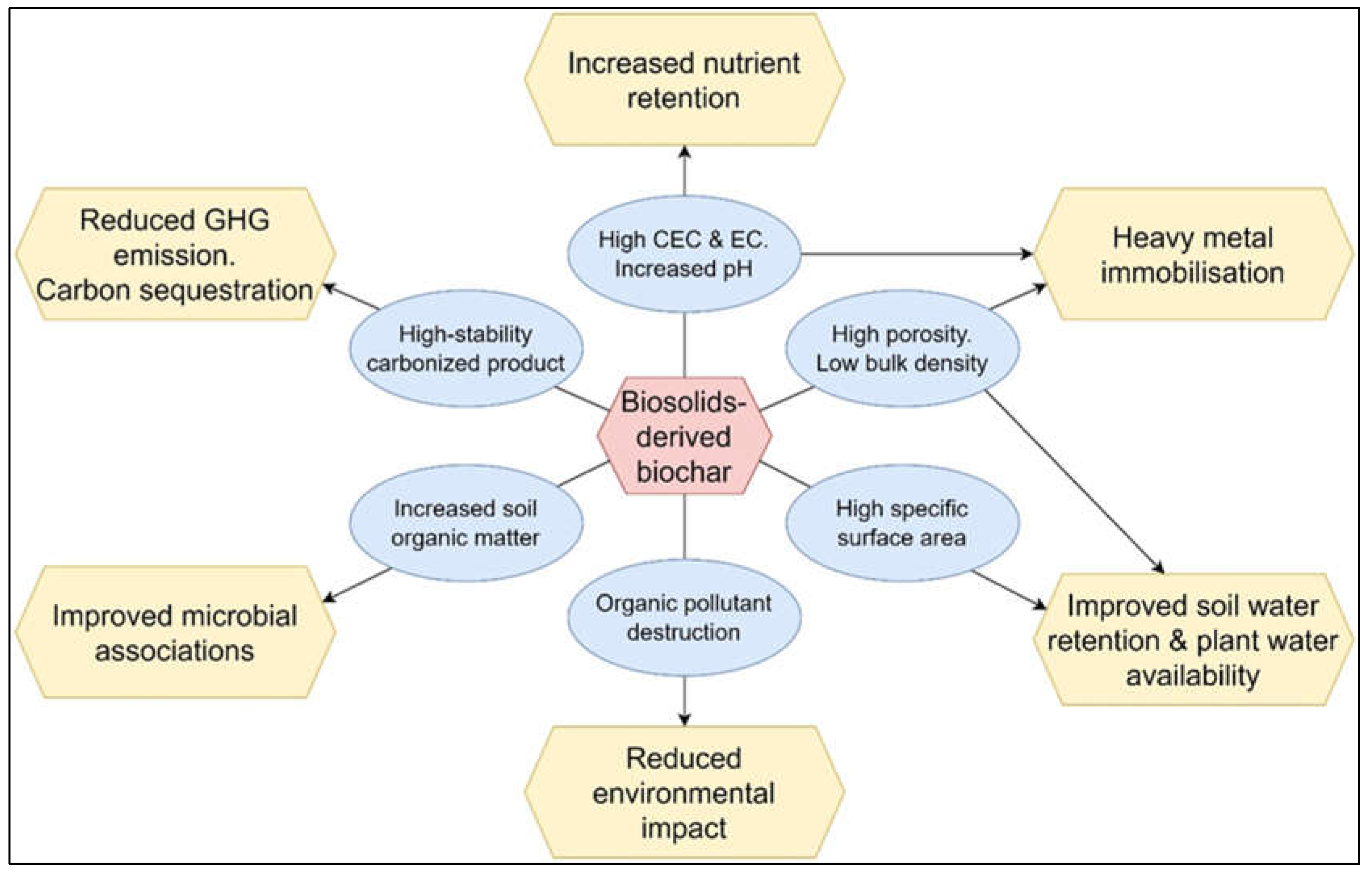
Figure 2.
Schematic representation of thermal treatment of biosolids to produce biochar. The blue dotted area illustrates the focus of the literature review.
Figure 2.
Schematic representation of thermal treatment of biosolids to produce biochar. The blue dotted area illustrates the focus of the literature review.
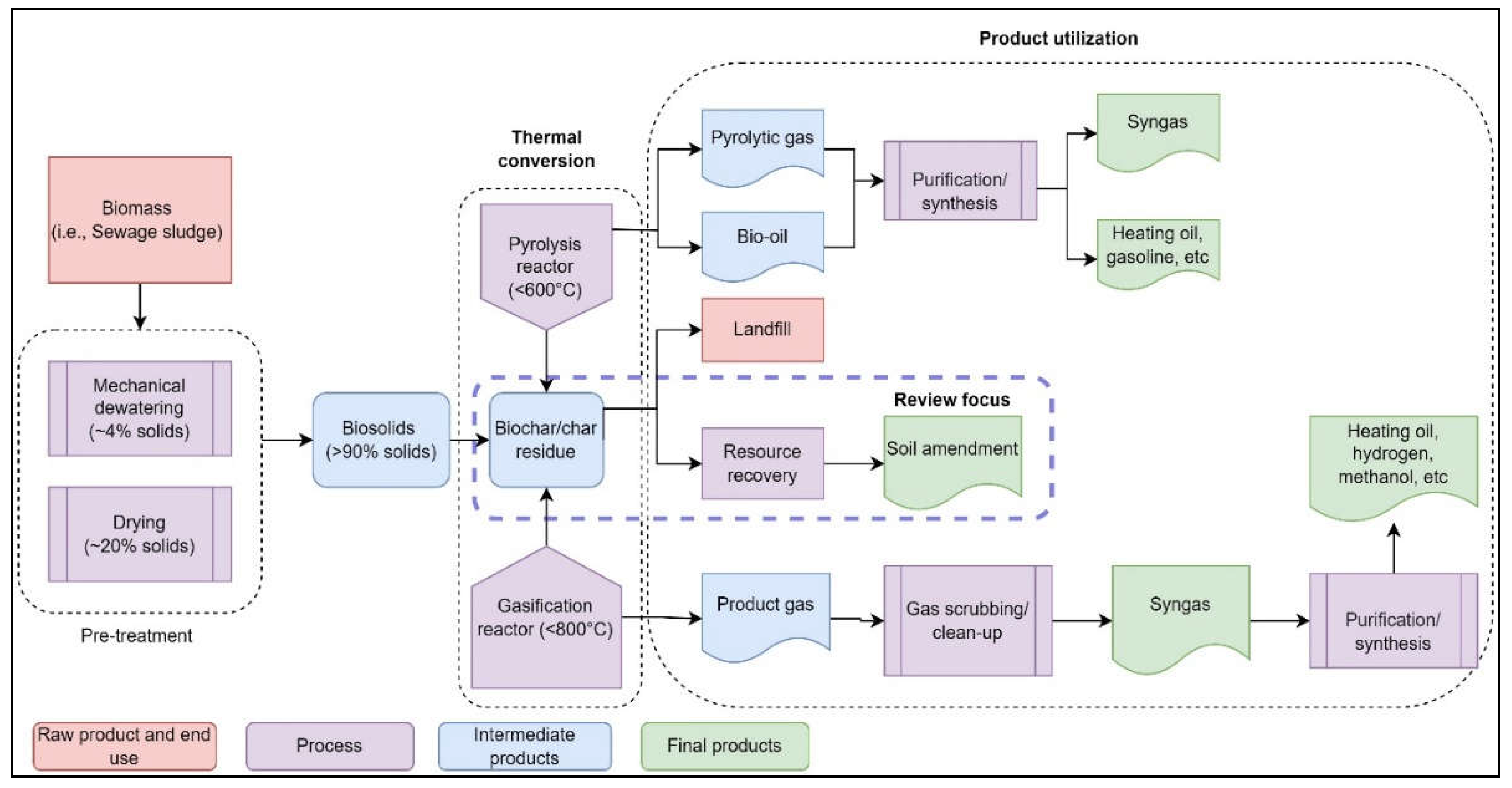
Figure 3.
Change in the BDB properties as a function of temperature.
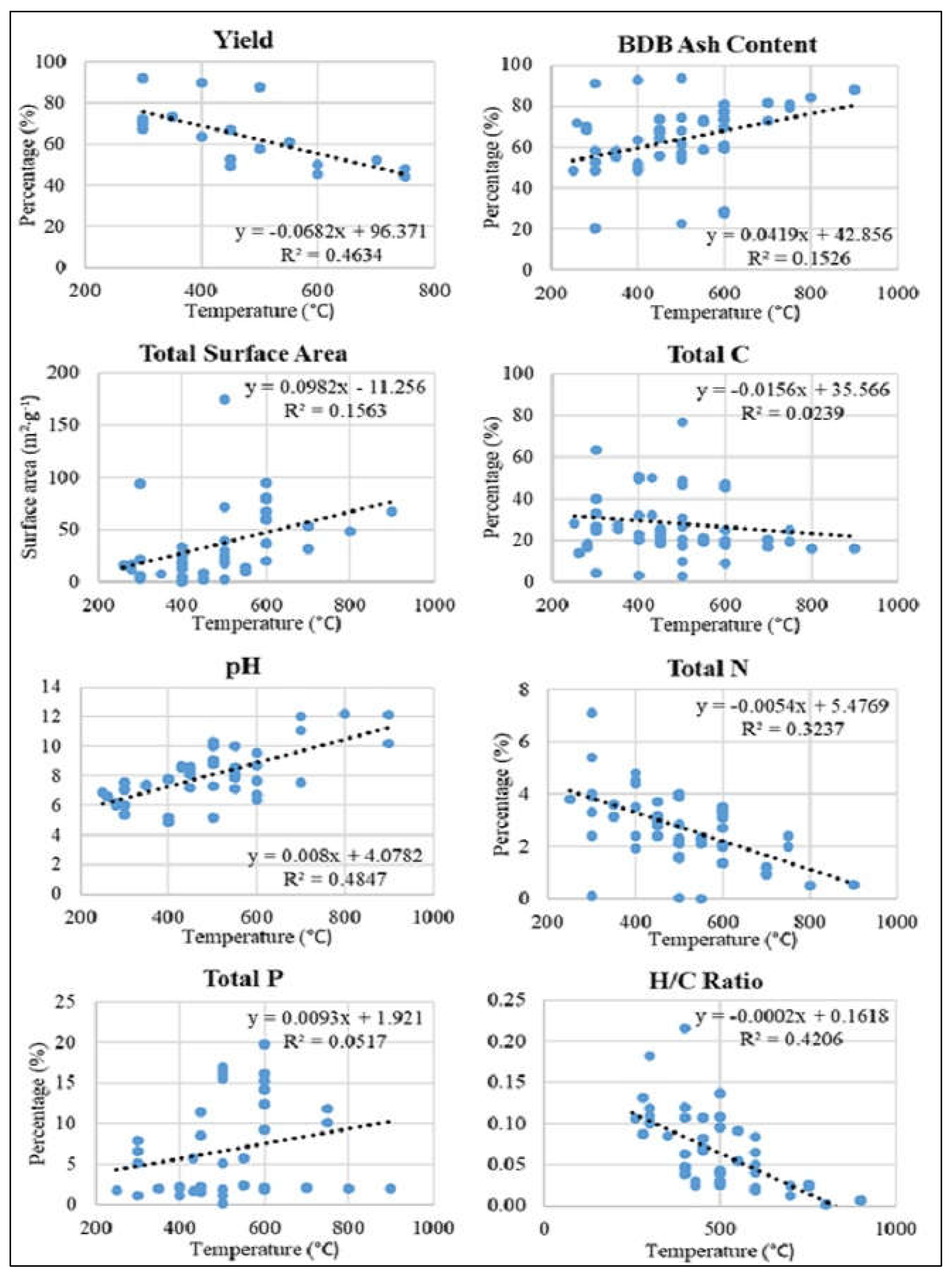
Figure 4.
SWOT analysis of biosolids-biochar conversation on the Australian market.
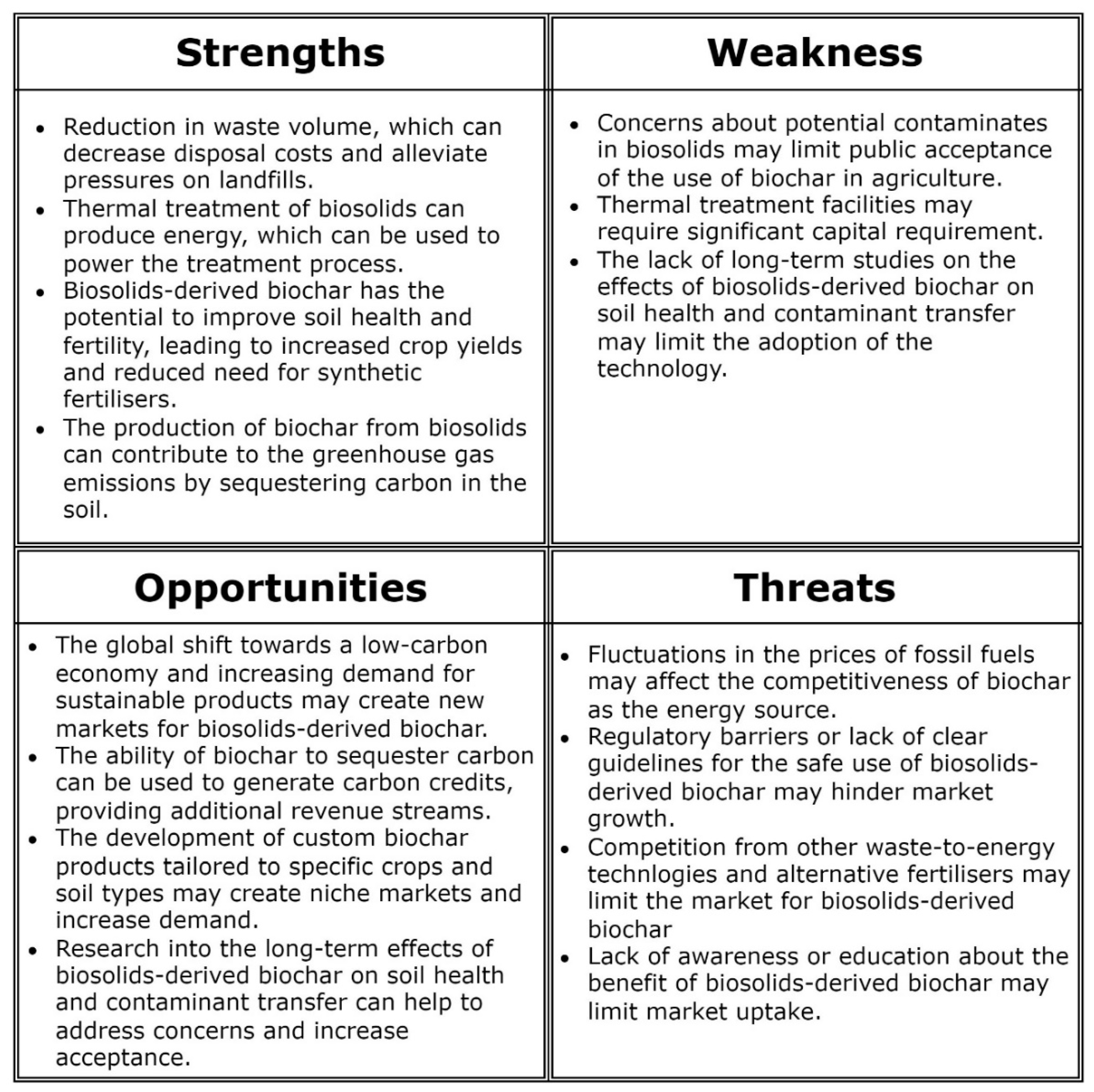

Table 1.
Chemical analysis of biochar derived from biosolids at different temperatures. Results reported as average and (standard deviation).
Table 1.
Chemical analysis of biochar derived from biosolids at different temperatures. Results reported as average and (standard deviation).
| Technology | Samplea, Temp°C | pH | Elemental Analysis (%) | Nutrient Composition (g·kg-1) | |||||||
|---|---|---|---|---|---|---|---|---|---|---|---|
| C | H | N | Ca | Fe | K | Mg | P | S | |||
| Pyrolysis1 | BS 25 | 5.1 | 25.6 | 4.1 | 3.0 | 26.5 (19.4) | 37.0 (22) | 4.1 (3.3) | 8.1 (9.9) | 28.5 (6.8) | 23.2 (24.8) |
| BDB 300 | 5.9 (0.6) | 23.1 (2.7) | 2.7 (0.8) | 3.0 (0.6) | 31.24 (24) | 44.01 (30.4) | 4.17 (3.2) | 10.18 (12.8) | 32.89 (8.2) | 23.23 (1.9) | |
| BDB 400 | 6 (1.3) | 19.9 (0.4) | 1 | 2.2 (0.3) | 42.13 (19.7) | 48.94 (35.5) | 6.52 (3.5) | 13.31 (13.4) | 32.83 (8.7) | 28.46 (26.5) | |
| BDB 500 | 7.1 (0.5) | 15.3 (5.1) | 0.9 (0.8) | 1.0 (0.8) | 40.41 (32.6) | 54.72 (41.6) | 5.12 (4.5) | 13.19 (17.4) | 41.83 (14.9) | 24.43 (29.94) | |
| BDB 550 | 7 | 18.6 (12.5) | 0.8 (0.2) | 2.5 (0.5) | - | - | - | - | - | - | |
| BDB 600 | 8.7 (0.7) | - | - | - | 24 | 41.7 | 13.3 | 7.86 | 45.1 | - | |
| BDB 700 | 9.6 (2.0) | 13.9 (5.6) |
- | 1.0 (0.3) | 48.96 (21.7) | 60.66 (43.3) | 12.35 (6.0) | 13.99 (12.7) | 40.92 (7.8) | 35.1 (37.7) | |
| BDB 900 | 11 | 5 | - | 0 | 71.82 | 33.37 | 9.83 | 29.06 | 40.65 | 9.69 | |
| Slow pyrolysis2 |
BS 25 | 7.1 | 25.6 | 4.5 | 4.5 | 42.4 (23.6) | 30.4 (28.0) | 5.1 (2.6) | 9.3 (5.9) | 38.7 (9.2) | 20.9 (10.7) |
| BDB 300 | 7.3 (0.2) | 27.5 (4.7) | 3.1 (0.3) | 4.5. (0.9) | 25.76 (28.7) | 7.10 (2.9) | 3.5 (2.6) | 12.40 (7.4) | 49.69 (21.6) | 7.92 (3.0) | |
| BDB 400 | 7.3 (0.2) | 22.2 (5.6) | 1.9 (0.2) | 3.6 (0.8) | 7.43 (5) | - | 2.17 (0.2) | 9.10 (4) | 42.03 (15.1) | 6.07 (0.6) | |
| BDB 450 | - | 22.5 (4.1) | 1.7 (0.1) | 3.4 (0.5) | - | - | - | - | - | - | |
| BDB 500 | 7.4 (0.3) | 22.2 (4.0) | 1.2 (0.6) | 2.8 (1.1) | 56.47 (48.5) | 63.8 (47.5) | 7.59 (5.2) | 13.56 (9) | 56.73 (19.8) | 19.73 (16.9) | |
| BDB 600 | 9.6 (1.6) | 22.2 (3.9) | 0.9 (0.3) | 2.6 (0.9) | 58.96 (42.5) | 48.8 (50.5) | 8.32 (4.9) | 17.85 (13.5) | 68.93 (2.9) | 15.6 (13.9) | |
| BDB 700 | 12.5 (0.4) | 22.5 (3.6) | 0.5 (0.1) | 2.3 (0.4) | 93.05 (24.5) | 51.93 (53.4) | 11.98 (2.9) | 20.42 (9.4) | 83.63 (24.7) | 24.08 (20) | |
| Fast pyrolsis3 |
BS | 43.40 | 6.99 | 5.66 | 27.1 | 8.5 | 5.9 | 6.0 | 23.9 | 10.1 | |
| BDB 400 | - |
29.9 | 1.1 (0.6) |
2.5 (1.4) |
- | - | - | - | - | - | |
| BDB 500 | 8.8 | 19.7 (3.14) |
1.1 (0.6) | 2.5 (1.4) | 73.2 (19.8) | 28.8 (3.2) | 13.2 (6.7) | 17.2 (3.6) | 46.6 (40.2) | - | |
| BDB 600 | 9.5 | 19.5 (1.6) |
0.6 (0.6) | 2.3 (1.3) | 62.71 | 33.60 | 8.40 | 15.45 | 18.76 | - | |
| BDB 700 | 11.1 | 16.9 | 0.2 | 1.0 | 64.37 | 35.32 | 9.30 | 16.36 | 20.35 | - | |
| BDB 800 | 12.2 | 16.2 | 0.0 | 0.5 | 65.83 | 35.76 | 9.20 | 16.57 | 19.35 | - | |
| BDB 900 | 12.2 | 15.9 | 0.1 | 0.5 | 69.56 | 37.20 | 8.60 | 17.52 | 20.23 | - | |
| Flash Pyrolysis4 |
BDB 350 | 7.7 | 20.5 | 2.4 | 8.2 | 17.07 | 0.4 | 13.52 | 9.88 | 24.12 | - |
| BDB 400 | - | 15.4 | 1.6 | 6.6 | - | - | - | - | - | - | |
| BDB 450 | - | 12 | 1.2 | 5.9 | - | - | - | - | - | - | |
| BDB 500 | - | 12.6 | 1.2 | 3.9 | - | - | - | - | - | - | |
| BDB 550 | - | 10.9 | 0.9 | 4 | - | - | - | - | - | - | |
| BDB 650 | - | 10.3 | 0.7 | 0.7 | - | - | - | - | - | - | |
| BDB 700 | 8.7 | 10 | 0.5 | ND | 5.35 | ND | 23.20 | 13.6 | 22.89 | - | |
| BS | - | - | - | - | 51 | 30 | 5 | 6 | 40 | 8 | |
| Two stage gasification5 | BDB 850 | - | 5.8 | - | 0.1 | 14 | 7.5 | 15 | 17.0 | 11.2 | 20 |
| LT-CFB5, b gasification5 | BDB 750 | - | 7.2 | - | 0.6 | 13 | 8.1 | 15 | 17.0 | 11 | 10 |
| Gasification6 | BS | - | - | - | - | 49.7 | 38.7 | 3 | 9.6 | 41.8 | 9.5 |
| BDB 700 | 12 | 22.3 | 0.77 | 1.9 | 11 | 8.8 | 7.6 | 24.5 | 10.2 | - | |
| BDB 900 | 12 | 2.9 | 0.18 | 0.25 | 14.5 | 11.9 | 10.9 | 35.1 | 14.2 | - | |
aBS – biosolids; BDB – biosolids-derived biochar; bLT-CFB - Low temperature circulating fluidized bed; ND – not detected. 1(Hossain et al., 2011 [55]; de Figueiredo et al., 2020 [71]; de Figueiredo et al., 2019a [72]; de Figueiredo et al., 2019b [73]; Yuan et al., 2015 [74]; Vaughn et al., 2018 [75]; Yang et al., 2018 [76] ) ; 2( Roberts et al., 2017 [77]; Lu et al., 2013 [78]; Zielińska & Oleszczuk, 2015[79]); 3(Chen et al., 2014 [80]; Barry et al., 2019 [81]; Zhou et al., 2018 [82]);4( Piskorz et al., 1986 [83]; Uchimiya et al., 2015 [84]); 5(Thomsen et al., 2017b [85]; Hernandez et al., 2011 [86]).
Table 2.
Heavy metals and organic pollutants in biosolids and biosolids-derived biochar and their allowable range according to guidelines.
Table 2.
Heavy metals and organic pollutants in biosolids and biosolids-derived biochar and their allowable range according to guidelines.
| Guidelines | Sample | Temp °C |
Total heavy metals (mg·kg-1 DBS.)b | Total PAHs μg·kg-1 d.b. |
Reference | |||||||
|---|---|---|---|---|---|---|---|---|---|---|---|---|
| As | Cd | Cr | Cu | Pb | Hg | Ni | Zn | |||||
| AWA-Biosolid | - | - | 20-30 | 1-20 | 100-600 | 100-2000 | 150-420 | 1-15 | 60-270 | 200-2500 | - | Natural Resource Management Ministerial Council, 2004 [12] |
| IBI -Biochar | Category A Category B |
- | 13 100 |
1.4 20 |
93 100 |
143 6,000 |
121 300 |
1 10 |
47 400 |
416 7400 |
6000 300000 |
International biochar initiative, 2015 [106] |
| EBC-Biochar | Premium Basic |
- | 13 13 |
1 1.5 |
80 90 |
100 100 |
120 150 |
1 1 |
30 50 |
400 400 |
4000 12000 |
Schmidt et al. (2013) [107] |
| Technology | ||||||||||||
| Pyrolysis | BS | N/A | - | 2.3-5.3 | - | 401-611 | 136-224 | - | - | 629-1238 | - | Lu et al. (2013) [19] |
| BDB | 300 | - | 3.3-7.5 | - | 480-043 | 190-350 | - | - | 849-1909 | |||
| BDB | 400 | - | 3.8-9.8 | - | 549-1198 | 194-438 | - | - | 912-2104 | |||
| BDB | 500 | - | 4.3-8.9 | - | 565-1267 | 212-506 | - | - | 1014-2305 | |||
| Pyrolysis | BS | N/A | - | 7.54 | - | 545 | 189 | - | 102 | 2398 | Méndez et al. (2013) [88] | |
| BDB | 400 | - | 9.67 | - | 632 | 239 | - | 129 | 2983 | - | ||
| BDB | 600 | - | 9.76 | - | 740 | 253 | - | 134 | 3922 | |||
| Gasification | BS BDB |
N/A 750 |
- - |
1.0-2.5 1.5-5.5 |
34-66 80-182 |
- - |
41 84-110 |
1.5 0.2 |
24 87-158 |
- - |
- | Thomsen et al. (2017b) [85] |
| Gasification | BS BDB BDB |
- 350 400 |
- | 0.93 1.5-1.6 1.5-1.7 |
80.8 218-227 228-247 |
580 851-900 886-922 |
78.27 114-121 120-125 |
402 597-623 612-637 |
- | Li et al. (2012) [108] | ||
| Gasification | BS BDB BDB |
- 700 900 |
- | 1 ND ND |
36 (7) 98 (1) 104 (2) |
529 (8) 1159 (8) 1346 (6) |
45 88(1) 51(1) |
2 ND ND |
66(2) 122(1) 165(4) |
423(10) 753 (5) 757 (4) |
- | Hernandez et al. (2011) [86] |
| Pyrolysis | BDB | 200 | 7.6-16.7 | 2-9.1 | 67.6-281 | 712-1000 | 28.4-60 | 65-635 | 1964-2940 | Waqas et al. (2015) [109] | ||
| Pyrolysis | BDS BDB BDB BDB BDB |
25 200 500 600 700 |
- | 1.0 1.1 1.4 1.1 0.7 |
173 180 233 239 247 |
143 149 193 198 202 |
51.1 54.7 67.9 69.1 74.2 |
42 41.1 55.1 56.1 55.2 |
698 735 887 976 986 |
3339 1644 70385 1241 179 |
Luo et al. (2014) [110] |
|
| Pyrolysis | BS BDB BDB |
25 300 500 |
- | 3.6 5.5 6.5 |
- | 487 733 841 |
167 260 506 |
- | - | 922 1417 1705 |
- | Lu et al. (2013) [78] |
| Pyrolysis | BS BDB |
- 550 |
2.6 12 |
1.7 2.7 |
- | 160 210 |
44 82 |
- | - | 1200 2080 |
3860 900 |
Waqas et al. (2014) [111] |
| Pyrolysis | BS BDB |
550 |
2.3 11.9 |
1.5 2.3 |
- | 171 237 |
53.8 71.9 |
- | - | 1105 1879 |
5780 1701 |
Waqas et al. (2015) [109] |
| Pyrolysis | BS BDB BDB |
Air 400 500 |
18 9.4 14 |
ND 3.2 3.2 |
20 60.7 61 |
165 357 334 |
42 83 92.6 |
23 77.1 68.4 |
703 1478 1704 |
- | Song et al. (2014) [60] | |
| Pyrolysis | BDB | 550 | 9.3 | 3.7 | 74.1 | 222 | 27 | 34.5 | 1102 | - | Khan et al. (2013a) [112] | |
| Pyrolysis | BS BDB |
- 500 |
- | - | - | - | - | - | - | - | 2950 4350 |
Khan et al. (2013b) [113] |
| Pyrolysis | BS BDB |
- 500 |
- | - | - | - | - | - | - | - | 8625-13333 612-766 |
Tomczyk et al. (2020b) [68] |
| Technology | Samplea |
Temp °C |
Available heavy metals (mg·kg-1 DBSb) | Reference | ||||||||
| As | Cd | Cr | Cu | Pb | Hg | Ni | Zn | |||||
| Pyrolysis | BS BDB BDB BDB BDB |
25 300 500 600 700 |
- | 7.80 0.45 2.30 5.90 10.5 |
9 11 9 8.5 8 |
700 45.5 205 295 365 |
309 48 27.5 67 115 |
- | 135 20.5 25 37 46.5 |
3565 280 385 635 970 |
Luo et al. (2014) [110] | |
| Pyrolysis | BS BDB BDB |
25 300 500 |
- | 1.8 ND ND |
- | 139 1.7 0.4 |
34.9 ND 6.5 |
- | - | 586.6 4.5 50.8 |
Lu et al. (2013) [78] | |
| Pyrolysis | BS BDB |
- 550 |
1.1 0.04 |
1.1 0.2 |
- | 37 3.4 |
8.2 2.5 |
- | - | 371 66 |
Waqas et al. (2014) [111] | |
| Pyrolysis | BS BDB |
- 550 |
1.07 0.05 |
1.03 0.17 |
- | 35.3 4.35 |
9.02 3.41 |
- | - | 387 56.7 |
Waqas et al. (2015) [109] | |
| Pyrolysis | SS BDB BDB |
Air 400 500 |
- 0.9 0.6 |
- ND ND |
- 0.2 ND |
- 0.3 0.2 |
- 0.5 0.6 |
- | - 0.3 ND |
- 7.9 1.8 |
Song et al. (2014) [60] | |
| Pyrolysis | BDB | 550 | 0.04 | 0.26 | 1.24 | 6.5 | 2.13 | 2.26 | 127 | Khan et al. (2013b) [113] | ||
| Gasification | BS BDB BDB |
- 350 400 |
- | 0.62 0.03-0.12 0.01-0.24 |
1.26 1-3.91 1.2-7.51 |
22.63 0.42-1.17 0.37-0.97 |
2.74 0.58-1.13 0.59-1.40 |
- | - | 112 7.67-17.19 9.05-12.25 |
Li et al. (2012) [108] | |
| Gasification | BS BDB BDB |
- 700 900 |
- | - | 8.89 0.06 0.04 |
16.3 0.49 2.08 |
- | - | 3.44 0.04 <0.01 |
- | Hernandez et al. (2011) [86] | |
aBS – biosolids; BDB – Biosolids- derived biochar; bDBS – dry biosolids; N/A- not applicable; ND – not detected.
Table 3.
Effect of biosolids-derived biochar on soil physicochemical characteristics, crop yield and heavy metal bioaccumulation. Thermal treatment process used to biochar from biosolids was pyrolysis.
Table 3.
Effect of biosolids-derived biochar on soil physicochemical characteristics, crop yield and heavy metal bioaccumulation. Thermal treatment process used to biochar from biosolids was pyrolysis.
| Temp °C |
Plant species | Soil fertility | Agronomic performance | Reference | |
|---|---|---|---|---|---|
| Crop yield | Heavy metals bioaccumulation | ||||
| 300 | Radish | Increased soil base saturation, CEC, available P, Ca, and Mg, except K. Soil pH was not affected. | Increased plant height, yields, and above-ground dry weight. | - | Sousa & Figueiredo (2016) [141] |
| 450 | Wheat | Increased soil CEC, K, and available P. | Increased plant height, biomass, and grain yield. | - | Rehman et al. (2018) [46] |
| 500 | Rice | Increased pH, EC, total N, C and available P and K. Availability of heavy metals in the soil was reduced. | Increased shoot biomass, grain yields, and above-ground dry weight. | Reduced bioaccumulation of As, Co, Cr, Cu, Ni and Pb in rice grains, stems, and leaves. | Khan et al. (2013a) [112] |
| 400-550 | Garlic | - | Increased average plant height, plant biomass (stem and leaves) and garlic yield when compared with control. | No heavy metal accumulation was found in stem and leaves. Although, higher Zn and Cu content was found in roots and bulbs compared to the control. |
Song et al. (2014) [60] |
| 550 | Coolatai grass | - | Increased grass yield was observed, specifically when biosolids-derived biochar was combined with chemical fertilizer. | - | Hossain et al. (2015a) [144] |
| 550 | Cherry tomatoes | - | Increased plant height and fruit yield. | Heavy metals concentrations in the fruits were lower in the biochar treatment than the biosolids treatment. | Hossain et al. (2015b) [145] |
| 550 | Cucumber | - | Increased plant biomass and fruit yields | Reduced bioaccumulation of As, Cu, Cd, Zn and Pb in the fruit when compared to the biosolids treatment. | Waqas et al. (2014) [111] |
| 200-700 | Turf grass | Increased soil organic carbon, total N, available P and K, decreased soil pH. | Increased above-ground dry matter and total N, P and K content. | Reduced bioaccumulation of heavy metals was observed in above-ground biomass |
Yue et al. (2017) [146] |
Table 4.
Heavy metal accumulation in plants. All treatments were applied as % w/w basis and are represented as mg·kg-1.
Table 4.
Heavy metal accumulation in plants. All treatments were applied as % w/w basis and are represented as mg·kg-1.
| Plants | Treatments | As | Cd | Cr | Cu | Ni | Pb | Zn | References |
|---|---|---|---|---|---|---|---|---|---|
| Rice grain | Control 5 % BDB 10% BDB |
0.45 0.19 0.17 |
0.4 0.32 0.28 |
ND ND ND |
20 17 16 |
ND ND ND |
0.95 0.6 0.5 |
54 44 41 |
Khan et al. (2014) [149] |
| Control | 0.35 | 0.26 | ND | 2.8 | ND | 0.5 | 85 | ||
| Tomato | 2% BDB | 0.17 | 2.6 | ND | 4 | ND | 0.25 | 20 | Hossain et al. (2010) [142] |
| 5% BDB | 0.16 | 2.5 | ND | 2 | ND | 0.2 | 12 | ||
| 10% BDB | 0.12 | 2 | ND | 1.2 | ND | 0.17 | 8 | ||
| Rice grain | Control 5% BDB 10% BDB |
0.14 0.05 0.04 |
0.02 0.12 0.13 |
0.3 0.21 0.17 |
4.8 4.7 4.6 |
0.68 0.55 0.49 |
0.35 0.1 0.05 |
8 26 28 |
Khan et al. (2013a) [112] |
| Turnip | 2% BDB | 0.12 | 0.11 | ND | 3.2 | ND | 0.22 | 48 | Khan et al. (2015) [150] |
| 5% BDB | 0.11 | 0.1 | ND | 1.9 | ND | 0.19 | 36 | ||
| Turf grass | Control | 0.14 | 0 | 0.19 | 0.25 | ND | 0.18 | 0.59 | Yue et al. (2017) [146] |
| 1% BDB | 0.08 | 0.02 | 0.08 | 0.12 | ND | 0.2 | 0.23 | ||
| 5% BDB | 0.03 | 0 | 0.04 | 0.1 | ND | 0.05 | 0.11 | ||
| 10% BDB | 0.07 | 0 | 0.06 | 0.14 | ND | 0.14 | 0.18 | ||
| 20% BDB | 0.06 | 0 | 0.05 | 0.1 | ND | 0.08 | 0.11 | ||
| 50% BDB | 0.05 | 0 | 0.04 | 0.1 | ND | 0.05 | 0.05 |
aBS – biosolids, BDB – Biosolids- derived biochar; ND – not detected.
Disclaimer/Publisher’s Note: The statements, opinions and data contained in all publications are solely those of the individual author(s) and contributor(s) and not of MDPI and/or the editor(s). MDPI and/or the editor(s) disclaim responsibility for any injury to people or property resulting from any ideas, methods, instructions or products referred to in the content. |
© 2023 by the authors. Licensee MDPI, Basel, Switzerland. This article is an open access article distributed under the terms and conditions of the Creative Commons Attribution (CC BY) license (http://creativecommons.org/licenses/by/4.0/).
Copyright: This open access article is published under a Creative Commons CC BY 4.0 license, which permit the free download, distribution, and reuse, provided that the author and preprint are cited in any reuse.


