

Submitted:
19 May 2023
Posted:
23 May 2023
You are already at the latest version
Abstract
The province of Jaén (Andalusia, Spain), despite being declared the European territory with the largest number of defensive constructions (castles, fortifications, etc.), has few conservation plans, with many remains included on the Red List of Spanish Heritage ly-ing abandoned. This poses a challenge for landscape conservation and the optimal use of the province’s tourism potential. In this paper we present the early implementation of an ongoing methodological approach designed to alleviate this situation. It takes advantage of data from the Sentinel 2A and 2B satellites, HBIM, RPAS, GIS and fieldwork that will be applied across five archaeological case studies. It has been tested for the first time in the village of Magaña. Three main objectives and phases of this methodological approach have been designed:
1. Preparation of an Environmental Risk Chart with which to answer such ques-tions as “How have climate change, anthropic alterations and environmental characteris-tics affected the state of conservation of certain heritage sites?”
2. Preparation of HBIM models to foster monitorisation and conservation policies for the main archaeological remains and improving their protection based on digital and technological tools.
3. Building a Smart Tourism App for mobile devices aimed at promoting smart tourism by digitalising and virtualising tourist itineraries and archaeological remains.
Finally, public administrations will be apprised of the need to implement a conservation policy for cultural assets and their surroundings in a simple, quick and cost-effective man-ner.
Keywords:
SAR
; Climate Change
; GIS
; Archaeological Chart
; Risk Assessment
; Digital Humanities.
; Magaña
1. Introduction
In this article we present a theoretical approach and a pilot case study designed to integrate the latest digital technologies applied to environmental protection and their dissemination aimed at providing twin protection for assets in the heritage and environmental spheres. Through the DIGITALESCAPE project, we will develop an innovative experimental proposal oriented towards a twin study path. Firstly, we will analyse how climate change, anthropic alterations and environmental characteristics have affected the state of conservation of certain historical-cultural heritage assets, the extent of their deterioration, and the measures to be taken to halt this. Secondly, we will look at how to highlight the value this heritage for tourism use and raise environmental awareness of it using digital tools. This proposal is directly linked to United Nations Sustainable Development Goal (SDG) 15. To achieve these objectives we will use the latest advances in digital and technological tools, such as remote sensing (SAR), HBIM, RPAS flights, GIS and the development and construction of a smart tourism app for mobile devices. We will take advantage of data provided by the European Space Agency (ESA) Copernicus mission, thanks to the constellation of Sentinel satellites (accessible free of charge), and the application of the ISO 28000 and ISO 31000 International Risk Management Standard.
Remote sensing applied to cultural heritage has proved to be a high-quality tool for conservation in numerous projects. These include the “Endangered Archaeology in the Middle East & North Africa (EAMENA)” project [1] based in the Universities of Oxford, Leicester and Durham, which uses satellite imagery to identify and record new archaeological sites and their landscapes. Other examples of the potential of the techniques that will be used here are the studies carried out at Angkor using LiDAR data [2]; those developed for the Italian CNR to detect looting from space [3]; the research carried out in Belize where LiDAR data was used for detecting settlements and modified landscapes [4,5]; and the work carried out by Fiz et al. using UAV aerial photogrammetry [6]. Data from the Copernicus mission have also been shown to be a powerful tool for the monitoring, protection and management of natural and cultural heritage [7].
Figure 1.
Study zone locations. Sierra Sur: 1. Castillo de Susana (Valdepeñas); 2. Castillo de Otiñar (Los Villares); 3. Castillo de Arenas (Campillo de Arenas); Sierra Morena; 4. Aldea de Buenos Aires (Aldeaquemada); 5. Aldea de Magaña (Santa Elena).
Figure 1.
Study zone locations. Sierra Sur: 1. Castillo de Susana (Valdepeñas); 2. Castillo de Otiñar (Los Villares); 3. Castillo de Arenas (Campillo de Arenas); Sierra Morena; 4. Aldea de Buenos Aires (Aldeaquemada); 5. Aldea de Magaña (Santa Elena).
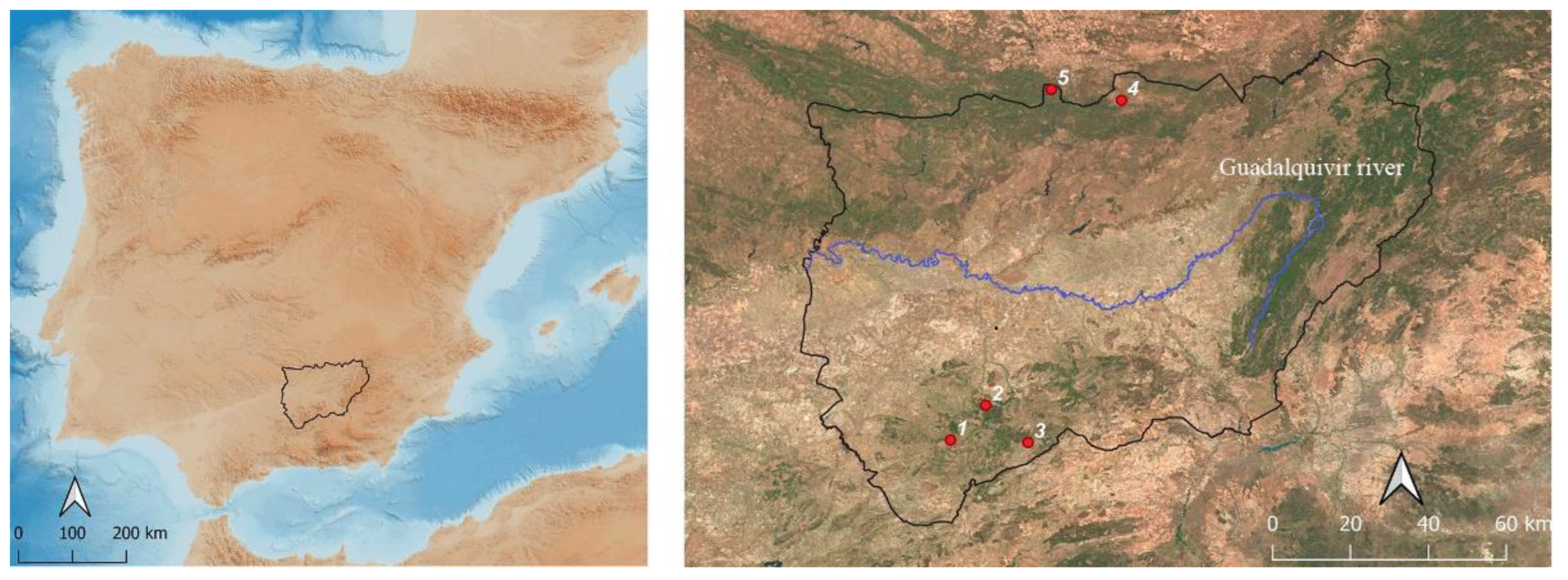
The area under study, to which the methodology contained in this project will be applied, is the province of Jaén in the northern part of the Andalusia region of southern Spain (Error! Reference source not found.). This province has been declared the territory with the greatest number of defensive constructions in Europe (castles, fortifications, towers, etc.), more than 400 of them, although there could be more. Currently, nineteen structures are included on the aforementioned Heritage Red List [8]. The list does not reflect all the structures that are in a ruinous state. Therefore, the number of these is greater, as many are at risk and there are few measures in place for their protection and conservation. Many are completely abandoned. Completing this bleak panorama, we have other civil elements associated with the history of the territory and its landscape that are in an advanced state of ruin (localities, villages, farmhouses, etc.) that have been included on the Spanish Heritage Red List [8]. This situation constitutes a challenge for the province’s landscape conservation and the optimisation of its tourism potential. We believe that to solve or alleviate this, it is necessary to address a series of proposals for change and transformation. In this respect, the symbiosis between archaeological remains, localities and environmental characteristics cannot be approached independently, but rather in combination. We will therefore apply a multidisciplinary methodology adapted to each case and the different scales of analysis, in order to deal with the issues raised. The proposed methodology, as we will see in detail below and in the proposed study case, includes an approach based on remote sensing combined with terrestrial archaeological surveys and other disciplines, such as geology, musicology, archiving and gender studies, to cover all the mentioned sections.
We decided to focus our research on five specific case studies that reflect the transformation of the territory through projects for the foundation of new populations, as well as previous experiences in remote sensing analysis of archaeological remains in the Sierra Morena mountains, such us the villages of Buenos Aires (in press) and Magaña. However, they are based on two different historical realities: the border area in medieval and modern times in the Sierra Sur mountains and the New Populations in an area that was depopulated in the second half of the 18th century. From the Sierra Sur we chose the sites of Castillo de Susana, Castillo de Otiñar and Castillo de Arenas, while from the Sierra Morena we selected the cases of villages in the New Populations, such as Buenos Aires and Magaña (Error! Reference source not found.1).
To understand the reasons behind the foundation of new populations in each area, we must first take a brief, historical approach. Our story dates back to the hinge decades of two centuries, between the years 1489 and 1539, during the reigns of the Catholic Monarchs, Juana I of Castile, Fernando the Catholic and Emperor Carlos V. The aim of the Catholic Monarchs in 1489 was to found population centres along the communication route between the Christian territories and the last Muslim redoubt, the town of Granada. These territories are known as the Entredichos (Interdictions), a reference to the fact that they occupied territory between “dicho (said) kingdom of Jaén” and “dicho (said) kingdom of Granada”.
These populations were to be spread between the Castle of Otiñar and the Eliche River. It may have been the rapid conquest of the town of Granada in 1492 that led to the abandonment of the project, although there was a later, also unsuccessful, attempt to revive it in 1494. Queen Juana I of Castile echoed these proposals and signed a royal decree on 17 March 1508, in which she expressed her support by setting the number of foundations and possible locations in the Sierra Sur de Jaén. It consisted of a series of castles, towers, farmhouses, isolated houses, villages, localities, towns and villages that reached its peak with the foundation of the towns of Valdepeñas de Jaén, Los Villares de Jaén, Mancha Real and Campillo de Arenas in the surroundings of the abandoned and ruined castles of Susana, Otiñar and Arenas.
Castillo de Susana (Valdepeñas de Jaén)
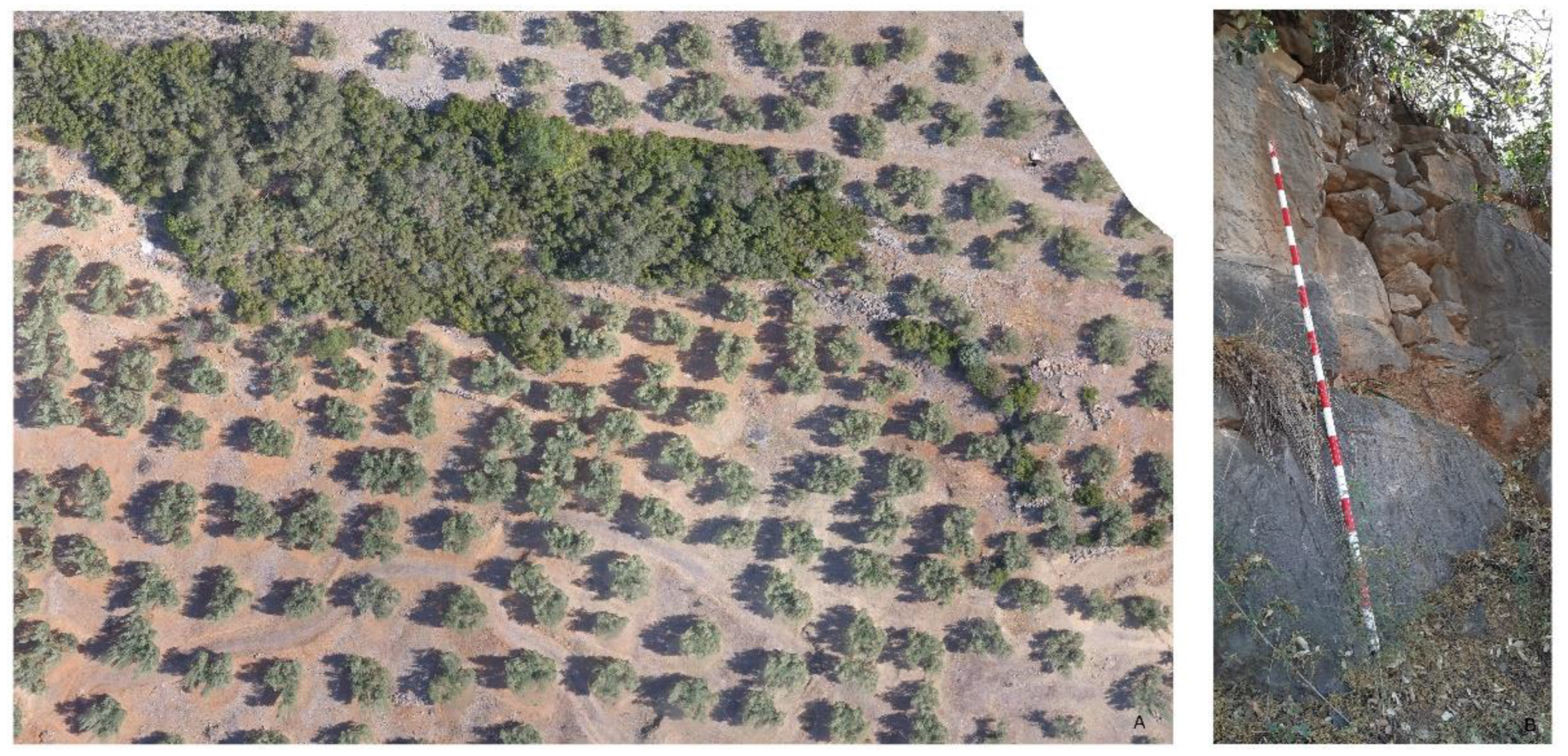
In the area of Castellón, Cerro de Castellón, near the Susana River, we find Susana Castle, which was conquered by Fernando III the Saint and donated to the Order of Calatrava. According to Jimena Jurado, Susana Castle was conquered by the master of the Order of Calatrava in 1238. It may also have had a Muslim population, judging by the pottery remains and a necropolis. It was declared an Asset of Cultural Interest on 29 June 1985 ().
Figure 2.
Actual condition of Susana Castle. Source: the authors.
Castillo de Otiñar (Los Villares de Jaén)
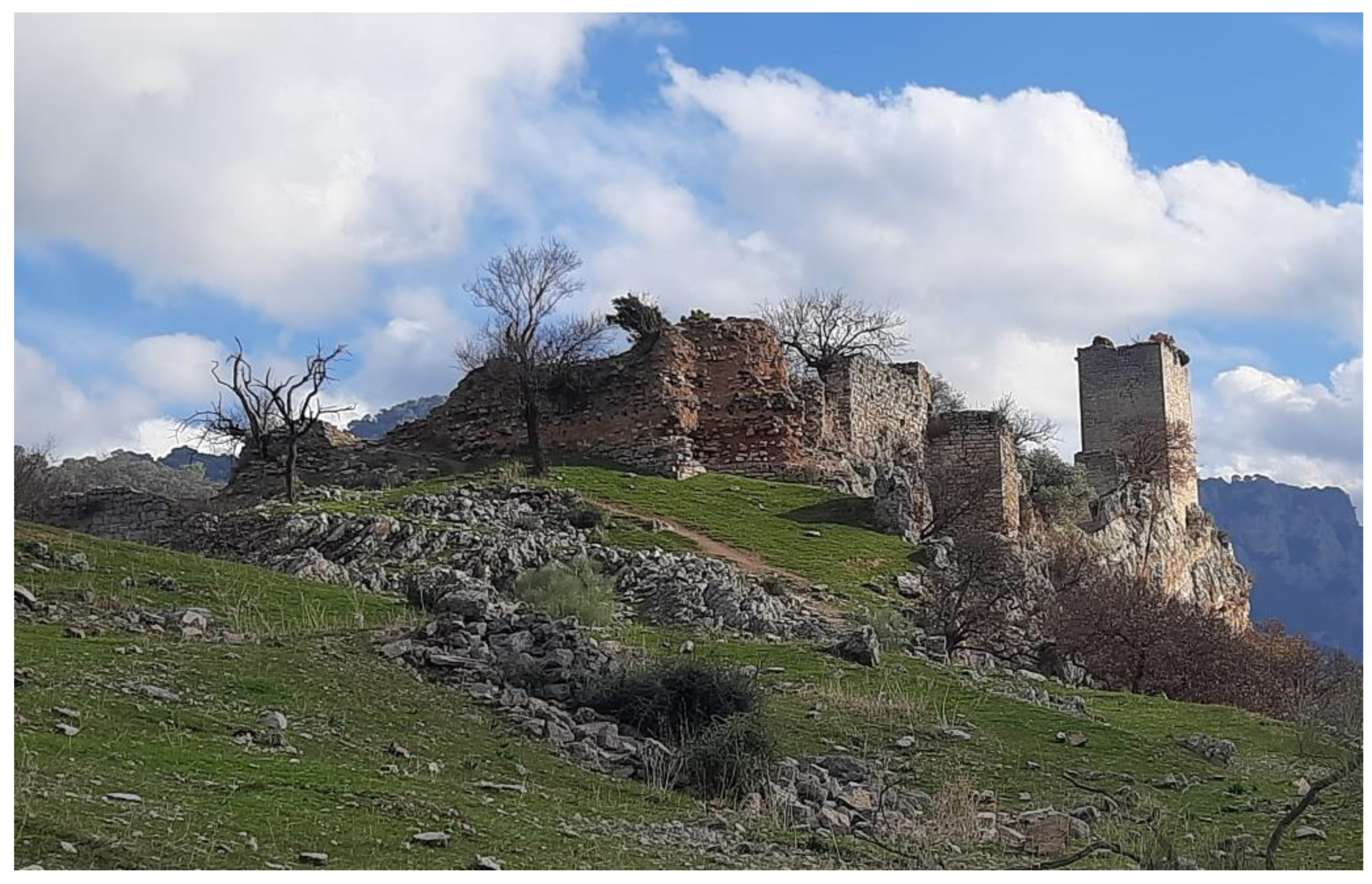
In 1228 Fernando III laid waste to the Otiñar area, the site of a fortification of Muslim origin and the town of Otiñar Viejo. Subsequently, in 1246, he built a castle on its ruins. The geostrategic position was especially notable for its proximity to the Nasrid lands. During the 14th century, a population in the form of a village was founded next to the castle, with a mayor’s office and a church. In the Ordinances of 1464, the mayor of Otíñar was assigned 8,000 maravedís a year. From 1492 it lost its geostrategic potential and little by little it was abandoned. In 1505 Otíñar was described as a town surrounded by a good lime and pebble wall with a fortress. It is currently in ruins. It has a main tower, defensive towers, a cistern and some rooms with ogival vaults. The village or town of Otiñar in the vicinity of the castle is difficult to locate. Juana I of Castile’s repopulation project in 1508 affected Otiñar, where it was planned to establish a population. The project, as we will see, did not become a reality until the time of Emperor Carlos V. The site was protected under the generic declaration of the Decree of 22 April 1949 and declared Spanish Historical Heritage under Act 16/1985 (Error! Reference source not found.).
Figure 3.
Castillo de Otiñar. Source: the authors.
Castillo de Arenas (Campillo de Arenas)
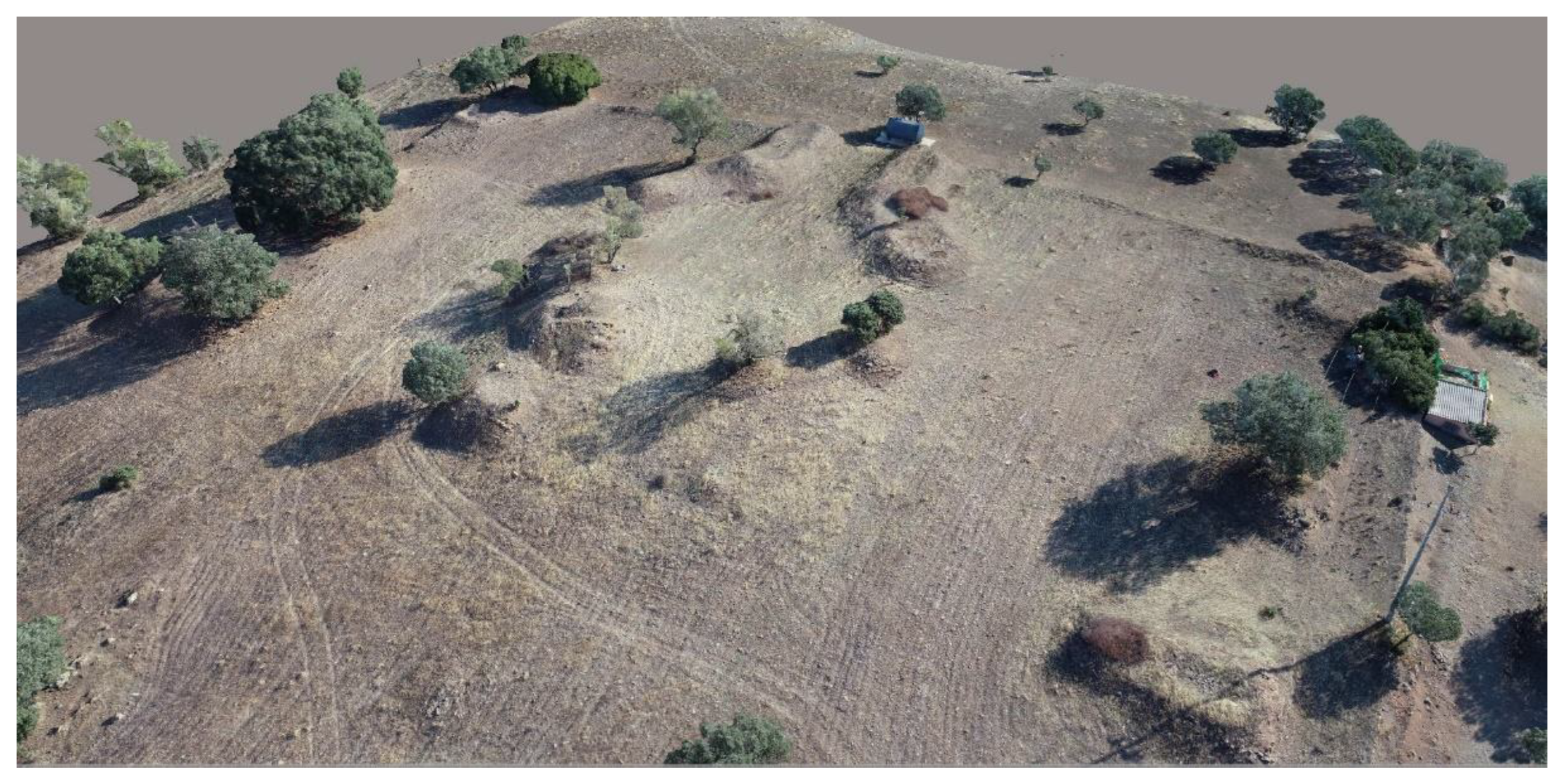
Located on the hill known as Cerro del Castillo de Puerta Arenas in the Sierra de Alta Coloma, it has remains from a first phase (9th–11th centuries), perhaps of Almohad origin. The second construction phases date from the 14th–15th centuries and comprise up to three enclosures with towers, walls, gates, a moat, cisterns, a chapel, etc. It was in an excellent geostrategic position on the road between Jaén and Granada. The flags that flew over the castle alternated between those of the Christian kings and the kings of Granada, until it was definitively conquered in 1486 by Fernando the Catholic. During the reign of the Catholic Monarchs, there were already plans to repopulate the area. Juana I of Castile proposed the foundation in 1508 of a town in Campillo, which was finally established in the time of Carlos V and called Campillo de Arenas. It is categorised as an Asset of Cultural Interest and was declared Spanish Historical Heritage on 22 June 1993 ().
Figure 4.
3D image of the present-day condition of Arenas Castle. Source: the authors.

Regarding the other study area, the Sierra Morena mountains, the founding of the New Populations in Sierra Morena and Andalusia during the 18th century was the reformist project par excellence. It pursued two objectives: agricultural and manufacturing development and control and dominance of the territory.
The cartography generated as a result of the decision to found the New Populations is currently being reviewed. New hypotheses are being put forward, such as the fact that some maps and plans were used by various hands and at different times, with extremely valuable layers of geo-historical information being added gradually. These have remained hidden until now due to the lack of legends or notes attached to the document [2].
Aldea de Buenos Aires in La Feligresía de Aldeaquemada
The history of Aldeaquemada (Jaén) began in 1767. It was founded by order of King Carlos III as one of the new towns in Sierra Morena and Andalusia. Its legal status was that of a feligresía or parish and it consisted of the central town, Aldeaquemada, and three neighbouring villages, Aldea de la Cruz, Aldea de Buenos Aires (also called Aldehuela), and La Tamujosa, all within its jurisdictional boundaries.
The main hypothesis is that the abandonment of Aldea de Buenos Aires came about basically due to the attraction of nearby Aldeaquemada, although the studied documentation cites other reasons, such as the poor construction quality and torrential rains that destroyed many buildings. The first information about the collapse of houses due to the poor quality of the building materials was also received from 1784, with new collapses confirmed in 1786 and 1788, when controlled demolitions of damaged structures were carried out. Finally, from 1789, the decision was taken to gradually abandon the village and relocate its inhabitants in Aldeaquemada, although some families resisted leaving.
Figure 5.
3D model of the current state of Aldea de Buenos Aires. Source: the authors.
Its building materials were reused in Aldeaquemada and today only remnants covered with vegetation remain (Error! Reference source not found.). The frailty of the constructions referred to in the documentary sources clashes with the remains that can still be seen today: the structures have wide, solid walls in which the corners still give an idea of their previous splendour.
The deterioration of the buildings was presumably due more to a combination of weak roofs, inclement weather and poor materials than to problems in the wall structures. Its high location affords impressive views of Aldeaquemada and the surrounding mountains.
Aldea de Magaña in the Feligresía de Santa Elena.
The feligresía or parish of Santa Elena was made up of part of the districts of Vilches, Baños (both in Jaén) and El Viso del Marqués (La Mancha). Next to the forgotten Los Palacios inn was the chapel of Santa Elena or Vera Cruz, dedicated to the victory of Alfonso VIII in the Battle of Las Navas in Tolosa in 1212. These two buildings served as a starting point for the village and the orientation of its streets. Santa Elena was located on the old Muradal road, on a branch that led to Vilches, and was separated from the Puerto del Rey royal road, where two new population points were founded in 1768: Miranda del Rey and Magaña, both taking old inns as a reference. Finally, the construction of the new section of the Despeñaperros pass on the same Muradal road between 1779 and 1783 led to the progressive depopulation of both villages as their inhabitants moved to Santa Elena, on the route of the new royal road designed by the military engineer Carlos Lemaur.
Figure 6.
3D image of the present-day condition of Aldea de Magaña. Source: the authors.
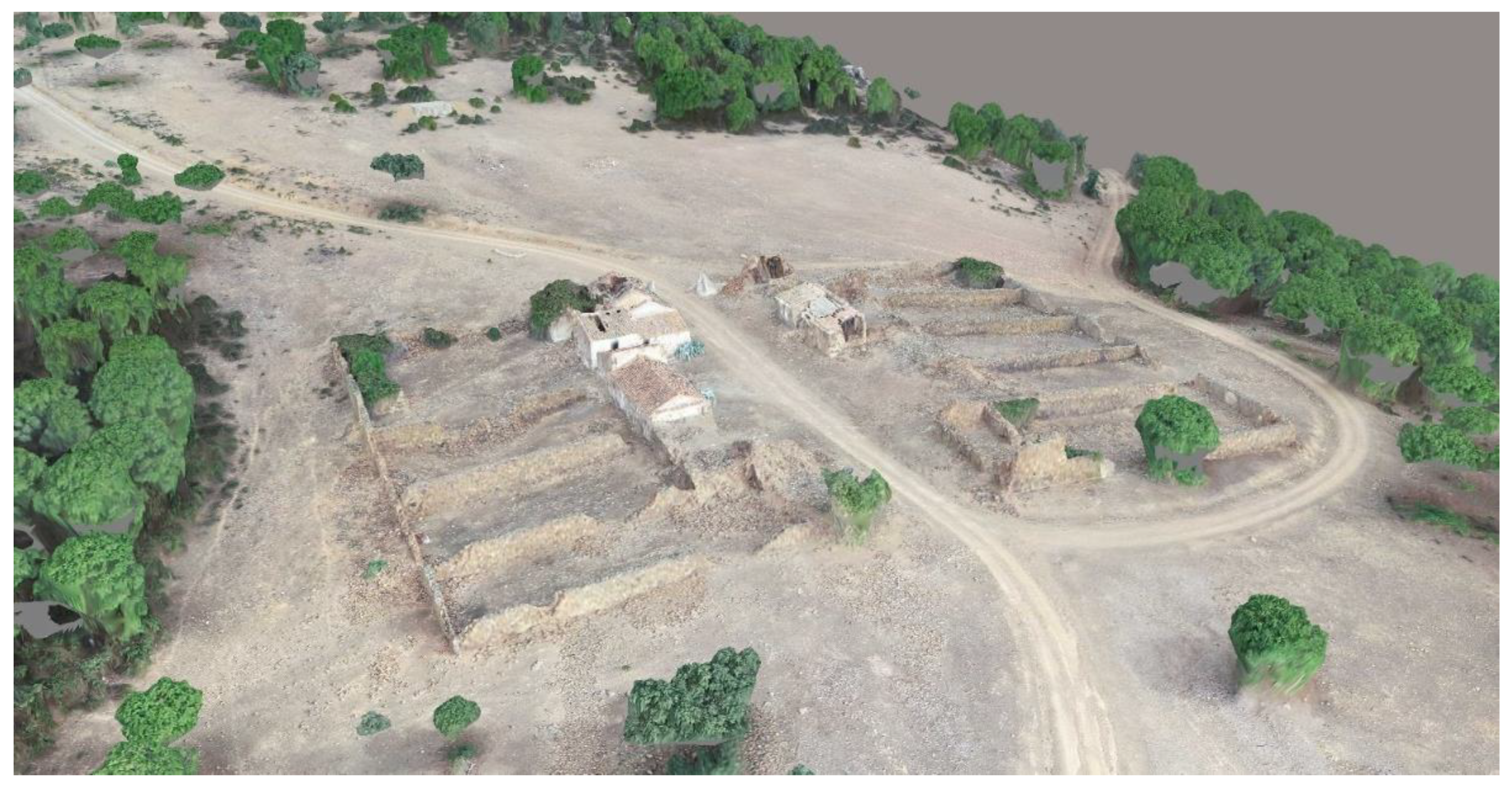
The parish was finally constituted with the addition of the village of Magaña (Error! Reference source not found.). This situation continued until 1782, when the status of the parish was once again reduced to that of a village, becoming once again, together with Magaña, part of Santa Elena. The main reasons would have been the construction of the new royal road and the increasing depopulation. The loss of colonists from Magaña was progressive, although it was never completely abandoned.
At the end of the 18th century, the parish was made up of Santa Elena and three villages: Miranda del Rey, Magaña and Venta Nueva. Magaña resisted with a small group of inhabitants, who remained in the area until the 1960s, after which it was completely abandoned. Today it lies in ruins (Error! Reference source not found.).
The case studies referred to here are located in non-urban country areas. Some are classified as natural parks, landscapes of interest, protected areas, etc. They are difficult to access, both for vehicles (of any type) and people. As can be seen in Figure 2 to 6, the chosen sites are in medium and/or high states of ruin or abandonment. There are no musealised and interpretive spaces, information panels, restored or consolidated architectural elements, risk prevention measures for visitors, etc.
Thus, among the objectives of this proposal is the creation of an archaeological and environmental map that reflects the current state of the heritage assets. It will also contain the factors that have caused their deterioration, and a series of measures proposed, on the one hand, to prevent further deterioration and, on the other, to improve their protection. The purpose of this environmental charter is ambitious, since its intention is to detect the negative environmental effects on these places and their surroundings in order to propose solutions, such as native reforestation, runoff channelling, etc. It also aims to promote smart tourism by digitalising the ruins and the surroundings of the buildings, as well as to establish virtual tourist itineraries. At the same time, together with the definition of the effects on the heritage assets, we aim to lessen the impact of visitors and invite them to participate in the environmental questions that affect both the assets and their surroundings.
2. Materials and Methods
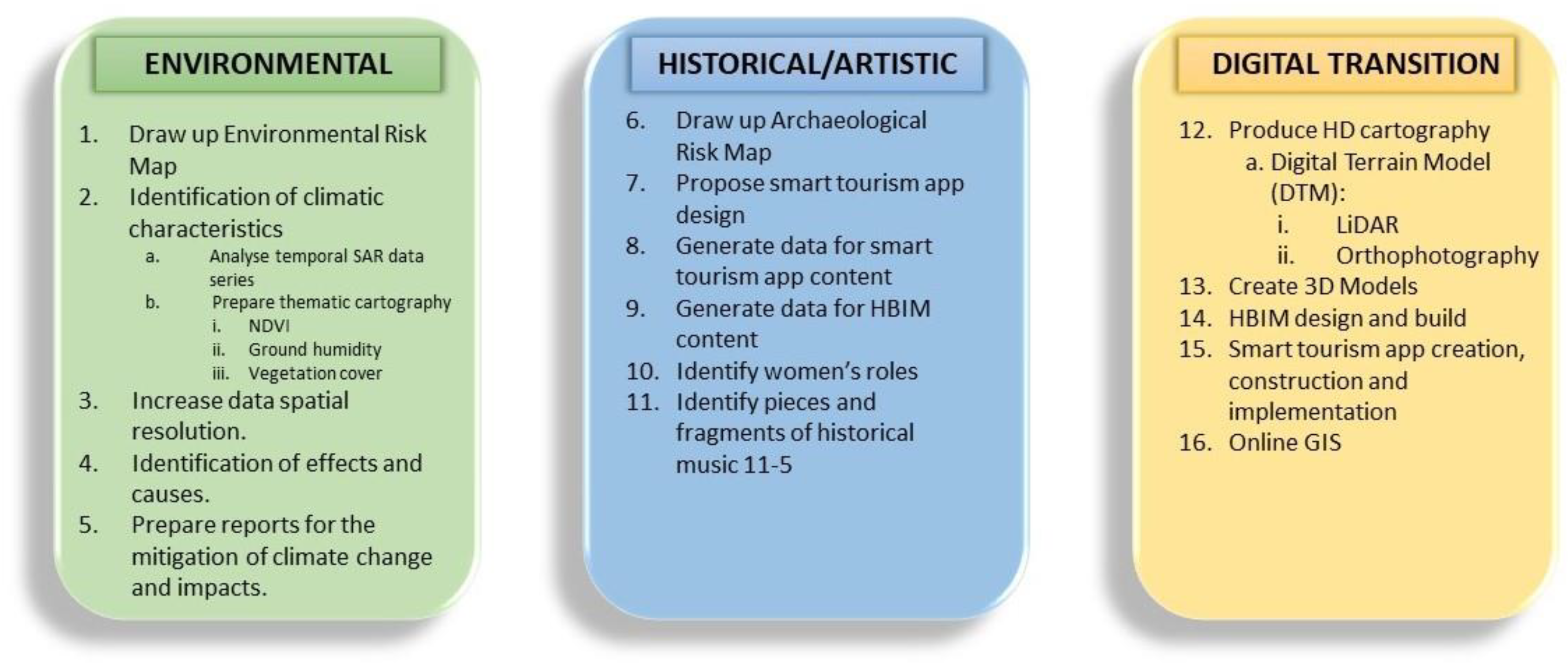
Given the multidisciplinary nature of the project, in order to achieve the aforementioned objectives, we consider it necessary place them in groups, depending on the thematic area to which they are addressed. Therefore, we have classified them in three main groups of objectives: Environmental, Historical-Archaeological and Digital Transition (Error! Reference source not found.).
Figure 7.
Scheme of the proposed objectives.
2.1. Environmental objectives
2.1.1. Preparation of an Environmental Risk Map
The aim of this objective will be to clearly identify the damage caused to the aforementioned cultural heritage sites and their surrounding landscapes. To achieve this objective we propose the subsequent sub-objectives:
- Characterisation of the geological characteristics and recent and current natural dynamics of the environment, as well as of the aforementioned cultural heritage sites by analysing freely available Spanish geological charts [9], soil sample analyses and their enhancement by presenting geological and landscape information with a view to their exploitation for tourism.
- Definition and application of objective indicators for assessing the state of conservation of the natural environment, evidence of deterioration, foreseeable impacts due to the enhancement of the natural space, and present geological risks, both for the elements it is aimed to highlight and for the people who visit the sites. To carry out this objective it is essential to consider the principles provided for in the European Commission’s nature and biodiversity laws [10]. This will allow clear identification of how the natural environment is being affected by climate change and human activity and consequently the effects on cultural heritage.
2.1.2. Identify the climate characteristics
- Analysing SAR time series data between the 1980s and the present day will allow us to understand the climate dynamics of the area as well as to identify changes in landscape. This objective is clearly related to Subobjective 2.1.1.a. Thanks to their combined interpretation we may be able to reach a correlation between geology and climate characteristics, clearly identifying the effects of climate change.
- Considering the aforementioned objectives, we will prepare a thematic cartography reflecting all the aspects related to climate change that affect the environment and cultural heritage in the area. This thematic cartography will be fundamental for clearly understanding the environmental dynamics and disseminating them.
2.2. History and archaeological objectives
We have to bear in mind that this is a holistic project in which we are analysing how climate change affects cultural heritage. We also need to provide information on historical context. Therefore, considering the guidelines, we have designed two sub-objectives focusing on the conservation of the archaeological remains and their dissemination.
- To build and develop a smart tourism app with data relating to history and how environmental and climate change affects cultural heritage and informs users about how people can mitigate these effects to facilitate the dissemination of the results obtained and raise awareness about how human activity and climate change can affect the environment and consequently the cultural heritage.
- To generate data to provide content for the HBIM that will allow a conservation plan to be drawn up, the state of the cultural heritage to be monitored over time, and the virtual dissemination of the remains.
2.3. Digital transition objectives
Lastly, during the design of this project we have taken into account the adaptation of the methodology to the new ideas that are more efficient and adapt better to our needs. Therefore we have planned our next objectives along these lines.
- To produce HD cartography using latest remote sensing data. The sources that will be used are:
a. Previously prepared digital terrain models (DTM) available from IGN [11]
b. LiDAR data. This kind of data allow us to obtain information about areas where the vegetation cover is high, allowing a high-resolution digital elevation model of the ground to be created and the type of vegetation and its status to be analysed. This will also allow us to combine information about the health of the vegetation with that obtained from satellite imagery data.
c. Drone orthophotography that provides high-quality documentation of archaeological remains and their surroundings. This will provide a basis on which visual analysis can be carried out in the laboratory, thus reducing although not eliminating the field work needed to evaluate the conservation status.
- 2.
- Designing and building of 3D models and use of HBIM. This objective is directly related to 2.2.b.
- 3.
- Online GIS. The dissemination of this project is fundamental. Therefore we have also set an objective to disseminate the project results among a specialised audience. In this case, the user more interested in a specific aspect will be able to see the data in an online viewer such as Potree [12] that will allow more in-depth research to be undertaken.
3. Methodology
The methodology we propose has been designed taking into account its optimisation for the achievement of the objectives in their three aspects. It is, therefore, a truly multidisciplinary and complex project (Figure 8).
Phase 1. Data capture
This phase is oriented towards obtaining all the publicly available data that will be used during the project. They range from environmental objectives (climatological, geological, etc.) to geographical, historical and archaeological objectives (conservation, restoration, orthophotography, historical cartography, LiDAR and SAR data, printed and handwritten documentary sources, travel literature, historical geographic descriptions, archaeological finds, etc.; and even digital information). They are all available from various archives, libraries, digitised collections, repositories, national and international institutional websites, etc.
To facilitate their reuse, as well as access to the compiled documentation, as far as possible we will use free software, such as QGIS. This is a GIS. whose power and expandability through plugins adapted to each need will allow us to process the vast majority of the data expected to be compiled in this project [13,14], such as LiDAR [15], SAR data [16], MDE analysis [17], etc. In some cases, for the creation of 3D models for example, it will be necessary to use proprietary software, such as Bentley Context Capture or Autodesk REVIT.
Phase 2. Data analysis
For the analysis of the data obtained in Phase I, applied history and quantitative and qualitative history methodologies and digital humanities tools [3-5] will be used to explain how to apply historical knowledge to digital tools. Specifically, and in the case of the study of the areas surrounding the castles of Campillo, Otiñar and Susana and their respective new Renaissance towns (Campillo de Arenas, Los Villares and Valdepeñas), the available medieval documentary collections will be studied, as well as the 16th-century land distribution books, notarial protocols, etc. For the case studies of the villages of Buenos Aires and Magaña, we will basically analyse the 16th-century libros de repartimiento (land distribution records) of the governor Ondeano (from 1780) and the cartographic series from Ampudia and Valdés (1792-1797).
In addition, these data will be combined with other data sources that will allow us to obtain a clear understanding not only of the phenology, but also of the communities’ relationship with their immediate surroundings.
For the analysis of the five proposed archaeological sites we will use both existing historical cartography and orthophotography, which will facilitate the characterisation of the sites to be studied. With the LiDAR data provided by the IGN download centre [11], we will generate digital terrain models (DTM). Although their spatial resolution is relatively low (0.5 points/m2), when analysed with the correct algorithms and software, such as SAILORE [18] or RVT [19] respectively, based on GIS, they can provide us with valuable information regarding the original plans of certain archaeological remains that, due to their state of conservation and the identification of new aspects in the spatial distribution, have previously gone unnoticed. This type of data is especially useful in areas covered by vegetation [19,20,21,22].
SAR data will also be used to monitor the Sustainable Development Goals (SDG). In our specific case, this is Number 15, Life of Terrestrial Ecosystems, recognised in Article 76 of the 2030 Agenda for Sustainable Development approved by the United Nations General Assembly in 2015. In the analysis we will use the data provided by the European Commission’s Copernicus space programme, the objective of which is the surveillance of our planet through earth observation and monitoring, including geographic information on land cover, land use and temporal changes from the 1970s to the present day [23]. Specifically, for the study and understanding of the climate dynamics over time in the areas under study, we will use the indicators and indices on the control and prediction of climate change that can be consulted in the Climate Change Service [23], data from the CORINE Land Cover (CLC) project on large-scale land occupation, and, on a national level, we will use the data contained in SIOSE, PNOA and LiDAR and reference geographic information, such as IGR Hydrography and IGR Populations, which are part of the local component of the Copernicus programme. All of these are free to access.
The usefulness of this type of data for the discovery and exploration of archaeological sites has been demonstrated since the 1980s in studies carried out in both tropical and subtropical environments [24], as well as in arid areas [25], or more recently in the Chinese city of Luoyang [26]. On the other hand, its use for the study of climate change presents some advantages, since this type of SAR image analysis applied to the study of the alterations produced by humans in their immediate environment is becoming a basic technology to combine in different types of interventions related to cultural heritage [27]. In some cases, such studies have revealed hitherto hidden characteristics in palaeo-landscapes by registering differences in the refractance produced by archaeological remains in ground covered by vegetation [28].
Thanks to the use of geomatics and data collected with drone flights, topographic surveys in areas of special interest and the preparation of GIS –both of the current landscape and applied to the historical cartography– will be georeferenced. Thanks to their use, a georeferenced thematic cartography will be drawn up including both existing and new data that will allow us to respond to the questions that arise during the project. These include the historical evolution of the landscape in the areas under study and the effects caused by human beings, etc. This will allow us to understand the climatic behaviour of the studied areas, as well as to advance our knowledge of the structure of some of them.
Phase 3. Field work
Once data have been processed and the thematic cartography generated and analysed, several fieldworks campaigns will be undertaken in selected areas to go a step further in our study. This phase is crucial for testing the hypothesis generated in Phases 1 and 2. For this purpose we have designed an interdisciplinary approach in which UAVs play a very important role.
There are numerous cases in which the drone has proven to be a highly effective tool both for obtaining aerial orthophotography and creating 3D models of heritage elements [29]. Thanks to their versatility, various types of sensors can be mounted to facilitate data collection, increase spatial resolution, and reduce time and cost. This in turn, indirectly reduces pollution.
A drone flight has been planned for each of the five case studies and we have organised them into two blocks: orthophotography and 3D models.
We will use the data obtained from the five scheduled flights to make the 3D models [5,14,28,30] (Figure 6, 7) of each study area. The purpose will be to establish a three-dimensional base that will allow us to use the BIM methodology, identifying both the construction aspects and the effects of inclement weather/climate [31,32,33,34] that need to be dealt with. We will also work on the creation of a future smart tourism app for mobile devices, for which it will be essential to create a specific cartography. To this end, high-resolution orthophotography of the areas under study has been planned. This will allow the analysis of details of the environment that would otherwise be lost, as well as a detailed study of the conditions documented in the asset. Thanks to this high-resolution model, actions can be planned to alleviate the deterioration, as well to analyse its evolution over time.
Complementing the SAR data analysis from the Sentinel satellites and using UAV we have designed a very high resolution multispectral flight. The maximum spatial resolution that can be freely accessed with the Copernicus mission data is 10 m/pixels in the Red, Green and Blue bands. This is very useful for understanding the environmental dynamics of the cultural asset’s surroundings, but is insufficient for the study of an area as precise as those proposed. By using a multispectral camera that will allow the analysis of the same range of the electromagnetic spectrum (Red, Green, Blue, NIR, etc.) that will be mounted on a drone, the precision of the data obtained will be increased exponentially, achieving a resolution of at least 8 cm/pix, allowing the identification of any anomaly in the electromagnetic spectrum related to both the climate and the presence of archaeological remains. This methodology is similar to that used in precision agriculture to study the health status of crops, the presence of plant diseases, etc.
Finally, taking into account the aforementioned dataset, a geophysical survey will be carried out and divided into three phases:
- Data phases.
- Laboratory and field work: analysis of the available geological information (geological maps, reports, scientific publications).
- Field work (geological cartography, lithological characterisation of natural geological dynamics); geological risk analysis (erosion, landslides, floods, earthquakes); analysis of anthropogenic impacts on the geological environment (runoff modification, waste contamination, changes in topography due to land use, etc.); definition and application of indicators; geodiversity; geological heritage; risks; present and expected impacts of the proposed intervention; and the preparation of material for the dissemination of geological information for tourist use, including maps, graphs, texts, panels, etc. Integration of the material in digital applications.
Once the data have been collected and analysed we will be able to set the guidelines to follow in future actions in the fields of restoration and conservation. We intend to draw up a protocol for each case study that will serve as a base document for future action proposals and master plans. In order to systematise data collection, with the aim of increasing reproducibility and unifying criteria, a table of alterations will be prepared, in which the various forms of deterioration affecting the case studies will be examined. These include biodeterioration caused by animal, vegetable or microorganism factors; chemical or contaminant damage; anthropogenic deterioration or vandalism; and deterioration caused by environmental actions or natural disasters. For their correct identification, it is important to take samples and perform laboratory analyses of the various factors causing biodeterioration. For this purpose, a taxonomic classification will be made using visual observation techniques through a stereoscopic binocular loupe, an optical microscope, a scanning electron microscope, and a transmission electron microscope.
Phase 4. Final Cartography. Inclusion and accessibility in the tourism app
In this phase we will generate a final digital thematic cartography that will reflect each of the aforementioned aspects and create a powerful predictive GIS-based tool that could be used to implement improved conservation policies. Is in this field where HBIM plays an important role as this methodology is based on the creation or construction of a central 3D model () or a shared and collaborative database [35], in which the agents/stakeholders involved in the project can create and easily access the information, recreating virtualised spaces and historical environments, reducing the number of exchanges between them and avoiding losses or duplicates. When this methodology is applied to historic buildings it is known as HBIM. The ultimate purpose is to create a graphic model from data faithful to the Heesom historical reality [36] and, in our case, also climatic, since it will be fed by data obtained through the use of the GIS referred to above. This methodology allows us to make virtual recreations of the historical and environmental space and environs. In turn, it will allow us, on the one hand, to delve more deeply into the historical-artistic and conservation details of the asset and, on the other, it will allow the visitor to enjoy the history virtually and the internal background of the asset, offering a temporal [36] and climatic approach to it. Thanks to its use, administrations will be provided with a plan with action proposals both to halt further deterioration and to facilitate the conservation of the assets under study [34].
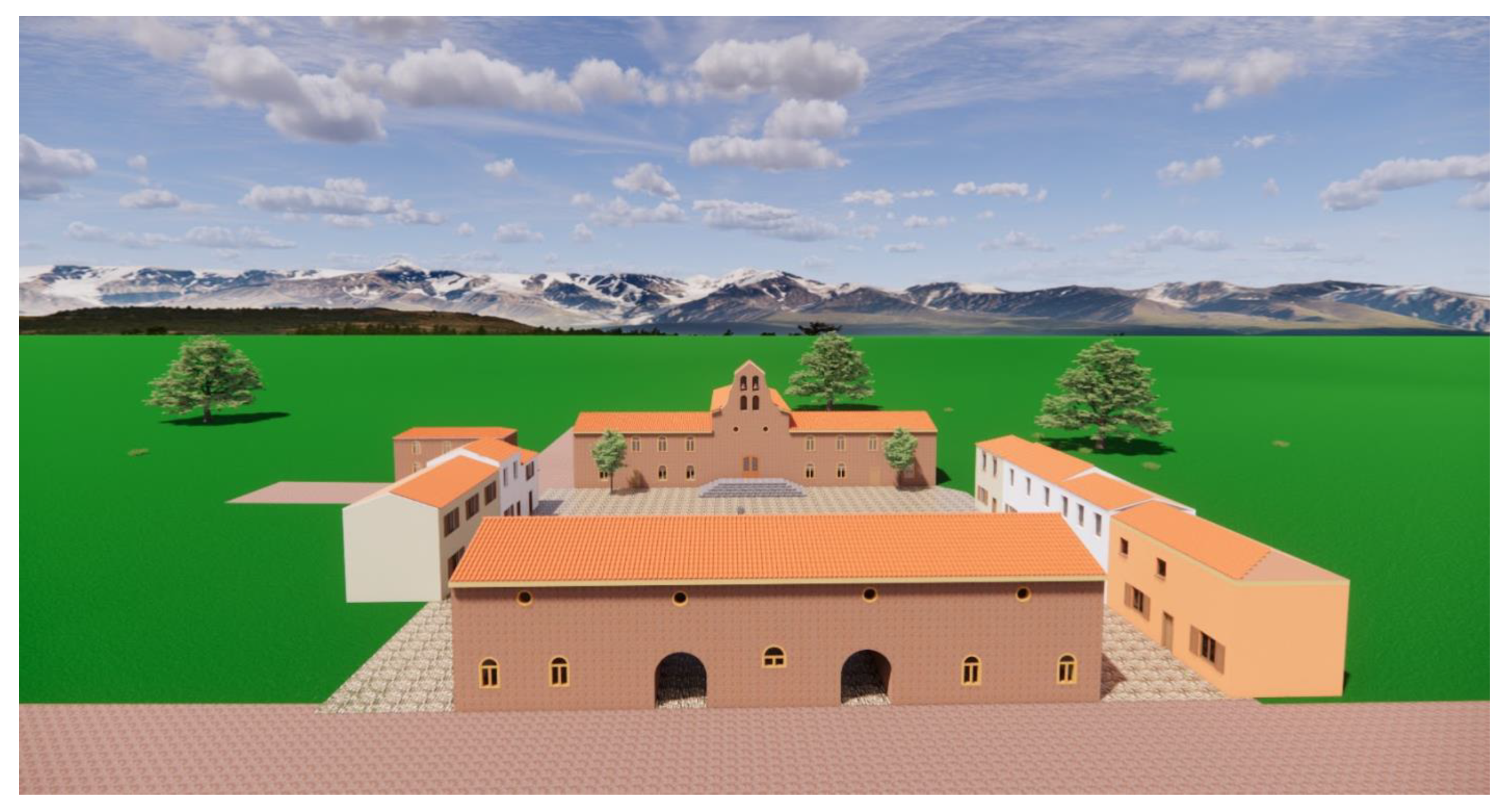
Based on the previous experience in modelling the feligresia of Aldquemada in which Magaña hamlet is included (), we are optimising the modelling process of the HBIM to include environmental factor. To achieve this we have designed three mains phases:
- Compilation of historic and climatic information extracted from historical and self-made archives.
- HBIM modelling. Prior to the final 3D model we will combine historical imagery, drone photography, multispectral data, topography, etc. in online HBIM software, such us bimserver.center (https://bimserver.center/es/), in this case with architectural, cartographic and conservation data. Thanks to the digital format of each of the aforementioned data sources they can be easily imported into HBIM software. Also, in this phase we will organise the data, if possible in chronological periods and from each source that will allow the interoperability of each of the stakeholders involved in the project development.
- Once the data are included we will be able to generate a 3D model enhanced with historic, climatic and conservation information. We will also be able to generate specific finds libraries for each of the areas to facilitate links with models in other territories and case studies.
We consider the words of Llorenç Prat [37] regarding the concept of cultural heritage as“…understood as everything that is socially considered worthy of conservation regardless of its utilitarian interest. Of course, this concept also covers what is commonly known as natural heritage, to the extent that it deals with culturally selected natural elements and ensembles”. And with the aim of disseminating and creating awareness of how climate and landscape changes affect cultural heritage conservation, the HBIM 3D model will be exported and included in the anticipated smart tourism app (details under embargo for future development), including historic data and the main important deterioration factors, as well as some advice on how to mitigate them.
Cultural heritage can also be defined from a humanistic and relational perspective, assuming that it is people who bestow value on goods. This brings us closer to the concept of diversity, understood as a wide range of people, each with their own characteristics. This could be due to their ways of thinking, acting, feeling, proceeding, being [38] or physical or psychological limitations. In short, diversity is conceived of as a continuum in which we are all included. Therefore, as we have seen, accessibility needs are diverse and vary throughout life. We all benefit from measures aimed at accessibility and inclusion that seek improved physical, cognitive and sensory access. Therefore we will develop measures for cognitive and sensory accessibility, gender inclusion and effective accessibility [39,40], the UNE 153101:2018 EX Standard, and the Accessibility Observatory [41].
4. Study case: Magaña hamlet
Due to the heterogeneous landscape and varying states of preservation among the proposed archaeological sites, the methodology mentioned above will be adapted to optimise responses to specific questions, including those related to history, climate and tourism. This means that not all techniques will be applied to all the case studies. Taking this into account, and in order to initially test the proposed workflow, we conducted a pilot study in Magaña, a hamlet inhabited until 1954. It is currently in ruins but, as can be observed in Error! Reference source not found., it is relatively well preserved. It is located at one of the most important crossroads in the Parque Natural de Despeñaperros and, in spite of its deterioration, the urban plan and internal structure of the houses can be easily observed. This factor is a keystone in this study, as it allows us to establish a model on which to base future comparisons. Moreover, thanks to the historical aerial orthophotography, especially American Flight Series B, we can document the original condition of the houses, as well as how the landscape has been altered by the reforestation that unquestionably has affected both their state of conservation and the surrounding environment. These factors make Magaña one of the more suitable villages in the Sierra Morena and Sierra Sur mountains on which to test our proposed methodology, as well as allowing us to test all the different
proposed approaches.
As mentioned above, the surrounding landscape and environment have been modified since 1954 due to a decree issued by the Ministry of Agriculture, which declared the public utility, necessity, and urgency of occupying a significant portion of the farms in the northernmost area of the region for reforestation purposes [42]
Considering the unique characteristics and historical evolution of Magaña, we aimed to test the proposed methodological approach by adapting the different techniques outlined in Section 3, as can be seen in Table 1.
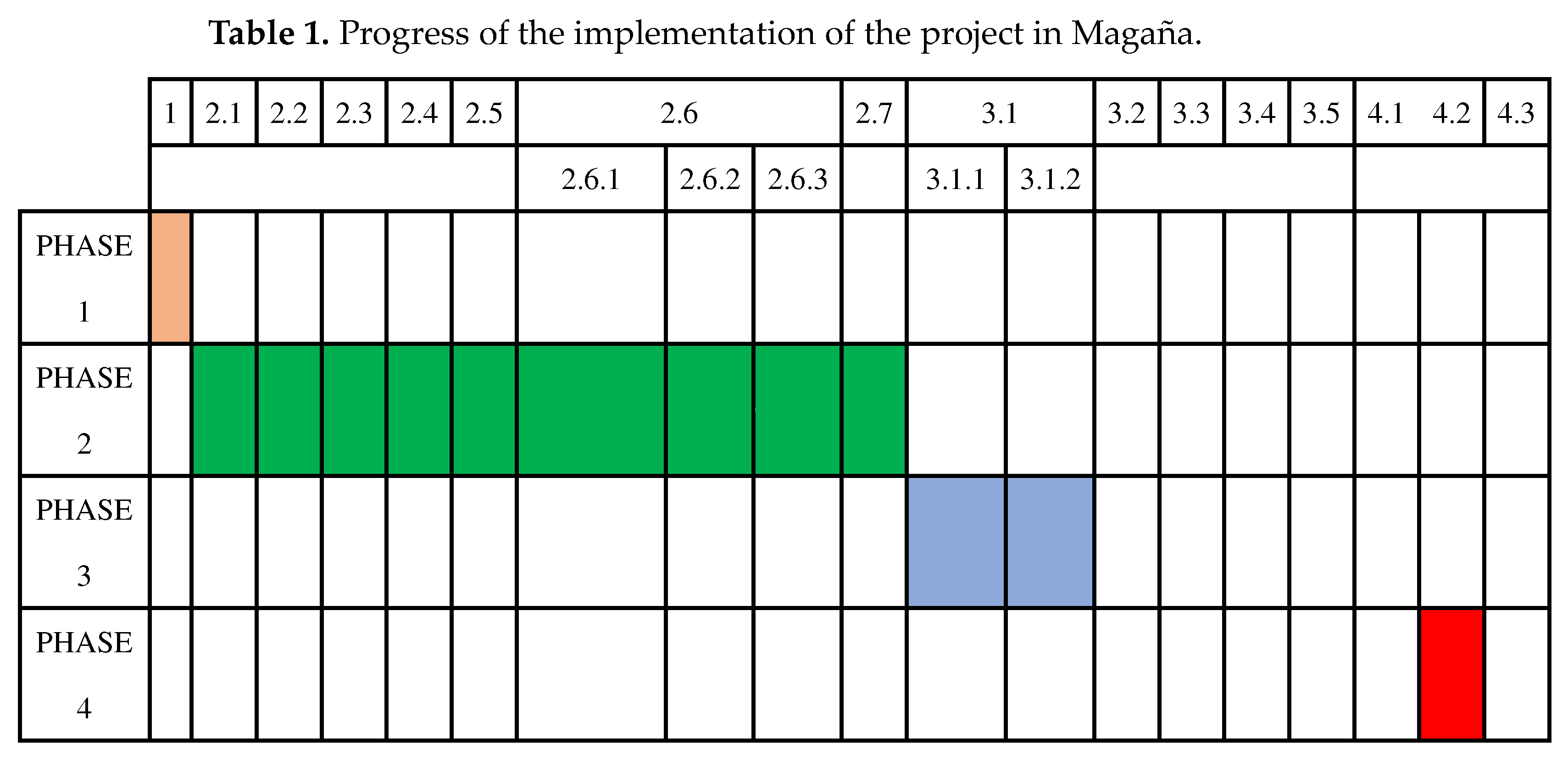
Please, note that the methodological approach presented in this paper is theoretical and, due to the large number of specialists involved in the project, we decided to initially test the basic procedure. In future stages we will continue to complement the information provided by the rest of the team by combining the obtained data in the planned app, which is currently under embargo.
4.1. Analysis of written texts
This is a fundamental approach, especially considering the aim of the project. The historical evolution of an area reflected in written texts normally does not reflect environmental aspects. The aim of this analysis has been to establish its history in order to understand the relationship with its surrounding landscape, particularly considering the lack of remotely sensed data for the periods prior to the 20th century and the historical evolution on a wider scale, such as the in historical period. Thanks to this approach, we can focus on the most suitable aspects for our purpose, such as the reasons for establishing the hamlet and any references to economic exploitation, among others. A very brief summary of the results of this analysis can be found in the previous pages.
4.2. Corine Land Cover Analysis
The information provided by this analysis was not as useful as expected in this case.
Figure 10.
Land cover evolution. A. Land cover of the study area and its surroundings. B. Land cover changes from 2000-2006. C. Land cover changes from 2006-2012. D. Land cover changes from 2012-2018. The red square marks the study area. Source: Copernicus Land Cover Service.
Figure 10.
Land cover evolution. A. Land cover of the study area and its surroundings. B. Land cover changes from 2000-2006. C. Land cover changes from 2006-2012. D. Land cover changes from 2012-2018. The red square marks the study area. Source: Copernicus Land Cover Service.
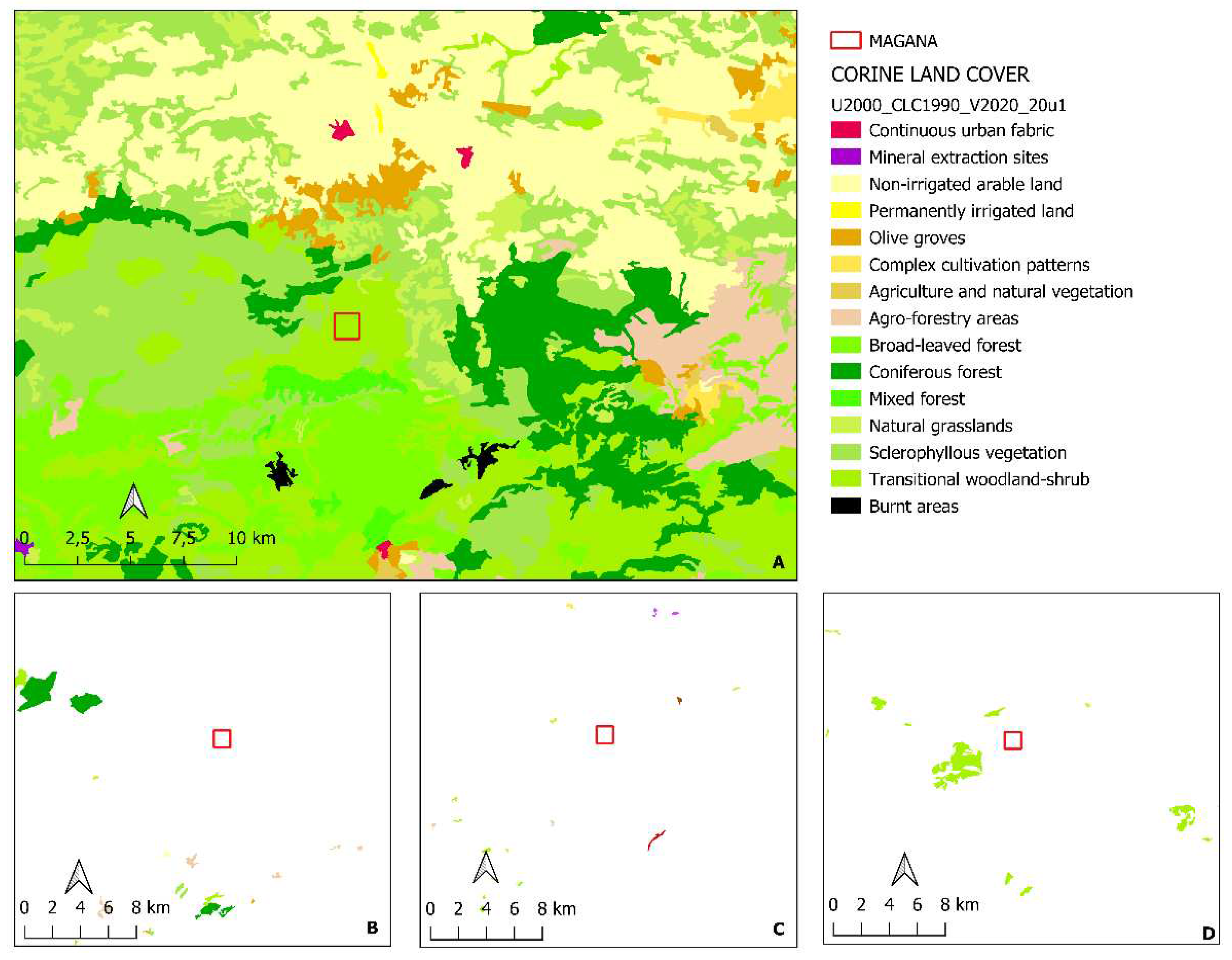
As can be seen in Error! Reference source not found.0, there have been no changes in the land cover within the study area, confirming the reforestation process carried out in 1954 in the Despeñaperros Natural Park. Since this process was undertaken by humans with a clear objective and within a natural park, no significant variation was expected. However, the data provided by Copernicus Land Monitoring Services only dates back to 1990, so information about the land cover prior to this date is needed to fully understand the phenology of the area. This information can be obtained from other sources, such as historical aerial orthophotography, although even in this case, the information may be incomplete.
4.3. Historical aerial imagery analysis
The information provided by this source has enabled us to document the evolution of the surrounding landscape, as well as changes that have taken place in the communication routes, which in this case is a clear effect of the reforestation. While historical imagery has been captured over other regions of Spain, there are no available images of the target area and therefore the dataset used is reflected in Table 1.

Table 1.
Historical imagery used.
| DATASET | ORIGIN | DATE |
|---|---|---|
| PNOA-H AMS 1956-57 | American Flight Series B | 1956-1957 |
| PNOA-H NACIONAL | National flight | 1981-1986 |
| PNOA-H OLISTAT | OLISTAT | 1997-1998 |
| PNOA-H SIGPAC | SIGPAC | 1997-2003 |
| PNOA ANUAL | Annual Flight | 2005, 2009 and 2018 |
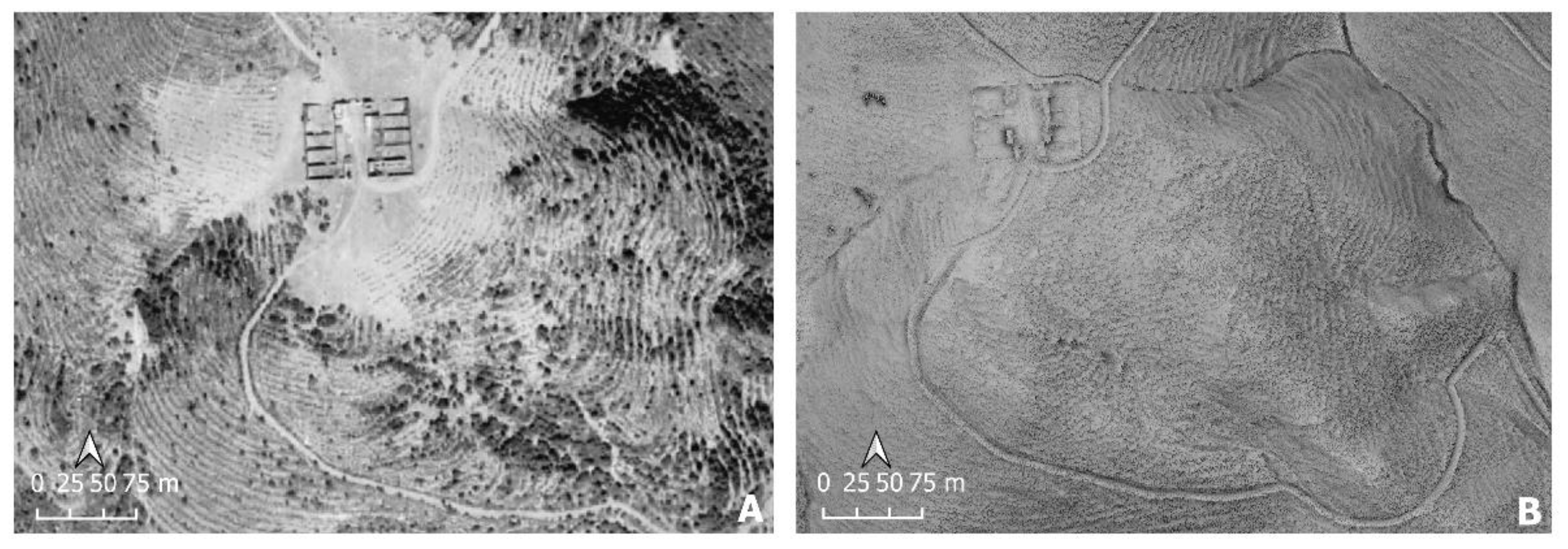
The results obtained from evaluating these images, particularly from the American Flight Series B and the National Flight, are very useful in identifying the major changes that took place in the second half of the 20th century, which presumably altered the historical landscape of the area (Error! Reference source not found.).
Figure 11.
A. American Flight Series B (1956-1957). B. National Flight (1981-1986). Note the alteration caused by the beginning of the reforestation plan. Source: Instituto Geografía de España (IGN).
Figure 11.
A. American Flight Series B (1956-1957). B. National Flight (1981-1986). Note the alteration caused by the beginning of the reforestation plan. Source: Instituto Geografía de España (IGN).
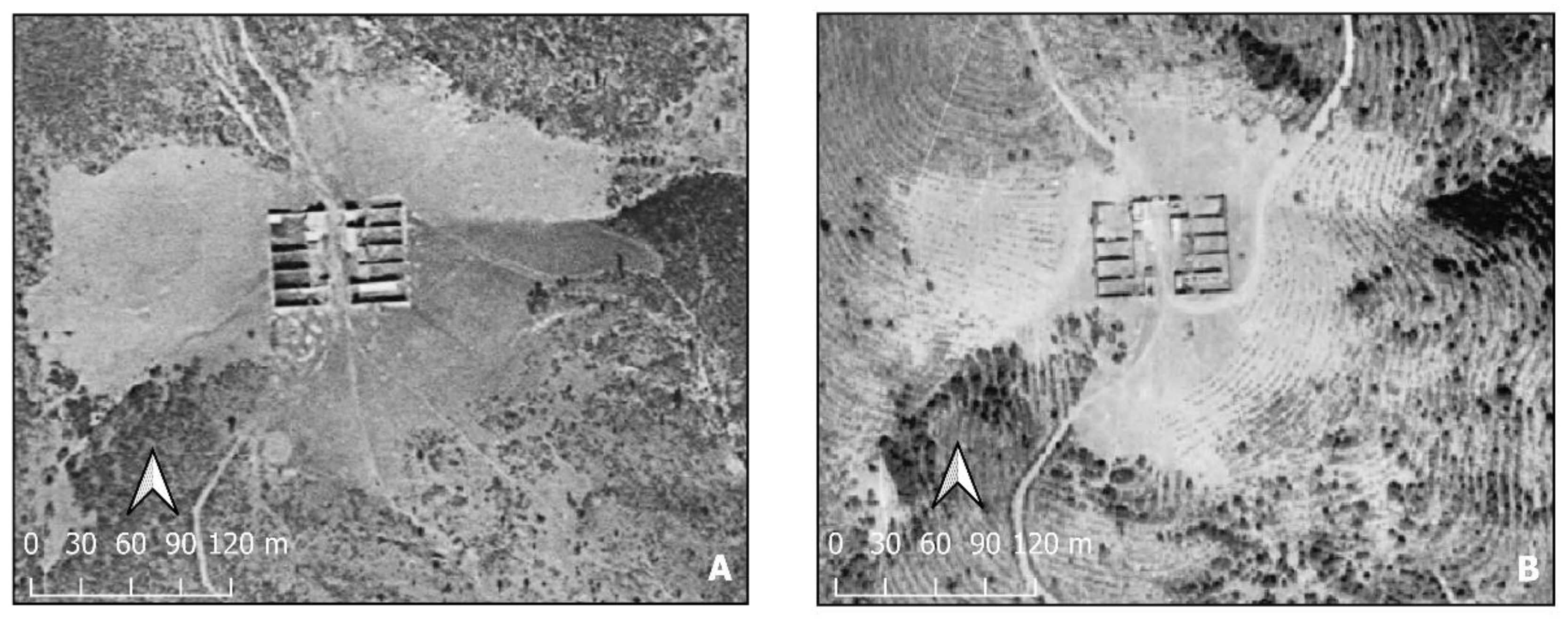
As noted in Figure 11 A, some terraces can be seen, which can be associated with the aforementioned reforestation plan. Changes in the morphology of the terrain are evident but not unique. We can also identify alterations in the communication routes; in fact, a new route was constructed to provide access for the reforestation process. This route also crosses the remains of Magaña, increasing its degradation. Additionally, some of the original manmade footpaths have disappeared.
4.4. Time series of Sentinel 2A imagery analysis
As has been demonstrated in numerous study cases, such us those carried out in in Central America [43,44] among others, environmental factors affect the conservation of the archaeological remains of past communities, as well as those brought about by tourism [45]. To understand the dynamics of the surrounding landscape, as well as to identify the possible archaeological remains of Magaña hamlet we carried out a time series analysis of Sentinel 2A satellite imagery, specifically from 2015-06-01 to 2023-01-31. The analysis was carried out using the Google Earth Engine [46,47]. In total 239 images with a cloud cover of less than 10% were analysed. To proceed with this analysis, we used the most suitable vegetation indexes for archaeological purposes, such as NDVI [48,49,50] and NWVI [51,52]. The spectral bands used in those indexes were B3, B4, B5 and B8, as they were the most suitable for our purpose. Bands B3, B4 and B5 reflect the phenology of the vegetation as they absorb part of the sun’s energy. On the other hand, the reflectivity increases in Band B8 (near infrared). Therefore, multiples aspects regarding vegetation can be analysed to obtain information regarding vegetation, humidity or growing phases. In addition, crop marks can be linked to the presence of archaeological remains in areas covered by vegetation in two ways: the remains of buildings in the subsoil constrain the growth of vegetation above them, and a lack of them allows normal growth [53,54].
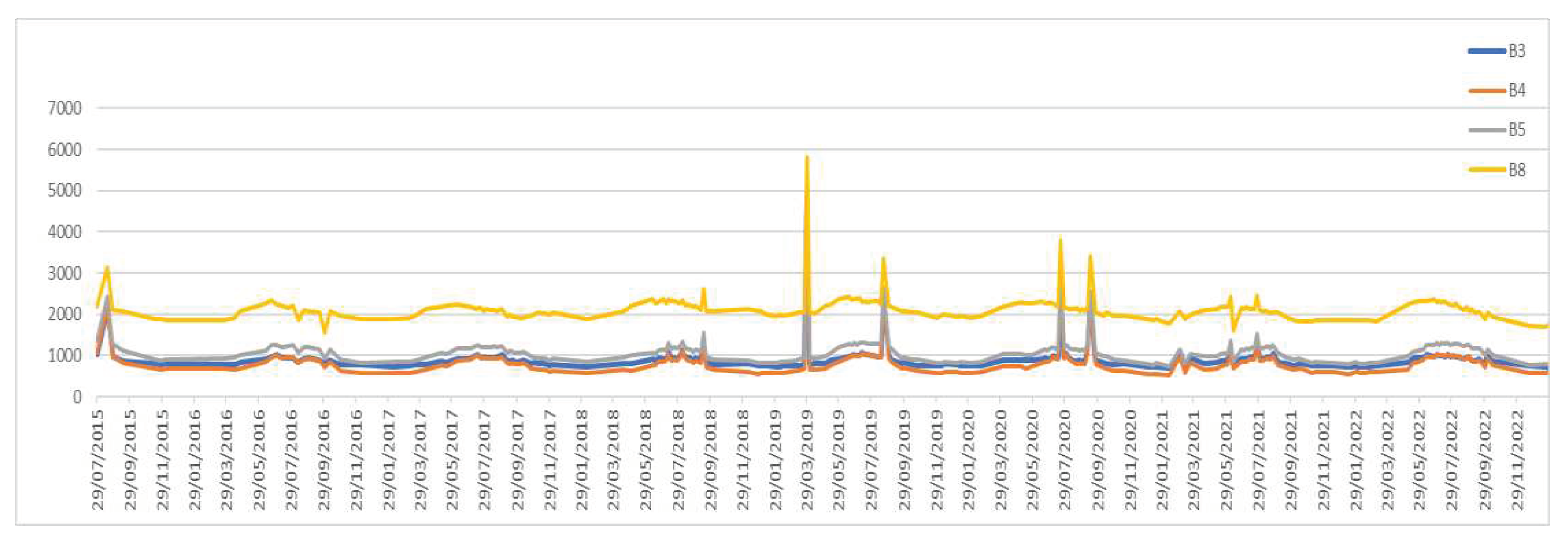
Graphic 1. Results of the multitemporal analysis of Bands B3, B4, B5 and B8. Source: the author.
As can be noted in Graphic 1, the behaviour of the bands is very homogeneous and only interrupted by some “anomalies”. In the author’s previous experience in the analysis of multispectral data, it is most suitable to use data from prior to these marked changes. With the aim of ascertaining the cause of these alterations, we analysed the pluviometry of the area during the 15 days prior to and following the anomaly and just one date coincided with precipitation: on 30/03/2019 when the rainfall was 8.5 l/m2. Considering that, we could infer that rain was not the cause of the alteration and moreover, we were unable to analyse the area after the rain as the nearest imagery to that date had cloud cover that made it impossible to see the specific area. Therefore, with that in mind, we analysed the images nearest to the identified alteration with less than 10% cloud cover. Finally, the range of images analysed was:
- S2A_MSIL2A_20180802T105621_N0208_R094_T30SVH_20180802T141714
- S2B_MSIL2A_20190325T105709_N0211_R094_T30SVH_20190325T141511
- S2A_MSIL2A_20190817T105621_N0213_R094_T30SVH_20190817T141933
- S2A_MSIL2A_20200702T105621_N0214_R094_T30SVH_20200702T135414
For this analysis, we used SNAP software from the European Space Agency (ESA), a specific software developed to carry out multispectral analysis of diverse satellite imagery. As a preparatory phase prior to analysing the Normalised Difference Vegetation Index (NDVI), the Normalised Difference Water Index (NDWI) and Principal Component Analysis (PCA), we converted radiance to reflectance[55].
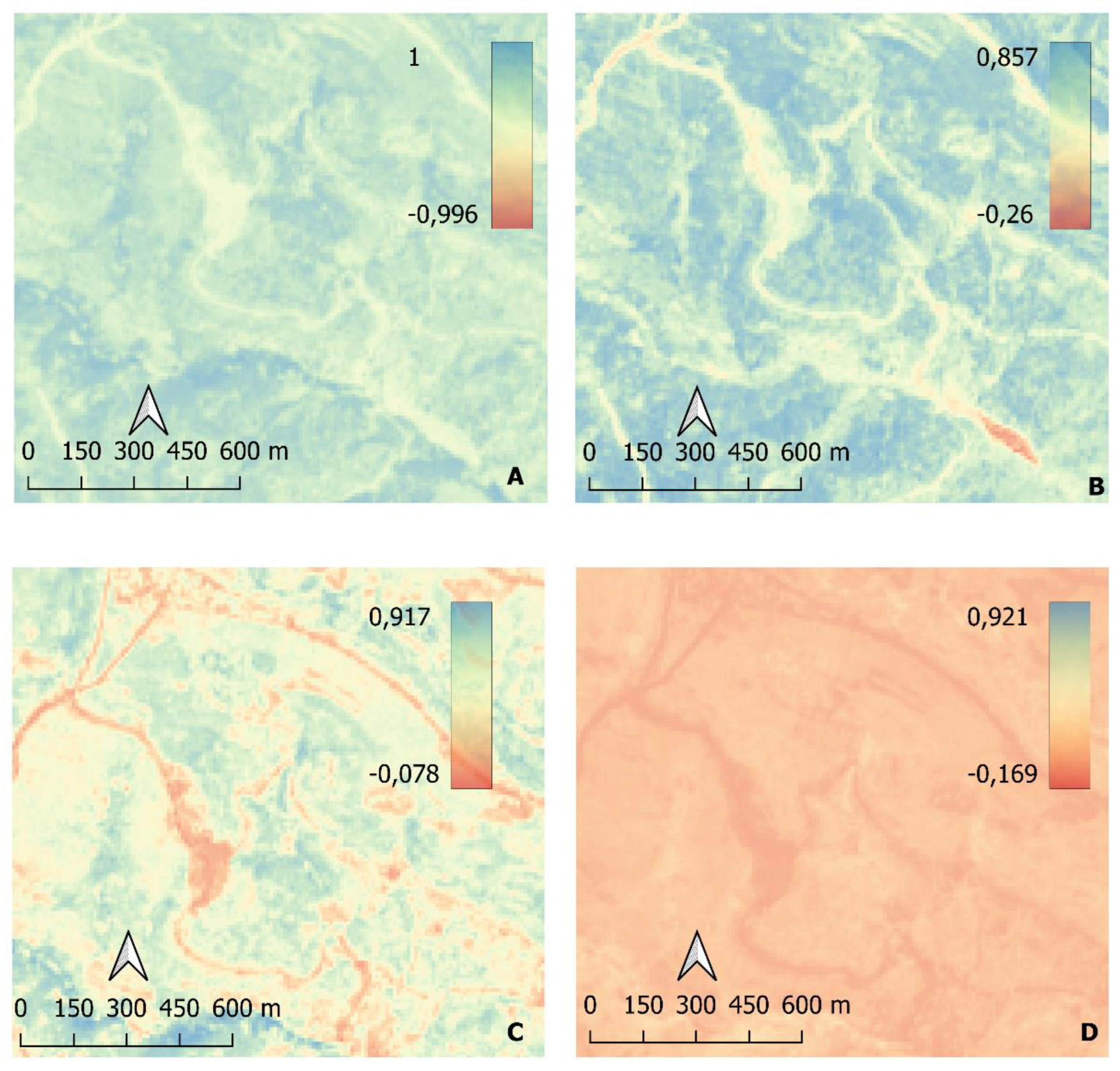
Once the data had been converted, we calculated the NDVI index for the four images in order to analyse the vegetation growth dynamics in the area (Error! Reference source not found.). We also considered that variations in this index could be related to the presence of buried archaeological remains. However, due to the low spatial resolution and the characteristics of the studied area, we were unable to identify any archaeological remains. Nevertheless, the NDVI index provided valuable environmental information. As shown in Error! Reference source not found., seasonal changes were detected depending on the year, indicating the health and changes in reforestation over time and the seasons, particularly between spring (Error! Reference source not found. B) and summer (Error! Reference source not found. A,B,D). After calculating this index, we used Principal Component Analysis (PCA) to reduce the amount of spectral redundancy, which is an excellent method when using multispectral imagery[44]. The results obtained did not provide information about archaeological remains but showed a clear upward trend in NDVI index values, reflecting the success of the repopulation process as the index indicated vegetation growth.
Figure 12.
Evolution of the NDVI index in the studied area. A. 02-08-2018. B. 25-03-2019. C. 18-08-2109. D. 02-07-2020. Source: the authors.
Figure 12.
Evolution of the NDVI index in the studied area. A. 02-08-2018. B. 25-03-2019. C. 18-08-2109. D. 02-07-2020. Source: the authors.
4.5. LiDAR data analysis
The Lidar data used during this study were downloaded from IGN[56], specifically the second flight carried out in 2020 with a point density of 1.5 per m2 and the datasets were:
- PNOA_2019_CLM-SW_450-4254_ORT-CLA-RGB
- PNOA_2019_CLM-SW_450-4256_ORT-CLA-RGB
These data were naturally (RGB) and infrared (IRC) coloured and classified taking into account the American Society for Photogrammetry and Remote Sensing (ASPRS) principles. In the development of this case study we filtered the Lidar point cloud data to keep those related to the ground (Class 2) using the Las2las filter algorithm included in the LasTools QGIS plug-in. After that, we processed the generated point cloud with Open Lidar Toolbox in QGIS [57] and obtained different visualisation techniques optimised for archaeological purposes, including: Sky View Factor (SVF) [58], Hillshade [59] and Openess [60].
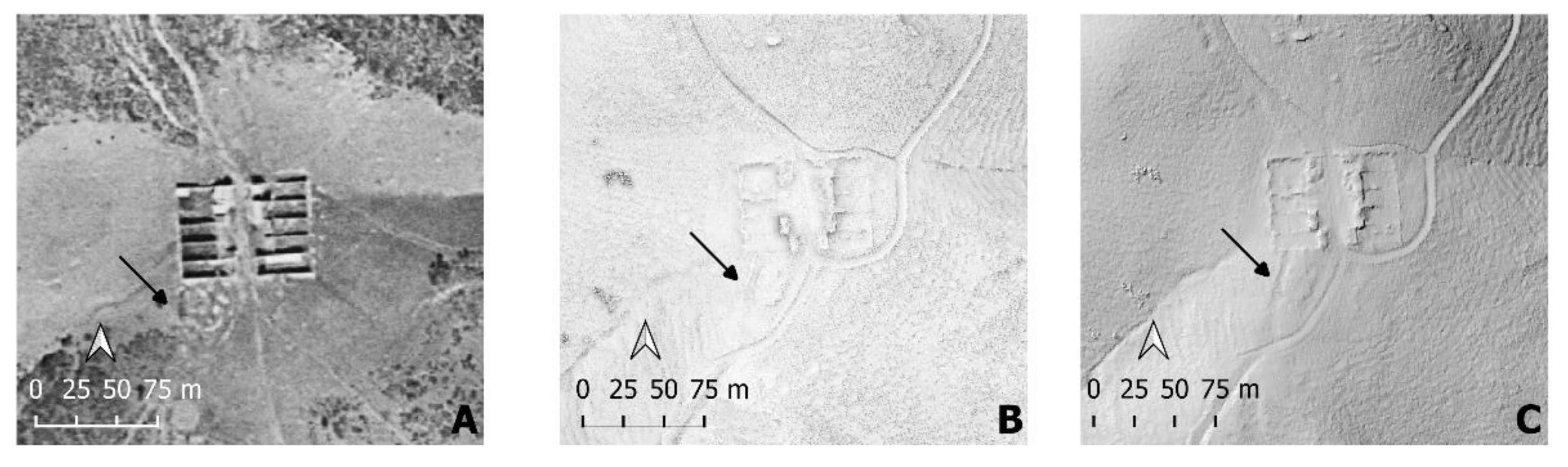
Thanks to the analysis of the different rasters obtained using the aforementioned analysis we were able to identify certain elements that must be taken into consideration, such us possible original routes of ancient roads (Error! Reference source not found.), the presence of the aforementioned terraces built for the reforestation, the confirmation of the existence of the former road mentioned in 4.3 (Error! Reference source not found. A), a possible threshing floor and identified terrain alterations that could be related to a livestock structure (Error! Reference source not found.).
Figure 13.
Possible original route of an ancient road identified from Lidar data analysis marked with a black arrow. A. American Flight Series B (1956-1957). B. Sky view factor. C. Hillshade. Source: the authors.
Figure 13.
Possible original route of an ancient road identified from Lidar data analysis marked with a black arrow. A. American Flight Series B (1956-1957). B. Sky view factor. C. Hillshade. Source: the authors.
The aforementioned threshing floor (Error! Reference source not found.) is approximately 88 m to the south. It has a radius of some 8.80 m with an estimated diameter of approximately 17 m. To clearly understand it location and function we must consider the orography of the surrounding land prior to the so-called reforestation in 1954. It is at one end of the same plateau as Magaña and, as can be seen in American Flight Series B, there were no trees in its immediate surroundings that could have blocked the wind. The road and ancient footpath also passed nearby.
The possible livestock infrastructure is near the southern façade of Magaña. Is appears to be something temporary as it cannot be documented with other visualisation techniques or other historical imagery. It approximate radius is 16 m, implying a diameter of 32 m. Its location next to the walls of the hamlet rules out the possibility of it being a threshing floor. On the other hand, this structure is the main factor in the disappearance the aforementioned original route (Error! Reference source not found.).
Figure 14.
Threshing floor identified in American Flight Series B (1956-1957). The red circle marks the presence of the threshing floor. The black circle marks the possible livestock infrastructure.
Figure 14.
Threshing floor identified in American Flight Series B (1956-1957). The red circle marks the presence of the threshing floor. The black circle marks the possible livestock infrastructure.
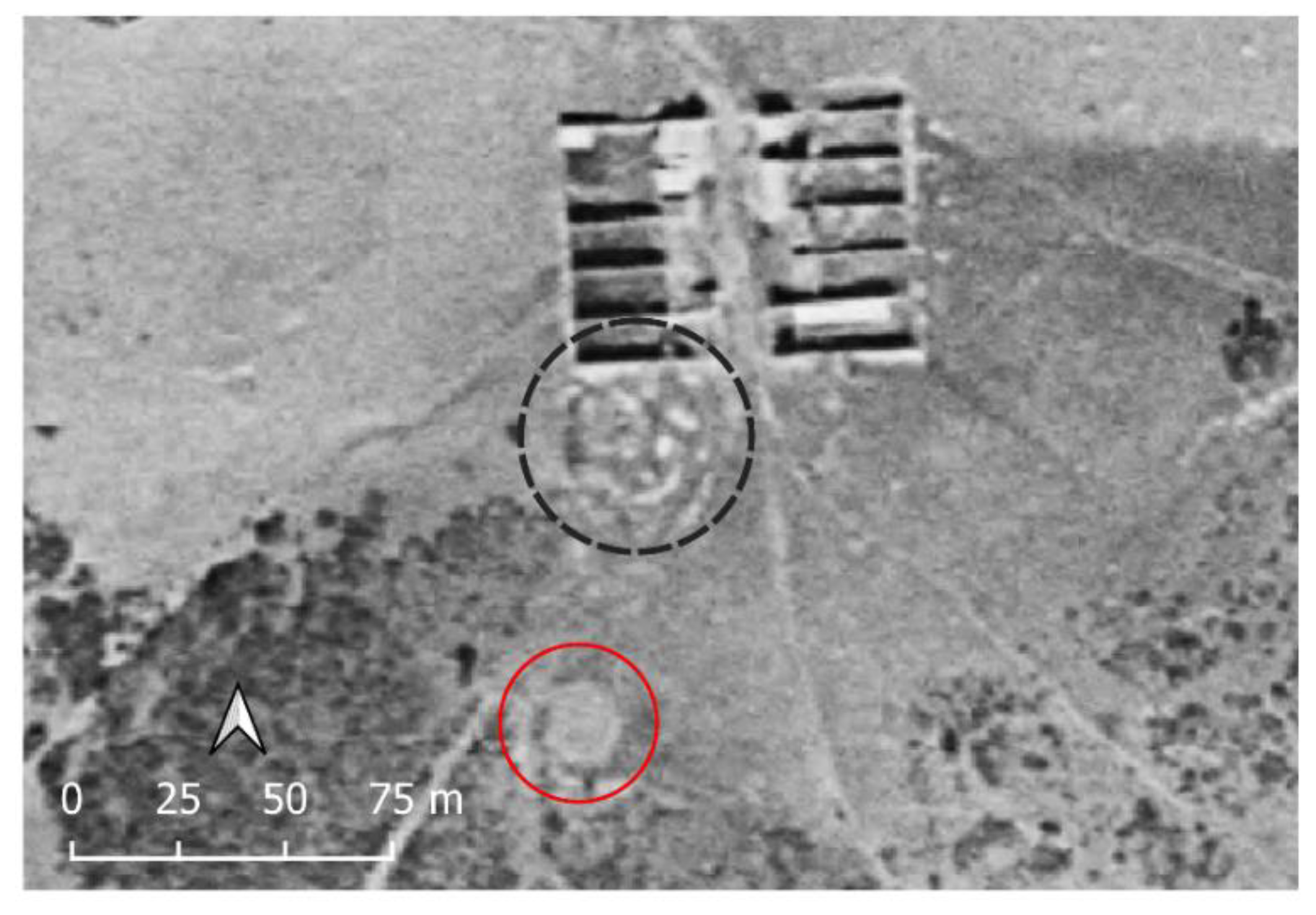
Finally, the terraces built during the reforestation process can be clearly identified in both the historical aerial imagery and the Lidar data (Error! Reference source not found.). They considerably altered the landscape and eradicated any possible remains in the surrounding area.
Figure 15.
Terraces built during the reforestation. A. National flight carried out between 1981-86. B. Sky View Factor.
Figure 15.
Terraces built during the reforestation. A. National flight carried out between 1981-86. B. Sky View Factor.
4.6. 3D model of Magaña using drone photography
As a final step, we created a 3D model (Error! Reference source not found.) of Magaña for two main purposes. Firstly, it will be integrated into the HBIM system, with the point cloud generated during the creation of the 3D model serving as the basis for modelling a virtual reconstruction of the hamlet. This model will include information regarding the actual conservation status, the causes of degradation, possible treatments, their cost, and other relevant details. This will allow different stakeholders involved in cultural heritage and environmental studies to work together in a coordinated manner to develop more accurate conservation policies. Secondly, the creation of this 3D model plays an important role in dissemination. The model will be included in the aforementioned app, and explanatory videos will be uploaded to various social media channels, providing access to this archaeological site and increasing knowledge of it among interested audiences worldwide.
5. Discussion
The focus of the proposal is novel in the field of Modern History (16th–18th centuries) and, therefore, there are high expectations for the scientific-technical and socio-economic impact of the project. The studies of Spatial Archaeology or Applied History in Spain during the centuries of the Modern Age are in the minority or infrequent, even more so taking into account the climatic conditions of the environment. The joint interpretation of a corpus of data in which architectural and environmental values are integrated to facilitate both the conservation of the asset and its landscape environment has been practically non-existent. The use of drone flights over buildings is more common, although not for the analysis and morphological study of the territory in which the archaeological remains are located. In this respect, the results will have a high impact. Letters of interest and offers of cooperation from different European geo-historical laboratories have been added to these actions. Particularly notable in this case are those from Italy, due to the similarities between the Italian and Spanish methodologies, thus guaranteeing international impact. We can cite the Osservatorio Geopolitico Internazionale sulle citta’ di fondazione of the municipality of Saubadia (Latina); the Centro Italiano per gli Studi Storico-Geografici of the Dipartimento di Studi Umanistici, Università degli Studi Roma Tre; the Centro Geo-Cartografico di Studio e Documentazione GeCo of the Università di Trento; the Laboratorio Geocartografico “Giuseppe Caraci” of the Università di Roma Tre; and the Geographic Research and Application Laboratory (GREAL) of the Università Europea di Roma (letters kept in the UJA Vice-Rectorate for Research).
Thanks to the pilot study developed in this paper, we have obtained very important information on the proposed methodology. Additionally, we have achieved a comprehensive understanding of the archaeological site and its surrounding landscape. Due to the characteristics of Magaña hamlet, which was occupied and in use until the mid-twentieth century, the remaining structures are relatively well preserved, and their structure can be seen and interpreted clearly. However, the information obtained through this study is of significant importance. Archaeologically speaking, it allowed us to identify the possible remains of a section of the main road to Magaña that should be interpreted jointly with the two circular structures related to daily routine of the inhabitants of Magaña: a threshing floor and a possible livestock structure, which will need to be confirmed in coming field work campaigns. As a hypothesis that must be demonstrated or ruled out, we believe that an earlier, since eradicated, part of the main road communicated the threshing floor with the village and that once this structure had been abandoned, what we identify as livestock infrastructure was built and altered the physiognomy of the original route.
Regarding the climate information, we observed that the main changes in the landscape have occurred since 1954, when the reforestation process was undertaken. This altered the landscape of the natural park and consequently the environment, providing more shade and thus lowering the temperature, moderating wind speeds, slowing desertification and attracting different species previously unknown in the area. This action resulted in the creation of a specific environment with very little change, having two different aspects that affected the village of Magaña and its surroundings in two different and contradictory ways. The first aspect is the contradictory one, the modification of the landscape carried out since 1954 has altered the surrounding area, creating a new environment that bears little relation to the historical one. Moreover, the creation of a new communication route through Magaña led to the deterioration of the village, even though there is little traffic. The terraces also erased the original morphology of the area, eliminating any possibility of identifying archaeological remains near the village. The second aspect is the positive one, the reforestation has created a specific and protected environment, as demonstrated in the Corine Landcover cartography (Error! Reference source not found.0) and the variation identified through PCA and NDVI analysis in Error! Reference source not found.. The protection of this plantation inside a natural park has reduced the climatic impact on the conserved structure. As has been demonstrated, the vegetation is healthy, and its continuous growth shows that climatic conditions in the area are consistent, reducing the impact of weather on the archaeological remains.
Thanks to this study, we have gained a comprehensive understanding of the historical and climate dynamics of one archaeological site, in this case, the village of Magaña. We must not forget that alterations in the landscape, whether natural or man-made, are part of the history of a populated area. Although some of the changes are recent, they must be considered an integral part of its evolution. The information provided by holistic approaches, such as the one described in this paper, will be the basis for promoting the most accurate and efficient conservation policies for cultural heritage sites, considering their adaptation to climate change.
Data Availability Statement
Data regarding app are protected by the Universidad de Jaén due to its future register and exploitation.
Conflicts of Interest
The authors declare no conflict of interest.
References
- Endangered Archaeology in the Middle East and North Africa | EAMENA Project. Available online: https://eamena.org/ (accessed on 21 January 2023).
- Evans, D.H.; Fletcher, R.J.; Pottier, C.; Chevance, J.B.; Soutif, D.; Tan, B.S.; Im, S.; Ea, D.; Tin, T.; Kim, S.; et al. Uncovering Archaeological Landscapes at Angkor Using Lidar. Proc Natl Acad Sci U S A 2013, 110, 12595–12600. [Google Scholar] [CrossRef] [PubMed]
- Tapete, D.; Cigna, F. Detection of Archaeological Looting from Space: Methods, Achievements and Challenges. Remote Sens (Basel) 2019, 11. [Google Scholar] [CrossRef]
- Prufer, K.M.; Thompson, A.E.; Kennett, D.J. Evaluating Airborne LiDAR for Detecting Settlements and Modified Landscapes in Disturbed Tropical Environments at Uxbenká, Belize. J Archaeol Sci 2015. [Google Scholar] [CrossRef]
- Galeazzi, F. Towards the Definition of Best 3D Practices in Archaeology: Assessing 3D Documentation Techniques for Intra-Site Data Recording. J Cult Herit 2016. [Google Scholar] [CrossRef]
- Fiz, J.I.; Martín, P.M.; Cuesta, R.; Subías, E.; Codina, D.; Cartes, A. Examples and Results of Aerial Photogrammetry in Archeology with UAV: Geometric Documentation, High Resolution Multispectral Analysis, Models and 3D Printing. Drones 2022, 6. [Google Scholar] [CrossRef]
- Bonazza, A.; Bonora, N.; Duke, B.; Spizzichino, D.; Recchia, A.P.; Taramelli, A. Copernicus in Support of Monitoring, Protection, and Management of Cultural and Natural Heritage. Sustainability 2022, 14, 2501. [Google Scholar] [CrossRef]
- Lista Roja. Available online: https://listaroja.hispanianostra.org/ (accessed on 21 January 2023).
- InfoIGME - Catálogo de Aplicaciones. Available online: https://info.igme.es/catalogo/catalog.aspx?catalog=2&shim=true&shdt=false&shtb=true&shtp=false&shfp=false&shsf=false&shfo=false&master=infoigme&lang=spa&intranet=false (accessed on 21 January 2023).
- Nature and Biodiversity Law - Environment - European Commission . Available online: https://ec.europa.eu/environment/nature/legislation/index_en.htm#legal_sources (accessed on 21 January 2023).
- Organismo Autónomo Centro Nacional de Información Geográfica (CNIG) Centro Nacional de Información Geográfica. Available online: https://www.ign.es/web/ign/portal/qsm-cnig (accessed on 6 May 2020).
- Potree. Available online: https://potree.github.io/ (accessed on 21 January 2023).
- Logothetis, S.; Delinasiou, A.; Stylianidis, E. Building Information Modelling for Cultural Heritage: A Review. ISPRS Annals of Photogrammetry, Remote Sensing and Spatial Information Sciences 2015. [CrossRef]
- Sarris, A. Best Practices of GeoInformatic Technologies for the Mapping of Archaeolandscapes.
- Štular, B.; Lozić, E.; Eichert, S. Airborne LiDAR-Derived Digital Elevation Model for Archaeology. Remote Sens (Basel) 2021, 13. [Google Scholar] [CrossRef]
- Agapiou, A.; Hadjimitsis, D.; Sarris, A.; Themistocleous, K.; Papadavid, G. Hyperspectral Ground Truth Data for the Detection of Buried Architectural Remains; 2010; Vol. 6436;
- Análisis Del Sistema De Transporte, S.Y.; Moreno-Navarro, F. Simulación y Análisis Del Sistema de Transporte En El Norte de La Carpetania Romana. Una Aproximación Desde Los Sig y Análisis de Redes = Transportation System Simulation and Analysis in the North of Roman Carpetania. A Gis and Network Analysis Approach. 2022. [CrossRef]
- Toumazet, J.-P.; Simon, F.-X.; Mayoral, A. Self-AdaptIve LOcal Relief Enhancer (SAILORE): A New Filter to Improve Local Relief Model Performances According to Local Topography. Geomatics 2021, 1, 450–463. [Google Scholar] [CrossRef]
- Kokalj, Ž.; Zaksek, K.; Oštir, K.; Čotar, K. Relief Visualization Toolbox, Version 1.3, Manual Special Issue “Applications of Micro-and Nano-Satellites for Earth Observation” View Project; 2013.
- Kokalj, Ž.; Somrak, M. Why Not a Single Image? Combining Visualizations to Facilitate Fieldwork and on-Screen Mapping. Remote Sens (Basel) 2019, 11. [Google Scholar] [CrossRef]
- Štular, B.; Eichert, S.; Lozić, E. Airborne LiDAR Point Cloud Processing for Archaeology. Pipeline and QGIS Toolbox. Remote Sens (Basel) 2021, 13, 3225. [Google Scholar] [CrossRef]
- Chase, A.F.; Chase, D.Z.; Weishampel, J.F.; Drake, J.B.; Shrestha, R.L.; Slatton, K.C.; Awe, J.J.; Carter, W.E. Airborne LiDAR, Archaeology, and the Ancient Maya Landscape at Caracol, Belize. J Archaeol Sci 2011, 38, 387–398. [Google Scholar] [CrossRef]
- Climate Change Service Available online: https://climate.copernicus.eu/.
- Adams, R.E.W. a; Brown Jr., W. E. b; Patrick Culbert, T. c Radar Mapping, Archeology, and Ancient Maya Land Use. Science (1979) 1981, 213, 1457–1463. [Google Scholar]
- Elachi, C.; Roth, L.E.; Schaber, G.G. Spaceborne Radar Subsurface Imaging in Hyperarid Regions. IEEE Transactions on Geoscience and Remote Sensing 1984, GE-22, 383–388.
- Cheng, G.; Han, J. A Survey on Object Detection in Optical Remote Sensing Images. ISPRS Journal of Photogrammetry and Remote Sensing 2016. [CrossRef]
- Chen, F.; Lasaponara, R.; Masini, N. An Overview of Satellite Synthetic Aperture Radar Remote Sensing in Archaeology: From Site Detection to Monitoring. J Cult Herit 2017. [Google Scholar] [CrossRef]
- Verhoeven, G. BRDF and Its Impact on Aerial Archaeological Photography. Archaeol Prospect 2017, 24, 133–140. [Google Scholar] [CrossRef]
- De Reu, J.; Plets, G.; Verhoeven, G.; De Smedt, P.; Bats, M.; Cherretté, B.; De Maeyer, W.; Deconynck, J.; Herremans, D.; Laloo, P.; et al. Towards a Three-Dimensional Cost-Effective Registration of the Archaeological Heritage. J Archaeol Sci 2013, 40, 1108–1121. [Google Scholar] [CrossRef]
- Soler, F.; Melero, F.J.; Luzón, M.V. A Complete 3D Information System for Cultural Heritage Documentation. J Cult Herit 2017, 23, 49–57. [Google Scholar] [CrossRef]
- Tapete, D.; Banks, V.; Jones, L.; Kirkham, M.; Garton, D. Contextualising Archaeological Models with Geological, Airborne and Terrestrial LiDAR Data: The Ice Age Landscape in Farndon Fields, Nottinghamshire, UK. J Archaeol Sci 2017, 81. [Google Scholar] [CrossRef]
- Willis, M.D.; Koenig, C.W.; Black, S.L.; Castañeda, A.M. ARCHEOLOGICAL 3D MAPPING: THE STRUCTURE FROM MOTION REVOLUTION; 2016; Vol. 3;
- Megahed, N. Towards a Theoretical Framework for HBIM Approach in Historic Preservation and Management. International Journal of Architectural Research: ArchNet-IJAR 2017, 9, 130. [Google Scholar] [CrossRef]
- Oreni, D.; Brumana, R.; Torre, S. Della; Banfi, F. Survey, HBIM and Conservation Plan of a Monumental Building Damaged by Earthquake. In Proceedings of the International Archives of the Photogrammetry, Remote Sensing and Spatial Information Sciences - ISPRS Archives; International Society for Photogrammetry and Remote Sensing, May 12 2017; Vol. 42; pp. 337–342. [Google Scholar]
- Hermoso-Orzáez, M.J.; Camacho Sánchez, J.M.; Estepa Cantero, C.; Terrados-Cepeda, J. IMPLEMENTATION OF THE BIM MANAGER FIGURE WITH CYPE’S TOOL BIM SERVER CENTER IN THE DESIGN, MODELING, DIRECTION AND PROJECT MANAGEMENT-UNIVERSIDAD DE JAÉN. EDULEARN21 Proceedings 2021, 1, 2337–2347. [Google Scholar] [CrossRef]
- Heesom, D.; Boden, P.; Hatfield, A.; Rooble, S.; Andrews, K.; Berwari, H. Developing a Collaborative HBIM to Integrate Tangible and Intangible Cultural Heritage. International Journal of Building Pathology and Adaptation 2021, 39, 72–95. [Google Scholar] [CrossRef]
- Prats, L. El Concepto de Patrimonio Cultural. Cuadernos de Antropología Social 2000, 11, 115–136. [Google Scholar]
- García, A. EL CONCEPTO DE DIVERSIDAD ENTENDIDO POR LOS FUTUROS DOCENTES; 2016.
- Gil González, S. Cómo Hacer “Apps” Accesibles; 2013; Vol. 1;
- Marín-Cepeda, S.; García-Ceballos, S.; Gümez-Redondo, C.; Vicent, N.; Gillate, I. Educación Patrimonial Inclusiva En OEPE: Un Studio Prospectivo. Revista de Educacion 2017, 2017, 110–135. [Google Scholar] [CrossRef]
- Gobierno de España. Porta de Administración Electrónica Observatorio de Accesibilidad Web . Available online: https://administracionelectronica.gob.es/pae_Home/pae_Estrategias/pae_Accesibilidad/pae_Observatorio_de_Accesibilidad.html (accessed on 2 November 2022).
- Domingo, J.; Martínez, S.; Eduardo, Y.; Jiménez, A. EL PARQUE NATURAL DE DESPEÑAPERROS: CARACTERIZACIÓN TERRITORIAL Y PERSPECTIVAS INMEDIATAS. Cuadernos Geográficos 2005, 37, 7–39. [Google Scholar]
- Wiseman, James. ; El-Baz, Farouk. Remote Sensing in Archaeology. 2007, 553.
- Parcak, S.H. Satellite Remote Sensing for Archaeology; Routledge. Taylor and Francis Group.: London and New York, 2009; ISBN 0-415-44877-8. [Google Scholar]
- Ramírez-Guerrero, G.; García-Onetti, J.; Arcila-Garrido, M.; Chica-Ruiz, J.A. A Tourism Potential Index for Cultural Heritage Management through the Ecosystem Services Approach. Sustainability 2021, Vol. 13, Page 6415 2021, 13, 6415. [Google Scholar] [CrossRef]
- Google Earth Engine.
- Liss, B.; Howland, M.D.; Levy, T.E. Testing Google Earth Engine for the Automatic Identification and Vectorization of Archaeological Features: A Case Study from Faynan, Jordan. J Archaeol Sci Rep 2017, 15. [Google Scholar] [CrossRef]
- Crippen, R.E. Calculating the Vegetation Index Faster. Remote Sens Environ 1990, 34, 71–73. [Google Scholar] [CrossRef]
- Agapiou, A.; Hadjimitsis, D.G.; Georgopoulos, A.; Sarris, A.; Alexakis, D.D. Towards an Archaeological Index: Identification of the Spectral Regions of Stress Vegetation Due to Buried Archaeological Remains. In Proceedings of the Lecture Notes in Computer Science (including subseries Lecture Notes in Artificial Intelligence and Lecture Notes in Bioinformatics); 2012. [Google Scholar]
- Verena, H.; Krauss, G.; Götze, C.; Sandow, C. Index DataBase. A Database for Remote Sensing Indices.
- Gao, B.C. NDWI—A Normalized Difference Water Index for Remote Sensing of Vegetation Liquid Water from Space. Remote Sens Environ 1996, 58, 257–266. [Google Scholar] [CrossRef]
- McFeeters, S.K. The Use of the Normalized Difference Water Index (NDWI) in the Delineation of Open Water Features. https://doi.org/10.1080/01431169608948714 2007, 17, 1425–1432.
- Masini, N.; Marzo, C.; Manzari, P.; Belmonte, A.; Sabia, C.; Lasaponara, R. On the Characterization of Temporal and Spatial Patterns of Archaeological Crop-Marks. J Cult Herit 2018, 32, 124–132. [Google Scholar] [CrossRef]
- Lasaponara, R.; Masini, N. Detection of Archaeological Crop Marks by Using Satellite QuickBird Multispectral Imagery. J Archaeol Sci 2007, 34, 214–221. [Google Scholar] [CrossRef]
- SENTINEL-2 User Handbook Sentinel-2 User Handbook SENTINEL-2 User Handbook Title Sentinel-2 User Handbook Issue 1 Revision 1 SENTINEL-2 User Handbook; 2013.
- Organismo Autónomo Centro Nacional de Información Geográfica Centro de Descargas Del IGN Available online:. Available online: https://centrodedescargas.cnig.es/CentroDescargas/index.jsp (accessed on 5 June 2020).
- Štular, B.; Eichert, S.; Lozić, E. Airborne Lidar Point Cloud Processing for Archaeology. Pipeline and Qgis Toolbox. Remote Sens (Basel) 2021, 13. [Google Scholar] [CrossRef]
- Zakšek, K.; Oštir, K.; Kokalj, Ž. Sky-View Factor as a Relief Visualization Technique. Remote Sens (Basel) 2011. [Google Scholar] [CrossRef]
- Bennett, R.; Welham, K.; Hill, R.A.; Ford, A. A Comparison of Visualization Techniques for Models Created from Airborne Laser Scanned Data. Archaeol Prospect 2012. [Google Scholar] [CrossRef]
- Doneus, M. Openness as Visualization Technique for Interpretative Mapping of Airborne Lidar Derived Digital Terrain Models. Remote Sens (Basel) 2013. [Google Scholar] [CrossRef]
Figure 8.
Scheme of the proposed methodology.
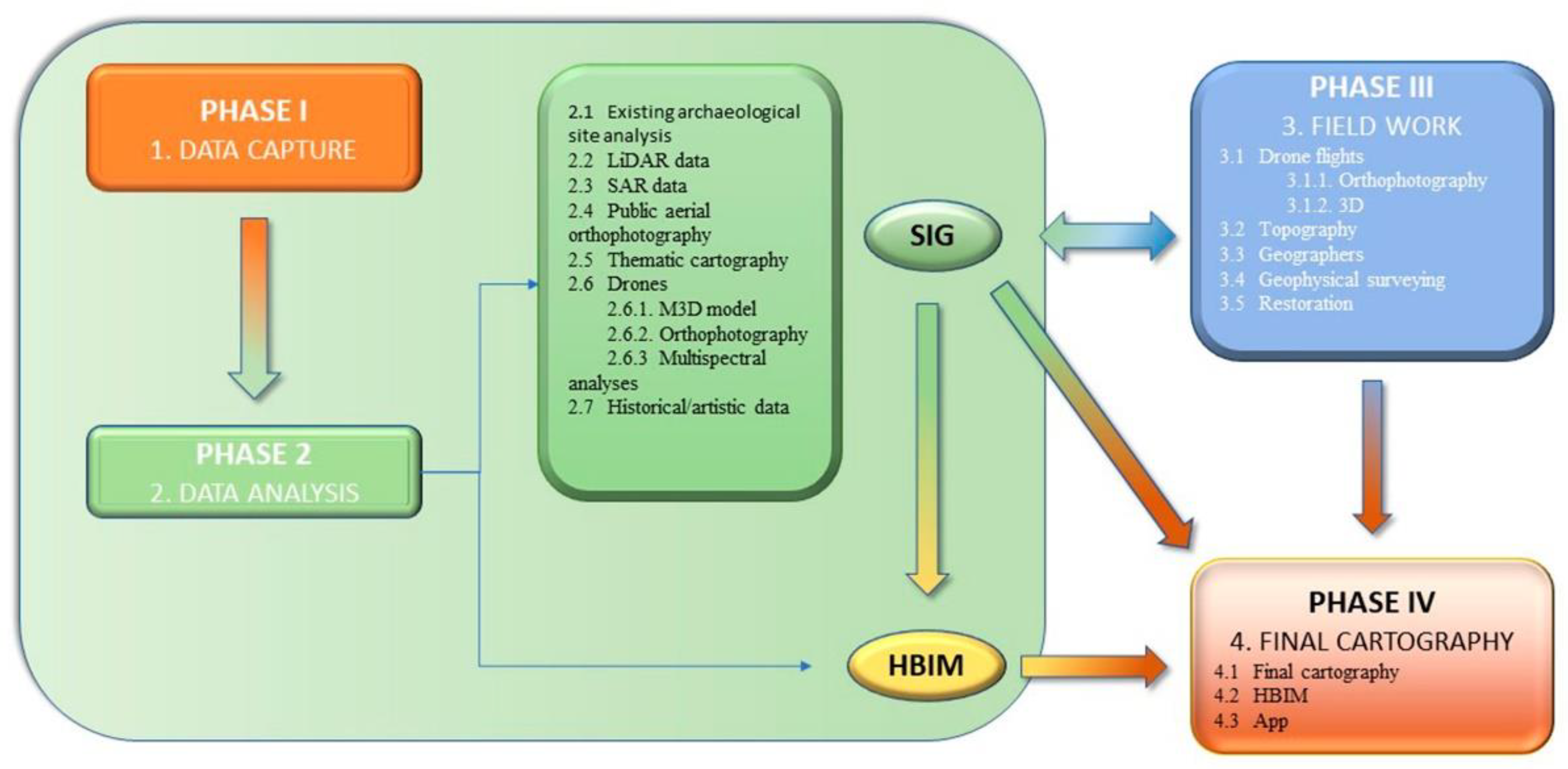
Figure 9.
3D reconstruction of the feligresia of Aldeaqueama, in which Aldea de Buenos Aires is included, using Autodesk Revit (BIM software adapted for heritage).
Figure 9.
3D reconstruction of the feligresia of Aldeaqueama, in which Aldea de Buenos Aires is included, using Autodesk Revit (BIM software adapted for heritage).
Disclaimer/Publisher’s Note: The statements, opinions and data contained in all publications are solely those of the individual author(s) and contributor(s) and not of MDPI and/or the editor(s). MDPI and/or the editor(s) disclaim responsibility for any injury to people or property resulting from any ideas, methods, instructions or products referred to in the content. |
© 2023 by the authors. Licensee MDPI, Basel, Switzerland. This article is an open access article distributed under the terms and conditions of the Creative Commons Attribution (CC BY) license (http://creativecommons.org/licenses/by/4.0/).
Copyright: This open access article is published under a Creative Commons CC BY 4.0 license, which permit the free download, distribution, and reuse, provided that the author and preprint are cited in any reuse.


