

Submitted:
18 May 2023
Posted:
19 May 2023
You are already at the latest version
Abstract
Margarines are W/O emulsions with minimal fat and are heat treated when used for baking. Lipid oxi-dation has been identified as the major deterioration process of margarines and addition of antioxidants is necessary. Consumers are increasingly demanding that chemical antioxidants in foods be replaced by natural preservatives. A multivariate statistical study gave us oxidative stability depending on the com-position of 20 different commercial margarines and an analysis of the principal components allowed us to classify and select eight of them. This study analyzes the antioxidant capacity of six different natural ground herbs (Curcuma longa, Illicium verum, Rosmarinus officinalis, Taraxacum officinale, Thymus piperella and Thymus vulgaris) on the oxidative stability of eight selected margarines. In order to evalu-ate the oxidative stability, we determine the induction period (IP) with Rancimat assays at 120 ºC with 1.5 hours of suppression. As results, Rosmarinus officinalis increases the IP value by 73.17% with respect to its basal values, Curcuma longa, Thymus vulgaris and Thymus piperella increases it between 17% and 26% and Taraxacum officinale together with Illicium verum reduces it between 19% and 34% respec-tively. A multiple linear regression model approach shows that IP has a positive correlation with SFA, PUFA, acids, MUFA/PUFA ratio and antioxidant activity.
Keywords:
margarine
; natural antioxidant
; oxidative stability
; Curcuma
; Illicium
; Rosmarinus
; Taraxacum
; Thymus
1. Introduction
Since ancient times, human beings have sought a way to extend the shelf life of food. Civilizations such as the Chinese, Egyptian, Greek, or Roman used physical conservation techniques. From the 50s, there was a great development in chemical preservation techniques, appearing multiple artificial preservatives such as butylhydroxyanisole (BHA), butylhydroxytoluene (BHT), ethylenediaminetetraacetic acid (EDTA), nitric acid or benzoic acid. These types of preservatives have been widely used due to the low price and the optimal results in terms of food preservation [1]. The shelf life of food products can be shortened by microbiological, chemical, physical or enzymatic causes. Food degradation can also be prevented by using preservation techniques such as packaging in a protective atmosphere or under vacuum, fermentation, acidification, curing, drying, refrigeration or freezing [2]. In most cases, food preservation requires the combination of preservation techniques and the addition of preservatives to increase its shelf life. Attention must also be paid to multiple factors to obtain food with higher quality, palatability, and duration in optimal conditions [3]. The literature has shown that human consumption of artificial preservatives such as synthetic antioxidants can have potentially harmful effects on health [4].The BHA (E-320) and BHT (E-321) are the most widely used antioxidants in margarines. They are compounds with phenolic structures of a number of degrees of alkyl substitution [5].
Due to the above, in recent years the interest on the part of consumers toward the acquisition of less processed and healthier products has been growing. For this reason, the food industry is directing its efforts toward the investigation of natural products of plant origin as potential preservatives. In 2010 the European Union authorized the use of rosemary extract (Rosmarinus officinalis, E-392) as a new food additive [6,7].
However, the wide variety of systems used in the processing and preservation of food, and the oxidation processes that they entail make it difficult to study oxidative stability. The understanding of the factors that affect oxidation in certain types of systems, such as food emulsions, are still quite insufficient considering the large amount of food that consists totally or partially in emulsions. In these types of systems, the oxidation reactions can be affected by many different factors related to the composition in saturated (SFA), monounsaturated (MUFA) and polyunsaturated (PUFA) fatty acids, with the processing and the resulting physical structure of the food system [8].
Margarines are emulsions of water in vegetable fats (oils) (W/O). They usually contain an oil or mixtures of vegetable oils from palm, soy, sunflower, corn, olive, linseed, or coconut, in varied combinations. The oxidative stability of margarines also depends on the aforementioned factors, their water content, because the aqueous phase promotes the formation of undesirable hydrolysis reactions [9].
Recent studies by members of the research group that heads this project, used 22 oils of vegetable origin for the study of oxidative stability at different temperatures. The results were different according to the oil used and improved when a portion of rosemary powder was added [10,11]. These considerations lead us to propose a study on the influence of the addiction of different aromatic plants or food spices with a high content of polyphenols, on the oxidative stability of different margarines with different fatty acid composition. In addition, it was shown that of all the components analyzed, the most important factor influencing the oxidative stability of the oils was the fatty acid composition.
On the other hand, the presence of water in the margarine composition could give different results with respect to those obtained with samples of vegetable oils.
The objectives of this study are to evaluate and compare the effect of the antioxidant power of different plant species in margarines, and to establish the relationship between the oxidative stability and the total phenolic compounds of the plant species used to confirm that the phenolic constituents are responsible for the increase of the oxidative stability of margarines. In addition, we pretend to quantify the oxidative stability of margarines and make two unequal classifications: on one hand, 20 diverse margarines according to their composition, and on the other hand, eight margarines with six different herbs individually added according to the nutritional composition of the eight margarines and the antioxidant activity provided by the plant species.
2. Materials and Methods
2.1. Statistical Analysis of Principal Components (PCA)
Considering their nutritional composition, a total of 20 margarines (Table 1) underwent a multivariate analysis of main components (Principal Component Analysis or PCA) to establish groupings that would allow us a more rigorous characterization of the margarines. Statistical analysis was performed using SPSS statistical program for windows (SPSS Inc., Chicago, IL, USA).
In this way we had a more exact vision when selecting those margarines that were the most different in their composition to carry out our experimental trial (Table 1).
2.2. Margarines and Plant Material
To carry out the tests and considering the results obtained in the statistical analysis, a total of eight margarines were selected (Table 1, margarines commercial brand marked with *): Flora pro-activ colesterol original, Ligeresa, Flora oliva and Consum margarina ligera belong to one of the groups. Consum margarina vegetal ¾, Tulipan original and Consum mantequilla belong to a second group. A margarine was also chosen that was not in the two previous main groups, but in another less numerous group: Flora original. During the tests, the margarines were stored in the refrigerator at 4° C of temperature.
The following six species of plants with documented antioxidant activity were added independently to these margarines, due to their high content of phenolic compounds, flavonoids, tannins and diterpenes: Curcuma longa, Rosmarinus officinalis, Taraxacum officinale, Illicium verum, Thymus piperella, and Thymus vulgaris. The variation of the oxidative stability was studied against the control margarines (without any added plant species).
The plant species Curcuma longa belongs to the Zingiberaceae family. Turmeric is a species widely distributed in subtropical and tropical regions, especially in Asian countries [12]. It has antifungal, antibacterial, antipyretic, antioxidant, and antihypercholesterolemic activities. These properties are due to its content in phenolic compounds [13].
Rosmarinus officinalis belongs to a genus of branched, aromatic, and perennial herbaceous plants characteristic of the Mediterranean region, which is part of the Lamiaceae family. It has great healing, venotonic and anti-inflammatory power. It also has great antioxidant capacity due to its high content in phenolic compounds, flavonoids, tannins and diterpenes [14].
As regards Taraxacum officinale, it is a plant species that belongs to a genus of angiosperm plants of the Asteraceae family commonly known as “dandelions, bakers or asters”. It is a biennial or perennial herbaceous plant native to the temperate zones of the northern hemisphere, although it is currently distributed throughout the world except for Africa. It has purifying, laxative, immune-enhancing, and antioxidant capabilities [15].
Illicium verum is an aromatic evergreen tree bearing purple-red flowers and anise-scented star-shaped fruit. It grows almost exclusively in southern China and Vietnam. Its fruit is an important traditional Chinese medicine as well as a commonly used spice. Star anise fruits could be considered a good source of natural compounds with significant antioxidant and antimicrobial activities, and their volatile oil could be applied in the food industry to replace the synthetic antioxidants used nowadays [16].
Finally, the genus Thymus, native to the western Mediterranean region of Europe, with a long tradition of a number of uses, includes some chemically variable species. Essential oils with high proportions of the phenolic components thymol and / or carvacrol showed the highest antioxidant activity, and the antioxidant properties of Thymus species have been reported by various authors. However, the variability in antioxidant activity between plants of different species has not yet been studied in detail; there may be provenances possessing higher activities. That is the reason for why we selected two species from this taxonomic genus Thymus vulgaris and Thymus piperella [17,18].
The plant species were used as dehydrated material and were kept at room temperature (20°C) and under dark conditions. Table 2 describes the manufacturer's information (name and batch number) of the plant species used in the assays.
2.3. Study of Oxidative Stability
The oxidative stability of margarines was determined by evaluating the induction period (IP) with a Rancimat 892 equipment [19]. The IP value is indicative of the resistance of the sample to oxidation, so that the longer the induction time, the more stable the analyzed sample is. Conductivity-time curves are displayed live for each measurement point in the database. The induction time was determined automatically from the second derivative of the measuring curve, and the manufacturer's performance protocol for solid vegetable fats was followed.
For the test, a temperature of 120 ± 1.6 ºC and an air flow of 20 L / h were used. The analyses were carried out in quadruplicate. The plant species were provided in powder form and were homogenized together with the margarines using a percentage of 0.5% (w / w), as established by the European Commission, 2011 [6]. The variation of the oxidative stability of each of the different margarines with added vegetable extracts was studied and compared with the data obtained from their respective controls (margarine samples without added vegetable extracts)
2.4. Ferric Reducing Ability of Power (FRAP) Assay in Plants
Extraction and testing sample preparations were adapted from Wojdyło et al. [20] with some modifications. In brief, 1 g of each ground aromatic plant was weighed in a test tube. A total of 10 mL of 80% aqueous methanol was added, and the suspension was gently mixed. Tubes were sonicated twice for 15 min and then centrifuged for 10 min at 1500 rpm using a CompactStar CS4 centrifuge (VWR International Ltd, West Sussex, UK). Supernatants were collected and stored at 4 °C before to use within 24 h.
The total antioxidant potential of the five samples of plants was determined, using the FRAP assay adapted from Benzie and Strain [21], as a measure of antioxidant power. The FRAP reagent was freshly prepared by mixing 25 mL of acetate buffer (300 mM, pH 3.6), 2.5 mL of a solution of 10 mM TPTZ in 40 mM HCl, and 2.5 mL of 20 mM FeCl3, and once prepared was kept in a water bath at 37 °C. The following were added directly to each cuvette in a Pye Unicam UV-4 UV-VIS scanning spectrophotometer (Spectronic Camspec Ltd., Leeds, UK) thermostated at 37 °C: 90 µL H2O, 900 µL FRAP reagent and 30 µL of sample (diluted 25 times), with standard or H2O as a blank. Absorbance readings were taken at 593 nm after 4 min at 37 °C. A solution of 1 mM FeSO4 was used as standard. All determinations were performed in triplicate. The results were corrected for dilution and expressed in µM Fe2+ per gram of plant.
2.5. Total Phenolic Content (TPC) of Plants
Extraction and testing sample preparations were performed as follows: 1 g of each plant was weighed in a test tube, and 20 mL of methanol was added. The test tube was vortexed, homogenized for 2 min at 8000 rpm, left at a tube roller mixer for 1 h, and then centrifuged at 1100 rpm for 15 min. The supernatant was collected, and the procedure was repeated one more time with another 20 mL of methanol. The two methanol extracts were combined, and the final volume was brought up to 40 mL with methanol. The total phenolic contents of the samples were determined using the Folin–Ciocalteu reagent as described by Parry et al. [22]. In brief, the reaction mixture contained 50 µL of testing sample solutions, 250 µL of the Folin–Ciocalteu reagent, 0.75 mL of 20% sodium carbonate, and 3 mL of pure water. After 2 h of reaction at room temperature, the absorbance at 765 nm was measured by a Pye Unicam UV-4 UV–vis scanning spectrophotometer (Spectronic Camspec Ltd., Leeds, UK) and was used to calculate the phenolic contents of oils using gallic acid as standard. Measurements were taken in triplicate. The results were expressed as mg gallic acid equivalents (GAE) per gram of powder.
2.6. Statistical Analysis
To compare the induction times obtained from the different samples, they were analyzed with the statistical program Stata version 13.1. Continuous variables were represented as mean ± standard deviation (SD). The nonparametric Wilcoxon W test was used to determine statistical significance and statistical significance was specified as a p-value less than 0.05.
Principal component analysis (PCA), and linear and multiple linear regression models were performed using SPSS (vs. 21.0, IBM Corp., USA), Knowledge Miner and Microsoft Excel for Office (2020) for Windows 10 OS.
3. Results and Discussion
3.1. Preliminary Selection of Margarines for Use in Subsequent Experimental Trials
Principal component analysis (PCA) is a technique useful to summarize all information contained in X-matrix and put it understandable. The PCA works decomposing X-matrix as the product of two smaller matrices P and T. The loading matrix (P) with information about the variables contains few vectors, the principal components (PCs), which are obtained as linear combinations of the original X-variables. In the score matrix (T), with information about objects, every object is described in terms of the projections on to PCs instead of the original variables: X = TP’ + E, where (’) denotes the transpose matrix. The information not contained in the matrices remains as unexplained X-variance in the residual matrix (E). Every PCi is a new co-ordinate expressed as linear combination of old features xj: PCi = Σjbijxj. The new co-ordinates PCi are named scores/factors while the coefficients bij are called loadings. The scores are ordered according to their information content with regard to the total variance among all objects. Score–score plots show positions of compounds in the new co-ordinate system, while loading–loading plots indicate the locations of the features that represent the compounds in the new co-ordinates. The PCs present two interesting properties:
- 1) They are extracted in decaying order of importance. First PC F1 always contains more information than the second F2 does, F2 more than the third F3, etc.
- 2) Every PC is orthogonal to one another. There is no correlation between the information contained in different PCs.
An analysis of PCA was carried out with a total of 20 margarines based on their different composition. The following variables that can be seen in Table 1 (Material and Methods) were used for statistical assessment: total fatty acids (TFA), saturated fatty acids (SFA), monounsaturated fatty acids (MUFA), polyunsaturated fatty acids (PUFA), vitamin A (Vit A) and vitamin E (Vit E). Figure 1 shows all the variables taken into consideration for the first two PCs (Plot of Components 1 and 2). The variance explained by PC1 and PC2 is 73,869%. The PC1 (51,563% of the total variance) showed positive loading with all variables. The PC2, which explained 22,306% of the total variance, was positively correlated with Vit A and Vit E, and negatively with SFA, TFA, MUFA and PUFA. The most remote properties of the 0.0 point are more important for describing PCs.
Figure 2 shows the bi-dimensional representation of margarines. The multivariate statistical analysis distributed the 20 margarines analyzed in three clusters based on their nutritional composition: Cluster 1 (F1>0, F2> 0), Cluster 2 (F1<0, F2>0), and Cluster 3 (F2<0). Cluster 1 (F1>0, F2> 0) exclusively includes samples characterized by high TFA, SFA and Vit A contents (Table 1). Cluster 2 (F1<0, F2>0, includes samples characterized by a low content in TFA, SFA and PUFA. Finally, the last group, Cluster 3 (F2<0), includes samples with high content in MUFA, ω-3 and ω-6 fatty acids (Table 3).
3.2. Effect of the Fatty Acid Composition of the Different Margarines on the Induction Period Obtained
Oxidative stability can also be defined as the time it takes to reach a critical point of oxidation. This serves as a parameter for studying lipid behavior and half-life [23]. This parameter depends on multiple factors: temperature, concentration and type of oxygen, processing and storage conditions, the presence of antioxidants, the composition of the oil, and so on [24]. The literature showed that unsaturated fatty acids (UFA) are more susceptible to oxidation relative to saturated acids (SFA) and that, the more unsaturation, the more likely they are to oxidation [23].
The eight margarines of differents clusters (Figure 2) were selected to perform the comparative study of their oxidative stability (by IP). They are: Consum mantequilla, Consum margarina vegetal ¾ and Tulipan original of Cluster 1; Ligeresa, Consum margarina ligera, Flora oliva, and Flora pro-activ colesterol original of cluster 2; Flora original of cluster 3 (Table 3). The additional nutritional information of them is in Table 1 (see Materials and Methods).
Table 3 shows the fatty acid composition (in grams per 100g of margarine) of each of the selected margarines and the IP values obtained experimentally with the Rancimat equipment. It can be seen that it is difficult to draw clear conclusions about how the different fatty acids that make up the margarines directly interfere with the IP values obtained. Therefore, it was necessary to rely on the statistical study carried out that compares the oxidative stability of the eight margarines and groups them into three different clusters.
Figure 3 presents the IP of the margarines that were selected, the ordinate axis shows the different margarines used in our experiment and the abscissa axis shows the induction time in hours for the different margarines used.
Figure 3 shows the IP trend line of the margarines belonging to the clusters. In this figure it is observed that IP rises in the direction Cluster 1>Cluster 2>Cluster 3, which means that the margarines of cluster 1 in general have greater oxidative stability and those of cluster 3 present lower. In general, margarines with a higher content of total fatty acids (TFA) are those with higher IP values (Tulipan original and Consum margarina vegetal ¾).
Something similar happens with the content of saturated fatty acids (SFA): if we compare in Figure 3 the margarines in cluster 1, specifically between Tulipan original and Consum margarina vegetal ¾, it is observed that the margarine with the highest value of SFA (34 g for the former versus 15 g for the latter margarine according to Table 3) presents a higher IP value (10.8 ± 0.3 h. vs. 5.88 ± 0.21 h). Therefore, for the margarines belonging to cluster 1, with a similar content of polyunsaturated fatty acids (PUFA), we can conclude that total fat (TFA) and saturated fatty acids (SFA) composition are positively correlated with IP values.
With respect to cluster 2, it contains the four margarines with the lowest SFA values, and similar IP values between 4.0 ± 0.3 h. and 3.46 ± 0.17 h were obtained with them. Within this cluster 2 there are two margarines (Flora oliva and Ligeresa) that have the same content of total fatty acids (TFA= 40g) and saturated (SFA=11g), very similar values of unsaturated fatty acids (UFA=30 and 29 grams, respectively) but different MUFA/PUFA ratios (0.76 vs. 2.22 respectively) and their obtained IP values are very similar (3.74 ± 0.19 h. and 4.0 ± 0.3 h, respectively). Therefore, we can say that, in cluster 2, those margarines that have very similar contents of TFA, SFA and UFA have similar values of IP.
On the other hand, if we compare between the different clusters, we can conclude that those margarines with the highest MUFA/PUFA ratios: 2.22, 1.55 and 2.18 (Ligeresa and Consum margarina ligera belonging to cluster 2, and Consum mantequilla belonging to cluster 1, respectively) are those that have obtained, in general, low values of IP (Table 3).
Regarding the only margarine selected from cluster 3 (Flora original), due to its high content of TFA (70 g) and SFA (18 g), and its low MUFA/PUFA ratio (0.59), a higher IP value would be expected; however, despite its fatty acid composition, its IP value is similar to that of group 2 margarines with high MUFA/PUFA ratios. This result could be due to the fact that this margarine (Flora original) is characterized by having the highest composition in grams of unsaturated fatty acids ω−3 and ω−6 (3.60 g and 29 g, respectively) (Table 3).
Moreover, in general, we can affirm that the UFA/SFA ratio was not relevant for the IP values obtained. For example, the original Flora proactiv colesterol original margarine (cluster 2) and Consum margarina vegetal ¾ (cluster 1) have very similar UFA/SFA ratio values (3.38 and 3.40, respectively), however their corresponding IP values are very different.
3.3. Natural Antioxidants of Herbs and Spices Improve the Oxidative Stability of Margarines of Different Composition
3.3.1. Antioxidant Capacity of the Plant Species Used in the Tests
Numerous studies have evaluated and demonstrated by different methodologies both the antioxidant activity and the presence of phenolic compounds in the chemical composition of the plant species used in this work [25,26,27,28,29,30,31].
The values obtained in relation to the antioxidant capacity according to the FRAP assay and the total phenolic content (TPC) of the plant species used in the tests are shown in Table 4.
Table 4 shows the phenol content (mg GAE / g) and the antioxidant capacity expressed in (µM Fe2+/g). Rosmarinus officinalis shows the higher phenolic content and the higher antioxidant capacity. The herbs of genus Thymus are next in antioxidant capacity. Taraxacum officinale and Illicium Verum shows the lowest antioxidant activities. This table indicates that there is no linear correlation between phenol content and antioxidant capacity, for example, Curcuma longa has high phenol content and an intermediate antioxidant capacity.
3.3.2. Effect of the addition of different plant species on the oxidative stability of tested margarines
Of the six plant species used in our tests, four of them: Rosmarinus officinalis, Curcuma longa, Thymus piperella and Thymus vulgaris increased induction times (IP value) with respect to control margarines, which implies that their addition to margarines represents a protective measure to prevent their oxidation. However, the addition of Illicium verum and Taraxacum officinale produced a negative effect in the oxidative stability of the eight tested margarines (Table 5).
Table 5 and Figure 4 show the results of induction period (IP) values in hours obtained with Rancimat, for eight margarines of different clusters and these margarines with six different plant species added with antioxidant activity.
The four plant species that improve the oxidative stability of all margarines do so to a greater degree on the Consum mantequilla margarine, which is characterized by having the highest MUFA content (24 g; Table 3). Therefore, this result indicates that the oxidation-protective effect of the herbs used has a preferential effect in the MUFA content. Rosmarinus officinalis exerts its greatest oxidation-protective effect in the following margarines: Consum mantequilla (131.25%), Consum margarina ligera (94.48%), and Ligeresa (75.60%). Curcuma longa does it on Consum mantequilla (37.32%), Ligeresa (20.56%) and Consum margarina vegetal ¾ (15.15%). In the case of the two species of the genus Thymus, both greatly improve the oxidative stability of two specific margarines: Consum mantequilla (T. vulgaris 104.67%; T. piperella 55.41% and Flora pro-activ colesterol original (T. vulgaris 44.07%; T. piperella 17.97%).
According to the results obtained in Table 5 and Figure 4 on the IP values obtained in the different margarines after the individual addition of the four different herbs that increase the induction times, we can observe that in the Consum mantequilla margarine is the margarine in which the effect of adding all four herbs is most noticeable. This margarine has one of the highest MUFA/PUFA ratios (2.18) and the highest content in MUFA (24 g; Table 3). This result can make us think that the phenolic compounds of the added herbs have a higher antioxidant activity on the MUFAs. On the contrary, we cannot conclude that there is a specific margarine where the effect of adding all herbs is the least.
The plant species that provides greater oxidative stability to all tested margarines is Rosmarinus officinalis (in a range from 131.25% to 24.97%) followed by the two species of Thymus (vulgaris and piperella) and Curcuma longa. These results are consistent with their antioxidant capabilities (R.o.: 570; T.v.:242.3; T.p.:213.5 and C. l.:166.0, Table 4). Although the two Thymus species have similar antioxidant activity, T. vulgaris provides greater oxidative stability, probably because it has a higher phenol content than T. piperella (172.6 vs. 57.4, respectively, Table 4).
In the case of the addition of rosemary, the improvement in the oxidative stability of the margarines is obtained in the following order from highest to lowest: Consum mantequilla, Consum margarina ligera, Ligeresa, Flora pro-activ colesterol original, Flora oliva, Consum margarina vegetal 3/4, Flora original, and lastly Tulipan original. The first three margarines in which the greatest rises in the IP value are obtained after the addition of the mentioned herb (Consum mantequilla, Consum margarina ligera, and Ligeresa) are those that present the highest values of the MUFA/PUFA ratio, which is greater than 1.55 (Table 3), and the last three margarines in which the lowest rises in IP value are obtained (Tulipan original, Flora original, and Consum margarina vegetal 3/4) are the margarines with the highest UFA content (Table 3).
This same result is obtained when Curcuma longa is added: for two of the first three margarines (Consum mantequilla and Ligeresa) the IP value rises the most, and in one of the last three margarines (Flora original) it increases the least. Although the addition of Curcuma longa provides a lower oxidative stability improvement than Rosmarinus officinalis, this coincidence in the effect it produces on margarines could be due to its high phenol content (240 ± 30, Table 4).
When are added to the margarines the two species of the genus Thymus, which have lower phenol content (172.6 ± 1.4 and 57.4 ± 0.4, Table 4) than the tested species of Rosmarinus and Curcuma, this same previous result is not obtained.
If we consider the eight different margarines with each of the added herbs as a mean value, we get the following results: Rosmarinus officinalis increases the mean IP value by 69.80%, Thymus vulgaris increases by 30.87%, Thymus piperella increases by 14.37%, Curcuma longa increases by 13.89%, Taraxacum officinale decreases by 14.98%, and Illicium verum decreases by 28.84%. All mean values of the rises and decays are calculated from the average of the IP percentages obtained individually in each margarine (Table 5).
At present, there are several publications that study the antioxidant effect of the addition of different plant species to oils to delay the effect of their degradation [32,33,34,35], but there are little data available in the current scientific evidence on the effect of different plant species on margarines, and our study is relevant. As we have been able to verify in our trial, plant spices such as Rosmarinus officinalis, Curcuma longa, and Thymus spp., increase the induction times, and their addition is a protective measure to prevent the oxidation of the different margarines. Of these four species, three of them belong to the taxonomic family Laminaceae (rosemary and thyme) and are the ones that have given the best results. The natural extracts from this family have been reported in several studies for its antioxidative activity [14,28,36].
In Figure 4, it can be seen how Rosmarinus officinalis is the plant species with the highest antioxidant capacity over all tested margarines belonging to the three clusters, increasing, in general, their IP mean values by up to 69.80%. Rosmarinus officinalis is an aromatic plant whose extracts have been used in food preservation, because they prevent oxidation and, in the United States and Europe, rosemary is the unique commercially available spice for use as an antioxidant [36]. It is considered a natural source of phenolic compounds. The rosemary extract contained 24 flavonoids (mainly flavones, although flavonols and flavanones were also detected), five phenolic acids, 24 diterpenoids (carnosic acid, carnosol, and rosmanol derivatives), one triterpenoid (betulinic acid), and three lignans (medioresinol derivatives). Carnosic acid was the predominant phenolic compound. Besides, 63 volatile molecules (mainly terpenes, alcohols, esters, aldehydes, and ketones) were identified [37]. There are multiple studies that demonstrate the powerful antioxidant activity of rosemary through a number of biochemical technique [7,14,31,37,38]. The main constituents with antioxidant properties are carnosic acid and carnosol that are responsible for 90% of the properties. Both are inhibitors of lipid peroxidation in liposomal and microsomal systems; they are good scavengers of CCl3O2 (peroxyl radicals), reduce cytochrome c, and scavenge hydroxyl radicals. According to Löliger [32], carnosic acid and carnosol act as potent scavengers of peroxyl radicals. This fact explains the conclusions obtained by Chen et al. [39], who confirmed that the effect of both compounds on peroxidation of membrane lipids is higher than the effect reported by artificial antioxidants such as BHA, BHT, and propyl gallate [40]. In general, rosemary has a high content of highly lipophilic apolar monoterpenes and sesquiterpenes [7]. This may be the cause of the high antioxidant protection of the tested margarines.
It can be seen that Rosmarinus officinalis has the best protective effect in all margarines. The Tulipan original margarine with a result of almost 13.5 h is the one with the highest IP value. Consum margarina vegetal ¾ and Ligeresa margarine have IP values exceeding 8.64 and 7.0 hours, respectively. The margarines Consum margarina ligera, Consum mantequilla, Flora pro-activ colesterol original and Flora oliva have IP times around 6.5 h. Flora original margarine with an IP of just under 5.3 h has the shortest induction time (Table 5).
Plant species belonging to the genus Thymus rank second in antioxidant activity over margarines. The number of species currently cataloged exceeds 500, and among the best-known species in south-eastern Spain that experience greater propagation and exploitation are Thymus vulgaris and Thymus piperella, between others. Several studies have reported that thyme is a source rich in bioactive compounds [41].
Both plant species T. piperella and T. vulgaris exert their greatest protective effect in the same two margarines (Consum mantequilla and Flora pro-activ colesterol original) between 104.67% -44.07% for T. vulgaris and between 55.41% and 17.97% for T. piperella, respectively, rise in the IP values (in hours) with respect to control margarines. In the same way, its minor effect (only a rise in the IP of 5% for T. vulgaris, and between 4% and 1% for T. piperella) fell on the same margarines belonging to cluster 2 (Flora oliva to T. vulgaris (5.35%) and Ligeresa to T. piperella (1.18%).
Thyme contains monoterpene phenols, including carvacrol (isopropyl-ortho-cresol; 0.4–20.6%), thymol (2-isopropyl-5-methylphenol or isopropyl-meta-cresol; 10–64%) and p-cymene (9.1–22.2%), and other monoterpenes, such as α-pinene (0.9–6.6%), 1,8-cineole (0.2–14.2%), camphor (0–7.3%), linalool (2.2–4.8%), and borneol (0.6–7.5%) [42]. In addition, it has been reported that methanolic extracts of thyme are sources of flavonols, such as quercetin-7-O-glucoside, and phenolic acids (p-coumaric, caffeic, rosmarinic, cinnamic, carnosic, ferulic, quinic and caffeoylquinic acids), as well as flavanones (naringenin) and flavones (apigenin). Using other solvents, such as butanol, ethyl acetate, and hexane, other compounds can be extracted from thyme, including saponins, steroids, flavonoids, alkaloids, and tannins [43].
The antioxidant effect is due to the fact that thyme essential oil contains at least 60 bioactive compounds with powerful antioxidant properties. The main phenolic compounds are carvacrol (3.5%), thymol (68.1%), ρ-cymene monoterpene hydrocarbons (11.2%) and γ-terpinene (4.8%) [44], which have significant antioxidant properties. Since polyphenolic compounds exhibit redox activity and can act as hydrogen donors, as reducing agents, they also have the ability to chelate metals.
The antioxidant effect of thyme extract has been analyzed in a number of studies, such as that carried out by Youdim et al. [45], who verified the properties of Thymus vulgaris extract as a protector against the oxidation of the lipids present in biological membranes, identifying components in the extract with substantial antioxidant power. Oxygenated terpene derivatives constitute the main concentration in leaves of T. vulgaris and the two most abundant oxygenated terpene derivatives are 1,8-cineole and linalool [46], which are very fat soluble. In regards to T. piperella L., its most abundant terpenes are the hydrocarbon terpene p-cymene and the oxygenated terpene carvacrol. Both terpenes have a very low solubility in aqueous solutions and very high in fat [47].
Moreover, flavonoids that have been isolated from the concentrate of this plant show activity comparable to that of BHT, α-tocopherol, or L-ascorbic acid. In the study conducted by Venskutonis et al. [48], it was shown that thyme extract is an effective inhibitor of xanthine oxidase, an enzyme in the group of oxidized reductases that produces oxygen free radicals. Gavaric et al. [49] reported that thymol is more active in vitro than butylated hydroxytoluene (one of the most important synthetic antioxidants). Furthermore, Nagoor Meeran et al. [50] studied the antioxidant properties of thymol, and they concluded that it produces phenoxyl radicals, major transient species and scavengers of hydroxyl free radicals.
As for the genus Thymus, we can see that it has a protector effect of margarines, lengthening the induction times. In the case of Thymus vulgaris, the margarine with the longest induction time is Tulipan original, with an IP of almost 12 hours. Consum margarina vegetal ¾ margarine has an IP value of more than 6.5h. The Flora pro-activ colesterol original margarine, Consum mantequilla, and Consum margarina ligera have an IP value of approximately between 5.45h and 4.80h. The margarines: Flora original, Ligeresa and Flora oliva have IP values of about 4 hours. As for Thymus piperella, we can see that the margarine with the longest induction time is again the Tulipan original, with an IP of almost 11.8 hours. Consum margarine vegetal ¾ has a IP value of almost 6.2h. The Flora pro-activ colesterol original margarine has an IP value of almost 4.5 h. The margarines: Flora original, Ligeresa, Consum mantequilla, Flora olive, and Consum margarina ligera have IP values of about 4 h. For all margarines tested, the improvement of the oxidative stability of T. vulgaris (104.67%-5.35%) has turned out to be greater than that of T. piperella (55.41%-1.18%).
The fourth best plant species that improves mean IP value by 13.98 % over different margarines is Curcuma longa. Turmeric is an herb belonging to the family Zingiberaceae, a yellow spice of high economic importance due to its wide medicinal values. Antioxidant capacity of some species and varieties of turmeric have been reported previously [51,52], and many compounds have been isolated from turmeric for a number of biological effects. Much work has been carried out on the antioxidant activities of compounds derived from turmeric rhizomes. The curcuminoids [i.e., curcumin (1,7-bis(4-hydroxy-3-methoxyphenil)-1,6-heptadiene-3,5-dione), demethoxycurcumin, and bisdemethoxycurcumin] are major antioxidative compounds of turmeric. In addition to the curcuminoids, other compounds possessing antioxidant capabilities include: γ-terpinene, ascorbic acid, β-carotene, β-sitosterol, caffeic acid, campestrol, camphene, dehydrocurdione, eugenol, p-coumaric acid, protocatechuic acid, stigmasterol, syringic acid, turmerin, turmeronola, turmeronol-B and vanillic acid [53].
Curcuma longa is rich in curcumin (the principal active compound of turmeric) content. It has been reported earlier that curcumin and demethoxycurcumin are the good scavengers of DPPH radical [54] and, more recently, H– atom transfer from CH2 group at the center of the heptadione link also plays an important role in the antioxidant properties of curcumin, along with that of its hydroxyphenol group. In turmeric, the main phenolic components are curcuminoids, which are poorly soluble in water (partition coefficient in octanol is approximately 3.3). These compounds are lipophilic and therefore very soluble in margarines, favoring their oxidative stability [52,55]
According to our results (Table 5), the effect of C. longa is greater on two margarines belonging to different clusters. Increasing the IP values with respect to the control samples (margarine without added plant species) by 37.32% on Consum mantequilla margarine and 20.56% on Ligeresa. Of all the margarines analyzed, these two margarines (Consum mantequilla and Ligeresa) are the only two that have an MUFA/PUFA ratio greater than two (2.18 and 2.22, respectively). With respect to the other margarines, the rise in the value of the IP is only between 15-1%. The protective effect of Curcuma longa follows a similar pattern to that of Rosmarinus officinalis with respect to margarines, but with lower induction times. Therefore, the Tulipan original margarine with a result of 11.87 h is the one with the highest IP value. As for Consum margarina vegetal ¾ and Ligeresa margarines, their IP values are 6.77 and 4.8 h., respectively. Flora pro-activ colesterol original exceeds 4 hours. The rest of the margarines: Flora original, Consum margarina ligera, and Flora oliva have IP values below 4 h. The lowest IP is for Consum mantequilla with 3.6 h.
Regarding the other two plant species used in the trials (Taraxacum officinale L. and Illicium verum) [56,57], despite having antioxidant agents in their composition, their addition to margarines did not improve their oxidative stability. Unlike the previous species, these accelerated the degradation of margarines showing a decay in the IP values. Taraxacum officinale decreased, on average, the IP value by 14.98% and illicium verum, by 28.84%.
With respect to Taraxacum officinale and Illicium verum, their seeds contain unsaturated fatty acids (linoleic and oleic acids), as well as other antioxidant agents [15,56]. However, most of the phenolic compounds of both I. verum and T. officinale are not soluble in non-polar media (such as oils and fats); therefore, they do not have an antioxidant effect in the (non-polar) margarines tested. Many of the phenolic compounds such as trans-anethole (in the case of I. verum) and cichoric acid (in T. officinale) are unsaturated compounds that increase the total UFA content, and this may be the reason why these two plant species decrease the IP value and, therefore, the oxidative stability of margarines. Our working group speculates that this peculiar composition in these plant species would make that, despite their composition in antioxidant agents, adding more unsaturated fatty acids in the margarine sample would increase its composition and, therefore, it would behave as a compound richer in unsaturated fatty acids, thus increasing the oxidation of the sample.
Taraxacum officinale, instead of having a protective effect, accelerates the degradation of margarines, and shorter induction times are obtained than those of the control margarine (margarine without any added herb). In spite of this, the pattern is still very similar with respect to the margarines with longer induction times. Tulipan original margarine, with a result of 6.5 h, has the highest IP value. It is followed by Consum margarina vegetal ¾ margarine with an IP of almost 4.20 h. As for Flora pro-activ colesterol original margarine, Flora oliva, Flora original and Ligeresa margarine, they all have IP values around 3.5 h. Those with the lowest IP values are Consum mantequilla and Consum margarina ligera with IP values around 2.5 hours.
In the case of Illicium Verum, we can see that the same happens as in the previous case, and the effect is also of greater intensity. In this case, the Tulipan original margarine, with a result of almost 6 hours, is the one with the highest IP value. Consum margarina vegetal ¾ and Flora oliva margarines have IP values of 3.5 h. Flora pro-activ colesterol original and Flora original margarines have IP values about 3 h. Consum margarina ligera, Ligeresa margarine and Consum mantequilla margarine have IP times around 2 h. The latter is again the one with the lowest IP (Table 5).
3.3.3. Statistical Analysis of the Eight Margarines Together with the Plant Species
Principal Component Analysis (PCA)
Table 6 indicates the total number of combinations of each margarine with one unique herb. The following 13 variables were used for statistical assessment: Induction Period (IP) obtained from the combinations of the eight margarines with the six added herbs (Table 5), total fatty acids (TFA), saturated fatty acids (SFA), monounsaturated fatty acids (MUFA), polyunsaturated fatty acids (PUFA), unsaturated fatty acids (UFA), MUFA/PUFA ratio (MUFA/PUFA), vitamin A (Vit. A), vitamin E (Vit. E), omega-3 (ω-3), omega-6 (ω-6) from the margarine samples and Phenolic content (PC) and antioxidant activity (AA) of the herbs (Table 4). Values of them are in Table 3, Table 4 and Table 5.
The PCA was applied to reduce the initial variables to a small number of six principal components (PCs), in order to obtain an overview of the sample variations and identify behavioral patterns. Figure 5A presents the scores plot tri-dimensional representation of variables taken into consideration for the first three PCs. The total variance explained is 77.48% where: PC1 (37.084%), PC2 (23.94%), PC3 (16.45% of total). Figure 5A shows that PC1 is positively correlated with all variables except PUFA; PC2 is positively correlated with TFA, SFA, MUFA, PUFA, UFA, Vit. A, Vit. E, IP, and MUFA/PUFA, and negative correlated with ω-3, ω-6, PC, and AA; PC3 is positively correlated with the variables TFA, SFA, MUFA, PUFA, UFA, Vit. E, IP, PC, and AA, and negatively correlated with Vit. A, ω-3, ω-6, and MUFA/PUFA.
Loadings plot of margarines PC1 vs. PC2 shows eight groups of each margarine with all species as it is expected. Figure 5B presents PC1 vs. PC3, where margarines are distributed in two major clusters: Cluster A exclusively includes all margarines with Rosmarinus officinalis with highest IP values (1-8), Cluster B, the rest and includes four subgroups: Subgroup 1 (11,19,27,35,43) formed by Flora pro-activ colesterol original with the rest of herbs. Subgroup 2 (16,24,32,40,48), Consum mantequilla with the rest of herbs with the lowest IP. Subgroup 3 (9,17,25,33,41), Tulipan original with the rest of herbs with the longest IP of the subgroups. Subgroup 4 includes the rest of them.
A multiple linear regression model approach was adopted to determine the quantitative compositional significance of the combined presence of the variables, referring to the nutritional composition of margarines from Table 3, and the IP values from Table 5 variables: PUFA, SFA, MUFA/PUFA ratio, and antioxidant capacity. The IP values have been softened by taking the log 10 IP, which is usual in quantitative structure-property relationship studies.
The multiple linear regression models were performed using SPSS (vs. 21.0, IBM Corp., USA), and Knowledge Miner and Microsoft Excel for Office (2020) for Windows 10 OS. For the chosen database the following best model was generated in both methods.
The results with SPSS:
- LOG IP = (0.399±0.093) + (0.952 ±0.150) ω-3 – (0.010±0.003) PUFA + (0.0010±0.0001) AA + (0.021±0.002) SFA – (0.366±0.051) MUFA/PUFA
- R2 = 0.815
- F = 36.910
- Std. Error of the estimate= 0.87212484
Durbin-Watson =1.2255
The results with Knowledge Miner and Microsoft Excel for Office match the parameters that characterize IP:
- LOG IP = 0.314647 + 0.942967 ω-3 – 0.006232 PUFA + 0.000691 AA + 0.019548 SFA – 0.330934 MUFA/PUFA
- R2 = 0.8083
- Prediction Error Sum Of Squares (PESS)= 0.2090
- Mean Absolute Percentage Error= 9.87 %
- Approximation Error Variance= 0.1917
Approximation Standard Derivation= 0.4378
Multiple linear regression correlation analysis (equations (1) and (2)) showed that ω-3, SFA; PUFA; MUFA/PUFA ratio and antioxidant activity (AA) are the major contributors to the oxidative stability (OS, measured by IP). SFA and AA are positively correlated with IP. A positive dependence between OS and SFA has been extensively documented and the influence of AA of herbs on the oxidative stability is confirmed. Therefore, Tulipan original with Rosmarinus officinalis is the margarine with herb that has the highest oxidative stability (IP 13.49) because this margarine has the higher content of SFA (34 g), and Rosmarinus officinalis is the herb with the highest AA.
The PUFA and MUFA/PUFA ratio are negatively correlated with IP. Therefore, Consum mantequilla with high values of SFA (25g) and MUFA/PUFA ratio 2.18 is the margarine with the lowest oxidative stability (IP 2.65 ± 0.24) (equations (1) and (2)).
It may be striking that being acids ω-3 a mixture of PUFA compounds, they greatly favor oxidative stability while PUFA decrease it. This is demonstrated in both equations. The explanation is clear, ω-3 acids have the particularity of being α,β-unsaturated compounds that always have great stability by having double bonds alternated with single bonds, so they are a particular case, with a behavior qualitatively different from the rest of PUFA (equations (1) and (2)).
4. Conclusions
Margarines can suffer different types of deterioration, the most important being the phenomenon of lipid oxidation. This leads to the limitation of their industrial application, and there is a tendency to substitute synthetic antioxidants for natural plant antioxidants.
1.-The multivariate statistical analysis distributed the 20 margarines analyzed in three clusters (Figure 2 and Table 3) based on their nutritional composition: Cluster 1 exclusively includes samples characterized by high TFA, SFA, and Vit A contents; Cluster 2 includes samples characterized by a low content in TFA, SFA, and PUFA; Cluster 3 (F2<0) includes samples with high content in MUFA. Oxidative stability (measured by IP values) rises in the direction Cluster 1>Cluster 2>Cluster 3. Moreover, from margarines belonging to cluster 1, with a similar content of polyunsaturated fatty acids (PUFA), we can conclude that those with higher total fat (TFA) and saturated fatty acids (SFA) present higher IP. In cluster 2, those margarines that have very similar contents of TFA, SFA and UFA are directly related to the values obtained from IP. In general, the margarines with the highest MUFA/PUFA ratios: 2.22-1.55 presents low values of IP, and we can affirm that the UFA/SFA ratio has not been relevant for the IP.
2.- If we consider the eight different margarines with each of the added herbs as a single group, it results that oxidative stability rises for Rosmarinus officinalis > Thymus vulgaris > Thymus piperella > Curcuma longa which is in accordance with the rise in polyphenol content and its antioxidant capacity. However, oxidative stability decreases for Illicium verum > Taraxacum officinale. We conclude that the herbs that increase the oxidative stability have a high content in highly lipophilic apolar phenolic compounds, and this is the cause of the high antioxidant protection of the margarines. Whilst the herbs that decrease the oxidative stability because the phenolic compounds of both I. verum and T. officinale are not soluble in non-polar media (such as oils and fats), therefore they do not have an antioxidant effect in the (non-polar) margarines tested. Moreover, the seeds of Taraxacum officinale and Illicium verum contain unsaturated fatty acids (linoleic and oleic acids) that increase the total UFA content, and this may be the other reason why these two plant species decrease the IP value and, therefore, the oxidative stability of margarines.
3.- Loadings plot of margarines PC1 vs. PC2 shows eight groups of each margarine with all species as it is expected. The margarines are distributed in two major clusters. Cluster A exclusively includes all margarines with Rosmarinus officinalis with the highest IP values, and Cluster B, the rest and includes four subgroups formed by each margarine with the rest of herbs (Figure 5B).
4.- Multiple linear regression correlation analysis showed that ω-3, SFA; PUFA; MUFA/PUFA ratio, and antioxidant activity (AA) are the major contributors to the oxidative stability (IP). The SFA and AA are positively correlated with IP, while the PUFA and MUFA/PUFA ratio are negatively correlated with IP (equations (1) and (2)).
More studies are required to understand fully how these, and other plant-based natural products exert their antioxidant effect on different margarines, and more research needs to be done to reformulate margarines to achieve ideal nutritional properties for today's market.
Acknowledgments
The authors acknowledge F. Torrens for his contribution to induction period calculations with Knowledge Miner. This study was supported by the Spain project with code Nº: 2020-217-001 in the framework of Centro de Investigación Translacional San Alberto Magno (CITSAM) financed from the Universidad Católica de Valencia San Vicente Mártir.
References
- Anand, S.P.; Sati, N. Artificial Preservatives and Their Harmful Effects: Looking Toward Nature for Safer Alternatives. Int. J. Pharm. Sci. Res. 2013, 4, 2496–2501. [Google Scholar] [CrossRef]
- Gould, G.W. Preservation: Past, Present and Future. Br. Med. Bull. 2000, 56, 84–96. [Google Scholar] [CrossRef] [PubMed]
- Paulus, K. Physikalische Konservierung von Lebensmitteln [Physical Preservation of Food]. Zentralbl Bakteriol Mikrobiol Hyg B. 1985, 180, 299–310. [Google Scholar]
- Ida Del Greco, N. Estudio Sobre La Tendencia de Consumo de Alimentos. Available online: http://bvs.minsa.gob.pe/local/MINSA/2603.pdf (accessed on 19 June 2021).
- Moure, A.; Cruz, J.M.; Franco, D.; Manuel Domínguez, J.; Sineiro, J.; Domínguez, H.; Núñez, M.J.; Carlos Parajó, J. Natural Antioxidants from Residual Sources. Food Chem. 2001, 72, 155–171. [Google Scholar] [CrossRef]
- European Food Safety Authority. Available online: https://www.efsa.europa.eu/en/efsajournal/pub/721 (accessed on 19 June 2021).
- Rašković, A.; Milanović, I.; Pavlović, N.; Ćebović, T.; Vukmirović, S.; Mikov, M. Antioxidant Activity of Rosemary (Rosmarinus officinalis L.) Essential Oil and Its Hepatoprotective Potential. BMC Complement. Altern. Med. 2014, 14, 84–91. [Google Scholar] [CrossRef] [PubMed]
- Jacobsen, C. Some Strategies for the Stabilization of Long Chain N-3 PUFA Enriched Foods: A Review. Eur. J. Lipid Sci. Technol. 2015, 117, 1853–1866. [Google Scholar] [CrossRef]
- Yamamoto, Y.; Misawa, R. Effect of Emulsifier Concentration on the Oxidation of an O/W Emulsion Prepared from Canola Oil. Food Nutr. Sci. 2018, 09, 683–692. [Google Scholar] [CrossRef]
- Redondo-Cuevas, L.; Castellano, G.; Raikos, V. Natural Antioxidants from Herbs and Spices Improve the Oxidative Stability and Frying Performance of Vegetable Oils. Int. J. Food Sci. Technol. 2017, 52, 2422–2428. [Google Scholar] [CrossRef]
- Redondo Cuevas, L.; Castellano, G.; Torrens, F.; Raikos, V. Revealing the Relationship between Vegetable Oil Composition and Oxidative Stability: A Multifactorial Approach. J. Food Compos. Anal. 2018, 66, 221–229. [Google Scholar] [CrossRef]
- Shirsath, S.R.; Sable, S.S.; Gaikwad, S.G.; Sonawane, S.H.; Saini, D.R.; Gogate, P.R. Intensification of Extraction of Curcumin from Curcuma Amada Using Ultrasound Assisted Approach: Effect of Different Operating Parameters. Ultrason. Sonochem. 2017, 38, 437–445. [Google Scholar] [CrossRef]
- Ayati Z, Ramezani M, Amiri MS, Moghadam AT, Rahimi H, Abdollahzade A, Sahebkar A, E. S. Ethnobotany, Phytochemistry and Traditional Uses of Curcuma Spp. and Pharmacological Profile of Two Important Species (C. Longa and C. Zedoaria): A Review. Curr. Pharm. Des. Pharm. Des. 2019, 25, 871–901. [Google Scholar] [CrossRef] [PubMed]
- Erkan, N.; Ayranci, G.; Ayranci, E.; Akter, J.; Hossain, M.A.; Takara, K.; Islam, M.Z.; Hou, D.X. Antioxidant Activities of Rosemary (Rosmarinus officinalis L.) Extract, Blackseed (Nigella sativa L.) Essential Oil, Carnosic Acid, Rosmarinic Acid and Sesamol. Food Chem. 2008, 110, 76–82. [Google Scholar] [CrossRef]
- Ivanov, I.G. Polyphenols Content and Antioxidant Activities of Taraxacum officinale F.H. Wigg (Dandelion) Leaves. Int. J. Pharmacogn. Phytochem. Res. 2014, 6, 889–893. [Google Scholar]
- Aly, S.E.; Sabry, B.A.; Shaheen, M.S.; Hathout, A.S. Assessment of Antimycotoxigenic and Antioxidant Activity of Star Anise (Illicium verum) in Vitro. J. Saudi Soc. Agric. Sci. 2016, 15, 20–27. [Google Scholar] [CrossRef]
- Ruiz-Navajas, Y.; Viuda-Martos, M.; Sendra, E.; Perez-Alvarez, J.A.; Fernández-López, J. In Vitro Antibacterial and Antioxidant Properties of Chitosan Edible Films Incorporated with Thymus Moroderi or Thymus piperella Essential Oils. Food Control 2013, 30, 386–392. [Google Scholar] [CrossRef]
- Grigore, A.; Paraschiv, I.; Colceru-Mihul, S.; Bubueanu, C.; Draghici, E.; Ichim, M. Chemical Composition and Antioxidant Activity of Thymus vulgaris L. Volatile Oil Obtained by Two Different Methods. Rom. Biotechnol. Lett. 2010, 15, 5436–5443. [Google Scholar]
- Manual 892 Professional Rancimat. Available online: https://www.metrohm.com/es_es/products/stability-measurement/Stability-measurement-Rancimat-Thermomat.html (accessed on 19 June 2021).
- Wojdyło, A.; Oszmiański, J.; Czemerys, R. Antioxidant Activity and Phenolic Compounds in 32 Selected Herbs. Food Chem. 2007, 105, 940–949. [Google Scholar] [CrossRef]
- Benzie, I.F.F.; Strain, J.J. The Ferric Reducing Ability of Plasma (FRAP) as a Measure of “Antioxidant Power”: The FRAP Assay. Anal. Biochem. 1996, 239, 70–76. [Google Scholar] [CrossRef]
- Parry, J.; Su, L.; Luther, M.; Zhou, K.; Peter Yurawecz, M.; Whittaker, P.; Yu, L. Fatty Acid Composition and Antioxidant Properties of Cold-Pressed Marionberry, Boysenberry, Red Raspberry, and Blueberry Seed Oils. J. Agric. Food Chem. 2005, 53, 566–573. [Google Scholar] [CrossRef]
- Hu, M.; Jacobsen, C. Oxidative Stability and Shelf Life of Foods Containing Oils and Fats, 1st ed.; Elsevier Inc.: Amsterdam, The Netherlands; AOCS Press: London, UK, 2016; ISBN 9781630670566. [Google Scholar]
- Sahraee, S.; Milani, J.M.; Regenstein, J.M.; Kafil, H.S. Protection of Foods against Oxidative Deterioration Using Edible Films and Coatings: A Review. Food Biosci. 2019, 32, 429–451. [Google Scholar] [CrossRef]
- Lis, B.; Olas, B. Pro-Health Activity of Dandelion (Taraxacum officinale L.) and Its Food Products – History and Present. J. Funct. Foods 2019, 59, 40–48. [Google Scholar] [CrossRef]
- Akter, J.; Hossain, M.A.; Takara, K.; Islam, M.Z.; Hou, D.X. Antioxidant Activity of Different Species and Varieties of Turmeric (Curcuma Spp): Isolation of Active Compounds. Comp. Biochem. Physiol. Part - C Toxicol. Pharmacol. 2019, 215, 9–17. [Google Scholar] [CrossRef]
- Chizzola, R.; Michitsch, H.; Franz, C. Antioxidative Properties of Thymus vulgaris Leaves: Comparison of Different Extracts and Essential Oil Chemotypes. J. Agric. Food Chem. 2008, 56, 6897–6904. [Google Scholar] [CrossRef]
- Nickavar, B.; Esbati, N. Evaluation of the Antioxidant Capacity and Phenolic Content of Three Thymus Species. J. Acupunct. Meridian Stud. 2012, 5, 119–125. [Google Scholar] [CrossRef] [PubMed]
- Ruiz-Navajas, Y.; Viuda-Martos, M.; Sendra, E.; Perez-Alvarez, J.A.; Fernández-López, J. Chemical Characterization and Antibacterial Activity of Thymus Moroderi and Thymus piperella Essential Oils, Two Thymus Endemic Species from Southeast of Spain. Food Control 2012, 27, 294–299. [Google Scholar] [CrossRef]
- Yang, Q.Q.; Cheng, L.Z.; Zhang, T.; Yaron, S.; Jiang, H.X.; Sui, Z.Q.; Corke, H. Phenolic Profiles, Antioxidant, and Antiproliferative Activities of Turmeric (Curcuma longa). Ind. Crops Prod. 2020, 152, 112561. [Google Scholar] [CrossRef]
- Yesil-Celiktas, O.; Nartop, P.; Gurel, A.; Bedir, E.; Vardar-Sukan, F. Determination of Phenolic Content and Antioxidant Activity of Extracts Obtained from Rosmarinus officinalis Calli. J. Plant Physiol. 2007, 164, 1536–1542. [Google Scholar] [CrossRef] [PubMed]
- Löliger, J. The Use of Antioxidants in Foods. In Free Radicals and Food Additives. In Science and education; Edition, H.B., Ed.; Springer: London, UK, 1991; Volume 35, pp. 121–150. [Google Scholar]
- Nieto, G.; Huvaere, K.; Skibsted, L.H. Antioxidant Activity of Rosemary and Thyme By-Products and Synergism with Added Antioxidant in a Liposome System. Eur. Food Res. Technol. 2011, 233, 11–18. [Google Scholar] [CrossRef]
- Rege, S.A.; Momin, S.A.; Wadekar, S.D.; Bhowmick, D.N. Formulation of a Functional Fat Spread Stabilised by Natural Antioxidants and Emulsifiers. Malays. J. Nutr. 2013, 19, 121–130. [Google Scholar]
- Ungureanu, C.R.M.; Poiana, M.A.; Cocan, I.; Lupitu, A.I.; Alexa, E.; Moigradean, D. Strategies to Improve the Thermo-Oxidative Stability of Sunflower Oil by Exploiting the Antioxidant Potential of Blueberries Processing by Products. Molecules 2020, 25, 1–22. [Google Scholar] [CrossRef]
- Cuvelier, M.E.; Richard, H.; Berset, C. Antioxidative Activity and Phenolic Composition of Pilot-Plant and Commercial Extracts of Sage and Rosemary. J. Am. Oil Chem. Soc. 1996, 73, 645–652. [Google Scholar] [CrossRef]
- Cedeño-Pinos, C.; Martínez-Tomé, M.; Murcia, M.A.; Jordán, M.J.; Bañón, S. Assessment of Rosemary (Rosmarinus officinalis L.) Extract as Antioxidant in Jelly Candies Made with Fructan Fibres and Stevia. Antioxidants 2020, 9, 1–16. [Google Scholar] [CrossRef]
- Etter, S.C. Rosmarinus officinalis as an Antioxidant. J. Herbs, Spices Med. Plants 2004, 11, 121–159. [Google Scholar] [CrossRef]
- Chen, C.; Pearson, A.M.; Gray, J.I. Effects of Synthetic Antioxidants (BHA, BHT and PG) on the Mutagenicity of IQ-like Compounds. Food Chem. 1992, 43, 177–183. [Google Scholar] [CrossRef]
- Aruoma, O.I. Commentary: Antioxidant Actions of Plant Foods: Use of Oxidative DNA Damage as a Tool for Studying Antioxidant Efficacy. Free Radic. Res. 1999, 30, 419–427. [Google Scholar] [CrossRef]
- Nieto, G. A Review on Applications and Uses of Thymus in the Food Industry. Plants 2020, 9, 3–29. [Google Scholar] [CrossRef]
- Burt, S. Essential Oils: Their Antibacterial Properties and Potential Applications in Foods - A Review. Int. J. Food Microbiol. 2004, 94, 223–253. [Google Scholar] [CrossRef]
- Roby, M.H.H.; Sarhan, M.A.; Selim, K.A.H.; Khalel, K.I. Evaluation of Antioxidant Activity, Total Phenols and Phenolic Compounds in Thyme (Thymus vulgaris L.), Sage (Salvia officinalis L.), and Marjoram (Origanum majorana L.) Extracts. Ind. Crops Prod. 2013, 43, 827–831. [Google Scholar] [CrossRef]
- Rota, M.C.; Herrera, A.; Martínez, R.M.; Sotomayor, J.A.; Jordán, M.J. Antimicrobial Activity and Chemical Composition of Thymus vulgaris, Thymus zygis and Thymus hyemalis Essential Oils. Food Control 2008, 19, 681–687. [Google Scholar] [CrossRef]
- Youdim, K.A.; Deans, S.G.; Finlayson, H.J. The Antioxidant Properties of Thyme (Thymus Zygis L.) Essential Oil: An Inhibitor of Lipid Peroxidation and a Free Radical Scavenger. J. Essent. Oil Res. 2002, 14, 210–215. [Google Scholar] [CrossRef]
- Guillén, M.D.; Manzanos, M.J. Study of the Composition of the Different Parts of a Spanish Thymus vulgaris L. Plant. Food Chem. 1998, 63, 373–383. [Google Scholar] [CrossRef]
- Boira, H.; Blanquer, A. Environmental Factors Affecting Chemical Variability of Essential Oils in Thymus piperella L. Biochem. Syst. Ecol. 1998, 26, 811–822. [Google Scholar] [CrossRef]
- Venskutonis, P.R.; Gruzdiene, D.; Tirzite, D.; Tirzitis, G. Assessment of Antioxidant Activity of Plant Extracts by Different Methods. Wocmap Perspect. Nat. Prod. Chem. 2005, 3, 99–107. [Google Scholar] [CrossRef]
- Gavaric, N.; Mozina, S.S.; Kladar, N.; Bozin, B. Chemical Profile, Antioxidant and Antibacterial Activity of Thyme and Oregano Essential Oils, Thymol and Carvacrol and Their Possible Synergism. J. Essent. Oil-Bearing Plants 2015, 18, 1013–1021. [Google Scholar] [CrossRef]
- Nagoor Meeran, M.F.; Javed, H.; Al Taee, H.; Azimullah, S.; Ojha, S.K. Pharmacological Properties and Molecular Mechanisms of Thymol: Prospects for Its Therapeutic Potential and Pharmaceutical Development. Front. Pharmacol. 2017, 8, 380–389. [Google Scholar] [CrossRef] [PubMed]
- Tanvir, E.M.; Hossen, M.S.; Hossain, M.F.; Afroz, R.; Gan, S.H.; Khalil, M.I.; Karim, N. Antioxidant Properties of Popular Turmeric (Curcuma longa) Varieties from Bangladesh. J. Food Qual. 2017, 2017, 97–105. [Google Scholar] [CrossRef]
- Kim, I.S.; Yang, M.R.; Lee, O.H.; Kang, S.N. Antioxidant Activities of Hot Water Extracts from Various Spices. Int. J. Mol. Sci. 2011, 12, 4120–4131. [Google Scholar] [CrossRef]
- Gonzalez-Albadalejo, J.; Sanz, D.; Claramunt, R.M.; Lavandera, J.L.; Alkorta, I.; Elguero, J. Curcumin and Curcuminoids: Chemistry, Structural Studies and Biological Properties | Curcumina y Curcuminoides: Quimica, Estudios Estructurales y propiedades Biologicas. An. la Real Acad. Nac. Farm. 2015, 81, 278–310. [Google Scholar]
- Somparn, P.; Phisalaphong, C.; Nakornchai, S.; Unchern, S.; Morales, N.P. Comparative Antioxidant Activities of Curcumin and Its Demethoxy and Hydrogenated Derivatives. Biol. Pharm. Bull. 2007, 30, 74–78. [Google Scholar] [CrossRef]
- Jha, N.S.; Mishra, S.; Jha, S.K.; Surolia, A. Antioxidant Activity and Electrochemical Elucidation of the Enigmatic Redox Behavior of Curcumin and Its Structurally Modified Analogues. Electrochim. Acta 2015, 151, 574–583. [Google Scholar] [CrossRef]
- Cheng Hong, Y.; Fang Rong, C.; Hsueh Wei, C.; Shao Ming, W.; Ming Che, H.; Li Yeh, C. Investigation of the Antioxidant Activity of Illicium verum Extracts. J. Med. Plants Res. 2012, 6, 314–324. [Google Scholar] [CrossRef]
- Fulga, A.; Pantea, V.; Andronache, L.; Tagadiuc, O.; Todiras, M.; Gudumac, V. Antioxidant Activity of Taraxacum officinale. Inter Conf 2021, 46, 264–280. [Google Scholar] [CrossRef]
Figure 1.
Loadings plot for margarine samples.
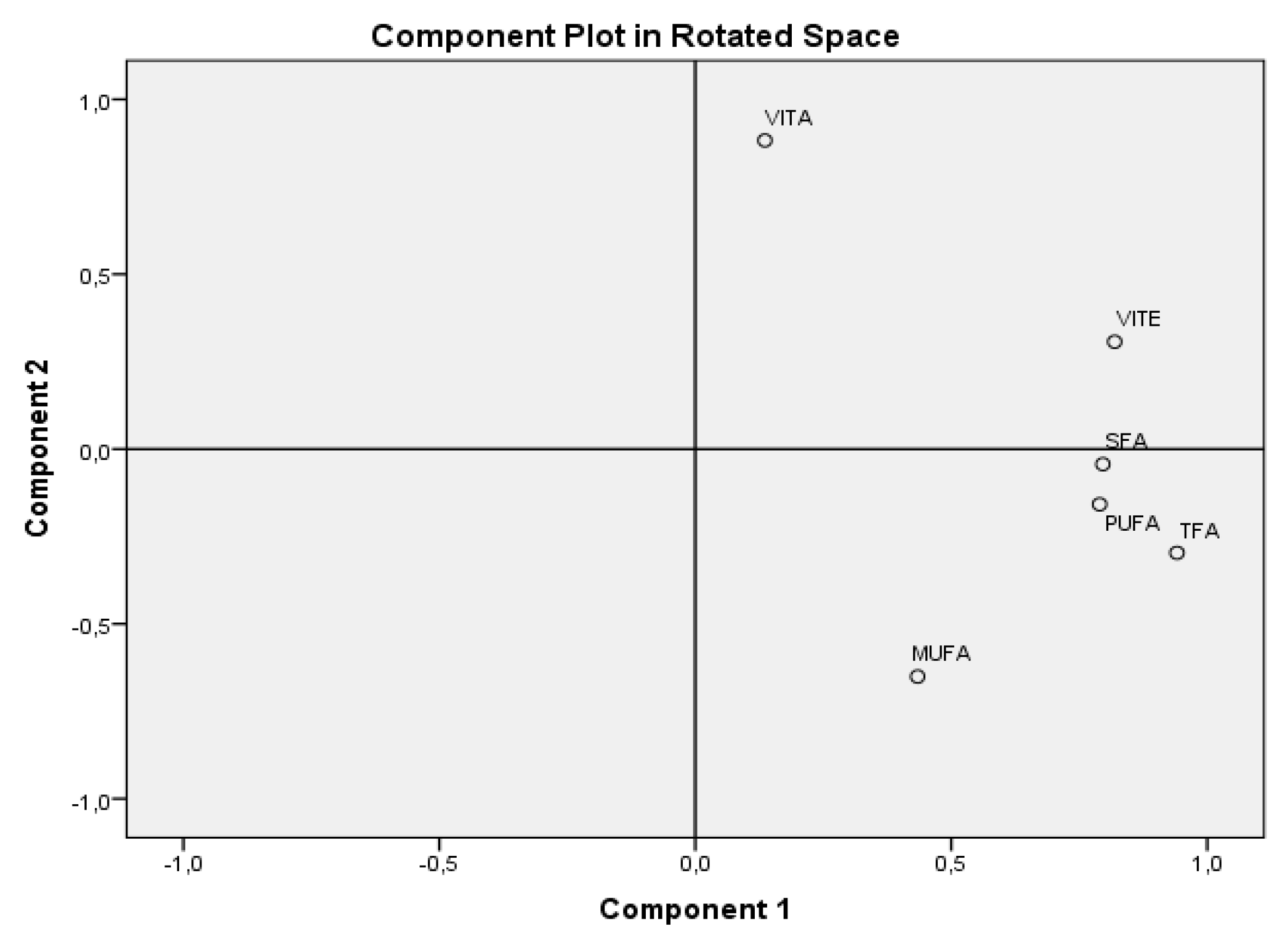
Figure 2.
Scores Plot for margarine samples.
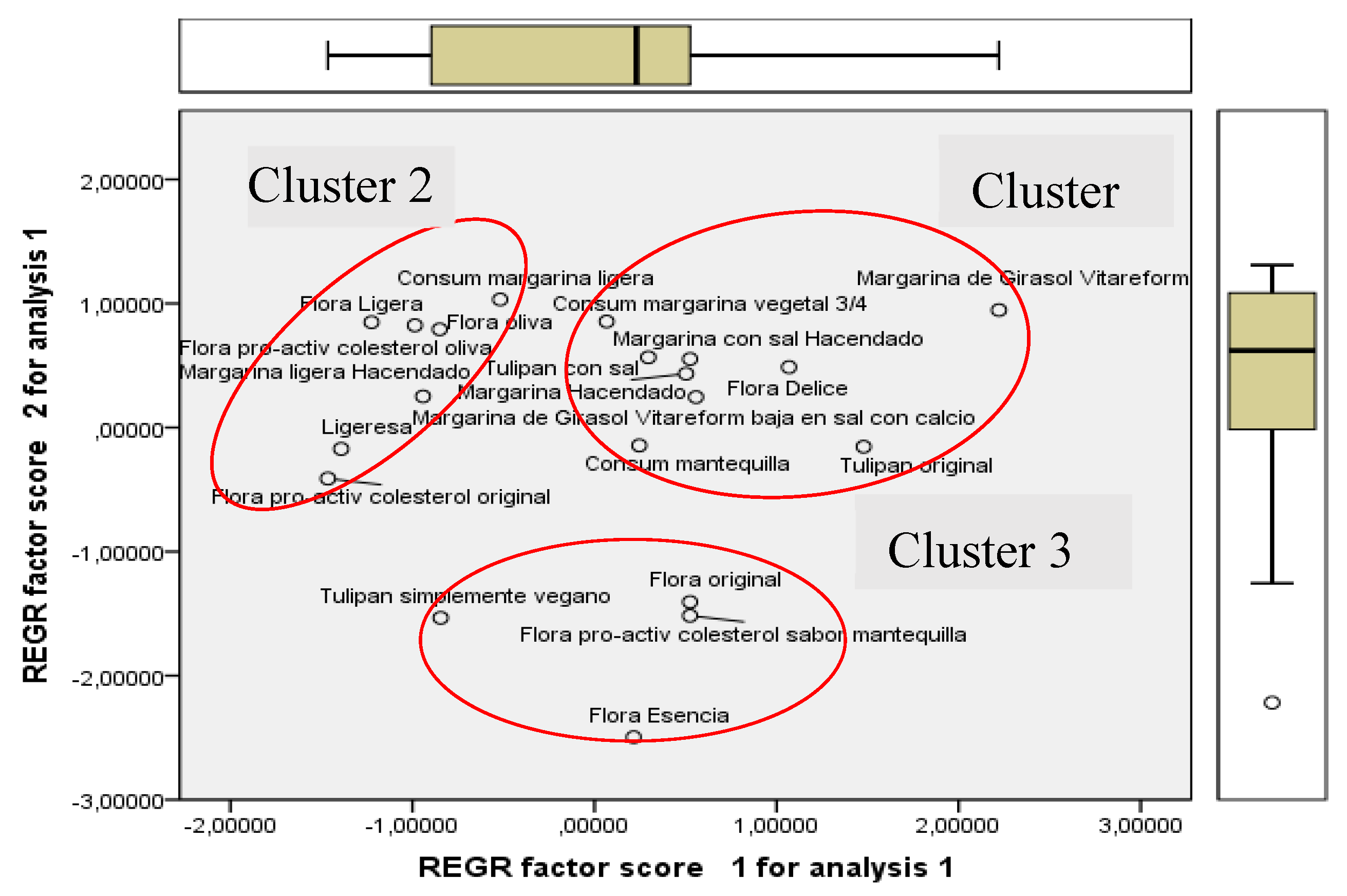
Figure 3.
Induction Period (IP) values in hours of eight margarines selected.
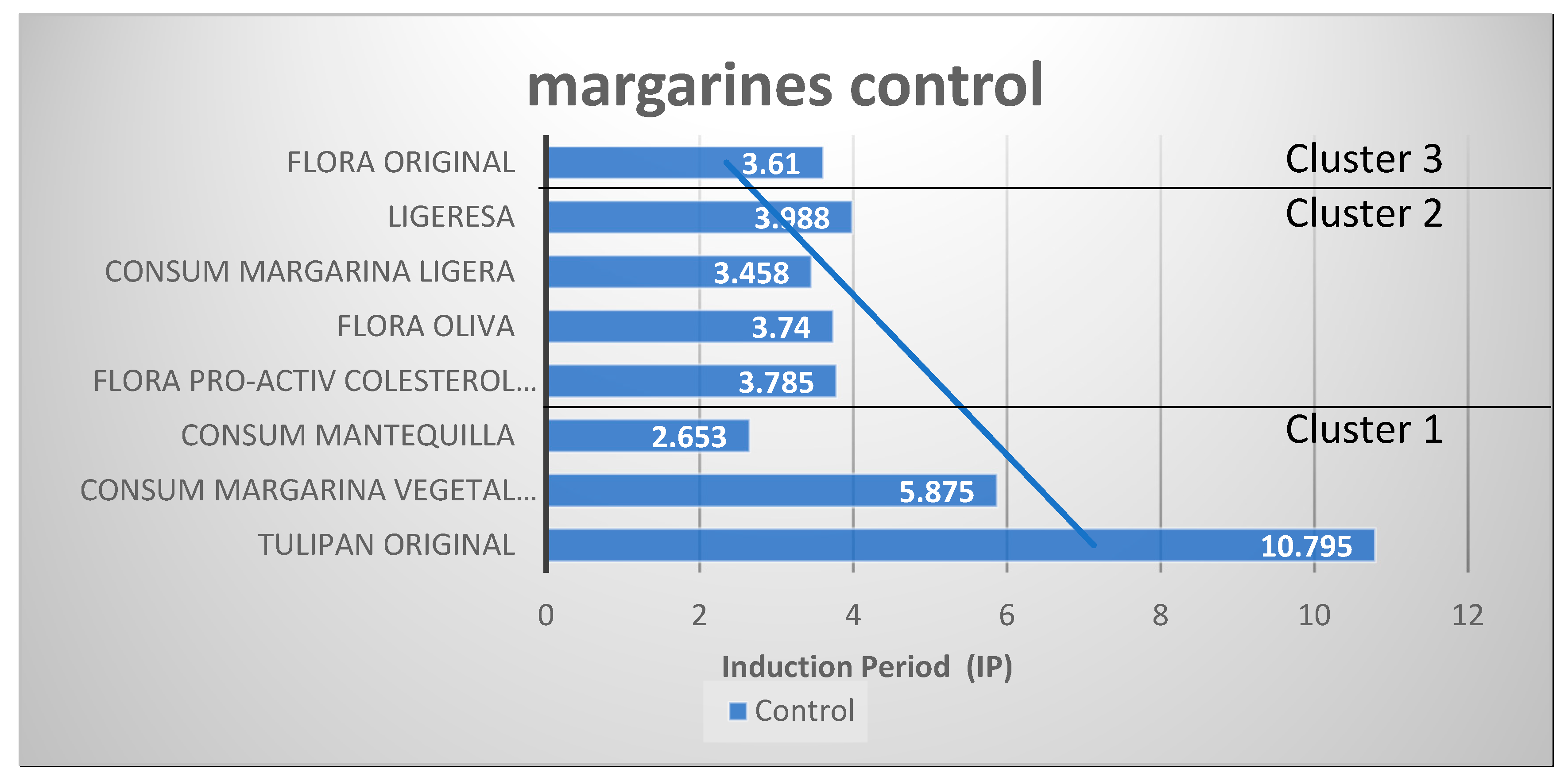
Figure 4.
Effect of plant material powders (0.5% w/w) addition on margarines stability (IP). Results are presented as mean ± SD. *denotes significant differences at p < 0.05 for samples before/after material powders addition.
Figure 4.
Effect of plant material powders (0.5% w/w) addition on margarines stability (IP). Results are presented as mean ± SD. *denotes significant differences at p < 0.05 for samples before/after material powders addition.
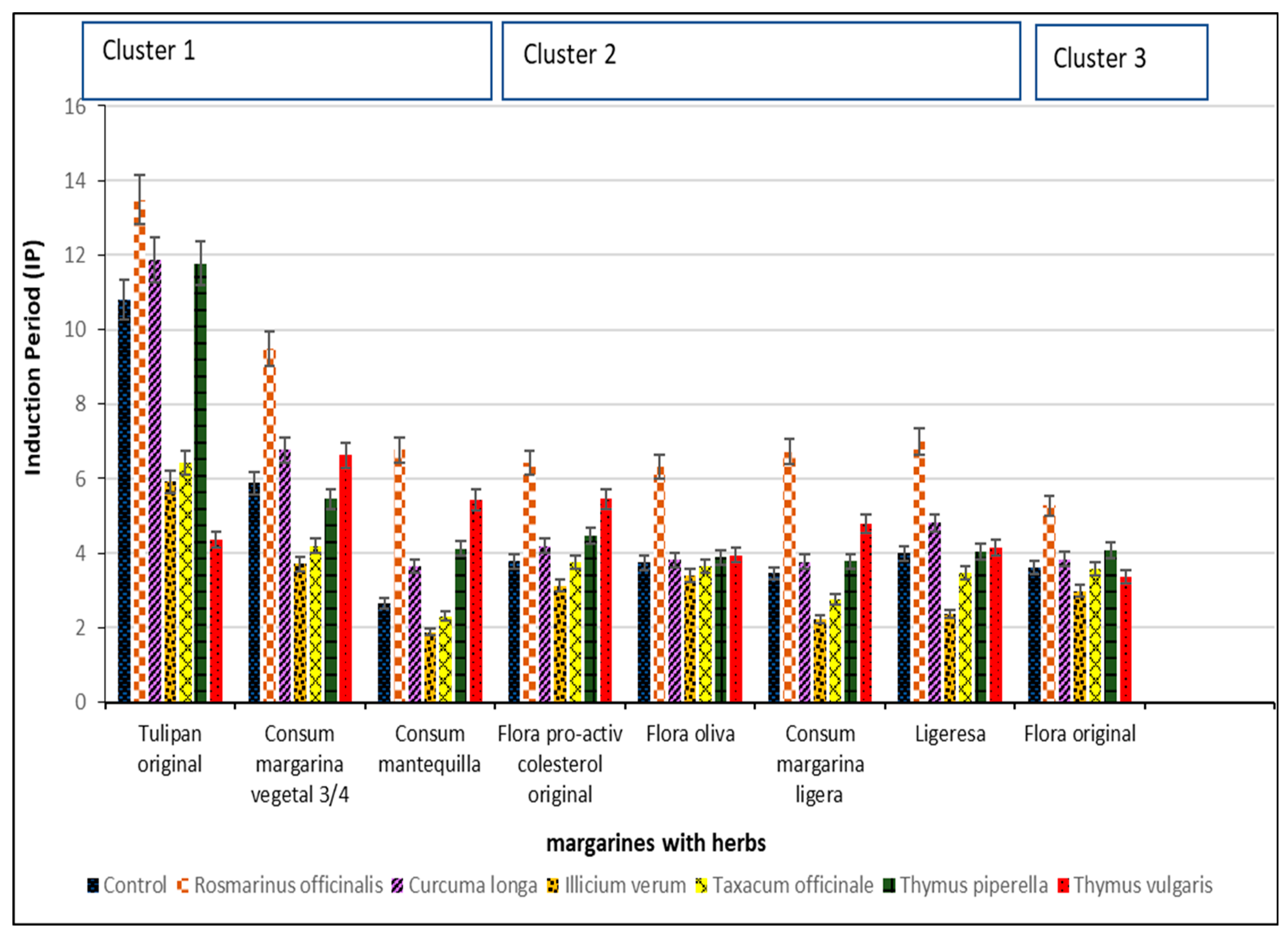
Figure 5.
(A). Score plot of variables.(B). Loading plot PC1 vs PC3 of margarines with herbs added grouped in clusters A (up) and B (down).
Figure 5.
(A). Score plot of variables.(B). Loading plot PC1 vs PC3 of margarines with herbs added grouped in clusters A (up) and B (down).
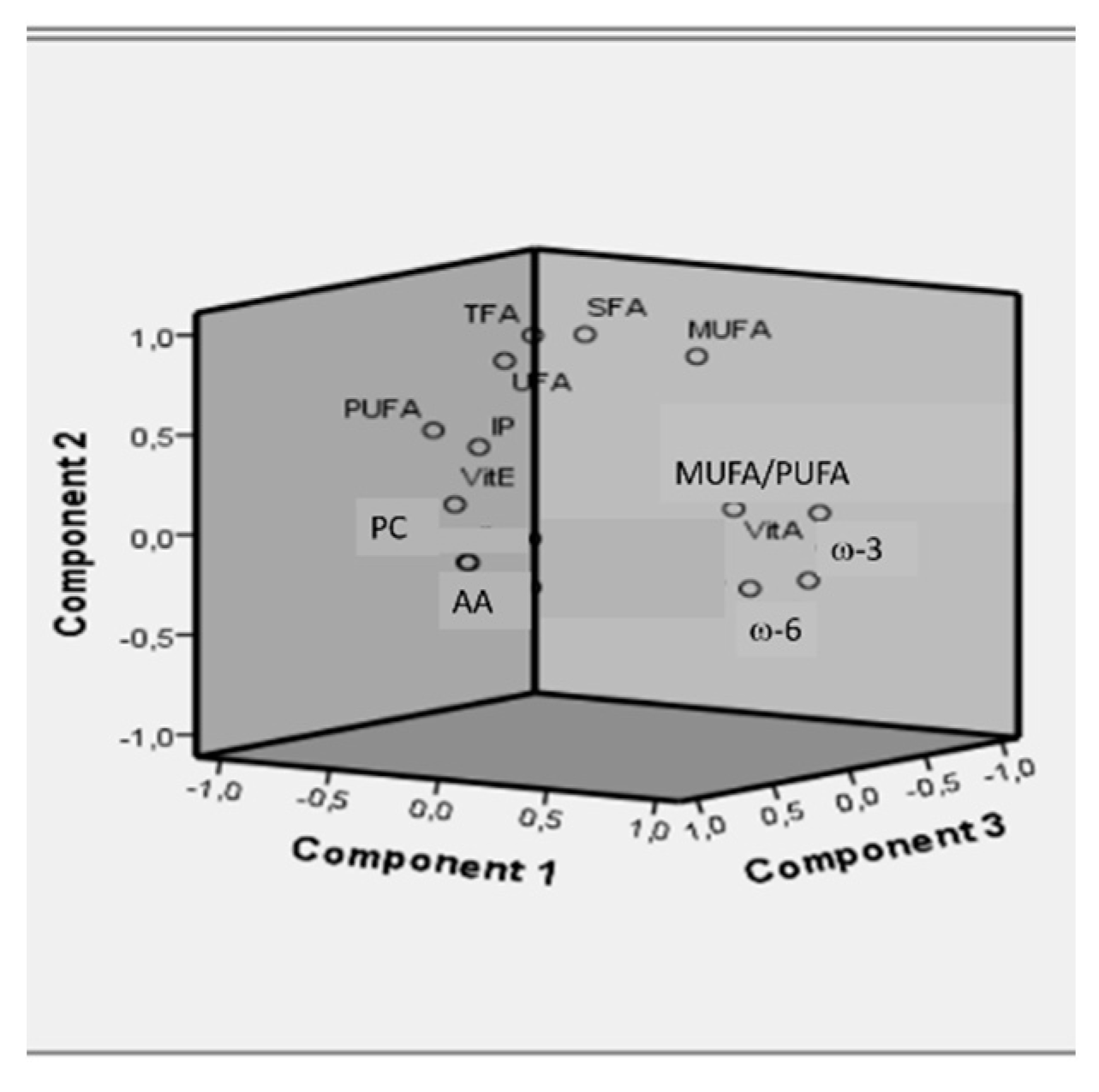
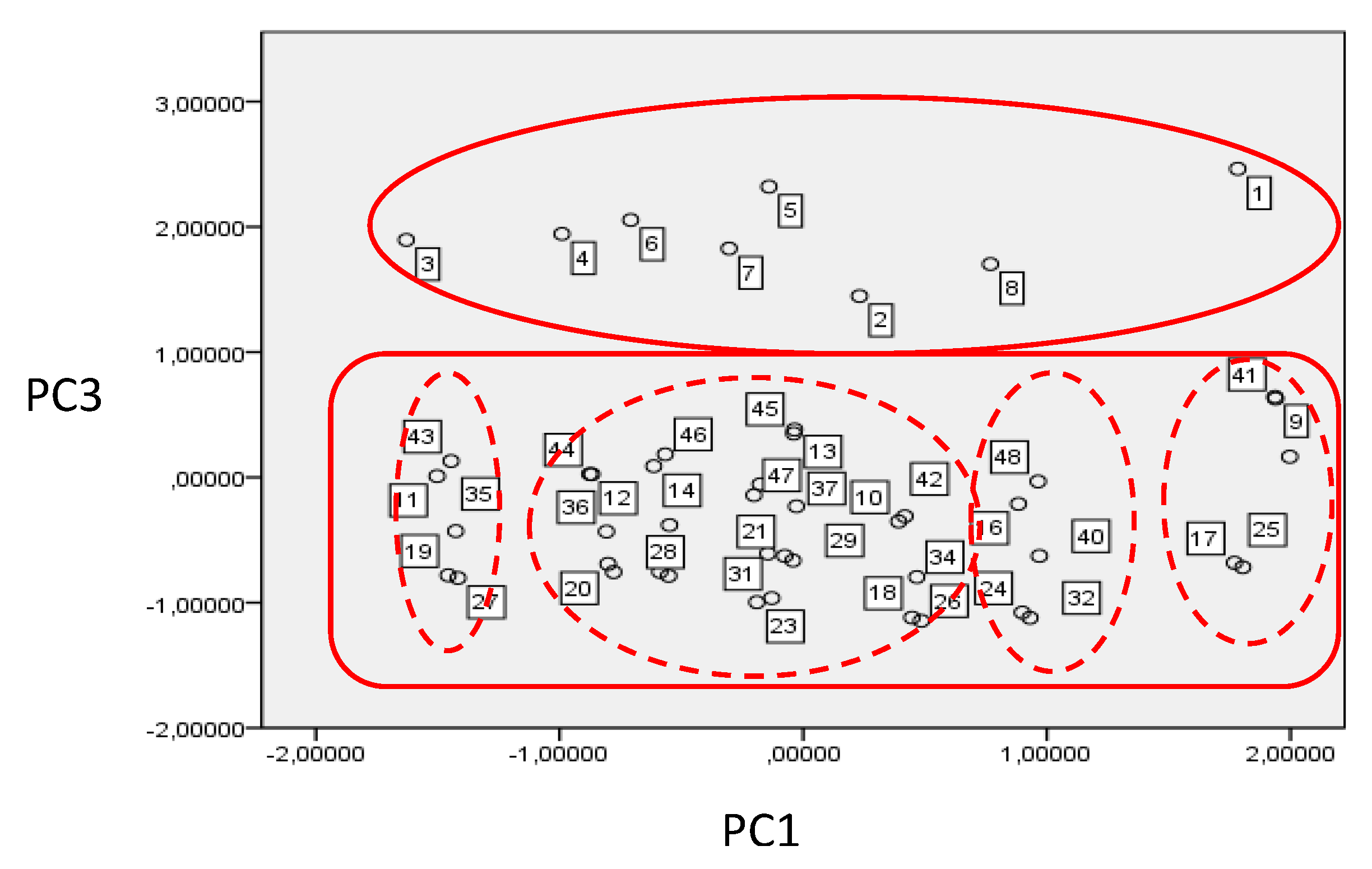

Table 1.
Composition of the 20 margarines used in the principal component analysis (PCA) 1.
| Margarine Commercial brand |
TFA (g) | SFA (g) | MUFA (g) | PUFA (g) | UFA (g) | MUFA/PUFA | Carbo- hydrates (g) |
Proteins (g) | Vit. A (µg) | Vit. D (µg) | Vit. E (µg) | Salt (g) |
|---|---|---|---|---|---|---|---|---|---|---|---|---|
| Tulipan original* | 80 | 34 | 23 | 23 | 46 | 0.50 | 0.5 | 0.5 | 800 | 7.5 | 17000 | 0.31 |
|
Tulipan con sal |
60 | 18 | 15 | 26 | 41 | 0.63 | 0.5 | 0.5 | 800 | 7.5 | 16000 | 0.91 |
| Tulipan simplemente vegano | 50 | 12 | 20 | 17 | 37 | 0.46 | 0.5 | 0.5 | 0 | 7.5 | 10000 | 0.71 |
| Flora original* | 70 | 18 | 19 | 32 | 51 | 0.63 | 0.5 | 0 | 800 | 7.5 | 25000 | 0.20 |
|
Flora pro-activ colesterol original* |
35 | 8 | 11 | 16 | 27 | 0.59 | 0.5 | 0.5 | 120 | 7.5 | 10000 | 0.3 |
|
Flora pro-activ colesterol oliva |
35 | 8.1 | 12 | 15 | 27 | 0.56 | 0.5 | 0.5 | 800 | 7.5 | 10000 | 0.33 |
|
Flora pro-activ colesterol sabor mantequilla |
70 | 16 | 23 | 31 | 54 | 0.57 | 0.5 | 0.5 | 120 | 7.5 | 18000 | 0.5 |
| Flora Esencia | 70 | 15 | 33 | 22 | 55 | 0.40 | 0.5 | 0.5 | 120 | 7.5 | 13000 | 0.4 |
| Flora oliva* | 40 | 11 | 13 | 17 | 30 | 0.57 | 0.5 | 0.5 | 800 | 7.5 | 12000 | 0.34 |
| Flora Ligera | 39 | 12 | 12 | 15 | 27 | 0.56 | 0.5 | 0.5 | 800 | 7.5 | 9700 | 0.37 |
| Flora Delice | 70 | 18 | 18 | 33 | 27 | 1.22 | 0.5 | 0.5 | 804 | 7.5 | 24700 | 0.21 |
|
Consum margarina vegetal ¾* |
60 | 15 | 17 | 27 | 51 | 0.25 | 0.5 | 0.5 | 650 | 5.4 | 24000 | 0.46 |
|
Consum margarina ligera* |
40 | 12 | 17 | 11 | 28 | 0.39 | 0.5 | 0.5 | 853 | 7.5 | 22000 | 0.4 |
| Margarina Hacendado | 60 | 17 | 17 | 26 | 43 | 0.60 | 0.5 | 0.5 | 700 | 5.9 | 23000 | 0.3 |
| Margarina con sal Hacendado | 60 | 17 | 17 | 26 | 43 | 0.60 | 0.5 | 0.5 | 760 | 5.9 | 23000 | 0.9 |
| Margarina ligera Hacendado | 40 | 12 | 20 | 8.2 | 28 | 0.29 | 0.5 | 0.5 | 800 | 6.8 | 12000 | 0.4 |
|
Margarina de girasol Vitareform |
80 | 23 | 20 | 37 | 57 | 0.65 | 0 | 0 | 900 | 2.5 | 40000 | 0.2 |
|
Margarina de girasol Vitareform baja en sal con calcio |
60 | 13 | 23 | 24 | 47 | 0.51 | 0.5 | 0.5 | 800 | 7.5 | 27000 | 0.2 |
| Ligeresa* | 40 | 11 | 20 | 9 | 29 | 0.31 | 0.1 | 0.1 | 800 | 7.5 | 0 | 0.76 |
|
Consum mantequilla* |
60 | 25 | 24 | 11 | 35 | 0.31 | 1 | 1 | 800 | 7.5 | 14000 | 0.4 |
1Information extracted from manufacturers' packaging and from the following web site: https://es.openfoodfacts.org/cgi/search.pl?search_terms=margarina&search_simple=1&action=process. Abbreviations: g: grams. µg: micrograms. mg: milligrams. TFA: total fatty acids; SFA: saturated fats; MUFA: monounsaturated fats; PUFA: polyunsaturated fats; UFA: unsaturated fats; Vit.: vitamin. * Margarines then selected to add herbs or spices.
Table 2.
Manufacturer information of the plant species used in the assays.
| Plant species | Batch number | Manufacturer name / Location |
|---|---|---|
| Curcuma longa | F12747 | Celeplame S.L. / Barbate (Cádiz) |
| Rosmarinus officinalis | F12449 | Celeplame S.L./ Barbate (Cádiz) |
| Taraxacum officinale | F12598 | Celeplame S.L./ Barbate (Cádiz) |
| Illicium verum | 3489 | Celeplame S.L./ Barbate (Cádiz) |
| Thymus piperella | 5049 | Celeplame S.L./ Barbate (Cádiz) |
| Thymus vulgaris | 11110.11110 | Jesús Navarro S.A./ Monforte del Cid (Alicante) |
Table 3.
Fatty acid composition in grams and IP values from the eight selected margarines in three clusters.
Table 3.
Fatty acid composition in grams and IP values from the eight selected margarines in three clusters.
| Cluster number |
Margarine Brand |
TFA (g) |
SFA (g) |
MUFA (g) |
PUFA (g) |
UFA (g) |
MUFA/ PUFA |
UFA/ SFA |
ω 3 (g) |
ω 6 (g) |
IP value (h) |
|---|---|---|---|---|---|---|---|---|---|---|---|
| 1 | Tulipan original | 80 | 34 | 23 | 23 | 46 | 1.00 | 1.35 | 0 | 0 | 10.8 ± 0.3 |
| Consum margarina vegetal 3/4 | 60 | 15 | 17 | 27 | 51 | 0.63 | 3.40 | 2.90 | 10 | 5.88 ± 0.21 | |
| Consum mantequilla | 60 | 25 | 24 | 11 | 35 | 2.18 | 1.40 | 0.00 | 11 | 2.65 ± 0.24 | |
| 2 | Flora proactiv colesterol original | 35 | 8 | 11 | 16 | 27 | 0.69 | 3.38 | 3.20 | 12 | 3.79 ± 0.09 |
| Flora oliva | 40 | 11 | 13 | 17 | 30 | 0.76 | 2.73 | 1.90 | 15 | 3.74 ± 0.19 | |
| Ligeresa | 40 | 11 | 20 | 9 | 29 | 2.22 | 2.64 | 0 | 0 | 4.0 ± 0.3 | |
| Consum margarina ligera | 40 | 12 | 17 | 11 | 28 | 1.55 | 2.33 | 0 | 11 | 3.46 ± 0.17 | |
| 3 | Flora original | 70 | 18 | 19 | 32 | 51 | 0.59 | 2.83 | 3.60 | 29 | 3.6 ± 0.3 |
Abbreviations: g: grams; h: hours.
Table 4.
Phenol content and antioxidant capacity of the plant species used in the tests.
| Plant species | Phenol content (mg GAE/g) |
Antioxidant capacity (μM Fe2+/g) |
|---|---|---|
| Curcuma longa | 240 ± 30 | 166.0 ± 0.7 |
| Rosmarinus officinalis | 410 ± 22 | 570 ± 70 |
| Taraxacum officinale | 33.90 ± 0.18 | 131.5 ± 0.9 |
| Illicium verum | 96.3 ± 0.5 | 88.9 ± 0.5 |
| Thymus piperella | 57.4 ± 0.4 | 213.5 ± 1.4 |
| Thymus vulgaris | 172.6 ± 1.4 | 242.3 ± 1.9 |
Abbreviations: g: grams. mg: milligrams. µM: micromoles. GAE: gallic acid equivalents.
Table 5.
Values of Induction Period (IP) in hours obtained with Rancimat test for eight margarines selected with the six herbs added separately. The controls correspond to the margarine samples without the addition of any plant species.
Table 5.
Values of Induction Period (IP) in hours obtained with Rancimat test for eight margarines selected with the six herbs added separately. The controls correspond to the margarine samples without the addition of any plant species.
| 8 | CLUSTER No. |
ADDED HERBS | ||||||
|---|---|---|---|---|---|---|---|---|
| Control | Rosmarinus officinalis |
Curcuma longa |
Illicium verum |
Taraxacum officinale | Thymus piperella |
Thymus vulgaris |
||
| Tulipan original |
1 | 10.8±0.3 | 13.49±0.23 (+24.97%) |
11.87±0.13 (+9.94%) |
5.9±0.5 (-45.21%) |
6.41±0.22 (-40.62%) |
11.8±0.8 (+9.03%) |
11.87±0.17 (+9.96%) |
| Consum margarina vegetal 3/4 |
5.88±0.21 | 8.64±0.24 (+47.06%) |
6.77±0.18 (+15.15%) |
3.7±0.8 (-36.89%) |
4.20±0.18 (-28.55%) |
6.2±0.6 (+6.04%) |
6.6±0.3 (+12.73%) |
|
| Consum mantequilla |
2.65±0.24 | 6.1±0.6 (+131.25%) |
3.6±0.6 (+37.32%) |
1.9±0.3 (-28.94%) |
2.31±0.16 (-12.81%) |
4.1±0.5 (+55.41%) |
5.4±0.5 (+104.67%) |
|
| Flora pro-activ colesterol original | 2 | 3.79±0.09 | 6.43±0.07 (+69.83%) |
4.2±0.03 (+10.91%) |
3.1±0.4 (-17.44%) |
3.8±0.3 (-0.92%) |
4.47±0.12 (+17.97%) |
5.5±0.3 (+44.07%) |
| Flora oliva | 3.74±0.19 | 6.32±0.17 (+68.98%) |
3.81±0.14 (+1.87%) |
3.4±0.3 (-8.82%) |
3.6±0.4 (-2.67%) |
3.9±0.4 (+4.01%) |
3.94±0.17 (+5.35%) |
|
| Consum margarina ligera |
3.46±0.17 | 6.7±0.5 (+94.48%) |
3.77±0.13 (+9.02%) |
2.2±0.7 (-35.57%) |
2.75±0.10 (-20.39%) |
3.76±0.16 (+8.59%) |
4.79±0.10 (+38.43%) |
|
| Ligeresa | 4.0±0.3 | 7.0±0.9 (+75.60%) |
4.8±0.3 (+20.56%) |
2.37±0.18 (-40.70%) |
3.5±0.3 (-12.78%) |
4.0±0.5 (+1.18%) |
4.2±0.5 (+4,19%) |
|
| Flora original | 3 | 3.6±0.3 | 5.28±0.13 (+46.26%) |
3.84±0.18 (+6.37%) |
3.0±0.4 (-17.17%) |
3.57±0.09 (-1.11%) |
4.07±0.19 (+12.74%) |
4.4±0.6 (+21.05%) |
Table 6.
Combinations of the eight selected margarines with added herbs.
| 1. Tulipan original + Rosmarinus officinalis | 17. Tulipan original+ Illicium verum | 33. Tulipan original + Thymus piperella |
| 2. Flora original + Rosmarinus officinalis | 18. Flora original + Illicium verum | 34. Flora original + Thymus piperella |
| 3. Flora pro-activ colesterol original + Rosmarinus officinalis | 19. Flora pro-activ colesterol original + Illicium verum | 35. Flora pro-activ colesterol original + Thymus piperella |
| 4. Flora oliva + Rosmarinus officinalis | 20. Flora oliva + Illicium verum | 36. Flora oliva + Thymus piperella |
| 5. Consum margarina vegetal ¾ + Rosmarinus officinalis | 21. Consum margarina vegetal ¾ + Illicium verum | 37. Consum margarina vegetal ¾ + Thymus piperella |
| 6. Consum margarina ligera + Rosmarinus officinalis | 22. Consum margarina ligera + Illicium verum | 38. Consum margarina ligera + Thymus piperella |
| 7. Ligeresa + Rosmarinus officinalis | 23. Ligeresa + Illicium verum | 39. Ligeresa + Thymus piperella |
| 8. Consum mantequilla + Rosmarinus officinalis | 24. Consum mantequilla + Illicium verum | 40. Consum mantequilla + Thymus piperella |
| 9. Tulipan original + Curcuma longa | 25. Tulipan original + Taraxacum officinale | 41. Tulipan original + Thymus vulgaris |
| 10. Flora original + Curcuma longa | 26. Flora original + Taraxacum officinale | 42. Flora original + Thymus vulgaris |
| 11. Flora pro-activ colesterol original + Curcuma longa | 27. Flora pro-activ colesterol original + Taraxacum officinale | 43. Flora pro-activ colesterol original + Thymus vulgaris |
| 12. Flora oliva + Curcuma longa | 28. Flora oliva + Taraxacum officinale | 44. Flora oliva + Thymus vulgaris |
| 13 .Consum margarina vegetal ¾ + Curcuma longa | 29. Consum margarina vegetal ¾ + Taraxacum officinale | 45 Consum margarina vegetal ¾ + Thymus vulgaris |
| 14.Consum margarina ligera + Curcuma longa | 30. Consum margarina ligera + Taraxacum officinale | 46. Consum margarina ligera + Thymus vulgaris |
| 15.Ligeresa + Curcuma longa | 31. Ligeresa + Taraxacum officinale | 47. Ligeresa + Thymus vulgaris |
| 16.Consum mantequilla + Curcuma longa | 32. Consum mantequilla + Taraxacum officinale | 48. Consum mantequilla + Thymus vulgaris |
Disclaimer/Publisher’s Note: The statements, opinions and data contained in all publications are solely those of the individual author(s) and contributor(s) and not of MDPI and/or the editor(s). MDPI and/or the editor(s) disclaim responsibility for any injury to people or property resulting from any ideas, methods, instructions or products referred to in the content. |
© 2023 by the authors. Licensee MDPI, Basel, Switzerland. This article is an open access article distributed under the terms and conditions of the Creative Commons Attribution (CC BY) license (http://creativecommons.org/licenses/by/4.0/).
Copyright: This open access article is published under a Creative Commons CC BY 4.0 license, which permit the free download, distribution, and reuse, provided that the author and preprint are cited in any reuse.


