

Submitted:
18 May 2023
Posted:
18 May 2023
You are already at the latest version
Abstract
The development of mobile internet technology has enabled companies to use social media for E-commerce. Some companies use personified images and languages to communicate with consumers in this context. How does personified communication affect consumer behavior in social commerce? Are consumers willing to accept this new form of communication under social commerce? To answer these questions, this paper explores consumers' willingness to take per-sonified communication in the context of social commerce. It investigates the role of cognitive needs in regulating the internal mechanism and proposes some suggestions for enterprises to improve social media communication. Specifically, this paper presents an improved model based on the TAM model. In our model, perceived interaction is introduced as a new independent variable, and cognitive need is added as a regulatory variable, which is more suitable for social commerce. We conduct a questionnaire survey on the Internet and analyze data using AMOS and SPSS. The results show that perceived usefulness and perceived interaction positively im-pact attitude, which influences consumers' willingness to purchase. Furthermore, the cognitive need as the regulatory variable significantly affects the influencing path from perceived use-fulness to attitude and purchase intention.
Keywords:
Social commerce
; Social media
; Personified communication
; E-commerce
1. Introduction
With the development of the Web 2.0 era and mobile Internet technologies, social commerce has become a promising area [1,2,3]. In social media, Internet users passively accept the information generated by other users and can communicate with others freely. At first, social media appeared as entertainment tool. Later, some E-commerce providers found that the use of social media can broaden the scope of information dissemination and social interaction, especially during the COVID-19 pandemic [4]. One of the advantages of social commerce is interaction, which means that users can conveniently interact on social media platforms. Many brand companies open accounts on social media platforms like Sina Weibo and WeChat and start to offer personification services in social media. For example. "Haier", as a famous appliance supplier in China, has promoted the construction of a "brand-consumer" relationship through personification communication in the WeChat platform.
In recent years, the academic community began to pay attention to social commerce [5]. The research on social commerce mainly focused on the following aspects: the theoretical concept of social commerce, the marketing strategy of social media, the brand attitude of consumers, and so on. However, these studies have not yet focused on the impact of marketing on consumer psychology and behavior in the context of social media. Enterprises pay more and more attention to marketing activities under social media's background, reflecting the innovation of brand communication and consumer interaction mode, and consumers' behavior and psychology are bound to be affected by this innovation mode. Personified communication is an innovative behavior of enterprises in social commerce. It refers to using social media to offer personified brands and communication with consumers with emotions including joy, anger, sadness, and fear.
This paper constructs a research model of consumers' willingness to accept personified communication with brand merchants in social commerce. The purpose of this model is to answer the question "whether the personified communication behavior of brand merchants has an impact on consumers, and if so, how it will be affected?". Specifically, this paper proposes an improved model based on the TAM model, in which "perceived interaction" is introduced as an independent variable and "cognitive need" as a moderating variable, which is more in line with the characteristics of social commerce. On this basis, the paper obtains data through a questionnaire survey conducted on the WeChat platform and uses AMOS and SPSS for data analysis. This paper enriches the existing relevant theories of social commerce, enhances brand merchants' attention on the innovation of social media marketing methods, and provides corresponding decision-making suggestions for companies to carry out E-commerce on social media platforms.
2. Related Work
2.1. Social Commerce
Social commerce refers to using social media, such as blogs, social tools, and sharing forums, to promote E-commerce. Hammond pointed out that different from online marketing, the key to social commerce lies in creating and exchanging content by users [6]. At present, the research on social commerce mainly focuses on theoretical concepts, marketing strategy, brand attitude, etc. Scholars on theoretical concepts focus on the differences between social commerce and traditional marketing. For example, Chikandiwa reported that social commerce promotes interactive communication between users compared with conventional marketing's one-way communication channel [7]. In social media, enterprises should transmit information to consumers and accept consumers' ideas and opinions. Also, Jung et al. pointed out that social commerce can promote advertising at a lower cost and establish stable relationships with users [8]. Kiezmann et al. developed a cellular model to facilitate enterprises' social media use for marketing positioning regarding marketing strategy research [9]. Their model includes seven modules: identity, communication, sharing, existence, relationship, reputation, and aggregation.
On the other hand, Mohammadia proposed to use social media to publish information using the same language style as consumers [10]. Their study showed that transparent information was more conducive to marketing. Wawrowski & Otola studied social commerce in creative industries and proposed to use social commerce to promote computer games [11]. Hudson et al. pointed out that traditional media and social media communication significantly affect corporate brand image. Social media communication has a more significant impact on corporate brand image than conventional media communication and is more suitable for improving brand image [12].
On the one hand, the existing research clearly defines the types of social commerce and points out the differences between traditional marketing and social commerce. On the other hand, it also explores social media strategies. Although social commerce has attracted Chinese scholars' attention, there is still a lack of relevant research. There is not enough attention on enterprises' marketing methods using social media. A complete system has not yet been presented.
2.2. Personified Communication
Personified communication is an innovative way for companies to use social media to offer a personified communication mode that allows users to express their joy, anger, and sadness [13, 14]. It is an innovative way for brand companies to use social media for marketing. Previous research on personification mainly focused on the design concept of an entity. For example, Aaker pointed out that marketers tend to visualize, vividly, and personify products when facing young children to make them understand [13]. Simultaneously, the design concept of personification has also been integrated into the automobile industry. For example, in the Super Bowl in 2007, General Motors adopted personified cars. With social media development, personification is not limited to traditional appearance design but gradually transformed into online communication. Social media has provided a platform for companies to use personified communication for marketing. Salminen et al. conducted an empirical study and found that companies can improve consumers' attitudes through personified advertisements [14]. Nobile & Kalbaska established a platform for companies to use personified communication [15]. The relationship between consumers' needs of belonging and brand attitude was explored by setting up a personified situation. In addition, Puzakoza et al. found that consumers' personal beliefs moderate personified communication [16].
At present, personified communication has just entered the vision of managers and researchers under the social network background, which belongs to a relatively new concept. As a result, most of the current literature research focuses on theoretical concepts and brand attitude. Although many well-known brands use social media to conduct personified communication with consumers and achieve good marketing results, how they affect consumer behavior is still unclear.
3. Research Method
3.1. Hypothesis
(1) Hypothesis on the influence of consumers' attitude on purchase intention
Ajzen has pointed out that people's behavior attitude will directly affect their intention [17]. Scholars have made a clear definition of attitude and behavior. Behavioral attitude refers to a person's positive or negative feelings and cognition of specific behavior, which is a person's view on the behavior after evaluating its total value. Behavioral intention refers to an individual's willingness intensity to a particular behavior. The more robust the willingness is, the more significant the behavior's possibility will be. The theory of rational behavior points out that people's behavior attitude affects the generation of behavior intention, affecting action implementation.
Davis proposed the technology acceptance model (TAM) [18] based on the above theory, which explores people's behavior and attitude on its acceptance. This paper improves the TAM model for brand merchants' personified communication behavior. Brand merchants adopt personified communication behavior in social media to influence consumers' purchase intention. Based on the rational behavior theory, consumers' purchase intention is determined by their purchase attitude. Therefore, this paper puts forward the following assumptions:
H1: The attitude of consumers' purchase behavior positively impacts consumers' purchase intention.
(2) Hypothesis on the influencing factors of consumers' attitude
The TAM model defined perceived usefulness as an indicator. According to its definition, combined with personified communication, we define perceived usefulness as consumers' perception of life benefits when they receive personified communication information from brand merchants in social media. Perceived usefulness is an important indicator of consumer evaluation. Perceived usefulness can evaluate the benefits of behavior, and perceived cost can assess the level of behavior cost.
In personified communication, perceived usefulness can make consumers perceive the quality of products; if consumers can feel the usefulness of personified communication behavior in social media, they will have a positive attitude towards purchasing behavior. Based on this, this paper puts forward the following assumptions:
H2a: Perceived usefulness has a positive impact on consumers' purchase attitude
Chikandiwa et al. pointed out that enterprises use social media for marketing activities because, compared with traditional marketing methods, social commerce is more interactive and can effectively establish consumer brand relationship ties [7]. Besides, consumer participation is an essential factor in the success of enterprises using social media. Consumers' involvement in enterprise marketing activities is also conducive to consumers' integration into brand companies.
Consumers' participation is crucial when enterprises adopt personified communication behavior through social commerce. Through the analysis of the activity, we found that the personified communication of enterprises mainly includes two aspects of interaction. One is the interaction between companies and users, which is called User-Company interaction in this paper. Through this level of interaction, the needs of consumers can be understood by enterprises to improve products, and consumers can also obtain information directly from enterprises, which strengthens the communication with enterprises and establishes enterprises well. The other is the interaction between users, which is called User-User interaction in this paper. It can promote consumers' trust and promote the formation of word-of-mouth. Based on this, this paper puts forward the following assumptions:
H2b: User-Company interaction has a positive impact on consumers' purchase attitude
H2c: User-User interaction has a positive impact on consumers' purchase attitude
H3a: Consumers' purchase attitude mediates the relationship between perceived usefulness and purchase intention
H3b: Consumers' purchase attitude mediates the relationship between perceived interaction (User-User) and purchase intention
H3c: Consumers' purchase attitude mediates the relationship between perceived interaction (User-Company) and purchase intention.
(3) Hypothesis of consumers' cognitive need
In the personified communication marketing mode in social media, the change of consumers' psychological perception depends not only on enterprise behavior but also on consumers' characteristics. Consumers' personality characteristics are different, and their attitudes towards enterprise marketing differ from taking other actions. Cognitive need refers to how individuals participate in thinking and enjoy thinking in the process of understanding things; consumers with high cognitive need are eager to obtain more product attribute information to help them feel and make decisions [19]. People with low cognitive needs desire to make decisions as soon as possible. According to cognition, consumers with high cognitive needs are eager to obtain more information about product attributes to help them make decisions as soon as possible. People can be divided into two categories: those with low cognitive needs think that the situation should be orderly and regular. In contrast, those with high cognitive needs believe that the case is not clear. They will analyze the situation according to their personal experience and understand it through self-learning [19]. Ma et al. pointed out that people with high cognitive needs prefer thinking and form brand attitudes through thinking [20]. Conversely, people with low cognitive needs are easily affected by the frontier clues of advertising.
When the consumer's cognitive need is high, even if the company's personified information provides the product's detailed content, such consumers are eager to obtain more additional information to determine their purchase behavior. Therefore, even if the perceived usefulness is high, consumers with higher cognitive need still want to get more information than those with low cognitive needs. The change in their purchasing attitude can be improved. It can be relatively slow. When the interaction is high, consumers with low cognitive needs may promote their decision-making through interactive communication. Therefore, the higher the perceived interaction, the more pronounced the change of consumers' attitude towards cognitive needs; however, when consumers with high cognitive needs desire to make self-determination, they may perceive that interaction has little effect on their decision-making. Based on this, this paper puts forward the following assumptions:
H4a: Cognitive needs moderated the relationship between perceived usefulness and attitude; when cognitive needs were high, perceived usefulness had a less positive effect on attitude
H4B: Cognitive needs have a moderating effect on perceived interaction and attitude relationship; when cognitive need is high, perceived interaction has a less positive impact on attitude
3.2. Research Model
Based on the technology acceptance model (TAM), this paper constructs a model of consumers' willingness to accept personified communication with brand merchants. The TAM model is revised based on the rational behavior theory, which believes that people's behavior intention is affected by their behavior attitude. The TAM model is widely used in various fields to explore users' willingness to accept technology or similar technology. Personified communication is an innovative marketing method adopted by companies. Consumers' willingness to accept companies' marketing methods can be measured by their desire to buy. In brand companies, the perceived ease of use and perceived usefulness of information will affect consumers' purchase attitude, affecting their purchase intention. In the personified communication of companies, perceived interaction is an essential factor influencing the attitude of users. Therefore, with the introduction of perceived interaction, the TAM model can well study consumers' acceptance intention of personified communication behavior. Figure 1 shows the theoretical model of this paper.

Table 1.
Questionnaire questions and variables.
| Variable | Item | Questionnaire Question |
|---|---|---|
| Perceived Usefulness (PU) | PU1 | Reading the personified microblog of brand enterprises allows me to buy the products I like |
| PU2 | Reading the personified microblog of brand enterprises can enhance my understanding of products or services | |
| PU3 | Reading the personified microblog of brand enterprises has improved my shopping efficiency | |
| Perceived Interaction (PIU) (User-User) |
PIU1 | Through the personification of enterprise communication, the frequency of communication with other consumers has become more and more |
| PIU2 | Through the personification of corporate communication, I feel that I have strengthened the connection with other consumers | |
| PIU3 | As consumers, they often communicate with each other under the personified microblog of enterprises | |
| Perceived Interaction (PIC) (User-Company) |
PIC1 | When I post my microblog about brand enterprises in microblog, I will get personified response from brand enterprises |
| PIC2 | I often participate in related topics about a corporate brand in microblog | |
| PIC3 | Through the personified communication of enterprises, I feel able to establish contact with enterprises | |
| Attitude (AT) |
AT1 | I am delighted with the personified communication behavior of enterprises |
| AT2 | The personified communication of enterprises makes me have the impulse to buy goods | |
| AT3 | I think it's a good idea for companies to personify communication on social media | |
| Purchase Intention (PW) |
PW1 | It is helpful for me to make a purchase decision for this product |
| PW2 | The personification of enterprise communication has an impact on my purchase of this enterprise's products | |
| PW3 | In whether to buy this product, I will refer to the personified communication behavior of the enterprise | |
| PW4 | The personified communication behavior of the enterprise makes me more confident when I decide to buy the products of this brand | |
| Cognitive Need (CN) |
CN1 | The personified communication behavior of the enterprise makes me more confident when I decide to buy the products of this brand |
| CN2 | I have a strong interest in the goods I buy | |
| CN3 | I like to do things that require a lot of thinking |
4. Empirical Study and Results
4.1. Questionnaire Design
This paper conducts a questionnaire survey to test the model hypothesis. The questionnaire is designed according to the general principles and steps of the previous literature. We extracted each variable's indicators and tested the designed questionnaire in a small range of 50 college students based on many existing studies. According to the analysis results of the sample, we revised some items to get the formal questionnaire. The questionnaire was designed with the Richter five subscale. The respondents chose 1 (very disagree) to 5 (very agree) to rate the questions. The scale of perceived usefulness comes from the research in [21]. The scale of perceived interaction is designed according to the study in [22,23]. The scale of purchase attitude is developed according to [24,25]. The scale of cognitive needs was modified based on the scale designed [19]. The questionnaire design is shown in Table 1.
4.2. Data Collection
The data collection of this paper is mainly through the WeChat platform, which is the biggest personal communication platform in China. In order to ensure that participants have a good understanding of personified communication and provide real, accurate, and effective data, they were asked some questions before starting the survey, such as "Do you often know about products or after-sales service information through retailers' social media?" and "Are you familiar with other social commerce models?". Only those who responded positively were invited to fill in the questionnaire. In this survey, 340 questionnaires were collected. After eliminating the invalid questionnaires, such as no experience of using social media and lack of data, 252 valid questionnaires were obtained, with an effective rate of 74.1%. The sample size is more than 200, which meets the analysis requirements of the structural equation model. Among the respondents, 127 are male, 125 are female, the age is mainly between 20 and 25 years old (72.2%), and 68.6% have a college degree or above.
Table 2.
Reliability and validity test.
| Variable | Item | Factor loading | Cronbach's α | CR | AVE |
| Perceived Usefulness(PU) | PU1 | 0.84 | 0.879 | 0.881 | 0.712 |
| PU2 | 0.85 | ||||
| PU3 | 0.84 | ||||
| Perceived Interaction(PIU) (User-User) |
PIU1 | 0.75 | 0.862 | 0.864 | 0.681 |
| PIU2 | 0.88 | ||||
| PIU3 | 0.84 | ||||
| Perceived Interaction (PIC) (User-Company) |
PIC1 | 0.83 | 0.896 | 0.898 | 0.746 |
| PIC2 | 0.89 | ||||
| PIC3 | 0.87 | ||||
| Attitude (AT) |
AT1 | 0.75 | 0.813 | 0.807 | 0.583 |
| AT2 | 0.79 | ||||
| AT3 | 0.75 | ||||
| Purchase Intention (PW) |
PW1 | 0.74 | 0.852 | 0.858 | 0.603 |
| PW2 | 0.74 | ||||
| PW3 | 0.84 | ||||
| PW4 | 0.78 | ||||
| Cognitive Need (CN) |
CN1 | 0.84 | 0.842 | 0.852 | 0.592 |
| CN2 | 0.80 | ||||
| CN3 | 0.71 |
4.3. Model Validation
The model validation measures the relationship between latent variables and measurement indicators. We use confirmatory factor analysis (CFA) to analyze its reliability and validity.
(1) Reliability. We use SPSS 22.0 to analyze reliability. The specific results were KMO = 0.874. The Bartlett sphericity test results were significant (SIG = 0.000). The Cronbach's α coefficient and combination reliability of the structural variables were greater than 0.8, indicating that the scale had high reliability. The detailed results are shown in Table 2.
(2) Convergence validity. The standardized factor loads of the significant variables of the model were higher than 0.8 and reached a considerable level. The model's component reliability was more significant than 0.7. The average variance extraction rate was more significant than 0.5.
(3) Discriminant validity. As shown in Table 3, each variable's correlation coefficient is less than the square root of the average variance extraction rate of the corresponding variable, so we can know that it has good discriminant validity.
4.4. SEM Analysis
The structural equation model (SEM) measures the relationship between latent variables. We use AMOS 23.0 to verify the path coefficients among the latent variables in the research model. The path coefficients among the variables are shown in Figure 2.
Companies' personified marketing affects consumers' attitudes through perceived usefulness and interaction when consumers browse on social media. More specifically, perceived usefulness significantly affects consumers' attitudes (β = 0.20, P < 0.05), and perceived interactive consumers also significantly and positively affects consumers' attitudes (β = 0.29, P < 0.001). The results show that the change of knowledge interactive enterprises' attitude to consumers is also positively significant (β = 0.31, P < 0.001). Thus, hypotheses H2a, H2b, and H2c are valid. This result shows that when companies adopt personified communication in social commerce, perceived usefulness and interaction positively affect users' purchasing behavior.
On the other hand, the personified communication marketing methods adopted by enterprises significantly impact users' purchase behavior. When consumers' attitudes toward purchase behavior change, the impact on purchase intention is positive and significant (β = 0.56, P < 0.001), consistent with the rational behavior theory. The rational behavior theory points out that people's attitudes to behavior will significantly impact behavior intention, affecting the implementation of behavior. In other words, the change of consumers' purchase attitudes will positively impact the change of purchase intention.
Also, the determinable coefficient of attitude is 0.26, showing that perceived usefulness and perceived interaction explain the variance of 26% of consumers' attitudes towards purchase behavior when browsing social media and experiencing personified. Overall, the decisive coefficient of purchase intention is 0.32, which means that the model explains a 32% variance variation of consumers' purchase intention, and the explanation degree is acceptable. The model fitting degree is shown in Table 4. The model fit index reaches the theoretical value, and the fit degree is sufficient.
4.5. Mediating Effect Test
To verify the influence of personified communication on consumers' purchase intention, we adopt the method of Hayes and Scharkow [26] to analyze the mediating effect of variables. The results are shown in Table 5.
To sum up, in the path of perceived usefulness influencing consumers' purchase intention, the attitude has a partial mediating role, which shows that perceived usefulness mainly affects consumers' attitude towards purchase intention and then affects consumers' willingness to purchase behavior. In the path of consumers' perceived interaction influencing consumers' purchase intention, the mediating effect of attitude on consumers' perceived interaction on consumers' purchase intention exists. Unlike the other two paths, attitude plays a partial intermediary role in influencing perceived interaction at the enterprise level on consumers' purchase intention. Thus, consumers' purchase attitude mediates the relationship between perceived usefulness and purchase intention, validating H3a. Furthermore, consumers' purchase attitude mediates the relationship between perceived interaction (User-User) and purchase intention, supporting H3b. Finally, consumers' purchase attitude mediates the relationship between perceived interaction (User-Company) and purchase intention, meaning that H3c is established. These results show that perceived usefulness and perceived interaction impact purchase intention through the influence of attitude.
4.6. Moderated Mediation Analysis
In this study, the condition's indirect effect under different variables' values is directly obtained by the Process operation. The Process will automatically operate different values to reduce one standard deviation and increase one standard deviation based on adjusting the variable's mean value from low to high [27]. The results shown in the left part of Table 6 show that when consumers' cognitive needs are relatively low, the indirect effect of perceived usefulness of personified communication on consumers' purchase intention is 0.067. When consumers' cognitive needs are relatively high, the indirect effect of perceived usefulness on consumers' purchase intention through attitude is 0.125. Since these confidence intervals do not contain zero, the results show that the indirect effect of perceived usefulness on the dependent variable consumers' purchase intention through attitude is significant whether the moderator of cognitive need is low or high. Besides, when the cognitive need is low, perceived interaction's indirect effect on consumers' purchase intention is 0.033. When the consumer's cognitive need is relatively high, the indirect effect of perceived interaction (User-User) on consumers' purchase intention through attitude is 0.057.
Similarly, the indirect effect of perceived usefulness on the dependent variable consumers' purchase intention through attitude is significant. In the aspect of perceived interaction (User-Company), when consumers' cognitive need is low, the indirect effect of perceived interaction on consumers' purchase intention through attitude is 0.109 (the confidence interval is [0.042,0.215]). On the other hand, when the cognitive need is relatively high, the indirect effect is 0.111 (the confidence interval is [0.012,0.239]). Therefore, the perceived interaction (User-Company) significantly impacts purchase intention through attitude.
According to the above analysis, we can see that it is not enough to determine whether there is a moderated mediating effect by only conducting the study of the conditions' indirect impact. Therefore, the right part of Table 6 focuses on the index obtained from the process operation. We can see that in the path: PU→AT→PW, the judgment index of cognitive need on the indirect relationship between perceived interaction of personified communication and consumer purchase intention is 0.0642 (the confidence interval is [0.023,0.0127]). Therefore, the moderated mediating effect is significant since the confidence interval does not contain zero. This result fully supports hypothesis H4a. In the aspect of perceived interaction (User-User), the judgment index for the moderating effect of cognitive need on the indirect relationship between perceived interaction and purchase intention is 0.0132. In the aspect of perceived interaction (User-Company), the moderating effect of cognitive need on the indirect relationship between perceived interaction and purchase intention is 0.0016. As the confidence interval contains zero, the mediating effect is insignificant, and hypothesis H4b has not been verified.
5. Conclusions and Suggestions
5.1. Research Conclusions
Based on the TAM theory, this paper studies the influence of personified communication on consumers' purchase intention under the background of social commerce. The results show that personified communication has a significant positive impact on consumers' attitudes through perceived usefulness and perceived interaction between enterprises and consumers. Furthermore, the mediating effect test shows that consumers' psychological perception indirectly affects consumers' purchase intention through attitude. Specifically, consumer psychological perception (perceived usefulness, perceived interaction) affects consumers' purchase intention by influencing consumers' attitudes. Due to the anonymity, spatial separation, and the characteristics of online products, in the context of social media, when users browse online information, they meet the personified communication behavior of enterprises to publicize their products. To judge the authenticity of the information, they long for enterprises' information to be authentic and reliable, reduce the uncertainty, and perceive the use-value of products. Furthermore, users can obtain additional information by communicating with enterprises and other consumers in the background. Therefore, the more perfect the information provided by personified communication is, the higher the perceived usefulness is, and the more significant the positive impact on attitude is.
Meanwhile, the influence of attitude on purchase intention is also substantial, which is consistent with previous studies reporting that attitude positively affects behavioral intention. In addition, consumers' cognitive need for knowledge can adjust the path of perceived usefulness, indirectly influencing consumers' purchase intention. In contrast, the indirect effect of perceived interaction on consumers' purchase intention is not significant. This shows that consumers' cognitive needs may be satisfied after reducing uncertainty through interaction in online shopping, so the moderating effect is not significant.
5.2. Suggestions
(1) E-commerce providers are suggested to offer high-quality service information through social media.
The perceived usefulness of personified communication positively impacts consumers' attitudes and then on consumers' purchase intention. The quality of the information provided by personified communication affects consumers' perceived usefulness. Based on this, enterprises can bring novelty and entertainment to consumers through personified communication. In personified language, they can also report information about commodity attributes, such as commodity price, size, and material. In this way, consumers' perceived usefulness can be significantly improved, positively affecting consumers' attitudes towards purchasing behavior. On the other hand, if personified communication only uses corporate brand cartoon characters to communicate with consumers, and the information about commodities is vague, it may not bring consumers a sense of usefulness.
(2) E-commerce companies need to communicate with consumers through social media better.
Due to social media's rapid development, consumers can comment and praise the information released by enterprises through social media. For these interactive behaviors of consumers, enterprises should take corresponding positive response behavior in time. Enterprises can interact in time to effectively improve the attitude of consumers to purchase behavior [30]. To improve consumers' purchase intention, enterprises must take timely measures to influence the negative attitude positively.
(3) E-commerce providers are encouraged to promote consumer interaction on social networks.
The perceived interaction between users can indirectly affect consumers' purchase intention through attitude [31]. Besides, consumers are more willing to believe the information sharing than enterprises' information. The information provided by enterprises must be confirmed by consumers, further affecting consumers' purchase intention. Therefore, enterprises should encourage interaction between consumers and reward excellent respondents in personified communication in social media, yielding brand co-creation of E-commerce providers and consumers [32].
(4) E-commerce companies are suggested to create topics in social media and offer rewards to interactive users.
Creating topics and rewarding prizes can effectively guide consumers to interact with content, direction, and quantity. According to previous studies, reviews positively impact consumers' purchase intention. The more quality of reviews, potential consumers will know more product-related information and better perceive the product. If there are a lot of high-quality communication comments, it will attract more attention from consumers. The platform rewards the consumers who publish valuable and high-quality comments after reading the personified communication microblog information and gives material rewards, effectively improving consumers' perception of interaction and usefulness and improving purchase intention.
Author Contributions
J. Z., conceptualization, funding acquisition, project administration, supervision, and writing—review and editing; Z. C., data curation, methodology, validation, and writing—original draft preparation. All authors have read and agreed to the published version of the manuscript.
Funding
This research was funded by Anhui Philosophy and Social Science Foundation, grant number AHSKY2021D15.
Acknowledgments
We would like to thank the editors and anonymous reviewers for their suggestions and comments to improve the quality of the paper.
Conflicts of Interest
The authors declare no conflict of interest.
References
- Hajli, N. Social Commerce and the Future of E-commerce. Comput. Hum. Behav. 2020, 108, 106133. [Google Scholar] [CrossRef]
- Hajli, N.; Sims, J. Social Commerce: The Transfer of Power from Sellers to Buyers. Technological Forecasting and Social Change, 2015, 94 (Supplement C), 350–358. [Google Scholar] [CrossRef]
- Lin, X.; Wang, X.; Hajli, N. Building E-Commerce Satisfaction and Boosting Sales: The Role of Social Commerce Trust and Its Antecedents. Int. J. Electron. Commer. 2019, 23, 328–363. [Google Scholar] [CrossRef]
- Bazi, S.; Haddad, H.; Al-Amad, A.; Rees, D.; Hajli, N. Investigating the Impact of Situational Influences and Social Support on Social Commerce during the COVID-19 Pandemic. J. Theor. Appl. Electron. Commer. Res. 2022, 17, 104–121. [Google Scholar] [CrossRef]
- Hajli, N. The Impact of Positive Valence and Negative Valence on Social Commerce Purchase Intention. Inf. Technol. People, 2020, 33, 774–791. [Google Scholar] [CrossRef]
- Hammond, M. Users of the World, Unite! The Challenges and Opportunities of Social Media. Business Horizons, 2010, 53, 59–68. [Google Scholar]
- Chikandiwa, S.; Contogiannis, E.; Jembere, E. The Adoption of Social Media Marketing in South African Banks. European Business Review, 2013, 25, 365–381. [Google Scholar] [CrossRef]
- Jung, W.; Yang, S.; Kim, H. Design of Sweepstakes-Based Social Media Marketing for Online Customer Engagement. Electronic Commerce Research. 2020, 20, 119–146. [Google Scholar] [CrossRef]
- Kietzmann, J.; Hermkens, K.; Mccarthy, I. Social Media? Get Serious! Understanding the Functional Building Blocks of Social Media. Business Horizons, 2011, 54, 241–251. [Google Scholar] [CrossRef]
- Mohammadian, M.; Mohammadreza, M. Identify the Success Factors of Social Media. International Business & Management, 2012, 4, 23–25. [Google Scholar]
- Wawrowski, B.; Otola, I. Social Media Marketing in Creative Industries: How to Use Social Media Marketing to Promote Computer Games? information, 2020, 11, 242. [Google Scholar] [CrossRef]
- Hudson, S.; Huang, L.; Roth, M. The Influence of Social Media Interactions on Consumer–Brand Relationships: A Three-Country Study of Brand Perceptions and Marketing Behaviors. International Journal of Research in Marketing, 2016, 33, 27–41. [Google Scholar] [CrossRef]
- Aaker, J. Dimensions of Brand Personality. Journal of Marketing Research, 1997, 34, 347–356. [Google Scholar] [CrossRef]
- Salminen, J.; Kaate, I.; Kamel, A.; Jung, S.; Jansen, B. How Does Personification Impact Ad Performance and Empathy? An Experiment with Online Advertising. International Journal of Human-Computer Interaction. 2021, 37, 141–155. [Google Scholar] [CrossRef]
- Nobile, T.; Kalbaska, N. An Exploration of Personalization in Digital Communication. Insights in Fashion. Proc. of the 22nd HCI International Conference (HCI), Copenhagen, Denmark, July 19-24, 2020, 456-473.
- Puzakova, M.; Kwak, H.; Rocereto, J. When Humanizing Brands Goes Wrong: the Detrimental Effect of Brand Anthropomorphization Amid Product Wrongdoings. Journal of Marketing, 2013, 77, 81–100. [Google Scholar] [CrossRef]
- Ajzen, I. The Theory of Planned Behavior. Organizational Behavior & Human Decision Processes, 1991, 50, 179–211. [Google Scholar]
- Davis, F. Perceived Usefulness, Perceived Ease of Use, and User Acceptance of Information Technology. MIS Quarterly, 1989, 13, 319–340. [Google Scholar] [CrossRef]
- Cacioppo, J.; Petty, R. The Need for Cognition. Journal of Personality & Social Psychology, 2009, 42, 318–329. [Google Scholar]
- Ma, M.; Briñol, P.; Horcajo, J. The Effect of Need for Cognition on the Stability of Prejudiced Attitudes toward South American Immigrants. Psicothema, 2013, 25, 73–78. [Google Scholar]
- Kaur, H.; Paruthi, M.; Islam, J.; Hollebeek, L. The Role of Brand Community Identification and Reward on Consumer Brand Engagement and Brand Loyalty in Virtual Brand Communities. Telematics Informatics, 2020, 46, article 2. [Google Scholar] [CrossRef]
- Preece, J. Sociability and usability in online communities: Determining and Measuring success. Behaviour & Information Technology, 2001, 20, 347–356. [Google Scholar]
- Li, S. Li, F. The Interaction Effects of Online Reviews and Free Samples on Consumers' Downloads: An Empirical Analysis. Information Processing & Management 2019, 56, 102071.
- Macinnis, D.; Moorman, C.; Jaworski, B. Enhancing and Measuring Consumers' Motivation, opportunity, and ability to process brand information from ads. Journal of Marketing, 1991, 55, 32–53. [Google Scholar] [CrossRef]
- Yeh, H.; Chang, T. Mining Customer Shopping Behavior: A Method Encoding Customer Purchase Decision Attitude. International Journal of Information Systems in the Service Sector. 2018, 10, 16–27. [Google Scholar] [CrossRef]
- Hayes, A.; Scharkow, M. The Relative Trustworthiness of Inferential Tests of the Indirect Effect in Statistical Mediation Analysis: Does Method Really Matter? Psychological Science, 2013, 24, 1918–1927. [Google Scholar] [CrossRef] [PubMed]
- Milin, P.; Hadzic, O. Moderating and Mediating Variables in Psychological Research. International Encyclopedia of Statistical Science 2011, 849–852.
- Podsakoff, P.; Mackenzie, S.; Lee, J. Common Method Biases in Behavioral Research: A Critical Review of the Literature and Recommended Remedies. Journal of Applied Psychology, 2003, 88, 879–903. [Google Scholar] [CrossRef]
- Aging, H. A Theory Based on Free Radical and Radiation Chemistry. Journal of Gerontol, 1956, 11, 298–300. [Google Scholar]
- Hajli, N. Social Commerce Constructs and Consumer's Intention to Buy. Int. J. Inf. Manag. 2015, 35, 183–191. [Google Scholar] [CrossRef]
- Hajli, N.; Wang, Y.; Tajvidi, M.; Hajli, M. People, Technologies, and Organizations Interactions in a Social Commerce Era. IEEE Trans. Engineering Management, 2017, 64, 594–604. [Google Scholar] [CrossRef]
- Tajvidi, M.; Wang, Y.; Hajli, N.; Love, P. Brand Value Co-Creation in Social Commerce: The Role of Interactivity, Social Support, and Relationship Quality. Comput. Hum. Behav.; 2021, 115, 105238. [Google Scholar] [CrossRef]
Figure 1.
Research model.
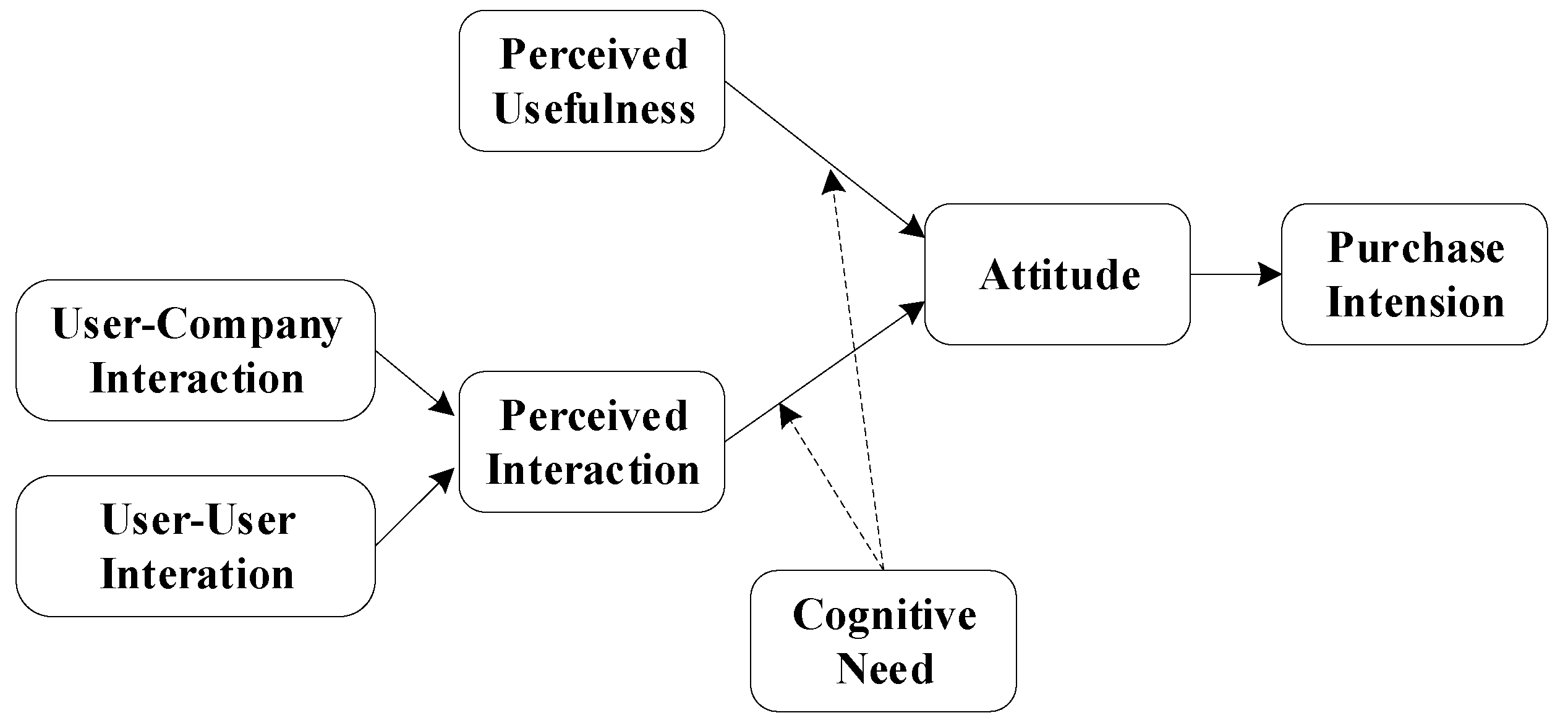
Figure 2.
SEM test design (*** denotes P < 0.001, ** means P < 0.01, * indicates P < 0.05; R2 is the decisive coefficient).
Figure 2.
SEM test design (*** denotes P < 0.001, ** means P < 0.01, * indicates P < 0.05; R2 is the decisive coefficient).
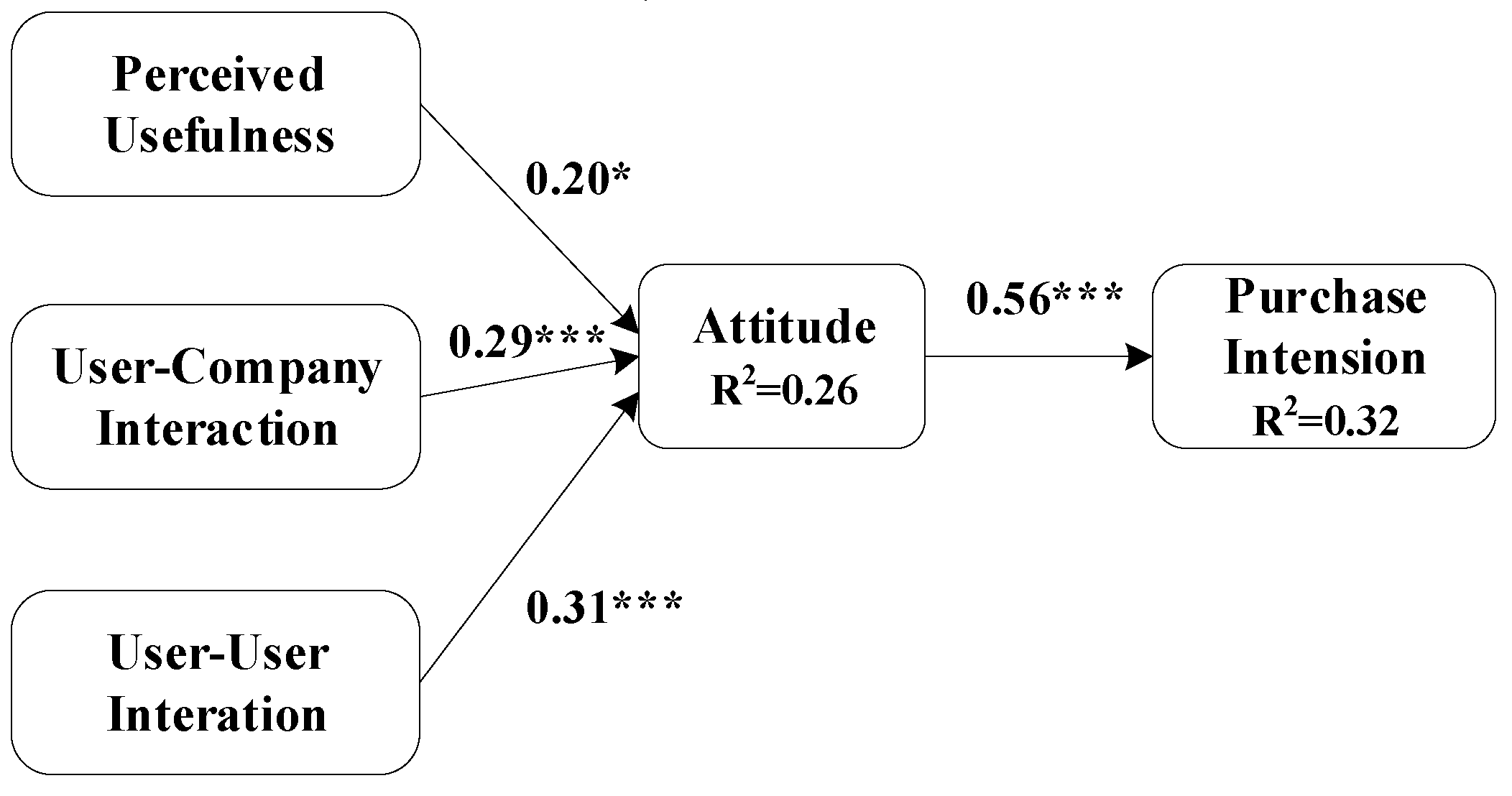
Table 3.
Discriminant validity test.
| PU | PIU | PIC | AT | PW | CN | |
| Perceived Usefulness (PU) |
0.843 | |||||
| Perceived Interaction (PIU) (User-User) |
0.161 | 0.825 | ||||
| Perceived Interaction (PIC) (User-Company) |
0.071 | 0.034 | 0.863 | |||
| Attitude (AT) |
0.191 | 0.245 | 0.226 | 0.763 | ||
| Purchase Intention (PW) |
0.231 | 0.256 | 0.198 | 0.278 | 0.769 | |
| Cognitive Need (CN) |
0.230 | 0.257 | 0.266 | 0.373 | 0.335 | 0.875 |
Table 4.
Model fitting degree.
| Statistical test | χ2/df | SMRM | RMSEA | AGFI | NFI | RFI | CFI | IFI | PGFI | PNFI | PCFI |
|---|---|---|---|---|---|---|---|---|---|---|---|
| Ideal Value | <2.00 | <0.08 | <0.05 | >0.80 | >0.90 | >0.90 | >0.90 | >0.90 | >0.50 | >0.50 | >0.50 |
| Acceptable Value | <3.00 | <0.1 | <0.08 | >0.70 | >0.80 | >0.80 | >0.80 | >0.80 | |||
| Our Value | 1.46 | 0.04 | 0.04 | 0.91 | 0.94 | 0.92 | 0.97 | 0.98 | 0.67 | 0.76 | 0.79 |
Table 5.
Mediating effects analysis.
| Path | Effect | Bootstrapping(5000 samples) | Result | |||
| bias-corrected | percentile | |||||
| 95%CI | 95%CI | |||||
| lower | upper | lower | upper | |||
| PU→AT→PW | total | 0.170 | 0.452 | 0.170 | 0.450 | Exist |
| direct | 0.049 | 0.261 | 0.049 | 0.264 | Exist | |
| indirect | 0.019 | 0.318 | 0.010 | 0.311 | Exist | |
| PIU→AT→PW | total | 0.205 | 0.530 | 0.197 | 0.515 | Exist |
| direct | 0.014 | 0.250 | 0.001 | 0.237 | Exist | |
| indirect | 0.084 | 0.403 | 0.082 | 0.401 | Exist | |
| PIC→AT→PW | total | 0.194 | 0.494 | 0.197 | 0.496 | Exist |
| direct | 0.115 | 0.389 | 0.096 | 0.369 | Exist | |
| indirect | -0.059 | 0.268 | -0.044 | 0.285 | Not Exist | |
Table 6.
Moderated mediation analysis.
| Path | Conditional Indirect Effect | Moderated Mediating Effect | ||||||||
| Variable | Effect | Standard Error | Lower Bound | Upper Bound |
INDEX | Standard Error | Lower Bound | Upper Bound | ||
| PU→AT→PW | Low | 0.07 | 0.04 | 0.003 | 0.150 | 0.064 | 0.03 | 0.024 | 0.127 | |
| High | 0.12 | 0.04 | 0.045 | 0.218 | ||||||
| PIU→AT→PW | Low | 0.03 | 0.06 | 0.022 | 0.150 | 0.013 | 0.04 | -0.069 | 0.011 | |
| High | 0.06 | 006 | 0.042 | 0.187 | ||||||
| PIC→AT→PW | Low | 0.11 | 0.04 | 0.042 | 0.215 | 0.002 | 0.05 | -0.096 | 0.089 | |
| High | 0.11 | 0.06 | 0.012 | 0.239 | ||||||
Disclaimer/Publisher’s Note: The statements, opinions and data contained in all publications are solely those of the individual author(s) and contributor(s) and not of MDPI and/or the editor(s). MDPI and/or the editor(s) disclaim responsibility for any injury to people or property resulting from any ideas, methods, instructions or products referred to in the content. |
© 2023 by the authors. Licensee MDPI, Basel, Switzerland. This article is an open access article distributed under the terms and conditions of the Creative Commons Attribution (CC BY) license (http://creativecommons.org/licenses/by/4.0/).
Copyright: This open access article is published under a Creative Commons CC BY 4.0 license, which permit the free download, distribution, and reuse, provided that the author and preprint are cited in any reuse.


