

Submitted:
15 May 2023
Posted:
17 May 2023
You are already at the latest version
Abstract
The purpose of this study is to investigate and validate the influencing factors of audiences’ attitude toward virtual concerts. To address this issue, the current study proposes a conceptual model integrating player experiences’ factors (autonomy, relatedness, and engagement) and the technology acceptance model (perceived usefulness, perceived ease of use, and perceived enjoyment). An online questionnaire on virtual concert experiences was distributed to Chinese audiences who had attended virtual concerts. Structural equation modeling was then used to establish the relationship between variables. The results suggested autonomy, relatedness and engagement positively impacted perceived usefulness, perceived ease of use, and perceived enjoyment. Furthermore, the perceived usefulness, perceived ease of use, and perceived enjoyment were significant predictors of audiences’ attitude. The findings of this study can provide a reference for relevant virtual entertainment providers and can also serve as a point of development and exploration for technology acceptance model and player experience in the field of virtual concerts.
Keywords:
virtual concert
; audiences’ attitude
; player experience
; technology acceptance
1. Introduction
The emergence of virtual entertainment platforms has gained popularity as a new space for music events, particularly during the COVID-19 pandemic [1,2]. Virtual concerts are broadly defined in the academic literature and encompass various forms, such as livestream concerts [3,4,5], holographic concerts [6,7,8], and concerts requiring VR hardware [9,10]. For the purposes of this study, the virtual concert focus on a musical performance in which participants are projected into a digital virtual environment in the form of virtual avatars [11,12]. These virtual concerts are mostly game-based, such as those found in Fortnite, Roblox, Second Life, or Minecraft, or blockchain-based, such as Decentraland or The Sandbox, which were reported as the most popular virtual entertainment for adults, ahead of virtual sports and virtual shopping [13].
Virtual digital technologies have transformed the concert audiences’ experience [8,14]. For instance, audiences have always had to rely on the physical environment, incurring transportation and time costs to attend concerts; however, virtual concert platforms now allow audiences to participate in concerts from anywhere using digital devices such as mobile phones and computers [15]. Moreover, the integrate of virtual stages, avatars, video games, virtual social networks, and other virtual technologies such as virtual environments, music Internet of Things (IoMusT), and singer identification and field adaptation (MetaSID), which has been proved enhanced the audiences’ experience [6,16,17]. Previous studies have discussed several factors that contribute to the audiences’ experience of virtual concerts, including the sense of connection, interactivity, immersion, and a feeling of "being there," all of which can affect audience satisfaction and attendance intentions [12,18,19,20], Hwang & Koo has highlighted the positive potential of virtual concerts to change the way the music industry works [21], while Vandenberg pointed out negative factors of virtual concerts experience, for example, the central elements of the concert experience, large-scale interactive rituals (such as collective quiet or collective dance) cannot be translated into the virtual environment [22,23]. Currently, the factors influencing audiences’ experience and attitude of virtual concerts have not been fully explored. Thus, a method needs to developed to evaluate the audiences’ attitude in virtual concert and investigate the experiential factors that influence audiences’ attitude.
Despite a substantial body of research on audience experiences in virtual concerts, there have been relatively few studies assessing audiences’ attitude towards them. Previous research from the perspectives of gratification theory, attending motivation, and experience economy has suggested that audience satisfaction, attendance, and continuous immersion intention are influenced by personal identity needs, accessibility, and meaningful virtual experiences [4,6,24]. However, these studies have largely focused on the substitutability of virtual concerts for in-person concerts. With the emergence of virtual concerts as a distinct option for audience, it is crucial to better understand audiences’ attitude towards this new form of virtual entertainment. While several studies have demonstrated the applicability of technology acceptance model TAM in evaluating participants' attitude or acceptance in the virtual entertainment field, such as combining TAM with flow experience in online games [25,26] or with SDT in gaming and online social networking [27,28], TAM has not yet been applied to virtual concerts. Additionally, there remains limited research on the factors that influence audience experience in virtual concerts from the perspective of the player experience (PX). As more and more virtual concerts are held on comprehensive virtual entertainment platforms that include games, representative game elements such as manipulative and digital avatars promote engagement as well as the feeling of proximity with the artist and other audience members [29,30]. Although the roles of “player” and “audience” have gradually merged in virtual concerts, they were quite different in previous studies [31], and PX attributes are rarely included in the research on virtual concerts. Therefore, this study aims to address the aforementioned research gaps by evaluating audiences’ attitude towards virtual concerts and identifying what PX factors influence audiences' attitude in the context of virtual environment.
The purpose of this research is to evaluate the audiences’ attitude towards virtual concerts, by using a conceptual model that based on TAM and including PX factors as antecedents. The research process will involve developing hypotheses and conceptual model that links PX and TAM. Empirical analysis will then be conducted through surveys, with data on the audience's experiences being collected from a sample of 217 individuals who have previously attended virtual concerts. Path and factor analyses will be carried out using SPSS26.0 and AMOS18.0 to examine the structure of the relationships between the variables. Ultimately, the study will yield an extended TAM model that incorporates player experiences. The significance of this study lies in its potential to help virtual concert organizers better understand the preferences of their audience on a deeper level. Furthermore, it has opened up a new avenue for applying the concepts of TAM and PX within the realm of virtual concerts.
The remainder article is structured as follows. Section 2 provides an overview of the literature on TAM and PX, allowing us to develop ten hypotheses to frame our research model. Section 3 explains the research methodology, including the participants, data collection procedures, and statistical analysis methods. Section 4 presents the results obtained from the data analysis. Section 5 discusses the implications of these results and conclusion.
2. Literature Review and Hypothesis Development
2.1. The TAM and virtual concerts
The TAM initially proposed by Davis, is a well-established theoretical framework for explaining and predicting the acceptance or adoption of information technology by specific users. It postulates that individuals' attitude towards using and their behavioral intentions towards information technology are influenced by two constructs: Perceived Usefulness (PU) and Perceived Ease of Use (PEOU) [32]. PU is defined as "the degree to which a person believes that using a particular system would enhance their job performance" [32], while PEOU refers to "the extent to which a technology is perceived to be free from effort." These two constructs are determined by exogenous variables [32]. The benefits of this model have been demonstrated in numerous studies across a broad range of contexts, including human-computer interaction, e-commerce, mobile applications, education, and healthcare [33,34,35,36,37]. For hedonic systems, such as those used for leisure or entertainment purposes, Perceived Enjoyment (PE) has been added to the original TAM model, and has been shown to be a stronger predictor of the attitude and intention of use than PU, particularly for technologies used for leisure or entertainment purposes [38,39,40]. PE is defined as "the extent to which the activity of using a specific system is perceived to be enjoyable in its own right, aside from any performance consequences resulting from system use" [41,42], and is also seen as central to the media entertainment experience. TAM has been applied in various research fields related to virtual experience, such as virtual reality, augmented reality, and virtual tours [43,44,45]. It has also been used to investigate the acceptance of entertainment-related technologies and services, such as using TAM to investigate exercisers' and spectators' perceptions of using social exercise platforms [46] and to identify the adoption factors that affect customers' intention to use in-flight entertainment and connectivity services [47]. These studies demonstrate the generality of TAM in different research fields, as well as its applicability to new technologies of virtual entertainment. Since a virtual concert is an entertainment experience, in this study, a TAM model including enjoyment variables was selected [38]. Based on the existing literature and the defined structures, this study developed the following hypotheses:
H1: Perceived Usefulness (PU) will have a positive influence on Attitude (ATT);
H2: Perceived Ease of Use (PEOU) will have a positive influence on Attitude (ATT);
H3: Perceived Enjoyment (PE) will have a positive influence on Attitude (ATT).
The proposed framework evaluates audiences’ attitudes towards virtual concerts based on the constructs of PU, PEOU and PE. However, it is important to explore the factors that influence how virtual concerts are perceived in terms of these constructs. The next section will examine various antecedents that affect audiences’ attitude towards virtual concerts and will predict their impact on the constructs of PU, PEOU and PE.
2.2. The Importance of Player Experience in Virtual Concerts
PX refers to the personal experience an individual has during and immediately after playing a game, encompassing specific dimensions such as flow, immersion, challenge, tension, competence, and emotions [48]. It is a crucial aspect of user experience within the context of digital games and is studied through its cognitive, emotional, and social components [49,50]. Although objective methods such as play-testing protocols, player data clustering, and biometric indicators are available to measure player experience [51,52,53], players’ self-reports remain important to give meaning to these metrics [54], it could collecting from online self-reports data [55], but more commonly from questionnaires. Hence several scales have been developed to inquire about players' subjective experiences.
Various scales have been developed to measure PX in the context of digital games. Based on Self-Determine Theory, the Player Experience of Need Satisfaction (PENS) [56] and Ubisoft Perceived Experience Questionnaire (QPEU) [57] have been proposed. Means-End Theory has given rise to the Player Experience Inventory (PXI) and mini PXI [54,58]. From the perspective of User Experience, the Game User Experience Satisfaction Scale (GUESS) [59], Game Engagement Questionnaire (GEQ) [60] and Immersive Experience Questionnaire (IEQ) [61] have been developed to measure PX in game environments. Additionally, for measuring gameful experiences while using non-game services, GAMEX [62] and GAMEFULQUEST [63] have been developed. Johnson validated two commonly used scales, PENS and GEQ, and demonstrated empirical support for dimensions such as flow, immersion, competence, positive affect, presence, autonomy, and relatedness [64].
The integration of gamification elements has been shown to enhance the user experience in various fields [65,66]. Consequently, the key factors of PX have been adopted in several industries, such as fitness, medical treatment, training, and e-learning [67,68,69,70]. As virtual concerts are becoming an interconnected virtual entertainment community that integrates multiple technologies and virtual environments, they offer new perspectives on the format of virtual experiences [2,29]. Therefore, measuring the audiences’ experience in virtual concerts is essential and can be accomplished through PX measurement. Venkatesh demonstrated a positive relationship between general computer playfulness and PEOU [71], while enjoyment has been identified as a central component of PX [72], indicating the potential of PX to complement the TAM. Several studies have demonstrated the relevance of this integration, such as Park exploration of the determinants of players’ attitude and acceptance of mobile games using an extended TAM that includes perceived control and skill, which are derived from PX [73]. Additionally, other researchers have assessed student acceptance of virtual laboratory and practical work by extending the TAM to include other factors such as perceived efficiency, playfulness, and satisfaction [74]. Based on these studies and the characteristics of virtual concerts, we propose to extract autonomy, relatedness, and engagement as key variables from PX and integrate them into TAM as antecedents.
2.2.1. Autonomy
AU is defined as "the degree to which participants felt free and perceived opportunities to engage in activities that interest them" [56]. Previous studies have shown that avatars in virtual environments promote autonomy by providing users with freedom in identity decisions, such as walking, running, flying, and even teleportation [75]. Several studies in the field of player experience have demonstrated a positive correlation between AU and PE [76,77,78]. This relationship has also been verified in non-pure entertainment environments, such as e-learning, where AU has been shown to be related to enjoyment experience [79] and perceived human computation game enjoyment [80]. Game autonomy has also been found to be positively related to gamers' PEOU [81]. In virtual environments, avatars allow players to have more accurate interactions and better spatial awareness, which might also improve the PEOU [82]. Therefore, the following hypotheses are proposed:
H4: Autonomy (AU) has a positive effect on Perceived Ease of Use (PEOU);
H5: Autonomy (AU) has a positive effect on Perceived Enjoyment (PE).
2.2.2. Relatedness
RL is a social construct that refers to the feeling of social belongingness [57]. Several studies have highlighted the importance of social interaction in online music performances [3,19]. Swarbrick has emphasized the key role of social and emotional connections in motivating attendance at online concerts [83]. Moritzen has further highlighted that virtual concerts are more strongly associated with social connection than streaming concerts [29].
The PU of mobile-based social games has been found to be affected by social relevance [73], with positive relationships being observed between social relevance and PE and PU in gamified e-banking applications [84]. In addition, digital avatars have been shown to improve participants' sense of relatedness in virtual environments, allowing the audience to follow the musicians' work from an intimate perspective [85] and increasing social engagement in virtual environments [86]. As virtual concerts are replacing physical attendance, it is reasonable to assume that digital avatars may improve the ease of use of virtual concerts. Therefore, the following hypotheses are proposed:
H6: Relatedness (RL) has a positive effect on Perceived Usefulness (PU);
H7: Relatedness (RL) has a positive effect on Perceived Ease of Use (EU);
H8: Relatedness (RL) has a positive effect on Perceived Enjoyment (EN).
2.2.3. Engagement
EG is defined as a "progression of ever-deeper engagement in game-playing" [87] or "a state of focusing one's attention from a psychological perspective" [88]. In many scales for measuring EG, the components mentioned repeatedly are immersion, presence, and flow [89]. Boyle's research considered immersion, presence, and flow as similar in virtual entertainment game experience [90]. Additionally, an increase in curiosity will increase immersion [91] while immersion is highly correlated with EG [64]. Thus, in this study, we define engagement as a collection of immersion, presence, flow, and curiosity.
Previous studies have also shown that these four elements are often intertwined with each other and influence the user's experience. For example, flow was positively correlated with music experience and immersion experience [92,93]; the sense of presence can enhance the enjoyment of game concerts [29]. In the context of the virtual world, users can gain social presence through the interaction between digital avatars [94], which could be perceived as usefulness. We therefore developed the following hypotheses.
H9: Engagement (EG) has a positive effect on Perceived Usefulness (PU);
H10: Engagement (EG) has a positive effect on Perceived Enjoyment (PE).
2.3. Research Model
Based on the above hypotheses, this study proposes a research model that extend the TAM with player experience antecedents to examine the audiences' attitude towards virtual concerts. Figure 1 illustrates the hypothesized relationships among the variables.
3. Methods
3.1. Instrument
We conducted a thorough review of the literature related to audiences' attitude towards virtual concerts and developed a questionnaire as a measurement instrument. The questionnaire comprises two main parts: the TAM structure and PX factors. The TAM structure extracted and adapted from a Revised TAM with PEOU [38,95] which were derived from the study of Davis [32], and included four constructs: PU, PEOU, PE, and ATT. PU (questions 10-13) refers to the extent to which the audience perceives that the virtual concert enhances their concert experience. PEOU (questions 14-17) refers to the degree to which the audience perceives the virtual concert procedures as simple and easy to use. PE (questions 18-20) refers to the extent to which the audience experiences pleasure and enjoyment in the virtual concert, and ATT (questions 32-34) refers to the degree of positive feelings about the virtual concert experience.
In addition to the TAM structure, the questionnaire also includes three PX factors as antecedents: AU (questions 21-23), RL (questions 24-27), and EG (questions 28-31). The AU scale was adapted from the PENS [56] and refers to the extent to which the audience feels free to engage in activities that interest them in the virtual environment. RL scale was adapted from the PENS [56] and refers to the extent to which the audience perceives that the virtual concert will help improve their relationships with others. Finally, EG scale comprises four items: three questions about immersion, presence and flow was adapted from the GEQ scale [60] and a question of curiosity was adapted from the PXI scale [54]
In total, the measurement instrument consisted of 25 items, all of which were measured on a 7-point Likert scale, ranging from 1 (strongly disagree) to 7 (strongly agree). All items used in the questionnaire were adapted from validated questionnaires and translated into Chinese.
3.2. Participants and data collection
In surveys, participation was voluntary with the sample of the virtual concert audiences. The sample comes from China. We questioned participants if they had experienced virtual concert before they answered the questionnaire. Those who had not experienced virtual concert were excluded. Data were collected through an online survey platform (Questionnaire Star, a professional Chinese online survey platform). A total of 236 questionnaires were distributed and we collected 225 questionnaires of which 8 questionnaires were invalid after we collated the answers. Finally, a total of 217 valid questionnaires were collected. Of the descriptive analysis of demographic imformation,116 were males and 108 were females, and 26.7% respondents were aged between 23-32, most of the subjects (26.3%) were students. Of the total subjects, 25.2% subjects had a university education background and 31.6% of the participants attending virtual concerts 1-4 times a year. Table 1 provided the demographic information of the study's respondents.
3.3. The method of data analysis
In this study, data analysis was conducted using SPSS 26 and AMOS 18. The data analysis involved two steps: reliability and validity analysis, and hypothesis testing. First, internal consistency reliability was measured using Cronbach’s α coefficient, and composite reliability (CR) was tested using SPSS26. High values of CA and CR indicate high reliability of the tool. CA and CR value of above 0.70 is recommended [96]. To assess the convergent validity of the constructs, we used CR values and average variance extracted (AVE) values. If the CR values and AVE values are all above 0.7 and 0.5, respectively, the convergent validity is high [97]. Discriminant validity of the constructs was verified by analyzing the square root values of average variance extracted (AVEs). The sufficiency of discriminant validity was demonstrated if all constructs were higher than the inter-construct correlations. Second, after obtaining satisfactory results in the first step, the structural model was used to test the hypotheses. The significance and size of each path coefficient were analyzed to test our hypotheses. Model fit indices were also assessed to determine the adequacy of the proposed research model.
4. Results
4.1. Measurement Tool Assessment
4.1.1. Results of the Reliability and Validity Test
Table 2 presented the results of the construct assessment. The Cronbach's alpha values of all variables were above 0.8, indicating good internal consistency reliability. The composite reliability (CR) values for all variables exceeded 0.7, indicating sufficient convergent validity [98]. Furthermore, the AVE values for all variables were above the recommended threshold of 0.5, indicating good convergent validity [98].
4.1.2. The results of discrimination validity test
4.2. Assessment of the structural model and the hypotheses
4.2.1. Model fit index
The first step of hypotheses testing, the structural model was evaluated. Our model showed a good fit with the data (χ2 = 358.121, DF = 2254, CMIN/DF = 1.410, p = 0.00; NFI = 0.89; IFI = 0.965; CFI = 0.946; RFI = 0.895; TLI = 0.954; RMSEA = 0.039). Based on the established fit criteria [99], all model fit index values were acceptable.
4.2.2. Hypotheses testing
This study calculated the path coefficient and p value through bootstrapping with a sample of 217 subjects. As shown in Table 4 and Figure 2, all hypotheses are supported at a significant level of p<0.05 or p<0.001.
The present study's findings lend support to Hypotheses 1 2, and 3, positing a positive impact of PU, PEOU, and PE on ATT. The estimated coefficients for these relationships range from 0.572 to 0.611, indicating moderate to strong positive effects on ATT towards virtual concerts. Subsequent hypotheses examined the antecedents of these factors, revealing AU as having a moderate positive effect on PEOU (H4), and as a significant determinant of PE (H5). Additionally, RL in virtual concerts was positively associated with PU (H6), PEOU (H7), and PE (H8). Furthermore, EG was positively associated with PU(H9) an PE(H10).
Overall, the results suggest that PU, PEOU, PE, AU, RL, and EG are all significant factors positively impacting audiences' attitude towards virtual concerts. Of note, with the exception of H4 and H9, which have P values less than 0.05, all other hypotheses have P values less than 0.001.
5. Discussions and Conclusion
This study aimed to investigate the audiences’ attitude towards virtual concerts by extending TAM with factors from PX, including AU, RL, and EG. Our key findings revealed that AU had the strongest positive impact on audiences’ attitude towards virtual concerts, primarily through the enhancement of PE. RL emerged as the most comprehensive factor affecting audiences' attitude. In this chapter, we have discussed our findings related to the TAM components and their impact on the audiences’ attitude towards virtual concerts. Furthermore, we have explored the antecedents that influenced audiences’ attitude. Theoretical and practical implications of our research have also been discussed. Finally, we have identified the limitations of our study and provided suggestions for future research in this area.
5.1. Results for TAM and its antecedents
5.1.1. The results shown that PU, PEOU and PE had a positive influence on audiences' attitude
Among the three components of TAM, PE was found to have the greatest influence on ATT. The participants in our study reported having a positive experience while attending the virtual concert. This finding is consistent with earlier studies indicating that PE is the strongest predictor of ATT in pleasure-oriented systems [38,39,100]. Recent research has also suggested that PE can significantly improve ATT of virtual entertainment contexts [101]. Our results also demonstrated that PU was the second strongest predictor of ATT towards virtual concerts. Participants in our study found virtual concerts to be useful in terms of watching the desired performance and enhancing their effectiveness in attending a concert. This finding is consistent with Choi's explanation that digital technology provides effective services and accurately conveys the contents of the performance in a non-contact environment [102].
Furthermore, there was a positive relationship between PEOU and ATT, although the strength of the relationship was weaker than that of PE and PU. Previous studies have suggested that PEOU increases ATT by increasing PU, rather than directly affecting ATT [103]. Overall, our study found that all three components of TAM were significant predictors of audiences’ attitude, consistent with numerous previous studies.
5.1.2. The results show that AU, RL and EG affect PU, PEOU, and PE in different degrees.
AU demonstrated the strongest positive impact on PE, followed by RL, and EG. Therefore, AU emerges as the most influential antecedent. The audience's experience of AU in the virtual concert was found to strongly influence their PE, which lead a significant positive impact on ATT. Participants reported engaging in behaviors they would not have in a real-life concert, and their choices in the virtual concert influenced the outcomes. This finding aligns with previous research on Self-Determination Theory and PX, suggesting that satisfying the need for AU can contribute to PE [56,104]. Moreover, when the audience experiences presence, immersion, flow, and curiosity, they are more likely to perceive the virtual concert as pleasant, which is consistent with Yang and Zhang's findings in the context of virtual environments. Their study reported that presence and flow positively influenced participant enjoyment [105].
RL was found to be the strongest influencing antecedent for PU and PEOU and the second strongest influencing antecedent for PE. This suggests that when the audience feels Relatedness, they perceive the virtual concert as pleasant, easy to use, and useful simultaneously. These findings highlight the importance of RL as an antecedent, given its impact on the ATT in all aspects. The positive influence of RL on PU and PEOU is consistent with previous research on virtual entertainment experience [28,46]. However, our results contrast with the widely held assumption regarding the impact of RL on PE. Our study found that RL had a significant positive effect on PE, ranking even higher than EG. Other studies suggest that RL may have a negative impact on the audience's experience of non-contacted concerts, such as a lack of relatedness between performer and audience or being disturbed by virtual audiences surrounding them [9,22,106].
In this study, the significant positive impact of RL on audience experience in virtual concerts can be explained from two perspectives. Firstly, previous studies have limited the definition of relatedness to a person feeling connected with others [107]. In contrast, this study considers RL as a larger-scale connection, taking into account the role of digital avatars in the virtual environment. Participants reported feeling close to some of the characters in the virtual concert, which suggests that the addition of avatars expands the definition of RL and increases its positive impact on the virtual concert experience. This is supported by recent research by Park, who found that avatars can increase emotional attachment [108]. Secondly, digital avatars and the virtual environment offer a unique way to get up close to artists and interact with other players. Participants reported feeling closer to the performers in the virtual concert, which enhances their sense of connection with the artists. This amplifies the positive impact of RL on the virtual concert experience, providing another explanation for the significant positive effect of RL on PU, PEOU, and PE.
5.2. Implications
The present study offers both theoretical and practical implications. From a theoretical standpoint, this research expands the empirical TAM literature by applying the model to the context of virtual concerts. This extends the research field and highlights the relevance of TAM components, including enjoyment, usefulness, and ease of use, which are consistent with previous studies on virtual entertainment environments. Furthermore, the integration of autonomy, relatedness, and engagement into the revised TAM improves the explanatory power of the model for virtual hedonic systems. This study also introduces a new perspective of player experience to evaluate audiences’ experience and attitude towards virtual concerts. The incorporation of player experience elements provides key factors that directly influence audience experiences and attitude, indicating the future development of virtual concerts. Our research framework reflects the concept that concert audiences in virtual platforms can be regarded as players, and the extension of the TAM to incorporate player experience elements offers a better understanding of audience attitude in the virtual environment. Despite the importance of player experience in various fields such as education, gaming, and consumer behavior, this study extends previous research by demonstrating that player experience elements positively influence audience attitude. Notably, our findings highlight the positive influence of two factors, Autonomy and Relatedness, which expand our understanding of audience experience in virtual environments and provide new research directions from a player's perspective when evaluating audiences’ attitude towards virtual concerts.
Form practical point of view, this study contributes to the virtual entertainment platforms a wider and deeper understanding of the needs of concert audiences in virtual environments, and provides practical insights for the improvement of virtual concert audience experience in the future. Since virtual entertainment platform is a complex system that connects to many different services, the improvement of virtual concert can also have a considerable influence on the overall services provided by virtual entertainment platform. First of all, we suggest that virtual concert platform adopt a player experience-centric approach when optimizing the audience experience. This involves a combination of autonomy, relatedness and engagement to enhance audience perceptions of enjoyment, usefulness and easy to use in virtual concerts. According to our research results, in order to improve the audience's virtual concert experience, the platform should give priority to improving the audiences’ perception of virtual concert enjoyment, by providing the audience with a stronger autonomy in the virtual concert environment. For example, more widely invite singers from different regions and languages to join the virtual platform for music performances to provide audiences with more choices of virtual concerts, and increase the operability of the digital avatar to provide the audience with more possibilities for free activities in the virtual world, etc.
In order to enhance the enjoyment of virtual concerts, the platform can provide a more immersive experience by enhancing audience-relatedness, avatar customization, and performer interaction. For instance, the platform can offer more options for avatar customization, including hairstyles, clothing, and facial features, as well as more extensive scene customization within the virtual environment. Additionally, the platform can increase audience intimacy with performers and other attendees through designing more interactive and communicative features for avatars. Our research has shown that relatedness significantly impacts the audiences’ concert experience. Therefore, implementing such measures not only enhances enjoyment, but also improves perceived usefulness and ease of use for virtual concerts. In terms of improving perceived usefulness, the platform can also improve audience engagement by enhancing the audio-visual quality of virtual concerts and creating a more immersive virtual environment with personalized customization features. This may include adding character storylines and optimizing the recommendation function based on big data to recommend virtual concerts that match the audience's preferences. By doing so, the platform can comprehensively improve the audience's engagement. Finally, to positively impact perceived ease of use, the platform should simplify its operational processes without sacrificing positive user experiences. This can be achieved by simplifying the functional interface, removing or modifying uncommon functions, and emphasizing frequently used functions such as recording, pausing, and returning functions during the performance. The platform should also facilitate simple operation throughout the entire concert, including audience registration, ticket ordering, and character and virtual environment control, without adding any unnecessary mental workload for the audience.
The findings of this study also have several policy implications. In recent years, numerous game platforms have increased their cooperation with the music industry to transform traditional music performances into new virtual entertainment experiences. As virtual concerts are closely related to game experiences, it is essential to consider applying the anti-addiction measures and supervision in the field of virtual concerts. Moreover, given the intimate connection between the virtual world and reality, the self-representation of the virtual character created by the user within the virtual environment can influence the user's real behavior. Ethical and privacy issues in virtual worlds also require the attention of policy makers. While the current virtual concert platform does not involve violence or theft, the mainstream 3D multiplayer games currently do involve such elements, and policy makers must determine whether the environment can be overridden or allowed the prohibited behaviors in reality in advance. To address this challenge, we first identified specific influencing factors that may cause problems. The influencing factors identified in this study from the perspective of player experience provide us with a good entry point. Therefore, it is necessary to consider these factors when formulating policies to regulate virtual concerts and games in the future.
5.3. Limitations and Future Research Directions
This study has several limitations that should be acknowledged. Firstly, the sample size and scope of the study are limited. The participants in this study were from China, and the virtual concerts they attended were predominantly Western pop music performers. The audience's preferences for singers and music styles may vary across different regions and cultures, which may affect their attitude towards virtual concerts. Therefore, future studies could include larger and more diverse samples from different regions and with a broader range of music styles to provide a more comprehensive understanding of audience experiences with virtual concerts.
Secondly, the survey period of this study was relatively short, with most participants attending one or fewer virtual concerts per year. Since audience experiences are dynamic and changeable, as more people attend virtual concerts or visit virtual entertainment platforms, their experiences may evolve over time. Therefore, future research could investigate the longitudinal experiences of audiences attending virtual concerts over a longer time span, which may provide more reliable and accurate results.
In addition, future research could explore other factors that affect audience attitude and enjoyment of virtual concerts. For example, researchers could investigate the role of social influence, such as peer recommendations and social norms, in shaping audiences’ attitude towards virtual concerts. Furthermore, studies could explore the impact of technological advancements, such as virtual reality and augmented reality, on audience experiences with virtual concerts. Lastly, studies could also examine the role of different types of interactions, such as social interactions and personalized recommendations, on audience experiences with virtual concerts.
5.4. Conclusion
As one of the few empirical studies that focuses on the audience attitude of virtual concerts, this research examines the issue from the perspective of player experience. The primary objective of this study is to explore and validate a measurement of the factors that influence audiences’ attitude towards virtual concerts. We first developed a measurement instrument that combines TAM with player experience elements, and then tested six influencing factors using a questionnaire. The research findings demonstrate that among the six factors that positively impact audiences' attitude towards virtual concert, PE has the greatest influence, followed by AU, which is the most significant positive correlate of PE, and RL provides a comprehensive positive impact.
These findings are useful for virtual entertainment platforms and policy makers. On the one hand, virtual entertainment platforms can use these influencing factors as guidelines to develop new virtual concerts or promote their existing virtual concerts. As these influencing factors were proposed and tested by a large audience, they can be used as practical guidelines for virtual concert design. On the other hand, these findings can provide some reference comments for policy makers when designing and planning virtual concerts. As the audiences’ attitude towards virtual concerts increasingly positive, future policies for virtual entertainment platforms will increasingly focus on audience experiences.
Author Contributions
Conceptualization, J.D. and Y.P.; methodology, J.D.; software, J.D.; validation, J.D.; formal analysis, J.D.; investigation, J.D.; data curation, J.D.; writing—original draft preparation, J.D.; writing—review and editing, J.D.; visualization, J.D.; supervision, Y.P. All authors have read and agreed to the published version of the manuscript.
Funding
This research received no external funding.
Acknowledgments
The authors would like to thank all the participants in this study for their time and willingness to share their experiences and feelings.
Conflicts of Interest
The authors declare no conflict of interest concerning the research, authorship, and publication of this article.
References
- Lu, J.; Xiao, X.; Xu, Z.; Wang, C.; Zhang, M.; Zhou, Y. The Potential of Virtual Tourism in the Recovery of Tourism Industry during the COVID-19 Pandemic. Curr. Issues Tour. 2022, 25, 441–457. [Google Scholar] [CrossRef]
- Turchet, L. Musical Metaverse: Vision, Opportunities, and Challenges. Pers Ubiquit Comput. 2023. [Google Scholar] [CrossRef] [PubMed]
- Onderdijk, K. E.; Swarbrick, D.; Van Kerrebroeck, B.; Mantei, M.; Vuoskoski, J. K.; Maes, P.-J.; Leman, M. Livestream Experiments: The Role of COVID-19, Agency, Presence, and Social Context in Facilitating Social Connectedness. Front. Psychol. 2021, 12. [Google Scholar] [CrossRef] [PubMed]
- Solihah, F. Fans’ Satisfaction on Watching Virtual Concert During COVID-19 Pandemic; Atlantis Press, 2021; pp 154–156. [CrossRef]
- d’Hoop, A.; Pols, J. ‘The Game Is on!’ Eventness at a Distance at a Livestream Concert during Lockdown. Ethnography 2022, 14661381221124502. [Google Scholar] [CrossRef]
- Chang, W.; Shin, H.-D. Virtual Experience in the Performing Arts: K-Live Hologram Music Concerts. Pop. Entertain. Stud. 2019, 10, 34–50. [Google Scholar]
- McLeod, K. Living in the Immaterial World: Holograms and Spirituality in Recent Popular Music. Pop. Music. Soc. 2016, 39, 501–515. [Google Scholar] [CrossRef]
- Michaud, A. Locating Liveness in Holographic Performances: Technological Anxiety and Participatory Fandom at Vocaloid Concerts. Pop. Music 2022, 41, 1–19. [Google Scholar] [CrossRef]
- Beacco, A.; Oliva, R.; Cabreira, C.; Gallego, J.; Slater, M. Disturbance and Plausibility in a Virtual Rock Concert: A Pilot Study. In 2021 IEEE Virtual Reality and 3D User Interfaces (VR); 2021; pp 538–545. [CrossRef]
- Charron, J.-P. Music Audiences 3.0: Concert-Goers’ Psychological Motivations at the Dawn of Virtual Reality. Front. Psychol. 2017, 8. [Google Scholar] [CrossRef]
- Böcker, T.; Fritsch, M.; Summers, T. Producing Game Music Concerts. In The Cambridge Companion to Video Game Music; Fritsch, M., Summers, T., Eds.; Cambridge University Press, 2021; pp 424–432. [CrossRef]
- Jin, C.; Wu, F.; Wang, J.; Liu, Y.; Guan, Z.; Han, Z. MetaMGC: A Music Generation Framework for Concerts in Metaverse. J AUDIO SPEECH MUSIC PROC. 2022, 2022, 31. [Google Scholar] [CrossRef]
- In the Metaverse, Live Concerts Hold More Appeal Than Live Sports and Shopping - Morning Consult. Available online: https://morningconsult.com/2022/04/11/metaverse-activities-generations-survey/ (accessed on 8 May 2023).
- Deacon, T.; Stockman, T.; Barthet, M. User Experience in an Interactive Music Virtual Reality System: An Exploratory Study. In Bridging People and Sound; Aramaki, M., Kronland-Martinet, R., Ystad, S., Eds.; Lecture Notes in Computer Science; Springer International Publishing: Cham, 2017; pp. 192–216. [Google Scholar] [CrossRef]
- Botstein, L. The Future of Music in America: The Challenge of the COVID-19 Pandemic. Music. Q. 2019, 102, 351–360. [Google Scholar] [CrossRef]
- Fox, M. A.; Breese, J. L.; Vaidyanathan, G. Live Music Performances and the Internet of Things. 2019.
- Zhang, X.; Wang, J.; Cheng, N.; Xiao, J. Singer Identification for Metaverse with Timbral and Middle-Level Perceptual Features. In 2022 International Joint Conference on Neural Networks (IJCNN); 2022; pp 1–7. [CrossRef]
- Baym, N. K. Playing to the Crowd: Musicians, Audiences, and the Intimate Work of Connection; NYU Press, 2018; Vol. 14.
- Bennett, L. Patterns of Listening through Social Media: Online Fan Engagement with the Live Music Experience. Soc. Semiot. 2012, 22, 545–557. [Google Scholar] [CrossRef]
- Droste, M.; Letellier, J.; Sieck, J. An Interactive Classical VR Concert Featuring Multiple Views. In Proceedings of the Second African Conference for Human Computer Interaction: Thriving Communities; AfriCHI ’18; Association for Computing Machinery: New York, NY, USA, 2018; pp. 1–4. [Google Scholar] [CrossRef]
- Hwang, S.; Koo, G. Art Marketing in the Metaverse World: Evidence from South Korea. Cogent Soc. Sci. 2023, 9, 2175429. [Google Scholar] [CrossRef]
- Vandenberg, F.; Berghman, M.; Schaap, J. The ‘Lonely Raver’: Music Livestreams during COVID-19 as a Hotline to Collective Consciousness? Eur. Soc. 2021, 23, S141–S152. [Google Scholar] [CrossRef]
- Vandenberg, F. Put Your “Hand Emotes in the Air:” Twitch Concerts as Unsuccessful Large-Scale Interaction Rituals. Symb. Interact. 2022, 45, 425–448. [Google Scholar] [CrossRef]
- Yoon, H.; Song, C.; Ha, M.; Kim, C. Impact of COVID-19 Pandemic on Virtual Korean Wave Experience: Perspective on Experience Economy. Sustainability 2022, 14, 14806. [Google Scholar] [CrossRef]
- Chang, C.-C. Examining Users′ Intention to Continue Using Social Network Games: A Flow Experience Perspective. Telemat. Inform. 2013, 30, 311–321. [Google Scholar] [CrossRef]
- Hsu, C.-L.; Lu, H.-P. Why Do People Play On-Line Games? An Extended TAM with Social Influences and Flow Experience. Inf. Manag. 2004, 41, 853–868. [Google Scholar] [CrossRef]
- Li, Y.; Wang, X. Online Social Networking Sites Continuance Intention: A Model Comparison Approach. J. Comput. Inf. Syst. 2017, 57, 160–168. [Google Scholar] [CrossRef]
- Linares, M.; Gallego, M. D.; Bueno, S. Proposing a TAM-SDT-Based Model to Examine the User Acceptance of Massively Multiplayer Online Games. International Journal of Environmental Research and Public Health 2021, 18, 3687. [Google Scholar] [CrossRef] [PubMed]
- Moritzen, K. Opening Up Virtual Mosh Pits. Journal of Sound and Music in Games 2022, 3, 115–140. [Google Scholar] [CrossRef]
- Bayram, A. Metaleisure: Leisure Time Habits to Be Changed with Metaverse. JMv 2022, 2, 1–7. [Google Scholar]
- Hamilton, R. Collaborative and Competitive Futures for Virtual Reality Music and Sound. In 2019 IEEE Conference on Virtual Reality and 3D User Interfaces (VR); 2019; pp 1510–1512. [CrossRef]
- Davis, F. D. Perceived Usefulness, Perceived Ease of Use, and User Acceptance of Information Technology. MIS Quarterly 1989, 13, 319–340. [Google Scholar] [CrossRef]
- Ozkale, A.; Koc, M. Investigating Academicians’ Use of Tablet PC from the Perspectives of Human Computer Interaction and Technology Acceptance Model. International Journal of Technology in Education and Science 2020, 4, 37–52. [Google Scholar] [CrossRef]
- Ying, Z.; Jianqiu, Z.; Akram, U.; Rasool, H. TAM Model Evidence for Online Social Commerce Purchase Intention. IRMJ 2021, 34, 86–108. [Google Scholar] [CrossRef]
- Nadal, C.; Sas, C.; Doherty, G. Technology Acceptance in Mobile Health: Scoping Review of Definitions, Models, and Measurement. Journal of Medical Internet Research 2020, 22, e17256. [Google Scholar] [CrossRef] [PubMed]
- Kurilovas, E.; Kubilinskiene, S. Lithuanian Case Study on Evaluating Suitability, Acceptance and Use of IT Tools by Students – An Example of Applying Technology Enhanced Learning Research Methods in Higher Education. Computers in Human Behavior 2020, 107, 106274. [Google Scholar] [CrossRef]
- Liu, K.; Tao, D. The Roles of Trust, Personalization, Loss of Privacy, and Anthropomorphism in Public Acceptance of Smart Healthcare Services. Computers in Human Behavior 2022, 127, 107026. [Google Scholar] [CrossRef]
- van der Heijden, H. User Acceptance of Hedonic Information Systems. MIS Quarterly 2004, 28, 695–704. [Google Scholar] [CrossRef]
- Magni, M.; Susan Taylor, M.; Venkatesh, V. ‘To Play or Not to Play’: A Cross-Temporal Investigation Using Hedonic and Instrumental Perspectives to Explain User Intentions to Explore a Technology. International Journal of Human-Computer Studies 2010, 68, 572–588. [Google Scholar] [CrossRef]
- Venkatesh, V.; Thong, J. Y. L.; Xu, X. Consumer Acceptance and Use of Information Technology: Extending the Unified Theory of Acceptance and Use of Technology. MIS Quarterly 2012, 36, 157–178. [Google Scholar] [CrossRef]
- Davis, F. D.; Bagozzi, R. P.; Warshaw, P. R. Extrinsic and Intrinsic Motivation to Use Computers in the Workplace1. Journal of Applied Social Psychology 1992, 22, 1111–1132. [Google Scholar] [CrossRef]
- Vorderer, P.; Klimmt, C.; Ritterfeld, U. Enjoyment: At the Heart of Media Entertainment. Communication Theory 2004, 14, 388–408. [Google Scholar] [CrossRef]
- Sagnier, C.; Loup-Escande, E.; Lourdeaux, D.; Thouvenin, I.; Valléry, G. User Acceptance of Virtual Reality: An Extended Technology Acceptance Model. International Journal of Human–Computer Interaction 2020, 36, 993–1007. [Google Scholar] [CrossRef]
- Rese, A.; Baier, D.; Geyer-Schulz, A.; Schreiber, S. How Augmented Reality Apps Are Accepted by Consumers: A Comparative Analysis Using Scales and Opinions. Technological Forecasting and Social Change 2017, 124, 306–319. [Google Scholar] [CrossRef]
- El-Said, O.; Aziz, H. Virtual Tours a Means to an End: An Analysis of Virtual Tours’ Role in Tourism Recovery Post COVID-19. Journal of Travel Research 2022, 61, 528–548. [Google Scholar] [CrossRef]
- Tsai, T.-H.; Chang, Y.-S.; Chang, H.-T.; Lin, Y.-W. Running on a Social Exercise Platform: Applying Self-Determination Theory to Increase Motivation to Participate in a Sporting Event. Computers in Human Behavior 2021, 114, 106523. [Google Scholar] [CrossRef]
- Jin, M.-J.; Kim, J. K. Customer Adoption Factors for In-Flight Entertainment and Connectivity. Research in Transportation Business & Management 2022, 43, 100759. [Google Scholar] [CrossRef]
- Wiemeyer, J.; Nacke, L.; Moser, C.; ‘Floyd’ Mueller, F. Player Experience. In Serious Games: Foundations, Concepts and Practice; Dörner, R., Göbel, S., Effelsberg, W., Wiemeyer, J., Eds.; Springer International Publishing: Cham, 2016; pp. 243–271. [Google Scholar] [CrossRef]
- Drachen, A.; Mirza-Babaei, P.; Nacke, L. E. Games User Research; Oxford University Press, 2018.
- Rienzo, A.; Cubillos, C. Playability and Player Experience in Digital Games for Elderly: A Systematic Literature Review. Sensors 2020, 20, 3958. [Google Scholar] [CrossRef]
- Ferdous, R.; Kifetew, F.; Prandi, D.; Susi, A. Towards Agent-Based Testing of 3D Games Using Reinforcement Learning. In Proceedings of the 37th IEEE/ACM International Conference on Automated Software Engineering; Association for Computing Machinery: New York, NY, USA, 2023; pp. 1–8. [Google Scholar]
- Drakopoulos, G.; Voutos, Y.; Mylonas, P. Annotation-Assisted Clustering of Player Profiles in Cultural Games: A Case for Tensor Analytics in Julia. Big Data and Cognitive Computing 2020, 4, 39. [Google Scholar] [CrossRef]
- Robinson, R.; Wiley, K.; Rezaeivahdati, A.; Klarkowski, M.; Mandryk, R. L. “Let’s Get Physiological, Physiological!”: A Systematic Review of Affective Gaming. In Proceedings of the Annual Symposium on Computer-Human Interaction in Play; CHI PLAY ’20; Association for Computing Machinery: New York, NY, USA, 2020; pp. 132–147. [Google Scholar] [CrossRef]
- Abeele, V. V.; Spiel, K.; Nacke, L.; Johnson, D.; Gerling, K. Development and Validation of the Player Experience Inventory: A Scale to Measure Player Experiences at the Level of Functional and Psychosocial Consequences. International Journal of Human-Computer Studies 2020, 135, 102370. [Google Scholar] [CrossRef]
- Frommel, J.; Phillips, C.; Mandryk, R. L. Gathering Self-Report Data in Games Through NPC Dialogues: Effects on Data Quality, Data Quantity, Player Experience, and Information Intimacy. In Proceedings of the 2021 CHI Conference on Human Factors in Computing Systems; CHI ’21; Association for Computing Machinery: New York, NY, USA, 2021; pp. 1–12. [Google Scholar] [CrossRef]
- Ryan, R. M.; Rigby, C. S.; Przybylski, A. The Motivational Pull of Video Games: A Self-Determination Theory Approach. Motiv Emot 2006, 30, 344–360. [Google Scholar] [CrossRef]
- Azadvar, A.; Canossa, A. UPEQ: Ubisoft Perceived Experience Questionnaire: A Self-Determination Evaluation Tool for Video Games. In Proceedings of the 13th International Conference on the Foundations of Digital Games; ACM: Malmö Sweden, 2018; pp. 1–7. [Google Scholar] [CrossRef]
- Haider, A.; Harteveld, C.; Johnson, D.; Birk, M.; Mandryk, R.; El-Nasr, M.; Nacke, L.; Gerling, K.; Vanden Abeele, V. MiniPXI: Development and Validation of an Eleven-Item Measure of the Player Experience Inventory. Proceedings of the ACM on Human-Computer Interaction 2022, 6, 1–26. [Google Scholar] [CrossRef]
- Phan, M. H.; Keebler, J. R.; Chaparro, B. S. The Development and Validation of the Game User Experience Satisfaction Scale (GUESS). Hum Factors 2016, 58, 1217–1247. [Google Scholar] [CrossRef] [PubMed]
- IJsselsteijn, W.; Poels, K.; Ravaja, N.; Turpeinen, M.; Vorderer, P. Measuring the Experience of Digital Game Enjoyment.
- Jennett, C.; Cox, A. L.; Cairns, P.; Dhoparee, S.; Epps, A.; Tijs, T.; Walton, A. Measuring and Defining the Experience of Immersion in Games. International Journal of Human-Computer Studies 2008, 66, 641–661. [Google Scholar] [CrossRef]
- Eppmann, R.; Bekk, M.; Klein, K. Gameful Experience in Gamification: Construction and Validation of a Gameful Experience Scale [GAMEX]. Journal of Interactive Marketing 2018, 43, 98–115. [Google Scholar] [CrossRef]
- Högberg, J.; Hamari, J.; Wästlund, E. Gameful Experience Questionnaire (GAMEFULQUEST): An Instrument for Measuring the Perceived Gamefulness of System Use. User Model User-Adap Inter 2019, 29, 619–660. [Google Scholar] [CrossRef]
- Johnson, D.; Gardner, M. J.; Perry, R. Validation of Two Game Experience Scales: The Player Experience of Need Satisfaction (PENS) and Game Experience Questionnaire (GEQ). International Journal of Human-Computer Studies 2018, 118, 38–46. [Google Scholar] [CrossRef]
- Easley, D.; Ghosh, A. Incentives, Gamification, and Game Theory: An Economic Approach to Badge Design. ACM Trans. Econ. Comput. 2016, 4, 16:1–16:26. [Google Scholar] [CrossRef]
- Venkatesh, V.; Speier, C. Creating an Effective Training Environment for Enhancing Telework. International Journal of Human-Computer Studies 2000, 52, 991–1005. [Google Scholar] [CrossRef]
- Godovykh, M.; Fyall, A.; Pizam, A.; Hancer, M.; Cassisi, J. Virtual Versus Face-to-face Events: The Effects of Event Type on Attendees’ Attitudes and Behavioral Intentions https://www.ingentaconnect.com/content/cog/em/2022/00000026/00000008/art00002 (accessed Apr 3, 2023). [CrossRef]
- Bayrak, A. T. Compassionate Game Design: A Holistic Perspective for a Player-Centric Game Design Paradigm for Games4health. 2020.
- Wauck, H.; Woodard, B. S.; Xiao, Z.; Li, T. W.; Bailey, B. P. A Data-Driven, Player-Centric Approach to Evaluating Spatial Skill Training Games. In Proceedings of the Annual Symposium on Computer-Human Interaction in Play; CHI PLAY ’20; Association for Computing Machinery: New York, NY, USA, 2020; pp. 349–361. [Google Scholar] [CrossRef]
- Chan, H.-Y.; Liu, S.-W.; Hou, H.-T. Interacting with Real-Person Non-Player Characters to Learn History: Development and Playing Behavior Pattern Analysis of a Remote Scaffolding-Based Situated Educational Game. Interactive Learning Environments 2023, 0, 1–21. [Google Scholar] [CrossRef]
- Venkatesh, V. Determinants of Perceived Ease of Use: Integrating Control, Intrinsic Motivation, and Emotion into the Technology Acceptance Model. Information Systems Research 2000, 11, 342–365. [Google Scholar] [CrossRef]
- Mekler, E. D.; Bopp, J. A.; Tuch, A. N.; Opwis, K. A Systematic Review of Quantitative Studies on the Enjoyment of Digital Entertainment Games. In Proceedings of the SIGCHI Conference on Human Factors in Computing Systems; CHI ’14; Association for Computing Machinery: New York, NY, USA, 2014; pp. 927–936. [Google Scholar] [CrossRef]
- Park, E.; Baek, S.; Ohm, J.; Chang, H. J. Determinants of Player Acceptance of Mobile Social Network Games: An Application of Extended Technology Acceptance Model. Telematics and Informatics 2014, 31, 3–15. [Google Scholar] [CrossRef]
- Estriegana, R.; Medina-Merodio, J.-A.; Barchino, R. Student Acceptance of Virtual Laboratory and Practical Work: An Extension of the Technology Acceptance Model. Computers & Education 2019, 135, 1–14. [Google Scholar] [CrossRef]
- Cresswell Jones, A. The Digital Evolution of Live Music; Chandos information professional series; Chandos Publishing: Amsterdam, 2015. [Google Scholar]
- Kim, K.; Schmierbach, M. G.; Bellur, S. (Saras); Chung, M.-Y.; Fraustino, J. D.; Dardis, F.; Ahern, L. Is It a Sense of Autonomy, Control, or Attachment? Exploring the Effects of in-Game Customization on Game Enjoyment. Computers in Human Behavior 2015, 48, 695–705. [Google Scholar] [CrossRef]
- Kneer, J.; Zhang, Y.; Żerebecki, B. G.; Wulf, T. Same Gaming: An Exploration of Relationships Between Gender Traits, Sexual Orientation, Motivations, and Enjoyment of Playing Video Games. Simulation & Gaming 2022, 53, 423–445. [Google Scholar] [CrossRef]
- Reer, F.; Wehden, L.-O.; Janzik, R.; Tang, W. Y.; Quandt, T. Virtual Reality Technology and Game Enjoyment: The Contributions of Natural Mapping and Need Satisfaction. Computers in Human Behavior 2022, 132, 107242. [Google Scholar] [CrossRef]
- Ebrahimzadeh, M.; Alavi, S. Motivating EFL Students: E-Learning Enjoyment as a Predictor of Vocabulary Learning through Digital Video Games. Cogent Education 2016, 3, 1255400. [Google Scholar] [CrossRef]
- Pe-Than, E. P. P.; Goh, D. H.-L.; Lee, C. S. Making Work Fun: Investigating Antecedents of Perceived Enjoyment in Human Computation Games for Information Sharing. Computers in Human Behavior 2014, 39, 88–99. [Google Scholar] [CrossRef]
- Ho, C.-I.; Chang, C.-C.; Lee, S.-S. Exploring Key Determinants of Gamer Behavior for Somatosensory Video Games: An Application of the Extended Technology Acceptance Model and Game Flow Theory. 2014, 1.
- Gorisse, G.; Christmann, O.; Amato, E. A.; Richir, S. First- and Third-Person Perspectives in Immersive Virtual Environments: Presence and Performance Analysis of Embodied Users. Frontiers in Robotics and AI 2017, 4. [Google Scholar] [CrossRef]
- Swarbrick, D.; Seibt, B.; Grinspun, N.; Vuoskoski, J. K. Corona Concerts: The Effect of Virtual Concert Characteristics on Social Connection and Kama Muta. Frontiers in Psychology 2021, 12. [Google Scholar] [CrossRef]
- Rodrigues, L. F.; Oliveira, A.; Costa, C. J. Does Ease-of-Use Contributes to the Perception of Enjoyment? A Case of Gamification in e-Banking. Computers in Human Behavior 2016, 61, 114–126. [Google Scholar] [CrossRef]
- Pfafff, S.; Lervik, O.; Spoerri, R.; Berra, E.; Jahrmann, M.; Neukom, M. Games in Concert: Collaborative Music Making in Virtual Reality. In SIGGRAPH Asia 2018 Virtual & Augmented Reality; SA ’18; Association for Computing Machinery: New York, NY, USA, 2018; pp. 1–2. [Google Scholar] [CrossRef]
- Grinberg, A. M.; Careaga, J. S.; Mehl, M. R.; O’Connor, M.-F. Social Engagement and User Immersion in a Socially Based Virtual World. Computers in Human Behavior 2014, 36, 479–486. [Google Scholar] [CrossRef]
- Brockmyer, J. H.; Fox, C. M.; Curtiss, K. A.; McBroom, E.; Burkhart, K. M.; Pidruzny, J. N. The Development of the Game Engagement Questionnaire: A Measure of Engagement in Video Game-Playing. Journal of Experimental Social Psychology 2009, 45, 624–634. [Google Scholar] [CrossRef]
- Kniestedt, I.; Lefter, I.; Lukosch, S.; Brazier, F. M. Re-Framing Engagement for Applied Games: A Conceptual Framework. Entertainment Computing 2022, 41, 100475. [Google Scholar] [CrossRef]
- Procci, K.; Bowers, C. A.; Jentsch, F.; Sims, V. K.; McDaniel, R. The Revised Game Engagement Model: Capturing The Subjective Gameplay Experience. Entertainment Computing 2018, 27. [Google Scholar] [CrossRef]
- Boyle, E. A.; Connolly, T. M.; Hainey, T.; Boyle, J. M. Engagement in Digital Entertainment Games: A Systematic Review. Computers in Human Behavior 2012, 28, 771–780. [Google Scholar] [CrossRef]
- Lowry, P.; Gaskin, J.; Twyman, N.; Hammer, B.; Roberts, T. Taking “Fun and Games” Seriously: Proposing the Hedonic-Motivation System Adoption Model (HMSAM). Journal of the Association for Information Systems 2013, 14. [Google Scholar] [CrossRef]
- Wu, S.-H.; Wei, N.-C.; Hsu, H.-C.; Pu, T.-C. EXPLORING THE INTENTION OF VISITING THE MUSEUM USING IMMERSIVE VIRTUAL REALITY TECHNIQUE AND FLOW EXPERIENCE. 2021, 14.
- Loepthien, T.; Leipold, B. Flow in Music Performance and Music-Listening: Differences in Intensity, Predictors, and the Relationship between Flow and Subjective Well-Being. Psychology of Music 2022, 50, 111–126. [Google Scholar] [CrossRef]
- Schultze, U.; Leahy, M. The Avatar-Self Relationship: Enacting Presence in Second Life. ICIS 2009 Proceedings, 2009. [Google Scholar]
- Chesney, T. An Acceptance Model for Useful and Fun Information Systems. Human Technology: An Interdisciplinary Journal on Humans in ICT Environments, 2006. [Google Scholar]
- Roberts, P.; Priest, H. Reliability and Validity in Research. Nursing Standard 2006, 20, 41–46. [Google Scholar] [CrossRef]
- Hair, J.F.; Ringle, C.M.; Sarstedt, M. PLS-SEM: Indeed a Silver Bullet. Journal of Marketing Theory and Practice 2011, 19, 139–152. [Google Scholar] [CrossRef]
- Fornell, C.; Larcker, D. F. Evaluating Structural Equation Models with Unobservable Variables and Measurement Error. Journal of Marketing Research 1981, 18, 39–50. [Google Scholar] [CrossRef]
- Byrne, B.M. Structural Equation Modeling With AMOS: Basic Concepts, Applications, and Programming, Third Edition; Routledge, 2016.
- Childers, T.L.; Carr, C.L.; Peck, J.; Carson, S. Hedonic and Utilitarian Motivations for Online Retail Shopping Behavior. Journal of Retailing 2001, 77, 511–535. [Google Scholar] [CrossRef]
- Holdack, E.; Lurie-Stoyanov, K.; Fromme, H. F. The Role of Perceived Enjoyment and Perceived Informativeness in Assessing the Acceptance of AR Wearables. Journal of Retailing and Consumer Services 2022, 65, 102259. [Google Scholar] [CrossRef]
- Choi, B.-H. A Study on Acceptance of Online Concerts Based on Mobile Augmented Reality: Focusing on the Extended Technology Acceptance Model. Journal of Digital Convergence 2021, 19, 315–325. [Google Scholar] [CrossRef]
- Yang, H.; Han, S.-Y. Understanding Virtual Reality Continuance: An Extended Perspective of Perceived Value. Online Information Review 2020, 45, 422–439. [Google Scholar] [CrossRef]
- Ryan, R. M.; Deci, E. L. Self-Determination Theory and the Facilitation of Intrinsic Motivation, Social Development, and Well-Being. American Psychologist. [CrossRef]
- Yang, S.; Zhang, W. Presence and Flow in the Context of Virtual Reality Storytelling: What Influences Enjoyment in Virtual Environments? Cyberpsychology Behav. Soc. Netw. 2022, 25, 101–109. [Google Scholar] [CrossRef]
- Hahm, J. B.; Byon, K. K.; Hyun, Y. A.; Hahm, J. The Show Must Go on: The Mediating Role of Self-Assessment in the Relationship between Performers’ Technology Acceptance and Satisfaction Level with Remote Performances in Korea during the COVID-19 Pandemic. Technol. Soc. 2022, 68, 101855. [Google Scholar] [CrossRef]
- Ryan, R. M.; Deci, E. L. On Happiness and Human Potentials: A Review of Research on Hedonic and Eudaimonic Well-Being. Annu. Rev. Psychol. 2001, 52, 141–166. [Google Scholar] [CrossRef]
- Park, I.; Sah, Y. J.; Lee, S.; Lee, D. Avatar-Mediated Communication in Video Conferencing: Effect of Self-Affirmation on Debating Participation Focusing on Moderation Effect of Avatar. Int. J. Hum. –Comput. Interact. 2023, 39, 464–475. [Google Scholar] [CrossRef]
Figure 1.
A model of the predictors of the audiences’ attitude toward virtual concerts.
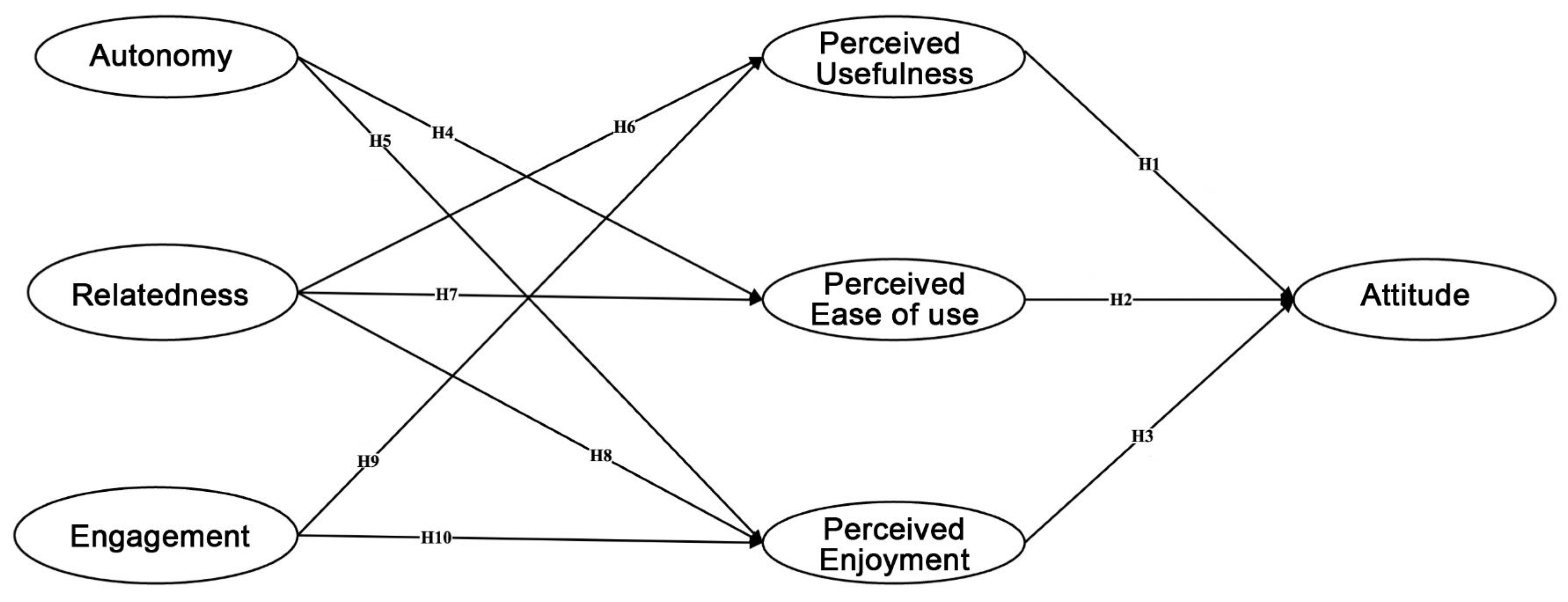
Figure 2.
Standardized Structural Estimates and Hypotheses Tests. *** p<0.001, **p<0.05.
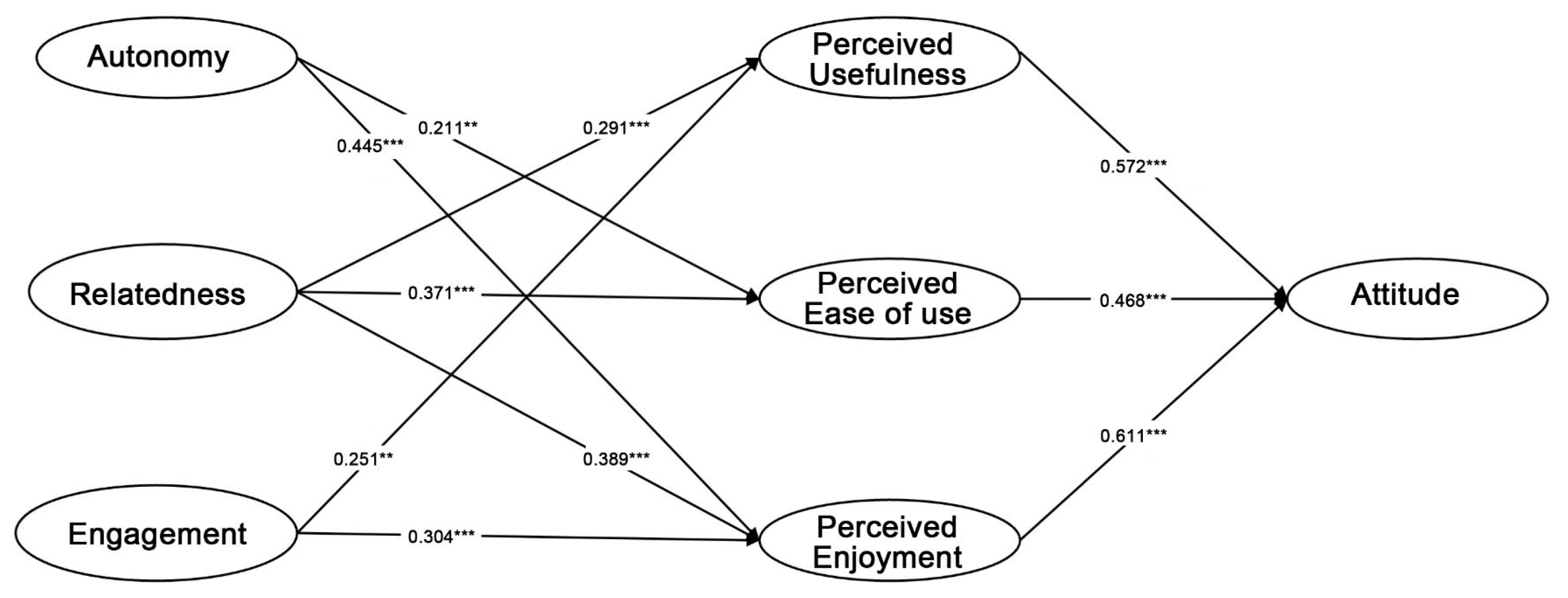

Table 1.
The demographic information of participants(N=217).
| Variable | N(%) | Variable | N(%) |
|---|---|---|---|
| Age |
Frequency of participating in offline concerts |
||
| Under 18 | 13(4.9) | Once a year or less | 136(51.1) |
| 18-22 | 54(20.3) | 2-4 times a year | 38(14.3) |
| 23-32 | 71(26.7) | 5-11 times a year | 18(6.8) |
| 33-45 | 60(22.6) | 12 times a year or above | 12(4.5) |
| Above 45 | 19(7.1) | Once a month or above | 8(3.0) |
| Gender | Once a week or above | 5(1.9) | |
| Male | 116(43.6) |
Frequency of participating in virtual concerts |
|
| Female | 101(38) | Once a year or less | 50(18.8) |
| Education | 1-4 times a year | 84(31.6) | |
| High school and below | 49 (18.4) | 5-11 times a year | 63(23.7) |
| Academy | 49(18.4) | Once a month or above | 16(6.0) |
| Undergraduate | 67(25.2) | Once a week or above | 4(1.5) |
| Graduate | 52(19.5) | Frequency of playing online games | |
| Monthly Income | Never | 11(4.1) | |
| Less than 2000 | 38(14.3) | 1-3 times a month | 25(9.4) |
| 2001-5000 | 64(24.1) | Once a month | 64(24.1) |
| 50001-10000 | 61(22.9) | More than once a month | 81(30.5) |
| 10001 and above | 54(20.3) | Everyday | 36(13.5) |
| Occupation | |||
| Civil servant | 26(9.8) | ||
| Employee | 47(17.7) | ||
| Self-employment | 28(10.5) | ||
| Free occupation | 23(8.6) | ||
| Student | 70(26.3) | ||
| Others | 23(8.6) |
Table 2.
The results of construct assessment.
| Variable | Mean | SD | Loading | CR | CA | AVE |
|---|---|---|---|---|---|---|
| Perceived Usefulness |
0.839 | 0.882 | 0.567 | |||
| PU1 | 5.06 | 1.678 | 0.702 | |||
| PU2 | 5.04 | 1.631 | 0.769 | |||
| PU3 | 5.05 | 1.659 | 0.715 | |||
| PU4 | 5.17 | 1.575 | 0.820 | |||
| Perceived Ease of use | 0.831 | 0.878 | 0.552 | |||
| PEOU1 | 4.94 | 1.435 | 0.661 | |||
| PEOU 2 | 4.89 | 1.399 | 0.816 | |||
| PEOU 3 | 4.99 | 1.467 | 0.742 | |||
| PEOU 4 | 5.06 | 1.369 | 0.746 | |||
| Perceived Enjoyment | 0.854 | 0.876 | 0.662 | |||
| PE1 | 5.30 | 1.371 | 0.774 | |||
| PE 2 | 5.22 | 1.352 | 0.827 | |||
| PE 3 | 5.35 | 1.374 | 0.838 | |||
| Autonomy | 0.752 | 0.823 | 0.504 | |||
| AU1 | 4.93 | 1.472 | 0.696 | |||
| AU2 | 5.02 | 1.508 | 0.781 | |||
| AU3 | 5.00 | 1.532 | 0.647 | |||
| Relatedness | 0.817 | 0.864 | 0.523 | |||
| RL1 | 5.14 | 1.478 | 0.687 | |||
| RL2 | 5.04 | 1.509 | 0.725 | |||
| RL3 | 5.17 | 1.467 | 0.722 | |||
| RL4 | 5.14 | 1.513 | 0.770 | |||
| Engagement | 0.814 | 0.865 | 0.523 | |||
| EG1 | 5.08 | 1.496 | 0.736 | |||
| EG2 | 4.94 | 1.489 | 0.740 | |||
| EG3 | 5.14 | 1.473 | 0.761 | |||
| EG4 | 5.08 | 1.521 | 0.651 | |||
| Attitude | 0.765 | 0.824 | 0.520 | |||
| ATT1 | 5.38 | 1.399 | 0.713 | |||
| ATT2 | 5.28 | 1.363 | 0.720 | |||
| ATT3 | 5.51 | 1.385 | 0.732 |
Note: SD= standard deviation; CR= construct reliability; CA= Cronbach’s alpha; AVE = average variance extracted.
Table 3.
The results of discrimination validity test.
| 1 | 2 | 3 | 4 | 5 | 6 | 7 | |
|---|---|---|---|---|---|---|---|
| 1. AU | 0.710 | ||||||
| 2. RL | 0.351 | 0.723 | |||||
| 3. EG | 0.445 | 0.389 | 0.814 | ||||
| 4. PU | 0.341 | 0.291 | 0.419 | 0.753 | |||
| 5. PEOU | 0.211 | 0.317 | 0.317 | 0.29 | 0.743 | ||
| 6. PE | 0.251 | 0.179 | 0.304 | 0.251 | 0.219 | 0.723 | |
| 7. ATT | 0.477 | 0.597 | 0.611 | 0.572 | 0.468 | 0.471 | 0.721 |
Note: Figures on the diagonal line (in bold) are the square root of the average variance extracted (AVE). Off-diagonal figures show inter-construct correlations.
Table 4.
Standardized Structural Estimates and Hypotheses Tests. *** p<0.001, **p<0.05.
| Hypothesis/Path | Estimate | S.E. | C.R. | Results |
|---|---|---|---|---|
| Hypothesis1: PU →ATT | 0.572*** | 0.128 | 5.673 | Supported |
| Hypothesis2: PEOU →ATT | 0.468*** | 0.098 | 4.897 | Supported |
| Hypothesis3: PE →ATT | 0.611*** | 0.104 | 5.783 | Supported |
| Hypothesis4: AU → PEOU | 0.211** | 0.097 | 2.578 | Supported |
| Hypothesis5: AU → PE | 0.445*** | 0.105 | 4.809 | Supported |
| Hypothesis6: RL → PU | 0.291*** | 0.12 | 3.524 | Supported |
| Hypothesis7: RL → PEOU | 0.317*** | 0.099 | 3.741 | Supported |
| Hypothesis8: RL → PE | 0.389*** | 0.098 | 4.418 | Supported |
| Hypothesis9: EG → PU | 0.251** | 0.122 | 3.100 | Supported |
| Hypothesis10: EG → PE | 0.304*** | 0.097 | 3.644 | Supported |
Disclaimer/Publisher’s Note: The statements, opinions and data contained in all publications are solely those of the individual author(s) and contributor(s) and not of MDPI and/or the editor(s). MDPI and/or the editor(s) disclaim responsibility for any injury to people or property resulting from any ideas, methods, instructions or products referred to in the content. |
© 2023 by the authors. Licensee MDPI, Basel, Switzerland. This article is an open access article distributed under the terms and conditions of the Creative Commons Attribution (CC BY) license (http://creativecommons.org/licenses/by/4.0/).
Copyright: This open access article is published under a Creative Commons CC BY 4.0 license, which permit the free download, distribution, and reuse, provided that the author and preprint are cited in any reuse.


