

Submitted:
12 May 2023
Posted:
16 May 2023
You are already at the latest version
Abstract
Lichens were investigated in Brazil in a small area along the Roosevelt river in Amazonas; 26 species are first reports for Brazil, and 192 additional species are first records for Amazonas state. As many as 24 species are described as new to science: Allographa lineatipruinosa, Allographa variopruinata, Arthonia xanthopycnidiata, Astrothelium aurantioseptemseptatum, Astrothelium bulbosum, Astrothelium coloratum, Astrothelium inspersonovemseptatum, Astrothelium insulare, Astrothelium laureroides, Astrothelium marjoleinae, Astrothelium meandratum, Astrothelium multireflexum, Astrothelium myopicum, Astrothelium parabathelium, Astrothelium stellare (also known from Mato Grosso state), Astrothelium suprainspersum, Astrothelium xanthocavatum, Ocellularia fuscolichexanthonica, Ocellularia lichexanthocavata, Pertusaria amazonica, Phaeographis xantholirellinata, Porina ramiisidiata, Pseudopyrenula connexa, and Sprucidea squamulosa.
Keywords:
Allographa
; Astrothelium
; Ocellularia
; Pertusaria
; Phaeographis
; Porina
; Pseudopyrenula
; Sprucidea
1. Introduction
The study of lichens in the Amazon started only seriously recently, with the systematic exploration of all Amazonian states by the author and colleagues. In the last century and before, no papers were published citing more or less complete lists of species from a certain locality. The only paper citing more than 100 lichens from the Amazon [1] cited foliicolous species.
Somewhat surprisingly, apparently no lichenologist ever did some comprehensive collecting in an Amazon area, or even one single tree, before we started this work (or at least the results were never published). This can be seen from the monographs from the last century. For instance, only 35 species of Trypetheliaceae [2] were known from the whole of Amazonian Brazil (an area of around 5 million square kilometers), based on all records available since the end of the 18th century. Here, I report as many as 83 species of this family in just one small locality of around 10 square kilometers (less than a thousandth percent). Similarly, the monograph of Laurera Reichenb. (now partly included in Astrothelium Eschw. and partly in Bathelium Ach.) from 1957 [3] treats 23 species for all of the earth (150 million square kilometers), a number that is almost exactly equaled here on 10 square kilometers.
One of the main research questions of our work is how diverse the lichens are in the Amazon. Even after 11 years of intense fieldwork this is still difficult to assess. The Amazon is known to be a biodiversity hot spot for many groups of organisms, e. g. trees and butterflies, or probably even plants and insects. For other organism groups, like bryophytes, it is reported to be much less diverse than e. g. the Andes. In the past ten years, I visited and published lichen records and species from the Amazonian states of Rondônia [4,5,6,7,8,9], Amazonas [10], Amapá [11,12], Acre [13], Pará [14], Mato Grosso [15], and Tocantins [14]. Not every specimen could be identified or described so far, but the majority of the material has been published, although over 50 new Graphidaceae from the Amazon are still waiting to be published.
2. Materials and Methods
Specimens were observed with an Olympus SZX7 and pictures taken with Nikon Coolpix 995. Hand-made sections of ascomata and thallus were studied in water, 5% KOH (K) and/or Lugol’s reagent (1% I2) after pre-treatment with KOH (IKI). Microscopic photographs were prepared using an Olympus BX50 with Nomarski interference contrast and Nikon Coolpix 995. Chemical spot reactions are abbreviated as K (5% KOH), C (commercial bleach), KC (K followed by C), P (paraphenylenediamine), and UV refers to fluorescence at 366 nm. Thin-layer chromatography [16] has been undertaken by the author in solvent A.
3. Results
3.1. Diversity
In five days of intensive field work, lichens were collected on all trees (bark and living leaves) along the c. 12 km of trails through primary forest, and on trees, shrubs and rock along the river and waterfalls. In total, 1067 specimens were collected; most were separatedly collected per species in the field, but the leaves with foliicolous lichens were pooled and the separate species were dissected from them in the lab. In total, about 475 species were found, 406 of which could be identified, 26 of which are new reports for Brazil, and 192 are first reports for Amazonas state (Table 1). A further 24 more are described as new to science below. So, more than half of the species found were either new to science, Brazil or Amazonas, highlighting the poor state of knowledge of the Amazon lichens.
One of the problems of collecting lichens in rain forest is that the canopies of the trees are generally out of reach; especially the thicker branches in the lower canopy can be full of species. The twigs usually yield the same small set of pioneer species that is widely wind-dispersed, while the zone of the branches is generally wind still, and species cannot disperse well, leading to local endemism. I of course examined every fallen twig, branche and tree I saw, but I was lucky to find one recently fallen Enterolobium tree, which I sampled exhaustively. I collected 136 lichen specimens from it, in which I found 98 different species (Table 2), 84 of which could be identified and seven of which are described below (only one of which was found elsewhere too). Among the unidentified species, there are three additional undescribed Astrothelium species which are however overmature.
An indication of the incompleteness of any field trip is that in the present Roosevelt location, as many as 48 species were only found on one recently fallen Enterolobium tree (including seven new species to science). If I had not found this tree, the list would be considerably shorter; if I had been able to examine more complete trees, who knows how many more species I would have found
Some additional observations can be made, based on the c. 15,000 collections collected in the past ten years in Amazonian Brazil: The borders of the Amazon region in the North (Amapá), West (Acre) and East (Tocantins & Pará) are relatively poor in species. The central region (Manaus) is richer, but the richest areas are in the South borders (Rondônia, Mato Grosso and the Roosevelt locality in Amazonas reported upon here). We have no offhand explanation for this; there is no correlation with the supposed relict areas where rain forest remained in drier geological times, as compared to other Amazon areas that became savannahs. Cristalino in Mato Grosso and the Roosevelt locality in Amazonas share the abundance of exposed rock which contributes to the diversity, but not by so many species.
One analysis I made was if I ever approached the saturation point while collecting, i.e., whether I know how many species occur in a visited area. i found that for the two places where I spent several field days (Parque Natural, Porto Velho, Rondônia and Reserva Florestal Adolphe Ducke, Manaus, Amazonas), the number of new species found every day after the third day was not yet falling.
3.2. New species
Allographa lineatipruinosa Aptroot, sp. nov. Figure 1
MycoBank MB 848702
Diagnosis: Corticolous Allographa with white pruina on the labia (farinulenta-morph), hamathecium not inspersed and ascospores at least 4/ascus, muriform, 68–72 × 13–16 µm.
Type: BRAZIL. Amazonas: Novo Aripuanã, Pousada Rio Roosevelt, alt. 100 m, 8°29′S, 60°58′W, on tree bark in primary rain forest, 16–20 May 2022, A. Aptroot 86544 (holotype: cgms; isotype: abl).
Description: Thallus crustose, continuous, corticate, glossy, pale mineral grey, under 0.1 mm thick, not surrounded by a prothallus. Photobiont trentepohlioid. Ascomata sessile, solitary, linear, wavy, unbranched, 0.3–0.4 mm wide, up to 3 mm long, c. 0.2 mm high, excipulum completely carbonized, not striate, not covered by thallus, disc closed, with white pruina on the labia (farinulenta-morph fide Lücking et al. 2009). Hamathecium not inspersed. Ascospores at least 4/ascus, hyaline, muriform, 68–72 × 13–16 µm, without gelatinous sheath. Pycnidia not observed.
Chemistry: Thallus UV–, C–, K–, KC–, P–. TLC: nil.
Etymology: Named after the elongated line of pruina.
Ecology and distribution: On tree bark in primary rain forest; only known from Brazil.
Discussion: This species would key out in the world key to Graphis [17] in Group 9 at couplet 26: Labia with line of white pruina.
Additional specimens examined: BRAZIL. Same details as the type, 86584 & 86595 (all cgms, abl).
Allographa variopruinata Aptroot, sp. nov. Figure 2
MycoBank MB 848704
Diagnosis: Corticolous Allographa with often white pruina on the labia (farinulenta-morph), hamathecium inspersed and ascospores 8/ascus, 7-septate, 22–24 × 5.5–6.5 µm.
Type: BRAZIL. Amazonas: Novo Aripuanã, Pousada Rio Roosevelt, alt. 100 m, 8°29′S, 60°58′W, on tree bark in primary rain forest, 16–20 May 2022, A. Aptroot 86436 (holotype: cgms; isotype: abl).
Description: Thallus crustose, continuous, corticate, dull, whitish grey, up to 0.1 mm thick, not surrounded by a prothallus. Photobiont trentepohlioid. Ascomata erumpent, solitary, linear, wavy, unbranched or sparingly branched, 0.3–0.4 mm wide, up to 4 mm long, c. 0.2 mm high, excipulum completely carbonized, not striate, laterally covered by thallus, disc closed, with white pruina on some labia (similar to farinulenta-morph fide Lücking et al. 2009). Hamathecium inspersed. Ascospores 8/ascus, hyaline, 7-septate, 22–24 × 5.5–6.5 µm, without gelatinous sheath. Pycnidia not observed.
Chemistry: Thallus UV–, C–, K+ yellow, KC–, P+ orange. TLC: Stictic acid.
Etymology: Named after the variable pruina.
Ecology and distribution: On tree bark in primary rain forest; only known from Brazil.
Discussion: This species would key out in the world key to Graphis [17] in Group 10 at couplet 3: Labia often with white pruina.
Arthonia xanthopycnidiata Aptroot, sp. nov. Figure 3
MycoBank MB 848705
Diagnosis: Corticolous Arthonia with pale brown apothecia, ascospores 8/ascus, hyaline, 1-septate, clavate, 9–10.5 × 2.5–3.5 µm, and pycnidia which are UV+ yellow.
Type: BRAZIL. Amazonas: Novo Aripuanã, Pousada Rio Roosevelt, alt. 100 m, 8°29′S, 60°58′W, on wood in primary rain forest, 16–20 May 2022, A. Aptroot 86467 (holotype: cgms; isotype: abl).
Description: Thallus crustose, continuous, not corticate, dull, pale whitish grey, under 0.1 mm thick, mostly immersed in the wood, not surrounded by a prothallus. Photobiont trentepohlioid. Ascomata sessile, solitary or in fused rows, superficial on the substratum, round to ellipsoid in outline, 0.2–0.3 mm wide, up to 1,5 mm long, c. 0.1 mm high, disc very pale brown. Epihymenium almost hyaline. Hamathecium not inspersed. Ascospores 8/ascus, hyaline, 1-septate, clavate, 9–10.5 × 2.5–3.5 µm, without gelatinous sheath. Pycnidia superficial on the thallus, whitish, hemispherical, c. 0.1 mm diam. Conidia not observed.
Chemistry: Thallus UV–, C–, K–, KC–, P–; pycnidia UV+ yellow. TLC: Lichexanthone.
Etymology: Named after the yellow UV-reaction of only the pycnidia.
Ecology and distribution: On wood in primary rain forest; only known from Brazil.
Discussion: This species is most similar to common pantropical Arthonia antillarum Fée, but differs by the lichexanthone being only present on the pycnidia in stead of the thallus.
Astrothelium aurantioseptemseptatum Aptroot, sp. nov. Figure 4
MycoBank MB 848706
Diagnosis: Corticolous Astrothelium with thallus orange-green, UV+ orange, ascomata fused, immersed in thallus-covered hemispherical pseudostromata, hamathecium inspersed, and ascospores 7-septate, 40–47 × 14–16 µm.
Type: BRAZIL. Amazonas: Novo Aripuanã, Pousada Rio Roosevelt, alt. 100 m, 8°29′S, 60°58′W, on tree bark in primary rain forest, 16–20 May 2022, A. Aptroot 87330 (holotype: cgms; isotype: abl).
Description: Thallus dull to shiny, orange-green, surrounded by a 0.2 mm wide black prothallus line. Ascomata pyriform, 0.3–0.5 mm diam., fully immersed in thallus-covered hemispherical pseudostromata. Ostioles skewed, fused, black, 1 or 2 per pseudostroma. Hamathecium inspersed with hyaline oil globules. Ascospores 8/ascus, hyaline, 7-septate, 40–47 × 14–16 µm, long-ellipsoid, lumina diamond-shaped, not surrounded by a gelatinous sheath. Pycnidia not observed.
Chemistry: Thallus UV+ orange, C–, P–, K+ red. TLC: An anthraquinone.
Etymology: Named for the orange thallus and the 7-septate ascospores.
Ecology and distribution: On tree bark in rain forest; only known from Brazil.
Discussion: This species would key out as follows in the world key [18]: key J, couplet 40: Thallus with superficial orange pigment.
Astrothelium bulbosum Aptroot, sp. nov. Figure 5
MycoBank MB 848707
Diagnosis: Corticolous Astrothelium with thallus pale metallic green, UV–, pseudostromata mottled whitish and pale brownish, UV+ yellow, ascomata in groups of 10–40 in pseudostromata, ostioles apical, hamathecium not inspersed, and ascospores muriform, 42–47 × 15–16.5 µm.
Type: BRAZIL. Amazonas: Novo Aripuanã, Pousada Rio Roosevelt, alt. 100 m, 8°29′S, 60°58′W, on Enterolobium tree bark in primary rain forest, 16–20 May 2022, A. Aptroot 86111 (holotype: cgms; isotype: abl).
Description: Thallus glossy, pale metallic green, not surrounded by a prothallus. Ascomata globose, 0.2–0.4 mm diam., immersed in groups of 10–40 in pseudostromata. Pseudostromata raised, mottled whitish and pale brownish, irregular to somewhat linear or almost reticulate, 1–2 mm wide, up to 6 mm long. Ostioles apical, single, pale brown. Hamathecium not inspersed. Ascospores generally 4/ascus, hyaline, muriform, 42–47 × 15–16.5 µm, long-ellipsoid, without thickened central septum, not surrounded by a gelatinous sheath. Pycnidia not observed.
Chemistry: Thallus UV–, C–, P–, K–; pseudostromata UV+ orange, C–, P–, K+ red. TLC: An anthraquinone.
Etymology: Named for the bulbose pseudostromata.
Ecology and distribution: On tree bark in rain forest; only known from Brazil.
Discussion: This species would key out as follows in the world key [18]: key L, couplet 16: Pseudostromata with pigment which is not very pronounced but causes a UV+ orange reaction.
Astrothelium coloratum Aptroot, sp. nov. Figure 6
MycoBank MB 848708
Diagnosis: Corticolous Astrothelium with thallus pale metallic green, UV+ yellow, ascomata in groups of 2–30 in UV+ yellow and orange pseudostromata with both lichexanthone and anthraquinone, ostioles apical, hamathecium not inspersed, and ascospores muriform, 100–117 × 18–21 µm.
Type: BRAZIL. Amazonas: Novo Aripuanã, Pousada Rio Roosevelt, alt. 100 m, 8°29′S, 60°58′W, on tree bark in primary rain forest, 16–20 May 2022, A. Aptroot 86586 (holotype: cgms; isotype: abl).
Description: Thallus glossy, pale metallic green, surrounded by a c. 0.1 mm wide black prothallus line. Ascomata globose, 0.2–0.4 mm diam., immersed in groups of 2–30 in pseudostromata. Pseudostromata raised, yellow, irregular to somewhat linear or almost reticulate, 1–2 mm wide, up to 4 mm long. Ostioles apical, single, black, surrounded by a c. 0.2 mm wide whitish area. Hamathecium not inspersed. Ascospores generally 4/ascus, hyaline, muriform, 100–117 × 18–21 µm, long-ellipsoid, without thickened central septum, not surrounded by a gelatinous sheath. Pycnidia present in young pseudostromata. Conidia not observed.
Chemistry: Thallus UV+ yellow, C–, P–, K––; pseudostromata UV+ yellow and orange (both anthraquinone and lichexanthone present on the pseudostromata), C–, P–, K+ red. TLC: An anthraquinone and lichexanthone.
Etymology: Named for the various colours, both in daylight and under UV.
Ecology and distribution: On tree bark in rain forest; only known from Brazil.
Discussion: This species would key out as follows in the world key [18]: key L, couplet 4: Lichexanthone present on thallus and pseudostromata.
Astrothelium inspersonovemseptatum Aptroot, sp. nov. Figure 7
MycoBank MB 848709
Diagnosis: Corticolous Astrothelium with thallus pale olivaceous green, UV–, ascomata immersed in whitish erumpent pseudostromata, ostioles fused, hamathecium inspersed, and ascospores 9-septate, 60–64 × 12–14 µm.
Type: BRAZIL. Amazonas: Novo Aripuanã, Pousada Rio Roosevelt, alt. 100 m, 8°29′S, 60°58′W, on tree bark in primary rain forest, 16–20 May 2022, A. Aptroot 85920 (holotype: cgms; isotype: abl).
Description: Thallus shiny, pale olivaceous green, not surrounded by prothallus. Ascomata pyriform, 0.3–0.5 mm diam., fully immersed in mostly thallus-covered erumpent pseudostromata. Pseudostromata whitish. Ostioles skewed, fused, black, 1 to 4 per pseudostroma. Hamathecium inspersed with hyaline oil globules. Ascospores 8/ascus, hyaline, 9-septate, 60–64 × 12–14 µm, long-ellipsoid, lumina diamond-shaped, not surrounded by a gelatinous sheath. Pycnidia not observed.
Chemistry: Thallus UV–, C–, P–, K–. TLC: nil.
Etymology: Named for the inspersed hamathecium and the 9-septate ascospores.
Ecology and distribution: On tree bark in rain forest; only known from Brazil.
Discussion: This species would key out as follows in the world key [18]: key K, couplet 23: Ascospores 9-septate, ostioles fused, pseudostromata whitish, with 1–4 groups of fused ascomata, sideways covered by thallus.
Astrothelium insulare Aptroot, sp. nov. Figure 8
MycoBank MB 848710
Diagnosis: Corticolous Astrothelium with thallus pale metallic green, UV–, ascomata 3 to 10 per pseudostroma, which are whitish and almost flush with the thallus, ostioles skewed, hamathecium inspersed, and ascospores 13–16-septate, 50–56 × 14–16.
Type: BRAZIL. Amazonas: Novo Aripuanã, Pousada Rio Roosevelt, alt. 100 m, 8°29′S, 60°58′W, on tree bark in primary rain forest, 16–20 May 2022, A. Aptroot 86484 (holotype: cgms; isotype: abl).
Description: Thallus shiny, pale metallic green, not surrounded by prothallus. Ascomata pyriform, 0.5–0.8 mm diam., fully immersed inside the bark below the thallus. Pseudostromata almost flush with the thallus, irregularly shaped, whitish, c. 1–2 mm diam. Ostioles skewed, single, pale brown, concave, 3 to 10 per pseudostroma. Hamathecium inspersed with hyaline oil globules. Ascospores 8/ascus, hyaline, 13–16-septate, 50–56 × 14–16 µm, long-ellipsoid, lumina diamond-shaped, not surrounded by a gelatinous sheath. Pycnidia not observed.
Chemistry: Thallus UV–, C–, P–, K–. TLC: nil.
Etymology: Named for the island-shaped pattern formed by the pseudostromata.
Ecology and distribution: On tree bark in rain forest; only known from Brazil.
Discussion: This species would key out as follows in the world key [18]: key K, couplet 23: Ascospores 13–16-septate, ostioles single, pseudostromata whitish, almost flush with the thallus.
Astrothelium laureroides Aptroot, sp. nov. Figure 9
MycoBank MB 848711
Diagnosis: Corticolous Astrothelium with thallus pale olivaceous green, UV–, ascomata in groups of 10–40 in raised brownish, UV+ orange pseudostromata, ostioles apical, hamathecium not inspersed, and ascospores muriform, 75–80 × 15–17 µm.
Type: BRAZIL. Amazonas: Novo Aripuanã, Pousada Rio Roosevelt, alt. 100 m, 8°29′S, 60°58′W, on Enterolobium tree bark in primary rain forest, 16–20 May 2022, A. Aptroot 86116 (holotype: cgms; isotype: abl).
Description: Thallus glossy, pale olivaceous green, not surrounded by prothallus. Ascomata globose, 0.2–0.4 mm diam., immersed in groups of 10–40 in pseudostromata. Pseudostromata raised, brownish, irregular to somewhat linear or almost reticulate, 1–2 mm wide, up to 4 mm long. Ostioles apical, single, black, surrounded by a c. 0.2 mm wide whitish area. Hamathecium not inspersed. Ascospores generally 4/ascus, hyaline, muriform, 75–80 × 15–17 µm, long-ellipsoid, without thickened central septum, not surrounded by a gelatinous sheath. Pycnidia not observed.
Chemistry: Thallus UV–, C–, P–, K–; pseudostromata UV+ orange, C–, P–, K+ red. TLC: An anthraquinone.
Etymology: Named for the similarity to the former genus Laurera.
Ecology and distribution: On tree bark in rain forest; only known from Brazil.
Discussion: This species would key out as follows in the world key [18]: key L, couplet 20: Pseudostromata raised, brownish, but UV+ orange.
Astrothelium marjoleinae Aptroot, sp. nov. Figure 10
MycoBank MB 848712
Diagnosis: Corticolous Astrothelium with thallus orange-green, UV+ orange, ascomata immersed in thallus-covered hemispherical, UV+ orange pseudostromata, ostioles fused, hamathecium inspersed, and ascospores 7–9-septate, 62–67 × 11–13 µm.
Type: BRAZIL. Amazonas: Novo Aripuanã, Pousada Rio Roosevelt, alt. 100 m, 8°29′S, 60°58′W, on tree bark in primary rain forest, 16–20 May 2022, A. Aptroot 86378 (holotype: cgms; isotype: abl).
Description: Thallus dull to shiny, orange-green, not surrounded by prothallus. Ascomata pyriform, 0.3–0.5 mm diam., fully immersed in thallus-covered hemispherical pseudostromata. Ostioles skewed, fused, black, surrounded by a 0.2 mm wide whitish area, 1–3 groups per pseudostroma. Hamathecium inspersed with hyaline oil globules. Ascospores 8/ascus, hyaline, 7–9-septate, 62–67 × 11–13 µm, long-ellipsoid, lumina diamond-shaped, not surrounded by a gelatinous sheath. Pycnidia not observed.
Chemistry: Thallus UV+ orange, C–, P–, K+ red; pseudostromata UV+ orange, C–, P–, K+ red. TLC: An anthraquinone.
Etymology: Named for the my wife, whom I married in the week that I described this species.
Ecology and distribution: On tree bark in rain forest; only known from Brazil.
Discussion: This species would key out as follows in the world key [18]: key J, couplet 40: Thallus and pseudostromata orange-green, ascospores 7–9-septate, 62–67 × 11–13 µm.
Additional material examined. Same details as the type, Aptroot 86389, 86411, & 86418 (all cgms, abl).
Astrothelium meandratum Aptroot, sp. nov. Figure 11
MycoBank MB 848713
Diagnosis: Corticolous Astrothelium with thallus pale olivaceous green, UV–, ascomata immersed inside the bark below whitish pseudostromata which are flush with the bark, ostioles fused, hamathecium not inspersed, and ascospores 1/ascus, muriform, 270–305 × 42–46 µm, fusiform, median septum strongly thickened.
Type: BRAZIL. Amazonas: Novo Aripuanã, Pousada Rio Roosevelt, alt. 100 m, 8°29′S, 60°58′W, on Enterolobium tree bark in primary rain forest, 16–20 May 2022, A. Aptroot 86094 (holotype: cgms; isotype: abl).
Description: Thallus shiny, olivaceous green, not surrounded by prothallus. Ascomata pyriform, 0.5–0.8 mm diam., fully immersed inside the bark below the pseudostromata. Pseudostromata almost flush with the thallus, round to lobate following the contours of the ascomata, whitish, c. 1–4 mm diam. Ostioles lateral, 3–10 fused, pale brown, convex, 1 fused group per pseudostroma. Hamathecium not inspersed. Ascospores 1/ascus, hyaline, muriform, 270–305 × 42–46 µm, fusiform, median septum strongly thickened, not surrounded by a gelatinous sheath. Pycnidia not observed.
Chemistry: Thallus UV–, C–, P–, K–. TLC: nil.
Etymology: Named for the meandering outline of the pseudostromata.
Ecology and distribution: On tree bark in rain forest; only known from Brazil.
Discussion: This species would key out as follows in the world key [18]: key O, couplet 18: Ascospores 270–305 × 42–46 µm.
Astrothelium multireflexum Aptroot, sp. nov. Figure 12
MycoBank MB 848715
Diagnosis: Corticolous Astrothelium with thallus pale metallic green, UV–, ascomata in groups of 5–30 in raised, yellow, UV+ orange pseudostromata, ostioles apical, UV+ yellow, hamathecium not inspersed, and ascospores muriform, 65–77 × 12–14 µm.
Type: BRAZIL. Amazonas: Novo Aripuanã, Pousada Rio Roosevelt, alt. 100 m, 8°29′S, 60°58′W, on Enterolobium tree bark in primary rain forest, 16–20 May 2022, A. Aptroot 86112 (holotype: cgms; isotype: abl).
Description: Thallus glossy, pale metallic green, not surrounded by prothallus. Ascomata globose, 0.2–0.4 mm diam., immersed in groups of 5–30 in pseudostromata. Pseudostromata raised, yellow, round to irregular in outline, 1–2 mm wide, up to 4 mm long. Ostioles apical, single, c. 0.2 mm wide, whitish to brown. Hamathecium not inspersed. Ascospores generally 4/ascus, hyaline, muriform, 65–77 × 12–14 µm, long-ellipsoid, without thickened central septum, not surrounded by a gelatinous sheath. Pycnidia not observed.
Chemistry: Thallus UV–, C–, P–, K–; pseudostromata UV+ orange, C–, P–, K+ red; ostioles UV+ yellow. TLC: An anthraquinone and lichexanthone.
Etymology: Named for the various UV-reactions of the different thallus parts.
Ecology and distribution: On tree bark in rain forest; only known from Brazil.
Discussion: This species would key out as follows in the world key [18]: key L, couplet 4: Lichexanthone only on the ostioles; pseudostromata yelllow.
Astrothelium myopicum Aptroot, sp. nov. Figure 13
MycoBank MB 848716
Diagnosis: Corticolous Astrothelium with thallus orange-green, UV+ orange, ascomata in laterally thallus-covered hemispherical, UV+ orange pseudostromata which are at the tops flat, brown, and not thallus-covered, ostioles fused, hamathecium inspersed, and ascospores 7–9-septate, 35–45 × 9–10 µm.
Type: BRAZIL. Amazonas: Novo Aripuanã, Pousada Rio Roosevelt, alt. 100 m, 8°29′S, 60°58′W, on Enterolobium tree bark in primary rain forest, 16–20 May 2022, A. Aptroot 86109 (holotype: cgms; isotype: abl).
Description: Thallus dull to shiny, orange-green, not surrounded by prothallus. Ascomata pyriform, 0.3–0.5 mm diam., fully immersed in laterally thallus-covered hemispherical pseudostromata. Pseudostromata at the tops flat, brown, and not thallus-covered. Ostioles skewed, fused, brown, surrounded by a 0.2 mm wide whitish area, 1–3 groups per pseudostroma. Hamathecium inspersed with hyaline oil globules. Ascospores 8/ascus, hyaline, 7–9-septate, 35–45 × 9–10 µm, long-ellipsoid, lumina diamond-shaped, not surrounded by a gelatinous sheath. Pycnidia not observed.
Chemistry: Thallus UV+ orange, C–, P–, K+ red; pseudostromata UV+ orange, C–, P–, K+ red. TLC: An anthraquinone.
Etymology: Named for the ostioles that give the impression of myopic eyes.
Ecology and distribution: On tree bark in rain forest; only known from Brazil.
Discussion: This species would key out as follows in the world key [18]: key J, couplet 40: Thallus and pseudostromata orange-green, ascospores 7–9-septate, 35–45 × 9–10 µm.
Astrothelium parabathelium Aptroot, sp. nov. Figure 14
MycoBank MB 848717
Diagnosis: Corticolous Astrothelium with thallus olivaceous green, UV+ yellow, ascomata in groups of c. 3–40 in brownish, UV– pseudostromata, ostioles apical, UV+ yellow, hamathecium not inspersed, and ascospores muriform, 115–130 × 18–21 µm.
Type: BRAZIL. Amazonas: Novo Aripuanã, Pousada Rio Roosevelt, alt. 100 m, 8°29′S, 60°58′W, on tree bark in primary rain forest, 16–20 May 2022, A. Aptroot 86535 (holotype: cgms; isotype: abl).
Description: Thallus glossy, olivaceous green, not surrounded by prothallus. Ascomata globose, 0.2–0.4 mm diam., immersed in groups of c. 3–40 in pseudostromata. Pseudostromata raised, brownish, irregular to somewhat linear or almost reticulate, 1–2 mm wide, up to 4 mm long. Ostioles apical, whitish to pale or dark brown to black, convex, c. 0.1 mm wide. Hamathecium not inspersed. Ascospores generally 4/ascus, hyaline, muriform, 115–130 × 18–21 µm, long-ellipsoid, without thickened central septum, not surrounded by a gelatinous sheath. Pycnidia not observed.
Chemistry: Thallus UV+ yellow, C–, P–, K–; pseudostromata UV–, C–, P–, K–; ostioles UV+ yellow. TLC: Lichexanthone.
Etymology: Named for the similarity to Bathelium.
Ecology and distribution: On tree bark in rain forest; only known from Brazil.
Discussion: This species would key out as follows in the world key [18]: key L, couplet 13: Pseudostromata brown, superficial; thallus and ostioles UV+ yellow.
Astrothelium stellare Aptroot, sp. nov. Figure 15
MycoBank MB 848718
Diagnosis: Corticolous Astrothelium with thallus olivaceous greeen, UV–, ascomata in groups of c. 3–40 in raised, brown to whitish, UV– pseudostromata, ostioles apical, UV+ yellow, hamathecium not inspersed, and ascospores muriform, 120–140 × 23–27 µm.
Type: BRAZIL. Amazonas: Novo Aripuanã, Pousada Rio Roosevelt, alt. 100 m, 8°29′S, 60°58′W, on Enterolobium tree bark in primary rain forest, 16–20 May 2022, A. Aptroot 86110 (holotype: cgms; isotype: abl).
Description: Thallus glossy, olivaceous green, not surrounded by prothallus. Ascomata globose, 0.2–0.4 mm diam., immersed in groups of c. 3–40 in pseudostromata. Pseudostromata raised, brown to whitish, often mottled, occasionally with patches of thallus cover, round to lobate to irregular to somewhat linear or almost reticulate, 1–2 mm wide, up to 4 mm long. Ostioles apical, single, whitish to pale or dark brown, convex, c. 0.1 mm wide. Hamathecium not inspersed. Ascospores generally 4/ascus, hyaline, muriform, 120–140 × 23–27 µm, long-ellipsoid, IKI+ blue, without thickened central septum, not surrounded by a gelatinous sheath. Pycnidia not observed.
Chemistry: Thallus and pseudostromata UV–, C–, P–, K–; ostioles UV+ yellow, C–, P–, K–. TLC: Lichexanthone.
Etymology: Named for the brilliantly UV+ yellow ostioles that remind a starry night.
Ecology and distribution: On tree bark in rain forest; only known from Brazil.
Discussion: This species would key out as follows in the world key [18]: key L, couplet 13: Pseudostromata brown, superficial; only ostioles UV+ yellow.
Additional material examined. Same as the type, Aptroot 86113, 86129, 86338, & 86343; Mato Grosso: Reserva Cristalino, alt. 250–350 m, on tree bark in primary rain forest, 22–29 Apr. 2021, Aptroot 84061, 84065 (all cgms, abl).
Astrothelium suprainspersum Aptroot, sp. nov. Figure 16
MycoBank MB 848719
Diagnosis: Corticolous Astrothelium with thallus pale olivaceous green, UV+ yellow, ascomata in groups of c. 3–20 in raised, dark brown to to black, UV+ yellow pseudostromata with thin to thick whitish, often mottled, pruina, ostioles apical, hamathecium inspersed, and ascospores 3-septate, 18–21 × 6–7.5 µm.
Type: BRAZIL. Amazonas: Novo Aripuanã, Pousada Rio Roosevelt, alt. 100 m, 8°29′S, 60°58′W, on tree bark in primary rain forest, 16–20 May 2022, A. Aptroot 86416 (holotype: cgms; isotype: abl).
Description: Thallus glossy, pale olivaceous green, with thin to thick whitish, often mottled, pruina, not surrounded by prothallus. Ascomata globose, 0.2–0.4 mm diam., immersed in groups of c. 3–20 in pseudostromata. Pseudostromata raised, dark brown to to black but with thin to thick whitish, often mottled, pruina, round to lobate to irregular to somewhat linear or almost reticulate, 0.7–1.3 mm wide, up to 3 mm long. Ostioles apical, single, brown, concave, c. 0.1 mm wide. Hamathecium inspersed with hyaline oil droplets, but only in the upper half. Ascospores 8/ascus, hyaline, 3-septate, 18–21 × 6–7.5 µm, long-ellipsoid, lumina diamond-shaped, not surrounded by a gelatinous sheath. Pycnidia not observed.
Chemistry: Thallus UV+ yellow, C–, P–, K–; pseudostromata UV+ yellow, C–, P–, K–. TLC: Lichexanthone.
Etymology: Named for the inspersion in the upper half of the hamathecium.
Ecology and distribution: On tree bark in rain forest; only known from Brazil.
Discussion: This species would key out as follows in the world key [18]: key H, couplet 7: Hamathecium inspersed with hyaline oil droplets, but only in the upper half, ascospores 18–21 × 6–7.5 µm.
Astrothelium xanthocavatum Aptroot, sp. nov. Figure 17
MycoBank MB 848720
Diagnosis: Corticolous Astrothelium with thallus pale olivaceous brown, UV–, ascomata in groups of 1–10 in whitish, partly UV+ yellow pseudostramata which are almost flush with the thallus, ostioles apical, hamathecium not inspersed, and ascospores 1/ascus, hyaline, muriform, 140–175 × 21–24 µm.
Type: BRAZIL. Amazonas: Novo Aripuanã, Pousada Rio Roosevelt, alt. 100 m, 8°29′S, 60°58′W, on tree bark in primary rain forest, 16–20 May 2022, A. Aptroot 86551 (holotype: cgms; isotype: abl).
Description: Thallus shiny, pale olivaceous brown, not surrounded by prothallus. Ascomata pyriform, 0.4–0.8 mm diam., mostly immersed inside the bark below the thallus, but usually some black parts exposed. Pseudostromata almost flush with the thallus, round to lobate to somewhat irregularly linear, whitish, c. 1–2 mm wide, up to 3 mm long, containing 1–10 ascomata. Ostioles apical, black, c. 0.1 mm diam. Hamathecium not inspersed. Ascospores 1/ascus, hyaline, muriform, 140–175 × 21–24 µm, long ellipsoid, without thickened median septum, not surrounded by a gelatinous sheath. Pycnidia not observed.
Chemistry: Thallus UV–, C–, P–, K–; pseudostromata partly UV+ yellow, C–, P–, K–. TLC: Lichexanthone.
Etymology: Named for the yellow UV reaction and the cavate ascomata.
Ecology and distribution: On tree bark in rain forest; only known from Brazil.
Discussion: This species would key out as follows in the world key [18]: key L, couplet 13: Pseudostromata almost flush with the thallus, whitish, with UV+ yellow patches, ascospores 140–175 × 21–24 µm.
Ocellularia fuscolichexanthonica Aptroot, sp. nov. Figure 18
MycoBank MB 848721
Diagnosis: Corticolous Ocellularia with thallus medulla UV+ white, cortex UV+ yellow, columella isodiametric, c. 0.1 mm wide, surface white, internally brown, excipulum with brown ring-shaped tips, hamathecium not inspersed, ascospores brown, 3-septate, ellipsoid, 18–21 × 7.5–8.5 µm
Type: BRAZIL. Amazonas: Novo Aripuanã, Pousada Rio Roosevelt, alt. 100 m, 8°29′S, 60°58′W, on tree bark in primary rain forest, 16–20 May 2022, A. Aptroot 86492 (holotype: cgms; isotype: abl).
Description: Thallus crustose, continuous, corticate, somewhat shiny, pale whitish grey, up to 0.3 mm thick, not surrounded by a prothallus. Photobiont trentepohlioid. Ascomata immersed in the thallus, solitary, round, 0.3–0.4 mm diam., disc brown-black, white pruinose, columella isodiametric, c. 0.1 mm wide, surface white, internally brown. Excipulum with brown ring-shaped tips. Hamathecium not inspersed. Ascospores 8/ascus, brown, 3-septate, ellipsoid, 18–21 × 7.5–8.5 µm, without gelatinous sheath. Pycnidia not observed.
Chemistry: Thallus medulla UV+ white, C–, K–, KC–, P–; thallus cortex UV+ yellow, C–, K–, KC–, P–. TLC: Lichexanthone and hypothamnolic acid.
Etymology: Named after the brown ascospores and the thallus with lichexanthone. Ecology and distribution: On tree bark in primary rain forest; only known from Brazil.
Discussion: This species differs from all known species in the genus (and in the family) by the combination of 3-septate brown ascospores, lichexanthone in the thallus and the presence of a columella that is brown inside.
Ocellularia lichexanthocavata Aptroot, sp. nov. Figure 19
MycoBank MB 848722
Diagnosis: Corticolous Ocellularia with thallus UV+ yellow, columella isodiametric, c. 0.1 mm wide, surface and internally black, margin of thallus colour, medulla with copious orange-yellow crystals, excipulum with black ring-shaped tips, hamathecium not inspersed, ascospores hyaline, 5-septate, long ellipsoid, 18–21 × 5.5–6.5 µm.
Type: BRAZIL. Amazonas: Novo Aripuanã, Pousada Rio Roosevelt, alt. 100 m, 8°29′S, 60°58′W, on tree bark in primary rain forest, 16–20 May 2022, A. Aptroot 86424 (holotype: cgms; isotype: abl).
Description: Thallus crustose, continuous, slightly verrucose, corticate, somewhat shiny, pale whitish grey, up to 0.1 mm thick, surrounded by a black prothallus line. Photobiont trentepohlioid. Ascomata erumpent from the thallus, solitary, round, 0.3–0.5 mm diam., disc black, not pruinose, columella isodiametric, c. 0.1 mm wide, surface and internally black, margin of thallus colour, medulla with copious orange-yellow crystals. Excipulum with black ring-shaped tips. Hamathecium not inspersed. Ascospores 8/ascus, hyaline, 5-septate, long ellipsoid, 18–21 × 5.5–6.5 µm, without gelatinous sheath. Pycnidia not observed.
Chemistry: Thallus UV+ yellow, C–, K+ red, KC–, P–. TLC: Lichexanthone and an orange-(Ach.) Müll. Arg.
Etymology: Named after the thallus with lichexanthone and similarity to O. cavata (Ach.) Müll. Arg.
Ecology and distribution: On tree bark in primary rain forest; only known from Brazil.
Discussion: This species is very similar to the type of the genus, O. cavata, but it has lichexanthone in the thallus.
Pertusaria amazonica Aptroot, sp. nov. Figure 20
MycoBank MB 848723
Diagnosis: Saxicolous Pertusaria with thallus medulla UV+ white, cortex UV+ yellow, with isidia of thallus colour but with black tips, sparsely dichotomously branched, c. 0.3 mm wide, up to 1.3 mm long, hamathecium not inspersed, ascomata globose, c. 0.4 mm diam., 2–8 immersed in sessile warts of thallus colour that are constricted at the base, 1–2 mm diam., ascospores 8/ascus but usually 4 ascospores maturating, hyaline, ellipsoid, 75–97 × 32–40 µm, wall c. 8 µm wide, smooth.
Type: BRAZIL. Amazonas: Novo Aripuanã, Pousada Rio Roosevelt, alt. 100 m, 8°29′S, 60°58′W, on siliceous rock along river in primary rain forest, 16–20 May 2022, A. Aptroot 86458 (holotype: cgms; isotype: abl).
Description: Thallus crustose, continuous, corticate, dull, metallic grey, up to 0.3 mm thick, up to 1 meter diam., not surrounded by a c. 2–5 mm wide, zonated prothallus. Isidia sparse or copious, of thallus colour but with black tips, sparsely dichotomously branched, c. 0.3 mm wide, up to 1.3 mm long. Photobiont trebouxioid. Ascomata globose, c. 0.4 mm diam., 2–8 immersed in sessile warts of thallus colour that are constricted at the base, 1–2 mm diam. And c. 1 mm high. Ostioles concave, grey, c. 0.2 mm diam. Hamathecium not inspersed. Ascospores 8/ascus but usually 4 ascospores maturating, hyaline, ellipsoid, 75–97 × 32–40 µm, wall c. 8 µm wide, smooth. Pycnidia not observed.
Chemistry: Thallus medulla UV+ white, C–, K–, KC–, P–; thallus cortex UV+ yellow, C–, K–, KC–, P–. TLC: Lichexanthone and divaricatic acid aggregate.
Etymology: Named after the small muriform ascospores.
Ecology and distribution: On tree bark in primary rain forest; only known from Brazil.
Discussion: This species would key out in the world key [19] in Group 21 at couplet 4: Thallus with isidia, with divaricatic acid. Pertusaria species are very scarce in the Amazon, just like Lecanora and in general all lichens with trebouxioid algae. This species is locally very abundant, covering many complete rockfaces. The new species is markedly different from any described species, by the presence of isidia and the chemistry of lichexanthone and divaricatic acid. Over 100 species of Pertusaria are already described or reported from Brazil, but a preliminary analysis of our recently collected specimens suggests that probably at least 200 species occur there.
Additional specimens examined: Same details as the type, Aptroot 86452, 8457, 86521, 86531, 86441, 86445, 86459, 87342, & 87347 (all cgms; abl).
Phaeographis xantholirellinata Aptroot, sp. nov. Figure 21
MycoBank MB 848724
Diagnosis: Corticolous Phaeographis with thallus UV– and K–, lirellae deeply crenately furrowed, UV+ yellow, hamathecium not inspersed; ascospores brown, 3-septate, clavate, 19–20 × 7–8 µm.
Type: BRAZIL. Amazonas: Novo Aripuanã, Pousada Rio Roosevelt, alt. 100 m, 8°29′S, 60°58′W, on tree bark in primary rain forest, 16–20 May 2022, A. Aptroot 86349 (holotype: cgms; isotype: abl).
Description: Thallus crustose, continuous, corticate, glossy, pale greenish grey, up to 0.1 mm thick, not surrounded by a prothallus. Photobiont trentepohlioid. Ascomata erumpent, linear, wavy and branched in outline, 0.25–0.35 mm wide, up to 7 mm long, c. 0.2 mm high, disc grey (pruinose?), margin raised much above the disc, cream white, deeply crenately furrowed, c. 0.1 mm wide. Excipulum and hypothecium not carbonized. Epihymenium pale brown. Hamathecium not inspersed. Ascospores 8/ascus, brown, 3-septate, clavate, 19–20 × 7–8 µm, without gelatinous sheath. Pycnidia not observed.
Chemistry: Thallus UV–, C–, K–, KC–, P–; lirellae UV+ yellow, C–, K–, KC–, P–. TLC: Lichexanthone.
Etymology: Named after the lirellae that are UV+ yellow.
Ecology and distribution: On tree bark in primary rain forest; only known from Brazil.
Discussion: This species differs from all known species in the genus (and family) by the yellow reflecting crenate lirellae.
Porina ramiisidiata Aptroot, sp. nov. Figure 22
MycoBank MB 848725
Diagnosis: Corticolous Porina with thallus ochraceous green, with isidia in irregular groups, cylindrical, irregularly branched, c. 0.1 mm wide and up to 0.8 mm long, often ending in white prothallus filaments.
Type: BRAZIL. Amazonas: Novo Aripuanã, Pousada Rio Roosevelt, alt. 100 m, 8°29′S, 60°58′W, on tree bark in primary rain forest, 16–20 May 2022, A. Aptroot 86322 (holotype: cgms; isotype: abl).
Description: Thallus glossy, olivaceous green, up to 7 cm diam., surrounded by a whitish prothallus line. Isidia in irregular groups, cylindrical, irregularly branched, c. 0.1 mm wide and up to 0.8 mm long, often ending in white prothallus filaments. Ascomata and pycnidia not observed.
Chemistry: Thallus UV–, C–, K–, KC–, P–. TLC: nil.
Etymology: Named for the branched isidia.
Ecology and distribution: On tree bark in rain forest; only known from Brazil.
Discussion: This species was sterile, but sequence data showed that it is (indeed) a Porina. It differs from all other isidiate species so far described in the irregularly branched isidia that often end in white prothallus.
Pseudopyrenula connexa Aptroot, sp. nov. Figure 23
MycoBank MB 848726
Diagnosis: Corticolous Pseudopyrenula with thallus pale ochraceous white, UV–, ascomata 1–8 immersed in carbonized pseudostroma, ostioles fused, hamathecium inspersed, and ascospores 3-septate, 24–25.5 × 6.5–7.5 µm.
Type: BRAZIL. Amazonas: Novo Aripuanã, Pousada Rio Roosevelt, alt. 100 m, 8°29′S, 60°58′W, on tree bark in primary rain forest, 16–20 May 2022, A. Aptroot 85964 (holotype: cgms; isotype: abl).
Description: Thallus dull, not corticate, pale ochraceous white, not surrounded by a prothallus. Ascomata pyriform, 0.2–0.4 mm diam., 1–8 immersed in carbonized pseudostroma. Ostioles skewed, fused, black. Hamathecium inspersed with hyaline oil globules. Ascospores 8/ascus, hyaline, 3-septate, 24–25.5 × 6.5–7.5 µm, long-ellipsoid, lumina diamond-shaped, not surrounded by a gelatinous sheath. Pycnidia not observed.
Chemistry: Thallus UV–, C–, K–, KC–, P–. TLC: nil.
Etymology: Named for the connected ostioles.
Ecology and distribution: On tree bark in rain forest; only known from Brazil.
Discussion: This species would key out as follows in the world key [18]: key Y, couplet 18: Ostioles skewed, fused.
Sprucidea squamulosa Aptroot, sp. nov. Figure 24
MycoBank MB 848728
Diagnosis: Corticolous Sprucidea with thallus with norsoloronic acid, microsquamulose on a continuous black hypothallus, consisting of a 0.1–0.4 mm thick layer of squamules, greyish green mottled with brigt brick red patches, surrounded by a black prothallus line, which is a continuation of the hypothallus. Squamules much dissected into lobules of c. 0.03 mm wide, flattened, at the margin often fragmenting into small propagules
Type: BRAZIL. Amazonas: Novo Aripuanã, Pousada Rio Roosevelt, alt. 100 m, 8°29′S, 60°58′W, on Enterolobium tree bark in primary rain forest, 16–20 May 2022, A. Aptroot 86075 (holotype: cgms; isotype: abl).
Description: Thallus microsquamulose on a continuous black hypothallus, consisting of a 0.1–0.4 mm thick layer of squamules, greyish green mottled with bright brick red patches, surrounded by a black prothallus line, which is a continuation of the hypothallus. Squamules much dissected into lobules of c. 0.03 mm wide, flattened, at the margin often fragmenting into small propagules. Photobiont trebouxioid. Ascomata and pycnidia not observed.
Chemistry: Thallus UV–, C–, K+ purple, KC–, P–. TLC: Norsoloronic acid.
Etymology: Named after the squamules.
Ecology and distribution: On tree bark in primary rain forest; only known from Brazil.
Discussion: This species would key out in the world key [20] at couplet 2: Thallus microsquamulose.
Funding: This study was financed in part by the Coordenação de Aperfeiçoamento de Pessoal de Nível Superior—Brasil (CAPES)—Finance Code 001 who provided a visiting professorship to the first author. The Stichting Hugo de Vries Fonds kindly gave a generous grant for the fieldwork.
Institutional Review Board Statement
Not applicable.
Informed Consent Statement
Not applicable.
Data Availability Statement
Not applicable.
Conflicts of Interest
The author declares no conflict of interest.
References
- Lücking, R.; Kalb, K. Foliikole Flechten aus Brasilien (vornehmlich Amazonien), inklusive einer Checkliste und Bemerkungen zu Coenogonium und Dimerella (Gyalectaceae). Botanische Jahrbücher für Systematik, Pflanzengeschichte und Pflanzengeographie 2000, 122, 1–61. [Google Scholar]
- Harris, R.C. The family Trypetheliaceae (Loculoascomycetes: lichenized Melanommatales) in Amazonian Brazil. Supplement Acta Amazonica 1986 (“1984”), 14(1/2), 55–80.
- Letrouit-Galinou, M.A. Révision monographique du genre Laurera (lichens, Trypéthéliacées). Revue Bryologique et Lichénologique 1957, 26, 207–264. [Google Scholar]
- Aptroot, A.; Cáceres, M.E.S. Pyrenocarpous lichens (except Trypetheliaceae) in Rondônia. Lichenologist 2013, 45, 763–785. [Google Scholar] [CrossRef]
- Aptroot, A.; Cáceres, M.E.S. New lichen species from termite nests in rainforest in Brazilian Rondônia and adjacent Amazonas. Lichenologist 2014, 46, 365–372. [Google Scholar] [CrossRef]
- Aptroot, A.; Cáceres, M.E.S. A key to the microfoliose, foliose and related crustose lichens from Rondônia, Brazil, with the description of four new species. Lichenologist 2014, 46, 783–799. [Google Scholar] [CrossRef]
- Aptroot, A.; Cáceres, M.E.S. New Trypetheliaceae from the Amazon basin in Rondônia (Brazil), the centre of diversity of the genus Astrothelium. Lichenologist 2016, 48, 693–712. [Google Scholar] [CrossRef]
- Cáceres, M.E.S.; Ertz, D.; Aptroot, A. New species and interesting records of Arthoniales from the Amazon, Rondônia, Brazil. Lichenologist 2014, 46, 573–588. [Google Scholar] [CrossRef]
- Cáceres, M.E.S.; Aptroot, A.; Parnmen, S.; Lücking, R. Remarkable diversity of the lichen family Graphidaceae in the Amazon rain forest of Rondônia, Brazil. Phytotaxa 2014, 189, 87–136. [Google Scholar] [CrossRef]
- Aptroot, A.; Cavalcante, J.G.; dos Santos, L.A.; Oliveira, I., Jr.; Oliveira Lima, D.; Cáceres, M.E.S. Checklist of the lichens of The Reserva Florestal Adolphe Ducke in Manaus (Amazonas, Brazil). Mycotaxon mycobiota website 2021, 39 pp.
- Cáceres, M.E.S.; Aptroot, A. First inventory of lichens from the Brazilian Amazon in Amapá State. The Bryologist 2016, 119, 250–265. [Google Scholar] [CrossRef]
- Aptroot, A.; Cáceres, M.E.S. . New Arthoniales from Amapá (Amazonian North Brazil) show unexspected relationships. Lichenologist 2017, 49, 607–615. [Google Scholar] [CrossRef]
- Aptroot, A.; dos Santos, L.A.; Cavalcante, J.G.; Oliveira Jr, I.;. Cáceres, M.E.S. Lichens from Brazil: a checklist of lichenized fungi from Acre, in the Amazon. Mycotaxon 2021, 136, 541. And Mycotaxon mycobiota website: 49 pp. 4: 541. And Mycotaxon mycobiota website.
- Aptroot, A.; Feuerstein, S.C.; Cunha-Dias, I.P.R.; Nunes, A.R.L.; Honorato, M.E. , Cáceres, M.E.S. New lichen species and lichen reports from Amazon forest remnants and Cerrado vegetation in the Tocantina region, northern Brazil. The Bryologist 2017, 120, 320–328. [Google Scholar] [CrossRef]
- Aptroot, A.; Souza, M.F.; dos Santos, L.A.; Oliveira Jr, I.; Barbosa, B.M.C.; Cáceres, M.E.S. New species of lichenized fungi from Brazil, with a record report of 492 species in a small area of the Amazon Forest. The Bryologist 2022, 125, 433–465. [Google Scholar] [CrossRef]
- Orange, A.; James, P.J.; White, F.J. Microchemical Methods for the Identification of Lichens. 2010, London: British Lichen Society.
- Lücking, R.; Archer, A.W.; Aptroot, A. A world-wide key to the genus Graphis (Ostropales: Graphidaceae). Lichenologist 2009, 41, 363–452. [Google Scholar] [CrossRef]
- Aptroot, A. World key to the species of Pyrenulaceae and Trypetheliaceae. Archive for Lichenology 2022, 29, 1–90. [Google Scholar]
- Archer, A.W.; Elix, J.A. A preliminary world-wide key to the lichen genus Pertusaria. 2018. https://www.rbgsyd.nsw.gov.au/getmedia/02569f19-bddb-4865-9155-6156d95939f1/Revised-Pertusaria-key-final-August-2018.pdf.aspx (accessed 7 May 2023).
- Cáceres, M.E.S.; Aptroot, A.; Mendonça, C.O.; dos Santos, L.A.; Lücking, R. Sprucidea, a further genus of rain forest lichens in the family Malmideaceae (Ascomycota). The Bryologist 2017, 120, 202–211. [Google Scholar] [CrossRef]
Figure 1.
Allographa lineatipruinosa.
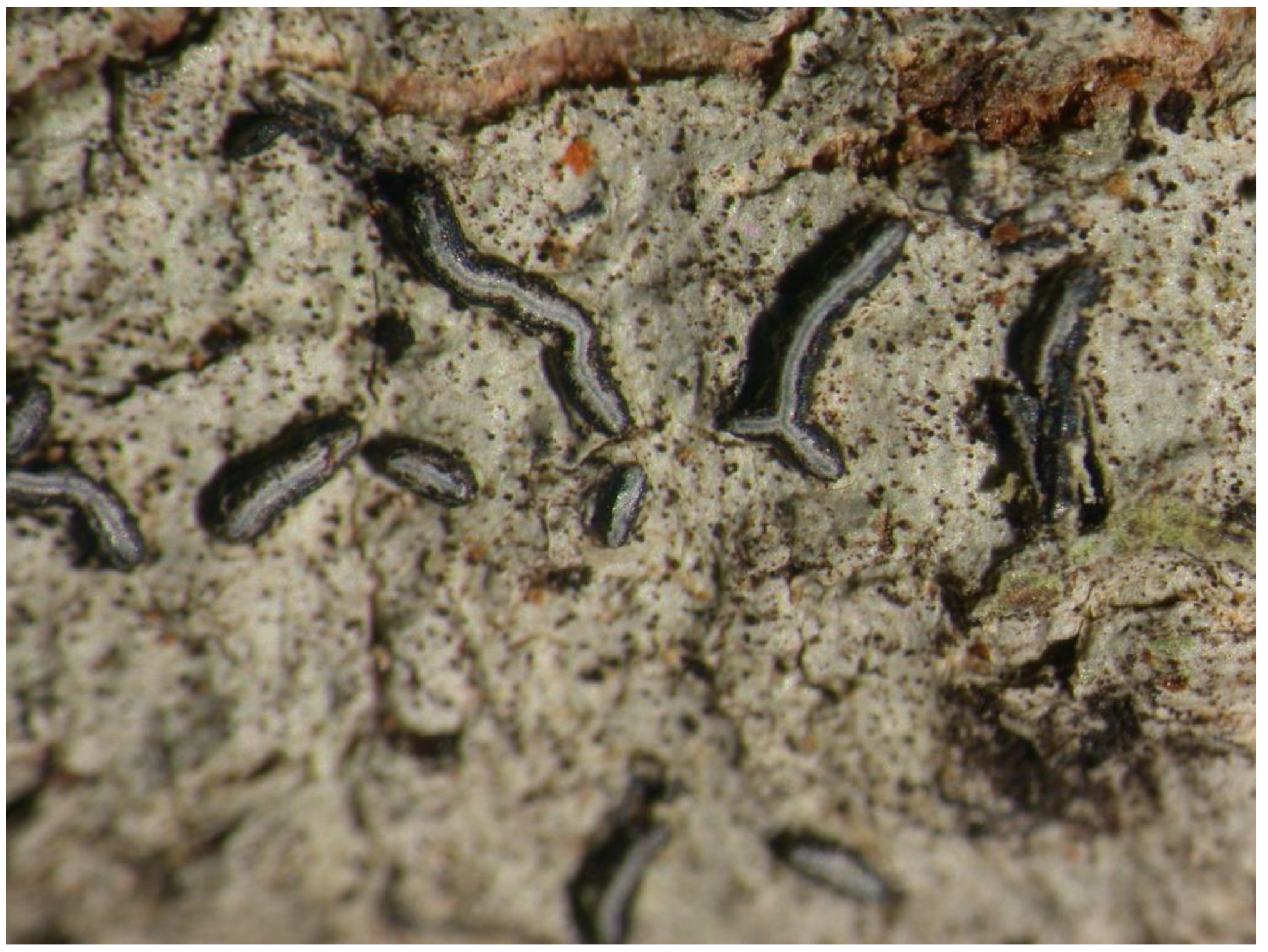
Figure 2.
Allographa variopruinata.
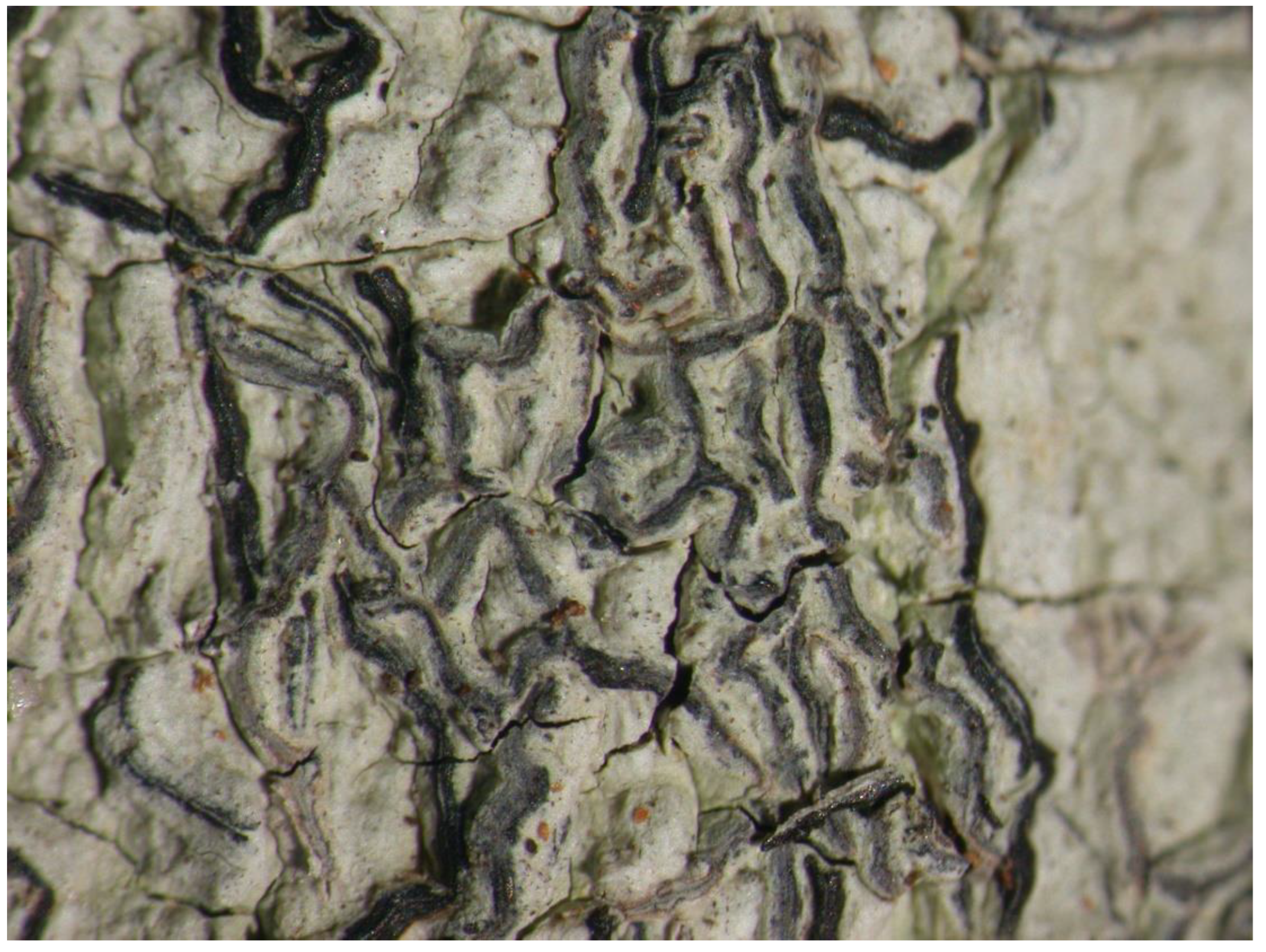
Figure 3.
Arthonia xanthopycnidiata. Left, daylight; Right, under UV-light.
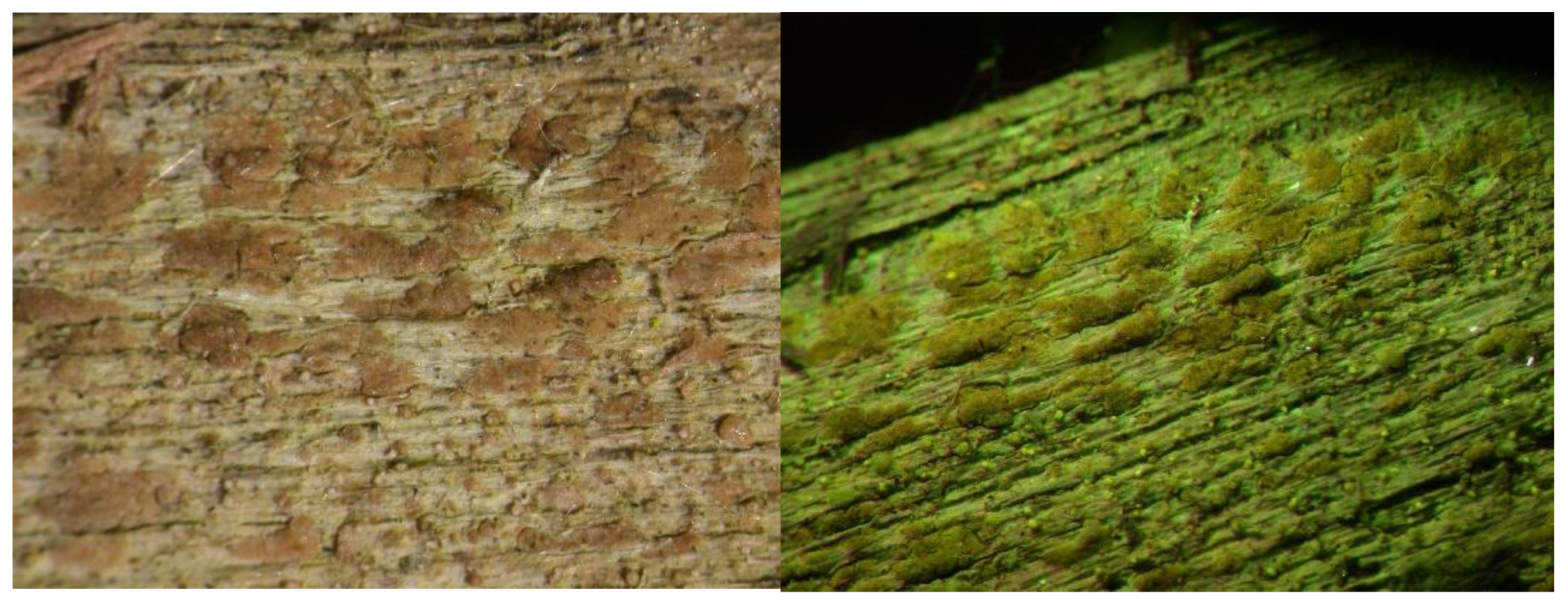
Figure 4.
Astrothelium aurantioseptemseptatum. Left, daylight; Right, under UV-light.
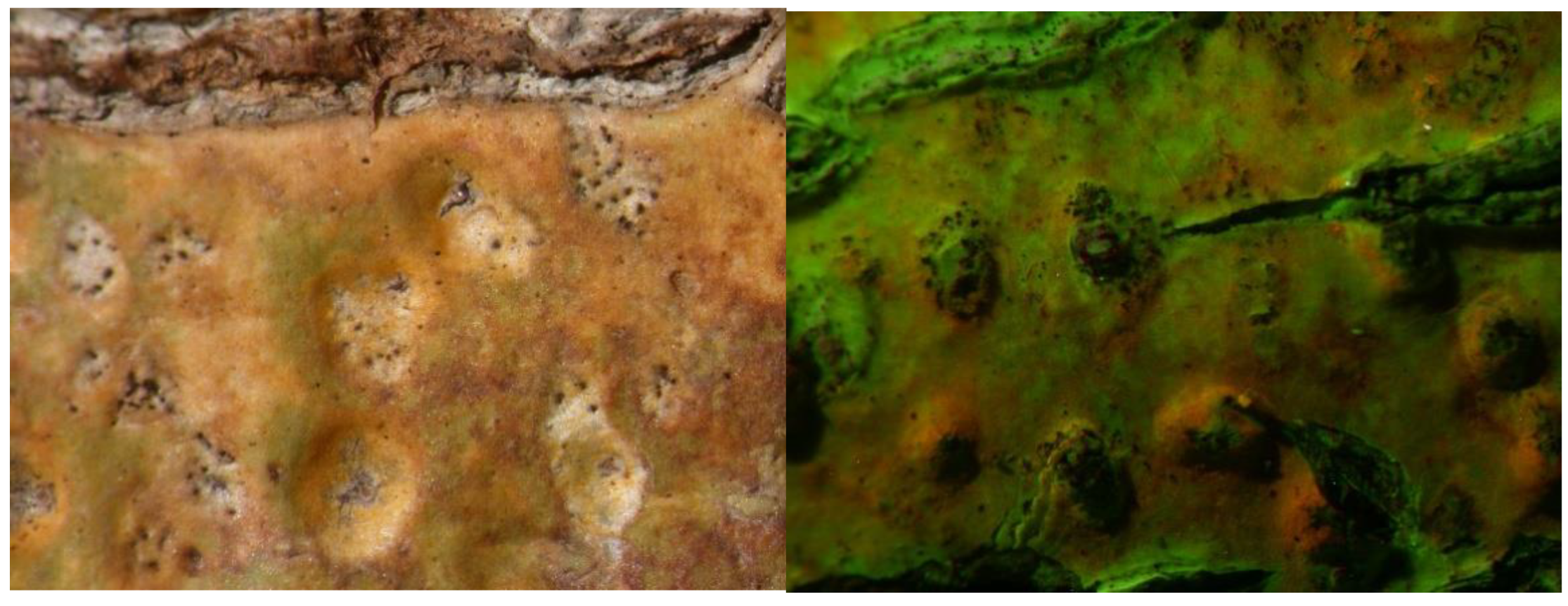
Figure 5.
Astrothelium bulbosum. Left, daylight; Right, under UV-light.
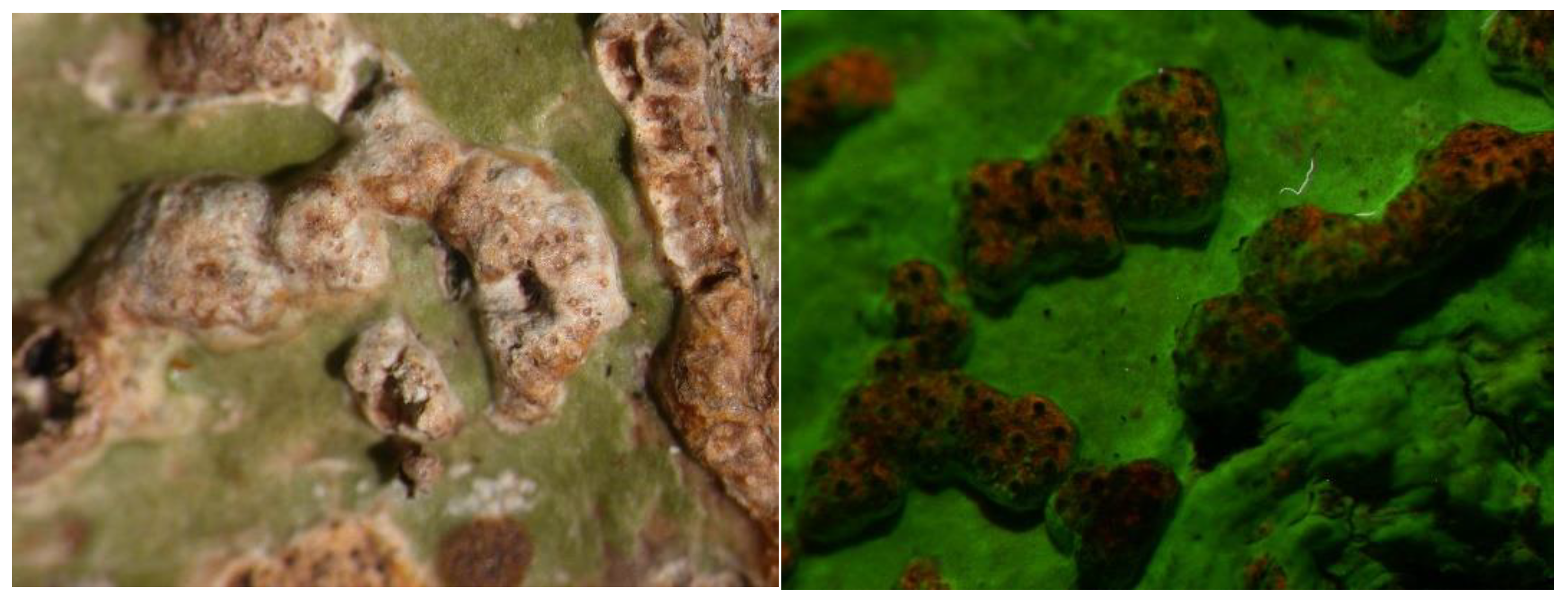
Figure 6.
Astrothelium coloratum. Left, daylight; Right, under UV-light.
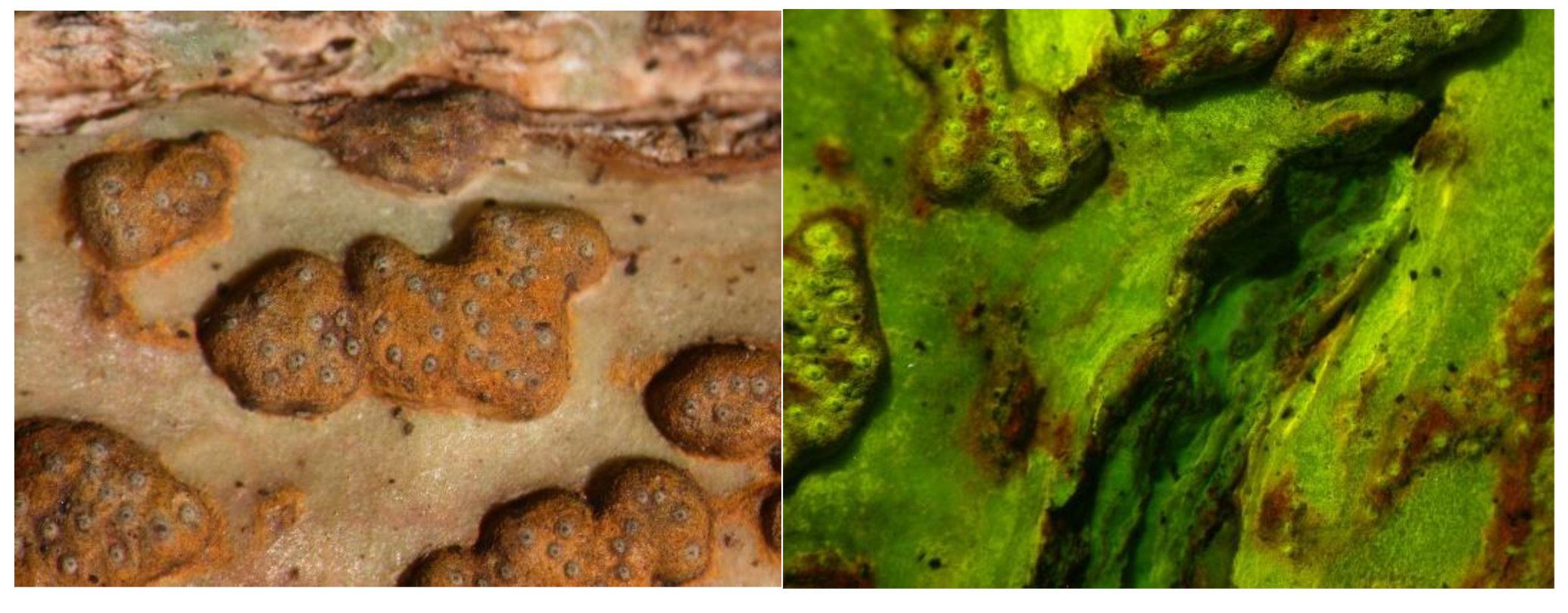
Figure 7.
Astrothelium inspersoseptatum.
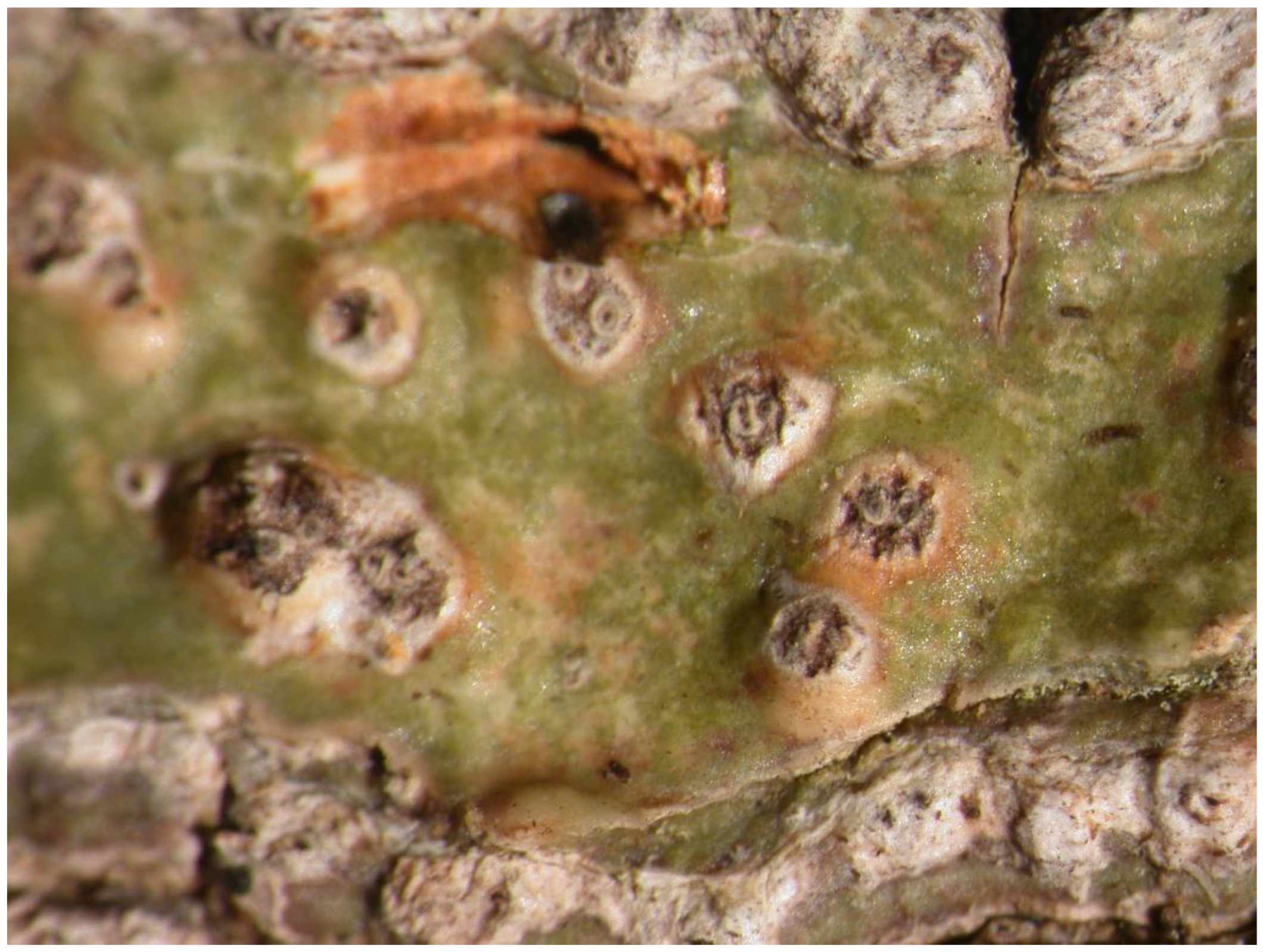
Figure 8.
Astrothelium insulare.
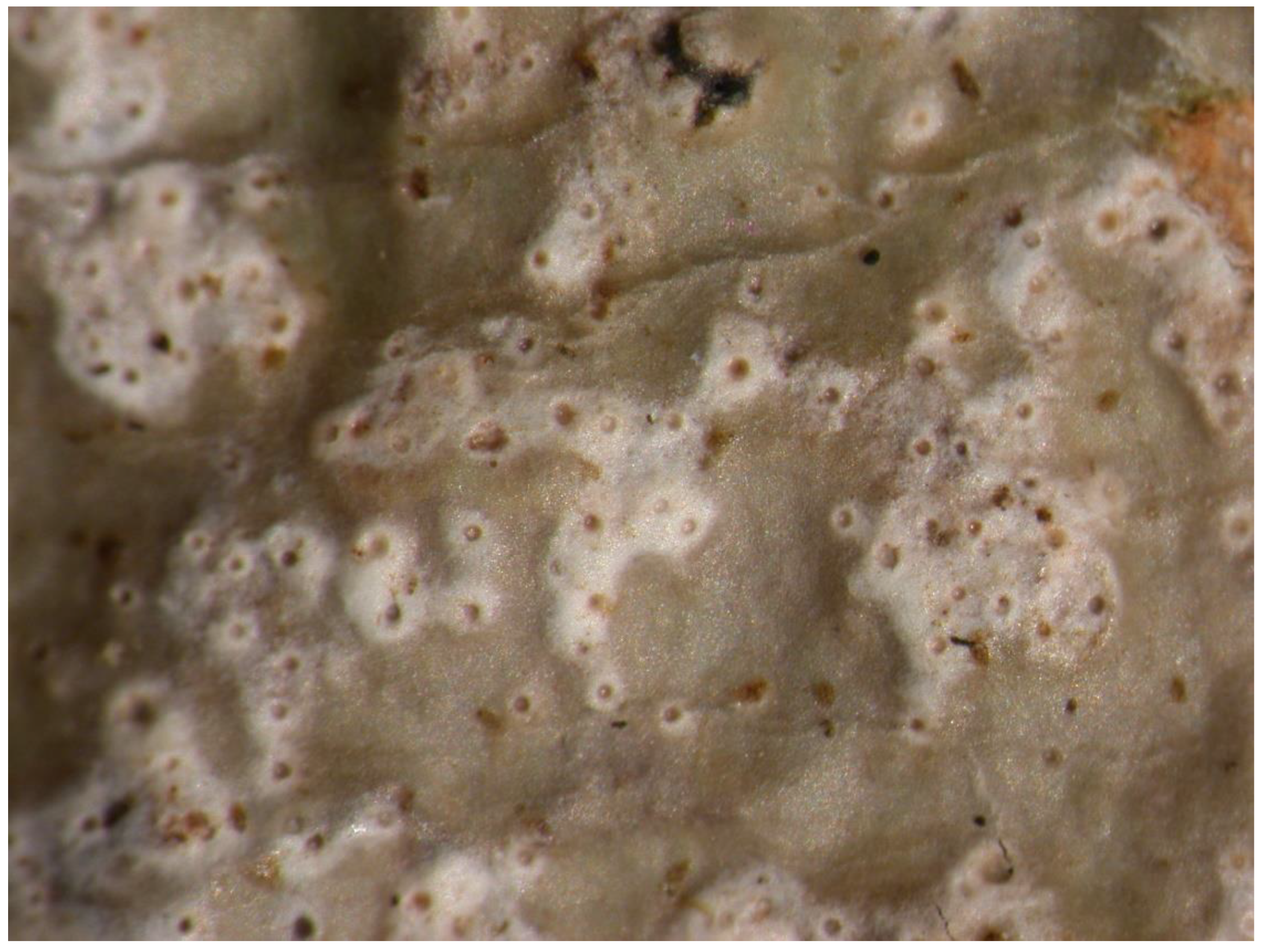
Figure 9.
Astrothelium laurerioides. Left, daylight; Right, under UV-light.
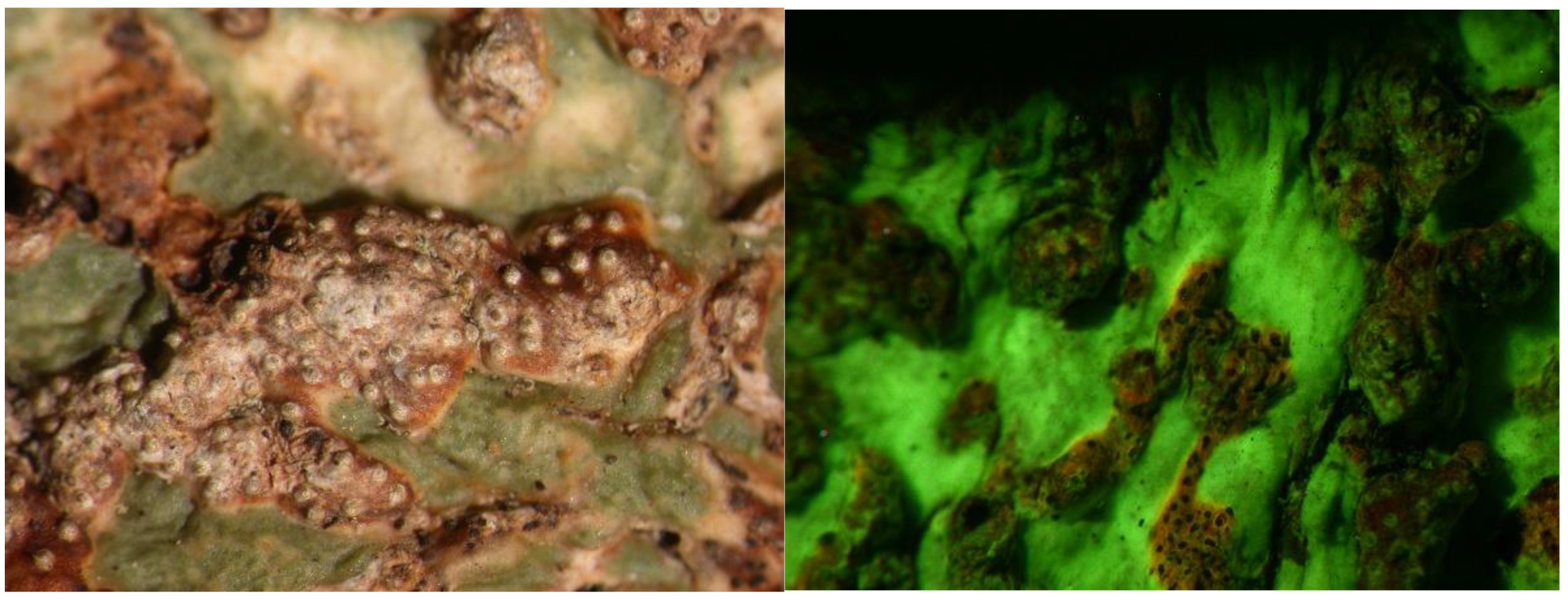
Figure 10.
Astrothelium marjoleinae. Left, daylight; Right, under UV-light.
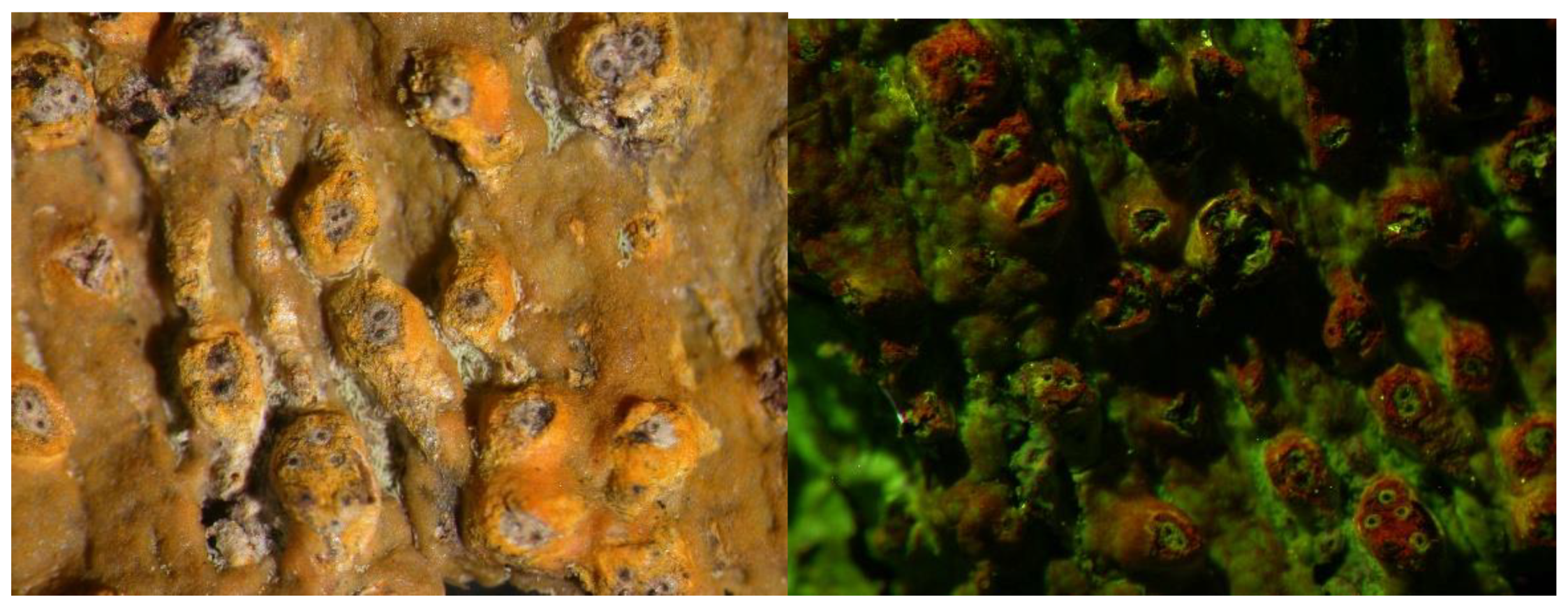
Figure 11.
Astrothelium meandratum.
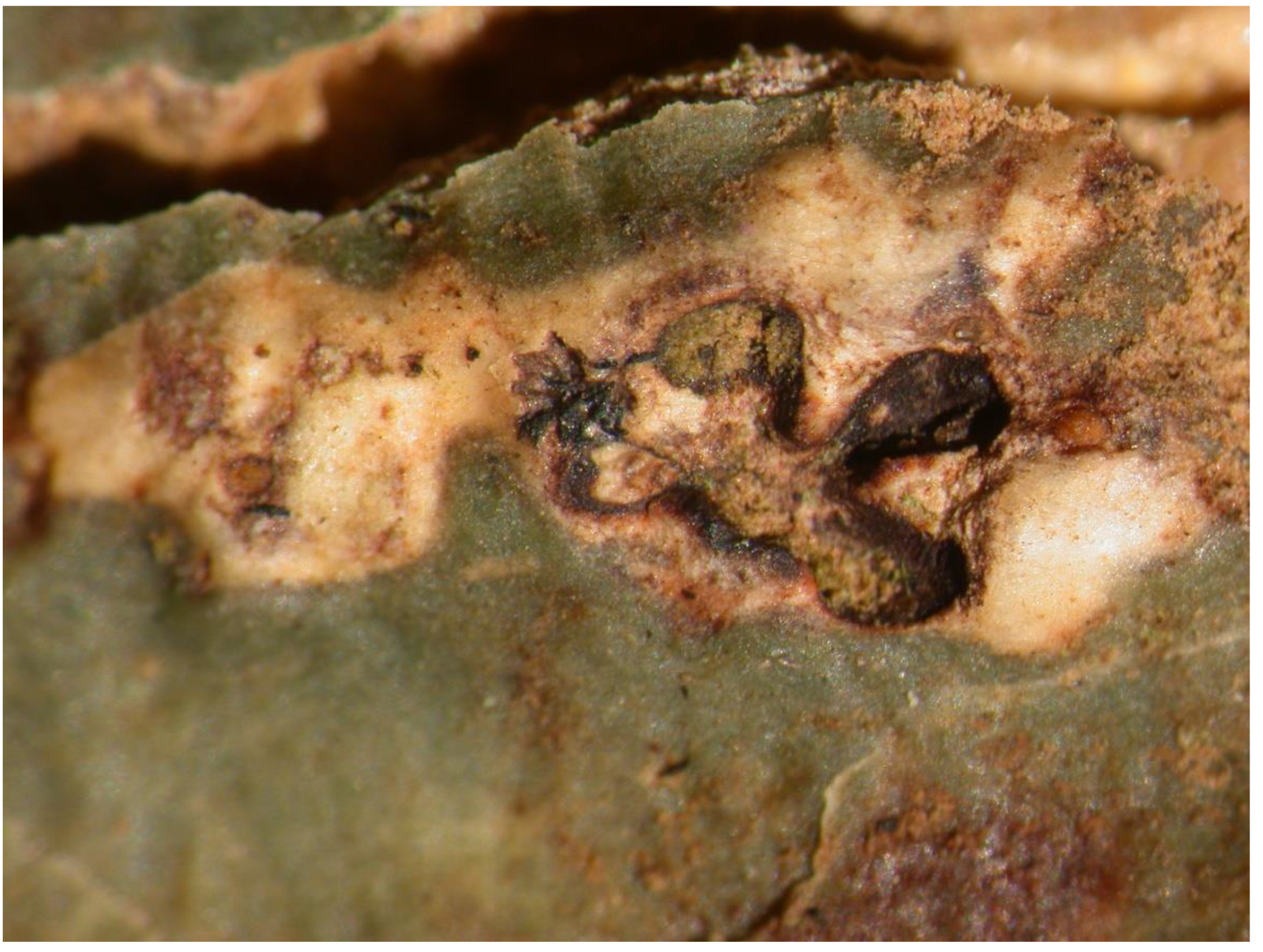
Figure 12.
Astrothelium multireflexum. Left, daylight; Right, under UV-light.
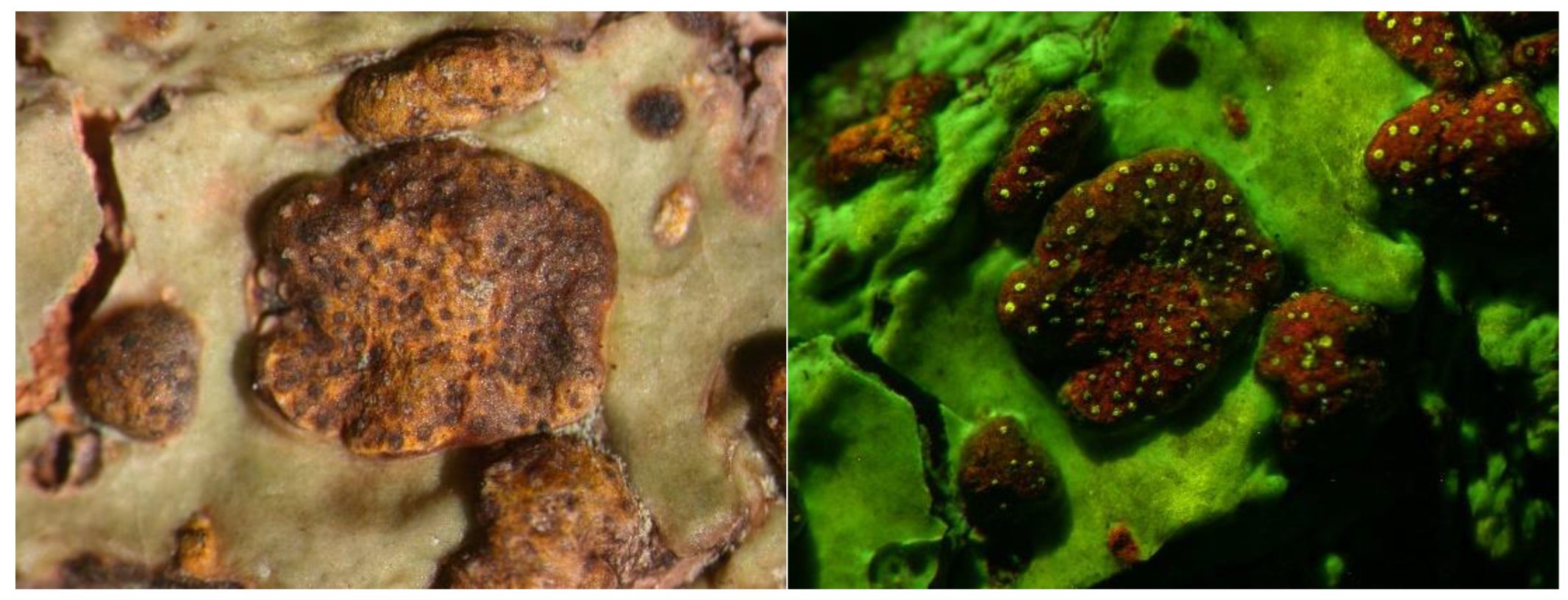
Figure 13.
Astrothelium myopicum. Left, daylight; Right, under UV-light.
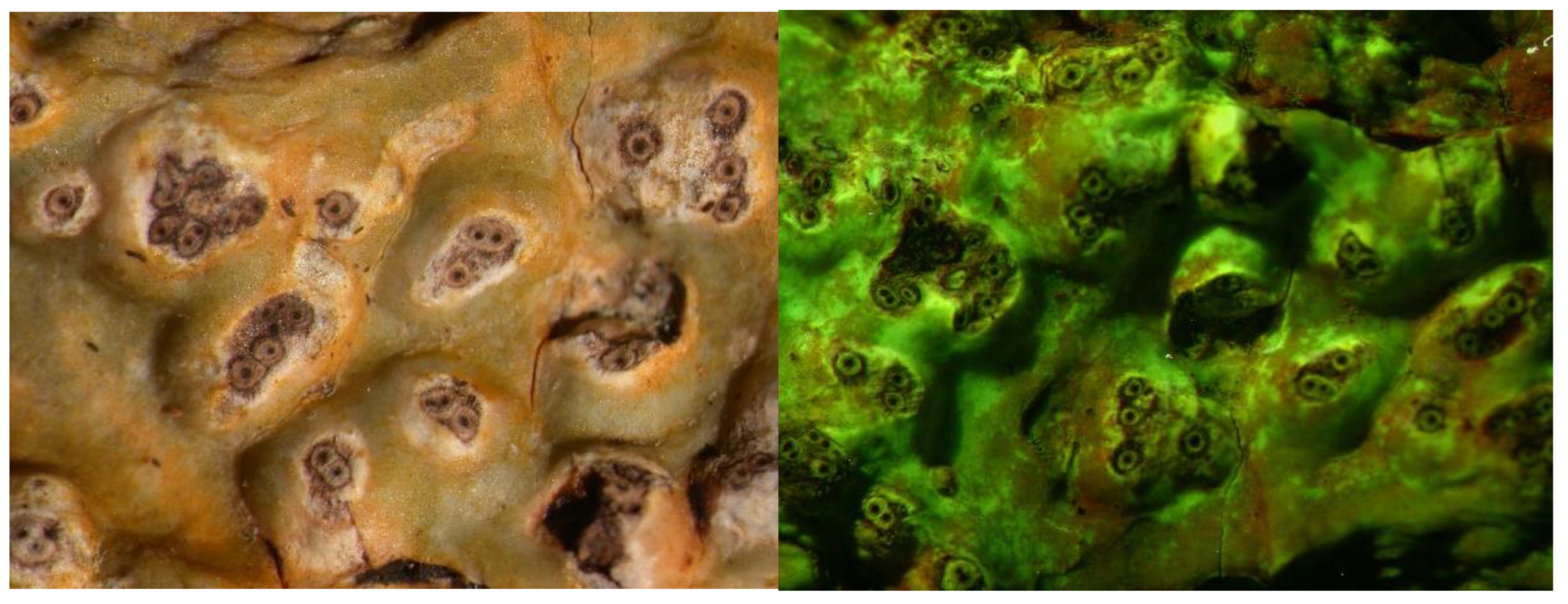
Figure 14.
Astrothelium parabathelium. Left, daylight; Right, under UV-light.
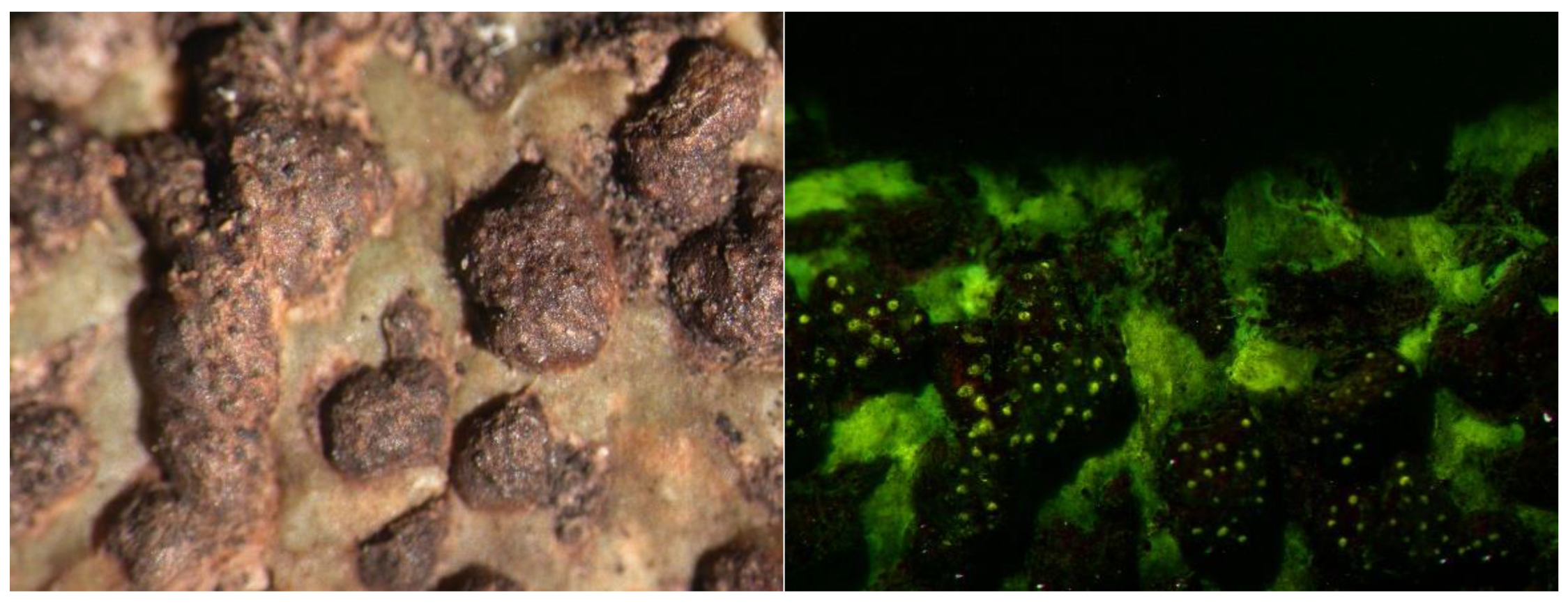
Figure 15.
Astrothelium stellare. Left, daylight; Right, under UV-light.
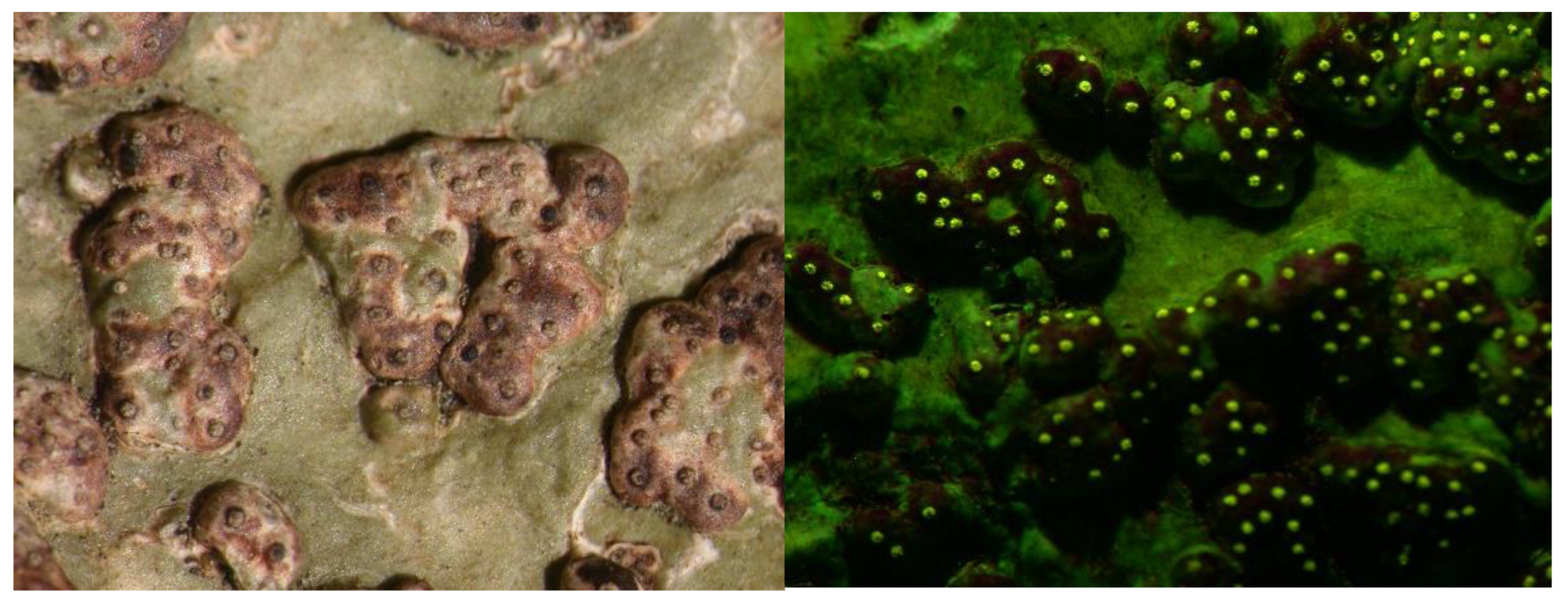
Figure 16.
Astrothelium suprainspersum. Left, daylight; Right, under UV-light.
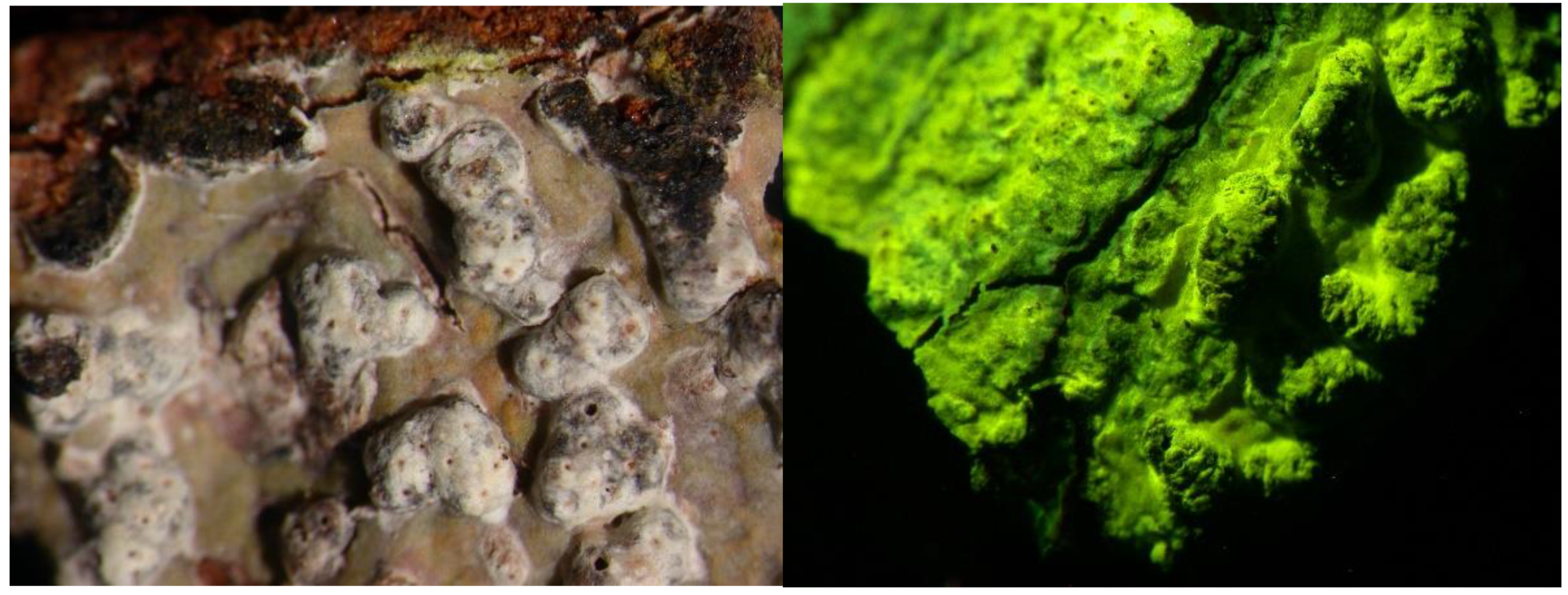
Figure 17.
Astrothelium xanthocavatum.
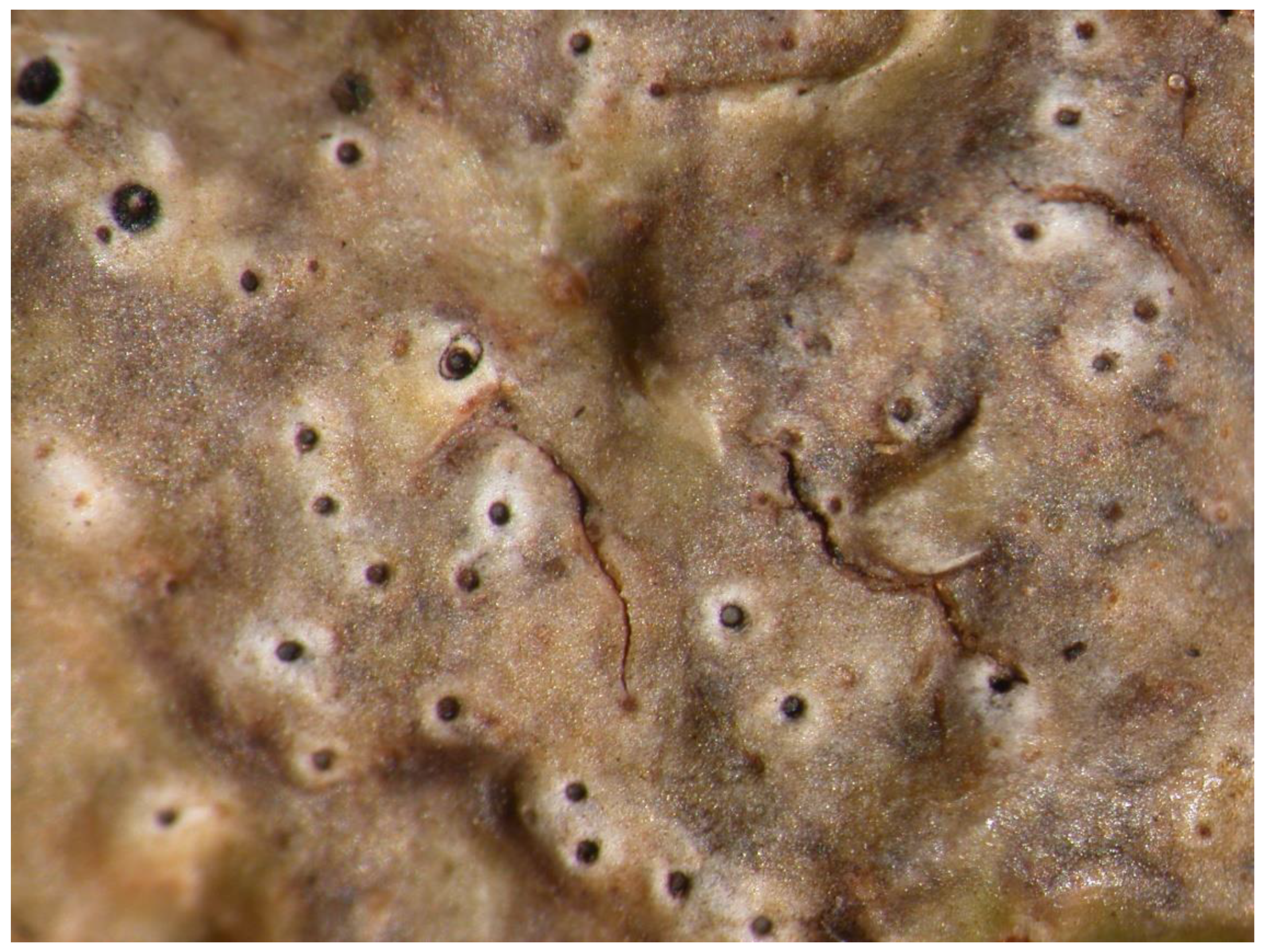
Figure 18.
Ocellularia fuscolichexanthonica.
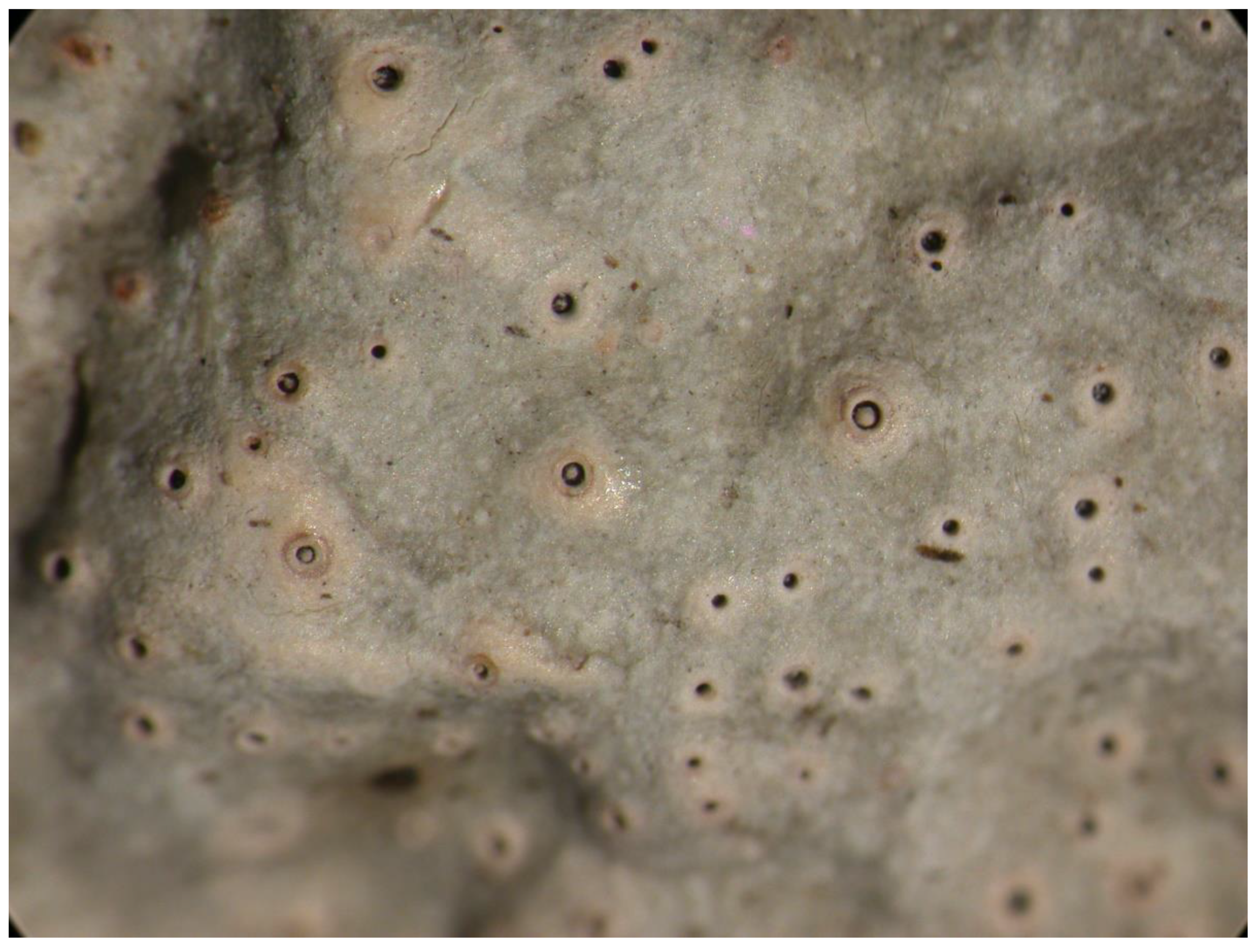
Figure 19.
Ocellularia lichexanthocavata.
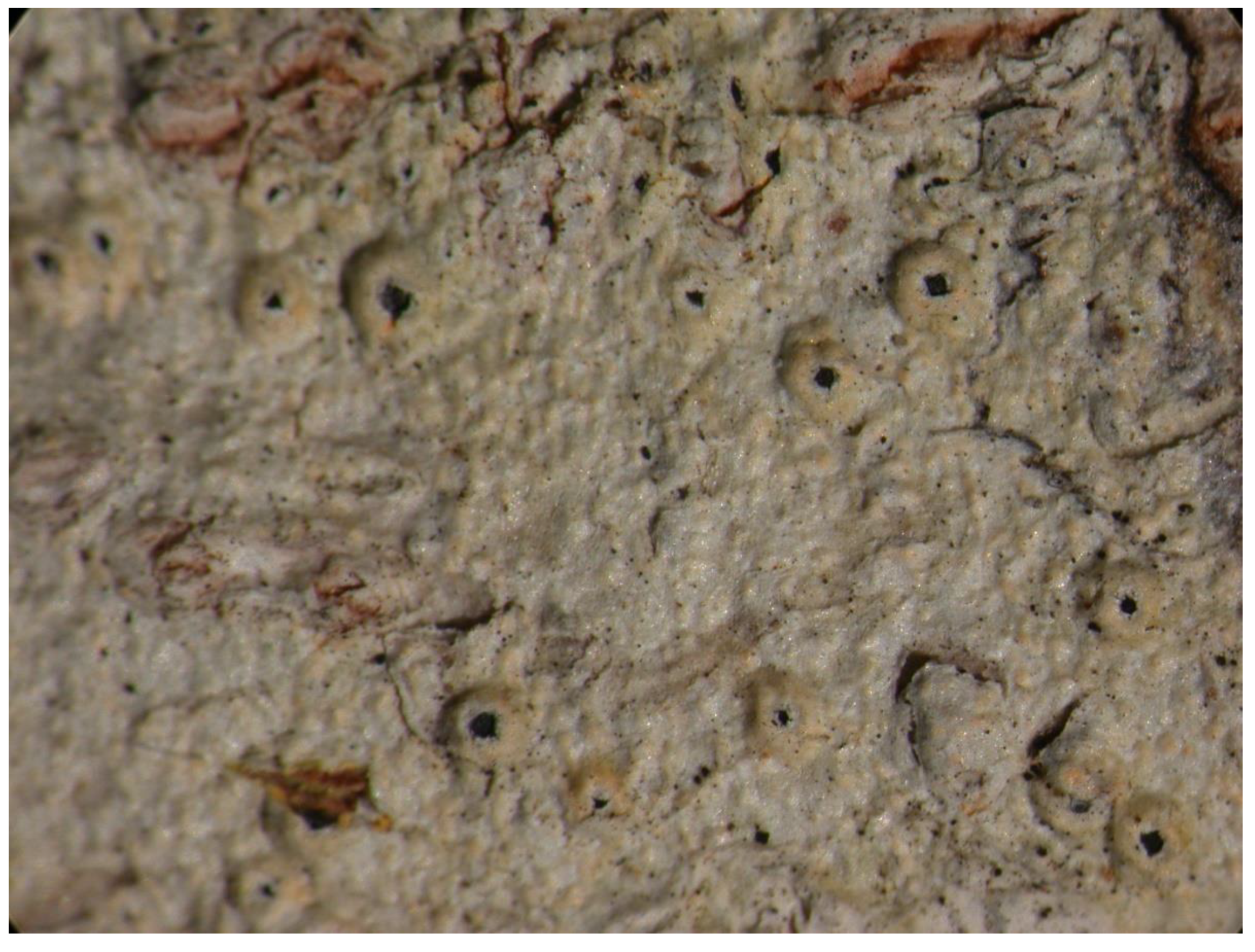
Figure 20.
Pertusaria amazonica.
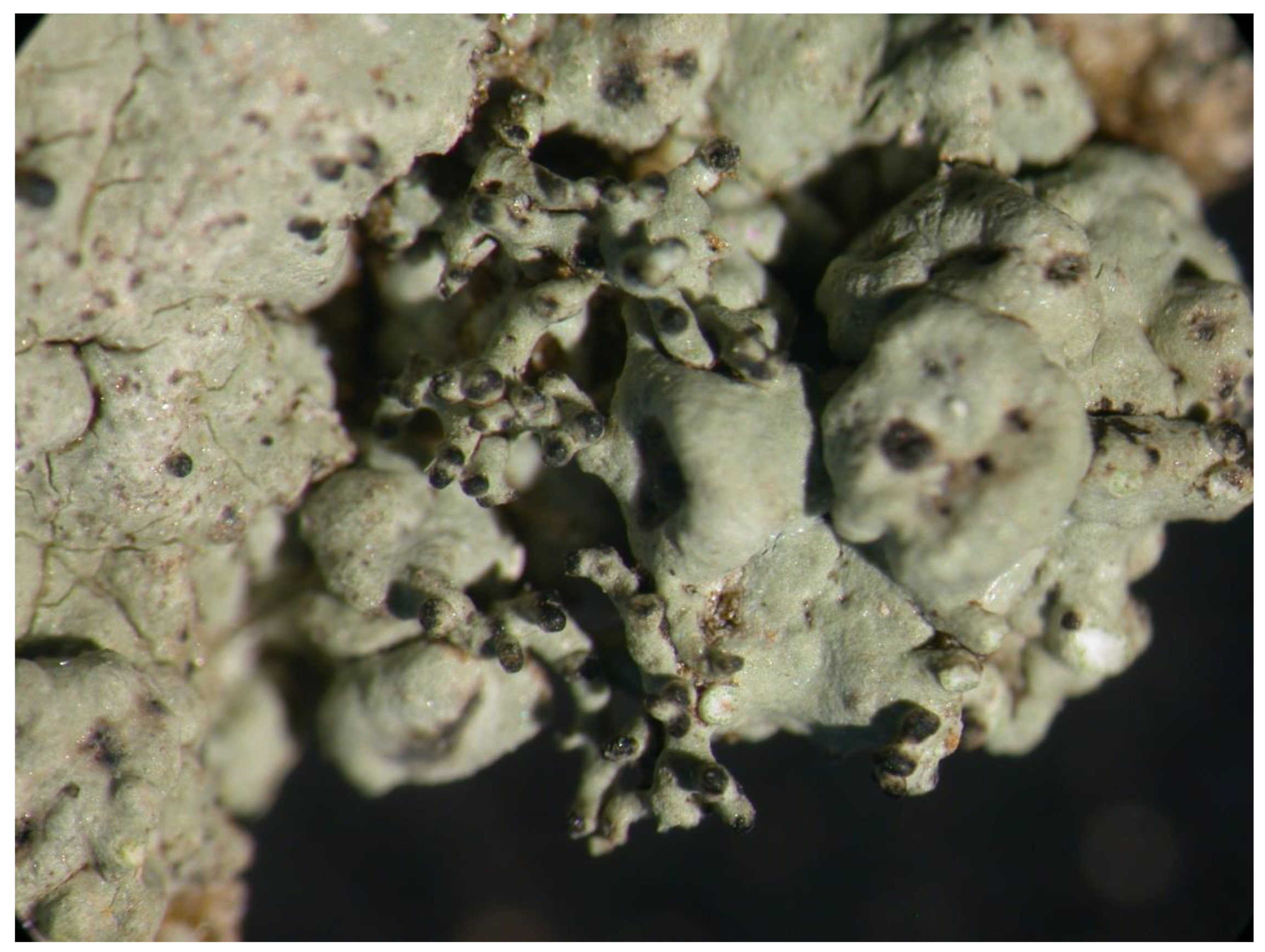
Figure 21.
Phaeographis xantholirellinata.
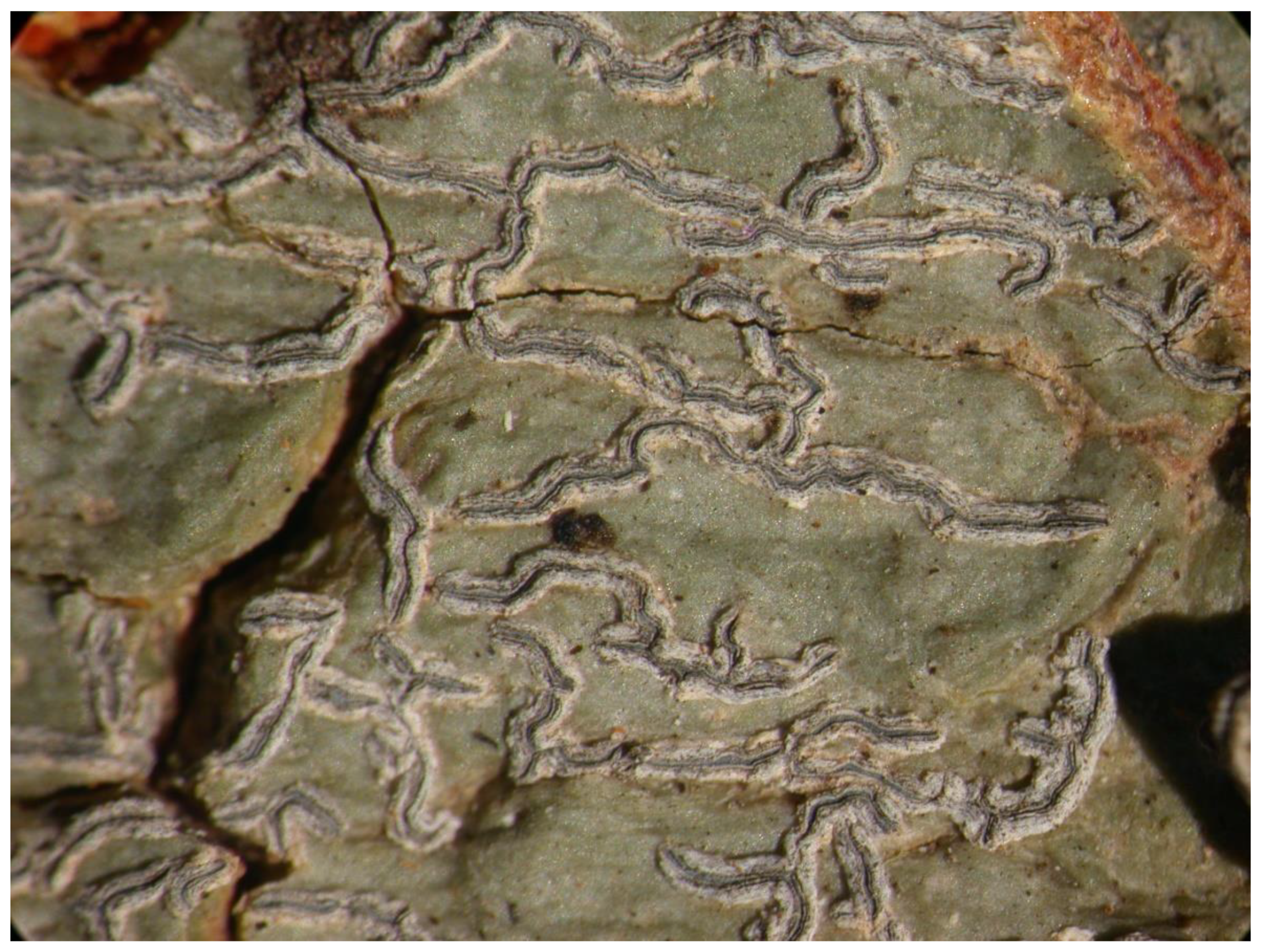
Figure 22.
Porina ramiisidiata.
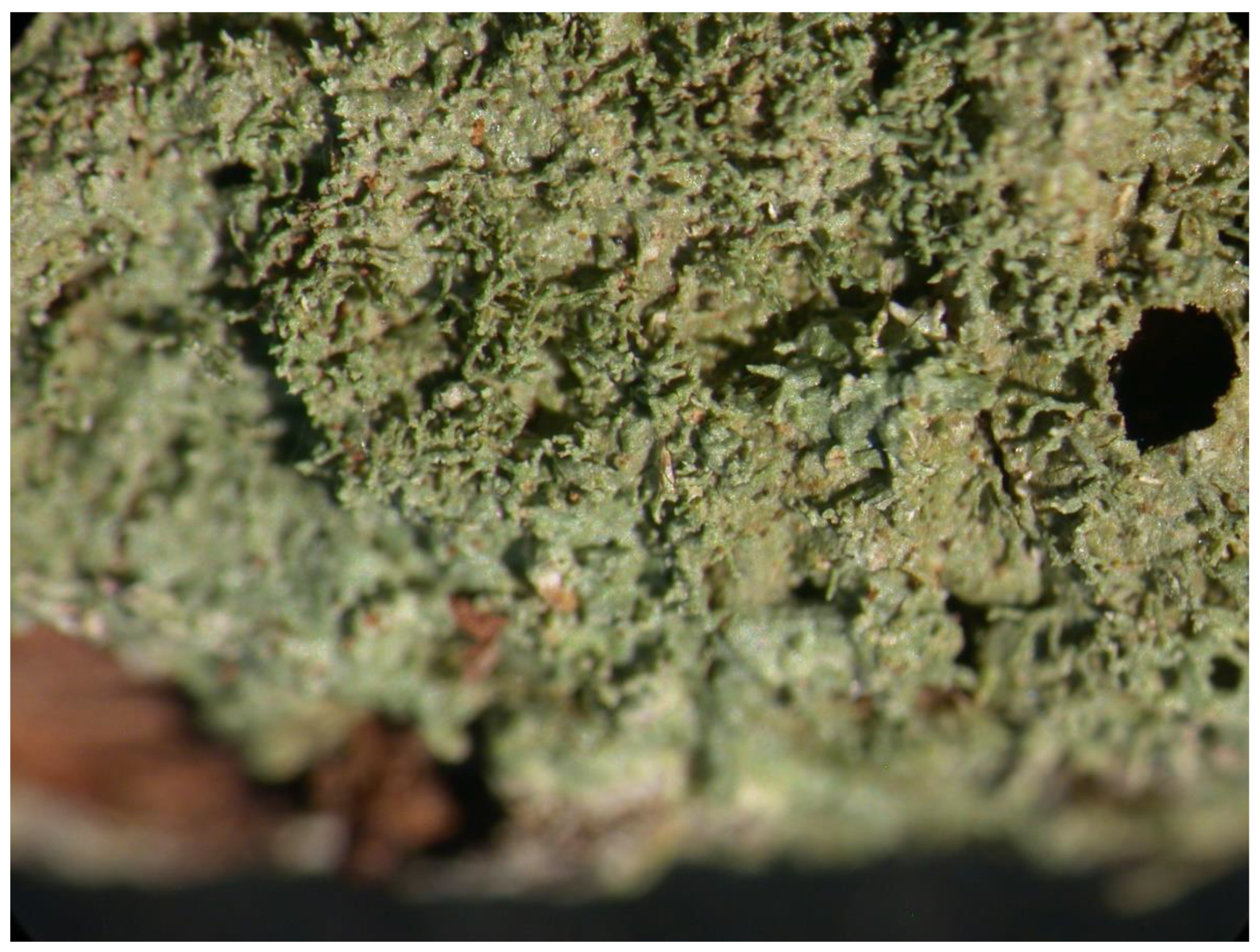
Figure 23.
Pseudopyrenula connexa.

Figure 24.
Sprucidea squamulosa.
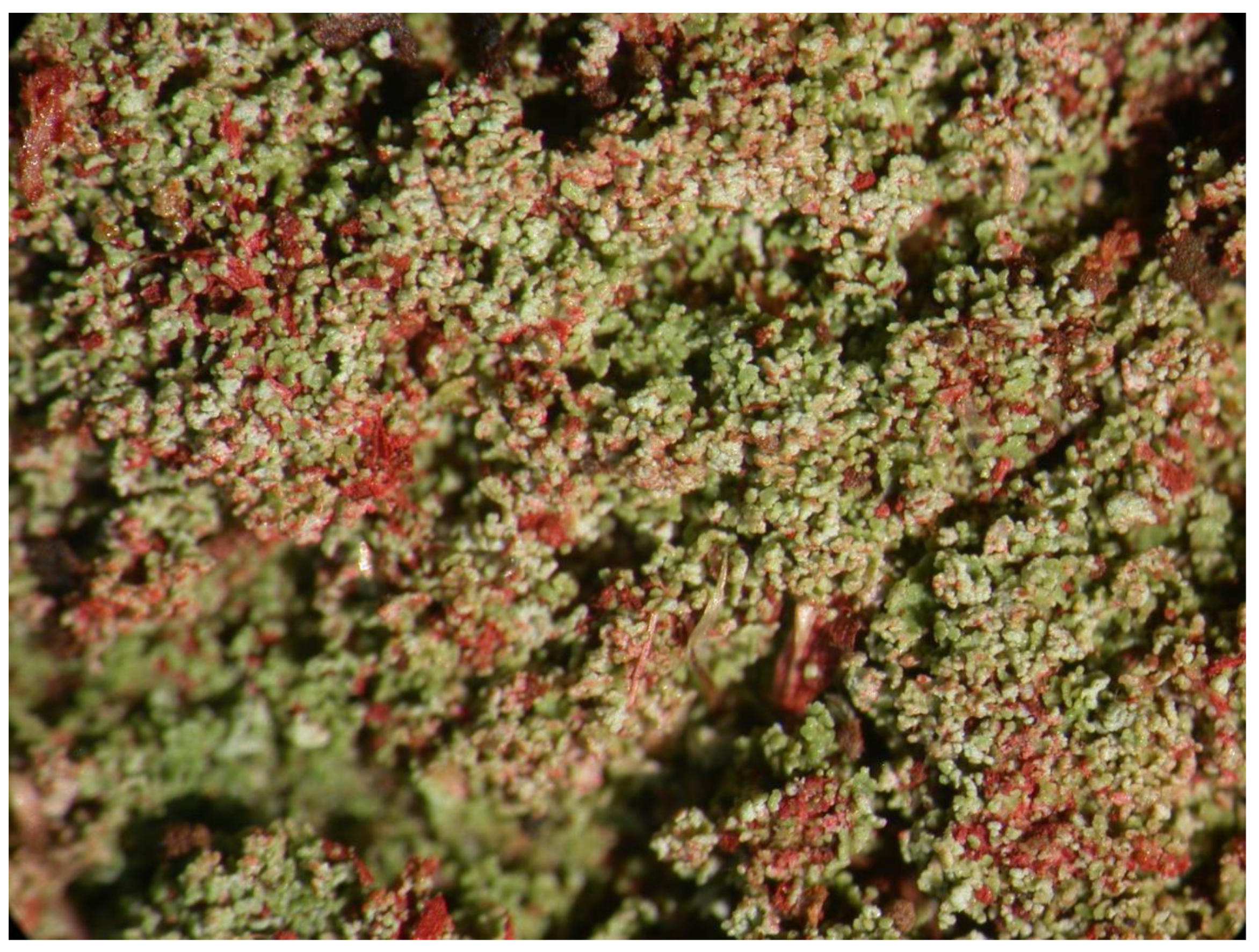

Table 1.
New records for Brazil (BR) or Amazonas State (AM); only one Aptroot collection number mentioned.
Table 1.
New records for Brazil (BR) or Amazonas State (AM); only one Aptroot collection number mentioned.
| Species | new | # | substratum |
| Acanthothecis peplophora | BR | 87255 | bark |
| Allographa angustata | AM | 86357 | bark |
| Allographa balbisii | AM | 86462 | siliceous rock |
| Allographa flavens | BR | 86359 | twig |
| Allographa longula | AM | 85997 | bark of fallen Enterolobium tree |
| Allographa rufopallida | AM | 86404 | bark |
| Anomomorpha sordida | AM | 87231 | bark |
| Anthracothecium prasinum | AM | 86298 | bark |
| Architrypethelium grande | AM | 85967 | bark |
| Arthonia parantillarum | AM | 86549 | bark |
| Astrochapsa astroidea | AM | 85969 | bark |
| Astrochapsa calathiformis | BR | 86197 | bark |
| Astrothelium astrolucidum | AM | 87353 | bark |
| Astrothelium aureomaculatum | AM | 86036 | bark of fallen Enterolobium tree |
| Astrothelium chapadense | AM | 86011 | bark of fallen Enterolobium tree |
| Astrothelium eustomum | AM | 86047 | bark of fallen Enterolobium tree |
| Astrothelium floridanum | AM | 85917 | bark |
| Astrothelium globosum | AM | 86062 | bark of fallen Enterolobium tree |
| Astrothelium inspersotuberculosum | AM | 86114 | bark of fallen Enterolobium tree |
| Astrothelium introflavidum | AM | 86017 | bark of fallen Enterolobium tree |
| Astrothelium leucosessile | AM | 86053 | bark of fallen Enterolobium tree |
| Astrothelium megaeneum | AM | 85908 | bark |
| Astrothelium mesoduplex | AM | 86103 | bark of fallen Enterolobium tree |
| Astrothelium neogalbineum | AM | 86035 | bark of fallen Enterolobium tree |
| Astrothelium neovariolosum | AM | 86379 | bark |
| Astrothelium nicaraguense | BR | 86498 | bark |
| Astrothelium novemseptatum | AM | 85916 | bark |
| Astrothelium ochroleucoides | AM | 86033 | bark of fallen Enterolobium tree |
| Astrothelium pallidoflavum | BR | 86009 | bark of fallen Enterolobium tree |
| Astrothelium pyrenastrosulphureum | AM | 86568 | bark |
| Astrothelium scoria | AM | 85992 | bark |
| Astrothelium sepultum | AM | 86227 | bark |
| Astrothelium sphaerioides | AM | 86107 | bark of fallen Enterolobium tree |
| Astrothelium subfuscum | AM | 85958 | bark |
| Astrothelium subfuscum | AM | 85994 | bark |
| Astrothelium trypethelioides | BR | 85988 | bark |
| Bacidina neotropica | AM | 85892 | bark |
| Bacidina pseudoisidiata | BR | 86241 | bark |
| Bapalmuia lineata | AM | 86637 | living leaves |
| Bapalmuia pallescens | AM | 86695 | living leaves |
| Bathelium madreporiforme | AM | 86004 | bark of fallen Enterolobium tree |
| Bathelium mastoideum | AM | 86088 | bark of fallen Enterolobium tree |
| Bogoriella megaspora | AM | 85961 | bark |
| Bogoriella oleosa | AM | 86087 | bark of fallen Enterolobium tree |
| Bryostigma mediella | BR | 86365 | pebbles |
| Buellia subtabacina | AM | 86511 | siliceous rock |
| Bulbothrix fungicola | AM | 86580 | bark |
| Byssolecania hymenocarpa | AM | 86718 | living leaves |
| Byssoloma chlorinum | AM | 87181 | living leaves |
| Byssoloma subdiscordans | AM | 86698 | living leaves |
| Calopadia subcoerulescens | AM | 86474 | siliceous rock |
| Caloplaca baueri | AM | 86439 | siliceous rock |
| Caloplaca lecapustulata | AM | 85900 | siliceous rock |
| Canoparmelia caroliniana | AM | 86413 | bark |
| Carbacanthographis latispora | BR | 87351 | bark |
| Carbacanthographis subchionophora | BR | 86601 | bark |
| Chapsa chionostoma | AM | 87302 | bark |
| Chapsa defectosorediata | AM | 86237 | bark |
| Chapsa leprocarpa | AM | 85938 | twig |
| Chapsa phlyctidioides | AM | 86165 | bark |
| Chiodecton malmei | AM | 87277 | bark |
| Clandestinotrema leucomelaenum | AM | 87246 | bark |
| Coenogonium subdentatum | AM | 86265 | bark |
| Crustospathula amazonica | AM | 86200 | bark |
| Crustospathula humboldtii | AM | 85891 | bark |
| Crypthonia corticorygmoides | AM | 86229 | bark |
| Cryptoschizotrema cryptotrema | AM | 87325 | bark |
| Cryptothecia aleurocarpa | AM | 86277 | bark |
| Cryptothecia effusa | AM | 86721 | living leaves |
| Cryptothecia inexspectata | AM | 87176 | living leaves |
| Cryptothecia macrocephala | AM | 86489 | bark |
| Cryptothecia striata | AM | 85939 | bark |
| Dichoporis phaea | AM | 86140 | bark |
| Dictyomeridium proponens | AM | 86119 | bark of fallen Enterolobium tree |
| Dictyonema phyllophilum | AM | 87177 | living leaves |
| Diploschistes actinostomus | AM | 86516 | siliceous rock |
| Dirinaria picta | AM | 86427 | bark |
| Enterographa subserialis | AM | 85987 | bark |
| Ephebe brasiliensis | AM | 86442 | siliceous rock |
| Eschatogonia minuta | AM | 86207 | bark |
| Fellhanera badimioides | BR | 86636 | living leaves |
| Fellhanera bouteillei | AM | 86307 | root under overhang |
| Fellhanera fuscatula | AM | 86716 | living leaves |
| Fellhanera muhlei | AM | 86731 | living leaves |
| Fellhanera rubida | AM | 86226 | termitarium on bark |
| Fissurina dumastii | AM | 85932 | bark |
| Fissurina incondita | AM | 86469 | siliceous rock |
| Fissurina pseudostromatica | AM | 86316 | bark |
| Fissurina scolecitis | AM | 86069 | bark of fallen Enterolobium tree |
| Flavobathelium epiphyllum | AM | 86711 | living leaves |
| Graphis lineola | AM | 86477 | twig |
| Graphis pinicola | AM | 86477a | bark |
| Graphis pitmanii | BR | 86015 | bark of fallen Enterolobium tree |
| Graphis subhiascens | AM | 87326 | bark |
| Graphis subtecta | AM | 86001 | bark of fallen Enterolobium tree |
| Graphis syzygii | BR | 86128 | bark of fallen Enterolobium tree |
| Herpothallon adnatum | AM | 86629 | bark |
| Herpothallon minimum | AM | 86147 | siliceous rock |
| Herpothallon nigroisidiatum | AM | 85968 | bark |
| Hypotrachyna minarum | AM | 86381 | bark |
| Lecanora brasiliana | AM | 86449 | siliceous rock |
| Lepra tropica | AM | 86025 | bark of fallen Enterolobium tree |
| Leptogium coralloideum | AM | 86628 | bark |
| Leptogium cyanescens | AM | 85901 | siliceous rock |
| Leptogium moluccanum | AM | 85927 | bark |
| Leucodecton compunctum | BR | 87346 | siliceous rock |
| Leucodecton expallescens | AM | 86396 | bark |
| Lithothelium immersum | AM | 86291 | bark |
| Lithothelium obtectum | AM | 86145 | bark |
| Lyromma confusum | AM | 86699 | living leaves |
| Malmidea bakeri | AM | 85911 | bark |
| Malmidea nigra | AM | 86501 | bark |
| Malmidea piperis | AM | 86141 | bark |
| Malmidea tratiana | AM | 86076 | bark of fallen Enterolobium tree |
| Malmidea vinosa | AM | 86503 | bark |
| Mazosia carnea | AM | 86393 | bark |
| Mazosia multipunctata | AM | 86732 | living leaves |
| Megalospora tuberculosa | AM | 87269 | bark |
| Micarea lithinella | BR | 85888 | siliceous rock |
| Multisporidea conidiophora | AM | 85913 | bark |
| Mycoporum lacteum | AM | 86624 | wood |
| Myriostigma xanthominiatum | AM | 86149 | bark |
| Myriotrema frondosolucens | AM | 86348 | bark |
| Myriotrema myrioporoides | AM | 86221 | bark |
| Myriotrema subclandestinum | AM | 86194 | bark |
| Myriotrema viride | AM | 86222 | bark |
| Myriotrema viridialbum | AM | 85951 | bark |
| Nadvornikia hawaiensis | AM | 86627 | bark |
| Ocellularia ascidioidea | AM | 86218 | bark |
| Ocellularia aurulenta | AM | 86312 | bark |
| Ocellularia barroensis | AM | 87341 | siliceous rock |
| Ocellularia buckii | AM | 86564 | bark |
| Ocellularia cicra | BR | 86275 | bark |
| Ocellularia dolichotata | AM | 86195 | bark |
| Ocellularia excavata | BR | 86249 | bark |
| Ocellularia inspersula | AM | 86166 | bark |
| Ocellularia laeviusculoides | AM | 86068 | bark of fallen Enterolobium tree |
| Ocellularia landronii | AM | 86534 | bark |
| Ocellularia marmorata | AM | 86337 | bark |
| Ocellularia percolumellata | AM | 85984 | bark |
| Ocellularia pulverulenta | AM | 86159 | bark |
| Ocellularia rondoniana | AM | 86168 | bark |
| Ocellularia rugosothallina | AM | 86282 | bark |
| Ocellularia tishae | BR | 86246 | bark |
| Ocellularia usnicolor | AM | 86490a | bark |
| Opegrapha contracta | AM | 86435 | bark |
| Opegrapha ramisorediata | AM | 86172 | bark |
| Opegrapha vegae | AM | 86737 | living leaves |
| Pallidogramme chapadana | AM | 86106 | bark of fallen Enterolobium tree |
| Pallidogramme chlorocarpoides | AM | 87264 | bark |
| Parallopsora leucophyllina | AM | 86174 | bark |
| Parmeliella nigrata | AM | 86390 | bark |
| Parmotrema gardneri | AM | 87290 | bark |
| Parmotrema progenes | AM | 86493 | bark |
| Parmotrema rubifaciens | AM | 87284 | bark |
| Parmotrema tinctorum | AM | 87340 | bark |
| Peltula brasiliensis | AM | 85879 | wet siliceous rock |
| Peltula lingulata | AM | 86517 | wet siliceous rock |
| Phaeographis brasiliensis | AM | 86146 | bark |
| Phaeographis dendritica | AM | 87322 | bark |
| Phaeographis haematites | AM | 85923 | bark |
| Phaeographis tortuosa | AM | 86423 | bark |
| Phylliscum vermiformis | AM | 86527 | wet siliceous rock |
| Phyllopsora buettneri | AM | 87312 | bark |
| Phyllopsora ochroxantha | AM | 86575 | siliceous rock |
| Phyllopsora parvifolia | AM | 86133 | bark |
| Phyllopsora soralifera | AM | 85912 | bark |
| Platythecium colliculosum | AM | 87243 | bark |
| Platythecium grammites | AM | 86196 | bark |
| Polymeridium albidovarians | AM | 86352 | bark |
| Porina applanata | BR | 86672 | living leaves |
| Porina atriceps | AM | 87190 | living leaves |
| Porina chlorotica | AM | 85893 | siliceous rock |
| Porina conspersa | AM | 86438 | siliceous rock |
| Porina distans | AM | 86086 | bark of fallen Enterolobium tree |
| Porina epiphylloides | AM | 86671 | living leaves |
| Porina interjungens | BR | 86451 | siliceous rock |
| Porina internigrans | AM | 86264 | bark |
| Porina melanops | AM | 85902 | siliceous rock |
| Porina nucula | AM | 87252 | bark |
| Porina ocellata | AM | 86440 | siliceous rock |
| Porina pilosa | BR | 87204 | living leaves |
| Porina sorediata | AM | 86398 | bark |
| Pseudobogoriella exigua | AM | 87236 | bark |
| Pseudopyrenula subgregaria | AM | 85903 | bark |
| Pterygiopsis densisidiata | AM | 86514 | siliceous rock |
| Pterygiopsis guyanensis | AM | 86528 | wet siliceous rock |
| Pyrenopsis carassensis | AM | 86523 | wet siliceous rock |
| Pyrenopsis cylindrophora | AM | 86519 | wet siliceous rock |
| Pyrenopsis olivacea | AM | 86515 | wet siliceous rock |
| Pyrenula acutispora | AM | 86267 | bark |
| Pyrenula aggregataspistea | AM | 85999 | bark of fallen Enterolobium tree |
| Pyrenula minor | AM | 85928 | bark |
| Pyrenula minutispora | AM | 86325 | bark |
| Pyrenula monospora | AM | 87274 | bark |
| Pyrenula obvoluta | BR | 85949 | twig |
| Pyrgillus javanicus | AM | 87295 | bark |
| Pyxine coralligera | AM | 86626 | siliceous rock |
| Ramboldia badia | AM | 87267 | bark |
| Redingeria glyphica | AM | 87240 | bark |
| Relicina subabstrusa | AM | 87304 | bark |
| Rhabdodiscus isidiiferus | BR | 87237 | bark |
| Schizotrema zebrinum | BR | 86096 | bark of fallen Enterolobium tree |
| Sclerophyton elegans | AM | 87229 | bark |
| Sclerophyton fluorescens | AM | 86557 | bark |
| Sprucidea granulosa | AM | 86504 | bark |
| Sprucidea penicillata | AM | 86085 | bark of fallen Enterolobium tree |
| Stegobolus radians | AM | 86244 | bark |
| Stirtonia nivea | AM | 86089 | bark of fallen Enterolobium tree |
| Synarthonia inconspicua | AM | 86424a | bark |
| Synarthothelium cerebriforme | AM | 86219 | bark |
| Thalloloma anguiniforme | AM | 87306 | wood |
| Thalloloma hypoleptum | AM | 86578 | bark |
| Thelotrema adjectum | BR | 87352 | bark |
| Thelotrema suecicum | BR | 86606 | bark |
| Trichothelium horridulum | AM | 86619 | bark |
| Trichothelium mirum | AM | 86691 | living leaves |
| Trypetheliopsis kalbii | AM | 87191 | living leaves |
Table 2.
Species on the sampled fallen Enterolobium tree; only one Aptroot collection number mentioned.
Table 2.
Species on the sampled fallen Enterolobium tree; only one Aptroot collection number mentioned.
| Species | # |
| Aggregatorygma triseptatum | 86000 |
| Allographa longula | 85997 |
| Allographa striatula | 86124 |
| Ampliotrema amplius | 86010 |
| Astrothelium aeneoides | 86003 |
| Astrothelium aeneum | 86022 |
| Astrothelium aureomaculatum | 86036 |
| Astrothelium bulbosum | 86111 |
| Astrothelium chapadense | 86011 |
| Astrothelium cinnamomeum | 86034 |
| Astrothelium crassum | 86055 |
| Astrothelium croceum | 86039 |
| Astrothelium cryptolucens | 86098 |
| Astrothelium disjunctum | 86101 |
| Astrothelium eustomum | 86047 |
| Astrothelium flavoduplex | 86115 |
| Astrothelium globosum | 86062 |
| Astrothelium inspersotuberculosum | 86114 |
| Astrothelium introflavidum | 86017 |
| Astrothelium kunzei | 86056 |
| Astrothelium laureroides | 86116 |
| Astrothelium leucosessile | 86053 |
| Astrothelium meandratum | 86094 |
| Astrothelium mesoduplex | 86103 |
| Astrothelium multireflexum | 86112 |
| Astrothelium myopicum | 86109 |
| Astrothelium neogalbineum | 86035 |
| Astrothelium nitidiusculum | 86100 |
| Astrothelium novemseptatum | 86020 |
| Astrothelium ochroleucoides | 86033 |
| Astrothelium pallidoflavum | 86009 |
| Astrothelium pleiostomum | 86037 |
| Astrothelium sphaerioides | 86107 |
| Astrothelium stellare | 86129 |
| Astrothelium stromatofluorescens | 86028 |
| Astrothelium subinterjectum | 86029 |
| Astrothelium subscoria | 86091 |
| Astrothelium variolosum | 86046 |
| Arthothelium (additional species) | 86042 |
| Arthothelium (additional species) | 86060 |
| Arthothelium (additional species) | 86117 |
| Bacidina | 86070 |
| Bathelium madreporiforme | 86004 |
| Bathelium mastoideum | 86088 |
| Bogoriella megaspora | 86090 |
| Bogoriella oleosa | 86087 |
| Chapsa | 86032 |
| Chapsa thallotrema | 86122 |
| Cryptothecia | 86082 |
| Cryptothecia lichexanthonica | 86043 |
| Dictyomeridium proponens | 86119 |
| Diorygma confluens | 86031 |
| Dyplolabia afzelii | 86002 |
| Enterographa lichexanthonica | 86030 |
| Erythrodecton granulatum | 86057 |
| Eschatogonia prolifera | 86063 |
| Fellhanera | 86071 |
| Fissurina | 86044 |
| Fissurina scolecitis | 86069 |
| Flegographa leprieurii | 86045 |
| Glaucotrema glaucophaenum | 86066 |
| Graphidaceae c sor | 86016 |
| Graphis pitmanii | 86015 |
| Graphis subtecta | 86001 |
| Graphis syzygii | 86128 |
| Herpothallon nigroisidiatum | 85998 |
| Lepra tropica | 86126 |
| Malmidea bakeri | 86078 |
| Malmidea polycampia | 86074 |
| Malmidea tratiana | 86076 |
| Malmographina plicosa | 86008 |
| Melanotrema platystomum | 86024 |
| Micarea corallothallina | 86073 |
| Myriotrema | 86054 |
| Myriotrema viridialbum | 86059 |
| Ocellularia ascidioidea | 86026 |
| Ocellularia cavata | 86125 |
| Ocellularia laeviusculoides | 86068 |
| Ocellularia referta | 86095 |
| Opegrapha | 85995 |
| Pallidogramme chapadana | 86106 |
| Phaeographis nylanderi | 86041 |
| Phyllopsora cinchonarum | 86081 |
| Platygramme caesiopruinosa | 85996 |
| Polymeridium | 86018 |
| Porina | 86072 |
| Porina distans | 86086 |
| Porina isidioambigua | 86104 |
| Pseudopyrenula subnudata | 86058 |
| Pyrenula aggregataspistea | 85999 |
| Pyrenula inframamillana | 86014 |
| Schizotrema zebrinum | 86096 |
| Sprucidea penicillata | 86085 |
| Sprucidea squamulosa | 86079 |
| Stirtonia nivea | 86089 |
| Trypethelium platystomum | 86049 |
| Tylophoron | 86006 |
| Tylophoron moderatum | 86130 |
Disclaimer/Publisher’s Note: The statements, opinions and data contained in all publications are solely those of the individual author(s) and contributor(s) and not of MDPI and/or the editor(s). MDPI and/or the editor(s) disclaim responsibility for any injury to people or property resulting from any ideas, methods, instructions or products referred to in the content. |
© 2023 by the authors. Licensee MDPI, Basel, Switzerland. This article is an open access article distributed under the terms and conditions of the Creative Commons Attribution (CC BY) license (http://creativecommons.org/licenses/by/4.0/).
Copyright: This open access article is published under a Creative Commons CC BY 4.0 license, which permit the free download, distribution, and reuse, provided that the author and preprint are cited in any reuse.