

Submitted:
16 May 2023
Posted:
16 May 2023
You are already at the latest version
Abstract
The rapid market changes and strong product individualization create the need for great flexibility of manufacturing management on new foundations, such as the Industry 4.0 model. Digital manufacturing is the basis for Industry 4.0, that have the following dimensions: (i) digital manufacturing based on advanced digital-oriented technologies, (ii) smart products (advanced manufacturing mode and new characteristics), and (iii) smart supply - chain (procurement of raw materials and delivery of finished products). Bidirectional exchange of information in collaborative manufacturing, using it exchange also for digital platforms of design of the innovative products. In this paper we are showing developed model of one Serbian digital factory model for Quality 4.0 (Q 4.0) , especially in workshop as a part of ERP/MES model.
Keywords:
Digital manufacturing
; Quality Management
; ERP
; MES
1. Introduction
Today, there are several definitions of Industry 4.0, as well as Q 4.0, as its essential part [1,2,3]. On the other hand, the Industry 4.0 model represents a fully networked collaborative manufacturing system (CPS/CM), which has real-time feedback [4]. So, this is the essential difference of manufacturing in the Industry 4.0 model, compared to the previous models, from which the new and improved features of the Q 4.0 model arise, which in the Industry 4.0 model also work online. It should be noted here that Q 4.0 in our example primarily refers to the factory, as a manufacturing organization.
MES (Manufacturing Execution System) is the basis for online management according to the Industry 4.0 model in real manufacturing in the workshop (WS), which also includes quality management (QM) activities. On the other hand, it integrates all digital product models and forms the hub of the engineering (CAD/CAPP/CAM/CAI) and business (CRM/SCM/ERP) planning functions from which the manufacturing control in workshop (MES) grows [4]. The Q 4.0 model presented in this paper permeates the mentioned entities of engineering and business planning, primarily taking into account the fulfillment of the requirements of ISO 9001:2015, IATF 16949:2016 as well as the HACCP model.
This paper has several parts: (i) an overview of research in the world in the field of Q 4.0, in the context of Industry 4.0 from various aspects, (ii) a presentation of a digital model of the organization with examples from practice, which include elements of Q 4.0, as a case study, and (iii) conclusions with directions for future research.
The aim of this paper is to show the path of development and application of the Q 4.0 model in a manufacturing company using examples of good digital manufacturing practices, on which the application of the Industry 4.0 model is built.
2. Quality in Manufacturing as Context of Industry 4.0 - Literature Review
When we analyze the Industry 4.0 model in detail, with its main constituent elements, then quality management, for the development and application of Q 4.0 can be viewed from six angles: (i) strategies at the national or organizational level (good practice) for digitization, as a basis for Industry 4.0, and thus also for Q 4.0, (ii) digitization of the organization, with quality as a function, (iii) developed QM models (ISO 9001, TQM) and their application in the Industry 4.0 model, (iv) quality engineering techniques (Six sigma, lean, and others) and their application in the Industry 4.0 model, (v) today’s definitions of Q 4.0, and (vi) examples of good Q 4.0 practices from industry.
2.1. Industry 4.0 and Digital Manufacturing
Today, the concept of Industry 4.0 has become a world project, because 46 of the most industrially developed countries in the world have adopted national programs for its application in industry and economy [5,6]. A key element for the application of the Industry 4.0 model is digital manufacturing, which will lead to the establishment of sustainable digital eco-systems, smart manufacturing (SM), Table 1.
The assessment and translation of known QM models into the Quality 4.0 model is carried out in organizations that perform digitization processes. Eleven dimensions of this model are defined, so their values during evaluation provide guidelines for the implementation of this project in the organization [7].
The application of AI/ML as an element of Industry 4.0 in the development of the Q 4.0 model is one of the approaches for small and medium-sized enterprises [8]. Here, this approach is used for BDA analyzes in the circular economy model.
Today’s level of application of the Industry 4.0 model means the application of technologically driven innovations, and more and more is moving towards the next level of this model, which is based on data-driven innovation [4]. This means that we will move from digital production to the same production that will be self-optimizing.
As part of the Industry 4.0 model, conformity quality is managed according to the concept of PMI (Product and Manufacturing Information) Driven Dimensional Quality Lifecycle Management [9]. This means that Q 4.0 is defined as a digital subsystem of digital production, as a framework for smart production.
We can conclude that in this area we have two approaches to the Q 4.0 model: (i) it is developed in the context of the overall Industry 4.0 model, with all its constituent elements, or (ii) some elements of Industry 4.0 are, depending on the needs of the organization, ‘ “build” into its Q 4.0 model.
In our research, which is presented in the second part of the paper, we used this first approach [10]. Also, our research presented in this work is based on the assumption that digital manufacturing is the basis of Industry 4.0.
2.2. Digitization of Organization and Quality
Today’s trends of personalized production in large series, require specific ERP/MES models for each work order (WO) separately, where digitalization in these cases helps tremendously, and QM is an integrated part of this process [11], Table 2. AI/ML is used to define the product inspection strategy, as part of the overall data - driven concept analysis of product property propagation, which enables digitization.
Some researchers [12] believe that Industry 4.0 represents a disruptive technology, which requires a digital transformation of the organization, which is particularly important for business processes and employees. In connection with Q 4.0 in this context, the emphasis is still placed on the technological dimension of quality, i.e., quality management of conformity at workshop level (MES).
National Industry 4.0 projects are developing particularly intensively in the Far East and Southeast Asia, and the Q 4.0 model is based on the digitization of the TQM model [13]. The specific segments that are being researched and developed for Q 4.0 in these approaches are: BDA and workshop-level conformance quality management through operational technologies (MES). Top management’s support for these processes is the most important.
One of the particularly important aspects of Q 4.0 in practice is the professional competencies of employees for this area (Industry 4.0). Conducted research shows [14] that in order for Q 4.0 to succeed in practice, the focus of education must be on the application of I 4.0 technologies in improvements, teamwork, and especially in researching phenomena in quality (cause - effect). That is why BDA and AI/ML, the main elements of I 4.0, are extremely important for professional competencies in the field of quality, and for the Q 4.0 model.
In the study [15] it is shown that the Q 4.0 model represents the integration of strategic, cultural and technological issues. It is considered that Industry 4.0 technologies are key to improving product quality, as they can monitor processes and collect data, as well as perform their analytics in real time. All of this enables evaluation and prediction of quality, which transforms quality to a higher level.
The research shown in [16] showed that the most important elements for the application of the Q 4.0 model in practice are the combination of two groups of factors: (i) the elements of Industry 4.0 (BDA, AI/ML and horizontal and vertical integration, and (ii) the elements of quality (strategy, leadership, training and organizational culture.) Organizational self-assessment is one method for determining the current state of affairs in relation to these elements.
The integrated Q 4.0 model, according to [17], integrates the following elements: (i) digital quality management with the application of Industry 4.0 elements, (ii) quality management of digital products, and (iii) quality management of digital product development. In this way, product development and its manufacturing are integrated through the concept of Industry 4.0.
TQM as a basis for the development of the Q 4.0 model is presented in [18]. This approach is characterized by quality management through entity connectivity, management intelligence and online monitoring of quality process performance.
Digital transformation is a strategic project of every organization during the development and implementation of I 4.0, i.e., Q 4.0. However, research in [19] shows that these processes are innovative, because new technologies are used that shape a new way of functioning of the organization, including quality.
Digitization of the organization is a conditional paradigm for the development and application of the Q 4.0 model, which is explicitly shown by the analyzes in this chapter. It is also important to say that the digitalization and innovative development of the organization is also based on disruptive technologies, which gives its products and services additional value.
Our research in this paper also starts from this paradigm.
2.3. Quality Management Models and INDUSTRY 4.0
Through the MES model as a part of I 4.0, and with the support of IoT, a traditional QMS as a Q 4.0 model [20] was developed and applied, based on the online monitoring of quality parameters in the manufacturing of one group of products, Table 3. Impressive results were achieved, the sigma level is increased from 1.5 to 5.5 sigma. This concept will be extended to other products in this plant of the automotive industry.
Research in [21] showed that the QMS model can be translated into the Q 4.0 model with the following elements: Management Leadership, Customer Management, Supplier Management, Employee involvement, Process Management, Quality information and their analysis, Planning (strategic and operational) and SPC tools and techniques. If we know that there are more than 1.2 million QMS certificates in the world today, then this approach for about 0.7 million production organizations can be an interesting approach.
Industry 4.0 has enabled advanced approaches to materials management in production. In [22], an applied material quality management model on the SOP platform, with IIoT support and the application of SPC methods as a tool for BDA, is presented.
The PDCA quality improvement model has been well known for several decades, but now in the Q 4.0 model it takes on new dimensions. In the study [23] the factors that must be used in the development of the PDCA 4.0 model were investigated and defined: ranking of product quality factors, teamwork, leadership for continuous improvements, motivation and user-centeredness. The pilot project is a mandatory approach, and all this was done in a company from the automotive industry (ERP and MES model), as part of the overall I 4.0 project.
In the era of accelerated development and application of I 4.0, the technological aspects of QM are gaining more and more importance. For these reasons, in [24] the dimensions of Q 4.0 for manufacturing organizations were investigated and defined: manufacturing preparation and manufacturing (ERP and MES), QM model (most often QMS, sometimes IATF), digitalization of QM model, monitoring of KPI quality parameters and basic principles of Q 4.0 models for organization. In this way, the consistency matrix for the organization is obtained.
In the Far East, there is more and more research related to the digitization of TQM. This should not be surprising, because this model was first developed there and applied since the eighties of the last century. Research, shown in [25], shows that TQM in model I 4.0 develops through four directions: (i) creation of new values through quality in the organization (BDA and AI/ML), (ii) development of best practice Q 4.0, (iii) customer participation in the creation of new products and services, and (iv) CPS and ERP/MES model for QM in manufacturing.
QM as a quality loop modal is discussed in the example [26], which is digitized, for the development of the Q 4.0 model. Therefore, it is designed in two levels: (i) integration of information from the QM quality loop as a basis for creating new value, and (ii) application of I 4.0 elements (BDA, AI/ML, IoT and CMM as CPS). All this led to the construction of a new model of quality culture in the organization.
Business Excellence (BE) is an advanced model of TQM, which is used in this research as a framework for building BE 4.0. It is developed through three dimensions: TQM, Lean Six Sigma and Business Process Management [27], as a holistic model. The basis of the integration of these three elements is shown to be data-driven, which means that the following elements of I 4.0 are applied: BDA, AI/ML and horizontal/vertical integration.
QM for Q 4.0 in [28] is viewed in the context of the business model for I 4.0, as an approach that should improve product quality: from the point of view of costs (ERP and MES model), monitoring and decision-making (BDA) and manufacturing technology (CAPP) /CAM) with the application of CPS. All this works in turbulent market conditions, with often undefined customer expectations.
The research shown in [29] shows that there is a gap in the development and application of I 4.0 elements in manufacturing and the QM model in their integration. Namely I 4.0 is based on the integration of information through information technologies (IT) and IoT, with the support of AI, cloud computing and CPSs. This concept enables the manufacturing of highly customized products, which results in a controllable dynamic manufacturing structure, supported by an ERP and MES model. On the other hand, QM models are based on formalized structures, which are immanent in the concept of I 4.0. Therefore, for these reasons, we should work on the development of the interface between these two approaches.
In order to clarify this approach, it is necessary to perform an in-depth analysis of the QM and Q 4.0 models, as indicated in Table 4, which was made according to [29].
This analysis was carried out through five dimensions: (T)QM models and their structure, new knowledge for Q 4.0, big data management and quality predictions, lean process models and supply chains and factories as eco-systems.
Our research, presented in this paper, will refer to this last approach, where we will start from the QM model IATF 16949:2016, as a basis for building the Q 4.0 model.
2.4. Quality Engineering Techniques and Industry 4.0
The basic element of the I 4.0 model in the industry is the CPS, because it ensures the high quality of the product on the one hand and is the hub of information for it on the other hand. Starting from these facts, in [30] a CPS model from the automotive industry is presented, equipped with RFID and IoT entities, with the help of which the online state of the process is monitored from the aspect of its quality. In this way, their analytics (BDA) and prediction are performed, which achieves high KPI values, including traceability, which is extremely important for this type of production, and thus the key element of Q 4.0 in this case, Table 5.
Zero Defect Manufacturing (ZDM) is an ideal framework for the full application of the I 4.0 model, because with its elements: strategies (Detection, Repair, Prediction, and Prevention) and three policies (Correction, Compensation, and Cultivation) [31], ensures six sigma manufacturing quality. A special element of this concept that needs to be worked on in the Q 4.0 model is the knowledge of people for application (education, skill, experience), in order to improve it, because the quality of the process in relation to the part and the machine has been brought to the level of perfection. So, we need to raise the sigma level of the process - people, in order to complete Q 4.0.
Research so far shows that manufacturing organizations have gone the farthest in applying the Q 4.0 model. According to the same researches, the only pronounced problem in this application is the large volumes of data on current processes as well as their prediction, on the basis of which appropriate decisions should be made. For these reasons, and according to Six Sigma and DMAIC methodology, the IADLPR 2 model was developed and applied (Identify, Acsensorize, Discover, Learn, Predict, Redesign and Relearn), which improves decision-making procedures [32]. It helps us decide in which direction the Q 4.0 model should be further developed, and gives advice to quality engineers, using AI/ML, on how to solve systemic quality problems.
In [33], analytic was used hierarchy process (AHP) technique , in order to rank the twelve quality parameters in the Q 4.0 model, which have an impact on organizational performance, agility and sustainability. Those parameters are: strategic leadership, quality culture, customer centricity, QMS, compliance, competence, analytical thinking, metrics and data driven decision making, advanced analytics, data governance, innovation and new-age technology. On a sample of thirty six organizations, it was shown that the first three influential parameters are: analytic thinking, competence and customer centricity. This tells us that Q 4.0 is still based on traditional quality management approaches.
It is considered, which is written about, that in relation to Industry 4.0, innovative models of quality lag behind in development. Namely, while in manufacturing we are talking about the full application of I 4.0 elements, that is not the case today in terms of quality, the old QM models are on the scene. The birth of Q 4.0 is going very hard. Why? Scheduled by quality researchers and engineers, worldwide! For the above reasons, research is proposed in [34] to define a framework for Q 4.0 that would include: (a) quality as a given driven disciplines, (b) the application of modeling and simulation for evidence-based quality engineering, (c) monitoring and prognostics for quality, (d) integrated QM, (e) maturity levels with respect to the I 4.0, (f) integrating innovation with quality and managing for innovation, (g) Q 4.0 and data science, (h) integrating reliability engineering with quality engineering, and (n) information quality. From our point of view, the proposed framework can really be a good basis for building the Q 4.0 model, which was also shown in our research, presented in this paper.
Conducted research shows that I 4.0 and Lean Six Sigma (LSS) are complementary and synergistic models [35]. This means that it is possible to develop and apply the LSS 4.0 model, which would include the nine elements of I 4.0 and the 21 elements of the DMAIC model, which is applicable to all industries, types and sizes of organizations. Also, the exposed approach enables managers to connect advanced I 4.0 technologies with the LSS methodology, followed by a large amount of data, managed by BDA and AI/ML models.
2.5. Quality 4.0 Definitions
The key elements of I 4.0 consist of hardware and software components, and in [36] the Q 4.0 model for the software structure of I 4.0 is presented, Table 6. The starting element is ISO / IEC 25010:2011, for which a list of five groups of requirements is defined: monitoring and resource utilization I 4.0 specifics (with two subgroups), maintainability and compatibility (with eleven subgroups), portability (with one subgroup), fault tolerance (with two subgroups) and security (with one subgroup). The mentioned subgroups have their engineering and operational aspects in the I 4.0 model and are related to the corresponding industry standards or recommendations: ISO/IEC, ISO, IEC or VDMA. So, in this way, a quality model (Q 4.0) with a comprehensive taxonomy of quality attributes was provided for software engineers (software architects I 4.0), which created prerequisites for the development of an intelligent factory, Table 6.
The digital quality chain in the product life cycle, supported by I 4.0 technologies, is an ideal framework for the development and application of the Q 4.0 model [1]. Therefore, with conventional QM models, which through digital technologies and with the support of CAD/CAI/MES models are developed as a Q 4.0 model, the extended Q 4.0 model includes quality monitoring in the exploitation of the product itself. This is where 4.0 technologies come to the fore, such as: DT, BDA, IoT, AI/ML and VR/AR, so that we move from the management model to quality prediction.
There is still no universal definition for Q 4.0, but digital tools (DT, BDA, ...) are increasingly used in the practical development of this model [2]. At the moment, they enable online monitoring of technological processes at the CPS level, which realizes the ZDM concept, which is an exceptional improvement. Also, the need for the development of a digital culture of quality, with a new place and demands on people, is increasingly entering the scene. All this leads to digitalization, step by step, of existing QM models (QMS, TQM, BE).
Q 4.0 can also be defined as the integration of I 4.0 technologies, quality and people, in the construction of an intelligent factory [3]. In this research, emphasis is placed on QC, as a key factor in quality management in the workshop. Starting from this, a TQM model is then built, which is then translated into Q 4.0, as TQM 4.0.
In the study [37] the factors (eleven in total) of the development of the Q 4.0 model in Italian manufacturing companies from the automotive industry were investigated. They are defined as: Q 4.0 based on I 4.0, quality 4.0 based on ISO 9001 (PDCA model), top management (involved, committed), process mapping, automatic data collection (internal data, product life cycle data, customer data), integration of data with ERP (customer relationship management, product life cycle management, MES), artificial intelligence and predictive software, machine-to-machine communication, smart technologies for identification and traceability (product identification and traceability, measurement instrument control), automated document control, and digital skills for quality staff. All of them proved to be relevant, and they are grouped into three areas that make up the framework of the Q 4.0 model: people, processes and technologies. In this way, a robust Q 4.0 model for manufacturing companies was obtained.
The study [38] provided the theoretical framework of the Q 4.0 model, which is based on strategic, cultural and technological entities, which in application provide the organization with a competitive advantage based on increasing: customer satisfaction, increasing operational efficiency and quality of products/services. The study also presents the advantages, critical factors and challenges of the Q 4.0 model, factors of organizational readiness and the role of leadership in this model. The role of experts is extremely important in the new model with hard and soft skills features, as well as predictive analytics with sensors for online monitoring with feedback. This completes the Q 4.0 model based on the I 4.0 technology.
The expansion of the application of the I 4.0 model in the economy also contributed to the development of the Q 4.0 model. One of the first definitions of Q 4.0 reads: the integration of the latest technologies (I 4.0), with traditional quality models (QC, QA, TQM), improves and expands quality activities in the organization [39]. This definition tells us how I 4.0 improves quality performance in the organization, in every sense of the word. In this study as well, the importance of quality experts on the basis of I 4.0 is especially emphasized.
Decision-making in the complex infrastructure model of I 4.0, especially Q 4.0, is becoming an increasingly difficult problem, so research in this area is extremely important. Research, shown in [40], showed that new approaches and decision-making tools can especially help in managing outsourcing, anticipating customer expectations, and involving employees in quality improvement according to the PDCA model.
2.6. Quality 4.0 in Practice
In [41], an IoT platform for collecting, managing and routing data streams from heterogeneous CPS, on a configurable and interoperable basis, is presented. It uses advanced data analytics based on AI/ML data mining models. It is applied in industrial conditions for preventive maintenance (increasing OEE parameters) and quality management (ZDM), Table 7.
Online monitoring of data from technological processes is a special challenge due to: volume, discontinuity, sampling method and simultaneous provision of multiple values. In order to overcome these problems, the “ Subjectively Big Data” model was developed, which was applied to the quality management of the welding process [42]. Here, 7V (SBD indicative characteristics for welding monitoring) and ANN are used for training to manage this process.
BDA analyzes are a hyperdimensional feature space, especially for process quality management. For these reasons, it is necessary to use the meta-learning algorithm for classification (MCS) of features [43]. In the mentioned reference, one such model is shown, with a learning algorithm, by means of which the sigma level is increased to the ZDM level, which is for applied industrial production (electronic components) and a realistic production requirement.
From the perspective of product quality management, horizontal information integration is extremely important for supply chains. In this sense, big data platforms for this area, such as FADI, are extremely important [44], for building the Q 4.0 model. In this research for the European steel industry, quality information of high reliability, improved decisions about achieved product quality and automatic exchange were achieved. information which are adapted to existing customers and orders.
The Cognitive Engineering (CE) model, one of the solutions for QM, which in this case refers to the QMS model [45]. Namely, this approach guarantees high-quality products from the very development and through all stages of its manufacturing, meeting the requirements of the standard.
Data analytics is the most important element for manufacturing quality management, but also increasingly complex due to the complexity and variety of products and value chains. Therefore, the quality control of manufacturing processes has a high potential of data analytics [46]. By researching several case studies, we came to the key elements of BDA for the development of Q 4.0: data - driven issue solving, predictive and prescriptive analytics algorithms, combining multiple given sources (CRM, ERP, MES) and combining and integrating data and knowledge.
Quality is a key factor for economic sustainability and business excellence of an organization. Now supported by the I 4.0 model, these elements come to the fore even more, and the quality through the construction of the Q 4.0. However, each organization in the field of digitization is a story for itself, and in order to determine its readiness and maturity for the application of the Q 4.0 model, a model was developed to evaluate these elements [47]. It has four dimensions (strategic directions, prople and culture, processes and methods and tools), and twenty-two elements. The maturity level for Q 4.0 is defined over seven levels, from not applied (0 - 10%) to leader (85 - 100%) criteria fulfillment. For each level, the elements of Q 4.0 in application are clearly defined, and this model has been checked in several organizations in the Czech Republic.
Quality engineering techniques, especially SPC methods, play an important role in the development of the Q 4.0 model as well. That is why BDA analysis, for example in [48], is used in this area for: control charts, cause-effect analysis and predictive recognition of trends in quality characteristics. An additional aspect of this concept is the experts in these methods and their understanding of the Q 4.0 model.
In the study [49], a model for measuring the maturity of the Q 4.0 model is presented, with examples of application. It is evaluated through the organizational dimensions of Q 4.0, of which there are eleven, from data to leadership and competencies. The model itself has five maturity levels: absent quality—from 0% to 19.99%, basic quality—from 20.00% to 39.99%, traditional quality—from 40.00% to 59.99%, advanced quality—from 60.00% to 79.99% and Quality 4.0— from 80.00% to 100%. An analysis of the application of this model in the automotive industry and energy is given.
Quality is at the core of all manufacturing organizations, and Q 4.0 will be its framework for factories of the future in smart manufacturing supported by intelligent argoliths. In [50], the hybrid model Q 4.0, which uses ANN and an expert system (ES) for online plaster quality management, is presented, using control charts (SPC). ANN is used to generate knowledge and learn about the process in the context of quality parameters, and ES provides recommendations for corrective actions.
Q 4.0 is increasingly becoming a good practice and less a theoretical concept. In the study [51], the constituent elements of the Q 4.0 model in application were investigated, and it was concluded that they include: (a) BDA (collection, analysis and synthesis of data), (b) horizontal and vertical integration of quality data, (c) Q 4.0 as a strategic advantage, (d) leadership in Q 4.0, (e) training for Q 4.0 and (f) organizational culture for Q 4.0. This analysis shows that technical and management factors are equally important for the application of this model in practice.
The following example refers to the PCB assembly [52], and the application of the Q 4.0 model in online mode. The essence of the model is the use of machine learning techniques and edge cloud computing technology, and the result of this model is a significant reduction in the scope of the final inspection of PCB entities. The predictive model is trained on the basis of historical data from the cloud, and new process quality parameters are returned to the machine’s computer, with the help of which the entire process is managed.
Service-oriented manufacturing (SOM) is a new manufacturing paradigm, where CPS are key elements for ensuring high product quality. The key element of the Q 4.0 model is a formal schematic network, which is used to construct a process-oriented ontology for managing process quality parameters [53] and data quality for the process.
The performed analysis shows us that different approaches are used to establish the Q 4.0 model in the organization, and recently specialized platforms are being developed for it, which represents the latest approach.
As a summary conclusion of this chapter, we can state that the digitization of the organization is the basis for the application of the Industry 4.0 model, and the digitization of manufacturing is the basis for the development and application of the Q 4.0 model.
The same approach was used in our example.
3. Digital Model of Inmold Plast Company
The manufacturing of plastic containers for food and parts for the automotive industry is the core business of this organization. She has been working on the digitization project for several years, simultaneously introducing elements of Industry 4.0, as well as Q 4.0. The basic framework of the digital model of this organization is shown in Figure 1.
“Islands” of automation, business and engineering-development activities were created, which are now being integrated according to the concept of Industry 4.0 into the cloud model of digital manufacturing [10]. The digital manufacturing model, which is being developed in this organization, has an integrated database (knowledge) on the cloud about all business entities, updated on a daily basis - with the latest (current) versions of products and the history of their changes. The Q 4.0 model is an integral part of the overall digital model of this organization and permeates all elements, from the definition and adoption of customer requirements (CRM), to the delivery (DP) of that product to that customer.
3.1. Functioning of Digital and Q 4.0 Models in Practice - Case Study
How the formation of the digital chain for the product in this organization begins, and how it develops further ?
Based on the customer’s request, an offer is created in the CRM module. The customer defines his requirements by email, technical drawing, by submitting a STEP model, or a sample (on the basis of which a 3D model is made), with a list of requirements. In order to clearly define all requirements (and in accordance with the stated standards that are applied in this organization), a document is filled out that defines the quality characteristics that are defined and agreed both by the customer and by Inmold and they are stated in the offer, which is shown in Figure 2.
This activity is performed in several iterations with the customer, using both previous solutions and the product CAD model catalog, Figure 3, paying special attention to the quality characteristics and their values (green box on Figure 3a).
When contracting the work, based on the quality characteristics, CAD model library, previous experience, the planned expected costs for the realization of the project are calculated. When the Offer is accepted by the customer, it becomes Project N (in digital form), for which a Production Request (of products and/or tools) and Planned purchase orders for raw materials and tools are automatically generated. These documents are generated in the ERP system. Also, the following sets of information (reports) are then generated: (i) Planned costs and Actual costs (after product delivery), Figure 4. They also contain costs quality (planned) and scrap costs (if it appears), (ii) monitoring of the procurement process (list of entities for procurement with an overview of warehouse conditions), Figure 5. Then the process of making the tool construction is approached. This is done in the appropriate CAD systems. In addition to the technical documentation as a result of the design process, a bill of materials (BoM - Bill of Materials) is generated. The BoM makes a list with clearly defined positions of each part in the tool, name, designation, dimensions and material of the preparation, as a recommended supplier. The item codes in CAD and ERP are harmonized so that system integration is ensured by simple export or import of BoM from one system to another.
After importing the BoM into the ERP system, the warehouse condition is automatically checked in accordance with the required needs. Each item is defined by attribute categories, of which there are six, and each item is defined with a huge amount of attributes (there are 250 of them), including a picture, technical drawing and pdf documentation. This list also contains requirements for the quality of the entities being procured. Also, it immediately calculates the stock of items, calculates existing orders, necessary purchases, gives consumption in the last two years, monitors the stock over time, and records changes in the price of items.
Casting tools (machine, data on the number of cycles, products produced in it, maintenance technology, costs) are monitored especially in the warehouse.
At the next level, manufacturing components (MBOM) are generated, which gives us relevant data for: product / tool production (CAPP operations), as well as tool maintenance technology, Figure 7.
This document also defines the metrological operations of process quality control, which make up the elements of the CAI model, which are realized on the CMM, for the most important tolerances, of the tool as a rule. The tolerances of the products are not as narrow as the tolerances of the tools in which the products are made, Figure 8.
After this activity, capacity planning is carried out, since all structural engineering (EBOM) and technological (MBOM) resources are defined, with the aim of planning manufacturing at WS level, Figure 9.
In this way, all the elements for scheduling manufacturing that are monitored through the online ERP module are defined. The procurement process is carried out from the same place. Procurement that is carried out in the form of a tender with a clearly and transparently defined cost center for each position. The record of the beginning and end of operations, as well as the conclusion of procurement documentation or warehouse documentation results, among other things, in the sending of messages - notification of realization, Figure 10.
This is how the MES module is completed, where the WO is monitored in the WS, and their online checking is done after each operation (manufacturing or quality control) is completed. After processing, a work order for heat treatment is created, which also includes heat treatment quality control operations.
After the completion of the manufacturing of plastic products, a final quality control is carried out, using SPC methods, and the test manufacturing of the parts is carried out with the tool, which are controlled and thereby confirm the quality of the tool itself.
All business entities in this organization are marked with a BAR or QR code, including documentation, so their status is monitored through the process.
3.2. Achieved Results
Q 4.0 concept, was implemented : (a) a single database (knowledge) about all business entities, located on the cloud, (ii) faster, clearer and more accurate definition of offers for the customer, (iii) unambiguous definition of the customer’s requirements (especially in relation to the requirements of ISO 9001:2015, IATF 16949:2016 as well as the HACCP model, and their management in the manufacturing process (iv) online information of all participants in the project about its status (how far it has come, what is the bottleneck, ...), and online monitoring of the project (without paper), (v) realistic definition of time by project activities, better planning and scheduling of capacity on each machine, workers are realistically rewarded (vi) complete insight into the complete costs of the project through several types of reports, (vii) informing the customer about the real transit time of delivery, (viii) a detailed overview of procurement/warehouse operations and all related costs, (ix) full management of working documents and ensuring traceability, (x) noticing the weaknesses of the production process in terms of organization and technology, and defining methods for its improvement.
3.3. What Next
In the next phase in this organization, it is necessary to build real CPS systems (equipped with sensors and IoT entities). After that, a real IoT-based Work Order (WO) online management base will be created. This will enable the synchronous management of ERP processes, through their orchestration, according to the model in Figure 11 [55].
This structure provides a detailed architecture of cloud computing services, with which applications are managed through data centers, and supports all types of platforms: SaaS, PaaS and IaaS. This organization will decide on its own which platform it will use, according to its capabilities and the achieved technological level.
From the example shown, we can conclude that this organization is building the Q 4.0 model in such a way that it raises the existing QM models (especially standardized ones) to a higher level using the framework and elements of digitization from the Industry 4.0 model, as analyzed in points 2.2 and 2.3.
4. Conclusions
Q 4.0 represents a model under development, which will be built in the coming years, primarily in accordance with the development and model of Industry 4.0. Its application in this organization has brought great benefits, and at this level, and they will only increase with the application of IoT, BDA concepts, as well as AI/ML models. All these elements will only contribute to the “improvement” of this model (Q 4.0) in this organization.
This example comes from a small country and an organization that represents one of the national leaders of digitization. Therefore, this work should be understood as an exemplary example for other organizations in Serbia, which way to go, and for partners from abroad, it shows that they will cooperate with an organization that has its own digital business model, which is compatible with theirs, as stated in its basic characteristics in application.
What is future research? Key machine tools will be selected, which will be translated into CPS, as explained in point 3.3. We will also work on improving the ERP system, as shown in Figure 11. In this way, we will get a cloud model of digital manufacturing, as the best basis for the development of smart manufacturing according to the full concept of Industry 4.0.
It will also be a real manufacturing example of I 4.0 / Q 4.0, a sustainable eco-technological system.
But more about that in the following papers of this team, as soon as possible.
Author Contributions
Conceptualization, Z.J. and V.M; methodology, Z.J, A.S. and V.M; validation, G.J.; formal analysis, G.J. and S.J. ; writing—original draft preparation, Z.J, A.S. and V.M; writing—review and editing, All authors; visualization, Z.J, A.S. and V.M; project administration, A.S. and V.M. All authors have read and agreed to the published version of the manuscript.
Funding
This research received no external funding.
Institutional Review Board Statement
Not applicable.
Informed Consent Statement
Not applicable.
Data Availability Statement
Not applicable.
Conflicts of Interest
The authors declare no conflict of interest.
References
- Javaid, Mohd & Haleem, Abid & Singh, Ravi & Suman, Rajiv. (2021). Significance of Quality 4.0 towards comprehensive enhancement in manufacturing sector. Sensors International. 2. 100109. [CrossRef]
- Broday, EE (2022), “ The evolution of quality: from inspection to quality 4.0 “, International Journal of Quality and Service Sciences, Vol. 14 No. 3, pp. 368-382. [CrossRef]
- Souza, FFd, Corsi, A., Pagani, RN, Balbinotti, G. and Kovaleski, JL (2022), “ Total quality management 4.0: adapting quality management to Industry 4.0 “, The TQM Journal, Vol. 34 No. 4, pp. 749-769. [CrossRef]
- Rauch, Erwin. (2020). Industry 4.0+: The Next Level of Intelligent and Self-optimizing Factories. [CrossRef]
- Butt, J. A Strategic Roadmap for the Manufacturing Industry to Implement Industry 4.0 . Designs 2020 , 4 , 11. [CrossRef]
- Majstorovic VD, Mitrovic R. (2019) Industry 4.0 Programs Worldwide. In: Monostori L., Majstorovic V., Hu S., Djurdjanovic D. (eds) Proceedings of the 4th International Conference on the Industry 4.0 Model for Advanced Manufacturing. Lecture Notes in Mechanical Engineering. Springer, Cham. ( pp. 78-99). [CrossRef]
- Zulqarnain, A.; Wasif, M.; Iqbal, SA Developing a Quality 4.0 Implementation Framework and Evaluating the Maturity Levels of Industries in Developing Countries . Sustainability 2022 , 14 , 11298. [CrossRef]
- Huang, Z.; Shahzadi, A.; Khan, YD Unfolding the Impact of Quality 4.0 Practices on Industry 4.0 and Circular Economy Practices: A Hybrid SEM-ANN Approach . Sustainability 2022 , 14 , 15495. [CrossRef]
- Fang, Frank & Li, Zhaoyan & Arokiam, Alan & Gorman, Terry. (2016 ). Closed Loop PMI Driven Dimensional Quality Lifecycle Management Approach for Smart Manufacturing System. Proceeding CIRP. 56. 614-619. [CrossRef]
- Vidosav, Majstorovic & Jankovic, Goran & Zivkov, Srdjan & Stojadinovic, Slavenko. (2021). Digital Manufacturing in SMEs based on the context of the Industry 4.0 framework—one approach. Procedia Manufacturing. 54. 52-57. [CrossRef]
- Filz, Marc-André & Gellrich, Sebastian & Lang, Felix & Zietsch, Jakob & Abraham, Tim & Herrmann, Christoph. (2021). Data-driven Analysis of Product Property Propagation to Support Process-integrated Quality Management in Manufacturing Systems. Proceeding CIRP. 104 (2021) 900-905. [CrossRef]
- Ranjith Kumar, R. , Ganesh, LS and Rajendran, C. (2022), “ Quality 4.0—a review of and framework for quality management in the digital era “, International Journal of Quality & Reliability Management, Vol. 39 No. 6, pp. 1385-1411. [CrossRef]
- Maganga, DP and Taifa, IWR (2023), “ Quality 4.0 conceptualisation: an emerging quality management concept for manufacturing industries “, The TQM Journal, Vol. 35 No. 2, pp. 389-413. [CrossRef]
- Jason Martin, Quoc Hung Dang & Ida Gremyr (2023) The influence of digitalisation on the role of quality professionals and their practices , Cogent Business & Management, 10:1, 2164162. [CrossRef]
- Daniel Küpper , Claudio Knizek , Dave Ryeson , Jan Noecker . Quality 4.0 takes more than technology . Available online: https://web-assets.bcg.com/img-src/BCG-Quality-4.0-Takes-More-Than-Technology-Aug-2019_tcm9-224161.pdf (accessed on 4 February 2023).
- Sony, M. , Antony, J. and Douglas, JA (2020), “ Essential ingredients for the implementation of Quality 4.0: A narrative review of literature and future directions for research “, The TQM Journal, Vol. 32 No. 4, pp. 779-793. [CrossRef]
- Carvalho, AMD, Sampaio, P., Rebentisch, E., & Oehmen, J. (2020 ). Technology and quality management: A review of concepts and opportunities in the digital transformation. International Conference on Quality Engineering and Management, 698-714. Minho, Portugal, 21.09.2020.
- Villegas Forero, Daniel & Sisodia, Raoul. (2020 ). Quality 4.0 - How to Handle Quality in the Industry 4.0 Revolution. Master’s thesis in Quality and Operations Management, Department of technology management and economics, Chalmers University of technology, Gothenburg, Sweden 2020.
- Vial, Gregory. (2019). Understanding digital transformation: A review and a research agenda . The Journal of Strategic Information Systems. 28. [CrossRef]
- Singh, Jagmeet & Ahuja, IPS & Singh, Harwinder & Singh, Amandeep. (2022). Development and Implementation of Autonomous Quality Management System (AQMS) in an Automotive Manufacturing using Quality 4.0—A Case Study . Computers & Industrial Engineering. [CrossRef]
- Carvalho, Adriana & Enrique, Daisy & Chouchene, Amal & Charrua Santos, Fernando. (2021). Quality 4.0: An Overview . Procedia Computer Science. 181. 341-346. [CrossRef]
- Ammar, Mohd & Haleem, Abid & Javaid, Mohd & Walia, Rinku & Bahl, Shashi. (2021). Implementing Industry 4.0 technologies in self-healing materials and digitally managing the quality of manufacturing. Materials Today: Proceedings. 52 (2022) 2285–2294. [CrossRef]
- Silva, CS, Borges, AF and Magano, J. (2022), “ Quality Control 4.0: a way to improve the quality performance and engage shop floor operators “, International Journal of Quality & Reliability Management, Vol. 39 No. 6, pp. 1471-1487. [CrossRef]
- Prashar, A. (2023), “ Quality management in industry 4.0 environment: a morphological analysis and research agenda “, International Journal of Quality & Reliability Management, Vol. 40 No. 3, pp. 863-885. [CrossRef]
- Chiarini, A. (2020), “ Industry 4.0, quality management and TQM world. A systematic literature review and a proposed agenda for further research “, The TQM Journal, Vol. 32 No. 4, pp. 603-616. [CrossRef]
- Sung Hyun Park, Wan Seon Shin, Young Hyun Park & Youngjo Lee (2017) Building a new culture for quality management in the era of the Fourth Industrial Revolution , Total Quality Management & Business Excellence, 28:9-10, 934- 945. [CrossRef]
- Tim Komkowski, Jiju Antony, Jose Arturo Garza-Reyes, Guilherme Luz Tortorella & Tanawadee Pongboonchai-Empl (2023) A systematic review of the integration of Industry 4.0 with quality-related operational excellence methodologies , Quality Management Journal, 30:1, 3-15. [CrossRef]
- Gunasekaran, Angappa & Subramanian, Nachiappan & Ngai, Eric. (2018). Quality Management in the 21st Century Enterprises: Research pathway towards Industry 4.0. International Journal of Production Economics. 207. [CrossRef]
- Asif, Muhammad. (2020). Are QM models aligned with Industry 4.0? A perspective on current practices . Journal of Cleaner Production. [CrossRef]
- Neal, Aaron & Sharpe, Richard & van Lopik, Katherine & Tribe, James & Goodall, Paul & Lugo, Heinz & Segura Velandia, Diana & Conway, Paul & Jackson, Lisa & Jackson, Thomas & West, Andrew. (2021). The potential of industry 4.0 Cyber Physical System to improve quality assurance: An automotive case study for wash monitoring of returnable transit items . CIRP Journal of Manufacturing Science and Technology. 32. 461-475. [CrossRef]
- Daryl Powella, Ragnhild Eleftheriadisa, Odd Myklebusta, Digitally Enhanced Quality Management for Zero Defect Manufacturing , Procedia CIRP 104 (2021) 1351–1354. [CrossRef]
- Escobar, Carlos & Macias, Daniela & McGovern, Megan & Hernández de Menéndez, Marcela & Morales-Menéndez, Ruben. (2022). Quality 4.0—an evolution of Six Sigma DMAIC . International Journal of Lean Six Sigma. 13. [CrossRef]
- Sureshchandar, GS (2022), “ Quality 4.0—understanding the criticality of the dimensions using the analytic hierarchy process (AHP) technique “, International Journal of Quality & Reliability Management, Vol. 39 No. 6, pp. 1336-1367. [CrossRef]
- Avigdor Zonnenshain & Ron S. Kennett (2020): Quality 4.0—the challenging future of quality engineering , Quality Engineering. [CrossRef]
- Dounia Skalli, Abdelkabir Charkaoui, Anass Cherrafi, Jose Arturo Garza-Reyes, Jiju Antony & Alireza Shokri (2023) Industry 4.0 and Lean Six Sigma integration in manufacturing: A literature review, an integrated framework and proposed research perspectives, Quality Management Journal, 30:1, 16-40. 1. [CrossRef]
- Oliveira Antonino, Pablo & Capilla, Rafael & Pelliccione, Patrizio & Schnicke, Frank & Espen, Daniel & Kuhn, Thomas & Schmid, Klaus. (2022). A Quality 4.0 Model for architecting industry 4.0 systems. Advanced Engineering Informatics. 54. [CrossRef]
- Andrea Chiarini & Maneesh Kumar (2021): What is Quality 4.0? An exploratory sequential mixed methods study of Italian manufacturing companies, International Journal of Production Research. [CrossRef]
- Antony, Jiju, McDermott, Olivia, & Sony, Michael. (2021). Quality 4.0 conceptualisation and theoretical understanding: a global exploratory qualitative study . The TQM Journal. [CrossRef]
- Sami Sader, Istvan Husti & Miklos Daroczi (2021): A review of quality 4.0: definitions, features, technologies, applications, and challenges, Total Quality Management & Business Excellence. [CrossRef]
- Goecks, Lucas & Santos, Alex & Korzenowski, André. (2020). Decision-making trends in quality management: a literature review about Industry 4.0. Production. 30. e20190086. [CrossRef]
- Ioannis T. Christou, Nikos Kefalakis, John K. Soldatos, Angela-Maria Despotopoulou, End-to-end industrial IoT platform for Quality 4.0 applications , Computers in Industry, Volume 137, 2022, 103591. [CrossRef]
- Panagiotis Stavropoulos, Alexios Papacharalampoulos, Kyriakos Sabatakakis, Dimitris Mourtzis , Quality Monitoring of Manufacturing Processes based on Full Data Utilization, Procedia CIRP 104 (2021) 1656–1661. [CrossRef]
- Escobar, Carlos & Macias , Daniela & Morales- Menendez , Ruben . (2021). Process monitoring for quality - A multiple classifier system for highly unbalanced data . Heliyon. 7. [CrossRef]
- 4Brandenburger, Jens & Schirm, Christoph & Melcher, Josef & Hancke, Edgar & Vannucci, Marco & Colla, Valentina & Cateni, Sivia & Sellami, Rami & Dupont, Sébastien & Majchrowski, Annick & Arteaga, Asier. (2020). Quality4.0 - Transparent product quality supervision in the age of Industry 4.0. Available online: https://arxiv.org/abs/2011.06502. (accessed on April 2, 2023).
- Carvalho, AV; Lima, TM Quality 4.0 and Cognitive Engineering Applied to Quality Management Systems: A Framework. Appl. Syst. Innov. 2022, 5, 115. [CrossRef]
- Alexandros Bousdekis, Katerina Lepenioti, Dimitris Apostolou & Gregoris Mentzas (2022): Data analytics in quality 4.0: literature review and future research directions, International Journal of Computer Integrated Manufacturing. [CrossRef]
- Nenadál, J.; Vykydal, D.; Halfarová, P.; Tyleˇcková, E. Quality 4.0 Maturity Assessment in Light of the Current Situation in the Czech Republic . Sustainability 2022, 14, 7519. [CrossRef]
- Barsalou, Matthew. (2023). Root Cause Analysis in Quality 4.0: A Scoping Review of Current State and Perspectives. TEM Journal. 12. 73-79. [CrossRef]
- Armani, Camila & Oliveira, Karina & Munhoz, Igor & Akkari, Alessandra. (2021). Proposal and application of a framework to measure the degree of maturity in Quality 4.0: A multiple case study. In book: Advances in Mathematics for Industry 4.0, Editor: Mangey Ram. (pp.131-163). [CrossRef]
- Ramezani, J.; Jassbi, J. Quality 4.0 in Action: Smart Hybrid Fault Diagnosis System in Plaster Production. Processes 2020, 8, 634. [Google Scholar] [CrossRef]
- Sony, M. , Antony, J. and Douglas, JA (2020), “ Essential ingredients for the implementation of Quality 4.0: A narrative review of literature and future directions for research “, The TQM Journal, Vol. 32 No. 4, pp. 779-793. [CrossRef]
- Schmitt, Jacqueline & Bönig, Jochen & Borggräfe, Thorbjörn & Beitinger, Gunter & Deuse, Jochen. (2020). Predictive model-based quality inspection using Machine Learning and Edge Cloud Computing . Advanced Engineering Informatics. 45. [CrossRef]
- Song, Zhiting & Sun, Yanming & Wan, Jiafu & Liang, Peipei. (2016). Data quality management for service-oriented manufacturing cyber-physical systems. Computers & Electrical Engineering. 64. [CrossRef]
- Sader, Sami & Husti, István & Daróczi, Miklós. (2019). Quality Management Practices in the Era of Industry 4.0. Zeszyty Naukowe Politechniki Częstochowskiej Zarządzanie. 35. [CrossRef]
- Krco, S., et al., IoT Project in Metalac Comapny , In progress, 2023, Gornji Milanovac.
Figure 1.
Digital model of Inmold Plast Company.
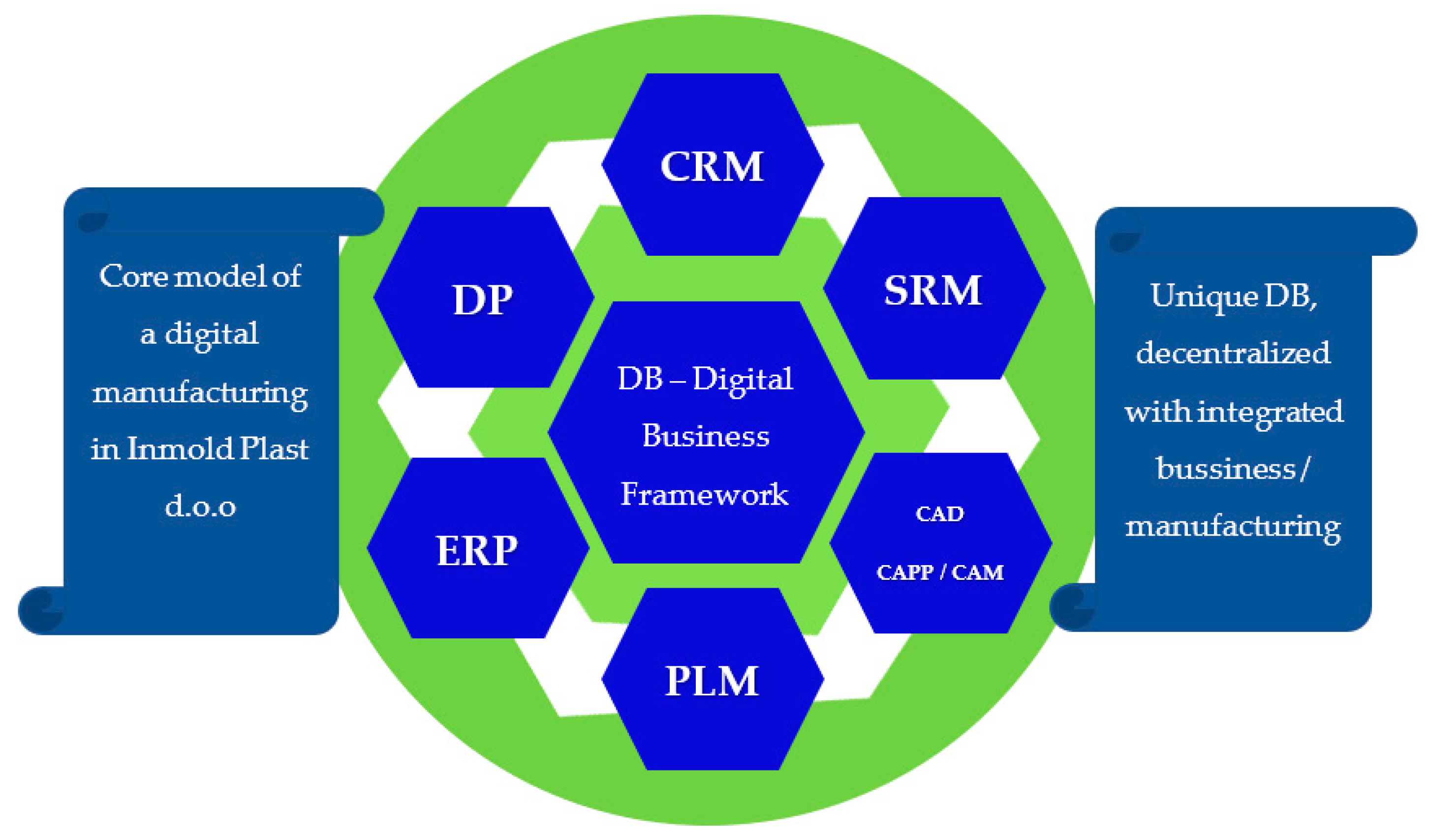
Figure 2.
Creation of an offer for the customer - a) definition of all product characteristics, b) official offer for the customer.
Figure 2.
Creation of an offer for the customer - a) definition of all product characteristics, b) official offer for the customer.
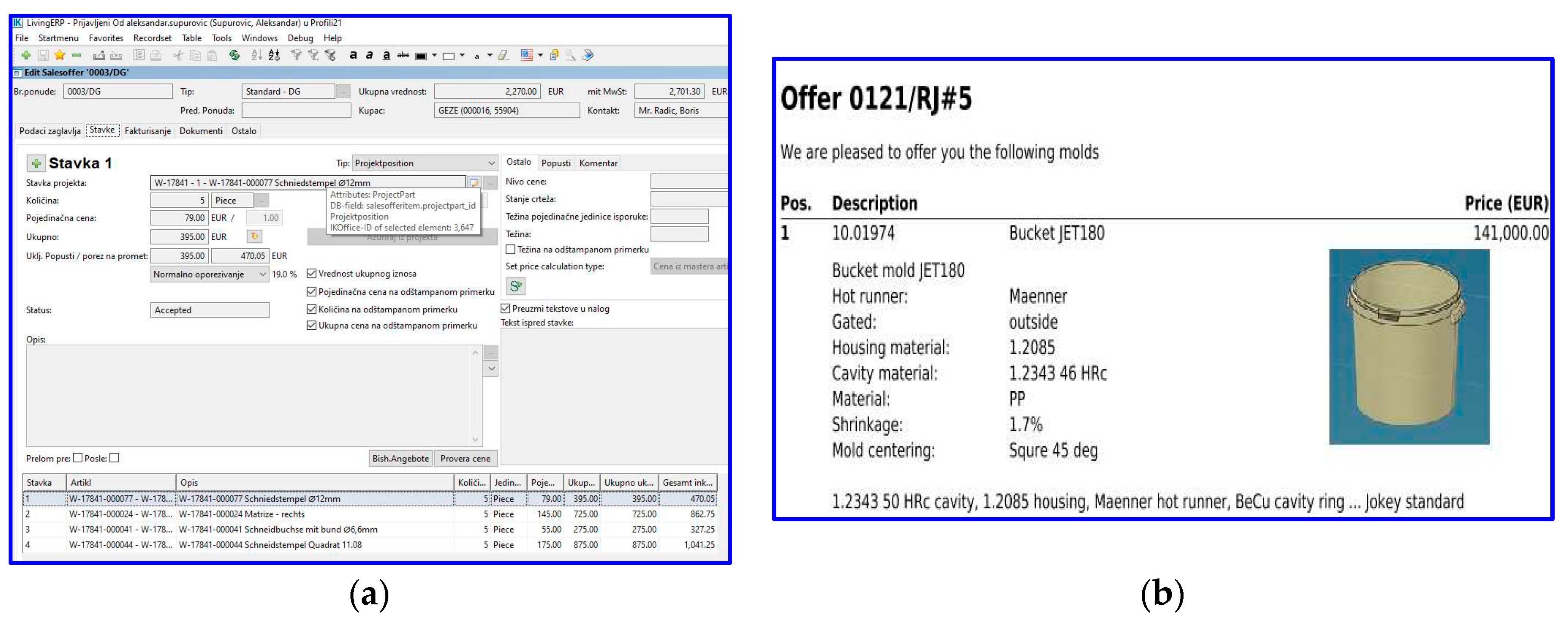
Figure 3.
CAD product model with quality characteristics (a) and entities for 3D product modeling (b).
Figure 3.
CAD product model with quality characteristics (a) and entities for 3D product modeling (b).
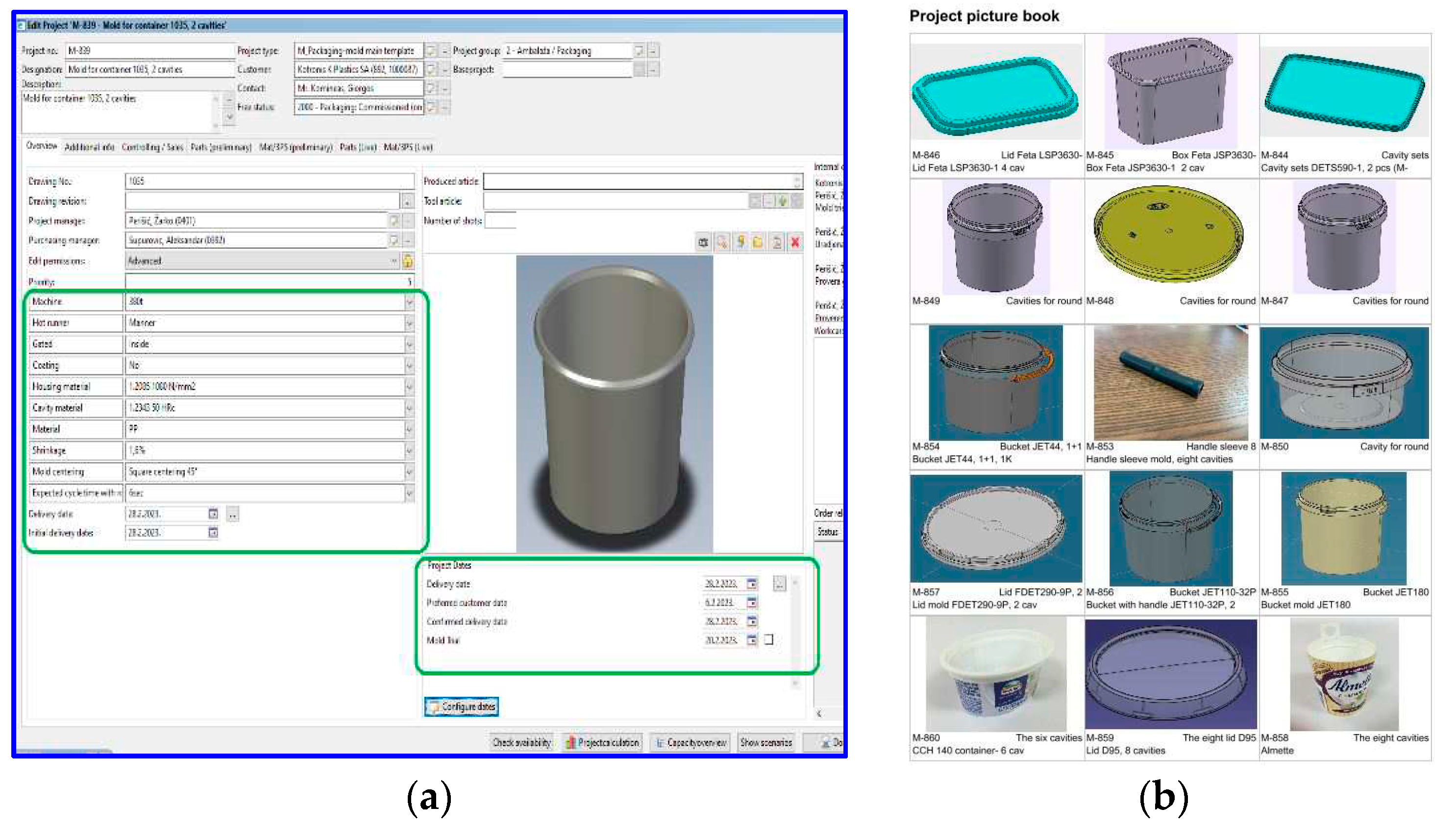
Figure 4.
Planned costs (a) and actual costs (b) for the product (Project N).
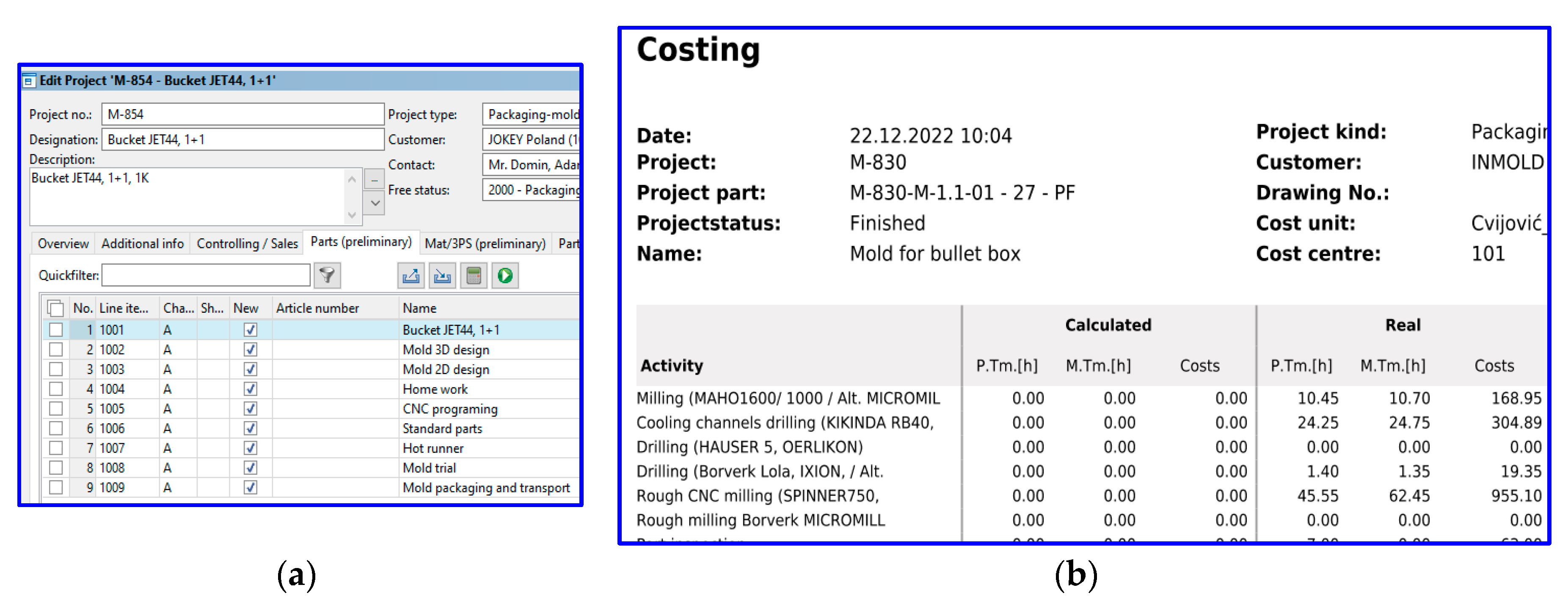
Figure 5.
List of parts, materials and services for Project N.
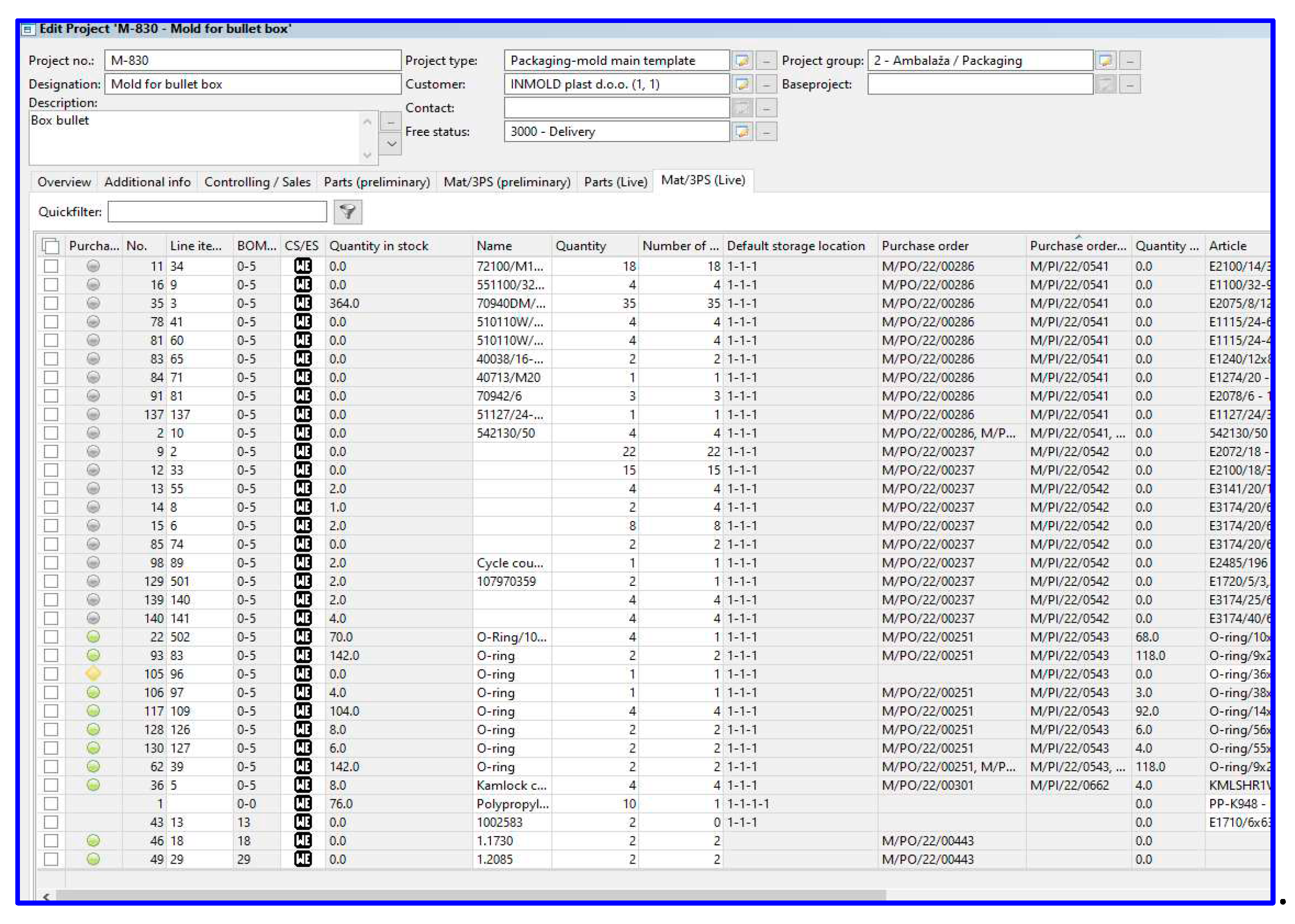
Figure 6.
EBOM for tools.
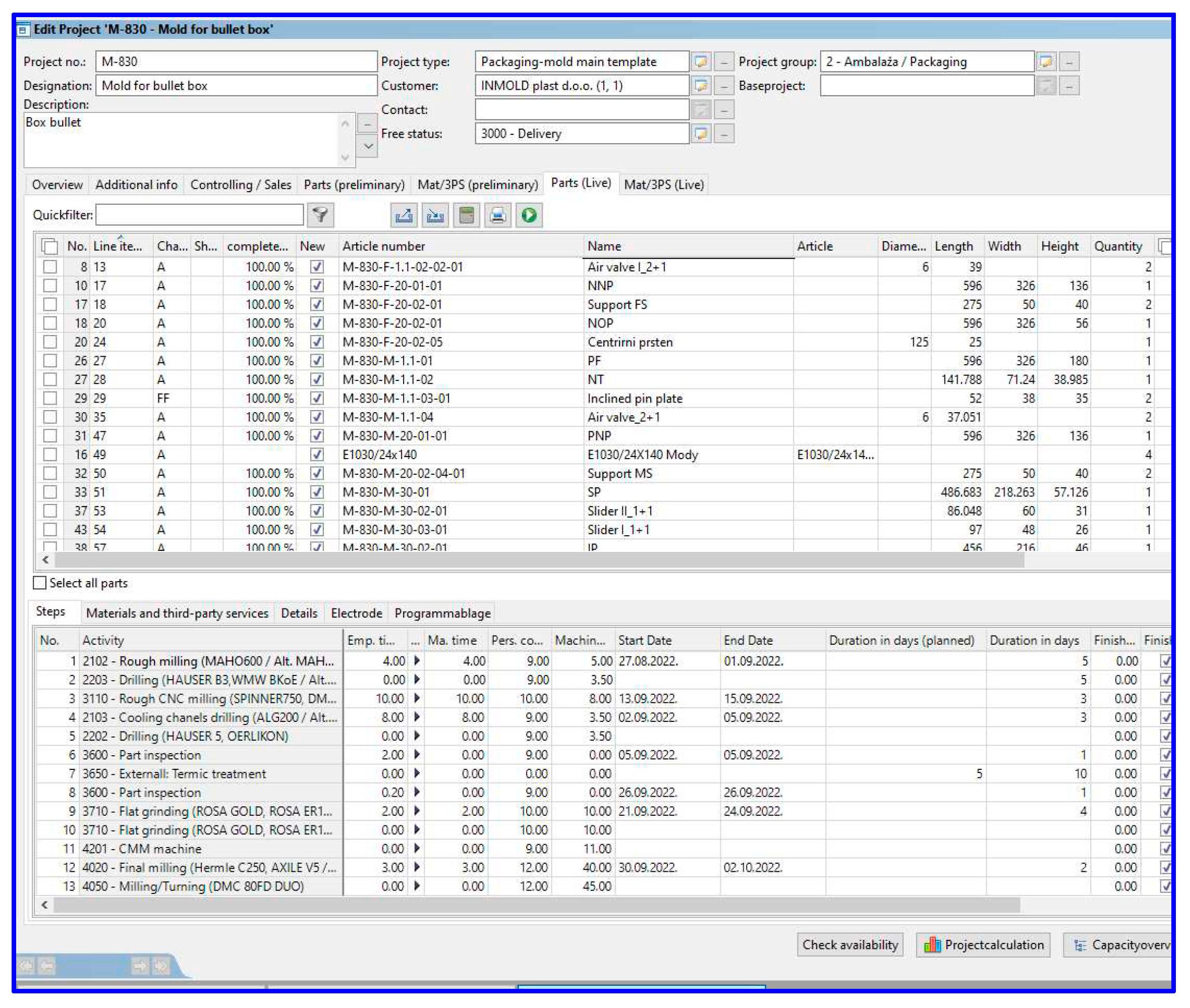
Figure 7.
CAPP model for tools (MBOM) (shaded green—catting operaion).
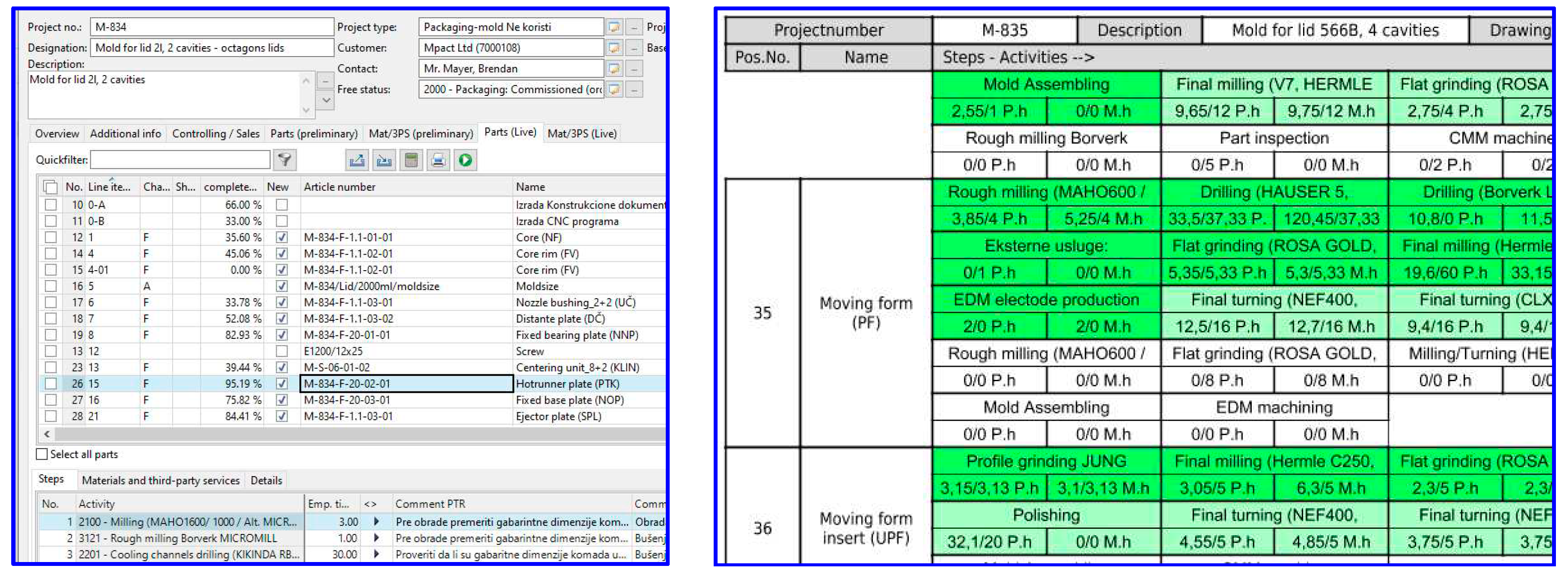
Figure 8.
Metrology sheet for tool parts (shaded in yellow—metrology operations).
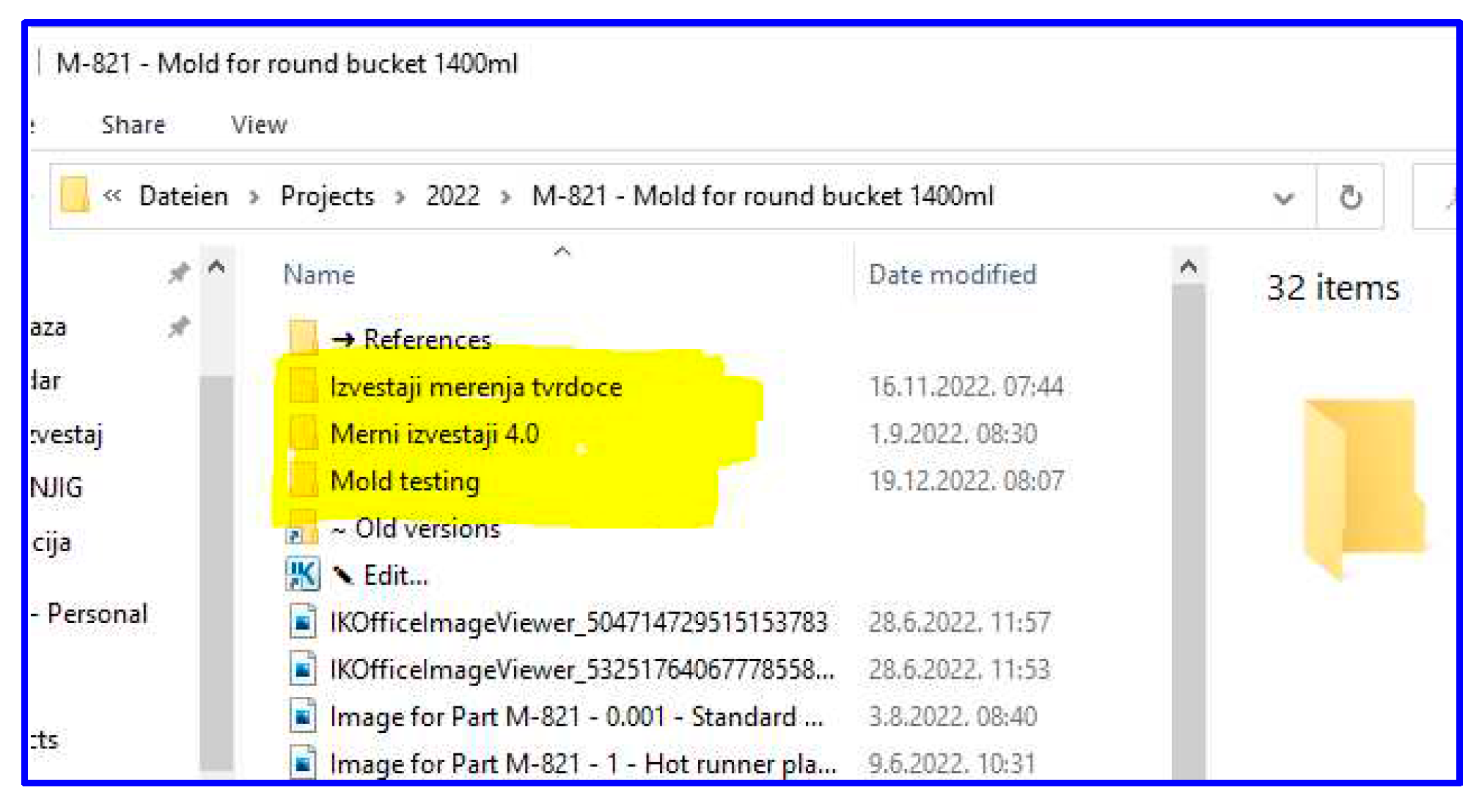
Figure 9.
Work order for tool manufacturing (shaded in yellow—metrology operations).
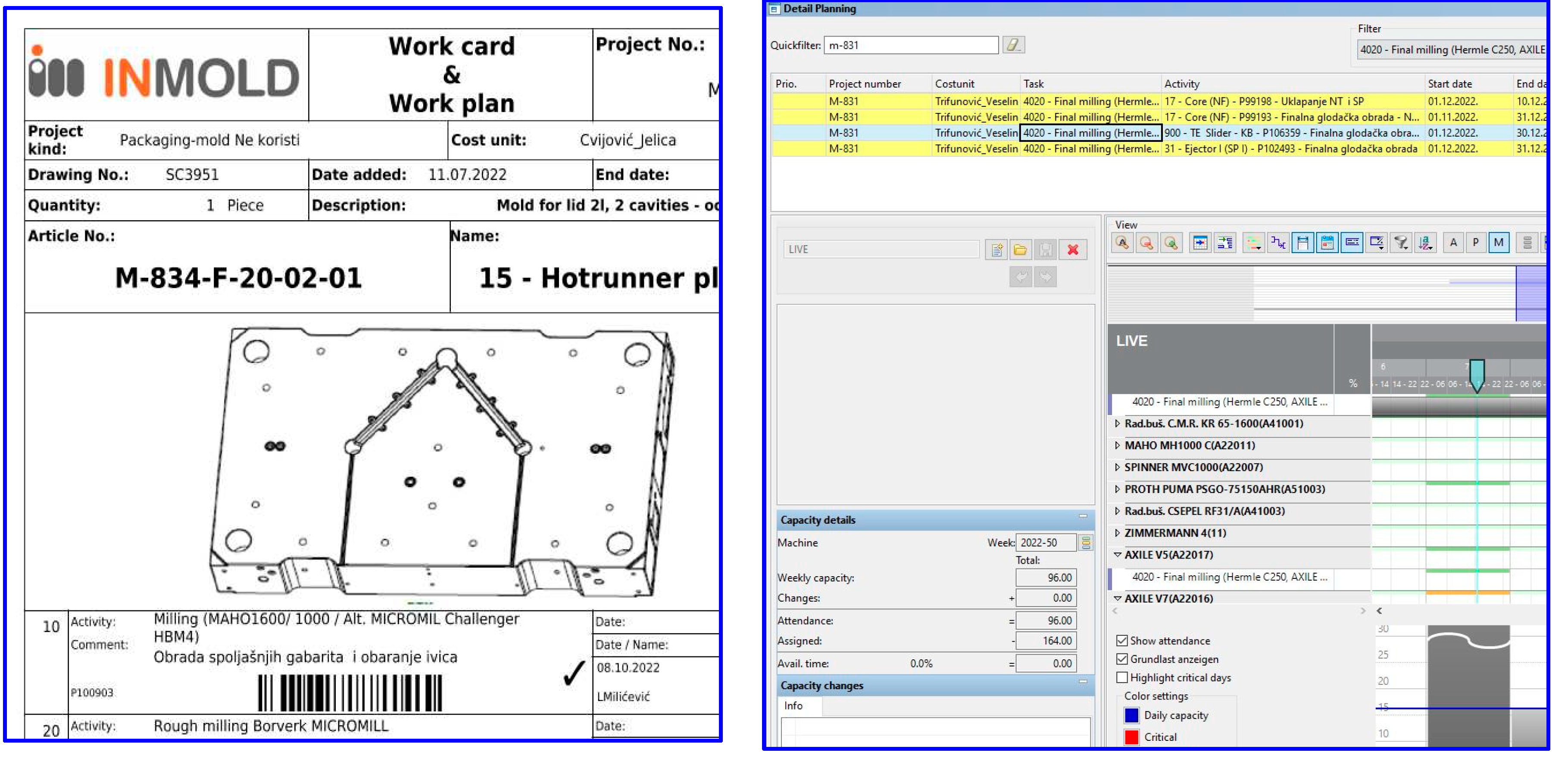
Figure 10.
On line ERP with automatic ordering.
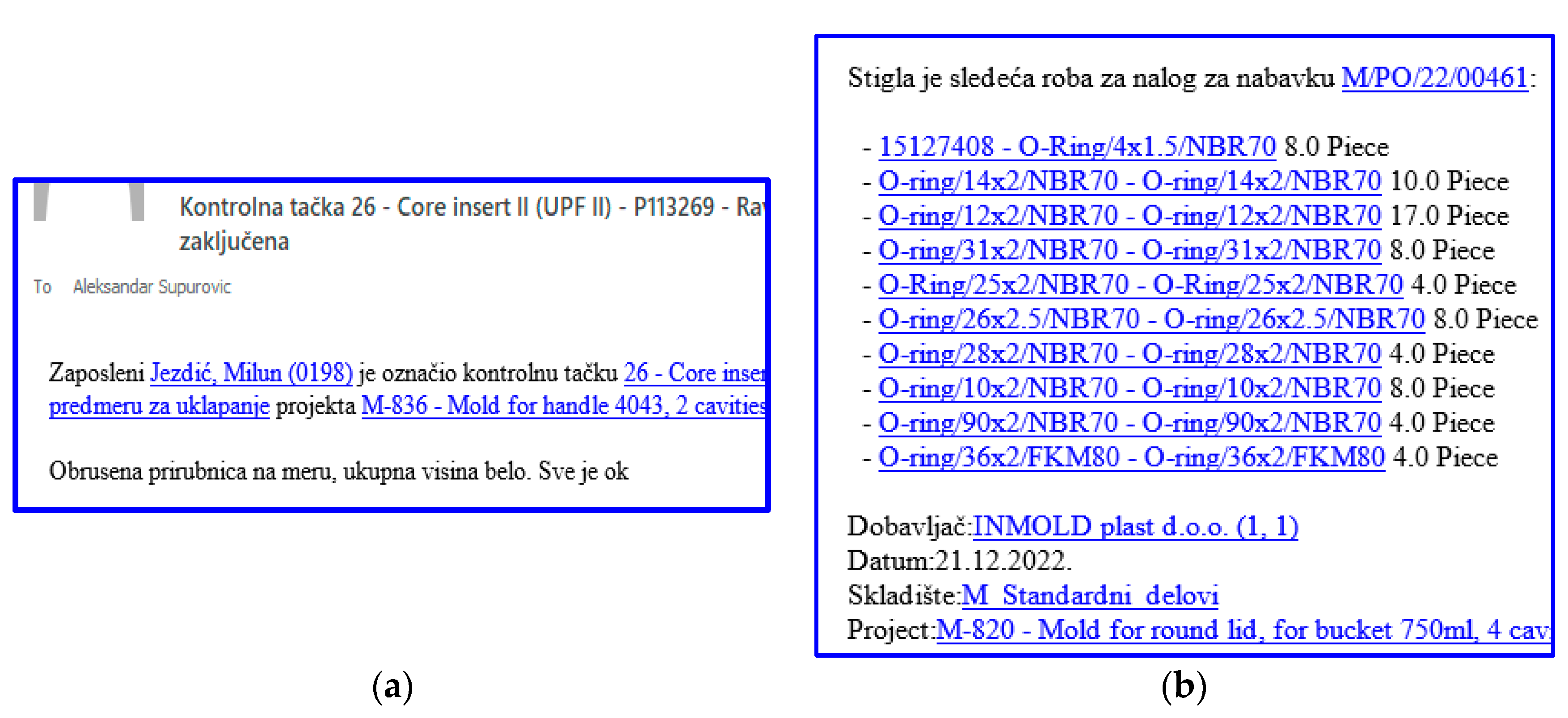
Figure 11.
Inmold plast doo solution architecture for future ERP model [55].
Figure 11.
Inmold plast doo solution architecture for future ERP model [55].
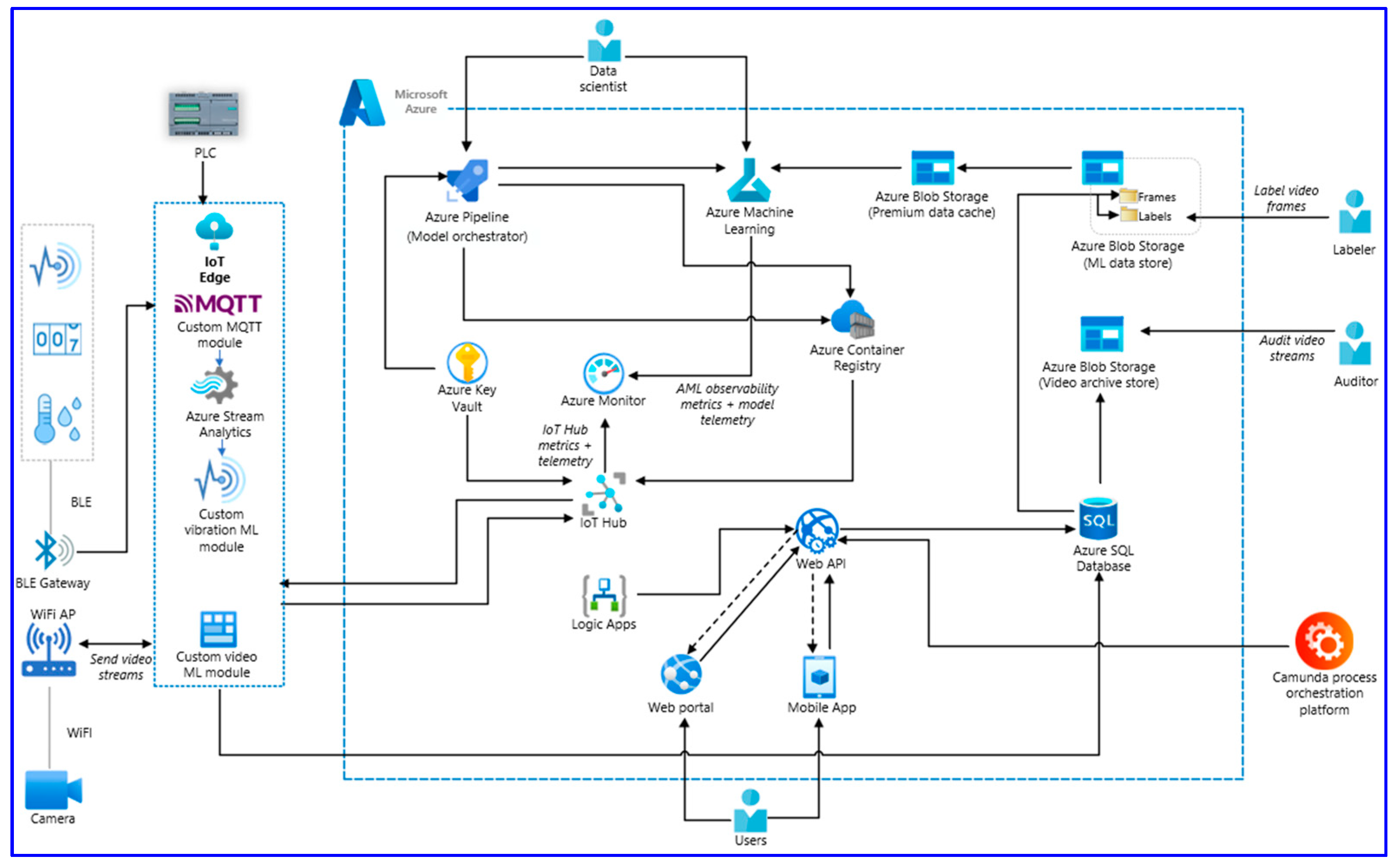

Table 1.
Overview of the realities of Industry 4.0 and digital manufacturing.
| Main issue | Source | Main messages |
| Strategies and roadmaps for the development of the national Indsutry 4.0 Project | [5,6] | Digital manufacturing is a key element for the application of the Industry 4.0 model |
| A model for evaluating QM with eleven dimensions in an organization. | [7] | The digital manufacturing model and Q4.0 are being integrated |
| AI/ML in support of Q 4.0 for SMEs | [8] | Application of one element of Industry 4.0 in the digital manufacturing model for Q 4.0. |
| Industry 4.0 and Q 4.0 as technologically driven innovations in application. | [4] | The next level of these models in application will be data - driven innovation (BDA, AI / ML - Intelligent and Self-Opimizing Factory ). |
| PMI (Product and Manufacturing Information). Driven Dimensional Quality Lifecycle Management. | [9] | Digital Q 4.0 as a subsystem of PMI. |
Table 2.
Overview of quality digitization models.
| Main issue | Source | Main messages |
| Digitization and QM at manufacturing level. | [11] | Driven analysis of product property propagation based on AI/ML models for product inspection. |
| And 4.0 as a disruptive technology. | [12] | Q 4.0 as a technological dimension of quality (MES). |
| Digitization of the TQM model, with the support of top management. | [13] | Q 4.0: BDA and MES. |
| Professional competencies of employees for promotions and teamwork. | [14] | New models of education for Q 4.0. |
| Q 4.0 as an integration of strategic, cultural and technological issues. | [15] | Q 4.0 as a model for working in real time. |
| The elements of I 4.0 essential for the development of the Q 4.0 model are: BDA, AI/ML horizontal and vertical automation. | [16] | Quality elements for Q 4.0 are: strategy, leadership, training and organizational culture. |
| Integrated model Q 4.0 of digital product development and their digital manufacturing. | [17] | Digital product model. |
| TQM as infrastructure Q 4.0. | [18] | Digitization of quality as TQM 4.0. |
| Digital transformation is the basic framework for building I 4.0, as well as Q 4.0. | [19] | Digital transformation is an innovative process. |
Table 3.
Overview of QM models and their reality with I 4.0.
| Main issue | Source | Main messages |
| Q 4.0 as a QMS model. | [20] | Sigma manufacturing level increased from 1.5 to 5.5. |
| Q 4.0 as a QMS model with seven elements (ISO 9001:2015). | [21] | Increased sigma level. |
| SOP model of material quality management. | [22] | Q 4.0 based on IioT, SPC and BDA. |
| Factors for applying the PDCA model in the I 4.0 organization. | [23] | The PDCA 4.0 model for the automotive industry. |
| Dimensions of Q 4.0 for organization. | [24] | The consistency matrix for the organization. |
| TQM in model I 4.0. | [25] | TQM 4.0 through four dimensions. |
| The QM model as a quality loop. | [26] | The quality loop as a framework for Q 4.0. |
| The elements of the model are: TQM, Lean Six Sigma and Business Process Management. | [27] | BE as a basis for the development of BE 4.0. |
| Building the organization’s business model from the point of view of quality. | [28] | Q 4.0 is a framework for quality costing, monitoring and decision-making, and manufacturing technology (CPS). |
| T(QM) models as static structures. | [29] | Q 4.0 as dynamic, networked structures for real-time operation. |
Table 4.
Towards Q 4.0 (adopted according to [29]).
Table 4.
Towards Q 4.0 (adopted according to [29]).
| Characteristics of Q 4.0 | From (T)QM today | To Q 4.0 tomorrow (as a part of I 4.0) |
| (T)QM models | 1. By automation 2. Used of standardized routines 3. Compliance with requirements and procedures |
1. Cognitive engagement 2. Mindful task execution 3. The direction of attention towards one ‘s ongoing experience 4. Evaluating and questioning the value of a routine |
| Intellectual capital management (HR) |
1. Managing employees (experience, training) 2. Managing human resources (education) |
1. Managing human, social, and intellectual capitals |
| Making quality predictions from big data (BDA and AI/ML) |
1. Anticipating customer requirements and addressing them | 1. Making accurate predictions using big data. 2. Using big data to determine changing customer preferences, enable agility, flexibility, and responsiveness, to create delightful customer experiences. |
| Lean structures (organization and/or processes) (ERP and MES) | 1. Developing formal systems through manuals, procedures, work instructions, and records (documented information) 2. Establishing documented evidence for quality processes |
1. Coexistence of technology and human-based simplicity 2. Alignment of human-side with new lean structures |
| Managing networked firms in business ecosystems (products or suppliers)—I 4.0 |
1. Define boundaries and scope of operations 2. Management of a relatively stable set of partners and suppliers 3. Supplier management |
1. Management of networked firms operating in business ecosystems 2. Managing collective value creation 3. Going beyond supplier management to integration with other firms for strategic advantage. |
Table 5.
Overview of quality engineering techniques and their relevance to I 4.0.
| Main issue | Source | Main messages |
| CPS with RFID and IoT in the automotive industry. | [30] | Traceability and high KPI values - Q 4.0. |
| ZDM is the ideal framework for Q 4.0. | [31] | Bring people to the six sigma level. |
| Big data and decision making. | [32] | The IADLPR 2 model as an intelligent decision support. |
| AHP technique for ranking 12 quality parameters. | [33] | The three most important parameters in Q 4.0 are: analytic thinking, competence and customer centricity. |
| Framework for Q 4.0 with nine elements. | [34] | Q 4.0 as contex I 4.0. |
| Integration of I 4.0 and LSS. | [35] | Q 4.0 as a basis for LSS 4.0. |
Table 6.
Overview of Q 4.0 definitions with basic features.
| Main issue | Source | Main messages |
| Q 4.0 model for software structure I 4.0. | [36] | ISO / IEC 25010:2011 is the framework for this model. |
| Digital quality chain in the product life cycle. | [1] | Q 4.0 with support for: BDA IoT, AI/ML and VR/AR. |
| Building Q 4.0 models using digital tools. | [2] | Translation of the QM model (QMS, TQM, BE) into the Q 4.0 model. |
| Q 4.0 can be defined as the integration of I 4.0 technologies, quality and people. | [3] | From QC, through TQM to TQM 4.0. |
| Q 4.0 model for manufacturing organizations from the automotive industry. | [37] | Robust Q 4.0 model with eleven elements. |
| Q 4.0 is based on strategic, cultural and technological entities. | [38] | Quality experts with soft and hard skills are needed. |
| Integration of traditional QC models with I 4.0 technologies. | [39] | Q 4.0—improvement of quality performance. |
| Making decisions. | [40] | Q 4.0 - outsourcing management, forecasting, customer expectations, as well as employee involvement. |
Table 7.
Overview of the case study Q 4.0 model.
| Main issue | Source | Main messages |
| IoT platform. | [41] | Predictive maintenance and ZDM. |
| SBD model for welding quality management - BDA. | [42] | 7V and ANN for BDA. |
| BDA analyzes are hyperdimensional spaces of quality characteristics. | [43] | MCS model for BDA analyses. |
| Horizontal exchange of quality information in the supply chain. | [44] | FADI Platform. |
| Product development on platform I 4.0. | [45] | Q 4.0 as an integrated model of CE and QMS. |
| Q 4.0 in production quality control. | [46] | BDA model: multiple given sources, integrate data and knowledge, data - driven, predictive and prescriptive analytics algorithms. |
| Q 4.0 Maturity Assessment Model. | [47] | Seven levels of maturity. |
| Quality engineering techniques as the basis of Q 4.0. | [48] | BDA model for QA, cause-effect analysis and prediction of quality characteristics. |
| Measuring the maturity of the Q 4.0 model. | [49] | Eleven organizational dimensions and five maturity levels. |
| Q 4.0 in plaster manufacturing. | [50] | ANN and ES for quality management using SPC. |
| The most important factors for implementing Q 4.0 in practice. | [51] | Three technical and three organizational factors. |
| Q 4.0 model for PCB manufacturing. | [52] | ML and edge cloud computing model framework. |
| Service-oriented manufacturing (SOM) and Q 4.0. | [53] | Formal semantic network and process-oriented ontology. |
Disclaimer/Publisher’s Note: The statements, opinions and data contained in all publications are solely those of the individual author(s) and contributor(s) and not of MDPI and/or the editor(s). MDPI and/or the editor(s) disclaim responsibility for any injury to people or property resulting from any ideas, methods, instructions or products referred to in the content. |
© 2023 by the authors. Licensee MDPI, Basel, Switzerland. This article is an open access article distributed under the terms and conditions of the Creative Commons Attribution (CC BY) license (http://creativecommons.org/licenses/by/4.0/).
Copyright: This open access article is published under a Creative Commons CC BY 4.0 license, which permit the free download, distribution, and reuse, provided that the author and preprint are cited in any reuse.


