

Submitted:
08 June 2023
Posted:
08 June 2023
Read the latest preprint version here
Abstract
We develop a quantitative microscopic theory of decaying Turbulence by studying the dimensional reduction of the Navier-Stokes loop equation for the velocity circulation. We have found an infinite dimensional manifold of solutions of the Navier-Stokes loop equation\cite{M93, M23PR} for the Wilson loop in decaying Turbulence in arbitrary dimension $d >2$. This family of solutions corresponds to a fractal curve in complex space $\mathbb C^d$, described by an algebraic equation between consecutive positions plus a nonlinear periodicity condition. We derive the constrained SDE for the evolution of the fractal curve at a fixed moment of physical time as a function of an auxiliary stochastic time. We expect this stochastic process to cover our fixed manifold of the solutions of the decaying Turbulence. The energy density of the fluid decays as $\mathcal E_0/t$, where $\mathcal E_0$ is an initial dissipation rate. Presumably, we have found a new phase of extreme Turbulence yet to be observed in real or numerical experiments.
Keywords:
Turbulence
; Fractal
; Anomalous dissipation
; Fixed point
; Velocity circulation
; Loop Equations
0. Introduction
A while ago, we derived [1,3] a functional equation for the so-called loop average [4,5] or Wilson loop in Turbulence. The path to an exact solution by a dimensional reduction in this equation was proposed in the ’93 paper [1] but has just been explored.
At the time, we could not compare a theory with anything but crude measurements in physical and numerical experiments at modest Reynolds numbers. All these experiments agreed with the K41 scaling, so the exotic equation based on unjustified methods of quantum field theory was premature.
The specific prediction of the Loop equation, namely the Area law [1], could not be verified in DNS at the time with existing computer power.
The situation has changed over the last decades. No alternative microscopic theory based on the Navier-Stokes equation emerged, but our understanding of the strong turbulence phenomena grew significantly.
On the other hand, the loop equations technology in the gauge theory also advanced over the last decades. The correspondence between the loop space functionals and the original vector fields was better understood, and various solutions to the gauge loop equations were found.
In particular, the momentum loop equation was developed, similar to our momentum loop used below [6,7,8]. Recently, some numerical methods were found to solve loop equations beyond perturbation theory [9,10].
The loop dynamics was extended to quantum gravity, where it was used to study nonperturbative phenomena [11,12].
All these old and new developments made loop equations a major nonperturbative approach to gauge field theory.
So, it is time to revive the hibernating theory of the loop equations in Turbulence, where these equations are much simpler.
The latest DNS [13,14,15,16] with Reynolds numbers of tens of thousands revealed and quantified violations of the K41 scaling laws. These numerical experiments are in agreement with so-called multifractal scaling laws [17].
However, as we argued in [2,18], at those Reynolds numbers, the DNS cannot yet distinguish between pure scaling laws with anomalous dimension and some algebraic function of the logarithm of scale modifying the K41 scaling.
Theoretically, we studied the loop equation in the confinement region (large circulation over large loop C), and we have justified the Area law, suggested back in ’93 on heuristic arguments [1].
This law says that the tails of velocity circulation PDF in the confinement region are functions of the minimal area inside this loop.
It was verified in DNS four years ago [13] which triggered the further development of the geometric theory of turbulence[2,14,15,16,18,19,20,21,22,23,24,25,26,27,28,29,30].
In particular, the Area law was justified for flat and quadratic minimal surfaces [22], and an exact scaling law in confinement region was derived [21]. The area law was verified with better precision in [14].
It was later conjectured in [18] that the dominant field configurations in extreme Turbulence are so-called Kelvinons, which were shown to solve stationary Navier-Stokes equations assuming the sparse distribution of vorticity structures.
These topological solitons of the Euler theory are built around a vortex sheet bounded by a singular vortex line. This vortex line is locally equivalent to the cylindrical Burgers vortex [31], with infinitesimal thickness in the limit of a large Reynolds number.
As we argued in [2,18], the Kelvinon has an anomalous dissipation, surviving the strong turbulent limit. This dissipation is proportional to the square of constant circulation of the Burgers vortex times a line integral of the tangent component of the strain along the loop.
The Kelvinon minimizes the energy functional, with anomalous terms coming from the Burgers core of the vortex line. There is also a constant scale factor Z in the representation of the Kelvinon vorticity in terms of spherical Clebsch variables:
In that paper, the constant Z was related to the Kolmogorov energy dissipation density and the boundary value of the variable at the loop C.
The anomalous Hamiltonian [2,18] explicitly violated the K41 scaling by the logarithmic terms in the region of small loops C. This region resembles the asymptotically free QCD. The logarithmic terms were summed up by RG equation with running coupling constant logarithmically small in this region.
These exciting developments explain and quantitatively describe many interesting phenomena [2] but do not provide a complete microscopic theory covering the full inertial range of Turbulence without simplifying assumptions of the sparsity of vortex structures.
Moreover, while the Kelvinon (presumably) solves the stationary Navier-Stokes equations, it does not solve the loop equations for the following reason.
The loop equation assumes that the velocity field is independent of the loop C. In this case, the circulation variations in the loop functional by the shape C of the loop can be reduced to the Navier-Stokes equation.
Otherwise, the variation would also involve the variation of the velocity field .
This problem does not invalidate the Kelvinon theory as an ideal gas of random vortex rings sparsely distributed in a turbulent flow.
The loop functional is not needed for that statistical theory, and the stationary solution of the Navier-Stokes equation is sufficient. The shape of the loop and the vortex sheet inside would become random variables influenced by a background strain like in the pure vortex sheet solutions [2].
These objections, however, prevent the Kelvinon gas model from being a complete theory of strong isotropic Turbulence. This model is merely an approximation of the full theory.
In the present work, we develop the theory free of these assumptions by exactly solving the loop equations for decaying Turbulence. Our representation of velocity circulation does not run into the problems of the Kelvinon gas model, nor do we make any approximations in the loop equations we are solving.
1. Loop Equation
We introduced the loop equation in Lecture Series at Cargese and Chernogolovka Summer Schools [1].
Here is a summary for the new generation.
We write the Navier-Stokes equation as follows
The Wilson loop average for the Turbulence
treated as a function of time and a functional of the periodic function (not necessarily a single closed loop), satisfies the following functional equation
The statistical averaging corresponds to initial randomized data, to be specified later.
The area derivative is related to the variation of the functional when the little closed loop is added
In the review, [1,2], we present the explicit limiting procedure needed to define these functional derivatives in terms of finite variations of the loop while keeping it closed.
All the operators are expressed in terms of the spike operator
The area derivative operator can be regularized as
and velocity operator (with )
In addition to the loop equation, every valid loop functional must satisfy the Bianchi constraint [4,5]
In three dimensions, it follows from identity ; in general dimension , the dual vorticity is an antisymmetric tensor with components. The divergence of this tensor equals zero identically.
However, for the loop functional, this restriction is not an identity; it reflects that this functional is a function of a circulation of some vector field, averaged by some set of parameters.
This constraint was analyzed in [2] in the confinement region of large loops, where it was used to predict the Area law. The area derivative of the area of some smooth surface inside a large loop reduces to a local normal vector. The Bianchi constraint is equivalent to the Plateau equation for a minimal surface (mean external curvature equals zero).
In the Navier-Stokes equation, we did NOT add customary Gaussian random forces, choosing instead to randomize the initial data for the velocity field.
These random forces would lead to the potential term [2] in the loop Hamiltonian , breaking certain symmetries needed for the dimensional reduction we study below.
With random initial data instead of time-dependent delta-correlated random forcing, we no longer describe the steady state (i.e., statistical equilibrium) but decaying Turbulence, which is also an interesting process, manifesting the same critical phenomena.
The energy is pumped in at the initial moment and slowly dissipates over time, provided the viscosity is small enough, corresponding to the large Reynolds number we are studying.
2. Dimensional Reduction
The crucial observation in [1] was that the right side of the Loop equation, without random forcing, dramatically simplifies in functional Fourier space. The dynamics of the loop field can be reproduced in an Ansatz
The difference with the original definition of is that our new function depends directly on rather then through the function taken at .
This transformation is the dimensional reduction we mentioned above. From the point of view of the loop functional, there is no need to deal with field ; one could take a shortcut.
The reduced dynamics must be fitted to the Navier-Stokes dynamics of the original field. With the loop calculus developed above, we have all the necessary tools to build these reduced dynamics.
Let us stress an important point: the function is independent of the loop C. As we shall see later, it is a random variable with a universal distribution in functional space.
This independence removes our objection in the Introduction to the Kelvinon theory and any other Navier-Stokes stationary solutions with a singularity at fixed loop C in space.
The functional derivative, acting on the exponential in (14) could be replaced by the derivative as follows
The equation for as a function of and also a function of time, reads:
where the operators should be regarded as ordinary numbers, with the following definitions.
The spike derivative D in the above equation
The first observation about this equation is that the viscosity factor cancels after the substitution (17).
As we shall see, the viscosity enters initial data so that at any finite time t, the solution for P still depends on viscosity.
Another observation is that the spike derivative turns to the discontinuity in the limit
The relation of the operators in the QCD loop equation to the discontinuities of the momentum loop was noticed, justified, and investigated in [7,8].
In the Navier-Stokes theory, this relation provides the key to the exact solution.
In the same way, we find the limit for vorticity
and velocity (skipping the common argument )
The Bianchi constraint is identically satisfied as it should
We arrive at a singular loop equation for
This equation is complex due to the irreversible dissipation effects in the Navier-Stokes equation.
The viscosity dropped from the right side of this equation; it can be absorbed in units of time. Viscosity also enters the initial data, as we shall see in the next Section on the example of the random rotation.
However, the large-time asymptotic behavior of the solution would be universal, as it should be in the Turbulent flow.
We are looking for a degenerate fixed point [2], a fixed manifold with some internal degrees of freedom. The spontaneous stochastization corresponds to random values of these hidden internal parameters.
Starting with different initial data, the trajectory would approach this fixed manifold at some arbitrary point and then keep moving around it, covering it with some probability measure.
The Turbulence problem is to find this manifold and determine this probability measure.
3. Random Global Rotation
Possible initial data for the reduced dynamics were suggested in the original papers [1,2]. The initial velocity field’s simplest meaningful distribution is the Gaussian one, with energy concentrated in the macroscopic motions. The corresponding loop field reads
where is the velocity correlation function
The potential part drops out in the closed loop integral.
The correlation function varies at the macroscopic scale, which means that we could expand it in the Taylor series
The first term is proportional to initial energy density,
and the second one is proportional to initial energy dissipation rate
where is the dimension of space.
The constant term in (27) as well as terms drop from the closed loop integral, so we are left with the cross-term , which reduces to a full square
This distribution is almost Gaussian: it reduces to Gaussian one by extra integration
The integration here involves all independent components of the antisymmetric tensor . Note that this is ordinary integration, not the functional one.
The physical meaning of this is the random uniform vorticity at the initial moment.
However, as we see it now, this initial data represents a spurious fixed point unrelated to the turbulence problem.
It was discussed in our review paper [2]. The uniform global rotation represents a fixed point of the Navier-Stokes equation for arbitrary uniform vorticity tensor.
Gaussian integration by keeps it as a fixed point of the Loop equation.
The time derivative at this special initial data vanishes so that the exact solution of the loop equation with this initial data equals its initial value (30).
Naturally, the time derivative of the momentum loop with the corresponding initial data will vanish as well.
It is instructive to look at the momentum trajectory for this fixed point.
The functional Fourier transform [1,2] leads to the following simple result for the initial values of .
In terms of Fourier harmonics, this initial data read
As for the constant part of , it is not defined, but it drops from equations by translational invariance.
Note that this initial data is not real, as . Positive and negative harmonics are real but unequal, leading to a complex Fourier transform. At fixed tensor the correlations are
This correlation function immediately leads to the uniform expectation value of the vorticity
The uniform constant vorticity kills the linear term in the original loop space, involving .
The nonlinear term vanishes in the coordinate loop space only after integration around the loop.
Here are the steps involved
Here the tensor area was defined in (9). It is an antisymmetric tensor; therefore its trace with a symmetric tensor vanishes.
This calculation demonstrates how an arbitrary uniform vorticity tensor satisfies the loop equation in coordinate loop space.
We expect the turbulent solution of the loop equation to be more general, with the local vorticity tensor at the loop becoming a random variable with some distribution for every point on the loop.
4. Decay or Fixed Point
The absolute value of loop average stays below 1 at any time, which leaves two possible scenarios for its behavior at a large time.
The Decay scenario in the nonlinear ODE (24) corresponds to the decrease of .
Omitting the common argument , we get the following exact time-dependent solution (not just asymptotically, at ).
The Fixed Point would correspond to the vanishing right side of the momentum loop equation (24). Multiplying by and reducing the terms, we find a singular algebraic equation
The fixed point could mean self-sustained Turbulence, which would be too good to be true, violating the second law of Thermodynamics. Indeed, it is easy to see that this fixed point cannot exist.
The fixed point equation (46) is a linear relation between two vectors with coefficients depending on various scalar products. The generic solution is simply
with the complex parameter to be determined from the equation (46).
This solution is degenerate: the fixed point equation is satisfied for arbitrary complex .
The discontinuity vector aligned with the principal value corresponds to vanishing vorticity in (19), leading to a trivial solution of the loop equation .
We are left with the decaying turbulence scenario (45) as the only remaining physical solution.
5. Markov Process in Complex Space
One may try the solution where the discontinuity vector is proportional to the principal value. However, in this case, such a solution does not exist.
There is, however, another solution where the vectors are not aligned. This solution requires the following relations
These relations are very interesting. The complex numbers indicate irreversibility, and lack of alignment leads to vorticity distributed along the loop.
Also, note that this complex vector is dimensionless, and the fixed point equation (50) is completely universal!
One can build this solution as a Markov process by the following method.
Start with a complex vector .
We compute the next values from the following discrete version of the discontinuity equations (50).
A solution to these equations can be represented using a complex vector subject to two complex constraints
after which we can find the next value
We assume N steps, each with the angle shift .
This recurrent sequence is a Markov process because each step only depends on the current position . On top of this Markov process, there is an extra periodicity requirement .
This requirement represents a nonlinear restriction on initial position .
With this discretization, the circulation can be expressed in terms of these steps
Note that the complex unit vector is not defined with the Euclidean metric in six dimensions . Instead, we have a complex condition
which leads to two conditions between real and imaginary parts
In d dimensions, there are complex parameters of the unit vector; with an extra linear constraint in (52), there are now free complex parameters at every step of our iteration, plus the discrete choice of the sign of the root in the solution of the quadratic equation.
At the last step, , we need to get a closed loop . This is one more constraint on the complex vectors
We use this complex vector constraint to fix the arbitrary initial complex vector as a function of all remaining parameters.
Looking ahead into the rest of our investigation, it turns out that the closure conditions fix only half of the real parameters in the initial point . The remaining parameters are free zero modes of our fixed manifold.
Due to the closure of the space loop , the global translation of the momentum loop leaves invariant the Wilson loop; therefore, the translational zero modes of the momentum loop do not lead to ambiguities.
However, the missing d out of parameters in mean that some other d parameters should be adjusted to provide the momentum loop closure.
We discuss this issue in the next Section, where we derive the SDE for the closed momentum loop in three dimensions. This SDE has explicit terms, which we computed in Appendix A and coded in Mathematica® in [32].
The adjustment of parameters we mentioned earlier yields three constraints on the Wiener process we derived.
Return to the general study of the discrete loop equations (51).
There is a trivial solution to these equations at any even N
We reject this solution as unphysical: the corresponding vorticity equals zero, as all the vectors are aligned.
Our set of equations has certain mirror reflection symmetry
Thus, the complex solutions come in mirror pairs . The real solutions are only a particular case of the above trivial solution with real .
Each nontrivial solution represents a periodic random walk in complex vector space . The complex unit step depends on the current position , or, equivalently, on the initial position plus the sum of the preceding steps.
We are interested in the limit of infinitely many steps , corresponding to a closed fractal curve with a discontinuity at every point.
This solution’s degeneracy (fewer restrictions than the number of free parameters) is a welcome feature. One would expect this from a fixed point of the Hopf equation for the probability distribution.
In the best-known example, the microcanonical Gibbs distribution covers the energy surface with a uniform measure (ergodic hypothesis, widely accepted in Physics).
The parameters describing a point on this energy surface are not specified– in the case of an ideal Maxwell gas, these are arbitrary velocities of particles.
Likewise, the fixed manifold, corresponding to our fractal curve’s limit, is parametrized by N arbitrary local rotations, as discussed in the next Section.
This rich internal random structure of our fixed manifold, combined with its rotation and translation invariance in loop space C, makes it an acceptable candidate for extreme isotropic Turbulence.
6. The Probability Measure
The simplest case where these equations have nontrivial solutions is the three-dimensional space. For smaller dimensions of space, there is only a degenerate solution with zero vorticity (a vanishing cross product ). Thus, we only consider in the rest of the paper.
The complex unit vector in d dimensions can be parametrized by rotation matrix and a unit real vector in dimensions
The following steps lead to this canonical form. Take a general complex d-vector and choose the rotation to direct its imaginary part at the last axis d.
The imaginary part of the condition implies the real part of this vector has zero component d. This real vector in dimensions can be parametrized as with the unit vector and arbitrary real parameters .
There is a multiple counting of the same unit vector with this parametrization: the rotation matrix space must be factored by rotations of the unit vector .
Also, the sign change of is equivalent to the reflection of the vector , so we have to factor out such reflections and keep the sign of arbitrary
The complex constraint for can be used to fix these as a linear function of given a complex vector
as follows:
where and
After that, yields a quadratic equation for .
Note in passing that belongs to De Sitter space . However, this is where an analogy with the ADS/CFT duality ends.
There are, in general, four solutions for : two signs for R in (68) and two more signs in a solution of the quadratic equation for (62a).
We have to choose a particular real solution for . A universal option is to choose the step with the smallest Euclidean distance . We used this choice in our initial simulations [32], but later we switched to another method, using the SDE we describe later in this work. The SDE guarantees the closure condition, unlike the naive random walk approach.
We arrive at the invariant distribution for our fractal curve. At a fixed N
where are complex vectors, parametrized by via recurrent equations (62),(67).
The complex vector’s integration and delta function is understood as a product of its real and imaginary parts.
We conclude that the fixed manifold of the decaying Turbulence is a subset of the tensor product of rotational and spherical spaces.
This subset is selected by imposing the closure condition , which in general provides nonlinear relations between all parameters: for each choice of the real solutions for on each step.
This closure condition is sufficient by parameter count to eliminate a complex vector ; however, we discovered in 3D that half of the parameters in complex vector are left undetermined, leading instead to three real constraints on the parameters of the rotation matrices.
We cannot resolve the global closure conditions, but we found a way to achieve the same goal by an SDE describing the evolution of our curve from one of the two exact symmetric solutions we have found; this method preserves the closure condition at each infinitesimal step of the stochastic process.
7. Symmetric Fixed Point
The above formal definition of the probability measure does not offer a practical simulation method for covering this manifold.
We attempted to simulate a random walk step by step, taking random rotation matrices. Unfortunately, there was a rapidly diminishing probability of the return to the vicinity of the initial point after N steps.
We could not numerically solve the resulting transcendental equation for the initial position at large N, neither by analytical nor by Monte Carlo methods.
Instead, we have found an alternative algorithm for covering this manifold, preserving the closed curve.
Here is a unit vector. As we pointed out in Section 5, a reflected sequence also represents a solution to the recurrent equations (51).
The random walk step is a real unit vector in this case, corresponding to in (62) and
Our covering algorithm will use a symmetric fixed point or its reflection as a starting element.
Due to the global symmetry, the rotated curve with arbitrary orthogonal matrix is also a solution. We use random global rotation in numerical simulations.
The imaginary parts of the steps are zero vectors at the start. Still, the evolution below will involve complex infinitesimal rotations so that the imaginary parts appear later in the evolution.
Some constraints are left in the solution for the vectors even after the complex rotations. In three dimensions, three scalar constraints remain on the imaginary parts of the complex rotation vectors .
These constraints are needed to provide the closure condition. There are only three scalar constraints among N real vectors, which leads to a nontrivial dimensional quotient space.
8. Infinitesimal Complex Rotations in 3D
Let us assume we already know a particular solution of the recurrent equations (51) in and perturb it by an infinitesimal transformation of the complex vectors , preserving their square.
We also shift the initial point to keep the loop closed after infinitesimal transformations of all the steps .
Here are infinitesimal complex 3D vectors.
The real part comes from the infinitesimal group transformation of rotation matrices in our canonical form (62)
The imaginary part leads to the infinitesimal transformation of parameters in two-dimensional de Sitter space ; therefore, there are only two independent components of .
We do not need an explicit split of the parameters of into these two transformations; it is sufficient to know that cross product with any complex vector is orthogonal to , as we need it in our random walk with .
Below, we will parameterize by two scalar parameters.
There are two contributions to the variation of each position . One variation comes from the rotation of the step from the previous position, and another comes from the variation of the previous position.
By variation of the second of the constraints in (51), which we rewrite as
we find the following set of relations between infinitesimal
We treat it as a recurrent system of equations for , assuming known values of .
After that, the complex vector is supposed to be determined from the closure equation
assuming all expressed as linear combinations of .
As we found in [32] in three dimensions, this system of equations for is degenerate: three parameters in are left undetermined.
The solution for exists only if N vectors obey three scalar constraints.
In other words, the complex vector equation (83) reduces to three constraints for and another three constraints for . The complex vector is left with three free components, and the vectors are left with free components out of .
The solution of these equations, which we find in Appendix A, has the form
with real matrices , and complex matrices ; these matrices depend on the current values of all the vectors .
In addition, we have found three linear constraints on , related to three complex null vectors of a block matrix involved in the equation for .
The vector is defined modulo this null space
Due to the closure of the original loop , the translation of by arbitrary complex vector does not change the circulation in (54). This translation of leads to the global translation of our momentum curve , preserving the circulation over the closed loop in space.
We resolved this ambiguity of by choosing the pseudo-inverse of the degenerate matrix when computing the coefficients .
The three constraints on infinitesimal rotations have a form (A16). These constraints define a subspace of the whole space of our rotation vectors (dual to elements of Lie algebra on each )
The rotation vectors vary in the quotient space
The null-vectors and coefficients , depending on the current positions are computed using recurrent equations in [32].
We get numerical results on a laptop for arbitrary . Larger values of N would require a supercomputer.
9. Brownian Motion on Fixed Manifold
Now, we are ready to write down the SDE for the evolution of our complex curve using the stochastic process :
These constrained stochastic differential equations describe the evolution of the point on our fixed manifold of closed complex curves subject to the loop equations (51), starting with one of the symmetric fixed points (72)
The constrained SDE was studied in the mathematical literature [33].
We use a standard method of the projection of the Brownian motion to a quotient space. Let us introduce new stochastic real vector variables and project out the constraints as follows (in matrix notations)
The variables are assumed to be delta correlated (in proper units of stochastic time)
Here is a unit matrix in dimensions.
It is straightforward to check that satisfies the constraints for arbitrary
The variables do not change when variables are shifted by superposition of transposed constraints
So, our stochastic process has some redundant (gauge) degrees of freedom .
The variables evolve in the quotient space , covering it with an invariant measure. This invariance is easy to check by noticing that all the matrices in our equations are made of rotation-covariant parameters in the linearized recurrent equations. These parameters are direct products of vectors times some dot products of other vectors.
In mathematical terms, is a Wiener process in with a unit variance matrix, and is a Brownian motion in the quotient space . This quotient space evolves with stochastic time, as the constraint matrix depends on current values of all vectors .
The projection can be used to redefine the matrices
after which our SDE takes a usual form
We propose this stochastic process as a definition of the fixed manifold of decaying Turbulence.
The proof of this conjecture and extension to higher dimensions is left for a detailed mathematical study, which is beyond the scope of this work.
We coded these SDE in [32] using Mathematica®. This code is convenient for theoretical development, but the optimized computations should be translated into Python and C++ and run on a supercomputer or a Tensorflow cluster.
Once we fix the initial value at one of the two mirror fixed points , the evolution is unambiguous, unlike the global description of the manifold in Section 6, where we had to choose between four solutions of two quadratic equations for the point in de Sitter space .
We are still left with a choice of one of the two mirror solutions or, in the general case, the coefficients of their linear superposition in the Wilson loop.
Such linear superposition will still solve the loop equation (7a), as this equation is linear in loop space.
Section Mirror solution and inequality for the Wilson loop
There is an obvious problem with the solution we have found. The loop equation for is complex, and so is the solution, particularly the vorticity in (19). Since the equation for is nonlinear, we cannot take a real part of .
The negative imaginary part of the circulation in momentum space may lead to violation of inequality . The following restriction must be imposed to preserve this inequality
Such restriction on a fractal curve would contradict its assumed universality. If this curve is related to , it would be involved in variations when the loop C is varied in the loop equation.
Here is a resolution of this paradox that we have found.
In the previous Sections, we described two mirror solutions, originating in (72) and evolving by an SDE (90a).
For any particular loop, we have to choose the solution with the positive imaginary part of the circulation
The averaging corresponds to averaging over the stochastic process or, equivalently, over the stochastic time .
At any moment of stochastic time, the inequality restricts the loop C, but not the momentum loop : for some loops C, the circulation has a positive imaginary part; for other loops, the reflected circulation does.
This choice is like selecting a decaying wave function for the bound state in the Schrödinger equation for a quantum potential problem.
The theta functions in this solution represent certain boundary conditions for the loop functional in the areas (if they exist) where or .
One could imagine a situation where both circulations have negative imaginary parts; the Wilson loop will be zero in these regions of parameter space.
We leave investigating these boundary conditions for a future complete mathematical theory. This exploratory paper has different goals.
Section Vorticity Distribution and Energy Dissipation
The simplest quantity to compute in our theory is the local vorticity distribution.
As we shall see, it determines the energy dissipation rate.
The local vorticity for our decaying solution of the loop equation
Here is an arbitrary point at the loop, which makes this expression a random variable.
Note that viscosity is canceled here, as it should be by dimensional counting (vorticity has the dimension of ).
In our random walk representation, the complex vorticity operator
The time derivative of energy density in our theory is
Solving this equation with boundary value we relate to mean initial energy
The probability distribution of and its mean value can be computed using our random walk. For the anomalous dissipation, we need the mean enstrophy to diverge [2,18] so that viscosity is compensated in the extreme turbulent limit.
As we shall see later, in Section 11, this happens in our numerical simulations.
The microscopic picture of this infinite enstrophy differs from the singular vortex line.
In the Euler theory, divergence came from the singularity of the classical field. However, in our dual theory, it comes from the large fluctuation of the fractal curve in momentum space.
We can now write down our result for the Wilson loop in decaying Turbulence as a functional of the contour C. Let us start with a three-dimensional case
The finite steps approximation we considered above
For the simplest circular loop in an plane, we have
We observe that even at the large time when the asymptotic fractal curve is already in place, there is a region of parameters
where the Wilson loop is a nontrivial universal function of a single variable
We can compute our prediction for this function by numerically simulating the SDE for our vectors and wait for the results with physical or numerical experiments in conventional three-dimensional decaying Turbulence.
10. Correlation Functions
The simplest observable quantities we can extract from the loop functional are the vorticity correlation functions [2], corresponding to the loop C backtracking between two points in space , see Figure 1. The vorticity operators are inserted at these two points.
The correlation function reduces to a random walk with a complex weight
In Fourier space, this reduces to the restricted random walk:
Presumably, the vorticity vectors as well as the vectors are distributed by some power laws in our random walk on a fixed manifold; this would lead to scaling laws with some fractal dimensions.
The numerical simulation of this correlation function would require significant computer resources.
Still, these resources are much more modest than those for full d dimensional simulations of the Navier-Stokes equation.
In our theory, the dimension of space enters as the number of components of the one-dimensional fluctuating field rather than the number of variables in the fluctuating velocity field .
Also, note that our quantum problem of the complex random walk naturally fits quantum computer architecture. Thus, in the future, when large quantum computers would become available for researchers, we can expect a real breakthrough in numerical simulations of the loop equation.
11. Open Loop Computations
We wrote a Mathematica® program [34] generating our random walk, starting with a random complex vector and using random orthogonal matrix at every step. If there is more than one real solution for , we have chosen the shortest step in Euclidean metric , i.e., the one with minimal .
We have chosen the simplest circular coordinate loop C in (116) and imposed the inequality (103) on the last step.
For 1000 steps, it takes a few seconds on a laptop to compute the whole path. We generate a parallel table of 100000 paths, each with 1000 steps, with various random initial vectors with a random set of rotation matrices for each step.
The path’s closure requires a numerical solution of the SDE (90a), which we plan to implement later on a supercomputer. This open path simulation only covers the big space of the direct product of rotation matrices at every step; the true turbulent fixed point corresponds to the projection of this space onto the closure conditions. We cannot do it at the global level, only at the level of the SDE described in the previous Section.
Thus, this open-path simulation cannot be used for predictions of fractal dimensions in the scaling laws; this has to wait until the SDE simulation is performed at the supercomputer.
With these comments in mind, let us analyze the open curves’ fractal properties, discarding the closure conditions.
The simplest quantity to compute is a fractal dimension of this random walk, defined as
The ordinary Brownian motion (linear random walk) has , but our random walk is very different, mainly because the Euclidean distance of an elementary step in De Sitter space is unlimited from above (though it is limited by 1 from below).
Here is the plot of vs (Figure 2).
The statistical data for parameters
This data is compatible with .
The distribution of the Euclidean length of each step (Figure 3).
The statistical table for the parameters of this fit
The mean is finite, , but the variance of the step is divergent.
Such a low decay of the step distribution undermines the concept of a finite fractal dimension as defined in (123). The linear fit is inadequate for such large statistics.
With large statistics, one can reach a perfect fit by adding the next correction to the linear log-log law
The fit at larger interval of N becomes perfect, with a very different coefficient b in front of :
This data fit is shown at Figure 4.
Our random walk with unbounded step size differs from an ordinary fractal curve. The fractal dimension does not properly describe this random object as the distance grows by a more complex law than a pure power of the number of steps.
Another interesting distribution is the enstrophy density in (108).
The CDF is shown in Figure 5. The tail is compatible with decay, corresponding to the decay of the PDF. The mean value and all higher moments diverge, leading to anomalous dissipation.
The statistical table for the parameters of this fit
The computation of the Wilson loop and related correlation functions of vorticity needs an ensemble of closed fractal loops with various sets of random matrices.
The closure condition for the loop would require some computational effort because the probability of the random curve with fractal dimension returning to an initial point goes to zero with the increased number of steps.
An alternative approach of starting with a large closed loop and randomizing it point by point while preserving its closure.
This approach would replace an SDE (90a) with a Monte-Carlo process in a closed polygon space. Each step would correspond to a small rotation of some randomly chosen link of the polygon and compensating shift of the initial position
The zeroth approximation to this shift would be our solution in Appendix A of the linearized equations. Then, a couple of Newton iterations will finalize this shift to provide the closure condition.
These extra layers of computational complexity would require a supercomputer, which we plan to do later.
12. Discussion
We have presented an exact solution of the Navier-Stokes loop equations for the Wilson loop in decaying Turbulence as a functional of the shape and size of the loop in arbitrary dimension .
The solution expresses the probability distribution for the Wilson loop at any given moment of the time t in terms of a nonlinear SDE in auxiliary time . The loop is approximated as a polygon with sides.
Compared to the original Navier-Stokes equation, this is the reduction of of the dimension of space. This SDE is straightforward to simulate by a Monte Carlo method.
The equivalence of a strong coupling phase of the fluctuating vector field to quantum geometry is a well-known phenomenon in gauge theory (the ADS/CFT duality).
In our case, this is a much simpler quantum geometry: a fractal curve in complex space.
An expert in the traditional approach to Turbulence may wonder why the solutions of the Loop equation have anything in common with the statistical distribution of the velocity field in a decaying turbulent flow.
Such questions were asked and answered in the gauge theories, including QCD[6,8,9,10] where the loop equations were derived first [4,5].
The solution of the loop equation with finite area derivative, satisfying Bianchi constraint, belongs to the so-called Stokes-type functionals [4], the same as the Wilson loop for Gauge theory and fluid dynamics.
Extra complications in the gauge theory, which are fortunately absent in fluid dynamics, are the short-distance singularities related to the infinite number of fluctuating degrees of freedom in quantum field theory.
As we discussed in detail in [2,4,5], any Stokes-type functional satisfying boundary condition at shrunk loop , and solving the loop equation can be iterated in the nonlinear term in the Navier-Stokes equations (which applies at large viscosity).
The resulting expansion in inverse powers of viscosity (weak Turbulence) exactly coincides with the ordinary perturbation expansion of the Navier-Stokes equations for the velocity field, averaged over the distribution of initial data or boundary conditions at infinity.
We have demonstrated in [1,2] (and also here, in Section 3) how the velocity distribution for the random uniform vorticity in the fluid was reproduced by a singular momentum loop .
The solution for in this special fixed point of the loop equation was random complex and had slowly decreasing Fourier coefficients, leading to a discontinuity in a pair correlation function (37). The corresponding Wilson loop was equal to the Stokes-type functional (30).
Our general Anzatz (14) satisfies the loop equation and boundary condition at . It has a finite area derivative, which obeys the Bianchi constraint, making it a Stokes-type functional.
The exact solution for in decaying Turbulence which we have found in this paper, leads to the Stokes functional satisfying the boundary value at the shrunk loop.
Therefore, it represents a statistical distribution in a turbulent Navier-Stokes flow, a degenerate fixed point of the Hopf equation for velocity circulation. It sums up all the Wylde diagrams in the limit of vanishing random forces plus nonperturbative effects, which are missed in the Wylde functional integral. Whether this exact solution is realized in Nature remains to be seen.
It is infinitely more complex than the randomly rotated fluid, as our curve has a discontinuity at every , corresponding to a distributed random vorticity.
This solution is described by a fractal curve in complex d dimensional space, a limit of a random walk with nonlinear algebraic relations between the previous position and the next one . These relations are degenerate: each step is characterized by an arbitrary element and an arbitrary element . This step also depends upon the previous position , making this process a Markov chain.
The periodicity condition provides a nonlinear equation for an initial position as a function of the above free parameters .
This periodicity condition presents a hard problem, particularly in the limit , when the probability of our random walk returning to the initial point afterN steps rapidly diminishes with N.
We found a way around this problem by finding an exact periodic solution to the momentum loop equations (51). This analytical solution for arbitrary N can serve as initial data for the SDE, which preserves the periodicity. In Appendix A, we constructed this SDE for , leaving the generalizations to mathematicians.
This SDE describes the Brownian motion of the rotation matrices in our canonical representation (62) of the solution to the discrete loop equations (51). Each matrix moves independently, while the remaining parameters move around de Sitter space to satisfy the loop equation (51).
The closure condition further restricts the set of N infinitesimal rotations : there are three linear relations between N vector parameters of these rotations. We found the projection matrix required to project the whole array of vector rotations onto the quotient space, satisfying the closure condition.
After this projection, we obtain the motion in the quotient space, where the closure condition is satisfied at every step.
Presumably, this SDE uniformly covers our fixed manifold for arbitrary N. The limit presents a computational challenge, and we are planning to address this challenge in the next publication using a supercomputer.
We simulated the open random walk (without the closure condition) in three dimensions and studied its statistical properties. The distribution of lengths of steps in Euclidean six-dimensional space has a long tail .
The fractal dimension is not well defined for a random walk with such an intermittent step size, unbounded from above. The linear log-log fit as in (123) yields , but this fit is imperfect with our large statistics.
As for the distribution of an enstrophy density, it has a power tail corresponding to an infinite mean value and all higher moments. This infinity is how anomalous dissipation manifests in our solution.
These numerical simulations must be repeated on a supercomputer with better statistics and more steps. There are many things to do next with this conjectured solution to the decaying turbulence problem; the first is to look for unnoticed inconsistencies.
One important step is yet to be made: the MC simulation of the SDE (90a). Let us assume that the qualitative properties and fractal dimensions we have found for the open fractal curves will stay the same or at least close.
As a first test of this hypothesis, let us compare it with various experimental data and those from DNS [35].
There is no agreement between these data, they vary in Reynolds number, and they have other differences related to the experimental setup. No value n for the decay power would fit all that data. However, a consensus seems to be around , which means faster decay than we have.
We are skeptical about these data. As we recently learned [36], there is a regime change at large Reynolds numbers; the numbers achievable in modern DNS may belong to such a transitional regime.
Besides, fitting powers is not a reliable method of deriving physical laws.
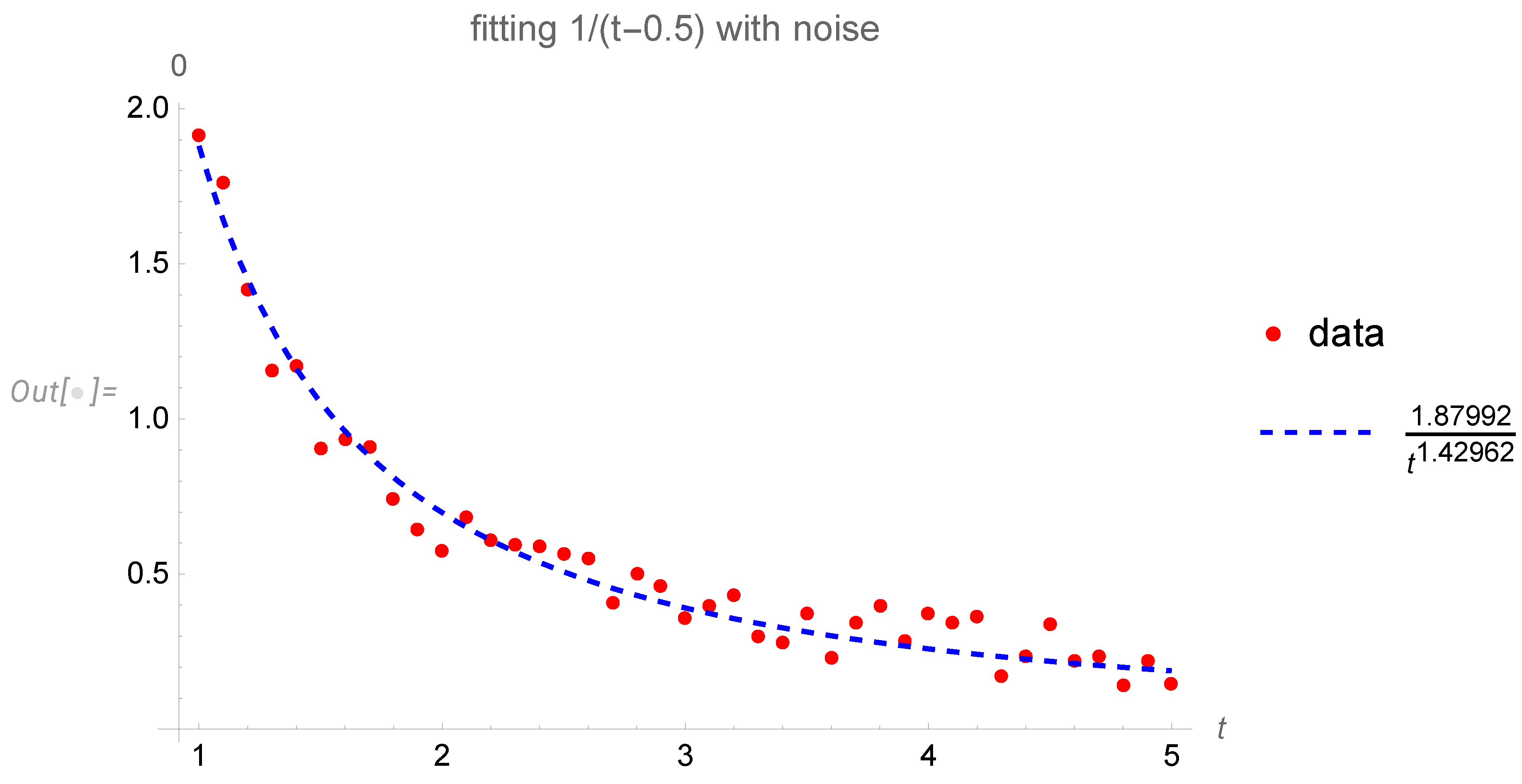
For example, we took a formula , added random noise between and fitted this data to . The best fit produced some fake power and some fake coefficient in front (see Figure 6)
Instead, one should compare a hypothetical theory with a null hypothesis by estimating the log-likelihood of both fits. In case the new theory is more likely as an explanation of the data, you may temporarily accept it until a better theory or better data will appear.
A good history lesson is fitting the power n in Newton’s gravity law to explain the astronomic data for the Mercury perihelion before the General Relativity theory. A small correction to "explained" the data, but this was useless without a theory.
Presumably, our fixed point corresponds to a true infinite Reynolds limit, as it is completely universal and does not depend on the Reynolds scales.
If you assume no hidden scales are left, our law follows from dimensional analysis. Observed or simulated data with all have the powers of some other dimensional parameters related to the Reynolds number. They rely on (multifractal versions of) K41 spectra and other intermediate turbulent phenomena.
We have an anomalous dissipation rate: the mean value of the vorticity square diverges, compensating for the viscosity factor in the energy decay in extreme turbulent limit.
This mechanism of anomalous dissipation differs from the one we studied in the Kelvinon [2,18]. In those fixed points, the viscosity canceled in the dissipation rate due to the singular vorticity configurations with the thin vortex line resolved as a core of a Burgers vortex.
Here, in the dual theory of fractal momentum loop, the large fluctuations of this momentum loop would lead to the divergent expectation value of the enstrophy.
Our solution is universal, rotational, and translational invariant. It has the expected properties of extreme isotropic Turbulence. Is it THE solution? Time will tell.
Data Availability
We generated new data for the nonlinear complex random walk and the enstrophy distribution using the Mathematica® code. This code, the data, and the three-dimensional plots are publicly available in Wolfram Cloud [34].
Acknowledgments
I benefited from discussions of this theory with Sasha Polyakov, K.R. Sreenivasan, Greg Eyink, Luca Moriconi, Vladimir Kazakov, and Kartik Iyer. This research was supported by a Simons Foundation award ID 686282 at NYU Abu Dhabi.
Appendix A. Linearized Loop Equations in 3D
Let us solve in 3D the linear set of recurrent equations derived in Section 8.
Only two independent real parameters exist in . In the canonical form (62) in 3D the two parameters were shifts of coordinates with third coordinate related to them by .
We resolve this ambiguity by using the pseudo-inverse matrix. Here are the original complex equations.
The solution of these three equations in [32] has the form
where the inverse matrix is understood as pseudo-inverse (dropping the null space part).
The complex number is linearly related to , the known previous vectors and unknown , which yields recurrent relations, which we are going to study below.
After solving these equations, the variation of the closure equation
provides a linear set of six equations for , relating these two vectors to all the rotation vectors .
Let us now proceed by assuming the following linear set of real vector relations (with some real matrices to be determined ):
Comparing the terms, we obtain a set of recurrent equations for
where the dual tensor to the vector is defined as
The last two equations can be combined into one complex recurrent equation for
Finally, the closure equation becomes
This is a complex vector equation for two real vectors
The solution is expressed in terms of a block matrix
There is a following complication [32]. The matrix viewed as dimensional real matrix has a null space of three real 6-dimensional eigenvectors. These eigenvectors can be combined in complex 3d vectors corresponding to the block structure of
Therefore, the complex 3D vector is defined modulo superposition of these three complex eigenvectors.
A particular solution for can be obtained using the pseudo-inverse.
In addition, there are three constraints on the angular variables . These constraints have the following form [32]
The coefficients of these constraints are nonlinear functions of the current positions . These constraints lead to projections of the SDE to the quotient space, as we derive in the Section 9.
Here are the results for in terms of rotation parameters (with being unit matrix)
References
- Migdal, A. Loop Equation and Area Law in Turbulence. In Quantum Field Theory and String Theory; Baulieu, L.; Dotsenko, V.; Kazakov, V.; Windey, P., Eds.; Springer US, 1995; pp. 193–231. [CrossRef]
- Migdal, A. Statistical Equilibrium of Circulating Fluids. Physics Reports 2023, 1011C, 1–117, [arXiv:physics.flu-dyn/2209.12312]. [CrossRef]
- Migdal, A.A. Random Surfaces and Turbulence. Proceedings of the International Workshop on Plasma Theory and Nonlinear and Turbulent Processes in Physics, Kiev, April 1987; Bar’yakhtar, V.G., Ed. World Scientific, 1988, p. 460.
- Makeenko, Y.; Migdal, A. Exact equation for the loop average in multicolor QCD. Physics Letters B 1979, 88, 135–137. [CrossRef]
- Migdal, A. Loop equations and expansion. Physics Reports 1983, 201.
- Migdal, A. Momentum loop dynamics and random surfaces in QCD. Nuclear Physics B 1986, 265, 594–614. [CrossRef]
- Migdal, A. Second quantization of the Wilson loop. Nuclear Physics B - Proceedings Supplements 1995, 41, 151–183. [CrossRef]
- Migdal, A.A. Hidden symmetries of large N QCD. Prog. Theor. Phys. Suppl. 1998, 131, 269–307, [hep-th/9610126]. [CrossRef]
- Anderson, P.D.; Kruczenski, M. Loop equations and bootstrap methods in the lattice. Nuclear Physics B 2017, 921, 702–726. [CrossRef]
- Kazakov, V.; Zheng, Z. Bootstrap for lattice Yang-Mills theory. Phys. Rev. D 2023, 107, L051501, [arXiv:hep-th/2203.11360]. [CrossRef]
- Ashtekar, A. New variables for classical and quantum gravity. Physical Review Letters 1986, 57, 2244–2247. [CrossRef]
- Rovelli, C.; Smolin, L. Knot Theory and Quantum Gravity. Phys. Rev. Lett. 1988, 61, 1155–1158. [CrossRef]
- Iyer, K.P.; Sreenivasan, K.R.; Yeung, P.K. Circulation in High Reynolds Number Isotropic Turbulence is a Bifractal. Phys. Rev. X 2019, 9, 041006. [CrossRef]
- Iyer, K.P.; Bharadwaj, S.S.; Sreenivasan, K.R. The area rule for circulation in three-dimensional turbulence. Proceedings of the National Academy of Sciences of the United States of America 2021, 118, e2114679118. [CrossRef]
- Apolinario, G.; Moriconi, L.; Pereira, R.; valadão, V. Vortex Gas Modeling of Turbulent Circulation Statistics. PHYSICAL REVIEW E 2020, 102, 041102. [CrossRef]
- Müller, N.P.; Polanco, J.I.; Krstulovic, G. Intermittency of Velocity Circulation in Quantum Turbulence. Phys. Rev. X 2021, 11, 011053. [CrossRef]
- Parisi, G.; Frisch, U. On the singularity structure of fully developed turbulence Turbulence and Predictability. Geophysical Fluid Dynamics: Proc. Intl School of Physics E. Fermi; M Ghil, R.B.; Parisi, G., Eds. Amsterdam: North-Holland, 1985, pp. 84–88.
- Migdal, A. Topological Vortexes, Asymptotic Freedom, and Multifractals. MDPI Fractals and Fractional, Special Issue 2023, [arXiv:physics.flu-dyn/2212.13356].
- Migdal, A. Universal Area Law in Turbulence, 2019, [arXiv:1903.08613].
- Migdal, A. Scaling Index In Turbulent Area Law, 2019, [arXiv:1904.00900v2].
- Migdal, A. Exact Area Law for Planar Loops in Turbulence in Two and Three Dimensions, 2019, [arXiv:1904.05245v2].
- Migdal, A. Analytic and Numerical Study of Navier-Stokes Loop Equation in Turbulence, 2019, [arXiv:1908.01422v1].
- Migdal, A. Turbulence, String Theory and Ising Model, 2019, [arXiv:1912.00276v3].
- Migdal, A. Towards Field Theory of Turbulence, 2020, [arXiv:hep-th/2005.01231].
- Migdal, A. Probability Distribution of Velocity Circulation in Three Dimensional Turbulence, 2020, [arXiv:hep-th/2006.12008].
- Migdal, A. Clebsch confinement and instantons in turbulence. International Journal of Modern Physics A 2020, 35, 2030018, [arXiv:hep-th/2007.12468v7]. [CrossRef]
- Migdal, A. Asymmetric vortex sheet. Physics of Fluids 2021, 33, 035127. [CrossRef]
- Migdal, A. Vortex sheet turbulence as solvable string theory. International Journal of Modern Physics A 2021, 36, 2150062. [CrossRef]
- Migdal, A. Confined Vortex Surface and Irreversibility. 1. Properties of Exact solution, 2021, [arXiv:physics.flu-dyn/2103.02065v10].
- Migdal, A. Confined Vortex Surface and Irreversibility. 2. Hyperbolic Sheets and Turbulent statistics, 2021, [arXiv:physics.flu-dyn/2105.12719].
- Wikipedia. Burgers vortex. https://en.wikipedia.org/wiki/Burgers_vortex, 2022. [Online; accessed 27-April-2022].
- Migdal, A. Symmetric Fixed Point. https://www.wolframcloud.com/obj/sasha.migdal/Published/SymmetricFixedPoint.nb, 2023.
- Briand, P.; Cardaliaguet, P.; Éric Chaudru de Raynal, P.; Hu, Y. Forward and backward stochastic differential equations with normal constraints in law. Stochastic Processes and their Applications 2020, 130, 7021–7097. [CrossRef]
- Migdal, A. Complex Nonlinear Random Walk. https://www.wolframcloud.com/obj/sasha.migdal/Published/FQequation.nb, 2023.
- Panickacheril John, J.; Donzis, D.A.; Sreenivasan, K.R. Laws of turbulence decay from direct numerical simulations. Philosophical Transactions of the Royal Society A: Mathematical, Physical and Engineering Sciences 2022, 380, 20210089. [CrossRef]
- Sreenivasan, K.R.; Yakhot, V. The saturation of exponents and the asymptotic fourth state of turbulence, 2022. [CrossRef]
Figure 1.
Backtracking wires corresponding to vorticity correlation function.

Figure 2.
Logarithm of Euclidean distance for our random walk in six-dimensional space as a function of a logarithm of the number of steps. The linear fit corresponds to fractal dimension .
Figure 2.
Logarithm of Euclidean distance for our random walk in six-dimensional space as a function of a logarithm of the number of steps. The linear fit corresponds to fractal dimension .
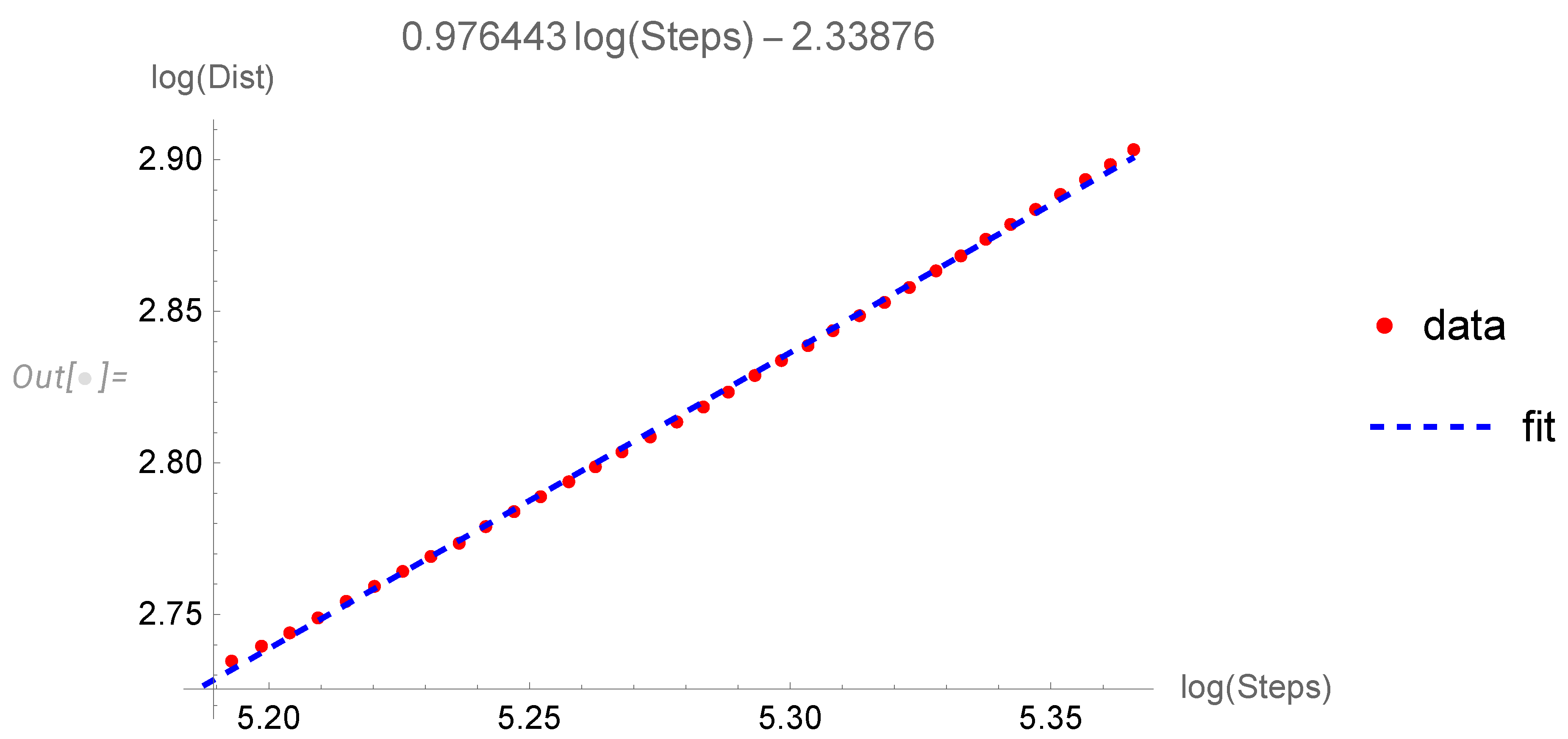
Figure 3.
The logarithmic plot of the CDF for the Euclidean length s of each step of our complex random walk. The tail of the CDF decays as , indicating the probability distribution with power tail in PDF
Figure 3.
The logarithmic plot of the CDF for the Euclidean length s of each step of our complex random walk. The tail of the CDF decays as , indicating the probability distribution with power tail in PDF

Figure 4.
Fitting the random walk distance as a power of number N of steps times a power of .
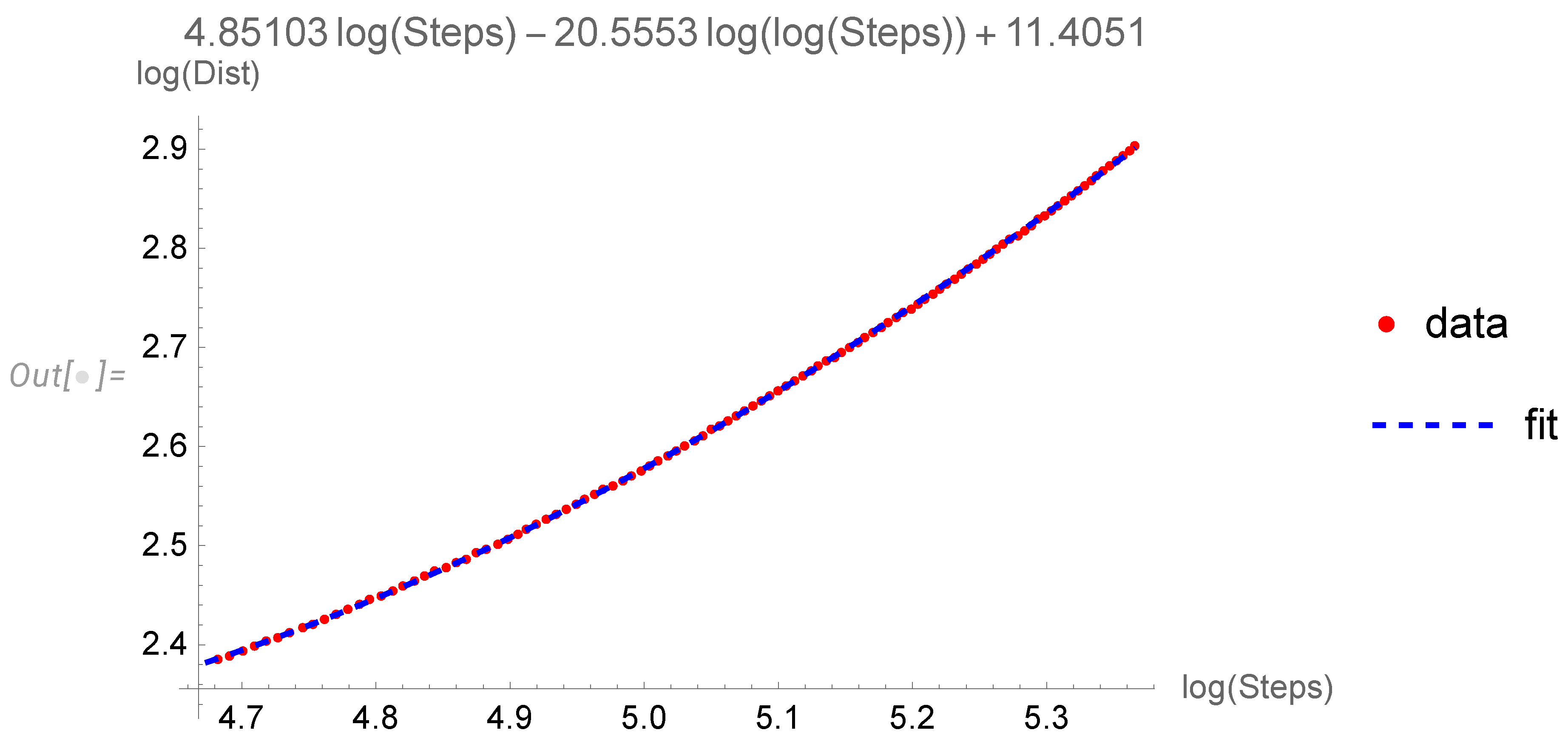
Figure 5.
The logarithmic plot of the CDF for the density. The tail of the CDF decays as , compatible with the power tail for PDF. The mean value of enstrophy and all higher moments diverge.
Figure 5.
The logarithmic plot of the CDF for the density. The tail of the CDF decays as , compatible with the power tail for PDF. The mean value of enstrophy and all higher moments diverge.
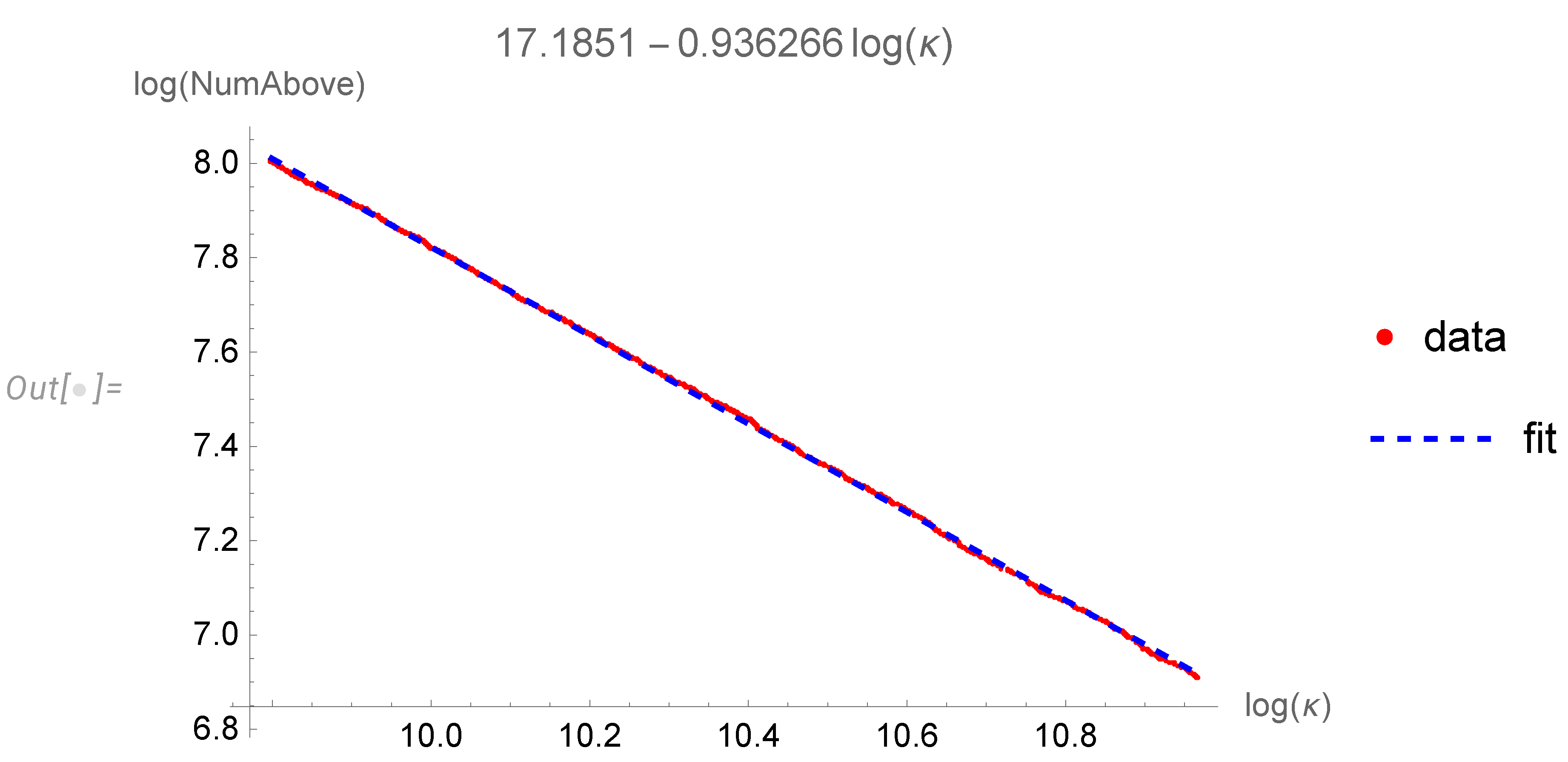
Figure 6.
Fitting noisy data for (red dots) by a power law . The best fit is a dashed blue line, corresponding to . This simple example shows how wrong laws can be "derived" by fitting noisy data.
Figure 6.
Fitting noisy data for (red dots) by a power law . The best fit is a dashed blue line, corresponding to . This simple example shows how wrong laws can be "derived" by fitting noisy data.
Disclaimer/Publisher’s Note: The statements, opinions and data contained in all publications are solely those of the individual author(s) and contributor(s) and not of MDPI and/or the editor(s). MDPI and/or the editor(s) disclaim responsibility for any injury to people or property resulting from any ideas, methods, instructions or products referred to in the content. |
© 2020 by the author. Licensee MDPI, Basel, Switzerland. This article is an open access article distributed under the terms and conditions of the Creative Commons Attribution (CC BY) license (https://creativecommons.org/licenses/by/4.0/).
Copyright: This open access article is published under a Creative Commons CC BY 4.0 license, which permit the free download, distribution, and reuse, provided that the author and preprint are cited in any reuse.


