

Submitted:
28 April 2023
Posted:
04 May 2023
You are already at the latest version
Abstract
This study aimed to establish and verify the validity of an acoustic simulation method during sustained phonation of the Japanese vowels /i/ and /u/. The study participants were six healthy adults. First, vocal tract models were constructed based on computed tomography (CT) data, such as the range from the frontal sinus to the glottis, during sustained phonation of /i/ and /u/. Next, cylindrical shapes virtually extended by 12 cm were added to the vocal tract models to imitate the trachea between the tracheal bifurcation and lower part of the glottis. The Kirchhoff–Helmholtz integral equation was formulated as the wave equation for sound propagation, and the boundary element method was used for discretization. As a result, the relative discrimination thresholds of the vowel formant frequencies for /i/ and /u/ against actual voice were 1.1%–10.2% and 0.4%–9.3% for the first formant and 3.9%–7.5% and 5.0%–12.5% for second formant, respectively. In the vocal tract model with nasal coupling, a pole–zero pair was observed at around 500 Hz, and for both /i/ and /u/, a pole–zero pair was observed at around 1000 Hz regardless of the presence or absence of nasal coupling. These findings demonstrated that /i/ and /u/ could be simulated with high validity in a vocal tract model constructed from CT data obtained during sustained phonation using the boundary element method.
Keywords:
articulation
; acoustic simulation
; boundary element method
; vocal tract model
; Japanese vowels
1. Introduction
The nasopharyngeal closure function is known to be crucially involved in articulatory disorders that occur after palatoplasty in patients with cleft palate, and may be involved in both the morphology and movement of articulatory organs, including the palate and tongue [1]. However, no method has been devised to assess in detail the association between articulatory disorders and the morphology and movement of articulatory organs; therefore, the pathogenesis remains unclear.
The recent development of acoustic wave-based techniques such as the finite element, finite difference, and boundary element methods, has made it possible to visualize and conduct a detailed analysis of the relationship between the morphology of, and sound produced by, a three-dimensional (3D) shape obtained for a 3D model of the vocal tract [2,3,4,5].
We established a simulation method using computed tomography (CT) data during phonation of /a/ in order to clarify the relationship between the morphology of the articulatory organs and the sounds produced by applying the boundary element method. In a previous study, we verified the accuracy of the simulation method for the Japanese vowel /a/ by applying the boundary element method for a vocal tract model including ranges from the frontal sinus to the trachea. Our results demonstrated that high-precision simulation is possible [6].
Consequently, the present study was conducted to establish a simulation method for the other vowels. Since /a/ is an open vowel, we aimed to establish a simulation for narrow vowels. Furthermore, the present study investigated the possibility of simulating the front narrow vowel /i/ and the rear narrow vowel /u/, and verified the accuracy of the simulations.
2. Materials and Methods
2.1. Participants
The study participants were six healthy adults (three males, three females; age range, 26−45 years) with a normal occlusal relationship and no abnormalities in the articulatory organs. The Institutional Review Board of Yamaguchi University Hospital approved this study (H26-22-4), and written, informed consent was obtained from all participants.
2.2. Simulation method
2.2.1. CT imaging
The following scanning conditions were used for the CT imaging (SOMATOM Force; Siemens Healthineers, Munich, Germany): tube voltage, 100 (+Tin filer) kV; tube current, 96 mA; slice thickness, 0.6 mm; CT dose index volume 0.23 mGy; and exposure dose, 0.1 mSv. All CT data were acquired during sustained phonation of the Japanese vowels /i/and /u/ while the participants were in the supine position. The scanning time from the upper end of the frontal sinus to the supraclavicular region was 5 seconds.
2.2.2. Creation of a vocal tract model
After the CT scan data were visualized, 3D visualization software (Amira, version 5.6.0; Maxnet, Tokyo, Japan) was used to construct a 3D model. The airways to the frontal, ethmoid, sphenoid, and maxillary sinuses, nasal and oral cavities, pharynx, larynx, and glottis were manually extracted from the CT data of coronal, axial, and sagittal sections to create a vocal tract model, which was then saved in STL file format. To reduce the exposure dose in the CT scans, a virtual cylindrical structure was extended by 12 cm from the lower part of the glottis to the tracheal bifurcation (Figure 1). Next, based on the simulation results, the length of the extension was adjusted by 1–2 cm.
A vocal tract model including the frontal sinus, ethmoid sinus, sphenoid sinus, maxillary sinus, nasal cavity, oral cavity, pharynx, larynx, and glottis is shown.
2.2.3. Creation of a mesh model for analysis
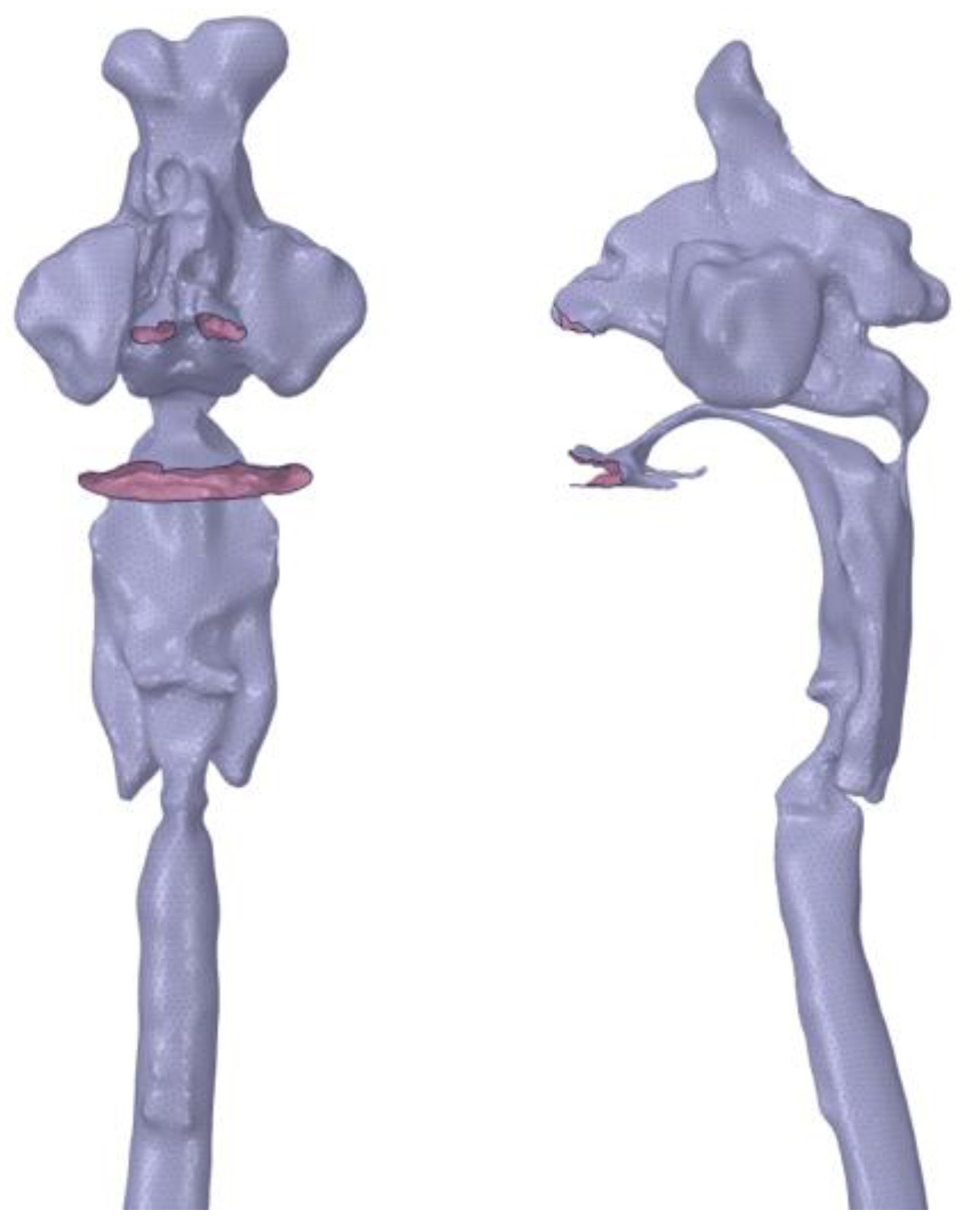
A mesh model was created from the vocal tract model to conduct acoustic analysis using the boundary element method. To equalize and adjust the mesh size and remove unnecessary meshes, a direct modeler (Space Claim Direct Modeler, version 2021R1; ANSYS, Canonsburg, PA) was used to modify the vocal tract model, after which, the meshes of the nostril and oral aperture were removed. Next, the nasal and oral cavities and tracheal bifurcation were opened. For ease of mesh creation, triangular elements were applied using 2 mm as the smallest mesh size, and analysis was carried out on a workstation (Dell Precision T3610; Inter Xeon E-1650 3.5 GHz) using the WAON software package (version 4.55; Cybernet, Tokyo, Japan) (Figure 2). Based on a previous study recommending a mesh size smaller than 1/6 of the wavelength of the sound wave of the analysis frequency [7], the mesh sizes used for /i/ and /u/ were 19.6 and 39.2 mm, respectively, for a body temperature of 37 °C (sound speed of 352.85 m/s). For the creation of a vocal tract model that did not include the nasal cavity and sinuses, these were separated at the section in which a cross-sectional area of the nasal coupling was minimized.
A surface mesh model for analysis is shown. The nostrils, oral cavity, and tracheal bifurcation are opened.
2.2.4. Acoustic analysis method
Acoustic analysis was performed at a range from 1 to 3000 Hz for /i/ and from 1 to 1500 Hz for /u/ at 1-Hz intervals using WAON (Cybernet). The Kirchhoff–Helmholtz integral equation and boundary element method were used as the wave equation representing sound propagation and the discretization method, respectively, the details of which are described elsewhere [6].
2.2.5. Parameters and conditions of the acoustic analysis
The wall of the vocal tract model was considered rigid and the sound absorption coefficient was set to 0% with a specific acoustic impedance of ∞. The bottom of the virtual trachea, which had been extended cylindrically between the tracheal bifurcation and lower part of the glottis, was regarded as a nonrigid (i.e., very soft) wall [8]. Assuming a constant body temperature, the acoustic medium was set at 37 °C. The sound velocity and density at 37 °C were 352.85 m/s and 1.1468 kg/m3, respectively. The sound source was set as a point in a place corresponding to the vocal cords, while the observation point was set 10 cm in front of the lips. Next, a frequency response curve was drawn at the sound pressure level, and the first (F1) and second formants (F2) were calculated.
2.3. Validity of the acoustic simulation
2.3.1. Comparison with actual voice
A solid-state audio recorder (Marantz Professional PMD661; inMusic Brands, Cumberland, RI) was used to record the Japanese vowels /i/ and /u/ (each sustained for 5 seconds) through a dynamic vocal microphone (SHURE SM58; Niles, IL) placed approximately 10 cm in front of the participants’ lips while they were in the supine position, similar to the CT scanning, in a soundproof room.
All voice data were recorded at a sampling rate of 44.1 kHz and saved on an SD memory card at 16 bits in .wav file format. After down-sampling the recorded voice data from 44.1 to 11.025 kHz, acoustic analysis software (Multi Speech 3700, PENTAX Medical, Montvale, NJ) was used to calculate F1 and F2.
2.3.2. Evaluation method
The vowel formant frequency discrimination thresholds for American English and Japanese, which have been reported to be under 3%−5% [9] and 4.9%−9.6% [10], respectively, were used in the present study to evaluate validity. The validity was considered acceptable if these criteria were met. The relative discrimination threshold (%) was obtained by dividing ΔF by F, where F is the formant frequency calculated from the simulation, and the discrimination threshold ΔF is the difference between F and the formant frequencies of the actual and artificial voices generated from the solid models [10].
3. Results
Table 1 and Table 2 show the results of the acoustic simulation of the vocal tract model created from six participants. In all participants, the formant frequencies obtained from the simulation were within the ranges of the frequencies of F1 and F2 for the Japanese vowels /i/ and /u/ reported in the past [11]. The relative discrimination thresholds of the vowel formant frequencies for /i/ and /u/ against actual voice ranged from 1.1% to 10.2% and from 0.4% to 9.3% for F1, and from 3.9% to 7.5% and from 5.0% to 12.5% for F2, respectively. Several thresholds exceeded 9%, but the relative discrimination thresholds became 9% or less by shortening the virtual cylindrical trachea. Specifically, the relative discrimination thresholds became 7.8% for F1 of /i/ in subject No. 6, 0.6% for F2 of /u/ in subject No. 3 by shortening by 1 cm, and 2.4% for F2 of /u/ in subject No. 2 by shortening by 2 cm.
The acoustic simulation results for various extension lengths of the virtual trachea are shown in Table 3 and Table 4. As the length of the virtual trachea shortened, the formant frequencies increased, except for F1 of /i/ in subject No. 1. The standard deviations of F1 and F2 obtained by the acoustic simulation were 2.9–22.1 cm and 43.7–135.2 cm for /i/, and 4.7–31.0 cm and 20.2–101.3 cm for /u/, respectively, when the lengths of the virtual trachea were changed to 10 cm, 11 cm, and 12 cm. The standard deviations with the changes in extension lengths varied considerably.
Three of the six participants had a connection to the nasal cavity at the nasopharynx (i.e., nasal coupling), whereas the remaining three did not (Table 5). The minimum cross-sectional areas at the nasal coupling for the three participants with nasal coupling are shown in Table 5. The average cross-sectional areas of /i/ and /u/ were 1.57 and 8.01 mm2, respectively.
The typical frequency response curves obtained by the acoustic simulation are shown in Figure 3, Figure 4, Figure 5 and Figure 6. A peak around 500 Hz was observed for /i/ in subject No. 4 and /u/ in subject No. 1, both of whom had nasal coupling (Figure 3 and Figure 4). Conversely, no peaks around 500 Hz were observed for both /i/ and /u/ in the curves obtained for the models without nasal coupling and with nasal coupling but with the nasal cavity and sinuses removed (Figure 5 and Figure 6). Therefore, the peak around 500 Hz was considered to be the pole–zero pair because of the nasal coupling (Figure 3 and Figure 4). Pole–zero pairs around 500 Hz caused by nasal coupling were observed between F1 and F2 for both /i/ and /u/ (Table 6). A further peak was observed at 1000 Hz for /i/ for all participants (Table 6). The peaks around 1000 Hz were observed in the curves obtained for both models of /i/ without nasal coupling and with nasal coupling but with the nasal cavity and sinuses removed (Figure 3 and Figure 5).
Comparing the frequency response curves obtained for the models with nasal coupling and those with the nasal cavity and sinuses removed, the frequencies of F1 for /i/ shifted to the low frequency side, whereas those for /u/ shifted to the high frequency side (Figure 3 and Figure 4).

Table 1.
Formant frequencies simulated from the vocal tract model and calculated from the actual voice of /i/.
Table 1.
Formant frequencies simulated from the vocal tract model and calculated from the actual voice of /i/.
| F1 | F2 | |||||||
| Sex | Subject No. | Number of elements | Simulation value (Hz) | Actual voice (Hz) | Discrimination threshold (%) | Simulation value (Hz) | Actual voice (Hz) | Discrimination threshold (%) |
| M | 1 | 28,509 | 356 | 351 | 1.4 | 2196 | 2031 | 7.5 |
| 2 | 11,864 | 365 | 342 | 6.3 | 2204 | 2356 | 6.9 | |
| 3 | 11,492 | 317 | 336 | 6.0 | 2347 | 2180 | 7.1 | |
| F | 4 | 21,192 | 374 | 370 | 1.1 | 2510 | 2649 | 5.5 |
| 5 | 8361 | 368 | 358 | 2.7 | 2451 | 2579 | 5.2 | |
| 6 | 22,419 | 401 | 442 | 10.2 | 2775 | 2882 | 3.9 | |
Table 2.
Formant frequencies simulated from the vocal tract model and calculated from the actual voice of /u/.
Table 2.
Formant frequencies simulated from the vocal tract model and calculated from the actual voice of /u/.
| F1 | F2 | |||||||
| Sex | Subject No. | Number of elements | Simulation value (Hz) | Actual voice (Hz) | Discrimination threshold (%) | Simulation value (Hz) | Actual voice (Hz) | Discrimination threshold (%) |
| M | 1 | 28,982 | 371 | 364 | 1.9 | 1127 | 1198 | 6.3 |
| 2 | 9905 | 445 | 436 | 2.0 | 1102 | 1222 | 11.0 | |
| 3 | 9728 | 381 | 375 | 1.6 | 1121 | 1261 | 12.5 | |
| F | 4 | 20,644 | 449 | 447 | 0.4 | 1403 | 1333 | 5.0 |
| 5 | 8653 | 495 | 464 | 6.3 | 1220 | 1292 | 6.0 | |
| 6 | 22,151 | 432 | 472 | 9.3 | 2072 | 1906 | 8.0 | |
Table 3.
Formant frequencies simulated for /i/ by various extension lengths of the virtual trachea (Hz).
Table 3.
Formant frequencies simulated for /i/ by various extension lengths of the virtual trachea (Hz).
| F1 | F2 | ||||||
| Sex | Subject No. | Length of the virtual trachea | Length of the virtual trachea | ||||
| 11 cm | 10 cm | 0 cm | 11 cm | 10 cm | 0 cm | ||
| M | 1 | 387 | 410 | 390 | 2279 | 2364 | 2432 |
| 2 | 369 | 379 | 501 | 2298 | 2342 | 2369 | |
| 3 | 317 | 324 | 393 | 2520 | 2663 | 2679 | |
| F | 4 | 416 | 420 | 451 | 2663 | 2840 | 3317 |
| 5 | 370 | 375 | 580 | 2608 | 2782 | 3070 | |
| 6 | 410 | 429 | 633 | 2860 | 2874 | 3350 | |
Table 4.
Formant frequencies simulated for /u/ by various extension lengths of the virtual trachea (Hz).
Table 4.
Formant frequencies simulated for /u/ by various extension lengths of the virtual trachea (Hz).
| F1 | F2 | ||||||
| Sex | Subject No. | Length of the virtual trachea | Length of the virtual trachea | ||||
| 11 cm | 10 cm | 0 cm | 11 cm | 10 cm | 0 cm | ||
| M | 1 | 380 | 391 | 404 | 1195 | 1230 | 1749 |
| 2 | 483 | 521 | 597 | 1110 | 1193 | 1960 | |
| 3 | 399 | 410 | 519 | 1253 | 1369 | 2451 | |
| F | 4 | 439 | 449 | 1061 | 1339 | 1399 | 2041 |
| 5 | 508 | 523 | 725 | 1265 | 1295 | 1850 | |
| 6 | 438 | 446 | 753 | 2106 | 2120 | 2160 | |
Table 5.
Minimum cross-sectional area at the nasal coupling for /i/ and /u/ (mm2).
| Sex | Subject No. | /i/ | /u/ |
| M | 1 | 2.82 | 7.91 |
| F | 4 | 0.45 | 12.01 |
| 6 | 1.44 | 4.12 |
Table 6.
Pole–zero pairs for /i/ and /u/.
| /i/ | /u/ | |||
| Sex | Subject No. | Pole–zero 1 (Hz) | Pole–zero 2 (Hz) | Pole–zero (Hz) |
| M | 1 | 411 ; 534 | 1037 ; 1209 | 462 ; 492 |
| 2 | - | 944 ; 1175 | - | |
| 3 | - | 936 ; 1011 | - | |
| F | 4 | 406 ; 486 | 1206 ; 1240 | 613 ; 654 |
| 5 | - | 1100 ; 1251 | - | |
| 6 | 449 ; 518 | 1143 ; 1213 | 531 ; 587 | |
Figure 3.
Frequency response curve for /i/ in subject No. 4.
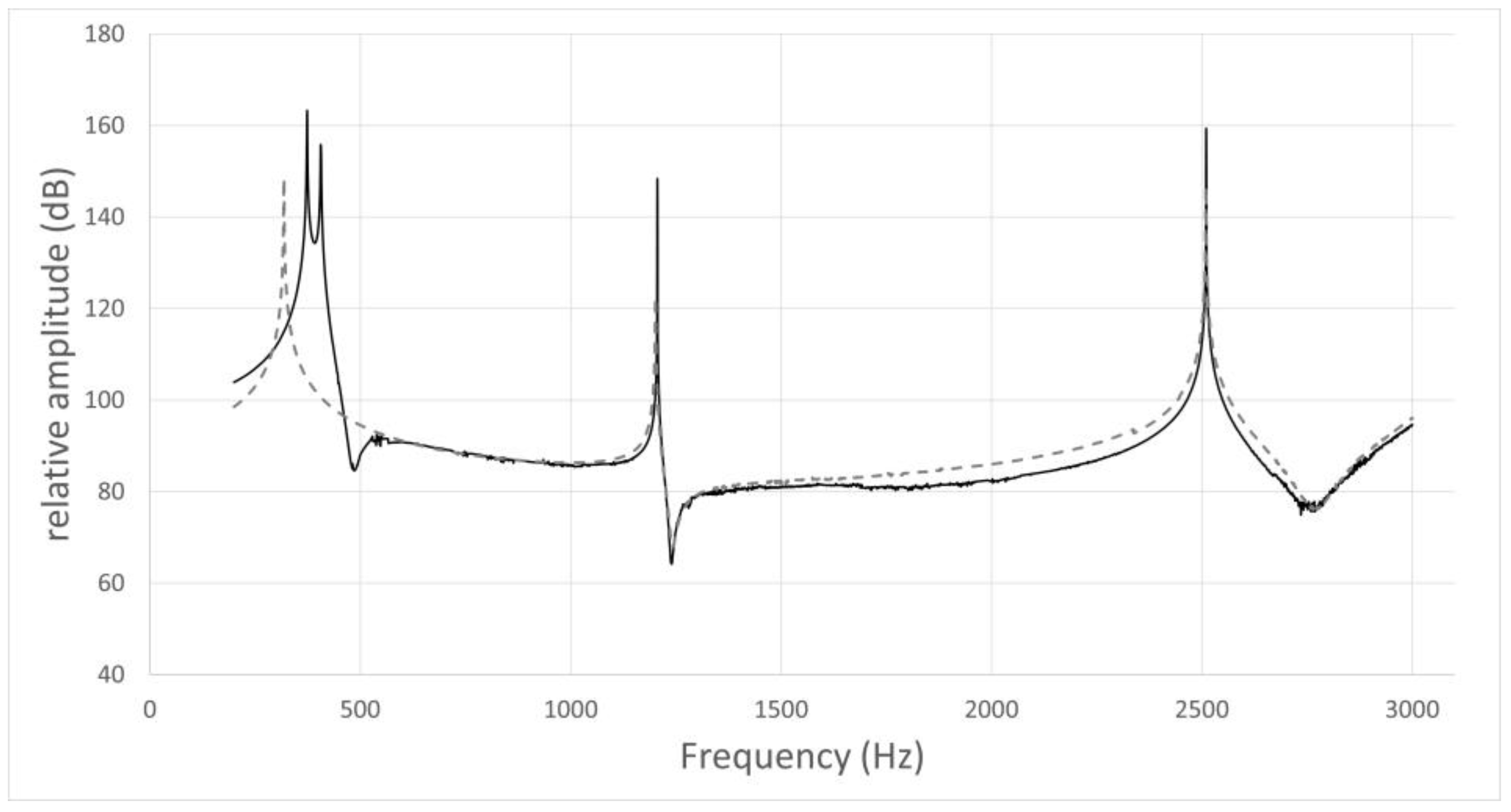
The simulation result of the model including the nasal cavity and sinuses is indicated by the solid line, and that of the model excluding the nasal cavity and sinuses by the dotted line. In the former curve, the first peak is F1 (374 Hz), the second is due to nasal coupling for a pole–zero pair (pole: 406 Hz; zero: 486 Hz), the third is a pole–zero pair (pole: 1206 Hz; zero: 1240 Hz), and the fourth is F2 (2510 Hz). In the latter curve, the first peak is F1 (319 Hz), the second is not due to nasal coupling for a pole–zero pair (pole: 1202 Hz; zero: 1242 Hz), and the third is F2 (2509 Hz).
Figure 4.
Frequency response curve for /u/ in subject No. 1.
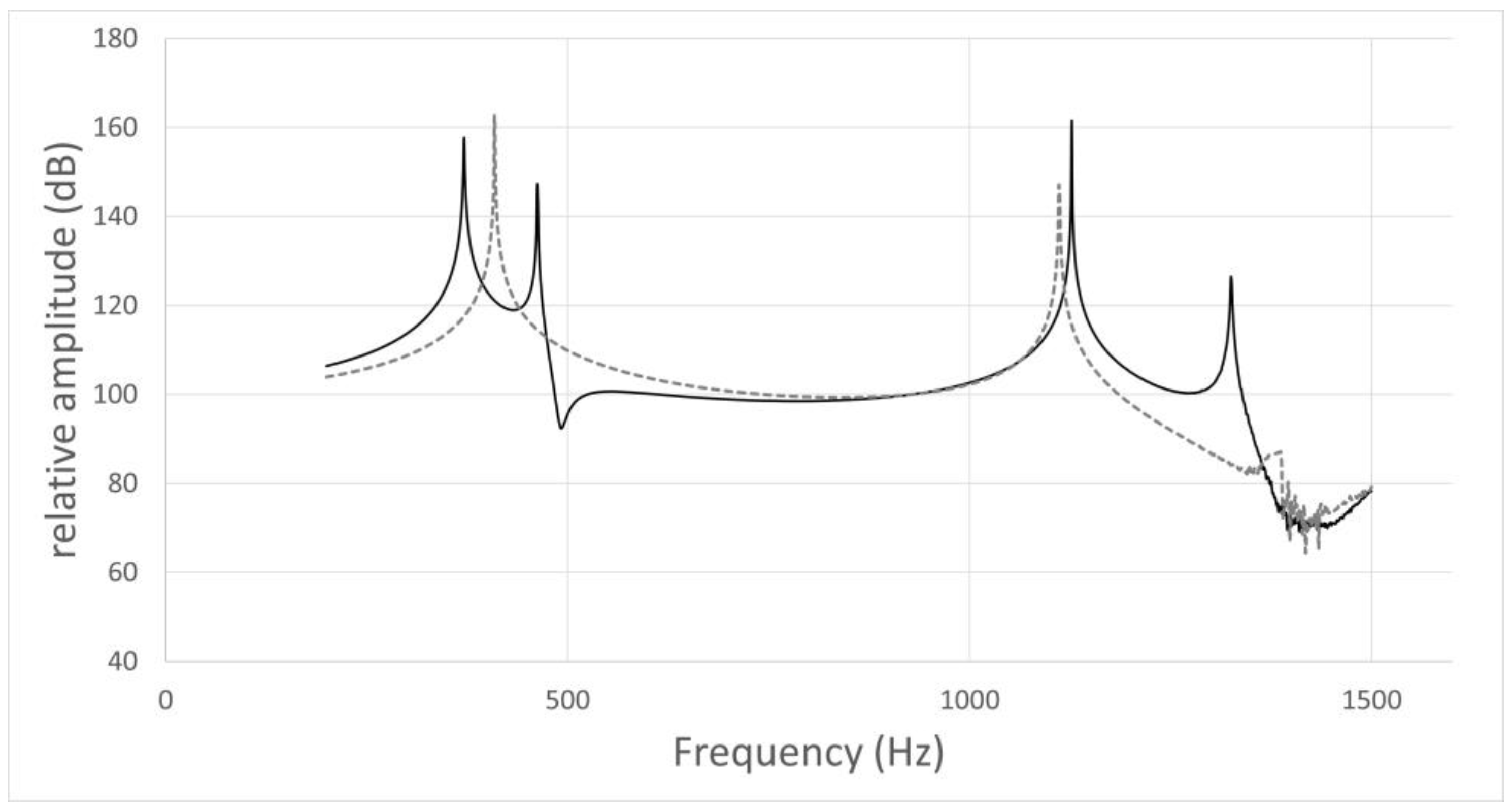
The simulation result of the model including the nasal cavity and sinuses is indicated by the solid line, and that of the model not including the nasal cavity and sinuses by the dotted line. In the former curve, the first peak is F1 (371 Hz), the second is due to nasal coupling for a pole–zero pair (pole: 462 Hz; zero: 492 Hz), and the third is F2 (1127 Hz). In the latter curve, the first peak is F1 (409 Hz) and the second is F2 (1111 Hz).
Figure 5.
Frequency response curve for /i/ in subject No. 2.
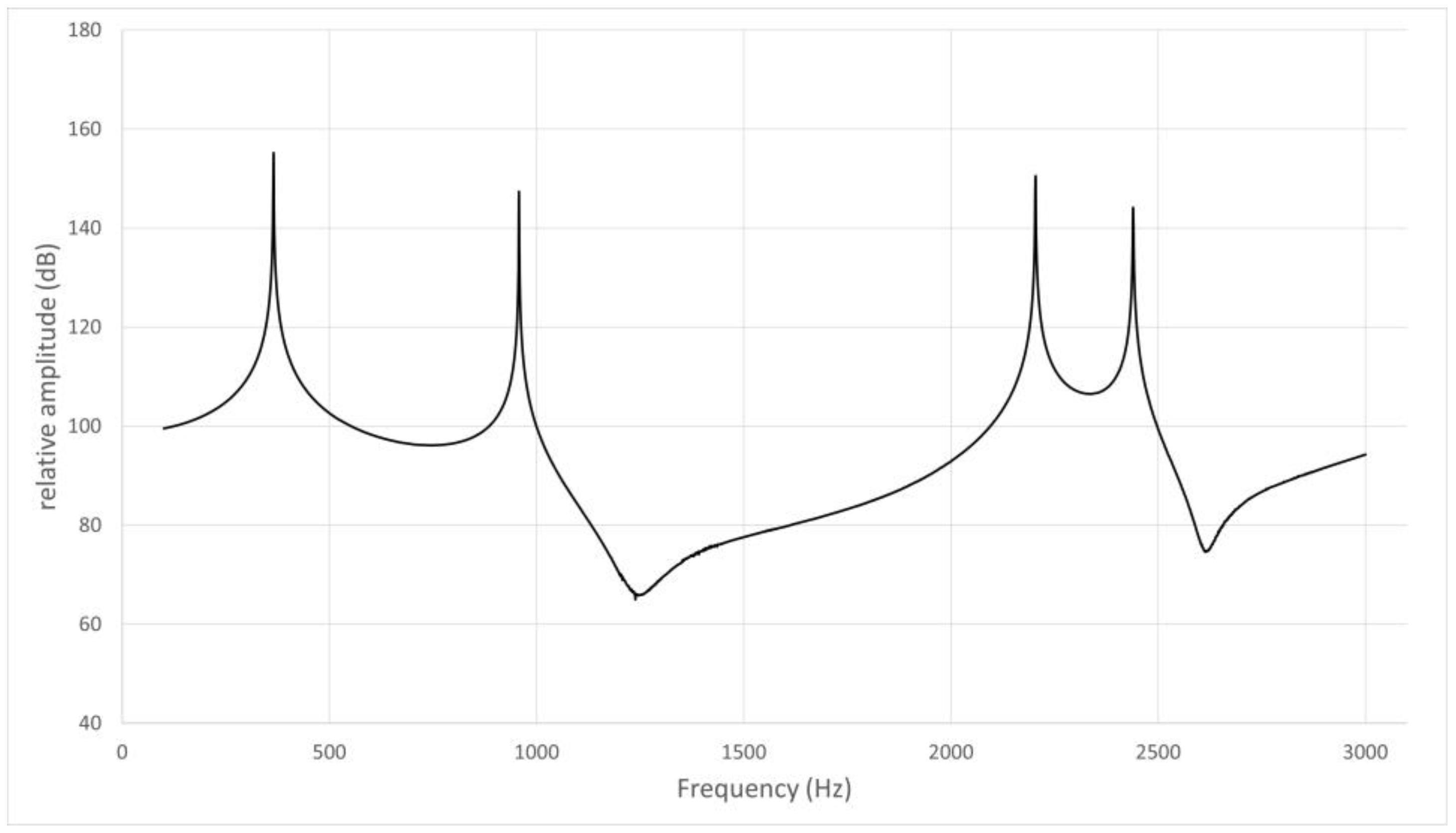
The frequency response curve obtained from the simulation of the models without the nasal cavity and sinuses is shown. The first peak is F1 (365 Hz), the second is a pole–zero pair (pole: 944 Hz, zero: 1175 Hz) not due to nasal coupling, and the third is F2 (2204 Hz).
Figure 6.
Frequency response curve for /u/ in subject No. 5.
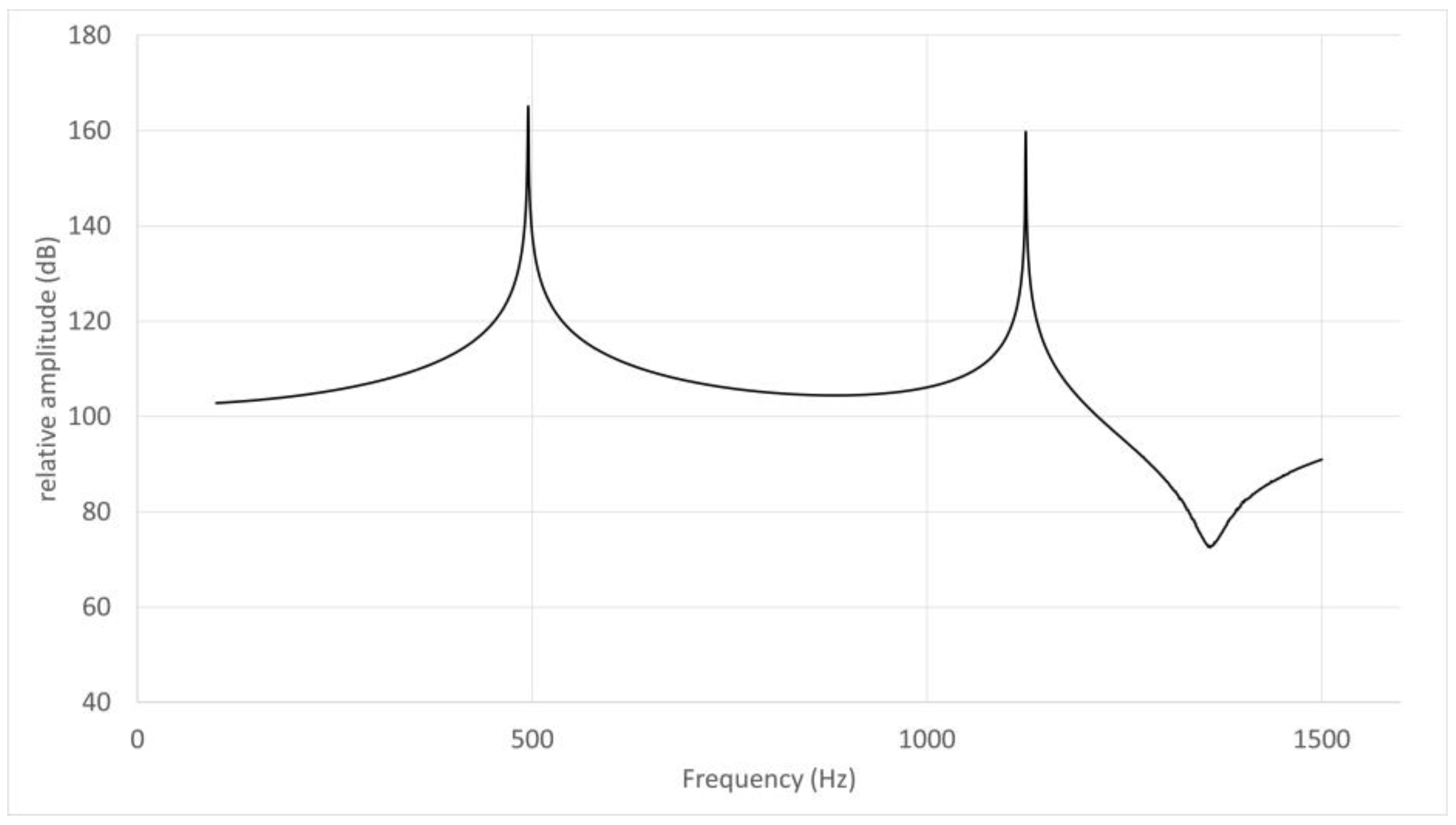
The frequency response curve obtained from the simulation of the models without the nasal cavity and sinuses is shown. The first peak is F1 (495 Hz) and the second is F2 (1220 Hz).
4. Discussion
By using the boundary element method in the same way as for the Japanese vowel /a/ and applying the same parameter settings [6], an acoustic simulation could be stably performed for the Japanese vowels /i/ and /u/. In a previous study [11], F1 and F2 of /i/ ranged from 250 to 500 Hz and from 2000 to 3000 Hz, respectively, and those of /u/ ranged from 300 to 500 Hz and from 1000 to 2000 Hz, respectively; the formant frequencies obtained from the present simulation were almost within these ranges.
Regarding the sound analysis of the Japanese vowel /a/ in a previous study [6], the sound source was set as a point in a place corresponding to the vocal cords, the sound was modified by reflection, absorption, and interference on the wall of the vocal tract, and the boundary element method was used to analyze the sound radiated to the outside space from the mouth and nostrils. In the present study, we considered that the Japanese vowels /i/ and /u/ could be simulated by using the same boundary element method with the same parameter settings, that is, the wall of the vocal tract and the bottom end of the virtual trachea were regarded as rigid and very soft walls, respectively, and the sound velocity and density were set at 37 °C.
In the verification using actual voice, the relative discrimination thresholds were within 9%, except for one of the six cases for F1 of /i/ and two of six cases for F2 of /u/. No significant difference was found between the numbers of participants in whom the relative discrimination thresholds were 9% or less in the present simulations of /i/ and /u/ or the previous simulation of /a/ [6]. Similar to the previous simulation of /a/, the relative discrimination thresholds became less than 9% by adjusting the length of the virtual cylindrical extension of the lower part of the glottis. In the present study, as the length of the virtual trachea shortened, the formant frequency increased, except for F1 of /i/ in subject No. 1. However, discussing the appropriate length of the virtual trachea exceeds the scope of the present study.
Peaks other than the formant frequencies were observed in the frequency response curves obtained by the present acoustic simulation using the boundary element method. Chen [12] reported that peaks arising from nasalization are often observed at a position lower than F1 or between F1 and F2 in narrow vowels with a high tongue position. In the present study, peaks were observed between F1 and F2 for /i/ and /u/ (Table 6). Because the Japanese vowels /i/ and /u/ are narrow vowels, our results were consistent with those reported by Chen [12]. Peaks around 500 Hz have been observed for vowels [13]. Because a peak around 500 Hz is not observed in vocal tract models without a nasal cavity, the peak, i.e., the pole–zero pair, is considered to arise from the nasal coupling of vowels [13].
It is also known that a pole–zero pair appears around 500 Hz because of nasal coupling, and that the presence of a pole–zero pair changes the position where the peak of F1 appears in the frequency response curves [13]. In the present study, among three participants with nasal coupling, the obtained peaks of F1 shifted to the low frequency side in two participants for /i/ and to the high frequency side in three for /u/ in the simulated vocal tract models in which the nasal cavity and sinuses had been removed.
Pole–zero pairs not due to nasal coupling have been reported to be generated by the resonance of the paranasal cavities, thereby causing the frequency response curves to become complicated [14]. In the present simulation of the Japanese vowel /i/, two peaks appearing at around 500 and 1000 Hz were observed between F1 and F2. The peak at around 500 Hz was considered to be the pole–zero pair due to nasal coupling. The other peak at a higher frequency occurred at around 1000 Hz in /i/ for all participants. No gender difference in the occurrence of the peaks was observed. Because a peak was observed at 1000 Hz regardless of the presence of the nasal cavity, the peaks were considered to have been generated on either site of the vocal tract, excluding the nasal coupling. However, further discussion exceeds the limitations of the present study.
5. Conclusions
In the present study, by using the boundary element method, the propagation and emission of sound could be simulated well for a vocal tract model that included the range from the frontal sinus to the glottis by on CT data during sustained phonation of the Japanese vowels /i/ and /u/ and virtual cylindrical extension from the lower part of the glottis. A comparison with actual voice confirmed the validity of the simulation.
Author Contributions
Conceptualization, K.M.; Methodology, K.M.; Software, M.T. and M.M; Validation, M.S. and, H.U.; Formal Analysis, M.S., M.T. and M.M.; Investigation, M.S., M.T., M.M. and, H.U. ; Resources, M.T. and M.M; Data Curation, M.S.; Writing – Original Draft Preparation, M.S. and K.M.; Writing – Review & Editing, M.S. and K.M.; Visualization, M.S. and K.M.; Supervision, K.M.; Project Administration, K.M.; Funding Acquisition, K.M.
Funding
This research was supported by the Japan Society for the Promotion of Science under Grants-in-Aid for Scientific Research (Basic Research (B) 18H03001) and the Kawai Foundation for Sound Technology & Music.
Institutional Review Board Statement
The Institutional Review Board of Yamaguchi University Hospital approved this study (H26-22-4), and written, informed consent was obtained from all participants.
Data Availability Statement
Not applicable. There is no dataset associated with this manuscript.
Conflicts of Interest
The authors have no conflicts of interest to declare.
References
- Bejdová, S.; Krajíček, V.; Peterka, M. Variability in palatal shape and size in patients with bilateral complete cleft lip and palate assessed using dense surface model construction and 3D geometric morphometrics. J CM Surg. 2012, 40, 201–208. [Google Scholar] [CrossRef] [PubMed]
- Marc, A.; Rémi, B.; Saeed, D.; Oriol, G.; Francesc, A.; Xavier, P.; Annemie, V. H.; Olov, E. Influence of lips on the production of vowels based on finite element simulations and experiments. J Acoust Soc Am. 2016, 139, 2852–2859. [Google Scholar]
- Takemoto, H.; Mokhtari, P.; Kitamura, T. Acoustic analysis of the vocal tract during vowel production by finite-difference time-domain method. J Acoust Soc Am. 2010, 128, 3724–3738. [Google Scholar] [CrossRef] [PubMed]
- Tsuji, T.; Tsuchiya, T.; Kagawa, Y. Finite element and boundary element modelling for the acoustic wave transmission in mean flow medium. J Sound Vib. 2002, 255, 849–866. [Google Scholar] [CrossRef]
- Amelia, J. G.; Helena, D.; Damian, T. M. Diphthong synthesis using the dynamic 3d digital waveguide mesh. IEEE/ACM Trans Audio Speech Lang Process. 2018, 26, 243–255. [Google Scholar]
- Shiraishi, M.; Mishima, K.; Umeda, H. Development of an Acoustic Simulation Method during Phonation of the Japanese Vowel /a/ by the Boundary Element Method. J Voice. 2021, 35, 530–544. [Google Scholar] [CrossRef] [PubMed]
- Steffen, M. Six boundary elements per wavelength: Is that enough? J Comput Acoust. 2002, 10, 25–51. [Google Scholar]
- Zwikker, C.; Kosten, C. W. Sound Absorbent Material. New York, NY, Elsevier; 1949; p.1-22.
- Lyzenga, J.; Horst, J. W. Frequency discrimination of bandlimited harmonic complexes related to vowel formants. J Acoust Soc Am. 1995, 98, 1943–1955. [Google Scholar] [CrossRef]
- Eguchi, S. Difference limens for the formant frequencies: Normal adult values and their development in children. J Am Audiol Soc. 1976, 1, 145–149. [Google Scholar]
- Hirahara, T.; Akahane-Yamada, R. Acoustic characteristics of Japanese vowels. Proc. INTERSPEECH2004-ICSLP. 2004, 3287-3290.
- Chen, M. Y. Acoustic correlates of English and French nasalized vowels. J Acoust Soc Am. 1997, 102, 2360–2370. [Google Scholar] [CrossRef] [PubMed]
- Kenneth, N. S. Acoustic Phonetics. Cambridge; MIT Press 2000; p. 135-137.
- Havel, M.; Kornes, T.; Weitzberg, E.; Lundberg, J. O.; Sundberg, J. Eliminating paranasal sinus resonance and its effects on acoustic properties of the nasal tract. Logoped Phoniatr Vocol. 2016, 41, 33–40. [Google Scholar] [CrossRef] [PubMed]
Figure 1.
Vocal tract model.
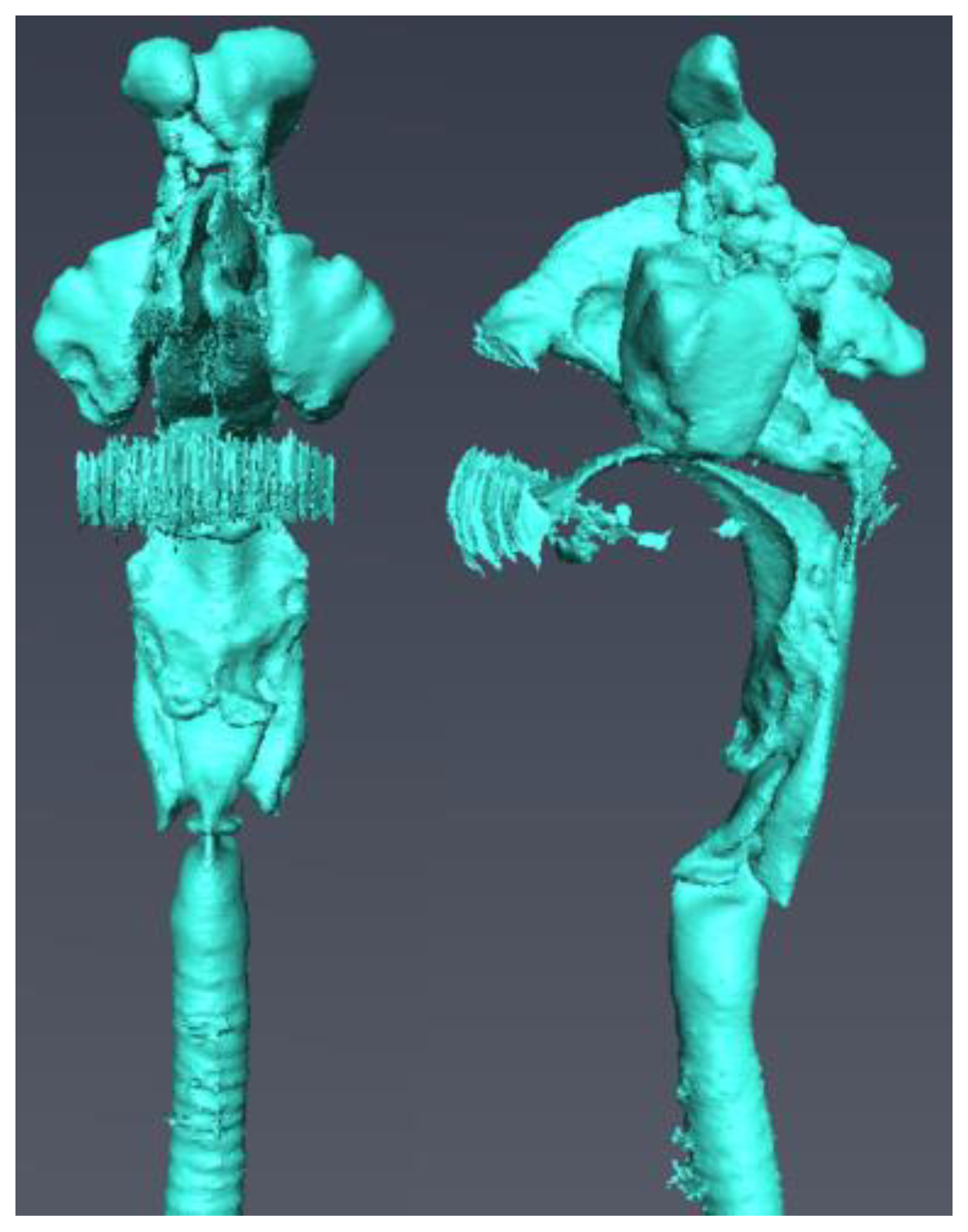
Figure 2.
Mesh model for simulation.
Disclaimer/Publisher’s Note: The statements, opinions and data contained in all publications are solely those of the individual author(s) and contributor(s) and not of MDPI and/or the editor(s). MDPI and/or the editor(s) disclaim responsibility for any injury to people or property resulting from any ideas, methods, instructions or products referred to in the content. |
© 2023 by the authors. Licensee MDPI, Basel, Switzerland. This article is an open access article distributed under the terms and conditions of the Creative Commons Attribution (CC BY) license (http://creativecommons.org/licenses/by/4.0/).
Copyright: This open access article is published under a Creative Commons CC BY 4.0 license, which permit the free download, distribution, and reuse, provided that the author and preprint are cited in any reuse.


