
Submitted:
26 April 2023
Posted:
27 April 2023
You are already at the latest version
Abstract
This study used a two-stage network data envelopment analysis model to measure the water use efficiency of 108 cities in the Yangtze River Economic Belt in the initial water use and wastewater treatment phases from 2009 to 2019. We used the Dagum Gini coefficient to decompose the urban water use efficiency of six major urban clusters in the Yangtze River Economic Belt. We also used σ convergence and β convergence types to test the convergence characteristics of urban water use efficiency of six major urban clusters in the Yangtze River Economic Belt. This study found that the overall low level of water use efficiency in cities in the Yangtze River Economic Zone mainly stems from the low level of water use efficiency in the wastewater treatment stage. The 108 cities in the Yangtze River Economic Zone are divided into four types based on the average values of water use efficiency in the initial use and wastewater treatment phases; the highest number of cities are in the double-low category, with low average values of water use efficiency in the initial use and wastewater treatment phases. During the study period, spatial differences in urban water use efficiency in the Yangtze River Economic Zone narrowed, with the differences stemming mainly from hyperdensity, followed by intra- and inter-regional differences. Meanwhile, there is convergence in urban water use efficiency in the Yangtze River Economic Belt; significant β convergence in the urban agglomerations of the Yangtze River Delta, Jianghuai, middle reaches of the Yangtze River, Chengdu–Chongqing, and Central Yunnan; and insignificant β convergence in the Central Qian urban agglomeration. After considering control factors, such as industrial structure, financial development level, environmental regulation, economic development level, and science and education development level, the water use efficiency of the six major urban clusters in the Yangtze River Economic Belt converges faster, but the influence of these control factors on the water use efficiency of each urban cluster is heterogeneous. Research results have reference value for the development of improvement strategies on differentiated urban water use efficiency in the Yangtze River Economic Belt.
Keywords:
water use efficiency
; regional differences
; convergence
; urban agglomerations
; Yangtze River Economic Belt
1. Introduction
The accelerated urbanization and industrialization, urban water resource demand, and wastewater discharge increase have resulted in water resources and water environment becoming rigid conditions that constrain urban development. Under a certain scale of total water resources and supply, improving the efficiency of urban water resources utilization has become the key to alleviate the contradiction between supply and demand [1]. In 2016, the Ministry of Environmental Protection took the lead in the Yangtze River Economic Zone with a special action for environmental enforcement of drinking water sources; a total of 490 drinking water source problems were identified in 126 prefecture-level cities in 11 provinces and cities along the river [2]. In response to water environment problems in the Yangtze River Economic Belt, the Ministry of Ecology and Environment and Development and Reform Commission jointly issued the Action Plan for the Battle of Yangtze River Protection and Restoration Attack in January 2019, proposing to strengthen water environment management in cities at the prefecture level and above. In September 2022, 17 departments and units, including the Ministry of Ecology and Environment, National Development and Reform Commission, Supreme People's Court, and Supreme People's Procuratorate, jointly issued the In-depth Battle of Yangtze River Protection Action Plan for Restoring the Battle of the Yangtze River. This action plan provides measures to strengthen the construction of municipal sewage networks in cities at the prefecture level and above and to improve the centralized collection rate of urban domestic sewage. The Yangtze River basin is where 45.94% of China's water resources are concentrated [3]. Moreover, cities along the river depend on it, and the problems of wasteful urban water resources, low utilization efficiency, prominent contradictions between supply and demand, and significant differences in regional water resources utilization efficiency still exist owing to various factors (e.g., water conservation and environmental protection technology, industrial structure, and economic development level) [4]. Accordingly, the key to solving these problems lies in improving urban water use efficiency and promoting inter-city collaborative management. Under the core concept of “ecological priority and green development,” improving urban water use efficiency in the Yangtze River Economic Zone is of immense practical significance for the high-quality development of this area.
Data envelopment analysis (DEA) is a nonparametric system analysis method based on production function theory to evaluate the relative effectiveness of multiple input and multiple output decision units of the same type [5]. Given that multiple inputs and outputs can be considered simultaneously and no specific functional forms need to be set [6,7], the DEA method is widely used for water use efficiency evaluation. The relevant research results focus on the following four aspects. (1) Capital, labor, and water resources are used as input factors and gross regional product as output factors to measure water use efficiency and analyze its spatial and temporal characteristics and influencing factors. Francisco et al. (2010) evaluated agricultural water use efficiency in Spain using DEA [8]. He Wei et al. (2021) measured the water resource utilization efficiency of cities in the Yellow River basin by taking the total water supply, domestic water consumption, number of people using water, number of employed people, and total fixed asset investment as input indicators; and the GDP of municipalities as output indicators. They also analyzed the influence on water resource utilization efficiency of such factors as economic development level, industrial structure, degree of marketization, and water resource endowment [9]. Yao Tingting et al. (2021) selected six indicators: water consumption of 10,000 Yuan GDP, water consumption of 10,000 Yuan industrial value added, leakage rate of pipeline network, per capita daily domestic water consumption, sewage treatment rate, and crop water utilization efficiency; and used the DEA model to study the water utilization efficiency of Beijing, Tianjin, and Hebei and its spatial and temporal characteristics [10].(2) Considering the water environment impact, wastewater is included as a non-desired output element in DEA to measure water use efficiency..Pittman et al. (1983) first incorporated “non-consensual” output into the productivity analysis process [11]. Since then, scholars have gradually included environmental pollution as a non-desired output in DEA models to analyze water use efficiency. Yang et al. (2020) used the slacks-based model (SBM) to measure the water resource use efficiency of cities in the Huaihe eco-economic zone by including wastewater emissions as a non-desired output [12]. Yue, L. et al. (2021) measured the green development efficiency of cities in the Yellow River Basin by taking real GDP, average urban residents' wage, and park green area as desired outputs; and industrial wastewater emissions as non-desired outputs [13]. Gao Xincai et al. (2021) used the super-efficient SBM (SE-SBM) model based on non-consensual outputs and selected total fixed asset investment, employment, and total water consumption as input indicators, and selected gross regional product and wastewater discharge as consensual output indicators and non-consensual output indicators, respectively, to measure the water resources utilization efficiency of 33 prefecture-level cities in Northwest China from 2010 to 2018 [1]. (3) Using a multi-stage DEA model to measure the efficiency of water resources use, we tried to open the "black box" of water resources use efficiency.Färe and Grosskopf (1996) constructed a multi-stage DEA model in an attempt to open the “black box” of multi-stage performance assessment. Tone and Tsutsui (2009) developed a relaxation-based network DEA model [15]. Li et al. (2012) developed a two-stage network DEA model [16]. Bian et al. (2014) subdivided the entire water use process into an initial water use stage and a wastewater treatment stage and eventually built a two-stage DEA model to calculate water use efficiency and wastewater treatment efficiency [17]. M. Moran Valencia et al. (2023) constructed a two-stage DEA model to evaluate the efficiency of water system management in Mexico [18]. Zhao et al. (2017) used two stages to evaluate inter-provincial water resource efficiency in China [19]. Based on a network SBM-DEA model and GML index, Deng Guangyao et al. (2019) found large differences in industrial water use efficiency among Chinese provinces in the production and wastewater management stages [20]. Zhang Guoji et al. (2020) constructed a DEA model based on the hybrid network structure of water resources system to measure water use efficiency from two stages: initial water use and wastewater treatment stages [21]. (4) From the provincial or central city level, the DEA or SBM model was used to study the water resources utilization efficiency of the Yangtze River Economic Zone. Ren Junlin et al. (2016) measured the urban water use efficiency of the Yangtze River Economic Belt using the SE-DEA model and Malmquist index and examined its influencing factors using the Tobit model [22]. Wang Keliang et al. (2017) incorporated industrial water use and water pollution discharge into the analytical framework and constructed the epsilon-based measure (EBM)-Tobit two-stage efficiency analysis model to measure the industrial green water efficiency of 11 provinces and cities in the Yangtze River Economic Belt from 2005 to 2014 [23]. Yang Gao-Sheng et al. (2019) used the SE-SBM model to quantitatively analyze the spatial and temporal changes of green water resources efficiency in 11 provinces and cities in the Yangtze River Economic Belt from 2002-2016, and explored the factors influencing green water resources efficiency using the Malmquist-Luenberger (ML) index method [24]. An Hui et al. (2022) used the SE-SBM model to measure the green water resources efficiency of 45 cities along the Yangtze River Economic Belt from 2010 to 2019 [4]. The following shortcomings exist in existing studies. First, the scale of research is mainly focused on the provincial level, but no sufficient research has been conducted on cities with high production and domestic water consumption, particularly the water use efficiency of urban clusters, which is the main form of China's new urbanization. Second, in terms of “black box” research on water resources utilization efficiency, the relevant research has mainly focused on industrial and agricultural water resources efficiency. Moreover, the results of “black box” research on urban water resources utilization efficiency are relatively few.
The existing achievements have made relative progress in terms of research objects, contents, and methods, but there is still room for expansion. The contributions of the current paper are as follows. (1) Given that the Yangtze River Economic Belt is a major national development region, of immense practical significance for the high-quality economic development of this region is to take its urban water use efficiency as the research object and to explore its regional differences and convergence of urban water use efficiency from the perspective of urban clusters. (2) Considering the non-expected output as an intermediate variable, a two-stage network DEA model was established, which opened the “black box” of urban water use efficiency in the Yangtze River Economic Zone and uncovered the correlation between inputs and outputs in the urban water use system. These outcomes can more clearly and objectively reflect urban water use efficiency at different stages and propose more accurate urban water use efficiency improvement strategies. (3) Using the Dagum Gini coefficient and its decomposition, the regional differences in water use efficiency of the six major urban clusters in the Yangtze River economic belt and their sources are revealed.
2. Overview of the study area
The Yangtze River Economic Belt is a new economic support belt of China based on the Yangtze River Golden Waterway, with urban agglomerations as the main form, covering 9 provinces and 2 cities (i.e., Shanghai, Jiangsu, Zhejiang, Anhui, Jiangxi, Hubei, Hunan, Chongqing, Sichuan, Yunnan and Guizhou) (Figure 1). This region accounts for about 40% of the country in terms of population and regional GDP, forming 6 urban agglomerations of different scales and development stages: Yangtze River Delta, Jianghuai, the middle reaches of the Yangtze River, Chengdu–Chongqing, Central Guizhou, and central Yunnan [25]. With the advancement of urbanization, urban water consumption and wastewater emissions in the Yangtze River Economic Zone have been increasing, which has become an important factor affecting the sustainable development of the ecological environment in this region. Statistical data show that the total urban water supply in the Yangtze River Economic Belt from 2009 to 2019 increased from 173,808,568,000 m3 in 2009, accounting for 34.99% of the national proportion, to 239,137,793,000 m3 in 2019, accounting for 38.06% of the national proportion; urban wastewater discharge increased from 128,704,430,000 m3 in 2009, accounting for 34.67% of the national proportion rose, to 2009794 million m3 in 2019, accounting for 36.24% of the national proportion; and the region’s total urban water supply and wastewater discharge exceeded 1/3 of the country.
3. Research Methodology and Data Processing
3.1. Two-stage network DEA model
Urban water use can be divided into two stages: initial water use and wastewater treatment. This process starts with urban water supply facilities and is transported to each water-using unit through urban water supply pipelines. After the initial water use stage, the corresponding economic, ecological, and social expected output is produced, and the corresponding non-expected output of sewage is discharged. After the initial water use stage, each water-using unit in the city collects urban sewage through urban drainage pipes to urban sewage treatment facilities, and generates the corresponding sewage treatment volume after the sewage treatment stage. The initial water use and sewage treatment stages are linked by the volume of sewage discharge. Sewage treatment investment is added to the sewage treatment process as second stage input factor. On the basis of the aforementioned urban water use, this research constructs a two-stage network DEA model of urban water use efficiency and attempts to open the “black box” of urban water use system (Figure 2). In the first stage of initial water use, capital input is characterized by fixed asset investment in urban municipal utility construction and length of water pipeline, labor input is characterized by urban water population, and water input is characterized by total urban water supply. The desired output includes gross regional product, green area, and average wage of employees on the job; and the non-desired output is sewage discharge. In the second stage of wastewater treatment, the input elements include the “non-desired output” of the initial water use stage and length of drainage pipes, and the desired output is the total amount of wastewater treatment.
In the traditional DEA efficiency evaluation system, only initial inputs and final outputs should be considered, the influence of relevant intermediate inputs and outputs on the overall efficiency is disregarded, and substantial important information is lost in an invisible way [26]. In real production activities, the system consists of several departments, which collaborate with each other to complete various production activities. When studying the system input–output efficiency, the efficiency of different departmental inputs and outputs should be understood. Thus, Färe and Grosskopf [14] proposed a network DEA model to open the “black box” of the evaluation system and uncover the correlation between inputs and outputs in the system. Given that there are various forms of network structure models, this research chooses a combination of network structure for urban water input–output efficiency measurement. The two-stage efficiency of the first city is denoted as the first and second stages, and the efficiency of the decision unit in the first and second stages can be measured by the following two models [27]:
where denotes the ith input indicator of the kth decision unit in the urban initial water use phase, denotes the rth output indicator of the kth decision unit in the urban initial water use phase, denotes the intermediate product, and and and and the weights of denotes the pth input indicator of the kth decision unit in the urban initial water use stage, and denotes the gth output indicator of the kth decision unit in the urban initial water use stage, and and are respectively and and are the weights of The assumption is that the intermediate product is the output and input of the first and second stages, respectively, and the weights of the first and second stages are equal.
3.2. Dagum's Gini coefficient and decomposition method
The Dagum Gini coefficient method was used to analyze the spatial differences in water use efficiency of urban clusters and their sources. On the basis of the Gini coefficient proposed by Dagum (1997) and its decomposition by subgroups, the Gini coefficient G is defined as follows [28]:
where , h is the different regional subscripts, i and r are city subscripts, n is the total number of cities, k is the total number of regions, and is the number of cities within the j(h)th region. In addition, is the water use efficiency of city i(r) within region j(h) and is the average of water use efficiency of all cities.
In decomposing the overall Gini coefficient G by region, the k regions were ranked according to the average of urban water efficiency in each region. Thereafter, the Gini coefficient G was decomposed into three components: contribution of intra-regional (within-group) variation to G, contribution of intra-regional (inter-group) differences to G, contribution of inter-regional (inter-group) differences to G, contribution of inter-regional (inter-group) hyper-variance density to G. The three components satisfy G =, where the Gini coefficient of region j and the intra-regional variance are calculated using Eqs. (2) and (3), respectively. The Gini coefficients between regions j and h and the inter-regional net difference are Eqs. (4) and (5), respectively. The formula for calculating the inter-regional hypervariable density is given in Eq. (6).
In Eq. (5), ; j; j = 1, 2, 3... In Eq. (7), is the relative impact of urban water use efficiency between regions j and h (see Eq. (7)); is the difference in urban water use efficiency between regions (see Eq. (8) and represents the mathematical expectation of all , which is the mathematical expectation of the sum of the samples between regions j and h; is the hypervariable first order moment, which represents the mathematical expectation of all in regions j and h.
where denotes the cumulative distribution function of urban water use efficiency in region j(h).
3.3. Convergence model
To examine the evolutionary trend of water use efficiency in the entire Yangtze River Economic Zone and urban clusters, a convergence analysis was conducted, including convergence and Convergence.
In particular, convergence means that the deviation of water use efficiency in different regions shows a decreasing trend with time. The coefficient of variation is used to measure convergence, with the following equation [29]:
where j denotes the number of regions (j = 1, 2, 3...) , i denotes the number of cities in the region (i = 1, 2, 3...), is the number of cities in each region, and is the average value of urban water use efficiency in region j in period t.
The convergence model is as follows [29]:
The left-hand side of the convergence is the growth rate of urban water use efficiency calculated using the log-difference, is a fixed effect, is the time fixed effect, and is the random error term.
The conditional convergence model is an absolute convergence model by adding a series of control variables to the convergence model. This study adds industrial structure, financial development level, population density, economic development level, and science and education level as control variables. The conditional convergence model is as follows:
The regression takes logarithms for each variable. This research uses a two-way fixed effects model to improve the coefficient estimation accuracy. Robust error criteria are used for clustering to the city level. If and significant, then there is convergence in urban water use efficiency; and if vice versa, then there is divergence. The rate of convergence .
3.4. Data sources and processing
China City Statistical Yearbook is an informative annual publication that comprehensively reflects the socioeconomic development of Chinese cities. This publication contains the main statistical data on the socioeconomic development of cities above the prefecture level nationwide. Data on gross regional product, green area, average wage of employees on the job, gross secondary industry, employed population, balance of deposits and loans, expenditure on science and technology and education as a percentage of public expenditure, among others, are directly obtained from the China Urban Statistical Yearbook 2010–2020. The China Urban Construction Statistical Yearbook comprehensively reflects the construction and development of urban and rural municipal utilities in China and is published publicly once a year. Data on fixed asset investment in municipal utilities construction, length of water supply pipes, length of drainage pipes, population of water users, total water supply, sewage discharge, and total sewage treatment are directly obtained from the China Urban Construction Statistical Yearbook 2010–2020. In particular, investment in fixed assets for construction of urban municipal utilities is calculated using the perpetual inventory method, the formula of which is , where and denote the number of provinces in the capital stock, fixed asset investment and capital depreciation rate in the period. Capital stock in the base period is calculated using the formula , where is the the geometric average growth rate of fixed asset investment in the province. Fixed asset investment in urban municipal utility construction has been converted to comparable prices in 2009 as the base period before estimating the stock. On the basis of resident consumption index, gross regional product is converted to constant prices in 2009 as base period.
Among the control variables, industrial structure is measured using the share of GDP of the secondary industry in GDP. Marketization level is measured using the share of employment in the tertiary industry in total employment. Level of financial development is measured using the share of deposit and loan balance in GDP. Lastly, level of science and education is measured using the share of expenditure on science, technology, and education in public expenditure.
4. Results and Analysis
4.1. General characteristics of urban water use efficiency in the Yangtze River Economic Zone
From 2009 to 2019, the initial water use stage, pollution control stage, and overall water use efficiency of cities in the Yangtze River Economic Zone showed the evolution characteristics of “decline–rise–decline” (Figure 3). Note that after 2017, the initial urban water use phase, pollution treatment phase, and overall water use efficiency declined. Such a decline indicates that although the Yangtze River coastline industries are transforming, upgrading, and developing green, they should also focus on the economical and intensive use of urban water resources, strengthen urban sewage treatment, and improve urban water use efficiency. The average values of urban initial water use stage, sewage treatment stage, and overall water use efficiency are 0.708, 0.632, and 0.507, respectively. Compared with optimal efficiency, there is still room for improvement potential of 29.2%, 36.8%, and 49.3% (Table 1), respectively. This result indicates that the overall efficiency level of urban water use is low, and the problems of urban water waste and water environment management are prominent. The low overall efficiency level of urban water use mainly comes from the low efficiency of water use in the urban wastewater treatment stage.
Table 1 shows that the highest mean value of initial water use phase efficiency from 2009 to 2019 is 0.909 for the Central Yunnan urban agglomeration, followed by the urban agglomerations of the Yangtze River Delta, Central Qian, Chengdu–Chongqing, Middle Yangtze River, and Jianghuai. Shanghai, Nanjing, Changzhou, Suzhou, Yangzhou, Hangzhou, Ningbo, Zhoushan, Wuhan, Xiangfan, Changsha, Chongqing, Yuxi, Lijiang and Lincang have the best initial water use efficiency of 1.000. Moreover, the highest pollution control efficiency of 0.682 is in the Central Yunnan urban agglomeration, followed by the urban agglomerations of the Middle Yangtze River, Jianghuai, Central Guizhou, Yangtze River Delta, and Chengdu–Chongqing. The average value of water use efficiency in the pollution control stage in Shanghai reaches the optimal 1.000; those in Nanjing, Changsha, Lincang, and Liupanshui exceed 0.900; and those of all other cities are below 0.900. These results indicate that most cities have low efficiency values in the sewage control stage, which is a key element of urban water environment control in the future. The highest average value of overall urban water use efficiency is 0.645 in the Yunnan Central urban agglomeration, followed by the urban agglomerations in the Yangtze River Delta, Central Guizhou, Yangtze River Central, Chengdu–Chongqing, and Jianghuai. Except for Shanghai, where the average value of overall water use efficiency is 1.000; and Nanjing, Pingxiang, Yingtan, Wuhan, Changsha, Guang'an, and Lincang, where the average value of overall water use efficiency is above 0.800, all other cities are below 0.800, indicating that most cities have low overall water use efficiency.
From the changes of the average value of urban water use efficiency from 2009 to 2019, the average value of urban initial water use stage efficiency showed an increasing trend, from 0.648 in 2009 to 0.743 in 2019. The average value of water use efficiency in the wastewater treatment stage showed a decreasing trend, from 0.645 in 2009 to 0.641 in 2019. Lastly, the average value of water use efficiency in the wastewater treatment stage was lower than that in the initial. The average value of water use efficiency in the sewage treatment stage is lower than that in the corresponding period in the initial water use stage. The average value of water use efficiency in the initial water use stage of the Yangtze River Delta, middle reaches of the Yangtze River, Chengdu–Chongqing, and Central Yunnan urban agglomerations relatively increased. Meanwhile, the Jianghuai and Central Guizhou urban agglomerations relatively decreased. Accordingly, there is a certain degree of decline.
4.2. Classification of city types in the Yangtze River Economic Zone
On the bases of the average values of water use efficiency in the initial water use and waste water treatment stages of cities from 2009 to 2019, the 108 cities were divided into four basic types: high–high type (high water use efficiency values in the initial water use and wastewater treatment stages of cities), high–low type (high water use efficiency values in the initial water use and low water use efficiency values in the wastewater treatment stages of cities), low–high type (low water use efficiency values in the initial water use and high water use efficiency value in the urban initial water use phase and low water use efficiency value in the sewage treatment phase), and low–low type (low water use efficiency value in the urban initial water use and sewage treatment phases) (Figure 4).
(1) High–high type cities. Shanghai, Nanjing, Wuhan, Chengdu, Chongqing, Kunming, and 29 other cities belong to the high–high type. That is, the average values of water use efficiency in the initial water use and sewage treatment stages of cities is high, accounting for approximately 26.85% of the total number of cities. Most cities in the center of urban clusters belong to this type. Note that except for Shanghai, other cities belong to the high–high type, but sewage treatment efficiency is not optimal. In addition, these cities still need to increase their sewage treatment effort and improve water use efficiency in the sewage treatment stage.
(2) High–low type cities. Ningbo, Suzhou, Wuxi, Changzhou, Yueyang, Quzhou, Nantong, and 26 other cities belong to the high–low type. That is, the average values of water use efficiency in the initial water use and sewage treatment stages are high and low, respectively, accounting for approximately 24.07% of the total number of cities. Although the average value of urban initial water use efficiency in these cities is high, the average value of water use efficiency in the sewage treatment stage is low owing to the influence of such factors as urban industrial structure and industrial foundation. Consequently, urban sewage treatment becomes difficult and exerts considerable pressure on the water environment.
(3) Low–high type cities. Nanchang, Zhuzhou, Jiujiang, Loudi, Bengbu, Huabei, and 9 other cities belong to the low-high type. That is, the average values of water use efficiency in the initial water use and sewage treatment stages are low and high, respectively, accounting for approximately 8.33% of the total number of cities. These cities are mainly located in the middle reaches of the Yangtze River, and there are still water waste problems in urban water use.
(4) Low–low type cities. Guiyang, Wenzhou, Yibin, Huaihua, Ganzhou, Panzhihua, Tongling, and 44 other cities belong to the low –low type. That is, the average value of water use efficiency in the initial water use and sewage treatment stages of cities is low, accounting for approximately 40.74% of the total number of cities, with a large number and high proportion. These cities have many resource-based industries with heavy energy consumption and high pollution, and their sewage treatment and industrial technologies are relatively backward [30].
4.3. Decomposition of water use efficiency differences among urban agglomerations in the Yangtze River Economic Zone
To reveal the differences and sources of water use efficiency among the six major urban agglomerations and other cities in the Yangtze River Economic Zone, this study uses the Dagum Gini coefficient for calculation and decomposition.
Table 2 indicates that the overall urban water use efficiency Gini coefficient shows a downward trend in fluctuation. The Gini coefficient decreased from 0.271 in 2009 to 0.184 in 2019 (a decrease of 0.087), indicating a reduction in overall variation. During the sample period, the mean contribution of intra-regional, inter-regional, and hypervariable density were 20.42%, 20.01%, and 59.57%, respectively. This result indicates that the sources leading to the differences in water use efficiency of urban agglomerations in the Yangtze River Economic Belt were (in order) hypervariable density, intra-regional differences, and inter-regional differences. Among them, hypervariable density is the main source of differences among urban clusters in the Yangtze River Economic Belt. Moreover, its changes show a fluctuating downward trend, indicating that water resources management and governance among cities in the Yangtze River Economic Belt are insufficiently integrated and coordinated [31]. In addition, water resources utilization and pollution crossover problems among cities are serious, making it the main source of urban water use efficiency differences. The contribution rate of intra-regional differences shows a slightly increasing development in fluctuation, even though the change is small, which is within the range of 19.80% to 21.10%. Inter-regional variation initially declines and increases thereafter, with a greater variation than the intra-regional variation, and within the range of 14.58% to 30.92%. From the changing trend, the source of regional difference contribution rate changes from inter-regional water use efficiency cross-term to inter-regional difference, indicating that the water use system management and water environment management in the Yangtze River Economic Zone were effective in these years.
The differences within the six major urban agglomerations (i.e., Yangtze River Delta, Jianghuai, Yangtze River midstream, Chengdu–Chongqing, Central Guizhou, and Central Yunnan) show a resective decreasing development (Figure 5). In terms of intra-regional variation, the urban agglomerations of Chengdu–Chongqing, middle reaches of the Yangtze River, and Jianghuai are in the top three, with mean values of 0.258, 0.246, and 0.199, respectively. The urban agglomerations of Central Yunnan, Central Qian, and Yangtze River Delta are in the bottom three, with mean values of 0.108, 0.169, and 0.171, respectively. The possible reason is that there are fewer cities in the Central Yunnan and Central Guizhou urban agglomerations, and most of them are provincial capitals or central cities. Hence, the mean value of urban water efficiency is higher. In terms of the size of the differences, the Gini coefficients of the six major urban agglomerations are characterized by staggered changes (Figure 5), with the largest intra-regional Gini coefficients in the middle Yangtze River from 2009 to 2013 and the largest Gini coefficients in Chengdu–Chongqing from 2014 to 2018. Overall, the Gini coefficients of the middle Yangtze River urban agglomeration are relatively large. The differences are consistently smallest and relatively small in the Central Yunnan and Central Qian urban agglomerations. This result indicates that urban imbalance within the Chengdu–Chongqing and the middle reaches of the Yangtze River urban agglomerations is more prominent, and urban imbalance within the Central Yunnan and Central Qian urban agglomerations is weaker.
In terms of the evolution of inter-regional differences, the differences among the six major urban agglomerations all show a decreasing trend in fluctuations (Figure 6). Among them, the urban agglomerations of JAC and Central Guizhou, Central Yunnan and Yangtze River Delta, and Central Guizhou and Chengdu–Chongqing ranked in the top three in terms of decline, decreasing by 78.05%, 49.15%, and 46.57%, respectively. In terms of the difference values between regions, the largest difference values are found between the urban agglomerations of Chengdu–Chongqing and middle Yangtze River, Chengdu–Chongqing and Central Yunnan, and Chengdu–Chongqing and Jianghuai, with mean values of 0.259, 0.248, and 0.245, respectively, during the sample period. This result indicates large differences between the upper, middle, and lower reaches of urban agglomeration. The possible main reason is the differences in socioeconomic levels and urban development stages between the upper, middle, and lower reaches of the urban agglomerations, resulting in different water resources utilization efficiency and wastewater management levels.
4.4. Convergence analysis of water use efficiency of urban clusters in the Yangtze River Economic Zone
4.4.1. Convergence analysis
The convergence coefficient of σ for the water use efficiency of cities in the Yangtze River Economic Zone decreased from 0.482 in 2009 to 0.338 in 2019 (a decrease of 29.86%). This result indicate that there is σ convergence in the water use efficiency of cities in the region. That is, the regional differences in the water use efficiency of cities in the region have narrowed, which is consistent with the results of the study that the water use efficiency of cities in the region as measured by Dagum's Gini coefficient is on a narrowing trend. The convergence coefficients of σ for the water use efficiency of the six major urban agglomerations all decreased to different degrees, indicating that their water use efficiency converged to σ (Figure 7). That is, the regional differences in water use efficiency of the six major urban agglomerations decreased.
4.4.2. β-absolute convergence analysis
Table 3 shows that the absolute β convergence coefficients of water use efficiency of the Yangtze River Economic Belt, Yangtze River Delta, Jianghuai, middle Yangtze River, Chengdu–Chongqing, and Central Yunnan urban agglomerations are all negative at 1% significance, indicating a β convergence of urban water use efficiency. That is, the difference of urban water use efficiency is reduced. The absolute β convergence coefficient of water use efficiency of the Central Guizhou urban agglomeration is negative, but it does not pass the significance test, indicating an insignificant absolute β convergence. On the basis of the absolute value of the β convergence coefficient, a comparison of the convergence speeds of urban water use development efficiency of urban clusters indicated that convergence speed differs significantly among urban clusters, with the fastest and slowest convergence speeds in the urban clusters of Central Yunnan and Yangtze River Delta, respectively.
4.4.3. β-conditional convergence analysis
From the results of the conditional β convergence, the convergence coefficients of the Yangtze River Economic Belt, Yangtze River Delta, Jianghuai, Yangtze River midstream, Chengdu–Chongqing, Central Yunnan, and Central Guizhou urban agglomerations are significantly negative at the 1% level. This result indicates that conditional β convergence exists for the entire Yangtze River Economic Belt and the urban water use efficiency of the six major urban agglomerations. Compared with the absolute value of the absolute β convergence coefficient, the absolute values of the conditional β convergence coefficients of the Yangtze River Economic Belt, Yangtze River Delta, Jianghuai, Yangtze River midstream, Chengdu–Chongqing, Central Yunnan, and Central Guizhou urban agglomerations are larger. This result indicates that their urban water use efficiency converges faster after considering control factors, such as industrial structure, financial development level, environmental regulation, economic development level, and science and education development level.
The industrial structure has a significant negative impact on the improvement of water use efficiency in the entire Yangtze River Economic Belt and the urban agglomerations of the Yangtze River Delta and middle reaches of the Yangtze River, and a significant positive impact on the improvement of water use efficiency in the cities of Central Guizhou urban agglomeration. This result indicates that the industrial structure will prevent the water use efficiency of the entire region and the urban agglomerations of the Yangtze River Delta and middle reaches of the Yangtze River from converging to a higher steady-state level. The reason is that the industrial structure of cities in the Yangtze River Economic Zone is biased toward heavy chemical industries, and the pressure on water resources utilization efficiency increases owing to energy consumption and pollutant emissions during industrial structure transformation and upgrading. The industrial structure will promote the convergence of the water use efficiency of the urban cluster in Central Guizhou to a higher steady-state level, indicating that the industrial structure adjustment in Guizhou has been effective over the years, thereby promoting urban water conservation and sewage treatment.
Financial development level has a significant negative influence on the improvement of water use efficiency in the entire Yangtze River Economic Belt and the Yangtze River Delta and Chengdu–Chongqing city clusters. This result indicates that financial development level will prevent urban water use efficiency from converging to a higher steady-state level. This outcome may be related to the fact that the development of urban financial markets is still immature, the financial system is not perfect, and financial regulation capacity is insufficient. These problems in the financial market restrict the improvement of urban water use efficiency.
Environmental regulation has a significant positive effect on the improvement of water use efficiency in the middle reaches of Yangtze River and Central Guizhou urban agglomerations, and a significant negative effect on the improvement of water use efficiency in the central Yunnan urban agglomeration. This result indicates that environmental regulation promotes the convergence of water use efficiency to a higher steady-state level in the middle reaches of the Yangtze River and Central Guizhou urban agglomerations, and vice versa in the Central Yunnan urban agglomeration. Strict environmental regulations can promote water conservation and improve urban water consumption efficiency and wastewater treatment efficiency in the middle reaches of the Yangtze River and Central Guizhou urban agglomerations. Meanwhile, urban wastewater treatment costs increase in the Central Yunnan urban agglomeration under the constraint of strict environmental regulations, thereby hindering the improvement of urban water use efficiency.
The level of science and education development has a significant positive impact on the water use efficiency of the entire Yangtze River Economic Belt and the middle reaches of the Yangtze River urban cluster. The reason is that the development of science and education level can promote the research and development of energy-saving and emission reduction technology, improvement of water use processes, and improvement of sewage treatment level.
4. Discussion
(1) The two-stage network DEA model can measure the level of urban water use efficiency in the initial water use and wastewater treatment phases, thereby opening the “black box” of urban water use efficiency in the Yangtze River Economic Zone. The results of the study show that the overall efficiency of urban water use in the Yangtze River Economic Zone is low, which is consistent with the findings of the study in [30,32]. Data from the two-stage network DEA model indicate that the overall urban water use efficiency is at a low level, mainly caused by the low level of water use efficiency in the wastewater treatment stage. Zhang Xiyue et al. (2020) showed that the efficiency of the industrial production water use phase in the Yangtze River Economic Zone is higher than that of the wastewater treatment phase, which has some similarities with the findings of the current study [33]. Thus, the key to improving urban water use efficiency in the Yangtze River Economic Belt currently lies in improving the efficiency of urban wastewater treatment. On the one hand, urban water conservation technology and process transformation should be strengthened and the level of urban water conservation and intensification must be improved. On the other hand, there is a need to strictly control urban wastewater discharge, increase urban wastewater treatment, improve wastewater treatment process and technology, increase the rate of centralized wastewater treatment, and promote the improvement of urban wastewater treatment efficiency.
(2) The basin economy has the regional economic and water resources' common characteristics [34]. The Yangtze River Economic Belt spans a large geographical area, and the differences in natural conditions and resource endowments lead to different degrees and modes of development, which eventually manifest in some form of urban economic and social–spatial differentiation and segmental variability [35]. Thus, influenced by such factors as city scale, development stage, and resource endowment, urban water efficiency in the Yangtze River Economic Belt has significant spatial differences [36], showing the spatial characteristics of provincial capital cities and central cities with high water efficiency values, similar to the findings of reference [37]. For the mean values of water efficiency of urban clusters, the urban cluster of central Yunnan in the upper reaches of the Yangtze River has the highest mean values of initial water use phase, wastewater treatment phase, and overall efficiency. Meanwhile, the urban cluster of central Qian and Chengdu–Chongqing in the upper reaches of the Yangtze River also ranks in the top. The possible reason is that the urban clusters in the upper reaches of the Yangtze River are mostly composed of provincial capitals or regional central cities. Moreover, there are only a few cities, with high mean values of urban water use efficiency. For example, the Central Yunnan urban agglomeration includes only three prefecture-level cities: Kunming, Qujing, and Yuxi. In addition, the high level of urban wastewater management performance in upstream cities is an important reason [38]. In view of the significant spatial differences in urban water use efficiency, differentiated urban water use efficiency improvement strategies should be formulated based on the technical and economic conditions and resource endowments of different regions. The technical and economic advantages of provincial capital cities or regional central cities in water use efficiency should be considered. Through their driving and diffusion effects, collaborative urban water use efficiency governance should be promoted, particularly collaborative governance and integrated planning among cities within urban clusters. The water use efficiency of cities should be improved as well.
(3) When improving urban water use efficiency in the Yangtze River Economic Belt, focus should be given to the heterogeneity of factors, such as industrial structure, financial development level, environmental regulation, economic development level, and science and education development level on urban water use efficiency [37]. Moreover, the positive effects of these factors must be highlighted. Given that the scale and development stage of the six major urban agglomerations in the Yangtze River Economic Belt are different, the factors affecting their urban water use efficiency vary. Therefore, in terms of intensive urban water resources utilization and sewage treatment, differentiated combination strategies should be formulated based on the factor endowment, socioeconomic development stage, and industrialization level of the urban agglomerations to promote urban water use efficiency. For example, the middle reaches of the Yangtze River and Central Guizhou urban agglomerations need to strengthen the construction of environmental regulation and play their role in promoting urban water use efficiency. The Yangtze River Delta and Chengdu–Chongqing urban agglomerations need to strengthen the regulation of urban financial markets, improve the financial system, and enhance the financial regulation capacity to promote the improvement of urban water use efficiency.
5. Conclusion
The two-stage DEA model was used to measure the urban water use efficiency of the Yangtze River Economic Belt from 2009 to 2019. Moreover, the Dagum Gini coefficient was used to measure and decompose the differences in water use efficiency among the six major urban agglomerations in the Yangtze River Economic Belt. Lastly, the σ convergence, β convergence, and β conditional convergence of the urban agglomerations’ water use efficiency were tested. The main findings are as follows.
(1) The overall efficiency of urban water use in the Yangtze River Economic Zone shows a trend of growth in fluctuation. However, the overall efficiency level of urban water use is low, mainly from the low efficiency of water use in the sewage treatment stage. Spatial differences in urban water use efficiency are evident, with provincial capital cities and regional central cities having relatively high water use efficiency values. The average value of water use efficiency in the upstream Central Yunnan urban agglomeration is high. On the bases of the average values of water use efficiency in the initial water use and sewage treatment stages from 2009 to 2019, 108 cities can be divided into four types. Moreover, the number of cities with the double-low type where the average values of water use efficiency in the initial water use and sewage treatment stages are low is the largest, accounting for approximately 40.74% of the total number of cities.
(2) For the spatial differences in water use efficiency of urban clusters in the Yangtze River Economic Belt and their sources, the Dagum Gini coefficient decomposition shows that the differences in water use efficiency of cities in the Yangtze River Economic Belt narrowed during the period under examination. In addition, the differences mainly originated from super density differences, followed by intra- and inter-regional differences. The differences in water use efficiency among the six major urban agglomerations in the Yangtze River Economic Belt also narrowed, and intra- and inter-urban differences showed a decreasing development.
(3) There is σ convergence in water use efficiency for the entire Yangtze River Economic Belt and the six major urban agglomerations. Moreover, there is significant β convergence in the entire Yangtze River Economic Belt, Yangtze River Delta, Jianghuai, middle reaches of the Yangtze River, Chengdu–Chongqing, and Central Guizhou urban agglomerations; and insignificant absolute β convergence in the Central Guizhou urban agglomeration. After considering control factors, such as industrial structure, financial development level, environmental regulation, economic development level, and science and education development level, the water use efficiency of the six major urban agglomerations converges faster, but its influence on each urban agglomeration differs.
Author Contributions
Conceptualization, Y.X. and Z.D.; methodology, Y.X., Y.Z. and S.D.; data curation, Y.X., S.D. and W.S.; writing, Y.X., Z.D.,S.D. and W.S.; supervision Z.D.; Funding Acquisition, X.Y. All authors have read and agreed to the published version of the manuscript.
Funding
This research was supported by funds of the National Social Science Foundation of China (22BJL124).
Conflicts of Interest
The authors declare no conflict of interest.
References
- Gaoxin Cai, Yin Songkui. Spatial and temporal evolution of urban water use efficiency in Northwest China and club convergence analysis. Economic Economics,2021,38(2),5-13.
- Xiang Y B, Wang S Y, Dai Z J.Green Development Efficiency Measurement and Influencing Factors of the Paper Industry in Yangtze River Economic Belt. Water ,2021, 13, 1286.
- Tian Guiliang, Li Jiaojiao, Li Lele. Study on the virtual water flow pattern of Yangtze River economic zone based on multi-regional input-output model. China Population-Resources and Environment,2019,29(3),81-88.
- An Hui, Wang Yonghao, An Min, Wang Lijie. Spatial and temporal evolution of water resources green efficiency and water conservation and emission reduction potential in cities along the Yangtze River Economic Belt [J/OL]. Yangtze River Basin Resources and Environment:1-18[2023-03-03]. http://kns.cnki.net/kcms/detail/42.1320.X.20220826.1526.002.html.
- Charnes, A. , Cooper, W.W., Rhodes, E.Measuring the efficiency of decision making units. eur. J. Oper. Res. 1978, 6, 429–444. [Google Scholar] [CrossRef]
- Gao Win. A study on green development performance and its influencing factors in eight integrated economic zones in China. Research on Quantitative Economics and Technology Economy,2019,36(9),3-23.
- P. Andersen and N.C. Petersen. A procedure for ranking efficient units in Data Envelopment Analysis. Management Science ,1993,39,1261 -1264.
- Francisco J. André, Inés Herrero, Laura Riesgo.A modified DEA model to estimate the importance of objectives with an application to agricultural A modified DEA model to estimate the importance of objectives with an application to agricultural economics.Omega,2010, 38 (5),371-382.
- He Wei, Wang Yiling. Measurement of urban water use efficiency in the Yellow River basin and analysis of influencing factors. Journal of Environmental Science,2021,41(11),4760-4770.
- Yao Tingting., Liu Suxia. Comparison of change characteristics of multiple efficiency indicators of water resources use in Beijing, Tianjin and Hebei. Advances in Geographical Sciences,2021,40(7),1195-1207.
- Pittman R.W. Multilateral Productivity Comparisons with Undesirable Outputs.Economic Journal,1983,93(372),883-891.
- Yang Jingwen, He Gang, Zhou Qinting, Bao Keyu. Study on the spatial spillover effect of water resources utilization efficiency in Huaihe eco-economic zone. Hydroelectricity,2020,46(11),29-33.
- Yue Li, Ren Wanyu, Yao Xiaoqiang. Spatial and temporal variation of green water resources efficiency in cities of the Yellow River basin and its influencing factors--based on the perspective of river ecohydrological zoning. Industrial Technology and Economics,2021,40(10),15-22.
- Färe R,Groskopf S. Productivity and intermediate products: A frontier approach.Computational Economics,1996,50 (1) ,65-70.
- Tone, K. , Tsutsui, M.Network DEA: a slacks-based measure approach. eur. j. Oper. Res. 2009, 1, 243–252. [Google Scholar] [CrossRef]
- Li, Y. , Chen, Y., Liang, L., Xie, J. DEA models for extended two-stage networkstructures. Omega Int. J. Manage. Sci. 2012, 5, 611–618. [Google Scholar] [CrossRef]
- Bian Y., YanS. ,Xu H.Efficiency Evaluation for Regionalban Water Use and Waste water Decontamination Systems in China: A DEA Approach. Respurces,Conservation and Recycling, 2014, 83, 15–23. [Google Scholar] [CrossRef]
- Marien Morán-Valencia, Martin Flegl, David Güemes-Castorena. A state-level analysis of the water system management efficiency in Mexico: two- stage DEA approach,Water Resources and Industry, 2023, 29, 100200.
- Zhao, L. ,Sun C.,Liu F.Interprovincial two stage water resource utilization effificiency under environmental constraint and spatial spillover effects in China. Journal of Cleaner Production, 2017, 164, 715–725. [Google Scholar] [CrossRef]
- Deng Guangyao,Zhang Zhongjie.Research on industrial water use efficiency of Chinese provinces based on network SBM-DEA model and GML index. Journal of Natural Resources,2019,34(7),1457-1470.
- Zhang Guoji, Wu Huaqing, Liu Yezheng, Zhou Zhixiang. Measurement of comprehensive water resources utilization efficiency in China and its spatial interaction analysis. Quantitative Economic and Technical Economics Research,2020,37(8),123-139.
- Ren Junlin, Li Hao, Wu Xinmu, Li Xuesong. Analysis of water use efficiency of provincial capitals in Yangtze River economic belt. China Population-Resources and Environment,2016,26(5),101-107.
- Wang Keliang, Liu Yue, Shi Lijuan, Liu Lei, Meng Xiagrui, Yang Baochen. Spatial and temporal divergence and influencing factors of industrial green water resources efficiency in Yangtze River Economic Zone - a two-stage analysis based on EBM-Tobit model. Resource Science,2017,39(8),1522-1534.
- Yang Gaosheng,Xie Qiuhao. Study on the spatial and temporal variation of green water resources efficiency in Yangtze River economic zone - based on SE-SBM and ML index method. Yangtze River Basin Resources and Environment,2019,28(2),349-358.
- Fang Chuanglin, Zhou Chenghu, Wang Zhenbo. Strategic issues of sustainable development of urban agglomerations in the Yangtze River Economic Belt and the focus of graded gradient development. Advances in Geographical Sciences,2015,34(11),1398-1408.
- Li Yongqing. Research on regional industrial environmental efficiency evaluation and driving factors in China based on two-stage network DEA [D]. China University of Petroleum (East China), 2019. [CrossRef]
- Guo Ji, Wu Xianhua, Chen Yufeng. Construction and empirical evidence of a two-stage DEA model for haze emission efficiency assessment. China Soft Science,2020(10),184-192.
- Chuanming, L.; Huitong, W.; Xiaomin, W. Research on regional difference decomposition and convergence of Internet financial development in China 's eight urban agglomerations. quant. econ. tech. econ. res. 2017, 34, 3–20. [Google Scholar]
- Shuai, L. Regional differences and stochastic convergence of China's economic growth quality. res. Quant. Econ. Tech. Econ. 2019, 36, 24–41. [Google Scholar]
- Zhang Mingdou, Weng Aihua.. Spatial correlation network and formation mechanism of urban water use efficiency in Yangtze River Economic Zone. Journal of Geography,2022,77(9),2353-2373.
- Cheng Fengyu. Study on the spatial differences and convergence of science and technology innovation in Guangdong-Hong Kong-Macao Greater Bay Area metropolitan area. Research on Quantitative Economics and Technology Economy,2020,37(12),89-107.
- Zhu Binhai. Study on the measurement and influencing factors of water use efficiency in Yangtze River Economic Belt under environmental constraints . Journal of Hebei University of Geosciences,2018,41(2),51-57.
- Zhang Xiyue, Sun Fangcheng, Wang Huaizu. Study on green efficiency of industrial water resources in Yangtze River Economic Zone based on two-stage evaluation of "production-governance". Journal of Jiangxi University of Finance and Economics, 2020(2),26-36.
- Qian Lexiang, Xu Shuming, Qin Fen. Spatial analysis of basin economy and western development strategy. Advances in Geographical Sciences,2000,19(3) , 266-272.
- Zhang Kankan, Guo Wenjiong. A study of watershed economy based on spatial characteristics, processes and mechanisms. Economic Issues,2013(10),103-108.
- Chen Shu, Lv Wenfang, Wang Jianping. Analysis of the spatial and temporal evolution of water resource use efficiency in the Yangtze River basin. Water Resources Conservation,2022,38(4),80-86,94.
- Deng Qizhong,Zhang Ling. Spatial and temporal evolution characteristics of water resources green efficiency in Yangtze River Economic Zone and its influencing factors. Resource Science,2022,44(2),247-260.
- Chen Jie, He Wei, Chen Deliang. A study on performance assessment of urban wastewater management in the Yangtze River basin. Environmental Science and Management,2019,44(6),1-5.
Figure 1.
Six major urban agglomerations in Yangtze River Economic Belt.
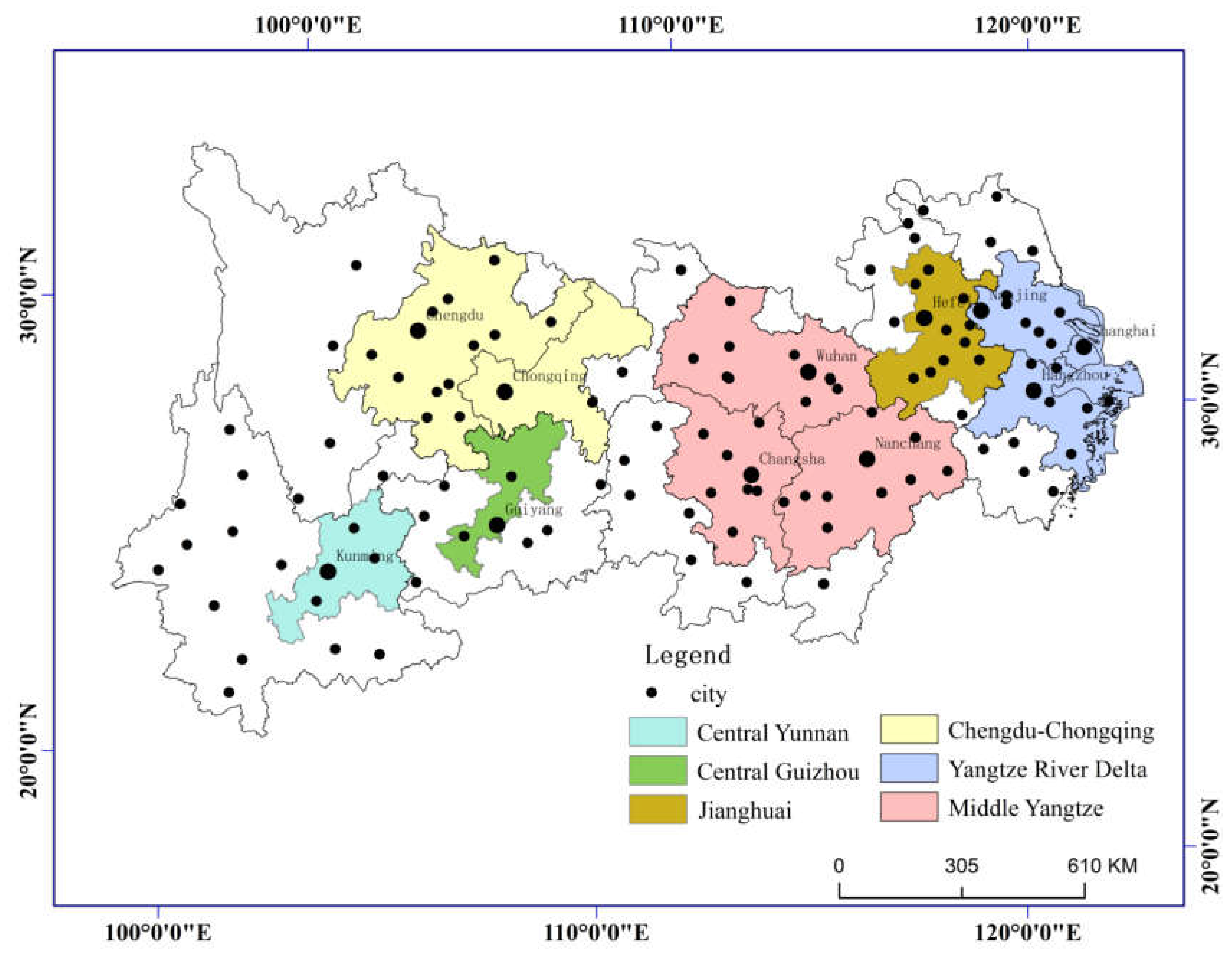
Figure 2.
Urban water system structure.
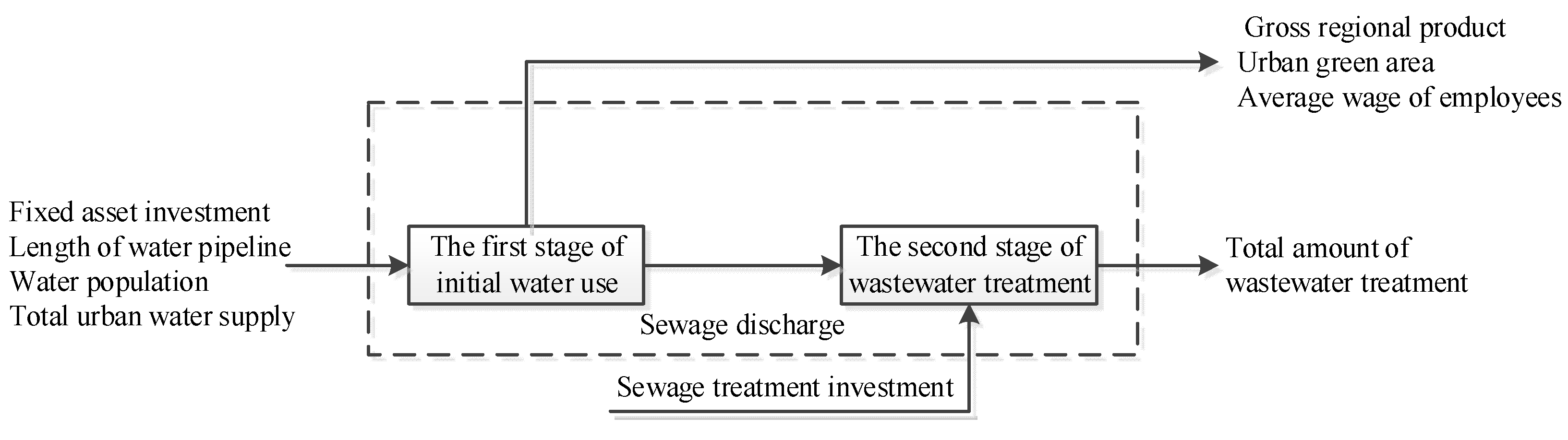
Figure 3.
Urban water use efficiency evolution from 2009 to 2019.
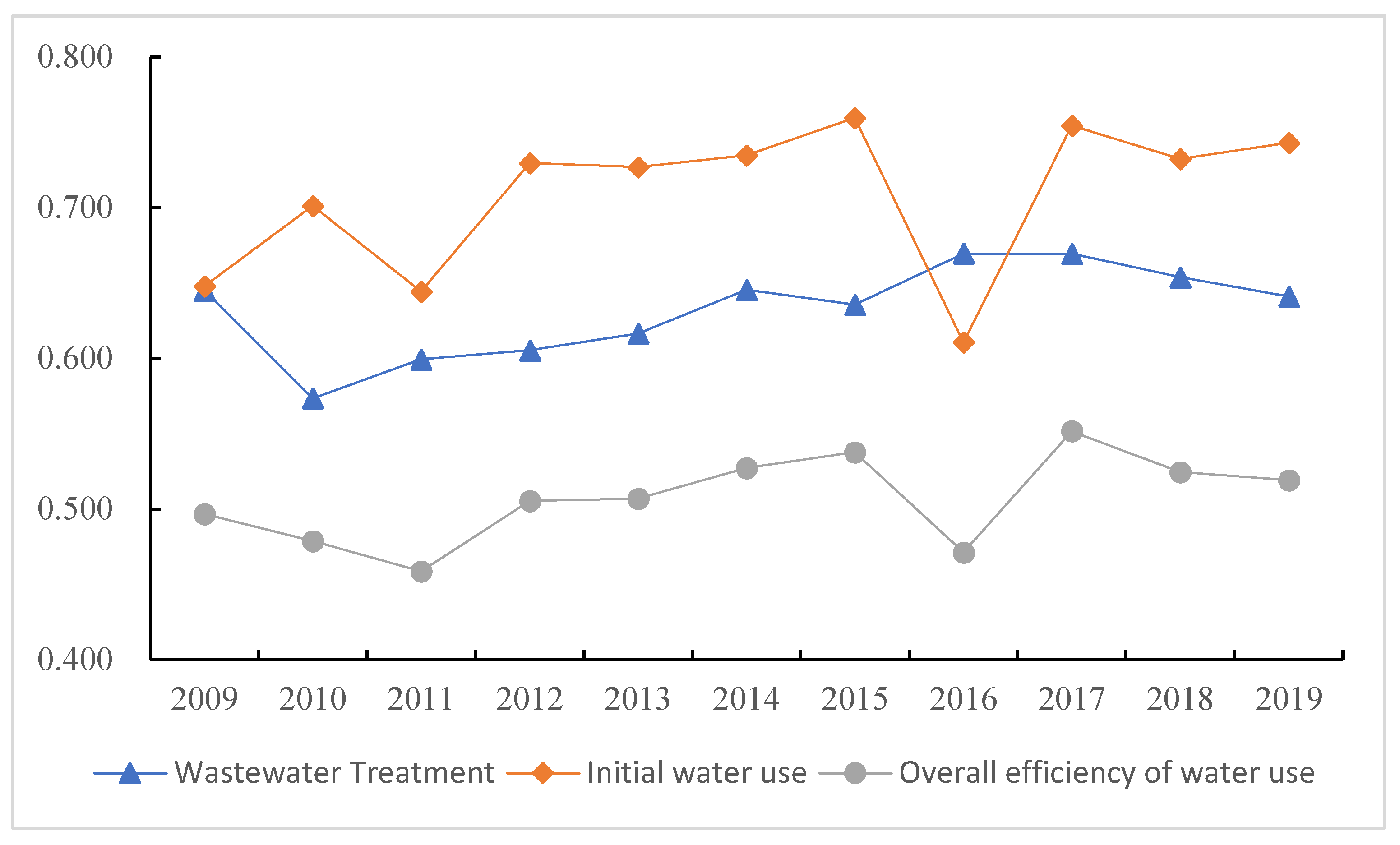
Figure 4.
Classification of urban water efficiency types.
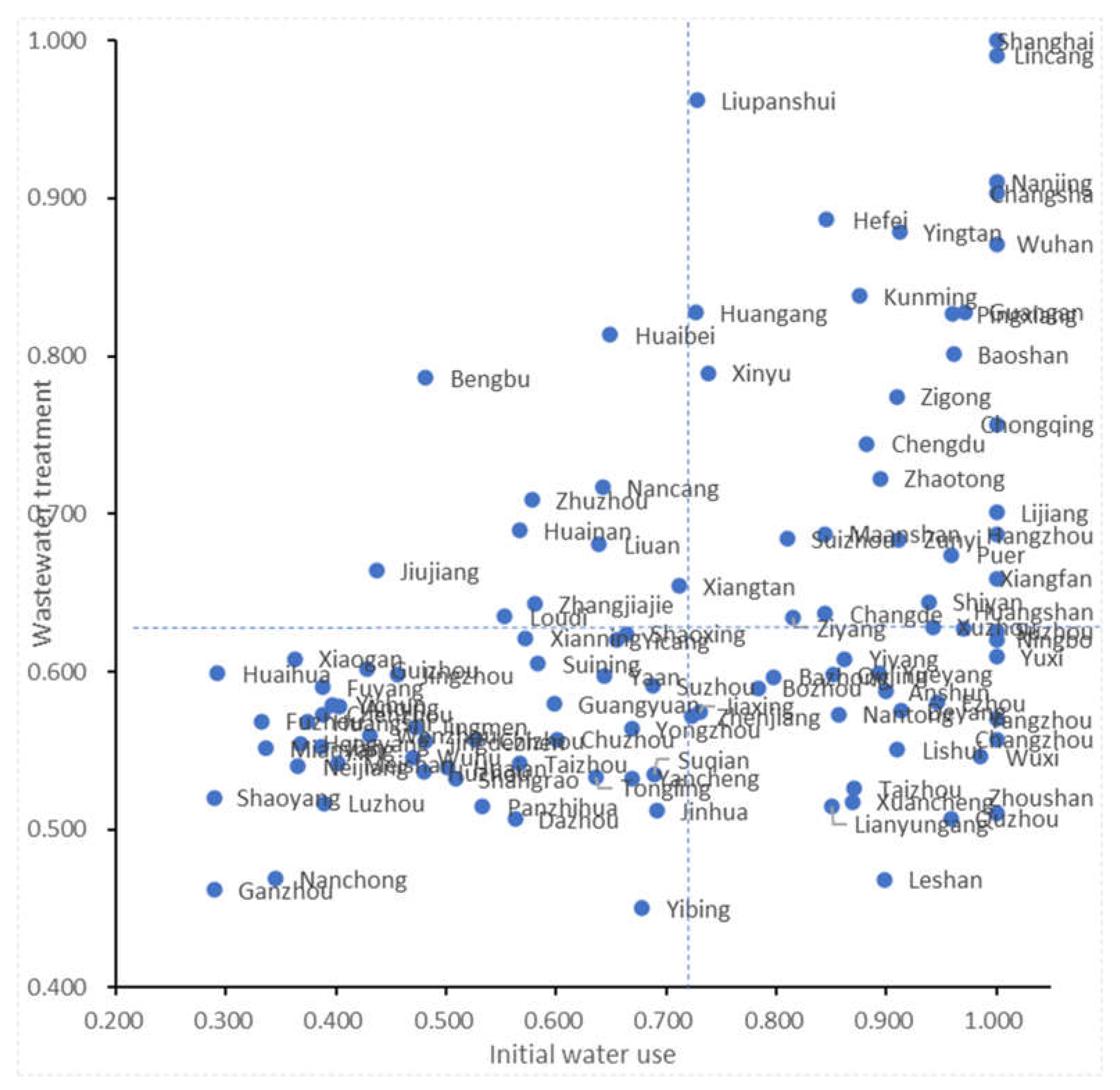
Figure 5.
Intra-regional variation in water use efficiency. Note: 1. Yangtze River Delta City Cluster, 2. Jianghuai City Cluster, 3. Middle Yangtze River City
Cluster, 4. Chengdu-Chongqing City Cluster, 5. Central Guizhou City Cluster, 6. Central Yunnan
City Cluster.
Figure 5.
Intra-regional variation in water use efficiency. Note: 1. Yangtze River Delta City Cluster, 2. Jianghuai City Cluster, 3. Middle Yangtze River City
Cluster, 4. Chengdu-Chongqing City Cluster, 5. Central Guizhou City Cluster, 6. Central Yunnan
City Cluster.
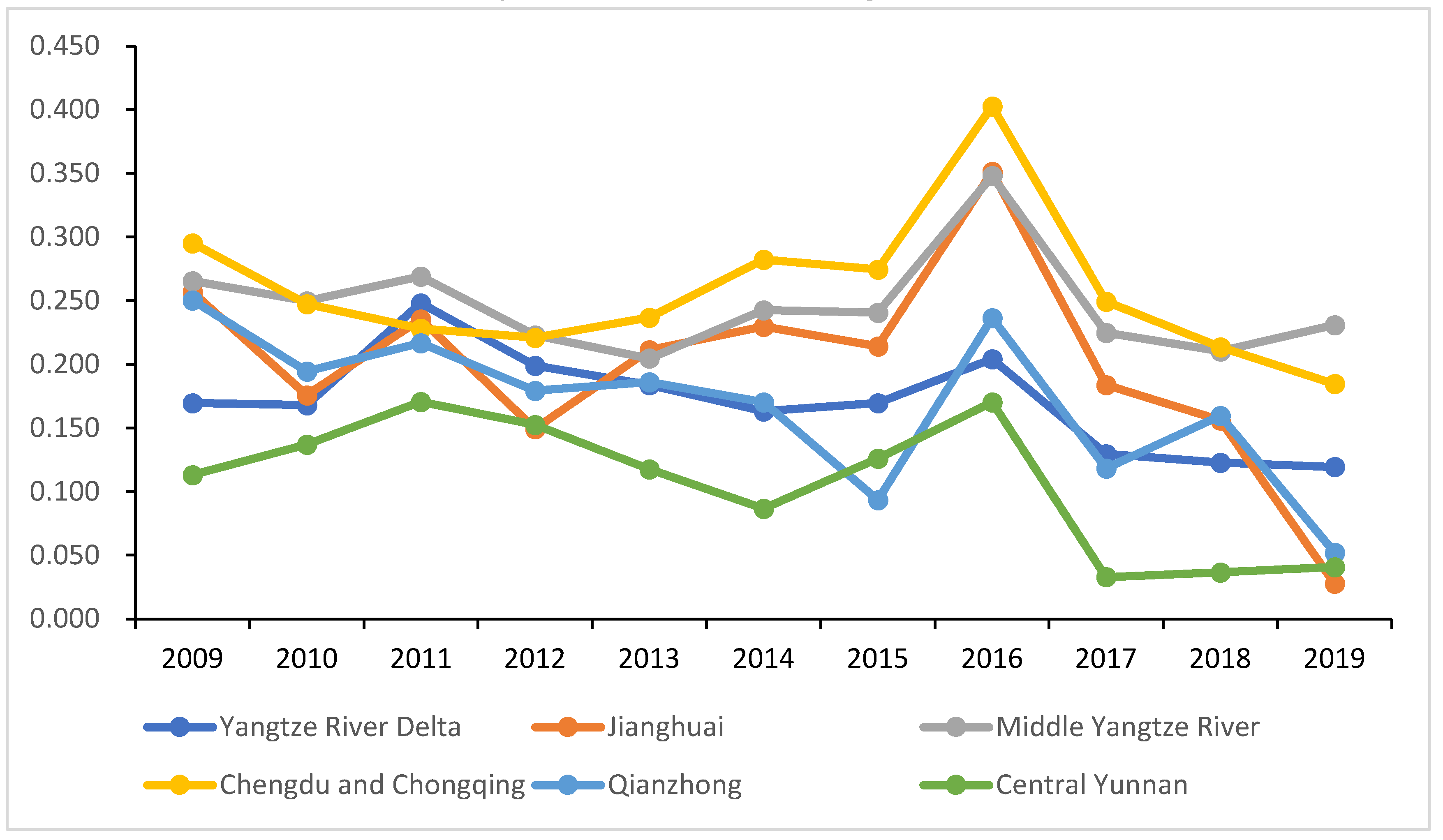
Figure 6.
Inter-regional differences in water use efficiency.
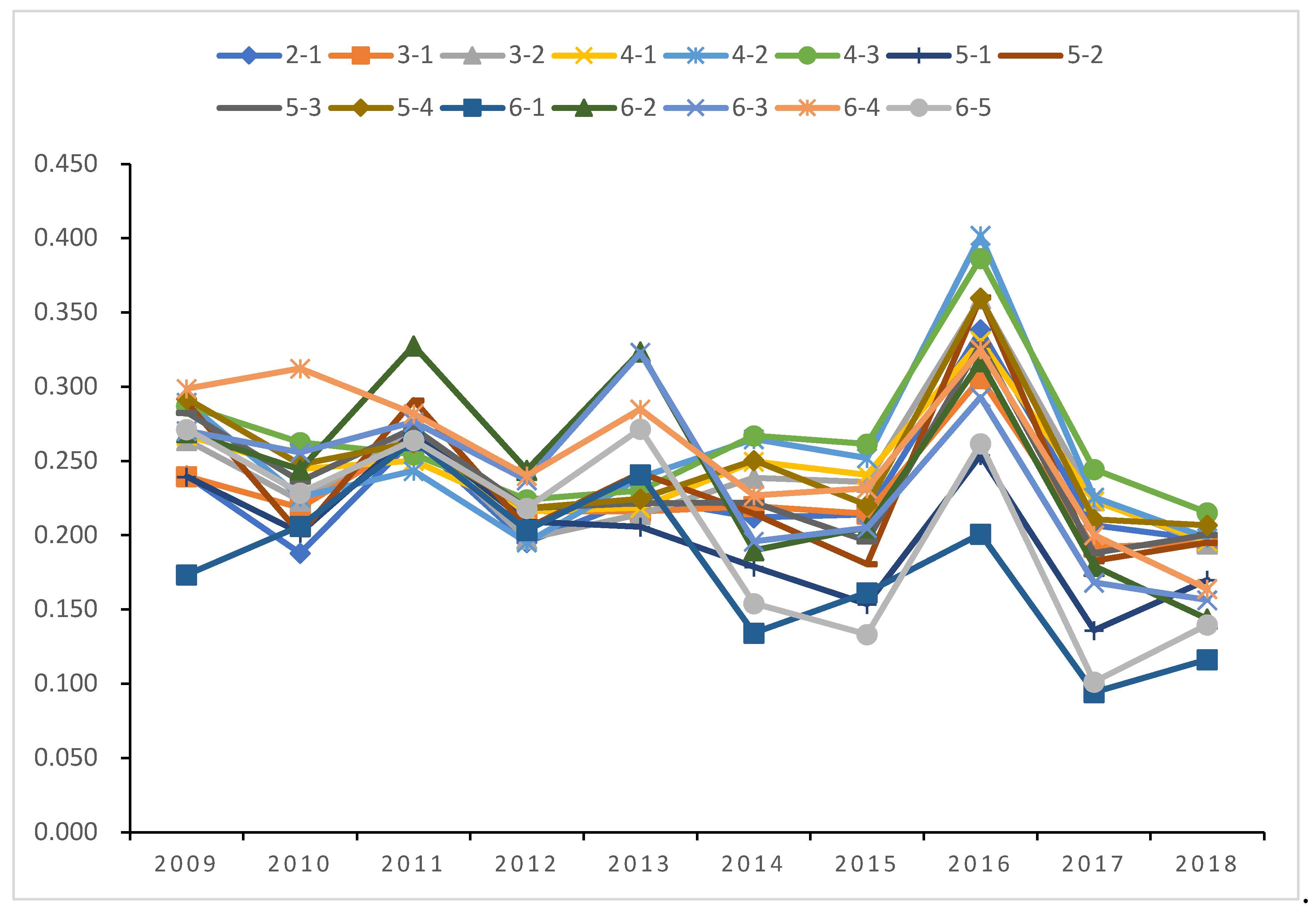
Figure 7.
Evolution of σ convergence of water use efficiency.
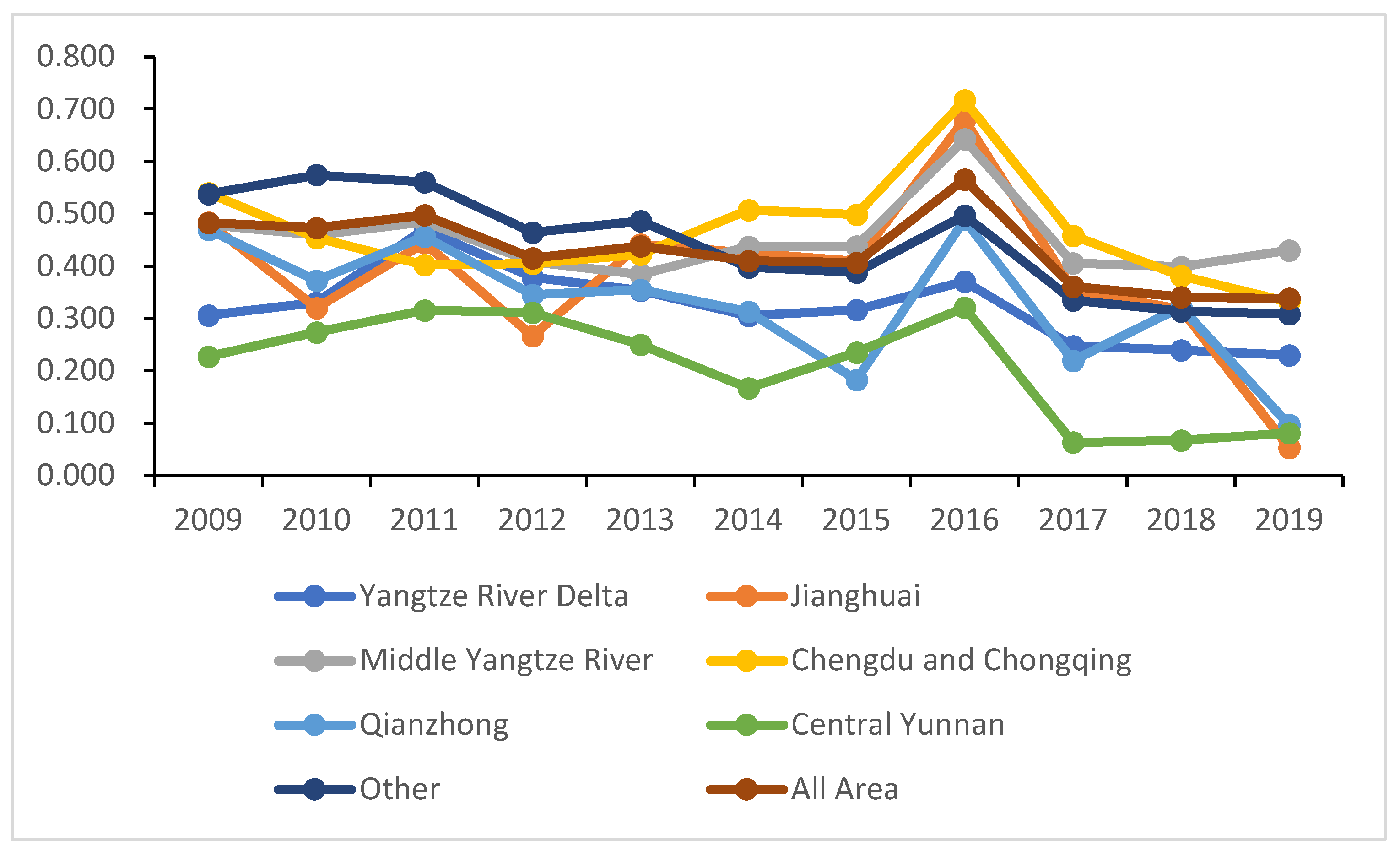

Table 1.
Average urban water use efficiency values from 2009 to 2019.
| Initial water use | Pollution control | Water use efficiency | Initial water use | Pollution control | Water use efficiency | ||||
|---|---|---|---|---|---|---|---|---|---|
| Yangtze River Delta | Shanghai | 1.000 | 1.000 | 1.000 | Chengdu and Chongqing | Chongqing | 1.000 | 0.757 | 0.760 |
| Nanjing | 1.000 | 0.910 | 0.910 | Chengdu | 0.882 | 0.744 | 0.695 | ||
| Wuxi | 0.986 | 0.546 | 0.544 | Zigong | 0.909 | 0.774 | 0.741 | ||
| Changzhou | 1.000 | 0.557 | 0.565 | Luzhou | 0.389 | 0.517 | 0.267 | ||
| Suzhou | 1.000 | 0.626 | 0.635 | Deyang | 0.913 | 0.575 | 0.553 | ||
| Nantong | 0.856 | 0.573 | 0.520 | Mianyang | 0.336 | 0.552 | 0.239 | ||
| Yangzhou | 1.000 | 0.570 | 0.580 | Suining | 0.583 | 0.605 | 0.403 | ||
| Zhenjiang | 0.724 | 0.572 | 0.452 | Neijiang | 0.365 | 0.540 | 0.269 | ||
| Taizhou | 0.871 | 0.526 | 0.485 | Leshan | 0.898 | 0.468 | 0.467 | ||
| Hangzhou | 1.000 | 0.687 | 0.692 | Nanchong | 0.344 | 0.469 | 0.223 | ||
| Ningbo | 1.000 | 0.620 | 0.639 | Meishan | 0.402 | 0.542 | 0.277 | ||
| Jiaxing | 0.730 | 0.575 | 0.464 | Yibin | 0.678 | 0.450 | 0.377 | ||
| Huzhou | 0.479 | 0.536 | 0.299 | Guang'an | 0.971 | 0.828 | 0.813 | ||
| Introduction | 0.664 | 0.624 | 0.479 | Dazhou | 0.563 | 0.507 | 0.408 | ||
| Zhoushan | 1.000 | 0.511 | 0.533 | Ya'an | 0.644 | 0.597 | 0.471 | ||
| Taizhou | 0.567 | 0.542 | 0.356 | Ziyang | 0.815 | 0.634 | 0.552 | ||
| Average value | 0.867 | 0.623 | 0.572 | Average value | 0.668 | 0.597 | 0.470 | ||
| Jianghuai | Hefei | 0.846 | 0.887 | 0.798 | Central Guizhou | Guiyang | 0.428 | 0.602 | 0.330 |
| Wuhu | 0.469 | 0.546 | 0.309 | Zunyi | 0.911 | 0.684 | 0.673 | ||
| Bengbu | 0.481 | 0.786 | 0.482 | Anshun | 0.899 | 0.588 | 0.552 | ||
| Huainan | 0.566 | 0.690 | 0.452 | Average value | 0.746 | 0.625 | 0.518 | ||
| Ma On Shan | 0.844 | 0.687 | 0.612 | Central Yunnan | Kunming | 0.875 | 0.838 | 0.771 | |
| Tongling | 0.636 | 0.533 | 0.384 | Qujing | 0.852 | 0.598 | 0.544 | ||
| Anqing | 0.403 | 0.578 | 0.291 | Yuxi | 1.000 | 0.609 | 0.620 | ||
| Chuzhou | 0.600 | 0.557 | 0.378 | Average value | 0.909 | 0.682 | 0.645 | ||
| Chizhou | 0.526 | 0.557 | 0.347 | Non-urbancluster area | Baoshan | 0.961 | 0.801 | 0.796 | |
| Xuancheng | 0.869 | 0.518 | 0.472 | Zhaotong | 0.894 | 0.723 | 0.691 | ||
| Average value | 0.624 | 0.634 | 0.453 | Lijiang | 1.000 | 0.701 | 0.719 | ||
| Middle Yangtze River | Nanchang | 0.642 | 0.717 | 0.557 | Pu'er | 0.959 | 0.674 | 0.702 | |
| Jingdezhen | 0.481 | 0.556 | 0.349 | Lincang | 1.000 | 0.991 | 0.994 | ||
| Pingxiang | 0.960 | 0.826 | 0.814 | Xuzhou | 0.943 | 0.629 | 0.618 | ||
| Jiujiang | 0.436 | 0.664 | 0.356 | Lianyungang | 0.850 | 0.515 | 0.472 | ||
| Xinyu | 0.738 | 0.789 | 0.649 | Huai'an | 0.501 | 0.539 | 0.331 | ||
| Yingtan | 0.912 | 0.879 | 0.841 | Yancheng | 0.669 | 0.532 | 0.395 | ||
| Ji'an | 0.386 | 0.552 | 0.273 | Suqian | 0.689 | 0.535 | 0.400 | ||
| Yichun | 0.396 | 0.579 | 0.285 | Wenzhou | 0.431 | 0.560 | 0.319 | ||
| Fuzhou | 0.332 | 0.569 | 0.248 | Jinhua | 0.691 | 0.512 | 0.395 | ||
| Shangrao | 0.508 | 0.532 | 0.325 | Quzhou | 0.959 | 0.507 | 0.512 | ||
| Wuhan | 1.000 | 0.871 | 0.874 | Lishui | 0.910 | 0.550 | 0.526 | ||
| Huangshi | 0.374 | 0.568 | 0.278 | Huaibei | 0.648 | 0.814 | 0.606 | ||
| Yichang | 0.655 | 0.620 | 0.457 | Huangshan | 0.970 | 0.628 | 0.619 | ||
| Xiangfan | 1.000 | 0.659 | 0.676 | Fuyang | 0.388 | 0.590 | 0.298 | ||
| Ezhou | 0.946 | 0.580 | 0.567 | Cebu | 0.688 | 0.591 | 0.484 | ||
| Jingmen | 0.473 | 0.565 | 0.331 | Lu'an | 0.639 | 0.681 | 0.498 | ||
| Xiaogan | 0.362 | 0.608 | 0.285 | Bozhou | 0.783 | 0.590 | 0.482 | ||
| Jingzhou | 0.455 | 0.598 | 0.348 | Ganzhou | 0.290 | 0.462 | 0.199 | ||
| Huanggang | 0.726 | 0.828 | 0.653 | Shiyan | 0.938 | 0.644 | 0.644 | ||
| Xianning | 0.572 | 0.621 | 0.435 | Suizhou | 0.810 | 0.684 | 0.591 | ||
| Changsha | 1.000 | 0.903 | 0.909 | Shaoyang | 0.289 | 0.520 | 0.230 | ||
| Zhuzhou | 0.578 | 0.709 | 0.498 | Zhangjiajie | 0.581 | 0.643 | 0.477 | ||
| Xiangtan | 0.712 | 0.654 | 0.538 | Chenzhou | 0.388 | 0.573 | 0.292 | ||
| Hengyang | 0.367 | 0.554 | 0.302 | Yongzhou | 0.669 | 0.564 | 0.468 | ||
| Yueyang | 0.893 | 0.599 | 0.573 | Huaihua | 0.292 | 0.599 | 0.251 | ||
| Changde | 0.845 | 0.637 | 0.578 | Panzhihua | 0.533 | 0.515 | 0.387 | ||
| Yiyang | 0.862 | 0.608 | 0.570 | Guangyuan | 0.598 | 0.580 | 0.413 | ||
| Loudi | 0.553 | 0.635 | 0.429 | Bazhong | 0.798 | 0.597 | 0.534 | ||
| Average value | 0.649 | 0.660 | 0.500 | Liupanshui | 0.727 | 0.962 | 0.731 | ||
| Overall mean value | 0.708 | 0.632 | 0.507 |
Table 2.
Decomposition of the Gini coefficient of urban water use efficiency.
| Years | Overall differences | Intra-regional variation | Inter-regional differences | Super variable density | Contribution rates (%) | ||
|---|---|---|---|---|---|---|---|
| In the region | Inter-regional | Super variable density | |||||
| 2009 | 0.271 | 0.054 | 0.059 | 0.158 | 19.89 | 21.96 | 58.15 |
| 2010 | 0.259 | 0.055 | 0.049 | 0.156 | 21.06 | 18.89 | 60.05 |
| 2011 | 0.276 | 0.057 | 0.047 | 0.172 | 20.72 | 17.01 | 62.27 |
| 2012 | 0.228 | 0.048 | 0.035 | 0.145 | 21.10 | 15.45 | 63.45 |
| 2013 | 0.238 | 0.047 | 0.055 | 0.136 | 19.80 | 23.21 | 56.99 |
| 2014 | 0.230 | 0.047 | 0.039 | 0.144 | 20.23 | 16.98 | 62.78 |
| 2015 | 0.224 | 0.046 | 0.033 | 0.145 | 20.64 | 14.58 | 64.78 |
| 2016 | 0.320 | 0.063 | 0.060 | 0.197 | 19.83 | 18.70 | 61.48 |
| 2017 | 0.203 | 0.042 | 0.038 | 0.123 | 20.63 | 18.96 | 60.41 |
| 2018 | 0.188 | 0.038 | 0.044 | 0.106 | 20.25 | 23.40 | 56.35 |
| 2019 | 0.184 | 0.038 | 0.057 | 0.089 | 20.50 | 30.92 | 48.58 |
| Average value | 0.238 | 0.049 | 0.047 | 0.143 | 20.42 | 20.01 | 59.57 |
Table 3.
Absolute β convergence of water use efficiency.
| Variables | All Areas | Yangtze River Delta | Jianghuai | Middle Yangtze River | Chengdu–Chongqing | Central Guizhou | Central Yunnan | Others |
|---|---|---|---|---|---|---|---|---|
| β | −0.736*** (−21.560) |
−0.607*** (−4.790) |
−0.846*** (−4.840) |
−0.769*** (−13.330) |
−0.862*** (−12.420) |
−0.450 (−1.570) |
−0.872*** (−15.780) |
−0.673*** (−10.850) |
| Constant term | −0.630*** (−19.690) |
−0.476*** (−7.900) |
−0.728*** (−4.510) |
−0.638*** (−9.790) |
−0.880*** (−13.420) |
−0.296 (−1.050) |
−0.321 (−2.690) |
−0.597*** (−9.220) |
| R2 | 0.214 | 0.178 | 0.373 | 0.234 | 0.232 | 0.322 | 0.481 | 0.220 |
| Convergence speed | 12.12% | 8.49% | 17.01% | 13.32% | 17.99% | / | 18.71% | 10.16% |
Note: t-statistical parameters; t-values in parentheses; “*” indicates significance at the 10% level; “**” indicates significance at the 5% level; “***” indicates significance at the 1% level; “/” indicates null.
Table 4.
Water use efficiency condition β convergence.
| Variables | All Areas | Yangtze River Delta | Jianghuai | Middle Yangtze River | Chengdu–Chongqing | Central Guizhou | Central Yunnan | Others |
|---|---|---|---|---|---|---|---|---|
| β | −0.775***(−25.710) | -0.745***(−9.890) | −0.946***(−8.750) | -0.863***(−13.940) | -0.939***(−12.310) | -0.851***(−3.920) | -1.065***(−4.020) | -0.699***(−12.790) |
| Industry Structure | −0.005***(-3.070) | -0.012***(−3.060) | 0.008(1.310) | -0.013***(−3.660) | 0.000(−0.030) | 0.070**(2.190) | 0.019(1.600) | −0.004(−1.030) |
| Level of financial development | −0.054***(-6.410) | -0.135***(−5.160) | −0.022(−0.210) | −0.025(−0.510) | -0.064***(−6.410) | 0.067(0.820) | −0.056(−1.110) | −0.014(−0.480) |
| Environmental regulation | −0.003(0.004) | −0.002(−0.270) | −0.005(−0.370) | 0.021***(3.090) | −0.014(−1.160) | 0.071*(1.930) | −0.078*(−1.820) | −0.009(−1.370) |
| Population density | 0.000(−0.260) | 0.000(1.090) | 0.000(−0.900) | 0.000(−0.060) | 0.000(−0.820) | 0.000(−0.730) | 0.000(−0.720) | 0.000(0.350) |
| Economic development level | 0.000(−0.070) | 0.000(−1.030) | 0.000(−0.130) | 0.000(−0.620) | 0.000(1.410) | 0.001**(2.100) | 0.000(−0.080) | 0.000(1.280) |
| Science and education development level | 0.556*(1.930) | −0.938(−1.240) | 1.063(1.070) | 0.948*(1.660) | 0.982(1.250) | 3.607(1.130) | 1.488(0.640) | 0.350(0.680) |
| Constant term | −0.268**(−2.450) | 0.778***(2.930) | −1.316**(−2.170) | −0.145(−0.500) | −0.745**(−2.540) | -4.703**(−2.650) | −1.311*(−1.740) | −0.435(−1.570) |
| R2 | 0.169 | 0.090 | 0.250 | 0.145 | 0.240 | 0.310 | 0.059 | 0.161 |
Note: t-statistical parameters; t-values in parentheses; “*” indicates significance at the 10% level; “**” indicates significance at the 5% level; “***” indicates significance at the 1% level.
Disclaimer/Publisher’s Note: The statements, opinions and data contained in all publications are solely those of the individual author(s) and contributor(s) and not of MDPI and/or the editor(s). MDPI and/or the editor(s) disclaim responsibility for any injury to people or property resulting from any ideas, methods, instructions or products referred to in the content. |
© 2023 by the authors. Licensee MDPI, Basel, Switzerland. This article is an open access article distributed under the terms and conditions of the Creative Commons Attribution (CC BY) license (http://creativecommons.org/licenses/by/4.0/).
Copyright: This open access article is published under a Creative Commons CC BY 4.0 license, which permit the free download, distribution, and reuse, provided that the author and preprint are cited in any reuse.


